<?xml version="1.0" encoding="ISO-8859-1"?><article xmlns:mml="http://www.w3.org/1998/Math/MathML" xmlns:xlink="http://www.w3.org/1999/xlink" xmlns:xsi="http://www.w3.org/2001/XMLSchema-instance">
<front>
<journal-meta>
<journal-id>0212-1611</journal-id>
<journal-title><![CDATA[Nutrición Hospitalaria]]></journal-title>
<abbrev-journal-title><![CDATA[Nutr. Hosp.]]></abbrev-journal-title>
<issn>0212-1611</issn>
<publisher>
<publisher-name><![CDATA[Grupo Arán]]></publisher-name>
</publisher>
</journal-meta>
<article-meta>
<article-id>S0212-16112013000100019</article-id>
<article-id pub-id-type="doi">10.3305/nh.2013.28.1.6152</article-id>
<title-group>
<article-title xml:lang="en"><![CDATA[Basal Energy Expenditure measured by indirect calorimetry in patients with squamous cell carcinoma of the esophagus]]></article-title>
<article-title xml:lang="es"><![CDATA[El gasto energético basal medido por calorimetría indirecta en pacientes con carcinoma de células escamosas del esófago]]></article-title>
</title-group>
<contrib-group>
<contrib contrib-type="author">
<name>
<surname><![CDATA[Becker Veronese]]></surname>
<given-names><![CDATA[Camila Beltrame]]></given-names>
</name>
<xref ref-type="aff" rid="A01"/>
</contrib>
<contrib contrib-type="author">
<name>
<surname><![CDATA[Guerra]]></surname>
<given-names><![CDATA[Léa Teresinha]]></given-names>
</name>
<xref ref-type="aff" rid="A01"/>
<xref ref-type="aff" rid="A02"/>
</contrib>
<contrib contrib-type="author">
<name>
<surname><![CDATA[Souza Grigolleti]]></surname>
<given-names><![CDATA[Shana]]></given-names>
</name>
<xref ref-type="aff" rid="A01"/>
</contrib>
<contrib contrib-type="author">
<name>
<surname><![CDATA[Vargas]]></surname>
<given-names><![CDATA[Juliane]]></given-names>
</name>
<xref ref-type="aff" rid="A01"/>
<xref ref-type="aff" rid="A02"/>
</contrib>
<contrib contrib-type="author">
<name>
<surname><![CDATA[Pereira da Rosa]]></surname>
<given-names><![CDATA[André Ricardo]]></given-names>
</name>
<xref ref-type="aff" rid="A01"/>
</contrib>
<contrib contrib-type="author">
<name>
<surname><![CDATA[Pinto Kruel]]></surname>
<given-names><![CDATA[Cleber Dario]]></given-names>
</name>
<xref ref-type="aff" rid="A03"/>
</contrib>
</contrib-group>
<aff id="A01">
<institution><![CDATA[,Universidade Federal do Rio Grande do Sul (UFRGS)  ]]></institution>
<addr-line><![CDATA[ ]]></addr-line>
</aff>
<aff id="A02">
<institution><![CDATA[,Hospital de Clínicas de Porto Alegre (HCPA)  ]]></institution>
<addr-line><![CDATA[ ]]></addr-line>
</aff>
<aff id="A03">
<institution><![CDATA[,Universidade Federal do Rio Grande do Sul (UFRGS) Faculdade de Medicina (FAMED) ]]></institution>
<addr-line><![CDATA[ ]]></addr-line>
</aff>
<pub-date pub-type="pub">
<day>00</day>
<month>02</month>
<year>2013</year>
</pub-date>
<pub-date pub-type="epub">
<day>00</day>
<month>02</month>
<year>2013</year>
</pub-date>
<volume>28</volume>
<numero>1</numero>
<fpage>142</fpage>
<lpage>147</lpage>
<copyright-statement/>
<copyright-year/>
<self-uri xlink:href="http://scielo.isciii.es/scielo.php?script=sci_arttext&amp;pid=S0212-16112013000100019&amp;lng=en&amp;nrm=iso"></self-uri><self-uri xlink:href="http://scielo.isciii.es/scielo.php?script=sci_abstract&amp;pid=S0212-16112013000100019&amp;lng=en&amp;nrm=iso"></self-uri><self-uri xlink:href="http://scielo.isciii.es/scielo.php?script=sci_pdf&amp;pid=S0212-16112013000100019&amp;lng=en&amp;nrm=iso"></self-uri><abstract abstract-type="short" xml:lang="en"><p><![CDATA[Background: Determination of Basal Energy Expenditure (BEE) is essential for planning nutritional therapy in patients with esophageal cancer. Aims: The objective of this study was to determine BEE through indirect calorimetry (IC) in patients with squamous cell carcinoma of the esophagus (SCC). Methods: Cross-sectional study involving 30 patients admitted with a diagnosis of SCC who underwent IC before starting cancer therapy. The BEE was evaluated using IC and also estimated by means of the Harris-Benedict Equation (HBE). Nutritional assessment was conducted using anthropometric parameters (body mass index, arm circumference, triceps skinfold thickness, arm muscle circumference, and weight loss), biochemical parameters (albumin, transferrin and C-reactive protein) and tetrapolar bioimpedance to assess body composition (fat free mass). Additionally, lung capacity was measured and clinical staging of the cancer established by the TNM method. Results: The mean of the BEE for IC and Harris-Benedict Equation were 1421.8 ± 348.2 kcal/day and 1310.6 ± 215.1 kcal/day, respectively. No association was found between BEE measured by IC and clinical staging (p=0.255) or the Tiffeneau Index (p=0.946). There were no significant associations between BEE measured by IC and altered dosages of transferrin, albumin and C-reactive protein (p=0.364, 0.309 and 0.780 respectively). The factors most associated with BEE were BMI and fat free mass. Conclusion: The BEE of patients with SCC was underestimated when using the HBE, and the result overestimated when incorporating an injury factor with the HBE. Therefore, despite the practical difficulties of implementing IC, its use should be considered.]]></p></abstract>
<abstract abstract-type="short" xml:lang="es"><p><![CDATA[Antecedentes: La determinación del gasto energético basal (GEB) es esencial para la planificación de la terapia nutricional en pacientes con cáncer de esófago. Objetivos: El objetivo de este estudio fue determinar GEB por calorimetría indirecta (CI) en pacientes con carcinoma de células escamosas del esófago (CCS). Métodos: Estudio transversal con 30 pacientes ingresados con el diagnóstico de CCS que se sometieron CI antes de iniciar la terapia contra el cáncer. La abeja se evaluó con CI y estimó por medio de la ecuación de Harris-Benedict (EHB). La evaluación nutricional se realizó utilizando los parámetros antropométricos (índice de masa corporal, circunferencia del brazo, el pliegue del tríceps, circunferencia muscular del brazo y pérdida de peso), parámetros bioquímicos (albúmina, transferrina y la proteína C-reactiva) y bioimpedancia tetrapolar para evaluar la composición corporal (grasa masa). Además, la capacidad pulmonar se midió y la estadificación clínica del cáncer establecido por el método TNM. Resultados: La media de la abeja para la ecuación CI y Harris-Benedict fueron 1421,8 ± 348,2 kcal / día y 1310,6 ± 215,1 kcal / día, respectivamente. No se encontró asociación entre GEB medido por CI y la estadificación clínica (p = 0,255) o el Índice Tiffeneau (p = 0,946). No se encontraron asociaciones significativas entre GEB medidos por dosis de CI y alteración de la transferrina, albúmina y proteína C reactiva (p = 0,364, 0,309 y 0,780, respectivamente). Los factores más asociados con GEB fueron el IMC y la masa libre de grasa. Conclusión: La abeja de los pacientes con CCS fue subestimada cuando se utiliza el EHB, y el resultado sobreestimado cuando se incorpora un factor de daño con el EHB. Por lo tanto, a pesar de las dificultades de aplicación práctica de CI, su uso debe ser considerado.]]></p></abstract>
<kwd-group>
<kwd lng="en"><![CDATA[Esophageal cancer]]></kwd>
<kwd lng="en"><![CDATA[Indirect calorimetry]]></kwd>
<kwd lng="en"><![CDATA[Basal energy expenditure]]></kwd>
<kwd lng="es"><![CDATA[Cáncer de esófago]]></kwd>
<kwd lng="es"><![CDATA[Calorimetría indirecta]]></kwd>
<kwd lng="es"><![CDATA[El gasto energético basal]]></kwd>
</kwd-group>
</article-meta>
</front><body><![CDATA[ <p><font face="Verdana" size="2"><a name="top"></a><b>ORIGINAL</b></font></p>     <p>&nbsp;</p>     <p><font face="Verdana" size="4"><b>Basal Energy Expenditure measured by indirect calorimetry in patients with squamous cell carcinoma of the esophagus</b></font></p>     <p><font face="Verdana" size="4"><b>El gasto energético basal medido por calorimetría indirecta en pacientes con carcinoma de células escamosas del esófago</b></font></p>     <p>&nbsp;</p>     <p>&nbsp;</p>     <p><font face="Verdana" size="2"><b>Camila Beltrame Becker Veronese<sup>1</sup>, Léa Teresinha Guerra<sup>2</sup>, Shana Souza Grigolleti<sup>3</sup>, Juliane Vargas<sup>4</sup>, André Ricardo Pereira da Rosa<sup>5</sup> and Cleber Dario Pinto Kruel<sup>6</sup></b></font></p>     <p><font face="Verdana" size="2"><sup>1</sup>MSc in Gastroenterology and Hepatology - UFRGS.    <br><sup>2</sup>MSc in Gastroenterology and Hepatology - HCPA, UFRGS.    <br><sup>3</sup>MSc in Cardiology - UFRGS.    ]]></body>
<body><![CDATA[<br><sup>4</sup>Graduate in Medicine - HCPA, UFRGS.    <br><sup>5</sup>Doctor in Surgery - UFRGS.    <br><sup>6</sup>PhD in Surgery - FAMED, UFRGS</font></p>     <p><font face="Verdana" size="2">The authors would like to acknowledge the Research Incentive Fund of the Hospital de Clinicas de Porto Alegre, the financial incentive.</font></p>     <p><font face="Verdana" size="2"><a href="#back">Correspondence</a></font></p>     <p>&nbsp;</p>     <p>&nbsp;</p> <hr size="1">     <p><font face="Verdana" size="2"><b>ABSTRACT</b></font></p>     <p><font face="Verdana" size="2"><b>Background:</b> Determination of Basal Energy Expenditure (BEE) is essential for planning nutritional therapy in patients with esophageal cancer. Aims: The objective of this study was to determine BEE through indirect calorimetry (IC) in patients with squamous cell carcinoma of the esophagus (SCC).    <br><b>Methods:</b> Cross-sectional study involving 30 patients admitted with a diagnosis of SCC who underwent IC before starting cancer therapy. The BEE was evaluated using IC and also estimated by means of the Harris-Benedict Equation (HBE). Nutritional assessment was conducted using anthropometric parameters (body mass index, arm circumference, triceps skinfold thickness, arm muscle circumference, and weight loss), biochemical parameters (albumin, transferrin and C-reactive protein) and tetrapolar bioimpedance to assess body composition (fat free mass). Additionally, lung capacity was measured and clinical staging of the cancer established by the TNM method.    ]]></body>
<body><![CDATA[<br><b>Results:</b> The mean of the BEE for IC and Harris-Benedict Equation were 1421.8 &plusmn; 348.2 kcal/day and 1310.6 &plusmn; 215.1 kcal/day, respectively. No association was found between BEE measured by IC and clinical staging (p=0.255) or the Tiffeneau Index (p=0.946). There were no significant associations between BEE measured by IC and altered dosages of transferrin, albumin and C-reactive protein (p=0.364, 0.309 and 0.780 respectively). The factors most associated with BEE were BMI and fat free mass.    <br><b>Conclusion:</b> The BEE of patients with SCC was underestimated when using the HBE, and the result overestimated when incorporating an injury factor with the HBE. Therefore, despite the practical difficulties of implementing IC, its use should be considered.</font></p>     <p><font face="Verdana" size="2"><b>Key words:</b> Esophageal cancer. Indirect calorimetry. Basal energy expenditure.</font></p> <hr size="1">     <p><font face="Verdana" size="2"><b>RESUMEN</b></font></p>     <p><font face="Verdana" size="2"><b>Antecedentes:</b> La determinación del gasto energético basal (GEB) es esencial para la planificación de la terapia nutricional en pacientes con cáncer de esófago.    <br><b>Objetivos:</b> El objetivo de este estudio fue determinar GEB por calorimetría indirecta (CI) en pacientes con carcinoma de células escamosas del esófago (CCS).    <br><b>Métodos:</b> Estudio transversal con 30 pacientes ingresados con el diagnóstico de CCS que se sometieron CI antes de iniciar la terapia contra el cáncer. La abeja se evaluó con CI y estimó por medio de la ecuación de Harris-Benedict (EHB). La evaluación nutricional se realizó utilizando los parámetros antropométricos (índice de masa corporal, circunferencia del brazo, el pliegue del tríceps, circunferencia muscular del brazo y pérdida de peso), parámetros bioquímicos (albúmina, transferrina y la proteína C-reactiva) y bioimpedancia tetrapolar para evaluar la composición corporal (grasa masa). Además, la capacidad pulmonar se midió y la estadificación clínica del cáncer establecido por el método TNM.    <br><b>Resultados:</b> La media de la abeja para la ecuación CI y Harris-Benedict fueron 1421,8 &plusmn; 348,2 kcal / día y 1310,6 &plusmn; 215,1 kcal / día, respectivamente. No se encontró asociación entre GEB medido por CI y la estadificación clínica (p = 0,255) o el Índice Tiffeneau (p = 0,946). No se encontraron asociaciones significativas entre GEB medidos por dosis de CI y alteración de la transferrina, albúmina y proteína C reactiva (p = 0,364, 0,309 y 0,780, respectivamente). Los factores más asociados con GEB fueron el IMC y la masa libre de grasa.    <br><b>Conclusión:</b> La abeja de los pacientes con CCS fue subestimada cuando se utiliza el EHB, y el resultado sobreestimado cuando se incorpora un factor de daño con el EHB. Por lo tanto, a pesar de las dificultades de aplicación práctica de CI, su uso debe ser considerado.</font></p>     <p><font face="Verdana" size="2"><b>Palabras clave:</b> Cáncer de esófago. Calorimetría indirecta. El gasto energético basal.</font></p> <hr size="1">     ]]></body>
<body><![CDATA[<p><font face="Verdana" size="2"><b>Abbreviations</b>    <br>BEE: Basal Energy expenditure.    <br>IC: Indirect Calorimetry.    <br>HBE: Equaçâo de Harris-Benedict.    <br>SCC: Squamous cell carcinoma.    <br>BMI: Body Mass Index.    <br>CRP: C-reactive protein.    <br>FFM: Fat Free Mass.</font></p>     <p>&nbsp;</p>     <p><font face="Verdana" size="2"><b>Introduction</b></font></p>     ]]></body>
<body><![CDATA[<p><font face="Verdana" size="2">Basal Energy Expenditure (BEE) is the main contributor to total energy expenditure (60% to 75%) and corresponds to the energy expenditure over a 24 hour period used for the maintenance of vital bodily processes such as respiration, circulation, and biochemical reactions involved in the maintenance of the metabolism<sup>1</sup>.</font></p>     <p><font face="Verdana" size="2">Indirect calorimetry (IC) is a noninvasive method for determining energy needs from the gas exchanges that takes place between the body and the environment, namely, the volume of oxygen consumed (VO<sub>2</sub>), a major component of BEE, and the volume of carbon dioxide produced (VCO<sub>2</sub>). This is obtained by analysis of air inhaled and exhaled by the lungs<sup>2-3</sup>.</font></p>     <p><font face="Verdana" size="2">Prediction equations are used to establish a standard that will serve as a benchmark for the comparison of BEE in sick individuals. The Harris-Benedict Equation (HBE) is the most commonly used method to calculate BEE in clinical practice<sup>4</sup>.</font></p>     <p><font face="Verdana" size="2">Measurement of BEE in healthy individuals, and also for different groups of diseases is essential for proper planning of nutritional therapy<sup>5</sup>, with the purpose of avoiding the detrimental effects caused by both over and under eating<sup>6</sup>.</font></p>     <p><font face="Verdana" size="2">The objective of this study was to determine by IC the BEE of patients diagnosed with squamous cell carcinoma of the esophagus (SCC) and to compare these findings with other parameters that make up a nutritional assessment.</font></p>     <p>&nbsp;</p>     <p><font face="Verdana" size="2"><b>Methods</b></font></p>     <p><font face="Verdana" size="2"><i>Patients</i></font></p>     <p><font face="Verdana" size="2">The population studied consisted of 30 adult patients with a diagnosis confirmed by pathological examination of SCC, attending the group of gastrointestinal surgery, Hospital de Clinicas, Porto Alegre, from April 2009 until June 2011. The exclusion criteria were: patients previously treated with chemotherapy and/or radiotherapy and/or surgery, hypo/hyperthyroidism, chronic renal failure, diabetes mellitus, or patients with Human Immunodeficiency Virus (HIV). These criteria sought to exclude any clinical condition that might interfere with energy expenditure. The study was approved by the Research Ethics Committee of our institution and all participants signed a consent form.</font></p>     <p><font face="Verdana" size="2">Patients underwent a nutritional assessment upon admission in order to determine their nutritional status. The following measurements were recorded: body weight, height, body mass index (BMI) and percentage weight loss. Venous blood was sampled for levels of: albumin by bromocresol green colorimetry (reference value: greater than 3.5 g/dL); transferrin by immunoturbidimetry (reference values: 200 and 400mg/dL); C-reactive protein (CRP) by turbidimetry (reference values: up to 5.0 mg/L). The ADVIA<sup>&reg;</sup> 1800 chemistry analyzer (Siemens, Japan) was used. Clinical staging of the disease was determined by the TNM classification of malignant tumors<sup>7-8</sup>. Patient lung capacity was also determined through spirometry and using the Tiffeneau Index (reference value: 60% or more of the expected value).</font></p>     ]]></body>
<body><![CDATA[<p><font face="Verdana" size="2"><i>Body Composition</i></font></p>     <p><font face="Verdana" size="2">Fat free mass (FFM) was ascertained by means of bioelectrical impedance analysis using a body composition analyzer (model Bodystat<sup>&reg;</sup> 1500). Participants were instructed to fast for 8 hours prior to the procedure, and in addition, to take no part in physical activity from the day before the exam until the procedure was completed<sup>9</sup>.</font></p>     <p><font face="Verdana" size="2"><i>Basal Energy Expenditure</i></font></p>     <p><font face="Verdana" size="2">BEE was measured in a thermoneutral environment by indirect calorimetry (CORTEX Biophysik MetaLyzer<sup>&reg;</sup> 3B, Germany), after a fasting period of at least 6 hours. Patients were at rest for 30 minutes before data collection commenced. The system was calibrated in accordance with the instruction manual before each measurement. Oxygen consumption and carbon dioxide production were measured with the patient being in a supine position over a period of 25 minutes (including the initial time of 5 minutes). Measurement of the Basal Metabolic Rate (kcal/min) was obtained through the Weir equation<sup>10</sup>:</font></p>     <blockquote> 	    <p><font face="Verdana" size="2">Kcal/min = {&#091;3.9(VO<sub>2</sub>)&#093; + &#091;1.1(VCO<sub>2</sub>)&#093;}</font></p> </blockquote>     <p><font face="Verdana" size="2">The equation as described by Weir (10) uses the last 20 minutes, after having first observed an initial 5 minute resting steady state, with the mean being multiplied by 1.440 to obtain the BEE for 24 hours.</font></p>     <p><font face="Verdana" size="2"><i>Prediction Equation</i></font></p>     <p><font face="Verdana" size="2">The expected BEE was estimated using the Harris-Benedict Equation (HBE)<sup>11</sup>:</font></p>     <blockquote> 	    ]]></body>
<body><![CDATA[<p><font face="Verdana" size="2">Women: BEE: 655+(9.6xW)+(1.8xH)-(4.7xA)</font></p> 	    <p><font face="Verdana" size="2">Men: BEE: 66.5+(13.8xW)+(5xH)-(6.8xA)</font></p> </blockquote>     <p><font face="Verdana" size="2">Where W represents weight, H is height, and A is age.</font></p>     <p><font face="Verdana" size="2">An additional method for prediction was included based on recommendations for the use of an injury factor for cancer of 1.3 in combination with the HBE<sup>12</sup>.</font></p>     <p><font face="Verdana" size="2">Patients with a measured BEE of less than 90% of the predicted value were classified as hypometabolic, those between 90 and 110% as being normal metabolic, and those in excess of 110% as being hypermetabolic, as conforming with Boothby et al<sup>13</sup>.</font></p>     <p><font face="Verdana" size="2"><i>Statistical Analysis</i></font></p>     <p><font face="Verdana" size="2">Data analysis was performed using SPSS software (Statistical Package for the Social Sciences) version 18.0.</font></p>     <p><font face="Verdana" size="2">Quantitative variables were described through mean and standard deviation, except for measurement of CRP for which the median and range of variation were used. Categorical variables were described using absolute and relative frequencies.</font></p>     <p><font face="Verdana" size="2">Student's t-test for independent samples was used to compare continuous variables according to group.</font></p>     <p><font face="Verdana" size="2">Energy expenditure measured by IC was compared to values gained through estimation methods using Student's t-test for paired samples. When adjusted for FFM the analysis of covariance was applied. The Bland-Altman method was used for assessing agreement between the findings.</font></p>     ]]></body>
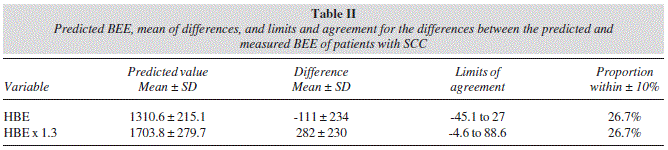
<body><![CDATA[<p><font face="Verdana" size="2">Pearson's chi-square test was applied to assess associations between categorical variables, and Pearson's correlation analysis when assessing associations between continuous variables.</font></p>     <p><font face="Verdana" size="2">The multiple linear regression model with backward elimination was used to control confounding factors. The criterion for entering a variable in the model was that it presented a p&lt;0.10 in the bivariate analysis.</font></p>     <p><font face="Verdana" size="2">The Cochran test was used to compare methods of nutritional assessment. In the case of statistical significance, the McNemar test was applied to locate the difference.</font></p>     <p><font face="Verdana" size="2">The level of statistical significance considered was 5% (p &le; 0.05).</font></p>     <p>&nbsp;</p>     <p><font face="Verdana" size="2"><b>Results</b></font></p>     <p><font face="Verdana" size="2">Thirty patients with SCC were studied, this being 21 men (70%) and 9 women (30%) with an average age of 61.4 (&plusmn; 8.6) years.</font></p>     <p><font face="Verdana" size="2">In relation to BMI, 8 patients (26.7%) were malnourished, 14 (46.7%) were of a normal weight and 8 (26.7%) were overweight.</font></p>     <p><font face="Verdana" size="2">Twenty-seven individuals (90%) lost weight and of these, 25 (83%) had a significant weight loss, resulting in a mean percentage weight loss of 13.2% (&plusmn; 8.8). Anorexia was reported by 7 (23.3%) patients.</font></p>     <p><font face="Verdana" size="2">The percentage of FFM (%FFM) among individuals was 69.6% (&plusmn; 7.7) and body fat 30.4% (&plusmn; 7.7). Dysphagia related to solid and soft foods was present in 23 (85.2%) patients and in four (14.8%) patients for liquids. Patient characteristics are described in  <a href="#t1">table I</a>.</font></p>     ]]></body>
<body><![CDATA[<p align="center"><a name="t1"><img src="/img/revistas/nh/v28n1/19_original_12_t1.gif" align="top"></a></font></p>     <p><font face="Verdana" size="2">The mean for BEE measured by IC was 1421.8 (&plusmn; 348.2) kcal/day; estimated by HBE was 1310.6 (&plusmn; 215.1) kcal/day (p=0.014); estimated by HBE with inclusion of injury factor of 1.3 for cancer was 1703.8 (&plusmn; 279.7) kcal/day (p &lt;0.001).</font></p>     <p><font face="Verdana" size="2"><a href="#f1">Figure 1</a> demonstrates the association between %FFM and BEE measured by IC. It can be seen that the higher the %FFM, the higher the BEE.</font></p>     <p align="center"><a name="f1"><img src="/img/revistas/nh/v28n1/19_original_12_f1.gif" align="top"></a></p>     <p align="center"></font></p>     <p>&nbsp;</p>     <p><font face="Verdana" size="2"><a href="#t2">Table II</a> shows the mean differences, limits of agreement, and the population proportion that is included in the acceptable limits of &plusmn; 10%.</font></p>     <p>&nbsp;</p>     <p align="center"><a name="t2"><img src="/img/revistas/nh/v28n1/19_original_12_t2.gif" align="top"></a></p>     <p align="center"></font></p>     ]]></body>
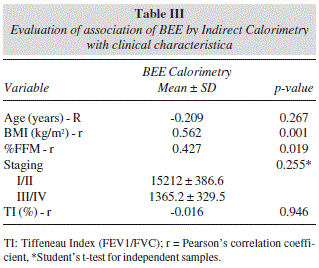
<body><![CDATA[<p>&nbsp;</p>     <p><font face="Verdana" size="2">According to the classification of Boothby et al<sup>13</sup>., 6 (20%) patients were considered hypometabolic, 7 (23.3%) normal metabolic, and 17 (56.7%) hypermetabolic.</font></p>     <p><font face="Verdana" size="2">Nutritional status determined by BMI and % weight loss was linked with BEE measured by IC. A significant difference was found in the BEE between malnourished (1181.7 &plusmn; 278.1 kcal/day) and well nourished patients (1509.1 &plusmn; 334.1 kcal/day) by BMI (p=0.020), whereas no significant differences were found using % weight loss, 1403.4 &plusmn; 369.0 kcal/day and 1514.0 &plusmn; 222.0 kcal/day respectively (p = 0.526). The BEE for patients with a lower than expected %FFM was 1408.9 &plusmn; 364.3 kcal/day, as compared to 1538.4 &plusmn; 97.5 kcal/day for patients with an adequate %FFM (p=0.550).</font></p>     <p><font face="Verdana" size="2">Associations between BEE and demographic and clinical characteristics of patients are shown in  <a href="#t3">table III</a>. No association with BEE measured by IC was found between age (p=0.267), clinical staging (p=0.255) and the Tiffeneau Index (p=0.946). There was a significant association of BEE measured by IC with BMI (p=0.001) and %FFM (p=0.019).</font></p>     <p align="center"><a name="t3"><img src="/img/revistas/nh/v28n1/19_original_12_t3.gif" align="top"></a></font></p>     <p><font face="Verdana" size="2">No significant associations were found between BEE measured by IC and the pathology tests. In relation to transferrin in malnourished patients the BEE was 1504.9 &plusmn; 273.1 kcal/day and 1380.3 &plusmn; 379.8 kcal/day for the others (p=0.364); for albumin the figures were 1667.7 &plusmn; 119.2 kcal/day and 1404.3 &plusmn; 353.4 kcal/day respectively (p=0.309). In relation to CRP in patients with altered values the BEE measured by IC was 1403.6 &plusmn; 296.8 kcal/day and 1440.1 &plusmn; 402.8 kcal/day for the others (p=0.780). The mean for albumin was 4.1 &plusmn; 0.39 g/dL and for transferrin 218.1 &plusmn; 34.9 mg/dL. The median for the 16 patients who presented alterations in CRP was 10.2 mg/L (6.6 mg/L to 123 mg/L).</font></p>     <p><font face="Verdana" size="2">A multiple linear regression analysis was performed to evaluate independent factors associated with BEE measured by IC. The variables %FFM (p=0.002) and BMI (p&lt;0.001) showed that the two factors together contributed 52.9% to BEE.</font></p>     <p>&nbsp;</p>     <p><font face="Verdana" size="2"><b>Discussion</b></font></p>     <p><font face="Verdana" size="2">Many studies in recent decades have investigated energy expenditure in cancer patients with some maintaining the idea that these patients have a high BEE which significantly contributes to the development of malnutrition<sup>14</sup>, while others have found no change<sup>15</sup>.</font></p>     ]]></body>
<body><![CDATA[<p><font face="Verdana" size="2">Our study found the mean BEE measured by IC of patients with SCC to be 1421.8 &plusmn; 348.2 kcal/day. Research by Reeves<sup>16</sup>, which looked at post-radiotherapy patients with lung and gastrointestinal tract cancers found the mean BEE measured by IC to be 1589.4 &plusmn; 89.7 kcal/day. A further study by Thomson<sup>17</sup> involving only black patients with esophageal cancer found the mean BEE measured by IC was 1484.6 &plusmn; 200.7 kcal/day.</font></p>     <p><font face="Verdana" size="2">In this study BEE was underestimated by the HBE by 111.2 kcal/day or 7.82%. The HBE was developed to evaluate the basal metabolism in healthy people, but can overestimate BEE by 5 to 15%<sup>18</sup>, and underestimate BEE in malnourished patients<sup>19</sup>. In a study by Knox<sup>20</sup> which evaluated malnourished patients with cancer (gastrointestinal and gynecological), the BEE estimated by the HBE showed no statistically significant differences when compared to the BEE as measured by IC. The difference we found of 7.82% was statistically significant but cannot be considered clinically significant, as this would happen when there was a greater or lesser difference of at least 10%<sup>11</sup>.</font></p>     <p><font face="Verdana" size="2">In order to improve the estimate of BEE by the HBE, studies have added an injury factor<sup>21</sup>. In this study the HBE with an injury factor of 1.3 overestimated the BEE by 282.4 kcal/day or 19.83%. In the study by Reeves (16), the BEE calculated by the HBE with injury factor overestimated by 373.7 kcal/day or 23.51%.</font></p>     <p><font face="Verdana" size="2">In relation to the acceptable clinical limits of agreement in terms of HBE and also HBE x 1.3, our research showed 26.7% and 26.7% of agreement, respectively. In the study by Johnson<sup>22</sup> using the HBE with a correction factor of 1.11, an agreement of 55.6% was obtained, whilst Reeves<sup>16</sup> describes an agreement of 50% by HBE, and 18.8% by HBE with injury factor of 1.3.</font></p>     <p><font face="Verdana" size="2">When considering Boothby's<sup>13</sup> equation, the result of our study found 20% of patients hypometabolic, 23.3% normometabolic, and 56.7% hypermetabolic. Other research by Cao<sup>23</sup> involving recently diagnosed cancer patients (esophagus, stomach, colorectal and pancreatic) produced results of 7.4%, 43.3% and 49.3%, whilst results for Dempsey<sup>24</sup> with malnourished gastrointestinal cancer patients were 36%, 42% and 22% respectively.</font></p>     <p><font face="Verdana" size="2">Associations were observed between BMI and BEE measured by IC. When evaluating women after 12 weeks on a calorie restricted diet, Kendrick<sup>25</sup> also found an association between BEE and BMI (r=0.68). Body size as defined by height and weight is an important determinant of BEE, although it is difficult to separate the specific effect of each factor<sup>26,27</sup>.</font></p>     <p><font face="Verdana" size="2">Also observed was an association between the reduction in the %FFM and the decrease in BEE. According to Wilson and Morley<sup>28</sup>, FFM is the primary determinant of BEE. Weight loss in patients initially occurs as a fat loss with this resulting in an observed increase in FFM. In situations where the %FFM increases, an equation based on weight will underestimate the BEE. Any such underestimation could be of clinical importance as underestimating the energy needs of a patient could impact on the effect of the nutritional therapy<sup>29,30</sup>. The study by Cao<sup>23</sup> demonstrated that cancer patients lose body fat more rapidly than FFM, which could be a possible mechanism for the increase in BEE as FFM is more metabolically active than fat.</font></p>     <p><font face="Verdana" size="2">The role of CRP as a predictor of survival has been demonstrated for different tumor types<sup>31</sup>. Our study showed no difference in the BEE of patients with altered CRP, albumin and transferrin readings. In the study by Johnson<sup>22</sup>, CRP was increased in cancer patients who had had a significant weight loss and suffered from cancer cachexia syndrome, with the BEE for these patients also showing increases. The reason for this discrepancy with our results may be that the patients evaluated by Johnson<sup>22</sup> had cancer cachexia syndrome, which could mean that other factors may have influenced the increase in BEE, whereas in our study the cause of significant weight loss for the majority of patients was due to the obstructive nature (dysphagia) of the tumor, and not cancer cachexia syndrome. In patients with cancer the acute phase proteins may contribute to an increased BEE<sup>32</sup>, which can promote weight loss<sup>31</sup>.</font></p>     <p><font face="Verdana" size="2">In relation to lung capacity, there was no difference between the BEE in patients with a lower IF. The IF is used as an index sensitive to mild airway obstruction<sup>33</sup>.</font></p>     <p><font face="Verdana" size="2">It should be noted that it was not possible to evaluate the IF of 4 patients, and of the others, only 4 had an altered IF. Nonetheless, there was a minimal reduction in BEE measured by IC in patients with IF alterations of 1.26%. No study to date has linked IF with BEE.</font></p>     ]]></body>
<body><![CDATA[<p><font face="Verdana" size="2">When considering BEE and the clinical stage of the disease, our study showed no significant difference in BEE between patients diagnosed at stages I and II and those at stage III and IV, with the latter groups showing a reduction in BEE of 10.29%. Dempsey et al<sup>24</sup>. have suggested that some cancer patients may in fact have a reduction in BEE, though Cao<sup>23</sup> concluded that the BEE of patients with stage IV cancer was higher than for stages I, II and III, and that type of cancer, stage and the time of diagnosis are responsible for the BEE, which is in agreement with some previous studies<sup>34</sup>.</font></p>     <p>&nbsp;</p>     <p><font face="Verdana" size="2"><b>Conclusion</b></font></p>     <p><font face="Verdana" size="2">In conclusion, when comparing the BEE measured by IC of patients with SCC, it was found that the HBE with no injury factor underestimated BEE whereas the HBE with injury factor of 1.3 overestimated the figure. The factors that contributed most to the increase of BEE measured by IC were BMI and FFM. The use of IC should always be considered since it is the "gold standard" method for determining BEE. However, even today the use of IC is not routine and thus further studies involving larger numbers of patients with SCC are necessary in order to identify the ideal injury factor to be used with the HBE, for those occasions when IC is not available.</font></p>     <p>&nbsp;</p>     <p><font face="Verdana" size="2"><b>References</b></font></p>     <!-- ref --><p><font face="Verdana" size="2">1. Institute of Medicine. <i>Food and Nutrition Board, Dietary reference intakes for energy.</i> Washington (DC): National Academy Press; 2002.    &nbsp;&nbsp;&nbsp;&nbsp;&nbsp;&nbsp;&nbsp;&nbsp;[&#160;<a href="javascript:void(0);" onclick="javascript: window.open('/scielo.php?script=sci_nlinks&ref=3705958&pid=S0212-1611201300010001900001&lng=','','width=640,height=500,resizable=yes,scrollbars=1,menubar=yes,');">Links</a>&#160;]<!-- end-ref --></font></p>    <!-- ref --><p><font face="Verdana" size="2">2. Branson RD. The measurement of energy expenditure: instrumentation, practical considertions and clinical application. <i>Respir Care 1990;</i> 35: 640-59.    &nbsp;&nbsp;&nbsp;&nbsp;&nbsp;&nbsp;&nbsp;&nbsp;[&#160;<a href="javascript:void(0);" onclick="javascript: window.open('/scielo.php?script=sci_nlinks&ref=3705960&pid=S0212-1611201300010001900002&lng=','','width=640,height=500,resizable=yes,scrollbars=1,menubar=yes,');">Links</a>&#160;]<!-- end-ref --></font></p>    ]]></body>
<body><![CDATA[<!-- ref --><p><font face="Verdana" size="2">3. Simonson DC, DeFronzo R. Indirect Calorimetry: methodological and interpretative problems. <i>Am J Physiol</i> 1990; 258: 399-412.    &nbsp;&nbsp;&nbsp;&nbsp;&nbsp;&nbsp;&nbsp;&nbsp;[&#160;<a href="javascript:void(0);" onclick="javascript: window.open('/scielo.php?script=sci_nlinks&ref=3705962&pid=S0212-1611201300010001900003&lng=','','width=640,height=500,resizable=yes,scrollbars=1,menubar=yes,');">Links</a>&#160;]<!-- end-ref --></font></p>    <!-- ref --><p><font face="Verdana" size="2">4. Frankenfield DC, Muth ER, Rowe WA. The Harris-Benedict studies of human basal metabolism: History and limitations. <i>J Am Diet Assoc</i> 1998; 98(4): 439-445.    &nbsp;&nbsp;&nbsp;&nbsp;&nbsp;&nbsp;&nbsp;&nbsp;[&#160;<a href="javascript:void(0);" onclick="javascript: window.open('/scielo.php?script=sci_nlinks&ref=3705964&pid=S0212-1611201300010001900004&lng=','','width=640,height=500,resizable=yes,scrollbars=1,menubar=yes,');">Links</a>&#160;]<!-- end-ref --></font></p>    <!-- ref --><p><font face="Verdana" size="2">5. Elia M. Changing concepts of nutrient requirements in disease: implications for artificial nutritional support. <i>Lancet</i> 1995; 345:1279-1284.    &nbsp;&nbsp;&nbsp;&nbsp;&nbsp;&nbsp;&nbsp;&nbsp;[&#160;<a href="javascript:void(0);" onclick="javascript: window.open('/scielo.php?script=sci_nlinks&ref=3705966&pid=S0212-1611201300010001900005&lng=','','width=640,height=500,resizable=yes,scrollbars=1,menubar=yes,');">Links</a>&#160;]<!-- end-ref --></font></p>    <!-- ref --><p><font face="Verdana" size="2">6. McClave SA, Lowen CC, Kleber MJ, et al. Are patients fed appropriately according to their caloric requirements? <i>J of Parenter Enteral Nutr</i> 1998; 22: 375-381.    &nbsp;&nbsp;&nbsp;&nbsp;&nbsp;&nbsp;&nbsp;&nbsp;[&#160;<a href="javascript:void(0);" onclick="javascript: window.open('/scielo.php?script=sci_nlinks&ref=3705968&pid=S0212-1611201300010001900006&lng=','','width=640,height=500,resizable=yes,scrollbars=1,menubar=yes,');">Links</a>&#160;]<!-- end-ref --></font></p>    <!-- ref --><p><font face="Verdana" size="2">7. Rice TW, Zuccaro G Jr, Adelstein DJ, Rybicki LA, Blackstone EH, Goldblum JR. Esophageal carcinoma: depth of tumor invasion is predictive of regional lymph node status. <i>Ann Thorac Surg</i> 1998; 65: 787-792.    &nbsp;&nbsp;&nbsp;&nbsp;&nbsp;&nbsp;&nbsp;&nbsp;[&#160;<a href="javascript:void(0);" onclick="javascript: window.open('/scielo.php?script=sci_nlinks&ref=3705970&pid=S0212-1611201300010001900007&lng=','','width=640,height=500,resizable=yes,scrollbars=1,menubar=yes,');">Links</a>&#160;]<!-- end-ref --></font></p>    ]]></body>
<body><![CDATA[<!-- ref --><p><font face="Verdana" size="2">8. Roth JA, Ruckdeschel JC, Weisenburger TH. <i>Thoracic Oncology</i> Philadelphia, PA: Saunders; 1989.    &nbsp;&nbsp;&nbsp;&nbsp;&nbsp;&nbsp;&nbsp;&nbsp;[&#160;<a href="javascript:void(0);" onclick="javascript: window.open('/scielo.php?script=sci_nlinks&ref=3705972&pid=S0212-1611201300010001900008&lng=','','width=640,height=500,resizable=yes,scrollbars=1,menubar=yes,');">Links</a>&#160;]<!-- end-ref --></font></p>    <!-- ref --><p><font face="Verdana" size="2">9. Britto EP, Mesquita ET. Bioimpedância Eletrica Aplicada  à Insuficiência Cardiaca. <i>Rev SOCERJ</i> 2008; 21(3): 178-183.    &nbsp;&nbsp;&nbsp;&nbsp;&nbsp;&nbsp;&nbsp;&nbsp;[&#160;<a href="javascript:void(0);" onclick="javascript: window.open('/scielo.php?script=sci_nlinks&ref=3705974&pid=S0212-1611201300010001900009&lng=','','width=640,height=500,resizable=yes,scrollbars=1,menubar=yes,');">Links</a>&#160;]<!-- end-ref --></font></p>    <!-- ref --><p><font face="Verdana" size="2">10. Weir, JB. New methods for calculating metabolic rate with special reference to protein metabolism. <i>J Physiology</i> 1949; 109:1-9.    &nbsp;&nbsp;&nbsp;&nbsp;&nbsp;&nbsp;&nbsp;&nbsp;[&#160;<a href="javascript:void(0);" onclick="javascript: window.open('/scielo.php?script=sci_nlinks&ref=3705976&pid=S0212-1611201300010001900010&lng=','','width=640,height=500,resizable=yes,scrollbars=1,menubar=yes,');">Links</a>&#160;]<!-- end-ref --></font></p>    <!-- ref --><p><font face="Verdana" size="2">11. Harris JA, Benedict FG. <i>Biometric studies of basal metabolism in man.</i> Washington, DC: Carnegie Institute; 1919.    &nbsp;&nbsp;&nbsp;&nbsp;&nbsp;&nbsp;&nbsp;&nbsp;[&#160;<a href="javascript:void(0);" onclick="javascript: window.open('/scielo.php?script=sci_nlinks&ref=3705978&pid=S0212-1611201300010001900011&lng=','','width=640,height=500,resizable=yes,scrollbars=1,menubar=yes,');">Links</a>&#160;]<!-- end-ref --></font></p>    <!-- ref --><p><font face="Verdana" size="2">12. Long CL, Schaffel N, Geiger JW, Schiller WR, Blakemore WS. Metabolic response to injury and illness: estimation of energy and protein needs from indirect calorimetry and nitrogen balance. <i>JPEN</i> 1979: 3: 452-56.    &nbsp;&nbsp;&nbsp;&nbsp;&nbsp;&nbsp;&nbsp;&nbsp;[&#160;<a href="javascript:void(0);" onclick="javascript: window.open('/scielo.php?script=sci_nlinks&ref=3705980&pid=S0212-1611201300010001900012&lng=','','width=640,height=500,resizable=yes,scrollbars=1,menubar=yes,');">Links</a>&#160;]<!-- end-ref --></font></p>    ]]></body>
<body><![CDATA[<!-- ref --><p><font face="Verdana" size="2">13. Boothby W, Berkson J, Dunn H. Studies of the energy of metabolism of normal individuals: a standard for basal metabolism with a normogram for clinical application. <i>Am J Physiol</i> 1936: 116(2): 468-84.    &nbsp;&nbsp;&nbsp;&nbsp;&nbsp;&nbsp;&nbsp;&nbsp;[&#160;<a href="javascript:void(0);" onclick="javascript: window.open('/scielo.php?script=sci_nlinks&ref=3705982&pid=S0212-1611201300010001900013&lng=','','width=640,height=500,resizable=yes,scrollbars=1,menubar=yes,');">Links</a>&#160;]<!-- end-ref --></font></p>    <!-- ref --><p><font face="Verdana" size="2">14. Macfie J, Burkinshaw L, Oxby C, Hoimfield JH, Hill GL. The effect of gastrointestinal malignancy on resting metabolic expenditure. <i>Br J Surg</i> 1982; 69(8): 443-6.    &nbsp;&nbsp;&nbsp;&nbsp;&nbsp;&nbsp;&nbsp;&nbsp;[&#160;<a href="javascript:void(0);" onclick="javascript: window.open('/scielo.php?script=sci_nlinks&ref=3705984&pid=S0212-1611201300010001900014&lng=','','width=640,height=500,resizable=yes,scrollbars=1,menubar=yes,');">Links</a>&#160;]<!-- end-ref --></font></p>    <!-- ref --><p><font face="Verdana" size="2">15. Ballwill F, Osborne R, Burke F, et al. Evidence for tumor necrosis factor/cachectin production in cancer. <i>Lancet</i> 1987; 2(8570): 1229-32.    &nbsp;&nbsp;&nbsp;&nbsp;&nbsp;&nbsp;&nbsp;&nbsp;[&#160;<a href="javascript:void(0);" onclick="javascript: window.open('/scielo.php?script=sci_nlinks&ref=3705986&pid=S0212-1611201300010001900015&lng=','','width=640,height=500,resizable=yes,scrollbars=1,menubar=yes,');">Links</a>&#160;]<!-- end-ref --></font></p>    <!-- ref --><p><font face="Verdana" size="2">16. Reeves MM, Battistutta D, Capra S, Bauer J, Davies PS. Resting energy expenditure in patients with solid tumors undergoing anticancer therapy. <i>Nutrition</i> 2006; 22(6): 609-15.    &nbsp;&nbsp;&nbsp;&nbsp;&nbsp;&nbsp;&nbsp;&nbsp;[&#160;<a href="javascript:void(0);" onclick="javascript: window.open('/scielo.php?script=sci_nlinks&ref=3705988&pid=S0212-1611201300010001900016&lng=','','width=640,height=500,resizable=yes,scrollbars=1,menubar=yes,');">Links</a>&#160;]<!-- end-ref --></font></p>    <!-- ref --><p><font face="Verdana" size="2">17. Thomson SR, Hirshberg A, Haffejee AA, Huizinga J. Resting metabolic rate of esophageal carcinoma patients: A model for energy expenditure measurement in a homogenous cancer population. <i>JPEN</i> 1990; 14(2): 119-121.    &nbsp;&nbsp;&nbsp;&nbsp;&nbsp;&nbsp;&nbsp;&nbsp;[&#160;<a href="javascript:void(0);" onclick="javascript: window.open('/scielo.php?script=sci_nlinks&ref=3705990&pid=S0212-1611201300010001900017&lng=','','width=640,height=500,resizable=yes,scrollbars=1,menubar=yes,');">Links</a>&#160;]<!-- end-ref --></font></p>    ]]></body>
<body><![CDATA[<!-- ref --><p><font face="Verdana" size="2">18. Mifflin MD, Jeor ST, Hill LA, Scott BJ, Daugherty SA, Koh YO. A new predictive equation for resting energy expenditure in healthy individuals. <i>Am J Clin Nutr</i> 1990; 51: 241-7.    &nbsp;&nbsp;&nbsp;&nbsp;&nbsp;&nbsp;&nbsp;&nbsp;[&#160;<a href="javascript:void(0);" onclick="javascript: window.open('/scielo.php?script=sci_nlinks&ref=3705992&pid=S0212-1611201300010001900018&lng=','','width=640,height=500,resizable=yes,scrollbars=1,menubar=yes,');">Links</a>&#160;]<!-- end-ref --></font></p>    <!-- ref --><p><font face="Verdana" size="2">19. Roza AM, Shizgal H. The Harris Benedict equation reevaluated: resting energy requirements and the body cell mass. <i>Am J Clin Nutr</i> 1984; 40: 168-82.    &nbsp;&nbsp;&nbsp;&nbsp;&nbsp;&nbsp;&nbsp;&nbsp;[&#160;<a href="javascript:void(0);" onclick="javascript: window.open('/scielo.php?script=sci_nlinks&ref=3705994&pid=S0212-1611201300010001900019&lng=','','width=640,height=500,resizable=yes,scrollbars=1,menubar=yes,');">Links</a>&#160;]<!-- end-ref --></font></p>    <!-- ref --><p><font face="Verdana" size="2">20. Knox LS, Crosby LO, Feurer ID, Buzby GP, Miller CL, Mullen JL. Energy expenditure in malnourished cancer patients. <i>Ann Surg</i> 1983; 197: 152-62.    &nbsp;&nbsp;&nbsp;&nbsp;&nbsp;&nbsp;&nbsp;&nbsp;[&#160;<a href="javascript:void(0);" onclick="javascript: window.open('/scielo.php?script=sci_nlinks&ref=3705996&pid=S0212-1611201300010001900020&lng=','','width=640,height=500,resizable=yes,scrollbars=1,menubar=yes,');">Links</a>&#160;]<!-- end-ref --></font></p>    <!-- ref --><p><font face="Verdana" size="2">21. MacDonald A, Hildebrandt L. Comparison of furmalaic equations to determine energy expenditure in the critically ill patient. <i>Nutrition</i> 2003; 19: 233-9.    &nbsp;&nbsp;&nbsp;&nbsp;&nbsp;&nbsp;&nbsp;&nbsp;[&#160;<a href="javascript:void(0);" onclick="javascript: window.open('/scielo.php?script=sci_nlinks&ref=3705998&pid=S0212-1611201300010001900021&lng=','','width=640,height=500,resizable=yes,scrollbars=1,menubar=yes,');">Links</a>&#160;]<!-- end-ref --></font></p>    <!-- ref --><p><font face="Verdana" size="2">22. Johnson G, Sallé A, Lorimier G, et al. Cancer cachexia: Measurement and predicted resting energy expenditures for nutritional needs evaluation. <i>Nutrition</i> 2008; 24: 443-450.    &nbsp;&nbsp;&nbsp;&nbsp;&nbsp;&nbsp;&nbsp;&nbsp;[&#160;<a href="javascript:void(0);" onclick="javascript: window.open('/scielo.php?script=sci_nlinks&ref=3706000&pid=S0212-1611201300010001900022&lng=','','width=640,height=500,resizable=yes,scrollbars=1,menubar=yes,');">Links</a>&#160;]<!-- end-ref --></font></p>    ]]></body>
<body><![CDATA[<!-- ref --><p><font face="Verdana" size="2">23. Cao D, Wu G, Zhang B, et al. Resting energy expenditure and body composition in patients with newly detected cancer. <i>Clin Nut</i> 2010; 29: 72-77.    &nbsp;&nbsp;&nbsp;&nbsp;&nbsp;&nbsp;&nbsp;&nbsp;[&#160;<a href="javascript:void(0);" onclick="javascript: window.open('/scielo.php?script=sci_nlinks&ref=3706002&pid=S0212-1611201300010001900023&lng=','','width=640,height=500,resizable=yes,scrollbars=1,menubar=yes,');">Links</a>&#160;]<!-- end-ref --></font></p>    <!-- ref --><p><font face="Verdana" size="2">24. Dempsey DT, Feurer ID, Knox LS, Crosby LO, Buzby GP, Mullen JL. Energy expenditure in malnourished gastrointestinal cancer patients. <i>Cancer</i> 1984; 53: 1265-73.    &nbsp;&nbsp;&nbsp;&nbsp;&nbsp;&nbsp;&nbsp;&nbsp;[&#160;<a href="javascript:void(0);" onclick="javascript: window.open('/scielo.php?script=sci_nlinks&ref=3706004&pid=S0212-1611201300010001900024&lng=','','width=640,height=500,resizable=yes,scrollbars=1,menubar=yes,');">Links</a>&#160;]<!-- end-ref --></font></p>    <!-- ref --><p><font face="Verdana" size="2">25. Kendrick ZV, Mcpeek CK, Young KF. Prediction of the resting energy expenditure of women following 12 to 18 weeks of very-low-calorie dieting. <i>Annals of sports medicine</i> 1990; 5:118-123.    &nbsp;&nbsp;&nbsp;&nbsp;&nbsp;&nbsp;&nbsp;&nbsp;[&#160;<a href="javascript:void(0);" onclick="javascript: window.open('/scielo.php?script=sci_nlinks&ref=3706006&pid=S0212-1611201300010001900025&lng=','','width=640,height=500,resizable=yes,scrollbars=1,menubar=yes,');">Links</a>&#160;]<!-- end-ref --></font></p>    <!-- ref --><p><font face="Verdana" size="2">26. DuBois EF. <i>Basal metabolism in health and Disease.</i> Philadelphia, PA: Lea and Febiger; 1936.    &nbsp;&nbsp;&nbsp;&nbsp;&nbsp;&nbsp;&nbsp;&nbsp;[&#160;<a href="javascript:void(0);" onclick="javascript: window.open('/scielo.php?script=sci_nlinks&ref=3706008&pid=S0212-1611201300010001900026&lng=','','width=640,height=500,resizable=yes,scrollbars=1,menubar=yes,');">Links</a>&#160;]<!-- end-ref --></font></p>    <!-- ref --><p><font face="Verdana" size="2">27. Kleiber M. <i>The fire of Life: An introduction to Animal Energetics.</i> Huntingdon: Robert E. Kreiger Publishing; 1975.    &nbsp;&nbsp;&nbsp;&nbsp;&nbsp;&nbsp;&nbsp;&nbsp;[&#160;<a href="javascript:void(0);" onclick="javascript: window.open('/scielo.php?script=sci_nlinks&ref=3706010&pid=S0212-1611201300010001900027&lng=','','width=640,height=500,resizable=yes,scrollbars=1,menubar=yes,');">Links</a>&#160;]<!-- end-ref --></font></p>    ]]></body>
<body><![CDATA[<!-- ref --><p><font face="Verdana" size="2">28. Wilson MM, Morley JE. Invited review: aging and energy balance. <i>J Appl Physiol</i> 2003; 95: 1728-36.    &nbsp;&nbsp;&nbsp;&nbsp;&nbsp;&nbsp;&nbsp;&nbsp;[&#160;<a href="javascript:void(0);" onclick="javascript: window.open('/scielo.php?script=sci_nlinks&ref=3706012&pid=S0212-1611201300010001900028&lng=','','width=640,height=500,resizable=yes,scrollbars=1,menubar=yes,');">Links</a>&#160;]<!-- end-ref --></font></p>    <!-- ref --><p><font face="Verdana" size="2">29. Sukkar SG, Bogdanovic A. Interrelationships between body composition and energy expenditure in cancer malnutrition. The role of bioimpedance assessment. <i>Minerva Gastroenterol Dietol</i> 2003; 49: 195-200.    &nbsp;&nbsp;&nbsp;&nbsp;&nbsp;&nbsp;&nbsp;&nbsp;[&#160;<a href="javascript:void(0);" onclick="javascript: window.open('/scielo.php?script=sci_nlinks&ref=3706014&pid=S0212-1611201300010001900029&lng=','','width=640,height=500,resizable=yes,scrollbars=1,menubar=yes,');">Links</a>&#160;]<!-- end-ref --></font></p>    <!-- ref --><p><font face="Verdana" size="2">30. Garcia-Peris P, Lozano MA, Velasco C et al. Prospective study of resting energy expenditure changes in head and neck cancer patients treated with chemoradiotherapy measured by indirect calorimetry. <i>Nutrition</i> 2005; 21: 1107-12.    &nbsp;&nbsp;&nbsp;&nbsp;&nbsp;&nbsp;&nbsp;&nbsp;[&#160;<a href="javascript:void(0);" onclick="javascript: window.open('/scielo.php?script=sci_nlinks&ref=3706016&pid=S0212-1611201300010001900030&lng=','','width=640,height=500,resizable=yes,scrollbars=1,menubar=yes,');">Links</a>&#160;]<!-- end-ref --></font></p>    <!-- ref --><p><font face="Verdana" size="2">31. Mahmoud FA, Rivera NI. The role of C-reactive protein as a prognostic indicator in advanced cancer. <i>Curr Oncol Rep</i> 2002; 4: 250-5.    &nbsp;&nbsp;&nbsp;&nbsp;&nbsp;&nbsp;&nbsp;&nbsp;[&#160;<a href="javascript:void(0);" onclick="javascript: window.open('/scielo.php?script=sci_nlinks&ref=3706018&pid=S0212-1611201300010001900031&lng=','','width=640,height=500,resizable=yes,scrollbars=1,menubar=yes,');">Links</a>&#160;]<!-- end-ref --></font></p>    <!-- ref --><p><font face="Verdana" size="2">32. Falconer JS, Fearon KC, Plester CE, Ross JA, Carter DC. Cytokines, the acute-phase response, and resting energy expenditure in cachectic patients with pancreatic cancer. <i>Ann Surg</i> 1994; 219: 325-31.    &nbsp;&nbsp;&nbsp;&nbsp;&nbsp;&nbsp;&nbsp;&nbsp;[&#160;<a href="javascript:void(0);" onclick="javascript: window.open('/scielo.php?script=sci_nlinks&ref=3706020&pid=S0212-1611201300010001900032&lng=','','width=640,height=500,resizable=yes,scrollbars=1,menubar=yes,');">Links</a>&#160;]<!-- end-ref --></font></p>    ]]></body>
<body><![CDATA[<!-- ref --><p><font face="Verdana" size="2">33. Filho JT. Avaliação Laboratorial da Função Pulmonar. <i>Medicina</i> 1998; 31: 191-207.    &nbsp;&nbsp;&nbsp;&nbsp;&nbsp;&nbsp;&nbsp;&nbsp;[&#160;<a href="javascript:void(0);" onclick="javascript: window.open('/scielo.php?script=sci_nlinks&ref=3706022&pid=S0212-1611201300010001900033&lng=','','width=640,height=500,resizable=yes,scrollbars=1,menubar=yes,');">Links</a>&#160;]<!-- end-ref --></font></p>    <!-- ref --><p><font face="Verdana" size="2">34. Hansell DT, Davies JW, Burns HJ. The effects on resting energy expenditure of different tumor types. <i>Cancer</i> 1986; 58(8): 1739-44.    &nbsp;&nbsp;&nbsp;&nbsp;&nbsp;&nbsp;&nbsp;&nbsp;[&#160;<a href="javascript:void(0);" onclick="javascript: window.open('/scielo.php?script=sci_nlinks&ref=3706024&pid=S0212-1611201300010001900034&lng=','','width=640,height=500,resizable=yes,scrollbars=1,menubar=yes,');">Links</a>&#160;]<!-- end-ref --></font></p>     <p>&nbsp;</p>     <p>&nbsp;</p>     <p><font face="Verdana" size="2"><b><a name="back"></a><a href="#top"><img border="0" src="/img/revistas/nh/v28n1/seta.gif" width="15" height="17"></a>Correspondence:</b>    <br>Camila Beltrame Becker Veronese.    <br>Rua Dona Augusta, 180/502.    <br>90850130 Porto Alegre/RS.    ]]></body>
<body><![CDATA[<br>E-mail: <a href="mailto:mila.becker@gmail.com">mila.becker@gmail.com</a></font></p>     <p><font face="Verdana" size="2">Recibido: 6-VIII-2012.    <br>Aceptado: 30-X-2012.</font></p>      ]]></body><back>
<ref-list>
<ref id="B1">
<label>1</label><nlm-citation citation-type="book">
<collab>Institute of Medicine</collab>
<source><![CDATA[Food and Nutrition Board, Dietary reference intakes for energy]]></source>
<year>2002</year>
<publisher-loc><![CDATA[Washington^eDC DC]]></publisher-loc>
<publisher-name><![CDATA[National Academy Press]]></publisher-name>
</nlm-citation>
</ref>
<ref id="B2">
<label>2</label><nlm-citation citation-type="journal">
<person-group person-group-type="author">
<name>
<surname><![CDATA[Branson]]></surname>
<given-names><![CDATA[RD]]></given-names>
</name>
</person-group>
<article-title xml:lang="en"><![CDATA[The measurement of energy expenditure: instrumentation, practical considertions and clinical application]]></article-title>
<source><![CDATA[Respir Care]]></source>
<year>1990</year>
<volume>35</volume>
<page-range>640-59</page-range></nlm-citation>
</ref>
<ref id="B3">
<label>3</label><nlm-citation citation-type="journal">
<person-group person-group-type="author">
<name>
<surname><![CDATA[Simonson]]></surname>
<given-names><![CDATA[DC]]></given-names>
</name>
<name>
<surname><![CDATA[DeFronzo]]></surname>
<given-names><![CDATA[R]]></given-names>
</name>
</person-group>
<article-title xml:lang="en"><![CDATA[Indirect Calorimetry: methodological and interpretative problems]]></article-title>
<source><![CDATA[Am J Physiol]]></source>
<year>1990</year>
<volume>258</volume>
<page-range>399-412</page-range></nlm-citation>
</ref>
<ref id="B4">
<label>4</label><nlm-citation citation-type="journal">
<person-group person-group-type="author">
<name>
<surname><![CDATA[Frankenfield]]></surname>
<given-names><![CDATA[DC]]></given-names>
</name>
<name>
<surname><![CDATA[Muth]]></surname>
<given-names><![CDATA[ER]]></given-names>
</name>
<name>
<surname><![CDATA[Rowe]]></surname>
<given-names><![CDATA[WA]]></given-names>
</name>
</person-group>
<article-title xml:lang="en"><![CDATA[The Harris-Benedict studies of human basal metabolism: History and limitations]]></article-title>
<source><![CDATA[J Am Diet Assoc]]></source>
<year>1998</year>
<volume>98</volume>
<numero>4</numero>
<issue>4</issue>
<page-range>439-445</page-range></nlm-citation>
</ref>
<ref id="B5">
<label>5</label><nlm-citation citation-type="journal">
<person-group person-group-type="author">
<name>
<surname><![CDATA[Elia]]></surname>
<given-names><![CDATA[M]]></given-names>
</name>
</person-group>
<article-title xml:lang="en"><![CDATA[Changing concepts of nutrient requirements in disease: implications for artificial nutritional support]]></article-title>
<source><![CDATA[Lancet]]></source>
<year>1995</year>
<volume>345</volume>
<page-range>1279-1284</page-range></nlm-citation>
</ref>
<ref id="B6">
<label>6</label><nlm-citation citation-type="journal">
<person-group person-group-type="author">
<name>
<surname><![CDATA[McClave]]></surname>
<given-names><![CDATA[SA]]></given-names>
</name>
<name>
<surname><![CDATA[Lowen]]></surname>
<given-names><![CDATA[CC]]></given-names>
</name>
<name>
<surname><![CDATA[Kleber]]></surname>
<given-names><![CDATA[MJ]]></given-names>
</name>
</person-group>
<article-title xml:lang="en"><![CDATA[Are patients fed appropriately according to their caloric requirements?]]></article-title>
<source><![CDATA[J of Parenter Enteral Nutr]]></source>
<year>1998</year>
<volume>22</volume>
<page-range>375-381</page-range></nlm-citation>
</ref>
<ref id="B7">
<label>7</label><nlm-citation citation-type="journal">
<person-group person-group-type="author">
<name>
<surname><![CDATA[Rice]]></surname>
<given-names><![CDATA[TW]]></given-names>
</name>
<name>
<surname><![CDATA[Zuccaro]]></surname>
<given-names><![CDATA[G Jr]]></given-names>
</name>
<name>
<surname><![CDATA[Adelstein]]></surname>
<given-names><![CDATA[DJ]]></given-names>
</name>
<name>
<surname><![CDATA[Rybicki]]></surname>
<given-names><![CDATA[LA]]></given-names>
</name>
<name>
<surname><![CDATA[Blackstone]]></surname>
<given-names><![CDATA[EH]]></given-names>
</name>
<name>
<surname><![CDATA[Goldblum]]></surname>
<given-names><![CDATA[JR]]></given-names>
</name>
</person-group>
<article-title xml:lang="en"><![CDATA[Esophageal carcinoma: depth of tumor invasion is predictive of regional lymph node status]]></article-title>
<source><![CDATA[Ann Thorac Surg]]></source>
<year>1998</year>
<volume>65</volume>
<page-range>787-792</page-range></nlm-citation>
</ref>
<ref id="B8">
<label>8</label><nlm-citation citation-type="book">
<person-group person-group-type="author">
<name>
<surname><![CDATA[Roth]]></surname>
<given-names><![CDATA[JA]]></given-names>
</name>
<name>
<surname><![CDATA[Ruckdeschel]]></surname>
<given-names><![CDATA[JC]]></given-names>
</name>
<name>
<surname><![CDATA[Weisenburger]]></surname>
<given-names><![CDATA[TH]]></given-names>
</name>
</person-group>
<source><![CDATA[Thoracic Oncology]]></source>
<year>1989</year>
<publisher-loc><![CDATA[Philadelphia^ePA PA]]></publisher-loc>
<publisher-name><![CDATA[Saunders]]></publisher-name>
</nlm-citation>
</ref>
<ref id="B9">
<label>9</label><nlm-citation citation-type="journal">
<person-group person-group-type="author">
<name>
<surname><![CDATA[Britto]]></surname>
<given-names><![CDATA[EP]]></given-names>
</name>
<name>
<surname><![CDATA[Mesquita]]></surname>
<given-names><![CDATA[ET]]></given-names>
</name>
</person-group>
<article-title xml:lang="pt"><![CDATA[Bioimpedância Eletrica Aplicada à Insuficiência Cardiaca]]></article-title>
<source><![CDATA[Rev SOCERJ]]></source>
<year>2008</year>
<volume>21</volume>
<numero>3</numero>
<issue>3</issue>
<page-range>178-183</page-range></nlm-citation>
</ref>
<ref id="B10">
<label>10</label><nlm-citation citation-type="journal">
<person-group person-group-type="author">
<name>
<surname><![CDATA[Weir]]></surname>
<given-names><![CDATA[JB]]></given-names>
</name>
</person-group>
<article-title xml:lang="en"><![CDATA[New methods for calculating metabolic rate with special reference to protein metabolism]]></article-title>
<source><![CDATA[J Physiology]]></source>
<year>1949</year>
<volume>109</volume>
<page-range>1-9</page-range></nlm-citation>
</ref>
<ref id="B11">
<label>11</label><nlm-citation citation-type="book">
<person-group person-group-type="author">
<name>
<surname><![CDATA[Harris]]></surname>
<given-names><![CDATA[JA]]></given-names>
</name>
<name>
<surname><![CDATA[Benedict]]></surname>
<given-names><![CDATA[FG]]></given-names>
</name>
</person-group>
<source><![CDATA[Biometric studies of basal metabolism in man]]></source>
<year>1919</year>
<publisher-loc><![CDATA[Washington^eDC DC]]></publisher-loc>
<publisher-name><![CDATA[Carnegie Institute]]></publisher-name>
</nlm-citation>
</ref>
<ref id="B12">
<label>12</label><nlm-citation citation-type="journal">
<person-group person-group-type="author">
<name>
<surname><![CDATA[Long]]></surname>
<given-names><![CDATA[CL]]></given-names>
</name>
<name>
<surname><![CDATA[Schaffel]]></surname>
<given-names><![CDATA[N]]></given-names>
</name>
<name>
<surname><![CDATA[Geiger]]></surname>
<given-names><![CDATA[JW]]></given-names>
</name>
<name>
<surname><![CDATA[Schiller]]></surname>
<given-names><![CDATA[WR]]></given-names>
</name>
<name>
<surname><![CDATA[Blakemore]]></surname>
<given-names><![CDATA[WS]]></given-names>
</name>
</person-group>
<article-title xml:lang="en"><![CDATA[Metabolic response to injury and illness: estimation of energy and protein needs from indirect calorimetry and nitrogen balance]]></article-title>
<source><![CDATA[JPEN]]></source>
<year>1979</year>
<volume>3</volume>
<page-range>452-56</page-range></nlm-citation>
</ref>
<ref id="B13">
<label>13</label><nlm-citation citation-type="journal">
<person-group person-group-type="author">
<name>
<surname><![CDATA[Boothby]]></surname>
<given-names><![CDATA[W]]></given-names>
</name>
<name>
<surname><![CDATA[Berkson]]></surname>
<given-names><![CDATA[J]]></given-names>
</name>
<name>
<surname><![CDATA[Dunn]]></surname>
<given-names><![CDATA[H]]></given-names>
</name>
</person-group>
<article-title xml:lang="en"><![CDATA[Studies of the energy of metabolism of normal individuals: a standard for basal metabolism with a normogram for clinical application]]></article-title>
<source><![CDATA[Am J Physiol]]></source>
<year>1936</year>
<volume>116</volume>
<numero>2</numero>
<issue>2</issue>
<page-range>468-84</page-range></nlm-citation>
</ref>
<ref id="B14">
<label>14</label><nlm-citation citation-type="journal">
<person-group person-group-type="author">
<name>
<surname><![CDATA[Macfie]]></surname>
<given-names><![CDATA[J]]></given-names>
</name>
<name>
<surname><![CDATA[Burkinshaw]]></surname>
<given-names><![CDATA[L]]></given-names>
</name>
<name>
<surname><![CDATA[Oxby]]></surname>
<given-names><![CDATA[C]]></given-names>
</name>
<name>
<surname><![CDATA[Hoimfield]]></surname>
<given-names><![CDATA[JH]]></given-names>
</name>
<name>
<surname><![CDATA[Hill]]></surname>
<given-names><![CDATA[GL]]></given-names>
</name>
</person-group>
<article-title xml:lang="en"><![CDATA[The effect of gastrointestinal malignancy on resting metabolic expenditure]]></article-title>
<source><![CDATA[Br J Surg]]></source>
<year>1982</year>
<volume>69</volume>
<numero>8</numero>
<issue>8</issue>
<page-range>443-6</page-range></nlm-citation>
</ref>
<ref id="B15">
<label>15</label><nlm-citation citation-type="journal">
<person-group person-group-type="author">
<name>
<surname><![CDATA[Ballwill]]></surname>
<given-names><![CDATA[F]]></given-names>
</name>
<name>
<surname><![CDATA[Osborne]]></surname>
<given-names><![CDATA[R]]></given-names>
</name>
<name>
<surname><![CDATA[Burke]]></surname>
<given-names><![CDATA[F]]></given-names>
</name>
</person-group>
<article-title xml:lang="en"><![CDATA[Evidence for tumor necrosis factor/cachectin production in cancer]]></article-title>
<source><![CDATA[Lancet]]></source>
<year>1987</year>
<volume>2</volume>
<numero>8570</numero>
<issue>8570</issue>
<page-range>1229-32</page-range></nlm-citation>
</ref>
<ref id="B16">
<label>16</label><nlm-citation citation-type="journal">
<person-group person-group-type="author">
<name>
<surname><![CDATA[Reeves]]></surname>
<given-names><![CDATA[MM]]></given-names>
</name>
<name>
<surname><![CDATA[Battistutta]]></surname>
<given-names><![CDATA[D]]></given-names>
</name>
<name>
<surname><![CDATA[Capra]]></surname>
<given-names><![CDATA[S]]></given-names>
</name>
<name>
<surname><![CDATA[Bauer]]></surname>
<given-names><![CDATA[J]]></given-names>
</name>
<name>
<surname><![CDATA[Davies]]></surname>
<given-names><![CDATA[PS]]></given-names>
</name>
</person-group>
<article-title xml:lang="en"><![CDATA[Resting energy expenditure in patients with solid tumors undergoing anticancer therapy]]></article-title>
<source><![CDATA[Nutrition]]></source>
<year>2006</year>
<volume>22</volume>
<numero>6</numero>
<issue>6</issue>
<page-range>609-15</page-range></nlm-citation>
</ref>
<ref id="B17">
<label>17</label><nlm-citation citation-type="journal">
<person-group person-group-type="author">
<name>
<surname><![CDATA[Thomson]]></surname>
<given-names><![CDATA[SR]]></given-names>
</name>
<name>
<surname><![CDATA[Hirshberg]]></surname>
<given-names><![CDATA[A]]></given-names>
</name>
<name>
<surname><![CDATA[Haffejee]]></surname>
<given-names><![CDATA[AA]]></given-names>
</name>
<name>
<surname><![CDATA[Huizinga]]></surname>
<given-names><![CDATA[J]]></given-names>
</name>
</person-group>
<article-title xml:lang="en"><![CDATA[Resting metabolic rate of esophageal carcinoma patients: A model for energy expenditure measurement in a homogenous cancer population]]></article-title>
<source><![CDATA[JPEN]]></source>
<year>1990</year>
<volume>14</volume>
<numero>2</numero>
<issue>2</issue>
<page-range>119-121</page-range></nlm-citation>
</ref>
<ref id="B18">
<label>18</label><nlm-citation citation-type="journal">
<person-group person-group-type="author">
<name>
<surname><![CDATA[Mifflin]]></surname>
<given-names><![CDATA[MD]]></given-names>
</name>
<name>
<surname><![CDATA[Jeor]]></surname>
<given-names><![CDATA[ST]]></given-names>
</name>
<name>
<surname><![CDATA[Hill]]></surname>
<given-names><![CDATA[LA]]></given-names>
</name>
<name>
<surname><![CDATA[Scott]]></surname>
<given-names><![CDATA[BJ]]></given-names>
</name>
<name>
<surname><![CDATA[Daugherty]]></surname>
<given-names><![CDATA[SA]]></given-names>
</name>
<name>
<surname><![CDATA[Koh]]></surname>
<given-names><![CDATA[YO]]></given-names>
</name>
</person-group>
<article-title xml:lang="en"><![CDATA[A new predictive equation for resting energy expenditure in healthy individuals]]></article-title>
<source><![CDATA[Am J Clin Nutr]]></source>
<year>1990</year>
<volume>51</volume>
<page-range>241-7</page-range></nlm-citation>
</ref>
<ref id="B19">
<label>19</label><nlm-citation citation-type="journal">
<person-group person-group-type="author">
<name>
<surname><![CDATA[Roza]]></surname>
<given-names><![CDATA[AM]]></given-names>
</name>
<name>
<surname><![CDATA[Shizgal]]></surname>
<given-names><![CDATA[H]]></given-names>
</name>
</person-group>
<article-title xml:lang="en"><![CDATA[The Harris Benedict equation reevaluated: resting energy requirements and the body cell mass]]></article-title>
<source><![CDATA[Am J Clin Nutr]]></source>
<year>1984</year>
<volume>40</volume>
<page-range>168-82</page-range></nlm-citation>
</ref>
<ref id="B20">
<label>20</label><nlm-citation citation-type="journal">
<person-group person-group-type="author">
<name>
<surname><![CDATA[Knox]]></surname>
<given-names><![CDATA[LS]]></given-names>
</name>
<name>
<surname><![CDATA[Crosby]]></surname>
<given-names><![CDATA[LO]]></given-names>
</name>
<name>
<surname><![CDATA[Feurer]]></surname>
<given-names><![CDATA[ID]]></given-names>
</name>
<name>
<surname><![CDATA[Buzby]]></surname>
<given-names><![CDATA[GP]]></given-names>
</name>
<name>
<surname><![CDATA[Miller]]></surname>
<given-names><![CDATA[CL]]></given-names>
</name>
<name>
<surname><![CDATA[Mullen]]></surname>
<given-names><![CDATA[JL]]></given-names>
</name>
</person-group>
<article-title xml:lang="en"><![CDATA[Energy expenditure in malnourished cancer patients]]></article-title>
<source><![CDATA[Ann Surg]]></source>
<year>1983</year>
<volume>197</volume>
<page-range>152-62</page-range></nlm-citation>
</ref>
<ref id="B21">
<label>21</label><nlm-citation citation-type="journal">
<person-group person-group-type="author">
<name>
<surname><![CDATA[MacDonald]]></surname>
<given-names><![CDATA[A]]></given-names>
</name>
<name>
<surname><![CDATA[Hildebrandt]]></surname>
<given-names><![CDATA[L]]></given-names>
</name>
</person-group>
<article-title xml:lang="en"><![CDATA[Comparison of furmalaic equations to determine energy expenditure in the critically ill patient]]></article-title>
<source><![CDATA[Nutrition]]></source>
<year>2003</year>
<volume>19</volume>
<page-range>233-9</page-range></nlm-citation>
</ref>
<ref id="B22">
<label>22</label><nlm-citation citation-type="journal">
<person-group person-group-type="author">
<name>
<surname><![CDATA[Johnson]]></surname>
<given-names><![CDATA[G]]></given-names>
</name>
<name>
<surname><![CDATA[Sallé]]></surname>
<given-names><![CDATA[A]]></given-names>
</name>
<name>
<surname><![CDATA[Lorimier]]></surname>
<given-names><![CDATA[G]]></given-names>
</name>
</person-group>
<article-title xml:lang="en"><![CDATA[Cancer cachexia: Measurement and predicted resting energy expenditures for nutritional needs evaluation]]></article-title>
<source><![CDATA[Nutrition]]></source>
<year>2008</year>
<volume>24</volume>
<page-range>443-450</page-range></nlm-citation>
</ref>
<ref id="B23">
<label>23</label><nlm-citation citation-type="journal">
<person-group person-group-type="author">
<name>
<surname><![CDATA[Cao]]></surname>
<given-names><![CDATA[D]]></given-names>
</name>
<name>
<surname><![CDATA[Wu]]></surname>
<given-names><![CDATA[G]]></given-names>
</name>
<name>
<surname><![CDATA[Zhang]]></surname>
<given-names><![CDATA[B]]></given-names>
</name>
</person-group>
<article-title xml:lang="en"><![CDATA[Resting energy expenditure and body composition in patients with newly detected cancer]]></article-title>
<source><![CDATA[Clin Nut]]></source>
<year>2010</year>
<volume>29</volume>
<page-range>72-77</page-range></nlm-citation>
</ref>
<ref id="B24">
<label>24</label><nlm-citation citation-type="journal">
<person-group person-group-type="author">
<name>
<surname><![CDATA[Dempsey]]></surname>
<given-names><![CDATA[DT]]></given-names>
</name>
<name>
<surname><![CDATA[Feurer]]></surname>
<given-names><![CDATA[ID]]></given-names>
</name>
<name>
<surname><![CDATA[Knox]]></surname>
<given-names><![CDATA[LS]]></given-names>
</name>
<name>
<surname><![CDATA[Crosby]]></surname>
<given-names><![CDATA[LO]]></given-names>
</name>
<name>
<surname><![CDATA[Buzby]]></surname>
<given-names><![CDATA[GP]]></given-names>
</name>
<name>
<surname><![CDATA[Mullen]]></surname>
<given-names><![CDATA[JL]]></given-names>
</name>
</person-group>
<article-title xml:lang="en"><![CDATA[Energy expenditure in malnourished gastrointestinal cancer patients]]></article-title>
<source><![CDATA[Cancer]]></source>
<year>1984</year>
<volume>53</volume>
<page-range>1265-73</page-range></nlm-citation>
</ref>
<ref id="B25">
<label>25</label><nlm-citation citation-type="journal">
<person-group person-group-type="author">
<name>
<surname><![CDATA[Kendrick]]></surname>
<given-names><![CDATA[ZV]]></given-names>
</name>
<name>
<surname><![CDATA[Mcpeek]]></surname>
<given-names><![CDATA[CK]]></given-names>
</name>
<name>
<surname><![CDATA[Young]]></surname>
<given-names><![CDATA[KF]]></given-names>
</name>
</person-group>
<article-title xml:lang="en"><![CDATA[Prediction of the resting energy expenditure of women following 12 to 18 weeks of very-low-calorie dieting]]></article-title>
<source><![CDATA[Annals of sports medicine]]></source>
<year>1990</year>
<volume>5</volume>
<page-range>118-123</page-range></nlm-citation>
</ref>
<ref id="B26">
<label>26</label><nlm-citation citation-type="book">
<person-group person-group-type="author">
<name>
<surname><![CDATA[DuBois]]></surname>
<given-names><![CDATA[EF]]></given-names>
</name>
</person-group>
<source><![CDATA[Basal metabolism in health and Disease]]></source>
<year>1936</year>
<publisher-loc><![CDATA[Philadelphia^ePA PA]]></publisher-loc>
<publisher-name><![CDATA[Lea and Febiger]]></publisher-name>
</nlm-citation>
</ref>
<ref id="B27">
<label>27</label><nlm-citation citation-type="book">
<person-group person-group-type="author">
<name>
<surname><![CDATA[Kleiber]]></surname>
<given-names><![CDATA[M]]></given-names>
</name>
</person-group>
<source><![CDATA[The fire of Life: An introduction to Animal Energetics]]></source>
<year>1975</year>
<publisher-loc><![CDATA[Huntingdon ]]></publisher-loc>
<publisher-name><![CDATA[Robert E. Kreiger Publishing]]></publisher-name>
</nlm-citation>
</ref>
<ref id="B28">
<label>28</label><nlm-citation citation-type="journal">
<person-group person-group-type="author">
<name>
<surname><![CDATA[Wilson]]></surname>
<given-names><![CDATA[MM]]></given-names>
</name>
<name>
<surname><![CDATA[Morley]]></surname>
<given-names><![CDATA[JE]]></given-names>
</name>
</person-group>
<article-title xml:lang="en"><![CDATA[Invited review: aging and energy balance]]></article-title>
<source><![CDATA[J Appl Physiol]]></source>
<year>2003</year>
<volume>95</volume>
<page-range>1728-36</page-range></nlm-citation>
</ref>
<ref id="B29">
<label>29</label><nlm-citation citation-type="journal">
<person-group person-group-type="author">
<name>
<surname><![CDATA[Sukkar]]></surname>
<given-names><![CDATA[SG]]></given-names>
</name>
<name>
<surname><![CDATA[Bogdanovic]]></surname>
<given-names><![CDATA[A]]></given-names>
</name>
</person-group>
<article-title xml:lang="en"><![CDATA[Interrelationships between body composition and energy expenditure in cancer malnutrition: The role of bioimpedance assessment]]></article-title>
<source><![CDATA[Minerva Gastroenterol Dietol]]></source>
<year>2003</year>
<volume>49</volume>
<page-range>195-200</page-range></nlm-citation>
</ref>
<ref id="B30">
<label>30</label><nlm-citation citation-type="journal">
<person-group person-group-type="author">
<name>
<surname><![CDATA[Garcia-Peris]]></surname>
<given-names><![CDATA[P]]></given-names>
</name>
<name>
<surname><![CDATA[Lozano]]></surname>
<given-names><![CDATA[MA]]></given-names>
</name>
<name>
<surname><![CDATA[Velasco]]></surname>
<given-names><![CDATA[C]]></given-names>
</name>
</person-group>
<article-title xml:lang="en"><![CDATA[Prospective study of resting energy expenditure changes in head and neck cancer patients treated with chemoradiotherapy measured by indirect calorimetry]]></article-title>
<source><![CDATA[Nutrition]]></source>
<year>2005</year>
<volume>21</volume>
<page-range>1107-12</page-range></nlm-citation>
</ref>
<ref id="B31">
<label>31</label><nlm-citation citation-type="journal">
<person-group person-group-type="author">
<name>
<surname><![CDATA[Mahmoud]]></surname>
<given-names><![CDATA[FA]]></given-names>
</name>
<name>
<surname><![CDATA[Rivera]]></surname>
<given-names><![CDATA[NI]]></given-names>
</name>
</person-group>
<article-title xml:lang="en"><![CDATA[The role of C-reactive protein as a prognostic indicator in advanced cancer]]></article-title>
<source><![CDATA[Curr Oncol Rep]]></source>
<year>2002</year>
<volume>4</volume>
<page-range>250-5</page-range></nlm-citation>
</ref>
<ref id="B32">
<label>32</label><nlm-citation citation-type="journal">
<person-group person-group-type="author">
<name>
<surname><![CDATA[Falconer]]></surname>
<given-names><![CDATA[JS]]></given-names>
</name>
<name>
<surname><![CDATA[Fearon]]></surname>
<given-names><![CDATA[KC]]></given-names>
</name>
<name>
<surname><![CDATA[Plester]]></surname>
<given-names><![CDATA[CE]]></given-names>
</name>
<name>
<surname><![CDATA[Ross]]></surname>
<given-names><![CDATA[JA]]></given-names>
</name>
<name>
<surname><![CDATA[Carter]]></surname>
<given-names><![CDATA[DC]]></given-names>
</name>
</person-group>
<article-title xml:lang="en"><![CDATA[Cytokines, the acute-phase response, and resting energy expenditure in cachectic patients with pancreatic cancer]]></article-title>
<source><![CDATA[Ann Surg]]></source>
<year>1994</year>
<volume>219</volume>
<page-range>325-31</page-range></nlm-citation>
</ref>
<ref id="B33">
<label>33</label><nlm-citation citation-type="journal">
<person-group person-group-type="author">
<name>
<surname><![CDATA[Filho]]></surname>
<given-names><![CDATA[JT]]></given-names>
</name>
</person-group>
<article-title xml:lang="pt"><![CDATA[Avaliação Laboratorial da Função Pulmonar]]></article-title>
<source><![CDATA[Medicina]]></source>
<year>1998</year>
<volume>31</volume>
<page-range>191-207</page-range></nlm-citation>
</ref>
<ref id="B34">
<label>34</label><nlm-citation citation-type="journal">
<person-group person-group-type="author">
<name>
<surname><![CDATA[Hansell]]></surname>
<given-names><![CDATA[DT]]></given-names>
</name>
<name>
<surname><![CDATA[Davies]]></surname>
<given-names><![CDATA[JW]]></given-names>
</name>
<name>
<surname><![CDATA[Burns]]></surname>
<given-names><![CDATA[HJ]]></given-names>
</name>
</person-group>
<article-title xml:lang="en"><![CDATA[The effects on resting energy expenditure of different tumor types]]></article-title>
<source><![CDATA[Cancer]]></source>
<year>1986</year>
<volume>58</volume>
<numero>8</numero>
<issue>8</issue>
<page-range>1739-44</page-range></nlm-citation>
</ref>
</ref-list>
</back>
</article>