<?xml version="1.0" encoding="ISO-8859-1"?><article xmlns:mml="http://www.w3.org/1998/Math/MathML" xmlns:xlink="http://www.w3.org/1999/xlink" xmlns:xsi="http://www.w3.org/2001/XMLSchema-instance">
<front>
<journal-meta>
<journal-id>0212-1611</journal-id>
<journal-title><![CDATA[Nutrición Hospitalaria]]></journal-title>
<abbrev-journal-title><![CDATA[Nutr. Hosp.]]></abbrev-journal-title>
<issn>0212-1611</issn>
<publisher>
<publisher-name><![CDATA[Grupo Arán]]></publisher-name>
</publisher>
</journal-meta>
<article-meta>
<article-id>S0212-16112013000200011</article-id>
<article-id pub-id-type="doi">10.3305/nh.2013.28.2.6200</article-id>
<title-group>
<article-title xml:lang="en"><![CDATA[Effect of endurance and resistance training on regional fat mass and lipid profile]]></article-title>
<article-title xml:lang="es"><![CDATA[Efecto del entrenamiento de resistencia y fuerza sobre la masa grasa regional y el perfil lípido]]></article-title>
</title-group>
<contrib-group>
<contrib contrib-type="author">
<name>
<surname><![CDATA[Pérez-Gomez]]></surname>
<given-names><![CDATA[Jorge]]></given-names>
</name>
<xref ref-type="aff" rid="A01"/>
<xref ref-type="aff" rid="A02"/>
</contrib>
<contrib contrib-type="author">
<name>
<surname><![CDATA[Vicente-Rodríguez]]></surname>
<given-names><![CDATA[Germán]]></given-names>
</name>
<xref ref-type="aff" rid="A01"/>
<xref ref-type="aff" rid="A03"/>
</contrib>
<contrib contrib-type="author">
<name>
<surname><![CDATA[Ara Royo]]></surname>
<given-names><![CDATA[Ignacio]]></given-names>
</name>
<xref ref-type="aff" rid="A01"/>
<xref ref-type="aff" rid="A04"/>
</contrib>
<contrib contrib-type="author">
<name>
<surname><![CDATA[Martínez-Redondo]]></surname>
<given-names><![CDATA[Diana]]></given-names>
</name>
<xref ref-type="aff" rid="A05"/>
</contrib>
<contrib contrib-type="author">
<name>
<surname><![CDATA[Puzo Foncillas]]></surname>
<given-names><![CDATA[José]]></given-names>
</name>
<xref ref-type="aff" rid="A06"/>
</contrib>
<contrib contrib-type="author">
<name>
<surname><![CDATA[Moreno]]></surname>
<given-names><![CDATA[Luis A.]]></given-names>
</name>
<xref ref-type="aff" rid="A01"/>
<xref ref-type="aff" rid="A07"/>
</contrib>
<contrib contrib-type="author">
<name>
<surname><![CDATA[Díez-Sánchez]]></surname>
<given-names><![CDATA[Carmen]]></given-names>
</name>
<xref ref-type="aff" rid="A05"/>
</contrib>
<contrib contrib-type="author">
<name>
<surname><![CDATA[Casajús]]></surname>
<given-names><![CDATA[José A.]]></given-names>
</name>
<xref ref-type="aff" rid="A01"/>
<xref ref-type="aff" rid="A03"/>
</contrib>
</contrib-group>
<aff id="A01">
<institution><![CDATA[,Universidad de Zaragoza Growth, Exercise, Nutrition and Development (GENUD) research group ]]></institution>
<addr-line><![CDATA[Zaragoza ]]></addr-line>
<country>Spain</country>
</aff>
<aff id="A02">
<institution><![CDATA[,University of Extremadura Faculty of Sport Science ]]></institution>
<addr-line><![CDATA[Cáceres ]]></addr-line>
<country>Spain</country>
</aff>
<aff id="A03">
<institution><![CDATA[,Universidad de Zaragoza Faculty of Health and Sports Sciences (FCSD) Department of Physiotherapy and Nursing]]></institution>
<addr-line><![CDATA[Zaragoza ]]></addr-line>
<country>Spain</country>
</aff>
<aff id="A04">
<institution><![CDATA[,University of Castilla La Mancha Growth, Exercise, Nutrition and Development (GENUD) Toledo Research Group ]]></institution>
<addr-line><![CDATA[ ]]></addr-line>
<country>SPAIN</country>
</aff>
<aff id="A05">
<institution><![CDATA[,Universidad de Zaragoza Departamento de Bioquímica y Biología Molecular y Celular ]]></institution>
<addr-line><![CDATA[Zaragoza ]]></addr-line>
<country>España</country>
</aff>
<aff id="A06">
<institution><![CDATA[,Universidad de Zaragoza Facultad de Ciencias de la Salud y el Deporte Departamento de Medicina]]></institution>
<addr-line><![CDATA[Zaragoza ]]></addr-line>
<country>España</country>
</aff>
<aff id="A07">
<institution><![CDATA[,Universidad de Zaragoza School of Health Sciences (EUCS) Department of Physiotherapy and Nursing]]></institution>
<addr-line><![CDATA[Zaragoza ]]></addr-line>
<country>Spain</country>
</aff>
<pub-date pub-type="pub">
<day>00</day>
<month>04</month>
<year>2013</year>
</pub-date>
<pub-date pub-type="epub">
<day>00</day>
<month>04</month>
<year>2013</year>
</pub-date>
<volume>28</volume>
<numero>2</numero>
<fpage>340</fpage>
<lpage>346</lpage>
<copyright-statement/>
<copyright-year/>
<self-uri xlink:href="http://scielo.isciii.es/scielo.php?script=sci_arttext&amp;pid=S0212-16112013000200011&amp;lng=en&amp;nrm=iso"></self-uri><self-uri xlink:href="http://scielo.isciii.es/scielo.php?script=sci_abstract&amp;pid=S0212-16112013000200011&amp;lng=en&amp;nrm=iso"></self-uri><self-uri xlink:href="http://scielo.isciii.es/scielo.php?script=sci_pdf&amp;pid=S0212-16112013000200011&amp;lng=en&amp;nrm=iso"></self-uri><abstract abstract-type="short" xml:lang="en"><p><![CDATA[The purpose of this study was to investigate the effect of 10-week of endurance training or resistance training on regional and abdominal fat, and in the lipid profile, examining the associations among the changes in body composition, weight, waist circumference and lipid profile. Body composition, waist circumference and lipid profile were analyzed in 26 volunteers healthy young men (age 22.5 ± 1.9 yr), randomly assigned to: endurance group (EG), resistance group (RG) or control group (CG). The EG significantly decreased after training the body weight, body mass index, total body fat and percentage of fat, fat and percentage of fat at the trunk and at the abdominal region and High-Density Lipoprotein. The RG significantly increased total lean mass and decreased total cholesterol, High-Density and Low-Density Lipoprotein. Close relationship were found among changes in weight, total lean mass, regional fat mass, waist circumference and changes in lipid profile (all p < 0.05). We concluded that 10-week of endurance training decreased abdominal and body fat in young men, while 10-week of resistance training increased total lean mass. These types of training had also effects on lipid profile that seem to be to some extent associated to changes in body composition; however it requires additional investigation.]]></p></abstract>
<abstract abstract-type="short" xml:lang="es"><p><![CDATA[El objetivo de este estudio fue investigar el efecto de 10 semanas de entrenamiento de resistencia ó fuerza sobre la cantidad de grasa en la región abdominal y sobre el perfil lipídico, analizando las asociaciones entre los cambios en composición corporal, peso, circunferencia de la cintura y perfil lipídico. La composición corporal, la circunferencia de la cintura y el perfil lipídico fueron analizados en 26 jóvenes (edad 22.5 ± 1,9 años), que se asignaron aleatoriamente a un grupo de resistencia (EG), un grupo de fuerza (RG) o al grupo control (CG). El EG disminuye significativamente, después del entrenamiento, el peso corporal, el índice de masa corporal, la cantidad total de grasa y el porcentaje de grasa, la grasa y porcentaje de grasa en el tronco y en la región abdominal y la lipoproteina de alta densidad. El RG mejoró significativamente la masa muscular total y disminuyeron el colesterol total, HDL y LDL. Se observó una relación estrecha entre los cambios en el peso, la masa magra total, la masa grasa regional, la cintura de la cadera y los cambio lipídicos (p < 0,05). Concluimos que 10 semanas de entrenamiento de resistencia disminuyen la grasa abdominal y corporal en sujetos jóvenes, mientras que 10 semanas de entrenamiento de fuerza aumentan la masa muscular total. Estos entrenamientos tienen un efecto sobre el perfil lipídico que parecen estar asociado a cambios en la composición corporal, no obstante, son necesarios más estudios.]]></p></abstract>
<kwd-group>
<kwd lng="en"><![CDATA[Fat abdominal]]></kwd>
<kwd lng="en"><![CDATA[HDL]]></kwd>
<kwd lng="en"><![CDATA[LDL]]></kwd>
<kwd lng="en"><![CDATA[Strength training]]></kwd>
<kwd lng="en"><![CDATA[Total cholesterol]]></kwd>
<kwd lng="es"><![CDATA[Grasa abdominal]]></kwd>
<kwd lng="es"><![CDATA[HDL]]></kwd>
<kwd lng="es"><![CDATA[LDL]]></kwd>
<kwd lng="es"><![CDATA[Entrenamiento de fuerza]]></kwd>
<kwd lng="es"><![CDATA[Colesterol total]]></kwd>
</kwd-group>
</article-meta>
</front><body><![CDATA[ <p><a name="top"></a></p>     <p><font face="Verdana" size="2"><b>ORIGINAL</b></font></p>     <p>&nbsp;</p>     <p><font face="Verdana" size="4"><b>Effect of endurance and resistance training on regional fat mass and lipid profile</b></font></p>     <p><font face="Verdana" size="4"><b>Efecto del entrenamiento de resistencia y fuerza sobre la masa grasa regional y el perfil lípido</b></font></p>     <p>&nbsp;</p>     <p>&nbsp;</p>     <p><font face="Verdana" size="2"><b>Jorge Pérez-Gomez<sup>1,2</sup>, Germán Vicente-Rodríguez<sup>1,3</sup>, Ignacio Ara Royo<sup>1,4</sup>, Diana Martínez-Redondo<sup>5</sup>, José Puzo Foncillas<sup>6</sup>, Luis A. Moreno<sup>1,7</sup>, Carmen, Díez-Sánchez<sup>5</sup> and José A. Casajús<sup>1,3</sup></b></font></p>     <p><font face="Verdana" size="2"><sup>1</sup>Growth, Exercise, Nutrition and Development (GENUD) research group. Universidad de Zaragoza. Spain.    <br><sup>2</sup>Faculty of Sport Science. University of Extremadura. Cáceres. Spain.    ]]></body>
<body><![CDATA[<br><sup>3</sup>Faculty of Health and Sports Sciences (FCSD). Department of Physiotherapy and Nursing. Universidad de Zaragoza. Huesca. Spain.    <br><sup>4</sup>GENUD. Toledo Research Group. University of Castilla La Mancha.  SPAIN.    <br><sup>5</sup>Departamento de Bioquímica y Biología Molecular y Celular. Universidad de Zaragoza. España.    <br><sup>6</sup>Facultad de CC Salud y el Deporte. Departamento de Medicina. Universidad de Zaragoza. España.    <br><sup>7</sup>School of Health Sciences (EUCS). Department of Physiotherapy and Nursing. Universidad de Zaragoza. Zaragoza, Spain.</font></p>     <p><font face="Verdana" size="2"><a href="#bajo">Correspondence</a></font></p>     <p>&nbsp;</p>     <p>&nbsp;</p> <hr size="1">     <p><font face="Verdana" size="2"><b>ABSTRACT</b></font></p>     <p><font face="Verdana" size="2">The purpose of this study was to investigate the effect of 10-week of endurance training or resistance training on regional and abdominal fat, and in the lipid profile, examining the associations among the changes in body composition, weight, waist circumference and lipid profile. Body composition, waist circumference and lipid profile were analyzed in 26 volunteers healthy young men (age 22.5 &plusmn; 1.9 yr), randomly assigned to: endurance group (EG), resistance group (RG) or control group (CG). The EG significantly decreased after training the body weight, body mass index, total body fat and percentage of fat, fat and percentage of fat at the trunk and at the abdominal region and High-Density Lipoprotein. The RG significantly increased total lean mass and decreased total cholesterol, High-Density and Low-Density Lipoprotein. Close relationship were found among changes in weight, total lean mass, regional fat mass, waist circumference and changes in lipid profile (all p  &lt; 0.05). We concluded that 10-week of endurance training decreased abdominal and body fat in young men, while 10-week of resistance training increased total lean mass. These types of training had also effects on lipid profile that seem to be to some extent associated to changes in body composition; however it requires additional investigation.</font></p>     ]]></body>
<body><![CDATA[<p><font face="Verdana" size="2"><b>Key words:</b> Fat abdominal. HDL. LDL. Strength training. Total cholesterol.</font></p> <hr size="1">     <p><font face="Verdana" size="2"><b>RESUMEN</b></font></p>     <p><font face="Verdana" size="2">El objetivo de este estudio fue investigar el efecto de 10 semanas de entrenamiento de resistencia ó fuerza sobre la cantidad de grasa en la región abdominal y sobre el perfil lipídico, analizando las asociaciones entre los cambios en composición corporal, peso, circunferencia de la cintura y perfil lipídico. La composición corporal, la circunferencia de la cintura y el perfil lipídico fueron analizados en 26 jóvenes (edad 22.5 &plusmn; 1,9 años), que se asignaron aleatoriamente a un grupo de resistencia (EG), un grupo de fuerza (RG) o al grupo control (CG). El EG disminuye significativamente, después del entrenamiento, el peso corporal, el índice de masa corporal, la cantidad total de grasa y el porcentaje de grasa, la grasa y porcentaje de grasa en el tronco y en la región abdominal y la lipoproteina de alta densidad. El RG mejoró significativamente la masa muscular total y disminuyeron el colesterol total, HDL y LDL. Se observó una relación estrecha entre los cambios en el peso, la masa magra total, la masa grasa regional, la cintura de la cadera y los cambio lipídicos (p &lt; 0,05). Concluimos que 10 semanas de entrenamiento de resistencia disminuyen la grasa abdominal y corporal en sujetos jóvenes, mientras que 10 semanas de entrenamiento de fuerza aumentan la masa muscular total. Estos entrenamientos tienen un efecto sobre el perfil lipídico que parecen estar asociado a cambios en la composición corporal, no obstante, son necesarios más estudios.</font></p>     <p><font face="Verdana" size="2"><b>Palabras clave:</b> Grasa abdominal. HDL. LDL. Entrenamiento de fuerza. Colesterol total.</font></p> <hr size="1">     <p><font face="Verdana" size="2"><b>Abreviaturas</b>    <br>BMI: Body mass index.    <br>LDL: Low density lipoprotein.    <br>HDL: High density lipoprotein.    <br>CHD: Coronary heart disease.    <br>CHOL: Total cholesterol.    ]]></body>
<body><![CDATA[<br>EG: Endurance group.    <br>RG: Resistance group.    <br>CG: Control group.    <br>DXA: Dual-energy X-ray absorptiometry.    <br>ROI: Region of interest.    <br>ISAK: International Society for the Advancement of Kinanthropometry.    <br>VT1: Ventilatory threshold 1.    <br>VT2: Ventilatory threshold 2.    <br>1RM: One repetition maximum.</font></p>     <p>&nbsp;</p>     ]]></body>
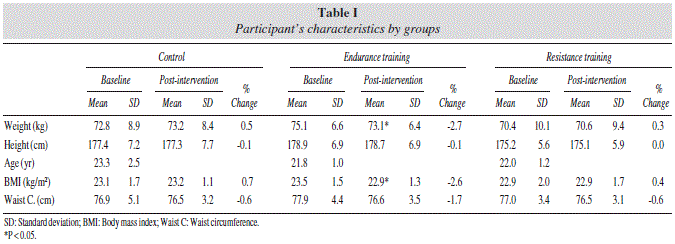
<body><![CDATA[<p><font face="Verdana" size="2"><b>Introduction</b></font></p>     <p><font face="Verdana" size="2">Obesity is characterized by excess fat storage in adipose tissue is a major risk factor for chronic disease, specifically cardiovascular disease and diabetes. Obesity is defined by the use of body mass index (BMI), which is calculated as weight (kg) divided by height squared (m<sup>2</sup>). Despite the benefits of using BMI as it is simple measure to characterize individual's body composition it does not provide a good indication of the location of fat deposition, which has been found to be more closely related to cardiovascular health risk than total fat mass;<sup>1</sup> specifically, excess accumulation of adipose tissue within the abdominal cavity.<sup>2</sup></font></p>     <p><font face="Verdana" size="2">Dyslipidemia characterize by elevated levels blood lipid (Low density lipoprotein (LDL), total cholesterol (CHOL), triglycerides) is also another major risk factor for coronary heart disease (CHD).<sup>3</sup> Previous research have demonstrated that high level of cholesterol in blood can lead to secondary cardiovascular disease,<sup>4 </sup>while high level of High density lipoprotein (HDL) can prevent atherosclerosis and CHD,<sup>5</sup> elevated concentration of LDL has shown to be associated with CHD.<sup>6</sup></font></p>     <p><font face="Verdana" size="2">Positive associations have been found between body fat and lipid profile,<sup>7</sup> even it has been suggested that an increased percent body fat can predict an increase LDL.<sup>8 </sup>However, it is not clear how changes in soft tissues body composition affect lipid profile in healthy young men.</font></p>     <p><font face="Verdana" size="2">One of the main recommendations in preventing obesity is engaging in regular physical activity, which is important in maintaining and improving health<sup>9</sup> and have been associated with lower visceral and abdominal subcutaneous adipose tissue.<sup>10</sup> Specific training programs have shown to change body composition; endurance training can improve body composition by decreasing fat mass,<sup>11</sup> and resistance training can also decrease fat mass and increase total lean mass;<sup>12 </sup>however it remains unclear which kind of specific training is more appropriate to reduce regional and specifically abdominal adiposity.</font></p>     <p><font face="Verdana" size="2">In addition to changing body composition, exercise training has been associated with changes in lipid profile, mainly when concomitant dietary interventions and/or weight loss were presented.<sup>13,14</sup> However, the effect and mechanism around on changes in body composition on lipid profile due to exercise per se requires additional investigation.</font></p>     <p><font face="Verdana" size="2">The purpose of this study was to investigate the effect of two different trainings (endurance or resistance) on regional, and specifically, abdominal adipose tissue, as well as in the lipid profile in young men. Secondly, to examine the associations among the changes produced in body composition, weight, waist circumference and lipid profile after the training period.</font></p>     <p>&nbsp;</p>     <p><font face="Verdana" size="2"><b>Methods</b></font></p>     <p><font face="Verdana" size="2">A total of 26 healthy young men (age 22.5 &plusmn; 1.9 yr) participated in this study. The participants were randomly assigned to three groups: endurance (EG, n = 7), resistance (RG, n = 8) or control (CG, n = 11). Their physical characteristics are presented in  <a href="#t1">table I</a>. The participants were healthy and physically active. All participants answered a questionnaire, which included information about personal data, sports participation, and medical history. Participants were asked to keep their dietary habits during the study and were classified as normal-weight participants according to their BMI values. All participants provided written after they had received a full explanation of the study procedures. The study was performed in accordance with the Helsinki Declaration 1975 and was approved by the Research Ethics Committee of the Government of Aragon (CEICA; Spain).</font></p>     ]]></body>
<body><![CDATA[<p>&nbsp;</p>     <p align="center"><a name="t1"><img src="/img/revistas/nh/v28n2/11_original_06_t1.gif" align="top"></a></p>     <p><font face="Verdana" size="2">Baseline data was collected in one week; it consisted of 6 tests sessions. In the first session cardiorespiratory fitness was assessed, in the second session body composition was determined by dual-energy X-ray absorptiometry (DXA), and in the third session blood sample was taken.</font></p>     <p><font face="Verdana" size="2">The DXA measurements were taken to calculate total and regional lean (body mass - &#091;fat mass + bone mass&#093;) and fat masses. The DXA (QDR-Explorer, Hologic Corp., Software version 12.4, Waltham, MA) was calibrated using a lumbar spine phantom as recommended by the manufacturer. Participants were scanned in supine position and the scans were performed at high resolution. Lean and fat mass were calculated from total and regional analysis of the whole body scan <sup>15</sup>. In order to obtain abdominal fat mass, a region of interest (ROI) was established from the lower costal margin to above the iliac crest was also analyzed with a variation coefficient lower than 4%.</font></p>     <p><font face="Verdana" size="2">In additional to abdominal fat mass anthropometrics were also obtained to determine body composition. Height, body mass and waist circumference were obtained by the same anthropometrics (Level 3 ISAK accreditation), according to the procedures of the International Society for the Advancement in Kinanthropometry.<sup>16</sup> The intratester Technical Error of Measurements was lower than 1% for the measurements (within the limits set by ISAK). The anthropometric instruments used included a stadiometer, balance, and an anthropometric tape (GPM Siber-Hegner Maschinen, Switzerland). BMI was also calculated.</font></p>     <p><font face="Verdana" size="2">Blood samples were collecting at baseline and at the end of the study, 48-72 hours after the last training session. Venous blood samples were taken between 7.00-8.00 hours, after 12 hours overnight fasting. The blood samples were allowed to clot at 4<sup>o</sup> C and then centrifuged at the same temperature (Allegra 21R, Beckman Instruments Inc, Fullerton, CA, USA). The lipid profile was determined using blood serum using an Analyzer Synchron DX 800 by means of well-proportioned enzymatic reagents by Beckman Instruments.</font></p>     <p><font face="Verdana" size="2">The intervention was a 10-week period of supervised training. The EG performed running and cycling sessions with a load intensities ranging between the ventilatory threshold 1 (VT1) and 2 (VT2), during 90 minutes per session. The VT were calculated from the cardiorespiratory tests that were performed at the same time of the day (16:00-19:00 h) under similar environmental conditions (20<sup>o</sup> C; relative humidity, 45-55%, 720 mmHg) on an electrically braked cycle-ergometer (Germany Ergometrics 900; Ergoline; Bitz, Germany).<sup>17</sup></font></p>     <p><font face="Verdana" size="2">The one repetition maximum (1RM) was assessed, and training protocol for the RG is described else-where.<sup>18</sup> Briefly, RG trained with 5 different exercises (parallel squat, leg extension, inclined leg press, leg curl and hip flexors), for which 1RM was assessed before and after 10-week training. The ranged between 50-90% of 1RM values obtained were used for the training. A 90-s rest period was taken between exercise sets.</font></p>     <p><font face="Verdana" size="2">Data analysis was done using R software v2.7.0. Non-parametric statistics were used as the Kolmogorov-Smirnov tests showed non-normally distribution of the variables. Wilcoxon test was applied to study differences between the baseline and the post-intervention  results within each group. Differences between groups either, at baseline, for post-intervention or changes were studied by Kruskal-Wallis test. Relationship among body composition, weight, waist circumference and lipid profile variables were studied by Spearman bivariate correlations. The probability for significance was fixed at 0.05.</font></p>     <p>&nbsp;</p>     ]]></body>
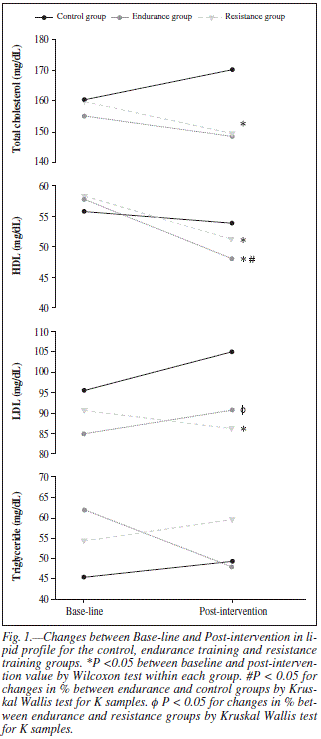
<body><![CDATA[<p><font face="Verdana" size="2"><b>Results</b></font></p>     <p><font face="Verdana" size="2">The characteristics of the participants are shown in  <a href="#t1">table I</a>. Among the three training groups, no significant differences were observed in anthropometrics (weight, height, age, BMI or waist circumference) and lipid profile (<a href="#f1">fig. 1</a>) at baseline or after the intervention. The EG significantly decreased their body weight and BMI by 2.7% and 2.5% respectively after training period (<a href="#t1">table I</a>, both P &lt; 0.05). No other significant changes were observed in the RG and CG with regards to anthropometrics.</font></p>     <p align="center"></font></p>     <p align="center"><a name="f1"><img src="/img/revistas/nh/v28n2/11_original_06_f1.gif" align="top"></a></font></p>     <p>&nbsp;</p>     <p><font face="Verdana" size="2">The CG significantly decreased total lean mass shown in  <a href="#t2">table II</a>. The EG significantly decreased body fat and percentage of fat, as well as fat and percentage of fat at the trunk and at the abdominal region and the RG significantly increased total lean mass; however, no significant changes were observed in fat mass, (all P &lt; 0.05).</font></p>     <p>&nbsp;</p>     <p align="center"><a name="t2"><img src="/img/revistas/nh/v28n2/11_original_06_t2.gif" align="top"></a></p>     <p align="center"></font></p>     <p><font face="Verdana" size="2">For EG the change in abdominal percentage of fat was significantly higher compared with CG. For the RG, only the total lean mass percentage of change was significantly higher compared with the CG (all P &lt; 0.05).</font></p>     ]]></body>
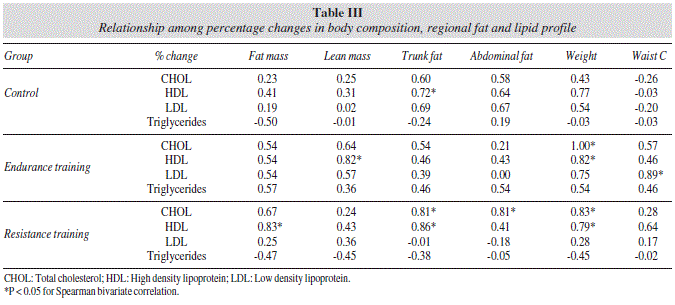
<body><![CDATA[<p><font face="Verdana" size="2">There was no difference between baseline and postintervention in the CG. For the EG the HDL (mg/dL) significantly decreased (57.7 &plusmn; 7.0 <i>vs.</i> 48.0 &plusmn; 4.2). For the RG, the CHOL (159.9 &plusmn; 17.9 <i>vs.</i> 149.4 &plusmn; 18.7), HDL (58.4 &plusmn; 8.7 <i>vs.</i> 51.3 &plusmn; 10.8) and LDL (90.8 &plusmn; 15.6 <i>vs.</i> 86.3 &plusmn; 15.7) significantly decreased with training (all P &lt; 0.05).</font></p>     <p><font face="Verdana" size="2">For EG, the percentage change in HDL was significantly greater compared with the changes of the CG; while the percentage change of LDL was significantly different compared with the RG. For EG, the percentage change in CHOL, HDL and LDL were significantly different compared to changes of the CG (all P &lt; 0.05).</font></p>     <p><font face="Verdana" size="2">The <a href="#t3">table III</a> shows the correlation among total body soft tissue composition, regional fat, waist circumference and lipid profile. In the CG changes in HDL showed a close correlation with changes in trunk fat. In the EG, changes in CHOL strongly correlated with changes in total body weight; changes in HDL with changes in total lean mass and weight and changes in LDL with changes in waist circumference. In the RG, changes in CHOL strongly correlated with changes in weight and in trunk and abdominal fat; and changes in HDL with changes in weight and in total body and trunk fat mass, (all P &lt; 0.05).</font></p>     <p>&nbsp;</p>     <p align="center"><a name="t3"><img src="/img/revistas/nh/v28n2/11_original_06_t3.gif" align="top"></a></font></p>     <p>&nbsp;</p>     <p><font face="Verdana" size="2"><b>Discussion</b></font></p>     <p><font face="Verdana" size="2">The main findings are that the EG had significant decreases in body fat, the percentage of fat, fat and percentage of fat at the trunk and at the abdominal region. The results of this study supports findings of early studies in which showed that significant decrease in fat mass after regular physical exercise.<sup>19,20</sup>.</font></p>     <p><font face="Verdana" size="2">Research have shown that abdominal fat has close correlation with visceral fat<sup>21</sup> therefore, by direct measuring fat in fat the abdominal area provides a more direct understanding of different training programmes which can reduces visceral fat. Thereby providing closer to measure the results from this study suggest that visceral fat can decrease with just 10-week of endurance training; this could have important implications for addressing cardiovascular disease prevention, because visceral fat is a determinant of cardiovascular disease.<sup>2</sup> The RG increased total lean mass as happened in most of the previous studies<sup>22</sup> after resistance training. However, no effect has been observed on total or regional fat in the RG, which could be the result of internal aspects of this training program such as intensity or training volume.</font></p>     <p><font face="Verdana" size="2">Research studies designed to measure the effects of exercise training on the lipid profile are usually carried out in overweight and/or obese participants and have often been confounded by concomitant dietary changes and/or weight loss.<sup>14</sup> Few studies have examined the effect of different training regimens on serum lipid changes in normal-weight participants with healthy lipid profile. Weight loss has been associated with variable changes in lipid profile in obese individuals,<sup>13 </sup>specifically reductions in triglycerides, CHOL, and LDL.<sup>14</sup> There are also changes in HDL, usually after significant weight reduction and a stabilization but this is often no change or decrease in HDL during active weight loss period increases.<sup>14</sup> It is unclear whether changes in the lipid profile after training programs can be a consequence of elevated initial values and/or weight loss is still unknown in the current literature available more research is need to clarify the exact mechanism.</font></p>     ]]></body>
<body><![CDATA[<p><font face="Verdana" size="2">A meta-analysis that investigated the effect of moderate- to hard-intensity endurance training showed inconsistent results in improvements in the blood lipid profile.<sup>23</sup> Twelve weeks of moderate endurance training alone, without weight loss, was insufficient to stimulate changes in any lipid or lipoprotein measured in obese participants.<sup>24</sup> However, the same exercise program including a diet intervention (weight loss of 4 kg) resulted in an improved lipid profile. This data seems to indicate that no effect of the training intervention per se can be found on the lipid profile unless weight loss is present in obese participants. In this  current study, the EG, with a similar training regimen and duration as the study of Nieman et al. (2002), had no changes in CHOL, and triglycerides levels despite a significant reduction in body weight and body fat, illustrating that in normal-weight participants changes in body weight after an endurance training does not necessary implies positive changes in the lipid profile. These results, support the findings of another meta-analysis which concluded that aerobic training influence on lipid profile were more effective in participants with initially high CHOL levels or low BMI (&lt; 28 kg/m<sup>2</sup>), proving that both variables seems to be highly relevant.<sup>25</sup></font></p>     <p><font face="Verdana" size="2">There are few data related to the effects of resistance training on blood lipid levels. In healthy, premenopausal women, with normal baseline lipid profile, five months of resistance training was associated with significant decreases in CHOL and LDL concentrations.<sup>26</sup> Moreover, a 14-week resistance training had a favourable effect on lipid profile and body fat percentage in a similar type of population.<sup>27</sup> These findings suggest that resistance training could have a favourable effect on lipid profile and body fat percentage. On the contrary, eight weeks of low intensity resistance training was not enough to produce significant alterations in blood lipid concentrations in postmenopausal women.<sup>28</sup> Thus, it seems that when the stimulus is sufficient, the resistance training could positively influence the lipid profile. Accordingly, data from the present investigation indicates that although body weight remained stable and fat mass did not decrease substantially, a marked reduction in all lipid variables was found in the RG. This could be partly explained by the increase in the total lean mass occurred in this group, however since no significant correlations between lipid and total lean mass changes have been observed, it seems that intensity and duration of the exercise program might be more influential than body composition changes in normal-weight participants with optimal baseline lipid values.</font></p>     <p><font face="Verdana" size="2">The fact that both, EG and RG, had a reduction in the HDL levels after the training period is in agreement with other studies that previously showed that especially when negative caloric balance is present and/or a stabilization period is missed a decrease in HDL can be found.<sup>14</sup> Moreover, data from the Heritage Study concluded that as a consequence of a short-term endurance training, 20-week, there were more participants who experienced a decrease in HDL among those with high baseline HDL levels compared to those with initial low HDL levels, proving to some extent the importance of initial values and the elevated heterogeneity of the HDL changes in response to a training period.<sup>29</sup></font></p>     <p><font face="Verdana" size="2">The present data shows positive correlations between fat mass and CHOL in the EG and with HDL in the resistance training. There were also strong correlations between total lean mass with HDL in the EG. These results are of interest since traditionally, changes in lipid profile have been investigated in relation with fat, but total lean mass changes may be also important, at least when the endurance training is carried out. Previous studies have also shown that 12-week of aerobic or strength training significant decreased body fat composition, triglyceride, and CHOL levels.<sup>30 </sup>Conversely there are several studies that showed changes in body mass did not improve lipid profile for type 1 mellitus participants, while in healthy participants, only HDL increased significantly after training.<sup>31 </sup>A 6-week study of endurance training showed that improvement of body composition by reducing fat mass and waist circumference did not change CHOL, HDL, LDL, and triglyceride levels in young female.<sup>32</sup> However, in the present study changes in waist circumference are correlated with changes in LDL in the EG. It is possible that the variance in results from this research and previous findings might be related to the differences in regional fat distribution between male and female.</font></p>     <p><font face="Verdana" size="2">A study with middle-aged men demonstrated that fat mass distributions were associated with blood lipid profile.<sup>33</sup> Waist circumference is correlated with abdominal fat mass and is associated with increased metabolic diseases risk,<sup>34</sup> waist circumference is also a better predictor of changes in HDL than the BMI,<sup>35</sup> therefore it is important to highlight that the present research observed a close relationship between waist circumference and lipid profile. Since changes in abdominal fat did not show relationship with changes in lipid profile, more studies are needed to clarify the relationship between changes in waist circumference and lipid profile.</font></p>     <p>&nbsp;</p>     <p><font face="Verdana" size="2"><b>Conclusion</b></font></p>     <p><font face="Verdana" size="2">We concluded that ten weeks of endurance training decreased abdominal and body fat in young men, while 10-week of resistance training increased total lean mass. There were no observed changes in the endurance training group for lipid profile components; however in statistical testing it was shown that changes in CHOL was associated with changes in weight, in HDL with total lean mass and weight, and LDL with waist circumference.</font></p>     <p><font face="Verdana" size="2">The resistance training group showed a significant decrease in CHOL, HDL and LDL without significant changes in body weight. The observed changes are associated with changes in weight, and trunk and abdominal fat. The changes in LDL and HDL may require addition investigation in order to better understand the associations and interactions between endurance and strength training on lipid profile.</font></p>     <p>&nbsp;</p>     ]]></body>
<body><![CDATA[<p><font face="Verdana" size="2"><b>References</b></font></p>     <!-- ref --><p><font face="Verdana" size="2">1. Peiris AN, Thakur RK, Sothmann MS, et al. Relationship of regional fat distribution and obesity to electrocardiographic parameters in healthy premenopausal women. <i>South Med J</i> 1991; 84: 961-5.    &nbsp;&nbsp;&nbsp;&nbsp;&nbsp;&nbsp;&nbsp;&nbsp;[&#160;<a href="javascript:void(0);" onclick="javascript: window.open('/scielo.php?script=sci_nlinks&ref=3712917&pid=S0212-1611201300020001100001&lng=','','width=640,height=500,resizable=yes,scrollbars=1,menubar=yes,');">Links</a>&#160;]<!-- end-ref --></font></p>    <!-- ref --><p><font face="Verdana" size="2">2. Krishnan S, Rosenberg L, Djousse L, et al. Overall and central obesity and risk of type 2 diabetes in U.S. black women. <i>Obesity (Silver Spring)</i> 2007; 15: 1860-6.    &nbsp;&nbsp;&nbsp;&nbsp;&nbsp;&nbsp;&nbsp;&nbsp;[&#160;<a href="javascript:void(0);" onclick="javascript: window.open('/scielo.php?script=sci_nlinks&ref=3712919&pid=S0212-1611201300020001100002&lng=','','width=640,height=500,resizable=yes,scrollbars=1,menubar=yes,');">Links</a>&#160;]<!-- end-ref --></font></p>    <!-- ref --><p><font face="Verdana" size="2">3. Wooten JS, Biggerstaff KD, Anderson C. Response of lipid, lipoprotein-cholesterol, and electrophoretic characteristics of lipoproteins following a single bout of aerobic exercise in women. <i>Eur J Appl Physiol</i> 2008.    &nbsp;&nbsp;&nbsp;&nbsp;&nbsp;&nbsp;&nbsp;&nbsp;[&#160;<a href="javascript:void(0);" onclick="javascript: window.open('/scielo.php?script=sci_nlinks&ref=3712921&pid=S0212-1611201300020001100003&lng=','','width=640,height=500,resizable=yes,scrollbars=1,menubar=yes,');">Links</a>&#160;]<!-- end-ref --></font></p>    <!-- ref --><p><font face="Verdana" size="2">4. Durrington P. Dyslipidaemia. <i>Lancet</i> 2003; 362: 717-31.    &nbsp;&nbsp;&nbsp;&nbsp;&nbsp;&nbsp;&nbsp;&nbsp;[&#160;<a href="javascript:void(0);" onclick="javascript: window.open('/scielo.php?script=sci_nlinks&ref=3712923&pid=S0212-1611201300020001100004&lng=','','width=640,height=500,resizable=yes,scrollbars=1,menubar=yes,');">Links</a>&#160;]<!-- end-ref --></font></p>    <!-- ref --><p><font face="Verdana" size="2">5. Chapman MJ. Therapeutic elevation of HDL-cholesterol to prevent atherosclerosis and coronary heart disease. <i>Pharmacol Ther</i> 2006; 111: 893-908.    &nbsp;&nbsp;&nbsp;&nbsp;&nbsp;&nbsp;&nbsp;&nbsp;[&#160;<a href="javascript:void(0);" onclick="javascript: window.open('/scielo.php?script=sci_nlinks&ref=3712925&pid=S0212-1611201300020001100005&lng=','','width=640,height=500,resizable=yes,scrollbars=1,menubar=yes,');">Links</a>&#160;]<!-- end-ref --></font></p>    <!-- ref --><p><font face="Verdana" size="2">6. Halle M, Berg A, Baumstark MW, et al. Association of physical fitness with LDL and HDL subfractions in young healthy men. <i>Int J Sports Med</i> 1999; 20: 464-9.    &nbsp;&nbsp;&nbsp;&nbsp;&nbsp;&nbsp;&nbsp;&nbsp;[&#160;<a href="javascript:void(0);" onclick="javascript: window.open('/scielo.php?script=sci_nlinks&ref=3712927&pid=S0212-1611201300020001100006&lng=','','width=640,height=500,resizable=yes,scrollbars=1,menubar=yes,');">Links</a>&#160;]<!-- end-ref --></font></p>    <!-- ref --><p><font face="Verdana" size="2">7. Woolf K, Reese CE, Mason MP, et al. Physical activity is associated with risk factors for chronic disease across adult women's life cycle. <i>J Am Diet Assoc</i> 2008; 108: 948-59.    &nbsp;&nbsp;&nbsp;&nbsp;&nbsp;&nbsp;&nbsp;&nbsp;[&#160;<a href="javascript:void(0);" onclick="javascript: window.open('/scielo.php?script=sci_nlinks&ref=3712929&pid=S0212-1611201300020001100007&lng=','','width=640,height=500,resizable=yes,scrollbars=1,menubar=yes,');">Links</a>&#160;]<!-- end-ref --></font></p>    <!-- ref --><p><font face="Verdana" size="2">8. Mosca L, Rubenfire M, Tarshis T, et al. Clinical predictors of oxidized low-density lipoprotein in patients with coronary artery disease. <i>Am J Cardiol</i> 1997; 80: 825-30.    &nbsp;&nbsp;&nbsp;&nbsp;&nbsp;&nbsp;&nbsp;&nbsp;[&#160;<a href="javascript:void(0);" onclick="javascript: window.open('/scielo.php?script=sci_nlinks&ref=3712931&pid=S0212-1611201300020001100008&lng=','','width=640,height=500,resizable=yes,scrollbars=1,menubar=yes,');">Links</a>&#160;]<!-- end-ref --></font></p>    <!-- ref --><p><font face="Verdana" size="2">9. Ferrara CM, Goldberg AP, Ortmeyer HK, et al. Effects of aerobic and resistive exercise training on glucose disposal and skeletal muscle metabolism in older men. <i>J Gerontol A Biol Sci Med Sci</i> 2006; 61: 480-7.    &nbsp;&nbsp;&nbsp;&nbsp;&nbsp;&nbsp;&nbsp;&nbsp;[&#160;<a href="javascript:void(0);" onclick="javascript: window.open('/scielo.php?script=sci_nlinks&ref=3712933&pid=S0212-1611201300020001100009&lng=','','width=640,height=500,resizable=yes,scrollbars=1,menubar=yes,');">Links</a>&#160;]<!-- end-ref --></font></p>    <!-- ref --><p><font face="Verdana" size="2">10. Lee SJ, Arslanian SA. Cardiorespiratory fitness and abdominal adiposity in youth. <i>Eur J Clin Nutr</i> 2007; 61: 561-5.    &nbsp;&nbsp;&nbsp;&nbsp;&nbsp;&nbsp;&nbsp;&nbsp;[&#160;<a href="javascript:void(0);" onclick="javascript: window.open('/scielo.php?script=sci_nlinks&ref=3712935&pid=S0212-1611201300020001100010&lng=','','width=640,height=500,resizable=yes,scrollbars=1,menubar=yes,');">Links</a>&#160;]<!-- end-ref --></font></p>    <!-- ref --><p><font face="Verdana" size="2">11. Moro C, Pillard F, De Glisezinski I, et al. Training enhances ANP lipid-mobilizing action in adipose tissue of overweight men. <i>Med Sci Sports Exerc</i> 2005; 37: 1126-32.    &nbsp;&nbsp;&nbsp;&nbsp;&nbsp;&nbsp;&nbsp;&nbsp;[&#160;<a href="javascript:void(0);" onclick="javascript: window.open('/scielo.php?script=sci_nlinks&ref=3712937&pid=S0212-1611201300020001100011&lng=','','width=640,height=500,resizable=yes,scrollbars=1,menubar=yes,');">Links</a>&#160;]<!-- end-ref --></font></p>    <!-- ref --><p><font face="Verdana" size="2">12. Nindl BC, Harman EA, Marx JO, et al. Regional body composition changes in women after 6 months of periodized physical training. <i>J Appl Physiol</i> 2000; 88: 2251-9.    &nbsp;&nbsp;&nbsp;&nbsp;&nbsp;&nbsp;&nbsp;&nbsp;[&#160;<a href="javascript:void(0);" onclick="javascript: window.open('/scielo.php?script=sci_nlinks&ref=3712939&pid=S0212-1611201300020001100012&lng=','','width=640,height=500,resizable=yes,scrollbars=1,menubar=yes,');">Links</a>&#160;]<!-- end-ref --></font></p>    <!-- ref --><p><font face="Verdana" size="2">13. Katzel LI, Bleecker ER, Colman EG, et al. Effects of weight loss vs aerobic exercise training on risk factors for coronary disease in healthy, obese, middle-aged and older men. A randomized controlled trial. <i>JAMA</i> 1995; 274: 1915-21.    &nbsp;&nbsp;&nbsp;&nbsp;&nbsp;&nbsp;&nbsp;&nbsp;[&#160;<a href="javascript:void(0);" onclick="javascript: window.open('/scielo.php?script=sci_nlinks&ref=3712941&pid=S0212-1611201300020001100013&lng=','','width=640,height=500,resizable=yes,scrollbars=1,menubar=yes,');">Links</a>&#160;]<!-- end-ref --></font></p>    <!-- ref --><p><font face="Verdana" size="2">14. Dattilo AM, Kris-Etherton PM. Effects of weight reduction on blood lipids and lipoproteins: a meta-analysis. <i>Am J Clin Nutr</i> 1992; 56: 320-8.    &nbsp;&nbsp;&nbsp;&nbsp;&nbsp;&nbsp;&nbsp;&nbsp;[&#160;<a href="javascript:void(0);" onclick="javascript: window.open('/scielo.php?script=sci_nlinks&ref=3712943&pid=S0212-1611201300020001100014&lng=','','width=640,height=500,resizable=yes,scrollbars=1,menubar=yes,');">Links</a>&#160;]<!-- end-ref --></font></p>    <!-- ref --><p><font face="Verdana" size="2">15. Vicente-Rodríguez G, Ara I, Pérez-Gómez J, et al. High femoral bone mineral density accretion in prepubertal soccer players. <i>Med Sci Sports Exerc</i> 2004; 36: 1789-95.    &nbsp;&nbsp;&nbsp;&nbsp;&nbsp;&nbsp;&nbsp;&nbsp;[&#160;<a href="javascript:void(0);" onclick="javascript: window.open('/scielo.php?script=sci_nlinks&ref=3712945&pid=S0212-1611201300020001100015&lng=','','width=640,height=500,resizable=yes,scrollbars=1,menubar=yes,');">Links</a>&#160;]<!-- end-ref --></font></p>    <!-- ref --><p><font face="Verdana" size="2">16. ISAK. International Standars for Anthropometric Assessment. Sydney. ISAK; 2001.    &nbsp;&nbsp;&nbsp;&nbsp;&nbsp;&nbsp;&nbsp;&nbsp;[&#160;<a href="javascript:void(0);" onclick="javascript: window.open('/scielo.php?script=sci_nlinks&ref=3712947&pid=S0212-1611201300020001100016&lng=','','width=640,height=500,resizable=yes,scrollbars=1,menubar=yes,');">Links</a>&#160;]<!-- end-ref --></font></p>    <!-- ref --><p><font face="Verdana" size="2">17. Beaver WL, Wasserman K, Whipp BJ. A new method for detecting anaerobic threshold by gas exchange. <i>J Appl Physiol</i> 1986; 60: 2020-7.    &nbsp;&nbsp;&nbsp;&nbsp;&nbsp;&nbsp;&nbsp;&nbsp;[&#160;<a href="javascript:void(0);" onclick="javascript: window.open('/scielo.php?script=sci_nlinks&ref=3712949&pid=S0212-1611201300020001100017&lng=','','width=640,height=500,resizable=yes,scrollbars=1,menubar=yes,');">Links</a>&#160;]<!-- end-ref --></font></p>    <!-- ref --><p><font face="Verdana" size="2">18. Ara I, Pérez-Gómez J, Vicente-Rodríguez G, et al. Serum free testosterone, leptin and soluble leptin receptor changes in a 6-week strength-training programme. <i>Br J Nutr</i> 2006; 96: 1053-9.    &nbsp;&nbsp;&nbsp;&nbsp;&nbsp;&nbsp;&nbsp;&nbsp;[&#160;<a href="javascript:void(0);" onclick="javascript: window.open('/scielo.php?script=sci_nlinks&ref=3712951&pid=S0212-1611201300020001100018&lng=','','width=640,height=500,resizable=yes,scrollbars=1,menubar=yes,');">Links</a>&#160;]<!-- end-ref --></font></p>    <!-- ref --><p><font face="Verdana" size="2">19. González Calvo G, Hernández Sánchez S, Pozo Rosado P, et al. Positive effects of physical exercise on reducing the relationship between subcutaneous abdominal fat and morbility risk. <i>Nutr Hosp</i> 2011; 26: 685-91.    &nbsp;&nbsp;&nbsp;&nbsp;&nbsp;&nbsp;&nbsp;&nbsp;[&#160;<a href="javascript:void(0);" onclick="javascript: window.open('/scielo.php?script=sci_nlinks&ref=3712953&pid=S0212-1611201300020001100019&lng=','','width=640,height=500,resizable=yes,scrollbars=1,menubar=yes,');">Links</a>&#160;]<!-- end-ref --></font></p>    <!-- ref --><p><font face="Verdana" size="2">20. Verney J, Kadi F, Saafi MA, et al. Combined lower body endurance and upper body resistance training improves performance and health parameters in healthy active elderly. <i>Eur J Appl Physiol</i> 2006; 97: 288-97.    &nbsp;&nbsp;&nbsp;&nbsp;&nbsp;&nbsp;&nbsp;&nbsp;[&#160;<a href="javascript:void(0);" onclick="javascript: window.open('/scielo.php?script=sci_nlinks&ref=3712955&pid=S0212-1611201300020001100020&lng=','','width=640,height=500,resizable=yes,scrollbars=1,menubar=yes,');">Links</a>&#160;]<!-- end-ref --></font></p>    <!-- ref --><p><font face="Verdana" size="2">21. Irving BA, Weltman JY, Brock DW, et al. NIH Image J and Slice-O-Matic computed tomography imaging software to quantify soft tissue. <i>Obesity (Silver Spring)</i> 2007; 15: 370-6.    &nbsp;&nbsp;&nbsp;&nbsp;&nbsp;&nbsp;&nbsp;&nbsp;[&#160;<a href="javascript:void(0);" onclick="javascript: window.open('/scielo.php?script=sci_nlinks&ref=3712957&pid=S0212-1611201300020001100021&lng=','','width=640,height=500,resizable=yes,scrollbars=1,menubar=yes,');">Links</a>&#160;]<!-- end-ref --></font></p>    <!-- ref --><p><font face="Verdana" size="2">22. Suman OE, Herndon DN. Effects of cessation of a structured and supervised exercise conditioning program on lean mass and muscle strength in severely burned children. <i>Arch Phys Med Rehabil</i> 2007; 88: S24-9.    &nbsp;&nbsp;&nbsp;&nbsp;&nbsp;&nbsp;&nbsp;&nbsp;[&#160;<a href="javascript:void(0);" onclick="javascript: window.open('/scielo.php?script=sci_nlinks&ref=3712959&pid=S0212-1611201300020001100022&lng=','','width=640,height=500,resizable=yes,scrollbars=1,menubar=yes,');">Links</a>&#160;]<!-- end-ref --></font></p>    <!-- ref --><p><font face="Verdana" size="2">23. León AS, Sánchez OA. Response of blood lipids to exercise training alone or combined with dietary intervention. <i>Med Sci Sports Exerc</i> 2001; 33: S502-15; discussion S28-9.    &nbsp;&nbsp;&nbsp;&nbsp;&nbsp;&nbsp;&nbsp;&nbsp;[&#160;<a href="javascript:void(0);" onclick="javascript: window.open('/scielo.php?script=sci_nlinks&ref=3712961&pid=S0212-1611201300020001100023&lng=','','width=640,height=500,resizable=yes,scrollbars=1,menubar=yes,');">Links</a>&#160;]<!-- end-ref --></font></p>    <!-- ref --><p><font face="Verdana" size="2">24. Nieman DC, Brock DW, Butterworth D, et al. Reducing diet and/or exercise training decreases the lipid and lipoprotein risk factors of moderately obese women. <i>J Am Coll Nutr</i> 2002; 21: 344-50.    &nbsp;&nbsp;&nbsp;&nbsp;&nbsp;&nbsp;&nbsp;&nbsp;[&#160;<a href="javascript:void(0);" onclick="javascript: window.open('/scielo.php?script=sci_nlinks&ref=3712963&pid=S0212-1611201300020001100024&lng=','','width=640,height=500,resizable=yes,scrollbars=1,menubar=yes,');">Links</a>&#160;]<!-- end-ref --></font></p>    <!-- ref --><p><font face="Verdana" size="2">25. Kodama S, Tanaka S, Saito K, et al. Effect of aerobic exercise training on serum levels of high-density lipoprotein cholesterol: a meta-analysis. <i>Arch Intern Med</i> 2007; 167: 999-1008.    &nbsp;&nbsp;&nbsp;&nbsp;&nbsp;&nbsp;&nbsp;&nbsp;[&#160;<a href="javascript:void(0);" onclick="javascript: window.open('/scielo.php?script=sci_nlinks&ref=3712965&pid=S0212-1611201300020001100025&lng=','','width=640,height=500,resizable=yes,scrollbars=1,menubar=yes,');">Links</a>&#160;]<!-- end-ref --></font></p>    <!-- ref --><p><font face="Verdana" size="2">26. Boyden TW, Pamenter RW, Going SB, et al. Resistance exercise training is associated with decreases in serum low-density lipoprotein cholesterol levels in premenopausal women. <i>Arch Intern Med</i> 1993; 153: 97-100.    &nbsp;&nbsp;&nbsp;&nbsp;&nbsp;&nbsp;&nbsp;&nbsp;[&#160;<a href="javascript:void(0);" onclick="javascript: window.open('/scielo.php?script=sci_nlinks&ref=3712967&pid=S0212-1611201300020001100026&lng=','','width=640,height=500,resizable=yes,scrollbars=1,menubar=yes,');">Links</a>&#160;]<!-- end-ref --></font></p>    <!-- ref --><p><font face="Verdana" size="2">27. Prabhakaran B, Dowling EA, Branch JD, et al. Effect of 14 weeks of resistance training on lipid profile and body fat percentage in premenopausal women. <i>Br J Sports Med</i> 1999; 33: 190-5.    &nbsp;&nbsp;&nbsp;&nbsp;&nbsp;&nbsp;&nbsp;&nbsp;[&#160;<a href="javascript:void(0);" onclick="javascript: window.open('/scielo.php?script=sci_nlinks&ref=3712969&pid=S0212-1611201300020001100027&lng=','','width=640,height=500,resizable=yes,scrollbars=1,menubar=yes,');">Links</a>&#160;]<!-- end-ref --></font></p>    <!-- ref --><p><font face="Verdana" size="2">28. Elliott KJ, Sale C, Cable NT. Effects of resistance training and detraining on muscle strength and blood lipid profiles in post-menopausal women. <i>Br J Sports Med</i> 2002; 36: 340-4.    &nbsp;&nbsp;&nbsp;&nbsp;&nbsp;&nbsp;&nbsp;&nbsp;[&#160;<a href="javascript:void(0);" onclick="javascript: window.open('/scielo.php?script=sci_nlinks&ref=3712971&pid=S0212-1611201300020001100028&lng=','','width=640,height=500,resizable=yes,scrollbars=1,menubar=yes,');">Links</a>&#160;]<!-- end-ref --></font></p>    <!-- ref --><p><font face="Verdana" size="2">29. Abbott A. All pain, no gain? <i>Nature</i> 2005; 433: 188-9.    &nbsp;&nbsp;&nbsp;&nbsp;&nbsp;&nbsp;&nbsp;&nbsp;[&#160;<a href="javascript:void(0);" onclick="javascript: window.open('/scielo.php?script=sci_nlinks&ref=3712973&pid=S0212-1611201300020001100029&lng=','','width=640,height=500,resizable=yes,scrollbars=1,menubar=yes,');">Links</a>&#160;]<!-- end-ref --></font></p>    <!-- ref --><p><font face="Verdana" size="2">30. Fenkci S, Sarsan A, Rota S, et al. Effects of resistance or aerobic exercises on metabolic parameters in obese women who are not on a diet. <i>Adv Ther</i> 2006; 23: 404-13.    &nbsp;&nbsp;&nbsp;&nbsp;&nbsp;&nbsp;&nbsp;&nbsp;[&#160;<a href="javascript:void(0);" onclick="javascript: window.open('/scielo.php?script=sci_nlinks&ref=3712975&pid=S0212-1611201300020001100030&lng=','','width=640,height=500,resizable=yes,scrollbars=1,menubar=yes,');">Links</a>&#160;]<!-- end-ref --></font></p>    <!-- ref --><p><font face="Verdana" size="2">31. Sideraviciute S, Gailiuniene A, Visagurskiene K, et al. The effect of long-term swimming program on body composition, aerobic capacity and blood lipids in 14-19-year aged healthy girls and girls with type 1 diabetes mellitus. <i>Medicina (Kaunas)</i> 2006; 42: 661-6.    &nbsp;&nbsp;&nbsp;&nbsp;&nbsp;&nbsp;&nbsp;&nbsp;[&#160;<a href="javascript:void(0);" onclick="javascript: window.open('/scielo.php?script=sci_nlinks&ref=3712977&pid=S0212-1611201300020001100031&lng=','','width=640,height=500,resizable=yes,scrollbars=1,menubar=yes,');">Links</a>&#160;]<!-- end-ref --></font></p>    <!-- ref --><p><font face="Verdana" size="2">32. Colakoglu S, Colakoglu M, Taneli F, et al. Cumulative effects of conjugated linoleic acid and exercise on endurance development, body composition, serum leptin and insulin levels. <i>J Sports Med Phys Fitness</i> 2006; 46: 570-7.    &nbsp;&nbsp;&nbsp;&nbsp;&nbsp;&nbsp;&nbsp;&nbsp;[&#160;<a href="javascript:void(0);" onclick="javascript: window.open('/scielo.php?script=sci_nlinks&ref=3712979&pid=S0212-1611201300020001100032&lng=','','width=640,height=500,resizable=yes,scrollbars=1,menubar=yes,');">Links</a>&#160;]<!-- end-ref --></font></p>    <!-- ref --><p><font face="Verdana" size="2">33. Buemann B, Astrup A, Pedersen O, et al. Possible role of adiponectin and insulin sensitivity in mediating the favorable effects of lower body fat mass on blood lipids. <i>J Clin Endocrinol Metab</i> 2006; 91: 1698-704.    &nbsp;&nbsp;&nbsp;&nbsp;&nbsp;&nbsp;&nbsp;&nbsp;[&#160;<a href="javascript:void(0);" onclick="javascript: window.open('/scielo.php?script=sci_nlinks&ref=3712981&pid=S0212-1611201300020001100033&lng=','','width=640,height=500,resizable=yes,scrollbars=1,menubar=yes,');">Links</a>&#160;]<!-- end-ref --></font></p>    <!-- ref --><p><font face="Verdana" size="2">34. Kissebah AH, Vydelingum N, Murray R, et al. Relation of body fat distribution to metabolic complications of obesity. <i>J Clin Endocrinol Metab</i> 1982; 54: 254-60.    &nbsp;&nbsp;&nbsp;&nbsp;&nbsp;&nbsp;&nbsp;&nbsp;[&#160;<a href="javascript:void(0);" onclick="javascript: window.open('/scielo.php?script=sci_nlinks&ref=3712983&pid=S0212-1611201300020001100034&lng=','','width=640,height=500,resizable=yes,scrollbars=1,menubar=yes,');">Links</a>&#160;]<!-- end-ref --></font></p>    <!-- ref --><p><font face="Verdana" size="2">35. Arimura ST, Moura BM, Pimentel GD, et al. Waist circumference is better associated with high density lipoprotein (HDL-c) than with body mass index (BMI) in adults with metabolic syndrome. <i>Nutr Hosp</i> 2011; 26: 1328-32.    &nbsp;&nbsp;&nbsp;&nbsp;&nbsp;&nbsp;&nbsp;&nbsp;[&#160;<a href="javascript:void(0);" onclick="javascript: window.open('/scielo.php?script=sci_nlinks&ref=3712985&pid=S0212-1611201300020001100035&lng=','','width=640,height=500,resizable=yes,scrollbars=1,menubar=yes,');">Links</a>&#160;]<!-- end-ref --></font></p>     <p>&nbsp;</p>     <p>&nbsp;</p>     <p><font face="Verdana" size="2"><a href="#top"><img border="0" src="/img/revistas/nh/v28n2/seta.gif" width="15" height="17"></a><a name="bajo"></a><b>Correspondence:</b>    <br>Jorge Pérez-Gómez.    <br>Facultad Ciencias del Deporte.    <br>Avda. Universidad, s/n.    <br>10003 Cáceres. Spain.    <br>E-mail:  <a href="mailto:jorgepg100@gmail.com">jorgepg100@gmail.com</a></font></p>     <p><font face="Verdana" size="2">Recibido: 24-IX-2012.    ]]></body>
<body><![CDATA[<br>Aceptado: 23-X-2012.</font></p>      ]]></body><back>
<ref-list>
<ref id="B1">
<label>1</label><nlm-citation citation-type="journal">
<person-group person-group-type="author">
<name>
<surname><![CDATA[Peiris]]></surname>
<given-names><![CDATA[AN]]></given-names>
</name>
<name>
<surname><![CDATA[Thakur]]></surname>
<given-names><![CDATA[RK]]></given-names>
</name>
<name>
<surname><![CDATA[Sothmann]]></surname>
<given-names><![CDATA[MS]]></given-names>
</name>
</person-group>
<article-title xml:lang="en"><![CDATA[Relationship of regional fat distribution and obesity to electrocardiographic parameters in healthy premenopausal women]]></article-title>
<source><![CDATA[South Med J]]></source>
<year>1991</year>
<volume>84</volume>
<page-range>961-5</page-range></nlm-citation>
</ref>
<ref id="B2">
<label>2</label><nlm-citation citation-type="journal">
<person-group person-group-type="author">
<name>
<surname><![CDATA[Krishnan]]></surname>
<given-names><![CDATA[S]]></given-names>
</name>
<name>
<surname><![CDATA[Rosenberg]]></surname>
<given-names><![CDATA[L]]></given-names>
</name>
<name>
<surname><![CDATA[Djousse]]></surname>
<given-names><![CDATA[L]]></given-names>
</name>
</person-group>
<article-title xml:lang="en"><![CDATA[Overall and central obesity and risk of type 2 diabetes in U. S. black women]]></article-title>
<source><![CDATA[Obesity (Silver Spring)]]></source>
<year>2007</year>
<volume>15</volume>
<page-range>1860-6</page-range></nlm-citation>
</ref>
<ref id="B3">
<label>3</label><nlm-citation citation-type="journal">
<person-group person-group-type="author">
<name>
<surname><![CDATA[Wooten]]></surname>
<given-names><![CDATA[JS]]></given-names>
</name>
<name>
<surname><![CDATA[Biggerstaff]]></surname>
<given-names><![CDATA[KD]]></given-names>
</name>
<name>
<surname><![CDATA[Anderson]]></surname>
<given-names><![CDATA[C]]></given-names>
</name>
</person-group>
<article-title xml:lang="en"><![CDATA[Response of lipid, lipoprotein-cholesterol, and electrophoretic characteristics of lipoproteins following a single bout of aerobic exercise in women]]></article-title>
<source><![CDATA[Eur J Appl Physiol]]></source>
<year>2008</year>
</nlm-citation>
</ref>
<ref id="B4">
<label>4</label><nlm-citation citation-type="journal">
<person-group person-group-type="author">
<name>
<surname><![CDATA[Durrington]]></surname>
<given-names><![CDATA[P]]></given-names>
</name>
</person-group>
<article-title xml:lang="en"><![CDATA[Dyslipidaemia]]></article-title>
<source><![CDATA[Lancet]]></source>
<year>2003</year>
<volume>362</volume>
<page-range>717-31</page-range></nlm-citation>
</ref>
<ref id="B5">
<label>5</label><nlm-citation citation-type="journal">
<person-group person-group-type="author">
<name>
<surname><![CDATA[Chapman]]></surname>
<given-names><![CDATA[MJ]]></given-names>
</name>
</person-group>
<article-title xml:lang="en"><![CDATA[Therapeutic elevation of HDL-cholesterol to prevent atherosclerosis and coronary heart disease]]></article-title>
<source><![CDATA[Pharmacol Ther]]></source>
<year>2006</year>
<volume>111</volume>
<page-range>893-908</page-range></nlm-citation>
</ref>
<ref id="B6">
<label>6</label><nlm-citation citation-type="journal">
<person-group person-group-type="author">
<name>
<surname><![CDATA[Halle]]></surname>
<given-names><![CDATA[M]]></given-names>
</name>
<name>
<surname><![CDATA[Berg]]></surname>
<given-names><![CDATA[A]]></given-names>
</name>
<name>
<surname><![CDATA[Baumstark]]></surname>
<given-names><![CDATA[MW]]></given-names>
</name>
</person-group>
<article-title xml:lang="en"><![CDATA[Association of physical fitness with LDL and HDL subfractions in young healthy men]]></article-title>
<source><![CDATA[Int J Sports Med]]></source>
<year>1999</year>
<volume>20</volume>
<page-range>464-9</page-range></nlm-citation>
</ref>
<ref id="B7">
<label>7</label><nlm-citation citation-type="journal">
<person-group person-group-type="author">
<name>
<surname><![CDATA[Woolf]]></surname>
<given-names><![CDATA[K]]></given-names>
</name>
<name>
<surname><![CDATA[Reese]]></surname>
<given-names><![CDATA[CE]]></given-names>
</name>
<name>
<surname><![CDATA[Mason]]></surname>
<given-names><![CDATA[MP]]></given-names>
</name>
</person-group>
<article-title xml:lang="en"><![CDATA[Physical activity is associated with risk factors for chronic disease across adult women's life cycle]]></article-title>
<source><![CDATA[J Am Diet Assoc]]></source>
<year>2008</year>
<volume>108</volume>
<page-range>948-59</page-range></nlm-citation>
</ref>
<ref id="B8">
<label>8</label><nlm-citation citation-type="journal">
<person-group person-group-type="author">
<name>
<surname><![CDATA[Mosca]]></surname>
<given-names><![CDATA[L]]></given-names>
</name>
<name>
<surname><![CDATA[Rubenfire]]></surname>
<given-names><![CDATA[M]]></given-names>
</name>
<name>
<surname><![CDATA[Tarshis]]></surname>
<given-names><![CDATA[T]]></given-names>
</name>
</person-group>
<article-title xml:lang="en"><![CDATA[Clinical predictors of oxidized low-density lipoprotein in patients with coronary artery disease]]></article-title>
<source><![CDATA[Am J Cardiol]]></source>
<year>1997</year>
<volume>80</volume>
<page-range>825-30</page-range></nlm-citation>
</ref>
<ref id="B9">
<label>9</label><nlm-citation citation-type="journal">
<person-group person-group-type="author">
<name>
<surname><![CDATA[Ferrara]]></surname>
<given-names><![CDATA[CM]]></given-names>
</name>
<name>
<surname><![CDATA[Goldberg]]></surname>
<given-names><![CDATA[AP]]></given-names>
</name>
<name>
<surname><![CDATA[Ortmeyer]]></surname>
<given-names><![CDATA[HK]]></given-names>
</name>
</person-group>
<article-title xml:lang="en"><![CDATA[Effects of aerobic and resistive exercise training on glucose disposal and skeletal muscle metabolism in older men]]></article-title>
<source><![CDATA[J Gerontol A Biol Sci Med Sci]]></source>
<year>2006</year>
<volume>61</volume>
<page-range>480-7</page-range></nlm-citation>
</ref>
<ref id="B10">
<label>10</label><nlm-citation citation-type="journal">
<person-group person-group-type="author">
<name>
<surname><![CDATA[Lee]]></surname>
<given-names><![CDATA[SJ]]></given-names>
</name>
<name>
<surname><![CDATA[Arslanian]]></surname>
<given-names><![CDATA[SA]]></given-names>
</name>
</person-group>
<article-title xml:lang="en"><![CDATA[Cardiorespiratory fitness and abdominal adiposity in youth]]></article-title>
<source><![CDATA[Eur J Clin Nutr]]></source>
<year>2007</year>
<volume>61</volume>
<page-range>561-5</page-range></nlm-citation>
</ref>
<ref id="B11">
<label>11</label><nlm-citation citation-type="journal">
<person-group person-group-type="author">
<name>
<surname><![CDATA[Moro]]></surname>
<given-names><![CDATA[C]]></given-names>
</name>
<name>
<surname><![CDATA[Pillard]]></surname>
<given-names><![CDATA[F]]></given-names>
</name>
<name>
<surname><![CDATA[De Glisezinski]]></surname>
<given-names><![CDATA[I]]></given-names>
</name>
</person-group>
<article-title xml:lang="en"><![CDATA[Training enhances ANP lipid-mobilizing action in adipose tissue of overweight men]]></article-title>
<source><![CDATA[Med Sci Sports Exerc]]></source>
<year>2005</year>
<volume>37</volume>
<page-range>1126-32</page-range></nlm-citation>
</ref>
<ref id="B12">
<label>12</label><nlm-citation citation-type="journal">
<person-group person-group-type="author">
<name>
<surname><![CDATA[Nindl]]></surname>
<given-names><![CDATA[BC]]></given-names>
</name>
<name>
<surname><![CDATA[Harman]]></surname>
<given-names><![CDATA[EA]]></given-names>
</name>
<name>
<surname><![CDATA[Marx]]></surname>
<given-names><![CDATA[JO]]></given-names>
</name>
</person-group>
<article-title xml:lang="en"><![CDATA[Regional body composition changes in women after 6 months of periodized physical training]]></article-title>
<source><![CDATA[J Appl Physiol]]></source>
<year>2000</year>
<volume>88</volume>
<page-range>2251-9</page-range></nlm-citation>
</ref>
<ref id="B13">
<label>13</label><nlm-citation citation-type="journal">
<person-group person-group-type="author">
<name>
<surname><![CDATA[Katzel]]></surname>
<given-names><![CDATA[LI]]></given-names>
</name>
<name>
<surname><![CDATA[Bleecker]]></surname>
<given-names><![CDATA[ER]]></given-names>
</name>
<name>
<surname><![CDATA[Colman]]></surname>
<given-names><![CDATA[EG]]></given-names>
</name>
</person-group>
<article-title xml:lang="en"><![CDATA[Effects of weight loss vs aerobic exercise training on risk factors for coronary disease in healthy, obese, middle-aged and older men: A randomized controlled trial]]></article-title>
<source><![CDATA[JAMA]]></source>
<year>1995</year>
<volume>274</volume>
<page-range>1915-21</page-range></nlm-citation>
</ref>
<ref id="B14">
<label>14</label><nlm-citation citation-type="journal">
<person-group person-group-type="author">
<name>
<surname><![CDATA[Dattilo]]></surname>
<given-names><![CDATA[AM]]></given-names>
</name>
<name>
<surname><![CDATA[Kris-Etherton]]></surname>
<given-names><![CDATA[PM]]></given-names>
</name>
</person-group>
<article-title xml:lang="en"><![CDATA[Effects of weight reduction on blood lipids and lipoproteins: a meta-analysis]]></article-title>
<source><![CDATA[Am J Clin Nutr]]></source>
<year>1992</year>
<volume>56</volume>
<page-range>320-8</page-range></nlm-citation>
</ref>
<ref id="B15">
<label>15</label><nlm-citation citation-type="journal">
<person-group person-group-type="author">
<name>
<surname><![CDATA[Vicente-Rodríguez]]></surname>
<given-names><![CDATA[G]]></given-names>
</name>
<name>
<surname><![CDATA[Ara]]></surname>
<given-names><![CDATA[I]]></given-names>
</name>
<name>
<surname><![CDATA[Pérez-Gómez]]></surname>
<given-names><![CDATA[J]]></given-names>
</name>
</person-group>
<article-title xml:lang="en"><![CDATA[High femoral bone mineral density accretion in prepubertal soccer players]]></article-title>
<source><![CDATA[Med Sci Sports Exerc]]></source>
<year>2004</year>
<volume>36</volume>
<page-range>1789-95</page-range></nlm-citation>
</ref>
<ref id="B16">
<label>16</label><nlm-citation citation-type="book">
<collab>ISAK</collab>
<source><![CDATA[International Standars for Anthropometric Assessment]]></source>
<year>2001</year>
<publisher-loc><![CDATA[Sydney ]]></publisher-loc>
<publisher-name><![CDATA[ISAK]]></publisher-name>
</nlm-citation>
</ref>
<ref id="B17">
<label>17</label><nlm-citation citation-type="journal">
<person-group person-group-type="author">
<name>
<surname><![CDATA[Beaver]]></surname>
<given-names><![CDATA[WL]]></given-names>
</name>
<name>
<surname><![CDATA[Wasserman]]></surname>
<given-names><![CDATA[K]]></given-names>
</name>
<name>
<surname><![CDATA[Whipp]]></surname>
<given-names><![CDATA[BJ]]></given-names>
</name>
</person-group>
<article-title xml:lang="en"><![CDATA[A new method for detecting anaerobic threshold by gas exchange]]></article-title>
<source><![CDATA[J Appl Physiol]]></source>
<year>1986</year>
<volume>60</volume>
<page-range>2020-7</page-range></nlm-citation>
</ref>
<ref id="B18">
<label>18</label><nlm-citation citation-type="journal">
<person-group person-group-type="author">
<name>
<surname><![CDATA[Ara]]></surname>
<given-names><![CDATA[I]]></given-names>
</name>
<name>
<surname><![CDATA[Pérez-Gómez]]></surname>
<given-names><![CDATA[J]]></given-names>
</name>
<name>
<surname><![CDATA[Vicente-Rodríguez]]></surname>
<given-names><![CDATA[G]]></given-names>
</name>
</person-group>
<article-title xml:lang="en"><![CDATA[Serum free testosterone, leptin and soluble leptin receptor changes in a 6-week strength-training programme]]></article-title>
<source><![CDATA[Br J Nutr]]></source>
<year>2006</year>
<volume>96</volume>
<page-range>1053-9</page-range></nlm-citation>
</ref>
<ref id="B19">
<label>19</label><nlm-citation citation-type="journal">
<person-group person-group-type="author">
<name>
<surname><![CDATA[González Calvo]]></surname>
<given-names><![CDATA[G]]></given-names>
</name>
<name>
<surname><![CDATA[Hernández Sánchez]]></surname>
<given-names><![CDATA[S]]></given-names>
</name>
<name>
<surname><![CDATA[Pozo Rosado]]></surname>
<given-names><![CDATA[P]]></given-names>
</name>
</person-group>
<article-title xml:lang="en"><![CDATA[Positive effects of physical exercise on reducing the relationship between subcutaneous abdominal fat and morbility risk]]></article-title>
<source><![CDATA[Nutr Hosp]]></source>
<year>2011</year>
<volume>26</volume>
<page-range>685-91</page-range></nlm-citation>
</ref>
<ref id="B20">
<label>20</label><nlm-citation citation-type="journal">
<person-group person-group-type="author">
<name>
<surname><![CDATA[Verney]]></surname>
<given-names><![CDATA[J]]></given-names>
</name>
<name>
<surname><![CDATA[Kadi]]></surname>
<given-names><![CDATA[F]]></given-names>
</name>
<name>
<surname><![CDATA[Saafi]]></surname>
<given-names><![CDATA[MA]]></given-names>
</name>
</person-group>
<article-title xml:lang="en"><![CDATA[Combined lower body endurance and upper body resistance training improves performance and health parameters in healthy active elderly]]></article-title>
<source><![CDATA[Eur J Appl Physiol]]></source>
<year>2006</year>
<volume>97</volume>
<page-range>288-97</page-range></nlm-citation>
</ref>
<ref id="B21">
<label>21</label><nlm-citation citation-type="journal">
<person-group person-group-type="author">
<name>
<surname><![CDATA[Irving]]></surname>
<given-names><![CDATA[BA]]></given-names>
</name>
<name>
<surname><![CDATA[Weltman]]></surname>
<given-names><![CDATA[JY]]></given-names>
</name>
<name>
<surname><![CDATA[Brock]]></surname>
<given-names><![CDATA[DW]]></given-names>
</name>
</person-group>
<article-title xml:lang="en"><![CDATA[NIH Image J and Slice-O-Matic computed tomography imaging software to quantify soft tissue]]></article-title>
<source><![CDATA[Obesity (Silver Spring)]]></source>
<year>2007</year>
<volume>15</volume>
<page-range>370-6</page-range></nlm-citation>
</ref>
<ref id="B22">
<label>22</label><nlm-citation citation-type="journal">
<person-group person-group-type="author">
<name>
<surname><![CDATA[Suman]]></surname>
<given-names><![CDATA[OE]]></given-names>
</name>
<name>
<surname><![CDATA[Herndon]]></surname>
<given-names><![CDATA[DN]]></given-names>
</name>
</person-group>
<article-title xml:lang="en"><![CDATA[Effects of cessation of a structured and supervised exercise conditioning program on lean mass and muscle strength in severely burned children]]></article-title>
<source><![CDATA[Arch Phys Med Rehabil]]></source>
<year>2007</year>
<volume>88</volume>
<page-range>S24-9</page-range></nlm-citation>
</ref>
<ref id="B23">
<label>23</label><nlm-citation citation-type="journal">
<person-group person-group-type="author">
<name>
<surname><![CDATA[León]]></surname>
<given-names><![CDATA[AS]]></given-names>
</name>
<name>
<surname><![CDATA[Sánchez]]></surname>
<given-names><![CDATA[OA]]></given-names>
</name>
</person-group>
<article-title xml:lang="en"><![CDATA[Response of blood lipids to exercise training alone or combined with dietary intervention]]></article-title>
<source><![CDATA[Med Sci Sports Exerc]]></source>
<year>2001</year>
<volume>33</volume>
<page-range>S502-15</page-range></nlm-citation>
</ref>
<ref id="B24">
<label>24</label><nlm-citation citation-type="journal">
<person-group person-group-type="author">
<name>
<surname><![CDATA[Nieman]]></surname>
<given-names><![CDATA[DC]]></given-names>
</name>
<name>
<surname><![CDATA[Brock]]></surname>
<given-names><![CDATA[DW]]></given-names>
</name>
<name>
<surname><![CDATA[Butterworth]]></surname>
<given-names><![CDATA[D]]></given-names>
</name>
</person-group>
<article-title xml:lang="en"><![CDATA[Reducing diet and/or exercise training decreases the lipid and lipoprotein risk factors of moderately obese women]]></article-title>
<source><![CDATA[J Am Coll Nutr]]></source>
<year>2002</year>
<volume>21</volume>
<page-range>344-50</page-range></nlm-citation>
</ref>
<ref id="B25">
<label>25</label><nlm-citation citation-type="journal">
<person-group person-group-type="author">
<name>
<surname><![CDATA[Kodama]]></surname>
<given-names><![CDATA[S]]></given-names>
</name>
<name>
<surname><![CDATA[Tanaka]]></surname>
<given-names><![CDATA[S]]></given-names>
</name>
<name>
<surname><![CDATA[Saito]]></surname>
<given-names><![CDATA[K]]></given-names>
</name>
</person-group>
<article-title xml:lang="en"><![CDATA[Effect of aerobic exercise training on serum levels of high-density lipoprotein cholesterol: a meta-analysis]]></article-title>
<source><![CDATA[Arch Intern Med]]></source>
<year>2007</year>
<volume>167</volume>
<page-range>999-1008</page-range></nlm-citation>
</ref>
<ref id="B26">
<label>26</label><nlm-citation citation-type="journal">
<person-group person-group-type="author">
<name>
<surname><![CDATA[Boyden]]></surname>
<given-names><![CDATA[TW]]></given-names>
</name>
<name>
<surname><![CDATA[Pamenter]]></surname>
<given-names><![CDATA[RW]]></given-names>
</name>
<name>
<surname><![CDATA[Going]]></surname>
<given-names><![CDATA[SB]]></given-names>
</name>
</person-group>
<article-title xml:lang="en"><![CDATA[Resistance exercise training is associated with decreases in serum low-density lipoprotein cholesterol levels in premenopausal women]]></article-title>
<source><![CDATA[Arch Intern Med]]></source>
<year>1993</year>
<volume>153</volume>
<page-range>97-100</page-range></nlm-citation>
</ref>
<ref id="B27">
<label>27</label><nlm-citation citation-type="journal">
<person-group person-group-type="author">
<name>
<surname><![CDATA[Prabhakaran]]></surname>
<given-names><![CDATA[B]]></given-names>
</name>
<name>
<surname><![CDATA[Dowling]]></surname>
<given-names><![CDATA[EA]]></given-names>
</name>
<name>
<surname><![CDATA[Branch]]></surname>
<given-names><![CDATA[JD]]></given-names>
</name>
</person-group>
<article-title xml:lang="en"><![CDATA[Effect of 14 weeks of resistance training on lipid profile and body fat percentage in premenopausal women]]></article-title>
<source><![CDATA[Br J Sports Med]]></source>
<year>1999</year>
<volume>33</volume>
<page-range>190-5</page-range></nlm-citation>
</ref>
<ref id="B28">
<label>28</label><nlm-citation citation-type="journal">
<person-group person-group-type="author">
<name>
<surname><![CDATA[Elliott]]></surname>
<given-names><![CDATA[KJ]]></given-names>
</name>
<name>
<surname><![CDATA[Sale]]></surname>
<given-names><![CDATA[C]]></given-names>
</name>
<name>
<surname><![CDATA[Cable]]></surname>
<given-names><![CDATA[NT]]></given-names>
</name>
</person-group>
<article-title xml:lang="en"><![CDATA[Effects of resistance training and detraining on muscle strength and blood lipid profiles in post-menopausal women]]></article-title>
<source><![CDATA[Br J Sports Med]]></source>
<year>2002</year>
<volume>36</volume>
<page-range>340-4</page-range></nlm-citation>
</ref>
<ref id="B29">
<label>29</label><nlm-citation citation-type="journal">
<person-group person-group-type="author">
<name>
<surname><![CDATA[Abbott]]></surname>
<given-names><![CDATA[A]]></given-names>
</name>
</person-group>
<article-title xml:lang="en"><![CDATA[All pain, no gain?]]></article-title>
<source><![CDATA[Nature]]></source>
<year>2005</year>
<volume>433</volume>
<page-range>188-9</page-range></nlm-citation>
</ref>
<ref id="B30">
<label>30</label><nlm-citation citation-type="journal">
<person-group person-group-type="author">
<name>
<surname><![CDATA[Fenkci]]></surname>
<given-names><![CDATA[S]]></given-names>
</name>
<name>
<surname><![CDATA[Sarsan]]></surname>
<given-names><![CDATA[A]]></given-names>
</name>
<name>
<surname><![CDATA[Rota]]></surname>
<given-names><![CDATA[S]]></given-names>
</name>
</person-group>
<article-title xml:lang="en"><![CDATA[Effects of resistance or aerobic exercises on metabolic parameters in obese women who are not on a diet]]></article-title>
<source><![CDATA[Adv Ther]]></source>
<year>2006</year>
<volume>23</volume>
<page-range>404-13</page-range></nlm-citation>
</ref>
<ref id="B31">
<label>31</label><nlm-citation citation-type="journal">
<person-group person-group-type="author">
<name>
<surname><![CDATA[Sideraviciute]]></surname>
<given-names><![CDATA[S]]></given-names>
</name>
<name>
<surname><![CDATA[Gailiuniene]]></surname>
<given-names><![CDATA[A]]></given-names>
</name>
<name>
<surname><![CDATA[Visagurskiene]]></surname>
<given-names><![CDATA[K]]></given-names>
</name>
</person-group>
<article-title xml:lang="en"><![CDATA[The effect of long-term swimming program on body composition, aerobic capacity and blood lipids in 14-19-year aged healthy girls and girls with type 1 diabetes mellitus]]></article-title>
<source><![CDATA[Medicina (Kaunas)]]></source>
<year>2006</year>
<volume>42</volume>
<page-range>661-6</page-range></nlm-citation>
</ref>
<ref id="B32">
<label>32</label><nlm-citation citation-type="journal">
<person-group person-group-type="author">
<name>
<surname><![CDATA[Colakoglu]]></surname>
<given-names><![CDATA[S]]></given-names>
</name>
<name>
<surname><![CDATA[Colakoglu]]></surname>
<given-names><![CDATA[M]]></given-names>
</name>
<name>
<surname><![CDATA[Taneli]]></surname>
<given-names><![CDATA[F]]></given-names>
</name>
</person-group>
<article-title xml:lang="en"><![CDATA[Cumulative effects of conjugated linoleic acid and exercise on endurance development, body composition, serum leptin and insulin levels]]></article-title>
<source><![CDATA[J Sports Med Phys Fitness]]></source>
<year>2006</year>
<volume>46</volume>
<page-range>570-7</page-range></nlm-citation>
</ref>
<ref id="B33">
<label>33</label><nlm-citation citation-type="journal">
<person-group person-group-type="author">
<name>
<surname><![CDATA[Buemann]]></surname>
<given-names><![CDATA[B]]></given-names>
</name>
<name>
<surname><![CDATA[Astrup]]></surname>
<given-names><![CDATA[A]]></given-names>
</name>
<name>
<surname><![CDATA[Pedersen]]></surname>
<given-names><![CDATA[O]]></given-names>
</name>
</person-group>
<article-title xml:lang="en"><![CDATA[Possible role of adiponectin and insulin sensitivity in mediating the favorable effects of lower body fat mass on blood lipids]]></article-title>
<source><![CDATA[J Clin Endocrinol Metab]]></source>
<year>2006</year>
<volume>91</volume>
<page-range>1698-704</page-range></nlm-citation>
</ref>
<ref id="B34">
<label>34</label><nlm-citation citation-type="journal">
<person-group person-group-type="author">
<name>
<surname><![CDATA[Kissebah]]></surname>
<given-names><![CDATA[AH]]></given-names>
</name>
<name>
<surname><![CDATA[Vydelingum]]></surname>
<given-names><![CDATA[N]]></given-names>
</name>
<name>
<surname><![CDATA[Murray]]></surname>
<given-names><![CDATA[R]]></given-names>
</name>
</person-group>
<article-title xml:lang="en"><![CDATA[Relation of body fat distribution to metabolic complications of obesity]]></article-title>
<source><![CDATA[J Clin Endocrinol Metab]]></source>
<year>1982</year>
<volume>54</volume>
<page-range>254-60</page-range></nlm-citation>
</ref>
<ref id="B35">
<label>35</label><nlm-citation citation-type="journal">
<person-group person-group-type="author">
<name>
<surname><![CDATA[Arimura]]></surname>
<given-names><![CDATA[ST]]></given-names>
</name>
<name>
<surname><![CDATA[Moura]]></surname>
<given-names><![CDATA[BM]]></given-names>
</name>
<name>
<surname><![CDATA[Pimentel]]></surname>
<given-names><![CDATA[GD]]></given-names>
</name>
</person-group>
<article-title xml:lang="en"><![CDATA[Waist circumference is better associated with high density lipoprotein (HDL-c) than with body mass index (BMI) in adults with metabolic syndrome]]></article-title>
<source><![CDATA[Nutr Hosp]]></source>
<year>2011</year>
<volume>26</volume>
<page-range>1328-32</page-range></nlm-citation>
</ref>
</ref-list>
</back>
</article>