<?xml version="1.0" encoding="ISO-8859-1"?><article xmlns:mml="http://www.w3.org/1998/Math/MathML" xmlns:xlink="http://www.w3.org/1999/xlink" xmlns:xsi="http://www.w3.org/2001/XMLSchema-instance">
<front>
<journal-meta>
<journal-id>0212-1611</journal-id>
<journal-title><![CDATA[Nutrición Hospitalaria]]></journal-title>
<abbrev-journal-title><![CDATA[Nutr. Hosp.]]></abbrev-journal-title>
<issn>0212-1611</issn>
<publisher>
<publisher-name><![CDATA[Grupo Arán]]></publisher-name>
</publisher>
</journal-meta>
<article-meta>
<article-id>S0212-16112013000300012</article-id>
<article-id pub-id-type="doi">10.3305/nh.2013.28.3.6199</article-id>
<title-group>
<article-title xml:lang="en"><![CDATA[Eating habits, nutritional status and quality of life of patients in late postoperative gastric bypass Roux-Y]]></article-title>
<article-title xml:lang="es"><![CDATA[Hábitos alimenticios, estatus nutricional y calidad de vida en pacientes en el postoperatorio de cirugía bariátrica a fobi-capela]]></article-title>
</title-group>
<contrib-group>
<contrib contrib-type="author">
<name>
<surname><![CDATA[Prazeres de Assis]]></surname>
<given-names><![CDATA[Priscila]]></given-names>
</name>
<xref ref-type="aff" rid="A01"/>
<xref ref-type="aff" rid="A02"/>
</contrib>
<contrib contrib-type="author">
<name>
<surname><![CDATA[Alves da Silva]]></surname>
<given-names><![CDATA[Silvia]]></given-names>
</name>
<xref ref-type="aff" rid="A01"/>
<xref ref-type="aff" rid="A02"/>
</contrib>
<contrib contrib-type="author">
<name>
<surname><![CDATA[Sousa Vieira de Melo]]></surname>
<given-names><![CDATA[Camila Yandara]]></given-names>
</name>
<xref ref-type="aff" rid="A01"/>
<xref ref-type="aff" rid="A02"/>
</contrib>
<contrib contrib-type="author">
<name>
<surname><![CDATA[Arruda Moreira]]></surname>
<given-names><![CDATA[Marcella de]]></given-names>
</name>
<xref ref-type="aff" rid="A01"/>
<xref ref-type="aff" rid="A02"/>
</contrib>
</contrib-group>
<aff id="A01">
<institution><![CDATA[,Hospital Universitario Oswaldo Cruz (HUOC) Divisão de Nutrição ]]></institution>
<addr-line><![CDATA[ ]]></addr-line>
</aff>
<aff id="A02">
<institution><![CDATA[,Universidade de Pernambuco (UPE)  ]]></institution>
<addr-line><![CDATA[Recife Pernambuco]]></addr-line>
<country>Brazil</country>
</aff>
<pub-date pub-type="pub">
<day>00</day>
<month>06</month>
<year>2013</year>
</pub-date>
<pub-date pub-type="epub">
<day>00</day>
<month>06</month>
<year>2013</year>
</pub-date>
<volume>28</volume>
<numero>3</numero>
<fpage>637</fpage>
<lpage>642</lpage>
<copyright-statement/>
<copyright-year/>
<self-uri xlink:href="http://scielo.isciii.es/scielo.php?script=sci_arttext&amp;pid=S0212-16112013000300012&amp;lng=en&amp;nrm=iso"></self-uri><self-uri xlink:href="http://scielo.isciii.es/scielo.php?script=sci_abstract&amp;pid=S0212-16112013000300012&amp;lng=en&amp;nrm=iso"></self-uri><self-uri xlink:href="http://scielo.isciii.es/scielo.php?script=sci_pdf&amp;pid=S0212-16112013000300012&amp;lng=en&amp;nrm=iso"></self-uri><abstract abstract-type="short" xml:lang="en"><p><![CDATA[Objective: To characterize the food habits, nutritional status and quality of life of patients in the postoperative period of bariatric surgery to Fobi-Capella. Methods: Analytical cross-sectional study was conducted with 66 patients underwent bariatric surgery and monitoring by the staff of the Hospital Universitario Oswaldo Cruz (HUOC), in northeast Brazil. A questionnaire was applied in witch was covered sociodemographic characteristics, and demographic information related to eating habits, and also evaluated the quality of life by the method BAROS. Results: The tolerance to food, the category "hardly eaten" were reported food such as meat, chicken, rice, raw salad and corn meal and that "not eaten" were corn meal, followed by sweets, meat and chicken. There was a reduction of total body weight and BMI and, consequently, the increase in PEP% over time. Regarding quality of life, it can be observed which is classified as "good" for most patients in both groups of 6-18 months and > 18 months. Conclusions: Our results demonstrate that bariatric surgery showed satisfactory effects in this population, however the need for continuous nutritional education work, especially in groups of more than 18 months post-operatively.]]></p></abstract>
<abstract abstract-type="short" xml:lang="es"><p><![CDATA[Objetivo: Caracterizar los hábitos alimenticios, el estado nutricional y la calidad de vida de pacientes en el periodo posoperatorio de la cirugía bariátrica de Fobi-Capella. Métodos: Se realizó un estudio analítico transversal en 66 pacientes sometidos a cirugía bariátrica y monitorizados por el personal del Hospital Universitario Oswaldo Cruz (HUOC), en el noreste de Brasil. Se aplicó un cuestionario que contemplaba características sociodemográficas e información demográfica relativa a los hábitos alimenticios, y también se evaluaba la calidad de vida por el método BAROS. Resultados: En la tolerancia a los alimentos, en la categoría de "difícil de comer" se notificaron alimentos tales como carne, pollo, arroz, ensalada cruda y maíz y en la "no ingeridos" estaban maíz, seguido de caramelos, carne y pollo. Hubo una reducción del peso corporal total y del IMC y, en consecuencia, un aumento del PEP% con el tiempo. Con respecto a la calidad de vida, se pudo observar que la mayor parte de los pacientes la clasificaron como "buena" en ambos grupos de 6-18 meses y de > 18 meses. Conclusiones: Nuestro resultados demuestran que la cirugía bariátrica produjo unos efectos satisfactorios en esta población; sin embargo, existe la necesidad de una educación nutricional continuada, especialmente en el grupo de más de 18 meses tras la cirugía.]]></p></abstract>
<kwd-group>
<kwd lng="en"><![CDATA[Bariatric surgery]]></kwd>
<kwd lng="en"><![CDATA[Eating habits]]></kwd>
<kwd lng="en"><![CDATA[Eating behavior]]></kwd>
<kwd lng="en"><![CDATA[Quality of life]]></kwd>
<kwd lng="en"><![CDATA[Morbid obesity]]></kwd>
<kwd lng="es"><![CDATA[Cirugía bariátrica]]></kwd>
<kwd lng="es"><![CDATA[Hábitos alimenticios]]></kwd>
<kwd lng="es"><![CDATA[Conducta alimenticia]]></kwd>
<kwd lng="es"><![CDATA[Calidad de vida]]></kwd>
<kwd lng="es"><![CDATA[Obesidad mórbida]]></kwd>
</kwd-group>
</article-meta>
</front><body><![CDATA[ <p><a name="top"></a></p>     <p><font face="Verdana" size="2"><b>ORIGINAL</b></font></p>     <p>&nbsp;</p>     <p><font face="Verdana" size="4"><b>Eating habits, nutritional status and quality of life of patients in late postoperative gastric bypass Roux-Y</b></font></p>     <p><font face="Verdana" size="4"><b>Hábitos alimenticios, estatus nutricional y calidad de vida en pacientes en el postoperatorio de cirugía bariátrica a fobi-capela</b></font></p>     <p>&nbsp;</p>     <p>&nbsp;</p>     <p><font face="Verdana" size="2"><b>Priscila Prazeres de Assis, Silvia Alves da Silva, Camila Yandara Sousa Vieira de Melo and Marcella de Arruda Moreira</b></font></p>     <p><font face="Verdana" size="2">Divisão de Nutrição. Hospital Universitario Oswaldo Cruz (HUOC). Universidade de Pernambuco (UPE). Recife. Brazil.</font></p>     <p><font face="Verdana" size="2"><a href="#bajo">Correspondence</a></font></p>     ]]></body>
<body><![CDATA[<p>&nbsp;</p>     <p>&nbsp;</p> <hr size="1">     <p><font face="Verdana" size="2"><b>ABSTRACT</b></font></p>     <p><font face="Verdana" size="2"><b>Objective:</b> To characterize the food habits, nutritional status and quality of life of patients in the postoperative period of bariatric surgery to Fobi-Capella.    <br><b>Methods:</b> Analytical cross-sectional study was conducted with 66 patients underwent bariatric surgery and monitoring by the staff of the Hospital Universitario Oswaldo Cruz (HUOC), in northeast Brazil. A questionnaire was applied in witch was covered sociodemographic characteristics, and demographic information related to eating habits, and also evaluated the quality of life by the method BAROS.    <br><b>Results:</b> The tolerance to food, the category &quot;hardly eaten&quot; were reported food such as meat, chicken, rice, raw salad and corn meal and that &quot;not eaten&quot; were corn meal, followed by sweets, meat and chicken. There was a reduction of total body weight and BMI and, consequently, the increase in PEP% over time. Regarding quality of life, it can be observed which is classified as &quot;good&quot; for most patients in both groups of 6-18 months and <u>&gt;</u> 18 months.    <br><b>Conclusions:</b> Our results demonstrate that bariatric surgery showed satisfactory effects in this population, however the need for continuous nutritional education work, especially in groups of more than 18 months post-operatively.</font></p>     <p><font face="Verdana" size="2"><b>Key words:</b> Bariatric surgery. Eating habits. Eating behavior. Quality of life. Morbid obesity.</font></p> <hr size="1">     <p><font face="Verdana" size="2"><b>RESUMEN</b></font></p>     <p><font face="Verdana" size="2"><b>Objetivo:</b> Caracterizar los hábitos alimenticios, el estado nutricional y la calidad de vida de pacientes en el periodo posoperatorio de la cirugía bariátrica de Fobi-Capella.    ]]></body>
<body><![CDATA[<br><b>Métodos:</b> Se realizó un estudio analítico transversal en 66 pacientes sometidos a cirugía bariátrica y monitorizados por el personal del Hospital Universitario Oswaldo Cruz (HUOC), en el noreste de Brasil. Se aplicó un cuestionario que contemplaba características sociodemográficas e información demográfica relativa a los hábitos alimenticios, y también se evaluaba la calidad de vida por el método BAROS.    <br><b>Resultados:</b> En la tolerancia a los alimentos, en la categoría de &quot;difícil de comer&quot; se notificaron alimentos tales como carne, pollo, arroz, ensalada cruda y maíz y en la &quot;no ingeridos&quot; estaban maíz, seguido de caramelos, carne y pollo. Hubo una reducción del peso corporal total y del IMC y, en consecuencia, un aumento del PEP% con el tiempo. Con respecto a la calidad de vida, se pudo observar que la mayor parte de los pacientes la clasificaron como &quot;buena&quot; en ambos grupos de 6-18 meses y de &gt; 18 meses.    <br><b>Conclusiones:</b> Nuestro resultados demuestran que la cirugía bariátrica produjo unos efectos satisfactorios en esta población; sin embargo, existe la necesidad de una educación nutricional continuada, especialmente en el grupo de más de 18 meses tras la cirugía.</font></p>     <p><font face="Verdana" size="2"><b>Palabras clave:</b> Cirugía bariátrica. Hábitos alimenticios. Conducta alimenticia. Calidad de vida. Obesidad mórbida.</font></p> <hr size="1">     <p>&nbsp;</p>     <p><font face="Verdana" size="2"><b>Introduction</b></font></p>     <p><font face="Verdana" size="2">Obesity is defined by the World Health Organization (WHO) as the excess fat in the body,<sup>1</sup> raising the risk of various health problems,<sup>2</sup> and because it is a multifactorial disease, the same treatment should be multidisciplinary. Several types of treatment have been used from the food guide to surgical treatment, through the use of anorectic drugs and psychotherapy.<sup>3</sup></font></p>     <p><font face="Verdana" size="2">Conservative treatment is based on behavioral changes, such as low-calorie diet combined with physical exercise and use of appetite suppressants. Such treatment is ineffective in producing significant weight loss and has a recurrence rate of 98% in one year and 100% in five years.<sup>4</sup> Surgery is currently the most effective treatment for weight reduction and maintenance of this loss in severely obese patients.<sup>5</sup></font></p>     <p><font face="Verdana" size="2">Gastric Bypass Roux-en-Y is the type of Bariatric Surgery (CB) most commonly performed and is considered the &quot;gold standard&quot;,<sup>6</sup> to result in abrupt loss of excess weight (30% in the first year)<sup>7,8</sup> and promote considerable reduction in food intake.<sup>9</sup> It is important to note that surgery is justified only when the risks of remaining obese outweigh the risks in the medium and long term, the surgery itself.<sup>10,11</sup> To evaluate the actual results of the surgery we should take into account the quality of life that includes parameters such as physical, mental and social well-being, plus the ability to eat and enjoy different kinds of food.<sup>12</sup></font></p>     <p><font face="Verdana" size="2">The success of the surgery should not only be measured by weight loss, since this loss is directly influenced by the quality of food readjustment,<sup>3</sup> since some types of food can not be tolerated, representing a significant risk of changes in nutritional status.<sup>13,14</sup> Therefore, this study aimed to characterize the food habits, nutritional status and quality of life of patients in the late postoperative CB.</font></p>     ]]></body>
<body><![CDATA[<p>&nbsp;</p>     <p><font face="Verdana" size="2"><b>Materials and methods</b></font></p>     <p><font face="Verdana" size="2">A cross-sectional analytical study was conducted, during the period September-November 2010. The sample consisted of adults of both sexes, who underwent gastric bypass Roux-Y. These patients were evaluated and followed by the multidisciplinary team at the Clinic's Bariatric Surgery Program of the Oswaldo Cruz University Hospital/University of Pernambuco (HUOC/UPE) in Northeast of Brazil. About 300 patients enter in the program annually, and remain in follow-up by the multidisciplinary team for an indefinite period. Exclusion criteria were pregnant women, patients who underwent reoperation and those who had medical conditions that prevented the measurement of weight or the capability of answering the questionnaire.</font></p>     <p><font face="Verdana" size="2">Interviews were applied to the patients, in an individual questionnaire, with socio-demographic characteristics and information about the feeding habits as the number of daily meals, fluid intake and ability to consume or tolerate specific food such as meat, chicken, corn meal, rice , raw salad, sweets and others. This tolerance was assessed by the classification of food such as &quot;easily eaten&quot;, &quot;hardly eaten&quot; and &quot;not eaten&quot;.</font></p>     <p><font face="Verdana" size="2">The quality of life was assessed by applying a specific questionnaire, the method BAROS (Bariatric Analysis and Reporting Outcome System),<sup>15</sup> which includes questions about self-esteem, physical status, social interaction, ability to work and/or study, sexual performance, percentage of loss of excess weight and dissatisfaction with side effects and complications of surgery.</font></p>     <p><font face="Verdana" size="2">The anthropometric assessment in the postoperative period was held during the consultation and nutritional anthropometric data of the preoperative period were recovered from patient charts. These were weighed in the standing position, wearing light clothes and barefoot, a digital scale platform type of Filizola<sup>&reg;</sup>, with a maximum capacity of 300 kg and a variation of 100 grams. The height was determined by anthropometric metal ruler 2 meters long, with fractions of 1 centimeter, attached to the platform of digital scales.</font></p>     <p><font face="Verdana" size="2">Patients were kept standing, barefoot in the center of the platform, feet together, upper limbs hanging over the body and in apnea. The classification of nutritional status in the postoperative period was performed using the Body Mass Index (BMI), according to the criteria of the World Health Organization (WHO, 1997).<sup>21</sup> The percentage of weight loss (% PP) and loss of excess weight (% PEP) were calculated according to the formulas proposed by Toneto.<sup>22</sup></font></p>     <p><font face="Verdana" size="2">Statistical analysis was performed using SPSS (Statistical Package for Social Sciences) version 13.0. In order to evaluate the behavior of the variables according to the criterion of normality, it was used the Kolmogorov Smirnov test. All continuous variables were tested showed Gaussian distribution, and is therefore presented as mean and standard deviation. For comparison, groups were categorized according to the postoperative period (6-18 months and greater than 18 months). The Student t test was used to compare means between two independent variables.</font></p>     <p><font face="Verdana" size="2">Categorical variables were presented in simple frequency, and compared using the chi-square or Fisher's exact test when necessary. The significance level used in the decision of the statistical tests was 5%.</font></p>     <p><font face="Verdana" size="2">The study was approved by the Ethics Committee on Human Research of the Oswaldo Cruz Hospital Complex/PROCAP-UPE, in the opinion No. 128/ 2010. Patients were interviewed individually during nutritional consultation, which received clarification as to the purposes and procedures of the study, being urged to signing the consent form.</font></p>     ]]></body>
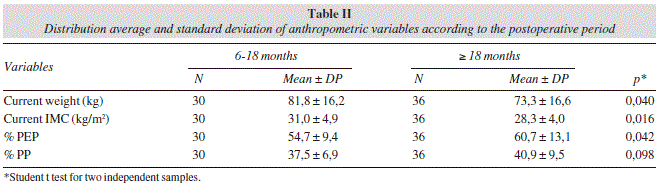
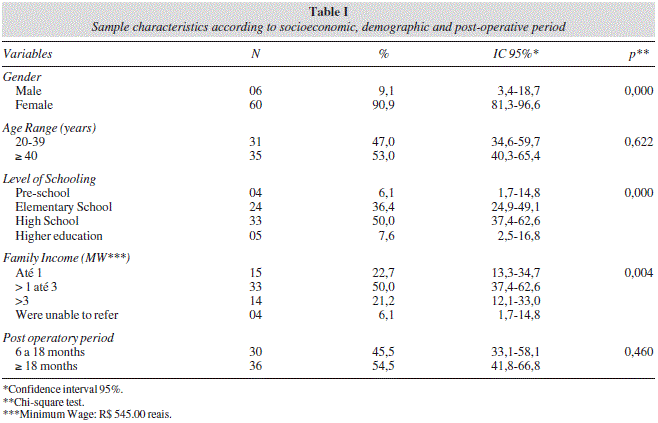
<body><![CDATA[<p>&nbsp;</p>     <p><font face="Verdana" size="2"><b>Results and discussion</b></font></p>     <p><font face="Verdana" size="2">66 patients have been interviewed within an average age of 42 &plusmn; 10.3 years, predominantly female, the majority with level of education of high school and 50% of the sample had family incomes between 1 to 3 minimum wages. There were no statistical differences regarding age and post-operative period (<a href="#t1">table I</a>).</font></p>     <p>&nbsp;</p>     <p align="center"><font face="Verdana" size="2"><a name="t1"><img src="/img/revistas/nh/v28n3/12_original_08_t1.gif" align="top"></a></font></p>     <p>&nbsp;</p>     <p><font face="Verdana" size="2">Similarly to the study of Menendez et al.,<sup>18</sup> in which results showed 83% of women and age average was also similar (41 &plusmn; 12 years old).</font></p>     <p><font face="Verdana" size="2">The fact that a higher frequency of obesity was found in females can be justified by the demand for health services by women, as reported by Ribeiro.<sup>19</sup> For this reason, the number of women treated when compared with the number of men seeking treatment is considerably larger.  <a href="#t2">Table II</a> shows the reduction of total body weight and BMI and, consequently, the PEP% increases over time. Although the PP% was higher in the postoperative period exceeding 18 months, no statistically significant difference was obtained.</font></p>     <p>&nbsp;</p>     <p align="center"><font face="Verdana" size="2"><a name="t2"><img src="/img/revistas/nh/v28n3/12_original_08_t2.gif" align="top"></a></font></p>     ]]></body>
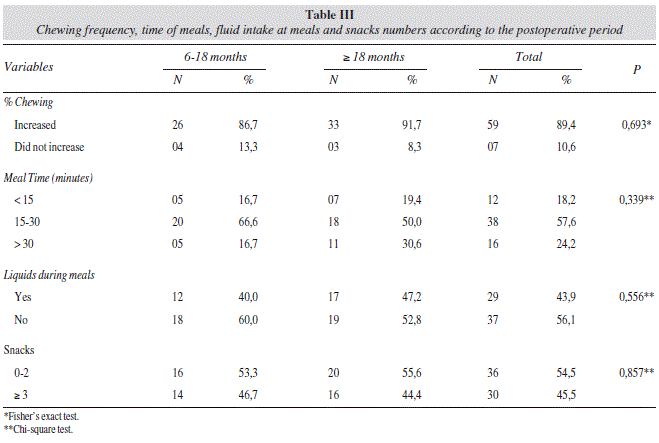
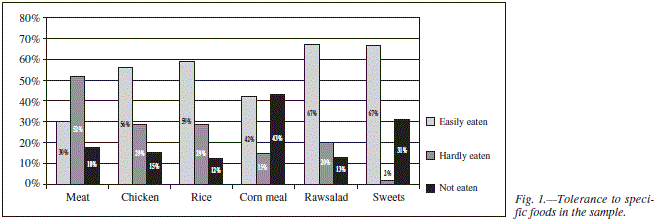
<body><![CDATA[<p>&nbsp;</p>     <p><font face="Verdana" size="2">After bariatric surgery, patients have an average weight loss of 40% as described by Oria and Morehead<sup>15</sup> in 1998. In this study, the average percentage weight loss of patients achieved a number very close to this value, in both groups between 6 and 18 months as an equal and above 18. Regarding eating habits, it appears that there was no statistical difference between all variables between the two patient groups (6-18 and <u>&gt;</u> 18 months postoperatively). However, the majority reported an increase in chewing time in relation to preoperative (89,4%). The average time spent on each meal within 15 to 30 minutes was more frequent in both groups. As for fluid intake during meals, it was found that most do not consume them during meals, which can be justified by the low tolerance for large volumes (<a href="#t3">table III</a>).</font></p>     <p>&nbsp;</p>     <p align="center"><font face="Verdana" size="2"><a name="t3"><img src="/img/revistas/nh/v28n3/12_original_08_t3.gif" align="top"></a></font></p>     <p>&nbsp;</p>     <p><font face="Verdana" size="2">Regarding to reduction of stomach capacity is important to emphasize the need to avoid the concomitant intake of liquids at meals, so that there is a further decrease in the amount of food consumed, and thus a depletion of nutritional status.<sup>14</sup></font></p>     <p><font face="Verdana" size="2">An important point to note is the frequency of complications in the postoperative period, in which the most commonly complication cited by patients were dumping syndrome (DS), affecting 39 (59%) patients. However, when evaluating the frequency of SD according to the periods after surgery, there was no statistically significant difference (p = 0.385). According to tolerance to specific foods, the most reported in the category &quot;hardly eaten&quot; were meat, chicken, rice, raw salad and corn meal. The food listed as &quot;not eaten&quot; were corn meal, followed by sweets, meat and chicken (<a href="#f1">fig. 1</a>).</font></p>     <p>&nbsp;</p>     <p align="center"><font face="Verdana" size="2"><a name="f1"><img src="/img/revistas/nh/v28n3/12_original_08_f1.gif" align="top"></a></font></p>     <p>&nbsp;</p>     ]]></body>
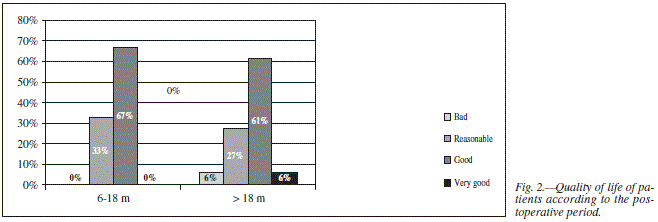
<body><![CDATA[<p><font face="Verdana" size="2">Bariatric surgery involves changes which are difficult to adapt and adhere, especially in the long run. The non- adherence can be the cause of several complications, and may thus aggravate various specific nutrient deficiencies or malnutrition,<sup>9</sup> inherent in the postoperative period.<sup>14</sup></font></p>     <p><font face="Verdana" size="2">The emergence of food intolerance is quite common in patients undergoing bariatric surgery in the late postoperative period.<sup>9</sup> However, there are few studies that evaluate the feeding tolerance in this group of patients. In the literature, there is record of a validated questionnaire to evaluate the feeding tolerance in the group in question, presented by Suter in 2007<sup>20</sup> which has not yet been validated in Brazil and does not include regional food, particularly those that are typical in the Northeast.</font></p>     <p><font face="Verdana" size="2">Food intolerance, if intense, may be the reason why some patients turn to drink or eat food in a soft consistence and high calorie, with negative effect on weight loss.<sup>21</sup> Such tolerance varied widely among the patients interviewed. Intolerance of beef is expected due to resection of a large part of the stomach with consequent change in the production of pepsin, primarily responsible for the digestion of proteins.<sup>22</sup> As for the difficulty in accepting the rice, this stems from impaired digestion by hydration and gelatinization process that it undergoes when subjected to cooking associated with low enzymatic activity of amylase.<sup>23</sup></font></p>     <p><font face="Verdana" size="2">Regarding quality of life, it can be observed, which is classified as &quot;good&quot; for most patients in both groups of 6-18 months as an equal and greater than 18 months. However, patients with &quot;bad&quot; and &quot;very good&quot; ratings of quality of life are observed only in the group &ge; 18 months (<a href="#f2">fig. 2</a>).</font></p>     <p>&nbsp;</p>     <p align="center"><font face="Verdana" size="2"><a name="f2"><img src="/img/revistas/nh/v28n3/12_original_08_f2.gif" align="top"></a></font></p>     <p>&nbsp;</p>     <p><font face="Verdana" size="2">Regarding the analysis of quality of life as measured by questionnaire BAROS, it was observed that the results differ somewhat from those found by Oria and Moorehead,<sup>15</sup> in which 88.8% of patients in the quality of life was considered very good or excellent, and only 3.7% rated themselves as fair or poor at the end of 12 months. Martinez et al.,<sup>24</sup> also using the BAROS criteria, had an outcome considered &quot;very good&quot; for 20% of the group whereas 60% was considered good.</font></p>     <p><font face="Verdana" size="2">According to the study by Prevedello et al. 2009,<sup>25</sup> 21.9% of patients were classified as excellent, 50% as very good and 28.1% as good, where none of the patients had acceptable or insufficient progress within 30 months after surgery.</font></p>     <p>&nbsp;</p>     ]]></body>
<body><![CDATA[<p><font face="Verdana" size="2"><b>Conclusion</b></font></p>     <p><font face="Verdana" size="2">The evolution of weight loss and loss of excess weight was satisfactory in all postoperative periods evaluated. The results of the method BAROS in this study showed the effectiveness of surgery in this population, since the patients had &quot;good&quot; rating in most patients in both groups of 6-18 months as an equal and greater than 18 months. However, patients report quality of life in the classification &quot;bad&quot; only in the period <u>&gt;</u> 18 months, showing thus the importance of multidisciplinary monitoring, stimulating compliance dietary guidelines and the guidelines from other specialties, to achieve a satisfactory level of well being and quality of life, both ultimate goals of the patient in question.</font></p>     <p>&nbsp;</p>     <p><font face="Verdana" size="2"><b>References</b></font></p>     <!-- ref --><p><font face="Verdana" size="2">1.  World Health Organization (WHO). Obesity: Prevalence of obesity in the world. 2006. Available at  <a target="_blank" href="http://www.who.int/research/en">http://www.who.int/research/en</a>.    &nbsp;&nbsp;&nbsp;&nbsp;&nbsp;&nbsp;&nbsp;&nbsp;[&#160;<a href="javascript:void(0);" onclick="javascript: window.open('/scielo.php?script=sci_nlinks&ref=3720218&pid=S0212-1611201300030001200001&lng=','','width=640,height=500,resizable=yes,scrollbars=1,menubar=yes,');">Links</a>&#160;]<!-- end-ref --></font></p>    <!-- ref --><p><font face="Verdana" size="2">2. Csendes A, et al. Resultados preliminares de la gastroplastia horizontal con anastomosis en Y de Roux como cirurgia bariática en pacientes com obesidad severa y mórbida. <i>Rev Méd Chil</i> 1999; 127 (8): 953-60.    &nbsp;&nbsp;&nbsp;&nbsp;&nbsp;&nbsp;&nbsp;&nbsp;[&#160;<a href="javascript:void(0);" onclick="javascript: window.open('/scielo.php?script=sci_nlinks&ref=3720220&pid=S0212-1611201300030001200002&lng=','','width=640,height=500,resizable=yes,scrollbars=1,menubar=yes,');">Links</a>&#160;]<!-- end-ref --></font></p>    <!-- ref --><p><font face="Verdana" size="2">3. Brito SJ, et al. Estudo do padrão alimentar tardio em obesos submetidos à derivação gástrica com bandagem em Y-de-Roux. <i>Rev Bras Nutr Clin</i> 2009; 24 (4): 249-54.    &nbsp;&nbsp;&nbsp;&nbsp;&nbsp;&nbsp;&nbsp;&nbsp;[&#160;<a href="javascript:void(0);" onclick="javascript: window.open('/scielo.php?script=sci_nlinks&ref=3720222&pid=S0212-1611201300030001200003&lng=','','width=640,height=500,resizable=yes,scrollbars=1,menubar=yes,');">Links</a>&#160;]<!-- end-ref --></font></p>    ]]></body>
<body><![CDATA[<!-- ref --><p><font face="Verdana" size="2">4. Barreto VN, Braghrolli Neto O, Lima CK, Paneili EB, Seal C, Santos D, et al. Quality of life of obese patients submitted to bariatric surgery. <i>Nutr Hosp</i> 2004; 19 (6): 367-71.    &nbsp;&nbsp;&nbsp;&nbsp;&nbsp;&nbsp;&nbsp;&nbsp;[&#160;<a href="javascript:void(0);" onclick="javascript: window.open('/scielo.php?script=sci_nlinks&ref=3720224&pid=S0212-1611201300030001200004&lng=','','width=640,height=500,resizable=yes,scrollbars=1,menubar=yes,');">Links</a>&#160;]<!-- end-ref --></font></p>    <!-- ref --><p><font face="Verdana" size="2">5. Choban PS, Jackson B, Poplawski S, Bistolarides P. Bariatric surgery for morbid obesity: why, when, how, where, and then what? <i>Cleve Clin J Med</i> 2002; 69 (11): 897-903.    &nbsp;&nbsp;&nbsp;&nbsp;&nbsp;&nbsp;&nbsp;&nbsp;[&#160;<a href="javascript:void(0);" onclick="javascript: window.open('/scielo.php?script=sci_nlinks&ref=3720226&pid=S0212-1611201300030001200005&lng=','','width=640,height=500,resizable=yes,scrollbars=1,menubar=yes,');">Links</a>&#160;]<!-- end-ref --></font></p>    <!-- ref --><p><font face="Verdana" size="2">6. Fobi MA, Lee H, Felahy B, Che K, Ako P, Fobi N. Choosing an operation for weight control, and the transected banded gastric bypass. <i>Obes Surg</i> 2005; 15 (1): 114-21.    &nbsp;&nbsp;&nbsp;&nbsp;&nbsp;&nbsp;&nbsp;&nbsp;[&#160;<a href="javascript:void(0);" onclick="javascript: window.open('/scielo.php?script=sci_nlinks&ref=3720228&pid=S0212-1611201300030001200006&lng=','','width=640,height=500,resizable=yes,scrollbars=1,menubar=yes,');">Links</a>&#160;]<!-- end-ref --></font></p>    <!-- ref --><p><font face="Verdana" size="2">7. Kriwanek S, Blauensteiner W, Lebisch E, Beckerhinn P, Roka R. Dietary changes after vertical banded gastroplasty. <i>Obes Surg</i> 2000; 10 (1): 37-40.    &nbsp;&nbsp;&nbsp;&nbsp;&nbsp;&nbsp;&nbsp;&nbsp;[&#160;<a href="javascript:void(0);" onclick="javascript: window.open('/scielo.php?script=sci_nlinks&ref=3720230&pid=S0212-1611201300030001200007&lng=','','width=640,height=500,resizable=yes,scrollbars=1,menubar=yes,');">Links</a>&#160;]<!-- end-ref --></font></p>    <!-- ref --><p><font face="Verdana" size="2">8. Shai I, Henkin Y, Weitzman S, Levi I. Long-term dietary changes after vertical banded gastroplasty: is the trade-off favorable? <i>Obes Surg</i> 2002; 12 (6): 805-11.    &nbsp;&nbsp;&nbsp;&nbsp;&nbsp;&nbsp;&nbsp;&nbsp;[&#160;<a href="javascript:void(0);" onclick="javascript: window.open('/scielo.php?script=sci_nlinks&ref=3720232&pid=S0212-1611201300030001200008&lng=','','width=640,height=500,resizable=yes,scrollbars=1,menubar=yes,');">Links</a>&#160;]<!-- end-ref --></font></p>    ]]></body>
<body><![CDATA[<!-- ref --><p><font face="Verdana" size="2">9. Cooper PL, Brearley LK, Jamieson AC, Ball MJ. Nutritional consequences of modified vertical gastroplasty in obese subjects. <i>Int J Obes Relat Metab Disord</i> 1999; 23 (4): 382-8.    &nbsp;&nbsp;&nbsp;&nbsp;&nbsp;&nbsp;&nbsp;&nbsp;[&#160;<a href="javascript:void(0);" onclick="javascript: window.open('/scielo.php?script=sci_nlinks&ref=3720234&pid=S0212-1611201300030001200009&lng=','','width=640,height=500,resizable=yes,scrollbars=1,menubar=yes,');">Links</a>&#160;]<!-- end-ref --></font></p>    <!-- ref --><p><font face="Verdana" size="2">10. Nelson JK, Gastineau CF, Moxness KE. Mayo clinic diet manual: a handbook of nutrition practices. Missouri: Mosby; 1994, pp. 195-205.    &nbsp;&nbsp;&nbsp;&nbsp;&nbsp;&nbsp;&nbsp;&nbsp;[&#160;<a href="javascript:void(0);" onclick="javascript: window.open('/scielo.php?script=sci_nlinks&ref=3720236&pid=S0212-1611201300030001200010&lng=','','width=640,height=500,resizable=yes,scrollbars=1,menubar=yes,');">Links</a>&#160;]<!-- end-ref --></font></p>    <!-- ref --><p><font face="Verdana" size="2">11. Fisher BL, Barber AE. In: Deitel M, Cowan Jr GSM. Update: surgery for the morbidly obese patient. Canada: FD-Communications; 2000, pp. 139-44.    &nbsp;&nbsp;&nbsp;&nbsp;&nbsp;&nbsp;&nbsp;&nbsp;[&#160;<a href="javascript:void(0);" onclick="javascript: window.open('/scielo.php?script=sci_nlinks&ref=3720238&pid=S0212-1611201300030001200011&lng=','','width=640,height=500,resizable=yes,scrollbars=1,menubar=yes,');">Links</a>&#160;]<!-- end-ref --></font></p>    <!-- ref --><p><font face="Verdana" size="2">12. Sugerman JH, Londery GL, Kellum JM, et al. Weight loss with vertical banded gastroplasty and Roux-en-Y gastric bypass for morbid obesity with selective versus random assignment. <i>Am J Surg</i> 1989; 15 (7): 93-102.    &nbsp;&nbsp;&nbsp;&nbsp;&nbsp;&nbsp;&nbsp;&nbsp;[&#160;<a href="javascript:void(0);" onclick="javascript: window.open('/scielo.php?script=sci_nlinks&ref=3720240&pid=S0212-1611201300030001200012&lng=','','width=640,height=500,resizable=yes,scrollbars=1,menubar=yes,');">Links</a>&#160;]<!-- end-ref --></font></p>    <!-- ref --><p><font face="Verdana" size="2">13. Halverson JD. Metabolic risk of obesity surgery and long term follow-up. <i>Am J Clin Nutr</i> 1992; 55 (2 Suppl.): 602S-5.    &nbsp;&nbsp;&nbsp;&nbsp;&nbsp;&nbsp;&nbsp;&nbsp;[&#160;<a href="javascript:void(0);" onclick="javascript: window.open('/scielo.php?script=sci_nlinks&ref=3720242&pid=S0212-1611201300030001200013&lng=','','width=640,height=500,resizable=yes,scrollbars=1,menubar=yes,');">Links</a>&#160;]<!-- end-ref --></font></p>    ]]></body>
<body><![CDATA[<!-- ref --><p><font face="Verdana" size="2">14. Faintuch J, Matsuda M, Cruz ME, Silva MM, Teivelis MP, Garrido AB Jr, et al. Severe protein-calorie malnutrition after bariatric procedures. <i>Obes Surg</i> 2004; 14 (2): 175-81.    &nbsp;&nbsp;&nbsp;&nbsp;&nbsp;&nbsp;&nbsp;&nbsp;[&#160;<a href="javascript:void(0);" onclick="javascript: window.open('/scielo.php?script=sci_nlinks&ref=3720244&pid=S0212-1611201300030001200014&lng=','','width=640,height=500,resizable=yes,scrollbars=1,menubar=yes,');">Links</a>&#160;]<!-- end-ref --></font></p>    <!-- ref --><p><font face="Verdana" size="2">15. Oria HE, Moorehead MK. Bariatric analysis and reporting outcome system (BAROS). <i>Obes Surg</i> 1998; 8 (5): 487-99.    &nbsp;&nbsp;&nbsp;&nbsp;&nbsp;&nbsp;&nbsp;&nbsp;[&#160;<a href="javascript:void(0);" onclick="javascript: window.open('/scielo.php?script=sci_nlinks&ref=3720246&pid=S0212-1611201300030001200015&lng=','','width=640,height=500,resizable=yes,scrollbars=1,menubar=yes,');">Links</a>&#160;]<!-- end-ref --></font></p>    <!-- ref --><p><font face="Verdana" size="2">16. World Health Organization (WHO). Physical status: the use and interpretation of anthropometry. WHO Technical Reports Series 854. Geneva: WHO. 1995, 452 p.    &nbsp;&nbsp;&nbsp;&nbsp;&nbsp;&nbsp;&nbsp;&nbsp;[&#160;<a href="javascript:void(0);" onclick="javascript: window.open('/scielo.php?script=sci_nlinks&ref=3720248&pid=S0212-1611201300030001200016&lng=','','width=640,height=500,resizable=yes,scrollbars=1,menubar=yes,');">Links</a>&#160;]<!-- end-ref --></font></p>    <!-- ref --><p><font face="Verdana" size="2">17. Toneto MG, Mottin CC, Repetto G, Rizzolli J, Berleze D, Brito CL, et al. Resultados iniciais do tratamento cirúrgico da obesidade mórbida em um centro multidisciplinar. <i>Rev AMRIGS</i> 2004; 48 (1): 16-21.    &nbsp;&nbsp;&nbsp;&nbsp;&nbsp;&nbsp;&nbsp;&nbsp;[&#160;<a href="javascript:void(0);" onclick="javascript: window.open('/scielo.php?script=sci_nlinks&ref=3720250&pid=S0212-1611201300030001200017&lng=','','width=640,height=500,resizable=yes,scrollbars=1,menubar=yes,');">Links</a>&#160;]<!-- end-ref --></font></p>    <!-- ref --><p><font face="Verdana" size="2">18. Menéndez P, Gambi D, Villarejo P, Cubo T, Padilla D, Menéndez JM, Martin J. Indicadores de calidad em cirugía bariátrica. Valoración de La perdida de peso. <i>Nutr Hosp</i> 2009; 24 (1): 25-31.    &nbsp;&nbsp;&nbsp;&nbsp;&nbsp;&nbsp;&nbsp;&nbsp;[&#160;<a href="javascript:void(0);" onclick="javascript: window.open('/scielo.php?script=sci_nlinks&ref=3720252&pid=S0212-1611201300030001200018&lng=','','width=640,height=500,resizable=yes,scrollbars=1,menubar=yes,');">Links</a>&#160;]<!-- end-ref --></font></p>    ]]></body>
<body><![CDATA[<!-- ref --><p><font face="Verdana" size="2">19. Ribeiro MCSA, Barata RB, Almeida MF, Silva ZP. Perfil sociodemográfico e padrão de utilização de serviços de saúde para usuários e não-usuários do SUS-PNAD 2003. Ciênc. saúde coletiva (serial on the Internet). 2006; 11 (4): 1011-22.    &nbsp;&nbsp;&nbsp;&nbsp;&nbsp;&nbsp;&nbsp;&nbsp;[&#160;<a href="javascript:void(0);" onclick="javascript: window.open('/scielo.php?script=sci_nlinks&ref=3720254&pid=S0212-1611201300030001200019&lng=','','width=640,height=500,resizable=yes,scrollbars=1,menubar=yes,');">Links</a>&#160;]<!-- end-ref --></font></p>    <!-- ref --><p><font face="Verdana" size="2">20. Suter, et al. A New Questionnaire for Quick Assessment of Food Tolerance after Bariatric Surgery. <i>Obes Surg</i> 2007; 7 (1): 2-8.    &nbsp;&nbsp;&nbsp;&nbsp;&nbsp;&nbsp;&nbsp;&nbsp;[&#160;<a href="javascript:void(0);" onclick="javascript: window.open('/scielo.php?script=sci_nlinks&ref=3720256&pid=S0212-1611201300030001200020&lng=','','width=640,height=500,resizable=yes,scrollbars=1,menubar=yes,');">Links</a>&#160;]<!-- end-ref --></font></p>    <!-- ref --><p><font face="Verdana" size="2">21. Valezi AC, et al. Late meal pattern in obese people after banded roux-en-y gastric bypass: comparision between male and female. <i>Rev Col Bras Cir</i> 2008; 35 (6): 387-91.    &nbsp;&nbsp;&nbsp;&nbsp;&nbsp;&nbsp;&nbsp;&nbsp;[&#160;<a href="javascript:void(0);" onclick="javascript: window.open('/scielo.php?script=sci_nlinks&ref=3720258&pid=S0212-1611201300030001200021&lng=','','width=640,height=500,resizable=yes,scrollbars=1,menubar=yes,');">Links</a>&#160;]<!-- end-ref --></font></p>    <!-- ref --><p><font face="Verdana" size="2">22. Kenler HA, Brolin RE, Cody RP. Changes in eating behavior after horizontal gastroplasty and Roux-en-Y gastric bypass. <i>Am J Clin Nutr</i> 1990; 52 (1): 87-92.    &nbsp;&nbsp;&nbsp;&nbsp;&nbsp;&nbsp;&nbsp;&nbsp;[&#160;<a href="javascript:void(0);" onclick="javascript: window.open('/scielo.php?script=sci_nlinks&ref=3720260&pid=S0212-1611201300030001200022&lng=','','width=640,height=500,resizable=yes,scrollbars=1,menubar=yes,');">Links</a>&#160;]<!-- end-ref --></font></p>    <!-- ref --><p><font face="Verdana" size="2">23. White S, Brooks E, Jurikova L, Stubbs RS. Long-term outcome safter gastric bypass. <i>Obes Surg</i> 2005; 15 (2): 155-63.    &nbsp;&nbsp;&nbsp;&nbsp;&nbsp;&nbsp;&nbsp;&nbsp;[&#160;<a href="javascript:void(0);" onclick="javascript: window.open('/scielo.php?script=sci_nlinks&ref=3720262&pid=S0212-1611201300030001200023&lng=','','width=640,height=500,resizable=yes,scrollbars=1,menubar=yes,');">Links</a>&#160;]<!-- end-ref --></font></p>    ]]></body>
<body><![CDATA[<!-- ref --><p><font face="Verdana" size="2">24. Martínez Y, Ruiz-López M D, Giménez R, Pérez de la Cruz A J, Orduña R. Does bariatric surgery improve the patient's quality of life? <i>Nutr Hosp</i> 2010; 25 (6): 925-30.    &nbsp;&nbsp;&nbsp;&nbsp;&nbsp;&nbsp;&nbsp;&nbsp;[&#160;<a href="javascript:void(0);" onclick="javascript: window.open('/scielo.php?script=sci_nlinks&ref=3720264&pid=S0212-1611201300030001200024&lng=','','width=640,height=500,resizable=yes,scrollbars=1,menubar=yes,');">Links</a>&#160;]<!-- end-ref --></font></p>    <!-- ref --><p><font face="Verdana" size="2">25. Prevedello CF, Colpo E, Mayer ET, Copetti H. Análise do impacto da cirurgia bariátrica em uma população do centro do estado do Rio Grande do Sul utilizando o método BAROS. <i>Arq Gastroenterol</i> 2009; 46 (3): 199-203.    &nbsp;&nbsp;&nbsp;&nbsp;&nbsp;&nbsp;&nbsp;&nbsp;[&#160;<a href="javascript:void(0);" onclick="javascript: window.open('/scielo.php?script=sci_nlinks&ref=3720266&pid=S0212-1611201300030001200025&lng=','','width=640,height=500,resizable=yes,scrollbars=1,menubar=yes,');">Links</a>&#160;]<!-- end-ref --></font></p>     <p>&nbsp;</p>     <p>&nbsp;</p>     <p><font face="Verdana" size="2"><a href="#top"><img border="0" src="/img/revistas/nh/v28n3/seta.gif" width="15" height="17"></a><a name="bajo"></a><b>Correspondence:</b>    <br>Priscila Prazeres de Assis.    <br>Divisão de Nutrição.    <br> Hospital Universitario Oswaldo Cruz (HUOC).    ]]></body>
<body><![CDATA[<br>Universidade de Pernambuco (UPE).    <br>Rua Arnóbio Marques, 310, Santo Amaro.    <br>50.100-130 Recife/PE-Brazil.    <br>E-mail: <a href="mailto:priscilaassis.nutri@hotmail.com">priscilaassis.nutri@hotmail.com</a></font></p>     <p><font face="Verdana" size="2">Recibido: 24-IX-2012.    <br>Aceptado: 8-I-2013.</font></p>      ]]></body><back>
<ref-list>
<ref id="B1">
<label>1</label><nlm-citation citation-type="">
<collab>World Health Organization (WHO)</collab>
<source><![CDATA[Obesity: Prevalence of obesity in the world]]></source>
<year>2006</year>
</nlm-citation>
</ref>
<ref id="B2">
<label>2</label><nlm-citation citation-type="journal">
<person-group person-group-type="author">
<name>
<surname><![CDATA[Csendes]]></surname>
<given-names><![CDATA[A]]></given-names>
</name>
</person-group>
<article-title xml:lang="es"><![CDATA[Resultados preliminares de la gastroplastia horizontal con anastomosis en Y de Roux como cirurgia bariática en pacientes com obesidad severa y mórbida]]></article-title>
<source><![CDATA[Rev Méd Chil]]></source>
<year>1999</year>
<volume>127</volume>
<numero>8</numero>
<issue>8</issue>
<page-range>953-60</page-range></nlm-citation>
</ref>
<ref id="B3">
<label>3</label><nlm-citation citation-type="journal">
<person-group person-group-type="author">
<name>
<surname><![CDATA[Brito]]></surname>
<given-names><![CDATA[SJ]]></given-names>
</name>
</person-group>
<article-title xml:lang="pt"><![CDATA[Estudo do padrão alimentar tardio em obesos submetidos à derivação gástrica com bandagem em Y-de-Roux]]></article-title>
<source><![CDATA[Rev Bras Nutr Clin]]></source>
<year>2009</year>
<volume>24</volume>
<numero>4</numero>
<issue>4</issue>
<page-range>249-54</page-range></nlm-citation>
</ref>
<ref id="B4">
<label>4</label><nlm-citation citation-type="journal">
<person-group person-group-type="author">
<name>
<surname><![CDATA[Barreto]]></surname>
<given-names><![CDATA[VN]]></given-names>
</name>
<name>
<surname><![CDATA[Braghrolli Neto]]></surname>
<given-names><![CDATA[O]]></given-names>
</name>
<name>
<surname><![CDATA[Lima]]></surname>
<given-names><![CDATA[CK]]></given-names>
</name>
<name>
<surname><![CDATA[Paneili]]></surname>
<given-names><![CDATA[EB]]></given-names>
</name>
<name>
<surname><![CDATA[Seal]]></surname>
<given-names><![CDATA[C]]></given-names>
</name>
<name>
<surname><![CDATA[Santos]]></surname>
<given-names><![CDATA[D]]></given-names>
</name>
</person-group>
<article-title xml:lang="en"><![CDATA[Quality of life of obese patients submitted to bariatric surgery]]></article-title>
<source><![CDATA[Nutr Hosp]]></source>
<year>2004</year>
<volume>19</volume>
<numero>6</numero>
<issue>6</issue>
<page-range>367-71</page-range></nlm-citation>
</ref>
<ref id="B5">
<label>5</label><nlm-citation citation-type="journal">
<person-group person-group-type="author">
<name>
<surname><![CDATA[Choban]]></surname>
<given-names><![CDATA[PS]]></given-names>
</name>
<name>
<surname><![CDATA[Jackson]]></surname>
<given-names><![CDATA[B]]></given-names>
</name>
<name>
<surname><![CDATA[Poplawski]]></surname>
<given-names><![CDATA[S]]></given-names>
</name>
<name>
<surname><![CDATA[Bistolarides]]></surname>
<given-names><![CDATA[P]]></given-names>
</name>
</person-group>
<article-title xml:lang="en"><![CDATA[Bariatric surgery for morbid obesity: why, when, how, where, and then what?]]></article-title>
<source><![CDATA[Cleve Clin J Med]]></source>
<year>2002</year>
<volume>69</volume>
<numero>11</numero>
<issue>11</issue>
<page-range>897-903</page-range></nlm-citation>
</ref>
<ref id="B6">
<label>6</label><nlm-citation citation-type="journal">
<person-group person-group-type="author">
<name>
<surname><![CDATA[Fobi]]></surname>
<given-names><![CDATA[MA]]></given-names>
</name>
<name>
<surname><![CDATA[Lee]]></surname>
<given-names><![CDATA[H]]></given-names>
</name>
<name>
<surname><![CDATA[Felahy]]></surname>
<given-names><![CDATA[B]]></given-names>
</name>
<name>
<surname><![CDATA[Che]]></surname>
<given-names><![CDATA[K]]></given-names>
</name>
<name>
<surname><![CDATA[Ako]]></surname>
<given-names><![CDATA[P]]></given-names>
</name>
<name>
<surname><![CDATA[Fobi]]></surname>
<given-names><![CDATA[N]]></given-names>
</name>
</person-group>
<article-title xml:lang="en"><![CDATA[Choosing an operation for weight control, and the transected banded gastric bypass]]></article-title>
<source><![CDATA[Obes Surg]]></source>
<year>2005</year>
<volume>15</volume>
<numero>1</numero>
<issue>1</issue>
<page-range>114-21</page-range></nlm-citation>
</ref>
<ref id="B7">
<label>7</label><nlm-citation citation-type="journal">
<person-group person-group-type="author">
<name>
<surname><![CDATA[Kriwanek]]></surname>
<given-names><![CDATA[S]]></given-names>
</name>
<name>
<surname><![CDATA[Blauensteiner]]></surname>
<given-names><![CDATA[W]]></given-names>
</name>
<name>
<surname><![CDATA[Lebisch]]></surname>
<given-names><![CDATA[E]]></given-names>
</name>
<name>
<surname><![CDATA[Beckerhinn]]></surname>
<given-names><![CDATA[P]]></given-names>
</name>
<name>
<surname><![CDATA[Roka]]></surname>
<given-names><![CDATA[R]]></given-names>
</name>
</person-group>
<article-title xml:lang="en"><![CDATA[Dietary changes after vertical banded gastroplasty]]></article-title>
<source><![CDATA[Obes Surg]]></source>
<year>2000</year>
<volume>10</volume>
<numero>1</numero>
<issue>1</issue>
<page-range>37-40</page-range></nlm-citation>
</ref>
<ref id="B8">
<label>8</label><nlm-citation citation-type="journal">
<person-group person-group-type="author">
<name>
<surname><![CDATA[Shai]]></surname>
<given-names><![CDATA[I]]></given-names>
</name>
<name>
<surname><![CDATA[Henkin]]></surname>
<given-names><![CDATA[Y]]></given-names>
</name>
<name>
<surname><![CDATA[Weitzman]]></surname>
<given-names><![CDATA[S]]></given-names>
</name>
<name>
<surname><![CDATA[Levi]]></surname>
<given-names><![CDATA[I]]></given-names>
</name>
</person-group>
<article-title xml:lang="en"><![CDATA[Long-term dietary changes after vertical banded gastroplasty: is the trade-off favorable?]]></article-title>
<source><![CDATA[Obes Surg]]></source>
<year>2002</year>
<volume>12</volume>
<numero>6</numero>
<issue>6</issue>
<page-range>805-11</page-range></nlm-citation>
</ref>
<ref id="B9">
<label>9</label><nlm-citation citation-type="journal">
<person-group person-group-type="author">
<name>
<surname><![CDATA[Cooper]]></surname>
<given-names><![CDATA[PL]]></given-names>
</name>
<name>
<surname><![CDATA[Brearley]]></surname>
<given-names><![CDATA[LK]]></given-names>
</name>
<name>
<surname><![CDATA[Jamieson]]></surname>
<given-names><![CDATA[AC]]></given-names>
</name>
<name>
<surname><![CDATA[Ball]]></surname>
<given-names><![CDATA[MJ]]></given-names>
</name>
</person-group>
<article-title xml:lang="en"><![CDATA[Nutritional consequences of modified vertical gastroplasty in obese subjects]]></article-title>
<source><![CDATA[Int J Obes Relat Metab Disord]]></source>
<year>1999</year>
<volume>23</volume>
<numero>4</numero>
<issue>4</issue>
<page-range>382-8</page-range></nlm-citation>
</ref>
<ref id="B10">
<label>10</label><nlm-citation citation-type="book">
<person-group person-group-type="author">
<name>
<surname><![CDATA[Nelson]]></surname>
<given-names><![CDATA[JK]]></given-names>
</name>
<name>
<surname><![CDATA[Gastineau]]></surname>
<given-names><![CDATA[CF]]></given-names>
</name>
<name>
<surname><![CDATA[Moxness]]></surname>
<given-names><![CDATA[KE]]></given-names>
</name>
</person-group>
<source><![CDATA[Mayo clinic diet manual: a handbook of nutrition practices]]></source>
<year>1994</year>
<page-range>195-205</page-range><publisher-loc><![CDATA[Missouri ]]></publisher-loc>
<publisher-name><![CDATA[Mosby]]></publisher-name>
</nlm-citation>
</ref>
<ref id="B11">
<label>11</label><nlm-citation citation-type="book">
<person-group person-group-type="author">
<name>
<surname><![CDATA[Fisher]]></surname>
<given-names><![CDATA[BL]]></given-names>
</name>
<name>
<surname><![CDATA[Barber]]></surname>
<given-names><![CDATA[AE]]></given-names>
</name>
</person-group>
<person-group person-group-type="editor">
<name>
<surname><![CDATA[Deitel]]></surname>
<given-names><![CDATA[M]]></given-names>
</name>
<name>
<surname><![CDATA[Cowan]]></surname>
<given-names><![CDATA[Jr GSM]]></given-names>
</name>
</person-group>
<source><![CDATA[Update: surgery for the morbidly obese patient]]></source>
<year>2000</year>
<page-range>139-44</page-range><publisher-loc><![CDATA[Canada ]]></publisher-loc>
<publisher-name><![CDATA[FD-Communications]]></publisher-name>
</nlm-citation>
</ref>
<ref id="B12">
<label>12</label><nlm-citation citation-type="journal">
<person-group person-group-type="author">
<name>
<surname><![CDATA[Sugerman]]></surname>
<given-names><![CDATA[JH]]></given-names>
</name>
<name>
<surname><![CDATA[Londery]]></surname>
<given-names><![CDATA[GL]]></given-names>
</name>
<name>
<surname><![CDATA[Kellum]]></surname>
<given-names><![CDATA[JM]]></given-names>
</name>
</person-group>
<article-title xml:lang="en"><![CDATA[Weight loss with vertical banded gastroplasty and Roux-en-Y gastric bypass for morbid obesity with selective versus random assignment]]></article-title>
<source><![CDATA[Am J Surg]]></source>
<year>1989</year>
<volume>15</volume>
<numero>7</numero>
<issue>7</issue>
<page-range>93-102</page-range></nlm-citation>
</ref>
<ref id="B13">
<label>13</label><nlm-citation citation-type="journal">
<person-group person-group-type="author">
<name>
<surname><![CDATA[Halverson]]></surname>
<given-names><![CDATA[JD]]></given-names>
</name>
</person-group>
<article-title xml:lang="en"><![CDATA[Metabolic risk of obesity surgery and long term follow-up]]></article-title>
<source><![CDATA[Am J Clin Nutr]]></source>
<year>1992</year>
<volume>55</volume>
<numero>2</numero>
<issue>2</issue>
<page-range>602S-5</page-range></nlm-citation>
</ref>
<ref id="B14">
<label>14</label><nlm-citation citation-type="journal">
<person-group person-group-type="author">
<name>
<surname><![CDATA[Faintuch]]></surname>
<given-names><![CDATA[J]]></given-names>
</name>
<name>
<surname><![CDATA[Matsuda]]></surname>
<given-names><![CDATA[M]]></given-names>
</name>
<name>
<surname><![CDATA[Cruz]]></surname>
<given-names><![CDATA[ME]]></given-names>
</name>
<name>
<surname><![CDATA[Silva]]></surname>
<given-names><![CDATA[MM]]></given-names>
</name>
<name>
<surname><![CDATA[Teivelis]]></surname>
<given-names><![CDATA[MP]]></given-names>
</name>
<name>
<surname><![CDATA[Garrido]]></surname>
<given-names><![CDATA[AB Jr]]></given-names>
</name>
</person-group>
<article-title xml:lang="en"><![CDATA[Severe protein-calorie malnutrition after bariatric procedures]]></article-title>
<source><![CDATA[Obes Surg]]></source>
<year>2004</year>
<volume>14</volume>
<numero>2</numero>
<issue>2</issue>
<page-range>175-81</page-range></nlm-citation>
</ref>
<ref id="B15">
<label>15</label><nlm-citation citation-type="journal">
<person-group person-group-type="author">
<name>
<surname><![CDATA[Oria]]></surname>
<given-names><![CDATA[HE]]></given-names>
</name>
<name>
<surname><![CDATA[Moorehead]]></surname>
<given-names><![CDATA[MK]]></given-names>
</name>
</person-group>
<article-title xml:lang="en"><![CDATA[Bariatric analysis and reporting outcome system (BAROS)]]></article-title>
<source><![CDATA[Obes Surg]]></source>
<year>1998</year>
<volume>8</volume>
<numero>5</numero>
<issue>5</issue>
<page-range>487-99</page-range></nlm-citation>
</ref>
<ref id="B16">
<label>16</label><nlm-citation citation-type="book">
<collab>World Health Organization (WHO)</collab>
<source><![CDATA[Physical status: the use and interpretation of anthropometry]]></source>
<year>1995</year>
<volume>854</volume>
<publisher-loc><![CDATA[Geneva ]]></publisher-loc>
<publisher-name><![CDATA[WHO]]></publisher-name>
</nlm-citation>
</ref>
<ref id="B17">
<label>17</label><nlm-citation citation-type="journal">
<person-group person-group-type="author">
<name>
<surname><![CDATA[Toneto]]></surname>
<given-names><![CDATA[MG]]></given-names>
</name>
<name>
<surname><![CDATA[Mottin]]></surname>
<given-names><![CDATA[CC]]></given-names>
</name>
<name>
<surname><![CDATA[Repetto]]></surname>
<given-names><![CDATA[G]]></given-names>
</name>
<name>
<surname><![CDATA[Rizzolli]]></surname>
<given-names><![CDATA[J]]></given-names>
</name>
<name>
<surname><![CDATA[Berleze]]></surname>
<given-names><![CDATA[D]]></given-names>
</name>
<name>
<surname><![CDATA[Brito]]></surname>
<given-names><![CDATA[CL]]></given-names>
</name>
</person-group>
<article-title xml:lang="pt"><![CDATA[Resultados iniciais do tratamento cirúrgico da obesidade mórbida em um centro multidisciplinar]]></article-title>
<source><![CDATA[Rev AMRIGS]]></source>
<year>2004</year>
<volume>48</volume>
<numero>1</numero>
<issue>1</issue>
<page-range>16-21</page-range></nlm-citation>
</ref>
<ref id="B18">
<label>18</label><nlm-citation citation-type="journal">
<person-group person-group-type="author">
<name>
<surname><![CDATA[Menéndez]]></surname>
<given-names><![CDATA[P]]></given-names>
</name>
<name>
<surname><![CDATA[Gambi]]></surname>
<given-names><![CDATA[D]]></given-names>
</name>
<name>
<surname><![CDATA[Villarejo]]></surname>
<given-names><![CDATA[P]]></given-names>
</name>
<name>
<surname><![CDATA[Cubo]]></surname>
<given-names><![CDATA[T]]></given-names>
</name>
<name>
<surname><![CDATA[Padilla]]></surname>
<given-names><![CDATA[D]]></given-names>
</name>
<name>
<surname><![CDATA[Menéndez]]></surname>
<given-names><![CDATA[JM]]></given-names>
</name>
<name>
<surname><![CDATA[Martin]]></surname>
<given-names><![CDATA[J]]></given-names>
</name>
</person-group>
<article-title xml:lang="es"><![CDATA[Indicadores de calidad em cirugía bariátrica: Valoración de La perdida de peso]]></article-title>
<source><![CDATA[Nutr Hosp]]></source>
<year>2009</year>
<volume>24</volume>
<numero>1</numero>
<issue>1</issue>
<page-range>25-31</page-range></nlm-citation>
</ref>
<ref id="B19">
<label>19</label><nlm-citation citation-type="journal">
<person-group person-group-type="author">
<name>
<surname><![CDATA[Ribeiro]]></surname>
<given-names><![CDATA[MCSA]]></given-names>
</name>
<name>
<surname><![CDATA[Barata]]></surname>
<given-names><![CDATA[RB]]></given-names>
</name>
<name>
<surname><![CDATA[Almeida]]></surname>
<given-names><![CDATA[MF]]></given-names>
</name>
<name>
<surname><![CDATA[Silva]]></surname>
<given-names><![CDATA[ZP]]></given-names>
</name>
</person-group>
<article-title xml:lang="pt"><![CDATA[Perfil sociodemográfico e padrão de utilização de serviços de saúde para usuários e não-usuários do SUS-PNAD 2003]]></article-title>
<source><![CDATA[Ciênc. saúde coletiva (serial on the Internet)]]></source>
<year>2006</year>
<volume>11</volume>
<numero>4</numero>
<issue>4</issue>
<page-range>1011-22</page-range></nlm-citation>
</ref>
<ref id="B20">
<label>20</label><nlm-citation citation-type="journal">
<person-group person-group-type="author">
<name>
<surname><![CDATA[Suter]]></surname>
</name>
</person-group>
<article-title xml:lang="en"><![CDATA[A New Questionnaire for Quick Assessment of Food Tolerance after Bariatric Surgery]]></article-title>
<source><![CDATA[Obes Surg]]></source>
<year>2007</year>
<volume>7</volume>
<numero>1</numero>
<issue>1</issue>
<page-range>2-8</page-range></nlm-citation>
</ref>
<ref id="B21">
<label>21</label><nlm-citation citation-type="journal">
<person-group person-group-type="author">
<name>
<surname><![CDATA[Valezi]]></surname>
<given-names><![CDATA[AC]]></given-names>
</name>
</person-group>
<article-title xml:lang="en"><![CDATA[Late meal pattern in obese people after banded roux-en-y gastric bypass: comparision between male and female]]></article-title>
<source><![CDATA[Rev Col Bras Cir]]></source>
<year>2008</year>
<volume>35</volume>
<numero>6</numero>
<issue>6</issue>
<page-range>387-91</page-range></nlm-citation>
</ref>
<ref id="B22">
<label>22</label><nlm-citation citation-type="journal">
<person-group person-group-type="author">
<name>
<surname><![CDATA[Kenler]]></surname>
<given-names><![CDATA[HA]]></given-names>
</name>
<name>
<surname><![CDATA[Brolin]]></surname>
<given-names><![CDATA[RE]]></given-names>
</name>
<name>
<surname><![CDATA[Cody]]></surname>
<given-names><![CDATA[RP]]></given-names>
</name>
</person-group>
<article-title xml:lang="en"><![CDATA[Changes in eating behavior after horizontal gastroplasty and Roux-en-Y gastric bypass]]></article-title>
<source><![CDATA[Am J Clin Nutr]]></source>
<year>1990</year>
<volume>52</volume>
<numero>1</numero>
<issue>1</issue>
<page-range>87-92</page-range></nlm-citation>
</ref>
<ref id="B23">
<label>23</label><nlm-citation citation-type="journal">
<person-group person-group-type="author">
<name>
<surname><![CDATA[White]]></surname>
<given-names><![CDATA[S]]></given-names>
</name>
<name>
<surname><![CDATA[Brooks]]></surname>
<given-names><![CDATA[E]]></given-names>
</name>
<name>
<surname><![CDATA[Jurikova]]></surname>
<given-names><![CDATA[L]]></given-names>
</name>
<name>
<surname><![CDATA[Stubbs]]></surname>
<given-names><![CDATA[RS]]></given-names>
</name>
</person-group>
<article-title xml:lang="en"><![CDATA[Long-term outcome safter gastric bypass]]></article-title>
<source><![CDATA[Obes Surg]]></source>
<year>2005</year>
<volume>15</volume>
<numero>2</numero>
<issue>2</issue>
<page-range>155-63</page-range></nlm-citation>
</ref>
<ref id="B24">
<label>24</label><nlm-citation citation-type="journal">
<person-group person-group-type="author">
<name>
<surname><![CDATA[Martínez]]></surname>
<given-names><![CDATA[Y]]></given-names>
</name>
<name>
<surname><![CDATA[Ruiz-López]]></surname>
<given-names><![CDATA[M D]]></given-names>
</name>
<name>
<surname><![CDATA[Giménez]]></surname>
<given-names><![CDATA[R]]></given-names>
</name>
<name>
<surname><![CDATA[Pérez de la Cruz]]></surname>
<given-names><![CDATA[A J]]></given-names>
</name>
<name>
<surname><![CDATA[Orduña]]></surname>
<given-names><![CDATA[R]]></given-names>
</name>
</person-group>
<article-title xml:lang="en"><![CDATA[Does bariatric surgery improve the patient's quality of life?]]></article-title>
<source><![CDATA[Nutr Hosp]]></source>
<year>2010</year>
<volume>25</volume>
<numero>6</numero>
<issue>6</issue>
<page-range>925-30</page-range></nlm-citation>
</ref>
<ref id="B25">
<label>25</label><nlm-citation citation-type="journal">
<person-group person-group-type="author">
<name>
<surname><![CDATA[Prevedello]]></surname>
<given-names><![CDATA[CF]]></given-names>
</name>
<name>
<surname><![CDATA[Colpo]]></surname>
<given-names><![CDATA[E]]></given-names>
</name>
<name>
<surname><![CDATA[Mayer]]></surname>
<given-names><![CDATA[ET]]></given-names>
</name>
<name>
<surname><![CDATA[Copetti]]></surname>
<given-names><![CDATA[H]]></given-names>
</name>
</person-group>
<article-title xml:lang="pt"><![CDATA[Análise do impacto da cirurgia bariátrica em uma população do centro do estado do Rio Grande do Sul utilizando o método BAROS]]></article-title>
<source><![CDATA[Arq Gastroenterol]]></source>
<year>2009</year>
<volume>46</volume>
<numero>3</numero>
<issue>3</issue>
<page-range>199-203</page-range></nlm-citation>
</ref>
</ref-list>
</back>
</article>