<?xml version="1.0" encoding="ISO-8859-1"?><article xmlns:mml="http://www.w3.org/1998/Math/MathML" xmlns:xlink="http://www.w3.org/1999/xlink" xmlns:xsi="http://www.w3.org/2001/XMLSchema-instance">
<front>
<journal-meta>
<journal-id>0212-1611</journal-id>
<journal-title><![CDATA[Nutrición Hospitalaria]]></journal-title>
<abbrev-journal-title><![CDATA[Nutr. Hosp.]]></abbrev-journal-title>
<issn>0212-1611</issn>
<publisher>
<publisher-name><![CDATA[Grupo Arán]]></publisher-name>
</publisher>
</journal-meta>
<article-meta>
<article-id>S0212-16112013000400031</article-id>
<article-id pub-id-type="doi">10.3305/nh.2013.28.4.6033</article-id>
<title-group>
<article-title xml:lang="en"><![CDATA[Metabolic syndrome and nutrition in a Granada's tropical coast population]]></article-title>
<article-title xml:lang="es"><![CDATA[Síndrome metabólico y nutrición en una población de la costa tropical de Granada]]></article-title>
</title-group>
<contrib-group>
<contrib contrib-type="author">
<name>
<surname><![CDATA[Millán]]></surname>
<given-names><![CDATA[S.]]></given-names>
</name>
<xref ref-type="aff" rid="A01"/>
</contrib>
<contrib contrib-type="author">
<name>
<surname><![CDATA[Samaniego-Sánchez]]></surname>
<given-names><![CDATA[C.]]></given-names>
</name>
<xref ref-type="aff" rid="A01"/>
</contrib>
<contrib contrib-type="author">
<name>
<surname><![CDATA[Romero]]></surname>
<given-names><![CDATA[A.]]></given-names>
</name>
<xref ref-type="aff" rid="A01"/>
</contrib>
<contrib contrib-type="author">
<name>
<surname><![CDATA[Quesada-Granados]]></surname>
<given-names><![CDATA[J. J.]]></given-names>
</name>
<xref ref-type="aff" rid="A01"/>
</contrib>
<contrib contrib-type="author">
<name>
<surname><![CDATA[López-García de la Serrana]]></surname>
<given-names><![CDATA[H.]]></given-names>
</name>
<xref ref-type="aff" rid="A01"/>
</contrib>
</contrib-group>
<aff id="A01">
<institution><![CDATA[,University of Granada Faculty of Pharmacy Department of Nutrition and Bromatology]]></institution>
<addr-line><![CDATA[Granada ]]></addr-line>
<country>Spain</country>
</aff>
<pub-date pub-type="pub">
<day>00</day>
<month>08</month>
<year>2013</year>
</pub-date>
<pub-date pub-type="epub">
<day>00</day>
<month>08</month>
<year>2013</year>
</pub-date>
<volume>28</volume>
<numero>4</numero>
<fpage>1190</fpage>
<lpage>1194</lpage>
<copyright-statement/>
<copyright-year/>
<self-uri xlink:href="http://scielo.isciii.es/scielo.php?script=sci_arttext&amp;pid=S0212-16112013000400031&amp;lng=en&amp;nrm=iso"></self-uri><self-uri xlink:href="http://scielo.isciii.es/scielo.php?script=sci_abstract&amp;pid=S0212-16112013000400031&amp;lng=en&amp;nrm=iso"></self-uri><self-uri xlink:href="http://scielo.isciii.es/scielo.php?script=sci_pdf&amp;pid=S0212-16112013000400031&amp;lng=en&amp;nrm=iso"></self-uri><abstract abstract-type="short" xml:lang="en"><p><![CDATA[Background: The metabolic syndrome (MS) is described as an association of health problems that a given person may simultaneously or successively develop, and it is considered a serious condition because it is related to a significantly increased risk of suffering diabetes, coronary disease and brain damage. Nutrition, along with other factors such as physical activity and genetic inheritance, has an influence on preventing MS. Objective: The aim of this research is to demonstrate important aspects concerning the diagnosis, the prevalence, and the prevention of metabolic syndrome among the population of the tropical coast of Granada. Methods: 119 individuals from the tropical coast of Granada were studied to collect personal data such as their body mass index, body fat percentage, glycaemia, total cholesterol, HDL cholesterol, LDL cholesterol, and food intake (through nutritional survey). Results: As a result of this research, a metabolic syndrome prevalence of 20,2% was obtained, 58,3% of which was related to women. The results obtained show significant statistical differences between individuals having metabolic syndrome and the control group. Particularly, these differences can be noted in parameters such as the BMI or the % of body fat. Nevertheless, there are no significant differences between the two groups concerning parameters related to nutrition such as % of fat, carbohydrates, proteins and kcal/day. Conclusion: As a conclusion from the research, we can state that the metabolic syndrome prevalence among the population of the tropical coast of Granada is similar to the figure obtained for the population in the US and in other areas of Spain. In addition, this research shows that metabolic syndrome is more frequent among individuals whose BMI and % of body fat is higher than 30.]]></p></abstract>
<abstract abstract-type="short" xml:lang="es"><p><![CDATA[Antecedentes: El síndrome metabòlico (SM) es una asociación de problemas de salud que pueden aparecer de forma simultánea o secuencial en un mismo individuo, y es importante porque se relaciona con un incremento significativo de riesgo de diabetes, enfermedad coronaria y enfermedad cerebrovascular. La nutrición junto a otros factores como es el ejercicio físico y la genetica del individuo, influyen en la prevención del SM. Objetivo: Conocer aspectos importantes como el diagnostico, prevalencia y prevención del síndrome metabólico en población de la Costa Tropical Granadina. Métodos: Se estudiaron en 119 individuos de la Costa Granadina parámetros como el indice de masa corporal, el porcentaje de grasa corporal, análisis clínicos de glucosa, colesterol total, colesterol HDL, colesterol LDL y estudiaron valores nutricionales mediante encuesta. Resultados: En el estudio se obtuvo una prevalencia el Síndrome metabòlico del 20,2%, del que el 58,3% correspondía a mujeres. Los resultados obtenidos reflejan diferencias estadísticas significativas entre los individuos con síndrome metabólico y el grupo control, observándose dichas diferencias en parámetros tales como IMC o el porcentaje de grasa corporal. Sin embargo en parámetros como porcentaje de lípidos, porcentaje de hidratos de carbono, porcentaje de proteínas y kcal/día no hay diferencias significativas entre los individuos con SM y los individuos control. Conclusión: De esta manera podemos deducir del estudio que la prevalencia de síndrome metabólico en la población de la Costa Tropical Granadina se asemeja a la obtenida en EE.UU y a la obtenida en algunas zonas estudiadas en España. Igualmente, se puede apreciar en este estudio como el síndrome metabólico es más frecuente en personas con IMC y % de grasa corporal superior a 30.]]></p></abstract>
<kwd-group>
<kwd lng="en"><![CDATA[Metabolic syndrome]]></kwd>
<kwd lng="en"><![CDATA[Diet]]></kwd>
<kwd lng="en"><![CDATA[Obesity]]></kwd>
<kwd lng="en"><![CDATA[Body Mass Index]]></kwd>
<kwd lng="es"><![CDATA[Síndrome metabólico]]></kwd>
<kwd lng="es"><![CDATA[Dieta]]></kwd>
<kwd lng="es"><![CDATA[Obesidad]]></kwd>
<kwd lng="es"><![CDATA[Índice de masa corporal]]></kwd>
</kwd-group>
</article-meta>
</front><body><![CDATA[  <a name="top"></a>     <p><font face="Verdana" size="2"><b>ORIGINAL/<i>Síndrome metabólico</i></b></font></p>     <p>&nbsp;</p>     <p><font face="Verdana" size="4"><b>Metabolic syndrome and nutrition in a Granada's tropical coast population</b></font></p>     <p><font face="Verdana" size="4"><b>Síndrome metabólico y nutrición en una población de la costa tropical de Granada</b></font></p>     <p>&nbsp;</p>     <p>&nbsp;</p>     <p><font face="Verdana" size="2"><b>S. Millán, C. Samaniego-Sánchez, A. Romero, J. J. Quesada-Granados and H. López-García de la Serrana</b></font></p>     <p><font face="Verdana" size="2">Department of Nutrition and Bromatology. Faculty of Pharmacy. University of Granada. Granada. Spain</font></p>     <p><font face="Verdana" size="2"><a href="#bajo">Correspondence</a></font></p>     ]]></body>
<body><![CDATA[<p>&nbsp;</p>     <p>&nbsp;</p> <hr size="1">     <p><font face="Verdana" size="2"><b>ABSTRACT</b></font></p>     <p><font face="Verdana" size="2"><b>Background:</b> The metabolic syndrome (MS) is described as an association of health problems that a given person may simultaneously or successively develop, and it is considered a serious condition because it is related to a significantly increased risk of suffering diabetes, coronary disease and brain damage. Nutrition, along with other factors such as physical activity and genetic inheritance, has an influence on preventing MS.    <br><b>Objective:</b> The aim of this research is to demonstrate important aspects concerning the diagnosis, the prevalence, and the prevention of metabolic syndrome among the population of the tropical coast of Granada.    <br><b>Methods:</b> 119 individuals from the tropical coast of Granada were studied to collect personal data such as their body mass index, body fat percentage, glycaemia, total cholesterol, HDL cholesterol, LDL cholesterol, and food intake (through nutritional survey). Results: As a result of this research, a metabolic syndrome prevalence of 20,2% was obtained, 58,3% of which was related to women. The results obtained show significant statistical differences between individuals having metabolic syndrome and the control group. Particularly, these differences can be noted in parameters such as the BMI or the % of body fat. Nevertheless, there are no significant differences between the two groups concerning parameters related to nutrition such as % of fat, carbohydrates, proteins and kcal/day.    <br><b>Conclusion:</b> As a conclusion from the research, we can state that the metabolic syndrome prevalence among the population of the tropical coast of Granada is similar to the figure obtained for the population in the US and in other areas of Spain. In addition, this research shows that metabolic syndrome is more frequent among individuals whose BMI and % of body fat is higher than 30.</font></p>     <p><font face="Verdana" size="2"><b>Key words:</b> Metabolic syndrome. Diet. Obesity. Body Mass Index.</font></p> <hr size="1">     <p><font face="Verdana" size="2"><b>RESUMEN</b></font></p>     <p><font face="Verdana" size="2"><b>Antecedentes:</b> El síndrome metabòlico (SM) es una asociación de problemas de salud que pueden aparecer de forma simultánea o secuencial en un mismo individuo, y es importante porque se relaciona con un incremento significativo de riesgo de diabetes, enfermedad coronaria y enfermedad cerebrovascular. La nutrición junto a otros factores como es el ejercicio físico y la genetica del individuo, influyen en la prevención del SM.    ]]></body>
<body><![CDATA[<br><b>Objetivo:</b> Conocer aspectos importantes como el diagnostico, prevalencia y prevención del síndrome metabólico en población de la Costa Tropical Granadina.    <br><b>Métodos:</b> Se estudiaron en 119 individuos de la Costa Granadina parámetros como el indice de masa corporal, el porcentaje de grasa corporal, análisis clínicos de glucosa, colesterol total, colesterol HDL, colesterol LDL y estudiaron valores nutricionales mediante encuesta.    <br><b>Resultados:</b> En el estudio se obtuvo una prevalencia el Síndrome metabòlico del 20,2%, del que el 58,3% correspondía a mujeres. Los resultados obtenidos reflejan diferencias estadísticas significativas entre los individuos con síndrome metabólico y el grupo control, observándose dichas diferencias en parámetros tales como IMC o el porcentaje de grasa corporal. Sin embargo en parámetros como porcentaje de lípidos, porcentaje de hidratos de carbono, porcentaje de proteínas y kcal/día no hay diferencias significativas entre los individuos con SM y los individuos control.    <br><b>Conclusión:</b> De esta manera podemos deducir del estudio que la prevalencia de síndrome metabólico en la población de la Costa Tropical Granadina se asemeja a la obtenida en EE.UU y a la obtenida en algunas zonas estudiadas en España. Igualmente, se puede apreciar en este estudio como el síndrome metabólico es más frecuente en personas con IMC y % de grasa corporal superior a 30.</font></p>     <p><font face="Verdana" size="2"><b>Palabras clave:</b> Síndrome metabólico. Dieta. Obesidad. Índice de masa corporal.</font></p> <hr size="1">     <p><font face="Verdana" size="2"><b>Abbreviations</b>    <br>SM: Metabolic Syndrome.    <br>BMI: Body Mass Index.    <br>WHO: World Health Organization.    <br>HTN: High Blood Pressure or Hypertension.    ]]></body>
<body><![CDATA[<br>ATP III: Adult Treatment Panel III.    <br>HDL: High Density Lipoprotein.    <br>LDL: Low Density Lipoprotein.    <br>MESYAS: Metabolic Syndrome In Active Subjects.    <br>GOD-POD METHOD : Enzymatic colourimetric test Glucose Oxidase, Peroxidase.    <br>CHOD-PAP METHOD: Test Chol. Esterase, chol. Oxidase, Peroxidase.</font></p>     <p>&nbsp;</p>     <p><font face="Verdana" size="2"><b>Introduction</b></font></p>     <p><font face="Verdana" size="2">The Metabolic Syndrome (MS) was called X Syndrome by Reaven,<sup>1</sup> and although several authors had been warning about the cardiovascular risk of suffering dyslipidemia, obesity, arterial hypertension (HTN) and glucose intolerance, it was Reaven's group the one that confirmed the association of these metabolic alterations with insulin resistance, even in apparently healthy and thin individuals.<sup>2,3</sup></font></p>     <p><font face="Verdana" size="2">There are several sets of defining criteria for MS: in 1988 the World Health Organization<sup>4</sup> considers that metabolic syndrome can be diagnosed when the glycemia level in fasting conditions is 110 mg/dL and when the glycemia level after two hours of drinking a glucose solution is 140 mg/dL, or when there is a diagnosed insulin resistance, along with, at least, two of the following: Dyslipidemia (Triglycerides &gt; 150 mg/dL and cholesterol HDL &gt; 35 or 39 mg/dL in men and women respectively); HTN (<u>&gt;</u> 140-90 mmHg); Obesity (waist/hip index &gt; 0,9-0,8 in men and women respectively and body mass index (BMI) &gt; 30 kg/m<sup>2</sup>); Microalbuminuria (short-time urine collection of 20 mg/min).</font></p>     ]]></body>
<body><![CDATA[<p><font face="Verdana" size="2">Currently, the Adult Treatment Panel III (ATP III 2001)<sup>5</sup> diagnostic criteria are considered the most useful and the most commonly used to diagnose Metabolic Syndrome. It requieres the existance of at least three of the following: Waist Circumference (&gt; 102 cm for male and &gt; 88 cm for female); Triglycerides <u>&gt;</u> 150 mg/dL; HDL cholesterol &lt; 40 mg/dL (male) and &lt; 50 mg/dL (female); Blood pressure <u>&gt;</u> 130-85 mmHg; Fasting plasma glucose <u>&gt;</u> 110 mg/dL.</font></p>     <p><font face="Verdana" size="2">The MS and its components are related to a high risk of developing cardiovascular disease; obesity and sedentariness are underlying risk factors, therefore, the first line treatment is change of lifestyle, modifying physical activity and diet<sup>8-11</sup> in order to normalize the individual disorders that comprise the MS.</font></p>     <p><font face="Verdana" size="2">Recent research shows the important rol of visceral obesity in the development of MS.<sup>21</sup> Obesity and overweight tend to trigger an increase of the insulin resistance.<sup>22</sup> It also has been noticed a relationship between obesity and arteriosclerosis, caused by the increase of free fatty acids, the unbalance of cytosines, and the insulin resistance. Through the insulin resistance, glucose intolerance and diabetes type II are developed. But also, in association with the increase of the free fatty acids, the insulin resistance plays a role in the development of dyslipidemia, that results in a reduced amount of HDL cholesterol and raised triglycerides.<sup>23</sup></font></p>     <p><font face="Verdana" size="2">The aim of this article is to show the relationships between variables such as gender, age, HDL cholesterol, triglycerides, glycemia, BMI, percentage of body fat, waist circumference, blood pressure, and diet with the MS diagnose in a population of the tropical coast of Granada.</font></p>     <p>&nbsp;</p>     <p><font face="Verdana" size="2"><b>Material and methods</b></font></p>     <p><font face="Verdana" size="2"><i>Subjects</i></font></p>     <p><font face="Verdana" size="2">This study was conducted in a sample of 119 individuals belonging to the so called tropical coast of Granada. The sampling process was carried out in a private clinic located in the geographical area object of the study, taking advantage of the voluntary attendance of these individuals with the purpose of being subjected to different routine clinical analysis.</font></p>     <p><font face="Verdana" size="2">All the subjects had previously and voluntarily signed an informed consent (according to the WMA Declaration of Helsinki on Ethical Principles for Medical Research Involving Human Subjects) expressing their willingness to take part in this study and giving permission to collect, use and disclose their personal analytic data anonymously. All the individuals were given a control number to guaratee their anonymousness. Regarding the composition of the sample in terms of gender and age, 52% of the subjects were women and 48% were men, and their ages ranged between 15 and 90 (<a target="_blank" href="/img/revistas/nh/v28n4/31original22_f1.gif">fig. 1</a>).</font></p>     <p><font face="Verdana" size="2"><i>Information collected</i></font></p>     ]]></body>
<body><![CDATA[<p><font face="Verdana" size="2">The individuals were subjected to several tests and measurements: Anthropometric measurements such as weight (kg), height (m), BMI (kg/m<sup>2</sup>), and waist circumference (cm). The skinfold test was used to calculate the percentage of body fat. Points of measurement: biceps, triceps, subescapular, and iliac crest and Blood pressure measurement (mmHg).</font></p>     <p><font face="Verdana" size="2">Clinical analysis of glucose, total cholesterol, HDL cholesterol, LDL cholesterol, and triglycerides were analyzed.</font></p>     <p><font face="Verdana" size="2">A survey of the the subjects' diet 24 hours prior to the blood extraction. Once the analytic parameters were taken, the individuals were divided into a control group and a group with MS according to the diagnose criteria of the ATP III 2001.<sup>5</sup></font></p>     <p>&nbsp;</p>     <p><font face="Verdana" size="2"><b>Methods</b></font></p>     <p><font face="Verdana" size="2">The equipment used for the anthropometric measurements was: electronic scales model OMRN HN283, stadiometer BAME, fiberglass tape GULICK to measure waist circumference, caliper HOLTAIN. The BMI was calculated following the World Health Organization (WHO) criterion: BMI = Weight (kg)/Height (m).<sup>2</sup> The percentage of body fat was calculated using the Siri Equation.<sup>20</sup> Blood pressure was measured with a sphygmomanometer model OMRON wrist R6/HEM 6001-E.</font></p>     <p><font face="Verdana" size="2">The blood samples for the measurement of glucose, total cholesterol, HDL cholesterol, LDL cholesterol, and triglycerides were taken in fasting conditions between 8:30 and 9:30 in the morning. Venojet<sup>&reg;</sup> tubes were used for the biochemical analysis, where 6 ml of blood with EDTA were introduced for the collect of blood serum or plasma. All the determinations were performed at 37<sup>o</sup> C by the biochemical analyser Techinicon RA-1000. The reagents used were make QCA (Química Clínica Aplicada S.A.), and they were: liquid glucose GOD-POD method for the measurement of glucose, liquid cholesterol colorimetric CHOD-PAP method for total cholesterol, direct HDL cholesterol calorimetric method for HDL cholesterol, and liquid triglycerides GPO method for triglycerides.</font></p>     <p><font face="Verdana" size="2"><i>Statistical analysis</i></font></p>     <p><font face="Verdana" size="2">The statistical analysis was performed with Microsoft Excel 2000 and Statistical Analysis System, SAS<sup>&reg;</sup> version 9.1 for Windows. The statistical techniques used were the Wilcoxon Test, descriptive analysis, and ANOVA.</font></p>     <p>&nbsp;</p>     ]]></body>
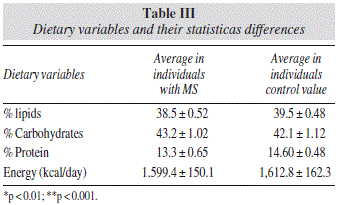
<body><![CDATA[<p><font face="Verdana" size="2"><b>Results</b></font></p>     <p><font face="Verdana" size="2">This research shows that 20,2% of the sample was diagnosed with MS. Significant statistical differences were found between the individuals with MS and the control group. When analyzing <a target="_blank" href="/img/revistas/nh/v28n4/31original22_t1.gif">table I</a>, it is possible to appreciate the figures for each parameter that was measured as well as its level of statistical significance.</font></p>     <p><font face="Verdana" size="2">According to the data, the prevalence of MS in the sample is 20,2%, 58,3% of which were women. Comparing our figure for prevalence (20,2%) with that of other researchers in the United States<sup>6</sup> (22%) it is noticeable how similar they are. If also compared the sample of this research with the Spanish population as a whole<sup>7</sup> (MESYAS) in terms of prevalence, it can be noticed that our figure is higher, but it has to be taken into consideration that the prevalence of MS in the Spanish population is not homogeneous, on the contrary the prevalence in the south of Spain is higher than in the north, in agreement with our results. In the developed countries there is an estimated prevalence of 24% in adults, whereas the figure exceeds 40% in the elderly.<sup>23</sup></font></p>     <p><font face="Verdana" size="2">Obesity is a condition characterised by the excess of body fat. According to the quantity of body fat, a person could be defined as obese when his or her percentage of body fat exceeds the figures considered as normal: 12 to 20% in men and 20 to 30% in women.<sup>24</sup></font></p>     <p><font face="Verdana" size="2">The BMI, in spite of not being an excellent indicator of adiposity in muscular or elderly people, is the parameter most used in the majority of epidemiologic studies and the most recommended one by medical societies and international health organizations for medical use, due to its reproducibility, easy use, and capability to show the adiposity of the majority of the population.</font></p>     <p><font face="Verdana" size="2">When we talk about obessity in our research, it is refered to BMI and body fat percentage. In our study there are differences between the individuals with MS and the control ones (<a href="#t2">table II</a>). The individuals with MS of our sample have an average BMI of 32,5 kg/m<sup>2 </sup>(falling into the &quot;Obese grade I&quot; category according to the WHO) and an average body fat percentage of 34,8% (falling into the &quot;Obese&quot; category according to scientists and doctors).<sup>19</sup></font></p>     <p>&nbsp;</p>     <p align=center><a name="t2"><img src="/img/revistas/nh/v28n4/31original22_t2.gif"></a></p>     <p>&nbsp;</p>     <p><font face="Verdana" size="2">Diet is the main exogenetic factor that influences the concentration and composition of blood lipids. The total calorie content in the diet has an effect on the blood lipids. Diets with excess calories (hypercaloric) stimulate the production of triglycerides by the liver and increase the level of LDL cholesterol. When studying the diet<sup>8-11</sup> of the indivuals in our sample (data obtained through dietetic survey) no significant differences can appreciated in terms of percentage of lipids, carbohydrates and proteins, and kcal/day between the subjects with MS and the control ones (<a href="#t3">table III</a>).</font></p>     ]]></body>
<body><![CDATA[<p>&nbsp;</p>     <p align=center><a name="t3"><img src="/img/revistas/nh/v28n4/31original22_t3.gif"></a></p>     <p>&nbsp;</p>     <p><font face="Verdana" size="2"><b>Discussion</b></font></p>     <p><font face="Verdana" size="2">The prevalence of MS in the tropical coast of Granada is similar to that of other national (MESYAS) and international studies. This prevalence is high, but it is important to know that corrective and preventive measures can be taken involving diet and physical activity. The BMI and the body fat percentage are relevant factors to consider when talking about MS since significant differences have been found between individuals with and without MS. Regarding diet, our results (obtained through dietetic survey) don t agree with those of other studies related to MS, reaching the conclusion that this method may not be the most suitable to obtain this kind of information. More controled conditions should be applied to obtain the data related to the individuals food intake. We would suggest conducting the research among guests of some kind of canteen, where the menu is perfectly known. MS is related to variables, apart from diet, such as physical activity and genotype that were not taken into account in this research and therefore may have altered the results in one direction or the other.</font></p>     <p>&nbsp;</p>     <p><font face="Verdana" size="2"><b>References</b></font></p>     <!-- ref --><p><font face="Verdana" size="2">1. Reaven G. Role of insulin resistance in human disease. <i>Diabetes</i> 1988; 37: 1595-607.    &nbsp;&nbsp;&nbsp;&nbsp;&nbsp;&nbsp;&nbsp;&nbsp;[&#160;<a href="javascript:void(0);" onclick="javascript: window.open('/scielo.php?script=sci_nlinks&ref=3737709&pid=S0212-1611201300040003100001&lng=','','width=640,height=500,resizable=yes,scrollbars=1,menubar=yes,');">Links</a>&#160;]<!-- end-ref --></font></p>    <!-- ref --><p><font face="Verdana" size="2">2. Reaven GM, Chen Y-DI, Jeppesen J, Maheux P, Krauss RM. Insulin resistance and hyperinsulinemia in individuals with small, dense, low density lipoprotein particles. <i>J Clin Invest</i> 1993; 92: 141-6.    &nbsp;&nbsp;&nbsp;&nbsp;&nbsp;&nbsp;&nbsp;&nbsp;[&#160;<a href="javascript:void(0);" onclick="javascript: window.open('/scielo.php?script=sci_nlinks&ref=3737711&pid=S0212-1611201300040003100002&lng=','','width=640,height=500,resizable=yes,scrollbars=1,menubar=yes,');">Links</a>&#160;]<!-- end-ref --></font></p>    <!-- ref --><p><font face="Verdana" size="2">3. Ai A, Tanaka A, Ogita K, Sekine M, Numano F, Numano U, Reaven G. Relationsship between hyperinsulinemia and remnant lipoprotein concetrations in patients with impaired glucose tolerance. <i>J Clin Endocrinol Metabol</i> 2000; 85: 3557-60.    &nbsp;&nbsp;&nbsp;&nbsp;&nbsp;&nbsp;&nbsp;&nbsp;[&#160;<a href="javascript:void(0);" onclick="javascript: window.open('/scielo.php?script=sci_nlinks&ref=3737713&pid=S0212-1611201300040003100003&lng=','','width=640,height=500,resizable=yes,scrollbars=1,menubar=yes,');">Links</a>&#160;]<!-- end-ref --></font></p>    <!-- ref --><p><font face="Verdana" size="2">4. WHO consutation: Definition, diagnosis and classification of diabetes mellitus and its complications. WHO/NCD/NCS/99.2; 31-3.    &nbsp;&nbsp;&nbsp;&nbsp;&nbsp;&nbsp;&nbsp;&nbsp;[&#160;<a href="javascript:void(0);" onclick="javascript: window.open('/scielo.php?script=sci_nlinks&ref=3737715&pid=S0212-1611201300040003100004&lng=','','width=640,height=500,resizable=yes,scrollbars=1,menubar=yes,');">Links</a>&#160;]<!-- end-ref --></font></p>    <!-- ref --><p><font face="Verdana" size="2">5. Third report of the National Cholesterol Education Program (NCEP) Expert Panel on the deteccion, evaluation, and treatment of high blood cholesterol in adults (Adult Treatment panel III). Executive summary. NIH Publication 01-3670; May 2001.    &nbsp;&nbsp;&nbsp;&nbsp;&nbsp;&nbsp;&nbsp;&nbsp;[&#160;<a href="javascript:void(0);" onclick="javascript: window.open('/scielo.php?script=sci_nlinks&ref=3737717&pid=S0212-1611201300040003100005&lng=','','width=640,height=500,resizable=yes,scrollbars=1,menubar=yes,');">Links</a>&#160;]<!-- end-ref --></font></p>    <!-- ref --><p><font face="Verdana" size="2">6. Ford ES, Giles WH, Dietz WH. Prevalence of the Metabolic Syndrome Among US Adults: Findings From the Third National Health and Nutrition Examination Survey. <i>JAMA</i> 2002; 16 (287): 356-9.    &nbsp;&nbsp;&nbsp;&nbsp;&nbsp;&nbsp;&nbsp;&nbsp;[&#160;<a href="javascript:void(0);" onclick="javascript: window.open('/scielo.php?script=sci_nlinks&ref=3737719&pid=S0212-1611201300040003100006&lng=','','width=640,height=500,resizable=yes,scrollbars=1,menubar=yes,');">Links</a>&#160;]<!-- end-ref --></font></p>    <!-- ref --><p><font face="Verdana" size="2">7. Alegría E, Cordero A, Grima A, Casasnovas JA, Laclaustra M, Luengo E, et al. Prevalencia del síndrome metabòlico en población laboral española: Registro MESYAS. <i>Rev Esp Cardiol</i> 2005; 58: 797-806.    &nbsp;&nbsp;&nbsp;&nbsp;&nbsp;&nbsp;&nbsp;&nbsp;[&#160;<a href="javascript:void(0);" onclick="javascript: window.open('/scielo.php?script=sci_nlinks&ref=3737721&pid=S0212-1611201300040003100007&lng=','','width=640,height=500,resizable=yes,scrollbars=1,menubar=yes,');">Links</a>&#160;]<!-- end-ref --></font></p>    <!-- ref --><p><font face="Verdana" size="2">8. Hu FB, Manson JE, Stampfer MJ, Colditz GA, Liu S, Solomon CG, et al. Diet, lifestyle, and the risk type 2 diabetes mellitus in women. <i>N Engl J Med</i> 2001; 345: 790-7.    &nbsp;&nbsp;&nbsp;&nbsp;&nbsp;&nbsp;&nbsp;&nbsp;[&#160;<a href="javascript:void(0);" onclick="javascript: window.open('/scielo.php?script=sci_nlinks&ref=3737723&pid=S0212-1611201300040003100008&lng=','','width=640,height=500,resizable=yes,scrollbars=1,menubar=yes,');">Links</a>&#160;]<!-- end-ref --></font></p>    <!-- ref --><p><font face="Verdana" size="2">9. Foster GD, Wyatt HR, Hill JO. A randomized trial of low-carbohydrate diet for obesity. <i>N Engl J Med</i> 2003; 348: 2082-90.    &nbsp;&nbsp;&nbsp;&nbsp;&nbsp;&nbsp;&nbsp;&nbsp;[&#160;<a href="javascript:void(0);" onclick="javascript: window.open('/scielo.php?script=sci_nlinks&ref=3737725&pid=S0212-1611201300040003100009&lng=','','width=640,height=500,resizable=yes,scrollbars=1,menubar=yes,');">Links</a>&#160;]<!-- end-ref --></font></p>    <!-- ref --><p><font face="Verdana" size="2">10. Kelly S. Frost G, Whittaker V, Summerbell C. Low glycaemic index diets for coronary heart disease. Cochrane Heart Group. Database of Systematic Rev. 2004:CD004467.    &nbsp;&nbsp;&nbsp;&nbsp;&nbsp;&nbsp;&nbsp;&nbsp;[&#160;<a href="javascript:void(0);" onclick="javascript: window.open('/scielo.php?script=sci_nlinks&ref=3737727&pid=S0212-1611201300040003100010&lng=','','width=640,height=500,resizable=yes,scrollbars=1,menubar=yes,');">Links</a>&#160;]<!-- end-ref --></font></p>    <!-- ref --><p><font face="Verdana" size="2">11. The Deabetes and Nutrition study group of the Spanish Diabetes Association (GSEDNu). Diabetes Nutrition ando Complications Trial: adherence to the ADA nutritional recommendations, targets of metabolic control, and onset of diabetes complications. A 7-year, prospective, populationbased, observational multicenter study. <i>J Diabetes Complications</i> 2006; 20: 361-6.    &nbsp;&nbsp;&nbsp;&nbsp;&nbsp;&nbsp;&nbsp;&nbsp;[&#160;<a href="javascript:void(0);" onclick="javascript: window.open('/scielo.php?script=sci_nlinks&ref=3737729&pid=S0212-1611201300040003100011&lng=','','width=640,height=500,resizable=yes,scrollbars=1,menubar=yes,');">Links</a>&#160;]<!-- end-ref --></font></p>    <!-- ref --><p><font face="Verdana" size="2">12. Manson JE, Willett WC, Stampfer MJ, Colditz GA, Hunter DJ, Hankinson SE, Hennekens CH, Speizer FE. Body weight and mortality among women. <i>N Engl J Med</i> 1995; 333 (11): 677-85.    &nbsp;&nbsp;&nbsp;&nbsp;&nbsp;&nbsp;&nbsp;&nbsp;[&#160;<a href="javascript:void(0);" onclick="javascript: window.open('/scielo.php?script=sci_nlinks&ref=3737731&pid=S0212-1611201300040003100012&lng=','','width=640,height=500,resizable=yes,scrollbars=1,menubar=yes,');">Links</a>&#160;]<!-- end-ref --></font></p>    <!-- ref --><p><font face="Verdana" size="2">13. Chong Do Lee, Blair SN, Jackson AS. Cardiorespiratory fitness, body composition, and all-cause and cardiovascular mortality in men. <i>Am J Clin Nutr</i> 1999; 69: 373-80.    &nbsp;&nbsp;&nbsp;&nbsp;&nbsp;&nbsp;&nbsp;&nbsp;[&#160;<a href="javascript:void(0);" onclick="javascript: window.open('/scielo.php?script=sci_nlinks&ref=3737733&pid=S0212-1611201300040003100013&lng=','','width=640,height=500,resizable=yes,scrollbars=1,menubar=yes,');">Links</a>&#160;]<!-- end-ref --></font></p>    <!-- ref --><p><font face="Verdana" size="2">14. Calle EE, Thun MJ, Petrelli JM, Rodriguez C, Heath CW Jr. Body-mass index and mortality in a prospective cohort of U.S. Adults. <i>N Engl J Med</i> 1999; 341 (15): 1097-105.    &nbsp;&nbsp;&nbsp;&nbsp;&nbsp;&nbsp;&nbsp;&nbsp;[&#160;<a href="javascript:void(0);" onclick="javascript: window.open('/scielo.php?script=sci_nlinks&ref=3737735&pid=S0212-1611201300040003100014&lng=','','width=640,height=500,resizable=yes,scrollbars=1,menubar=yes,');">Links</a>&#160;]<!-- end-ref --></font></p>    <!-- ref --><p><font face="Verdana" size="2">15. Lamon-Fava S, Wilson PW, Schaefer EJ. Impact of body mass index on coronary heart disease risk factors in men and women. The Framingham Offspring Study. <i>Arterioscler Thromb Vasc Biol</i> 1996; 16 (12): 1509-15.    &nbsp;&nbsp;&nbsp;&nbsp;&nbsp;&nbsp;&nbsp;&nbsp;[&#160;<a href="javascript:void(0);" onclick="javascript: window.open('/scielo.php?script=sci_nlinks&ref=3737737&pid=S0212-1611201300040003100015&lng=','','width=640,height=500,resizable=yes,scrollbars=1,menubar=yes,');">Links</a>&#160;]<!-- end-ref --></font></p>    <!-- ref --><p><font face="Verdana" size="2">16. Colditz GA, Willett WC, Rotnitzky A, Manson JE. Weight gain as a risk factor for clinical diabetes mellitus in women. <i>Ann Intern Med</i> 1995; 122 (7): 481-6.    &nbsp;&nbsp;&nbsp;&nbsp;&nbsp;&nbsp;&nbsp;&nbsp;[&#160;<a href="javascript:void(0);" onclick="javascript: window.open('/scielo.php?script=sci_nlinks&ref=3737739&pid=S0212-1611201300040003100016&lng=','','width=640,height=500,resizable=yes,scrollbars=1,menubar=yes,');">Links</a>&#160;]<!-- end-ref --></font></p>    <!-- ref --><p><font face="Verdana" size="2">17. Astrup A. The role of dietary fat in the prevention and treatment of obesity. Efficacy and safety of low-fat diets. <i>Int J Obes</i> 2001; 25 (Suppl. 1): S46-S50.    &nbsp;&nbsp;&nbsp;&nbsp;&nbsp;&nbsp;&nbsp;&nbsp;[&#160;<a href="javascript:void(0);" onclick="javascript: window.open('/scielo.php?script=sci_nlinks&ref=3737741&pid=S0212-1611201300040003100017&lng=','','width=640,height=500,resizable=yes,scrollbars=1,menubar=yes,');">Links</a>&#160;]<!-- end-ref --></font></p>    <!-- ref --><p><font face="Verdana" size="2">18. World Health Organization Tecnical report series 894: &quot;Obesity: preventing and managing the global epidemic.&quot;. Geneva: World Health Organization, 2000. PDF. ISBN 92-4-120894-5.    &nbsp;&nbsp;&nbsp;&nbsp;&nbsp;&nbsp;&nbsp;&nbsp;[&#160;<a href="javascript:void(0);" onclick="javascript: window.open('/scielo.php?script=sci_nlinks&ref=3737743&pid=S0212-1611201300040003100018&lng=','','width=640,height=500,resizable=yes,scrollbars=1,menubar=yes,');">Links</a>&#160;]<!-- end-ref --></font></p>    <!-- ref --><p><font face="Verdana" size="2">19. National Institute of Health and Clinical Excellence. Clinical guideline 43: Obesity: the prevention, identification, assessment and management of overweight ando obesity in adults and children.London, 2006.    &nbsp;&nbsp;&nbsp;&nbsp;&nbsp;&nbsp;&nbsp;&nbsp;[&#160;<a href="javascript:void(0);" onclick="javascript: window.open('/scielo.php?script=sci_nlinks&ref=3737745&pid=S0212-1611201300040003100019&lng=','','width=640,height=500,resizable=yes,scrollbars=1,menubar=yes,');">Links</a>&#160;]<!-- end-ref --></font></p>    <!-- ref --><p><font face="Verdana" size="2">20. Siri WE. Body composition from fluid spaces and density: analysis of methods. En: Brozeck J, Henschel A eds. Tehmiques for measuring body composition. Washington DC: National Academy of Sciences. Natural Resourcer Council, 1961: 223-44.    &nbsp;&nbsp;&nbsp;&nbsp;&nbsp;&nbsp;&nbsp;&nbsp;[&#160;<a href="javascript:void(0);" onclick="javascript: window.open('/scielo.php?script=sci_nlinks&ref=3737747&pid=S0212-1611201300040003100020&lng=','','width=640,height=500,resizable=yes,scrollbars=1,menubar=yes,');">Links</a>&#160;]<!-- end-ref --></font></p>    <!-- ref --><p><font face="Verdana" size="2">21. Grundy SM. Metabòlico Syndrome Pandemic. Arteriosclerosis <i>Thromb Vasc Biol</i> 2008; 28: 629-36.    &nbsp;&nbsp;&nbsp;&nbsp;&nbsp;&nbsp;&nbsp;&nbsp;[&#160;<a href="javascript:void(0);" onclick="javascript: window.open('/scielo.php?script=sci_nlinks&ref=3737749&pid=S0212-1611201300040003100021&lng=','','width=640,height=500,resizable=yes,scrollbars=1,menubar=yes,');">Links</a>&#160;]<!-- end-ref --></font></p>    <!-- ref --><p><font face="Verdana" size="2">22. Kahn R. Metabòlico Syndrome: is it a syndrome? Does it matter? <i>Circulation</i> 2007; 115: 1806-11.    &nbsp;&nbsp;&nbsp;&nbsp;&nbsp;&nbsp;&nbsp;&nbsp;[&#160;<a href="javascript:void(0);" onclick="javascript: window.open('/scielo.php?script=sci_nlinks&ref=3737751&pid=S0212-1611201300040003100022&lng=','','width=640,height=500,resizable=yes,scrollbars=1,menubar=yes,');">Links</a>&#160;]<!-- end-ref --></font></p>    <!-- ref --><p><font face="Verdana" size="2">23. Alegria Ezquerra E., Castellano Vázquez JM, Alegría Barrero A. Obesidad, síndrome metabòlico y diabetes: implicaciones cardiovasculares y actuación terapéutica. <i>Rev Esp Cardiol</i> 2008; 61 (7): 752-64.    &nbsp;&nbsp;&nbsp;&nbsp;&nbsp;&nbsp;&nbsp;&nbsp;[&#160;<a href="javascript:void(0);" onclick="javascript: window.open('/scielo.php?script=sci_nlinks&ref=3737753&pid=S0212-1611201300040003100023&lng=','','width=640,height=500,resizable=yes,scrollbars=1,menubar=yes,');">Links</a>&#160;]<!-- end-ref --></font></p>     <p>&nbsp;</p>     <p>&nbsp;</p>     <p><font face="Verdana" size="2"><a href="#top"><img border="0" src="/img/revistas/nh/v28n4/seta.gif" width="15" height="17"></a><a name="bajo"></a><b>Correspondence:</b>    <br>José Javier Quesada Granados    <br>Department of Nutrition and Bromatology    <br>Faculty of Pharmacy. University of Granada    <br>18071 Granada. Spain    ]]></body>
<body><![CDATA[<br>E-mail: <a href="mailto:quesadag@ugr.es">quesadag@ugr.es</a></font></p>     <p><font face="Verdana" size="2">Recibido: 8-VII-2012    <br>1.<sup>a</sup> Revisión: 29-VIII-2012    <br>Aceptado: 13-II-2013.</font></p>      ]]></body><back>
<ref-list>
<ref id="B1">
<label>1</label><nlm-citation citation-type="journal">
<person-group person-group-type="author">
<name>
<surname><![CDATA[Reaven]]></surname>
<given-names><![CDATA[G]]></given-names>
</name>
</person-group>
<article-title xml:lang="en"><![CDATA[Role of insulin resistance in human disease]]></article-title>
<source><![CDATA[Diabetes]]></source>
<year>1988</year>
<volume>37</volume>
<page-range>1595-607</page-range></nlm-citation>
</ref>
<ref id="B2">
<label>2</label><nlm-citation citation-type="journal">
<person-group person-group-type="author">
<name>
<surname><![CDATA[Reaven]]></surname>
<given-names><![CDATA[GM]]></given-names>
</name>
<name>
<surname><![CDATA[Chen]]></surname>
<given-names><![CDATA[Y-DI]]></given-names>
</name>
<name>
<surname><![CDATA[Jeppesen]]></surname>
<given-names><![CDATA[J]]></given-names>
</name>
<name>
<surname><![CDATA[Maheux]]></surname>
<given-names><![CDATA[P]]></given-names>
</name>
<name>
<surname><![CDATA[Krauss]]></surname>
<given-names><![CDATA[RM]]></given-names>
</name>
</person-group>
<article-title xml:lang="en"><![CDATA[Insulin resistance and hyperinsulinemia in individuals with small, dense, low density lipoprotein particles]]></article-title>
<source><![CDATA[J Clin Invest]]></source>
<year>1993</year>
<volume>92</volume>
<page-range>141-6</page-range></nlm-citation>
</ref>
<ref id="B3">
<label>3</label><nlm-citation citation-type="journal">
<person-group person-group-type="author">
<name>
<surname><![CDATA[Ai]]></surname>
<given-names><![CDATA[A]]></given-names>
</name>
<name>
<surname><![CDATA[Tanaka]]></surname>
<given-names><![CDATA[A]]></given-names>
</name>
<name>
<surname><![CDATA[Ogita]]></surname>
<given-names><![CDATA[K]]></given-names>
</name>
<name>
<surname><![CDATA[Sekine]]></surname>
<given-names><![CDATA[M]]></given-names>
</name>
<name>
<surname><![CDATA[Numano]]></surname>
<given-names><![CDATA[F]]></given-names>
</name>
<name>
<surname><![CDATA[Numano]]></surname>
<given-names><![CDATA[U]]></given-names>
</name>
<name>
<surname><![CDATA[Reaven]]></surname>
<given-names><![CDATA[G]]></given-names>
</name>
</person-group>
<article-title xml:lang="en"><![CDATA[Relationsship between hyperinsulinemia and remnant lipoprotein concetrations in patients with impaired glucose tolerance]]></article-title>
<source><![CDATA[J Clin Endocrinol Metabol]]></source>
<year>2000</year>
<volume>85</volume>
<page-range>3557-60</page-range></nlm-citation>
</ref>
<ref id="B4">
<label>4</label><nlm-citation citation-type="journal">
<article-title xml:lang="en"><![CDATA[WHO consutation: Definition, diagnosis and classification of diabetes mellitus and its complications]]></article-title>
<source><![CDATA[WHO/NCD/NCS/]]></source>
<year></year>
<volume>99</volume>
<numero>2</numero>
<issue>2</issue>
<page-range>31-3</page-range></nlm-citation>
</ref>
<ref id="B5">
<label>5</label><nlm-citation citation-type="journal">
<article-title xml:lang="en"><![CDATA[Third report of the National Cholesterol Education Program (NCEP) Expert Panel on the deteccion, evaluation, and treatment of high blood cholesterol in adults (Adult Treatment panel III): Executive summary]]></article-title>
<source><![CDATA[NIH Publication]]></source>
<year>May </year>
<month>20</month>
<day>01</day>
<volume>01</volume>
</nlm-citation>
</ref>
<ref id="B6">
<label>6</label><nlm-citation citation-type="journal">
<person-group person-group-type="author">
<name>
<surname><![CDATA[Ford]]></surname>
<given-names><![CDATA[ES]]></given-names>
</name>
<name>
<surname><![CDATA[Giles]]></surname>
<given-names><![CDATA[WH]]></given-names>
</name>
<name>
<surname><![CDATA[Dietz]]></surname>
<given-names><![CDATA[WH]]></given-names>
</name>
</person-group>
<article-title xml:lang="en"><![CDATA[Prevalence of the Metabolic Syndrome Among US Adults: Findings From the Third National Health and Nutrition Examination Survey]]></article-title>
<source><![CDATA[JAMA]]></source>
<year>2002</year>
<volume>16</volume>
<numero>287</numero>
<issue>287</issue>
<page-range>356-9</page-range></nlm-citation>
</ref>
<ref id="B7">
<label>7</label><nlm-citation citation-type="journal">
<person-group person-group-type="author">
<name>
<surname><![CDATA[Alegría]]></surname>
<given-names><![CDATA[E]]></given-names>
</name>
<name>
<surname><![CDATA[Cordero]]></surname>
<given-names><![CDATA[A]]></given-names>
</name>
<name>
<surname><![CDATA[Grima]]></surname>
<given-names><![CDATA[A]]></given-names>
</name>
<name>
<surname><![CDATA[Casasnovas]]></surname>
<given-names><![CDATA[JA]]></given-names>
</name>
<name>
<surname><![CDATA[Laclaustra]]></surname>
<given-names><![CDATA[M]]></given-names>
</name>
<name>
<surname><![CDATA[Luengo]]></surname>
<given-names><![CDATA[E]]></given-names>
</name>
</person-group>
<article-title xml:lang="es"><![CDATA[Prevalencia del síndrome metabòlico en población laboral española: Registro MESYAS]]></article-title>
<source><![CDATA[Rev Esp Cardiol]]></source>
<year>2005</year>
<volume>58</volume>
<page-range>797-806</page-range></nlm-citation>
</ref>
<ref id="B8">
<label>8</label><nlm-citation citation-type="journal">
<person-group person-group-type="author">
<name>
<surname><![CDATA[Hu]]></surname>
<given-names><![CDATA[FB]]></given-names>
</name>
<name>
<surname><![CDATA[Manson]]></surname>
<given-names><![CDATA[JE]]></given-names>
</name>
<name>
<surname><![CDATA[Stampfer]]></surname>
<given-names><![CDATA[MJ]]></given-names>
</name>
<name>
<surname><![CDATA[Colditz]]></surname>
<given-names><![CDATA[GA]]></given-names>
</name>
<name>
<surname><![CDATA[Liu]]></surname>
<given-names><![CDATA[S]]></given-names>
</name>
<name>
<surname><![CDATA[Solomon]]></surname>
<given-names><![CDATA[CG]]></given-names>
</name>
</person-group>
<article-title xml:lang="en"><![CDATA[Diet, lifestyle, and the risk type 2 diabetes mellitus in women]]></article-title>
<source><![CDATA[N Engl J Med]]></source>
<year>2001</year>
<volume>345</volume>
<page-range>790-7</page-range></nlm-citation>
</ref>
<ref id="B9">
<label>9</label><nlm-citation citation-type="journal">
<person-group person-group-type="author">
<name>
<surname><![CDATA[Foster]]></surname>
<given-names><![CDATA[GD]]></given-names>
</name>
<name>
<surname><![CDATA[Wyatt]]></surname>
<given-names><![CDATA[HR]]></given-names>
</name>
<name>
<surname><![CDATA[Hill]]></surname>
<given-names><![CDATA[JO]]></given-names>
</name>
</person-group>
<article-title xml:lang="en"><![CDATA[A randomized trial of low-carbohydrate diet for obesity]]></article-title>
<source><![CDATA[N Engl J Med]]></source>
<year>2003</year>
<volume>348</volume>
<page-range>2082-90</page-range></nlm-citation>
</ref>
<ref id="B10">
<label>10</label><nlm-citation citation-type="journal">
<person-group person-group-type="author">
<name>
<surname><![CDATA[Kelly]]></surname>
<given-names><![CDATA[S]]></given-names>
</name>
<name>
<surname><![CDATA[Frost]]></surname>
<given-names><![CDATA[G]]></given-names>
</name>
<name>
<surname><![CDATA[Whittaker]]></surname>
<given-names><![CDATA[V]]></given-names>
</name>
<name>
<surname><![CDATA[Summerbell]]></surname>
<given-names><![CDATA[C]]></given-names>
</name>
</person-group>
<article-title xml:lang="en"><![CDATA[Low glycaemic index diets for coronary heart disease: Cochrane Heart Group]]></article-title>
<source><![CDATA[Database of Systematic Rev.]]></source>
<year>2004</year>
</nlm-citation>
</ref>
<ref id="B11">
<label>11</label><nlm-citation citation-type="journal">
<collab>Spanish Diabetes Association (GSEDNu)^dThe Deabetes and Nutrition study group</collab>
<collab>Diabetes Nutrition ando Complications Trial</collab>
<article-title xml:lang="en"><![CDATA[adherence to the ADA nutritional recommendations, targets of metabolic control, and onset of diabetes complications: A 7-year, prospective, populationbased, observational multicenter study]]></article-title>
<source><![CDATA[J Diabetes Complications]]></source>
<year>2006</year>
<volume>20</volume>
<page-range>361-6</page-range></nlm-citation>
</ref>
<ref id="B12">
<label>12</label><nlm-citation citation-type="journal">
<person-group person-group-type="author">
<name>
<surname><![CDATA[Manson]]></surname>
<given-names><![CDATA[JE]]></given-names>
</name>
<name>
<surname><![CDATA[Willett]]></surname>
<given-names><![CDATA[WC]]></given-names>
</name>
<name>
<surname><![CDATA[Stampfer]]></surname>
<given-names><![CDATA[MJ]]></given-names>
</name>
<name>
<surname><![CDATA[Colditz]]></surname>
<given-names><![CDATA[GA]]></given-names>
</name>
<name>
<surname><![CDATA[Hunter]]></surname>
<given-names><![CDATA[DJ]]></given-names>
</name>
<name>
<surname><![CDATA[Hankinson]]></surname>
<given-names><![CDATA[SE]]></given-names>
</name>
<name>
<surname><![CDATA[Hennekens]]></surname>
<given-names><![CDATA[CH]]></given-names>
</name>
<name>
<surname><![CDATA[Speizer]]></surname>
<given-names><![CDATA[FE]]></given-names>
</name>
</person-group>
<article-title xml:lang="en"><![CDATA[Body weight and mortality among women]]></article-title>
<source><![CDATA[N Engl J Med]]></source>
<year>1995</year>
<volume>333</volume>
<numero>11</numero>
<issue>11</issue>
<page-range>677-85</page-range></nlm-citation>
</ref>
<ref id="B13">
<label>13</label><nlm-citation citation-type="journal">
<person-group person-group-type="author">
<name>
<surname><![CDATA[Chong]]></surname>
<given-names><![CDATA[Do Lee]]></given-names>
</name>
<name>
<surname><![CDATA[Blair]]></surname>
<given-names><![CDATA[SN]]></given-names>
</name>
<name>
<surname><![CDATA[Jackson]]></surname>
<given-names><![CDATA[AS]]></given-names>
</name>
</person-group>
<article-title xml:lang="en"><![CDATA[Cardiorespiratory fitness, body composition, and all-cause and cardiovascular mortality in men]]></article-title>
<source><![CDATA[Am J Clin Nutr]]></source>
<year>1999</year>
<volume>69</volume>
<page-range>373-80</page-range></nlm-citation>
</ref>
<ref id="B14">
<label>14</label><nlm-citation citation-type="journal">
<person-group person-group-type="author">
<name>
<surname><![CDATA[Calle]]></surname>
<given-names><![CDATA[EE]]></given-names>
</name>
<name>
<surname><![CDATA[Thun]]></surname>
<given-names><![CDATA[MJ]]></given-names>
</name>
<name>
<surname><![CDATA[Petrelli]]></surname>
<given-names><![CDATA[JM]]></given-names>
</name>
<name>
<surname><![CDATA[Rodriguez]]></surname>
<given-names><![CDATA[C]]></given-names>
</name>
<name>
<surname><![CDATA[Heath]]></surname>
<given-names><![CDATA[CW Jr]]></given-names>
</name>
</person-group>
<article-title xml:lang="en"><![CDATA[Body-mass index and mortality in a prospective cohort of U. S. Adults]]></article-title>
<source><![CDATA[N Engl J Med]]></source>
<year>1999</year>
<volume>341</volume>
<numero>15</numero>
<issue>15</issue>
<page-range>1097-105</page-range></nlm-citation>
</ref>
<ref id="B15">
<label>15</label><nlm-citation citation-type="journal">
<person-group person-group-type="author">
<name>
<surname><![CDATA[Lamon-Fava]]></surname>
<given-names><![CDATA[S]]></given-names>
</name>
<name>
<surname><![CDATA[Wilson]]></surname>
<given-names><![CDATA[PW]]></given-names>
</name>
<name>
<surname><![CDATA[Schaefer]]></surname>
<given-names><![CDATA[EJ]]></given-names>
</name>
</person-group>
<article-title xml:lang="en"><![CDATA[Impact of body mass index on coronary heart disease risk factors in men and women: The Framingham Offspring Study]]></article-title>
<source><![CDATA[Arterioscler Thromb Vasc Biol]]></source>
<year>1996</year>
<volume>16</volume>
<numero>12</numero>
<issue>12</issue>
<page-range>1509-15</page-range></nlm-citation>
</ref>
<ref id="B16">
<label>16</label><nlm-citation citation-type="journal">
<person-group person-group-type="author">
<name>
<surname><![CDATA[Colditz]]></surname>
<given-names><![CDATA[GA]]></given-names>
</name>
<name>
<surname><![CDATA[Willett]]></surname>
<given-names><![CDATA[WC]]></given-names>
</name>
<name>
<surname><![CDATA[Rotnitzky]]></surname>
<given-names><![CDATA[A]]></given-names>
</name>
<name>
<surname><![CDATA[Manson]]></surname>
<given-names><![CDATA[JE]]></given-names>
</name>
</person-group>
<article-title xml:lang="en"><![CDATA[Weight gain as a risk factor for clinical diabetes mellitus in women]]></article-title>
<source><![CDATA[Ann Intern Med]]></source>
<year>1995</year>
<volume>122</volume>
<numero>7</numero>
<issue>7</issue>
<page-range>481-6</page-range></nlm-citation>
</ref>
<ref id="B17">
<label>17</label><nlm-citation citation-type="journal">
<person-group person-group-type="author">
<name>
<surname><![CDATA[Astrup]]></surname>
<given-names><![CDATA[A]]></given-names>
</name>
</person-group>
<article-title xml:lang="en"><![CDATA[The role of dietary fat in the prevention and treatment of obesity: Efficacy and safety of low-fat diets]]></article-title>
<source><![CDATA[Int J Obes]]></source>
<year>2001</year>
<volume>25</volume>
<numero>^s1</numero>
<issue>^s1</issue>
<supplement>1</supplement>
<page-range>S46-S50</page-range></nlm-citation>
</ref>
<ref id="B18">
<label>18</label><nlm-citation citation-type="book">
<collab>World Health Organization</collab>
<source><![CDATA[Obesity: preventing and managing the global epidemic]]></source>
<year>2000</year>
<volume>894</volume>
<publisher-loc><![CDATA[Geneva ]]></publisher-loc>
<publisher-name><![CDATA[World Health Organization]]></publisher-name>
</nlm-citation>
</ref>
<ref id="B19">
<label>19</label><nlm-citation citation-type="">
<collab>National Institute of Health and Clinical Excellence</collab>
<source><![CDATA[Obesity: the prevention, identification, assessment and management of overweight ando obesity in adults and children]]></source>
<year>2006</year>
<volume>43</volume>
<publisher-loc><![CDATA[London ]]></publisher-loc>
</nlm-citation>
</ref>
<ref id="B20">
<label>20</label><nlm-citation citation-type="book">
<person-group person-group-type="author">
<name>
<surname><![CDATA[Siri]]></surname>
<given-names><![CDATA[WE]]></given-names>
</name>
</person-group>
<article-title xml:lang="en"><![CDATA[Body composition from fluid spaces and density: analysis of methods]]></article-title>
<person-group person-group-type="editor">
<name>
<surname><![CDATA[Brozeck]]></surname>
<given-names><![CDATA[J]]></given-names>
</name>
<name>
<surname><![CDATA[Henschel]]></surname>
<given-names><![CDATA[A]]></given-names>
</name>
</person-group>
<source><![CDATA[Tehmiques for measuring body composition]]></source>
<year>1961</year>
<page-range>223-44</page-range><publisher-loc><![CDATA[Washington^eDC DC]]></publisher-loc>
<publisher-name><![CDATA[National Academy of SciencesNatural Resourcer Council]]></publisher-name>
</nlm-citation>
</ref>
<ref id="B21">
<label>21</label><nlm-citation citation-type="journal">
<person-group person-group-type="author">
<name>
<surname><![CDATA[Grundy]]></surname>
<given-names><![CDATA[SM]]></given-names>
</name>
</person-group>
<article-title xml:lang="en"><![CDATA[Metabòlico Syndrome Pandemic]]></article-title>
<source><![CDATA[Arteriosclerosis Thromb Vasc Biol]]></source>
<year>2008</year>
<volume>28</volume>
<page-range>629-36</page-range></nlm-citation>
</ref>
<ref id="B22">
<label>22</label><nlm-citation citation-type="journal">
<person-group person-group-type="author">
<name>
<surname><![CDATA[Kahn]]></surname>
<given-names><![CDATA[R]]></given-names>
</name>
</person-group>
<article-title xml:lang="en"><![CDATA[Metabòlico Syndrome: is it a syndrome? Does it matter?]]></article-title>
<source><![CDATA[Circulation]]></source>
<year>2007</year>
<volume>115</volume>
<page-range>1806-11</page-range></nlm-citation>
</ref>
<ref id="B23">
<label>23</label><nlm-citation citation-type="journal">
<person-group person-group-type="author">
<name>
<surname><![CDATA[Alegria Ezquerra]]></surname>
<given-names><![CDATA[E.]]></given-names>
</name>
<name>
<surname><![CDATA[Castellano Vázquez]]></surname>
<given-names><![CDATA[JM]]></given-names>
</name>
<name>
<surname><![CDATA[Alegría Barrero]]></surname>
<given-names><![CDATA[A]]></given-names>
</name>
</person-group>
<article-title xml:lang="en"><![CDATA[Obesidad, síndrome metabòlico y diabetes: implicaciones cardiovasculares y actuación terapéutica]]></article-title>
<source><![CDATA[Rev Esp Cardiol]]></source>
<year>2008</year>
<volume>61</volume>
<numero>7</numero>
<issue>7</issue>
<page-range>752-64</page-range></nlm-citation>
</ref>
</ref-list>
</back>
</article>