<?xml version="1.0" encoding="ISO-8859-1"?><article xmlns:mml="http://www.w3.org/1998/Math/MathML" xmlns:xlink="http://www.w3.org/1999/xlink" xmlns:xsi="http://www.w3.org/2001/XMLSchema-instance">
<front>
<journal-meta>
<journal-id>0212-1611</journal-id>
<journal-title><![CDATA[Nutrición Hospitalaria]]></journal-title>
<abbrev-journal-title><![CDATA[Nutr. Hosp.]]></abbrev-journal-title>
<issn>0212-1611</issn>
<publisher>
<publisher-name><![CDATA[Grupo Arán]]></publisher-name>
</publisher>
</journal-meta>
<article-meta>
<article-id>S0212-16112013000400055</article-id>
<article-id pub-id-type="doi">10.3305/nh.2013.28.4.6566</article-id>
<title-group>
<article-title xml:lang="en"><![CDATA[Are poor physical fitness and obesity two features of the adolescent with Down syndrome?]]></article-title>
<article-title xml:lang="es"><![CDATA[¿Son el bajo nivel de condición física y la obesidad dos características del adolescente con síndrome de Down?]]></article-title>
</title-group>
<contrib-group>
<contrib contrib-type="author">
<name>
<surname><![CDATA[Izquierdo-Gomez]]></surname>
<given-names><![CDATA[Rocío]]></given-names>
</name>
<xref ref-type="aff" rid="A01"/>
</contrib>
<contrib contrib-type="author">
<name>
<surname><![CDATA[Martínez-Gómez]]></surname>
<given-names><![CDATA[David]]></given-names>
</name>
<xref ref-type="aff" rid="A01"/>
</contrib>
<contrib contrib-type="author">
<name>
<surname><![CDATA[Tejero-Gonzalez]]></surname>
<given-names><![CDATA[Carlos María]]></given-names>
</name>
<xref ref-type="aff" rid="A01"/>
</contrib>
<contrib contrib-type="author">
<name>
<surname><![CDATA[Cabanas-Sánchez]]></surname>
<given-names><![CDATA[Verónica]]></given-names>
</name>
<xref ref-type="aff" rid="A01"/>
</contrib>
<contrib contrib-type="author">
<name>
<surname><![CDATA[Ruiz Ruiz]]></surname>
<given-names><![CDATA[Jonathan]]></given-names>
</name>
<xref ref-type="aff" rid="A02"/>
<xref ref-type="aff" rid="A03"/>
</contrib>
<contrib contrib-type="author">
<name>
<surname><![CDATA[Veiga]]></surname>
<given-names><![CDATA[Óscar L.]]></given-names>
</name>
<xref ref-type="aff" rid="A01"/>
</contrib>
</contrib-group>
<aff id="A01">
<institution><![CDATA[,Autonomous University of Madrid Department of Physical Education, Sport and Human Movement ]]></institution>
<addr-line><![CDATA[Madrid ]]></addr-line>
<country>Spain</country>
</aff>
<aff id="A02">
<institution><![CDATA[,University of Granada School of Sport Sciences Department of Physical Education and Sport]]></institution>
<addr-line><![CDATA[Granada ]]></addr-line>
<country>Spain</country>
</aff>
<aff id="A03">
<institution><![CDATA[,Karolinska Institutet Department of Biosciences and Nutrition at NOVUM Unit for Preventive Nutrition]]></institution>
<addr-line><![CDATA[Huddinge ]]></addr-line>
<country>Sweden</country>
</aff>
<pub-date pub-type="pub">
<day>00</day>
<month>08</month>
<year>2013</year>
</pub-date>
<pub-date pub-type="epub">
<day>00</day>
<month>08</month>
<year>2013</year>
</pub-date>
<volume>28</volume>
<numero>4</numero>
<fpage>1348</fpage>
<lpage>1351</lpage>
<copyright-statement/>
<copyright-year/>
<self-uri xlink:href="http://scielo.isciii.es/scielo.php?script=sci_arttext&amp;pid=S0212-16112013000400055&amp;lng=en&amp;nrm=iso"></self-uri><self-uri xlink:href="http://scielo.isciii.es/scielo.php?script=sci_abstract&amp;pid=S0212-16112013000400055&amp;lng=en&amp;nrm=iso"></self-uri><self-uri xlink:href="http://scielo.isciii.es/scielo.php?script=sci_pdf&amp;pid=S0212-16112013000400055&amp;lng=en&amp;nrm=iso"></self-uri><abstract abstract-type="short" xml:lang="en"><p><![CDATA[Introduction: "Obesity" is considered a feature of youth with DS but whether "low physical fitness" is also a feature is unknown. Objective: The aim of this case-control study was to compare the levels of fatness and fitness in adolescents with and without DS. Methods: Participants included 17 (5 girls) adolescents with DS aged 12-18 years and a control group of 94 (45 girls) adolescents without DS aged 12-16 years. The ALPHA health-related fitness test battery for children and adolescents was selected to assess fatness and fitness in both groups. Results: There were no differences in levels of fatness between groups (all P &gt; 0.27). Adolescents with DS had lower levels of fitness in all the tests than adolescents without DS (all P < 0.001). Conclusion: Adolescents with DS have similar levels of fatness and lower levels of fitness than their peers without DS.]]></p></abstract>
<abstract abstract-type="short" xml:lang="es"><p><![CDATA[Introducción: La obesidad es considerada una característica de los jóvenes con SD, sin embargo se desconoce si la "baja condición física" también lo es. Objetivo: Comparar los niveles de obesidad y condición física en adolescentes con y sin SD. Métodos: Participaron 17 adolescentes (5 niñas) con SD de 12 a 18 años y un grupo control de 94 (45 niñas) adolescentes sin SD de 12-16 años de edad. La batería de condición física ALPHA relacionada con la salud para niños y adolescentes fue seleccionada para evaluar la obesidad y la condición física en ambos grupos. Resultados: No se encontraron diferencias en los niveles de obesidad entre grupos (P &gt; 0,27). Los adolescentes con SD tuvieron niveles más bajos de condición física en todos los test en comparación con los adolescentes sin SD (P < 0,001). Conclusión: Los adolescentes con SD tienen niveles similares de obesidad y menores de condición física que sus compañeros sin SD.]]></p></abstract>
<kwd-group>
<kwd lng="en"><![CDATA[Obesity]]></kwd>
<kwd lng="en"><![CDATA[Physical fitness]]></kwd>
<kwd lng="en"><![CDATA[Down syndrome]]></kwd>
<kwd lng="en"><![CDATA[Adolescents]]></kwd>
<kwd lng="es"><![CDATA[Obesidad]]></kwd>
<kwd lng="es"><![CDATA[Condición física]]></kwd>
<kwd lng="es"><![CDATA[Síndrome de Down]]></kwd>
<kwd lng="es"><![CDATA[Adolescentes]]></kwd>
</kwd-group>
</article-meta>
</front><body><![CDATA[  <a name="top"></a>     <p><font face="Verdana" size="2"><b>COMUNICACIÓN BREVE</b></font></p>     <p>&nbsp;</p>     <p><font face="Verdana" size="4"><b>Are poor physical fitness and obesity two features of the adolescent with Down syndrome?</b></font></p>     <p><font face="Verdana" size="4"><b>¿Son el bajo nivel de condición física y la obesidad dos características del adolescente con síndrome de  Down?</b></font></p>     <p>&nbsp;</p>     <p>&nbsp;</p>     <p><font face="Verdana" size="2"><b>Rocío Izquierdo-Gomez<sup>1</sup>, David Martínez-Gómez<sup>1</sup>, Carlos María Tejero-Gonzalez<sup>1</sup>, Verónica Cabanas-Sánchez<sup>1</sup>, Jonathan Ruiz Ruiz<sup>2,3</sup> and Óscar L. Veiga<sup>1</sup></b></font></p>     <p><font face="Verdana" size="2"><sup>1</sup>Department of Physical Education, Sport and Human Movement. Autonomous University of Madrid. Madrid. Spain.    <br><sup>2</sup>Department of Physical Education and Sport. School of Sport Sciences. University of Granada. Granada. Spain.    ]]></body>
<body><![CDATA[<br><sup>3</sup>Department of Biosciences and Nutrition at NOVUM. Unit for Preventive Nutrition. Karolinska Institutet. Huddinge. Sweden.</font></p>     <p><font face="Verdana" size="2">The UP&amp;DOWN study was supported by the Spanish Ministry of Economy and Competitiveness (DEP 2010-21662-C04). JRR was supported by a contract from the Spanish Ministry of Science and Innovation (RYC-2010-05957).</font></p>     <p><font face="Verdana" size="2"><a href="#bajo">Correspondence</a></font></p>     <p>&nbsp;</p>     <p>&nbsp;</p> <hr size="1">    <p><font face="Verdana" size="2"><b>ABSTRACT</b></font></p>     <p><font face="Verdana" size="2"><b>Introduction:</b> &quot;Obesity&quot; is considered a feature of youth with DS but whether &quot;low physical fitness&quot; is also a feature is unknown.    <br><b>Objective:</b> The aim of this case-control study was to compare the levels of fatness and fitness in adolescents with and without DS.    <br><b>Methods:</b> Participants included 17 (5 girls) adolescents with DS aged 12-18 years and a control group of 94 (45 girls) adolescents without DS aged 12-16 years. The ALPHA health-related fitness test battery for children and adolescents was selected to assess fatness and fitness in both groups.    <br><b>Results:</b> There were no differences in levels of fatness between groups (all P &gt; 0.27). Adolescents with DS had lower levels of fitness in all the tests than adolescents without DS (all P &lt; 0.001).    ]]></body>
<body><![CDATA[<br><b>Conclusion:</b> Adolescents with DS have similar levels of fatness and lower levels of fitness than their peers without DS.</font></p>     <p><font face="Verdana" size="2"><b>Key words:</b> Obesity. Physical fitness. Down syndrome. Adolescents.</font></p> <hr size="1">    <p><font face="Verdana" size="2"><b>RESUMEN</b></font></p>     <p><font face="Verdana" size="2"><b>Introducción:</b> La obesidad es considerada una característica de los jóvenes con SD, sin embargo se desconoce si la &quot;baja condición física&quot; también lo es.    <br><b>Objetivo:</b> Comparar los niveles de obesidad y condición física en adolescentes con y sin SD.    <br><b>Métodos:</b> Participaron 17 adolescentes (5 niñas) con SD de 12 a 18 años y un grupo control de 94 (45 niñas) adolescentes sin SD de 12-16 años de edad. La batería de condición física ALPHA relacionada con la salud para niños y adolescentes fue seleccionada para evaluar la obesidad y la condición física en ambos grupos.    <br><b>Resultados:</b> No se encontraron diferencias en los niveles de obesidad entre grupos (P &gt; 0,27). Los adolescentes con SD tuvieron niveles más bajos de condición física en todos los test en comparación con los adolescentes sin SD (P &lt; 0,001).    <br><b>Conclusión:</b> Los adolescentes con SD tienen niveles similares de obesidad y menores de condición física que sus compañeros sin SD.</font></p>     <p><font face="Verdana" size="2"><b>Palabras clave:</b> Obesidad. Condición física. Síndrome de Down. Adolescentes.</font></p> <hr size="1">     <p><font face="Verdana" size="2"><b>Abbreviations</b>    ]]></body>
<body><![CDATA[<br>DS: Down syndrome.    <br>%BF: Percentage body fat.    <br>ICC: Intraclass correlation coefficient.    <br>BMI: Body mass index.    <br>DXA: Dual energy X-ray plethysmography.    <br>ADP: Air- displacement plethysmography.    <br>VO<sub>2</sub> peak: Peak oxygen consumption.</font></p>     <p>&nbsp;</p>     <p><font face="Verdana" size="2"><b>Introduction</b></font></p>     <p><font face="Verdana" size="2">There is strong evidence regarding the detrimental effect of fatness on health across the lifespan.<sup>1</sup> Physical fitness is also an important contributor to health, not only in adults but also in youth. Many studies aimed to determine the levels of fatness and fitness in adolescence<sup>1</sup>. However, little studies focus on fatness and fitness levels in adolescents with disabilities, such as Down syndrome (DS).</font></p>     ]]></body>
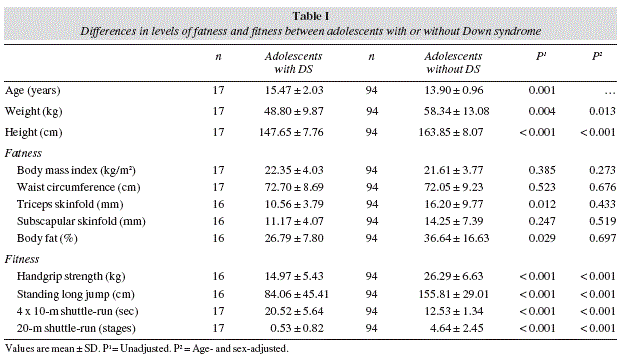
<body><![CDATA[<p><font face="Verdana" size="2">DS is chromosomal condition caused by the presence of all or part of an extra chromosoma 21<sup>st</sup>, and affects around 1/1,000 live births. The effects of an extra chromosoma have direct consequences for their health and well-being (e.g. heart defects, muscle hipotonicity, joint hypermobility).<sup>2</sup> Moreover, DS has been commonly related to obesity and low levels of physical fitness, even though these features are unclear in the case of youth with DS. Previous studies that assessed fatness and fitness levels in youth with DS had critical methodological limitations such as combined samples of children and adolescents, pooled analysis including several intellecual disabilities, and unstandardized assessments.<sup>3,4</sup></font></p>     <p><font face="Verdana" size="2">Therefore, the aim of this case-control study was to compare the levels of fatness and fitness in adolescents with and without DS using the ALPHA health-related fitness test battery for youth.</font></p>     <p>&nbsp;</p>     <p><font face="Verdana" size="2"><b>Methods</b></font></p>     <p><font face="Verdana" size="2">A total of 17 adolescents with DS (5 girls) aged 12 to 18 years participated in the present study. These adolescents were recruited from special education schools from the region of Madrid, Spain. An inclusion criterion of an intelligence quotient over 35 was necessary to be included in the study. A control group of 94 adolescents (45 girls) without DS aged 12 to 16 years were selected from 2 public secondary schools in the same region of Spain. Written signed consent was obtained from all parents or legal guardians. The study was approved by the ethics committee of the University Autonomous of Madrid.</font></p>     <p><font face="Verdana" size="2">We used the extended ALPHA health-related fitness test battery for children and adolescents to assess fatness and fitness in both groups.<sup>5</sup> This battery includes anthropometric measurements and fitness field test. More details about the ALPHA test, protocols and scoring procedures can be found else where.<sup>5</sup></font></p>     <p><font face="Verdana" size="2">The percentage of body fat (%BF) was calculated using the Slaughter's equations for triceps and subscapular skinfolds thicknesses.<sup>7</sup> Adolescents with DS performed the handgrip strength test in a sitting position in order to focus the attention in tighten the handgrip, whereas adolescents without DS performed the test according to the original protocol. In the reliability study of the ALPHA battery in adolescents with DS, we observed (i) no differences (<i>P</i> &gt; 0.2) between positions (seated vs. standing) in the handgrip strength scores in adolescents without DS, and (ii) high one-month test-retest reliability (intraclass correlation coefficient &#091;ICC&#093; <u>&gt;</u> 0.85) in all tests, with the exception of a moderate reliability (ICC = 0.64) in subscapular skin-fold measures, in adolescents with DS.<sup>6</sup></font></p>     <p><font face="Verdana" size="2">Data were analyzed using an SPSS statistical software package (version 17.0, Chicago, IL, USA) for Macintosh. Mean &plusmn; SD were calculated for all variables. The Mann-Whitney <i>U</i> test was used to compare groups. Initially, differences between groups were examined unadjusted. Then, fatness and fitness variables were regressed onto age and sex using a lineal regression process, and differences between groups were again calculated taking into account for any age-and sex-related differences in these variables.</font></p>     <p>&nbsp;</p>     <p><font face="Verdana" size="2"><b>Results</b></font></p>     ]]></body>
<body><![CDATA[<p><font face="Verdana" size="2">Among adolescents with DS, one girl was not able to perform the handgrip strength test (due to a disease in the hands) and the standing broad jump test. Also, it was not possible to measure skinfolds in one boy because he was uncomfortable with the caliper. <a href="#t1">Table I</a> shows differences in levels of fatness and fitness between adolescents with or without DS. Adolescents with DS were older than adolescents without DS (<i>P</i> &gt; 0.001). Adolescents without DS were heavier and taller than their peers with DS, even after controlling for sex and age. Regarding fatness variables, both body mass index (BMI) and waist circumference were similar in both groups (both P &gt; 0.2). Significant differences were observed in triceps skinfold thickness (P = 0.012) and %BF (P = 0.029) using unadjusted values, however these differences disappeared once the analyses were controlled for sex and age (both <i>P</i> &gt; 0.4). Adolescents without DS had significantly better scores in all fitness variables than adolescents with DS and these results did not change after controlling for age and sex (all <i>P</i> &lt;0.001).</font></p>     <p>&nbsp;</p>     <p align="center"><font face="Verdana" size="2"><a name="t1"><img src="/img/revistas/nh/v28n4/55comunicacionbreve01_t1.gif"></a></font></p>     <p>&nbsp;</p>     <p><font face="Verdana" size="2"><b>Discussion</b></font></p>     <p><font face="Verdana" size="2">The results of the present study indicate that fatness levels were similar in adolescents with and without DS. In contrast, we observed that adolescents with DS had lower scores in all the study fitness tests than their peers without DS. These differences could be due to the clinical characteristics of this population (e.g. heart and respiratory diseases, muscle hypotonicity, hypermobility of the joints, short stature) that limit their physical performance.<sup>2,3,8</sup></font></p>     <p><font face="Verdana" size="2">Although &quot;obesity&quot; is a term commonly used to describe physical characteristics in individuals with DS,<sup>2</sup> nowadays this issue is not so clear, at least, in youth with DS. A narrative review about this issue by Gonzalez-Aguero et al.<sup>3</sup> reported mixed results. The same group measured anthropometry variables, as well % BF by dual energy X-ray absorptiometry (DXA) and air-displacement plethysmography (ADP).<sup>4</sup> They did not find differences between groups in levels of BMI, waist circumference, and %BF by both DXA and ADP, which concur with our study. Therefore obesity might be not correct to characterize children and adolescents with DS.</font></p>     <p><font face="Verdana" size="2">Physical fitness research in adolescents with DS is scarce.<sup>3</sup> In general, as shown in previous studies,<sup>3</sup> it seems that adolescents with DS have lower levels of fitness. Cardiorespiratory fitness is, by far, the component of physical fitness more studied in young population with DS<sup>3</sup>. In agreement with our results, several studies also found that youth with DS had lower levels of cardiorespiratory fitness than youth without DS or young with mental retardation.<sup>3,9</sup> Available data suggested that it might be linked to both chronotropic incompetence and poor exercise economy. Chronotropic incompetence would limit peak cardiac output that produces lower peak oxygen consumption (VO<sub>2peak</sub>), and exercise economy could be reducing due to biomechanical variables and clinical characteristics of these populations.<sup>3,8</sup></font></p>     <p><font face="Verdana" size="2">Less is known about the musculoskeletal fitness in this population, and to our knowledge, only one study<sup>7</sup> showed that youth with DS may have lower muscle strength, in terms of mean peak torque for hip abduction and knee extension. The reason for the lower muscle strength could be related to physiological characteristics and a combination of low levels of physical activity and high sedentariness.<sup>2,8</sup></font></p>     <p><font face="Verdana" size="2">In relation to motor fitness, there are no studies comparing motor fitness with field-based tests in children or adolescents with and without DS, but some clinical studies reported that individuals with DS have low levels of agility, gait speed and coordination. Some clinical characteristics may be the cause of a delayed motor developmental<sup>10,11,12,13</sup> and, consequently, a poor motor fitness in this population.</font></p>     ]]></body>
<body><![CDATA[<p><font face="Verdana" size="2">In conclusion, the main results of this study indicate that (i) adolescents with DS have similar levels of fatness than adolescents without DS; and (ii) adolescents with DS have lower levels of all the components of fitness than adolescents without DS. Hence, taking into consideration the protective impact of fitness on health, and regardless of fatness levels, well-designed interventions to build fitness in adolescents with DS are warranted. In addition, longitudinal studies are necessary to understand changes over time in fatness and fitness levels in youth with DS compared with their peers without DS.</font></p>     <p>&nbsp;</p>     <p><font face="Verdana" size="2"><b>References</b></font></p>     <!-- ref --><p><font face="Verdana" size="2">1. Ruiz JR, Castro-Piñero J, Artego EG, Ortega FB, Sjöström M, Suni J, et al. Predictive validity of health-related fitness in youth: a systematic review. <i>Br J Sports Med</i> 2009; 43: 909-23.    &nbsp;&nbsp;&nbsp;&nbsp;&nbsp;&nbsp;&nbsp;&nbsp;[&#160;<a href="javascript:void(0);" onclick="javascript: window.open('/scielo.php?script=sci_nlinks&ref=3749525&pid=S0212-1611201300040005500001&lng=','','width=640,height=500,resizable=yes,scrollbars=1,menubar=yes,');">Links</a>&#160;]<!-- end-ref --></font></p>    <!-- ref --><p><font face="Verdana" size="2">2. Roizen NJ, Patterson D. Down s syndrome. <i>Lancet</i> 2003; 361: 1281-9.    &nbsp;&nbsp;&nbsp;&nbsp;&nbsp;&nbsp;&nbsp;&nbsp;[&#160;<a href="javascript:void(0);" onclick="javascript: window.open('/scielo.php?script=sci_nlinks&ref=3749527&pid=S0212-1611201300040005500002&lng=','','width=640,height=500,resizable=yes,scrollbars=1,menubar=yes,');">Links</a>&#160;]<!-- end-ref --></font></p>    <!-- ref --><p><font face="Verdana" size="2">3. González-Agüero A, Vicente-Rodríguez G, Moreno LA, Guerra-Balic M, Ara I, Casajús JA. Health-related physical fitness in children and adolescents with Down syndrome and response to training. <i>Scand J Med Sci Sports</i> 2010; 20: 716-24.    &nbsp;&nbsp;&nbsp;&nbsp;&nbsp;&nbsp;&nbsp;&nbsp;[&#160;<a href="javascript:void(0);" onclick="javascript: window.open('/scielo.php?script=sci_nlinks&ref=3749529&pid=S0212-1611201300040005500003&lng=','','width=640,height=500,resizable=yes,scrollbars=1,menubar=yes,');">Links</a>&#160;]<!-- end-ref --></font></p>    <!-- ref --><p><font face="Verdana" size="2">4. González-Agüero A, Ara I, Moreno LA, Vicente-Rodríguez G, Casajús, JA. Fat and lean masses in youths with Down syndrome: gender differences. <i>Res Dev Disabili</i> 2011; 32: 1685-93.    &nbsp;&nbsp;&nbsp;&nbsp;&nbsp;&nbsp;&nbsp;&nbsp;[&#160;<a href="javascript:void(0);" onclick="javascript: window.open('/scielo.php?script=sci_nlinks&ref=3749531&pid=S0212-1611201300040005500004&lng=','','width=640,height=500,resizable=yes,scrollbars=1,menubar=yes,');">Links</a>&#160;]<!-- end-ref --></font></p>    <!-- ref --><p><font face="Verdana" size="2">5. Ruiz JR, Castro-Piñero J, España-Romero V, Artero EG, Ortega FB, Cuenca MM, et al. Field based fitness assessment in young people: the Alpha health-related fitness test battery for children and adolescents. <i>Br J Sports Med</i> 2011; 45: 518-24.    &nbsp;&nbsp;&nbsp;&nbsp;&nbsp;&nbsp;&nbsp;&nbsp;[&#160;<a href="javascript:void(0);" onclick="javascript: window.open('/scielo.php?script=sci_nlinks&ref=3749533&pid=S0212-1611201300040005500005&lng=','','width=640,height=500,resizable=yes,scrollbars=1,menubar=yes,');">Links</a>&#160;]<!-- end-ref --></font></p>    <!-- ref --><p><font face="Verdana" size="2">6. Tejero-González CM, Martínez-Gómez D, Bayón-Serna J, Izquierdo-Gómez R, Castro-Piñero J, Veiga OL. Reliability of the ALPHA health-related fitness test battery in adolescents with Down syndrome. <i>J Strength Cond Res</i> 2012. (Epub ahead of print). DOI:10.1519/JSC.0b013e31828bed4e.    &nbsp;&nbsp;&nbsp;&nbsp;&nbsp;&nbsp;&nbsp;&nbsp;[&#160;<a href="javascript:void(0);" onclick="javascript: window.open('/scielo.php?script=sci_nlinks&ref=3749535&pid=S0212-1611201300040005500006&lng=','','width=640,height=500,resizable=yes,scrollbars=1,menubar=yes,');">Links</a>&#160;]<!-- end-ref --></font></p>    <!-- ref --><p><font face="Verdana" size="2">7. Slaughter MH, Lohman TG, Boileau RA, Horswill CA, Stillman RJ, Van Loan MD, et al. Skinfold equation for estimation of body fatness in children and youth. <i>Hum Biol</i> 1988; 60: 709-23.    &nbsp;&nbsp;&nbsp;&nbsp;&nbsp;&nbsp;&nbsp;&nbsp;[&#160;<a href="javascript:void(0);" onclick="javascript: window.open('/scielo.php?script=sci_nlinks&ref=3749537&pid=S0212-1611201300040005500007&lng=','','width=640,height=500,resizable=yes,scrollbars=1,menubar=yes,');">Links</a>&#160;]<!-- end-ref --></font></p>    <!-- ref --><p><font face="Verdana" size="2">8. Medonca CV, Pereira FD, Fernhall BO. Reduced exercise capacity in persons with Down syndrome: cause, effect and management. <i>Ther Clin Risk Manag</i> 2010; 8: 601-10.    &nbsp;&nbsp;&nbsp;&nbsp;&nbsp;&nbsp;&nbsp;&nbsp;[&#160;<a href="javascript:void(0);" onclick="javascript: window.open('/scielo.php?script=sci_nlinks&ref=3749539&pid=S0212-1611201300040005500008&lng=','','width=640,height=500,resizable=yes,scrollbars=1,menubar=yes,');">Links</a>&#160;]<!-- end-ref --></font></p>    <!-- ref --><p><font face="Verdana" size="2">9. Guerra M, Llorens N, Martinez R, Gomez A, Cuadrado E, Fernhall B. Reliability of Wingate testing in children with mental retardation including Down syndrome. <i>Med Sci Sports and Exerc</i> 2001; 33: 1798-S321.    &nbsp;&nbsp;&nbsp;&nbsp;&nbsp;&nbsp;&nbsp;&nbsp;[&#160;<a href="javascript:void(0);" onclick="javascript: window.open('/scielo.php?script=sci_nlinks&ref=3749541&pid=S0212-1611201300040005500009&lng=','','width=640,height=500,resizable=yes,scrollbars=1,menubar=yes,');">Links</a>&#160;]<!-- end-ref --></font></p>    <!-- ref --><p><font face="Verdana" size="2">10. Mercer VS, Lewis CL. Hip abductor and knee extensor muscle strength of children with and without Down syndrome. <i>Pediatr Phys Ther</i> 2001; 13: 18-26.    &nbsp;&nbsp;&nbsp;&nbsp;&nbsp;&nbsp;&nbsp;&nbsp;[&#160;<a href="javascript:void(0);" onclick="javascript: window.open('/scielo.php?script=sci_nlinks&ref=3749543&pid=S0212-1611201300040005500010&lng=','','width=640,height=500,resizable=yes,scrollbars=1,menubar=yes,');">Links</a>&#160;]<!-- end-ref --></font></p>    <!-- ref --><p><font face="Verdana" size="2">11. Agiovlasitis S, MacCubbin JA, Yun J, Mpitsos G, Pavol MJ. Effects of Down syndrome on three-dimensional motion during walking at different speeds. <i>Gait Posture</i> 2009; 30: 345-50.    &nbsp;&nbsp;&nbsp;&nbsp;&nbsp;&nbsp;&nbsp;&nbsp;[&#160;<a href="javascript:void(0);" onclick="javascript: window.open('/scielo.php?script=sci_nlinks&ref=3749545&pid=S0212-1611201300040005500011&lng=','','width=640,height=500,resizable=yes,scrollbars=1,menubar=yes,');">Links</a>&#160;]<!-- end-ref --></font></p>    <!-- ref --><p><font face="Verdana" size="2">12. Henderson SE, Morris J, Ray S. Performance of Down syndrome and other retarded children on the Cratty GrossMotor Test. <i>Am J Ment Defic</i> 1981; 84: 416-24.    &nbsp;&nbsp;&nbsp;&nbsp;&nbsp;&nbsp;&nbsp;&nbsp;[&#160;<a href="javascript:void(0);" onclick="javascript: window.open('/scielo.php?script=sci_nlinks&ref=3749547&pid=S0212-1611201300040005500012&lng=','','width=640,height=500,resizable=yes,scrollbars=1,menubar=yes,');">Links</a>&#160;]<!-- end-ref --></font></p>    <!-- ref --><p><font face="Verdana" size="2">13. Conolly BH and Michael BT. Performance of retarded children, with and without Down syndrome, on the Bruininks Osereretsky Test of Motor Proficiency. <i>Phys Ther</i> 1986; 66: 344-8.    &nbsp;&nbsp;&nbsp;&nbsp;&nbsp;&nbsp;&nbsp;&nbsp;[&#160;<a href="javascript:void(0);" onclick="javascript: window.open('/scielo.php?script=sci_nlinks&ref=3749549&pid=S0212-1611201300040005500013&lng=','','width=640,height=500,resizable=yes,scrollbars=1,menubar=yes,');">Links</a>&#160;]<!-- end-ref --></font></p>     <p>&nbsp;</p>     ]]></body>
<body><![CDATA[<p>&nbsp;</p>     <p><font face="Verdana" size="2"><a href="#top"><img border="0" src="/img/revistas/nh/v28n4/seta.gif" width="15" height="17"></a><a name="bajo"></a><b>Correspondence:</b>    <br>Óscar L. Veiga.    <br>Departamento de Educación Física, Deporte y Motricidad Humana.    <br>Universidad Autónoma de Madrid.    <br>Ctra. de Colmenar, km. 15.    <br>28049 Madrid. España.    <br>E-mail: <a href="mailto:oscar.veiga@uam.es">oscar.veiga@uam.es</a></font></p>     <p><font face="Verdana" size="2">Recibido: 11-III-2013.    <br>Aceptado: 28-III-2013.</font></p>     ]]></body>
<body><![CDATA[ ]]></body><back>
<ref-list>
<ref id="B1">
<label>1</label><nlm-citation citation-type="journal">
<person-group person-group-type="author">
<name>
<surname><![CDATA[Ruiz]]></surname>
<given-names><![CDATA[JR]]></given-names>
</name>
<name>
<surname><![CDATA[Castro-Piñero]]></surname>
<given-names><![CDATA[J]]></given-names>
</name>
<name>
<surname><![CDATA[Artego]]></surname>
<given-names><![CDATA[EG]]></given-names>
</name>
<name>
<surname><![CDATA[Ortega]]></surname>
<given-names><![CDATA[FB]]></given-names>
</name>
<name>
<surname><![CDATA[Sjöström]]></surname>
<given-names><![CDATA[M]]></given-names>
</name>
<name>
<surname><![CDATA[Suni]]></surname>
<given-names><![CDATA[J]]></given-names>
</name>
</person-group>
<article-title xml:lang="en"><![CDATA[Predictive validity of health-related fitness in youth: a systematic review]]></article-title>
<source><![CDATA[Br J Sports Med]]></source>
<year>2009</year>
<volume>43</volume>
<page-range>909-23</page-range></nlm-citation>
</ref>
<ref id="B2">
<label>2</label><nlm-citation citation-type="journal">
<person-group person-group-type="author">
<name>
<surname><![CDATA[Roizen]]></surname>
<given-names><![CDATA[NJ]]></given-names>
</name>
<name>
<surname><![CDATA[Patterson]]></surname>
<given-names><![CDATA[D]]></given-names>
</name>
</person-group>
<article-title xml:lang="en"><![CDATA[Down s syndrome]]></article-title>
<source><![CDATA[Lancet]]></source>
<year>2003</year>
<volume>361</volume>
<page-range>1281-9</page-range></nlm-citation>
</ref>
<ref id="B3">
<label>3</label><nlm-citation citation-type="journal">
<person-group person-group-type="author">
<name>
<surname><![CDATA[González-Agüero]]></surname>
<given-names><![CDATA[A]]></given-names>
</name>
<name>
<surname><![CDATA[Vicente-Rodríguez]]></surname>
<given-names><![CDATA[G]]></given-names>
</name>
<name>
<surname><![CDATA[Moreno]]></surname>
<given-names><![CDATA[LA]]></given-names>
</name>
<name>
<surname><![CDATA[Guerra-Balic]]></surname>
<given-names><![CDATA[M]]></given-names>
</name>
<name>
<surname><![CDATA[Ara]]></surname>
<given-names><![CDATA[I]]></given-names>
</name>
<name>
<surname><![CDATA[Casajús]]></surname>
<given-names><![CDATA[JA]]></given-names>
</name>
</person-group>
<article-title xml:lang="en"><![CDATA[Health-related physical fitness in children and adolescents with Down syndrome and response to training]]></article-title>
<source><![CDATA[Scand J Med Sci Sports]]></source>
<year>2010</year>
<volume>20</volume>
<page-range>716-24</page-range></nlm-citation>
</ref>
<ref id="B4">
<label>4</label><nlm-citation citation-type="journal">
<person-group person-group-type="author">
<name>
<surname><![CDATA[González-Agüero]]></surname>
<given-names><![CDATA[A]]></given-names>
</name>
<name>
<surname><![CDATA[Ara]]></surname>
<given-names><![CDATA[I]]></given-names>
</name>
<name>
<surname><![CDATA[Moreno]]></surname>
<given-names><![CDATA[LA]]></given-names>
</name>
<name>
<surname><![CDATA[Vicente-Rodríguez]]></surname>
<given-names><![CDATA[G]]></given-names>
</name>
<name>
<surname><![CDATA[Casajús]]></surname>
<given-names><![CDATA[JA]]></given-names>
</name>
</person-group>
<article-title xml:lang="en"><![CDATA[Fat and lean masses in youths with Down syndrome: gender differences]]></article-title>
<source><![CDATA[Res Dev Disabili]]></source>
<year>2011</year>
<volume>32</volume>
<page-range>1685-93</page-range></nlm-citation>
</ref>
<ref id="B5">
<label>5</label><nlm-citation citation-type="journal">
<person-group person-group-type="author">
<name>
<surname><![CDATA[Ruiz]]></surname>
<given-names><![CDATA[JR]]></given-names>
</name>
<name>
<surname><![CDATA[Castro-Piñero]]></surname>
<given-names><![CDATA[J]]></given-names>
</name>
<name>
<surname><![CDATA[España-Romero]]></surname>
<given-names><![CDATA[V]]></given-names>
</name>
<name>
<surname><![CDATA[Artero]]></surname>
<given-names><![CDATA[EG]]></given-names>
</name>
<name>
<surname><![CDATA[Ortega]]></surname>
<given-names><![CDATA[FB]]></given-names>
</name>
<name>
<surname><![CDATA[Cuenca]]></surname>
<given-names><![CDATA[MM]]></given-names>
</name>
</person-group>
<article-title xml:lang="en"><![CDATA[Field based fitness assessment in young people: the Alpha health-related fitness test battery for children and adolescents]]></article-title>
<source><![CDATA[Br J Sports Med]]></source>
<year>2011</year>
<volume>45</volume>
<page-range>518-24</page-range></nlm-citation>
</ref>
<ref id="B6">
<label>6</label><nlm-citation citation-type="journal">
<person-group person-group-type="author">
<name>
<surname><![CDATA[Tejero-González]]></surname>
<given-names><![CDATA[CM]]></given-names>
</name>
<name>
<surname><![CDATA[Martínez-Gómez]]></surname>
<given-names><![CDATA[D]]></given-names>
</name>
<name>
<surname><![CDATA[Bayón-Serna]]></surname>
<given-names><![CDATA[J]]></given-names>
</name>
<name>
<surname><![CDATA[Izquierdo-Gómez]]></surname>
<given-names><![CDATA[R]]></given-names>
</name>
<name>
<surname><![CDATA[Castro-Piñero]]></surname>
<given-names><![CDATA[J]]></given-names>
</name>
<name>
<surname><![CDATA[Veiga]]></surname>
<given-names><![CDATA[OL]]></given-names>
</name>
</person-group>
<article-title xml:lang="en"><![CDATA[Reliability of the ALPHA health-related fitness test battery in adolescents with Down syndrome]]></article-title>
<source><![CDATA[J Strength Cond Res]]></source>
<year>2012</year>
</nlm-citation>
</ref>
<ref id="B7">
<label>7</label><nlm-citation citation-type="journal">
<person-group person-group-type="author">
<name>
<surname><![CDATA[Slaughter]]></surname>
<given-names><![CDATA[MH]]></given-names>
</name>
<name>
<surname><![CDATA[Lohman]]></surname>
<given-names><![CDATA[TG]]></given-names>
</name>
<name>
<surname><![CDATA[Boileau]]></surname>
<given-names><![CDATA[RA]]></given-names>
</name>
<name>
<surname><![CDATA[Horswill]]></surname>
<given-names><![CDATA[CA]]></given-names>
</name>
<name>
<surname><![CDATA[Stillman]]></surname>
<given-names><![CDATA[RJ]]></given-names>
</name>
<name>
<surname><![CDATA[Van Loan]]></surname>
<given-names><![CDATA[MD]]></given-names>
</name>
</person-group>
<article-title xml:lang="en"><![CDATA[Skinfold equation for estimation of body fatness in children and youth]]></article-title>
<source><![CDATA[Hum Biol]]></source>
<year>1988</year>
<volume>60</volume>
<page-range>709-23</page-range></nlm-citation>
</ref>
<ref id="B8">
<label>8</label><nlm-citation citation-type="journal">
<person-group person-group-type="author">
<name>
<surname><![CDATA[Medonca]]></surname>
<given-names><![CDATA[CV]]></given-names>
</name>
<name>
<surname><![CDATA[Pereira]]></surname>
<given-names><![CDATA[FD]]></given-names>
</name>
<name>
<surname><![CDATA[Fernhall]]></surname>
<given-names><![CDATA[BO]]></given-names>
</name>
</person-group>
<article-title xml:lang="en"><![CDATA[Reduced exercise capacity in persons with Down syndrome: cause, effect and management]]></article-title>
<source><![CDATA[Ther Clin Risk Manag]]></source>
<year>2010</year>
<volume>8</volume>
<page-range>601-10</page-range></nlm-citation>
</ref>
<ref id="B9">
<label>9</label><nlm-citation citation-type="journal">
<person-group person-group-type="author">
<name>
<surname><![CDATA[Guerra]]></surname>
<given-names><![CDATA[M]]></given-names>
</name>
<name>
<surname><![CDATA[Llorens]]></surname>
<given-names><![CDATA[N]]></given-names>
</name>
<name>
<surname><![CDATA[Martinez]]></surname>
<given-names><![CDATA[R]]></given-names>
</name>
<name>
<surname><![CDATA[Gomez]]></surname>
<given-names><![CDATA[A]]></given-names>
</name>
<name>
<surname><![CDATA[Cuadrado]]></surname>
<given-names><![CDATA[E]]></given-names>
</name>
<name>
<surname><![CDATA[Fernhall]]></surname>
<given-names><![CDATA[B]]></given-names>
</name>
</person-group>
<article-title xml:lang="en"><![CDATA[Reliability of Wingate testing in children with mental retardation including Down syndrome]]></article-title>
<source><![CDATA[Med Sci Sports and Exerc]]></source>
<year>2001</year>
<volume>33</volume>
<page-range>1798-S321</page-range></nlm-citation>
</ref>
<ref id="B10">
<label>10</label><nlm-citation citation-type="journal">
<person-group person-group-type="author">
<name>
<surname><![CDATA[Mercer]]></surname>
<given-names><![CDATA[VS]]></given-names>
</name>
<name>
<surname><![CDATA[Lewis]]></surname>
<given-names><![CDATA[CL]]></given-names>
</name>
</person-group>
<article-title xml:lang="en"><![CDATA[Hip abductor and knee extensor muscle strength of children with and without Down syndrome]]></article-title>
<source><![CDATA[Pediatr Phys Ther]]></source>
<year>2001</year>
<volume>13</volume>
<page-range>18-26</page-range></nlm-citation>
</ref>
<ref id="B11">
<label>11</label><nlm-citation citation-type="journal">
<person-group person-group-type="author">
<name>
<surname><![CDATA[Agiovlasitis]]></surname>
<given-names><![CDATA[S]]></given-names>
</name>
<name>
<surname><![CDATA[MacCubbin]]></surname>
<given-names><![CDATA[JA]]></given-names>
</name>
<name>
<surname><![CDATA[Yun]]></surname>
<given-names><![CDATA[J]]></given-names>
</name>
<name>
<surname><![CDATA[Mpitsos]]></surname>
<given-names><![CDATA[G]]></given-names>
</name>
<name>
<surname><![CDATA[Pavol]]></surname>
<given-names><![CDATA[MJ]]></given-names>
</name>
</person-group>
<article-title xml:lang="en"><![CDATA[Effects of Down syndrome on three-dimensional motion during walking at different speeds]]></article-title>
<source><![CDATA[Gait Posture]]></source>
<year>2009</year>
<volume>30</volume>
<page-range>345-50</page-range></nlm-citation>
</ref>
<ref id="B12">
<label>12</label><nlm-citation citation-type="journal">
<person-group person-group-type="author">
<name>
<surname><![CDATA[Henderson]]></surname>
<given-names><![CDATA[SE]]></given-names>
</name>
<name>
<surname><![CDATA[Morris]]></surname>
<given-names><![CDATA[J]]></given-names>
</name>
<name>
<surname><![CDATA[Ray]]></surname>
<given-names><![CDATA[S]]></given-names>
</name>
</person-group>
<article-title xml:lang="en"><![CDATA[Performance of Down syndrome and other retarded children on the Cratty GrossMotor Test]]></article-title>
<source><![CDATA[Am J Ment Defic]]></source>
<year>1981</year>
<volume>84</volume>
<page-range>416-24</page-range></nlm-citation>
</ref>
<ref id="B13">
<label>13</label><nlm-citation citation-type="journal">
<person-group person-group-type="author">
<name>
<surname><![CDATA[Conolly]]></surname>
<given-names><![CDATA[BH]]></given-names>
</name>
<name>
<surname><![CDATA[Michael]]></surname>
<given-names><![CDATA[BT]]></given-names>
</name>
</person-group>
<article-title xml:lang="en"><![CDATA[Performance of retarded children, with and without Down syndrome, on the Bruininks Osereretsky Test of Motor Proficiency]]></article-title>
<source><![CDATA[Phys Ther]]></source>
<year>1986</year>
<volume>66</volume>
<page-range>344-8</page-range></nlm-citation>
</ref>
</ref-list>
</back>
</article>
