<?xml version="1.0" encoding="ISO-8859-1"?><article xmlns:mml="http://www.w3.org/1998/Math/MathML" xmlns:xlink="http://www.w3.org/1999/xlink" xmlns:xsi="http://www.w3.org/2001/XMLSchema-instance">
<front>
<journal-meta>
<journal-id>0212-1611</journal-id>
<journal-title><![CDATA[Nutrición Hospitalaria]]></journal-title>
<abbrev-journal-title><![CDATA[Nutr. Hosp.]]></abbrev-journal-title>
<issn>0212-1611</issn>
<publisher>
<publisher-name><![CDATA[Grupo Arán]]></publisher-name>
</publisher>
</journal-meta>
<article-meta>
<article-id>S0212-16112013000500008</article-id>
<article-id pub-id-type="doi">10.3305/nh.2013.28.5.6753</article-id>
<title-group>
<article-title xml:lang="en"><![CDATA[Nori- and Sea Spaghetti- but not Wakame-restructured pork decrease the hypercholesterolemic and liver proapototic short-term effects of high-dietary cholesterol consumption]]></article-title>
<article-title xml:lang="es"><![CDATA[El consumo de carne de cerdo reestructurada conteniendo Nori o, Espaguetti de Mar, pero no el de Wakame, reduce los efectos hipercolesterolemiantes y proapoptóticos hepáticos inducidos por altas cantidades de colesterol en la dieta]]></article-title>
</title-group>
<contrib-group>
<contrib contrib-type="author">
<name>
<surname><![CDATA[Schultz Moreira]]></surname>
<given-names><![CDATA[Adriana R.]]></given-names>
</name>
<xref ref-type="aff" rid="A01"/>
</contrib>
<contrib contrib-type="author">
<name>
<surname><![CDATA[Benedi]]></surname>
<given-names><![CDATA[Juana]]></given-names>
</name>
<xref ref-type="aff" rid="A02"/>
</contrib>
<contrib contrib-type="author">
<name>
<surname><![CDATA[Bastida]]></surname>
<given-names><![CDATA[Sara]]></given-names>
</name>
<xref ref-type="aff" rid="A01"/>
</contrib>
<contrib contrib-type="author">
<name>
<surname><![CDATA[Sánchez-Reus]]></surname>
<given-names><![CDATA[Isabel]]></given-names>
</name>
<xref ref-type="aff" rid="A03"/>
</contrib>
<contrib contrib-type="author">
<name>
<surname><![CDATA[Sánchez-Muniz]]></surname>
<given-names><![CDATA[Francisco J.]]></given-names>
</name>
<xref ref-type="aff" rid="A01"/>
</contrib>
</contrib-group>
<aff id="A01">
<institution><![CDATA[,Universidad Complutense de Madrid Facultad de Farmacia Departamento de Nutrición y bromatología I (nutrición)]]></institution>
<addr-line><![CDATA[Madrid ]]></addr-line>
<country>Spain</country>
</aff>
<aff id="A02">
<institution><![CDATA[,Universidad Complutense de Madrid Facultad de Farmacia Departamento de Farmacología]]></institution>
<addr-line><![CDATA[Madrid ]]></addr-line>
<country>Spain</country>
</aff>
<aff id="A03">
<institution><![CDATA[,Universidad Complutense de Madrid Facultad de Farmacia Departamento de Bioquímica y Biología Molecular II]]></institution>
<addr-line><![CDATA[Madrid ]]></addr-line>
<country>Spain</country>
</aff>
<pub-date pub-type="pub">
<day>00</day>
<month>10</month>
<year>2013</year>
</pub-date>
<pub-date pub-type="epub">
<day>00</day>
<month>10</month>
<year>2013</year>
</pub-date>
<volume>28</volume>
<numero>5</numero>
<fpage>1422</fpage>
<lpage>1429</lpage>
<copyright-statement/>
<copyright-year/>
<self-uri xlink:href="http://scielo.isciii.es/scielo.php?script=sci_arttext&amp;pid=S0212-16112013000500008&amp;lng=en&amp;nrm=iso"></self-uri><self-uri xlink:href="http://scielo.isciii.es/scielo.php?script=sci_abstract&amp;pid=S0212-16112013000500008&amp;lng=en&amp;nrm=iso"></self-uri><self-uri xlink:href="http://scielo.isciii.es/scielo.php?script=sci_pdf&amp;pid=S0212-16112013000500008&amp;lng=en&amp;nrm=iso"></self-uri><abstract abstract-type="short" xml:lang="en"><p><![CDATA[Restructured pork (RP) enriched in Seaweeds are potential functional foods. The antiapoptotic and hypocholesterolemic effects of consuming cholesterol enriched diets containing Wakame-RP (CW), Nori-RP (CN) and Sea Spaghetti (CS) were tested in a 1-wk study. Groups of six rats per group were fed a mix of 85% AIN-93M rodent-diet containing cholesterol and cholic acid as a cholesterol rising agent plus 15% RP containing alga. These diets were compared to control-RP diets enriched or not in cholesterol (CC and C, respectively). After 1-wk, cholesterol feeding significantly increased liver apoptosis markers which were significantly reduced by CS (cellular cycle DNA, caspase-3, and cytochrome c), CN (caspase-3 and cytochrome c) and CW (caspase-3) diets. CN and CS diets significantly blocked the cholesterolaemic rising effect observed in the CC group but no protective effect was observed in the CW group. Differences in seaweed composition added to RP appear responsible for blocking or not the proapoptotic and hypercholesterolemic effects of high cholesterol-RP consumption; thus, any generalization on seaweed effects or food containing seaweeds must be avoided. Although present results are worthy, future studies are demanded to ascertain the utility of consuming algal-RP as part of usual diets.]]></p></abstract>
<abstract abstract-type="short" xml:lang="es"><p><![CDATA[La incorporación de algas, ricas en fibra y compuestos asociados, a reestructurados de carne de cerdo (R) resulta en derivados cárnicos potencialmente funcionales. En este trabajo se estudian los efectos antiapoptóticos e hipocolesterolemiantes de dietas en las que se incluyen agentes hipercolesterolemiantes y R enriquecidos en diferentes algas, Wakame (RW), Nori-R (RN) y Espagueti de Mar (RE). Durante una semana grupos de seis ratas cada uno recibieron una mezcla constituida por 85% de dieta AIN-93M para roedores suplementada con colesterol y ácido cólico, como agente hipercolesterolemiante, y 15% de RW, RN o RE. Estas dietas fueron comparadas con otras a las que se incorporó R control y a las que se añadió o no el agente hipercolesterolemiante. Después de 1 semana de tratamiento el incremento de marcadores de apoptosis hepática observado en el lote control con colesterol se redujo por el consumo de las dietas RE (DNA ciclo celular, caspasa-3, y citocromo c), RN (caspasa-3, y citocromo c) and RW (caspasa-3). Sólo las dietas con RN and RE bloquearon significativamente la inducción hipercolesterolemiante de la dieta control enriquecida en colesterol. Teniendo en cuenta las diferencias observadas entre los lotes respecto a sus efectos hipocolesterolémicos y antiapoptóticos, debe evitarse cualquier generalización sobre el consumo de algas y en particular de carnes conteniendo algas. Aunque los resultados son relevantes, deben realizarse estudios futuros para determinar la utilidad del consumo de estos R enriquecidos en algas dentro de dietas habituales.]]></p></abstract>
<kwd-group>
<kwd lng="en"><![CDATA[Alga]]></kwd>
<kwd lng="en"><![CDATA[Apoptosis]]></kwd>
<kwd lng="en"><![CDATA[Cholesterol]]></kwd>
<kwd lng="en"><![CDATA[Functional foods]]></kwd>
<kwd lng="en"><![CDATA[Liver damage]]></kwd>
<kwd lng="en"><![CDATA[Restructured pork]]></kwd>
<kwd lng="es"><![CDATA[Algas]]></kwd>
<kwd lng="es"><![CDATA[Alimentos funcionales]]></kwd>
<kwd lng="es"><![CDATA[Apoptosis]]></kwd>
<kwd lng="es"><![CDATA[Carne de cerdo reestructurada]]></kwd>
<kwd lng="es"><![CDATA[Colesterol]]></kwd>
<kwd lng="es"><![CDATA[Daño hepático]]></kwd>
</kwd-group>
</article-meta>
</front><body><![CDATA[  <a name="top"></a>     <p><font face="Verdana" size="2"><b>ORIGINAL / <i>Alimentos funcionales</i></b></font></p>     <p>&nbsp;</p>     <p><font face="Verdana" size="4"><b>Nori- and Sea Spaghetti- but not Wakame-restructured pork decrease the hypercholesterolemic and liver proapototic short-term effects of high-dietary cholesterol consumption</b></font></p>     <p><font face="Verdana" size="4"><b>El consumo de carne de cerdo reestructurada conteniendo Nori o, Espaguetti de Mar, pero no el de Wakame, reduce los efectos hipercolesterolemiantes y proapoptóticos hepáticos inducidos por altas cantidades de colesterol en la dieta</b></font></p>     <p>&nbsp;</p>     <p>&nbsp;</p>     <p><font face="Verdana" size="2"><b>Adriana R. Schultz Moreira<sup>1</sup>, Juana Benedi<sup>2</sup>, Sara Bastida<sup>1</sup>, Isabel Sánchez-Reus<sup>3</sup> and Francisco J. Sánchez-Muniz<sup>1</sup></b></font></p>     <p><font face="Verdana" size="2"><sup>1</sup>Departamento de Nutrición y  Bromatología I (Nutrición). Facultad de Farmacia. Universidad Complutense de Madrid. Madrid. Spain    <br><sup>2</sup>Departamento de  Farmacología. Facultad de Farmacia. Universidad Complutense de Madrid. Madrid. Spain    ]]></body>
<body><![CDATA[<br><sup>3</sup>Departamento de  Bioquímica y Biología Molecular II. Facultad de Farmacia. Universidad Complutense de Madrid. Madrid. Spain</font></p>     <p><font face="Verdana" size="2">This study was supported by the Spanish project AGL-2011-29644-C02-02 and Consolider-Ingenio 2010 # CSD2007-00016. We gratefully acknowledge the predoctoral fellowship awarded to Adriana Schultz Moreira by the Universidad Complutense, Madrid, Spain.</font></p>     <p><font face="Verdana" size="2"><a href="#bajo">Correspondence</a></font></p>     <p>&nbsp;</p>     <p>&nbsp;</p> <hr size="1">     <p><font face="Verdana" size="2"><b>ABSTRACT</b></font></p>     <p><font face="Verdana" size="2">Restructured pork (RP) enriched in Seaweeds are potential functional foods. The antiapoptotic and hypocholesterolemic effects of consuming cholesterol enriched diets containing Wakame-RP (CW), Nori-RP (CN) and Sea Spaghetti (CS) were tested in a 1-wk study. Groups of six rats per group were fed a mix of 85% AIN-93M rodent-diet containing cholesterol and cholic acid as a cholesterol rising agent plus 15% RP containing alga. These diets were compared to control-RP diets enriched or not in cholesterol (CC and C, respectively). After 1-wk, cholesterol feeding significantly increased liver apoptosis markers which were significantly reduced by CS (cellular cycle DNA, caspase-3, and cytochrome c), CN (caspase-3 and cytochrome c) and CW (caspase-3) diets. CN and CS diets significantly blocked the cholesterolaemic rising effect observed in the CC group but no protective effect was observed in the CW group. Differences in seaweed composition added to RP appear responsible for blocking or not the proapoptotic and hypercholesterolemic effects of high cholesterol-RP consumption; thus, any generalization on seaweed effects or food containing seaweeds must be avoided. Although present results are worthy, future studies are demanded to ascertain the utility of consuming algal-RP as part of usual diets.</font></p>     <p><font face="Verdana" size="2"><b>Key words:</b> Alga. Apoptosis. Cholesterol. Functional foods. Liver damage. Restructured pork.</font></p> <hr size="1">     <p><font face="Verdana" size="2"><b>RESUMEN</b></font></p>     <p><font face="Verdana" size="2">La incorporación de algas, ricas en fibra y compuestos asociados, a reestructurados de carne de cerdo (R) resulta en derivados cárnicos potencialmente funcionales. En este trabajo se estudian los efectos antiapoptóticos e hipocolesterolemiantes de dietas en las que se incluyen agentes hipercolesterolemiantes y R enriquecidos en diferentes algas, Wakame (RW), Nori-R (RN) y Espagueti de Mar (RE). Durante una semana grupos de seis ratas cada uno recibieron una mezcla constituida por 85% de dieta AIN-93M para roedores suplementada con colesterol y ácido cólico, como agente hipercolesterolemiante, y 15% de RW, RN o RE. Estas dietas fueron comparadas con otras a las que se incorporó R control y a las que se añadió o no el agente hipercolesterolemiante. Después de 1 semana de tratamiento el incremento de marcadores de apoptosis hepática observado en el lote control con colesterol se redujo por el consumo de las dietas RE (DNA ciclo celular, caspasa-3, y citocromo c), RN (caspasa-3, y citocromo c) and RW (caspasa-3). Sólo las dietas con RN and RE bloquearon significativamente la inducción hipercolesterolemiante de la dieta control enriquecida en colesterol. Teniendo en cuenta las diferencias observadas entre los lotes respecto a sus efectos hipocolesterolémicos y antiapoptóticos, debe evitarse cualquier generalización sobre el consumo de algas y en particular de carnes conteniendo algas. Aunque los resultados son relevantes, deben realizarse estudios futuros para determinar la utilidad del consumo de estos R enriquecidos en algas dentro de dietas habituales.</font></p>     ]]></body>
<body><![CDATA[<p><font face="Verdana" size="2"><b>Palabras clave:</b> Algas. Alimentos funcionales. Apoptosis. Carne de cerdo reestructurada. Colesterol. Daño hepático.</font></p> <hr size="1">     <p><font face="Verdana" size="2"><b>Abbreviations</b>    <br>C: Control-group.    <br>CC: Cholesterol-control.    <br>CN: Cholesterol-Nori.    <br>CS: Cholesterol-Sea spaghetti.    <br>CW: Cholesterol-Wakame.    <br>PUFA: Polyunsaturated fatty acids.    <br>RP: Restructured pork.</font></p>     <p>&nbsp;</p>     ]]></body>
<body><![CDATA[<p><font face="Verdana" size="2"><b>Introduction</b></font></p>     <p><font face="Verdana" size="2">Seaweeds have gained importance as healthy foodstuffs in Western countries.<sup>1</sup> High consumption of red meats has been related to increased incidence and prevalence of degenerative diseases.<sup>23</sup> Pork-based functional foods containing seaweeds is an opportunity to improve the &quot;image&quot; of the meat product as these marine vegetables would positively modify meat composition increasing omega-3 fatty acid,<sup>4</sup> fibre and associate bioactive ingredient contents<sup>5,6</sup> and, therefore, exert positive effects on cardiovascular disease risk factors.<sup>7,8</sup></font></p>     <p><font face="Verdana" size="2">Cholesterol consumption has been found to produce hepatomegalia, liver-fat infiltration and to increase some liver damage markers.<sup>9,10</sup> The benefits of seaweed consumption on liver disease have been suggested; <i>Ecklonia cava<sup>11</sup></i> and Spirulina<sup>12</sup> were found to be effective in preventing the development of hepatic fibrosis. However, no rat-liver damage protection was observed after 5-wk on diets based on restructured pork (RP) containing seaweed and highly enriched in cholesterol.<sup>10</sup>In addition, previous results<sup>13-18</sup> suggest that generalization on the effects of seaweeds is misleading as these vegetables display differential effects attributable to differences in their composition (e.g. total and soluble dietary fibre, mineral, vitamin, and phytochemical contents).</font></p>     <p><font face="Verdana" size="2">On the other hand, the liver is the main detoxifying organ for many toxic substances and drugs that contribute to oxidative stress.<sup>19</sup> Very recently, our group has reported that the hypocholesterolemic effect of Seaweed-RP would have a double-edge effect probably related to the CYP P450 hemo enzyme prooxidant effect.<sup>10</sup> Indications of adverse effects associated with herbal medications, which include among others, liver failure, toxic hepatitis, and death have been reported.<sup>20</sup>Increased intake of polyunsaturated fatty acids (PUFAs) induces fatty acid oxidation in the liver and increase lipid peroxidation and cause severe hepatic injury.<sup>21</sup>Hepatocellular injury is accompanied by activation of the apoptotic pathways.<sup>22</sup> Cellular cycle modifications and changes in caspase-3 as indicators of apoptosis level have been used to demonstrate cellular and tissue injury.<sup>23,24</sup> To the best of our knowledge no studies on these liver damage markers have been performed in rats fed diets containing algal-RP, whether or not they were enriched in cholesterol.</font></p>     <p><font face="Verdana" size="2">As some seaweeds are hypocholesterolaemic and also antioxidants,<sup>18,25</sup> and the cholesterol elimination via cholic acid and bile induces prooxidant stress,<sup>10</sup> the hypothesis of the present paper is that, in the short-term, seaweed-enriched-RP check liver-cell cycle modification and damage induced by cholesterol consumption. Moreover, the protective effects are different and depend on the seaweed included in the RP. Thus, the objective of this paper was to study the short-term protective effect on the liver cellular cycle and apoptosis (measured as liver cytochrome c expression and caspase-3 activity) in Wistar rats which consumed algal-RP as part of hypercholesterolaemic diets.</font></p>     <p>&nbsp;</p>     <p><font face="Verdana" size="2"><b>Materials and methods</b></font></p>     <p><font face="Verdana" size="2"><i>Materials</i></font></p>     <p><font face="Verdana" size="2">Wakame <i>(Undaria pinnatifida),</i> Nori <i>(Porphyra umbilicalis)</i> and Sea Spaghetti <i>(Himanthalia elongata)</i> were obtained from a local supplier (Algamar C.B., Redondela, Pontevedra, Spain). These seaweeds were ground in a mill (ZM 200, Retsch GmbH and Co., KG, Haan, Germany), passed through a screen with an aperture of 0.25 mm and stored in plastic flasks at 4 &plusmn; 2<sup>o</sup> C until used. Raw meat materials (post-rigor pork and pork backfat), seaweeds and additives (sodium chloride, sodium tripolyphosphate and sodium nitrite) were used as reported by Cofrades et al.<sup>26</sup> <a target="_blank" href="/img/revistas/nh/v28n5/08original03_t1.gif">Table I</a> gives information on protein, fat, soluble and insoluble fibre, and ash of the different RP employed for diet preparation.</font></p>     <p><font face="Verdana" size="2"><i>Diet preparation and experimental design</i></font></p>     ]]></body>
<body><![CDATA[<p><font face="Verdana" size="2">Eight experimental semi-synthetic diets (<a target="_blank" href="/img/revistas/nh/v28n5/08original03_t1.gif">table I</a>) were prepared: (a) the control RP diet (C) contained 85% rodent feed (AIN-93 M, purified rodent diet; Dyets #180729, DYETS, Inc., Bethlehem, PA, USA) and 15% freeze-dried control RP to which 4% cellulose had been added; (b) the Cholesterol-control RP diet (CC) was identical to the C diet but with 2.43% cholesterol (95%-98% purity) and 0.49% cholic acid (&gt; 98% purity) substituting an equal amount of starch (AIN-93 M # 180730 diet); (c) the cholesterol Wakame RP diet (CW) consisted of a mixture of AIN-93 M #180730 feed (85%) and freeze-dried Wakame RP (15%); (d) the Cholesterol-Nori RP diet (CN) was a mixture of AIN-93 M #180730 feed (85%) and freeze-dried Nori RP (15%); (d) the cholesterol-Sea Spaghetti RP diet (CS) consisted of a mixture of AIN-93 M #180730 feed (85%) and freeze-dried Sea Spaghetti RP (15%). Details of experimental diet composition are summarized in <a target="_blank" href="/img/revistas/nh/v28n5/08original03_t1.gif">table I</a>.</font></p>     <p><font face="Verdana" size="2">This experiment was approved by the Spanish Science and Technology Advisory Committee and by an ethics committee of the Universidad Complutense de Madrid (Spain). All experiments were performed in compliance with Directive 86/609/EEC of November 24, 1986.</font></p>     <p><font face="Verdana" size="2"><i>Animals and maintenance</i></font></p>     <p><font face="Verdana" size="2">Thirty Wistar rats with a body weight of approximately 90 g at the outset, obtained from Harlan Laboratories Models, SL, Barcelona (Spain), were kept in a temperature-controlled room (22.3 &plusmn; 1.8<sup>o</sup> C) with a 12 h light-dark cycle for 1 week to adapt to environmental conditions and fed commercial rat pellets (Panlab, Barcelona, Spain). Rats were later distributed into 5 groups of 6 animals each. The Control group received the C diet while the CC, CW, CN, and CS groups received their respective experimental diets enriched in cholesterol and the different RP. Water and food were provided ad libitum. Diets contained approximately 20.7% protein, 8.7% fat, and 4.2% total dietary fibre. At the end of the experiment, rats were anaesthetised with an intraperitoneal injection of sodium pentobarbital (45 mg/kg body weight) and euthanized by blood extraction from descendent aorta.</font></p>     <p><font face="Verdana" size="2"><i>Food consumption and body weight change</i></font></p>     <p><font face="Verdana" size="2">Food intake was checked daily and body weights were measured at the start and end of the experimental week.</font></p>     <p><font face="Verdana" size="2"><i>Plasma cholesterol</i></font></p>     <p><font face="Verdana" size="2">Plasma cholesterol was determined by the enzymatic colorimetric method of SPINREACT (Sant Esteve de Bas, Girona, Spain).</font></p>     <p><font face="Verdana" size="2"><i>Liver perfusion</i></font></p>     <p><font face="Verdana" size="2">Livers were prepared for perfusion, caspase-3 activity, and flow cytometry analysis of DNA content, taking one animal at a time from each of the 5 experimental groups. Hepatocytes were isolated from rats by the collagenase perfusion technique as previously described.<sup>28</sup> The viability of isolated hepatocytes (&gt; 90%) was assessed by trypan blue exclusion as previously described.<sup>29</sup></font></p>     ]]></body>
<body><![CDATA[<p><font face="Verdana" size="2"><i>DNA content and cellular cycle evaluation</i></font></p>     <p><font face="Verdana" size="2">10<sup>6</sup> isolated viable hepatocytes were stained with propidium iodide following the multistep procedure of Vindelov et al.<sup>30</sup> The emitted fluorescence of the DNA-propidium iodide complex was assayed in a FACScan flow cytometer (Becton-Dickinson, San Jose, California, USA) in the FL2-A channel. A double discriminator module was used to distinguish between signals coming from a single nucleus and those produced by nuclear aggregation. Data analysis was carried out by evaluation of single inputs (10<sup>4</sup> nuclei/assay) and was expressed as the percentage of DNA distribution in G0/G1 diploid population (2C), S1 population (2C - 4C), G<sub>2</sub> + M tetraploid population (4C) phases of the cell cycle. The C DNA index was calculated as G<sub>0</sub>/G<sub>1</sub> diploid population mean seaweed-RP divided by G<sub>0</sub>/G<sub>1</sub> diploid population mean of C-RP. CC DNA index was calculated as G<sub>0</sub>/G<sub>1</sub> diploid population mean seaweed-RP divided by G<sub>0</sub>/G<sub>1</sub> diploid population mean of CC-RP.</font></p>     <p><font face="Verdana" size="2"><i>Liver Caspase-3 activity assay</i></font></p>     <p><font face="Verdana" size="2">The caspase-3 activity was measured as a marker of cell apoptosis. Fluorometric assays of caspase-3 activity were conducted as described previously,<sup>31</sup> with some modifications, in 96-well clear-bottom plates, and all measurements were carried out in triplicate wells. To each well, 100 &mu;l of assay buffer (50 mM HEPES, pH 7.4, 10% glycerol, 10 mM dithiothreitol) was added. The peptide substrate for caspase-3 (AC-DEVD-AMC) was added to each well up to a final concentration of 20 &mu;M. Cells were lysed with 100 &mu;l of lysis buffer, vortexed for 30 min and centrifuged at 13,000 g for 5 min at 4<sup>o</sup> C. Protein concentrations in the supernatants were determined using the Bradford method.<sup>32</sup> Cell lysates (20 &mu;g protein) were added to start the reaction. Fluorescence was measured on a fluorescence plate reader at 360 nm excitation and 460 nm emission after 1 hour in incubation at 37<sup>o</sup> C. Caspase activity was calculated as &#091;(mean AMC fluorescence from triplicate wells)-(background fluorescence)&#093;/&mu;g protein.</font></p>     <p><font face="Verdana" size="2"><i>Assesment of liver apoptosis of cytochome c</i></font></p>     <p><font face="Verdana" size="2">Tissue samples were homogenized for 5 min in PBS buffer at a ratio of 100 mg tissue/0.5 mL PBS. The homogenates were placed on ice and then centrifuged at 12,000 g for 30 min. 40 &mu;g of protein sample was loaded and analysed by Western blot analysis. Briefly, proteins were separated by 12% SDS-PAGE and transferred onto PVDF membranes (Millipore, Belford, NJ, USA). Membranes were blocked with blocking buffer (PBS-T containing 0.1% Tween 20) for at least 1 h with primary antibody in the above solution on an orbit shaker at 4<sup>o</sup> C overnight. Incubation was followed by washing with PBS and incubation with horseradish peroxidase-conjugated secondary antibody (anti-rabbit) in 1:1000 dilution for 1 h at room temperature. &beta;-actin antibody (Santa Cruz Biotechnology Inc, Santa Cruz, California, USA) was used as loading control.</font></p>     <p><font face="Verdana" size="2"><i>Statistical analyses</i></font></p>     <p><font face="Verdana" size="2">All results were expressed as the means &plusmn; SD of six animals in duplicate. Differences between groups were analysed by one-way ANOVA followed by Tukey post-hoc study. Statistical analyses were conducted using the SPSS version 15.0 statistical analysis packages. Differences were accepted as significant when p &#8804; 0.05.</font></p>     <p>&nbsp;</p>     <p><font face="Verdana" size="2"><b>Results</b></font></p>     ]]></body>
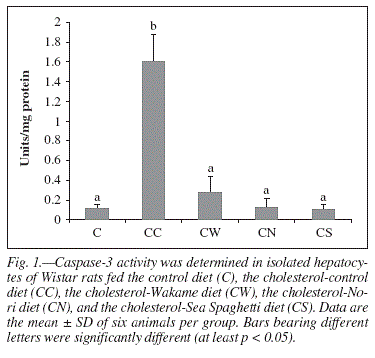
<body><![CDATA[<p><font face="Verdana" size="2"><i>Feed intake, body weight gain and feed conversion</i></font></p>     <p><font face="Verdana" size="2">No significant effects were observed in feed consumption, bodyweight increase or conversion rate (p &gt; 0.05) (<a target="_blank" href="/img/revistas/nh/v28n5/08original03_t2.gif">table II</a>).</font></p>     <p><font face="Verdana" size="2"><i>Plasma cholesterol</i></font></p>     <p><font face="Verdana" size="2">Cholesterol in diet increased plasma cholesterolemia in all groups (p &lt; 0.001). However, CN and CS diets induced lower plasma cholesterolemia than C and CW groups (p &lt; 0.05) (<a target="_blank" href="/img/revistas/nh/v28n5/08original03_t1.gif">table I</a>).</font></p>     <p><font face="Verdana" size="2"><i>Hepatocyte cellular cycle and DNA content</i></font></p>     <p><font face="Verdana" size="2"><a target="_blank" href="/img/revistas/nh/v28n5/08original03_t3.gif">Table III</a> shows the percentage of cell cycle populations in relation to ploidy and DNA content. For the percentage of apoptotic cells (sub G1), content of DNA lesser 2n, analyzed in the cell cycle was affected by diet (p = 0.030) and increased 2.5 fold in the CC vs. C animals. The sub G1 was significantly decreased by CS when compared to CC rats, while no difference was observed when compared to the C group. By contrast, CN and CW resulted in a decreased sub G1 although no significant respect CC groups. Non-significant differences were observed in the pattern of DNA distribution and DNA indices between groups CC DNA index.</font></p>     <p><font face="Verdana" size="2"><i>Caspase-3 activity assay</i></font></p>     <p><font face="Verdana" size="2">Caspase-3 activity was assayed in liver cytosolic fraction in all experimental groups and is presented in  <a href="#f1">figure 1</a>. There was a significant increase in the caspase-3 activity in hypercholesterolemic rats when compared to the control group (p &lt; 0.05). The caspase-3 activity was significantly decreased by algae-diets when compared to hypercholesterolemic rats (p &lt; 0.001). CS, CW, and CN displayed no differences (p &gt; 0.05) when compared to the C group.</font></p>     <p>&nbsp;</p>     <p align="center"><a name="f1"><img src="/img/revistas/nh/v28n5/08original03_f1.gif"></a></p>     ]]></body>
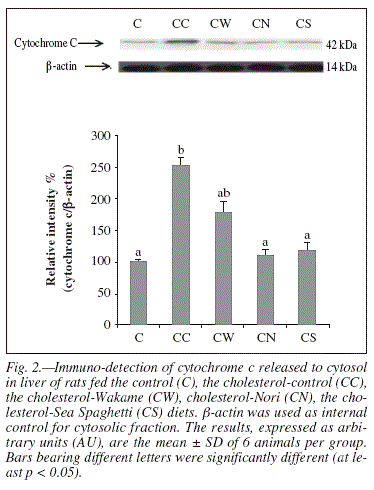
<body><![CDATA[<p>&nbsp;</p>     <p><font face="Verdana" size="2"><i>Cytochrome c expression</i></font></p>     <p><font face="Verdana" size="2">The release of mitochondrial cytochrome c into cytosol is one indicator of perturbation of mitochondrial membrane stability. We further detected cytochrome c protein levels in cytosol using western blot analysis. Immunoblot analysis showed higher release of cytosolic cytochrome c in CC rats in comparison to the C group (p &lt; 0.05), while a consequent diminution of mitochondrial cytochrome c levels was observed when compared to the C group. Cytosolic cytochrome c protein levels analyzed by quantitative densitometry were increased by 250% (p &lt; 0.05) in CC rats compared with the C group. The levels of cytosolic cytochrome c were decreased by CN and CS groups compared with the CC animals, while no difference was observed when compared to the C group (<a href="#f2">fig. 2</a>).</font></p>     <p>&nbsp;</p>     <p align="center"><a name="f2"><img src="/img/revistas/nh/v28n5/08original03_f2.gif"></a></p>     <p>&nbsp;</p>     <p><font face="Verdana" size="2"><b>Discussion</b></font></p>     <p><font face="Verdana" size="2">The experiment was designed to test possible benefits of 1-wk consumption of seaweed-RP as part of cholesterol enriched diets on liver apoptosis and DNA cell cycle. For the first time, flow cytometry analyses were tested in seaweed-RP diets both with and without added cholesterol. Rat groups present similar food acceptation and feed conversion; thus results should be related to differences in composition of seaweeds. The inclusion of cholesterol in diet promptly and highly affected the cholesterolemia; however, clear differences were observed between groups as CC increased plasma cholesterol 64%, CW 43%, and CN and CS by 25%. Semisynthetic casein-based diets with added cholesterol have been found to increase cholesterolemia in medium<sup>1,9,33</sup> and large-term studies.<sup>16</sup> However, the hypocholesterolaemic effects observed due to seaweed inclusion were different and highly dependent on the type of alga included in diet.<sup>1,16</sup> According to Ren et al.,<sup>34</sup> some seaweed polysaccharides exert hypolipemic effects in rats fed a diet rich in sodium and cholesterol. However, sodium alginate, funoran, porphyran, and carrageenan were found to interact with dietary cholesterol to facilitate its excretion, whilst dietary agar was almost inactive.<sup>35</sup></font></p>     <p><font face="Verdana" size="2">Mammal livers contain polyploid hepatocytes, whose number depends on the animal's age and species.<sup>36</sup> Thus, rat foetal hepatocytes are mainly diploids (85.3% of cells are in the diploid phase), 7.3% in DNA synthesis phase and 7.4% polyploids (tetraploids plus octoploids).<sup>37</sup> In the current study, the diploid phase accounted for 73.0 to 78.6 % and tended to decrease after cholesterol feeding, while S plus tetraploid phases represented 14.1 to 19.6%. Apoptosis increased by cholesterol feeding in CC rats but CS rats showed similar apoptotic level to the C group while CW and CN intermediate values with respect to those of CC and CN groups. The necrosis-regeneration process is characterized by a change in the distribution of different populations of hepatocytes and, while normal hepatocytes have stability in their DNA content and chromosome organization, proliferative state of hepatocytes (regenerating) are involved in the replication process through the cell cycle including DNA synthesis programmed to duplicate the genomic material of the cell before its division. Regenerating cells, therefore, have a higher DNA content than quiescent cells (resting phase) and this content can vary in each cycle according to the progression of DNA synthesis. Thus, according to the cellular apoptosis/cellular DNA the inclusion of seaweed to RP diets induced moderate antiapoptotic effects, mostly in the CN diet.</font></p>     <p><font face="Verdana" size="2">Free radicals induce oxidative stress, which is balanced by the body's endogenous antioxidant systems with an input from co-factors, and by the ingestion of exogenous antioxidants. Disturbances in mitochondrial membrane permeability cause leakage of free radicals and cytochrome c from the mitochondria to the cytosol. Once cytochrome c is released into the cytosol, it binds to another protein, Apaf-1, and promotes activation of the caspase cascade, leading to cell death.<sup>38</sup> In CC diet-fed rats, the levels of cytosolic cytochrome c and the activation of caspase-3 were much greater than those of the C group. This indicates that the release of cytochrome c into the cytosol is due to mitochondrial membrane damage, which is induced by increased levels of radicals. Cytosolic cytochrome c activates protease activators (caspases), and this may cause further apoptosis, which is also supported from the cellular cycle-DNA content. As also reported by Zamora et al.,<sup>39</sup> dietary cholesterol increased apoptosis. However, the inclusion of alga blocked those effects in the CS group, which remained at basal levels, while CW and CN diets partially blocked the apoptotic effect of dietary cholesterol. However, seaweeds contain antioxidants and other substances that probably block the negative effect on the antioxidant status of reducing plasma cholesterol. Thus, some amino acids and antioxidant activity molecules (e.g. zinc)<sup>40</sup> of red and brown seaweeds have been reported to be antiapoptotic.<sup>39</sup> In addition, vitamins A and E, and some polyphenols present in seaweeds<sup>1</sup> could act as antioxidants and have a role in the partial antiapoptotic effects observed. Fucose-containing sulphated polysaccharides extracted from <i>Sargassum</i> sp. and from <i>Fucus vesiculosus</i> respectively have been reported to induce growth inhibition and apoptosis of melanoma B16 cells <i>in vitro.<sup>41,42</sup></i></font></p>     ]]></body>
<body><![CDATA[<p><font face="Verdana" size="2">The pro-apoptotic effect of dietary cholesterol and the antiapoptotic effect of seaweed-RP diet were also supported by the results of caspase-3 activity. In fact CW, CN, and CS rats displayed much lower caspase-3 activities than their CC counterparts. Similarly, cytosolic cytochrome c expression increased 2.5-fold in CC animals and decreased to C rat values with consumption of CN and CS diets. All these results suggest that algal compounds, mostly in the case of CS and CN, blocked the proapoptotic effect of dietary cholesterol and reduced the release of mitochondrial cytochrome c into the cytosol occurring in CC rats. Thiruchenduran et al.<sup>43</sup> reported that the increase in the expression of caspase-3 and cytochrome c observed in cholesterol fed rats was partially blocked in the grape seed proanthocyanidin-treated group via their ability to reduce, directly or indirectly, free radicals production. Although we did not measure free radical production in this short-term experiment, CN and CS diets probably reduced free radical levels via algal antioxidants and other compounds, consequently maintaining mitochondrial membrane permeability.<sup>18</sup> This would, in turn, lead to tissue damage and/or apoptosis reduction. Mohamed et al.<sup>44</sup>reported that seaweed consumption increases the antioxidant endogenous production <i>in vivo</i> and that malondialdehyde were significantly reduced in liver and other organs of aging animals by porphyrans and sulphated galactans from <i>Porphyra</i> spp. However, a hystologycal study performed in Wistar rats fed the same RP showed, after 5-wk treatment, that the antiapoptotic and other protective effects were lost.<sup>10</sup> As in the Schultz Moreira et al.<sup>10</sup> study plasma cholesterol were much higher than those observed in the present study, it must be suggested that long-term cholesterol feeding must increase plasma cholesterolemia to a level that implies a high cholesterol to cholic acid conversion.<sup>44</sup> In the cholesterol to bile acids conversion, the cytochrome P450 7A-1 hemoenzyme is induced, highly increasing the production of free radicals.<sup>45,46</sup> This effect probably blocks the protection again apoptosis observed in the present short-term study and deserve future studies.</font></p>     <p>&nbsp;</p>     <p><font face="Verdana" size="2"><b>Conclusion</b></font></p>     <p><font face="Verdana" size="2">In summary, in this 1-week short-term study, sea Spaghetti-RP, and Nori-RP to a lesser extent, reduced the apoptosis induced by cholesterol feeding. More studies are needed to understand the results obtained and to ascertain the utility of consuming algal-RP as part of very cholesterol-rich diets.</font></p>     <p>&nbsp;</p>     <p><font face="Verdana" size="2"><b>References</b></font></p>     <!-- ref --><p><font face="Verdana" size="2">1. Bocanegra A, Bastida S, Benedi J, Rodenas S, Sanchez-Muniz FJ. Characteristics and nutritional and cardiovascular-health properties of seaweeds. <i>J Med Food</i> 2009; 2: 236-58.    &nbsp;&nbsp;&nbsp;&nbsp;&nbsp;&nbsp;&nbsp;&nbsp;[&#160;<a href="javascript:void(0);" onclick="javascript: window.open('/scielo.php?script=sci_nlinks&ref=3743231&pid=S0212-1611201300050000800001&lng=','','width=640,height=500,resizable=yes,scrollbars=1,menubar=yes,');">Links</a>&#160;]<!-- end-ref --></font></p>    <!-- ref --><p><font face="Verdana" size="2">2. Pauwels EK. The protective effect of the Mediterranean diet: focus on cancer and cardiovascular risk. <i>Med Princ Pract</i> 2011; 20: 103-11.    &nbsp;&nbsp;&nbsp;&nbsp;&nbsp;&nbsp;&nbsp;&nbsp;[&#160;<a href="javascript:void(0);" onclick="javascript: window.open('/scielo.php?script=sci_nlinks&ref=3743233&pid=S0212-1611201300050000800002&lng=','','width=640,height=500,resizable=yes,scrollbars=1,menubar=yes,');">Links</a>&#160;]<!-- end-ref --></font></p>    ]]></body>
<body><![CDATA[<!-- ref --><p><font face="Verdana" size="2">3. Solfrizzi V, Frisardi V, Seripa D, Logroscino G, Imbimbo BP, D'Onofrio G, Addante F, Sancarlo D, Cascavilla L, Pilotto A, Panza F. Mediterranean diet in predementia and dementia syndromes. <i>Curr Alzheimer Res</i> 2011; 8: 520-42.    &nbsp;&nbsp;&nbsp;&nbsp;&nbsp;&nbsp;&nbsp;&nbsp;[&#160;<a href="javascript:void(0);" onclick="javascript: window.open('/scielo.php?script=sci_nlinks&ref=3743235&pid=S0212-1611201300050000800003&lng=','','width=640,height=500,resizable=yes,scrollbars=1,menubar=yes,');">Links</a>&#160;]<!-- end-ref --></font></p>    <!-- ref --><p><font face="Verdana" size="2">4. Conchillo A, Valencia I, Puente A, Ansorena D, Astiasarán EI. Componentes funcionales en aceites de pescado y de alga. <i>Nutr Hosp</i> 2006; 21: 369-73.    &nbsp;&nbsp;&nbsp;&nbsp;&nbsp;&nbsp;&nbsp;&nbsp;[&#160;<a href="javascript:void(0);" onclick="javascript: window.open('/scielo.php?script=sci_nlinks&ref=3743237&pid=S0212-1611201300050000800004&lng=','','width=640,height=500,resizable=yes,scrollbars=1,menubar=yes,');">Links</a>&#160;]<!-- end-ref --></font></p>    <!-- ref --><p><font face="Verdana" size="2">5. Cofrades S, López-López I, Bravo L, Ruiz-Capillas C, Bastida S, Larrea MT, Jiménez-Colmenero F. Nutritional and antioxidant properties of different brown and red Spanish edible seaweeds. <i>Food Sci Technol Int</i> 2010; 5: 361-70.    &nbsp;&nbsp;&nbsp;&nbsp;&nbsp;&nbsp;&nbsp;&nbsp;[&#160;<a href="javascript:void(0);" onclick="javascript: window.open('/scielo.php?script=sci_nlinks&ref=3743239&pid=S0212-1611201300050000800005&lng=','','width=640,height=500,resizable=yes,scrollbars=1,menubar=yes,');">Links</a>&#160;]<!-- end-ref --></font></p>    <!-- ref --><p><font face="Verdana" size="2">6. Jiménez Colmenero F, Sánchez-Muniz FJ, Olmedilla-Alonso B, and collaborators. Design and development of meat-based functional foods with walnut: Technological, nutritional and health impact. <i>Food Chem</i> 2010; 123: 959-67.    &nbsp;&nbsp;&nbsp;&nbsp;&nbsp;&nbsp;&nbsp;&nbsp;[&#160;<a href="javascript:void(0);" onclick="javascript: window.open('/scielo.php?script=sci_nlinks&ref=3743241&pid=S0212-1611201300050000800006&lng=','','width=640,height=500,resizable=yes,scrollbars=1,menubar=yes,');">Links</a>&#160;]<!-- end-ref --></font></p>    <!-- ref --><p><font face="Verdana" size="2">7. Sánchez-Muniz FJ. Dietary fibre and cardiovascular health. <i>Nutr Hosp</i> 2012; 27: 31-45.    &nbsp;&nbsp;&nbsp;&nbsp;&nbsp;&nbsp;&nbsp;&nbsp;[&#160;<a href="javascript:void(0);" onclick="javascript: window.open('/scielo.php?script=sci_nlinks&ref=3743243&pid=S0212-1611201300050000800007&lng=','','width=640,height=500,resizable=yes,scrollbars=1,menubar=yes,');">Links</a>&#160;]<!-- end-ref --></font></p>    ]]></body>
<body><![CDATA[<!-- ref --><p><font face="Verdana" size="2">8. Babio N, Balanzá R, Basulto J, Bulló M, Salas-Salvadó J. Fibra dietética: influencia sobre el peso corporal, el control glicémico y el perfil del colesterol plasmático. <i>Nutr Hosp</i> 25: 327-40.    &nbsp;&nbsp;&nbsp;&nbsp;&nbsp;&nbsp;&nbsp;&nbsp;[&#160;<a href="javascript:void(0);" onclick="javascript: window.open('/scielo.php?script=sci_nlinks&ref=3743245&pid=S0212-1611201300050000800008&lng=','','width=640,height=500,resizable=yes,scrollbars=1,menubar=yes,');">Links</a>&#160;]<!-- end-ref --></font></p>    <!-- ref --><p><font face="Verdana" size="2">9. Sánchez-Muniz FJ, Cava F, Viejo JM, Bastida S, Higon E, Marcos A. Olive oil-fried sardines in the prevention of dietary hypercholesterolemia in rats. Effects on some serum lipids and cell-damage marker enzymes. <i>Nutr Res</i> 1996; 16: 111-21.    &nbsp;&nbsp;&nbsp;&nbsp;&nbsp;&nbsp;&nbsp;&nbsp;[&#160;<a href="javascript:void(0);" onclick="javascript: window.open('/scielo.php?script=sci_nlinks&ref=3743247&pid=S0212-1611201300050000800009&lng=','','width=640,height=500,resizable=yes,scrollbars=1,menubar=yes,');">Links</a>&#160;]<!-- end-ref --></font></p>    <!-- ref --><p><font face="Verdana" size="2">10. Schultz Moreira AR, García-Fernández RA, Bocanegra A, Méndez MT, Bastida S, Benedí J, Sánchez-Reus MI, Sánchez-Muniz FJ. Effects of seaweed-restructured pork diets enriched or not with cholesterol on rat cholesterolemia and liver damage. <i>Food Chem Toxicol</i> 2013; 56: 223-30.    &nbsp;&nbsp;&nbsp;&nbsp;&nbsp;&nbsp;&nbsp;&nbsp;[&#160;<a href="javascript:void(0);" onclick="javascript: window.open('/scielo.php?script=sci_nlinks&ref=3743249&pid=S0212-1611201300050000800010&lng=','','width=640,height=500,resizable=yes,scrollbars=1,menubar=yes,');">Links</a>&#160;]<!-- end-ref --></font></p>    <!-- ref --><p><font face="Verdana" size="2">11. Yokogawa K, Matsui-Yuasa I, Tamura A, Terada M, Kojima-Yuasa A. Inhibitory effects of Ecklonia cava extract on high glucose-induced hepatic stellate cell activation. <i>Mar Drugs</i> 2011; 9: 2793-808.    &nbsp;&nbsp;&nbsp;&nbsp;&nbsp;&nbsp;&nbsp;&nbsp;[&#160;<a href="javascript:void(0);" onclick="javascript: window.open('/scielo.php?script=sci_nlinks&ref=3743251&pid=S0212-1611201300050000800011&lng=','','width=640,height=500,resizable=yes,scrollbars=1,menubar=yes,');">Links</a>&#160;]<!-- end-ref --></font></p>    <!-- ref --><p><font face="Verdana" size="2">12. Kuriakose GC, Kurup MG. Antioxidant and antihepatotoxic effect of Spirulina laxissima against carbon tetrachloride induced hepatotoxicity in rats. <i>Food Funct</i> 2011; 2: 190-6.    &nbsp;&nbsp;&nbsp;&nbsp;&nbsp;&nbsp;&nbsp;&nbsp;[&#160;<a href="javascript:void(0);" onclick="javascript: window.open('/scielo.php?script=sci_nlinks&ref=3743253&pid=S0212-1611201300050000800012&lng=','','width=640,height=500,resizable=yes,scrollbars=1,menubar=yes,');">Links</a>&#160;]<!-- end-ref --></font></p>    ]]></body>
<body><![CDATA[<!-- ref --><p><font face="Verdana" size="2">13. Bocanegra A, Benedí J, Sánchez-Muniz FJ. Differential effects of konbu and nori seaweed dietary supplementation on liver glutathione status in normo- and hypercholesterolaemic growing rats. <i>Br J Nutr</i> 2006; 95: 696-702.    &nbsp;&nbsp;&nbsp;&nbsp;&nbsp;&nbsp;&nbsp;&nbsp;[&#160;<a href="javascript:void(0);" onclick="javascript: window.open('/scielo.php?script=sci_nlinks&ref=3743255&pid=S0212-1611201300050000800013&lng=','','width=640,height=500,resizable=yes,scrollbars=1,menubar=yes,');">Links</a>&#160;]<!-- end-ref --></font></p>    <!-- ref --><p><font face="Verdana" size="2">14. Bocanegra A, Nieto A, Bastida S, Benedí J, Sánchez-Muniz FJ. A Nori but not a Konbu, dietary supplement decreases the cholesterolaemia, liver fat infiltration and mineral bioavailability in hypercholesterolaemic growing Wistar rats. <i>Br J Nutr</i> 2008; 99: 272-80.    &nbsp;&nbsp;&nbsp;&nbsp;&nbsp;&nbsp;&nbsp;&nbsp;[&#160;<a href="javascript:void(0);" onclick="javascript: window.open('/scielo.php?script=sci_nlinks&ref=3743257&pid=S0212-1611201300050000800014&lng=','','width=640,height=500,resizable=yes,scrollbars=1,menubar=yes,');">Links</a>&#160;]<!-- end-ref --></font></p>    <!-- ref --><p><font face="Verdana" size="2">15. González-Torres L, Churruca I, Schultz Moreira AR, Bastida S, Benedí J, Portillo MP, Sánchez-Muniz FJ. Effects of restructured pork containing Himanthalia elongata on adipose tissue lipogenic and lipolytic enzyme expression of normo- and hypercholesterolemic rats. <i>J Nutrigenet Nutrigenomics</i> 2012; 5: 158-67.    &nbsp;&nbsp;&nbsp;&nbsp;&nbsp;&nbsp;&nbsp;&nbsp;[&#160;<a href="javascript:void(0);" onclick="javascript: window.open('/scielo.php?script=sci_nlinks&ref=3743259&pid=S0212-1611201300050000800015&lng=','','width=640,height=500,resizable=yes,scrollbars=1,menubar=yes,');">Links</a>&#160;]<!-- end-ref --></font></p>    <!-- ref --><p><font face="Verdana" size="2">16. Olivero-David R, Schultz-Moreira A, Vázquez-Velasco M, González-Torres L, Bastida S, Benedí J, Sanchez-Reus MI, González-Muñoz MJ, Sánchez-Muniz FJ. Effects of Nori- and Wakame-enriched meats with or without supplementary cholesterol on arylesterase activity, lipaemia and lipoproteinaemia in growing Wistar rats. <i>Br J Nutr</i> 2011; 106: 1476-86.    &nbsp;&nbsp;&nbsp;&nbsp;&nbsp;&nbsp;&nbsp;&nbsp;[&#160;<a href="javascript:void(0);" onclick="javascript: window.open('/scielo.php?script=sci_nlinks&ref=3743261&pid=S0212-1611201300050000800016&lng=','','width=640,height=500,resizable=yes,scrollbars=1,menubar=yes,');">Links</a>&#160;]<!-- end-ref --></font></p>    <!-- ref --><p><font face="Verdana" size="2">17. Mišurcová L, Mach L, Orsavová J. Advances in food and nutrition research: Marine medicinal foods: Implications and applications, macro and microalgae. In: Se-Kwon, K. (Eds.), Seaweed minerals as nutraceuticals. Marine bioprocess research center, Department of Chemistry, Pukyong National University, pp. 371-86, Busan, 2011.    &nbsp;&nbsp;&nbsp;&nbsp;&nbsp;&nbsp;&nbsp;&nbsp;[&#160;<a href="javascript:void(0);" onclick="javascript: window.open('/scielo.php?script=sci_nlinks&ref=3743263&pid=S0212-1611201300050000800017&lng=','','width=640,height=500,resizable=yes,scrollbars=1,menubar=yes,');">Links</a>&#160;]<!-- end-ref --></font></p>    ]]></body>
<body><![CDATA[<!-- ref --><p><font face="Verdana" size="2">18. Moreira AS, González-Torres L, Olivero-David R, Bastida S, Benedi J, Sánchez-Muniz FJ. Wakame and Nori in restructured meats included in cholesterol-enriched diets affect the antioxidant enzyme gene expressions and activities in Wistar rats. <i>Plant Foods Hum Nutr</i> 2010; 65: 290-8.    &nbsp;&nbsp;&nbsp;&nbsp;&nbsp;&nbsp;&nbsp;&nbsp;[&#160;<a href="javascript:void(0);" onclick="javascript: window.open('/scielo.php?script=sci_nlinks&ref=3743265&pid=S0212-1611201300050000800018&lng=','','width=640,height=500,resizable=yes,scrollbars=1,menubar=yes,');">Links</a>&#160;]<!-- end-ref --></font></p>    <!-- ref --><p><font face="Verdana" size="2">19. Goraca A, Huk-Kolega H, Piechota A, Kleniewska PE, Skibska B. Lipoic acid - biological activity and therapeutic potential. <i>Pharmacol Rep</i> 2011; 63: 849-58.    &nbsp;&nbsp;&nbsp;&nbsp;&nbsp;&nbsp;&nbsp;&nbsp;[&#160;<a href="javascript:void(0);" onclick="javascript: window.open('/scielo.php?script=sci_nlinks&ref=3743267&pid=S0212-1611201300050000800019&lng=','','width=640,height=500,resizable=yes,scrollbars=1,menubar=yes,');">Links</a>&#160;]<!-- end-ref --></font></p>    <!-- ref --><p><font face="Verdana" size="2">20. Ernst E. Serious adverse effects of unconventional therapies for children and adolescents: a systematic review of recent evidence. <i>Eur J Pediatr</i> 2003; 162: 72-80.    &nbsp;&nbsp;&nbsp;&nbsp;&nbsp;&nbsp;&nbsp;&nbsp;[&#160;<a href="javascript:void(0);" onclick="javascript: window.open('/scielo.php?script=sci_nlinks&ref=3743269&pid=S0212-1611201300050000800020&lng=','','width=640,height=500,resizable=yes,scrollbars=1,menubar=yes,');">Links</a>&#160;]<!-- end-ref --></font></p>    <!-- ref --><p><font face="Verdana" size="2">21. Rukkumani R, Aruna K, Suresh Varma P, Padmanabhan Menon V. Hepatoprotective role of ferulic acid: a dose-dependent study. <i>J Med Food</i> 2004; 7: 456-61.    &nbsp;&nbsp;&nbsp;&nbsp;&nbsp;&nbsp;&nbsp;&nbsp;[&#160;<a href="javascript:void(0);" onclick="javascript: window.open('/scielo.php?script=sci_nlinks&ref=3743271&pid=S0212-1611201300050000800021&lng=','','width=640,height=500,resizable=yes,scrollbars=1,menubar=yes,');">Links</a>&#160;]<!-- end-ref --></font></p>    <!-- ref --><p><font face="Verdana" size="2">22. Malhi H, Gores GJ. Molecular mechanisms of lipotoxicity in nonalcoholic fatty liver disease. <i>Semin Liver Dis</i> 2008; 28: 360-369.    &nbsp;&nbsp;&nbsp;&nbsp;&nbsp;&nbsp;&nbsp;&nbsp;[&#160;<a href="javascript:void(0);" onclick="javascript: window.open('/scielo.php?script=sci_nlinks&ref=3743273&pid=S0212-1611201300050000800022&lng=','','width=640,height=500,resizable=yes,scrollbars=1,menubar=yes,');">Links</a>&#160;]<!-- end-ref --></font></p>    ]]></body>
<body><![CDATA[<!-- ref --><p><font face="Verdana" size="2">23. Bautista M, Andres D, Cascales M, Morales-González JA, Sánchez-Reus MI. Effect of gadolinium chloride on liver regeneration following thioacetamide-induced necrosis in rats. <i>Int J Mol Sci</i> 2010; 11: 4426-40.    &nbsp;&nbsp;&nbsp;&nbsp;&nbsp;&nbsp;&nbsp;&nbsp;[&#160;<a href="javascript:void(0);" onclick="javascript: window.open('/scielo.php?script=sci_nlinks&ref=3743275&pid=S0212-1611201300050000800023&lng=','','width=640,height=500,resizable=yes,scrollbars=1,menubar=yes,');">Links</a>&#160;]<!-- end-ref --></font></p>    <!-- ref --><p><font face="Verdana" size="2">24. Guicciardi ME, Gores GJ. Apoptosis as a mechanism for liver disease progression. <i>Semin Liver Dis</i> 2010; 30: 402-10.    &nbsp;&nbsp;&nbsp;&nbsp;&nbsp;&nbsp;&nbsp;&nbsp;[&#160;<a href="javascript:void(0);" onclick="javascript: window.open('/scielo.php?script=sci_nlinks&ref=3743277&pid=S0212-1611201300050000800024&lng=','','width=640,height=500,resizable=yes,scrollbars=1,menubar=yes,');">Links</a>&#160;]<!-- end-ref --></font></p>    <!-- ref --><p><font face="Verdana" size="2">25. Lordan S, Ross RP, Stanton C. Marine bioactives as functional food ingredients: potential to reduce the incidence of chronic diseases. <i>Mar Drugs</i> 2011; 9: 1056-100.    &nbsp;&nbsp;&nbsp;&nbsp;&nbsp;&nbsp;&nbsp;&nbsp;[&#160;<a href="javascript:void(0);" onclick="javascript: window.open('/scielo.php?script=sci_nlinks&ref=3743279&pid=S0212-1611201300050000800025&lng=','','width=640,height=500,resizable=yes,scrollbars=1,menubar=yes,');">Links</a>&#160;]<!-- end-ref --></font></p>    <!-- ref --><p><font face="Verdana" size="2">26. Cofrades S, López-López I, Solas MT, Bravo L, Jiménez-Colmenero F. Influence of different types and proportions of added edible seaweeds on characteristics of low-salt gel/emulsion meat systems. <i>Meat Sci</i> 2008; 79: 767-76.    &nbsp;&nbsp;&nbsp;&nbsp;&nbsp;&nbsp;&nbsp;&nbsp;[&#160;<a href="javascript:void(0);" onclick="javascript: window.open('/scielo.php?script=sci_nlinks&ref=3743281&pid=S0212-1611201300050000800026&lng=','','width=640,height=500,resizable=yes,scrollbars=1,menubar=yes,');">Links</a>&#160;]<!-- end-ref --></font></p>    <!-- ref --><p><font face="Verdana" size="2">27. López-López I, Bastida S, Ruiz-Capillas C, Bravo L, Larrea MT, Sánchez-Muniz FJ, Cofrades S, Jiménez-Colmenero F. Composition and antioxidant capacity of low-salt meat emulsion model systems containing edible seaweeds. <i>Meat Sci</i> 2009; 83: 492-8.    &nbsp;&nbsp;&nbsp;&nbsp;&nbsp;&nbsp;&nbsp;&nbsp;[&#160;<a href="javascript:void(0);" onclick="javascript: window.open('/scielo.php?script=sci_nlinks&ref=3743283&pid=S0212-1611201300050000800027&lng=','','width=640,height=500,resizable=yes,scrollbars=1,menubar=yes,');">Links</a>&#160;]<!-- end-ref --></font></p>    ]]></body>
<body><![CDATA[<!-- ref --><p><font face="Verdana" size="2">28. Seglen PO. Isolation of hepatocytes by collagenase perfusion. In: Tyson CA, Frazier JM, editors. Methods in toxicology in vitro biological systems. Academia Press; pp. 231-43, New York, NY, USA, 1993.    &nbsp;&nbsp;&nbsp;&nbsp;&nbsp;&nbsp;&nbsp;&nbsp;[&#160;<a href="javascript:void(0);" onclick="javascript: window.open('/scielo.php?script=sci_nlinks&ref=3743285&pid=S0212-1611201300050000800028&lng=','','width=640,height=500,resizable=yes,scrollbars=1,menubar=yes,');">Links</a>&#160;]<!-- end-ref --></font></p>    <!-- ref --><p><font face="Verdana" size="2">29. Diez-Fernandez C, Sanz N, Cascales M. Changes in glucose-6-phosphate dehydrogenase and malic enzyme gene expression in acute hepatic injury induced by thioacetamide. <i>Biochem Pharmacol</i> 1996; 51: 1159-63.    &nbsp;&nbsp;&nbsp;&nbsp;&nbsp;&nbsp;&nbsp;&nbsp;[&#160;<a href="javascript:void(0);" onclick="javascript: window.open('/scielo.php?script=sci_nlinks&ref=3743287&pid=S0212-1611201300050000800029&lng=','','width=640,height=500,resizable=yes,scrollbars=1,menubar=yes,');">Links</a>&#160;]<!-- end-ref --></font></p>    <!-- ref --><p><font face="Verdana" size="2">30. Vindelov LL, Christensen IJ, Nissen NI. A detergent trypsin method for the preparation of nuclei for flow cytometric. <i>Cytometry</i> 1983; 3: 323-7.    &nbsp;&nbsp;&nbsp;&nbsp;&nbsp;&nbsp;&nbsp;&nbsp;[&#160;<a href="javascript:void(0);" onclick="javascript: window.open('/scielo.php?script=sci_nlinks&ref=3743289&pid=S0212-1611201300050000800030&lng=','','width=640,height=500,resizable=yes,scrollbars=1,menubar=yes,');">Links</a>&#160;]<!-- end-ref --></font></p>    <!-- ref --><p><font face="Verdana" size="2">31. Bijur GN, De Sarno P, Jope RS. Glycogen synthase kinase-3beta facilitates staurosporine- and heat shock-induced apoptosis. Protection by lithium. <i>J Biol Chem</i> 2000; 275: 7583-90.    &nbsp;&nbsp;&nbsp;&nbsp;&nbsp;&nbsp;&nbsp;&nbsp;[&#160;<a href="javascript:void(0);" onclick="javascript: window.open('/scielo.php?script=sci_nlinks&ref=3743291&pid=S0212-1611201300050000800031&lng=','','width=640,height=500,resizable=yes,scrollbars=1,menubar=yes,');">Links</a>&#160;]<!-- end-ref --></font></p>    <!-- ref --><p><font face="Verdana" size="2">32. Bradford MM. A rapid and sensitive method for the quantitation of microgram quantities of protein utilizing the principle of protein-dye binding. <i>Anal Biochem</i> 1976; 72: 248-54.    &nbsp;&nbsp;&nbsp;&nbsp;&nbsp;&nbsp;&nbsp;&nbsp;[&#160;<a href="javascript:void(0);" onclick="javascript: window.open('/scielo.php?script=sci_nlinks&ref=3743293&pid=S0212-1611201300050000800032&lng=','','width=640,height=500,resizable=yes,scrollbars=1,menubar=yes,');">Links</a>&#160;]<!-- end-ref --></font></p>    ]]></body>
<body><![CDATA[<!-- ref --><p><font face="Verdana" size="2">33. Sánchez-Muniz FJ, García-Linares MC, García-Arias MT, Bastida S, Viejo J. Fat and protein from olive oil-fried sardines interact to normalize serum lipoproteins and reduce liver lipids in hypercholesterolaemic rats. <i>J Nutr</i> 2003; 133: 2302-8.    &nbsp;&nbsp;&nbsp;&nbsp;&nbsp;&nbsp;&nbsp;&nbsp;[&#160;<a href="javascript:void(0);" onclick="javascript: window.open('/scielo.php?script=sci_nlinks&ref=3743295&pid=S0212-1611201300050000800033&lng=','','width=640,height=500,resizable=yes,scrollbars=1,menubar=yes,');">Links</a>&#160;]<!-- end-ref --></font></p>    <!-- ref --><p><font face="Verdana" size="2">34. Ren D, Noda H, Amano H, Nishino Y, Nishizawa K. Study on antihypertensive and antihyperlipidemic effects of marine algae. <i>Fish Sci</i> 1994; 60: 83-8.    &nbsp;&nbsp;&nbsp;&nbsp;&nbsp;&nbsp;&nbsp;&nbsp;[&#160;<a href="javascript:void(0);" onclick="javascript: window.open('/scielo.php?script=sci_nlinks&ref=3743297&pid=S0212-1611201300050000800034&lng=','','width=640,height=500,resizable=yes,scrollbars=1,menubar=yes,');">Links</a>&#160;]<!-- end-ref --></font></p>    <!-- ref --><p><font face="Verdana" size="2">35. Jiménez-Escrig A, Sánchez-Muniz FJ. Dietary fibre from Edible seaweeds: chemical structure, physicochemical properties and effects on cholesterol metabolism. <i>Nutr Res</i> 2000; 20: 585-98.    &nbsp;&nbsp;&nbsp;&nbsp;&nbsp;&nbsp;&nbsp;&nbsp;[&#160;<a href="javascript:void(0);" onclick="javascript: window.open('/scielo.php?script=sci_nlinks&ref=3743299&pid=S0212-1611201300050000800035&lng=','','width=640,height=500,resizable=yes,scrollbars=1,menubar=yes,');">Links</a>&#160;]<!-- end-ref --></font></p>    <!-- ref --><p><font face="Verdana" size="2">36. Saeter G, Schwarze PE, Nesland JM, Jull N, Pettersen EO, Seglen PO. The polyploidizing growth pattern of normal rat liver is replaced by divisional growth in hepatocellular nodules and carcinomas. <i>Carcinogenesis</i> 1988; 9: 939-45.    &nbsp;&nbsp;&nbsp;&nbsp;&nbsp;&nbsp;&nbsp;&nbsp;[&#160;<a href="javascript:void(0);" onclick="javascript: window.open('/scielo.php?script=sci_nlinks&ref=3743301&pid=S0212-1611201300050000800036&lng=','','width=640,height=500,resizable=yes,scrollbars=1,menubar=yes,');">Links</a>&#160;]<!-- end-ref --></font></p>    <!-- ref --><p><font face="Verdana" size="2">37. Díez-Fernández C, Boscá L, Fernández-Simón L, Alvarez A, Cascales M. Relationship between genomic DNA ploidy and parameters of liver damage during necrosis and regeneration induced by thioacetamide. <i>Hepatology</i> 1993; 4: 912-8.    &nbsp;&nbsp;&nbsp;&nbsp;&nbsp;&nbsp;&nbsp;&nbsp;[&#160;<a href="javascript:void(0);" onclick="javascript: window.open('/scielo.php?script=sci_nlinks&ref=3743303&pid=S0212-1611201300050000800037&lng=','','width=640,height=500,resizable=yes,scrollbars=1,menubar=yes,');">Links</a>&#160;]<!-- end-ref --></font></p>    ]]></body>
<body><![CDATA[<!-- ref --><p><font face="Verdana" size="2">38. Tien YC, Liao JC, Chiu C, Huang TH, Huang CY, Chang WT, Peng WH. Esculetin ameliorates carbon tetrachloride-mediated hepatic apoptosis in rats. <i>Int J Mol Sci</i> 2011; 12: 4053-67.    &nbsp;&nbsp;&nbsp;&nbsp;&nbsp;&nbsp;&nbsp;&nbsp;[&#160;<a href="javascript:void(0);" onclick="javascript: window.open('/scielo.php?script=sci_nlinks&ref=3743305&pid=S0212-1611201300050000800038&lng=','','width=640,height=500,resizable=yes,scrollbars=1,menubar=yes,');">Links</a>&#160;]<!-- end-ref --></font></p>    <!-- ref --><p><font face="Verdana" size="2">39. Zamora JD, Otárola IC, Brenes O. La apoptosis y su relación con diversos nutrientes. <i>Rev Chil Nutr</i> 2005; 32: 178-90.    &nbsp;&nbsp;&nbsp;&nbsp;&nbsp;&nbsp;&nbsp;&nbsp;[&#160;<a href="javascript:void(0);" onclick="javascript: window.open('/scielo.php?script=sci_nlinks&ref=3743307&pid=S0212-1611201300050000800039&lng=','','width=640,height=500,resizable=yes,scrollbars=1,menubar=yes,');">Links</a>&#160;]<!-- end-ref --></font></p>    <!-- ref --><p><font face="Verdana" size="2">40. Rupérez P, Ahrazem O, Leal JA. Potential antioxidant capacity of sulfated polysaccharides from the edible marine brown seaweed Fucus vesiculosus. <i>J Agric Food Chem</i> 2002; 50: 840-5.    &nbsp;&nbsp;&nbsp;&nbsp;&nbsp;&nbsp;&nbsp;&nbsp;[&#160;<a href="javascript:void(0);" onclick="javascript: window.open('/scielo.php?script=sci_nlinks&ref=3743309&pid=S0212-1611201300050000800040&lng=','','width=640,height=500,resizable=yes,scrollbars=1,menubar=yes,');">Links</a>&#160;]<!-- end-ref --></font></p>    <!-- ref --><p><font face="Verdana" size="2">41. Ale MT, Maruyama H, Tamauchi H, Mikkelsen JD, Meyer AS. Fucoidan from Sargassum sp. and Fucus vesiculosus reduces cell viability of lung carcinoma and melanoma cells <i>in vitro</i> and activates natural killer cells in mice <i>in vivo. Int J Biol Macromol</i> 2011; 49: 331-6.    &nbsp;&nbsp;&nbsp;&nbsp;&nbsp;&nbsp;&nbsp;&nbsp;[&#160;<a href="javascript:void(0);" onclick="javascript: window.open('/scielo.php?script=sci_nlinks&ref=3743311&pid=S0212-1611201300050000800041&lng=','','width=640,height=500,resizable=yes,scrollbars=1,menubar=yes,');">Links</a>&#160;]<!-- end-ref --></font></p>    <!-- ref --><p><font face="Verdana" size="2">42. Ale MT, Maruyama H, Tamauchi H, Mikkelsen JD, Meyer AS. Fucose-containing sulfated polysaccharides from brown seaweeds inhibit proliferation of melanoma cells and induce apoptosis by activation of caspase-3 in vitro. <i>Mar Drugs</i> 2011; 9: 2605-21.    &nbsp;&nbsp;&nbsp;&nbsp;&nbsp;&nbsp;&nbsp;&nbsp;[&#160;<a href="javascript:void(0);" onclick="javascript: window.open('/scielo.php?script=sci_nlinks&ref=3743313&pid=S0212-1611201300050000800042&lng=','','width=640,height=500,resizable=yes,scrollbars=1,menubar=yes,');">Links</a>&#160;]<!-- end-ref --></font></p>    ]]></body>
<body><![CDATA[<!-- ref --><p><font face="Verdana" size="2">43. Thiruchenduran M, Vijayan NA, Sawaminathan JK, Devaraj SN. Protective effect of grape seed proanthocyanidins against cholesterol cholic acid diet-induced hypercholesterolemia in rats. <i>Cardiovasc Pathol</i> 2011; 20: 361-8.    &nbsp;&nbsp;&nbsp;&nbsp;&nbsp;&nbsp;&nbsp;&nbsp;[&#160;<a href="javascript:void(0);" onclick="javascript: window.open('/scielo.php?script=sci_nlinks&ref=3743315&pid=S0212-1611201300050000800043&lng=','','width=640,height=500,resizable=yes,scrollbars=1,menubar=yes,');">Links</a>&#160;]<!-- end-ref --></font></p>    <!-- ref --><p><font face="Verdana" size="2">44. Mohamed S, Hashim SN, Rahman HA. Seweeds: A sustainable functional food for complementary and alternative therapy. <i>Trends Food Sci Technol</i> 2012; 23: 83-96.    &nbsp;&nbsp;&nbsp;&nbsp;&nbsp;&nbsp;&nbsp;&nbsp;[&#160;<a href="javascript:void(0);" onclick="javascript: window.open('/scielo.php?script=sci_nlinks&ref=3743317&pid=S0212-1611201300050000800044&lng=','','width=640,height=500,resizable=yes,scrollbars=1,menubar=yes,');">Links</a>&#160;]<!-- end-ref --></font></p>    <!-- ref --><p><font face="Verdana" size="2">45. Schultz Moreira AR, Benedí J, González-Torres L, Olivero-David R, Bastida S, Sánchez-Reus MI, González-Muñoz MJ, Sánchez-Muniz FJ. Effects of diet enriched with restructured meats, containing Himanthalia elongata, on hypercholesterolaemic induction, CYP7A1 expression and antioxidant enzyme activity and expression in growing rats. <i>Food Chem</i> 2011; 129: 1623-30.    &nbsp;&nbsp;&nbsp;&nbsp;&nbsp;&nbsp;&nbsp;&nbsp;[&#160;<a href="javascript:void(0);" onclick="javascript: window.open('/scielo.php?script=sci_nlinks&ref=3743319&pid=S0212-1611201300050000800045&lng=','','width=640,height=500,resizable=yes,scrollbars=1,menubar=yes,');">Links</a>&#160;]<!-- end-ref --></font></p>    <!-- ref --><p><font face="Verdana" size="2">46. Micheletta F, Luliano L. Free Radical attack on cholesterol: Oxysterols as markers of oxidative stress and as bioactive molecules. <i>Immun Endoc Metab Agents Med Chem</i> 2006; 6: 305-16.    &nbsp;&nbsp;&nbsp;&nbsp;&nbsp;&nbsp;&nbsp;&nbsp;[&#160;<a href="javascript:void(0);" onclick="javascript: window.open('/scielo.php?script=sci_nlinks&ref=3743321&pid=S0212-1611201300050000800046&lng=','','width=640,height=500,resizable=yes,scrollbars=1,menubar=yes,');">Links</a>&#160;]<!-- end-ref --></font></p>    <!-- ref --><p><font face="Verdana" size="2">47. Tabrez S, Ahmad M. Cytochrome P450 system as potential biomarker of certain toxicants: comparison between plant and animal models. <i>Environ Monit Assess</i> 2013; 185: 2977-87.    &nbsp;&nbsp;&nbsp;&nbsp;&nbsp;&nbsp;&nbsp;&nbsp;[&#160;<a href="javascript:void(0);" onclick="javascript: window.open('/scielo.php?script=sci_nlinks&ref=3743323&pid=S0212-1611201300050000800047&lng=','','width=640,height=500,resizable=yes,scrollbars=1,menubar=yes,');">Links</a>&#160;]<!-- end-ref --></font></p>     ]]></body>
<body><![CDATA[<p>&nbsp;</p>     <p>&nbsp;</p>     <p><font face="Verdana" size="2"><a href="#top"><img border="0" src="/img/revistas/nh/v28n5/seta.gif" width="15" height="17"></a><a name="bajo"></a><b>Correspondence:</b>    <br>Francisco J. Sánchez-Muniz    <br>Departamento de Nutrición    <br>Facultad de Farmacia. Universidad Complutense de Madrid    <br>28040 Madrid. Spain    <br>E-mail: <a href="mailto:frasan@ucm.es">frasan@ucm.es</a></font></p>     <p><font face="Verdana" size="2">Recibido: 31-V-2013    <br>Aceptado: 26-VI-2013</font></p>     ]]></body>
<body><![CDATA[ ]]></body><back>
<ref-list>
<ref id="B1">
<label>1</label><nlm-citation citation-type="journal">
<person-group person-group-type="author">
<name>
<surname><![CDATA[Bocanegra]]></surname>
<given-names><![CDATA[A]]></given-names>
</name>
<name>
<surname><![CDATA[Bastida]]></surname>
<given-names><![CDATA[S]]></given-names>
</name>
<name>
<surname><![CDATA[Benedi]]></surname>
<given-names><![CDATA[J]]></given-names>
</name>
<name>
<surname><![CDATA[Rodenas]]></surname>
<given-names><![CDATA[S]]></given-names>
</name>
<name>
<surname><![CDATA[Sanchez-Muniz]]></surname>
<given-names><![CDATA[FJ]]></given-names>
</name>
</person-group>
<article-title xml:lang="en"><![CDATA[Characteristics and nutritional and cardiovascular-health properties of seaweeds]]></article-title>
<source><![CDATA[J Med Food]]></source>
<year>2009</year>
<volume>2</volume>
<page-range>236-58</page-range></nlm-citation>
</ref>
<ref id="B2">
<label>2</label><nlm-citation citation-type="journal">
<person-group person-group-type="author">
<name>
<surname><![CDATA[Pauwels]]></surname>
<given-names><![CDATA[EK]]></given-names>
</name>
</person-group>
<article-title xml:lang="en"><![CDATA[The protective effect of the Mediterranean diet: focus on cancer and cardiovascular risk]]></article-title>
<source><![CDATA[Med Princ Pract]]></source>
<year>2011</year>
<volume>20</volume>
<page-range>103-11</page-range></nlm-citation>
</ref>
<ref id="B3">
<label>3</label><nlm-citation citation-type="journal">
<person-group person-group-type="author">
<name>
<surname><![CDATA[Solfrizzi]]></surname>
<given-names><![CDATA[V]]></given-names>
</name>
<name>
<surname><![CDATA[Frisardi]]></surname>
<given-names><![CDATA[V]]></given-names>
</name>
<name>
<surname><![CDATA[Seripa]]></surname>
<given-names><![CDATA[D]]></given-names>
</name>
<name>
<surname><![CDATA[Logroscino]]></surname>
<given-names><![CDATA[G]]></given-names>
</name>
<name>
<surname><![CDATA[Imbimbo]]></surname>
<given-names><![CDATA[BP]]></given-names>
</name>
<name>
<surname><![CDATA[D'Onofrio]]></surname>
<given-names><![CDATA[G]]></given-names>
</name>
<name>
<surname><![CDATA[Addante]]></surname>
<given-names><![CDATA[F]]></given-names>
</name>
<name>
<surname><![CDATA[Sancarlo]]></surname>
<given-names><![CDATA[D]]></given-names>
</name>
<name>
<surname><![CDATA[Cascavilla]]></surname>
<given-names><![CDATA[L]]></given-names>
</name>
<name>
<surname><![CDATA[Pilotto]]></surname>
<given-names><![CDATA[A]]></given-names>
</name>
<name>
<surname><![CDATA[Panza]]></surname>
<given-names><![CDATA[F]]></given-names>
</name>
</person-group>
<article-title xml:lang="en"><![CDATA[Mediterranean diet in predementia and dementia syndromes]]></article-title>
<source><![CDATA[Curr Alzheimer Res]]></source>
<year>2011</year>
<volume>8</volume>
<page-range>520-42</page-range></nlm-citation>
</ref>
<ref id="B4">
<label>4</label><nlm-citation citation-type="journal">
<person-group person-group-type="author">
<name>
<surname><![CDATA[Conchillo]]></surname>
<given-names><![CDATA[A]]></given-names>
</name>
<name>
<surname><![CDATA[Valencia]]></surname>
<given-names><![CDATA[I]]></given-names>
</name>
<name>
<surname><![CDATA[Puente]]></surname>
<given-names><![CDATA[A]]></given-names>
</name>
<name>
<surname><![CDATA[Ansorena]]></surname>
<given-names><![CDATA[D]]></given-names>
</name>
<name>
<surname><![CDATA[Astiasarán]]></surname>
<given-names><![CDATA[EI]]></given-names>
</name>
</person-group>
<article-title xml:lang="es"><![CDATA[Componentes funcionales en aceites de pescado y de alga]]></article-title>
<source><![CDATA[Nutr Hosp]]></source>
<year>2006</year>
<volume>21</volume>
<page-range>369-73</page-range></nlm-citation>
</ref>
<ref id="B5">
<label>5</label><nlm-citation citation-type="journal">
<person-group person-group-type="author">
<name>
<surname><![CDATA[Cofrades]]></surname>
<given-names><![CDATA[S]]></given-names>
</name>
<name>
<surname><![CDATA[López-López]]></surname>
<given-names><![CDATA[I]]></given-names>
</name>
<name>
<surname><![CDATA[Bravo]]></surname>
<given-names><![CDATA[L]]></given-names>
</name>
<name>
<surname><![CDATA[Ruiz-Capillas]]></surname>
<given-names><![CDATA[C]]></given-names>
</name>
<name>
<surname><![CDATA[Bastida]]></surname>
<given-names><![CDATA[S]]></given-names>
</name>
<name>
<surname><![CDATA[Larrea]]></surname>
<given-names><![CDATA[MT]]></given-names>
</name>
<name>
<surname><![CDATA[Jiménez-Colmenero]]></surname>
<given-names><![CDATA[F]]></given-names>
</name>
</person-group>
<article-title xml:lang="en"><![CDATA[Nutritional and antioxidant properties of different brown and red Spanish edible seaweeds]]></article-title>
<source><![CDATA[Food Sci Technol Int]]></source>
<year>2010</year>
<volume>5</volume>
<page-range>361-70</page-range></nlm-citation>
</ref>
<ref id="B6">
<label>6</label><nlm-citation citation-type="journal">
<person-group person-group-type="author">
<name>
<surname><![CDATA[Jiménez Colmenero]]></surname>
<given-names><![CDATA[F]]></given-names>
</name>
<name>
<surname><![CDATA[Sánchez-Muniz]]></surname>
<given-names><![CDATA[FJ]]></given-names>
</name>
<name>
<surname><![CDATA[Olmedilla-Alonso]]></surname>
<given-names><![CDATA[B]]></given-names>
</name>
</person-group>
<article-title xml:lang="en"><![CDATA[Design and development of meat-based functional foods with walnut: Technological, nutritional and health impact]]></article-title>
<source><![CDATA[Food Chem]]></source>
<year>2010</year>
<volume>123</volume>
<page-range>959-67</page-range></nlm-citation>
</ref>
<ref id="B7">
<label>7</label><nlm-citation citation-type="journal">
<person-group person-group-type="author">
<name>
<surname><![CDATA[Sánchez-Muniz]]></surname>
<given-names><![CDATA[FJ]]></given-names>
</name>
</person-group>
<article-title xml:lang="en"><![CDATA[Dietary fibre and cardiovascular health]]></article-title>
<source><![CDATA[Nutr Hosp]]></source>
<year>2012</year>
<volume>27</volume>
<page-range>31-45</page-range></nlm-citation>
</ref>
<ref id="B8">
<label>8</label><nlm-citation citation-type="journal">
<person-group person-group-type="author">
<name>
<surname><![CDATA[Babio]]></surname>
<given-names><![CDATA[N]]></given-names>
</name>
<name>
<surname><![CDATA[Balanzá]]></surname>
<given-names><![CDATA[R]]></given-names>
</name>
<name>
<surname><![CDATA[Basulto]]></surname>
<given-names><![CDATA[J]]></given-names>
</name>
<name>
<surname><![CDATA[Bulló]]></surname>
<given-names><![CDATA[M]]></given-names>
</name>
<name>
<surname><![CDATA[Salas-Salvadó]]></surname>
<given-names><![CDATA[J]]></given-names>
</name>
</person-group>
<article-title xml:lang="es"><![CDATA[Fibra dietética: influencia sobre el peso corporal, el control glicémico y el perfil del colesterol plasmático]]></article-title>
<source><![CDATA[Nutr Hosp]]></source>
<year></year>
<volume>25</volume>
<page-range>327-40</page-range></nlm-citation>
</ref>
<ref id="B9">
<label>9</label><nlm-citation citation-type="journal">
<person-group person-group-type="author">
<name>
<surname><![CDATA[Sánchez-Muniz]]></surname>
<given-names><![CDATA[FJ]]></given-names>
</name>
<name>
<surname><![CDATA[Cava]]></surname>
<given-names><![CDATA[F]]></given-names>
</name>
<name>
<surname><![CDATA[Viejo]]></surname>
<given-names><![CDATA[JM]]></given-names>
</name>
<name>
<surname><![CDATA[Bastida]]></surname>
<given-names><![CDATA[S]]></given-names>
</name>
<name>
<surname><![CDATA[Higon]]></surname>
<given-names><![CDATA[E]]></given-names>
</name>
<name>
<surname><![CDATA[Marcos]]></surname>
<given-names><![CDATA[A]]></given-names>
</name>
</person-group>
<article-title xml:lang="en"><![CDATA[Olive oil-fried sardines in the prevention of dietary hypercholesterolemia in rats: Effects on some serum lipids and cell-damage marker enzymes]]></article-title>
<source><![CDATA[Nutr Res]]></source>
<year>1996</year>
<volume>16</volume>
<page-range>111-21</page-range></nlm-citation>
</ref>
<ref id="B10">
<label>10</label><nlm-citation citation-type="journal">
<person-group person-group-type="author">
<name>
<surname><![CDATA[Schultz Moreira]]></surname>
<given-names><![CDATA[AR]]></given-names>
</name>
<name>
<surname><![CDATA[García-Fernández]]></surname>
<given-names><![CDATA[RA]]></given-names>
</name>
<name>
<surname><![CDATA[Bocanegra]]></surname>
<given-names><![CDATA[A]]></given-names>
</name>
<name>
<surname><![CDATA[Méndez]]></surname>
<given-names><![CDATA[MT]]></given-names>
</name>
<name>
<surname><![CDATA[Bastida]]></surname>
<given-names><![CDATA[S]]></given-names>
</name>
<name>
<surname><![CDATA[Benedí]]></surname>
<given-names><![CDATA[J]]></given-names>
</name>
<name>
<surname><![CDATA[Sánchez-Reus]]></surname>
<given-names><![CDATA[MI]]></given-names>
</name>
<name>
<surname><![CDATA[Sánchez-Muniz]]></surname>
<given-names><![CDATA[FJ]]></given-names>
</name>
</person-group>
<article-title xml:lang="en"><![CDATA[Effects of seaweed-restructured pork diets enriched or not with cholesterol on rat cholesterolemia and liver damage]]></article-title>
<source><![CDATA[Food Chem Toxicol]]></source>
<year>2013</year>
<volume>56</volume>
<page-range>223-30</page-range></nlm-citation>
</ref>
<ref id="B11">
<label>11</label><nlm-citation citation-type="journal">
<person-group person-group-type="author">
<name>
<surname><![CDATA[Yokogawa]]></surname>
<given-names><![CDATA[K]]></given-names>
</name>
<name>
<surname><![CDATA[Matsui-Yuasa]]></surname>
<given-names><![CDATA[I]]></given-names>
</name>
<name>
<surname><![CDATA[Tamura]]></surname>
<given-names><![CDATA[A]]></given-names>
</name>
<name>
<surname><![CDATA[Terada]]></surname>
<given-names><![CDATA[M]]></given-names>
</name>
<name>
<surname><![CDATA[Kojima-Yuasa]]></surname>
<given-names><![CDATA[A]]></given-names>
</name>
</person-group>
<article-title xml:lang="en"><![CDATA[Inhibitory effects of Ecklonia cava extract on high glucose-induced hepatic stellate cell activation]]></article-title>
<source><![CDATA[Mar Drugs]]></source>
<year>2011</year>
<volume>9</volume>
<page-range>2793-808</page-range></nlm-citation>
</ref>
<ref id="B12">
<label>12</label><nlm-citation citation-type="journal">
<person-group person-group-type="author">
<name>
<surname><![CDATA[Kuriakose]]></surname>
<given-names><![CDATA[GC]]></given-names>
</name>
<name>
<surname><![CDATA[Kurup]]></surname>
<given-names><![CDATA[MG]]></given-names>
</name>
</person-group>
<article-title xml:lang="en"><![CDATA[Antioxidant and antihepatotoxic effect of Spirulina laxissima against carbon tetrachloride induced hepatotoxicity in rats]]></article-title>
<source><![CDATA[Food Funct]]></source>
<year>2011</year>
<volume>2</volume>
<page-range>190-6</page-range></nlm-citation>
</ref>
<ref id="B13">
<label>13</label><nlm-citation citation-type="journal">
<person-group person-group-type="author">
<name>
<surname><![CDATA[Bocanegra]]></surname>
<given-names><![CDATA[A]]></given-names>
</name>
<name>
<surname><![CDATA[Benedí]]></surname>
<given-names><![CDATA[J]]></given-names>
</name>
<name>
<surname><![CDATA[Sánchez-Muniz]]></surname>
<given-names><![CDATA[FJ]]></given-names>
</name>
</person-group>
<article-title xml:lang="en"><![CDATA[Differential effects of konbu and nori seaweed dietary supplementation on liver glutathione status in normo- and hypercholesterolaemic growing rats]]></article-title>
<source><![CDATA[Br J Nutr]]></source>
<year>2006</year>
<volume>95</volume>
<page-range>696-702</page-range></nlm-citation>
</ref>
<ref id="B14">
<label>14</label><nlm-citation citation-type="journal">
<person-group person-group-type="author">
<name>
<surname><![CDATA[Bocanegra]]></surname>
<given-names><![CDATA[A]]></given-names>
</name>
<name>
<surname><![CDATA[Nieto]]></surname>
<given-names><![CDATA[A]]></given-names>
</name>
<name>
<surname><![CDATA[Bastida]]></surname>
<given-names><![CDATA[S]]></given-names>
</name>
<name>
<surname><![CDATA[Benedí]]></surname>
<given-names><![CDATA[J]]></given-names>
</name>
<name>
<surname><![CDATA[Sánchez-Muniz]]></surname>
<given-names><![CDATA[FJ]]></given-names>
</name>
</person-group>
<article-title xml:lang="en"><![CDATA[A Nori but not a Konbu, dietary supplement decreases the cholesterolaemia, liver fat infiltration and mineral bioavailability in hypercholesterolaemic growing Wistar rats]]></article-title>
<source><![CDATA[Br J Nutr]]></source>
<year>2008</year>
<volume>99</volume>
<page-range>272-80</page-range></nlm-citation>
</ref>
<ref id="B15">
<label>15</label><nlm-citation citation-type="journal">
<person-group person-group-type="author">
<name>
<surname><![CDATA[González-Torres]]></surname>
<given-names><![CDATA[L]]></given-names>
</name>
<name>
<surname><![CDATA[Churruca]]></surname>
<given-names><![CDATA[I]]></given-names>
</name>
<name>
<surname><![CDATA[Schultz Moreira]]></surname>
<given-names><![CDATA[AR]]></given-names>
</name>
<name>
<surname><![CDATA[Bastida]]></surname>
<given-names><![CDATA[S]]></given-names>
</name>
<name>
<surname><![CDATA[Benedí]]></surname>
<given-names><![CDATA[J]]></given-names>
</name>
<name>
<surname><![CDATA[Portillo]]></surname>
<given-names><![CDATA[MP]]></given-names>
</name>
<name>
<surname><![CDATA[Sánchez-Muniz]]></surname>
<given-names><![CDATA[FJ]]></given-names>
</name>
</person-group>
<article-title xml:lang="en"><![CDATA[Effects of restructured pork containing Himanthalia elongata on adipose tissue lipogenic and lipolytic enzyme expression of normo- and hypercholesterolemic rats]]></article-title>
<source><![CDATA[J Nutrigenet Nutrigenomics]]></source>
<year>2012</year>
<volume>5</volume>
<page-range>158-67</page-range></nlm-citation>
</ref>
<ref id="B16">
<label>16</label><nlm-citation citation-type="journal">
<person-group person-group-type="author">
<name>
<surname><![CDATA[Olivero-David]]></surname>
<given-names><![CDATA[R]]></given-names>
</name>
<name>
<surname><![CDATA[Schultz-Moreira]]></surname>
<given-names><![CDATA[A]]></given-names>
</name>
<name>
<surname><![CDATA[Vázquez-Velasco]]></surname>
<given-names><![CDATA[M]]></given-names>
</name>
<name>
<surname><![CDATA[González-Torres]]></surname>
<given-names><![CDATA[L]]></given-names>
</name>
<name>
<surname><![CDATA[Bastida]]></surname>
<given-names><![CDATA[S]]></given-names>
</name>
<name>
<surname><![CDATA[Benedí]]></surname>
<given-names><![CDATA[J]]></given-names>
</name>
<name>
<surname><![CDATA[Sanchez-Reus]]></surname>
<given-names><![CDATA[MI]]></given-names>
</name>
<name>
<surname><![CDATA[González-Muñoz]]></surname>
<given-names><![CDATA[MJ]]></given-names>
</name>
<name>
<surname><![CDATA[Sánchez-Muniz]]></surname>
<given-names><![CDATA[FJ]]></given-names>
</name>
</person-group>
<article-title xml:lang="en"><![CDATA[Effects of Nori- and Wakame-enriched meats with or without supplementary cholesterol on arylesterase activity, lipaemia and lipoproteinaemia in growing Wistar rats]]></article-title>
<source><![CDATA[Br J Nutr]]></source>
<year>2011</year>
<volume>106</volume>
<page-range>1476-86</page-range></nlm-citation>
</ref>
<ref id="B17">
<label>17</label><nlm-citation citation-type="book">
<person-group person-group-type="author">
<name>
<surname><![CDATA[Mišurcová]]></surname>
<given-names><![CDATA[L]]></given-names>
</name>
<name>
<surname><![CDATA[Mach]]></surname>
<given-names><![CDATA[L]]></given-names>
</name>
<name>
<surname><![CDATA[Orsavová]]></surname>
<given-names><![CDATA[J]]></given-names>
</name>
</person-group>
<collab>Advances in food and nutrition research</collab>
<article-title xml:lang="en"><![CDATA[Marine medicinal foods: Implications and applications, macro and microalgae]]></article-title>
<person-group person-group-type="editor">
<name>
<surname><![CDATA[Se-Kwon]]></surname>
<given-names><![CDATA[K.]]></given-names>
</name>
</person-group>
<source><![CDATA[Seaweed minerals as nutraceuticals]]></source>
<year>2011</year>
<page-range>371-86</page-range><publisher-loc><![CDATA[Busan ]]></publisher-loc>
<publisher-name><![CDATA[Marine bioprocess research center, Department of Chemistry, Pukyong National University]]></publisher-name>
</nlm-citation>
</ref>
<ref id="B18">
<label>18</label><nlm-citation citation-type="journal">
<person-group person-group-type="author">
<name>
<surname><![CDATA[Moreira]]></surname>
<given-names><![CDATA[AS]]></given-names>
</name>
<name>
<surname><![CDATA[González-Torres]]></surname>
<given-names><![CDATA[L]]></given-names>
</name>
<name>
<surname><![CDATA[Olivero-David]]></surname>
<given-names><![CDATA[R]]></given-names>
</name>
<name>
<surname><![CDATA[Bastida]]></surname>
<given-names><![CDATA[S]]></given-names>
</name>
<name>
<surname><![CDATA[Benedi]]></surname>
<given-names><![CDATA[J]]></given-names>
</name>
<name>
<surname><![CDATA[Sánchez-Muniz]]></surname>
<given-names><![CDATA[FJ]]></given-names>
</name>
</person-group>
<article-title xml:lang="en"><![CDATA[Wakame and Nori in restructured meats included in cholesterol-enriched diets affect the antioxidant enzyme gene expressions and activities in Wistar rats]]></article-title>
<source><![CDATA[Plant Foods Hum Nutr]]></source>
<year>2010</year>
<volume>65</volume>
<page-range>290-8</page-range></nlm-citation>
</ref>
<ref id="B19">
<label>19</label><nlm-citation citation-type="journal">
<person-group person-group-type="author">
<name>
<surname><![CDATA[Goraca]]></surname>
<given-names><![CDATA[A]]></given-names>
</name>
<name>
<surname><![CDATA[Huk-Kolega]]></surname>
<given-names><![CDATA[H]]></given-names>
</name>
<name>
<surname><![CDATA[Piechota]]></surname>
<given-names><![CDATA[A]]></given-names>
</name>
<name>
<surname><![CDATA[Kleniewska]]></surname>
<given-names><![CDATA[PE]]></given-names>
</name>
<name>
<surname><![CDATA[Skibska]]></surname>
<given-names><![CDATA[B]]></given-names>
</name>
</person-group>
<article-title xml:lang="en"><![CDATA[Lipoic acid - biological activity and therapeutic potential]]></article-title>
<source><![CDATA[Pharmacol Rep]]></source>
<year>2011</year>
<volume>63</volume>
<page-range>849-58</page-range></nlm-citation>
</ref>
<ref id="B20">
<label>20</label><nlm-citation citation-type="journal">
<person-group person-group-type="author">
<name>
<surname><![CDATA[Ernst]]></surname>
<given-names><![CDATA[E]]></given-names>
</name>
</person-group>
<article-title xml:lang="en"><![CDATA[Serious adverse effects of unconventional therapies for children and adolescents: a systematic review of recent evidence]]></article-title>
<source><![CDATA[Eur J Pediatr]]></source>
<year>2003</year>
<volume>162</volume>
<page-range>72-80</page-range></nlm-citation>
</ref>
<ref id="B21">
<label>21</label><nlm-citation citation-type="journal">
<person-group person-group-type="author">
<name>
<surname><![CDATA[Rukkumani]]></surname>
<given-names><![CDATA[R]]></given-names>
</name>
<name>
<surname><![CDATA[Aruna]]></surname>
<given-names><![CDATA[K]]></given-names>
</name>
<name>
<surname><![CDATA[Suresh Varma]]></surname>
<given-names><![CDATA[P]]></given-names>
</name>
<name>
<surname><![CDATA[Padmanabhan Menon]]></surname>
<given-names><![CDATA[V]]></given-names>
</name>
</person-group>
<article-title xml:lang="en"><![CDATA[Hepatoprotective role of ferulic acid: a dose-dependent study]]></article-title>
<source><![CDATA[J Med Food]]></source>
<year>2004</year>
<volume>7</volume>
<page-range>456-61</page-range></nlm-citation>
</ref>
<ref id="B22">
<label>22</label><nlm-citation citation-type="journal">
<person-group person-group-type="author">
<name>
<surname><![CDATA[Malhi]]></surname>
<given-names><![CDATA[H]]></given-names>
</name>
<name>
<surname><![CDATA[Gores]]></surname>
<given-names><![CDATA[GJ]]></given-names>
</name>
</person-group>
<article-title xml:lang="en"><![CDATA[Molecular mechanisms of lipotoxicity in nonalcoholic fatty liver disease]]></article-title>
<source><![CDATA[Semin Liver Dis]]></source>
<year>2008</year>
<volume>28</volume>
<page-range>360-369</page-range></nlm-citation>
</ref>
<ref id="B23">
<label>23</label><nlm-citation citation-type="journal">
<person-group person-group-type="author">
<name>
<surname><![CDATA[Bautista]]></surname>
<given-names><![CDATA[M]]></given-names>
</name>
<name>
<surname><![CDATA[Andres]]></surname>
<given-names><![CDATA[D]]></given-names>
</name>
<name>
<surname><![CDATA[Cascales]]></surname>
<given-names><![CDATA[M]]></given-names>
</name>
<name>
<surname><![CDATA[Morales-González]]></surname>
<given-names><![CDATA[JA]]></given-names>
</name>
<name>
<surname><![CDATA[Sánchez-Reus]]></surname>
<given-names><![CDATA[MI]]></given-names>
</name>
</person-group>
<article-title xml:lang="en"><![CDATA[Effect of gadolinium chloride on liver regeneration following thioacetamide-induced necrosis in rats]]></article-title>
<source><![CDATA[Int J Mol Sci]]></source>
<year>2010</year>
<volume>11</volume>
<page-range>4426-40</page-range></nlm-citation>
</ref>
<ref id="B24">
<label>24</label><nlm-citation citation-type="journal">
<person-group person-group-type="author">
<name>
<surname><![CDATA[Guicciardi]]></surname>
<given-names><![CDATA[ME]]></given-names>
</name>
<name>
<surname><![CDATA[Gores]]></surname>
<given-names><![CDATA[GJ]]></given-names>
</name>
</person-group>
<article-title xml:lang="en"><![CDATA[Apoptosis as a mechanism for liver disease progression]]></article-title>
<source><![CDATA[Semin Liver Dis]]></source>
<year>2010</year>
<volume>30</volume>
<page-range>402-10</page-range></nlm-citation>
</ref>
<ref id="B25">
<label>25</label><nlm-citation citation-type="journal">
<person-group person-group-type="author">
<name>
<surname><![CDATA[Lordan]]></surname>
<given-names><![CDATA[S]]></given-names>
</name>
<name>
<surname><![CDATA[Ross]]></surname>
<given-names><![CDATA[RP]]></given-names>
</name>
<name>
<surname><![CDATA[Stanton]]></surname>
<given-names><![CDATA[C]]></given-names>
</name>
</person-group>
<article-title xml:lang="en"><![CDATA[Marine bioactives as functional food ingredients: potential to reduce the incidence of chronic diseases]]></article-title>
<source><![CDATA[Mar Drugs]]></source>
<year>2011</year>
<volume>9</volume>
<page-range>1056-100</page-range></nlm-citation>
</ref>
<ref id="B26">
<label>26</label><nlm-citation citation-type="journal">
<person-group person-group-type="author">
<name>
<surname><![CDATA[Cofrades]]></surname>
<given-names><![CDATA[S]]></given-names>
</name>
<name>
<surname><![CDATA[López-López]]></surname>
<given-names><![CDATA[I]]></given-names>
</name>
<name>
<surname><![CDATA[Solas]]></surname>
<given-names><![CDATA[MT]]></given-names>
</name>
<name>
<surname><![CDATA[Bravo]]></surname>
<given-names><![CDATA[L]]></given-names>
</name>
<name>
<surname><![CDATA[Jiménez-Colmenero]]></surname>
<given-names><![CDATA[F]]></given-names>
</name>
</person-group>
<article-title xml:lang="en"><![CDATA[Influence of different types and proportions of added edible seaweeds on characteristics of low-salt gel/emulsion meat systems]]></article-title>
<source><![CDATA[Meat Sci]]></source>
<year>2008</year>
<volume>79</volume>
<page-range>767-76</page-range></nlm-citation>
</ref>
<ref id="B27">
<label>27</label><nlm-citation citation-type="journal">
<person-group person-group-type="author">
<name>
<surname><![CDATA[López-López]]></surname>
<given-names><![CDATA[I]]></given-names>
</name>
<name>
<surname><![CDATA[Bastida]]></surname>
<given-names><![CDATA[S]]></given-names>
</name>
<name>
<surname><![CDATA[Ruiz-Capillas]]></surname>
<given-names><![CDATA[C]]></given-names>
</name>
<name>
<surname><![CDATA[Bravo]]></surname>
<given-names><![CDATA[L]]></given-names>
</name>
<name>
<surname><![CDATA[Larrea]]></surname>
<given-names><![CDATA[MT]]></given-names>
</name>
<name>
<surname><![CDATA[Sánchez-Muniz]]></surname>
<given-names><![CDATA[FJ]]></given-names>
</name>
<name>
<surname><![CDATA[Cofrades]]></surname>
<given-names><![CDATA[S]]></given-names>
</name>
<name>
<surname><![CDATA[Jiménez-Colmenero]]></surname>
<given-names><![CDATA[F]]></given-names>
</name>
</person-group>
<article-title xml:lang="en"><![CDATA[Composition and antioxidant capacity of low-salt meat emulsion model systems containing edible seaweeds]]></article-title>
<source><![CDATA[Meat Sci]]></source>
<year>2009</year>
<volume>83</volume>
<page-range>492-8</page-range></nlm-citation>
</ref>
<ref id="B28">
<label>28</label><nlm-citation citation-type="book">
<person-group person-group-type="author">
<name>
<surname><![CDATA[Seglen]]></surname>
<given-names><![CDATA[PO]]></given-names>
</name>
</person-group>
<article-title xml:lang="en"><![CDATA[Isolation of hepatocytes by collagenase perfusion]]></article-title>
<person-group person-group-type="editor">
<name>
<surname><![CDATA[Tyson]]></surname>
<given-names><![CDATA[CA]]></given-names>
</name>
<name>
<surname><![CDATA[Frazier]]></surname>
<given-names><![CDATA[JM]]></given-names>
</name>
</person-group>
<source><![CDATA[Methods in toxicology in vitro biological systems]]></source>
<year>1993</year>
<page-range>231-43</page-range><publisher-loc><![CDATA[New York^eNY NY]]></publisher-loc>
<publisher-name><![CDATA[Academia Press]]></publisher-name>
</nlm-citation>
</ref>
<ref id="B29">
<label>29</label><nlm-citation citation-type="journal">
<person-group person-group-type="author">
<name>
<surname><![CDATA[Diez-Fernandez]]></surname>
<given-names><![CDATA[C]]></given-names>
</name>
<name>
<surname><![CDATA[Sanz]]></surname>
<given-names><![CDATA[N]]></given-names>
</name>
<name>
<surname><![CDATA[Cascales]]></surname>
<given-names><![CDATA[M]]></given-names>
</name>
</person-group>
<article-title xml:lang="en"><![CDATA[Changes in glucose-6-phosphate dehydrogenase and malic enzyme gene expression in acute hepatic injury induced by thioacetamide]]></article-title>
<source><![CDATA[Biochem Pharmacol]]></source>
<year>1996</year>
<volume>51</volume>
<page-range>1159-63</page-range></nlm-citation>
</ref>
<ref id="B30">
<label>30</label><nlm-citation citation-type="journal">
<person-group person-group-type="author">
<name>
<surname><![CDATA[Vindelov]]></surname>
<given-names><![CDATA[LL]]></given-names>
</name>
<name>
<surname><![CDATA[Christensen]]></surname>
<given-names><![CDATA[IJ]]></given-names>
</name>
<name>
<surname><![CDATA[Nissen]]></surname>
<given-names><![CDATA[NI]]></given-names>
</name>
</person-group>
<article-title xml:lang="en"><![CDATA[A detergent trypsin method for the preparation of nuclei for flow cytometric]]></article-title>
<source><![CDATA[Cytometry]]></source>
<year>1983</year>
<volume>3</volume>
<page-range>323-7</page-range></nlm-citation>
</ref>
<ref id="B31">
<label>31</label><nlm-citation citation-type="journal">
<person-group person-group-type="author">
<name>
<surname><![CDATA[Bijur]]></surname>
<given-names><![CDATA[GN]]></given-names>
</name>
<name>
<surname><![CDATA[De Sarno]]></surname>
<given-names><![CDATA[P]]></given-names>
</name>
<name>
<surname><![CDATA[Jope]]></surname>
<given-names><![CDATA[RS]]></given-names>
</name>
</person-group>
<article-title xml:lang="en"><![CDATA[Glycogen synthase kinase-3beta facilitates staurosporine- and heat shock-induced apoptosis: Protection by lithium]]></article-title>
<source><![CDATA[J Biol Chem]]></source>
<year>2000</year>
<volume>275</volume>
<page-range>7583-90</page-range></nlm-citation>
</ref>
<ref id="B32">
<label>32</label><nlm-citation citation-type="journal">
<person-group person-group-type="author">
<name>
<surname><![CDATA[Bradford]]></surname>
<given-names><![CDATA[MM]]></given-names>
</name>
</person-group>
<article-title xml:lang="en"><![CDATA[A rapid and sensitive method for the quantitation of microgram quantities of protein utilizing the principle of protein-dye binding]]></article-title>
<source><![CDATA[Anal Biochem]]></source>
<year>1976</year>
<volume>72</volume>
<page-range>248-54</page-range></nlm-citation>
</ref>
<ref id="B33">
<label>33</label><nlm-citation citation-type="journal">
<person-group person-group-type="author">
<name>
<surname><![CDATA[Sánchez-Muniz]]></surname>
<given-names><![CDATA[FJ]]></given-names>
</name>
<name>
<surname><![CDATA[García-Linares]]></surname>
<given-names><![CDATA[MC]]></given-names>
</name>
<name>
<surname><![CDATA[García-Arias]]></surname>
<given-names><![CDATA[MT]]></given-names>
</name>
<name>
<surname><![CDATA[Bastida]]></surname>
<given-names><![CDATA[S]]></given-names>
</name>
<name>
<surname><![CDATA[Viejo]]></surname>
<given-names><![CDATA[J]]></given-names>
</name>
</person-group>
<article-title xml:lang="en"><![CDATA[Fat and protein from olive oil-fried sardines interact to normalize serum lipoproteins and reduce liver lipids in hypercholesterolaemic rats]]></article-title>
<source><![CDATA[J Nutr]]></source>
<year>2003</year>
<volume>133</volume>
<page-range>2302-8</page-range></nlm-citation>
</ref>
<ref id="B34">
<label>34</label><nlm-citation citation-type="journal">
<person-group person-group-type="author">
<name>
<surname><![CDATA[Ren]]></surname>
<given-names><![CDATA[D]]></given-names>
</name>
<name>
<surname><![CDATA[Noda]]></surname>
<given-names><![CDATA[H]]></given-names>
</name>
<name>
<surname><![CDATA[Amano]]></surname>
<given-names><![CDATA[H]]></given-names>
</name>
<name>
<surname><![CDATA[Nishino]]></surname>
<given-names><![CDATA[Y]]></given-names>
</name>
<name>
<surname><![CDATA[Nishizawa]]></surname>
<given-names><![CDATA[K]]></given-names>
</name>
</person-group>
<article-title xml:lang="en"><![CDATA[Study on antihypertensive and antihyperlipidemic effects of marine algae]]></article-title>
<source><![CDATA[Fish Sci]]></source>
<year>1994</year>
<volume>60</volume>
<page-range>83-8</page-range></nlm-citation>
</ref>
<ref id="B35">
<label>35</label><nlm-citation citation-type="journal">
<person-group person-group-type="author">
<name>
<surname><![CDATA[Jiménez-Escrig]]></surname>
<given-names><![CDATA[A]]></given-names>
</name>
<name>
<surname><![CDATA[Sánchez-Muniz]]></surname>
<given-names><![CDATA[FJ]]></given-names>
</name>
</person-group>
<article-title xml:lang="en"><![CDATA[Dietary fibre from Edible seaweeds: chemical structure, physicochemical properties and effects on cholesterol metabolism]]></article-title>
<source><![CDATA[Nutr Res]]></source>
<year>2000</year>
<volume>20</volume>
<page-range>585-98</page-range></nlm-citation>
</ref>
<ref id="B36">
<label>36</label><nlm-citation citation-type="journal">
<person-group person-group-type="author">
<name>
<surname><![CDATA[Saeter]]></surname>
<given-names><![CDATA[G]]></given-names>
</name>
<name>
<surname><![CDATA[Schwarze]]></surname>
<given-names><![CDATA[PE]]></given-names>
</name>
<name>
<surname><![CDATA[Nesland]]></surname>
<given-names><![CDATA[JM]]></given-names>
</name>
<name>
<surname><![CDATA[Jull]]></surname>
<given-names><![CDATA[N]]></given-names>
</name>
<name>
<surname><![CDATA[Pettersen]]></surname>
<given-names><![CDATA[EO]]></given-names>
</name>
<name>
<surname><![CDATA[Seglen]]></surname>
<given-names><![CDATA[PO]]></given-names>
</name>
</person-group>
<article-title xml:lang="en"><![CDATA[The polyploidizing growth pattern of normal rat liver is replaced by divisional growth in hepatocellular nodules and carcinomas]]></article-title>
<source><![CDATA[Carcinogenesis]]></source>
<year>1988</year>
<volume>9</volume>
<page-range>939-45</page-range></nlm-citation>
</ref>
<ref id="B37">
<label>37</label><nlm-citation citation-type="journal">
<person-group person-group-type="author">
<name>
<surname><![CDATA[Díez-Fernández]]></surname>
<given-names><![CDATA[C]]></given-names>
</name>
<name>
<surname><![CDATA[Boscá]]></surname>
<given-names><![CDATA[L]]></given-names>
</name>
<name>
<surname><![CDATA[Fernández-Simón]]></surname>
<given-names><![CDATA[L]]></given-names>
</name>
<name>
<surname><![CDATA[Alvarez]]></surname>
<given-names><![CDATA[A]]></given-names>
</name>
<name>
<surname><![CDATA[Cascales]]></surname>
<given-names><![CDATA[M]]></given-names>
</name>
</person-group>
<article-title xml:lang="en"><![CDATA[Relationship between genomic DNA ploidy and parameters of liver damage during necrosis and regeneration induced by thioacetamide]]></article-title>
<source><![CDATA[Hepatology]]></source>
<year>1993</year>
<volume>4</volume>
<page-range>912-8</page-range></nlm-citation>
</ref>
<ref id="B38">
<label>38</label><nlm-citation citation-type="journal">
<person-group person-group-type="author">
<name>
<surname><![CDATA[Tien]]></surname>
<given-names><![CDATA[YC]]></given-names>
</name>
<name>
<surname><![CDATA[Liao]]></surname>
<given-names><![CDATA[JC]]></given-names>
</name>
<name>
<surname><![CDATA[Chiu]]></surname>
<given-names><![CDATA[C]]></given-names>
</name>
<name>
<surname><![CDATA[Huang]]></surname>
<given-names><![CDATA[TH]]></given-names>
</name>
<name>
<surname><![CDATA[Huang]]></surname>
<given-names><![CDATA[CY]]></given-names>
</name>
<name>
<surname><![CDATA[Chang]]></surname>
<given-names><![CDATA[WT]]></given-names>
</name>
<name>
<surname><![CDATA[Peng]]></surname>
<given-names><![CDATA[WH]]></given-names>
</name>
</person-group>
<article-title xml:lang="en"><![CDATA[Esculetin ameliorates carbon tetrachloride-mediated hepatic apoptosis in rats]]></article-title>
<source><![CDATA[Int J Mol Sci]]></source>
<year>2011</year>
<volume>12</volume>
<page-range>4053-67</page-range></nlm-citation>
</ref>
<ref id="B39">
<label>39</label><nlm-citation citation-type="journal">
<person-group person-group-type="author">
<name>
<surname><![CDATA[Zamora]]></surname>
<given-names><![CDATA[JD]]></given-names>
</name>
<name>
<surname><![CDATA[Otárola]]></surname>
<given-names><![CDATA[IC]]></given-names>
</name>
<name>
<surname><![CDATA[Brenes]]></surname>
<given-names><![CDATA[O]]></given-names>
</name>
</person-group>
<article-title xml:lang="es"><![CDATA[La apoptosis y su relación con diversos nutrientes]]></article-title>
<source><![CDATA[Rev Chil Nutr]]></source>
<year>2005</year>
<volume>32</volume>
<page-range>178-90</page-range></nlm-citation>
</ref>
<ref id="B40">
<label>40</label><nlm-citation citation-type="journal">
<person-group person-group-type="author">
<name>
<surname><![CDATA[Rupérez]]></surname>
<given-names><![CDATA[P]]></given-names>
</name>
<name>
<surname><![CDATA[Ahrazem]]></surname>
<given-names><![CDATA[O]]></given-names>
</name>
<name>
<surname><![CDATA[Leal]]></surname>
<given-names><![CDATA[JA]]></given-names>
</name>
</person-group>
<article-title xml:lang="en"><![CDATA[Potential antioxidant capacity of sulfated polysaccharides from the edible marine brown seaweed Fucus vesiculosus]]></article-title>
<source><![CDATA[J Agric Food Chem]]></source>
<year>2002</year>
<volume>50</volume>
<page-range>840-5</page-range></nlm-citation>
</ref>
<ref id="B41">
<label>41</label><nlm-citation citation-type="journal">
<person-group person-group-type="author">
<name>
<surname><![CDATA[Ale]]></surname>
<given-names><![CDATA[MT]]></given-names>
</name>
<name>
<surname><![CDATA[Maruyama]]></surname>
<given-names><![CDATA[H]]></given-names>
</name>
<name>
<surname><![CDATA[Tamauchi]]></surname>
<given-names><![CDATA[H]]></given-names>
</name>
<name>
<surname><![CDATA[Mikkelsen]]></surname>
<given-names><![CDATA[JD]]></given-names>
</name>
<name>
<surname><![CDATA[Meyer]]></surname>
<given-names><![CDATA[AS]]></given-names>
</name>
</person-group>
<article-title xml:lang="en"><![CDATA[Fucoidan from Sargassum sp. and Fucus vesiculosus reduces cell viability of lung carcinoma and melanoma cells in vitro and activates natural killer cells in mice in vivo]]></article-title>
<source><![CDATA[Int J Biol Macromol]]></source>
<year>2011</year>
<volume>49</volume>
<page-range>331-6</page-range></nlm-citation>
</ref>
<ref id="B42">
<label>42</label><nlm-citation citation-type="journal">
<person-group person-group-type="author">
<name>
<surname><![CDATA[Ale]]></surname>
<given-names><![CDATA[MT]]></given-names>
</name>
<name>
<surname><![CDATA[Maruyama]]></surname>
<given-names><![CDATA[H]]></given-names>
</name>
<name>
<surname><![CDATA[Tamauchi]]></surname>
<given-names><![CDATA[H]]></given-names>
</name>
<name>
<surname><![CDATA[Mikkelsen]]></surname>
<given-names><![CDATA[JD]]></given-names>
</name>
<name>
<surname><![CDATA[Meyer]]></surname>
<given-names><![CDATA[AS]]></given-names>
</name>
</person-group>
<article-title xml:lang="en"><![CDATA[Fucose-containing sulfated polysaccharides from brown seaweeds inhibit proliferation of melanoma cells and induce apoptosis by activation of caspase-3 in vitro]]></article-title>
<source><![CDATA[Mar Drugs]]></source>
<year>2011</year>
<volume>9</volume>
<page-range>2605-21</page-range></nlm-citation>
</ref>
<ref id="B43">
<label>43</label><nlm-citation citation-type="journal">
<person-group person-group-type="author">
<name>
<surname><![CDATA[Thiruchenduran]]></surname>
<given-names><![CDATA[M]]></given-names>
</name>
<name>
<surname><![CDATA[Vijayan]]></surname>
<given-names><![CDATA[NA]]></given-names>
</name>
<name>
<surname><![CDATA[Sawaminathan]]></surname>
<given-names><![CDATA[JK]]></given-names>
</name>
<name>
<surname><![CDATA[Devaraj]]></surname>
<given-names><![CDATA[SN]]></given-names>
</name>
</person-group>
<article-title xml:lang="en"><![CDATA[Protective effect of grape seed proanthocyanidins against cholesterol cholic acid diet-induced hypercholesterolemia in rats]]></article-title>
<source><![CDATA[Cardiovasc Pathol]]></source>
<year>2011</year>
<volume>20</volume>
<page-range>361-8</page-range></nlm-citation>
</ref>
<ref id="B44">
<label>44</label><nlm-citation citation-type="journal">
<person-group person-group-type="author">
<name>
<surname><![CDATA[Mohamed]]></surname>
<given-names><![CDATA[S]]></given-names>
</name>
<name>
<surname><![CDATA[Hashim]]></surname>
<given-names><![CDATA[SN]]></given-names>
</name>
<name>
<surname><![CDATA[Rahman]]></surname>
<given-names><![CDATA[HA]]></given-names>
</name>
</person-group>
<article-title xml:lang="en"><![CDATA[Seweeds: A sustainable functional food for complementary and alternative therapy]]></article-title>
<source><![CDATA[Trends Food Sci Technol]]></source>
<year>2012</year>
<volume>23</volume>
<page-range>83-96</page-range></nlm-citation>
</ref>
<ref id="B45">
<label>45</label><nlm-citation citation-type="journal">
<person-group person-group-type="author">
<name>
<surname><![CDATA[Schultz Moreira]]></surname>
<given-names><![CDATA[AR]]></given-names>
</name>
<name>
<surname><![CDATA[Benedí]]></surname>
<given-names><![CDATA[J]]></given-names>
</name>
<name>
<surname><![CDATA[González-Torres]]></surname>
<given-names><![CDATA[L]]></given-names>
</name>
<name>
<surname><![CDATA[Olivero-David]]></surname>
<given-names><![CDATA[R]]></given-names>
</name>
<name>
<surname><![CDATA[Bastida]]></surname>
<given-names><![CDATA[S]]></given-names>
</name>
<name>
<surname><![CDATA[Sánchez-Reus]]></surname>
<given-names><![CDATA[MI]]></given-names>
</name>
<name>
<surname><![CDATA[González-Muñoz]]></surname>
<given-names><![CDATA[MJ]]></given-names>
</name>
<name>
<surname><![CDATA[Sánchez-Muniz]]></surname>
<given-names><![CDATA[FJ]]></given-names>
</name>
</person-group>
<article-title xml:lang="en"><![CDATA[Effects of diet enriched with restructured meats, containing Himanthalia elongata, on hypercholesterolaemic induction, CYP7A1 expression and antioxidant enzyme activity and expression in growing rats]]></article-title>
<source><![CDATA[Food Chem]]></source>
<year>2011</year>
<volume>129</volume>
<page-range>1623-30</page-range></nlm-citation>
</ref>
<ref id="B46">
<label>46</label><nlm-citation citation-type="journal">
<person-group person-group-type="author">
<name>
<surname><![CDATA[Micheletta]]></surname>
<given-names><![CDATA[F]]></given-names>
</name>
<name>
<surname><![CDATA[Luliano]]></surname>
<given-names><![CDATA[L]]></given-names>
</name>
</person-group>
<article-title xml:lang="en"><![CDATA[Free Radical attack on cholesterol: Oxysterols as markers of oxidative stress and as bioactive molecules]]></article-title>
<source><![CDATA[Immun Endoc Metab Agents Med Chem]]></source>
<year>2006</year>
<volume>6</volume>
<page-range>305-16</page-range></nlm-citation>
</ref>
<ref id="B47">
<label>47</label><nlm-citation citation-type="journal">
<person-group person-group-type="author">
<name>
<surname><![CDATA[Tabrez]]></surname>
<given-names><![CDATA[S]]></given-names>
</name>
<name>
<surname><![CDATA[Ahmad]]></surname>
<given-names><![CDATA[M]]></given-names>
</name>
</person-group>
<article-title xml:lang="en"><![CDATA[Cytochrome P450 system as potential biomarker of certain toxicants: comparison between plant and animal models]]></article-title>
<source><![CDATA[Environ Monit Assess]]></source>
<year>2013</year>
<volume>185</volume>
<page-range>2977-87</page-range></nlm-citation>
</ref>
</ref-list>
</back>
</article>