<?xml version="1.0" encoding="ISO-8859-1"?><article xmlns:mml="http://www.w3.org/1998/Math/MathML" xmlns:xlink="http://www.w3.org/1999/xlink" xmlns:xsi="http://www.w3.org/2001/XMLSchema-instance">
<front>
<journal-meta>
<journal-id>0212-1611</journal-id>
<journal-title><![CDATA[Nutrición Hospitalaria]]></journal-title>
<abbrev-journal-title><![CDATA[Nutr. Hosp.]]></abbrev-journal-title>
<issn>0212-1611</issn>
<publisher>
<publisher-name><![CDATA[Grupo Arán]]></publisher-name>
</publisher>
</journal-meta>
<article-meta>
<article-id>S0212-16112013000500023</article-id>
<article-id pub-id-type="doi">10.3305/nh.2013.28.5.6699</article-id>
<title-group>
<article-title xml:lang="en"><![CDATA[Effectiveness of cognitive-behavioral therapy in morbidity obese candidates for bariatric surgery with and without binge eating disorder]]></article-title>
<article-title xml:lang="es"><![CDATA[Efectividad de la terapia cognitivo-conductual en obesos mórbidos candidatos a cirugía bariátrica con o sin trastorno por atracón]]></article-title>
</title-group>
<contrib-group>
<contrib contrib-type="author">
<name>
<surname><![CDATA[Abilés]]></surname>
<given-names><![CDATA[V.]]></given-names>
</name>
<xref ref-type="aff" rid="A01"/>
</contrib>
<contrib contrib-type="author">
<name>
<surname><![CDATA[Rodríguez-Ruiz]]></surname>
<given-names><![CDATA[S.]]></given-names>
</name>
<xref ref-type="aff" rid="A02"/>
</contrib>
<contrib contrib-type="author">
<name>
<surname><![CDATA[Abilés]]></surname>
<given-names><![CDATA[J.]]></given-names>
</name>
<xref ref-type="aff" rid="A03"/>
</contrib>
<contrib contrib-type="author">
<name>
<surname><![CDATA[Obispo]]></surname>
<given-names><![CDATA[A.]]></given-names>
</name>
<xref ref-type="aff" rid="A01"/>
</contrib>
<contrib contrib-type="author">
<name>
<surname><![CDATA[Gandara]]></surname>
<given-names><![CDATA[N.]]></given-names>
</name>
<xref ref-type="aff" rid="A01"/>
</contrib>
<contrib contrib-type="author">
<name>
<surname><![CDATA[Luna]]></surname>
<given-names><![CDATA[V.]]></given-names>
</name>
<xref ref-type="aff" rid="A04"/>
</contrib>
<contrib contrib-type="author">
<name>
<surname><![CDATA[Femández-Santaella]]></surname>
<given-names><![CDATA[M. C.]]></given-names>
</name>
<xref ref-type="aff" rid="A02"/>
</contrib>
</contrib-group>
<aff id="A01">
<institution><![CDATA[,Costa del Sol Hospital Department of Surgery ]]></institution>
<addr-line><![CDATA[ ]]></addr-line>
</aff>
<aff id="A02">
<institution><![CDATA[,University of Granada School of Psychology Department of Personality, Treatment and Evaluation]]></institution>
<addr-line><![CDATA[Granada ]]></addr-line>
</aff>
<aff id="A03">
<institution><![CDATA[,Costa del Sol Hospital Department of Farmacy and Nutrition ]]></institution>
<addr-line><![CDATA[ ]]></addr-line>
</aff>
<aff id="A04">
<institution><![CDATA[,Virgen de las Nieves University Hospital Department of Clinical Nutrition and Dietetics ]]></institution>
<addr-line><![CDATA[ ]]></addr-line>
<country>España</country>
</aff>
<pub-date pub-type="pub">
<day>00</day>
<month>10</month>
<year>2013</year>
</pub-date>
<pub-date pub-type="epub">
<day>00</day>
<month>10</month>
<year>2013</year>
</pub-date>
<volume>28</volume>
<numero>5</numero>
<fpage>1523</fpage>
<lpage>1529</lpage>
<copyright-statement/>
<copyright-year/>
<self-uri xlink:href="http://scielo.isciii.es/scielo.php?script=sci_arttext&amp;pid=S0212-16112013000500023&amp;lng=en&amp;nrm=iso"></self-uri><self-uri xlink:href="http://scielo.isciii.es/scielo.php?script=sci_abstract&amp;pid=S0212-16112013000500023&amp;lng=en&amp;nrm=iso"></self-uri><self-uri xlink:href="http://scielo.isciii.es/scielo.php?script=sci_pdf&amp;pid=S0212-16112013000500023&amp;lng=en&amp;nrm=iso"></self-uri><abstract abstract-type="short" xml:lang="en"><p><![CDATA[Aims: To analyze changes in the general and specific psychopathology of morbidly obese bariatric surgery (BS) candidates after cognitive behavioral therapy (CBT) and assess differences between patients with and without binge eating disorder (BED) and between patients with obesity grades III and IV, studying their influence on weight loss. Methods: 110 consecutive morbidly obese BS candidates [77 females; aged 41 ± 9 yrs; body mass index 49.1 ± 9.0 kg/m²] entered a three-month CBT program (12 two-hour sessions) before BS. Participants were assessed with general and specific psychopathology tests pre-and post-CBT. Data were analyzed according to the degree of obesity and presence/absence of BED. Results: At baseline, BED patients were more anxious and depressive with lower self-esteem and quality of life versus non-BED patients (p < 0.05) and were more concerned with food, weight and figure, felt greater hunger, fear and guilt, and were more influenced by contextual cues (p < 0.005). Post-CBT, these differences in self-esteem, depression, and eating disorders disappeared due to significant improvements in BED patients. No difference between OIII and OIV groups was found in any psychopathology test pre- or post-CBT. Multivariate analysis demonstrated that CBT was effective to treat psychological comorbidity regardless of the presence/ absence of BED or degree of obesity. At 1 yr post-CBT, weight loss versus baseline (before CTT) was &gt; 10% in 61%, with no intergroup differences. Conclusions: CBT is effective to treat psychological comorbidity in BS candidates, regardless of the presence of BED and degree of obesity.]]></p></abstract>
<abstract abstract-type="short" xml:lang="es"><p><![CDATA[Objetivo: Analizar cambios en la psicopatología general y específica de pacientes con obesidad mórbida (OM) candidatos a Cirugía Bariátrica (CB) tras aplicación de terapia cognitiva-conductual (TCC) y evaluar diferencias entre pacientes con y sin trastorno por atracón (TA y NTA respectivamente), y entre grados de obesidad III y IV; estudiando su influencia en la pérdida peso. Material y métodos: Se incluyeron110 pacientes candidatos a CB [77mujeres; con 41 ± 9 años e IMC 49,1 ± 9,0 kg/m²] que recibieron TCC preoperatoria (12-sesiones de 2 horas) Se evalúo comorbolidad psicológica pre-post-TCC mediante test validados para la población española. Resultados: Basalmente los pacientes con TA mostraron mayor ansiedad y depresión y menor autoestima y calidad de vida que aquellos NTA (p < 0,05). También mostraron mayor preocupación por la comida, el peso y la figura revelando sentir más hambre, temor y culpa, importándoles más el contexto (p < 0,005). Tras TCC, las diferencias en autoestima, depresión y desordenes alimentarios desaparecieron, asociado a una significativa mejoría en pacientes con TA. No hubo diferencias entre grados de obesidad III y IV en ninguno de los test pre y post-TCC aplicados. El análisis multivariante demostró efectividad de la TCC para tratar la psicopatología independientemente de la presencia de TA o del grado de obesidad. Tras 1 año post-TCC, la pérdida de peso con respecto a la basal fue &gt; 10% en 67 pacientes. Sin diferencia entre los grupos de estudio. Conclusiones: La TCC es efectiva en el tratamiento de la comorbilidad psicológica, independientemente de la presencia de TA y del grado de obesidad.]]></p></abstract>
<kwd-group>
<kwd lng="en"><![CDATA[Morbid obesity]]></kwd>
<kwd lng="en"><![CDATA[Bariatric surgery]]></kwd>
<kwd lng="en"><![CDATA[Cognitive therapy]]></kwd>
<kwd lng="es"><![CDATA[Obesidad mórbida]]></kwd>
<kwd lng="es"><![CDATA[Cirugía bariátrica]]></kwd>
<kwd lng="es"><![CDATA[Terapia cognitiva]]></kwd>
</kwd-group>
</article-meta>
</front><body><![CDATA[ <p><font face="Verdana" size="2"><a name="top"></a><b>ORIGINAL / <i>Obesidad</i></b></font></p>     <p>&nbsp;</p>     <p><font face="Verdana" size="4"><b>Effectiveness of cognitive-behavioral therapy in morbidity obese candidates for bariatric surgery with and without binge eating disorder</b></font></p>     <p><font face="Verdana" size="4"><b>Efectividad de la terapia cognitivo-conductual en obesos mórbidos candidatos a cirugía bariátrica con o sin trastorno por atracón</b></font></p>     <p>&nbsp;</p>     <p>&nbsp;</p>     <p><font face="Verdana" size="2"><b>V. Abilés<sup>1</sup>, S. Rodríguez-Ruiz<sup>2</sup>, J. Abilés<sup>3</sup>, A. Obispo<sup>1</sup>, N. Gandara<sup>1</sup>, V. Luna<sup>4</sup> and M. C. Femández-Santaella<sup>2</sup></b></font></p>     <p><font face="Verdana" size="2"><sup>1</sup>Department of Surgery. Costa del Sol Hospital. Málaga.    <br><sup>2</sup>Department of Personality, Treatment and Evaluation. School of Psychology. University of Granada.    <br><sup>3</sup>Department of Farmacy and Nutrition. Costa del Sol Hospital. Málaga.    ]]></body>
<body><![CDATA[<br><sup>4</sup>Department of Clinical Nutrition and Dietetics. Virgen de las Nieves University Hospital. España.</font></p>     <p><font face="Verdana" size="2"><a href="#bajo">Correspondence</a></font></p>     <p>&nbsp;</p>     <p>&nbsp;</p> <hr size="1">    <p><font face="Verdana" size="2"><b>ABSTRACT</b></font></p>     <p><font face="Verdana" size="2"><b>Aims:</b> To analyze changes in the general and specific psychopathology of morbidly obese bariatric surgery (BS) candidates after cognitive behavioral therapy (CBT) and assess differences between patients with and without binge eating disorder (BED) and between patients with obesity grades III and IV, studying their influence on weight loss.    <br><b>Methods:</b> 110 consecutive morbidly obese BS candidates &#091;77 females; aged 41 &plusmn; 9 yrs; body mass index 49.1 &plusmn; 9.0 kg/m<sup>2</sup>&#093; entered a three-month CBT program (12 two-hour sessions) before BS.    <br>Participants were assessed with general and specific psychopathology tests pre-and post-CBT. Data were analyzed according to the degree of obesity and presence/absence of BED.    <br><b>Results:</b> At baseline, BED patients were more anxious and depressive with lower self-esteem and quality of life versus non-BED patients (p &lt; 0.05) and were more concerned with food, weight and figure, felt greater hunger, fear and guilt, and were more influenced by contextual cues (p &lt; 0.005). Post-CBT, these differences in self-esteem, depression, and eating disorders disappeared due to significant improvements in BED patients. No difference between OIII and OIV groups was found in any psychopathology test pre- or post-CBT. Multivariate analysis demonstrated that CBT was effective to treat psychological comorbidity regardless of the presence/ absence of BED or degree of obesity. At 1 yr post-CBT, weight loss versus baseline (before CTT) was &gt; 10% in 61%, with no intergroup differences.    <br><b>Conclusions:</b> CBT is effective to treat psychological comorbidity in BS candidates, regardless of the presence of BED and degree of obesity.</font></p>     ]]></body>
<body><![CDATA[<p><font face="Verdana" size="2"><b>Key words:</b> Morbid obesity. Bariatric surgery. Cognitive therapy.</font></p> <hr size="1">    <p><font face="Verdana" size="2"><b>RESUMEN</b></font></p>     <p><font face="Verdana" size="2"><b>Objetivo:</b> Analizar cambios en la psicopatología general y específica de pacientes con obesidad mórbida (OM) candidatos a Cirugía Bariátrica (CB) tras aplicación de terapia cognitiva-conductual  (TCC) y evaluar diferencias entre pacientes con y sin trastorno por atracón (TA y NTA respectivamente), y entre grados de obesidad III y IV; estudiando su influencia en la pérdida peso.    <br><b>Material y métodos:</b> Se incluyeron110 pacientes candidatos a CB &#091;77mujeres; con 41 &plusmn; 9 años e IMC 49,1 &plusmn; 9,0 kg/m<sup>2</sup>&#093; que recibieron TCC preoperatoria (12-sesiones de 2 horas)    <br>Se evalúo comorbolidad psicológica pre-post-TCC mediante test validados para la población española.    <br><b>Resultados:</b> Basalmente los pacientes con TA mostraron mayor ansiedad y depresión y menor autoestima y calidad de vida que aquellos NTA (p &lt; 0,05). También mostraron mayor preocupación por la comida, el peso y la figura revelando sentir más hambre, temor y culpa, importándoles más el contexto (p &lt; 0,005). Tras TCC, las diferencias en autoestima, depresión y desordenes alimentarios desaparecieron, asociado a una significativa mejoría en pacientes con TA.    <br>No hubo diferencias entre grados de obesidad III y IV en ninguno de los test pre y post-TCC aplicados.    <br>El análisis multivariante demostró efectividad de la TCC para tratar la psicopatología independientemente de la presencia de TA o del grado de obesidad.    <br>Tras 1 año post-TCC, la pérdida de peso con respecto a la basal fue &gt; 10% en 67 pacientes. Sin diferencia entre los grupos de estudio.    <br><b>Conclusiones:</b> La TCC es efectiva en el tratamiento de la comorbilidad psicológica, independientemente de la presencia de TA y del grado de obesidad.</font></p>     ]]></body>
<body><![CDATA[<p><font face="Verdana" size="2"><b>Palabras clave:</b> Obesidad mórbida. Cirugía bariátrica. Terapia cognitiva.</font></p> <hr size="1">     <p>&nbsp;</p>     <p><font face="Verdana" size="2"><b>Introduction</b></font></p>     <p><font face="Verdana" size="2">Obesity has become a global pandemic with significant social and public health implications, and its treatment poses a major challenge to modern medicine.<sup>1</sup> Bariatric surgery (BS) has proven more effective than conventional therapies to treat patients with morbid obesity (OM), i.e., with body mass index (BMI) &gt; 40 kg/m<sup>2</sup>.<sup>2</sup> This surgery achieves a relatively rapid and effective long-term weight reduction<sup>3</sup> and can alleviate somatic comorbidities<sup>4</sup> and improve psychosocial functioning and the quality of life.<sup>5</sup></font></p>     <p><font face="Verdana" size="2">Nonetheless, outcomes vary among patients as a function of non-surgical factors that may affect their capacity to adapt to postoperative conditions.<sup>6</sup> Thus, it has been shown that psychological disorders may influence long-term outcomes in these patients. These include binge-eating disorder (BED), highly prevalent among obese patients, which is associated with a higher psychiatric comorbidity and psychological distress<sup>7</sup> and is considered a risk factor for a worse postoperative outcome.<sup>8,9</sup></font></p>     <p><font face="Verdana" size="2">Given the influence of psychological and behavioral factors on the success of bariatric surgery,<sup>10,11</sup> Cognitive Behavioral Therapy (CBT) has been recommended as a complementary approach<sup>8,9</sup> and is described in National Institute for Clinical Excellence (NICE) guidelines as a treatment of choice with grade A evidence.<sup>12</sup> Behavior modification implies a systematic approach to eating, exercise, and other behaviors that contribute to the persistence of obesity.<sup>13</sup></font></p>     <p><font face="Verdana" size="2">A strong association between the degree of obesity and psychological comorbidity is widely documented, although a previous study found no difference between patients with grades III and IV obesity.<sup>2,14</sup> However, evidence has been published suggesting that the degree of obesity in patients with BED may influence outcomes.<sup>14,15</sup></font></p>     <p><font face="Verdana" size="2">With this background, the objective of the present study was to analyze changes in the general and specific psychopathology of patients with OM after undergoing CBT and to assess differences between patients with and without BED and between patients with obesity grades III and IV and to evaluate their influence on weight loss.</font></p>     <p>&nbsp;</p>     <p><font face="Verdana" size="2"><b>Methodology</b></font></p>     ]]></body>
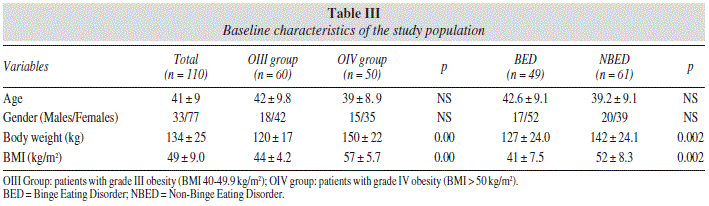
<body><![CDATA[<p><font face="Verdana" size="2">A prospective observational study was conducted in consecutive patients with OM aged between 18 and 59 yrs and enrolled in the BS program of the Obesity Surgery Unit of our hospital from June 2007 through May 2010. 110 patients signed informed consent to participate in this study, which was approved by the Clinical Research Ethics Committee of the Hospital.</font></p>     <p><font face="Verdana" size="2">For data analyses, participants were divided between patients with grade III obesity (BMI 40-49.9 kg/m<sup>2</sup>), the OIII Group (n = 60,) and those with grade IV obesity BMI &gt; 50 kg/m<sup>2</sup>), the OIV Group (n = 50). They were also divided between patients with (n = 49) and without (n = 61) BED (BED and NBED groups, respectively) as diagnosed by a psychologist (AV) according to DSM-IV-TR diagnostic criteria (American Psychiatric Association; 2000).</font></p>     <p><font face="Verdana" size="2"><i>Treatment</i></font></p>     <p><font face="Verdana" size="2">CBT was applied in three stages in consecutive groups of 10 patients each.</font></p>     <p><font face="Verdana" size="2"><i>1<sup>st</sup> stage-Initial psychological assessment</i></font></p>     <p><font face="Verdana" size="2">Tests validated for Spanish-speaking populations were used to examine the psychological profiles of patients before their group assignment for the 2<sup>nd</sup> stage, considering four variables (<a href="#t1">table I</a>).</font></p>     <p>&nbsp;</p>     <p align="center"><a name="t1"><img src="/img/revistas/nh/v28n5/23original18_t1.gif"></a></font></p>     <p>&nbsp;</p>     <p><font face="Verdana" size="2"><i>2<sup>nd</sup> stage-Group therapy</i></font></p>     ]]></body>
<body><![CDATA[<p><font face="Verdana" size="2">Over a three-month period, CBT was applied in 12 two-hour sessions using the method of Fairburn et al.<sup>16</sup> (<a href="#t2">table II</a>). The objective of the treatment was for the patient to recover self-esteem and develop appropriate eating behaviors for weight loss and long-term weight maintenance. It was necessary for patients to lose at least 10% of their initial weight to complete the CBT and be accepted for BS.</font></p>     <p>&nbsp;</p>     <p align="center"><a name="t2"><img src="/img/revistas/nh/v28n5/23original18_t2.gif"></a></font></p>     <p>&nbsp;</p>     <p><font face="Verdana" size="2"><i>3<sup>rd</sup> stage-Individual monitoring and treatment</i></font></p>     <p><font face="Verdana" size="2">After the group therapy stage, patients again underwent psychopathology assessment to detect behaviors needing reinforcement or symptoms requiring individual treatment. Next, patients were followed up in weekly 60-min sessions for 12-months, and their suitability for BS was then evaluated in a final report.</font></p>     <p><font face="Verdana" size="2">Throughout this 12-month period, the calorie intake of the patients was restricted by following a balanced diet of 1,500 kcal in accordance with guidelines provided by a nutritionist (AJ). At the start of the study (baseline), the height of participants (barefoot) was measured to the nearest 0.1 cm using a wall-mounted stadiometer (SECA, Vogel &amp; Halke, Hamburg, Germany).</font></p>     <p><font face="Verdana" size="2">At baseline and at all treatment and follow-up sessions, the weight of participants was measured to the nearest 0.1 kg using a TANITA Ultimate Scale 2000 (Tanita Corporation, Tokyo, Japan). The BMI was calculated as weight (kg) divided by the square of the height (m)..</font></p>     <p><font face="Verdana" size="2"><i>Statistical analysis</i></font></p>     <p><font face="Verdana" size="2">SPSS for Windows version 16.0 was used for data analyses. Continuous variables were expressed as means &plusmn; standard deviation (SD). To assess the effectiveness of the program, the Student s paired t test and chi-square test were used to analyze differences in the characteristics of the groups during the treatment. Univariate analysis of variance (ANOVA) was used for intragroup comparisons, applying the Tukey test for <i>a posteriori</i> analyses.</font></p>     ]]></body>
<body><![CDATA[<p><font face="Verdana" size="2">Multivariate linear regression analyses were used to quantify the relationship between general and specific psychopathology test outcomes and study groups. All analyses were two-tailed, and p &lt; 0.05 was considered significant.</font></p>     <p>&nbsp;</p>     <p><font face="Verdana" size="2"><b>Results</b></font></p>     <p><font face="Verdana" size="2"><i>Demographic and descriptive data</i></font></p>     <p><font face="Verdana" size="2"><a href="#t3">Table III</a> exhibits the baseline characteristics of the 110 volunteers (77 females, 33 males) and study groups, showing a significantly higher body weight and BMI in the OIV <i>versus</i> OIII group and in the non-BED <i>versus</i> BED group. All except for two patients correctly followed the course of treatment, i.e., completed &#8805; 10 of the 12 CBT-sessions.</font></p>     <p>&nbsp;</p>     <p align="center"><a name="t3"><img src="/img/revistas/nh/v28n5/23original18_t3.gif"></a></font></p>     <p>&nbsp;</p>     <p><font face="Verdana" size="2"><i>Changes in eating behavior</i></font></p>     <p><font face="Verdana" size="2">During the month before initiating CBT, at least one episode of objective binge-eating (OBE) was reported by 93% of patients. BED was present in 37 (61%) patients in the OIII group and in 24 (48%) patients in the OIV group. The frequency of binge-eating did not differ between OIII and OIV groups.</font></p>     ]]></body>
<body><![CDATA[<p><font face="Verdana" size="2">After CBT, a reduction in OBE episodes was reported by 35.5% of patients, while a cessation of episodes was reported by 8% of patients.</font></p>     <p><font face="Verdana" size="2"><i>Eating Disorders Examination-Questionnaire (EDE-Q)</i> (<a href="#t4">table IV</a>)</font></p>     <p>&nbsp;</p>     <p align="center"><a name="t4"><img src="/img/revistas/nh/v28n5/23original18_t4.gif"></a></font></p>     <p>&nbsp;</p>     <p><font face="Verdana" size="2">No difference between obesity groups was found in any subscale score either before or after CBT. Pre-CBT, concerns about weight, shape, and food were greater in the BED versus NBED group (p &lt; 0.05); the frequency of OBE was also positively correlated with the frequency of concern for weight (r = 0.44, P = 0.015). Post-CBT, no differences were found between BED and NBED patients in any EDE-Q subscale. <i>Food Craving Questionnaire-Trait (FCQ-T)</i></font></p>     <p><font face="Verdana" size="2">Results showed that the food craving of participants was driven by hunger, fear, and guilt, with no difference between obesity groups either pre- or post-CBT. Post-CBT, both obesity groups evidenced a significant reduction in food craving <i>versus</i> pre-CBT values, and a marked decrease in preoccupation with food was observed in the global sample (<a href="#t5">table V</a>). Pre-CBT, BED patients made more plans about food, were more concerned about food, felt more hunger, fear, and guilt, and were more influenced by contextual cues in comparison to NBED patients (p &lt; 0.005). Post-CBT, the significant intergroup differences in food craving items persisted, but an improvement in all test subscales was observed in the whole sample <i>versus</i> pre-CBT values (p &lt; 0.005) (<a href="#t5">table V</a>).</font></p>     <p>&nbsp;</p>     <p align="center"><a name="t5"><img src="/img/revistas/nh/v28n5/23original18_t5.gif"></a></font></p>     <p>&nbsp;</p>     ]]></body>
<body><![CDATA[<p><font face="Verdana" size="2"><i>General psychopathology</i></font></p>     <p><font face="Verdana" size="2"><a href="#t6">Table VI</a> reports the results obtained for each obesity group pre- and post-CBT, showing the beneficial effect of the treatment on the general psychopathology and quality of life of participants, with significant improvements in anxiety, depression, stress, and self-esteem (p &lt; 0.05); no significant differences were observed between OIII and OIV groups.</font></p>     <p>&nbsp;</p>     <p align="center"><a name="t6"><img src="/img/revistas/nh/v28n5/23original18_t6.gif"></a></font></p>     <p>&nbsp;</p>     <p><font face="Verdana" size="2">At baseline (<a href="#t6">table VI</a>), BED patients were significantly more anxious and depressive and had a lower self-esteem and quality of life <i>versus</i> NBED patients (p &lt; 0.05). Post-CBT, the intragroup differences in anxiety and quality of life persisted but the differences in self-esteem and depression disappeared due significant improvements among BED patients.</font></p>     <p><font face="Verdana" size="2"><i>Weight loss</i></font></p>     <p><font face="Verdana" size="2">The mean weight loss immediately after CBT was 11.6 &plusmn; 5.14 kg and at the 12-month follow-up was 15, 3 &plusmn; 3,05 kg.</font></p>     <p><font face="Verdana" size="2">Post-CBT, the obesity groups did not significantly differ in mean weight loss. At the one-year follow-up period, a weight loss of &gt; 5% of their initial weight was achieved by all participants (both obesity groups), and a loss of &gt; 10% was achieved by 67 patients. There were no significant differences in weight loss between patients with and without BED.</font></p>     <p><font face="Verdana" size="2"><i>Association between weight loss and psychological  comorbidity</i></font></p>     ]]></body>
<body><![CDATA[<p><font face="Verdana" size="2">Weight loss was significally associated with a reduction in anxiety (r<sup>2</sup>=0.3; P=0.036) and improvement in self-esteem (r<sup>2</sup>=0.5; P=0.028) in the OIV group but not in the OIII group.</font></p>     <p><font face="Verdana" size="2"><i>Association between psychopathology results and study groups pre- and post-CBT</i></font></p>     <p><font face="Verdana" size="2">After controlling for age and sex in the multivariate analysis, no significant relationship was found between general (depression, anxiety, self-esteem, stress, quality of life and family function) or specific (food behavior and food craving disorders) psychopathologic variables and the study groups (BED and NBED or OIII and OIV groups).</font></p>     <p>&nbsp;</p>     <p><font face="Verdana" size="2"><b>Discussion</b></font></p>     <p><font face="Verdana" size="2">In this study of candidates for BS, the prevalence of BED, estimated to be 2-5% in the general population,<sup>17,18</sup> was 55%, comparable to previous reports of up to 68%.<sup>19</sup> Obese individuals with BED have been found to have significantly greater concerns about shape and higher psychiatric comorbidity in comparison to those without this disorder.<sup>11,20</sup> In our study population, the presence of BED was associated with greater concerns about shape, food intake and weight, which are also characteristic of patients with bulimia and anorexia. These findings confirm previous reports that preoccupation with image is not limited to these two diseases.<sup>21</sup> Dietary restrictions driven by these concerns may play an important role in the etiology and persistence of compulsive binging episodes. However, all participants in our study, including those without BED, followed a diet of 1,500 kcal, suggesting that binge-eating is not an inevitable consequence of dietary restriction. The onset of a binge-eating habit is considered to follow dietary restriction in patients with bulimia but appears to precede attempts at dietary restriction in obese individuals with BED.<sup>22</sup></font></p>     <p><font face="Verdana" size="2">In the present study, greater depression and anxiety was observed in the participants with BED than in those without, confirming previous reports of higher psychological comorbidity in obese individuals with this disorder.<sup>11,23</sup> It has been reported that the prevalence of BED is lower (20-30%) among patients with lower degrees of obesity (grades I and II),<sup>17,18</sup> and its presence has been associated with increased adiposity.<sup>24</sup> In the present study, however, patients with grade III and IV obesity did not significantly differ in the presence of BED, suggesting that severe degrees of obesity may produce similar levels of psychological comorbidity.</font></p>     <p><font face="Verdana" size="2">The presence of psychological disorders has sometimes been considered a contraindication for BS because it is believed to increase the risk of postsurgical complications.<sup>8,9,24</sup> Some researchers have reported that patients with these disorders experienced difficulties in following dietary instructions given after the surgery, with a negative effect on their weight reduction.<sup>25</sup> In fact, Hsu et al. recommended the prior screening of candidates for BS in order to identify and exclude patients with psychological disorders.<sup>26</sup> However, other authors have found no correlation between the presence of psychopathology and worse BS outcomes and have argued against the exclusion of these patients.<sup>27</sup> It has been proposed that these patients can undergo surgery on condition that they receive appropriate psychotherapeutic treatment both before and after the intervention.<sup>28</sup></font></p>     <p><font face="Verdana" size="2">CBT has been selected as the treatment approach over the past 20 years, with good results.<sup>29</sup> The application of CBT in our patients produced a significant improvement in their specific and general psychopathology and a satisfactory weight reduction, and the response to CBT was no less favorable in patients with BED than in those without, BED was reduced or eliminated as a result of the CBT, in agreement with previous reports that this therapy produces a short-term reduction in BED among obese patients.<sup>30</sup></font></p>     <p><font face="Verdana" size="2">One study limitation is that we included all BS candidates during the study period, precluding the formation of a control group and hindering comparisons with randomized controlled studies.</font></p>     ]]></body>
<body><![CDATA[<p><font face="Verdana" size="2">According to our findings, CBT is effective in patients with OM, regardless of the degree of obesity and the presence of BED. It appears advisable to identify and treat psychological disorders in candidates for BS in order to improve post-operative outcomes, although further research is required on the long-term impact of this approach.</font></p>     <p>&nbsp;</p>     <p><font face="Verdana" size="2"><b>References</b></font></p>     <!-- ref --><p><font face="Verdana" size="2">1. Obesity and Overweight (Fact Sheet N<sup>o</sup>311) Genova, Switerland: World Health Organization; 2006.    &nbsp;&nbsp;&nbsp;&nbsp;&nbsp;&nbsp;&nbsp;&nbsp;[&#160;<a href="javascript:void(0);" onclick="javascript: window.open('/scielo.php?script=sci_nlinks&ref=3760631&pid=S0212-1611201300050002300001&lng=','','width=640,height=500,resizable=yes,scrollbars=1,menubar=yes,');">Links</a>&#160;]<!-- end-ref --></font></p>    <!-- ref --><p><font face="Verdana" size="2">2. Maggard MA, Shugarman LR, Suttorp M, et.al. Meta-Analysis: surgical treatment of obesity. <i>Ann Intern Med</i> 2005; 142: 547-59.    &nbsp;&nbsp;&nbsp;&nbsp;&nbsp;&nbsp;&nbsp;&nbsp;[&#160;<a href="javascript:void(0);" onclick="javascript: window.open('/scielo.php?script=sci_nlinks&ref=3760633&pid=S0212-1611201300050002300002&lng=','','width=640,height=500,resizable=yes,scrollbars=1,menubar=yes,');">Links</a>&#160;]<!-- end-ref --></font></p>    <!-- ref --><p><font face="Verdana" size="2">3. Waseem T, Mogensen KM, Lautz DB. Pathophysiology of obesity: why surgery remains the most effective treatment. <i>Obes Surg</i> 2007; 17: 1389-98. Review.    &nbsp;&nbsp;&nbsp;&nbsp;&nbsp;&nbsp;&nbsp;&nbsp;[&#160;<a href="javascript:void(0);" onclick="javascript: window.open('/scielo.php?script=sci_nlinks&ref=3760635&pid=S0212-1611201300050002300003&lng=','','width=640,height=500,resizable=yes,scrollbars=1,menubar=yes,');">Links</a>&#160;]<!-- end-ref --></font></p>    <!-- ref --><p><font face="Verdana" size="2">4. Brolin RE, Kenler HA. Gorman RC, et al. The dilemma of outcome assessment after operations for morbid obesity. <i>Obes Surg</i> 1989; 105: 337-46.    &nbsp;&nbsp;&nbsp;&nbsp;&nbsp;&nbsp;&nbsp;&nbsp;[&#160;<a href="javascript:void(0);" onclick="javascript: window.open('/scielo.php?script=sci_nlinks&ref=3760637&pid=S0212-1611201300050002300004&lng=','','width=640,height=500,resizable=yes,scrollbars=1,menubar=yes,');">Links</a>&#160;]<!-- end-ref --></font></p>    <!-- ref --><p><font face="Verdana" size="2">5. Hafner RJ, Wtts JM, Rogers J. Quality of life after gastric bypass for morbid obesity. <i>Int J Obes</i> 1991; 15: 555-60.    &nbsp;&nbsp;&nbsp;&nbsp;&nbsp;&nbsp;&nbsp;&nbsp;[&#160;<a href="javascript:void(0);" onclick="javascript: window.open('/scielo.php?script=sci_nlinks&ref=3760639&pid=S0212-1611201300050002300005&lng=','','width=640,height=500,resizable=yes,scrollbars=1,menubar=yes,');">Links</a>&#160;]<!-- end-ref --></font></p>    <!-- ref --><p><font face="Verdana" size="2">6. Glinski J, Wetzler S, Goodman E. The psychology of gastric bypass surgery. <i>Obes Surg</i> 2001; 11: 680-5.    &nbsp;&nbsp;&nbsp;&nbsp;&nbsp;&nbsp;&nbsp;&nbsp;[&#160;<a href="javascript:void(0);" onclick="javascript: window.open('/scielo.php?script=sci_nlinks&ref=3760641&pid=S0212-1611201300050002300006&lng=','','width=640,height=500,resizable=yes,scrollbars=1,menubar=yes,');">Links</a>&#160;]<!-- end-ref --></font></p>    <!-- ref --><p><font face="Verdana" size="2">7. White MA, Grilo CM. Psychiatric comorbidity in binge eating disorder as a functional of smoking history. <i>Journal of Clinical Psychiatry</i> 2006; 67: 594-9.    &nbsp;&nbsp;&nbsp;&nbsp;&nbsp;&nbsp;&nbsp;&nbsp;[&#160;<a href="javascript:void(0);" onclick="javascript: window.open('/scielo.php?script=sci_nlinks&ref=3760643&pid=S0212-1611201300050002300007&lng=','','width=640,height=500,resizable=yes,scrollbars=1,menubar=yes,');">Links</a>&#160;]<!-- end-ref --></font></p>    <!-- ref --><p><font face="Verdana" size="2">8. Busetto L, Segato G, De Luca M, et al. Weight loss and postoperative complications in morbidly obese patients with binge eating disorder treated by laparoscopic adjustable gastric banding. <i>Obes Surg</i> 2005; 15: 195-201.    &nbsp;&nbsp;&nbsp;&nbsp;&nbsp;&nbsp;&nbsp;&nbsp;[&#160;<a href="javascript:void(0);" onclick="javascript: window.open('/scielo.php?script=sci_nlinks&ref=3760645&pid=S0212-1611201300050002300008&lng=','','width=640,height=500,resizable=yes,scrollbars=1,menubar=yes,');">Links</a>&#160;]<!-- end-ref --></font></p>    <!-- ref --><p><font face="Verdana" size="2">9. Colles SL, Dixon JB, O'Brien PE. Grazing and loss of control related to eating: Two high-risk factors following bariatric surgery. <i>Obesity</i> 2008; 16 (3): 615-22.    &nbsp;&nbsp;&nbsp;&nbsp;&nbsp;&nbsp;&nbsp;&nbsp;[&#160;<a href="javascript:void(0);" onclick="javascript: window.open('/scielo.php?script=sci_nlinks&ref=3760647&pid=S0212-1611201300050002300009&lng=','','width=640,height=500,resizable=yes,scrollbars=1,menubar=yes,');">Links</a>&#160;]<!-- end-ref --></font></p>    <!-- ref --><p><font face="Verdana" size="2">10. Malone M, Alger-Mayer S. Binge eating status and quality of life after gastric bypass surgery: a one-year study. <i>Obes Res</i> 2004; 12: 473-81.    &nbsp;&nbsp;&nbsp;&nbsp;&nbsp;&nbsp;&nbsp;&nbsp;[&#160;<a href="javascript:void(0);" onclick="javascript: window.open('/scielo.php?script=sci_nlinks&ref=3760649&pid=S0212-1611201300050002300010&lng=','','width=640,height=500,resizable=yes,scrollbars=1,menubar=yes,');">Links</a>&#160;]<!-- end-ref --></font></p>    <!-- ref --><p><font face="Verdana" size="2">11. Hsu LkG, Benotti PN, Dwyer J, et al. Nonsurgical factors that influence the outcome of bariatric surgery: a review. <i>Psychosom Me</i> 1998; 60: 338-46.    &nbsp;&nbsp;&nbsp;&nbsp;&nbsp;&nbsp;&nbsp;&nbsp;[&#160;<a href="javascript:void(0);" onclick="javascript: window.open('/scielo.php?script=sci_nlinks&ref=3760651&pid=S0212-1611201300050002300011&lng=','','width=640,height=500,resizable=yes,scrollbars=1,menubar=yes,');">Links</a>&#160;]<!-- end-ref --></font></p>    <!-- ref --><p><font face="Verdana" size="2">12. National Institute for Clinical Excellence (2004). Eating disorders-Core interventions in the treatment and management of anorexia nervosa, bulimia nervosa and related eating disorders (Clinical Guideline N<sup>o</sup> 9). London: Author. (Available at <a target="_blank" href="http://www.Nice.org.uk/guidance/CG9">www.Nice.org.uk/guidance/CG9</a>).    &nbsp;&nbsp;&nbsp;&nbsp;&nbsp;&nbsp;&nbsp;&nbsp;[&#160;<a href="javascript:void(0);" onclick="javascript: window.open('/scielo.php?script=sci_nlinks&ref=3760653&pid=S0212-1611201300050002300012&lng=','','width=640,height=500,resizable=yes,scrollbars=1,menubar=yes,');">Links</a>&#160;]<!-- end-ref --></font></p>    <!-- ref --><p><font face="Verdana" size="2">13. Garaulet M, Pérez de Heredia F. Behavioural therapy in the treatment of obesity (I): New directions for clinical practice. <i>Nutr Hosp</i> 2009; 24: 629-39.    &nbsp;&nbsp;&nbsp;&nbsp;&nbsp;&nbsp;&nbsp;&nbsp;[&#160;<a href="javascript:void(0);" onclick="javascript: window.open('/scielo.php?script=sci_nlinks&ref=3760655&pid=S0212-1611201300050002300013&lng=','','width=640,height=500,resizable=yes,scrollbars=1,menubar=yes,');">Links</a>&#160;]<!-- end-ref --></font></p>    <!-- ref --><p><font face="Verdana" size="2">14. Abilés V, Rodriguez-Ruiz S, Abilés J, Mellado C, García A, Pérez de la Cruz A. Psychological Characteristics of Morbidly Obese Candidates for Bariatric Surgery. <i>Obes Surg</i> 2010; 20: 161-7.    &nbsp;&nbsp;&nbsp;&nbsp;&nbsp;&nbsp;&nbsp;&nbsp;[&#160;<a href="javascript:void(0);" onclick="javascript: window.open('/scielo.php?script=sci_nlinks&ref=3760657&pid=S0212-1611201300050002300014&lng=','','width=640,height=500,resizable=yes,scrollbars=1,menubar=yes,');">Links</a>&#160;]<!-- end-ref --></font></p>    <!-- ref --><p><font face="Verdana" size="2">15. Striegel-Moore RH, Dohm FA, Solomon EE, Faibrun CG, Pike KM and Wilfley fDE. Subthreshold binge eating disorder. <i>Int J Eat Disord</i> 2000; 27: 270-8.    &nbsp;&nbsp;&nbsp;&nbsp;&nbsp;&nbsp;&nbsp;&nbsp;[&#160;<a href="javascript:void(0);" onclick="javascript: window.open('/scielo.php?script=sci_nlinks&ref=3760659&pid=S0212-1611201300050002300015&lng=','','width=640,height=500,resizable=yes,scrollbars=1,menubar=yes,');">Links</a>&#160;]<!-- end-ref --></font></p>    <!-- ref --><p><font face="Verdana" size="2">16. Cooper Z, Faiburn CG, Haweker DM. Cognitive-Behavioral treatment of obesity. A clinician's guide. New York: Guilford Press, 2003.    &nbsp;&nbsp;&nbsp;&nbsp;&nbsp;&nbsp;&nbsp;&nbsp;[&#160;<a href="javascript:void(0);" onclick="javascript: window.open('/scielo.php?script=sci_nlinks&ref=3760661&pid=S0212-1611201300050002300016&lng=','','width=640,height=500,resizable=yes,scrollbars=1,menubar=yes,');">Links</a>&#160;]<!-- end-ref --></font></p>    <!-- ref --><p><font face="Verdana" size="2">17. Hudson JI, Hirip E, Pope HG, Kessler RC. The prevalence and correlates of eating disorders in the National Comorbidity survey replication. <i>Biol Psychiatry</i> 2007; 61: 348-58.    &nbsp;&nbsp;&nbsp;&nbsp;&nbsp;&nbsp;&nbsp;&nbsp;[&#160;<a href="javascript:void(0);" onclick="javascript: window.open('/scielo.php?script=sci_nlinks&ref=3760663&pid=S0212-1611201300050002300017&lng=','','width=640,height=500,resizable=yes,scrollbars=1,menubar=yes,');">Links</a>&#160;]<!-- end-ref --></font></p>    <!-- ref --><p><font face="Verdana" size="2">18. Striegel-Moore RH, Franko DL. Epidemiology of binge eating disorder. <i>Int J Eat Disord</i> 2003; 34: 519-29.    &nbsp;&nbsp;&nbsp;&nbsp;&nbsp;&nbsp;&nbsp;&nbsp;[&#160;<a href="javascript:void(0);" onclick="javascript: window.open('/scielo.php?script=sci_nlinks&ref=3760665&pid=S0212-1611201300050002300018&lng=','','width=640,height=500,resizable=yes,scrollbars=1,menubar=yes,');">Links</a>&#160;]<!-- end-ref --></font></p>    <!-- ref --><p><font face="Verdana" size="2">19. Adami GF, Gandolfo P, Baver B, et al. Binge eating in massively obese patients undergoing bariatric surgery. <i>Int J Eat Disord</i> 1995; 17: 45-50.    &nbsp;&nbsp;&nbsp;&nbsp;&nbsp;&nbsp;&nbsp;&nbsp;[&#160;<a href="javascript:void(0);" onclick="javascript: window.open('/scielo.php?script=sci_nlinks&ref=3760667&pid=S0212-1611201300050002300019&lng=','','width=640,height=500,resizable=yes,scrollbars=1,menubar=yes,');">Links</a>&#160;]<!-- end-ref --></font></p>    <!-- ref --><p><font face="Verdana" size="2">20. Wilfley DE, Wilson GT, Agras WS. The clinical significance of binge eating disorder. <i>Int J Eat Disord</i> 2003; 34: S96-106.    &nbsp;&nbsp;&nbsp;&nbsp;&nbsp;&nbsp;&nbsp;&nbsp;[&#160;<a href="javascript:void(0);" onclick="javascript: window.open('/scielo.php?script=sci_nlinks&ref=3760669&pid=S0212-1611201300050002300020&lng=','','width=640,height=500,resizable=yes,scrollbars=1,menubar=yes,');">Links</a>&#160;]<!-- end-ref --></font></p>    <!-- ref --><p><font face="Verdana" size="2">21. Crow SJ, Agras WS, Halmi K, Mitchell JE, Kraemer HC. Full syndromal versus subthreshold anorexia nervosa, bulimia nervosa and binge eating disorder: a multicenter study. <i>Int J Eat Disord</i> 2002; 32: 309-18.    &nbsp;&nbsp;&nbsp;&nbsp;&nbsp;&nbsp;&nbsp;&nbsp;[&#160;<a href="javascript:void(0);" onclick="javascript: window.open('/scielo.php?script=sci_nlinks&ref=3760671&pid=S0212-1611201300050002300021&lng=','','width=640,height=500,resizable=yes,scrollbars=1,menubar=yes,');">Links</a>&#160;]<!-- end-ref --></font></p>    <!-- ref --><p><font face="Verdana" size="2">22. Malkoff SB, Marcus MD, Grant A, Moulton MM, Vayonis C. The relationship between dieting and binge eating among obese individuals. <i>Annals of Behavioral Medicine</i> 1993; 14: S40.    &nbsp;&nbsp;&nbsp;&nbsp;&nbsp;&nbsp;&nbsp;&nbsp;[&#160;<a href="javascript:void(0);" onclick="javascript: window.open('/scielo.php?script=sci_nlinks&ref=3760673&pid=S0212-1611201300050002300022&lng=','','width=640,height=500,resizable=yes,scrollbars=1,menubar=yes,');">Links</a>&#160;]<!-- end-ref --></font></p>    <!-- ref --><p><font face="Verdana" size="2">23. Smith DE, Marcus MD, Lewis CE, Fitzgibbon M, Schreiner P. Prevalence of binge Ealing disorder, obesity, and depression in a biracial cohort of young adults. <i>Ann Behav Med</i> 1998; 20: 227-32.    &nbsp;&nbsp;&nbsp;&nbsp;&nbsp;&nbsp;&nbsp;&nbsp;[&#160;<a href="javascript:void(0);" onclick="javascript: window.open('/scielo.php?script=sci_nlinks&ref=3760675&pid=S0212-1611201300050002300023&lng=','','width=640,height=500,resizable=yes,scrollbars=1,menubar=yes,');">Links</a>&#160;]<!-- end-ref --></font></p>    <!-- ref --><p><font face="Verdana" size="2">24. Burgmer R, Grigutsch K, Zipfel S, Wolf AM, Zwaan M, Huseman B, Albus C, Senf W, Herpertz S. The influence of eating behaviour and eating pathology on weight loss after gastric restriction operations. <i>Obes Surg</i> 2005; 15: 684-91.    &nbsp;&nbsp;&nbsp;&nbsp;&nbsp;&nbsp;&nbsp;&nbsp;[&#160;<a href="javascript:void(0);" onclick="javascript: window.open('/scielo.php?script=sci_nlinks&ref=3760677&pid=S0212-1611201300050002300024&lng=','','width=640,height=500,resizable=yes,scrollbars=1,menubar=yes,');">Links</a>&#160;]<!-- end-ref --></font></p>    <!-- ref --><p><font face="Verdana" size="2">25. Green AE, Dymek-Valentine M, Pytluk S, le Grange D, Alverdy J. Psychological outcome of gastric bypass surgery for patients with and without binge eating. <i>Obes Surg</i> 2004; 14: 975-85.    &nbsp;&nbsp;&nbsp;&nbsp;&nbsp;&nbsp;&nbsp;&nbsp;[&#160;<a href="javascript:void(0);" onclick="javascript: window.open('/scielo.php?script=sci_nlinks&ref=3760679&pid=S0212-1611201300050002300025&lng=','','width=640,height=500,resizable=yes,scrollbars=1,menubar=yes,');">Links</a>&#160;]<!-- end-ref --></font></p>    <!-- ref --><p><font face="Verdana" size="2">26. Hsu LKG, Benotti PN, Dwyer J, et al. Nonsurgical factors that influence the outcome surgery: a review. <i>Psychosom Med</i> 1998; 60: 338-46.    &nbsp;&nbsp;&nbsp;&nbsp;&nbsp;&nbsp;&nbsp;&nbsp;[&#160;<a href="javascript:void(0);" onclick="javascript: window.open('/scielo.php?script=sci_nlinks&ref=3760681&pid=S0212-1611201300050002300026&lng=','','width=640,height=500,resizable=yes,scrollbars=1,menubar=yes,');">Links</a>&#160;]<!-- end-ref --></font></p>    <!-- ref --><p><font face="Verdana" size="2">27. White MA, Masheb RM, Rothschild BS, et al. The prognostic significance of regular binge eating in extremely obese gastric bypass patients. 2006; 67: 1935-82.    &nbsp;&nbsp;&nbsp;&nbsp;&nbsp;&nbsp;&nbsp;&nbsp;[&#160;<a href="javascript:void(0);" onclick="javascript: window.open('/scielo.php?script=sci_nlinks&ref=3760683&pid=S0212-1611201300050002300027&lng=','','width=640,height=500,resizable=yes,scrollbars=1,menubar=yes,');">Links</a>&#160;]<!-- end-ref --></font></p>    <!-- ref --><p><font face="Verdana" size="2">28. Segal A, Libanori HT, Azevedo A. Bariatric surgery in a patient with possible psychiatric contraindications. <i>Obes Surg</i> 2002; 12: 598-601.    &nbsp;&nbsp;&nbsp;&nbsp;&nbsp;&nbsp;&nbsp;&nbsp;[&#160;<a href="javascript:void(0);" onclick="javascript: window.open('/scielo.php?script=sci_nlinks&ref=3760685&pid=S0212-1611201300050002300028&lng=','','width=640,height=500,resizable=yes,scrollbars=1,menubar=yes,');">Links</a>&#160;]<!-- end-ref --></font></p>    <!-- ref --><p><font face="Verdana" size="2">29. Shaw K, O Pouke P, Del Mar C, Kenedy J. Psichological interventions for overweight or obesity. <i>Cochrane Database Systematic Review</i> 2006: CD003818.    &nbsp;&nbsp;&nbsp;&nbsp;&nbsp;&nbsp;&nbsp;&nbsp;[&#160;<a href="javascript:void(0);" onclick="javascript: window.open('/scielo.php?script=sci_nlinks&ref=3760687&pid=S0212-1611201300050002300029&lng=','','width=640,height=500,resizable=yes,scrollbars=1,menubar=yes,');">Links</a>&#160;]<!-- end-ref --></font></p>    <!-- ref --><p><font face="Verdana" size="2">30. National Task Force on the Prevention and Treatment of Obesity. Dieting and the development of disorders in overweight and obese adults. <i>Arch Intern Med</i> 2000; 160: 2581-9.    &nbsp;&nbsp;&nbsp;&nbsp;&nbsp;&nbsp;&nbsp;&nbsp;[&#160;<a href="javascript:void(0);" onclick="javascript: window.open('/scielo.php?script=sci_nlinks&ref=3760689&pid=S0212-1611201300050002300030&lng=','','width=640,height=500,resizable=yes,scrollbars=1,menubar=yes,');">Links</a>&#160;]<!-- end-ref --></font></p>     <p>&nbsp;</p>     <p>&nbsp;</p>     <p><font face="Verdana" size="2"><a href="#top"><img border="0" src="/img/revistas/nh/v28n5/seta.gif" width="15" height="17"></a><a name="bajo"></a><b>Correspondence:</b>    <br>Verónica Abilés.    <br>Department of Surgery.    <br>Costa del Sol Hospital.    <br>Autovía A-7, km. 187.    ]]></body>
<body><![CDATA[<br>29603 Marbella. Málaga. Spain.    <br>E-mail: <a href="mailto:veroabiles@hotmail.com">veroabiles@hotmail.com</a></font></p>     <p><font face="Verdana" size="2">Recibido: 14-V-2013.    <br>Aceptado: 26-VI-2013.</font></p>      ]]></body><back>
<ref-list>
<ref id="B1">
<label>1</label><nlm-citation citation-type="book">
<source><![CDATA[Obesity and Overweight]]></source>
<year>2006</year>
<volume>311</volume>
<publisher-loc><![CDATA[Genova ]]></publisher-loc>
<publisher-name><![CDATA[World Health Organization]]></publisher-name>
</nlm-citation>
</ref>
<ref id="B2">
<label>2</label><nlm-citation citation-type="journal">
<person-group person-group-type="author">
<name>
<surname><![CDATA[Maggard]]></surname>
<given-names><![CDATA[MA]]></given-names>
</name>
<name>
<surname><![CDATA[Shugarman]]></surname>
<given-names><![CDATA[LR]]></given-names>
</name>
<name>
<surname><![CDATA[Suttorp]]></surname>
<given-names><![CDATA[M]]></given-names>
</name>
</person-group>
<article-title xml:lang="en"><![CDATA[Meta-Analysis: surgical treatment of obesity]]></article-title>
<source><![CDATA[Ann Intern Med]]></source>
<year>2005</year>
<volume>142</volume>
<page-range>547-59</page-range></nlm-citation>
</ref>
<ref id="B3">
<label>3</label><nlm-citation citation-type="journal">
<person-group person-group-type="author">
<name>
<surname><![CDATA[Waseem]]></surname>
<given-names><![CDATA[T]]></given-names>
</name>
<name>
<surname><![CDATA[Mogensen]]></surname>
<given-names><![CDATA[KM]]></given-names>
</name>
<name>
<surname><![CDATA[Lautz]]></surname>
<given-names><![CDATA[DB]]></given-names>
</name>
</person-group>
<article-title xml:lang="en"><![CDATA[Pathophysiology of obesity: why surgery remains the most effective treatment]]></article-title>
<source><![CDATA[Obes Surg]]></source>
<year>2007</year>
<volume>17</volume>
<page-range>1389-98</page-range></nlm-citation>
</ref>
<ref id="B4">
<label>4</label><nlm-citation citation-type="journal">
<person-group person-group-type="author">
<name>
<surname><![CDATA[Brolin]]></surname>
<given-names><![CDATA[RE]]></given-names>
</name>
<name>
<surname><![CDATA[Kenler]]></surname>
<given-names><![CDATA[HA.]]></given-names>
</name>
<name>
<surname><![CDATA[Gorman]]></surname>
<given-names><![CDATA[RC]]></given-names>
</name>
</person-group>
<article-title xml:lang="en"><![CDATA[The dilemma of outcome assessment after operations for morbid obesity]]></article-title>
<source><![CDATA[Obes Surg]]></source>
<year>1989</year>
<volume>105</volume>
<page-range>337-46</page-range></nlm-citation>
</ref>
<ref id="B5">
<label>5</label><nlm-citation citation-type="journal">
<person-group person-group-type="author">
<name>
<surname><![CDATA[Hafner]]></surname>
<given-names><![CDATA[RJ]]></given-names>
</name>
<name>
<surname><![CDATA[Wtts]]></surname>
<given-names><![CDATA[JM]]></given-names>
</name>
<name>
<surname><![CDATA[Rogers]]></surname>
<given-names><![CDATA[J]]></given-names>
</name>
</person-group>
<article-title xml:lang="en"><![CDATA[Quality of life after gastric bypass for morbid obesity]]></article-title>
<source><![CDATA[Int J Obes]]></source>
<year>1991</year>
<volume>15</volume>
<page-range>555-60</page-range></nlm-citation>
</ref>
<ref id="B6">
<label>6</label><nlm-citation citation-type="journal">
<person-group person-group-type="author">
<name>
<surname><![CDATA[Glinski]]></surname>
<given-names><![CDATA[J]]></given-names>
</name>
<name>
<surname><![CDATA[Wetzler]]></surname>
<given-names><![CDATA[S]]></given-names>
</name>
<name>
<surname><![CDATA[Goodman]]></surname>
<given-names><![CDATA[E]]></given-names>
</name>
</person-group>
<article-title xml:lang="en"><![CDATA[The psychology of gastric bypass surgery]]></article-title>
<source><![CDATA[Obes Surg]]></source>
<year>2001</year>
<volume>11</volume>
<page-range>680-5</page-range></nlm-citation>
</ref>
<ref id="B7">
<label>7</label><nlm-citation citation-type="journal">
<person-group person-group-type="author">
<name>
<surname><![CDATA[White]]></surname>
<given-names><![CDATA[MA]]></given-names>
</name>
<name>
<surname><![CDATA[Grilo]]></surname>
<given-names><![CDATA[CM]]></given-names>
</name>
</person-group>
<article-title xml:lang="en"><![CDATA[Psychiatric comorbidity in binge eating disorder as a functional of smoking history]]></article-title>
<source><![CDATA[Journal of Clinical Psychiatry]]></source>
<year>2006</year>
<volume>67</volume>
<page-range>594-9</page-range></nlm-citation>
</ref>
<ref id="B8">
<label>8</label><nlm-citation citation-type="journal">
<person-group person-group-type="author">
<name>
<surname><![CDATA[Busetto]]></surname>
<given-names><![CDATA[L]]></given-names>
</name>
<name>
<surname><![CDATA[Segato]]></surname>
<given-names><![CDATA[G]]></given-names>
</name>
<name>
<surname><![CDATA[De Luca]]></surname>
<given-names><![CDATA[M]]></given-names>
</name>
</person-group>
<article-title xml:lang="en"><![CDATA[Weight loss and postoperative complications in morbidly obese patients with binge eating disorder treated by laparoscopic adjustable gastric banding]]></article-title>
<source><![CDATA[Obes Surg]]></source>
<year>2005</year>
<volume>15</volume>
<page-range>195-201</page-range></nlm-citation>
</ref>
<ref id="B9">
<label>9</label><nlm-citation citation-type="journal">
<person-group person-group-type="author">
<name>
<surname><![CDATA[Colles]]></surname>
<given-names><![CDATA[SL]]></given-names>
</name>
<name>
<surname><![CDATA[Dixon]]></surname>
<given-names><![CDATA[JB]]></given-names>
</name>
<name>
<surname><![CDATA[O'Brien]]></surname>
<given-names><![CDATA[PE]]></given-names>
</name>
</person-group>
<article-title xml:lang="en"><![CDATA[Grazing and loss of control related to eating: Two high-risk factors following bariatric surgery]]></article-title>
<source><![CDATA[Obesity]]></source>
<year>2008</year>
<volume>16</volume>
<numero>3</numero>
<issue>3</issue>
<page-range>615-22</page-range></nlm-citation>
</ref>
<ref id="B10">
<label>10</label><nlm-citation citation-type="journal">
<person-group person-group-type="author">
<name>
<surname><![CDATA[Malone]]></surname>
<given-names><![CDATA[M]]></given-names>
</name>
<name>
<surname><![CDATA[Alger-Mayer]]></surname>
<given-names><![CDATA[S]]></given-names>
</name>
</person-group>
<article-title xml:lang="en"><![CDATA[Binge eating status and quality of life after gastric bypass surgery: a one-year study]]></article-title>
<source><![CDATA[Obes Res]]></source>
<year>2004</year>
<volume>12</volume>
<page-range>473-81</page-range></nlm-citation>
</ref>
<ref id="B11">
<label>11</label><nlm-citation citation-type="journal">
<person-group person-group-type="author">
<name>
<surname><![CDATA[Hsu]]></surname>
<given-names><![CDATA[LkG]]></given-names>
</name>
<name>
<surname><![CDATA[Benotti]]></surname>
<given-names><![CDATA[PN]]></given-names>
</name>
<name>
<surname><![CDATA[Dwyer]]></surname>
<given-names><![CDATA[J]]></given-names>
</name>
</person-group>
<article-title xml:lang="en"><![CDATA[Nonsurgical factors that influence the outcome of bariatric surgery: a review]]></article-title>
<source><![CDATA[Psychosom Me]]></source>
<year>1998</year>
<volume>60</volume>
<page-range>338-46</page-range></nlm-citation>
</ref>
<ref id="B12">
<label>12</label><nlm-citation citation-type="">
<collab>National Institute for Clinical Excellence</collab>
<source><![CDATA[Eating disorders-Core interventions in the treatment and management of anorexia nervosa, bulimia nervosa and related eating disorders]]></source>
<year>2004</year>
<volume>9</volume>
<publisher-loc><![CDATA[London ]]></publisher-loc>
</nlm-citation>
</ref>
<ref id="B13">
<label>13</label><nlm-citation citation-type="journal">
<person-group person-group-type="author">
<name>
<surname><![CDATA[Garaulet]]></surname>
<given-names><![CDATA[M]]></given-names>
</name>
<name>
<surname><![CDATA[Pérez de Heredia]]></surname>
<given-names><![CDATA[F]]></given-names>
</name>
</person-group>
<article-title xml:lang="en"><![CDATA[Behavioural therapy in the treatment of obesity (I): New directions for clinical practice]]></article-title>
<source><![CDATA[Nutr Hosp]]></source>
<year>2009</year>
<volume>24</volume>
<page-range>629-39</page-range></nlm-citation>
</ref>
<ref id="B14">
<label>14</label><nlm-citation citation-type="journal">
<person-group person-group-type="author">
<name>
<surname><![CDATA[Abilés]]></surname>
<given-names><![CDATA[V]]></given-names>
</name>
<name>
<surname><![CDATA[Rodriguez-Ruiz]]></surname>
<given-names><![CDATA[S]]></given-names>
</name>
<name>
<surname><![CDATA[Abilés]]></surname>
<given-names><![CDATA[J]]></given-names>
</name>
<name>
<surname><![CDATA[Mellado]]></surname>
<given-names><![CDATA[C]]></given-names>
</name>
<name>
<surname><![CDATA[García]]></surname>
<given-names><![CDATA[A]]></given-names>
</name>
<name>
<surname><![CDATA[Pérez de la Cruz]]></surname>
<given-names><![CDATA[A]]></given-names>
</name>
</person-group>
<article-title xml:lang="en"><![CDATA[Psychological Characteristics of Morbidly Obese Candidates for Bariatric Surgery]]></article-title>
<source><![CDATA[Obes Surg]]></source>
<year>2010</year>
<volume>20</volume>
<page-range>161-7</page-range></nlm-citation>
</ref>
<ref id="B15">
<label>15</label><nlm-citation citation-type="journal">
<person-group person-group-type="author">
<name>
<surname><![CDATA[Striegel-Moore]]></surname>
<given-names><![CDATA[RH]]></given-names>
</name>
<name>
<surname><![CDATA[Dohm]]></surname>
<given-names><![CDATA[FA]]></given-names>
</name>
<name>
<surname><![CDATA[Solomon]]></surname>
<given-names><![CDATA[EE]]></given-names>
</name>
<name>
<surname><![CDATA[Faibrun]]></surname>
<given-names><![CDATA[CG]]></given-names>
</name>
<name>
<surname><![CDATA[Pike]]></surname>
<given-names><![CDATA[KM]]></given-names>
</name>
<name>
<surname><![CDATA[Wilfley]]></surname>
<given-names><![CDATA[fDE]]></given-names>
</name>
</person-group>
<article-title xml:lang="en"><![CDATA[Subthreshold binge eating disorder]]></article-title>
<source><![CDATA[Int J Eat Disord]]></source>
<year>2000</year>
<volume>27</volume>
<page-range>270-8</page-range></nlm-citation>
</ref>
<ref id="B16">
<label>16</label><nlm-citation citation-type="book">
<person-group person-group-type="author">
<name>
<surname><![CDATA[Cooper]]></surname>
<given-names><![CDATA[Z]]></given-names>
</name>
<name>
<surname><![CDATA[Faiburn]]></surname>
<given-names><![CDATA[CG]]></given-names>
</name>
<name>
<surname><![CDATA[Haweker]]></surname>
<given-names><![CDATA[DM]]></given-names>
</name>
</person-group>
<source><![CDATA[Cognitive-Behavioral treatment of obesity: A clinician's guide]]></source>
<year>2003</year>
<publisher-loc><![CDATA[New York ]]></publisher-loc>
<publisher-name><![CDATA[Guilford Press]]></publisher-name>
</nlm-citation>
</ref>
<ref id="B17">
<label>17</label><nlm-citation citation-type="journal">
<person-group person-group-type="author">
<name>
<surname><![CDATA[Hudson]]></surname>
<given-names><![CDATA[JI]]></given-names>
</name>
<name>
<surname><![CDATA[Hirip]]></surname>
<given-names><![CDATA[E]]></given-names>
</name>
<name>
<surname><![CDATA[Pope]]></surname>
<given-names><![CDATA[HG]]></given-names>
</name>
<name>
<surname><![CDATA[Kessler]]></surname>
<given-names><![CDATA[RC]]></given-names>
</name>
</person-group>
<article-title xml:lang="en"><![CDATA[The prevalence and correlates of eating disorders in the National Comorbidity survey replication]]></article-title>
<source><![CDATA[Biol Psychiatry]]></source>
<year>2007</year>
<volume>61</volume>
<page-range>348-58</page-range></nlm-citation>
</ref>
<ref id="B18">
<label>18</label><nlm-citation citation-type="journal">
<person-group person-group-type="author">
<name>
<surname><![CDATA[Striegel-Moore]]></surname>
<given-names><![CDATA[RH]]></given-names>
</name>
<name>
<surname><![CDATA[Franko]]></surname>
<given-names><![CDATA[DL]]></given-names>
</name>
</person-group>
<article-title xml:lang="en"><![CDATA[Epidemiology of binge eating disorder]]></article-title>
<source><![CDATA[Int J Eat Disord]]></source>
<year>2003</year>
<volume>34</volume>
<page-range>519-29</page-range></nlm-citation>
</ref>
<ref id="B19">
<label>19</label><nlm-citation citation-type="journal">
<person-group person-group-type="author">
<name>
<surname><![CDATA[Adami]]></surname>
<given-names><![CDATA[GF]]></given-names>
</name>
<name>
<surname><![CDATA[Gandolfo]]></surname>
<given-names><![CDATA[P]]></given-names>
</name>
<name>
<surname><![CDATA[Baver]]></surname>
<given-names><![CDATA[B]]></given-names>
</name>
</person-group>
<article-title xml:lang="en"><![CDATA[Binge eating in massively obese patients undergoing bariatric surgery]]></article-title>
<source><![CDATA[Int J Eat Disord]]></source>
<year>1995</year>
<volume>17</volume>
<page-range>45-50</page-range></nlm-citation>
</ref>
<ref id="B20">
<label>20</label><nlm-citation citation-type="journal">
<person-group person-group-type="author">
<name>
<surname><![CDATA[Wilfley]]></surname>
<given-names><![CDATA[DE]]></given-names>
</name>
<name>
<surname><![CDATA[Wilson]]></surname>
<given-names><![CDATA[GT]]></given-names>
</name>
<name>
<surname><![CDATA[Agras]]></surname>
<given-names><![CDATA[WS]]></given-names>
</name>
</person-group>
<article-title xml:lang="en"><![CDATA[The clinical significance of binge eating disorder]]></article-title>
<source><![CDATA[Int J Eat Disord]]></source>
<year>2003</year>
<volume>34</volume>
<page-range>S96-106</page-range></nlm-citation>
</ref>
<ref id="B21">
<label>21</label><nlm-citation citation-type="journal">
<person-group person-group-type="author">
<name>
<surname><![CDATA[Crow]]></surname>
<given-names><![CDATA[SJ]]></given-names>
</name>
<name>
<surname><![CDATA[Agras]]></surname>
<given-names><![CDATA[WS]]></given-names>
</name>
<name>
<surname><![CDATA[Halmi]]></surname>
<given-names><![CDATA[K]]></given-names>
</name>
<name>
<surname><![CDATA[Mitchell]]></surname>
<given-names><![CDATA[JE]]></given-names>
</name>
<name>
<surname><![CDATA[Kraemer]]></surname>
<given-names><![CDATA[HC]]></given-names>
</name>
</person-group>
<article-title xml:lang="en"><![CDATA[Full syndromal versus subthreshold anorexia nervosa, bulimia nervosa and binge eating disorder: a multicenter study]]></article-title>
<source><![CDATA[Int J Eat Disord]]></source>
<year>2002</year>
<volume>32</volume>
<page-range>309-18</page-range></nlm-citation>
</ref>
<ref id="B22">
<label>22</label><nlm-citation citation-type="journal">
<person-group person-group-type="author">
<name>
<surname><![CDATA[Malkoff]]></surname>
<given-names><![CDATA[SB]]></given-names>
</name>
<name>
<surname><![CDATA[Marcus]]></surname>
<given-names><![CDATA[MD]]></given-names>
</name>
<name>
<surname><![CDATA[Grant]]></surname>
<given-names><![CDATA[A]]></given-names>
</name>
<name>
<surname><![CDATA[Moulton]]></surname>
<given-names><![CDATA[MM]]></given-names>
</name>
<name>
<surname><![CDATA[Vayonis]]></surname>
<given-names><![CDATA[C]]></given-names>
</name>
</person-group>
<article-title xml:lang="en"><![CDATA[The relationship between dieting and binge eating among obese individuals]]></article-title>
<source><![CDATA[Annals of Behavioral Medicine]]></source>
<year>1993</year>
<volume>14</volume>
</nlm-citation>
</ref>
<ref id="B23">
<label>23</label><nlm-citation citation-type="journal">
<person-group person-group-type="author">
<name>
<surname><![CDATA[Smith]]></surname>
<given-names><![CDATA[DE]]></given-names>
</name>
<name>
<surname><![CDATA[Marcus]]></surname>
<given-names><![CDATA[MD]]></given-names>
</name>
<name>
<surname><![CDATA[Lewis]]></surname>
<given-names><![CDATA[CE]]></given-names>
</name>
<name>
<surname><![CDATA[Fitzgibbon]]></surname>
<given-names><![CDATA[M]]></given-names>
</name>
<name>
<surname><![CDATA[Schreiner]]></surname>
<given-names><![CDATA[P]]></given-names>
</name>
</person-group>
<article-title xml:lang="en"><![CDATA[Prevalence of binge Ealing disorder, obesity, and depression in a biracial cohort of young adults]]></article-title>
<source><![CDATA[Ann Behav Med]]></source>
<year>1998</year>
<volume>20</volume>
<page-range>227-32</page-range></nlm-citation>
</ref>
<ref id="B24">
<label>24</label><nlm-citation citation-type="journal">
<person-group person-group-type="author">
<name>
<surname><![CDATA[Burgmer]]></surname>
<given-names><![CDATA[R]]></given-names>
</name>
<name>
<surname><![CDATA[Grigutsch]]></surname>
<given-names><![CDATA[K]]></given-names>
</name>
<name>
<surname><![CDATA[Zipfel]]></surname>
<given-names><![CDATA[S]]></given-names>
</name>
<name>
<surname><![CDATA[Wolf]]></surname>
<given-names><![CDATA[AM]]></given-names>
</name>
<name>
<surname><![CDATA[Zwaan]]></surname>
<given-names><![CDATA[M]]></given-names>
</name>
<name>
<surname><![CDATA[Huseman]]></surname>
<given-names><![CDATA[B]]></given-names>
</name>
<name>
<surname><![CDATA[Albus]]></surname>
<given-names><![CDATA[C]]></given-names>
</name>
<name>
<surname><![CDATA[Senf]]></surname>
<given-names><![CDATA[W]]></given-names>
</name>
<name>
<surname><![CDATA[Herpertz]]></surname>
<given-names><![CDATA[S]]></given-names>
</name>
</person-group>
<article-title xml:lang="en"><![CDATA[The influence of eating behaviour and eating pathology on weight loss after gastric restriction operations]]></article-title>
<source><![CDATA[Obes Surg]]></source>
<year>2005</year>
<volume>15</volume>
<page-range>684-91</page-range></nlm-citation>
</ref>
<ref id="B25">
<label>25</label><nlm-citation citation-type="journal">
<person-group person-group-type="author">
<name>
<surname><![CDATA[Green]]></surname>
<given-names><![CDATA[AE]]></given-names>
</name>
<name>
<surname><![CDATA[Dymek-Valentine]]></surname>
<given-names><![CDATA[M]]></given-names>
</name>
<name>
<surname><![CDATA[Pytluk]]></surname>
<given-names><![CDATA[S]]></given-names>
</name>
<name>
<surname><![CDATA[le Grange]]></surname>
<given-names><![CDATA[D]]></given-names>
</name>
<name>
<surname><![CDATA[Alverdy]]></surname>
<given-names><![CDATA[J]]></given-names>
</name>
</person-group>
<article-title xml:lang="en"><![CDATA[Psychological outcome of gastric bypass surgery for patients with and without binge eating]]></article-title>
<source><![CDATA[Obes Surg]]></source>
<year>2004</year>
<volume>14</volume>
<page-range>975-85</page-range></nlm-citation>
</ref>
<ref id="B26">
<label>26</label><nlm-citation citation-type="journal">
<person-group person-group-type="author">
<name>
<surname><![CDATA[Hsu]]></surname>
<given-names><![CDATA[LKG]]></given-names>
</name>
<name>
<surname><![CDATA[Benotti]]></surname>
<given-names><![CDATA[PN]]></given-names>
</name>
<name>
<surname><![CDATA[Dwyer]]></surname>
<given-names><![CDATA[J]]></given-names>
</name>
</person-group>
<article-title xml:lang="en"><![CDATA[Nonsurgical factors that influence the outcome surgery: a review]]></article-title>
<source><![CDATA[Psychosom Med]]></source>
<year>1998</year>
<volume>60</volume>
<page-range>338-46</page-range></nlm-citation>
</ref>
<ref id="B27">
<label>27</label><nlm-citation citation-type="">
<person-group person-group-type="author">
<name>
<surname><![CDATA[White]]></surname>
<given-names><![CDATA[MA]]></given-names>
</name>
<name>
<surname><![CDATA[Masheb]]></surname>
<given-names><![CDATA[RM]]></given-names>
</name>
<name>
<surname><![CDATA[Rothschild]]></surname>
<given-names><![CDATA[BS]]></given-names>
</name>
</person-group>
<article-title xml:lang="en"><![CDATA[The prognostic significance of regular binge eating in extremely obese gastric bypass patients]]></article-title>
<source><![CDATA[]]></source>
<year>2006</year>
<volume>67</volume>
<page-range>1935-82</page-range></nlm-citation>
</ref>
<ref id="B28">
<label>28</label><nlm-citation citation-type="journal">
<person-group person-group-type="author">
<name>
<surname><![CDATA[Segal]]></surname>
<given-names><![CDATA[A]]></given-names>
</name>
<name>
<surname><![CDATA[Libanori]]></surname>
<given-names><![CDATA[HT]]></given-names>
</name>
<name>
<surname><![CDATA[Azevedo]]></surname>
<given-names><![CDATA[A]]></given-names>
</name>
</person-group>
<article-title xml:lang="en"><![CDATA[Bariatric surgery in a patient with possible psychiatric contraindications]]></article-title>
<source><![CDATA[Obes Surg]]></source>
<year>2002</year>
<volume>12</volume>
<page-range>598-601</page-range></nlm-citation>
</ref>
<ref id="B29">
<label>29</label><nlm-citation citation-type="journal">
<person-group person-group-type="author">
<name>
<surname><![CDATA[Shaw]]></surname>
<given-names><![CDATA[K]]></given-names>
</name>
<name>
<surname><![CDATA[O Pouke]]></surname>
<given-names><![CDATA[P]]></given-names>
</name>
<name>
<surname><![CDATA[Del Mar]]></surname>
<given-names><![CDATA[C]]></given-names>
</name>
<name>
<surname><![CDATA[Kenedy]]></surname>
<given-names><![CDATA[J]]></given-names>
</name>
</person-group>
<article-title xml:lang="en"><![CDATA[Psichological interventions for overweight or obesity]]></article-title>
<source><![CDATA[Cochrane Database Systematic Review]]></source>
<year>2006</year>
</nlm-citation>
</ref>
<ref id="B30">
<label>30</label><nlm-citation citation-type="journal">
<collab>National Task Force on the Prevention and Treatment of Obesity</collab>
<article-title xml:lang="en"><![CDATA[Dieting and the development of disorders in overweight and obese adults]]></article-title>
<source><![CDATA[Arch Intern Med]]></source>
<year>2000</year>
<volume>160</volume>
<page-range>2581-9</page-range></nlm-citation>
</ref>
</ref-list>
</back>
</article>