<?xml version="1.0" encoding="ISO-8859-1"?><article xmlns:mml="http://www.w3.org/1998/Math/MathML" xmlns:xlink="http://www.w3.org/1999/xlink" xmlns:xsi="http://www.w3.org/2001/XMLSchema-instance">
<front>
<journal-meta>
<journal-id>0212-1611</journal-id>
<journal-title><![CDATA[Nutrición Hospitalaria]]></journal-title>
<abbrev-journal-title><![CDATA[Nutr. Hosp.]]></abbrev-journal-title>
<issn>0212-1611</issn>
<publisher>
<publisher-name><![CDATA[Grupo Arán]]></publisher-name>
</publisher>
</journal-meta>
<article-meta>
<article-id>S0212-16112013000500041</article-id>
<article-id pub-id-type="doi">10.3305/nh.2013.28.5.6743</article-id>
<title-group>
<article-title xml:lang="en"><![CDATA[Predictive ability of the anthropometric and body composition indicators for detecting changes in inflammatory biomarkers]]></article-title>
<article-title xml:lang="es"><![CDATA[Capacidad predictiva de los indicadores antropométricos y de composición corporal para detectar cambios en los biomarcadores del estado inflamatorio]]></article-title>
</title-group>
<contrib-group>
<contrib contrib-type="author">
<name>
<surname><![CDATA[Carvalho Vidigal]]></surname>
<given-names><![CDATA[Fernanda de]]></given-names>
</name>
<xref ref-type="aff" rid="A01"/>
</contrib>
<contrib contrib-type="author">
<name>
<surname><![CDATA[Frandsen Paez de Lima Rosado]]></surname>
<given-names><![CDATA[Lina Enriqueta]]></given-names>
</name>
<xref ref-type="aff" rid="A01"/>
</contrib>
<contrib contrib-type="author">
<name>
<surname><![CDATA[Paixão Rosado]]></surname>
<given-names><![CDATA[Gilberto]]></given-names>
</name>
<xref ref-type="aff" rid="A01"/>
</contrib>
<contrib contrib-type="author">
<name>
<surname><![CDATA[Lanes Ribeiro]]></surname>
<given-names><![CDATA[Rita de Cassia]]></given-names>
</name>
<xref ref-type="aff" rid="A01"/>
</contrib>
<contrib contrib-type="author">
<name>
<surname><![CDATA[Castro Franceschini]]></surname>
<given-names><![CDATA[Sylvia do Carmo]]></given-names>
</name>
<xref ref-type="aff" rid="A01"/>
</contrib>
<contrib contrib-type="author">
<name>
<surname><![CDATA[Eloiza Priore]]></surname>
<given-names><![CDATA[Silvia]]></given-names>
</name>
<xref ref-type="aff" rid="A01"/>
</contrib>
<contrib contrib-type="author">
<name>
<surname><![CDATA[Gomes de Souza]]></surname>
<given-names><![CDATA[Eliana Carla]]></given-names>
</name>
<xref ref-type="aff" rid="A01"/>
</contrib>
</contrib-group>
<aff id="A01">
<institution><![CDATA[,Federal University of Viçosa Department of Nutrition and Health ]]></institution>
<addr-line><![CDATA[Viçosa Minas Gerais]]></addr-line>
<country>Brazil</country>
</aff>
<pub-date pub-type="pub">
<day>00</day>
<month>10</month>
<year>2013</year>
</pub-date>
<pub-date pub-type="epub">
<day>00</day>
<month>10</month>
<year>2013</year>
</pub-date>
<volume>28</volume>
<numero>5</numero>
<fpage>1639</fpage>
<lpage>1645</lpage>
<copyright-statement/>
<copyright-year/>
<self-uri xlink:href="http://scielo.isciii.es/scielo.php?script=sci_arttext&amp;pid=S0212-16112013000500041&amp;lng=en&amp;nrm=iso"></self-uri><self-uri xlink:href="http://scielo.isciii.es/scielo.php?script=sci_abstract&amp;pid=S0212-16112013000500041&amp;lng=en&amp;nrm=iso"></self-uri><self-uri xlink:href="http://scielo.isciii.es/scielo.php?script=sci_pdf&amp;pid=S0212-16112013000500041&amp;lng=en&amp;nrm=iso"></self-uri><abstract abstract-type="short" xml:lang="en"><p><![CDATA[Introduction: Obesity has been considered a chronic subclinical inflammation. High sensitivity C-reactive protein (hs-CRP) and fibrinogen are increasingly associated with cardiovascular risk. Objectives: To evaluate the ability of anthropometric and body composition indicators in discriminating higher levels of hs-CRP and fibrinogen. Methods: 130 men (20-59 years) were assessed, having measurement of weight, height, waist circumference (WC), hip and thigh circumferences, sagittal abdominal diameter (SAD), coronal diameter (CD) and body composition. Conicity index, waist/height ratio, body mass index, waist/hip ratio, waist/thigh ratio and sagittal index were calculated. It was considered as the cutoff point for hs-CRP values &#8805; 0.12 mg/dL and for fibrinogen the 50th percentile of the evaluated sample. Results: Sagittal index (r = 0.280), waist/thigh ratio (r = 0.233) and waist/height ratio (r = 0.233) showed the best correlation with hs-CRP (p < 0.01). Conicity index (r = 0.305) and waist/height ratio (r = 0.279) showed the best correlation with fibrinogen (p < 0.01). In ROC analysis, the SAD (0.698 ± 0.049) and the conicity index (0.658 ± 0.048) had greater ability to discriminate cardiovascular risk through higher levels of hs-CRP and fibrinogen, respectively (p < 0.01). The cutoff points of 30 cm, 89.9 cm and 20.5 cm were the ones that reached largest sum between sensitivity and specificity values for the CD, WC and SAD, respectively. Conclusions: The SAD and the conicity index demonstrated a greater ability to detect higher levels of hs-CRP and fibrinogen, respectively, in apparently healthy adult men.]]></p></abstract>
<abstract abstract-type="short" xml:lang="es"><p><![CDATA[Introducción: La obesidad ha sido considerada como una inflamación crónica subclínica. La proteína C-reac-tiva ultrasensible (PCR-us) y el fibrinógeno se han asociado cada vez más con el riesgo cardiovascular. Objetivos: Evaluar la capacidad, de los indicadores antropométricos y de composición corporal, en discriminar mayores niveles séricos de PCR-us y fibrinógeno. Métodos: Se evaluaron 130 hombres (20-59 años). Se midió peso, estatura, circunferencia de la cintura, de la cadera y del muslo, diámetro abdominal sagital (DAS), diámetro coronal (DC) y composición corporal. Se calculó el índice de conicidad, la relación cintura/estatura, el índice de masa corporal, la relación cintura/cadera, la relación cintura/muslo y el índice sagital. Se consideró como punto de corte para los valores de PCR-us &#8805; 0,12 mg/dl y para el fibrinógeno se utilizó el percentil 50 de la muestra evaluada. Resultados: El índice sagital (r = 0,280), la relación cintura/muslo (r = 0,233) y la relación cintura/estatura (r = 0,233) mostraron una mejor correlación con la PCR-us (p < 0,01). El índice de conicidad (r = 0,305) y la relación cintura/estatura (r = 0,279) mostraron una mejor correlación con el fibrinógeno (p < 0,01). En el análisis ROC, el DAS (0,698 ± 0,049) y el índice de conicidad (0,658 ± 0,048) mostraron una mayor capacidad predictiva de riesgo cardiovascular determinado a través de mayores niveles de PCR-us y fibrinógeno, respectivamente (p < 0,01). Los puntos de corte de 30 cm, 89,9 cm y 20,5 fueron los que alcanzaron mayor sumatorio entre los valores de sensibilidad y especificidad para el DC, circunferencia de la cintura y DAS, respectivamente. Conclusiones: En hombres adultos sanos, el DAS y el índice de conicidad mostraron una mayor capacidad predictiva para detectar niveles más altos de PCR-us y fibrinógeno respectivamente.]]></p></abstract>
<kwd-group>
<kwd lng="en"><![CDATA[Anthropometry]]></kwd>
<kwd lng="en"><![CDATA[Body composition]]></kwd>
<kwd lng="en"><![CDATA[Fibrinogen]]></kwd>
<kwd lng="en"><![CDATA[C-reactive protein]]></kwd>
<kwd lng="en"><![CDATA[Inflammation]]></kwd>
<kwd lng="es"><![CDATA[Antropometría]]></kwd>
<kwd lng="es"><![CDATA[Composición corporal]]></kwd>
<kwd lng="es"><![CDATA[Fibrinógeno]]></kwd>
<kwd lng="es"><![CDATA[Proteína C-reactiva]]></kwd>
<kwd lng="es"><![CDATA[Inflamación]]></kwd>
</kwd-group>
</article-meta>
</front><body><![CDATA[ <p><a name="top"></a>&nbsp;</font></p>     <p><font face="Verdana" size="2"><b>ORIGINAL / Valoración nutricional</b></font></p>     <p>&nbsp;</p>     <p><font face="Verdana" size="4"><b>Predictive ability of the anthropometric and body composition indicators for detecting changes in inflammatory biomarkers</b></font></p>     <p><font face="Verdana" size="4"><b>Capacidad predictiva de los indicadores antropométricos y de composición corporal para detectar cambios en los biomarcadores del estado inflamatorio</b></font></p>     <p>&nbsp;</p>     <p>&nbsp;</p>     <p><font face="Verdana" size="2"><b>Fernanda de Carvalho Vidigal, Lina Enriqueta Frandsen Paez de Lima Rosado, Gilberto Paix&atilde;o Rosado, Rita de Cassia Lanes Ribeiro, Sylvia do Carmo Castro Franceschini, Silvia Eloiza Priore and Eliana Carla Gomes de Souza</b></font></p>     <p><font face="Verdana" size="2">Department of Nutrition and Health. Federal University of Vi&ccedil;osa. Minas Gerais. Brazil</font></p>     <p><font face="Verdana" size="2">We thank CAPES Foundation (Ministry of Education of Brazil), FAPEMIG Foundation (Brazil) and CNPq Foundation (Brazil) for research grant to F.C.V. and financial support.</font></p>     ]]></body>
<body><![CDATA[<p><font face="Verdana" size="2"><a href="#bajo">Correspondence</a></font></p>     <p>&nbsp;</p>     <p>&nbsp;</p> <hr size="1">     <p><font face="Verdana" size="2"><b>ABSTRACT</b></font></p>     <p><font face="Verdana" size="2"><b>Introduction:</b> Obesity has been considered a chronic subclinical inflammation. High sensitivity C-reactive protein (hs-CRP) and fibrinogen are increasingly associated with cardiovascular risk.    <br><b>Objectives:</b> To evaluate the ability of anthropometric and body composition indicators in discriminating higher levels of hs-CRP and fibrinogen.    <br><b>Methods:</b> 130 men (20-59 years) were assessed, having measurement of weight, height, waist circumference (WC), hip and thigh circumferences, sagittal abdominal diameter (SAD), coronal diameter (CD) and body composition. Conicity index, waist/height ratio, body mass index, waist/hip ratio, waist/thigh ratio and sagittal index were calculated. It was considered as the cutoff point for hs-CRP values &ge; 0.12 mg/dL and for fibrinogen the 50<sup>th</sup> percentile of the evaluated sample.    <br><b>Results:</b> Sagittal index (r = 0.280), waist/thigh ratio (r = 0.233) and waist/height ratio (r = 0.233) showed the best correlation with hs-CRP (p &lt; 0.01). Conicity index (r = 0.305) and waist/height ratio (r = 0.279) showed the best correlation with fibrinogen (p &lt; 0.01). In ROC analysis, the SAD (0.698 &plusmn; 0.049) and the conicity index (0.658 &plusmn; 0.048) had greater ability to discriminate cardiovascular risk through higher levels of hs-CRP and fibrinogen, respectively (p &lt; 0.01). The cutoff points of 30 cm, 89.9 cm and 20.5 cm were the ones that reached largest sum between sensitivity and specificity values for the CD, WC and SAD, respectively.    <br><b>Conclusions:</b> The SAD and the conicity index demonstrated a greater ability to detect higher levels of hs-CRP and fibrinogen, respectively, in apparently healthy adult men.</font></p>     <p><font face="Verdana" size="2"><b>Key words:</b> Anthropometry. Body composition. Fibrinogen. C-reactive protein. Inflammation.</font></p> <hr size="1">     ]]></body>
<body><![CDATA[<p><font face="Verdana" size="2"><b>RESUMEN</b></font></p>     <p><font face="Verdana" size="2"><b>Introducción:</b> La obesidad ha sido considerada como una inflamación crónica subclínica. La proteína C-reac-tiva ultrasensible (PCR-us) y el fibrinógeno se han asociado cada vez más con el riesgo cardiovascular.    <br><b>Objetivos:</b> Evaluar la capacidad, de los indicadores antropométricos y de composición corporal, en discriminar mayores niveles séricos de PCR-us y fibrinógeno.    <br><b>Métodos:</b> Se evaluaron 130 hombres (20-59 años). Se midió peso, estatura, circunferencia de la cintura, de la cadera y del muslo, diámetro abdominal sagital (DAS), diámetro coronal (DC) y composición corporal. Se calculó el índice de conicidad, la relación cintura/estatura, el índice de masa corporal, la relación cintura/cadera, la relación cintura/muslo y el índice sagital. Se consideró como punto de corte para los valores de PCR-us &ge; 0,12 mg/dl y para el fibrinógeno se utilizó el percentil 50 de la muestra evaluada.    <br><b>Resultados:</b> El índice sagital (r = 0,280), la relación cintura/muslo (r = 0,233) y la relación cintura/estatura (r = 0,233) mostraron una mejor correlación con la PCR-us (p &lt; 0,01). El índice de conicidad (r = 0,305) y la relación cintura/estatura (r = 0,279) mostraron una mejor correlación con el fibrinógeno (p &lt; 0,01). En el análisis ROC, el DAS (0,698 &plusmn; 0,049) y el índice de conicidad (0,658 &plusmn; 0,048) mostraron una mayor capacidad predictiva de riesgo cardiovascular determinado a través de mayores niveles de PCR-us y fibrinógeno, respectivamente (p &lt; 0,01). Los puntos de corte de 30 cm, 89,9 cm y 20,5 fueron los que alcanzaron mayor sumatorio entre los valores de sensibilidad y especificidad para el DC, circunferencia de la cintura y DAS, respectivamente.    <br><b>Conclusiones:</b> En hombres adultos sanos, el DAS y el índice de conicidad mostraron una mayor capacidad predictiva para detectar niveles más altos de PCR-us y fibrinógeno respectivamente.</font></p>     <p><font face="Verdana" size="2"><b>Palabras clave:</b> Antropometría. Composición corporal. Fibrinógeno. Proteína C-reactiva. Inflamación.</font></p> <hr size="1">     <p><font face="Verdana" size="2"><b>Abbreviations</b>    <br>ANOVA: Analysis of variance.    <br>AUC: Areas under the ROC curves.    ]]></body>
<body><![CDATA[<br>BMI: Body mass index.    <br>CD: Coronal diameter.    <br>CI: Confidence interval.    <br>COI: Conicity index.    <br>CRP: C-reactive protein.    <br>DAS: Diámetro abdominal sagital.    <br>DC: Diámetro coronal.    <br>hs-CRP: High-sensitivity C-reactive protein.    <br>IL-6: Interleukin-6.    <br>PCR-us: Proteína C-reactiva ultrasensible.    ]]></body>
<body><![CDATA[<br>ROC: Receiver Operating Characteristic.    <br>SAD: Sagittal abdominal diameter.    <br>SI: Sagittal index.    <br>WHO: World Health Organization.    <br>WHR: Waist/hip ratio.    <br>WHTR: Waist/height ratio.    <br>WC: Waist circumference.    <br>WTR: Waist/thigh ratio.</font></p>     <p>&nbsp;</p>     <p><font face="Verdana" size="2"><b>Introduction</b></font></p>     ]]></body>
<body><![CDATA[<p><font face="Verdana" size="2">Obesity has been characterized by a condition of chronic subclinical inflammation.<sup>1</sup>. Forouhi et al.<sup>2</sup> suggest that adiposity, particularly visceral adiposity, is the key promoter of chronic subclinical inflammation. The distribution of abdominal fat is associated with metabolic abnormalities and increased risk of cardiovascular disease and type 2 diabetes.<sup>3</sup></font></p>     <p><font face="Verdana" size="2">Inflammatory biomarkers, such as, C-reactive protein (CRP) and interleukin-6 (IL-6), are increased in obese compared with normal subjects.<sup>1</sup> Elevated levels of CRP<sup>4</sup> and fibrinogen<sup>5</sup> are related to increased risk of developing cardiovascular disease.</font></p>     <p><font face="Verdana" size="2">The improvement in the identification of populations at high risk of overweight and its associated complications, especially with a better characterization of the relationship between simple measures and metabolic abnormalities, are important priorities for obesity research.<sup>6</sup></font></p>     <p><font face="Verdana" size="2">To prevent cardiovascular diseases, it is important identify subjects at high risk. Clinical and epidemiological studies require noninvasive and low cost methods to assess cardiovascular risk, thereby, anthropometric measures are clinically useful tools, since they are noninvasive and inexpensive.<sup>7</sup></font></p>     <p><font face="Verdana" size="2">Among the most important indicators of obesity that have been associated with increased cardiovascular risk are: the waist circumference (WC),<sup>8</sup> the sagittal abdominal diameter (SAD),<sup>9</sup> the coronal diameter (CD)<sup>6</sup> the conicity index (COI),<sup>10,11</sup> the waist/height ratio (WHTR),<sup>12</sup> the body mass index (BMI),<sup>13</sup> the body fat percentage,<sup>14</sup> the body fat mass (kg),<sup>14</sup> the waist/hip ratio (WHR),<sup>13</sup> the waist/thigh ratio (WTR)<sup>6,15,16</sup> and the sagittal index (SI).<sup>16</sup></font></p>     <p><font face="Verdana" size="2">Few studies have considered the association between body composition, fat distribution, and inflammatory biomarkers. In this study, we evaluated the ability of anthropometric and body composition indicators in discriminating higher levels of high-sensitivity C-reac-tive protein (hs-CRP) and fibrinogen in apparently healthy adult men, and choose the best cutoff points for anthropometric and body composition indicators as discriminators of cardiovascular risk.</font></p>     <p>&nbsp;</p>     <p><font face="Verdana" size="2"><b>Methods</b></font></p>     <p><font face="Verdana" size="2"><i>Participants and data collection</i></font></p>     <p><font face="Verdana" size="2">A cross sectional study was conducted on apparently healthy adult men from Brazil using a convenience sampling method. Data were collected in the Nutrition Sector of the Federal  University of Viçosa, Brazil. The volunteers were recruited through posters, leaflets, web sites and e-mail. In the recruitment message, the age range (20-59 years old) and the gender (men) were mentioned. Exclusion criteria of the participants included in this study were: BMI <u>&lt;</u> 18.5 kg/m<sup>2</sup> or <u>&gt;</u> 35 kg/m<sup>2</sup>, self-reported hypertension or treatment with antihypertensive medication, type 1 or type 2 diabetes, osteoarthritis, treatment with drugs that could interfere with the expression of inflammatory biomarkers (i.e.: hormonal and nonhormonal anti-inflammatory, statins, steroids, cyclosporine, anticonvulsants and diuretics), current smokers, bacterial infections at the time of collection, individuals with levels of hs-CRP above 1.0 mg/dL suggesting the presence of inflammation and/or infection.<sup>7</sup></font></p>     ]]></body>
<body><![CDATA[<p><font face="Verdana" size="2">The general design of research was explained before the study began and all participants provided written informed consent. The protocol has been approved by the Ethics Committee of the Federal  University of Viçosa (ref no. 006/2008), in accordance with the principles of the Helsinki Declaration.</font></p>     <p><font face="Verdana" size="2"><i>Anthropometric measurements</i></font></p>     <p><font face="Verdana" size="2">The anthropometric assessment was conducted by a single trained examiner. The hip and thigh circumferences, the WC, the SAD and the CD were evaluated in triplicate, using the two closest values to calculate the respective averages. The weight and the height were measured according to the techniques recommended by the World Health Organization <span class=font7>(WhO).<sup>13</sup></font></p>     <p><font face="Verdana" size="2">The WC was measured with flexible and inelastic tape at the end of a normal expiration and taking care not to compress the tissues.<sup>13</sup> The WC was measured at the smallest circumference between the thorax and the hips.<sup>8</sup> The hip circumference was measured at the largest circumference on trocanters with flexible and inelastic tape.<sup>13</sup> The thigh circumference was measured at the midpoint of the right anterior thigh.<sup>8</sup></font></p>     <p><font face="Verdana" size="2">The SAD and the CD were measured with a portable abdominal caliper <i>(Holtain Kahn Abdominal Caliper<sup>&reg;</sup>).</i> The measurements were performed with the participants lying on a flat and firm table, in the supine position with bent knees. The SAD was measured at the umbilical level.<sup>9</sup> The subject was asked to inhale and exhale gently, and the arm of the caliper was brought down to touch the abdominal without compression. The CD was measured at the level of the iliac crests (L4-L5).<sup>6</sup></font></p>     <p><font face="Verdana" size="2"><i>Anthropometric indices</i></font></p>     <p><font face="Verdana" size="2">The BMI was calculated as the weight (kg) divided by the square of the height (m) and classified according to criteria established by the WHO.<sup>13,17</sup> The SI was calculated as the DAS (cm) divided by the thigh circumference (cm).<sup>16</sup> The COI was calculated using the following formula:<sup>10</sup></font></p>     <p><img src="/img/revistas/nh/v28n5/41original36_formula.gif"></p>     <p><font face="Verdana" size="2">The WHR was calculated as the WC (cm) divided by the hip circumference (cm).<sup>13 </sup>The WTR was calculated as the WC (cm) divided by the thigh circumference (cm).<sup>6</sup> The WHTR was calculated as the WC (cm) divided by the height (cm).<sup>12</sup></font></p>     <p><font face="Verdana" size="2"><i>Body composition measurement</i></font></p>     ]]></body>
<body><![CDATA[<p><font face="Verdana" size="2">The body composition assessment was conducted by monofrequency bioelectrical impedance analysis <i>(Biodynamics<sup>&reg;</sup></i> 450 model). The participants were instructed to follow a protocol for the test.<sup>18</sup> It was considered as high body fat percentage &ge; 25%.<sup>19</sup></font></p>     <p><font face="Verdana" size="2"><i>Biochemical analysis</i></font></p>     <p><font face="Verdana" size="2">The blood samples were collected after a 12 hours overnight fasting. The determination of complete blood count was performed by flow cytometry, in order to detect the presence of bacterial infections at the time of collection. The hs-CRP was determined by nephelometry. Participants with hs-CRP levels above the 3rd quintile of the population distribution (&#8805; 0.12 mg/dL) were considered at higher relative risk of cardiovascular events.<sup>20</sup> Fibrinogen was estimated by the Clauss method. It was considered as the cutoff point for analysis of fibrinogen value to the 50<sup>th</sup> percentile in the study sample.</font></p>     <p><font face="Verdana" size="2"><i>Statistical analysis</i></font></p>     <p><font face="Verdana" size="2">Data are presented as means and standard deviations. The distribution of variables was analyzed with Kolmogorov-Smirnov test. Variables with normal distribution were analyzed with a Student's t-test, analysis of variance (ANOVA) with Tukey's post hoc test and Pearson's correlation coefficient. Non-parametric variables were analyzed with the MannWhitney test, Kruskal-Wallis test with Dumfs post hoc test and Spearman's correlation coefficient. Sensitivity and specificity were examined by Receiver Operating Characteristic (ROC) analysis, and the areas under the ROC curves (AUC) were calculated for each anthropo-metrical and body composition parameter and risk condition. Individual cutoffs points were defined as that point on the curve where the sum of sensitivity and specificity was highest. Were adopted a confidence interval (CI) of 95% and were applied the Z test for comparison of the curves. The statistical analyses and ROC curves were performed by using SPSS for WINDOWS (version 15.0, SPSS Inc, Chicago, IL) and MedCalc (version 9.3). P &lt; 0.05 was considered as statistically significant.</font></p>     <p>&nbsp;</p>     <p><font face="Verdana" size="2"><b>Results</b></font></p>     <p><font face="Verdana" size="2">Were evaluated 152 adult men, of which 130 filled out the inclusion criteria. The general characteristics of the participants studied are shown in <a href="#t1">table I</a>. <a href="#t2">Table II</a> shows that the group with hs-CRP levels &#8805; 0.12 mg/dL had higher values for all anthropometric and body composition indicators assessed (p &lt; 0.01). The distribution of anthropometric and body composition indicators, according to quartiles of fibrinogen levels, found no statistical differences between them (data not shown).</font></p>     <p align="center"><a name="t1"><img src="/img/revistas/nh/v28n5/41original36_t1.gif"></a></p>     <p>&nbsp;</p>     ]]></body>
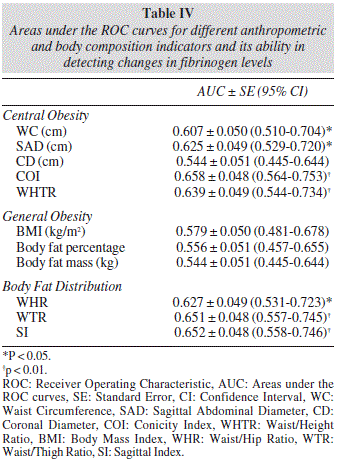
<body><![CDATA[<p align="center"><a name="t2"><img src="/img/revistas/nh/v28n5/41original36_t2.gif"></a></p>     <p>&nbsp;</p>     <p><font face="Verdana" size="2">The indicators of body fat distribution represented by the SI (r = 0.280, p &lt; 0.01), 95% CI (0.12 to 0.43), followed by the WTR (r = 0.233, p &lt; 0.01), 95% CI (0.06 to 0.39), showed the best correlation with hs-CRP levels, and the indicator of central obesity WHTR (r = 0.233, p &lt; 0.01), 95% CI (0.06 to 0.39), showed the same correlation that the WTR. No correlation was found between the CD (r = 0.136, p &gt; 0.05), 95% CI (- 0.04 to 0.30), and hs-CRP levels. The indicators of central obesity COI (r = 0.305, p &lt; 0.01), 95% CI (0.14 to 0.45), and WHTR (r = 0.279, p &lt; 0.01), 95% CI (0.10 to 0.42), showed the best correlation with fibrinogen levels. Nevertheless, there was no correlation between the CD (r = 0.103, p &gt; 0.05), 95% CI (-0.07 to 0.27), the BMI (r = 0.144, p &gt; 0.05), 95% CI (-0.03 to 0.31), and the body fat mass (kg) (r = 0.109, p &gt; 0.05), 95% CI (-0.06 to 0.28), and the fibrinogen levels (data not shown).</font></p>     <p><font face="Verdana" size="2">In the ROC analysis, comparing different anthropometric and body composition indicators and hs-CRP levels, the SAD had the highest absolute value for AUC (<a target="_blank" href="/img/revistas/nh/v28n5/41original36_t3.gif">table III</a>). According to the Z test that compared the AUC, there were no statistically significant differences.</font></p>     <p><font face="Verdana" size="2">In agreement with the correlation analysis that detected the best correlation between the fibrinogen levels and the COI, the highest absolute value for AUC (<a href="#t4">table IV</a>), in the ROC analysis, was represented by the COI, by evaluating cardiovascular risk through higher fibrinogen levels. The application of the Z test comparing AUC indicated that the COI had higher areas in relation to body fat percentage (p = 0.015), body fat mass in kg (p = 0.012) and CD (p = 0.012). The CD, the BMI, the body fat percentage and the body fat mass (kg) showed no predictive ability to detect changes in fibrinogen levels (p &gt; 0.05) (<a href="#t4">table IV</a>).</font></p>     <p align="center"><a name="t4"><img src="/img/revistas/nh/v28n5/41original36_t4.gif"></a></p>     <p>&nbsp;</p>     <p><font face="Verdana" size="2">By assessing the cutoff points with greater accuracy for each anthropometric and body composition indicators, the CD, the WC and the SAD reached the highest sum among the values of sensitivity and specificity for the cutoff points 30 cm, 89.9 cm and 20.5 cm, respectively (<a target="_blank" href="/img/revistas/nh/v28n5/41original36_t3.gif">table III</a>).</font></p>     <p>&nbsp;</p>     <p><font face="Verdana" size="2"><b>Discussion</b></font></p>     ]]></body>
<body><![CDATA[<p><font face="Verdana" size="2">The results of the present study showed that the group with higher levels of hs-CRP (&ge; 0.12 mg/dL) had higher values for all anthropometric and body composition indicators. Lemieux et al.<sup>21</sup> observed a progressive increase in BMI, body fat mass, visceral adipose tissue area and WC according to quintiles of CRP levels. Adding, Ramírez Alvarado and Sánchez Roitz,<sup>22</sup> in a review article, verified that in the studies consulted the CRP levels were positively correlated with the BMI (r = 0.08 to 0.84) and the WC (r = 0.27 to 1.03), being of great significance the correlation between the BMI and the WC with the CRP levels observed in obese of South American, including Brazil. The BMI and the body fat distribution have a strong influence on the CRP levels. Nevertheless, the distribution of anthropo-metric and body composition indicators, according to quartiles of fibrinogen levels, did not identify differences between groups in the present study. However, Church et al.,<sup>23</sup> evaluating 4,057 men from the Aerobics Center Longitudinal Study, verified lower fibrinogen levels (246 mg/dL), after adjustment for age, in the group with higher physical fitness and BMI &lt; 25 kg/m<sup>2</sup>, and the highest values (303 mg/dL) were detected in the group with lower physical fitness and BMI &#8805; 30 kg/m<sup>2</sup>.</font></p>     <p><font face="Verdana" size="2">Generally, the anthropometric and body composition indicators showed a weak correlation with the hs-CRP and the fibrinogen levels, with the exception of the COI, which showed a regular correlation with the fibrinogen levels, according to criteria proposed by Callegari-Jacques.<sup>24</sup> The indicators of body fat distribution, particularly the SI and WTR, showed the best correlation with hs-CRP levels, while the indicators of central obesity, mainly represented by the COI and the WHTR, showed the best correlation with fibrinogen levels.</font></p>     <p><font face="Verdana" size="2">Kahn et al.<sup>16</sup> suggested that SI could be used as a substitute for WHR, in order to overcoming the disadvantages of the measurements of WC and hip circumference. Sampaio et al.<sup>25</sup> observed that the SI (r = 0.50) showed a good correlation with visceral fat, but this correlation was lower than those reported for the SAD (r = 0.80), the WC (r = 0.77) and the WHR (r = 0.72) (p &lt; 0.01). Whereas, Chuang et al.<sup>(15)</sup> observed that the WTR was the best indicator compared with the BMI, the WC and the WHR in the correlation with type 2 diabetes.</font></p>     <p><font face="Verdana" size="2">Pitanga and Lessa<sup>12</sup> suggested that the WHTR might be used to discriminate high coronary risk. According to this, Hsieh and Muto<sup>26</sup> verified that the WHTR had the highest AUC, in ROC analysis, for identification of coronary risk factors, whereas BMI had the lowest AUC, for both sexes. The same study indicates the same cutoff point found in the present study for WHTR (<u>&gt;</u> 0.5) as the most effective anthropometric indicator for screening of metabolic syndrome in the Japanese population. &quot;Keep your WC to less than half your height&quot;.<sup>27</sup></font></p>     <p><font face="Verdana" size="2">Forouhi et al.<sup>2</sup> found a strong association between WC and visceral fat area in the South Asian, whereas the BMI and the body fat percentage were more significantly associated with CRP levels in Europeans. In the same study, the CRP levels in South Asian women (0.135 mg/dL) were almost twice that observed in European women (0.07 mg/dL, p = 0.05), showing the influence of ethnicity on CRP levels. This fact reinforces the importance of specific studies with the Brazilian population in order to verify the performance of anthropometric and body composition indicators and the inflammatory biomarkers in our population.</font></p>     <p><font face="Verdana" size="2">The BMI is an indicator commonly used in the assessment of nutritional status, however, in the present study, there was no statistical correlation between the BMI and the fibrinogen levels. Nevertheless, Imperatore et al.<sup>28</sup> evaluating 1,252 men without diabetes (35-64 years) detected a significant positive association between the BMI and the fibrinogen levels, after adjustment for age.</font></p>     <p><font face="Verdana" size="2">The indicators of general obesity showed the worst correlation with hs-CRP and fibrinogen levels, indicating that the type and the location of body fat are more important than total body fat. It has been recognized that central obesity rather than general obesity, is likely to coexist not only with type 2 diabetes, but is also responsible for several complications of diabetes, such as, hyperinsu-linemia, insulin resistance, dyslipidemia, proinflamma-tory conditions and cardiovascular disease.<sup>29</sup></font></p>     <p><font face="Verdana" size="2">The ROC analysis identified the SAD as the best anthropometric indicator to detect changes in the hs-CRP levels, since this indicator showed the higher AUC. Riserus et al.<sup>30</sup> showed that the SAD was a strong predictor of insulin resistance and hiperproinsulinemia compared with other classic anthropometric measurements (BMI, WC and WHR). The Bogalusa Heart Study<sup>31</sup> suggests that the DAS be an additional parameter of risk, since it contributes to the prediction of cardiovascular risk factors similarly to other measurements of obesity, but can contribute to the assessment of the component of visceral fat deposition. Moreover, the SAD is an efficient method for predicting the accumulation of abdominal fat, and it showed to be better and more sensitive than the WC.<sup>32</sup></font></p>     <p><font face="Verdana" size="2">The COI, in the ROC analysis, was the best indicator for detecting changes in fibrinogen levels. Pitanga and Lessa,<sup>11</sup> in a study with a sample of 391 men (30-74 years), identified an AUC between the COI and the coronary risk of 0.80, 95% CI (0.74 to 0.85 ) and its results show that the COI might be used to discriminate high coronary risk.</font></p>     <p><font face="Verdana" size="2"><a target="_blank" href="/img/revistas/nh/v28n5/41original36_t3.gif">Table III</a> of the present study suggested cutoff points for anthropometric and body composition indicators evaluated for use in apparently healthy adult men. The cutoff points took into account the highest sum of sensitivity and specificity for each indicator. The cutoff point proposed for the SAD in the present study (20.5 cm) was the same as indicated by Sampaio et al.<sup>25</sup> in a study that validated the use of the SAD as a predictor of visceral abdominal fat.</font></p>     ]]></body>
<body><![CDATA[<p><font face="Verdana" size="2">The determination of the cutoff point of the WC is important since it influences in the assessment of cardiovascular risk. Using the cutoff point indicated in the present study (89.9 cm), the prevalence of abdominal obesity would be 32.3% (n = 42). According to the values proposed by WHO to detected increased cardiovascular risk (94 cm),<sup>33</sup> the prevalence would reduce to 19.2% (n = 25). In the diagnosis of metabolic syndrome, according to the criteria of National Cholesterol Education Program-NCEP-ATPIII,<sup>34</sup> the prevalence of abdominal obesity (102 cm) would be only 2.3% (n = 3). These findings underscore the importance of using specific cutoff points for each population, since inadequate cutoff points may underestimate and/or overestimate the prevalence of abdominal obesity.</font></p>     <p>&nbsp;</p>     <p><font face="Verdana" size="2"><b>Conclusion</b></font></p>     <p><font face="Verdana" size="2">The SAD and the COI revealed to be the most appropriate anthropometric indicators for assessing cardiovascular risk, since they showed greater ability to discriminate higher levels of hs-CRP and fibrinogen, respectively, in apparently healthy adult men. Nevertheless, is essential evaluating the effectiveness of anthropometric and body composition indicators in different population and in both sexes, once they may present a distinct behavior depending on gender and age group considered.</font></p>     <p>&nbsp;</p>     <p><font face="Verdana" size="2"><b>References</b></font></p>     <!-- ref --><p><font face="Verdana" size="2">1. Fantuzzi G. Adipose tissue, adipokines, and inflammation. <i>J Allergy Clin Immunol</i> 2005; 115 (5): 911-9.    &nbsp;&nbsp;&nbsp;&nbsp;&nbsp;&nbsp;&nbsp;&nbsp;[&#160;<a href="javascript:void(0);" onclick="javascript: window.open('/scielo.php?script=sci_nlinks&ref=3749659&pid=S0212-1611201300050004100001&lng=','','width=640,height=500,resizable=yes,scrollbars=1,menubar=yes,');">Links</a>&#160;]<!-- end-ref --></font></p>    <!-- ref --><p><font face="Verdana" size="2">2. Forouhi NG, Sattar N, McKeigue PM. Relation of C-reactive protein to body fat distribution and features of the metabolic syndrome in Europeans and South Asians. <i>Int J Obes</i> 2001; 25: 1327-31.    &nbsp;&nbsp;&nbsp;&nbsp;&nbsp;&nbsp;&nbsp;&nbsp;[&#160;<a href="javascript:void(0);" onclick="javascript: window.open('/scielo.php?script=sci_nlinks&ref=3749661&pid=S0212-1611201300050004100002&lng=','','width=640,height=500,resizable=yes,scrollbars=1,menubar=yes,');">Links</a>&#160;]<!-- end-ref --></font></p>    ]]></body>
<body><![CDATA[<!-- ref --><p><font face="Verdana" size="2">3. Snijder MB, van Dam RM, Visser M, Seidell JC. What aspects of body fat are particularly hazardous and how do we measure them? <i>International Journal of Epidemiology</i> 2006; 35: 83-92.    &nbsp;&nbsp;&nbsp;&nbsp;&nbsp;&nbsp;&nbsp;&nbsp;[&#160;<a href="javascript:void(0);" onclick="javascript: window.open('/scielo.php?script=sci_nlinks&ref=3749663&pid=S0212-1611201300050004100003&lng=','','width=640,height=500,resizable=yes,scrollbars=1,menubar=yes,');">Links</a>&#160;]<!-- end-ref --></font></p>    <!-- ref --><p><font face="Verdana" size="2">4. Koenig W, Sund M, Frohlich M, Fischer H-G, Lowel H, Doring A, et al. C-reactive protein, a sensitive marker of inflammation, predicts future risk of coronary heart disease in initially healthy middle-aged men results from the MONICA (monitoring trends and determinants in cardiovascular disease) Augsburg cohort study, 1984 to 1992. <i>Circulation</i> 1999; 99: 237-42.    &nbsp;&nbsp;&nbsp;&nbsp;&nbsp;&nbsp;&nbsp;&nbsp;[&#160;<a href="javascript:void(0);" onclick="javascript: window.open('/scielo.php?script=sci_nlinks&ref=3749665&pid=S0212-1611201300050004100004&lng=','','width=640,height=500,resizable=yes,scrollbars=1,menubar=yes,');">Links</a>&#160;]<!-- end-ref --></font></p>    <!-- ref --><p><font face="Verdana" size="2">5. Shankar A, Wang JJ, Rochtchina E, Mitchell P. Positive association between plasma fibrinogen level and incident hypertension among men population-based cohort study. <i>Hypertension</i> 2006; 48: 1043-9.    &nbsp;&nbsp;&nbsp;&nbsp;&nbsp;&nbsp;&nbsp;&nbsp;[&#160;<a href="javascript:void(0);" onclick="javascript: window.open('/scielo.php?script=sci_nlinks&ref=3749667&pid=S0212-1611201300050004100005&lng=','','width=640,height=500,resizable=yes,scrollbars=1,menubar=yes,');">Links</a>&#160;]<!-- end-ref --></font></p>    <!-- ref --><p><font face="Verdana" size="2">6. Garaulet M, Hernández-Morante JJ, Tébar FJ, Zamora S, Canteras M. Two-dimensional predictive equation to classify visceral obesity in clinical practice. <i>Obesity </i>2006; 14 (7): 1181-91.    &nbsp;&nbsp;&nbsp;&nbsp;&nbsp;&nbsp;&nbsp;&nbsp;[&#160;<a href="javascript:void(0);" onclick="javascript: window.open('/scielo.php?script=sci_nlinks&ref=3749669&pid=S0212-1611201300050004100006&lng=','','width=640,height=500,resizable=yes,scrollbars=1,menubar=yes,');">Links</a>&#160;]<!-- end-ref --></font></p>    <!-- ref --><p><font face="Verdana" size="2">7. Petersson H, Daryani A, Riserus U. Sagittal abdominal diameter as a marker of inflammation and insulin resistance among immigrant women from the Middle East and native Swedish women: a cross-sectional study. <i>Cardiovascular Diabetology</i> 2007; 6: 10.    &nbsp;&nbsp;&nbsp;&nbsp;&nbsp;&nbsp;&nbsp;&nbsp;[&#160;<a href="javascript:void(0);" onclick="javascript: window.open('/scielo.php?script=sci_nlinks&ref=3749671&pid=S0212-1611201300050004100007&lng=','','width=640,height=500,resizable=yes,scrollbars=1,menubar=yes,');">Links</a>&#160;]<!-- end-ref --></font></p>    ]]></body>
<body><![CDATA[<!-- ref --><p><font face="Verdana" size="2">8. Callaway CW, Chumlea WC, Bouchard C, Himes JH, Lohman TG, Martin AD. Circumferences. In: Lohman TG, Roche AF, Martorell R, editors. Anthropometric standardization reference manual. Champaign: Human Kinetics; 1988, pp. 39-54.    &nbsp;&nbsp;&nbsp;&nbsp;&nbsp;&nbsp;&nbsp;&nbsp;[&#160;<a href="javascript:void(0);" onclick="javascript: window.open('/scielo.php?script=sci_nlinks&ref=3749673&pid=S0212-1611201300050004100008&lng=','','width=640,height=500,resizable=yes,scrollbars=1,menubar=yes,');">Links</a>&#160;]<!-- end-ref --></font></p>    <!-- ref --><p><font face="Verdana" size="2">9. Ohrvall M, Berglund L, Vessby B. Sagittal abdominal diameter compared with other anthropometric measurements in relation to cardiovascular risk. <i>Int J Obes Relat Metab Disord</i> 2000; 24(4): 497-501.    &nbsp;&nbsp;&nbsp;&nbsp;&nbsp;&nbsp;&nbsp;&nbsp;[&#160;<a href="javascript:void(0);" onclick="javascript: window.open('/scielo.php?script=sci_nlinks&ref=3749675&pid=S0212-1611201300050004100009&lng=','','width=640,height=500,resizable=yes,scrollbars=1,menubar=yes,');">Links</a>&#160;]<!-- end-ref --></font></p>    <!-- ref --><p><font face="Verdana" size="2">10. Valdez R. A simple model-based index of abdominal adiposity. <i>J Clin Epidemiol</i> 1991; 44 (9): 955-6.    &nbsp;&nbsp;&nbsp;&nbsp;&nbsp;&nbsp;&nbsp;&nbsp;[&#160;<a href="javascript:void(0);" onclick="javascript: window.open('/scielo.php?script=sci_nlinks&ref=3749677&pid=S0212-1611201300050004100010&lng=','','width=640,height=500,resizable=yes,scrollbars=1,menubar=yes,');">Links</a>&#160;]<!-- end-ref --></font></p>    <!-- ref --><p><font face="Verdana" size="2">11. Pitanga FJG, Lessa I. Sensibilidade e especificidade do índice de conicidade como discriminador do risco coronariano de adultos em Salvador, Brasil. <i>Rev Bras Epidemiol</i> 2004; 7: 259-69.    &nbsp;&nbsp;&nbsp;&nbsp;&nbsp;&nbsp;&nbsp;&nbsp;[&#160;<a href="javascript:void(0);" onclick="javascript: window.open('/scielo.php?script=sci_nlinks&ref=3749679&pid=S0212-1611201300050004100011&lng=','','width=640,height=500,resizable=yes,scrollbars=1,menubar=yes,');">Links</a>&#160;]<!-- end-ref --></font></p>    <!-- ref --><p><font face="Verdana" size="2">12. Pitanga FJG, Lessa I. Razão cintura-estatura como discriminador do risco coronariano de adultos. <i>Rev Assoc Med Bras</i> 2006; 52 (3): 157-61.    &nbsp;&nbsp;&nbsp;&nbsp;&nbsp;&nbsp;&nbsp;&nbsp;[&#160;<a href="javascript:void(0);" onclick="javascript: window.open('/scielo.php?script=sci_nlinks&ref=3749681&pid=S0212-1611201300050004100012&lng=','','width=640,height=500,resizable=yes,scrollbars=1,menubar=yes,');">Links</a>&#160;]<!-- end-ref --></font></p>    ]]></body>
<body><![CDATA[<!-- ref --><p><font face="Verdana" size="2">13. Organización Mundial de la Salud. El estado físico: uso e interpretación de la antropometría: informe de un Comité de Expertos de la OMS. Ginebra: Organización Mundial de la Salud; 1995.    &nbsp;&nbsp;&nbsp;&nbsp;&nbsp;&nbsp;&nbsp;&nbsp;[&#160;<a href="javascript:void(0);" onclick="javascript: window.open('/scielo.php?script=sci_nlinks&ref=3749683&pid=S0212-1611201300050004100013&lng=','','width=640,height=500,resizable=yes,scrollbars=1,menubar=yes,');">Links</a>&#160;]<!-- end-ref --></font></p>    <!-- ref --><p><font face="Verdana" size="2">14. Pannacciulli N, Cantatore FP, Minenna A, Bellacicco M, Giorgino R, De Pergola G. C-reactive protein is independently associated with total body fat, central fat, and insulin resistance in adult women. <i>International Journal of Obesity</i> 2001; 25: 1416-20.    &nbsp;&nbsp;&nbsp;&nbsp;&nbsp;&nbsp;&nbsp;&nbsp;[&#160;<a href="javascript:void(0);" onclick="javascript: window.open('/scielo.php?script=sci_nlinks&ref=3749685&pid=S0212-1611201300050004100014&lng=','','width=640,height=500,resizable=yes,scrollbars=1,menubar=yes,');">Links</a>&#160;]<!-- end-ref --></font></p>    <!-- ref --><p><font face="Verdana" size="2">15. Chuang YC, Hsu KH, Hwang CJ, Hu PM, Lin TM, Chiou WK. Waist-to-thigh ratio can also be a better indicator associated with type 2 diabetes than traditional anthropometrical measurements in Taiwan population. <i>Ann Epidemiol</i> 2006; 16 (5): 321-31.    &nbsp;&nbsp;&nbsp;&nbsp;&nbsp;&nbsp;&nbsp;&nbsp;[&#160;<a href="javascript:void(0);" onclick="javascript: window.open('/scielo.php?script=sci_nlinks&ref=3749687&pid=S0212-1611201300050004100015&lng=','','width=640,height=500,resizable=yes,scrollbars=1,menubar=yes,');">Links</a>&#160;]<!-- end-ref --></font></p>    <!-- ref --><p><font face="Verdana" size="2">16. Kahn HS, Simoes EJ, Koponen M, Hanzlick R. The abdominal diameter index and sudden coronary death in men. <i>Am J Cardiol</i> 1996; 78 (8): 961-4.    &nbsp;&nbsp;&nbsp;&nbsp;&nbsp;&nbsp;&nbsp;&nbsp;[&#160;<a href="javascript:void(0);" onclick="javascript: window.open('/scielo.php?script=sci_nlinks&ref=3749689&pid=S0212-1611201300050004100016&lng=','','width=640,height=500,resizable=yes,scrollbars=1,menubar=yes,');">Links</a>&#160;]<!-- end-ref --></font></p>    <!-- ref --><p><font face="Verdana" size="2">17. World Health Organization. WHO Global Database on Body Mass Index (BMI): an Interactive Surveillance Tool for Monitoring Nutrition Transition. <i>Public Health Nutrition</i> 2006; 9 (5): 658-60.    &nbsp;&nbsp;&nbsp;&nbsp;&nbsp;&nbsp;&nbsp;&nbsp;[&#160;<a href="javascript:void(0);" onclick="javascript: window.open('/scielo.php?script=sci_nlinks&ref=3749691&pid=S0212-1611201300050004100017&lng=','','width=640,height=500,resizable=yes,scrollbars=1,menubar=yes,');">Links</a>&#160;]<!-- end-ref --></font></p>    ]]></body>
<body><![CDATA[<!-- ref --><p><font face="Verdana" size="2">18. Lukaski HC, Johnson PE, Bolonchuk WW, Lykken GI. Assessment of fat-free mass using bioelectrical impedance measurements of the human body. <i>Am J Clin Nutr</i> 1985; 41 (4): 810-7.    &nbsp;&nbsp;&nbsp;&nbsp;&nbsp;&nbsp;&nbsp;&nbsp;[&#160;<a href="javascript:void(0);" onclick="javascript: window.open('/scielo.php?script=sci_nlinks&ref=3749693&pid=S0212-1611201300050004100018&lng=','','width=640,height=500,resizable=yes,scrollbars=1,menubar=yes,');">Links</a>&#160;]<!-- end-ref --></font></p>    <!-- ref --><p><font face="Verdana" size="2">19. Lohman TG. Advances in body composition assessment. n.3. M, editor. Champaign; 1992.    &nbsp;&nbsp;&nbsp;&nbsp;&nbsp;&nbsp;&nbsp;&nbsp;[&#160;<a href="javascript:void(0);" onclick="javascript: window.open('/scielo.php?script=sci_nlinks&ref=3749695&pid=S0212-1611201300050004100019&lng=','','width=640,height=500,resizable=yes,scrollbars=1,menubar=yes,');">Links</a>&#160;]<!-- end-ref --></font></p>    <!-- ref --><p><font face="Verdana" size="2">20. Sociedade Brasileira de Cardiologia. III Diretrizes Brasileiras sobre Dislipidemias e Diretriz de Prevenção da Aterosclerose do Departamento de Aterosclerose da Sociedade Brasileira de Cardiologia. <i>Arq Bras Cardiol</i> 2001; 77 (Suppl. III): 48 p.    &nbsp;&nbsp;&nbsp;&nbsp;&nbsp;&nbsp;&nbsp;&nbsp;[&#160;<a href="javascript:void(0);" onclick="javascript: window.open('/scielo.php?script=sci_nlinks&ref=3749697&pid=S0212-1611201300050004100020&lng=','','width=640,height=500,resizable=yes,scrollbars=1,menubar=yes,');">Links</a>&#160;]<!-- end-ref --></font></p>    <!-- ref --><p><font face="Verdana" size="2">21. Lemieux I, Pascot A, Prud'homme D, Alméras N, Bogaty P, Nadeau A et al. Elevated C-reactive protein another component of the atherothrombotic profile of abdominal obesity. <i>Arte-rioscler Thromb Vasc Biol</i> 2001; 21: 961-7.    &nbsp;&nbsp;&nbsp;&nbsp;&nbsp;&nbsp;&nbsp;&nbsp;[&#160;<a href="javascript:void(0);" onclick="javascript: window.open('/scielo.php?script=sci_nlinks&ref=3749699&pid=S0212-1611201300050004100021&lng=','','width=640,height=500,resizable=yes,scrollbars=1,menubar=yes,');">Links</a>&#160;]<!-- end-ref --></font></p>    <!-- ref --><p><font face="Verdana" size="2">22. Ramírez Alvarado MM, Sánchez Roitz C. Relación entre los niveles séricos de la proteína C reactiva y medidas antropométricas: una revisión sistemática de los estudios realizados en Suramérica. <i>Nutr Hosp</i> 2012; 27 (4): 971-7.    &nbsp;&nbsp;&nbsp;&nbsp;&nbsp;&nbsp;&nbsp;&nbsp;[&#160;<a href="javascript:void(0);" onclick="javascript: window.open('/scielo.php?script=sci_nlinks&ref=3749701&pid=S0212-1611201300050004100022&lng=','','width=640,height=500,resizable=yes,scrollbars=1,menubar=yes,');">Links</a>&#160;]<!-- end-ref --></font></p>    ]]></body>
<body><![CDATA[<!-- ref --><p><font face="Verdana" size="2">23. Church TS, Finley CE, Earnest CP, Kampert JB, Gibbons LW, Blair SN. Relative associations of fitness and fatness to fibrinogen, white blood cell count, uric acid and metabolic syndrome. <i>International Journal of Obesity</i> 2002; 26: 805-13.    &nbsp;&nbsp;&nbsp;&nbsp;&nbsp;&nbsp;&nbsp;&nbsp;[&#160;<a href="javascript:void(0);" onclick="javascript: window.open('/scielo.php?script=sci_nlinks&ref=3749703&pid=S0212-1611201300050004100023&lng=','','width=640,height=500,resizable=yes,scrollbars=1,menubar=yes,');">Links</a>&#160;]<!-- end-ref --></font></p>    <!-- ref --><p><font face="Verdana" size="2">24. Callegari-Jacques SM. Bioestatística: principios e aplica&ccedil;&otilde;es. Porto Alegre Artmed; 2006.    &nbsp;&nbsp;&nbsp;&nbsp;&nbsp;&nbsp;&nbsp;&nbsp;[&#160;<a href="javascript:void(0);" onclick="javascript: window.open('/scielo.php?script=sci_nlinks&ref=3749705&pid=S0212-1611201300050004100024&lng=','','width=640,height=500,resizable=yes,scrollbars=1,menubar=yes,');">Links</a>&#160;]<!-- end-ref --></font></p>    <!-- ref --><p><font face="Verdana" size="2">25. Sampaio LR, Simoes EJ, Assis AM, Ramos LR. Validity and reliability of the sagittal abdominal diameter as a predictor of visceral abdominal fat. <i>Arq Bras Endocrinol Metabol</i> 2007; 51 (6): 980-6.    &nbsp;&nbsp;&nbsp;&nbsp;&nbsp;&nbsp;&nbsp;&nbsp;[&#160;<a href="javascript:void(0);" onclick="javascript: window.open('/scielo.php?script=sci_nlinks&ref=3749707&pid=S0212-1611201300050004100025&lng=','','width=640,height=500,resizable=yes,scrollbars=1,menubar=yes,');">Links</a>&#160;]<!-- end-ref --></font></p>    <!-- ref --><p><font face="Verdana" size="2">26. Hsieh SD, Muto T. Metabolic syndrome in Japanese men and women with special reference to the anthropometric criteria for the assessment of obesity: Proposal to use the waist-to-height ratio. <i>Preventive Medicine</i> 2006; 42: 135-9.    &nbsp;&nbsp;&nbsp;&nbsp;&nbsp;&nbsp;&nbsp;&nbsp;[&#160;<a href="javascript:void(0);" onclick="javascript: window.open('/scielo.php?script=sci_nlinks&ref=3749709&pid=S0212-1611201300050004100026&lng=','','width=640,height=500,resizable=yes,scrollbars=1,menubar=yes,');">Links</a>&#160;]<!-- end-ref --></font></p>    <!-- ref --><p><font face="Verdana" size="2">27. Ashwell M, Hsieh SD. Six reasons why the waist to height ratio is a rapid and effective global indicator for health risks of obesity and how its use could simply the international public health message for the prevention of obesity. <i>Int J Food Sci Nutr</i> 2005; 56 (5): 303-7.    &nbsp;&nbsp;&nbsp;&nbsp;&nbsp;&nbsp;&nbsp;&nbsp;[&#160;<a href="javascript:void(0);" onclick="javascript: window.open('/scielo.php?script=sci_nlinks&ref=3749711&pid=S0212-1611201300050004100027&lng=','','width=640,height=500,resizable=yes,scrollbars=1,menubar=yes,');">Links</a>&#160;]<!-- end-ref --></font></p>    ]]></body>
<body><![CDATA[<!-- ref --><p><font face="Verdana" size="2">28. Imperatore G, Riccardi G, Iovine C, Rivellese AA, Vaccaro O. Plasma fibrinogen: a new factor of the metabolic syndrome - A population-based study. <i>Diabetes Care</i> 1998; 21 (4): 649-54.    &nbsp;&nbsp;&nbsp;&nbsp;&nbsp;&nbsp;&nbsp;&nbsp;[&#160;<a href="javascript:void(0);" onclick="javascript: window.open('/scielo.php?script=sci_nlinks&ref=3749713&pid=S0212-1611201300050004100028&lng=','','width=640,height=500,resizable=yes,scrollbars=1,menubar=yes,');">Links</a>&#160;]<!-- end-ref --></font></p>    <!-- ref --><p><font face="Verdana" size="2">29. Mamtani MR, Kulkarni HR. Predictive performance of anthropometric indexes of central obesity for the risk of type 2 diabetes. <i>Arch Med Res</i> 2005; 36 (5): 581-9.    &nbsp;&nbsp;&nbsp;&nbsp;&nbsp;&nbsp;&nbsp;&nbsp;[&#160;<a href="javascript:void(0);" onclick="javascript: window.open('/scielo.php?script=sci_nlinks&ref=3749715&pid=S0212-1611201300050004100029&lng=','','width=640,height=500,resizable=yes,scrollbars=1,menubar=yes,');">Links</a>&#160;]<!-- end-ref --></font></p>    <!-- ref --><p><font face="Verdana" size="2">30. Riserus U, Arnlov J, Brismar K, Zethelius B, Berglund L, Vessby B. Sagittal abdominal diameter is a strong anthropo-metric marker of insulin resistance and hyperproinsulinemia in obese men. <i>Diabetes Care</i> 2004; 27 (8): 2041-6.    &nbsp;&nbsp;&nbsp;&nbsp;&nbsp;&nbsp;&nbsp;&nbsp;[&#160;<a href="javascript:void(0);" onclick="javascript: window.open('/scielo.php?script=sci_nlinks&ref=3749717&pid=S0212-1611201300050004100030&lng=','','width=640,height=500,resizable=yes,scrollbars=1,menubar=yes,');">Links</a>&#160;]<!-- end-ref --></font></p>    <!-- ref --><p><font face="Verdana" size="2">31. Gustat J, Elkasabany A, Srinivasan S, Berenson GS. Relation of abdominal height to cardiovascular risk factors in young adults: the Bogalusa heart study. <i>Am J Epidemiol</i> 2000; 151 (9): 885-91.    &nbsp;&nbsp;&nbsp;&nbsp;&nbsp;&nbsp;&nbsp;&nbsp;[&#160;<a href="javascript:void(0);" onclick="javascript: window.open('/scielo.php?script=sci_nlinks&ref=3749719&pid=S0212-1611201300050004100031&lng=','','width=640,height=500,resizable=yes,scrollbars=1,menubar=yes,');">Links</a>&#160;]<!-- end-ref --></font></p>    <!-- ref --><p><font face="Verdana" size="2">32. Duarte Pimentel G, Portero-McLellan KC, Maestá N, Corrente JE, Burini RC. Accuracy of sagittal abdominal diameter as predictor of abdominal fat among Brazilian adults: a comparation with waist circumference. <i>Nutr Hosp </i>2010; 25 (4): 656-61.    &nbsp;&nbsp;&nbsp;&nbsp;&nbsp;&nbsp;&nbsp;&nbsp;[&#160;<a href="javascript:void(0);" onclick="javascript: window.open('/scielo.php?script=sci_nlinks&ref=3749721&pid=S0212-1611201300050004100032&lng=','','width=640,height=500,resizable=yes,scrollbars=1,menubar=yes,');">Links</a>&#160;]<!-- end-ref --></font></p>    ]]></body>
<body><![CDATA[<!-- ref --><p><font face="Verdana" size="2">33. Sociedade Brasileira de Hipertensáo. I Diretriz Brasileira de Diagnóstico e Tratamento da Síndrome Metabólica. <i>Arq Bras Cardiol</i> 2005; 84 (Suppl. I): 3-28.    &nbsp;&nbsp;&nbsp;&nbsp;&nbsp;&nbsp;&nbsp;&nbsp;[&#160;<a href="javascript:void(0);" onclick="javascript: window.open('/scielo.php?script=sci_nlinks&ref=3749723&pid=S0212-1611201300050004100033&lng=','','width=640,height=500,resizable=yes,scrollbars=1,menubar=yes,');">Links</a>&#160;]<!-- end-ref --></font></p>    <!-- ref --><p><font face="Verdana" size="2">34. NCEP. Executive Summary of The Third Report of The National Cholesterol Education Program (NCEP) Expert Panel on Detection, Evaluation, And Treatment of High Blood Cholesterol In Adults (Adult Treatment Panel III). <i>JAMA </i>2001; 285 (19): 2486-97.    &nbsp;&nbsp;&nbsp;&nbsp;&nbsp;&nbsp;&nbsp;&nbsp;[&#160;<a href="javascript:void(0);" onclick="javascript: window.open('/scielo.php?script=sci_nlinks&ref=3749725&pid=S0212-1611201300050004100034&lng=','','width=640,height=500,resizable=yes,scrollbars=1,menubar=yes,');">Links</a>&#160;]<!-- end-ref --></font></p>     <p>&nbsp;</p>     <p>&nbsp;</p>     <p><font face="Verdana" size="2"><a href="#top"><img border="0" src="/img/revistas/nh/v28n5/seta.gif" width="15" height="17"></a><a name="bajo"></a><b>Correspondence:</b>    <br>Fernanda de Carvalho Vidigal    <br>Universidade Federal de Vi&ccedil;osa    <br>Departamento de Nutri&ccedil;&atilde;o e Saúde    ]]></body>
<body><![CDATA[<br>Av. PH Rolfs, s/n    <br>CEP 36570-000 Vi&ccedil;osa. Minas Gerais. Brazil    <br>E-mail: <a href="mailto:fcvidigal@gmail.com">fcvidigal@gmail.com</a></font></p>     <p><font face="Verdana" size="2">Recibido: 26-III-2013    <br>1.<sup>a</sup> Revisión: 27-V-2013    <br>Aceptado: 17-VI-2013</font></p>      ]]></body><back>
<ref-list>
<ref id="B1">
<label>1</label><nlm-citation citation-type="journal">
<person-group person-group-type="author">
<name>
<surname><![CDATA[Fantuzzi]]></surname>
<given-names><![CDATA[G]]></given-names>
</name>
</person-group>
<article-title xml:lang="en"><![CDATA[Adipose tissue, adipokines, and inflammation]]></article-title>
<source><![CDATA[J Allergy Clin Immunol]]></source>
<year>2005</year>
<volume>115</volume>
<numero>5</numero>
<issue>5</issue>
<page-range>911-9</page-range></nlm-citation>
</ref>
<ref id="B2">
<label>2</label><nlm-citation citation-type="journal">
<person-group person-group-type="author">
<name>
<surname><![CDATA[Forouhi]]></surname>
<given-names><![CDATA[NG]]></given-names>
</name>
<name>
<surname><![CDATA[Sattar]]></surname>
<given-names><![CDATA[N]]></given-names>
</name>
<name>
<surname><![CDATA[McKeigue]]></surname>
<given-names><![CDATA[PM]]></given-names>
</name>
</person-group>
<article-title xml:lang="en"><![CDATA[Relation of C-reactive protein to body fat distribution and features of the metabolic syndrome in Europeans and South Asians]]></article-title>
<source><![CDATA[Int J Obes]]></source>
<year>2001</year>
<volume>25</volume>
<page-range>1327-31</page-range></nlm-citation>
</ref>
<ref id="B3">
<label>3</label><nlm-citation citation-type="journal">
<person-group person-group-type="author">
<name>
<surname><![CDATA[Snijder]]></surname>
<given-names><![CDATA[MB]]></given-names>
</name>
<name>
<surname><![CDATA[van Dam]]></surname>
<given-names><![CDATA[RM]]></given-names>
</name>
<name>
<surname><![CDATA[Visser]]></surname>
<given-names><![CDATA[M]]></given-names>
</name>
<name>
<surname><![CDATA[Seidell]]></surname>
<given-names><![CDATA[JC]]></given-names>
</name>
</person-group>
<article-title xml:lang="en"><![CDATA[What aspects of body fat are particularly hazardous and how do we measure them?]]></article-title>
<source><![CDATA[International Journal of Epidemiology]]></source>
<year>2006</year>
<volume>35</volume>
<page-range>83-92</page-range></nlm-citation>
</ref>
<ref id="B4">
<label>4</label><nlm-citation citation-type="journal">
<person-group person-group-type="author">
<name>
<surname><![CDATA[Koenig]]></surname>
<given-names><![CDATA[W]]></given-names>
</name>
<name>
<surname><![CDATA[Sund]]></surname>
<given-names><![CDATA[M]]></given-names>
</name>
<name>
<surname><![CDATA[Frohlich]]></surname>
<given-names><![CDATA[M]]></given-names>
</name>
<name>
<surname><![CDATA[Fischer]]></surname>
<given-names><![CDATA[H-G]]></given-names>
</name>
<name>
<surname><![CDATA[Lowel]]></surname>
<given-names><![CDATA[H]]></given-names>
</name>
<name>
<surname><![CDATA[Doring]]></surname>
<given-names><![CDATA[A]]></given-names>
</name>
</person-group>
<article-title xml:lang="en"><![CDATA[C-reactive protein, a sensitive marker of inflammation, predicts future risk of coronary heart disease in initially healthy middle-aged men results from the MONICA (monitoring trends and determinants in cardiovascular disease) Augsburg cohort study, 1984 to 1992]]></article-title>
<source><![CDATA[Circulation]]></source>
<year>1999</year>
<volume>99</volume>
<page-range>237-42</page-range></nlm-citation>
</ref>
<ref id="B5">
<label>5</label><nlm-citation citation-type="journal">
<person-group person-group-type="author">
<name>
<surname><![CDATA[Shankar]]></surname>
<given-names><![CDATA[A]]></given-names>
</name>
<name>
<surname><![CDATA[Wang]]></surname>
<given-names><![CDATA[JJ]]></given-names>
</name>
<name>
<surname><![CDATA[Rochtchina]]></surname>
<given-names><![CDATA[E]]></given-names>
</name>
<name>
<surname><![CDATA[Mitchell]]></surname>
<given-names><![CDATA[P]]></given-names>
</name>
</person-group>
<article-title xml:lang="en"><![CDATA[Positive association between plasma fibrinogen level and incident hypertension among men population-based cohort study]]></article-title>
<source><![CDATA[Hypertension]]></source>
<year>2006</year>
<volume>48</volume>
<page-range>1043-9</page-range></nlm-citation>
</ref>
<ref id="B6">
<label>6</label><nlm-citation citation-type="journal">
<person-group person-group-type="author">
<name>
<surname><![CDATA[Garaulet]]></surname>
<given-names><![CDATA[M]]></given-names>
</name>
<name>
<surname><![CDATA[Hernández-Morante]]></surname>
<given-names><![CDATA[JJ]]></given-names>
</name>
<name>
<surname><![CDATA[Tébar]]></surname>
<given-names><![CDATA[FJ]]></given-names>
</name>
<name>
<surname><![CDATA[Zamora]]></surname>
<given-names><![CDATA[S]]></given-names>
</name>
<name>
<surname><![CDATA[Canteras]]></surname>
<given-names><![CDATA[M]]></given-names>
</name>
</person-group>
<article-title xml:lang="en"><![CDATA[Two-dimensional predictive equation to classify visceral obesity in clinical practice]]></article-title>
<source><![CDATA[Obesity]]></source>
<year>2006</year>
<volume>14</volume>
<numero>7</numero>
<issue>7</issue>
<page-range>1181-91</page-range></nlm-citation>
</ref>
<ref id="B7">
<label>7</label><nlm-citation citation-type="journal">
<person-group person-group-type="author">
<name>
<surname><![CDATA[Petersson]]></surname>
<given-names><![CDATA[H]]></given-names>
</name>
<name>
<surname><![CDATA[Daryani]]></surname>
<given-names><![CDATA[A]]></given-names>
</name>
<name>
<surname><![CDATA[Riserus]]></surname>
<given-names><![CDATA[U]]></given-names>
</name>
</person-group>
<article-title xml:lang="en"><![CDATA[Sagittal abdominal diameter as a marker of inflammation and insulin resistance among immigrant women from the Middle East and native Swedish women: a cross-sectional study]]></article-title>
<source><![CDATA[Cardiovascular Diabetology]]></source>
<year>2007</year>
<volume>6</volume>
<page-range>10</page-range></nlm-citation>
</ref>
<ref id="B8">
<label>8</label><nlm-citation citation-type="book">
<person-group person-group-type="author">
<name>
<surname><![CDATA[Callaway]]></surname>
<given-names><![CDATA[CW]]></given-names>
</name>
<name>
<surname><![CDATA[Chumlea]]></surname>
<given-names><![CDATA[WC]]></given-names>
</name>
<name>
<surname><![CDATA[Bouchard]]></surname>
<given-names><![CDATA[C]]></given-names>
</name>
<name>
<surname><![CDATA[Himes]]></surname>
<given-names><![CDATA[JH]]></given-names>
</name>
<name>
<surname><![CDATA[Lohman]]></surname>
<given-names><![CDATA[TG]]></given-names>
</name>
<name>
<surname><![CDATA[Martin]]></surname>
<given-names><![CDATA[AD]]></given-names>
</name>
</person-group>
<article-title xml:lang="en"><![CDATA[Circumferences]]></article-title>
<person-group person-group-type="editor">
<name>
<surname><![CDATA[Lohman]]></surname>
<given-names><![CDATA[TG]]></given-names>
</name>
<name>
<surname><![CDATA[Roche]]></surname>
<given-names><![CDATA[AF]]></given-names>
</name>
<name>
<surname><![CDATA[Martorell]]></surname>
<given-names><![CDATA[R]]></given-names>
</name>
</person-group>
<source><![CDATA[Anthropometric standardization reference manual]]></source>
<year>1988</year>
<page-range>39-54</page-range><publisher-loc><![CDATA[Champaign ]]></publisher-loc>
<publisher-name><![CDATA[Human Kinetics]]></publisher-name>
</nlm-citation>
</ref>
<ref id="B9">
<label>9</label><nlm-citation citation-type="journal">
<person-group person-group-type="author">
<name>
<surname><![CDATA[Ohrvall]]></surname>
<given-names><![CDATA[M]]></given-names>
</name>
<name>
<surname><![CDATA[Berglund]]></surname>
<given-names><![CDATA[L]]></given-names>
</name>
<name>
<surname><![CDATA[Vessby]]></surname>
<given-names><![CDATA[B]]></given-names>
</name>
</person-group>
<article-title xml:lang="en"><![CDATA[Sagittal abdominal diameter compared with other anthropometric measurements in relation to cardiovascular risk]]></article-title>
<source><![CDATA[Int J Obes Relat Metab Disord]]></source>
<year>2000</year>
<volume>24</volume>
<numero>4</numero>
<issue>4</issue>
<page-range>497-501</page-range></nlm-citation>
</ref>
<ref id="B10">
<label>10</label><nlm-citation citation-type="journal">
<person-group person-group-type="author">
<name>
<surname><![CDATA[Valdez]]></surname>
<given-names><![CDATA[R]]></given-names>
</name>
</person-group>
<article-title xml:lang="en"><![CDATA[A simple model-based index of abdominal adiposity]]></article-title>
<source><![CDATA[J Clin Epidemiol]]></source>
<year>1991</year>
<volume>44</volume>
<numero>9</numero>
<issue>9</issue>
<page-range>955-6</page-range></nlm-citation>
</ref>
<ref id="B11">
<label>11</label><nlm-citation citation-type="journal">
<person-group person-group-type="author">
<name>
<surname><![CDATA[Pitanga]]></surname>
<given-names><![CDATA[FJG]]></given-names>
</name>
<name>
<surname><![CDATA[Lessa]]></surname>
<given-names><![CDATA[I]]></given-names>
</name>
</person-group>
<article-title xml:lang="pt"><![CDATA[Sensibilidade e especificidade do índice de conicidade como discriminador do risco coronariano de adultos em Salvador, Brasil]]></article-title>
<source><![CDATA[Rev Bras Epidemiol]]></source>
<year>2004</year>
<volume>7</volume>
<page-range>259-69</page-range></nlm-citation>
</ref>
<ref id="B12">
<label>12</label><nlm-citation citation-type="journal">
<person-group person-group-type="author">
<name>
<surname><![CDATA[Pitanga]]></surname>
<given-names><![CDATA[FJG]]></given-names>
</name>
<name>
<surname><![CDATA[Lessa]]></surname>
<given-names><![CDATA[I]]></given-names>
</name>
</person-group>
<article-title xml:lang="pt"><![CDATA[Razão cintura-estatura como discriminador do risco coronariano de adultos]]></article-title>
<source><![CDATA[Rev Assoc Med Bras]]></source>
<year>2006</year>
<volume>52</volume>
<numero>3</numero>
<issue>3</issue>
<page-range>157-61</page-range></nlm-citation>
</ref>
<ref id="B13">
<label>13</label><nlm-citation citation-type="book">
<collab>Organización Mundial de la Salud</collab>
<source><![CDATA[El estado físico: uso e interpretación de la antropometría: informe de un Comité de Expertos de la OMS]]></source>
<year>1995</year>
<publisher-loc><![CDATA[Ginebra ]]></publisher-loc>
<publisher-name><![CDATA[Organización Mundial de la Salud]]></publisher-name>
</nlm-citation>
</ref>
<ref id="B14">
<label>14</label><nlm-citation citation-type="journal">
<person-group person-group-type="author">
<name>
<surname><![CDATA[Pannacciulli]]></surname>
<given-names><![CDATA[N]]></given-names>
</name>
<name>
<surname><![CDATA[Cantatore]]></surname>
<given-names><![CDATA[FP]]></given-names>
</name>
<name>
<surname><![CDATA[Minenna]]></surname>
<given-names><![CDATA[A]]></given-names>
</name>
<name>
<surname><![CDATA[Bellacicco]]></surname>
<given-names><![CDATA[M]]></given-names>
</name>
<name>
<surname><![CDATA[Giorgino]]></surname>
<given-names><![CDATA[R]]></given-names>
</name>
<name>
<surname><![CDATA[De Pergola]]></surname>
<given-names><![CDATA[G]]></given-names>
</name>
</person-group>
<article-title xml:lang="en"><![CDATA[C-reactive protein is independently associated with total body fat, central fat, and insulin resistance in adult women]]></article-title>
<source><![CDATA[International Journal of Obesity]]></source>
<year>2001</year>
<volume>25</volume>
<page-range>1416-20</page-range></nlm-citation>
</ref>
<ref id="B15">
<label>15</label><nlm-citation citation-type="journal">
<person-group person-group-type="author">
<name>
<surname><![CDATA[Chuang]]></surname>
<given-names><![CDATA[YC]]></given-names>
</name>
<name>
<surname><![CDATA[Hsu]]></surname>
<given-names><![CDATA[KH]]></given-names>
</name>
<name>
<surname><![CDATA[Hwang]]></surname>
<given-names><![CDATA[CJ]]></given-names>
</name>
<name>
<surname><![CDATA[Hu]]></surname>
<given-names><![CDATA[PM]]></given-names>
</name>
<name>
<surname><![CDATA[Lin]]></surname>
<given-names><![CDATA[TM]]></given-names>
</name>
<name>
<surname><![CDATA[Chiou]]></surname>
<given-names><![CDATA[WK]]></given-names>
</name>
</person-group>
<article-title xml:lang="en"><![CDATA[Waist-to-thigh ratio can also be a better indicator associated with type 2 diabetes than traditional anthropometrical measurements in Taiwan population]]></article-title>
<source><![CDATA[Ann Epidemiol]]></source>
<year>2006</year>
<volume>16</volume>
<numero>5</numero>
<issue>5</issue>
<page-range>321-31</page-range></nlm-citation>
</ref>
<ref id="B16">
<label>16</label><nlm-citation citation-type="journal">
<person-group person-group-type="author">
<name>
<surname><![CDATA[Kahn]]></surname>
<given-names><![CDATA[HS]]></given-names>
</name>
<name>
<surname><![CDATA[Simoes]]></surname>
<given-names><![CDATA[EJ]]></given-names>
</name>
<name>
<surname><![CDATA[Koponen]]></surname>
<given-names><![CDATA[M]]></given-names>
</name>
<name>
<surname><![CDATA[Hanzlick]]></surname>
<given-names><![CDATA[R]]></given-names>
</name>
</person-group>
<article-title xml:lang="en"><![CDATA[The abdominal diameter index and sudden coronary death in men]]></article-title>
<source><![CDATA[Am J Cardiol]]></source>
<year>1996</year>
<volume>78</volume>
<numero>8</numero>
<issue>8</issue>
<page-range>961-4</page-range></nlm-citation>
</ref>
<ref id="B17">
<label>17</label><nlm-citation citation-type="journal">
<collab>World Health Organization</collab>
<article-title xml:lang="en"><![CDATA[WHO Global Database on Body Mass Index (BMI): an Interactive Surveillance Tool for Monitoring Nutrition Transition]]></article-title>
<source><![CDATA[Public Health Nutrition]]></source>
<year>2006</year>
<volume>9</volume>
<numero>5</numero>
<issue>5</issue>
<page-range>658-60</page-range></nlm-citation>
</ref>
<ref id="B18">
<label>18</label><nlm-citation citation-type="journal">
<person-group person-group-type="author">
<name>
<surname><![CDATA[Lukaski]]></surname>
<given-names><![CDATA[HC]]></given-names>
</name>
<name>
<surname><![CDATA[Johnson]]></surname>
<given-names><![CDATA[PE]]></given-names>
</name>
<name>
<surname><![CDATA[Bolonchuk]]></surname>
<given-names><![CDATA[WW]]></given-names>
</name>
<name>
<surname><![CDATA[Lykken]]></surname>
<given-names><![CDATA[GI]]></given-names>
</name>
</person-group>
<article-title xml:lang="en"><![CDATA[Assessment of fat-free mass using bioelectrical impedance measurements of the human body]]></article-title>
<source><![CDATA[Am J Clin Nutr]]></source>
<year>1985</year>
<volume>41</volume>
<numero>4</numero>
<issue>4</issue>
<page-range>810-7</page-range></nlm-citation>
</ref>
<ref id="B19">
<label>19</label><nlm-citation citation-type="">
<person-group person-group-type="author">
<name>
<surname><![CDATA[Lohman]]></surname>
<given-names><![CDATA[TG]]></given-names>
</name>
</person-group>
<source><![CDATA[Advances in body composition assessment]]></source>
<year>1992</year>
<volume>3</volume>
<publisher-loc><![CDATA[Champaign ]]></publisher-loc>
</nlm-citation>
</ref>
<ref id="B20">
<label>20</label><nlm-citation citation-type="journal">
<collab>Sociedade Brasileira de Cardiologia</collab>
<article-title xml:lang="pt"><![CDATA[III Diretrizes Brasileiras sobre Dislipidemias e Diretriz de Prevenção da Aterosclerose do Departamento de Aterosclerose da Sociedade Brasileira de Cardiologia]]></article-title>
<source><![CDATA[Arq Bras Cardiol]]></source>
<year>2001</year>
<volume>77</volume>
<numero>^sIII</numero>
<issue>^sIII</issue>
<supplement>III</supplement>
<page-range>48</page-range></nlm-citation>
</ref>
<ref id="B21">
<label>21</label><nlm-citation citation-type="journal">
<person-group person-group-type="author">
<name>
<surname><![CDATA[Lemieux]]></surname>
<given-names><![CDATA[I]]></given-names>
</name>
<name>
<surname><![CDATA[Pascot]]></surname>
<given-names><![CDATA[A]]></given-names>
</name>
<name>
<surname><![CDATA[Prud'homme]]></surname>
<given-names><![CDATA[D]]></given-names>
</name>
<name>
<surname><![CDATA[Alméras]]></surname>
<given-names><![CDATA[N]]></given-names>
</name>
<name>
<surname><![CDATA[Bogaty]]></surname>
<given-names><![CDATA[P]]></given-names>
</name>
<name>
<surname><![CDATA[Nadeau]]></surname>
<given-names><![CDATA[A]]></given-names>
</name>
</person-group>
<article-title xml:lang="en"><![CDATA[Elevated C-reactive protein another component of the atherothrombotic profile of abdominal obesity]]></article-title>
<source><![CDATA[Arte-rioscler Thromb Vasc Biol]]></source>
<year>2001</year>
<volume>21</volume>
<page-range>961-7</page-range></nlm-citation>
</ref>
<ref id="B22">
<label>22</label><nlm-citation citation-type="journal">
<person-group person-group-type="author">
<name>
<surname><![CDATA[Ramírez Alvarado]]></surname>
<given-names><![CDATA[MM]]></given-names>
</name>
<name>
<surname><![CDATA[Sánchez Roitz]]></surname>
<given-names><![CDATA[C]]></given-names>
</name>
</person-group>
<article-title xml:lang="es"><![CDATA[Relación entre los niveles séricos de la proteína C reactiva y medidas antropométricas: una revisión sistemática de los estudios realizados en Suramérica]]></article-title>
<source><![CDATA[Nutr Hosp]]></source>
<year>2012</year>
<volume>27</volume>
<numero>4</numero>
<issue>4</issue>
<page-range>971-7</page-range></nlm-citation>
</ref>
<ref id="B23">
<label>23</label><nlm-citation citation-type="journal">
<person-group person-group-type="author">
<name>
<surname><![CDATA[Church]]></surname>
<given-names><![CDATA[TS]]></given-names>
</name>
<name>
<surname><![CDATA[Finley]]></surname>
<given-names><![CDATA[CE]]></given-names>
</name>
<name>
<surname><![CDATA[Earnest]]></surname>
<given-names><![CDATA[CP]]></given-names>
</name>
<name>
<surname><![CDATA[Kampert]]></surname>
<given-names><![CDATA[JB]]></given-names>
</name>
<name>
<surname><![CDATA[Gibbons]]></surname>
<given-names><![CDATA[LW]]></given-names>
</name>
<name>
<surname><![CDATA[Blair]]></surname>
<given-names><![CDATA[SN]]></given-names>
</name>
</person-group>
<article-title xml:lang="en"><![CDATA[Relative associations of fitness and fatness to fibrinogen, white blood cell count, uric acid and metabolic syndrome]]></article-title>
<source><![CDATA[International Journal of Obesity]]></source>
<year>2002</year>
<volume>26</volume>
<page-range>805-13</page-range></nlm-citation>
</ref>
<ref id="B24">
<label>24</label><nlm-citation citation-type="book">
<person-group person-group-type="author">
<name>
<surname><![CDATA[Callegari-Jacques]]></surname>
<given-names><![CDATA[SM]]></given-names>
</name>
</person-group>
<source><![CDATA[Bioestatística: principios e aplicações]]></source>
<year>2006</year>
<publisher-loc><![CDATA[Porto Alegre ]]></publisher-loc>
<publisher-name><![CDATA[Artmed]]></publisher-name>
</nlm-citation>
</ref>
<ref id="B25">
<label>25</label><nlm-citation citation-type="journal">
<person-group person-group-type="author">
<name>
<surname><![CDATA[Sampaio]]></surname>
<given-names><![CDATA[LR]]></given-names>
</name>
<name>
<surname><![CDATA[Simoes]]></surname>
<given-names><![CDATA[EJ]]></given-names>
</name>
<name>
<surname><![CDATA[Assis]]></surname>
<given-names><![CDATA[AM]]></given-names>
</name>
<name>
<surname><![CDATA[Ramos]]></surname>
<given-names><![CDATA[LR]]></given-names>
</name>
</person-group>
<article-title xml:lang="en"><![CDATA[Validity and reliability of the sagittal abdominal diameter as a predictor of visceral abdominal fat]]></article-title>
<source><![CDATA[Arq Bras Endocrinol Metabol]]></source>
<year>2007</year>
<volume>51</volume>
<numero>6</numero>
<issue>6</issue>
<page-range>980-6</page-range></nlm-citation>
</ref>
<ref id="B26">
<label>26</label><nlm-citation citation-type="journal">
<person-group person-group-type="author">
<name>
<surname><![CDATA[Hsieh]]></surname>
<given-names><![CDATA[SD]]></given-names>
</name>
<name>
<surname><![CDATA[Muto]]></surname>
<given-names><![CDATA[T]]></given-names>
</name>
</person-group>
<article-title xml:lang="en"><![CDATA[Metabolic syndrome in Japanese men and women with special reference to the anthropometric criteria for the assessment of obesity: Proposal to use the waist-to-height ratio]]></article-title>
<source><![CDATA[Preventive Medicine]]></source>
<year>2006</year>
<volume>42</volume>
<page-range>135-9</page-range></nlm-citation>
</ref>
<ref id="B27">
<label>27</label><nlm-citation citation-type="journal">
<person-group person-group-type="author">
<name>
<surname><![CDATA[Ashwell]]></surname>
<given-names><![CDATA[M]]></given-names>
</name>
<name>
<surname><![CDATA[Hsieh]]></surname>
<given-names><![CDATA[SD]]></given-names>
</name>
</person-group>
<article-title xml:lang="en"><![CDATA[Six reasons why the waist to height ratio is a rapid and effective global indicator for health risks of obesity and how its use could simply the international public health message for the prevention of obesity]]></article-title>
<source><![CDATA[Int J Food Sci Nutr]]></source>
<year>2005</year>
<volume>56</volume>
<numero>5</numero>
<issue>5</issue>
<page-range>303-7</page-range></nlm-citation>
</ref>
<ref id="B28">
<label>28</label><nlm-citation citation-type="journal">
<person-group person-group-type="author">
<name>
<surname><![CDATA[Imperatore]]></surname>
<given-names><![CDATA[G]]></given-names>
</name>
<name>
<surname><![CDATA[Riccardi]]></surname>
<given-names><![CDATA[G]]></given-names>
</name>
<name>
<surname><![CDATA[Iovine]]></surname>
<given-names><![CDATA[C]]></given-names>
</name>
<name>
<surname><![CDATA[Rivellese]]></surname>
<given-names><![CDATA[AA]]></given-names>
</name>
<name>
<surname><![CDATA[Vaccaro]]></surname>
<given-names><![CDATA[O]]></given-names>
</name>
</person-group>
<article-title xml:lang="en"><![CDATA[Plasma fibrinogen: a new factor of the metabolic syndrome - A population-based study]]></article-title>
<source><![CDATA[Diabetes Care]]></source>
<year>1998</year>
<volume>21</volume>
<numero>4</numero>
<issue>4</issue>
<page-range>649-54</page-range></nlm-citation>
</ref>
<ref id="B29">
<label>29</label><nlm-citation citation-type="journal">
<person-group person-group-type="author">
<name>
<surname><![CDATA[Mamtani]]></surname>
<given-names><![CDATA[MR]]></given-names>
</name>
<name>
<surname><![CDATA[Kulkarni]]></surname>
<given-names><![CDATA[HR]]></given-names>
</name>
</person-group>
<article-title xml:lang="en"><![CDATA[Predictive performance of anthropometric indexes of central obesity for the risk of type 2 diabetes]]></article-title>
<source><![CDATA[Arch Med Res]]></source>
<year>2005</year>
<volume>36</volume>
<numero>5</numero>
<issue>5</issue>
<page-range>581-9</page-range></nlm-citation>
</ref>
<ref id="B30">
<label>30</label><nlm-citation citation-type="journal">
<person-group person-group-type="author">
<name>
<surname><![CDATA[Riserus]]></surname>
<given-names><![CDATA[U]]></given-names>
</name>
<name>
<surname><![CDATA[Arnlov]]></surname>
<given-names><![CDATA[J]]></given-names>
</name>
<name>
<surname><![CDATA[Brismar]]></surname>
<given-names><![CDATA[K]]></given-names>
</name>
<name>
<surname><![CDATA[Zethelius]]></surname>
<given-names><![CDATA[B]]></given-names>
</name>
<name>
<surname><![CDATA[Berglund]]></surname>
<given-names><![CDATA[L]]></given-names>
</name>
<name>
<surname><![CDATA[Vessby]]></surname>
<given-names><![CDATA[B]]></given-names>
</name>
</person-group>
<article-title xml:lang="en"><![CDATA[Sagittal abdominal diameter is a strong anthropo-metric marker of insulin resistance and hyperproinsulinemia in obese men]]></article-title>
<source><![CDATA[Diabetes Care]]></source>
<year>2004</year>
<volume>27</volume>
<numero>8</numero>
<issue>8</issue>
<page-range>2041-6</page-range></nlm-citation>
</ref>
<ref id="B31">
<label>31</label><nlm-citation citation-type="journal">
<person-group person-group-type="author">
<name>
<surname><![CDATA[Gustat]]></surname>
<given-names><![CDATA[J]]></given-names>
</name>
<name>
<surname><![CDATA[Elkasabany]]></surname>
<given-names><![CDATA[A]]></given-names>
</name>
<name>
<surname><![CDATA[Srinivasan]]></surname>
<given-names><![CDATA[S]]></given-names>
</name>
<name>
<surname><![CDATA[Berenson]]></surname>
<given-names><![CDATA[GS]]></given-names>
</name>
</person-group>
<article-title xml:lang="en"><![CDATA[Relation of abdominal height to cardiovascular risk factors in young adults: the Bogalusa heart study]]></article-title>
<source><![CDATA[Am J Epidemiol]]></source>
<year>2000</year>
<volume>151</volume>
<numero>9</numero>
<issue>9</issue>
<page-range>885-91</page-range></nlm-citation>
</ref>
<ref id="B32">
<label>32</label><nlm-citation citation-type="journal">
<person-group person-group-type="author">
<name>
<surname><![CDATA[Duarte Pimentel]]></surname>
<given-names><![CDATA[G]]></given-names>
</name>
<name>
<surname><![CDATA[Portero-McLellan]]></surname>
<given-names><![CDATA[KC]]></given-names>
</name>
<name>
<surname><![CDATA[Maestá]]></surname>
<given-names><![CDATA[N]]></given-names>
</name>
<name>
<surname><![CDATA[Corrente]]></surname>
<given-names><![CDATA[JE]]></given-names>
</name>
<name>
<surname><![CDATA[Burini]]></surname>
<given-names><![CDATA[RC]]></given-names>
</name>
</person-group>
<article-title xml:lang="en"><![CDATA[Accuracy of sagittal abdominal diameter as predictor of abdominal fat among Brazilian adults: a comparation with waist circumference]]></article-title>
<source><![CDATA[Nutr Hosp]]></source>
<year>2010</year>
<volume>25</volume>
<numero>4</numero>
<issue>4</issue>
<page-range>656-61</page-range></nlm-citation>
</ref>
<ref id="B33">
<label>33</label><nlm-citation citation-type="journal">
<collab>Sociedade Brasileira de Hipertensáo</collab>
<article-title xml:lang="pt"><![CDATA[I Diretriz Brasileira de Diagnóstico e Tratamento da Síndrome Metabólica]]></article-title>
<source><![CDATA[Arq Bras Cardiol]]></source>
<year>2005</year>
<volume>84</volume>
<numero>^sI</numero>
<issue>^sI</issue>
<supplement>I</supplement>
<page-range>3-28</page-range></nlm-citation>
</ref>
<ref id="B34">
<label>34</label><nlm-citation citation-type="journal">
<collab>NCEP</collab>
<article-title xml:lang="en"><![CDATA[Executive Summary of The Third Report of The National Cholesterol Education Program (NCEP) Expert Panel on Detection, Evaluation, And Treatment of High Blood Cholesterol In Adults (Adult Treatment Panel III)]]></article-title>
<source><![CDATA[JAMA]]></source>
<year>2001</year>
<volume>285</volume>
<numero>19</numero>
<issue>19</issue>
<page-range>2486-97</page-range></nlm-citation>
</ref>
</ref-list>
</back>
</article>