<?xml version="1.0" encoding="ISO-8859-1"?><article xmlns:mml="http://www.w3.org/1998/Math/MathML" xmlns:xlink="http://www.w3.org/1999/xlink" xmlns:xsi="http://www.w3.org/2001/XMLSchema-instance">
<front>
<journal-meta>
<journal-id>0212-1611</journal-id>
<journal-title><![CDATA[Nutrición Hospitalaria]]></journal-title>
<abbrev-journal-title><![CDATA[Nutr. Hosp.]]></abbrev-journal-title>
<issn>0212-1611</issn>
<publisher>
<publisher-name><![CDATA[Grupo Arán]]></publisher-name>
</publisher>
</journal-meta>
<article-meta>
<article-id>S0212-16112013001100002</article-id>
<title-group>
<article-title xml:lang="en"><![CDATA[The Spanish diet: an update]]></article-title>
<article-title xml:lang="es"><![CDATA[La dieta española: una actualización]]></article-title>
</title-group>
<contrib-group>
<contrib contrib-type="author">
<name>
<surname><![CDATA[Varela-Moreiras]]></surname>
<given-names><![CDATA[Gregorio]]></given-names>
</name>
<xref ref-type="aff" rid="A01"/>
<xref ref-type="aff" rid="A02"/>
</contrib>
<contrib contrib-type="author">
<name>
<surname><![CDATA[Ruiz]]></surname>
<given-names><![CDATA[Emma]]></given-names>
</name>
<xref ref-type="aff" rid="A01"/>
</contrib>
<contrib contrib-type="author">
<name>
<surname><![CDATA[Valero]]></surname>
<given-names><![CDATA[Teresa]]></given-names>
</name>
<xref ref-type="aff" rid="A01"/>
</contrib>
<contrib contrib-type="author">
<name>
<surname><![CDATA[Ávila]]></surname>
<given-names><![CDATA[José Manuel]]></given-names>
</name>
<xref ref-type="aff" rid="A01"/>
</contrib>
<contrib contrib-type="author">
<name>
<surname><![CDATA[Pozo]]></surname>
<given-names><![CDATA[Susana del]]></given-names>
</name>
<xref ref-type="aff" rid="A01"/>
</contrib>
</contrib-group>
<aff id="A01">
<institution><![CDATA[,Universidad CEU San Pablo Departamento de Ciencias Farmacéuticas y de la Salud ]]></institution>
<addr-line><![CDATA[Madrid ]]></addr-line>
<country>Spain</country>
</aff>
<aff id="A02">
<institution><![CDATA[,Fundación Española de la Nutrición (FEN)  ]]></institution>
<addr-line><![CDATA[Madrid ]]></addr-line>
<country>Spain</country>
</aff>
<pub-date pub-type="pub">
<day>00</day>
<month>09</month>
<year>2013</year>
</pub-date>
<pub-date pub-type="epub">
<day>00</day>
<month>09</month>
<year>2013</year>
</pub-date>
<volume>28</volume>
<fpage>13</fpage>
<lpage>20</lpage>
<copyright-statement/>
<copyright-year/>
<self-uri xlink:href="http://scielo.isciii.es/scielo.php?script=sci_arttext&amp;pid=S0212-16112013001100002&amp;lng=en&amp;nrm=iso"></self-uri><self-uri xlink:href="http://scielo.isciii.es/scielo.php?script=sci_abstract&amp;pid=S0212-16112013001100002&amp;lng=en&amp;nrm=iso"></self-uri><self-uri xlink:href="http://scielo.isciii.es/scielo.php?script=sci_pdf&amp;pid=S0212-16112013001100002&amp;lng=en&amp;nrm=iso"></self-uri><abstract abstract-type="short" xml:lang="en"><p><![CDATA[Background/Aims: The Food Consumption Survey, conducted for over 20 years by the Spanish Ministry of Agriculture, Food and Environment (MAGRAMA), is the most reliable source of data to evaluate the food consumption and dietary patterns of Spain. The aim of the present article was to review the diet trends in Spain and its evolution. Food availability assessment per capita per day, which allows the calculation of energy and nutrient intake and comparison with the Recommended Nutrient Intakes for the Spanish population is described. In addition, different markers of the quality of the diet have been also evaluated. Methods: The sample consisted of consumption and distribution data, obtained from the nationwide representative Food Consumption Survey for the period 2000-2012. A two-stage sampling method was applied, where in the first stage the units to be sampled were towns or local entities, and in the second stage households which were going to be part of the final sample from those entities were selected. Units consisted of towns or local entities in the national territory. The data allowed the calculation of energy and nutrient intakes, using the Food Composition Tables (Moreiras et al, 2013). The quality of the diet was also evaluated: the adequacy of the diet in meeting the recommended intakes for energy and nutrients; energy profile; dietary fat quality; dietary protein quality; nutrient density; Mediterranean diet adequacy indices. The present data were compared with previous data obtained by our research group in 1964, 1981 and 1991. Results: Using the most recent data, average intake comprised: milk and derivatives (356 g/person/day), fruits (323 g/person/day), vegetables and greens (339 g/ person/day), cereals and derivatives (197 g/person/day), meat and meat products (181 g/day), fish (88,6 g/person/ day), oils and fats (41,6 g/person/day), sugar and derivatives (25,6 g/person/day), eggs (27,1 g/person/day), legumes (13,9 g/person/day). There was also a high consumption of non-alcoholic beverages (437 g/person/day) and decreasing for alcoholic beverages (192 g/person/day) compared to previous surveys. In consequence, meat and meat product consumption was higher than the recommendations, whereas for cereals and their derivatives, vegetables and greens, fruit, and legumes and pulses, consumption was below recommendations for the Spanish population (GRUNUMUR, 2004; SENC, 2007). Some staple and traditional Mediterranean foods (bread, potatoes and olive oil) showed a dramatic decline when compared to data from Household Budget Surveys in 1964 data. Energy intake showed a marked decline when compared to the 1960's mean consumption, and show marked differences for food groups contributors. Energy profile shows too much coming from lipids vs carbohydrates and slightly higher from proteins. Conclusion: Food consumption patterns in Spain and energy and nutrient intakes have changed markedly in the last forty years, differing somewhat at present from the traditional and healthy Mediterranean Diet.]]></p></abstract>
<abstract abstract-type="short" xml:lang="es"><p><![CDATA[Antecedentes/objetivos: La Encuesta de Consumo de Alimentos, realizada durante 20 años por el Ministerio de Agricultura, Alimentación y Medio Ambiente (MAGRAMA), es la fuente más fiable de datos para evaluar el consumo de alimentos y patrones dietéticos en España. El objetivo de este artículo fue revisar las tendencias dietéticas en España y su evolución. Se describe la evaluación de la disponibilidad de alimentos per cápita y día, que permite el cálculo de consumo de energía y nutrientes y su comparación con el Consumo Recomendado de Nutrientes para la población española. Además, se han evaluado diferentes marcadores de la calidad de la dieta. Métodos: La muestra consistió en los datos de consumo y distribución, obtenidos de la Encuesta Nacional de Consumo de Alimentos para el período 2000-2012. Se aplicó un método de muestreo en dos etapas en el que, en la primera etapa, las unidades que se muestreaban fueron ciudades y entidades locales y, en la segunda, se seleccionaron los hogares que conformaron la muestra final a partir de las entidades locales. Las unidades consistieron en ciudades o entidades locales del territorio nacional. Los datos permitieron el cálculo de consumo de energía y nutrientes utilizando las tablas de Consumo de Alimentos (Moreiras et al., 2013). También se evaluó la calidad de la dieta: la adecuación de la dieta para alcanzar los consumos de energía y nutrientes recomendados; perfil de energía; calidad de la grasa de la dieta; calidad de la proteína de la dieta; densidad de nutrientes; índices de adecuación de la dieta mediterránea. Los datos actuales se compararon con los datos previos obtenidos por nuestro grupo de investigación en 1964, 1981 y 1991 Resultados: Utilizando los datos más recientes, el consumo promedio comprendía: leche y derivados (356 g/persona/día), frutas (323 g/persona/día), verduras y hortalizas (339 g/persona/día), cereales y derivados (197 g/persona/día), carne y productos cárnicos (181 g/día), pescado (88,6 g/persona/día), aceites y grasas (41,6 g/persona/día), azúcar y derivados (25,6 g/persona/día), huevos (27,1 g/persona/día), legumbres (13,9 g/persona/día) . También un consumo elevado de bebidas no alcohólicas (437 g/persona/día) y un descenso del consumo de bebidas alcohólicas (192 g/persona/día) en comparación con las encuestas previas. En consecuencia, el consumo de carne y productos cárnicos fue superior al recomendado mientras que el consumo de cereales y sus derivados, verduras y hortalizas, fruta y legumbres estaba por debajo de las recomendaciones para la población española (GRUNU-MUR, 2004; SENC, 2007). Algunos alimentos mediterráneos de consumo habitual y tradicionales (pan, patatas y aceite de oliva) mostraron un declive notable en comparación con los datos de las Encuestas de Economía Doméstica de 1964. El consumo de energía mostró un marcado declive en comparación con el consumo medio de los años sesenta y mostró marcadas diferencias para los distintos grupos de alimentos contribuyentes. El perfil de energía mostró que una gran parte procedía de los lípidos, frente a los hidratos de carbono y algo superior con respecto a las proteínas. Conclusión: Los patrones de consumo de alimentos en España y los consumos de energía y nutrientes han cambiado notablemente en los últimos 40 años, difiriendo algo en la actualidad de la dieta mediterránea tradicional y saludable.]]></p></abstract>
<kwd-group>
<kwd lng="en"><![CDATA[Food consumption survey]]></kwd>
<kwd lng="en"><![CDATA[Food availability]]></kwd>
<kwd lng="en"><![CDATA[Dietary intake]]></kwd>
<kwd lng="en"><![CDATA[Energy profiles]]></kwd>
<kwd lng="en"><![CDATA[Diet quality]]></kwd>
<kwd lng="en"><![CDATA[Mediterranean diet]]></kwd>
<kwd lng="es"><![CDATA[Encuesta de consumo de alimentos]]></kwd>
<kwd lng="es"><![CDATA[Disponibilidad de alimentos]]></kwd>
<kwd lng="es"><![CDATA[Consumo dietético]]></kwd>
<kwd lng="es"><![CDATA[Perfiles de energía]]></kwd>
<kwd lng="es"><![CDATA[Calidad de la dieta]]></kwd>
<kwd lng="es"><![CDATA[Dieta mediterránea]]></kwd>
</kwd-group>
</article-meta>
</front><body><![CDATA[  <head> <title>The Spanish diet: an update</title> </head>     <p><font face="Verdana" size="2"><a name="top"></a><b>CONSENSUS DOCUMENT AND CONCLUSIONS</b></font></p>     <p>&nbsp;</p>     <p><font face="Verdana" size="4"><b>The Spanish diet: an update</b></font></p>     <p><font face="Verdana" size="4"><b>La dieta española: una actualización</b></font></p>     <p>&nbsp;</p>     <p>&nbsp;</p>     <p><font face="Verdana" size="2"><b>Gregorio Varela-Moreiras<sup>1,2</sup>, Emma Ruiz<sup>1</sup>, Teresa Valero<sup>1</sup>, José Manuel Ávila<sup>1</sup> and Susana del Pozo<sup>1</sup></b></font></p>     <p><font face="Verdana" size="2"><sup>1</sup>Departamento de Ciencias Farmacéuticas y de la Salud. Universidad CEU San Pablo. Madrid. Spain    <br><sup>2</sup>Fundación Española de la Nutrición (FEN). Madrid. Spain</font></p>     ]]></body>
<body><![CDATA[<p><font face="Verdana" size="2">The author is grateful to those responsible for the <i>Food Consumption Survey</i> data <i>(Ministry of Agriculture, Food and Environment</i>, Spain) and the sponsorship from the Ministry for the present study.</font></p>     <p><font face="Verdana" size="2"><a href="#bajo">Correspondence</a></font></p>     <p>&nbsp;</p>     <p>&nbsp;</p> <hr size="1">     <p><font face="Verdana" size="2"><b>ABSTRACT</b></font></p>     <p><font face="Verdana" size="2"><b>Background/Aims:</b> The Food Consumption Survey, conducted for over 20 years by the Spanish Ministry of Agriculture, Food and Environment (MAGRAMA), is the most reliable source of data to evaluate the food consumption and dietary patterns of Spain. The aim of the present article was to review the diet trends in Spain and its evolution. Food availability assessment per capita per day, which allows the calculation of energy and nutrient intake and comparison with the Recommended Nutrient Intakes for the Spanish population is described. In addition, different markers of the quality of the diet have been also evaluated.    <br><b>Methods:</b> The sample consisted of consumption and distribution data, obtained from the nationwide representative Food Consumption Survey for the period 2000-2012. A two-stage sampling method was applied, where in the first stage the units to be sampled were towns or local entities, and in the second stage households which were going to be part of the final sample from those entities were selected. Units consisted of towns or local entities in the national territory. The data allowed the calculation of energy and nutrient intakes, using the Food Composition Tables (Moreiras et al, 2013). The quality of the diet was also evaluated: the adequacy of the diet in meeting the recommended intakes for energy and nutrients; energy profile; dietary fat quality; dietary protein quality; nutrient density; Mediterranean diet adequacy indices. The present data were compared with previous data obtained by our research group in 1964, 1981 and 1991.    <br><b>Results:</b> Using the most recent data, average intake comprised: milk and derivatives (356 g/person/day), fruits (323 g/person/day), vegetables and greens (339 g/ person/day), cereals and derivatives (197 g/person/day), meat and meat products (181 g/day), fish (88,6 g/person/ day), oils and fats (41,6 g/person/day), sugar and derivatives (25,6 g/person/day), eggs (27,1 g/person/day), legumes (13,9 g/person/day). There was also a high consumption of non-alcoholic beverages (437 g/person/day) and decreasing for alcoholic beverages (192 g/person/day) compared to previous surveys. In consequence, meat and meat product consumption was higher than the recommendations, whereas for cereals and their derivatives, vegetables and greens, fruit, and legumes and pulses, consumption was below recommendations for the Spanish population (GRUNUMUR, 2004; SENC, 2007). Some staple and traditional Mediterranean foods (bread, potatoes and olive oil) showed a dramatic decline when compared to data from Household Budget Surveys in 1964 data. Energy intake showed a marked decline when compared to the 1960's mean consumption, and show marked differences for food groups contributors. Energy profile shows too much coming from lipids vs carbohydrates and slightly higher from proteins.    <br><b>Conclusion:</b> Food consumption patterns in Spain and energy and nutrient intakes have changed markedly in the last forty years, differing somewhat at present from the traditional and healthy <i>Mediterranean Diet.</i></font></p>     <p><font face="Verdana" size="2"><b>Key words:</b> Food consumption survey. Food availability. Dietary intake. Energy profiles. Diet quality. Mediterranean diet.</font></p> <hr size="1">     ]]></body>
<body><![CDATA[<p><font face="Verdana" size="2"><b>RESUMEN</b></font></p>     <p><font face="Verdana" size="2"><b>Antecedentes/objetivos:</b> La Encuesta de Consumo de Alimentos, realizada durante 20 años por el Ministerio de Agricultura, Alimentación y Medio Ambiente (MAGRAMA), es la fuente más fiable de datos para evaluar el consumo de alimentos y patrones dietéticos en España. El objetivo de este artículo fue revisar las tendencias dietéticas en España y su evolución. Se describe la evaluación de la disponibilidad de alimentos per cápita y día, que permite el cálculo de consumo de energía y nutrientes y su comparación con el Consumo Recomendado de Nutrientes para la población española. Además, se han evaluado diferentes marcadores de la calidad de la dieta.    <br><b>Métodos:</b> La muestra consistió en los datos de consumo y distribución, obtenidos de la Encuesta Nacional de Consumo de Alimentos para el período 2000-2012. Se aplicó un método de muestreo en dos etapas en el que, en la primera etapa, las unidades que se muestreaban fueron ciudades y entidades locales y, en la segunda, se seleccionaron los hogares que conformaron la muestra final a partir de las entidades locales. Las unidades consistieron en ciudades o entidades locales del territorio nacional. Los datos permitieron el cálculo de consumo de energía y nutrientes utilizando las tablas de Consumo de Alimentos (Moreiras et al., 2013). También se evaluó la calidad de la dieta: la adecuación de la dieta para alcanzar los consumos de energía y nutrientes recomendados; perfil de energía; calidad de la grasa de la dieta; calidad de la proteína de la dieta; densidad de nutrientes; índices de adecuación de la dieta mediterránea. Los datos actuales se compararon con los datos previos obtenidos por nuestro grupo de investigación en 1964, 1981 y 1991     <br><b>Resultados:</b> Utilizando los datos más recientes, el consumo promedio comprendía: leche y derivados (356 g/persona/día), frutas (323 g/persona/día), verduras y hortalizas (339 g/persona/día), cereales y derivados (197 g/persona/día), carne y productos cárnicos (181 g/día), pescado (88,6 g/persona/día), aceites y grasas (41,6 g/persona/día), azúcar y derivados (25,6 g/persona/día), huevos (27,1 g/persona/día), legumbres (13,9 g/persona/día) . También un consumo elevado de bebidas no alcohólicas (437 g/persona/día) y un descenso del consumo de bebidas alcohólicas (192 g/persona/día) en comparación con las encuestas previas. En consecuencia, el consumo de carne y productos cárnicos fue superior al recomendado mientras que el consumo de cereales y sus derivados, verduras y hortalizas, fruta y legumbres estaba por debajo de las recomendaciones para la población española (GRUNU-MUR, 2004; SENC, 2007). Algunos alimentos mediterráneos de consumo habitual y tradicionales (pan, patatas y aceite de oliva) mostraron un declive notable en comparación con los datos de las Encuestas de Economía Doméstica de 1964. El consumo de energía mostró un marcado declive en comparación con el consumo medio de los años sesenta y mostró marcadas diferencias para los distintos grupos de alimentos contribuyentes. El perfil de energía mostró que una gran parte procedía de los lípidos, frente a los hidratos de carbono y algo superior con respecto a las proteínas.    <br><b>Conclusión:</b> Los patrones de consumo de alimentos en España y los consumos de energía y nutrientes han cambiado notablemente en los últimos 40 años, difiriendo algo en la actualidad de la dieta mediterránea tradicional y saludable.</font></p>     <p><font face="Verdana" size="2"><b>Palabras clave:</b> Encuesta de consumo de alimentos. Disponibilidad de alimentos. Consumo dietético. Perfiles de energía. Calidad de la dieta. Dieta mediterránea.</font></p> <hr size="1">     <p>&nbsp;</p>     <p><font face="Verdana" size="2"><b>Introduction</b></font></p>     <p><font face="Verdana" size="2">Spain has undergone dramatic socioeconomic changes since the 1960s, including massive rural-urban migration, but also a generalised incorporation of females into the active workforce added to rapid urbanisation processes in the 1980s, an accelerating factor for dietary change due to factors such as the organization of family life and home meals (Cruz Cantera, 1995). A rapidly increasing number of people use catering services, restaurants and vending machines (Varela Moreiras et al, 2008), both during weekdays and leisure time, which is also a key factor in understanding changes in diet, even though the present economical crisis is deriving more people to eat at home. In addition, there has been a rapid increase in the immigrant population, which now represents about 8-10% of the total population, although a marked decrease due to economical recession in the country is also observed (Varela Moreiras et al, 2009). These changes in dietary pattern and lifestyle potentially appear to have had negative consequences for both the present and future populations, since overweight and/or obesity affect more than 50% of the adult population and almost 30% of the infant/ young population (National Health Survey, 2013).</font></p>     <p><font face="Verdana" size="2">The Food Consumption Survey (FCS), conducted in Spain since 1987, shows trends in consumption of different food groups and provides data on the place of consumption, i.e. either at home, in institutions, catering, restaurants, etc (Ministry of Agriculture, Food and Environment, 2012). The Spanish Nutrition Foundation (FEN) is in charge of evaluating the dietary trends and nutritional status of the population derived from the FCS. This information is also essential in order to obtain information on the nutritional parameters that allow the identification of the dietary patterns for the Spanish population (Spanish Nutrition Foundation, 2012).</font></p>     ]]></body>
<body><![CDATA[<p><font face="Verdana" size="2">The purpose of the present study was to assess food consumption in the adult population per capita per day (pc/d), at a national level in Spain for the period 20002012, allowing the calculation of energy and nutrient intakes and comparison to the Recommended Nutrient Intakes for the Spanish population (Moreiras et al, 2013). Other dietary markers have been also analysed. The evolutionary trends observed in comparison to data obtained through Household Budget Surveys, done in a statistically significant sample of households, conducted by the National Statistical Offices of Spain in the years 1964, 1981 and 1991 are also discussed (Varela et al, 1971; Varela et al, 1991).</font></p>     <p>&nbsp;</p>     <p><font face="Verdana" size="2"><b>Methods</b></font></p>     <p><font face="Verdana" size="2">The data sample is about shopping and product entrance into the home obtained from the FCS from 2000 to 2010, and consumption carried out in catering trade and institutions. In order to calculate the contributed the average energy and nutrients intake, has been faced against the needs of men and women aged between 20 and 40 because this age group includes the population segment which the <i>National Statistical Institute</i> considered in the year 2006 the largest in Spain.</font></p>     <p><font face="Verdana" size="2">The most thorough analysis belongs to household. A &quot;household&quot; is considered to be the person or group of people who occupy a family house together or part of it, and consume food and other goods bought from the same budget. Data for the products in the home were registered by a scanner on the same day as product acquisition and for seven consecutive days.</font></p>     <p><font face="Verdana" size="2">Data from the households have also been considered according to geographical areas; socioeconomic level; size of habitat; number of household members; age of the person responsible for food purchase; profession of the person in charge of purchases; number of children and age. The location of the study was inland Spain plus the Balearic and Canary Islands.</font></p>     <p><font face="Verdana" size="2">A two-stage sampling method was carried out for the whole sample studied. In the first stage, the units to be sampled were towns or local entities in the national territory, and in the second stage households that were going to be part of the final sample from those entities were selected.</font></p>     <p><font face="Verdana" size="2">The obtained data allowed calculation of energy and nutrient intakes, using food composition tables containing over 600 foods, distributed in 15 groups. The data were also compared to the most recent <i>Recommended Nutrient Intakes</i> for the Spanish population to evaluate the adequacy of the diet (Moreiras et al, 2013).</font></p>     <p><font face="Verdana" size="2">In order to evaluate the adherence to the traditional Mediterranean diet, different indicators were used (Bach-Faig et al, 2006). The first one, the so-called &quot;Mediterranean Diet Score (MDS)&quot;, is composed of nine variables (Knoops et al, 2006): monounsaturated fatty acids (MUFA)/saturated fatty acids (SFA), alcohol, legumes and pulses, cereals, fruit, vegetables and greens, meat and meat products, dairy products and fish. Each of these variables is given a value of zero or one. Using the MDS, when the consumption of the typical Mediterranean food groups in the Mediterranean diet (vegetables and greens, pulses and legumes, fruit, cereals and fish) is below the median consumption, it scores zero; whereas, if consumption is above the median, the score is one. Food groups which are traditionally not included in the Mediterranean diet score zero when consumed at levels above the median and one when consumption is below the median consumption. Alcohol scores one when consumption is between 10 g/day and 50 g/day for men and between 5 g/day and 25 g/day for women. Altogether, the MDS score would be zero when adherence to the traditional MD was minimum, and nine when it was maximum. The &quot;Healthy Diet Indicator (HDI)&quot; (Huijbregts et al, 1997) is based on World Health Organisation (WHO) guidelines for the prevention of chronic diseases: when consumption is within ranges established in these guides it is scored one (e.g. SFA &lt; 10%; polyunsaturated fatty acids (PUFA) 3-7%; carbohydrates 5070%; fruit, vegetables and greens &gt; 400 g/day, etc.), and when it is not within the proposed range it is scored as zero. Here again, the highest theoretical score is &quot;nine&quot;.</font></p>     <p>&nbsp;</p>     ]]></body>
<body><![CDATA[<p><font face="Verdana" size="2"><b>Results</b></font></p>     <p><font face="Verdana" size="2">Analysis of food consumption data for per capita availability based on the food surveys by the Ministry of Agriculture, Food and Environment (MAGRAMA, Spain) panel, over the period of 2000-2012, allows estimation of the average Spanish <i>daily menu</i> and the associated distribution of the different food groups as shown in <a target="_blank" href="/img/revistas/nh/v28s5/02_articulo_02_f1.gif">figure 1</a>.</font></p>     <p><font face="Verdana" size="2"><i>Milk and derivatives</i> consumption was quantitatively one of the most important in the present Spanish diet . However, a significant decrease in the purchase of dairy products is being observed from years 200 (416 g/person/day) and 2012 (359 g/person/day). When comparing the present data with those obtained by Varela et al. in 1991, dairy product intake has increased by approximately 150g/person/day since 1964. Compared with other European countries, Finland (507 g/day), Ireland (481 g/day), Sweden (445 g/day), Norway (387 g/ day) and Poland (381 g/day) all reported a higher intake of milk and milk derivatives (DAFNE, 2006) (<a target="_blank" href="/img/revistas/nh/v28s5/02_articulo_02_f2.gif">Figure 2</a>).</font></p>     <p><font face="Verdana" size="2"><i>Eggs</i> consumption has steadily decreased since the year 2000. In that year, 4.3 medium sized eggs per week were consumed, whereas for the year 2012 the mean consumption of medium sized eggs was just 3.5 per week.</font></p>     <p><font face="Verdana" size="2"><i>Vegetable and greens</i> consumption, including potatoes, remained largely unchanged (a slight increase) from year 2000 to 2012. This was not the case when comparing the results with those obtained in 1964, when more than 450g/day were consumed (Varela et al, 1971). This was mainly due to a steady decrease in potato consumption. In fact, the overall decline for the last forty years has exceeded 200g/person/day. This trend showed a marked tendency of traditional staple foods being increasingly replaced by more processed alternatives. However, consumption of vegetables and greens (without potatoes) was calculated and showed an increase of 220 g/person/day since 1964 (<a target="_blank" href="/img/revistas/nh/v28s5/02_articulo_02_f3.gif">Figure 3</a>).</font></p>     <p><font face="Verdana" size="2"><i>Fruit</i> consumption, including dried fruits, showed an increasing trend from year 2000 (278g/person/day) to year 2012 (305 g/person/day). When compared to 1964 data, fruit consumption has nearly doubled. Within this group, oranges represent by far the most consumed which guarantee a potential high vitamin C intake for the adult population.</font></p>     <p><font face="Verdana" size="2">The consumption of <i>legumes and pulses</i> has decreased (12.9 g/d at present) when compared to the 1991 results (20.2 g/d). However, it seems that there is at present an increase due to a combination of its low price, their culinary possibilities, the nutrient density (source of protein, complex carbohydrates, fiber, vitamins and minerals, but also low in fat). In addition, it has to be remained that this food group plays a key role in the Mediterranean dietary pattern.</font></p>     <p><font face="Verdana" size="2"><i>Cereals and derivatives</i> consumption has shown a marked decrease over the last forty years (434 g/d in 1964 vs. 218 g/d in 2012). Bread was still the most important food within this group. However, a steadily decline has also been observed (368 g/d in 1964 vs. 139 g/d in 2012).</font></p>     <p><font face="Verdana" size="2"><i>White</i> bread is the type of bread for which the most rapid decline has occurred. Rice consumption has also changed, being much lower in 2012 (11.6 g/d) vs. 1964 (26.5 g/d), but also a steady decline is shown very recently (16.7 g/d in year 2000). As for <i>Oils and fats</i> consumption, it was 47.2 g/person/day in 2006. However, an overall decrease over the last 40 years has been observed (approximately 20 g/person/day since 1964). The decrease in consumption was more noticeable for olive oil (a fall of over 27 g/ person/day). However, more than 90% of the total consumption of oils and fats were still of vegetable origin, mainly olive oil (25.4 g/ person/day in 2012), which represented roughly 60% of the total. Other culinary and spread fats such as butter and margarine only represented a 7% of the total oils and fats consumed.</font></p>     <p><font face="Verdana" size="2">As for the <i>meats and derivatives</i> group, this represents a total of 179 g/person/day, maintained steadily high for over the last twelve years. It should be noticed that the food group has increased by roughly 300% when compared to the 1964 data (77 g/person/day). The mean consumption of<i>fish and shellfish</i> was considered high but beneficial (103 g/person/d), according to present national dietary guidelines. There has been a marked increase since 1964 (63g/person/d). Oily fish represented approximately 40% of total fish consumption; this may make a clear contribution to adequate intake of omega-3 fatty acids, although eicosapentanoic acid (EPA) and docosahexanoic acid (DHA) contribution to the total energy intake was markedly below recommended levels (Mataix, 2005).</font></p>     ]]></body>
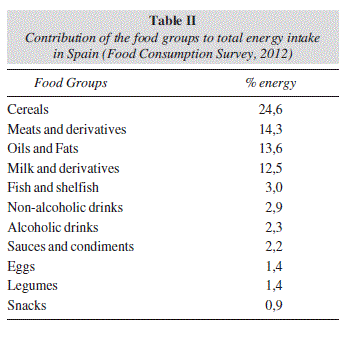
<body><![CDATA[<p><font face="Verdana" size="2"><i>Alcoholic beverages</i> consumption has undergone a slow decline during recent years (259 g/person/d in year 2000 vs. 208 g/person/d). Within this group, wine as a beverage traditionally included in the Mediterranean diet concept , only represented a 23.5% of the total alcoholic beverages consumption whereas it accounted a 62% of the total consumption in 1991. In the last few years, a gradual substitution of wine with beer has occurred, which represents almost a 70% of the total alcoholic beverage consumption at present. An important additional point is that almost 70% of these beverages were consumed out of home. One of the most striking change has been the enormous increase in <i>nonalcoholic beverages</i> consumption, since almost a tenfold increase was observed since 1964 (46 g/person/d vs.446 g/person/d at present).</font></p>     <p><font face="Verdana" size="2">Another food group of current importance, for which a marked rise in consumption was noticed, was <i>precooked foods or ready to eat meals</i> (23.3 g/person/day for year 2000 vs. 44.2 g/day at present). For this group, unfortunately there were no previous data available for an accurate comparison of the evolution trends.</font></p>     <p><font face="Verdana" size="2"><i>Adherence to the Recommended Serving Sizes for the Spanish Adult Population</i></font></p>     <p><font face="Verdana" size="2">Comparing data from the Spanish FCS with current dietary guidelines for the Spanish population (Dapcich et al, 2007) shows that meat and meat products consumption was clearly above the recommended amount, whereas for cereals and derivatives, vegetables and greens, fruit, and legumes and pulses consumption was lower than that considered to be optimal. Groups for which intakes were closer to the recommendations are milk and derivatives, fish and eggs.</font></p>     <p><font face="Verdana" size="2"><i>Energy and Nutrient Intake</i></font></p>     <p><font face="Verdana" size="2">The mean energy consumption for the Spanish adult population at present is 2609 kcal/person/d, which is clearly lower than in 1964 (3008 kcal/person/d). The trends in energy and macronutients intake from 2000-2012 are shown in <a href="#t1">table 1</a>.</font></p>     <p>&nbsp;</p>     <p align="center"><a name="t1"><img src="/img/revistas/nh/v28s5/02_articulo_02_t1.gif"></a></p>     <p>&nbsp;</p>     <p><font face="Verdana" size="2">The food groups contributing the most to energy consumption were cereals and derivatives (24.6%), meats and meat products (14.3%), oils and fats (13.6%) and milk and derivatives (12.5%). By contrast, fish and shellfish (3%), non-alcoholic beverages (2.9%), alcoholic beverages (2.3%) showed a much lower contribution to total energy intake besides the popular perception (<a href="#t2">table 2</a>).</font></p>     ]]></body>
<body><![CDATA[<p>&nbsp;</p>     <p align="center"><a name="t2"><img src="/img/revistas/nh/v28s5/02_articulo_02_t2.gif"></a></p>     <p>&nbsp;</p>     <p><font face="Verdana" size="2"><b>Discussion</b></font></p>     <p><font face="Verdana" size="2">Several nutrition surveys based on the National Institute of Statistics' Household Budgetary Surveys provide evidence of evolving trends in energy and nutrient intake estimates between 1961 and 1991 (Varela et al, 1971; Varela et al, 1991; Varela et al, 1995; INE, 1985). Since the beginning of the 1990s, a number of Spanish regions have also accomplished randomised population nutrition surveys, including food intake surveys of individuals. These are a valuable source of information from a public health perspective, enabling a more descriptive analysis of the food and nutrition situation of the Spanish population (Aranceta, 1994; Aranceta, 1998). The present study, conducted at national level, updates the food habits and nutritional aspects of importance for the Spanish population. In addition, trends emerging from the other surveys mentioned above were considered.</font></p>     <p><font face="Verdana" size="2">The Spanish diet may be still considered varied and healthy, although some trends need to be considered negative. Therefore, a more detailed analysis of food consumption patterns at present and evolutionary trends reveals some significant findings. A large proportion of the young adult Spanish population, mainly women, wrongly consider that potatoes and bread are &quot;fattening&quot; foods. However, a recent study (Academia Española de Gastronomía, 2006) confirmed that potatoes are still included among the five most consumed types of food by more than 95% of the population. The decline in egg consumption is probably due to the general concern that eggs are &quot;unhealthy&quot;, based on their cholesterol content. Although it is true that eggs contain cholesterol, it must be remembered that the consumption of saturated fatty acids has a higher influence on cholesterol levels than dietary cholesterol.</font></p>     <p><font face="Verdana" size="2">When compared with other countries, in the pan-European DAFNE study only Greece presented a higher consumption of the vegetables group at 271g/ person/day (Naska et al, 2006). From a nutritional point of view, the vegetables and greens group contributed 66% of total carotenoid intake in the diet in 2012. The high fruit consumption is clearly a positive aspect, as this food group will provide antioxidant vitamins and other components, such as pectins, fructose, &beta;-carotenoids and polyphenols, which may be beneficial in helping to prevent chronic degenerative diseases. In 2012 the fruit group contributed over 40 % of the total vitamin C consumed within the diet in Spain, mostly from fresh unprocessed foods. By contrast, legumes and pulses consumption seems to be too low according to the nutritional importance of this group; moreover, this group also provides high quality dietary protein and fibre at relatively low cost that is being skipped. The cereals and derivatives group contributed roughly a 43% of total dietary carbohydrate consumption and approximately 70% of the total starch.</font></p>     <p><font face="Verdana" size="2">The mean consumption of meat and meat products (181 g/person/day) may be considered to be very high according to the traditional <i>Mediterranean dietary patterns</i> and dietary guidelines. Paradoxically, for the DAFNE study Spain showed a higher consumption of meats than Ireland, Norway or the UK, whereas other traditional Mediterranean countries, such as Greece, showed a similar trend to Spain (Naska et al, 2006). Although total fish consumption may be considered high, omega 6/omega 3 fatty acids ratio in the diet in Spain was still not aligned with recommendations (16/1 vs. the recommended 4/1-5/1). In addition, this food group contributed 87% of total dietary vitamin D and 64% of the total vitamin B<sub>12</sub> consumption. The recommendation is to encourage the maintenance of this valuable characteristic of the Spanish diet.</font></p>     <p><font face="Verdana" size="2"><i>Adherence to the traditional Mediterranean diet</i></font></p>     <p><font face="Verdana" size="2">The food culture of the Spanish society is established within the Mediterranean diet frame, which is considered a healthy eating pattern mainly due to its potential protective role against the most common chronic diseases. It is generally agreed that the main components of the Mediterranean diet include a high intake of plant foods (vegetables, fruits, cereals, legumes, nuts and seeds, and olive oil); a low to moderate intake of dairy products (in the form of cheese or yogurt), low to moderate consumption of poultry and eggs; a moderately high intake of fish &amp; shellfish; low intake of <i>red</i> meat and processed meat products, and a moderate intake of wine during meals (Keys A et al, 1986).</font></p>     ]]></body>
<body><![CDATA[<p><font face="Verdana" size="2">At present, there is a high concern that the so-called Mediterranean diet is more a theoretical reference pattern based on the diet that existed in the 60's in some regions on the Mediterranean coast, and that it has been preserved to some extent in just a few Mediterranean locations (Willett et al, 1995). This seems to also be the case for Spain. Paradoxically, Spain is a major producer and exporter of typical Mediterranean products, a factor that amplifies the importance of maintaining a Mediterranean diet pattern.</font></p>     <p><font face="Verdana" size="2">The percentage contribution of carbohydrates has steadily decreased since 1964. In that year, the energy profile was in line with recommendations. This worsening is linked to the decline in the consumption of the cereals and derivatives, legumes and pulses, and potato groups. However, as expected, cereals and derivatives represented the highest contribution to total carbohydrates, followed by the milk and derivatives food group. In contrast, the percentage of lipids (43%) markedly exceeded the recommendations at the expense of carbohydrates. The main contributors to total dietary lipid consumption were oils and fats (30%); meat and derivatives (28%); milk and derivatives (15%); cereals and derivatives (9%); and fish and fish products (6%). In order to evaluate the dietary fat quality, the lipid profile was calculated (percentage contribution of the three fatty acid classes to the total energy), as well as relationships between PUFA/SFA and (PUFA+MUFA)/SFA. The SFA and PUFA fractions were well above the recommended levels. A positive aspect that should be maintained was the high proportion of MUFA due to the common occurrence of olive oil in the Spanish diet. In the present study, total omega-3 PUFA consumption was adequate but the percentage contribution of eicosapentaenoic acid (EPA) plus docosahexaenoic acid (DHA) to total energy consumption, which is recommended to be between 0.25 and 0.5%, was markedly below recommendations. As far as the omega 6/omega 3 ratio is concerned, the nutritional objectives for the Spanish population indicate that it should be between 5/1 and 4/1 (Mataix, 2005). However, the ratio was found to be deviating markedly towards the omega-6 fraction (16.6/1), which may compromise the potential benefits provided by the omega-3 fatty acids.</font></p>     <p><font face="Verdana" size="2">The percentage contribution of protein to total energy intake (15%) was unchanged since the survey in 2000 and is above the recommended profile. It is also advisable to decrease the proportion of animal protein in the total protein intake. The mean protein intake at present for the Spanish population was 93.5 g/person/day, the main contributors being: 28% from the meat and derivatives group; 19% from milk and derivatives; 17% from cereals and derivatives and 16% from fish and fish products.</font></p>     <p><font face="Verdana" size="2">In conclusion, social and economic changes have led to important modifications in food patterns in the last few decades, as has also been observed in previous studies (Balanza et al, 2007; García-Closas et al, 2006; Rodríguez-Artalejo et al, 1996). Some changes have had a <i>potential</i> positive impact, such as increasing variety in the diet and improved access to food, but are not consistent with an adequate food selection as described for a healthy Mediterranean type of diet. On the other hand, some changes have moved the Spanish diet away from the <i>traditional Mediterranean Diet pattern</i> (Moreno et al, 2002). Therefore, strategies that encourage a healthy diet and which also allow the recovery of the traditional characteristics of the Mediterranean Diet are a priority for nutritional policies. This may partly be achieved by an adequate use of new technologies which deal with food production, food conservation, food marketing and food distribution.</font></p>     <p>&nbsp;</p>     <p><font face="Verdana" size="2"><b>References</b></font></p>     <!-- ref --><p><font face="Verdana" size="2">1. Academia Española de Gastronomía (2006): Lo que come España. Estudio sociológico. En: Academia Española de Gastronomía &amp; Freixenet (eds), Barcelona.    &nbsp;&nbsp;&nbsp;&nbsp;&nbsp;&nbsp;&nbsp;&nbsp;[&#160;<a href="javascript:void(0);" onclick="javascript: window.open('/scielo.php?script=sci_nlinks&ref=3778610&pid=S0212-1611201300110000200001&lng=','','width=640,height=500,resizable=yes,scrollbars=1,menubar=yes,');">Links</a>&#160;]<!-- end-ref --><!-- ref --><p><font face="Verdana" size="2">2. Aranceta J, Pérez C, Amela C, García R. Encuesta de Nutrición de la Comunidad de Madrid. Documentos Técnicos de Salud Pública No. 18. Madrid: Dirección General de Prevención y Promoción de la Salud, Comunidad de Madrid, 1994.    &nbsp;&nbsp;&nbsp;&nbsp;&nbsp;&nbsp;&nbsp;&nbsp;[&#160;<a href="javascript:void(0);" onclick="javascript: window.open('/scielo.php?script=sci_nlinks&ref=3778611&pid=S0212-1611201300110000200002&lng=','','width=640,height=500,resizable=yes,scrollbars=1,menubar=yes,');">Links</a>&#160;]<!-- end-ref --></font></p>    <!-- ref --><p><font face="Verdana" size="2">3. Aranceta J, Pérez C, Marzana I, Eguileor I, González de Galdeano L, Saenz de Buruaga J. Food consumption patterns in the Basque Country: the EINUT-I study. <i>Public Health Nutr</i> 1998; 1: 185-92.    &nbsp;&nbsp;&nbsp;&nbsp;&nbsp;&nbsp;&nbsp;&nbsp;[&#160;<a href="javascript:void(0);" onclick="javascript: window.open('/scielo.php?script=sci_nlinks&ref=3778613&pid=S0212-1611201300110000200003&lng=','','width=640,height=500,resizable=yes,scrollbars=1,menubar=yes,');">Links</a>&#160;]<!-- end-ref --></font></p>    <!-- ref --><p><font face="Verdana" size="2">4. Aranceta-Bartrina J, Serra-Majem L. Hábitos alimentarios y consumo de alimentos en España. En: Aranceta K, Serra LL. Nutrición y Salud Pública. Métodos, bases científicas y aplicaciones, ed. Barcelona: Editorial Masson, 2006; p. 220-32.    &nbsp;&nbsp;&nbsp;&nbsp;&nbsp;&nbsp;&nbsp;&nbsp;[&#160;<a href="javascript:void(0);" onclick="javascript: window.open('/scielo.php?script=sci_nlinks&ref=3778615&pid=S0212-1611201300110000200004&lng=','','width=640,height=500,resizable=yes,scrollbars=1,menubar=yes,');">Links</a>&#160;]<!-- end-ref --></font></p>    <!-- ref --><p><font face="Verdana" size="2">5. Bach-Faig A, Serra-Majem L, Carrasco JL, Roman B, Ngo J, Bertomeu I, et al. The use of indexes evaluating the adherence to the Mediterranean diet in epidemiological studies: a review. <i>Public Health Nutr</i> 2006; 9: 132-46.    &nbsp;&nbsp;&nbsp;&nbsp;&nbsp;&nbsp;&nbsp;&nbsp;[&#160;<a href="javascript:void(0);" onclick="javascript: window.open('/scielo.php?script=sci_nlinks&ref=3778617&pid=S0212-1611201300110000200005&lng=','','width=640,height=500,resizable=yes,scrollbars=1,menubar=yes,');">Links</a>&#160;]<!-- end-ref --></font></p>    <!-- ref --><p><font face="Verdana" size="2">6. Balanza R, García-Lorda P, Pérez-Rodrigo C, Aranceta J, Bonet MB Salas-Salvadó J. Trends in food availability determined by the Food and Agriculture Organization's food balance sheets in Mediterranean Europe in comparison with other European areas. <i>Public Health Nutr</i> 2007; 10: 168-76.    &nbsp;&nbsp;&nbsp;&nbsp;&nbsp;&nbsp;&nbsp;&nbsp;[&#160;<a href="javascript:void(0);" onclick="javascript: window.open('/scielo.php?script=sci_nlinks&ref=3778619&pid=S0212-1611201300110000200006&lng=','','width=640,height=500,resizable=yes,scrollbars=1,menubar=yes,');">Links</a>&#160;]<!-- end-ref --></font></p>    <!-- ref --><p><font face="Verdana" size="2">7. Core report EURODIET Nutrition &amp; Diet for Healthy Lifestyles in Europe: Science &amp; Policy Implications. School of Medicine, University of Crete, 2000.    &nbsp;&nbsp;&nbsp;&nbsp;&nbsp;&nbsp;&nbsp;&nbsp;[&#160;<a href="javascript:void(0);" onclick="javascript: window.open('/scielo.php?script=sci_nlinks&ref=3778621&pid=S0212-1611201300110000200007&lng=','','width=640,height=500,resizable=yes,scrollbars=1,menubar=yes,');">Links</a>&#160;]<!-- end-ref --></font></p>    <!-- ref --><p><font face="Verdana" size="2">8. Cruz Cantera P. Percepción Social de la Familia en España. Madrid: CIS, 1995; p. 1-79.    &nbsp;&nbsp;&nbsp;&nbsp;&nbsp;&nbsp;&nbsp;&nbsp;[&#160;<a href="javascript:void(0);" onclick="javascript: window.open('/scielo.php?script=sci_nlinks&ref=3778623&pid=S0212-1611201300110000200008&lng=','','width=640,height=500,resizable=yes,scrollbars=1,menubar=yes,');">Links</a>&#160;]<!-- end-ref --></font></p>    <!-- ref --><p><font face="Verdana" size="2">9. Dapcich V, Salvador G, Ribas L, Pérez C, Aranceta J, Serra L. Consejos para una alimentación saludable de la Sociedad Española de Nutrición Comunitaria (SENC) y la Sociedad Española de Medicina de Familia y Comunitaria (SEMFYC)&quot;). Ed: Spanish Society of Community Nutrition (SENC) and Spanish Society of Family and Community Medicine (SEMFYC)&quot;, 2007.    &nbsp;&nbsp;&nbsp;&nbsp;&nbsp;&nbsp;&nbsp;&nbsp;[&#160;<a href="javascript:void(0);" onclick="javascript: window.open('/scielo.php?script=sci_nlinks&ref=3778625&pid=S0212-1611201300110000200009&lng=','','width=640,height=500,resizable=yes,scrollbars=1,menubar=yes,');">Links</a>&#160;]<!-- end-ref --></font></p>    <!-- ref --><p><font face="Verdana" size="2">10. FAO. FAOSTAT-PC, Food Balance Sheets 1997. Rome: FAO, 1998.    &nbsp;&nbsp;&nbsp;&nbsp;&nbsp;&nbsp;&nbsp;&nbsp;[&#160;<a href="javascript:void(0);" onclick="javascript: window.open('/scielo.php?script=sci_nlinks&ref=3778627&pid=S0212-1611201300110000200010&lng=','','width=640,height=500,resizable=yes,scrollbars=1,menubar=yes,');">Links</a>&#160;]<!-- end-ref --></font></p>    <!-- ref --><p><font face="Verdana" size="2">11. García-Closas R, Berenguer A, González CA. Changes in food supply in Mediterranean countries from 1961 to 2001. <i>Public Health Nutr</i> 2006; 9: 53-60.    &nbsp;&nbsp;&nbsp;&nbsp;&nbsp;&nbsp;&nbsp;&nbsp;[&#160;<a href="javascript:void(0);" onclick="javascript: window.open('/scielo.php?script=sci_nlinks&ref=3778629&pid=S0212-1611201300110000200011&lng=','','width=640,height=500,resizable=yes,scrollbars=1,menubar=yes,');">Links</a>&#160;]<!-- end-ref --></font></p>    <!-- ref --><p><font face="Verdana" size="2">12. Huijbregts P, Feskens E, Rasanen L, Fidanza F, Menotti A, Kromhout D. Dietary pattern and 20 year mortality in elderly men in Finland, Italy, and the Netherlands: longitudinal cohort study. <i>BMJ</i> 1997; 315: 13-7.    &nbsp;&nbsp;&nbsp;&nbsp;&nbsp;&nbsp;&nbsp;&nbsp;[&#160;<a href="javascript:void(0);" onclick="javascript: window.open('/scielo.php?script=sci_nlinks&ref=3778631&pid=S0212-1611201300110000200012&lng=','','width=640,height=500,resizable=yes,scrollbars=1,menubar=yes,');">Links</a>&#160;]<!-- end-ref --></font></p>    <!-- ref --><p><font face="Verdana" size="2">13. INE. Encuesta de Presupuestos Familiares 1980-81. Estudio sobre Nutrición Vol V, 2<sup>nd</sup> ed. Madrid: INE, 1985.    &nbsp;&nbsp;&nbsp;&nbsp;&nbsp;&nbsp;&nbsp;&nbsp;[&#160;<a href="javascript:void(0);" onclick="javascript: window.open('/scielo.php?script=sci_nlinks&ref=3778633&pid=S0212-1611201300110000200013&lng=','','width=640,height=500,resizable=yes,scrollbars=1,menubar=yes,');">Links</a>&#160;]<!-- end-ref --></font></p>    <!-- ref --><p><font face="Verdana" size="2">14. Keys A, Menotti A, Karvonen MJ. The diet and 15-year death rate in the seven countries study. Am. J. Epidemiol 1986; 124: 903-15.    &nbsp;&nbsp;&nbsp;&nbsp;&nbsp;&nbsp;&nbsp;&nbsp;[&#160;<a href="javascript:void(0);" onclick="javascript: window.open('/scielo.php?script=sci_nlinks&ref=3778635&pid=S0212-1611201300110000200014&lng=','','width=640,height=500,resizable=yes,scrollbars=1,menubar=yes,');">Links</a>&#160;]<!-- end-ref --></font></p>    <!-- ref --><p><font face="Verdana" size="2">15. Knoops KTB, Groot de LC, Fidanza F, Alberti-Fidanza A, Kromhout D, van Staveren WA. Comparison of three different dietary scores in relation to 10-year morality in elderly European subjects: the HALE project. <i>Eur J Clin Nutr</i> 2006; 60: 746-55.    &nbsp;&nbsp;&nbsp;&nbsp;&nbsp;&nbsp;&nbsp;&nbsp;[&#160;<a href="javascript:void(0);" onclick="javascript: window.open('/scielo.php?script=sci_nlinks&ref=3778637&pid=S0212-1611201300110000200015&lng=','','width=640,height=500,resizable=yes,scrollbars=1,menubar=yes,');">Links</a>&#160;]<!-- end-ref --></font></p>    <!-- ref --><p><font face="Verdana" size="2">16. Mataix J. Requerimientos e ingestas recomendadas de ácidos grasos omega-3 y ácido oléico. En: Mataix J, Gil A. <i>Libro blanco de los omega3</i>, ed. Granada: Puleva Biotech, 2005; p. 21-35.    &nbsp;&nbsp;&nbsp;&nbsp;&nbsp;&nbsp;&nbsp;&nbsp;[&#160;<a href="javascript:void(0);" onclick="javascript: window.open('/scielo.php?script=sci_nlinks&ref=3778639&pid=S0212-1611201300110000200016&lng=','','width=640,height=500,resizable=yes,scrollbars=1,menubar=yes,');">Links</a>&#160;]<!-- end-ref --></font></p>    <!-- ref --><p><font face="Verdana" size="2">17. Ministerio de Agricultura, Pesca y Alimentación (MAPA) (various years). La alimentación en España. Madrid: Ministerio de Agricultura, Pesca y Alimentación, Madrid, España.    &nbsp;&nbsp;&nbsp;&nbsp;&nbsp;&nbsp;&nbsp;&nbsp;[&#160;<a href="javascript:void(0);" onclick="javascript: window.open('/scielo.php?script=sci_nlinks&ref=3778641&pid=S0212-1611201300110000200017&lng=','','width=640,height=500,resizable=yes,scrollbars=1,menubar=yes,');">Links</a>&#160;]<!-- end-ref --></font></p>    <!-- ref --><p><font face="Verdana" size="2">18. Moreiras O, Carbajal A, Cabrera L, Cuadrado C. Tablas de composición de alimentos/Guía de Prácticas, 16<sup>th</sup> Edition. Madrid: Ediciones Pirámide, 2013.    &nbsp;&nbsp;&nbsp;&nbsp;&nbsp;&nbsp;&nbsp;&nbsp;[&#160;<a href="javascript:void(0);" onclick="javascript: window.open('/scielo.php?script=sci_nlinks&ref=3778643&pid=S0212-1611201300110000200018&lng=','','width=640,height=500,resizable=yes,scrollbars=1,menubar=yes,');">Links</a>&#160;]<!-- end-ref --></font></p>    <!-- ref --><p><font face="Verdana" size="2">19. Moreno LA, Sarria A, Popkin BM. The nutrition transition in Spain: a European Mediterranean country. <i>Eur J Clin Nutr</i> 2002; 56: 992-1003.    &nbsp;&nbsp;&nbsp;&nbsp;&nbsp;&nbsp;&nbsp;&nbsp;[&#160;<a href="javascript:void(0);" onclick="javascript: window.open('/scielo.php?script=sci_nlinks&ref=3778645&pid=S0212-1611201300110000200019&lng=','','width=640,height=500,resizable=yes,scrollbars=1,menubar=yes,');">Links</a>&#160;]<!-- end-ref --></font></p>    <!-- ref --><p><font face="Verdana" size="2">20. Naska A, Fouskakis D, Oikonomou E, Almeida MDV, Berg MA, Gedrich K, et al (2006). Dietary patterns and their socio-demographic determinants in 10 European countries: data from the DAFNE databank. <i>Eur J Clin Nutr</i> 2006; 60: 181-90.    &nbsp;&nbsp;&nbsp;&nbsp;&nbsp;&nbsp;&nbsp;&nbsp;[&#160;<a href="javascript:void(0);" onclick="javascript: window.open('/scielo.php?script=sci_nlinks&ref=3778647&pid=S0212-1611201300110000200020&lng=','','width=640,height=500,resizable=yes,scrollbars=1,menubar=yes,');">Links</a>&#160;]<!-- end-ref --></font></p>    <!-- ref --><p><font face="Verdana" size="2">21. Panagiotakos DB, Pitsavos C, Stefanadis D. Dietary patterns: A Mediterranean diet store and its relation to clinical and biological markers of cardiovascular disease risk. <i>Nutrition, Metabolism &amp; Cardiovascular Diseases</i> 2006; 16: 559-68.    &nbsp;&nbsp;&nbsp;&nbsp;&nbsp;&nbsp;&nbsp;&nbsp;[&#160;<a href="javascript:void(0);" onclick="javascript: window.open('/scielo.php?script=sci_nlinks&ref=3778649&pid=S0212-1611201300110000200021&lng=','','width=640,height=500,resizable=yes,scrollbars=1,menubar=yes,');">Links</a>&#160;]<!-- end-ref --></font></p>    <!-- ref --><p><font face="Verdana" size="2">22. Pérez Miguelsanz J, Cabrera W, Varela-Moreiras G, Garaulet M. Distribución regional de la grasa corporal. Uso de técnicas de imagen como herramienta de diagnóstico nutricional. <i>Nutr Hosp</i> 2010; 25: 207-23.    &nbsp;&nbsp;&nbsp;&nbsp;&nbsp;&nbsp;&nbsp;&nbsp;[&#160;<a href="javascript:void(0);" onclick="javascript: window.open('/scielo.php?script=sci_nlinks&ref=3778651&pid=S0212-1611201300110000200022&lng=','','width=640,height=500,resizable=yes,scrollbars=1,menubar=yes,');">Links</a>&#160;]<!-- end-ref --></font></p>    <!-- ref --><p><font face="Verdana" size="2">23. del Pozo S, García Iglesias V, Cuadrado C, Ruiz E, Valero T, Ávila JM, Varela Moreiras G. Valoración Nutricional de la Dieta Española de acuerdo al Panel de Consumo Alimentario. En: Ministerio de Agricultura, Alimentación y Medio Ambiente/Fundación Española de la Nutrición, eds., 2012.    &nbsp;&nbsp;&nbsp;&nbsp;&nbsp;&nbsp;&nbsp;&nbsp;[&#160;<a href="javascript:void(0);" onclick="javascript: window.open('/scielo.php?script=sci_nlinks&ref=3778653&pid=S0212-1611201300110000200023&lng=','','width=640,height=500,resizable=yes,scrollbars=1,menubar=yes,');">Links</a>&#160;]<!-- end-ref --></font></p>    <!-- ref --><p><font face="Verdana" size="2">24. Rodríguez-Artalejo F, Banegas JR, Graciani A, Hernández-Vecino R, del Rey-Calero J. Food supply versus household survey data: nutrient consumption trends for Spain, 1958-1988. <i>Eur J Epidemiol</i> 1996; 12: 367-71.    &nbsp;&nbsp;&nbsp;&nbsp;&nbsp;&nbsp;&nbsp;&nbsp;[&#160;<a href="javascript:void(0);" onclick="javascript: window.open('/scielo.php?script=sci_nlinks&ref=3778655&pid=S0212-1611201300110000200024&lng=','','width=640,height=500,resizable=yes,scrollbars=1,menubar=yes,');">Links</a>&#160;]<!-- end-ref --></font></p>    <!-- ref --><p><font face="Verdana" size="2">25. Sofi F, Cesari F, Abbate R, Gensini GF, Casini A. Adherence to Mediterranean diet and health status: meta-analysis. <i>BMJ</i> 2008; 28: 337-44.    &nbsp;&nbsp;&nbsp;&nbsp;&nbsp;&nbsp;&nbsp;&nbsp;[&#160;<a href="javascript:void(0);" onclick="javascript: window.open('/scielo.php?script=sci_nlinks&ref=3778657&pid=S0212-1611201300110000200025&lng=','','width=640,height=500,resizable=yes,scrollbars=1,menubar=yes,');">Links</a>&#160;]<!-- end-ref --></font></p>    <!-- ref --><p><font face="Verdana" size="2">26. The Data Food NEtworking (DAFNE) project. European Food Availability databank based on household budget surveys. Grant Agreement number S12.195600 between the Commission of the European Community and the National Kapodistrian University of Athens (NKUA), Greece, 2006.    &nbsp;&nbsp;&nbsp;&nbsp;&nbsp;&nbsp;&nbsp;&nbsp;[&#160;<a href="javascript:void(0);" onclick="javascript: window.open('/scielo.php?script=sci_nlinks&ref=3778659&pid=S0212-1611201300110000200026&lng=','','width=640,height=500,resizable=yes,scrollbars=1,menubar=yes,');">Links</a>&#160;]<!-- end-ref --></font></p>    <!-- ref --><p><font face="Verdana" size="2">27. Varela G, García D, Moreiras-Varela O. La Nutrición de los Españoles. Diagnóstico y Recomendaciones. Madrid: Escuela Nacional de Administración Pública, 1971.    &nbsp;&nbsp;&nbsp;&nbsp;&nbsp;&nbsp;&nbsp;&nbsp;[&#160;<a href="javascript:void(0);" onclick="javascript: window.open('/scielo.php?script=sci_nlinks&ref=3778661&pid=S0212-1611201300110000200027&lng=','','width=640,height=500,resizable=yes,scrollbars=1,menubar=yes,');">Links</a>&#160;]<!-- end-ref --></font></p>    <!-- ref --><p><font face="Verdana" size="2">28. Varela G, Moreiras O, Carbajal A, Campo M. Encuesta de presupuestos familiares 1990-91. Volume I. Spanish National Statistical Institute, 1991.    &nbsp;&nbsp;&nbsp;&nbsp;&nbsp;&nbsp;&nbsp;&nbsp;[&#160;<a href="javascript:void(0);" onclick="javascript: window.open('/scielo.php?script=sci_nlinks&ref=3778663&pid=S0212-1611201300110000200028&lng=','','width=640,height=500,resizable=yes,scrollbars=1,menubar=yes,');">Links</a>&#160;]<!-- end-ref --></font></p>    <!-- ref --><p><font face="Verdana" size="2">29. Varela G, Moreiras O, Carbajal A, Campo M. Encuesta de Presupuestos Familiares 1990-91. Estudio Nacional de Nutrición y Alimentación 1991. Vol I. Madrid: INE, 1995.    &nbsp;&nbsp;&nbsp;&nbsp;&nbsp;&nbsp;&nbsp;&nbsp;[&#160;<a href="javascript:void(0);" onclick="javascript: window.open('/scielo.php?script=sci_nlinks&ref=3778665&pid=S0212-1611201300110000200029&lng=','','width=640,height=500,resizable=yes,scrollbars=1,menubar=yes,');">Links</a>&#160;]<!-- end-ref --></font></p>    <!-- ref --><p><font face="Verdana" size="2">30. Varela Moreiras G, Ávila JM, Cuadrado C, del Pozo S, Ruiz E, Moreiras O. Valoración de la Dieta Española de acuerdo al Panel de Consumo Alimentario. En: Ministerio de Medio Ambiente y Medio Rural y Marino/Fundación Española de la Nutrición, eds, 2008.    &nbsp;&nbsp;&nbsp;&nbsp;&nbsp;&nbsp;&nbsp;&nbsp;[&#160;<a href="javascript:void(0);" onclick="javascript: window.open('/scielo.php?script=sci_nlinks&ref=3778667&pid=S0212-1611201300110000200030&lng=','','width=640,height=500,resizable=yes,scrollbars=1,menubar=yes,');">Links</a>&#160;]<!-- end-ref --></font></p>    <!-- ref --><p><font face="Verdana" size="2">31. Varela Moreiras G, Ávila JM, Cuadrado C, del Pozo S, Ruiz E, Moreiras O. Hábitos alimentarios y estado nutricional de la población inmigrante en España. En: Ministerio de Medio Ambiente y Medio Rural y Marino/Fundación Española de la Nutrición, eds, 2009.    &nbsp;&nbsp;&nbsp;&nbsp;&nbsp;&nbsp;&nbsp;&nbsp;[&#160;<a href="javascript:void(0);" onclick="javascript: window.open('/scielo.php?script=sci_nlinks&ref=3778669&pid=S0212-1611201300110000200031&lng=','','width=640,height=500,resizable=yes,scrollbars=1,menubar=yes,');">Links</a>&#160;]<!-- end-ref --></font></p>    <!-- ref --><p><font face="Verdana" size="2">32. Varela-Moreiras G, Ávila JM, Cuadrado C, del Pozo S, Ruiz E, Moreiras O. Evaluation of food consumption and dietary patterns in Spain by the Food Consumption Survey. <i>European Journal of Clinical Nutrition</i> 2010; 64: S37-43.    &nbsp;&nbsp;&nbsp;&nbsp;&nbsp;&nbsp;&nbsp;&nbsp;[&#160;<a href="javascript:void(0);" onclick="javascript: window.open('/scielo.php?script=sci_nlinks&ref=3778671&pid=S0212-1611201300110000200032&lng=','','width=640,height=500,resizable=yes,scrollbars=1,menubar=yes,');">Links</a>&#160;]<!-- end-ref --></font></p>    <!-- ref --><p><font face="Verdana" size="2">33. Willett WC, Sacks F, Trichopoulou A, Drescher G, Ferro-Luzzi A, Helsing E et al. Mediterranean diet pyramid: a cultural model for healthy eating. <i>Am J Clin Nutr</i> 1995; 6: 1402S-6.    &nbsp;&nbsp;&nbsp;&nbsp;&nbsp;&nbsp;&nbsp;&nbsp;[&#160;<a href="javascript:void(0);" onclick="javascript: window.open('/scielo.php?script=sci_nlinks&ref=3778673&pid=S0212-1611201300110000200033&lng=','','width=640,height=500,resizable=yes,scrollbars=1,menubar=yes,');">Links</a>&#160;]<!-- end-ref --></font></p>     <p>&nbsp;</p>     <p>&nbsp;</p>     <p><font face="Verdana" size="2"><a href="#top"><img border="0" src="/img/revistas/nh/v28s5/seta.gif" width="15" height="17"></a><a name="bajo"></a><b>Correspondence:</b>    <br>Gregorio Varela-Moreiras    <br>Facultad de Farmacia    <br>Universidad CEU San Pablo    <br>Urb. Montepríncipe, crta. Boadilla, km. 5,3    <br>28668 Boadilla del Monte. Madrid. Spain    <br>E-mail: <a href="mailto:gvarela@ceu.es">gvarela@ceu.es</a>; <a href="mailto:gvarela@fen.org.es">gvarela@fen.org.es</a></font></p>     ]]></body>
<body><![CDATA[ ]]></body><back>
<ref-list>
<ref id="B1">
<label>1</label><nlm-citation citation-type="book">
<collab>Academia Española de Gastronomía</collab>
<source><![CDATA[Lo que come España: Estudio sociológico]]></source>
<year>2006</year>
<publisher-loc><![CDATA[Barcelona ]]></publisher-loc>
<publisher-name><![CDATA[Academia Española de GastronomíaFreixenet]]></publisher-name>
</nlm-citation>
</ref>
<ref id="B2">
<label>2</label><nlm-citation citation-type="book">
<person-group person-group-type="author">
<name>
<surname><![CDATA[Aranceta]]></surname>
<given-names><![CDATA[J]]></given-names>
</name>
<name>
<surname><![CDATA[Pérez]]></surname>
<given-names><![CDATA[C]]></given-names>
</name>
<name>
<surname><![CDATA[Amela]]></surname>
<given-names><![CDATA[C]]></given-names>
</name>
<name>
<surname><![CDATA[García]]></surname>
<given-names><![CDATA[R]]></given-names>
</name>
</person-group>
<source><![CDATA[Encuesta de Nutrición de la Comunidad de Madrid]]></source>
<year>1994</year>
<volume>18</volume>
<publisher-loc><![CDATA[Madrid ]]></publisher-loc>
<publisher-name><![CDATA[Dirección General de Prevención y Promoción de la Salud, Comunidad de Madrid]]></publisher-name>
</nlm-citation>
</ref>
<ref id="B3">
<label>3</label><nlm-citation citation-type="journal">
<person-group person-group-type="author">
<name>
<surname><![CDATA[Aranceta]]></surname>
<given-names><![CDATA[J]]></given-names>
</name>
<name>
<surname><![CDATA[Pérez]]></surname>
<given-names><![CDATA[C]]></given-names>
</name>
<name>
<surname><![CDATA[Marzana]]></surname>
<given-names><![CDATA[I]]></given-names>
</name>
<name>
<surname><![CDATA[Eguileor]]></surname>
<given-names><![CDATA[I]]></given-names>
</name>
<name>
<surname><![CDATA[González de Galdeano]]></surname>
<given-names><![CDATA[L]]></given-names>
</name>
<name>
<surname><![CDATA[Saenz de Buruaga]]></surname>
<given-names><![CDATA[J]]></given-names>
</name>
</person-group>
<article-title xml:lang="en"><![CDATA[Food consumption patterns in the Basque Country: the EINUT-I study]]></article-title>
<source><![CDATA[Public Health Nutr]]></source>
<year>1998</year>
<volume>1</volume>
<page-range>185-92</page-range></nlm-citation>
</ref>
<ref id="B4">
<label>4</label><nlm-citation citation-type="book">
<person-group person-group-type="author">
<name>
<surname><![CDATA[Aranceta-Bartrina]]></surname>
<given-names><![CDATA[J]]></given-names>
</name>
<name>
<surname><![CDATA[Serra-Majem]]></surname>
<given-names><![CDATA[L]]></given-names>
</name>
</person-group>
<article-title xml:lang="es"><![CDATA[Hábitos alimentarios y consumo de alimentos en España]]></article-title>
<person-group person-group-type="editor">
<name>
<surname><![CDATA[Aranceta]]></surname>
<given-names><![CDATA[K]]></given-names>
</name>
<name>
<surname><![CDATA[Serra]]></surname>
<given-names><![CDATA[LL]]></given-names>
</name>
</person-group>
<source><![CDATA[Nutrición y Salud Pública: Métodos, bases científicas y aplicaciones]]></source>
<year>2006</year>
<page-range>220-32</page-range><publisher-loc><![CDATA[Barcelona ]]></publisher-loc>
<publisher-name><![CDATA[Editorial Masson]]></publisher-name>
</nlm-citation>
</ref>
<ref id="B5">
<label>5</label><nlm-citation citation-type="journal">
<person-group person-group-type="author">
<name>
<surname><![CDATA[Bach-Faig]]></surname>
<given-names><![CDATA[A]]></given-names>
</name>
<name>
<surname><![CDATA[Serra-Majem]]></surname>
<given-names><![CDATA[L]]></given-names>
</name>
<name>
<surname><![CDATA[Carrasco]]></surname>
<given-names><![CDATA[JL]]></given-names>
</name>
<name>
<surname><![CDATA[Roman]]></surname>
<given-names><![CDATA[B]]></given-names>
</name>
<name>
<surname><![CDATA[Ngo]]></surname>
<given-names><![CDATA[J]]></given-names>
</name>
<name>
<surname><![CDATA[Bertomeu]]></surname>
<given-names><![CDATA[I]]></given-names>
</name>
</person-group>
<article-title xml:lang="en"><![CDATA[The use of indexes evaluating the adherence to the Mediterranean diet in epidemiological studies: a review]]></article-title>
<source><![CDATA[Public Health Nutr]]></source>
<year>2006</year>
<volume>9</volume>
<page-range>132-46</page-range></nlm-citation>
</ref>
<ref id="B6">
<label>6</label><nlm-citation citation-type="journal">
<person-group person-group-type="author">
<name>
<surname><![CDATA[Balanza]]></surname>
<given-names><![CDATA[R]]></given-names>
</name>
<name>
<surname><![CDATA[García-Lorda]]></surname>
<given-names><![CDATA[P]]></given-names>
</name>
<name>
<surname><![CDATA[Pérez-Rodrigo]]></surname>
<given-names><![CDATA[C]]></given-names>
</name>
<name>
<surname><![CDATA[Aranceta]]></surname>
<given-names><![CDATA[J]]></given-names>
</name>
<name>
<surname><![CDATA[Bonet]]></surname>
<given-names><![CDATA[MB]]></given-names>
</name>
<name>
<surname><![CDATA[Salas-Salvadó]]></surname>
<given-names><![CDATA[J]]></given-names>
</name>
</person-group>
<article-title xml:lang="en"><![CDATA[Trends in food availability determined by the Food and Agriculture Organization's food balance sheets in Mediterranean Europe in comparison with other European areas]]></article-title>
<source><![CDATA[Public Health Nutr]]></source>
<year>2007</year>
<volume>10</volume>
<page-range>168-76</page-range></nlm-citation>
</ref>
<ref id="B7">
<label>7</label><nlm-citation citation-type="book">
<source><![CDATA[Core report EURODIET Nutrition & Diet for Healthy Lifestyles in Europe: Science & Policy Implications]]></source>
<year>2000</year>
<publisher-name><![CDATA[School of Medicine, University of Crete]]></publisher-name>
</nlm-citation>
</ref>
<ref id="B8">
<label>8</label><nlm-citation citation-type="book">
<person-group person-group-type="author">
<name>
<surname><![CDATA[Cruz Cantera]]></surname>
<given-names><![CDATA[P]]></given-names>
</name>
</person-group>
<source><![CDATA[Percepción Social de la Familia en España]]></source>
<year>1995</year>
<page-range>1-79</page-range><publisher-loc><![CDATA[Madrid ]]></publisher-loc>
<publisher-name><![CDATA[CIS]]></publisher-name>
</nlm-citation>
</ref>
<ref id="B9">
<label>9</label><nlm-citation citation-type="book">
<person-group person-group-type="author">
<name>
<surname><![CDATA[Dapcich]]></surname>
<given-names><![CDATA[V]]></given-names>
</name>
<name>
<surname><![CDATA[Salvador]]></surname>
<given-names><![CDATA[G]]></given-names>
</name>
<name>
<surname><![CDATA[Ribas]]></surname>
<given-names><![CDATA[L]]></given-names>
</name>
<name>
<surname><![CDATA[Pérez]]></surname>
<given-names><![CDATA[C]]></given-names>
</name>
<name>
<surname><![CDATA[Aranceta]]></surname>
<given-names><![CDATA[J]]></given-names>
</name>
<name>
<surname><![CDATA[Serra]]></surname>
<given-names><![CDATA[L]]></given-names>
</name>
</person-group>
<source><![CDATA[Consejos para una alimentación saludable de la Sociedad Española de Nutrición Comunitaria (SENC) y la Sociedad Española de Medicina de Familia y Comunitaria (SEMFYC)")]]></source>
<year>2007</year>
<publisher-name><![CDATA[Spanish Society of Community Nutrition (SENC)Spanish Society of Family and Community Medicine (SEMFYC)]]></publisher-name>
</nlm-citation>
</ref>
<ref id="B10">
<label>10</label><nlm-citation citation-type="book">
<collab>FAO</collab>
<source><![CDATA[FAOSTAT-PC: Food Balance Sheets 1997]]></source>
<year>1998</year>
<publisher-loc><![CDATA[Rome ]]></publisher-loc>
<publisher-name><![CDATA[FAO]]></publisher-name>
</nlm-citation>
</ref>
<ref id="B11">
<label>11</label><nlm-citation citation-type="journal">
<person-group person-group-type="author">
<name>
<surname><![CDATA[García-Closas]]></surname>
<given-names><![CDATA[R]]></given-names>
</name>
<name>
<surname><![CDATA[Berenguer]]></surname>
<given-names><![CDATA[A]]></given-names>
</name>
<name>
<surname><![CDATA[González]]></surname>
<given-names><![CDATA[CA]]></given-names>
</name>
</person-group>
<article-title xml:lang="en"><![CDATA[Changes in food supply in Mediterranean countries from 1961 to 2001]]></article-title>
<source><![CDATA[Public Health Nutr]]></source>
<year>2006</year>
<volume>9</volume>
<page-range>53-60</page-range></nlm-citation>
</ref>
<ref id="B12">
<label>12</label><nlm-citation citation-type="journal">
<person-group person-group-type="author">
<name>
<surname><![CDATA[Huijbregts]]></surname>
<given-names><![CDATA[P]]></given-names>
</name>
<name>
<surname><![CDATA[Feskens]]></surname>
<given-names><![CDATA[E]]></given-names>
</name>
<name>
<surname><![CDATA[Rasanen]]></surname>
<given-names><![CDATA[L]]></given-names>
</name>
<name>
<surname><![CDATA[Fidanza]]></surname>
<given-names><![CDATA[F]]></given-names>
</name>
<name>
<surname><![CDATA[Menotti]]></surname>
<given-names><![CDATA[A]]></given-names>
</name>
<name>
<surname><![CDATA[Kromhout]]></surname>
<given-names><![CDATA[D]]></given-names>
</name>
</person-group>
<article-title xml:lang="en"><![CDATA[Dietary pattern and 20 year mortality in elderly men in Finland, Italy, and the Netherlands: longitudinal cohort study]]></article-title>
<source><![CDATA[BMJ]]></source>
<year>1997</year>
<volume>315</volume>
<page-range>13-7</page-range></nlm-citation>
</ref>
<ref id="B13">
<label>13</label><nlm-citation citation-type="book">
<collab>INE</collab>
<source><![CDATA[Encuesta de Presupuestos Familiares 1980-81: Estudio sobre Nutrición]]></source>
<year>1985</year>
<volume>V</volume>
<edition>2</edition>
<publisher-loc><![CDATA[Madrid ]]></publisher-loc>
<publisher-name><![CDATA[INE]]></publisher-name>
</nlm-citation>
</ref>
<ref id="B14">
<label>14</label><nlm-citation citation-type="journal">
<person-group person-group-type="author">
<name>
<surname><![CDATA[Keys]]></surname>
<given-names><![CDATA[A]]></given-names>
</name>
<name>
<surname><![CDATA[Menotti]]></surname>
<given-names><![CDATA[A]]></given-names>
</name>
<name>
<surname><![CDATA[Karvonen]]></surname>
<given-names><![CDATA[MJ]]></given-names>
</name>
</person-group>
<article-title xml:lang="en"><![CDATA[The diet and 15-year death rate in the seven countries study]]></article-title>
<source><![CDATA[Am. J. Epidemiol]]></source>
<year>1986</year>
<volume>124</volume>
<page-range>903-15</page-range></nlm-citation>
</ref>
<ref id="B15">
<label>15</label><nlm-citation citation-type="journal">
<person-group person-group-type="author">
<name>
<surname><![CDATA[Knoops]]></surname>
<given-names><![CDATA[KTB]]></given-names>
</name>
<name>
<surname><![CDATA[Groot]]></surname>
<given-names><![CDATA[de LC]]></given-names>
</name>
<name>
<surname><![CDATA[Fidanza]]></surname>
<given-names><![CDATA[F]]></given-names>
</name>
<name>
<surname><![CDATA[Alberti-Fidanza]]></surname>
<given-names><![CDATA[A]]></given-names>
</name>
<name>
<surname><![CDATA[Kromhout]]></surname>
<given-names><![CDATA[D]]></given-names>
</name>
<name>
<surname><![CDATA[van Staveren]]></surname>
<given-names><![CDATA[WA]]></given-names>
</name>
</person-group>
<article-title xml:lang="en"><![CDATA[Comparison of three different dietary scores in relation to 10-year morality in elderly European subjects: the HALE project]]></article-title>
<source><![CDATA[Eur J Clin Nutr]]></source>
<year>2006</year>
<volume>60</volume>
<page-range>746-55</page-range></nlm-citation>
</ref>
<ref id="B16">
<label>16</label><nlm-citation citation-type="book">
<person-group person-group-type="author">
<name>
<surname><![CDATA[Mataix]]></surname>
<given-names><![CDATA[J]]></given-names>
</name>
</person-group>
<article-title xml:lang="es"><![CDATA[Requerimientos e ingestas recomendadas de ácidos grasos omega-3 y ácido oléico]]></article-title>
<person-group person-group-type="editor">
<name>
<surname><![CDATA[Mataix]]></surname>
<given-names><![CDATA[J]]></given-names>
</name>
<name>
<surname><![CDATA[Gil]]></surname>
<given-names><![CDATA[A]]></given-names>
</name>
</person-group>
<source><![CDATA[Libro blanco de los omega3]]></source>
<year>2005</year>
<page-range>21-35</page-range><publisher-loc><![CDATA[Granada ]]></publisher-loc>
<publisher-name><![CDATA[Puleva Biotech]]></publisher-name>
</nlm-citation>
</ref>
<ref id="B17">
<label>17</label><nlm-citation citation-type="book">
<collab>Ministerio de Agricultura, Pesca y Alimentación (MAPA)</collab>
<source><![CDATA[La alimentación en España]]></source>
<year></year>
<publisher-loc><![CDATA[Madrid ]]></publisher-loc>
<publisher-name><![CDATA[Ministerio de Agricultura, Pesca y Alimentación, Madrid]]></publisher-name>
</nlm-citation>
</ref>
<ref id="B18">
<label>18</label><nlm-citation citation-type="book">
<person-group person-group-type="author">
<name>
<surname><![CDATA[Moreiras]]></surname>
<given-names><![CDATA[O]]></given-names>
</name>
<name>
<surname><![CDATA[Carbajal]]></surname>
<given-names><![CDATA[A]]></given-names>
</name>
<name>
<surname><![CDATA[Cabrera]]></surname>
<given-names><![CDATA[L]]></given-names>
</name>
<name>
<surname><![CDATA[Cuadrado]]></surname>
<given-names><![CDATA[C]]></given-names>
</name>
</person-group>
<source><![CDATA[Tablas de composición de alimentos/Guía de Prácticas]]></source>
<year>2013</year>
<edition>16</edition>
<publisher-loc><![CDATA[Madrid ]]></publisher-loc>
<publisher-name><![CDATA[Ediciones Pirámide]]></publisher-name>
</nlm-citation>
</ref>
<ref id="B19">
<label>19</label><nlm-citation citation-type="journal">
<person-group person-group-type="author">
<name>
<surname><![CDATA[Moreno]]></surname>
<given-names><![CDATA[LA]]></given-names>
</name>
<name>
<surname><![CDATA[Sarria]]></surname>
<given-names><![CDATA[A]]></given-names>
</name>
<name>
<surname><![CDATA[Popkin]]></surname>
<given-names><![CDATA[BM]]></given-names>
</name>
</person-group>
<article-title xml:lang="en"><![CDATA[The nutrition transition in Spain: a European Mediterranean country]]></article-title>
<source><![CDATA[Eur J Clin Nutr]]></source>
<year>2002</year>
<volume>56</volume>
<page-range>992-1003</page-range></nlm-citation>
</ref>
<ref id="B20">
<label>20</label><nlm-citation citation-type="journal">
<person-group person-group-type="author">
<name>
<surname><![CDATA[Naska]]></surname>
<given-names><![CDATA[A]]></given-names>
</name>
<name>
<surname><![CDATA[Fouskakis]]></surname>
<given-names><![CDATA[D]]></given-names>
</name>
<name>
<surname><![CDATA[Oikonomou]]></surname>
<given-names><![CDATA[E]]></given-names>
</name>
<name>
<surname><![CDATA[Almeida]]></surname>
<given-names><![CDATA[MDV]]></given-names>
</name>
<name>
<surname><![CDATA[Berg]]></surname>
<given-names><![CDATA[MA]]></given-names>
</name>
<name>
<surname><![CDATA[Gedrich]]></surname>
<given-names><![CDATA[K]]></given-names>
</name>
</person-group>
<article-title xml:lang="en"><![CDATA[Dietary patterns and their socio-demographic determinants in 10 European countries: data from the DAFNE databank]]></article-title>
<source><![CDATA[Eur J Clin Nutr]]></source>
<year>2006</year>
<month>20</month>
<day>06</day>
<volume>60</volume>
<page-range>181-90</page-range></nlm-citation>
</ref>
<ref id="B21">
<label>21</label><nlm-citation citation-type="journal">
<person-group person-group-type="author">
<name>
<surname><![CDATA[Panagiotakos]]></surname>
<given-names><![CDATA[DB]]></given-names>
</name>
<name>
<surname><![CDATA[Pitsavos]]></surname>
<given-names><![CDATA[C]]></given-names>
</name>
<name>
<surname><![CDATA[Stefanadis]]></surname>
<given-names><![CDATA[D]]></given-names>
</name>
</person-group>
<article-title xml:lang="en"><![CDATA[Dietary patterns: A Mediterranean diet store and its relation to clinical and biological markers of cardiovascular disease risk]]></article-title>
<source><![CDATA[Nutrition, Metabolism & Cardiovascular Diseases]]></source>
<year>2006</year>
<volume>16</volume>
<page-range>559-68</page-range></nlm-citation>
</ref>
<ref id="B22">
<label>22</label><nlm-citation citation-type="journal">
<person-group person-group-type="author">
<name>
<surname><![CDATA[Pérez Miguelsanz]]></surname>
<given-names><![CDATA[J]]></given-names>
</name>
<name>
<surname><![CDATA[Cabrera]]></surname>
<given-names><![CDATA[W]]></given-names>
</name>
<name>
<surname><![CDATA[Varela-Moreiras]]></surname>
<given-names><![CDATA[G]]></given-names>
</name>
<name>
<surname><![CDATA[Garaulet]]></surname>
<given-names><![CDATA[M]]></given-names>
</name>
</person-group>
<article-title xml:lang="es"><![CDATA[Distribución regional de la grasa corporal: Uso de técnicas de imagen como herramienta de diagnóstico nutricional]]></article-title>
<source><![CDATA[Nutr Hosp]]></source>
<year>2010</year>
<volume>25</volume>
<page-range>207-23</page-range></nlm-citation>
</ref>
<ref id="B23">
<label>23</label><nlm-citation citation-type="book">
<person-group person-group-type="author">
<name>
<surname><![CDATA[del Pozo]]></surname>
<given-names><![CDATA[S]]></given-names>
</name>
<name>
<surname><![CDATA[García Iglesias]]></surname>
<given-names><![CDATA[V]]></given-names>
</name>
<name>
<surname><![CDATA[Cuadrado]]></surname>
<given-names><![CDATA[C]]></given-names>
</name>
<name>
<surname><![CDATA[Ruiz]]></surname>
<given-names><![CDATA[E]]></given-names>
</name>
<name>
<surname><![CDATA[Valero]]></surname>
<given-names><![CDATA[T]]></given-names>
</name>
<name>
<surname><![CDATA[Ávila]]></surname>
<given-names><![CDATA[JM]]></given-names>
</name>
<name>
<surname><![CDATA[Varela Moreiras]]></surname>
<given-names><![CDATA[G]]></given-names>
</name>
</person-group>
<source><![CDATA[Valoración Nutricional de la Dieta Española de acuerdo al Panel de Consumo Alimentario]]></source>
<year>2012</year>
<publisher-name><![CDATA[Ministerio de Agricultura, Alimentación y Medio AmbienteFundación Española de la Nutrición]]></publisher-name>
</nlm-citation>
</ref>
<ref id="B24">
<label>24</label><nlm-citation citation-type="journal">
<person-group person-group-type="author">
<name>
<surname><![CDATA[Rodríguez-Artalejo]]></surname>
<given-names><![CDATA[F]]></given-names>
</name>
<name>
<surname><![CDATA[Banegas]]></surname>
<given-names><![CDATA[JR]]></given-names>
</name>
<name>
<surname><![CDATA[Graciani]]></surname>
<given-names><![CDATA[A]]></given-names>
</name>
<name>
<surname><![CDATA[Hernández-Vecino]]></surname>
<given-names><![CDATA[R]]></given-names>
</name>
<name>
<surname><![CDATA[del Rey-Calero]]></surname>
<given-names><![CDATA[J]]></given-names>
</name>
</person-group>
<article-title xml:lang="en"><![CDATA[Food supply versus household survey data: nutrient consumption trends for Spain, 1958-1988]]></article-title>
<source><![CDATA[Eur J Epidemiol]]></source>
<year>1996</year>
<volume>12</volume>
<page-range>367-71</page-range></nlm-citation>
</ref>
<ref id="B25">
<label>25</label><nlm-citation citation-type="journal">
<person-group person-group-type="author">
<name>
<surname><![CDATA[Sofi]]></surname>
<given-names><![CDATA[F]]></given-names>
</name>
<name>
<surname><![CDATA[Cesari]]></surname>
<given-names><![CDATA[F]]></given-names>
</name>
<name>
<surname><![CDATA[Abbate]]></surname>
<given-names><![CDATA[R]]></given-names>
</name>
<name>
<surname><![CDATA[Gensini]]></surname>
<given-names><![CDATA[GF]]></given-names>
</name>
<name>
<surname><![CDATA[Casini]]></surname>
<given-names><![CDATA[A]]></given-names>
</name>
</person-group>
<article-title xml:lang="en"><![CDATA[Adherence to Mediterranean diet and health status: meta-analysis]]></article-title>
<source><![CDATA[BMJ]]></source>
<year>2008</year>
<volume>28</volume>
<page-range>337-44</page-range></nlm-citation>
</ref>
<ref id="B26">
<label>26</label><nlm-citation citation-type="">
<source><![CDATA[The Data Food NEtworking (DAFNE) project: European Food Availability databank based on household budget surveys]]></source>
<year>2006</year>
<publisher-loc><![CDATA[Greece ]]></publisher-loc>
</nlm-citation>
</ref>
<ref id="B27">
<label>27</label><nlm-citation citation-type="book">
<person-group person-group-type="author">
<name>
<surname><![CDATA[Varela]]></surname>
<given-names><![CDATA[G]]></given-names>
</name>
<name>
<surname><![CDATA[García]]></surname>
<given-names><![CDATA[D]]></given-names>
</name>
<name>
<surname><![CDATA[Moreiras-Varela]]></surname>
<given-names><![CDATA[O]]></given-names>
</name>
</person-group>
<source><![CDATA[La Nutrición de los Españoles: Diagnóstico y Recomendaciones]]></source>
<year>1971</year>
<publisher-loc><![CDATA[Madrid ]]></publisher-loc>
<publisher-name><![CDATA[Escuela Nacional de Administración Pública]]></publisher-name>
</nlm-citation>
</ref>
<ref id="B28">
<label>28</label><nlm-citation citation-type="book">
<person-group person-group-type="author">
<name>
<surname><![CDATA[Varela]]></surname>
<given-names><![CDATA[G]]></given-names>
</name>
<name>
<surname><![CDATA[Moreiras]]></surname>
<given-names><![CDATA[O]]></given-names>
</name>
<name>
<surname><![CDATA[Carbajal]]></surname>
<given-names><![CDATA[A]]></given-names>
</name>
<name>
<surname><![CDATA[Campo]]></surname>
<given-names><![CDATA[M]]></given-names>
</name>
</person-group>
<source><![CDATA[Encuesta de presupuestos familiares 1990-91]]></source>
<year>1991</year>
<volume>I</volume>
<publisher-name><![CDATA[Spanish National Statistical Institute]]></publisher-name>
</nlm-citation>
</ref>
<ref id="B29">
<label>29</label><nlm-citation citation-type="book">
<person-group person-group-type="author">
<name>
<surname><![CDATA[Varela]]></surname>
<given-names><![CDATA[G]]></given-names>
</name>
<name>
<surname><![CDATA[Moreiras]]></surname>
<given-names><![CDATA[O]]></given-names>
</name>
<name>
<surname><![CDATA[Carbajal]]></surname>
<given-names><![CDATA[A]]></given-names>
</name>
<name>
<surname><![CDATA[Campo]]></surname>
<given-names><![CDATA[M]]></given-names>
</name>
</person-group>
<source><![CDATA[Encuesta de Presupuestos Familiares 1990-91: Estudio Nacional de Nutrición y Alimentación 1991]]></source>
<year>1995</year>
<volume>I</volume>
<publisher-loc><![CDATA[Madrid ]]></publisher-loc>
<publisher-name><![CDATA[INE]]></publisher-name>
</nlm-citation>
</ref>
<ref id="B30">
<label>30</label><nlm-citation citation-type="book">
<person-group person-group-type="author">
<name>
<surname><![CDATA[Varela Moreiras]]></surname>
<given-names><![CDATA[G]]></given-names>
</name>
<name>
<surname><![CDATA[Ávila]]></surname>
<given-names><![CDATA[JM]]></given-names>
</name>
<name>
<surname><![CDATA[Cuadrado]]></surname>
<given-names><![CDATA[C]]></given-names>
</name>
<name>
<surname><![CDATA[del Pozo]]></surname>
<given-names><![CDATA[S]]></given-names>
</name>
<name>
<surname><![CDATA[Ruiz]]></surname>
<given-names><![CDATA[E]]></given-names>
</name>
<name>
<surname><![CDATA[Moreiras]]></surname>
<given-names><![CDATA[O]]></given-names>
</name>
</person-group>
<source><![CDATA[Valoración de la Dieta Española de acuerdo al Panel de Consumo Alimentario]]></source>
<year>2008</year>
<publisher-name><![CDATA[Ministerio de Medio Ambiente y Medio Rural y MarinoFundación Española de la Nutrición]]></publisher-name>
</nlm-citation>
</ref>
<ref id="B31">
<label>31</label><nlm-citation citation-type="book">
<person-group person-group-type="author">
<name>
<surname><![CDATA[Varela Moreiras]]></surname>
<given-names><![CDATA[G]]></given-names>
</name>
<name>
<surname><![CDATA[Ávila]]></surname>
<given-names><![CDATA[JM]]></given-names>
</name>
<name>
<surname><![CDATA[Cuadrado]]></surname>
<given-names><![CDATA[C]]></given-names>
</name>
<name>
<surname><![CDATA[del Pozo]]></surname>
<given-names><![CDATA[S]]></given-names>
</name>
<name>
<surname><![CDATA[Ruiz]]></surname>
<given-names><![CDATA[E]]></given-names>
</name>
<name>
<surname><![CDATA[Moreiras]]></surname>
<given-names><![CDATA[O]]></given-names>
</name>
</person-group>
<source><![CDATA[Hábitos alimentarios y estado nutricional de la población inmigrante en España]]></source>
<year>2009</year>
<publisher-name><![CDATA[Ministerio de Medio Ambiente y Medio Rural y MarinoFundación Española de la Nutrición]]></publisher-name>
</nlm-citation>
</ref>
<ref id="B32">
<label>32</label><nlm-citation citation-type="journal">
<person-group person-group-type="author">
<name>
<surname><![CDATA[Varela-Moreiras]]></surname>
<given-names><![CDATA[G]]></given-names>
</name>
<name>
<surname><![CDATA[Ávila]]></surname>
<given-names><![CDATA[JM]]></given-names>
</name>
<name>
<surname><![CDATA[Cuadrado]]></surname>
<given-names><![CDATA[C]]></given-names>
</name>
<name>
<surname><![CDATA[del Pozo]]></surname>
<given-names><![CDATA[S]]></given-names>
</name>
<name>
<surname><![CDATA[Ruiz]]></surname>
<given-names><![CDATA[E]]></given-names>
</name>
<name>
<surname><![CDATA[Moreiras]]></surname>
<given-names><![CDATA[O]]></given-names>
</name>
</person-group>
<article-title xml:lang="en"><![CDATA[Evaluation of food consumption and dietary patterns in Spain by the Food Consumption Survey]]></article-title>
<source><![CDATA[European Journal of Clinical Nutrition]]></source>
<year>2010</year>
<volume>64</volume>
<page-range>S37-43</page-range></nlm-citation>
</ref>
<ref id="B33">
<label>33</label><nlm-citation citation-type="journal">
<person-group person-group-type="author">
<name>
<surname><![CDATA[Willett]]></surname>
<given-names><![CDATA[WC]]></given-names>
</name>
<name>
<surname><![CDATA[Sacks]]></surname>
<given-names><![CDATA[F]]></given-names>
</name>
<name>
<surname><![CDATA[Trichopoulou]]></surname>
<given-names><![CDATA[A]]></given-names>
</name>
<name>
<surname><![CDATA[Drescher]]></surname>
<given-names><![CDATA[G]]></given-names>
</name>
<name>
<surname><![CDATA[Ferro-Luzzi]]></surname>
<given-names><![CDATA[A]]></given-names>
</name>
<name>
<surname><![CDATA[Helsing]]></surname>
<given-names><![CDATA[E et al]]></given-names>
</name>
</person-group>
<article-title xml:lang="en"><![CDATA[Mediterranean diet pyramid: a cultural model for healthy eating]]></article-title>
<source><![CDATA[Am J Clin Nutr]]></source>
<year>1995</year>
<volume>6</volume>
<page-range>1402S-6</page-range></nlm-citation>
</ref>
</ref-list>
</back>
</article>