<?xml version="1.0" encoding="ISO-8859-1"?><article xmlns:mml="http://www.w3.org/1998/Math/MathML" xmlns:xlink="http://www.w3.org/1999/xlink" xmlns:xsi="http://www.w3.org/2001/XMLSchema-instance">
<front>
<journal-meta>
<journal-id>0212-1611</journal-id>
<journal-title><![CDATA[Nutrición Hospitalaria]]></journal-title>
<abbrev-journal-title><![CDATA[Nutr. Hosp.]]></abbrev-journal-title>
<issn>0212-1611</issn>
<publisher>
<publisher-name><![CDATA[Grupo Arán]]></publisher-name>
</publisher>
</journal-meta>
<article-meta>
<article-id>S0212-16112014000100017</article-id>
<article-id pub-id-type="doi">10.3305/nh.2014.29.1.6997</article-id>
<title-group>
<article-title xml:lang="en"><![CDATA[The relationship between serum vitamin A and breast cancer staging before and after radiotherapy]]></article-title>
<article-title xml:lang="es"><![CDATA[La relación entre la concentración de vitamina A y estadificación del cáncer de mama antes y después de la radioterapia]]></article-title>
</title-group>
<contrib-group>
<contrib contrib-type="author">
<name>
<surname><![CDATA[Matos]]></surname>
<given-names><![CDATA[Andréa]]></given-names>
</name>
<xref ref-type="aff" rid="A01"/>
</contrib>
<contrib contrib-type="author">
<name>
<surname><![CDATA[Nogueira]]></surname>
<given-names><![CDATA[Carla]]></given-names>
</name>
<xref ref-type="aff" rid="A01"/>
</contrib>
<contrib contrib-type="author">
<name>
<surname><![CDATA[Franca]]></surname>
<given-names><![CDATA[Carlos]]></given-names>
</name>
<xref ref-type="aff" rid="A01"/>
<xref ref-type="aff" rid="A02"/>
<xref ref-type="aff" rid="A03"/>
<xref ref-type="aff" rid="A04"/>
<xref ref-type="aff" rid="A05"/>
</contrib>
<contrib contrib-type="author">
<name>
<surname><![CDATA[Carvalho]]></surname>
<given-names><![CDATA[Antônio]]></given-names>
</name>
<xref ref-type="aff" rid="A04"/>
<xref ref-type="aff" rid="A05"/>
</contrib>
<contrib contrib-type="author">
<name>
<surname><![CDATA[Lannes Vieira]]></surname>
<given-names><![CDATA[Sérgio]]></given-names>
</name>
<xref ref-type="aff" rid="A02"/>
<xref ref-type="aff" rid="A03"/>
</contrib>
<contrib contrib-type="author">
<name>
<surname><![CDATA[Penna]]></surname>
<given-names><![CDATA[Antônio]]></given-names>
</name>
<xref ref-type="aff" rid="A02"/>
<xref ref-type="aff" rid="A03"/>
</contrib>
<contrib contrib-type="author">
<name>
<surname><![CDATA[Ramalho]]></surname>
<given-names><![CDATA[Andréa]]></given-names>
</name>
<xref ref-type="aff" rid="A01"/>
</contrib>
</contrib-group>
<aff id="A01">
<institution><![CDATA[,Federal University of Rio de Janeiro Micronutrients Research Center (NPqM) Social Applied Nutrition Department]]></institution>
<addr-line><![CDATA[ Rio de Janeiro]]></addr-line>
<country>Brazil</country>
</aff>
<aff id="A02">
<institution><![CDATA[,Brazilian Institute of Oncology (IBO) Ingá Radiotherapy Clinic (CRI) Department of Radiation Oncology]]></institution>
<addr-line><![CDATA[Niterói ]]></addr-line>
</aff>
<aff id="A03">
<institution><![CDATA[,Pontifical Catholic University of Rio de Janeiro Department of Radiation Oncology ]]></institution>
<addr-line><![CDATA[ Rio de Janeiro]]></addr-line>
<country>Brazil</country>
</aff>
<aff id="A04">
<institution><![CDATA[,Clementino Fraga Filho University Hospital Department of Radiology ]]></institution>
<addr-line><![CDATA[ ]]></addr-line>
</aff>
<aff id="A05">
<institution><![CDATA[,Federal University of Rio de Janeiro  ]]></institution>
<addr-line><![CDATA[ Rio de Janeiro]]></addr-line>
<country>Brazil</country>
</aff>
<pub-date pub-type="pub">
<day>00</day>
<month>01</month>
<year>2014</year>
</pub-date>
<pub-date pub-type="epub">
<day>00</day>
<month>01</month>
<year>2014</year>
</pub-date>
<volume>29</volume>
<numero>1</numero>
<fpage>136</fpage>
<lpage>139</lpage>
<copyright-statement/>
<copyright-year/>
<self-uri xlink:href="http://scielo.isciii.es/scielo.php?script=sci_arttext&amp;pid=S0212-16112014000100017&amp;lng=en&amp;nrm=iso"></self-uri><self-uri xlink:href="http://scielo.isciii.es/scielo.php?script=sci_abstract&amp;pid=S0212-16112014000100017&amp;lng=en&amp;nrm=iso"></self-uri><self-uri xlink:href="http://scielo.isciii.es/scielo.php?script=sci_pdf&amp;pid=S0212-16112014000100017&amp;lng=en&amp;nrm=iso"></self-uri><abstract abstract-type="short" xml:lang="en"><p><![CDATA[Introduction: Several adverse effects of radiotherapy have been associated with the process of increased oxidative stress in the organism. In this context, vitamin A noteworthy for its important role in combating oxidative stress, in addition to its chemoprotective effect. Objective: To assess the serum levels of vitamin A (retinol and &#946;-carotene) and their relationship to breast cancer staging in patients before and after radiotherapy. Methods: This is a prospective study of women with breast cancer who were evaluated from October 2011 to September 2012 before (T0) and after radiotherapy (T1-7 days). Serum retinol and &#946;-carotene levels were analyzed using High Performance Liquid Chromatography. The assignment of breast cancer stages was based on the classification of malignant tumors that has been proposed by the International Union Against Cancer. Results: 230 patients (mean age 63.6 years, SD ± 9.38) were evaluated. There was a significant reduction in the serum retinol (45.1 ± 18.2 &#956;g/dL at T0 to 27.1 ± 11.7 &#956;g/dL at T1, p < 0.001) and &#946;-carotene (209.0 ± 153.6 &#956;g/L at T0 to 47.7 ± 25.5 &#956;g/L at T1, p < 0.001). There was also a significant difference in serum retinol (p < 0.001) and &#946;-carotene (p = 0.003) levels based on the disease stage. Conclusions: It is recommended the early establishment of adequation serum concentrations of retinol and beta-carotene, offering nutritional assistance for those patients with deficiencies, in order to minimize the harmful effects of radiation.]]></p></abstract>
<abstract abstract-type="short" xml:lang="es"><p><![CDATA[Introducción: Varios efectos adversos de la radioterapia se han asociado con el proceso de aumento de estrés oxidativo en el organismo. En este contexto, la vitamina A se destaca por su papel importante en la lucha contra el estrés oxidativo, además de su efecto quimioprotector. Objetivo: Evaluar los niveles séricos de la vitamina A (retinol y &#946;-caroteno) y su relación con la estadificación del cáncer de mama en pacientes antes y después de la radioterapia. Métodos: Se realizó un estudio prospectivo de mujeres con cáncer de mama que fueron evaluadas desde octubre 2011 a septiembre 2012 antes (T0) y después de la radioterapia (T1-7 días). Retinol sérico y los niveles de &#946;-caroteno se analizaron mediante cromatografía líquida de alto rendimiento. La asignación de las etapas del cáncer de mama se basa en la clasificación de los tumores malignos que se han propuesto por la Unión Internacional contra el Cáncer. Resultados: 230 pacientes (edad media de 63,6 años, SD + 9,38) fueron evaluados. Hubo una reducción significativa en el retinol sérico (45.1 ± 18.2 &#956;g/dL en T0 a 27.1 ± 11.7 &#956;g/dL en T1, p < 0.001) y &#946;-caroteno (209.0 ± 153.6 &#956;g/L en T0 a 47.7 ± 25.5 &#956;g/L en T1, p < 0.001). También hubo una diferencia significativa en el retinol sérico (p < 0,001) y los niveles de &#946;-caroteno (p = 0,003) sobre la base de la etapa de la enfermedad. Conclusiones: Se recomienda el pronto establecimiento de la adecuación de las concentraciones séricas de retinol y beta-caroteno, ofreciendo asistencia nutricional para los pacientes con deficiencias, con el fin de minimizar los efectos nocivos de la radiación.]]></p></abstract>
<kwd-group>
<kwd lng="en"><![CDATA[Breast cancer]]></kwd>
<kwd lng="en"><![CDATA[Radiotherapy]]></kwd>
<kwd lng="en"><![CDATA[Antioxidants]]></kwd>
<kwd lng="en"><![CDATA[Retinol]]></kwd>
<kwd lng="en"><![CDATA[&#946;-carotene]]></kwd>
<kwd lng="es"><![CDATA[Cáncer de mama]]></kwd>
<kwd lng="es"><![CDATA[Radioterapia]]></kwd>
<kwd lng="es"><![CDATA[Antioxidantes]]></kwd>
<kwd lng="es"><![CDATA[Retinol]]></kwd>
<kwd lng="es"><![CDATA[&#946;-caroteno]]></kwd>
</kwd-group>
</article-meta>
</front><body><![CDATA[  <a name="top"></a>     <p><font face="Verdana" size="2"><b>ORIGINAL / <i>Vitaminas</i></b></font></p>     <p>&nbsp;</p>     <p><font face="Verdana" size="4"><b>The relationship between serum vitamin A and breast cancer staging before and after radiotherapy</b></font></p>     <p><b><font face="Verdana" size="4">La relación entre la concentración de vitamina A y estadificación del cáncer de mama antes y después de la radioterapia</font></b></p>     <p>&nbsp;</p>     <p>&nbsp;</p>     <p><font face="Verdana" size="2"><b>Andréa Matos<sup>1</sup>, Carla Nogueira<sup>1</sup>, Carlos Franca<sup>1,2,3,4</sup>, Ant&#244;nio Carvalho<sup>4</sup>, Sérgio Lannes Vieira<sup>2,3</sup>, Ant&#244;nio Penna<sup>2,3</sup> and Andréa Ramalho<sup>1</sup></b></font></p>     <p><font face="Verdana" size="2"><sup>1</sup> Social Applied Nutrition Department. Micronutrients Research Center (NPqM). Federal University of Rio de Janeiro. Brazil.    <br><sup>2</sup> Department of Radiation Oncology. Ingá Radiotherapy Clinic (CRI). Brazilian Institute of Oncology (IBO). Niterói.    ]]></body>
<body><![CDATA[<br><sup>3</sup> Department of Radiation Oncology. Pontifical Catholic University of Rio de Janeiro. Rio de Janeiro. Brazil.    <br><sup>4</sup> Department of Radiology. Clementino Fraga Filho University Hospital. Federal University of Rio de Janeiro. Brazil.</font></p>     <p><font face="Verdana" size="2">We thank the National Council of Technological and Scientific Development and the Brazilian Institute of Oncology by research support for this study and American Journal Experts by review the manuscript.</font></p>     <p><font face="Verdana" size="2"><a href="#bajo">Correspondence</a></font></p>     <p>&nbsp;</p>     <p>&nbsp;</p> <hr size="1">    <p><font face="Verdana" size="2"><b>ABSTRACT</b></font></p>     <p><font face="Verdana" size="2"><b>Introduction:</b> Several adverse effects of radiotherapy have been associated with the process of increased oxidative stress in the organism. In this context, vitamin A noteworthy for its important role in combating oxidative stress, in addition to its chemoprotective effect.    <br><b>Objective:</b> To assess the serum levels of vitamin A (retinol and &beta;-carotene) and their relationship to breast cancer staging in patients before and after radiotherapy.    <br><b>Methods:</b> This is a prospective study of women with breast cancer who were evaluated from October 2011 to September 2012 before (T0) and after radiotherapy (T1-7 days). Serum retinol and &beta;-carotene levels were analyzed using High Performance Liquid Chromatography. The assignment of breast cancer stages was based on the classification of malignant tumors that has been proposed by the International Union Against Cancer.    ]]></body>
<body><![CDATA[<br><b>Results:</b> 230 patients (mean age 63.6 years, SD &plusmn; 9.38) were evaluated. There was a significant reduction in the serum retinol (45.1 &plusmn; 18.2 &mu;g/dL at T0 to 27.1 &plusmn; 11.7 &mu;g/dL at T1, p &lt; 0.001) and &beta;-carotene (209.0 &plusmn; 153.6 &mu;g/L at T0 to 47.7 &plusmn; 25.5 &mu;g/L at T1, p &lt; 0.001). There was also a significant difference in serum retinol (p &lt; 0.001) and &beta;-carotene (p = 0.003) levels based on the disease stage.    <br><b>Conclusions:</b> It is recommended the early establishment of adequation serum concentrations of retinol and beta-carotene, offering nutritional assistance for those patients with deficiencies, in order to minimize the harmful effects of radiation.</font></p>     <p><font face="Verdana" size="2"><b>Key words:</b> Breast cancer. Radiotherapy. Antioxidants. Retinol. &beta;-carotene.</font></p> <hr size="1">    <p><font face="Verdana" size="2"><b>RESUMEN</b></font></p>     <p><font face="Verdana" size="2"><b>Introducción:</b> Varios efectos adversos de la radioterapia se han asociado con el proceso de aumento de estrés oxidativo en el organismo. En este contexto, la vitamina A se destaca por su papel importante en la lucha contra el estrés oxidativo, además de su efecto quimioprotector.    <br><b>Objetivo:</b> Evaluar los niveles séricos de la vitamina A (retinol y &beta;-caroteno) y su relación con la estadificación del cáncer de mama en pacientes antes y después de la radioterapia.    <br><b>Métodos:</b> Se realizó un estudio prospectivo de mujeres con cáncer de mama que fueron evaluadas desde octubre 2011 a septiembre 2012 antes (T0) y después de la radioterapia (T1-7 días). Retinol sérico y los niveles de &beta;-caroteno se analizaron mediante cromatografía líquida de alto rendimiento. La asignación de las etapas del cáncer de mama se basa en la clasificación de los tumores malignos que se han propuesto por la Unión Internacional contra el Cáncer.    <br><b>Resultados:</b> 230 pacientes (edad media de 63,6 años, SD + 9,38) fueron evaluados. Hubo una reducción significativa en el retinol sérico (45.1 &plusmn; 18.2 &mu;g/dL en T0 a 27.1 &plusmn; 11.7 &mu;g/dL en T1, p &lt; 0.001) y &beta;-caroteno (209.0 &plusmn; 153.6 &mu;g/L en T0 a 47.7 &plusmn; 25.5 &mu;g/L en T1, p &lt; 0.001). También hubo una diferencia significativa en el retinol sérico (p &lt; 0,001) y los niveles de &beta;-caroteno (p = 0,003) sobre la base de la etapa de la enfermedad.    <br><b>Conclusiones:</b> Se recomienda el pronto establecimiento de la adecuación de las concentraciones séricas de retinol y beta-caroteno, ofreciendo asistencia nutricional para los pacientes con deficiencias, con el fin de minimizar los efectos nocivos de la radiación.</font></p>     <p><font face="Verdana" size="2"><b>Palabras clave:</b> Cáncer de mama. Radioterapia. Antioxidantes. Retinol. &beta;-caroteno.</font></p> <hr size="1">     ]]></body>
<body><![CDATA[<p>&nbsp;</p>     <p><font face="Verdana" size="2"><b>Introduction</b></font></p>     <p><font face="Verdana" size="2">Breast cancer affects more women worldwide than any other cancer, both in developing and developed countries. Approximately 1.4 million new cancer cases were expected in 2008 worldwide, representing 23% of all cancers.<sup>1</sup> In 2013, it was projected that Brazil will have 52,680 new breast cancer cases, with an estimated incidence of 52 cases per 100,000 women.<sup>2</sup></font></p>     <p><font face="Verdana" size="2">Several adverse effects of radiotherapy have been associated with cellular oxidation processes in the human body;<sup>3</sup> these processes reduce antioxidant levels in tissue<sup>4</sup> and threaten the integrity and survival of normal neighboring cells.</font></p>     <p><font face="Verdana" size="2">The primary focus of radiotherapy is to increase DNA damage in tumor cells because double-strand breaks can lead to cell death. Another course of action is to alter cellular homeostasis by modifying the signal transduction pathways, the redox state and the cell's disposition to apoptosis. These cellular changes would ideally increase the death of tumor cells while reducing the likelihood of normal cell death. Cellular radiation damage occurs by direct DNA ionization as well as the ionization of other cellular targets. It is also indirectly accomplished by reactive oxygen species. Exposure to ionizing radiation produces oxygen-derived free radicals within the tissue environment; these species include hydroxyl radicals (the most damaging), superoxide anion radicals and other oxidants, such as hydrogen peroxide. Additional destructive radicals are formed through various chemical interactions. The concentration of intracellular oxygen determines the extent of DNA damage by X-rays and gamma rays.<sup>5</sup></font></p>     <p><font face="Verdana" size="2">It has long been known that own cancer treatment, like radiotherapy, can cause malnutrition and vitamin deficiency. It seems unacceptable that, in the 21st century, cancer patients should still suffer from such deprivations. Under these circumstances, many nutritionists believe that the intake of enriched antioxidant food will restore this biochemical deficiency. However, enhanced food intake alone is not enough. Therefore, antioxidants, in the form of oral or i.v. supplementation, may be required to remedy patient's depleted nutritional status.<sup>6</sup></font></p>     <p><font face="Verdana" size="2">In this context, vitamin A deserves special attention for its important role in combating oxidative stress<sup>7</sup> and for its potential chemoprotective effect.<sup>8,9</sup></font></p>     <p><font face="Verdana" size="2">The literature has noted a relationship between vitamin A and cancer therapy because of the vitamin's antioxidant role. Vitamin A is also involved in improving blood flow and in normal tissue oxygenation, which makes tumors more susceptible to radiation, beyond, can reduce the severity of treatment adverse effects.<sup>9,10,11,12</sup> However, this benefit is still controversial and few prospective studies address these effects.</font></p>     <p><font face="Verdana" size="2">In this vein, our study aims to evaluate the serum concentrations of vitamin A (retinol and &beta;-carotene) and their relationship with breast cancer staging before and after radiotherapy.</font></p>     <p>&nbsp;</p>     ]]></body>
<body><![CDATA[<p><font face="Verdana" size="2"><b>Methods</b></font></p>     <p><font face="Verdana" size="2">This is a prospective longitudinal study of breast cancer patients, who were treated with adjuvant radiotherapy in a private clinic from October 2011 to September 2012.</font></p>     <p><font face="Verdana" size="2">This research was approved by the research ethics committee local and all of the participants signed informed consent forms.</font></p>     <p><font face="Verdana" size="2">The following inclusion criteria were used: adult women (aged &ge; 20 years) who were diagnosed with breast cancer (TNM stage I-III, without metastases) that was confirmed by histopathological reports and indication of external beam radiotherapy after conservative surgery.</font></p>     <p><font face="Verdana" size="2">Patients who were suffering from malabsorption syndromes, acute or chronic infections, kidney diseases, liver diseases or diabetes mellitus, and those who had taken medication or vitamin supplements containing vitamin A over the previous six months were excluded from the study as were the patients who did not undergo periodic clinical control after treatment and died from unrelated causes.</font></p>     <p><font face="Verdana" size="2">This study comprised 230 patients who were evaluated before (T0) and after radiotherapy (T1-7 days).</font></p>     <p><font face="Verdana" size="2">For the biochemical analysis, a specific tube sample of about 20 mL was collected, after, at least, 8 hours fasting. The samples were immediately sent properly protected of oxidation and ultraviolet radiation to Laboratory, in order to be analyzed.</font></p>     <p><font face="Verdana" size="2">High performance liquid chromatography (HPLC) was used to determine the serum retinol and &beta;-carotene levels. We adopted the cutoff points of &lt; 30 &mu;g/dL for inadequate serum retinol levels and &lt; 50 &mu;g/L for inadequate serum &beta;-carotene levels.</font></p>     <p><font face="Verdana" size="2">Age, clinical stage and body mass index (BMI) were recorded for each patient. The BMI was assessed through the relation between weight (kg) and height (m) to the square. The weight was measured by using an electronic scale platform type (Welmy). The height was measured by using a stadiometer, with the individual standing, barefoot, ankles aligned and touching each other, back straight and stretched arms touching the body.<sup>13</sup></font></p>     <p><font face="Verdana" size="2">Breast cancer staging assignments were based on the International Union Against Cancer classification of malignant tumors,<sup>14</sup> according to the characteristics of the primary tumor, lymph node, lymphatic drainage chains of the organ in which the tumor is located, and the presence or absence of distant metastases.</font></p>     ]]></body>
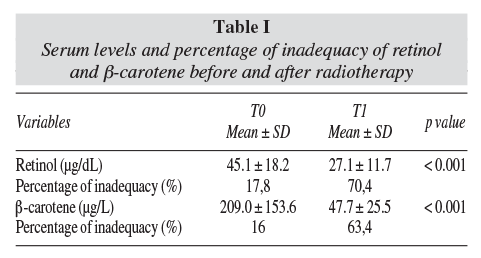
<body><![CDATA[<p><font face="Verdana" size="2">Radiotherapy was performed through teletherapy, using 6mV linear accelerator, by radiooncologist. The clinical target volumes (CTV) that were designed for radiotherapy treatments included the whole breast and homolateral axillary lymph nodes. The breast limits were defined as the area medial to the lateral edge of the sternum, inferior to the inframammary fold, superior to the inferior edge of the medial head of the clavicle and lateral to include all apparent breast tissue. The planning target volume (PTV) was defined as the CTV plus a 3-mm margin, with the exception of the skin area. The patients were treated postoperatively with a radiation dose that was prescribed for the PTV, which was equal to 50 Gy/25 fr/5 weeks of external beam radiation using four oblique tangent breast fields, followed by a single directed field that was restricted to the tumor bed and delivered at 10 Gy/5 fr/1 week.</font></p>     <p><font face="Verdana" size="2">During the data analysis, the quantitative variables were expressed as a mean and standard deviation, and the qualitative variables were shown as percentages. The Kolmogorov-Smirnov test was used to test the normality of continuous variables. The Mann-Whitney U-test was used to compare two groups, and the Friedman test was used for three groups. The chi-squared test was employed to assess the association between categorical variables. The level of significance adopted was 5% (p &lt; 0.05). The analyses were performed with <i>Statistical Package for the Social Sciences</i> (SPSS) program version 15.0.</font></p>     <p>&nbsp;</p>     <p><font face="Verdana" size="2"><b>Results</b></font></p>     <p><font face="Verdana" size="2">The sample group comprised 230 patients with a mean age of 63.6 &plusmn; 9.3 years. Mean BMI was 27.9 &plusmn; 4.2 kg/m<sup>2</sup> at T0 and 27.4 &plusmn; 3.9 kg/m<sup>2</sup> at T1, there wasn't significant difference before and after radiotherapy (p = 0.109).</font></p>     <p><font face="Verdana" size="2">There was a significant reduction in retinol and &beta;-carotene serum levels after radiotherapy (<a href="#t1">table I</a>).</font></p>     <p>&nbsp;</p>     <p align="center"><font face="Verdana" size="2"><a name="t1"><img src="/img/revistas/nh/v29n1/17originalvitaminas02_t1.gif"></a></font></p>     <p>&nbsp;</p>     <p><font face="Verdana" size="2">The percentage of vitamin A (in terms of retinol and &beta;-carotene) deficiency at T0 was 17.8% (n = 41) and 16% (n = 37), respectively. After radiotherapy, there was a significant increase in the percentage of deficiency for both retinol of 70.4% (n = 162) and &beta;-carotene of 63.4% (n = 146) (<a href="#t1">table I</a>).</font></p>     ]]></body>
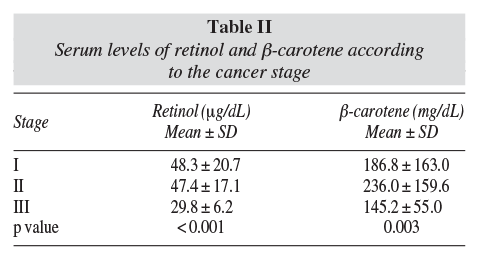
<body><![CDATA[<p><font face="Verdana" size="2">During the analysis of cancer staging, a significant difference in the levels of serum retinol (<i>p</i> &lt; 0.001) and &beta;-carotene (<i>p</i> = 0.003) was observed based on the disease stage. The retinol levels were significantly lower in the women who had stage III cancer compared with those who were at stage I (<i>p</i> = 0.001) and II (<i>p</i> &lt; 0.001). Similarly, the &beta;-carotene levels were significantly lower in stage III compared to stage II (<i>p</i> = 0.002) (<a href="#t2">table II</a>).</font></p>     <p>&nbsp;</p>     <p align="center"><font face="Verdana" size="2"><a name="t2"><img src="/img/revistas/nh/v29n1/17originalvitaminas02_t2.gif"></a></font></p>     <p>&nbsp;</p>     <p><font face="Verdana" size="2"><b>Discussion</b></font></p>     <p><font face="Verdana" size="2">Radiotherapy has been used in cancer treatment for decades, and several adverse effects have been associated with cellular oxidation processes,<sup>3</sup> which reduce the level of tissue antioxidants<sup>4</sup> and threaten the integrity and survival of normal neighboring cells. The mechanisms behind this decrease are still unclear, but it has been suggested that cancer cells use antioxidants more effectively than healthy cells, thus depleting circulating antioxidant agents.<sup>5</sup> In this context, the interest in the relationship between antioxidant nutrients and cancer development has increased because of the possible role of vitamins in increasing treatment efficiency.</font></p>     <p><font face="Verdana" size="2">In the present study, a significant reduction in the serum levels of retinol and &beta;-carotene after radiotherapy were observed. These findings are in line with the observations of Elango et al.,<sup>15</sup> who reported significant reductions in the levels of vitamins A, C and E in patients with stage III oral cancer who received radiotherapy in comparison with those who did not.</font></p>     <p><font face="Verdana" size="2">An important increase in the percentage of both retinol and &beta;-carotene inadequacy was observed after the radiotherapy. This result should be considered because radiation can trigger an imbalance in the oxidant-antioxidant system and cause medium and long-term acute damage that can lead to secondary cancers.<sup>16</sup> In addition, free radicals can aggravate comorbidities that preceded the cancer or emerge because of the treatment itself.<sup>4</sup></font></p>     <p><font face="Verdana" size="2">In addition to its antioxidant role, it has been suggested that vitamin A improves blood flow, which promotes normal tissue oxygenation and renders the tumors susceptible to radiation.<sup>9,12</sup> Administering high doses of vitamin A (retinyl palmitate) or synthetic &beta;-carotene daily before irradiation and during the observation period produced a cure rate above 90% in mice with breast cancer and also enhanced the amount of radiation damage.<sup>17,18</sup></font></p>     <p><font face="Verdana" size="2">According to Block et al.,<sup>19</sup> advanced cancer patients have reduced serum levels of micronutrients before the start of any therapy. This statement corroborates the findings in this study that show significantly lower serum retinol levels in women whose cancer was at stage III compared to those with stage I and II cancer. Additionally, the levels of &beta;-carotene were significantly lower at stage III compared to stage II. According to Malvy et al.,<sup>20</sup> it was assumed that these vitamin reductions were caused by inadequate intake; therefore, attempts to relate the vitamin levels directly to nutritional status were unsuccessful. The impact of inadequate intake of micronutrients on treatment outcome has to be evaluated in further studies.</font></p>     ]]></body>
<body><![CDATA[<p><font face="Verdana" size="2">The question of how tumors and/or normal tissues are protected by antioxidant micronutrients during fractionated radiotherapy remains unanswered.<sup>5</sup> The scarcity of studies assessing the impact of supplementation with antioxidant micronutrients in modifying radio-induced injuries during antineoplastic therapy demonstrates that the real effects of supplementation need to be better informed and leaves a gap on the potential benefits of this intervention in patients with cancer.</font></p>     <p><font face="Verdana" size="2">Studies in animals have shown that exposure to radiation decreases cellular levels of vitamin E.<sup>4</sup> Studies in humans demonstrates the levels reduction of vitamin C and E in bone marrow and breast cancer patients have lower plasma levels of vitamins A, C and E, selenium and zinc during radiotherapy.<sup>4</sup> These results are similar to those of the present study which found percentage of deficiency of 70.4% and 63.4% for retinol and &beta;-carotene, respectively, after radiotherapy. These findings suggest the increased demand of this micronutrient, as antioxidant defense or as a result of radiotherapy, which implies severe depletions in their circulating levels. This behavior, possibly, can be seen in relation to other antioxidant nutrients.</font></p>     <p><font face="Verdana" size="2">The synergic action of antioxidants is a limiting point of this study, however, the results presented here are grants that can contribute to the elucidation of questions about antioxidant nutrients and antineoplastic therapy and encourage the development of studies that approach the current doubts about antioxidant supplementation in order to minimize the adverse effects of radiotherapy on nutritional status and antioxidant capacity of cancer patients.</font></p>     <p><font face="Verdana" size="2">Simone et al.<sup>21</sup> suggest, after a systematic review of the literature, that the use of antioxidants improves the effectiveness of standard therapies while decreases adverse effects on normal cells, protecting them. Additionally, it was demonstrated an increase in survival in patients supplemented, subsidizing the deconstruction of the general context of decreased survival, in the long term, with antioxidants.</font></p>     <p><font face="Verdana" size="2">Vitamin A deficiency is one of the important factors that may influence the clinical evolution and prognosis of patients with breast cancer. From the results presented here, it is suggested that greater attention should be paid to the nutritional status of this micronutrient in patients with breast cancer who are undergoing radiotherapy, particularly those in the most advanced stage of the disease. It is recommended the early establishment of adequation serum concentrations of retinol and beta-carotene, offering nutritional assistance for those patients with deficiencies, in order to minimize the harmful effects of radiation.</font></p>     <p>&nbsp;</p>     <p><font face="Verdana" size="2"><b>References</b></font></p>     <!-- ref --><p><font face="Verdana" size="2">1. Jemal A, Bray F, Center M, Ferlay J, Ward E, Forman D. Global cancer statistics. <i>CA Cancer J Clin</i> 2011; 61 (2): 69-90.    &nbsp;&nbsp;&nbsp;&nbsp;&nbsp;&nbsp;&nbsp;&nbsp;[&#160;<a href="javascript:void(0);" onclick="javascript: window.open('/scielo.php?script=sci_nlinks&ref=3786778&pid=S0212-1611201400010001700001&lng=','','width=640,height=500,resizable=yes,scrollbars=1,menubar=yes,');">Links</a>&#160;]<!-- end-ref --></font></p>    <!-- ref --><p><font face="Verdana" size="2">2. National Cancer Institute (INCA)/ Brasil. Estimative 2012: Incidence of cancer in Brasil. Available from:  <a target="_blank" href="http://www.inca.gov.br/estimativa/2012/index.asp?ID=5/">http://www.inca.gov.br/estimativa/2012/index.asp?ID=5/</a>. Access: 03/15/ 2013.    &nbsp;&nbsp;&nbsp;&nbsp;&nbsp;&nbsp;&nbsp;&nbsp;[&#160;<a href="javascript:void(0);" onclick="javascript: window.open('/scielo.php?script=sci_nlinks&ref=3786780&pid=S0212-1611201400010001700002&lng=','','width=640,height=500,resizable=yes,scrollbars=1,menubar=yes,');">Links</a>&#160;]<!-- end-ref --></font></p>    <!-- ref --><p><font face="Verdana" size="2">3. Tabassum A, Bristow RG, Venkateswaran V. Ingestion of selenium and other antioxidants during prostate cancer radiotherapy: a good thing? <i>Cancer Treat Rev</i> 2010; 36 (3):230-4.    &nbsp;&nbsp;&nbsp;&nbsp;&nbsp;&nbsp;&nbsp;&nbsp;[&#160;<a href="javascript:void(0);" onclick="javascript: window.open('/scielo.php?script=sci_nlinks&ref=3786782&pid=S0212-1611201400010001700003&lng=','','width=640,height=500,resizable=yes,scrollbars=1,menubar=yes,');">Links</a>&#160;]<!-- end-ref --></font></p>    <!-- ref --><p><font face="Verdana" size="2">4. Moss RW. Do antioxidants interfere with radiation therapy for cancer? <i>Integr Cancer Ther</i> 2007; 6 (3): 281-92.    &nbsp;&nbsp;&nbsp;&nbsp;&nbsp;&nbsp;&nbsp;&nbsp;[&#160;<a href="javascript:void(0);" onclick="javascript: window.open('/scielo.php?script=sci_nlinks&ref=3786784&pid=S0212-1611201400010001700004&lng=','','width=640,height=500,resizable=yes,scrollbars=1,menubar=yes,');">Links</a>&#160;]<!-- end-ref --></font></p>    <!-- ref --><p><font face="Verdana" size="2">5. Franca CAS, Nogueira CR, Ramalho A, Carvalho AC, Vieira SL, Penna AB. Serum levels of selenium in patients with breast cancer before and after treatment of external beam radiotherapy. <i>Ann Oncol</i> 2011; 22: 1109-12.    &nbsp;&nbsp;&nbsp;&nbsp;&nbsp;&nbsp;&nbsp;&nbsp;[&#160;<a href="javascript:void(0);" onclick="javascript: window.open('/scielo.php?script=sci_nlinks&ref=3786786&pid=S0212-1611201400010001700005&lng=','','width=640,height=500,resizable=yes,scrollbars=1,menubar=yes,');">Links</a>&#160;]<!-- end-ref --></font></p>    <!-- ref --><p><font face="Verdana" size="2">6. Moss RW. Should patients undergoing chemotherapy and radiotherapy be prescribed antioxidants? <i>Integr Cancer Ther</i> 2006; 5:63-82.    &nbsp;&nbsp;&nbsp;&nbsp;&nbsp;&nbsp;&nbsp;&nbsp;[&#160;<a href="javascript:void(0);" onclick="javascript: window.open('/scielo.php?script=sci_nlinks&ref=3786788&pid=S0212-1611201400010001700006&lng=','','width=640,height=500,resizable=yes,scrollbars=1,menubar=yes,');">Links</a>&#160;]<!-- end-ref --></font></p>    <!-- ref --><p><font face="Verdana" size="2">7. Berger MM. Can oxidative damage be treated nutritionally? <i>Clin Nutr</i> 2005; 24: 172-83.    &nbsp;&nbsp;&nbsp;&nbsp;&nbsp;&nbsp;&nbsp;&nbsp;[&#160;<a href="javascript:void(0);" onclick="javascript: window.open('/scielo.php?script=sci_nlinks&ref=3786790&pid=S0212-1611201400010001700007&lng=','','width=640,height=500,resizable=yes,scrollbars=1,menubar=yes,');">Links</a>&#160;]<!-- end-ref --></font></p>    <!-- ref --><p><font face="Verdana" size="2">8. Rock L, Flatt S, Natarajan L, Thomson CA, Bardwell WA, Hollenbach KA, Jones L, Caan BJ, Pierce JP. Plasma Carotenoids and Recurrence-Free Survival in Women with a History of Breast Cancer. <i>J Clin Oncol</i> 2005; 23 (27): 6631-8.    &nbsp;&nbsp;&nbsp;&nbsp;&nbsp;&nbsp;&nbsp;&nbsp;[&#160;<a href="javascript:void(0);" onclick="javascript: window.open('/scielo.php?script=sci_nlinks&ref=3786792&pid=S0212-1611201400010001700008&lng=','','width=640,height=500,resizable=yes,scrollbars=1,menubar=yes,');">Links</a>&#160;]<!-- end-ref --></font></p>    <!-- ref --><p><font face="Verdana" size="2">9. McKenna NJ. EMBO Retinoids 2011: mechanisms, biology and pathology of signaling by retinoic acid and retinoic acid receptors. <i>Nucl Recept Signal</i> 2012; 10: 003.    &nbsp;&nbsp;&nbsp;&nbsp;&nbsp;&nbsp;&nbsp;&nbsp;[&#160;<a href="javascript:void(0);" onclick="javascript: window.open('/scielo.php?script=sci_nlinks&ref=3786794&pid=S0212-1611201400010001700009&lng=','','width=640,height=500,resizable=yes,scrollbars=1,menubar=yes,');">Links</a>&#160;]<!-- end-ref --></font></p>    <!-- ref --><p><font face="Verdana" size="2">10. Bairati I, Meyer F, Gélinas M, Fortin A, Nabid A, Brochet F, Mercier JP, Têtu B, Harel F, Abdous B, Vigneault E, Vass E, Vecchio P, Roy J. Randomized Trial of Antioxidant Vitamins to Prevent Acute Adverse Effects of Radiation Therapy in Head and Neck Cancer Patients. <i>J Clin Oncol</i> 2005; 23 (24) 5805-13.    &nbsp;&nbsp;&nbsp;&nbsp;&nbsp;&nbsp;&nbsp;&nbsp;[&#160;<a href="javascript:void(0);" onclick="javascript: window.open('/scielo.php?script=sci_nlinks&ref=3786796&pid=S0212-1611201400010001700010&lng=','','width=640,height=500,resizable=yes,scrollbars=1,menubar=yes,');">Links</a>&#160;]<!-- end-ref --></font></p>    <!-- ref --><p><font face="Verdana" size="2">11. Borek, C. Dietary Antioxidants and Human Cancer. <i>Integr Cancer Ther</i> 2004; 3: 333-41.    &nbsp;&nbsp;&nbsp;&nbsp;&nbsp;&nbsp;&nbsp;&nbsp;[&#160;<a href="javascript:void(0);" onclick="javascript: window.open('/scielo.php?script=sci_nlinks&ref=3786798&pid=S0212-1611201400010001700011&lng=','','width=640,height=500,resizable=yes,scrollbars=1,menubar=yes,');">Links</a>&#160;]<!-- end-ref --></font></p>    <!-- ref --><p><font face="Verdana" size="2">12. Conklin KA. Cancer chemotherapy and antioxidants. <i>J Nutr</i> 2004; 34: 3201S-3204S.    &nbsp;&nbsp;&nbsp;&nbsp;&nbsp;&nbsp;&nbsp;&nbsp;[&#160;<a href="javascript:void(0);" onclick="javascript: window.open('/scielo.php?script=sci_nlinks&ref=3786800&pid=S0212-1611201400010001700012&lng=','','width=640,height=500,resizable=yes,scrollbars=1,menubar=yes,');">Links</a>&#160;]<!-- end-ref --></font></p>    <!-- ref --><p><font face="Verdana" size="2">13. Gordon CC, Chumlea WC, Roche AF. Stature, recumbent length, and weight. In: Lohman TG, Roche AF, Martorel R, editors. Anthropometric standardization reference manual. Champaign, IL/Human Kinetics, 1988: 3-8.    &nbsp;&nbsp;&nbsp;&nbsp;&nbsp;&nbsp;&nbsp;&nbsp;[&#160;<a href="javascript:void(0);" onclick="javascript: window.open('/scielo.php?script=sci_nlinks&ref=3786802&pid=S0212-1611201400010001700013&lng=','','width=640,height=500,resizable=yes,scrollbars=1,menubar=yes,');">Links</a>&#160;]<!-- end-ref --></font></p>    <!-- ref --><p><font face="Verdana" size="2">14. National Cancer Institute (INCA)/ Brazil. TNM Classification of Malignant Tumours. 6<sup>a</sup> edição; 2004. Available from: <a target="_blank" href="http://www2.inca.gov.br/wps/wcm/connect/inca/portal/home">http://www2.inca.gov.br/wps/wcm/connect/inca/portal/home</a>. Access: 03/07/2013.    &nbsp;&nbsp;&nbsp;&nbsp;&nbsp;&nbsp;&nbsp;&nbsp;[&#160;<a href="javascript:void(0);" onclick="javascript: window.open('/scielo.php?script=sci_nlinks&ref=3786804&pid=S0212-1611201400010001700014&lng=','','width=640,height=500,resizable=yes,scrollbars=1,menubar=yes,');">Links</a>&#160;]<!-- end-ref --></font></p>    <!-- ref --><p><font face="Verdana" size="2">15. Elango N, Samuel S, Chinnakkannu P. Enzymatic and nonenzymatic antioxidant status in stage (III) human oral squamous cell carcinoma and treated with radical radio therapy: influence of selenium supplementation. <i>Clin Chim Acta</i> 2006; 373: 92-8.    &nbsp;&nbsp;&nbsp;&nbsp;&nbsp;&nbsp;&nbsp;&nbsp;[&#160;<a href="javascript:void(0);" onclick="javascript: window.open('/scielo.php?script=sci_nlinks&ref=3786806&pid=S0212-1611201400010001700015&lng=','','width=640,height=500,resizable=yes,scrollbars=1,menubar=yes,');">Links</a>&#160;]<!-- end-ref --></font></p>    <!-- ref --><p><font face="Verdana" size="2">16. Koh E-S, Tran TH, Heydarian M, Sachs R, Tsang R, Brenner D, Pintilie M, Xu T, Chung J, Paul N, Hodgson D. A comparison of mantle versus involved-field radiotherapy for Hodgkin's lymphoma: reduction in normal tissue dose and second cancer risk. <i>Radiat Oncol</i> 2007; 2: 13.    &nbsp;&nbsp;&nbsp;&nbsp;&nbsp;&nbsp;&nbsp;&nbsp;[&#160;<a href="javascript:void(0);" onclick="javascript: window.open('/scielo.php?script=sci_nlinks&ref=3786808&pid=S0212-1611201400010001700016&lng=','','width=640,height=500,resizable=yes,scrollbars=1,menubar=yes,');">Links</a>&#160;]<!-- end-ref --></font></p>    <!-- ref --><p><font face="Verdana" size="2">17. Prasad K N, Cole WC, Kumar B &amp; Prasad KC. Scientific rationale for using high-dose multiple micronutrients as an adjunct to standard and experimental cancer therapies. <i>J Am Coll Nutr</i> 2001; 20: 450S-463S; discussion 473S-475S.    &nbsp;&nbsp;&nbsp;&nbsp;&nbsp;&nbsp;&nbsp;&nbsp;[&#160;<a href="javascript:void(0);" onclick="javascript: window.open('/scielo.php?script=sci_nlinks&ref=3786810&pid=S0212-1611201400010001700017&lng=','','width=640,height=500,resizable=yes,scrollbars=1,menubar=yes,');">Links</a>&#160;]<!-- end-ref --></font></p>    <!-- ref --><p><font face="Verdana" size="2">18. Prasad KN, Cole WC, Kumar B &amp; Che Prasad K. Pros and cons of antioxidant use during radiation therapy. <i>Cancer Treat Rev</i> 2002; 28: 79-91.    &nbsp;&nbsp;&nbsp;&nbsp;&nbsp;&nbsp;&nbsp;&nbsp;[&#160;<a href="javascript:void(0);" onclick="javascript: window.open('/scielo.php?script=sci_nlinks&ref=3786812&pid=S0212-1611201400010001700018&lng=','','width=640,height=500,resizable=yes,scrollbars=1,menubar=yes,');">Links</a>&#160;]<!-- end-ref --></font></p>    <!-- ref --><p><font face="Verdana" size="2">19. Block KI, Koch AC, Mead MN, Tothy PK, Newman RA, Gyllenhaal C. Impact of antioxidant supplementation on chemotherapeutic efficacy: A systematic review of the evidence from randomized controlled trials. <i>Cancer Treat Rev</i> 2007; 33: 407-18.    &nbsp;&nbsp;&nbsp;&nbsp;&nbsp;&nbsp;&nbsp;&nbsp;[&#160;<a href="javascript:void(0);" onclick="javascript: window.open('/scielo.php?script=sci_nlinks&ref=3786814&pid=S0212-1611201400010001700019&lng=','','width=640,height=500,resizable=yes,scrollbars=1,menubar=yes,');">Links</a>&#160;]<!-- end-ref --></font></p>    <!-- ref --><p><font face="Verdana" size="2">20. Malvy DJ, Arnaud J, Burtschy B, Sommelet D, Leverger G, Dostalova L, Amédée-Manesme O. Assessment of serum antioxidant micronutrients and biochemical indicators of nutritional status in children with cancer in search of prognostic factors. <i>Int J Vitam Nutr Res</i> 1997; 67: 267-71.    &nbsp;&nbsp;&nbsp;&nbsp;&nbsp;&nbsp;&nbsp;&nbsp;[&#160;<a href="javascript:void(0);" onclick="javascript: window.open('/scielo.php?script=sci_nlinks&ref=3786816&pid=S0212-1611201400010001700020&lng=','','width=640,height=500,resizable=yes,scrollbars=1,menubar=yes,');">Links</a>&#160;]<!-- end-ref --></font></p>    <!-- ref --><p><font face="Verdana" size="2">21. Simone CB II, Simone NL, Simone V, Simone CB. Antioxidants and other nutrients do not interfere with chemotherapy or radiation therapy and can increase kill and increase survival, part 1. <i>Altern Ther Health Med</i> 2007; 13: 22-8.    &nbsp;&nbsp;&nbsp;&nbsp;&nbsp;&nbsp;&nbsp;&nbsp;[&#160;<a href="javascript:void(0);" onclick="javascript: window.open('/scielo.php?script=sci_nlinks&ref=3786818&pid=S0212-1611201400010001700021&lng=','','width=640,height=500,resizable=yes,scrollbars=1,menubar=yes,');">Links</a>&#160;]<!-- end-ref --></font></p>     <p>&nbsp;</p>     ]]></body>
<body><![CDATA[<p>&nbsp;</p>     <p><font face="Verdana" size="2"><a href="#top"><img border="0" src="/img/revistas/nh/v29n1/seta.gif" width="15" height="17"></a><a name="bajo"></a><b>Correspondence:</b>    <br>Andréa Matos.    <br>Social Applied Nutrition Department.    <br>Micronutrients Research Center (NPqM).    <br>Federal University of Rio de Janeiro.    <br>Av. Brigadeiro Trompovwsky, s/n, 2<sup>o</sup> andar, Bloco J. Ilha do Fundão.    <br>21941-590 Rio de Janeiro, Brazil.    <br>E-mail: <a href="mailto:amatosresearchufrj@gmail.com">amatosresearchufrj@gmail.com</a></font></p>     <p><font face="Verdana" size="2">Recibido: 27-VI-2013.    ]]></body>
<body><![CDATA[<br>1.<sup>a</sup> Revisión: 24-IX-2013.    <br>Aceptado: 18-X-2013.</font></p>      ]]></body><back>
<ref-list>
<ref id="B1">
<label>1</label><nlm-citation citation-type="journal">
<person-group person-group-type="author">
<name>
<surname><![CDATA[Jemal]]></surname>
<given-names><![CDATA[A]]></given-names>
</name>
<name>
<surname><![CDATA[Bray]]></surname>
<given-names><![CDATA[F]]></given-names>
</name>
<name>
<surname><![CDATA[Center]]></surname>
<given-names><![CDATA[M]]></given-names>
</name>
<name>
<surname><![CDATA[Ferlay]]></surname>
<given-names><![CDATA[J]]></given-names>
</name>
<name>
<surname><![CDATA[Ward]]></surname>
<given-names><![CDATA[E]]></given-names>
</name>
<name>
<surname><![CDATA[Forman]]></surname>
<given-names><![CDATA[D]]></given-names>
</name>
</person-group>
<article-title xml:lang="en"><![CDATA[Global cancer statistics]]></article-title>
<source><![CDATA[CA Cancer J Clin]]></source>
<year>2011</year>
<volume>61</volume>
<numero>2</numero>
<issue>2</issue>
<page-range>69-90</page-range></nlm-citation>
</ref>
<ref id="B2">
<label>2</label><nlm-citation citation-type="">
<collab>National Cancer Institute (INCA)/ Brasil</collab>
<source><![CDATA[Estimative 2012: Incidence of cancer in Brasil]]></source>
<year></year>
</nlm-citation>
</ref>
<ref id="B3">
<label>3</label><nlm-citation citation-type="journal">
<person-group person-group-type="author">
<name>
<surname><![CDATA[Tabassum]]></surname>
<given-names><![CDATA[A]]></given-names>
</name>
<name>
<surname><![CDATA[Bristow]]></surname>
<given-names><![CDATA[RG]]></given-names>
</name>
<name>
<surname><![CDATA[Venkateswaran]]></surname>
<given-names><![CDATA[V]]></given-names>
</name>
</person-group>
<article-title xml:lang="en"><![CDATA[Ingestion of selenium and other antioxidants during prostate cancer radiotherapy: a good thing?]]></article-title>
<source><![CDATA[Cancer Treat Rev]]></source>
<year>2010</year>
<volume>36</volume>
<numero>3</numero>
<issue>3</issue>
<page-range>230-4</page-range></nlm-citation>
</ref>
<ref id="B4">
<label>4</label><nlm-citation citation-type="journal">
<person-group person-group-type="author">
<name>
<surname><![CDATA[Moss]]></surname>
<given-names><![CDATA[RW]]></given-names>
</name>
</person-group>
<article-title xml:lang="en"><![CDATA[Do antioxidants interfere with radiation therapy for cancer?]]></article-title>
<source><![CDATA[Integr Cancer Ther]]></source>
<year>2007</year>
<volume>6</volume>
<numero>3</numero>
<issue>3</issue>
<page-range>281-92</page-range></nlm-citation>
</ref>
<ref id="B5">
<label>5</label><nlm-citation citation-type="journal">
<person-group person-group-type="author">
<name>
<surname><![CDATA[Franca]]></surname>
<given-names><![CDATA[CAS]]></given-names>
</name>
<name>
<surname><![CDATA[Nogueira]]></surname>
<given-names><![CDATA[CR]]></given-names>
</name>
<name>
<surname><![CDATA[Ramalho]]></surname>
<given-names><![CDATA[A]]></given-names>
</name>
<name>
<surname><![CDATA[Carvalho]]></surname>
<given-names><![CDATA[AC]]></given-names>
</name>
<name>
<surname><![CDATA[Vieira]]></surname>
<given-names><![CDATA[SL]]></given-names>
</name>
<name>
<surname><![CDATA[Penna]]></surname>
<given-names><![CDATA[AB]]></given-names>
</name>
</person-group>
<article-title xml:lang="en"><![CDATA[Serum levels of selenium in patients with breast cancer before and after treatment of external beam radiotherapy]]></article-title>
<source><![CDATA[Ann Oncol]]></source>
<year>2011</year>
<volume>22</volume>
<page-range>1109-12</page-range></nlm-citation>
</ref>
<ref id="B6">
<label>6</label><nlm-citation citation-type="journal">
<person-group person-group-type="author">
<name>
<surname><![CDATA[Moss]]></surname>
<given-names><![CDATA[RW]]></given-names>
</name>
</person-group>
<article-title xml:lang="en"><![CDATA[Should patients undergoing chemotherapy and radiotherapy be prescribed antioxidants?]]></article-title>
<source><![CDATA[Integr Cancer Ther]]></source>
<year>2006</year>
<volume>5</volume>
<page-range>63-82</page-range></nlm-citation>
</ref>
<ref id="B7">
<label>7</label><nlm-citation citation-type="journal">
<person-group person-group-type="author">
<name>
<surname><![CDATA[Berger]]></surname>
<given-names><![CDATA[MM]]></given-names>
</name>
</person-group>
<article-title xml:lang="en"><![CDATA[Can oxidative damage be treated nutritionally?]]></article-title>
<source><![CDATA[Clin Nutr]]></source>
<year>2005</year>
<volume>24</volume>
<page-range>172-83</page-range></nlm-citation>
</ref>
<ref id="B8">
<label>8</label><nlm-citation citation-type="journal">
<person-group person-group-type="author">
<name>
<surname><![CDATA[Rock]]></surname>
<given-names><![CDATA[L]]></given-names>
</name>
<name>
<surname><![CDATA[Flatt]]></surname>
<given-names><![CDATA[S]]></given-names>
</name>
<name>
<surname><![CDATA[Natarajan]]></surname>
<given-names><![CDATA[L]]></given-names>
</name>
<name>
<surname><![CDATA[Thomson]]></surname>
<given-names><![CDATA[CA]]></given-names>
</name>
<name>
<surname><![CDATA[Bardwell]]></surname>
<given-names><![CDATA[WA]]></given-names>
</name>
<name>
<surname><![CDATA[Hollenbach]]></surname>
<given-names><![CDATA[KA]]></given-names>
</name>
<name>
<surname><![CDATA[Jones]]></surname>
<given-names><![CDATA[L]]></given-names>
</name>
<name>
<surname><![CDATA[Caan]]></surname>
<given-names><![CDATA[BJ]]></given-names>
</name>
<name>
<surname><![CDATA[Pierce]]></surname>
<given-names><![CDATA[JP]]></given-names>
</name>
</person-group>
<article-title xml:lang="en"><![CDATA[Plasma Carotenoids and Recurrence-Free Survival in Women with a History of Breast Cancer]]></article-title>
<source><![CDATA[J Clin Oncol]]></source>
<year>2005</year>
<volume>23</volume>
<numero>27</numero>
<issue>27</issue>
<page-range>6631-8</page-range></nlm-citation>
</ref>
<ref id="B9">
<label>9</label><nlm-citation citation-type="journal">
<person-group person-group-type="author">
<name>
<surname><![CDATA[McKenna]]></surname>
<given-names><![CDATA[NJ]]></given-names>
</name>
</person-group>
<article-title xml:lang="en"><![CDATA[EMBO Retinoids 2011: mechanisms, biology and pathology of signaling by retinoic acid and retinoic acid receptors]]></article-title>
<source><![CDATA[Nucl Recept Signal]]></source>
<year>2012</year>
<volume>10</volume>
<page-range>003</page-range></nlm-citation>
</ref>
<ref id="B10">
<label>10</label><nlm-citation citation-type="journal">
<person-group person-group-type="author">
<name>
<surname><![CDATA[Bairati]]></surname>
<given-names><![CDATA[I]]></given-names>
</name>
<name>
<surname><![CDATA[Meyer]]></surname>
<given-names><![CDATA[F]]></given-names>
</name>
<name>
<surname><![CDATA[Gélinas]]></surname>
<given-names><![CDATA[M]]></given-names>
</name>
<name>
<surname><![CDATA[Fortin]]></surname>
</name>
<name>
<surname><![CDATA[Nabid]]></surname>
<given-names><![CDATA[A]]></given-names>
</name>
<name>
<surname><![CDATA[Brochet]]></surname>
<given-names><![CDATA[F]]></given-names>
</name>
<name>
<surname><![CDATA[Mercier]]></surname>
<given-names><![CDATA[JP]]></given-names>
</name>
<name>
<surname><![CDATA[Têtu]]></surname>
<given-names><![CDATA[B]]></given-names>
</name>
<name>
<surname><![CDATA[Harel]]></surname>
<given-names><![CDATA[F]]></given-names>
</name>
<name>
<surname><![CDATA[Abdous]]></surname>
<given-names><![CDATA[B]]></given-names>
</name>
<name>
<surname><![CDATA[Vigneault]]></surname>
<given-names><![CDATA[E]]></given-names>
</name>
<name>
<surname><![CDATA[Vass]]></surname>
<given-names><![CDATA[E]]></given-names>
</name>
<name>
<surname><![CDATA[Vecchio]]></surname>
<given-names><![CDATA[P]]></given-names>
</name>
<name>
<surname><![CDATA[Roy]]></surname>
<given-names><![CDATA[J]]></given-names>
</name>
</person-group>
<article-title xml:lang="en"><![CDATA[Randomized Trial of Antioxidant Vitamins to Prevent Acute Adverse Effects of Radiation Therapy in Head and Neck Cancer Patients]]></article-title>
<source><![CDATA[J Clin Oncol]]></source>
<year>2005</year>
<volume>23</volume>
<numero>24</numero>
<issue>24</issue>
<page-range>5805-13</page-range></nlm-citation>
</ref>
<ref id="B11">
<label>11</label><nlm-citation citation-type="journal">
<person-group person-group-type="author">
<name>
<surname><![CDATA[Borek]]></surname>
<given-names><![CDATA[C]]></given-names>
</name>
</person-group>
<article-title xml:lang="en"><![CDATA[Dietary Antioxidants and Human Cancer]]></article-title>
<source><![CDATA[Integr Cancer Ther]]></source>
<year>2004</year>
<volume>3</volume>
<page-range>333-41</page-range></nlm-citation>
</ref>
<ref id="B12">
<label>12</label><nlm-citation citation-type="journal">
<person-group person-group-type="author">
<name>
<surname><![CDATA[Conklin]]></surname>
<given-names><![CDATA[KA]]></given-names>
</name>
</person-group>
<article-title xml:lang="en"><![CDATA[Cancer chemotherapy and antioxidants]]></article-title>
<source><![CDATA[J Nutr]]></source>
<year>2004</year>
<volume>34</volume>
<page-range>3201S-3204S</page-range></nlm-citation>
</ref>
<ref id="B13">
<label>13</label><nlm-citation citation-type="book">
<person-group person-group-type="author">
<name>
<surname><![CDATA[Gordon]]></surname>
<given-names><![CDATA[CC]]></given-names>
</name>
<name>
<surname><![CDATA[Chumlea]]></surname>
<given-names><![CDATA[WC]]></given-names>
</name>
<name>
<surname><![CDATA[Roche]]></surname>
<given-names><![CDATA[AF]]></given-names>
</name>
</person-group>
<article-title xml:lang="en"><![CDATA[Stature, recumbent length, and weight]]></article-title>
<person-group person-group-type="editor">
<name>
<surname><![CDATA[Lohman]]></surname>
<given-names><![CDATA[TG]]></given-names>
</name>
<name>
<surname><![CDATA[Roche]]></surname>
<given-names><![CDATA[AF]]></given-names>
</name>
<name>
<surname><![CDATA[Martorel]]></surname>
<given-names><![CDATA[R]]></given-names>
</name>
</person-group>
<source><![CDATA[Anthropometric standardization reference manual]]></source>
<year>1988</year>
<page-range>3-8</page-range><publisher-loc><![CDATA[Champaign^eIL IL]]></publisher-loc>
<publisher-name><![CDATA[Human Kinetics]]></publisher-name>
</nlm-citation>
</ref>
<ref id="B14">
<label>14</label><nlm-citation citation-type="">
<collab>National Cancer Institute (INCA)/ Brazil</collab>
<source><![CDATA[TNM Classification of Malignant Tumours]]></source>
<year>2004</year>
<edition>6</edition>
</nlm-citation>
</ref>
<ref id="B15">
<label>15</label><nlm-citation citation-type="journal">
<person-group person-group-type="author">
<name>
<surname><![CDATA[Elango]]></surname>
<given-names><![CDATA[N]]></given-names>
</name>
<name>
<surname><![CDATA[Samuel]]></surname>
<given-names><![CDATA[S]]></given-names>
</name>
<name>
<surname><![CDATA[Chinnakkannu]]></surname>
<given-names><![CDATA[P]]></given-names>
</name>
</person-group>
<article-title xml:lang="en"><![CDATA[Enzymatic and nonenzymatic antioxidant status in stage (III) human oral squamous cell carcinoma and treated with radical radio therapy: influence of selenium supplementation]]></article-title>
<source><![CDATA[Clin Chim Acta]]></source>
<year>2006</year>
<volume>373</volume>
<page-range>92-8</page-range></nlm-citation>
</ref>
<ref id="B16">
<label>16</label><nlm-citation citation-type="journal">
<person-group person-group-type="author">
<name>
<surname><![CDATA[Koh]]></surname>
<given-names><![CDATA[E-S]]></given-names>
</name>
<name>
<surname><![CDATA[Tran]]></surname>
<given-names><![CDATA[TH]]></given-names>
</name>
<name>
<surname><![CDATA[Heydarian]]></surname>
<given-names><![CDATA[M]]></given-names>
</name>
<name>
<surname><![CDATA[Sachs]]></surname>
<given-names><![CDATA[R]]></given-names>
</name>
<name>
<surname><![CDATA[Tsang]]></surname>
<given-names><![CDATA[R]]></given-names>
</name>
<name>
<surname><![CDATA[Brenner]]></surname>
<given-names><![CDATA[D]]></given-names>
</name>
<name>
<surname><![CDATA[Pintilie]]></surname>
<given-names><![CDATA[M]]></given-names>
</name>
<name>
<surname><![CDATA[Xu]]></surname>
<given-names><![CDATA[T]]></given-names>
</name>
<name>
<surname><![CDATA[Chung]]></surname>
<given-names><![CDATA[J]]></given-names>
</name>
<name>
<surname><![CDATA[Paul]]></surname>
<given-names><![CDATA[N]]></given-names>
</name>
<name>
<surname><![CDATA[Hodgson]]></surname>
<given-names><![CDATA[D]]></given-names>
</name>
</person-group>
<article-title xml:lang="en"><![CDATA[A comparison of mantle versus involved-field radiotherapy for Hodgkin's lymphoma: reduction in normal tissue dose and second cancer risk]]></article-title>
<source><![CDATA[Radiat Oncol]]></source>
<year>2007</year>
<volume>2</volume>
<page-range>13</page-range></nlm-citation>
</ref>
<ref id="B17">
<label>17</label><nlm-citation citation-type="journal">
<person-group person-group-type="author">
<name>
<surname><![CDATA[Prasad]]></surname>
<given-names><![CDATA[K N]]></given-names>
</name>
<name>
<surname><![CDATA[Cole]]></surname>
<given-names><![CDATA[WC]]></given-names>
</name>
<name>
<surname><![CDATA[Kumar]]></surname>
<given-names><![CDATA[B]]></given-names>
</name>
<name>
<surname><![CDATA[Prasad]]></surname>
<given-names><![CDATA[KC]]></given-names>
</name>
</person-group>
<article-title xml:lang="en"><![CDATA[Scientific rationale for using high-dose multiple micronutrients as an adjunct to standard and experimental cancer therapies]]></article-title>
<source><![CDATA[J Am Coll Nutr]]></source>
<year>2001</year>
<volume>20</volume>
<page-range>450S-463S</page-range><page-range>473S-475S</page-range></nlm-citation>
</ref>
<ref id="B18">
<label>18</label><nlm-citation citation-type="journal">
<person-group person-group-type="author">
<name>
<surname><![CDATA[Prasad]]></surname>
<given-names><![CDATA[KN]]></given-names>
</name>
<name>
<surname><![CDATA[Cole]]></surname>
<given-names><![CDATA[WC]]></given-names>
</name>
<name>
<surname><![CDATA[Kumar]]></surname>
<given-names><![CDATA[B]]></given-names>
</name>
<name>
<surname><![CDATA[Che Prasad]]></surname>
<given-names><![CDATA[K]]></given-names>
</name>
</person-group>
<article-title xml:lang="en"><![CDATA[Pros and cons of antioxidant use during radiation therapy]]></article-title>
<source><![CDATA[Cancer Treat Rev]]></source>
<year>2002</year>
<volume>28</volume>
<page-range>79-91</page-range></nlm-citation>
</ref>
<ref id="B19">
<label>19</label><nlm-citation citation-type="journal">
<person-group person-group-type="author">
<name>
<surname><![CDATA[Block]]></surname>
<given-names><![CDATA[KI]]></given-names>
</name>
<name>
<surname><![CDATA[Koch]]></surname>
<given-names><![CDATA[AC]]></given-names>
</name>
<name>
<surname><![CDATA[Mead]]></surname>
<given-names><![CDATA[MN]]></given-names>
</name>
<name>
<surname><![CDATA[Tothy]]></surname>
<given-names><![CDATA[PK]]></given-names>
</name>
<name>
<surname><![CDATA[Newman]]></surname>
<given-names><![CDATA[RA]]></given-names>
</name>
<name>
<surname><![CDATA[Gyllenhaal]]></surname>
<given-names><![CDATA[C]]></given-names>
</name>
</person-group>
<article-title xml:lang="en"><![CDATA[Impact of antioxidant supplementation on chemotherapeutic efficacy: A systematic review of the evidence from randomized controlled trials]]></article-title>
<source><![CDATA[Cancer Treat Rev]]></source>
<year>2007</year>
<volume>33</volume>
<page-range>407-18</page-range></nlm-citation>
</ref>
<ref id="B20">
<label>20</label><nlm-citation citation-type="journal">
<person-group person-group-type="author">
<name>
<surname><![CDATA[Malvy]]></surname>
<given-names><![CDATA[DJ]]></given-names>
</name>
<name>
<surname><![CDATA[Arnaud]]></surname>
<given-names><![CDATA[J]]></given-names>
</name>
<name>
<surname><![CDATA[Burtschy]]></surname>
<given-names><![CDATA[B]]></given-names>
</name>
<name>
<surname><![CDATA[Sommelet]]></surname>
<given-names><![CDATA[D]]></given-names>
</name>
<name>
<surname><![CDATA[Leverger]]></surname>
<given-names><![CDATA[G]]></given-names>
</name>
<name>
<surname><![CDATA[Dostalova]]></surname>
<given-names><![CDATA[L]]></given-names>
</name>
<name>
<surname><![CDATA[Amédée-Manesme]]></surname>
<given-names><![CDATA[O]]></given-names>
</name>
</person-group>
<article-title xml:lang="en"><![CDATA[Assessment of serum antioxidant micronutrients and biochemical indicators of nutritional status in children with cancer in search of prognostic factors]]></article-title>
<source><![CDATA[Int J Vitam Nutr Res]]></source>
<year>1997</year>
<volume>67</volume>
<page-range>267-71</page-range></nlm-citation>
</ref>
<ref id="B21">
<label>21</label><nlm-citation citation-type="journal">
<person-group person-group-type="author">
<name>
<surname><![CDATA[Simone]]></surname>
<given-names><![CDATA[CB II]]></given-names>
</name>
<name>
<surname><![CDATA[Simone]]></surname>
<given-names><![CDATA[NL]]></given-names>
</name>
<name>
<surname><![CDATA[Simone]]></surname>
<given-names><![CDATA[V]]></given-names>
</name>
<name>
<surname><![CDATA[Simone]]></surname>
<given-names><![CDATA[CB]]></given-names>
</name>
</person-group>
<article-title xml:lang="en"><![CDATA[Antioxidants and other nutrients do not interfere with chemotherapy or radiation therapy and can increase kill and increase survival, part 1]]></article-title>
<source><![CDATA[Altern Ther Health Med]]></source>
<year>2007</year>
<volume>13</volume>
<page-range>22-8</page-range></nlm-citation>
</ref>
</ref-list>
</back>
</article>