<?xml version="1.0" encoding="ISO-8859-1"?><article xmlns:mml="http://www.w3.org/1998/Math/MathML" xmlns:xlink="http://www.w3.org/1999/xlink" xmlns:xsi="http://www.w3.org/2001/XMLSchema-instance">
<front>
<journal-meta>
<journal-id>0212-1611</journal-id>
<journal-title><![CDATA[Nutrición Hospitalaria]]></journal-title>
<abbrev-journal-title><![CDATA[Nutr. Hosp.]]></abbrev-journal-title>
<issn>0212-1611</issn>
<publisher>
<publisher-name><![CDATA[Grupo Arán]]></publisher-name>
</publisher>
</journal-meta>
<article-meta>
<article-id>S0212-16112014001000020</article-id>
<article-id pub-id-type="doi">10.3305/nh.2014.30.3.7240</article-id>
<title-group>
<article-title xml:lang="en"><![CDATA[Comparison of two field methods for estimating body fat in different Spanish Dance disciplines]]></article-title>
<article-title xml:lang="es"><![CDATA[Comparación de dos metodos de campo para estimar la grasa corporal en diferentes disciplinas de la danza española]]></article-title>
</title-group>
<contrib-group>
<contrib contrib-type="author">
<name>
<surname><![CDATA[Alvero-Cruz]]></surname>
<given-names><![CDATA[José Ramón]]></given-names>
</name>
<xref ref-type="aff" rid="A01"/>
<xref ref-type="aff" rid="A07"/>
</contrib>
<contrib contrib-type="author">
<name>
<surname><![CDATA[Marfell-Jones]]></surname>
<given-names><![CDATA[Mike]]></given-names>
</name>
<xref ref-type="aff" rid="A02"/>
</contrib>
<contrib contrib-type="author">
<name>
<surname><![CDATA[Alacid]]></surname>
<given-names><![CDATA[Fernando]]></given-names>
</name>
<xref ref-type="aff" rid="A03"/>
</contrib>
<contrib contrib-type="author">
<name>
<surname><![CDATA[Artero Orta]]></surname>
<given-names><![CDATA[Pedro]]></given-names>
</name>
<xref ref-type="aff" rid="A04"/>
</contrib>
<contrib contrib-type="author">
<name>
<surname><![CDATA[Correas-Gómez]]></surname>
<given-names><![CDATA[Lorena]]></given-names>
</name>
<xref ref-type="aff" rid="A05"/>
</contrib>
<contrib contrib-type="author">
<name>
<surname><![CDATA[Santonja Medina]]></surname>
<given-names><![CDATA[Fernando]]></given-names>
</name>
<xref ref-type="aff" rid="A06"/>
</contrib>
<contrib contrib-type="author">
<name>
<surname><![CDATA[Carnero]]></surname>
<given-names><![CDATA[Elvis A.]]></given-names>
</name>
<xref ref-type="aff" rid="A05"/>
<xref ref-type="aff" rid="A07"/>
</contrib>
</contrib-group>
<aff id="A01">
<institution><![CDATA[,University of Málaga-Andalucía Tech Faculty of Medicine (Campus de Teatinos) ]]></institution>
<addr-line><![CDATA[Málaga ]]></addr-line>
<country>Spain</country>
</aff>
<aff id="A02">
<institution><![CDATA[,Catholic University of Murcia  ]]></institution>
<addr-line><![CDATA[Murcia ]]></addr-line>
<country>Spain</country>
</aff>
<aff id="A03">
<institution><![CDATA[,Catholic University of Murcia Faculty of Sports Sciences ]]></institution>
<addr-line><![CDATA[Murcia ]]></addr-line>
<country>Spain</country>
</aff>
<aff id="A04">
<institution><![CDATA[,Junta de Andalucía Málaga High Dance School ]]></institution>
<addr-line><![CDATA[Málaga ]]></addr-line>
<country>Spain</country>
</aff>
<aff id="A05">
<institution><![CDATA[,University of Málaga-Andalucía Tech Faculty of Education Sciences (Campus de Teatinos) ]]></institution>
<addr-line><![CDATA[Málaga ]]></addr-line>
<country>Spain</country>
</aff>
<aff id="A06">
<institution><![CDATA[,Hospital Virgen de la Arrixaca Traumatology Service ]]></institution>
<addr-line><![CDATA[Murcia ]]></addr-line>
<country>Spain</country>
</aff>
<aff id="A07">
<institution><![CDATA[,Instituto de Investigaciones Biomédicas de Málaga (IBIMA)  ]]></institution>
<addr-line><![CDATA[Málaga ]]></addr-line>
</aff>
<pub-date pub-type="pub">
<day>00</day>
<month>09</month>
<year>2014</year>
</pub-date>
<pub-date pub-type="epub">
<day>00</day>
<month>09</month>
<year>2014</year>
</pub-date>
<volume>30</volume>
<numero>3</numero>
<fpage>614</fpage>
<lpage>621</lpage>
<copyright-statement/>
<copyright-year/>
<self-uri xlink:href="http://scielo.isciii.es/scielo.php?script=sci_arttext&amp;pid=S0212-16112014001000020&amp;lng=en&amp;nrm=iso"></self-uri><self-uri xlink:href="http://scielo.isciii.es/scielo.php?script=sci_abstract&amp;pid=S0212-16112014001000020&amp;lng=en&amp;nrm=iso"></self-uri><self-uri xlink:href="http://scielo.isciii.es/scielo.php?script=sci_pdf&amp;pid=S0212-16112014001000020&amp;lng=en&amp;nrm=iso"></self-uri><abstract abstract-type="short" xml:lang="en"><p><![CDATA[The purpose of the present study was to investigate percentage body fat (%BF) differences in three Spanish dance disciplines and to compare skinfold and bioelectrical impedance predictions of body fat percentage in the same sample. Seventy-six female dancers, divided into three groups, Classical (n=23), Spanish (n=29) and Flamenco (n=24), were measured using skinfold measurements at four sites: triceps, subscapular, biceps and iliac crest, and whole body multi-frequency bioelectrical impedance (BIA). The skin-fold measures were used to predict body fat percentage via Durnin and Womersley's and Segal, Sun and Yannakoulia equations by BIA. Differences in percent fat mass between groups (Classical, Spanish and Flamenco) were tested by using repeated measures analysis (ANOVA). Also, Pearson's product-moment correlations were performed on the body fat percentage values obtained using both methods. In addition, Bland-Altman plots were used to assess agreement, between anthropometric and BIA methods. Repeated measures analysis of variance did not found differences in %BF between modalities (p<0.05). Fat percentage correlations ranged from r= 0.57 to r=0.97 (all, p<0.001). Bland-Altman analysis revealed differences between BIA Yannakoulia as a reference method with BIA Segal (-0.35 ± 2.32%, 95%CI: -0.89to 0.18, p=0.38), with BIA Sun (-0.73 ± 2.3%, 95%CI: -1.27 to -0.20, p=0.014) and Durnin-Womersley (-2.65 ± 2,48%, 95%CI: -3.22 to -2.07, p<0.0001). It was concluded that body fat percentage estimates by BIA compared with skinfold method were systematically different in young adult female ballet dancers, having a tendency to produce underestimations as %BF increased with Segal and Durnin-Womersley equations compared to Yannakoulia, concluding that these methods are not interchangeable.]]></p></abstract>
<abstract abstract-type="short" xml:lang="es"><p><![CDATA[El objetivo del presente estudio fue investigar el porcentaje de grasa corporal (% GC) y comparar las predicciones y las diferencias en tres disciplinas de danza española, asi como las predicciones del porcentaje de grasa corporal mediante los pliegues de grasa y por impedancia bioeléctrica en la misma muestra. Setenta y seis bailarinas, divididos en tres grupos, Clásica (n = 23), Danza española (n = 29) y Flamenco (n = 24), fueron evaluados mediante mediciones de los pliegues cutáneos: tríceps, subescapular, bíceps y la cresta ilíaca y por impedancia bioeléctrica de cuerpo entero (BIA). Se utilizaron las medidas de pliegues cutáneos para predecir el porcentaje de grasa corporal a través de ecuaciones de Durnin y Womersley y Segal, Sun y Yannakoulia por BIA . Las diferencias en el porcentaje de grasa en masa entre los grupos Clásica, Española y Flamenco fueron evaluadas mediante un análisis de medidas repetidas (ANOVA). Además se realizaron correlaciones de Pearson entre los valores de porcentaje de grasa corporal obtenidos entre métodos. Así mismo se utilizó un análisis de Bland -Altman para evaluar la concordancia entre los métodos antropométricos y BIA. El análisis de medidas repetidas no encontró diferencias en el % de grasa corporal entre modalidades (P <0,05). Las correlaciones entre los porcentaje de grasa oscilaron entre r = 0,57 y r = 0,97 (todos, P < 0,001). El análisis de Bland y Altman reveló diferencias entre BIA Yannakoulia como método de referencia con BIA Segal (-0.35 ± 2.32 % , IC del 95 % : - 0.89to 0,18, P = 0,38), con BIA Sun (-0,73 ± 2,3 %, 95 % IC : -1,27 a -0,20, P = 0,014) y Durnin-Womersley (-2,65 ± 2,48 % , IC del 95 % : -3,22 a -2,07, P < 0,0001) . Se concluye que las estimaciones de porcentaje de grasa corporal por BIA en comparación con el método de los pliegues cutáneos fueron sistemáticamente diferentes en jóvenes bailarinas de ballet, además de existir una tendencia a la subestimacion en el porcentaje de grasa corporal a medida que aumenta la magnitud de los valores de las ecuaciones de Segal y Durnin - Womersley en comparación con Yannakoulia, por lo cual no son métodos intercambiables.]]></p></abstract>
<kwd-group>
<kwd lng="en"><![CDATA[Fat mass]]></kwd>
<kwd lng="en"><![CDATA[Anthropometry]]></kwd>
<kwd lng="en"><![CDATA[Bioelectrical impedance analysis]]></kwd>
<kwd lng="en"><![CDATA[Spanish dance]]></kwd>
<kwd lng="en"><![CDATA[Classical dance]]></kwd>
<kwd lng="en"><![CDATA[Flamenco dance]]></kwd>
<kwd lng="es"><![CDATA[Masa Grasa]]></kwd>
<kwd lng="es"><![CDATA[Antropometría]]></kwd>
<kwd lng="es"><![CDATA[Impedancia bioeléctrica]]></kwd>
<kwd lng="es"><![CDATA[Danza española]]></kwd>
<kwd lng="es"><![CDATA[Danza clásica]]></kwd>
<kwd lng="es"><![CDATA[Baile flamenco]]></kwd>
</kwd-group>
</article-meta>
</front><body><![CDATA[ <p><a name="top"></a><font face="Verdana" size="2"><b>ORIGINAL / <i>Deporte y ejercicio</i></b></font></p>     <p>&nbsp;</p>     <p><font face="Verdana" size="4"><b>Comparison of two field methods for estimating body fat in different Spanish Dance disciplines</b></font></p>     <p><font face="Verdana" size="4"><b>Comparación de dos metodos de campo para estimar la grasa corporal en diferentes disciplinas de la danza española</b></font></p>     <p>&nbsp;</p>     <p>&nbsp;</p>     <p><font face="Verdana" size="2"><b>José Ramón Alvero-Cruz<sup>1,7</sup>, Mike Marfell-Jones<sup>2</sup>, Fernando Alacid<sup>3</sup>, Pedro Artero Orta<sup>4</sup>, Lorena Correas-Gómez<sup>5</sup>, Fernando Santonja Medina<sup>6</sup> and Elvis A. Carnero<sup>5,7</sup></b></font></p>     <p><font face="Verdana" size="2"><sup>1</sup>University of Málaga-Andalucía Tech. Faculty of Medicine. Campus de Teatinos sin, 29071. Málaga Spain.    <br><sup>2</sup>Catholic University of Murcia. Spain.    <br><sup>3</sup>Faculty of Sports Sciences. Catholic University of Murcia. Spain.    ]]></body>
<body><![CDATA[<br><sup>4</sup>Málaga High Dance School. Junta de Andalucía. Spain.    <br><sup>5</sup>University of Málaga-Andalucía Tech. Faculty of Education Sciences. Campus de Teatinos sin, 29071. Málaga Spain.    <br><sup>6</sup>Traumatology Service. Hospital Virgen de la Arrixaca. Murcia. Spain.    <br><sup>7</sup>Instituto de Investigaciones Biomédicas de Málaga (IBIMA).</font></p>     <p><font face="Verdana" size="2"><a href="#bajo">Correspondence</a></font></p>     <p>&nbsp;</p>     <p>&nbsp;</p> <hr size="1">     <p><font face="Verdana" size="2"><b>ABSTRACT</b></font></p>     <p><font face="Verdana" size="2">The purpose of the present study was to investigate percentage body fat (%BF) differences in three Spanish dance disciplines and to compare skinfold and bioelectrical impedance predictions of body fat percentage in the same sample.    <br>Seventy-six female dancers, divided into three groups, Classical (n=23), Spanish (n=29) and Flamenco (n=24), were measured using skinfold measurements at four sites: triceps, subscapular, biceps and iliac crest, and whole body multi-frequency bioelectrical impedance (BIA). The skin-fold measures were used to predict body fat percentage via Durnin and Womersley's and Segal, Sun and Yannakoulia equations by BIA. Differences in percent fat mass between groups (Classical, Spanish and Flamenco) were tested by using repeated measures analysis (ANOVA). Also, Pearson's product-moment correlations were performed on the body fat percentage values obtained using both methods. In addition, Bland-Altman plots were used to assess agreement, between anthropometric and BIA methods.    ]]></body>
<body><![CDATA[<br>Repeated measures analysis of variance did not found differences in %BF between modalities (<i>p</i>&lt;0.05). Fat percentage correlations ranged from <i>r</i>= 0.57 to <i>r</i>=0.97 (all, <i>p</i>&lt;0.001). Bland-Altman analysis revealed differences between BIA Yannakoulia as a reference method with BIA Segal (-0.35 &plusmn; 2.32%, 95%CI: -0.89to 0.18, <i>p</i>=0.38), with BIA Sun (-0.73 &plusmn; 2.3%, 95%CI: -1.27 to -0.20, <i>p</i>=0.014) and Durnin-Womersley (-2.65 &plusmn; 2,48%, 95%CI: -3.22 to -2.07, <i>p</i>&lt;0.0001). It was concluded that body fat percentage estimates by BIA compared with skinfold method were systematically different in young adult female ballet dancers, having a tendency to produce underestimations as %BF increased with Segal and Durnin-Womersley equations compared to Yannakoulia, concluding that these methods are not interchangeable.</font></p>     <p><font face="Verdana" size="2"><b>Key words:</b> Fat mass. Anthropometry. Bioelectrical impedance analysis. Spanish dance. Classical dance. Flamenco dance.</font></p> <hr size="1">     <p><font face="Verdana" size="2"><b>RESUMEN</b></font></p>     <p><font face="Verdana" size="2">El objetivo del presente estudio fue investigar el porcentaje de grasa corporal (% GC) y comparar las predicciones y las diferencias en tres disciplinas de danza española, asi como las predicciones del porcentaje de grasa corporal mediante los pliegues de grasa y por impedancia bioeléctrica en la misma muestra. Setenta y seis bailarinas, divididos en tres grupos, Clásica (n = 23), Danza española (n = 29) y Flamenco (n = 24), fueron evaluados mediante mediciones de los pliegues cutáneos: tríceps, subescapular, bíceps y la cresta ilíaca y por impedancia bioeléctrica de cuerpo entero (BIA). Se utilizaron las medidas de pliegues cutáneos para predecir el porcentaje de grasa corporal a través de ecuaciones de Durnin y Womersley y Segal, Sun y Yannakoulia por BIA . Las diferencias en el porcentaje de grasa en masa entre los grupos Clásica, Española y Flamenco fueron evaluadas mediante un análisis de medidas repetidas (ANOVA). Además se realizaron correlaciones de Pearson entre los valores de porcentaje de grasa corporal obtenidos entre métodos. Así mismo se utilizó un análisis de Bland -Altman para evaluar la concordancia entre los métodos antropométricos y BIA. El análisis de medidas repetidas no encontró diferencias en el % de grasa corporal entre modalidades (P &lt;0,05). Las correlaciones entre los porcentaje de grasa oscilaron entre r = 0,57 y r = 0,97 (todos, <i>P</i> &lt; 0,001). El análisis de Bland y Altman reveló diferencias entre BIA Yannakoulia como método de referencia con BIA Segal (-0.35 &plusmn; 2.32 % , IC del 95 % : - 0.89to 0,18, <i>P</i> = 0,38), con BIA Sun (-0,73 &plusmn; 2,3 %, 95 % IC : -1,27 a -0,20, <i>P</i> = 0,014) y Durnin-Womersley (-2,65 &plusmn; 2,48 % , IC del 95 % : -3,22 a -2,07, <i>P</i> &lt; 0,0001) . Se concluye que las estimaciones de porcentaje de grasa corporal por BIA en comparación con el método de los pliegues cutáneos fueron sistemáticamente diferentes en jóvenes bailarinas de ballet, además de existir una tendencia a la subestimacion en el porcentaje de grasa corporal a medida que aumenta la magnitud de los valores de las ecuaciones de Segal y Durnin - Womersley en comparación con Yannakoulia, por lo cual no son métodos intercambiables.</font></p>     <p><font face="Verdana" size="2"><b>Palabras clave:</b> Masa Grasa. Antropometría. Impedancia bioeléctrica. Danza española. Danza clásica. Baile flamenco.</font></p> <hr size="1">     <p><font face="Verdana" size="2"><b>Abbreviations</b>    <br>%BF: percentage body fat.    <br>BIA: bioelectrical impedance.    <br>DXA: dual-energy X-ray absorptiometry.    <br>CL: Classic dance.    ]]></body>
<body><![CDATA[<br>SP: Spanish dance.    <br>FL: Flamenco dance.    <br>CON: Contemporary dance.</font></p>     <p>&nbsp;</p>     <p><font face="Verdana" size="2"><b>Introduction</b></font></p>     <p><font face="Verdana" size="2">Although Contemporary Dance has only emerged in the last century, Dance, as a form of corporal expression and physical activity, can be traced as far back in human culture and history as ancient Egypt and Greece. Dance performance is dependent of many physiological, psychological, technical and morphological factors, the last of these being influenced by such components as bone, muscle and subcutaneous adiposity.</font></p>     <p><font face="Verdana" size="2">Four different sorts of dance are studied in official Dance Studies programmes in Spain, namely: Classical Dance (ballet) and Contemporary Dance, as practiced internationally, and two types of Spanish dance. These are Classical Spanish Dance, where sophisticated choreographies are performed to Classical Music of Spanish composers such as Falla, Granados or Albeniz, and Flamenco Spanish Dance, where the traditional dances of different regions of Spain are studied. Flamenco is the best known Spanish dance outside Spain, mainly due to the fame of its different dancers (named "bailaores") and singers (named "cantaores").</font></p>     <p><font face="Verdana" size="2">Academic and professional training of Dance in Spain occurs in three stages: Basic Education, Professional and Higher Grades (see <a target="_blank" href="/img/revistas/nh/v30n3/20originaldeporteyejercicio02_f1.gif">figure 1</a>).</font></p>     <p><font face="Verdana" size="2">In the first stage, all students learn Classical, Spanish and Flamenco Dance disciplines. Professional grade allows specialization in Classical, Spanish, Flamenco or Contemporary Dance. The High Grade is dedicated to Pedagogy and/or Choreography in these four dance disciplines. All stages in the three grades are performed full-time in the same school.</font></p>     <p><font face="Verdana" size="2">Each of the four types of dance has an impact on the morphology of its practitioners<sup>10</sup>, both during selection and in on-going development and maturation. Classical dancers need to be elegant; Contemporary dancers tend to be natural movers; Classical Spanish dancers are characterized by varied and stylized movements and Folk/Flamenco dancers are very expressive. In all four, the level of body fatness is significant because of its impact on both performance and appearance.</font></p>     ]]></body>
<body><![CDATA[<p><font face="Verdana" size="2">Whereas many professional dancers manage their fatness via body weight restrictions, such a general approach can often have a negative effect on performance, because of the physiological demands that ballet training makes on its practitioners<sup>1</sup>. So, assessment of body composition as fat mass must be a cornerstone to control health, performance and appearance of dancers.</font></p>     <p><font face="Verdana" size="2">Several accurate and valid body composition measurement methods, such as hydrostatic weighing, dual-energy X-ray absorptiometry (DXA), isotope dilution and total body potassium are available to measure different bodily components (body volume, bone mineral, total body water or potassium, respectively); as well as indirect methods such as anthropometry, bioelectrical impedance analysis (BIA) and total body electrical conductivity are widely utilized also. All vary in their accuracy, complexity, cost and availability<sup>20</sup>. For measurements of body composition in field settings, anthropometry and BIA are considered the simplest and quickest methods. Unfortunately, large limits of agreement has been reported between estimates of percentage body fat based on the four compartment model and estimates based on DXA with skinfolds or BIA<sup>6, 14, 16</sup>.</font></p>     <p><font face="Verdana" size="2">A Dance school offers a unique opportunity to compare the body composition of dancers from different dance disciplines, yet of similar age, experience and training backgrounds. The opportunity was taken therefore to evaluate any difference in the body fat percentage of dancers in the different disciplines at the High Dance School of Málaga (Spain). This school has a great tradition in international dances, but mainly in Flamenco dance a particular discipline in Spain.</font></p>     <p><font face="Verdana" size="2">Further, because there are two readily-available field measurement methods - skinfolds and whole-body bioelectrical impedance - it was decided to measure the sample using both techniques in order to evaluate their comparability in young adult dancers.</font></p>     <p><font face="Verdana" size="2">The main purpose of our work was to analyze if there were differences on fat mass between dance modalities, moreover since there is an evidence about significant differences between field methods to assess body composition in general population, our second concern was to explore the interaction between dance modalities and two field methods as anthropometry and bioelectrical impedance analyses.</font></p>     <p>&nbsp;</p>     <p><font face="Verdana" size="2"><b>Material and Methods</b></font></p>     <p><font face="Verdana" size="2"><i>Subjects</i></font></p>     <p><font face="Verdana" size="2">Seventy-six female dance students, recruited from Málaga High Dance School (Spain), participated in the study. Descriptive characteristics of the sample are showed in <a target="_blank" href="/img/revistas/nh/v30n3/20originaldeporteyejercicio02_t1.gif">table I</a>. They were classified in three groups as classic dance (CL) (n=23), Spanish dance (SP) (n=29) and Flamenco dance (FL) (n=24). All the measurements were carried out during the first two weeks before menstruation. The study was approved by the Medical Ethical Committee of the Faculty of Medicine of the University of Málaga and written informed consent form was obtained from all subjects before participation.</font></p>     <p><font face="Verdana" size="2"><i>Protocol Anthropometry</i></font></p>     ]]></body>
<body><![CDATA[<p><font face="Verdana" size="2">Stature was measured with a wall-mounted stadiometer (Seca, Hamburg, Germany) to the nearest 0.1 cm and body mass was obtained with an electronic scale (Seca, Hamburg, Germany) to the nearest 0.1 kg. Body mass index was calculated as weight (kg) divided by height (m) squared (kg<sup>.</sup>m<sup>-2</sup>). All measurements (anthropometry and BIA) were obtained in fasting conditions without exercise before 24 hours and made by the same technician.</font></p>     <p><font face="Verdana" size="2"><i>Skinfold measurements</i></font></p>     <p><font face="Verdana" size="2">Holtain skinfold calipers (Holtain Ltd, Crymmych, UK) were used to assess triceps, subscapular, biceps and iliac crest skinfold thickness. All skinfolds were taken on the right side of the body by an ISAK (International Society for Advancement in Kinanthropometry) Level 3 anthropometrist, following the standard procedures<sup>13</sup>. Skinfolds were measured three times, with the mean values respectively used for data analysis. The skinfold technical error of measurement, was all less than 3%. Durnin &amp; Womersley's related -age (20-29 years-old) and gender (female) equation<sup>5</sup>, was used to predict body density (Db):</font></p>     <p><font face="Verdana" size="2">Db= 1.1599 - 0.0632- log (Tri + Bic + Sbesc + Iliac Skf)</font></p>     <p><font face="Verdana" size="2">Percent of fat mass was calculated using Siri's equation<sup>19</sup>.</font></p>     <p><font face="Verdana" size="2"><i>Bioelectrical Impedance Analysis (BIA)</i></font></p>     <p><font face="Verdana" size="2">Each subject fasted overnight prior to measurement. For the BIA assessment, subjects removed their shoes and socks. BIA measurements were carried out with the subject lying in a supine position on a flat, non-conductive bed using a multifrequency tetrapolar technique (SanoCare Human System, Madrid, Spain). The BIA analyzer unit had 4 electrodes. Two electrodes were placed on the right hand with one just proximal to the third metacarpo-phalangeal joint, and the other near to the ulnar head. Two other electrodes were placed on the dorsal surface on the right foot with one just proximal to the third metatarso-phalangeal joint (positive) and the other one between the medial and lateral malleoli (12). Multifrequency (1, 5, 25, 50, 100 and 150 kHz) currents were introduced from the positive leads and travelled through the body to the negative leads. Percent of body fat (%BF) was calculated from the resistance (R) and reactance (Xc) values, using the Segal<sup>18</sup> Sun<sup>21</sup> and Yannakoulia<sup>25</sup> as a reference equation because these was generated and validated for estimating the body composition in dancers (Mediterranean dancers). BIA data equations were used to estimate fat-free mass (FFM); afterwards %BF was calculated using the classical 2-component model (<a href="#e2">equation 2</a>):</font></p>     <p>&nbsp;</p>     <p><font face="Verdana" size="2"><a name="e2"><img src="/img/revistas/nh/v30n3/20originaldeporteyejercicio02_e1.gif"></a></font></p>     <p>&nbsp;</p>     ]]></body>
<body><![CDATA[<p><font face="Verdana" size="2"><i>Statistical Analyses</i></font></p>     <p><font face="Verdana" size="2">Data are presented as mean &plusmn; standard deviation. The hypotheses of normality and homogeneity of the variance were analyzed via Kolmogorov-Smirnov and Levene tests, respectively. Parametric analysis was performed because the data were normally distributed. Differences in %BF between methods (within subjects) among groups and effect of modality (between subjects) were tested by using repeated measures analysis of variance and were corrected by means of the Bonferroni <i>post hoc</i> method. Pearson product-moment correlations coefficients were performed on the body composition values obtained using anthropometry and BIA methods for the entire data set. In addition, the difference in body fat percentage was plotted against the average body fat percentage obtained from both techniques according to the Bland Altman procedure, to test agreement between methods<sup>2</sup>.</font></p>     <p>&nbsp;</p>     <p><font face="Verdana" size="2"><b>Results</b></font></p>     <p><font face="Verdana" size="2">The physical characteristics of the sample are showed in <a target="_blank" href="/img/revistas/nh/v30n3/20originaldeporteyejercicio02_t1.gif">table I</a>. The dance student's mean age ranged from 22.1 to 22.6 year-olds. Participants did not present differences in body mass, stature, body mass index, percent fat mass or experience between dance categories (<i>p</i>&gt;0.05). Spanish and Flamenco groups presented more hours per week than Classical dancers (<i>p</i>&lt;0.001). Individual skinfolds and sum of four skinfolds did not present statistical differences between dance modalities (<i>p</i>&gt; 0.05) (<a target="_blank" href="/img/revistas/nh/v30n3/20originaldeporteyejercicio02_t1.gif">table I</a>).</font></p>     <p><font face="Verdana" size="2"><i>Associations between %BF by BIA and anthropometry</i></font></p>     <p><font face="Verdana" size="2">The results of the correlation analysis of percent fat between body composition equations showed a significant correlation coefficients (CC) ranging from <i>r</i>= 0.57 to <i>r</i>=0.97, (<i>P</i>&lt;0.001). Higher correlation coefficients were found between BIA methods (Segal, Sun and Yannakoulia, (<i>r</i>= 0.85 to 0.97, <i>P</i>&lt; 0.001). The lowest CC was observed between BIA methods and Durnin-Womersley (<i>r</i>=0.57 to 0.79, <i>P</i>&lt;0.001).</font></p>     <p><font face="Verdana" size="2">Repeated measures analysis of variance did not reveal any differences in %BF between modalities (<i>P</i>&gt;0.05), however we found differences between body composition methods (factor), so a %BF by BIA Yannakoulia were significantly different of BIA Sun (<i>p</i>=0.014) and Durnin-Womersley (<i>P</i>&lt;0.0001). It was observed interaction between body composition methods and modality (<i>P</i>&lt;0.05).</font></p>     <p><font face="Verdana" size="2"><i>Differences between modalities</i></font></p>     <p><font face="Verdana" size="2">Significant differences between Durnin &amp; Womersley equation and the other models were found (<a target="_blank" href="/img/revistas/nh/v30n3/20originaldeporteyejercicio02_t2.gif">table II</a>). A significantly higher %BF was observed on Flamenco dancers than Classical and Spanish, however repeated measured analysis did not confirm any interaction between dance modalities and equation (<a target="_blank" href="/img/revistas/nh/v30n3/20originaldeporteyejercicio02_t2.gif">table II</a>). So, the differences between modalities were not dependent of the equation that was used.</font></p>     ]]></body>
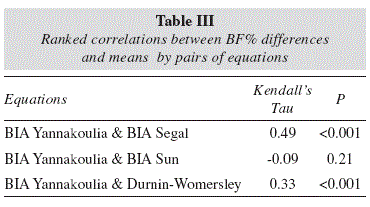
<body><![CDATA[<p><font face="Verdana" size="2"><i>Agreement analysis</i></font></p>     <p><font face="Verdana" size="2">The graphical analysis of Band &amp; Altman plots showed us that there were large intervals of confidence for all methods (<a target="_blank" href="/img/revistas/nh/v30n3/20originaldeporteyejercicio02_f1.gif">figure 1</a>). Regarding absolute bias the one sample T-test was significantly different from 0 value for Sun and Durnin Womersley models. The smallest mean difference was found between Yannakoulia and Segal equations, which was not statistically significant (-0.35 &plusmn; 2.32%, <i>P</i>=0.38). The greatest mean differences were presented with Sun and Durnin-Womersley equations (-0.73 &plusmn; 2.30%, <i>P</i>&lt;0.05 and -2.65 &plusmn; 2.48 %, <i>P</i>&lt;0.001; respectively). (<a target="_blank" href="/img/revistas/nh/v30n3/20originaldeporteyejercicio02_t2.gif">table II</a>, <a href="#f2">figure 2</a>). Also, a negative proportional bias were observed between Yannakoulia with Segal and Durnin-Womersley, which were confirmed using a ranked correlation coefficient of Kendall's <i>Tau</i> of r= -0.33 and r=-0.49, respectively (both P&lt;0.001; <a href="#t3">table III</a>).</font></p>     <p>&nbsp;</p>     <p align="center"><font face="Verdana" size="2"><a name="f2"><img src="/img/revistas/nh/v30n3/20originaldeporteyejercicio02_f2.gif"></a></font></p>     <p>&nbsp;</p>     <p align="center"><font face="Verdana" size="2"><a name="t3"><img src="/img/revistas/nh/v30n3/20originaldeporteyejercicio02_t3.gif"></a></font></p>     <p>&nbsp;</p>     <p><font face="Verdana" size="2"><b>Discussion</b></font></p>     <p><font face="Verdana" size="2">The main findings of this study were that for first time the body composition pattern of Flamenco dancers was described in international scientific literature. On second, we confirmed differences between the field methods to assess body composition in a sample of female dance students of different modalities. In accordance with other studies<sup>6, 16</sup>, this study showed differences between bioelectrical impedance analysis and skinfolds method for body fat prediction in dancers. So we can confirm, that not all procedures can be used interchangeably to compare results between different samples. Although body composition is a proliferative research area there are not too much models to assess accurately among sport and physical activity modalities, such as dance. We used the Yannakoulia model, as the reference equation, because it is the only one that has been developed and validated with dancers, so it should fit better in our sample of young Caucasian female dancers in order to estimate accurately their body composition compartments. This equation was developed with anthropometric (skinfolds) BIA variables (resistance (&Omega;)) and was validated with DXA as a reference method<sup>25</sup>. Our findings must reflect methodological limitations of instruments and mathematical models that are used to assess body composition, namely in dance performers.</font></p>     <p><font face="Verdana" size="2">Regarding the validity of the equations, all equations that used BIA estimated similar %BF, however the Durnin-Womersley equation overestimated significantly the adiposity. Our data are not in accordance with the Peterson's results who validated the equation against the four compartment model<sup>14</sup>, concluding that Durnin-Womersley equation underestimate -1.8% on average %BF in women. These results suggest that the true difference values estimated by Durnin-Womersley in dancers should be even higher than those from reference model validated by Yannakoulia<sup>25</sup>. Whereas at least a 4-component model must be used as "gold standard" to measure and validate %BF assessments, the classical 2-component model (%BF= (Body mass-FFM) x 100) is used in this study as reference method using BIA as technique to estimate FFM and calculate %BF; moreover, Yannakoulia's model was validated with DXA as reference method. Although DXA have been widely validated as an accurate and reliable method to assess body composition<sup>3, 8</sup>, it cannot be used as the reference in methodological studies since is a two component-based method<sup>7, 15</sup>.</font></p>     ]]></body>
<body><![CDATA[<p><font face="Verdana" size="2">In spite of the 4-component model must be a more robust method to validate body composition methods than DXA. However, even it was validated with DXA, Yannakoulia equation is the only that has been developed for dancers (Yannakoulia, Keramopoulos, Tsakalakos &amp; Matalas, 2000). Moreover while other equations have been validated from general population, the Yannakoulia equation should be fit better for dancers than the classical equations because it was developed with a specific sample of dancers.</font></p>     <p><font face="Verdana" size="2">The results of correlation analysis between %BF estimations using BIA or anthropometric techniques showed variable results. As expect, the poorest Pearson's coefficient was found between reference equation and anthropometric equation, which confirm that Durnin-Womersley equation do not fit well in our sample; moreover, these values were similar (<i>r</i>=0.48) with other studies<sup>6, 16</sup>. The coefficients between %BF estimated by BIA models were relatively strong (r &gt; 0.85), but it must not confirm definitively a good validity, and an agreement analysis must be conducted in order to confirm an absence of systematic or proportional bias.</font></p>     <p><font face="Verdana" size="2">Although moderate-high significant correlations were observed between the methods, Bland-Altman plot analyses revealed bias. In the <a href="#f2">figure 2</a> we have shown the bias and limits of agreement (LOA) in each prediction models by plotting the difference between comparison equation and Yannakoulia values (y axis) against the mean values (&chi; axis). Bland-Altman plots were used to assess the agreement of each prediction equation and Yannakoulia model. The 95% LOA (mean difference &plusmn; 2 SD) for %BF by Segal was approximately 4.2 to -4.9% (9.1%); Sun 3.8 to -5.3% (9.1%) and Durnin-Womersley 2.2 to -7.5 (9.7%), which noticed large error between methods. Also, Bland-Altman plots revealed different agreements between BIA equations, so a systematic bias was observed for Sun equation, which resulted in an underestimation of 0.73% on average (<a href="#f2">Figure 2B</a>). Regarding proportional bias, Segal and Durnin-Womersley equations showed a significant and positive trend (0.49, <i>P</i>&lt;0.05; 0.33, <i>P</i>&lt;0.0001 respectively), which meant more %BF greater overestimation, also there were larger differences between equations in lower and upper extremes values (<a href="#f2">Figure 2A and 2C</a>). Segal and Sun equations were developed and validated in large samples of general population<sup>18, 21</sup>, while these equations are recommended for the use in clinical and epidemiologic studies to describe levels of body composition in Spanish subjects<sup>1</sup>, they must not fit well for specific populations as our dancers. The main reason that could explain these differences should be related with differences of FFM hydration<sup>23</sup>, which is one of the cornerstone paradigms to estimate body composition using component-type II methods<sup>7, 23, 24</sup>. Although, there are not studies where FFM hydration have been measured in dancers, classical studies have reported this concern when body composition is assessed in athletes, who must perform high levels of physical activity practice like dancers<sup>11</sup>. Moreover, dancers herein were all females and young, which should be other factor that explain our results since have been reported that female athletes have higher density of FFM than male athletes<sup>17</sup>. All this previous knowledge, reinforce our initial hypothesis, that propose that only models validated in specific populations must predict accurately body composition, since our sample is a sample of dancers, who are not true athletes in fact, new models must be developed, and even though Yannakoulia model should be good approach for some type of dancers, our Flamenco dancers seems that have a particular pattern of body composition (<a target="_blank" href="/img/revistas/nh/v30n3/20originaldeporteyejercicio02_t1.gif">table I</a>).</font></p>     <p><font face="Verdana" size="2">In regard of specific characteristics of our dancers, as reported in classical studies, our results of anthropometric parameters as body mass and stature, mirrored the expected values from other studies with dan-cers<sup>9,22,25</sup>, although body mass index in our sample was slightly higher, which must be a consequence of the modalities analyzed in this study. The inclusion of Flamenco dancers should be the consequence since this modality has never been reported in the literature.</font></p>     <p><font face="Verdana" size="2">In our knowledge, there are not international studies that describe body composition in Flamenco dancers. Our data confirm empirical descriptions of body composition in Flamenco dancers, which characterized them with voluminous body shape and greater skinfold thicknesses than others such as Classical or Spanish dancers. Results showed differences between modalities that confirms our hypothesis, so Flamenco dancers have a higher %BF than Classical and Spanish, although only statistically significant with Spanish dancers. Dancers constitute a lean group of performers and their mean levels of fatness ranged widely from 13 to 22% of body mass<sup>4, 6</sup>. The present study was carried out on student dancers with great experience and training amount and %BF ranging 12.0 to 35.1%. This was almost certainly due to %BF from Flamenco dancers, who had 25% on average (minimum 17.6% and maximum 35.1%). %BF must be an important concern to perform high speed movements and some acrobatic skills that are a characteristic of dances as Spanish and Classical, however in Flamenco %BF should not be a difficulty to perform a high quality technique.</font></p>     <p><font face="Verdana" size="2">In conclusion, our findings support the view that there are body composition differences among performers of Spanish dance disciplines at least to the end of a dancer's extensive training and education period. Anecdotal evidence leads us to believe that this may well occur following some years of training on one discipline only, but the timing and extent of any differences have yet to be quantified. The body composition assessment of dancers showed differences in predicted values by the two used methods, yet again confirm, that the two methods are not interchangeable and that one only should be used for comparison purposes.</font></p>     <p>&nbsp;</p>     <p><font face="Verdana" size="2"><b>Practical Applications</b></font></p>     <p><font face="Verdana" size="2">Providing precise and accurate body composition estimates is of great importance. The comparisons provided in this work should aid in making a more informed decision, considering accuracy, when choosing among several equations for predicting %BF. We found that individual estimation of body composition was highly method-dependent and the BIA equations<sup>18, 21, 25</sup> were not interchangeable with anthropometric method. Skinfolds measurement is considered useful method to estimate body fatness, at least the classical models used for general population must not be valid for dancers. So, we strongly suggest the use of Yannakoulia model and BIA when we want assess %BF in Flamenco, Classical or Spanish dancers. However, anthropometric measurements must be good method to control regional changes of subcutaneous adiposity. Our results would be used as reference of high performance healthy dancers since these dancers have large professional experience and a high volume of daily practice, mainly for Flamenco and Spanish dancers.</font></p>     <p>&nbsp;</p>     ]]></body>
<body><![CDATA[<p><font face="Verdana" size="2"><b>Acknowledgements</b></font></p>     <p><font face="Verdana" size="2">We would like to thank the staff, and dance students of the High Dance School of Málaga City (Spain), for their help and participation in this study.</font></p>     <p>&nbsp;</p>     <p><font face="Verdana" size="2"><b>References</b></font></p>     <!-- ref --><p><font face="Verdana" size="2">1. Alvero-Cruz JR, Diego-Acosta AM, Fernández-Pastor VJ, Garcia Romero J. Métodos de evaluación de la composición corporal: Tendencias actuales II. <i>Archivos de Medicina del Deporte</i> 2005, 105: 45-50.    &nbsp;&nbsp;&nbsp;&nbsp;&nbsp;&nbsp;&nbsp;&nbsp;[&#160;<a href="javascript:void(0);" onclick="javascript: window.open('/scielo.php?script=sci_nlinks&ref=3844431&pid=S0212-1611201400100002000001&lng=','','width=640,height=500,resizable=yes,scrollbars=1,menubar=yes,');">Links</a>&#160;]<!-- end-ref --></font></p>    <!-- ref --><p><font face="Verdana" size="2">2. Bland JM, Altman DG. Statistical methods for assessing agreement between two methods of clinical measurement. <i>Lancet</i> 1986, 1: 307-310.    &nbsp;&nbsp;&nbsp;&nbsp;&nbsp;&nbsp;&nbsp;&nbsp;[&#160;<a href="javascript:void(0);" onclick="javascript: window.open('/scielo.php?script=sci_nlinks&ref=3844433&pid=S0212-1611201400100002000002&lng=','','width=640,height=500,resizable=yes,scrollbars=1,menubar=yes,');">Links</a>&#160;]<!-- end-ref --></font></p>    <!-- ref --><p><font face="Verdana" size="2">3. Bridge P, Pocock NA, Nguyen T, Munns C, Cowell CT, Forwood N, Thompson MW. Validation of longitudinal DXA changes in body composition from pre- to mid-adolescence using MRI as reference. <i>J Clin Densitom</i> 2011, 14: 340-347.    &nbsp;&nbsp;&nbsp;&nbsp;&nbsp;&nbsp;&nbsp;&nbsp;[&#160;<a href="javascript:void(0);" onclick="javascript: window.open('/scielo.php?script=sci_nlinks&ref=3844435&pid=S0212-1611201400100002000003&lng=','','width=640,height=500,resizable=yes,scrollbars=1,menubar=yes,');">Links</a>&#160;]<!-- end-ref --></font></p>    ]]></body>
<body><![CDATA[<!-- ref --><p><font face="Verdana" size="2">4. Chmelar RD, Fitt SS, Shultz BB, Ruhling RO, Shepherd MF. Body composition and the comparison of measurement techniques indifferent levels and styles of dancers. <i>Dance Research Journal</i> 1988, 20: 37-41.    &nbsp;&nbsp;&nbsp;&nbsp;&nbsp;&nbsp;&nbsp;&nbsp;[&#160;<a href="javascript:void(0);" onclick="javascript: window.open('/scielo.php?script=sci_nlinks&ref=3844437&pid=S0212-1611201400100002000004&lng=','','width=640,height=500,resizable=yes,scrollbars=1,menubar=yes,');">Links</a>&#160;]<!-- end-ref --></font></p>    <!-- ref --><p><font face="Verdana" size="2">5. Durnin JV, Womersley J. Body fat assessed from total body density and its estimation from skinfold thickness: measurements on 481 men and women aged from 16 to 72 years. <i>Br J Nutr</i> 1974, 32: 77-97.    &nbsp;&nbsp;&nbsp;&nbsp;&nbsp;&nbsp;&nbsp;&nbsp;[&#160;<a href="javascript:void(0);" onclick="javascript: window.open('/scielo.php?script=sci_nlinks&ref=3844439&pid=S0212-1611201400100002000005&lng=','','width=640,height=500,resizable=yes,scrollbars=1,menubar=yes,');">Links</a>&#160;]<!-- end-ref --></font></p>    <!-- ref --><p><font face="Verdana" size="2">6. Eliakim A, Ish-Shalom S, Giladi A, Falk B, Constantini N. Assessment of body composition in ballett dancers: correlation among anthropometric measurements, bioelectrical impedance analysis, and dual-energy X-ray absorptiometry. <i>Int J Sports Med</i> 2000, 21: 598-601.    &nbsp;&nbsp;&nbsp;&nbsp;&nbsp;&nbsp;&nbsp;&nbsp;[&#160;<a href="javascript:void(0);" onclick="javascript: window.open('/scielo.php?script=sci_nlinks&ref=3844441&pid=S0212-1611201400100002000006&lng=','','width=640,height=500,resizable=yes,scrollbars=1,menubar=yes,');">Links</a>&#160;]<!-- end-ref --></font></p>    <!-- ref --><p><font face="Verdana" size="2">7. Heymsfield SB, Wang Z, Baumgartner RN, Ross R. Human body composition: advances in models and methods. <i>Annu Rev Nutr</i> 1977, 17: 527-558.    &nbsp;&nbsp;&nbsp;&nbsp;&nbsp;&nbsp;&nbsp;&nbsp;[&#160;<a href="javascript:void(0);" onclick="javascript: window.open('/scielo.php?script=sci_nlinks&ref=3844443&pid=S0212-1611201400100002000007&lng=','','width=640,height=500,resizable=yes,scrollbars=1,menubar=yes,');">Links</a>&#160;]<!-- end-ref --></font></p>    <!-- ref --><p><font face="Verdana" size="2">8. Kohrt WM. Preliminary evidence that DEXA provides an accurate assessment of body composition. <i>J Appl Physiol</i> 1998, 84: 372-377.    &nbsp;&nbsp;&nbsp;&nbsp;&nbsp;&nbsp;&nbsp;&nbsp;[&#160;<a href="javascript:void(0);" onclick="javascript: window.open('/scielo.php?script=sci_nlinks&ref=3844445&pid=S0212-1611201400100002000008&lng=','','width=640,height=500,resizable=yes,scrollbars=1,menubar=yes,');">Links</a>&#160;]<!-- end-ref --></font></p>    ]]></body>
<body><![CDATA[<!-- ref --><p><font face="Verdana" size="2">9. Koutedakis Y, Hukam H, Metsios G, Nevill A, Giakas G, Jamurtas A, Myszkewycz L. The effects of three months of aerobic and strength training on selected performance- and fitness-related parameters in modern dance students. <i>J Strength Cond Res</i> 2007, 21: 808-812.    &nbsp;&nbsp;&nbsp;&nbsp;&nbsp;&nbsp;&nbsp;&nbsp;[&#160;<a href="javascript:void(0);" onclick="javascript: window.open('/scielo.php?script=sci_nlinks&ref=3844447&pid=S0212-1611201400100002000009&lng=','','width=640,height=500,resizable=yes,scrollbars=1,menubar=yes,');">Links</a>&#160;]<!-- end-ref --></font></p>    <!-- ref --><p><font face="Verdana" size="2">10. León HB, Aréchiga J, Ramirez CM, Diaz MB. Study of body dimensions of elite professional dancers. <i>Apunts de Medicina del Deporte</i> 2009, 169: 3-9.    &nbsp;&nbsp;&nbsp;&nbsp;&nbsp;&nbsp;&nbsp;&nbsp;[&#160;<a href="javascript:void(0);" onclick="javascript: window.open('/scielo.php?script=sci_nlinks&ref=3844449&pid=S0212-1611201400100002000010&lng=','','width=640,height=500,resizable=yes,scrollbars=1,menubar=yes,');">Links</a>&#160;]<!-- end-ref --></font></p>    <!-- ref --><p><font face="Verdana" size="2">11. Lohman TG, Pollock ML, Slaughter MH, Brandon LJ, Boileau RA. Methodological factors and the prediction of body fat in female athletes. <i>Med Sci Sports Exerc</i> 1984, 16: 92-96.    &nbsp;&nbsp;&nbsp;&nbsp;&nbsp;&nbsp;&nbsp;&nbsp;[&#160;<a href="javascript:void(0);" onclick="javascript: window.open('/scielo.php?script=sci_nlinks&ref=3844451&pid=S0212-1611201400100002000011&lng=','','width=640,height=500,resizable=yes,scrollbars=1,menubar=yes,');">Links</a>&#160;]<!-- end-ref --></font></p>    <!-- ref --><p><font face="Verdana" size="2">12. Lukaski HC, Bolonchuk WW, Hall CB, Siders WA. Validation of tetrapolar bioelectrical impedance method to assess human body composition. <i>J Appl Physiol</i> 1986, 60: 1327-1332.    &nbsp;&nbsp;&nbsp;&nbsp;&nbsp;&nbsp;&nbsp;&nbsp;[&#160;<a href="javascript:void(0);" onclick="javascript: window.open('/scielo.php?script=sci_nlinks&ref=3844453&pid=S0212-1611201400100002000012&lng=','','width=640,height=500,resizable=yes,scrollbars=1,menubar=yes,');">Links</a>&#160;]<!-- end-ref --></font></p>    <!-- ref --><p><font face="Verdana" size="2">13. Marfell-Jones M, Olds T, Stewart A, Carter L. <i>International Standards for Anthropometric Assessment.</i> Potschefstroom (South Africa): International Society for Advancement in Kinanthropometry (ISAK). 2006.    &nbsp;&nbsp;&nbsp;&nbsp;&nbsp;&nbsp;&nbsp;&nbsp;[&#160;<a href="javascript:void(0);" onclick="javascript: window.open('/scielo.php?script=sci_nlinks&ref=3844455&pid=S0212-1611201400100002000013&lng=','','width=640,height=500,resizable=yes,scrollbars=1,menubar=yes,');">Links</a>&#160;]<!-- end-ref --></font></p>    ]]></body>
<body><![CDATA[<!-- ref --><p><font face="Verdana" size="2">14. Peterson MJ, Czerwinski SA, Siervogel RM. Development and validation of skinfold-thickness prediction equations with a 4-compartment model. <i>Am J Clin Nutr</i> 2003, 77: 1186-1191.    &nbsp;&nbsp;&nbsp;&nbsp;&nbsp;&nbsp;&nbsp;&nbsp;[&#160;<a href="javascript:void(0);" onclick="javascript: window.open('/scielo.php?script=sci_nlinks&ref=3844457&pid=S0212-1611201400100002000014&lng=','','width=640,height=500,resizable=yes,scrollbars=1,menubar=yes,');">Links</a>&#160;]<!-- end-ref --></font></p>    <!-- ref --><p><font face="Verdana" size="2">15. Pietrobelli A, Formica C, Wang Z, Heymsfield SB. Dual-energy X-ray absorptiometry body composition model: review of physical concepts. <i>Am J Physiol</i> 1996, 271: E941-951.    &nbsp;&nbsp;&nbsp;&nbsp;&nbsp;&nbsp;&nbsp;&nbsp;[&#160;<a href="javascript:void(0);" onclick="javascript: window.open('/scielo.php?script=sci_nlinks&ref=3844459&pid=S0212-1611201400100002000015&lng=','','width=640,height=500,resizable=yes,scrollbars=1,menubar=yes,');">Links</a>&#160;]<!-- end-ref --></font></p>    <!-- ref --><p><font face="Verdana" size="2">16. Portao J, Bescos R, Irurtia A, Cacciatori E, Vallejo L. Assessment of body fat in physically active young people: anthropometry vs bioimpedance. <i>Nutr Hosp</i> 2009, 24: 529-534.    &nbsp;&nbsp;&nbsp;&nbsp;&nbsp;&nbsp;&nbsp;&nbsp;[&#160;<a href="javascript:void(0);" onclick="javascript: window.open('/scielo.php?script=sci_nlinks&ref=3844461&pid=S0212-1611201400100002000016&lng=','','width=640,height=500,resizable=yes,scrollbars=1,menubar=yes,');">Links</a>&#160;]<!-- end-ref --></font></p>    <!-- ref --><p><font face="Verdana" size="2">17. Quiterio AL, Silva AM, Minderico CS, Carnero EA, Fields DA, Sardinha LB. Total body water measurements in adolescent athletes: a comparison of six field methods with deuterium dilution. <i>J Strength Cond Res</i> 2009, 23: 1225-1237.    &nbsp;&nbsp;&nbsp;&nbsp;&nbsp;&nbsp;&nbsp;&nbsp;[&#160;<a href="javascript:void(0);" onclick="javascript: window.open('/scielo.php?script=sci_nlinks&ref=3844463&pid=S0212-1611201400100002000017&lng=','','width=640,height=500,resizable=yes,scrollbars=1,menubar=yes,');">Links</a>&#160;]<!-- end-ref --></font></p>    <!-- ref --><p><font face="Verdana" size="2">18. Segal KR, Van Loan M, Fitzgerald PI, Hodgdon JA, Van Itallie TB. Lean body mass estimation by bioelectrical impedance analysis: a four-site cross-validation study. <i>Am J Clin Nutr</i> 1988, 47: 7-14.    &nbsp;&nbsp;&nbsp;&nbsp;&nbsp;&nbsp;&nbsp;&nbsp;[&#160;<a href="javascript:void(0);" onclick="javascript: window.open('/scielo.php?script=sci_nlinks&ref=3844465&pid=S0212-1611201400100002000018&lng=','','width=640,height=500,resizable=yes,scrollbars=1,menubar=yes,');">Links</a>&#160;]<!-- end-ref --></font></p>    ]]></body>
<body><![CDATA[<!-- ref --><p><font face="Verdana" size="2">19. Siri WR. Body composition from fluid spaces and density; analysis of methods. In: <i>Techniques for measuring body composition</i>, edited by Brozek JaH, A. Washington D.C. : A. Nat. Acad. Sci., 1961, p. 223-244.    &nbsp;&nbsp;&nbsp;&nbsp;&nbsp;&nbsp;&nbsp;&nbsp;[&#160;<a href="javascript:void(0);" onclick="javascript: window.open('/scielo.php?script=sci_nlinks&ref=3844467&pid=S0212-1611201400100002000019&lng=','','width=640,height=500,resizable=yes,scrollbars=1,menubar=yes,');">Links</a>&#160;]<!-- end-ref --></font></p>    <!-- ref --><p><font face="Verdana" size="2">20. Soric M, M. M-D, Pedisic Z. Dietary intake and body composition of prepubescent female aesthetic athletes. <i>International Journal of Sport Nutrition and Exercise Metabolism</i> 2008, 18: 343-354.    &nbsp;&nbsp;&nbsp;&nbsp;&nbsp;&nbsp;&nbsp;&nbsp;[&#160;<a href="javascript:void(0);" onclick="javascript: window.open('/scielo.php?script=sci_nlinks&ref=3844469&pid=S0212-1611201400100002000020&lng=','','width=640,height=500,resizable=yes,scrollbars=1,menubar=yes,');">Links</a>&#160;]<!-- end-ref --></font></p>    <!-- ref --><p><font face="Verdana" size="2">21. Sun SS, Chumlea WC, Heymsfield SB, Lukaski HC, Schoeller D, Friedl K, Kuczmarski RJ, Flegal KM, Johnson CL, Hubbard VS. Development of bioelectrical impedance analysis prediction equations for body composition with the use of a multi-component model for use in epidemiologic surveys. <i>Am J Clin Nutr</i> 2003, 77: 331-340.    &nbsp;&nbsp;&nbsp;&nbsp;&nbsp;&nbsp;&nbsp;&nbsp;[&#160;<a href="javascript:void(0);" onclick="javascript: window.open('/scielo.php?script=sci_nlinks&ref=3844471&pid=S0212-1611201400100002000021&lng=','','width=640,height=500,resizable=yes,scrollbars=1,menubar=yes,');">Links</a>&#160;]<!-- end-ref --></font></p>    <!-- ref --><p><font face="Verdana" size="2">22. Van Marken Lichtenbelt WD, Fogelholm M, Ottenheijm R, Westerterp KR. Physical activity, body composition and bone density in ballet dancers. <i>Br J Nutr</i> 1995, 74: 439-451.    &nbsp;&nbsp;&nbsp;&nbsp;&nbsp;&nbsp;&nbsp;&nbsp;[&#160;<a href="javascript:void(0);" onclick="javascript: window.open('/scielo.php?script=sci_nlinks&ref=3844473&pid=S0212-1611201400100002000022&lng=','','width=640,height=500,resizable=yes,scrollbars=1,menubar=yes,');">Links</a>&#160;]<!-- end-ref --></font></p>    <!-- ref --><p><font face="Verdana" size="2">23. Wang Z, Deurenberg P, Wang W, Pietrobelli A, Baumgartner RN, Heymsfield SB. Hydration of fat-free body mass: review and critique of a classic body-composition constant. <i>Am J Clin Nutr</i> 1999, 69: 833-841.    &nbsp;&nbsp;&nbsp;&nbsp;&nbsp;&nbsp;&nbsp;&nbsp;[&#160;<a href="javascript:void(0);" onclick="javascript: window.open('/scielo.php?script=sci_nlinks&ref=3844475&pid=S0212-1611201400100002000023&lng=','','width=640,height=500,resizable=yes,scrollbars=1,menubar=yes,');">Links</a>&#160;]<!-- end-ref --></font></p>    ]]></body>
<body><![CDATA[<!-- ref --><p><font face="Verdana" size="2">24. Wang ZM, Heshka S, Pierson RN, Jr., Heymsfield SB. Systematic organization of body-composition methodology: an overview with emphasis on component-based methods. <i>Am J Clin Nutr</i> 1995, 61: 457-465.    &nbsp;&nbsp;&nbsp;&nbsp;&nbsp;&nbsp;&nbsp;&nbsp;[&#160;<a href="javascript:void(0);" onclick="javascript: window.open('/scielo.php?script=sci_nlinks&ref=3844477&pid=S0212-1611201400100002000024&lng=','','width=640,height=500,resizable=yes,scrollbars=1,menubar=yes,');">Links</a>&#160;]<!-- end-ref --></font></p>    <!-- ref --><p><font face="Verdana" size="2">25. Yannakoulia M, Keramopoulos A, Tsakalakos N, Matalas AL. Body composition in dancers: the bioelectrical impedance method. <i>Med Sci Sports Exerc</i> 2000, 32: 228-234.    &nbsp;&nbsp;&nbsp;&nbsp;&nbsp;&nbsp;&nbsp;&nbsp;[&#160;<a href="javascript:void(0);" onclick="javascript: window.open('/scielo.php?script=sci_nlinks&ref=3844479&pid=S0212-1611201400100002000025&lng=','','width=640,height=500,resizable=yes,scrollbars=1,menubar=yes,');">Links</a>&#160;]<!-- end-ref --></font></p>     <p>&nbsp;</p>     <p>&nbsp;</p>     <p><font face="Verdana" size="2"><a href="#top"><img border="0" src="/img/revistas/nh/v30n3/seta.gif" width="15" height="17"></a><a name="bajo"></a><b>Correspondence:</b>    <br>José Ramón Alvero Cruz.    <br>Sports Medicine School.    <br>Faculty of Medicine.    ]]></body>
<body><![CDATA[<br>University of Málaga. Spain.    <br>Edificio López de Peñalver,    <br>Campus de Teatinos s/n.    <br>29071 Málaga. Spain.    <br>E-mail: <a href="mailto:alvero@uma.es">alvero@uma.es</a></font></p>     <p><font face="Verdana" size="2">Recibido: 18-XII-2013.    <br>Aceptado: 29-V-2014.</font></p>      ]]></body><back>
<ref-list>
<ref id="B1">
<label>1</label><nlm-citation citation-type="journal">
<person-group person-group-type="author">
<name>
<surname><![CDATA[Alvero-Cruz]]></surname>
<given-names><![CDATA[JR]]></given-names>
</name>
<name>
<surname><![CDATA[Diego-Acosta]]></surname>
<given-names><![CDATA[AM]]></given-names>
</name>
<name>
<surname><![CDATA[Fernández-Pastor]]></surname>
<given-names><![CDATA[VJ]]></given-names>
</name>
<name>
<surname><![CDATA[Garcia Romero]]></surname>
<given-names><![CDATA[J]]></given-names>
</name>
</person-group>
<article-title xml:lang="es"><![CDATA[Métodos de evaluación de la composición corporal: Tendencias actuales II]]></article-title>
<source><![CDATA[Archivos de Medicina del Deporte]]></source>
<year>2005</year>
<volume>105</volume>
<page-range>45-50</page-range></nlm-citation>
</ref>
<ref id="B2">
<label>2</label><nlm-citation citation-type="journal">
<person-group person-group-type="author">
<name>
<surname><![CDATA[Bland]]></surname>
<given-names><![CDATA[JM]]></given-names>
</name>
<name>
<surname><![CDATA[Altman]]></surname>
<given-names><![CDATA[DG]]></given-names>
</name>
</person-group>
<article-title xml:lang="en"><![CDATA[Statistical methods for assessing agreement between two methods of clinical measurement]]></article-title>
<source><![CDATA[Lancet]]></source>
<year>1986</year>
<volume>1</volume>
<page-range>307-310</page-range></nlm-citation>
</ref>
<ref id="B3">
<label>3</label><nlm-citation citation-type="journal">
<person-group person-group-type="author">
<name>
<surname><![CDATA[Bridge]]></surname>
<given-names><![CDATA[P]]></given-names>
</name>
<name>
<surname><![CDATA[Pocock]]></surname>
<given-names><![CDATA[NA]]></given-names>
</name>
<name>
<surname><![CDATA[Nguyen]]></surname>
<given-names><![CDATA[T]]></given-names>
</name>
<name>
<surname><![CDATA[Munns]]></surname>
<given-names><![CDATA[C]]></given-names>
</name>
<name>
<surname><![CDATA[Cowell]]></surname>
<given-names><![CDATA[CT]]></given-names>
</name>
<name>
<surname><![CDATA[Forwood]]></surname>
<given-names><![CDATA[N]]></given-names>
</name>
<name>
<surname><![CDATA[Thompson]]></surname>
<given-names><![CDATA[MW]]></given-names>
</name>
</person-group>
<article-title xml:lang="en"><![CDATA[Validation of longitudinal DXA changes in body composition from pre- to mid-adolescence using MRI as reference]]></article-title>
<source><![CDATA[J Clin Densitom]]></source>
<year>2011</year>
<volume>14</volume>
<page-range>340-347</page-range></nlm-citation>
</ref>
<ref id="B4">
<label>4</label><nlm-citation citation-type="journal">
<person-group person-group-type="author">
<name>
<surname><![CDATA[Chmelar]]></surname>
<given-names><![CDATA[RD]]></given-names>
</name>
<name>
<surname><![CDATA[Fitt]]></surname>
<given-names><![CDATA[SS]]></given-names>
</name>
<name>
<surname><![CDATA[Shultz]]></surname>
<given-names><![CDATA[BB]]></given-names>
</name>
<name>
<surname><![CDATA[Ruhling]]></surname>
<given-names><![CDATA[RO]]></given-names>
</name>
<name>
<surname><![CDATA[Shepherd]]></surname>
<given-names><![CDATA[MF]]></given-names>
</name>
</person-group>
<article-title xml:lang="en"><![CDATA[Body composition and the comparison of measurement techniques indifferent levels and styles of dancers]]></article-title>
<source><![CDATA[Dance Research Journal]]></source>
<year>1988</year>
<volume>20</volume>
<page-range>37-41</page-range></nlm-citation>
</ref>
<ref id="B5">
<label>5</label><nlm-citation citation-type="journal">
<person-group person-group-type="author">
<name>
<surname><![CDATA[Durnin]]></surname>
<given-names><![CDATA[JV]]></given-names>
</name>
<name>
<surname><![CDATA[Womersley]]></surname>
<given-names><![CDATA[J]]></given-names>
</name>
</person-group>
<article-title xml:lang="en"><![CDATA[Body fat assessed from total body density and its estimation from skinfold thickness: measurements on 481 men and women aged from 16 to 72 years]]></article-title>
<source><![CDATA[Br J Nutr]]></source>
<year>1974</year>
<volume>32</volume>
<page-range>77-97</page-range></nlm-citation>
</ref>
<ref id="B6">
<label>6</label><nlm-citation citation-type="journal">
<person-group person-group-type="author">
<name>
<surname><![CDATA[Eliakim]]></surname>
<given-names><![CDATA[A]]></given-names>
</name>
<name>
<surname><![CDATA[Ish-Shalom]]></surname>
<given-names><![CDATA[S]]></given-names>
</name>
<name>
<surname><![CDATA[Giladi]]></surname>
<given-names><![CDATA[A]]></given-names>
</name>
<name>
<surname><![CDATA[Falk]]></surname>
<given-names><![CDATA[B]]></given-names>
</name>
<name>
<surname><![CDATA[Constantini]]></surname>
<given-names><![CDATA[N]]></given-names>
</name>
</person-group>
<article-title xml:lang="en"><![CDATA[Assessment of body composition in ballett dancers: correlation among anthropometric measurements, bioelectrical impedance analysis, and dual-energy X-ray absorptiometry]]></article-title>
<source><![CDATA[Int J Sports Med]]></source>
<year>2000</year>
<volume>21</volume>
<page-range>598-601</page-range></nlm-citation>
</ref>
<ref id="B7">
<label>7</label><nlm-citation citation-type="journal">
<person-group person-group-type="author">
<name>
<surname><![CDATA[Heymsfield]]></surname>
<given-names><![CDATA[SB]]></given-names>
</name>
<name>
<surname><![CDATA[Wang]]></surname>
<given-names><![CDATA[Z]]></given-names>
</name>
<name>
<surname><![CDATA[Baumgartner]]></surname>
<given-names><![CDATA[RN]]></given-names>
</name>
<name>
<surname><![CDATA[Ross]]></surname>
<given-names><![CDATA[R]]></given-names>
</name>
</person-group>
<article-title xml:lang="en"><![CDATA[Human body composition: advances in models and methods]]></article-title>
<source><![CDATA[Annu Rev Nutr]]></source>
<year>1977</year>
<volume>17</volume>
<page-range>527-558</page-range></nlm-citation>
</ref>
<ref id="B8">
<label>8</label><nlm-citation citation-type="journal">
<person-group person-group-type="author">
<name>
<surname><![CDATA[Kohrt]]></surname>
<given-names><![CDATA[WM]]></given-names>
</name>
</person-group>
<article-title xml:lang="en"><![CDATA[Preliminary evidence that DEXA provides an accurate assessment of body composition]]></article-title>
<source><![CDATA[J Appl Physiol]]></source>
<year>1998</year>
<volume>84</volume>
<page-range>372-377</page-range></nlm-citation>
</ref>
<ref id="B9">
<label>9</label><nlm-citation citation-type="journal">
<person-group person-group-type="author">
<name>
<surname><![CDATA[Koutedakis]]></surname>
<given-names><![CDATA[Y]]></given-names>
</name>
<name>
<surname><![CDATA[Hukam]]></surname>
<given-names><![CDATA[H]]></given-names>
</name>
<name>
<surname><![CDATA[Metsios]]></surname>
<given-names><![CDATA[G]]></given-names>
</name>
<name>
<surname><![CDATA[Nevill]]></surname>
<given-names><![CDATA[A]]></given-names>
</name>
<name>
<surname><![CDATA[Giakas]]></surname>
<given-names><![CDATA[G]]></given-names>
</name>
<name>
<surname><![CDATA[Jamurtas]]></surname>
<given-names><![CDATA[A]]></given-names>
</name>
<name>
<surname><![CDATA[Myszkewycz]]></surname>
<given-names><![CDATA[L]]></given-names>
</name>
</person-group>
<article-title xml:lang="en"><![CDATA[The effects of three months of aerobic and strength training on selected performance- and fitness-related parameters in modern dance students]]></article-title>
<source><![CDATA[J Strength Cond Res]]></source>
<year>2007</year>
<volume>21</volume>
<page-range>808-812</page-range></nlm-citation>
</ref>
<ref id="B10">
<label>10</label><nlm-citation citation-type="journal">
<person-group person-group-type="author">
<name>
<surname><![CDATA[León]]></surname>
<given-names><![CDATA[HB]]></given-names>
</name>
<name>
<surname><![CDATA[Aréchiga]]></surname>
<given-names><![CDATA[J]]></given-names>
</name>
<name>
<surname><![CDATA[Ramirez]]></surname>
<given-names><![CDATA[CM]]></given-names>
</name>
<name>
<surname><![CDATA[Diaz]]></surname>
<given-names><![CDATA[MB]]></given-names>
</name>
</person-group>
<article-title xml:lang="en"><![CDATA[Study of body dimensions of elite professional dancers]]></article-title>
<source><![CDATA[Apunts de Medicina del Deporte]]></source>
<year>2009</year>
<volume>169</volume>
<page-range>3-9</page-range></nlm-citation>
</ref>
<ref id="B11">
<label>11</label><nlm-citation citation-type="journal">
<person-group person-group-type="author">
<name>
<surname><![CDATA[Lohman]]></surname>
<given-names><![CDATA[TG]]></given-names>
</name>
<name>
<surname><![CDATA[Pollock]]></surname>
<given-names><![CDATA[ML]]></given-names>
</name>
<name>
<surname><![CDATA[Slaughter]]></surname>
<given-names><![CDATA[MH]]></given-names>
</name>
<name>
<surname><![CDATA[Brandon]]></surname>
<given-names><![CDATA[LJ]]></given-names>
</name>
<name>
<surname><![CDATA[Boileau]]></surname>
<given-names><![CDATA[RA]]></given-names>
</name>
</person-group>
<article-title xml:lang="en"><![CDATA[Methodological factors and the prediction of body fat in female athletes]]></article-title>
<source><![CDATA[Med Sci Sports Exerc]]></source>
<year>1984</year>
<volume>16</volume>
<page-range>92-96</page-range></nlm-citation>
</ref>
<ref id="B12">
<label>12</label><nlm-citation citation-type="journal">
<person-group person-group-type="author">
<name>
<surname><![CDATA[Lukaski]]></surname>
<given-names><![CDATA[HC]]></given-names>
</name>
<name>
<surname><![CDATA[Bolonchuk]]></surname>
<given-names><![CDATA[WW]]></given-names>
</name>
<name>
<surname><![CDATA[Hall]]></surname>
<given-names><![CDATA[CB]]></given-names>
</name>
<name>
<surname><![CDATA[Siders]]></surname>
<given-names><![CDATA[WA]]></given-names>
</name>
</person-group>
<article-title xml:lang="en"><![CDATA[Validation of tetrapolar bioelectrical impedance method to assess human body composition]]></article-title>
<source><![CDATA[J Appl Physiol]]></source>
<year>1986</year>
<volume>60</volume>
<page-range>1327-1332</page-range></nlm-citation>
</ref>
<ref id="B13">
<label>13</label><nlm-citation citation-type="book">
<person-group person-group-type="author">
<name>
<surname><![CDATA[Marfell-Jones]]></surname>
<given-names><![CDATA[M]]></given-names>
</name>
<name>
<surname><![CDATA[Olds]]></surname>
<given-names><![CDATA[T]]></given-names>
</name>
<name>
<surname><![CDATA[Stewart]]></surname>
<given-names><![CDATA[A]]></given-names>
</name>
<name>
<surname><![CDATA[Carter]]></surname>
<given-names><![CDATA[L]]></given-names>
</name>
</person-group>
<source><![CDATA[International Standards for Anthropometric Assessment]]></source>
<year>2006</year>
<publisher-loc><![CDATA[Potschefstroom ]]></publisher-loc>
<publisher-name><![CDATA[International Society for Advancement in Kinanthropometry (ISAK)]]></publisher-name>
</nlm-citation>
</ref>
<ref id="B14">
<label>14</label><nlm-citation citation-type="journal">
<person-group person-group-type="author">
<name>
<surname><![CDATA[Peterson]]></surname>
<given-names><![CDATA[MJ]]></given-names>
</name>
<name>
<surname><![CDATA[Czerwinski]]></surname>
<given-names><![CDATA[SA]]></given-names>
</name>
<name>
<surname><![CDATA[Siervogel]]></surname>
<given-names><![CDATA[RM]]></given-names>
</name>
</person-group>
<article-title xml:lang="en"><![CDATA[Development and validation of skinfold-thickness prediction equations with a 4-compartment model]]></article-title>
<source><![CDATA[Am J Clin Nutr]]></source>
<year>2003</year>
<volume>77</volume>
<page-range>1186-1191</page-range></nlm-citation>
</ref>
<ref id="B15">
<label>15</label><nlm-citation citation-type="journal">
<person-group person-group-type="author">
<name>
<surname><![CDATA[Pietrobelli]]></surname>
<given-names><![CDATA[A]]></given-names>
</name>
<name>
<surname><![CDATA[Formica]]></surname>
<given-names><![CDATA[C]]></given-names>
</name>
<name>
<surname><![CDATA[Wang]]></surname>
<given-names><![CDATA[Z]]></given-names>
</name>
<name>
<surname><![CDATA[Heymsfield]]></surname>
<given-names><![CDATA[SB]]></given-names>
</name>
</person-group>
<article-title xml:lang="en"><![CDATA[Dual-energy X-ray absorptiometry body composition model: review of physical concepts]]></article-title>
<source><![CDATA[Am J Physiol]]></source>
<year>1996</year>
<volume>271</volume>
<page-range>E941-951</page-range></nlm-citation>
</ref>
<ref id="B16">
<label>16</label><nlm-citation citation-type="journal">
<person-group person-group-type="author">
<name>
<surname><![CDATA[Portao]]></surname>
<given-names><![CDATA[J]]></given-names>
</name>
<name>
<surname><![CDATA[Bescos]]></surname>
<given-names><![CDATA[R]]></given-names>
</name>
<name>
<surname><![CDATA[Irurtia]]></surname>
<given-names><![CDATA[A]]></given-names>
</name>
<name>
<surname><![CDATA[Cacciatori]]></surname>
<given-names><![CDATA[E]]></given-names>
</name>
<name>
<surname><![CDATA[Vallejo]]></surname>
<given-names><![CDATA[L]]></given-names>
</name>
</person-group>
<article-title xml:lang="en"><![CDATA[Assessment of body fat in physically active young people: anthropometry vs bioimpedance]]></article-title>
<source><![CDATA[Nutr Hosp]]></source>
<year>2009</year>
<volume>24</volume>
<page-range>529-534</page-range></nlm-citation>
</ref>
<ref id="B17">
<label>17</label><nlm-citation citation-type="journal">
<person-group person-group-type="author">
<name>
<surname><![CDATA[Quiterio]]></surname>
<given-names><![CDATA[AL]]></given-names>
</name>
<name>
<surname><![CDATA[Silva]]></surname>
<given-names><![CDATA[AM]]></given-names>
</name>
<name>
<surname><![CDATA[Minderico]]></surname>
<given-names><![CDATA[CS]]></given-names>
</name>
<name>
<surname><![CDATA[Carnero]]></surname>
<given-names><![CDATA[EA]]></given-names>
</name>
<name>
<surname><![CDATA[Fields]]></surname>
<given-names><![CDATA[DA]]></given-names>
</name>
<name>
<surname><![CDATA[Sardinha]]></surname>
<given-names><![CDATA[LB]]></given-names>
</name>
</person-group>
<article-title xml:lang="en"><![CDATA[Total body water measurements in adolescent athletes: a comparison of six field methods with deuterium dilution]]></article-title>
<source><![CDATA[J Strength Cond Res]]></source>
<year>2009</year>
<volume>23</volume>
<page-range>1225-1237</page-range></nlm-citation>
</ref>
<ref id="B18">
<label>18</label><nlm-citation citation-type="journal">
<person-group person-group-type="author">
<name>
<surname><![CDATA[Segal]]></surname>
<given-names><![CDATA[KR]]></given-names>
</name>
<name>
<surname><![CDATA[Van Loan]]></surname>
<given-names><![CDATA[M]]></given-names>
</name>
<name>
<surname><![CDATA[Fitzgerald]]></surname>
<given-names><![CDATA[PI]]></given-names>
</name>
<name>
<surname><![CDATA[Hodgdon]]></surname>
<given-names><![CDATA[JA]]></given-names>
</name>
<name>
<surname><![CDATA[Van Itallie]]></surname>
<given-names><![CDATA[TB]]></given-names>
</name>
</person-group>
<article-title xml:lang="en"><![CDATA[Lean body mass estimation by bioelectrical impedance analysis: a four-site cross-validation study]]></article-title>
<source><![CDATA[Am J Clin Nutr]]></source>
<year>1988</year>
<volume>47</volume>
<page-range>7-14</page-range></nlm-citation>
</ref>
<ref id="B19">
<label>19</label><nlm-citation citation-type="book">
<person-group person-group-type="author">
<name>
<surname><![CDATA[Siri]]></surname>
<given-names><![CDATA[WR]]></given-names>
</name>
</person-group>
<article-title xml:lang="en"><![CDATA[Body composition from fluid spaces and density: analysis of methods]]></article-title>
<person-group person-group-type="editor">
<name>
<surname><![CDATA[Brozek]]></surname>
<given-names><![CDATA[JaH]]></given-names>
</name>
</person-group>
<source><![CDATA[Techniques for measuring body composition]]></source>
<year>1961</year>
<page-range>223-244</page-range><publisher-loc><![CDATA[Washington^eD.C. D.C.]]></publisher-loc>
<publisher-name><![CDATA[A. Nat. Acad. Sci.]]></publisher-name>
</nlm-citation>
</ref>
<ref id="B20">
<label>20</label><nlm-citation citation-type="journal">
<person-group person-group-type="author">
<name>
<surname><![CDATA[Soric]]></surname>
<given-names><![CDATA[M]]></given-names>
</name>
<name>
<surname><![CDATA[M.]]></surname>
<given-names><![CDATA[M-D]]></given-names>
</name>
<name>
<surname><![CDATA[Pedisic]]></surname>
<given-names><![CDATA[Z]]></given-names>
</name>
</person-group>
<article-title xml:lang="en"><![CDATA[Dietary intake and body composition of prepubescent female aesthetic athletes]]></article-title>
<source><![CDATA[International Journal of Sport Nutrition and Exercise Metabolism]]></source>
<year>2008</year>
<volume>18</volume>
<page-range>343-354</page-range></nlm-citation>
</ref>
<ref id="B21">
<label>21</label><nlm-citation citation-type="journal">
<person-group person-group-type="author">
<name>
<surname><![CDATA[Sun]]></surname>
<given-names><![CDATA[SS]]></given-names>
</name>
<name>
<surname><![CDATA[Chumlea]]></surname>
<given-names><![CDATA[WC]]></given-names>
</name>
<name>
<surname><![CDATA[Heymsfield]]></surname>
<given-names><![CDATA[SB]]></given-names>
</name>
<name>
<surname><![CDATA[Lukaski]]></surname>
<given-names><![CDATA[HC]]></given-names>
</name>
<name>
<surname><![CDATA[Schoeller]]></surname>
<given-names><![CDATA[D]]></given-names>
</name>
<name>
<surname><![CDATA[Friedl]]></surname>
<given-names><![CDATA[K]]></given-names>
</name>
<name>
<surname><![CDATA[Kuczmarski]]></surname>
<given-names><![CDATA[RJ]]></given-names>
</name>
<name>
<surname><![CDATA[Flegal]]></surname>
<given-names><![CDATA[KM]]></given-names>
</name>
<name>
<surname><![CDATA[Johnson]]></surname>
<given-names><![CDATA[CL]]></given-names>
</name>
<name>
<surname><![CDATA[Hubbard]]></surname>
<given-names><![CDATA[VS]]></given-names>
</name>
</person-group>
<article-title xml:lang="en"><![CDATA[Development of bioelectrical impedance analysis prediction equations for body composition with the use of a multi-component model for use in epidemiologic surveys]]></article-title>
<source><![CDATA[Am J Clin Nutr]]></source>
<year>2003</year>
<volume>77</volume>
<page-range>331-340</page-range></nlm-citation>
</ref>
<ref id="B22">
<label>22</label><nlm-citation citation-type="journal">
<person-group person-group-type="author">
<name>
<surname><![CDATA[Van Marken Lichtenbelt]]></surname>
<given-names><![CDATA[WD]]></given-names>
</name>
<name>
<surname><![CDATA[Fogelholm]]></surname>
<given-names><![CDATA[M]]></given-names>
</name>
<name>
<surname><![CDATA[Ottenheijm]]></surname>
<given-names><![CDATA[R]]></given-names>
</name>
<name>
<surname><![CDATA[Westerterp]]></surname>
<given-names><![CDATA[KR]]></given-names>
</name>
</person-group>
<article-title xml:lang="en"><![CDATA[Physical activity, body composition and bone density in ballet dancers]]></article-title>
<source><![CDATA[Br J Nutr]]></source>
<year>1995</year>
<volume>74</volume>
<page-range>439-451</page-range></nlm-citation>
</ref>
<ref id="B23">
<label>23</label><nlm-citation citation-type="journal">
<person-group person-group-type="author">
<name>
<surname><![CDATA[Wang]]></surname>
<given-names><![CDATA[Z]]></given-names>
</name>
<name>
<surname><![CDATA[Deurenberg]]></surname>
<given-names><![CDATA[P]]></given-names>
</name>
<name>
<surname><![CDATA[Wang]]></surname>
<given-names><![CDATA[W]]></given-names>
</name>
<name>
<surname><![CDATA[Pietrobelli]]></surname>
<given-names><![CDATA[A]]></given-names>
</name>
<name>
<surname><![CDATA[Baumgartner]]></surname>
<given-names><![CDATA[RN]]></given-names>
</name>
<name>
<surname><![CDATA[Heymsfield]]></surname>
<given-names><![CDATA[SB]]></given-names>
</name>
</person-group>
<article-title xml:lang="en"><![CDATA[Hydration of fat-free body mass: review and critique of a classic body-composition constant]]></article-title>
<source><![CDATA[Am J Clin Nutr]]></source>
<year>1999</year>
<volume>69</volume>
<page-range>833-841</page-range></nlm-citation>
</ref>
<ref id="B24">
<label>24</label><nlm-citation citation-type="journal">
<person-group person-group-type="author">
<name>
<surname><![CDATA[Wang]]></surname>
<given-names><![CDATA[ZM]]></given-names>
</name>
<name>
<surname><![CDATA[Heshka]]></surname>
<given-names><![CDATA[S]]></given-names>
</name>
<name>
<surname><![CDATA[Pierson]]></surname>
<given-names><![CDATA[RN, Jr.]]></given-names>
</name>
<name>
<surname><![CDATA[Heymsfield]]></surname>
<given-names><![CDATA[SB]]></given-names>
</name>
</person-group>
<article-title xml:lang="en"><![CDATA[Systematic organization of body-composition methodology: an overview with emphasis on component-based methods]]></article-title>
<source><![CDATA[Am J Clin Nutr]]></source>
<year>1995</year>
<volume>61</volume>
<page-range>457-465</page-range></nlm-citation>
</ref>
<ref id="B25">
<label>25</label><nlm-citation citation-type="journal">
<person-group person-group-type="author">
<name>
<surname><![CDATA[Yannakoulia]]></surname>
<given-names><![CDATA[M]]></given-names>
</name>
<name>
<surname><![CDATA[Keramopoulos]]></surname>
<given-names><![CDATA[A]]></given-names>
</name>
<name>
<surname><![CDATA[Tsakalakos]]></surname>
<given-names><![CDATA[N]]></given-names>
</name>
<name>
<surname><![CDATA[Matalas]]></surname>
<given-names><![CDATA[AL]]></given-names>
</name>
</person-group>
<article-title xml:lang="en"><![CDATA[Body composition in dancers: the bioelectrical impedance method]]></article-title>
<source><![CDATA[Med Sci Sports Exerc]]></source>
<year>2000</year>
<volume>32</volume>
<page-range>228-234</page-range></nlm-citation>
</ref>
</ref-list>
</back>
</article>