<?xml version="1.0" encoding="ISO-8859-1"?><article xmlns:mml="http://www.w3.org/1998/Math/MathML" xmlns:xlink="http://www.w3.org/1999/xlink" xmlns:xsi="http://www.w3.org/2001/XMLSchema-instance">
<front>
<journal-meta>
<journal-id>0212-1611</journal-id>
<journal-title><![CDATA[Nutrición Hospitalaria]]></journal-title>
<abbrev-journal-title><![CDATA[Nutr. Hosp.]]></abbrev-journal-title>
<issn>0212-1611</issn>
<publisher>
<publisher-name><![CDATA[Grupo Arán]]></publisher-name>
</publisher>
</journal-meta>
<article-meta>
<article-id>S0212-16112014001300007</article-id>
<article-id pub-id-type="doi">10.3305/nh.2014.30.6.7828</article-id>
<title-group>
<article-title xml:lang="en"><![CDATA[Efficiency of the 24-hour food recall instrument for assessing nutrient intake before and after Roux-en-Y gastric bypass]]></article-title>
<article-title xml:lang="es"><![CDATA[Eficacia del instrumento de recordatorio de comidas de 24 horas para la evaluación de la ingesta de nutrientes antes y después de bypass gástrico en Y de Roux]]></article-title>
</title-group>
<contrib-group>
<contrib contrib-type="author">
<name>
<surname><![CDATA[Marques da Silva]]></surname>
<given-names><![CDATA[Mariane]]></given-names>
</name>
<xref ref-type="aff" rid="A01"/>
</contrib>
<contrib contrib-type="author">
<name>
<surname><![CDATA[Campos Sala]]></surname>
<given-names><![CDATA[Priscilla]]></given-names>
</name>
<xref ref-type="aff" rid="A01"/>
<xref ref-type="aff" rid="A02"/>
</contrib>
<contrib contrib-type="author">
<name>
<surname><![CDATA[Matos de Miranda Torrinhas]]></surname>
<given-names><![CDATA[Raquel Suzana]]></given-names>
</name>
<xref ref-type="aff" rid="A01"/>
<xref ref-type="aff" rid="A02"/>
</contrib>
<contrib contrib-type="author">
<name>
<surname><![CDATA[Linetzky Waitzberg]]></surname>
<given-names><![CDATA[Dan]]></given-names>
</name>
<xref ref-type="aff" rid="A01"/>
<xref ref-type="aff" rid="A02"/>
</contrib>
</contrib-group>
<aff id="A01">
<institution><![CDATA[,University of Sao Paulo Scholl of Medicine Department of Gastroenterology]]></institution>
<addr-line><![CDATA[São Paulo ]]></addr-line>
</aff>
<aff id="A02">
<institution><![CDATA[,University of Sao Paulo NAPAN (Grupo de Apoio a Pesquisa em Alimentos e Nitruçao) ]]></institution>
<addr-line><![CDATA[São Paulo ]]></addr-line>
<country>Brazil</country>
</aff>
<pub-date pub-type="pub">
<day>00</day>
<month>12</month>
<year>2014</year>
</pub-date>
<pub-date pub-type="epub">
<day>00</day>
<month>12</month>
<year>2014</year>
</pub-date>
<volume>30</volume>
<numero>6</numero>
<fpage>1240</fpage>
<lpage>1247</lpage>
<copyright-statement/>
<copyright-year/>
<self-uri xlink:href="http://scielo.isciii.es/scielo.php?script=sci_arttext&amp;pid=S0212-16112014001300007&amp;lng=en&amp;nrm=iso"></self-uri><self-uri xlink:href="http://scielo.isciii.es/scielo.php?script=sci_abstract&amp;pid=S0212-16112014001300007&amp;lng=en&amp;nrm=iso"></self-uri><self-uri xlink:href="http://scielo.isciii.es/scielo.php?script=sci_pdf&amp;pid=S0212-16112014001300007&amp;lng=en&amp;nrm=iso"></self-uri><abstract abstract-type="short" xml:lang="en"><p><![CDATA[Background: Nutritional and food intake assessments before and after bariatric surgery may be important to correct eating habits and nutritional deficiencies. Aim: To assess the efficiency of the 24-hour food recall (24hR) form as a fast method for assessing nutrient intake before and after a Roux-en-Y gastric bypass (RYGB). Methods: This study analyzed data from 10 obese patients with type 2 diabetes mellitus (T2DM). Food intake (calories, macronutrients, and micronutrients) before and 3 months after RYGB were assessed with the 24hR as well as the seven-day food record (7dR) as the gold standard reference. Virtual Nutri Plus® software was used to quantify nutrients. Results: The 7dR data revealed deficits in the estimated intake of total fiber and 14 out of 22 micronutrients pre- and postoperatively, combined; the 24hR failed to detect intake deficits in only two of these micronutrients (vitamins A and B3). Other postoperative deficits included carbohydrates, vitamin B1, copper, and iron, on which the 24hR was sensitive to only the iron deficit. In our pre- versus post-operative comparison analyses, the 7dR revealed decreases in total calories, carbohydrates, total and all subclasses of fat and fiber, and 12 micronutrients; in the analogous comparison analyses, the 24hR failed to detect decreases in the ingestion of monounsaturated and saturated fats and in six of these micronutrients. Conclusions: In obese T2DM patients, the 24hR performed reasonably well for probing nutrient intake before and after RYGB, but is not recommended for tracking changes over time, including pre- versus postoperative deficits.]]></p></abstract>
<abstract abstract-type="short" xml:lang="es"><p><![CDATA[Introducción: Las evaluaciones nutricionales y de ingesta de comida antes y después de cirugía bariátrica puede ser importante para corregir hábitos de alimentación y deficiencias nutricionales. Objetivo: Evaluar la eficacia del formulario de recordatorio de alimento de 24 horas (24hR) como método rápido de evaluación de ingesta de nutrientes antes y después de bypass gástrico en Y de Roux (RYGB). Métodos: Este estudio analizó datos de 10 pacientes obesos con diabetes mellitus de tipo 2 (T2DM). Se evaluó la ingesta de alimentos (calorías, macronutrientes y micronutrientes) antes y 3 meses después de RYGB con el 24hR además del registro de alimentos de siete días (7dR) como patrón de referencia estándar. Se utilizó el software Virtual Nutri Plus® para cuantificar los nutrientes. Resultados: Los datos del 7dR revelaron deficiencias en la ingesta estimada de fibra total y 14 de 22 micronutrientes pre- y postoperación, combinados; el 24hR no pudo detectar deficiencias de ingesta en solo dos de estos micronutrientes (vitaminas A y B3). Otras deficiencias postoperatorias incluyeron carbohidratos, vitamina B1, cobre y hierro, sobre las que el 24hR detectó solo la deficiencia de hierro. En nuestros análisis comparativos pre- y post-operación, el 7dR reveló descensos en calorías totales, carbohidratos, grasas totales y todas las subclasses de grasa y fibra, y 12 micronutrientes; en los análisis comparativos análogos, el 24hR no logró detectar descensos en la ingesta de grasas monoinsaturadas y saturadas y en seis de estos micronutrientes. Conclusiones: En pacientes obesos con T2DM, el 24hR funcionó razonablemente bien demostrando la ingesta de nutrientes antes y después de RYGB, pero no se recomienda para registrar cambios a lo largo del tiempo, incluyendo deficiencias pre- y postoperación.]]></p></abstract>
<kwd-group>
<kwd lng="en"><![CDATA[24-hour food recall]]></kwd>
<kwd lng="en"><![CDATA[7-day food record]]></kwd>
<kwd lng="en"><![CDATA[Virtual Nutri Plus®]]></kwd>
<kwd lng="en"><![CDATA[Roux-en-Y gastric bypass]]></kwd>
<kwd lng="es"><![CDATA[Recordatorio de alimentos de 24 horas]]></kwd>
<kwd lng="es"><![CDATA[Registro de alimentos de 7 días]]></kwd>
<kwd lng="es"><![CDATA[Virtual Nutri Plus®]]></kwd>
<kwd lng="es"><![CDATA[Bypass gástrico en Y de Roux]]></kwd>
</kwd-group>
</article-meta>
</front><body><![CDATA[  <a name="top"></a>    <p><font size="2" face="Verdana"><b>ORIGINAL / <i>Obesidad</i></b></font></p>     <p>&nbsp;</p>     <p><font face="Verdana" size="4"><b>Efficiency of the 24-hour food recall instrument for assessing nutrient intake before and after Roux-en-Y gastric bypass</b></font></p>     <p><font face="Verdana" size="4"><b>Eficacia del instrumento de recordatorio de comidas de 24 horas para la evaluación de la ingesta de nutrientes antes y después de bypass gástrico en Y de Roux</b></font></p>     <p>&nbsp;</p>     <p>&nbsp;</p>     <p><font size="2" face="Verdana"><b>Mariane Marques da Silva<sup>1</sup>, Priscilla Campos Sala<sup>1,2</sup>, Raquel Suzana Matos de Miranda Torrinhas<sup>1,2</sup> and Dan Linetzky Waitzberg<sup>1,2</sup></b></font></p>     <p><font size="2" face="Verdana"><sup>1</sup>University of S&#227;o Paulo Scholl of Medicine, Department of Gastroenterology, Surgical Gastroenterology Discipline (LIM 35).    <br><sup>2</sup>NAPAN - Grupo de Apoio a Pesquisa em Alimentos e Nutri&#231;&#227;o, University of S&#227;o Paulo. Brazil.</font></p>     ]]></body>
<body><![CDATA[<p><font size="2" face="Verdana">This study was supported by the Funda&#231;&#227;o de Amparo à Pesquisa do Estado de S&#227;o Paulo (FAPESP 2012/23762-0 and 2011/09612-3).</font></p>     <p><font size="2" face="Verdana"><a href="#bajo">Correspondence</a></font></p>     <p>&nbsp;</p>     <p>&nbsp;</p> <hr size="1">     <p><font size="2" face="Verdana"><b>ABSTRACT</b></font></p>     <p><font size="2" face="Verdana"><b>Background:</b> Nutritional and food intake assessments before and after bariatric surgery may be important to correct eating habits and nutritional deficiencies.    <br><b>Aim:</b> To assess the efficiency of the 24-hour food recall (24hR) form as a fast method for assessing nutrient intake before and after a Roux-en-Y gastric bypass (RYGB).    <br><b>Methods:</b> This study analyzed data from 10 obese patients with type 2 diabetes mellitus (T2DM). Food intake (calories, macronutrients, and micronutrients) before and 3 months after RYGB were assessed with the 24hR as well as the seven-day food record (7dR) as the gold standard reference. Virtual Nutri Plus<sup>&reg;</sup> software was used to quantify nutrients.    <br><b>Results:</b> The 7dR data revealed deficits in the estimated intake of total fiber and 14 out of 22 micronutrients pre- and postoperatively, combined; the 24hR failed to detect intake deficits in only two of these micronutrients (vitamins A and B3). Other postoperative deficits included carbohydrates, vitamin B1, copper, and iron, on which the 24hR was sensitive to only the iron deficit. In our pre- versus post-operative comparison analyses, the 7dR revealed decreases in total calories, carbohydrates, total and all subclasses of fat and fiber, and 12 micronutrients; in the analogous comparison analyses, the 24hR failed to detect decreases in the ingestion of monounsaturated and saturated fats and in six of these micronutrients.    <br><b>Conclusions:</b> In obese T2DM patients, the 24hR performed reasonably well for probing nutrient intake before and after RYGB, but is not recommended for tracking changes over time, including pre- versus postoperative deficits.</font></p>     ]]></body>
<body><![CDATA[<p><font size="2" face="Verdana"><b>Key words:</b> 24-hour food recall. 7-day food record. Virtual Nutri Plus<sup>&reg;</sup>. Roux-en-Y gastric bypass.</font></p> <hr size="1">     <p><font size="2" face="Verdana"><b>RESUMEN</b></font></p>     <p><font size="2" face="Verdana"><b>Introducción:</b> Las evaluaciones nutricionales y de ingesta de comida antes y después de cirugía bariátrica puede ser importante para corregir hábitos de alimentación y deficiencias nutricionales.    <br><b>Objetivo:</b> Evaluar la eficacia del formulario de recordatorio de alimento de 24 horas (24hR) como método rápido de evaluación de ingesta de nutrientes antes y después de bypass gástrico en Y de Roux (RYGB).    <br><b>Métodos:</b> Este estudio analizó datos de 10 pacientes obesos con diabetes mellitus de tipo 2 (T2DM). Se evaluó la ingesta de alimentos (calorías, macronutrientes y micronutrientes) antes y 3 meses después de RYGB con el 24hR además del registro de alimentos de siete días (7dR) como patrón de referencia estándar. Se utilizó el software Virtual Nutri Plus<sup>&reg;</sup> para cuantificar los nutrientes.    <br><b>Resultados:</b> Los datos del 7dR revelaron deficiencias en la ingesta estimada de fibra total y 14 de 22 micronutrientes pre- y postoperación, combinados; el 24hR no pudo detectar deficiencias de ingesta en solo dos de estos micronutrientes (vitaminas A y B3). Otras deficiencias postoperatorias incluyeron carbohidratos, vitamina B1, cobre y hierro, sobre las que el 24hR detectó solo la deficiencia de hierro. En nuestros análisis comparativos pre- y post-operación, el 7dR reveló descensos en calorías totales, carbohidratos, grasas totales y todas las subclasses de grasa y fibra, y 12 micronutrientes; en los análisis comparativos análogos, el 24hR no logró detectar descensos en la ingesta de grasas monoinsaturadas y saturadas y en seis de estos micronutrientes.    <br><b>Conclusiones:</b> En pacientes obesos con T2DM, el 24hR funcionó razonablemente bien demostrando la ingesta de nutrientes antes y después de RYGB, pero no se recomienda para registrar cambios a lo largo del tiempo, incluyendo deficiencias pre- y postoperación.</font></p>     <p><font size="2" face="Verdana"><b>Palabras clave:</b> Recordatorio de alimentos de 24 horas. Registro de alimentos de 7 días. Virtual Nutri Plus<sup>&reg;</sup>. Bypass gástrico en Y de Roux.</font></p> <hr size="1">     <p>&nbsp;</p>     <p><font size="2" face="Verdana"><b>Introduction</b></font></p>     ]]></body>
<body><![CDATA[<p><font size="2" face="Verdana">Obesity is a multifactorial metabolic disease associated with life-threatening and debilitating comorbidities, including type 2 diabetes mellitus (T2DM)<sup>1,2</sup>. The long-term results of traditional weight loss therapies including diet, exercise, and drug treatments are relatively poor in patients with obesity<sup>1</sup>. Bariatric surgeries are currently the most effective intervention for obese patients with a body mass index (BMI) &ge; 35 kg/m<sup>2</sup> associated with two or more comorbidities or a BMI &ge; 40 kg/m<sup>2</sup>.</font></p>     <p><font size="2" face="Verdana">Bariatric surgeries can lead to substantial and sustained weight loss and can improve or eliminate obesity-associated comorbidities<sup>1,3</sup>. Restricted food intake after bariatric surgery can be an important factor in long-term control of body weight, but it can also aggravate pre-existing nutritional deficits and contribute to the onset of new nutritional deficiencies<sup>4</sup>. Therefore, food and nutrient intake is an important component of patient monitoring in nutritional bariatric follow-up.</font></p>     <p><font size="2" face="Verdana">The seven-day food record (7dR), the gold standard for nutrient intake, provides detailed information regarding food ingestion patterns. However, the 7dR assessment can be complex. Indeed, it requires not only literate, but also motivated and trained patients to register and identify the types and amounts of foods they ingest correctly. It also requires considerable time for the patient to record the data<sup>5,6</sup>.</font></p>     <p><font size="2" face="Verdana">Relative to the 7dR, the 24-hour food recall (24hR) is easier to apply and provides faster results. However, considering the restricted 24hR period and external influences on food intake recording, it may be less sensitive than the 7dR and less representative of the patient's typical food intake patterns, especially if a weekend day is evaluated<sup>5,6</sup>. This study evaluated the efficiency with which the 24hR identified nutritional deficits in obese patients with type T2DM, before and after Roux-en-Y gastric bypass (RYGB).</font></p>     <p>&nbsp;</p>     <p><font size="2" face="Verdana"><b>Methods</b></font></p>     <p><font size="2" face="Verdana"><i>Ethical considerations</i></font></p>     <p><font size="2" face="Verdana">The current study is part of a larger clinical trial registered in the Clinical Trials Database (ID: NCT01251016). This study was performed according to the ethical recommendations of the Declaration of Helsinki, and the Ethical Committee of the University of S&#227;o Paulo School of Medicine. All patients enrolled in the study provided written, informed consent.</font></p>     <p><font size="2" face="Verdana"><i>Patients</i></font></p>     <p><font size="2" face="Verdana">Ten adult (18-60 years old) obese patients (BMI &gt;35 kg/m<sup>2</sup>) who were admitted to the gastrointestinal surgery division of the Hospital das Clínicas at the University of S&#227;o Paulo Medical School (ICHC-FMUSP) from April 2010 to December 2012 for elective RYGB participated in the study. All 10 patients had diagnoses of T2DM (fasting plasma glucose &gt; 126 mg/dL and hemoglobin A1c &gt; 7%) and were using oral antidiabetic medications. Each patient underwent standardized RYGB without rings with biliary-pancreatic loops (50-60 cm) and feed handles (100-120 cm). Exclusion criteria included the intra-gastric presence of <i>Helicobacter pylori</i> bacterium, exogenous insulin use, thyroid disease, and concurrent participation in other clinical trials.</font></p>     ]]></body>
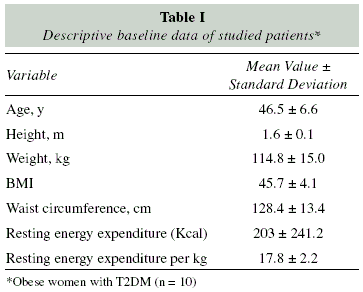
<body><![CDATA[<p><font size="2" face="Verdana"><i>Dietary assessment</i></font></p>     <p><font size="2" face="Verdana">Dietary assessments were performed one week before surgery and three months after RYGB. Food intake was determined via a 24hR<sup>5</sup> and the 7dR<sup>5</sup>. The 24hRl was performed during interviews with two trained nutritionists (M.M. and P.C.S.), excluding weekend days. For the 7dR, the types and amounts of food and beverages consumed were self-recorded over seven consecutive days, including one weekend.</font></p>     <p><font size="2" face="Verdana">For both assessments, amounts of food were recorded in cooking units (teaspoons, cups, etc.) in accordance with the book <i>&quot;Consumo Alimentar - Visualizando Por&#231;&#245;es&quot;</i> (Food Consumption book - Viewing Portions)<sup>7</sup>. During interviews with the nutritionists (average time, 90 minutes), patients were instructed on how to use the book and how to recognize and record consumed foods correctly. All patients were given the book to take home. In addition, the dietitians called each patient by phone every 2 days to improve 7dR recordkeeping. The assessment data were entered into a computerized database and checked by two different investigators (M.M. and P.C.S) to reduce the risk of digitation errors. Virtual Nutri Plus<sup>&reg;8</sup> software was used to calculate total calories and amounts of macronutrients and micronutrients.</font></p>     <p><font size="2" face="Verdana">The following nutritional components were analyzed: total calories, protein, carbohydrates, total fat, saturated fat, monounsaturated fat, polyunsaturated fat, cholesterol, total fiber, soluble fiber, insoluble fiber, vitamins A, B1, B2, B3, B5, B6, B12, C, D and E, calcium, copper, folate, iodine, iron, magnesium, manganese, phosphorus, potassium, selenium, sodium, and zinc. A food chemical composition table developed by Philippi<sup>9</sup> and the Brazilian food chemical composition table <i>(Tabela Brasileira de Composi&#231;&#227;o de Alimentos)<sup>10</sup></i> were used to determine food chemical composition. Pre- and postoperative deficits in nutritional consumption were determined in relation to the Dietary Reference Intakes (DRIs) determined by the Food and Nutrition Board of the Institute of Medicine<sup>11</sup>.</font></p>     <p><font size="2" face="Verdana"><i>Statistical analyses</i></font></p>     <p><font size="2" face="Verdana">Sample homogeneity was determined for all variables using the Kolmogorov-Smirnov test. Comparisons between pre- and postoperative periods were made with paired <i>t</i>-tests or Mann-Whitney tests. An alpha level of 0.05 was considered statistically significant in all cases. Analyses were performed using the R program (version 3.0.2)<sup>12</sup>. Mean values are reported in tables with standard deviations (SDs).</font></p>     <p>&nbsp;</p>     <p><font size="2" face="Verdana"><b>Results</b></font></p>     <p><font size="2" face="Verdana"><i>Nutritional intake deficiencies before and after bariatric surgery</i></font></p>     <p><font size="2" face="Verdana">Descriptive data for the patients (10 women, 32-54 years old) are provided in <a href="#t1">Table I</a>. General nutritional data obtained before and three months after bariatric surgery with the 24hR and the 7dR are presented in <a target="_blank" href="/img/revistas/nh/v30n6/07originalobesidad02_t2.gif">Table II</a>. Both food-recording tools revealed preoperative deficits in total fiber, vitamins B5, B6, D, and E, calcium, folate, iodine, magnesium, manganese, phosphorus, potassium, selenium, and zinc, relative to DRIs. Preoperative deficits in vitamins A and B2 were observed only with the 7dR, and deficits in vitamins B1 and B3 were observed only in the 24hR data.</font></p>     ]]></body>
<body><![CDATA[<p>&nbsp;</p>     <p align="center"><font size="2" face="Verdana"><a name="t1"></a><img src="/img/revistas/nh/v30n6/07originalobesidad02_t1.gif"></font></p>     <p>&nbsp;</p>     <p><font size="2" face="Verdana">All nutrient intake deficits identified before RYGB were maintained in the postoperative measurements by both instruments, with the notable exceptions of vitamins B1 and B3 which had been revealed only by the 24hR preoperatively, but were observed only with the 7dR postoperatively. New postoperative nutritional deficiencies that were not observed in the preoperative data but were observed postoperatively included deficiencies in iron, copper, and carbohydrates with the 7dR and iron and vitamins B12 and C with the 24hR.</font></p>     <p><font size="2" face="Verdana"><i>Decreases in nutritional intake between before and after RYGB</i></font></p>     <p><font size="2" face="Verdana">Our comparison analyses of the 24hR data revealed no significant differences in the consumption of calories or total macronutrients in the patients' pre- versus postoperative nutrient intake data (<i>p</i> &gt; 0.05). Conversely, the gold standard 7dR data comparisons did show decreased ingestion of calories, carbohydrates, total fat, and total fiber postoperatively (<i>p</i> &lt; .05 vs. pre-operative). No differences in protein consumption were detected with either instrument (<i>p</i> &gt; .05). The 24hR data comparisons showed decreased intake of polyunsaturated fat (<i>p</i> = .004) and of both soluble (<i>p</i> = .009) and insoluble (p = .015) fiber, whereas the 7dR data comparisons showed decreased intake of mono- (<i>p</i> = .007), poly- (p = .001), and saturated (<i>p</i> = .014) fats as well as decreased intake of both soluble (<i>p</i> = .007) and insoluble (p = .026) fiber between the preoperative and postoperative time points. No changes in cholesterol consumption were detected between the pre- and postoperative time points by either method (<i>p</i> &gt; .05).</font></p>     <p><font size="2" face="Verdana">Surgery-related differences in vitamin consumption were also documented. The pre- versus post-operative 24hR data comparisons showed decreased intake of vitamin E (<a target="_blank" href="/img/revistas/nh/v30n6/07originalobesidad02_f1.gif">Fig. 1A</a>) and vitamin B6 (<i>p</i> = .024) after the procedure. The pre- versus postoperative 7dR data comparisons showed decreased intake of vitamins E (<a target="_blank" href="/img/revistas/nh/v30n6/07originalobesidad02_f1.gif">Fig. 1B</a>), B1, (<i>p</i> = .002) and B3 (p = .004) after the procedure. No significant changes in consumption of vitamins A, B2, B5, B6, B12, C, and D were detected with either tool (<i>p</i> &gt; .05).</font></p>     <p><font size="2" face="Verdana">Some surgery-associated changes in mineral consumption were detected. Both the 24hR and the 7dR pre- versus postoperative data comparisons showed decreased ingestion of iron, folate, magnesium, manganese, and potassium postoperatively (<a target="_blank" href="/img/revistas/nh/v30n6/07originalobesidad02_f1.gif">Fig. 1</a>). The 7dR pre-versus postoperative data comparisons also showed decreased intake of copper, phosphorus, selenium, and sodium postoperatively (all <i>p</i> &le; 0.05). No significant changes were found between the two time points for calcium, iodine, and zinc consumption with either tool (all <i>p</i> &gt; 0.05).</font></p>     <p>&nbsp;</p>     <p><font size="2" face="Verdana"><b>Discussion</b></font></p>     ]]></body>
<body><![CDATA[<p><font size="2" face="Verdana">Early detection of deficient intake of macronutrients and micronutrients has relevance for clinical follow up of severely obese patients. The efficiency of the 24hR method, relative to the 7dR gold standard method, was assessed in obese patients with T2DM in the present study. We found that the 24hR had sensitivity to identify deficits in nutrient intake before and after RYGB, but not to identify the risk of future deficits related to the effects of the surgery.</font></p>     <p><font size="2" face="Verdana">Habitual consumption of high fat diets and sweetened beverages are associated with decreased dietary intake of fiber, vitamins A, C and D, calcium and folate in obese subjects<sup>13-15</sup>. The 7dR data was efficient to detect preoperative deficiencies in the intake of all these nutrients as well as the 24hR, except for vitamin A. Thus, our findings suggest that the 24hR can identify nutritional deficits in obese patients and are in accordance with a previous study showing decreased ingestion of vitamin D and calcium using the 24hR for three days before bariatric surgery<sup>16</sup>.</font></p>     <p><font size="2" face="Verdana">Several deficiencies in biochemical levels and micronutrient intake have been reported after RYGB, including deficiencies in vitamins A, D, and B12, calcium, folate, and zinc<sup>17-24</sup><sub>.</sub> Deficits in consumption of these and other 10 micronutrients were observed by both the 24hR and the 7dR in the present study. Postoperative deficiencies in the intake of carbohydrates, vitamins B1 and B3, and copper were identified with the 7dR. However, insufficient vitamin C intake was observed only with the 24hR, perhaps due to an underestimation.</font></p>     <p><font size="2" face="Verdana">A postoperative deficit in vitamin B12 intake was also observed only with the 24hR, consistent with a prior report<sup>25</sup>. We did not find any studies using the 7dR to identify changes in B12 consumption after RYGB, but one study did report deficits in vitamin B12 ingestion after bariatric surgery with a 4-day record<sup>26</sup>. Interestingly, one of our patients reported consuming fried beef liver, a very rich source of vitamin B12, in the 7dR, which may have biased the 7dR toward an overestimate of B12 consumption.</font></p>     <p><font size="2" face="Verdana">Our pre- versus postoperative comparison of 7dR data revealed decreases in the consumption of energy and of all macronutrients, except protein, whereas the 24hR data detected decreases only in the consumption of subclasses of fat and fiber. Decreases in total calories, carbohydrates, and fat intake<sup>27,28</sup> and in total fiber<sup>29</sup> have also been observed by others with single or repeated 24hR, with or without inclusion of a weekend day. On the other hand, our findings contrast with prior reports of decreased protein intake postoperatively with the 24hR<sup>27,28</sup>. Our findings in regards to protein intake may have differed from these prior reports due to differential application of this instrument and the prior studies conducting evaluations with a longer postoperative follow-up delay.</font></p>     <p><font size="2" face="Verdana">In our study, the pre- versus postoperative comparison of 7dR was also more sensitive than the 24hR for identifying decreases in the intake of micronutrients (e.g. vitamin B1, iron, and selenium) postoperatively. These changes are consistent, in part, with the findings of Rossi and colleagues who found significant decreases in the intake of iron, zinc, vitamin B12, and vitamin B1 in women after RYGB with a 4-day record instrument<sup>26</sup>. Additionally, Mercachita <i>et al.</i> found a significant decrease in iron intake using the 24hR one and two years after RYGB<sup>25</sup>, whereas Freeth <i>et al.</i> found a significant decrease in selenium intake three months after RYGB with a 3-day record instrument<sup>30</sup>.</font></p>     <p><font size="2" face="Verdana">Low levels of iron, vitamin B12, vitamin D, and calcium have been described after RYGB previously<sup>31</sup>. In the present study, the pre- versus postoperative comparison of both the 24hR and 7dR revealed significant decreases in iron intake postoperatively, but neither provided evidence of postoperative changes in intake of vitamin B12, vitamin D, or calcium. However, it should be noted that preoperative intake of vitamin D and calcium were already lower than recommended levels before surgery and remained lower at postoperative in our cohort, which may have prevent further decrements from being significant.</font></p>     <p><font size="2" face="Verdana">Our study has some limitations. Firstly, our cohort was limited to adult obese woman who had elected to undergo RYGP. Similar results may not be achieved in more demographically diverse populations or with patients who elect to under other types of bariatric surgery. Secondly, although both the 24hR and the 7dR are validated, well established, and widely used instruments, it is possible that they may be less reliable in obese patients than in healthy weight subjects due to a propensity among obese individuals to underestimate food intake. However, every dietary survey tool has advantages and disadvantages, and none are immune to underestimation of intake. Additionally, the 24hR depends on patients' memories, the reliability of which is likely variable in relation to several factors including age and educational level<sup>5</sup>. The patients in our study spanned several educational levels: three had completed a college degree, four had completed high school only, and three had not completed high school. Given that the reliability of the 7dR depends on patients being literate, motivated, and properly trained in reporting types and amounts of food<sup>5</sup>, educational level may be an important factor in the reliability of its results. Importantly, the patients in this study were well trained in this regard and monitored for this purpose.</font></p>     <p><font size="2" face="Verdana">Previous studies have used the 24hR and 3- and 4-day food intake records, as well as food frequency questionnaires (<a target="_blank" href="/img/revistas/nh/v30n6/07originalobesidad02_t3.gif">Table III</a>) to assess nutrient intake before and after RYGB. As far as we know, prior studies have not used the 7dR for this purpose<sup>5,17,18,26,32,33,34-36</sup>, perhaps because it is relatively more time consuming to interpret. Although the accuracy of the 7dR depends on patients' abilities, dedication, and training, it remains the gold standard for food consumption recording.</font></p>     <p><font size="2" face="Verdana">In conclusion, the 24hR was sensitive enough to detect deficits in the intake of 13 out of 15 nutrients identified as deficient with the 7dR before RYGB (&#8773;86.7%) and 15 out of 19 nutrients identified as deficient with the 7dR postoperatively (&#8773;79.0%), but detected decreases in the ingestion of only 12 of the 20 nutrient deficiencies identified with the 7dR over both time points combined (&#8773;40%). Thus, our data suggest that the 24hR may be appropriate for probing nutrient intake status before and after RYGB, but is likely insufficient for long-term preventing of nutrient intake deficits after RYGB for failing to track pre-versus postoperative eating changes.</font></p>     ]]></body>
<body><![CDATA[<p>&nbsp;</p>     <p><font size="2" face="Verdana"><b>Acknowledgements</b></font></p>     <p><font size="2" face="Verdana">We thank M&#228;rcio Augusto Diniz and Professor Julio Cesar Rodrigues Pereira for discussions on the statistical plan and analyses.</font></p>     <p><font size="2" face="Verdana">The authors have no conflicts of interest to declare.</font></p>     <p>&nbsp;</p>     <p><font size="2" face="Verdana"><b>References</b></font></p>     <!-- ref --><p><font size="2" face="Verdana">1. Kissler HJ, Settmacher U. Bariatric surgery to treat obesity. <i>Semin Nephrol</i> 2013;33:75-89.    &nbsp;&nbsp;&nbsp;&nbsp;&nbsp;&nbsp;&nbsp;&nbsp;[&#160;<a href="javascript:void(0);" onclick="javascript: window.open('/scielo.php?script=sci_nlinks&ref=3902621&pid=S0212-1611201400130000700001&lng=','','width=640,height=500,resizable=yes,scrollbars=1,menubar=yes,');">Links</a>&#160;]<!-- end-ref --></font></p>    <!-- ref --><p><font size="2" face="Verdana">2. Anonymus. Obesity: preventing and managing the global epidemic. Report of a WHO consultation. <i>World Health Organ Tech Rep Ser</i> 2000;894:i-xii:1-253.    &nbsp;&nbsp;&nbsp;&nbsp;&nbsp;&nbsp;&nbsp;&nbsp;[&#160;<a href="javascript:void(0);" onclick="javascript: window.open('/scielo.php?script=sci_nlinks&ref=3902623&pid=S0212-1611201400130000700002&lng=','','width=640,height=500,resizable=yes,scrollbars=1,menubar=yes,');">Links</a>&#160;]<!-- end-ref --></font></p>    ]]></body>
<body><![CDATA[<!-- ref --><p><font size="2" face="Verdana">3. Tucker ON, Szomstein S, Rosenthal RJ. Nutritional consequences of weight-loss surgery. <i>Med Clin North Am</i> 2007;91:499-514, xii.    &nbsp;&nbsp;&nbsp;&nbsp;&nbsp;&nbsp;&nbsp;&nbsp;[&#160;<a href="javascript:void(0);" onclick="javascript: window.open('/scielo.php?script=sci_nlinks&ref=3902625&pid=S0212-1611201400130000700003&lng=','','width=640,height=500,resizable=yes,scrollbars=1,menubar=yes,');">Links</a>&#160;]<!-- end-ref --></font></p>    <!-- ref --><p><font size="2" face="Verdana">4. Folope V, Co&#235;ffier M, Déchelotte P. Nutritional deficiencies associated with bariatric surgery. <i>Gastroenterol Clin Biol</i> 2007;31:369-77.    &nbsp;&nbsp;&nbsp;&nbsp;&nbsp;&nbsp;&nbsp;&nbsp;[&#160;<a href="javascript:void(0);" onclick="javascript: window.open('/scielo.php?script=sci_nlinks&ref=3902627&pid=S0212-1611201400130000700004&lng=','','width=640,height=500,resizable=yes,scrollbars=1,menubar=yes,');">Links</a>&#160;]<!-- end-ref --></font></p>    <!-- ref --><p><font size="2" face="Verdana">5. Fisberg, RM, Slater, B, Martini, LA. Métodos de Inquéritos Alimentares. In: Fisberg RM, Slater B, Marchioni DM, Martini LA. Inquéritos Alimentares: Métodos e Bases Científicas. Barueri: Manole; 2005:1-31.    &nbsp;&nbsp;&nbsp;&nbsp;&nbsp;&nbsp;&nbsp;&nbsp;[&#160;<a href="javascript:void(0);" onclick="javascript: window.open('/scielo.php?script=sci_nlinks&ref=3902629&pid=S0212-1611201400130000700005&lng=','','width=640,height=500,resizable=yes,scrollbars=1,menubar=yes,');">Links</a>&#160;]<!-- end-ref --></font></p>    <!-- ref --><p><font size="2" face="Verdana">6. Nonino-Borges CB, Borges RM, dos Santos JE. Tratamento clínico da obesidade. <i>Medicina</i> (Ribeir&#227;o Preto) 2006;39:246-252.    &nbsp;&nbsp;&nbsp;&nbsp;&nbsp;&nbsp;&nbsp;&nbsp;[&#160;<a href="javascript:void(0);" onclick="javascript: window.open('/scielo.php?script=sci_nlinks&ref=3902631&pid=S0212-1611201400130000700006&lng=','','width=640,height=500,resizable=yes,scrollbars=1,menubar=yes,');">Links</a>&#160;]<!-- end-ref --></font></p>    <!-- ref --><p><font size="2" face="Verdana">7. Monteiro JP. Consumo Alimentar-Visualizando Por&#231;&#245;es-Série Nutri&#231;&#227;o e Metabolismo. Rio de Janeiro: Guanabara Koogan; 2007.    &nbsp;&nbsp;&nbsp;&nbsp;&nbsp;&nbsp;&nbsp;&nbsp;[&#160;<a href="javascript:void(0);" onclick="javascript: window.open('/scielo.php?script=sci_nlinks&ref=3902633&pid=S0212-1611201400130000700007&lng=','','width=640,height=500,resizable=yes,scrollbars=1,menubar=yes,');">Links</a>&#160;]<!-- end-ref --></font></p>    ]]></body>
<body><![CDATA[<!-- ref --><p><font size="2" face="Verdana">8. Virtual Nutri Plus<sup>&reg;</sup>. Software de Nutri&#231;&#227;o. Disponível em <a target="_blank" href="http://www.virtualnutriplus.com.br/">http://www.virtualnutriplus.com.br/</a>.    &nbsp;&nbsp;&nbsp;&nbsp;&nbsp;&nbsp;&nbsp;&nbsp;[&#160;<a href="javascript:void(0);" onclick="javascript: window.open('/scielo.php?script=sci_nlinks&ref=3902635&pid=S0212-1611201400130000700008&lng=','','width=640,height=500,resizable=yes,scrollbars=1,menubar=yes,');">Links</a>&#160;]<!-- end-ref --></font></p>    <!-- ref --><p><font size="2" face="Verdana">9. Philip, S.T. Tabela de Composi&#231;&#227;o de Alimentos: Suporte para Decis&#226;o Nutricional. S&#227;o Paulo: <i>Manole</i> 2002.    &nbsp;&nbsp;&nbsp;&nbsp;&nbsp;&nbsp;&nbsp;&nbsp;[&#160;<a href="javascript:void(0);" onclick="javascript: window.open('/scielo.php?script=sci_nlinks&ref=3902637&pid=S0212-1611201400130000700009&lng=','','width=640,height=500,resizable=yes,scrollbars=1,menubar=yes,');">Links</a>&#160;]<!-- end-ref --></font></p>    <!-- ref --><p><font size="2" face="Verdana">10. Nucleo de Estudos e Pesquisas em Alimenta&#231;&#227;o (NEPA). TACO-Tabela Brasileira de Composi&#231;&#227;o de Alimentos. UNICAMP, 4<sup>a</sup> ed. <i>Campinas</i> 2011.    &nbsp;&nbsp;&nbsp;&nbsp;&nbsp;&nbsp;&nbsp;&nbsp;[&#160;<a href="javascript:void(0);" onclick="javascript: window.open('/scielo.php?script=sci_nlinks&ref=3902639&pid=S0212-1611201400130000700010&lng=','','width=640,height=500,resizable=yes,scrollbars=1,menubar=yes,');">Links</a>&#160;]<!-- end-ref --></font></p>    <!-- ref --><p><font size="2" face="Verdana">11. Institute of Medicine, Food and Nutrition Board. Dietary Reference Intakes. Applications in dietary planning. Washington DC: National Academy Press, 2003.    &nbsp;&nbsp;&nbsp;&nbsp;&nbsp;&nbsp;&nbsp;&nbsp;[&#160;<a href="javascript:void(0);" onclick="javascript: window.open('/scielo.php?script=sci_nlinks&ref=3902641&pid=S0212-1611201400130000700011&lng=','','width=640,height=500,resizable=yes,scrollbars=1,menubar=yes,');">Links</a>&#160;]<!-- end-ref --></font></p>    <!-- ref --><p><font size="2" face="Verdana">12. Title = &#123;R: A Language and Environment for Statistical Computing&#125;, author = &#123;&#123;R Core Team&#125;&#125;, organization = &#123;R Foundation for Statistical Computing&#125;, address = &#123;Vienna, Austria&#125;, year = 2013,url = <a target="_blank" href="http://www.R-project.org">http://www.R-project.org</a>.    &nbsp;&nbsp;&nbsp;&nbsp;&nbsp;&nbsp;&nbsp;&nbsp;[&#160;<a href="javascript:void(0);" onclick="javascript: window.open('/scielo.php?script=sci_nlinks&ref=3902643&pid=S0212-1611201400130000700012&lng=','','width=640,height=500,resizable=yes,scrollbars=1,menubar=yes,');">Links</a>&#160;]<!-- end-ref --></font></p>    ]]></body>
<body><![CDATA[<!-- ref --><p><font size="2" face="Verdana">13. Xanthakos SA. Nutritional deficiencies in obesity and after bariatric surgery. <i>Pediatr Clin North Am</i> 2009;56:1105-21.    &nbsp;&nbsp;&nbsp;&nbsp;&nbsp;&nbsp;&nbsp;&nbsp;[&#160;<a href="javascript:void(0);" onclick="javascript: window.open('/scielo.php?script=sci_nlinks&ref=3902645&pid=S0212-1611201400130000700013&lng=','','width=640,height=500,resizable=yes,scrollbars=1,menubar=yes,');">Links</a>&#160;]<!-- end-ref --></font></p>    <!-- ref --><p><font size="2" face="Verdana">14. Hampl JS, Betts NM. Comparisons of dietary intake and sources of fat in low-and high-fat diets of 18-to 24-year-olds. <i>J Am Diet Assoc</i> 1995;95:893-7.    &nbsp;&nbsp;&nbsp;&nbsp;&nbsp;&nbsp;&nbsp;&nbsp;[&#160;<a href="javascript:void(0);" onclick="javascript: window.open('/scielo.php?script=sci_nlinks&ref=3902647&pid=S0212-1611201400130000700014&lng=','','width=640,height=500,resizable=yes,scrollbars=1,menubar=yes,');">Links</a>&#160;]<!-- end-ref --></font></p>    <!-- ref --><p><font size="2" face="Verdana">15. Keller KL, Kirzner J, Pietrobelli A, St-Onge MP, Faith MS. Increased sweetened beverage intake is associated with reduced milk and calcium intake in 3-to 7-year-old children at multi-item laboratory lunches. <i>J Am Diet Assoc</i> 2009;109:497-501.    &nbsp;&nbsp;&nbsp;&nbsp;&nbsp;&nbsp;&nbsp;&nbsp;[&#160;<a href="javascript:void(0);" onclick="javascript: window.open('/scielo.php?script=sci_nlinks&ref=3902649&pid=S0212-1611201400130000700015&lng=','','width=640,height=500,resizable=yes,scrollbars=1,menubar=yes,');">Links</a>&#160;]<!-- end-ref --></font></p>    <!-- ref --><p><font size="2" face="Verdana">16. Jastrzebska-Mierzynska M, Ostrowska L, Hady HR, Dadan J. Assessment of dietary habits, nutritional status and blood biochemical parameters in patients prepared for bariatric surgery: a preliminary study. Wideochir Inne Tech Malo Inwazyine. 2012; 7(3):156-65.    &nbsp;&nbsp;&nbsp;&nbsp;&nbsp;&nbsp;&nbsp;&nbsp;[&#160;<a href="javascript:void(0);" onclick="javascript: window.open('/scielo.php?script=sci_nlinks&ref=3902651&pid=S0212-1611201400130000700016&lng=','','width=640,height=500,resizable=yes,scrollbars=1,menubar=yes,');">Links</a>&#160;]<!-- end-ref --></font></p>    <!-- ref --><p><font size="2" face="Verdana">17. Ziegler O, Sirveaux MA, Brunaud L, Reibel N, Quilliot D. Medical follow up after bariatric surgery: nutritional and drug issues. General recommendations for the prevention and treatment of nutritional deficiencies. <i>Diabetes Metab</i> 2009;35:544-57.    &nbsp;&nbsp;&nbsp;&nbsp;&nbsp;&nbsp;&nbsp;&nbsp;[&#160;<a href="javascript:void(0);" onclick="javascript: window.open('/scielo.php?script=sci_nlinks&ref=3902653&pid=S0212-1611201400130000700017&lng=','','width=640,height=500,resizable=yes,scrollbars=1,menubar=yes,');">Links</a>&#160;]<!-- end-ref --></font></p>    ]]></body>
<body><![CDATA[<!-- ref --><p><font size="2" face="Verdana">18. Allied Health Sciences Section Ad Hoc Nutrition Committee, Aills L, Blankenship J, Buffington C, Furtado M, Parrott J. ASMBS Allied Health Nutritional Guidelines for the Surgical Weight Loss Patient. <i>Surg Obes Relat Dis</i> 2008;4:S73-108.    &nbsp;&nbsp;&nbsp;&nbsp;&nbsp;&nbsp;&nbsp;&nbsp;[&#160;<a href="javascript:void(0);" onclick="javascript: window.open('/scielo.php?script=sci_nlinks&ref=3902655&pid=S0212-1611201400130000700018&lng=','','width=640,height=500,resizable=yes,scrollbars=1,menubar=yes,');">Links</a>&#160;]<!-- end-ref --></font></p>    <!-- ref --><p><font size="2" face="Verdana">19. Duran CC, Dalcanale L, Pajecki D, Garrido AB Jr, Halpern A. Calcium intake and metabolic bone disease after eight years of Roux-en-Y gastric bypass. <i>Obes Surg</i> 2008; 18(4):386-90.    &nbsp;&nbsp;&nbsp;&nbsp;&nbsp;&nbsp;&nbsp;&nbsp;[&#160;<a href="javascript:void(0);" onclick="javascript: window.open('/scielo.php?script=sci_nlinks&ref=3902657&pid=S0212-1611201400130000700019&lng=','','width=640,height=500,resizable=yes,scrollbars=1,menubar=yes,');">Links</a>&#160;]<!-- end-ref --></font></p>    <!-- ref --><p><font size="2" face="Verdana">20. Cominetti C, Garrido AB Jr, Cozzolino SM. Zinc nutritional status of morbidly obese patients before and after Roux-en-Y gastric bypass: a preliminary report. <i>Obes Surg</i> 2006; 16(4):448-53.    &nbsp;&nbsp;&nbsp;&nbsp;&nbsp;&nbsp;&nbsp;&nbsp;[&#160;<a href="javascript:void(0);" onclick="javascript: window.open('/scielo.php?script=sci_nlinks&ref=3902659&pid=S0212-1611201400130000700020&lng=','','width=640,height=500,resizable=yes,scrollbars=1,menubar=yes,');">Links</a>&#160;]<!-- end-ref --></font></p>    <!-- ref --><p><font size="2" face="Verdana">21. Brolin RE, Gorman JH, Gorman RC, Petschenik AJ, Bradley LJ, Kenler HA, et al. Are vitamin B12 and folate deficiency clinically important after roux-en-Y gastric bypass? <i>J Gastrointest Surg</i> 1998;2(5):436-42.    &nbsp;&nbsp;&nbsp;&nbsp;&nbsp;&nbsp;&nbsp;&nbsp;[&#160;<a href="javascript:void(0);" onclick="javascript: window.open('/scielo.php?script=sci_nlinks&ref=3902661&pid=S0212-1611201400130000700021&lng=','','width=640,height=500,resizable=yes,scrollbars=1,menubar=yes,');">Links</a>&#160;]<!-- end-ref --></font></p>    <!-- ref --><p><font size="2" face="Verdana">22. Bloomberg RD, Fleishman A, Nalle JE, Herron DM, Kini S. Nutritional deficiencies following bariatric surgery: what have we learned? <i>Obes Surg</i> 2005;15(2):145-54.    &nbsp;&nbsp;&nbsp;&nbsp;&nbsp;&nbsp;&nbsp;&nbsp;[&#160;<a href="javascript:void(0);" onclick="javascript: window.open('/scielo.php?script=sci_nlinks&ref=3902663&pid=S0212-1611201400130000700022&lng=','','width=640,height=500,resizable=yes,scrollbars=1,menubar=yes,');">Links</a>&#160;]<!-- end-ref --></font></p>    ]]></body>
<body><![CDATA[<!-- ref --><p><font size="2" face="Verdana">23. Blume CA, Boni CC, Casagrande DS, Rizzolli J, Padoin AV, Mottin CC. Nutritional profile of patients before and after Roux-en-Y gastric bypass: 3-year follow-up. <i>Obes Surg</i> 2012;22(11):1676-85.    &nbsp;&nbsp;&nbsp;&nbsp;&nbsp;&nbsp;&nbsp;&nbsp;[&#160;<a href="javascript:void(0);" onclick="javascript: window.open('/scielo.php?script=sci_nlinks&ref=3902665&pid=S0212-1611201400130000700023&lng=','','width=640,height=500,resizable=yes,scrollbars=1,menubar=yes,');">Links</a>&#160;]<!-- end-ref --></font></p>    <!-- ref --><p><font size="2" face="Verdana">24. Skroubis G, Sakellaropoulos G, Pouggouras K, Mead N, Nikiforidis G, Kalfarentzos F. Comparison of nutritional deficiencies after Roux-en-Y gastric bypass and after biliopancreatic diversion with Roux-en-Y gastric bypass. <i>Obes Surg</i> 2002;12(4):551-8.    &nbsp;&nbsp;&nbsp;&nbsp;&nbsp;&nbsp;&nbsp;&nbsp;[&#160;<a href="javascript:void(0);" onclick="javascript: window.open('/scielo.php?script=sci_nlinks&ref=3902667&pid=S0212-1611201400130000700024&lng=','','width=640,height=500,resizable=yes,scrollbars=1,menubar=yes,');">Links</a>&#160;]<!-- end-ref --></font></p>    <!-- ref --><p><font size="2" face="Verdana">25. Mercachita T, Santos Z, Lim&#227;o J, Carolino E, Mendes L. Anthropometric Evaluation and Micronutrients Intake in Patients Submitted to Laparoscopic Roux-en-Y Gastric Bypass with a Postoperative Period of &#8805;1 Year. <i>Obes Surg</i> 2014;24:102-8.    &nbsp;&nbsp;&nbsp;&nbsp;&nbsp;&nbsp;&nbsp;&nbsp;[&#160;<a href="javascript:void(0);" onclick="javascript: window.open('/scielo.php?script=sci_nlinks&ref=3902669&pid=S0212-1611201400130000700025&lng=','','width=640,height=500,resizable=yes,scrollbars=1,menubar=yes,');">Links</a>&#160;]<!-- end-ref --></font></p>    <!-- ref --><p><font size="2" face="Verdana">26. de Torres Rossi RG, Dos Santos Mt, de Souza Fl, de Càssia de Aquino R, Sarni RO. Nutrient intake of women 3 years after Roux-en-Y Gastric bypass surgery. <i>Obes Surg</i> 2012;22:1548-53.    &nbsp;&nbsp;&nbsp;&nbsp;&nbsp;&nbsp;&nbsp;&nbsp;[&#160;<a href="javascript:void(0);" onclick="javascript: window.open('/scielo.php?script=sci_nlinks&ref=3902671&pid=S0212-1611201400130000700026&lng=','','width=640,height=500,resizable=yes,scrollbars=1,menubar=yes,');">Links</a>&#160;]<!-- end-ref --></font></p>    <!-- ref --><p><font size="2" face="Verdana">27. Custodio Afonso Rocha V, Ramos de Arvelos L, Pereira Felix G, Nogueira Prado de Souza D, Bernardino Neto M, Santos Resende E, et al. Evolution of nutritional, hematologic biochemical changes in obese women during 8 weeks after Roux-en-Y gastric bypasss. <i>Nutr Hosp</i> 2012;27:1134-40.    &nbsp;&nbsp;&nbsp;&nbsp;&nbsp;&nbsp;&nbsp;&nbsp;[&#160;<a href="javascript:void(0);" onclick="javascript: window.open('/scielo.php?script=sci_nlinks&ref=3902673&pid=S0212-1611201400130000700027&lng=','','width=640,height=500,resizable=yes,scrollbars=1,menubar=yes,');">Links</a>&#160;]<!-- end-ref --></font></p>    ]]></body>
<body><![CDATA[<!-- ref --><p><font size="2" face="Verdana">28. Ferreira Nicoletti C, Morandi Junqueira-Franco MV, Dos Santos JE, Sergio Marchini J, Junior WS, Nonino CB. Protein and amino acid status before and after bariatric surgery: A 12-month follow-up study. <i>Surg Obes Relat Dis</i> 2013;9:1008-12.    &nbsp;&nbsp;&nbsp;&nbsp;&nbsp;&nbsp;&nbsp;&nbsp;[&#160;<a href="javascript:void(0);" onclick="javascript: window.open('/scielo.php?script=sci_nlinks&ref=3902675&pid=S0212-1611201400130000700028&lng=','','width=640,height=500,resizable=yes,scrollbars=1,menubar=yes,');">Links</a>&#160;]<!-- end-ref --></font></p>    <!-- ref --><p><font size="2" face="Verdana">29. Novais PF, Rasera I Jr, Leite CV, Marin FA, de Oliveira MR. Food intake in women two years or more after bariatric surgery meets adequate intake requirements. <i>Nutr Res</i> 2012;32:335-41.    &nbsp;&nbsp;&nbsp;&nbsp;&nbsp;&nbsp;&nbsp;&nbsp;[&#160;<a href="javascript:void(0);" onclick="javascript: window.open('/scielo.php?script=sci_nlinks&ref=3902677&pid=S0212-1611201400130000700029&lng=','','width=640,height=500,resizable=yes,scrollbars=1,menubar=yes,');">Links</a>&#160;]<!-- end-ref --></font></p>    <!-- ref --><p><font size="2" face="Verdana">30. Freeth A, Prajuabpansri P, Victory JM, Jenkins P. Assessment of selenium in Roux-en-Y gastric bypass and gastric banding surgery. <i>Obes Surg</i> 2012, 22:1660-5.    &nbsp;&nbsp;&nbsp;&nbsp;&nbsp;&nbsp;&nbsp;&nbsp;[&#160;<a href="javascript:void(0);" onclick="javascript: window.open('/scielo.php?script=sci_nlinks&ref=3902679&pid=S0212-1611201400130000700030&lng=','','width=640,height=500,resizable=yes,scrollbars=1,menubar=yes,');">Links</a>&#160;]<!-- end-ref --></font></p>    <!-- ref --><p><font size="2" face="Verdana">31. Alvarez-Leite JI. Nutrient deficiencies secondary to bariatric surgery. <i>Curr Opin Clin Nutr Metab Care</i> 2004;7:569-75.    &nbsp;&nbsp;&nbsp;&nbsp;&nbsp;&nbsp;&nbsp;&nbsp;[&#160;<a href="javascript:void(0);" onclick="javascript: window.open('/scielo.php?script=sci_nlinks&ref=3902681&pid=S0212-1611201400130000700031&lng=','','width=640,height=500,resizable=yes,scrollbars=1,menubar=yes,');">Links</a>&#160;]<!-- end-ref --></font></p>    <!-- ref --><p><font size="2" face="Verdana">32. Carrasco F, Papapietro K, Csendes A, Salazar G, Echenique C, Lisboa C, et al. Changes in esting energy expenditure and body composition after weight loss following Roux-en-Y Gastric Bypass. <i>Obes Surg</i> 2007;17:608-16.    &nbsp;&nbsp;&nbsp;&nbsp;&nbsp;&nbsp;&nbsp;&nbsp;[&#160;<a href="javascript:void(0);" onclick="javascript: window.open('/scielo.php?script=sci_nlinks&ref=3902683&pid=S0212-1611201400130000700032&lng=','','width=640,height=500,resizable=yes,scrollbars=1,menubar=yes,');">Links</a>&#160;]<!-- end-ref --></font></p>    ]]></body>
<body><![CDATA[<!-- ref --><p><font size="2" face="Verdana">33. Olbers T, Bj&#246;rkman S, Lindroos A, Maleckas A, L&#246;nn L, Sj&#246;str&#246;m L, et al. Body composition, dietary intake, and energy expenditure after laparoscopic Roux-en-Y Gastric Bypass and Laparoscopic Vertical Banded Gastroplasty. A Randomized clinical trial. <i>Ann Surg</i> 2006;244:715-22.    &nbsp;&nbsp;&nbsp;&nbsp;&nbsp;&nbsp;&nbsp;&nbsp;[&#160;<a href="javascript:void(0);" onclick="javascript: window.open('/scielo.php?script=sci_nlinks&ref=3902685&pid=S0212-1611201400130000700033&lng=','','width=640,height=500,resizable=yes,scrollbars=1,menubar=yes,');">Links</a>&#160;]<!-- end-ref --></font></p>    <!-- ref --><p><font size="2" face="Verdana">34. Novais PF, Rasera I Jr, Leite CV, Marin FA, de Oliveira MR. Food intake in women two years or more after bariatric surgery meets adequate intake requirements. <i>Nutr Res</i> 2012;32:335-41.    &nbsp;&nbsp;&nbsp;&nbsp;&nbsp;&nbsp;&nbsp;&nbsp;[&#160;<a href="javascript:void(0);" onclick="javascript: window.open('/scielo.php?script=sci_nlinks&ref=3902687&pid=S0212-1611201400130000700034&lng=','','width=640,height=500,resizable=yes,scrollbars=1,menubar=yes,');">Links</a>&#160;]<!-- end-ref --></font></p>    <!-- ref --><p><font size="2" face="Verdana">35. Freeth A, Prajuabpansri P, Victory JM, Jenkins P. Assessment of selenium in Roux-en-Y gastric bypass and gastric banding surgery. <i>Obes Surg</i> 2012, 22:1660-5.    &nbsp;&nbsp;&nbsp;&nbsp;&nbsp;&nbsp;&nbsp;&nbsp;[&#160;<a href="javascript:void(0);" onclick="javascript: window.open('/scielo.php?script=sci_nlinks&ref=3902689&pid=S0212-1611201400130000700035&lng=','','width=640,height=500,resizable=yes,scrollbars=1,menubar=yes,');">Links</a>&#160;]<!-- end-ref --></font></p>    <!-- ref --><p><font size="2" face="Verdana">36. Alvarez-Leite JI. Nutrient deficiencies secondary to bariatric surgery. <i>Curr Opin Clin Nutr Metab Care</i> 2004;7:569-75.    &nbsp;&nbsp;&nbsp;&nbsp;&nbsp;&nbsp;&nbsp;&nbsp;[&#160;<a href="javascript:void(0);" onclick="javascript: window.open('/scielo.php?script=sci_nlinks&ref=3902691&pid=S0212-1611201400130000700036&lng=','','width=640,height=500,resizable=yes,scrollbars=1,menubar=yes,');">Links</a>&#160;]<!-- end-ref --></font></p>     <p>&nbsp;</p>     <p>&nbsp;</p>     ]]></body>
<body><![CDATA[<p><font size="2" face="Verdana"><b><a name="bajo"></a><a href="#top"><img border="0" src="/img/revistas/nh/v30n6/seta.gif" width="15" height="17"></a>Correspondence:</b>    <br>Dan Linetzky Waitzberg.    <br>Laboratório de Nutri&#231;&#227;o e Cirurgia Metabólica do Aparelho Digestivo LIM 35    <br>Faculdade de Medicina da Universidade de S&#227;o Paulo (FMUSP).    <br>Av. Dr. Arnaldo, 455 2<sup>o</sup> andar, sala 2108 - Cerqueira César.    <br>CEP: 01246-903, S&#227;o Paulo - SP, Brazil    <br>E-mail: <a href="mailto:dan@ganep.com.br">dan@ganep.com.br</a> / <a href="mailto:metanutri@usp.br">metanutri@usp.br</a></font></p>     <p><font size="2" face="Verdana">Recibido: 21-VII-2014.    <br>Aceptado: 16-VIII-2014.</font></p>      ]]></body><back>
<ref-list>
<ref id="B1">
<label>1</label><nlm-citation citation-type="journal">
<person-group person-group-type="author">
<name>
<surname><![CDATA[Kissler]]></surname>
<given-names><![CDATA[HJ]]></given-names>
</name>
<name>
<surname><![CDATA[Settmacher]]></surname>
<given-names><![CDATA[U]]></given-names>
</name>
</person-group>
<article-title xml:lang="en"><![CDATA[Bariatric surgery to treat obesity]]></article-title>
<source><![CDATA[Semin Nephrol]]></source>
<year>2013</year>
<volume>33</volume>
<page-range>75-89</page-range></nlm-citation>
</ref>
<ref id="B2">
<label>2</label><nlm-citation citation-type="journal">
<person-group person-group-type="author">
<name>
</name>
<name>
</name>
</person-group>
<article-title xml:lang="en"><![CDATA[Obesity: preventing and managing the global epidemic. Report of a WHO consultation]]></article-title>
<source><![CDATA[World Health Organ Tech Rep Ser]]></source>
<year>2000</year>
<volume>894</volume>
<page-range>1-253</page-range></nlm-citation>
</ref>
<ref id="B3">
<label>3</label><nlm-citation citation-type="journal">
<person-group person-group-type="author">
<name>
<surname><![CDATA[Tucker]]></surname>
<given-names><![CDATA[ON]]></given-names>
</name>
<name>
<surname><![CDATA[Szomstein]]></surname>
<given-names><![CDATA[S]]></given-names>
</name>
<name>
<surname><![CDATA[Rosenthal]]></surname>
<given-names><![CDATA[RJ]]></given-names>
</name>
</person-group>
<article-title xml:lang="en"><![CDATA[Nutritional consequences of weight-loss surgery]]></article-title>
<source><![CDATA[Med Clin North Am]]></source>
<year>2007</year>
<volume>91</volume>
<page-range>499-514, xii</page-range></nlm-citation>
</ref>
<ref id="B4">
<label>4</label><nlm-citation citation-type="journal">
<person-group person-group-type="author">
<name>
<surname><![CDATA[Folope]]></surname>
<given-names><![CDATA[V]]></given-names>
</name>
<name>
<surname><![CDATA[Coëffier]]></surname>
<given-names><![CDATA[M]]></given-names>
</name>
<name>
<surname><![CDATA[Déchelotte]]></surname>
<given-names><![CDATA[P]]></given-names>
</name>
</person-group>
<article-title xml:lang="en"><![CDATA[Nutritional deficiencies associated with bariatric surgery]]></article-title>
<source><![CDATA[Gastroenterol Clin Biol]]></source>
<year>2007</year>
<volume>31</volume>
<page-range>369-77</page-range></nlm-citation>
</ref>
<ref id="B5">
<label>5</label><nlm-citation citation-type="book">
<person-group person-group-type="author">
<name>
<surname><![CDATA[Fisberg]]></surname>
<given-names><![CDATA[RM]]></given-names>
</name>
<name>
<surname><![CDATA[Slater]]></surname>
<given-names><![CDATA[B]]></given-names>
</name>
<name>
<surname><![CDATA[Martini]]></surname>
<given-names><![CDATA[LA]]></given-names>
</name>
</person-group>
<article-title xml:lang="pt"><![CDATA[Métodos de Inquéritos Alimentares]]></article-title>
<person-group person-group-type="editor">
<name>
<surname><![CDATA[Fisberg]]></surname>
<given-names><![CDATA[RM]]></given-names>
</name>
<name>
<surname><![CDATA[Slater]]></surname>
<given-names><![CDATA[B]]></given-names>
</name>
<name>
<surname><![CDATA[Marchioni]]></surname>
<given-names><![CDATA[DM]]></given-names>
</name>
<name>
<surname><![CDATA[Martini]]></surname>
<given-names><![CDATA[LA]]></given-names>
</name>
</person-group>
<source><![CDATA[Inquéritos Alimentares: Métodos e Bases Científicas]]></source>
<year>2005</year>
<page-range>1-31</page-range><publisher-loc><![CDATA[Barueri ]]></publisher-loc>
<publisher-name><![CDATA[Manole]]></publisher-name>
</nlm-citation>
</ref>
<ref id="B6">
<label>6</label><nlm-citation citation-type="journal">
<person-group person-group-type="author">
<name>
<surname><![CDATA[Nonino-Borges]]></surname>
<given-names><![CDATA[CB]]></given-names>
</name>
<name>
<surname><![CDATA[Borges]]></surname>
<given-names><![CDATA[RM]]></given-names>
</name>
<name>
<surname><![CDATA[dos Santos]]></surname>
<given-names><![CDATA[JE]]></given-names>
</name>
</person-group>
<article-title xml:lang="pt"><![CDATA[Tratamento clínico da obesidade]]></article-title>
<source><![CDATA[Medicina (Ribeirão Preto)]]></source>
<year>2006</year>
<volume>39</volume>
<page-range>246-252</page-range></nlm-citation>
</ref>
<ref id="B7">
<label>7</label><nlm-citation citation-type="book">
<person-group person-group-type="author">
<name>
<surname><![CDATA[Monteiro]]></surname>
<given-names><![CDATA[JP]]></given-names>
</name>
</person-group>
<source><![CDATA[Consumo Alimentar: Visualizando Porções]]></source>
<year>2007</year>
<publisher-loc><![CDATA[Rio de Janeiro ]]></publisher-loc>
<publisher-name><![CDATA[Guanabara Koogan]]></publisher-name>
</nlm-citation>
</ref>
<ref id="B8">
<label>8</label><nlm-citation citation-type="">
<source><![CDATA[Virtual Nutri Plus®: Software de Nutrição]]></source>
<year></year>
</nlm-citation>
</ref>
<ref id="B9">
<label>9</label><nlm-citation citation-type="book">
<person-group person-group-type="author">
<name>
<surname><![CDATA[Philip]]></surname>
<given-names><![CDATA[S.T]]></given-names>
</name>
</person-group>
<source><![CDATA[Tabela de Composição de Alimentos: Suporte para Decisâo Nutricional]]></source>
<year>2002</year>
<publisher-loc><![CDATA[São Paulo ]]></publisher-loc>
<publisher-name><![CDATA[Manole]]></publisher-name>
</nlm-citation>
</ref>
<ref id="B10">
<label>10</label><nlm-citation citation-type="book">
<collab>Nucleo de Estudos e Pesquisas em Alimentação (NEPA)</collab>
<source><![CDATA[TACO-Tabela Brasileira de Composição de Alimentos]]></source>
<year>2011</year>
<edition>4</edition>
<publisher-loc><![CDATA[Campinas ]]></publisher-loc>
<publisher-name><![CDATA[UNICAMP]]></publisher-name>
</nlm-citation>
</ref>
<ref id="B11">
<label>11</label><nlm-citation citation-type="book">
<collab>Institute of Medicine^dFood and Nutrition Board</collab>
<source><![CDATA[Dietary Reference Intakes: Applications in dietary planning]]></source>
<year>2003</year>
<publisher-loc><![CDATA[Washington^eDC DC]]></publisher-loc>
<publisher-name><![CDATA[National Academy Press]]></publisher-name>
</nlm-citation>
</ref>
<ref id="B12">
<label>12</label><nlm-citation citation-type="book">
<collab>R Core Team</collab>
<source><![CDATA[R: A Language and Environment for Statistical Computing]]></source>
<year>2013</year>
<publisher-loc><![CDATA[Vienna ]]></publisher-loc>
<publisher-name><![CDATA[R Foundation for Statistical Computing]]></publisher-name>
</nlm-citation>
</ref>
<ref id="B13">
<label>13</label><nlm-citation citation-type="journal">
<person-group person-group-type="author">
<name>
<surname><![CDATA[Xanthakos]]></surname>
<given-names><![CDATA[SA]]></given-names>
</name>
</person-group>
<article-title xml:lang="en"><![CDATA[Nutritional deficiencies in obesity and after bariatric surgery]]></article-title>
<source><![CDATA[Pediatr Clin North Am]]></source>
<year>2009</year>
<volume>56</volume>
<page-range>1105-21</page-range></nlm-citation>
</ref>
<ref id="B14">
<label>14</label><nlm-citation citation-type="journal">
<person-group person-group-type="author">
<name>
<surname><![CDATA[Hampl]]></surname>
<given-names><![CDATA[JS]]></given-names>
</name>
<name>
<surname><![CDATA[Betts]]></surname>
<given-names><![CDATA[NM]]></given-names>
</name>
</person-group>
<article-title xml:lang="en"><![CDATA[Comparisons of dietary intake and sources of fat in low-and high-fat diets of 18-to 24-year-olds]]></article-title>
<source><![CDATA[J Am Diet Assoc]]></source>
<year>1995</year>
<volume>95</volume>
<page-range>893-7</page-range></nlm-citation>
</ref>
<ref id="B15">
<label>15</label><nlm-citation citation-type="journal">
<person-group person-group-type="author">
<name>
<surname><![CDATA[Keller]]></surname>
<given-names><![CDATA[KL]]></given-names>
</name>
<name>
<surname><![CDATA[Kirzner]]></surname>
<given-names><![CDATA[J]]></given-names>
</name>
<name>
<surname><![CDATA[Pietrobelli]]></surname>
<given-names><![CDATA[A]]></given-names>
</name>
<name>
<surname><![CDATA[St-Onge]]></surname>
<given-names><![CDATA[MP]]></given-names>
</name>
<name>
<surname><![CDATA[Faith]]></surname>
<given-names><![CDATA[MS]]></given-names>
</name>
</person-group>
<article-title xml:lang="en"><![CDATA[Increased sweetened beverage intake is associated with reduced milk and calcium intake in 3-to 7-year-old children at multi-item laboratory lunches]]></article-title>
<source><![CDATA[J Am Diet Assoc]]></source>
<year>2009</year>
<volume>109</volume>
<page-range>497-501</page-range></nlm-citation>
</ref>
<ref id="B16">
<label>16</label><nlm-citation citation-type="journal">
<person-group person-group-type="author">
<name>
<surname><![CDATA[Jastrzebska-Mierzynska]]></surname>
<given-names><![CDATA[M]]></given-names>
</name>
<name>
<surname><![CDATA[Ostrowska]]></surname>
<given-names><![CDATA[L]]></given-names>
</name>
<name>
<surname><![CDATA[Hady]]></surname>
<given-names><![CDATA[HR]]></given-names>
</name>
<name>
<surname><![CDATA[Dadan]]></surname>
<given-names><![CDATA[J]]></given-names>
</name>
</person-group>
<article-title xml:lang="en"><![CDATA[Assessment of dietary habits, nutritional status and blood biochemical parameters in patients prepared for bariatric surgery: a preliminary study]]></article-title>
<source><![CDATA[Wideochir Inne Tech Malo Inwazyine]]></source>
<year>2012</year>
<volume>7</volume>
<numero>3</numero>
<issue>3</issue>
<page-range>156-65</page-range></nlm-citation>
</ref>
<ref id="B17">
<label>17</label><nlm-citation citation-type="journal">
<person-group person-group-type="author">
<name>
<surname><![CDATA[Ziegler]]></surname>
<given-names><![CDATA[O]]></given-names>
</name>
<name>
<surname><![CDATA[Sirveaux]]></surname>
<given-names><![CDATA[MA]]></given-names>
</name>
<name>
<surname><![CDATA[Brunaud]]></surname>
<given-names><![CDATA[L]]></given-names>
</name>
<name>
<surname><![CDATA[Reibel]]></surname>
<given-names><![CDATA[N]]></given-names>
</name>
<name>
<surname><![CDATA[Quilliot]]></surname>
<given-names><![CDATA[D]]></given-names>
</name>
</person-group>
<article-title xml:lang="en"><![CDATA[Medical follow up after bariatric surgery: nutritional and drug issues.General recommendations for the prevention and treatment of nutritional deficiencies]]></article-title>
<source><![CDATA[Diabetes Metab]]></source>
<year>2009</year>
<volume>35</volume>
<page-range>544-57</page-range></nlm-citation>
</ref>
<ref id="B18">
<label>18</label><nlm-citation citation-type="journal">
<person-group person-group-type="author">
<name>
<surname><![CDATA[Aills]]></surname>
<given-names><![CDATA[L]]></given-names>
</name>
<name>
<surname><![CDATA[Blankenship]]></surname>
<given-names><![CDATA[J]]></given-names>
</name>
<name>
<surname><![CDATA[Buffington]]></surname>
<given-names><![CDATA[C]]></given-names>
</name>
<name>
<surname><![CDATA[Furtado]]></surname>
<given-names><![CDATA[M]]></given-names>
</name>
<name>
<surname><![CDATA[Parrott]]></surname>
<given-names><![CDATA[J]]></given-names>
</name>
</person-group>
<collab>Allied Health Sciences^dSection Ad Hoc Nutrition Committee</collab>
<article-title xml:lang="en"><![CDATA[ASMBS Allied Health Nutritional Guidelines for the Surgical Weight Loss Patient]]></article-title>
<source><![CDATA[Surg Obes Relat Dis]]></source>
<year>2008</year>
<volume>4</volume>
<page-range>S73-108</page-range></nlm-citation>
</ref>
<ref id="B19">
<label>19</label><nlm-citation citation-type="journal">
<person-group person-group-type="author">
<name>
<surname><![CDATA[Duran]]></surname>
<given-names><![CDATA[CC]]></given-names>
</name>
<name>
<surname><![CDATA[Dalcanale]]></surname>
<given-names><![CDATA[L]]></given-names>
</name>
<name>
<surname><![CDATA[Pajecki]]></surname>
<given-names><![CDATA[D]]></given-names>
</name>
<name>
<surname><![CDATA[Garrido]]></surname>
<given-names><![CDATA[AB Jr]]></given-names>
</name>
<name>
<surname><![CDATA[Halpern]]></surname>
<given-names><![CDATA[A]]></given-names>
</name>
</person-group>
<article-title xml:lang="en"><![CDATA[Calcium intake and metabolic bone disease after eight years of Roux-en-Y gastric bypass]]></article-title>
<source><![CDATA[Obes Surg]]></source>
<year>2008</year>
<volume>18</volume>
<numero>4</numero>
<issue>4</issue>
<page-range>386-90</page-range></nlm-citation>
</ref>
<ref id="B20">
<label>20</label><nlm-citation citation-type="journal">
<person-group person-group-type="author">
<name>
<surname><![CDATA[Cominetti]]></surname>
<given-names><![CDATA[C]]></given-names>
</name>
<name>
<surname><![CDATA[Garrido]]></surname>
<given-names><![CDATA[AB Jr]]></given-names>
</name>
<name>
<surname><![CDATA[Cozzolino]]></surname>
<given-names><![CDATA[SM]]></given-names>
</name>
</person-group>
<article-title xml:lang="en"><![CDATA[Zinc nutritional status of morbidly obese patients before and after Roux-en-Y gastric bypass: a preliminary report]]></article-title>
<source><![CDATA[Obes Surg]]></source>
<year>2006</year>
<volume>16</volume>
<numero>4</numero>
<issue>4</issue>
<page-range>448-53</page-range></nlm-citation>
</ref>
<ref id="B21">
<label>21</label><nlm-citation citation-type="journal">
<person-group person-group-type="author">
<name>
<surname><![CDATA[Brolin]]></surname>
<given-names><![CDATA[RE]]></given-names>
</name>
<name>
<surname><![CDATA[Gorman]]></surname>
<given-names><![CDATA[JH]]></given-names>
</name>
<name>
<surname><![CDATA[Gorman]]></surname>
<given-names><![CDATA[RC]]></given-names>
</name>
<name>
<surname><![CDATA[Petschenik]]></surname>
<given-names><![CDATA[AJ]]></given-names>
</name>
<name>
<surname><![CDATA[Bradley]]></surname>
<given-names><![CDATA[LJ]]></given-names>
</name>
<name>
<surname><![CDATA[Kenler]]></surname>
<given-names><![CDATA[HA]]></given-names>
</name>
</person-group>
<article-title xml:lang="en"><![CDATA[Are vitamin B12 and folate deficiency clinically important after roux-en-Y gastric bypass?]]></article-title>
<source><![CDATA[J Gastrointest Surg]]></source>
<year>1998</year>
<volume>2</volume>
<numero>5</numero>
<issue>5</issue>
<page-range>436-42</page-range></nlm-citation>
</ref>
<ref id="B22">
<label>22</label><nlm-citation citation-type="journal">
<person-group person-group-type="author">
<name>
<surname><![CDATA[Bloomberg]]></surname>
<given-names><![CDATA[RD]]></given-names>
</name>
<name>
<surname><![CDATA[Fleishman]]></surname>
<given-names><![CDATA[A]]></given-names>
</name>
<name>
<surname><![CDATA[Nalle]]></surname>
<given-names><![CDATA[JE]]></given-names>
</name>
<name>
<surname><![CDATA[Herron]]></surname>
<given-names><![CDATA[DM]]></given-names>
</name>
<name>
<surname><![CDATA[Kini]]></surname>
<given-names><![CDATA[S]]></given-names>
</name>
</person-group>
<article-title xml:lang="en"><![CDATA[Nutritional deficiencies following bariatric surgery: what have we learned?]]></article-title>
<source><![CDATA[Obes Surg]]></source>
<year>2005</year>
<volume>15</volume>
<numero>2</numero>
<issue>2</issue>
<page-range>145-54</page-range></nlm-citation>
</ref>
<ref id="B23">
<label>23</label><nlm-citation citation-type="journal">
<person-group person-group-type="author">
<name>
<surname><![CDATA[Blume]]></surname>
<given-names><![CDATA[CA]]></given-names>
</name>
<name>
<surname><![CDATA[Boni]]></surname>
<given-names><![CDATA[CC]]></given-names>
</name>
<name>
<surname><![CDATA[Casagrande]]></surname>
<given-names><![CDATA[DS]]></given-names>
</name>
<name>
<surname><![CDATA[Rizzolli]]></surname>
<given-names><![CDATA[J]]></given-names>
</name>
<name>
<surname><![CDATA[Padoin]]></surname>
<given-names><![CDATA[AV]]></given-names>
</name>
<name>
<surname><![CDATA[Mottin]]></surname>
<given-names><![CDATA[CC]]></given-names>
</name>
</person-group>
<article-title xml:lang="en"><![CDATA[Nutritional profile of patients before and after Roux-en-Y gastric bypass: 3-year follow-up]]></article-title>
<source><![CDATA[Obes Surg]]></source>
<year>2012</year>
<volume>22</volume>
<numero>11</numero>
<issue>11</issue>
<page-range>1676-85</page-range></nlm-citation>
</ref>
<ref id="B24">
<label>24</label><nlm-citation citation-type="journal">
<person-group person-group-type="author">
<name>
<surname><![CDATA[Skroubis]]></surname>
<given-names><![CDATA[G]]></given-names>
</name>
<name>
<surname><![CDATA[Sakellaropoulos]]></surname>
<given-names><![CDATA[G]]></given-names>
</name>
<name>
<surname><![CDATA[Pouggouras]]></surname>
<given-names><![CDATA[K]]></given-names>
</name>
<name>
<surname><![CDATA[Mead]]></surname>
<given-names><![CDATA[N]]></given-names>
</name>
<name>
<surname><![CDATA[Nikiforidis]]></surname>
<given-names><![CDATA[G]]></given-names>
</name>
<name>
<surname><![CDATA[Kalfarentzos]]></surname>
<given-names><![CDATA[F]]></given-names>
</name>
</person-group>
<article-title xml:lang="en"><![CDATA[Comparison of nutritional deficiencies after Roux-en-Y gastric bypass and after biliopancreatic diversion with Roux-en-Y gastric bypass]]></article-title>
<source><![CDATA[Obes Surg]]></source>
<year>2002</year>
<volume>12</volume>
<numero>4</numero>
<issue>4</issue>
<page-range>551-8</page-range></nlm-citation>
</ref>
<ref id="B25">
<label>25</label><nlm-citation citation-type="journal">
<person-group person-group-type="author">
<name>
<surname><![CDATA[Mercachita]]></surname>
<given-names><![CDATA[T]]></given-names>
</name>
<name>
<surname><![CDATA[Santos]]></surname>
<given-names><![CDATA[Z]]></given-names>
</name>
<name>
<surname><![CDATA[Limão]]></surname>
<given-names><![CDATA[J]]></given-names>
</name>
<name>
<surname><![CDATA[Carolino]]></surname>
<given-names><![CDATA[E]]></given-names>
</name>
<name>
<surname><![CDATA[Mendes]]></surname>
<given-names><![CDATA[L]]></given-names>
</name>
</person-group>
<article-title xml:lang="en"><![CDATA[Anthropometric Evaluation and Micronutrients Intake in Patients Submitted to Laparoscopic Roux-en-Y Gastric Bypass with a Postoperative Period of &#8805;1 Year]]></article-title>
<source><![CDATA[Obes Surg]]></source>
<year>2014</year>
<volume>24</volume>
<page-range>102-8</page-range></nlm-citation>
</ref>
<ref id="B26">
<label>26</label><nlm-citation citation-type="journal">
<person-group person-group-type="author">
<name>
<surname><![CDATA[de Torres Rossi]]></surname>
<given-names><![CDATA[RG]]></given-names>
</name>
<name>
<surname><![CDATA[Dos Santos]]></surname>
<given-names><![CDATA[Mt]]></given-names>
</name>
<name>
<surname><![CDATA[de Souza]]></surname>
<given-names><![CDATA[Fl]]></given-names>
</name>
<name>
<surname><![CDATA[de Càssia de Aquino]]></surname>
<given-names><![CDATA[R]]></given-names>
</name>
<name>
<surname><![CDATA[Sarni]]></surname>
<given-names><![CDATA[RO]]></given-names>
</name>
</person-group>
<article-title xml:lang="en"><![CDATA[Nutrient intake of women 3 years after Roux-en-Y Gastric bypass surgery]]></article-title>
<source><![CDATA[Obes Surg]]></source>
<year>2012</year>
<volume>22</volume>
<page-range>1548-53</page-range></nlm-citation>
</ref>
<ref id="B27">
<label>27</label><nlm-citation citation-type="journal">
<person-group person-group-type="author">
<name>
<surname><![CDATA[Custodio Afonso Rocha]]></surname>
<given-names><![CDATA[V]]></given-names>
</name>
<name>
<surname><![CDATA[Ramos de Arvelos]]></surname>
<given-names><![CDATA[L]]></given-names>
</name>
<name>
<surname><![CDATA[Pereira Felix]]></surname>
<given-names><![CDATA[G]]></given-names>
</name>
<name>
<surname><![CDATA[Nogueira Prado de Souza]]></surname>
<given-names><![CDATA[D]]></given-names>
</name>
<name>
<surname><![CDATA[Bernardino Neto]]></surname>
<given-names><![CDATA[M]]></given-names>
</name>
<name>
<surname><![CDATA[Santos Resende]]></surname>
<given-names><![CDATA[E]]></given-names>
</name>
</person-group>
<article-title xml:lang="en"><![CDATA[Evolution of nutritional, hematologic biochemical changes in obese women during 8 weeks after Roux-en-Y gastric bypasss]]></article-title>
<source><![CDATA[Nutr Hosp]]></source>
<year>2012</year>
<volume>27</volume>
<page-range>1134-40</page-range></nlm-citation>
</ref>
<ref id="B28">
<label>28</label><nlm-citation citation-type="journal">
<person-group person-group-type="author">
<name>
<surname><![CDATA[Ferreira Nicoletti]]></surname>
<given-names><![CDATA[C]]></given-names>
</name>
<name>
<surname><![CDATA[Morandi Junqueira-Franco]]></surname>
<given-names><![CDATA[MV]]></given-names>
</name>
<name>
<surname><![CDATA[Dos Santos]]></surname>
<given-names><![CDATA[JE]]></given-names>
</name>
<name>
<surname><![CDATA[Sergio Marchini]]></surname>
<given-names><![CDATA[J]]></given-names>
</name>
<name>
<surname><![CDATA[Junior]]></surname>
<given-names><![CDATA[WS]]></given-names>
</name>
<name>
<surname><![CDATA[Nonino]]></surname>
<given-names><![CDATA[CB]]></given-names>
</name>
</person-group>
<article-title xml:lang="en"><![CDATA[Protein and amino acid status before and after bariatric surgery: A 12-month follow-up study]]></article-title>
<source><![CDATA[Surg Obes Relat Dis]]></source>
<year>2013</year>
<volume>9</volume>
<page-range>1008-12</page-range></nlm-citation>
</ref>
<ref id="B29">
<label>29</label><nlm-citation citation-type="journal">
<person-group person-group-type="author">
<name>
<surname><![CDATA[Novais]]></surname>
<given-names><![CDATA[PF]]></given-names>
</name>
<name>
<surname><![CDATA[Rasera]]></surname>
<given-names><![CDATA[I Jr]]></given-names>
</name>
<name>
<surname><![CDATA[Leite]]></surname>
<given-names><![CDATA[CV]]></given-names>
</name>
<name>
<surname><![CDATA[Marin]]></surname>
<given-names><![CDATA[FA]]></given-names>
</name>
<name>
<surname><![CDATA[de Oliveira]]></surname>
<given-names><![CDATA[MR]]></given-names>
</name>
</person-group>
<article-title xml:lang="en"><![CDATA[Food intake in women two years or more after bariatric surgery meets adequate intake requirements]]></article-title>
<source><![CDATA[Nutr Res]]></source>
<year>2012</year>
<volume>32</volume>
<page-range>335-41</page-range></nlm-citation>
</ref>
<ref id="B30">
<label>30</label><nlm-citation citation-type="journal">
<person-group person-group-type="author">
<name>
<surname><![CDATA[Freeth]]></surname>
<given-names><![CDATA[A]]></given-names>
</name>
<name>
<surname><![CDATA[Prajuabpansri]]></surname>
<given-names><![CDATA[P]]></given-names>
</name>
<name>
<surname><![CDATA[Victory]]></surname>
<given-names><![CDATA[JM]]></given-names>
</name>
<name>
<surname><![CDATA[Jenkins]]></surname>
<given-names><![CDATA[P.]]></given-names>
</name>
</person-group>
<article-title xml:lang="en"><![CDATA[Assessment of selenium in Roux-en-Y gastric bypass and gastric banding surgery]]></article-title>
<source><![CDATA[Obes Surg]]></source>
<year>2012</year>
<volume>22</volume>
<page-range>1660-5</page-range></nlm-citation>
</ref>
<ref id="B31">
<label>31</label><nlm-citation citation-type="journal">
<person-group person-group-type="author">
<name>
<surname><![CDATA[Alvarez-Leite]]></surname>
<given-names><![CDATA[JI]]></given-names>
</name>
</person-group>
<article-title xml:lang="en"><![CDATA[Nutrient deficiencies secondary to bariatric surgery]]></article-title>
<source><![CDATA[Curr Opin Clin Nutr Metab Care]]></source>
<year>2004</year>
<volume>7</volume>
<page-range>569-75</page-range></nlm-citation>
</ref>
<ref id="B32">
<label>32</label><nlm-citation citation-type="journal">
<person-group person-group-type="author">
<name>
<surname><![CDATA[Carrasco]]></surname>
<given-names><![CDATA[F]]></given-names>
</name>
<name>
<surname><![CDATA[Papapietro]]></surname>
<given-names><![CDATA[K]]></given-names>
</name>
<name>
<surname><![CDATA[Csendes]]></surname>
<given-names><![CDATA[A]]></given-names>
</name>
<name>
<surname><![CDATA[Salazar]]></surname>
<given-names><![CDATA[G]]></given-names>
</name>
<name>
<surname><![CDATA[Echenique]]></surname>
<given-names><![CDATA[C]]></given-names>
</name>
<name>
<surname><![CDATA[Lisboa]]></surname>
<given-names><![CDATA[C]]></given-names>
</name>
</person-group>
<article-title xml:lang="en"><![CDATA[Changes in esting energy expenditure and body composition after weight loss following Roux-en-Y Gastric Bypass]]></article-title>
<source><![CDATA[Obes Surg]]></source>
<year>2007</year>
<volume>17</volume>
<page-range>608-16</page-range></nlm-citation>
</ref>
<ref id="B33">
<label>33</label><nlm-citation citation-type="journal">
<person-group person-group-type="author">
<name>
<surname><![CDATA[Olbers]]></surname>
<given-names><![CDATA[T]]></given-names>
</name>
<name>
<surname><![CDATA[Björkman]]></surname>
<given-names><![CDATA[S]]></given-names>
</name>
<name>
<surname><![CDATA[Lindroos]]></surname>
<given-names><![CDATA[A]]></given-names>
</name>
<name>
<surname><![CDATA[Maleckas]]></surname>
<given-names><![CDATA[A]]></given-names>
</name>
<name>
<surname><![CDATA[Lönn]]></surname>
<given-names><![CDATA[L]]></given-names>
</name>
<name>
<surname><![CDATA[Sjöström]]></surname>
<given-names><![CDATA[L]]></given-names>
</name>
</person-group>
<article-title xml:lang="en"><![CDATA[Body composition, dietary intake, and energy expenditure after laparoscopic Roux-en-Y Gastric Bypass and Laparoscopic Vertical Banded Gastroplasty: A Randomized clinical trial]]></article-title>
<source><![CDATA[Ann Surg]]></source>
<year>2006</year>
<volume>244</volume>
<page-range>715-22</page-range></nlm-citation>
</ref>
<ref id="B34">
<label>34</label><nlm-citation citation-type="journal">
<person-group person-group-type="author">
<name>
<surname><![CDATA[Novais]]></surname>
<given-names><![CDATA[PF]]></given-names>
</name>
<name>
<surname><![CDATA[Rasera]]></surname>
<given-names><![CDATA[I Jr]]></given-names>
</name>
<name>
<surname><![CDATA[Leite]]></surname>
<given-names><![CDATA[CV]]></given-names>
</name>
<name>
<surname><![CDATA[Marin]]></surname>
<given-names><![CDATA[FA]]></given-names>
</name>
<name>
<surname><![CDATA[de Oliveira]]></surname>
<given-names><![CDATA[MR]]></given-names>
</name>
</person-group>
<article-title xml:lang="en"><![CDATA[Food intake in women two years or more after bariatric surgery meets adequate intake requirements]]></article-title>
<source><![CDATA[Nutr Res]]></source>
<year>2012</year>
<volume>32</volume>
<page-range>335-41</page-range></nlm-citation>
</ref>
<ref id="B35">
<label>35</label><nlm-citation citation-type="journal">
<person-group person-group-type="author">
<name>
<surname><![CDATA[Freeth]]></surname>
<given-names><![CDATA[A]]></given-names>
</name>
<name>
<surname><![CDATA[Prajuabpansri]]></surname>
<given-names><![CDATA[P]]></given-names>
</name>
<name>
<surname><![CDATA[Victory]]></surname>
<given-names><![CDATA[JM]]></given-names>
</name>
<name>
<surname><![CDATA[Jenkins]]></surname>
<given-names><![CDATA[P.]]></given-names>
</name>
</person-group>
<article-title xml:lang="en"><![CDATA[Assessment of selenium in Roux-en-Y gastric bypass and gastric banding surgery]]></article-title>
<source><![CDATA[Obes Surg]]></source>
<year>2012</year>
<volume>22</volume>
<page-range>1660-5</page-range></nlm-citation>
</ref>
<ref id="B36">
<label>36</label><nlm-citation citation-type="journal">
<person-group person-group-type="author">
<name>
<surname><![CDATA[Alvarez-Leite]]></surname>
<given-names><![CDATA[JI]]></given-names>
</name>
</person-group>
<article-title xml:lang="en"><![CDATA[Nutrient deficiencies secondary to bariatric surgery]]></article-title>
<source><![CDATA[Curr Opin Clin Nutr Metab Care]]></source>
<year>2004</year>
<volume>7</volume>
<page-range>569-75</page-range></nlm-citation>
</ref>
</ref-list>
</back>
</article>
