<?xml version="1.0" encoding="ISO-8859-1"?><article xmlns:mml="http://www.w3.org/1998/Math/MathML" xmlns:xlink="http://www.w3.org/1999/xlink" xmlns:xsi="http://www.w3.org/2001/XMLSchema-instance">
<front>
<journal-meta>
<journal-id>0212-1611</journal-id>
<journal-title><![CDATA[Nutrición Hospitalaria]]></journal-title>
<abbrev-journal-title><![CDATA[Nutr. Hosp.]]></abbrev-journal-title>
<issn>0212-1611</issn>
<publisher>
<publisher-name><![CDATA[Grupo Arán]]></publisher-name>
</publisher>
</journal-meta>
<article-meta>
<article-id>S0212-16112016000100022</article-id>
<article-id pub-id-type="doi">10.20960/nh.40</article-id>
<title-group>
<article-title xml:lang="en"><![CDATA[Effects of oat bran and nutrition counseling on the lipid and glucose profile and anthropometric parameters of hypercholesterolemia patients]]></article-title>
<article-title xml:lang="es"><![CDATA[Efectos del salvado de avena y del asesoramiento nutricional en el perfil de lípidos y glucosa y en los parámetros antropométricos de los pacientes con hipercolesterolemia]]></article-title>
</title-group>
<contrib-group>
<contrib contrib-type="author">
<name>
<surname><![CDATA[Raimondi de Souza]]></surname>
<given-names><![CDATA[Simone]]></given-names>
</name>
<xref ref-type="aff" rid="A01"/>
</contrib>
<contrib contrib-type="author">
<name>
<surname><![CDATA[Moraes de Oliveira]]></surname>
<given-names><![CDATA[Gláucia Maria]]></given-names>
</name>
<xref ref-type="aff" rid="A01"/>
</contrib>
<contrib contrib-type="author">
<name>
<surname><![CDATA[Raggio Luiz]]></surname>
<given-names><![CDATA[Ronir]]></given-names>
</name>
<xref ref-type="aff" rid="A02"/>
</contrib>
<contrib contrib-type="author">
<name>
<surname><![CDATA[Rosa]]></surname>
<given-names><![CDATA[Glorimar]]></given-names>
</name>
<xref ref-type="aff" rid="A01"/>
<xref ref-type="aff" rid="A03"/>
</contrib>
</contrib-group>
<aff id="A01">
<institution><![CDATA[,Federal University of Rio de Janeiro Postgraduate Program of Medicine/Cardiology ]]></institution>
<addr-line><![CDATA[Rio de Janeiro ]]></addr-line>
</aff>
<aff id="A02">
<institution><![CDATA[,Federal University of Rio de Janeiro Institute of Collective Health ]]></institution>
<addr-line><![CDATA[Rio de Janeiro ]]></addr-line>
</aff>
<aff id="A03">
<institution><![CDATA[,Federal University of Rio de Janeiro Josué de Castro Institute of Nutrition ]]></institution>
<addr-line><![CDATA[Rio de Janeiro ]]></addr-line>
<country>Brazil</country>
</aff>
<pub-date pub-type="pub">
<day>00</day>
<month>02</month>
<year>2016</year>
</pub-date>
<pub-date pub-type="epub">
<day>00</day>
<month>02</month>
<year>2016</year>
</pub-date>
<volume>33</volume>
<numero>1</numero>
<fpage>123</fpage>
<lpage>130</lpage>
<copyright-statement/>
<copyright-year/>
<self-uri xlink:href="http://scielo.isciii.es/scielo.php?script=sci_arttext&amp;pid=S0212-16112016000100022&amp;lng=en&amp;nrm=iso"></self-uri><self-uri xlink:href="http://scielo.isciii.es/scielo.php?script=sci_abstract&amp;pid=S0212-16112016000100022&amp;lng=en&amp;nrm=iso"></self-uri><self-uri xlink:href="http://scielo.isciii.es/scielo.php?script=sci_pdf&amp;pid=S0212-16112016000100022&amp;lng=en&amp;nrm=iso"></self-uri><abstract abstract-type="short" xml:lang="en"><p><![CDATA[Background: In order to prevent chronic, non communicable disease, it is essential that lifestyle is modified to include a diet high in fiber. Aim: To assess the effect oat bran (OB) in conjunction with nutrition counseling (NC) have on lipid and glucose profile, anthropometric parameters, quality of diet, and ingestion of ultraprocessed foods (UPF) and additives in hypercholesterolemia sufferers. Method: This was a 90-day, double-blind, placebo-controlled, block-randomized trial undertaken on 132 men and women with LDL-c &#8805; 130 mg/dL. The participants were sorted into two groups: OB Group (OBG) and Placebo Group (PLG), and were given NC and 40g of either OB or rice flour, respectively. Lipid and glucose profile were assessed, as were the anthropometric data, quality of diet (Diet Quality Index revised for the Brazilian population - DQI-R) and whether or not UPF or additives were consumed. Results: Both groups showed a significant decrease in anthropometric parameters and blood pressure, as well as a significant reduction in total and LDL cholesterol. There was also an improvement in DQI-R in both groups and a decrease in consumption of UPF. Blood sugar, HOMA-IR and QUICKI values were found to be significantly lower only in the OBG. Conclusion: Our findings in lipid profile and anthropometric parameters signify that NC has a beneficial effect, which is attributable to the improved quality of diet and reduced consumption of UPF. Daily consumption of 40 g of OB was found to be of additional benefit, in decreasing insulin-resistance parameters.]]></p></abstract>
<abstract abstract-type="short" xml:lang="es"><p><![CDATA[Antecedentes: con el fin de prevenir la enfermedad crónica, no transmisible, es esencial que el estilo de vida se modifique para incluir una dieta alta en fibra. Objetivo: evaluar el efecto de la harina de avena (DE) en conjunto con consejos de nutrición (NC) sobre el perfil lipídico y glucémico, los parámetros antropométricos, la calidad de la dieta, y la ingestión de alimentos ultraprocesadas (UPF) y aditivos en los enfermos de hipercolesterolemia. Método: se realizó un ensayo de 90 días, doble ciego, controlado con placebo, aleatorizado realizado en 132 hombres y mujeres con c-LDL &#8805; 130 mg/dl. Los participantes fueron clasificados en dos grupos: DE Group (OBG) y el grupo placebo (PLG), y se les dio NC y 40 g de DE o de harina de arroz, respectivamente. Se evaluó el perfil lipídico y la glucemia, así como los datos antropométricos, la calidad de la dieta (Índice de Calidad de la dieta revisada para la población brasileña ICD-R) y si se consumieron UPF o aditivos. Resultados: ambos grupos mostraron una disminución significativa en los parámetros antropométricos y la presión arterial, así como una reducción significativa en el colesterol total y LDL. También hubo una mejora en la ICD-R en ambos grupos y una disminución en el consumo de la UPF. La glucemia, HOMA-IR, y QUICKI fueron significativas en inferiores sólo en el grupo que consumió salvado de avena. Conclusión: nuestros hallazgos sobre las modificaciones en el perfil lipídico y en los parámetros antropométricos significan que los consejos nutricionales tienen un efecto beneficioso, que es atribuible a la mejoría en la calidad de la dieta y al menor consumo de alimentos ultraprocesados. El consumo diario de 40 g de salvado de avena proporciona un beneficio adicional, al disminuir los parámetros de resistencia insulínica.]]></p></abstract>
<kwd-group>
<kwd lng="en"><![CDATA[Oat bran]]></kwd>
<kwd lng="en"><![CDATA[Beta-glucan]]></kwd>
<kwd lng="en"><![CDATA[Nutrition counseling]]></kwd>
<kwd lng="en"><![CDATA[Hypercholesterolemia]]></kwd>
<kwd lng="en"><![CDATA[Dyslipidemia]]></kwd>
<kwd lng="en"><![CDATA[Chronic]]></kwd>
<kwd lng="en"><![CDATA[Non communicable diseases]]></kwd>
<kwd lng="es"><![CDATA[Harina de avena]]></kwd>
<kwd lng="es"><![CDATA[Beta-glucano]]></kwd>
<kwd lng="es"><![CDATA[Asesoramiento nutricional]]></kwd>
<kwd lng="es"><![CDATA[Hipercolesterolemia]]></kwd>
<kwd lng="es"><![CDATA[Dislipidemia]]></kwd>
<kwd lng="es"><![CDATA[Enfermedades crónicas no transmisibles]]></kwd>
</kwd-group>
</article-meta>
</front><body><![CDATA[  <a name="top"></a>    <p><font face="Verdana" size="2"><b>TRABAJO ORIGINAL / <i>Otros</i></b></font></p>     <p>&nbsp;</p>     <p><font face="Verdana" size="4"><b>Effects of oat bran and nutrition counseling on the lipid and glucose profile and anthropometric parameters of hypercholesterolemia patients</b></font></p>     <p><font face="Verdana" size="4"><b>Efectos del salvado de avena y del asesoramiento nutricional en el perfil de l&iacute;pidos y glucosa y en los par&aacute;metros antropom&eacute;tricos de los pacientes con hipercolesterolemia</b></font></p>     <p>&nbsp;</p>     <p>&nbsp;</p>     <p><font face="Verdana" size="2"><b>Simone Raimondi de Souza<sup>1</sup>, Gl&aacute;ucia Maria Moraes de Oliveira<sup>1</sup>, Ronir Raggio Luiz<sup>2</sup> and Glorimar Rosa<sup>1,3</sup></b></font></p>     <p><font face="Verdana" size="2"><sup>1</sup>Postgraduate Program of Medicine/Cardiology. Federal University of Rio de Janeiro.    <br><sup>2</sup>Institute of Collective Health. Rio de Janeiro Federal University.    ]]></body>
<body><![CDATA[<br><sup>3</sup>Josu&eacute; de Castro Institute of Nutrition. Federal University of Rio de Janeiro. Brazil</font></p>     <p><font face="Verdana" size="2"><a href="#bajo">Correspondence</a></font></p>     <p>&nbsp;</p>     <p>&nbsp;</p> <hr size="1">     <p><font face="Verdana" size="2"><b>ABSTRACT</b></font></p>     <p><font face="Verdana" size="2"><b>Background:</b> In order to prevent chronic, non communicable disease, it is essential that lifestyle is modified to include a diet high in fiber.    <br><b>Aim:</b> To assess the effect oat bran (OB) in conjunction with nutrition counseling (NC) have on lipid and glucose profile, anthropometric parameters, quality of diet, and ingestion of ultraprocessed foods (UPF) and additives in hypercholesterolemia sufferers.    <br><b>Method:</b> This was a 90-day, double-blind, placebo-controlled, block-randomized trial undertaken on 132 men and women with LDL-c &ge; 130 mg/dL. The participants were sorted into two groups: OB Group (OBG) and Placebo Group (PLG), and were given NC and 40g of either OB or rice flour, respectively. Lipid and glucose profile were assessed, as were the anthropometric data, quality of diet (Diet Quality Index revised for the Brazilian population - DQI-R) and whether or not UPF or additives were consumed.    <br><b>Results:</b> Both groups showed a significant decrease in anthropometric parameters and blood pressure, as well as a significant reduction in total and LDL cholesterol. There was also an improvement in DQI-R in both groups and a decrease in consumption of UPF. Blood sugar, HOMA-IR and QUICKI values were found to be significantly lower only in the OBG.    <br><b>Conclusion:</b> Our findings in lipid profile and anthropometric parameters signify that NC has a beneficial effect, which is attributable to the improved quality of diet and reduced consumption of UPF. Daily consumption of 40 g of OB was found to be of additional benefit, in decreasing insulin-resistance parameters.</font></p>     ]]></body>
<body><![CDATA[<p><font face="Verdana" size="2"><b>Key words:</b> Oat bran. Beta-glucan. Nutrition counseling. Hypercholesterolemia. Dyslipidemia. Chronic. Non communicable diseases.</font></p> <hr size="1">     <p><font face="Verdana" size="2"><b>RESUMEN</b></font></p>     <p><font face="Verdana" size="2"><b>Antecedentes:</b> con el fin de prevenir la enfermedad cr&oacute;nica, no transmisible, es esencial que el estilo de vida se modifique para incluir una dieta alta en fibra.    <br><b>Objetivo:</b> evaluar el efecto de la harina de avena (DE) en conjunto con consejos de nutrici&oacute;n (NC) sobre el perfil lip&iacute;dico y gluc&eacute;mico, los par&aacute;metros antropom&eacute;tricos, la calidad de la dieta, y la ingesti&oacute;n de alimentos ultraprocesadas (UPF) y aditivos en los enfermos de hipercolesterolemia.    <br><b>M&eacute;todo:</b> se realiz&oacute; un ensayo de 90 d&iacute;as, doble ciego, controlado con placebo, aleatorizado realizado en 132 hombres y mujeres con c-LDL &ge; 130 mg/dl. Los participantes fueron clasificados en dos grupos: DE Group (OBG) y el grupo placebo (PLG), y se les dio NC y 40 g de DE o de harina de arroz, respectivamente. Se evalu&oacute; el perfil lip&iacute;dico y la glucemia, as&iacute; como los datos antropom&eacute;tricos, la calidad de la dieta (&Iacute;ndice de Calidad de la dieta revisada para la poblaci&oacute;n brasile&ntilde;a ICD-R) y si se consumieron UPF o aditivos.    <br><b>Resultados:</b> ambos grupos mostraron una disminuci&oacute;n significativa en los par&aacute;metros antropom&eacute;tricos y la presi&oacute;n arterial, as&iacute; como una reducci&oacute;n significativa en el colesterol total y LDL. Tambi&eacute;n hubo una mejora en la ICD-R en ambos grupos y una disminuci&oacute;n en el consumo de la UPF. La glucemia, HOMA-IR, y QUICKI fueron significativas en inferiores s&oacute;lo en el grupo que consumi&oacute; salvado de avena.    <br><b>Conclusi&oacute;n:</b> nuestros hallazgos sobre las modificaciones en el perfil lip&iacute;dico y en los par&aacute;metros antropom&eacute;tricos significan que los consejos nutricionales tienen un efecto beneficioso, que es atribuible a la mejor&iacute;a en la calidad de la dieta y al menor consumo de alimentos ultraprocesados. El consumo diario de 40 g de salvado de avena proporciona un beneficio adicional, al disminuir los par&aacute;metros de resistencia insul&iacute;nica.</font></p>     <p><font face="Verdana" size="2"><b>Palabras clave:</b> Harina de avena. Beta-glucano. Asesoramiento nutricional. Hipercolesterolemia. Dislipidemia. Enfermedades cr&oacute;nicas no transmisibles.</font></p> <hr size="1">     <p>&nbsp;</p>     <p><font face="Verdana" size="2"><b>Introduction</b></font></p>     ]]></body>
<body><![CDATA[<p><font face="Verdana" size="2">High serum cholesterol levels have been shown to cause approximately 4.4 million deaths per year worldwide (1). There are numerous studies demonstrating a strong relationship between dyslipidemia and atherosclerotic vascular disease (2-6). Research into both primary as well as secondary prevention sustains this link to increased cardiovascular risk, highlighting the essential role that lifestyle change plays in non-pharmacological treatment of atherosclerotic disease, especially in the long term (2-6).</font></p>     <p><font face="Verdana" size="2">In the prevention of chronic, non communicable disease, it is vital to create an environment conducive to health and healthful choices (2). Research in primary and secondary prevention shows that in dyslipidemia sufferers nutrition counseling inhibits the modulation of mechanisms that regulate lipid and glucose metabolism (7,8).</font></p>     <p><font face="Verdana" size="2">Oat (<i>Avena sativa L.</i>) contains beta-glucans, soluble fibers that may act to inhibit the absorption of fats and carbohydrates. Although the Food and Drug Administration (FDA) and ANVISA (Brazil's health watchdog) consider a daily intake of 3 g of beta-glucans to be sufficient to curtail cholesterol absorption, clinical trials have provided controversial results (11-13), which compels further investigation.</font></p>     <p><font face="Verdana" size="2">The main objective of our study is to assess the effect oat flour consumption coupled with nutrition counseling have on the lipid and glucose profile, anthropometric parameters, quality of diet and the ingestion of processed foods and additives in hypercholesterolemia sufferers.</font></p>     <p>&nbsp;</p>     <p><font face="Verdana" size="2"><b>Material and methods</b></font></p>     <p><font face="Verdana" size="2">This study was approved by the Research Ethics Committee monitoring studies involving human beings at the Aloysio de Castro State Cardiology Institute (IECAC) -ruling no. 47305. All the participants that agreed to take part in the research signed a free and informed consent form (FICF).</font></p>     <p><font face="Verdana" size="2">The sample calculation was based on a pilot study involving 44 individuals (14 men, 30 women), using Openepi software version 3.0 (Open Source Epidemiological Statistics for Public Health, available at <a target="_blank" href="http://www.openepi.com">www.openepi.com</a>), with a 95% (&#945;) confidence interval, the power of 80%, and a 1:1 size ratio between the sample groups. We took into account differences between mean (intervention vs. placebo) decrease in LDL-c, of 30 mg/dl x 15 mg/dL (absolute values), with variability (SD) of 30. The resulting number was 63 individuals for each group.</font></p>     <p><font face="Verdana" size="2">We performed a 90-day, double-blind, placebo-controlled block-randomized trial on men and women over 20 years of age whom we found at the Aloysio de Castro State Cardiology Institute. Criteria for inclusion: LDL-c &ge; 130 mg/dL, either taking or not taking lipid-lowering medication. Criteria for exclusion: water restrictions, use of dietary-fiber supplements, or pregnancy or lactation. We selected 227 individuals of whom 134 met the inclusion criteria. The screening and inclusion phase took place between October 2012 and January 2014.</font></p>     <p><font face="Verdana" size="2">The included individuals were sorted into two groups: Oat Bran Group (OBG) and Placebo Group (PLG). The nutrition counseling they were given was based on <i>Dez Passos para uma Alimenta&ccedil;&atilde;o Saud&aacute;vel do Minist&eacute;rio da Sa&uacute;de</i> (14) (Ten Steps to a Healthy Diet published by the Ministry of Health). During each appointment individuals were given a box containing 30 daily portions of a morning mixture, comprising either fat-free powdered milk, sucralose-based artificial coloring and 40 g of oat bran (OBG) containing the equivalent of 3 g of beta-glucans, or 40 g of corn starch and rice flour (PLG), with instructions to consume the preparation as porridge in the morning. Each participant was monitored for 90 days through monthly visits.</font></p>     ]]></body>
<body><![CDATA[<p><font face="Verdana" size="2">The anthropometric data gathered: body mass (BM) and height, body mass index (BMI), waist circumference (WC) (15) and neck perimeter (NP) (16), blood pressure (BP) (17), food frequency questionnaire (FFQ), and 24-hour recall (24HR). A 12-hour fast preceded testing for total cholesterol (TC), triglycerides (TG) (18), high-density lipoprotein (HDL-c) and low-density lipoprotein (LDL-c) (20), fasting blood sugar (FBS) (21), fasting insulin (FIN) and insulin resistance (HOMA-IR) (22), with insulin resistance defined as being a HOMA value &gt; 2.71 (23), insulin-sensitivity index (QUICKI) (24).</font></p>     <p><font face="Verdana" size="2">Quality of diet was assessed through the 24HR throughout the entire intervention by using the Food Processor<sup>&reg;</sup> software version 7.2 (25), the Nutritional Composition Table for Foods Consumed in Brazil (26), the Table for Assessing Dietary Intake in Home Food Proportions (27), and Dietary Reference Intakes (28). We applied the Diet Quality Index revised for the Brazilian population (DQI-R) (29), with a cutoff point of 75 percentile (75 p), taking as the baseline the points the DQI-R attributed to all the 24HRs at basal time (t0). DQI-R values greater than or equal to 75 p were deemed "adequate standard diet", while under 75 p was an "inadequate standard diet".</font></p>     <p><font face="Verdana" size="2">The assessment of ultraprocessed foods and additives was performed by way of 24HR, with the consumption of such foods as chocolate, margarine, cookies, whole milk, foods with fillings, soft drinks, candies, added sugar, instant noodles, vegetable oil, sodium and processed juices quantified before and after the nutritional intervention.</font></p>     <p><font face="Verdana" size="2">Exploratory analysis of the data was done by calculating the measures of central tendency and amplitude (median and interquartile range). We assessed the normality of the variables using the Komolgorov Smirnoff method. As most of the variables were not of normal distribution, we adopted the non-parametric Mann-Whitney and Wilcoxon tests. We used the SPSS software package (Statistical Package for the Social Sciences) version 20.0. The level of statistical significance we adopted was 5% (p &lt; 0.05).</font></p>     <p>&nbsp;</p>     <p><font face="Verdana" size="2"><b>Results</b></font></p>     <p><font face="Verdana" size="2">One hundred and thirty-two participants completed the study, 66 in each group. Their overall characteristics are presented in <a href="#t1">table I</a>. We found that there was no difference between the groups, testament to the effectiveness of the randomization. Around half the patients had at least one risk factor and around a fifth had suffered some sort of cardiovascular event. Around 40% used medication to treat high blood pressure, and 15% of the OBG and 17% of the PLG were taking hypolipidemic medication, without properly controlling LDL-c.</font></p>     <p>&nbsp;</p>     <p align="center"><font face="Verdana" size="2"><a name="t1"><img src="/img/revistas/nh/v33n1/22_original21_table1.jpg"></a></font></p>     <p>&nbsp;</p>     ]]></body>
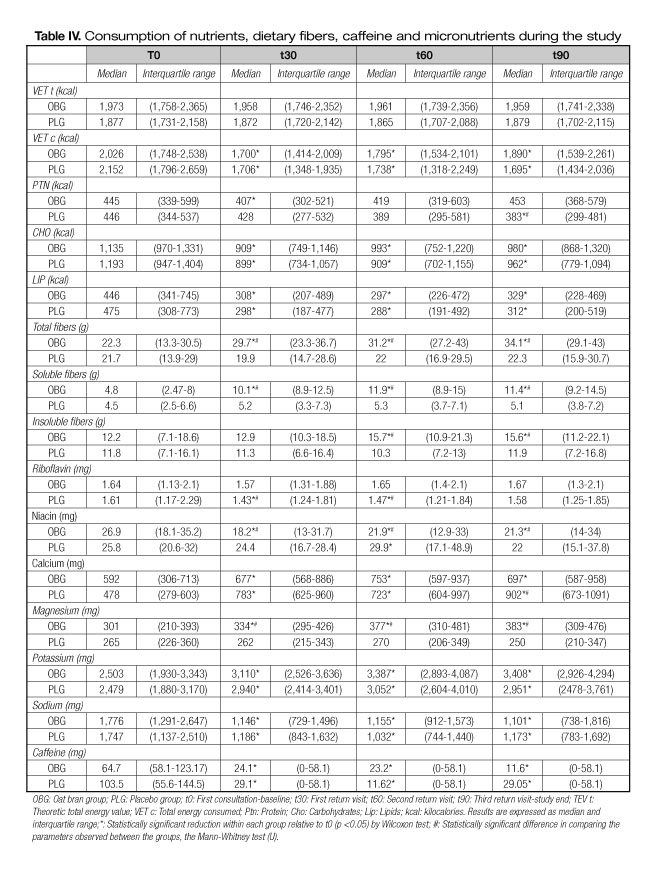
<body><![CDATA[<p><font face="Verdana" size="2"><a href="#t2">Table II</a> presents the variation in anthropometric parameters and blood pressure over the course of the study. We found that both groups underwent a significant decrease in these variables by the end of 90 days of nutrition counseling.</font></p>     <p>&nbsp;</p>     <p align="center"><font face="Verdana" size="2"><a name="t2"><img src="/img/revistas/nh/v33n1/22_original21_table2.jpg"></a></font></p>     <p>&nbsp;</p>     <p><font face="Verdana" size="2"><a href="#t3">Table III</a> presents the variation between laboratory parameters over the course of the study. Both groups showed a significant decrease in total cholesterol and LDL-c. The HOMA-IR and QUICKI glucose values showed a significant decrease only in the group that was given the oat flour intervention.</font></p>     <p>&nbsp;</p>     <p align="center"><font face="Verdana" size="2"><a name="t3"><img src="/img/revistas/nh/v33n1/22_original21_table3.jpg"></a></font></p>     <p>&nbsp;</p>     <p><font face="Verdana" size="2"><a href="#t4">Table IV</a> presents the nutritional data over the course of the study and it shows that both groups reduced their carbohydrate consumption and achieved a normal distribution of macronutrients. However, only the OBG saw a significant increase in dietary fiber consumption.</font></p>     <p>&nbsp;</p>     ]]></body>
<body><![CDATA[<p align="center"><font face="Verdana" size="2"><a name="t4"><img src="/img/revistas/nh/v33n1/22_original21_table4.jpg"></a></font></p>     <p>&nbsp;</p>     <p><font face="Verdana" size="2">In our diet-quality analysis, classified by DQI-R, we found the value 80.57 in 75 p. At t0 27% of the OBG participants were found to have adequate eating habits, with a score &ge; 80.57. In the PLG, 23% practiced an adequate diet. By the end of the study, the percentages increased significantly to 88% and 89% in the OBG and PLG, respectively.</font></p>     <p><font face="Verdana" size="2"><a href="#t5">Table V</a> presents anthropometric, biochemical and blood pressure data from the pre- and post-intervention periods, as related to quality of diet. The OBG and PLG were subdivided into DQI-R &lt; p75 <i>versus</i> DQI-R &ge; p75 categories. We found that even the individuals who began the study with adequate eating habits improved their score. By the end of the study both subgroups achieved practically the same DQI-R. OBG and PLG participants were found to eat a low quantity of processed food at t0, which lowered even more once both the OBG and PLG had undergone 90 days of nutritional intervention.</font></p>     <p>&nbsp;</p>     <p align="center"><font face="Verdana" size="2"><a name="t5"><img src="/img/revistas/nh/v33n1/22_original21_table5.jpg"></a></font></p>     <p>&nbsp;</p>     <p><font face="Verdana" size="2"><b>Discussion</b></font></p>     <p><font face="Verdana" size="2">Our findings from the lipid profile and anthropometric parameters show that nutrition counseling has a beneficial effect that can be attributed to the improvement in diet quality and the decreased consumption of ultraprocessed foods in our study. Nutrition intervention at a population level is shown to be beneficial over time, especially when the lifestyle changes proposed are followed, both in primary and secondary prevention (30). These measures seem to have a greater effect in developing nations where large segments of the population are low-income. However, it is necessary to involve society and health care professionals in order to see that the strategies being proposed are carried out step by step (31).</font></p>     <p><font face="Verdana" size="2">Karmally et al. (32) compared the effects of oat flour consumption (3 g of beta-glucans) with corn-based cereal lacking in soluble fiber in 152 individuals with hypercholesterolemia for six weeks. They noted a drop in TC and LDL-c of 4.5% and 5.3%, with no decrease in BM. Chen et al. (33) assessed 102 individuals with hypercholesterolemia taking 8g of beta-glucans over 90 days, with no significant results in BM, WC, TC or LDL-C. Maki et al. (11) conducted a study on 144 overweight or obese adults with LDL-c &ge; 130 mg/dL and taking 3 g beta-glucans and undergoing a BM-loss program over a period of 12 weeks. They found a significant decrease in TC, LDL-c and not in HDL-c in the intervention group, with minor decreases in BM.</font></p>     ]]></body>
<body><![CDATA[<p><font face="Verdana" size="2">Charlton et al. (34) assessed the added effects that 1.5 g or 3 g of beta-glucans has on nutrition counseling in 87 adults with hypercholesterolemia over six weeks. They noted a significant drop in TC, LDL-c, BM and BP in both groups, with no difference between them, corroborating the results of this study. Zhang et al. (35) assessed the effect 3.6 g of beta-glucans coupled with nutrition counseling had on 166 adult hypercholesterolemia sufferers. They noted a significant decrease in TC, LDL-c and WC only in the beta-glucan group, a significant decrease in HDL-c in the control group and no significant changes in the other experimental parameters, BP or BM. The results from this study diverge from those of Charlton et al. (34) and Zhang et al. (35).</font></p>     <p><font face="Verdana" size="2">A recent systematic revision of the use of beta-glucans for lowering blood sugar and lipids in diabetic patients showed benefits stemming both from low and high doses over prolonged periods of use. The authors stress that there is a dearth of longitudinal studies where the beneficial effects can be better evaluated (36). A possible mechanism to explain this effect could be that the gelatinous layer created by the beta-glucans prevents the enterocytes from absorbing glucose (37). There are also reports of a decrease in insulin resistance in obese women who ingest high doses of beta-glucans (38). These results are similar to the results of this study, which present a significant drop in serum glucose, HOMA-IR and QUICKI, suggesting a decrease in insulin resistance in dyslipidemia sufferers. However, these findings were obtained through much higher doses than the ones previously described (38).</font></p>     <p><font face="Verdana" size="2">The inclusion of patients both in primary and secondary prevention may have masked the effect OF had on lipid profile due to 20% of the sample using of hypolipidemic medication. However, all the patients involved had LDL-c &ge; 130 mg/dL, suggesting a lack of control, even while employing pharmacological measures. The same reasoning applies to 10% of the diabetic patients taking oral hypoglycemic agents. When patients taking hypolipidemic and hypoglycemic drugs were excluded from the sample group, results were not affected.</font></p>     <p>&nbsp;</p>     <p><font face="Verdana" size="2"><b>Conclusion</b></font></p>     <p><font face="Verdana" size="2">The findings pertaining to lipid profile and anthropometric parameters show that NC has a beneficial effect attributable to the improved quality of diet and decreased consumption of UPF. Daily consumption of 40 g of OF was shown to be of added benefit in lowering the parameters relating to insulin resistance.</font></p>     <p>&nbsp;</p>     <p><font face="Verdana" size="2"><b>References</b></font></p>     <!-- ref --><p><font face="Verdana" size="2">1. Lewington S, Whitlock G, Clarke R, Sherliker P, Emberson J, et al. Blood cholesterol and vascular mortality by age, sex, and blood pressure: A meta-analysis of individual data from 61 prospective studies with 55,000 vascular deaths. Lancet 2007;370:1829-39.    &nbsp;&nbsp;&nbsp;&nbsp;&nbsp;&nbsp;&nbsp;&nbsp;[&#160;<a href="javascript:void(0);" onclick="javascript: window.open('/scielo.php?script=sci_nlinks&ref=3850648&pid=S0212-1611201600010002200001&lng=','','width=640,height=500,resizable=yes,scrollbars=1,menubar=yes,');">Links</a>&#160;]<!-- end-ref --></font></p>    ]]></body>
<body><![CDATA[<!-- ref --><p><font face="Verdana" size="2">2. Farzadfar F, Finucane MM, Danaei G, Pelizzari PM, Cowan MJ, Paciorek CJ, et al. Global Burden of Metabolic Risk Factors of Chronic Diseases Collaborating G. National, regional, and global trends in serum total cholesterol since 1980: Systematic analysis of health examination surveys and epidemiological studies with 321 country-years and 3.0 million participants. Lancet 2011;377:578-86.    &nbsp;&nbsp;&nbsp;&nbsp;&nbsp;&nbsp;&nbsp;&nbsp;[&#160;<a href="javascript:void(0);" onclick="javascript: window.open('/scielo.php?script=sci_nlinks&ref=3850650&pid=S0212-1611201600010002200002&lng=','','width=640,height=500,resizable=yes,scrollbars=1,menubar=yes,');">Links</a>&#160;]<!-- end-ref --></font></p>    <!-- ref --><p><font face="Verdana" size="2">3. Verschuren WM, Jacobs DR, Bloemberg BP, Kromhout D, Menotti A, Aravanis C, et al. Serum total cholesterol and long-term coronary heart disease mortality in different cultures. Twenty-five-year follow-up of the seven countries study. JAMA 1995;274:131-6.    &nbsp;&nbsp;&nbsp;&nbsp;&nbsp;&nbsp;&nbsp;&nbsp;[&#160;<a href="javascript:void(0);" onclick="javascript: window.open('/scielo.php?script=sci_nlinks&ref=3850652&pid=S0212-1611201600010002200003&lng=','','width=640,height=500,resizable=yes,scrollbars=1,menubar=yes,');">Links</a>&#160;]<!-- end-ref --></font></p>    <!-- ref --><p><font face="Verdana" size="2">4. Kannel WB, Dawber TR, Kagan A, Revotskie N, Stokes J. Factors of risk in the development of coronary heart disease - six year follow-up experience. The framingham study. Ann Intern Med 1961;55:33-50.    &nbsp;&nbsp;&nbsp;&nbsp;&nbsp;&nbsp;&nbsp;&nbsp;[&#160;<a href="javascript:void(0);" onclick="javascript: window.open('/scielo.php?script=sci_nlinks&ref=3850654&pid=S0212-1611201600010002200004&lng=','','width=640,height=500,resizable=yes,scrollbars=1,menubar=yes,');">Links</a>&#160;]<!-- end-ref --></font></p>    <!-- ref --><p><font face="Verdana" size="2">5. Yusuf S, Hawken S, Ounpuu S, Dans T, Avezum A, Lanas F, et al. Effect of potentially modifiable risk factors associated with myocardial infarction in 52 countries (the INTERHEART study): case-control study. Lancet 2004;364(9438):937-52.    &nbsp;&nbsp;&nbsp;&nbsp;&nbsp;&nbsp;&nbsp;&nbsp;[&#160;<a href="javascript:void(0);" onclick="javascript: window.open('/scielo.php?script=sci_nlinks&ref=3850656&pid=S0212-1611201600010002200005&lng=','','width=640,height=500,resizable=yes,scrollbars=1,menubar=yes,');">Links</a>&#160;]<!-- end-ref --></font></p>    <!-- ref --><p><font face="Verdana" size="2">6. O'Donnell M, Xavier D, Liu L, Zhang H, Chin S, Rao-Melacini P, et al. Risk factors for ischaemic and intracerebral haemorrhagic stroke in 22 countries (the INTERSTROKE study): a case-control study. Lancet 2010;376(9735):112-23.    &nbsp;&nbsp;&nbsp;&nbsp;&nbsp;&nbsp;&nbsp;&nbsp;[&#160;<a href="javascript:void(0);" onclick="javascript: window.open('/scielo.php?script=sci_nlinks&ref=3850658&pid=S0212-1611201600010002200006&lng=','','width=640,height=500,resizable=yes,scrollbars=1,menubar=yes,');">Links</a>&#160;]<!-- end-ref --></font></p>    ]]></body>
<body><![CDATA[<!-- ref --><p><font face="Verdana" size="2">7. Kouki R, Schwab U, Hassonen M, Komulainen P, Heikkil&atilde; H, Lakka T A, et al. Food consumption, nutrient intake and the risk of having metabolic syndrome: the DR's EXTRA Study. European Journal of Clinical Nutrition 2011;65(3):368-377.    &nbsp;&nbsp;&nbsp;&nbsp;&nbsp;&nbsp;&nbsp;&nbsp;[&#160;<a href="javascript:void(0);" onclick="javascript: window.open('/scielo.php?script=sci_nlinks&ref=3850660&pid=S0212-1611201600010002200007&lng=','','width=640,height=500,resizable=yes,scrollbars=1,menubar=yes,');">Links</a>&#160;]<!-- end-ref --></font></p>    <!-- ref --><p><font face="Verdana" size="2">8. Camargo A, Menezes ME, Perez-Martinez P, Delgado-Lista J, Jimenez-Gomez Y, Ceuzteno C, et al. Dietary fat differentially influences the lipids storage on the adipose tissue in metabolic syndrome patients. European Journal of Nutrition 2014;53(2):617-26.    &nbsp;&nbsp;&nbsp;&nbsp;&nbsp;&nbsp;&nbsp;&nbsp;[&#160;<a href="javascript:void(0);" onclick="javascript: window.open('/scielo.php?script=sci_nlinks&ref=3850662&pid=S0212-1611201600010002200008&lng=','','width=640,height=500,resizable=yes,scrollbars=1,menubar=yes,');">Links</a>&#160;]<!-- end-ref --></font></p>    <!-- ref --><p><font face="Verdana" size="2">9. United States of America. Department of Health and Human Services. Food and Drug Administration. Federal Register. Rules and Regulations 2002;67(191):61773-83.    &nbsp;&nbsp;&nbsp;&nbsp;&nbsp;&nbsp;&nbsp;&nbsp;[&#160;<a href="javascript:void(0);" onclick="javascript: window.open('/scielo.php?script=sci_nlinks&ref=3850664&pid=S0212-1611201600010002200009&lng=','','width=640,height=500,resizable=yes,scrollbars=1,menubar=yes,');">Links</a>&#160;]<!-- end-ref --></font></p>    <!-- ref --><p><font face="Verdana" size="2">10. Brasil. Minist&eacute;rio da Sa&uacute;de. Ag&ecirc;ncia Nacional de Vigil&acirc;ncia Sanit&aacute;ria. Lista de alega&ccedil;&otilde;es de propriedade funcional aprovadas. Atualizada em junho/2008. Available at: <a target="_blank" href="http://www.anvisa.gov.br/alimentos/comissoes/tecno_lista_alega.htm">http://www.anvisa.gov.br/alimentos/comissoes/tecno_lista_alega.htm</a>. (Accesed on Aug 15th 2013).    &nbsp;&nbsp;&nbsp;&nbsp;&nbsp;&nbsp;&nbsp;&nbsp;[&#160;<a href="javascript:void(0);" onclick="javascript: window.open('/scielo.php?script=sci_nlinks&ref=3850666&pid=S0212-1611201600010002200010&lng=','','width=640,height=500,resizable=yes,scrollbars=1,menubar=yes,');">Links</a>&#160;]<!-- end-ref --></font></p>    <!-- ref --><p><font face="Verdana" size="2">11. Maki KC, Beiseigel JM, Jonnalagadda SS, Gugger CK, Reeves MS, Farmer MV, et al. Whole-grain ready-to-eat oat cereal, as part of a dietary program for weight loss, reduces low-density lipoprotein cholesterol in adults with overweight and obesity more than a dietary program including low-fiber control foods. Journal of the American Dietetic Association 2010;110(2):205-14.    &nbsp;&nbsp;&nbsp;&nbsp;&nbsp;&nbsp;&nbsp;&nbsp;[&#160;<a href="javascript:void(0);" onclick="javascript: window.open('/scielo.php?script=sci_nlinks&ref=3850668&pid=S0212-1611201600010002200011&lng=','','width=640,height=500,resizable=yes,scrollbars=1,menubar=yes,');">Links</a>&#160;]<!-- end-ref --></font></p>    ]]></body>
<body><![CDATA[<!-- ref --><p><font face="Verdana" size="2">12. Dalen JE, Devries S. Diets to Prevent Coronary Heart Disease 1957-2013: What have we learned? The American Journal of Medicine 2014;127(5):364-9.    &nbsp;&nbsp;&nbsp;&nbsp;&nbsp;&nbsp;&nbsp;&nbsp;[&#160;<a href="javascript:void(0);" onclick="javascript: window.open('/scielo.php?script=sci_nlinks&ref=3850670&pid=S0212-1611201600010002200012&lng=','','width=640,height=500,resizable=yes,scrollbars=1,menubar=yes,');">Links</a>&#160;]<!-- end-ref --></font></p>    <!-- ref --><p><font face="Verdana" size="2">13. Wolever TMS, Gibbs AL, Brand-Miller J, Duncan AM, Hart V, Lamarche B, et al. Bioactive oat &beta;-glucan reduces LDL cholesterol in Caucasians and non-Caucasians. Nutrition Journal 2011;10:1-4.    &nbsp;&nbsp;&nbsp;&nbsp;&nbsp;&nbsp;&nbsp;&nbsp;[&#160;<a href="javascript:void(0);" onclick="javascript: window.open('/scielo.php?script=sci_nlinks&ref=3850672&pid=S0212-1611201600010002200013&lng=','','width=640,height=500,resizable=yes,scrollbars=1,menubar=yes,');">Links</a>&#160;]<!-- end-ref --></font></p>    <!-- ref --><p><font face="Verdana" size="2">14. Brasil. Minist&eacute;rio da Sa&uacute;de. Secretaria de Aten&ccedil;&atilde;o &agrave; Sa&uacute;de. Coordena&ccedil;&atilde;o-Geral da Pol&iacute;tica de Alimenta&ccedil;&atilde;o e Nutri&ccedil;&atilde;o. Guia alimentar para a popula&ccedil;&atilde;o brasileira: Dez Passos para uma Alimenta&ccedil;&atilde;o Saud&aacute;vel. Bras&iacute;lia; 2006. p. 32. Available at: <a target="_blank" href="http://bvsms.saude.gov.br/bvs/publicacoes/guia_alimentar_alimentacao_saudavel.pdf">http://bvsms.saude.gov.br/bvs/publicacoes/guia_alimentar_alimentacao_saudavel.pdf</a> (Accessed on May 17th 2013).    &nbsp;&nbsp;&nbsp;&nbsp;&nbsp;&nbsp;&nbsp;&nbsp;[&#160;<a href="javascript:void(0);" onclick="javascript: window.open('/scielo.php?script=sci_nlinks&ref=3850674&pid=S0212-1611201600010002200014&lng=','','width=640,height=500,resizable=yes,scrollbars=1,menubar=yes,');">Links</a>&#160;]<!-- end-ref --></font></p>    <!-- ref --><p><font face="Verdana" size="2">15. World Health Organization. Waist circumference and waist-hip ratio: report of a WHO expert consultation, Geneva, 8-11, December 2008. Available at: <a target="_blank" href="http://whqlibdoc.who.int/publications/2011/9789241501491_eng.pdf">http://whqlibdoc.who.int/publications/2011/9789241501491_eng.pdf</a> (Accessed on March 12th 2012).    &nbsp;&nbsp;&nbsp;&nbsp;&nbsp;&nbsp;&nbsp;&nbsp;[&#160;<a href="javascript:void(0);" onclick="javascript: window.open('/scielo.php?script=sci_nlinks&ref=3850676&pid=S0212-1611201600010002200015&lng=','','width=640,height=500,resizable=yes,scrollbars=1,menubar=yes,');">Links</a>&#160;]<!-- end-ref --></font></p>    <!-- ref --><p><font face="Verdana" size="2">16. Ben-Noun L, Laor A. Relationship of neck circumference to cardiovascular risk factors. Obesity Research 2003;11(2):226-31.    &nbsp;&nbsp;&nbsp;&nbsp;&nbsp;&nbsp;&nbsp;&nbsp;[&#160;<a href="javascript:void(0);" onclick="javascript: window.open('/scielo.php?script=sci_nlinks&ref=3850678&pid=S0212-1611201600010002200016&lng=','','width=640,height=500,resizable=yes,scrollbars=1,menubar=yes,');">Links</a>&#160;]<!-- end-ref --></font></p>    ]]></body>
<body><![CDATA[<!-- ref --><p><font face="Verdana" size="2">17. Sociedade Brasileira de Cardiologia. Sociedade Brasileira de Hipertens&atilde;o. Sociedade Brasileira de Nefrologia. VI Diretrizes Brasileiras de Hipertens&atilde;o. Arquivos Brasileiros de Cardiologia 2010;95(1) (Supl. 1):1-51.    &nbsp;&nbsp;&nbsp;&nbsp;&nbsp;&nbsp;&nbsp;&nbsp;[&#160;<a href="javascript:void(0);" onclick="javascript: window.open('/scielo.php?script=sci_nlinks&ref=3850680&pid=S0212-1611201600010002200017&lng=','','width=640,height=500,resizable=yes,scrollbars=1,menubar=yes,');">Links</a>&#160;]<!-- end-ref --></font></p>    <!-- ref --><p><font face="Verdana" size="2">18. Warnick GR, Nauck M, Rifai N. Evolution of Methods for Measurement of HDL-Cholesterol: From Ultracentrifugation to Homogeneous Assays. Clinical Chemistry 2001;47(9):1579-96.    &nbsp;&nbsp;&nbsp;&nbsp;&nbsp;&nbsp;&nbsp;&nbsp;[&#160;<a href="javascript:void(0);" onclick="javascript: window.open('/scielo.php?script=sci_nlinks&ref=3850682&pid=S0212-1611201600010002200018&lng=','','width=640,height=500,resizable=yes,scrollbars=1,menubar=yes,');">Links</a>&#160;]<!-- end-ref --></font></p>    <!-- ref --><p><font face="Verdana" size="2">19. Fossati P, Prencipe L. Serum triglycerides determined colorimetrically with an enzyme that produces hydrogen peroxide. Clinical Chemistry 1982; 28(10):2077-80.    &nbsp;&nbsp;&nbsp;&nbsp;&nbsp;&nbsp;&nbsp;&nbsp;[&#160;<a href="javascript:void(0);" onclick="javascript: window.open('/scielo.php?script=sci_nlinks&ref=3850684&pid=S0212-1611201600010002200019&lng=','','width=640,height=500,resizable=yes,scrollbars=1,menubar=yes,');">Links</a>&#160;]<!-- end-ref --></font></p>    <!-- ref --><p><font face="Verdana" size="2">20. Friedwald WT, Levy RI, Fredrickson DS. Estimation of the concentration of low-density lipoprotein cholesterol in plasma, without use of the preparative ultracentrifuge. Clinical Chemistry 1982;Vol 18(6):499-502.    &nbsp;&nbsp;&nbsp;&nbsp;&nbsp;&nbsp;&nbsp;&nbsp;[&#160;<a href="javascript:void(0);" onclick="javascript: window.open('/scielo.php?script=sci_nlinks&ref=3850686&pid=S0212-1611201600010002200020&lng=','','width=640,height=500,resizable=yes,scrollbars=1,menubar=yes,');">Links</a>&#160;]<!-- end-ref --></font></p>    <!-- ref --><p><font face="Verdana" size="2">21. Trinder P. Determination of blood glucose using an oxidase-peroxidase system with a non-carcinogenic chromogen. Journal of Clinical Phatology 1969; 22(2):158-61.    &nbsp;&nbsp;&nbsp;&nbsp;&nbsp;&nbsp;&nbsp;&nbsp;[&#160;<a href="javascript:void(0);" onclick="javascript: window.open('/scielo.php?script=sci_nlinks&ref=3850688&pid=S0212-1611201600010002200021&lng=','','width=640,height=500,resizable=yes,scrollbars=1,menubar=yes,');">Links</a>&#160;]<!-- end-ref --></font></p>    ]]></body>
<body><![CDATA[<!-- ref --><p><font face="Verdana" size="2">22. Matthews DR, Hosker JP, Rudenski AS, Naylor BA, Treacher DF, Turner RC. Homeostasis model assessment: insulin resistance and beta-cell function from fasting plasma glucose and insulin concentrations in man. Diabetologia 1985;28(7):412-9.    &nbsp;&nbsp;&nbsp;&nbsp;&nbsp;&nbsp;&nbsp;&nbsp;[&#160;<a href="javascript:void(0);" onclick="javascript: window.open('/scielo.php?script=sci_nlinks&ref=3850690&pid=S0212-1611201600010002200022&lng=','','width=640,height=500,resizable=yes,scrollbars=1,menubar=yes,');">Links</a>&#160;]<!-- end-ref --></font></p>    <!-- ref --><p><font face="Verdana" size="2">23. Geloneze B, Repetto EM, Geloneze SR, Tambascia MA, Ermetice MN. The threshold value for insulin resistance (HOMA-IR) in admixtured population IR in the Brazilian Metabolic Syndrome Study. Diabetes Research and Clinical Practice 2006;72(2):219-20.    &nbsp;&nbsp;&nbsp;&nbsp;&nbsp;&nbsp;&nbsp;&nbsp;[&#160;<a href="javascript:void(0);" onclick="javascript: window.open('/scielo.php?script=sci_nlinks&ref=3850692&pid=S0212-1611201600010002200023&lng=','','width=640,height=500,resizable=yes,scrollbars=1,menubar=yes,');">Links</a>&#160;]<!-- end-ref --></font></p>    <!-- ref --><p><font face="Verdana" size="2">24. Katz A, Nambi SS, Mather K, Baron AD, Follmann DA, Sullivan G, et al. Quantitative insulin sensitivity check index: a simple, accurate method for assessing insulin sensitivity in humans. The Journal of Clinical Endocrinology and Metabolism 2000;85(7):2402-10.    &nbsp;&nbsp;&nbsp;&nbsp;&nbsp;&nbsp;&nbsp;&nbsp;[&#160;<a href="javascript:void(0);" onclick="javascript: window.open('/scielo.php?script=sci_nlinks&ref=3850694&pid=S0212-1611201600010002200024&lng=','','width=640,height=500,resizable=yes,scrollbars=1,menubar=yes,');">Links</a>&#160;]<!-- end-ref --></font></p>    <!-- ref --><p><font face="Verdana" size="2">25. Food Processor Nutrition Analysis System. Version 12.0. USA: ESHA Corporation; 1984.    &nbsp;&nbsp;&nbsp;&nbsp;&nbsp;&nbsp;&nbsp;&nbsp;[&#160;<a href="javascript:void(0);" onclick="javascript: window.open('/scielo.php?script=sci_nlinks&ref=3850696&pid=S0212-1611201600010002200025&lng=','','width=640,height=500,resizable=yes,scrollbars=1,menubar=yes,');">Links</a>&#160;]<!-- end-ref --></font></p>    <!-- ref --><p><font face="Verdana" size="2">26. Brasil. Instituto Brasileiro de Geografia e Estat&iacute;stica. Tabela de Composi&ccedil;&atilde;o Nutricional dos Alimentos Consumidos no Brasil, 2011. Available at: <a target="_blank" href="http://www.ibge.gov.br/home/estatistica/populacao/condicaodevida/pof/2008_2009_composicao_nutricional/default_pdf.shtm">http://www.ibge.gov.br/home/estatistica/populacao/condicaodevida/pof/2008_2009_composicao_nutricional/default_pdf.shtm</a> (Accessed on Jan 12th 2013).    &nbsp;&nbsp;&nbsp;&nbsp;&nbsp;&nbsp;&nbsp;&nbsp;[&#160;<a href="javascript:void(0);" onclick="javascript: window.open('/scielo.php?script=sci_nlinks&ref=3850698&pid=S0212-1611201600010002200026&lng=','','width=640,height=500,resizable=yes,scrollbars=1,menubar=yes,');">Links</a>&#160;]<!-- end-ref --></font></p>    ]]></body>
<body><![CDATA[<!-- ref --><p><font face="Verdana" size="2">27. Pinheiro ABV, Lacerda EMA, Benzecry EH, Gomes MCS, Costa MV. Tabela para Avalia&ccedil;&atilde;o de Consumo Alimentar em Medidas Caseiras. 5<sup>a</sup> ed. S&atilde;o Paulo: Editora Atheneu; 2005.    &nbsp;&nbsp;&nbsp;&nbsp;&nbsp;&nbsp;&nbsp;&nbsp;[&#160;<a href="javascript:void(0);" onclick="javascript: window.open('/scielo.php?script=sci_nlinks&ref=3850700&pid=S0212-1611201600010002200027&lng=','','width=640,height=500,resizable=yes,scrollbars=1,menubar=yes,');">Links</a>&#160;]<!-- end-ref --></font></p>    <!-- ref --><p><font face="Verdana" size="2">28. Institute of Medicine. Dietary Reference Intakes for Energy, Carbohydrate, Fiber, Fat, Fatty Acids, Cholesterol, Protein, and Amino Acids (Macronutrients). Washington, DC: The National Academies Press, 2005. Available at: <a target="_blank" href="http://www.nap.edu/openbook.php?isbn=0309085373">http://www.nap.edu/openbook.php?isbn=0309085373</a> (Accessed on May 15<sup>th</sup> 2012).    &nbsp;&nbsp;&nbsp;&nbsp;&nbsp;&nbsp;&nbsp;&nbsp;[&#160;<a href="javascript:void(0);" onclick="javascript: window.open('/scielo.php?script=sci_nlinks&ref=3850702&pid=S0212-1611201600010002200028&lng=','','width=640,height=500,resizable=yes,scrollbars=1,menubar=yes,');">Links</a>&#160;]<!-- end-ref --></font></p>    <!-- ref --><p><font face="Verdana" size="2">29. Previdelli NA, Andrade SC, Pires MM, Ferreira SRG, Fisberg RM, Marchioni DM. &Iacute;ndice de qualidade da dieta revisado para popula&ccedil;&atilde;o brasileira. Revista de Sa&uacute;de P&uacute;blica 2011;45(4):794-8.    &nbsp;&nbsp;&nbsp;&nbsp;&nbsp;&nbsp;&nbsp;&nbsp;[&#160;<a href="javascript:void(0);" onclick="javascript: window.open('/scielo.php?script=sci_nlinks&ref=3850704&pid=S0212-1611201600010002200029&lng=','','width=640,height=500,resizable=yes,scrollbars=1,menubar=yes,');">Links</a>&#160;]<!-- end-ref --></font></p>    <!-- ref --><p><font face="Verdana" size="2">30. Ribeiro AG, Cotta RMM, Ribeiro SMR Ribeiro A Promo&ccedil;&atilde;o da Sa&uacute;de e a Preven&ccedil;&atilde;o Integrada dos Fatores de Risco para Doen&ccedil;as Cardiovasculares. Ci&ecirc;ncia &amp; Sa&uacute;de Coletiva 2012;17(1):7-17.    &nbsp;&nbsp;&nbsp;&nbsp;&nbsp;&nbsp;&nbsp;&nbsp;[&#160;<a href="javascript:void(0);" onclick="javascript: window.open('/scielo.php?script=sci_nlinks&ref=3850706&pid=S0212-1611201600010002200030&lng=','','width=640,height=500,resizable=yes,scrollbars=1,menubar=yes,');">Links</a>&#160;]<!-- end-ref --></font></p>    <!-- ref --><p><font face="Verdana" size="2">31. The Lancet NCD Action Group. Country actions to meet UN commitments on non-communicable diseases: a stepwise approach. Lancet 2013;381:575-84.    &nbsp;&nbsp;&nbsp;&nbsp;&nbsp;&nbsp;&nbsp;&nbsp;[&#160;<a href="javascript:void(0);" onclick="javascript: window.open('/scielo.php?script=sci_nlinks&ref=3850708&pid=S0212-1611201600010002200031&lng=','','width=640,height=500,resizable=yes,scrollbars=1,menubar=yes,');">Links</a>&#160;]<!-- end-ref --></font></p>    ]]></body>
<body><![CDATA[<!-- ref --><p><font face="Verdana" size="2">32. Karmally W, Montez MG, Palmas W, Martinez W, Branstetter A, Ramakrishnan R, et al. Cholesterol-Lowering Benefits of Oat-Containing Cereal in Hispanic Americans. Journal of the American Dietetic Association 2005;105(6):967-70.    &nbsp;&nbsp;&nbsp;&nbsp;&nbsp;&nbsp;&nbsp;&nbsp;[&#160;<a href="javascript:void(0);" onclick="javascript: window.open('/scielo.php?script=sci_nlinks&ref=3850710&pid=S0212-1611201600010002200032&lng=','','width=640,height=500,resizable=yes,scrollbars=1,menubar=yes,');">Links</a>&#160;]<!-- end-ref --></font></p>    <!-- ref --><p><font face="Verdana" size="2">33. Chen J, He J.; Wildman RP, Reynolds K, Streiffer RH, Whelton PK. A randomized controlled trial of dietary fiber intake on serum lipids. European Journal of Clinical Nutrition 2006;60(1):62-8.    &nbsp;&nbsp;&nbsp;&nbsp;&nbsp;&nbsp;&nbsp;&nbsp;[&#160;<a href="javascript:void(0);" onclick="javascript: window.open('/scielo.php?script=sci_nlinks&ref=3850712&pid=S0212-1611201600010002200033&lng=','','width=640,height=500,resizable=yes,scrollbars=1,menubar=yes,');">Links</a>&#160;]<!-- end-ref --></font></p>    <!-- ref --><p><font face="Verdana" size="2">34. Charlton KE1, Tapsell LC, Batterham MJ, O'Shea J, Thorne R, Beck E, Tosh SM. Effect of 6 weeks' consumption of b-glucan-rich oat products on cholesterol levels in mildly hypercholesterolaemic overweight adults. British Journal of Nutrition 2011;106(3):1-11.    &nbsp;&nbsp;&nbsp;&nbsp;&nbsp;&nbsp;&nbsp;&nbsp;[&#160;<a href="javascript:void(0);" onclick="javascript: window.open('/scielo.php?script=sci_nlinks&ref=3850714&pid=S0212-1611201600010002200034&lng=','','width=640,height=500,resizable=yes,scrollbars=1,menubar=yes,');">Links</a>&#160;]<!-- end-ref --></font></p>    <!-- ref --><p><font face="Verdana" size="2">35. Zhang J, Li L., Song P, Wang C, Man Q, Meng L, et al. Randomized controlled trial of oatmeal consumption versus noodle consumption on blood lipids of urban Chinese adults with hypercholesterolemia. Nutrition Journal 2012;11(1):1-8.    &nbsp;&nbsp;&nbsp;&nbsp;&nbsp;&nbsp;&nbsp;&nbsp;[&#160;<a href="javascript:void(0);" onclick="javascript: window.open('/scielo.php?script=sci_nlinks&ref=3850716&pid=S0212-1611201600010002200035&lng=','','width=640,height=500,resizable=yes,scrollbars=1,menubar=yes,');">Links</a>&#160;]<!-- end-ref --></font></p>    <!-- ref --><p><font face="Verdana" size="2">36. Andrade EF, Lobato RV, Araujo TV, Zangeronimo1 MG, Sousa RV, Pereira LJ. Effect of beta-glucans in the control of blood glucose levels of diabetic patients: a systematic review. Nutr Hosp 2015;31(1):170-7.    &nbsp;&nbsp;&nbsp;&nbsp;&nbsp;&nbsp;&nbsp;&nbsp;[&#160;<a href="javascript:void(0);" onclick="javascript: window.open('/scielo.php?script=sci_nlinks&ref=3850718&pid=S0212-1611201600010002200036&lng=','','width=640,height=500,resizable=yes,scrollbars=1,menubar=yes,');">Links</a>&#160;]<!-- end-ref --></font></p>    ]]></body>
<body><![CDATA[<!-- ref --><p><font face="Verdana" size="2">37. Reyna NY, Cano C, Bermudez VJ, et al. Sweeteners and Beta Glucans Improve Metabolic and Anthropometrics Variable in Well Controlled Type 2 Diabetic Patients. Am J Ther 2003;10:438-43.    &nbsp;&nbsp;&nbsp;&nbsp;&nbsp;&nbsp;&nbsp;&nbsp;[&#160;<a href="javascript:void(0);" onclick="javascript: window.open('/scielo.php?script=sci_nlinks&ref=3850720&pid=S0212-1611201600010002200037&lng=','','width=640,height=500,resizable=yes,scrollbars=1,menubar=yes,');">Links</a>&#160;]<!-- end-ref --></font></p>    <!-- ref --><p><font face="Verdana" size="2">38. Kim H, Stote KS, Behall KM, et al. Glucose and insulin responses to whole grain breakfasts varying in soluble fiber, sglucan: A dose response study in obese women with increased risk for insulin resistance. Eur J Nutr 2009;48:170-5.    &nbsp;&nbsp;&nbsp;&nbsp;&nbsp;&nbsp;&nbsp;&nbsp;[&#160;<a href="javascript:void(0);" onclick="javascript: window.open('/scielo.php?script=sci_nlinks&ref=3850722&pid=S0212-1611201600010002200038&lng=','','width=640,height=500,resizable=yes,scrollbars=1,menubar=yes,');">Links</a>&#160;]<!-- end-ref --></font></p>     <p>&nbsp;</p>     <p>&nbsp;</p>     <p><font face="Verdana" size="2"><a href="#top"><img border="0" src="/img/revistas/nh/v33n1/seta.gif" width="15" height="17"></a><a name="bajo"></a><b>Correspondence:</b>    <br>Glorimar Rosa.    <br>Departamento de Nutri&ccedil;&atilde;o e Diet&eacute;tica.    <br>Instituto de Nutri&ccedil;&atilde;o Josu&eacute; de Castro    ]]></body>
<body><![CDATA[<br>da Universidade Federal do Rio de Janeiro.    <br>Av. Carlos Chagas Filho, 373.    <br>Edif&iacute;cio do Centro de Ci&ecirc;ncias da Sa&uacute;de,    <br>Bloco J/2<sup>o</sup> andar. Cidade Universit&aacute;ria.    <br>CEP: 21941-902. Rio de Janeiro, Brasil    <br>e-mail: <a href="mailto:glorimar@nutricao.ufrj.br">glorimar@nutricao.ufrj.br</a></font></p>     <p><font face="Verdana" size="2">Received: 27/10/15    <br>Accepted: 12/11/15</font></p>      ]]></body><back>
<ref-list>
<ref id="B1">
<label>1</label><nlm-citation citation-type="journal">
<person-group person-group-type="author">
<name>
<surname><![CDATA[Lewington]]></surname>
<given-names><![CDATA[S]]></given-names>
</name>
<name>
<surname><![CDATA[Whitlock]]></surname>
<given-names><![CDATA[G]]></given-names>
</name>
<name>
<surname><![CDATA[Clarke]]></surname>
<given-names><![CDATA[R]]></given-names>
</name>
<name>
<surname><![CDATA[Sherliker]]></surname>
<given-names><![CDATA[P]]></given-names>
</name>
<name>
<surname><![CDATA[Emberson]]></surname>
<given-names><![CDATA[J]]></given-names>
</name>
</person-group>
<article-title xml:lang="en"><![CDATA[Blood cholesterol and vascular mortality by age, sex, and blood pressure: A meta-analysis of individual data from 61 prospective studies with 55,000 vascular deaths]]></article-title>
<source><![CDATA[Lancet]]></source>
<year>2007</year>
<volume>370</volume>
<page-range>1829-39</page-range></nlm-citation>
</ref>
<ref id="B2">
<label>2</label><nlm-citation citation-type="journal">
<person-group person-group-type="author">
<name>
<surname><![CDATA[Farzadfar]]></surname>
<given-names><![CDATA[F]]></given-names>
</name>
<name>
<surname><![CDATA[Finucane]]></surname>
<given-names><![CDATA[MM]]></given-names>
</name>
<name>
<surname><![CDATA[Danaei]]></surname>
<given-names><![CDATA[G]]></given-names>
</name>
<name>
<surname><![CDATA[Pelizzari]]></surname>
<given-names><![CDATA[PM]]></given-names>
</name>
<name>
<surname><![CDATA[Cowan]]></surname>
<given-names><![CDATA[MJ]]></given-names>
</name>
<name>
<surname><![CDATA[Paciorek]]></surname>
<given-names><![CDATA[CJ]]></given-names>
</name>
</person-group>
<collab>Global Burden of Metabolic Risk Factors of Chronic Diseases Collaborating G</collab>
<article-title xml:lang="en"><![CDATA[National, regional, and global trends in serum total cholesterol since 1980: Systematic analysis of health examination surveys and epidemiological studies with 321 country-years and 3.0 million participants]]></article-title>
<source><![CDATA[Lancet]]></source>
<year>2011</year>
<volume>377</volume>
<page-range>578-86</page-range></nlm-citation>
</ref>
<ref id="B3">
<label>3</label><nlm-citation citation-type="journal">
<person-group person-group-type="author">
<name>
<surname><![CDATA[Verschuren]]></surname>
<given-names><![CDATA[WM]]></given-names>
</name>
<name>
<surname><![CDATA[Jacobs]]></surname>
<given-names><![CDATA[DR]]></given-names>
</name>
<name>
<surname><![CDATA[Bloemberg]]></surname>
<given-names><![CDATA[BP]]></given-names>
</name>
<name>
<surname><![CDATA[Kromhout]]></surname>
<given-names><![CDATA[D]]></given-names>
</name>
<name>
<surname><![CDATA[Menotti]]></surname>
<given-names><![CDATA[A]]></given-names>
</name>
<name>
<surname><![CDATA[Aravanis]]></surname>
<given-names><![CDATA[C]]></given-names>
</name>
</person-group>
<article-title xml:lang="en"><![CDATA[Serum total cholesterol and long-term coronary heart disease mortality in different cultures: Twenty-five-year follow-up of the seven countries study]]></article-title>
<source><![CDATA[JAMA]]></source>
<year>1995</year>
<volume>274</volume>
<page-range>131-6</page-range></nlm-citation>
</ref>
<ref id="B4">
<label>4</label><nlm-citation citation-type="journal">
<person-group person-group-type="author">
<name>
<surname><![CDATA[Kannel]]></surname>
<given-names><![CDATA[WB]]></given-names>
</name>
<name>
<surname><![CDATA[Dawber]]></surname>
<given-names><![CDATA[TR]]></given-names>
</name>
<name>
<surname><![CDATA[Kagan]]></surname>
<given-names><![CDATA[A]]></given-names>
</name>
<name>
<surname><![CDATA[Revotskie]]></surname>
<given-names><![CDATA[N]]></given-names>
</name>
<name>
<surname><![CDATA[Stokes]]></surname>
<given-names><![CDATA[J]]></given-names>
</name>
</person-group>
<article-title xml:lang="en"><![CDATA[Factors of risk in the development of coronary heart disease - six year follow-up experience: The framingham study]]></article-title>
<source><![CDATA[Ann Intern Med]]></source>
<year>1961</year>
<volume>55</volume>
<page-range>33-50</page-range></nlm-citation>
</ref>
<ref id="B5">
<label>5</label><nlm-citation citation-type="journal">
<person-group person-group-type="author">
<name>
<surname><![CDATA[Yusuf]]></surname>
<given-names><![CDATA[S]]></given-names>
</name>
<name>
<surname><![CDATA[Hawken]]></surname>
<given-names><![CDATA[S]]></given-names>
</name>
<name>
<surname><![CDATA[Ounpuu]]></surname>
<given-names><![CDATA[S]]></given-names>
</name>
<name>
<surname><![CDATA[Dans]]></surname>
<given-names><![CDATA[T]]></given-names>
</name>
<name>
<surname><![CDATA[Avezum]]></surname>
<given-names><![CDATA[A]]></given-names>
</name>
<name>
<surname><![CDATA[Lanas]]></surname>
<given-names><![CDATA[F]]></given-names>
</name>
</person-group>
<article-title xml:lang="en"><![CDATA[Effect of potentially modifiable risk factors associated with myocardial infarction in 52 countries (the INTERHEART study): case-control study]]></article-title>
<source><![CDATA[Lancet]]></source>
<year>2004</year>
<volume>364</volume>
<numero>9438</numero>
<issue>9438</issue>
<page-range>937-52</page-range></nlm-citation>
</ref>
<ref id="B6">
<label>6</label><nlm-citation citation-type="journal">
<person-group person-group-type="author">
<name>
<surname><![CDATA[O'Donnell]]></surname>
<given-names><![CDATA[M]]></given-names>
</name>
<name>
<surname><![CDATA[Xavier]]></surname>
<given-names><![CDATA[D]]></given-names>
</name>
<name>
<surname><![CDATA[Liu]]></surname>
<given-names><![CDATA[L]]></given-names>
</name>
<name>
<surname><![CDATA[Zhang]]></surname>
<given-names><![CDATA[H]]></given-names>
</name>
<name>
<surname><![CDATA[Chin]]></surname>
<given-names><![CDATA[S]]></given-names>
</name>
<name>
<surname><![CDATA[Rao-Melacini]]></surname>
<given-names><![CDATA[P]]></given-names>
</name>
</person-group>
<article-title xml:lang="en"><![CDATA[Risk factors for ischaemic and intracerebral haemorrhagic stroke in 22 countries (the INTERSTROKE study): a case-control study]]></article-title>
<source><![CDATA[Lancet]]></source>
<year>2010</year>
<volume>376</volume>
<numero>9735</numero>
<issue>9735</issue>
<page-range>112-23</page-range></nlm-citation>
</ref>
<ref id="B7">
<label>7</label><nlm-citation citation-type="journal">
<person-group person-group-type="author">
<name>
<surname><![CDATA[Kouki]]></surname>
<given-names><![CDATA[R]]></given-names>
</name>
<name>
<surname><![CDATA[Schwab]]></surname>
<given-names><![CDATA[U]]></given-names>
</name>
<name>
<surname><![CDATA[Hassonen]]></surname>
<given-names><![CDATA[M]]></given-names>
</name>
<name>
<surname><![CDATA[Komulainen]]></surname>
<given-names><![CDATA[P]]></given-names>
</name>
<name>
<surname><![CDATA[Heikkilã]]></surname>
<given-names><![CDATA[H]]></given-names>
</name>
<name>
<surname><![CDATA[Lakka]]></surname>
<given-names><![CDATA[T A]]></given-names>
</name>
</person-group>
<article-title xml:lang="en"><![CDATA[Food consumption, nutrient intake and the risk of having metabolic syndrome: the DR's EXTRA Study]]></article-title>
<source><![CDATA[European Journal of Clinical Nutrition]]></source>
<year>2011</year>
<volume>65</volume>
<numero>3</numero>
<issue>3</issue>
<page-range>368-377</page-range></nlm-citation>
</ref>
<ref id="B8">
<label>8</label><nlm-citation citation-type="journal">
<person-group person-group-type="author">
<name>
<surname><![CDATA[Camargo]]></surname>
<given-names><![CDATA[A]]></given-names>
</name>
<name>
<surname><![CDATA[Menezes]]></surname>
<given-names><![CDATA[ME]]></given-names>
</name>
<name>
<surname><![CDATA[Perez-Martinez]]></surname>
<given-names><![CDATA[P]]></given-names>
</name>
<name>
<surname><![CDATA[Delgado-Lista]]></surname>
<given-names><![CDATA[J]]></given-names>
</name>
<name>
<surname><![CDATA[Jimenez-Gomez]]></surname>
<given-names><![CDATA[Y]]></given-names>
</name>
<name>
<surname><![CDATA[Ceuzteno]]></surname>
<given-names><![CDATA[C]]></given-names>
</name>
</person-group>
<article-title xml:lang="en"><![CDATA[Dietary fat differentially influences the lipids storage on the adipose tissue in metabolic syndrome patients]]></article-title>
<source><![CDATA[European Journal of Nutrition]]></source>
<year>2014</year>
<volume>53</volume>
<numero>2</numero>
<issue>2</issue>
<page-range>617-26</page-range></nlm-citation>
</ref>
<ref id="B9">
<label>9</label><nlm-citation citation-type="journal">
<collab>United States of America. Department of Health and Human Services^dFood and Drug Administration</collab>
<source><![CDATA[Federal Register. Rules and Regulations]]></source>
<year>2002</year>
<volume>67</volume>
<numero>191</numero>
<issue>191</issue>
<page-range>61773-83</page-range></nlm-citation>
</ref>
<ref id="B10">
<label>10</label><nlm-citation citation-type="">
<collab>Ministério da Saúde^dAgência Nacional de Vigilância Sanitária</collab>
<source><![CDATA[Lista de alegações de propriedade funcional aprovadas]]></source>
<year></year>
</nlm-citation>
</ref>
<ref id="B11">
<label>11</label><nlm-citation citation-type="journal">
<person-group person-group-type="author">
<name>
<surname><![CDATA[Maki]]></surname>
<given-names><![CDATA[KC]]></given-names>
</name>
<name>
<surname><![CDATA[Beiseigel]]></surname>
<given-names><![CDATA[JM]]></given-names>
</name>
<name>
<surname><![CDATA[Jonnalagadda]]></surname>
<given-names><![CDATA[SS]]></given-names>
</name>
<name>
<surname><![CDATA[Gugger]]></surname>
<given-names><![CDATA[CK]]></given-names>
</name>
<name>
<surname><![CDATA[Reeves]]></surname>
<given-names><![CDATA[MS]]></given-names>
</name>
<name>
<surname><![CDATA[Farmer]]></surname>
<given-names><![CDATA[MV]]></given-names>
</name>
</person-group>
<article-title xml:lang="en"><![CDATA[Whole-grain ready-to-eat oat cereal, as part of a dietary program for weight loss, reduces low-density lipoprotein cholesterol in adults with overweight and obesity more than a dietary program including low-fiber control foods]]></article-title>
<source><![CDATA[Journal of the American Dietetic Association]]></source>
<year>2010</year>
<volume>110</volume>
<numero>2</numero>
<issue>2</issue>
<page-range>205-14</page-range></nlm-citation>
</ref>
<ref id="B12">
<label>12</label><nlm-citation citation-type="journal">
<person-group person-group-type="author">
<name>
<surname><![CDATA[Dalen]]></surname>
<given-names><![CDATA[JE]]></given-names>
</name>
<name>
<surname><![CDATA[Devries]]></surname>
<given-names><![CDATA[S]]></given-names>
</name>
</person-group>
<article-title xml:lang="en"><![CDATA[Diets to Prevent Coronary Heart Disease 1957-2013: What have we learned?]]></article-title>
<source><![CDATA[The American Journal of Medicine]]></source>
<year>2014</year>
<volume>127</volume>
<numero>5</numero>
<issue>5</issue>
<page-range>364-9</page-range></nlm-citation>
</ref>
<ref id="B13">
<label>13</label><nlm-citation citation-type="journal">
<person-group person-group-type="author">
<name>
<surname><![CDATA[Wolever]]></surname>
<given-names><![CDATA[TMS]]></given-names>
</name>
<name>
<surname><![CDATA[Gibbs]]></surname>
<given-names><![CDATA[AL]]></given-names>
</name>
<name>
<surname><![CDATA[Brand-Miller]]></surname>
<given-names><![CDATA[J]]></given-names>
</name>
<name>
<surname><![CDATA[Duncan]]></surname>
<given-names><![CDATA[AM]]></given-names>
</name>
<name>
<surname><![CDATA[Hart]]></surname>
<given-names><![CDATA[V]]></given-names>
</name>
<name>
<surname><![CDATA[Lamarche]]></surname>
<given-names><![CDATA[B]]></given-names>
</name>
</person-group>
<article-title xml:lang="en"><![CDATA[Bioactive oat Beta-glucan reduces LDL cholesterol in Caucasians and non-Caucasians]]></article-title>
<source><![CDATA[Nutrition Journal]]></source>
<year>2011</year>
<volume>10</volume>
<page-range>1-4</page-range></nlm-citation>
</ref>
<ref id="B14">
<label>14</label><nlm-citation citation-type="">
<collab>Ministério da Saúde^dSecretaria de Atenção à Saúde. Coordenação-Geral da Política de Alimentação e Nutrição</collab>
<source><![CDATA[Guia alimentar para a população brasileira: Dez Passos para uma Alimentação Saudável]]></source>
<year>2006</year>
<page-range>32</page-range><publisher-loc><![CDATA[Brasília ]]></publisher-loc>
</nlm-citation>
</ref>
<ref id="B15">
<label>15</label><nlm-citation citation-type="">
<collab>World Health Organization</collab>
<source><![CDATA[Waist circumference and waist-hip ratio: report of a WHO expert consultation, Geneva, 8-11, December 2008]]></source>
<year></year>
</nlm-citation>
</ref>
<ref id="B16">
<label>16</label><nlm-citation citation-type="journal">
<person-group person-group-type="author">
<name>
<surname><![CDATA[Ben-Noun]]></surname>
<given-names><![CDATA[L]]></given-names>
</name>
<name>
<surname><![CDATA[Laor]]></surname>
<given-names><![CDATA[A]]></given-names>
</name>
</person-group>
<article-title xml:lang="en"><![CDATA[Relationship of neck circumference to cardiovascular risk factors]]></article-title>
<source><![CDATA[Obesity Research]]></source>
<year>2003</year>
<volume>11</volume>
<numero>2</numero>
<issue>2</issue>
<page-range>226-31</page-range></nlm-citation>
</ref>
<ref id="B17">
<label>17</label><nlm-citation citation-type="journal">
<collab>Sociedade Brasileira de Cardiologia</collab>
<collab>Sociedade Brasileira de Hipertensão</collab>
<collab>Sociedade Brasileira de Nefrologia</collab>
<article-title xml:lang="en"><![CDATA[VI Diretrizes Brasileiras de Hipertensão]]></article-title>
<source><![CDATA[Arquivos Brasileiros de Cardiologia]]></source>
<year>2010</year>
<volume>95</volume>
<numero>1^s1</numero>
<issue>1^s1</issue>
<supplement>1</supplement>
<page-range>1-51</page-range></nlm-citation>
</ref>
<ref id="B18">
<label>18</label><nlm-citation citation-type="journal">
<person-group person-group-type="author">
<name>
<surname><![CDATA[Warnick]]></surname>
<given-names><![CDATA[GR]]></given-names>
</name>
<name>
<surname><![CDATA[Nauck]]></surname>
<given-names><![CDATA[M]]></given-names>
</name>
<name>
<surname><![CDATA[Rifai]]></surname>
<given-names><![CDATA[N]]></given-names>
</name>
</person-group>
<article-title xml:lang="en"><![CDATA[Evolution of Methods for Measurement of HDL-Cholesterol: From Ultracentrifugation to Homogeneous Assays]]></article-title>
<source><![CDATA[Clinical Chemistry]]></source>
<year>2001</year>
<volume>47</volume>
<numero>9</numero>
<issue>9</issue>
<page-range>1579-96</page-range></nlm-citation>
</ref>
<ref id="B19">
<label>19</label><nlm-citation citation-type="journal">
<person-group person-group-type="author">
<name>
<surname><![CDATA[Fossati]]></surname>
<given-names><![CDATA[P]]></given-names>
</name>
<name>
<surname><![CDATA[Prencipe]]></surname>
<given-names><![CDATA[L]]></given-names>
</name>
</person-group>
<article-title xml:lang="en"><![CDATA[Serum triglycerides determined colorimetrically with an enzyme that produces hydrogen peroxide]]></article-title>
<source><![CDATA[Clinical Chemistry]]></source>
<year>1982</year>
<volume>28</volume>
<numero>10</numero>
<issue>10</issue>
<page-range>2077-80</page-range></nlm-citation>
</ref>
<ref id="B20">
<label>20</label><nlm-citation citation-type="journal">
<person-group person-group-type="author">
<name>
<surname><![CDATA[Friedwald]]></surname>
<given-names><![CDATA[WT]]></given-names>
</name>
<name>
<surname><![CDATA[Levy]]></surname>
<given-names><![CDATA[RI]]></given-names>
</name>
<name>
<surname><![CDATA[Fredrickson]]></surname>
<given-names><![CDATA[DS]]></given-names>
</name>
</person-group>
<article-title xml:lang="en"><![CDATA[Estimation of the concentration of low-density lipoprotein cholesterol in plasma, without use of the preparative ultracentrifuge]]></article-title>
<source><![CDATA[Clinical Chemistry]]></source>
<year>1982</year>
<volume>18</volume>
<numero>6</numero>
<issue>6</issue>
<page-range>499-502</page-range></nlm-citation>
</ref>
<ref id="B21">
<label>21</label><nlm-citation citation-type="journal">
<person-group person-group-type="author">
<name>
<surname><![CDATA[Trinder]]></surname>
<given-names><![CDATA[P]]></given-names>
</name>
</person-group>
<article-title xml:lang="en"><![CDATA[Determination of blood glucose using an oxidase-peroxidase system with a non-carcinogenic chromogen]]></article-title>
<source><![CDATA[Journal of Clinical Phatology]]></source>
<year>1969</year>
<volume>22</volume>
<numero>2</numero>
<issue>2</issue>
<page-range>158-61</page-range></nlm-citation>
</ref>
<ref id="B22">
<label>22</label><nlm-citation citation-type="journal">
<person-group person-group-type="author">
<name>
<surname><![CDATA[Matthews]]></surname>
<given-names><![CDATA[DR]]></given-names>
</name>
<name>
<surname><![CDATA[Hosker]]></surname>
<given-names><![CDATA[JP]]></given-names>
</name>
<name>
<surname><![CDATA[Rudenski]]></surname>
<given-names><![CDATA[AS]]></given-names>
</name>
<name>
<surname><![CDATA[Naylor]]></surname>
<given-names><![CDATA[BA]]></given-names>
</name>
<name>
<surname><![CDATA[Treacher]]></surname>
<given-names><![CDATA[DF]]></given-names>
</name>
<name>
<surname><![CDATA[Turner]]></surname>
<given-names><![CDATA[RC]]></given-names>
</name>
</person-group>
<article-title xml:lang="en"><![CDATA[Homeostasis model assessment: insulin resistance and beta-cell function from fasting plasma glucose and insulin concentrations in man]]></article-title>
<source><![CDATA[Diabetologia]]></source>
<year>1985</year>
<volume>28</volume>
<numero>7</numero>
<issue>7</issue>
<page-range>412-9</page-range></nlm-citation>
</ref>
<ref id="B23">
<label>23</label><nlm-citation citation-type="journal">
<person-group person-group-type="author">
<name>
<surname><![CDATA[Geloneze]]></surname>
<given-names><![CDATA[B]]></given-names>
</name>
<name>
<surname><![CDATA[Repetto]]></surname>
<given-names><![CDATA[EM]]></given-names>
</name>
<name>
<surname><![CDATA[Geloneze]]></surname>
<given-names><![CDATA[SR]]></given-names>
</name>
<name>
<surname><![CDATA[Tambascia]]></surname>
<given-names><![CDATA[MA]]></given-names>
</name>
<name>
<surname><![CDATA[Ermetice]]></surname>
<given-names><![CDATA[MN]]></given-names>
</name>
</person-group>
<article-title xml:lang="en"><![CDATA[The threshold value for insulin resistance (HOMA-IR) in admixtured population IR in the Brazilian Metabolic Syndrome Study]]></article-title>
<source><![CDATA[Diabetes Research and Clinical Practice]]></source>
<year>2006</year>
<volume>72</volume>
<numero>2</numero>
<issue>2</issue>
<page-range>219-20</page-range></nlm-citation>
</ref>
<ref id="B24">
<label>24</label><nlm-citation citation-type="journal">
<person-group person-group-type="author">
<name>
<surname><![CDATA[Katz]]></surname>
<given-names><![CDATA[A]]></given-names>
</name>
<name>
<surname><![CDATA[Nambi]]></surname>
<given-names><![CDATA[SS]]></given-names>
</name>
<name>
<surname><![CDATA[Mather]]></surname>
<given-names><![CDATA[K]]></given-names>
</name>
<name>
<surname><![CDATA[Baron]]></surname>
<given-names><![CDATA[AD]]></given-names>
</name>
<name>
<surname><![CDATA[Follmann]]></surname>
<given-names><![CDATA[DA]]></given-names>
</name>
<name>
<surname><![CDATA[Sullivan]]></surname>
<given-names><![CDATA[G]]></given-names>
</name>
</person-group>
<article-title xml:lang="en"><![CDATA[Quantitative insulin sensitivity check index: a simple, accurate method for assessing insulin sensitivity in humans]]></article-title>
<source><![CDATA[The Journal of Clinical Endocrinology and Metabolism]]></source>
<year>2000</year>
<volume>85</volume>
<numero>7</numero>
<issue>7</issue>
<page-range>2402-10</page-range></nlm-citation>
</ref>
<ref id="B25">
<label>25</label><nlm-citation citation-type="book">
<source><![CDATA[Food Processor Nutrition Analysis System: Version 12.0]]></source>
<year>1984</year>
<publisher-name><![CDATA[ESHA Corporation]]></publisher-name>
</nlm-citation>
</ref>
<ref id="B26">
<label>26</label><nlm-citation citation-type="">
<collab>Instituto Brasileiro de Geografia e Estatística</collab>
<source><![CDATA[Tabela de Composição Nutricional dos Alimentos Consumidos no Brasil]]></source>
<year>2011</year>
</nlm-citation>
</ref>
<ref id="B27">
<label>27</label><nlm-citation citation-type="book">
<person-group person-group-type="author">
<name>
<surname><![CDATA[Pinheiro]]></surname>
<given-names><![CDATA[ABV]]></given-names>
</name>
<name>
<surname><![CDATA[Lacerda]]></surname>
<given-names><![CDATA[EMA]]></given-names>
</name>
<name>
<surname><![CDATA[Benzecry]]></surname>
<given-names><![CDATA[EH]]></given-names>
</name>
<name>
<surname><![CDATA[Gomes]]></surname>
<given-names><![CDATA[MCS]]></given-names>
</name>
<name>
<surname><![CDATA[Costa]]></surname>
<given-names><![CDATA[MV]]></given-names>
</name>
</person-group>
<source><![CDATA[Tabela para Avaliação de Consumo Alimentar em Medidas Caseiras]]></source>
<year>2005</year>
<edition>5</edition>
<publisher-loc><![CDATA[São Paulo ]]></publisher-loc>
<publisher-name><![CDATA[Editora Atheneu]]></publisher-name>
</nlm-citation>
</ref>
<ref id="B28">
<label>28</label><nlm-citation citation-type="book">
<collab>Institute of Medicine</collab>
<source><![CDATA[Dietary Reference Intakes for Energy, Carbohydrate, Fiber, Fat, Fatty Acids, Cholesterol, Protein, and Amino Acids (Macronutrients)]]></source>
<year>2005</year>
<publisher-loc><![CDATA[Washington^eDC DC]]></publisher-loc>
<publisher-name><![CDATA[The National Academies Press]]></publisher-name>
</nlm-citation>
</ref>
<ref id="B29">
<label>29</label><nlm-citation citation-type="journal">
<person-group person-group-type="author">
<name>
<surname><![CDATA[Previdelli]]></surname>
<given-names><![CDATA[NA]]></given-names>
</name>
<name>
<surname><![CDATA[Andrade]]></surname>
<given-names><![CDATA[SC]]></given-names>
</name>
<name>
<surname><![CDATA[Pires]]></surname>
<given-names><![CDATA[MM]]></given-names>
</name>
<name>
<surname><![CDATA[Ferreira]]></surname>
<given-names><![CDATA[SRG]]></given-names>
</name>
<name>
<surname><![CDATA[Fisberg]]></surname>
<given-names><![CDATA[RM]]></given-names>
</name>
<name>
<surname><![CDATA[Marchioni]]></surname>
<given-names><![CDATA[DM]]></given-names>
</name>
</person-group>
<article-title xml:lang="pt"><![CDATA[Índice de qualidade da dieta revisado para população brasileira]]></article-title>
<source><![CDATA[Revista de Saúde Pública]]></source>
<year>2011</year>
<volume>45</volume>
<numero>4</numero>
<issue>4</issue>
<page-range>794-8</page-range></nlm-citation>
</ref>
<ref id="B30">
<label>30</label><nlm-citation citation-type="journal">
<person-group person-group-type="author">
<name>
<surname><![CDATA[Ribeiro]]></surname>
<given-names><![CDATA[AG]]></given-names>
</name>
<name>
<surname><![CDATA[Cotta]]></surname>
<given-names><![CDATA[RMM]]></given-names>
</name>
<name>
<surname><![CDATA[Ribeiro]]></surname>
<given-names><![CDATA[SMR]]></given-names>
</name>
<name>
<surname><![CDATA[Ribeiro]]></surname>
<given-names><![CDATA[A]]></given-names>
</name>
</person-group>
<article-title xml:lang="pt"><![CDATA[Promoção da Saúde e a Prevenção Integrada dos Fatores de Risco para Doenças Cardiovasculares]]></article-title>
<source><![CDATA[Ciência & Saúde Coletiva]]></source>
<year>2012</year>
<volume>17</volume>
<numero>1</numero>
<issue>1</issue>
<page-range>7-17</page-range></nlm-citation>
</ref>
<ref id="B31">
<label>31</label><nlm-citation citation-type="journal">
<collab>The Lancet NCD Action Group</collab>
<article-title xml:lang="en"><![CDATA[Country actions to meet UN commitments on non-communicable diseases: a stepwise approach]]></article-title>
<source><![CDATA[Lancet]]></source>
<year>2013</year>
<volume>381</volume>
<page-range>575-84</page-range></nlm-citation>
</ref>
<ref id="B32">
<label>32</label><nlm-citation citation-type="journal">
<person-group person-group-type="author">
<name>
<surname><![CDATA[Karmally]]></surname>
<given-names><![CDATA[W]]></given-names>
</name>
<name>
<surname><![CDATA[Montez]]></surname>
<given-names><![CDATA[MG]]></given-names>
</name>
<name>
<surname><![CDATA[Palmas]]></surname>
<given-names><![CDATA[W]]></given-names>
</name>
<name>
<surname><![CDATA[Martinez]]></surname>
<given-names><![CDATA[W]]></given-names>
</name>
<name>
<surname><![CDATA[Branstetter]]></surname>
<given-names><![CDATA[A]]></given-names>
</name>
<name>
<surname><![CDATA[Ramakrishnan]]></surname>
<given-names><![CDATA[R]]></given-names>
</name>
</person-group>
<article-title xml:lang="en"><![CDATA[Cholesterol-Lowering Benefits of Oat-Containing Cereal in Hispanic Americans]]></article-title>
<source><![CDATA[Journal of the American Dietetic Association]]></source>
<year>2005</year>
<volume>105</volume>
<numero>6</numero>
<issue>6</issue>
<page-range>967-70</page-range></nlm-citation>
</ref>
<ref id="B33">
<label>33</label><nlm-citation citation-type="journal">
<person-group person-group-type="author">
<name>
<surname><![CDATA[Chen]]></surname>
<given-names><![CDATA[J]]></given-names>
</name>
<name>
<surname><![CDATA[He]]></surname>
<given-names><![CDATA[J.]]></given-names>
</name>
<name>
<surname><![CDATA[Wildman]]></surname>
<given-names><![CDATA[RP]]></given-names>
</name>
<name>
<surname><![CDATA[Reynolds]]></surname>
<given-names><![CDATA[K]]></given-names>
</name>
<name>
<surname><![CDATA[Streiffer]]></surname>
<given-names><![CDATA[RH]]></given-names>
</name>
<name>
<surname><![CDATA[Whelton]]></surname>
<given-names><![CDATA[PK]]></given-names>
</name>
</person-group>
<article-title xml:lang="en"><![CDATA[A randomized controlled trial of dietary fiber intake on serum lipids]]></article-title>
<source><![CDATA[European Journal of Clinical Nutrition]]></source>
<year>2006</year>
<volume>60</volume>
<numero>1</numero>
<issue>1</issue>
<page-range>62-8</page-range></nlm-citation>
</ref>
<ref id="B34">
<label>34</label><nlm-citation citation-type="journal">
<person-group person-group-type="author">
<name>
<surname><![CDATA[Charlton]]></surname>
<given-names><![CDATA[KE1]]></given-names>
</name>
<name>
<surname><![CDATA[Tapsell]]></surname>
<given-names><![CDATA[LC]]></given-names>
</name>
<name>
<surname><![CDATA[Batterham]]></surname>
<given-names><![CDATA[MJ]]></given-names>
</name>
<name>
<surname><![CDATA[O'Shea]]></surname>
<given-names><![CDATA[J]]></given-names>
</name>
<name>
<surname><![CDATA[Thorne]]></surname>
<given-names><![CDATA[R]]></given-names>
</name>
<name>
<surname><![CDATA[Beck]]></surname>
<given-names><![CDATA[E]]></given-names>
</name>
<name>
<surname><![CDATA[Tosh]]></surname>
<given-names><![CDATA[SM]]></given-names>
</name>
</person-group>
<article-title xml:lang="en"><![CDATA[Effect of 6 weeks' consumption of b-glucan-rich oat products on cholesterol levels in mildly hypercholesterolaemic overweight adults]]></article-title>
<source><![CDATA[British Journal of Nutrition]]></source>
<year>2011</year>
<volume>106</volume>
<numero>3</numero>
<issue>3</issue>
<page-range>1-11</page-range></nlm-citation>
</ref>
<ref id="B35">
<label>35</label><nlm-citation citation-type="journal">
<person-group person-group-type="author">
<name>
<surname><![CDATA[Zhang]]></surname>
<given-names><![CDATA[J]]></given-names>
</name>
<name>
<surname><![CDATA[Li]]></surname>
<given-names><![CDATA[L.]]></given-names>
</name>
<name>
<surname><![CDATA[Song]]></surname>
<given-names><![CDATA[P]]></given-names>
</name>
<name>
<surname><![CDATA[Wang]]></surname>
<given-names><![CDATA[C]]></given-names>
</name>
<name>
<surname><![CDATA[Man]]></surname>
<given-names><![CDATA[Q]]></given-names>
</name>
<name>
<surname><![CDATA[Meng]]></surname>
<given-names><![CDATA[L]]></given-names>
</name>
</person-group>
<article-title xml:lang="en"><![CDATA[Randomized controlled trial of oatmeal consumption versus noodle consumption on blood lipids of urban Chinese adults with hypercholesterolemia]]></article-title>
<source><![CDATA[Nutrition Journal]]></source>
<year>2012</year>
<volume>11</volume>
<numero>1</numero>
<issue>1</issue>
<page-range>1-8</page-range></nlm-citation>
</ref>
<ref id="B36">
<label>36</label><nlm-citation citation-type="journal">
<person-group person-group-type="author">
<name>
<surname><![CDATA[Andrade]]></surname>
<given-names><![CDATA[EF]]></given-names>
</name>
<name>
<surname><![CDATA[Lobato]]></surname>
<given-names><![CDATA[RV]]></given-names>
</name>
<name>
<surname><![CDATA[Araujo]]></surname>
<given-names><![CDATA[TV]]></given-names>
</name>
<name>
<surname><![CDATA[Zangeronimo1]]></surname>
<given-names><![CDATA[MG]]></given-names>
</name>
<name>
<surname><![CDATA[Sousa]]></surname>
<given-names><![CDATA[RV]]></given-names>
</name>
<name>
<surname><![CDATA[Pereira]]></surname>
<given-names><![CDATA[LJ]]></given-names>
</name>
</person-group>
<article-title xml:lang="en"><![CDATA[Effect of beta-glucans in the control of blood glucose levels of diabetic patients: a systematic review]]></article-title>
<source><![CDATA[Nutr Hosp]]></source>
<year>2015</year>
<volume>31</volume>
<numero>1</numero>
<issue>1</issue>
<page-range>170-7</page-range></nlm-citation>
</ref>
<ref id="B37">
<label>37</label><nlm-citation citation-type="journal">
<person-group person-group-type="author">
<name>
<surname><![CDATA[Reyna]]></surname>
<given-names><![CDATA[NY]]></given-names>
</name>
<name>
<surname><![CDATA[Cano]]></surname>
<given-names><![CDATA[C]]></given-names>
</name>
<name>
<surname><![CDATA[Bermudez]]></surname>
<given-names><![CDATA[VJ]]></given-names>
</name>
</person-group>
<article-title xml:lang="en"><![CDATA[Sweeteners and Beta Glucans Improve Metabolic and Anthropometrics Variable in Well Controlled Type 2 Diabetic Patients]]></article-title>
<source><![CDATA[Am J Ther]]></source>
<year>2003</year>
<volume>10</volume>
<page-range>438-43</page-range></nlm-citation>
</ref>
<ref id="B38">
<label>38</label><nlm-citation citation-type="journal">
<person-group person-group-type="author">
<name>
<surname><![CDATA[Kim]]></surname>
<given-names><![CDATA[H]]></given-names>
</name>
<name>
<surname><![CDATA[Stote]]></surname>
<given-names><![CDATA[KS]]></given-names>
</name>
<name>
<surname><![CDATA[Behall]]></surname>
<given-names><![CDATA[KM]]></given-names>
</name>
</person-group>
<article-title xml:lang="en"><![CDATA[Glucose and insulin responses to whole grain breakfasts varying in soluble fiber, sglucan: A dose response study in obese women with increased risk for insulin resistance]]></article-title>
<source><![CDATA[Eur J Nutr]]></source>
<year>2009</year>
<volume>48</volume>
<page-range>170-5</page-range></nlm-citation>
</ref>
</ref-list>
</back>
</article>