<?xml version="1.0" encoding="ISO-8859-1"?><article xmlns:mml="http://www.w3.org/1998/Math/MathML" xmlns:xlink="http://www.w3.org/1999/xlink" xmlns:xsi="http://www.w3.org/2001/XMLSchema-instance">
<front>
<journal-meta>
<journal-id>0212-1611</journal-id>
<journal-title><![CDATA[Nutrición Hospitalaria]]></journal-title>
<abbrev-journal-title><![CDATA[Nutr. Hosp.]]></abbrev-journal-title>
<issn>0212-1611</issn>
<publisher>
<publisher-name><![CDATA[Grupo Arán]]></publisher-name>
</publisher>
</journal-meta>
<article-meta>
<article-id>S0212-16112016000100026</article-id>
<article-id pub-id-type="doi">10.20960/nh.27</article-id>
<title-group>
<article-title xml:lang="en"><![CDATA[Chromium supplementation in patients with type 2 diabetes and high risk of type 2 diabetes: a meta-analysis of randomized controlled trials]]></article-title>
<article-title xml:lang="es"><![CDATA[Suplementación con cromo en pacientes con diabetes tipo 2 y elevado riesgo de diabetes tipo 2: un metaanálisis de ensayos clínicos aleatorizados]]></article-title>
</title-group>
<contrib-group>
<contrib contrib-type="author">
<name>
<surname><![CDATA[San Mauro Martín]]></surname>
<given-names><![CDATA[Ismael]]></given-names>
</name>
<xref ref-type="aff" rid="A01"/>
</contrib>
<contrib contrib-type="author">
<name>
<surname><![CDATA[Ruiz León]]></surname>
<given-names><![CDATA[Ana María]]></given-names>
</name>
<xref ref-type="aff" rid="A01"/>
</contrib>
<contrib contrib-type="author">
<name>
<surname><![CDATA[Camina Martín]]></surname>
<given-names><![CDATA[María Alicia]]></given-names>
</name>
<xref ref-type="aff" rid="A02"/>
</contrib>
<contrib contrib-type="author">
<name>
<surname><![CDATA[Garicano Vila]]></surname>
<given-names><![CDATA[Elena]]></given-names>
</name>
<xref ref-type="aff" rid="A01"/>
</contrib>
<contrib contrib-type="author">
<name>
<surname><![CDATA[Collado-Yurrita]]></surname>
<given-names><![CDATA[Luis]]></given-names>
</name>
<xref ref-type="aff" rid="A03"/>
</contrib>
<contrib contrib-type="author">
<name>
<surname><![CDATA[Mateo-Silleras]]></surname>
<given-names><![CDATA[Beatriz de]]></given-names>
</name>
<xref ref-type="aff" rid="A02"/>
</contrib>
<contrib contrib-type="author">
<name>
<surname><![CDATA[Redondo del Río]]></surname>
<given-names><![CDATA[María de Paz]]></given-names>
</name>
<xref ref-type="aff" rid="A02"/>
</contrib>
</contrib-group>
<aff id="A01">
<institution><![CDATA[,Research Centers of Nutrition and Health  ]]></institution>
<addr-line><![CDATA[Madrid ]]></addr-line>
<country>Spain</country>
</aff>
<aff id="A02">
<institution><![CDATA[,Universidad de Valladolid Faculty of Medicine Department of Nutrition and Food Science]]></institution>
<addr-line><![CDATA[Valladolid ]]></addr-line>
<country>Spain</country>
</aff>
<aff id="A03">
<institution><![CDATA[,Universidad Complutense de Madrid Medicine Department ]]></institution>
<addr-line><![CDATA[Madrid ]]></addr-line>
<country>Spain</country>
</aff>
<pub-date pub-type="pub">
<day>00</day>
<month>02</month>
<year>2016</year>
</pub-date>
<pub-date pub-type="epub">
<day>00</day>
<month>02</month>
<year>2016</year>
</pub-date>
<volume>33</volume>
<numero>1</numero>
<fpage>156</fpage>
<lpage>161</lpage>
<copyright-statement/>
<copyright-year/>
<self-uri xlink:href="http://scielo.isciii.es/scielo.php?script=sci_arttext&amp;pid=S0212-16112016000100026&amp;lng=en&amp;nrm=iso"></self-uri><self-uri xlink:href="http://scielo.isciii.es/scielo.php?script=sci_abstract&amp;pid=S0212-16112016000100026&amp;lng=en&amp;nrm=iso"></self-uri><self-uri xlink:href="http://scielo.isciii.es/scielo.php?script=sci_pdf&amp;pid=S0212-16112016000100026&amp;lng=en&amp;nrm=iso"></self-uri><abstract abstract-type="short" xml:lang="en"><p><![CDATA[Introduction: Chromium is an essential trace mineral for carbohydrate and lipid metabolism, which is currently prescribed to control diabetes mellitus. Results of previous systematic reviews and meta-analyses of chromium supplementation and metabolic profiles in diabetes have been inconsistent. Aim: The objective of this meta-analysis was to assess the effects on metabolic profiles and safety of chromium supplementation in type 2 diabetes mellitus and cholesterol. Methods: Literature searches in PubMed, Scopus and Web of Science were made by use of related terms-keywords and randomized clinical trials during the period of 2000-2014. Results: Thirteen trials fulfilled the inclusion criteria and were included in this systematic review. Total doses of Cr supplementation and brewer's yeast ranged from 42 to 1,000 µg/day, and duration of supplementation ranged from 30 to 120 days. The analysis indicated that there was a significant effect of chromium supplementation in diabetics on fasting plasma glucose with a weighted average effect size of -29.26 mg/dL, p = 0.01, CI 95% = -52.4 to -6.09; and on total cholesterol with a weighted average effect size of -6.7 mg/dL, p = 0.01, CI 95% = -11.88 to -1.53. Conclusions: The available evidence suggests favourable effects of chromium supplementation on glycaemic control in patients with diabetes. Chromium supplementation may additionally improve total cholesterol levels.]]></p></abstract>
<abstract abstract-type="short" xml:lang="es"><p><![CDATA[Introducción: el cromo es un oligoelemento esencial para el metabolismo de carbohidratos y lípidos, que actualmente está prescrito para controlar la diabetes mellitus. Los resultados de las revisiones sistemáticas anteriores y metaanálisis de los suplementos de cromo y de perfiles metabólicos en diabetes han sido inconsistentes. Objetivo: el objetivo de este metaanálisis fue evaluar los efectos sobre los perfiles y la seguridad de la suplementación de cromo en la diabetes mellitus tipo 2 y el colesterol. Métodos: se realizaron búsquedas bibliográficas en PubMed, Scopus y Web of Science mediante el uso de palabras clave relacionadas y ensayos clínicos aleatorios durante el período de 2000-2014. Resultados: trece ensayos cumplieron los criterios de inclusión y se incluyeron en esta revisión sistemática. Las dosis totales de la suplementación con Cr y levadura de cerveza oscilaron desde 42 hasta 1.000 µg/día, y la duración de la suplementación varió de 30 a 120 días. El análisis indicó que hubo un efecto significativo de la suplementación de cromo en los diabéticos en la glucemia en ayunas, con un tamaño del efecto promedio ponderado de -29,26 mg/dl, p = 0,01, IC del 95% = -52,4 a -6,09; y sobre el colesterol total, con un efecto promedio ponderado de -6,7 mg/dl, p = 0,01, IC del 95% = -11,88 a -1,53. Conclusiones: la evidencia disponible sugiere efectos favorables de la administración de suplementos de cromo sobre el control glucémico en pacientes con diabetes. Los complementos de cromo pueden además mejorar los niveles de colesterol total.]]></p></abstract>
<kwd-group>
<kwd lng="en"><![CDATA[Type 2 diabetes]]></kwd>
<kwd lng="en"><![CDATA[Hyperglycaemia]]></kwd>
<kwd lng="en"><![CDATA[HbA1c]]></kwd>
<kwd lng="en"><![CDATA[Cholesterol]]></kwd>
<kwd lng="en"><![CDATA[Chromium]]></kwd>
<kwd lng="en"><![CDATA[Randomized controlled trial]]></kwd>
<kwd lng="es"><![CDATA[Diabetes tipo 2]]></kwd>
<kwd lng="es"><![CDATA[Hiperglucemia]]></kwd>
<kwd lng="es"><![CDATA[HbA1c]]></kwd>
<kwd lng="es"><![CDATA[Colesterol]]></kwd>
<kwd lng="es"><![CDATA[Cromo]]></kwd>
<kwd lng="es"><![CDATA[Ensayo clínico controlado aleatorizado]]></kwd>
</kwd-group>
</article-meta>
</front><body><![CDATA[ <p><a name="top"></a><font face="Verdana" size="2"><b>REVISIÓN</b></font></p>     <p>&nbsp;</p>     <p><font face="Verdana" size="4"><b>Chromium supplementation in patients with type 2 diabetes and high risk of type 2 diabetes: a meta-analysis of randomized controlled trials</b></font></p>     <p><font face="Verdana" size="4"><b>Suplementaci&oacute;n con cromo en pacientes con diabetes tipo 2 y elevado riesgo de diabetes tipo 2: un metaan&aacute;lisis de ensayos cl&iacute;nicos aleatorizados</b></font></p>     <p>&nbsp;</p>     <p>&nbsp;</p>     <p><font face="Verdana" size="2"><b>Ismael San Mauro Mart&iacute;n<sup>1</sup>, Ana Mar&iacute;a Ruiz Le&oacute;n<sup>1</sup>, Mar&iacute;a Alicia Camina Mart&iacute;n<sup>2</sup>, Elena Garicano Vila<sup>1</sup>, Luis Collado-Yurrita<sup>3</sup>, Beatriz de Mateo-Silleras<sup>2</sup> and Mar&iacute;a de Paz Redondo del R&iacute;o<sup>2</sup></b></font></p>     <p><font face="Verdana" size="2"><sup>1</sup> Research Centers of Nutrition and Health. Madrid, Spain.    <br><sup>2</sup> Department of Nutrition and Food Science. Faculty of Medicine. Universidad de Valladolid. Valladolid, Spain.    <br><sup>3</sup> Medicine Department. Universidad Complutense de Madrid. Madrid, Spain</font></p>     ]]></body>
<body><![CDATA[<p><font face="Verdana" size="2"><a href="#bajo">Correspondence</a></font></p>     <p>&nbsp;</p>     <p>&nbsp;</p> <hr size="1">    <p><font face="Verdana" size="2"><b>ABSTRACT</b></font></p>     <p><font face="Verdana" size="2"><b>Introduction:</b> Chromium is an essential trace mineral for carbohydrate and lipid metabolism, which is currently prescribed to control diabetes mellitus. Results of previous systematic reviews and meta-analyses of chromium supplementation and metabolic profiles in diabetes have been inconsistent.    <br><b>Aim:</b> The objective of this meta-analysis was to assess the effects on metabolic profiles and safety of chromium supplementation in type 2 diabetes mellitus and cholesterol.    <br><b>Methods:</b> Literature searches in PubMed, Scopus and Web of Science were made by use of related terms-keywords and randomized clinical trials during the period of 2000-2014.    <br><b>Results:</b> Thirteen trials fulfilled the inclusion criteria and were included in this systematic review. Total doses of Cr supplementation and brewer's yeast ranged from 42 to 1,000 &micro;g/day, and duration of supplementation ranged from 30 to 120 days. The analysis indicated that there was a significant effect of chromium supplementation in diabetics on fasting plasma glucose with a weighted average effect size of -29.26 mg/dL, p = 0.01, CI 95% = -52.4 to -6.09; and on total cholesterol with a weighted average effect size of -6.7 mg/dL, p = 0.01, CI 95% = -11.88 to -1.53.    <br><b>Conclusions:</b> The available evidence suggests favourable effects of chromium supplementation on glycaemic control in patients with diabetes. Chromium supplementation may additionally improve total cholesterol levels.</font></p>     <p><font face="Verdana" size="2"><b>Key words:</b> Type 2 diabetes. Hyperglycaemia. HbA1c. Cholesterol. Chromium. Randomized controlled trial.</font></p> <hr size="1">    ]]></body>
<body><![CDATA[<p><font face="Verdana" size="2"><b>RESUMEN</b></font></p>     <p><font face="Verdana" size="2"><b>Introducci&oacute;n:</b> el cromo es un oligoelemento esencial para el metabolismo de carbohidratos y l&iacute;pidos, que actualmente est&aacute; prescrito para controlar la diabetes mellitus. Los resultados de las revisiones sistem&aacute;ticas anteriores y metaan&aacute;lisis de los suplementos de cromo y de perfiles metab&oacute;licos en diabetes han sido inconsistentes.    <br><b>Objetivo:</b> el objetivo de este metaan&aacute;lisis fue evaluar los efectos sobre los perfiles y la seguridad de la suplementaci&oacute;n de cromo en la diabetes mellitus tipo 2 y el colesterol.    <br><b>M&eacute;todos:</b> se realizaron b&uacute;squedas bibliogr&aacute;ficas en PubMed, Scopus y Web of Science mediante el uso de palabras clave relacionadas y ensayos cl&iacute;nicos aleatorios durante el per&iacute;odo de 2000-2014.    <br><b>Resultados:</b> trece ensayos cumplieron los criterios de inclusi&oacute;n y se incluyeron en esta revisi&oacute;n sistem&aacute;tica. Las dosis totales de la suplementaci&oacute;n con Cr y levadura de cerveza oscilaron desde 42 hasta 1.000 &micro;g/d&iacute;a, y la duraci&oacute;n de la suplementaci&oacute;n vari&oacute; de 30 a 120 d&iacute;as. El an&aacute;lisis indic&oacute; que hubo un efecto significativo de la suplementaci&oacute;n de cromo en los diab&eacute;ticos en la glucemia en ayunas, con un tama&ntilde;o del efecto promedio ponderado de -29,26 mg/dl, p = 0,01, IC del 95% = -52,4 a -6,09; y sobre el colesterol total, con un efecto promedio ponderado de -6,7 mg/dl, p = 0,01, IC del 95% = -11,88 a -1,53.    <br><b>Conclusiones:</b> la evidencia disponible sugiere efectos favorables de la administraci&oacute;n de suplementos de cromo sobre el control gluc&eacute;mico en pacientes con diabetes. Los complementos de cromo pueden adem&aacute;s mejorar los niveles de colesterol total.</font></p>     <p><font face="Verdana" size="2"><b>Palabras clave:</b> Diabetes tipo 2. Hiperglucemia. HbA1c. Colesterol. Cromo. Ensayo cl&iacute;nico controlado aleatorizado.</font></p> <hr size="1">     <p>&nbsp;</p>     <p><font face="Verdana" size="2"><b>Introduction</b></font></p>     <p><font face="Verdana" size="2">Chromium (Cr) is a trace element widely distributed in the earth's crust, which usually occurs naturally either in a Cr (III) or Cr (VI) oxidation state (1). Foods and supplements mainly contain Cr (III) (2,3). The highest concentrations (&gt; 100 &micro;g/kg) can be found in condiments and spices, cocoa, molasses, pure sugar, walnuts, dry corn, seafood, butter and oil; while the lowest (&lt;100 &micro;g/kg) can be found in meat, grains, cereals, starch, refined rice, vegetables, fruits, milk and dairy products (4). Nevertheless, chromium content can vary considerably depending, for example, on the geographic zone and the soil type (3,4).</font></p>     ]]></body>
<body><![CDATA[<p><font face="Verdana" size="2">Some studies have observed that Cr (III) could improve insulin action (5-7), but the relation between Cr and insulin is not well known. This element also could participate in lipid metabolism and could have some effect on body composition (7). However, these effects are controversial, and scientific evidence seems to be stronger towards glycaemia. For this reason Cr (III) supplements, which are considered safe, are often recommended to type 2 diabetes mellitus (DM) diagnosed patients. For instance, recently the European Food Safety Agency (EFSA) established the Daily Tolerable Intake of Cr in 300 &micro;g/kg of body weight (4), a much larger amount than the daily chromium intake of European people that was estimated around 0.6-5.9 &micro;g/kg of body weight (4).</font></p>     <p><font face="Verdana" size="2">However, some randomized controlled trials (RCTs) had demonstrated that Cr (III) supplementation lead a significant improvement in some alterations associated with type 2 DM. By contrast, some RCTs reported no additional protection provided by Cr (III).</font></p>     <p><font face="Verdana" size="2">Given the controversies of impact of Cr (III) on alterations associated with type 2 DM, in the present study, we performed a meta-analysis of single and double-blind, randomized, placebo controlled trials, where participants diagnosed of type 2 DM or glucose intolerants were supplemented with Cr (III) in different formulations.</font></p>     <p>&nbsp;</p>     <p><font face="Verdana" size="2"><b>Methods</b></font></p>     <p><font face="Verdana" size="2">Systematic literature search in electronic databases PubMed, Cochrane, Clinicaltrials.gov, Scopus and Web of Science was made using the following MeSH terms and key words: ("diabetes mellitus" &#091;MeSH Terms&#093; OR ("diabetes" &#091;All Fields&#093; AND "mellitus" &#091;All Fields&#093;) OR "diabetes mellitus" &#091;All Fields&#093; OR "diabetes" &#091;All Fields&#093; OR "diabetes insipidus" &#091;MeSH Terms&#093; OR ("diabetes" &#091;All Fields&#093; AND "insipidus" &#091;All Fields&#093;) OR "diabetes insipidus" &#091;All Fields&#093;) AND ("chromium" &#091;MeSH Terms&#093; OR "chromium" &#091;All Fields&#093;) AND (Randomized Controlled Trial &#091;ptyp&#093; AND "humans" &#091;MeSH Terms&#093;), until 2014.</font></p>     <p><font face="Verdana" size="2">Eligible studies were only double or single-blind, parallel group, placebo-controlled, randomized trials comparing Cr mono or combined supplementation at least for 30 days against placebo in type 2 DM patients. Two reviewers independently screened full papers, and disagreements were resolved by a third author. The outcomes of interest were fasting plasma glucose (FPG), glycosilated hemoglobin (HbA1c), total cholesterol (TC), high-density lipoprotein cholesterol (HDL-C), low-density lipoprotein cholesterol (LDL-C) and triglycerides (TG). All duplicated articles, as well as those that did not meet the aforementioned inclusion criteria were excluded.</font></p>     <p><font face="Verdana" size="2">Data from individual studies were abstracted and methodological quality of trials was evaluated independently by two authors using Jadad scale (8). The score range from 0 to 3 points with a low quality report of score 1 or less and a high quality report of score at least 3 (<a href="#t1">Table I</a>).</font></p>     <p>&nbsp;</p>     <p align="center"><font face="Verdana" size="2"><a name="t1"><img src="/img/revistas/nh/v33n1/26_revision3_table1.jpg"></a></font></p>     ]]></body>
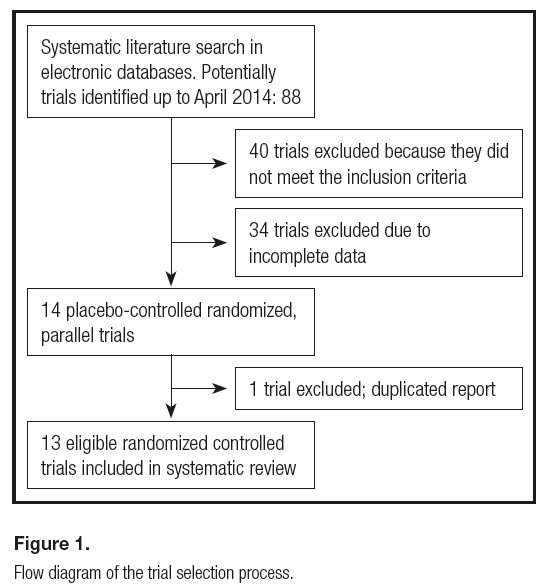
<body><![CDATA[<p>&nbsp;</p>     <p><font face="Verdana" size="2">Statistical analysis was carried out using the SPSS<sup>&reg;</sup> version 18.0 (SPSS, Chicago, IL, USA). Treatment effect was estimated with mean difference in the final values of outcome measure (HbA1c, FPG, lipid variables) between the treatment group and the placebo group. The pooled mean difference and estimated 95% confidence interval (95% CI) were calculated using the inverse variance-weighted method (9). The Cochran Q test was used to test heterogeneity and p &lt; 0.10 was considered significant (10). In case of heterogeneity, the random effects model was used (9). Funnel plot and Egger's method (11) were used as publication bias indicator.</font></p>     <p>&nbsp;</p>     <p><font face="Verdana" size="2"><b>Results</b></font></p>     <p><font face="Verdana" size="2"><b>SEARCH RESULTS ANS STUDY CHARACTERISTICS</b></font></p>     <p><font face="Verdana" size="2">We initially identified 88 reports of Cr supplementation in type 2 DM. After screening, 40 reports were excluded because they did not meet the inclusion criteria, and 34 trials were excluded due to incomplete data. The remaining 14 reports were placebo-controlled randomized, parallel trials. Of these, one trial was rejected because this was a duplicate report.</font></p>     <p><font face="Verdana" size="2">Thirteen trials fulfilled the inclusion criteria and were included in this systematic review (<a href="#f1">Fig. 1</a>). Formulations of Cr included chromium picolinate (CP), chromium picolinate and biotin combination (CPB); chromium nicotinate (NC), chromium dinicocysteinate (CDNC); chromium yeast (CY), brewer's yeast (BY), and chromium milk powder (CMP). Total doses of Cr supplementation and brewer's yeast ranged from 42 &micro;g/day to 1.000 &micro;g/day, and duration of supplementation ranged from 30 to 120 days (<a href="#t1">Table I</a>).</font></p>     <p>&nbsp;</p>     <p align="center"><font face="Verdana" size="2"><a name="f1"><img src="/img/revistas/nh/v33n1/26_revision3_figure1.jpg"></a></font></p>     <p>&nbsp;</p>     ]]></body>
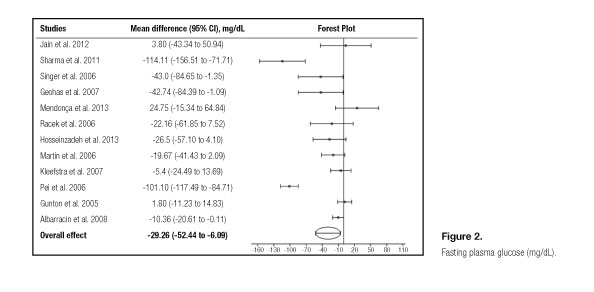
<body><![CDATA[<p><font face="Verdana" size="2"><b>META-ANALYSIS OF EFFECT OF Cr ON FPG IN TYPE 2 DM</b></font></p>     <p><font face="Verdana" size="2">The Cochrane Q test showed heterogeneity (p &lt; 0.0001), so the random effects model was used. This meta-analysis, which incorporated data from a total of 12 studies (12-23) (843 participants) of the effect of Cr on FPG showed an effect size of weighted mean differences of FPG change in type 2 DM patients in Cr supplement therapy equal to -29.26 (95% CI = -52.44 to -6.09) mg/dL, p= 0.01 (<a href="#f2">Fig. 2</a>). No publication bias was detected.</font></p>     <p>&nbsp;</p>     <p align="center"><font face="Verdana" size="2"><a name="f2"><img src="/img/revistas/nh/v33n1/26_revision3_figure2.jpg"></a></font></p>     <p>&nbsp;</p>     <p><font face="Verdana" size="2"><b>META-ANALYSIS OF EFFECT OF Cr ON HbA1c IN TYPE 2 DM</b></font></p>     <p><font face="Verdana" size="2">The Cochrane Q test indicated that studies were heterogeneous (p &lt; 0.0001), so the random effects model was used. This meta-analysis incorporated data from a total of 9 studies (12,13,17,18,20,21,23) (734 participants), and results obtained showed that effect size of weighted mean differences of HbA1c change in type 2 DM patients in Cr supplement therapy was not significant: mean difference -0.41 (95% CI = -0.98 to 0.16)%, p= 0.16. No publication bias was detected.</font></p>     <p><font face="Verdana" size="2"><b>META-ANALYSIS OF EFFECT OF Cr ON TC TYPE 2 DM</b></font></p>     <p><font face="Verdana" size="2">The Cochrane Q test showed homogeneity (p = 0.96), so the fixed effects model was used. This meta-analysis, which incorporated data from a total of 9 studies (13-17,22-24) (652 participants) of effect of Cr on TC showed an effect size of weighted mean differences of TC change in type 2 DM patients in Cr supplement therapy equal to -6.70 (95% CI = -11.88 to -1.53) mg/dL, p= 0.01. No publication bias was detected.</font></p>     <p><font face="Verdana" size="2"><b>META-ANALYSIS OF EFFECT OF CR ON HDL-C IN TYPE 2 DM</b></font></p>     ]]></body>
<body><![CDATA[<p><font face="Verdana" size="2">The Cochrane Q test indicated that studies were heterogeneous (p &lt; 0.0001), so the random effects model was used. This meta-analysis incorporated data from a total of 8 studies (13-17,20,23,24) (612 participants), and results obtained showed that effect size of weighted mean differences of HDL-C change in type 2 DM patients in Cr supplement therapy was not significant: mean difference -0.13 (95% CI = -2.04 to 1.77) mg/dL, p= 0.90. No publication bias was detected.</font></p>     <p><font face="Verdana" size="2"><b>META-ANALYSIS OF EFFECT OF Cr ON LDL-C IN TYPE 2 DM</b></font></p>     <p><font face="Verdana" size="2">The Cochrane Q test showed heterogeneity (p &lt; 0.0001), so the random effects model was used. This meta-analysis, which incorporated data from a total of 8 studies and 612 participants (13-17,20,23,24) on the effect of Cr on LDL-C showed a non significant effect size of weighted mean differences of LDL-C change in type 2 DM patients in Cr supplement therapy: -1.90 (95% CI = -7.56 to 3.76) mg/dL, p= 0.51. No publication bias was detected.</font></p>     <p><font face="Verdana" size="2"><b>META-ANALYSIS OF EFFECT OF Cr ON TG IN TYPE 2 DM</b></font></p>     <p><font face="Verdana" size="2">The Cochrane Q test indicated that studies were heterogeneous (p &lt; 0.0001), so the random effects model was used. This meta-analysis incorporated data from a total of 8 studies and 621 participants (13-15,17,19,22-24) and results obtained showed that effect size of weighted mean differences of TG change in type 2 DM patients in Cr supplement therapy was not significant: mean difference -9.78 (95% CI = -27.82 to 8.27) mg/dL, p  = 0.29 (<a href="#f3">Fig. 3</a>). No publication bias was detected.</font></p>     <p>&nbsp;</p>     <p align="center"><font face="Verdana" size="2"><a name="f3"><img src="/img/revistas/nh/v33n1/26_revision3_figure3.jpg"></a></font></p>     <p>&nbsp;</p>     <p><font face="Verdana" size="2"><b>Discussion</b></font></p>     <p><font face="Verdana" size="2">The results of the meta-analysis show an effect size of weighted mean differences of FPG (p = 0.01) and TC (p = 0.01) change in type 2 DM patients in Cr supplement therapy. On the contrary, an effect size of weighted mean differences of HbA1c (p = 0.16), HDL-C (p = 0.90), LDL-C (p = 0.51) and TG (p = 0.29) change in type 2 DM patients in Cr supplement therapy was not significant.</font></p>     ]]></body>
<body><![CDATA[<p><font face="Verdana" size="2">In relation to the effects on lipid profiles, some results of this meta-analysis are in line with that observed in Suksomboon et al. 2014 (25) review, in which no significant difference in LDL-C was observed between chromium monotherapy and placebo. Similarly, LDL-C level did not change with Cr plus biotin.</font></p>     <p><font face="Verdana" size="2">However, fifteen studies with 974 patients examined by them concluded that Cr single supplement (in the forms of CP, Cr chloride, CY, BY or Cr complexed with nicotinic acid) had no effect on TC level, while ours did. Likewise, TC did not improve with Cr combined with biotin.</font></p>     <p><font face="Verdana" size="2">By the same token, Cr monosupplementation significantly lowered TG level by 0.30 mM, particularly by treatment with CP and Cr combined with biotin, and increased HDL-C significantly but not by Cr combined with biotin; while we did not find any significant changes in any case.</font></p>     <p><font face="Verdana" size="2">Other sources of information (Abdollahi et al. &#091;26&#093;) claim that Cr does not affect HbA1c (p = 0.1) and lipids (p = 0.54 for TC, p = 0.18 for TG). They indicate that Cr has no benefit on lowering TC, HDL-C, LDL-C, VLDL-C, and TG that is consistent with previous reviews (27,28) and our meta-analyses, except for TC.</font></p>     <p><font face="Verdana" size="2">Previous meta-analyses and systematic reviews have indicated that Cr supplementation results in a significant lowering of FPG in diabetics but not in nondiabetics. However, sixteen studies with 809 participants (440 diabetics and 369 nondiabetics) were included in the analysis of Bailey 2014 (29), which indicated that there was no significant effect of Cr supplementation in diabetics or nondiabetics, with a weighted average effect size of 0.02 (SE = 0.07), p = 0.787, CI 95% = -0.12 to 0.16. Cr supplementation appears to provide no benefits to populations where Cr deficiency is unlikely.</font></p>     <p><font face="Verdana" size="2">Two of the most recent meta-analyses of diabetic subjects reported a significant lowering of FPG in type 2 DM (26,27). Patal et al. 2010 (27) analyzed two studies and reported a 0.92 mmol/L decrease in FPG of type 2 DM, while Abdollahi et al. 2013 (26) analyzed six studies and found a significant decrease in FPG of type 2 DM, which supplemented with Cr reduces FPG up to 7 mmol/L, p = &lt; 0.0001, as we observed. Suksomboon et al. 2014 (25) also affirmed that Cr daily monosupplementation of 200 lg and up to 1,000 lg improved HbA1c and slightly decreased in effect on FPG.</font></p>     <p><font face="Verdana" size="2">These meta-analyses provide some evidence for effects of Cr supplementation on FPG in diabetic subjects but all have methodological limitations. These previous meta-analyses made no checks for publication bias except in the most recent analysis by Abdollahi et al. (26), and they used various methodologies to reach their conclusions.</font></p>     <p><font face="Verdana" size="2">Going into detail, the summary for effect size of weighted mean differences of HbA1c change "&Delta;HbA1c" in diabetic patients in Cr supplement therapy for seven included trials comparing to placebo was -0.33 with 95% CI = -0.72 to 0.06 (p = 0.1), while our result was -0.41 (95% CI = -0.98 to 0.16)%, p = 0.16. The summary for effect size of weighted mean differences of FBG change "&Delta;FBG" in diabetic patients in Cr supplement therapy for six included trials comparing to placebo was -0.95 with 95% CI = -1.42 to -0.49 (p &lt; 0.0001), a great difference compared to our result: -29.26 (95% CI = -52.44 to -6.09) mg/dL, p = 0.01 (26).</font></p>     <p><font face="Verdana" size="2">Abdollahi et al. (26) meta-analysis indicates that in patients with type 2 DM, Cr supplementation does not change HbA1c. This result on HbA1c is contrary to a recent review which reported the positive effect of Cr in HbA1c reduction by 0.34% through including 6 RCTs in patients with type 2 DM who had HbA1c higher than 7% (27). On the other hand, reviews by two other groups showed 0.6% and 0.9% reduction in HbA1c, respectively (28,30).</font></p>     <p><font face="Verdana" size="2">Therefore, we can state that, depending on the examined clinical trials, current evidences support positive effects for Cr supplementation in the management of type 2 DM as it reduces FPG and TC in long-term therapy of DM patients.</font></p>     ]]></body>
<body><![CDATA[<p><font face="Verdana" size="2">Some limitations of this meta-analysis should be noted. First, there was a significant heterogeneity with regard to results of the studies included. These could be due to differences in the extent of glycaemic control at baseline, duration of diabetes, dose and form of Cr and duration of supplementation.</font></p>     <p>&nbsp;</p>     <p><font face="Verdana" size="2"><b>Conclusion</b></font></p>     <p><font face="Verdana" size="2">As a consequence, the short duration of studies, variable quality of data and large heterogeneity across these studies limit the strength of our conclusion. Further studies are recommended.</font></p>     <p><font face="Verdana" size="2">By elucidating the body of evidence on Cr supplementation, our meta-analysis highlights the questions that remain unanswered and the issues that need to be addressed in future RCT of Cr on glucose and lipid metabolism.</font></p>     <p>&nbsp;</p>     <p><font face="Verdana" size="2"><b>References</b></font></p>     <!-- ref --><p><font face="Verdana" size="2">1. Barceloux DG. Chromium. J Toxicol Clin Toxicol 1999;37:173-94.    &nbsp;&nbsp;&nbsp;&nbsp;&nbsp;&nbsp;&nbsp;&nbsp;[&#160;<a href="javascript:void(0);" onclick="javascript: window.open('/scielo.php?script=sci_nlinks&ref=3851797&pid=S0212-1611201600010002600001&lng=','','width=640,height=500,resizable=yes,scrollbars=1,menubar=yes,');">Links</a>&#160;]<!-- end-ref --></font></p>    <!-- ref --><p><font face="Verdana" size="2">2. Boon PE, Te Biesebeek JD, Sioen I, Huyberchts I, De Neve M, Amiano P, et al. Long-term dietary exposure to chromium in young children living in different European countries. EFSA Journal 2010.    &nbsp;&nbsp;&nbsp;&nbsp;&nbsp;&nbsp;&nbsp;&nbsp;[&#160;<a href="javascript:void(0);" onclick="javascript: window.open('/scielo.php?script=sci_nlinks&ref=3851799&pid=S0212-1611201600010002600002&lng=','','width=640,height=500,resizable=yes,scrollbars=1,menubar=yes,');">Links</a>&#160;]<!-- end-ref --></font></p>    <!-- ref --><p><font face="Verdana" size="2">3. Vicent JB. The nutritional biochemistry of chromium (III). Elsevier; 2007.    &nbsp;&nbsp;&nbsp;&nbsp;&nbsp;&nbsp;&nbsp;&nbsp;[&#160;<a href="javascript:void(0);" onclick="javascript: window.open('/scielo.php?script=sci_nlinks&ref=3851801&pid=S0212-1611201600010002600003&lng=','','width=640,height=500,resizable=yes,scrollbars=1,menubar=yes,');">Links</a>&#160;]<!-- end-ref --></font></p>    <!-- ref --><p><font face="Verdana" size="2">4. EFSA Panel on Contaminants in the Food Chain (EFSA CONTAM Panel). Scientific opinion on the risks to public health related to the presence of chromium in food and drinking water. EFSA Journal 2014;12(3):3595-261.    &nbsp;&nbsp;&nbsp;&nbsp;&nbsp;&nbsp;&nbsp;&nbsp;[&#160;<a href="javascript:void(0);" onclick="javascript: window.open('/scielo.php?script=sci_nlinks&ref=3851803&pid=S0212-1611201600010002600004&lng=','','width=640,height=500,resizable=yes,scrollbars=1,menubar=yes,');">Links</a>&#160;]<!-- end-ref --></font></p>    <!-- ref --><p><font face="Verdana" size="2">5. EFSA. Scientific opinion of the Panel on Food Additives and Nutrient Sources added to Food on chromium nitrate as a source of chromium added for nutritional purposes to food supplements following a request from the European Commission. EFSA Journal 2009;1111:1-19.    &nbsp;&nbsp;&nbsp;&nbsp;&nbsp;&nbsp;&nbsp;&nbsp;[&#160;<a href="javascript:void(0);" onclick="javascript: window.open('/scielo.php?script=sci_nlinks&ref=3851805&pid=S0212-1611201600010002600005&lng=','','width=640,height=500,resizable=yes,scrollbars=1,menubar=yes,');">Links</a>&#160;]<!-- end-ref --></font></p>    <!-- ref --><p><font face="Verdana" size="2">6. Melo V, Cuamatzi O. Bioqu&iacute;mica de los procesos metab&oacute;licos. Barcelona and M&eacute;xico D.F.: Reverte; 2007.    &nbsp;&nbsp;&nbsp;&nbsp;&nbsp;&nbsp;&nbsp;&nbsp;[&#160;<a href="javascript:void(0);" onclick="javascript: window.open('/scielo.php?script=sci_nlinks&ref=3851807&pid=S0212-1611201600010002600006&lng=','','width=640,height=500,resizable=yes,scrollbars=1,menubar=yes,');">Links</a>&#160;]<!-- end-ref --></font></p>    <!-- ref --><p><font face="Verdana" size="2">7. F&eacute;bel H, Szegedi B, Husz&aacute;r S. Absorption of inorganic, trivalent and hexavalent chromium following oral and intrajejunal doses in rats. Acta Vet Hung 2001;49:203-9.    &nbsp;&nbsp;&nbsp;&nbsp;&nbsp;&nbsp;&nbsp;&nbsp;[&#160;<a href="javascript:void(0);" onclick="javascript: window.open('/scielo.php?script=sci_nlinks&ref=3851809&pid=S0212-1611201600010002600007&lng=','','width=640,height=500,resizable=yes,scrollbars=1,menubar=yes,');">Links</a>&#160;]<!-- end-ref --></font></p>    <!-- ref --><p><font face="Verdana" size="2">8. Jadad AR, Moore RA, Carroll D, Jenkinson C, Reynolds DJ, Gavaghan DJ. Assessing the quality of reports of randomized clinical trials: is blinding necessary? Control Clin Trials 1996;17(1):1-12.    &nbsp;&nbsp;&nbsp;&nbsp;&nbsp;&nbsp;&nbsp;&nbsp;[&#160;<a href="javascript:void(0);" onclick="javascript: window.open('/scielo.php?script=sci_nlinks&ref=3851811&pid=S0212-1611201600010002600008&lng=','','width=640,height=500,resizable=yes,scrollbars=1,menubar=yes,');">Links</a>&#160;]<!-- end-ref --></font></p>    <!-- ref --><p><font face="Verdana" size="2">9. Whitehead A, Whitehead J. A general parametric approach to the meta-analysis of randomized clinical trials. Stat Med 1991;10:1665-77.    &nbsp;&nbsp;&nbsp;&nbsp;&nbsp;&nbsp;&nbsp;&nbsp;[&#160;<a href="javascript:void(0);" onclick="javascript: window.open('/scielo.php?script=sci_nlinks&ref=3851813&pid=S0212-1611201600010002600009&lng=','','width=640,height=500,resizable=yes,scrollbars=1,menubar=yes,');">Links</a>&#160;]<!-- end-ref --></font></p>    <!-- ref --><p><font face="Verdana" size="2">10. De Simonian R, Laird N. Meta-analysis in clinical trials. Control Clin Trials 1986;7:177-88.    &nbsp;&nbsp;&nbsp;&nbsp;&nbsp;&nbsp;&nbsp;&nbsp;[&#160;<a href="javascript:void(0);" onclick="javascript: window.open('/scielo.php?script=sci_nlinks&ref=3851815&pid=S0212-1611201600010002600010&lng=','','width=640,height=500,resizable=yes,scrollbars=1,menubar=yes,');">Links</a>&#160;]<!-- end-ref --></font></p>    <!-- ref --><p><font face="Verdana" size="2">11. Egger M, Davey Smith G, Schneider M, Minder C. Bias in meta-analysis detected by a simple, graphical test. Br Med J 1997;315:629-34.    &nbsp;&nbsp;&nbsp;&nbsp;&nbsp;&nbsp;&nbsp;&nbsp;[&#160;<a href="javascript:void(0);" onclick="javascript: window.open('/scielo.php?script=sci_nlinks&ref=3851817&pid=S0212-1611201600010002600011&lng=','','width=640,height=500,resizable=yes,scrollbars=1,menubar=yes,');">Links</a>&#160;]<!-- end-ref --></font></p>    <!-- ref --><p><font face="Verdana" size="2">12. Jain SK, Kahlon G, Morehead L, Dhawan R, LIeblong B, Stapleton T, et al. Effect of chromium dinicocysteinate supplementation on circulating levels of insulin, TNF-alpha, oxidative stress, and insulin resistance in type 2 diabetic subjects: randomized, double-blind, placebo-controlled study. Mol Nutr Food Res 2012;56:1333-41.    &nbsp;&nbsp;&nbsp;&nbsp;&nbsp;&nbsp;&nbsp;&nbsp;[&#160;<a href="javascript:void(0);" onclick="javascript: window.open('/scielo.php?script=sci_nlinks&ref=3851819&pid=S0212-1611201600010002600012&lng=','','width=640,height=500,resizable=yes,scrollbars=1,menubar=yes,');">Links</a>&#160;]<!-- end-ref --></font></p>    <!-- ref --><p><font face="Verdana" size="2">13. Sharma S, Agrawal RP, Choudhary M, Jain S, Goyal S, Agarwal Vl. Beneficial effect of chromium supplementation on glucose, HbA1C and lipid variables in individuals with newly onset type-2 diabetes. J Trace Elem Med Biol 2011;25:149-53.    &nbsp;&nbsp;&nbsp;&nbsp;&nbsp;&nbsp;&nbsp;&nbsp;[&#160;<a href="javascript:void(0);" onclick="javascript: window.open('/scielo.php?script=sci_nlinks&ref=3851821&pid=S0212-1611201600010002600013&lng=','','width=640,height=500,resizable=yes,scrollbars=1,menubar=yes,');">Links</a>&#160;]<!-- end-ref --></font></p>    <!-- ref --><p><font face="Verdana" size="2">14. Singer GM, Geohas J. The effect of chromium picolinate and biotin supplementation on glycemic control in poorly controlled patients with type 2 diabetes mellitus: a placebo-controlled, double-blinded, randomized trial. Diabetes Technol Ther 2006;8:636-43.    &nbsp;&nbsp;&nbsp;&nbsp;&nbsp;&nbsp;&nbsp;&nbsp;[&#160;<a href="javascript:void(0);" onclick="javascript: window.open('/scielo.php?script=sci_nlinks&ref=3851823&pid=S0212-1611201600010002600014&lng=','','width=640,height=500,resizable=yes,scrollbars=1,menubar=yes,');">Links</a>&#160;]<!-- end-ref --></font></p>    <!-- ref --><p><font face="Verdana" size="2">15. Geohas J, Daly A, Juturu V, Finch M, Komorowski JR. Chromium picolinate and biotin combination reduces atherogenic index of plasma in patients with type 2 diabetes mellitus: a placebo-controlled, double-blinded, randomized clinical trial. Am J Med Sci 2007;333:145-53.    &nbsp;&nbsp;&nbsp;&nbsp;&nbsp;&nbsp;&nbsp;&nbsp;[&#160;<a href="javascript:void(0);" onclick="javascript: window.open('/scielo.php?script=sci_nlinks&ref=3851825&pid=S0212-1611201600010002600015&lng=','','width=640,height=500,resizable=yes,scrollbars=1,menubar=yes,');">Links</a>&#160;]<!-- end-ref --></font></p>    <!-- ref --><p><font face="Verdana" size="2">16. Guimar&atilde;es MM, Martins Silva Carvalho AC, Silva MS. Chromium nicotinate has no effect on insulin sensitivity, glycemic control, and lipid profile in subjects with type 2 diabetes. J Am Coll Nutr 2013;32:243-50.    &nbsp;&nbsp;&nbsp;&nbsp;&nbsp;&nbsp;&nbsp;&nbsp;[&#160;<a href="javascript:void(0);" onclick="javascript: window.open('/scielo.php?script=sci_nlinks&ref=3851827&pid=S0212-1611201600010002600016&lng=','','width=640,height=500,resizable=yes,scrollbars=1,menubar=yes,');">Links</a>&#160;]<!-- end-ref --></font></p>    <!-- ref --><p><font face="Verdana" size="2">17. Racek J, Trefil L, Rajdl D, Mudrova V, Hunter D, Senft V. Influence of chromium-enriched yeast on blood glucose and insulin variables, blood lipids, and markers of oxidative stress in subjects with type 2 diabetes mellitus. Biol Trace Elem Res 2006;109:215-30.    &nbsp;&nbsp;&nbsp;&nbsp;&nbsp;&nbsp;&nbsp;&nbsp;[&#160;<a href="javascript:void(0);" onclick="javascript: window.open('/scielo.php?script=sci_nlinks&ref=3851829&pid=S0212-1611201600010002600017&lng=','','width=640,height=500,resizable=yes,scrollbars=1,menubar=yes,');">Links</a>&#160;]<!-- end-ref --></font></p>    <!-- ref --><p><font face="Verdana" size="2">18. Hosseinzadeh P, Javanbakht MH, Mostafavi SA, Djalali M, Derakhshanian H, Hajianfar H, et al. Brewer's Yeast improves glycemic Indices in type 2 diabetes mellitus. Int J Prev Med 2013;4:1131-8.    &nbsp;&nbsp;&nbsp;&nbsp;&nbsp;&nbsp;&nbsp;&nbsp;[&#160;<a href="javascript:void(0);" onclick="javascript: window.open('/scielo.php?script=sci_nlinks&ref=3851831&pid=S0212-1611201600010002600018&lng=','','width=640,height=500,resizable=yes,scrollbars=1,menubar=yes,');">Links</a>&#160;]<!-- end-ref --></font></p>    <!-- ref --><p><font face="Verdana" size="2">19. Martin J, Wang ZQ, Zhang XH, Wachtel D, Volaufova J, Matthews DE, et al. Chromium picolinate supplementation attenuates body weight gain and increases insulin sensitivity in subjects with type 2 diabetes. Diabetes Care 2006;29:1826-32.    &nbsp;&nbsp;&nbsp;&nbsp;&nbsp;&nbsp;&nbsp;&nbsp;[&#160;<a href="javascript:void(0);" onclick="javascript: window.open('/scielo.php?script=sci_nlinks&ref=3851833&pid=S0212-1611201600010002600019&lng=','','width=640,height=500,resizable=yes,scrollbars=1,menubar=yes,');">Links</a>&#160;]<!-- end-ref --></font></p>    <!-- ref --><p><font face="Verdana" size="2">20. Kleefstra N, Houweling ST, Bakker SJ, Verhoeven S, Gans ROB, Jong BM, et al. Chromium treatment has no effect in patients with type 2 diabetes in a Western population: a randomized, double-blind, placebo-controlled trial. Diabetes Care 2007;30:1092-6.    &nbsp;&nbsp;&nbsp;&nbsp;&nbsp;&nbsp;&nbsp;&nbsp;[&#160;<a href="javascript:void(0);" onclick="javascript: window.open('/scielo.php?script=sci_nlinks&ref=3851835&pid=S0212-1611201600010002600020&lng=','','width=640,height=500,resizable=yes,scrollbars=1,menubar=yes,');">Links</a>&#160;]<!-- end-ref --></font></p>    <!-- ref --><p><font face="Verdana" size="2">21. Pei D, Hsieh CH, Hung YJ, Li JC, Lee CH, Kuo SW. The influence of chromium chloride-containing milk to glycemic control of patients with type 2 diabetes mellitus: a randomized, double-blind, placebo-controlled trial. Metabolism 2006;55:923-7.    &nbsp;&nbsp;&nbsp;&nbsp;&nbsp;&nbsp;&nbsp;&nbsp;[&#160;<a href="javascript:void(0);" onclick="javascript: window.open('/scielo.php?script=sci_nlinks&ref=3851837&pid=S0212-1611201600010002600021&lng=','','width=640,height=500,resizable=yes,scrollbars=1,menubar=yes,');">Links</a>&#160;]<!-- end-ref --></font></p>    <!-- ref --><p><font face="Verdana" size="2">22. Gunton JE, Cheung NW, Hitchman R, Hams G, O'Sullivan C, Foster-Powell K, et al. Chromium supplementation does not improve glucose tolerance, insulin sensitivity, or lipid profile: a randomized, placebo-controlled, double-blind trial of supplementation in subjects with impaired glucose tolerance. Diabetes Care 2005;28:712-3.    &nbsp;&nbsp;&nbsp;&nbsp;&nbsp;&nbsp;&nbsp;&nbsp;[&#160;<a href="javascript:void(0);" onclick="javascript: window.open('/scielo.php?script=sci_nlinks&ref=3851839&pid=S0212-1611201600010002600022&lng=','','width=640,height=500,resizable=yes,scrollbars=1,menubar=yes,');">Links</a>&#160;]<!-- end-ref --></font></p>    <!-- ref --><p><font face="Verdana" size="2">23. Albarracin CA, Fuqua BC, Evans JL, Goldfine ID. Chromium picolinate and biotin combination improves glucose metabolism in treated, uncontrolled overweight to obese patients with type 2 diabetes. Diabetes Metab Res Rev 2008;24:41-51.    &nbsp;&nbsp;&nbsp;&nbsp;&nbsp;&nbsp;&nbsp;&nbsp;[&#160;<a href="javascript:void(0);" onclick="javascript: window.open('/scielo.php?script=sci_nlinks&ref=3851841&pid=S0212-1611201600010002600023&lng=','','width=640,height=500,resizable=yes,scrollbars=1,menubar=yes,');">Links</a>&#160;]<!-- end-ref --></font></p>    <!-- ref --><p><font face="Verdana" size="2">24. Kleefstra N, Houweling ST, Jansman FGA, Groenier KH, Gans ROB, Jong BM, et al. Chromium treatment has no effect in patients with poorly controlled, insulin-treated type 2 diabetes in an obese Western population: a randomized, double-blind, placebo-controlled trial. Diabetes Care 2006;29:521-5.    &nbsp;&nbsp;&nbsp;&nbsp;&nbsp;&nbsp;&nbsp;&nbsp;[&#160;<a href="javascript:void(0);" onclick="javascript: window.open('/scielo.php?script=sci_nlinks&ref=3851843&pid=S0212-1611201600010002600024&lng=','','width=640,height=500,resizable=yes,scrollbars=1,menubar=yes,');">Links</a>&#160;]<!-- end-ref --></font></p>    <!-- ref --><p><font face="Verdana" size="2">25. Suksomboon N, Poolsupt N, Yuwanakorn A. Systematic review and meta-analysis of the efficacy and safety of chromium supplementation in diabetes. Journal of Clinical Pharmacy and Therapeutics 2014;39:292-306.    &nbsp;&nbsp;&nbsp;&nbsp;&nbsp;&nbsp;&nbsp;&nbsp;[&#160;<a href="javascript:void(0);" onclick="javascript: window.open('/scielo.php?script=sci_nlinks&ref=3851845&pid=S0212-1611201600010002600025&lng=','','width=640,height=500,resizable=yes,scrollbars=1,menubar=yes,');">Links</a>&#160;]<!-- end-ref --></font></p>    <!-- ref --><p><font face="Verdana" size="2">26. Abdollahi M, Farshchi A, Nikfar S, Seyedifar M. Effect of chromium on glucose and lipid profiles in patients with type 2 diabetes; a meta-analysis review of randomized trials. J Pharm Pharmaceut Sci 2013;16(1):99-114.    &nbsp;&nbsp;&nbsp;&nbsp;&nbsp;&nbsp;&nbsp;&nbsp;[&#160;<a href="javascript:void(0);" onclick="javascript: window.open('/scielo.php?script=sci_nlinks&ref=3851847&pid=S0212-1611201600010002600026&lng=','','width=640,height=500,resizable=yes,scrollbars=1,menubar=yes,');">Links</a>&#160;]<!-- end-ref --></font></p>    <!-- ref --><p><font face="Verdana" size="2">27. Patal PC, Cardino MT, Jimeno CA. A meta-analysis on the effect of chromium picolinate on glucose and lipid profiles among patients with type 2 diabetes mellitus. Philipp J Int Med 2010;48(1):32-37.    &nbsp;&nbsp;&nbsp;&nbsp;&nbsp;&nbsp;&nbsp;&nbsp;[&#160;<a href="javascript:void(0);" onclick="javascript: window.open('/scielo.php?script=sci_nlinks&ref=3851849&pid=S0212-1611201600010002600027&lng=','','width=640,height=500,resizable=yes,scrollbars=1,menubar=yes,');">Links</a>&#160;]<!-- end-ref --></font></p>    <!-- ref --><p><font face="Verdana" size="2">28. Balk EM, Tatsioni A, Lichtenstein AH, Lau J, Pitta AG. Effect of chromium supplementation on glucose metabolism and lipids a systematic review of randomized controlled trials. Diabetes Care 2007;30(8):2154-63.    &nbsp;&nbsp;&nbsp;&nbsp;&nbsp;&nbsp;&nbsp;&nbsp;[&#160;<a href="javascript:void(0);" onclick="javascript: window.open('/scielo.php?script=sci_nlinks&ref=3851851&pid=S0212-1611201600010002600028&lng=','','width=640,height=500,resizable=yes,scrollbars=1,menubar=yes,');">Links</a>&#160;]<!-- end-ref --></font></p>    <!-- ref --><p><font face="Verdana" size="2">29. Bailey CH. Improved meta-analytic method show no effect of chromium supplements on fasting glucose. Biol Trace Elem Res 2014;157:1-8.    &nbsp;&nbsp;&nbsp;&nbsp;&nbsp;&nbsp;&nbsp;&nbsp;[&#160;<a href="javascript:void(0);" onclick="javascript: window.open('/scielo.php?script=sci_nlinks&ref=3851853&pid=S0212-1611201600010002600029&lng=','','width=640,height=500,resizable=yes,scrollbars=1,menubar=yes,');">Links</a>&#160;]<!-- end-ref --></font></p>    <!-- ref --><p><font face="Verdana" size="2">30. Broadhurst CL, Domenico P. Clinical studies on chromium picolinate supplementation in diabetes mellitus-a review. Diabetes Technol Ther 2006;8(6):677-87.    &nbsp;&nbsp;&nbsp;&nbsp;&nbsp;&nbsp;&nbsp;&nbsp;[&#160;<a href="javascript:void(0);" onclick="javascript: window.open('/scielo.php?script=sci_nlinks&ref=3851855&pid=S0212-1611201600010002600030&lng=','','width=640,height=500,resizable=yes,scrollbars=1,menubar=yes,');">Links</a>&#160;]<!-- end-ref --></font></p>     <p>&nbsp;</p>     <p>&nbsp;</p>     <p><font face="Verdana" size="2"><a href="#top"><img border="0" src="/img/revistas/nh/v33n1/seta.gif" width="15" height="17"></a><a name="bajo"></a><b>Correspondence:</b>    ]]></body>
<body><![CDATA[<br>Ismael San Mauro Mart&iacute;n.    <br>Research Centers in Nutrition and Health.    <br>Madrid, Spain    <br>e-mail: <a href="mailto:research@grupocinusa.com">research@grupocinusa.com</a></font></p>     <p><font face="Verdana" size="2">Received: 11/10/15    <br>Accepted: 27/10/15</font></p>      ]]></body><back>
<ref-list>
<ref id="B1">
<label>1</label><nlm-citation citation-type="journal">
<person-group person-group-type="author">
<name>
<surname><![CDATA[Barceloux]]></surname>
<given-names><![CDATA[DG]]></given-names>
</name>
</person-group>
<article-title xml:lang="en"><![CDATA[Chromium]]></article-title>
<source><![CDATA[J Toxicol Clin Toxicol]]></source>
<year>1999</year>
<volume>37</volume>
<page-range>173-94</page-range></nlm-citation>
</ref>
<ref id="B2">
<label>2</label><nlm-citation citation-type="journal">
<person-group person-group-type="author">
<name>
<surname><![CDATA[Boon]]></surname>
<given-names><![CDATA[PE]]></given-names>
</name>
<name>
<surname><![CDATA[Te Biesebeek]]></surname>
<given-names><![CDATA[JD]]></given-names>
</name>
<name>
<surname><![CDATA[Sioen]]></surname>
<given-names><![CDATA[I]]></given-names>
</name>
<name>
<surname><![CDATA[Huyberchts]]></surname>
<given-names><![CDATA[I]]></given-names>
</name>
<name>
<surname><![CDATA[De Neve]]></surname>
<given-names><![CDATA[M]]></given-names>
</name>
<name>
<surname><![CDATA[Amiano]]></surname>
<given-names><![CDATA[P]]></given-names>
</name>
</person-group>
<article-title xml:lang="en"><![CDATA[Long-term dietary exposure to chromium in young children living in different European countries]]></article-title>
<source><![CDATA[EFSA Journal]]></source>
<year>2010</year>
</nlm-citation>
</ref>
<ref id="B3">
<label>3</label><nlm-citation citation-type="book">
<person-group person-group-type="author">
<name>
<surname><![CDATA[Vicent]]></surname>
<given-names><![CDATA[JB]]></given-names>
</name>
</person-group>
<source><![CDATA[The nutritional biochemistry of chromium (III)]]></source>
<year>2007</year>
<publisher-name><![CDATA[Elsevier]]></publisher-name>
</nlm-citation>
</ref>
<ref id="B4">
<label>4</label><nlm-citation citation-type="journal">
<collab>EFSA^dPanel on Contaminants in the Food Chain (EFSA CONTAM Panel)</collab>
<article-title xml:lang="en"><![CDATA[Scientific opinion on the risks to public health related to the presence of chromium in food and drinking water]]></article-title>
<source><![CDATA[EFSA Journal]]></source>
<year>2014</year>
<volume>12</volume>
<numero>3</numero>
<issue>3</issue>
<page-range>3595-261</page-range></nlm-citation>
</ref>
<ref id="B5">
<label>5</label><nlm-citation citation-type="journal">
<collab>EFSA</collab>
<article-title xml:lang="en"><![CDATA[Scientific opinion of the Panel on Food Additives and Nutrient Sources added to Food on chromium nitrate as a source of chromium added for nutritional purposes to food supplements following a request from the European Commission]]></article-title>
<source><![CDATA[EFSA Journal]]></source>
<year>2009</year>
<numero>1111</numero>
<issue>1111</issue>
<page-range>1-19</page-range></nlm-citation>
</ref>
<ref id="B6">
<label>6</label><nlm-citation citation-type="book">
<person-group person-group-type="author">
<name>
<surname><![CDATA[Melo]]></surname>
<given-names><![CDATA[V]]></given-names>
</name>
<name>
<surname><![CDATA[Cuamatzi]]></surname>
<given-names><![CDATA[O]]></given-names>
</name>
</person-group>
<source><![CDATA[Bioquímica de los procesos metabólicos]]></source>
<year>2007</year>
<publisher-loc><![CDATA[BarcelonaMéxico D.F. ]]></publisher-loc>
<publisher-name><![CDATA[Reverte]]></publisher-name>
</nlm-citation>
</ref>
<ref id="B7">
<label>7</label><nlm-citation citation-type="journal">
<person-group person-group-type="author">
<name>
<surname><![CDATA[Fébel]]></surname>
<given-names><![CDATA[H]]></given-names>
</name>
<name>
<surname><![CDATA[Szegedi]]></surname>
<given-names><![CDATA[B]]></given-names>
</name>
<name>
<surname><![CDATA[Huszár]]></surname>
<given-names><![CDATA[S]]></given-names>
</name>
</person-group>
<article-title xml:lang="en"><![CDATA[Absorption of inorganic, trivalent and hexavalent chromium following oral and intrajejunal doses in rats]]></article-title>
<source><![CDATA[Acta Vet Hung]]></source>
<year>2001</year>
<volume>49</volume>
<page-range>203-9</page-range></nlm-citation>
</ref>
<ref id="B8">
<label>8</label><nlm-citation citation-type="journal">
<person-group person-group-type="author">
<name>
<surname><![CDATA[Jadad]]></surname>
<given-names><![CDATA[AR]]></given-names>
</name>
<name>
<surname><![CDATA[Moore]]></surname>
<given-names><![CDATA[RA]]></given-names>
</name>
<name>
<surname><![CDATA[Carroll]]></surname>
<given-names><![CDATA[D]]></given-names>
</name>
<name>
<surname><![CDATA[Jenkinson]]></surname>
<given-names><![CDATA[C]]></given-names>
</name>
<name>
<surname><![CDATA[Reynolds]]></surname>
<given-names><![CDATA[DJ]]></given-names>
</name>
<name>
<surname><![CDATA[Gavaghan]]></surname>
<given-names><![CDATA[DJ]]></given-names>
</name>
</person-group>
<article-title xml:lang="en"><![CDATA[Assessing the quality of reports of randomized clinical trials: is blinding necessary?]]></article-title>
<source><![CDATA[Control Clin Trials]]></source>
<year>1996</year>
<volume>17</volume>
<numero>1</numero>
<issue>1</issue>
<page-range>1-12</page-range></nlm-citation>
</ref>
<ref id="B9">
<label>9</label><nlm-citation citation-type="journal">
<person-group person-group-type="author">
<name>
<surname><![CDATA[Whitehead]]></surname>
<given-names><![CDATA[A]]></given-names>
</name>
<name>
<surname><![CDATA[Whitehead]]></surname>
<given-names><![CDATA[J]]></given-names>
</name>
</person-group>
<article-title xml:lang="en"><![CDATA[A general parametric approach to the meta-analysis of randomized clinical trials]]></article-title>
<source><![CDATA[Stat Med]]></source>
<year>1991</year>
<volume>10</volume>
<page-range>1665-77</page-range></nlm-citation>
</ref>
<ref id="B10">
<label>10</label><nlm-citation citation-type="journal">
<person-group person-group-type="author">
<name>
<surname><![CDATA[De Simonian]]></surname>
<given-names><![CDATA[R]]></given-names>
</name>
<name>
<surname><![CDATA[Laird]]></surname>
<given-names><![CDATA[N]]></given-names>
</name>
</person-group>
<article-title xml:lang="en"><![CDATA[Meta-analysis in clinical trials]]></article-title>
<source><![CDATA[Control Clin Trials]]></source>
<year>1986</year>
<volume>7</volume>
<page-range>177-88</page-range></nlm-citation>
</ref>
<ref id="B11">
<label>11</label><nlm-citation citation-type="journal">
<person-group person-group-type="author">
<name>
<surname><![CDATA[Egger]]></surname>
<given-names><![CDATA[M]]></given-names>
</name>
<name>
<surname><![CDATA[Davey Smith]]></surname>
<given-names><![CDATA[G]]></given-names>
</name>
<name>
<surname><![CDATA[Schneider]]></surname>
<given-names><![CDATA[M]]></given-names>
</name>
<name>
<surname><![CDATA[Minder]]></surname>
<given-names><![CDATA[C]]></given-names>
</name>
</person-group>
<article-title xml:lang="en"><![CDATA[Bias in meta-analysis detected by a simple, graphical test]]></article-title>
<source><![CDATA[Br Med J]]></source>
<year>1997</year>
<volume>315</volume>
<page-range>629-34</page-range></nlm-citation>
</ref>
<ref id="B12">
<label>12</label><nlm-citation citation-type="journal">
<person-group person-group-type="author">
<name>
<surname><![CDATA[Jain]]></surname>
<given-names><![CDATA[SK]]></given-names>
</name>
<name>
<surname><![CDATA[Kahlon]]></surname>
<given-names><![CDATA[G]]></given-names>
</name>
<name>
<surname><![CDATA[Morehead]]></surname>
<given-names><![CDATA[L]]></given-names>
</name>
<name>
<surname><![CDATA[Dhawan]]></surname>
<given-names><![CDATA[R]]></given-names>
</name>
<name>
<surname><![CDATA[LIeblong]]></surname>
<given-names><![CDATA[B]]></given-names>
</name>
<name>
<surname><![CDATA[Stapleton]]></surname>
<given-names><![CDATA[T]]></given-names>
</name>
</person-group>
<article-title xml:lang="en"><![CDATA[Effect of chromium dinicocysteinate supplementation on circulating levels of insulin, TNF-alpha, oxidative stress, and insulin resistance in type 2 diabetic subjects: randomized, double-blind, placebo-controlled study]]></article-title>
<source><![CDATA[Mol Nutr Food Res]]></source>
<year>2012</year>
<volume>56</volume>
<page-range>1333-41</page-range></nlm-citation>
</ref>
<ref id="B13">
<label>13</label><nlm-citation citation-type="journal">
<person-group person-group-type="author">
<name>
<surname><![CDATA[Sharma]]></surname>
<given-names><![CDATA[S]]></given-names>
</name>
<name>
<surname><![CDATA[Agrawal]]></surname>
<given-names><![CDATA[RP]]></given-names>
</name>
<name>
<surname><![CDATA[Choudhary]]></surname>
<given-names><![CDATA[M]]></given-names>
</name>
<name>
<surname><![CDATA[Jain]]></surname>
<given-names><![CDATA[S]]></given-names>
</name>
<name>
<surname><![CDATA[Goyal]]></surname>
<given-names><![CDATA[S]]></given-names>
</name>
<name>
<surname><![CDATA[Agarwal]]></surname>
<given-names><![CDATA[Vl]]></given-names>
</name>
</person-group>
<article-title xml:lang="en"><![CDATA[Beneficial effect of chromium supplementation on glucose, HbA1C and lipid variables in individuals with newly onset type-2 diabetes]]></article-title>
<source><![CDATA[J Trace Elem Med Biol]]></source>
<year>2011</year>
<volume>25</volume>
<page-range>149-53</page-range></nlm-citation>
</ref>
<ref id="B14">
<label>14</label><nlm-citation citation-type="journal">
<person-group person-group-type="author">
<name>
<surname><![CDATA[Singer]]></surname>
<given-names><![CDATA[GM]]></given-names>
</name>
<name>
<surname><![CDATA[Geohas]]></surname>
<given-names><![CDATA[J]]></given-names>
</name>
</person-group>
<article-title xml:lang="en"><![CDATA[The effect of chromium picolinate and biotin supplementation on glycemic control in poorly controlled patients with type 2 diabetes mellitus: a placebo-controlled, double-blinded, randomized trial]]></article-title>
<source><![CDATA[Diabetes Technol Ther]]></source>
<year>2006</year>
<volume>8</volume>
<page-range>636-43</page-range></nlm-citation>
</ref>
<ref id="B15">
<label>15</label><nlm-citation citation-type="journal">
<person-group person-group-type="author">
<name>
<surname><![CDATA[Geohas]]></surname>
<given-names><![CDATA[J]]></given-names>
</name>
<name>
<surname><![CDATA[Daly]]></surname>
<given-names><![CDATA[A]]></given-names>
</name>
<name>
<surname><![CDATA[Juturu]]></surname>
<given-names><![CDATA[V]]></given-names>
</name>
<name>
<surname><![CDATA[Finch]]></surname>
<given-names><![CDATA[M]]></given-names>
</name>
<name>
<surname><![CDATA[Komorowski]]></surname>
<given-names><![CDATA[JR]]></given-names>
</name>
</person-group>
<article-title xml:lang="en"><![CDATA[Chromium picolinate and biotin combination reduces atherogenic index of plasma in patients with type 2 diabetes mellitus: a placebo-controlled, double-blinded, randomized clinical trial]]></article-title>
<source><![CDATA[Am J Med Sci]]></source>
<year>2007</year>
<volume>333</volume>
<page-range>145-53</page-range></nlm-citation>
</ref>
<ref id="B16">
<label>16</label><nlm-citation citation-type="journal">
<person-group person-group-type="author">
<name>
<surname><![CDATA[Guimarães]]></surname>
<given-names><![CDATA[MM]]></given-names>
</name>
<name>
<surname><![CDATA[Martins Silva Carvalho]]></surname>
<given-names><![CDATA[AC]]></given-names>
</name>
<name>
<surname><![CDATA[Silva]]></surname>
<given-names><![CDATA[MS]]></given-names>
</name>
</person-group>
<article-title xml:lang="en"><![CDATA[Chromium nicotinate has no effect on insulin sensitivity, glycemic control, and lipid profile in subjects with type 2 diabetes]]></article-title>
<source><![CDATA[J Am Coll Nutr]]></source>
<year>2013</year>
<volume>32</volume>
<page-range>243-50</page-range></nlm-citation>
</ref>
<ref id="B17">
<label>17</label><nlm-citation citation-type="journal">
<person-group person-group-type="author">
<name>
<surname><![CDATA[Racek]]></surname>
<given-names><![CDATA[J]]></given-names>
</name>
<name>
<surname><![CDATA[Trefil]]></surname>
<given-names><![CDATA[L]]></given-names>
</name>
<name>
<surname><![CDATA[Rajdl]]></surname>
<given-names><![CDATA[D]]></given-names>
</name>
<name>
<surname><![CDATA[Mudrova]]></surname>
<given-names><![CDATA[V]]></given-names>
</name>
<name>
<surname><![CDATA[Hunter]]></surname>
<given-names><![CDATA[D]]></given-names>
</name>
<name>
<surname><![CDATA[Senft]]></surname>
<given-names><![CDATA[V]]></given-names>
</name>
</person-group>
<article-title xml:lang="en"><![CDATA[Influence of chromium-enriched yeast on blood glucose and insulin variables, blood lipids, and markers of oxidative stress in subjects with type 2 diabetes mellitus]]></article-title>
<source><![CDATA[Biol Trace Elem Res]]></source>
<year>2006</year>
<volume>109</volume>
<page-range>215-30</page-range></nlm-citation>
</ref>
<ref id="B18">
<label>18</label><nlm-citation citation-type="journal">
<person-group person-group-type="author">
<name>
<surname><![CDATA[Hosseinzadeh]]></surname>
<given-names><![CDATA[P]]></given-names>
</name>
<name>
<surname><![CDATA[Javanbakht]]></surname>
<given-names><![CDATA[MH]]></given-names>
</name>
<name>
<surname><![CDATA[Mostafavi]]></surname>
<given-names><![CDATA[SA]]></given-names>
</name>
<name>
<surname><![CDATA[Djalali]]></surname>
<given-names><![CDATA[M]]></given-names>
</name>
<name>
<surname><![CDATA[Derakhshanian]]></surname>
<given-names><![CDATA[H]]></given-names>
</name>
<name>
<surname><![CDATA[Hajianfar]]></surname>
<given-names><![CDATA[H]]></given-names>
</name>
</person-group>
<article-title xml:lang="en"><![CDATA[Brewer's Yeast improves glycemic Indices in type 2 diabetes mellitus]]></article-title>
<source><![CDATA[Int J Prev Med]]></source>
<year>2013</year>
<volume>4</volume>
<page-range>1131-8</page-range></nlm-citation>
</ref>
<ref id="B19">
<label>19</label><nlm-citation citation-type="journal">
<person-group person-group-type="author">
<name>
<surname><![CDATA[Martin]]></surname>
<given-names><![CDATA[J]]></given-names>
</name>
<name>
<surname><![CDATA[Wang]]></surname>
<given-names><![CDATA[ZQ]]></given-names>
</name>
<name>
<surname><![CDATA[Zhang]]></surname>
<given-names><![CDATA[XH]]></given-names>
</name>
<name>
<surname><![CDATA[Wachtel]]></surname>
<given-names><![CDATA[D]]></given-names>
</name>
<name>
<surname><![CDATA[Volaufova]]></surname>
<given-names><![CDATA[J]]></given-names>
</name>
<name>
<surname><![CDATA[Matthews]]></surname>
<given-names><![CDATA[DE]]></given-names>
</name>
</person-group>
<article-title xml:lang="en"><![CDATA[Chromium picolinate supplementation attenuates body weight gain and increases insulin sensitivity in subjects with type 2 diabetes]]></article-title>
<source><![CDATA[Diabetes Care]]></source>
<year>2006</year>
<volume>29</volume>
<page-range>1826-32</page-range></nlm-citation>
</ref>
<ref id="B20">
<label>20</label><nlm-citation citation-type="journal">
<person-group person-group-type="author">
<name>
<surname><![CDATA[Kleefstra]]></surname>
<given-names><![CDATA[N]]></given-names>
</name>
<name>
<surname><![CDATA[Houweling]]></surname>
<given-names><![CDATA[ST]]></given-names>
</name>
<name>
<surname><![CDATA[Bakker]]></surname>
<given-names><![CDATA[SJ]]></given-names>
</name>
<name>
<surname><![CDATA[Verhoeven]]></surname>
<given-names><![CDATA[S]]></given-names>
</name>
<name>
<surname><![CDATA[Gans]]></surname>
<given-names><![CDATA[ROB]]></given-names>
</name>
<name>
<surname><![CDATA[Jong]]></surname>
<given-names><![CDATA[BM]]></given-names>
</name>
</person-group>
<article-title xml:lang="en"><![CDATA[Chromium treatment has no effect in patients with type 2 diabetes in a Western population: a randomized, double-blind, placebo-controlled trial]]></article-title>
<source><![CDATA[Diabetes Care]]></source>
<year>2007</year>
<volume>30</volume>
<page-range>1092-6</page-range></nlm-citation>
</ref>
<ref id="B21">
<label>21</label><nlm-citation citation-type="journal">
<person-group person-group-type="author">
<name>
<surname><![CDATA[Pei]]></surname>
<given-names><![CDATA[D]]></given-names>
</name>
<name>
<surname><![CDATA[Hsieh]]></surname>
<given-names><![CDATA[CH]]></given-names>
</name>
<name>
<surname><![CDATA[Hung]]></surname>
<given-names><![CDATA[YJ]]></given-names>
</name>
<name>
<surname><![CDATA[Li]]></surname>
<given-names><![CDATA[JC]]></given-names>
</name>
<name>
<surname><![CDATA[Lee]]></surname>
<given-names><![CDATA[CH]]></given-names>
</name>
<name>
<surname><![CDATA[Kuo]]></surname>
<given-names><![CDATA[SW]]></given-names>
</name>
</person-group>
<article-title xml:lang="en"><![CDATA[The influence of chromium chloride-containing milk to glycemic control of patients with type 2 diabetes mellitus: a randomized, double-blind, placebo-controlled trial]]></article-title>
<source><![CDATA[Metabolism]]></source>
<year>2006</year>
<volume>55</volume>
<page-range>923-7</page-range></nlm-citation>
</ref>
<ref id="B22">
<label>22</label><nlm-citation citation-type="journal">
<person-group person-group-type="author">
<name>
<surname><![CDATA[Gunton]]></surname>
<given-names><![CDATA[JE]]></given-names>
</name>
<name>
<surname><![CDATA[Cheung]]></surname>
<given-names><![CDATA[NW]]></given-names>
</name>
<name>
<surname><![CDATA[Hitchman]]></surname>
<given-names><![CDATA[R]]></given-names>
</name>
<name>
<surname><![CDATA[Hams]]></surname>
<given-names><![CDATA[G]]></given-names>
</name>
<name>
<surname><![CDATA[O'Sullivan]]></surname>
<given-names><![CDATA[C]]></given-names>
</name>
<name>
<surname><![CDATA[Foster-Powell]]></surname>
<given-names><![CDATA[K]]></given-names>
</name>
</person-group>
<article-title xml:lang="en"><![CDATA[Chromium supplementation does not improve glucose tolerance, insulin sensitivity, or lipid profile: a randomized, placebo-controlled, double-blind trial of supplementation in subjects with impaired glucose tolerance]]></article-title>
<source><![CDATA[Diabetes Care]]></source>
<year>2005</year>
<volume>28</volume>
<page-range>712-3</page-range></nlm-citation>
</ref>
<ref id="B23">
<label>23</label><nlm-citation citation-type="journal">
<person-group person-group-type="author">
<name>
<surname><![CDATA[Albarracin]]></surname>
<given-names><![CDATA[CA]]></given-names>
</name>
<name>
<surname><![CDATA[Fuqua]]></surname>
<given-names><![CDATA[BC]]></given-names>
</name>
<name>
<surname><![CDATA[Evans]]></surname>
<given-names><![CDATA[JL]]></given-names>
</name>
<name>
<surname><![CDATA[Goldfine]]></surname>
<given-names><![CDATA[ID]]></given-names>
</name>
</person-group>
<article-title xml:lang="en"><![CDATA[Chromium picolinate and biotin combination improves glucose metabolism in treated, uncontrolled overweight to obese patients with type 2 diabetes]]></article-title>
<source><![CDATA[Diabetes Metab Res Rev]]></source>
<year>2008</year>
<volume>24</volume>
<page-range>41-51</page-range></nlm-citation>
</ref>
<ref id="B24">
<label>24</label><nlm-citation citation-type="journal">
<person-group person-group-type="author">
<name>
<surname><![CDATA[Kleefstra]]></surname>
<given-names><![CDATA[N]]></given-names>
</name>
<name>
<surname><![CDATA[Houweling]]></surname>
<given-names><![CDATA[ST]]></given-names>
</name>
<name>
<surname><![CDATA[Jansman]]></surname>
<given-names><![CDATA[FGA]]></given-names>
</name>
<name>
<surname><![CDATA[Groenier]]></surname>
<given-names><![CDATA[KH]]></given-names>
</name>
<name>
<surname><![CDATA[Gans]]></surname>
<given-names><![CDATA[ROB]]></given-names>
</name>
<name>
<surname><![CDATA[Jong]]></surname>
<given-names><![CDATA[BM]]></given-names>
</name>
</person-group>
<article-title xml:lang="en"><![CDATA[Chromium treatment has no effect in patients with poorly controlled, insulin-treated type 2 diabetes in an obese Western population: a randomized, double-blind, placebo-controlled trial]]></article-title>
<source><![CDATA[Diabetes Care]]></source>
<year>2006</year>
<volume>29</volume>
<page-range>521-5</page-range></nlm-citation>
</ref>
<ref id="B25">
<label>25</label><nlm-citation citation-type="journal">
<person-group person-group-type="author">
<name>
<surname><![CDATA[Suksomboon]]></surname>
<given-names><![CDATA[N]]></given-names>
</name>
<name>
<surname><![CDATA[Poolsupt]]></surname>
<given-names><![CDATA[N]]></given-names>
</name>
<name>
<surname><![CDATA[Yuwanakorn]]></surname>
<given-names><![CDATA[A]]></given-names>
</name>
</person-group>
<article-title xml:lang="en"><![CDATA[Systematic review and meta-analysis of the efficacy and safety of chromium supplementation in diabetes]]></article-title>
<source><![CDATA[Journal of Clinical Pharmacy and Therapeutics]]></source>
<year>2014</year>
<volume>39</volume>
<page-range>292-306</page-range></nlm-citation>
</ref>
<ref id="B26">
<label>26</label><nlm-citation citation-type="journal">
<person-group person-group-type="author">
<name>
<surname><![CDATA[Abdollahi]]></surname>
<given-names><![CDATA[M]]></given-names>
</name>
<name>
<surname><![CDATA[Farshchi]]></surname>
<given-names><![CDATA[A]]></given-names>
</name>
<name>
<surname><![CDATA[Nikfar]]></surname>
<given-names><![CDATA[S]]></given-names>
</name>
<name>
<surname><![CDATA[Seyedifar]]></surname>
<given-names><![CDATA[M]]></given-names>
</name>
</person-group>
<article-title xml:lang="en"><![CDATA[Effect of chromium on glucose and lipid profiles in patients with type 2 diabetes: a meta-analysis review of randomized trials]]></article-title>
<source><![CDATA[J Pharm Pharmaceut Sci]]></source>
<year>2013</year>
<volume>16</volume>
<numero>1</numero>
<issue>1</issue>
<page-range>99-114</page-range></nlm-citation>
</ref>
<ref id="B27">
<label>27</label><nlm-citation citation-type="journal">
<person-group person-group-type="author">
<name>
<surname><![CDATA[Patal]]></surname>
<given-names><![CDATA[PC]]></given-names>
</name>
<name>
<surname><![CDATA[Cardino]]></surname>
<given-names><![CDATA[MT]]></given-names>
</name>
<name>
<surname><![CDATA[Jimeno]]></surname>
<given-names><![CDATA[CA]]></given-names>
</name>
</person-group>
<article-title xml:lang="en"><![CDATA[A meta-analysis on the effect of chromium picolinate on glucose and lipid profiles among patients with type 2 diabetes mellitus]]></article-title>
<source><![CDATA[Philipp J Int Med]]></source>
<year>2010</year>
<volume>48</volume>
<numero>1</numero>
<issue>1</issue>
<page-range>32-37</page-range></nlm-citation>
</ref>
<ref id="B28">
<label>28</label><nlm-citation citation-type="journal">
<person-group person-group-type="author">
<name>
<surname><![CDATA[Balk]]></surname>
<given-names><![CDATA[EM]]></given-names>
</name>
<name>
<surname><![CDATA[Tatsioni]]></surname>
<given-names><![CDATA[A]]></given-names>
</name>
<name>
<surname><![CDATA[Lichtenstein]]></surname>
<given-names><![CDATA[AH]]></given-names>
</name>
<name>
<surname><![CDATA[Lau]]></surname>
<given-names><![CDATA[J]]></given-names>
</name>
<name>
<surname><![CDATA[Pitta]]></surname>
<given-names><![CDATA[AG]]></given-names>
</name>
</person-group>
<article-title xml:lang="en"><![CDATA[Effect of chromium supplementation on glucose metabolism and lipids a systematic review of randomized controlled trials]]></article-title>
<source><![CDATA[Diabetes Care]]></source>
<year>2007</year>
<volume>30</volume>
<numero>8</numero>
<issue>8</issue>
<page-range>2154-63</page-range></nlm-citation>
</ref>
<ref id="B29">
<label>29</label><nlm-citation citation-type="journal">
<person-group person-group-type="author">
<name>
<surname><![CDATA[Bailey]]></surname>
<given-names><![CDATA[CH]]></given-names>
</name>
</person-group>
<article-title xml:lang="en"><![CDATA[Improved meta-analytic method show no effect of chromium supplements on fasting glucose]]></article-title>
<source><![CDATA[Biol Trace Elem Res]]></source>
<year>2014</year>
<volume>157</volume>
<page-range>1-8</page-range></nlm-citation>
</ref>
<ref id="B30">
<label>30</label><nlm-citation citation-type="journal">
<person-group person-group-type="author">
<name>
<surname><![CDATA[Broadhurst]]></surname>
<given-names><![CDATA[CL]]></given-names>
</name>
<name>
<surname><![CDATA[Domenico]]></surname>
<given-names><![CDATA[P]]></given-names>
</name>
</person-group>
<article-title xml:lang="en"><![CDATA[Clinical studies on chromium picolinate supplementation in diabetes mellitus-a review]]></article-title>
<source><![CDATA[Diabetes Technol Ther]]></source>
<year>2006</year>
<volume>8</volume>
<numero>6</numero>
<issue>6</issue>
<page-range>677-87</page-range></nlm-citation>
</ref>
</ref-list>
</back>
</article>