<?xml version="1.0" encoding="ISO-8859-1"?><article xmlns:mml="http://www.w3.org/1998/Math/MathML" xmlns:xlink="http://www.w3.org/1999/xlink" xmlns:xsi="http://www.w3.org/2001/XMLSchema-instance">
<front>
<journal-meta>
<journal-id>0212-1611</journal-id>
<journal-title><![CDATA[Nutrición Hospitalaria]]></journal-title>
<abbrev-journal-title><![CDATA[Nutr. Hosp.]]></abbrev-journal-title>
<issn>0212-1611</issn>
<publisher>
<publisher-name><![CDATA[Grupo Arán]]></publisher-name>
</publisher>
</journal-meta>
<article-meta>
<article-id>S0212-16112016000100028</article-id>
<article-id pub-id-type="doi">10.20960/nh.29</article-id>
<title-group>
<article-title xml:lang="en"><![CDATA[To eat or not to eat meat: that is the question]]></article-title>
<article-title xml:lang="es"><![CDATA[Comer o no comer carne: ¿es esa la incógnita?]]></article-title>
</title-group>
<contrib-group>
<contrib contrib-type="author">
<name>
<surname><![CDATA[Celada]]></surname>
<given-names><![CDATA[Paloma]]></given-names>
</name>
<xref ref-type="aff" rid="A01"/>
</contrib>
<contrib contrib-type="author">
<name>
<surname><![CDATA[Bastida]]></surname>
<given-names><![CDATA[Sara]]></given-names>
</name>
<xref ref-type="aff" rid="A01"/>
</contrib>
<contrib contrib-type="author">
<name>
<surname><![CDATA[Sánchez-Muniz]]></surname>
<given-names><![CDATA[Francisco J.]]></given-names>
</name>
<xref ref-type="aff" rid="A01"/>
</contrib>
</contrib-group>
<aff id="A01">
<institution><![CDATA[,Universidad Complutense de Madrid Facultad de Farmacia Department of Nutrition and Food Science I]]></institution>
<addr-line><![CDATA[Madrid ]]></addr-line>
<country>Spain</country>
</aff>
<pub-date pub-type="pub">
<day>00</day>
<month>02</month>
<year>2016</year>
</pub-date>
<pub-date pub-type="epub">
<day>00</day>
<month>02</month>
<year>2016</year>
</pub-date>
<volume>33</volume>
<numero>1</numero>
<fpage>177</fpage>
<lpage>181</lpage>
<copyright-statement/>
<copyright-year/>
<self-uri xlink:href="http://scielo.isciii.es/scielo.php?script=sci_arttext&amp;pid=S0212-16112016000100028&amp;lng=en&amp;nrm=iso"></self-uri><self-uri xlink:href="http://scielo.isciii.es/scielo.php?script=sci_abstract&amp;pid=S0212-16112016000100028&amp;lng=en&amp;nrm=iso"></self-uri><self-uri xlink:href="http://scielo.isciii.es/scielo.php?script=sci_pdf&amp;pid=S0212-16112016000100028&amp;lng=en&amp;nrm=iso"></self-uri><abstract abstract-type="short" xml:lang="en"><p><![CDATA[Meat is a well accepted food with appreciable appealing. Due to its high nutritional value it plays a central role in human development. Meat/meat derivates are important sources of proteins, minerals and vitamins. Their nutritional importance is paralleled to their economic impact. Paying attention to the social alarm originated by a recent publication of WHO about the relationship between red and/or processed meat consumption and cancer, this paper reviews the following aspects: a) the present consumption of meat/meat products in Spain; b) the contribution of their macro/micronutrients to the recommended dietary allowances; c) the obliged use of additives (e.g. nitrites and nitrates) to warrant the food safety, and their daily intake. In addition health risks derived from a high consumption, as well as the most appropriate culinary uses in order to reduce the formation of toxic products (e.g. N-nitrosocompounds) are commented. Due to the huge variety of available meat products, this paper concludes that any generalization should be avoided. We also emphasize about the advantages of consuming meat/meat products in the frame of a Mediterranean diet, rich in vegetables, fruits, and bioactive compounds.]]></p></abstract>
<abstract abstract-type="short" xml:lang="es"><p><![CDATA[La carne es un alimento muy bien aceptado por sus propiedades organolépticas. Es fundamental en el desarrollo del ser humano por su alto valor nutritivo. Fuente importante de minerales, vitaminas y proteínas de elevada calidad. Su importancia nutricional está en consonancia con su repercusión económica. En este artículo, y a la luz del comunicado recientemente emitido por la OMS sobre el peligro para la salud, particularmente de cáncer, del consumo elevado de carne roja y/o procesada y dada la alarma social ocasionada, pretendemos matizar algunos aspectos. Se revisan a) el consumo actual de carnes y derivados en España; b) su contribución en macro/micronutrientes a las ingestas recomendadas; c) el aporte obligado de aditivos (p.ej. nitratos y nitritos) para garantizar la seguridad alimentaria y su ingesta diaria. Se comentan los riesgos del consumo elevado de los productos cárnicos así como los usos culinarios más adecuados para reducir la formación de compuestos tóxicos (p.ej. N-nitrosocompuestos). Dada la enorme variedad de productos cárnicos ofertados, se concluye que cualquier generalización sobre el consumo de carne y derivados sería totalmente inadecuada y se resaltan las ventajas de consumirlos en el marco de una dieta tipo mediterránea, rica en verduras, frutas y compuestos bioactivos.]]></p></abstract>
<kwd-group>
<kwd lng="en"><![CDATA[Cancer]]></kwd>
<kwd lng="en"><![CDATA[Red meat]]></kwd>
<kwd lng="en"><![CDATA[Processed meat]]></kwd>
<kwd lng="en"><![CDATA[Diet]]></kwd>
<kwd lng="en"><![CDATA[Nitrates]]></kwd>
<kwd lng="en"><![CDATA[Nitrites]]></kwd>
<kwd lng="en"><![CDATA[N-nitrosocompounds]]></kwd>
<kwd lng="es"><![CDATA[Cáncer]]></kwd>
<kwd lng="es"><![CDATA[Carne roja]]></kwd>
<kwd lng="es"><![CDATA[Carne procesada]]></kwd>
<kwd lng="es"><![CDATA[Dieta]]></kwd>
<kwd lng="es"><![CDATA[Nitratos]]></kwd>
<kwd lng="es"><![CDATA[Nitritos]]></kwd>
<kwd lng="es"><![CDATA[N-nitrosocompuestos]]></kwd>
</kwd-group>
</article-meta>
</front><body><![CDATA[ <p><a name="top"></a><font face="Verdana" size="2"><b>ARTÍCULO ESPECIAL</b></font></p>     <p>&nbsp;</p>     <p><font face="Verdana" size="4"><b>To eat or not to eat meat. That is the question</b></font></p>     <p><font face="Verdana" size="4"><b>Comer o no comer carne. ¿Es esa la inc&oacute;gnita?</b></font></p>     <p>&nbsp;</p>     <p>&nbsp;</p>     <p><font face="Verdana" size="2"><b>Paloma Celada, Sara Bastida and Francisco J. S&aacute;nchez-Muniz</b></font></p>     <p><font face="Verdana" size="2">Department of Nutrition and Food Science I. Facultad de Farmacia. Universidad Complutense de Madrid. Madrid, Spain</font></p>     <p><font face="Verdana" size="2">We acknowledge the support of the "Nutrition and Cardiovascular Health #920536" research group of excellence of the Universidad Complutense de Madrid and the Spanish Project AGL 2011-29644-C02-01.</font></p>     <p><font face="Verdana" size="2"><a href="#bajo">Correspondence</a></font></p>     ]]></body>
<body><![CDATA[<p>&nbsp;</p>     <p>&nbsp;</p> <hr size="1">    <p><font face="Verdana" size="2"><b>ABSTRACT</b></font></p>     <p><font face="Verdana" size="2">Meat is a well accepted food with appreciable appealing. Due to its high nutritional value it plays a central role in human development. Meat/meat derivates are important sources of proteins, minerals and vitamins. Their nutritional importance is paralleled to their economic impact. Paying attention to the social alarm originated by a recent publication of WHO about the relationship between red and/or processed meat consumption and cancer, this paper reviews the following aspects: a) the present consumption of meat/meat products in Spain; b) the contribution of their macro/micronutrients to the recommended dietary allowances; c) the obliged use of additives (e.g. nitrites and nitrates) to warrant the food safety, and their daily intake. In addition health risks derived from a high consumption, as well as the most appropriate culinary uses in order to reduce the formation of toxic products (e.g. N-nitrosocompounds) are commented. Due to the huge variety of available meat products, this paper concludes that any generalization should be avoided. We also emphasize about the advantages of consuming meat/meat products in the frame of a Mediterranean diet, rich in vegetables, fruits, and bioactive compounds.</font></p>     <p><font face="Verdana" size="2"><b>Key words:</b> Cancer. Red meat. Processed meat. Diet. Nitrates. Nitrites. N-nitrosocompounds.</font></p> <hr size="1">    <p><font face="Verdana" size="2"><b>RESUMEN</b></font></p>     <p><font face="Verdana" size="2">La carne es un alimento muy bien aceptado por sus propiedades organol&eacute;pticas. Es fundamental en el desarrollo del ser humano por su alto valor nutritivo. Fuente importante de minerales, vitaminas y prote&iacute;nas de elevada calidad. Su importancia nutricional est&aacute; en consonancia con su repercusi&oacute;n econ&oacute;mica. En este art&iacute;culo, y a la luz del comunicado recientemente emitido por la OMS sobre el peligro para la salud, particularmente de c&aacute;ncer, del consumo elevado de carne roja y/o procesada y dada la alarma social ocasionada, pretendemos matizar algunos aspectos. Se revisan a) el consumo actual de carnes y derivados en Espa&ntilde;a; b) su contribuci&oacute;n en macro/micronutrientes a las ingestas recomendadas; c) el aporte obligado de aditivos (p.ej. nitratos y nitritos) para garantizar la seguridad alimentaria y su ingesta diaria. Se comentan los riesgos del consumo elevado de los productos c&aacute;rnicos as&iacute; como los usos culinarios m&aacute;s adecuados para reducir la formaci&oacute;n de compuestos t&oacute;xicos (p.ej. N-nitrosocompuestos). Dada la enorme variedad de productos c&aacute;rnicos ofertados, se concluye que cualquier generalizaci&oacute;n sobre el consumo de carne y derivados ser&iacute;a totalmente inadecuada y se resaltan las ventajas de consumirlos en el marco de una dieta tipo mediterr&aacute;nea, rica en verduras, frutas y compuestos bioactivos.</font></p>     <p><font face="Verdana" size="2"><b>Palabras clave:</b> C&aacute;ncer. Carne roja. Carne procesada. Dieta. Nitratos. Nitritos. N-nitrosocompuestos.</font></p> <hr size="1">     <p>&nbsp;</p>     <blockquote>    ]]></body>
<body><![CDATA[<p><font face="Verdana" size="2"><i>"To be or not to be. That is the question"    <br>Hamlet. William Shakespeare</i></font></p></blockquote>     <p>&nbsp;</p>     <p><font face="Verdana" size="2">A few hundred years ago, a Danish prince considered the doubt that consciously or unconsciously assaults everybody when he or she makes important decisions. That soliloquy is the model of indecision that the human being implicitly carries with him.</font></p>     <p><font face="Verdana" size="2">During the last few decades there have been several avian crises, which entailed the killing of hundreds of thousands of ducks and Galliformes, particularly in the Asian zone, quite often because of not being able to guarantee adequate treatment and the fail-safeness of subsequent sales.</font></p>     <p><font face="Verdana" size="2">In 2001 the <i>mad cow</i> disease or bovine spongiform encephalopathy (1) appeared, leading to a very important fall in the consumption of beef and an increase in that of other potentially healthier meats. The crisis meant a revolution in the management of food safety, establishing a plan for the monitoring and controlling of animals. The causal agent is a prion which incorporates into normal proteins modifying them and causing irreversible damage with the appearance of spongiform encephalopathies, existing evidence of those prions transferring from one species to humans giving rise to the Creutzfeldt-Jakob's disease (1). It seems in some way anecdotal that fewer than 250 people in the world have died of Creutzfeldt-Jakob's disease, the majority of them in the United Kingdom and only 5 in Spain (2).</font></p>     <p><font face="Verdana" size="2">In 2009 experts from the WHO warned us of an apocalyptic avian flu pandemic (3). In the corresponding report it was predicted that the mutated virus of swine fever could severely affect the whole population of the world causing a great number of deaths. The alarm was sounded and governments proceeded to purchase massive amounts of vaccines and antiviral drugs. The such feared avian flu was neither so devastating nor lethal as experts had told us, and the anti-viral drugs are still in storage because they were not necessary. It seems that in this case experts caused unnecessary alarm in the population, ditto for the anti-viral drugs.</font></p>     <p><font face="Verdana" size="2">Last year the Ebola virus that usually attacks Africa periodically changed geographic zones and appeared in the occidental part of the continent, when it usually happened in the central part of the country. The virus spread much further than it usually did and even arrived to Europe. The number of deaths from this outbreak rose to five thousand (4). For one reason or another, intervention was late and of low quality and the WHO received a lot of criticism for its not having reacted in time.</font></p>     <p><font face="Verdana" size="2">Last October 26<sup>th</sup> the WHO issued a press release on the (potential) danger of consuming red and/or processed meat (5). On analyzing the OMS communiqu&eacute; and checking some central papers on the subject and paying attention to the outcomes, it seems clear that in the epidemiological results that are dealt with, some of them in hundreds of thousands of people, the danger exists and the subject is not trivial. Nevertheless, the news as it was disseminated has created a lot of confusion regarding a group of foods of high nutritional and commercial importance in the world.</font></p>     <p><font face="Verdana" size="2">After the last communiqu&eacute; in which we were notified that processed meat products were carcinogenic (5), the headlines did not make us wait and the outrageous things that ended up being said in one or another news program were very serious (e.g., sausages are as harmful as tobacco or asbestos). A few weeks ago, Doctor Estruch, one of the leading experts on the Mediterranean diet, stressed in an interview (6) that the level of evidence is not enough to show that they have carcinogens that are as dangerous as tobacco and asbestos, even though he referred to our consuming too much sausage, and, in his own words, "demonizing red meat is excessive".</font></p>     ]]></body>
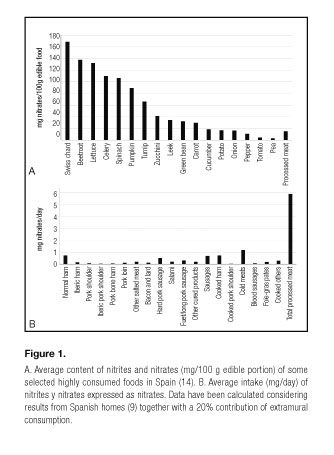
<body><![CDATA[<p><font face="Verdana" size="2">Through all of this we want to clear up certain aspects concerning our judgment's being in dispute.</font></p>     <p><font face="Verdana" size="2">- From the point of view of human evolution it is taken for granted that the consumption of meat causes the development of certain mental and psychomotor skills (7).</font></p>     <p><font face="Verdana" size="2">- Meat is an important source of proteins of high biological value, minerals and vitamins; it is also a very good source of haem iron. Besides, their being products which are accepted and appreciated due to their organoleptic properties has to be taken into account (8).</font></p>     <p><font face="Verdana" size="2">- A large percentage of the recommended dietary allowances of proteins, B<sub>12</sub> and B<sub>6</sub> vitamins, among others, is covered in Spain by meat and meat-product consumption (8).</font></p>     <p><font face="Verdana" size="2">- Adult animal meat contains more fat. Its relatively high saturated fatty acid content suggests that its high consumption should be avoided (8).</font></p>     <p><font face="Verdana" size="2">- The consumption of meat in Spain is very high (9) (<a href="#t1">Table I</a>). The variety and composition of such products make a ruling really difficult. The analysis done by the WHO involves and concerns products consumed in important quantities in other countries, mainly in the USA and North of Europe, where culinary practices are different and the consumed ratios of fruit and vegetables are far from those recommended. However, in Spain the consumption of meat-products in which potentially dangerous products to which we will refer are found are on the range recommended by the WHO but fruit and vegetables consumption is rather higher.</font></p>     <p>&nbsp;</p>     <p align="center"><font face="Verdana" size="2"><a name="t1"><img src="/img/revistas/nh/v33n1/28_especial2_table1.jpg"></a></font></p>     <p>&nbsp;</p>     <p><font face="Verdana" size="2">- Regarding meat-products, nitrites/nitrates have been added to neither fresh meat, nor fresh sausages; however, such additives are used by mixing them in a homogeneous form with the meat mass or together with salt for meat-product curing. In <a href="#f1">figure 1A</a> a summary of the nitrite/nitrate contents of some foods is shown. In <a href="#f1">figure 1B</a> the total intake of additives considering the Spanish consumption of meat-products is summarized. This total intake is far from the maximum admissible daily intake of 3.7 mg/kg body weight (222 mg in a 60 kg person) (10).</font></p>     ]]></body>
<body><![CDATA[<p>&nbsp;</p>     <p align="center"><font face="Verdana" size="2"><a name="f1"><img src="/img/revistas/nh/v33n1/28_especial2_figure1.jpg"></a></font></p>     <p>&nbsp;</p>     <p><font face="Verdana" size="2">- It must be also considered that, in their preparation, foods and antioxidant products such as paprika or ascorbic acid that can greatly lessen the negative effects of their consumption are used.</font></p>     <p>&nbsp;</p>     <p><font face="Verdana" size="2">Now and before the WHO report on the toxicity/danger of processed meat the healthy consumption of these products is being and has been questioned. The most convenient mechanism that links meat and the development of cancer involves various components that are formed during cooking at high temperatures: heterocyclic amines (HCAs), polycyclic hydrocarbon aromatics (PHAs) and N-nitroso-compounds (NOCs) (5).</font></p>     <p><font face="Verdana" size="2">With respect to HCAs, this relationship is not easily established as the amounts considered to be carcinogenetic for animals are much higher than eating reasonable amounts of fried foods (11), thus, the extrapolation to human cancer requires caution. It has to be pointed out that temperatures used in some studies gathered by the WHO in the HCAs are really high (e.g., 280<sup>o</sup>C) and far from those used in habitual frying in the Mediterranean diet.</font></p>     <p><font face="Verdana" size="2">PAHs are formed when food is directly cooked in the fire, and in much less an amount when performed by any other cooking procedure. In the worst of scenarios evidence relating colon cancer with such products is relatively weak (12).</font></p>     <p><font face="Verdana" size="2">NOCs are originated when nitrites and nitrogen oxide react with secondary amines and N-alquylamides (13). These are the most controversial compounds and require a more exhaustive study.</font></p>     <p><font face="Verdana" size="2">Epidemiological studies in humans have intended to reveal a direct relationship between nitrite and/or nitrate consumption and NOC formation with cancer development; nonetheless, non-conclusive results have been found, possibly due to difficulties in establishing time-extension and exposition levels (5).</font></p>     ]]></body>
<body><![CDATA[<p><font face="Verdana" size="2">Nitrates are present in natural form in foods; several plants store nitrates and nitrites in leaves and stems (<a href="#f1">Fig. 1A</a>). Despite this, the European Food Safety Authority (EFSA) recommends increasing their consumption due to their implicit health benefits (14). Water can also contain nitrates. All these foods relevantly contribute nitrates that can be reduced and accumulated in saliva (13). Twenty-percent of nitrate arriving in the mouth (5% of the amount ingested) is reduced to nitrite by the nitrate reductase enzyme activity of the mouth microbiota (15). Thus blaming only meat products on their negative impact on health seems excessive.</font></p>     <p><font face="Verdana" size="2">One of the major functions of nitrites/nitrates is meat derivate preservation by virtue of their anti-microbial effect; perhaps this is the most powerful argument for their use, as consumer health is compromised. They have an effect on anaerobic bacteria, mainly on <i>Clostridium botulinum</i>, impeding spore germination and avoiding neurotoxin formation responsible for deadly botulism. In addition, they also inhibit other pathogen microorganism such as <i>Staphylococcus aureus</i> (16) and <i>Clostridium perfringens</i> (17), responsible for gastrointestinal infections and necrotic enteritis, respectively.</font></p>     <p><font face="Verdana" size="2">These additives intervene in color stabilization (13), nitrite being the main responsible for the rosy-red color of such products which is very appreciated by consumers, improving taste and flavor of cured products and reducing the use of other flavor enhancers such as NaCl.</font></p>     <p><font face="Verdana" size="2">One more thing must be added: their antioxidant role inhibiting lipid autooxidation (18). When nitrite joins haem iron, it keeps its ferrous status avoiding its oxidation.</font></p>     <p><font face="Verdana" size="2">The WHO communiqu&eacute; is centered on the idea that the use of these additives implies some health risks, mainly related to cancer:</font></p>     <blockquote>     <p><font face="Verdana" size="2">- Nitrites at high doses are toxic (2 g can produce death in human) as they produce methemoglobin, that fails in capturing and ceding oxygen, causing hypoxia.</font></p>     <p><font face="Verdana" size="2">- Another risk is related to N-nitrosamine formation. Those substances are formed by nitrosation of amine, amide and other nitrogen-containing-compounds (10,13). Nitrates are the most common nitrosating agents. The majority of N-nitrosamines possess toxic activity, genotoxic and carcinogenic for an ample number of animal species, including primates (13). However, nitrosation is a complex phenomenon influenced by different factors such as temperature, pH, nitrosating agent activity and the amount and type of amine.</font></p>     <p><font face="Verdana" size="2">- Gastric pH and high cooking temperatures stimulate nitrosation. At the same time inhibitor agents such as vitamin C block its reaction (13). Salt also exerts a protecting role (13).</font></p>     <p><font face="Verdana" size="2">- Food heating is another factor accelerating N-nitrosamine formation. However, this is probably the most controversial aspect when evaluating the risk of nitrites and nitrates as additives. The higher the cooking temperature, the higher the nitrosation, thus some culinary treatments are more aggressive that others performed at lower temperature and for shorter periods. Nonetheless, N-nitrosamines are rather volatile; thus, elimination is accelerated when non-hermetic recipients are used during cooking (13).</font></p> </blockquote>     ]]></body>
<body><![CDATA[<p><font face="Verdana" size="2">However, it has also to be taken into account that nitrites elimination as additives does not exclude them from the body, as we have endogen production. Usually, we take in less than 3 mg/day of nitrites from foods but we secrete 12 mg/day in the saliva and our intestinal microbiota produces about 70 mg/day (15). Therefore, to correctly evaluate N-nitrosamines toxicity all expositions need to be addressed, which is really complex.</font></p>     <p><font face="Verdana" size="2">We want to highlight that the potential relationship between cancer and meat consumption has been already known for decades, particularly in circles linked to these kinds of products. The WHO communiqu&eacute; adds almost nothing new. Thus, we wonder what is under the hat of such an impressive mise-en-sc&egrave;ne. Why was news presented to the journalist months before the definitive publication of the complete article? And what seems even more important: does anybody, who is not related to the meat sector, remember any such news yet? After the communiqu&eacute;, have Spanish people changed, for longer than a week, their consumption habits? Absolutely not!</font></p>     <p><font face="Verdana" size="2">Taking into account these premises, we recommend the following:</font></p>     <blockquote>     <p><font face="Verdana" size="2">- Reducing the nitrite/nitrate presence in food to the maximum, without implying loss of protection against botulism and other infection risks.</font></p>     <p><font face="Verdana" size="2">- Including nitrosation inhibitors in meat-products, such as vitamin C and other antioxidants.</font></p>     <p><font face="Verdana" size="2">- Performing thermal treatment as mild as possible by avoiding high temperatures and incorrect culinary practices that would increase NOCs content.</font></p>     <p><font face="Verdana" size="2">- Performing cooking processes in open-cup recipients to permit N-nitrosamine exit, and avoiding consumption of fat leached from foods during cooking.</font></p>     <p><font face="Verdana" size="2">- Recovering the Mediterranean diet in its more ample sense: an important base of vegetable products consumption assuring consumption of spoon-dishes (e.g., <i>cocidos</i>, <i>paellas</i>) where meat and meat products are of high quality and consumed in moderate quantities.</font></p>     <p><font face="Verdana" size="2">- Avoiding excessive consumption of one-type food, which reduces diet variety and quality. According to Professor Grande Covian, the key to correct nutrition is "eating any food type but in a small dish".</font></p> </blockquote>     ]]></body>
<body><![CDATA[<p><font face="Verdana" size="2">Thus, research on meat-products -addressed to reduce potential negative compounds and to incorporate functional ingredients in order to improve their quality and health properties- deserves all scientific and institutional support.</font></p>     <p><font face="Verdana" size="2">When communiqu&eacute;s such as the WHO's are issued by the media, we often forget food symbolism and its implication on alimentary behavior and health. While, for example, in the UK weather is the conversation topic par excellence, in the Mediterranean basin it is food. All Spaniards talk about nutrition. According to Cruz and Cruz (7), food is a symbol for us, something representing generational safety and a pleasure to be shared (19). That means that any alimentary alarm can have very negative implications, especially for people for whom some central foods mean safety, prestige, health, as they definitively contribute to their wellbeing and that of their family (19). In conclusion, when a scientific entity such as the WHO is showing that a food considered to be good or very good or healthy, generation after generation, is potentially/really carcinogenic, the disarray becomes maximum and the credibility minimum, contributing to people not knowing what to eat. This is highly potentiated when part of the information is skidded, shown out of context and sold as news.</font></p>     <p><font face="Verdana" size="2">In conclusion, and with no intention of knocking the Danish prince, we can dispel all doubts and answer the question "Eating meat?" with a categorical "Yes, but in moderation and with the correct processing measures and culinary treatment".</font></p>     <p>&nbsp;</p>     <p><font face="Verdana" size="2"><b>Acknowledgements</b></font></p>     <p><font face="Verdana" size="2">We acknowledge Mar&iacute;a S&aacute;nchez's collaboration.</font></p>     <p>&nbsp;</p>     <p><font face="Verdana" size="2"><b>References</b></font></p>     <!-- ref --><p><font face="Verdana" size="2">1. Steelman VM. Creutzfeld-Jacob disease: Recommendations for infection control. Am J Infect Control 1994;22(5):312-8.    &nbsp;&nbsp;&nbsp;&nbsp;&nbsp;&nbsp;&nbsp;&nbsp;[&#160;<a href="javascript:void(0);" onclick="javascript: window.open('/scielo.php?script=sci_nlinks&ref=3866518&pid=S0212-1611201600010002800001&lng=','','width=640,height=500,resizable=yes,scrollbars=1,menubar=yes,');">Links</a>&#160;]<!-- end-ref --></font></p>    ]]></body>
<body><![CDATA[<!-- ref --><p><font face="Verdana" size="2">2. Las encefalopat&iacute;as espongiformes transmisibles humanas. Una visi&oacute;n desde la salud p&uacute;blica. Registro Nacional de Encefalopat&iacute;as Espongiformes Transmisibles Humanas. Centro Nacional de Epidemiolog&iacute;a ISCIII. 2008. Available in: <a target="_blank" href="http://www.isciii.es/ISCIII/es/contenidos/fd-servicios-cientifico-tecnicos/fd-vigilancias-alertas/fd-enfermedades/Encefalopatiasespongiformes.pdf">http://www.isciii.es/ISCIII/es/contenidos/fd-servicios-cientifico-tecnicos/fd-vigilancias-alertas/fd-enfermedades/Encefalopatiasespongiformes.pdf</a>.    &nbsp;&nbsp;&nbsp;&nbsp;&nbsp;&nbsp;&nbsp;&nbsp;[&#160;<a href="javascript:void(0);" onclick="javascript: window.open('/scielo.php?script=sci_nlinks&ref=3866520&pid=S0212-1611201600010002800002&lng=','','width=640,height=500,resizable=yes,scrollbars=1,menubar=yes,');">Links</a>&#160;]<!-- end-ref --></font></p>    <!-- ref --><p><font face="Verdana" size="2">3. Plan mundial de la OMS de preparaci&oacute;n para una pandemia de influenza. Funci&oacute;n y recomendaciones de la OMS para las medidas nacionales antes y durante la pandemia. Organizaci&oacute;n Mundial de la Salud. 2005. (WHO/CDS/CSR/GIP/2005.5).    &nbsp;&nbsp;&nbsp;&nbsp;&nbsp;&nbsp;&nbsp;&nbsp;[&#160;<a href="javascript:void(0);" onclick="javascript: window.open('/scielo.php?script=sci_nlinks&ref=3866522&pid=S0212-1611201600010002800003&lng=','','width=640,height=500,resizable=yes,scrollbars=1,menubar=yes,');">Links</a>&#160;]<!-- end-ref --></font></p>    <!-- ref --><p><font face="Verdana" size="2">4. WHO. Ebola response roadmap situation report. December 3 2014.    &nbsp;&nbsp;&nbsp;&nbsp;&nbsp;&nbsp;&nbsp;&nbsp;[&#160;<a href="javascript:void(0);" onclick="javascript: window.open('/scielo.php?script=sci_nlinks&ref=3866524&pid=S0212-1611201600010002800004&lng=','','width=640,height=500,resizable=yes,scrollbars=1,menubar=yes,');">Links</a>&#160;]<!-- end-ref --></font></p>    <!-- ref --><p><font face="Verdana" size="2">5. WHO. Carcinogenicity of consumption of red and processed meat. Lancet Oncol 2015. Available in: <a target="_blank" href="https://www.iarc.fr/en/media-centre/pr/2015/pdfs/pr240_E.pdf">https://www.iarc.fr/en/media-centre/pr/2015/pdfs/pr240_E.pdf</a>.    &nbsp;&nbsp;&nbsp;&nbsp;&nbsp;&nbsp;&nbsp;&nbsp;[&#160;<a href="javascript:void(0);" onclick="javascript: window.open('/scielo.php?script=sci_nlinks&ref=3866526&pid=S0212-1611201600010002800005&lng=','','width=640,height=500,resizable=yes,scrollbars=1,menubar=yes,');">Links</a>&#160;]<!-- end-ref --></font></p>    <!-- ref --><p><font face="Verdana" size="2">6. <a target="_blank" href="http://www.abc.es/sociedad/abci-doctor-estruch-habria-cuidar-alimentacion-antes-recurrir-farmacos-201511011704_noticia.html">http://www.abc.es/sociedad/abci-doctor-estruch-habria-cuidar-alimentacion-antes-recurrir-farmacos-201511011704_noticia.html</a>.    &nbsp;&nbsp;&nbsp;&nbsp;&nbsp;&nbsp;&nbsp;&nbsp;[&#160;<a href="javascript:void(0);" onclick="javascript: window.open('/scielo.php?script=sci_nlinks&ref=3866528&pid=S0212-1611201600010002800006&lng=','','width=640,height=500,resizable=yes,scrollbars=1,menubar=yes,');">Links</a>&#160;]<!-- end-ref --></font></p>    ]]></body>
<body><![CDATA[<!-- ref --><p><font face="Verdana" size="2">7. Cruz Cruz J (editor). Alimentaci&oacute;n y cultura. Antropolog&iacute;a de la cultura alimentaria. Pamplona: EUNSA; 1991.    &nbsp;&nbsp;&nbsp;&nbsp;&nbsp;&nbsp;&nbsp;&nbsp;[&#160;<a href="javascript:void(0);" onclick="javascript: window.open('/scielo.php?script=sci_nlinks&ref=3866530&pid=S0212-1611201600010002800007&lng=','','width=640,height=500,resizable=yes,scrollbars=1,menubar=yes,');">Links</a>&#160;]<!-- end-ref --></font></p>    <!-- ref --><p><font face="Verdana" size="2">8. Colmenero F, S&aacute;nchez-Muniz FJ, Olmedilla-Alonso B (editors). La carne y productos c&aacute;rnicos como alimentos funcionales. Madrid: FEN y Editec@Red S.L.; 2004.    &nbsp;&nbsp;&nbsp;&nbsp;&nbsp;&nbsp;&nbsp;&nbsp;[&#160;<a href="javascript:void(0);" onclick="javascript: window.open('/scielo.php?script=sci_nlinks&ref=3866532&pid=S0212-1611201600010002800008&lng=','','width=640,height=500,resizable=yes,scrollbars=1,menubar=yes,');">Links</a>&#160;]<!-- end-ref --></font></p>    <!-- ref --><p><font face="Verdana" size="2">9. Informe Mercasa sobre Alimentaci&oacute;n en Espa&ntilde;a 2014. Available in: <a target="_blank" href="http://www.mercasa.es/nosotros/alimentacion_en_espana">http://www.mercasa.es/nosotros/alimentacion_en_espana</a>.    &nbsp;&nbsp;&nbsp;&nbsp;&nbsp;&nbsp;&nbsp;&nbsp;[&#160;<a href="javascript:void(0);" onclick="javascript: window.open('/scielo.php?script=sci_nlinks&ref=3866534&pid=S0212-1611201600010002800009&lng=','','width=640,height=500,resizable=yes,scrollbars=1,menubar=yes,');">Links</a>&#160;]<!-- end-ref --></font></p>    <!-- ref --><p><font face="Verdana" size="2">10. Habermeyer M, Roth A, Guth S, et al. Nitrate and nitrite in the diet: How to assess their benefit and risk for human health. Mol Nutr Food Res 2015;59(1):106-28.    &nbsp;&nbsp;&nbsp;&nbsp;&nbsp;&nbsp;&nbsp;&nbsp;[&#160;<a href="javascript:void(0);" onclick="javascript: window.open('/scielo.php?script=sci_nlinks&ref=3866536&pid=S0212-1611201600010002800010&lng=','','width=640,height=500,resizable=yes,scrollbars=1,menubar=yes,');">Links</a>&#160;]<!-- end-ref --></font></p>    <!-- ref --><p><font face="Verdana" size="2">11. Alaejos MS, Gonz&aacute;lez V, Afonso AM. Exposure to heterocyclic aromatic amines from the consumption of cooked red meat and its effect on human cancer risk: A review. Food Addit Contam Part A Chem Anal Control Expo Risk Assess 2008;25(1):2-24.    &nbsp;&nbsp;&nbsp;&nbsp;&nbsp;&nbsp;&nbsp;&nbsp;[&#160;<a href="javascript:void(0);" onclick="javascript: window.open('/scielo.php?script=sci_nlinks&ref=3866538&pid=S0212-1611201600010002800011&lng=','','width=640,height=500,resizable=yes,scrollbars=1,menubar=yes,');">Links</a>&#160;]<!-- end-ref --></font></p>    ]]></body>
<body><![CDATA[<!-- ref --><p><font face="Verdana" size="2">12. Cross AJ, Sinha R. Meat-related mutagens/carcinogens in the etiology of colorectal cancer. Environ Mol Mutagen 2004;44(1):44-55.    &nbsp;&nbsp;&nbsp;&nbsp;&nbsp;&nbsp;&nbsp;&nbsp;[&#160;<a href="javascript:void(0);" onclick="javascript: window.open('/scielo.php?script=sci_nlinks&ref=3866540&pid=S0212-1611201600010002800012&lng=','','width=640,height=500,resizable=yes,scrollbars=1,menubar=yes,');">Links</a>&#160;]<!-- end-ref --></font></p>    <!-- ref --><p><font face="Verdana" size="2">13. Ord&oacute;&ntilde;ez Pereda JA, Anad&oacute;n Navarro A, Arboix Arzo M, et al. Informe del Comit&eacute; Cient&iacute;fico de la Agencia Espa&ntilde;ola de Seguridad Alimentaria y Nutrici&oacute;n (AESAN) sobre una cuesti&oacute;n planteada por la Direcci&oacute;n Ejecutiva de la AESAN, en relaci&oacute;n con el riesgo de la posible presencia de N-nitrosaminas en productos c&aacute;rnicos crudos adobados cuando se someten a tratamientos culinarios de asado o fritura. Revista del Comit&eacute; Cient&iacute;fico de la AESAN. AESAN 2007-007 2008;8:9-40.    &nbsp;&nbsp;&nbsp;&nbsp;&nbsp;&nbsp;&nbsp;&nbsp;[&#160;<a href="javascript:void(0);" onclick="javascript: window.open('/scielo.php?script=sci_nlinks&ref=3866542&pid=S0212-1611201600010002800013&lng=','','width=640,height=500,resizable=yes,scrollbars=1,menubar=yes,');">Links</a>&#160;]<!-- end-ref --></font></p>    <!-- ref --><p><font face="Verdana" size="2">14. Scientific Panel of Contaminants in the food chain on a request from the European Commission to perform a scientific risk assessment on nitrite in vegetable. EFSA Journal 2008;689:1-79.    &nbsp;&nbsp;&nbsp;&nbsp;&nbsp;&nbsp;&nbsp;&nbsp;[&#160;<a href="javascript:void(0);" onclick="javascript: window.open('/scielo.php?script=sci_nlinks&ref=3866544&pid=S0212-1611201600010002800014&lng=','','width=640,height=500,resizable=yes,scrollbars=1,menubar=yes,');">Links</a>&#160;]<!-- end-ref --></font></p>    <!-- ref --><p><font face="Verdana" size="2">15. Schmidt T, Sedaghat S, Rosel P, et al. Medici&oacute;n de nitratos y nitritos en agua y saliva de poblaci&oacute;n rural precordillerana de la VIII regi&oacute;n. Rev Otorrinolaringol Cir Cabeza Cuello 2012;72:119-24.    &nbsp;&nbsp;&nbsp;&nbsp;&nbsp;&nbsp;&nbsp;&nbsp;[&#160;<a href="javascript:void(0);" onclick="javascript: window.open('/scielo.php?script=sci_nlinks&ref=3866546&pid=S0212-1611201600010002800015&lng=','','width=640,height=500,resizable=yes,scrollbars=1,menubar=yes,');">Links</a>&#160;]<!-- end-ref --></font></p>    <!-- ref --><p><font face="Verdana" size="2">16. Buchanan RL, Solberg M. Interaction of sodium nitrite, oxygen and pH on growth of Staphylococcus aureus. J Food Sci 1972;37:81-5.    &nbsp;&nbsp;&nbsp;&nbsp;&nbsp;&nbsp;&nbsp;&nbsp;[&#160;<a href="javascript:void(0);" onclick="javascript: window.open('/scielo.php?script=sci_nlinks&ref=3866548&pid=S0212-1611201600010002800016&lng=','','width=640,height=500,resizable=yes,scrollbars=1,menubar=yes,');">Links</a>&#160;]<!-- end-ref --></font></p>    ]]></body>
<body><![CDATA[<!-- ref --><p><font face="Verdana" size="2">17. O'Leary DF, Solberg M. Effect of sodium nitrite inhibition on intracellular thiol group and on the activity of certain glycolytic enzymes in Clostridium perfringens. Appl Environ Microbiol 1976;31:208-12.    &nbsp;&nbsp;&nbsp;&nbsp;&nbsp;&nbsp;&nbsp;&nbsp;[&#160;<a href="javascript:void(0);" onclick="javascript: window.open('/scielo.php?script=sci_nlinks&ref=3866550&pid=S0212-1611201600010002800017&lng=','','width=640,height=500,resizable=yes,scrollbars=1,menubar=yes,');">Links</a>&#160;]<!-- end-ref --></font></p>    <!-- ref --><p><font face="Verdana" size="2">18. Leistner L. The essentials of producing stable and safe raw fermented sausages. En: Smulders FJM, Toldr&aacute; F, Flores F, et al., editors. New technologies for meat and meat products. Nijmegen: Ecceamst Audet; 1992. p. 1-19.    &nbsp;&nbsp;&nbsp;&nbsp;&nbsp;&nbsp;&nbsp;&nbsp;[&#160;<a href="javascript:void(0);" onclick="javascript: window.open('/scielo.php?script=sci_nlinks&ref=3866552&pid=S0212-1611201600010002800018&lng=','','width=640,height=500,resizable=yes,scrollbars=1,menubar=yes,');">Links</a>&#160;]<!-- end-ref --></font></p>    <!-- ref --><p><font face="Verdana" size="2">19. S&aacute;nchez-Muniz FJ (editor). Nutrici&oacute;n y felicidad. Madrid: Instituto de Espa&ntilde;a. Real Academia Nacional de Farmacia; 2013.    &nbsp;&nbsp;&nbsp;&nbsp;&nbsp;&nbsp;&nbsp;&nbsp;[&#160;<a href="javascript:void(0);" onclick="javascript: window.open('/scielo.php?script=sci_nlinks&ref=3866554&pid=S0212-1611201600010002800019&lng=','','width=640,height=500,resizable=yes,scrollbars=1,menubar=yes,');">Links</a>&#160;]<!-- end-ref --></font></p>     <p>&nbsp;</p>     <p>&nbsp;</p>     <p><font face="Verdana" size="2"><a href="#top"><img border="0" src="/img/revistas/nh/v33n1/seta.gif" width="15" height="17"></a><a name="bajo"></a><b>Correspondence:</b>    <br>Francisco Jos&eacute; S&aacute;nchez-Muniz.    ]]></body>
<body><![CDATA[<br>Departamento de Nutrici&oacute;n y Bromatolog&iacute;a I (Nutrici&oacute;n).    <br>Facultad de Farmacia.    <br>Universidad Complutense de Madrid.    <br>28040 Madrid    <br>e-mail: <a href="mailto:frasan@farm.ucm.es">frasan@farm.ucm.es</a></font></p>     <p><font face="Verdana" size="2">Received: 14/11/2015    <br>Accepted: 02/12/2015</font></p>      ]]></body><back>
<ref-list>
<ref id="B1">
<label>1</label><nlm-citation citation-type="journal">
<person-group person-group-type="author">
<name>
<surname><![CDATA[Steelman]]></surname>
<given-names><![CDATA[VM]]></given-names>
</name>
</person-group>
<article-title xml:lang="en"><![CDATA[Creutzfeld-Jacob disease: Recommendations for infection control]]></article-title>
<source><![CDATA[Am J Infect Control]]></source>
<year>1994</year>
<volume>22</volume>
<numero>5</numero>
<issue>5</issue>
<page-range>312-8</page-range></nlm-citation>
</ref>
<ref id="B2">
<label>2</label><nlm-citation citation-type="book">
<source><![CDATA[Las encefalopatías espongiformes transmisibles humanas: Una visión desde la salud pública]]></source>
<year></year>
<publisher-name><![CDATA[Registro Nacional de Encefalopatías Espongiformes Transmisibles Humanas. Centro Nacional de Epidemiología ISCIII]]></publisher-name>
</nlm-citation>
</ref>
<ref id="B3">
<label>3</label><nlm-citation citation-type="book">
<source><![CDATA[Plan mundial de la OMS de preparación para una pandemia de influenza: Función y recomendaciones de la OMS para las medidas nacionales antes y durante la pandemia.]]></source>
<year>2005</year>
<publisher-name><![CDATA[Organización Mundial de la Salud]]></publisher-name>
</nlm-citation>
</ref>
<ref id="B4">
<label>4</label><nlm-citation citation-type="">
<collab>WHO</collab>
<source><![CDATA[Ebola response roadmap situation report]]></source>
<year>Dece</year>
<month>mb</month>
<day>er</day>
</nlm-citation>
</ref>
<ref id="B5">
<label>5</label><nlm-citation citation-type="journal">
<collab>WHO</collab>
<article-title xml:lang="en"><![CDATA[Carcinogenicity of consumption of red and processed meat]]></article-title>
<source><![CDATA[Lancet Oncol]]></source>
<year>2015</year>
</nlm-citation>
</ref>
<ref id="B6">
<label>6</label><nlm-citation citation-type="">
<source><![CDATA[]]></source>
<year></year>
</nlm-citation>
</ref>
<ref id="B7">
<label>7</label><nlm-citation citation-type="book">
<person-group person-group-type="author">
<name>
<surname><![CDATA[Cruz Cruz]]></surname>
<given-names><![CDATA[J]]></given-names>
</name>
</person-group>
<source><![CDATA[Alimentación y cultura: Antropología de la cultura alimentaria]]></source>
<year>1991</year>
<publisher-loc><![CDATA[Pamplona ]]></publisher-loc>
<publisher-name><![CDATA[EUNSA]]></publisher-name>
</nlm-citation>
</ref>
<ref id="B8">
<label>8</label><nlm-citation citation-type="book">
<person-group person-group-type="author">
<name>
<surname><![CDATA[Colmenero]]></surname>
<given-names><![CDATA[F]]></given-names>
</name>
<name>
<surname><![CDATA[Sánchez-Muniz]]></surname>
<given-names><![CDATA[FJ]]></given-names>
</name>
<name>
<surname><![CDATA[Olmedilla-Alonso]]></surname>
<given-names><![CDATA[B]]></given-names>
</name>
</person-group>
<source><![CDATA[La carne y productos cárnicos como alimentos funcionales]]></source>
<year>2004</year>
<publisher-loc><![CDATA[Madrid ]]></publisher-loc>
<publisher-name><![CDATA[FENEditec@Red]]></publisher-name>
</nlm-citation>
</ref>
<ref id="B9">
<label>9</label><nlm-citation citation-type="">
<source><![CDATA[Informe Mercasa sobre Alimentación en España 2014]]></source>
<year></year>
</nlm-citation>
</ref>
<ref id="B10">
<label>10</label><nlm-citation citation-type="journal">
<person-group person-group-type="author">
<name>
<surname><![CDATA[Habermeyer]]></surname>
<given-names><![CDATA[M]]></given-names>
</name>
<name>
<surname><![CDATA[Roth]]></surname>
<given-names><![CDATA[A]]></given-names>
</name>
<name>
<surname><![CDATA[Guth]]></surname>
<given-names><![CDATA[S]]></given-names>
</name>
</person-group>
<article-title xml:lang="en"><![CDATA[Nitrate and nitrite in the diet: How to assess their benefit and risk for human health]]></article-title>
<source><![CDATA[Mol Nutr Food Res]]></source>
<year>2015</year>
<volume>59</volume>
<numero>1</numero>
<issue>1</issue>
<page-range>106-28</page-range></nlm-citation>
</ref>
<ref id="B11">
<label>11</label><nlm-citation citation-type="journal">
<person-group person-group-type="author">
<name>
<surname><![CDATA[Alaejos]]></surname>
<given-names><![CDATA[MS]]></given-names>
</name>
<name>
<surname><![CDATA[González]]></surname>
<given-names><![CDATA[V]]></given-names>
</name>
<name>
<surname><![CDATA[Afonso]]></surname>
<given-names><![CDATA[AM]]></given-names>
</name>
</person-group>
<article-title xml:lang="en"><![CDATA[Exposure to heterocyclic aromatic amines from the consumption of cooked red meat and its effect on human cancer risk: A review]]></article-title>
<source><![CDATA[Food Addit Contam Part A Chem Anal Control Expo Risk Assess]]></source>
<year>2008</year>
<volume>25</volume>
<numero>1</numero>
<issue>1</issue>
<page-range>2-24</page-range></nlm-citation>
</ref>
<ref id="B12">
<label>12</label><nlm-citation citation-type="journal">
<person-group person-group-type="author">
<name>
<surname><![CDATA[Cross]]></surname>
<given-names><![CDATA[AJ]]></given-names>
</name>
<name>
<surname><![CDATA[Sinha]]></surname>
<given-names><![CDATA[R]]></given-names>
</name>
</person-group>
<article-title xml:lang="en"><![CDATA[Meat-related mutagens/carcinogens in the etiology of colorectal cancer]]></article-title>
<source><![CDATA[Environ Mol Mutagen]]></source>
<year>2004</year>
<volume>44</volume>
<numero>1</numero>
<issue>1</issue>
<page-range>44-55</page-range></nlm-citation>
</ref>
<ref id="B13">
<label>13</label><nlm-citation citation-type="journal">
<person-group person-group-type="author">
<name>
<surname><![CDATA[Ordóñez Pereda]]></surname>
<given-names><![CDATA[JA]]></given-names>
</name>
<name>
<surname><![CDATA[Anadón Navarro]]></surname>
<given-names><![CDATA[A]]></given-names>
</name>
<name>
<surname><![CDATA[Arboix Arzo]]></surname>
<given-names><![CDATA[M]]></given-names>
</name>
</person-group>
<article-title xml:lang="es"><![CDATA[Informe del Comité Científico de la Agencia Española de Seguridad Alimentaria y Nutrición (AESAN) sobre una cuestión planteada por la Dirección Ejecutiva de la AESAN, en relación con el riesgo de la posible presencia de N-nitrosaminas en productos cárnicos crudos adobados cuando se someten a tratamientos culinarios de asado o fritura]]></article-title>
<source><![CDATA[Revista del Comité Científico de la AESAN]]></source>
<year>2008</year>
<volume>8</volume>
<page-range>9-40</page-range></nlm-citation>
</ref>
<ref id="B14">
<label>14</label><nlm-citation citation-type="journal">
<article-title xml:lang="en"><![CDATA[Scientific Panel of Contaminants in the food chain on a request from the European Commission to perform a scientific risk assessment on nitrite in vegetable]]></article-title>
<source><![CDATA[EFSA Journal]]></source>
<year>2008</year>
<numero>689</numero>
<issue>689</issue>
<page-range>1-79</page-range></nlm-citation>
</ref>
<ref id="B15">
<label>15</label><nlm-citation citation-type="journal">
<person-group person-group-type="author">
<name>
<surname><![CDATA[Schmidt]]></surname>
<given-names><![CDATA[T]]></given-names>
</name>
<name>
<surname><![CDATA[Sedaghat]]></surname>
<given-names><![CDATA[S]]></given-names>
</name>
<name>
<surname><![CDATA[Rosel]]></surname>
<given-names><![CDATA[P]]></given-names>
</name>
</person-group>
<article-title xml:lang="es"><![CDATA[Medición de nitratos y nitritos en agua y saliva de población rural precordillerana de la VIII región]]></article-title>
<source><![CDATA[Rev Otorrinolaringol Cir Cabeza Cuello]]></source>
<year>2012</year>
<volume>72</volume>
<page-range>119-24</page-range></nlm-citation>
</ref>
<ref id="B16">
<label>16</label><nlm-citation citation-type="journal">
<person-group person-group-type="author">
<name>
<surname><![CDATA[Buchanan]]></surname>
<given-names><![CDATA[RL]]></given-names>
</name>
<name>
<surname><![CDATA[Solberg]]></surname>
<given-names><![CDATA[M]]></given-names>
</name>
</person-group>
<article-title xml:lang="en"><![CDATA[Interaction of sodium nitrite, oxygen and pH on growth of Staphylococcus aureus]]></article-title>
<source><![CDATA[J Food Sci]]></source>
<year>1972</year>
<volume>37</volume>
<page-range>81-5</page-range></nlm-citation>
</ref>
<ref id="B17">
<label>17</label><nlm-citation citation-type="journal">
<person-group person-group-type="author">
<name>
<surname><![CDATA[O'Leary]]></surname>
<given-names><![CDATA[DF]]></given-names>
</name>
<name>
<surname><![CDATA[Solberg]]></surname>
<given-names><![CDATA[M]]></given-names>
</name>
</person-group>
<article-title xml:lang="en"><![CDATA[Effect of sodium nitrite inhibition on intracellular thiol group and on the activity of certain glycolytic enzymes in Clostridium perfringens]]></article-title>
<source><![CDATA[Appl Environ Microbiol]]></source>
<year>1976</year>
<volume>31</volume>
<page-range>208-12</page-range></nlm-citation>
</ref>
<ref id="B18">
<label>18</label><nlm-citation citation-type="book">
<person-group person-group-type="author">
<name>
<surname><![CDATA[Leistner]]></surname>
<given-names><![CDATA[L]]></given-names>
</name>
</person-group>
<article-title xml:lang="en"><![CDATA[The essentials of producing stable and safe raw fermented sausages]]></article-title>
<person-group person-group-type="editor">
<name>
<surname><![CDATA[Smulders]]></surname>
<given-names><![CDATA[FJM]]></given-names>
</name>
<name>
<surname><![CDATA[Toldrá]]></surname>
<given-names><![CDATA[F]]></given-names>
</name>
<name>
<surname><![CDATA[Flores]]></surname>
<given-names><![CDATA[F]]></given-names>
</name>
</person-group>
<source><![CDATA[New technologies for meat and meat products]]></source>
<year>1992</year>
<page-range>1-19</page-range><publisher-loc><![CDATA[Nijmegen ]]></publisher-loc>
<publisher-name><![CDATA[Ecceamst Audet]]></publisher-name>
</nlm-citation>
</ref>
<ref id="B19">
<label>19</label><nlm-citation citation-type="book">
<person-group person-group-type="author">
<name>
<surname><![CDATA[Sánchez-Muniz]]></surname>
<given-names><![CDATA[FJ]]></given-names>
</name>
</person-group>
<source><![CDATA[Nutrición y felicidad]]></source>
<year>2013</year>
<publisher-loc><![CDATA[Madrid ]]></publisher-loc>
<publisher-name><![CDATA[Instituto de España. Real Academia Nacional de Farmacia]]></publisher-name>
</nlm-citation>
</ref>
</ref-list>
</back>
</article>