<?xml version="1.0" encoding="ISO-8859-1"?><article xmlns:mml="http://www.w3.org/1998/Math/MathML" xmlns:xlink="http://www.w3.org/1999/xlink" xmlns:xsi="http://www.w3.org/2001/XMLSchema-instance">
<front>
<journal-meta>
<journal-id>0212-1611</journal-id>
<journal-title><![CDATA[Nutrición Hospitalaria]]></journal-title>
<abbrev-journal-title><![CDATA[Nutr. Hosp.]]></abbrev-journal-title>
<issn>0212-1611</issn>
<publisher>
<publisher-name><![CDATA[Grupo Arán]]></publisher-name>
</publisher>
</journal-meta>
<article-meta>
<article-id>S0212-16112016000500012</article-id>
<article-id pub-id-type="doi">10.20960/nh.571</article-id>
<title-group>
<article-title xml:lang="en"><![CDATA[Body mass index cutoff point estimation as obesity diagnostic criteria in Down syndrome adolescents]]></article-title>
<article-title xml:lang="es"><![CDATA[Estimación del punto de corte del índice de masa corporal como criterio diagnóstico de obesidad en adolescentes con síndrome de Down]]></article-title>
</title-group>
<contrib-group>
<contrib contrib-type="author">
<name>
<surname><![CDATA[Samur-San-Martin]]></surname>
<given-names><![CDATA[Juan Eduardo]]></given-names>
</name>
<xref ref-type="aff" rid="A01"/>
</contrib>
<contrib contrib-type="author">
<name>
<surname><![CDATA[Moreira Gonçalves]]></surname>
<given-names><![CDATA[Ezequiel]]></given-names>
</name>
<xref ref-type="aff" rid="A01"/>
</contrib>
<contrib contrib-type="author">
<name>
<surname><![CDATA[Bertapelli]]></surname>
<given-names><![CDATA[Fabio]]></given-names>
</name>
<xref ref-type="aff" rid="A02"/>
</contrib>
<contrib contrib-type="author">
<name>
<surname><![CDATA[Teixeira Mendes]]></surname>
<given-names><![CDATA[Roberto]]></given-names>
</name>
<xref ref-type="aff" rid="A03"/>
</contrib>
<contrib contrib-type="author">
<name>
<surname><![CDATA[Guerra-Júnior]]></surname>
<given-names><![CDATA[Gil]]></given-names>
</name>
<xref ref-type="aff" rid="A01"/>
<xref ref-type="aff" rid="A04"/>
</contrib>
</contrib-group>
<aff id="A01">
<institution><![CDATA[,Center for Investigation in Pediatrics (CIPED) Laboratory of Growth and Development ]]></institution>
<addr-line><![CDATA[ ]]></addr-line>
</aff>
<aff id="A02">
<institution><![CDATA[,State University of Canpinas (UNICAMP) School of Medicine Health of Child and Adolescent Graduate Program]]></institution>
<addr-line><![CDATA[ ]]></addr-line>
</aff>
<aff id="A03">
<institution><![CDATA[,State University of Canpinas (UNICAMP) School of Medicine Department of Pediatrics]]></institution>
<addr-line><![CDATA[ ]]></addr-line>
</aff>
<aff id="A04">
<institution><![CDATA[,State University of Canpinas (UNICAMP) School of Medicine Department of Pediatrics]]></institution>
<addr-line><![CDATA[Campinas SP]]></addr-line>
<country>Brazil</country>
</aff>
<pub-date pub-type="pub">
<day>00</day>
<month>10</month>
<year>2016</year>
</pub-date>
<pub-date pub-type="epub">
<day>00</day>
<month>10</month>
<year>2016</year>
</pub-date>
<volume>33</volume>
<numero>5</numero>
<fpage>1090</fpage>
<lpage>1094</lpage>
<copyright-statement/>
<copyright-year/>
<self-uri xlink:href="http://scielo.isciii.es/scielo.php?script=sci_arttext&amp;pid=S0212-16112016000500012&amp;lng=en&amp;nrm=iso"></self-uri><self-uri xlink:href="http://scielo.isciii.es/scielo.php?script=sci_abstract&amp;pid=S0212-16112016000500012&amp;lng=en&amp;nrm=iso"></self-uri><self-uri xlink:href="http://scielo.isciii.es/scielo.php?script=sci_pdf&amp;pid=S0212-16112016000500012&amp;lng=en&amp;nrm=iso"></self-uri><abstract abstract-type="short" xml:lang="en"><p><![CDATA[Introduction: Adolescents with Down syndrome (DS) show high rate of overweight and tend to accumulate high amount of fat compared to the same people without the syndrome. Objective: To estimate the cutoff point of the Body Mass Index (BMI) for the diagnosis of obesity in adolescents with DS according to different references for BMI in relation to the percentage of body fat (%BF) measured by dual-energy X-ray absorptiometry (DXA). Methods: The sample was composed of 34 adolescents with DS (aged: 10 to 17 years old). BMI was evaluated according to the references of the International Obesity Task Force (IOTF), the World Health Organization (WHO) for the general population, and Myrelid et al. and Styles et al. for people with DS. The %BF was assessed by whole body DXA and classified according to National Health And Nutrition Examination Survey (NHANES, 2011). Results: The boys were significantly taller than the girls and this %BF higher than boys. All references who have used BMI to assess obesity was positively associated with %BF measured by DXA in the diagnosis of obesity. Using the ROC curve in relation to %BF by DXA, all references showed high sensitivity, but the z-score of BMI by WHO showed better specificity, with the value of the accuracy of 0.82 for the cutoff point above 2.14. Conclusions: All the references used for the diagnosis of obesity were associated with %BF measured by DXA, and the cutoff point of z-scores above 2.14 by WHO showed better specificity.]]></p></abstract>
<abstract abstract-type="short" xml:lang="es"><p><![CDATA[Introducción: adolescentes con síndrome de Down (SD) muestran alta tasa de sobrepeso y tienden a acumular gran cantidad de grasa en comparación con los adolescentes sin el síndrome. Objetivo: estimar el punto de corte del índice de masa corporal (IMC) para el diagnóstico de obesidad en adolescentes con SD de acuerdo con las diferentes referencias para el IMC en relación con el porcentaje de grasa corporal (%GC) obtenido por el absorciometría con rayos X de doble energía (DXA). Métodos: la muestra se compone de 34 adolescentes con SD (10 a 17 años). El IMC se evaluó de acuerdo con las referencias de la International Obesity Task Force (IOTF), Organización Mundial de la Salud (OMS) para la población general, y Myrelid et al. y Estyles et al. para personas con SD. El %GC fue evaluado por DXA y clasificado según NHANES (2011). Resultados: los niños fueron significativamente más altos que las niñas, y estas con mayor %GC que los niños. Todas las referencias que han utilizado el IMC se asociaron positivamente con el %GC medido por DXA en el diagnóstico de la obesidad. Utilizando la curva ROC en relación con %GC por DXA todas las referencias mostraron alta sensibilidad, pero el score-z del IMC por la OMS mostró mejor especificidad, con el valor de exactitud de 0,82 para el punto de corte por encima de 2,14. Conclusiones: todas las referencias utilizadas para el diagnóstico de obesidad se asociaron con el %GC medido por DXA, y el punto de corte del score-z por encima de 2,14 por la OMS mostró mejor especificidad.]]></p></abstract>
<kwd-group>
<kwd lng="en"><![CDATA[Down syndrome]]></kwd>
<kwd lng="en"><![CDATA[Body mass index]]></kwd>
<kwd lng="en"><![CDATA[ROC curve]]></kwd>
<kwd lng="en"><![CDATA[DXA]]></kwd>
<kwd lng="en"><![CDATA[Anthropometry]]></kwd>
<kwd lng="es"><![CDATA[Síndrome de Down]]></kwd>
<kwd lng="es"><![CDATA[Índice de masa corporal]]></kwd>
<kwd lng="es"><![CDATA[Curva ROC]]></kwd>
<kwd lng="es"><![CDATA[DXA]]></kwd>
<kwd lng="es"><![CDATA[Antropometría]]></kwd>
</kwd-group>
</article-meta>
</front><body><![CDATA[ 
    <p><a name="top"></a><font face="Verdana" size="2"><b>TRABAJO ORIGINAL / <i>Obesidad y s&iacute;ndrome metab&oacute;lico</i></b></font></p>
    <p>&nbsp;</p>
    <p><font face="Verdana" size="4"><b>Body mass index cutoff point estimation as obesity diagnostic criteria in Down syndrome adolescents</b></font></p>
    <p><font face="Verdana" size="4"><b>Estimaci&oacute;n del punto de corte del &iacute;ndice de masa corporal como criterio diagn&oacute;stico de obesidad en adolescentes con s&iacute;ndrome de Down</b></font></p>
    <p>&nbsp;</p>
    <p>&nbsp;</p>
    <p><font face="Verdana" size="2"><b>Juan Eduardo Samur-San-Martin<sup>1</sup>, Ezequiel Moreira Gon&ccedil;alves<sup>1</sup>, Fabio Bertapelli<sup>2</sup>, Roberto Teixeira Mendes<sup>3</sup> and Gil Guerra-J&uacute;nior<sup>1,4</sup></b></font></p>
    <p><font face="Verdana" size="2"><sup>1</sup>Laboratory of Growth and Development. Center for Investigation in Pediatrics (CIPED).    <br><sup>2</sup>Health of Child and Adolescent Graduate Program.    ]]></body>
<body><![CDATA[<br><sup>3</sup>Department of Pediatrics and <sup>4</sup>Pediatric Endocrinology Unit. Department of Pediatrics. School of Medicine. State University of Canpinas (UNICAMP). Campinas (SP), Brazil</font></p>
    <p><font face="Verdana" size="2">The authors would like to acknowledge the support for two centers CEESD and APAE in this work, in the city of Campinas-SP, Brazil.</font></p>
    <p><font face="Verdana" size="2"><a href="#bajo">Correspondence</a></font></p>
    <p>&nbsp;</p>
    <p>&nbsp;</p>
<hr size="1">
    <p><font face="Verdana" size="2"><b>ABSTRACT</b></font></p>
    <p><font face="Verdana" size="2"><b>Introduction:</b> Adolescents with Down syndrome (DS) show high rate of overweight and tend to accumulate high amount of fat compared to the same people without the syndrome.    <br><b>Objective:</b> To estimate the cutoff point of the Body Mass Index (BMI) for the diagnosis of obesity in adolescents with DS according to different references for BMI in relation to the percentage of body fat (%BF) measured by dual-energy X-ray absorptiometry (DXA).    <br><b>Methods:</b> The sample was composed of 34 adolescents with DS (aged: 10 to 17 years old). BMI was evaluated according to the references of the International Obesity Task Force (IOTF), the World Health Organization (WHO) for the general population, and Myrelid et al. and Styles et al. for people with DS. The %BF was assessed by whole body DXA and classified according to National Health And Nutrition Examination Survey (NHANES, 2011).    <br><b>Results:</b> The boys were significantly taller than the girls and this %BF higher than boys. All references who have used BMI to assess obesity was positively associated with %BF measured by DXA in the diagnosis of obesity. Using the ROC curve in relation to %BF by DXA, all references showed high sensitivity, but the z-score of BMI by WHO showed better specificity, with the value of the accuracy of 0.82 for the cutoff point above 2.14.    ]]></body>
<body><![CDATA[<br><b>Conclusions:</b> All the references used for the diagnosis of obesity were associated with %BF measured by DXA, and the cutoff point of z-scores above 2.14 by WHO showed better specificity.</font></p>
    <p><font face="Verdana" size="2"><b>Key words:</b> Down syndrome. Body mass index. ROC curve. DXA. Anthropometry.</font></p>
<hr size="1">
    <p><font face="Verdana" size="2"><b>RESUMEN</b></font></p>
    <p><font face="Verdana" size="2"><b>Introducci&oacute;n:</b> adolescentes con s&iacute;ndrome de Down (SD) muestran alta tasa de sobrepeso y tienden a acumular gran cantidad de grasa en comparaci&oacute;n con los adolescentes sin el s&iacute;ndrome.    <br><b>Objetivo:</b> estimar el punto de corte del &iacute;ndice de masa corporal (IMC) para el diagn&oacute;stico de obesidad en adolescentes con SD de acuerdo con las diferentes referencias para el IMC en relaci&oacute;n con el porcentaje de grasa corporal (%GC) obtenido por el absorciometr&iacute;a con rayos X de doble energ&iacute;a (DXA).    <br><b>M&eacute;todos:</b> la muestra se compone de 34 adolescentes con SD (10 a 17 a&ntilde;os). El IMC se evalu&oacute; de acuerdo con las referencias de la International Obesity Task Force (IOTF), Organizaci&oacute;n Mundial de la Salud (OMS) para la poblaci&oacute;n general, y Myrelid et al. y Estyles et al. para personas con SD. El %GC fue evaluado por DXA y clasificado seg&uacute;n NHANES (2011).    <br><b>Resultados:</b> los ni&ntilde;os fueron significativamente m&aacute;s altos que las ni&ntilde;as, y estas con mayor %GC que los ni&ntilde;os. Todas las referencias que han utilizado el IMC se asociaron positivamente con el %GC medido por DXA en el diagn&oacute;stico de la obesidad. Utilizando la curva ROC en relaci&oacute;n con %GC por DXA todas las referencias mostraron alta sensibilidad, pero el score-z del IMC por la OMS mostr&oacute; mejor especificidad, con el valor de exactitud de 0,82 para el punto de corte por encima de 2,14.    <br><b>Conclusiones:</b> todas las referencias utilizadas para el diagn&oacute;stico de obesidad se asociaron con el %GC medido por DXA, y el punto de corte del score-z por encima de 2,14 por la OMS mostr&oacute; mejor especificidad.</font></p>
    <p><font face="Verdana" size="2"><b>Palabras clave:</b> S&iacute;ndrome de Down. &Iacute;ndice de masa corporal. Curva ROC. DXA. Antropometr&iacute;a.</font></p>
<hr size="1">
    <p>&nbsp;</p>
    ]]></body>
<body><![CDATA[<p><font face="Verdana" size="2"><b>Introduction</b></font></p>
    <p><font face="Verdana" size="2">The life expectancy of the population with Down syndrome (DS) has been increasing over the last 40 years (1), but studies show a high rate of overweight in children and adolescents with DS (2,3). For some authors, children and adolescents with DS tend to accumulate high amount of fat (4) compared to the same people without the syndrome due to sedentarism (5), inadequate food that worsens over the years (6) and low physical fitness (7,8). Certain comorbidities commonly found in this population may aggravate or be aggravated by obesity, such as congenital heart defects (9,10), reduction of immunological function (11), obstructive sleep apnea (12), diabetes mellitus (13), among others.</font></p>
    <p><font face="Verdana" size="2">To determine excess body fat in children and adolescents with DS, researchers have used some indirect and doubly indirect methods. Among these various techniques, absorptiometry with dual energy X-ray absorptiometry (DXA) (14,15) and body mass index (BMI) (16,17) have been widely used to assess the nutritional state (2). Several graphic weight, height and BMI for specific DS were created (2,16-19), but so far there is no consensus for a standardization for both the technical procedures as for anthropometric parameters for this population (20).</font></p>
    <p><font face="Verdana" size="2">The DXA is one of the most accurate and useful tools to assess body composition and determine the distribution of fat and is considered the gold standard for this purpose. It is an imaging procedure that allows the quantification of bone mass, muscle and fat, divided by body parts or the entire body (21,22).</font></p>
    <p><font face="Verdana" size="2">Thus, the aim of this study was to estimate the BMI cutoff point for the diagnosis of obesity in adolescents with DS according to different references for BMI classification in relation to the percentage of body fat (%BF) measured by DXA.</font></p>
    <p>&nbsp;</p>
    <p><font face="Verdana" size="2"><b>Materials and methods</b></font></p>
    <p><font face="Verdana" size="2"><b>STUDY DESING AND PARTICIPANTS</b></font></p>
    <p><font face="Verdana" size="2">A total sample of 34 adolescents with DS (aged 10 and 17 years), 18 males (mean: 14.8 &plusmn; 2.1 years) and 16 females (mean: 13.7 &plusmn; 2.5 years). It is a cross-sectional descriptive study, conducted in 2013, two DS treatment referral centers located in the city of Campinas (S&atilde;o Paulo - Brazil). This study was approved by the Ethic Committees for Human Being Research of the School of Medical Sciences (FCM); University of Campinas (UNICAMP), and was conducted in accordance with the declaration of Helsinki for human studies - under number 783/2011, and only participated in the study adolescents with written permission of their parents and/or guardians.</font></p>
    <p>&nbsp;</p>
    ]]></body>
<body><![CDATA[<p><font face="Verdana" size="2"><b>Methods</b></font></p>
    <p><font face="Verdana" size="2">Two techniques were used: to assess the nutritional status BMI and DXA for body composition.</font></p>
    <p><font face="Verdana" size="2"><b>ANTHROPOMETRY</b></font></p>
    <p><font face="Verdana" size="2">To calculate BMI, weight and height of adolescents' measurements were made, according to standardized procedures (23). Weight was measured (kg) using portable digital scales to the nearest 0.1 kg. Height was measured (cm) using a vertical stadiometer to the nearest 0.1 cm. From those measurements, BMI was calculated using the formula (kg/m<sup>2</sup>). BMI values was analyzed according to data from the International Obesity Task Force (IOTF) (24) and the World Health Organization (WHO) (25) and converted to standard deviation scores (z-score), according to each of these two international reference parameters. The adolescent was considered obese when he presented the z-score &ge; 2, for these two references. It was also rated the BMI according to the specific references to the DS structured by Myrelid et al. (16) and Styles et al. (17). As Myrelid et al. (16), the adolescent was considered obese when his BMI was &ge; 2 Standard Deviation (SD). While, according to Styles et al. (17), the adolescent was considered obese when his BMI was &ge; percentile 98 (P98).</font></p>
    <p><font face="Verdana" size="2"><b>BODY COMPOSITION ASSESSMENT</b></font></p>
    <p><font face="Verdana" size="2">Body composition was analyzed using whole-body DXA equipment (Lunar iDXA - GE Healthcare - USA). With regard to the %BF obtained by DXA, the adolescents was considered obese when the %BF was &ge; P90, according to the classification of the NHANES (26). To assess the frequency of obesity according to each BMI reference in relation to %BF estimated by DXA, the adolescents were classified into two groups, eutrophic (including normal and overweight) and obese.</font></p>
    <p><font face="Verdana" size="2"><b>STATISTICAL ANALYSIS</b></font></p>
    <p><font face="Verdana" size="2">Data was presented as mean, variance, absolute and relative frequencies. For evaluation of variables according to sex the Mann-Whitney test. For comparing the frequency of obesity according to several references was used Fisher's exact test. For the analysis of correlation between the diagnostic of obesity references the z-score of BMI by IOTF, by WHO in relation to %BF by DXA was employed by the Spearman correlation coefficient. Regarding the %BF by DXA, Receiver Operating Characteristic curves (ROC curves) were constructed to determine the cut-off weight and BMI of adolescents with DS for the diagnosis of obesity. For all statistical analysis was considered significant difference when p &le; 0.05.</font></p>
    <p>&nbsp;</p>
    <p><font face="Verdana" size="2"><b>Results</b></font></p>
    ]]></body>
<body><![CDATA[<p><font face="Verdana" size="2">A total sample of 34 adolescents were evaluated, 18 males (52,9%) and 16 females (47,0%).</font></p>
    <p><font face="Verdana" size="2"><a href="#t1">Table I</a> shows the general characteristics of the 18 boys and 16 girls with DS. There was no statistically significant difference between genders for age, weight, BMI, BMI z-score of the IOTF and the WHO. A significant statistical difference only at the time, with higher values in boys, and %BF estimated by DXA, with higher values in girls.</font></p>
    <p>&nbsp;</p>
    <p align="center"><font face="Verdana" size="2"><a name="t1"></a><img src="/img/revistas/nh/v33n5/original11_table1.jpg"></font></p>
    <p>&nbsp;</p>
    <p><font face="Verdana" size="2">All references evaluating BMI were associated with the %BF assessed by DXA in the diagnosis of obesity in this sample (<a href="#t2">Table II</a>).</font></p>
    <p>&nbsp;</p>
    <p align="center"><font face="Verdana" size="2"><a name="t2"></a><img src="/img/revistas/nh/v33n5/original11_table2.jpg"></font></p>
    <p>&nbsp;</p>
    <p><font face="Verdana" size="2">The correlation between the %BF by DXA and BMI by several references was positive and significant, r = 0.61 with BMI (kg/m<sup>2</sup>) (p &lt; 0.001), r = 0.68 with z-score of BMI by IOTF (p &lt; 0.001) and r = 0.74 with BMI z-score by WHO (p &lt; 0.001).</font></p>
    ]]></body>
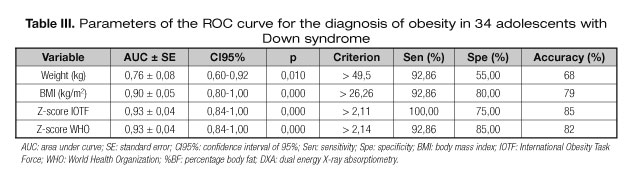
<body><![CDATA[<p><font face="Verdana" size="2">Using the ROC curve, in relation to the %BF by DXA, all parameters showed high sensitivity, but the z-score of BMI by WHO showed better specificity (85%) with an accuracy of the 82% for the cut-off point above 2.14 (<a href="#t3">Table III</a>).</font></p>
    <p>&nbsp;</p>
    <p align="center"><font face="Verdana" size="2"><a name="t3"></a><img src="/img/revistas/nh/v33n5/original11_table3.jpg"></font></p>
    <p>&nbsp;</p>
    <p><font face="Verdana" size="2"><b>Discussion</b></font></p>
    <p><font face="Verdana" size="2">In the general population, the use of BMI to assess obesity has high association with %BF by DXA (27), as well as with the risk in long-term comorbidities (28). However, in people with DS, the use of BMI, due to short stature (4,18) and the tendency to high weight (27), could lead to error, overestimating the diagnosis of obesity. In addition, one should remember that BMI does not differentiate fat mass in lean body mass (29). Therefore, this study sought to estimate the cutoff point of BMI and to verify the accuracy of these BMI references both to the general population (WHO and IOTF) and for people with DS (16,17) in diagnose obesity in relation to %BF analyzed by DXA.</font></p>
    <p><font face="Verdana" size="2">The sample of adolescents with DS (18 males and 16 females) were analyzed together for not presenting significant differences between the gender, beyond that already expected as the height and %BF. Considering that only adolescents were included in this study, stage of life where sex hormones determine the difference in height and body composition between men and women.</font></p>
    <p><font face="Verdana" size="2">In DS, several studies have evaluated children, adolescents, youth and adults, through the BMI, which have detected high levels of obesity (3,14,30). Considering the results of this study in relation to obesity, it was found that obesity was present among 58.8% (20 of 34 cases) of the adolescents with DS, when used references from the WHO (25) for the z-score and BMI 38.2% (13 of 34 cases) by IOTF (24). When used specific indicators of BMI for DS, 35.3% (12 of 34) were obese as references to Myrelid et al. (16) and 55.9% (19 of 34) according to the classification of Styles et al. (17).</font></p>
    <p><font face="Verdana" size="2">According to the %BF by DXA, obesity was present in 41.1% (14 of 34) of adolescents with DS, showing that references the WHO (25) and Styles et al. (17) overestimated the obesity diagnosis in this group of teenagers evaluated for %BF, while references to Myrelid et al. (16) and the IOTF (24) underestimated, despite all these references used present good association with the %BF by DXA. In accordance with a New Zealand study using bioimpedance to assess %BF by means of three equations, Loveday et al. (14) compared and validated the results in relation to the %BF obtained by DXA, in 70 cases of DS aged 5 to18 years and concluded that the bioelectrical impedance showed validity to measure the %BF (14).</font></p>
    <p><font face="Verdana" size="2">Regarding the correlation of %BF by DXA with different BMI references the general population (IOTF and WHO) in obesity assessment, the results of this study showed good correlation, the most significant correlation with the z-score of the BMI by WHO (r = 0.74). In accordance with Bandini et al. (31) who evaluated the excess body fat in 32 cases of DS, aged 13 and 21 years, through the BMI of National Center for Disease Control and Prevention (CDC) 2000, found moderate correlation between BMI and %BF (r = 0.50). Already Hill et al. (32), assessed the resting energy expenditure and adiposity through the z-score for BMI, skin folds and DXA in 28 children with DS and 35 in a control group without the syndrome, noted a strong correlation of the %BF obtained from measurements of skinfold thickness and DXA (r = 0.97) and concluded that skin folds can be used to estimate body fat instead of DXA, without leading to important errors, although there are not specific folds equations skin for people with DS.</font></p>
    ]]></body>
<body><![CDATA[<p><font face="Verdana" size="2">In this study, despite the association of all references that evaluated the BMI with the %BF estimated by DXA for diagnosis of obesity in adolescents with DS, the cutoff point above 2.14 assessed by the BMI of WHO (25) showed the best specificity (85%), with an accuracy of 82%. This result was similar to Bandini et al. (31) who observed the cutting bridge above the CDC 2000 P95 with better sensitivity and specificity for the determination of excess body fat in relation to %BF obtained by the DXA. However, it is important to note that the absence of reference values ??for the correct analysis of the cutoff points for BMI and DXA criteria for children and adolescents with DS hinder its exact applicability.</font></p>
    <p><font face="Verdana" size="2">Considering the results of this study and others cited here for evaluation of %BF in children and adolescents with DS, it was found that, regardless of the methods used is high excess fat percentage and that there is a need to establish specific criteria and reference values for this population.</font></p>
    <p><font face="Verdana" size="2">Limitations of this study were the sample size and the use of %BF obtained by the DXA in relation to the general population according NHANES (26).</font></p>
    <p><font face="Verdana" size="2">We believe that the criteria that use the BMI (WHO and IOTF) for estimating obesity, as well as references based on specific curves for the population with DS are associated with %BF estimated by the DXA and concluded that the cutoff point of z-score above of 2.14 of WHO presented the best specificity with an accuracy of 82%.</font></p>
    <p>&nbsp;</p>
    <p><font face="Verdana" size="2"><b>References</b></font></p>
    <!-- ref --><p><font face="Verdana" size="2">1. Glasson EJ, Sullivan SG, Hussain R, Petterson BA, Montgomery PD, Bittles AH. The changing survival profile of people with Down's syndrome: implications for genetic counselling. Clin Genet 2002;62(5):390-3.    &nbsp;&nbsp;&nbsp;&nbsp;&nbsp;&nbsp;&nbsp;&nbsp;[&#160;<a href="javascript:void(0);" onclick="javascript: window.open('/scielo.php?script=sci_nlinks&ref=3892626&pid=S0212-1611201600050001200001&lng=','','width=640,height=500,resizable=yes,scrollbars=1,menubar=yes,');">Links</a>&#160;]<!-- end-ref --></font></p>    <!-- ref --><p><font face="Verdana" size="2">2. Pinheiro AC, Urtega CR, Ca&ntilde;ete GS, Atalah ES. Evaluaci&oacute;n del estado nutricional en ni&ntilde;os con s&iacute;ndrome de Down seg&uacute;n diferentes referencias antropom&eacute;tricas. Rev Chil Pediatr 2003;74(6):585-9.    &nbsp;&nbsp;&nbsp;&nbsp;&nbsp;&nbsp;&nbsp;&nbsp;[&#160;<a href="javascript:void(0);" onclick="javascript: window.open('/scielo.php?script=sci_nlinks&ref=3892628&pid=S0212-1611201600050001200002&lng=','','width=640,height=500,resizable=yes,scrollbars=1,menubar=yes,');">Links</a>&#160;]<!-- end-ref --></font></p>    ]]></body>
<body><![CDATA[<!-- ref --><p><font face="Verdana" size="2">3. Van Gameren-Oosterom HBM, van Dommelen P, Sch&ouml;beck Y, Oudesluys-Murphy AM, van Wouwe JP, Buitendijk SE. Prevalence of overweight in Dutch children with Down syndrome. Pediatrics 2012;130(6):e1520-6.    &nbsp;&nbsp;&nbsp;&nbsp;&nbsp;&nbsp;&nbsp;&nbsp;[&#160;<a href="javascript:void(0);" onclick="javascript: window.open('/scielo.php?script=sci_nlinks&ref=3892630&pid=S0212-1611201600050001200003&lng=','','width=640,height=500,resizable=yes,scrollbars=1,menubar=yes,');">Links</a>&#160;]<!-- end-ref --></font></p>    <!-- ref --><p><font face="Verdana" size="2">4. Gonz&aacute;lez-Ag&uuml;ero A, Ara I, Moreno LA, Vicente-Rodr&iacute;guez G, Casaj&uacute;s JA. Fat and lean masses in youths with Down syndrome: gender differences. Res Dev Disabil 2011;32(5):1685-93.    &nbsp;&nbsp;&nbsp;&nbsp;&nbsp;&nbsp;&nbsp;&nbsp;[&#160;<a href="javascript:void(0);" onclick="javascript: window.open('/scielo.php?script=sci_nlinks&ref=3892632&pid=S0212-1611201600050001200004&lng=','','width=640,height=500,resizable=yes,scrollbars=1,menubar=yes,');">Links</a>&#160;]<!-- end-ref --></font></p>    <!-- ref --><p><font face="Verdana" size="2">5. Esposito PE, MacDonald M, Hornyak JE, Ulrich DA. Physical activity patterns of youth with Down syndrome. Intellect Dev Disabil 2012;50(2):109-19.    &nbsp;&nbsp;&nbsp;&nbsp;&nbsp;&nbsp;&nbsp;&nbsp;[&#160;<a href="javascript:void(0);" onclick="javascript: window.open('/scielo.php?script=sci_nlinks&ref=3892634&pid=S0212-1611201600050001200005&lng=','','width=640,height=500,resizable=yes,scrollbars=1,menubar=yes,');">Links</a>&#160;]<!-- end-ref --></font></p>    <!-- ref --><p><font face="Verdana" size="2">6. Grammatikopoulou MG, Manai A, Tsigga M, Tsiligiroglou-Fchantidou A, Galli-Tsinopoulou A, Zakas A. Nutrient intake and anthropometry in children and adolescents with Down syndrome - a preliminary study. Dev Neurorehabil 2008;11(4):260-7.    &nbsp;&nbsp;&nbsp;&nbsp;&nbsp;&nbsp;&nbsp;&nbsp;[&#160;<a href="javascript:void(0);" onclick="javascript: window.open('/scielo.php?script=sci_nlinks&ref=3892636&pid=S0212-1611201600050001200006&lng=','','width=640,height=500,resizable=yes,scrollbars=1,menubar=yes,');">Links</a>&#160;]<!-- end-ref --></font></p>    <!-- ref --><p><font face="Verdana" size="2">7. Pitetti K, Baynard T, Agiovlasitis. Children and adolescents with Down syndrome, physical fitness and physical activity. J Sport Health Sci 2013;2(1):47-57.    &nbsp;&nbsp;&nbsp;&nbsp;&nbsp;&nbsp;&nbsp;&nbsp;[&#160;<a href="javascript:void(0);" onclick="javascript: window.open('/scielo.php?script=sci_nlinks&ref=3892638&pid=S0212-1611201600050001200007&lng=','','width=640,height=500,resizable=yes,scrollbars=1,menubar=yes,');">Links</a>&#160;]<!-- end-ref --></font></p>    ]]></body>
<body><![CDATA[<!-- ref --><p><font face="Verdana" size="2">8. Izquierdo-G&oacute;mez R, Mart&iacute;nez-G&oacute;mez D, Tejero-Gonz&aacute;lez CM, Cabanas-S&aacute;nchez V, Ruiz JR, Veiga OL. Are poor physical fitness and obesity two features of the adolescent with Down syndrome? Nutr Hosp 2013;28(4):1348-51.    &nbsp;&nbsp;&nbsp;&nbsp;&nbsp;&nbsp;&nbsp;&nbsp;[&#160;<a href="javascript:void(0);" onclick="javascript: window.open('/scielo.php?script=sci_nlinks&ref=3892640&pid=S0212-1611201600050001200008&lng=','','width=640,height=500,resizable=yes,scrollbars=1,menubar=yes,');">Links</a>&#160;]<!-- end-ref --></font></p>    <!-- ref --><p><font face="Verdana" size="2">9. Freeman SB, Bean LH, Allen EG, Tinker SW, Locke AE, Druschel C, et al. Ethnicity, sex, and the incidence of congenital heart defects: a report from the National Down Syndrome Project. Genet Med 2008;10(3):173-80.    &nbsp;&nbsp;&nbsp;&nbsp;&nbsp;&nbsp;&nbsp;&nbsp;[&#160;<a href="javascript:void(0);" onclick="javascript: window.open('/scielo.php?script=sci_nlinks&ref=3892642&pid=S0212-1611201600050001200009&lng=','','width=640,height=500,resizable=yes,scrollbars=1,menubar=yes,');">Links</a>&#160;]<!-- end-ref --></font></p>    <!-- ref --><p><font face="Verdana" size="2">10. Vilas Boas LT, Albernaz EP, Costa RG. Prevalence of congenital heart defects in patients with Down syndrome in the municipality of Pelotas, Brazil. J Pediatr (Rio J) 2009;85(5):403-7.    &nbsp;&nbsp;&nbsp;&nbsp;&nbsp;&nbsp;&nbsp;&nbsp;[&#160;<a href="javascript:void(0);" onclick="javascript: window.open('/scielo.php?script=sci_nlinks&ref=3892644&pid=S0212-1611201600050001200010&lng=','','width=640,height=500,resizable=yes,scrollbars=1,menubar=yes,');">Links</a>&#160;]<!-- end-ref --></font></p>    <!-- ref --><p><font face="Verdana" size="2">11. Kusters MAA, Verstegen RH, Gemen EF, de Viries E. Intrinsic defect of the immune system in children with Down syndrome: a review. Clin Exp Immunol 2009;156(2):189-93.    &nbsp;&nbsp;&nbsp;&nbsp;&nbsp;&nbsp;&nbsp;&nbsp;[&#160;<a href="javascript:void(0);" onclick="javascript: window.open('/scielo.php?script=sci_nlinks&ref=3892646&pid=S0212-1611201600050001200011&lng=','','width=640,height=500,resizable=yes,scrollbars=1,menubar=yes,');">Links</a>&#160;]<!-- end-ref --></font></p>    <!-- ref --><p><font face="Verdana" size="2">12. Shete MM, Stocks RMS, Sebelik ME, Schoumacher RA. Effects of adeno-tonsillectomy on polysomnography patterns in Down syndrome children with obstructive sleep apnea: a comparative study with children without Down syndrome. Int J Pediatr Otorhinolaryngol 2010;74(3):241-4.    &nbsp;&nbsp;&nbsp;&nbsp;&nbsp;&nbsp;&nbsp;&nbsp;[&#160;<a href="javascript:void(0);" onclick="javascript: window.open('/scielo.php?script=sci_nlinks&ref=3892648&pid=S0212-1611201600050001200012&lng=','','width=640,height=500,resizable=yes,scrollbars=1,menubar=yes,');">Links</a>&#160;]<!-- end-ref --></font></p>    ]]></body>
<body><![CDATA[<!-- ref --><p><font face="Verdana" size="2">13. Van Goor JC, Massa GG, Hirasing R. Increased incidence and prevalence of diabetes mellitus in Down's syndrome. Arch Dis Child 1999;77(2):183-8.    &nbsp;&nbsp;&nbsp;&nbsp;&nbsp;&nbsp;&nbsp;&nbsp;[&#160;<a href="javascript:void(0);" onclick="javascript: window.open('/scielo.php?script=sci_nlinks&ref=3892650&pid=S0212-1611201600050001200013&lng=','','width=640,height=500,resizable=yes,scrollbars=1,menubar=yes,');">Links</a>&#160;]<!-- end-ref --></font></p>    <!-- ref --><p><font face="Verdana" size="2">14. Loveday SJ, Thompson J, Mitchell EA. Bioelectrical impedance for measuring percentage body fat in young persons with Down syndrome: validation with dual-energy absorptiometry. Acta Paediatr 2012;101(11):e491-5.    &nbsp;&nbsp;&nbsp;&nbsp;&nbsp;&nbsp;&nbsp;&nbsp;[&#160;<a href="javascript:void(0);" onclick="javascript: window.open('/scielo.php?script=sci_nlinks&ref=3892652&pid=S0212-1611201600050001200014&lng=','','width=640,height=500,resizable=yes,scrollbars=1,menubar=yes,');">Links</a>&#160;]<!-- end-ref --></font></p>    <!-- ref --><p><font face="Verdana" size="2">15. Gonz&aacute;lez-Ag&uuml;ero A, Matute-Llorente A, G&oacute;mez-Cabello A, Casaj&uacute;s JA, Vicente-Rodr&iacute;guez G. Effects of whole body vibration training on body composition in adolescents with Down syndrome. Rev Dev Disabil 2013;34(5)1426-33.    &nbsp;&nbsp;&nbsp;&nbsp;&nbsp;&nbsp;&nbsp;&nbsp;[&#160;<a href="javascript:void(0);" onclick="javascript: window.open('/scielo.php?script=sci_nlinks&ref=3892654&pid=S0212-1611201600050001200015&lng=','','width=640,height=500,resizable=yes,scrollbars=1,menubar=yes,');">Links</a>&#160;]<!-- end-ref --></font></p>    <!-- ref --><p><font face="Verdana" size="2">16. Myrelid A, Gustafsson J, Ollars B, Anneren G. Growth charts for Down's syndrome from birth to 18 years of age. Arch Dis Child 2002;87(2):97-103.    &nbsp;&nbsp;&nbsp;&nbsp;&nbsp;&nbsp;&nbsp;&nbsp;[&#160;<a href="javascript:void(0);" onclick="javascript: window.open('/scielo.php?script=sci_nlinks&ref=3892656&pid=S0212-1611201600050001200016&lng=','','width=640,height=500,resizable=yes,scrollbars=1,menubar=yes,');">Links</a>&#160;]<!-- end-ref --></font></p>    <!-- ref --><p><font face="Verdana" size="2">17. Styles M, Cole T, Dennis J, Preece M. New cross sectional stature, weight and head circumference references for Down's syndrome in the UK and Republic of Ireland. Arch Dis Child 2002;87(2):104-8.    &nbsp;&nbsp;&nbsp;&nbsp;&nbsp;&nbsp;&nbsp;&nbsp;[&#160;<a href="javascript:void(0);" onclick="javascript: window.open('/scielo.php?script=sci_nlinks&ref=3892658&pid=S0212-1611201600050001200017&lng=','','width=640,height=500,resizable=yes,scrollbars=1,menubar=yes,');">Links</a>&#160;]<!-- end-ref --></font></p>    ]]></body>
<body><![CDATA[<!-- ref --><p><font face="Verdana" size="2">18. Cronk C, Crocker A, Pueschel S, Shea AM, Zackai E, Pickens G, et al. Growth chards for children with Down syndrome: 1 month to 18 years of age. Pediatrics 1988;81(2):102-10.    &nbsp;&nbsp;&nbsp;&nbsp;&nbsp;&nbsp;&nbsp;&nbsp;[&#160;<a href="javascript:void(0);" onclick="javascript: window.open('/scielo.php?script=sci_nlinks&ref=3892660&pid=S0212-1611201600050001200018&lng=','','width=640,height=500,resizable=yes,scrollbars=1,menubar=yes,');">Links</a>&#160;]<!-- end-ref --></font></p>    <!-- ref --><p><font face="Verdana" size="2">19. Al Husain M. Body mass index for Saudi children with Down's syndrome. Acta Paediatr 2003;92(12):1482-5.    &nbsp;&nbsp;&nbsp;&nbsp;&nbsp;&nbsp;&nbsp;&nbsp;[&#160;<a href="javascript:void(0);" onclick="javascript: window.open('/scielo.php?script=sci_nlinks&ref=3892662&pid=S0212-1611201600050001200019&lng=','','width=640,height=500,resizable=yes,scrollbars=1,menubar=yes,');">Links</a>&#160;]<!-- end-ref --></font></p>    <!-- ref --><p><font face="Verdana" size="2">20. Bertapelli F, Martin JE, Gon&ccedil;alves EM, de Oliveira Barbeta VJ, Guerra-J&uacute;nior. Growth curves in Down syndrome: implications for clinical practice. Am J Med Genet A 2014;164A(3):844-7.    &nbsp;&nbsp;&nbsp;&nbsp;&nbsp;&nbsp;&nbsp;&nbsp;[&#160;<a href="javascript:void(0);" onclick="javascript: window.open('/scielo.php?script=sci_nlinks&ref=3892664&pid=S0212-1611201600050001200020&lng=','','width=640,height=500,resizable=yes,scrollbars=1,menubar=yes,');">Links</a>&#160;]<!-- end-ref --></font></p>    <!-- ref --><p><font face="Verdana" size="2">21. Knapp KM, Welsman JR, Hopkins SJ, Schallcross A, Fogelman I, Blake GM. Obesity increases precision errors in total body dual-energy x-ray absorptiometry measurements. J Clin Densitom 2015;18(2):209-16.    &nbsp;&nbsp;&nbsp;&nbsp;&nbsp;&nbsp;&nbsp;&nbsp;[&#160;<a href="javascript:void(0);" onclick="javascript: window.open('/scielo.php?script=sci_nlinks&ref=3892666&pid=S0212-1611201600050001200021&lng=','','width=640,height=500,resizable=yes,scrollbars=1,menubar=yes,');">Links</a>&#160;]<!-- end-ref --></font></p>    <!-- ref --><p><font face="Verdana" size="2">22. De Miguel-Etayo P, Moreno LA, Santab&aacute;rbara J, Mart&iacute;n-Matillas M, Piqueras MJ, Rocha-Silva D, et al. Anthropometric indices to assess body-fat changes during a multidisciplinary obesity treatment in adolescents: EVAYON Study. Clin Nutr 2015;34(3):523-8.    &nbsp;&nbsp;&nbsp;&nbsp;&nbsp;&nbsp;&nbsp;&nbsp;[&#160;<a href="javascript:void(0);" onclick="javascript: window.open('/scielo.php?script=sci_nlinks&ref=3892668&pid=S0212-1611201600050001200022&lng=','','width=640,height=500,resizable=yes,scrollbars=1,menubar=yes,');">Links</a>&#160;]<!-- end-ref --></font></p>    ]]></body>
<body><![CDATA[<!-- ref --><p><font face="Verdana" size="2">23. Lohman TG, Roche AF, Martorell R. Anthropometric Standardization Reference Manual. Champaign: Human Kinetics; 1988.    &nbsp;&nbsp;&nbsp;&nbsp;&nbsp;&nbsp;&nbsp;&nbsp;[&#160;<a href="javascript:void(0);" onclick="javascript: window.open('/scielo.php?script=sci_nlinks&ref=3892670&pid=S0212-1611201600050001200023&lng=','','width=640,height=500,resizable=yes,scrollbars=1,menubar=yes,');">Links</a>&#160;]<!-- end-ref --></font></p>    <!-- ref --><p><font face="Verdana" size="2">24. Cole TJ, Lobstein T. Extended international (IOTF) body mass index cut-offs for thinness, overweight and obesity. Pediatr Obes 2012;7(4)284-94.    &nbsp;&nbsp;&nbsp;&nbsp;&nbsp;&nbsp;&nbsp;&nbsp;[&#160;<a href="javascript:void(0);" onclick="javascript: window.open('/scielo.php?script=sci_nlinks&ref=3892672&pid=S0212-1611201600050001200024&lng=','','width=640,height=500,resizable=yes,scrollbars=1,menubar=yes,');">Links</a>&#160;]<!-- end-ref --></font></p>    <!-- ref --><p><font face="Verdana" size="2">25. De Onis M, Onyango AW, Borghi E, Siyam A, Nishida C, Siekmann J. Development of a WHO growth reference for school-aged children and adolescents. Bull World Health Organ (WHO) 2007;85(9):660-7.    &nbsp;&nbsp;&nbsp;&nbsp;&nbsp;&nbsp;&nbsp;&nbsp;[&#160;<a href="javascript:void(0);" onclick="javascript: window.open('/scielo.php?script=sci_nlinks&ref=3892674&pid=S0212-1611201600050001200025&lng=','','width=640,height=500,resizable=yes,scrollbars=1,menubar=yes,');">Links</a>&#160;]<!-- end-ref --></font></p>    <!-- ref --><p><font face="Verdana" size="2">26. Ogden CL, Li Y, Freedman DS, Borrud LG, Flegal KM. Smoothed percentage body fat percentiles for U.S. children and adolescents, 1999-2004. Natl Health Stat Report 2011;9(43):1-7.    &nbsp;&nbsp;&nbsp;&nbsp;&nbsp;&nbsp;&nbsp;&nbsp;[&#160;<a href="javascript:void(0);" onclick="javascript: window.open('/scielo.php?script=sci_nlinks&ref=3892676&pid=S0212-1611201600050001200026&lng=','','width=640,height=500,resizable=yes,scrollbars=1,menubar=yes,');">Links</a>&#160;]<!-- end-ref --></font></p>    <!-- ref --><p><font face="Verdana" size="2">27. Heo M, Wylie-Rosett J, Pietrobelli A, Kabat GC, Rohan TE, Faith MS. US pediatric population-level associations of DXA-measured percentage of body fat with four BMI metrics with cutoffs. <i>Int J Obes</i> (Lond) 2014;38(1):60-8.    &nbsp;&nbsp;&nbsp;&nbsp;&nbsp;&nbsp;&nbsp;&nbsp;[&#160;<a href="javascript:void(0);" onclick="javascript: window.open('/scielo.php?script=sci_nlinks&ref=3892678&pid=S0212-1611201600050001200027&lng=','','width=640,height=500,resizable=yes,scrollbars=1,menubar=yes,');">Links</a>&#160;]<!-- end-ref --></font></p>    ]]></body>
<body><![CDATA[<!-- ref --><p><font face="Verdana" size="2">28. Martin L, Oepen J, Reinehr T, Wabitsch M, Claussnitzer G, Waldeck E, et al. Ethnicity and cardiovascular risk factors: evaluation of 40.921 normal-weight, overweight or obese children and adolescents living in Central Europe. Int J Obes (Lond) 2015;39(1):45-51.    &nbsp;&nbsp;&nbsp;&nbsp;&nbsp;&nbsp;&nbsp;&nbsp;[&#160;<a href="javascript:void(0);" onclick="javascript: window.open('/scielo.php?script=sci_nlinks&ref=3892680&pid=S0212-1611201600050001200028&lng=','','width=640,height=500,resizable=yes,scrollbars=1,menubar=yes,');">Links</a>&#160;]<!-- end-ref --></font></p>    <!-- ref --><p><font face="Verdana" size="2">29. Must A, Anderson SE. Body mass index in children and adolescents: considerations for population-based applications. Int J Obes (Lond) 2006;30(4):590-4.    &nbsp;&nbsp;&nbsp;&nbsp;&nbsp;&nbsp;&nbsp;&nbsp;[&#160;<a href="javascript:void(0);" onclick="javascript: window.open('/scielo.php?script=sci_nlinks&ref=3892682&pid=S0212-1611201600050001200029&lng=','','width=640,height=500,resizable=yes,scrollbars=1,menubar=yes,');">Links</a>&#160;]<!-- end-ref --></font></p>    <!-- ref --><p><font face="Verdana" size="2">30. Miyazaki Y, Okumiya A. Prediction of obesity in Down syndrome individuals using BMI and blood pressure records. J Phys Ther Sci 2004;16(1):65-71.    &nbsp;&nbsp;&nbsp;&nbsp;&nbsp;&nbsp;&nbsp;&nbsp;[&#160;<a href="javascript:void(0);" onclick="javascript: window.open('/scielo.php?script=sci_nlinks&ref=3892684&pid=S0212-1611201600050001200030&lng=','','width=640,height=500,resizable=yes,scrollbars=1,menubar=yes,');">Links</a>&#160;]<!-- end-ref --></font></p>    <!-- ref --><p><font face="Verdana" size="2">31. Bandini LG, Fleming RK, Scampini R, Gleason J, Must A. Is body mass index a useful measure of excess body fatness in adolescents and young adults with Down syndrome? J Intellect Disabil Res 2013;57(11):1050-7.    &nbsp;&nbsp;&nbsp;&nbsp;&nbsp;&nbsp;&nbsp;&nbsp;[&#160;<a href="javascript:void(0);" onclick="javascript: window.open('/scielo.php?script=sci_nlinks&ref=3892686&pid=S0212-1611201600050001200031&lng=','','width=640,height=500,resizable=yes,scrollbars=1,menubar=yes,');">Links</a>&#160;]<!-- end-ref --></font></p>    <!-- ref --><p><font face="Verdana" size="2">32. Hill DL, Parks EP, Zemel BS, Shults J, Stalling VA, Stettler N. Resting energy expenditure and adiposity accretion among children with Down syndrome: a three year prospective study. Eur J Clin Nutr 2013;67(10):1087-91.    &nbsp;&nbsp;&nbsp;&nbsp;&nbsp;&nbsp;&nbsp;&nbsp;[&#160;<a href="javascript:void(0);" onclick="javascript: window.open('/scielo.php?script=sci_nlinks&ref=3892688&pid=S0212-1611201600050001200032&lng=','','width=640,height=500,resizable=yes,scrollbars=1,menubar=yes,');">Links</a>&#160;]<!-- end-ref --></font></p>
    ]]></body>
<body><![CDATA[<p>&nbsp;</p>
    <p>&nbsp;</p>
    <p><font face="Verdana" size="2"><a href="#top"><img border="0" src="/img/revistas/nh/v33n5/seta.gif" width="15" height="17"></a><a name="bajo"></a><b>Correspondence:</b>    <br>Juan Eduardo Samur San Martin.    <br>Growth and Development Laboratory (CIPED).    <br>School of Medicine.    <br>State University of Campinas (UNICAMP).    <br>Rua Tessalia Vieira de Camargo, 126.    <br>Cidade Universit&aacute;ria Zeferino Vaz.    <br>13083-887 Campinas-SP, Brasil    ]]></body>
<body><![CDATA[<br>e-mail:<a href="mailto:juansamur@gmail.com">juansamur@gmail.com</a></font></p>
    <p><font face="Verdana" size="2">Received: 04/02/2016    <br>Accepted: 14/03/2016</font></p>
     ]]></body><back>
<ref-list>
<ref id="B1">
<label>1</label><nlm-citation citation-type="journal">
<person-group person-group-type="author">
<name>
<surname><![CDATA[Glasson]]></surname>
<given-names><![CDATA[EJ]]></given-names>
</name>
<name>
<surname><![CDATA[Sullivan]]></surname>
<given-names><![CDATA[SG]]></given-names>
</name>
<name>
<surname><![CDATA[Hussain]]></surname>
<given-names><![CDATA[R]]></given-names>
</name>
<name>
<surname><![CDATA[Petterson]]></surname>
<given-names><![CDATA[BA]]></given-names>
</name>
<name>
<surname><![CDATA[Montgomery]]></surname>
<given-names><![CDATA[PD]]></given-names>
</name>
<name>
<surname><![CDATA[Bittles]]></surname>
<given-names><![CDATA[AH]]></given-names>
</name>
</person-group>
<article-title xml:lang="en"><![CDATA[The changing survival profile of people with Down's syndrome: implications for genetic counselling]]></article-title>
<source><![CDATA[Clin Genet]]></source>
<year>2002</year>
<volume>62</volume>
<numero>5</numero>
<issue>5</issue>
<page-range>390-3</page-range></nlm-citation>
</ref>
<ref id="B2">
<label>2</label><nlm-citation citation-type="journal">
<person-group person-group-type="author">
<name>
<surname><![CDATA[Pinheiro]]></surname>
<given-names><![CDATA[AC]]></given-names>
</name>
<name>
<surname><![CDATA[Urtega]]></surname>
<given-names><![CDATA[CR]]></given-names>
</name>
<name>
<surname><![CDATA[Cañete]]></surname>
<given-names><![CDATA[GS]]></given-names>
</name>
<name>
<surname><![CDATA[Atalah]]></surname>
<given-names><![CDATA[ES]]></given-names>
</name>
</person-group>
<article-title xml:lang="es"><![CDATA[Evaluación del estado nutricional en niños con síndrome de Down según diferentes referencias antropométricas]]></article-title>
<source><![CDATA[Rev Chil Pediatr]]></source>
<year>2003</year>
<volume>74</volume>
<numero>6</numero>
<issue>6</issue>
<page-range>585-9</page-range></nlm-citation>
</ref>
<ref id="B3">
<label>3</label><nlm-citation citation-type="journal">
<person-group person-group-type="author">
<name>
<surname><![CDATA[Van Gameren-Oosterom]]></surname>
<given-names><![CDATA[HBM]]></given-names>
</name>
<name>
<surname><![CDATA[van Dommelen]]></surname>
<given-names><![CDATA[P]]></given-names>
</name>
<name>
<surname><![CDATA[Schöbeck]]></surname>
<given-names><![CDATA[Y]]></given-names>
</name>
<name>
<surname><![CDATA[Oudesluys-Murphy]]></surname>
<given-names><![CDATA[AM]]></given-names>
</name>
<name>
<surname><![CDATA[van Wouwe]]></surname>
<given-names><![CDATA[JP]]></given-names>
</name>
<name>
<surname><![CDATA[Buitendijk]]></surname>
<given-names><![CDATA[SE]]></given-names>
</name>
</person-group>
<article-title xml:lang="en"><![CDATA[Prevalence of overweight in Dutch children with Down syndrome]]></article-title>
<source><![CDATA[Pediatrics]]></source>
<year>2012</year>
<volume>130</volume>
<numero>6</numero>
<issue>6</issue>
<page-range>e1520-6</page-range></nlm-citation>
</ref>
<ref id="B4">
<label>4</label><nlm-citation citation-type="journal">
<person-group person-group-type="author">
<name>
<surname><![CDATA[González-Agüero]]></surname>
<given-names><![CDATA[A]]></given-names>
</name>
<name>
<surname><![CDATA[Ara]]></surname>
<given-names><![CDATA[I]]></given-names>
</name>
<name>
<surname><![CDATA[Moreno]]></surname>
<given-names><![CDATA[LA]]></given-names>
</name>
<name>
<surname><![CDATA[Vicente-Rodríguez]]></surname>
<given-names><![CDATA[G]]></given-names>
</name>
<name>
<surname><![CDATA[Casajús]]></surname>
<given-names><![CDATA[JA]]></given-names>
</name>
</person-group>
<article-title xml:lang="en"><![CDATA[Fat and lean masses in youths with Down syndrome: gender differences]]></article-title>
<source><![CDATA[Res Dev Disabil]]></source>
<year>2011</year>
<volume>32</volume>
<numero>5</numero>
<issue>5</issue>
<page-range>1685-93</page-range></nlm-citation>
</ref>
<ref id="B5">
<label>5</label><nlm-citation citation-type="journal">
<person-group person-group-type="author">
<name>
<surname><![CDATA[Esposito]]></surname>
<given-names><![CDATA[PE]]></given-names>
</name>
<name>
<surname><![CDATA[MacDonald]]></surname>
<given-names><![CDATA[M]]></given-names>
</name>
<name>
<surname><![CDATA[Hornyak]]></surname>
<given-names><![CDATA[JE]]></given-names>
</name>
<name>
<surname><![CDATA[Ulrich]]></surname>
<given-names><![CDATA[DA]]></given-names>
</name>
</person-group>
<article-title xml:lang="en"><![CDATA[Physical activity patterns of youth with Down syndrome]]></article-title>
<source><![CDATA[Intellect Dev Disabil]]></source>
<year>2012</year>
<volume>50</volume>
<numero>2</numero>
<issue>2</issue>
<page-range>109-19</page-range></nlm-citation>
</ref>
<ref id="B6">
<label>6</label><nlm-citation citation-type="journal">
<person-group person-group-type="author">
<name>
<surname><![CDATA[Grammatikopoulou]]></surname>
<given-names><![CDATA[MG]]></given-names>
</name>
<name>
<surname><![CDATA[Manai]]></surname>
<given-names><![CDATA[A]]></given-names>
</name>
<name>
<surname><![CDATA[Tsigga]]></surname>
<given-names><![CDATA[M]]></given-names>
</name>
<name>
<surname><![CDATA[Tsiligiroglou-Fchantidou]]></surname>
<given-names><![CDATA[A]]></given-names>
</name>
<name>
<surname><![CDATA[Galli-Tsinopoulou]]></surname>
<given-names><![CDATA[A]]></given-names>
</name>
<name>
<surname><![CDATA[Zakas]]></surname>
<given-names><![CDATA[A]]></given-names>
</name>
</person-group>
<article-title xml:lang="en"><![CDATA[Nutrient intake and anthropometry in children and adolescents with Down syndrome: a preliminary study]]></article-title>
<source><![CDATA[Dev Neurorehabil]]></source>
<year>2008</year>
<volume>11</volume>
<numero>4</numero>
<issue>4</issue>
<page-range>260-7</page-range></nlm-citation>
</ref>
<ref id="B7">
<label>7</label><nlm-citation citation-type="journal">
<person-group person-group-type="author">
<name>
<surname><![CDATA[Pitetti]]></surname>
<given-names><![CDATA[K]]></given-names>
</name>
<name>
<surname><![CDATA[Baynard]]></surname>
<given-names><![CDATA[T]]></given-names>
</name>
</person-group>
<article-title xml:lang="en"><![CDATA[Agiovlasitis: Children and adolescents with Down syndrome, physical fitness and physical activity]]></article-title>
<source><![CDATA[J Sport Health Sci]]></source>
<year>2013</year>
<volume>2</volume>
<numero>1</numero>
<issue>1</issue>
<page-range>47-57</page-range></nlm-citation>
</ref>
<ref id="B8">
<label>8</label><nlm-citation citation-type="journal">
<person-group person-group-type="author">
<name>
<surname><![CDATA[Izquierdo-Gómez]]></surname>
<given-names><![CDATA[R]]></given-names>
</name>
<name>
<surname><![CDATA[Martínez-Gómez]]></surname>
<given-names><![CDATA[D]]></given-names>
</name>
<name>
<surname><![CDATA[Tejero-González]]></surname>
<given-names><![CDATA[CM]]></given-names>
</name>
<name>
<surname><![CDATA[Cabanas-Sánchez]]></surname>
<given-names><![CDATA[V]]></given-names>
</name>
<name>
<surname><![CDATA[Ruiz]]></surname>
<given-names><![CDATA[JR]]></given-names>
</name>
<name>
<surname><![CDATA[Veiga]]></surname>
<given-names><![CDATA[OL]]></given-names>
</name>
</person-group>
<article-title xml:lang="en"><![CDATA[Are poor physical fitness and obesity two features of the adolescent with Down syndrome?]]></article-title>
<source><![CDATA[Nutr Hosp]]></source>
<year>2013</year>
<volume>28</volume>
<numero>4</numero>
<issue>4</issue>
<page-range>1348-51</page-range></nlm-citation>
</ref>
<ref id="B9">
<label>9</label><nlm-citation citation-type="journal">
<person-group person-group-type="author">
<name>
<surname><![CDATA[Freeman]]></surname>
<given-names><![CDATA[SB]]></given-names>
</name>
<name>
<surname><![CDATA[Bean]]></surname>
<given-names><![CDATA[LH]]></given-names>
</name>
<name>
<surname><![CDATA[Allen]]></surname>
<given-names><![CDATA[EG]]></given-names>
</name>
<name>
<surname><![CDATA[Tinker]]></surname>
<given-names><![CDATA[SW]]></given-names>
</name>
<name>
<surname><![CDATA[Locke]]></surname>
<given-names><![CDATA[AE]]></given-names>
</name>
<name>
<surname><![CDATA[Druschel]]></surname>
<given-names><![CDATA[C]]></given-names>
</name>
</person-group>
<article-title xml:lang="en"><![CDATA[Ethnicity, sex, and the incidence of congenital heart defects: a report from the National Down Syndrome Project]]></article-title>
<source><![CDATA[Genet Med]]></source>
<year>2008</year>
<volume>10</volume>
<numero>3</numero>
<issue>3</issue>
<page-range>173-80</page-range></nlm-citation>
</ref>
<ref id="B10">
<label>10</label><nlm-citation citation-type="journal">
<person-group person-group-type="author">
<name>
<surname><![CDATA[Vilas Boas]]></surname>
<given-names><![CDATA[LT]]></given-names>
</name>
<name>
<surname><![CDATA[Albernaz]]></surname>
<given-names><![CDATA[EP]]></given-names>
</name>
<name>
<surname><![CDATA[Costa]]></surname>
<given-names><![CDATA[RG]]></given-names>
</name>
</person-group>
<article-title xml:lang="en"><![CDATA[Prevalence of congenital heart defects in patients with Down syndrome in the municipality of Pelotas, Brazil]]></article-title>
<source><![CDATA[J Pediatr (Rio J)]]></source>
<year>2009</year>
<volume>85</volume>
<numero>5</numero>
<issue>5</issue>
<page-range>403-7</page-range></nlm-citation>
</ref>
<ref id="B11">
<label>11</label><nlm-citation citation-type="journal">
<person-group person-group-type="author">
<name>
<surname><![CDATA[Kusters]]></surname>
<given-names><![CDATA[MAA]]></given-names>
</name>
<name>
<surname><![CDATA[Verstegen]]></surname>
<given-names><![CDATA[RH]]></given-names>
</name>
<name>
<surname><![CDATA[Gemen]]></surname>
<given-names><![CDATA[EF]]></given-names>
</name>
<name>
<surname><![CDATA[de Viries]]></surname>
<given-names><![CDATA[E]]></given-names>
</name>
</person-group>
<article-title xml:lang="en"><![CDATA[Intrinsic defect of the immune system in children with Down syndrome: a review]]></article-title>
<source><![CDATA[Clin Exp Immunol]]></source>
<year>2009</year>
<volume>156</volume>
<numero>2</numero>
<issue>2</issue>
<page-range>189-93</page-range></nlm-citation>
</ref>
<ref id="B12">
<label>12</label><nlm-citation citation-type="journal">
<person-group person-group-type="author">
<name>
<surname><![CDATA[Shete]]></surname>
<given-names><![CDATA[MM]]></given-names>
</name>
<name>
<surname><![CDATA[Stocks]]></surname>
<given-names><![CDATA[RMS]]></given-names>
</name>
<name>
<surname><![CDATA[Sebelik]]></surname>
<given-names><![CDATA[ME]]></given-names>
</name>
<name>
<surname><![CDATA[Schoumacher]]></surname>
<given-names><![CDATA[RA]]></given-names>
</name>
</person-group>
<article-title xml:lang="en"><![CDATA[Effects of adeno-tonsillectomy on polysomnography patterns in Down syndrome children with obstructive sleep apnea: a comparative study with children without Down syndrome]]></article-title>
<source><![CDATA[Int J Pediatr Otorhinolaryngol]]></source>
<year>2010</year>
<volume>74</volume>
<numero>3</numero>
<issue>3</issue>
<page-range>241-4</page-range></nlm-citation>
</ref>
<ref id="B13">
<label>13</label><nlm-citation citation-type="journal">
<person-group person-group-type="author">
<name>
<surname><![CDATA[Van Goor]]></surname>
<given-names><![CDATA[JC]]></given-names>
</name>
<name>
<surname><![CDATA[Massa]]></surname>
<given-names><![CDATA[GG]]></given-names>
</name>
<name>
<surname><![CDATA[Hirasing]]></surname>
<given-names><![CDATA[R]]></given-names>
</name>
</person-group>
<article-title xml:lang="en"><![CDATA[Increased incidence and prevalence of diabetes mellitus in Down's syndrome]]></article-title>
<source><![CDATA[Arch Dis Child]]></source>
<year>1999</year>
<volume>77</volume>
<numero>2</numero>
<issue>2</issue>
<page-range>183-8</page-range></nlm-citation>
</ref>
<ref id="B14">
<label>14</label><nlm-citation citation-type="journal">
<person-group person-group-type="author">
<name>
<surname><![CDATA[Loveday]]></surname>
<given-names><![CDATA[SJ]]></given-names>
</name>
<name>
<surname><![CDATA[Thompson]]></surname>
<given-names><![CDATA[J]]></given-names>
</name>
<name>
<surname><![CDATA[Mitchell]]></surname>
<given-names><![CDATA[EA]]></given-names>
</name>
</person-group>
<article-title xml:lang="en"><![CDATA[Bioelectrical impedance for measuring percentage body fat in young persons with Down syndrome: validation with dual-energy absorptiometry]]></article-title>
<source><![CDATA[Acta Paediatr]]></source>
<year>2012</year>
<volume>101</volume>
<numero>11</numero>
<issue>11</issue>
<page-range>e491-5</page-range></nlm-citation>
</ref>
<ref id="B15">
<label>15</label><nlm-citation citation-type="journal">
<person-group person-group-type="author">
<name>
<surname><![CDATA[González-Agüero]]></surname>
<given-names><![CDATA[A]]></given-names>
</name>
<name>
<surname><![CDATA[Matute-Llorente]]></surname>
<given-names><![CDATA[A]]></given-names>
</name>
<name>
<surname><![CDATA[Gómez-Cabello]]></surname>
<given-names><![CDATA[A]]></given-names>
</name>
<name>
<surname><![CDATA[Casajús]]></surname>
<given-names><![CDATA[JA]]></given-names>
</name>
<name>
<surname><![CDATA[Vicente-Rodríguez]]></surname>
<given-names><![CDATA[G]]></given-names>
</name>
</person-group>
<article-title xml:lang="en"><![CDATA[Effects of whole body vibration training on body composition in adolescents with Down syndrome]]></article-title>
<source><![CDATA[Rev Dev Disabil]]></source>
<year>2013</year>
<volume>34</volume>
<numero>5</numero>
<issue>5</issue>
<page-range>1426-33</page-range></nlm-citation>
</ref>
<ref id="B16">
<label>16</label><nlm-citation citation-type="journal">
<person-group person-group-type="author">
<name>
<surname><![CDATA[Myrelid]]></surname>
<given-names><![CDATA[A]]></given-names>
</name>
<name>
<surname><![CDATA[Gustafsson]]></surname>
<given-names><![CDATA[J]]></given-names>
</name>
<name>
<surname><![CDATA[Ollars]]></surname>
<given-names><![CDATA[B]]></given-names>
</name>
<name>
<surname><![CDATA[Anneren]]></surname>
<given-names><![CDATA[G]]></given-names>
</name>
</person-group>
<article-title xml:lang="en"><![CDATA[Growth charts for Down's syndrome from birth to 18 years of age]]></article-title>
<source><![CDATA[Arch Dis Child]]></source>
<year>2002</year>
<volume>87</volume>
<numero>2</numero>
<issue>2</issue>
<page-range>97-103</page-range></nlm-citation>
</ref>
<ref id="B17">
<label>17</label><nlm-citation citation-type="journal">
<person-group person-group-type="author">
<name>
<surname><![CDATA[Styles]]></surname>
<given-names><![CDATA[M]]></given-names>
</name>
<name>
<surname><![CDATA[Cole]]></surname>
<given-names><![CDATA[T]]></given-names>
</name>
<name>
<surname><![CDATA[Dennis]]></surname>
<given-names><![CDATA[J]]></given-names>
</name>
<name>
<surname><![CDATA[Preece]]></surname>
<given-names><![CDATA[M]]></given-names>
</name>
</person-group>
<article-title xml:lang="en"><![CDATA[New cross sectional stature, weight and head circumference references for Down's syndrome in the UK and Republic of Ireland]]></article-title>
<source><![CDATA[Arch Dis Child]]></source>
<year>2002</year>
<volume>87</volume>
<numero>2</numero>
<issue>2</issue>
<page-range>104-8</page-range></nlm-citation>
</ref>
<ref id="B18">
<label>18</label><nlm-citation citation-type="journal">
<person-group person-group-type="author">
<name>
<surname><![CDATA[Cronk]]></surname>
<given-names><![CDATA[C]]></given-names>
</name>
<name>
<surname><![CDATA[Crocker]]></surname>
<given-names><![CDATA[A]]></given-names>
</name>
<name>
<surname><![CDATA[Pueschel]]></surname>
<given-names><![CDATA[S]]></given-names>
</name>
<name>
<surname><![CDATA[Shea]]></surname>
<given-names><![CDATA[AM]]></given-names>
</name>
<name>
<surname><![CDATA[Zackai]]></surname>
<given-names><![CDATA[E]]></given-names>
</name>
<name>
<surname><![CDATA[Pickens]]></surname>
<given-names><![CDATA[G]]></given-names>
</name>
</person-group>
<article-title xml:lang="en"><![CDATA[Growth chards for children with Down syndrome: 1 month to 18 years of age]]></article-title>
<source><![CDATA[Pediatrics]]></source>
<year>1988</year>
<volume>81</volume>
<numero>2</numero>
<issue>2</issue>
<page-range>102-10</page-range></nlm-citation>
</ref>
<ref id="B19">
<label>19</label><nlm-citation citation-type="journal">
<person-group person-group-type="author">
<name>
<surname><![CDATA[Al Husain]]></surname>
<given-names><![CDATA[M]]></given-names>
</name>
</person-group>
<article-title xml:lang="en"><![CDATA[Body mass index for Saudi children with Down's syndrome]]></article-title>
<source><![CDATA[Acta Paediatr]]></source>
<year>2003</year>
<volume>92</volume>
<numero>12</numero>
<issue>12</issue>
<page-range>1482-5</page-range></nlm-citation>
</ref>
<ref id="B20">
<label>20</label><nlm-citation citation-type="journal">
<person-group person-group-type="author">
<name>
<surname><![CDATA[Bertapelli]]></surname>
<given-names><![CDATA[F]]></given-names>
</name>
<name>
<surname><![CDATA[Martin]]></surname>
<given-names><![CDATA[JE]]></given-names>
</name>
<name>
<surname><![CDATA[Gonçalves]]></surname>
<given-names><![CDATA[EM]]></given-names>
</name>
<name>
<surname><![CDATA[de Oliveira Barbeta]]></surname>
<given-names><![CDATA[VJ]]></given-names>
</name>
<name>
<surname><![CDATA[Guerra-Júnior]]></surname>
</name>
</person-group>
<article-title xml:lang="en"><![CDATA[Growth curves in Down syndrome: implications for clinical practice]]></article-title>
<source><![CDATA[Am J Med Genet A]]></source>
<year>2014</year>
<volume>164A</volume>
<numero>3</numero>
<issue>3</issue>
<page-range>844-7</page-range></nlm-citation>
</ref>
<ref id="B21">
<label>21</label><nlm-citation citation-type="journal">
<person-group person-group-type="author">
<name>
<surname><![CDATA[Knapp]]></surname>
<given-names><![CDATA[KM]]></given-names>
</name>
<name>
<surname><![CDATA[Welsman]]></surname>
<given-names><![CDATA[JR]]></given-names>
</name>
<name>
<surname><![CDATA[Hopkins]]></surname>
<given-names><![CDATA[SJ]]></given-names>
</name>
<name>
<surname><![CDATA[Schallcross]]></surname>
<given-names><![CDATA[A]]></given-names>
</name>
<name>
<surname><![CDATA[Fogelman]]></surname>
<given-names><![CDATA[I]]></given-names>
</name>
<name>
<surname><![CDATA[Blake]]></surname>
<given-names><![CDATA[GM]]></given-names>
</name>
</person-group>
<article-title xml:lang="en"><![CDATA[Obesity increases precision errors in total body dual-energy x-ray absorptiometry measurements]]></article-title>
<source><![CDATA[J Clin Densitom]]></source>
<year>2015</year>
<volume>18</volume>
<numero>2</numero>
<issue>2</issue>
<page-range>209-16</page-range></nlm-citation>
</ref>
<ref id="B22">
<label>22</label><nlm-citation citation-type="journal">
<person-group person-group-type="author">
<name>
<surname><![CDATA[De Miguel-Etayo]]></surname>
<given-names><![CDATA[P]]></given-names>
</name>
<name>
<surname><![CDATA[Moreno]]></surname>
<given-names><![CDATA[LA]]></given-names>
</name>
<name>
<surname><![CDATA[Santabárbara]]></surname>
<given-names><![CDATA[J]]></given-names>
</name>
<name>
<surname><![CDATA[Martín-Matillas]]></surname>
<given-names><![CDATA[M]]></given-names>
</name>
<name>
<surname><![CDATA[Piqueras]]></surname>
<given-names><![CDATA[MJ]]></given-names>
</name>
<name>
<surname><![CDATA[Rocha-Silva]]></surname>
<given-names><![CDATA[D]]></given-names>
</name>
</person-group>
<article-title xml:lang="en"><![CDATA[Anthropometric indices to assess body-fat changes during a multidisciplinary obesity treatment in adolescents: EVAYON Study]]></article-title>
<source><![CDATA[Clin Nutr]]></source>
<year>2015</year>
<volume>34</volume>
<numero>3</numero>
<issue>3</issue>
<page-range>523-8</page-range></nlm-citation>
</ref>
<ref id="B23">
<label>23</label><nlm-citation citation-type="book">
<person-group person-group-type="author">
<name>
<surname><![CDATA[Lohman]]></surname>
<given-names><![CDATA[TG]]></given-names>
</name>
<name>
<surname><![CDATA[Roche]]></surname>
<given-names><![CDATA[AF]]></given-names>
</name>
<name>
<surname><![CDATA[Martorell]]></surname>
<given-names><![CDATA[R]]></given-names>
</name>
</person-group>
<source><![CDATA[Anthropometric Standardization Reference Manual]]></source>
<year>1988</year>
<publisher-loc><![CDATA[Champaign ]]></publisher-loc>
<publisher-name><![CDATA[Human Kinetics]]></publisher-name>
</nlm-citation>
</ref>
<ref id="B24">
<label>24</label><nlm-citation citation-type="journal">
<person-group person-group-type="author">
<name>
<surname><![CDATA[Cole]]></surname>
<given-names><![CDATA[TJ]]></given-names>
</name>
<name>
<surname><![CDATA[Lobstein]]></surname>
<given-names><![CDATA[T]]></given-names>
</name>
</person-group>
<article-title xml:lang="en"><![CDATA[Extended international (IOTF) body mass index cut-offs for thinness, overweight and obesity]]></article-title>
<source><![CDATA[Pediatr Obes]]></source>
<year>2012</year>
<volume>7</volume>
<numero>4</numero>
<issue>4</issue>
<page-range>284-94</page-range></nlm-citation>
</ref>
<ref id="B25">
<label>25</label><nlm-citation citation-type="journal">
<person-group person-group-type="author">
<name>
<surname><![CDATA[De Onis]]></surname>
<given-names><![CDATA[M]]></given-names>
</name>
<name>
<surname><![CDATA[Onyango]]></surname>
<given-names><![CDATA[AW]]></given-names>
</name>
<name>
<surname><![CDATA[Borghi]]></surname>
<given-names><![CDATA[E]]></given-names>
</name>
<name>
<surname><![CDATA[Siyam]]></surname>
<given-names><![CDATA[A]]></given-names>
</name>
<name>
<surname><![CDATA[Nishida]]></surname>
<given-names><![CDATA[C]]></given-names>
</name>
<name>
<surname><![CDATA[Siekmann]]></surname>
<given-names><![CDATA[J]]></given-names>
</name>
</person-group>
<article-title xml:lang="en"><![CDATA[Development of a WHO growth reference for school-aged children and adolescents]]></article-title>
<source><![CDATA[Bull World Health Organ (WHO)]]></source>
<year>2007</year>
<volume>85</volume>
<numero>9</numero>
<issue>9</issue>
<page-range>660-7</page-range></nlm-citation>
</ref>
<ref id="B26">
<label>26</label><nlm-citation citation-type="journal">
<person-group person-group-type="author">
<name>
<surname><![CDATA[Ogden]]></surname>
<given-names><![CDATA[CL]]></given-names>
</name>
<name>
<surname><![CDATA[Li]]></surname>
<given-names><![CDATA[Y]]></given-names>
</name>
<name>
<surname><![CDATA[Freedman]]></surname>
<given-names><![CDATA[DS]]></given-names>
</name>
<name>
<surname><![CDATA[Borrud]]></surname>
<given-names><![CDATA[LG]]></given-names>
</name>
<name>
<surname><![CDATA[Flegal]]></surname>
<given-names><![CDATA[KM]]></given-names>
</name>
</person-group>
<article-title xml:lang="en"><![CDATA[Smoothed percentage body fat percentiles for U. S. children and adolescents, 1999-2004]]></article-title>
<source><![CDATA[Natl Health Stat Report]]></source>
<year>2011</year>
<volume>9</volume>
<numero>43</numero>
<issue>43</issue>
<page-range>1-7</page-range></nlm-citation>
</ref>
<ref id="B27">
<label>27</label><nlm-citation citation-type="journal">
<person-group person-group-type="author">
<name>
<surname><![CDATA[Heo]]></surname>
<given-names><![CDATA[M]]></given-names>
</name>
<name>
<surname><![CDATA[Wylie-Rosett]]></surname>
<given-names><![CDATA[J]]></given-names>
</name>
<name>
<surname><![CDATA[Pietrobelli]]></surname>
<given-names><![CDATA[A]]></given-names>
</name>
<name>
<surname><![CDATA[Kabat]]></surname>
<given-names><![CDATA[GC]]></given-names>
</name>
<name>
<surname><![CDATA[Rohan]]></surname>
<given-names><![CDATA[TE]]></given-names>
</name>
<name>
<surname><![CDATA[Faith]]></surname>
<given-names><![CDATA[MS]]></given-names>
</name>
</person-group>
<article-title xml:lang="en"><![CDATA[US pediatric population-level associations of DXA-measured percentage of body fat with four BMI metrics with cutoffs]]></article-title>
<source><![CDATA[Int J Obes (Lond)]]></source>
<year>2014</year>
<volume>38</volume>
<numero>1</numero>
<issue>1</issue>
<page-range>60-8</page-range></nlm-citation>
</ref>
<ref id="B28">
<label>28</label><nlm-citation citation-type="journal">
<person-group person-group-type="author">
<name>
<surname><![CDATA[Martin]]></surname>
<given-names><![CDATA[L]]></given-names>
</name>
<name>
<surname><![CDATA[Oepen]]></surname>
<given-names><![CDATA[J]]></given-names>
</name>
<name>
<surname><![CDATA[Reinehr]]></surname>
<given-names><![CDATA[T]]></given-names>
</name>
<name>
<surname><![CDATA[Wabitsch]]></surname>
<given-names><![CDATA[M]]></given-names>
</name>
<name>
<surname><![CDATA[Claussnitzer]]></surname>
<given-names><![CDATA[G]]></given-names>
</name>
<name>
<surname><![CDATA[Waldeck]]></surname>
<given-names><![CDATA[E]]></given-names>
</name>
</person-group>
<article-title xml:lang="en"><![CDATA[Ethnicity and cardiovascular risk factors: evaluation of 40.921 normal-weight, overweight or obese children and adolescents living in Central Europe]]></article-title>
<source><![CDATA[Int J Obes (Lond)]]></source>
<year>2015</year>
<volume>39</volume>
<numero>1</numero>
<issue>1</issue>
<page-range>45-51</page-range></nlm-citation>
</ref>
<ref id="B29">
<label>29</label><nlm-citation citation-type="journal">
<person-group person-group-type="author">
<name>
<surname><![CDATA[Must]]></surname>
<given-names><![CDATA[A]]></given-names>
</name>
<name>
<surname><![CDATA[Anderson]]></surname>
<given-names><![CDATA[SE]]></given-names>
</name>
</person-group>
<article-title xml:lang="en"><![CDATA[Body mass index in children and adolescents: considerations for population-based applications]]></article-title>
<source><![CDATA[Int J Obes (Lond)]]></source>
<year>2006</year>
<volume>30</volume>
<numero>4</numero>
<issue>4</issue>
<page-range>590-4</page-range></nlm-citation>
</ref>
<ref id="B30">
<label>30</label><nlm-citation citation-type="journal">
<person-group person-group-type="author">
<name>
<surname><![CDATA[Miyazaki]]></surname>
<given-names><![CDATA[Y]]></given-names>
</name>
<name>
<surname><![CDATA[Okumiya]]></surname>
<given-names><![CDATA[A]]></given-names>
</name>
</person-group>
<article-title xml:lang="en"><![CDATA[Prediction of obesity in Down syndrome individuals using BMI and blood pressure records]]></article-title>
<source><![CDATA[J Phys Ther Sci]]></source>
<year>2004</year>
<volume>16</volume>
<numero>1</numero>
<issue>1</issue>
<page-range>65-71</page-range></nlm-citation>
</ref>
<ref id="B31">
<label>31</label><nlm-citation citation-type="journal">
<person-group person-group-type="author">
<name>
<surname><![CDATA[Bandini]]></surname>
<given-names><![CDATA[LG]]></given-names>
</name>
<name>
<surname><![CDATA[Fleming]]></surname>
<given-names><![CDATA[RK]]></given-names>
</name>
<name>
<surname><![CDATA[Scampini]]></surname>
<given-names><![CDATA[R]]></given-names>
</name>
<name>
<surname><![CDATA[Gleason]]></surname>
<given-names><![CDATA[J]]></given-names>
</name>
<name>
<surname><![CDATA[Must]]></surname>
<given-names><![CDATA[A]]></given-names>
</name>
</person-group>
<article-title xml:lang="en"><![CDATA[Is body mass index a useful measure of excess body fatness in adolescents and young adults with Down syndrome?]]></article-title>
<source><![CDATA[J Intellect Disabil Res]]></source>
<year>2013</year>
<volume>57</volume>
<numero>11</numero>
<issue>11</issue>
<page-range>1050-7</page-range></nlm-citation>
</ref>
<ref id="B32">
<label>32</label><nlm-citation citation-type="journal">
<person-group person-group-type="author">
<name>
<surname><![CDATA[Hill]]></surname>
<given-names><![CDATA[DL]]></given-names>
</name>
<name>
<surname><![CDATA[Parks]]></surname>
<given-names><![CDATA[EP]]></given-names>
</name>
<name>
<surname><![CDATA[Zemel]]></surname>
<given-names><![CDATA[BS]]></given-names>
</name>
<name>
<surname><![CDATA[Shults]]></surname>
<given-names><![CDATA[J]]></given-names>
</name>
<name>
<surname><![CDATA[Stalling]]></surname>
<given-names><![CDATA[VA]]></given-names>
</name>
<name>
<surname><![CDATA[Stettler]]></surname>
<given-names><![CDATA[N]]></given-names>
</name>
</person-group>
<article-title xml:lang="en"><![CDATA[Resting energy expenditure and adiposity accretion among children with Down syndrome: a three year prospective study]]></article-title>
<source><![CDATA[Eur J Clin Nutr]]></source>
<year>2013</year>
<volume>67</volume>
<numero>10</numero>
<issue>10</issue>
<page-range>1087-91</page-range></nlm-citation>
</ref>
</ref-list>
</back>
</article>