<?xml version="1.0" encoding="ISO-8859-1"?><article xmlns:mml="http://www.w3.org/1998/Math/MathML" xmlns:xlink="http://www.w3.org/1999/xlink" xmlns:xsi="http://www.w3.org/2001/XMLSchema-instance">
<front>
<journal-meta>
<journal-id>0212-1611</journal-id>
<journal-title><![CDATA[Nutrición Hospitalaria]]></journal-title>
<abbrev-journal-title><![CDATA[Nutr. Hosp.]]></abbrev-journal-title>
<issn>0212-1611</issn>
<publisher>
<publisher-name><![CDATA[Grupo Arán]]></publisher-name>
</publisher>
</journal-meta>
<article-meta>
<article-id>S0212-16112016000500020</article-id>
<article-id pub-id-type="doi">10.20960/nh.579</article-id>
<title-group>
<article-title xml:lang="en"><![CDATA[Impact of the two different iron fortified cookies on treatment of anemia in preschool children in Brazil]]></article-title>
<article-title xml:lang="es"><![CDATA[Impacto de dos galletas diferentes enriquecidas con hierro en el tratamiento de la anemia en niños en edad preescolar en Brasil]]></article-title>
</title-group>
<contrib-group>
<contrib contrib-type="author">
<name>
<surname><![CDATA[Landim]]></surname>
<given-names><![CDATA[Liejy Agnes dos Santos Raposo]]></given-names>
</name>
<xref ref-type="aff" rid="A01"/>
</contrib>
<contrib contrib-type="author">
<name>
<surname><![CDATA[Pessoa]]></surname>
<given-names><![CDATA[Marcia Luiza Dos Santos Beserra]]></given-names>
</name>
<xref ref-type="aff" rid="A02"/>
</contrib>
<contrib contrib-type="author">
<name>
<surname><![CDATA[Brandão]]></surname>
<given-names><![CDATA[Amanda de Castro Amorim Serpa]]></given-names>
</name>
<xref ref-type="aff" rid="A02"/>
</contrib>
<contrib contrib-type="author">
<name>
<surname><![CDATA[Morgano]]></surname>
<given-names><![CDATA[Marcelo Antonio]]></given-names>
</name>
<xref ref-type="aff" rid="A03"/>
</contrib>
<contrib contrib-type="author">
<name>
<surname><![CDATA[Mota Araújo]]></surname>
<given-names><![CDATA[Marcos Antônio de]]></given-names>
</name>
<xref ref-type="aff" rid="A04"/>
</contrib>
<contrib contrib-type="author">
<name>
<surname><![CDATA[Moura Rocha]]></surname>
<given-names><![CDATA[Maurisrael de]]></given-names>
</name>
<xref ref-type="aff" rid="A05"/>
</contrib>
<contrib contrib-type="author">
<name>
<surname><![CDATA[Gomes Arêas]]></surname>
<given-names><![CDATA[José Alfredo]]></given-names>
</name>
<xref ref-type="aff" rid="A06"/>
</contrib>
<contrib contrib-type="author">
<name>
<surname><![CDATA[Moreira-Araújo]]></surname>
<given-names><![CDATA[Regilda Saraiva dos Reis]]></given-names>
</name>
<xref ref-type="aff" rid="A02"/>
</contrib>
</contrib-group>
<aff id="A01">
<institution><![CDATA[,Faculdade de Ciências e Tecnologia do Maranhão (FACEMA) School of Science and Technology of Maranhão ]]></institution>
<addr-line><![CDATA[ Maranhão]]></addr-line>
</aff>
<aff id="A02">
<institution><![CDATA[,Federal University of Piauí (UFPI) Department of Nutrition ]]></institution>
<addr-line><![CDATA[ Piauí]]></addr-line>
</aff>
<aff id="A03">
<institution><![CDATA[,Food Technology Institute-ITAL  ]]></institution>
<addr-line><![CDATA[Campinas SP]]></addr-line>
</aff>
<aff id="A04">
<institution><![CDATA[,Municipal Health Foundation (FMS)  ]]></institution>
<addr-line><![CDATA[ ]]></addr-line>
</aff>
<aff id="A05">
<institution><![CDATA[,Embrapa Meio-Norte Teresina  ]]></institution>
<addr-line><![CDATA[Teresina Piauí]]></addr-line>
</aff>
<aff id="A06">
<institution><![CDATA[,University of São Paulo (USP) Faculty of Public Health Department of Nutrition]]></institution>
<addr-line><![CDATA[ ]]></addr-line>
<country>Brazil</country>
</aff>
<pub-date pub-type="pub">
<day>00</day>
<month>10</month>
<year>2016</year>
</pub-date>
<pub-date pub-type="epub">
<day>00</day>
<month>10</month>
<year>2016</year>
</pub-date>
<volume>33</volume>
<numero>5</numero>
<fpage>1142</fpage>
<lpage>1148</lpage>
<copyright-statement/>
<copyright-year/>
<self-uri xlink:href="http://scielo.isciii.es/scielo.php?script=sci_arttext&amp;pid=S0212-16112016000500020&amp;lng=en&amp;nrm=iso"></self-uri><self-uri xlink:href="http://scielo.isciii.es/scielo.php?script=sci_abstract&amp;pid=S0212-16112016000500020&amp;lng=en&amp;nrm=iso"></self-uri><self-uri xlink:href="http://scielo.isciii.es/scielo.php?script=sci_pdf&amp;pid=S0212-16112016000500020&amp;lng=en&amp;nrm=iso"></self-uri><abstract abstract-type="short" xml:lang="en"><p><![CDATA[Introduction: Nutritional intervention in pre-school children using cookies prepared with wheat flour enriched with iron and folic acid (CWFFeFA) and cookies prepared with cowpea (Vigna unguiculata (L.) Walp) flour fortified with iron and zinc and wheat flour enriched with iron and folic acid (CCFFeZn + WFFeFA). Objective: To assess the impact of the ingestion of CWFFeFA and CCFFeZn + WFFeFA by pre-school children, using the cowpea variety BRS-Xiquexique, to control iron-deficiency anaemia. Methods: Nutritional intervention was conducted in municipal day care centres selected at random (n = 262) involving pre-school children aged 2 to 5 years living in Teresina, state of Piauí, Brazil. To assess the socioeconomic data, BMI-for-age, haemoglobin levels before and after intervention, and dietary intake, the children were divided into group 1 (G1), which received CWFFeFA (30 g), and group 2 (G2), which received CCFFeZn + WFFeFA (30 g). Food acceptance was evaluated daily. Results: The prevalence of anaemia in G1 and G2 before the nutritional intervention was 12.2% (n = 18) and 11.5% (n = 30), respectively. After intervention, the prevalence decreased to 1.4% in G1 (n = 2) and to 4.2% in G2 (n = 11). Food acceptance by pre-school children in G1 and G2 was 97.4% and 94.3%, respectively. Conclusion: The use of both types of cookie formulations decreased the prevalence of anaemia among pre-school children, and CCFFeZn + WFFeFA yielded the greatest decrease.]]></p></abstract>
<abstract abstract-type="short" xml:lang="es"><p><![CDATA[Introducción: intervención nutricional en niños en edad preescolar con dos galletas: galletas de harina de trigo enriquecidas con hierro y ácido fólico (BFTF) y galletas con harina de feijão-caupi, biofortificados con zinc y hierro, y harina de trigo enriquecida con hierro y ácido fólico (BFFCb + FTF). Objetivo: evaluar el impacto del consumo de galletas a base de harina de trigo fortificada con hierro y ácido fólico y de galletas enriquecidas con harina de feijão-caupi (Vigna unguiculata (L.) Walp) variedad BRS-Xiquexique, biofortificados con hierro y zinc, por los preescolares para controlar la anemia ferropriva. Métodos: intervención en guarderías municipales seleccionados aleatoriamente (n = 262), niños en edad preescolar de 2 a 5 años en Teresina, Brasil. Con el fin de evaluar los datos socioeconómicos, o IMC para la edad y exámenes de hemoglobina antes y después de la intervención, y el consumo de alimentos se dividen en grupos: grupo 1 (G1) recibió el BFTF (30 g) y el grupo 2 (G2), que recibió el BFFCb + FTF (30 g); analizar la aceptación diaria de galletas. Resultados: la prevalencia de anemia antes de la intervención en los grupos G1 y G2 fue de 12,2% (n = 18) y 11,5% (n = 30), respectivamente. Después de la intervención en el G1 se redujo a 1,4% (n = 2) y en el G2 a 4,2% (n = 11). La aceptación de las galletas por los niños en edad preescolar en G1 y G2 fue del 97,4% y 94,3%, respectivamente. Conclusión: el uso de dos galletas disminuyó la prevalencia de anemia en niños preescolares, destacándose que en la BFFCb+FTF hubo una mayor reducción.]]></p></abstract>
<kwd-group>
<kwd lng="en"><![CDATA[Nutritional intervention]]></kwd>
<kwd lng="en"><![CDATA[Anaemia]]></kwd>
<kwd lng="en"><![CDATA[Pre-school children]]></kwd>
<kwd lng="en"><![CDATA[Fortification]]></kwd>
<kwd lng="en"><![CDATA[Cowpea]]></kwd>
<kwd lng="es"><![CDATA[Intervención nutricional]]></kwd>
<kwd lng="es"><![CDATA[Anemia]]></kwd>
<kwd lng="es"><![CDATA[Niños en edad preescolar]]></kwd>
<kwd lng="es"><![CDATA[Biofortificacion]]></kwd>
<kwd lng="es"><![CDATA[Feijão-caupi]]></kwd>
</kwd-group>
</article-meta>
</front><body><![CDATA[ <p><a name="top"></a><font face="Verdana" size="2"><b>TRABAJO ORIGINAL / <i>Epidemiolog&iacute;a y diet&eacute;tica</i></b></font></p>     <p>&nbsp;</p>     <p><font face="Verdana" size="4"><b>Impact of the two different iron fortified cookies on treatment of anemia in preschool children in Brazil</b></font></p>     <p><font face="Verdana" size="4"><b>Impacto de dos galletas diferentes enriquecidas con hierro en el tratamiento de la anemia en ni&ntilde;os en edad preescolar en Brasil</b></font></p>     <p>&nbsp;</p>     <p>&nbsp;</p>     <p><font face="Verdana" size="2"><b>Liejy Agnes dos Santos Raposo Landim<sup>1</sup>, Marcia Luiza Dos Santos Beserra Pessoa<sup>2</sup>, Amanda de Castro Amorim Serpa Brand&atilde;o<sup>3</sup>, Marcelo Antonio Morgano<sup>4</sup>, Marcos Ant&ocirc;nio de Mota Ara&uacute;jo<sup>5</sup>, Maurisrael de Moura Rocha<sup>6</sup>, Jos&eacute; Alfredo Gomes Ar&ecirc;as<sup>7</sup> and Regilda Saraiva dos Reis Moreira-Ara&uacute;jo<sup>8</sup></b></font></p>     <p><font face="Verdana" size="2"><sup>1</sup>School of Science and Technology of Maranh&atilde;o (FACEMA).    <br><sup>2</sup>Department of Nutrition, <sup>3</sup>Post-Doc in Food and Nutrition and <sup>8</sup>Associate Professor in Department of Nutrition. Federal University of Piau&iacute; (UFPI).    <br><sup>4</sup>Food Technology Institute-ITAL, Campinas-SP.    ]]></body>
<body><![CDATA[<br><sup>5</sup>Statistician. Municipal Health Foundation (FMS).    <br><sup>6</sup>Embrapa Meio-Norte Teresina. Piau&iacute;.    <br><sup>7</sup>Department of Nutrition. Faculty of Public Health. University of S&atilde;o Paulo (USP). Brazil</font></p>     <p><font face="Verdana" size="2">We gratefully acknowledge the National Counsel of Technological and Scientific Development (Conselho Nacional de Desenvolvimento Científico e Tecnológico-CNPq) for the scholarship granted through the call for research proposals No. 4822292/2011-3 and the Brazilian Company for Agricultural Research (Empresa Brasileira de Pesquisa Agropecuária-EMBRAPA) through the call for research proposals No1/2011 for financial support and ITAL/SP for analysing the materials.</font></p>     <p><font face="Verdana" size="2"><a href="#bajo">Correspondence</a></font></p>     <p>&nbsp;</p>     <p>&nbsp;</p> <hr size="1">     <p><font face="Verdana" size="2"><b>ABSTRACT</b></font></p>     <p><font face="Verdana" size="2"><b>Introduction:</b> Nutritional intervention in pre-school children using cookies prepared with wheat flour enriched with iron and folic acid (CWFFeFA) and cookies prepared with cowpea <i>(Vigna unguiculata (L.) Walp)</i> flour fortified with iron and zinc and wheat flour enriched with iron and folic acid (CCFFeZn + WFFeFA).    <br><b>Objective:</b> To assess the impact of the ingestion of CWFFeFA and CCFFeZn + WFFeFA by pre-school children, using the cowpea variety BRS-Xiquexique, to control iron-deficiency anaemia.    ]]></body>
<body><![CDATA[<br><b>Methods:</b> Nutritional intervention was conducted in municipal day care centres selected at random (n = 262) involving pre-school children aged 2 to 5 years living in Teresina, state of Piau&iacute;, Brazil. To assess the socioeconomic data, BMI-for-age, haemoglobin levels before and after intervention, and dietary intake, the children were divided into group 1 (G1), which received CWFFeFA (30 g), and group 2 (G2), which received CCFFeZn + WFFeFA (30 g). Food acceptance was evaluated daily.    <br><b>Results:</b> The prevalence of anaemia in G1 and G2 before the nutritional intervention was 12.2% (n = 18) and 11.5% (n = 30), respectively. After intervention, the prevalence decreased to 1.4% in G1 (n = 2) and to 4.2% in G2 (n = 11). Food acceptance by pre-school children in G1 and G2 was 97.4% and 94.3%, respectively.    <br><b>Conclusion:</b> The use of both types of cookie formulations decreased the prevalence of anaemia among pre-school children, and CCFFeZn + WFFeFA yielded the greatest decrease.</font></p>     <p><font face="Verdana" size="2"><b>Key words:</b> Nutritional intervention. Anaemia. Pre-school children. Fortification. Cowpea.</font></p> <hr size="1">     <p><font face="Verdana" size="2"><b>RESUMEN</b></font></p>     <p><font face="Verdana" size="2"><b>Introducci&oacute;n:</b> intervenci&oacute;n nutricional en ni&ntilde;os en edad preescolar con dos galletas: galletas de harina de trigo enriquecidas con hierro y &aacute;cido f&oacute;lico (BFTF) y galletas con harina de <i>feij&atilde;o-caupi</i>, biofortificados con zinc y hierro, y harina de trigo enriquecida con hierro y &aacute;cido f&oacute;lico (BFFCb + FTF).    <br><b>Objetivo:</b> evaluar el impacto del consumo de galletas a base de harina de trigo fortificada con hierro y &aacute;cido f&oacute;lico y de galletas enriquecidas con harina de feij&atilde;o-caupi (<i>Vigna unguiculata</i> (L.) Walp) variedad BRS-Xiquexique, biofortificados con hierro y zinc, por los preescolares para controlar la anemia ferropriva.    <br><b>M&eacute;todos:</b> intervenci&oacute;n en guarder&iacute;as municipales seleccionados aleatoriamente (n = 262), ni&ntilde;os en edad preescolar de 2 a 5 a&ntilde;os en Teresina, Brasil. Con el fin de evaluar los datos socioecon&oacute;micos, o IMC para la edad y ex&aacute;menes de hemoglobina antes y despu&eacute;s de la intervenci&oacute;n, y el consumo de alimentos se dividen en grupos: grupo 1 (G1) recibi&oacute; el BFTF (30 g) y el grupo 2 (G2), que recibi&oacute; el BFFCb + FTF (30 g); analizar la aceptaci&oacute;n diaria de galletas.    <br><b>Resultados:</b> la prevalencia de anemia antes de la intervenci&oacute;n en los grupos G1 y G2 fue de 12,2% (n = 18) y 11,5% (n = 30), respectivamente. Despu&eacute;s de la intervenci&oacute;n en el G1 se redujo a 1,4% (n = 2) y en el G2 a 4,2% (n = 11). La aceptaci&oacute;n de las galletas por los ni&ntilde;os en edad preescolar en G1 y G2 fue del 97,4% y 94,3%, respectivamente.    <br><b>Conclusi&oacute;n:</b> el uso de dos galletas disminuy&oacute; la prevalencia de anemia en ni&ntilde;os preescolares, destac&aacute;ndose que en la BFFCb+FTF hubo una mayor reducci&oacute;n.</font></p>     ]]></body>
<body><![CDATA[<p><font face="Verdana" size="2"><b>Palabras clave:</b> Intervenci&oacute;n nutricional. Anemia. Ni&ntilde;os en edad preescolar. Biofortificacion. Feij&atilde;o-caupi.</font></p> <hr size="1">     <p>&nbsp;</p>     <p><font face="Verdana" size="2"><b>Introduction</b></font></p>     <p><font face="Verdana" size="2">Anaemia is defined by the World Health Organization (WHO) as the condition in which the haemoglobin content in the blood is lower than the normal as a result of the shortage of one or more essential nutrients, no matter what is the cause of disability (1). It is estimated that iron deficiency is responsible for about 50% of all the cases of anaemia (2). Other possible causes are haemolysis malaria, glucose-6-phosphate dehydrogenase deficiency, a genetic defect in haemoglobin synthesis and nutritional deficiencies, such as vitamin A, B12, C and folic acid (3).</font></p>     <p><font face="Verdana" size="2">Anaemia is the last stage of iron deficiency, which is characterized by a reduction of haemoglobin levels with impairment of body functions, which are more severe according to the level of that reduction. In addition, this reduction is the universal parameter to set this anaemia.</font></p>     <p><font face="Verdana" size="2">Anaemia is a public health problem that affects populations in both rich and poor countries (4). Previous studies (5-7) have reported the nutritional changes that occurred in the last three decades and have indicated that the prevalence of anaemia assumed epidemic proportions and became the main deficiency problem in Brazil in terms of magnitude.</font></p>     <p><font face="Verdana" size="2">Given the importance of this pathology in the world, numerous countries conduct interventions to reduce anaemia; particularly in the groups most susceptible to its devastating effects: pregnant women and young children. Among the measures adopted to prevent and control iron-deficiency anaemia in Brazil, the Ministry of Health (Minist&eacute;rio da Sa&uacute;de-MS) has intensified actions aimed at reducing iron deficiency by means of the weekly supplementation of food products with iron sulphate, as recommended by the National Iron Supplementation Program (Programa Nacional de Suplementa&ccedil;&atilde;o de Ferro-PNSF), and using universal fortification, which involves the addition of micronutrients to food products consumed by most of the population (8).</font></p>     <p><font face="Verdana" size="2">Another strategy currently used with the goal of decreasing micronutrient deficiency involves the increase in the nutrient content of food products using conventional breeding or genetic engineering, thereby allowing the identification of genotypes with high levels of iron, zinc, and protein, among other elements. These genotypes are assessed as to their performance in cross-breeding experiments and, consequently, their capacity for transmission of superior genetic traits, <i>i.e.</i>, genotypes exhibiting an increased capacity to extract sufficient amount of minerals to adequately supply human needs (9,10). These fortified crops include cowpeas (<i>Vigna unguiculata</i> (L). Walp) enriched in iron (average content of 61.3 mg.kg<sup>-1</sup>) and zinc (average content of 44.7 mg.kg<sup>-1</sup>) belonging to various cultivars, such as BRS-Arac&ecirc;, BRS-Xiquexique, and BRS-Tumucumaque (11).</font></p>     <p><font face="Verdana" size="2">Considering the magnitude of nutritional deficiency, its importance as a public health problem, and its deleterious effects on human health, this study conducted a nutritional intervention program among pre-school children attending municipal day-care centres using two dry cookies formulation: one cookie prepared with wheat flour enriched with iron and folic acid and otherprepared with cowpea flour (Xiquexique cultivar) fortified with iron and zinc. The effect of this formulation on the control of anaemia and/or increasing haemoglobin levels was evaluated among pre-school children.</font></p>     <p>&nbsp;</p>     ]]></body>
<body><![CDATA[<p><font face="Verdana" size="2"><b>Materials and methods</b></font></p>     <p><font face="Verdana" size="2"><b>PARTICIPANTS</b></font></p>     <p><font face="Verdana" size="2">The study involved 262 pre-school children aged 2 to 5 years who attended two Municipal Childhood Education Centres (Centros Municipais de Ensino Infantil-CMEIs) in Teresina, state of Piau&iacute;. The sample size was determined using Epi Info software, version 6.04 based on the study by Moreira-Ara&uacute;jo et al. (2009) (12), wherein the anaemia prevalence was 30%. The procedure for determining the sample size was as follows: 1) Teresina was divided into four zones containing CMEIs: 27 CMEIs in the southeast, 37 in the east, 47 in the south, and 40 in the north; 2) study areas were selected by the drawing of lots; 3) CMEIs of a specific area were selected by the drawing of lots, and 4) in each CMEI selected, an invitation to participate was issued to all parents and/or guardians of pre-school children. The following children were included in the study: pre-school children attending CMEIs whose parents and/or guardians signed an informed consent form, except children with clinical complications that could affect the results, such as malabsorptive diseases, inflammation, and bleeding, or for whom the consent of parents and/or guardians was not obtained.</font></p>     <p><font face="Verdana" size="2">The study sample was divided into two groups: intervention group 1 (G1), with 115 (43.9%) pre-school children who received cookies prepared with wheat flour fortified with iron and folic acid (CWFFeFA), and intervention group 2 (G2), with 147 (56.1%) pre-school children who received cookies prepared with cowpea flour fortified with iron and zinc in addition to wheat flour enriched with iron and folic acid (CCFFeZn + WFFeFA). Sample selection was performed at random.</font></p>     <p><font face="Verdana" size="2">This study was approved by the Research Ethics Committee of the Federal University of Piau&iacute; through Brazil Platform under protocol CAAE 01140312000005214. After obtaining the consent of parents and/or guardians, data were collected on scheduled days at CMEIs by the researcher and previously trained collaborators.</font></p>     <p><font face="Verdana" size="2"><b>DATA COLLECTION</b></font></p>     <p><font face="Verdana" size="2"><b>First phase</b></font></p>     <blockquote>     <p><font face="Verdana" size="2">a) Collection of information using a structured questionnaire: Socioeconomic status (parental education, age, occupation, family income, sanitation conditions, housing type, and control of parasite infections).</font></p>     <p><font face="Verdana" size="2">b) Anthropometric measurements: Weight was obtained using a portable digital scale, model ultra slim Wiso W910, with a capacity of up to 150 kg with 100 g accuracy, and height was measured using a portable vertical -anthropometer, model <i>person-check</i> (KaWe), graduated in centimetres. To perform these measurements, pre-school children were required to be barefoot, wear standardised uniforms, and maintain their heads in the Frankfort plane.</font></p>     ]]></body>
<body><![CDATA[<p><font face="Verdana" size="2">c) Diagnosis of anaemia before and after intervention: To investigate the prevalence of anemic deficiency, haemoglobin level was measured using the cyanmethemoglobin method (13,14), after disposing of children with other diseases or other forms of anaemia. During venipuncture, a 20-&mu;L blood sample was collected in Drabkin solution using a Sahli pipette, and readings were performed in a spectrophotometer, model E-210D (CELM), with an absorbance accuracy of three decimal places. Children with haemoglobin levels &lt; 11 g/dL were considered anaemic, and children with levels &lt; 9.5 g/dL were considered severely anaemic, as previously described (15). Two age categories were considered: 1-3 years and 3-6 years.</font></p> </blockquote>     <p><font face="Verdana" size="2"><b>Second phase</b></font></p>     <blockquote>     <p><font face="Verdana" size="2">a) Cookie preparation: The two formulations were prepared following a protocol detailed by Frota et al. (16). For CCFFeZn, 30% of the wheat flour was replaced with fortified cowpea flour.</font></p>     <p><font face="Verdana" size="2">b) The cookie ingredients were mixed to ensure homogeneity of the dough. For cookie preparation, approximately 8 g of the dough was rolled manually. Raw cookies were placed on trays and baked in a domestic oven at approximately 220 <sup>o</sup>C for approximately 20 minutes. After baking, the cookies were left in the open air to cool and were then transferred to polyethylene bags (30 g capacity) without stamping, and each student in both G1 and G2 was identified in the package by the school name, shift, class period, class ID, student name, and student number.</font></p>     <p><font face="Verdana" size="2">c) Proximate composition: The moisture was determined by drying in an oven (314D242 model, Quimis, S&atilde;o Paulo, Brazil) at 105 <sup>o</sup>C until a constant weight was obtained. The ash content was determined after calcination in a muffle furnace (model Q-318 M21, Quimis, S&atilde;o Paulo, Brazil) at 550 <sup>o</sup>C. The protein concentration was determined using the -macro-Kjeldahl method with a conversion factor of 6.25, and the lipid content was determined by hot extraction using hexane as solvent in a Soxhlet apparatus (TE-044, Tecnal, S&atilde;o Paulo, Brazil) (17). The carbohydrate content was calculated by difference. These analyses were performed in triplicate at the Laboratory of Food Science and Food Biochemistry (Department of Nutrition-UFPI).</font></p>     <p><font face="Verdana" size="2">d) Mineral content: The calcium (Ca), copper (Cu), iron (Fe), phosphorus (P), sodium (Na), magnesium (Mg), manganese (Mn) and zinc (Zn) mineral contents were determined using an adapted inductively coupled plasma-optic emission spectrometry (ICP OES) technique according to Horwitz and Latimer (2000) (18) after mineralisation of the samples in a muffle furnace at 450 <sup>o</sup>C (model Q-318 M21, Quimis, S&atilde;o Paulo, Brazil). The original method was adapted regarding the wavelengths to analyse each mineral as follows: calcium, 317,933; copper, 324,754; iron, 259,940; phosphorus, 213,618; sodium, 589,592; magnesium, 279,553; manganese, 257,610; and zinc 206,200. Prior to the determination of the minerals, the materials used were decontaminated in a 20% nitric acid solution for 24 hours. These analyses were performed in triplicate at the Food Science and Quality Centre, ITAL, S&atilde;o Paulo (SP).</font></p>     <p><font face="Verdana" size="2">e) Nutritional intervention: During the study and in addition to the normal CMEI diet, pre-school children from G1 ingested CWFFeFA, whereas G2 ingested 30 g of CCFFeZn + WFFeFA (BRS-Xiquexique cultivar) for two months, three times a week, which ensured a daily iron intake of 0.6 mg and 4.0 mg for G1 and G2, respectively.</font></p> </blockquote>     <p><font face="Verdana" size="2"><b>DATA ANALYSIS</b></font></p>     <p><font face="Verdana" size="2">The data were processed using the Statistical Package for the Social Sciences (SPSS) software, version 13.0. In addition, the paired t-test was used to assess the difference in the mean haemoglobin levels before and after the nutritional intervention with the two formulations, Student's t test was used to assess potential associations, and the chi-square and McNemar tests were used to evaluate the differences between the prevalence rates of anaemia before and after intervention with the two formulations. A value of p &lt; 0.05 was considered statistically significant for all tests.</font></p>     ]]></body>
<body><![CDATA[<p>&nbsp;</p>     <p><font face="Verdana" size="2"><b>Results</b></font></p>     <p><font face="Verdana" size="2">The study involved 131 boys and 131 girls (n = 262) with a mean age of 60.7 months and 57.2 months, respectively, with a significant difference (p = 0.010) in the mean age in regard to gender.</font></p>     <p><font face="Verdana" size="2">The participating families comprised 4 family members on average. The average education level of the mother and father was 9.7 and 9.2 years, respectively, and a higher frequency of primary education level was found for the mother and father. Regarding the family monthly income, 71% received between one and two times the minimum wage (MW) at the time of the study, and approximately 18.7% received &lt; 1 MW.</font></p>     <p><font face="Verdana" size="2"><a href="#t1">Table I</a> lists the variables evaluated in G1 and G2 before and after intervention: height, weight, gender, and haemoglobin levels. The results indicate that the mean values were very similar between the two study periods, except the haemoglobin level in G2, which was significantly different before and after intervention.</font></p>     <p>&nbsp;</p>     <p align="center"><font face="Verdana" size="2"><a name="t1"></a><img src="/img/revistas/nh/v33n5/original19_tabla1.jpg"></font></p>     <p>&nbsp;</p>     <p><font face="Verdana" size="2"><a href="#f1">Figure I</a> shows the results before and after the intervention for G1 and G2. The haemoglobin level significantly increased from 12.4 before the intervention to 14.7 after the intervention in G2 (p = 0.003). However, no significant difference (p = 0.0754) was observed in this parameter in G1. In addition, no significant increase in haemoglobin levels (p = 0.0587) was observed in the total population after the intervention. With regard to the occurrence of anaemia among pre-school children who ingested CCFFeZn + WFFeFA, the prevalence rate decreased significantly (p &lt; 0.001) from 12.2% (n = 18) before the intervention to 1.4% (n = 2) after the intervention. However, no significant difference (p = 0.284) was observed in the group offered CWFFeFA.</font></p>     <p>&nbsp;</p>     ]]></body>
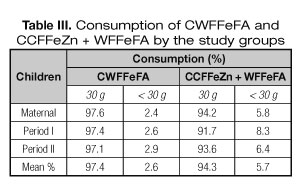
<body><![CDATA[<p align="center"><font face="Verdana" size="2"><a name="f1"></a><img src="/img/revistas/nh/v33n5/original19_figure1.jpg"></font></p>     <p>&nbsp;</p>     <p><font face="Verdana" size="2">In <a href="#t2">Table II</a>, it is shown the chemical composition of cookies that were used in this study. The results showed that the cookie with cowpea + wheat flour fortified with folic acid and iron (CCFFeZn WFFeFA +) presented the best contents both macro and micronutrients, especially the iron with 4.0 mg/100 g-1.</font></p>     <p>&nbsp;</p>     <p align="center"><font face="Verdana" size="2"><a name="t2"></a><img src="/img/revistas/nh/v33n5/original19_table2.jpg"></font></p>     <p>&nbsp;</p>     <p><font face="Verdana" size="2"><a href="#t3">Table III</a> shows that the acceptance rate of CCFFeZn + WFFeFA and CWFFeFA among pre-school children was 94.3% and 97.4%, respectively. Considering this high acceptance rate, the use of both cookie formulations as a nutritional supplement in the diet of pre-school children is effective in lowering iron-deficiency anaemia.</font></p>     <p>&nbsp;</p>     <p align="center"><font face="Verdana" size="2"><a name="t3"></a><img src="/img/revistas/nh/v33n5/original19_table3.jpg"></font></p>     <p>&nbsp;</p>     ]]></body>
<body><![CDATA[<p><font face="Verdana" size="2">The diet provided in the two CMEIs consisted of one daily meal (morning or afternoon snack) because the CMEIs had two shifts with distinct classes. A one-week menu was examined with respect to calories and levels of proteins, calcium, iron, vitamin C, and vitamin A. Considering that children remained only part-time at the CMEIs, the recommended calories and nutrient intake that should be consumed in the CMEIs corresponded to 30% of the recommended daily intake (RDI).</font></p>     <p><font face="Verdana" size="2">With respect to nutritional adequacy of the diet offered according to age in both CMEIs., it was observed that in all age groups, the consumption of calories, protein, and vitamin C exceeded the 30% recommendation in both CMEIs. By contrast, the amount of minerals (iron, calcium) and vitamin A was inadequate and below the values recommended (19). Furthermore, in the group offered CCFFeZn + WFFeFA, a nutritional level above the 30% recommendation was achieved for all age groups regarding calorie intake (64.5% and 52% in G1 and G2, respectively), protein intake (198.5% and 135.8% in G1 and G2, respectively), and iron intake (31.7%).</font></p>     <p>&nbsp;</p>     <p><font face="Verdana" size="2"><b>Discussion</b></font></p>     <p><font face="Verdana" size="2">Pre-school children at the CMEIs exhibited a similar profile, making the study sample homogeneous because the participants were located in the same area and neighbourhood and had similar socioeconomic and cultural status.</font></p>     <p><font face="Verdana" size="2">Iron-deficiency anaemia transcends the biological aspects and includes social and cultural dimensions. In this context, among the family-related variables, the education of the mother has been reported to influence the development of anaemia because it affects the care provided to the children (20,21). This variable averaged 9.2 years (higher education), similar to the results obtained by Goes et al. (22), wherein 80.7% of the mothers had more than eight years of education (at least incomplete secondary education), which corroborates the low prevalence of anaemia observed in this study because the increased education translates into more knowledge, awareness, and access to information and better understanding when choosing food.</font></p>     <p><font face="Verdana" size="2">The prevalence of anaemia among pre-school children decreased from 11.5% (n = 30) before the intervention to 4.2% (n = 11) after the intervention. These results indicate a lower prevalence of anaemia than has been reported in other studies, such as the work of Gondim et al. (23), with a prevalence of 36.5%, Souza et al. (24), with a prevalence of 51.8%, and Rocha et al. (25), with a prevalence of 30.8%. This decreased prevalence was positively affected by the improvement in housing conditions, income, and education level.</font></p>     <p><font face="Verdana" size="2">Studies show that the prevalence of anaemia is from moderate to severe magnitude in many countries, including European countries (26) and highlight the importance of doing interventions to control it as if it was a serious public health problem.</font></p>     <p><font face="Verdana" size="2">The control of anaemia can be achieved with preventive measures such as the provision of foods with wheat flour fortified with iron and folic acid to vulnerable populations, including pre-school children, following the recommendations of RDC 344 issued by the Ministry of Health (27). Other strategies include diet diversification, nutritional education programs, and promotion of breastfeeding. Furthermore, the control of anaemia involves drug therapy with ferrous sulphate through the iron supplementation program of the Ministry of Health (2005) (28,29,14). Iron deficiency in childhood stems from diet inadequacy (balance between iron sources and substances that increase or decrease iron bioavailability) and not from the unavailability of iron-containing food products. Studies conducted in Brazil have indicated that food fortification has succeeded in decreasing the prevalence of anaemia at the national level and overseas and that this strategy is easy, safe, inexpensive, effective in the short and medium term, and able to improve food quality for the population (25,30).</font></p>     <p><font face="Verdana" size="2">This study proposed the use of cookie formulation containing the cowpea cultivar BRS-XiqueXique as the iron source as well as honey, which is also a source of iron that is highly appreciated and consumed by the Brazilian population. The cookie was prepared with wheat flour enriched with iron and folic acid. The cookie formulations were prepared carefully to ensure quality, with the aim of obtaining the safest product possible within the quality standards established by the legislation.</font></p>     ]]></body>
<body><![CDATA[<p><font face="Verdana" size="2">Both cookies had a good acceptance by children, because the results and the daily monitoring of the intervention showed that almost all of the children ate the whole package (30 g daily) during the intervention period (<a href="#t3">Table III</a>). However, the results presented in <a href="#t2">table II</a> infer that the cookie consumed by G2 with cowpea meal (CCFFeZn + WFFeFA) contributed to a lower supply of lipids and carbohydrates and increased the delivery of proteins and may contribute to the most appropriate control of weight gain. In addition, they had a greater amount of iron, with greater effectiveness in controlling anaemia and increased haemoglobin.</font></p>     <p><font face="Verdana" size="2">The nutritional intervention adopted yielded excellent results in decreasing the prevalence of anaemia in both G1 and G2. The prevalence rate decreased from 10.4% (n = 12) to 7.8% (n = 9) in G1 after the intervention and from 12.2% (n = 18) to 1.4% (n = 2) in G2. The use of wheat flour fortified with iron and folic acid, as required by the RDC No. 344 (27), helped to decrease the prevalence of iron-deficiency anaemia, as demonstrated in the study by Souza Filho et al. (31). In that study, the authors compared haemoglobin levels and the occurrence of anaemia in pregnant women before and after flour fortification and reported a prevalence rate of 27.2% in the unfortified group and 11.5% in the fortified group (p &lt; 0.001). The study by Bagni et al. (32) used rice fortified with iron in anaemic pre-school children and indicated that the prevalence of anaemia decreased significantly (p &lt; 0.01) from 37.8% to 23.3% in the intervention group and from 45.4% to 33.3% in the control group. Moreira-Ara&uacute;jo et al. (7) conducted a nutritional intervention with cookie formulations containing chickpea, bovine lung, and corn and observed that the prevalence of anaemia decreased from 61.5% to 11.5%.</font></p>     <p><font face="Verdana" size="2">In this context, Moreira-Ara&uacute;jo et al. (12) used a cookie formulation prepared with cowpea using the cultivar BRS-Guaribas during a nutritional intervention among pre-school children, of which 36 (31%) were anaemic. After intervention, the formulation significantly decreased the prevalence of anaemia from 31% (n = 36) to 0.8% (n = 1), thereby confirming the importance of fortification for anaemia control and/or increasing haemoglobin levels.</font></p>     <p><font face="Verdana" size="2"><a href="#f1">Figure I</a> shows that after the administration of CWFFeFA to G1 and CCFFeZn + WFFeFA to G2, haemoglobin levels increased significantly (p = 0.0754) from 12.4 to 14.7 in G2, while the increase in G1 was lower (from 12.6 to 12.7) and not significant (p = 0.587), indicating that the suggested intervention ensured a significant increase in haemoglobin levels among pre-school children.</font></p>     <p><font face="Verdana" size="2">By the adequacy of the diet offered at the CMEIs, it was found that the nutritional recommendation of 30% of the RDI proposed by the CMEIs, according to the National School Meals Program (PNAE) (19) for the age groups 1-3 years and 4-6 years -considering that these children remained part-time at the CMEIs- was met in both age groups with respect to the intake of calories, proteins, and vitamin C. The iron levels offered in the CMEIs did not achieve the 30% RDI and corresponded to 10.8% of the RDI for all age groups. The RDI for iron is 6 g/day for children aged 1-6 years (33). With the addition of CCFFeZn + WFFeFA in the diet, iron supply was adequate for all age groups.</font></p>     <p><font face="Verdana" size="2">Of note, the impact of the nutritional intervention was higher than the impact of drug therapy because the acceptance rate of cookies and the level of enrolment in the study were high. Moreover, supplementation with ferrous sulphate faces resistance among children and their parents because of adverse effects including vomiting, diarrhoea, stained teeth, constipation, and cramps, in addition to forgetting to take the ferrous sulphate supplement and rejection by the child (34).</font></p>     <p>&nbsp;</p>     <p><font face="Verdana" size="2"><b>Conclusion</b></font></p>     <p><font face="Verdana" size="2">The use of two types of fortified cookie formulations (one prepared with fortified cowpea flour and the other prepared with fortified wheat flour) decreased the prevalence of anaemia among pre-school children, and the consumption of the food product prepared with enriched cowpea flour led to a more pronounced decrease in anaemia. Therefore, cowpea is a viable option for use in nutritional intervention because of its low cost and routine use by the population, and this ingredient resulted in a food product with adequate composition and acceptance by the population. In addition, its effectiveness as a dietary supplement in the control of iron-deficiency anaemia was demonstrated.</font></p>     <p>&nbsp;</p>     ]]></body>
<body><![CDATA[<p><font face="Verdana" size="2"><b>References</b></font></p>     <!-- ref --><p><font face="Verdana" size="2">1. Reithinger R, Ngondi JM, Graves PM, Hwang J, Getachew A, Jima D; Group Ethiopia Malaria Indicator Survey Working. Risk factors for anemia in children under 6 years of age in Ethiopia: Analysis of the data from the cross-sectional Malaria Indicator Survey, 2007. Transactions of the Royal Society of Tropical Medicine and Hygiene 2013;107(12):769-76.    &nbsp;&nbsp;&nbsp;&nbsp;&nbsp;&nbsp;&nbsp;&nbsp;[&#160;<a href="javascript:void(0);" onclick="javascript: window.open('/scielo.php?script=sci_nlinks&ref=3894262&pid=S0212-1611201600050002000001&lng=','','width=640,height=500,resizable=yes,scrollbars=1,menubar=yes,');">Links</a>&#160;]<!-- end-ref --></font></p>    <!-- ref --><p><font face="Verdana" size="2">2. WHO/FAO. Guidelines on food fortification with micronutrients. World health Organization, Food and Agricultural Organization of the United Nations; 2006.    &nbsp;&nbsp;&nbsp;&nbsp;&nbsp;&nbsp;&nbsp;&nbsp;[&#160;<a href="javascript:void(0);" onclick="javascript: window.open('/scielo.php?script=sci_nlinks&ref=3894264&pid=S0212-1611201600050002000002&lng=','','width=640,height=500,resizable=yes,scrollbars=1,menubar=yes,');">Links</a>&#160;]<!-- end-ref --></font></p>    <!-- ref --><p><font face="Verdana" size="2">3. Marques MR, Silva LMO, Pessoa MLSB, Ara&uacute;jo MAM, Moreira-Ara&uacute;jo RSR. Risk and Prevalence of Anemia among Women Attending Public and Private Universities. Ecol Food Nutr 2015;54(5):520-8.    &nbsp;&nbsp;&nbsp;&nbsp;&nbsp;&nbsp;&nbsp;&nbsp;[&#160;<a href="javascript:void(0);" onclick="javascript: window.open('/scielo.php?script=sci_nlinks&ref=3894266&pid=S0212-1611201600050002000003&lng=','','width=640,height=500,resizable=yes,scrollbars=1,menubar=yes,');">Links</a>&#160;]<!-- end-ref --></font></p>    <!-- ref --><p><font face="Verdana" size="2">4. De Benoist B, McLean E, Egli I, Cogswell M (eds.). Worldwide Prevalence of Anaemia 1993-2005. Geneva: World Health Organization; 2008. WHO Global Database on Anaemia: <a target="_blank" href="http://www.who.int/vmnis/publications/anaemia_prevalence/en/index.html">http://www.who.int/vmnis/publications/anaemia_prevalence/en/index.html</a>. (last accessed January 2016).    &nbsp;&nbsp;&nbsp;&nbsp;&nbsp;&nbsp;&nbsp;&nbsp;[&#160;<a href="javascript:void(0);" onclick="javascript: window.open('/scielo.php?script=sci_nlinks&ref=3894268&pid=S0212-1611201600050002000004&lng=','','width=640,height=500,resizable=yes,scrollbars=1,menubar=yes,');">Links</a>&#160;]<!-- end-ref --></font></p>    <!-- ref --><p><font face="Verdana" size="2">5. Heijblom GS, Santos, LMP. Anemia ferropriva em escolares da primeira s&eacute;rie do ensino fundamental da rede p&uacute;blica de educa&ccedil;&atilde;o de uma regi&atilde;o de Bras&iacute;lia, DF. (Iron-deficiency anaemia in first grade students of public primary schools in Bras&iacute;lia, Federal District.) Revista Brasileira de Epidemiologia 2007;10(2):258-66.    &nbsp;&nbsp;&nbsp;&nbsp;&nbsp;&nbsp;&nbsp;&nbsp;[&#160;<a href="javascript:void(0);" onclick="javascript: window.open('/scielo.php?script=sci_nlinks&ref=3894270&pid=S0212-1611201600050002000005&lng=','','width=640,height=500,resizable=yes,scrollbars=1,menubar=yes,');">Links</a>&#160;]<!-- end-ref --></font></p>    <!-- ref --><p><font face="Verdana" size="2">6. Batista Filho M, Souza AI, Bresani CC. Anemia como problema de sa&uacute;de p&uacute;blica: uma realidade atual. (Anaemia as a public health problem: a current reality.) Ci&ecirc;ncia e Sa&uacute;de coletiva, Rio de Janeiro 2008;13(6):1917-22.    &nbsp;&nbsp;&nbsp;&nbsp;&nbsp;&nbsp;&nbsp;&nbsp;[&#160;<a href="javascript:void(0);" onclick="javascript: window.open('/scielo.php?script=sci_nlinks&ref=3894272&pid=S0212-1611201600050002000006&lng=','','width=640,height=500,resizable=yes,scrollbars=1,menubar=yes,');">Links</a>&#160;]<!-- end-ref --></font></p>    <!-- ref --><p><font face="Verdana" size="2">7. Moreira-Ara&uacute;jo RSR, Ara&uacute;jo MAM, Ar&ecirc;as JA. Fortified food made by extrusion of a mixture of chickpea corn and bovine lung controls iron-deficiency anaemia in preschool children. Food Chemistry 2008;107:158-64.    &nbsp;&nbsp;&nbsp;&nbsp;&nbsp;&nbsp;&nbsp;&nbsp;[&#160;<a href="javascript:void(0);" onclick="javascript: window.open('/scielo.php?script=sci_nlinks&ref=3894274&pid=S0212-1611201600050002000007&lng=','','width=640,height=500,resizable=yes,scrollbars=1,menubar=yes,');">Links</a>&#160;]<!-- end-ref --></font></p>    <!-- ref --><p><font face="Verdana" size="2">8. Allen L, de Benoist B, Dary O, Hurrell R, editors. Guidelines on food fortification with micronutrients. Geneva: WHO; 2006.    &nbsp;&nbsp;&nbsp;&nbsp;&nbsp;&nbsp;&nbsp;&nbsp;[&#160;<a href="javascript:void(0);" onclick="javascript: window.open('/scielo.php?script=sci_nlinks&ref=3894276&pid=S0212-1611201600050002000008&lng=','','width=640,height=500,resizable=yes,scrollbars=1,menubar=yes,');">Links</a>&#160;]<!-- end-ref --></font></p>    <!-- ref --><p><font face="Verdana" size="2">9. Cakmak, I. Enrichment of cereal grains with zinc: Agronomic or genetic biofortification? Plant Soil 2008;302:1-17.    &nbsp;&nbsp;&nbsp;&nbsp;&nbsp;&nbsp;&nbsp;&nbsp;[&#160;<a href="javascript:void(0);" onclick="javascript: window.open('/scielo.php?script=sci_nlinks&ref=3894278&pid=S0212-1611201600050002000009&lng=','','width=640,height=500,resizable=yes,scrollbars=1,menubar=yes,');">Links</a>&#160;]<!-- end-ref --></font></p>    <!-- ref --><p><font face="Verdana" size="2">10. Rios SA, Alves KR, Costa NMB, Martino HD. Biofortifica&ccedil;&atilde;o: culturas enriquecidas com micronutrientes pelo melhoramento gen&eacute;tico. (Biofortification: crops enriched with micronutrients through plant breeding.) Revista Ceres 2009.    &nbsp;&nbsp;&nbsp;&nbsp;&nbsp;&nbsp;&nbsp;&nbsp;[&#160;<a href="javascript:void(0);" onclick="javascript: window.open('/scielo.php?script=sci_nlinks&ref=3894280&pid=S0212-1611201600050002000010&lng=','','width=640,height=500,resizable=yes,scrollbars=1,menubar=yes,');">Links</a>&#160;]<!-- end-ref --></font></p>    <!-- ref --><p><font face="Verdana" size="2">11. Freire-filho FR, Ribeiro VQ, Rocha MM, Silva KJD, Nogueira MSR, Rodrigues EV. Produ&ccedil;&atilde;o, Melhoramento Gen&eacute;tico e Potencialidades do Feij&atilde;o-Caupi no Brasil. (Production, Breeding and Potential of cowpea in Brazil.) IV Reuni&atilde;o de Biofortifica&ccedil;&atilde;o (Biofortification Meeting). Teresina, PI; 2011. p. 21.    &nbsp;&nbsp;&nbsp;&nbsp;&nbsp;&nbsp;&nbsp;&nbsp;[&#160;<a href="javascript:void(0);" onclick="javascript: window.open('/scielo.php?script=sci_nlinks&ref=3894282&pid=S0212-1611201600050002000011&lng=','','width=640,height=500,resizable=yes,scrollbars=1,menubar=yes,');">Links</a>&#160;]<!-- end-ref --></font></p>    <!-- ref --><p><font face="Verdana" size="2">12. Moreira-Ara&uacute;jo RSR, Martins LS, Meneses NA, Frota KM, Morgano MA, Ara&uacute;jo MAM. Utiliza&ccedil;&atilde;o de biscoito &agrave; base de farinha de feij&atilde;o-caupi em pr&eacute;-escolares com anaemia ferropriva. (Use of cookies prepared with cowpea flour in pre-school children with iron-deficiency anaemia.) Anais do II CONAC: Congresso Nacional de Feij&atilde;o-caupi; 2009.    &nbsp;&nbsp;&nbsp;&nbsp;&nbsp;&nbsp;&nbsp;&nbsp;[&#160;<a href="javascript:void(0);" onclick="javascript: window.open('/scielo.php?script=sci_nlinks&ref=3894284&pid=S0212-1611201600050002000012&lng=','','width=640,height=500,resizable=yes,scrollbars=1,menubar=yes,');">Links</a>&#160;]<!-- end-ref --></font></p>    <!-- ref --><p><font face="Verdana" size="2">13. Hainlaine A. Standard methods of clinical chemistry. New York: Academic Press; 1958. p. 2-52.    &nbsp;&nbsp;&nbsp;&nbsp;&nbsp;&nbsp;&nbsp;&nbsp;[&#160;<a href="javascript:void(0);" onclick="javascript: window.open('/scielo.php?script=sci_nlinks&ref=3894286&pid=S0212-1611201600050002000013&lng=','','width=640,height=500,resizable=yes,scrollbars=1,menubar=yes,');">Links</a>&#160;]<!-- end-ref --></font></p>    <!-- ref --><p><font face="Verdana" size="2">14. Moreira-Ara&uacute;jo RSR. Utiliza&ccedil;&atilde;o do Snack com elevado conte&uacute;do de ferro em pr&eacute;-escolares para controle da anaemia ferropriva. (Use of snacks with high iron content in pre-school children for the control of iron-deficiency anaemia.) S&atilde;o Paulo: SP, FCF, 2000. Originally presented as a part of a PhD thesis, Universidade de S&atilde;o Paulo (University of S&atilde;o Paulo); 2000.    &nbsp;&nbsp;&nbsp;&nbsp;&nbsp;&nbsp;&nbsp;&nbsp;[&#160;<a href="javascript:void(0);" onclick="javascript: window.open('/scielo.php?script=sci_nlinks&ref=3894288&pid=S0212-1611201600050002000014&lng=','','width=640,height=500,resizable=yes,scrollbars=1,menubar=yes,');">Links</a>&#160;]<!-- end-ref --></font></p>    <!-- ref --><p><font face="Verdana" size="2">15. Organiza&ccedil;&atilde;o Mundial de Sa&uacute;de. Lucha contra la anaemia nutricional, especialmente contra la carencia de hierro: Informes ADI/OIEA/OMS. (World Health Organization. Fight against nutritional anaemia, especially iron deficiency anaemia: ADI/IAEA/WHO reports.) S&eacute;rie de informes T&eacute;cnicos, 580. Genebra: OMS; 2001.    &nbsp;&nbsp;&nbsp;&nbsp;&nbsp;&nbsp;&nbsp;&nbsp;[&#160;<a href="javascript:void(0);" onclick="javascript: window.open('/scielo.php?script=sci_nlinks&ref=3894290&pid=S0212-1611201600050002000015&lng=','','width=640,height=500,resizable=yes,scrollbars=1,menubar=yes,');">Links</a>&#160;]<!-- end-ref --></font></p>    <!-- ref --><p><font face="Verdana" size="2">16. Frota KMG, Morgano MA, Silva MG, Ara&uacute;jo MAM, Moreira-Ara&uacute;jo RSR. Utiliza&ccedil;&atilde;o da farinha de feij&atilde;o-caupi (<i>Vigna unguiculata</i> (L.) Walp) na elabora&ccedil;&atilde;o de produtos de panifica&ccedil;&atilde;o. (Use of cowpea (<i>Vigna unguiculata</i> (L.) Walp) flour in the preparation of bakery products.) Ci&ecirc;ncia e Tecnologia de Alimentos. Campinas 2010;30:44-50.    &nbsp;&nbsp;&nbsp;&nbsp;&nbsp;&nbsp;&nbsp;&nbsp;[&#160;<a href="javascript:void(0);" onclick="javascript: window.open('/scielo.php?script=sci_nlinks&ref=3894292&pid=S0212-1611201600050002000016&lng=','','width=640,height=500,resizable=yes,scrollbars=1,menubar=yes,');">Links</a>&#160;]<!-- end-ref --></font></p>    <!-- ref --><p><font face="Verdana" size="2">17. Association of Official Analytical Chemistry (AOAC). Official Methods of Analysis of the AOAC International. 18<sup>th</sup> ed. Gaithersburg, MD, USA: AOAC; 2011. p. 1025.    &nbsp;&nbsp;&nbsp;&nbsp;&nbsp;&nbsp;&nbsp;&nbsp;[&#160;<a href="javascript:void(0);" onclick="javascript: window.open('/scielo.php?script=sci_nlinks&ref=3894294&pid=S0212-1611201600050002000017&lng=','','width=640,height=500,resizable=yes,scrollbars=1,menubar=yes,');">Links</a>&#160;]<!-- end-ref --></font></p>    <!-- ref --><p><font face="Verdana" size="2">18. Horwitz W, Latimer JRG (eds.). Official Methods of Analysis of the Association of Official Analytical Chemists. 17<sup>th</sup> ed. Gaithersburg, Maryland: AOAC; 2000, v. 2, chap. 50 (met. 985.35; 984.27, p. 15-18).    &nbsp;&nbsp;&nbsp;&nbsp;&nbsp;&nbsp;&nbsp;&nbsp;[&#160;<a href="javascript:void(0);" onclick="javascript: window.open('/scielo.php?script=sci_nlinks&ref=3894296&pid=S0212-1611201600050002000018&lng=','','width=640,height=500,resizable=yes,scrollbars=1,menubar=yes,');">Links</a>&#160;]<!-- end-ref --></font></p>    <!-- ref --><p><font face="Verdana" size="2">19. Brasil, Conselho Deliberativo. Resolu&ccedil;&atilde;o /CD/FNDE n<sup>o</sup>26 de 17 de junho de 2013. Disp&otilde;e sobre o atendimento escolar aos alunos da aten&ccedil;&atilde;o b&aacute;sica no &acirc;mbito do programa nacional de alimenta&ccedil;&atilde;o escolar-PNAE. Available at &lt;/<a target="_blank" href="http://www.fnde.gov.br/legislacão/resoluções/">www.fnde.gov.br/legislac&atilde;o/resolu&ccedil;&otilde;es/</a>&gt;. (Deliberative Council. Resolution/CD/ENDF No. 26 of 17 June 2013 provides on school attendance for students assisted by primary health care services under the national school meals program - PNAE. Available at &lt;/<a target="_blank"  href="http://www.fnde.gov.br/legislacão/resoluções/">www.fnde.gov.br/legislac&atilde;o/resolu&ccedil;&otilde;es/</a>&gt;.) Accessed on: 12/09/2013.    &nbsp;&nbsp;&nbsp;&nbsp;&nbsp;&nbsp;&nbsp;&nbsp;[&#160;<a href="javascript:void(0);" onclick="javascript: window.open('/scielo.php?script=sci_nlinks&ref=3894298&pid=S0212-1611201600050002000019&lng=','','width=640,height=500,resizable=yes,scrollbars=1,menubar=yes,');">Links</a>&#160;]<!-- end-ref --></font></p>    <!-- ref --><p><font face="Verdana" size="2">20. Os&oacute;rio MM. Fatores determinantes da anaemia em crian&ccedil;as. (Determinants of anaemia in children.) Jornal de Pediatria 2002;78(4):269-78.    &nbsp;&nbsp;&nbsp;&nbsp;&nbsp;&nbsp;&nbsp;&nbsp;[&#160;<a href="javascript:void(0);" onclick="javascript: window.open('/scielo.php?script=sci_nlinks&ref=3894300&pid=S0212-1611201600050002000020&lng=','','width=640,height=500,resizable=yes,scrollbars=1,menubar=yes,');">Links</a>&#160;]<!-- end-ref --></font></p>    <!-- ref --><p><font face="Verdana" size="2">21. Spinelli MGN, Marchioni DML, Souza JMP, Souza SB, Szarfarc SC.Fatores de risco para anaemia em crian&ccedil;as de 6 a 12 meses no Brasil. (Risk factors for anaemia in children aged 6 to 12 months in Brazil.) Revista Panamericana Salude Publica/Panamerican American Journal P&uacute;blic Health 2005;17(2):84-91.    &nbsp;&nbsp;&nbsp;&nbsp;&nbsp;&nbsp;&nbsp;&nbsp;[&#160;<a href="javascript:void(0);" onclick="javascript: window.open('/scielo.php?script=sci_nlinks&ref=3894302&pid=S0212-1611201600050002000021&lng=','','width=640,height=500,resizable=yes,scrollbars=1,menubar=yes,');">Links</a>&#160;]<!-- end-ref --></font></p>    <!-- ref --><p><font face="Verdana" size="2">22. Goes VF, et al. Avalia&ccedil;&atilde;o do estado nutricional e do consumo alimentar de pr&eacute;-escolares atendidos nos centros municipais de educa&ccedil;&atilde;o infantil de Guarapuara- PR. (Assessment of the nutritional status and dietary intake of pre-school children attending childhood municipal education centres in Guarapuara, state of Paran&aacute;.) Alimentos e Nutri&ccedil;&atilde;o. Araraquara 2012;13(1):121-29.    &nbsp;&nbsp;&nbsp;&nbsp;&nbsp;&nbsp;&nbsp;&nbsp;[&#160;<a href="javascript:void(0);" onclick="javascript: window.open('/scielo.php?script=sci_nlinks&ref=3894304&pid=S0212-1611201600050002000022&lng=','','width=640,height=500,resizable=yes,scrollbars=1,menubar=yes,');">Links</a>&#160;]<!-- end-ref --></font></p>    <!-- ref --><p><font face="Verdana" size="2">23. Gondim SSR, et al. Magnitude, tend&ecirc;ncia temporal e fatores associados &agrave; anaemia em crian&ccedil;as do Estado da Para&iacute;ba. (Magnitude, temporal trends, and factors associated with anaemia in children in the state of Para&iacute;ba.) Revista Sa&uacute;de P&uacute;blica 2012;46(4):649-56.    &nbsp;&nbsp;&nbsp;&nbsp;&nbsp;&nbsp;&nbsp;&nbsp;[&#160;<a href="javascript:void(0);" onclick="javascript: window.open('/scielo.php?script=sci_nlinks&ref=3894306&pid=S0212-1611201600050002000023&lng=','','width=640,height=500,resizable=yes,scrollbars=1,menubar=yes,');">Links</a>&#160;]<!-- end-ref --></font></p>    <!-- ref --><p><font face="Verdana" size="2">24. Souza OF, Macedo L F, Oliveira, CSM, Ara&uacute;jo TS, Muniz PT. Prevalence and Associated Factors to Anaemia in Children. Journal of Human Growth and Development 2012;22(3):307-13.    &nbsp;&nbsp;&nbsp;&nbsp;&nbsp;&nbsp;&nbsp;&nbsp;[&#160;<a href="javascript:void(0);" onclick="javascript: window.open('/scielo.php?script=sci_nlinks&ref=3894308&pid=S0212-1611201600050002000024&lng=','','width=640,height=500,resizable=yes,scrollbars=1,menubar=yes,');">Links</a>&#160;]<!-- end-ref --></font></p>    <!-- ref --><p><font face="Verdana" size="2">25. Rocha DS, Capanema FD, Netto MP, Franceschini SCC, Lamounier JA. Preval&ecirc;ncia e fatores determinantes da anaemia em crian&ccedil;as assistidas em creches de Belo Horizonte-MG. (Prevalence and determinants of anaemia in children attending day-care centres in Belo Horizonte, state of Minas Gerais.) Revista Brasileira de Epidemiologia 2012;15(3):675-84.    &nbsp;&nbsp;&nbsp;&nbsp;&nbsp;&nbsp;&nbsp;&nbsp;[&#160;<a href="javascript:void(0);" onclick="javascript: window.open('/scielo.php?script=sci_nlinks&ref=3894310&pid=S0212-1611201600050002000025&lng=','','width=640,height=500,resizable=yes,scrollbars=1,menubar=yes,');">Links</a>&#160;]<!-- end-ref --></font></p>    <!-- ref --><p><font face="Verdana" size="2">26. Eussen S, Alles M, Uijterschout L, Brus F, Van der Horst-Graat J. Iron intake and status of children aged 6-36 months in Europe: A systematic review. Ann Nutr Metab 2015;66:80-92.    &nbsp;&nbsp;&nbsp;&nbsp;&nbsp;&nbsp;&nbsp;&nbsp;[&#160;<a href="javascript:void(0);" onclick="javascript: window.open('/scielo.php?script=sci_nlinks&ref=3894312&pid=S0212-1611201600050002000026&lng=','','width=640,height=500,resizable=yes,scrollbars=1,menubar=yes,');">Links</a>&#160;]<!-- end-ref --></font></p>    <!-- ref --><p><font face="Verdana" size="2">27. Brasil. Ag&ecirc;ncia Nacional de Vigil&acirc;ncia Sanit&aacute;ria. Resolu&ccedil;&atilde;o RDC n<sup>o</sup>344, de 13 de dezembro de 2002. (National Health Surveillance Agency. RDC Resolution No. 344 of December 13, 2002.) Di&aacute;rio Oficial da Uni&atilde;o. Bras&iacute;lia, 2002. Available at &lt;<a target="_blank" href="http://portal.anvisa.gov.br">portal.anvisa.gov.br</a>&gt; Accessed on: 06/08/2013.    &nbsp;&nbsp;&nbsp;&nbsp;&nbsp;&nbsp;&nbsp;&nbsp;[&#160;<a href="javascript:void(0);" onclick="javascript: window.open('/scielo.php?script=sci_nlinks&ref=3894314&pid=S0212-1611201600050002000027&lng=','','width=640,height=500,resizable=yes,scrollbars=1,menubar=yes,');">Links</a>&#160;]<!-- end-ref --></font></p>    <!-- ref --><p><font face="Verdana" size="2">28. Organiza&ccedil;&atilde;o Mundial de Saude (OMS) (World Health Organization (WHO)). Learning from large-scale community-based programmes to improve breastfeeding practices. Geneva. World Health Organization, United Nations Children's Fund/ UNICEF, Academy for Educational development/EAD, 2008. Available at &lt;<a target="_blank" href="http://www.who.int/nutrition/publications/infantfeeding/">http://www.who.int/nutrition/publications/infantfeeding/</a>&gt; Accessed on: 07/01/2013.    &nbsp;&nbsp;&nbsp;&nbsp;&nbsp;&nbsp;&nbsp;&nbsp;[&#160;<a href="javascript:void(0);" onclick="javascript: window.open('/scielo.php?script=sci_nlinks&ref=3894316&pid=S0212-1611201600050002000028&lng=','','width=640,height=500,resizable=yes,scrollbars=1,menubar=yes,');">Links</a>&#160;]<!-- end-ref --></font></p>    <!-- ref --><p><font face="Verdana" size="2">29. Brasil. Minist&eacute;rio da Sa&uacute;de. Manual operacional do Programa Nacional de Suplementa&ccedil;&atilde;o de Ferro. (Ministry of Health. Operating Manual of the National Iron Supplementation Program.) Bras&iacute;lia: Minist&eacute;rio da Sa&uacute;de, 2005. Available at &lt;<a target="_blank" href="http://bvsms.saude.gov.br">bvsms.saude.gov.br</a>&gt; Accessed on: 05/04/2012.    &nbsp;&nbsp;&nbsp;&nbsp;&nbsp;&nbsp;&nbsp;&nbsp;[&#160;<a href="javascript:void(0);" onclick="javascript: window.open('/scielo.php?script=sci_nlinks&ref=3894318&pid=S0212-1611201600050002000029&lng=','','width=640,height=500,resizable=yes,scrollbars=1,menubar=yes,');">Links</a>&#160;]<!-- end-ref --></font></p>    <!-- ref --><p><font face="Verdana" size="2">30. Heijblom GS, Santos LMP. Anemia ferropriva em escolares da primeira s&eacute;rie do ensino fundamental da rede p&uacute;blica de educa&ccedil;&atilde;o de uma regi&atilde;o de Bras&iacute;lia, DF. (Iron-deficiency anaemia in first grade students of public primary schools in Brasilia, Federal District) Revista Brasileira de Epidemiologia 2007;10(2):258-66.    &nbsp;&nbsp;&nbsp;&nbsp;&nbsp;&nbsp;&nbsp;&nbsp;[&#160;<a href="javascript:void(0);" onclick="javascript: window.open('/scielo.php?script=sci_nlinks&ref=3894320&pid=S0212-1611201600050002000030&lng=','','width=640,height=500,resizable=yes,scrollbars=1,menubar=yes,');">Links</a>&#160;]<!-- end-ref --></font></p>    <!-- ref --><p><font face="Verdana" size="2">31. Sousa-Fillho MD, Damasceno CVX, Szarfarc SC, Fujimori E, Ara&uacute;jo MAM, Moreira-Ara&uacute;jo RSR. Fortifica&ccedil;&atilde;o das farinhas com ferro e controle da anaemia em gestantes de Teresina, Piau&iacute;, Brasil. (Fortification of flour with iron and anaemia control in pregnant women in Teresina, state of Piau&iacute;, Brazil). Revista de Nutri&ccedil;&atilde;o. Campinas 2011;24(5):679-88.    &nbsp;&nbsp;&nbsp;&nbsp;&nbsp;&nbsp;&nbsp;&nbsp;[&#160;<a href="javascript:void(0);" onclick="javascript: window.open('/scielo.php?script=sci_nlinks&ref=3894322&pid=S0212-1611201600050002000031&lng=','','width=640,height=500,resizable=yes,scrollbars=1,menubar=yes,');">Links</a>&#160;]<!-- end-ref --></font></p>    <!-- ref --><p><font face="Verdana" size="2">32. Bagni UV, Bai&atilde;o MR, Santos MMAS, Lu&iacute;z RR, Veiga GV. Efeito da fortifica&ccedil;&atilde;o semanal do arroz com ferro quelato sobre a frequ&ecirc;ncia de anaemia e concentra&ccedil;&atilde;o de hemoglobina em crian&ccedil;as de creches municipais do Rio de Janeiro, Brasil. (Effect of weekly fortification of rice with iron chelate on the prevalence of anaemia and haemoglobin concentration in children attending day care centres in Rio de Janeiro, Brazil.) Cadernos de sa&uacute;de P&uacute;blica, Rio de Janeiro 2009;25(2):291-302.    &nbsp;&nbsp;&nbsp;&nbsp;&nbsp;&nbsp;&nbsp;&nbsp;[&#160;<a href="javascript:void(0);" onclick="javascript: window.open('/scielo.php?script=sci_nlinks&ref=3894324&pid=S0212-1611201600050002000032&lng=','','width=640,height=500,resizable=yes,scrollbars=1,menubar=yes,');">Links</a>&#160;]<!-- end-ref --></font></p>    <!-- ref --><p><font face="Verdana" size="2">33. Brasil. Minist&eacute;rio da Sa&uacute;de. Ag&ecirc;ncia Nacional de Vigil&acirc;ncia Sanit&aacute;ria. Resolu&ccedil;&atilde;o RDC n<sup>o</sup> 269, de 22 de Setembro de 2005. Regulamento T&eacute;cnico sobre a Ingest&atilde;o Di&aacute;ria Recomendada (IDR) de prote&iacute;na, vitaminas e minerais. (Ministry of Health. Technical Regulations on Recommended Daily Intake (RDI) of protein, vitamins, and minerals.) Di&aacute;rio Oficial da Rep&uacute;blica Federativa do Brasil, Poder Executivo, Bras&iacute;lia, August 22, 2005. Available at &lt;<a target="_blank" href="http://portal.anvisa.gov.br">http://portal.anvisa.gov.br</a>&gt; Accessed on: 09/22/2013.    &nbsp;&nbsp;&nbsp;&nbsp;&nbsp;&nbsp;&nbsp;&nbsp;[&#160;<a href="javascript:void(0);" onclick="javascript: window.open('/scielo.php?script=sci_nlinks&ref=3894326&pid=S0212-1611201600050002000033&lng=','','width=640,height=500,resizable=yes,scrollbars=1,menubar=yes,');">Links</a>&#160;]<!-- end-ref --></font></p>    <!-- ref --><p><font face="Verdana" size="2">34. Azeredo CM, Cotta RMM, Silva LS, Franceschini SCC, Sant'ana LFR, Lamounier JA. A problem&aacute;tica da ades&atilde;o na preven&ccedil;&atilde;o da anaemia ferropriva e suplementa&ccedil;&atilde;o com sais de ferro no munic&iacute;pio de Vi&ccedil;osa (MG). (The problem of adherence for the prevention of iron-deficiency anaemia and supplementation with iron salts in Vi&ccedil;osa, state of Minas Gerais.) Ci&ecirc;ncia &amp; Sa&uacute;de Coletiva 2013;18(3):827-36.    &nbsp;&nbsp;&nbsp;&nbsp;&nbsp;&nbsp;&nbsp;&nbsp;[&#160;<a href="javascript:void(0);" onclick="javascript: window.open('/scielo.php?script=sci_nlinks&ref=3894328&pid=S0212-1611201600050002000034&lng=','','width=640,height=500,resizable=yes,scrollbars=1,menubar=yes,');">Links</a>&#160;]<!-- end-ref --></font></p>     <p>&nbsp;</p>     ]]></body>
<body><![CDATA[<p>&nbsp;</p>     <p><font face="Verdana" size="2"><a href="#top"><img border="0" src="/img/revistas/nh/v33n5/seta.gif" width="15" height="17"></a><a name="bajo"></a><b>Correspondence:</b>    <br>Regilda Saraiva dos Reis Moreira-Araújo.    <br>Faculty of Science and Technology of Maranhão (FACEMA). Brasil    <br>e-mail: <a href="mailto:regilda@ufpi.edu.br">regilda@ufpi.edu.br</a></font></p>     <p><font face="Verdana" size="2">Received: 16/12/2015    <br>Accepted: 16/02/2016</font></p>      ]]></body><back>
<ref-list>
<ref id="B1">
<label>1</label><nlm-citation citation-type="journal">
<person-group person-group-type="author">
<name>
<surname><![CDATA[Reithinger]]></surname>
<given-names><![CDATA[R]]></given-names>
</name>
<name>
<surname><![CDATA[Ngondi]]></surname>
<given-names><![CDATA[JM]]></given-names>
</name>
<name>
<surname><![CDATA[Graves]]></surname>
<given-names><![CDATA[PM]]></given-names>
</name>
<name>
<surname><![CDATA[Hwang]]></surname>
<given-names><![CDATA[J]]></given-names>
</name>
<name>
<surname><![CDATA[Getachew]]></surname>
<given-names><![CDATA[A]]></given-names>
</name>
<name>
<surname><![CDATA[Jima]]></surname>
<given-names><![CDATA[D]]></given-names>
</name>
</person-group>
<collab>Group Ethiopia Malaria Indicator Survey Working</collab>
<article-title xml:lang="en"><![CDATA[Risk factors for anemia in children under 6 years of age in Ethiopia: Analysis of the data from the cross-sectional Malaria Indicator Survey, 2007]]></article-title>
<source><![CDATA[Transactions of the Royal Society of Tropical Medicine and Hygiene]]></source>
<year>2013</year>
<volume>107</volume>
<numero>12</numero>
<issue>12</issue>
<page-range>769-76</page-range></nlm-citation>
</ref>
<ref id="B2">
<label>2</label><nlm-citation citation-type="book">
<collab>WHO</collab>
<collab>FAO</collab>
<source><![CDATA[Guidelines on food fortification with micronutrients]]></source>
<year>2006</year>
<publisher-name><![CDATA[World health OrganizationFood and Agricultural Organization of the United Nations]]></publisher-name>
</nlm-citation>
</ref>
<ref id="B3">
<label>3</label><nlm-citation citation-type="journal">
<person-group person-group-type="author">
<name>
<surname><![CDATA[Marques]]></surname>
<given-names><![CDATA[MR]]></given-names>
</name>
<name>
<surname><![CDATA[Silva]]></surname>
<given-names><![CDATA[LMO]]></given-names>
</name>
<name>
<surname><![CDATA[Pessoa]]></surname>
<given-names><![CDATA[MLSB]]></given-names>
</name>
<name>
<surname><![CDATA[Araújo]]></surname>
<given-names><![CDATA[MAM]]></given-names>
</name>
<name>
<surname><![CDATA[Moreira-Araújo]]></surname>
<given-names><![CDATA[RSR]]></given-names>
</name>
</person-group>
<article-title xml:lang="en"><![CDATA[Risk and Prevalence of Anemia among Women Attending Public and Private Universities]]></article-title>
<source><![CDATA[Ecol Food Nutr]]></source>
<year>2015</year>
<volume>54</volume>
<numero>5</numero>
<issue>5</issue>
<page-range>520-8</page-range></nlm-citation>
</ref>
<ref id="B4">
<label>4</label><nlm-citation citation-type="book">
<person-group person-group-type="author">
<name>
<surname><![CDATA[De Benoist]]></surname>
<given-names><![CDATA[B]]></given-names>
</name>
<name>
<surname><![CDATA[McLean]]></surname>
<given-names><![CDATA[E]]></given-names>
</name>
<name>
<surname><![CDATA[Egli]]></surname>
<given-names><![CDATA[I]]></given-names>
</name>
<name>
<surname><![CDATA[Cogswell]]></surname>
<given-names><![CDATA[M]]></given-names>
</name>
</person-group>
<source><![CDATA[Worldwide Prevalence of Anaemia 1993-2005]]></source>
<year>2008</year>
<publisher-loc><![CDATA[Geneva ]]></publisher-loc>
<publisher-name><![CDATA[World Health Organization]]></publisher-name>
</nlm-citation>
</ref>
<ref id="B5">
<label>5</label><nlm-citation citation-type="journal">
<person-group person-group-type="author">
<name>
<surname><![CDATA[Heijblom]]></surname>
<given-names><![CDATA[GS]]></given-names>
</name>
<name>
<surname><![CDATA[Santos]]></surname>
<given-names><![CDATA[LMP]]></given-names>
</name>
</person-group>
<article-title xml:lang="en"><![CDATA[Iron-deficiency anaemia in first grade students of public primary schools in Brasília, Federal District]]></article-title>
<source><![CDATA[Revista Brasileira de Epidemiologia]]></source>
<year>2007</year>
<volume>10</volume>
<numero>2</numero>
<issue>2</issue>
<page-range>258-66</page-range></nlm-citation>
</ref>
<ref id="B6">
<label>6</label><nlm-citation citation-type="journal">
<person-group person-group-type="author">
<name>
<surname><![CDATA[Batista Filho]]></surname>
<given-names><![CDATA[M]]></given-names>
</name>
<name>
<surname><![CDATA[Souza]]></surname>
<given-names><![CDATA[AI]]></given-names>
</name>
<name>
<surname><![CDATA[Bresani]]></surname>
<given-names><![CDATA[CC]]></given-names>
</name>
</person-group>
<article-title xml:lang="en"><![CDATA[Anaemia as a public health problem: a current reality]]></article-title>
<source><![CDATA[Ciência e Saúde coletiva, Rio de Janeiro]]></source>
<year>2008</year>
<volume>13</volume>
<numero>6</numero>
<issue>6</issue>
<page-range>1917-22</page-range></nlm-citation>
</ref>
<ref id="B7">
<label>7</label><nlm-citation citation-type="journal">
<person-group person-group-type="author">
<name>
<surname><![CDATA[Moreira-Araújo]]></surname>
<given-names><![CDATA[RSR]]></given-names>
</name>
<name>
<surname><![CDATA[Araújo]]></surname>
<given-names><![CDATA[MAM]]></given-names>
</name>
<name>
<surname><![CDATA[Arêas]]></surname>
<given-names><![CDATA[JA]]></given-names>
</name>
</person-group>
<article-title xml:lang="en"><![CDATA[Fortified food made by extrusion of a mixture of chickpea corn and bovine lung controls iron-deficiency anaemia in preschool children]]></article-title>
<source><![CDATA[Food Chemistry]]></source>
<year>2008</year>
<volume>107</volume>
<page-range>158-64</page-range></nlm-citation>
</ref>
<ref id="B8">
<label>8</label><nlm-citation citation-type="book">
<person-group person-group-type="author">
<name>
<surname><![CDATA[Allen]]></surname>
<given-names><![CDATA[L]]></given-names>
</name>
<name>
<surname><![CDATA[de Benoist]]></surname>
<given-names><![CDATA[B]]></given-names>
</name>
<name>
<surname><![CDATA[Dary]]></surname>
<given-names><![CDATA[O]]></given-names>
</name>
<name>
<surname><![CDATA[Hurrell]]></surname>
<given-names><![CDATA[R]]></given-names>
</name>
</person-group>
<source><![CDATA[Guidelines on food fortification with micronutrients]]></source>
<year>2006</year>
<publisher-loc><![CDATA[Geneva ]]></publisher-loc>
<publisher-name><![CDATA[WHO]]></publisher-name>
</nlm-citation>
</ref>
<ref id="B9">
<label>9</label><nlm-citation citation-type="journal">
<person-group person-group-type="author">
<name>
<surname><![CDATA[Cakmak]]></surname>
<given-names><![CDATA[I]]></given-names>
</name>
</person-group>
<article-title xml:lang="en"><![CDATA[Enrichment of cereal grains with zinc: Agronomic or genetic biofortification?]]></article-title>
<source><![CDATA[Plant Soil]]></source>
<year>2008</year>
<volume>302</volume>
<page-range>1-17</page-range></nlm-citation>
</ref>
<ref id="B10">
<label>10</label><nlm-citation citation-type="journal">
<person-group person-group-type="author">
<name>
<surname><![CDATA[Rios]]></surname>
<given-names><![CDATA[SA]]></given-names>
</name>
<name>
<surname><![CDATA[Alves]]></surname>
<given-names><![CDATA[KR]]></given-names>
</name>
<name>
<surname><![CDATA[Costa]]></surname>
<given-names><![CDATA[NMB]]></given-names>
</name>
<name>
<surname><![CDATA[Martino]]></surname>
<given-names><![CDATA[HD]]></given-names>
</name>
</person-group>
<article-title xml:lang="en"><![CDATA[Biofortification: crops enriched with micronutrients through plant breeding]]></article-title>
<source><![CDATA[Revista Ceres]]></source>
<year>2009</year>
</nlm-citation>
</ref>
<ref id="B11">
<label>11</label><nlm-citation citation-type="confpro">
<person-group person-group-type="author">
<name>
<surname><![CDATA[Freire-filho]]></surname>
<given-names><![CDATA[FR]]></given-names>
</name>
<name>
<surname><![CDATA[Ribeiro]]></surname>
<given-names><![CDATA[VQ]]></given-names>
</name>
<name>
<surname><![CDATA[Rocha]]></surname>
<given-names><![CDATA[MM]]></given-names>
</name>
<name>
<surname><![CDATA[Silva]]></surname>
<given-names><![CDATA[KJD]]></given-names>
</name>
<name>
<surname><![CDATA[Nogueira]]></surname>
<given-names><![CDATA[MSR]]></given-names>
</name>
<name>
<surname><![CDATA[Rodrigues]]></surname>
<given-names><![CDATA[EV.]]></given-names>
</name>
</person-group>
<source><![CDATA[Production, Breeding and Potential of cowpea in Brazil]]></source>
<year>2011</year>
<conf-name><![CDATA[IV Biofortification Meeting]]></conf-name>
<conf-loc> </conf-loc>
<page-range>21</page-range><publisher-loc><![CDATA[Teresina^ePI PI]]></publisher-loc>
</nlm-citation>
</ref>
<ref id="B12">
<label>12</label><nlm-citation citation-type="confpro">
<person-group person-group-type="author">
<name>
<surname><![CDATA[Moreira-Araújo]]></surname>
<given-names><![CDATA[RSR]]></given-names>
</name>
<name>
<surname><![CDATA[Martins]]></surname>
<given-names><![CDATA[LS]]></given-names>
</name>
<name>
<surname><![CDATA[Meneses]]></surname>
<given-names><![CDATA[NA]]></given-names>
</name>
<name>
<surname><![CDATA[Frota]]></surname>
<given-names><![CDATA[KM]]></given-names>
</name>
<name>
<surname><![CDATA[Morgano]]></surname>
<given-names><![CDATA[MA]]></given-names>
</name>
<name>
<surname><![CDATA[Araújo]]></surname>
<given-names><![CDATA[MAM]]></given-names>
</name>
</person-group>
<source><![CDATA[Use of cookies prepared with cowpea flour in pre-school children with iron-deficiency anaemia]]></source>
<year></year>
<conf-name><![CDATA[II CONAC: Congresso Nacional de Feijão-caupi]]></conf-name>
<conf-date>2009</conf-date>
<conf-loc> </conf-loc>
</nlm-citation>
</ref>
<ref id="B13">
<label>13</label><nlm-citation citation-type="book">
<person-group person-group-type="author">
<name>
<surname><![CDATA[Hainlaine]]></surname>
<given-names><![CDATA[A]]></given-names>
</name>
</person-group>
<source><![CDATA[Standard methods of clinical chemistry]]></source>
<year>1958</year>
<page-range>2-52</page-range><publisher-loc><![CDATA[New York ]]></publisher-loc>
<publisher-name><![CDATA[Academic Press]]></publisher-name>
</nlm-citation>
</ref>
<ref id="B14">
<label>14</label><nlm-citation citation-type="">
<person-group person-group-type="author">
<name>
<surname><![CDATA[Moreira-Araújo]]></surname>
<given-names><![CDATA[RSR]]></given-names>
</name>
</person-group>
<source><![CDATA[Use of snacks with high iron content in pre-school children for the control of iron-deficiency anaemia]]></source>
<year>2000</year>
<publisher-loc><![CDATA[São Paulo^eSP SP]]></publisher-loc>
</nlm-citation>
</ref>
<ref id="B15">
<label>15</label><nlm-citation citation-type="book">
<collab>Organização Mundial de Saúde</collab>
<source><![CDATA[Lucha contra la anaemia nutricional, especialmente contra la carencia de hierro: Informes ADI/OIEA/OMS]]></source>
<year>2001</year>
<volume>580</volume>
<publisher-loc><![CDATA[Genebra ]]></publisher-loc>
<publisher-name><![CDATA[OMS]]></publisher-name>
</nlm-citation>
</ref>
<ref id="B16">
<label>16</label><nlm-citation citation-type="journal">
<person-group person-group-type="author">
<name>
<surname><![CDATA[Frota]]></surname>
<given-names><![CDATA[KMG]]></given-names>
</name>
<name>
<surname><![CDATA[Morgano]]></surname>
<given-names><![CDATA[MA]]></given-names>
</name>
<name>
<surname><![CDATA[Silva]]></surname>
<given-names><![CDATA[MG]]></given-names>
</name>
<name>
<surname><![CDATA[Araújo]]></surname>
<given-names><![CDATA[MAM]]></given-names>
</name>
<name>
<surname><![CDATA[Moreira-Araújo]]></surname>
<given-names><![CDATA[RSR]]></given-names>
</name>
</person-group>
<article-title xml:lang="en"><![CDATA[Use of cowpea (Vigna unguiculata (L.) Walp) flour in the preparation of bakery products]]></article-title>
<source><![CDATA[Ciência e Tecnologia de Alimentos]]></source>
<year>2010</year>
<volume>30</volume>
<page-range>44-50</page-range><publisher-loc><![CDATA[Campinas ]]></publisher-loc>
</nlm-citation>
</ref>
<ref id="B17">
<label>17</label><nlm-citation citation-type="book">
<collab>Association of Official Analytical Chemistry (AOAC)</collab>
<source><![CDATA[Official Methods of Analysis of the AOAC International]]></source>
<year>2011</year>
<edition>18</edition>
<page-range>1025</page-range><publisher-loc><![CDATA[Gaithersburg^eMD MD]]></publisher-loc>
<publisher-name><![CDATA[AOAC]]></publisher-name>
</nlm-citation>
</ref>
<ref id="B18">
<label>18</label><nlm-citation citation-type="book">
<person-group person-group-type="author">
<name>
<surname><![CDATA[Horwitz]]></surname>
<given-names><![CDATA[W]]></given-names>
</name>
<name>
<surname><![CDATA[Latimer]]></surname>
<given-names><![CDATA[JRG]]></given-names>
</name>
</person-group>
<source><![CDATA[Official Methods of Analysis of the Association of Official Analytical Chemists]]></source>
<year>2000</year>
<volume>2</volume>
<edition>17</edition>
<page-range>15-18</page-range><publisher-loc><![CDATA[Gaithersburg^eMaryland Maryland]]></publisher-loc>
<publisher-name><![CDATA[AOAC]]></publisher-name>
</nlm-citation>
</ref>
<ref id="B19">
<label>19</label><nlm-citation citation-type="">
<collab>Deliberative Council</collab>
<source><![CDATA[Resolution/CD/ENDF No. 26 of 17 June 2013 provides on school attendance for students assisted by primary health care services under the national school meals program - PNAE]]></source>
<year></year>
</nlm-citation>
</ref>
<ref id="B20">
<label>20</label><nlm-citation citation-type="journal">
<person-group person-group-type="author">
<name>
<surname><![CDATA[Osório]]></surname>
<given-names><![CDATA[MM]]></given-names>
</name>
</person-group>
<article-title xml:lang="en"><![CDATA[Determinants of anaemia in children]]></article-title>
<source><![CDATA[Jornal de Pediatria]]></source>
<year>2002</year>
<volume>78</volume>
<numero>4</numero>
<issue>4</issue>
<page-range>269-78</page-range></nlm-citation>
</ref>
<ref id="B21">
<label>21</label><nlm-citation citation-type="journal">
<person-group person-group-type="author">
<name>
<surname><![CDATA[Spinelli]]></surname>
<given-names><![CDATA[MGN]]></given-names>
</name>
<name>
<surname><![CDATA[Marchioni]]></surname>
<given-names><![CDATA[DML]]></given-names>
</name>
<name>
<surname><![CDATA[Souza]]></surname>
<given-names><![CDATA[JMP]]></given-names>
</name>
<name>
<surname><![CDATA[Souza]]></surname>
<given-names><![CDATA[SB]]></given-names>
</name>
<name>
<surname><![CDATA[Szarfarc]]></surname>
<given-names><![CDATA[SC]]></given-names>
</name>
</person-group>
<article-title xml:lang="en"><![CDATA[Risk factors for anaemia in children aged 6 to 12 months in Brazil]]></article-title>
<source><![CDATA[Revista Panamericana Salude Publica/Panamerican American Journal Públic Health]]></source>
<year>2005</year>
<volume>17</volume>
<numero>2</numero>
<issue>2</issue>
<page-range>84-91</page-range></nlm-citation>
</ref>
<ref id="B22">
<label>22</label><nlm-citation citation-type="journal">
<person-group person-group-type="author">
<name>
<surname><![CDATA[Goes]]></surname>
<given-names><![CDATA[VF]]></given-names>
</name>
</person-group>
<article-title xml:lang="en"><![CDATA[Assessment of the nutritional status and dietary intake of pre-school children attending childhood municipal education centres in Guarapuara, state of Paraná]]></article-title>
<source><![CDATA[Alimentos e Nutrição. Araraquara]]></source>
<year>2012</year>
<volume>13</volume>
<numero>1</numero>
<issue>1</issue>
<page-range>121-29</page-range></nlm-citation>
</ref>
<ref id="B23">
<label>23</label><nlm-citation citation-type="journal">
<person-group person-group-type="author">
<name>
<surname><![CDATA[Gondim]]></surname>
<given-names><![CDATA[SSR]]></given-names>
</name>
</person-group>
<article-title xml:lang="en"><![CDATA[Magnitude, temporal trends, and factors associated with anaemia in children in the state of Paraíba]]></article-title>
<source><![CDATA[Revista Saúde Pública]]></source>
<year>2012</year>
<volume>46</volume>
<numero>4</numero>
<issue>4</issue>
<page-range>649-56</page-range></nlm-citation>
</ref>
<ref id="B24">
<label>24</label><nlm-citation citation-type="journal">
<person-group person-group-type="author">
<name>
<surname><![CDATA[Souza]]></surname>
<given-names><![CDATA[OF]]></given-names>
</name>
<name>
<surname><![CDATA[Macedo]]></surname>
<given-names><![CDATA[L F]]></given-names>
</name>
<name>
<surname><![CDATA[Oliveira]]></surname>
<given-names><![CDATA[CSM]]></given-names>
</name>
<name>
<surname><![CDATA[Araújo]]></surname>
<given-names><![CDATA[TS]]></given-names>
</name>
<name>
<surname><![CDATA[Muniz]]></surname>
<given-names><![CDATA[PT]]></given-names>
</name>
</person-group>
<article-title xml:lang="en"><![CDATA[Prevalence and Associated Factors to Anaemia in Children]]></article-title>
<source><![CDATA[Journal of Human Growth and Development]]></source>
<year>2012</year>
<volume>22</volume>
<numero>3</numero>
<issue>3</issue>
<page-range>307-13</page-range></nlm-citation>
</ref>
<ref id="B25">
<label>25</label><nlm-citation citation-type="journal">
<person-group person-group-type="author">
<name>
<surname><![CDATA[Rocha]]></surname>
<given-names><![CDATA[DS]]></given-names>
</name>
<name>
<surname><![CDATA[Capanema]]></surname>
<given-names><![CDATA[FD]]></given-names>
</name>
<name>
<surname><![CDATA[Netto]]></surname>
<given-names><![CDATA[MP]]></given-names>
</name>
<name>
<surname><![CDATA[Franceschini]]></surname>
<given-names><![CDATA[SCC]]></given-names>
</name>
<name>
<surname><![CDATA[Lamounier]]></surname>
<given-names><![CDATA[JA]]></given-names>
</name>
</person-group>
<article-title xml:lang="en"><![CDATA[Prevalence and determinants of anaemia in children attending day-care centres in Belo Horizonte, state of Minas Gerais]]></article-title>
<source><![CDATA[Revista Brasileira de Epidemiologia]]></source>
<year>2012</year>
<volume>15</volume>
<numero>3</numero>
<issue>3</issue>
<page-range>675-84</page-range></nlm-citation>
</ref>
<ref id="B26">
<label>26</label><nlm-citation citation-type="journal">
<person-group person-group-type="author">
<name>
<surname><![CDATA[Eussen]]></surname>
<given-names><![CDATA[S]]></given-names>
</name>
<name>
<surname><![CDATA[Alles]]></surname>
<given-names><![CDATA[M]]></given-names>
</name>
<name>
<surname><![CDATA[Uijterschout]]></surname>
<given-names><![CDATA[L]]></given-names>
</name>
<name>
<surname><![CDATA[Brus]]></surname>
<given-names><![CDATA[F]]></given-names>
</name>
<name>
<surname><![CDATA[Van der Horst-Graat]]></surname>
<given-names><![CDATA[J]]></given-names>
</name>
</person-group>
<article-title xml:lang="en"><![CDATA[Iron intake and status of children aged 6-36 months in Europe: A systematic review]]></article-title>
<source><![CDATA[Ann Nutr Metab]]></source>
<year>2015</year>
<volume>66</volume>
<page-range>80-92</page-range></nlm-citation>
</ref>
<ref id="B27">
<label>27</label><nlm-citation citation-type="journal">
<collab>National Health Surveillance Agency</collab>
<article-title xml:lang="en"><![CDATA[RDC Resolution No. 344 of December 13, 2002]]></article-title>
<source><![CDATA[Diário Oficial da União]]></source>
<year>2002</year>
<publisher-loc><![CDATA[Brasília ]]></publisher-loc>
</nlm-citation>
</ref>
<ref id="B28">
<label>28</label><nlm-citation citation-type="book">
<collab>World Health Organization (WHO)</collab>
<source><![CDATA[Learning from large-scale community-based programmes to improve breastfeeding practices]]></source>
<year>2008</year>
<publisher-loc><![CDATA[Geneva ]]></publisher-loc>
<publisher-name><![CDATA[World Health OrganizationUnited Nations Children's Fund/ UNICEFAcademy for Educational development/EAD]]></publisher-name>
</nlm-citation>
</ref>
<ref id="B29">
<label>29</label><nlm-citation citation-type="book">
<collab>Ministry of Health</collab>
<source><![CDATA[Operating Manual of the National Iron Supplementation Program]]></source>
<year>2005</year>
<publisher-loc><![CDATA[Brasília ]]></publisher-loc>
<publisher-name><![CDATA[Ministério da Saúde]]></publisher-name>
</nlm-citation>
</ref>
<ref id="B30">
<label>30</label><nlm-citation citation-type="journal">
<person-group person-group-type="author">
<name>
<surname><![CDATA[Heijblom]]></surname>
<given-names><![CDATA[GS]]></given-names>
</name>
<name>
<surname><![CDATA[Santos]]></surname>
<given-names><![CDATA[LMP]]></given-names>
</name>
</person-group>
<article-title xml:lang="en"><![CDATA[Iron-deficiency anaemia in first grade students of public primary schools in Brasilia, Federal District]]></article-title>
<source><![CDATA[Revista Brasileira de Epidemiologia]]></source>
<year>2007</year>
<volume>10</volume>
<numero>2</numero>
<issue>2</issue>
<page-range>258-66</page-range></nlm-citation>
</ref>
<ref id="B31">
<label>31</label><nlm-citation citation-type="journal">
<person-group person-group-type="author">
<name>
<surname><![CDATA[Sousa-Fillho]]></surname>
<given-names><![CDATA[MD]]></given-names>
</name>
<name>
<surname><![CDATA[Damasceno]]></surname>
<given-names><![CDATA[CVX]]></given-names>
</name>
<name>
<surname><![CDATA[Szarfarc]]></surname>
<given-names><![CDATA[SC]]></given-names>
</name>
<name>
<surname><![CDATA[Fujimori]]></surname>
<given-names><![CDATA[E]]></given-names>
</name>
<name>
<surname><![CDATA[Araújo]]></surname>
<given-names><![CDATA[MAM]]></given-names>
</name>
<name>
<surname><![CDATA[Moreira-Araújo]]></surname>
<given-names><![CDATA[RSR]]></given-names>
</name>
</person-group>
<article-title xml:lang="en"><![CDATA[Fortification of flour with iron and anaemia control in pregnant women in Teresina, state of Piauí, Brazil]]></article-title>
<source><![CDATA[Revista de Nutrição]]></source>
<year>2011</year>
<volume>24</volume>
<numero>5</numero>
<issue>5</issue>
<page-range>679-88</page-range><publisher-loc><![CDATA[Campinas ]]></publisher-loc>
</nlm-citation>
</ref>
<ref id="B32">
<label>32</label><nlm-citation citation-type="journal">
<person-group person-group-type="author">
<name>
<surname><![CDATA[Bagni]]></surname>
<given-names><![CDATA[UV]]></given-names>
</name>
<name>
<surname><![CDATA[Baião]]></surname>
<given-names><![CDATA[MR]]></given-names>
</name>
<name>
<surname><![CDATA[Santos]]></surname>
<given-names><![CDATA[MMAS]]></given-names>
</name>
<name>
<surname><![CDATA[Luíz]]></surname>
<given-names><![CDATA[RR]]></given-names>
</name>
<name>
<surname><![CDATA[Veiga]]></surname>
<given-names><![CDATA[GV]]></given-names>
</name>
</person-group>
<article-title xml:lang="en"><![CDATA[Effect of weekly fortification of rice with iron chelate on the prevalence of anaemia and haemoglobin concentration in children attending day care centres in Rio de Janeiro, Brazil]]></article-title>
<source><![CDATA[Cadernos de saúde Pública]]></source>
<year>2009</year>
<volume>25</volume>
<numero>2</numero>
<issue>2</issue>
<page-range>291-302</page-range><publisher-loc><![CDATA[Rio de Janeiro ]]></publisher-loc>
</nlm-citation>
</ref>
<ref id="B33">
<label>33</label><nlm-citation citation-type="journal">
<collab>Ministry of Health</collab>
<article-title xml:lang="en"><![CDATA[Technical Regulations on Recommended Daily Intake (RDI) of protein, vitamins, and minerals]]></article-title>
<source><![CDATA[Diário Oficial da República Federativa do Brasil, Poder Executivo]]></source>
<year>Augu</year>
<month>st</month>
<day> 2</day>
<publisher-loc><![CDATA[Brasília ]]></publisher-loc>
</nlm-citation>
</ref>
<ref id="B34">
<label>34</label><nlm-citation citation-type="journal">
<person-group person-group-type="author">
<name>
<surname><![CDATA[Azeredo]]></surname>
<given-names><![CDATA[CM]]></given-names>
</name>
<name>
<surname><![CDATA[Cotta]]></surname>
<given-names><![CDATA[RMM]]></given-names>
</name>
<name>
<surname><![CDATA[Silva]]></surname>
<given-names><![CDATA[LS]]></given-names>
</name>
<name>
<surname><![CDATA[Franceschini]]></surname>
<given-names><![CDATA[SCC]]></given-names>
</name>
<name>
<surname><![CDATA[Sant'ana]]></surname>
<given-names><![CDATA[LFR]]></given-names>
</name>
<name>
<surname><![CDATA[Lamounier]]></surname>
<given-names><![CDATA[JA]]></given-names>
</name>
</person-group>
<article-title xml:lang="en"><![CDATA[The problem of adherence for the prevention of iron-deficiency anaemia and supplementation with iron salts in Viçosa, state of Minas Gerais]]></article-title>
<source><![CDATA[Ciência & Saúde Coletiva]]></source>
<year>2013</year>
<volume>18</volume>
<numero>3</numero>
<issue>3</issue>
<page-range>827-36</page-range></nlm-citation>
</ref>
</ref-list>
</back>
</article>