<?xml version="1.0" encoding="ISO-8859-1"?><article xmlns:mml="http://www.w3.org/1998/Math/MathML" xmlns:xlink="http://www.w3.org/1999/xlink" xmlns:xsi="http://www.w3.org/2001/XMLSchema-instance">
<front>
<journal-meta>
<journal-id>0212-1611</journal-id>
<journal-title><![CDATA[Nutrición Hospitalaria]]></journal-title>
<abbrev-journal-title><![CDATA[Nutr. Hosp.]]></abbrev-journal-title>
<issn>0212-1611</issn>
<publisher>
<publisher-name><![CDATA[Grupo Arán]]></publisher-name>
</publisher>
</journal-meta>
<article-meta>
<article-id>S0212-16112017000500029</article-id>
<article-id pub-id-type="doi">10.20960/nh.1300</article-id>
<title-group>
<article-title xml:lang="en"><![CDATA[Probiotics for fibromyalgia: study design for a pilot double-blind, randomized controlled trial]]></article-title>
<article-title xml:lang="es"><![CDATA[Probióticos en fibromialgia: diseño de un estudio piloto doble ciego y randomizado]]></article-title>
</title-group>
<contrib-group>
<contrib contrib-type="author">
<name>
<surname><![CDATA[Roman]]></surname>
<given-names><![CDATA[Pablo]]></given-names>
</name>
<xref ref-type="aff" rid="A01"/>
</contrib>
<contrib contrib-type="author">
<name>
<surname><![CDATA[Estévez]]></surname>
<given-names><![CDATA[Ángeles F.]]></given-names>
</name>
<xref ref-type="aff" rid="A02"/>
</contrib>
<contrib contrib-type="author">
<name>
<surname><![CDATA[Sánchez-Labraca]]></surname>
<given-names><![CDATA[Nuria]]></given-names>
</name>
<xref ref-type="aff" rid="A03"/>
</contrib>
<contrib contrib-type="author">
<name>
<surname><![CDATA[Cañadas]]></surname>
<given-names><![CDATA[Fernando]]></given-names>
</name>
<xref ref-type="aff" rid="A02"/>
</contrib>
<contrib contrib-type="author">
<name>
<surname><![CDATA[Miras]]></surname>
<given-names><![CDATA[Alonso]]></given-names>
</name>
</contrib>
<contrib contrib-type="author">
<name>
<surname><![CDATA[Cardona]]></surname>
<given-names><![CDATA[Diana]]></given-names>
</name>
<xref ref-type="aff" rid="A03"/>
</contrib>
</contrib-group>
<aff id="A01">
<institution><![CDATA[,Universitat Jaume I Department of Nursing ]]></institution>
<addr-line><![CDATA[Castellón ]]></addr-line>
<country>Spain</country>
</aff>
<aff id="A02">
<institution><![CDATA[,Universidad de Almería Department of Psychology ]]></institution>
<addr-line><![CDATA[Almería ]]></addr-line>
<country>Spain</country>
</aff>
<aff id="A03">
<institution><![CDATA[,Universidad de Almería Department of Nursing Science, Physiotherapy and Medicine ]]></institution>
<addr-line><![CDATA[Almería ]]></addr-line>
<country>Spain</country>
</aff>
<pub-date pub-type="pub">
<day>00</day>
<month>10</month>
<year>2017</year>
</pub-date>
<pub-date pub-type="epub">
<day>00</day>
<month>10</month>
<year>2017</year>
</pub-date>
<volume>34</volume>
<numero>5</numero>
<fpage>1246</fpage>
<lpage>1251</lpage>
<copyright-statement/>
<copyright-year/>
<self-uri xlink:href="http://scielo.isciii.es/scielo.php?script=sci_arttext&amp;pid=S0212-16112017000500029&amp;lng=en&amp;nrm=iso"></self-uri><self-uri xlink:href="http://scielo.isciii.es/scielo.php?script=sci_abstract&amp;pid=S0212-16112017000500029&amp;lng=en&amp;nrm=iso"></self-uri><self-uri xlink:href="http://scielo.isciii.es/scielo.php?script=sci_pdf&amp;pid=S0212-16112017000500029&amp;lng=en&amp;nrm=iso"></self-uri><abstract abstract-type="short" xml:lang="en"><p><![CDATA[Background: Fibromyalgia syndrome (FMS) is a chronic, generalized and diffuse pain disorder accompanied by other symptoms such as emotional and cognitive deficits. The FMS patients show a high prevalence of gastrointestinal symptoms. Recently it has been found that microbes in the gut may regulate brain processes through the gut-microbiota-brain axis, modulating thus affection, motivation and higher cognitive functions. Therefore, the use of probiotics might be a new treatment that could improve the physical, psychological and cognitive state in FMS; however, no evidence about this issue is available. Methods: This paper describes the design and protocol of a double-blind, placebo-controlled and randomized pilot study. We use validated questionnaires, cognitive task through E-Prime and biological measures like urine cortisol and stool fecal samples. The trial aim is to explore the effects of eight weeks of probiotics therapy in physical (pain, impact of the FMS and quality of life), emotional (depression, and anxiety) and cognitive symptoms (attention, memory, and impulsivity) in FMS patients as compared to placebo. Conclusion: This pilot study is the first, to our knowledge, to evaluate the effects of probiotics in FMS. The primary hypothesis was that FMS patients will show a better performance on cognitive tasks, and an improvement in emotional and physical symptoms. These results will contribute to a better understanding in the gut-brain axis. Here we present the design and protocol of the study.]]></p></abstract>
<abstract abstract-type="short" xml:lang="es"><p><![CDATA[Antecedentes: el síndrome de fibromialgia (FMS) es un trastorno crónico, generalizado y difuso que produce dolor acompañado de otros síntomas emocionales y cognitivos. Así mismo, los pacientes con FMS muestran una alta comorbilidad de síntomas gastrointestinales. En este sentido, recientemente se ha encontrado que la microbiota intestinal es capaz de regular procesos cerebrales a través del eje intestino-microbiota-cerebro, modulando así a nivel afectivo, emocional, motivacional y de funciones cognitivas complejas. Por lo tanto, el uso de probióticos podría ser una nueva estrategia terapéutica para mejorar el estado físico, psicológico y cognitivo en pacientes con FMS. Sin embargo, aún no hay evidencia disponible sobre este tema. Métodos: este artículo describe el diseño y el protocolo de un estudio piloto doble ciego, controlado con placebo y aleatorizado. Se utilizan cuestionarios validados, tareas cognitivas a través de E-Prime y medidas biológicas como cortisol de orina y muestras de heces. El objetivo del estudio es explorar el efecto de un tratamiento multiespecies probióticas durante ocho semanas en la sintomatología física (dolor, impacto del FMS y calidad de vida), emocional (depresión y ansiedad) y cognitiva (atención, memoria e impulsividad) en pacientes con FMS. Conclusión: el protocolo de este estudio piloto, a nuestro conocer, es el primero que pretende evaluar los efectos de los probióticos en FMS. La hipótesis de partida es que los pacientes con FMS mostrarán un mejor desempeño en las tareas cognitivas y una mejoría en los síntomas emocionales y físicos. Estos resultados contribuirán a una mejor comprensión del eje intestino-cerebral.]]></p></abstract>
<kwd-group>
<kwd lng="en"><![CDATA[Fibromyalgia]]></kwd>
<kwd lng="en"><![CDATA[Probiotics]]></kwd>
<kwd lng="en"><![CDATA[Chronic pain]]></kwd>
<kwd lng="en"><![CDATA[Clinical trial]]></kwd>
<kwd lng="en"><![CDATA[Nutrition]]></kwd>
<kwd lng="es"><![CDATA[Fibromialgia]]></kwd>
<kwd lng="es"><![CDATA[Probióticos]]></kwd>
<kwd lng="es"><![CDATA[Dolor crónico]]></kwd>
<kwd lng="es"><![CDATA[Ensayo clínico]]></kwd>
<kwd lng="es"><![CDATA[Nutrición]]></kwd>
</kwd-group>
</article-meta>
</front><body><![CDATA[ <p><a name="top"></a><font face="Verdana" size="2"><b>ART&Iacute;CULO ESPECIAL</b></font></p>     <p>&nbsp;</p>     <p><font face="Verdana" size="4"><b>Probiotics for fibromyalgia: study design for a pilot double-blind, randomized controlled trial</b></font></p>     <p><font face="Verdana" size="4"><b>Probi&oacute;ticos en fibromialgia: dise&ntilde;o de un estudio piloto doble ciego y randomizado</b></font></p>     <p>&nbsp;</p>     <p>&nbsp;</p>     <p><font face="Verdana" size="2"><b>Pablo Roman<sup>1</sup>, &Aacute;ngeles F. Est&eacute;vez<sup>2</sup>, Nuria S&aacute;nchez-Labraca<sup>3</sup>, Fernando Ca&ntilde;adas<sup>2</sup>, Alonso Miras<sup>4</sup> and Diana Cardona<sup>3</sup></b></font></p>     <p><font face="Verdana" size="2"><sup>1</sup>Department of Nursing. Universitat Jaume I. Castell&oacute;n, Spain.    <br><sup>2</sup>Department of Psychology. Universidad de Almer&iacute;a. Almer&iacute;a, Spain.    <br><sup>3</sup>Department of Nursing Science, Physiotherapy and Medicine. Universidad de Almer&iacute;a. Almer&iacute;a, Spain.    ]]></body>
<body><![CDATA[<br><sup>4</sup>Independent Researcher. Almer&iacute;a, Spain</font></p>     <p><font face="Verdana" size="2"><a href="#bajo">Correspondence</a></font></p>     <p>&nbsp;</p>     <p>&nbsp;</p> <hr size="1">     <p><font face="Verdana" size="2"><b>ABSTRACT</b></font></p>     <p><font face="Verdana" size="2"><b>Background:</b> Fibromyalgia syndrome (FMS) is a chronic, generalized and diffuse pain disorder accompanied by other symptoms such as emotional and cognitive deficits. The FMS patients show a high prevalence of gastrointestinal symptoms. Recently it has been found that microbes in the gut may regulate brain processes through the gut-microbiota-brain axis, modulating thus affection, motivation and higher cognitive functions. Therefore, the use of probiotics might be a new treatment that could improve the physical, psychological and cognitive state in FMS; however, no evidence about this issue is available.    <br><b>Methods:</b> This paper describes the design and protocol of a double-blind, placebo-controlled and randomized pilot study. We use validated questionnaires, cognitive task through E-Prime and biological measures like urine cortisol and stool fecal samples. The trial aim is to explore the effects of eight weeks of probiotics therapy in physical (pain, impact of the FMS and quality of life), emotional (depression, and anxiety) and cognitive symptoms (attention, memory, and impulsivity) in FMS patients as compared to placebo.    <br><b>Conclusion:</b> This pilot study is the first, to our knowledge, to evaluate the effects of probiotics in FMS. The primary hypothesis was that FMS patients will show a better performance on cognitive tasks, and an improvement in emotional and physical symptoms. These results will contribute to a better understanding in the gut-brain axis. Here we present the design and protocol of the study.</font></p>     <p><font face="Verdana" size="2"><b>Key words:</b> Fibromyalgia. Probiotics. Chronic pain. Clinical trial. Nutrition.</font></p> <hr size="1">     <p><font face="Verdana" size="2"><b>RESUMEN</b></font></p>     ]]></body>
<body><![CDATA[<p><font face="Verdana" size="2"><b>Antecedentes:</b> el s&iacute;ndrome de fibromialgia (FMS) es un trastorno cr&oacute;nico, generalizado y difuso que produce dolor acompa&ntilde;ado de otros s&iacute;ntomas emocionales y cognitivos. As&iacute; mismo, los pacientes con FMS muestran una alta comorbilidad de s&iacute;ntomas gastrointestinales. En este sentido, recientemente se ha encontrado que la microbiota intestinal es capaz de regular procesos cerebrales a trav&eacute;s del eje intestino-microbiota-cerebro, modulando as&iacute; a nivel afectivo, emocional, motivacional y de funciones cognitivas complejas. Por lo tanto, el uso de probi&oacute;ticos podr&iacute;a ser una nueva estrategia terap&eacute;utica para mejorar el estado f&iacute;sico, psicol&oacute;gico y cognitivo en pacientes con FMS. Sin embargo, a&uacute;n no hay evidencia disponible sobre este tema.    <br><b>M&eacute;todos:</b> este art&iacute;culo describe el dise&ntilde;o y el protocolo de un estudio piloto doble ciego, controlado con placebo y aleatorizado. Se utilizan cuestionarios validados, tareas cognitivas a trav&eacute;s de E-Prime y medidas biol&oacute;gicas como cortisol de orina y muestras de heces. El objetivo del estudio es explorar el efecto de un tratamiento multiespecies probi&oacute;ticas durante ocho semanas en la sintomatolog&iacute;a f&iacute;sica (dolor, impacto del FMS y calidad de vida), emocional (depresi&oacute;n y ansiedad) y cognitiva (atenci&oacute;n, memoria e impulsividad) en pacientes con FMS.    <br><b>Conclusi&oacute;n:</b> el protocolo de este estudio piloto, a nuestro conocer, es el primero que pretende evaluar los efectos de los probi&oacute;ticos en FMS. La hip&oacute;tesis de partida es que los pacientes con FMS mostrar&aacute;n un mejor desempe&ntilde;o en las tareas cognitivas y una mejor&iacute;a en los s&iacute;ntomas emocionales y f&iacute;sicos. Estos resultados contribuir&aacute;n a una mejor comprensi&oacute;n del eje intestino-cerebral.</font></p>     <p><font face="Verdana" size="2"><b>Palabras clave:</b> Fibromialgia. Probi&oacute;ticos. Dolor cr&oacute;nico. Ensayo cl&iacute;nico. Nutrici&oacute;n.</font></p> <hr size="1">     <p>&nbsp;</p>     <p><font face="Verdana" size="2"><b>Introduction</b></font></p>     <p><font face="Verdana" size="2">Fibromyalgia syndrome (FMS) is a chronic, generalized and diffuse pain disorder accompanied by symptoms such as morning stiffness or rested, fatigue, depression and sleeping disorders with unknown etiology (1,2). The global prevalence is estimated in 2.7%, with a mean prevalence of 2.5% in Europe, 3.1% in America and 1.7% in Asia (3). However, this prevalence could increase until 5.4%, with a ratio of females to males of 2.3:1 (4), using the modified 2010 criteria (5).</font></p>     <p><font face="Verdana" size="2">The FMS patients show a high prevalence of gastrointestinal symptoms (6), 81% of them reported normal alternating with irregular bowel pattern, and 63% had alternating diarrhea and constipation (7). In the same line, 32% to 80% of patients with FMS met criteria for irritable bowel syndrome (IBS), a common functional disorder of the gastrointestinal tract (8-11) with a considerable comorbidity (odds ratio 1.8-5.3) (12).</font></p>     <p><font face="Verdana" size="2">Self-reported cognitive deficits include forgetfulness, concentration difficulties, loss of vocabulary and mental slowness (13-18). Emotional and mood problems are also common in FMS. The cognitive domains that appear to be frequently affected in this population are attention, episodic memory and working memory (13,19). Interestingly, it was shown that the severity of these neurological and cognitive deficits could be related to reduced levels of <i>Bifidobacterium</i> and increased levels of <i>Enterococcus spp</i> (20). In addition, Pimentel et al. (21) found an abnormal lactulose breath test in FMS patients (78%), suggesting bacterial overgrowth of the small intestine. A posterior research of this group (22) has showed that 100% of FMS patients were diagnosed with small intestinal bacterial overgrowth compared to 84% of subjects with IBS and 20% of the healthy subjects.</font></p>     <p><font face="Verdana" size="2">All of the above show the relevance of microbiota in FMS, pointing to the potential use of probiotics in this syndrome, as has been suggested by several authors (23-25). Probiotics are live microorganisms that, when administered in adequate amounts, confer a health benefit on the host (26). Probiotics has demonstrated useful in IBS (27,28) and in another patients with small intestinal bacterial overgrowth (29). In the last years, the interest in probiotics research has been increased about the effectiveness in the mood and emotional modulation (30-33) through the gut-brain axis (34-35), improving symptoms like depression, anxiety, cognitive functions, and others, and not only pain symptomatology. In fact, a recent meta-analysis shows that probiotic consumption may have a positive effect on psychological symptoms of depression, anxiety, and perceived stress in healthy human volunteers (46).</font></p>     ]]></body>
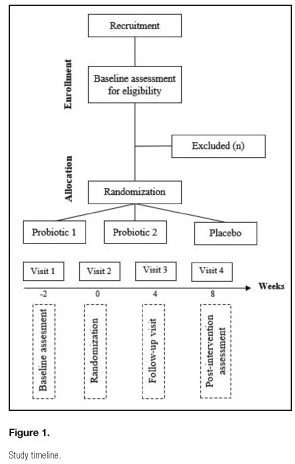
<body><![CDATA[<p><font face="Verdana" size="2">A better understanding of the probiotic effects in this pathology is required to develop integrative approaches for patient care, given the high comorbidities between FMS and gastrointestinal pathologies, as well as the high gastrointestinal symptomatology and the beneficial effect of probiotics in symptoms present in FMS. To the best of our knowledge, no randomized controlled trial has been conducted to evaluate the role of probiotics in FMS. Consequently, the aim of this research is to evaluate the effect of probiotic treatment in patients diagnosed with FMS. Therefore, in the present study, we designed a randomized controlled intervention with a multispecies probiotic to improve cognitive functions and emotional processes, as well as self-reported symptoms of depression and anxiety in FMS patients.</font></p>     <p>&nbsp;</p>     <p><font face="Verdana" size="2"><b>Material and methods</b></font></p>     <p><font face="Verdana" size="2"><b>STUDY DESIGN</b></font></p>     <p><font face="Verdana" size="2">This is a randomized, double-blind and placebo controlled pilot study. Study enrollment took place from December 2015 to February 2016. It is designed to test whether a multispecies probiotic may improve cognition, emotional symptoms and functional state in a population diagnosed with FMS. Therefore, our aim is to explore the effects of probiotics in FMS patients as compared to placebo. Specifically, we explore the effects of probiotics in physical (e.g., pain), emotional (e.g., anxiety and depression) and cognitive (e.g., attention, memory) symptoms.</font></p>     <p><font face="Verdana" size="2"><b>PARTICIPANTS</b></font></p>     <p><font face="Verdana" size="2">The population of our study are patients aged 18 years or older diagnosed with FMS by a physician according to the American College of Rheumatology criteria (2). This study is carried out at the University of Almeria. Participants are referred to our study from the Almeria Fibromyalgia Association (AFIAL-Spain) or the El Ejido Fibromyalgia Association (AFIEL-Spain). The inclusion criteria are: a) having been diagnosed at least one year before entering the study; b) without antibiotic treatment; and c) having signed the informed consent to participate. Exclusion criteria include: a) severe physical disability; b) being pregnant or breastfeeding; c) medication usage other than as-needed analgesics (excluding long-term narcotics); and d) meeting the criteria for psychiatric disorders other than depression and/or anxiety. The recruitment is based on an initial interview to evaluate the inclusion and exclusion criteria; this first visit is carried out two weeks before the study began. Patients do not receive any economic compensation. <a href="#f1">Figure 1</a> illustrates the participants' flow throughout the study.</font></p>     <p>&nbsp;</p>     <p align="center"><font face="Verdana" size="2"><a name="f1"></a><img src="/img/revistas/nh/v34n5/29_especial1_fig1.jpg"></font></p>     <p>&nbsp;</p>     ]]></body>
<body><![CDATA[<p><font face="Verdana" size="2"><b>ETHICAL ASPECTS</b></font></p>     <p><font face="Verdana" size="2">Informed written consent, including information about the different types of intervention (probiotics <i>vs</i> placebo), is obtained from all participants. This study is done in accordance with the Declaration of Helsinki, and it received ethics approval by the local Human Research Committee at the University of Almeria (Spain). The study was registered with ClinicalTrial.gov (NCT02642289).</font></p>     <p><font face="Verdana" size="2"><b>RANDOMIZATION AND BLINDING</b></font></p>     <p><font face="Verdana" size="2">This study was double blinded, using identical matching placebo and probiotics. The bottles containing probiotics and placebo were identical and each one contained 60 pills; probiotics and placebo pills were indistinguishable in color, taste and smell. The group allocator, the participants, and the outcome assessor were aware of the assigned intervention.</font></p>     <p><font face="Verdana" size="2">Participants were randomly assigned to either the placebo or the interventions (probiotic) groups through a random-number generator by assignment in a 1:1:1 ratio for the three groups.</font></p>     <p><font face="Verdana" size="2"><b>INTERVENTIONS</b></font></p>     <p><font face="Verdana" size="2">The intervention consisted in the administration of a multispecies probiotics. The subjects took the oral probiotics or placebo every day for eight weeks. The doses were four pills each day. The three different interventions are identical in appearance, taste and smell.</font></p>     <blockquote>     <p><font face="Verdana" size="2">-<i>Probiotic 1</i>: the oral probiotic 1, consisted of <i>S. thermophiles, S. faecium, L. acidophilus, L. rhamnosus, L. casei, L. bulgaricus, B. bifidum, and B. infantis.</i> This probiotic was provided by the manufacturer Complementos Fitonutricionales (CFN. S.L., Granada, Spain) through their product Probiotic 5000. Each capsule contains about five million bacteria.</font></p>     <p><font face="Verdana" size="2">-<i>Probiotic 2</i>: the oral probiotic 2 was Ergyphilus Plus, provided by the manufacturer Nutergia (Spain), containing six million revivifications of germs per capsule. This probiotic contains the following bacterial strains: <i>L. Rhamnosus GG<sup>&reg;</sup>, Casei, Acidophilus, and B. Bifidus.</i></font></p>     ]]></body>
<body><![CDATA[<p><font face="Verdana" size="2"><i>-Placebo</i>: the placebo was composed by cellulose, an inert substance, and was provided by the manufacturer Complementos Fitonutricionales (CFN. S.L., Granada, Spain). The duration and the daily pills intake was the same than in the probiotics groups.</font></p> </blockquote>     <p><font face="Verdana" size="2"><b>INTERVENTION TIMELINE</b></font></p>     <p><font face="Verdana" size="2">The study timeline is shown in <a href="#f1">figure 1</a> and intervention details are outlined below.</font></p>     <blockquote>     <p><font face="Verdana" size="2"><i>-Study visit 1</i>: a recruitment visit was carried out two weeks before the beginning of the study to evaluate the inclusion an exclusion criteria.</font></p>     <p><font face="Verdana" size="2"><i>-Study visit 2</i>: at the second visit, week zero, the subjects were enrolled following informed consent, and randomized to probiotic or placebo. Initial stool and urine samples were collected. Also, all the demographic information was taken. This visit is considered as the baseline pre-treatment and all the outcomes were measured.</font></p>     <p><font face="Verdana" size="2"><i>-Study visit 3</i>: after four weeks of treatment we carried out a visit (visit 3) to evaluate adherence.</font></p>     <p><font face="Verdana" size="2"><i>-Study visit 4</i>: eight weeks after, in the fourth visit, the subject stopped taking the probiotic or placebo. This visit is considered as the post-treatment effects and all the outcomes were measured. Stool and urine samples were collected.</font></p> </blockquote>     <p><font face="Verdana" size="2"><b>ADHERENCE</b></font></p>     <p><font face="Verdana" size="2">Subjects were followed through weekly by telephone calls to identify side effects from the medication and any medication-related problems. In addition, after four weeks of treatment an interview with the patients was carried out to evaluate adherence to the treatment. Tolerability is an important factor in subject adherence to get a potentially beneficial intervention.</font></p>     ]]></body>
<body><![CDATA[<p><font face="Verdana" size="2"><b>SUBJECT WITHDRAWAL</b></font></p>     <p><font face="Verdana" size="2">All subjects were informed during enrollment that they may discontinue participation at any time.</font></p>     <p><font face="Verdana" size="2"><b>OUTCOME MEASURES</b></font></p>     <p><font face="Verdana" size="2">The primary outcome of this study is FMS patients cognition improves after eight weeks of treatment. We hypothesize that FMS patients will show a better performance on impulsive choice and decision-making, as well as on working memory and attentional control, following the treatment with probiotics. As secondary outcomes, we hypothesize mean changes between baseline and after intervention on body composition, pain, and emotional outcomes. Additional secondary outcomes include changes on physiological measures (free cortisol concentration in urine and stool fecal samples).</font></p>     <p><font face="Verdana" size="2"><b>ASSESSMENT TOOLS</b></font></p>     <p><font face="Verdana" size="2">The following assessment tools were used:</font></p>     <blockquote>     <p><font face="Verdana" size="2">1. Demographic information: gender, age, time with fibromyalgia, and years of formal education.</font></p>     <p><font face="Verdana" size="2">2. Anthropometric measurements of body mass index and corporal composition (fat mass and lean mass) were assessed by bioelectric impedance analyzer of six electrodes (Electro Interstitial Scanner, LD Technology, Miami, FL).</font></p>     <p><font face="Verdana" size="2">3. A Spanish validated version of several questionnaires was used to evaluate several symptoms or dimensions of FMS patients.</font></p>     ]]></body>
<body><![CDATA[<blockquote>     <p><font face="Verdana" size="2">-<i>Pain</i>: Visual Analogue Scale (47) and McGuill Pain Questionnaire (48).</font></p>     <p><font face="Verdana" size="2">-<i>Quality of life</i>: Short-Form Health Survey (SF-36) (49).</font></p>     <p><font face="Verdana" size="2">-<i>Impact and severity of FMS symptoms</i>: Fibromyalgia Impact Questionnaire (50).</font></p>     <p><font face="Verdana" size="2">-<i>Sleep quality</i>: Pittsburg Sleep Quality Index (51).</font></p>     <p><font face="Verdana" size="2">-<i>Emotional symptoms</i>: depression (Beck Depression Inventory &#091;52&#093;) and anxiety (State-Trait Anxiety Inventory &#091;53&#093;).</font></p>     <p><font face="Verdana" size="2">-<i>Cognitive dimension</i>: general evaluation (Mini-Mental State Examination &#091;54&#093;) and verbal working memory (Digits &#091;55&#093;).</font></p> </blockquote>     <p><font face="Verdana" size="2">4. The following computerized cognitive tasks were used. E-Prime 2.0 software (Psychology Software Tools, Pittsburgh, PA) controlled the presentation of the stimuli as well as collection of the participant's responses in the tasks:</font></p>     <blockquote>     <p><font face="Verdana" size="2">-<i>Working memory</i>: Directed-forgetting Task, Corsi Task, Simon Task, and N-Back Task.</font></p>     ]]></body>
<body><![CDATA[<p><font face="Verdana" size="2">-<i>Inhibitory control mechanisms of attention</i>: Go/No-Go Task, Distractor Devaluation Effect Task, and Stroop Task with negative priming.</font></p>     <p><font face="Verdana" size="2">-<i>Impulsive choice and decision-making</i>: Iowa Gambling Task, Task Switching and Two-Choice Task.</font></p> </blockquote>     <p><font face="Verdana" size="2">5. Free cortisol in urine, using a competitive ELISA kit (RE5224, Cortisol ELISA, IBL International, Hamburg, Germany).</font></p>     <p><font face="Verdana" size="2">6. Stool fecal samples, using QIAampR DNA Stool Mini Kit (QIAGEN) to extract DNA, and PCR-R to analyze the DNA.</font></p> </blockquote>     <p><font face="Verdana" size="2"><b>ADVERSE EVENTS</b></font></p>     <blockquote>     <p><font face="Verdana" size="2">-<i>Safety of probiotics: Lactobacillus</i> and <i>Bifidobacterium</i> species have long been considered as safe for human consumption, and their safety has been studied in many publications (56). They were made commercially available many years ago. In our study, our products have been supplied by CFN. S.L. and Nutergia, which commercialize them reliably.</font></p>     <p><font face="Verdana" size="2">-<i>Safety of placebo</i>: the placebo agent was composed of cellulose, an inert, inactive substance. Being an inert substance, the likelihood for adverse reaction is virtually none, and there is no obvious foreseeable risk associated with the ingestion of the placebo capsules.</font></p> </blockquote>     <p><font face="Verdana" size="2"><b>DATA MANAGEMENT</b></font></p>     <p><font face="Verdana" size="2">Research data is handled with utmost confidentiality and discretion. Subjects are assigned a unique identification number that can be traced only by the research specialist and PI. The file linking study identification numbers to identifiable information is stored and secured separately from the coded data. All subject information is kept in locked drawers, file cabinets or secure computer files, with access only allowed to research personnel. The final trial dataset will be available to all research personnel.</font></p>     ]]></body>
<body><![CDATA[<p><font face="Verdana" size="2"><b>STATISTICAL ANALYSIS</b></font></p>     <blockquote>     <p><font face="Verdana" size="2">-<i>Sample size justification.</i> We conducted a randomized controlled trial with probiotic and placebo randomized in a 1:1:1 manner. Because this is a pilot feasibility study, a sample size calculation was not conducted as there are not previous studies evaluating probiotics in FMS. We considered that it was feasible to recruit an overall of 60 participants, with 20 patients randomized to each group.</font></p>     <p><font face="Verdana" size="2">-<i>Data analysis.</i> For baseline demographic data, questionnaires and behavioral measurement, the mean scores (total and/or partial) were calculated using descriptive statics. Repeated measures analysis of variance (ANOVA) was used to evaluate the significance of the participants' evolution within each group by comparing the different scores at various time points compared to baseline. Even though the data show a non-normal distribution, Friedman test were used. A p-value of &lt; 0.05 is considered as statistically significant. In addition to the statistical significance levels, the effect size estimates were calculated by &eta;2 (eta-squared). This indicator provided estimates of the magnitude of the effects that are independent of the sample size. Statistical analysis was performed using software SPSS for Windows, Version 21.0 (SPSS Inc., Chicago, Illinois, USA).</font></p> </blockquote>     <p>&nbsp;</p>     <p><font face="Verdana" size="2"><b>Discussion</b></font></p>     <p><font face="Verdana" size="2">Ingestion of probiotics positively affects the host's health by improving intestinal the microbial balance (57), and also may positively affect cognitive and psychological processes via the gut-brain-axis (44). The proposed mechanisms of action of probiotics include competition against the pathogenic bacteria to bind to the intestinal epithelial cells, enhancement of the intestinal epithelial barrier function, inhibition of pathogens' growth by secretion of antimicrobial peptides, and augmentation of the production of serum IgA (58,59). Probiotics may also affect the central nervous system via the gut-brain axis by: a) enhancing the production and delivery of neuroactive substances, such as gamma-amino butyric acid (GABA), serotonin, dopamine and acetylcholine; b) the vagus nerve (60); and c) decreasing pro-inflammatory cytokines, which are able to cross the blood-brain barrier and elicit mood and behavioral changes (58). For instance, some probiotics have been shown to induce an elevation of tryptophan levels in plasma (61), which is a precursor of serotonin. Serotonin has been implicated in emotional processes, cognition, motor function and pain, as well as in neuroendocrine functions, such as food intake, circadian rhythms and reproductive activity (62). A very important practical implication of this is that probiotics may then produce health benefits in patients suffering from neuropsychiatric disorders (60). Therefore, FMS is one of the target population. These patients show a seemingly altered GI microbial community (20,63). Their symptoms include chronic, generalized and diffuse pain disorders, as well as fatigue, depression, sleeping disorders (1), self-reported reduced mental performance (14-18) and cognitive deficits in inhibition and decision-making processes (64).</font></p>     <p><font face="Verdana" size="2">Previous studies with probiotics in population with a great comorbidity with FMS, like CFS and IBS (6,11,12,65), have reported beneficial effects after treatment in quality of life (60), pain severity (67), reduced inflammation (68), and emotional symptoms like anxiety (69).</font></p>     <p><font face="Verdana" size="2">To our knowledge, the current pilot study is the first randomized controlled trial evaluating the effects of probiotics on FMS. This study will identify the potential effect of probiotics in several dimensions of FMS, since these effects are still unknown. Moreover, this protocol study will provide a complex and a large evaluation of several symptoms in FMS, affecting to the physical, emotional and cognitive symptoms. Thus, it could affect to the quality of life of patients with FMS, improving some symptoms that limited their daily life.</font></p>     <p><font face="Verdana" size="2">While this study adds important knowledge to the literature, it does have some limitations. The primary limitation of this study is the sample size. This was designed as a pilot study, planned to assess feasibility, attrition, completion of study procedures, and recruitment challenges, prior to undertaking a larger study. Second, dietary measures were not included and consumption of other fermented foods (e.g., yogurt) was not controlled. Hence, we cannot exclude that the consumption of probiotics will be accompanied by spontaneous dietary changes that may have indirectly accounted for the observed effects.</font></p>     ]]></body>
<body><![CDATA[<p><font face="Verdana" size="2">Despite the limitations, the results of this study will provide the first evidence of the effect of probiotics on FMS. In addition, data will have important clinical implications. Given that neither pharmacological nor non-pharmacological interventions are effective on FMS by themselves, a multidisciplinary intervention including both of them is the most effective approach so far (70).</font></p>     <p>&nbsp;</p>     <p><font face="Verdana" size="2"><b>Acknowledgements</b></font></p>     <p><font face="Verdana" size="2">PR is supported by a pre-doctoral grant by the Research Plan by the University of Almeria. In addition, we wish to thank the staff of the Almeria Fibromyalgia Association (AFIAL-Spain) and the El Ejido Fibromyalgia Association (AFIEL-Spain) for their help throughout the development of this study.</font></p>     <p>&nbsp;</p>     <p><font face="Verdana" size="2"><b>ClinicalTrial.gov Identifier:</b> NCT02642289</font></p>     <p>&nbsp;</p>     <p><font face="Verdana" size="2"><b>References</b></font></p>     <!-- ref --><p><font face="Verdana" size="2">1. Wolfe F, Smythe HA, Yunus MB, Bennett RM, Bombardier C, Goldenberg DL, et al. The American College of Rheumatology 1990 Criteria for the Classification of Fibromyalgia. Report of the Multicenter Criteria Committee. Arthritis Rheum 1990;33(2):160-72.    &nbsp;&nbsp;&nbsp;&nbsp;&nbsp;&nbsp;&nbsp;&nbsp;[&#160;<a href="javascript:void(0);" onclick="javascript: window.open('/scielo.php?script=sci_nlinks&ref=3971731&pid=S0212-1611201700050002900001&lng=','','width=640,height=500,resizable=yes,scrollbars=1,menubar=yes,');">Links</a>&#160;]<!-- end-ref --></font></p>    ]]></body>
<body><![CDATA[<!-- ref --><p><font face="Verdana" size="2">2. Wolfe F, Clauw DJ, Fitzcharles M-A, Goldenberg DL, Katz RS, Mease P, et al. The American College of Rheumatology preliminary diagnostic criteria for fibromyalgia and measurement of symptom severity. Arthritis Care Res (Hoboken) 2010;62(5):600-10.    &nbsp;&nbsp;&nbsp;&nbsp;&nbsp;&nbsp;&nbsp;&nbsp;[&#160;<a href="javascript:void(0);" onclick="javascript: window.open('/scielo.php?script=sci_nlinks&ref=3971733&pid=S0212-1611201700050002900002&lng=','','width=640,height=500,resizable=yes,scrollbars=1,menubar=yes,');">Links</a>&#160;]<!-- end-ref --></font></p>    <!-- ref --><p><font face="Verdana" size="2">3. Queiroz LP. Worldwide epidemiology of fibromyalgia. Curr Pain Headache Rep 2013;17(8):356.    &nbsp;&nbsp;&nbsp;&nbsp;&nbsp;&nbsp;&nbsp;&nbsp;[&#160;<a href="javascript:void(0);" onclick="javascript: window.open('/scielo.php?script=sci_nlinks&ref=3971735&pid=S0212-1611201700050002900003&lng=','','width=640,height=500,resizable=yes,scrollbars=1,menubar=yes,');">Links</a>&#160;]<!-- end-ref --></font></p>    <!-- ref --><p><font face="Verdana" size="2">4. Jones G, Atzeni F, Beasley M, Fl&uuml;&szlig; E, Sarzi-Puttini P, Macfarlane GJ. The prevalence of fibromyalgia in the general population: A comparison of the American College of Rheumatology 1990, 2010, and modified 2010 classification criteria. Arthritis Rheumatol 2015;67(2):568-75.    &nbsp;&nbsp;&nbsp;&nbsp;&nbsp;&nbsp;&nbsp;&nbsp;[&#160;<a href="javascript:void(0);" onclick="javascript: window.open('/scielo.php?script=sci_nlinks&ref=3971737&pid=S0212-1611201700050002900004&lng=','','width=640,height=500,resizable=yes,scrollbars=1,menubar=yes,');">Links</a>&#160;]<!-- end-ref --></font></p>    <!-- ref --><p><font face="Verdana" size="2">5. Wolfe F, Clauw DJ, Fitzcharles M-A, Goldenberg DL, H&auml;user W, Katz RS, et al. Fibromyalgia criteria and severity scales for clinical and epidemiological studies: A modification of the ACR Preliminary Diagnostic Criteria for Fibromyalgia. J Rheumatol 2011;38(6):1113-22.    &nbsp;&nbsp;&nbsp;&nbsp;&nbsp;&nbsp;&nbsp;&nbsp;[&#160;<a href="javascript:void(0);" onclick="javascript: window.open('/scielo.php?script=sci_nlinks&ref=3971739&pid=S0212-1611201700050002900005&lng=','','width=640,height=500,resizable=yes,scrollbars=1,menubar=yes,');">Links</a>&#160;]<!-- end-ref --></font></p>    <!-- ref --><p><font face="Verdana" size="2">6. Aaron LA, Burke MM, Buchwald D. Overlapping conditions among patients with chronic fatigue syndrome, fibromyalgia, and temporomandibular disorder. Arch Intern Med 2000;160(2):221-7.    &nbsp;&nbsp;&nbsp;&nbsp;&nbsp;&nbsp;&nbsp;&nbsp;[&#160;<a href="javascript:void(0);" onclick="javascript: window.open('/scielo.php?script=sci_nlinks&ref=3971741&pid=S0212-1611201700050002900006&lng=','','width=640,height=500,resizable=yes,scrollbars=1,menubar=yes,');">Links</a>&#160;]<!-- end-ref --></font></p>    ]]></body>
<body><![CDATA[<!-- ref --><p><font face="Verdana" size="2">7. Triadafilopoulos G, Simms RW, Goldenberg DL. Bowel dysfunction in fibromyalgia syndrome. Dig Dis Sci 1991;36(1):59-64.    &nbsp;&nbsp;&nbsp;&nbsp;&nbsp;&nbsp;&nbsp;&nbsp;[&#160;<a href="javascript:void(0);" onclick="javascript: window.open('/scielo.php?script=sci_nlinks&ref=3971743&pid=S0212-1611201700050002900007&lng=','','width=640,height=500,resizable=yes,scrollbars=1,menubar=yes,');">Links</a>&#160;]<!-- end-ref --></font></p>    <!-- ref --><p><font face="Verdana" size="2">8. Riedl A, Schmidtmann M, Stengel A, Goebel M, Wisser A-S, Klapp BF, et al. Somatic comorbidities of irritable bowel syndrome: A systematic analysis. J Psychosom Res 2008;64(6):573-82.    &nbsp;&nbsp;&nbsp;&nbsp;&nbsp;&nbsp;&nbsp;&nbsp;[&#160;<a href="javascript:void(0);" onclick="javascript: window.open('/scielo.php?script=sci_nlinks&ref=3971745&pid=S0212-1611201700050002900008&lng=','','width=640,height=500,resizable=yes,scrollbars=1,menubar=yes,');">Links</a>&#160;]<!-- end-ref --></font></p>    <!-- ref --><p><font face="Verdana" size="2">9. Sperber AD, Atzmon Y, Neumann L, Weisberg I, Shalit Y, Abu-Shakrah M, et al. Fibromyalgia in the irritable bowel syndrome: Studies of prevalence and clinical implications. Am J Gastroenterol 1999;94(12):3541-6.    &nbsp;&nbsp;&nbsp;&nbsp;&nbsp;&nbsp;&nbsp;&nbsp;[&#160;<a href="javascript:void(0);" onclick="javascript: window.open('/scielo.php?script=sci_nlinks&ref=3971747&pid=S0212-1611201700050002900009&lng=','','width=640,height=500,resizable=yes,scrollbars=1,menubar=yes,');">Links</a>&#160;]<!-- end-ref --></font></p>    <!-- ref --><p><font face="Verdana" size="2">10. Whitehead WE, Palsson O, Jones KR. Systematic review of the comorbidity of irritable bowel syndrome with other disorders: What are the causes and implications? Gastroenterol 2002;122(4):1140-56.    &nbsp;&nbsp;&nbsp;&nbsp;&nbsp;&nbsp;&nbsp;&nbsp;[&#160;<a href="javascript:void(0);" onclick="javascript: window.open('/scielo.php?script=sci_nlinks&ref=3971749&pid=S0212-1611201700050002900010&lng=','','width=640,height=500,resizable=yes,scrollbars=1,menubar=yes,');">Links</a>&#160;]<!-- end-ref --></font></p>    <!-- ref --><p><font face="Verdana" size="2">11. Aaron LA, Buchwald D. A review of the evidence for overlap among unexplained clinical conditions. Ann Intern Med 2001;134(9 Pt 2):868-81.    &nbsp;&nbsp;&nbsp;&nbsp;&nbsp;&nbsp;&nbsp;&nbsp;[&#160;<a href="javascript:void(0);" onclick="javascript: window.open('/scielo.php?script=sci_nlinks&ref=3971751&pid=S0212-1611201700050002900011&lng=','','width=640,height=500,resizable=yes,scrollbars=1,menubar=yes,');">Links</a>&#160;]<!-- end-ref --></font></p>    ]]></body>
<body><![CDATA[<!-- ref --><p><font face="Verdana" size="2">12. Kanaan RAA, Lepine JP, Wessely SC. The association or otherwise of the functional somatic syndromes. Psychosom Med 2007;69(9):855-9.    &nbsp;&nbsp;&nbsp;&nbsp;&nbsp;&nbsp;&nbsp;&nbsp;[&#160;<a href="javascript:void(0);" onclick="javascript: window.open('/scielo.php?script=sci_nlinks&ref=3971753&pid=S0212-1611201700050002900012&lng=','','width=640,height=500,resizable=yes,scrollbars=1,menubar=yes,');">Links</a>&#160;]<!-- end-ref --></font></p>    <!-- ref --><p><font face="Verdana" size="2">13. Glass JM, Park DC. Cognitive dysfunction in fibromyalgia. Curr Rheumatol Rep 2001;3(2):123-7.    &nbsp;&nbsp;&nbsp;&nbsp;&nbsp;&nbsp;&nbsp;&nbsp;[&#160;<a href="javascript:void(0);" onclick="javascript: window.open('/scielo.php?script=sci_nlinks&ref=3971755&pid=S0212-1611201700050002900013&lng=','','width=640,height=500,resizable=yes,scrollbars=1,menubar=yes,');">Links</a>&#160;]<!-- end-ref --></font></p>    <!-- ref --><p><font face="Verdana" size="2">14. Glass JM, Park DC, Minear M, Crofford LJ. Memory beliefs and function in fibromyalgia patients. J Psychosom Res 2005;58(3):263-9.    &nbsp;&nbsp;&nbsp;&nbsp;&nbsp;&nbsp;&nbsp;&nbsp;[&#160;<a href="javascript:void(0);" onclick="javascript: window.open('/scielo.php?script=sci_nlinks&ref=3971757&pid=S0212-1611201700050002900014&lng=','','width=640,height=500,resizable=yes,scrollbars=1,menubar=yes,');">Links</a>&#160;]<!-- end-ref --></font></p>    <!-- ref --><p><font face="Verdana" size="2">15. Glass JM. Fibromyalgia and cognition. J Clin Psychiatry 2008;69(Suppl 2):20-4.    &nbsp;&nbsp;&nbsp;&nbsp;&nbsp;&nbsp;&nbsp;&nbsp;[&#160;<a href="javascript:void(0);" onclick="javascript: window.open('/scielo.php?script=sci_nlinks&ref=3971759&pid=S0212-1611201700050002900015&lng=','','width=640,height=500,resizable=yes,scrollbars=1,menubar=yes,');">Links</a>&#160;]<!-- end-ref --></font></p>    <!-- ref --><p><font face="Verdana" size="2">16. Glass JM. Cognitive dysfunction in fibromyalgia and chronic fatigue syndrome: New trends and future directions. Curr Rheumatol Rep 2006;8(6):425-9.    &nbsp;&nbsp;&nbsp;&nbsp;&nbsp;&nbsp;&nbsp;&nbsp;[&#160;<a href="javascript:void(0);" onclick="javascript: window.open('/scielo.php?script=sci_nlinks&ref=3971761&pid=S0212-1611201700050002900016&lng=','','width=640,height=500,resizable=yes,scrollbars=1,menubar=yes,');">Links</a>&#160;]<!-- end-ref --></font></p>    ]]></body>
<body><![CDATA[<!-- ref --><p><font face="Verdana" size="2">17. Glass JM. Review of cognitive dysfunction in fibromyalgia: A convergence on working memory and attentional control impairments. Rheum Dis Clin North Am 2009;35(2):299-311.    &nbsp;&nbsp;&nbsp;&nbsp;&nbsp;&nbsp;&nbsp;&nbsp;[&#160;<a href="javascript:void(0);" onclick="javascript: window.open('/scielo.php?script=sci_nlinks&ref=3971763&pid=S0212-1611201700050002900017&lng=','','width=640,height=500,resizable=yes,scrollbars=1,menubar=yes,');">Links</a>&#160;]<!-- end-ref --></font></p>    <!-- ref --><p><font face="Verdana" size="2">18. Glass JM, Williams DA, Fern&aacute;ndez-S&aacute;nchez ML, Kairys A, Barjola P, Heitzeg MM, et al. Executive function in chronic pain patients and healthy controls: Different cortical activation during response inhibition in fibromyalgia. J Pain 2011;12(12):1219-29.    &nbsp;&nbsp;&nbsp;&nbsp;&nbsp;&nbsp;&nbsp;&nbsp;[&#160;<a href="javascript:void(0);" onclick="javascript: window.open('/scielo.php?script=sci_nlinks&ref=3971765&pid=S0212-1611201700050002900018&lng=','','width=640,height=500,resizable=yes,scrollbars=1,menubar=yes,');">Links</a>&#160;]<!-- end-ref --></font></p>    <!-- ref --><p><font face="Verdana" size="2">19. Gelonch O, Garolera M, Rossell&oacute; L, Pifarr&eacute; J. Cognitive dysfunction in fibromyalgia. Rev Neurol 2013;56(11):573-88.    &nbsp;&nbsp;&nbsp;&nbsp;&nbsp;&nbsp;&nbsp;&nbsp;[&#160;<a href="javascript:void(0);" onclick="javascript: window.open('/scielo.php?script=sci_nlinks&ref=3971767&pid=S0212-1611201700050002900019&lng=','','width=640,height=500,resizable=yes,scrollbars=1,menubar=yes,');">Links</a>&#160;]<!-- end-ref --></font></p>    <!-- ref --><p><font face="Verdana" size="2">20. Butt H, Dunstan R, McGregor N, Roberts T. Bacterial colonosis in patients with persistent fatigue. In: Proceedings of the AHMF international clinical and scientific conference; 2001.    &nbsp;&nbsp;&nbsp;&nbsp;&nbsp;&nbsp;&nbsp;&nbsp;[&#160;<a href="javascript:void(0);" onclick="javascript: window.open('/scielo.php?script=sci_nlinks&ref=3971769&pid=S0212-1611201700050002900020&lng=','','width=640,height=500,resizable=yes,scrollbars=1,menubar=yes,');">Links</a>&#160;]<!-- end-ref --></font></p>    <!-- ref --><p><font face="Verdana" size="2">21. Pimentel M, Chow EJ, Lin HC. Normalization of lactulose breath testing correlates with symptom improvement in irritable bowel syndrome. A double-blind, randomized, placebo-controlled study. Am J Gastroenterol 2003;98(2):412-9.    &nbsp;&nbsp;&nbsp;&nbsp;&nbsp;&nbsp;&nbsp;&nbsp;[&#160;<a href="javascript:void(0);" onclick="javascript: window.open('/scielo.php?script=sci_nlinks&ref=3971771&pid=S0212-1611201700050002900021&lng=','','width=640,height=500,resizable=yes,scrollbars=1,menubar=yes,');">Links</a>&#160;]<!-- end-ref --></font></p>    ]]></body>
<body><![CDATA[<!-- ref --><p><font face="Verdana" size="2">22. Pimentel M, Wallace D, Hallegua D, Chow E, Kong Y, Park S, et al. A link between irritable bowel syndrome and fibromyalgia may be related to findings on lactulose breath testing. Ann Rheum Dis 2004;63(4):450-2.    &nbsp;&nbsp;&nbsp;&nbsp;&nbsp;&nbsp;&nbsp;&nbsp;[&#160;<a href="javascript:void(0);" onclick="javascript: window.open('/scielo.php?script=sci_nlinks&ref=3971773&pid=S0212-1611201700050002900022&lng=','','width=640,height=500,resizable=yes,scrollbars=1,menubar=yes,');">Links</a>&#160;]<!-- end-ref --></font></p>    <!-- ref --><p><font face="Verdana" size="2">23. Galland L. The gut microbiome and the brain. J Med Food 2014;17(12): 1261-72.    &nbsp;&nbsp;&nbsp;&nbsp;&nbsp;&nbsp;&nbsp;&nbsp;[&#160;<a href="javascript:void(0);" onclick="javascript: window.open('/scielo.php?script=sci_nlinks&ref=3971775&pid=S0212-1611201700050002900023&lng=','','width=640,height=500,resizable=yes,scrollbars=1,menubar=yes,');">Links</a>&#160;]<!-- end-ref --></font></p>    <!-- ref --><p><font face="Verdana" size="2">24. Slim M, Calandre EP, Rico-Villademoros F. An insight into the gastrointestinal component of fibromyalgia: Clinical manifestations and potential underlying mechanisms. Rheumatol Int 2015;35(3):433-44.    &nbsp;&nbsp;&nbsp;&nbsp;&nbsp;&nbsp;&nbsp;&nbsp;[&#160;<a href="javascript:void(0);" onclick="javascript: window.open('/scielo.php?script=sci_nlinks&ref=3971777&pid=S0212-1611201700050002900024&lng=','','width=640,height=500,resizable=yes,scrollbars=1,menubar=yes,');">Links</a>&#160;]<!-- end-ref --></font></p>    <!-- ref --><p><font face="Verdana" size="2">25. Lakhan SE, Kirchgessner A. Gut inflammation in chronic fatigue syndrome. Nutr Metab (Lond) 2010;7(1):79.    &nbsp;&nbsp;&nbsp;&nbsp;&nbsp;&nbsp;&nbsp;&nbsp;[&#160;<a href="javascript:void(0);" onclick="javascript: window.open('/scielo.php?script=sci_nlinks&ref=3971779&pid=S0212-1611201700050002900025&lng=','','width=640,height=500,resizable=yes,scrollbars=1,menubar=yes,');">Links</a>&#160;]<!-- end-ref --></font></p>    <!-- ref --><p><font face="Verdana" size="2">26. FAO/WHO. Joint FAO/WHO Expert Consultation on Evaluation of Health and Nutritional Properties of Prebiotics in Food Including Powder Milk with Live Lactic Acid Bacteria. Vol. 85, Food and Nutrition Paper; 2001. p. 71.    &nbsp;&nbsp;&nbsp;&nbsp;&nbsp;&nbsp;&nbsp;&nbsp;[&#160;<a href="javascript:void(0);" onclick="javascript: window.open('/scielo.php?script=sci_nlinks&ref=3971781&pid=S0212-1611201700050002900026&lng=','','width=640,height=500,resizable=yes,scrollbars=1,menubar=yes,');">Links</a>&#160;]<!-- end-ref --></font></p>    ]]></body>
<body><![CDATA[<!-- ref --><p><font face="Verdana" size="2">27. Didari T, Mozaffari S, Nikfar S, Abdollahi M. Effectiveness of probiotics in irritable bowel syndrome: Updated systematic review with meta-analysis. World J Gastroenterol 2015;21(10):3072-84.    &nbsp;&nbsp;&nbsp;&nbsp;&nbsp;&nbsp;&nbsp;&nbsp;[&#160;<a href="javascript:void(0);" onclick="javascript: window.open('/scielo.php?script=sci_nlinks&ref=3971783&pid=S0212-1611201700050002900027&lng=','','width=640,height=500,resizable=yes,scrollbars=1,menubar=yes,');">Links</a>&#160;]<!-- end-ref --></font></p>    <!-- ref --><p><font face="Verdana" size="2">28. Tiequn B, Guanqun C, Shuo Z. Therapeutic effects of Lactobacillus in treating irritable bowel syndrome: A meta-analysis. Intern Med 2015;54(3): 243-9.    &nbsp;&nbsp;&nbsp;&nbsp;&nbsp;&nbsp;&nbsp;&nbsp;[&#160;<a href="javascript:void(0);" onclick="javascript: window.open('/scielo.php?script=sci_nlinks&ref=3971785&pid=S0212-1611201700050002900028&lng=','','width=640,height=500,resizable=yes,scrollbars=1,menubar=yes,');">Links</a>&#160;]<!-- end-ref --></font></p>    <!-- ref --><p><font face="Verdana" size="2">29. Khalighi AR, Khalighi MR, Behdani R, Jamali J, Khosravi A, Kouhestani S, et al. Evaluating the efficacy of probiotic on treatment in patients with small intestinal bacterial overgrowth (SIBO) - A pilot study. Indian J Med Res 2014;140(5):604-8.    &nbsp;&nbsp;&nbsp;&nbsp;&nbsp;&nbsp;&nbsp;&nbsp;[&#160;<a href="javascript:void(0);" onclick="javascript: window.open('/scielo.php?script=sci_nlinks&ref=3971787&pid=S0212-1611201700050002900029&lng=','','width=640,height=500,resizable=yes,scrollbars=1,menubar=yes,');">Links</a>&#160;]<!-- end-ref --></font></p>    <!-- ref --><p><font face="Verdana" size="2">30. Benton D, Williams C, Brown A. Impact of consuming a milk drink containing a probiotic on mood and cognition. Eur J Clin Nutr 2007;61(3):355-61.    &nbsp;&nbsp;&nbsp;&nbsp;&nbsp;&nbsp;&nbsp;&nbsp;[&#160;<a href="javascript:void(0);" onclick="javascript: window.open('/scielo.php?script=sci_nlinks&ref=3971789&pid=S0212-1611201700050002900030&lng=','','width=640,height=500,resizable=yes,scrollbars=1,menubar=yes,');">Links</a>&#160;]<!-- end-ref --></font></p>    <!-- ref --><p><font face="Verdana" size="2">31. Messaoudi M, Lalonde R, Violle N, Javelot H, Desor D, Nejdi A, et al. Assessment of psychotropic-like properties of a probiotic formulation (Lactobacillus helveticus R0052 and Bifidobacterium longum R0175) in rats and human subjects. Br J Nutr 2011;105(5):755-64.    &nbsp;&nbsp;&nbsp;&nbsp;&nbsp;&nbsp;&nbsp;&nbsp;[&#160;<a href="javascript:void(0);" onclick="javascript: window.open('/scielo.php?script=sci_nlinks&ref=3971791&pid=S0212-1611201700050002900031&lng=','','width=640,height=500,resizable=yes,scrollbars=1,menubar=yes,');">Links</a>&#160;]<!-- end-ref --></font></p>    ]]></body>
<body><![CDATA[<!-- ref --><p><font face="Verdana" size="2">32. Steenbergen L, Sellaro R, Van Hemert S, Bosch JA, Colzato LS. A randomized controlled trial to test the effect of multispecies probiotics on cognitive reactivity to sad mood. Brain Behav Immun 2015;48:258-64.    &nbsp;&nbsp;&nbsp;&nbsp;&nbsp;&nbsp;&nbsp;&nbsp;[&#160;<a href="javascript:void(0);" onclick="javascript: window.open('/scielo.php?script=sci_nlinks&ref=3971793&pid=S0212-1611201700050002900032&lng=','','width=640,height=500,resizable=yes,scrollbars=1,menubar=yes,');">Links</a>&#160;]<!-- end-ref --></font></p>    <!-- ref --><p><font face="Verdana" size="2">33. Messaoudi M, Violle N, Bisson J-F, Desor D, Javelot H, Rougeot C. Beneficial psychological effects of a probiotic formulation (Lactobacillus helveticus R0052 and Bifidobacterium longum R0175) in healthy human volunteers. Gut Microbes 2011;2(4):256-61.    &nbsp;&nbsp;&nbsp;&nbsp;&nbsp;&nbsp;&nbsp;&nbsp;[&#160;<a href="javascript:void(0);" onclick="javascript: window.open('/scielo.php?script=sci_nlinks&ref=3971795&pid=S0212-1611201700050002900033&lng=','','width=640,height=500,resizable=yes,scrollbars=1,menubar=yes,');">Links</a>&#160;]<!-- end-ref --></font></p>    <!-- ref --><p><font face="Verdana" size="2">34. Sherwin E, Rea K, Dinan TG, Cryan JF. A gut (microbiome) feeling about the brain. Curr Opin Gastroenterol 2016;32(2):96-102.    &nbsp;&nbsp;&nbsp;&nbsp;&nbsp;&nbsp;&nbsp;&nbsp;[&#160;<a href="javascript:void(0);" onclick="javascript: window.open('/scielo.php?script=sci_nlinks&ref=3971797&pid=S0212-1611201700050002900034&lng=','','width=640,height=500,resizable=yes,scrollbars=1,menubar=yes,');">Links</a>&#160;]<!-- end-ref --></font></p>    <!-- ref --><p><font face="Verdana" size="2">35. De Palma G, Collins SM, Bercik P, Verdu EF. The microbiota-gut-brain axis in gastrointestinal disorders: Stressed bugs, stressed brain or both? J Physiol 2014;592(14):2989-97.    &nbsp;&nbsp;&nbsp;&nbsp;&nbsp;&nbsp;&nbsp;&nbsp;[&#160;<a href="javascript:void(0);" onclick="javascript: window.open('/scielo.php?script=sci_nlinks&ref=3971799&pid=S0212-1611201700050002900035&lng=','','width=640,height=500,resizable=yes,scrollbars=1,menubar=yes,');">Links</a>&#160;]<!-- end-ref --></font></p>    <!-- ref --><p><font face="Verdana" size="2">36. Maes M, Kubera M, Leunis JC. The gut-brain barrier in major depression: Intestinal mucosal dysfunction with an increased translocation of LPS from gram negative enterobacteria (leaky gut) plays a role in the inflammatory pathophysiology of depression. Neuro Endocrinol Lett 2008;29(1): 117-24.    &nbsp;&nbsp;&nbsp;&nbsp;&nbsp;&nbsp;&nbsp;&nbsp;[&#160;<a href="javascript:void(0);" onclick="javascript: window.open('/scielo.php?script=sci_nlinks&ref=3971801&pid=S0212-1611201700050002900036&lng=','','width=640,height=500,resizable=yes,scrollbars=1,menubar=yes,');">Links</a>&#160;]<!-- end-ref --></font></p>    ]]></body>
<body><![CDATA[<!-- ref --><p><font face="Verdana" size="2">37. Carabotti M, Scirocco A, Maselli MA, Severi C. The gut-brain axis: Interactions between enteric microbiota, central and enteric nervous systems. Ann Gastroenterol Q Publ Hell Soc Gastroenterol 2015;28(2):203-9.    &nbsp;&nbsp;&nbsp;&nbsp;&nbsp;&nbsp;&nbsp;&nbsp;[&#160;<a href="javascript:void(0);" onclick="javascript: window.open('/scielo.php?script=sci_nlinks&ref=3971803&pid=S0212-1611201700050002900037&lng=','','width=640,height=500,resizable=yes,scrollbars=1,menubar=yes,');">Links</a>&#160;]<!-- end-ref --></font></p>    <!-- ref --><p><font face="Verdana" size="2">38. Huang R, Wang K, Hu J. Effect of probiotics on depression: A systematic review and meta-analysis of randomized controlled trials. Nutrients 2016;8(8).    &nbsp;&nbsp;&nbsp;&nbsp;&nbsp;&nbsp;&nbsp;&nbsp;[&#160;<a href="javascript:void(0);" onclick="javascript: window.open('/scielo.php?script=sci_nlinks&ref=3971805&pid=S0212-1611201700050002900038&lng=','','width=640,height=500,resizable=yes,scrollbars=1,menubar=yes,');">Links</a>&#160;]<!-- end-ref --></font></p>    <!-- ref --><p><font face="Verdana" size="2">39. Bravo JA, Forsythe P, Chew M V, Escaravage E, Savignac HM, Dinan TG, et al. Ingestion of Lactobacillus strain regulates emotional behavior and central GABA receptor expression in a mouse via the vagus nerve. Proc Natl Acad Sci USA 2011;108(38):16050-5.    &nbsp;&nbsp;&nbsp;&nbsp;&nbsp;&nbsp;&nbsp;&nbsp;[&#160;<a href="javascript:void(0);" onclick="javascript: window.open('/scielo.php?script=sci_nlinks&ref=3971807&pid=S0212-1611201700050002900039&lng=','','width=640,height=500,resizable=yes,scrollbars=1,menubar=yes,');">Links</a>&#160;]<!-- end-ref --></font></p>    <!-- ref --><p><font face="Verdana" size="2">40. Wall R, Cryan JF, Ross RP, Fitzgerald GF, Dinan TG, Stanton C. Bacterial neuroactive compounds produced by psychobiotics. Adv Exp Med Biol 2014;817:221-39.    &nbsp;&nbsp;&nbsp;&nbsp;&nbsp;&nbsp;&nbsp;&nbsp;[&#160;<a href="javascript:void(0);" onclick="javascript: window.open('/scielo.php?script=sci_nlinks&ref=3971809&pid=S0212-1611201700050002900040&lng=','','width=640,height=500,resizable=yes,scrollbars=1,menubar=yes,');">Links</a>&#160;]<!-- end-ref --></font></p>    <!-- ref --><p><font face="Verdana" size="2">41. Tillisch K. The effects of gut microbiota on CNS function in humans. Gut Microbes 2014;5(3):404-10.    &nbsp;&nbsp;&nbsp;&nbsp;&nbsp;&nbsp;&nbsp;&nbsp;[&#160;<a href="javascript:void(0);" onclick="javascript: window.open('/scielo.php?script=sci_nlinks&ref=3971811&pid=S0212-1611201700050002900041&lng=','','width=640,height=500,resizable=yes,scrollbars=1,menubar=yes,');">Links</a>&#160;]<!-- end-ref --></font></p>    ]]></body>
<body><![CDATA[<!-- ref --><p><font face="Verdana" size="2">42. Cryan JF, O'Mahony SM. The microbiome-gut-brain axis: From bowel to behavior. Neurogastroenterol Motil 2011;23(3):187-92.    &nbsp;&nbsp;&nbsp;&nbsp;&nbsp;&nbsp;&nbsp;&nbsp;[&#160;<a href="javascript:void(0);" onclick="javascript: window.open('/scielo.php?script=sci_nlinks&ref=3971813&pid=S0212-1611201700050002900042&lng=','','width=640,height=500,resizable=yes,scrollbars=1,menubar=yes,');">Links</a>&#160;]<!-- end-ref --></font></p>    <!-- ref --><p><font face="Verdana" size="2">43. Cryan JF, Dinan TG. Mind-altering microorganisms: The impact of the gut microbiota on brain and behaviour. Nat Rev Neurosci 2012;13(10):701-12.    &nbsp;&nbsp;&nbsp;&nbsp;&nbsp;&nbsp;&nbsp;&nbsp;[&#160;<a href="javascript:void(0);" onclick="javascript: window.open('/scielo.php?script=sci_nlinks&ref=3971815&pid=S0212-1611201700050002900043&lng=','','width=640,height=500,resizable=yes,scrollbars=1,menubar=yes,');">Links</a>&#160;]<!-- end-ref --></font></p>    <!-- ref --><p><font face="Verdana" size="2">44. Diaz Heijtz R, Wang S, Anuar F, Qian Y, Bj&ouml;rkholm B, Samuelsson A, et al. Normal gut microbiota modulates brain development and behavior. Proc Natl Acad Sci USA 2011;108(7):3047-52.    &nbsp;&nbsp;&nbsp;&nbsp;&nbsp;&nbsp;&nbsp;&nbsp;[&#160;<a href="javascript:void(0);" onclick="javascript: window.open('/scielo.php?script=sci_nlinks&ref=3971817&pid=S0212-1611201700050002900044&lng=','','width=640,height=500,resizable=yes,scrollbars=1,menubar=yes,');">Links</a>&#160;]<!-- end-ref --></font></p>    <!-- ref --><p><font face="Verdana" size="2">45. Mayer EA, Tillisch K. The brain-gut axis in abdominal pain syndromes. Annu Rev Med 2011;62:381-96.    &nbsp;&nbsp;&nbsp;&nbsp;&nbsp;&nbsp;&nbsp;&nbsp;[&#160;<a href="javascript:void(0);" onclick="javascript: window.open('/scielo.php?script=sci_nlinks&ref=3971819&pid=S0212-1611201700050002900045&lng=','','width=640,height=500,resizable=yes,scrollbars=1,menubar=yes,');">Links</a>&#160;]<!-- end-ref --></font></p>    <!-- ref --><p><font face="Verdana" size="2">46. McKean J, Naug H, Nikbakht E, Amiet B, Colson N. Probiotics and subclinical psychological symptoms in healthy participants: A systematic review and meta-analysis. J Altern Complement Med 2016;acm.2016.0023.    &nbsp;&nbsp;&nbsp;&nbsp;&nbsp;&nbsp;&nbsp;&nbsp;[&#160;<a href="javascript:void(0);" onclick="javascript: window.open('/scielo.php?script=sci_nlinks&ref=3971821&pid=S0212-1611201700050002900046&lng=','','width=640,height=500,resizable=yes,scrollbars=1,menubar=yes,');">Links</a>&#160;]<!-- end-ref --></font></p>    ]]></body>
<body><![CDATA[<!-- ref --><p><font face="Verdana" size="2">47. Huskisson EC. Measurement of pain. Lancet 1974;2(7889):1127-31.    &nbsp;&nbsp;&nbsp;&nbsp;&nbsp;&nbsp;&nbsp;&nbsp;[&#160;<a href="javascript:void(0);" onclick="javascript: window.open('/scielo.php?script=sci_nlinks&ref=3971823&pid=S0212-1611201700050002900047&lng=','','width=640,height=500,resizable=yes,scrollbars=1,menubar=yes,');">Links</a>&#160;]<!-- end-ref --></font></p>    <!-- ref --><p><font face="Verdana" size="2">48. Lahuerta J, Smith B, Mart&iacute;nez-Lage A. An adaptation of the McGill Pain Questionnaire to the Spanish language. Schmerz 1982;(3):132-4.    &nbsp;&nbsp;&nbsp;&nbsp;&nbsp;&nbsp;&nbsp;&nbsp;[&#160;<a href="javascript:void(0);" onclick="javascript: window.open('/scielo.php?script=sci_nlinks&ref=3971825&pid=S0212-1611201700050002900048&lng=','','width=640,height=500,resizable=yes,scrollbars=1,menubar=yes,');">Links</a>&#160;]<!-- end-ref --></font></p>    <!-- ref --><p><font face="Verdana" size="2">49. Alonso J, Prieto L, Ant&oacute; JM. The Spanish version of the SF-36 Health Survey (the SF-36 health questionnaire): An instrument for measuring clinical results. Med Clin 1995;104(20):771-6.    &nbsp;&nbsp;&nbsp;&nbsp;&nbsp;&nbsp;&nbsp;&nbsp;[&#160;<a href="javascript:void(0);" onclick="javascript: window.open('/scielo.php?script=sci_nlinks&ref=3971827&pid=S0212-1611201700050002900049&lng=','','width=640,height=500,resizable=yes,scrollbars=1,menubar=yes,');">Links</a>&#160;]<!-- end-ref --></font></p>    <!-- ref --><p><font face="Verdana" size="2">50. Monterde S, Salvat I, Montull S, Fern&aacute;ndez-Ballart J. Validaci&oacute;n de la versi&oacute;n espa&ntilde;ola del Fibromyalgia Impact Questionnaire. Rev Esp Reumatol 2004;31(9):507-13.    &nbsp;&nbsp;&nbsp;&nbsp;&nbsp;&nbsp;&nbsp;&nbsp;[&#160;<a href="javascript:void(0);" onclick="javascript: window.open('/scielo.php?script=sci_nlinks&ref=3971829&pid=S0212-1611201700050002900050&lng=','','width=640,height=500,resizable=yes,scrollbars=1,menubar=yes,');">Links</a>&#160;]<!-- end-ref --></font></p>    <!-- ref --><p><font face="Verdana" size="2">51. Macias J, Royuela A. La versi&oacute;n espa&ntilde;ola del &iacute;ndice de calidad del sue&ntilde;o de Pittsburg. Inf Psiquiatr 1996;(146):465-72.    &nbsp;&nbsp;&nbsp;&nbsp;&nbsp;&nbsp;&nbsp;&nbsp;[&#160;<a href="javascript:void(0);" onclick="javascript: window.open('/scielo.php?script=sci_nlinks&ref=3971831&pid=S0212-1611201700050002900051&lng=','','width=640,height=500,resizable=yes,scrollbars=1,menubar=yes,');">Links</a>&#160;]<!-- end-ref --></font></p>    ]]></body>
<body><![CDATA[<!-- ref --><p><font face="Verdana" size="2">52. Conde V, Useros E. Adaptaci&oacute;n castellana de la escala de evaluaci&oacute;n conductual para la depresi&oacute;n de Beck. Rev Psiquiat Psicol Med Eur Am Lat 1975;(12):217-36.    &nbsp;&nbsp;&nbsp;&nbsp;&nbsp;&nbsp;&nbsp;&nbsp;[&#160;<a href="javascript:void(0);" onclick="javascript: window.open('/scielo.php?script=sci_nlinks&ref=3971833&pid=S0212-1611201700050002900052&lng=','','width=640,height=500,resizable=yes,scrollbars=1,menubar=yes,');">Links</a>&#160;]<!-- end-ref --></font></p>    <!-- ref --><p><font face="Verdana" size="2">53. Seisdedos N. Cuestionario de Ansiedad Estado-Rasgo (STAI). Madrid: TEA; 1982.    &nbsp;&nbsp;&nbsp;&nbsp;&nbsp;&nbsp;&nbsp;&nbsp;[&#160;<a href="javascript:void(0);" onclick="javascript: window.open('/scielo.php?script=sci_nlinks&ref=3971835&pid=S0212-1611201700050002900053&lng=','','width=640,height=500,resizable=yes,scrollbars=1,menubar=yes,');">Links</a>&#160;]<!-- end-ref --></font></p>    <!-- ref --><p><font face="Verdana" size="2">54. Lobo A, Escobar V, Ezquerra J, Seva D&iacute;az A. El Mini-Examen Cognoscitivo. Un test sencillo, pr&aacute;ctico, para detectar alteraciones intelectuales en pacientes psiqui&aacute;tricos. Rev Psiquiatr Psicol Med 1980;14(5):39-57.    &nbsp;&nbsp;&nbsp;&nbsp;&nbsp;&nbsp;&nbsp;&nbsp;[&#160;<a href="javascript:void(0);" onclick="javascript: window.open('/scielo.php?script=sci_nlinks&ref=3971837&pid=S0212-1611201700050002900054&lng=','','width=640,height=500,resizable=yes,scrollbars=1,menubar=yes,');">Links</a>&#160;]<!-- end-ref --></font></p>    <!-- ref --><p><font face="Verdana" size="2">55. Ibor J. Escala de inteligencia de Wechsler para adultos III. Schizophr Res 2005;(78):147-56.    &nbsp;&nbsp;&nbsp;&nbsp;&nbsp;&nbsp;&nbsp;&nbsp;[&#160;<a href="javascript:void(0);" onclick="javascript: window.open('/scielo.php?script=sci_nlinks&ref=3971839&pid=S0212-1611201700050002900055&lng=','','width=640,height=500,resizable=yes,scrollbars=1,menubar=yes,');">Links</a>&#160;]<!-- end-ref --></font></p>    <!-- ref --><p><font face="Verdana" size="2">56. M&auml;kel&auml; R, M&auml;kil&auml; H, Peltomaa R. Dietary therapy in patients with inflammatory arthritis. Altern Ther Health Med 2017;23(1):34-9.    &nbsp;&nbsp;&nbsp;&nbsp;&nbsp;&nbsp;&nbsp;&nbsp;[&#160;<a href="javascript:void(0);" onclick="javascript: window.open('/scielo.php?script=sci_nlinks&ref=3971841&pid=S0212-1611201700050002900056&lng=','','width=640,height=500,resizable=yes,scrollbars=1,menubar=yes,');">Links</a>&#160;]<!-- end-ref --></font></p>    ]]></body>
<body><![CDATA[<!-- ref --><p><font face="Verdana" size="2">57. Dinan TG, Quigley EM. Probiotics in the treatment of depression: Science or science fiction? Aust N Z J Psychiatry 2011;45(12):1023-5.    &nbsp;&nbsp;&nbsp;&nbsp;&nbsp;&nbsp;&nbsp;&nbsp;[&#160;<a href="javascript:void(0);" onclick="javascript: window.open('/scielo.php?script=sci_nlinks&ref=3971843&pid=S0212-1611201700050002900057&lng=','','width=640,height=500,resizable=yes,scrollbars=1,menubar=yes,');">Links</a>&#160;]<!-- end-ref --></font></p>    <!-- ref --><p><font face="Verdana" size="2">58. Hardy H, Harris J, Lyon E, Beal J, Foey AD. Probiotics, prebiotics and immunomodulation of gut mucosal defences: Homeostasis and immunopathology. Nutrients 2013;5(6):1869-912.    &nbsp;&nbsp;&nbsp;&nbsp;&nbsp;&nbsp;&nbsp;&nbsp;[&#160;<a href="javascript:void(0);" onclick="javascript: window.open('/scielo.php?script=sci_nlinks&ref=3971845&pid=S0212-1611201700050002900058&lng=','','width=640,height=500,resizable=yes,scrollbars=1,menubar=yes,');">Links</a>&#160;]<!-- end-ref --></font></p>    <!-- ref --><p><font face="Verdana" size="2">59. Upadhyay N, Moudgal V. Probiotics: A review. J Clin Outcomes Manag 2012; 19(2):76-84.    &nbsp;&nbsp;&nbsp;&nbsp;&nbsp;&nbsp;&nbsp;&nbsp;[&#160;<a href="javascript:void(0);" onclick="javascript: window.open('/scielo.php?script=sci_nlinks&ref=3971847&pid=S0212-1611201700050002900059&lng=','','width=640,height=500,resizable=yes,scrollbars=1,menubar=yes,');">Links</a>&#160;]<!-- end-ref --></font></p>    <!-- ref --><p><font face="Verdana" size="2">60. Dinan TG, Stanton C, Cryan JF. Psychobiotics: A novel class of psychotropic. Biol Psychiatry 2013;74(10):720-6.    &nbsp;&nbsp;&nbsp;&nbsp;&nbsp;&nbsp;&nbsp;&nbsp;[&#160;<a href="javascript:void(0);" onclick="javascript: window.open('/scielo.php?script=sci_nlinks&ref=3971849&pid=S0212-1611201700050002900060&lng=','','width=640,height=500,resizable=yes,scrollbars=1,menubar=yes,');">Links</a>&#160;]<!-- end-ref --></font></p>    <!-- ref --><p><font face="Verdana" size="2">61. Desbonnet L, Garrett L, Clarke G, Bienenstock J, Dinan TG. The probiotic Bifidobacteria infantis: An assessment of potential antidepressant properties in the rat. J Psychiatr Res 2008;43(2):164-74.    &nbsp;&nbsp;&nbsp;&nbsp;&nbsp;&nbsp;&nbsp;&nbsp;[&#160;<a href="javascript:void(0);" onclick="javascript: window.open('/scielo.php?script=sci_nlinks&ref=3971851&pid=S0212-1611201700050002900061&lng=','','width=640,height=500,resizable=yes,scrollbars=1,menubar=yes,');">Links</a>&#160;]<!-- end-ref --></font></p>    ]]></body>
<body><![CDATA[<!-- ref --><p><font face="Verdana" size="2">62. Martinowich K, Lu B. Interaction between BDNF and serotonin: Role in mood disorders. Neuropsychopharmacol 2008;33(1):73-83.    &nbsp;&nbsp;&nbsp;&nbsp;&nbsp;&nbsp;&nbsp;&nbsp;[&#160;<a href="javascript:void(0);" onclick="javascript: window.open('/scielo.php?script=sci_nlinks&ref=3971853&pid=S0212-1611201700050002900062&lng=','','width=640,height=500,resizable=yes,scrollbars=1,menubar=yes,');">Links</a>&#160;]<!-- end-ref --></font></p>    <!-- ref --><p><font face="Verdana" size="2">63. Othman M, Ag&uuml;ero R, Lin HC. Alterations in intestinal microbial flora and human disease. Curr Opin Gastroenterol 2008;24(1):11-6.    &nbsp;&nbsp;&nbsp;&nbsp;&nbsp;&nbsp;&nbsp;&nbsp;[&#160;<a href="javascript:void(0);" onclick="javascript: window.open('/scielo.php?script=sci_nlinks&ref=3971855&pid=S0212-1611201700050002900063&lng=','','width=640,height=500,resizable=yes,scrollbars=1,menubar=yes,');">Links</a>&#160;]<!-- end-ref --></font></p>    <!-- ref --><p><font face="Verdana" size="2">64. Verdejo-Garc&iacute;a A, L&oacute;pez-Torrecillas F, Calandre EP, Delgado-Rodr&iacute;guez A, Bechara A. Executive function and decision-making in women with fibromyalgia. Arch Clin Neuropsychol 2009;24(1):113-22.    &nbsp;&nbsp;&nbsp;&nbsp;&nbsp;&nbsp;&nbsp;&nbsp;[&#160;<a href="javascript:void(0);" onclick="javascript: window.open('/scielo.php?script=sci_nlinks&ref=3971857&pid=S0212-1611201700050002900064&lng=','','width=640,height=500,resizable=yes,scrollbars=1,menubar=yes,');">Links</a>&#160;]<!-- end-ref --></font></p>    <!-- ref --><p><font face="Verdana" size="2">65. Buchwald D, Garrity D. Comparison of patients with chronic fatigue syndrome, fibromyalgia, and multiple chemical sensitivities. Arch Intern Med 1994; 154(18):2049-53.    &nbsp;&nbsp;&nbsp;&nbsp;&nbsp;&nbsp;&nbsp;&nbsp;[&#160;<a href="javascript:void(0);" onclick="javascript: window.open('/scielo.php?script=sci_nlinks&ref=3971859&pid=S0212-1611201700050002900065&lng=','','width=640,height=500,resizable=yes,scrollbars=1,menubar=yes,');">Links</a>&#160;]<!-- end-ref --></font></p>    <!-- ref --><p><font face="Verdana" size="2">66. Lorenzo-Z&uacute;&ntilde;iga V, Llop E, Su&aacute;rez C, &Aacute;lvarez B, Abreu L, Espadaler J, et al. I.31, a new combination of probiotics, improves irritable bowel syndrome-related quality of life. World J Gastroenterol 2014;20(26):8709-16.    &nbsp;&nbsp;&nbsp;&nbsp;&nbsp;&nbsp;&nbsp;&nbsp;[&#160;<a href="javascript:void(0);" onclick="javascript: window.open('/scielo.php?script=sci_nlinks&ref=3971861&pid=S0212-1611201700050002900066&lng=','','width=640,height=500,resizable=yes,scrollbars=1,menubar=yes,');">Links</a>&#160;]<!-- end-ref --></font></p>    ]]></body>
<body><![CDATA[<!-- ref --><p><font face="Verdana" size="2">67. Francavilla R, Miniello V, Magista AM, De Canio A, Bucci N, Gagliardi F, et al. A randomized controlled trial of Lactobacillus gg in children with functional abdominal pain. Pediatrics 2010;126(6):e1445-52.    &nbsp;&nbsp;&nbsp;&nbsp;&nbsp;&nbsp;&nbsp;&nbsp;[&#160;<a href="javascript:void(0);" onclick="javascript: window.open('/scielo.php?script=sci_nlinks&ref=3971863&pid=S0212-1611201700050002900067&lng=','','width=640,height=500,resizable=yes,scrollbars=1,menubar=yes,');">Links</a>&#160;]<!-- end-ref --></font></p>    <!-- ref --><p><font face="Verdana" size="2">68. Konieczna P, Groeger D, Ziegler M, Frei R, Ferstl R, Shanahan F, et al. Bifidobacterium infantis 35624 administration induces Foxp3 T regulatory cells in human peripheral blood: Potential role for myeloid and plasmacytoid dendritic cells. Gut 2012;61(3):354-66.    &nbsp;&nbsp;&nbsp;&nbsp;&nbsp;&nbsp;&nbsp;&nbsp;[&#160;<a href="javascript:void(0);" onclick="javascript: window.open('/scielo.php?script=sci_nlinks&ref=3971865&pid=S0212-1611201700050002900068&lng=','','width=640,height=500,resizable=yes,scrollbars=1,menubar=yes,');">Links</a>&#160;]<!-- end-ref --></font></p>    <!-- ref --><p><font face="Verdana" size="2">69. Rao AV, Bested AC, Beaulne TM, Katzman MA, Iorio C, Berardi JM, et al. A randomized, double-blind, placebo-controlled pilot study of a probiotic in emotional symptoms of chronic fatigue syndrome. Gut Pathog 2009;1(1):6.    &nbsp;&nbsp;&nbsp;&nbsp;&nbsp;&nbsp;&nbsp;&nbsp;[&#160;<a href="javascript:void(0);" onclick="javascript: window.open('/scielo.php?script=sci_nlinks&ref=3971867&pid=S0212-1611201700050002900069&lng=','','width=640,height=500,resizable=yes,scrollbars=1,menubar=yes,');">Links</a>&#160;]<!-- end-ref --></font></p>    <!-- ref --><p><font face="Verdana" size="2">70. N&uuml;esch E, H&auml;user W, Bernardy K, Barth J, J&uuml;ni P. Comparative efficacy of pharmacological and non-pharmacological interventions in fibromyalgia syndrome: Network meta-analysis. Ann Rheum Dis 2013;72(6):955-62.    &nbsp;&nbsp;&nbsp;&nbsp;&nbsp;&nbsp;&nbsp;&nbsp;[&#160;<a href="javascript:void(0);" onclick="javascript: window.open('/scielo.php?script=sci_nlinks&ref=3971869&pid=S0212-1611201700050002900070&lng=','','width=640,height=500,resizable=yes,scrollbars=1,menubar=yes,');">Links</a>&#160;]<!-- end-ref --></font></p>     <p>&nbsp;</p>     <p>&nbsp;</p>     ]]></body>
<body><![CDATA[<p><font face="Verdana" size="2"><a href="#top"><img border="0" src="/img/revistas/nh/v34n5/seta.gif" width="15" height="17"></a><a name="bajo"></a><b>Correspondence:</b>    <br>Diana Cardona Mena.    <br>Department of Nursing Science, Physiotherapy and Medicine.    <br>Edificio de Ciencias de la Salud.    <br>Universidad de Almer&iacute;a.    <br>Ctra. Sacramento, s/n.    <br>04120 La Ca&ntilde;ada de San Urbano.    <br>Almer&iacute;a, Spain.    <br>e-mail: <a href="mailto:dcardona@ual.es">dcardona@ual.es</a></font></p>     <p><font face="Verdana" size="2">Received: 23/05/2017    ]]></body>
<body><![CDATA[<br>Accepted: 06/06/2017</font></p>      ]]></body><back>
<ref-list>
<ref id="B1">
<label>1</label><nlm-citation citation-type="journal">
<person-group person-group-type="author">
<name>
<surname><![CDATA[Wolfe]]></surname>
<given-names><![CDATA[F]]></given-names>
</name>
<name>
<surname><![CDATA[Smythe]]></surname>
<given-names><![CDATA[HA]]></given-names>
</name>
<name>
<surname><![CDATA[Yunus]]></surname>
<given-names><![CDATA[MB]]></given-names>
</name>
<name>
<surname><![CDATA[Bennett]]></surname>
<given-names><![CDATA[RM]]></given-names>
</name>
<name>
<surname><![CDATA[Bombardier]]></surname>
<given-names><![CDATA[C]]></given-names>
</name>
<name>
<surname><![CDATA[Goldenberg]]></surname>
<given-names><![CDATA[DL]]></given-names>
</name>
</person-group>
<article-title xml:lang="en"><![CDATA[The American College of Rheumatology 1990 Criteria for the Classification of Fibromyalgia: Report of the Multicenter Criteria Committee]]></article-title>
<source><![CDATA[Arthritis Rheum]]></source>
<year>1990</year>
<volume>33</volume>
<numero>2</numero>
<issue>2</issue>
<page-range>160-72</page-range></nlm-citation>
</ref>
<ref id="B2">
<label>2</label><nlm-citation citation-type="journal">
<person-group person-group-type="author">
<name>
<surname><![CDATA[Wolfe]]></surname>
<given-names><![CDATA[F]]></given-names>
</name>
<name>
<surname><![CDATA[Clauw]]></surname>
<given-names><![CDATA[DJ]]></given-names>
</name>
<name>
<surname><![CDATA[Fitzcharles]]></surname>
<given-names><![CDATA[M-A]]></given-names>
</name>
<name>
<surname><![CDATA[Goldenberg]]></surname>
<given-names><![CDATA[DL]]></given-names>
</name>
<name>
<surname><![CDATA[Katz]]></surname>
<given-names><![CDATA[RS]]></given-names>
</name>
<name>
<surname><![CDATA[Mease]]></surname>
<given-names><![CDATA[P]]></given-names>
</name>
</person-group>
<article-title xml:lang="en"><![CDATA[The American College of Rheumatology preliminary diagnostic criteria for fibromyalgia and measurement of symptom severity]]></article-title>
<source><![CDATA[Arthritis Care Res (Hoboken)]]></source>
<year>2010</year>
<volume>62</volume>
<numero>5</numero>
<issue>5</issue>
<page-range>600-10</page-range></nlm-citation>
</ref>
<ref id="B3">
<label>3</label><nlm-citation citation-type="journal">
<person-group person-group-type="author">
<name>
<surname><![CDATA[Queiroz]]></surname>
<given-names><![CDATA[LP]]></given-names>
</name>
</person-group>
<article-title xml:lang="en"><![CDATA[Worldwide epidemiology of fibromyalgia]]></article-title>
<source><![CDATA[Curr Pain Headache Rep]]></source>
<year>2013</year>
<volume>17</volume>
<numero>8</numero>
<issue>8</issue>
<page-range>356</page-range></nlm-citation>
</ref>
<ref id="B4">
<label>4</label><nlm-citation citation-type="journal">
<person-group person-group-type="author">
<name>
<surname><![CDATA[Jones]]></surname>
<given-names><![CDATA[G]]></given-names>
</name>
<name>
<surname><![CDATA[Atzeni]]></surname>
<given-names><![CDATA[F]]></given-names>
</name>
<name>
<surname><![CDATA[Beasley]]></surname>
<given-names><![CDATA[M]]></given-names>
</name>
<name>
<surname><![CDATA[Flüß]]></surname>
<given-names><![CDATA[E]]></given-names>
</name>
<name>
<surname><![CDATA[Sarzi-Puttini]]></surname>
<given-names><![CDATA[P]]></given-names>
</name>
<name>
<surname><![CDATA[Macfarlane]]></surname>
<given-names><![CDATA[GJ]]></given-names>
</name>
</person-group>
<article-title xml:lang="en"><![CDATA[The prevalence of fibromyalgia in the general population: A comparison of the American College of Rheumatology 1990, 2010, and modified 2010 classification criteria]]></article-title>
<source><![CDATA[Arthritis Rheumatol]]></source>
<year>2015</year>
<volume>67</volume>
<numero>2</numero>
<issue>2</issue>
<page-range>568-75</page-range></nlm-citation>
</ref>
<ref id="B5">
<label>5</label><nlm-citation citation-type="journal">
<person-group person-group-type="author">
<name>
<surname><![CDATA[Wolfe]]></surname>
<given-names><![CDATA[F]]></given-names>
</name>
<name>
<surname><![CDATA[Clauw]]></surname>
<given-names><![CDATA[DJ]]></given-names>
</name>
<name>
<surname><![CDATA[Fitzcharles]]></surname>
<given-names><![CDATA[M-A]]></given-names>
</name>
<name>
<surname><![CDATA[Goldenberg]]></surname>
<given-names><![CDATA[DL]]></given-names>
</name>
<name>
<surname><![CDATA[Häuser]]></surname>
<given-names><![CDATA[W]]></given-names>
</name>
<name>
<surname><![CDATA[Katz]]></surname>
<given-names><![CDATA[RS]]></given-names>
</name>
</person-group>
<article-title xml:lang="en"><![CDATA[Fibromyalgia criteria and severity scales for clinical and epidemiological studies: A modification of the ACR Preliminary Diagnostic Criteria for Fibromyalgia]]></article-title>
<source><![CDATA[J Rheumatol]]></source>
<year>2011</year>
<volume>38</volume>
<numero>6</numero>
<issue>6</issue>
<page-range>1113-22</page-range></nlm-citation>
</ref>
<ref id="B6">
<label>6</label><nlm-citation citation-type="journal">
<person-group person-group-type="author">
<name>
<surname><![CDATA[Aaron]]></surname>
<given-names><![CDATA[LA]]></given-names>
</name>
<name>
<surname><![CDATA[Burke]]></surname>
<given-names><![CDATA[MM]]></given-names>
</name>
<name>
<surname><![CDATA[Buchwald]]></surname>
<given-names><![CDATA[D]]></given-names>
</name>
</person-group>
<article-title xml:lang="en"><![CDATA[Overlapping conditions among patients with chronic fatigue syndrome, fibromyalgia, and temporomandibular disorder]]></article-title>
<source><![CDATA[Arch Intern Med]]></source>
<year>2000</year>
<volume>160</volume>
<numero>2</numero>
<issue>2</issue>
<page-range>221-7</page-range></nlm-citation>
</ref>
<ref id="B7">
<label>7</label><nlm-citation citation-type="journal">
<person-group person-group-type="author">
<name>
<surname><![CDATA[Triadafilopoulos]]></surname>
<given-names><![CDATA[G]]></given-names>
</name>
<name>
<surname><![CDATA[Simms]]></surname>
<given-names><![CDATA[RW]]></given-names>
</name>
<name>
<surname><![CDATA[Goldenberg]]></surname>
<given-names><![CDATA[DL]]></given-names>
</name>
</person-group>
<article-title xml:lang="en"><![CDATA[Bowel dysfunction in fibromyalgia syndrome]]></article-title>
<source><![CDATA[Dig Dis Sci]]></source>
<year>1991</year>
<volume>36</volume>
<numero>1</numero>
<issue>1</issue>
<page-range>59-64</page-range></nlm-citation>
</ref>
<ref id="B8">
<label>8</label><nlm-citation citation-type="journal">
<person-group person-group-type="author">
<name>
<surname><![CDATA[Riedl]]></surname>
<given-names><![CDATA[A]]></given-names>
</name>
<name>
<surname><![CDATA[Schmidtmann]]></surname>
<given-names><![CDATA[M]]></given-names>
</name>
<name>
<surname><![CDATA[Stengel]]></surname>
<given-names><![CDATA[A]]></given-names>
</name>
<name>
<surname><![CDATA[Goebel]]></surname>
<given-names><![CDATA[M]]></given-names>
</name>
<name>
<surname><![CDATA[Wisser]]></surname>
<given-names><![CDATA[A-S]]></given-names>
</name>
<name>
<surname><![CDATA[Klapp]]></surname>
<given-names><![CDATA[BF]]></given-names>
</name>
</person-group>
<article-title xml:lang="en"><![CDATA[Somatic comorbidities of irritable bowel syndrome: A systematic analysis]]></article-title>
<source><![CDATA[J Psychosom Res]]></source>
<year>2008</year>
<volume>64</volume>
<numero>6</numero>
<issue>6</issue>
<page-range>573-82</page-range></nlm-citation>
</ref>
<ref id="B9">
<label>9</label><nlm-citation citation-type="journal">
<person-group person-group-type="author">
<name>
<surname><![CDATA[Sperber]]></surname>
<given-names><![CDATA[AD]]></given-names>
</name>
<name>
<surname><![CDATA[Atzmon]]></surname>
<given-names><![CDATA[Y]]></given-names>
</name>
<name>
<surname><![CDATA[Neumann]]></surname>
<given-names><![CDATA[L]]></given-names>
</name>
<name>
<surname><![CDATA[Weisberg]]></surname>
<given-names><![CDATA[I]]></given-names>
</name>
<name>
<surname><![CDATA[Shalit]]></surname>
<given-names><![CDATA[Y]]></given-names>
</name>
<name>
<surname><![CDATA[Abu-Shakrah]]></surname>
<given-names><![CDATA[M]]></given-names>
</name>
</person-group>
<article-title xml:lang="en"><![CDATA[Fibromyalgia in the irritable bowel syndrome: Studies of prevalence and clinical implications]]></article-title>
<source><![CDATA[Am J Gastroenterol]]></source>
<year>1999</year>
<volume>94</volume>
<numero>12</numero>
<issue>12</issue>
<page-range>3541-6</page-range></nlm-citation>
</ref>
<ref id="B10">
<label>10</label><nlm-citation citation-type="journal">
<person-group person-group-type="author">
<name>
<surname><![CDATA[Whitehead]]></surname>
<given-names><![CDATA[WE]]></given-names>
</name>
<name>
<surname><![CDATA[Palsson]]></surname>
<given-names><![CDATA[O]]></given-names>
</name>
<name>
<surname><![CDATA[Jones]]></surname>
<given-names><![CDATA[KR]]></given-names>
</name>
</person-group>
<article-title xml:lang="en"><![CDATA[Systematic review of the comorbidity of irritable bowel syndrome with other disorders: What are the causes and implications?]]></article-title>
<source><![CDATA[Gastroenterol]]></source>
<year>2002</year>
<volume>122</volume>
<numero>4</numero>
<issue>4</issue>
<page-range>1140-56</page-range></nlm-citation>
</ref>
<ref id="B11">
<label>11</label><nlm-citation citation-type="journal">
<person-group person-group-type="author">
<name>
<surname><![CDATA[Aaron]]></surname>
<given-names><![CDATA[LA]]></given-names>
</name>
<name>
<surname><![CDATA[Buchwald]]></surname>
<given-names><![CDATA[D]]></given-names>
</name>
</person-group>
<article-title xml:lang="en"><![CDATA[A review of the evidence for overlap among unexplained clinical conditions]]></article-title>
<source><![CDATA[Ann Intern Med]]></source>
<year>2001</year>
<volume>134</volume>
<numero>9</numero>
<issue>9</issue>
<page-range>868-81</page-range></nlm-citation>
</ref>
<ref id="B12">
<label>12</label><nlm-citation citation-type="journal">
<person-group person-group-type="author">
<name>
<surname><![CDATA[Kanaan]]></surname>
<given-names><![CDATA[RAA]]></given-names>
</name>
<name>
<surname><![CDATA[Lepine]]></surname>
<given-names><![CDATA[JP]]></given-names>
</name>
<name>
<surname><![CDATA[Wessely]]></surname>
<given-names><![CDATA[SC]]></given-names>
</name>
</person-group>
<article-title xml:lang="en"><![CDATA[The association or otherwise of the functional somatic syndromes]]></article-title>
<source><![CDATA[Psychosom Med]]></source>
<year>2007</year>
<volume>69</volume>
<numero>9</numero>
<issue>9</issue>
<page-range>855-9</page-range></nlm-citation>
</ref>
<ref id="B13">
<label>13</label><nlm-citation citation-type="journal">
<person-group person-group-type="author">
<name>
<surname><![CDATA[Glass]]></surname>
<given-names><![CDATA[JM]]></given-names>
</name>
<name>
<surname><![CDATA[Park]]></surname>
<given-names><![CDATA[DC]]></given-names>
</name>
</person-group>
<article-title xml:lang="en"><![CDATA[Cognitive dysfunction in fibromyalgia]]></article-title>
<source><![CDATA[Curr Rheumatol Rep]]></source>
<year>2001</year>
<volume>3</volume>
<numero>2</numero>
<issue>2</issue>
<page-range>123-7</page-range></nlm-citation>
</ref>
<ref id="B14">
<label>14</label><nlm-citation citation-type="journal">
<person-group person-group-type="author">
<name>
<surname><![CDATA[Glass]]></surname>
<given-names><![CDATA[JM]]></given-names>
</name>
<name>
<surname><![CDATA[Park]]></surname>
<given-names><![CDATA[DC]]></given-names>
</name>
<name>
<surname><![CDATA[Minear]]></surname>
<given-names><![CDATA[M]]></given-names>
</name>
<name>
<surname><![CDATA[Crofford]]></surname>
<given-names><![CDATA[LJ]]></given-names>
</name>
</person-group>
<article-title xml:lang="en"><![CDATA[Memory beliefs and function in fibromyalgia patients]]></article-title>
<source><![CDATA[J Psychosom Res]]></source>
<year>2005</year>
<volume>58</volume>
<numero>3</numero>
<issue>3</issue>
<page-range>263-9</page-range></nlm-citation>
</ref>
<ref id="B15">
<label>15</label><nlm-citation citation-type="journal">
<person-group person-group-type="author">
<name>
<surname><![CDATA[Glass]]></surname>
<given-names><![CDATA[JM]]></given-names>
</name>
</person-group>
<article-title xml:lang="en"><![CDATA[Fibromyalgia and cognition]]></article-title>
<source><![CDATA[J Clin Psychiatry]]></source>
<year>2008</year>
<volume>69</volume>
<numero>^s2</numero>
<issue>^s2</issue>
<supplement>2</supplement>
<page-range>20-4</page-range></nlm-citation>
</ref>
<ref id="B16">
<label>16</label><nlm-citation citation-type="journal">
<person-group person-group-type="author">
<name>
<surname><![CDATA[Glass]]></surname>
<given-names><![CDATA[JM]]></given-names>
</name>
</person-group>
<article-title xml:lang="en"><![CDATA[Cognitive dysfunction in fibromyalgia and chronic fatigue syndrome: New trends and future directions]]></article-title>
<source><![CDATA[Curr Rheumatol Rep]]></source>
<year>2006</year>
<volume>8</volume>
<numero>6</numero>
<issue>6</issue>
<page-range>425-9</page-range></nlm-citation>
</ref>
<ref id="B17">
<label>17</label><nlm-citation citation-type="journal">
<person-group person-group-type="author">
<name>
<surname><![CDATA[Glass]]></surname>
<given-names><![CDATA[JM]]></given-names>
</name>
</person-group>
<article-title xml:lang="en"><![CDATA[Review of cognitive dysfunction in fibromyalgia: A convergence on working memory and attentional control impairments]]></article-title>
<source><![CDATA[Rheum Dis Clin North Am]]></source>
<year>2009</year>
<volume>35</volume>
<numero>2</numero>
<issue>2</issue>
<page-range>299-311</page-range></nlm-citation>
</ref>
<ref id="B18">
<label>18</label><nlm-citation citation-type="journal">
<person-group person-group-type="author">
<name>
<surname><![CDATA[Glass]]></surname>
<given-names><![CDATA[JM]]></given-names>
</name>
<name>
<surname><![CDATA[Williams]]></surname>
<given-names><![CDATA[DA]]></given-names>
</name>
<name>
<surname><![CDATA[Fernández-Sánchez]]></surname>
<given-names><![CDATA[ML]]></given-names>
</name>
<name>
<surname><![CDATA[Kairys]]></surname>
<given-names><![CDATA[A]]></given-names>
</name>
<name>
<surname><![CDATA[Barjola]]></surname>
<given-names><![CDATA[P]]></given-names>
</name>
<name>
<surname><![CDATA[Heitzeg]]></surname>
<given-names><![CDATA[MM]]></given-names>
</name>
</person-group>
<article-title xml:lang="en"><![CDATA[Executive function in chronic pain patients and healthy controls: Different cortical activation during response inhibition in fibromyalgia]]></article-title>
<source><![CDATA[J Pain]]></source>
<year>2011</year>
<volume>12</volume>
<numero>12</numero>
<issue>12</issue>
<page-range>1219-29</page-range></nlm-citation>
</ref>
<ref id="B19">
<label>19</label><nlm-citation citation-type="journal">
<person-group person-group-type="author">
<name>
<surname><![CDATA[Gelonch]]></surname>
<given-names><![CDATA[O]]></given-names>
</name>
<name>
<surname><![CDATA[Garolera]]></surname>
<given-names><![CDATA[M]]></given-names>
</name>
<name>
<surname><![CDATA[Rosselló]]></surname>
<given-names><![CDATA[L]]></given-names>
</name>
<name>
<surname><![CDATA[Pifarré]]></surname>
<given-names><![CDATA[J]]></given-names>
</name>
</person-group>
<article-title xml:lang="en"><![CDATA[Cognitive dysfunction in fibromyalgia]]></article-title>
<source><![CDATA[Rev Neurol]]></source>
<year>2013</year>
<volume>56</volume>
<numero>11</numero>
<issue>11</issue>
<page-range>573-88</page-range></nlm-citation>
</ref>
<ref id="B20">
<label>20</label><nlm-citation citation-type="">
<person-group person-group-type="author">
<name>
<surname><![CDATA[Butt]]></surname>
<given-names><![CDATA[H]]></given-names>
</name>
<name>
<surname><![CDATA[Dunstan]]></surname>
<given-names><![CDATA[R]]></given-names>
</name>
<name>
<surname><![CDATA[McGregor]]></surname>
<given-names><![CDATA[N]]></given-names>
</name>
<name>
<surname><![CDATA[Roberts]]></surname>
<given-names><![CDATA[T]]></given-names>
</name>
</person-group>
<article-title xml:lang="en"><![CDATA[Bacterial colonosis in patients with persistent fatigue]]></article-title>
<source><![CDATA[Proceedings of the AHMF international clinical and scientific conference]]></source>
<year>2001</year>
</nlm-citation>
</ref>
<ref id="B21">
<label>21</label><nlm-citation citation-type="journal">
<person-group person-group-type="author">
<name>
<surname><![CDATA[Pimentel]]></surname>
<given-names><![CDATA[M]]></given-names>
</name>
<name>
<surname><![CDATA[Chow]]></surname>
<given-names><![CDATA[EJ]]></given-names>
</name>
<name>
<surname><![CDATA[Lin]]></surname>
<given-names><![CDATA[HC]]></given-names>
</name>
</person-group>
<article-title xml:lang="en"><![CDATA[Normalization of lactulose breath testing correlates with symptom improvement in irritable bowel syndrome: A double-blind, randomized, placebo-controlled study]]></article-title>
<source><![CDATA[Am J Gastroenterol]]></source>
<year>2003</year>
<volume>98</volume>
<numero>2</numero>
<issue>2</issue>
<page-range>412-9</page-range></nlm-citation>
</ref>
<ref id="B22">
<label>22</label><nlm-citation citation-type="journal">
<person-group person-group-type="author">
<name>
<surname><![CDATA[Pimentel]]></surname>
<given-names><![CDATA[M]]></given-names>
</name>
<name>
<surname><![CDATA[Wallace]]></surname>
<given-names><![CDATA[D]]></given-names>
</name>
<name>
<surname><![CDATA[Hallegua]]></surname>
<given-names><![CDATA[D]]></given-names>
</name>
<name>
<surname><![CDATA[Chow]]></surname>
<given-names><![CDATA[E]]></given-names>
</name>
<name>
<surname><![CDATA[Kong]]></surname>
<given-names><![CDATA[Y]]></given-names>
</name>
<name>
<surname><![CDATA[Park]]></surname>
<given-names><![CDATA[S]]></given-names>
</name>
</person-group>
<article-title xml:lang="en"><![CDATA[A link between irritable bowel syndrome and fibromyalgia may be related to findings on lactulose breath testing]]></article-title>
<source><![CDATA[Ann Rheum Dis]]></source>
<year>2004</year>
<volume>63</volume>
<numero>4</numero>
<issue>4</issue>
<page-range>450-2</page-range></nlm-citation>
</ref>
<ref id="B23">
<label>23</label><nlm-citation citation-type="journal">
<person-group person-group-type="author">
<name>
<surname><![CDATA[Galland]]></surname>
<given-names><![CDATA[L]]></given-names>
</name>
</person-group>
<article-title xml:lang="en"><![CDATA[The gut microbiome and the brain]]></article-title>
<source><![CDATA[J Med Food]]></source>
<year>2014</year>
<volume>17</volume>
<numero>12</numero>
<issue>12</issue>
<page-range>1261-72</page-range></nlm-citation>
</ref>
<ref id="B24">
<label>24</label><nlm-citation citation-type="journal">
<person-group person-group-type="author">
<name>
<surname><![CDATA[Slim]]></surname>
<given-names><![CDATA[M]]></given-names>
</name>
<name>
<surname><![CDATA[Calandre]]></surname>
<given-names><![CDATA[EP]]></given-names>
</name>
<name>
<surname><![CDATA[Rico-Villademoros]]></surname>
<given-names><![CDATA[F]]></given-names>
</name>
</person-group>
<article-title xml:lang="en"><![CDATA[An insight into the gastrointestinal component of fibromyalgia: Clinical manifestations and potential underlying mechanisms]]></article-title>
<source><![CDATA[Rheumatol Int]]></source>
<year>2015</year>
<volume>35</volume>
<numero>3</numero>
<issue>3</issue>
<page-range>433-44</page-range></nlm-citation>
</ref>
<ref id="B25">
<label>25</label><nlm-citation citation-type="journal">
<person-group person-group-type="author">
<name>
<surname><![CDATA[Lakhan]]></surname>
<given-names><![CDATA[SE]]></given-names>
</name>
<name>
<surname><![CDATA[Kirchgessner]]></surname>
<given-names><![CDATA[A]]></given-names>
</name>
</person-group>
<article-title xml:lang="en"><![CDATA[Gut inflammation in chronic fatigue syndrome]]></article-title>
<source><![CDATA[Nutr Metab (Lond)]]></source>
<year>2010</year>
<volume>7</volume>
<numero>1</numero>
<issue>1</issue>
</nlm-citation>
</ref>
<ref id="B26">
<label>26</label><nlm-citation citation-type="book">
<collab>FAO</collab>
<collab>WHO</collab>
<source><![CDATA[Joint FAO/WHO Expert Consultation on Evaluation of Health and Nutritional Properties of Prebiotics in Food Including Powder Milk with Live Lactic Acid Bacteria]]></source>
<year>2001</year>
<volume>85</volume>
<page-range>71</page-range><publisher-name><![CDATA[Food and Nutrition Paper]]></publisher-name>
</nlm-citation>
</ref>
<ref id="B27">
<label>27</label><nlm-citation citation-type="journal">
<person-group person-group-type="author">
<name>
<surname><![CDATA[Didari]]></surname>
<given-names><![CDATA[T]]></given-names>
</name>
<name>
<surname><![CDATA[Mozaffari]]></surname>
<given-names><![CDATA[S]]></given-names>
</name>
<name>
<surname><![CDATA[Nikfar]]></surname>
<given-names><![CDATA[S]]></given-names>
</name>
<name>
<surname><![CDATA[Abdollahi]]></surname>
<given-names><![CDATA[M]]></given-names>
</name>
</person-group>
<article-title xml:lang="en"><![CDATA[Effectiveness of probiotics in irritable bowel syndrome: Updated systematic review with meta-analysis]]></article-title>
<source><![CDATA[World J Gastroenterol]]></source>
<year>2015</year>
<volume>21</volume>
<numero>10</numero>
<issue>10</issue>
<page-range>3072-84</page-range></nlm-citation>
</ref>
<ref id="B28">
<label>28</label><nlm-citation citation-type="journal">
<person-group person-group-type="author">
<name>
<surname><![CDATA[Tiequn]]></surname>
<given-names><![CDATA[B]]></given-names>
</name>
<name>
<surname><![CDATA[Guanqun]]></surname>
<given-names><![CDATA[C]]></given-names>
</name>
<name>
<surname><![CDATA[Shuo]]></surname>
<given-names><![CDATA[Z]]></given-names>
</name>
</person-group>
<article-title xml:lang="en"><![CDATA[Therapeutic effects of Lactobacillus in treating irritable bowel syndrome: A meta-analysis]]></article-title>
<source><![CDATA[Intern Med]]></source>
<year>2015</year>
<volume>54</volume>
<numero>3</numero>
<issue>3</issue>
<page-range>243-9</page-range></nlm-citation>
</ref>
<ref id="B29">
<label>29</label><nlm-citation citation-type="journal">
<person-group person-group-type="author">
<name>
<surname><![CDATA[Khalighi]]></surname>
<given-names><![CDATA[AR]]></given-names>
</name>
<name>
<surname><![CDATA[Khalighi]]></surname>
<given-names><![CDATA[MR]]></given-names>
</name>
<name>
<surname><![CDATA[Behdani]]></surname>
<given-names><![CDATA[R]]></given-names>
</name>
<name>
<surname><![CDATA[Jamali]]></surname>
<given-names><![CDATA[J]]></given-names>
</name>
<name>
<surname><![CDATA[Khosravi]]></surname>
<given-names><![CDATA[A]]></given-names>
</name>
<name>
<surname><![CDATA[Kouhestani]]></surname>
<given-names><![CDATA[S]]></given-names>
</name>
</person-group>
<article-title xml:lang="en"><![CDATA[Evaluating the efficacy of probiotic on treatment in patients with small intestinal bacterial overgrowth (SIBO): A pilot study]]></article-title>
<source><![CDATA[Indian J Med Res]]></source>
<year>2014</year>
<volume>140</volume>
<numero>5</numero>
<issue>5</issue>
<page-range>604-8</page-range></nlm-citation>
</ref>
<ref id="B30">
<label>30</label><nlm-citation citation-type="journal">
<person-group person-group-type="author">
<name>
<surname><![CDATA[Benton]]></surname>
<given-names><![CDATA[D]]></given-names>
</name>
<name>
<surname><![CDATA[Williams]]></surname>
<given-names><![CDATA[C]]></given-names>
</name>
<name>
<surname><![CDATA[Brown]]></surname>
<given-names><![CDATA[A]]></given-names>
</name>
</person-group>
<article-title xml:lang="en"><![CDATA[Impact of consuming a milk drink containing a probiotic on mood and cognition]]></article-title>
<source><![CDATA[Eur J Clin Nutr]]></source>
<year>2007</year>
<volume>61</volume>
<numero>3</numero>
<issue>3</issue>
<page-range>355-61</page-range></nlm-citation>
</ref>
<ref id="B31">
<label>31</label><nlm-citation citation-type="journal">
<person-group person-group-type="author">
<name>
<surname><![CDATA[Messaoudi]]></surname>
<given-names><![CDATA[M]]></given-names>
</name>
<name>
<surname><![CDATA[Lalonde]]></surname>
<given-names><![CDATA[R]]></given-names>
</name>
<name>
<surname><![CDATA[Violle]]></surname>
<given-names><![CDATA[N]]></given-names>
</name>
<name>
<surname><![CDATA[Javelot]]></surname>
<given-names><![CDATA[H]]></given-names>
</name>
<name>
<surname><![CDATA[Desor]]></surname>
<given-names><![CDATA[D]]></given-names>
</name>
<name>
<surname><![CDATA[Nejdi]]></surname>
<given-names><![CDATA[A]]></given-names>
</name>
</person-group>
<article-title xml:lang="en"><![CDATA[Assessment of psychotropic-like properties of a probiotic formulation (Lactobacillus helveticus R0052 and Bifidobacterium longum R0175) in rats and human subjects]]></article-title>
<source><![CDATA[Br J Nutr]]></source>
<year>2011</year>
<volume>105</volume>
<numero>5</numero>
<issue>5</issue>
<page-range>755-64</page-range></nlm-citation>
</ref>
<ref id="B32">
<label>32</label><nlm-citation citation-type="journal">
<person-group person-group-type="author">
<name>
<surname><![CDATA[Steenbergen]]></surname>
<given-names><![CDATA[L]]></given-names>
</name>
<name>
<surname><![CDATA[Sellaro]]></surname>
<given-names><![CDATA[R]]></given-names>
</name>
<name>
<surname><![CDATA[Van Hemert]]></surname>
<given-names><![CDATA[S]]></given-names>
</name>
<name>
<surname><![CDATA[Bosch]]></surname>
<given-names><![CDATA[JA]]></given-names>
</name>
<name>
<surname><![CDATA[Colzato]]></surname>
<given-names><![CDATA[LS]]></given-names>
</name>
</person-group>
<article-title xml:lang="en"><![CDATA[A randomized controlled trial to test the effect of multispecies probiotics on cognitive reactivity to sad mood]]></article-title>
<source><![CDATA[Brain Behav Immun]]></source>
<year>2015</year>
<volume>48</volume>
<page-range>258-64</page-range></nlm-citation>
</ref>
<ref id="B33">
<label>33</label><nlm-citation citation-type="journal">
<person-group person-group-type="author">
<name>
<surname><![CDATA[Messaoudi]]></surname>
<given-names><![CDATA[M]]></given-names>
</name>
<name>
<surname><![CDATA[Violle]]></surname>
<given-names><![CDATA[N]]></given-names>
</name>
<name>
<surname><![CDATA[Bisson]]></surname>
<given-names><![CDATA[J-F]]></given-names>
</name>
<name>
<surname><![CDATA[Desor]]></surname>
<given-names><![CDATA[D]]></given-names>
</name>
<name>
<surname><![CDATA[Javelot]]></surname>
<given-names><![CDATA[H]]></given-names>
</name>
<name>
<surname><![CDATA[Rougeot]]></surname>
<given-names><![CDATA[C]]></given-names>
</name>
</person-group>
<article-title xml:lang="en"><![CDATA[Beneficial psychological effects of a probiotic formulation (Lactobacillus helveticus R0052 and Bifidobacterium longum R0175) in healthy human volunteers]]></article-title>
<source><![CDATA[Gut Microbes]]></source>
<year>2011</year>
<volume>2</volume>
<numero>4</numero>
<issue>4</issue>
<page-range>256-61</page-range></nlm-citation>
</ref>
<ref id="B34">
<label>34</label><nlm-citation citation-type="journal">
<person-group person-group-type="author">
<name>
<surname><![CDATA[Sherwin]]></surname>
<given-names><![CDATA[E]]></given-names>
</name>
<name>
<surname><![CDATA[Rea]]></surname>
<given-names><![CDATA[K]]></given-names>
</name>
<name>
<surname><![CDATA[Dinan]]></surname>
<given-names><![CDATA[TG]]></given-names>
</name>
<name>
<surname><![CDATA[Cryan]]></surname>
<given-names><![CDATA[JF]]></given-names>
</name>
</person-group>
<article-title xml:lang="en"><![CDATA[A gut (microbiome) feeling about the brain]]></article-title>
<source><![CDATA[Curr Opin Gastroenterol]]></source>
<year>2016</year>
<volume>32</volume>
<numero>2</numero>
<issue>2</issue>
<page-range>96-102</page-range></nlm-citation>
</ref>
<ref id="B35">
<label>35</label><nlm-citation citation-type="journal">
<person-group person-group-type="author">
<name>
<surname><![CDATA[De Palma]]></surname>
<given-names><![CDATA[G]]></given-names>
</name>
<name>
<surname><![CDATA[Collins]]></surname>
<given-names><![CDATA[SM]]></given-names>
</name>
<name>
<surname><![CDATA[Bercik]]></surname>
<given-names><![CDATA[P]]></given-names>
</name>
<name>
<surname><![CDATA[Verdu]]></surname>
<given-names><![CDATA[EF]]></given-names>
</name>
</person-group>
<article-title xml:lang="en"><![CDATA[The microbiota-gut-brain axis in gastrointestinal disorders: Stressed bugs, stressed brain or both?]]></article-title>
<source><![CDATA[J Physiol]]></source>
<year>2014</year>
<volume>592</volume>
<numero>14</numero>
<issue>14</issue>
<page-range>2989-97</page-range></nlm-citation>
</ref>
<ref id="B36">
<label>36</label><nlm-citation citation-type="journal">
<person-group person-group-type="author">
<name>
<surname><![CDATA[Maes]]></surname>
<given-names><![CDATA[M]]></given-names>
</name>
<name>
<surname><![CDATA[Kubera]]></surname>
<given-names><![CDATA[M]]></given-names>
</name>
<name>
<surname><![CDATA[Leunis]]></surname>
<given-names><![CDATA[JC]]></given-names>
</name>
</person-group>
<article-title xml:lang="en"><![CDATA[The gut-brain barrier in major depression: Intestinal mucosal dysfunction with an increased translocation of LPS from gram negative enterobacteria (leaky gut) plays a role in the inflammatory pathophysiology of depression]]></article-title>
<source><![CDATA[Neuro Endocrinol Lett]]></source>
<year>2008</year>
<volume>29</volume>
<numero>1</numero>
<issue>1</issue>
<page-range>117-24</page-range></nlm-citation>
</ref>
<ref id="B37">
<label>37</label><nlm-citation citation-type="journal">
<person-group person-group-type="author">
<name>
<surname><![CDATA[Carabotti]]></surname>
<given-names><![CDATA[M]]></given-names>
</name>
<name>
<surname><![CDATA[Scirocco]]></surname>
<given-names><![CDATA[A]]></given-names>
</name>
<name>
<surname><![CDATA[Maselli]]></surname>
<given-names><![CDATA[MA]]></given-names>
</name>
<name>
<surname><![CDATA[Severi]]></surname>
<given-names><![CDATA[C]]></given-names>
</name>
</person-group>
<article-title xml:lang="en"><![CDATA[The gut-brain axis: Interactions between enteric microbiota, central and enteric nervous systems]]></article-title>
<source><![CDATA[Ann Gastroenterol Q Publ Hell Soc Gastroenterol]]></source>
<year>2015</year>
<volume>28</volume>
<numero>2</numero>
<issue>2</issue>
<page-range>203-9</page-range></nlm-citation>
</ref>
<ref id="B38">
<label>38</label><nlm-citation citation-type="journal">
<person-group person-group-type="author">
<name>
<surname><![CDATA[Huang]]></surname>
<given-names><![CDATA[R]]></given-names>
</name>
<name>
<surname><![CDATA[Wang]]></surname>
<given-names><![CDATA[K]]></given-names>
</name>
<name>
<surname><![CDATA[Hu]]></surname>
<given-names><![CDATA[J]]></given-names>
</name>
</person-group>
<article-title xml:lang="en"><![CDATA[Effect of probiotics on depression: A systematic review and meta-analysis of randomized controlled trials]]></article-title>
<source><![CDATA[Nutrients]]></source>
<year>2016</year>
<volume>8</volume>
<numero>8</numero>
<issue>8</issue>
</nlm-citation>
</ref>
<ref id="B39">
<label>39</label><nlm-citation citation-type="journal">
<person-group person-group-type="author">
<name>
<surname><![CDATA[Bravo]]></surname>
<given-names><![CDATA[JA]]></given-names>
</name>
<name>
<surname><![CDATA[Forsythe]]></surname>
<given-names><![CDATA[P]]></given-names>
</name>
<name>
<surname><![CDATA[Chew]]></surname>
<given-names><![CDATA[M V]]></given-names>
</name>
<name>
<surname><![CDATA[Escaravage]]></surname>
<given-names><![CDATA[E]]></given-names>
</name>
<name>
<surname><![CDATA[Savignac]]></surname>
<given-names><![CDATA[HM]]></given-names>
</name>
<name>
<surname><![CDATA[Dinan]]></surname>
<given-names><![CDATA[TG]]></given-names>
</name>
</person-group>
<article-title xml:lang="en"><![CDATA[Ingestion of Lactobacillus strain regulates emotional behavior and central GABA receptor expression in a mouse via the vagus nerve]]></article-title>
<source><![CDATA[Proc Natl Acad Sci USA]]></source>
<year>2011</year>
<volume>108</volume>
<numero>38</numero>
<issue>38</issue>
<page-range>16050-5</page-range></nlm-citation>
</ref>
<ref id="B40">
<label>40</label><nlm-citation citation-type="journal">
<person-group person-group-type="author">
<name>
<surname><![CDATA[Wall]]></surname>
<given-names><![CDATA[R]]></given-names>
</name>
<name>
<surname><![CDATA[Cryan]]></surname>
<given-names><![CDATA[JF]]></given-names>
</name>
<name>
<surname><![CDATA[Ross]]></surname>
<given-names><![CDATA[RP]]></given-names>
</name>
<name>
<surname><![CDATA[Fitzgerald]]></surname>
<given-names><![CDATA[GF]]></given-names>
</name>
<name>
<surname><![CDATA[Dinan]]></surname>
<given-names><![CDATA[TG]]></given-names>
</name>
<name>
<surname><![CDATA[Stanton]]></surname>
<given-names><![CDATA[C]]></given-names>
</name>
</person-group>
<article-title xml:lang="en"><![CDATA[Bacterial neuroactive compounds produced by psychobiotics]]></article-title>
<source><![CDATA[Adv Exp Med Biol]]></source>
<year>2014</year>
<volume>817</volume>
<page-range>221-39</page-range></nlm-citation>
</ref>
<ref id="B41">
<label>41</label><nlm-citation citation-type="journal">
<person-group person-group-type="author">
<name>
<surname><![CDATA[Tillisch]]></surname>
<given-names><![CDATA[K]]></given-names>
</name>
</person-group>
<article-title xml:lang="en"><![CDATA[The effects of gut microbiota on CNS function in humans]]></article-title>
<source><![CDATA[Gut Microbes]]></source>
<year>2014</year>
<volume>5</volume>
<numero>3</numero>
<issue>3</issue>
<page-range>404-10</page-range></nlm-citation>
</ref>
<ref id="B42">
<label>42</label><nlm-citation citation-type="journal">
<person-group person-group-type="author">
<name>
<surname><![CDATA[Cryan]]></surname>
<given-names><![CDATA[JF]]></given-names>
</name>
<name>
<surname><![CDATA[O'Mahony]]></surname>
<given-names><![CDATA[SM]]></given-names>
</name>
</person-group>
<article-title xml:lang="en"><![CDATA[The microbiome-gut-brain axis: From bowel to behavior]]></article-title>
<source><![CDATA[Neurogastroenterol Motil]]></source>
<year>2011</year>
<volume>23</volume>
<numero>3</numero>
<issue>3</issue>
<page-range>187-92</page-range></nlm-citation>
</ref>
<ref id="B43">
<label>43</label><nlm-citation citation-type="journal">
<person-group person-group-type="author">
<name>
<surname><![CDATA[Cryan]]></surname>
<given-names><![CDATA[JF]]></given-names>
</name>
<name>
<surname><![CDATA[Dinan]]></surname>
<given-names><![CDATA[TG]]></given-names>
</name>
</person-group>
<article-title xml:lang="en"><![CDATA[Mind-altering microorganisms: The impact of the gut microbiota on brain and behaviour]]></article-title>
<source><![CDATA[Nat Rev Neurosci]]></source>
<year>2012</year>
<volume>13</volume>
<numero>10</numero>
<issue>10</issue>
<page-range>701-12</page-range></nlm-citation>
</ref>
<ref id="B44">
<label>44</label><nlm-citation citation-type="journal">
<person-group person-group-type="author">
<name>
<surname><![CDATA[Diaz Heijtz]]></surname>
<given-names><![CDATA[R]]></given-names>
</name>
<name>
<surname><![CDATA[Wang]]></surname>
<given-names><![CDATA[S]]></given-names>
</name>
<name>
<surname><![CDATA[Anuar]]></surname>
<given-names><![CDATA[F]]></given-names>
</name>
<name>
<surname><![CDATA[Qian]]></surname>
<given-names><![CDATA[Y]]></given-names>
</name>
<name>
<surname><![CDATA[Björkholm]]></surname>
<given-names><![CDATA[B]]></given-names>
</name>
<name>
<surname><![CDATA[Samuelsson]]></surname>
<given-names><![CDATA[A]]></given-names>
</name>
</person-group>
<article-title xml:lang="en"><![CDATA[Normal gut microbiota modulates brain development and behavior]]></article-title>
<source><![CDATA[Proc Natl Acad Sci USA]]></source>
<year>2011</year>
<volume>108</volume>
<numero>7</numero>
<issue>7</issue>
<page-range>3047-52</page-range></nlm-citation>
</ref>
<ref id="B45">
<label>45</label><nlm-citation citation-type="journal">
<person-group person-group-type="author">
<name>
<surname><![CDATA[Mayer]]></surname>
<given-names><![CDATA[EA]]></given-names>
</name>
<name>
<surname><![CDATA[Tillisch]]></surname>
<given-names><![CDATA[K]]></given-names>
</name>
</person-group>
<article-title xml:lang="en"><![CDATA[The brain-gut axis in abdominal pain syndromes]]></article-title>
<source><![CDATA[Annu Rev Med]]></source>
<year>2011</year>
<volume>62</volume>
<page-range>381-96</page-range></nlm-citation>
</ref>
<ref id="B46">
<label>46</label><nlm-citation citation-type="journal">
<person-group person-group-type="author">
<name>
<surname><![CDATA[McKean]]></surname>
<given-names><![CDATA[J]]></given-names>
</name>
<name>
<surname><![CDATA[Naug]]></surname>
<given-names><![CDATA[H]]></given-names>
</name>
<name>
<surname><![CDATA[Nikbakht]]></surname>
<given-names><![CDATA[E]]></given-names>
</name>
<name>
<surname><![CDATA[Amiet]]></surname>
<given-names><![CDATA[B]]></given-names>
</name>
<name>
<surname><![CDATA[Colson]]></surname>
<given-names><![CDATA[N]]></given-names>
</name>
</person-group>
<article-title xml:lang="en"><![CDATA[Probiotics and subclinical psychological symptoms in healthy participants: A systematic review and meta-analysis]]></article-title>
<source><![CDATA[J Altern Complement Med]]></source>
<year>2016</year>
</nlm-citation>
</ref>
<ref id="B47">
<label>47</label><nlm-citation citation-type="journal">
<person-group person-group-type="author">
<name>
<surname><![CDATA[Huskisson]]></surname>
<given-names><![CDATA[EC]]></given-names>
</name>
</person-group>
<article-title xml:lang="en"><![CDATA[Measurement of pain]]></article-title>
<source><![CDATA[Lancet]]></source>
<year>1974</year>
<volume>2</volume>
<numero>7889</numero>
<issue>7889</issue>
<page-range>1127-31</page-range></nlm-citation>
</ref>
<ref id="B48">
<label>48</label><nlm-citation citation-type="journal">
<person-group person-group-type="author">
<name>
<surname><![CDATA[Lahuerta]]></surname>
<given-names><![CDATA[J]]></given-names>
</name>
<name>
<surname><![CDATA[Smith]]></surname>
<given-names><![CDATA[B]]></given-names>
</name>
<name>
<surname><![CDATA[Martínez-Lage]]></surname>
<given-names><![CDATA[A]]></given-names>
</name>
</person-group>
<article-title xml:lang="en"><![CDATA[An adaptation of the McGill Pain Questionnaire to the Spanish language]]></article-title>
<source><![CDATA[Schmerz]]></source>
<year>1982</year>
<volume>3</volume>
<page-range>132-4</page-range></nlm-citation>
</ref>
<ref id="B49">
<label>49</label><nlm-citation citation-type="journal">
<person-group person-group-type="author">
<name>
<surname><![CDATA[Alonso]]></surname>
<given-names><![CDATA[J]]></given-names>
</name>
<name>
<surname><![CDATA[Prieto]]></surname>
<given-names><![CDATA[L]]></given-names>
</name>
<name>
<surname><![CDATA[Antó]]></surname>
<given-names><![CDATA[JM]]></given-names>
</name>
</person-group>
<article-title xml:lang="en"><![CDATA[The Spanish version of the SF-36 Health Survey (the SF-36 health questionnaire): An instrument for measuring clinical results]]></article-title>
<source><![CDATA[Med Clin]]></source>
<year>1995</year>
<volume>104</volume>
<numero>20</numero>
<issue>20</issue>
<page-range>771-6</page-range></nlm-citation>
</ref>
<ref id="B50">
<label>50</label><nlm-citation citation-type="journal">
<person-group person-group-type="author">
<name>
<surname><![CDATA[Monterde]]></surname>
<given-names><![CDATA[S]]></given-names>
</name>
<name>
<surname><![CDATA[Salvat]]></surname>
<given-names><![CDATA[I]]></given-names>
</name>
<name>
<surname><![CDATA[Montull]]></surname>
<given-names><![CDATA[S]]></given-names>
</name>
<name>
<surname><![CDATA[Fernández-Ballart]]></surname>
<given-names><![CDATA[J]]></given-names>
</name>
</person-group>
<article-title xml:lang="es"><![CDATA[Validación de la versión española del Fibromyalgia Impact Questionnaire]]></article-title>
<source><![CDATA[Rev Esp Reumatol]]></source>
<year>2004</year>
<volume>31</volume>
<numero>9</numero>
<issue>9</issue>
<page-range>507-13</page-range></nlm-citation>
</ref>
<ref id="B51">
<label>51</label><nlm-citation citation-type="journal">
<person-group person-group-type="author">
<name>
<surname><![CDATA[Macias]]></surname>
<given-names><![CDATA[J]]></given-names>
</name>
<name>
<surname><![CDATA[Royuela]]></surname>
<given-names><![CDATA[A]]></given-names>
</name>
</person-group>
<article-title xml:lang="es"><![CDATA[La versión española del índice de calidad del sueño de Pittsburg]]></article-title>
<source><![CDATA[Inf Psiquiatr]]></source>
<year>1996</year>
<volume>146</volume>
<page-range>465-72</page-range></nlm-citation>
</ref>
<ref id="B52">
<label>52</label><nlm-citation citation-type="journal">
<person-group person-group-type="author">
<name>
<surname><![CDATA[Conde]]></surname>
<given-names><![CDATA[V]]></given-names>
</name>
<name>
<surname><![CDATA[Useros]]></surname>
<given-names><![CDATA[E]]></given-names>
</name>
</person-group>
<article-title xml:lang="es"><![CDATA[Adaptación castellana de la escala de evaluación conductual para la depresión de Beck]]></article-title>
<source><![CDATA[Rev Psiquiat Psicol Med Eur Am Lat]]></source>
<year>1975</year>
<volume>12</volume>
<page-range>217-36</page-range></nlm-citation>
</ref>
<ref id="B53">
<label>53</label><nlm-citation citation-type="book">
<person-group person-group-type="author">
<name>
<surname><![CDATA[Seisdedos]]></surname>
<given-names><![CDATA[N]]></given-names>
</name>
</person-group>
<source><![CDATA[Cuestionario de Ansiedad Estado-Rasgo (STAI)]]></source>
<year>1982</year>
<publisher-loc><![CDATA[Madrid ]]></publisher-loc>
<publisher-name><![CDATA[TEA]]></publisher-name>
</nlm-citation>
</ref>
<ref id="B54">
<label>54</label><nlm-citation citation-type="journal">
<person-group person-group-type="author">
<name>
<surname><![CDATA[Lobo]]></surname>
<given-names><![CDATA[A]]></given-names>
</name>
<name>
<surname><![CDATA[Escobar]]></surname>
<given-names><![CDATA[V]]></given-names>
</name>
<name>
<surname><![CDATA[Ezquerra]]></surname>
<given-names><![CDATA[J]]></given-names>
</name>
<name>
<surname><![CDATA[Seva Díaz]]></surname>
<given-names><![CDATA[A]]></given-names>
</name>
</person-group>
<article-title xml:lang="es"><![CDATA[El Mini-Examen Cognoscitivo: Un test sencillo, práctico, para detectar alteraciones intelectuales en pacientes psiquiátricos]]></article-title>
<source><![CDATA[Rev Psiquiatr Psicol Med]]></source>
<year>1980</year>
<volume>14</volume>
<numero>5</numero>
<issue>5</issue>
<page-range>39-57</page-range></nlm-citation>
</ref>
<ref id="B55">
<label>55</label><nlm-citation citation-type="journal">
<person-group person-group-type="author">
<name>
<surname><![CDATA[Ibor]]></surname>
<given-names><![CDATA[J]]></given-names>
</name>
</person-group>
<article-title xml:lang="es"><![CDATA[Escala de inteligencia de Wechsler para adultos III]]></article-title>
<source><![CDATA[Schizophr Res]]></source>
<year>2005</year>
<volume>78</volume>
<page-range>147-56</page-range></nlm-citation>
</ref>
<ref id="B56">
<label>56</label><nlm-citation citation-type="journal">
<person-group person-group-type="author">
<name>
<surname><![CDATA[Mäkelä]]></surname>
<given-names><![CDATA[R]]></given-names>
</name>
<name>
<surname><![CDATA[Mäkilä]]></surname>
<given-names><![CDATA[H]]></given-names>
</name>
<name>
<surname><![CDATA[Peltomaa]]></surname>
<given-names><![CDATA[R]]></given-names>
</name>
</person-group>
<article-title xml:lang="en"><![CDATA[Dietary therapy in patients with inflammatory arthritis]]></article-title>
<source><![CDATA[Altern Ther Health Med]]></source>
<year>2017</year>
<volume>23</volume>
<numero>1</numero>
<issue>1</issue>
<page-range>34-9</page-range></nlm-citation>
</ref>
<ref id="B57">
<label>57</label><nlm-citation citation-type="journal">
<person-group person-group-type="author">
<name>
<surname><![CDATA[Dinan]]></surname>
<given-names><![CDATA[TG]]></given-names>
</name>
<name>
<surname><![CDATA[Quigley]]></surname>
<given-names><![CDATA[EM]]></given-names>
</name>
</person-group>
<article-title xml:lang="en"><![CDATA[Probiotics in the treatment of depression: Science or science fiction?]]></article-title>
<source><![CDATA[Aust N Z J Psychiatry]]></source>
<year>2011</year>
<volume>45</volume>
<numero>12</numero>
<issue>12</issue>
<page-range>1023-5</page-range></nlm-citation>
</ref>
<ref id="B58">
<label>58</label><nlm-citation citation-type="journal">
<person-group person-group-type="author">
<name>
<surname><![CDATA[Hardy]]></surname>
<given-names><![CDATA[H]]></given-names>
</name>
<name>
<surname><![CDATA[Harris]]></surname>
<given-names><![CDATA[J]]></given-names>
</name>
<name>
<surname><![CDATA[Lyon]]></surname>
<given-names><![CDATA[E]]></given-names>
</name>
<name>
<surname><![CDATA[Beal]]></surname>
<given-names><![CDATA[J]]></given-names>
</name>
<name>
<surname><![CDATA[Foey]]></surname>
<given-names><![CDATA[AD]]></given-names>
</name>
</person-group>
<article-title xml:lang="en"><![CDATA[Probiotics, prebiotics and immunomodulation of gut mucosal defences: Homeostasis and immunopathology]]></article-title>
<source><![CDATA[Nutrients]]></source>
<year>2013</year>
<volume>5</volume>
<numero>6</numero>
<issue>6</issue>
<page-range>1869-912</page-range></nlm-citation>
</ref>
<ref id="B59">
<label>59</label><nlm-citation citation-type="journal">
<person-group person-group-type="author">
<name>
<surname><![CDATA[Upadhyay]]></surname>
<given-names><![CDATA[N]]></given-names>
</name>
<name>
<surname><![CDATA[Moudgal]]></surname>
<given-names><![CDATA[V]]></given-names>
</name>
</person-group>
<article-title xml:lang="en"><![CDATA[Probiotics: A review]]></article-title>
<source><![CDATA[J Clin Outcomes Manag]]></source>
<year>2012</year>
<volume>19</volume>
<numero>2</numero>
<issue>2</issue>
<page-range>76-84</page-range></nlm-citation>
</ref>
<ref id="B60">
<label>60</label><nlm-citation citation-type="journal">
<person-group person-group-type="author">
<name>
<surname><![CDATA[Dinan]]></surname>
<given-names><![CDATA[TG]]></given-names>
</name>
<name>
<surname><![CDATA[Stanton]]></surname>
<given-names><![CDATA[C]]></given-names>
</name>
<name>
<surname><![CDATA[Cryan]]></surname>
<given-names><![CDATA[JF]]></given-names>
</name>
</person-group>
<article-title xml:lang="en"><![CDATA[Psychobiotics: A novel class of psychotropic]]></article-title>
<source><![CDATA[Biol Psychiatry]]></source>
<year>2013</year>
<volume>74</volume>
<numero>10</numero>
<issue>10</issue>
<page-range>720-6</page-range></nlm-citation>
</ref>
<ref id="B61">
<label>61</label><nlm-citation citation-type="journal">
<person-group person-group-type="author">
<name>
<surname><![CDATA[Desbonnet]]></surname>
<given-names><![CDATA[L]]></given-names>
</name>
<name>
<surname><![CDATA[Garrett]]></surname>
<given-names><![CDATA[L]]></given-names>
</name>
<name>
<surname><![CDATA[Clarke]]></surname>
<given-names><![CDATA[G]]></given-names>
</name>
<name>
<surname><![CDATA[Bienenstock]]></surname>
<given-names><![CDATA[J]]></given-names>
</name>
<name>
<surname><![CDATA[Dinan]]></surname>
<given-names><![CDATA[TG]]></given-names>
</name>
</person-group>
<article-title xml:lang="en"><![CDATA[The probiotic Bifidobacteria infantis: An assessment of potential antidepressant properties in the rat]]></article-title>
<source><![CDATA[J Psychiatr Res]]></source>
<year>2008</year>
<volume>43</volume>
<numero>2</numero>
<issue>2</issue>
<page-range>164-74</page-range></nlm-citation>
</ref>
<ref id="B62">
<label>62</label><nlm-citation citation-type="journal">
<person-group person-group-type="author">
<name>
<surname><![CDATA[Martinowich]]></surname>
<given-names><![CDATA[K]]></given-names>
</name>
<name>
<surname><![CDATA[Lu]]></surname>
<given-names><![CDATA[B]]></given-names>
</name>
</person-group>
<article-title xml:lang="en"><![CDATA[Interaction between BDNF and serotonin: Role in mood disorders]]></article-title>
<source><![CDATA[Neuropsychopharmacol]]></source>
<year>2008</year>
<volume>33</volume>
<numero>1</numero>
<issue>1</issue>
<page-range>73-83</page-range></nlm-citation>
</ref>
<ref id="B63">
<label>63</label><nlm-citation citation-type="journal">
<person-group person-group-type="author">
<name>
<surname><![CDATA[Othman]]></surname>
<given-names><![CDATA[M]]></given-names>
</name>
<name>
<surname><![CDATA[Agüero]]></surname>
<given-names><![CDATA[R]]></given-names>
</name>
<name>
<surname><![CDATA[Lin]]></surname>
<given-names><![CDATA[HC]]></given-names>
</name>
</person-group>
<article-title xml:lang="en"><![CDATA[Alterations in intestinal microbial flora and human disease]]></article-title>
<source><![CDATA[Curr Opin Gastroenterol]]></source>
<year>2008</year>
<volume>24</volume>
<numero>1</numero>
<issue>1</issue>
<page-range>11-6</page-range></nlm-citation>
</ref>
<ref id="B64">
<label>64</label><nlm-citation citation-type="journal">
<person-group person-group-type="author">
<name>
<surname><![CDATA[Verdejo-García]]></surname>
<given-names><![CDATA[A]]></given-names>
</name>
<name>
<surname><![CDATA[López-Torrecillas]]></surname>
<given-names><![CDATA[F]]></given-names>
</name>
<name>
<surname><![CDATA[Calandre]]></surname>
<given-names><![CDATA[EP]]></given-names>
</name>
<name>
<surname><![CDATA[Delgado-Rodríguez]]></surname>
<given-names><![CDATA[A]]></given-names>
</name>
<name>
<surname><![CDATA[Bechara]]></surname>
<given-names><![CDATA[A]]></given-names>
</name>
</person-group>
<article-title xml:lang="en"><![CDATA[Executive function and decision-making in women with fibromyalgia]]></article-title>
<source><![CDATA[Arch Clin Neuropsychol]]></source>
<year>2009</year>
<volume>24</volume>
<numero>1</numero>
<issue>1</issue>
<page-range>113-22</page-range></nlm-citation>
</ref>
<ref id="B65">
<label>65</label><nlm-citation citation-type="journal">
<person-group person-group-type="author">
<name>
<surname><![CDATA[Buchwald]]></surname>
<given-names><![CDATA[D]]></given-names>
</name>
<name>
<surname><![CDATA[Garrity]]></surname>
<given-names><![CDATA[D]]></given-names>
</name>
</person-group>
<article-title xml:lang="en"><![CDATA[Comparison of patients with chronic fatigue syndrome, fibromyalgia, and multiple chemical sensitivities]]></article-title>
<source><![CDATA[Arch Intern Med]]></source>
<year>1994</year>
<volume>154</volume>
<numero>18</numero>
<issue>18</issue>
<page-range>2049-53</page-range></nlm-citation>
</ref>
<ref id="B66">
<label>66</label><nlm-citation citation-type="journal">
<person-group person-group-type="author">
<name>
<surname><![CDATA[Lorenzo-Zúñiga]]></surname>
<given-names><![CDATA[V]]></given-names>
</name>
<name>
<surname><![CDATA[Llop]]></surname>
<given-names><![CDATA[E]]></given-names>
</name>
<name>
<surname><![CDATA[Suárez]]></surname>
<given-names><![CDATA[C]]></given-names>
</name>
<name>
<surname><![CDATA[Álvarez]]></surname>
<given-names><![CDATA[B]]></given-names>
</name>
<name>
<surname><![CDATA[Abreu]]></surname>
<given-names><![CDATA[L]]></given-names>
</name>
<name>
<surname><![CDATA[Espadaler]]></surname>
<given-names><![CDATA[J]]></given-names>
</name>
</person-group>
<article-title xml:lang="en"><![CDATA[I. 31, a new combination of probiotics, improves irritable bowel syndrome-related quality of life]]></article-title>
<source><![CDATA[World J Gastroenterol]]></source>
<year>2014</year>
<volume>20</volume>
<numero>26</numero>
<issue>26</issue>
<page-range>8709-16</page-range></nlm-citation>
</ref>
<ref id="B67">
<label>67</label><nlm-citation citation-type="journal">
<person-group person-group-type="author">
<name>
<surname><![CDATA[Francavilla]]></surname>
<given-names><![CDATA[R]]></given-names>
</name>
<name>
<surname><![CDATA[Miniello]]></surname>
<given-names><![CDATA[V]]></given-names>
</name>
<name>
<surname><![CDATA[Magista]]></surname>
<given-names><![CDATA[AM]]></given-names>
</name>
<name>
<surname><![CDATA[De Canio]]></surname>
<given-names><![CDATA[A]]></given-names>
</name>
<name>
<surname><![CDATA[Bucci]]></surname>
<given-names><![CDATA[N]]></given-names>
</name>
<name>
<surname><![CDATA[Gagliardi]]></surname>
<given-names><![CDATA[F]]></given-names>
</name>
</person-group>
<article-title xml:lang="en"><![CDATA[A randomized controlled trial of Lactobacillus gg in children with functional abdominal pain]]></article-title>
<source><![CDATA[Pediatrics]]></source>
<year>2010</year>
<volume>126</volume>
<numero>6</numero>
<issue>6</issue>
<page-range>e1445-52</page-range></nlm-citation>
</ref>
<ref id="B68">
<label>68</label><nlm-citation citation-type="journal">
<person-group person-group-type="author">
<name>
<surname><![CDATA[Konieczna]]></surname>
<given-names><![CDATA[P]]></given-names>
</name>
<name>
<surname><![CDATA[Groeger]]></surname>
<given-names><![CDATA[D]]></given-names>
</name>
<name>
<surname><![CDATA[Ziegler]]></surname>
<given-names><![CDATA[M]]></given-names>
</name>
<name>
<surname><![CDATA[Frei]]></surname>
<given-names><![CDATA[R]]></given-names>
</name>
<name>
<surname><![CDATA[Ferstl]]></surname>
<given-names><![CDATA[R]]></given-names>
</name>
<name>
<surname><![CDATA[Shanahan]]></surname>
<given-names><![CDATA[F]]></given-names>
</name>
</person-group>
<article-title xml:lang="en"><![CDATA[Bifidobacterium infantis 35624 administration induces Foxp3 T regulatory cells in human peripheral blood: Potential role for myeloid and plasmacytoid dendritic cells]]></article-title>
<source><![CDATA[Gut]]></source>
<year>2012</year>
<volume>61</volume>
<numero>3</numero>
<issue>3</issue>
<page-range>354-66</page-range></nlm-citation>
</ref>
<ref id="B69">
<label>69</label><nlm-citation citation-type="journal">
<person-group person-group-type="author">
<name>
<surname><![CDATA[Rao]]></surname>
<given-names><![CDATA[AV]]></given-names>
</name>
<name>
<surname><![CDATA[Bested]]></surname>
<given-names><![CDATA[AC]]></given-names>
</name>
<name>
<surname><![CDATA[Beaulne]]></surname>
<given-names><![CDATA[TM]]></given-names>
</name>
<name>
<surname><![CDATA[Katzman]]></surname>
<given-names><![CDATA[MA]]></given-names>
</name>
<name>
<surname><![CDATA[Iorio]]></surname>
<given-names><![CDATA[C]]></given-names>
</name>
<name>
<surname><![CDATA[Berardi]]></surname>
<given-names><![CDATA[JM]]></given-names>
</name>
</person-group>
<article-title xml:lang="en"><![CDATA[A randomized, double-blind, placebo-controlled pilot study of a probiotic in emotional symptoms of chronic fatigue syndrome]]></article-title>
<source><![CDATA[Gut Pathog]]></source>
<year>2009</year>
<volume>1</volume>
<numero>1</numero>
<issue>1</issue>
</nlm-citation>
</ref>
<ref id="B70">
<label>70</label><nlm-citation citation-type="journal">
<person-group person-group-type="author">
<name>
<surname><![CDATA[Nüesch]]></surname>
<given-names><![CDATA[E]]></given-names>
</name>
<name>
<surname><![CDATA[Häuser]]></surname>
<given-names><![CDATA[W]]></given-names>
</name>
<name>
<surname><![CDATA[Bernardy]]></surname>
<given-names><![CDATA[K]]></given-names>
</name>
<name>
<surname><![CDATA[Barth]]></surname>
<given-names><![CDATA[J]]></given-names>
</name>
<name>
<surname><![CDATA[Jüni]]></surname>
<given-names><![CDATA[P]]></given-names>
</name>
</person-group>
<article-title xml:lang="en"><![CDATA[Comparative efficacy of pharmacological and non-pharmacological interventions in fibromyalgia syndrome: Network meta-analysis]]></article-title>
<source><![CDATA[Ann Rheum Dis]]></source>
<year>2013</year>
<volume>72</volume>
<numero>6</numero>
<issue>6</issue>
<page-range>955-62</page-range></nlm-citation>
</ref>
</ref-list>
</back>
</article>
