<?xml version="1.0" encoding="ISO-8859-1"?><article xmlns:mml="http://www.w3.org/1998/Math/MathML" xmlns:xlink="http://www.w3.org/1999/xlink" xmlns:xsi="http://www.w3.org/2001/XMLSchema-instance">
<front>
<journal-meta>
<journal-id>0212-7199</journal-id>
<journal-title><![CDATA[Anales de Medicina Interna]]></journal-title>
<abbrev-journal-title><![CDATA[An. Med. Interna (Madrid)]]></abbrev-journal-title>
<issn>0212-7199</issn>
<publisher>
<publisher-name><![CDATA[Arán Ediciones, S. L.]]></publisher-name>
</publisher>
</journal-meta>
<article-meta>
<article-id>S0212-71992004000800002</article-id>
<title-group>
<article-title xml:lang="es"><![CDATA[Tratamiento con interferón y ribavirina de la hepatitis crónica por virus C en pacientes con infección por VIH]]></article-title>
<article-title xml:lang="en"><![CDATA[Treatment with interferon and ribavirin of chronic hepatitis C in HIV-infected patients]]></article-title>
</title-group>
<contrib-group>
<contrib contrib-type="author">
<name>
<surname><![CDATA[Santos Gil]]></surname>
<given-names><![CDATA[I.]]></given-names>
</name>
<xref ref-type="aff" rid="A01"/>
<xref ref-type="aff" rid="A02"/>
</contrib>
<contrib contrib-type="author">
<name>
<surname><![CDATA[Sanz Sanz]]></surname>
<given-names><![CDATA[J.]]></given-names>
</name>
<xref ref-type="aff" rid="A01"/>
<xref ref-type="aff" rid="A02"/>
</contrib>
</contrib-group>
<aff id="A01">
<institution><![CDATA[,Hospital Universitario de la Princesa Servicio de Medicina Interna-Infecciosas ]]></institution>
<addr-line><![CDATA[ ]]></addr-line>
</aff>
<aff id="A02">
<institution><![CDATA[,Universidad Autónoma de Madrid  ]]></institution>
<addr-line><![CDATA[Madrid ]]></addr-line>
</aff>
<pub-date pub-type="pub">
<day>00</day>
<month>08</month>
<year>2004</year>
</pub-date>
<pub-date pub-type="epub">
<day>00</day>
<month>08</month>
<year>2004</year>
</pub-date>
<volume>21</volume>
<numero>8</numero>
<fpage>9</fpage>
<lpage>12</lpage>
<copyright-statement/>
<copyright-year/>
<self-uri xlink:href="http://scielo.isciii.es/scielo.php?script=sci_arttext&amp;pid=S0212-71992004000800002&amp;lng=en&amp;nrm=iso"></self-uri><self-uri xlink:href="http://scielo.isciii.es/scielo.php?script=sci_abstract&amp;pid=S0212-71992004000800002&amp;lng=en&amp;nrm=iso"></self-uri><self-uri xlink:href="http://scielo.isciii.es/scielo.php?script=sci_pdf&amp;pid=S0212-71992004000800002&amp;lng=en&amp;nrm=iso"></self-uri><abstract abstract-type="short" xml:lang="es"><p><![CDATA[Introducción: Actualmente, las complicaciones de la hepatitis crónica por virus C en pacientes infectados por el VIH son la causa más importante de morbilidad, mortalidad e ingreso hospitalario en estos pacientes. Estos hechos han conducido a que cada vez sea más prioritario el tratamiento de la hepatitis crónica en este tipo de pacientes. Pacientes y método: Hemos evaluado la eficacia y seguridad del tratamiento de la hepatitis crónica por VHC en pacientes infectados por VIH, con interferón (IFN) 3 MU 3 veces por semana por vía subcutánea y ribavirina (RBV) en comprimidos de 200 mg en dosis dependiente del peso, durante 24 semanas para genotipo 2 ó 3 y 48 semanas para genotipo 1 ó 4. Todos los pacientes tenían más de 150 CD4/µl y carga viral de VIH <50.000 copias/ml, con o sin tratamiento antirretroviral. Se consideró respuesta sostenida si el ARN-VHC era indetectable 24 semanas después de finalizar el tratamiento. Resultados: Hemos incluido 28 pacientes infectados por ambos virus, con edad media de 36,6 años. El 82% estaban con tratamiento antirretroviral que incluía AZT en el 60%. La distribución por genotipos fue: 1 en 14 (50%), 3 en 10 (35,7%), 4 en 3 (10,7%) y 2 en 1 (3%). Todos los pacientes tenían realizada biopsia hepática. Hubo 5 abandonos de tratamiento (17,8%) debido a efectos adversos. Se observó respuesta sostenida "por intención de tratamiento" en el 25,8% de los pacientes (50% para genotipo 3 y 14% para genotipo 1). Discusión: La eficacia del tratamiento combinado con IFN y RBV en la hepatitis crónica de los pacientes coinfectados por VHC y VIH es menor que la descrita para pacientes VIH negativos, aunque la tolerancia y seguridad son similares. Las nuevas formas de IFN (pegilado) abren una nueva posibilidad para optimizar el tratamiento de estos pacientes.]]></p></abstract>
<abstract abstract-type="short" xml:lang="en"><p><![CDATA[Background: The rapid progression of chronic hepatitis C (CHC) in HIV-infected patients is now the most important cause of morbidity, mortality and hospital admissions. In order to avoid this evolution, the treatment of CHC is a major challenge in these patients. Patients and method: The aim of this study is to evaluate the safety and efficacy of treatment of CHC in HIV-infected patients with subcutaneous IFN (3 MU 3 times a week) plus Ribavirin (RBV) administered per os depending on their body weight, for 24 weeks for genotype 2 or 3 and 48 weeks for genotype 1 or 4. All the patients have a CD4 count over 150 cells/µl and HIV viral load < 5,000 copies/ml, with or without antiretroviral treatment. We defined sustained response as RNA-VHC below level of detection 24 weeks after the end of treatment. Results: We included 28 patients in the study, with median age of 36,6 y.o. 81% of the patients were on antiretroviral treatment, with AZT in 60% of them. Genotype distribution was HCV-1 in 50%, HCV-3 in 35,7%, HCV-4 in 10,7% and HCV-2 in 3%. Liver biopsy was performed in all the patients. Adverse events leading to treatment discontinuation occurred in 5 patients (17,8%). The overall sustained response rate in the intent-to-treat analysis was 25,8% (50% for genotype 3 and 14% for genotype 1). Conclusion: This therapy provides cure in a rate significantly lower than that seen in HCV-monoinfected individuals, with a similar safety. The modern formulations of IFN (pegylated) will provide new expectatives in this group of patients.]]></p></abstract>
<kwd-group>
<kwd lng="es"><![CDATA[Hepatitis crónica C]]></kwd>
<kwd lng="es"><![CDATA[Virus de inmunodeficiencia humana]]></kwd>
<kwd lng="es"><![CDATA[Interferón]]></kwd>
<kwd lng="es"><![CDATA[Ribavirina]]></kwd>
<kwd lng="en"><![CDATA[Chronic hepatitis C]]></kwd>
<kwd lng="en"><![CDATA[Human immunodeficiency virus]]></kwd>
<kwd lng="en"><![CDATA[Interferon]]></kwd>
<kwd lng="en"><![CDATA[Ribavirin]]></kwd>
</kwd-group>
</article-meta>
</front><body><![CDATA[ <p>&nbsp;</p> <table border="0" width="100%"> <tr> <td width="15%" valign="top"></td> <td width="85%" valign="top"><font size=5><b>Tratamiento con interfer&oacute;n y ribavirina de la hepatitis cr&oacute;nica por virus C en pacientes con infecci&oacute;n por VIH</b></font>     <p>I. SANTOS GIL, J. SANZ SANZ</p>     <p><i>Servicio de Medicina Interna-Infecciosas. Hospital Universitario de la Princesa. Universidad Aut&oacute;noma. Madrid</i></p>     <p>&nbsp;</td>   </tr> </table> <table border="0" width="100%">   <tr>     <td width="48%" valign="top"></td>     <td width="4%" valign="top"></td>     <td width="48%" valign="top"><font size="2"><i>TREATMENT WITH INTERFERON AND RIBAVIRIN OF CHRONIC HEPATITIS C IN HIV-INFECTED PATIENTS</i></font>           <p>&nbsp;</td>   </tr>   <tr>     <td width="48%" valign="top">     <p>RESUMEN</p>     <p><i>Introducci&oacute;n</i>: Actualmente, las complicaciones de la hepatitis cr&oacute;nica por virus C en pacientes infectados por el VIH son la causa m&aacute;s importante de morbilidad, mortalidad e ingreso hospitalario en estos pacientes. Estos hechos han conducido a que cada vez sea m&aacute;s prioritario el tratamiento de la hepatitis cr&oacute;nica en este tipo de pacientes.</p>     <p><i>Pacientes y m&eacute;todo</i>: Hemos evaluado la eficacia y seguridad del tratamiento de la hepatitis cr&oacute;nica por VHC en pacientes infectados por VIH, con interfer&oacute;n (IFN) 3 MU 3 veces por semana por v&iacute;a subcut&aacute;nea y ribavirina (RBV) en comprimidos de 200 mg en dosis dependiente del peso, durante 24 semanas para genotipo 2 &oacute; 3 y 48 semanas para genotipo 1 &oacute; 4. Todos los pacientes ten&iacute;an m&aacute;s de 150 CD4/µl y carga viral de VIH &lt;50.000 copias/ml, con o sin tratamiento antirretroviral. Se consider&oacute; respuesta sostenida si el ARN-VHC era indetectable 24 semanas despu&eacute;s de finalizar el tratamiento.</p>     <p><i>Resultados</i>: Hemos incluido 28 pacientes infectados por ambos virus, con edad media de 36,6 a&ntilde;os. El 82% estaban con tratamiento antirretroviral que inclu&iacute;a AZT en el 60%. La distribuci&oacute;n por genotipos fue: 1 en 14 (50%), 3 en 10 (35,7%), 4 en 3 (10,7%) y 2 en 1 (3%). Todos los pacientes ten&iacute;an realizada biopsia hep&aacute;tica. Hubo 5 abandonos de tratamiento (17,8%) debido a efectos adversos. Se observ&oacute; respuesta sostenida "por intenci&oacute;n de tratamiento" en el 25,8% de los pacientes (50% para genotipo 3 y 14% para genotipo 1).</p>     <p><i>Discusi&oacute;n</i>: La eficacia del tratamiento combinado con IFN y RBV en la hepatitis cr&oacute;nica de los pacientes coinfectados por VHC y VIH es menor que la descrita para pacientes VIH negativos, aunque la tolerancia y seguridad son similares. Las nuevas formas de IFN (pegilado) abren una nueva posibilidad para optimizar el tratamiento de estos pacientes.</p>     ]]></body>
<body><![CDATA[<p>PALABRAS CLAVE: Hepatitis cr&oacute;nica C. Virus de inmunodeficiencia humana. Interfer&oacute;n. Ribavirina.</p>     </td>     <td width="4%" valign="top"></td>     <td width="48%" valign="top">     <p>ABSTRACT</p>     <p>Background: <i>The rapid progression of chronic hepatitis C (CHC) in HIV-infected patients is now the most important cause of morbidity, mortality and hospital admissions. In order to avoid this evolution, the treatment of CHC is a major challenge in these patients.</i></p>     <p>Patients and method: <i>The aim of this study is to evaluate the safety and efficacy of treatment of CHC in HIV-infected patients with subcutaneous IFN (3 MU 3 times a week) plus Ribavirin (RBV) administered per os depending on their body weight, for 24 weeks for genotype 2 or 3 and 48 weeks for genotype 1 or 4. All the patients have a CD4 count over 150 cells/µl and HIV viral load &lt; 5,000 copies/ml, with or without antiretroviral treatment. We defined sustained response as RNA-VHC below level of detection 24 weeks after the end of treatment.</i></p>     <p>Results: <i>We included 28 patients in the study, with median age of 36,6 y.o. 81% of the patients were on antiretroviral treatment, with AZT in 60% of them. Genotype distribution was HCV-1 in 50%, HCV-3 in 35,7%, HCV-4 in 10,7% and HCV-2 in 3%. Liver biopsy was performed in all the patients. Adverse events leading to treatment discontinuation occurred in 5 patients (17,8%). The overall sustained response rate in the intent-to-treat analysis was 25,8% (50% for genotype 3 and 14% for genotype 1).</i></p>     <p>Conclusion: <i>This therapy provides cure in a rate significantly lower than that seen in HCV-monoinfected individuals, with a similar safety. The modern formulations of IFN (pegylated) will provide new expectatives in this group of patients.</i></p>     <p>KEY WORDS: <i>Chronic hepatitis C. Human immunodeficiency virus. Interferon. Ribavirin.</i></p>     <p>&nbsp;</td>   </tr> </table>     <p><i>Santos Gil I, Sanz Sanz J. Tratamiento con interfer&oacute;n y ribavirina de la hepatitis cr&oacute;nica por virus C en pacientes con infecci&oacute;n por VIH. An Med Interna (Madrid) 2004; 21: 369-372.</i></p> <hr width="30%" align="left">     <p><font size="2"><i>Trabajo aceptado</i>: 17 de marzo de 2004</font></p>     ]]></body>
<body><![CDATA[<p><font size="2"><i>Correspondencia</i>: Ignacio Santos Gil. Servicio de Medicina Interna-Infecciosas. Hospital Universitario de la Princesa. C/diego de león, 62. e-mail: <a href="mailto:isaantosg@hotmail.com">isaantosg@hotmail.com</a>. 28006 Madrid</font></p>     <p><font size="2">Trabajo realizado en el marco de la cooperación de la Red Temática Cooperativa de Investigación en SIDA (RIS) (Red de grupos 173) del FISSss.</font></p> <hr>     <p>INTRODUCCIÓN</p>     <p>Debido a las v&iacute;as de transmisi&oacute;n similares tanto para el virus de la inmunodeficiencia humana (VIH) como para el virus de la hepatitis C (VHC), la asociaci&oacute;n de ambas infecciones en el mismo paciente es una situaci&oacute;n que se observa con elevada frecuencia en la pr&aacute;ctica cl&iacute;nica. Esta frecuencia var&iacute;a seg&uacute;n la v&iacute;a de transmisi&oacute;n de ambos virus, y aparece hasta en el 95% de los pacientes en los que la transmisi&oacute;n ha sido por v&iacute;a parenteral (fundamentalmente drogadictos por v&iacute;a intravenosa) y es del 4-8% cuando la v&iacute;a de transmisi&oacute;n ha sido por relaciones sexuales (homosexuales o heterosexuales) (1-3). En nuestro medio, la mayor frecuencia de pacientes VIH+ corresponde a drogadictos, por lo que la tasa de infecci&oacute;n simult&aacute;nea por VHC es muy elevada.</p>     <p>Antes de la introducci&oacute;n del tratamiento antirretroviral de gran eficacia, la causa m&aacute;s frecuente de morbilidad y mortalidad de los pacientes con infecci&oacute;n por VIH era la asociada a la inmunodepresi&oacute;n. Actualmente, las complicaciones de la hepatitis cr&oacute;nica por virus C son las causas m&aacute;s importantes de morbilidad y mortalidad y de ingreso hospitalario en estos pacientes en los pa&iacute;ses desarrollados (4-7), donde tambi&eacute;n se ha documentado una progresi&oacute;n m&aacute;s r&aacute;pida a cirrosis y a aparici&oacute;n de hepatocarcinoma (8). Todos estos hechos motivan que el tratamiento de la hepatitis cr&oacute;nica por virus C se considere en una gran cantidad de pacientes infectados por VIH. Y de aqu&iacute; han surgido diversas publicaciones que recogen los resultados del tratamiento de esta hepatitis. El objetivo del presente art&iacute;culo es comunicar nuestra experiencia en el tratamiento de la hepatitis cr&oacute;nica por virus C de pacientes infectados por el VIH.</p>     <p>PACIENTES Y MÉTODOS</p>     <p><i>PACIENTES</i></p>     <p>El estudio se realiz&oacute; entre diciembre de 2000 y julio de 2002 en nuestra consulta de pacientes VIH, que atiende una poblaci&oacute;n de 800 pacientes infectados por este virus. Ning&uacute;n paciente hab&iacute;a sido tratado previamente con interfer&oacute;n (IFN) y los criterios para iniciar tratamiento incluyeron: edad mayor de 18 a&ntilde;os, aumento de transaminasas durante m&aacute;s de 6 meses, serolog&iacute;a positiva para VHC, determinaci&oacute;n positiva en suero de ARN del VHC y biopsia hep&aacute;tica donde se demostrara la presencia de hepatitis cr&oacute;nica.</p>     <p>Los criterios para no iniciar tratamiento fueron los que se definen en las fichas t&eacute;cnicas de IFN y ribavirina (RBV), entre los que destacan plaquetas &lt; 75.000 c&eacute;lulas/mL, hemoglobina &lt;11 g/dL en mujeres y 12 en varones, recuento de neutr&oacute;filos &lt;1.500 c&eacute;lulas/µl, historia de enfermedad psiqui&aacute;trica grave no controlada o de enfermedad autoinmune. Los pacientes con cirrosis descompensada se excluyeron del tratamiento y tambi&eacute;n si estaban consumiendo m&aacute;s de 40 g de alcohol al d&iacute;a o con adicci&oacute;n activa a drogas (se permiti&oacute; el tratamiento sustitutivo con metadona).</p>     <p>Con respecto a la infecci&oacute;n por VIH, s&oacute;lo se indic&oacute; tratamiento para la hepatitis C si estaban bien controlados, con los siguientes criterios: cifra de CD4 &gt; 150 c&eacute;lulas/µL y carga viral del VIH &lt;50.000 copias/ml, con o sin tratamiento antirretroviral.</p>     ]]></body>
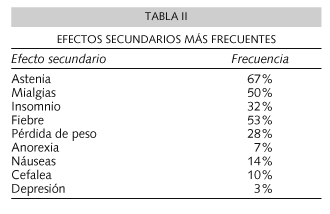
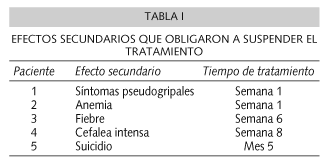
<body><![CDATA[<p>El tratamiento se llev&oacute; a cabo con IFN alfa-2b y RBV. El IFN se administr&oacute; a dosis de 3 millones de unidades, por v&iacute;a subcut&aacute;nea, 3 d&iacute;as en semana (lunes, mi&eacute;rcoles y viernes) y la RBV se administr&oacute; en comprimidos de 200 mg, diariamente por v&iacute;a oral a dosis de 1.000 mg/d&iacute;a si el paciente pesaba menos de 75 kg, y 1.200 mg/d&iacute;a si el peso era mayor de 75 kg. Este tratamiento se mantuvo durante 6 meses en los pacientes con genotipo 2 &oacute; 3, y durante 12 meses en los infectados con los genotipos 1 &oacute; 4 si al sexto mes de tratamiento la determinaci&oacute;n del ARN-VHC era indetectable. Si en ese momento era positiva esta determinaci&oacute;n, se suspend&iacute;a el tratamiento.</p>     <p><i>Determinaciones anal&iacute;ticas</i>. La determinaci&oacute;n basal del ARN del VHC se realiz&oacute; con un m&eacute;todo comercial (Cobas Amplicor HCV Monitor; Roche, Barcelona), con l&iacute;mite de detecci&oacute;n de 600 UI/ml. El genotipo del virus C tambi&eacute;n se realiz&oacute; con una t&eacute;cnica comercial (LiPA HCV II; Bayer, Barcelona). Las determinaciones posteriores del ARN-VHC se realizaron con una t&eacute;cnica cualitativa (Cobas Amplicor HCV; Roche, Barcelona) con l&iacute;mite de detecci&oacute;n de 60 UI/Ml. Esta determinaci&oacute;n se realiz&oacute; al finalizar el tratamiento y 6 meses despu&eacute;s. Si al finalizar el tratamiento la viremia del VHC era indetectable, se consideraba como respuesta de fin de tratamiento. Si a los 6 meses despu&eacute;s de finalizar el tratamiento la viremia del VHC era indetectable, se consideraba como respuesta sostenida.</p>    <p>Despu&eacute;s de iniciado el tratamiento, los pacientes se revisaron en la semana 2, 4, 6 y 8 y posteriormente cada 2 meses hasta los 6 meses siguientes a la finalizaci&oacute;n del tratamiento, realiz&aacute;ndose determinaciones de hemoglobina, plaquetas, leucocitos y transaminasas. El recuento de linfocitos CD4 y la carga viral del VIH se determinaron cada 2 meses hasta los 6 meses siguientes a la finalizaci&oacute;n del tratamiento. Tambi&eacute;n se determinaron las hormonas tiroideas antes de iniciar el tratamiento, al finalizarlo y 6 meses despu&eacute;s.</p>     <p><i>An&aacute;lisis estad&iacute;stico</i>. Los resultados se expresan en valores absolutos y porcentaje. El porcentaje de respuesta se estima por "intenci&oacute;n de tratamiento" (abandonos=fracasos).</p>     <p>RESULTADOS</p>     <p>Durante el periodo de estudio se han tratado un total de 28 pacientes (82% varones, 18% mujeres) con una edad media de 36,6 a&ntilde;os. 24 pacientes hab&iacute;an contra&iacute;do la infecci&oacute;n a trav&eacute;s del consumo de drogas por v&iacute;a parenteral y 4 por relaciones heterosexuales. El 82% de los pacientes (23) estaban con tratamiento antirretroviral, 17 de ellos con triple terapia y 6 con doble terapia, que inclu&iacute;a: AZT en 14 (60%), 3TC en 16 (69%), D4T en 9 (39%), DDI en 5 (21%), Nelfinavir en 5 (21%) y otros f&aacute;rmacos en menor porcentaje. La distribuci&oacute;n de pacientes por genotipo del VHC fue: genotipo 1 en 14 (50%), 3 en 10 (35,7%), 4 en 3 (10,7%) y 2 en 1 (3%). La media del ARN-VHC al comienzo del tratamiento fue de 2.300.000 UI/ml. Todos los pacientes ten&iacute;an biopsia hep&aacute;tica previa al inicio del tratamiento, la mayor&iacute;a con fibrosis grado 2 (20 pacientes, 71%), 6 con fibrosis grado 3 y 2 con fibrosis grado 1. La media de linfocitos CD4 al comienzo del tratamiento fue de 606, con un rango entre 180 y 1.186 c&eacute;lulas/µl. La carga viral del VIH era indetectable (&lt;50 copias/ml) en 19 pacientes (67%) y en el resto no pasaba de 5.000 copias/ml.</p>     <p>Ning&uacute;n paciente fue p&eacute;rdida de seguimiento y hubo un total de 5 abandonos (17,8%), debido a efectos adversos de la medicaci&oacute;n (<a href="#t1">Tabla I</a>). El efecto adverso m&aacute;s grave ocurri&oacute; en un paciente que se suicid&oacute; al 5&ordm; mes de tratamiento, tras presentar cuadro depresivo que motiv&oacute; su ingreso en el Servicio de Psiquiatr&iacute;a. Durante este ingreso, se suspendi&oacute; el tratamiento con IFN y RBV. Despu&eacute;s del alta del hospital, el paciente se suicid&oacute;.</p>     <p align="center"><a name="t1"><img src="/img/revistas/ami/v21n8/original1_tabla1.gif" width="329" height="166"></a></p>      <p>    <br>Pr&aacute;cticamente todos los pacientes presentaron alg&uacute;n efecto adverso, de mayor o menor intensidad, que en algunos pacientes se prolongaron hasta finalizar el tratamiento e incluso algunas semanas despu&eacute;s. Los m&aacute;s frecuentes fueron los s&iacute;ntomas pseudo-gripales o <i>"flu-like"</i>, seg&uacute;n se expone en la <a href="#t2">tabla II</a>.</p>     ]]></body>
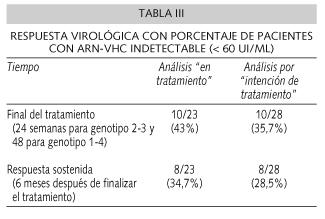
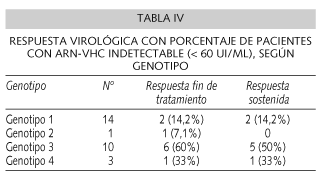
<body><![CDATA[<p align="center"><a name="t2"><img src="/img/revistas/ami/v21n8/original1_tabla2.gif" width="330" height="214"></a></p>      <p>    <br>S&oacute;lo una paciente abandon&oacute; el tratamiento por anemia, llegando a 7 g/dl de hemoglobina tras la primera semana de tratamiento, aunque no fue necesaria transfusi&oacute;n. Otros 3 pacientes necesitaron disminuir temporalmente la dosis de RBV a la mitad por aparici&oacute;n de anemia, con descenso mayor de 3 g/dl en la cifra de hemoglobina, entre la segunda y tercera semana de tratamiento, pudiendo volver a aumentarla a la dosis inicial entre 3 y 4 semanas despu&eacute;s. Estos 4 pacientes estaban con tratamiento antirretroviral que inclu&iacute;a AZT entre otros.</p>     <p>En ning&uacute;n caso hubo progresi&oacute;n de la infecci&oacute;n por VIH, no apareciendo ning&uacute;n tipo de infecci&oacute;n oportunista, aunque la cifra absoluta de linfocitos CD4 disminuy&oacute; en todos los pacientes, permaneciendo estable el porcentaje, con vuelta a los valores basales a las pocas semanas de suspender el tratamiento de la hepatitis C. La cifra de carga viral del VIH no sufri&oacute; ninguna modificaci&oacute;n.</p>     <p>Se observ&oacute; respuesta al final del tratamiento en 10 pacientes (43%) de 23 que finalizaron el tratamiento, ocurriendo recaida en 2 pacientes en los 6 meses siguientes a finalizar el tratamiento, uno con genotipo 2 y otro con genotipo 3, por lo que la respuesta sostenida fue del 34,7% (8 de 23). Si se analizan los datos por intenci&oacute;n de tratamiento, la respuesta al final del tratamiento fue del 35,7% (10 de 28) y la respuesta sostenida del 28,5% (8 de 28) (<a href="#t3">Tabla III</a>).</p>     <p align="center"><a name="t3"><img src="/img/revistas/ami/v21n8/original1_tabla3.gif" width="325" height="219"></a></p>      <p>    <br>Al analizar los datos seg&uacute;n el genotipo del virus C, de los 10 pacientes que respondieron al final del tratamiento, 6 eran de genotipo 3 (60%), 2 de genotipo 1, 1 de genotipo 4 y otro de genotipo 2. Y de los 8 pacientes con respuesta sostenida, 5 eran de genotipo 3 (62%) , 2 de genotipo 1 y 1 de genotipo 4. En datos por intenci&oacute;n de tratamiento, de los 14 pacientes con genotipo 1, s&oacute;lo 2 tuvieron respuesta sostenida (14%), mientras que de los 10 pacientes con genotipo 3 que empezaron tratamiento, 5 presentaron respuesta sostenida (50%) (<a href="#t4">Tabla IV</a>).</p>     <p align="center"><a name="t4"><img src="/img/revistas/ami/v21n8/original1_tabla4.gif" width="324" height="178"></a></p>      <p>    ]]></body>
<body><![CDATA[<br>DISCUSIÓN</p>     <p>Los objetivos del tratamiento de la hepatitis C cr&oacute;nica son, por un lado, la disminuci&oacute;n de la morbimortalidad asociada a enfermedad hep&aacute;tica terminal y la disminuci&oacute;n del riesgo de transmisi&oacute;n, y por otro, la erradicaci&oacute;n de la infecci&oacute;n por VHC y la mejora de la lesi&oacute;n histol&oacute;gica. Con este prop&oacute;sito, se realizaron hace varios a&ntilde;os estudios con IFN en monoterapia, obteniendo unos resultados muy pobres, con respuesta sostenida entre el 6 y el 13 % de los pacientes (9,10). Posteriormente se investig&oacute; con la terapia combinada con IFN y RBV y el porcentaje de respuesta sostenida se elev&oacute; al 41% (11).</p>     <p>Estos resultados pusieron de manifiesto que un elevado porcentaje de pacientes podr&iacute;an beneficiarse del tratamiento, por lo que comenzaron a hacerse estudios en pacientes coinfectados por VIH y VHC, en principio con IFN en monoterapia, con respuesta sostenida de apenas un 15%, y posteriormente con la combinaci&oacute;n de IFN y RBV. Entre estos estudios cabe destacar el realizado por Landau y cols. (12) sobre 51 pacientes, con respuesta sostenida global del 20%, el de Sauleda y cols. (13) en 20 pacientes que llega a una respuesta sostenida del 40%, y el de Nasti y cols. (14) con respuesta sostenida del 19% en 17 pacientes. Posteriormente se han comunicado otras series en forma de abstracts de congresos con respuestas sostenidas que oscilan entre 18-23%.</p>     <p>En nuestra serie, el porcentaje de respuesta sostenida fue del 28,5%, similar a las series comentadas, con mejor respuesta para el genotipo 3, como ya tambi&eacute;n se ha publicado. En cuanto al porcentaje de pacientes que tienen que abandonar el tratamiento por efectos secundarios, tambi&eacute;n nuestra serie se iguala a otras publicadas, que oscilan entre el 15-20%.</p>     <p>Recientemente se han publicado los resultados del tratamiento con una nueva forma de IFN, el IFN pegilado, en combinaci&oacute;n con RBV, en pacientes no infectados por VIH, y el porcentaje de respuesta sostenida se ha elevado de manera significativa, llegando al 54-56% para el genotipo 1 y al 76-82% para el genotipo 3 (15,16). Esto ha llevado a empezar ensayos con esta combinaci&oacute;n en pacientes coinfectados VHC-VIH, como el publicado por P&eacute;rez-Olmeda M y cols. (17) en 68 pacientes, donde obtienen una tasa de respuesta sostenida global del 35%. Otras series de pacientes se han comunicado en diversos Congresos, con resultados similares, entre el 20-26% (18,19).</p>     <p>Como vemos, estos porcentajes son sensiblemente inferiores a los obtenidos en pacientes no infectados por el VIH, y se han barajado diversas causas para su explicaci&oacute;n: grado de fibrosis hep&aacute;tica m&aacute;s avanzado, mayor frecuencia de esteatosis hep&aacute;tica, valores mayores de viremia, retraso en el aclaramiento inicial del ARN-VHC, mayor frecuencia de recidivas, mayor frecuencia de efectos adversos y peor cumplimiento de la medicaci&oacute;n.</p>     <p>En cualquier caso, est&aacute; claro que los pacientes coinfectados por el VHC y por el VIH presentan un riesgo aumentado de progresi&oacute;n de su enfermedad hep&aacute;tica, no s&oacute;lo por las posibles interacciones patog&eacute;nicas entre ambos virus, sino tambi&eacute;n por el aumento de la supervivencia en la infecci&oacute;n por VIH. Todo esto hay que tenerlo en cuenta a la hora de enfrentarnos a este tipo de pacientes, y pensar en la necesidad de tratar de forma precoz la infecci&oacute;n por el VHC, como ya se ha puesto de manifiesto en los diferentes Consensos de Tratamiento que se han publicado sobre este tema (20,21). A&uacute;n hay muchos puntos sin aclarar sobre el tratamiento &oacute;ptimo en estos pacientes, y partiendo de la base de los estudios realizados en pacientes sin infecci&oacute;n por VIH, las futuras investigaciones deben incluir el an&aacute;lisis cuidadoso del efecto del VIH sobre la fibrosis hep&aacute;tica, las interacciones <i>"in vitro"</i> e <i>"in vivo"</i> entre el VIH y el VHC, as&iacute; como las interacciones entre el tratamiento antirretroviral y el de la hepatitis C, estudiar la historia natural de la infecci&oacute;n por VHC en los pacientes con infecci&oacute;n por VIH, seguir con los estudios con el tratamiento combinado actual, y otros aspectos como la posibilidad de incluir a los pacientes con cirrosis descompensada en los programas de trasplante hep&aacute;tico (22). Actualmente, nuestro grupo est&aacute; trabajando con la combinaci&oacute;n de IFN pegilado y RBV y esperamos tener datos de respuesta sostenida en un breve plazo.</p>     <p>&nbsp;</p>     <p><font size="4"><i>Bibliograf&iacute;a</i></font></p>     <!-- ref --><p>1. Alfonso R, Hurtado I, Espacio A et al. Risks behaviours and seroprevalence to HIV, HBV and HCV in patients of the AIDS information and prevention center in Valencia, Spain. Gac Sanit 1999; 13: 16-21.    &nbsp;&nbsp;&nbsp;&nbsp;&nbsp;&nbsp;&nbsp;&nbsp;[&#160;<a href="javascript:void(0);" onclick="javascript: window.open('/scielo.php?script=sci_nlinks&ref=559806&pid=S0212-7199200400080000200001&lng=','','width=640,height=500,resizable=yes,scrollbars=1,menubar=yes,');">Links</a>&#160;]<!-- end-ref --></p>    <!-- ref --><p>2. Jim&eacute;nez X, Carballo A, Batalla C et al. The prevalence of infection by the hepatitis B, C and human immunodeficiency viruses in drug users. Aten Primaria 1999; 24: 368-371.    &nbsp;&nbsp;&nbsp;&nbsp;&nbsp;&nbsp;&nbsp;&nbsp;[&#160;<a href="javascript:void(0);" onclick="javascript: window.open('/scielo.php?script=sci_nlinks&ref=559808&pid=S0212-7199200400080000200002&lng=','','width=640,height=500,resizable=yes,scrollbars=1,menubar=yes,');">Links</a>&#160;]<!-- end-ref --></p>    <!-- ref --><p>3. Staples CT, Rimland D, Dudas D. Hepatitis C in the HIV (human immunodeficiency virus) Atlanta V.A. (Veterans Affairs Medical center) Cohort Study (HAVACS): the effect of coinfection on survival. Clin Infect Dis 1999; 29: 150-154.    &nbsp;&nbsp;&nbsp;&nbsp;&nbsp;&nbsp;&nbsp;&nbsp;[&#160;<a href="javascript:void(0);" onclick="javascript: window.open('/scielo.php?script=sci_nlinks&ref=559810&pid=S0212-7199200400080000200003&lng=','','width=640,height=500,resizable=yes,scrollbars=1,menubar=yes,');">Links</a>&#160;]<!-- end-ref --></p>    <!-- ref --><p>4. Bica I, McGovern B, Dhar et al. Increasing mortality due to end stage liver disease in patients with human immunodeficiency virus infection. Clin Infect Dis 2001; 32: 492-497.    &nbsp;&nbsp;&nbsp;&nbsp;&nbsp;&nbsp;&nbsp;&nbsp;[&#160;<a href="javascript:void(0);" onclick="javascript: window.open('/scielo.php?script=sci_nlinks&ref=559812&pid=S0212-7199200400080000200004&lng=','','width=640,height=500,resizable=yes,scrollbars=1,menubar=yes,');">Links</a>&#160;]<!-- end-ref --></p>    <!-- ref --><p>5. Graham CS, Baden LR, Yu E, et al. Influence of human immunodeficiency virus infection on the course oh hepatitis C virus infection: a meta-analysis. Clin Infect Dis 2001; 32: 562-569.    &nbsp;&nbsp;&nbsp;&nbsp;&nbsp;&nbsp;&nbsp;&nbsp;[&#160;<a href="javascript:void(0);" onclick="javascript: window.open('/scielo.php?script=sci_nlinks&ref=559814&pid=S0212-7199200400080000200005&lng=','','width=640,height=500,resizable=yes,scrollbars=1,menubar=yes,');">Links</a>&#160;]<!-- end-ref --></p>    <!-- ref --><p>6. Puoti M, Spinetti A, Ghezzi A, et al. Mortality for liver disease in patients with HIV infection: a cohort study. J Acquir Immun Def Syndr 2000; 24: 211-7.    &nbsp;&nbsp;&nbsp;&nbsp;&nbsp;&nbsp;&nbsp;&nbsp;[&#160;<a href="javascript:void(0);" onclick="javascript: window.open('/scielo.php?script=sci_nlinks&ref=559816&pid=S0212-7199200400080000200006&lng=','','width=640,height=500,resizable=yes,scrollbars=1,menubar=yes,');">Links</a>&#160;]<!-- end-ref --></p>    <!-- ref --><p>7. Mart&iacute;n-Carbonero L, Soriano V, Valencia ME, Garc&iacute;a-Samaniego J, L&oacute;pez M, Gonz&aacute;lez-Lahoz J. Impact of chronic viral hepatitis on hospital admission and mortality in HIV-infected patients. AIDS Res Hum Retroviruses 2001; 17: 1467-71.    &nbsp;&nbsp;&nbsp;&nbsp;&nbsp;&nbsp;&nbsp;&nbsp;[&#160;<a href="javascript:void(0);" onclick="javascript: window.open('/scielo.php?script=sci_nlinks&ref=559818&pid=S0212-7199200400080000200007&lng=','','width=640,height=500,resizable=yes,scrollbars=1,menubar=yes,');">Links</a>&#160;]<!-- end-ref --></p>    <!-- ref --><p>8. Benhamou Y, Bochet M, Di Martino V, et al. Liver fibrosis progression in HIV and HCV coinfected patients. Hepatology 1999; 30: 1054-1058.    &nbsp;&nbsp;&nbsp;&nbsp;&nbsp;&nbsp;&nbsp;&nbsp;[&#160;<a href="javascript:void(0);" onclick="javascript: window.open('/scielo.php?script=sci_nlinks&ref=559820&pid=S0212-7199200400080000200008&lng=','','width=640,height=500,resizable=yes,scrollbars=1,menubar=yes,');">Links</a>&#160;]<!-- end-ref --></p>    <!-- ref --><p>9. McHutchison J, Gordon S, Schiff E, et al. Interferon alfa-2b alone or in combination with ribavirin as initial treatment for chronic hepatitis C. N Engl J Med 1998; 339: 1485-1492.    &nbsp;&nbsp;&nbsp;&nbsp;&nbsp;&nbsp;&nbsp;&nbsp;[&#160;<a href="javascript:void(0);" onclick="javascript: window.open('/scielo.php?script=sci_nlinks&ref=559822&pid=S0212-7199200400080000200009&lng=','','width=640,height=500,resizable=yes,scrollbars=1,menubar=yes,');">Links</a>&#160;]<!-- end-ref --></p>    <!-- ref --><p>10. Poynard T, Marcellin P, Lee S, et al. Randomised trial of interferon alpha 2b plus ribavirin for 48 weeks or for 24 weeks versus interferon alpha 2b plus placebo for 48 weeks for treatment of chronic infection with hepatitis C virus. Lancet 1998; 352: 1426-1432.    &nbsp;&nbsp;&nbsp;&nbsp;&nbsp;&nbsp;&nbsp;&nbsp;[&#160;<a href="javascript:void(0);" onclick="javascript: window.open('/scielo.php?script=sci_nlinks&ref=559824&pid=S0212-7199200400080000200010&lng=','','width=640,height=500,resizable=yes,scrollbars=1,menubar=yes,');">Links</a>&#160;]<!-- end-ref --></p>    <!-- ref --><p>11. Zeuzem S, Feinman S, Rasenack J, et al. Peginterferon alfa-2a in patients with chronic hepatitis C. N Engl J Med 2000; 343: 1666-1672.    &nbsp;&nbsp;&nbsp;&nbsp;&nbsp;&nbsp;&nbsp;&nbsp;[&#160;<a href="javascript:void(0);" onclick="javascript: window.open('/scielo.php?script=sci_nlinks&ref=559826&pid=S0212-7199200400080000200011&lng=','','width=640,height=500,resizable=yes,scrollbars=1,menubar=yes,');">Links</a>&#160;]<!-- end-ref --></p>    <!-- ref --><p>12. Landau A, Batisse D, Piketty C et al. Long-term efficacy of combination therapy with interferon-a2b and ribavirin for severe chronic hepatitis in HIV.infected patients. AIDS 2001; 15: 2149-2155.    &nbsp;&nbsp;&nbsp;&nbsp;&nbsp;&nbsp;&nbsp;&nbsp;[&#160;<a href="javascript:void(0);" onclick="javascript: window.open('/scielo.php?script=sci_nlinks&ref=559828&pid=S0212-7199200400080000200012&lng=','','width=640,height=500,resizable=yes,scrollbars=1,menubar=yes,');">Links</a>&#160;]<!-- end-ref --></p>    <!-- ref --><p>13. Sauleda S, Ju&aacute;rez A, Esteban JI, et al. Interferon and Ribavirin combination therapy for chronic hepatitis C in human immunodeficiency virus-infected patients with congenital coagulation disorders. Hepatology 2001; 34: 1035-1040.    &nbsp;&nbsp;&nbsp;&nbsp;&nbsp;&nbsp;&nbsp;&nbsp;[&#160;<a href="javascript:void(0);" onclick="javascript: window.open('/scielo.php?script=sci_nlinks&ref=559830&pid=S0212-7199200400080000200013&lng=','','width=640,height=500,resizable=yes,scrollbars=1,menubar=yes,');">Links</a>&#160;]<!-- end-ref --></p>    <!-- ref --><p>14. Nasti G, Di Gennaro G, Tavio M et al. Chronic Hepatitis C in HIV infection: feasibility and sustained efficacy of therapy with interferon alfa-2b and ribavirin. AIDS 2001; 15: 1783-1787.    &nbsp;&nbsp;&nbsp;&nbsp;&nbsp;&nbsp;&nbsp;&nbsp;[&#160;<a href="javascript:void(0);" onclick="javascript: window.open('/scielo.php?script=sci_nlinks&ref=559832&pid=S0212-7199200400080000200014&lng=','','width=640,height=500,resizable=yes,scrollbars=1,menubar=yes,');">Links</a>&#160;]<!-- end-ref --></p>    <!-- ref --><p>15. Fried MW, Shiffman ML, Reddy R et al. Peginterferon Alfa-2a plus ribavirin for chronic hepatitis C virus infection. N Engl J Med 2002; 347: 975-982.    &nbsp;&nbsp;&nbsp;&nbsp;&nbsp;&nbsp;&nbsp;&nbsp;[&#160;<a href="javascript:void(0);" onclick="javascript: window.open('/scielo.php?script=sci_nlinks&ref=559834&pid=S0212-7199200400080000200015&lng=','','width=640,height=500,resizable=yes,scrollbars=1,menubar=yes,');">Links</a>&#160;]<!-- end-ref --></p>    <!-- ref --><p>16. Manns M, McHutchison J, Gordon S, et al. Peginterferon alfa-2b plus ribavirin compared with interferon alfa-2b plus ribavirin for initial treatment of chronic hepatitis C: a randomised trial. Lancet 2001; 358: 958-965.    &nbsp;&nbsp;&nbsp;&nbsp;&nbsp;&nbsp;&nbsp;&nbsp;[&#160;<a href="javascript:void(0);" onclick="javascript: window.open('/scielo.php?script=sci_nlinks&ref=559836&pid=S0212-7199200400080000200016&lng=','','width=640,height=500,resizable=yes,scrollbars=1,menubar=yes,');">Links</a>&#160;]<!-- end-ref --></p>    <!-- ref --><p>17. P&eacute;rez-Olmeda M, N&uacute;&ntilde;ez M, Romero M et al. Pegylated IFN-alpha2b plus ribavirin as therapy for chronic hepatitis in HIV-infected patients. AIDS 2003; 17: 1023-1028.    &nbsp;&nbsp;&nbsp;&nbsp;&nbsp;&nbsp;&nbsp;&nbsp;[&#160;<a href="javascript:void(0);" onclick="javascript: window.open('/scielo.php?script=sci_nlinks&ref=559838&pid=S0212-7199200400080000200017&lng=','','width=640,height=500,resizable=yes,scrollbars=1,menubar=yes,');">Links</a>&#160;]<!-- end-ref --></p>    <!-- ref --><p>18. Goelz J, Klausen G, Moil A et al. Efficacy and tolerance of therapy with IFN-alpha/RBV and pegIFN-alpha/RBV in HIV/HCV-coinfected IVDUs. XIV International AIDS Conference. Abstract MoPeB3258. Barcelona 2002.    &nbsp;&nbsp;&nbsp;&nbsp;&nbsp;&nbsp;&nbsp;&nbsp;[&#160;<a href="javascript:void(0);" onclick="javascript: window.open('/scielo.php?script=sci_nlinks&ref=559840&pid=S0212-7199200400080000200018&lng=','','width=640,height=500,resizable=yes,scrollbars=1,menubar=yes,');">Links</a>&#160;]<!-- end-ref --></p>    <!-- ref --><p>19. Voigt E, Schulz C, Mauss S et al. Factors related to outcome of treatment with pegylated Interferon alpha 2b (PEG INF) plus Ribavirin (RBV) in HCV/HIV-co-infected patients. 2nd IAS Conference on HIV Pathogenesis and Treatment. Abstract 976. Paris 2003.    &nbsp;&nbsp;&nbsp;&nbsp;&nbsp;&nbsp;&nbsp;&nbsp;[&#160;<a href="javascript:void(0);" onclick="javascript: window.open('/scielo.php?script=sci_nlinks&ref=559842&pid=S0212-7199200400080000200019&lng=','','width=640,height=500,resizable=yes,scrollbars=1,menubar=yes,');">Links</a>&#160;]<!-- end-ref --></p>    <!-- ref --><p>20. Garc&iacute;a-Samaniego J, Soriano V, Mir&oacute; JM et al. Management of chronic viral hepatitis in HIV-infected patients: Spanish Consensus Conference. HIV Clin Trials 2002; 3: 99-114.    &nbsp;&nbsp;&nbsp;&nbsp;&nbsp;&nbsp;&nbsp;&nbsp;[&#160;<a href="javascript:void(0);" onclick="javascript: window.open('/scielo.php?script=sci_nlinks&ref=559844&pid=S0212-7199200400080000200020&lng=','','width=640,height=500,resizable=yes,scrollbars=1,menubar=yes,');">Links</a>&#160;]<!-- end-ref --></p>    <!-- ref --><p>21. NIH Consensus Conference. Management of Hepatitis C: 2002. Bethesda, June 10-12, 2002.    &nbsp;&nbsp;&nbsp;&nbsp;&nbsp;&nbsp;&nbsp;&nbsp;[&#160;<a href="javascript:void(0);" onclick="javascript: window.open('/scielo.php?script=sci_nlinks&ref=559846&pid=S0212-7199200400080000200021&lng=','','width=640,height=500,resizable=yes,scrollbars=1,menubar=yes,');">Links</a>&#160;]<!-- end-ref --></p>    <!-- ref --><p>22. Thomas DL. Hepatitis C and Human Immunodeficiency Virus Infection. Hepatology 2002; 36: S201-S209.    &nbsp;&nbsp;&nbsp;&nbsp;&nbsp;&nbsp;&nbsp;&nbsp;[&#160;<a href="javascript:void(0);" onclick="javascript: window.open('/scielo.php?script=sci_nlinks&ref=559848&pid=S0212-7199200400080000200022&lng=','','width=640,height=500,resizable=yes,scrollbars=1,menubar=yes,');">Links</a>&#160;]<!-- end-ref --></p>      ]]></body><back>
<ref-list>
<ref id="B1">
<label>1</label><nlm-citation citation-type="journal">
<person-group person-group-type="author">
<name>
<surname><![CDATA[Alfonso]]></surname>
<given-names><![CDATA[R]]></given-names>
</name>
<name>
<surname><![CDATA[Hurtado]]></surname>
<given-names><![CDATA[I]]></given-names>
</name>
<name>
<surname><![CDATA[Espacio]]></surname>
<given-names><![CDATA[A]]></given-names>
</name>
</person-group>
<article-title xml:lang="en"><![CDATA[Risks behaviours and seroprevalence to HIV, HBV and HCV in patients of the AIDS information and prevention center in Valencia, Spain]]></article-title>
<source><![CDATA[Gac Sanit]]></source>
<year>1999</year>
<volume>13</volume>
<page-range>16-21</page-range></nlm-citation>
</ref>
<ref id="B2">
<label>2</label><nlm-citation citation-type="journal">
<person-group person-group-type="author">
<name>
<surname><![CDATA[Jiménez]]></surname>
<given-names><![CDATA[X]]></given-names>
</name>
<name>
<surname><![CDATA[Carballo]]></surname>
<given-names><![CDATA[A]]></given-names>
</name>
<name>
<surname><![CDATA[Batalla]]></surname>
<given-names><![CDATA[C]]></given-names>
</name>
</person-group>
<article-title xml:lang="en"><![CDATA[The prevalence of infection by the hepatitis B, C and human immunodeficiency viruses in drug users]]></article-title>
<source><![CDATA[Aten Primaria]]></source>
<year>1999</year>
<volume>24</volume>
</nlm-citation>
</ref>
<ref id="B3">
<label>3</label><nlm-citation citation-type="journal">
<person-group person-group-type="author">
<name>
<surname><![CDATA[Staples]]></surname>
<given-names><![CDATA[CT]]></given-names>
</name>
<name>
<surname><![CDATA[Rimland]]></surname>
<given-names><![CDATA[D]]></given-names>
</name>
<name>
<surname><![CDATA[Dudas]]></surname>
<given-names><![CDATA[D]]></given-names>
</name>
</person-group>
<article-title xml:lang="en"><![CDATA[Hepatitis C in the HIV (human immunodeficiency virus) Atlanta V.A. (Veterans Affairs Medical center) Cohort Study (HAVACS): the effect of coinfection on survival]]></article-title>
<source><![CDATA[Clin Infect Dis]]></source>
<year>1999</year>
<volume>29</volume>
<page-range>150-154</page-range></nlm-citation>
</ref>
<ref id="B4">
<label>4</label><nlm-citation citation-type="journal">
<person-group person-group-type="author">
<name>
<surname><![CDATA[Bica]]></surname>
<given-names><![CDATA[I]]></given-names>
</name>
<name>
<surname><![CDATA[McGovern]]></surname>
<given-names><![CDATA[B]]></given-names>
</name>
<name>
<surname><![CDATA[Dhar]]></surname>
</name>
</person-group>
<article-title xml:lang="en"><![CDATA[Increasing mortality due to end stage liver disease in patients with human immunodeficiency virus infection]]></article-title>
<source><![CDATA[Clin Infect Dis]]></source>
<year>2001</year>
<volume>32</volume>
<page-range>492-497</page-range></nlm-citation>
</ref>
<ref id="B5">
<label>5</label><nlm-citation citation-type="journal">
<person-group person-group-type="author">
<name>
<surname><![CDATA[Graham]]></surname>
<given-names><![CDATA[CS]]></given-names>
</name>
<name>
<surname><![CDATA[Baden]]></surname>
<given-names><![CDATA[LR]]></given-names>
</name>
<name>
<surname><![CDATA[Yu]]></surname>
<given-names><![CDATA[E]]></given-names>
</name>
</person-group>
<article-title xml:lang="en"><![CDATA[Influence of human immunodeficiency virus infection on the course oh hepatitis C virus infection: a meta-analysis]]></article-title>
<source><![CDATA[Clin Infect Dis]]></source>
<year>2001</year>
<volume>32</volume>
<page-range>562-569</page-range></nlm-citation>
</ref>
<ref id="B6">
<label>6</label><nlm-citation citation-type="journal">
<person-group person-group-type="author">
<name>
<surname><![CDATA[Puoti]]></surname>
<given-names><![CDATA[M]]></given-names>
</name>
<name>
<surname><![CDATA[Spinetti]]></surname>
<given-names><![CDATA[A]]></given-names>
</name>
<name>
<surname><![CDATA[Ghezzi]]></surname>
<given-names><![CDATA[A]]></given-names>
</name>
</person-group>
<article-title xml:lang="en"><![CDATA[Mortality for liver disease in patients with HIV infection: a cohort study]]></article-title>
<source><![CDATA[J Acquir Immun Def Syndr]]></source>
<year>2000</year>
<volume>24</volume>
<page-range>211-7</page-range></nlm-citation>
</ref>
<ref id="B7">
<label>7</label><nlm-citation citation-type="journal">
<person-group person-group-type="author">
<name>
<surname><![CDATA[Martín-Carbonero]]></surname>
<given-names><![CDATA[L]]></given-names>
</name>
<name>
<surname><![CDATA[Soriano]]></surname>
<given-names><![CDATA[V]]></given-names>
</name>
<name>
<surname><![CDATA[Valencia]]></surname>
<given-names><![CDATA[ME]]></given-names>
</name>
<name>
<surname><![CDATA[García-Samaniego]]></surname>
<given-names><![CDATA[J]]></given-names>
</name>
<name>
<surname><![CDATA[López]]></surname>
<given-names><![CDATA[M]]></given-names>
</name>
<name>
<surname><![CDATA[González-Lahoz]]></surname>
<given-names><![CDATA[J]]></given-names>
</name>
</person-group>
<article-title xml:lang="en"><![CDATA[Impact of chronic viral hepatitis on hospital admission and mortality in HIV-infected patients]]></article-title>
<source><![CDATA[AIDS Res Hum Retroviruses]]></source>
<year>2001</year>
<volume>17</volume>
<page-range>1467-71</page-range></nlm-citation>
</ref>
<ref id="B8">
<label>8</label><nlm-citation citation-type="journal">
<person-group person-group-type="author">
<name>
<surname><![CDATA[Benhamou]]></surname>
<given-names><![CDATA[Y]]></given-names>
</name>
<name>
<surname><![CDATA[Bochet]]></surname>
<given-names><![CDATA[M]]></given-names>
</name>
<name>
<surname><![CDATA[Di Martino]]></surname>
<given-names><![CDATA[V]]></given-names>
</name>
</person-group>
<article-title xml:lang="en"><![CDATA[Liver fibrosis progression in HIV and HCV coinfected patients]]></article-title>
<source><![CDATA[Hepatology]]></source>
<year>1999</year>
<volume>30</volume>
<page-range>1054-1058</page-range></nlm-citation>
</ref>
<ref id="B9">
<label>9</label><nlm-citation citation-type="journal">
<person-group person-group-type="author">
<name>
<surname><![CDATA[McHutchison]]></surname>
<given-names><![CDATA[J]]></given-names>
</name>
<name>
<surname><![CDATA[Gordon]]></surname>
<given-names><![CDATA[S]]></given-names>
</name>
<name>
<surname><![CDATA[Schiff]]></surname>
<given-names><![CDATA[E]]></given-names>
</name>
</person-group>
<article-title xml:lang="en"><![CDATA[Interferon alfa-2b alone or in combination with ribavirin as initial treatment for chronic hepatitis C]]></article-title>
<source><![CDATA[N Engl J Med]]></source>
<year>1998</year>
<volume>339</volume>
<page-range>1485-1492</page-range></nlm-citation>
</ref>
<ref id="B10">
<label>10</label><nlm-citation citation-type="journal">
<person-group person-group-type="author">
<name>
<surname><![CDATA[Poynard]]></surname>
<given-names><![CDATA[T]]></given-names>
</name>
<name>
<surname><![CDATA[Marcellin]]></surname>
<given-names><![CDATA[P]]></given-names>
</name>
<name>
<surname><![CDATA[Lee]]></surname>
<given-names><![CDATA[S]]></given-names>
</name>
</person-group>
<article-title xml:lang="en"><![CDATA[Randomised trial of interferon alpha 2b plus ribavirin for 48 weeks or for 24 weeks versus interferon alpha 2b plus placebo for 48 weeks for treatment of chronic infection with hepatitis C virus]]></article-title>
<source><![CDATA[Lancet]]></source>
<year>1998</year>
<volume>352</volume>
<page-range>1426-1432</page-range></nlm-citation>
</ref>
<ref id="B11">
<label>11</label><nlm-citation citation-type="journal">
<person-group person-group-type="author">
<name>
<surname><![CDATA[Zeuzem]]></surname>
<given-names><![CDATA[S]]></given-names>
</name>
<name>
<surname><![CDATA[Feinman]]></surname>
<given-names><![CDATA[S]]></given-names>
</name>
<name>
<surname><![CDATA[Rasenack]]></surname>
<given-names><![CDATA[J]]></given-names>
</name>
</person-group>
<article-title xml:lang="en"><![CDATA[Peginterferon alfa-2a in patients with chronic hepatitis C]]></article-title>
<source><![CDATA[N Engl J Med]]></source>
<year>2000</year>
<volume>343</volume>
<page-range>1666-1672</page-range></nlm-citation>
</ref>
<ref id="B12">
<label>12</label><nlm-citation citation-type="journal">
<person-group person-group-type="author">
<name>
<surname><![CDATA[Landau]]></surname>
<given-names><![CDATA[A]]></given-names>
</name>
<name>
<surname><![CDATA[Batisse]]></surname>
<given-names><![CDATA[D]]></given-names>
</name>
<name>
<surname><![CDATA[Piketty]]></surname>
<given-names><![CDATA[C]]></given-names>
</name>
</person-group>
<article-title xml:lang="en"><![CDATA[Long-term efficacy of combination therapy with interferon-a2b and ribavirin for severe chronic hepatitis in HIV.infected patients]]></article-title>
<source><![CDATA[AIDS]]></source>
<year>2001</year>
<volume>15</volume>
<page-range>2149-2155</page-range></nlm-citation>
</ref>
<ref id="B13">
<label>13</label><nlm-citation citation-type="journal">
<person-group person-group-type="author">
<name>
<surname><![CDATA[Sauleda]]></surname>
<given-names><![CDATA[S]]></given-names>
</name>
<name>
<surname><![CDATA[Juárez]]></surname>
<given-names><![CDATA[A]]></given-names>
</name>
<name>
<surname><![CDATA[Esteban]]></surname>
<given-names><![CDATA[JI]]></given-names>
</name>
</person-group>
<article-title xml:lang="en"><![CDATA[Interferon and Ribavirin combination therapy for chronic hepatitis C in human immunodeficiency virus-infected patients with congenital coagulation disorders]]></article-title>
<source><![CDATA[Hepatology]]></source>
<year>2001</year>
<volume>34</volume>
<page-range>1035-1040</page-range></nlm-citation>
</ref>
<ref id="B14">
<label>14</label><nlm-citation citation-type="journal">
<person-group person-group-type="author">
<name>
<surname><![CDATA[Nasti]]></surname>
<given-names><![CDATA[G]]></given-names>
</name>
<name>
<surname><![CDATA[Di Gennaro]]></surname>
<given-names><![CDATA[G]]></given-names>
</name>
<name>
<surname><![CDATA[Tavio]]></surname>
<given-names><![CDATA[M]]></given-names>
</name>
</person-group>
<article-title xml:lang="en"><![CDATA[Chronic Hepatitis C in HIV infection: feasibility and sustained efficacy of therapy with interferon alfa-2b and ribavirin]]></article-title>
<source><![CDATA[AIDS]]></source>
<year>2001</year>
<volume>15</volume>
<page-range>1783-1787</page-range></nlm-citation>
</ref>
<ref id="B15">
<label>15</label><nlm-citation citation-type="journal">
<person-group person-group-type="author">
<name>
<surname><![CDATA[Fried]]></surname>
<given-names><![CDATA[MW]]></given-names>
</name>
<name>
<surname><![CDATA[Shiffman]]></surname>
<given-names><![CDATA[ML]]></given-names>
</name>
<name>
<surname><![CDATA[Reddy]]></surname>
<given-names><![CDATA[R]]></given-names>
</name>
</person-group>
<article-title xml:lang="en"><![CDATA[Peginterferon Alfa-2a plus ribavirin for chronic hepatitis C virus infection]]></article-title>
<source><![CDATA[N Engl J Med]]></source>
<year>2002</year>
<volume>347</volume>
<page-range>975-982</page-range></nlm-citation>
</ref>
<ref id="B16">
<label>16</label><nlm-citation citation-type="journal">
<person-group person-group-type="author">
<name>
<surname><![CDATA[Manns]]></surname>
<given-names><![CDATA[M]]></given-names>
</name>
<name>
<surname><![CDATA[McHutchison]]></surname>
<given-names><![CDATA[J]]></given-names>
</name>
<name>
<surname><![CDATA[Gordon]]></surname>
<given-names><![CDATA[S]]></given-names>
</name>
</person-group>
<article-title xml:lang="en"><![CDATA[Peginterferon alfa-2b plus ribavirin compared with interferon alfa-2b plus ribavirin for initial treatment of chronic hepatitis C: a randomised trial]]></article-title>
<source><![CDATA[Lancet]]></source>
<year>2001</year>
<volume>358</volume>
<page-range>958-965</page-range></nlm-citation>
</ref>
<ref id="B17">
<label>17</label><nlm-citation citation-type="journal">
<person-group person-group-type="author">
<name>
<surname><![CDATA[Pérez-Olmeda]]></surname>
<given-names><![CDATA[M]]></given-names>
</name>
<name>
<surname><![CDATA[Núñez]]></surname>
<given-names><![CDATA[M]]></given-names>
</name>
<name>
<surname><![CDATA[Romero]]></surname>
<given-names><![CDATA[M]]></given-names>
</name>
</person-group>
<article-title xml:lang="en"><![CDATA[Pegylated IFN-alpha2b plus ribavirin as therapy for chronic hepatitis in HIV-infected patients]]></article-title>
<source><![CDATA[AIDS]]></source>
<year>2003</year>
<volume>17</volume>
<page-range>1023-1028</page-range></nlm-citation>
</ref>
<ref id="B18">
<label>18</label><nlm-citation citation-type="confpro">
<person-group person-group-type="author">
<name>
<surname><![CDATA[Goelz]]></surname>
<given-names><![CDATA[J]]></given-names>
</name>
<name>
<surname><![CDATA[Klausen]]></surname>
<given-names><![CDATA[G]]></given-names>
</name>
<name>
<surname><![CDATA[Moil]]></surname>
<given-names><![CDATA[A]]></given-names>
</name>
</person-group>
<article-title xml:lang="en"><![CDATA[Efficacy and tolerance of therapy with IFN-alpha/RBV and pegIFN-alpha/RBV in HIV/HCV-coinfected IVDUs]]></article-title>
<source><![CDATA[]]></source>
<year></year>
<conf-name><![CDATA[XIV International AIDS Conference]]></conf-name>
<conf-date>2002</conf-date>
<conf-loc>Barcelona </conf-loc>
</nlm-citation>
</ref>
<ref id="B19">
<label>19</label><nlm-citation citation-type="confpro">
<person-group person-group-type="author">
<name>
<surname><![CDATA[Voigt]]></surname>
<given-names><![CDATA[E]]></given-names>
</name>
<name>
<surname><![CDATA[Schulz]]></surname>
<given-names><![CDATA[C]]></given-names>
</name>
<name>
<surname><![CDATA[Mauss]]></surname>
<given-names><![CDATA[S]]></given-names>
</name>
</person-group>
<article-title xml:lang="en"><![CDATA[Factors related to outcome of treatment with pegylated Interferon alpha 2b (PEG INF) plus Ribavirin (RBV) in HCV/HIV-co-infected patients]]></article-title>
<source><![CDATA[]]></source>
<year></year>
<conf-name><![CDATA[2 IAS Conference on HIV Pathogenesis and Treatment]]></conf-name>
<conf-date>2003</conf-date>
<conf-loc>Paris </conf-loc>
</nlm-citation>
</ref>
<ref id="B20">
<label>20</label><nlm-citation citation-type="journal">
<person-group person-group-type="author">
<name>
<surname><![CDATA[García-Samaniego]]></surname>
<given-names><![CDATA[J]]></given-names>
</name>
<name>
<surname><![CDATA[Soriano]]></surname>
<given-names><![CDATA[V]]></given-names>
</name>
<name>
<surname><![CDATA[Miró]]></surname>
<given-names><![CDATA[JM]]></given-names>
</name>
</person-group>
<article-title xml:lang="en"><![CDATA[Management of chronic viral hepatitis in HIV-infected patients: Spanish Consensus Conference]]></article-title>
<source><![CDATA[HIV Clin Trials]]></source>
<year>2002</year>
<volume>3</volume>
<page-range>99-114</page-range></nlm-citation>
</ref>
<ref id="B21">
<label>21</label><nlm-citation citation-type="confpro">
<source><![CDATA[]]></source>
<year></year>
<conf-name><![CDATA[ Management of Hepatitis C: 2002]]></conf-name>
<conf-date>June 10-12, 2002</conf-date>
<conf-loc>Bethesda </conf-loc>
</nlm-citation>
</ref>
<ref id="B22">
<label>22</label><nlm-citation citation-type="journal">
<person-group person-group-type="author">
<name>
<surname><![CDATA[Thomas]]></surname>
<given-names><![CDATA[DL]]></given-names>
</name>
</person-group>
<article-title xml:lang="en"><![CDATA[Hepatitis C and Human Immunodeficiency Virus Infection]]></article-title>
<source><![CDATA[Hepatology]]></source>
<year>2002</year>
<volume>36</volume>
<page-range>S201-S209</page-range></nlm-citation>
</ref>
</ref-list>
</back>
</article>