<?xml version="1.0" encoding="ISO-8859-1"?><article xmlns:mml="http://www.w3.org/1998/Math/MathML" xmlns:xlink="http://www.w3.org/1999/xlink" xmlns:xsi="http://www.w3.org/2001/XMLSchema-instance">
<front>
<journal-meta>
<journal-id>0212-9728</journal-id>
<journal-title><![CDATA[Anales de Psicología]]></journal-title>
<abbrev-journal-title><![CDATA[Anal. Psicol.]]></abbrev-journal-title>
<issn>0212-9728</issn>
<publisher>
<publisher-name><![CDATA[Universidad de Murcia]]></publisher-name>
</publisher>
</journal-meta>
<article-meta>
<article-id>S0212-97282013000200018</article-id>
<article-id pub-id-type="doi">10.6018/analesps.29.2.139321</article-id>
<title-group>
<article-title xml:lang="en"><![CDATA[Adaptive Vocational Personality Questionnaire Development and Validation of an adaptive personality questionnaire to analyze the vocational behavior of university students]]></article-title>
<article-title xml:lang="es"><![CDATA[Desarrollo y validación del Cuestionario de Personalidad Vocacional Adaptativa: un cuestionario para analizar la conducta vocacional de estudiantes universitarios]]></article-title>
</title-group>
<contrib-group>
<contrib contrib-type="author">
<name>
<surname><![CDATA[Gómez-Artiga]]></surname>
<given-names><![CDATA[Amparo]]></given-names>
</name>
<xref ref-type="aff" rid="A01"/>
</contrib>
<contrib contrib-type="author">
<name>
<surname><![CDATA[Lloret-Segura]]></surname>
<given-names><![CDATA[Susana]]></given-names>
</name>
<xref ref-type="aff" rid="A02"/>
</contrib>
<contrib contrib-type="author">
<name>
<surname><![CDATA[Rocabert-Beút]]></surname>
<given-names><![CDATA[Esperanza]]></given-names>
</name>
<xref ref-type="aff" rid="A01"/>
</contrib>
<contrib contrib-type="author">
<name>
<surname><![CDATA[Descals-Tomás]]></surname>
<given-names><![CDATA[Adela]]></given-names>
</name>
<xref ref-type="aff" rid="A01"/>
</contrib>
</contrib-group>
<aff id="A01">
<institution><![CDATA[,Universitat de València Developmental and Educational Psychology ]]></institution>
<addr-line><![CDATA[Valencia ]]></addr-line>
<country>Spain</country>
</aff>
<aff id="A02">
<institution><![CDATA[,Universitat de València Methodology of the Behavioral Sciences ]]></institution>
<addr-line><![CDATA[Valencia ]]></addr-line>
<country>Spain</country>
</aff>
<pub-date pub-type="pub">
<day>00</day>
<month>05</month>
<year>2013</year>
</pub-date>
<pub-date pub-type="epub">
<day>00</day>
<month>05</month>
<year>2013</year>
</pub-date>
<volume>29</volume>
<numero>2</numero>
<fpage>470</fpage>
<lpage>481</lpage>
<copyright-statement/>
<copyright-year/>
<self-uri xlink:href="http://scielo.isciii.es/scielo.php?script=sci_arttext&amp;pid=S0212-97282013000200018&amp;lng=en&amp;nrm=iso"></self-uri><self-uri xlink:href="http://scielo.isciii.es/scielo.php?script=sci_abstract&amp;pid=S0212-97282013000200018&amp;lng=en&amp;nrm=iso"></self-uri><self-uri xlink:href="http://scielo.isciii.es/scielo.php?script=sci_pdf&amp;pid=S0212-97282013000200018&amp;lng=en&amp;nrm=iso"></self-uri><abstract abstract-type="short" xml:lang="en"><p><![CDATA[This study presents a personality evaluation instrument adapted to the vocational setting: the Adaptive Vocational Personality Questionnaire (AVPQ). The questionnaire was developed and tested in a sample of 2160 university students in the final years of their degree programs. The purpose of the study is to validate the questionnaire, providing evidence about its internal structure and its usefulness for predicting scores on a criterion scale. A confirmatory factor analysis combined with a cross-validation design was used: the exploratory sample (n = 879) helped to identify the model with the factorial structure that best fit the relations among the items. As expected, this model had two related but clearly separate factors: Adaptive Personality Characteristics (AC) with 9 items and Non-Adaptive Personality Characteristics (NAC) with 11 items. The validation sample (n =932) was used to test the generalization capacity of this model, which was satisfactory and showed a good reliability index. Regarding its usefulness in predicting proactive job-search behaviors, the results were also satisfactory. The questionnaire and keys are provided, as well as the criteria for calculating the scores on each scale and on the entire questionnaire.]]></p></abstract>
<abstract abstract-type="short" xml:lang="es"><p><![CDATA[Este estudio presenta el desarrollo y validación de un instrumento para evaluar la personalidad adaptado al ámbito vocacional: el cuestionario de Personalidad Vocacional Adaptativa (CPVA). 2160 estudiantes universitarios de los últimos años de carrera respondieron a la versión preliminar del cuestionario. Sus respuestas fueron sometidas a un conjunto de análisis factoriales confirmatorios siguiendo un diseño de validación cruzada: en la muestra exploratoria (n=879) identificamos el modelo que mejor ajustaba los datos. Como esperábamos, el modelo presenta dos factores relacionados pero separados: Características Adaptativas de personalidad (CA) con 9 ítems y Características no Adaptativas de personalidad (CNA) con 11 ítems. En la muestra de validación (n=932) comprobamos si ese modelo presentaba un buen ajuste a este nuevo conjunto de datos. Los resultados así lo indicaron, apoyando la validez de esta estructura bifactorial. La fiabilidad de las dos escalas, CA y CNA es adecuada, así como su capacidad para pronosticar el criterio empleado, conducta proactiva en la búsqueda de trabajo. Este artículo incluye el cuestionario, las claves de corrección y los baremos necesarios para su uso.]]></p></abstract>
<kwd-group>
<kwd lng="en"><![CDATA[Adaptive personality]]></kwd>
<kwd lng="en"><![CDATA[vocational behavior]]></kwd>
<kwd lng="en"><![CDATA[job-search behavior]]></kwd>
<kwd lng="en"><![CDATA[scales]]></kwd>
<kwd lng="en"><![CDATA[evaluation instrument]]></kwd>
<kwd lng="es"><![CDATA[Personalidad adaptativa]]></kwd>
<kwd lng="es"><![CDATA[conducta vocacional]]></kwd>
<kwd lng="es"><![CDATA[conducta de búsqueda de empleo]]></kwd>
<kwd lng="es"><![CDATA[escalas]]></kwd>
<kwd lng="es"><![CDATA[instrumento de evaluación]]></kwd>
</kwd-group>
</article-meta>
</front><body><![CDATA[ <p><a name="top"></a></p>     <p>&nbsp;</p>     <p><font face="Verdana" size="4"><b>Adaptive Vocational Personality Questionnaire Development and Validation of an adaptive personality questionnaire to analyze the vocational behavior of university students</b></font></p>     <p><font face="Verdana" size="4"><b>Desarrollo y validación del Cuestionario de Personalidad Vocacional Adaptativa: un cuestionario para analizar la conducta vocacional de estudiantes universitarios</b></font></p>     <p>&nbsp;</p>     <p>&nbsp;</p>      <p><font face="Verdana" size="2"><b>Amparo Gómez-Artiga<sup>1</sup>, Susana Lloret-Segura<sup>2</sup>, Esperanza Rocabert-Beút<sup>1</sup> and Adela Descals-Tomás<sup>1</sup></b></font></p>     <p><font face="Verdana" size="2"><sup>1</sup> Developmental and Educational Psychology, Universitat de València, (Valencia, Spain)    <br> <sup>2</sup> Methodology of the Behavioral Sciences, Universitat de València, (Valencia, Spain)</font></p>      <p><font face="Verdana" size="2"><a href="#bajo">Dirección para correspondencia</a></font></p>     ]]></body>
<body><![CDATA[<p>&nbsp;</p>     <p>&nbsp;</p> <hr size="1">     <p><font face="Verdana" size="2"><b>ABSTRACT</b></font></p>     <p><font face="Verdana" size="2">This study presents a personality evaluation instrument adapted to the vocational setting: the Adaptive Vocational Personality Questionnaire (AVPQ). The questionnaire was developed and tested in a sample of 2160 university students in the final years of their degree programs. The purpose of the study is to validate the questionnaire, providing evidence about its internal structure and its usefulness for predicting scores on a criterion scale. A confirmatory factor analysis combined with a cross-validation design was used: the exploratory sample (n = 879) helped to identify the model with the factorial structure that best fit the relations among the items. As expected, this model had two related but clearly separate factors: Adaptive Personality Characteristics (AC) with 9 items and Non-Adaptive Personality Characteristics (NAC) with 11 items. The validation sample (<i>n</i> =932) was used to test the generalization capacity of this model, which was satisfactory and showed a good reliability index. Regarding its usefulness in predicting proactive job-search behaviors, the results were also satisfactory. The questionnaire and keys are provided, as well as the criteria for calculating the scores on each scale and on the entire questionnaire.</font></p>     <p><font face="Verdana" size="2"><b>Key words:</b> Adaptive personality; vocational behavior; job-search behavior; scales; evaluation instrument.</font></p> <hr size="1">     <p><font face="Verdana" size="2"><b>RESUMEN</b></font></p>     <p><font face="Verdana" size="2">Este estudio presenta el desarrollo y validación de un instrumento para evaluar la personalidad adaptado al ámbito vocacional: el cuestionario de Personalidad Vocacional Adaptativa (CPVA). 2160 estudiantes universitarios de los últimos años de carrera respondieron a la versión preliminar del cuestionario. Sus respuestas fueron sometidas a un conjunto de análisis factoriales confirmatorios siguiendo un diseño de validación cruzada: en la muestra exploratoria (<i>n</i>=879) identificamos el modelo que mejor ajustaba los datos. Como esperábamos, el modelo presenta dos factores relacionados pero separados: Características Adaptativas de personalidad (CA) con 9 ítems y Características no Adaptativas de personalidad (CNA) con 11 ítems. En la muestra de validación (<i>n</i>=932) comprobamos si ese modelo presentaba un buen ajuste a este nuevo conjunto de datos. Los resultados así lo indicaron, apoyando la validez de esta estructura bifactorial. La fiabilidad de las dos escalas, CA y CNA es adecuada, así como su capacidad para pronosticar el criterio empleado, conducta proactiva en la búsqueda de trabajo. Este artículo incluye el cuestionario, las claves de corrección y los baremos necesarios para su uso.</font></p>     <p><font face="Verdana" size="2"><b>Palabras clave:</b> Personalidad adaptativa; conducta vocacional; conducta de búsqueda de empleo; escalas; instrumento de evaluación.</font></p> <hr size="1">     <p>&nbsp;</p>     <p><font face="Verdana" size="2"><b>Introduction</b></font></p>     ]]></body>
<body><![CDATA[<p><font face="Verdana" size="2">The study of personality has a long tradition in the field of vocational behavior. In fact, personality variables make up one of the most frequent topics in international publications on Vocational Psychology (Nilsson, Flores, Berkel, Scale, Linnemeyer &amp; Summer, 2007). The relationship between personality and vocational behavior has been approached mainly from two perspectives. Traditionally, there has been support for an approach that refers to the personality characteristics associated with each of the professional groups (occupational personality); that is, personality dimensions are associated with professions. This group includes Jung's typological model (1923) and Holland's typological theory (1997). The Jung typology is related to career guidance and personnel selection through the Myers-Briggs Type Indicator (MBTI; Myers, 1962), which has been widely utilized for evaluating personality (Hirs &amp; Kummerow, 1989; Leong, Hardin &amp; Gaylor, 2005). Furthermore, the majority of the studies carried out based on the Holland typological theory have mainly used interest inventories to establish personality profiles, given that vocational interests are considered an expression of the personality (Holland, 1997).</font></p>     <p><font face="Verdana" size="2">The previous proposal co-exists with another approach in which the relations between personality and vocational behavior focus on personal characteristics that orient efficient vocational behavior, emphasizing characteristics involving environmental adaptability rather than those related to an occupational personality. Career adaptability is understood as &quot;the willingness to deal with the expected tasks of preparation and participation in the work role, and with the unpredictable adjustments produced by changes in the job and in the work conditions&quot; (Savickas, 1997, p. 254). This second approach is based on the idea that people have many abilities (Super, Savickas &amp; Super, 1996), and that jobs and work environments are more and more varied and diverse.</font></p>     <p><font face="Verdana" size="2">This second approach considers that personality characteristics allow the adaptation that favors satisfaction and success (Castaño, 1995). It is important to mention that these personal characteristics are not exclusive to vocational behavior; that is, they not only influence the subject's vocational behavior, but they are also characteristic ways in which individuals deal with their surroundings, and they are related to the adaptive personality (Aciego de Mendoza, Domínguez Medina &amp; Hernández Hernández, 2005; Bar-On, 2006; Bradford, Rutherford &amp; John, 2002; Carbonero &amp; Merino, 2004; Castaño, 1995; Costa &amp; McCrae, 1985, 1992; Epstein, 2001; Goldberg, 1990; Goleman, 1996, 2001; Karaevli &amp; Tim Hall, 2006; Martín del Buey, Fernández Zapico, Martín Palacio, Dapelo Pellerano, Marcone Trigo &amp; Granados Urban, 2008).</font></p>     <p><font face="Verdana" size="2">Our study is situated within this second approach and focuses on developing, within cognitive aspects of personality, a questionnaire that includes and evaluates personality variables that play a role in individuals' successful vocational behavior, especially the way they deal with anything related to vocational decision-making and career development.</font></p>     <p><font face="Verdana" size="2">Although there is a considerable amount of literature on this topic, there is no one model or theory about the concept of an adaptive or efficient personality, which means that there is no consensus either about the criteria that should be used in its evaluation. However, in their vocational behavior models, many authors include personality factors or characteristics (self-esteem, self-fulfillment, expectation-valence, achievement personality, fear of failure, adaptive anxiety, self-control, perseverance, stable extroversion, curiosity, persistence, flexibility, optimism, risk-taking, achievement expectations, personal self-confidence, self-efficacy expectations....) to explain subjects' occupational and vocational behavior, and its relation to both professional and academic satisfaction, as well as various indicators of career success (Bartley &amp; Robitschek, 2000; Bateman &amp; Crant, 1993; Betz &amp; Klein Voyten, 1997; Castaño, 1995; Fuller &amp; Marler, 2009; Goleman, 1996, 2001; Grotevant, 1987; Hirschi, 2009; Judge, Higgins, Thoresen &amp; Barrick, 1999; Judge, Erez, Bono &amp; Thoresen, 2003; Kracke, 2002; Kracke &amp; Schmitt-Rodermund, 2001; Lazarus &amp; Folkman, 1986; Lounsbury, Hutchens &amp; Loveland, 2005; Miitchell, Levin &amp; Krumboltz, 1999; Ng Eby, Sorensen &amp; Feldman, 2005; Reed, Bruch &amp; Hasse, 2004; Reitzle, Kórner &amp; Vondracek, 2009; Rogers, Creed &amp; Glendon, 2008; Savickas, 1997; Schmitz &amp; Schwarzer, 2000; Uthayakumar, Schimmack, Hartung &amp; Rogers, 2010; Weiss &amp; Adler, 1984; White, Hendrick &amp; Hendrick, 2004; Wu, Foo &amp; Turban, 2008).</font></p>     <p><font face="Verdana" size="2">Regarding the relationship between personality characteristics and career adaptability processes, and more specifically career planning, highlighting job-search or employability improvement processes, various authors have suggested that, depending on their personality characteristics, people can be predisposed to certain search processes (Boswell, Roehling &amp; Boudreau, 2006; Boudreau, Boswell &amp; Bretz, 2001; Brown, Cober, Kane, Levy &amp; Shalhoop, 2006; Caldwell &amp; Burger, 1998; Costa &amp; McCrae, 1985, 1992; Goldberg, 1990; Kanfer, Wanberg &amp; Kantrowitz, 2001; Tziner, Vered &amp; Ophir, 2004). In this sense, Boundreau et al. (2001) state that a predisposition toward positively valuing life experiences and learning more from opportunities can aid in the interpretation of job situations and contribute to the job search and improved employability. It is important to keep in mind that these processes have hardly been studied in university students, as the majority of the studies on this topic have been carried out in the work setting, relating these behaviors to job dissatisfaction or job-leaving processes. However, the evidence suggests that these job-search behaviors or processes are different from job leaving, and they are not only activated when one wants to leave a job or is unemployed. The job-search activity can also take place in individuals who have a job but would like to improve, and in students who, after a period of training, would like to begin their work lives.</font></p>     <p><font face="Verdana" size="2">This review shows the importance different authors give to personality characteristics and, in some cases, the relationship of these characteristics with appropriate vocational behavior. However, at the same time it reflects the lack of a single definition proposal for evaluating these characteristics that can be adapted to the vocational field.</font></p>     <p><font face="Verdana" size="2">Based on the aforementioned research, the adaptive vocational personality construct can be understood as the sum of behaviors and self-perceptions that refer to personality variables related to successful vocational behavior based on the dimensions of motivation, emotional intelligence and self-efficacy. Certain variables acquire special relevance, such as: initiative and optimism (interpreting events in positive terms, but always within the context of reality; these skills allow people to overcome problems and profit from opportunities); persistence (degree to which the subject insists on finishing a task or making his/her own decisions); tolerance to frustration (tendency to not overestimate the impact of negative experiences); innovation and adaptability (remaining open to new ideas and points of view, being sufficiently flexible to respond to changes); self-efficacy expectations (self-confidence in one's ability to successfully perform a given task); fear of failure (fear of not being able to achieve successful performance in all endeavors); self-control and stress management (ability to adequately manage motives, conflicting emotions and impulses); empathy (degree to which we are capable of perceiving someone else's point of view or perspective); and assertiveness (clearly and concisely expressing one's desires, while at the same time respecting the desires and points of view of others). In the majority of studies, these dimensions have been treated as completely separate variables, rather than being considered jointly as part of a latent construct.</font></p>     <p><font face="Verdana" size="2">More concretely and based on previous studies (Gómez-Artiga, Rocabert &amp; Descals, 2006), we define the adaptive vocational personality as a two-dimensional psychological construct composed of two inter-related underlying dimensions: adaptive personality characteristics (which encompass variables that express persistence in goals and tasks, empathy, perception of self-efficacy, initiative and positive thoughts, assertiveness, innovation, adequate management of motives, conflicting emotions and impulses); and, non-adaptive personality characteristics (which encompass variables that express low tolerance to frustration, fear of failure, lack of flexibility in the face of change, negative self-efficacy expectations, low efficiency in self-control and stress management, negative thoughts, fear of facing new challenges, lack of initiative, lack of assertiveness and lack of persistence). In this sense, we see the adaptive vocational personality as a high-order personality trait that can be measured with a self-questionnaire. We introduce the concept of adaptive vocational personality in an attempt to define a personality trait that may be useful in detecting behaviors and attitudes that predict efficient vocational behavior.</font></p>     <p><font face="Verdana" size="2">Based on these theoretical considerations, a previous version of the adaptive vocational personality questionnaire (AVPQ) was elaborated in a preliminary study within an investigation on vocational behavior among university students (Gómez-Artiga et al. 2006).</font></p>     ]]></body>
<body><![CDATA[<p><font face="Verdana" size="2">The present research continues and completes the development of the adaptive vocational personality questionnaire (AVPQ). Specifically, Study 1 advances the previous study in that it moves from an exploratory to a confirmatory approach, in which we will statistically examine the degree of fit of the two-dimensional structure to the data from our sample, using a cross-validation design (see below for more details). Once the dimensional structure of the questionnaire has been established, Study 2 continues the process of evaluating the psychometric characteristics of the questionnaire (reliability and other sources of validity), and provides the necessary scales to adequately interpret the scores obtained on the questionnaire.</font></p>     <p>&nbsp;</p>     <p><font face="Verdana" size="2"><b>Study 1. The dimensionality of the AVPQ Questionnaire</b></font></p>     <p><font face="Verdana" size="2">The preliminary version of the questionnaire (Efficient Personality Questionnaire, see <a target="_blank" href="/img/revistas/ap/v29n2/psico_evolutiva9_anexo_a.jpg">appendix A</a>) was composed of 32 statements grouped into nine scales that included different variables related to the efficacious personality (initiative and optimism, persistence, tolerance to frustration, innovation and adaptability, expectations of self-efficacy, fear of failure, self-control and stress management, and empathy and assertiveness). For the questionnaire elaboration process, the contributions considered corresponded to: a qualitative component, related to personal criteria of experts on the topic, which, based on the scientific literature, brought to light the variables that characterize the efficient personality with regard to vocational behavior; and a quantitative component, referring to different studies that make it possible to evaluate the factorial structure of the instrument and the fit (reliability) of the different items in each factor. The factors are responded to on a graduated response scale with four options ranging from 1. Completely disagree to 4. Completely agree. The items evaluate variables that characterize the efficient personality from a vocational point of view. The distribution of the items has the following relation: initiative and optimism (1, 7, 15, 22, 23), persistence (2, 8, 16, 28), tolerance to frustration (9), innovation and adaptability (3, 10, 24, 30), expectations of self-efficacy (4, 11,18, 26), fear of failure (5, 12, 19, 27, 31), self-control and stress management (6, 14, 20), empathy (17, 29, 32) and assertiveness (13, 21, 25). The results indicate two separate but related scales: adaptive personality characteristics with 17 items, which includes variables that reflect <i>persistence in objectives and tasks, empathy, perception of self-efficacy, initiative and positive thinking, assertiveness, innovation, appropriate management of motives, emotions and conflictive impulses;</i> and non-adaptive personality characteristics, with 15 items grouped in the variables of <i>low tolerance to frustration, fear of failure, lack of flexibility when faced with changes, expectations of negative self-efficacy, low efficiency in self-control and stress management, negative thinking, fear of facing new challenges, lack of initiative, lack of assertiveness and lack of persistence.</i></font></p>     <p><font face="Verdana" size="2">In this study 1, the dimensionality of the AVPQ questionnaire was explored using a cross-validation design (Cudeck &amp; Browne, 1983; Gómez-Benito, 1996). A cross-validation design is different from a cross-sectional design. While a typical cross-sectional design employing CFA starts by fitting the hypothesized model to the data set, then employs indices of goodness of fit and other statistics provided by the analysis to modify the initial model in the direction indicated by the results, and finally stops when a good fit is reached, a cross-validation design continues to analyze this modified model <i>in an independent sample.</i> Only if the CFA yields a satisfying fit for this modified model <i>in this independent sample</i> can we conclude that the model presents a good fit to data. Therefore, we employed this design because by replicating the re-specified model in another sample we avoided the considerable risk of capitalizing on chance that often occurs in post-hoc model modifications (Cudeck &amp; Browne, 1983, Cudeck, 1989, Jóreskog &amp; Sórbom, 2006).</font></p>     <p><font face="Verdana" size="2"><b>Method</b></font></p>     <p><font face="Verdana" size="2"><i>Participants</i></font></p>     <p><font face="Verdana" size="2">The participants in the research were 2160 university students in the final years of their degree programs. The sample is an incidental sample. For methodological reasons (more details will be presented in the analysis paragraph), the total group (<i>N</i>=2160) was reduced by eliminating the students with missing data in their responses. The final sample size was <i>N</i>=1811. Next, the sample was randomly split into two groups, using the &quot;select cases&quot; option, combined with the sub-option of &quot;random sample about 50% of the total&quot; in the data menu of SPSS 17 (2008). The first group formed the so-called <i>exploratory sub-sample</i>, which consisted of <i>n=</i> 879 students with a mean age of 23 (<i>SD</i>=3.1). In this sub-sample, 35.4% were males. The second group formed the so-called <i>validation sub-sample</i>, which consisted of <i>n</i> =932 students with a mean age of 23.1 (<i>SD</i>)=3.2). In this sub-sample, 32.9% were males. No significant differences were detected in the sex variable (the proportion of males in the two samples was 35.4% and 32.9%, respectively; <i>&chi;<sup>2</sup></i> = 1.19,  <i>p</i>&gt;.55) or in the age variable (the means in the two samples were 23 and 23.1, respectively; <i>t</i>=-0.72, <i>p</i>&gt;.47) between the two sub-samples. Both sub-samples exceeded the recommended sample size of 800 (MacCallum, Roznowski, &amp; Necowiz, 1992).</font></p>     <p><font face="Verdana" size="2">All the students participated voluntarily in the study, and they met the following selection criterion: &quot;having passed 80% of the credits for their degree (equivalent to the penultimate and final years of the degree program)&quot;.</font></p>     <p><font face="Verdana" size="2"><i>Measures</i></font></p>     ]]></body>
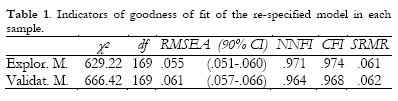
<body><![CDATA[<p><font face="Verdana" size="2"><i>The Adaptive Vocational Personality Questionnaire (AVPQ). Preliminary version.-</i> As previously mentioned in the introduction, the preliminary version of the adaptive vocational personality questionnaire (AVPQ, Gómez-Artiga et al. 2006) was composed of 32 statements grouped into nine scales that included different variables related to the efficacious personality (initiative and optimism, persistence, tolerance to frustration, innovation and adaptability, expectations of self-efficacy, fear of failure, self-control and stress management, and empathy and assertiveness). The questionnaire was then called the &quot;Efficient Personality Questionnaire&quot;. The response scale offers four response options ranging from 1. Completely disagree to 4. Completely agree.</font></p>     <p><font face="Verdana" size="2"><i>Procedure</i></font></p>     <p><font face="Verdana" size="2">The application was carried out with students from 13 universities in Spain, and their participation was coordinated by researchers from each of the universities involved in the project. Prior to this application, the researchers met and agreed on and clarified the guidelines for the general application conditions. The application was carried out individually and voluntarily. Once obtained, the data were turned over to the research team for their later codification and analysis.</font></p>     <p><font face="Verdana" size="2"><i>Statistical analyses</i></font></p>     <p><font face="Verdana" size="2">As a preliminary step, the polychoric correlation matrixes among the items on the questionnaire were obtained because the discrete and ordinal nature of the variables being studied (the items are responded to on a response scale with 4 alternatives) advises against the use of variance-covariance matrixes or the Pearson correlations matrix (Jóreskog &amp; Sórbom, 2006). Polychoric correlations relate variables that are theoretically continuous but have been measured ordinally, which is completely applicable to the variables (the items) under study. The matrix of polychoric correlations and the asymptotic covariance matrix (also necessary to analyze ordinal data) were obtained with the PRELIS 2.80 program (Jóreskog &amp; Sórbom, 2006).</font></p>     <p><font face="Verdana" size="2">The model generation phase starts by fitting the initial model to the data using the exploratory sub-sample (the first sub-sample) (Jöreskog &amp; Sörbom, 1999). Then the fit of the model is evaluated by means of a variety of goodness-of-fit indices. First, the <i>&chi;<sup>2</sup></i> statistic, which Jóreskog and Sórbom (2006) recommend to compare the degrees of freedom, is inspected. Mueller (1996) suggests as a &quot;rule of thumb&quot; criterion for good fit: <i>&chi;<sup>2</sup>/df</i> &lt;2. In addition to this ratio, several other fit indices are used. Following recommendations by Hu and Bentler (1999), the <i>RMSEA, SRMR, NNFI</i>, and <i>CFI</i> are included (see Batista &amp; Coenders, 2000, for an introduction on this topic). Typically, the initial model offers a poor fit to data, and when this occurs, the next step is to modify the model by identifying and modifying the hypotheses that are not supported by the data. These hypotheses are often related to items that do not load significantly in the expected factor, or that load in multiple factors instead of only one, or that would have a higher loading in a different factor. Sometimes the factors are responsible for the misfit: a single factor that splits into two or, on the contrary, two factors that in the end perform better if they are collapsed into only one factor. Confirmatory factor analysis provides us with information about which of these aspects are responsible for the model misfit, and it allows us to re-specify the model in that direction (deleting those items that do not load as expected, or constraining factors that correlate too high, etc). Briefly, each parameter estimated in a CFA is followed by its &quot;t value&quot;; that is, each factor loading, each correlation between two factors, and so on, is accompanied by an estimation of the probability of that parameter being zero in the corresponding population. We are then able to identify and delete any items that do not load significantly in the intended factor, thus producing post hoc modifications. Furthermore, these modifications can occur in the opposite way. Those factors loadings that had been fixed at zero (because the authors hypothesize that the corresponding items do not load on these factors) are provided with a modification index that shows how the model fit would improve if this particular parameter were freely estimated (Jöreskog &amp; Sörbom, 1981). In the end, this phase of the process uses the results from the initial model fit to formulate a better model which, in turn, is then re-specified and tested. The procedure is repeated with as many iterations as necessary until the resulting model presents a satisfactory fit to the data.</font></p>     <p><font face="Verdana" size="2">The second stage of the cross-validation design consists of trying to replicate the good fit of the re-specified model in another independent sample: the validation sub-sample (the second sub-sample). This second phase has a strictly confirmatory orientation, evaluating the fit of the re-specified model in this new sample (see Coenders, Batista Foguet, &amp; Saris, 2005, for more detais on this topic).</font></p>     <p><font face="Verdana" size="2"><b>Results</b></font></p>     <p><font face="Verdana" size="2">As would be expected, the initial model did not present an adequate fit to the data. This model, which stated which of the 32 original items loaded in the Adaptive Personality Characteristics factor and which loaded in the Non- Adaptive Personality Characteristics factor, was quite close to some of the required values. For example, the <i>NNFI</i> and <i>CFI</i> require values equal to or greater than .95, (Hu &amp; Bentler, 1999), while the values offered by this model were .945 and .949, respectively. In contrast, the <i>SRMR</i> and <i>RMSEA</i> require values below .05 (Hu &amp; Bentler, 1999), and the values offered by this model were .10 and .09, respectively. At first glance, the results suggest that the model would not improve much if we eliminated one or more of the parameters of the initial model, because all of their estimates were statistically significant. However, a detailed analysis of these estimations revealed that some of the factor loadings estimated were indeed statistically significant, but clearly too low to be relevant. Increases in sample size are known to increase statistical power, the probability of detecting even small effect sizes (small factor loadings).</font></p>     <p><font face="Verdana" size="2">Moreover, in some cases small effect sizes may be statistically significant but practically irrelevant (Cohen, 1988). We are interested in the evaluation of a factor's practical relevance in explaining or producing variability in the subjects' responses to a certain item. In this case, the effect size equals the square of the factor loading (<i>&lambda;<sup>2</sup></i>), and can be translated into the proportion of variance accounted for by the factor in the item (see Bollen, 1989). This proportion is also referred to as the reliability of the item in measuring the factor (Bollen, 1989). Although there is no clear cut-off value for this proportion of variance, it is recommended that it be large, according to some authors even above 50% (&lambda;<sup>2</sup>=.50 which implies &lambda;&lt;.70, a value that is certainly high) (Levy Mangig, 1999). Taking all these arguments into account, together with the content of the items, we decided to delete the items that presented a percentage of variance explained by the corresponding factor below 25% (&lambda;<sup>2</sup>=.25 which implies &lambda;&lt;.50, a moderate value). Twelve items were eliminated after applying this criterion: items 6, 8, 17, 20, 22, 23, 24, 25, 28, 30 and 32. The next step was to re-specify the initial model by eliminating these 12 items, and contrast it again in the experimental sub-sample. This new model proposed that the &quot;Adaptive Personality Characteristics&quot; factor would be defined by items 2, 3, 4, 7, 11, 14, 15, 18 and 23, while the &quot;Non- Adaptive Personality&quot; factor would be defined by items 16, 1, 9, 10, 26, 5, 12, 19, 27, 31 and 21. The fit indices produced by this re-specified (optimized) model leave no room for doubt: the model now presents a satisfactory fit (see <a href="#t1">table 1</a>). The <i>RMSEA</i> confidence interval has an inferior limit below .05, which indicates that the mean quadratic error of approximation is in an acceptable range (Hu &amp; Bentler, 1999). The non-normed fit indices (<i>NNFI</i>) and compared fit indices (<i>CFI</i>) are above the value of .95 (Hu &amp; Bentler, 1999), indicating a good fit, and the standardized root mean square residual (<i>SRMR</i>) has a value of .061, clearly inferior to .08, which also indicates an acceptable fit (Brown &amp; Cudeck, 1993; Gonzalez-Roma &amp; Lloret, 1998) (it would have been better if it had been less than .05). In sum, the proposed model for the two scales formed by the 20 items analyzed presents a good fit to the data.</font></p>     ]]></body>
<body><![CDATA[<p align="center"><font face="Verdana" size="2"><a name="t1"><img src="/img/revistas/ap/v29n2/psico_evolutiva9_t1.jpg"></a></font></p>     <p>&nbsp;</p>     <p><font face="Verdana" size="2">The next step is to interpret the estimations of the factor loadings obtained, as well as the estimated correlation between the two factors. All of the factor loadings were statistically significant (p&lt;.000) (See <a target="_blank" href="/img/revistas/ap/v29n2/psico_evolutiva9_anexo_a.jpg">appendix A</a> to view the content of the items and the magnitude of the factor loadings). The correlation between the two factors was even higher than expected (<i>r</i> =-.735,  <i>p</i>&lt;.000). The size of the correlation suggests that in reality there may be only one factor explaining the subjects' responses to the 20 items, so that we went on to examine this possibility by formulating a model with only one factor. This model presented a significantly <i>worse</i> fit than the two-factor model (&chi;<sup>2</sup>=458.86, 1<i>df,</i> <i>p</i>&lt;.000), which means that the initial two-factor structure fits the data better than the one-factor structure<sup>1</sup>; that is, although closely related, both factors are necessary in order to adequately explain the structure of this questionnaire. This last analysis ended the &quot;model generation&quot; phase.</font></p>     <p><font face="Verdana" size="2">As mentioned in the analysis section, the &quot;model validation&quot; phase that follows the model-generation phase employs a <i>strictly confirmatory</i> approach. The purpose of this phase is to contrast the modified model obtained in the previous phase <i>in an independent sample (the validation sub-sample</i>), so that we can test whether this model also fits other data sets. Thus, we tested the two-factor model in the validation sub-sample.  <a href="#t1">Table 1</a> shows the results of the fit indicators, which reveal a slight reduction in the fit indices of the model in this sample compared to those of the exploratory sample. Even so, the fit in this sample was also satisfactory (Cheung, &amp; Rensvold, 2002).</font></p>     <p><font face="Verdana" size="2"><b>Discussion</b></font></p>     <p><font face="Verdana" size="2">Study 1 was based on a preliminary study in which an exploratory factorial analysis was carried out of the initial version of the AVPQ instrument (Gómez-Artiga et al. 2006). The results obtained in the preliminary study indicated two separate, although related, subscales in the questionnaire: Adaptive Personality Characteristics (AC subscale) with 17 items and Non- Adaptive Personality Characteristics (NAC subscale) with 15 items. The present study extends the previous one in that it uses a confirmatory strategy (through a set of confirmatory factor analyses), on the one hand, and a cross-validation design, on the other. The results obtained confirm the two-factor structure (AC and NAC), although 12 of the initially proposed items had to be eliminated.</font></p>     <p><font face="Verdana" size="2">The final configuration of the AVPQ questionnaire is the following: the Adaptive Personality Characteristics subscale is defined by items 2, 3, 4, 7, 11, 14, 15, 18, and 23; and the Non-Adaptive Personality Characteristics subscale is defined by items 16, 1, 9, 10, 26, 5, 12, 19, 27, 31 and 21. Therefore, an adaptive vocational personality would be defined by: <i>persistence in objectives and tasks, empathy, perception of self-efficacy, initiative and positive thinking, innovation, and appropriate management of motives, emotions and conflictive impulses;</i> while a non-adaptive vocational personality would include characteristics such as <i>low tolerance to frustration, fear of failure, lack of flexibility toward changes, expectations of negative self-efficay, low efficieny in self-control and stress management, negative thinking, fear of facing new challenges, lack of assertiveness and lack of persistence.</i></font></p>     <p>&nbsp;</p>     <p><font face="Verdana" size="2"><b>Study 2: AVP Questionnaire: Reliability, Criterion Validity and Norms</b></font></p>     <p><font face="Verdana" size="2">Once the dimensionality of the AVP questionnaire had been clarified, it was time to evaluate the quality of the remaining psychometric proprieties, namely, the reliability and criterion validity of the questionnaire and the subscales. The aim of this second study is to evaluate these other aspects of the questionnaire.</font></p>     ]]></body>
<body><![CDATA[<p><font face="Verdana" size="2">In addition, the scoring of the questionnaire and the norms required for the correct interpretation of the scores will be presented. One way to derive meaning from test scores is to view them in the context of the scores of the normative sample, using a norm-referenced interpretation of test scores. This study uses the sample of 2170 participants as the normative sample, and it presents the norms (standard scores and/or percentiles) for the interpretation of the scores.</font></p>     <p><font face="Verdana" size="2"><b>Method</b></font></p>     <p><font face="Verdana" size="2"><i>Participants</i></font></p>     <p><font face="Verdana" size="2">The participants in this study are the 2170 Spanish university students mentioned in study 1. Of them, 33.9% were men and 66% women. Mean age was 23. 05 (<i>SD=</i> 3.18). The students come from 13 universities in Spain: Valencia 17.3%, Castellón 6.4%, Alicante 2.5%, Barcelona 6.9%, La Laguna 22.9%, Oviedo 5.3%, Conservatory of Aragón 0.6%, Extremadura 11.2%, Almería 10.4%, Las Palmas 2.9%, Valladolid 9.3%. These students were enrolled in a total of 93 different degree programs that cover almost the entire university spectrum (engineering, humanities, social sciences, health sciences...). Each of these degree programs represented a small percentage of the total sample. For example, the largest participation was 5.9%, and it corresponded to the &quot;Business Administration&quot; degree. The norms were also obtained by employing this sample as the normative sample.</font></p>     <p><font face="Verdana" size="2"><i>Measures</i></font></p>     <p><font face="Verdana" size="2"><i>The Adaptive Vocational Personality Questionnaire (AVPQ).-</i>The adaptive vocational personality questionnaire AVPQ, in its final version, was composed of 20 items grouped in two subscales: Adaptive Personality Characteristics (AC) with 9 items and Non- Adaptive Personality Characteristics (NAC) with 11 items (see <a target="_blank" href="/img/revistas/ap/v29n2/psico_evolutiva9_anexo_b.jpg">appendix B</a>). The response scale offers four response options ranging from 1. Completely disagree to 4. Completely agree.</font></p>     <p><font face="Verdana" size="2"><i>Job Search Skills Scale.-</i> The Job Search Skills Scale: JSS (Martínez, et al. 2005) consists of 14 items. Some examples of the items are the following. <i>&quot;I have planned what I am going to do to get the job I</i> want&quot;, <i>&quot;I feel capable of having a goodjob interview&quot;, &quot;I know how to analyze job offers and realistically relate them to my possibilities'.</i> Subjects respond on a graduated response scale where they indicate their degree of agreement with the statement. The response options are: 1= Not at all, 2 = Somewhat, and 3= Completely agree. As recommended, we tested the psychometric properties of this scale in our sample. The results were satisfactory: the exploratory factorial analysis of this scale revealed a one-dimensional structure in which the main factor explains 28% of the total variance. The Cronbach's alpha for the scale was .833.</font></p>     <p><font face="Verdana" size="2">The Jobsearch Skills Scale is an indicator of success and career adaptability (Ballout, 2007; Koen, Klehe, Van Vianen, Zikic &amp; Nauta, 2009).</font></p>     <p><font face="Verdana" size="2"><i>Procedure</i></font></p>     <p><font face="Verdana" size="2">See study one.</font></p>     ]]></body>
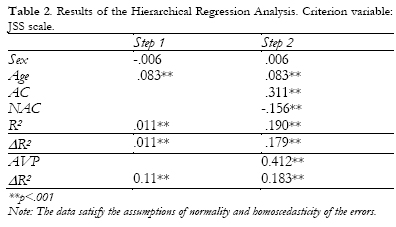
<body><![CDATA[<p><font face="Verdana" size="2"><i>Analyses</i></font></p>     <p><font face="Verdana" size="2">First, scores were calculated for each subscale, AC and NAC, as well as for the total questionnaire, AVP. The response scale for all the items presents four alternatives: A. exactly my case; B. quite similar; C. different from my case; D. the opposite of my case. The correction key is the following: each A response receives 4 points; each B response receives 3 points; each C response receives 2 points; and each D response receives 1 point. We then calculated the scores on each of the two subscales as the sum of the scores on each of its items, according to the correction key. A high score on the Adaptive Personality Characteristics scale indicates that the subject identifies with the Adaptive Personality Characteristics described in the scale. In the same way, a high score on the Non- Adaptive Personality Characteristics scale indicates that the subject identifies with the non- Adaptive Personality Characteristics described in this scale. We also calculated the total inverted score on the Non- Adaptive Personality Characteristics scale. In this case, we inverted the correction key, so that a high score would indicate that the subject does not identify with these non- Adaptive Personality Characteristics. Finally, we calculated the score on the AVP questionnaire, in order to reflect each subject's behaviors through a single indicator. We obtained this global score by averaging the score on the Adaptive Personality Characteristics scale and the inverted score on the Non- Adaptive Personality Characteristics scale. Means and standard deviations were obtained for all three scales.</font></p>     <p><font face="Verdana" size="2">The internal consistency of the AC and NAC subscales and the complete questionnaire, AVP, was evaluated by means of the Cronbach's alpha coefficient using the statistical packet SPSS 17.0 (2008).</font></p>     <p><font face="Verdana" size="2">On the other hand, traditional criterion validity, more recently called external evidence of test score validity <i>(Standards for educational and psychological testing, 1999</i>), was evaluated using hierarchical regression techniques<sup>2</sup>. As mentioned above, the criterion variable of job search skills was obtained based on the score on the Job Search Skills scale (JSS). The predictor variables were the scores on each of the two sub-scales, Adaptive Personality Characteristics and Non- Adaptive Personality Characteristics, and the score on the Adaptive Vocational Personality questionnaire.</font></p>     <p><font face="Verdana" size="2">Finally, we went on to construct the norms that make it possible to interpret these scores. For this purpose, we determined whether the scores on each scale (AC, NAC and AVP) followed a normal distribution by performing the Kolmogorov-Smirnov test. If this were the case, we would obtain the norms by transforming the direct scores into standard scores, with the advantages of normal distribution properties; if not, we would obtain the percentile norms. All these analyses were performed using the statistical packet SPSS 17.0 (2008).</font></p>     <p><font face="Verdana" size="2"><b>Results</b></font></p>     <p><font face="Verdana" size="2">The AC subscale presented a mean of 27.68 (<i>SD=</i> 3.80) and an alpha coefficient of .760; the NAC subscale presented a mean of 21.39 (<i>SD</i>= 5.06) and an alpha of .812; finally, the AVB scale presented a mean of 60.91 (<i>SD=</i> 7.97) and an alpha coefficient of .861.</font></p>     <p><font face="Verdana" size="2"><a href="#t2">Table 2</a> shows the results of the regression analysis. As can be observed, both scales have a significant effect on the criterion variable; that is, the scores on the AC scale (&beta;=.311,  <i>p</i>&lt;.00) and the NAC scale (&beta;=-.156, <i>p</i>&lt;.00) significantly predict, and in the expected direction, the subjects' job search skills as measured by the criterion variable JSS. It should be highlighted that the effect of the AC scale is much greater than that of the NAC scale. Together, the two types of behaviors predict 19% of the variability in the job search skills variable. It is also worth noting that the age of the subjects in the sample also shows a significant effect on the perception of job search skills, as common sense would dictate.</font></p>     <p align="center"><font face="Verdana" size="2"><a name="t2"><img src="/img/revistas/ap/v29n2/psico_evolutiva9_t2.jpg"></a></font></p>     <p>&nbsp;</p>     ]]></body>
<body><![CDATA[<p><font face="Verdana" size="2">The results shown in <a href="#t2">table 2</a> also reveal that there is hardly any difference in the usefulness of the AVP scale score compared to using the scores on each scale (AC and NAC) separately. With regard to the explained variance of the criterion variable, the difference between the two arrangements is small: the two separate scales explain 18.2%, and a single combined score, 18.9%. The standardized regression coefficients, AC (&beta;=.311,  <i>p</i>&lt;.00), NAC (&beta;=-.156, <i>p</i> &lt;.00) and AVP (&beta;=.412, <i>p</i> &lt;.00), highlight the simplicity of using the single global score.</font></p>     <p><font face="Verdana" size="2">Finally, we focused on the interpretation of the scores. First, we tested whether the raw-score distribution of all the scales approached the normal distribution. We did this prior to transforming raw-scores into standard scores because, contrary to popular belief, not all standard scores have a normal distribution (Allen &amp; Yen, 1979). If the raw scores are skewed or bimodal, the standard-score distribution will have these same properties; that is, it will not have the properties of a normal distribution. In that case, transforming raw-scores into percentiles has been recommended instead. As we mentioned earlier, we tested the normality of the raw-score distributions by employing the one-sample Kolomorov-Smirnov test. The results indicated that neither the scores on the Adaptive Personality Characteristics scale (AC) (<i>z K-S=</i> 3.41, p&lt;.000), nor the scores on the Non-Adaptive Personality Characteristics scale (NAC) (z K-S= 3.34, <i>p</i>&lt;.000), nor the scores on the Adaptive Vocational Personality questionnaire (AVP) (<i>z K-S=</i> 2.34, <i>p</i>&lt;.000) follow a normal distribution, so that we proceeded to transform the raw-scores into percentiles (see <a target="_blank" href="/img/revistas/ap/v29n2/psico_evolutiva9_anexo_c.jpg">appendix C</a>).</font></p>     <p><font face="Verdana" size="2"><b>Discussion</b></font></p>     <p><font face="Verdana" size="2">The main purpose of study 2 was to evaluate the psychometric properties of the Adaptive Vocational Personality Questionnaire (AVPQ) (Reliability and Criterion Validity), while offering guidelines for using and interpreting its scores in the most useful and simplest way possible.</font></p>     <p><font face="Verdana" size="2">Regarding reliability, we can now conclude that the internal consistency of both scales was satisfactory: the AC scale presented an alpha coefficient of .760, the NAC scale presented an alpha of .812, and the AVP questionnaire presented an alpha of .860.</font></p>     <p><font face="Verdana" size="2">Regarding the criterion validity of the scales, we analyzed the capacity of the questionnaire to predict the proactive behavior of searching for a job, which <i>we evaluated with the JSS scale.</i> The results of the hierarchical regression analyses indicate that the AVP questionnaire (combining the AC and NAC scales) explains a significant portion (18.9 %, <i>p</i>&lt;.00) of the individual differences in the job search skills variable. These results show that combining the two scales into a global scale is as effective as using the score on each scale separately, but much easier to interpret, so that we recommend the global score. We also offer the correction keys and the calculation procedures for the different scores, as well as the corresponding norms in percentiles, so that any of the three scores can be interpreted using the sample in this study as a normative sample.</font></p>     <p><font face="Verdana" size="2">For a correct interpretation of the results of the present study, it is necessary to consider its limitations. One of them is probably the representativeness of the study sample. The students participated in the study voluntarily; however, the sample selection was random, in order to make sure that the sample would represent the population studied; thus, the sample was an incidental one. For this reason, we must be cautious when generalizing the results. Another limitation of this study has to do with the transversal design proposed, as a longitudinal design would allow us to obtain information about possible changes in the relations between the two personality factors and the proactive job search behavior as the students advance on their vocational and/or professional paths. On the other hand, it should be pointed out that the variables were measured using self-report questionnaires, with their corresponding limitations.</font></p>     <p><font face="Verdana" size="2">Although the main purpose of this study was the factorial validity of the questionnaire, we also analyzed the criterion validity, using the job-search skills variable evaluated by the Job Search Skills scale (JSS). Although the results indicate that there is a significant relationship between the two dimensions of the questionnaire and the criterion variable, further studies would be necessary for the external validation of the instrument.</font></p>     <p>&nbsp;</p>     <p><font face="Verdana" size="2"><b>Final conclusion for Studies 1 and 2</b></font></p>     ]]></body>
<body><![CDATA[<p><font face="Verdana" size="2">Definitively, this new version of the Adaptive Vocational Personality Questionnaire appears to be a good tool for studying the vocational behavior of university students, thus satisfying the need for instruments that help us to perform university vocational counseling processes.</font></p>     <p><font face="Verdana" size="2">Likewise, this new version improves the psychometric properties of the original questionnaire while reducing the number of items, thus facilitating its application, and it presents the necessary norms for its correct interpretation.</font></p>     <p><font face="Verdana" size="2"><b>Practical implications</b></font></p>     <p><font face="Verdana" size="2">In spite of its limitations, this study adds new data to previous studies about personality characteristics and their relations with subjects' vocational behavior. It provides an instrument that evaluates the personality variables associated with efficient vocational behavior. The questionnaire was validated by means of rigorous statistical analyses with regard to the methodology used, and this was possible due to the large number of subjects who participated in the study. The novelty is that it is adapted to the vocational ambit and directed toward university students. Therefore, it responds to an important need highlighted by some authors who study variables that characterize the adaptive personality in the field of vocational counseling (Castaño, 1995; Martín del Buey et al. 2008; Tokar, Fischer &amp; Subich, 1998).</font></p>     <p><font face="Verdana" size="2">In addition, the assumption that the use of proactive job search behaviors by university students trying to enter the job market is related to displaying an adaptive vocational personality facilitates the design of vocational counseling interventions to improve the repertoires of adaptive behaviors in the changing and complex environment of present-day university students.</font></p>     <p><font face="Verdana" size="2">For this reason, we think the AVPQ can be quite useful, as it helps to detect imbalances between personality characteristics and the development of students' vocational careers, making it possible to propose appropriate intervention programs to strengthen subjects' adaptive personality characteristics and inhibit their non-adaptive characteristics, thus favoring their success and entrance into the job market.</font></p>     <p><font face="Verdana" size="2"><b>Future research</b></font></p>     <p><font face="Verdana" size="2">Although the AVPQ seems to be an efficient tool for studying students' vocational behavior, more studies are needed to analyze the relationship between personality characteristics and vocational career development. The AVPQ facilitates this type of studies, and the study presented here indicates that this instrument meets the necessary psychometric requirements.</font></p>     <p><font face="Verdana" size="2">Given that in this study a relationship has also been shown between characteristics that define the adaptive vocational personality evaluated with our questionnaire and proactive job search behaviors, it would be useful to carry out new studies to analyze this relationship. Such studies would be relevant for designing possible interventions to be used in students' vocational guidance.</font></p>     <p><font face="Verdana" size="2">It would also be quite interesting to test the construct validity of the Adaptive Vocational Personality Questionnaire, correlating the scores obtained on this instrument with those stemming from the application of other instruments that evaluate similar personality characteristics. Given that the five-factor personality model (Costa and McCrae, 1985, 1992; Goldberg, 1990) is one of the instruments most-widely utilized by personality researchers (Boudreau, Boswell &amp; Judge, 2001; Mount &amp; Barrick, 1995; Seibert &amp; Kraimer, 2001; Tokar et al. 1998; Wille, De Fruyt &amp; Feys, 2010), it would be advisable in future studies to try to contrast the personality characteristics derived from the AVPQ and those included in this five-factor model.</font></p>     ]]></body>
<body><![CDATA[<p>&nbsp;</p><hr align="left" width="30%" size="1">     <p><font face="Verdana" size="2"><b>Note.-</b> This study is located within the framework of an inter-university research project, subsidized by the Spanish Ministry of Science and Technology, &quot;Vocational behavior and professional counseling of university students: Computer protocol for preprofessional self-help&quot;, (I+D BS02001-3150), whose purpose is to provide scientific knowledge about vocational and pre-professional behavior of university students.</font></p>     <p><font face="Verdana" size="2"><sup>1</sup> As the one-factor model is nested in the two-factor model, the increase in &chi;<sup>2</sup> produced by the nested model indicates whether its fit is significantly worse than that of the previous model (Bollen, 1989).</font></p>     <p><font face="Verdana" size="2"><sup>2</sup> We controlled the usual demographic variables: age and sex.</font></p>     <p>&nbsp;</p>     <p><font face="Verdana" size="2"><b>References</b></font></p>     <!-- ref --><p><font face="Verdana" size="2">1. Aciego de Mendoza, R., Domínguez Medina, R., &amp; Hernández Hernández, P. (2005). Consistencia interna y estructura factorial de un cuestionario sobre autorrealización y crecimiento personal. (Internal consistency and factorial structure of a questionnaire on self-fulfillment and personal growth) Psicothema, 17, 134-142.    &nbsp;&nbsp;&nbsp;&nbsp;&nbsp;&nbsp;&nbsp;&nbsp;[&#160;<a href="javascript:void(0);" onclick="javascript: window.open('/scielo.php?script=sci_nlinks&ref=664124&pid=S0212-9728201300020001800001&lng=','','width=640,height=500,resizable=yes,scrollbars=1,menubar=yes,');">Links</a>&#160;]<!-- end-ref --></font></p>     <!-- ref --><p><font face="Verdana" size="2">2. Allen, M. J., &amp; Yen, W.M. (1979). Introduction to Measurement Theory. Monterrey, California: Brooks Cole Publishing Company.    &nbsp;&nbsp;&nbsp;&nbsp;&nbsp;&nbsp;&nbsp;&nbsp;[&#160;<a href="javascript:void(0);" onclick="javascript: window.open('/scielo.php?script=sci_nlinks&ref=664126&pid=S0212-9728201300020001800002&lng=','','width=640,height=500,resizable=yes,scrollbars=1,menubar=yes,');">Links</a>&#160;]<!-- end-ref --></font></p>     ]]></body>
<body><![CDATA[<!-- ref --><p><font face="Verdana" size="2">3. American Educational Research Association, American Psychological Association, National Council on Measurement in Education, American Psychological Association (1999). Standards for educational and psychological testing. Washington, DC: American Educational Research Association, American Psychological Association, National Council on Measurement in Education, American Psychological Association.    &nbsp;&nbsp;&nbsp;&nbsp;&nbsp;&nbsp;&nbsp;&nbsp;[&#160;<a href="javascript:void(0);" onclick="javascript: window.open('/scielo.php?script=sci_nlinks&ref=664128&pid=S0212-9728201300020001800003&lng=','','width=640,height=500,resizable=yes,scrollbars=1,menubar=yes,');">Links</a>&#160;]<!-- end-ref --></font></p>     <!-- ref --><p><font face="Verdana" size="2">4. Ballout, H.I. (2007). Career success: The effects of human capital, person environment fit and organizational support. Journal of Managerial Psychology, 22, 741-765.    &nbsp;&nbsp;&nbsp;&nbsp;&nbsp;&nbsp;&nbsp;&nbsp;[&#160;<a href="javascript:void(0);" onclick="javascript: window.open('/scielo.php?script=sci_nlinks&ref=664130&pid=S0212-9728201300020001800004&lng=','','width=640,height=500,resizable=yes,scrollbars=1,menubar=yes,');">Links</a>&#160;]<!-- end-ref --></font></p>     <!-- ref --><p><font face="Verdana" size="2">5. Bar-On, R. (2006). The Bar/On model of emotional-social intelligence (ESI). Psicothema, 18(1), 13-25.    &nbsp;&nbsp;&nbsp;&nbsp;&nbsp;&nbsp;&nbsp;&nbsp;[&#160;<a href="javascript:void(0);" onclick="javascript: window.open('/scielo.php?script=sci_nlinks&ref=664132&pid=S0212-9728201300020001800005&lng=','','width=640,height=500,resizable=yes,scrollbars=1,menubar=yes,');">Links</a>&#160;]<!-- end-ref --></font></p>     <!-- ref --><p><font face="Verdana" size="2">6. Bartley, D.F., &amp; Robitschek, C. (2000). Career exploration: A multivariate analysis of predictors. Journal of Vocational Behavior, 56, 63-81.    &nbsp;&nbsp;&nbsp;&nbsp;&nbsp;&nbsp;&nbsp;&nbsp;[&#160;<a href="javascript:void(0);" onclick="javascript: window.open('/scielo.php?script=sci_nlinks&ref=664134&pid=S0212-9728201300020001800006&lng=','','width=640,height=500,resizable=yes,scrollbars=1,menubar=yes,');">Links</a>&#160;]<!-- end-ref --></font></p>     <!-- ref --><p><font face="Verdana" size="2">7. Batista Foguet, J. M. &amp; Coenders, G., (2000). Modelos de ecuaciones estructurales. (Structural equation models) Madrid: La Muralla.    &nbsp;&nbsp;&nbsp;&nbsp;&nbsp;&nbsp;&nbsp;&nbsp;[&#160;<a href="javascript:void(0);" onclick="javascript: window.open('/scielo.php?script=sci_nlinks&ref=664136&pid=S0212-9728201300020001800007&lng=','','width=640,height=500,resizable=yes,scrollbars=1,menubar=yes,');">Links</a>&#160;]<!-- end-ref --></font></p>     ]]></body>
<body><![CDATA[<!-- ref --><p><font face="Verdana" size="2">8. Betz, N.E., &amp; Klein Voyten, K. (1997). Efficacy and outcome expectations influence career exploration &amp; decidedness. Career Development Quarterly, 46, 179-189.    &nbsp;&nbsp;&nbsp;&nbsp;&nbsp;&nbsp;&nbsp;&nbsp;[&#160;<a href="javascript:void(0);" onclick="javascript: window.open('/scielo.php?script=sci_nlinks&ref=664138&pid=S0212-9728201300020001800008&lng=','','width=640,height=500,resizable=yes,scrollbars=1,menubar=yes,');">Links</a>&#160;]<!-- end-ref --></font></p>     <!-- ref --><p><font face="Verdana" size="2">9. Bollen, K. A. (1989). Structural equations with latent variables. New York: John Wiley &amp; Sons.    &nbsp;&nbsp;&nbsp;&nbsp;&nbsp;&nbsp;&nbsp;&nbsp;[&#160;<a href="javascript:void(0);" onclick="javascript: window.open('/scielo.php?script=sci_nlinks&ref=664140&pid=S0212-9728201300020001800009&lng=','','width=640,height=500,resizable=yes,scrollbars=1,menubar=yes,');">Links</a>&#160;]<!-- end-ref --></font></p>     <!-- ref --><p><font face="Verdana" size="2">10. Boswell, W. R., Roehling, M. V., &amp; Boudreau, J. W. (2006). The role of personality, situational, and demographic variables in predicting job search among European managers. Personality and Individual Differences, 40(4),783-794.    &nbsp;&nbsp;&nbsp;&nbsp;&nbsp;&nbsp;&nbsp;&nbsp;[&#160;<a href="javascript:void(0);" onclick="javascript: window.open('/scielo.php?script=sci_nlinks&ref=664142&pid=S0212-9728201300020001800010&lng=','','width=640,height=500,resizable=yes,scrollbars=1,menubar=yes,');">Links</a>&#160;]<!-- end-ref --></font></p>     <!-- ref --><p><font face="Verdana" size="2">11. Boudreau, J. W., Boswell, W. R., &amp; Bretz, R. D. (2001). Personality and cognitive ability as predictors of job search among employed managers. Personnel Psychology, 54(1), 25-50.    &nbsp;&nbsp;&nbsp;&nbsp;&nbsp;&nbsp;&nbsp;&nbsp;[&#160;<a href="javascript:void(0);" onclick="javascript: window.open('/scielo.php?script=sci_nlinks&ref=664144&pid=S0212-9728201300020001800011&lng=','','width=640,height=500,resizable=yes,scrollbars=1,menubar=yes,');">Links</a>&#160;]<!-- end-ref --></font></p>     <!-- ref --><p><font face="Verdana" size="2">12. Boudreau, J. W., Boswell, W. R., &amp; Judge, T. A. (2001). Effects of personality on executive career success in the United States and Europe. Journal of Vocational Behavior, 58, 53-81.    &nbsp;&nbsp;&nbsp;&nbsp;&nbsp;&nbsp;&nbsp;&nbsp;[&#160;<a href="javascript:void(0);" onclick="javascript: window.open('/scielo.php?script=sci_nlinks&ref=664146&pid=S0212-9728201300020001800012&lng=','','width=640,height=500,resizable=yes,scrollbars=1,menubar=yes,');">Links</a>&#160;]<!-- end-ref --></font></p>     ]]></body>
<body><![CDATA[<!-- ref --><p><font face="Verdana" size="2">13. Bradford, R., Rutherford, D., &amp; John, A. (2002). Quality of life in young people: ratings and factor structure of the Quality of Life Profile-Adolescent Version. Journal of Adolescence, 25, 261-274.    &nbsp;&nbsp;&nbsp;&nbsp;&nbsp;&nbsp;&nbsp;&nbsp;[&#160;<a href="javascript:void(0);" onclick="javascript: window.open('/scielo.php?script=sci_nlinks&ref=664148&pid=S0212-9728201300020001800013&lng=','','width=640,height=500,resizable=yes,scrollbars=1,menubar=yes,');">Links</a>&#160;]<!-- end-ref --></font></p>     <!-- ref --><p><font face="Verdana" size="2">14. Brown, D. J., Cober, R. T., Kane, K., Levy, P.E., &amp; Shalhoop, J. (2006). Proactive personality and the successful job search: A field investigation with college graduates. Journal of Applied Psychology, 91(3), 717-726.    &nbsp;&nbsp;&nbsp;&nbsp;&nbsp;&nbsp;&nbsp;&nbsp;[&#160;<a href="javascript:void(0);" onclick="javascript: window.open('/scielo.php?script=sci_nlinks&ref=664150&pid=S0212-9728201300020001800014&lng=','','width=640,height=500,resizable=yes,scrollbars=1,menubar=yes,');">Links</a>&#160;]<!-- end-ref --></font></p>     <!-- ref --><p><font face="Verdana" size="2">15. Brown, D. J. &amp; Cudeck, R. (1993). Alternative ways of assessing model fit. In Bollen K.A. &amp; Long, J.S. (Eds.) Testing structural equation models (pp. 136-162). Thousand Oaks: Sage.    &nbsp;&nbsp;&nbsp;&nbsp;&nbsp;&nbsp;&nbsp;&nbsp;[&#160;<a href="javascript:void(0);" onclick="javascript: window.open('/scielo.php?script=sci_nlinks&ref=664152&pid=S0212-9728201300020001800015&lng=','','width=640,height=500,resizable=yes,scrollbars=1,menubar=yes,');">Links</a>&#160;]<!-- end-ref --></font></p>     <!-- ref --><p><font face="Verdana" size="2">16. Caldwell, D. F., &amp; Burger, J. M. (1998). Personality characteristics of job applicants and success in screening interviews. Personnel Psychology, 51 (1), 119-136.    &nbsp;&nbsp;&nbsp;&nbsp;&nbsp;&nbsp;&nbsp;&nbsp;[&#160;<a href="javascript:void(0);" onclick="javascript: window.open('/scielo.php?script=sci_nlinks&ref=664154&pid=S0212-9728201300020001800016&lng=','','width=640,height=500,resizable=yes,scrollbars=1,menubar=yes,');">Links</a>&#160;]<!-- end-ref --></font></p>     <!-- ref --><p><font face="Verdana" size="2">17. Carbonero, M. A., &amp; Merino, E. (2004). Autoeficacia y madurez vocacional (Self-efficacy and vocational maturity). Psicothema, 16, 229-234.    &nbsp;&nbsp;&nbsp;&nbsp;&nbsp;&nbsp;&nbsp;&nbsp;[&#160;<a href="javascript:void(0);" onclick="javascript: window.open('/scielo.php?script=sci_nlinks&ref=664156&pid=S0212-9728201300020001800017&lng=','','width=640,height=500,resizable=yes,scrollbars=1,menubar=yes,');">Links</a>&#160;]<!-- end-ref --></font></p>     ]]></body>
<body><![CDATA[<!-- ref --><p><font face="Verdana" size="2">18. Castaño, C. (1995). Personalidad y Cognición (Personality and Cognition). In F. Rivas (Ed.), Manual de asesoramiento y conducta vocacional (Manual on vocational behavior and counseling) (pp. 129-148). Madrid: Síntesis.    &nbsp;&nbsp;&nbsp;&nbsp;&nbsp;&nbsp;&nbsp;&nbsp;[&#160;<a href="javascript:void(0);" onclick="javascript: window.open('/scielo.php?script=sci_nlinks&ref=664158&pid=S0212-9728201300020001800018&lng=','','width=640,height=500,resizable=yes,scrollbars=1,menubar=yes,');">Links</a>&#160;]<!-- end-ref --></font></p>     <!-- ref --><p><font face="Verdana" size="2">19. Cheung, G. W., &amp; Rensvold, R. B. (2002). Evaluating Goodness-of-Fit Indexes for Testing Measurement Invariance. Structural Equation Modeling: A Multidisciplinary Journal, 9(2), 233-255.    &nbsp;&nbsp;&nbsp;&nbsp;&nbsp;&nbsp;&nbsp;&nbsp;[&#160;<a href="javascript:void(0);" onclick="javascript: window.open('/scielo.php?script=sci_nlinks&ref=664160&pid=S0212-9728201300020001800019&lng=','','width=640,height=500,resizable=yes,scrollbars=1,menubar=yes,');">Links</a>&#160;]<!-- end-ref --></font></p>     <!-- ref --><p><font face="Verdana" size="2">20. Coenders, G., Batista Foguet, J. M., &amp; Saris, W. E. (2005). Temas avanzados en modelos de ecuaciones estructurales (Advanced topics in structural equation models). Madrid: La Muralla.    &nbsp;&nbsp;&nbsp;&nbsp;&nbsp;&nbsp;&nbsp;&nbsp;[&#160;<a href="javascript:void(0);" onclick="javascript: window.open('/scielo.php?script=sci_nlinks&ref=664162&pid=S0212-9728201300020001800020&lng=','','width=640,height=500,resizable=yes,scrollbars=1,menubar=yes,');">Links</a>&#160;]<!-- end-ref --></font></p>     <!-- ref --><p><font face="Verdana" size="2">21. Cohen, J. (1988). Statistical Power Analysis for the Behavioral Sciences. Hillsdale, New Jersey: Lawrence Erlbaum Associates.    &nbsp;&nbsp;&nbsp;&nbsp;&nbsp;&nbsp;&nbsp;&nbsp;[&#160;<a href="javascript:void(0);" onclick="javascript: window.open('/scielo.php?script=sci_nlinks&ref=664164&pid=S0212-9728201300020001800021&lng=','','width=640,height=500,resizable=yes,scrollbars=1,menubar=yes,');">Links</a>&#160;]<!-- end-ref --></font></p>     <!-- ref --><p><font face="Verdana" size="2">22. Costa, P. T., &amp; McCrae, R. R. (1985). The NEO personality inventory manual. Odessa, FL: Psychological Assessment Resources.    &nbsp;&nbsp;&nbsp;&nbsp;&nbsp;&nbsp;&nbsp;&nbsp;[&#160;<a href="javascript:void(0);" onclick="javascript: window.open('/scielo.php?script=sci_nlinks&ref=664166&pid=S0212-9728201300020001800022&lng=','','width=640,height=500,resizable=yes,scrollbars=1,menubar=yes,');">Links</a>&#160;]<!-- end-ref --></font></p>     ]]></body>
<body><![CDATA[<!-- ref --><p><font face="Verdana" size="2">23. Costa, P. T., &amp; McCrae, R. R. (1992). Revised NEO Personality Inventory (Neo-PI-R) and NEO Five-Factor Inventory (NEO-FFI): Professional manual. Odessa, FL: Psychological Assessment Resources.    &nbsp;&nbsp;&nbsp;&nbsp;&nbsp;&nbsp;&nbsp;&nbsp;[&#160;<a href="javascript:void(0);" onclick="javascript: window.open('/scielo.php?script=sci_nlinks&ref=664168&pid=S0212-9728201300020001800023&lng=','','width=640,height=500,resizable=yes,scrollbars=1,menubar=yes,');">Links</a>&#160;]<!-- end-ref --></font></p>     <!-- ref --><p><font face="Verdana" size="2">24. Cudeck, R. (1989). Analysis of correlation matrices using covariance structure models. Psychological Bulletin, 105, 317-327.    &nbsp;&nbsp;&nbsp;&nbsp;&nbsp;&nbsp;&nbsp;&nbsp;[&#160;<a href="javascript:void(0);" onclick="javascript: window.open('/scielo.php?script=sci_nlinks&ref=664170&pid=S0212-9728201300020001800024&lng=','','width=640,height=500,resizable=yes,scrollbars=1,menubar=yes,');">Links</a>&#160;]<!-- end-ref --></font></p>     <!-- ref --><p><font face="Verdana" size="2">25. Cudeck, R., &amp; Browne, M. W. (1983). Cross-Validation of Covariance Structures. Multivariate Behavioral Research, 18, 147-167.    &nbsp;&nbsp;&nbsp;&nbsp;&nbsp;&nbsp;&nbsp;&nbsp;[&#160;<a href="javascript:void(0);" onclick="javascript: window.open('/scielo.php?script=sci_nlinks&ref=664172&pid=S0212-9728201300020001800025&lng=','','width=640,height=500,resizable=yes,scrollbars=1,menubar=yes,');">Links</a>&#160;]<!-- end-ref --></font></p>     <!-- ref --><p><font face="Verdana" size="2">26. Epstein, S. (2001). Inventario de pensamiento constructivo (Inventory of constructive thought). Madrid: TEA.    &nbsp;&nbsp;&nbsp;&nbsp;&nbsp;&nbsp;&nbsp;&nbsp;[&#160;<a href="javascript:void(0);" onclick="javascript: window.open('/scielo.php?script=sci_nlinks&ref=664174&pid=S0212-9728201300020001800026&lng=','','width=640,height=500,resizable=yes,scrollbars=1,menubar=yes,');">Links</a>&#160;]<!-- end-ref --></font></p>     <!-- ref --><p><font face="Verdana" size="2">27. Fuller, B., &amp; Marler, L. E. (2009). Change driven by nature: A meta-analytic review of the proactive personality literature. Journal of Vocational Behavior, 75, 329-345.    &nbsp;&nbsp;&nbsp;&nbsp;&nbsp;&nbsp;&nbsp;&nbsp;[&#160;<a href="javascript:void(0);" onclick="javascript: window.open('/scielo.php?script=sci_nlinks&ref=664176&pid=S0212-9728201300020001800027&lng=','','width=640,height=500,resizable=yes,scrollbars=1,menubar=yes,');">Links</a>&#160;]<!-- end-ref --></font></p>     ]]></body>
<body><![CDATA[<!-- ref --><p><font face="Verdana" size="2">28. Goleman, D. (1996). Inteligencia emocional (Emotional Intelligence). Barcelona: Kairós.    &nbsp;&nbsp;&nbsp;&nbsp;&nbsp;&nbsp;&nbsp;&nbsp;[&#160;<a href="javascript:void(0);" onclick="javascript: window.open('/scielo.php?script=sci_nlinks&ref=664178&pid=S0212-9728201300020001800028&lng=','','width=640,height=500,resizable=yes,scrollbars=1,menubar=yes,');">Links</a>&#160;]<!-- end-ref --></font></p>     <!-- ref --><p><font face="Verdana" size="2">29. Goleman, D. (2001). La práctica de la inteligencia emocional (The practice of emotional intelligence). Barcelona: Kairós.    &nbsp;&nbsp;&nbsp;&nbsp;&nbsp;&nbsp;&nbsp;&nbsp;[&#160;<a href="javascript:void(0);" onclick="javascript: window.open('/scielo.php?script=sci_nlinks&ref=664180&pid=S0212-9728201300020001800029&lng=','','width=640,height=500,resizable=yes,scrollbars=1,menubar=yes,');">Links</a>&#160;]<!-- end-ref --></font></p>     <!-- ref --><p><font face="Verdana" size="2">30. Goldberg, L.R. (1990). An alternative &quot;description of personality&quot;: The Big-Five factor structure. Journal of Personality and Social Psychology, 59, 1216-1229.    &nbsp;&nbsp;&nbsp;&nbsp;&nbsp;&nbsp;&nbsp;&nbsp;[&#160;<a href="javascript:void(0);" onclick="javascript: window.open('/scielo.php?script=sci_nlinks&ref=664182&pid=S0212-9728201300020001800030&lng=','','width=640,height=500,resizable=yes,scrollbars=1,menubar=yes,');">Links</a>&#160;]<!-- end-ref --></font></p>     <!-- ref --><p><font face="Verdana" size="2">31. Gómez-Artiga, A., Rocabert, E., &amp; Descals, A. (2006). Elaboración de un cuestionario de personalidad eficiente para el estudio/análisis de la conducta vocacional (Elaboration of an efficient personality questionnaire for the study/analysis of vocational behavior). Revista Galego-Portuguesa de Psicoloxia e Educación, 13(1), 399-411.    &nbsp;&nbsp;&nbsp;&nbsp;&nbsp;&nbsp;&nbsp;&nbsp;[&#160;<a href="javascript:void(0);" onclick="javascript: window.open('/scielo.php?script=sci_nlinks&ref=664184&pid=S0212-9728201300020001800031&lng=','','width=640,height=500,resizable=yes,scrollbars=1,menubar=yes,');">Links</a>&#160;]<!-- end-ref --></font></p>     <!-- ref --><p><font face="Verdana" size="2">32. Gómez-Benito, J. (1996). Aportaciones de los modelos de estructuras de covarianza al análisis psicométrico (Contributions of covariance structural models to psychometric analysis). In J. Muñiz (Ed.) Psicometría (pp. 234-278). Madrid: Universitas.    &nbsp;&nbsp;&nbsp;&nbsp;&nbsp;&nbsp;&nbsp;&nbsp;[&#160;<a href="javascript:void(0);" onclick="javascript: window.open('/scielo.php?script=sci_nlinks&ref=664186&pid=S0212-9728201300020001800032&lng=','','width=640,height=500,resizable=yes,scrollbars=1,menubar=yes,');">Links</a>&#160;]<!-- end-ref --></font></p>     ]]></body>
<body><![CDATA[<!-- ref --><p><font face="Verdana" size="2">33. Gonzalez-Roma, V., &amp; Lloret, S. (1998). Construct Validity of Rizzo et al. (1970) Role Conflict and Ambiguity Scales: A Multisample Study. Applied Psychology: an International Review, 47(4), 535-545.    &nbsp;&nbsp;&nbsp;&nbsp;&nbsp;&nbsp;&nbsp;&nbsp;[&#160;<a href="javascript:void(0);" onclick="javascript: window.open('/scielo.php?script=sci_nlinks&ref=664188&pid=S0212-9728201300020001800033&lng=','','width=640,height=500,resizable=yes,scrollbars=1,menubar=yes,');">Links</a>&#160;]<!-- end-ref --></font></p>     <!-- ref --><p><font face="Verdana" size="2">34. Grotevant, H. D. (1987). Toward a process model of identity formation. Journal of Adolescent Research, 2, 203-222.    &nbsp;&nbsp;&nbsp;&nbsp;&nbsp;&nbsp;&nbsp;&nbsp;[&#160;<a href="javascript:void(0);" onclick="javascript: window.open('/scielo.php?script=sci_nlinks&ref=664190&pid=S0212-9728201300020001800034&lng=','','width=640,height=500,resizable=yes,scrollbars=1,menubar=yes,');">Links</a>&#160;]<!-- end-ref --></font></p>     <!-- ref --><p><font face="Verdana" size="2">35. Hirs, S., &amp; Kummerow, J. (1989). Life types. Nueva York: Warner.    &nbsp;&nbsp;&nbsp;&nbsp;&nbsp;&nbsp;&nbsp;&nbsp;[&#160;<a href="javascript:void(0);" onclick="javascript: window.open('/scielo.php?script=sci_nlinks&ref=664192&pid=S0212-9728201300020001800035&lng=','','width=640,height=500,resizable=yes,scrollbars=1,menubar=yes,');">Links</a>&#160;]<!-- end-ref --></font></p>     <!-- ref --><p><font face="Verdana" size="2">36. Hirschi, A. (2009). Career adaptability development in adolescence: Multiple predictors and effect on sense of power and life satisfaction. Journal of Vocational Behavior, 74, 145-155.    &nbsp;&nbsp;&nbsp;&nbsp;&nbsp;&nbsp;&nbsp;&nbsp;[&#160;<a href="javascript:void(0);" onclick="javascript: window.open('/scielo.php?script=sci_nlinks&ref=664194&pid=S0212-9728201300020001800036&lng=','','width=640,height=500,resizable=yes,scrollbars=1,menubar=yes,');">Links</a>&#160;]<!-- end-ref --></font></p>     <!-- ref --><p><font face="Verdana" size="2">37. Holland, J. L. (1997). Making Vocational choices: A theory of vocational personalities and work environments. (3rd ed.). Florida: Psychological Assessment Resources.    &nbsp;&nbsp;&nbsp;&nbsp;&nbsp;&nbsp;&nbsp;&nbsp;[&#160;<a href="javascript:void(0);" onclick="javascript: window.open('/scielo.php?script=sci_nlinks&ref=664196&pid=S0212-9728201300020001800037&lng=','','width=640,height=500,resizable=yes,scrollbars=1,menubar=yes,');">Links</a>&#160;]<!-- end-ref --></font></p>     ]]></body>
<body><![CDATA[<!-- ref --><p><font face="Verdana" size="2">38. Hu, L. T., &amp; Bentler, P. M. (1999). Cutoff criteria for fit indices in covariance structure analysis. Conventional criteria versus new alternatives. Structural Equation Modeling, 6, 1-55.    &nbsp;&nbsp;&nbsp;&nbsp;&nbsp;&nbsp;&nbsp;&nbsp;[&#160;<a href="javascript:void(0);" onclick="javascript: window.open('/scielo.php?script=sci_nlinks&ref=664198&pid=S0212-9728201300020001800038&lng=','','width=640,height=500,resizable=yes,scrollbars=1,menubar=yes,');">Links</a>&#160;]<!-- end-ref --></font></p>     <!-- ref --><p><font face="Verdana" size="2">39. Jöreskog, K. G., &amp; Sörbom, D. (1981). LJSREE V: User's guide. Chicago: National Education Resources.    &nbsp;&nbsp;&nbsp;&nbsp;&nbsp;&nbsp;&nbsp;&nbsp;[&#160;<a href="javascript:void(0);" onclick="javascript: window.open('/scielo.php?script=sci_nlinks&ref=664200&pid=S0212-9728201300020001800039&lng=','','width=640,height=500,resizable=yes,scrollbars=1,menubar=yes,');">Links</a>&#160;]<!-- end-ref --></font></p>     <!-- ref --><p><font face="Verdana" size="2">40. Jöreskog, K. G., &amp; Sörbom, D. (1999). PRELJS 2: User's reference guide. Lincolnwood, IL: Scientific Software International.    &nbsp;&nbsp;&nbsp;&nbsp;&nbsp;&nbsp;&nbsp;&nbsp;[&#160;<a href="javascript:void(0);" onclick="javascript: window.open('/scielo.php?script=sci_nlinks&ref=664202&pid=S0212-9728201300020001800040&lng=','','width=640,height=500,resizable=yes,scrollbars=1,menubar=yes,');">Links</a>&#160;]<!-- end-ref --></font></p>     <!-- ref --><p><font face="Verdana" size="2">41. Jöreskog, K. G., &amp; Sörbom, D. (2006). LISREL 8.80 for Windows (Computer software). Lincolnwood, IL: Scientific Software International.    &nbsp;&nbsp;&nbsp;&nbsp;&nbsp;&nbsp;&nbsp;&nbsp;[&#160;<a href="javascript:void(0);" onclick="javascript: window.open('/scielo.php?script=sci_nlinks&ref=664204&pid=S0212-9728201300020001800041&lng=','','width=640,height=500,resizable=yes,scrollbars=1,menubar=yes,');">Links</a>&#160;]<!-- end-ref --></font></p>     <!-- ref --><p><font face="Verdana" size="2">42. Judge, T. A., Higgins, C. A., Thoresen, C. J., &amp; Barrick, M. R. (1999). The Big Five personality traits, general mental ability, and career success across the life span. Personnel Psychology, 52, 621-652.    &nbsp;&nbsp;&nbsp;&nbsp;&nbsp;&nbsp;&nbsp;&nbsp;[&#160;<a href="javascript:void(0);" onclick="javascript: window.open('/scielo.php?script=sci_nlinks&ref=664206&pid=S0212-9728201300020001800042&lng=','','width=640,height=500,resizable=yes,scrollbars=1,menubar=yes,');">Links</a>&#160;]<!-- end-ref --></font></p>     ]]></body>
<body><![CDATA[<!-- ref --><p><font face="Verdana" size="2">43. Judge, T. A., Erez, A., Bono, J. E., &amp; Thoresen, C. J. (2003). The core self evaluations scale: Development of measure. Personnel Psychology, 56(2), 303-331.    &nbsp;&nbsp;&nbsp;&nbsp;&nbsp;&nbsp;&nbsp;&nbsp;[&#160;<a href="javascript:void(0);" onclick="javascript: window.open('/scielo.php?script=sci_nlinks&ref=664208&pid=S0212-9728201300020001800043&lng=','','width=640,height=500,resizable=yes,scrollbars=1,menubar=yes,');">Links</a>&#160;]<!-- end-ref --></font></p>     <!-- ref --><p><font face="Verdana" size="2">44. Jung, C. (1923). Psychological Types. Londres: Kegan Paul.    &nbsp;&nbsp;&nbsp;&nbsp;&nbsp;&nbsp;&nbsp;&nbsp;[&#160;<a href="javascript:void(0);" onclick="javascript: window.open('/scielo.php?script=sci_nlinks&ref=664210&pid=S0212-9728201300020001800044&lng=','','width=640,height=500,resizable=yes,scrollbars=1,menubar=yes,');">Links</a>&#160;]<!-- end-ref --></font></p>     <!-- ref --><p><font face="Verdana" size="2">45. Kanfer, R., Wanberg, C. R., &amp; Kantrowitz, T. M. (2001). Job search and employment: A personality-motivational analysis and meta-analytic review. Journal of Applied Psychology, 86(5), 837-855.    &nbsp;&nbsp;&nbsp;&nbsp;&nbsp;&nbsp;&nbsp;&nbsp;[&#160;<a href="javascript:void(0);" onclick="javascript: window.open('/scielo.php?script=sci_nlinks&ref=664212&pid=S0212-9728201300020001800045&lng=','','width=640,height=500,resizable=yes,scrollbars=1,menubar=yes,');">Links</a>&#160;]<!-- end-ref --></font></p>     <!-- ref --><p><font face="Verdana" size="2">46. Karaevli, A., &amp; Tim Hall, D. T. (2006). How career variety promotes the adaptability of managers: A theoretical model. Journal of Vocational Behavior, 69, 359-373.    &nbsp;&nbsp;&nbsp;&nbsp;&nbsp;&nbsp;&nbsp;&nbsp;[&#160;<a href="javascript:void(0);" onclick="javascript: window.open('/scielo.php?script=sci_nlinks&ref=664214&pid=S0212-9728201300020001800046&lng=','','width=640,height=500,resizable=yes,scrollbars=1,menubar=yes,');">Links</a>&#160;]<!-- end-ref --></font></p>     <!-- ref --><p><font face="Verdana" size="2">47. Koen, J., Klehe, U. CH., Van Vianen, A. E. M., Zikic, J., &amp; Nauta, A. (2009). Job-search strategies and reemployment quality. The impact of career adaptability. Journal of Vocational Behavior, 77, 126-139.    &nbsp;&nbsp;&nbsp;&nbsp;&nbsp;&nbsp;&nbsp;&nbsp;[&#160;<a href="javascript:void(0);" onclick="javascript: window.open('/scielo.php?script=sci_nlinks&ref=664216&pid=S0212-9728201300020001800047&lng=','','width=640,height=500,resizable=yes,scrollbars=1,menubar=yes,');">Links</a>&#160;]<!-- end-ref --></font></p>     ]]></body>
<body><![CDATA[<!-- ref --><p><font face="Verdana" size="2">48. Kracke, B. (2002). The role of personality, parents and peers in adolescents' career exploration. Journal of Adolescence, 25, 19-30.    &nbsp;&nbsp;&nbsp;&nbsp;&nbsp;&nbsp;&nbsp;&nbsp;[&#160;<a href="javascript:void(0);" onclick="javascript: window.open('/scielo.php?script=sci_nlinks&ref=664218&pid=S0212-9728201300020001800048&lng=','','width=640,height=500,resizable=yes,scrollbars=1,menubar=yes,');">Links</a>&#160;]<!-- end-ref --></font></p>     <!-- ref --><p><font face="Verdana" size="2">49. Kracke, B., &amp; Schmitt-Rodermund, E. (2001). Adolescents' career exploration in the context of educational and occupational transitions. In J. E. Nurmi (Ed.), Navigating Through Adolescence: European Perspectives (pp. 137-161). New York: Garland.    &nbsp;&nbsp;&nbsp;&nbsp;&nbsp;&nbsp;&nbsp;&nbsp;[&#160;<a href="javascript:void(0);" onclick="javascript: window.open('/scielo.php?script=sci_nlinks&ref=664220&pid=S0212-9728201300020001800049&lng=','','width=640,height=500,resizable=yes,scrollbars=1,menubar=yes,');">Links</a>&#160;]<!-- end-ref --></font></p>     <!-- ref --><p><font face="Verdana" size="2">50. Lazarus, R. S., &amp; Folkman, S. (1986). Estrés y procesos cognitivos (Stress and cognitive processes). Barcelona: Martínez Roca.    &nbsp;&nbsp;&nbsp;&nbsp;&nbsp;&nbsp;&nbsp;&nbsp;[&#160;<a href="javascript:void(0);" onclick="javascript: window.open('/scielo.php?script=sci_nlinks&ref=664222&pid=S0212-9728201300020001800050&lng=','','width=640,height=500,resizable=yes,scrollbars=1,menubar=yes,');">Links</a>&#160;]<!-- end-ref --></font></p>     <!-- ref --><p><font face="Verdana" size="2">51. Levy Mangig, J. P. (1999) Modelización con ecuaciones estructurales y variables latentes (Modelling with structural equations and latent variables). Madrid: Editorial Erica.    &nbsp;&nbsp;&nbsp;&nbsp;&nbsp;&nbsp;&nbsp;&nbsp;[&#160;<a href="javascript:void(0);" onclick="javascript: window.open('/scielo.php?script=sci_nlinks&ref=664224&pid=S0212-9728201300020001800051&lng=','','width=640,height=500,resizable=yes,scrollbars=1,menubar=yes,');">Links</a>&#160;]<!-- end-ref --></font></p>     <!-- ref --><p><font face="Verdana" size="2">52. Leong, F. T. L., Hardin, E. E., &amp; Gaylor, M. (2005). Career speciality choice: A combined research-intervention project. Journal of Vocational Behavior, 67, 69-86.    &nbsp;&nbsp;&nbsp;&nbsp;&nbsp;&nbsp;&nbsp;&nbsp;[&#160;<a href="javascript:void(0);" onclick="javascript: window.open('/scielo.php?script=sci_nlinks&ref=664226&pid=S0212-9728201300020001800052&lng=','','width=640,height=500,resizable=yes,scrollbars=1,menubar=yes,');">Links</a>&#160;]<!-- end-ref --></font></p>     ]]></body>
<body><![CDATA[<!-- ref --><p><font face="Verdana" size="2">53. Lounsbury, J. W., Hutchens ,T., &amp; Loveland, J. M. (2005). An investigation of big five personality traits and career decidedness among early and middle adolescents. Journal of Career Assessment, 13, 25-39.    &nbsp;&nbsp;&nbsp;&nbsp;&nbsp;&nbsp;&nbsp;&nbsp;[&#160;<a href="javascript:void(0);" onclick="javascript: window.open('/scielo.php?script=sci_nlinks&ref=664228&pid=S0212-9728201300020001800053&lng=','','width=640,height=500,resizable=yes,scrollbars=1,menubar=yes,');">Links</a>&#160;]<!-- end-ref --></font></p>     <!-- ref --><p><font face="Verdana" size="2">54. MacCallum, R.C., Roznowski, M., &amp; Necowiz Urban, L. B. (1992). Model Modifications in Covariance Structure Analysis: The Problem of Capitalization on Chance. Psychological Bulletin, 111 (3), 224-228.    &nbsp;&nbsp;&nbsp;&nbsp;&nbsp;&nbsp;&nbsp;&nbsp;[&#160;<a href="javascript:void(0);" onclick="javascript: window.open('/scielo.php?script=sci_nlinks&ref=664230&pid=S0212-9728201300020001800054&lng=','','width=640,height=500,resizable=yes,scrollbars=1,menubar=yes,');">Links</a>&#160;]<!-- end-ref --></font></p>     <!-- ref --><p><font face="Verdana" size="2">55. Martín del Buey, F., Fernández Zapico, A., Martín Palacio, E., Dapelo Pellerano, B., Marcone Trigo, R., &amp; Granados Urban, P. (2008). Cuestionario de Personalidad Eficaz para la Formación Profesional (Questionnaire on Effective Personality for Professional Training). Psicothema, 20, 224-228.    &nbsp;&nbsp;&nbsp;&nbsp;&nbsp;&nbsp;&nbsp;&nbsp;[&#160;<a href="javascript:void(0);" onclick="javascript: window.open('/scielo.php?script=sci_nlinks&ref=664232&pid=S0212-9728201300020001800055&lng=','','width=640,height=500,resizable=yes,scrollbars=1,menubar=yes,');">Links</a>&#160;]<!-- end-ref --></font></p>     <!-- ref --><p><font face="Verdana" size="2">56. Martínez, J. M., Rocabert, E., &amp; Rivas, F. (2005). Ámbito Toma de Decisiones para la Especialización (Decision-making Area for the Specialization). In F. Rivas (Ed.), Conducta Vocacional y Asesoramiento Profesional de los Estudiantes Universitarios: Protocolo Informático para la Autoayuda Pre-profesional I+D BS02001-3150, (Vocational Behavior and Professional Counseling of University Students: Computer Protocolfor Pre-professional Self-help)  (pp. 200-214). Valencia.    &nbsp;&nbsp;&nbsp;&nbsp;&nbsp;&nbsp;&nbsp;&nbsp;[&#160;<a href="javascript:void(0);" onclick="javascript: window.open('/scielo.php?script=sci_nlinks&ref=664234&pid=S0212-9728201300020001800056&lng=','','width=640,height=500,resizable=yes,scrollbars=1,menubar=yes,');">Links</a>&#160;]<!-- end-ref --></font></p>     <!-- ref --><p><font face="Verdana" size="2">57. Miitchell, L. K., Levin, A. S., &amp; Krumboltz, J. D. (1999). Planned happen stance: Constructing, unexpected career opportunities. Journal of Counseling and Development, 77, 115-124.    &nbsp;&nbsp;&nbsp;&nbsp;&nbsp;&nbsp;&nbsp;&nbsp;[&#160;<a href="javascript:void(0);" onclick="javascript: window.open('/scielo.php?script=sci_nlinks&ref=664236&pid=S0212-9728201300020001800057&lng=','','width=640,height=500,resizable=yes,scrollbars=1,menubar=yes,');">Links</a>&#160;]<!-- end-ref --></font></p>     ]]></body>
<body><![CDATA[<!-- ref --><p><font face="Verdana" size="2">58. Mount, M. K., &amp; Barrick, M. R. (1995). The big five personality dimensions: Implications for research and practice in human resources management. In G. R. Ferris &amp; Rollins (Eds.), Research in personnel and human resources management (pp. 153-200). Greenwich, CT: JAI Press.    &nbsp;&nbsp;&nbsp;&nbsp;&nbsp;&nbsp;&nbsp;&nbsp;[&#160;<a href="javascript:void(0);" onclick="javascript: window.open('/scielo.php?script=sci_nlinks&ref=664238&pid=S0212-9728201300020001800058&lng=','','width=640,height=500,resizable=yes,scrollbars=1,menubar=yes,');">Links</a>&#160;]<!-- end-ref --></font></p>     <!-- ref --><p><font face="Verdana" size="2">59. Mueller, R. O. (1996). Basic principles of structural equation modeling. New York: Springe.    &nbsp;&nbsp;&nbsp;&nbsp;&nbsp;&nbsp;&nbsp;&nbsp;[&#160;<a href="javascript:void(0);" onclick="javascript: window.open('/scielo.php?script=sci_nlinks&ref=664240&pid=S0212-9728201300020001800059&lng=','','width=640,height=500,resizable=yes,scrollbars=1,menubar=yes,');">Links</a>&#160;]<!-- end-ref --></font></p>     <!-- ref --><p><font face="Verdana" size="2">60. Myers, I.B. (1962). The Myers-Briggs type indicator manual. Princeton: Educational Testing Service.    &nbsp;&nbsp;&nbsp;&nbsp;&nbsp;&nbsp;&nbsp;&nbsp;[&#160;<a href="javascript:void(0);" onclick="javascript: window.open('/scielo.php?script=sci_nlinks&ref=664242&pid=S0212-9728201300020001800060&lng=','','width=640,height=500,resizable=yes,scrollbars=1,menubar=yes,');">Links</a>&#160;]<!-- end-ref --></font></p>     <!-- ref --><p><font face="Verdana" size="2">61. Ng, T. W. H., Eby, L. T., Sorensen, K. L., &amp; Feldman, D. C. (2005). Predictors of objective and subjective career success: A meta-analysis. Personnel Psychology, 58, 367-408.    &nbsp;&nbsp;&nbsp;&nbsp;&nbsp;&nbsp;&nbsp;&nbsp;[&#160;<a href="javascript:void(0);" onclick="javascript: window.open('/scielo.php?script=sci_nlinks&ref=664244&pid=S0212-9728201300020001800061&lng=','','width=640,height=500,resizable=yes,scrollbars=1,menubar=yes,');">Links</a>&#160;]<!-- end-ref --></font></p>     <!-- ref --><p><font face="Verdana" size="2">62. Nilsson, J. E., Flores, L.Y., Berkel, L. V., Schale, C.L., Linnemeyer, R. M., &amp; Summer, I. (2007). International career articles: A content analysis of four journals across 34 years. Journal of Vocational Behavior, 70, 602-613.    &nbsp;&nbsp;&nbsp;&nbsp;&nbsp;&nbsp;&nbsp;&nbsp;[&#160;<a href="javascript:void(0);" onclick="javascript: window.open('/scielo.php?script=sci_nlinks&ref=664246&pid=S0212-9728201300020001800062&lng=','','width=640,height=500,resizable=yes,scrollbars=1,menubar=yes,');">Links</a>&#160;]<!-- end-ref --></font></p>     ]]></body>
<body><![CDATA[<!-- ref --><p><font face="Verdana" size="2">63. Reed, M. B., Bruch, M. A., &amp; Hasse, R. F. (2004). Five-Factor model of personality and career exploration. Journal of Career Assessment, 12, 223-238.    &nbsp;&nbsp;&nbsp;&nbsp;&nbsp;&nbsp;&nbsp;&nbsp;[&#160;<a href="javascript:void(0);" onclick="javascript: window.open('/scielo.php?script=sci_nlinks&ref=664248&pid=S0212-9728201300020001800063&lng=','','width=640,height=500,resizable=yes,scrollbars=1,menubar=yes,');">Links</a>&#160;]<!-- end-ref --></font></p>     <!-- ref --><p><font face="Verdana" size="2">64. Reitzle, M., Körner, A., &amp; Vondracek, F. W. (2009). Psychological and demographic correlates of career patterns. Journal of Vocational Behavior, 74, 308-320.    &nbsp;&nbsp;&nbsp;&nbsp;&nbsp;&nbsp;&nbsp;&nbsp;[&#160;<a href="javascript:void(0);" onclick="javascript: window.open('/scielo.php?script=sci_nlinks&ref=664250&pid=S0212-9728201300020001800064&lng=','','width=640,height=500,resizable=yes,scrollbars=1,menubar=yes,');">Links</a>&#160;]<!-- end-ref --></font></p>     <!-- ref --><p><font face="Verdana" size="2">65. Rogers, M. E., Creed, P. A., &amp; Ian Glendon, A. (2008). The role of personality in adolescent career planning and exploration: A social cognitive perspective. Journal of Vocational Behavior, 73, 132-142.    &nbsp;&nbsp;&nbsp;&nbsp;&nbsp;&nbsp;&nbsp;&nbsp;[&#160;<a href="javascript:void(0);" onclick="javascript: window.open('/scielo.php?script=sci_nlinks&ref=664252&pid=S0212-9728201300020001800065&lng=','','width=640,height=500,resizable=yes,scrollbars=1,menubar=yes,');">Links</a>&#160;]<!-- end-ref --></font></p>     <!-- ref --><p><font face="Verdana" size="2">66. Savickas, M. L. (1997). Career adaptability: An integrative construct for lifespan, life-space theory. Career Development Quarterly, 45, 247-259.    &nbsp;&nbsp;&nbsp;&nbsp;&nbsp;&nbsp;&nbsp;&nbsp;[&#160;<a href="javascript:void(0);" onclick="javascript: window.open('/scielo.php?script=sci_nlinks&ref=664254&pid=S0212-9728201300020001800066&lng=','','width=640,height=500,resizable=yes,scrollbars=1,menubar=yes,');">Links</a>&#160;]<!-- end-ref --></font></p>     <!-- ref --><p><font face="Verdana" size="2">67. Schmitz, G., &amp; Schwarzer, R. (2000). Perceived self-efficacy of teachers: Longitudinal findings with a new instrument. Zeitschrift für Pädagogische Psychologie, 14, 12-25.    &nbsp;&nbsp;&nbsp;&nbsp;&nbsp;&nbsp;&nbsp;&nbsp;[&#160;<a href="javascript:void(0);" onclick="javascript: window.open('/scielo.php?script=sci_nlinks&ref=664256&pid=S0212-9728201300020001800067&lng=','','width=640,height=500,resizable=yes,scrollbars=1,menubar=yes,');">Links</a>&#160;]<!-- end-ref --></font></p>     ]]></body>
<body><![CDATA[<!-- ref --><p><font face="Verdana" size="2">68. Seibert, S. E., &amp; Kraimer, M. L. (2001). The five-factor model of personality and career success. Journal of Vocational Behavior, 58, 1-21.    &nbsp;&nbsp;&nbsp;&nbsp;&nbsp;&nbsp;&nbsp;&nbsp;[&#160;<a href="javascript:void(0);" onclick="javascript: window.open('/scielo.php?script=sci_nlinks&ref=664258&pid=S0212-9728201300020001800068&lng=','','width=640,height=500,resizable=yes,scrollbars=1,menubar=yes,');">Links</a>&#160;]<!-- end-ref --></font></p>     <!-- ref --><p><font face="Verdana" size="2">69. SPSS Inc (2008). SPSS Base 17.0 for Windows User's Guide. Chicago, IL: SPSS Inc.    &nbsp;&nbsp;&nbsp;&nbsp;&nbsp;&nbsp;&nbsp;&nbsp;[&#160;<a href="javascript:void(0);" onclick="javascript: window.open('/scielo.php?script=sci_nlinks&ref=664260&pid=S0212-9728201300020001800069&lng=','','width=640,height=500,resizable=yes,scrollbars=1,menubar=yes,');">Links</a>&#160;]<!-- end-ref --></font></p>     <!-- ref --><p><font face="Verdana" size="2">70. Super, D. E., Savickas, M. L., &amp; Super, C. M. (1996). The life-span, life-space approach to career. In D. Brown &amp; L. Brooks (Eds.), Career choice and development. (3rd ed.) (pp. 122-178). San Francisco: Jossey-Bass.    &nbsp;&nbsp;&nbsp;&nbsp;&nbsp;&nbsp;&nbsp;&nbsp;[&#160;<a href="javascript:void(0);" onclick="javascript: window.open('/scielo.php?script=sci_nlinks&ref=664262&pid=S0212-9728201300020001800070&lng=','','width=640,height=500,resizable=yes,scrollbars=1,menubar=yes,');">Links</a>&#160;]<!-- end-ref --></font></p>     <!-- ref --><p><font face="Verdana" size="2">71. Tokar, D. M., Fischer, A. R., &amp; Subich, L. M. (1998). Personality and vocational behavior: A selective review of the literature, 1993-1997. Journal of Vocational Behavior, 53, 115-153.    &nbsp;&nbsp;&nbsp;&nbsp;&nbsp;&nbsp;&nbsp;&nbsp;[&#160;<a href="javascript:void(0);" onclick="javascript: window.open('/scielo.php?script=sci_nlinks&ref=664264&pid=S0212-9728201300020001800071&lng=','','width=640,height=500,resizable=yes,scrollbars=1,menubar=yes,');">Links</a>&#160;]<!-- end-ref --></font></p>     <!-- ref --><p><font face="Verdana" size="2">72. Tziner, A., Vered, E., &amp; Ophir, L. (2004). Predictors of job search intensity among college graduates. Journal of Career Assessment, 12(3), 332-344.    &nbsp;&nbsp;&nbsp;&nbsp;&nbsp;&nbsp;&nbsp;&nbsp;[&#160;<a href="javascript:void(0);" onclick="javascript: window.open('/scielo.php?script=sci_nlinks&ref=664266&pid=S0212-9728201300020001800072&lng=','','width=640,height=500,resizable=yes,scrollbars=1,menubar=yes,');">Links</a>&#160;]<!-- end-ref --></font></p>     ]]></body>
<body><![CDATA[<!-- ref --><p><font face="Verdana" size="2">73. Uthayakumar, R., Schimmack, U., Hartung, P. J., &amp; Rogers, J. R. (2010). Career decidedness as a predictor of subjective well-being. Journal of Vocational Behavior, 77, 196-204.    &nbsp;&nbsp;&nbsp;&nbsp;&nbsp;&nbsp;&nbsp;&nbsp;[&#160;<a href="javascript:void(0);" onclick="javascript: window.open('/scielo.php?script=sci_nlinks&ref=664268&pid=S0212-9728201300020001800073&lng=','','width=640,height=500,resizable=yes,scrollbars=1,menubar=yes,');">Links</a>&#160;]<!-- end-ref --></font></p>     <!-- ref --><p><font face="Verdana" size="2">74. Weiss, H., &amp; Adler, S. (1984). Personality and organizational behaviour. Research in Organisational Behavior, 4, 1-50.    &nbsp;&nbsp;&nbsp;&nbsp;&nbsp;&nbsp;&nbsp;&nbsp;[&#160;<a href="javascript:void(0);" onclick="javascript: window.open('/scielo.php?script=sci_nlinks&ref=664270&pid=S0212-9728201300020001800074&lng=','','width=640,height=500,resizable=yes,scrollbars=1,menubar=yes,');">Links</a>&#160;]<!-- end-ref --></font></p>     <!-- ref --><p><font face="Verdana" size="2">75. White, J. K., Hendrick, S. S., &amp; Hendrick, C. (2004). Big Five personality variables and relationship constructs. Personality and Individual Differences, 37, 1519-1530.    &nbsp;&nbsp;&nbsp;&nbsp;&nbsp;&nbsp;&nbsp;&nbsp;[&#160;<a href="javascript:void(0);" onclick="javascript: window.open('/scielo.php?script=sci_nlinks&ref=664272&pid=S0212-9728201300020001800075&lng=','','width=640,height=500,resizable=yes,scrollbars=1,menubar=yes,');">Links</a>&#160;]<!-- end-ref --></font></p>     <!-- ref --><p><font face="Verdana" size="2">76. Wille, B., De Fruyt, F., &amp; Feys, M. (2010). Vocational interests and Big Five traits as predictors of job instability. Journal of Vocational Behavior, 76, 547-558.    &nbsp;&nbsp;&nbsp;&nbsp;&nbsp;&nbsp;&nbsp;&nbsp;[&#160;<a href="javascript:void(0);" onclick="javascript: window.open('/scielo.php?script=sci_nlinks&ref=664274&pid=S0212-9728201300020001800076&lng=','','width=640,height=500,resizable=yes,scrollbars=1,menubar=yes,');">Links</a>&#160;]<!-- end-ref --></font></p>     <!-- ref --><p><font face="Verdana" size="2">77. Wu, P-C., Foo, M-D., &amp; Turban, D. B. (2008). The role of personality in relationship closeness, developer assistance, and career success. Journal of Vocational Behavior, 73, 440-448.    &nbsp;&nbsp;&nbsp;&nbsp;&nbsp;&nbsp;&nbsp;&nbsp;[&#160;<a href="javascript:void(0);" onclick="javascript: window.open('/scielo.php?script=sci_nlinks&ref=664276&pid=S0212-9728201300020001800077&lng=','','width=640,height=500,resizable=yes,scrollbars=1,menubar=yes,');">Links</a>&#160;]<!-- end-ref --></font></p>     ]]></body>
<body><![CDATA[<p>&nbsp;</p>     <p>&nbsp;</p>     <p><font face="Verdana" size="2"><a href="#top"><img border="0" src="/img/revistas/ap/v29n2/seta.gif" width="15" height="17"></a><a name="bajo"></a><b>Correspondence:</b>    <br>Amparo Gómez-Artiga    <br>Psicología Evolutiva y de la Educación    <br>Universitat de València    <br>Avda. Blasco Ibañez, 21    <br>46010 Valencia (Spain)    <br>E-mail:  <a href="mailto:amparo.gomez@uv.es">amparo.gomez@uv.es</a></font></p>     <p><font face="Verdana" size="2">Articulo recibido: 14-11-2011    ]]></body>
<body><![CDATA[<br>revisado: 18-06-2012    <br>aceptado: 26-07-2012</font></p>      ]]></body><back>
<ref-list>
<ref id="B1">
<label>1</label><nlm-citation citation-type="journal">
<person-group person-group-type="author">
<name>
<surname><![CDATA[Aciego de Mendoza]]></surname>
<given-names><![CDATA[R.]]></given-names>
</name>
<name>
<surname><![CDATA[Domínguez Medina]]></surname>
<given-names><![CDATA[R.]]></given-names>
</name>
<name>
<surname><![CDATA[Hernández Hernández]]></surname>
<given-names><![CDATA[P.]]></given-names>
</name>
</person-group>
<article-title xml:lang="es"><![CDATA[Consistencia interna y estructura factorial de un cuestionario sobre autorrealización y crecimiento personal]]></article-title>
<source><![CDATA[Psicothema]]></source>
<year>2005</year>
<volume>17</volume>
<page-range>134-142</page-range></nlm-citation>
</ref>
<ref id="B2">
<label>2</label><nlm-citation citation-type="book">
<person-group person-group-type="author">
<name>
<surname><![CDATA[Allen]]></surname>
<given-names><![CDATA[M. J.]]></given-names>
</name>
<name>
<surname><![CDATA[Yen]]></surname>
<given-names><![CDATA[W.M.]]></given-names>
</name>
</person-group>
<source><![CDATA[Introduction to Measurement Theory]]></source>
<year>1979</year>
<publisher-loc><![CDATA[Monterrey^eCalifornia California]]></publisher-loc>
<publisher-name><![CDATA[Brooks Cole Publishing Company]]></publisher-name>
</nlm-citation>
</ref>
<ref id="B3">
<label>3</label><nlm-citation citation-type="book">
<collab>American Educational Research Association</collab>
<collab>American Psychological Association</collab>
<collab>National Council on Measurement in Education</collab>
<collab>American Psychological Association</collab>
<source><![CDATA[Standards for educational and psychological testing]]></source>
<year>1999</year>
<publisher-loc><![CDATA[Washington^eDC DC]]></publisher-loc>
<publisher-name><![CDATA[American Educational Research AssociationAmerican Psychological AssociationNational Council on Measurement in EducationAmerican Psychological Association]]></publisher-name>
</nlm-citation>
</ref>
<ref id="B4">
<label>4</label><nlm-citation citation-type="journal">
<person-group person-group-type="author">
<name>
<surname><![CDATA[Ballout]]></surname>
<given-names><![CDATA[H.I.]]></given-names>
</name>
</person-group>
<article-title xml:lang="en"><![CDATA[Career success: The effects of human capital, person environment fit and organizational support]]></article-title>
<source><![CDATA[Journal of Managerial Psychology]]></source>
<year>2007</year>
<volume>22</volume>
<page-range>741-765</page-range></nlm-citation>
</ref>
<ref id="B5">
<label>5</label><nlm-citation citation-type="journal">
<person-group person-group-type="author">
<name>
<surname><![CDATA[Bar-On]]></surname>
<given-names><![CDATA[R.]]></given-names>
</name>
</person-group>
<article-title xml:lang="en"><![CDATA[The Bar/On model of emotional-social intelligence (ESI)]]></article-title>
<source><![CDATA[Psicothema]]></source>
<year>2006</year>
<volume>18</volume>
<numero>1</numero>
<issue>1</issue>
<page-range>13-25</page-range></nlm-citation>
</ref>
<ref id="B6">
<label>6</label><nlm-citation citation-type="journal">
<person-group person-group-type="author">
<name>
<surname><![CDATA[Bartley]]></surname>
<given-names><![CDATA[D.F.]]></given-names>
</name>
<name>
<surname><![CDATA[Robitschek]]></surname>
<given-names><![CDATA[C.]]></given-names>
</name>
</person-group>
<article-title xml:lang="en"><![CDATA[Career exploration: A multivariate analysis of predictors]]></article-title>
<source><![CDATA[Journal of Vocational Behavior]]></source>
<year>2000</year>
<volume>56</volume>
<page-range>63-81</page-range></nlm-citation>
</ref>
<ref id="B7">
<label>7</label><nlm-citation citation-type="book">
<person-group person-group-type="author">
<name>
<surname><![CDATA[Batista Foguet]]></surname>
<given-names><![CDATA[J. M.]]></given-names>
</name>
<name>
<surname><![CDATA[Coenders]]></surname>
<given-names><![CDATA[G]]></given-names>
</name>
</person-group>
<source><![CDATA[Modelos de ecuaciones estructurales]]></source>
<year>2000</year>
<publisher-loc><![CDATA[Madrid ]]></publisher-loc>
<publisher-name><![CDATA[La Muralla]]></publisher-name>
</nlm-citation>
</ref>
<ref id="B8">
<label>8</label><nlm-citation citation-type="journal">
<person-group person-group-type="author">
<name>
<surname><![CDATA[Betz]]></surname>
<given-names><![CDATA[N.E.]]></given-names>
</name>
<name>
<surname><![CDATA[Klein Voyten]]></surname>
<given-names><![CDATA[K.]]></given-names>
</name>
</person-group>
<article-title xml:lang="en"><![CDATA[Efficacy and outcome expectations influence career exploration & decidedness]]></article-title>
<source><![CDATA[Career Development Quarterly]]></source>
<year>1997</year>
<volume>46</volume>
<page-range>179-189</page-range></nlm-citation>
</ref>
<ref id="B9">
<label>9</label><nlm-citation citation-type="book">
<person-group person-group-type="author">
<name>
<surname><![CDATA[Bollen]]></surname>
<given-names><![CDATA[K. A.]]></given-names>
</name>
</person-group>
<source><![CDATA[Structural equations with latent variables]]></source>
<year>1989</year>
<publisher-loc><![CDATA[New York ]]></publisher-loc>
<publisher-name><![CDATA[John Wiley & Sons]]></publisher-name>
</nlm-citation>
</ref>
<ref id="B10">
<label>10</label><nlm-citation citation-type="journal">
<person-group person-group-type="author">
<name>
<surname><![CDATA[Boswell]]></surname>
<given-names><![CDATA[W. R.]]></given-names>
</name>
<name>
<surname><![CDATA[Roehling]]></surname>
<given-names><![CDATA[M. V.]]></given-names>
</name>
<name>
<surname><![CDATA[Boudreau]]></surname>
<given-names><![CDATA[J. W.]]></given-names>
</name>
</person-group>
<article-title xml:lang="en"><![CDATA[The role of personality, situational, and demographic variables in predicting job search among European managers]]></article-title>
<source><![CDATA[Personality and Individual Differences]]></source>
<year>2006</year>
<volume>40</volume>
<numero>4</numero>
<issue>4</issue>
<page-range>783-794</page-range></nlm-citation>
</ref>
<ref id="B11">
<label>11</label><nlm-citation citation-type="journal">
<person-group person-group-type="author">
<name>
<surname><![CDATA[Boudreau]]></surname>
<given-names><![CDATA[J. W.]]></given-names>
</name>
<name>
<surname><![CDATA[Boswell]]></surname>
<given-names><![CDATA[W. R.]]></given-names>
</name>
<name>
<surname><![CDATA[Bretz]]></surname>
<given-names><![CDATA[R. D.]]></given-names>
</name>
</person-group>
<article-title xml:lang="en"><![CDATA[Personality and cognitive ability as predictors of job search among employed managers]]></article-title>
<source><![CDATA[Personnel Psychology]]></source>
<year>2001</year>
<volume>54</volume>
<numero>1</numero>
<issue>1</issue>
<page-range>25-50</page-range></nlm-citation>
</ref>
<ref id="B12">
<label>12</label><nlm-citation citation-type="journal">
<person-group person-group-type="author">
<name>
<surname><![CDATA[Boudreau]]></surname>
<given-names><![CDATA[J. W.]]></given-names>
</name>
<name>
<surname><![CDATA[Boswell]]></surname>
<given-names><![CDATA[W. R.]]></given-names>
</name>
<name>
<surname><![CDATA[Judge]]></surname>
<given-names><![CDATA[T. A.]]></given-names>
</name>
</person-group>
<article-title xml:lang="en"><![CDATA[Effects of personality on executive career success in the United States and Europe]]></article-title>
<source><![CDATA[Journal of Vocational Behavior]]></source>
<year>2001</year>
<volume>58</volume>
<page-range>53-81</page-range></nlm-citation>
</ref>
<ref id="B13">
<label>13</label><nlm-citation citation-type="journal">
<person-group person-group-type="author">
<name>
<surname><![CDATA[Bradford]]></surname>
<given-names><![CDATA[R.]]></given-names>
</name>
<name>
<surname><![CDATA[Rutherford]]></surname>
<given-names><![CDATA[D.]]></given-names>
</name>
<name>
<surname><![CDATA[John]]></surname>
<given-names><![CDATA[A.]]></given-names>
</name>
</person-group>
<article-title xml:lang="en"><![CDATA[Quality of life in young people: ratings and factor structure of the Quality of Life Profile-Adolescent Version]]></article-title>
<source><![CDATA[Journal of Adolescence]]></source>
<year>2002</year>
<volume>25</volume>
<page-range>261-274</page-range></nlm-citation>
</ref>
<ref id="B14">
<label>14</label><nlm-citation citation-type="journal">
<person-group person-group-type="author">
<name>
<surname><![CDATA[Brown]]></surname>
<given-names><![CDATA[D. J.]]></given-names>
</name>
<name>
<surname><![CDATA[Cober]]></surname>
<given-names><![CDATA[R. T.]]></given-names>
</name>
<name>
<surname><![CDATA[Kane]]></surname>
<given-names><![CDATA[K.]]></given-names>
</name>
<name>
<surname><![CDATA[Levy]]></surname>
<given-names><![CDATA[P.E.]]></given-names>
</name>
<name>
<surname><![CDATA[Shalhoop]]></surname>
<given-names><![CDATA[J.]]></given-names>
</name>
</person-group>
<article-title xml:lang="en"><![CDATA[Proactive personality and the successful job search: A field investigation with college graduates]]></article-title>
<source><![CDATA[Journal of Applied Psychology]]></source>
<year>2006</year>
<volume>91</volume>
<numero>3</numero>
<issue>3</issue>
<page-range>717-726</page-range></nlm-citation>
</ref>
<ref id="B15">
<label>15</label><nlm-citation citation-type="book">
<person-group person-group-type="author">
<name>
<surname><![CDATA[Brown]]></surname>
<given-names><![CDATA[D. J.]]></given-names>
</name>
<name>
<surname><![CDATA[Cudeck]]></surname>
<given-names><![CDATA[R]]></given-names>
</name>
</person-group>
<article-title xml:lang="en"><![CDATA[Alternative ways of assessing model fit]]></article-title>
<person-group person-group-type="editor">
<name>
<surname><![CDATA[Bollen]]></surname>
<given-names><![CDATA[K.A.]]></given-names>
</name>
<name>
<surname><![CDATA[Long]]></surname>
<given-names><![CDATA[J.S.]]></given-names>
</name>
</person-group>
<source><![CDATA[Testing structural equation models]]></source>
<year>1993</year>
<page-range>136-162</page-range><publisher-loc><![CDATA[Thousand Oaks ]]></publisher-loc>
<publisher-name><![CDATA[Sage]]></publisher-name>
</nlm-citation>
</ref>
<ref id="B16">
<label>16</label><nlm-citation citation-type="journal">
<person-group person-group-type="author">
<name>
<surname><![CDATA[Caldwell]]></surname>
<given-names><![CDATA[D. F.]]></given-names>
</name>
<name>
<surname><![CDATA[Burger]]></surname>
<given-names><![CDATA[J. M.]]></given-names>
</name>
</person-group>
<article-title xml:lang="en"><![CDATA[Personality characteristics of job applicants and success in screening interviews]]></article-title>
<source><![CDATA[Personnel Psychology]]></source>
<year>1998</year>
<volume>51</volume>
<numero>1</numero>
<issue>1</issue>
<page-range>119-136</page-range></nlm-citation>
</ref>
<ref id="B17">
<label>17</label><nlm-citation citation-type="journal">
<person-group person-group-type="author">
<name>
<surname><![CDATA[Carbonero]]></surname>
<given-names><![CDATA[M. A.]]></given-names>
</name>
<name>
<surname><![CDATA[Merino]]></surname>
<given-names><![CDATA[E.]]></given-names>
</name>
</person-group>
<article-title xml:lang="es"><![CDATA[Autoeficacia y madurez vocacional]]></article-title>
<source><![CDATA[Psicothema]]></source>
<year>2004</year>
<volume>16</volume>
<page-range>229-234</page-range></nlm-citation>
</ref>
<ref id="B18">
<label>18</label><nlm-citation citation-type="book">
<person-group person-group-type="author">
<name>
<surname><![CDATA[Castaño]]></surname>
<given-names><![CDATA[C]]></given-names>
</name>
</person-group>
<article-title xml:lang="es"><![CDATA[Personalidad y Cognición]]></article-title>
<person-group person-group-type="editor">
<name>
<surname><![CDATA[Rivas]]></surname>
<given-names><![CDATA[F]]></given-names>
</name>
</person-group>
<source><![CDATA[Manual de asesoramiento y conducta vocacional]]></source>
<year>1995</year>
<page-range>129-148</page-range><publisher-loc><![CDATA[Madrid ]]></publisher-loc>
<publisher-name><![CDATA[Síntesis]]></publisher-name>
</nlm-citation>
</ref>
<ref id="B19">
<label>19</label><nlm-citation citation-type="journal">
<person-group person-group-type="author">
<name>
<surname><![CDATA[Cheung]]></surname>
<given-names><![CDATA[G. W.]]></given-names>
</name>
<name>
<surname><![CDATA[Rensvold]]></surname>
<given-names><![CDATA[R. B.]]></given-names>
</name>
</person-group>
<article-title xml:lang="en"><![CDATA[Evaluating Goodness-of-Fit Indexes for Testing Measurement Invariance]]></article-title>
<source><![CDATA[Structural Equation Modeling: A Multidisciplinary Journal]]></source>
<year>2002</year>
<volume>9</volume>
<numero>2</numero>
<issue>2</issue>
<page-range>233-255</page-range></nlm-citation>
</ref>
<ref id="B20">
<label>20</label><nlm-citation citation-type="book">
<person-group person-group-type="author">
<name>
<surname><![CDATA[Coenders]]></surname>
<given-names><![CDATA[G]]></given-names>
</name>
<name>
<surname><![CDATA[Batista Foguet]]></surname>
<given-names><![CDATA[J. M.]]></given-names>
</name>
<name>
<surname><![CDATA[Saris]]></surname>
<given-names><![CDATA[W. E.]]></given-names>
</name>
</person-group>
<source><![CDATA[Temas avanzados en modelos de ecuaciones estructurales]]></source>
<year>2005</year>
<publisher-loc><![CDATA[Madrid ]]></publisher-loc>
<publisher-name><![CDATA[La Muralla]]></publisher-name>
</nlm-citation>
</ref>
<ref id="B21">
<label>21</label><nlm-citation citation-type="book">
<person-group person-group-type="author">
<name>
<surname><![CDATA[Cohen]]></surname>
<given-names><![CDATA[J]]></given-names>
</name>
</person-group>
<source><![CDATA[Statistical Power Analysis for the Behavioral Sciences]]></source>
<year>1988</year>
<publisher-loc><![CDATA[Hillsdale^eNew Jersey New Jersey]]></publisher-loc>
<publisher-name><![CDATA[Lawrence Erlbaum Associates]]></publisher-name>
</nlm-citation>
</ref>
<ref id="B22">
<label>22</label><nlm-citation citation-type="book">
<person-group person-group-type="author">
<name>
<surname><![CDATA[Costa]]></surname>
<given-names><![CDATA[P. T.]]></given-names>
</name>
<name>
<surname><![CDATA[McCrae]]></surname>
<given-names><![CDATA[R. R.]]></given-names>
</name>
</person-group>
<source><![CDATA[The NEO personality inventory manual]]></source>
<year>1985</year>
<publisher-loc><![CDATA[Odessa^eFL FL]]></publisher-loc>
<publisher-name><![CDATA[Psychological Assessment Resources]]></publisher-name>
</nlm-citation>
</ref>
<ref id="B23">
<label>23</label><nlm-citation citation-type="book">
<person-group person-group-type="author">
<name>
<surname><![CDATA[Costa]]></surname>
<given-names><![CDATA[P. T.]]></given-names>
</name>
<name>
<surname><![CDATA[McCrae]]></surname>
<given-names><![CDATA[R. R.]]></given-names>
</name>
</person-group>
<source><![CDATA[Revised NEO Personality Inventory (Neo-PI-R) and NEO Five-Factor Inventory (NEO-FFI): Professional manual]]></source>
<year>1992</year>
<publisher-loc><![CDATA[Odessa^eFL FL]]></publisher-loc>
<publisher-name><![CDATA[Psychological Assessment Resources]]></publisher-name>
</nlm-citation>
</ref>
<ref id="B24">
<label>24</label><nlm-citation citation-type="journal">
<person-group person-group-type="author">
<name>
<surname><![CDATA[Cudeck]]></surname>
<given-names><![CDATA[R.]]></given-names>
</name>
</person-group>
<article-title xml:lang="en"><![CDATA[Analysis of correlation matrices using covariance structure models]]></article-title>
<source><![CDATA[Psychological Bulletin]]></source>
<year>1989</year>
<volume>105</volume>
<page-range>317-327</page-range></nlm-citation>
</ref>
<ref id="B25">
<label>25</label><nlm-citation citation-type="journal">
<person-group person-group-type="author">
<name>
<surname><![CDATA[Cudeck]]></surname>
<given-names><![CDATA[R.]]></given-names>
</name>
<name>
<surname><![CDATA[Browne]]></surname>
<given-names><![CDATA[M. W.]]></given-names>
</name>
</person-group>
<article-title xml:lang="en"><![CDATA[Cross-Validation of Covariance Structures]]></article-title>
<source><![CDATA[Multivariate Behavioral Research]]></source>
<year>1983</year>
<volume>18</volume>
<page-range>147-167</page-range></nlm-citation>
</ref>
<ref id="B26">
<label>26</label><nlm-citation citation-type="book">
<person-group person-group-type="author">
<name>
<surname><![CDATA[Epstein]]></surname>
<given-names><![CDATA[S]]></given-names>
</name>
</person-group>
<source><![CDATA[Inventario de pensamiento constructivo]]></source>
<year>2001</year>
<publisher-loc><![CDATA[Madrid ]]></publisher-loc>
<publisher-name><![CDATA[TEA]]></publisher-name>
</nlm-citation>
</ref>
<ref id="B27">
<label>27</label><nlm-citation citation-type="journal">
<person-group person-group-type="author">
<name>
<surname><![CDATA[Fuller]]></surname>
<given-names><![CDATA[B.]]></given-names>
</name>
<name>
<surname><![CDATA[Marler]]></surname>
<given-names><![CDATA[L. E.]]></given-names>
</name>
</person-group>
<article-title xml:lang="en"><![CDATA[Change driven by nature: A meta-analytic review of the proactive personality literature]]></article-title>
<source><![CDATA[Journal of Vocational Behavior]]></source>
<year>2009</year>
<volume>75</volume>
<page-range>329-345</page-range></nlm-citation>
</ref>
<ref id="B28">
<label>28</label><nlm-citation citation-type="book">
<person-group person-group-type="author">
<name>
<surname><![CDATA[Goleman]]></surname>
<given-names><![CDATA[D]]></given-names>
</name>
</person-group>
<source><![CDATA[Inteligencia emocional]]></source>
<year>1996</year>
<publisher-loc><![CDATA[Barcelona ]]></publisher-loc>
<publisher-name><![CDATA[Kairós]]></publisher-name>
</nlm-citation>
</ref>
<ref id="B29">
<label>29</label><nlm-citation citation-type="book">
<person-group person-group-type="author">
<name>
<surname><![CDATA[Goleman]]></surname>
<given-names><![CDATA[D]]></given-names>
</name>
</person-group>
<source><![CDATA[La práctica de la inteligencia emocional]]></source>
<year>2001</year>
<publisher-loc><![CDATA[Barcelona ]]></publisher-loc>
<publisher-name><![CDATA[Kairós]]></publisher-name>
</nlm-citation>
</ref>
<ref id="B30">
<label>30</label><nlm-citation citation-type="journal">
<person-group person-group-type="author">
<name>
<surname><![CDATA[Goldberg]]></surname>
<given-names><![CDATA[L.R.]]></given-names>
</name>
</person-group>
<article-title xml:lang="en"><![CDATA[An alternative "description of personality": The Big-Five factor structure]]></article-title>
<source><![CDATA[Journal of Personality and Social Psychology]]></source>
<year>1990</year>
<volume>59</volume>
<page-range>1216-1229</page-range></nlm-citation>
</ref>
<ref id="B31">
<label>31</label><nlm-citation citation-type="journal">
<person-group person-group-type="author">
<name>
<surname><![CDATA[Gómez-Artiga]]></surname>
<given-names><![CDATA[A.]]></given-names>
</name>
<name>
<surname><![CDATA[Rocabert]]></surname>
<given-names><![CDATA[E.]]></given-names>
</name>
<name>
<surname><![CDATA[Descals]]></surname>
<given-names><![CDATA[A.]]></given-names>
</name>
</person-group>
<article-title xml:lang="es"><![CDATA[Elaboración de un cuestionario de personalidad eficiente para el estudio/análisis de la conducta vocacional]]></article-title>
<source><![CDATA[Revista Galego-Portuguesa de Psicoloxia e Educación]]></source>
<year>2006</year>
<volume>13</volume>
<numero>1</numero>
<issue>1</issue>
<page-range>399-411</page-range></nlm-citation>
</ref>
<ref id="B32">
<label>32</label><nlm-citation citation-type="book">
<person-group person-group-type="author">
<name>
<surname><![CDATA[Gómez-Benito]]></surname>
<given-names><![CDATA[J]]></given-names>
</name>
</person-group>
<article-title xml:lang="es"><![CDATA[Aportaciones de los modelos de estructuras de covarianza al análisis psicométrico]]></article-title>
<person-group person-group-type="editor">
<name>
<surname><![CDATA[Muñiz]]></surname>
<given-names><![CDATA[J]]></given-names>
</name>
</person-group>
<source><![CDATA[Psicometría]]></source>
<year>1996</year>
<page-range>234-278</page-range><publisher-loc><![CDATA[Madrid ]]></publisher-loc>
<publisher-name><![CDATA[Universitas]]></publisher-name>
</nlm-citation>
</ref>
<ref id="B33">
<label>33</label><nlm-citation citation-type="journal">
<person-group person-group-type="author">
<name>
<surname><![CDATA[Gonzalez-Roma]]></surname>
<given-names><![CDATA[V.]]></given-names>
</name>
<name>
<surname><![CDATA[Lloret]]></surname>
<given-names><![CDATA[S.]]></given-names>
</name>
</person-group>
<article-title xml:lang="en"><![CDATA[Construct Validity of Rizzo et al. (1970) Role Conflict and Ambiguity Scales: A Multisample Study]]></article-title>
<source><![CDATA[Applied Psychology: an International Review]]></source>
<year>1998</year>
<volume>47</volume>
<numero>4</numero>
<issue>4</issue>
<page-range>535-545</page-range></nlm-citation>
</ref>
<ref id="B34">
<label>34</label><nlm-citation citation-type="journal">
<person-group person-group-type="author">
<name>
<surname><![CDATA[Grotevant]]></surname>
<given-names><![CDATA[H. D.]]></given-names>
</name>
</person-group>
<article-title xml:lang="en"><![CDATA[Toward a process model of identity formation]]></article-title>
<source><![CDATA[Journal of Adolescent Research]]></source>
<year>1987</year>
<volume>2</volume>
<page-range>203-222</page-range></nlm-citation>
</ref>
<ref id="B35">
<label>35</label><nlm-citation citation-type="book">
<person-group person-group-type="author">
<name>
<surname><![CDATA[Hirs]]></surname>
<given-names><![CDATA[S]]></given-names>
</name>
<name>
<surname><![CDATA[Kummerow]]></surname>
<given-names><![CDATA[J]]></given-names>
</name>
</person-group>
<source><![CDATA[Life types]]></source>
<year>1989</year>
<publisher-loc><![CDATA[Nueva York ]]></publisher-loc>
<publisher-name><![CDATA[Warner]]></publisher-name>
</nlm-citation>
</ref>
<ref id="B36">
<label>36</label><nlm-citation citation-type="journal">
<person-group person-group-type="author">
<name>
<surname><![CDATA[Hirschi]]></surname>
<given-names><![CDATA[A.]]></given-names>
</name>
</person-group>
<article-title xml:lang="en"><![CDATA[Career adaptability development in adolescence: Multiple predictors and effect on sense of power and life satisfaction]]></article-title>
<source><![CDATA[Journal of Vocational Behavior]]></source>
<year>2009</year>
<volume>74</volume>
<page-range>145-155</page-range></nlm-citation>
</ref>
<ref id="B37">
<label>37</label><nlm-citation citation-type="book">
<person-group person-group-type="author">
<name>
<surname><![CDATA[Holland]]></surname>
<given-names><![CDATA[J. L.]]></given-names>
</name>
</person-group>
<source><![CDATA[Making Vocational choices: A theory of vocational personalities and work environments]]></source>
<year>1997</year>
<edition>3</edition>
<publisher-loc><![CDATA[Florida ]]></publisher-loc>
<publisher-name><![CDATA[Psychological Assessment Resources]]></publisher-name>
</nlm-citation>
</ref>
<ref id="B38">
<label>38</label><nlm-citation citation-type="journal">
<person-group person-group-type="author">
<name>
<surname><![CDATA[Hu]]></surname>
<given-names><![CDATA[L. T.]]></given-names>
</name>
<name>
<surname><![CDATA[Bentler]]></surname>
<given-names><![CDATA[P. M.]]></given-names>
</name>
</person-group>
<article-title xml:lang="en"><![CDATA[Cutoff criteria for fit indices in covariance structure analysis: Conventional criteria versus new alternatives]]></article-title>
<source><![CDATA[Structural Equation Modeling]]></source>
<year>1999</year>
<volume>6</volume>
<page-range>1-55</page-range></nlm-citation>
</ref>
<ref id="B39">
<label>39</label><nlm-citation citation-type="book">
<person-group person-group-type="author">
<name>
<surname><![CDATA[Jöreskog]]></surname>
<given-names><![CDATA[K. G.]]></given-names>
</name>
<name>
<surname><![CDATA[Sörbom]]></surname>
<given-names><![CDATA[D]]></given-names>
</name>
</person-group>
<source><![CDATA[LJSREE V: User's guide]]></source>
<year>1981</year>
<publisher-loc><![CDATA[Chicago ]]></publisher-loc>
<publisher-name><![CDATA[National Education Resources]]></publisher-name>
</nlm-citation>
</ref>
<ref id="B40">
<label>40</label><nlm-citation citation-type="book">
<person-group person-group-type="author">
<name>
<surname><![CDATA[Jöreskog]]></surname>
<given-names><![CDATA[K. G.]]></given-names>
</name>
<name>
<surname><![CDATA[Sörbom]]></surname>
<given-names><![CDATA[D]]></given-names>
</name>
</person-group>
<source><![CDATA[PRELJS 2: User's reference guide]]></source>
<year>1999</year>
<publisher-loc><![CDATA[Lincolnwood^eIL IL]]></publisher-loc>
<publisher-name><![CDATA[Scientific Software International]]></publisher-name>
</nlm-citation>
</ref>
<ref id="B41">
<label>41</label><nlm-citation citation-type="book">
<person-group person-group-type="author">
<name>
<surname><![CDATA[Jöreskog]]></surname>
<given-names><![CDATA[K. G.]]></given-names>
</name>
<name>
<surname><![CDATA[Sörbom]]></surname>
<given-names><![CDATA[D]]></given-names>
</name>
</person-group>
<source><![CDATA[LISREL 8.80 for Windows (Computer software)]]></source>
<year>2006</year>
<publisher-loc><![CDATA[Lincolnwood^eIL IL]]></publisher-loc>
<publisher-name><![CDATA[Scientific Software International]]></publisher-name>
</nlm-citation>
</ref>
<ref id="B42">
<label>42</label><nlm-citation citation-type="journal">
<person-group person-group-type="author">
<name>
<surname><![CDATA[Judge]]></surname>
<given-names><![CDATA[T. A.]]></given-names>
</name>
<name>
<surname><![CDATA[Higgins]]></surname>
<given-names><![CDATA[C. A.]]></given-names>
</name>
<name>
<surname><![CDATA[Thoresen]]></surname>
<given-names><![CDATA[C. J.]]></given-names>
</name>
<name>
<surname><![CDATA[Barrick]]></surname>
<given-names><![CDATA[M. R.]]></given-names>
</name>
</person-group>
<article-title xml:lang="en"><![CDATA[The Big Five personality traits, general mental ability, and career success across the life span]]></article-title>
<source><![CDATA[Personnel Psychology]]></source>
<year>1999</year>
<volume>52</volume>
<page-range>621-652</page-range></nlm-citation>
</ref>
<ref id="B43">
<label>43</label><nlm-citation citation-type="journal">
<person-group person-group-type="author">
<name>
<surname><![CDATA[Judge]]></surname>
<given-names><![CDATA[T. A.]]></given-names>
</name>
<name>
<surname><![CDATA[Erez]]></surname>
<given-names><![CDATA[A.]]></given-names>
</name>
<name>
<surname><![CDATA[Bono]]></surname>
<given-names><![CDATA[J. E.]]></given-names>
</name>
<name>
<surname><![CDATA[Thoresen]]></surname>
<given-names><![CDATA[C. J.]]></given-names>
</name>
</person-group>
<article-title xml:lang="en"><![CDATA[The core self evaluations scale: Development of measure]]></article-title>
<source><![CDATA[Personnel Psychology]]></source>
<year>2003</year>
<volume>56</volume>
<numero>2</numero>
<issue>2</issue>
<page-range>303-331</page-range></nlm-citation>
</ref>
<ref id="B44">
<label>44</label><nlm-citation citation-type="book">
<person-group person-group-type="author">
<name>
<surname><![CDATA[Jung]]></surname>
<given-names><![CDATA[C]]></given-names>
</name>
</person-group>
<source><![CDATA[Psychological Types]]></source>
<year>1923</year>
<publisher-loc><![CDATA[Londres ]]></publisher-loc>
<publisher-name><![CDATA[Kegan Paul]]></publisher-name>
</nlm-citation>
</ref>
<ref id="B45">
<label>45</label><nlm-citation citation-type="journal">
<person-group person-group-type="author">
<name>
<surname><![CDATA[Kanfer]]></surname>
<given-names><![CDATA[R.]]></given-names>
</name>
<name>
<surname><![CDATA[Wanberg]]></surname>
<given-names><![CDATA[C. R.]]></given-names>
</name>
<name>
<surname><![CDATA[Kantrowitz]]></surname>
<given-names><![CDATA[T. M.]]></given-names>
</name>
</person-group>
<article-title xml:lang="en"><![CDATA[Job search and employment: A personality-motivational analysis and meta-analytic review]]></article-title>
<source><![CDATA[Journal of Applied Psychology]]></source>
<year>2001</year>
<volume>86</volume>
<numero>5</numero>
<issue>5</issue>
<page-range>837-855</page-range></nlm-citation>
</ref>
<ref id="B46">
<label>46</label><nlm-citation citation-type="journal">
<person-group person-group-type="author">
<name>
<surname><![CDATA[Karaevli]]></surname>
<given-names><![CDATA[A.]]></given-names>
</name>
<name>
<surname><![CDATA[Tim Hall]]></surname>
<given-names><![CDATA[D. T.]]></given-names>
</name>
</person-group>
<article-title xml:lang="en"><![CDATA[How career variety promotes the adaptability of managers: A theoretical model]]></article-title>
<source><![CDATA[Journal of Vocational Behavior]]></source>
<year>2006</year>
<volume>69</volume>
<page-range>359-373</page-range></nlm-citation>
</ref>
<ref id="B47">
<label>47</label><nlm-citation citation-type="journal">
<person-group person-group-type="author">
<name>
<surname><![CDATA[Koen]]></surname>
<given-names><![CDATA[J.]]></given-names>
</name>
<name>
<surname><![CDATA[Klehe]]></surname>
<given-names><![CDATA[U. CH.]]></given-names>
</name>
<name>
<surname><![CDATA[Van Vianen]]></surname>
<given-names><![CDATA[A. E. M.]]></given-names>
</name>
<name>
<surname><![CDATA[Zikic]]></surname>
<given-names><![CDATA[J.]]></given-names>
</name>
<name>
<surname><![CDATA[Nauta]]></surname>
<given-names><![CDATA[A.]]></given-names>
</name>
</person-group>
<article-title xml:lang="en"><![CDATA[Job-search strategies and reemployment quality: The impact of career adaptability]]></article-title>
<source><![CDATA[Journal of Vocational Behavior]]></source>
<year>2009</year>
<volume>77</volume>
<page-range>126-139</page-range></nlm-citation>
</ref>
<ref id="B48">
<label>48</label><nlm-citation citation-type="journal">
<person-group person-group-type="author">
<name>
<surname><![CDATA[Kracke]]></surname>
<given-names><![CDATA[B.]]></given-names>
</name>
</person-group>
<article-title xml:lang="en"><![CDATA[The role of personality, parents and peers in adolescents' career exploration]]></article-title>
<source><![CDATA[Journal of Adolescence]]></source>
<year>2002</year>
<volume>25</volume>
<page-range>19-30</page-range></nlm-citation>
</ref>
<ref id="B49">
<label>49</label><nlm-citation citation-type="book">
<person-group person-group-type="author">
<name>
<surname><![CDATA[Kracke]]></surname>
<given-names><![CDATA[B]]></given-names>
</name>
<name>
<surname><![CDATA[Schmitt-Rodermund]]></surname>
<given-names><![CDATA[E]]></given-names>
</name>
</person-group>
<article-title xml:lang="en"><![CDATA[Adolescents' career exploration in the context of educational and occupational transitions]]></article-title>
<person-group person-group-type="editor">
<name>
<surname><![CDATA[Nurmi]]></surname>
<given-names><![CDATA[J. E.]]></given-names>
</name>
</person-group>
<source><![CDATA[Navigating Through Adolescence: European Perspectives]]></source>
<year>2001</year>
<page-range>137-161</page-range><publisher-loc><![CDATA[New York ]]></publisher-loc>
<publisher-name><![CDATA[Garland]]></publisher-name>
</nlm-citation>
</ref>
<ref id="B50">
<label>50</label><nlm-citation citation-type="book">
<person-group person-group-type="author">
<name>
<surname><![CDATA[Lazarus]]></surname>
<given-names><![CDATA[R. S.]]></given-names>
</name>
<name>
<surname><![CDATA[Folkman]]></surname>
<given-names><![CDATA[S]]></given-names>
</name>
</person-group>
<source><![CDATA[Estrés y procesos cognitivos]]></source>
<year>1986</year>
<publisher-loc><![CDATA[Barcelona ]]></publisher-loc>
<publisher-name><![CDATA[Martínez Roca]]></publisher-name>
</nlm-citation>
</ref>
<ref id="B51">
<label>51</label><nlm-citation citation-type="book">
<person-group person-group-type="author">
<name>
<surname><![CDATA[Levy Mangig]]></surname>
<given-names><![CDATA[J. P.]]></given-names>
</name>
</person-group>
<source><![CDATA[Modelización con ecuaciones estructurales y variables latentes]]></source>
<year>1999</year>
<publisher-loc><![CDATA[Madrid ]]></publisher-loc>
<publisher-name><![CDATA[Editorial Erica]]></publisher-name>
</nlm-citation>
</ref>
<ref id="B52">
<label>52</label><nlm-citation citation-type="journal">
<person-group person-group-type="author">
<name>
<surname><![CDATA[Leong]]></surname>
<given-names><![CDATA[F. T. L.]]></given-names>
</name>
<name>
<surname><![CDATA[Hardin]]></surname>
<given-names><![CDATA[E. E.]]></given-names>
</name>
<name>
<surname><![CDATA[Gaylor]]></surname>
<given-names><![CDATA[M.]]></given-names>
</name>
</person-group>
<article-title xml:lang="en"><![CDATA[Career speciality choice: A combined research-intervention project]]></article-title>
<source><![CDATA[Journal of Vocational Behavior]]></source>
<year>2005</year>
<volume>67</volume>
<page-range>69-86</page-range></nlm-citation>
</ref>
<ref id="B53">
<label>53</label><nlm-citation citation-type="journal">
<person-group person-group-type="author">
<name>
<surname><![CDATA[Lounsbury]]></surname>
<given-names><![CDATA[J. W.]]></given-names>
</name>
<name>
<surname><![CDATA[Hutchens]]></surname>
<given-names><![CDATA[T]]></given-names>
</name>
<name>
<surname><![CDATA[Loveland]]></surname>
<given-names><![CDATA[J. M.]]></given-names>
</name>
</person-group>
<article-title xml:lang="en"><![CDATA[An investigation of big five personality traits and career decidedness among early and middle adolescents]]></article-title>
<source><![CDATA[Journal of Career Assessment]]></source>
<year>2005</year>
<volume>13</volume>
<page-range>25-39</page-range></nlm-citation>
</ref>
<ref id="B54">
<label>54</label><nlm-citation citation-type="journal">
<person-group person-group-type="author">
<name>
<surname><![CDATA[MacCallum]]></surname>
<given-names><![CDATA[R.C.]]></given-names>
</name>
<name>
<surname><![CDATA[Roznowski]]></surname>
<given-names><![CDATA[M.]]></given-names>
</name>
<name>
<surname><![CDATA[Necowiz Urban]]></surname>
<given-names><![CDATA[L. B.]]></given-names>
</name>
</person-group>
<article-title xml:lang="en"><![CDATA[Model Modifications in Covariance Structure Analysis: The Problem of Capitalization on Chance]]></article-title>
<source><![CDATA[Psychological Bulletin]]></source>
<year>1992</year>
<volume>111</volume>
<numero>3</numero>
<issue>3</issue>
<page-range>224-228</page-range></nlm-citation>
</ref>
<ref id="B55">
<label>55</label><nlm-citation citation-type="journal">
<person-group person-group-type="author">
<name>
<surname><![CDATA[Martín del Buey]]></surname>
<given-names><![CDATA[F.]]></given-names>
</name>
<name>
<surname><![CDATA[Fernández Zapico]]></surname>
<given-names><![CDATA[A.]]></given-names>
</name>
<name>
<surname><![CDATA[Martín Palacio]]></surname>
<given-names><![CDATA[E.]]></given-names>
</name>
<name>
<surname><![CDATA[Dapelo Pellerano]]></surname>
<given-names><![CDATA[B.]]></given-names>
</name>
<name>
<surname><![CDATA[Marcone Trigo]]></surname>
<given-names><![CDATA[R.]]></given-names>
</name>
<name>
<surname><![CDATA[Granados Urban]]></surname>
<given-names><![CDATA[P.]]></given-names>
</name>
</person-group>
<article-title xml:lang="es"><![CDATA[Cuestionario de Personalidad Eficaz para la Formación Profesional]]></article-title>
<source><![CDATA[Psicothema]]></source>
<year>2008</year>
<volume>20</volume>
<page-range>224-228</page-range></nlm-citation>
</ref>
<ref id="B56">
<label>56</label><nlm-citation citation-type="">
<person-group person-group-type="author">
<name>
<surname><![CDATA[Martínez]]></surname>
<given-names><![CDATA[J. M.]]></given-names>
</name>
<name>
<surname><![CDATA[Rocabert]]></surname>
<given-names><![CDATA[E]]></given-names>
</name>
<name>
<surname><![CDATA[Rivas]]></surname>
<given-names><![CDATA[F]]></given-names>
</name>
</person-group>
<article-title xml:lang="es"><![CDATA[Ámbito Toma de Decisiones para la Especialización]]></article-title>
<person-group person-group-type="editor">
<name>
<surname><![CDATA[Rivas]]></surname>
<given-names><![CDATA[F]]></given-names>
</name>
</person-group>
<source><![CDATA[Conducta Vocacional y Asesoramiento Profesional de los Estudiantes Universitarios: Protocolo Informático para la Autoayuda Pre-profesional I+D BS02001-3150]]></source>
<year>2005</year>
<page-range>200-214</page-range><publisher-loc><![CDATA[Valencia ]]></publisher-loc>
</nlm-citation>
</ref>
<ref id="B57">
<label>57</label><nlm-citation citation-type="journal">
<person-group person-group-type="author">
<name>
<surname><![CDATA[Miitchell]]></surname>
<given-names><![CDATA[L. K.]]></given-names>
</name>
<name>
<surname><![CDATA[Levin]]></surname>
<given-names><![CDATA[A. S.]]></given-names>
</name>
<name>
<surname><![CDATA[Krumboltz]]></surname>
<given-names><![CDATA[J. D.]]></given-names>
</name>
</person-group>
<article-title xml:lang="en"><![CDATA[Planned happen stance: Constructing, unexpected career opportunities]]></article-title>
<source><![CDATA[Journal of Counseling and Development]]></source>
<year>1999</year>
<volume>77</volume>
<page-range>115-124</page-range></nlm-citation>
</ref>
<ref id="B58">
<label>58</label><nlm-citation citation-type="book">
<person-group person-group-type="author">
<name>
<surname><![CDATA[Mount]]></surname>
<given-names><![CDATA[M. K.]]></given-names>
</name>
<name>
<surname><![CDATA[Barrick]]></surname>
<given-names><![CDATA[M. R.]]></given-names>
</name>
</person-group>
<article-title xml:lang="en"><![CDATA[The big five personality dimensions: Implications for research and practice in human resources management]]></article-title>
<person-group person-group-type="editor">
<name>
<surname><![CDATA[Ferris]]></surname>
<given-names><![CDATA[G. R.]]></given-names>
</name>
<name>
<surname><![CDATA[Rollins]]></surname>
</name>
</person-group>
<source><![CDATA[Research in personnel and human resources management]]></source>
<year>1995</year>
<page-range>153-200</page-range><publisher-loc><![CDATA[Greenwich^eCT CT]]></publisher-loc>
<publisher-name><![CDATA[JAI Press]]></publisher-name>
</nlm-citation>
</ref>
<ref id="B59">
<label>59</label><nlm-citation citation-type="book">
<person-group person-group-type="author">
<name>
<surname><![CDATA[Mueller]]></surname>
<given-names><![CDATA[R. O.]]></given-names>
</name>
</person-group>
<source><![CDATA[Basic principles of structural equation modeling]]></source>
<year>1996</year>
<publisher-loc><![CDATA[New York ]]></publisher-loc>
<publisher-name><![CDATA[Springe]]></publisher-name>
</nlm-citation>
</ref>
<ref id="B60">
<label>60</label><nlm-citation citation-type="book">
<person-group person-group-type="author">
<name>
<surname><![CDATA[Myers]]></surname>
<given-names><![CDATA[I.B.]]></given-names>
</name>
</person-group>
<source><![CDATA[The Myers-Briggs type indicator manual]]></source>
<year>1962</year>
<publisher-loc><![CDATA[Princeton ]]></publisher-loc>
<publisher-name><![CDATA[Educational Testing Service]]></publisher-name>
</nlm-citation>
</ref>
<ref id="B61">
<label>61</label><nlm-citation citation-type="journal">
<person-group person-group-type="author">
<name>
<surname><![CDATA[Ng]]></surname>
<given-names><![CDATA[T. W. H.]]></given-names>
</name>
<name>
<surname><![CDATA[Eby]]></surname>
<given-names><![CDATA[L. T.]]></given-names>
</name>
<name>
<surname><![CDATA[Sorensen]]></surname>
<given-names><![CDATA[K. L.]]></given-names>
</name>
<name>
<surname><![CDATA[Feldman]]></surname>
<given-names><![CDATA[D. C.]]></given-names>
</name>
</person-group>
<article-title xml:lang="en"><![CDATA[Predictors of objective and subjective career success: A meta-analysis]]></article-title>
<source><![CDATA[Personnel Psychology]]></source>
<year>2005</year>
<volume>58</volume>
<page-range>367-408</page-range></nlm-citation>
</ref>
<ref id="B62">
<label>62</label><nlm-citation citation-type="journal">
<person-group person-group-type="author">
<name>
<surname><![CDATA[Nilsson]]></surname>
<given-names><![CDATA[J. E.]]></given-names>
</name>
<name>
<surname><![CDATA[Flores]]></surname>
<given-names><![CDATA[L.Y.]]></given-names>
</name>
<name>
<surname><![CDATA[Berkel]]></surname>
<given-names><![CDATA[L. V.]]></given-names>
</name>
<name>
<surname><![CDATA[Schale]]></surname>
<given-names><![CDATA[C.L.]]></given-names>
</name>
<name>
<surname><![CDATA[Linnemeyer]]></surname>
<given-names><![CDATA[R. M.]]></given-names>
</name>
<name>
<surname><![CDATA[Summer]]></surname>
<given-names><![CDATA[I.]]></given-names>
</name>
</person-group>
<article-title xml:lang="en"><![CDATA[International career articles: A content analysis of four journals across 34 years]]></article-title>
<source><![CDATA[Journal of Vocational Behavior]]></source>
<year>2007</year>
<volume>70</volume>
<page-range>602-613</page-range></nlm-citation>
</ref>
<ref id="B63">
<label>63</label><nlm-citation citation-type="journal">
<person-group person-group-type="author">
<name>
<surname><![CDATA[Reed]]></surname>
<given-names><![CDATA[M. B.]]></given-names>
</name>
<name>
<surname><![CDATA[Bruch]]></surname>
<given-names><![CDATA[M. A.]]></given-names>
</name>
<name>
<surname><![CDATA[Hasse]]></surname>
<given-names><![CDATA[R. F.]]></given-names>
</name>
</person-group>
<article-title xml:lang="en"><![CDATA[Five-Factor model of personality and career exploration]]></article-title>
<source><![CDATA[Journal of Career Assessment]]></source>
<year>2004</year>
<volume>12</volume>
<page-range>223-238</page-range></nlm-citation>
</ref>
<ref id="B64">
<label>64</label><nlm-citation citation-type="journal">
<person-group person-group-type="author">
<name>
<surname><![CDATA[Reitzle]]></surname>
<given-names><![CDATA[M.]]></given-names>
</name>
<name>
<surname><![CDATA[Körner]]></surname>
<given-names><![CDATA[A.]]></given-names>
</name>
<name>
<surname><![CDATA[Vondracek]]></surname>
<given-names><![CDATA[F. W.]]></given-names>
</name>
</person-group>
<article-title xml:lang="en"><![CDATA[Psychological and demographic correlates of career patterns]]></article-title>
<source><![CDATA[Journal of Vocational Behavior]]></source>
<year>2009</year>
<volume>74</volume>
<page-range>308-320</page-range></nlm-citation>
</ref>
<ref id="B65">
<label>65</label><nlm-citation citation-type="journal">
<person-group person-group-type="author">
<name>
<surname><![CDATA[Rogers]]></surname>
<given-names><![CDATA[M. E.]]></given-names>
</name>
<name>
<surname><![CDATA[Creed]]></surname>
<given-names><![CDATA[P. A.]]></given-names>
</name>
<name>
<surname><![CDATA[Ian Glendon]]></surname>
<given-names><![CDATA[A.]]></given-names>
</name>
</person-group>
<article-title xml:lang="en"><![CDATA[The role of personality in adolescent career planning and exploration: A social cognitive perspective]]></article-title>
<source><![CDATA[Journal of Vocational Behavior]]></source>
<year>2008</year>
<volume>73</volume>
<page-range>132-142</page-range></nlm-citation>
</ref>
<ref id="B66">
<label>66</label><nlm-citation citation-type="journal">
<person-group person-group-type="author">
<name>
<surname><![CDATA[Savickas]]></surname>
<given-names><![CDATA[M. L.]]></given-names>
</name>
</person-group>
<article-title xml:lang="en"><![CDATA[Career adaptability: An integrative construct for lifespan, life-space theory]]></article-title>
<source><![CDATA[Career Development Quarterly]]></source>
<year>1997</year>
<volume>45</volume>
<page-range>247-259</page-range></nlm-citation>
</ref>
<ref id="B67">
<label>67</label><nlm-citation citation-type="journal">
<person-group person-group-type="author">
<name>
<surname><![CDATA[Schmitz]]></surname>
<given-names><![CDATA[G.]]></given-names>
</name>
<name>
<surname><![CDATA[Schwarzer]]></surname>
<given-names><![CDATA[R.]]></given-names>
</name>
</person-group>
<article-title xml:lang="en"><![CDATA[Perceived self-efficacy of teachers: Longitudinal findings with a new instrument]]></article-title>
<source><![CDATA[Zeitschrift für Pädagogische Psychologie]]></source>
<year>2000</year>
<volume>14</volume>
<page-range>12-25</page-range></nlm-citation>
</ref>
<ref id="B68">
<label>68</label><nlm-citation citation-type="journal">
<person-group person-group-type="author">
<name>
<surname><![CDATA[Seibert]]></surname>
<given-names><![CDATA[S. E.]]></given-names>
</name>
<name>
<surname><![CDATA[Kraimer]]></surname>
<given-names><![CDATA[M. L.]]></given-names>
</name>
</person-group>
<article-title xml:lang="en"><![CDATA[The five-factor model of personality and career success]]></article-title>
<source><![CDATA[Journal of Vocational Behavior]]></source>
<year>2001</year>
<volume>58</volume>
<page-range>1-21</page-range></nlm-citation>
</ref>
<ref id="B69">
<label>69</label><nlm-citation citation-type="book">
<collab>SPSS Inc</collab>
<source><![CDATA[SPSS Base 17.0 for Windows: User's Guide]]></source>
<year>2008</year>
<publisher-loc><![CDATA[Chicago^eIL IL]]></publisher-loc>
<publisher-name><![CDATA[SPSS]]></publisher-name>
</nlm-citation>
</ref>
<ref id="B70">
<label>70</label><nlm-citation citation-type="book">
<person-group person-group-type="author">
<name>
<surname><![CDATA[Super]]></surname>
<given-names><![CDATA[D. E.]]></given-names>
</name>
<name>
<surname><![CDATA[Savickas]]></surname>
<given-names><![CDATA[M. L.]]></given-names>
</name>
<name>
<surname><![CDATA[Super]]></surname>
<given-names><![CDATA[C. M.]]></given-names>
</name>
</person-group>
<article-title xml:lang="en"><![CDATA[The life-span, life-space approach to career]]></article-title>
<person-group person-group-type="editor">
<name>
<surname><![CDATA[Brown]]></surname>
<given-names><![CDATA[D]]></given-names>
</name>
<name>
<surname><![CDATA[Brooks]]></surname>
<given-names><![CDATA[L]]></given-names>
</name>
</person-group>
<source><![CDATA[Career choice and development]]></source>
<year>1996</year>
<edition>3</edition>
<page-range>122-178</page-range><publisher-loc><![CDATA[San Francisco ]]></publisher-loc>
<publisher-name><![CDATA[Jossey-Bass]]></publisher-name>
</nlm-citation>
</ref>
<ref id="B71">
<label>71</label><nlm-citation citation-type="journal">
<person-group person-group-type="author">
<name>
<surname><![CDATA[Tokar]]></surname>
<given-names><![CDATA[D. M.]]></given-names>
</name>
<name>
<surname><![CDATA[Fischer]]></surname>
<given-names><![CDATA[A. R.]]></given-names>
</name>
<name>
<surname><![CDATA[Subich]]></surname>
<given-names><![CDATA[L. M.]]></given-names>
</name>
</person-group>
<article-title xml:lang="en"><![CDATA[Personality and vocational behavior: A selective review of the literature, 1993-1997]]></article-title>
<source><![CDATA[Journal of Vocational Behavior]]></source>
<year>1998</year>
<volume>53</volume>
<page-range>115-153</page-range></nlm-citation>
</ref>
<ref id="B72">
<label>72</label><nlm-citation citation-type="journal">
<person-group person-group-type="author">
<name>
<surname><![CDATA[Tziner]]></surname>
<given-names><![CDATA[A.]]></given-names>
</name>
<name>
<surname><![CDATA[Vered]]></surname>
<given-names><![CDATA[E.]]></given-names>
</name>
<name>
<surname><![CDATA[Ophir]]></surname>
<given-names><![CDATA[L.]]></given-names>
</name>
</person-group>
<article-title xml:lang="en"><![CDATA[Predictors of job search intensity among college graduates]]></article-title>
<source><![CDATA[Journal of Career Assessment]]></source>
<year>2004</year>
<volume>12</volume>
<numero>3</numero>
<issue>3</issue>
<page-range>332-344</page-range></nlm-citation>
</ref>
<ref id="B73">
<label>73</label><nlm-citation citation-type="journal">
<person-group person-group-type="author">
<name>
<surname><![CDATA[Uthayakumar]]></surname>
<given-names><![CDATA[R.]]></given-names>
</name>
<name>
<surname><![CDATA[Schimmack]]></surname>
<given-names><![CDATA[U.]]></given-names>
</name>
<name>
<surname><![CDATA[Hartung]]></surname>
<given-names><![CDATA[P. J.]]></given-names>
</name>
<name>
<surname><![CDATA[Rogers]]></surname>
<given-names><![CDATA[J. R.]]></given-names>
</name>
</person-group>
<article-title xml:lang="en"><![CDATA[Career decidedness as a predictor of subjective well-being]]></article-title>
<source><![CDATA[Journal of Vocational Behavior]]></source>
<year>2010</year>
<volume>77</volume>
<page-range>196-204</page-range></nlm-citation>
</ref>
<ref id="B74">
<label>74</label><nlm-citation citation-type="journal">
<person-group person-group-type="author">
<name>
<surname><![CDATA[Weiss]]></surname>
<given-names><![CDATA[H.]]></given-names>
</name>
<name>
<surname><![CDATA[Adler]]></surname>
<given-names><![CDATA[S.]]></given-names>
</name>
</person-group>
<article-title xml:lang="en"><![CDATA[Personality and organizational behaviour]]></article-title>
<source><![CDATA[Research in Organisational Behavior]]></source>
<year>1984</year>
<volume>4</volume>
<page-range>1-50</page-range></nlm-citation>
</ref>
<ref id="B75">
<label>75</label><nlm-citation citation-type="journal">
<person-group person-group-type="author">
<name>
<surname><![CDATA[White]]></surname>
<given-names><![CDATA[J. K.]]></given-names>
</name>
<name>
<surname><![CDATA[Hendrick]]></surname>
<given-names><![CDATA[S. S.]]></given-names>
</name>
<name>
<surname><![CDATA[Hendrick]]></surname>
<given-names><![CDATA[C.]]></given-names>
</name>
</person-group>
<article-title xml:lang="en"><![CDATA[Big Five personality variables and relationship constructs]]></article-title>
<source><![CDATA[Personality and Individual Differences]]></source>
<year>2004</year>
<volume>37</volume>
<page-range>1519-1530</page-range></nlm-citation>
</ref>
<ref id="B76">
<label>76</label><nlm-citation citation-type="journal">
<person-group person-group-type="author">
<name>
<surname><![CDATA[Wille]]></surname>
<given-names><![CDATA[B.]]></given-names>
</name>
<name>
<surname><![CDATA[De Fruyt]]></surname>
<given-names><![CDATA[F.]]></given-names>
</name>
<name>
<surname><![CDATA[Feys]]></surname>
<given-names><![CDATA[M.]]></given-names>
</name>
</person-group>
<article-title xml:lang="en"><![CDATA[Vocational interests and Big Five traits as predictors of job instability]]></article-title>
<source><![CDATA[Journal of Vocational Behavior]]></source>
<year>2010</year>
<volume>76</volume>
<page-range>547-558</page-range></nlm-citation>
</ref>
<ref id="B77">
<label>77</label><nlm-citation citation-type="journal">
<person-group person-group-type="author">
<name>
<surname><![CDATA[Wu]]></surname>
<given-names><![CDATA[P-C.]]></given-names>
</name>
<name>
<surname><![CDATA[Foo]]></surname>
<given-names><![CDATA[M-D.]]></given-names>
</name>
<name>
<surname><![CDATA[Turban]]></surname>
<given-names><![CDATA[D. B.]]></given-names>
</name>
</person-group>
<article-title xml:lang="en"><![CDATA[The role of personality in relationship closeness, developer assistance, and career success]]></article-title>
<source><![CDATA[Journal of Vocational Behavior]]></source>
<year>2008</year>
<volume>73</volume>
<page-range>440-448</page-range></nlm-citation>
</ref>
</ref-list>
</back>
</article>