<?xml version="1.0" encoding="ISO-8859-1"?><article xmlns:mml="http://www.w3.org/1998/Math/MathML" xmlns:xlink="http://www.w3.org/1999/xlink" xmlns:xsi="http://www.w3.org/2001/XMLSchema-instance">
<front>
<journal-meta>
<journal-id>0212-9728</journal-id>
<journal-title><![CDATA[Anales de Psicología]]></journal-title>
<abbrev-journal-title><![CDATA[Anal. Psicol.]]></abbrev-journal-title>
<issn>0212-9728</issn>
<publisher>
<publisher-name><![CDATA[Universidad de Murcia]]></publisher-name>
</publisher>
</journal-meta>
<article-meta>
<article-id>S0212-97282015000100030</article-id>
<article-id pub-id-type="doi">10.6018/analesps.31.1.168581</article-id>
<title-group>
<article-title xml:lang="en"><![CDATA[Adaptation and psychometric properties of the SBI-U scale for Academic Burnout in university students]]></article-title>
<article-title xml:lang="es"><![CDATA[Adaptación y propiedades psicométricas de la escala SBI-U sobre Burnout Académico en estudiantes universitarios]]></article-title>
</title-group>
<contrib-group>
<contrib contrib-type="author">
<name>
<surname><![CDATA[Boada-Grau]]></surname>
<given-names><![CDATA[Joan]]></given-names>
</name>
<xref ref-type="aff" rid="A01"/>
</contrib>
<contrib contrib-type="author">
<name>
<surname><![CDATA[Merino-Tejedor]]></surname>
<given-names><![CDATA[Enrique]]></given-names>
</name>
<xref ref-type="aff" rid="A02"/>
</contrib>
<contrib contrib-type="author">
<name>
<surname><![CDATA[Sánchez-García]]></surname>
<given-names><![CDATA[José-Carlos]]></given-names>
</name>
<xref ref-type="aff" rid="A03"/>
</contrib>
<contrib contrib-type="author">
<name>
<surname><![CDATA[Prizmic-Kuzmica]]></surname>
<given-names><![CDATA[Aldo-Javier]]></given-names>
</name>
<xref ref-type="aff" rid="A04"/>
</contrib>
<contrib contrib-type="author">
<name>
<surname><![CDATA[Vigil-Colet]]></surname>
<given-names><![CDATA[Andreu]]></given-names>
</name>
<xref ref-type="aff" rid="A01"/>
</contrib>
</contrib-group>
<aff id="A01">
<institution><![CDATA[,Universitat Rovira i Virgili  ]]></institution>
<addr-line><![CDATA[ ]]></addr-line>
</aff>
<aff id="A02">
<institution><![CDATA[,Universidad de Valladolid  ]]></institution>
<addr-line><![CDATA[Valladolid ]]></addr-line>
</aff>
<aff id="A03">
<institution><![CDATA[,Universidad de Salamanca  ]]></institution>
<addr-line><![CDATA[Salamanca ]]></addr-line>
</aff>
<aff id="A04">
<institution><![CDATA[,Escuela de Alta Dirección y Administración  ]]></institution>
<addr-line><![CDATA[ ]]></addr-line>
</aff>
<pub-date pub-type="pub">
<day>00</day>
<month>01</month>
<year>2015</year>
</pub-date>
<pub-date pub-type="epub">
<day>00</day>
<month>01</month>
<year>2015</year>
</pub-date>
<volume>31</volume>
<numero>1</numero>
<fpage>290</fpage>
<lpage>297</lpage>
<copyright-statement/>
<copyright-year/>
<self-uri xlink:href="http://scielo.isciii.es/scielo.php?script=sci_arttext&amp;pid=S0212-97282015000100030&amp;lng=en&amp;nrm=iso"></self-uri><self-uri xlink:href="http://scielo.isciii.es/scielo.php?script=sci_abstract&amp;pid=S0212-97282015000100030&amp;lng=en&amp;nrm=iso"></self-uri><self-uri xlink:href="http://scielo.isciii.es/scielo.php?script=sci_pdf&amp;pid=S0212-97282015000100030&amp;lng=en&amp;nrm=iso"></self-uri><abstract abstract-type="short" xml:lang="en"><p><![CDATA[The objective of the present study was to draw up a Spanish adaptation for university students of the School Burnout Inventory (SBI) 9-item scale. This entailed a double adaptation, on the one hand from English into Spanish and then from secondary school students to university students. The scale was applied to 578 university students (25.7% men; 74.3% women) from different regions in Spain. The findings indicate that the University students-SBI has the same structure as the original version in English for secondary school students. This was confirmed by factor analysis that pointed to the existence of three factors: Exhaustion, Cynicism and Inadequacy. Furthermore, the three subscales showed acceptable reliability (between .77 and .70) In addition to this, indications of validity were found using eighteen external correlates and seven contrast scales. Finally the SBI-U constitutes a potentially useful instrument for evaluating academic burnout in university students.]]></p></abstract>
<abstract abstract-type="short" xml:lang="es"><p><![CDATA[El objetivo del presente trabajo ha sido desarrollar una adaptación española a estudiantes universitarios de la escala School Burnout Inventory (SBI) de 9 ítems. Así, se llevó a cabo una doble adaptación, por un lado, del inglés al español y, por otro, de estudiantes de secundaria a universitarios. La escala se aplicó a 578 estudiantes universitarios (25.7% hombres; 74.3% mujeres) de diversas zonas de España. Los resultados muestran que el SBI-Universitarios tiene la misma estructura que la versión original inglesa para estudiantes de secundaria, ello se ha constatado el mediante análisis factorial confirmatorio que ha indicado la existencia de tres factores: Agotamiento, Cinismo e Inadecuación. Por otro lado, las tres subescalas presentan una fiabilidad aceptable (entre .77 y .70). Además, se aportan indicios de validez a través de dieciocho correlatos externos y siete escalas de contraste. Finalmente, el SBI-U se configura como un instrumento potencialmente útil para evaluar el burnout académico en estudiantes universitarios.]]></p></abstract>
<kwd-group>
<kwd lng="en"><![CDATA[Academic burnout]]></kwd>
<kwd lng="en"><![CDATA[SBI]]></kwd>
<kwd lng="en"><![CDATA[university]]></kwd>
<kwd lng="en"><![CDATA[Spanish version]]></kwd>
<kwd lng="en"><![CDATA[instrumental study]]></kwd>
<kwd lng="es"><![CDATA[Burnout académico]]></kwd>
<kwd lng="es"><![CDATA[SBI]]></kwd>
<kwd lng="es"><![CDATA[universidad]]></kwd>
<kwd lng="es"><![CDATA[versión española]]></kwd>
<kwd lng="es"><![CDATA[estudio instrumental]]></kwd>
</kwd-group>
</article-meta>
</front><body><![CDATA[ <p><a name="top"></a></p>     <p>&nbsp;</p>     <p><font face="Verdana" size="4"><b>Adaptation and psychometric properties of the SBI-U scale for Academic Burnout in university students</b></font></p>     <p><font face="Verdana" size="4"><b>Adaptación y propiedades psicométricas de la escala SBI-U sobre <i>Burnout</i> Académico en estudiantes universitarios</b></font></p>     <p>&nbsp;</p>     <p>&nbsp;</p>     <p><font face="Verdana" size="2"><b>Joan Boada-Grau<sup>1</sup>, Enrique Merino-Tejedor<sup>2</sup>, José-Carlos Sánchez-García<sup>3</sup>, Aldo-Javier Prizmic-Kuzmica<sup>4</sup> y Andreu Vigil-Colet<sup>1</sup></b></font></p>     <p><font face="Verdana" size="2"><sup>1</sup> Universitat Rovira i Virgili    <br><sup>2</sup> Universidad de Valladolid    <br><sup>3</sup> Universidad de Salamanca    ]]></body>
<body><![CDATA[<br><sup>4</sup> Escuela de Alta Dirección y Administración</font></p>     <p><font face="Verdana" size="2"><a href="#bajo">Correspondence</a></font></p>     <p>&nbsp;</p>     <p>&nbsp;</p> <hr size="1">    <p><font face="Verdana" size="2"><b>ABSTRACT</b></font></p>     <p><font face="Verdana" size="2">The objective of the present study was to draw up a Spanish adaptation for university students of the School Burnout Inventory (SBI) 9-item scale. This entailed a double adaptation, on the one hand from English into Spanish and then from secondary school students to university students. The scale was applied to 578 university students (25.7% men; 74.3% women) from different regions in Spain. The findings indicate that the University students-SBI has the same structure as the original version in English for secondary school students. This was confirmed by factor analysis that pointed to the existence of three factors: <i>Exhaustion, Cynicism</i> and <i>Inadequacy</i>. Furthermore, the three subscales showed acceptable reliability (between .77 and .70) In addition to this, indications of validity were found using eighteen external correlates and seven contrast scales. Finally the SBI-U constitutes a potentially useful instrument for evaluating academic burnout in university students.</font></p>     <p><font face="Verdana" size="2"><b>Key words:</b> Academic burnout; SBI; university; Spanish version; instrumental study.</font></p> <hr size="1">    <p><font face="Verdana" size="2"><b>RESUMEN</b></font></p>     <p><font face="Verdana" size="2">El objetivo del presente trabajo ha sido desarrollar una adaptación española a estudiantes universitarios de la escala <i>School Burnout Inventory</i> (SBI) de 9 ítems. Así, se llevó a cabo una doble adaptación, por un lado, del inglés al español y, por otro, de estudiantes de secundaria a universitarios. La escala se aplicó a 578 estudiantes universitarios (25.7% hombres; 74.3% mujeres) de diversas zonas de España. Los resultados muestran que el SBI-Universitarios tiene la misma estructura que la versión original inglesa para estudiantes de secundaria, ello se ha constatado el mediante análisis factorial confirmatorio que ha indicado la existencia de tres factores: <i>Agotamiento, Cinismo</i> e <i>Inadecuación</i>. Por otro lado, las tres subescalas presentan una fiabilidad aceptable (entre .77 y .70). Además, se aportan indicios de validez a través de dieciocho correlatos externos y siete escalas de contraste. Finalmente, el SBI-U se configura como un instrumento potencialmente útil para evaluar el <i>burnout</i> académico en estudiantes universitarios.</font></p>     <p><font face="Verdana" size="2"><b>Palabras clave:</b> <i>Burnout</i> académico; SBI; universidad; versión española; estudio instrumental.</font></p> <hr size="1">     ]]></body>
<body><![CDATA[<p>&nbsp;</p>     <p><font face="Verdana" size="2"><b>Introduction</b></font></p>     <p><font face="Verdana" size="2">In the mid seventies of the last century, Freudenberger used the construct burnout to define the deterioration process in the care and professional attention that users receive in services organisations such as healthcare and education centres, etc. Later on, Maslach (1976) referred to the burnout experienced by employees who provide services to people. Maslach and Jackson (1981) defined it as an inadequate response to chronic emotional stress, whose main features are physical, psychological and emotional exhaustion (<i>emotional fatigue</i>), a cold attitude towards others (<i>depersonalization</i>) and a feeling of inadequacy concerning the tasks they have to carry out (<i>low personal fulfilment</i>).</font></p>     <p><font face="Verdana" size="2">Burnout syndrome has been studied in many professions. The most prominent of these are healthcare workers such as nursing staff, physiotherapists and external emergency workers (Bernaldo &amp; Labrador-Encinas, 2007; Figueiredo, Grau, Gil-Monte, &amp; García, 2012), university professors (Otero, Santiago, &amp; Castro, 2008), teachers (Pishghadam &amp; Sahebjam, 2012), carers of the elderly (Menezes, Fernández, Hernández, Ramos, &amp; Contador, 2006) and of minors (Jenaro-Río, Flores-Robaina, &amp; González-Gil, 2007), council workers (Boada-Grau, De-Diego, &amp; Agulló, 2004), traffic police (Aranda, Pando, Salazar, Torres, &amp; Aldrete, 2009), prison officers (Hernández-Martín, Fernández-Calvo, Ramos, &amp; Contador, 2006), firemen (Moreno-Jiménez, Morett, Rodríguez, &amp; Morante, 2006) and state and private companies (Salanova, Grau, Llorens, &amp; Schaufeli, 2001; Salanova, Schaufeli, Llorens, Peiró, &amp; Grau, 2000; Schaufeli, Salanova, González-Romá, &amp; Bakker, 2002). Other collectives are currently being researched such as sports players (Arce, De Francisco, Andrade, Arce, &amp; Raedeke, 2010) and adolescents (Salmela-Aro, 2012).</font></p>     <p><font face="Verdana" size="2">Numerous studies have applied the MBI-General Survey scale (MBI-GS) (Maslach &amp; Jackson, 1981) to students, alt-hough it was originally designed to evaluate burnout in the general population. Research studies on academic burnout have basically focussed on students in healthcare. Key among these are the studies of medical students (De-Abreu, Grosseman, De-Oliva, &amp; De-Andrade, 2011; Backovi&#263;, &#381;ivojinovi&#263;, Maksimovi&#263;, &amp; Maksimovi&#263;, 2012; Costa, Santos, Rodrigues, &amp; Vieira, 2012; Kains &amp; Piquard, 2011; Prinz, 2012; Santen, 2010; Young, Fang, Golshan, Moutier, &amp; Zisook, 2012), of nursing students (Botti, Foddis, &amp; Giacalone-Olive, 2011), of odontology students (Campos, Jordani, Zucoloto, Bonafé, &amp; Maroco, 2012; Divaris, Polychronopoulou, Taoufik, Katsaros, &amp; Eliades, 2012), gynaecology and obstetrics (Nalesnik, Heaton, Olsen, Haffner, &amp; Zahn, 2004), pharmacy students (Ried, Motycka, Mobley, &amp; Meldrum, 2006) and physiotherapy students (González, Souto, Fernández, &amp; Freire, 2011). Studies have also been carried out (Martínez, Marques, Salanova, &amp; Lopes da Silva, 2002; Schaufeli et al.2002) with university students studying sciences, social sciences and humanities.</font></p>     <p><font face="Verdana" size="2">In addition to the above, Schaufeli, Martínez, Marqués-Pinto, Salanova and Bakker (2002) designed a specific burn-out scale for students, called the MBI-Student Survey (MBI-SS). This scale focuses on burnout due to the demands of studying as well as displaying an attitude of indiference towards ones studies, and feeling competent as a student. There have been studies carried out with university students (Adie &amp; Wakefield, 2011; Gan, Shang, &amp; Zhang, 2007; Martínez &amp; Marques Pinto, 2005; Martínez et al., 2000-2001; Palacio, Caballero, González, Gravini, &amp; Contreras, 2012; Rostami, Reza, &amp; Schaufeli, 2012; Salanova, Martínez, Bresó, Llorens, &amp; Grau, 2005).</font></p>     <p><font face="Verdana" size="2">Previous studies had been carried out in countries such as: Spain (Salanova et al., 2005; Martínez, Marques, Salanova, &amp; Lopes da Silva, 2002), Portugal (Martínez &amp; Marques Pinto, 2005; Martínez et al., 2000-2001), China (Gan et al., 2007), Colombia (Palacio et al., 2012), Iran (Rostami, Reza, &amp; Schaufeli, 2012) and England (Adie &amp; Wakefield, 2011).</font></p>     <p><font face="Verdana" size="2">Another more recent line of research is that initiated by Salmela-Aro et al. (2009), who designed and validated the School-Burnout Inventory scale (SBI-9). This instrument has been applied to students in higher education (university and non-university) from Finland (Salmela-Aro &amp; Kunttu, 2010), to adolescent students from Spain (Moyano &amp; Riaño-Hernández, 2013), from Peru (Merino, Delgadillo, &amp; Caballero, 2013) and from Colombia (Aguilar-Bustamante &amp; Riaño-Hernandez, 2013).</font></p>     <p><font face="Verdana" size="2">However, as some authors point out, (Caballero, Hederich, &amp; Palacio, 2010; Salmela-Aro, Kiuru, Leskinen, &amp; Nurmi, 2009) we need to construct and validate specific scales to evaluate academic burnout in particular. Hence, the contribution of this study is that it presents an instrument that enables us to evaluate academic burnout in university students given that a scale of these characteristics has never been published before in Spanish.</font></p>     <p><font face="Verdana" size="2">Following on from the above the present instrumental study (Montero &amp; León, 2007) sets three objectives. Based on studies of burnout in job environments (Schaufeli, Bakker, &amp; Salanova, 2006) and in academic environments (Salmela-Aro et al., 2009; Salmela-Aro &amp; Kunttu, 2010; Martínez et al., 2002, Schaufeli et al., 2002) it puts forward an academic burnout model for university students. In the first objective 1, the Salmela-Aro et al., (2009) academic model in Spanish is expected to have three factors: <i>Exhaustion due to the demands of university work, Cynicism concerning the meaning of university</i>, and <i>A sense of inadequacy at university</i>. As far as reliability is concerned, the Cronbach alphas are expected to be acceptable (objective 2) for all three factors, and finally, the convergent validity (objective 3) was checked by correlating the three academic burnout factors with various indicators such as social demographic data, irritation, psychological wellbeing, depression, personality, self-regulation and self-efficacy.</font></p>     ]]></body>
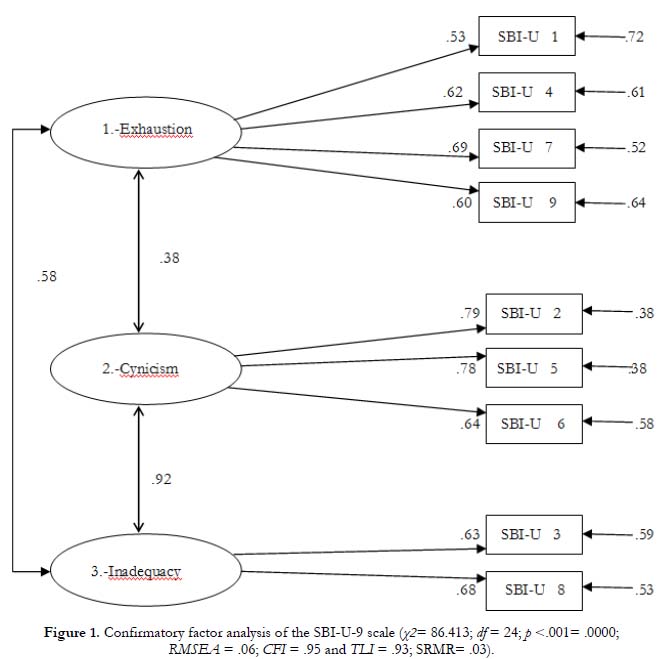
<body><![CDATA[<p>&nbsp;</p>     <p><font face="Verdana" size="2"><b>Method</b></font></p>     <p><font face="Verdana" size="2"><b>Participants</b></font></p>     <p><font face="Verdana" size="2">The sample was made up of 578 university and post-graduate students from different Autonomous Communities in Spain. The data was gathered by three Spanish universities (Universitat Rovira i Virgili-Tarragona, Universidad de Salamanca and Universidad de Valladolid) and one EADA Business School (Escuela de Alta Dirección y Administración). 25.7% of the sample were men and 74.3% women (<i>M</i>= 21.6; <i>SD</i>=4.94). The types of studies were undergraduate (61.9%), diploma (28%), graduate studies (9%) and masters (1%). 49.9% of the sample were in their first year, 20% in the second, 9.2% in the third, 15.4% in the fourth, 25% in the fifth and 15% were on postgraduate or masters courses.</font></p>     <p><font face="Verdana" size="2"><b>Instruments</b></font></p>     <p><font face="Verdana" size="2">- The School Burnout Inventory (SBI-9; Salmela-Aro et al., 2009) (See <a target="_blank" href="/img/revistas/ap/v31n1/psico_aprendizaje5_a1.jpg">Annex 1</a>) was drawn up for the purpose of evaluating burnout among adolescents in secondary education (16 year olds). The version we present has undergone a double adaptation. It was first translated from English into Spanish and the contents were then adapted from secondary school students to university students. The first adaptation was carried out following the steps set down in the scientific literature on adapting evaluation instruments (Muñiz &amp; Bartram, 2007): Translation by experts of the items into Spanish, a discussion group on the translation of the items followed by their back-translation into English and a final check to make sure that the two versions are equivalent. Group techniques such as brainstorming and focus group were used in the second adaptation and were applied to various groups of university students. The scale consists of 9 items assessed on a Likert type scale (from 1= <i>Completely disagree</i> to 6= <i>Completely agree</i>) and 3 sub-scales (<i>Exhaustion, Cynicism and Inadequacy</i>). In order to distinguish it from the original version the Spanish version was labelled SBI-U.</font></p>     <p><font face="Verdana" size="2">- The Spanish version of the Irritation Scale (IS; Merino, Carbonero, Moreno, &amp; Morante, 2006) consists of 8 items and 2 subscales. It enables us to diagnose irritation, which is defined as a state of progressive psychological fatigue that cannot be relieved with normal rest periods. Irritation may also arise when a person feels there is a discrepancy between a given state of affairs and their achievement of an important personal goal. The first subscale is called <i>Emotional irritation</i> (reliability = .86) and is made up of 5 items (for example, "3.-When other people talk to me it makes me irritated"); the second is called <i>Cognitive irritation</i> (reliability = .87) and is made up of 3 items (for example, find it hard to switch off after work"). The Likert responses were gathered using a 7 point scale (from 1.-<i>Very much disagree to</i> 6.-<i>Very much agree</i>) .</font></p>     <p><font face="Verdana" size="2">- The Beck Depression Inventory (BDI; Sanz &amp; Vázquez, 1998) has been adapted into Spanish for university students. It enables us to evaluate general subclinical states of depression. It is a single factor scale with a reliability of .83. It is made up of 21 items that deal with sadness, pessimism, etc. and are assessed on a four-point Likert scale.</font></p>     <p><font face="Verdana" size="2">- The Overall Personality Assessment Scale (OPERAS; Vigil-Colet, Morales-Vives, Camps, Tous, &amp; Lorenzo-Seva, 2013) is an instrument based on a model of the five big personality factors. According to this model, human behaviour depends mainly on five personality traits: <i>Extraversion, Responsibility, Emotional Stability, Agreeableness and Openness to Experience</i>. The scale consists of a total of 40 items, the responses to which are based on a 5-point scale. The factors are: <i>Extraversion</i> (alpha = .86; for example, "2.-I'm the life of the party"), <i>Emotional Stability</i> (alpha = .86; "32.-I often change mood"), <i>Responsibility</i> (alpha = .77; "5.-I always keep my word"), <i>Amiability</i> (alpha = .71; "12.-I respect others") and <i>Openness to Experience</i> (alpha = .81; "24.-I like trying out new things").</font></p>     <p><font face="Verdana" size="2">- The Self-Regulation Scale (SRS; Luszczynska, Diehl, Gutiérrez-Doña, Kuusinen, &amp; Schwarzer, 2004) consists of 7 items which are answered using a four point scale (1= <i>not at all</i> to 4= <i>a lot</i>) and its configuration is one dimensional. Self-regulation is regarded as a dispositional variable that is responsible for being able to regulate oneself in a wide range of situations. Hence controlling alertness is a key component when it comes to overcoming obstacles. The scale's internal consistency in the different transcultural studies that have been carried out ranges between .63 and .87. Here is one example of an item: "7.-I keep focussed on my goals and do not allow anything to divert me from them".</font></p>     ]]></body>
<body><![CDATA[<p><font face="Verdana" size="2">- The General Self-Efficacy Scale (GSES; Sanjuán, Pérez, &amp; Bermúdez, 2000) assesses the stable feeling of personal competency in coping effectively with a large variety of stressing situations. This is a one-dimensional instrument made up of 10 items with a 10-point response format (1= <i>Completely disagree</i> to 10= <i>Very much agree</i>) .An example of one item is: "5.-Thanks to my qualities and resources I can overcome unforeseen situations". The studies were carried out with samples featuring different nationalities and showed considerable internal consistency for the scale (between .79 and .93).</font></p>     <p><font face="Verdana" size="2">- Finally, we also used certain correlates, also known as external indicators (Streiner &amp; Norman, 2008), in the form of questions that the respondents had to answer. One of them was answered using a scale of 10 anchors (<i>1=Completely disagree</i> to <i>10=Very much agree</i>). These referred to support from tutors and professors, the class schedule load, the furniture and classroom conditions, and professor non-attendance of classes without prior notice. Others were answered providing specific details or stating how often they did certain things. For example, students were asked how often they had woken up at night thinking about things related to a certain subject, what they had studied over the weekends, etc.</font></p>     <p><font face="Verdana" size="2"><b>Procedure</b></font></p>     <p><font face="Verdana" size="2">Non-probabilistic sampling was used, which is also known as random accidental sampling. Students participated on a voluntary and anonymous basis and their personal identification data was not registered. The data was always gathered inside the classroom on a group basis following the consent of the professor teaching the subject. An expert psychologist was always present during the application of the questionnaire to solve any possible queries that the university students might have.</font></p>     <p><font face="Verdana" size="2"><b>Data Analysis</b></font></p>     <p><font face="Verdana" size="2">Taking into account that we already had a hypothesis concerning the questionnaire's factor structure, gven that the original version had put forward three factors, we carried out a confirmatory factor analysis (<i>CFA</i>) in order to verify this structure. Once the scale's factor structure was defined we used other scales and external indicators to analyse its reliability and criterion validity. The data were analysed using the programmes SPSS 19.0 and Mplus 5.1.</font></p>     <p>&nbsp;</p>     <p><font face="Verdana" size="2"><b>Results</b></font></p>     <p><font face="Verdana" size="2">A <i>CFA</i> was performed on the polychoric correlation matrix given that the items seemed to be on an ordinal scale. We used the fit indices put forward by Hu and Bentler (1999), the comparative fit index (<i>CFI</i>), the non-normative fit index (<i>NFI</i>) and the root mean square error of approximation (<i>RMSEA</i>). Although there is no absolute consensus, acceptable cut-off values for the first two tend to be equal to or above .90 whereas values below .08 were considered acceptable and equal to or under .05 excellent for the <i>RMSEA</i> (Browne &amp; Cudek, 1993).</font></p>     <p><font face="Verdana" size="2">In our case the SBI-U showed an acceptable fit with the three factor model initially put forward by Salmela-Aro et al. (2009), and it came up with the following indicators: <i>CFI</i> = .95; <i>TLI</i> = 0.93; <i>RMSEA</i> = .06 (90% reliability interval, .047 - .078; <i>RMSEA</i> approximate fit test &lt;.05, p=.098). Consequently the indicator values were close to optimum.</font></p>     ]]></body>
<body><![CDATA[<p><font face="Verdana" size="2"><a href="#f1">Figure 1</a> shows the resulting model. Although we had initially considered a three factor structure, given the close relationship between two of them, we thought that a two factor model might be more suitable than the three factor structure. However, when the model was contrasted using <i>CFA</i>, creating a new factor by joining the items of factors 2 and 3, the model's fit decreased significantly (&#916;&chi;<sup>2</sup> = 26.72; <i>p</i> &lt;.001).</font></p>     <p>&nbsp;</p>     <p align="center"><font face="Verdana" size="2"><a name="f1"><img src="/img/revistas/ap/v31n1/psico_aprendizaje5_f1.jpg"></a></font></p>     <p>&nbsp;</p>     <p><font face="Verdana" size="2">The questionnaire's dimensionality was established and <a target="_blank" href="/img/revistas/ap/v31n1/psico_aprendizaje5_t1.jpg">Table 1</a> shows the scales' descriptive statistics, reliabilities and validity ratios. Reliability is between .70 and .77 which means that it can be considered acceptable if we take into account the small number of items that make up each of the subscales.</font></p>     <p><font face="Verdana" size="2"><a target="_blank" href="/img/revistas/ap/v31n1/psico_aprendizaje5_t1.jpg">Table 1</a> also displays the correlations between the three scales and eighteen external correlates and five scales (Irritation, BDI, OPERAS, SRS and GSES). The three academic burnout factors (<i>Exhaustion due to the demands of university work, Cynicism concerning the meaning of university and A sense of inadequacy at university</i>) displayed relations with the different measures in the expected direction and correlated positively with irritation (<i>emotional and cognitive</i>) and general depression, whereas the third factor also showed a positive correlation with emotional stability (<i>Sense of inadequacy at university</i>). Furthermore, the three factors displayed negative correlations with extraversion, self-regulation and general efficacy. More specifically, we found different negative correlations such as between: <i>Exhaustion concerning university work</i> (F1) and emotional stability; <i>Cynicism concerning the meaning of university</i> (F2) and emotional stability, responsibility and amiability; and between <i>A sense of inadequacy at university</i> (F3) and responsibility, amiability and openness to experience).</font></p>     <p><font face="Verdana" size="2">As regards the external correlates, the three subscales that make up academic burnout were associated with various of these. We found three direct correlations, (for example, the number of the academic year, the Sundays they had devoted to studying, competition among colleagues, faculty absenteeism, etc.) plus nineteen inverse correlations (such as for example, support from tutors and professors, the class schedule load, level of comfort of furniture, transport, etc.).</font></p>     <p>&nbsp;</p>     <p><font face="Verdana" size="2"><b>Discussion</b></font></p>     <p><font face="Verdana" size="2">In the present study we present the psychometric properties of the SBI-U-9, a brief instrument that enables us to evaluate academic burnout (exhaustion, cynicism, inadequacy) in university students and this is the first time this scale has been presented in Spanish.</font></p>     ]]></body>
<body><![CDATA[<p><font face="Verdana" size="2">The findings from the confirmatory factor analysis of the SBI-U-9 support the three factor model (Salmela-Aro, Kiuru, Pietikäinen, &amp; Jokela, 2008) tested on a sample of Finnish teenage students (Salmela-Aro et al., 2009) and Spanish students (Moyano &amp; Riaño-Hernández, 2013). The SBI-U-9 and MBI-SS scales have three subscales, whose contents are similar (Salmela-Aro et al., 2009; Schaufeli et al., 2002). We can therefore affirm that the study's first objective was totally confirmed.</font></p>     <p><font face="Verdana" size="2">The second objective was corroborated given that the reliability of the three factors was found to be appropriate.</font></p>     <p><font face="Verdana" size="2">Salmela-Aro et al. (2009) reliability ratios for the three subscales were: <i>Exhaustion</i> (.80), <i>Cynicism</i> (.80) and Inadequacy (.67). The ratios in the Spanish version were acceptable ranging between .70 and .77. Moyano and Riaño-Hernández's (2013), adaptation into Spanish the SBI, and tested on adolescents obtained similar reliabilities: <i>Exhaustion</i> (.57), <i>Cynicism</i> (.63) and <i>Inadequacy</i> (.49). As regards the MBI-SS (Schaufeli et al., 2002) the resulting reliabilities in university students for the three subscales that make up the scale were as follows: From .74 to .79 (Spanish), from .69 to .82 (Portuguese) and from .67 to .86 (Dutch).</font></p>     <p><font face="Verdana" size="2">As far as criterion validity is concerned, a review of the literature shows that burnout is related to irritation (Merino-Tejedor et al., 2006), depression (Ahola &amp; Hakanen, 2007), personality (Hudek-Knezevic, 2011), self-regulation (Gurcay, 2009), self efficacy (Skaalvik, 2007) and certain external indicators (Salanova et al., 2000) such as age, profession, etc. The results of the present study found significant correlations between the three factors of the SBI-U scale and the abovementioned variables. They thus meet our objective in that they confirm the proposed validity ratios. In the study we are presenting what stands out primarily is the correlation between academic burnout and depression, which ranges between .29 and .41. Although the instruments used to measure depression were different, the association between academic burnout and depression was also found by Moyano and Riaño-Hernández (2013) in their research study, where the correlations ranged from .31 to .48.</font></p>     <p><font face="Verdana" size="2">By way of conclusion we can state that the SBI-U-9 scale's psychometric properties, in its Spanish version, are satisfactory. Thus, the <i>CFA</i> clearly confiráis the structure of the three original factors. Furthermore, the reliability estimates were acceptable and there is clear evidence of validity. We can consequently state that the present scale in Spanish is useful for evaluating academic burnout in university students.</font></p>     <p><font face="Verdana" size="2">The study has at least two drawbacks: On the one hand, more longitudinal studies need to be carried out in order to further determine the relationship between academic burn-out and other variables such as the year of the student's course (for example, the first year versus the fourth year), the number of repeat subjects, the type of repeat subjects (for example, education, psychology, medicine, engineering, economics, law, etc.), etc. Furthermore, the validation of a psychometric instrument is a dynamic process which does not end once it has been constructed and published (Padilla, Gómez, Hidalgo, &amp; Muñiz, 2006). Hence new studies are likely to contribute new data both on academic burnout and on the scale we have presented. Finally, this study uses a convenience sample to adapt the scales and this limits the validity of the findings. Having said this, this is relatively common practice in research studies in the behavioural sciences (Alonso-Tapia &amp; Rodríguez-Rey, 2012; Boada-Grau &amp; Gil-Ripoll, 2011; Boada-Grau, Sánchez-García, Prizmic-Kuzmica, &amp; Vigil-Colet, 2012). However, as Highhouse and Gillespie (2008) point out, quite often the use of incidental samples does not constitute an important threat to a study's validity and on the other hand, the present study, despite the fact that the sample is a convenience sample, incorporates students from different faculties.</font></p>     <p>&nbsp;</p>     <p><font face="Verdana" size="2"><b>References</b></font></p>     <!-- ref --><p><font face="Verdana" size="2">1. Adie, J., &amp; Wakefield, C. (2011). Perceptions of the teaching environment, engagement and burnout among university students on a sports-related degree programme in the UK. Journal of Hospitality, Leisure, Sport &amp; Tourism Education, 10, 74-84.    &nbsp;&nbsp;&nbsp;&nbsp;&nbsp;&nbsp;&nbsp;&nbsp;[&#160;<a href="javascript:void(0);" onclick="javascript: window.open('/scielo.php?script=sci_nlinks&ref=718642&pid=S0212-9728201500010003000001&lng=','','width=640,height=500,resizable=yes,scrollbars=1,menubar=yes,');">Links</a>&#160;]<!-- end-ref --></font></p>    ]]></body>
<body><![CDATA[<!-- ref --><p><font face="Verdana" size="2">2. Aguilar-Bustamante, M., &amp; Riaño-Hernandez, D. (2013). Propiedades psicométricas del "School Burnout Inventory" SBI en población colombiana adolescente (Psychometric properties of the "School Burnout Inventory" SBI in teenage Colombian population). Paper presented at the 34<sup>th</sup> Interamerican Congress of Psychology, 15-19 July, Brasilia (Brazil).    &nbsp;&nbsp;&nbsp;&nbsp;&nbsp;&nbsp;&nbsp;&nbsp;[&#160;<a href="javascript:void(0);" onclick="javascript: window.open('/scielo.php?script=sci_nlinks&ref=718644&pid=S0212-9728201500010003000002&lng=','','width=640,height=500,resizable=yes,scrollbars=1,menubar=yes,');">Links</a>&#160;]<!-- end-ref --></font></p>    <!-- ref --><p><font face="Verdana" size="2">3. Ahola, K., &amp; Hakanen, J. (2007). Job strain, burnout, and depressive symptoms: A prospective study among dentists. Journal of Affective Disorders, 104, 103-110.    &nbsp;&nbsp;&nbsp;&nbsp;&nbsp;&nbsp;&nbsp;&nbsp;[&#160;<a href="javascript:void(0);" onclick="javascript: window.open('/scielo.php?script=sci_nlinks&ref=718646&pid=S0212-9728201500010003000003&lng=','','width=640,height=500,resizable=yes,scrollbars=1,menubar=yes,');">Links</a>&#160;]<!-- end-ref --></font></p>    <!-- ref --><p><font face="Verdana" size="2">4. Alonso-Tapia, J., &amp; Rodríguez-Rey, R. (2012). Situaciones de interacción y metas sociales en la adolescencia: Desarrollo y validación inicial del Cuestionario de Metas Sociales (CMS) (Situations interaction and social goals in adolescence: Development and initial validation of the Social Goals Questionnaire). Estudios de Psicología, 33, 191-206.    &nbsp;&nbsp;&nbsp;&nbsp;&nbsp;&nbsp;&nbsp;&nbsp;[&#160;<a href="javascript:void(0);" onclick="javascript: window.open('/scielo.php?script=sci_nlinks&ref=718648&pid=S0212-9728201500010003000004&lng=','','width=640,height=500,resizable=yes,scrollbars=1,menubar=yes,');">Links</a>&#160;]<!-- end-ref --></font></p>    <!-- ref --><p><font face="Verdana" size="2">5. Aranda, C., Pando, M., Salazar, J. G., Torres, T.M., &amp; Aldrete, M. G. (2009). Social support, burnout syndrome and occupational exhaustion among Mexican traffic police agents. The Spanish Journal of Psychology, 12, 585-592.    &nbsp;&nbsp;&nbsp;&nbsp;&nbsp;&nbsp;&nbsp;&nbsp;[&#160;<a href="javascript:void(0);" onclick="javascript: window.open('/scielo.php?script=sci_nlinks&ref=718650&pid=S0212-9728201500010003000005&lng=','','width=640,height=500,resizable=yes,scrollbars=1,menubar=yes,');">Links</a>&#160;]<!-- end-ref --></font></p>    <!-- ref --><p><font face="Verdana" size="2">6. Arce, C., De Francisco, C., Andrade, E., Arce, I., &amp; Raedeke, T. (2010). Adaptación española del Ahtlete Burnout Questionnaire (ABQ) para la medida del burnout en futbolistas (Spanish adaptation of Ahtlete Burnout Questionnaire (ABQ) to measure burnout in players). Psicothema, 22, 250-255.    &nbsp;&nbsp;&nbsp;&nbsp;&nbsp;&nbsp;&nbsp;&nbsp;[&#160;<a href="javascript:void(0);" onclick="javascript: window.open('/scielo.php?script=sci_nlinks&ref=718652&pid=S0212-9728201500010003000006&lng=','','width=640,height=500,resizable=yes,scrollbars=1,menubar=yes,');">Links</a>&#160;]<!-- end-ref --></font></p>    ]]></body>
<body><![CDATA[<!-- ref --><p><font face="Verdana" size="2">7. Backovi&#263;, D., &#381;ivojinovi&#263;, J. I., Maksimovi&#263;, J., &amp; Maksimovi&#263;, M. (2012). Gender differences in academic stress and burnout among medical students in final years of education. Psychiatria Danubina, 24, 175-181.    &nbsp;&nbsp;&nbsp;&nbsp;&nbsp;&nbsp;&nbsp;&nbsp;[&#160;<a href="javascript:void(0);" onclick="javascript: window.open('/scielo.php?script=sci_nlinks&ref=718654&pid=S0212-9728201500010003000007&lng=','','width=640,height=500,resizable=yes,scrollbars=1,menubar=yes,');">Links</a>&#160;]<!-- end-ref --></font></p>    <!-- ref --><p><font face="Verdana" size="2">8. Bernaldo, M., &amp; Labrador-Encinas, F. J. (2007). Evaluación del estrés laboral y burnout en los servicios de urgencia extrahospitalaria (Assessment of job stress and burnout in-hospital emergency services). International Journal of Clinicaland Health Psychology, 7, 323-335.    &nbsp;&nbsp;&nbsp;&nbsp;&nbsp;&nbsp;&nbsp;&nbsp;[&#160;<a href="javascript:void(0);" onclick="javascript: window.open('/scielo.php?script=sci_nlinks&ref=718656&pid=S0212-9728201500010003000008&lng=','','width=640,height=500,resizable=yes,scrollbars=1,menubar=yes,');">Links</a>&#160;]<!-- end-ref --></font></p>    <!-- ref --><p><font face="Verdana" size="2">9. Boada-Grau, J., De-Diego, R., &amp; Agulló, E. (2004). El burnout y las manifestaciones psicosomáticas como consecuentes del clima organizacional y de la motivación laboral (The burnout and psychosomatic manifestations consistent climate as orgamzational and work motivation). Psicothema, 16, 125-131.    &nbsp;&nbsp;&nbsp;&nbsp;&nbsp;&nbsp;&nbsp;&nbsp;[&#160;<a href="javascript:void(0);" onclick="javascript: window.open('/scielo.php?script=sci_nlinks&ref=718658&pid=S0212-9728201500010003000009&lng=','','width=640,height=500,resizable=yes,scrollbars=1,menubar=yes,');">Links</a>&#160;]<!-- end-ref --></font></p>    <!-- ref --><p><font face="Verdana" size="2">10. Boada-Grau, J., &amp; Gil-Ripoll, C. (2011). Measure of human resource management practices: Psychometric properties and factorial structure of the questionnaire PRH-33. Anales de Psicología, 27, 527-535.    &nbsp;&nbsp;&nbsp;&nbsp;&nbsp;&nbsp;&nbsp;&nbsp;[&#160;<a href="javascript:void(0);" onclick="javascript: window.open('/scielo.php?script=sci_nlinks&ref=718660&pid=S0212-9728201500010003000010&lng=','','width=640,height=500,resizable=yes,scrollbars=1,menubar=yes,');">Links</a>&#160;]<!-- end-ref --></font></p>    <!-- ref --><p><font face="Verdana" size="2">11. Boada-Grau, J., Sánchez-García, J. C., Prizmic-Kuzmica, A-J., &amp; Vigil-Colet, A. (2012). Work health and hygiene in the transport industry (TRANS-18): Factorial structure, reliability and validity. The Spanish Journal of Psychology. 15, 357-366.    &nbsp;&nbsp;&nbsp;&nbsp;&nbsp;&nbsp;&nbsp;&nbsp;[&#160;<a href="javascript:void(0);" onclick="javascript: window.open('/scielo.php?script=sci_nlinks&ref=718662&pid=S0212-9728201500010003000011&lng=','','width=640,height=500,resizable=yes,scrollbars=1,menubar=yes,');">Links</a>&#160;]<!-- end-ref --></font></p>    ]]></body>
<body><![CDATA[<!-- ref --><p><font face="Verdana" size="2">12. Botti, G., Foddis, D., &amp; Giacalone-Olive, A. M. (2011). Preventing burnout in nursing students. Soins, 755, 21-23.    &nbsp;&nbsp;&nbsp;&nbsp;&nbsp;&nbsp;&nbsp;&nbsp;[&#160;<a href="javascript:void(0);" onclick="javascript: window.open('/scielo.php?script=sci_nlinks&ref=718664&pid=S0212-9728201500010003000012&lng=','','width=640,height=500,resizable=yes,scrollbars=1,menubar=yes,');">Links</a>&#160;]<!-- end-ref --></font></p>    <!-- ref --><p><font face="Verdana" size="2">13. Browne, M. W., &amp; Cudek, R. (1993). Alternate ways of assessing model fit. In K. A. Bollen &amp; J. S. Long (Eds.), Testing structural equation models (pp. 136-162). Newbury Park, CA: Sage.    &nbsp;&nbsp;&nbsp;&nbsp;&nbsp;&nbsp;&nbsp;&nbsp;[&#160;<a href="javascript:void(0);" onclick="javascript: window.open('/scielo.php?script=sci_nlinks&ref=718666&pid=S0212-9728201500010003000013&lng=','','width=640,height=500,resizable=yes,scrollbars=1,menubar=yes,');">Links</a>&#160;]<!-- end-ref --></font></p>    <!-- ref --><p><font face="Verdana" size="2">14. Caballero, C. C., Hederich, C., &amp; Palacio, J. E. (2010). El burnout académico: delimitación del síndrome y factores asociados con su aparición (The academic burnout: delineation of the syndrome and factors associated with its development). Revista Latinoamericana de Psicología, 42, 131-146.    &nbsp;&nbsp;&nbsp;&nbsp;&nbsp;&nbsp;&nbsp;&nbsp;[&#160;<a href="javascript:void(0);" onclick="javascript: window.open('/scielo.php?script=sci_nlinks&ref=718668&pid=S0212-9728201500010003000014&lng=','','width=640,height=500,resizable=yes,scrollbars=1,menubar=yes,');">Links</a>&#160;]<!-- end-ref --></font></p>    <!-- ref --><p><font face="Verdana" size="2">15. Campos, J. A., Jordani, P. C., Zucoloto, M. L., Bonafé, F. S., &amp; Maroco, J. (2012). Burnout syndrome among dental students. Revista Brasileira Epidemiologia, 15, 155-165.    &nbsp;&nbsp;&nbsp;&nbsp;&nbsp;&nbsp;&nbsp;&nbsp;[&#160;<a href="javascript:void(0);" onclick="javascript: window.open('/scielo.php?script=sci_nlinks&ref=718670&pid=S0212-9728201500010003000015&lng=','','width=640,height=500,resizable=yes,scrollbars=1,menubar=yes,');">Links</a>&#160;]<!-- end-ref --></font></p>    <!-- ref --><p><font face="Verdana" size="2">16. Costa, E. F., Santos, S., Rodrigues, A. T., &amp; Vieira, E. (2012). Burnout syndrome and associated factors among medical students: A cross-sectional study. Clinics (Sao Paulo), 67, 573-580.    &nbsp;&nbsp;&nbsp;&nbsp;&nbsp;&nbsp;&nbsp;&nbsp;[&#160;<a href="javascript:void(0);" onclick="javascript: window.open('/scielo.php?script=sci_nlinks&ref=718672&pid=S0212-9728201500010003000016&lng=','','width=640,height=500,resizable=yes,scrollbars=1,menubar=yes,');">Links</a>&#160;]<!-- end-ref --></font></p>    ]]></body>
<body><![CDATA[<!-- ref --><p><font face="Verdana" size="2">17. De-Abreu, A. T, Grosseman, S., De-Oliva, E. F., &amp; De-Andrade, T. M. (2011). Burnout syndrome among internship medical students. Medical Education, 45, 1146-1150.    &nbsp;&nbsp;&nbsp;&nbsp;&nbsp;&nbsp;&nbsp;&nbsp;[&#160;<a href="javascript:void(0);" onclick="javascript: window.open('/scielo.php?script=sci_nlinks&ref=718674&pid=S0212-9728201500010003000017&lng=','','width=640,height=500,resizable=yes,scrollbars=1,menubar=yes,');">Links</a>&#160;]<!-- end-ref --></font></p>    <!-- ref --><p><font face="Verdana" size="2">18. Divaris, K., Polychronopoulou, A., Taoufik, K., Katsaros, C., &amp; Eliades, T. (2012). Stress and burnout in postgraduate dental education. European Journal of Dental Education, 16, 35-42.    &nbsp;&nbsp;&nbsp;&nbsp;&nbsp;&nbsp;&nbsp;&nbsp;[&#160;<a href="javascript:void(0);" onclick="javascript: window.open('/scielo.php?script=sci_nlinks&ref=718676&pid=S0212-9728201500010003000018&lng=','','width=640,height=500,resizable=yes,scrollbars=1,menubar=yes,');">Links</a>&#160;]<!-- end-ref --></font></p>    <!-- ref --><p><font face="Verdana" size="2">19. Figueiredo, H., Grau, E., Gil-Monte, P. R., &amp; García, J. A. (2012). Síndrome de quemarse por el trabajo y satisfacción laboral en profesionales de enfermería (Burnout, work and job satisfaction in nurses). Psicothema, 24, 271-276.    &nbsp;&nbsp;&nbsp;&nbsp;&nbsp;&nbsp;&nbsp;&nbsp;[&#160;<a href="javascript:void(0);" onclick="javascript: window.open('/scielo.php?script=sci_nlinks&ref=718678&pid=S0212-9728201500010003000019&lng=','','width=640,height=500,resizable=yes,scrollbars=1,menubar=yes,');">Links</a>&#160;]<!-- end-ref --></font></p>    <!-- ref --><p><font face="Verdana" size="2">20. Gan Y., Shang J., &amp; Zhang Y. (2007). Coping flexibility and locus of control as predictors of burnout among chinese college students. Social Behavior and Personality, 35, 1087-1098.    &nbsp;&nbsp;&nbsp;&nbsp;&nbsp;&nbsp;&nbsp;&nbsp;[&#160;<a href="javascript:void(0);" onclick="javascript: window.open('/scielo.php?script=sci_nlinks&ref=718680&pid=S0212-9728201500010003000020&lng=','','width=640,height=500,resizable=yes,scrollbars=1,menubar=yes,');">Links</a>&#160;]<!-- end-ref --></font></p>    <!-- ref --><p><font face="Verdana" size="2">21. González, R., Souto, A., Fernández, R., &amp; Freire, C. (2011). Regulación emocional y burnout académico en estudiantes universitarios de Fisioterapia (Emotional regulation and academic burnout in university students Physiotherapy). Revista de Investigación en Educación, 9, 7-18.    &nbsp;&nbsp;&nbsp;&nbsp;&nbsp;&nbsp;&nbsp;&nbsp;[&#160;<a href="javascript:void(0);" onclick="javascript: window.open('/scielo.php?script=sci_nlinks&ref=718682&pid=S0212-9728201500010003000021&lng=','','width=640,height=500,resizable=yes,scrollbars=1,menubar=yes,');">Links</a>&#160;]<!-- end-ref --></font></p>    ]]></body>
<body><![CDATA[<!-- ref --><p><font face="Verdana" size="2">22. Gurcay, D. (2009). Factors predicting teachers' collective efficacy beliefs. Journal of Education, 36, 119-128.    &nbsp;&nbsp;&nbsp;&nbsp;&nbsp;&nbsp;&nbsp;&nbsp;[&#160;<a href="javascript:void(0);" onclick="javascript: window.open('/scielo.php?script=sci_nlinks&ref=718684&pid=S0212-9728201500010003000022&lng=','','width=640,height=500,resizable=yes,scrollbars=1,menubar=yes,');">Links</a>&#160;]<!-- end-ref --></font></p>    <!-- ref --><p><font face="Verdana" size="2">23. Hernández-Martín, L., Fernández-Calvo, B., Ramos, F., &amp; Contador, I. (2006). El síndrome de burnout en funcionarios de vigilancia de un centro penitenciario (The staff burnout syndrome surveillance in prisons). International Journal of Clinical and Health Psychology, 6, 599-611.    &nbsp;&nbsp;&nbsp;&nbsp;&nbsp;&nbsp;&nbsp;&nbsp;[&#160;<a href="javascript:void(0);" onclick="javascript: window.open('/scielo.php?script=sci_nlinks&ref=718686&pid=S0212-9728201500010003000023&lng=','','width=640,height=500,resizable=yes,scrollbars=1,menubar=yes,');">Links</a>&#160;]<!-- end-ref --></font></p>    <!-- ref --><p><font face="Verdana" size="2">24. Highhouse, S., &amp; Gillespie, J. Z. (2008). Do samples really matter that much? In C. E. Lance &amp; R. J. Vandenberg (Eds.), Statistical and methodological myths and urban legends: Received doctrine, verity, and fable in the organizational and social sciences (pp. 247-266). Mahwah, NJ: Erlbaum.    &nbsp;&nbsp;&nbsp;&nbsp;&nbsp;&nbsp;&nbsp;&nbsp;[&#160;<a href="javascript:void(0);" onclick="javascript: window.open('/scielo.php?script=sci_nlinks&ref=718688&pid=S0212-9728201500010003000024&lng=','','width=640,height=500,resizable=yes,scrollbars=1,menubar=yes,');">Links</a>&#160;]<!-- end-ref --></font></p>    <!-- ref --><p><font face="Verdana" size="2">25. Hu, L., &amp; Bentler, P. M. (1999). Cutoff criteria for fit indexes in covariance structure analysis: Conventional criteria versus new alternatives. Structural Equation Modeling, 6, 1-55.    &nbsp;&nbsp;&nbsp;&nbsp;&nbsp;&nbsp;&nbsp;&nbsp;[&#160;<a href="javascript:void(0);" onclick="javascript: window.open('/scielo.php?script=sci_nlinks&ref=718690&pid=S0212-9728201500010003000025&lng=','','width=640,height=500,resizable=yes,scrollbars=1,menubar=yes,');">Links</a>&#160;]<!-- end-ref --></font></p>    <!-- ref --><p><font face="Verdana" size="2">26. Hudek-Knezevic, J. (2011). Personality, organizational stress, and attitudes toward work as prospective predictors of professional burnout in hospital nurses. Croatian Medical Journal, 52, 538-549.    &nbsp;&nbsp;&nbsp;&nbsp;&nbsp;&nbsp;&nbsp;&nbsp;[&#160;<a href="javascript:void(0);" onclick="javascript: window.open('/scielo.php?script=sci_nlinks&ref=718692&pid=S0212-9728201500010003000026&lng=','','width=640,height=500,resizable=yes,scrollbars=1,menubar=yes,');">Links</a>&#160;]<!-- end-ref --></font></p>    ]]></body>
<body><![CDATA[<!-- ref --><p><font face="Verdana" size="2">27. Jenaro-Río, C., Flores-Robaina, N., &amp; González-Gil, F. (2007). Síndrome de burnout y afrontamiento en trabajadores de acogimiento residencial de menores (Burnout syndrome coping workers and residential care for children). International Journal of Clinical and Health Psychology, 7, 107-121.    &nbsp;&nbsp;&nbsp;&nbsp;&nbsp;&nbsp;&nbsp;&nbsp;[&#160;<a href="javascript:void(0);" onclick="javascript: window.open('/scielo.php?script=sci_nlinks&ref=718694&pid=S0212-9728201500010003000027&lng=','','width=640,height=500,resizable=yes,scrollbars=1,menubar=yes,');">Links</a>&#160;]<!-- end-ref --></font></p>    <!-- ref --><p><font face="Verdana" size="2">28. Kains, E., &amp; Piquard, D. (2011). The burnout of medical students. Revue Medicale de Bruxelles, 32, 424-430.    &nbsp;&nbsp;&nbsp;&nbsp;&nbsp;&nbsp;&nbsp;&nbsp;[&#160;<a href="javascript:void(0);" onclick="javascript: window.open('/scielo.php?script=sci_nlinks&ref=718696&pid=S0212-9728201500010003000028&lng=','','width=640,height=500,resizable=yes,scrollbars=1,menubar=yes,');">Links</a>&#160;]<!-- end-ref --></font></p>    <!-- ref --><p><font face="Verdana" size="2">29. Luszczynska, A., Diehl, M., Gutiérrez-Doña, B., Kuusinen, P., &amp; Schwarzer, R. (2004). Measuring one component of dispositional self-regulation: Attention control in goal pursuit. Personality and Individual Differences, 37, 555-566.    &nbsp;&nbsp;&nbsp;&nbsp;&nbsp;&nbsp;&nbsp;&nbsp;[&#160;<a href="javascript:void(0);" onclick="javascript: window.open('/scielo.php?script=sci_nlinks&ref=718698&pid=S0212-9728201500010003000029&lng=','','width=640,height=500,resizable=yes,scrollbars=1,menubar=yes,');">Links</a>&#160;]<!-- end-ref --></font></p>    <!-- ref --><p><font face="Verdana" size="2">30. Martínez, I. M., &amp; Marques Pinto, A. (2005). Burnout en estudiantes universitarios de España y Portugal y su relación con variables académicas (Burnout in university students from Spain and Portugal and its relation to academic variables). Aletheia, 21 , 21-30.    &nbsp;&nbsp;&nbsp;&nbsp;&nbsp;&nbsp;&nbsp;&nbsp;[&#160;<a href="javascript:void(0);" onclick="javascript: window.open('/scielo.php?script=sci_nlinks&ref=718700&pid=S0212-9728201500010003000030&lng=','','width=640,height=500,resizable=yes,scrollbars=1,menubar=yes,');">Links</a>&#160;]<!-- end-ref --></font></p>    <!-- ref --><p><font face="Verdana" size="2">31. Martínez, I. M., Marques Pinto, A., &amp; Lopes da Silva, A.L. (2000-2001). Burnout em estudantes do ensino superior (Burnout in students of higher education). Revista Portuguesa de Psicologia, 35, 151-167.    &nbsp;&nbsp;&nbsp;&nbsp;&nbsp;&nbsp;&nbsp;&nbsp;[&#160;<a href="javascript:void(0);" onclick="javascript: window.open('/scielo.php?script=sci_nlinks&ref=718702&pid=S0212-9728201500010003000031&lng=','','width=640,height=500,resizable=yes,scrollbars=1,menubar=yes,');">Links</a>&#160;]<!-- end-ref --></font></p>    ]]></body>
<body><![CDATA[<!-- ref --><p><font face="Verdana" size="2">32. Martínez, I. M., Marques, A., Salanova, M., &amp; Lopes da Silva, A. (2002). Burnout en estudiantes universitarios de España y Portugal. Un estudio transcultural (Burnout in university students from Spain and Portugal. A cross-cultural study). Ansiedad y Estrés, 8, 13-23.    &nbsp;&nbsp;&nbsp;&nbsp;&nbsp;&nbsp;&nbsp;&nbsp;[&#160;<a href="javascript:void(0);" onclick="javascript: window.open('/scielo.php?script=sci_nlinks&ref=718704&pid=S0212-9728201500010003000032&lng=','','width=640,height=500,resizable=yes,scrollbars=1,menubar=yes,');">Links</a>&#160;]<!-- end-ref --></font></p>    <!-- ref --><p><font face="Verdana" size="2">33. Maslach, C. (1976). Burned-out. Human Behavior, 5, 16-22.    &nbsp;&nbsp;&nbsp;&nbsp;&nbsp;&nbsp;&nbsp;&nbsp;[&#160;<a href="javascript:void(0);" onclick="javascript: window.open('/scielo.php?script=sci_nlinks&ref=718706&pid=S0212-9728201500010003000033&lng=','','width=640,height=500,resizable=yes,scrollbars=1,menubar=yes,');">Links</a>&#160;]<!-- end-ref --></font></p>    <!-- ref --><p><font face="Verdana" size="2">34. Maslach, C., &amp; Jackson, S. E. (1981). The measurement o experienced burnout. Journal of Occupational Behavior, 2, 99-113.    &nbsp;&nbsp;&nbsp;&nbsp;&nbsp;&nbsp;&nbsp;&nbsp;[&#160;<a href="javascript:void(0);" onclick="javascript: window.open('/scielo.php?script=sci_nlinks&ref=718708&pid=S0212-9728201500010003000034&lng=','','width=640,height=500,resizable=yes,scrollbars=1,menubar=yes,');">Links</a>&#160;]<!-- end-ref --></font></p>    <!-- ref --><p><font face="Verdana" size="2">35. Menezes, V. A., Fernández, B., Hernández, L. Ramos, F., &amp; Contador, I. (2006). Resiliencia y el modelo Burnout-Engagement en cuidadores formales de ancianos (Resilience and Burnout-Engagement model in nursing formal caregivers). Psicothema, 18, 791-796.    &nbsp;&nbsp;&nbsp;&nbsp;&nbsp;&nbsp;&nbsp;&nbsp;[&#160;<a href="javascript:void(0);" onclick="javascript: window.open('/scielo.php?script=sci_nlinks&ref=718710&pid=S0212-9728201500010003000035&lng=','','width=640,height=500,resizable=yes,scrollbars=1,menubar=yes,');">Links</a>&#160;]<!-- end-ref --></font></p>    <!-- ref --><p><font face="Verdana" size="2">36. Merino, C., Delgadillo, A., &amp; Caballero, R. (2013). ¿Burnout en adolescentes?: Validez estructural del inventario de burnout escolar (SBI) (Burnout in adolescents: structural validity School Burnout Inventory (SBI)). Paper presented at the 34<sup>th</sup> Interamerican Congress of Psychology, 15-19 July, Brasilia (Brazil).    &nbsp;&nbsp;&nbsp;&nbsp;&nbsp;&nbsp;&nbsp;&nbsp;[&#160;<a href="javascript:void(0);" onclick="javascript: window.open('/scielo.php?script=sci_nlinks&ref=718712&pid=S0212-9728201500010003000036&lng=','','width=640,height=500,resizable=yes,scrollbars=1,menubar=yes,');">Links</a>&#160;]<!-- end-ref --></font></p>    ]]></body>
<body><![CDATA[<!-- ref --><p><font face="Verdana" size="2">37. Merino-Tejedor, E., Carbonero, M.Á., Moreno-Jiménez, B., &amp; Morante, M-E. (2006). La escala de irritación como instrumento de evaluación del estrés laboral (The scale of irritation as an assessment tool of work stress). Psicothema, 18, 419-424.    &nbsp;&nbsp;&nbsp;&nbsp;&nbsp;&nbsp;&nbsp;&nbsp;[&#160;<a href="javascript:void(0);" onclick="javascript: window.open('/scielo.php?script=sci_nlinks&ref=718714&pid=S0212-9728201500010003000037&lng=','','width=640,height=500,resizable=yes,scrollbars=1,menubar=yes,');">Links</a>&#160;]<!-- end-ref --></font></p>    <!-- ref --><p><font face="Verdana" size="2">38. Montero, I., &amp; León, O. G. (2007). A guide for naming research studies in Psychology. International Journal of Clinical and Health Psychology, 7, 847-862.    &nbsp;&nbsp;&nbsp;&nbsp;&nbsp;&nbsp;&nbsp;&nbsp;[&#160;<a href="javascript:void(0);" onclick="javascript: window.open('/scielo.php?script=sci_nlinks&ref=718716&pid=S0212-9728201500010003000038&lng=','','width=640,height=500,resizable=yes,scrollbars=1,menubar=yes,');">Links</a>&#160;]<!-- end-ref --></font></p>    <!-- ref --><p><font face="Verdana" size="2">39. Moreno-Jiménez, B., Morett, N. I., Rodríguez, A., &amp; Morante, M. E. (2006). La personalidad resistente como variable moduladora del síndrome de burnout en una muestra de bomberos (The hardy personality as a moderating variable of burnout in a sample of firefighters). Psicothema, 18, 413-418.    &nbsp;&nbsp;&nbsp;&nbsp;&nbsp;&nbsp;&nbsp;&nbsp;[&#160;<a href="javascript:void(0);" onclick="javascript: window.open('/scielo.php?script=sci_nlinks&ref=718718&pid=S0212-9728201500010003000039&lng=','','width=640,height=500,resizable=yes,scrollbars=1,menubar=yes,');">Links</a>&#160;]<!-- end-ref --></font></p>    <!-- ref --><p><font face="Verdana" size="2">40. Moyano, N., &amp; Riaño-Hernández, D. (2013). Burnout escolar en adolescentes españoles: Adaptación y validación del School Burnout Inventory (School burnout in Spanish adolescents: Adaptation and validation of School Burn-out Inventory). Ansiedad y Estrés, 19, 95-103.    &nbsp;&nbsp;&nbsp;&nbsp;&nbsp;&nbsp;&nbsp;&nbsp;[&#160;<a href="javascript:void(0);" onclick="javascript: window.open('/scielo.php?script=sci_nlinks&ref=718720&pid=S0212-9728201500010003000040&lng=','','width=640,height=500,resizable=yes,scrollbars=1,menubar=yes,');">Links</a>&#160;]<!-- end-ref --></font></p>    <!-- ref --><p><font face="Verdana" size="2">41. Muñiz, J., &amp; Bartram, D. (2007). Improving international tests and testing. European Psychologist, 12, 206-219.    &nbsp;&nbsp;&nbsp;&nbsp;&nbsp;&nbsp;&nbsp;&nbsp;[&#160;<a href="javascript:void(0);" onclick="javascript: window.open('/scielo.php?script=sci_nlinks&ref=718722&pid=S0212-9728201500010003000041&lng=','','width=640,height=500,resizable=yes,scrollbars=1,menubar=yes,');">Links</a>&#160;]<!-- end-ref --></font></p>    ]]></body>
<body><![CDATA[<!-- ref --><p><font face="Verdana" size="2">42. Nalesnik, S., Heaton, J., Olsen, C., Haffner, W., &amp; Zahn, C. (2004). Incorporating problem-based learning into an obstetrics/gynecology clerkship: Impact on student satisfaction and grades. American Journal of Obstetrics and Gynecology, 190, 1375-1381.    &nbsp;&nbsp;&nbsp;&nbsp;&nbsp;&nbsp;&nbsp;&nbsp;[&#160;<a href="javascript:void(0);" onclick="javascript: window.open('/scielo.php?script=sci_nlinks&ref=718724&pid=S0212-9728201500010003000042&lng=','','width=640,height=500,resizable=yes,scrollbars=1,menubar=yes,');">Links</a>&#160;]<!-- end-ref --></font></p>    <!-- ref --><p><font face="Verdana" size="2">43. Otero, J. M., Santiago, M. J., &amp; Castro, C. (2008). An integrating approach to the study of burnout in University Professors. Psicothema, 20, 766-772.    &nbsp;&nbsp;&nbsp;&nbsp;&nbsp;&nbsp;&nbsp;&nbsp;[&#160;<a href="javascript:void(0);" onclick="javascript: window.open('/scielo.php?script=sci_nlinks&ref=718726&pid=S0212-9728201500010003000043&lng=','','width=640,height=500,resizable=yes,scrollbars=1,menubar=yes,');">Links</a>&#160;]<!-- end-ref --></font></p>    <!-- ref --><p><font face="Verdana" size="2">44. Padilla, J. L., Gómez, J., Hidalgo, M. D., &amp; Muñiz, J. (2006). La evaluación de las consecuencias del uso de los tests en la teoría de la validez (The evaluation of the consequences of test use in the theory of validity). Psicothema, 18, 307-312.    &nbsp;&nbsp;&nbsp;&nbsp;&nbsp;&nbsp;&nbsp;&nbsp;[&#160;<a href="javascript:void(0);" onclick="javascript: window.open('/scielo.php?script=sci_nlinks&ref=718728&pid=S0212-9728201500010003000044&lng=','','width=640,height=500,resizable=yes,scrollbars=1,menubar=yes,');">Links</a>&#160;]<!-- end-ref --></font></p>    <!-- ref --><p><font face="Verdana" size="2">45. Palacio, J. E., Caballero, C. C., González, O., Gravini, M., &amp; Contreras, K. P. (2012). Relación del burnout y las estrategias de afrontamiento con el promedio académico en estudiantes universitarios (Relationship of burnout and coping strategies with academic average in college students). Universitas Psychologica, 11, 535-544.    &nbsp;&nbsp;&nbsp;&nbsp;&nbsp;&nbsp;&nbsp;&nbsp;[&#160;<a href="javascript:void(0);" onclick="javascript: window.open('/scielo.php?script=sci_nlinks&ref=718730&pid=S0212-9728201500010003000045&lng=','','width=640,height=500,resizable=yes,scrollbars=1,menubar=yes,');">Links</a>&#160;]<!-- end-ref --></font></p>    <!-- ref --><p><font face="Verdana" size="2">46. Pishghadam, R., &amp; Sahebjam, S. (2012). Personality and emotional intelligence in teacher burnout. The Spanish Journal of Psychology, 15, 227-236.    &nbsp;&nbsp;&nbsp;&nbsp;&nbsp;&nbsp;&nbsp;&nbsp;[&#160;<a href="javascript:void(0);" onclick="javascript: window.open('/scielo.php?script=sci_nlinks&ref=718732&pid=S0212-9728201500010003000046&lng=','','width=640,height=500,resizable=yes,scrollbars=1,menubar=yes,');">Links</a>&#160;]<!-- end-ref --></font></p>    ]]></body>
<body><![CDATA[<!-- ref --><p><font face="Verdana" size="2">47. Prinz, P. (2012). Burnout, depression and depersonalisation - psychological factors and coping strategies in dental and medical students. GMS Zeitschriftfür Medizinische Ausbildung, 29, 10-15.    &nbsp;&nbsp;&nbsp;&nbsp;&nbsp;&nbsp;&nbsp;&nbsp;[&#160;<a href="javascript:void(0);" onclick="javascript: window.open('/scielo.php?script=sci_nlinks&ref=718734&pid=S0212-9728201500010003000047&lng=','','width=640,height=500,resizable=yes,scrollbars=1,menubar=yes,');">Links</a>&#160;]<!-- end-ref --></font></p>    <!-- ref --><p><font face="Verdana" size="2">48. Ried, L., Motycka, C., Mobley, C., &amp; Meldrum, M. (2006). Comparing burnout of student pharmacists at the founding campus with student pharmacists at a distance. American Journal of Pharmaceutical Education, 70, 114-126.    &nbsp;&nbsp;&nbsp;&nbsp;&nbsp;&nbsp;&nbsp;&nbsp;[&#160;<a href="javascript:void(0);" onclick="javascript: window.open('/scielo.php?script=sci_nlinks&ref=718736&pid=S0212-9728201500010003000048&lng=','','width=640,height=500,resizable=yes,scrollbars=1,menubar=yes,');">Links</a>&#160;]<!-- end-ref --></font></p>    <!-- ref --><p><font face="Verdana" size="2">49. Rostami, Z., Reza, M., &amp; Schaufeli, W.B. (2012). Dose interest predicts academic burnout? Interdisciplinari Journal of Contemporany Research in Business, 3, 877-885.    &nbsp;&nbsp;&nbsp;&nbsp;&nbsp;&nbsp;&nbsp;&nbsp;[&#160;<a href="javascript:void(0);" onclick="javascript: window.open('/scielo.php?script=sci_nlinks&ref=718738&pid=S0212-9728201500010003000049&lng=','','width=640,height=500,resizable=yes,scrollbars=1,menubar=yes,');">Links</a>&#160;]<!-- end-ref --></font></p>    <!-- ref --><p><font face="Verdana" size="2">50. Salanova, M., Grau, R., Llorens, S., &amp; Schaufeli, W.B. (2001). Exposición a las tecnologías de la información, burnout y engagement: el rol modulador de la autoeficacia profesional (Exposure to information technology, burnout and engagement: the role of self-efficacy training). Revista de Psicología Social Aplicada, 11, 69-90.    &nbsp;&nbsp;&nbsp;&nbsp;&nbsp;&nbsp;&nbsp;&nbsp;[&#160;<a href="javascript:void(0);" onclick="javascript: window.open('/scielo.php?script=sci_nlinks&ref=718740&pid=S0212-9728201500010003000050&lng=','','width=640,height=500,resizable=yes,scrollbars=1,menubar=yes,');">Links</a>&#160;]<!-- end-ref --></font></p>    <!-- ref --><p><font face="Verdana" size="2">51. Salanova, M., Martínez, I.M., Bresó, E., Llorens, S., &amp; Grau, R. (2005). Bienestar psicológico en estudiantes universitarios: Facilitadores y obstaculizadores del desempeño académico. (Psychological well-being in college students: Facilitating and hindering academic performance) Anales de Psicología, 21 , 170-180.    &nbsp;&nbsp;&nbsp;&nbsp;&nbsp;&nbsp;&nbsp;&nbsp;[&#160;<a href="javascript:void(0);" onclick="javascript: window.open('/scielo.php?script=sci_nlinks&ref=718742&pid=S0212-9728201500010003000051&lng=','','width=640,height=500,resizable=yes,scrollbars=1,menubar=yes,');">Links</a>&#160;]<!-- end-ref --></font></p>    ]]></body>
<body><![CDATA[<!-- ref --><p><font face="Verdana" size="2">52. Salanova, M., Schaufeli, W.B., Llorens, S., Peiró, J.M., &amp; Grau, R. (2000). Desde el "burnout" al "engagement": ¿una nueva perspectiva? (From the "burnout" to "engagement": A new perspective?) Revista de Psicología del Trabajo y de las Organizaciones, 16, 117-134.    &nbsp;&nbsp;&nbsp;&nbsp;&nbsp;&nbsp;&nbsp;&nbsp;[&#160;<a href="javascript:void(0);" onclick="javascript: window.open('/scielo.php?script=sci_nlinks&ref=718744&pid=S0212-9728201500010003000052&lng=','','width=640,height=500,resizable=yes,scrollbars=1,menubar=yes,');">Links</a>&#160;]<!-- end-ref --></font></p>    <!-- ref --><p><font face="Verdana" size="2">53. Salmela-Aro, K. (2012). Gendered pathways in school burnout among adolescents. Journal of Adolescence, 31, 89-95.    &nbsp;&nbsp;&nbsp;&nbsp;&nbsp;&nbsp;&nbsp;&nbsp;[&#160;<a href="javascript:void(0);" onclick="javascript: window.open('/scielo.php?script=sci_nlinks&ref=718746&pid=S0212-9728201500010003000053&lng=','','width=640,height=500,resizable=yes,scrollbars=1,menubar=yes,');">Links</a>&#160;]<!-- end-ref --></font></p>    <!-- ref --><p><font face="Verdana" size="2">54. Salmela-Aro, K., Kiuru, N., Pietikäinen, M., &amp; Jokela, J. (2008). Does school matter? The role of school context for school burnout. European Psychologist, 13, 1-13.    &nbsp;&nbsp;&nbsp;&nbsp;&nbsp;&nbsp;&nbsp;&nbsp;[&#160;<a href="javascript:void(0);" onclick="javascript: window.open('/scielo.php?script=sci_nlinks&ref=718748&pid=S0212-9728201500010003000054&lng=','','width=640,height=500,resizable=yes,scrollbars=1,menubar=yes,');">Links</a>&#160;]<!-- end-ref --></font></p>    <!-- ref --><p><font face="Verdana" size="2">55. Salmela-Aro, K., Kiuru, N., Leskinen, E., &amp; Nurmi, J. E. (2009). School-Burnout Inventory (SBI) - Reliability and validity. European Journal of Psychological Assessment, 25, 48-57.    &nbsp;&nbsp;&nbsp;&nbsp;&nbsp;&nbsp;&nbsp;&nbsp;[&#160;<a href="javascript:void(0);" onclick="javascript: window.open('/scielo.php?script=sci_nlinks&ref=718750&pid=S0212-9728201500010003000055&lng=','','width=640,height=500,resizable=yes,scrollbars=1,menubar=yes,');">Links</a>&#160;]<!-- end-ref --></font></p>    <!-- ref --><p><font face="Verdana" size="2">56. Salmela-Aro, K., &amp; Kunttu, K. (2010). Study burnout and engagement in higher education. Unterrichtswissenschaft, 38, 318-332.    &nbsp;&nbsp;&nbsp;&nbsp;&nbsp;&nbsp;&nbsp;&nbsp;[&#160;<a href="javascript:void(0);" onclick="javascript: window.open('/scielo.php?script=sci_nlinks&ref=718752&pid=S0212-9728201500010003000056&lng=','','width=640,height=500,resizable=yes,scrollbars=1,menubar=yes,');">Links</a>&#160;]<!-- end-ref --></font></p>    ]]></body>
<body><![CDATA[<!-- ref --><p><font face="Verdana" size="2">57. Sanjuán, P., Pérez, A.M., &amp; Bermúdez, J. (2000). Escala de autoeficacia general: datos psicométricos de la adaptación para población española (General self-efficacy scale: Psychometric data of adaptation to Spanish population). Psicothema, 12, 509-513.    &nbsp;&nbsp;&nbsp;&nbsp;&nbsp;&nbsp;&nbsp;&nbsp;[&#160;<a href="javascript:void(0);" onclick="javascript: window.open('/scielo.php?script=sci_nlinks&ref=718754&pid=S0212-9728201500010003000057&lng=','','width=640,height=500,resizable=yes,scrollbars=1,menubar=yes,');">Links</a>&#160;]<!-- end-ref --></font></p>    <!-- ref --><p><font face="Verdana" size="2">58. Santen, S. A. (2010). Burnout in medical students: examining the prevalence and associated factors. Southern Medical Journal, 103, 758-763.    &nbsp;&nbsp;&nbsp;&nbsp;&nbsp;&nbsp;&nbsp;&nbsp;[&#160;<a href="javascript:void(0);" onclick="javascript: window.open('/scielo.php?script=sci_nlinks&ref=718756&pid=S0212-9728201500010003000058&lng=','','width=640,height=500,resizable=yes,scrollbars=1,menubar=yes,');">Links</a>&#160;]<!-- end-ref --></font></p>    <!-- ref --><p><font face="Verdana" size="2">59. Sanz, J., &amp; Vázquez, C. (1998). Fiabilidad, validez y datos normativos del inventario para la depresión de Beck (Reliability, validity and normative data for depression inventory Beck). Psicothema, 10, 303-318.    &nbsp;&nbsp;&nbsp;&nbsp;&nbsp;&nbsp;&nbsp;&nbsp;[&#160;<a href="javascript:void(0);" onclick="javascript: window.open('/scielo.php?script=sci_nlinks&ref=718758&pid=S0212-9728201500010003000059&lng=','','width=640,height=500,resizable=yes,scrollbars=1,menubar=yes,');">Links</a>&#160;]<!-- end-ref --></font></p>    <!-- ref --><p><font face="Verdana" size="2">60. Schaufeli, W. B., Bakker, A. B., &amp; Salanova, M. (2006). The measurement of work engagement with a short questionnaire: A cross-national study. Educational and Psychological Measurement, 66, 701-716.    &nbsp;&nbsp;&nbsp;&nbsp;&nbsp;&nbsp;&nbsp;&nbsp;[&#160;<a href="javascript:void(0);" onclick="javascript: window.open('/scielo.php?script=sci_nlinks&ref=718760&pid=S0212-9728201500010003000060&lng=','','width=640,height=500,resizable=yes,scrollbars=1,menubar=yes,');">Links</a>&#160;]<!-- end-ref --></font></p>    <!-- ref --><p><font face="Verdana" size="2">61. Schaufeli, W. B., Martínez, I., Marqués-Pinto, A., Salanova, M., &amp; Bakker, A. (2002). Burnout and engagement in university students: A cross-national study. Journal of Cross-Cultural Studies, 33, 464-481.    &nbsp;&nbsp;&nbsp;&nbsp;&nbsp;&nbsp;&nbsp;&nbsp;[&#160;<a href="javascript:void(0);" onclick="javascript: window.open('/scielo.php?script=sci_nlinks&ref=718762&pid=S0212-9728201500010003000061&lng=','','width=640,height=500,resizable=yes,scrollbars=1,menubar=yes,');">Links</a>&#160;]<!-- end-ref --></font></p>    ]]></body>
<body><![CDATA[<!-- ref --><p><font face="Verdana" size="2">62. Schaufeli, W. B., Salanova, M., González-Romá, V., &amp; Bakker, A. (2002). The measurement of burnout and engagement: A confirmatory factor analytic approach. Journal of Happiness Studies, 3, 71-92.    &nbsp;&nbsp;&nbsp;&nbsp;&nbsp;&nbsp;&nbsp;&nbsp;[&#160;<a href="javascript:void(0);" onclick="javascript: window.open('/scielo.php?script=sci_nlinks&ref=718764&pid=S0212-9728201500010003000062&lng=','','width=640,height=500,resizable=yes,scrollbars=1,menubar=yes,');">Links</a>&#160;]<!-- end-ref --></font></p>    <!-- ref --><p><font face="Verdana" size="2">63. Skaalvik, E. M. (2007). Dimensions of teacher self-efficacy and relations with strain factors, perceived collective teacher efficacy, and teacher burnout. Journal of Educational Psychology, 99, 619-625.    &nbsp;&nbsp;&nbsp;&nbsp;&nbsp;&nbsp;&nbsp;&nbsp;[&#160;<a href="javascript:void(0);" onclick="javascript: window.open('/scielo.php?script=sci_nlinks&ref=718766&pid=S0212-9728201500010003000063&lng=','','width=640,height=500,resizable=yes,scrollbars=1,menubar=yes,');">Links</a>&#160;]<!-- end-ref --></font></p>    <!-- ref --><p><font face="Verdana" size="2">64. Streiner, D. L., &amp; Norman, G. R. (2008). Health measurement scales: A practical guide to their development and use. Oxford: Oxford University Press.    &nbsp;&nbsp;&nbsp;&nbsp;&nbsp;&nbsp;&nbsp;&nbsp;[&#160;<a href="javascript:void(0);" onclick="javascript: window.open('/scielo.php?script=sci_nlinks&ref=718768&pid=S0212-9728201500010003000064&lng=','','width=640,height=500,resizable=yes,scrollbars=1,menubar=yes,');">Links</a>&#160;]<!-- end-ref --></font></p>    <!-- ref --><p><font face="Verdana" size="2">65. Vigil-Colet, A., Morales-Vives, F., Camps, E., Tous, J., &amp; Lorenzo-Seva, U. (2013). Development and validation of the Overall Personality Assessment Scale (OPERAS). Psicothema, 25, 100-106.    &nbsp;&nbsp;&nbsp;&nbsp;&nbsp;&nbsp;&nbsp;&nbsp;[&#160;<a href="javascript:void(0);" onclick="javascript: window.open('/scielo.php?script=sci_nlinks&ref=718770&pid=S0212-9728201500010003000065&lng=','','width=640,height=500,resizable=yes,scrollbars=1,menubar=yes,');">Links</a>&#160;]<!-- end-ref --></font></p>    <!-- ref --><p><font face="Verdana" size="2">66. Young, C., Fang, D., Golshan, S., Moutier, C., &amp; Zisook, S. (2012). Burnout in premedical undergraduate students. Academic Psychiatry, 36, 11-16.    &nbsp;&nbsp;&nbsp;&nbsp;&nbsp;&nbsp;&nbsp;&nbsp;[&#160;<a href="javascript:void(0);" onclick="javascript: window.open('/scielo.php?script=sci_nlinks&ref=718772&pid=S0212-9728201500010003000066&lng=','','width=640,height=500,resizable=yes,scrollbars=1,menubar=yes,');">Links</a>&#160;]<!-- end-ref --></font></p>     ]]></body>
<body><![CDATA[<p>&nbsp;</p>     <p>&nbsp;</p>     <p><font face="Verdana" size="2"><a href="#top"><img border="0" src="/img/revistas/ap/v31n1/seta.gif" width="15" height="17"></a><a name="bajo"></a><b>Correspondence:</b>    <br>Joan Boada-Grau.    <br>Universitat Rovira i Virgili (Tarragona),    <br>Centre de Recerca d'Avaluació i Mesura de la Conducta (CRAMC),    <br>Carretera de Valls, s/n.    <br>43007 Tarragona (Spain),    <br>E-mail: <a href="mailto:joan.boada@urv.cat">joan.boada@urv.cat</a></font></p>     <p><font face="Verdana" size="2">Article received: 9-2-2013    ]]></body>
<body><![CDATA[<br>Revision received: 7-8-2013    <br>Accepted: 3-9-2013</font></p>      ]]></body><back>
<ref-list>
<ref id="B1">
<label>1</label><nlm-citation citation-type="journal">
<person-group person-group-type="author">
<name>
<surname><![CDATA[Adie]]></surname>
<given-names><![CDATA[J.]]></given-names>
</name>
<name>
<surname><![CDATA[Wakefield]]></surname>
<given-names><![CDATA[C.]]></given-names>
</name>
</person-group>
<article-title xml:lang="en"><![CDATA[Perceptions of the teaching environment, engagement and burnout among university students on a sports-related degree programme in the UK]]></article-title>
<source><![CDATA[Journal of Hospitality, Leisure, Sport & Tourism Education]]></source>
<year>2011</year>
<volume>10</volume>
<page-range>74-84</page-range></nlm-citation>
</ref>
<ref id="B2">
<label>2</label><nlm-citation citation-type="confpro">
<person-group person-group-type="author">
<name>
<surname><![CDATA[Aguilar-Bustamante]]></surname>
<given-names><![CDATA[M.]]></given-names>
</name>
<name>
<surname><![CDATA[Riaño-Hernandez]]></surname>
<given-names><![CDATA[D.]]></given-names>
</name>
</person-group>
<article-title xml:lang="es"><![CDATA[Propiedades psicométricas del "School Burnout Inventory" SBI en población colombiana adolescente (Psychometric properties of the "School Burnout Inventory" SBI in teenage Colombian population)]]></article-title>
<source><![CDATA[]]></source>
<year>2013</year>
<conf-name><![CDATA[34 Interamerican Congress of Psychology]]></conf-name>
<conf-loc>Brasilia </conf-loc>
</nlm-citation>
</ref>
<ref id="B3">
<label>3</label><nlm-citation citation-type="journal">
<person-group person-group-type="author">
<name>
<surname><![CDATA[Ahola]]></surname>
<given-names><![CDATA[K.]]></given-names>
</name>
<name>
<surname><![CDATA[Hakanen]]></surname>
<given-names><![CDATA[J.]]></given-names>
</name>
</person-group>
<article-title xml:lang="en"><![CDATA[Job strain, burnout, and depressive symptoms: A prospective study among dentists]]></article-title>
<source><![CDATA[Journal of Affective Disorders]]></source>
<year>2007</year>
<volume>104</volume>
<page-range>103-110</page-range></nlm-citation>
</ref>
<ref id="B4">
<label>4</label><nlm-citation citation-type="journal">
<person-group person-group-type="author">
<name>
<surname><![CDATA[Alonso-Tapia]]></surname>
<given-names><![CDATA[J.]]></given-names>
</name>
<name>
<surname><![CDATA[Rodríguez-Rey]]></surname>
<given-names><![CDATA[R.]]></given-names>
</name>
</person-group>
<article-title xml:lang="es"><![CDATA[Situaciones de interacción y metas sociales en la adolescencia: Desarrollo y validación inicial del Cuestionario de Metas Sociales (CMS) (Situations interaction and social goals in adolescence: Development and initial validation of the Social Goals Questionnaire)]]></article-title>
<source><![CDATA[Estudios de Psicología]]></source>
<year>2012</year>
<volume>33</volume>
<page-range>191-206</page-range></nlm-citation>
</ref>
<ref id="B5">
<label>5</label><nlm-citation citation-type="journal">
<person-group person-group-type="author">
<name>
<surname><![CDATA[Aranda]]></surname>
<given-names><![CDATA[C.]]></given-names>
</name>
<name>
<surname><![CDATA[Pando]]></surname>
<given-names><![CDATA[M.]]></given-names>
</name>
<name>
<surname><![CDATA[Salazar]]></surname>
<given-names><![CDATA[J. G.]]></given-names>
</name>
<name>
<surname><![CDATA[Torres]]></surname>
<given-names><![CDATA[T.M.]]></given-names>
</name>
<name>
<surname><![CDATA[Aldrete]]></surname>
<given-names><![CDATA[M. G.]]></given-names>
</name>
</person-group>
<article-title xml:lang="en"><![CDATA[Social support, burnout syndrome and occupational exhaustion among Mexican traffic police agents]]></article-title>
<source><![CDATA[The Spanish Journal of Psychology]]></source>
<year>2009</year>
<volume>12</volume>
<page-range>585-592</page-range></nlm-citation>
</ref>
<ref id="B6">
<label>6</label><nlm-citation citation-type="journal">
<person-group person-group-type="author">
<name>
<surname><![CDATA[Arce]]></surname>
<given-names><![CDATA[C.]]></given-names>
</name>
<name>
<surname><![CDATA[De Francisco]]></surname>
<given-names><![CDATA[C.]]></given-names>
</name>
<name>
<surname><![CDATA[Andrade]]></surname>
<given-names><![CDATA[E.]]></given-names>
</name>
<name>
<surname><![CDATA[Arce]]></surname>
<given-names><![CDATA[I.]]></given-names>
</name>
<name>
<surname><![CDATA[Raedeke]]></surname>
<given-names><![CDATA[T.]]></given-names>
</name>
</person-group>
<article-title xml:lang="es"><![CDATA[Adaptación española del Ahtlete Burnout Questionnaire (ABQ) para la medida del burnout en futbolistas (Spanish adaptation of Ahtlete Burnout Questionnaire (ABQ) to measure burnout in players)]]></article-title>
<source><![CDATA[Psicothema]]></source>
<year>2010</year>
<volume>22</volume>
<page-range>250-255</page-range></nlm-citation>
</ref>
<ref id="B7">
<label>7</label><nlm-citation citation-type="journal">
<person-group person-group-type="author">
<name>
<surname><![CDATA[Backovi&#263;]]></surname>
<given-names><![CDATA[D.]]></given-names>
</name>
<name>
<surname><![CDATA[Živojinovi&#263;]]></surname>
<given-names><![CDATA[J. I.]]></given-names>
</name>
<name>
<surname><![CDATA[Maksimovi&#263;]]></surname>
<given-names><![CDATA[J.]]></given-names>
</name>
<name>
<surname><![CDATA[Maksimovi&#263;]]></surname>
<given-names><![CDATA[M.]]></given-names>
</name>
</person-group>
<article-title xml:lang="en"><![CDATA[Gender differences in academic stress and burnout among medical students in final years of education]]></article-title>
<source><![CDATA[Psychiatria Danubina]]></source>
<year>2012</year>
<volume>24</volume>
<page-range>175-181</page-range></nlm-citation>
</ref>
<ref id="B8">
<label>8</label><nlm-citation citation-type="journal">
<person-group person-group-type="author">
<name>
<surname><![CDATA[Bernaldo]]></surname>
<given-names><![CDATA[M.]]></given-names>
</name>
<name>
<surname><![CDATA[Labrador-Encinas]]></surname>
<given-names><![CDATA[F. J.]]></given-names>
</name>
</person-group>
<article-title xml:lang="es"><![CDATA[Evaluación del estrés laboral y burnout en los servicios de urgencia extrahospitalaria (Assessment of job stress and burnout in-hospital emergency services)]]></article-title>
<source><![CDATA[International Journal of Clinicaland Health Psychology]]></source>
<year>2007</year>
<volume>7</volume>
<page-range>323-335</page-range></nlm-citation>
</ref>
<ref id="B9">
<label>9</label><nlm-citation citation-type="journal">
<person-group person-group-type="author">
<name>
<surname><![CDATA[Boada-Grau]]></surname>
<given-names><![CDATA[J.]]></given-names>
</name>
<name>
<surname><![CDATA[De-Diego]]></surname>
<given-names><![CDATA[R.]]></given-names>
</name>
<name>
<surname><![CDATA[Agulló]]></surname>
<given-names><![CDATA[E.]]></given-names>
</name>
</person-group>
<article-title xml:lang="es"><![CDATA[El burnout y las manifestaciones psicosomáticas como consecuentes del clima organizacional y de la motivación laboral (The burnout and psychosomatic manifestations consistent climate as orgamzational and work motivation)]]></article-title>
<source><![CDATA[Psicothema]]></source>
<year>2004</year>
<volume>16</volume>
<page-range>125-131</page-range></nlm-citation>
</ref>
<ref id="B10">
<label>10</label><nlm-citation citation-type="journal">
<person-group person-group-type="author">
<name>
<surname><![CDATA[Boada-Grau]]></surname>
<given-names><![CDATA[J.]]></given-names>
</name>
<name>
<surname><![CDATA[Gil-Ripoll]]></surname>
<given-names><![CDATA[C.]]></given-names>
</name>
</person-group>
<article-title xml:lang="en"><![CDATA[Measure of human resource management practices: Psychometric properties and factorial structure of the questionnaire PRH-33]]></article-title>
<source><![CDATA[Anales de Psicología]]></source>
<year>2011</year>
<volume>27</volume>
<page-range>527-535</page-range></nlm-citation>
</ref>
<ref id="B11">
<label>11</label><nlm-citation citation-type="journal">
<person-group person-group-type="author">
<name>
<surname><![CDATA[Boada-Grau]]></surname>
<given-names><![CDATA[J.]]></given-names>
</name>
<name>
<surname><![CDATA[Sánchez-García]]></surname>
<given-names><![CDATA[J. C.]]></given-names>
</name>
<name>
<surname><![CDATA[Prizmic-Kuzmica]]></surname>
<given-names><![CDATA[A-J.]]></given-names>
</name>
<name>
<surname><![CDATA[Vigil-Colet]]></surname>
<given-names><![CDATA[A.]]></given-names>
</name>
</person-group>
<article-title xml:lang="en"><![CDATA[Work health and hygiene in the transport industry (TRANS-18): Factorial structure, reliability and validity]]></article-title>
<source><![CDATA[The Spanish Journal of Psychology]]></source>
<year>2012</year>
<volume>15</volume>
<page-range>357-366</page-range></nlm-citation>
</ref>
<ref id="B12">
<label>12</label><nlm-citation citation-type="journal">
<person-group person-group-type="author">
<name>
<surname><![CDATA[Botti]]></surname>
<given-names><![CDATA[G.]]></given-names>
</name>
<name>
<surname><![CDATA[Foddis]]></surname>
<given-names><![CDATA[D.]]></given-names>
</name>
<name>
<surname><![CDATA[Giacalone-Olive]]></surname>
<given-names><![CDATA[A. M.]]></given-names>
</name>
</person-group>
<article-title xml:lang="en"><![CDATA[Preventing burnout in nursing students]]></article-title>
<source><![CDATA[Soins]]></source>
<year>2011</year>
<volume>755</volume>
<page-range>21-23</page-range></nlm-citation>
</ref>
<ref id="B13">
<label>13</label><nlm-citation citation-type="book">
<person-group person-group-type="author">
<name>
<surname><![CDATA[Browne]]></surname>
<given-names><![CDATA[M. W.]]></given-names>
</name>
<name>
<surname><![CDATA[Cudek]]></surname>
<given-names><![CDATA[R.]]></given-names>
</name>
</person-group>
<article-title xml:lang="en"><![CDATA[Alternate ways of assessing model fit]]></article-title>
<person-group person-group-type="editor">
<name>
<surname><![CDATA[Bollen]]></surname>
<given-names><![CDATA[K. A.]]></given-names>
</name>
<name>
<surname><![CDATA[Long]]></surname>
<given-names><![CDATA[J. S.]]></given-names>
</name>
</person-group>
<source><![CDATA[Testing structural equation models]]></source>
<year>1993</year>
<page-range>136-162</page-range><publisher-loc><![CDATA[Newbury Park^eCA CA]]></publisher-loc>
<publisher-name><![CDATA[Sage]]></publisher-name>
</nlm-citation>
</ref>
<ref id="B14">
<label>14</label><nlm-citation citation-type="journal">
<person-group person-group-type="author">
<name>
<surname><![CDATA[Caballero]]></surname>
<given-names><![CDATA[C. C.]]></given-names>
</name>
<name>
<surname><![CDATA[Hederich]]></surname>
<given-names><![CDATA[C.]]></given-names>
</name>
<name>
<surname><![CDATA[Palacio]]></surname>
<given-names><![CDATA[J. E.]]></given-names>
</name>
</person-group>
<article-title xml:lang="es"><![CDATA[El burnout académico: delimitación del síndrome y factores asociados con su aparición]]></article-title>
<source><![CDATA[Revista Latinoamericana de Psicología]]></source>
<year>2010</year>
<volume>42</volume>
<page-range>131-146</page-range></nlm-citation>
</ref>
<ref id="B15">
<label>15</label><nlm-citation citation-type="journal">
<person-group person-group-type="author">
<name>
<surname><![CDATA[Campos]]></surname>
<given-names><![CDATA[J. A.]]></given-names>
</name>
<name>
<surname><![CDATA[Jordani]]></surname>
<given-names><![CDATA[P. C.]]></given-names>
</name>
<name>
<surname><![CDATA[Zucoloto]]></surname>
<given-names><![CDATA[M. L.]]></given-names>
</name>
<name>
<surname><![CDATA[Bonafé]]></surname>
<given-names><![CDATA[F. S.]]></given-names>
</name>
<name>
<surname><![CDATA[Maroco]]></surname>
<given-names><![CDATA[J.]]></given-names>
</name>
</person-group>
<article-title xml:lang="en"><![CDATA[Burnout syndrome among dental students]]></article-title>
<source><![CDATA[Revista Brasileira Epidemiologia]]></source>
<year>2012</year>
<volume>15</volume>
<page-range>155-165</page-range></nlm-citation>
</ref>
<ref id="B16">
<label>16</label><nlm-citation citation-type="journal">
<person-group person-group-type="author">
<name>
<surname><![CDATA[Costa]]></surname>
<given-names><![CDATA[E. F.]]></given-names>
</name>
<name>
<surname><![CDATA[Santos]]></surname>
<given-names><![CDATA[S.]]></given-names>
</name>
<name>
<surname><![CDATA[Rodrigues]]></surname>
<given-names><![CDATA[A. T.]]></given-names>
</name>
<name>
<surname><![CDATA[Vieira]]></surname>
<given-names><![CDATA[E.]]></given-names>
</name>
</person-group>
<article-title xml:lang="en"><![CDATA[Burnout syndrome and associated factors among medical students: A cross-sectional study]]></article-title>
<source><![CDATA[Clinics]]></source>
<year>2012</year>
<volume>67</volume>
<page-range>573-580</page-range></nlm-citation>
</ref>
<ref id="B17">
<label>17</label><nlm-citation citation-type="journal">
<person-group person-group-type="author">
<name>
<surname><![CDATA[De-Abreu]]></surname>
<given-names><![CDATA[A. T]]></given-names>
</name>
<name>
<surname><![CDATA[Grosseman]]></surname>
<given-names><![CDATA[S.]]></given-names>
</name>
<name>
<surname><![CDATA[De-Oliva]]></surname>
<given-names><![CDATA[E. F.]]></given-names>
</name>
<name>
<surname><![CDATA[De-Andrade]]></surname>
<given-names><![CDATA[T. M.]]></given-names>
</name>
</person-group>
<article-title xml:lang="en"><![CDATA[Burnout syndrome among internship medical students]]></article-title>
<source><![CDATA[Medical Education]]></source>
<year>2011</year>
<volume>45</volume>
<page-range>1146-1150</page-range></nlm-citation>
</ref>
<ref id="B18">
<label>18</label><nlm-citation citation-type="journal">
<person-group person-group-type="author">
<name>
<surname><![CDATA[Divaris]]></surname>
<given-names><![CDATA[K.]]></given-names>
</name>
<name>
<surname><![CDATA[Polychronopoulou]]></surname>
<given-names><![CDATA[A.]]></given-names>
</name>
<name>
<surname><![CDATA[Taoufik]]></surname>
<given-names><![CDATA[K.]]></given-names>
</name>
<name>
<surname><![CDATA[Katsaros]]></surname>
<given-names><![CDATA[C.]]></given-names>
</name>
<name>
<surname><![CDATA[Eliades]]></surname>
<given-names><![CDATA[T.]]></given-names>
</name>
</person-group>
<article-title xml:lang="en"><![CDATA[Stress and burnout in postgraduate dental education]]></article-title>
<source><![CDATA[European Journal of Dental Education]]></source>
<year>2012</year>
<volume>16</volume>
<page-range>35-42</page-range></nlm-citation>
</ref>
<ref id="B19">
<label>19</label><nlm-citation citation-type="journal">
<person-group person-group-type="author">
<name>
<surname><![CDATA[Figueiredo]]></surname>
<given-names><![CDATA[H.]]></given-names>
</name>
<name>
<surname><![CDATA[Grau]]></surname>
<given-names><![CDATA[E.]]></given-names>
</name>
<name>
<surname><![CDATA[Gil-Monte]]></surname>
<given-names><![CDATA[P. R.]]></given-names>
</name>
<name>
<surname><![CDATA[García]]></surname>
<given-names><![CDATA[J. A.]]></given-names>
</name>
</person-group>
<article-title xml:lang="es"><![CDATA[Síndrome de quemarse por el trabajo y satisfacción laboral en profesionales de enfermería]]></article-title>
<source><![CDATA[Psicothema]]></source>
<year>2012</year>
<volume>24</volume>
<page-range>271-276</page-range></nlm-citation>
</ref>
<ref id="B20">
<label>20</label><nlm-citation citation-type="journal">
<person-group person-group-type="author">
<name>
<surname><![CDATA[Gan]]></surname>
<given-names><![CDATA[Y.]]></given-names>
</name>
<name>
<surname><![CDATA[Shang]]></surname>
<given-names><![CDATA[J.]]></given-names>
</name>
<name>
<surname><![CDATA[Zhang]]></surname>
<given-names><![CDATA[Y.]]></given-names>
</name>
</person-group>
<article-title xml:lang="en"><![CDATA[Coping flexibility and locus of control as predictors of burnout among chinese college students]]></article-title>
<source><![CDATA[Social Behavior and Personality]]></source>
<year>2007</year>
<volume>35</volume>
<page-range>1087-1098</page-range></nlm-citation>
</ref>
<ref id="B21">
<label>21</label><nlm-citation citation-type="journal">
<person-group person-group-type="author">
<name>
<surname><![CDATA[González]]></surname>
<given-names><![CDATA[R.]]></given-names>
</name>
<name>
<surname><![CDATA[Souto]]></surname>
<given-names><![CDATA[A.]]></given-names>
</name>
<name>
<surname><![CDATA[Fernández]]></surname>
<given-names><![CDATA[R.]]></given-names>
</name>
<name>
<surname><![CDATA[Freire]]></surname>
<given-names><![CDATA[C.]]></given-names>
</name>
</person-group>
<article-title xml:lang="es"><![CDATA[Regulación emocional y burnout académico en estudiantes universitarios de Fisioterapia]]></article-title>
<source><![CDATA[Revista de Investigación en Educación]]></source>
<year>2011</year>
<volume>9</volume>
<page-range>7-18</page-range></nlm-citation>
</ref>
<ref id="B22">
<label>22</label><nlm-citation citation-type="journal">
<person-group person-group-type="author">
<name>
<surname><![CDATA[Gurcay]]></surname>
<given-names><![CDATA[D.]]></given-names>
</name>
</person-group>
<article-title xml:lang="en"><![CDATA[Factors predicting teachers' collective efficacy beliefs]]></article-title>
<source><![CDATA[Journal of Education]]></source>
<year>2009</year>
<volume>36</volume>
<page-range>119-128</page-range></nlm-citation>
</ref>
<ref id="B23">
<label>23</label><nlm-citation citation-type="journal">
<person-group person-group-type="author">
<name>
<surname><![CDATA[Hernández-Martín]]></surname>
<given-names><![CDATA[L.]]></given-names>
</name>
<name>
<surname><![CDATA[Fernández-Calvo]]></surname>
<given-names><![CDATA[B.]]></given-names>
</name>
<name>
<surname><![CDATA[Ramos]]></surname>
<given-names><![CDATA[F.]]></given-names>
</name>
<name>
<surname><![CDATA[Contador]]></surname>
<given-names><![CDATA[I.]]></given-names>
</name>
</person-group>
<article-title xml:lang="es"><![CDATA[El síndrome de burnout en funcionarios de vigilancia de un centro penitenciario (The staff burnout syndrome surveillance in prisons)]]></article-title>
<source><![CDATA[International Journal of Clinical and Health Psychology]]></source>
<year>2006</year>
<volume>6</volume>
<page-range>599-611</page-range></nlm-citation>
</ref>
<ref id="B24">
<label>24</label><nlm-citation citation-type="">
<person-group person-group-type="author">
<name>
<surname><![CDATA[Highhouse]]></surname>
<given-names><![CDATA[S.]]></given-names>
</name>
<name>
<surname><![CDATA[Gillespie]]></surname>
<given-names><![CDATA[J. Z.]]></given-names>
</name>
</person-group>
<article-title xml:lang="en"><![CDATA[Do samples really matter that much?]]></article-title>
<person-group person-group-type="editor">
<name>
<surname><![CDATA[Lance]]></surname>
<given-names><![CDATA[C. E.]]></given-names>
</name>
<name>
<surname><![CDATA[Vandenberg]]></surname>
<given-names><![CDATA[R. J.]]></given-names>
</name>
</person-group>
<source><![CDATA[Statistical and methodological myths and urban legends: Received doctrine, verity, and fable in the organizational and social sciences]]></source>
<year>2008</year>
<page-range>247-266</page-range><publisher-loc><![CDATA[Mahwah^eNJ NJ]]></publisher-loc>
</nlm-citation>
</ref>
<ref id="B25">
<label>25</label><nlm-citation citation-type="journal">
<person-group person-group-type="author">
<name>
<surname><![CDATA[Hu]]></surname>
<given-names><![CDATA[L.]]></given-names>
</name>
<name>
<surname><![CDATA[Bentler]]></surname>
<given-names><![CDATA[P. M.]]></given-names>
</name>
</person-group>
<article-title xml:lang="en"><![CDATA[Cutoff criteria for fit indexes in covariance structure analysis: Conventional criteria versus new alternatives]]></article-title>
<source><![CDATA[Structural Equation Modeling]]></source>
<year>1999</year>
<volume>6</volume>
<page-range>1-55</page-range></nlm-citation>
</ref>
<ref id="B26">
<label>26</label><nlm-citation citation-type="journal">
<person-group person-group-type="author">
<name>
<surname><![CDATA[Hudek-Knezevic]]></surname>
<given-names><![CDATA[J.]]></given-names>
</name>
</person-group>
<article-title xml:lang="en"><![CDATA[Personality, organizational stress, and attitudes toward work as prospective predictors of professional burnout in hospital nurses]]></article-title>
<source><![CDATA[Croatian Medical Journal]]></source>
<year>2011</year>
<volume>52</volume>
<page-range>538-549</page-range></nlm-citation>
</ref>
<ref id="B27">
<label>27</label><nlm-citation citation-type="journal">
<person-group person-group-type="author">
<name>
<surname><![CDATA[Jenaro-Río]]></surname>
<given-names><![CDATA[C.]]></given-names>
</name>
<name>
<surname><![CDATA[Flores-Robaina]]></surname>
<given-names><![CDATA[N.]]></given-names>
</name>
<name>
<surname><![CDATA[González-Gil]]></surname>
<given-names><![CDATA[F.]]></given-names>
</name>
</person-group>
<article-title xml:lang="es"><![CDATA[Síndrome de burnout y afrontamiento en trabajadores de acogimiento residencial de menores (Burnout syndrome coping workers and residential care for children)]]></article-title>
<source><![CDATA[International Journal of Clinical and Health Psychology]]></source>
<year>2007</year>
<volume>7</volume>
<page-range>107-121</page-range></nlm-citation>
</ref>
<ref id="B28">
<label>28</label><nlm-citation citation-type="journal">
<person-group person-group-type="author">
<name>
<surname><![CDATA[Kains]]></surname>
<given-names><![CDATA[E.]]></given-names>
</name>
<name>
<surname><![CDATA[Piquard]]></surname>
<given-names><![CDATA[D.]]></given-names>
</name>
</person-group>
<article-title xml:lang="en"><![CDATA[The burnout of medical students]]></article-title>
<source><![CDATA[Revue Medicale de Bruxelles]]></source>
<year>2011</year>
<volume>32</volume>
<page-range>424-430</page-range></nlm-citation>
</ref>
<ref id="B29">
<label>29</label><nlm-citation citation-type="journal">
<person-group person-group-type="author">
<name>
<surname><![CDATA[Luszczynska]]></surname>
<given-names><![CDATA[A.]]></given-names>
</name>
<name>
<surname><![CDATA[Diehl]]></surname>
<given-names><![CDATA[M.]]></given-names>
</name>
<name>
<surname><![CDATA[Gutiérrez-Doña]]></surname>
<given-names><![CDATA[B.]]></given-names>
</name>
<name>
<surname><![CDATA[Kuusinen]]></surname>
<given-names><![CDATA[P.]]></given-names>
</name>
<name>
<surname><![CDATA[Schwarzer]]></surname>
<given-names><![CDATA[R.]]></given-names>
</name>
</person-group>
<article-title xml:lang="en"><![CDATA[Measuring one component of dispositional self-regulation: Attention control in goal pursuit]]></article-title>
<source><![CDATA[Personality and Individual Differences]]></source>
<year>2004</year>
<volume>37</volume>
<page-range>555-566</page-range></nlm-citation>
</ref>
<ref id="B30">
<label>30</label><nlm-citation citation-type="journal">
<person-group person-group-type="author">
<name>
<surname><![CDATA[Martínez]]></surname>
<given-names><![CDATA[I. M.]]></given-names>
</name>
<name>
<surname><![CDATA[Marques Pinto]]></surname>
<given-names><![CDATA[A.]]></given-names>
</name>
</person-group>
<article-title xml:lang="es"><![CDATA[Burnout en estudiantes universitarios de España y Portugal y su relación con variables académicas]]></article-title>
<source><![CDATA[Aletheia]]></source>
<year>2005</year>
<volume>21</volume>
<page-range>21-30</page-range></nlm-citation>
</ref>
<ref id="B31">
<label>31</label><nlm-citation citation-type="journal">
<person-group person-group-type="author">
<name>
<surname><![CDATA[Martínez]]></surname>
<given-names><![CDATA[I. M.]]></given-names>
</name>
<name>
<surname><![CDATA[Marques Pinto]]></surname>
<given-names><![CDATA[A.]]></given-names>
</name>
<name>
<surname><![CDATA[Lopes da Silva]]></surname>
<given-names><![CDATA[A.L.]]></given-names>
</name>
</person-group>
<article-title xml:lang="pt"><![CDATA[Burnout em estudantes do ensino superior]]></article-title>
<source><![CDATA[Revista Portuguesa de Psicologia]]></source>
<year>2000</year>
<month>-2</month>
<day>00</day>
<volume>35</volume>
<page-range>151-167</page-range></nlm-citation>
</ref>
<ref id="B32">
<label>32</label><nlm-citation citation-type="journal">
<person-group person-group-type="author">
<name>
<surname><![CDATA[Martínez]]></surname>
<given-names><![CDATA[I. M.]]></given-names>
</name>
<name>
<surname><![CDATA[Marques]]></surname>
<given-names><![CDATA[A.]]></given-names>
</name>
<name>
<surname><![CDATA[Salanova]]></surname>
<given-names><![CDATA[M.]]></given-names>
</name>
<name>
<surname><![CDATA[Lopes da Silva]]></surname>
<given-names><![CDATA[A.]]></given-names>
</name>
</person-group>
<article-title xml:lang="es"><![CDATA[Burnout en estudiantes universitarios de España y Portugal: Un estudio transcultural]]></article-title>
<source><![CDATA[Ansiedad y Estrés]]></source>
<year>2002</year>
<volume>8</volume>
<page-range>13-23</page-range></nlm-citation>
</ref>
<ref id="B33">
<label>33</label><nlm-citation citation-type="journal">
<person-group person-group-type="author">
<name>
<surname><![CDATA[Maslach]]></surname>
<given-names><![CDATA[C.]]></given-names>
</name>
</person-group>
<article-title xml:lang="en"><![CDATA[Burned-out]]></article-title>
<source><![CDATA[Human Behavior]]></source>
<year>1976</year>
<volume>5</volume>
<page-range>16-22</page-range></nlm-citation>
</ref>
<ref id="B34">
<label>34</label><nlm-citation citation-type="journal">
<person-group person-group-type="author">
<name>
<surname><![CDATA[Maslach]]></surname>
<given-names><![CDATA[C.]]></given-names>
</name>
<name>
<surname><![CDATA[Jackson]]></surname>
<given-names><![CDATA[S. E.]]></given-names>
</name>
</person-group>
<article-title xml:lang="en"><![CDATA[The measurement o experienced burnout]]></article-title>
<source><![CDATA[Journal of Occupational Behavior]]></source>
<year>1981</year>
<volume>2</volume>
<page-range>99-113</page-range></nlm-citation>
</ref>
<ref id="B35">
<label>35</label><nlm-citation citation-type="journal">
<person-group person-group-type="author">
<name>
<surname><![CDATA[Menezes]]></surname>
<given-names><![CDATA[V. A.]]></given-names>
</name>
<name>
<surname><![CDATA[Fernández]]></surname>
<given-names><![CDATA[B.]]></given-names>
</name>
<name>
<surname><![CDATA[Hernández]]></surname>
<given-names><![CDATA[L.]]></given-names>
</name>
<name>
<surname><![CDATA[Ramos]]></surname>
<given-names><![CDATA[F.]]></given-names>
</name>
<name>
<surname><![CDATA[Contador]]></surname>
<given-names><![CDATA[I.]]></given-names>
</name>
</person-group>
<article-title xml:lang="es"><![CDATA[Resiliencia y el modelo Burnout-Engagement en cuidadores formales de ancianos]]></article-title>
<source><![CDATA[Psicothema]]></source>
<year>2006</year>
<volume>18</volume>
<page-range>791-796</page-range></nlm-citation>
</ref>
<ref id="B36">
<label>36</label><nlm-citation citation-type="confpro">
<person-group person-group-type="author">
<name>
<surname><![CDATA[Merino]]></surname>
<given-names><![CDATA[C.]]></given-names>
</name>
<name>
<surname><![CDATA[Delgadillo]]></surname>
<given-names><![CDATA[A.]]></given-names>
</name>
<name>
<surname><![CDATA[Caballero]]></surname>
<given-names><![CDATA[R.]]></given-names>
</name>
</person-group>
<source><![CDATA[¿Burnout en adolescentes?: Validez estructural del inventario de burnout escolar (SBI)]]></source>
<year>2013</year>
<conf-name><![CDATA[34 Interamerican Congress of Psychology]]></conf-name>
<conf-date>15-19 July</conf-date>
<conf-loc>Brasilia </conf-loc>
</nlm-citation>
</ref>
<ref id="B37">
<label>37</label><nlm-citation citation-type="journal">
<person-group person-group-type="author">
<name>
<surname><![CDATA[Merino-Tejedor]]></surname>
<given-names><![CDATA[E.]]></given-names>
</name>
<name>
<surname><![CDATA[Carbonero]]></surname>
<given-names><![CDATA[M.Á.]]></given-names>
</name>
<name>
<surname><![CDATA[Moreno-Jiménez]]></surname>
<given-names><![CDATA[B.]]></given-names>
</name>
<name>
<surname><![CDATA[Morante]]></surname>
<given-names><![CDATA[M-E.]]></given-names>
</name>
</person-group>
<article-title xml:lang="es"><![CDATA[La escala de irritación como instrumento de evaluación del estrés laboral]]></article-title>
<source><![CDATA[Psicothema]]></source>
<year>2006</year>
<volume>18</volume>
<page-range>419-424</page-range></nlm-citation>
</ref>
<ref id="B38">
<label>38</label><nlm-citation citation-type="journal">
<person-group person-group-type="author">
<name>
<surname><![CDATA[Montero]]></surname>
<given-names><![CDATA[I.]]></given-names>
</name>
<name>
<surname><![CDATA[León]]></surname>
<given-names><![CDATA[O. G.]]></given-names>
</name>
</person-group>
<article-title xml:lang="en"><![CDATA[A guide for naming research studies in Psychology]]></article-title>
<source><![CDATA[International Journal of Clinical and Health Psychology]]></source>
<year>2007</year>
<volume>7</volume>
<page-range>847-862</page-range></nlm-citation>
</ref>
<ref id="B39">
<label>39</label><nlm-citation citation-type="journal">
<person-group person-group-type="author">
<name>
<surname><![CDATA[Moreno-Jiménez]]></surname>
<given-names><![CDATA[B.]]></given-names>
</name>
<name>
<surname><![CDATA[Morett]]></surname>
<given-names><![CDATA[N. I.]]></given-names>
</name>
<name>
<surname><![CDATA[Rodríguez]]></surname>
<given-names><![CDATA[A.]]></given-names>
</name>
<name>
<surname><![CDATA[Morante]]></surname>
<given-names><![CDATA[M. E.]]></given-names>
</name>
</person-group>
<article-title xml:lang="es"><![CDATA[La personalidad resistente como variable moduladora del síndrome de burnout en una muestra de bomberos]]></article-title>
<source><![CDATA[Psicothema]]></source>
<year>2006</year>
<volume>18</volume>
<page-range>413-418</page-range></nlm-citation>
</ref>
<ref id="B40">
<label>40</label><nlm-citation citation-type="journal">
<person-group person-group-type="author">
<name>
<surname><![CDATA[Moyano]]></surname>
<given-names><![CDATA[N.]]></given-names>
</name>
<name>
<surname><![CDATA[Riaño-Hernández]]></surname>
<given-names><![CDATA[D.]]></given-names>
</name>
</person-group>
<article-title xml:lang="es"><![CDATA[Burnout escolar en adolescentes españoles: Adaptación y validación del School Burnout Inventory]]></article-title>
<source><![CDATA[Ansiedad y Estrés]]></source>
<year>2013</year>
<volume>19</volume>
<page-range>95-103</page-range></nlm-citation>
</ref>
<ref id="B41">
<label>41</label><nlm-citation citation-type="journal">
<person-group person-group-type="author">
<name>
<surname><![CDATA[Muñiz]]></surname>
<given-names><![CDATA[J.]]></given-names>
</name>
<name>
<surname><![CDATA[Bartram]]></surname>
<given-names><![CDATA[D.]]></given-names>
</name>
</person-group>
<article-title xml:lang="en"><![CDATA[Improving international tests and testing]]></article-title>
<source><![CDATA[European Psychologist]]></source>
<year>2007</year>
<volume>12</volume>
<page-range>206-219</page-range></nlm-citation>
</ref>
<ref id="B42">
<label>42</label><nlm-citation citation-type="journal">
<person-group person-group-type="author">
<name>
<surname><![CDATA[Nalesnik]]></surname>
<given-names><![CDATA[S.]]></given-names>
</name>
<name>
<surname><![CDATA[Heaton]]></surname>
<given-names><![CDATA[J.]]></given-names>
</name>
<name>
<surname><![CDATA[Olsen]]></surname>
<given-names><![CDATA[C.]]></given-names>
</name>
<name>
<surname><![CDATA[Haffner]]></surname>
<given-names><![CDATA[W.]]></given-names>
</name>
<name>
<surname><![CDATA[Zahn]]></surname>
<given-names><![CDATA[C.]]></given-names>
</name>
</person-group>
<article-title xml:lang="en"><![CDATA[Incorporating problem-based learning into an obstetrics/gynecology clerkship: Impact on student satisfaction and grades]]></article-title>
<source><![CDATA[American Journal of Obstetrics and Gynecology]]></source>
<year>2004</year>
<volume>190</volume>
<page-range>1375-1381</page-range></nlm-citation>
</ref>
<ref id="B43">
<label>43</label><nlm-citation citation-type="journal">
<person-group person-group-type="author">
<name>
<surname><![CDATA[Otero]]></surname>
<given-names><![CDATA[J. M.]]></given-names>
</name>
<name>
<surname><![CDATA[Santiago]]></surname>
<given-names><![CDATA[M. J.]]></given-names>
</name>
<name>
<surname><![CDATA[Castro]]></surname>
<given-names><![CDATA[C.]]></given-names>
</name>
</person-group>
<article-title xml:lang="en"><![CDATA[An integrating approach to the study of burnout in University Professors]]></article-title>
<source><![CDATA[Psicothema]]></source>
<year>2008</year>
<volume>20</volume>
<page-range>766-772</page-range></nlm-citation>
</ref>
<ref id="B44">
<label>44</label><nlm-citation citation-type="journal">
<person-group person-group-type="author">
<name>
<surname><![CDATA[Padilla]]></surname>
<given-names><![CDATA[J. L.]]></given-names>
</name>
<name>
<surname><![CDATA[Gómez]]></surname>
<given-names><![CDATA[J.]]></given-names>
</name>
<name>
<surname><![CDATA[Hidalgo]]></surname>
<given-names><![CDATA[M. D.]]></given-names>
</name>
<name>
<surname><![CDATA[Muñiz]]></surname>
<given-names><![CDATA[J.]]></given-names>
</name>
</person-group>
<article-title xml:lang="es"><![CDATA[La evaluación de las consecuencias del uso de los tests en la teoría de la validez (The evaluation of the consequences of test use in the theory of validity)]]></article-title>
<source><![CDATA[Psicothema]]></source>
<year>2006</year>
<volume>18</volume>
<page-range>307-312</page-range></nlm-citation>
</ref>
<ref id="B45">
<label>45</label><nlm-citation citation-type="journal">
<person-group person-group-type="author">
<name>
<surname><![CDATA[Palacio]]></surname>
<given-names><![CDATA[J. E.]]></given-names>
</name>
<name>
<surname><![CDATA[Caballero]]></surname>
<given-names><![CDATA[C. C.]]></given-names>
</name>
<name>
<surname><![CDATA[González]]></surname>
<given-names><![CDATA[O.]]></given-names>
</name>
<name>
<surname><![CDATA[Gravini]]></surname>
<given-names><![CDATA[M.]]></given-names>
</name>
<name>
<surname><![CDATA[Contreras]]></surname>
<given-names><![CDATA[K. P.]]></given-names>
</name>
</person-group>
<article-title xml:lang="es"><![CDATA[Relación del burnout y las estrategias de afrontamiento con el promedio académico en estudiantes universitarios]]></article-title>
<source><![CDATA[Universitas Psychologica]]></source>
<year>2012</year>
<volume>11</volume>
<page-range>535-544</page-range></nlm-citation>
</ref>
<ref id="B46">
<label>46</label><nlm-citation citation-type="journal">
<person-group person-group-type="author">
<name>
<surname><![CDATA[Pishghadam]]></surname>
<given-names><![CDATA[R.]]></given-names>
</name>
<name>
<surname><![CDATA[Sahebjam]]></surname>
<given-names><![CDATA[S.]]></given-names>
</name>
</person-group>
<article-title xml:lang="en"><![CDATA[Personality and emotional intelligence in teacher burnout]]></article-title>
<source><![CDATA[The Spanish Journal of Psychology]]></source>
<year>2012</year>
<volume>15</volume>
<page-range>227-236</page-range></nlm-citation>
</ref>
<ref id="B47">
<label>47</label><nlm-citation citation-type="journal">
<person-group person-group-type="author">
<name>
<surname><![CDATA[Prinz]]></surname>
<given-names><![CDATA[P.]]></given-names>
</name>
</person-group>
<article-title xml:lang="en"><![CDATA[Burnout, depression and depersonalisation - psychological factors and coping strategies in dental and medical students]]></article-title>
<source><![CDATA[GMS Zeitschriftfür Medizinische Ausbildung]]></source>
<year>2012</year>
<volume>29</volume>
<page-range>10-15</page-range></nlm-citation>
</ref>
<ref id="B48">
<label>48</label><nlm-citation citation-type="journal">
<person-group person-group-type="author">
<name>
<surname><![CDATA[Ried]]></surname>
<given-names><![CDATA[L.]]></given-names>
</name>
<name>
<surname><![CDATA[Motycka]]></surname>
<given-names><![CDATA[C.]]></given-names>
</name>
<name>
<surname><![CDATA[Mobley]]></surname>
<given-names><![CDATA[C.]]></given-names>
</name>
<name>
<surname><![CDATA[Meldrum]]></surname>
<given-names><![CDATA[M.]]></given-names>
</name>
</person-group>
<article-title xml:lang="en"><![CDATA[Comparing burnout of student pharmacists at the founding campus with student pharmacists at a distance]]></article-title>
<source><![CDATA[American Journal of Pharmaceutical Education]]></source>
<year>2006</year>
<volume>70</volume>
<page-range>114-126</page-range></nlm-citation>
</ref>
<ref id="B49">
<label>49</label><nlm-citation citation-type="journal">
<person-group person-group-type="author">
<name>
<surname><![CDATA[Rostami]]></surname>
<given-names><![CDATA[Z.]]></given-names>
</name>
<name>
<surname><![CDATA[Reza]]></surname>
<given-names><![CDATA[M.]]></given-names>
</name>
<name>
<surname><![CDATA[Schaufeli]]></surname>
<given-names><![CDATA[W.B.]]></given-names>
</name>
</person-group>
<article-title xml:lang="en"><![CDATA[Dose interest predicts academic burnout?]]></article-title>
<source><![CDATA[Interdisciplinari Journal of Contemporany Research in Business]]></source>
<year>2012</year>
<volume>3</volume>
<page-range>877-885</page-range></nlm-citation>
</ref>
<ref id="B50">
<label>50</label><nlm-citation citation-type="journal">
<person-group person-group-type="author">
<name>
<surname><![CDATA[Salanova]]></surname>
<given-names><![CDATA[M.]]></given-names>
</name>
<name>
<surname><![CDATA[Grau]]></surname>
<given-names><![CDATA[R.]]></given-names>
</name>
<name>
<surname><![CDATA[Llorens]]></surname>
<given-names><![CDATA[S.]]></given-names>
</name>
<name>
<surname><![CDATA[Schaufeli]]></surname>
<given-names><![CDATA[W.B.]]></given-names>
</name>
</person-group>
<article-title xml:lang="es"><![CDATA[Exposición a las tecnologías de la información, burnout y engagement: el rol modulador de la autoeficacia profesional (Exposure to information technology, burnout and engagement: the role of self-efficacy training)]]></article-title>
<source><![CDATA[Revista de Psicología Social Aplicada]]></source>
<year>2001</year>
<volume>11</volume>
<page-range>69-90</page-range></nlm-citation>
</ref>
<ref id="B51">
<label>51</label><nlm-citation citation-type="journal">
<person-group person-group-type="author">
<name>
<surname><![CDATA[Salanova]]></surname>
<given-names><![CDATA[M.]]></given-names>
</name>
<name>
<surname><![CDATA[Martínez]]></surname>
<given-names><![CDATA[I.M.]]></given-names>
</name>
<name>
<surname><![CDATA[Bresó]]></surname>
<given-names><![CDATA[E.]]></given-names>
</name>
<name>
<surname><![CDATA[Llorens]]></surname>
<given-names><![CDATA[S.]]></given-names>
</name>
<name>
<surname><![CDATA[Grau]]></surname>
<given-names><![CDATA[R.]]></given-names>
</name>
</person-group>
<article-title xml:lang="es"><![CDATA[Bienestar psicológico en estudiantes universitarios: Facilitadores y obstaculizadores del desempeño académico]]></article-title>
<source><![CDATA[Anales de Psicología]]></source>
<year>2005</year>
<volume>21</volume>
<page-range>170-180</page-range></nlm-citation>
</ref>
<ref id="B52">
<label>52</label><nlm-citation citation-type="journal">
<person-group person-group-type="author">
<name>
<surname><![CDATA[Salanova]]></surname>
<given-names><![CDATA[M.]]></given-names>
</name>
<name>
<surname><![CDATA[Schaufeli]]></surname>
<given-names><![CDATA[W.B.]]></given-names>
</name>
<name>
<surname><![CDATA[Llorens]]></surname>
<given-names><![CDATA[S.]]></given-names>
</name>
<name>
<surname><![CDATA[Peiró]]></surname>
<given-names><![CDATA[J.M.]]></given-names>
</name>
<name>
<surname><![CDATA[Grau]]></surname>
<given-names><![CDATA[R.]]></given-names>
</name>
</person-group>
<article-title xml:lang="es"><![CDATA[Desde el "burnout" al "engagement": ¿una nueva perspectiva?]]></article-title>
<source><![CDATA[Revista de Psicología del Trabajo y de las Organizaciones]]></source>
<year>2000</year>
<volume>16</volume>
<page-range>117-134</page-range></nlm-citation>
</ref>
<ref id="B53">
<label>53</label><nlm-citation citation-type="journal">
<person-group person-group-type="author">
<name>
<surname><![CDATA[Salmela-Aro]]></surname>
<given-names><![CDATA[K.]]></given-names>
</name>
</person-group>
<article-title xml:lang="en"><![CDATA[Gendered pathways in school burnout among adolescents]]></article-title>
<source><![CDATA[Journal of Adolescence]]></source>
<year>2012</year>
<volume>31</volume>
<page-range>89-95</page-range></nlm-citation>
</ref>
<ref id="B54">
<label>54</label><nlm-citation citation-type="journal">
<person-group person-group-type="author">
<name>
<surname><![CDATA[Salmela-Aro]]></surname>
<given-names><![CDATA[K.]]></given-names>
</name>
<name>
<surname><![CDATA[Kiuru]]></surname>
<given-names><![CDATA[N.]]></given-names>
</name>
<name>
<surname><![CDATA[Pietikäinen]]></surname>
<given-names><![CDATA[M.]]></given-names>
</name>
<name>
<surname><![CDATA[Jokela]]></surname>
<given-names><![CDATA[J.]]></given-names>
</name>
</person-group>
<article-title xml:lang="en"><![CDATA[Does school matter? The role of school context for school burnout]]></article-title>
<source><![CDATA[European Psychologist]]></source>
<year>2008</year>
<volume>13</volume>
<page-range>1-13</page-range></nlm-citation>
</ref>
<ref id="B55">
<label>55</label><nlm-citation citation-type="journal">
<person-group person-group-type="author">
<name>
<surname><![CDATA[Salmela-Aro]]></surname>
<given-names><![CDATA[K.]]></given-names>
</name>
<name>
<surname><![CDATA[Kiuru]]></surname>
<given-names><![CDATA[N.]]></given-names>
</name>
<name>
<surname><![CDATA[Leskinen]]></surname>
<given-names><![CDATA[E.]]></given-names>
</name>
<name>
<surname><![CDATA[Nurmi]]></surname>
<given-names><![CDATA[J. E.]]></given-names>
</name>
</person-group>
<article-title xml:lang="en"><![CDATA[School-Burnout Inventory (SBI) - Reliability and validity]]></article-title>
<source><![CDATA[European Journal of Psychological Assessment]]></source>
<year>2009</year>
<volume>25</volume>
<page-range>48-57</page-range></nlm-citation>
</ref>
<ref id="B56">
<label>56</label><nlm-citation citation-type="journal">
<person-group person-group-type="author">
<name>
<surname><![CDATA[Salmela-Aro]]></surname>
<given-names><![CDATA[K.]]></given-names>
</name>
<name>
<surname><![CDATA[Kunttu]]></surname>
<given-names><![CDATA[K.]]></given-names>
</name>
</person-group>
<article-title xml:lang="en"><![CDATA[Study burnout and engagement in higher education]]></article-title>
<source><![CDATA[Unterrichtswissenschaft]]></source>
<year>2010</year>
<volume>38</volume>
<page-range>318-332</page-range></nlm-citation>
</ref>
<ref id="B57">
<label>57</label><nlm-citation citation-type="journal">
<person-group person-group-type="author">
<name>
<surname><![CDATA[Sanjuán]]></surname>
<given-names><![CDATA[P.]]></given-names>
</name>
<name>
<surname><![CDATA[Pérez]]></surname>
<given-names><![CDATA[A.M.]]></given-names>
</name>
<name>
<surname><![CDATA[Bermúdez]]></surname>
<given-names><![CDATA[J.]]></given-names>
</name>
</person-group>
<article-title xml:lang="es"><![CDATA[Escala de autoeficacia general: datos psicométricos de la adaptación para población española]]></article-title>
<source><![CDATA[Psicothema]]></source>
<year>2000</year>
<volume>12</volume>
<page-range>509-513</page-range></nlm-citation>
</ref>
<ref id="B58">
<label>58</label><nlm-citation citation-type="journal">
<person-group person-group-type="author">
<name>
<surname><![CDATA[Santen]]></surname>
<given-names><![CDATA[S. A.]]></given-names>
</name>
</person-group>
<article-title xml:lang="en"><![CDATA[Burnout in medical students: examining the prevalence and associated factors]]></article-title>
<source><![CDATA[Southern Medical Journal]]></source>
<year>2010</year>
<volume>103</volume>
<page-range>758-763</page-range></nlm-citation>
</ref>
<ref id="B59">
<label>59</label><nlm-citation citation-type="journal">
<person-group person-group-type="author">
<name>
<surname><![CDATA[Sanz]]></surname>
<given-names><![CDATA[J.]]></given-names>
</name>
<name>
<surname><![CDATA[Vázquez]]></surname>
<given-names><![CDATA[C.]]></given-names>
</name>
</person-group>
<article-title xml:lang="es"><![CDATA[Fiabilidad, validez y datos normativos del inventario para la depresión de Beck (Reliability, validity and normative data for depression inventory Beck)]]></article-title>
<source><![CDATA[Psicothema]]></source>
<year>1998</year>
<volume>10</volume>
<page-range>303-318</page-range></nlm-citation>
</ref>
<ref id="B60">
<label>60</label><nlm-citation citation-type="journal">
<person-group person-group-type="author">
<name>
<surname><![CDATA[Schaufeli]]></surname>
<given-names><![CDATA[W. B.]]></given-names>
</name>
<name>
<surname><![CDATA[Bakker]]></surname>
<given-names><![CDATA[A. B.]]></given-names>
</name>
<name>
<surname><![CDATA[Salanova]]></surname>
<given-names><![CDATA[M.]]></given-names>
</name>
</person-group>
<article-title xml:lang="en"><![CDATA[The measurement of work engagement with a short questionnaire: A cross-national study]]></article-title>
<source><![CDATA[Educational and Psychological Measurement]]></source>
<year>2006</year>
<volume>66</volume>
<page-range>701-716</page-range></nlm-citation>
</ref>
<ref id="B61">
<label>61</label><nlm-citation citation-type="journal">
<person-group person-group-type="author">
<name>
<surname><![CDATA[Schaufeli]]></surname>
<given-names><![CDATA[W. B.]]></given-names>
</name>
<name>
<surname><![CDATA[Martínez]]></surname>
<given-names><![CDATA[I.]]></given-names>
</name>
<name>
<surname><![CDATA[Marqués-Pinto]]></surname>
<given-names><![CDATA[A.]]></given-names>
</name>
<name>
<surname><![CDATA[Salanova]]></surname>
<given-names><![CDATA[M.]]></given-names>
</name>
<name>
<surname><![CDATA[Bakker]]></surname>
<given-names><![CDATA[A.]]></given-names>
</name>
</person-group>
<article-title xml:lang="en"><![CDATA[Burnout and engagement in university students: A cross-national study]]></article-title>
<source><![CDATA[Journal of Cross-Cultural Studies]]></source>
<year>2002</year>
<volume>33</volume>
<page-range>464-481</page-range></nlm-citation>
</ref>
<ref id="B62">
<label>62</label><nlm-citation citation-type="journal">
<person-group person-group-type="author">
<name>
<surname><![CDATA[Schaufeli]]></surname>
<given-names><![CDATA[W. B.]]></given-names>
</name>
<name>
<surname><![CDATA[Salanova]]></surname>
<given-names><![CDATA[M.]]></given-names>
</name>
<name>
<surname><![CDATA[González-Romá]]></surname>
<given-names><![CDATA[V.]]></given-names>
</name>
<name>
<surname><![CDATA[Bakker]]></surname>
<given-names><![CDATA[A.]]></given-names>
</name>
</person-group>
<article-title xml:lang="en"><![CDATA[The measurement of burnout and engagement: A confirmatory factor analytic approach]]></article-title>
<source><![CDATA[Journal of Happiness Studies]]></source>
<year>2002</year>
<volume>3</volume>
<page-range>71-92</page-range></nlm-citation>
</ref>
<ref id="B63">
<label>63</label><nlm-citation citation-type="journal">
<person-group person-group-type="author">
<name>
<surname><![CDATA[Skaalvik]]></surname>
<given-names><![CDATA[E. M.]]></given-names>
</name>
</person-group>
<article-title xml:lang="en"><![CDATA[Dimensions of teacher self-efficacy and relations with strain factors, perceived collective teacher efficacy, and teacher burnout]]></article-title>
<source><![CDATA[Journal of Educational Psychology]]></source>
<year>2007</year>
<volume>99</volume>
<page-range>619-625</page-range></nlm-citation>
</ref>
<ref id="B64">
<label>64</label><nlm-citation citation-type="book">
<person-group person-group-type="author">
<name>
<surname><![CDATA[Streiner]]></surname>
<given-names><![CDATA[D. L.]]></given-names>
</name>
<name>
<surname><![CDATA[Norman]]></surname>
<given-names><![CDATA[G. R.]]></given-names>
</name>
</person-group>
<source><![CDATA[Health measurement scales: A practical guide to their development and use]]></source>
<year>2008</year>
<publisher-loc><![CDATA[Oxford ]]></publisher-loc>
<publisher-name><![CDATA[Oxford University Press]]></publisher-name>
</nlm-citation>
</ref>
<ref id="B65">
<label>65</label><nlm-citation citation-type="journal">
<person-group person-group-type="author">
<name>
<surname><![CDATA[Vigil-Colet]]></surname>
<given-names><![CDATA[A.]]></given-names>
</name>
<name>
<surname><![CDATA[Morales-Vives]]></surname>
<given-names><![CDATA[F.]]></given-names>
</name>
<name>
<surname><![CDATA[Camps]]></surname>
<given-names><![CDATA[E.]]></given-names>
</name>
<name>
<surname><![CDATA[Tous]]></surname>
<given-names><![CDATA[J.]]></given-names>
</name>
<name>
<surname><![CDATA[Lorenzo-Seva]]></surname>
<given-names><![CDATA[U.]]></given-names>
</name>
</person-group>
<article-title xml:lang="en"><![CDATA[Development and validation of the Overall Personality Assessment Scale (OPERAS)]]></article-title>
<source><![CDATA[Psicothema]]></source>
<year>2013</year>
<volume>25</volume>
<page-range>100-106</page-range></nlm-citation>
</ref>
<ref id="B66">
<label>66</label><nlm-citation citation-type="journal">
<person-group person-group-type="author">
<name>
<surname><![CDATA[Young]]></surname>
<given-names><![CDATA[C.]]></given-names>
</name>
<name>
<surname><![CDATA[Fang]]></surname>
<given-names><![CDATA[D.]]></given-names>
</name>
<name>
<surname><![CDATA[Golshan]]></surname>
<given-names><![CDATA[S.]]></given-names>
</name>
<name>
<surname><![CDATA[Moutier]]></surname>
<given-names><![CDATA[C.]]></given-names>
</name>
<name>
<surname><![CDATA[Zisook]]></surname>
<given-names><![CDATA[S.]]></given-names>
</name>
</person-group>
<article-title xml:lang="en"><![CDATA[Burnout in premedical undergraduate students]]></article-title>
<source><![CDATA[Academic Psychiatry]]></source>
<year>2012</year>
<volume>36</volume>
<page-range>11-16</page-range></nlm-citation>
</ref>
</ref-list>
</back>
</article>
