<?xml version="1.0" encoding="ISO-8859-1"?><article xmlns:mml="http://www.w3.org/1998/Math/MathML" xmlns:xlink="http://www.w3.org/1999/xlink" xmlns:xsi="http://www.w3.org/2001/XMLSchema-instance">
<front>
<journal-meta>
<journal-id>0212-9728</journal-id>
<journal-title><![CDATA[Anales de Psicología]]></journal-title>
<abbrev-journal-title><![CDATA[Anal. Psicol.]]></abbrev-journal-title>
<issn>0212-9728</issn>
<publisher>
<publisher-name><![CDATA[Universidad de Murcia]]></publisher-name>
</publisher>
</journal-meta>
<article-meta>
<article-id>S0212-97282016000100025</article-id>
<article-id pub-id-type="doi">10.6018/analesps.32.1.182331</article-id>
<title-group>
<article-title xml:lang="en"><![CDATA[Cognitive Reserve Scale and ageing]]></article-title>
<article-title xml:lang="es"><![CDATA[Escala de Reserva Cognitiva y envejecimiento]]></article-title>
</title-group>
<contrib-group>
<contrib contrib-type="author">
<name>
<surname><![CDATA[León]]></surname>
<given-names><![CDATA[Irene]]></given-names>
</name>
<xref ref-type="aff" rid="A01"/>
</contrib>
<contrib contrib-type="author">
<name>
<surname><![CDATA[García-García]]></surname>
<given-names><![CDATA[Juan]]></given-names>
</name>
<xref ref-type="aff" rid="A01"/>
</contrib>
<contrib contrib-type="author">
<name>
<surname><![CDATA[Roldán-Tapia]]></surname>
<given-names><![CDATA[Lola]]></given-names>
</name>
<xref ref-type="aff" rid="A01"/>
</contrib>
</contrib-group>
<aff id="A01">
<institution><![CDATA[,University of Almeria Department of Psychology ]]></institution>
<addr-line><![CDATA[Almeria ]]></addr-line>
<country>Spain</country>
</aff>
<pub-date pub-type="pub">
<day>00</day>
<month>01</month>
<year>2016</year>
</pub-date>
<pub-date pub-type="epub">
<day>00</day>
<month>01</month>
<year>2016</year>
</pub-date>
<volume>32</volume>
<numero>1</numero>
<fpage>218</fpage>
<lpage>223</lpage>
<copyright-statement/>
<copyright-year/>
<self-uri xlink:href="http://scielo.isciii.es/scielo.php?script=sci_arttext&amp;pid=S0212-97282016000100025&amp;lng=en&amp;nrm=iso"></self-uri><self-uri xlink:href="http://scielo.isciii.es/scielo.php?script=sci_abstract&amp;pid=S0212-97282016000100025&amp;lng=en&amp;nrm=iso"></self-uri><self-uri xlink:href="http://scielo.isciii.es/scielo.php?script=sci_pdf&amp;pid=S0212-97282016000100025&amp;lng=en&amp;nrm=iso"></self-uri><abstract abstract-type="short" xml:lang="en"><p><![CDATA[The construct of cognitive reserve attempts to explain why some individuals with brain impairment, and some people during normal ageing, can solve cognitive tasks better than expected. This study aimed to estimate cognitive reserve in a healthy sample of people aged 65 years and over, with special attention to its influence on cognitive performance. For this purpose, it used the Cognitive Reserve Scale (CRS) and a neuropsychological battery that included tests of attention and memory. The results revealed that women obtained higher total CRS raw scores than men. Moreover, the CRS predicted the learning curve, short-term and long-term memory, but not attentional and working memory performance. Thus, the CRS offers a new proxy of cognitive reserve based on cognitively stimulating activities performed by healthy elderly people. Following an active lifestyle throughout life was associated with better intellectual performance and positive effects on relevant aspects of quality of life.]]></p></abstract>
<abstract abstract-type="short" xml:lang="es"><p><![CDATA[El constructo de reserva cognitiva intenta explicar por qué algunos sujetos con patología cerebral o durante el proceso de envejecimiento normal pueden ejecutar tareas cognitivas a un nivel superior al esperado. Los objetivos del presente estudio abarcan la estimación de reserva cognitiva en sujetos sanos a partir de los 65 años y su repercusión a nivel cognitivo. Para ello, se empleó la Escala de Reserva Cognitiva (ERC) y una batería neuropsicológica que englobaba tareas mnésicas y atencionales. Los resultados revelaron que las mujeres obtuvieron mayor puntuación directa en la ERC. Además, la ERC predijo la ejecución en tareas de memoria (curva de aprendizaje y recuerdos a corto plazo y a largo plazo), pero no predijo las puntuaciones en memoria de trabajo ni en atención. Así, la ERC ofreció una estimación de reserva cognitiva, basada en el estilo de vida, en sujetos sanos mayores. Mantener un estilo de vida activo a lo largo de los años favorece la ejecución intelectual y repercute positivamente en facetas relevantes para la calidad de vida.]]></p></abstract>
<kwd-group>
<kwd lng="en"><![CDATA[Activities]]></kwd>
<kwd lng="en"><![CDATA[quality of life]]></kwd>
<kwd lng="en"><![CDATA[lifestyle]]></kwd>
<kwd lng="en"><![CDATA[elderly]]></kwd>
<kwd lng="en"><![CDATA[measurement]]></kwd>
<kwd lng="en"><![CDATA[neuropsychology]]></kwd>
<kwd lng="en"><![CDATA[cognitive reserve]]></kwd>
<kwd lng="es"><![CDATA[Actividades]]></kwd>
<kwd lng="es"><![CDATA[calidad de vida]]></kwd>
<kwd lng="es"><![CDATA[estilo de vida]]></kwd>
<kwd lng="es"><![CDATA[mayores]]></kwd>
<kwd lng="es"><![CDATA[medición]]></kwd>
<kwd lng="es"><![CDATA[neuropsicología]]></kwd>
<kwd lng="es"><![CDATA[reserva cognitiva]]></kwd>
</kwd-group>
</article-meta>
</front><body><![CDATA[ <p><a name="top"></a>&nbsp;</p>     <p>&nbsp;</p>     <p><font face="Verdana" size="4"><b>Cognitive Reserve Scale and ageing</b></font></p>     <p><font face="Verdana" size="4"><b>Escala de Reserva Cognitiva y envejecimiento</b></font></p>     <p>&nbsp;</p>     <p>&nbsp;</p>     <p><font face="Verdana" size="2"><b>Irene León, Juan García-García and Lola Roldán-Tapia</b></font></p>     <p><font face="Verdana" size="2">Department of Psychology, University of Almeria, Almeria (Spain).</font></p>     <p><font face="Verdana" size="2">This work was supported by the Ministry of Economy and Competitiveness &#091;PSI2011-26985&#093; and a Plan Propio de investigación grant to IL (University of Almeria).</font></p>     <p><font face="Verdana" size="2"><a href="#bajo">Correspondence</a></font></p>     ]]></body>
<body><![CDATA[<p>&nbsp;</p>     <p>&nbsp;</p> <hr size="1">    <p><font face="Verdana" size="2"><b>ABSTRACT</b></font></p>     <p><font face="Verdana" size="2">The construct of cognitive reserve attempts to explain why some individuals with brain impairment, and some people during normal ageing, can solve cognitive tasks better than expected. This study aimed to estimate cognitive reserve in a healthy sample of people aged 65 years and over, with special attention to its influence on cognitive performance. For this purpose, it used the Cognitive Reserve Scale (CRS) and a neuropsychological battery that included tests of attention and memory. The results revealed that women obtained higher total CRS raw scores than men. Moreover, the CRS predicted the learning curve, short-term and long-term memory, but not attentional and working memory performance. Thus, the CRS offers a new proxy of cognitive reserve based on cognitively stimulating activities performed by healthy elderly people. Following an active lifestyle throughout life was associated with better intellectual performance and positive effects on relevant aspects of quality of life.</font></p>     <p><font face="Verdana" size="2"><b>Key words:</b> Activities; quality of life; lifestyle; elderly; measurement; neuropsychology; cognitive reserve.</font></p> <hr size="1">    <p><font face="Verdana" size="2"><b>RESUMEN</b></font></p>     <p><font face="Verdana" size="2">El constructo de reserva cognitiva intenta explicar por qué algunos sujetos con patología cerebral o durante el proceso de envejecimiento normal pueden ejecutar tareas cognitivas a un nivel superior al esperado. Los objetivos del presente estudio abarcan la estimación de reserva cognitiva en sujetos sanos a partir de los 65 años y su repercusión a nivel cognitivo. Para ello, se empleó la Escala de Reserva Cognitiva (ERC) y una batería neuropsicológica que englobaba tareas mnésicas y atencionales. Los resultados revelaron que las mujeres obtuvieron mayor puntuación directa en la ERC. Además, la ERC predijo la ejecución en tareas de memoria (curva de aprendizaje y recuerdos a corto plazo y a largo plazo), pero no predijo las puntuaciones en memoria de trabajo ni en atención. Así, la ERC ofreció una estimación de reserva cognitiva, basada en el estilo de vida, en sujetos sanos mayores. Mantener un estilo de vida activo a lo largo de los años favorece la ejecución intelectual y repercute positivamente en facetas relevantes para la calidad de vida.</font></p>     <p><font face="Verdana" size="2"><b>Palabras clave:</b> Actividades; calidad de vida; estilo de vida; mayores; medición, neuropsicología; reserva cognitiva.</font></p> <hr size="1">     <p>&nbsp;</p>     <p><font face="Verdana" size="2"><b>Introduction</b></font></p>     ]]></body>
<body><![CDATA[<p><font face="Verdana" size="2">In Spain, according to the National Institute of Statistics (<i>Instituto Nacional de Estadistica, 2013</i>), life expectancy for individuals older than 65 years increased during the period 1992-2011, by 2.5 years for men and 2.7 years for women. In addition, increases of .8 years and 1.1 years, respectively, were seen for men and women aged 85 years upwards.</font></p>     <p><font face="Verdana" size="2">Associated with this increased life expectancy, many efforts are being made to maintain people's quality of life. In this sense, according to the World Health Organization (2013), the lack of disease is complemented by the promotion of physical, social and emotional factors. It has been demonstrated that following an active lifestyle, which means incorporating cognitively stimulating, physical and social activities, contributes not only to delayed cognitive impairment related to ageing but also to delaying the onset of dementia (Fratiglioni, Paillard-Borg, &amp; Winblad, 2004; Paillard-Borg, Fratiglioni, Xu, Winbland, &amp; Wang, 2012; Sobral &amp; Paul, 2013; Wilson et al., 2013).</font></p>     <p><font face="Verdana" size="2">In this regard, a range of studies has focused on the quantification of these types of activities and on analysing their influence on brain function and structure and neuropsychological performance (Sánchez, Torrellas, Martín, &amp; Barrera, 2011; Valenzuela &amp; Sachdev, 2007; Valenzuela, Sachdev, Wen, Chen, &amp; Brodaty, 2008). Vemuri et al. (2012) studied 515 nondemented subjects and found that the intellectual activity (lifetime and current) and the biomarkers Alzheimer's disease pathophysiology (amyloid burden, glucose metabolism and hippocampal volume) may explain the observed variability in cognitive performance. No associations were found between these biomarkers and physical and intellectual activities.</font></p>     <p><font face="Verdana" size="2">The construct of cognitive reserve may explain the benefits, especially the cognitive ones, of spending time on brain stimulation in leisure, social and cognitive activities. Cognitive reserve could explain the findings that clinical manifestations of brain damage were delayed, and that subjects without brain lesions and with high cognitive reserve perform more successfully than those with low cognitive reserve (Stern, 2009). Thus, a wide variety of cognitive reserve studies has focused on healthy ageing and dementia (Ewers, Insel, Stern, &amp; Weiner, 2013; Premi et al., 2013; Stern, 2012).</font></p>     <p><font face="Verdana" size="2">The concept of cognitive reserve is understood differently in relation to the model followed: cognitive reserve or cerebral reserve. According to the cognitive reserve model, inter-individual differences in cognitive processes may explain better performance in both healthy individuals and patients with neuropathology. Regarding the cerebral reserve model, inter-individual differences can be registered in the capacity to accumulate brain pathology before reaching a certain threshold above which clinical manifestations appear. The present study follows the cognitive reserve model.</font></p>     <p><font face="Verdana" size="2">The registration of stimulating cognitive activities throughout a person's lifetime is one way to measure cognitive reserve (León, García, &amp; Roldán-Tapia, 2011; Nucci, Mapelli, &amp; Mondini, 2012; Rami et al., 2011; Valenzuela &amp; Sachdev, 2007; Wilson, Barnes, &amp; Bennett, 2003). In this perspective, a new test called the Cognitive Reserve Scale (CRS) has been developed to estimate cognitive reserve in the Spanish population (Leon, García-García, &amp; Roldán-Tapia, 2014). The CRS contains 24 ítems and is divided into three periods of life: young adulthood, adulthood and late adulthood. Consequently, it is possible to obtain a CRS total score and three partial scores corresponding to each period of life.</font></p>     <p><font face="Verdana" size="2">It has been demonstrated that cognitive reserve is flexible and it may change during the lifespan (Rodríguez-Álvarez &amp; Sánchez-Rodríguez, 2004; Tucker &amp; Stern, 2011). Therefore, all the efforts made individually and by institutions to potentiate education and stimulating activities, and to promote environmental enrichment, may have positive effects on the individual's quality of life and for society in general, including economic benefits.</font></p>     <p><font face="Verdana" size="2">The goals of the present study were: (1) to estimate cognitive reserve using the CRS in healthy individuals older than 65 years; and (2) to study the relation between CRS scores and cognitive performance.</font></p>     <p>&nbsp;</p>     <p><font face="Verdana" size="2"><b>Method</b></font></p>     ]]></body>
<body><![CDATA[<p><font face="Verdana" size="2"><b>Subjects</b></font></p>     <p><font face="Verdana" size="2">Thirty healthy subjects participated in this study (22 females, 8 males). The age ranged between 65 and 88 years (<i>Mean</i> = 72.9, <i>SD</i> = 6.04). <a target="_blank" href="/img/revistas/ap/v32n1/psicologia_vejez1_t1.jpg">Table 1</a> shows the characteristics of the participants. The education variable was measured as years of education (quantitative), and as low (<u>&lt;</u> 8 years) or high (&gt; 8 years) educational attainment (semi-quantitative). Occupational attainment was classified in two steps: first, the professions were categorized according to the National Classification of Occupations of the National Institute of Statistics (<i>Instituto Nacional de Estadística</i>, 2011); and secondly, they were split into high, medium or low occupational attainment (1, 2, 3) in relation to the qualification required. Thus, 1 was for managers, scientific and intellectual technicians and professionals; 2 for clerks, accountants and related professionals, and professionals in the armed forces; and 3 for sales agents and customer service employees, skilled workers in the agriculture, forestry and fishery industry, workers in crafts and related trades, plant and machine operators, manual occupations and home-makers.The exclusion criteria included a clinical history of psychiatric or neurological disorders, drug consumption, a score of <u>&lt;</u> 27 on the Mini Examen Cognoscitivo (MEC) (Lobo, Esquerra, Gómez-Burgada, Sala, &amp; Seva, 1979), a Spanish versión of the MiniMental State (Folstein, Folstein, &amp; McHugh, 1975), and uncorrectable hearing and/or visual impairment.</font></p>     <p><font face="Verdana" size="2">All subjects were volunteers and they signed written consent forms. This study was conducted in compliance with the Declaration of Helsinki and Spanish legislation on personal data protection.</font></p>     <p><font face="Verdana" size="2"><b>Instruments</b></font></p>     <p><font face="Verdana" size="2"><i>Cognitive Reserve Scale</i></font></p>     <p><font face="Verdana" size="2">The CRS is a proxy of cognitive reserve focused on the Spanish population. The psychometric properties of the CRS suggest its adequacy to measure cognitive reserve (Leon et al., 2014).</font></p>     <p><font face="Verdana" size="2">The CRS registers the frequency of cognitively stimulating activities carried out across the lifetime. A total of 24 ítems are distributed into four aspects: activities of daily living, training/information, hobbies and social life. In addition, the CRS is divided into three periods of life: young adulthood (18-35 years), adulthood (36-64 years) and late adulthood (<u>&gt;</u> 65 years).</font></p>     <p><font face="Verdana" size="2">To measure the frequency of the activities included in the CRS, a five-point Likert scale was designed, where 0 = <i>never</i> and 4 = <i>three or more times a week, whenever I have the opportunity</i>. This procedure facilitated the application of the scale and the calculation of the scores. Thus, each subject answered each item several times, according to the established age periods (young adulthood, adulthood and late adulthood). Total CRS score and partial scores for each age stage were the result of summing raw scores. The median of the total CRS score was used to classify participants into high and low cognitive reserve (Scarmeas, Levy, Tang, Manly, &amp; Stern, 2001).</font></p>     <p><font face="Verdana" size="2">The study of the psychometric properties of the CRS revealed an adequate reliability (Cronbach's alpha = .77). Validity evidence was obtained through different methods. First, a review of cognitive reserve studies was conducted to generate the ítems of the scale, and the CRS was supervised by experts (León et al., 2011). Secondly, the relationships between the CRS score and educational attainment, occupational attainment and IQ, three variables usually used as proxies of cognitive reserve (León et al., 2014), were analysed. The results showed that educational attainment affected the CRS score (<i>p</i> = .004, partial &#951;2</sup> = .07), and that neither occupational attainment (<i>p</i> = .898) nor IQ (<i>p</i> = .33) affected the CRS score. Finally, validity evidence was also found by analysing the theoretical relationships between CRS score and cognitive performance. The total CRS score correlated with memory, abstract reasoning, and visuoconstruction and visuoperception tasks.</font></p>     <p><font face="Verdana" size="2"><i>Neuropsychological assessment</i></font></p>     ]]></body>
<body><![CDATA[<p><font face="Verdana" size="2">The Vocabulary subtest (Wechsler, 2004) was administered to obtain a measure of verbal premorbid intelligence (IQ), and the MEC score (Lobo et al., 1979) was used as an exclusion criterion if it was less than 27. The rest of the neuropsychological tasks were categorized into three cognitive domains: memory, working memory and attention. The memory tasks were divided into verbal material: TAVEC (trials 1-5, short-term and long-term memory, and recognition) (Benedet &amp; Alejandre, 1998); and non-verbal material: Rey-Osterrieth Complex Figure (ROCF; short-term and long-term memory) (Rey, 2009); the Digit Span subtest (backward) (Wechsler, 2004) and Corsi's Block-Tapping test (backward) (Tamayo et al., 2012) were used to estimate working memory. In relation to attention, the Digit Span subtest (forward) (Wechsler, 2004), Corsi's Block-Tapping (forward) and the Stroop test (Golden, 2010) were administered.</font></p>     <p><font face="Verdana" size="2"><b>Procedure</b></font></p>     <p><font face="Verdana" size="2">Several associations and social centres in Almeria were visited to provide information about the objectives of the study and to recruit volunteers. The assessment session was conducted individually by a trained psychologist and took approximately 1.5 hours. Sociodemographic characteristics and medical information were registered in the initial interview; then, the MEC (Lobo et al., 1979) and Vocabulary subtest (Wechsler, 2004) were administered; and finally, the rest of the neuropsychological tasks and the CRS. All participants were provided with information about the session, and confidentiality and anonymity of the collected data were guaranteed.</font></p>     <p><font face="Verdana" size="2"><b>Data analysis</b></font></p>     <p><font face="Verdana" size="2">Analyses were carried out with the statistical package SPSS (versión 21.0). The education variable was treated as both continuous (years of education) and dichotomous (low and high). The median of the CRS total raw scores (154.5) was the criterion used to divide subjects into low (<u>&lt;</u> 154.5) and high (&gt; 154.5) cognitive reserve.</font></p>     <p><font face="Verdana" size="2">The Student's <i>t</i> test was used to study gender differences among quantitative variables, while the chi-squared (&chi;<sup>2</sup>) test and Fisher's exact test were used to compare quasiquantitative variables (educational and occupational attainments). Pearson's correlation was used to analyse the relationship between IQ and the CRS total score.</font></p>     <p><font face="Verdana" size="2">A two-way ANOVA (gender x time) with repeated measures in the last factor was applied. The three levels of the variable ‘time' corresponded to young adulthood, adulthood and late adulthood. In this analysis, the assumption of sphericity was analysed, the variable education (years) was controlled and post-hoc analyses were conducted.</font></p>     <p><font face="Verdana" size="2">In addition, MANOVA was used to analyse the influence of CRS score (low/high) on cognitive performance, controlling for education (years).</font></p>     <p><font face="Verdana" size="2">The size effect was estimated using partial eta-squared (partial &#951;<sup>2</sup>) and was interpreted as low = .01, medium = .059 or large = .138 (Cohen, 1988).</font></p>     <p>&nbsp;</p>     ]]></body>
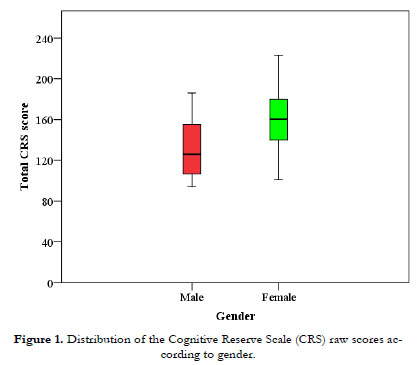
<body><![CDATA[<p><font face="Verdana" size="2"><b>Results</b></font></p>     <p><font face="Verdana" size="2">The mean age of the sample was 72.9 years (SD = 6.04) and the educational attainment ranged from no education to 21 years (<i>Mean</i> = 9.63, <i>SD</i> = 5.021). <a target="_blank" href="/img/revistas/ap/v32n1/psicologia_vejez1_t1.jpg">Table 1</a> shows the sociodemographic characteristics of the participants. All individuals were independent in activities of daily living (Barthel Index). In relation to educational attainment, the distribution of females was similar between low and high (54.5% and 45.5%, respectively), while a higher percentage of males than females had completed more than 8 years of education (75%). Regarding occupational attainment, the distribution of males was similar for high, medium and low (25%, 37.5% and 37.5%, respectively). A larger percentage of females than males had less intellectually demanding professions (63.6%).</font></p>     <p><font face="Verdana" size="2">The analysis revealed no statistically significant differences between genders in age &#091;<i>t</i>(28) = -.62, <i>p</i> = .539&#093;, educational attainment (years) &#091;<i>t</i>(28) = 1.15, <i>p</i> = .259&#093;, educational attainment (low/high) &#091;&chi;<sup>2</sup> = 2.06, <i>p</i> = .226&#093;, occupational attainment &#091;&chi;<sup>2</sup> = 2.4, <i>p</i> = .323&#093;, verbal IQ &#091;<i>t</i>(28) = 1.02, <i>p</i> = .318&#093; or Barthel Index &#091;<i>t</i>(28) = .6, <i>p</i> = .556&#093;. However, males showed higher MEC scores than females &#091;<i>t</i>(28) = 2.44, <i>p</i> = .022, r<sub>bp</sub> = .315&#093;. The effect size was moderate (<a target="_blank" href="/img/revistas/ap/v32n1/psicologia_vejez1_t1.jpg">Table 1</a>).</font></p>     <p><font face="Verdana" size="2"><i>Cognitive Reserve Scale</i></font></p>     <p><font face="Verdana" size="2">No correlation was registered between verbal IQ and CRS total score (<i>r</i> = .14, <i>p</i> = .455) or between verbal IQ and the partial CRS scores: young adulthood (<i>r</i> = .07, <i>p</i> = .72), adulthood (<i>r</i> = .24, <i>p</i> = .207) and late adulthood (<i>r</i> = .08, <i>p</i> = .683).</font></p>     <p><font face="Verdana" size="2">For the repeated-measures variable "time", the assumption of sphericity was not met (<i>p</i> = .048), so Greenhouse-Geisser correction was applied. Analysis revealed no interaction between time and gender &#091;<i>F</i>(1.66, 44.7) = .663, <i>p</i> = .493&#093;; however, significant main effects were observed for time and gender, with large size effects (partial &#951;<sup>2</sup> <i>p</i> &gt; .138). In relation to gender &#091;<i>F</i>(1,27) = 9.72, <i>p</i> = .004, partial &#951;<sup>2</sup> = .265&#093;, females (mean = 159.64, <i>SD</i> = 27.85) showed higher scores than males (mean = 131.88, <i>SD</i> = 31.63) (<a href="#f1">Figure 1</a>). Regarding time &#091;<i>F</i>(1.66, 44.7) = 6.07, <i>p</i> = .007, partial &#951;<sup>2</sup> = .183&#093;, post-hoc analysis and Bonferroni correction revealed significant differences among young adulthood (mean = 41.72, <i>SD</i> = 2.41), adulthood (mean = 48.04, <i>SD</i> = 2.01) and late adulthood (mean = 54.5, <i>SD</i> = 1.83) (<a href="#f2">Figure 2</a>).</font></p>     <p>&nbsp;</p>     <p align="center"><font face="Verdana" size="2"><a name="f1"><img src="/img/revistas/ap/v32n1/psicologia_vejez1_f1.jpg"></a></font></p>     <p>&nbsp;</p>     <p align="center"><font face="Verdana" size="2"><a name="f2"><img src="/img/revistas/ap/v32n1/psicologia_vejez1_f2.jpg"></a></font></p>     ]]></body>
<body><![CDATA[<p>&nbsp;</p>     <p><font face="Verdana" size="2"><i>Cognitive performance and the Cognitive Reserve Scale</i></font></p>     <p><font face="Verdana" size="2">The CRS score predicted memory performance assessed using verbal material. The first TAVEC trial did not achieve statistical significance &#091;<i>F</i>(1,27) = 2.74, <i>p</i> = .11&#093;, whereas statistical significance was observed for trials 2-5 &#091;trial 2, <i>F</i>(1,27) = 21.56, <i>p</i> &lt; .000, partial &#951;<sup>2</sup> = .44; trial 3, <i>F</i>(1,27) = 10.43, <i>p</i> = .003, partial &#951;<sup>2</sup> = .28; trial 4, <i>F</i>(1,27) = 6.04, <i>p</i> = .021, partial &#951;<sup>2</sup> = .18; and trial 5, <i>F</i>(1,27) = 8.21, <i>p</i> = .008, partial &#951;<sup>2</sup> = .233&#093;, short-term recall &#091;<i>F</i>(1,27) = 8.14, <i>p</i> = .008, partial &#951;<sup>2</sup> = .23&#093;, long-term recall &#091;<i>F</i>(1,27) = 13.98, <i>p</i> = .001, partial &#951;<sup>2</sup> = .34&#093; and recognition &#091;<i>F</i>(1,27) = 6.13, <i>p</i> = .02, partial &#951;<sup>2</sup> = .19&#093;. The effect sizes were large (partial &#951;<sup>2</sup> &gt; .138).</font></p>     <p><font face="Verdana" size="2">Analysis of memory measured by non-verbal material showed that the CRS score predicted short-term &#091;<i>F</i>(1,26) = 12.23, <i>p</i> = .002, partial &#951;<sup>2</sup> = .32&#093; and long-term memory &#091;<i>F</i>(1,26) = 11.19, <i>p</i> = .003, partial &#951;<sup>2</sup> = .3&#093;. Large effect sizes were observed (partial &#951;<sup>2</sup> &gt; .138).</font></p>     <p><font face="Verdana" size="2">The CRS did not predict attentional performance &#091;<i>F</i>(5,23) = 1.33, <i>p</i> = .287&#093; or working memory &#091;<i>F</i>(2,26) = .78, <i>p</i> = .47&#093;.</font></p>     <p>&nbsp;</p>     <p><font face="Verdana" size="2"><b>Discussion</b></font></p>     <p><font face="Verdana" size="2">The results showed that females spent more time than males performing cognitively stimulating activities. The CRS score predicted the cognitive performance related to memory tasks.</font></p>     <p><font face="Verdana" size="2">In the past few decades, the political and social context has changed notably in Spain, as well as the roles played by males and females. The age of the participants in the study ranged between 65 and 88 years; therefore, they were born in the 1920s, 1930s and 1940s. During these decades and well into the twenty-first century, males spent most of their time in professional or other occupations, whereas females were mainly dedicated to bringing up children and doing housework. This factor may have an effect on the CRS score and could explain why the women took part in more social, intellectual and leisure activities.</font></p>     <p><font face="Verdana" size="2">In this study, all subjects were healthy and had MEC (Lobo et al., 1979) scores <u>&lt;</u> 27, with males outperforming females. Moreover, Barthel Index scores revealed that all the individuals were independent in their activities of daily living.</font></p>     ]]></body>
<body><![CDATA[<p><font face="Verdana" size="2">The analysis revealed statistically significant differences in relation to years of education, which ranged from none to 21 years. Recently, it has been demonstrated that those individuals with more educational years show increased cerebral connectivity and more regional volume of the cerebral cortex (Arenaza-Urquijo et al., 2013; Liu et al., 2012). Among Alzheimer's disease patients, more education has been associated with a faster decline in certain cognitive domains, such as abstract reasoning, but at the same time it may help to conserve other cognitive performance (Le Carret et al., 2005). A low educational attainment may increase the risk of developing dementia (Caamaño-Isorna, Corral, Montes-Martínez, &amp; Takkouche, 2006; see meta-analysis by Meng &amp; D'Arcy, 2012), whereas a high educational attainment may help to delay the clinical manifestation of brain damage (Carnero-Pardo &amp; del Ser, 2007; Staff, Murray, Deary, &amp; Whalley, 2004). However, not all studies have found education to be a protective factor against the cognitive decline related to ageing (Van Dijk, Van Gerven, Van Boxtel, Van der Elst, &amp; Jolles, 2008).</font></p>     <p><font face="Verdana" size="2">In the present study, taking into consideration the political and social context of the participants, women did less cognitively demanding occupational activities throughout their lifetime (63.6%), including housework, than men. Suo et al. (2012) demonstrated that hippocampal atrophy is smaller in those subjects who had supervisory and directive roles in their occupational activity. Besides, individuals with high occupational attainment have a reduced risk of developing dementia and this factor contributes to the maintenance of cognitive execution during ageing (Staff et al, 2004; Stern, 2012).</font></p>     <p><font face="Verdana" size="2">On the other hand, male and female participants showed similar verbal IQ distributions. No relation was found between verbal IQ and total and partial CRS scores. It should be noted that the IQ was assessed by a cognitive task, whereas the cognitive reserve is a different construct measured using a non-cognitive task (Nucci et al., 2012) in the present study.</font></p>     <p><font face="Verdana" size="2">High and low cognitive reserve estimated using the median of the CRS raw scores predicted memory performance with verbal and non-verbal material, as well as the learning curve, in healthy individuals older than 65 years. However, the data showed that cognitive reserve may not affect significantly attention and working memory. Previously, Roldán-Tapia, García, Canovas, and Leon (2012) found that individuals with high reserve outperformed cognitively those with low reserve, including on attentional and working memory tasks. Nevertheless, the proxy of cognitive reserve used was based on a sum of IQ, educational and occupational attainment, not considering the perspective of the frequency of stimulating activities.</font></p>     <p><font face="Verdana" size="2">In the present study, cognitive reserve was estimated using the CRS, a test that reflects the frequency of participation in different cognitive, social and leisure activities across the lifetime. Women spent more time than men in these brain-stimulating activities. The delay of the onset of symptomatology associated with dementia is related to a better quality of life in elderly people, and it has been demonstrated that performing stimulating cognitive activities across the lifespan contributes to this (Akbaraly et al., 2009). A more active lifestyle is also related to increased cognitive plasticity (Calero, Navarro, &amp; Muñoz, 2007), more functional independency and more autonomy in activities of daily living among elderly people (Navarro, Calero, López, Gómez, Torres, &amp; Calero, 2008).</font></p>     <p><font face="Verdana" size="2">However, does the participation in stimulating activities explain cognitive performance, or could it be that those with better cognition participate more frequently in intellectual, physical and social activities? (Díaz-Orueta, Buiza-Bueno, &amp; Yanguas-Lezaun, 2010; Scarmeas, 2007). This directional duality has been investigated by the longitudinal Victoria study (Small, Dixon, McArdle, &amp; Grimm, 2012). After a follow-up period of 12 years, the conclusion reached was not only that lifestyle provides protection from certain cognitive changes in ageing, but also that impaired cognitive execution reduces engagement with stimulating activities.</font></p>     <p><font face="Verdana" size="2">In general, the maintenance of an active lifestyle leads to successful ageing (Hertzog, Kramer, Wilson, &amp; Linden-berger, 2008), but the normal ageing process is also affected by a wide variety of factors such as genetics, general health, psychological well-being and attitude to old age, as well as environmental stimulation, socioeconomic resources and social politics.</font></p>     <p><font face="Verdana" size="2">The study has some limitations. The selection of the sample was not random; therefore, in future investigations it would be advisable to choose a technique that ensures the representativeness of the sample. Additionally, the sample size was small and fewer men than women agreed to participate.</font></p>     <p><font face="Verdana" size="2">There has been a remarkable level of interest in research on cognitive reserve from diverse scientific disciplines. Political and social concerns are also reflected in the implementation of interventional strategies to contribute to the delay of neuropathological symptoms and achieve a better quality of life.</font></p>     <p>&nbsp;</p>     ]]></body>
<body><![CDATA[<p><font face="Verdana" size="2"><b>Acknowledgements</b></font></p>     <p><font face="Verdana" size="2">The authors thank the participants in the study.</font></p>     <p>&nbsp;</p>     <p><font face="Verdana" size="2"><b>References</b></b></font></p>     <!-- ref --><p><font face="Verdana" size="2">1. Akbaraly, T. N., Portet, F., Fustinoni, S., Dartigues, J. F., Artero, S., Rouaud, O., ... Berr, C. (2009). Leisure activities and the risk of dementia in the elderly: Results from the three-city study. Neurology, 73, 854-861.    &nbsp;&nbsp;&nbsp;&nbsp;&nbsp;&nbsp;&nbsp;&nbsp;[&#160;<a href="javascript:void(0);" onclick="javascript: window.open('/scielo.php?script=sci_nlinks&ref=752497&pid=S0212-9728201600010002500001&lng=','','width=640,height=500,resizable=yes,scrollbars=1,menubar=yes,');">Links</a>&#160;]<!-- end-ref --></font></p>    <!-- ref --><p><font face="Verdana" size="2">2. Arenaza-Urquijo, E. M., Landeau, B., La Joie, R., Mevel, K., Mézenge, F., Perrotin, A., ... Chételat, G. (2013). Relationships between years of education and gray matter volume, metabolism and functional connectivity in healthy elders. Neuroimage, 83, 450-457.    &nbsp;&nbsp;&nbsp;&nbsp;&nbsp;&nbsp;&nbsp;&nbsp;[&#160;<a href="javascript:void(0);" onclick="javascript: window.open('/scielo.php?script=sci_nlinks&ref=752499&pid=S0212-9728201600010002500002&lng=','','width=640,height=500,resizable=yes,scrollbars=1,menubar=yes,');">Links</a>&#160;]<!-- end-ref --></font></p>    <!-- ref --><p><font face="Verdana" size="2">3. Benedet, M., &amp; Alejandre, M. (1998). Test de aprendizaje verbal España-Complutense (TAVEC). Madrid: TEA.    &nbsp;&nbsp;&nbsp;&nbsp;&nbsp;&nbsp;&nbsp;&nbsp;[&#160;<a href="javascript:void(0);" onclick="javascript: window.open('/scielo.php?script=sci_nlinks&ref=752501&pid=S0212-9728201600010002500003&lng=','','width=640,height=500,resizable=yes,scrollbars=1,menubar=yes,');">Links</a>&#160;]<!-- end-ref --></font></p>    ]]></body>
<body><![CDATA[<!-- ref --><p><font face="Verdana" size="2">4. Caamaño-Isorna, F., Corral, M., Montes-Martínez, A., &amp; Takkouche, B. (2006). Education and dementia: A meta-analytic study. Neuroepidemiology, 26, 226-232.    &nbsp;&nbsp;&nbsp;&nbsp;&nbsp;&nbsp;&nbsp;&nbsp;[&#160;<a href="javascript:void(0);" onclick="javascript: window.open('/scielo.php?script=sci_nlinks&ref=752503&pid=S0212-9728201600010002500004&lng=','','width=640,height=500,resizable=yes,scrollbars=1,menubar=yes,');">Links</a>&#160;]<!-- end-ref --></font></p>    <!-- ref --><p><font face="Verdana" size="2">5. Calero, M. D., Navarro, E., &amp; Muñoz, L. (2007). Influence of activity on cognitive performance and cognitive plasticity in elderly persons. Archives of Gerontology and Geriatrics, 45, 307-318.    &nbsp;&nbsp;&nbsp;&nbsp;&nbsp;&nbsp;&nbsp;&nbsp;[&#160;<a href="javascript:void(0);" onclick="javascript: window.open('/scielo.php?script=sci_nlinks&ref=752505&pid=S0212-9728201600010002500005&lng=','','width=640,height=500,resizable=yes,scrollbars=1,menubar=yes,');">Links</a>&#160;]<!-- end-ref --></font></p>    <!-- ref --><p><font face="Verdana" size="2">6. Carnero-Pardo, C., &amp; del Ser, T. (2007). La educación proporciona reserva cognitiva en el deterioro cognitivo y la demencia. Neurología, 22, 78-85.    &nbsp;&nbsp;&nbsp;&nbsp;&nbsp;&nbsp;&nbsp;&nbsp;[&#160;<a href="javascript:void(0);" onclick="javascript: window.open('/scielo.php?script=sci_nlinks&ref=752507&pid=S0212-9728201600010002500006&lng=','','width=640,height=500,resizable=yes,scrollbars=1,menubar=yes,');">Links</a>&#160;]<!-- end-ref --></font></p>    <!-- ref --><p><font face="Verdana" size="2">7. Cohen, J. (1988). Statistical power analysis for the behavioural sciences (2nd ed.). Hillsdale, NJ: Erlbaum.    &nbsp;&nbsp;&nbsp;&nbsp;&nbsp;&nbsp;&nbsp;&nbsp;[&#160;<a href="javascript:void(0);" onclick="javascript: window.open('/scielo.php?script=sci_nlinks&ref=752509&pid=S0212-9728201600010002500007&lng=','','width=640,height=500,resizable=yes,scrollbars=1,menubar=yes,');">Links</a>&#160;]<!-- end-ref --></font></p>    <!-- ref --><p><font face="Verdana" size="2">8. Díaz-Orueta, U., Buiza-Bueno, C., &amp; Yanguas-Lezaun, J. (2010). Reserva cognitiva: Evidencias, limitaciones y líneas de investigación futura. Revista Española de Geriatría y Gerontología, 45, 150-155.    &nbsp;&nbsp;&nbsp;&nbsp;&nbsp;&nbsp;&nbsp;&nbsp;[&#160;<a href="javascript:void(0);" onclick="javascript: window.open('/scielo.php?script=sci_nlinks&ref=752511&pid=S0212-9728201600010002500008&lng=','','width=640,height=500,resizable=yes,scrollbars=1,menubar=yes,');">Links</a>&#160;]<!-- end-ref --></font></p>    ]]></body>
<body><![CDATA[<!-- ref --><p><font face="Verdana" size="2">9. Ewers, M., Insel, P. S., Stern, Y., &amp; Weiner, M. W. (2013). Cognitive reserve associated with FDG-PET in preclinical Alzheimer disease. Neurology, 80, 1194-1201.    &nbsp;&nbsp;&nbsp;&nbsp;&nbsp;&nbsp;&nbsp;&nbsp;[&#160;<a href="javascript:void(0);" onclick="javascript: window.open('/scielo.php?script=sci_nlinks&ref=752513&pid=S0212-9728201600010002500009&lng=','','width=640,height=500,resizable=yes,scrollbars=1,menubar=yes,');">Links</a>&#160;]<!-- end-ref --></font></p>    <!-- ref --><p><font face="Verdana" size="2">10. Folstein, M., Folstein, S. E., &amp; McHugh, P. R. (1975). Mini-Mental State: A practical method for grading the cognitive state of patients for the clinician. Journal of Psychiatric Research, 12, 189-198.    &nbsp;&nbsp;&nbsp;&nbsp;&nbsp;&nbsp;&nbsp;&nbsp;[&#160;<a href="javascript:void(0);" onclick="javascript: window.open('/scielo.php?script=sci_nlinks&ref=752515&pid=S0212-9728201600010002500010&lng=','','width=640,height=500,resizable=yes,scrollbars=1,menubar=yes,');">Links</a>&#160;]<!-- end-ref --></font></p>    <!-- ref --><p><font face="Verdana" size="2">11. Fratiglioni, L., Paillard-Borg, S., &amp; Winblad, B. (2004). An active and socially integrated lifestyle in late life might protect against dementia. Neurology, 3, 343-353.    &nbsp;&nbsp;&nbsp;&nbsp;&nbsp;&nbsp;&nbsp;&nbsp;[&#160;<a href="javascript:void(0);" onclick="javascript: window.open('/scielo.php?script=sci_nlinks&ref=752517&pid=S0212-9728201600010002500011&lng=','','width=640,height=500,resizable=yes,scrollbars=1,menubar=yes,');">Links</a>&#160;]<!-- end-ref --></font></p>    <!-- ref --><p><font face="Verdana" size="2">12. Golden, C. J. (2010). Stroop: Test de colores y palabras. Madrid: TEA.    &nbsp;&nbsp;&nbsp;&nbsp;&nbsp;&nbsp;&nbsp;&nbsp;[&#160;<a href="javascript:void(0);" onclick="javascript: window.open('/scielo.php?script=sci_nlinks&ref=752519&pid=S0212-9728201600010002500012&lng=','','width=640,height=500,resizable=yes,scrollbars=1,menubar=yes,');">Links</a>&#160;]<!-- end-ref --></font></p>    <!-- ref --><p><font face="Verdana" size="2">13. Hertzog, C., Kramer, A. F., Wilson, R. S., &amp; Lindenberger, U. (2008). Enrichment effects on the adult cognitive development: Can the functional capacity of older adults be preserved and enhanced? Psychological Science in the Public Interest, Supplement, 9, 1-65.    &nbsp;&nbsp;&nbsp;&nbsp;&nbsp;&nbsp;&nbsp;&nbsp;[&#160;<a href="javascript:void(0);" onclick="javascript: window.open('/scielo.php?script=sci_nlinks&ref=752521&pid=S0212-9728201600010002500013&lng=','','width=640,height=500,resizable=yes,scrollbars=1,menubar=yes,');">Links</a>&#160;]<!-- end-ref --></font></p>    ]]></body>
<body><![CDATA[<!-- ref --><p><font face="Verdana" size="2">14. Instituto Nacional de Estadística (2011). Clasificación Nacional de Ocupaciones (CNO). Retrieved from http://www.ine.es/jaxi/menu.do?type=pcaxis&amp;path=/t40/cno11&amp;file=inebase.    &nbsp;&nbsp;&nbsp;&nbsp;&nbsp;&nbsp;&nbsp;&nbsp;[&#160;<a href="javascript:void(0);" onclick="javascript: window.open('/scielo.php?script=sci_nlinks&ref=752523&pid=S0212-9728201600010002500014&lng=','','width=640,height=500,resizable=yes,scrollbars=1,menubar=yes,');">Links</a>&#160;]<!-- end-ref --></font></p>    <!-- ref --><p><font face="Verdana" size="2">15. Instituto Nacional de Estadística (2013). España en cifras. Retrieved from http://www.ine.es/ss/Satellite?L=es_ES&amp;c=INEPublicacion_C&amp;cid=1259924856416&amp;p=1254735110672&amp;pagename=ProductosYServicios%2FPYSLayout&amp;param1=PYSDetalleGratuitas.    &nbsp;&nbsp;&nbsp;&nbsp;&nbsp;&nbsp;&nbsp;&nbsp;[&#160;<a href="javascript:void(0);" onclick="javascript: window.open('/scielo.php?script=sci_nlinks&ref=752525&pid=S0212-9728201600010002500015&lng=','','width=640,height=500,resizable=yes,scrollbars=1,menubar=yes,');">Links</a>&#160;]<!-- end-ref --></font></p>    <!-- ref --><p><font face="Verdana" size="2">16. Le Carret, N., Auriacombe, S., Letenneur, L., Bergua, V., Dartigues, J. F., &amp; Fabrigoule, C. (2005). Influence of education on the pattern of cognitive deterioration in AD patients: The cognitive reserve hypothesis. Brain and Cognition, 57, 120-126.    &nbsp;&nbsp;&nbsp;&nbsp;&nbsp;&nbsp;&nbsp;&nbsp;[&#160;<a href="javascript:void(0);" onclick="javascript: window.open('/scielo.php?script=sci_nlinks&ref=752527&pid=S0212-9728201600010002500016&lng=','','width=640,height=500,resizable=yes,scrollbars=1,menubar=yes,');">Links</a>&#160;]<!-- end-ref --></font></p>    <!-- ref --><p><font face="Verdana" size="2">17. León, I., García, J., &amp; Roldán-Tapia, L. (2011). Construcción de la Escala de Reserva Cognitiva en población española: Estudio piloto (Development of the Scale of Cognitive Reserve in Spanish population: A pilot study). Revista de Neurología, 52, 653-660.    &nbsp;&nbsp;&nbsp;&nbsp;&nbsp;&nbsp;&nbsp;&nbsp;[&#160;<a href="javascript:void(0);" onclick="javascript: window.open('/scielo.php?script=sci_nlinks&ref=752529&pid=S0212-9728201600010002500017&lng=','','width=640,height=500,resizable=yes,scrollbars=1,menubar=yes,');">Links</a>&#160;]<!-- end-ref --></font></p>    <!-- ref --><p><font face="Verdana" size="2">18. León, I., García-García, J., &amp; Roldán-Tapia, L. (2014). Estimating cognitive reserve in healthy adults using the Cognitive Reserve Scale. PEoS One, 9: e102632. doi:10.1371/journal.pone.0102632.    &nbsp;&nbsp;&nbsp;&nbsp;&nbsp;&nbsp;&nbsp;&nbsp;[&#160;<a href="javascript:void(0);" onclick="javascript: window.open('/scielo.php?script=sci_nlinks&ref=752531&pid=S0212-9728201600010002500018&lng=','','width=640,height=500,resizable=yes,scrollbars=1,menubar=yes,');">Links</a>&#160;]<!-- end-ref --></font></p>    ]]></body>
<body><![CDATA[<!-- ref --><p><font face="Verdana" size="2">19. Liu, Y., Julkunen, V., Paajanen, T., Westman, E., Wahlund, L. O., Aitken, A., ... Soininen, H. (2012). Education increases reserve against Alzheimer's disease: Evidence from structural MRI analysis. Neuroradiology, 54, 929-938.    &nbsp;&nbsp;&nbsp;&nbsp;&nbsp;&nbsp;&nbsp;&nbsp;[&#160;<a href="javascript:void(0);" onclick="javascript: window.open('/scielo.php?script=sci_nlinks&ref=752533&pid=S0212-9728201600010002500019&lng=','','width=640,height=500,resizable=yes,scrollbars=1,menubar=yes,');">Links</a>&#160;]<!-- end-ref --></font></p>    <!-- ref --><p><font face="Verdana" size="2">20. Lobo, A., Esquerra, J., Gómez-Burgada, F., Sala, J. M., &amp; Seva, A. (1979). El Mini-Examen Cognoscitivo: Un test sencillo y práctico para detectar alteraciones intelectuales en pacientes médicos. Actas Luso-españolas de Neurología, Psiquiatría y Ciencias afines, 3, 189-202.    &nbsp;&nbsp;&nbsp;&nbsp;&nbsp;&nbsp;&nbsp;&nbsp;[&#160;<a href="javascript:void(0);" onclick="javascript: window.open('/scielo.php?script=sci_nlinks&ref=752535&pid=S0212-9728201600010002500020&lng=','','width=640,height=500,resizable=yes,scrollbars=1,menubar=yes,');">Links</a>&#160;]<!-- end-ref --></font></p>    <!-- ref --><p><font face="Verdana" size="2">21. Meng, X., &amp; D'Arcy, C. (2012). Education and dementia in the context of the cognitive reserve hypothesis: A systematic review with metaanalyses and qualitative analyses. PEoS One, 7: e38268. doi: 10.1371/journal.pone.0038268.    &nbsp;&nbsp;&nbsp;&nbsp;&nbsp;&nbsp;&nbsp;&nbsp;[&#160;<a href="javascript:void(0);" onclick="javascript: window.open('/scielo.php?script=sci_nlinks&ref=752537&pid=S0212-9728201600010002500021&lng=','','width=640,height=500,resizable=yes,scrollbars=1,menubar=yes,');">Links</a>&#160;]<!-- end-ref --></font></p>    <!-- ref --><p><font face="Verdana" size="2">22. Navarro, E., Calero, M. D., Lopez, A., Gómez, A. L., Torres, I., &amp; Calero, M. J. (2008). Nivel de independence en la vida diaria y plasticidad cognitiva en la vejez. Escritos de Psicología, 2, 74-84.    &nbsp;&nbsp;&nbsp;&nbsp;&nbsp;&nbsp;&nbsp;&nbsp;[&#160;<a href="javascript:void(0);" onclick="javascript: window.open('/scielo.php?script=sci_nlinks&ref=752539&pid=S0212-9728201600010002500022&lng=','','width=640,height=500,resizable=yes,scrollbars=1,menubar=yes,');">Links</a>&#160;]<!-- end-ref --></font></p>    <!-- ref --><p><font face="Verdana" size="2">23. Nucci, M., Mapelli, D., &amp; Mondini, S. (2012). Cognitive Reserve Index questionnaire (CRIq): A new instrument for measuring cognitive reserve. Aging Clinical and Experimental Research, 24, 218-226.    &nbsp;&nbsp;&nbsp;&nbsp;&nbsp;&nbsp;&nbsp;&nbsp;[&#160;<a href="javascript:void(0);" onclick="javascript: window.open('/scielo.php?script=sci_nlinks&ref=752541&pid=S0212-9728201600010002500023&lng=','','width=640,height=500,resizable=yes,scrollbars=1,menubar=yes,');">Links</a>&#160;]<!-- end-ref --></font></p>    ]]></body>
<body><![CDATA[<!-- ref --><p><font face="Verdana" size="2">24. Paillard-Borg, S., Fratiglioni, L., Xu, W., Winbland, B., &amp; Wang, H. X. (2012). An active lifestyle postpones dementia onset by more than one year in very old adults. Journal of Alzheimer's Disease, 31, 835-842.    &nbsp;&nbsp;&nbsp;&nbsp;&nbsp;&nbsp;&nbsp;&nbsp;[&#160;<a href="javascript:void(0);" onclick="javascript: window.open('/scielo.php?script=sci_nlinks&ref=752543&pid=S0212-9728201600010002500024&lng=','','width=640,height=500,resizable=yes,scrollbars=1,menubar=yes,');">Links</a>&#160;]<!-- end-ref --></font></p>    <!-- ref --><p><font face="Verdana" size="2">25. Premi, E., Garibotto, Y., Gazzina, S., Grassi, M., Cosseddu, M., Paghera, B., ... Borroni, B. (2013). Beyond cognitive reserve: Behavioural reserve hypothesis in frontotemporal dementia. Behavioural Brain Research, 15, 245-262.    &nbsp;&nbsp;&nbsp;&nbsp;&nbsp;&nbsp;&nbsp;&nbsp;[&#160;<a href="javascript:void(0);" onclick="javascript: window.open('/scielo.php?script=sci_nlinks&ref=752545&pid=S0212-9728201600010002500025&lng=','','width=640,height=500,resizable=yes,scrollbars=1,menubar=yes,');">Links</a>&#160;]<!-- end-ref --></font></p>    <!-- ref --><p><font face="Verdana" size="2">26. Ramí, L., Valls-Pedret, C., Bartrés-Faz, D., Caprile, C., Solé-Padullés, C., Castellví, ... Molinuevo, J. L. (2011). Cuestionario de reserva cognitiva. Valores obtenidos en población anciana sana y con enfermedad de Alzheimer (Cognitive reserve questionnaire. Scores obtained in a healthy elderly population and in one with Alzheimers disease). Revista de Neurología, 52, 195-201.    &nbsp;&nbsp;&nbsp;&nbsp;&nbsp;&nbsp;&nbsp;&nbsp;[&#160;<a href="javascript:void(0);" onclick="javascript: window.open('/scielo.php?script=sci_nlinks&ref=752547&pid=S0212-9728201600010002500026&lng=','','width=640,height=500,resizable=yes,scrollbars=1,menubar=yes,');">Links</a>&#160;]<!-- end-ref --></font></p>    <!-- ref --><p><font face="Verdana" size="2">27. Rey, A. (2009). Test de copia de una figura compleja. Madrid: TEA.    &nbsp;&nbsp;&nbsp;&nbsp;&nbsp;&nbsp;&nbsp;&nbsp;[&#160;<a href="javascript:void(0);" onclick="javascript: window.open('/scielo.php?script=sci_nlinks&ref=752549&pid=S0212-9728201600010002500027&lng=','','width=640,height=500,resizable=yes,scrollbars=1,menubar=yes,');">Links</a>&#160;]<!-- end-ref --></font></p>    <!-- ref --><p><font face="Verdana" size="2">28. Rodríguez-Álvarez, M., &amp; Sánchez-Rodríguez, J. L. (2004). Reserva cognitiva y demencia. Anales de Psicología, 20, 175-186.    &nbsp;&nbsp;&nbsp;&nbsp;&nbsp;&nbsp;&nbsp;&nbsp;[&#160;<a href="javascript:void(0);" onclick="javascript: window.open('/scielo.php?script=sci_nlinks&ref=752551&pid=S0212-9728201600010002500028&lng=','','width=640,height=500,resizable=yes,scrollbars=1,menubar=yes,');">Links</a>&#160;]<!-- end-ref --></font></p>    ]]></body>
<body><![CDATA[<!-- ref --><p><font face="Verdana" size="2">29. Roldán-Tapia, L., García, J., Canovas, R., &amp; León, I. (2012). Cognitive reserve, age, and their relation to attentional and executive functions. Applied Neuropsychology: Adult, 19, 2-8.    &nbsp;&nbsp;&nbsp;&nbsp;&nbsp;&nbsp;&nbsp;&nbsp;[&#160;<a href="javascript:void(0);" onclick="javascript: window.open('/scielo.php?script=sci_nlinks&ref=752553&pid=S0212-9728201600010002500029&lng=','','width=640,height=500,resizable=yes,scrollbars=1,menubar=yes,');">Links</a>&#160;]<!-- end-ref --></font></p>    <!-- ref --><p><font face="Verdana" size="2">30. Sánchez, J. L., Torrellas, C., Martín, J., &amp; Barrera, I. (2011). Study of sociodemographic variables linked to lifestyle and their possible influence on cognitive reserve. Journal of Clinical and Experimental Neuropsychology, 33, 874-891.    &nbsp;&nbsp;&nbsp;&nbsp;&nbsp;&nbsp;&nbsp;&nbsp;[&#160;<a href="javascript:void(0);" onclick="javascript: window.open('/scielo.php?script=sci_nlinks&ref=752555&pid=S0212-9728201600010002500030&lng=','','width=640,height=500,resizable=yes,scrollbars=1,menubar=yes,');">Links</a>&#160;]<!-- end-ref --></font></p>    <!-- ref --><p><font face="Verdana" size="2">31. Scarmeas, N. (2007). Lifestyle patterns and cognitive reserve. In Y. Stern (Ed.), Cognitive reserve (pp. 187-206). New York: Taylor &amp; Francis.    &nbsp;&nbsp;&nbsp;&nbsp;&nbsp;&nbsp;&nbsp;&nbsp;[&#160;<a href="javascript:void(0);" onclick="javascript: window.open('/scielo.php?script=sci_nlinks&ref=752557&pid=S0212-9728201600010002500031&lng=','','width=640,height=500,resizable=yes,scrollbars=1,menubar=yes,');">Links</a>&#160;]<!-- end-ref --></font></p>    <!-- ref --><p><font face="Verdana" size="2">32. Scarmeas, N., Levy, G., Tang, M. X., Manly, J., &amp; Stern Y. (2001). Influence of leisure activity on the incidence of Alzheimer's disease. Neurology, 57, 2236-2242.    &nbsp;&nbsp;&nbsp;&nbsp;&nbsp;&nbsp;&nbsp;&nbsp;[&#160;<a href="javascript:void(0);" onclick="javascript: window.open('/scielo.php?script=sci_nlinks&ref=752559&pid=S0212-9728201600010002500032&lng=','','width=640,height=500,resizable=yes,scrollbars=1,menubar=yes,');">Links</a>&#160;]<!-- end-ref --></font></p>    <!-- ref --><p><font face="Verdana" size="2">33. Small, B. J., Dixon, R. A., McArdle, J. J., &amp; Grimm, K. J. (2012). Do changes in lifestyle engagement moderate cognitive decline in normal aging? Evidence from the Victoria longitudinal study. Neuropsychology, 26, 144-155.    &nbsp;&nbsp;&nbsp;&nbsp;&nbsp;&nbsp;&nbsp;&nbsp;[&#160;<a href="javascript:void(0);" onclick="javascript: window.open('/scielo.php?script=sci_nlinks&ref=752561&pid=S0212-9728201600010002500033&lng=','','width=640,height=500,resizable=yes,scrollbars=1,menubar=yes,');">Links</a>&#160;]<!-- end-ref --></font></p>    ]]></body>
<body><![CDATA[<!-- ref --><p><font face="Verdana" size="2">34. Sobral, M., &amp; Paúl, C. (2013). Education, leisure activities and cognitive and functional ability of Alzheimer's disease patients: A follow-up study. Dementia &amp; Neuropsychologia, 7, 181-189.    &nbsp;&nbsp;&nbsp;&nbsp;&nbsp;&nbsp;&nbsp;&nbsp;[&#160;<a href="javascript:void(0);" onclick="javascript: window.open('/scielo.php?script=sci_nlinks&ref=752563&pid=S0212-9728201600010002500034&lng=','','width=640,height=500,resizable=yes,scrollbars=1,menubar=yes,');">Links</a>&#160;]<!-- end-ref --></font></p>    <!-- ref --><p><font face="Verdana" size="2">35. Staff, R. T., Murray, A. D., Deary, I. J., &amp; Whalley, L. J. (2004). What provides cerebral reserve? Brain, 127, 1191-1199.    &nbsp;&nbsp;&nbsp;&nbsp;&nbsp;&nbsp;&nbsp;&nbsp;[&#160;<a href="javascript:void(0);" onclick="javascript: window.open('/scielo.php?script=sci_nlinks&ref=752565&pid=S0212-9728201600010002500035&lng=','','width=640,height=500,resizable=yes,scrollbars=1,menubar=yes,');">Links</a>&#160;]<!-- end-ref --></font></p>    <!-- ref --><p><font face="Verdana" size="2">36. Stern, Y. (2009). Cognitive reserve. Neuropsychologia, 47, 2015-2028.    &nbsp;&nbsp;&nbsp;&nbsp;&nbsp;&nbsp;&nbsp;&nbsp;[&#160;<a href="javascript:void(0);" onclick="javascript: window.open('/scielo.php?script=sci_nlinks&ref=752567&pid=S0212-9728201600010002500036&lng=','','width=640,height=500,resizable=yes,scrollbars=1,menubar=yes,');">Links</a>&#160;]<!-- end-ref --></font></p>    <!-- ref --><p><font face="Verdana" size="2">37. Stern, Y. (2012). Cognitive reserve in ageing and Alzheimer's disease. Lancet Neurology, 11, 1006-1012.    &nbsp;&nbsp;&nbsp;&nbsp;&nbsp;&nbsp;&nbsp;&nbsp;[&#160;<a href="javascript:void(0);" onclick="javascript: window.open('/scielo.php?script=sci_nlinks&ref=752569&pid=S0212-9728201600010002500037&lng=','','width=640,height=500,resizable=yes,scrollbars=1,menubar=yes,');">Links</a>&#160;]<!-- end-ref --></font></p>    <!-- ref --><p><font face="Verdana" size="2">38. Suo, C., León, I., Brodaty, H., Trollor, J., Wen, W., Sachdev, P., &amp; Valenzuela, M. J. (2012). Supervisory experience at work is linked to low rate of hippocampal atrophy in late life. Neuroimage, 63, 1542-1551.    &nbsp;&nbsp;&nbsp;&nbsp;&nbsp;&nbsp;&nbsp;&nbsp;[&#160;<a href="javascript:void(0);" onclick="javascript: window.open('/scielo.php?script=sci_nlinks&ref=752571&pid=S0212-9728201600010002500038&lng=','','width=640,height=500,resizable=yes,scrollbars=1,menubar=yes,');">Links</a>&#160;]<!-- end-ref --></font></p>    ]]></body>
<body><![CDATA[<!-- ref --><p><font face="Verdana" size="2">39. Tamayo, F., Casals-Coll, M., Sánchez-Benavides, G., Quintana, M., Manero, R. M., Rognoni, T., ... Peña-Casanova, J. (2012). Estudios normativos españoles en población adulta joven (Proyecto NEURONORMA Jóvenes): Normas para las pruebas span verbal, span visuoespacial, Letter-Number Sequencing, Trail Making Test y Symbol Digit Modalities Test. Neurología, 27, 319-329.    &nbsp;&nbsp;&nbsp;&nbsp;&nbsp;&nbsp;&nbsp;&nbsp;[&#160;<a href="javascript:void(0);" onclick="javascript: window.open('/scielo.php?script=sci_nlinks&ref=752573&pid=S0212-9728201600010002500039&lng=','','width=640,height=500,resizable=yes,scrollbars=1,menubar=yes,');">Links</a>&#160;]<!-- end-ref --></font></p>    <!-- ref --><p><font face="Verdana" size="2">40. Tucker, A. M., &amp; Stern, Y. (2011). Cognitive reserve in aging. Current Alzheimer Research, 8, 354-360.    &nbsp;&nbsp;&nbsp;&nbsp;&nbsp;&nbsp;&nbsp;&nbsp;[&#160;<a href="javascript:void(0);" onclick="javascript: window.open('/scielo.php?script=sci_nlinks&ref=752575&pid=S0212-9728201600010002500040&lng=','','width=640,height=500,resizable=yes,scrollbars=1,menubar=yes,');">Links</a>&#160;]<!-- end-ref --></font></p>    <!-- ref --><p><font face="Verdana" size="2">41. Valenzuela, M. J., &amp; Sachdev, P. (2007). Assessment of complex mental activity across the lifespan: Development of the Lifetime of Experiences Questionnaire (LEQ). Psychological Medicine, 37, 1015-1025.    &nbsp;&nbsp;&nbsp;&nbsp;&nbsp;&nbsp;&nbsp;&nbsp;[&#160;<a href="javascript:void(0);" onclick="javascript: window.open('/scielo.php?script=sci_nlinks&ref=752577&pid=S0212-9728201600010002500041&lng=','','width=640,height=500,resizable=yes,scrollbars=1,menubar=yes,');">Links</a>&#160;]<!-- end-ref --></font></p>    <!-- ref --><p><font face="Verdana" size="2">42. Valenzuela, M. J., Sachdev, P., Wen, W., Chen, X., &amp; Brodaty, H. (2008). Lifespan mental activity predicts diminished rate of hippocampal atrophy. PEoS One, 3, e2598. doi:10.1371/journal.pone.0002598.    &nbsp;&nbsp;&nbsp;&nbsp;&nbsp;&nbsp;&nbsp;&nbsp;[&#160;<a href="javascript:void(0);" onclick="javascript: window.open('/scielo.php?script=sci_nlinks&ref=752579&pid=S0212-9728201600010002500042&lng=','','width=640,height=500,resizable=yes,scrollbars=1,menubar=yes,');">Links</a>&#160;]<!-- end-ref --></font></p>    <!-- ref --><p><font face="Verdana" size="2">43. Van Dijk, K. R., Van Gerven, P. W., Van Boxtel, M. P., Van der Elst, W., &amp; Jolles, J. (2008). No protective effects of education during normal cognitive aging: Results from the 6-year follow-up of the Maastricht Aging Study. Psychology and Aging, 23, 119-130.    &nbsp;&nbsp;&nbsp;&nbsp;&nbsp;&nbsp;&nbsp;&nbsp;[&#160;<a href="javascript:void(0);" onclick="javascript: window.open('/scielo.php?script=sci_nlinks&ref=752581&pid=S0212-9728201600010002500043&lng=','','width=640,height=500,resizable=yes,scrollbars=1,menubar=yes,');">Links</a>&#160;]<!-- end-ref --></font></p>    ]]></body>
<body><![CDATA[<!-- ref --><p><font face="Verdana" size="2">44. Vemuri, P., Lesnick, T. G., Przybelski, S. A., Knopman, D. S., Roberts, R. O., Lowe, V. J., ... Jack, C. R., Jr. (2012). Effect of lifestyle activities on Alzheimer disease biomarkers and cognition. Annals of Neurology, 72, 730-738.    &nbsp;&nbsp;&nbsp;&nbsp;&nbsp;&nbsp;&nbsp;&nbsp;[&#160;<a href="javascript:void(0);" onclick="javascript: window.open('/scielo.php?script=sci_nlinks&ref=752583&pid=S0212-9728201600010002500044&lng=','','width=640,height=500,resizable=yes,scrollbars=1,menubar=yes,');">Links</a>&#160;]<!-- end-ref --></font></p>    <!-- ref --><p><font face="Verdana" size="2">45. Wechsler, D. (2004). Escala de Memoria de Wechsler-IH (WMS-III). Madrid: TEA.    &nbsp;&nbsp;&nbsp;&nbsp;&nbsp;&nbsp;&nbsp;&nbsp;[&#160;<a href="javascript:void(0);" onclick="javascript: window.open('/scielo.php?script=sci_nlinks&ref=752585&pid=S0212-9728201600010002500045&lng=','','width=640,height=500,resizable=yes,scrollbars=1,menubar=yes,');">Links</a>&#160;]<!-- end-ref --></font></p>    <!-- ref --><p><font face="Verdana" size="2">46. Wilson, R., Barnes, L., &amp; Bennett, D. (2003). Assessment of lifetime participation in cognitively stimulating activities. Journal of Clinical and Experimental Neuropsychology, 25, 634-642.    &nbsp;&nbsp;&nbsp;&nbsp;&nbsp;&nbsp;&nbsp;&nbsp;[&#160;<a href="javascript:void(0);" onclick="javascript: window.open('/scielo.php?script=sci_nlinks&ref=752587&pid=S0212-9728201600010002500046&lng=','','width=640,height=500,resizable=yes,scrollbars=1,menubar=yes,');">Links</a>&#160;]<!-- end-ref --></font></p>    <!-- ref --><p><font face="Verdana" size="2">47. Wilson, R. S., Boyle, P. A., Yu, L., Barnes, L. L., Schneider, J. A., &amp; Bennett, D. A. (2013). Life-span cognitive activity, neuropathologic burden, and cognitive aging. Neurology, 81, 314-321.    &nbsp;&nbsp;&nbsp;&nbsp;&nbsp;&nbsp;&nbsp;&nbsp;[&#160;<a href="javascript:void(0);" onclick="javascript: window.open('/scielo.php?script=sci_nlinks&ref=752589&pid=S0212-9728201600010002500047&lng=','','width=640,height=500,resizable=yes,scrollbars=1,menubar=yes,');">Links</a>&#160;]<!-- end-ref --></font></p>    <!-- ref --><p><font face="Verdana" size="2">48. World Health Organization (2013). Preguntas más frecuentes. Retrieved from <a target="_blank" href="http://www.who.int/suggestions/faq/es/">http://www.who.int/suggestions/faq/es/</a>.    &nbsp;&nbsp;&nbsp;&nbsp;&nbsp;&nbsp;&nbsp;&nbsp;[&#160;<a href="javascript:void(0);" onclick="javascript: window.open('/scielo.php?script=sci_nlinks&ref=752591&pid=S0212-9728201600010002500048&lng=','','width=640,height=500,resizable=yes,scrollbars=1,menubar=yes,');">Links</a>&#160;]<!-- end-ref --></font></p>     ]]></body>
<body><![CDATA[<p>&nbsp;</p>     <p>&nbsp;</p>     <p><font face="Verdana" size="2"><a href="#top"><img border="0" src="/img/revistas/ap/v32n1/seta.gif" width="15" height="17"></a><a name="bajo"></a><b>Correspondence:</b>    <br>Lola Roldán-Tapia.    <br>Department of Psychology,    <br>Neuroscience Centre,    <br>University of Almeria, s/n,    <br>04120, Almeria (Spain).    <br>E-mail: <a href="mailto:mdroldan@ual.es">mdroldan@ual.es</a></font></p>     <p><font face="Verdana" size="2">Article received: 13-9-2013    ]]></body>
<body><![CDATA[<br>Revised: 30-7-2014    <br>Accepted: 22-9-2014</font></p>      ]]></body><back>
<ref-list>
<ref id="B1">
<label>1</label><nlm-citation citation-type="journal">
<person-group person-group-type="author">
<name>
<surname><![CDATA[Akbaraly]]></surname>
<given-names><![CDATA[T. N.]]></given-names>
</name>
<name>
<surname><![CDATA[Portet]]></surname>
<given-names><![CDATA[F.]]></given-names>
</name>
<name>
<surname><![CDATA[Fustinoni]]></surname>
<given-names><![CDATA[S.]]></given-names>
</name>
<name>
<surname><![CDATA[Dartigues]]></surname>
<given-names><![CDATA[J. F.]]></given-names>
</name>
<name>
<surname><![CDATA[Artero]]></surname>
<given-names><![CDATA[S.]]></given-names>
</name>
<name>
<surname><![CDATA[Rouaud]]></surname>
<given-names><![CDATA[O.]]></given-names>
</name>
<name>
<surname><![CDATA[Berr]]></surname>
<given-names><![CDATA[C.]]></given-names>
</name>
</person-group>
<article-title xml:lang="en"><![CDATA[Leisure activities and the risk of dementia in the elderly: Results from the three-city study]]></article-title>
<source><![CDATA[Neurology]]></source>
<year>2009</year>
<volume>73</volume>
<page-range>854-861</page-range></nlm-citation>
</ref>
<ref id="B2">
<label>2</label><nlm-citation citation-type="journal">
<person-group person-group-type="author">
<name>
<surname><![CDATA[Arenaza-Urquijo]]></surname>
<given-names><![CDATA[E. M.]]></given-names>
</name>
<name>
<surname><![CDATA[Landeau]]></surname>
<given-names><![CDATA[B.]]></given-names>
</name>
<name>
<surname><![CDATA[La Joie]]></surname>
<given-names><![CDATA[R.]]></given-names>
</name>
<name>
<surname><![CDATA[Mevel]]></surname>
<given-names><![CDATA[K.]]></given-names>
</name>
<name>
<surname><![CDATA[Mézenge]]></surname>
<given-names><![CDATA[F.]]></given-names>
</name>
<name>
<surname><![CDATA[Perrotin]]></surname>
<given-names><![CDATA[A.]]></given-names>
</name>
<name>
<surname><![CDATA[Chételat]]></surname>
<given-names><![CDATA[G.]]></given-names>
</name>
</person-group>
<article-title xml:lang="en"><![CDATA[Relationships between years of education and gray matter volume, metabolism and functional connectivity in healthy elders]]></article-title>
<source><![CDATA[Neuroimage]]></source>
<year>2013</year>
<volume>83</volume>
<page-range>450-457</page-range></nlm-citation>
</ref>
<ref id="B3">
<label>3</label><nlm-citation citation-type="book">
<person-group person-group-type="author">
<name>
<surname><![CDATA[Benedet]]></surname>
<given-names><![CDATA[M.]]></given-names>
</name>
<name>
<surname><![CDATA[Alejandre]]></surname>
<given-names><![CDATA[M.]]></given-names>
</name>
</person-group>
<source><![CDATA[Test de aprendizaje verbal España-Complutense (TAVEC)]]></source>
<year>1998</year>
<publisher-loc><![CDATA[Madrid ]]></publisher-loc>
<publisher-name><![CDATA[TEA]]></publisher-name>
</nlm-citation>
</ref>
<ref id="B4">
<label>4</label><nlm-citation citation-type="journal">
<person-group person-group-type="author">
<name>
<surname><![CDATA[Caamaño-Isorna]]></surname>
<given-names><![CDATA[F.]]></given-names>
</name>
<name>
<surname><![CDATA[Corral]]></surname>
<given-names><![CDATA[M.]]></given-names>
</name>
<name>
<surname><![CDATA[Montes-Martínez]]></surname>
<given-names><![CDATA[A.]]></given-names>
</name>
<name>
<surname><![CDATA[Takkouche]]></surname>
<given-names><![CDATA[B.]]></given-names>
</name>
</person-group>
<article-title xml:lang="en"><![CDATA[Education and dementia: A meta-analytic study]]></article-title>
<source><![CDATA[Neuroepidemiology]]></source>
<year>2006</year>
<volume>26</volume>
<page-range>226-232</page-range></nlm-citation>
</ref>
<ref id="B5">
<label>5</label><nlm-citation citation-type="journal">
<person-group person-group-type="author">
<name>
<surname><![CDATA[Calero]]></surname>
<given-names><![CDATA[M. D.]]></given-names>
</name>
<name>
<surname><![CDATA[Navarro]]></surname>
<given-names><![CDATA[E.]]></given-names>
</name>
<name>
<surname><![CDATA[Muñoz]]></surname>
<given-names><![CDATA[L.]]></given-names>
</name>
</person-group>
<article-title xml:lang="en"><![CDATA[Influence of activity on cognitive performance and cognitive plasticity in elderly persons]]></article-title>
<source><![CDATA[Archives of Gerontology and Geriatrics]]></source>
<year>2007</year>
<volume>45</volume>
<page-range>307-318</page-range></nlm-citation>
</ref>
<ref id="B6">
<label>6</label><nlm-citation citation-type="journal">
<person-group person-group-type="author">
<name>
<surname><![CDATA[Carnero-Pardo]]></surname>
<given-names><![CDATA[C.]]></given-names>
</name>
<name>
<surname><![CDATA[del Ser]]></surname>
<given-names><![CDATA[T.]]></given-names>
</name>
</person-group>
<article-title xml:lang="es"><![CDATA[La educación proporciona reserva cognitiva en el deterioro cognitivo y la demencia]]></article-title>
<source><![CDATA[Neurología]]></source>
<year>2007</year>
<volume>22</volume>
<page-range>78-85</page-range></nlm-citation>
</ref>
<ref id="B7">
<label>7</label><nlm-citation citation-type="book">
<person-group person-group-type="author">
<name>
<surname><![CDATA[Cohen]]></surname>
<given-names><![CDATA[J.]]></given-names>
</name>
</person-group>
<source><![CDATA[Statistical power analysis for the behavioural sciences]]></source>
<year>1988</year>
<edition>2</edition>
<publisher-loc><![CDATA[Hillsdale^eNJ NJ]]></publisher-loc>
<publisher-name><![CDATA[Erlbaum]]></publisher-name>
</nlm-citation>
</ref>
<ref id="B8">
<label>8</label><nlm-citation citation-type="journal">
<person-group person-group-type="author">
<name>
<surname><![CDATA[Díaz-Orueta]]></surname>
<given-names><![CDATA[U.]]></given-names>
</name>
<name>
<surname><![CDATA[Buiza-Bueno]]></surname>
<given-names><![CDATA[C.]]></given-names>
</name>
<name>
<surname><![CDATA[Yanguas-Lezaun]]></surname>
<given-names><![CDATA[J.]]></given-names>
</name>
</person-group>
<article-title xml:lang="es"><![CDATA[Reserva cognitiva: Evidencias, limitaciones y líneas de investigación futura]]></article-title>
<source><![CDATA[Revista Española de Geriatría y Gerontología]]></source>
<year>2010</year>
<volume>45</volume>
<page-range>150-155</page-range></nlm-citation>
</ref>
<ref id="B9">
<label>9</label><nlm-citation citation-type="journal">
<person-group person-group-type="author">
<name>
<surname><![CDATA[Ewers]]></surname>
<given-names><![CDATA[M.]]></given-names>
</name>
<name>
<surname><![CDATA[Insel]]></surname>
<given-names><![CDATA[P. S.]]></given-names>
</name>
<name>
<surname><![CDATA[Stern]]></surname>
<given-names><![CDATA[Y.]]></given-names>
</name>
<name>
<surname><![CDATA[Weiner]]></surname>
<given-names><![CDATA[M. W.]]></given-names>
</name>
</person-group>
<article-title xml:lang="en"><![CDATA[Cognitive reserve associated with FDG-PET in preclinical Alzheimer disease]]></article-title>
<source><![CDATA[Neurology]]></source>
<year>2013</year>
<volume>80</volume>
<page-range>1194-1201</page-range></nlm-citation>
</ref>
<ref id="B10">
<label>10</label><nlm-citation citation-type="journal">
<person-group person-group-type="author">
<name>
<surname><![CDATA[Folstein]]></surname>
<given-names><![CDATA[M.]]></given-names>
</name>
<name>
<surname><![CDATA[Folstein]]></surname>
<given-names><![CDATA[S. E.]]></given-names>
</name>
<name>
<surname><![CDATA[McHugh]]></surname>
<given-names><![CDATA[P. R.]]></given-names>
</name>
</person-group>
<article-title xml:lang="en"><![CDATA[Mini-Mental State: A practical method for grading the cognitive state of patients for the clinician]]></article-title>
<source><![CDATA[Journal of Psychiatric Research]]></source>
<year>1975</year>
<volume>12</volume>
<page-range>189-198</page-range></nlm-citation>
</ref>
<ref id="B11">
<label>11</label><nlm-citation citation-type="journal">
<person-group person-group-type="author">
<name>
<surname><![CDATA[Fratiglioni]]></surname>
<given-names><![CDATA[L.]]></given-names>
</name>
<name>
<surname><![CDATA[Paillard-Borg]]></surname>
<given-names><![CDATA[S.]]></given-names>
</name>
<name>
<surname><![CDATA[Winblad]]></surname>
<given-names><![CDATA[B.]]></given-names>
</name>
</person-group>
<article-title xml:lang="en"><![CDATA[An active and socially integrated lifestyle in late life might protect against dementia]]></article-title>
<source><![CDATA[Neurology]]></source>
<year>2004</year>
<volume>3</volume>
<page-range>343-353</page-range></nlm-citation>
</ref>
<ref id="B12">
<label>12</label><nlm-citation citation-type="book">
<person-group person-group-type="author">
<name>
<surname><![CDATA[Golden]]></surname>
<given-names><![CDATA[C. J.]]></given-names>
</name>
</person-group>
<source><![CDATA[Stroop: Test de colores y palabras]]></source>
<year>2010</year>
<publisher-loc><![CDATA[Madrid ]]></publisher-loc>
<publisher-name><![CDATA[TEA]]></publisher-name>
</nlm-citation>
</ref>
<ref id="B13">
<label>13</label><nlm-citation citation-type="journal">
<person-group person-group-type="author">
<name>
<surname><![CDATA[Hertzog]]></surname>
<given-names><![CDATA[C.]]></given-names>
</name>
<name>
<surname><![CDATA[Kramer]]></surname>
<given-names><![CDATA[A. F.]]></given-names>
</name>
<name>
<surname><![CDATA[Wilson]]></surname>
<given-names><![CDATA[R. S.]]></given-names>
</name>
<name>
<surname><![CDATA[Lindenberger]]></surname>
<given-names><![CDATA[U.]]></given-names>
</name>
</person-group>
<article-title xml:lang="en"><![CDATA[Enrichment effects on the adult cognitive development: Can the functional capacity of older adults be preserved and enhanced?]]></article-title>
<source><![CDATA[Psychological Science in the Public Interest]]></source>
<year>2008</year>
<volume>9</volume>
<page-range>1-65</page-range></nlm-citation>
</ref>
<ref id="B14">
<label>14</label><nlm-citation citation-type="">
<collab>Instituto Nacional de Estadística</collab>
<source><![CDATA[Clasificación Nacional de Ocupaciones (CNO)]]></source>
<year>2011</year>
</nlm-citation>
</ref>
<ref id="B15">
<label>15</label><nlm-citation citation-type="">
<collab>Instituto Nacional de Estadística</collab>
<source><![CDATA[España en cifras]]></source>
<year>2013</year>
</nlm-citation>
</ref>
<ref id="B16">
<label>16</label><nlm-citation citation-type="journal">
<person-group person-group-type="author">
<name>
<surname><![CDATA[Le Carret]]></surname>
<given-names><![CDATA[N.]]></given-names>
</name>
<name>
<surname><![CDATA[Auriacombe]]></surname>
<given-names><![CDATA[S.]]></given-names>
</name>
<name>
<surname><![CDATA[Letenneur]]></surname>
<given-names><![CDATA[L.]]></given-names>
</name>
<name>
<surname><![CDATA[Bergua]]></surname>
<given-names><![CDATA[V.]]></given-names>
</name>
<name>
<surname><![CDATA[Dartigues]]></surname>
<given-names><![CDATA[J. F.]]></given-names>
</name>
<name>
<surname><![CDATA[Fabrigoule]]></surname>
<given-names><![CDATA[C.]]></given-names>
</name>
</person-group>
<article-title xml:lang="en"><![CDATA[Influence of education on the pattern of cognitive deterioration in AD patients: The cognitive reserve hypothesis]]></article-title>
<source><![CDATA[Brain and Cognition]]></source>
<year>2005</year>
<volume>57</volume>
<page-range>120-126</page-range></nlm-citation>
</ref>
<ref id="B17">
<label>17</label><nlm-citation citation-type="journal">
<person-group person-group-type="author">
<name>
<surname><![CDATA[León]]></surname>
<given-names><![CDATA[I.]]></given-names>
</name>
<name>
<surname><![CDATA[García]]></surname>
<given-names><![CDATA[J.]]></given-names>
</name>
<name>
<surname><![CDATA[Roldán-Tapia]]></surname>
<given-names><![CDATA[L.]]></given-names>
</name>
</person-group>
<article-title xml:lang="es"><![CDATA[Construcción de la Escala de Reserva Cognitiva en población española: Estudio piloto]]></article-title>
<source><![CDATA[Revista de Neurología]]></source>
<year>2011</year>
<volume>52</volume>
<page-range>653-660</page-range></nlm-citation>
</ref>
<ref id="B18">
<label>18</label><nlm-citation citation-type="journal">
<person-group person-group-type="author">
<name>
<surname><![CDATA[León]]></surname>
<given-names><![CDATA[I.]]></given-names>
</name>
<name>
<surname><![CDATA[García-García]]></surname>
<given-names><![CDATA[J.]]></given-names>
</name>
<name>
<surname><![CDATA[Roldán-Tapia]]></surname>
<given-names><![CDATA[L.]]></given-names>
</name>
</person-group>
<article-title xml:lang="en"><![CDATA[Estimating cognitive reserve in healthy adults using the Cognitive Reserve Scale]]></article-title>
<source><![CDATA[PEoS One]]></source>
<year>2014</year>
<volume>9</volume>
</nlm-citation>
</ref>
<ref id="B19">
<label>19</label><nlm-citation citation-type="journal">
<person-group person-group-type="author">
<name>
<surname><![CDATA[Liu]]></surname>
<given-names><![CDATA[Y.]]></given-names>
</name>
<name>
<surname><![CDATA[Julkunen]]></surname>
<given-names><![CDATA[V.]]></given-names>
</name>
<name>
<surname><![CDATA[Paajanen]]></surname>
<given-names><![CDATA[T.]]></given-names>
</name>
<name>
<surname><![CDATA[Westman]]></surname>
<given-names><![CDATA[E.]]></given-names>
</name>
<name>
<surname><![CDATA[Wahlund]]></surname>
<given-names><![CDATA[L. O.]]></given-names>
</name>
<name>
<surname><![CDATA[Aitken]]></surname>
<given-names><![CDATA[A.]]></given-names>
</name>
<name>
<surname><![CDATA[Soininen]]></surname>
<given-names><![CDATA[H.]]></given-names>
</name>
</person-group>
<article-title xml:lang="en"><![CDATA[Education increases reserve against Alzheimer's disease: Evidence from structural MRI analysis]]></article-title>
<source><![CDATA[Neuroradiology]]></source>
<year>2012</year>
<volume>54</volume>
<page-range>929-938</page-range></nlm-citation>
</ref>
<ref id="B20">
<label>20</label><nlm-citation citation-type="journal">
<person-group person-group-type="author">
<name>
<surname><![CDATA[Lobo]]></surname>
<given-names><![CDATA[A.]]></given-names>
</name>
<name>
<surname><![CDATA[Esquerra]]></surname>
<given-names><![CDATA[J.]]></given-names>
</name>
<name>
<surname><![CDATA[Gómez-Burgada]]></surname>
<given-names><![CDATA[F.]]></given-names>
</name>
<name>
<surname><![CDATA[Sala]]></surname>
<given-names><![CDATA[J. M.]]></given-names>
</name>
<name>
<surname><![CDATA[Seva]]></surname>
<given-names><![CDATA[A.]]></given-names>
</name>
</person-group>
<article-title xml:lang="es"><![CDATA[El Mini-Examen Cognoscitivo: Un test sencillo y práctico para detectar alteraciones intelectuales en pacientes médicos]]></article-title>
<source><![CDATA[Actas Luso-españolas de Neurología, Psiquiatría y Ciencias afines]]></source>
<year>1979</year>
<volume>3</volume>
<page-range>189-202</page-range></nlm-citation>
</ref>
<ref id="B21">
<label>21</label><nlm-citation citation-type="journal">
<person-group person-group-type="author">
<name>
<surname><![CDATA[Meng]]></surname>
<given-names><![CDATA[X.]]></given-names>
</name>
<name>
<surname><![CDATA[D'Arcy]]></surname>
<given-names><![CDATA[C.]]></given-names>
</name>
</person-group>
<article-title xml:lang="en"><![CDATA[Education and dementia in the context of the cognitive reserve hypothesis: A systematic review with metaanalyses and qualitative analyses]]></article-title>
<source><![CDATA[PEoS One]]></source>
<year>2012</year>
<volume>7</volume>
</nlm-citation>
</ref>
<ref id="B22">
<label>22</label><nlm-citation citation-type="journal">
<person-group person-group-type="author">
<name>
<surname><![CDATA[Navarro]]></surname>
<given-names><![CDATA[E.]]></given-names>
</name>
<name>
<surname><![CDATA[Calero]]></surname>
<given-names><![CDATA[M. D.]]></given-names>
</name>
<name>
<surname><![CDATA[Lopez]]></surname>
<given-names><![CDATA[A.]]></given-names>
</name>
<name>
<surname><![CDATA[Gómez]]></surname>
<given-names><![CDATA[A. L.]]></given-names>
</name>
<name>
<surname><![CDATA[Torres]]></surname>
<given-names><![CDATA[I.]]></given-names>
</name>
<name>
<surname><![CDATA[Calero]]></surname>
<given-names><![CDATA[M. J.]]></given-names>
</name>
</person-group>
<article-title xml:lang="es"><![CDATA[Nivel de independence en la vida diaria y plasticidad cognitiva en la vejez]]></article-title>
<source><![CDATA[Escritos de Psicología]]></source>
<year>2008</year>
<volume>2</volume>
<page-range>74-84</page-range></nlm-citation>
</ref>
<ref id="B23">
<label>23</label><nlm-citation citation-type="journal">
<person-group person-group-type="author">
<name>
<surname><![CDATA[Nucci]]></surname>
<given-names><![CDATA[M.]]></given-names>
</name>
<name>
<surname><![CDATA[Mapelli]]></surname>
<given-names><![CDATA[D.]]></given-names>
</name>
<name>
<surname><![CDATA[Mondini]]></surname>
<given-names><![CDATA[S.]]></given-names>
</name>
</person-group>
<article-title xml:lang="en"><![CDATA[Cognitive Reserve Index questionnaire (CRIq): A new instrument for measuring cognitive reserve]]></article-title>
<source><![CDATA[Aging Clinical and Experimental Research]]></source>
<year>2012</year>
<volume>24</volume>
<page-range>218-226</page-range></nlm-citation>
</ref>
<ref id="B24">
<label>24</label><nlm-citation citation-type="journal">
<person-group person-group-type="author">
<name>
<surname><![CDATA[Paillard-Borg]]></surname>
<given-names><![CDATA[S.]]></given-names>
</name>
<name>
<surname><![CDATA[Fratiglioni]]></surname>
<given-names><![CDATA[L.]]></given-names>
</name>
<name>
<surname><![CDATA[Xu]]></surname>
<given-names><![CDATA[W.]]></given-names>
</name>
<name>
<surname><![CDATA[Winbland]]></surname>
<given-names><![CDATA[B.]]></given-names>
</name>
<name>
<surname><![CDATA[Wang]]></surname>
<given-names><![CDATA[H. X.]]></given-names>
</name>
</person-group>
<article-title xml:lang="en"><![CDATA[An active lifestyle postpones dementia onset by more than one year in very old adults]]></article-title>
<source><![CDATA[Journal of Alzheimer's Disease]]></source>
<year>2012</year>
<volume>31</volume>
<page-range>835-842</page-range></nlm-citation>
</ref>
<ref id="B25">
<label>25</label><nlm-citation citation-type="journal">
<person-group person-group-type="author">
<name>
<surname><![CDATA[Premi]]></surname>
<given-names><![CDATA[E.]]></given-names>
</name>
<name>
<surname><![CDATA[Garibotto]]></surname>
<given-names><![CDATA[Y.]]></given-names>
</name>
<name>
<surname><![CDATA[Gazzina]]></surname>
<given-names><![CDATA[S.]]></given-names>
</name>
<name>
<surname><![CDATA[Grassi]]></surname>
<given-names><![CDATA[M.]]></given-names>
</name>
<name>
<surname><![CDATA[Cosseddu]]></surname>
<given-names><![CDATA[M.]]></given-names>
</name>
<name>
<surname><![CDATA[Paghera]]></surname>
<given-names><![CDATA[B.]]></given-names>
</name>
<name>
<surname><![CDATA[Borroni]]></surname>
<given-names><![CDATA[B.]]></given-names>
</name>
</person-group>
<article-title xml:lang="en"><![CDATA[Beyond cognitive reserve: Behavioural reserve hypothesis in frontotemporal dementia]]></article-title>
<source><![CDATA[Behavioural Brain Research]]></source>
<year>2013</year>
<month>15</month>
<volume>245</volume>
</nlm-citation>
</ref>
<ref id="B26">
<label>26</label><nlm-citation citation-type="journal">
<person-group person-group-type="author">
<name>
<surname><![CDATA[Ramí]]></surname>
<given-names><![CDATA[L.]]></given-names>
</name>
<name>
<surname><![CDATA[Valls-Pedret]]></surname>
<given-names><![CDATA[C.]]></given-names>
</name>
<name>
<surname><![CDATA[Bartrés-Faz]]></surname>
<given-names><![CDATA[D.]]></given-names>
</name>
<name>
<surname><![CDATA[Caprile]]></surname>
<given-names><![CDATA[C.]]></given-names>
</name>
<name>
<surname><![CDATA[Solé-Padullés]]></surname>
<given-names><![CDATA[C.]]></given-names>
</name>
<name>
<surname><![CDATA[Castellví]]></surname>
</name>
<name>
<surname><![CDATA[Molinuevo]]></surname>
<given-names><![CDATA[J. L.]]></given-names>
</name>
</person-group>
<article-title xml:lang="es"><![CDATA[Cuestionario de reserva cognitiva: Valores obtenidos en población anciana sana y con enfermedad de Alzheimer]]></article-title>
<source><![CDATA[Revista de Neurología]]></source>
<year>2011</year>
<volume>52</volume>
<page-range>195-201</page-range></nlm-citation>
</ref>
<ref id="B27">
<label>27</label><nlm-citation citation-type="book">
<person-group person-group-type="author">
<name>
<surname><![CDATA[Rey]]></surname>
<given-names><![CDATA[A.]]></given-names>
</name>
</person-group>
<source><![CDATA[Test de copia de una figura compleja]]></source>
<year>2009</year>
<publisher-loc><![CDATA[Madrid ]]></publisher-loc>
<publisher-name><![CDATA[TEA]]></publisher-name>
</nlm-citation>
</ref>
<ref id="B28">
<label>28</label><nlm-citation citation-type="journal">
<person-group person-group-type="author">
<name>
<surname><![CDATA[Rodríguez-Álvarez]]></surname>
<given-names><![CDATA[M.]]></given-names>
</name>
<name>
<surname><![CDATA[Sánchez-Rodríguez]]></surname>
<given-names><![CDATA[J. L.]]></given-names>
</name>
</person-group>
<article-title xml:lang="es"><![CDATA[Reserva cognitiva y demencia]]></article-title>
<source><![CDATA[Anales de Psicología]]></source>
<year>2004</year>
<volume>20</volume>
<page-range>175-186</page-range></nlm-citation>
</ref>
<ref id="B29">
<label>29</label><nlm-citation citation-type="journal">
<person-group person-group-type="author">
<name>
<surname><![CDATA[Roldán-Tapia]]></surname>
<given-names><![CDATA[L.]]></given-names>
</name>
<name>
<surname><![CDATA[García]]></surname>
<given-names><![CDATA[J.]]></given-names>
</name>
<name>
<surname><![CDATA[Canovas]]></surname>
<given-names><![CDATA[R.]]></given-names>
</name>
<name>
<surname><![CDATA[León]]></surname>
<given-names><![CDATA[I.]]></given-names>
</name>
</person-group>
<article-title xml:lang="en"><![CDATA[Cognitive reserve, age, and their relation to attentional and executive functions]]></article-title>
<source><![CDATA[Applied Neuropsychology: Adult]]></source>
<year>2012</year>
<volume>19</volume>
<page-range>2-8</page-range></nlm-citation>
</ref>
<ref id="B30">
<label>30</label><nlm-citation citation-type="journal">
<person-group person-group-type="author">
<name>
<surname><![CDATA[Sánchez]]></surname>
<given-names><![CDATA[J. L.]]></given-names>
</name>
<name>
<surname><![CDATA[Torrellas]]></surname>
<given-names><![CDATA[C.]]></given-names>
</name>
<name>
<surname><![CDATA[Martín]]></surname>
<given-names><![CDATA[J.]]></given-names>
</name>
<name>
<surname><![CDATA[Barrera]]></surname>
<given-names><![CDATA[I.]]></given-names>
</name>
</person-group>
<article-title xml:lang="en"><![CDATA[Study of sociodemographic variables linked to lifestyle and their possible influence on cognitive reserve]]></article-title>
<source><![CDATA[Journal of Clinical and Experimental Neuropsychology]]></source>
<year>2011</year>
<volume>33</volume>
<page-range>874-891</page-range></nlm-citation>
</ref>
<ref id="B31">
<label>31</label><nlm-citation citation-type="book">
<person-group person-group-type="author">
<name>
<surname><![CDATA[Scarmeas]]></surname>
<given-names><![CDATA[N.]]></given-names>
</name>
</person-group>
<article-title xml:lang="en"><![CDATA[Lifestyle patterns and cognitive reserve]]></article-title>
<person-group person-group-type="editor">
<name>
<surname><![CDATA[Stern]]></surname>
<given-names><![CDATA[Y.]]></given-names>
</name>
</person-group>
<source><![CDATA[Cognitive reserve]]></source>
<year>2007</year>
<page-range>187-206</page-range><publisher-loc><![CDATA[New York ]]></publisher-loc>
<publisher-name><![CDATA[Taylor & Francis]]></publisher-name>
</nlm-citation>
</ref>
<ref id="B32">
<label>32</label><nlm-citation citation-type="journal">
<person-group person-group-type="author">
<name>
<surname><![CDATA[Scarmeas]]></surname>
<given-names><![CDATA[N.]]></given-names>
</name>
<name>
<surname><![CDATA[Levy]]></surname>
<given-names><![CDATA[G.]]></given-names>
</name>
<name>
<surname><![CDATA[Tang]]></surname>
<given-names><![CDATA[M. X.]]></given-names>
</name>
<name>
<surname><![CDATA[Manly]]></surname>
<given-names><![CDATA[J.]]></given-names>
</name>
<name>
<surname><![CDATA[Stern]]></surname>
<given-names><![CDATA[Y.]]></given-names>
</name>
</person-group>
<article-title xml:lang="en"><![CDATA[Influence of leisure activity on the incidence of Alzheimer's disease]]></article-title>
<source><![CDATA[Neurology]]></source>
<year>2001</year>
<volume>57</volume>
<page-range>2236-2242</page-range></nlm-citation>
</ref>
<ref id="B33">
<label>33</label><nlm-citation citation-type="journal">
<person-group person-group-type="author">
<name>
<surname><![CDATA[Small]]></surname>
<given-names><![CDATA[B. J.]]></given-names>
</name>
<name>
<surname><![CDATA[Dixon]]></surname>
<given-names><![CDATA[R. A.]]></given-names>
</name>
<name>
<surname><![CDATA[McArdle]]></surname>
<given-names><![CDATA[J. J.]]></given-names>
</name>
<name>
<surname><![CDATA[Grimm]]></surname>
<given-names><![CDATA[K. J.]]></given-names>
</name>
</person-group>
<article-title xml:lang="en"><![CDATA[Do changes in lifestyle engagement moderate cognitive decline in normal aging?: Evidence from the Victoria longitudinal study]]></article-title>
<source><![CDATA[Neuropsychology]]></source>
<year>2012</year>
<volume>26</volume>
<page-range>144-155</page-range></nlm-citation>
</ref>
<ref id="B34">
<label>34</label><nlm-citation citation-type="journal">
<person-group person-group-type="author">
<name>
<surname><![CDATA[Sobral]]></surname>
<given-names><![CDATA[M.]]></given-names>
</name>
<name>
<surname><![CDATA[Paúl]]></surname>
<given-names><![CDATA[C.]]></given-names>
</name>
</person-group>
<article-title xml:lang="en"><![CDATA[Education, leisure activities and cognitive and functional ability of Alzheimer's disease patients: A follow-up study]]></article-title>
<source><![CDATA[Dementia & Neuropsychologia]]></source>
<year>2013</year>
<volume>7</volume>
<page-range>181-189</page-range></nlm-citation>
</ref>
<ref id="B35">
<label>35</label><nlm-citation citation-type="journal">
<person-group person-group-type="author">
<name>
<surname><![CDATA[Staff]]></surname>
<given-names><![CDATA[R. T.]]></given-names>
</name>
<name>
<surname><![CDATA[Murray]]></surname>
<given-names><![CDATA[A. D.]]></given-names>
</name>
<name>
<surname><![CDATA[Deary]]></surname>
<given-names><![CDATA[I. J.]]></given-names>
</name>
<name>
<surname><![CDATA[Whalley]]></surname>
<given-names><![CDATA[L. J.]]></given-names>
</name>
</person-group>
<article-title xml:lang="en"><![CDATA[What provides cerebral reserve?]]></article-title>
<source><![CDATA[Brain]]></source>
<year>2004</year>
<volume>127</volume>
<page-range>1191-1199</page-range></nlm-citation>
</ref>
<ref id="B36">
<label>36</label><nlm-citation citation-type="journal">
<person-group person-group-type="author">
<name>
<surname><![CDATA[Stern]]></surname>
<given-names><![CDATA[Y.]]></given-names>
</name>
</person-group>
<article-title xml:lang="en"><![CDATA[Cognitive reserve]]></article-title>
<source><![CDATA[Neuropsychologia]]></source>
<year>2009</year>
<volume>47</volume>
<page-range>2015-2028</page-range></nlm-citation>
</ref>
<ref id="B37">
<label>37</label><nlm-citation citation-type="journal">
<person-group person-group-type="author">
<name>
<surname><![CDATA[Stern]]></surname>
<given-names><![CDATA[Y.]]></given-names>
</name>
</person-group>
<article-title xml:lang="en"><![CDATA[Cognitive reserve in ageing and Alzheimer's disease]]></article-title>
<source><![CDATA[Lancet Neurology]]></source>
<year>2012</year>
<volume>11</volume>
<page-range>1006-1012</page-range></nlm-citation>
</ref>
<ref id="B38">
<label>38</label><nlm-citation citation-type="journal">
<person-group person-group-type="author">
<name>
<surname><![CDATA[Suo]]></surname>
<given-names><![CDATA[C.]]></given-names>
</name>
<name>
<surname><![CDATA[León]]></surname>
<given-names><![CDATA[I.]]></given-names>
</name>
<name>
<surname><![CDATA[Brodaty]]></surname>
<given-names><![CDATA[H.]]></given-names>
</name>
<name>
<surname><![CDATA[Trollor]]></surname>
<given-names><![CDATA[J.]]></given-names>
</name>
<name>
<surname><![CDATA[Wen]]></surname>
<given-names><![CDATA[W.]]></given-names>
</name>
<name>
<surname><![CDATA[Sachdev]]></surname>
<given-names><![CDATA[P.]]></given-names>
</name>
<name>
<surname><![CDATA[Valenzuela]]></surname>
<given-names><![CDATA[M. J.]]></given-names>
</name>
</person-group>
<article-title xml:lang="en"><![CDATA[Supervisory experience at work is linked to low rate of hippocampal atrophy in late life]]></article-title>
<source><![CDATA[Neuroimage]]></source>
<year>2012</year>
<volume>63</volume>
<page-range>1542-1551</page-range></nlm-citation>
</ref>
<ref id="B39">
<label>39</label><nlm-citation citation-type="journal">
<person-group person-group-type="author">
<name>
<surname><![CDATA[Tamayo]]></surname>
<given-names><![CDATA[F.]]></given-names>
</name>
<name>
<surname><![CDATA[Casals-Coll]]></surname>
<given-names><![CDATA[M.]]></given-names>
</name>
<name>
<surname><![CDATA[Sánchez-Benavides]]></surname>
<given-names><![CDATA[G.]]></given-names>
</name>
<name>
<surname><![CDATA[Quintana]]></surname>
<given-names><![CDATA[M.]]></given-names>
</name>
<name>
<surname><![CDATA[Manero]]></surname>
<given-names><![CDATA[R. M.]]></given-names>
</name>
<name>
<surname><![CDATA[Rognoni]]></surname>
<given-names><![CDATA[T.]]></given-names>
</name>
<name>
<surname><![CDATA[Peña-Casanova]]></surname>
<given-names><![CDATA[J.]]></given-names>
</name>
</person-group>
<article-title xml:lang="es"><![CDATA[Estudios normativos españoles en población adulta joven (Proyecto NEURONORMA Jóvenes): Normas para las pruebas span verbal, span visuoespacial, Letter-Number Sequencing, Trail Making Test y Symbol Digit Modalities Test]]></article-title>
<source><![CDATA[Neurología]]></source>
<year>2012</year>
<volume>27</volume>
<page-range>319-329</page-range></nlm-citation>
</ref>
<ref id="B40">
<label>40</label><nlm-citation citation-type="journal">
<person-group person-group-type="author">
<name>
<surname><![CDATA[Tucker]]></surname>
<given-names><![CDATA[A. M.]]></given-names>
</name>
<name>
<surname><![CDATA[Stern]]></surname>
<given-names><![CDATA[Y.]]></given-names>
</name>
</person-group>
<article-title xml:lang="en"><![CDATA[Cognitive reserve in aging]]></article-title>
<source><![CDATA[Current Alzheimer Research]]></source>
<year>2011</year>
<volume>8</volume>
<page-range>354-360</page-range></nlm-citation>
</ref>
<ref id="B41">
<label>41</label><nlm-citation citation-type="journal">
<person-group person-group-type="author">
<name>
<surname><![CDATA[Valenzuela]]></surname>
<given-names><![CDATA[M. J.]]></given-names>
</name>
<name>
<surname><![CDATA[Sachdev]]></surname>
<given-names><![CDATA[P.]]></given-names>
</name>
</person-group>
<article-title xml:lang="en"><![CDATA[Assessment of complex mental activity across the lifespan: Development of the Lifetime of Experiences Questionnaire (LEQ)]]></article-title>
<source><![CDATA[Psychological Medicine]]></source>
<year>2007</year>
<volume>37</volume>
<page-range>1015-1025</page-range></nlm-citation>
</ref>
<ref id="B42">
<label>42</label><nlm-citation citation-type="journal">
<person-group person-group-type="author">
<name>
<surname><![CDATA[Valenzuela]]></surname>
<given-names><![CDATA[M. J.]]></given-names>
</name>
<name>
<surname><![CDATA[Sachdev]]></surname>
<given-names><![CDATA[P.]]></given-names>
</name>
<name>
<surname><![CDATA[Wen]]></surname>
<given-names><![CDATA[W.]]></given-names>
</name>
<name>
<surname><![CDATA[Chen]]></surname>
<given-names><![CDATA[X.]]></given-names>
</name>
<name>
<surname><![CDATA[Brodaty]]></surname>
<given-names><![CDATA[H.]]></given-names>
</name>
</person-group>
<article-title xml:lang="en"><![CDATA[Lifespan mental activity predicts diminished rate of hippocampal atrophy]]></article-title>
<source><![CDATA[PEoS One]]></source>
<year>2008</year>
<volume>3</volume>
</nlm-citation>
</ref>
<ref id="B43">
<label>43</label><nlm-citation citation-type="journal">
<person-group person-group-type="author">
<name>
<surname><![CDATA[Van Dijk]]></surname>
<given-names><![CDATA[K. R.]]></given-names>
</name>
<name>
<surname><![CDATA[Van Gerven]]></surname>
<given-names><![CDATA[P. W.]]></given-names>
</name>
<name>
<surname><![CDATA[Van Boxtel]]></surname>
<given-names><![CDATA[M. P.]]></given-names>
</name>
<name>
<surname><![CDATA[Van der Elst]]></surname>
<given-names><![CDATA[W.]]></given-names>
</name>
<name>
<surname><![CDATA[Jolles]]></surname>
<given-names><![CDATA[J.]]></given-names>
</name>
</person-group>
<article-title xml:lang="en"><![CDATA[No protective effects of education during normal cognitive aging: Results from the 6-year follow-up of the Maastricht Aging Study]]></article-title>
<source><![CDATA[Psychology and Aging]]></source>
<year>2008</year>
<volume>23</volume>
<page-range>119-130</page-range></nlm-citation>
</ref>
<ref id="B44">
<label>44</label><nlm-citation citation-type="journal">
<person-group person-group-type="author">
<name>
<surname><![CDATA[Vemuri]]></surname>
<given-names><![CDATA[P.]]></given-names>
</name>
<name>
<surname><![CDATA[Lesnick]]></surname>
<given-names><![CDATA[T. G.]]></given-names>
</name>
<name>
<surname><![CDATA[Przybelski]]></surname>
<given-names><![CDATA[S. A.]]></given-names>
</name>
<name>
<surname><![CDATA[Knopman]]></surname>
<given-names><![CDATA[D. S.]]></given-names>
</name>
<name>
<surname><![CDATA[Roberts]]></surname>
<given-names><![CDATA[R. O.]]></given-names>
</name>
<name>
<surname><![CDATA[Lowe]]></surname>
<given-names><![CDATA[V. J.]]></given-names>
</name>
<name>
<surname><![CDATA[Jack]]></surname>
<given-names><![CDATA[C. R., Jr.]]></given-names>
</name>
</person-group>
<article-title xml:lang="en"><![CDATA[Effect of lifestyle activities on Alzheimer disease biomarkers and cognition]]></article-title>
<source><![CDATA[Annals of Neurology]]></source>
<year>2012</year>
<volume>72</volume>
<page-range>730-738</page-range></nlm-citation>
</ref>
<ref id="B45">
<label>45</label><nlm-citation citation-type="book">
<person-group person-group-type="author">
<name>
<surname><![CDATA[Wechsler]]></surname>
<given-names><![CDATA[D.]]></given-names>
</name>
</person-group>
<source><![CDATA[Escala de Memoria de Wechsler-IH (WMS-III)]]></source>
<year>2004</year>
<publisher-loc><![CDATA[Madrid ]]></publisher-loc>
<publisher-name><![CDATA[TEA]]></publisher-name>
</nlm-citation>
</ref>
<ref id="B46">
<label>46</label><nlm-citation citation-type="journal">
<person-group person-group-type="author">
<name>
<surname><![CDATA[Wilson]]></surname>
<given-names><![CDATA[R.]]></given-names>
</name>
<name>
<surname><![CDATA[Barnes]]></surname>
<given-names><![CDATA[L.]]></given-names>
</name>
<name>
<surname><![CDATA[Bennett]]></surname>
<given-names><![CDATA[D.]]></given-names>
</name>
</person-group>
<article-title xml:lang="en"><![CDATA[Assessment of lifetime participation in cognitively stimulating activities]]></article-title>
<source><![CDATA[Journal of Clinical and Experimental Neuropsychology]]></source>
<year>2003</year>
<volume>25</volume>
<page-range>634-642</page-range></nlm-citation>
</ref>
<ref id="B47">
<label>47</label><nlm-citation citation-type="journal">
<person-group person-group-type="author">
<name>
<surname><![CDATA[Wilson]]></surname>
<given-names><![CDATA[R. S.]]></given-names>
</name>
<name>
<surname><![CDATA[Boyle]]></surname>
<given-names><![CDATA[P. A.]]></given-names>
</name>
<name>
<surname><![CDATA[Yu]]></surname>
<given-names><![CDATA[L.]]></given-names>
</name>
<name>
<surname><![CDATA[Barnes]]></surname>
<given-names><![CDATA[L. L.]]></given-names>
</name>
<name>
<surname><![CDATA[Schneider]]></surname>
<given-names><![CDATA[J. A.]]></given-names>
</name>
<name>
<surname><![CDATA[Bennett]]></surname>
<given-names><![CDATA[D. A.]]></given-names>
</name>
</person-group>
<article-title xml:lang="en"><![CDATA[Life-span cognitive activity, neuropathologic burden, and cognitive aging]]></article-title>
<source><![CDATA[Neurology]]></source>
<year>2013</year>
<volume>81</volume>
<page-range>314-321</page-range></nlm-citation>
</ref>
<ref id="B48">
<label>48</label><nlm-citation citation-type="">
<collab>World Health Organization</collab>
<source><![CDATA[Preguntas más frecuentes]]></source>
<year>2013</year>
</nlm-citation>
</ref>
</ref-list>
</back>
</article>
