<?xml version="1.0" encoding="ISO-8859-1"?><article xmlns:mml="http://www.w3.org/1998/Math/MathML" xmlns:xlink="http://www.w3.org/1999/xlink" xmlns:xsi="http://www.w3.org/2001/XMLSchema-instance">
<front>
<journal-meta>
<journal-id>0212-9728</journal-id>
<journal-title><![CDATA[Anales de Psicología]]></journal-title>
<abbrev-journal-title><![CDATA[Anal. Psicol.]]></abbrev-journal-title>
<issn>0212-9728</issn>
<publisher>
<publisher-name><![CDATA[Universidad de Murcia]]></publisher-name>
</publisher>
</journal-meta>
<article-meta>
<article-id>S0212-97282016000100033</article-id>
<article-id pub-id-type="doi">10.6018/analesps.31.3.186951</article-id>
<title-group>
<article-title xml:lang="en"><![CDATA[Application of logistic regression models in observational methodology: game formats in grassroots football in initiation into football]]></article-title>
<article-title xml:lang="es"><![CDATA[Aplicación de modelos de regresión logística en metodología observacional: modalidades de competición en la iniciación al fútbol]]></article-title>
</title-group>
<contrib-group>
<contrib contrib-type="author">
<name>
<surname><![CDATA[Lapresa]]></surname>
<given-names><![CDATA[Daniel]]></given-names>
</name>
<xref ref-type="aff" rid="A01"/>
</contrib>
<contrib contrib-type="author">
<name>
<surname><![CDATA[Arana]]></surname>
<given-names><![CDATA[Javier]]></given-names>
</name>
<xref ref-type="aff" rid="A02"/>
</contrib>
<contrib contrib-type="author">
<name>
<surname><![CDATA[Anguera]]></surname>
<given-names><![CDATA[M. Teresa]]></given-names>
</name>
<xref ref-type="aff" rid="A03"/>
</contrib>
<contrib contrib-type="author">
<name>
<surname><![CDATA[Pérez-Castellaños]]></surname>
<given-names><![CDATA[J. Ignacio]]></given-names>
</name>
<xref ref-type="aff" rid="A01"/>
</contrib>
<contrib contrib-type="author">
<name>
<surname><![CDATA[Amatria]]></surname>
<given-names><![CDATA[Mario]]></given-names>
</name>
<xref ref-type="aff" rid="A01"/>
</contrib>
</contrib-group>
<aff id="A01">
<institution><![CDATA[,Universidad de La Rioja  ]]></institution>
<addr-line><![CDATA[ ]]></addr-line>
<country>Spain</country>
</aff>
<aff id="A02">
<institution><![CDATA[,Universidad Internacional de La Rioja  ]]></institution>
<addr-line><![CDATA[ ]]></addr-line>
<country>Spain</country>
</aff>
<aff id="A03">
<institution><![CDATA[,Universidad de Barcelona  ]]></institution>
<addr-line><![CDATA[Barcelona ]]></addr-line>
<country>Spain</country>
</aff>
<pub-date pub-type="pub">
<day>00</day>
<month>01</month>
<year>2016</year>
</pub-date>
<pub-date pub-type="epub">
<day>00</day>
<month>01</month>
<year>2016</year>
</pub-date>
<volume>32</volume>
<numero>1</numero>
<fpage>288</fpage>
<lpage>294</lpage>
<copyright-statement/>
<copyright-year/>
<self-uri xlink:href="http://scielo.isciii.es/scielo.php?script=sci_arttext&amp;pid=S0212-97282016000100033&amp;lng=en&amp;nrm=iso"></self-uri><self-uri xlink:href="http://scielo.isciii.es/scielo.php?script=sci_abstract&amp;pid=S0212-97282016000100033&amp;lng=en&amp;nrm=iso"></self-uri><self-uri xlink:href="http://scielo.isciii.es/scielo.php?script=sci_pdf&amp;pid=S0212-97282016000100033&amp;lng=en&amp;nrm=iso"></self-uri><abstract abstract-type="short" xml:lang="en"><p><![CDATA[This study shows how simple and multiple logistic regression can be used in observational methodology and more specifically, in the fields of physical activity and sport. We demonstrate this in a study designed to determine whether three-a-side futsal or five-a-side futsal is more suited to the needs and potential of children aged 6-to-8 years. We constructed a multiple logistic regression model to analyze use of space (depth of play) and three simple logistic regression models to determine which game format is more likely to potentiate effective technical and tactical performance.]]></p></abstract>
<abstract abstract-type="short" xml:lang="es"><p><![CDATA[El presente trabajo constituye un ejemplo de las posibilidades de utilización de modelos de regresión logística -múltiple y simple- en el ámbito de la metodología observacional y más concretamente en su aplicación a la actividad física y el deporte. La ejemplificación se concreta en un estudio que pretende discriminar que modalidad de juego (fútbol 3 o fútbol 5) constituye una propuesta más adaptada a las posibilidades del niño de 6 a 8 años. La satisfacción de ambos objetivos -metodológico y disciplinar- se satisface mediante un modelo de regresión logística múltiple, que va a analizar en qué modalidad el niño obtiene un desempeño espacial de mayor calidad; y tres modelos de regresión logística simple, que van a aportar información relevante acerca de en qué modalidad de fútbol el niño obtiene un desempeño técnico-táctico más eficaz y adaptado.]]></p></abstract>
<kwd-group>
<kwd lng="en"><![CDATA[observational methodology]]></kwd>
<kwd lng="en"><![CDATA[logistic regression]]></kwd>
<kwd lng="en"><![CDATA[football]]></kwd>
<kwd lng="en"><![CDATA[grassroots]]></kwd>
<kwd lng="es"><![CDATA[metodología observacional]]></kwd>
<kwd lng="es"><![CDATA[regresión logística]]></kwd>
<kwd lng="es"><![CDATA[fútbol]]></kwd>
<kwd lng="es"><![CDATA[iniciación]]></kwd>
</kwd-group>
</article-meta>
</front><body><![CDATA[ <p><a name="top"></a>&nbsp;</p>     <p>&nbsp;</p>     <p><font face="Verdana" size="4"><b>Application of logistic regression models in observational methodology: game formats in grassroots football in initiation into football</b></font></p>     <p><font face="Verdana" size="4"><b>Aplicación de modelos de regresión logística en metodología observacional: modalidades de competición en la iniciación al fútbol</b></font></p>     <p>&nbsp;</p>     <p>&nbsp;</p>     <p><font face="Verdana" size="2"><b>Daniel Lapresa<sup>1</sup>, Javier Arana<sup>2</sup>, M. Teresa Anguera<sup>3</sup>, J. Ignacio Pérez-Castellaños<sup>1</sup> and Mario Amatria<sup>1</sup></b></font></p>     <p><font face="Verdana" size="2"><sup>1</sup> Universidad de La Rioja (Spain).    <br><sup>2</sup> Universidad Internacional de La Rioja (Spain).    <br><sup>3</sup> Universidad de Barcelona (Spain).</font></p>     ]]></body>
<body><![CDATA[<p><font face="Verdana" size="2">The authors gratefully acknowledge the support of the Spanish government project Observación de la interacción en deporte y actividad física: Avances técnicos y metodológicos en registros automatizados cualitativos-cuantitativos (Secretaría de Estado de investigación, Desarrollo e Innovación del Ministerio de Economía y Competitividad) during the period 2012-2015 &#091;Grant DEP2012-32124&#093;.</font></p>     <p><font face="Verdana" size="2"><a href="#bajo">Correspondence</a></font></p>     <p>&nbsp;</p>     <p>&nbsp;</p> <hr size="1">    <p><font face="Verdana" size="2"><b>ABSTRACT</b></font></p>     <p><font face="Verdana" size="2">This study shows how simple and multiple logistic regression can be used in observational methodology and more specifically, in the fields of physical activity and sport. We demonstrate this in a study designed to determine whether three-a-side futsal or five-a-side futsal is more suited to the needs and potential of children aged 6-to-8 years. We constructed a multiple logistic regression model to analyze use of space (depth of play) and three simple logistic regression models to determine which game format is more likely to potentiate effective technical and tactical performance.</font></p>     <p><font face="Verdana" size="2"><b>Key words:</b> observational methodology; logistic regression; football; grassroots.</font></p> <hr size="1">    <p><font face="Verdana" size="2"><b>RESUMEN</b></font></p>     <p><font face="Verdana" size="2">El presente trabajo constituye un ejemplo de las posibilidades de utilización de modelos de regresión logística -múltiple y simple- en el ámbito de la metodología observacional y más concretamente en su aplicación a la actividad física y el deporte. La ejemplificación se concreta en un estudio que pretende discriminar que modalidad de juego (fútbol 3 o fútbol 5) constituye una propuesta más adaptada a las posibilidades del niño de 6 a 8 años. La satisfacción de ambos objetivos -metodológico y disciplinar- se satisface mediante un modelo de regresión logística múltiple, que va a analizar en qué modalidad el niño obtiene un desempeño espacial de mayor calidad; y tres modelos de regresión logística simple, que van a aportar información relevante acerca de en qué modalidad de fútbol el niño obtiene un desempeño técnico-táctico más eficaz y adaptado.</font></p>     <p><font face="Verdana" size="2"><b>Palabras clave:</b> metodología observacional; regresión logística; fútbol; iniciación.</font></p> <hr size="1">     ]]></body>
<body><![CDATA[<p>&nbsp;</p>     <p><font face="Verdana" size="2"><b>Introduction</b></font></p>     <p><font face="Verdana" size="2">Regression is a statistical technique used to analyze functional relationships between variables (Silva &amp; Barroso, 2004). Regression models are used to evalúate the association between a given variable, called the criterion variable (or dependent in experimental studies), and one or more predictor variables (or independent). They can be used for estimation or prediction purposes. In the first case, they examine the extent to which the criterion variable is explained by the predictor variable(s) and in the second case, they are used to predict a criterion variable based on values obtained for the predictor variable(s) (Hellewik, 2007; Herrera &amp; Gómez, 2008). A range of regression models exist that vary in numerous aspects, including number of predictor variables (simple vs multiple regression) and the nature of the variables (continuous or dichotomous).</font></p>     <p><font face="Verdana" size="2">The logistic regression model (Ato &amp; López, 1996) uses a dichotomous criterion variable and one or more qualitative, ordinal, or quantitative predictor variables. Logistic regression analysis is mainly used in health sciences (Bagley, White &amp; Golomb, 2001; de Irala, 1999; Steyerberg Borsboom, Van Houwelingen, Eijkemans &amp; Habbema, 2004; Steyerberg, Eijkemans, Van Houwelingen, Lee &amp; Habbema, 2000), including studies of physical activity and sport (Abalo, 2012; Araguayo, Mena &amp; Vavarello, 2004; Fernández, de la Cruz Marquez, Cueto, de la Cruz Campos &amp; Salazar, 2008), and in behavioral sciences (Broc &amp; Gil, 2008; Rando, Blanca &amp; Frutos, 2000; Rodrigo, Molina, García &amp; Pérez, 2012). In recent years, several studies employing observational methodology have successfully used logistic regression analysis applied to sport (Arana, 2011; Arana, Lapresa, Anguera &amp; Garzón, 2013; Ardá, Maneiro, Rial, Losada &amp; Casal, 2014; Casal, 2010).</font></p>     <p><font face="Verdana" size="2">Logistic regression is one of the analytical techniques proposed by Anguera, Blanco-Villaseñor, Hernández-Mendo and Losada (2011) for studies employing an observational design. The present study had two aims: to show how logistic regression analysis could be applied to an observational study in the field of physical activity and sport and to determine how futsal competition models could be optimized for children aged 6-8 years old. The design fits into new research designs that are emerging in the field of sports psychology (Ortín-Montero, Moya-Faz &amp; Garcés de los Fayos, 2013). As highlighted by Romero &amp; Vegas (2003), five-a-side futsal (F-5) is the smallest small-sized game format for children in this sport, even though it has been shown that children aged 6-8 have difficulties in demonstrating competence in this format (Lapresa, Arana &amp; Carazo, 2005; Torres &amp; Rivera, 1994; Wein, 1995). F-5 has essentially the same format (same pitch and same ball) as adult futsal (Lapresa, Alvarez, Arana, Garzon &amp; Caballero, 2013). In this study, we compared F-5 with an alternative format (3-sided futsal, or F-3) to see if the latter might be more suited to the needs and potential of children aged 6-8 years old. We specifically compared the use of space (depth of play) and ball handling skills (effectiveness and suitability for age) during offensive play in F-3 and F-5.</font></p>     <p>&nbsp;</p>     <p><font face="Verdana" size="2"><b>Method</b></font></p>     <p><font face="Verdana" size="2">We employed observational methodology (Anguera, 1979) with the following design, based on the work of Anguera, Blanco-Villaseñor and Losada (2001) and Anguera et al. (2011): point (i.e. the aim was not to compare teams or follow them over time); within-session (continuous observation of behavior recorded during a single session (Anguera &amp; Hernández-Mendo, 2013); nomothetic (separate teams not acting as a unit); and multidimensional (multiple criteria in the observation instrument). Observation was nonparticipatory and governed by scientific criteria, and the level of perceptibility was complete.</font></p>     <p><font face="Verdana" size="2"><b>Participants</b></font></p>     <p><font face="Verdana" size="2">To analyze the performance of 6-to-8-year-olds in F-3 and F-5, we used a convenience sample (Anguera, Arnau, Ato, Martínez-Arias, Pascual &amp; Vallejo, 1995) selected from the top three teams in the F-5 league organized by the Football Federation in the Spanish autonomous community of La Rioja. To collect the data for the study, we organized a three-way tournament for each of the game formats. To ensure between-session consistency, we used the same pitch, the same game duration, the same referee, the same ball (no. 5), and the same division of the pitch. F-3 was played according to the rules established by the Royal Spanish Football Association in Lapresa, Arana, Garzon, Eguen and Amatria (2008).</font></p>     ]]></body>
<body><![CDATA[<p><font face="Verdana" size="2"><b>Instruments</b></font></p>     <p><font face="Verdana" size="2"><i>a) Observation Instrument</i></font></p>     <p><font face="Verdana" size="2">We used the observation instrument designed by Lapresa, Arana, Garzón, Egüén and Amatria (2010) to study technical actions executed by young football players. The observation structure was the same as that used in the different versións of the Football Observation System (Anguera et al. 2003).</font></p>     <p><font face="Verdana" size="2">The instrument comprised a combination of field formats and category systems (Anguera, Magnusson &amp; Jonsson, 2007) that met the needs of our observational design. This combined approach is feasible when the field format criteria, used to build the category system, are atemporal and supported by a theoretical framework. <a href="#t1">Table 1</a> summarizes the criteria applied in the observation instrument.</font></p>     <p>&nbsp;</p>     <p align="center"><font face="Verdana" size="2"><a name="t1"><img src="/img/revistas/ap/v32n1/metodologia_t1.jpg"></a></font></p>     <p>&nbsp;</p>     <p><font face="Verdana" size="2"><i>b) Recording instrument</i></font></p>     <p><font face="Verdana" size="2">The sessions were recorded using the software program ThemeCoder, with consideration of the work of Jonsson (2006) and Jonsson et al. (2006).</font></p>     <p>&nbsp;</p>     ]]></body>
<body><![CDATA[<p align="center"><font face="Verdana" size="2"><img src="/img/revistas/ap/v32n1/metodologia_f1.jpg"></font></p>     <p>&nbsp;</p>     <p><font face="Verdana" size="2"><i>c) Analysis instrument</i></font></p>     <p><font face="Verdana" size="2">The data collected were recoded for analysis with SPSS, versión 19.0.</font></p>     <p><font face="Verdana" size="2"><b>Procedure</b></font></p>     <p><font face="Verdana" size="2">Video recordings of each of the matches were used to record the study data. Each match consisted of a given number of moves, which, in turn, consisted of a given number of actions. To study the use of space, we analyzed 582 moves for F-3 and 361 moves for F-5, and to analyze the technical performance of players, we analyzed 1361 contacts for F-3 and 881 for F-5.</font></p>     <p><font face="Verdana" size="2">We designed a multiple logistic regression model to determine the likelihood of a move being successful in F-3 and F-5 according to the use of space (depth of play). The criterion variable (Move Conclusion) was dichotomous; the two possibilities were Success (if the move concluded in Zone 80, which contained the rival team's goalposts) or Failure (if the move concluded outside this zone). Two predictor variables were considered: Move Initiation Zone (Safety Sector, Creation Sector in Own Half, and Creation Sector in Opposing Half) and Game Format (F-3 and F-5). Because the criterion variable was dichotomous and there was more than one predictor, we used a multiple logistic regression model.</font></p>     <p><font face="Verdana" size="2">Because the predictor variable Move Initiation Zone had more than two categories, we generated dichotomous dummy variables, maintaining the information provided by the original variable. Two reference categories were used: Definition Sector for Move Initiation Zone and F-5 for Game Format.</font></p>     <p><font face="Verdana" size="2">The multiple logistic regression model employed is shown below, where: P(<i>Y</i>) is the probability of an event occurring; e, Euler's constant =<i>2.718281</i>; <i>Xi</i> (<i>i</i>=1,2,..., <i>k</i>), the predictor variables; (&beta;0, the constant; and &beta;i (<i>i</i>=1,2,..., <i>k</i>), the logistic regression coefficients</font></p>     <p><font face="Verdana" size="2"><img src="/img/revistas/ap/v32n1/metodologia_formula1.jpg"></font></p>     ]]></body>
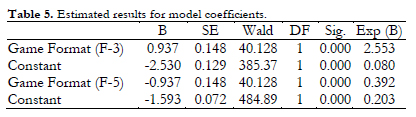
<body><![CDATA[<p><font face="Verdana" size="2">We designed three simple logistic models to analyze the children's technical performance in F-3 and F-5. The three criterion variables were: a) Success: -contact resulting in a shot at goal or continuation of the attack- versus Failure -contact not resulting in either of a shot or continuation-; b) Adapted -contact involving dribbling- versus Not Adapted -contact did not involving dribbling-; c) Success+Adapted -contact involving dribbling resulting in a shot at goal or continuation of the attack- versus all other combinations.</font></p>     <p><font face="Verdana" size="2">As just one predictor is used in simple regression models, we used the same model as that used for the multiple analysis except that it contained just one regression coefficient: (&beta;o+&beta;X).</font></p>     <p><font face="Verdana" size="2"><b>Data quality control</b></font></p>     <p><font face="Verdana" size="2">To assess the reliability of the data collected using the observation tool, we analyzed the level of agreement between the different data sets. Agreement was evalúated using the kappa statistic (Cohen, 1960), which is a measure of agreement for nominal classifications, with no ordering of data among the different categories. In this study, the same observer recorded, on two separate occasions, at least 10% of each of the matches that made up the study sample. Kappa was calculated using versión 5.1 of the SDIS-GSEQ software program following the recommendations of Bakeman &amp; Quera (1995, 2001, 2011). According to the criteria of Landis and Koch (1977, p. 165), the agreement between the six data sets generated for each game format (team observed/match) was "almost perfect" (F-5: .909, .906, .942, .934, .9544, .918; and F-3: .909, .906, .942, .934, .954, .918).</font></p>     <p>&nbsp;</p>     <p><font face="Verdana" size="2"><b>Results</b></font></p>     <p><font face="Verdana" size="2"><b>Multiple logistic regression</b></font></p>     <p><font face="Verdana" size="2">The criterion variable Success (move ending in zone containing the rival's goal) was significantly associated with the predictors Move Initiation Zone (&chi;<sup>2</sup>= 46.754; p<u>&lt;</u> .001) and Game Format (&chi;<sup>2</sup>= 24.687; p<u>&lt;</u> .001) and we therefore included these predictors in the multiple logistic regression model. The association between the two predictors was not statistically significant (&chi;<sup>2</sup>= 4.495; p= .213), allowing us to rule out colinearity. We next analyzed the possibility of confounding and interaction. In the first case, the different Exp (B) for Move Initiation Zone exhibited a variation of less than 10% when this variable was incorporated into the Game Format variable model. It was therefore decided to maintain the three dummy categories for this predictor in the multiple logistic regression model. Interaction between the predictor variables was also ruled out, as when this interaction was introduced into the model, the Game Format variable coefficient lost its significance (Álvarez, 2007).</font></p>     <p><font face="Verdana" size="2">To choose which variables to include in the predictive regression model and to estimate the strength of the association between the criterion variable and the predictor variables, we used three SPSS procedures: Enter, Forward Selection (Wald), and Backward Elimination (Wald). The three procedures included the same variables in the logistic regression model: Safety Sector, Creation Sector in Own Half, Creation Sector in Opposing Half, and F-3.</font></p>     <p><font face="Verdana" size="2">Once the variables were selected, we evalúated the discriminatory power of the multiple logistic regression model. The model accurately predicted 70.2% of the cases (moves) analyzed. Furthermore, it yielded a sensitivity of 19.9% (ability to correctly predict a successful move) and a specificity of 91.7% (ability to correctly predict an unsuccessful move).</font></p>     ]]></body>
<body><![CDATA[<p><font face="Verdana" size="2">We then performed the estimation process based on the resulting logistic regression model. In the first case, the Exp (B) value corresponding to Game Format was 2.426 (&gt;1 and significant), indicating that the probability of a move ending in Zone 80 was 2.426 times higher for F-3 than for F-5 (<a href="#t2">Table 2</a>). In the second case, the predicted probability of success for F-3 was .226 for moves that started in the Safety Sector, .344 for those that started in the Creation Sector in Own Half, and .529 for those that started in the Creation Sector in Opposing Half. The respective results for F-5 were .107, .178, and .316.</font></p>     <p>&nbsp;</p>     <p align="center"><font face="Verdana" size="2"><a name="t2"><img src="/img/revistas/ap/v32n1/metodologia_t2.jpg"></a></font></p>     <p>&nbsp;</p>     <p><font face="Verdana" size="2"><b>Simple logistic regression analyses</b></font></p>     <p><font face="Verdana" size="2">There was a significant association between each of the criterion variables (Success, Adapted, and Success+Adapted) and Game Format (p<u>&lt;</u> .05). We therefore established Game Format as the criterion variable in the three simple logistic regression models, which we constructed using the Enter selection method in SPSS.</font></p>     <p><font face="Verdana" size="2">The first model had a predictive accuracy of 55.6%, a sensitivity of 66.4%, and a specificity of 44.9%. The Exp(B) value for Game Format was 1.610 (&gt;1 and significant), indicating that the probability of a contact involving a shot or continuation of attack was 1.610 times higher for F-3 than for F-5 (<a href="#t3">Table 3</a>). The predicted probability of a contact being successful was .545 for F-3 and .426 for F-5.</font></p>     <p>&nbsp;</p>     <p align="center"><font face="Verdana" size="2"><a name="t3"><img src="/img/revistas/ap/v32n1/metodologia_t3.jpg"></a></font></p>     <p>&nbsp;</p>     ]]></body>
<body><![CDATA[<p><font face="Verdana" size="2">The second logistic regression model had a predictive accuracy of 70.8%, a sensitivity of 0%, and a specificity of 100%. The Exp(B) value for Game Format was 1.438 (&gt;1 and significant), indicating that the probability of a contact involving dribbling was 1.438 times higher for F-3 than for F-5 (<a href="#t4">Table 4</a>). The predicted probability of a contact involving dribbling was .321 for F-3 and .247 for F-5.</font></p>     <p>&nbsp;</p>     <p align="center"><font face="Verdana" size="2"><a name="t4"><img src="/img/revistas/ap/v32n1/metodologia_t4.jpg"></a></font></p>     <p>&nbsp;</p>     <p><font face="Verdana" size="2">The third simple logistic regression model had a predictive accuracy of 86.8%, a sensitivity of 0%, and a specificity of 100%. The Exp(B) value for Game Format was 2.553 (&gt;1 and significant), indicating that the probability of a contact involving a shot or continuation of attack with dribbling was 2.553 times higher for F-3 than for F-5 (<a href="#t5">Table 5</a>). Finally, the predicted probability of a contact involving dribbling plus a shot at goal or continuation of attack was .168 for F-3 and .073 for F-5.</font></p>     <p>&nbsp;</p>     <p align="center"><font face="Verdana" size="2"><a name="t5"><img src="/img/revistas/ap/v32n1/metodologia_t5.jpg"></a></font></p>     <p>&nbsp;</p>     <p><font face="Verdana" size="2"><b>Discussion and conclusions</b></font></p>     <p><font face="Verdana" size="2">The high kappa values obtained in our analysis of agreement confirm the reliability of the data used for the current study. The kappa statistic is one of the methods recommended by Blanco-Villaseñor and Anguera (2003) for analyzing intraobserver agreement. The high level of agreement observed is similar to levels reported by other studies that have used the Football Observation System (Camerino, Chaverri, Anguera &amp; Jonsson, 2012; Jonsson et al., 2006; Lapresa et al., 2010) and confirms the reliability of the data used in the analyses required to meet the aims of the study (Reina-Gómez, Hernández-Mendo &amp; Fernández-García, 2010).</font></p>     ]]></body>
<body><![CDATA[<p><font face="Verdana" size="2">We constructed a multiple logistic regression model to investigate the probability of a move being successful (ball reaching the goal area) according to the sector in which the move was initiated and the game format used (F-3 vs F-5) in children aged 6-8 years. In both F-3 and F-5, the probability of the ball reaching the goal area decreased the further away the move was initiated. This observation is consistent with results reported by Castelo (1999), Castellano (2000) and Perea (2008) for soccer and by Arda (1998) and Arana (2011) for grassroots soccer. The likelihood of success was higher for F-3 than for F-5 in all cases analyzed. Furthermore, the chances of the ball reaching the goal area was 2.426 times higher in F-3 than F-5. A greater use of space (observed in F-3 in our study) is associated with better quality of play, as indicated by Vales (1998) in a study of tactical indicators of performance in soccer.</font></p>     <p><font face="Verdana" size="2">We also constructed three simple logistic regression models to analyze the quality of technical actions executed by children aged 6-8 in F-3 and F-5. In the first model, we saw that the likelihood of a contact being effective was 1.610 times higher in F-3 than in F-5. In the second model, we categorized the criterion variable as Adapted when the contact involved dribbling and, as Not Adapted, when it did not. We distinguished between dribbling and non-dribbling, as it has been widely acknowledged that dribbling skills are important in children of a similar age to those in our study (Benedek, 2001; Casal &amp; Ardá, 2003; Lapresa et al., 2005; Lapresa et al., 2008; Vegas 2006; Wein, 1995; Wickstrom, 1990). We found that the smaller game format was better suited to the needs of the children in this age group as players were 1.438 times more likely to dribble the ball in F-3 compared with F-5. In the third model, we also saw that F-3 was more suited to the needs of children as the likelihood of a contact involving both dribbling and a shot at goal or continuation of attack was 2.553 higher in this format.</font></p>     <p><font face="Verdana" size="2">Our findings show that compared with F-5, F-3 played by children aged 6-8 according to the rules described by Lapresa et al. (2008) is more likely to satisfy competence needs (Ramis, Torregosa, Viladrich &amp; Cruz, 2013) in terms of the use of space (depth of play), effectiveness of play, and development of technical skills. The use of a more suitable game format (F-3 in this case) increases the chances of better play and consequently the chances of children mastering better technical and tactical skills and acquiring more competence (Ardá, 1998; Carvalho &amp; Pacheco 1990; Casal &amp; Ardá 2003; De la Vega et al. 2008; Escudero &amp; Palau 2005; Lapresa, Arana, Anguera &amp; Garzón 2013; Pacheco 2007; Vegas 2006).</font></p>     <p><font face="Verdana" size="2">We have shown how multiple and simple logistic regression models can be used in observational methodology, and more specifically in studies analyzing how football and sport in general can be adapted to the needs of children using multiple dichotomous variables in addition to those used in our study.</font></p>     <p>&nbsp;</p>     <p><font face="Verdana" size="2"><b>References</b></font></p>     <!-- ref --><p><font face="Verdana" size="2">1. Ábalo, R. (2012). Predicción de lesiones y regresión logística. Lecturas: Educación Física y Deportes, 169. Retrieved November 28, 2013 from <a target="_blank" href="http://www.efdeportes.com/efd169/prediccion-de-lesiones-y-regresion-logistica.htm">http://www.efdeportes.com/efd169/prediccion-de-lesiones-y-regresion-logistica.htm</a>.    &nbsp;&nbsp;&nbsp;&nbsp;&nbsp;&nbsp;&nbsp;&nbsp;[&#160;<a href="javascript:void(0);" onclick="javascript: window.open('/scielo.php?script=sci_nlinks&ref=753218&pid=S0212-9728201600010003300001&lng=','','width=640,height=500,resizable=yes,scrollbars=1,menubar=yes,');">Links</a>&#160;]<!-- end-ref --></font></p>    <!-- ref --><p><font face="Verdana" size="2">2. Álvarez, R. (2007). Estadística aplicada a las Ciencias de la Salud. Madrid: Ediciones Díaz de Santos.    &nbsp;&nbsp;&nbsp;&nbsp;&nbsp;&nbsp;&nbsp;&nbsp;[&#160;<a href="javascript:void(0);" onclick="javascript: window.open('/scielo.php?script=sci_nlinks&ref=753220&pid=S0212-9728201600010003300002&lng=','','width=640,height=500,resizable=yes,scrollbars=1,menubar=yes,');">Links</a>&#160;]<!-- end-ref --></font></p>    ]]></body>
<body><![CDATA[<!-- ref --><p><font face="Verdana" size="2">3. Anguera, M.T. (1979). Observational Typology. Quality &amp; Quantity. European-American Journal of Methodology, 13(6), 449-484.    &nbsp;&nbsp;&nbsp;&nbsp;&nbsp;&nbsp;&nbsp;&nbsp;[&#160;<a href="javascript:void(0);" onclick="javascript: window.open('/scielo.php?script=sci_nlinks&ref=753222&pid=S0212-9728201600010003300003&lng=','','width=640,height=500,resizable=yes,scrollbars=1,menubar=yes,');">Links</a>&#160;]<!-- end-ref --></font></p>    <!-- ref --><p><font face="Verdana" size="2">4. Anguera, M.T., Arnau, J., Ato, M., Martínez-Arias, R., Pascual, J. &amp; Vallejo, G. (1995). Métodos de investigación en psicología. Madrid: Síntesis.    &nbsp;&nbsp;&nbsp;&nbsp;&nbsp;&nbsp;&nbsp;&nbsp;[&#160;<a href="javascript:void(0);" onclick="javascript: window.open('/scielo.php?script=sci_nlinks&ref=753224&pid=S0212-9728201600010003300004&lng=','','width=640,height=500,resizable=yes,scrollbars=1,menubar=yes,');">Links</a>&#160;]<!-- end-ref --></font></p>    <!-- ref --><p><font face="Verdana" size="2">5. Anguera, M.T., Blanco-Villaseñor, A. &amp; Losada, J. (2001). Diseños observacionales, cuestión clave en el proceso de la metodología observacional. Metodología de las Ciencias del Comportamiento, 3, 135-161.    &nbsp;&nbsp;&nbsp;&nbsp;&nbsp;&nbsp;&nbsp;&nbsp;[&#160;<a href="javascript:void(0);" onclick="javascript: window.open('/scielo.php?script=sci_nlinks&ref=753226&pid=S0212-9728201600010003300005&lng=','','width=640,height=500,resizable=yes,scrollbars=1,menubar=yes,');">Links</a>&#160;]<!-- end-ref --></font></p>    <!-- ref --><p><font face="Verdana" size="2">6. Anguera, M.T., Blanco-Villaseñor, A., Hernández-Mendo, A. &amp; Losada, J.L. (2011). Diseños observacionales: ajuste y aplicación en psicología del deporte. Cuadernos de Psicología del Deporte, 11 (2), 63-76.    &nbsp;&nbsp;&nbsp;&nbsp;&nbsp;&nbsp;&nbsp;&nbsp;[&#160;<a href="javascript:void(0);" onclick="javascript: window.open('/scielo.php?script=sci_nlinks&ref=753228&pid=S0212-9728201600010003300006&lng=','','width=640,height=500,resizable=yes,scrollbars=1,menubar=yes,');">Links</a>&#160;]<!-- end-ref --></font></p>    <!-- ref --><p><font face="Verdana" size="2">7. Anguera, M.T., Blanco-Villaseñor, A., Losada, J., Arda, T., Camerino, O., Castellano, J. &amp; Hernández-Mendo, A. (2003). Instrumento de codificación y registro de la acción de juego en fútbol (SOF-1). Revista Digital de Alto Rendimiento en Fútbol, Universidad de Extremadura.    &nbsp;&nbsp;&nbsp;&nbsp;&nbsp;&nbsp;&nbsp;&nbsp;[&#160;<a href="javascript:void(0);" onclick="javascript: window.open('/scielo.php?script=sci_nlinks&ref=753230&pid=S0212-9728201600010003300007&lng=','','width=640,height=500,resizable=yes,scrollbars=1,menubar=yes,');">Links</a>&#160;]<!-- end-ref --></font></p>    ]]></body>
<body><![CDATA[<!-- ref --><p><font face="Verdana" size="2">8. Anguera, M.T., Magnusson, M.S. &amp; Jonsson, G.K. (2007). Instrumentos no estándar. Avances en Medición, 5(1), 63-82.    &nbsp;&nbsp;&nbsp;&nbsp;&nbsp;&nbsp;&nbsp;&nbsp;[&#160;<a href="javascript:void(0);" onclick="javascript: window.open('/scielo.php?script=sci_nlinks&ref=753232&pid=S0212-9728201600010003300008&lng=','','width=640,height=500,resizable=yes,scrollbars=1,menubar=yes,');">Links</a>&#160;]<!-- end-ref --></font></p>    <!-- ref --><p><font face="Verdana" size="2">9. Anguera, M.T. &amp; Hernández-Mendo, A. (2013). La metodología observacional en el ámbito del deporte. E-balonmano.com: Revista de Ciencias del Deporte, 9(3), 135-161.    &nbsp;&nbsp;&nbsp;&nbsp;&nbsp;&nbsp;&nbsp;&nbsp;[&#160;<a href="javascript:void(0);" onclick="javascript: window.open('/scielo.php?script=sci_nlinks&ref=753234&pid=S0212-9728201600010003300009&lng=','','width=640,height=500,resizable=yes,scrollbars=1,menubar=yes,');">Links</a>&#160;]<!-- end-ref --></font></p>    <!-- ref --><p><font face="Verdana" size="2">10. Araguayo, E., Mena, L.E. &amp; Vavarello, J.R. (2004). Un modelo predictivo para el logro del rendimiento motor. Lecturas, Educación Física y Deportes, 10, (73). Retrieved November 6, 2013 from <a target="_blank" href="http://www.efdeportes.com/efd73/rendim.htm">http://www.efdeportes.com/efd73/rendim.htm</a>.    &nbsp;&nbsp;&nbsp;&nbsp;&nbsp;&nbsp;&nbsp;&nbsp;[&#160;<a href="javascript:void(0);" onclick="javascript: window.open('/scielo.php?script=sci_nlinks&ref=753236&pid=S0212-9728201600010003300010&lng=','','width=640,height=500,resizable=yes,scrollbars=1,menubar=yes,');">Links</a>&#160;]<!-- end-ref --></font></p>    <!-- ref --><p><font face="Verdana" size="2">11. Arana, J. (2011). Adaptando el fútbol al niño de 12-13 años: análisis observacional de la utilización del espacio en las modalidades de F-7, F-9 y F-11. Tesis Doctoral: Logroño: Universidad de La Rioja.    &nbsp;&nbsp;&nbsp;&nbsp;&nbsp;&nbsp;&nbsp;&nbsp;[&#160;<a href="javascript:void(0);" onclick="javascript: window.open('/scielo.php?script=sci_nlinks&ref=753238&pid=S0212-9728201600010003300011&lng=','','width=640,height=500,resizable=yes,scrollbars=1,menubar=yes,');">Links</a>&#160;]<!-- end-ref --></font></p>    <!-- ref --><p><font face="Verdana" size="2">12. Arana, J., Lapresa, D., Anguera, M.T. &amp; Garzón, B. (2013). Adapting football to the child: an application of the logistic regression model in observational methodology. Quality &amp; Quantity, International Journal of Methodology, 47(6), 3473-3480.    &nbsp;&nbsp;&nbsp;&nbsp;&nbsp;&nbsp;&nbsp;&nbsp;[&#160;<a href="javascript:void(0);" onclick="javascript: window.open('/scielo.php?script=sci_nlinks&ref=753240&pid=S0212-9728201600010003300012&lng=','','width=640,height=500,resizable=yes,scrollbars=1,menubar=yes,');">Links</a>&#160;]<!-- end-ref --></font></p>    ]]></body>
<body><![CDATA[<!-- ref --><p><font face="Verdana" size="2">13. Ardá, A. (1998). Análisis de patrones en fútbol 7. Tesis Doctoral. La Coruña: Universidad de La Coruña.    &nbsp;&nbsp;&nbsp;&nbsp;&nbsp;&nbsp;&nbsp;&nbsp;[&#160;<a href="javascript:void(0);" onclick="javascript: window.open('/scielo.php?script=sci_nlinks&ref=753242&pid=S0212-9728201600010003300013&lng=','','width=640,height=500,resizable=yes,scrollbars=1,menubar=yes,');">Links</a>&#160;]<!-- end-ref --></font></p>    <!-- ref --><p><font face="Verdana" size="2">14. Ardá, T., Maneiro, R., Rial, A, Losada, J.L. &amp; Casal, C. (2014). Análisis de la eficacia de los saques de esquina en la Copa del Mundo de Fútbol 2010. Un intento de identificación de variables explicativas. Revista de Psicología del Deporte, 23(1), 165-172.    &nbsp;&nbsp;&nbsp;&nbsp;&nbsp;&nbsp;&nbsp;&nbsp;[&#160;<a href="javascript:void(0);" onclick="javascript: window.open('/scielo.php?script=sci_nlinks&ref=753244&pid=S0212-9728201600010003300014&lng=','','width=640,height=500,resizable=yes,scrollbars=1,menubar=yes,');">Links</a>&#160;]<!-- end-ref --></font></p>    <!-- ref --><p><font face="Verdana" size="2">15. Ato, M. &amp; López, J.J. (1996). Análisis estadístico para datos categóricos. Madrid: Síntesis.    &nbsp;&nbsp;&nbsp;&nbsp;&nbsp;&nbsp;&nbsp;&nbsp;[&#160;<a href="javascript:void(0);" onclick="javascript: window.open('/scielo.php?script=sci_nlinks&ref=753246&pid=S0212-9728201600010003300015&lng=','','width=640,height=500,resizable=yes,scrollbars=1,menubar=yes,');">Links</a>&#160;]<!-- end-ref --></font></p>    <!-- ref --><p><font face="Verdana" size="2">16. Bagley, S.C., White, H. &amp; Golomb, B.A. (2001). Logistic regression in the medical literature: standards for use and reporting, with particular attention to one medical domain. Journal of Clinical Epidemiology, 54, 979-985.    &nbsp;&nbsp;&nbsp;&nbsp;&nbsp;&nbsp;&nbsp;&nbsp;[&#160;<a href="javascript:void(0);" onclick="javascript: window.open('/scielo.php?script=sci_nlinks&ref=753248&pid=S0212-9728201600010003300016&lng=','','width=640,height=500,resizable=yes,scrollbars=1,menubar=yes,');">Links</a>&#160;]<!-- end-ref --></font></p>    <!-- ref --><p><font face="Verdana" size="2">17. Bakeman, R. &amp; Quera, V. (1995). Analyzing interaction: Sequential analysis with SDIS and GSEQ. Cambridge, UK: Cambridge University Press.    &nbsp;&nbsp;&nbsp;&nbsp;&nbsp;&nbsp;&nbsp;&nbsp;[&#160;<a href="javascript:void(0);" onclick="javascript: window.open('/scielo.php?script=sci_nlinks&ref=753250&pid=S0212-9728201600010003300017&lng=','','width=640,height=500,resizable=yes,scrollbars=1,menubar=yes,');">Links</a>&#160;]<!-- end-ref --></font></p>    ]]></body>
<body><![CDATA[<!-- ref --><p><font face="Verdana" size="2">18. Bakeman, R. &amp; Quera, V. (2001). Using GSEQ with SPSS. Metodología de las ciencias del Comportamiento, 3(2), 195-214.    &nbsp;&nbsp;&nbsp;&nbsp;&nbsp;&nbsp;&nbsp;&nbsp;[&#160;<a href="javascript:void(0);" onclick="javascript: window.open('/scielo.php?script=sci_nlinks&ref=753252&pid=S0212-9728201600010003300018&lng=','','width=640,height=500,resizable=yes,scrollbars=1,menubar=yes,');">Links</a>&#160;]<!-- end-ref --></font></p>    <!-- ref --><p><font face="Verdana" size="2">19. Bakeman, R. &amp; Quera, V. (2011). Sequential Analysis and Observational Methods for the Behavioral Sciences. Cambridge: University Press.    &nbsp;&nbsp;&nbsp;&nbsp;&nbsp;&nbsp;&nbsp;&nbsp;[&#160;<a href="javascript:void(0);" onclick="javascript: window.open('/scielo.php?script=sci_nlinks&ref=753254&pid=S0212-9728201600010003300019&lng=','','width=640,height=500,resizable=yes,scrollbars=1,menubar=yes,');">Links</a>&#160;]<!-- end-ref --></font></p>    <!-- ref --><p><font face="Verdana" size="2">20. Benedek, E. (2001). Fútbol Infantil. Barcelona: Paidotribo.    &nbsp;&nbsp;&nbsp;&nbsp;&nbsp;&nbsp;&nbsp;&nbsp;[&#160;<a href="javascript:void(0);" onclick="javascript: window.open('/scielo.php?script=sci_nlinks&ref=753256&pid=S0212-9728201600010003300020&lng=','','width=640,height=500,resizable=yes,scrollbars=1,menubar=yes,');">Links</a>&#160;]<!-- end-ref --></font></p>    <!-- ref --><p><font face="Verdana" size="2">21. Blanco-Villaseñor, A. &amp; Anguera, M.T. (2003). Calidad de los datos registrados en el ámbito deportivo. En A. Hernández-Mendo (Coord.). Psicología del Deporte (Vol. 2). Metodología (p. 35-73). Buenos Aires: Efdeportes (<a target="_blank" href="http://www.efdeportes.com">www.efdeportes.com</a>).    &nbsp;&nbsp;&nbsp;&nbsp;&nbsp;&nbsp;&nbsp;&nbsp;[&#160;<a href="javascript:void(0);" onclick="javascript: window.open('/scielo.php?script=sci_nlinks&ref=753258&pid=S0212-9728201600010003300021&lng=','','width=640,height=500,resizable=yes,scrollbars=1,menubar=yes,');">Links</a>&#160;]<!-- end-ref --></font></p>    <!-- ref --><p><font face="Verdana" size="2">22. Broc, M.A. &amp; Gil, C. (2008). Predicción del rendimiento académico en alumnos de ESO y Bachillerato mediante el inventario clínico para adolescentes de Millon (Escala MACI). Anales de Psicología, 24(1), 158-167.    &nbsp;&nbsp;&nbsp;&nbsp;&nbsp;&nbsp;&nbsp;&nbsp;[&#160;<a href="javascript:void(0);" onclick="javascript: window.open('/scielo.php?script=sci_nlinks&ref=753260&pid=S0212-9728201600010003300022&lng=','','width=640,height=500,resizable=yes,scrollbars=1,menubar=yes,');">Links</a>&#160;]<!-- end-ref --></font></p>    ]]></body>
<body><![CDATA[<!-- ref --><p><font face="Verdana" size="2">23. Camerino, O., Chaverri, J., Anguera, M.T. &amp; Jonsson, G.K. (2012). Dynamics of the game in soccer: Detection of T-patterns. European Journal of Sport Science, 12(3), 216-224.    &nbsp;&nbsp;&nbsp;&nbsp;&nbsp;&nbsp;&nbsp;&nbsp;[&#160;<a href="javascript:void(0);" onclick="javascript: window.open('/scielo.php?script=sci_nlinks&ref=753262&pid=S0212-9728201600010003300023&lng=','','width=640,height=500,resizable=yes,scrollbars=1,menubar=yes,');">Links</a>&#160;]<!-- end-ref --></font></p>    <!-- ref --><p><font face="Verdana" size="2">24. Carvalho, J. &amp; Pacheco, R. (1990). Ensino do futebol: futebol de 11 ou futebol de 7. Revista Horizonte, 5(25), 7-11.    &nbsp;&nbsp;&nbsp;&nbsp;&nbsp;&nbsp;&nbsp;&nbsp;[&#160;<a href="javascript:void(0);" onclick="javascript: window.open('/scielo.php?script=sci_nlinks&ref=753264&pid=S0212-9728201600010003300024&lng=','','width=640,height=500,resizable=yes,scrollbars=1,menubar=yes,');">Links</a>&#160;]<!-- end-ref --></font></p>    <!-- ref --><p><font face="Verdana" size="2">25. Casal, C.A. (2010). Análisis observacional de la fase ofensiva del fútbol de alto nivel. Tesis Doctoral. La Coruña: Universidad de La Coruña.    &nbsp;&nbsp;&nbsp;&nbsp;&nbsp;&nbsp;&nbsp;&nbsp;[&#160;<a href="javascript:void(0);" onclick="javascript: window.open('/scielo.php?script=sci_nlinks&ref=753266&pid=S0212-9728201600010003300025&lng=','','width=640,height=500,resizable=yes,scrollbars=1,menubar=yes,');">Links</a>&#160;]<!-- end-ref --></font></p>    <!-- ref --><p><font face="Verdana" size="2">26. Casal, C.A. &amp; Ardá, T. (2003). Metodología de la enseñanza del fútbol. Barcelona: Paidotribo.    &nbsp;&nbsp;&nbsp;&nbsp;&nbsp;&nbsp;&nbsp;&nbsp;[&#160;<a href="javascript:void(0);" onclick="javascript: window.open('/scielo.php?script=sci_nlinks&ref=753268&pid=S0212-9728201600010003300026&lng=','','width=640,height=500,resizable=yes,scrollbars=1,menubar=yes,');">Links</a>&#160;]<!-- end-ref --></font></p>    <!-- ref --><p><font face="Verdana" size="2">27. Castellano, J. (2000). Observación y análisis de la acción de juego en el fútbol. Tesis Doctoral. Vitoria: Universidad del País Vasco.    &nbsp;&nbsp;&nbsp;&nbsp;&nbsp;&nbsp;&nbsp;&nbsp;[&#160;<a href="javascript:void(0);" onclick="javascript: window.open('/scielo.php?script=sci_nlinks&ref=753270&pid=S0212-9728201600010003300027&lng=','','width=640,height=500,resizable=yes,scrollbars=1,menubar=yes,');">Links</a>&#160;]<!-- end-ref --></font></p>    ]]></body>
<body><![CDATA[<!-- ref --><p><font face="Verdana" size="2">28. Castelo, J. (1999). Fútbol. Estructura y dinámica del juego. Barcelona: Inde.    &nbsp;&nbsp;&nbsp;&nbsp;&nbsp;&nbsp;&nbsp;&nbsp;[&#160;<a href="javascript:void(0);" onclick="javascript: window.open('/scielo.php?script=sci_nlinks&ref=753272&pid=S0212-9728201600010003300028&lng=','','width=640,height=500,resizable=yes,scrollbars=1,menubar=yes,');">Links</a>&#160;]<!-- end-ref --></font></p>    <!-- ref --><p><font face="Verdana" size="2">29. Cohen, J. (1960). A coefficient of agreement for nominal scales. Educational and Psychological Measurement, 20, 37-46.    &nbsp;&nbsp;&nbsp;&nbsp;&nbsp;&nbsp;&nbsp;&nbsp;[&#160;<a href="javascript:void(0);" onclick="javascript: window.open('/scielo.php?script=sci_nlinks&ref=753274&pid=S0212-9728201600010003300029&lng=','','width=640,height=500,resizable=yes,scrollbars=1,menubar=yes,');">Links</a>&#160;]<!-- end-ref --></font></p>    <!-- ref --><p><font face="Verdana" size="2">30. De Irala, J. (1999). Regresión logística aplicada a las ciencias de la salud. Pamplona: Newbook Ediciones.    &nbsp;&nbsp;&nbsp;&nbsp;&nbsp;&nbsp;&nbsp;&nbsp;[&#160;<a href="javascript:void(0);" onclick="javascript: window.open('/scielo.php?script=sci_nlinks&ref=753276&pid=S0212-9728201600010003300030&lng=','','width=640,height=500,resizable=yes,scrollbars=1,menubar=yes,');">Links</a>&#160;]<!-- end-ref --></font></p>    <!-- ref --><p><font face="Verdana" size="2">31. De la Vega, R., Del Valle, M.S., Maldonado, A. &amp; Moreno, A. (2008). Una nueva herramienta para la compresión táctica en fútbol. Revista Internacional de Medicina y Ciencias de la Actividad Física y del Deporte, 8, 130-145.    &nbsp;&nbsp;&nbsp;&nbsp;&nbsp;&nbsp;&nbsp;&nbsp;[&#160;<a href="javascript:void(0);" onclick="javascript: window.open('/scielo.php?script=sci_nlinks&ref=753278&pid=S0212-9728201600010003300031&lng=','','width=640,height=500,resizable=yes,scrollbars=1,menubar=yes,');">Links</a>&#160;]<!-- end-ref --></font></p>    <!-- ref --><p><font face="Verdana" size="2">32. Escudero, J. M. &amp; Palau, J. M. (2005). Incidencia de la modalidad de juego (fútbol 7 y fútbol 11) sobre la eficacia de las acciones de juego en categorías de formación (11-12 años). Lecturas: Educación Física y Deportes, 10 (90). Retrieved March 2, 2014 from <a target="_blank" href="http://www.efdeportes.com/efd90/futbol.htm">http://www.efdeportes.com/efd90/futbol.htm</a>.    &nbsp;&nbsp;&nbsp;&nbsp;&nbsp;&nbsp;&nbsp;&nbsp;[&#160;<a href="javascript:void(0);" onclick="javascript: window.open('/scielo.php?script=sci_nlinks&ref=753280&pid=S0212-9728201600010003300032&lng=','','width=640,height=500,resizable=yes,scrollbars=1,menubar=yes,');">Links</a>&#160;]<!-- end-ref --></font></p>    ]]></body>
<body><![CDATA[<!-- ref --><p><font face="Verdana" size="2">33. Fernández, A., de la Cruz Márquez, J.C., Cueto, B., Salazar, S. &amp; de la Cruz Campos, J.C. (2008). Predicción de lesiones deportivas mediante modelos matemáticos. Apunts Medicina de l´Esport, 43(157), 41-44.    &nbsp;&nbsp;&nbsp;&nbsp;&nbsp;&nbsp;&nbsp;&nbsp;[&#160;<a href="javascript:void(0);" onclick="javascript: window.open('/scielo.php?script=sci_nlinks&ref=753282&pid=S0212-9728201600010003300033&lng=','','width=640,height=500,resizable=yes,scrollbars=1,menubar=yes,');">Links</a>&#160;]<!-- end-ref --></font></p>    <!-- ref --><p><font face="Verdana" size="2">34. Hellevik, O. (2007). Linear ersus logistic regression when the dependent variable is a dichotomy. Quality &amp; Quantity, International Journal of Methodology, 43(1), 59-74.    &nbsp;&nbsp;&nbsp;&nbsp;&nbsp;&nbsp;&nbsp;&nbsp;[&#160;<a href="javascript:void(0);" onclick="javascript: window.open('/scielo.php?script=sci_nlinks&ref=753284&pid=S0212-9728201600010003300034&lng=','','width=640,height=500,resizable=yes,scrollbars=1,menubar=yes,');">Links</a>&#160;]<!-- end-ref --></font></p>    <!-- ref --><p><font face="Verdana" size="2">35. Herrera, A.N. &amp; Gómez, J. (2008). Influence of equal or unequal comparison group sample sizes on the detection of differential item functioning using the Mantel-Haenszel and logistic regression techniques. Quality &amp; Quantity, International Journal of Methodology, 42(6), 739-755.    &nbsp;&nbsp;&nbsp;&nbsp;&nbsp;&nbsp;&nbsp;&nbsp;[&#160;<a href="javascript:void(0);" onclick="javascript: window.open('/scielo.php?script=sci_nlinks&ref=753286&pid=S0212-9728201600010003300035&lng=','','width=640,height=500,resizable=yes,scrollbars=1,menubar=yes,');">Links</a>&#160;]<!-- end-ref --></font></p>    <!-- ref --><p><font face="Verdana" size="2">36. Jonsson, G.K. (2006). SOF-coder: Technological and multimedia system for recording data in soccer. En J. Castellano, L. Sautu, A. Blanco-Villaseñor, A. Hernández-Mendo, A. Goñi &amp; F. Martínez de Ilarduya (Coord.). Socialización y deporte: Revisión Crítica (pp. 291-300). Vitoria: Diputación Foral de Álava.    &nbsp;&nbsp;&nbsp;&nbsp;&nbsp;&nbsp;&nbsp;&nbsp;[&#160;<a href="javascript:void(0);" onclick="javascript: window.open('/scielo.php?script=sci_nlinks&ref=753288&pid=S0212-9728201600010003300036&lng=','','width=640,height=500,resizable=yes,scrollbars=1,menubar=yes,');">Links</a>&#160;]<!-- end-ref --></font></p>    <!-- ref --><p><font face="Verdana" size="2">37. Jonsson, G.K., Anguera, M.T., Blanco-Villaseñor, A., Losada, J., Hernández-Mendo, A., Arda, T., Camerino, O. &amp; Castellano, J. (2006). Hidden patterns of play interaction in soccer using SOF-CODER. Behavior Research Methods, Instruments and Computers, 38(3), 372-381.    &nbsp;&nbsp;&nbsp;&nbsp;&nbsp;&nbsp;&nbsp;&nbsp;[&#160;<a href="javascript:void(0);" onclick="javascript: window.open('/scielo.php?script=sci_nlinks&ref=753290&pid=S0212-9728201600010003300037&lng=','','width=640,height=500,resizable=yes,scrollbars=1,menubar=yes,');">Links</a>&#160;]<!-- end-ref --></font></p>    ]]></body>
<body><![CDATA[<!-- ref --><p><font face="Verdana" size="2">38. Landis, J.R. &amp; Koch, G.G. (1977). The measurement of observer agreement for categorical data. Biometrics, 33,159-174.    &nbsp;&nbsp;&nbsp;&nbsp;&nbsp;&nbsp;&nbsp;&nbsp;[&#160;<a href="javascript:void(0);" onclick="javascript: window.open('/scielo.php?script=sci_nlinks&ref=753292&pid=S0212-9728201600010003300038&lng=','','width=640,height=500,resizable=yes,scrollbars=1,menubar=yes,');">Links</a>&#160;]<!-- end-ref --></font></p>    <!-- ref --><p><font face="Verdana" size="2">39. Lapresa, D., Álvarez, L., Arana, J., Garzón, B. &amp; Caballero, V. (2013): Observational analysis of the offensive sequences that ended in a shot by the winning team of the 2010 UEFA Futsal Championship, Journal of Sports Sciences, 31(15), 1731-1739.    &nbsp;&nbsp;&nbsp;&nbsp;&nbsp;&nbsp;&nbsp;&nbsp;[&#160;<a href="javascript:void(0);" onclick="javascript: window.open('/scielo.php?script=sci_nlinks&ref=753294&pid=S0212-9728201600010003300039&lng=','','width=640,height=500,resizable=yes,scrollbars=1,menubar=yes,');">Links</a>&#160;]<!-- end-ref --></font></p>    <!-- ref --><p><font face="Verdana" size="2">40. Lapresa, D., Arana, J. &amp; Carazo, J. (2005). Pautas para la adecuación de contenidos en el desarrollo psicomotor de prebenjamines y benjamines. Logroño: Real Federación española de Fútbol y Universidad de La Rioja.    &nbsp;&nbsp;&nbsp;&nbsp;&nbsp;&nbsp;&nbsp;&nbsp;[&#160;<a href="javascript:void(0);" onclick="javascript: window.open('/scielo.php?script=sci_nlinks&ref=753296&pid=S0212-9728201600010003300040&lng=','','width=640,height=500,resizable=yes,scrollbars=1,menubar=yes,');">Links</a>&#160;]<!-- end-ref --></font></p>    <!-- ref --><p><font face="Verdana" size="2">41. Lapresa, D., Arana, J., Anguera, M.T. &amp; Garzón, B. (2013). Comparative analysis of the sequentiality using SDIS-GSEQ and THEME: a concrete example in soccer. Journal of Sport Sciences, 31(15), 1687-1695.    &nbsp;&nbsp;&nbsp;&nbsp;&nbsp;&nbsp;&nbsp;&nbsp;[&#160;<a href="javascript:void(0);" onclick="javascript: window.open('/scielo.php?script=sci_nlinks&ref=753298&pid=S0212-9728201600010003300041&lng=','','width=640,height=500,resizable=yes,scrollbars=1,menubar=yes,');">Links</a>&#160;]<!-- end-ref --></font></p>    <!-- ref --><p><font face="Verdana" size="2">42. Lapresa, D., Arana, J., Garzón, B., Egüén, R. &amp; Amatria, M. (2008). Enseñado a jugar el fútbol. Hacia una iniciación coherente. Logroño: Real Federación Española de Fútbol y Universidad de La Rioja.    &nbsp;&nbsp;&nbsp;&nbsp;&nbsp;&nbsp;&nbsp;&nbsp;[&#160;<a href="javascript:void(0);" onclick="javascript: window.open('/scielo.php?script=sci_nlinks&ref=753300&pid=S0212-9728201600010003300042&lng=','','width=640,height=500,resizable=yes,scrollbars=1,menubar=yes,');">Links</a>&#160;]<!-- end-ref --></font></p>    ]]></body>
<body><![CDATA[<!-- ref --><p><font face="Verdana" size="2">43. Lapresa, D., Arana, J., Garzón, B., Egüén, R. &amp; Amatria, M. (2010). Adaptando la competición en la iniciación del fútbol: estudio comparativo de las modalidades de F-3 y F-5 en la categoría prebenjamin. Apunts: Educación Física y Deporte, 101, 43-56.    &nbsp;&nbsp;&nbsp;&nbsp;&nbsp;&nbsp;&nbsp;&nbsp;[&#160;<a href="javascript:void(0);" onclick="javascript: window.open('/scielo.php?script=sci_nlinks&ref=753302&pid=S0212-9728201600010003300043&lng=','','width=640,height=500,resizable=yes,scrollbars=1,menubar=yes,');">Links</a>&#160;]<!-- end-ref --></font></p>    <!-- ref --><p><font face="Verdana" size="2">44. Ortín-Montero, F.J., Moya-Faz, F. &amp; Garcés de los Fayos, E.J. (2013). Sport Psychology: Some new proposals being developed. Anales de Psicología, 29(3), 633-636.    &nbsp;&nbsp;&nbsp;&nbsp;&nbsp;&nbsp;&nbsp;&nbsp;[&#160;<a href="javascript:void(0);" onclick="javascript: window.open('/scielo.php?script=sci_nlinks&ref=753304&pid=S0212-9728201600010003300044&lng=','','width=640,height=500,resizable=yes,scrollbars=1,menubar=yes,');">Links</a>&#160;]<!-- end-ref --></font></p>    <!-- ref --><p><font face="Verdana" size="2">45. Pacheco, R. (2007). Fútbol: la enseñanza y el entrenamiento del fútbol 7. Barcelona: Paidotribo.    &nbsp;&nbsp;&nbsp;&nbsp;&nbsp;&nbsp;&nbsp;&nbsp;[&#160;<a href="javascript:void(0);" onclick="javascript: window.open('/scielo.php?script=sci_nlinks&ref=753306&pid=S0212-9728201600010003300045&lng=','','width=640,height=500,resizable=yes,scrollbars=1,menubar=yes,');">Links</a>&#160;]<!-- end-ref --></font></p>    <!-- ref --><p><font face="Verdana" size="2">46. Perea, A.E. (2008). Análisis de las acciones colectivas en el fútbol de rendimiento. Tesis Doctoral. Vitoria: Universidad del País Vasco.    &nbsp;&nbsp;&nbsp;&nbsp;&nbsp;&nbsp;&nbsp;&nbsp;[&#160;<a href="javascript:void(0);" onclick="javascript: window.open('/scielo.php?script=sci_nlinks&ref=753308&pid=S0212-9728201600010003300046&lng=','','width=640,height=500,resizable=yes,scrollbars=1,menubar=yes,');">Links</a>&#160;]<!-- end-ref --></font></p>    <!-- ref --><p><font face="Verdana" size="2">47. Ramis, Y., Torregosa, M., Viladrich, C. &amp; Cruz, J. (2013). El apoyo a la autonomía generado por entrenadores, compañeros y padres y su efecto sobre la motivación autodeterminada de deportistas de iniciación. Anales de Psicología, 29(1), 1695-2294.    &nbsp;&nbsp;&nbsp;&nbsp;&nbsp;&nbsp;&nbsp;&nbsp;[&#160;<a href="javascript:void(0);" onclick="javascript: window.open('/scielo.php?script=sci_nlinks&ref=753310&pid=S0212-9728201600010003300047&lng=','','width=640,height=500,resizable=yes,scrollbars=1,menubar=yes,');">Links</a>&#160;]<!-- end-ref --></font></p>    ]]></body>
<body><![CDATA[<!-- ref --><p><font face="Verdana" size="2">48. Rando, B., Blanca, M.J. &amp; Frutos, M.A. (2000). Modelo de regresión logística para la intención de hacerse el carnet de donante de órganos y tejidos. Psicothema, 12 (2), 464-469.    &nbsp;&nbsp;&nbsp;&nbsp;&nbsp;&nbsp;&nbsp;&nbsp;[&#160;<a href="javascript:void(0);" onclick="javascript: window.open('/scielo.php?script=sci_nlinks&ref=753312&pid=S0212-9728201600010003300048&lng=','','width=640,height=500,resizable=yes,scrollbars=1,menubar=yes,');">Links</a>&#160;]<!-- end-ref --></font></p>    <!-- ref --><p><font face="Verdana" size="2">49. Reina-Gómez, A., Hernández-Mendo, A. &amp; Fernández-García, J. C. (201). Multifacet design for goal scoring in SOCCER-7. Quality &amp; Quantity, International Journal of Methodology, 44(5), 1025-1035.    &nbsp;&nbsp;&nbsp;&nbsp;&nbsp;&nbsp;&nbsp;&nbsp;[&#160;<a href="javascript:void(0);" onclick="javascript: window.open('/scielo.php?script=sci_nlinks&ref=753314&pid=S0212-9728201600010003300049&lng=','','width=640,height=500,resizable=yes,scrollbars=1,menubar=yes,');">Links</a>&#160;]<!-- end-ref --></font></p>    <!-- ref --><p><font face="Verdana" size="2">50. Rodrigo, M.F., Molina, J.G., García, R. &amp; Pérez, F. (2012). Efectos de la interacción en la predicción del abandono en los estudios de psicología. Anales de Psicología, 28(1), 113-119.    &nbsp;&nbsp;&nbsp;&nbsp;&nbsp;&nbsp;&nbsp;&nbsp;[&#160;<a href="javascript:void(0);" onclick="javascript: window.open('/scielo.php?script=sci_nlinks&ref=753316&pid=S0212-9728201600010003300050&lng=','','width=640,height=500,resizable=yes,scrollbars=1,menubar=yes,');">Links</a>&#160;]<!-- end-ref --></font></p>    <!-- ref --><p><font face="Verdana" size="2">51. Romero, C. &amp; Vegas, G. (2003). Situación del fútbol 7 en España. En III Jornadas Internacionales de Fútbol. Málaga: Real Federación Española de Fútbol.    &nbsp;&nbsp;&nbsp;&nbsp;&nbsp;&nbsp;&nbsp;&nbsp;[&#160;<a href="javascript:void(0);" onclick="javascript: window.open('/scielo.php?script=sci_nlinks&ref=753318&pid=S0212-9728201600010003300051&lng=','','width=640,height=500,resizable=yes,scrollbars=1,menubar=yes,');">Links</a>&#160;]<!-- end-ref --></font></p>    <!-- ref --><p><font face="Verdana" size="2">52. Silva, L.C. &amp; Barroso, I.M. (2004). Regresión Logística. Salamanca: La Muralla.    &nbsp;&nbsp;&nbsp;&nbsp;&nbsp;&nbsp;&nbsp;&nbsp;[&#160;<a href="javascript:void(0);" onclick="javascript: window.open('/scielo.php?script=sci_nlinks&ref=753320&pid=S0212-9728201600010003300052&lng=','','width=640,height=500,resizable=yes,scrollbars=1,menubar=yes,');">Links</a>&#160;]<!-- end-ref --></font></p>    ]]></body>
<body><![CDATA[<!-- ref --><p><font face="Verdana" size="2">53. Steyerberg, E.W., Borsboom, G.J., Van Houwelingen, H.C., Eijkemans, M.J. &amp; Habbema, J.D. (2004). Validation and updating of predictive logistic regression models: a study on sample size and shrinkage. Statistics in Medicine, 23(16), 2567-2586.    &nbsp;&nbsp;&nbsp;&nbsp;&nbsp;&nbsp;&nbsp;&nbsp;[&#160;<a href="javascript:void(0);" onclick="javascript: window.open('/scielo.php?script=sci_nlinks&ref=753322&pid=S0212-9728201600010003300053&lng=','','width=640,height=500,resizable=yes,scrollbars=1,menubar=yes,');">Links</a>&#160;]<!-- end-ref --></font></p>    <!-- ref --><p><font face="Verdana" size="2">54. Steyerberg, E.W., Eijkemans, M.J., Van Houwelingen, H.C., Lee, K.L. &amp; Habbema, J.D. (2000). Prognostic models based on literature and individual patient data in logistic regression analysis. Statistics in Medicine, 19(2), 141-160.    &nbsp;&nbsp;&nbsp;&nbsp;&nbsp;&nbsp;&nbsp;&nbsp;[&#160;<a href="javascript:void(0);" onclick="javascript: window.open('/scielo.php?script=sci_nlinks&ref=753324&pid=S0212-9728201600010003300054&lng=','','width=640,height=500,resizable=yes,scrollbars=1,menubar=yes,');">Links</a>&#160;]<!-- end-ref --></font></p>    <!-- ref --><p><font face="Verdana" size="2">55. Torres, J. &amp; Rivera, E. (1994). Juegos y deportes alternativos y adaptados en Educación Primaria. Granada: Rosillo's.    &nbsp;&nbsp;&nbsp;&nbsp;&nbsp;&nbsp;&nbsp;&nbsp;[&#160;<a href="javascript:void(0);" onclick="javascript: window.open('/scielo.php?script=sci_nlinks&ref=753326&pid=S0212-9728201600010003300055&lng=','','width=640,height=500,resizable=yes,scrollbars=1,menubar=yes,');">Links</a>&#160;]<!-- end-ref --></font></p>    <!-- ref --><p><font face="Verdana" size="2">56. Vales, A. (1998). Propuesta de indicadores tácticos para la optimación de los sistemas de juego en fútbol. Tesis Doctoral. La Coruña: Universidade da Coruña.    &nbsp;&nbsp;&nbsp;&nbsp;&nbsp;&nbsp;&nbsp;&nbsp;[&#160;<a href="javascript:void(0);" onclick="javascript: window.open('/scielo.php?script=sci_nlinks&ref=753328&pid=S0212-9728201600010003300056&lng=','','width=640,height=500,resizable=yes,scrollbars=1,menubar=yes,');">Links</a>&#160;]<!-- end-ref --></font></p>    <!-- ref --><p><font face="Verdana" size="2">57. Vegas, G. (2006). Metodología de la enseñanza basada en la implicación cognitiva del jugador de fútbol base. Tesis doctoral. Granada: Universidad de Granada.    &nbsp;&nbsp;&nbsp;&nbsp;&nbsp;&nbsp;&nbsp;&nbsp;[&#160;<a href="javascript:void(0);" onclick="javascript: window.open('/scielo.php?script=sci_nlinks&ref=753330&pid=S0212-9728201600010003300057&lng=','','width=640,height=500,resizable=yes,scrollbars=1,menubar=yes,');">Links</a>&#160;]<!-- end-ref --></font></p>    ]]></body>
<body><![CDATA[<!-- ref --><p><font face="Verdana" size="2">58. Wein, H. (1995). Fútbol a la medida del niño. Madrid: CEDIF.    &nbsp;&nbsp;&nbsp;&nbsp;&nbsp;&nbsp;&nbsp;&nbsp;[&#160;<a href="javascript:void(0);" onclick="javascript: window.open('/scielo.php?script=sci_nlinks&ref=753332&pid=S0212-9728201600010003300058&lng=','','width=640,height=500,resizable=yes,scrollbars=1,menubar=yes,');">Links</a>&#160;]<!-- end-ref --></font></p>    <!-- ref --><p><font face="Verdana" size="2">59. Wickstrom, R. (1990). Patrones motores básicos. Madrid: Alianza Editorial.    &nbsp;&nbsp;&nbsp;&nbsp;&nbsp;&nbsp;&nbsp;&nbsp;[&#160;<a href="javascript:void(0);" onclick="javascript: window.open('/scielo.php?script=sci_nlinks&ref=753334&pid=S0212-9728201600010003300059&lng=','','width=640,height=500,resizable=yes,scrollbars=1,menubar=yes,');">Links</a>&#160;]<!-- end-ref --></font></p>     <p>&nbsp;</p>     <p>&nbsp;</p>     <p><font face="Verdana" size="2"><a href="#top"><img border="0" src="/img/revistas/ap/v32n1/seta.gif" width="15" height="17"></a><a name="bajo"></a><b>Correspondence:</b>    <br>Daniel Lapresa Ajamil.    <br>Universidad de la Rioja.    <br>Departamento de Ciencias de la Educación.    ]]></body>
<body><![CDATA[<br>Edificio Vives,    <br>C/ Luís de Ulloa s/n.    <br>26004. Logroño, La Rioja (España).    <br>E-mail: <a href="mailto:daniel.lapresa@unirioia.es">daniel.lapresa@unirioia.es</a></font></p>     <p><font face="Verdana" size="2">Article received: 03-12-2013;    <br>Revised 26-03-2014    <br>Accepted: 02-07-2014</font></p>      ]]></body><back>
<ref-list>
<ref id="B1">
<label>1</label><nlm-citation citation-type="journal">
<person-group person-group-type="author">
<name>
<surname><![CDATA[Ábalo]]></surname>
<given-names><![CDATA[R.]]></given-names>
</name>
</person-group>
<article-title xml:lang="es"><![CDATA[Predicción de lesiones y regresión logística]]></article-title>
<source><![CDATA[Lecturas: Educación Física y Deportes]]></source>
<year>2012</year>
<month>No</month>
<day>ve</day>
<numero>169</numero>
<issue>169</issue>
</nlm-citation>
</ref>
<ref id="B2">
<label>2</label><nlm-citation citation-type="book">
<person-group person-group-type="author">
<name>
<surname><![CDATA[Álvarez]]></surname>
<given-names><![CDATA[R.]]></given-names>
</name>
</person-group>
<source><![CDATA[Estadística aplicada a las Ciencias de la Salud]]></source>
<year>2007</year>
<publisher-loc><![CDATA[Madrid ]]></publisher-loc>
<publisher-name><![CDATA[Ediciones Díaz de Santos]]></publisher-name>
</nlm-citation>
</ref>
<ref id="B3">
<label>3</label><nlm-citation citation-type="journal">
<person-group person-group-type="author">
<name>
<surname><![CDATA[Anguera]]></surname>
<given-names><![CDATA[M.T.]]></given-names>
</name>
</person-group>
<article-title xml:lang="en"><![CDATA[Observational Typology]]></article-title>
<source><![CDATA[Quality & Quantity. European-American Journal of Methodology]]></source>
<year>1979</year>
<volume>13</volume>
<numero>6</numero>
<issue>6</issue>
<page-range>449-484</page-range></nlm-citation>
</ref>
<ref id="B4">
<label>4</label><nlm-citation citation-type="book">
<person-group person-group-type="author">
<name>
<surname><![CDATA[Anguera]]></surname>
<given-names><![CDATA[M.T.]]></given-names>
</name>
<name>
<surname><![CDATA[Arnau]]></surname>
<given-names><![CDATA[J.]]></given-names>
</name>
<name>
<surname><![CDATA[Ato]]></surname>
<given-names><![CDATA[M.]]></given-names>
</name>
<name>
<surname><![CDATA[Martínez-Arias]]></surname>
<given-names><![CDATA[R.]]></given-names>
</name>
<name>
<surname><![CDATA[Pascual]]></surname>
<given-names><![CDATA[J.]]></given-names>
</name>
<name>
<surname><![CDATA[Vallejo]]></surname>
<given-names><![CDATA[G.]]></given-names>
</name>
</person-group>
<source><![CDATA[Métodos de investigación en psicología]]></source>
<year>1995</year>
<publisher-loc><![CDATA[Madrid ]]></publisher-loc>
<publisher-name><![CDATA[Síntesis]]></publisher-name>
</nlm-citation>
</ref>
<ref id="B5">
<label>5</label><nlm-citation citation-type="journal">
<person-group person-group-type="author">
<name>
<surname><![CDATA[Anguera]]></surname>
<given-names><![CDATA[M.T.]]></given-names>
</name>
<name>
<surname><![CDATA[Blanco-Villaseñor]]></surname>
<given-names><![CDATA[A.]]></given-names>
</name>
<name>
<surname><![CDATA[Losada]]></surname>
<given-names><![CDATA[J.]]></given-names>
</name>
</person-group>
<article-title xml:lang="es"><![CDATA[Diseños observacionales, cuestión clave en el proceso de la metodología observacional]]></article-title>
<source><![CDATA[Metodología de las Ciencias del Comportamiento]]></source>
<year>2001</year>
<volume>3</volume>
<page-range>135-161</page-range></nlm-citation>
</ref>
<ref id="B6">
<label>6</label><nlm-citation citation-type="journal">
<person-group person-group-type="author">
<name>
<surname><![CDATA[Anguera]]></surname>
<given-names><![CDATA[M.T.]]></given-names>
</name>
<name>
<surname><![CDATA[Blanco-Villaseñor]]></surname>
<given-names><![CDATA[A.]]></given-names>
</name>
<name>
<surname><![CDATA[Hernández-Mendo]]></surname>
<given-names><![CDATA[A.]]></given-names>
</name>
<name>
<surname><![CDATA[Losada]]></surname>
<given-names><![CDATA[J.L.]]></given-names>
</name>
</person-group>
<article-title xml:lang="es"><![CDATA[Diseños observacionales: ajuste y aplicación en psicología del deporte]]></article-title>
<source><![CDATA[Cuadernos de Psicología del Deporte]]></source>
<year>2011</year>
<volume>11</volume>
<numero>2</numero>
<issue>2</issue>
<page-range>63-76</page-range></nlm-citation>
</ref>
<ref id="B7">
<label>7</label><nlm-citation citation-type="journal">
<person-group person-group-type="author">
<name>
<surname><![CDATA[Anguera]]></surname>
<given-names><![CDATA[M.T.]]></given-names>
</name>
<name>
<surname><![CDATA[Blanco-Villaseñor]]></surname>
<given-names><![CDATA[A.]]></given-names>
</name>
<name>
<surname><![CDATA[Losada]]></surname>
<given-names><![CDATA[J.]]></given-names>
</name>
<name>
<surname><![CDATA[Arda]]></surname>
<given-names><![CDATA[T.]]></given-names>
</name>
<name>
<surname><![CDATA[Camerino]]></surname>
<given-names><![CDATA[O.]]></given-names>
</name>
<name>
<surname><![CDATA[Castellano]]></surname>
<given-names><![CDATA[J.]]></given-names>
</name>
<name>
<surname><![CDATA[Hernández-Mendo]]></surname>
<given-names><![CDATA[A.]]></given-names>
</name>
</person-group>
<article-title xml:lang="es"><![CDATA[Instrumento de codificación y registro de la acción de juego en fútbol (SOF-1)]]></article-title>
<source><![CDATA[Revista Digital de Alto Rendimiento en Fútbol]]></source>
<year>2003</year>
<publisher-name><![CDATA[Universidad de Extremadura]]></publisher-name>
</nlm-citation>
</ref>
<ref id="B8">
<label>8</label><nlm-citation citation-type="journal">
<person-group person-group-type="author">
<name>
<surname><![CDATA[Anguera]]></surname>
<given-names><![CDATA[M.T.]]></given-names>
</name>
<name>
<surname><![CDATA[Magnusson]]></surname>
<given-names><![CDATA[M.S.]]></given-names>
</name>
<name>
<surname><![CDATA[Jonsson]]></surname>
<given-names><![CDATA[G.K.]]></given-names>
</name>
</person-group>
<article-title xml:lang="es"><![CDATA[Instrumentos no estándar]]></article-title>
<source><![CDATA[Avances en Medición]]></source>
<year>2007</year>
<volume>5</volume>
<numero>1</numero>
<issue>1</issue>
<page-range>63-82</page-range></nlm-citation>
</ref>
<ref id="B9">
<label>9</label><nlm-citation citation-type="journal">
<person-group person-group-type="author">
<name>
<surname><![CDATA[Anguera]]></surname>
<given-names><![CDATA[M.T.]]></given-names>
</name>
<name>
<surname><![CDATA[Hernández-Mendo]]></surname>
<given-names><![CDATA[A.]]></given-names>
</name>
</person-group>
<article-title xml:lang="es"><![CDATA[La metodología observacional en el ámbito del deporte]]></article-title>
<source><![CDATA[E-balonmano.com: Revista de Ciencias del Deporte]]></source>
<year>2013</year>
<volume>9</volume>
<numero>3</numero>
<issue>3</issue>
<page-range>135-161</page-range></nlm-citation>
</ref>
<ref id="B10">
<label>10</label><nlm-citation citation-type="journal">
<person-group person-group-type="author">
<name>
<surname><![CDATA[Araguayo]]></surname>
<given-names><![CDATA[E.]]></given-names>
</name>
<name>
<surname><![CDATA[Mena]]></surname>
<given-names><![CDATA[L.E.]]></given-names>
</name>
<name>
<surname><![CDATA[Vavarello]]></surname>
<given-names><![CDATA[J.R.]]></given-names>
</name>
</person-group>
<article-title xml:lang="es"><![CDATA[Un modelo predictivo para el logro del rendimiento motor]]></article-title>
<source><![CDATA[Lecturas, Educación Física y Deportes]]></source>
<year>2004</year>
<month>No</month>
<day>ve</day>
<volume>10</volume>
<numero>73</numero>
<issue>73</issue>
</nlm-citation>
</ref>
<ref id="B11">
<label>11</label><nlm-citation citation-type="">
<person-group person-group-type="author">
<name>
<surname><![CDATA[Arana]]></surname>
<given-names><![CDATA[J.]]></given-names>
</name>
</person-group>
<source><![CDATA[Adaptando el fútbol al niño de 12-13 años: análisis observacional de la utilización del espacio en las modalidades de F-7, F-9 y F-11]]></source>
<year>2011</year>
</nlm-citation>
</ref>
<ref id="B12">
<label>12</label><nlm-citation citation-type="journal">
<person-group person-group-type="author">
<name>
<surname><![CDATA[Arana]]></surname>
<given-names><![CDATA[J.]]></given-names>
</name>
<name>
<surname><![CDATA[Lapresa]]></surname>
<given-names><![CDATA[D.]]></given-names>
</name>
<name>
<surname><![CDATA[Anguera]]></surname>
<given-names><![CDATA[M.T.]]></given-names>
</name>
<name>
<surname><![CDATA[Garzón]]></surname>
<given-names><![CDATA[B.]]></given-names>
</name>
</person-group>
<article-title xml:lang="en"><![CDATA[Adapting football to the child: an application of the logistic regression model in observational methodology]]></article-title>
<source><![CDATA[Quality & Quantity, International Journal of Methodology]]></source>
<year>2013</year>
<volume>47</volume>
<numero>6</numero>
<issue>6</issue>
<page-range>3473-3480</page-range></nlm-citation>
</ref>
<ref id="B13">
<label>13</label><nlm-citation citation-type="">
<person-group person-group-type="author">
<name>
<surname><![CDATA[Ardá]]></surname>
<given-names><![CDATA[A.]]></given-names>
</name>
</person-group>
<source><![CDATA[Análisis de patrones en fútbol 7]]></source>
<year>1998</year>
</nlm-citation>
</ref>
<ref id="B14">
<label>14</label><nlm-citation citation-type="journal">
<person-group person-group-type="author">
<name>
<surname><![CDATA[Ardá]]></surname>
<given-names><![CDATA[T.]]></given-names>
</name>
<name>
<surname><![CDATA[Maneiro]]></surname>
<given-names><![CDATA[R.]]></given-names>
</name>
<name>
<surname><![CDATA[Rial]]></surname>
<given-names><![CDATA[A]]></given-names>
</name>
<name>
<surname><![CDATA[Losada]]></surname>
<given-names><![CDATA[J.L.]]></given-names>
</name>
<name>
<surname><![CDATA[Casal]]></surname>
<given-names><![CDATA[C.]]></given-names>
</name>
</person-group>
<article-title xml:lang="es"><![CDATA[Análisis de la eficacia de los saques de esquina en la Copa del Mundo de Fútbol 2010: Un intento de identificación de variables explicativas]]></article-title>
<source><![CDATA[Revista de Psicología del Deporte]]></source>
<year>2014</year>
<volume>23</volume>
<numero>1</numero>
<issue>1</issue>
<page-range>165-172</page-range></nlm-citation>
</ref>
<ref id="B15">
<label>15</label><nlm-citation citation-type="book">
<person-group person-group-type="author">
<name>
<surname><![CDATA[Ato]]></surname>
<given-names><![CDATA[M.]]></given-names>
</name>
<name>
<surname><![CDATA[López]]></surname>
<given-names><![CDATA[J.J.]]></given-names>
</name>
</person-group>
<source><![CDATA[Análisis estadístico para datos categóricos]]></source>
<year>1996</year>
<publisher-loc><![CDATA[Madrid ]]></publisher-loc>
<publisher-name><![CDATA[Síntesis]]></publisher-name>
</nlm-citation>
</ref>
<ref id="B16">
<label>16</label><nlm-citation citation-type="journal">
<person-group person-group-type="author">
<name>
<surname><![CDATA[Bagley]]></surname>
<given-names><![CDATA[S.C.]]></given-names>
</name>
<name>
<surname><![CDATA[White]]></surname>
<given-names><![CDATA[H.]]></given-names>
</name>
<name>
<surname><![CDATA[Golomb]]></surname>
<given-names><![CDATA[B.A.]]></given-names>
</name>
</person-group>
<article-title xml:lang="en"><![CDATA[Logistic regression in the medical literature: standards for use and reporting, with particular attention to one medical domain]]></article-title>
<source><![CDATA[Journal of Clinical Epidemiology]]></source>
<year>2001</year>
<volume>54</volume>
<page-range>979-985</page-range></nlm-citation>
</ref>
<ref id="B17">
<label>17</label><nlm-citation citation-type="book">
<person-group person-group-type="author">
<name>
<surname><![CDATA[Bakeman]]></surname>
<given-names><![CDATA[R.]]></given-names>
</name>
<name>
<surname><![CDATA[Quera]]></surname>
<given-names><![CDATA[V.]]></given-names>
</name>
</person-group>
<source><![CDATA[Analyzing interaction: Sequential analysis with SDIS and GSEQ]]></source>
<year>1995</year>
<publisher-loc><![CDATA[Cambridge ]]></publisher-loc>
<publisher-name><![CDATA[Cambridge University Press]]></publisher-name>
</nlm-citation>
</ref>
<ref id="B18">
<label>18</label><nlm-citation citation-type="journal">
<person-group person-group-type="author">
<name>
<surname><![CDATA[Bakeman]]></surname>
<given-names><![CDATA[R.]]></given-names>
</name>
<name>
<surname><![CDATA[Quera]]></surname>
<given-names><![CDATA[V.]]></given-names>
</name>
</person-group>
<article-title xml:lang="en"><![CDATA[Using GSEQ with SPSS]]></article-title>
<source><![CDATA[Metodología de las ciencias del Comportamiento]]></source>
<year>2001</year>
<volume>3</volume>
<numero>2</numero>
<issue>2</issue>
<page-range>195-214</page-range></nlm-citation>
</ref>
<ref id="B19">
<label>19</label><nlm-citation citation-type="book">
<person-group person-group-type="author">
<name>
<surname><![CDATA[Bakeman]]></surname>
<given-names><![CDATA[R.]]></given-names>
</name>
<name>
<surname><![CDATA[Quera]]></surname>
<given-names><![CDATA[V.]]></given-names>
</name>
</person-group>
<source><![CDATA[Sequential Analysis and Observational Methods for the Behavioral Sciences]]></source>
<year>2011</year>
<publisher-loc><![CDATA[Cambridge ]]></publisher-loc>
<publisher-name><![CDATA[University Press]]></publisher-name>
</nlm-citation>
</ref>
<ref id="B20">
<label>20</label><nlm-citation citation-type="book">
<person-group person-group-type="author">
<name>
<surname><![CDATA[Benedek]]></surname>
<given-names><![CDATA[E.]]></given-names>
</name>
</person-group>
<source><![CDATA[Fútbol Infantil]]></source>
<year>2001</year>
<publisher-loc><![CDATA[Barcelona ]]></publisher-loc>
<publisher-name><![CDATA[Paidotribo]]></publisher-name>
</nlm-citation>
</ref>
<ref id="B21">
<label>21</label><nlm-citation citation-type="book">
<person-group person-group-type="author">
<name>
<surname><![CDATA[Blanco-Villaseñor]]></surname>
<given-names><![CDATA[A.]]></given-names>
</name>
<name>
<surname><![CDATA[Anguera]]></surname>
<given-names><![CDATA[M.T.]]></given-names>
</name>
</person-group>
<article-title xml:lang="es"><![CDATA[Calidad de los datos registrados en el ámbito deportivo]]></article-title>
<person-group person-group-type="editor">
<name>
<surname><![CDATA[Hernández-Mendo]]></surname>
<given-names><![CDATA[A.]]></given-names>
</name>
</person-group>
<source><![CDATA[Psicología del Deporte (Vol. 2): Metodología]]></source>
<year>2003</year>
<page-range>35-73</page-range><publisher-loc><![CDATA[Buenos Aires ]]></publisher-loc>
<publisher-name><![CDATA[Efdeportes]]></publisher-name>
</nlm-citation>
</ref>
<ref id="B22">
<label>22</label><nlm-citation citation-type="journal">
<person-group person-group-type="author">
<name>
<surname><![CDATA[Broc]]></surname>
<given-names><![CDATA[M.A.]]></given-names>
</name>
<name>
<surname><![CDATA[Gil]]></surname>
<given-names><![CDATA[C.]]></given-names>
</name>
</person-group>
<article-title xml:lang="es"><![CDATA[Predicción del rendimiento académico en alumnos de ESO y Bachillerato mediante el inventario clínico para adolescentes de Millon (Escala MACI)]]></article-title>
<source><![CDATA[Anales de Psicología]]></source>
<year>2008</year>
<volume>24</volume>
<numero>1</numero>
<issue>1</issue>
<page-range>158-167</page-range></nlm-citation>
</ref>
<ref id="B23">
<label>23</label><nlm-citation citation-type="journal">
<person-group person-group-type="author">
<name>
<surname><![CDATA[Camerino]]></surname>
<given-names><![CDATA[O.]]></given-names>
</name>
<name>
<surname><![CDATA[Chaverri]]></surname>
<given-names><![CDATA[J.]]></given-names>
</name>
<name>
<surname><![CDATA[Anguera]]></surname>
<given-names><![CDATA[M.T.]]></given-names>
</name>
<name>
<surname><![CDATA[Jonsson]]></surname>
<given-names><![CDATA[G.K.]]></given-names>
</name>
</person-group>
<article-title xml:lang="en"><![CDATA[Dynamics of the game in soccer: Detection of T-patterns]]></article-title>
<source><![CDATA[European Journal of Sport Science]]></source>
<year>2012</year>
<volume>12</volume>
<numero>3</numero>
<issue>3</issue>
<page-range>216-224</page-range></nlm-citation>
</ref>
<ref id="B24">
<label>24</label><nlm-citation citation-type="journal">
<person-group person-group-type="author">
<name>
<surname><![CDATA[Carvalho]]></surname>
<given-names><![CDATA[J.]]></given-names>
</name>
<name>
<surname><![CDATA[Pacheco]]></surname>
<given-names><![CDATA[R.]]></given-names>
</name>
</person-group>
<article-title xml:lang="pt"><![CDATA[Ensino do futebol: futebol de 11 ou futebol de 7]]></article-title>
<source><![CDATA[Revista Horizonte]]></source>
<year>1990</year>
<volume>5</volume>
<numero>25</numero>
<issue>25</issue>
<page-range>7-11</page-range></nlm-citation>
</ref>
<ref id="B25">
<label>25</label><nlm-citation citation-type="">
<person-group person-group-type="author">
<name>
<surname><![CDATA[Casal]]></surname>
<given-names><![CDATA[C.A.]]></given-names>
</name>
</person-group>
<source><![CDATA[Análisis observacional de la fase ofensiva del fútbol de alto nivel]]></source>
<year>2010</year>
</nlm-citation>
</ref>
<ref id="B26">
<label>26</label><nlm-citation citation-type="book">
<person-group person-group-type="author">
<name>
<surname><![CDATA[Casal]]></surname>
<given-names><![CDATA[C.A.]]></given-names>
</name>
<name>
<surname><![CDATA[Ardá]]></surname>
<given-names><![CDATA[T.]]></given-names>
</name>
</person-group>
<source><![CDATA[Metodología de la enseñanza del fútbol]]></source>
<year>2003</year>
<publisher-loc><![CDATA[Barcelona ]]></publisher-loc>
<publisher-name><![CDATA[Paidotribo]]></publisher-name>
</nlm-citation>
</ref>
<ref id="B27">
<label>27</label><nlm-citation citation-type="">
<person-group person-group-type="author">
<name>
<surname><![CDATA[Castellano]]></surname>
<given-names><![CDATA[J.]]></given-names>
</name>
</person-group>
<source><![CDATA[Observación y análisis de la acción de juego en el fútbol]]></source>
<year>2000</year>
</nlm-citation>
</ref>
<ref id="B28">
<label>28</label><nlm-citation citation-type="book">
<person-group person-group-type="author">
<name>
<surname><![CDATA[Castelo]]></surname>
<given-names><![CDATA[J.]]></given-names>
</name>
</person-group>
<source><![CDATA[Fútbol: Estructura y dinámica del juego]]></source>
<year>1999</year>
<publisher-loc><![CDATA[Barcelona ]]></publisher-loc>
<publisher-name><![CDATA[Inde]]></publisher-name>
</nlm-citation>
</ref>
<ref id="B29">
<label>29</label><nlm-citation citation-type="journal">
<person-group person-group-type="author">
<name>
<surname><![CDATA[Cohen]]></surname>
<given-names><![CDATA[J.]]></given-names>
</name>
</person-group>
<article-title xml:lang="en"><![CDATA[A coefficient of agreement for nominal scales]]></article-title>
<source><![CDATA[Educational and Psychological Measurement]]></source>
<year>1960</year>
<volume>20</volume>
<page-range>37-46</page-range></nlm-citation>
</ref>
<ref id="B30">
<label>30</label><nlm-citation citation-type="book">
<person-group person-group-type="author">
<name>
<surname><![CDATA[De Irala]]></surname>
<given-names><![CDATA[J.]]></given-names>
</name>
</person-group>
<source><![CDATA[Regresión logística aplicada a las ciencias de la salud]]></source>
<year>1999</year>
<publisher-loc><![CDATA[Pamplona ]]></publisher-loc>
<publisher-name><![CDATA[Newbook Ediciones]]></publisher-name>
</nlm-citation>
</ref>
<ref id="B31">
<label>31</label><nlm-citation citation-type="journal">
<person-group person-group-type="author">
<name>
<surname><![CDATA[De la Vega]]></surname>
<given-names><![CDATA[R.]]></given-names>
</name>
<name>
<surname><![CDATA[Del Valle]]></surname>
<given-names><![CDATA[M.S.]]></given-names>
</name>
<name>
<surname><![CDATA[Maldonado]]></surname>
<given-names><![CDATA[A.]]></given-names>
</name>
<name>
<surname><![CDATA[Moreno]]></surname>
<given-names><![CDATA[A.]]></given-names>
</name>
</person-group>
<article-title xml:lang="es"><![CDATA[Una nueva herramienta para la compresión táctica en fútbol]]></article-title>
<source><![CDATA[Revista Internacional de Medicina y Ciencias de la Actividad Física y del Deporte]]></source>
<year>2008</year>
<volume>8</volume>
<page-range>130-145</page-range></nlm-citation>
</ref>
<ref id="B32">
<label>32</label><nlm-citation citation-type="journal">
<person-group person-group-type="author">
<name>
<surname><![CDATA[Escudero]]></surname>
<given-names><![CDATA[J. M.]]></given-names>
</name>
<name>
<surname><![CDATA[Palau]]></surname>
<given-names><![CDATA[J. M.]]></given-names>
</name>
</person-group>
<article-title xml:lang="es"><![CDATA[Incidencia de la modalidad de juego (fútbol 7 y fútbol 11) sobre la eficacia de las acciones de juego en categorías de formación (11-12 años)]]></article-title>
<source><![CDATA[Lecturas: Educación Física y Deportes]]></source>
<year>2005</year>
<month>Ma</month>
<day>rc</day>
<volume>10</volume>
<numero>90</numero>
<issue>90</issue>
</nlm-citation>
</ref>
<ref id="B33">
<label>33</label><nlm-citation citation-type="journal">
<person-group person-group-type="author">
<name>
<surname><![CDATA[Fernández]]></surname>
<given-names><![CDATA[A.]]></given-names>
</name>
<name>
<surname><![CDATA[de la Cruz Márquez]]></surname>
<given-names><![CDATA[J.C.]]></given-names>
</name>
<name>
<surname><![CDATA[Cueto]]></surname>
<given-names><![CDATA[B.]]></given-names>
</name>
<name>
<surname><![CDATA[Salazar]]></surname>
<given-names><![CDATA[S.]]></given-names>
</name>
<name>
<surname><![CDATA[de la Cruz Campos]]></surname>
<given-names><![CDATA[J.C.]]></given-names>
</name>
</person-group>
<article-title xml:lang="es"><![CDATA[Predicción de lesiones deportivas mediante modelos matemáticos]]></article-title>
<source><![CDATA[Apunts Medicina de l´Esport]]></source>
<year>2008</year>
<volume>43</volume>
<numero>157</numero>
<issue>157</issue>
<page-range>41-44</page-range></nlm-citation>
</ref>
<ref id="B34">
<label>34</label><nlm-citation citation-type="journal">
<person-group person-group-type="author">
<name>
<surname><![CDATA[Hellevik]]></surname>
<given-names><![CDATA[O.]]></given-names>
</name>
</person-group>
<article-title xml:lang="en"><![CDATA[Linear ersus logistic regression when the dependent variable is a dichotomy]]></article-title>
<source><![CDATA[Quality & Quantity, International Journal of Methodology]]></source>
<year>2007</year>
<volume>43</volume>
<numero>1</numero>
<issue>1</issue>
<page-range>59-74</page-range></nlm-citation>
</ref>
<ref id="B35">
<label>35</label><nlm-citation citation-type="journal">
<person-group person-group-type="author">
<name>
<surname><![CDATA[Herrera]]></surname>
<given-names><![CDATA[A.N.]]></given-names>
</name>
<name>
<surname><![CDATA[Gómez]]></surname>
<given-names><![CDATA[J.]]></given-names>
</name>
</person-group>
<article-title xml:lang="en"><![CDATA[Influence of equal or unequal comparison group sample sizes on the detection of differential item functioning using the Mantel-Haenszel and logistic regression techniques]]></article-title>
<source><![CDATA[Quality & Quantity, International Journal of Methodology]]></source>
<year>2008</year>
<volume>42</volume>
<numero>6</numero>
<issue>6</issue>
<page-range>739-755</page-range></nlm-citation>
</ref>
<ref id="B36">
<label>36</label><nlm-citation citation-type="book">
<person-group person-group-type="author">
<name>
<surname><![CDATA[Jonsson]]></surname>
<given-names><![CDATA[G.K.]]></given-names>
</name>
</person-group>
<article-title xml:lang="en"><![CDATA[SOF-coder: Technological and multimedia system for recording data in soccer]]></article-title>
<person-group person-group-type="editor">
<name>
<surname><![CDATA[Castellano]]></surname>
<given-names><![CDATA[J.]]></given-names>
</name>
<name>
<surname><![CDATA[Sautu]]></surname>
<given-names><![CDATA[L.]]></given-names>
</name>
<name>
<surname><![CDATA[Blanco-Villaseñor]]></surname>
<given-names><![CDATA[A.]]></given-names>
</name>
<name>
<surname><![CDATA[Hernández-Mendo]]></surname>
<given-names><![CDATA[A.]]></given-names>
</name>
<name>
<surname><![CDATA[Goñi]]></surname>
<given-names><![CDATA[A.]]></given-names>
</name>
<name>
<surname><![CDATA[Martínez de Ilarduya]]></surname>
<given-names><![CDATA[F.]]></given-names>
</name>
</person-group>
<source><![CDATA[Socialización y deporte: Revisión Crítica]]></source>
<year>2006</year>
<page-range>291-300</page-range><publisher-loc><![CDATA[Vitoria ]]></publisher-loc>
<publisher-name><![CDATA[Diputación Foral de Álava]]></publisher-name>
</nlm-citation>
</ref>
<ref id="B37">
<label>37</label><nlm-citation citation-type="journal">
<person-group person-group-type="author">
<name>
<surname><![CDATA[Jonsson]]></surname>
<given-names><![CDATA[G.K.]]></given-names>
</name>
<name>
<surname><![CDATA[Anguera]]></surname>
<given-names><![CDATA[M.T.]]></given-names>
</name>
<name>
<surname><![CDATA[Blanco-Villaseñor]]></surname>
<given-names><![CDATA[A.]]></given-names>
</name>
<name>
<surname><![CDATA[Losada]]></surname>
<given-names><![CDATA[J.]]></given-names>
</name>
<name>
<surname><![CDATA[Hernández-Mendo]]></surname>
<given-names><![CDATA[A.]]></given-names>
</name>
<name>
<surname><![CDATA[Arda]]></surname>
<given-names><![CDATA[T.]]></given-names>
</name>
<name>
<surname><![CDATA[Camerino]]></surname>
<given-names><![CDATA[O.]]></given-names>
</name>
<name>
<surname><![CDATA[Castellano]]></surname>
<given-names><![CDATA[J.]]></given-names>
</name>
</person-group>
<article-title xml:lang="en"><![CDATA[Hidden patterns of play interaction in soccer using SOF-CODER]]></article-title>
<source><![CDATA[Behavior Research Methods, Instruments and Computers]]></source>
<year>2006</year>
<volume>38</volume>
<numero>3</numero>
<issue>3</issue>
<page-range>372-381</page-range></nlm-citation>
</ref>
<ref id="B38">
<label>38</label><nlm-citation citation-type="journal">
<person-group person-group-type="author">
<name>
<surname><![CDATA[Landis]]></surname>
<given-names><![CDATA[J.R.]]></given-names>
</name>
<name>
<surname><![CDATA[Koch]]></surname>
<given-names><![CDATA[G.G.]]></given-names>
</name>
</person-group>
<article-title xml:lang="en"><![CDATA[The measurement of observer agreement for categorical data]]></article-title>
<source><![CDATA[Biometrics]]></source>
<year>1977</year>
<volume>33</volume>
<page-range>159-174</page-range></nlm-citation>
</ref>
<ref id="B39">
<label>39</label><nlm-citation citation-type="journal">
<person-group person-group-type="author">
<name>
<surname><![CDATA[Lapresa]]></surname>
<given-names><![CDATA[D.]]></given-names>
</name>
<name>
<surname><![CDATA[Álvarez]]></surname>
<given-names><![CDATA[L.]]></given-names>
</name>
<name>
<surname><![CDATA[Arana]]></surname>
<given-names><![CDATA[J.]]></given-names>
</name>
<name>
<surname><![CDATA[Garzón]]></surname>
<given-names><![CDATA[B.]]></given-names>
</name>
<name>
<surname><![CDATA[Caballero]]></surname>
<given-names><![CDATA[V.]]></given-names>
</name>
</person-group>
<article-title xml:lang="en"><![CDATA[Observational analysis of the offensive sequences that ended in a shot by the winning team of the 2010 UEFA Futsal Championship]]></article-title>
<source><![CDATA[Journal of Sports Sciences]]></source>
<year>2013</year>
<volume>31</volume>
<numero>15</numero>
<issue>15</issue>
<page-range>1731-1739</page-range></nlm-citation>
</ref>
<ref id="B40">
<label>40</label><nlm-citation citation-type="book">
<person-group person-group-type="author">
<name>
<surname><![CDATA[Lapresa]]></surname>
<given-names><![CDATA[D.]]></given-names>
</name>
<name>
<surname><![CDATA[Arana]]></surname>
<given-names><![CDATA[J.]]></given-names>
</name>
<name>
<surname><![CDATA[Carazo]]></surname>
<given-names><![CDATA[J.]]></given-names>
</name>
</person-group>
<source><![CDATA[Pautas para la adecuación de contenidos en el desarrollo psicomotor de prebenjamines y benjamines]]></source>
<year>2005</year>
<publisher-loc><![CDATA[Logroño ]]></publisher-loc>
<publisher-name><![CDATA[Real Federación española de FútbolUniversidad de La Rioja]]></publisher-name>
</nlm-citation>
</ref>
<ref id="B41">
<label>41</label><nlm-citation citation-type="journal">
<person-group person-group-type="author">
<name>
<surname><![CDATA[Lapresa]]></surname>
<given-names><![CDATA[D.]]></given-names>
</name>
<name>
<surname><![CDATA[Arana]]></surname>
<given-names><![CDATA[J.]]></given-names>
</name>
<name>
<surname><![CDATA[Anguera]]></surname>
<given-names><![CDATA[M.T.]]></given-names>
</name>
<name>
<surname><![CDATA[Garzón]]></surname>
<given-names><![CDATA[B.]]></given-names>
</name>
</person-group>
<article-title xml:lang="en"><![CDATA[Comparative analysis of the sequentiality using SDIS-GSEQ and THEME: a concrete example in soccer]]></article-title>
<source><![CDATA[Journal of Sport Sciences]]></source>
<year>2013</year>
<volume>31</volume>
<numero>15</numero>
<issue>15</issue>
<page-range>1687-1695</page-range></nlm-citation>
</ref>
<ref id="B42">
<label>42</label><nlm-citation citation-type="book">
<person-group person-group-type="author">
<name>
<surname><![CDATA[Lapresa]]></surname>
<given-names><![CDATA[D.]]></given-names>
</name>
<name>
<surname><![CDATA[Arana]]></surname>
<given-names><![CDATA[J.]]></given-names>
</name>
<name>
<surname><![CDATA[Garzón]]></surname>
<given-names><![CDATA[B.]]></given-names>
</name>
<name>
<surname><![CDATA[Egüén]]></surname>
<given-names><![CDATA[R.]]></given-names>
</name>
<name>
<surname><![CDATA[Amatria]]></surname>
<given-names><![CDATA[M.]]></given-names>
</name>
</person-group>
<source><![CDATA[Enseñado a jugar el fútbol: Hacia una iniciación coherente]]></source>
<year>2008</year>
<publisher-loc><![CDATA[Logroño ]]></publisher-loc>
<publisher-name><![CDATA[Real Federación Española de FútbolUniversidad de La Rioja]]></publisher-name>
</nlm-citation>
</ref>
<ref id="B43">
<label>43</label><nlm-citation citation-type="journal">
<person-group person-group-type="author">
<name>
<surname><![CDATA[Lapresa]]></surname>
<given-names><![CDATA[D.]]></given-names>
</name>
<name>
<surname><![CDATA[Arana]]></surname>
<given-names><![CDATA[J.]]></given-names>
</name>
<name>
<surname><![CDATA[Garzón]]></surname>
<given-names><![CDATA[B.]]></given-names>
</name>
<name>
<surname><![CDATA[Egüén]]></surname>
<given-names><![CDATA[R.]]></given-names>
</name>
<name>
<surname><![CDATA[Amatria]]></surname>
<given-names><![CDATA[M.]]></given-names>
</name>
</person-group>
<article-title xml:lang="es"><![CDATA[Adaptando la competición en la iniciación del fútbol: estudio comparativo de las modalidades de F-3 y F-5 en la categoría prebenjamin]]></article-title>
<source><![CDATA[Apunts: Educación Física y Deporte]]></source>
<year>2010</year>
<numero>101</numero>
<issue>101</issue>
<page-range>43-56</page-range></nlm-citation>
</ref>
<ref id="B44">
<label>44</label><nlm-citation citation-type="journal">
<person-group person-group-type="author">
<name>
<surname><![CDATA[Ortín-Montero]]></surname>
<given-names><![CDATA[F.J.]]></given-names>
</name>
<name>
<surname><![CDATA[Moya-Faz]]></surname>
<given-names><![CDATA[F.]]></given-names>
</name>
<name>
<surname><![CDATA[Garcés de los Fayos]]></surname>
<given-names><![CDATA[E.J.]]></given-names>
</name>
</person-group>
<article-title xml:lang="en"><![CDATA[Sport Psychology: Some new proposals being developed]]></article-title>
<source><![CDATA[Anales de Psicología]]></source>
<year>2013</year>
<volume>29</volume>
<numero>3</numero>
<issue>3</issue>
<page-range>633-636</page-range></nlm-citation>
</ref>
<ref id="B45">
<label>45</label><nlm-citation citation-type="book">
<person-group person-group-type="author">
<name>
<surname><![CDATA[Pacheco]]></surname>
<given-names><![CDATA[R.]]></given-names>
</name>
</person-group>
<source><![CDATA[Fútbol: la enseñanza y el entrenamiento del fútbol 7]]></source>
<year>2007</year>
<publisher-loc><![CDATA[Barcelona ]]></publisher-loc>
<publisher-name><![CDATA[Paidotribo]]></publisher-name>
</nlm-citation>
</ref>
<ref id="B46">
<label>46</label><nlm-citation citation-type="">
<person-group person-group-type="author">
<name>
<surname><![CDATA[Perea]]></surname>
<given-names><![CDATA[A.E.]]></given-names>
</name>
</person-group>
<source><![CDATA[Análisis de las acciones colectivas en el fútbol de rendimiento]]></source>
<year>2008</year>
</nlm-citation>
</ref>
<ref id="B47">
<label>47</label><nlm-citation citation-type="journal">
<person-group person-group-type="author">
<name>
<surname><![CDATA[Ramis]]></surname>
<given-names><![CDATA[Y.]]></given-names>
</name>
<name>
<surname><![CDATA[Torregosa]]></surname>
<given-names><![CDATA[M.]]></given-names>
</name>
<name>
<surname><![CDATA[Viladrich]]></surname>
<given-names><![CDATA[C.]]></given-names>
</name>
<name>
<surname><![CDATA[Cruz]]></surname>
<given-names><![CDATA[J.]]></given-names>
</name>
</person-group>
<article-title xml:lang="es"><![CDATA[El apoyo a la autonomía generado por entrenadores, compañeros y padres y su efecto sobre la motivación autodeterminada de deportistas de iniciación]]></article-title>
<source><![CDATA[Anales de Psicología]]></source>
<year>2013</year>
<volume>29</volume>
<numero>1</numero>
<issue>1</issue>
<page-range>1695-2294</page-range></nlm-citation>
</ref>
<ref id="B48">
<label>48</label><nlm-citation citation-type="journal">
<person-group person-group-type="author">
<name>
<surname><![CDATA[Rando]]></surname>
<given-names><![CDATA[B.]]></given-names>
</name>
<name>
<surname><![CDATA[Blanca]]></surname>
<given-names><![CDATA[M.J.]]></given-names>
</name>
<name>
<surname><![CDATA[Frutos]]></surname>
<given-names><![CDATA[M.A.]]></given-names>
</name>
</person-group>
<article-title xml:lang="es"><![CDATA[Modelo de regresión logística para la intención de hacerse el carnet de donante de órganos y tejidos]]></article-title>
<source><![CDATA[Psicothema]]></source>
<year>2000</year>
<volume>12</volume>
<numero>2</numero>
<issue>2</issue>
<page-range>464-469</page-range></nlm-citation>
</ref>
<ref id="B49">
<label>49</label><nlm-citation citation-type="journal">
<person-group person-group-type="author">
<name>
<surname><![CDATA[Reina-Gómez]]></surname>
<given-names><![CDATA[A.]]></given-names>
</name>
<name>
<surname><![CDATA[Hernández-Mendo]]></surname>
<given-names><![CDATA[A.]]></given-names>
</name>
<name>
<surname><![CDATA[Fernández-García]]></surname>
<given-names><![CDATA[J. C.]]></given-names>
</name>
</person-group>
<article-title xml:lang="en"><![CDATA[Multifacet design for goal scoring in SOCCER-7]]></article-title>
<source><![CDATA[Quality & Quantity, International Journal of Methodology]]></source>
<year></year>
<volume>44</volume>
<numero>5</numero>
<issue>5</issue>
<page-range>1025-1035</page-range></nlm-citation>
</ref>
<ref id="B50">
<label>50</label><nlm-citation citation-type="journal">
<person-group person-group-type="author">
<name>
<surname><![CDATA[Rodrigo]]></surname>
<given-names><![CDATA[M.F.]]></given-names>
</name>
<name>
<surname><![CDATA[Molina]]></surname>
<given-names><![CDATA[J.G.]]></given-names>
</name>
<name>
<surname><![CDATA[García]]></surname>
<given-names><![CDATA[R.]]></given-names>
</name>
<name>
<surname><![CDATA[Pérez]]></surname>
<given-names><![CDATA[F.]]></given-names>
</name>
</person-group>
<article-title xml:lang="es"><![CDATA[Efectos de la interacción en la predicción del abandono en los estudios de psicología]]></article-title>
<source><![CDATA[Anales de Psicología]]></source>
<year>2012</year>
<volume>28</volume>
<numero>1</numero>
<issue>1</issue>
<page-range>113-119</page-range></nlm-citation>
</ref>
<ref id="B51">
<label>51</label><nlm-citation citation-type="book">
<person-group person-group-type="author">
<name>
<surname><![CDATA[Romero]]></surname>
<given-names><![CDATA[C.]]></given-names>
</name>
<name>
<surname><![CDATA[Vegas]]></surname>
<given-names><![CDATA[G.]]></given-names>
</name>
</person-group>
<article-title xml:lang="es"><![CDATA[Situación del fútbol 7 en España]]></article-title>
<source><![CDATA[III Jornadas Internacionales de Fútbol]]></source>
<year>2003</year>
<publisher-loc><![CDATA[Málaga ]]></publisher-loc>
<publisher-name><![CDATA[Real Federación Española de Fútbol]]></publisher-name>
</nlm-citation>
</ref>
<ref id="B52">
<label>52</label><nlm-citation citation-type="book">
<person-group person-group-type="author">
<name>
<surname><![CDATA[Silva]]></surname>
<given-names><![CDATA[L.C.]]></given-names>
</name>
<name>
<surname><![CDATA[Barroso]]></surname>
<given-names><![CDATA[I.M.]]></given-names>
</name>
</person-group>
<source><![CDATA[Regresión Logística]]></source>
<year>2004</year>
<publisher-loc><![CDATA[Salamanca ]]></publisher-loc>
<publisher-name><![CDATA[La Muralla]]></publisher-name>
</nlm-citation>
</ref>
<ref id="B53">
<label>53</label><nlm-citation citation-type="journal">
<person-group person-group-type="author">
<name>
<surname><![CDATA[Steyerberg]]></surname>
<given-names><![CDATA[E.W.]]></given-names>
</name>
<name>
<surname><![CDATA[Borsboom]]></surname>
<given-names><![CDATA[G.J.]]></given-names>
</name>
<name>
<surname><![CDATA[Van Houwelingen]]></surname>
<given-names><![CDATA[H.C.]]></given-names>
</name>
<name>
<surname><![CDATA[Eijkemans]]></surname>
<given-names><![CDATA[M.J.]]></given-names>
</name>
<name>
<surname><![CDATA[Habbema]]></surname>
<given-names><![CDATA[J.D.]]></given-names>
</name>
</person-group>
<article-title xml:lang="en"><![CDATA[Validation and updating of predictive logistic regression models: a study on sample size and shrinkage]]></article-title>
<source><![CDATA[Statistics in Medicine]]></source>
<year>2004</year>
<volume>23</volume>
<numero>16</numero>
<issue>16</issue>
<page-range>2567-2586</page-range></nlm-citation>
</ref>
<ref id="B54">
<label>54</label><nlm-citation citation-type="journal">
<person-group person-group-type="author">
<name>
<surname><![CDATA[Steyerberg]]></surname>
<given-names><![CDATA[E.W.]]></given-names>
</name>
<name>
<surname><![CDATA[Eijkemans]]></surname>
<given-names><![CDATA[M.J.]]></given-names>
</name>
<name>
<surname><![CDATA[Van Houwelingen]]></surname>
<given-names><![CDATA[H.C.]]></given-names>
</name>
<name>
<surname><![CDATA[Lee]]></surname>
<given-names><![CDATA[K.L.]]></given-names>
</name>
<name>
<surname><![CDATA[Habbema]]></surname>
<given-names><![CDATA[J.D.]]></given-names>
</name>
</person-group>
<article-title xml:lang="en"><![CDATA[Prognostic models based on literature and individual patient data in logistic regression analysis]]></article-title>
<source><![CDATA[Statistics in Medicine]]></source>
<year>2000</year>
<volume>19</volume>
<numero>2</numero>
<issue>2</issue>
<page-range>141-160</page-range></nlm-citation>
</ref>
<ref id="B55">
<label>55</label><nlm-citation citation-type="book">
<person-group person-group-type="author">
<name>
<surname><![CDATA[Torres]]></surname>
<given-names><![CDATA[J.]]></given-names>
</name>
<name>
<surname><![CDATA[Rivera]]></surname>
<given-names><![CDATA[E.]]></given-names>
</name>
</person-group>
<source><![CDATA[Juegos y deportes alternativos y adaptados en Educación Primaria]]></source>
<year>1994</year>
<publisher-loc><![CDATA[Granada ]]></publisher-loc>
<publisher-name><![CDATA[Rosillo's]]></publisher-name>
</nlm-citation>
</ref>
<ref id="B56">
<label>56</label><nlm-citation citation-type="">
<person-group person-group-type="author">
<name>
<surname><![CDATA[Vales]]></surname>
<given-names><![CDATA[A.]]></given-names>
</name>
</person-group>
<source><![CDATA[Propuesta de indicadores tácticos para la optimación de los sistemas de juego en fútbol]]></source>
<year>1998</year>
</nlm-citation>
</ref>
<ref id="B57">
<label>57</label><nlm-citation citation-type="">
<person-group person-group-type="author">
<name>
<surname><![CDATA[Vegas]]></surname>
<given-names><![CDATA[G.]]></given-names>
</name>
</person-group>
<source><![CDATA[Metodología de la enseñanza basada en la implicación cognitiva del jugador de fútbol base]]></source>
<year>2006</year>
</nlm-citation>
</ref>
<ref id="B58">
<label>58</label><nlm-citation citation-type="book">
<person-group person-group-type="author">
<name>
<surname><![CDATA[Wein]]></surname>
<given-names><![CDATA[H.]]></given-names>
</name>
</person-group>
<source><![CDATA[Fútbol a la medida del niño]]></source>
<year>1995</year>
<publisher-loc><![CDATA[Madrid ]]></publisher-loc>
<publisher-name><![CDATA[CEDIF]]></publisher-name>
</nlm-citation>
</ref>
<ref id="B59">
<label>59</label><nlm-citation citation-type="book">
<person-group person-group-type="author">
<name>
<surname><![CDATA[Wickstrom]]></surname>
<given-names><![CDATA[R.]]></given-names>
</name>
</person-group>
<source><![CDATA[Patrones motores básicos]]></source>
<year>1990</year>
<publisher-loc><![CDATA[Madrid ]]></publisher-loc>
<publisher-name><![CDATA[Alianza Editorial]]></publisher-name>
</nlm-citation>
</ref>
</ref-list>
</back>
</article>