<?xml version="1.0" encoding="ISO-8859-1"?><article xmlns:mml="http://www.w3.org/1998/Math/MathML" xmlns:xlink="http://www.w3.org/1999/xlink" xmlns:xsi="http://www.w3.org/2001/XMLSchema-instance">
<front>
<journal-meta>
<journal-id>0212-9728</journal-id>
<journal-title><![CDATA[Anales de Psicología]]></journal-title>
<abbrev-journal-title><![CDATA[Anal. Psicol.]]></abbrev-journal-title>
<issn>0212-9728</issn>
<publisher>
<publisher-name><![CDATA[Universidad de Murcia]]></publisher-name>
</publisher>
</journal-meta>
<article-meta>
<article-id>S0212-97282016000200020</article-id>
<article-id pub-id-type="doi">10.6018/analesps.32.2.202891</article-id>
<title-group>
<article-title xml:lang="en"><![CDATA[Metacognition and executive functioning in Elementary School]]></article-title>
<article-title xml:lang="es"><![CDATA[Metacognición y funcionamiento ejecutivo en Educación Primaria]]></article-title>
</title-group>
<contrib-group>
<contrib contrib-type="author">
<name>
<surname><![CDATA[García]]></surname>
<given-names><![CDATA[Trinidad]]></given-names>
</name>
<xref ref-type="aff" rid="A01"/>
</contrib>
<contrib contrib-type="author">
<name>
<surname><![CDATA[Rodríguez]]></surname>
<given-names><![CDATA[Celestino]]></given-names>
</name>
<xref ref-type="aff" rid="A01"/>
</contrib>
<contrib contrib-type="author">
<name>
<surname><![CDATA[González-Castro]]></surname>
<given-names><![CDATA[Paloma]]></given-names>
</name>
<xref ref-type="aff" rid="A01"/>
</contrib>
<contrib contrib-type="author">
<name>
<surname><![CDATA[Álvarez-García]]></surname>
<given-names><![CDATA[David]]></given-names>
</name>
<xref ref-type="aff" rid="A01"/>
</contrib>
<contrib contrib-type="author">
<name>
<surname><![CDATA[González-Pienda]]></surname>
<given-names><![CDATA[Julio-Antonio]]></given-names>
</name>
<xref ref-type="aff" rid="A01"/>
</contrib>
</contrib-group>
<aff id="A01">
<institution><![CDATA[,Universidad de Oviedo  ]]></institution>
<addr-line><![CDATA[Oviedo ]]></addr-line>
<country>Spain</country>
</aff>
<pub-date pub-type="pub">
<day>00</day>
<month>05</month>
<year>2016</year>
</pub-date>
<pub-date pub-type="epub">
<day>00</day>
<month>05</month>
<year>2016</year>
</pub-date>
<volume>32</volume>
<numero>2</numero>
<fpage>474</fpage>
<lpage>483</lpage>
<copyright-statement/>
<copyright-year/>
<self-uri xlink:href="http://scielo.isciii.es/scielo.php?script=sci_arttext&amp;pid=S0212-97282016000200020&amp;lng=en&amp;nrm=iso"></self-uri><self-uri xlink:href="http://scielo.isciii.es/scielo.php?script=sci_abstract&amp;pid=S0212-97282016000200020&amp;lng=en&amp;nrm=iso"></self-uri><self-uri xlink:href="http://scielo.isciii.es/scielo.php?script=sci_pdf&amp;pid=S0212-97282016000200020&amp;lng=en&amp;nrm=iso"></self-uri><abstract abstract-type="short" xml:lang="en"><p><![CDATA[This study analyzes differences in metacognitive skills and executive functioning between two groups of students (10-12 years) with different levels of metacognitive knowledge (high n = 50, low n = 64). Groups were established based on students' score on a test of knowledge of strategy use. Metacognitive skills were assessed by means of self-report. Students reported the frequency with which they applied these strategies during the phases of planning, execution, and evaluation of learning. Information about student executive functioning was provided by families and teachers, who completed two parallel forms of a behavior rating scale. The results indicated that: a) the group with high levels of metacognitive knowledge reported using their metacognitive skills more frequently than their peers in the other group. These differences were statistically significant in the phases of planning and execution; b) both family and teachers informed of better levels of executive functioning in the students with high metacognitive knowledge. Statistically significant differences were found in planning, functional memory, focus, and sustained attention. These results show the existence of an association between different levels of metacognitive knowledge, and differences in metacognitive skills and executive functions, and suggest the need to emphasize this set of variables in order to encourage students to acquire increasing levels of control over their learning process.]]></p></abstract>
<abstract abstract-type="short" xml:lang="es"><p><![CDATA[Este trabajo analiza las diferencias en habilidades metacognitivas y de funcionamiento ejecutivo entre dos grupos de estudiantes (10-12 años) con diferentes niveles de conocimiento metacognitivo (alto n = 50, bajo n = 64). Los grupos fueron establecidos en función de la puntuación en una prueba de reconocimiento de estrategias. Las habilidades metacognitivas se evaluaron mediante auto-informe. Los estudiantes indicaron la frecuencia de empleo de estas habilidades en las fases de planificación, ejecución y evaluación del aprendizaje. Por último, la información sobre el funcionamiento ejecutivo fue proporcionada por familias y profesorado, los cuales cumplimentaron dos formas paralelas de un inventario de calificación de la conducta. Los resultados indicaron que: a) los estudiantes con alto conocimiento metacognitivo señalaron emplear más frecuentemente las habilidades metacognitivas que sus compañeros con bajo conocimiento metacognitivo. Estas diferencias se encontraron principalmente en las fases de planificación y ejecución; b) tanto familias como profesorado informaron acerca de unas mejores habilidades de funcionamiento ejecutivo en los estudiantes con alto conocimiento metacognitivo, siendo estadísticamente significativas las diferencias en planificación, memoria funcional, focalización de la atención y atención sostenida. Estos resultados muestran la existencia de una asociación entre diferentes niveles de conocimiento metacognitivo y las habilidades metacognitivas y de funcionamiento ejecutivo, sugiriendo la necesidad de incidir en el conjunto de variables estudiadas para promover entre los estudiantes niveles crecientes de control sobre su proceso de aprendizaje.]]></p></abstract>
<kwd-group>
<kwd lng="en"><![CDATA[metacognition]]></kwd>
<kwd lng="en"><![CDATA[executive functions]]></kwd>
<kwd lng="en"><![CDATA[knowledge]]></kwd>
<kwd lng="en"><![CDATA[skills]]></kwd>
<kwd lng="en"><![CDATA[learning]]></kwd>
<kwd lng="es"><![CDATA[metacognición]]></kwd>
<kwd lng="es"><![CDATA[funciones ejecutivas]]></kwd>
<kwd lng="es"><![CDATA[conocimiento]]></kwd>
<kwd lng="es"><![CDATA[habilidades]]></kwd>
<kwd lng="es"><![CDATA[aprendizaje]]></kwd>
</kwd-group>
</article-meta>
</front><body><![CDATA[ <p><a name="top"></a>    <p>&nbsp;</p>     <p>&nbsp;</p>     <p><font face="Verdana" size="4"><b>Metacognition and executive functioning in Elementary School</b></font></p>     <p><font face="Verdana" size="4"><b>Metacognición y funcionamiento ejecutivo en Educación Primaria</b></font></p>     <p>&nbsp;</p>     <p>&nbsp;</p>     <p><font face="Verdana" size="2"><b>Trinidad García, Celestino Rodríguez, Paloma González-Castro, David Álvarez-García and Julio-Antonio González-Pienda</b></font></p>     <p><font face="Verdana" size="2">Universidad de Oviedo (Spain).</font></p>     <p><font face="Verdana" size="2"><a href="#bajo">Correspondence</a></font></p>     ]]></body>
<body><![CDATA[<p>&nbsp;</p>     <p>&nbsp;</p> <hr size="1">    <p><font face="Verdana" size="2"><b>ABSTRACT</b></font></p>     <p><font face="Verdana" size="2">This study analyzes differences in metacognitive skills and executive functioning between two groups of students (10-12 years) with different levels of metacognitive knowledge (high <i>n</i> = 50, low <i>n</i> = 64). Groups were established based on students' score on a test of knowledge of strategy use. Metacognitive skills were assessed by means of self-report. Students reported the frequency with which they applied these strategies during the phases of planning, execution, and evaluation of learning. Information about student executive functioning was provided by families and teachers, who completed two parallel forms of a behavior rating scale. The results indicated that: a) the group with high levels of metacognitive knowledge reported using their metacognitive skills more frequently than their peers in the other group. These differences were statistically significant in the phases of planning and execution; b) both family and teachers informed of better levels of executive functioning in the students with high metacognitive knowledge. Statistically significant differences were found in planning, functional memory, focus, and sustained attention. These results show the existence of an association between different levels of metacognitive knowledge, and differences in metacognitive skills and executive functions, and suggest the need to emphasize this set of variables in order to encourage students to acquire increasing levels of control over their learning process.</font></p>     <p><font face="Verdana" size="2"><b>Key words:</b> metacognition; executive functions; knowledge; skills; learning.</font></p> <hr size="1">    <p><font face="Verdana" size="2"><b>RESUMEN</b></font></p>     <p><font face="Verdana" size="2">Este trabajo analiza las diferencias en habilidades metacognitivas y de funcionamiento ejecutivo entre dos grupos de estudiantes (10-12 años) con diferentes niveles de conocimiento metacognitivo (alto <i>n</i> = 50, bajo <i>n</i> = 64). Los grupos fueron establecidos en función de la puntuación en una prueba de reconocimiento de estrategias. Las habilidades metacognitivas se evaluaron mediante auto-informe. Los estudiantes indicaron la frecuencia de empleo de estas habilidades en las fases de planificación, ejecución y evaluación del aprendizaje. Por último, la información sobre el funcionamiento ejecutivo fue proporcionada por familias y profesorado, los cuales cumplimentaron dos formas paralelas de un inventario de calificación de la conducta. Los resultados indicaron que: a) los estudiantes con alto conocimiento metacognitivo señalaron emplear más frecuentemente las habilidades metacognitivas que sus compañeros con bajo conocimiento metacognitivo. Estas diferencias se encontraron principalmente en las fases de planificación y ejecución; b) tanto familias como profesorado informaron acerca de unas mejores habilidades de funcionamiento ejecutivo en los estudiantes con alto conocimiento metacognitivo, siendo estadísticamente significativas las diferencias en planificación, memoria funcional, focalización de la atención y atención sostenida. Estos resultados muestran la existencia de una asociación entre diferentes niveles de conocimiento metacognitivo y las habilidades metacognitivas y de funcionamiento ejecutivo, sugiriendo la necesidad de incidir en el conjunto de variables estudiadas para promover entre los estudiantes niveles crecientes de control sobre su proceso de aprendizaje.</font></p>     <p><font face="Verdana" size="2"><b>Palabras clave:</b> metacognición; funciones ejecutivas; conocimiento; habilidades; aprendizaje.</font></p> <hr size="1">     <p>&nbsp;</p>     <p><font face="Verdana" size="2"><b>Introduction</b></font></p>     ]]></body>
<body><![CDATA[<p><font face="Verdana" size="2">Academic performance depends largely on students' ability to carry out executive control processes, also known as <i>executive functions</i> (hereafter EFs). From early schooling years, students are required to acquire increasing degrees of responsibility, as well as to learn how to organize, integrate, and manage increasing amounts of information. Responding successfully to the demands of the school setting implies the intervention of processes such as the ability to prioritize the desired goals; organize time, information, and materials; behave flexibly and according to the situation; judge the appropriateness of a possible course of action; or monitor one's own progress in the performance of a task. The term EF, therefore, refers to a wide range of processes or skills that are in charge of goal-oriented behavior (Anderson, Jacobs, &amp; Anderson, 2008; Flores-Lázaro, Castillo-Preciado, &amp; Jiménez-Miramonte, 2014; Meltzer, 2013), and involve components such as working memory, organization and planning, response inhibition, cognitive flexibility, attentional capacity, or control of one's own emotional state (Diamond, 2013; Korzeniowski, 2011; Van De Voorde, Roeyers, Verté, &amp; Wiersema, 2010).</font></p>     <p><font face="Verdana" size="2">Difficulties in EF frequently manifest in the school context as problems related to writing, reading, and mathematical reasoning, among others (García et al. 2013; Lee, Lynn, &amp; Fong, 2009; Toll, Van der Ven, Kroesbergen, &amp; Van Luit, 2011; Van der Ven, Kroesbergen, Boom, &amp; Leseman, 2013). These difficulties become even more evident as students progress to higher levels of schooling, in part due to the increase in the volume and complexity of the information to be processed. As a result, many students do not achieve what is expected of them in view of their actual capacity, which can be extremely frustrating, affecting their motivation as well as their academic and social performance.</font></p>     <p><font face="Verdana" size="2">However, another important part of academic performance is the students' ability to assess their own learning process and differentiate the strategies that are useful to them, knowing how to determine why, how, and when to apply them. This ability to reflect on one's own thinking and learning has been defined as <i>metacognition</i> (Flavel, 1979).</font></p>     <p><font face="Verdana" size="2">Metacognition is a multidimensional construct. Two components have traditionally been differentiated: metacognitive knowledge and metacognitive skills (Flavell, 1979; Lucangeli &amp; Cabrele, 2006; Pennequin, Sorel, &amp; Mainguy, 2010). <i>Metacognitive knowledge</i> refers to several aspects: declarative knowledge about learning strategies and about oneself as a learner or problem solver; procedural knowledge about how to use these strategies; and conditional knowledge about when and why to use them. This knowledge is based on a relationship between the person, the task characteristics, and the available strategies in a learning situation. On the other hand, <i>metacognitive skills</i> refer to higher order skills and involve a component of regulation of one's own cognition and behavior. Hence, metacognitive skills imply components such as planning, monitoring and reflection about one's task performance (Throndsen, 2011; Pennequin, Sorel, &amp; Mainguy, 2010). These skills lead to a deep and transferable learning (panadero &amp; Alonso-Tapia, 2014). Evidence of this distinction lies in the fact that both components-knowledge and skills-seem to develop at different rates: metacognitive knowledge emerges before the metacognitive skills, which are based on the former (Blöte, Van Otterloo, Stevenson, &amp; Veenman, 2004; Pennequin, Sorel, Nanty, &amp; Fontaine, 2010; Weil et al., 2013). In this sense, Pennequin, Sorel, Nanty et al. point out that, while metacognitive knowledge begins to develop at the age of six years, the self-application of this knowledge (i.e., metacognitive skills) does not seem to reach maturity until eleven or twelve years of age. Thus, as noted in Valle et al. (2009), in order for students to be successful in their learning, it is not sufficient for them to understand and know which strategies should be applied, but rather, they should know how to effectively apply them to learning situations.</font></p>     <p><font face="Verdana" size="2">Both types of components, EF and metacognition, have a close relationship. In this regard, the review of the literature has confirmed the role of various EFs such as planning, memory, organization, or cognitive flexibility to control the process of learning, as well as effort and persistence in the task (Corso, Sperb, Inchausti de Jou, &amp; Fumagalli, 2013; Lyons &amp; Zelano, 2011; Meltzer, 2013). However, despite the conceptual and practical relationship between the two components, most of the studies focused on these aspects are conducted from very different orientations. In this sense, whereas studies on metacognition were conducted from the field of Psychology and Education, most of the studies on EF appear to have developed within more clinical contexts, primarily from Neuropsychology (Corso et al., 2013; Pennequin, Sorel, &amp; Mainguy, 2010). Few studies, therefore, have analyzed the relationship between the two aspects from a comprehensive point of view (for example, Garner, 2009; Kuhn, &amp; Pease, 2010; Pennequin, Sorel, &amp; Mainguy, 2010; Roebers, Cimeli, Röthlisberger, &amp; Neuenschwander, 2012; Schneider, 2010). These studies have revealed the importance of the relationship between the two components at different ages and educational stages. Specifically, the study of Garner (2009), with 108 college students who completed EF and learning strategies questionnaires, found that planning skills significantly predicted the use of cognitive and metacognitive strategies, as well as the regulation of academic effort. In the same vein, the work of Pennequin, Sorel, and Mainguy (2010) highlighted the relevance of aspects such as working memory and cognitive flexibility to support both metacognitive knowledge and metacognitive skills in adults.</font></p>     <p><font face="Verdana" size="2">On the other hand, in the work of Roebers et al. (2012), with a sample of 209 students in the first years of Primary Education, the results indicated that performance in various EF tasks (inhibition, cognitive flexibility, and verbal fluency) was significantly related to students' levels of metacognitive control, which was an important predictor of performance in math, reading, and writing. Lastly, Kuhn and Pease (2010) and Schneider (2010) have shown the importance of the skills of response inhibition and working memory for metacognitive development in childhood and adolescence.</font></p>     <p><font face="Verdana" size="2">Although these studies are not numerous, one of their common features is the type of EF assessment instruments used. In this case, most of them have applied neuropsychological tests or performance-based measures. Also called Neuropsychological Tests, such tests are usually applied in clinical settings and consist of individual tests or batteries that measure a series of objective indicators related to the subjects' execution, such as response times, number of errors, and omissions. Examples of these tests would be the Stroop Test (Martín et al., 2012; Stroop, 1935) to measure response inhibition, or the Hanoi Tower (Borys, Spitz, &amp; Dorans, 1892; Díaz et al., 2012) to measure planning. These tests have been widely used, generally showing their usefulness to assess EFs. However, they have been criticized for not being sufficiently specific, being too structured, and presenting models that are not very representative of the real world. For this reason, they are attributed with low ecological validity (Burin, Drake, &amp; Harris, 2007; Chevignard, Catroppa, Galvin, &amp; Anderson, 2010; Gioia, Kenworthy, &amp; Isquith, 2010; Lee, 2011; Lezak, Howieson, Bigler, &amp; Tranel, 2012).</font></p>     <p><font face="Verdana" size="2">An alternative to this type of measure is the use of behavior rating questionnaires. They allow the assessment of a variety of components from the point of view of behavioral observation of children and adolescents at home and at school. They are based on information provided by families and teachers about the frequency or intensity of certain problem behaviors, which would be indicative of difficulties in EFs. Such measures have been widely developed in recent years, in part due to the recognition of the fact of EFs not only involve cognitive aspects, but also behavioral and emotional ones, many of which can only be observed in habitual contexts (Egeland &amp; Fallmyr, 2010; Mares, McLuckie, Schwartz, &amp; Saini, 2007). Among the best-known standardized assessment instruments are the Child Behavior Checklist (CBCL; Achenbach, 1991), the Children Executive Function Inventory (CHEXI; Thorell &amp; Nyberg, 2008), the Behavior Rating Inventory of Executive Functions (BRIEF; Gioia, Isquith, Guy, &amp; Kenworthy, 2000), and, more recently, the Barkley Deficits in Executive Functioning Scale - Children and Adolescents (BDEFS-CA: Barkley, 2012). However, none of these instruments is available in Spanish. In this regard, the "Escala de Funcionamiento Ejecutivo para Profesorado" (EFE-P; in English, the Executive Functioning Scale for Teachers; García, Álvarez-García, González-Castro, Alvarez &amp; Segurola, 2014) and the "Escala de Funcionamiento Ejecutivo para Familias" (EFE-F; in English, the Executive Functioning Scale for Families; García, Álvarez-García, Cueli, González-Castro, &amp; Álvarez, 2013) have been developed in our country. Designed as two parallel scales, the first available data show their potential usefulness in the assessment of these components in our population.</font></p>     <p><font face="Verdana" size="2">However, despite the advantages of the use of observation-based measures as a method to assess EFs in everyday situations, other factors must be taken into account. In this regard, numerous studies have shown a low correspondence between the performance of children and adolescents in performance-based tests and the difficulties observed in various areas of everyday life (Bishop, 2011; Lezak et al., 2012; McAuley, Chen, Goos, Schachar, &amp; Crosbie, 2010), as well as a low-to-moderate agreement between different informants, primarily families and teaching staff (Rettew et al., 2011; Salbach-Andrae, Lenz, &amp; Lehmkuhl, 2009). These aspects often lead to conflicting results; hence, there is no unique EF pattern related to the metacognitive learning components. In this sense, having different informants, or failing that, various types of measures, is essential in order to more accurately define this relationship.</font></p>     <p><font face="Verdana" size="2">In short, although the studies that have analyzed the relationship between different EFs and metacognition are scarce in the current context, they suggest the existence of an association between the two components, underlining working memory, planning, cognitive flexibility, or response inhibition among the most relevant factors. However, aspects such as the conceptual and evolutionary distinction between metacognitive knowledge and skills, or the type of EF measures employed (mainly performance-based, with their implications for ecological validity of the measures) impose some restrictions on the generalization of the results obtained in previous studies. Thus, and based on the conception that metacognitive knowledge develops before metacognitive skills do and is the key to their development, the objective of the present study was to analyze differences in metacognitive skills and EFs in two groups of students from the third cycle of Primary Education (10 to 12 years of age), who have different levels of metacognitive knowledge (high vs. low). We used the "Conocimiento de Estrategias de Aprendizaje" questionnaire (CEA; in English, the Learning Strategies Knowledge Questionnaire of Rosàrio, Mourão, Núñez, González-Pienda, &amp; Solano, 2006) to assess metacognitive knowledge, and the "Inventario de Procesos de Autorregulación del Aprendizaje (IPAA; in English, the Inventory of Self-Regulation of Learning Processes; Rosàrio et al., 2010) to assess metacognitive skills. This latter questionnaire assesses the use of metacognitive strategies during the phases of planning, execution, and evaluation of learning. Finally, in order to avoid a possible bias in the assessment of EF, we administered two parallel forms of the above-mentioned EFE scale to families and teaching staff (García, Álvarez-García et al., 2013, 2014).</font></p>     ]]></body>
<body><![CDATA[<p><font face="Verdana" size="2">The specific objectives and hypotheses of this study are presented below:</font></p>     <p><font face="Verdana" size="2">- To determine whether students with good metacognitive knowledge, compared to those who display low knowledge, show better metacognitive skills (i.e., they use metacognitive strategies more frequently in the phases of planning, execution, and assessment of learning). As metacognitive knowledge is the basis for the development of metacognitive skills, it is expected that students with good metacognitive knowledge will generally show significantly higher scores in the metacognitive skills questionnaire compared with the group with low metacognitive knowledge.</font></p>     <p><font face="Verdana" size="2">- To examine whether students with different levels of knowledge of metacognitive strategies differ in the diverse EF components, as assessed through the information provided by families and teachers. Taking into account previous studies, we expect to find statistically significant differences between the two groups, mainly in the EF components of planning, memory, organization, inhibition, and cognitive flexibility. Students with high metacognitive knowledge will display higher levels of EF than their peers with low metacognitive knowledge.</font></p>     <p>&nbsp;</p>     <p><font face="Verdana" size="2"><b>Method</b></font></p>     <p><font face="Verdana" size="2"><b>Participants</b></font></p>     <p><font face="Verdana" size="2">The sample was made up of 114 students from the Third Cycle of Elementary Education from 9 schools in Asturias. Of the total sample, 49 students were female (43%) and 65 (57%) were male. The participants' ages ranged from 10 to 12 years (<i>M</i> = 11.25, <i>SD</i> = .686). A total of 31 students (27.2%) were in fifth grade, whereas 83 (72.8%) attended sixth grade of Primary Education. The total sample was divided into two groups according to the level of knowledge of metacognitive strategies (high vs. low), assessed by means of the CEA questionnaire (Rosário et al., 2006). We chose percentile 50 as a criterion for assigning students to the groups. The students were distributed in the following way:</font></p>     <p><font face="Verdana" size="2">Group 1 (high metacognitive knowledge) was made up of 50 students, of whom 28 (43.8%) were female and 36 (56.3%) were male. Participants' mean age was 11.10 years (<i>SD</i> = .647). Students who obtained a score higher than percentile 50 in the CEA questionnaire were assigned to this group (Rosário et al., 2006).</font></p>     <p><font face="Verdana" size="2">Group 2 (low metacognitive knowledge) included 64 students, of whom 21 (42%) were female and 29 (58%) were male. The mean age of the participants was 11.36 years (<i>SD</i> = .698). Students with a score equal to or less than percentile 50 in the CEA questionnaire formed this group.</font></p>     <p><font face="Verdana" size="2">The students participated voluntarily in the study, after obtaining informed consent of the families. The selection of the sample was by accessibility (Casal &amp; Mateu, 2003). Students with any prior diagnosis were excluded from the analysis. There were no significant age differences between the two groups, <i>F</i>(1,112) = 3.128, <i>p</i> <u>&gt;</u> .05. There were no statistically significant differences between the groups in the proportion of females, &chi;<sup>2</sup>(1) -1.000,<i>p</i><u>&gt;</u> .05; and males, &chi;<sup>2</sup>(1) -.754, <i>p</i><u>&gt;</u> .05.</font></p>     ]]></body>
<body><![CDATA[<p><font face="Verdana" size="2"><b>Instruments</b></font></p>     <p><font face="Verdana" size="2">The main variables and assessment tools are described below:</font></p>     <p><font face="Verdana" size="2"><i>Metacognitive knowledge.</i> This was assessed through the application of the "<i>Conocimiento de Estrategias de Aprendizaje</i>" questionnaire (CEA; Knowledge of Learning Strategies Questionnaire (Rosário et al., 2006). This test is based on the recognition of different metacognitive strategies. It presents 10 questions with 3 response alternatives, of which only one is true. The student must indicate the correct option. The items concern 10 of the most important metacognitive strategies, which refer to cognitive, motivational, and affective aspects. The maximum score on this scale is 10. High scores are indicative of good metacognitive knowledge. The reliability for the scale, estimated with Cronbach's alpha, was .89.</font></p>     <p><font face="Verdana" size="2"><i>Metacognitive skills.</i> We used the "<i>Inventario de Procesos de Autorregulación del Aprendizaje</i>" (IPAA; Inventory of SelfRegulation Processes of Learning; Rosàrio et al., 2010). This questionnaire consists of 12 items assessing the use of metacognitive strategies in different phases of the process of selfregulation of learning (planning, execution, and assessment; Zimmerman, 2008). Each phase or dimension is measured by 4 items, rated on a 5-point Likert-type scale, ranging from 1 (<i>never</i> ) to 5 (<i>always</i>). It assesses the frequency with which the student uses these strategies during learning situations. The maximum score in each component is 20. Higher scores in each of these items and dimensions indicate better metacognitive skills. The reliability of the scale, estimated through Cronbach's alpha was .80 for the dimension of Planning, .85 for Execution, and .87 for Assessment.</font></p>     <p><font face="Verdana" size="2"><i>Executive Functions.</i> We used the "<i>Escala de Funcionamiento Ejecutivo</i>" forms for teachers (EFE-P; in English, the Executive Functioning Scale; García, Álvarez-García et al., 2013) and families (EFE-F; García, Álvarez-García et al., 2014). They are designed as two parallel forms and are applicable from 6 to 18 years of age. These scales assess the frequency with which children and adolescents display a series of behaviors, indicative of possible EF deficits, in the educational setting or at home. For this purpose, they are based on information supplied by families and teachers. They are made up of 27 items each, assessing a total of 9 components (Control of Impulsivity, Control of Hyperactivity, Emotional Control, Concentration, Focus, Planning, Organization, Functional Memory, and Cognitive Flexibility). The items are rated on 5-point Likert type scale, ranging from 1 (<i>never</i>) to 5 (<i>always</i>). The maximum score in each component is 15. High scores on these components are indicative of EF difficulties. Both scales have been tested on a sample of 1019 and 616 students, respectively, belonging to 41 schools in Asturias (Spain). Confirmatory factor analysis showed a good fit of the data to the nine-factor model, with rates of reliability ranging from .77 to .89 for the different components in both forms of the scale.</font></p>     <p><font face="Verdana" size="2">The correspondence between the information provided by families and teachers in this study is shown in <a href="#t1">Table 1</a>. As seen, we found statistically significant correlations between the pairs of components, with the exception of the variable Cognitive Flexibility. These correlations were positive, ranging from low to moderate in all cases. The lowest correlations (close to .25) were found in the components of Emotional Control, Functional Memory and Control of Impulsivity whereas the highest correlations (above .37) were found in Planning, Sustained Attention, Focal Attention, and Organization.</font></p>     <p>&nbsp;</p>     <p align="center"><font face="Verdana" size="2"><a name="t1"><img src="/img/revistas/ap/v32n2/psicologia_evolutiva3_tab01.jpg"></a></font></p>     <p>&nbsp;</p>     <p><font face="Verdana" size="2"><b>Procedure</b></font></p>     ]]></body>
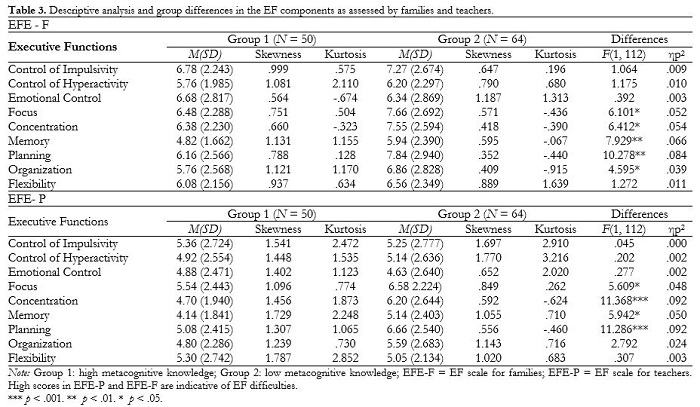
<body><![CDATA[<p><font face="Verdana" size="2">This study was carried out in accordance with the Declaration of Helsinki (Williams, 2008), which includes the ethical principles for research with human beings. Once the study was submitted to the school directors, we obtained their authorization and the informed consent of the families, after which we collected the data. The questionnaires were administered to the students collectively in a regular class session (approximately 50 minutes). Students' participation was voluntary, bearing in mind at all times their anonymity and the confidentiality of their data. The EF questionnaires were handed out to the tutors, who in addition to completing their own questionnaires, were responsible for the delivery and collection of the questionnaires administered to the families. The families completed the questionnaires in their homes. Instructions on how to complete the scales were provided along with the questionnaires. Only those questionnaires that had both the completed forms (families and teachers) were considered in this study.</font></p>     <p><font face="Verdana" size="2"><b>Data Analysis</b></font></p>     <p><font face="Verdana" size="2">In this work, a comparative cross-sectional design was used (Ato, Lopez, &amp; Benavente, 2013). In view of our goals, we decided to perform multivariate analysis of variance (MANOVA) in order to analyze the differences between the groups with different metacognitive knowledge: metacognitive skills (planning, execution, and evaluation phases), and the nine EF components as appraised by families and teachers.</font></p>     <p><font face="Verdana" size="2">We used the SPSS 19.0 program for the statistical processing of the data. The differences were statistically significant at a level of <i>p</i><u>&lt;</u>. 05. Taking into account the need to know the practical significance in addition to the statistical significance of the differences, an indicator of the effect size was included (Ato et al., 2013). For this purpose, we used Cohen's (1988) criterion according to which the effect is small when <i>&#951;p</i><sup>2</sup> = .01 (<i>d</i> = .20), medium when <i>&#951;p</i><sup>2</sup> = .059 (<i>d</i> = .50), and high when <i>&#951;p</i><sup>2</sup> = .138 (<i>d</i> = .80). Finally, given that the present study is based on the analysis of the differences between two groups, along with the means and the analysis of their differences, the values of skewness and kurtosis were obtained separately for each group and analyzed variable (Tables <a href="#t2">2</a> and <a href="#t3">3</a>). Finney and Di Stefano's (2006) criterion was used to check the suitability of these values. According to this criterion, ±2 and ±7 are acceptable maximum values of skewness and kurtosis to use parametric analysis. The variables in this study met this condition (Tables <a href="#t2">2</a> and <a href="#t3">3</a>).</font></p>     <p>&nbsp;</p>     <p align="center"><font face="Verdana" size="2"><a name="t2"><img src="/img/revistas/ap/v32n2/psicologia_evolutiva3_tab02.jpg"></a></font></p>     <p>&nbsp;</p>     <p align="center"><font face="Verdana" size="2"><a name="t3"><img src="/img/revistas/ap/v32n2/psicologia_evolutiva3_tab03.jpg"></a></font></p>     <p>&nbsp;</p>     <p><font face="Verdana" size="2"><b>Results</b></font></p>     ]]></body>
<body><![CDATA[<p><font face="Verdana" size="2"><b>Differences in metacognitive skills between groups with high and low metacognitive knowledge</b></font></p>     <p><font face="Verdana" size="2"><a href="#t2">Table 2</a> shows the means of the students with different levels of metacognitive knowledge (high vs. low) in the use of metacognitive strategies during different phases of selfregulated learning. These means indicated that the students in the group with high metacognitive knowledge reported using these strategies more frequently and systematically in all phases. In this sense, the MANOVA carried out confirmed the existence of statistically significant group differences in the set of above-mentioned variables, <i>Wilks' Lambda</i> = .873, <i>F</i>(3, 110) = 5.333, <i>p</i> &lt; .001, <i>&#951;p</i><sup>2</sup> = .127. This analysis also revealed that Planning (<i>p</i> &lt; .001) and Execution (<i>p</i> &lt; .01) were the phases in which these differences were found, mainly in the former, with a considerably larger effect size. In terms of the Assessment phase, we found no statistically significant group differences (<i>p</i> = .25).</font></p>     <p><font face="Verdana" size="2">Taking into account the means of both groups in these variables, we observed infrequent use of metacognitive skills in the phases of Assessment, and above all in Planning (with a mean close to 8, when the maximum for this subscale score can reach 20), whereas the use of these strategies was much more frequent in the Execution phase.</font></p>     <p><font face="Verdana" size="2"><b>Differences in Executive Functioning (assessed by families and teachers) between groups with high and low metacognitive knowledge</b></font></p>     <p><font face="Verdana" size="2">The means of both groups in the EF variables as assessed by families and teachers are shown in <a href="#t3">Table 3</a>. In general, students with high metacognitive knowledge were assessed more positively by their families and teachers (reporting a lower EF deficit) than the group with low metacognitive knowledge. This can be observed attending to the means obtained in the EF components, which are lower in the former group in most cases. Only in the components of Control of Impulsivity, Emotional Control, and Flexibility as assessed by teachers was a different pattern found, with slightly higher means in the group with high knowledge of metacognitive strategies.</font></p>     <p><font face="Verdana" size="2">The MANOVAs carried out revealed the existence of statistically significant group differences in the set of the assessed EFs, both when the informants were the families, <i>Wilks' Lambda</i> = .826, <i>F</i>(9, 104) = 2.438, <i>p</i> = .015; <i>&#951;p</i><sup>2</sup> = .174, and when the they were the teachers, <i>Wilks' Lambda</i> = .807, <i>F</i>(9, 104) = 2.766, <i>p</i> = .006, <i>&#951;p</i><sup>2</sup> = .193. Statistically significant differences were found in both forms of the scale on the components Focal Attention, Sustained Attention, Memory, and Planning. Statistically significant differences were also found in the component of Organization on the scale for families but with a smaller effect size. The Planning component presented the biggest effect size using both scales.</font></p>     <p><font face="Verdana" size="2">Again taking into account the means of both groups, it can be observed that the means of the questionnaire completed by the teachers were lower than those completed by the families in all of the assessed components, which indicates that the teachers reported better EF (e.g., lower deficit) in the students. In both cases, however, the means indicated an absence of major difficulties in the assessed behaviors. In this sense, although the maximum score in each component is 15, the means ranged from 4.82 to 7.84 in the questionnaire completed by the families and from 4.14 to 6.66 in the one completed by the teachers.</font></p>     <p>&nbsp;</p>     <p><font face="Verdana" size="2"><b>Discussion and conclusions</b></font></p>     <p><font face="Verdana" size="2">The goal of this work was to analyze the differences in metacognitive skills and EF between two groups of students from the Third Cycle of Primary Education (10-12 years) with different levels of metacognitive knowledge (high vs. low). The results are discussed below in relation to the goals and hypotheses:</font></p>     ]]></body>
<body><![CDATA[<p><font face="Verdana" size="2"><b>Differences in metacognitive skills between groups with high and low metacognitive knowledge</b></font></p>     <p><font face="Verdana" size="2">Firstly, students with high metacognitive knowledge reported using metacognitive strategies analyzed more frequently in the phases of planning, execution, and assessment. In this regard, greater metacognitive knowledge was related to better metacognitive skills, which is consistent with previous studies such as that of Blöte et al. (2004), Pennequin, Sorel, and Mainguy (2010), and Weil et al. (2013), indicating that metacognitive knowledge is prior to metacognitive skills and an important precursor to their development. These differences were statistically significant in the planning and execution phases, but not in the phase of assessment of learning.</font></p>     <p><font face="Verdana" size="2">Related to the latter result, a notable aspect is the fact that, considering the scores of both groups on the metacognitive skills scale, the students generally reported using these metacognitive skills more frequently in the execution phase, in contrast to the assessment phase and, particularly, to the planning phase. This prominence of the use of strategies in the execution phase and their lower use in assessment and planning is in line with previous studies suggesting that students of these ages (final courses of Primary Education) are mainly "executive" in the sense that they spend most of their efforts on task execution, rather than on designing a prior plan and on the subsequent evaluation of their results (Cleary &amp; Chen, 2009; Kramarski &amp; Gutman, 2006; Montague, Enders, &amp; Dietz, 2011). These works show that many students tend to display poor metacognitive skills in learning situations, acting directly, responding impulsively, and using the same strategy over and over even when it is inappropriate, which often leads them to using strategies of trial and error. This profile observed in the total sample may explain why, despite some differences between the two groups in the use of metacognitive strategies in the assessment phase (although they were not as pronounced as in the planning phase), they did not reach statistical significance. Another possible explanation for the absence of significant differences in this respect could be due to the possibility that students in general have difficulties recognizing the appropriate type of strategies for this phase, which would make it more difficult for them to decide whether or not to apply them. It would be necessary to study this in more depth in future studies.</font></p>     <p><font face="Verdana" size="2">These results, taken as a whole, indicate the existence of a relationship between metacognitive knowledge and skills, as well as the need to promote development of both components from an early age in two ways: firstly, to promote a good understanding of metacognitive strategies as a basis for the further development of metacognitive skills; and secondly, directly influencing the application of this knowledge in real tasks. Intervention strategies of self-regulated learning have been shown to be beneficial in two ways, primarily for students with learning difficulties or low academic achievement (González-Pienda, Fernández, Bernardo, Núñez, &amp; Rosário, 2014; Moos &amp; Ringdal, 2012; Stoeger &amp; Ziegler, 2008).</font></p>     <p><font face="Verdana" size="2"><b>Differences in EF (assessed by families and teachers) between groups with high and low metacognitive knowledge</b></font></p>     <p><font face="Verdana" size="2">Regarding the second issue raised in this study, the findings indicated that, although the students did not present major EF difficulties either when they were assessed by their families or by their teachers, both informants generally attributed better EF performance to the group with high metacognitive knowledge. The differences between the groups were found mainly in focal attention, sustained attention, functional memory and planning in both versions of the scale, as well as in capacity of organization in the case of the form administered to the families. In this sense, high metacognitive knowledge was related to better executive control skills (or lower deficit) in the assessed components.</font></p>     <p><font face="Verdana" size="2">It is, however, noteworthy that there were statistically significant differences in response inhibition and cognitive flexibility, which had been found in previous studies (Corso et al., 2013; Garner, 2009; Kuhn &amp; Pease, 2010; Meltzer, 2013; Pennequin, Sorel, &amp; Mainguy, 2010; Schneider, 2010). A possible explanation of this is linked to the type of assessment measures of EF mainly employed in previous studies, based on the performance of different executive tasks. These measures have been described by some authors as somewhat unspecific in the sense that different functions can intervene in the correct execution of a task (Burin et al., 2007; Chevignard, et al., 2010; Lee, 2011; Lezak et al., 2012). In the present study, the use of behavior rating scales seems to support the distinction proposed by several authors between the socalled <i>hot</i> and <i>cool functions</i> (Brock, Rimm-Kaufman, &amp; Nathanson, 2009; Zelazo &amp; Carlson, 2012). Hot functions deal with emotional information, including components such as impulse control, the interpretation of bodily signals, decision-making, and recognizing another person's perspective, and are more closely related to the individual's social functioning. Cool functions perform a more rational treatment of information and are related to reasoning and abstract information processing, such as the working memory, planning, conceptualization, and categorization, among others. These functions are more closely related to aspects of learning and to knowledge of metacognitive strategies. Therefore, these are the functions that generated the statistically significant differences between the groups in the present study.</font></p>     <p><font face="Verdana" size="2">These results again reveal the existence of a relationship between specific EF skills and metacognition, at least with regard to the component of metacognitive knowledge. In this sense, both components (EF and metacognition) are related insofar as they involve components of planning, organization, memory, and attention. But for authors like Roebers et al. (2012), this relationship could be partly explained from an evolutionary point of view (these authors argue that progress in EFs during childhood and adolescence is accompanied by the development of a better understanding and control of one's own learning processes), and the results obtained in this study do not allow us to determine the direction of this relationship. In any case, promoting progress in one component (metacognition or EFs) would benefit the development of the other component. However, although numerous works focus on promoting the development of the metacognitive components at school ages, interventions in EF have been carried out mainly in clinical settings. Taking into account the implications that functions like those analyzed in this study have on students' school learning and behavioral control (García, González-Castro, Areces, Cueli, &amp; Rodríguez, 2014; Marcovitch &amp; Zelazo, 2009; Van De Voorde et al., 2010), it becomes increasingly necessary to generalize these aspects of the intervention to new contexts, like the educational setting or the family.</font></p>     <p><font face="Verdana" size="2">Finally, although the correspondence between information provided by families and teachers in the EF scales was moderate (<a href="#t1">Table 1</a>), in line with previous studies in this field (papageorgiou, Kalyva, Dafoulis, &amp; Vostanis, 2008; Rettew et al., 2011; Salbach-Andrae et al., 2009), data from this study have shown that, when students are classified according to an external criterion (in this case, assignment to a group according to the number of correct answers given in the CEA metacognitive knowledge questionnaire), the information provided by families and teachers tends to converge. Therefore, these results indicate the desirability of having several informants when the assessment consists of behavioral observation.</font></p>     <p><font face="Verdana" size="2">Finally, there are a number of limitations in the present study that should be taken into account. First, the sample size imposes certain restrictions on the generalization of the results obtained. Likewise, along with a larger sample, it would be interesting to establish more extreme levels to assign the participants to the different groups. Although percentile 50 was used as a cut-off point in this study, levels like percentile 25 or 75 may achieve a clearer pattern of significant differences. Secondly, the type of assessment of the metacognitive skills employed must be taken into account. Although these components are usually assessed with selfreports, as in the present study, many authors indicate that the use of other types of measures, based on the analysis of the process, would be more appropriate to assess this type of procedural and strategic components (Azevedo &amp; Aleven, 2013; Lazakidou &amp; Retalis, 2010; Veenman, 2011). These methods, like the Think-aloud protocols (Montague et al., 2011) or the Triple Task and its variants (piolat, Kellogg, &amp; Farioli, 2001; Piolat, Olive, &amp; Kellogg, 2005), are based on the collection of data concurrent to the execution of a cognitive task and are complementary to the use of questionnaires. Thirdly, and after solving the above limitations, another aspect to consider is the appropriateness of extending this study by analyzing the relationship between EF and the metacognitive skills component. This would allow us to more accurately determine the relationship between EF and metacognition. Fourthly, although this study has shown the relevance of certain EF skills-such as attention, planning, memory, or the ability to organize-with regard to metacognitive knowledge, the results obtained do not allow us to determine whether EF explains the development of metacognitive knowledge or vice versa, or whether other variables such as the type of instructional method affect this relationship. Finally, as previous studies have reported that the components of metacognition and EF are related to academic performance in various areas such as mathematics or language, it would be of great interest to include some kind of indicator of these subjects in future studies This would enable us to determine the relationship between the two components and whether this relationship influences performance in different curriculum areas.</font></p>     ]]></body>
<body><![CDATA[<p>&nbsp;</p>     <p><font face="Verdana" size="2"><b>References</b></font></p>     <!-- ref --><p><font face="Verdana" size="2">1. Achenbach, T. M. (1991). Integrative guide for the 1991 CBCL/4-18, YSR and TRF profiles. Burlington, VT: Department of Psychiatry, University of Vermont.    &nbsp;&nbsp;&nbsp;&nbsp;&nbsp;&nbsp;&nbsp;&nbsp;[&#160;<a href="javascript:void(0);" onclick="javascript: window.open('/scielo.php?script=sci_nlinks&ref=759738&pid=S0212-9728201600020002000001&lng=','','width=640,height=500,resizable=yes,scrollbars=1,menubar=yes,');">Links</a>&#160;]<!-- end-ref --></font></p>    <!-- ref --><p><font face="Verdana" size="2">2. Anderson, V. M., Jacobs, R., &amp; Anderson, P. (2008). Executive functions and the frontal lobes: A lifespan perspective. New York: Taylor &amp; Francis.    &nbsp;&nbsp;&nbsp;&nbsp;&nbsp;&nbsp;&nbsp;&nbsp;[&#160;<a href="javascript:void(0);" onclick="javascript: window.open('/scielo.php?script=sci_nlinks&ref=759740&pid=S0212-9728201600020002000002&lng=','','width=640,height=500,resizable=yes,scrollbars=1,menubar=yes,');">Links</a>&#160;]<!-- end-ref --></font></p>    <!-- ref --><p><font face="Verdana" size="2">3. Ato, M., López, J. J., &amp; Benavente, A. (2013). Un sistema de clasificación de los diseños de investigación en psicología (A classification system of research designs in psychology). Anales de Psicología, 29(3), 1038-1059. doi: 10.6018/analesps.29.3.178511.    &nbsp;&nbsp;&nbsp;&nbsp;&nbsp;&nbsp;&nbsp;&nbsp;[&#160;<a href="javascript:void(0);" onclick="javascript: window.open('/scielo.php?script=sci_nlinks&ref=759742&pid=S0212-9728201600020002000003&lng=','','width=640,height=500,resizable=yes,scrollbars=1,menubar=yes,');">Links</a>&#160;]<!-- end-ref --></font></p>    <!-- ref --><p><font face="Verdana" size="2">4. Azevedo, R., &amp; Aleven, V. (2013). International handbook of metacognition and learning technologies. Springer International Handbooks of Education, 28. doi: 10.1007/978-1-4419-3_11. New York: Springer.    &nbsp;&nbsp;&nbsp;&nbsp;&nbsp;&nbsp;&nbsp;&nbsp;[&#160;<a href="javascript:void(0);" onclick="javascript: window.open('/scielo.php?script=sci_nlinks&ref=759744&pid=S0212-9728201600020002000004&lng=','','width=640,height=500,resizable=yes,scrollbars=1,menubar=yes,');">Links</a>&#160;]<!-- end-ref --></font></p>    ]]></body>
<body><![CDATA[<!-- ref --><p><font face="Verdana" size="2">5. Barkley, R. A. (2012). Barkley Deficits in Executive Functioning Scale - Children and Adolescents (BDEFS-CA). New York, NY: The Guilford Press.    &nbsp;&nbsp;&nbsp;&nbsp;&nbsp;&nbsp;&nbsp;&nbsp;[&#160;<a href="javascript:void(0);" onclick="javascript: window.open('/scielo.php?script=sci_nlinks&ref=759746&pid=S0212-9728201600020002000005&lng=','','width=640,height=500,resizable=yes,scrollbars=1,menubar=yes,');">Links</a>&#160;]<!-- end-ref --></font></p>    <!-- ref --><p><font face="Verdana" size="2">6. Bishop, T. L. (2011). Relationship between performance-based measures of executive function and the Behavior Rating Inventory of Executive Function (BRIEF), a parent rating measure. Dissertation Abstracts International: Section B: The Sciences and Engineering 72(1-B), 522.    &nbsp;&nbsp;&nbsp;&nbsp;&nbsp;&nbsp;&nbsp;&nbsp;[&#160;<a href="javascript:void(0);" onclick="javascript: window.open('/scielo.php?script=sci_nlinks&ref=759748&pid=S0212-9728201600020002000006&lng=','','width=640,height=500,resizable=yes,scrollbars=1,menubar=yes,');">Links</a>&#160;]<!-- end-ref --></font></p>    <!-- ref --><p><font face="Verdana" size="2">7. Blöte, A. W., Van Otterloo, S. G., van Stevenson, C. E., &amp; Veenman, M. V. J. (2004). Discovery and maintenance of the many-to-one counting strategy in 4-year-olds: A microgenetic study. British Journal of Developmental Psychology, 22, 83-102.    &nbsp;&nbsp;&nbsp;&nbsp;&nbsp;&nbsp;&nbsp;&nbsp;[&#160;<a href="javascript:void(0);" onclick="javascript: window.open('/scielo.php?script=sci_nlinks&ref=759750&pid=S0212-9728201600020002000007&lng=','','width=640,height=500,resizable=yes,scrollbars=1,menubar=yes,');">Links</a>&#160;]<!-- end-ref --></font></p>    <!-- ref --><p><font face="Verdana" size="2">8. Borys, S. V., Spitz, H. H., &amp; Dorans, B. A. (1982). Tower of Hanoi performance of retarded young adults and nonretarded children as a function of solution length and goal state. Journal of Experimental Child Psychology, 33, 87-110.    &nbsp;&nbsp;&nbsp;&nbsp;&nbsp;&nbsp;&nbsp;&nbsp;[&#160;<a href="javascript:void(0);" onclick="javascript: window.open('/scielo.php?script=sci_nlinks&ref=759752&pid=S0212-9728201600020002000008&lng=','','width=640,height=500,resizable=yes,scrollbars=1,menubar=yes,');">Links</a>&#160;]<!-- end-ref --></font></p>    <!-- ref --><p><font face="Verdana" size="2">9. Brock, L. L., Rimm-Kaufman, S. E., &amp; Nathanson, L. (2009). The contributions of "hot" and "cool" executive function to children's academic achievement and learning-related behaviors, and engagement in kindergarten. Early Childhood Research Quarterly, 24(3), 337-349.    &nbsp;&nbsp;&nbsp;&nbsp;&nbsp;&nbsp;&nbsp;&nbsp;[&#160;<a href="javascript:void(0);" onclick="javascript: window.open('/scielo.php?script=sci_nlinks&ref=759754&pid=S0212-9728201600020002000009&lng=','','width=640,height=500,resizable=yes,scrollbars=1,menubar=yes,');">Links</a>&#160;]<!-- end-ref --></font></p>    ]]></body>
<body><![CDATA[<!-- ref --><p><font face="Verdana" size="2">10. Burin, D. I., Drake, M., &amp; Harris, P. (2007). Evaluación de la atención. In D. I. Burin, M. Drake, &amp; P. Harris (Eds.), Evaluación Neuropsicológica en adultos (Neuropsychological assessment in adults)(pp. 146-147). Buenos Aires: Paidós.    &nbsp;&nbsp;&nbsp;&nbsp;&nbsp;&nbsp;&nbsp;&nbsp;[&#160;<a href="javascript:void(0);" onclick="javascript: window.open('/scielo.php?script=sci_nlinks&ref=759756&pid=S0212-9728201600020002000010&lng=','','width=640,height=500,resizable=yes,scrollbars=1,menubar=yes,');">Links</a>&#160;]<!-- end-ref --></font></p>    <!-- ref --><p><font face="Verdana" size="2">11. Casal, J., &amp; Mateu, E. (2003). Tipos de muestreo (Types of sampling). Revista de Epidemiología y Medicina preventiva, 1, 3-7.    &nbsp;&nbsp;&nbsp;&nbsp;&nbsp;&nbsp;&nbsp;&nbsp;[&#160;<a href="javascript:void(0);" onclick="javascript: window.open('/scielo.php?script=sci_nlinks&ref=759758&pid=S0212-9728201600020002000011&lng=','','width=640,height=500,resizable=yes,scrollbars=1,menubar=yes,');">Links</a>&#160;]<!-- end-ref --></font></p>    <!-- ref --><p><font face="Verdana" size="2">12. Chevignard, M. P., Catroppa, C., Galvin, J., &amp; Anderson, V. (2010). Development and evaluation of an ecological task to assess executive functioning post childhood TBI: The Children's Cooking Task. Brain Impairment, 11(2), 125-143. doi: http://dx.doi.org/10.1375/brim.11.2.125.    &nbsp;&nbsp;&nbsp;&nbsp;&nbsp;&nbsp;&nbsp;&nbsp;[&#160;<a href="javascript:void(0);" onclick="javascript: window.open('/scielo.php?script=sci_nlinks&ref=759760&pid=S0212-9728201600020002000012&lng=','','width=640,height=500,resizable=yes,scrollbars=1,menubar=yes,');">Links</a>&#160;]<!-- end-ref --></font></p>    <!-- ref --><p><font face="Verdana" size="2">13. Cleary, T. J., &amp; Chen, P. P. (2009). Self-regulation, motivation, and math achievement in middle school: Variations across grade level and math context. Journal of School Psychology, 47(5), 291-314.    &nbsp;&nbsp;&nbsp;&nbsp;&nbsp;&nbsp;&nbsp;&nbsp;[&#160;<a href="javascript:void(0);" onclick="javascript: window.open('/scielo.php?script=sci_nlinks&ref=759762&pid=S0212-9728201600020002000013&lng=','','width=640,height=500,resizable=yes,scrollbars=1,menubar=yes,');">Links</a>&#160;]<!-- end-ref --></font></p>    <!-- ref --><p><font face="Verdana" size="2">14. Cohen, J. (1988). Statistical power analysis for the behavioral sciences (2<sup>nd</sup> ed.). Hillsdale, NJ: Erlbaum.    &nbsp;&nbsp;&nbsp;&nbsp;&nbsp;&nbsp;&nbsp;&nbsp;[&#160;<a href="javascript:void(0);" onclick="javascript: window.open('/scielo.php?script=sci_nlinks&ref=759764&pid=S0212-9728201600020002000014&lng=','','width=640,height=500,resizable=yes,scrollbars=1,menubar=yes,');">Links</a>&#160;]<!-- end-ref --></font></p>    ]]></body>
<body><![CDATA[<!-- ref --><p><font face="Verdana" size="2">15. Corso, H. V, Sperb, T. M., Inchausti de Jou, G., &amp; Fumagalli, J. (2013). Metacognition and executive functions: Relationships between concepts and implications for learning. Psicología: Teoria e Pesquisa, 29(1), 21-29. doi: http://dx.doi.org/10.1590/S0102-37722013000100004.    &nbsp;&nbsp;&nbsp;&nbsp;&nbsp;&nbsp;&nbsp;&nbsp;[&#160;<a href="javascript:void(0);" onclick="javascript: window.open('/scielo.php?script=sci_nlinks&ref=759766&pid=S0212-9728201600020002000015&lng=','','width=640,height=500,resizable=yes,scrollbars=1,menubar=yes,');">Links</a>&#160;]<!-- end-ref --></font></p>    <!-- ref --><p><font face="Verdana" size="2">16. Diamond, A. (2013). Executive functions. Annual Review of Psychology, 64, 135-168. doi: 10.1146/annurev-psych-113011-143750.    &nbsp;&nbsp;&nbsp;&nbsp;&nbsp;&nbsp;&nbsp;&nbsp;[&#160;<a href="javascript:void(0);" onclick="javascript: window.open('/scielo.php?script=sci_nlinks&ref=759768&pid=S0212-9728201600020002000016&lng=','','width=640,height=500,resizable=yes,scrollbars=1,menubar=yes,');">Links</a>&#160;]<!-- end-ref --></font></p>    <!-- ref --><p><font face="Verdana" size="2">17. Díaz, A., Martín, R., Jiménez, J. E., García, E., Hernández, S., &amp; Rodríguez, C. (2012). Torre de Hanoi: datos normativos y desarrollo evolutivo de la planificación (Hanoi Tower: normative data and evolutionary development of planning). European Journal of Education and Psychology, 5(1), 79-91.    &nbsp;&nbsp;&nbsp;&nbsp;&nbsp;&nbsp;&nbsp;&nbsp;[&#160;<a href="javascript:void(0);" onclick="javascript: window.open('/scielo.php?script=sci_nlinks&ref=759770&pid=S0212-9728201600020002000017&lng=','','width=640,height=500,resizable=yes,scrollbars=1,menubar=yes,');">Links</a>&#160;]<!-- end-ref --></font></p>    <!-- ref --><p><font face="Verdana" size="2">18. Egeland, J., &amp; Fallmyr, &#216;. (2010). Confirmatory factor analysis of the Behavior Rating Inventory of Executive Function (BRIEF): Support for a distinction between emotional and behavioral regulation. Child Neuropsychology, 16(4), 326-37. doi: 10.1080/09297041003601462.    &nbsp;&nbsp;&nbsp;&nbsp;&nbsp;&nbsp;&nbsp;&nbsp;[&#160;<a href="javascript:void(0);" onclick="javascript: window.open('/scielo.php?script=sci_nlinks&ref=759772&pid=S0212-9728201600020002000018&lng=','','width=640,height=500,resizable=yes,scrollbars=1,menubar=yes,');">Links</a>&#160;]<!-- end-ref --></font></p>    <!-- ref --><p><font face="Verdana" size="2">19. Finney, S. J., &amp; DiStefano, C. (2006). Non-normal and categorical data in structural equation modeling. In G.R. Hancock &amp; R.O. Muller (Eds.), Structural equation modeling: A second course (pp. 269-314). Greenwich, CT: Information Age.    &nbsp;&nbsp;&nbsp;&nbsp;&nbsp;&nbsp;&nbsp;&nbsp;[&#160;<a href="javascript:void(0);" onclick="javascript: window.open('/scielo.php?script=sci_nlinks&ref=759774&pid=S0212-9728201600020002000019&lng=','','width=640,height=500,resizable=yes,scrollbars=1,menubar=yes,');">Links</a>&#160;]<!-- end-ref --></font></p>    ]]></body>
<body><![CDATA[<!-- ref --><p><font face="Verdana" size="2">20. Flavell, J. H. (1979). Metacognition and cognitive monitoring. American Psychologist, 34, 906-911.    &nbsp;&nbsp;&nbsp;&nbsp;&nbsp;&nbsp;&nbsp;&nbsp;[&#160;<a href="javascript:void(0);" onclick="javascript: window.open('/scielo.php?script=sci_nlinks&ref=759776&pid=S0212-9728201600020002000020&lng=','','width=640,height=500,resizable=yes,scrollbars=1,menubar=yes,');">Links</a>&#160;]<!-- end-ref --></font></p>    <!-- ref --><p><font face="Verdana" size="2">21. Flores-Lázaro, J. C., Castillo-Preciado, R. E., &amp; Jiménez-Miramonte, N. A. (2014). Desarrollo de funciones ejecutivas, de la niñez a la juventud (Development of executive functions, from childhood to youth). Anales de Psicología, 30(2), 463-473. doi: http://dx.doi.org/10.6018/analesps.30.2.155471.    &nbsp;&nbsp;&nbsp;&nbsp;&nbsp;&nbsp;&nbsp;&nbsp;[&#160;<a href="javascript:void(0);" onclick="javascript: window.open('/scielo.php?script=sci_nlinks&ref=759778&pid=S0212-9728201600020002000021&lng=','','width=640,height=500,resizable=yes,scrollbars=1,menubar=yes,');">Links</a>&#160;]<!-- end-ref --></font></p>    <!-- ref --><p><font face="Verdana" size="2">22. García, T., Álvarez-García, D., Cueli, M., González-Castro, P. &amp; Álvarez (2013) . Propiedades psicométricas de la Escala de Funcionamiento Ejecutivo para Familias (Psychometric properties of the Executive Functioning Scale for Families). Submittedfor publication.    &nbsp;&nbsp;&nbsp;&nbsp;&nbsp;&nbsp;&nbsp;&nbsp;[&#160;<a href="javascript:void(0);" onclick="javascript: window.open('/scielo.php?script=sci_nlinks&ref=759780&pid=S0212-9728201600020002000022&lng=','','width=640,height=500,resizable=yes,scrollbars=1,menubar=yes,');">Links</a>&#160;]<!-- end-ref --></font></p>    <!-- ref --><p><font face="Verdana" size="2">23. García, T., Álvarez-García, D., González-Castro, P., Álvarez, L., &amp; Segurola, L. A. (2014). Propiedades psicométricas de la Escala de Funcionamiento Ejecutivo para Profesorado (Psychometric properties of the Executive Functioning Scale for Teachers). Revista de Psicología y Educación, 9(1), 49-69.    &nbsp;&nbsp;&nbsp;&nbsp;&nbsp;&nbsp;&nbsp;&nbsp;[&#160;<a href="javascript:void(0);" onclick="javascript: window.open('/scielo.php?script=sci_nlinks&ref=759782&pid=S0212-9728201600020002000023&lng=','','width=640,height=500,resizable=yes,scrollbars=1,menubar=yes,');">Links</a>&#160;]<!-- end-ref --></font></p>    <!-- ref --><p><font face="Verdana" size="2">24. García, T., González-Castro, P., Areces, D., Cueli, M., &amp; Rodríguez, C. (2014) . Executive functions in children and adolescents: The types of assessment measures used and implications for their validity in clinical and educational contexts. Papeles del Psicólogo, 35(3), 215-223.    &nbsp;&nbsp;&nbsp;&nbsp;&nbsp;&nbsp;&nbsp;&nbsp;[&#160;<a href="javascript:void(0);" onclick="javascript: window.open('/scielo.php?script=sci_nlinks&ref=759784&pid=S0212-9728201600020002000024&lng=','','width=640,height=500,resizable=yes,scrollbars=1,menubar=yes,');">Links</a>&#160;]<!-- end-ref --></font></p>    ]]></body>
<body><![CDATA[<!-- ref --><p><font face="Verdana" size="2">25. García, T., Rodríguez, C., González-Castro, P., Álvarez, D., Cueli, M., &amp; González-Pienda, J. A. (2013). Executive functioning in children and adolescents with Attention Deficit Hyperactivity Disorder and reading disabilities. International Journal of Psychology &amp; Psychological Therapy, 13(2), 179-194.    &nbsp;&nbsp;&nbsp;&nbsp;&nbsp;&nbsp;&nbsp;&nbsp;[&#160;<a href="javascript:void(0);" onclick="javascript: window.open('/scielo.php?script=sci_nlinks&ref=759786&pid=S0212-9728201600020002000025&lng=','','width=640,height=500,resizable=yes,scrollbars=1,menubar=yes,');">Links</a>&#160;]<!-- end-ref --></font></p>    <!-- ref --><p><font face="Verdana" size="2">26. Garner, J. K. (2009). Conceptualizing the relations between executive functions and self-regulated learning. Journal of Psychology, 143(4), 405-426. doi:10.3200/JRLP.143.4.405-426.    &nbsp;&nbsp;&nbsp;&nbsp;&nbsp;&nbsp;&nbsp;&nbsp;[&#160;<a href="javascript:void(0);" onclick="javascript: window.open('/scielo.php?script=sci_nlinks&ref=759788&pid=S0212-9728201600020002000026&lng=','','width=640,height=500,resizable=yes,scrollbars=1,menubar=yes,');">Links</a>&#160;]<!-- end-ref --></font></p>    <!-- ref --><p><font face="Verdana" size="2">27. Gioia, G. A., Isquith, P. K., Guy, S., &amp; Kenworthy, L. (2000). BRIEF: Behavior Rating Inventory of Executive Function professional manual. Lutz, FL: Psychological Assessment Resources.    &nbsp;&nbsp;&nbsp;&nbsp;&nbsp;&nbsp;&nbsp;&nbsp;[&#160;<a href="javascript:void(0);" onclick="javascript: window.open('/scielo.php?script=sci_nlinks&ref=759790&pid=S0212-9728201600020002000027&lng=','','width=640,height=500,resizable=yes,scrollbars=1,menubar=yes,');">Links</a>&#160;]<!-- end-ref --></font></p>    <!-- ref --><p><font face="Verdana" size="2">28. Gioia, G. A., Kenworthy, L., &amp; Isquith, P. K. (2010). Executive function in the real world: BRIEF lessons from Mark Ylvisaker. Journal of Head Trauma Rehabilitation, 25(6), 433-439. doi: 10.1097/HTR.0b013e3181fbc272.    &nbsp;&nbsp;&nbsp;&nbsp;&nbsp;&nbsp;&nbsp;&nbsp;[&#160;<a href="javascript:void(0);" onclick="javascript: window.open('/scielo.php?script=sci_nlinks&ref=759792&pid=S0212-9728201600020002000028&lng=','','width=640,height=500,resizable=yes,scrollbars=1,menubar=yes,');">Links</a>&#160;]<!-- end-ref --></font></p>    <!-- ref --><p><font face="Verdana" size="2">29. González-Pienda, J. A., Fernández, E., Bernardo, A. B., Núñez, J. C., &amp; Rosário, P. (2014). Assessment of a self-regulated learning intervention. The Spanish Journal of Psychology, 17, 1-9. doi: http://dx.doi.org/10.1017/sjp.2014.12.    &nbsp;&nbsp;&nbsp;&nbsp;&nbsp;&nbsp;&nbsp;&nbsp;[&#160;<a href="javascript:void(0);" onclick="javascript: window.open('/scielo.php?script=sci_nlinks&ref=759794&pid=S0212-9728201600020002000029&lng=','','width=640,height=500,resizable=yes,scrollbars=1,menubar=yes,');">Links</a>&#160;]<!-- end-ref --></font></p>    ]]></body>
<body><![CDATA[<!-- ref --><p><font face="Verdana" size="2">30. Korzeniowski, C. G. (2011). Desarrollo evolutivo del funcionamiento ejecutivo y su relación con el aprendizaje escolar (Evolutionary development of executive functioning and its relationship to school Learning). Revista de Psicología, 7(13), 7-26.    &nbsp;&nbsp;&nbsp;&nbsp;&nbsp;&nbsp;&nbsp;&nbsp;[&#160;<a href="javascript:void(0);" onclick="javascript: window.open('/scielo.php?script=sci_nlinks&ref=759796&pid=S0212-9728201600020002000030&lng=','','width=640,height=500,resizable=yes,scrollbars=1,menubar=yes,');">Links</a>&#160;]<!-- end-ref --></font></p>    <!-- ref --><p><font face="Verdana" size="2">31. Kramarski, B., &amp; Gutman, M. (2006). How can self-regulated learning be supported in mathematical E-learning environments? Journal of Computer Assisted Learning 22, 24-33. doi: 10.1111/j.1365-2729.2006.00157.x.    &nbsp;&nbsp;&nbsp;&nbsp;&nbsp;&nbsp;&nbsp;&nbsp;[&#160;<a href="javascript:void(0);" onclick="javascript: window.open('/scielo.php?script=sci_nlinks&ref=759798&pid=S0212-9728201600020002000031&lng=','','width=640,height=500,resizable=yes,scrollbars=1,menubar=yes,');">Links</a>&#160;]<!-- end-ref --></font></p>    <!-- ref --><p><font face="Verdana" size="2">32. Kuhn, D., &amp; Pease, M. (2010). The dual components of developing strategy use: Production and inhibition. In H. S. Waters &amp; W. Schneider (Eds.). Metacognition strategy use and instruction (pp. 135-159). New York, NY: Guilford Press.    &nbsp;&nbsp;&nbsp;&nbsp;&nbsp;&nbsp;&nbsp;&nbsp;[&#160;<a href="javascript:void(0);" onclick="javascript: window.open('/scielo.php?script=sci_nlinks&ref=759800&pid=S0212-9728201600020002000032&lng=','','width=640,height=500,resizable=yes,scrollbars=1,menubar=yes,');">Links</a>&#160;]<!-- end-ref --></font></p>    <!-- ref --><p><font face="Verdana" size="2">33. Lazakidou, G., &amp; Retalis, S. (2010). Using computer supported collaborative learning strategies for helping students acquire self-regulated problem-solving skills in mathematics. Computers and Education 54, 3-13. doi:10.1016/j.compedu.2009.02.020.    &nbsp;&nbsp;&nbsp;&nbsp;&nbsp;&nbsp;&nbsp;&nbsp;[&#160;<a href="javascript:void(0);" onclick="javascript: window.open('/scielo.php?script=sci_nlinks&ref=759802&pid=S0212-9728201600020002000033&lng=','','width=640,height=500,resizable=yes,scrollbars=1,menubar=yes,');">Links</a>&#160;]<!-- end-ref --></font></p>    <!-- ref --><p><font face="Verdana" size="2">34. Lee, E. (2011). An exploratory analysis of the ecological validity of a performance-based assessment of attention. Dissertation Abstracts International: Section B: The Sciences and Engineering, 71(9-B), 5777.    &nbsp;&nbsp;&nbsp;&nbsp;&nbsp;&nbsp;&nbsp;&nbsp;[&#160;<a href="javascript:void(0);" onclick="javascript: window.open('/scielo.php?script=sci_nlinks&ref=759804&pid=S0212-9728201600020002000034&lng=','','width=640,height=500,resizable=yes,scrollbars=1,menubar=yes,');">Links</a>&#160;]<!-- end-ref --></font></p>    ]]></body>
<body><![CDATA[<!-- ref --><p><font face="Verdana" size="2">35. Lee, K., Lynn, N., &amp; Fong, S. (2009). The contributions of working memory and executive functioning to problem representation and solution generation in algebraic word problems. Journal of Educational Psychology, 101(2), 373-387.    &nbsp;&nbsp;&nbsp;&nbsp;&nbsp;&nbsp;&nbsp;&nbsp;[&#160;<a href="javascript:void(0);" onclick="javascript: window.open('/scielo.php?script=sci_nlinks&ref=759806&pid=S0212-9728201600020002000035&lng=','','width=640,height=500,resizable=yes,scrollbars=1,menubar=yes,');">Links</a>&#160;]<!-- end-ref --></font></p>    <!-- ref --><p><font face="Verdana" size="2">36. Lezak, M. D., Howieson D. B., Bigler, E. D., &amp; Tranel, D. (2012). Neuropsychological assessment - 5th edition. Oxford, UK: Oxford University Press Chapters.    &nbsp;&nbsp;&nbsp;&nbsp;&nbsp;&nbsp;&nbsp;&nbsp;[&#160;<a href="javascript:void(0);" onclick="javascript: window.open('/scielo.php?script=sci_nlinks&ref=759808&pid=S0212-9728201600020002000036&lng=','','width=640,height=500,resizable=yes,scrollbars=1,menubar=yes,');">Links</a>&#160;]<!-- end-ref --></font></p>    <!-- ref --><p><font face="Verdana" size="2">37. Lucangeli, D., &amp; Cabrele, S. (2006). The relationship of metacognitive knowledge, skills and beliefs in children with and without mathematical learning disabilities. In A. Desoete &amp; M. V. Veenman (Eds.), Metacognition in mathematics education (pp. 103-133). New York, NY: Nova Science Publishers.    &nbsp;&nbsp;&nbsp;&nbsp;&nbsp;&nbsp;&nbsp;&nbsp;[&#160;<a href="javascript:void(0);" onclick="javascript: window.open('/scielo.php?script=sci_nlinks&ref=759810&pid=S0212-9728201600020002000037&lng=','','width=640,height=500,resizable=yes,scrollbars=1,menubar=yes,');">Links</a>&#160;]<!-- end-ref --></font></p>    <!-- ref --><p><font face="Verdana" size="2">38. Lyons, K. E., &amp; Zelazo, P. D. (2011). Monitoring, metacognition, and executive function: Elucidating the role of self-reflection in the development of self-regulation. In J. Benson (Ed.), Advances in child development and behavior (pp. 379-412). Burlington, VT: Academic Press.    &nbsp;&nbsp;&nbsp;&nbsp;&nbsp;&nbsp;&nbsp;&nbsp;[&#160;<a href="javascript:void(0);" onclick="javascript: window.open('/scielo.php?script=sci_nlinks&ref=759812&pid=S0212-9728201600020002000038&lng=','','width=640,height=500,resizable=yes,scrollbars=1,menubar=yes,');">Links</a>&#160;]<!-- end-ref --></font></p>    <!-- ref --><p><font face="Verdana" size="2">39. Marcovitch, S., &amp; Zelazo, P. D. (2009). A hierarchical competing systems model of the emergence and early development of executive function. Developmental Science, 12(1), 1-18.    &nbsp;&nbsp;&nbsp;&nbsp;&nbsp;&nbsp;&nbsp;&nbsp;[&#160;<a href="javascript:void(0);" onclick="javascript: window.open('/scielo.php?script=sci_nlinks&ref=759814&pid=S0212-9728201600020002000039&lng=','','width=640,height=500,resizable=yes,scrollbars=1,menubar=yes,');">Links</a>&#160;]<!-- end-ref --></font></p>    ]]></body>
<body><![CDATA[<!-- ref --><p><font face="Verdana" size="2">40. Mares, D., McLuckie, A., Schwartz, M., &amp; Saini, M. (2007). Executive function impairments in children with attention-deficit hyperactivity disorder: Do they differ between school and home environments? Canadian Journal of Psychiatry, 52(8), 527-534.    &nbsp;&nbsp;&nbsp;&nbsp;&nbsp;&nbsp;&nbsp;&nbsp;[&#160;<a href="javascript:void(0);" onclick="javascript: window.open('/scielo.php?script=sci_nlinks&ref=759816&pid=S0212-9728201600020002000040&lng=','','width=640,height=500,resizable=yes,scrollbars=1,menubar=yes,');">Links</a>&#160;]<!-- end-ref --></font></p>    <!-- ref --><p><font face="Verdana" size="2">41. Martín, R., Hernández, S., Rodríguez, C., García, E., Díaz, A., &amp; Jiménez, J. E. (2012). Datos normativos para el Test de Stroop: patrón de desarrollo de la inhibición y formas alternativas para su evaluación (Normative data for the Stroop Test: development pattern of inhibition and alternative forms of assessment). European Journal of Education and Psychology, 5(1), 39-51.    &nbsp;&nbsp;&nbsp;&nbsp;&nbsp;&nbsp;&nbsp;&nbsp;[&#160;<a href="javascript:void(0);" onclick="javascript: window.open('/scielo.php?script=sci_nlinks&ref=759818&pid=S0212-9728201600020002000041&lng=','','width=640,height=500,resizable=yes,scrollbars=1,menubar=yes,');">Links</a>&#160;]<!-- end-ref --></font></p>    <!-- ref --><p><font face="Verdana" size="2">42. McAuley, T., Chen, S., Goos, L., Schachar, R., &amp; Crosbie, J. (2010). Is the Behavior Rating Inventory of Executive Functions more strongly associated with measures of impairment or executive function? Journal of the International Neuropsychological Society, 16(3), 495-505. doi: 10.1017/S1355617710000093.    &nbsp;&nbsp;&nbsp;&nbsp;&nbsp;&nbsp;&nbsp;&nbsp;[&#160;<a href="javascript:void(0);" onclick="javascript: window.open('/scielo.php?script=sci_nlinks&ref=759820&pid=S0212-9728201600020002000042&lng=','','width=640,height=500,resizable=yes,scrollbars=1,menubar=yes,');">Links</a>&#160;]<!-- end-ref --></font></p>    <!-- ref --><p><font face="Verdana" size="2">43. Meltzer, L. (2013). Executive function and metacognition in students with learning disabilities: New approaches to assessment and intervention. International Journalfor Research in Learning Disabilities, 1 (2), 31-63.    &nbsp;&nbsp;&nbsp;&nbsp;&nbsp;&nbsp;&nbsp;&nbsp;[&#160;<a href="javascript:void(0);" onclick="javascript: window.open('/scielo.php?script=sci_nlinks&ref=759822&pid=S0212-9728201600020002000043&lng=','','width=640,height=500,resizable=yes,scrollbars=1,menubar=yes,');">Links</a>&#160;]<!-- end-ref --></font></p>    <!-- ref --><p><font face="Verdana" size="2">44. Montague, M., Enders, G., &amp; Dietz, S. (2011). Effects of cognitive strategy instruction on math problem solving of middle school students with learning disabilities. Learning Disability Quarterly, 34(4), 262-272. doi: 10.1177/0731948712463368.    &nbsp;&nbsp;&nbsp;&nbsp;&nbsp;&nbsp;&nbsp;&nbsp;[&#160;<a href="javascript:void(0);" onclick="javascript: window.open('/scielo.php?script=sci_nlinks&ref=759824&pid=S0212-9728201600020002000044&lng=','','width=640,height=500,resizable=yes,scrollbars=1,menubar=yes,');">Links</a>&#160;]<!-- end-ref --></font></p>    ]]></body>
<body><![CDATA[<!-- ref --><p><font face="Verdana" size="2">45. Moos, D. C., &amp; Ringdal, A. (2012). Self-regulated learning in the classroom: A literature review on the teacher's role. Education Research International, 2012, Article ID 423284. doi:10.1155/2012/423284.    &nbsp;&nbsp;&nbsp;&nbsp;&nbsp;&nbsp;&nbsp;&nbsp;[&#160;<a href="javascript:void(0);" onclick="javascript: window.open('/scielo.php?script=sci_nlinks&ref=759826&pid=S0212-9728201600020002000045&lng=','','width=640,height=500,resizable=yes,scrollbars=1,menubar=yes,');">Links</a>&#160;]<!-- end-ref --></font></p>    <!-- ref --><p><font face="Verdana" size="2">46. Panadero, E., &amp; Alonso-Tapia, J. (2014). ¿Cómo autorregulan nuestros alumnos? Revisión del modelo cíclico de Zimmerman sobre autorregulación del aprendizaje (How do our students self-regulate? Review of Zimmerman's cyclic model of self-regulated Learning). Anales de Psicología, 30(2), 450-462. doi: http://dx.doi.org/10.6018/analesps.30.2.167221.    &nbsp;&nbsp;&nbsp;&nbsp;&nbsp;&nbsp;&nbsp;&nbsp;[&#160;<a href="javascript:void(0);" onclick="javascript: window.open('/scielo.php?script=sci_nlinks&ref=759828&pid=S0212-9728201600020002000046&lng=','','width=640,height=500,resizable=yes,scrollbars=1,menubar=yes,');">Links</a>&#160;]<!-- end-ref --></font></p>    <!-- ref --><p><font face="Verdana" size="2">47. Papageorgiou, V., Kalyva, E., Dafoulis, V., &amp; Vostanis, P. (2008). Differences in parents' and teachers' ratings of ADHD symptoms and other mental health problems. The European Journal of Psychiatry, 22(4), 200-210. doi: http://dx.doi.org/10.4321/S0213-61632008000400003.    &nbsp;&nbsp;&nbsp;&nbsp;&nbsp;&nbsp;&nbsp;&nbsp;[&#160;<a href="javascript:void(0);" onclick="javascript: window.open('/scielo.php?script=sci_nlinks&ref=759830&pid=S0212-9728201600020002000047&lng=','','width=640,height=500,resizable=yes,scrollbars=1,menubar=yes,');">Links</a>&#160;]<!-- end-ref --></font></p>    <!-- ref --><p><font face="Verdana" size="2">48. Pennequin, V., Sorel, O., &amp; Mainguy, M. (2010). Metacognition, executive functions and aging: The effect of training in the use of metacognitive skills to solve mathematical word problems. Journal of Adult Development, 17(3), 168-176. doi: 10.1007/s10804-010-9098-3.    &nbsp;&nbsp;&nbsp;&nbsp;&nbsp;&nbsp;&nbsp;&nbsp;[&#160;<a href="javascript:void(0);" onclick="javascript: window.open('/scielo.php?script=sci_nlinks&ref=759832&pid=S0212-9728201600020002000048&lng=','','width=640,height=500,resizable=yes,scrollbars=1,menubar=yes,');">Links</a>&#160;]<!-- end-ref --></font></p>    <!-- ref --><p><font face="Verdana" size="2">49. Pennequin, V., Sorel, O., Nanty, I., &amp; Fontaine, R. (2010). Metacognition and low achievement in mathematics: The effect of training in the use of metacognitive skills to solve mathematical word problems. Thinking &amp; Reasoning, 16(3), 198-220.    &nbsp;&nbsp;&nbsp;&nbsp;&nbsp;&nbsp;&nbsp;&nbsp;[&#160;<a href="javascript:void(0);" onclick="javascript: window.open('/scielo.php?script=sci_nlinks&ref=759834&pid=S0212-9728201600020002000049&lng=','','width=640,height=500,resizable=yes,scrollbars=1,menubar=yes,');">Links</a>&#160;]<!-- end-ref --></font></p>    ]]></body>
<body><![CDATA[<!-- ref --><p><font face="Verdana" size="2">50. Piolat, A., Kellogg, R. T., &amp; Farioli, F. (2001). The triple task technique for studying writing processes: On which task is attention focused? Current Psychology Letters: Brain, Behavior and Cognition, 4, 67-83.    &nbsp;&nbsp;&nbsp;&nbsp;&nbsp;&nbsp;&nbsp;&nbsp;[&#160;<a href="javascript:void(0);" onclick="javascript: window.open('/scielo.php?script=sci_nlinks&ref=759836&pid=S0212-9728201600020002000050&lng=','','width=640,height=500,resizable=yes,scrollbars=1,menubar=yes,');">Links</a>&#160;]<!-- end-ref --></font></p>    <!-- ref --><p><font face="Verdana" size="2">51. Piolat, A., Olive, T., &amp; Kellogg, R. T. (2005). Cognitive effort during note taking. Applied Cognitive Psychology, 19, 291-312. doi: 10.1002/acp.1086.    &nbsp;&nbsp;&nbsp;&nbsp;&nbsp;&nbsp;&nbsp;&nbsp;[&#160;<a href="javascript:void(0);" onclick="javascript: window.open('/scielo.php?script=sci_nlinks&ref=759838&pid=S0212-9728201600020002000051&lng=','','width=640,height=500,resizable=yes,scrollbars=1,menubar=yes,');">Links</a>&#160;]<!-- end-ref --></font></p>    <!-- ref --><p><font face="Verdana" size="2">52. Rettew, D. C., van Oort, F. V. A., Verhulst, F. C., Buitelaar, J. C., Ormel, J., Hartman, C. A., ...Hudziak, J. H. (2011). When parent and teacher ratings don't agree: The Tracking Adolescents' Individual Lives Survey (TRAILS). Journal of Child and Adolescent Psychopharmacology, 21(5), 389-397. doi: 10.1089/cap.2010.0153.    &nbsp;&nbsp;&nbsp;&nbsp;&nbsp;&nbsp;&nbsp;&nbsp;[&#160;<a href="javascript:void(0);" onclick="javascript: window.open('/scielo.php?script=sci_nlinks&ref=759840&pid=S0212-9728201600020002000052&lng=','','width=640,height=500,resizable=yes,scrollbars=1,menubar=yes,');">Links</a>&#160;]<!-- end-ref --></font></p>    <!-- ref --><p><font face="Verdana" size="2">53. Roebers, C. M., Cimeli, P., Röthlisberger, M., &amp; Neuenschwander, R. (2012). Executive functioning, metacognition, and self-perceived competence in elementary school children: An explorative study on their interrelations and their role for school achievement. Metacognition &amp; Learning, 7, 151-173. doi: 10.1007/s11409-012-9089-9.    &nbsp;&nbsp;&nbsp;&nbsp;&nbsp;&nbsp;&nbsp;&nbsp;[&#160;<a href="javascript:void(0);" onclick="javascript: window.open('/scielo.php?script=sci_nlinks&ref=759842&pid=S0212-9728201600020002000053&lng=','','width=640,height=500,resizable=yes,scrollbars=1,menubar=yes,');">Links</a>&#160;]<!-- end-ref --></font></p>    <!-- ref --><p><font face="Verdana" size="2">54. Rosário, P., González-Pienda, J. A., Pinto, R., Ferreira, P., Lourenço, A., &amp; Paiva, O. (2010). Efficacy of the program "Testas's (mis)adventures" to promote the deep approach to learning. Psicothema, 22, 828-834.    &nbsp;&nbsp;&nbsp;&nbsp;&nbsp;&nbsp;&nbsp;&nbsp;[&#160;<a href="javascript:void(0);" onclick="javascript: window.open('/scielo.php?script=sci_nlinks&ref=759844&pid=S0212-9728201600020002000054&lng=','','width=640,height=500,resizable=yes,scrollbars=1,menubar=yes,');">Links</a>&#160;]<!-- end-ref --></font></p>    ]]></body>
<body><![CDATA[<!-- ref --><p><font face="Verdana" size="2">55. Rosário, P., Mourão, R., Núñez, J. C., González-Pienda, J. A., &amp; Solano, P. (2006). School-family: Is a reciprocal and positive relationship possible? Papeles del Psicólogo, 27(3), 174-182.    &nbsp;&nbsp;&nbsp;&nbsp;&nbsp;&nbsp;&nbsp;&nbsp;[&#160;<a href="javascript:void(0);" onclick="javascript: window.open('/scielo.php?script=sci_nlinks&ref=759846&pid=S0212-9728201600020002000055&lng=','','width=640,height=500,resizable=yes,scrollbars=1,menubar=yes,');">Links</a>&#160;]<!-- end-ref --></font></p>    <!-- ref --><p><font face="Verdana" size="2">56. Salbach-Andrae, H., Lenz, K., &amp; Lehmkuhl, U. (2009). Patterns of agreement among parent, teacher and youth ratings in a referred sample. European Psychiatry, 24(5), 345-351. doi: 10.1016/j.eurpsy.2008.07.008.    &nbsp;&nbsp;&nbsp;&nbsp;&nbsp;&nbsp;&nbsp;&nbsp;[&#160;<a href="javascript:void(0);" onclick="javascript: window.open('/scielo.php?script=sci_nlinks&ref=759848&pid=S0212-9728201600020002000056&lng=','','width=640,height=500,resizable=yes,scrollbars=1,menubar=yes,');">Links</a>&#160;]<!-- end-ref --></font></p>    <!-- ref --><p><font face="Verdana" size="2">57. Schneider, W. (2010). Metacognition and memory development in childhood and adolescence. In H. S.Waters &amp; W. Schneider (Eds.), Metacognition, strategy use and instruction (pp. 54-81). New York: Guildford Press.    &nbsp;&nbsp;&nbsp;&nbsp;&nbsp;&nbsp;&nbsp;&nbsp;[&#160;<a href="javascript:void(0);" onclick="javascript: window.open('/scielo.php?script=sci_nlinks&ref=759850&pid=S0212-9728201600020002000057&lng=','','width=640,height=500,resizable=yes,scrollbars=1,menubar=yes,');">Links</a>&#160;]<!-- end-ref --></font></p>    <!-- ref --><p><font face="Verdana" size="2">58. Stoeger, H., &amp; Ziegler, A. (2008). Evaluation of a classroom based training to improve self-regulation in time management tasks during homework activities with fourth graders. Metacognition and Learning, 3(3), 207-230. doi: 10.1007/s11409-008-9027-z.    &nbsp;&nbsp;&nbsp;&nbsp;&nbsp;&nbsp;&nbsp;&nbsp;[&#160;<a href="javascript:void(0);" onclick="javascript: window.open('/scielo.php?script=sci_nlinks&ref=759852&pid=S0212-9728201600020002000058&lng=','','width=640,height=500,resizable=yes,scrollbars=1,menubar=yes,');">Links</a>&#160;]<!-- end-ref --></font></p>    <!-- ref --><p><font face="Verdana" size="2">59. Stroop, J. R. (1935). Studies of interference in serial verbal reactions. Journal of Experimental Psychology, 18, 643-622.    &nbsp;&nbsp;&nbsp;&nbsp;&nbsp;&nbsp;&nbsp;&nbsp;[&#160;<a href="javascript:void(0);" onclick="javascript: window.open('/scielo.php?script=sci_nlinks&ref=759854&pid=S0212-9728201600020002000059&lng=','','width=640,height=500,resizable=yes,scrollbars=1,menubar=yes,');">Links</a>&#160;]<!-- end-ref --></font></p>    ]]></body>
<body><![CDATA[<!-- ref --><p><font face="Verdana" size="2">60. Thorell, L. B., &amp; Nyberg, L. (2008). The Childhood Executive Functioning Inventory (CHEXI): A new rating instrument for parents and teachers. Developmental Neuropsychology, 33, 536-552. doi: 10.1080/87565640802101516.    &nbsp;&nbsp;&nbsp;&nbsp;&nbsp;&nbsp;&nbsp;&nbsp;[&#160;<a href="javascript:void(0);" onclick="javascript: window.open('/scielo.php?script=sci_nlinks&ref=759856&pid=S0212-9728201600020002000060&lng=','','width=640,height=500,resizable=yes,scrollbars=1,menubar=yes,');">Links</a>&#160;]<!-- end-ref --></font></p>    <!-- ref --><p><font face="Verdana" size="2">61. Throndsen, I. (2011). Self-regulated learning of basic arithmetic skills: A longitudinal study. British Journal of Educational Psychology, 81, 558-578.    &nbsp;&nbsp;&nbsp;&nbsp;&nbsp;&nbsp;&nbsp;&nbsp;[&#160;<a href="javascript:void(0);" onclick="javascript: window.open('/scielo.php?script=sci_nlinks&ref=759858&pid=S0212-9728201600020002000061&lng=','','width=640,height=500,resizable=yes,scrollbars=1,menubar=yes,');">Links</a>&#160;]<!-- end-ref --></font></p>    <!-- ref --><p><font face="Verdana" size="2">62. Toll, S. W. M., Van der Ven, S. H. G., Kroesbergen, E. H., &amp; Van Luit, J. E. H. (2011). Executive functions as predictors of math learning disabilities. Journal of Learning Disabilities, 44(6), 521-532. doi: 10.1177/0022219410387302.    &nbsp;&nbsp;&nbsp;&nbsp;&nbsp;&nbsp;&nbsp;&nbsp;[&#160;<a href="javascript:void(0);" onclick="javascript: window.open('/scielo.php?script=sci_nlinks&ref=759860&pid=S0212-9728201600020002000062&lng=','','width=640,height=500,resizable=yes,scrollbars=1,menubar=yes,');">Links</a>&#160;]<!-- end-ref --></font></p>    <!-- ref --><p><font face="Verdana" size="2">63. Valle, A., Rodríguez, S., Cabanach, R. G., Núñez, J. C., González-Pienda, J. A., &amp; Rosário, P. (2009). Diferencias en rendimiento académico según los niveles de las estrategias cognitivas y de las estrategias de autorregulación (Differences in academic performance according to the levels of cognitive strategies and self-regulation strategies). SUMMA Psicológica UST, 6(2), 31-42.    &nbsp;&nbsp;&nbsp;&nbsp;&nbsp;&nbsp;&nbsp;&nbsp;[&#160;<a href="javascript:void(0);" onclick="javascript: window.open('/scielo.php?script=sci_nlinks&ref=759862&pid=S0212-9728201600020002000063&lng=','','width=640,height=500,resizable=yes,scrollbars=1,menubar=yes,');">Links</a>&#160;]<!-- end-ref --></font></p>    <!-- ref --><p><font face="Verdana" size="2">64. Van der Ven, S. H., Kroesbergen, E. H., Boom, J., &amp; Leseman, P. P. (2013). The structure of executive functions in children: A closer examination of inhibition, shifting, and updating. British Journal of Developmental Psychology, 31(1), 70-87. doi: 10.1111/j.2044-835X.2012.02079.x.    &nbsp;&nbsp;&nbsp;&nbsp;&nbsp;&nbsp;&nbsp;&nbsp;[&#160;<a href="javascript:void(0);" onclick="javascript: window.open('/scielo.php?script=sci_nlinks&ref=759864&pid=S0212-9728201600020002000064&lng=','','width=640,height=500,resizable=yes,scrollbars=1,menubar=yes,');">Links</a>&#160;]<!-- end-ref --></font></p>    ]]></body>
<body><![CDATA[<!-- ref --><p><font face="Verdana" size="2">65. Van De Voorde, S., Roeyers, H., Verté, S., &amp; Wiersema, J. R. (2010). Working memory, response inhibition, and within-subject variability in children with attention-deficit/hyperactivity disorder or reading disorder. Journal of Clinical and Experimental Neuropsychology, 32, 366-79. doi: 10.1080/13803390903066865.    &nbsp;&nbsp;&nbsp;&nbsp;&nbsp;&nbsp;&nbsp;&nbsp;[&#160;<a href="javascript:void(0);" onclick="javascript: window.open('/scielo.php?script=sci_nlinks&ref=759866&pid=S0212-9728201600020002000065&lng=','','width=640,height=500,resizable=yes,scrollbars=1,menubar=yes,');">Links</a>&#160;]<!-- end-ref --></font></p>    <!-- ref --><p><font face="Verdana" size="2">66. Veenman, M. V. J. (2011). Learning to self-monitor and self-regulate. In R. Mayer &amp; P. Alexander (Eds.), Handbook of research on learning and instruction (pp. 197-218). New York, NY: Routledge.    &nbsp;&nbsp;&nbsp;&nbsp;&nbsp;&nbsp;&nbsp;&nbsp;[&#160;<a href="javascript:void(0);" onclick="javascript: window.open('/scielo.php?script=sci_nlinks&ref=759868&pid=S0212-9728201600020002000066&lng=','','width=640,height=500,resizable=yes,scrollbars=1,menubar=yes,');">Links</a>&#160;]<!-- end-ref --></font></p>    <!-- ref --><p><font face="Verdana" size="2">67. Weil, L. G., Flemingc, S. M., Dumontheil, I., Kilforda, E. J., Weil, R. S., Rees, G., ... Blakemorea. S. (2013). The development of metacognitive ability in adolescence. Consciousness and Cognition, 22, 264-271. doi: http://dx.doi.org/10.1016/j.concog.2013.01.004.    &nbsp;&nbsp;&nbsp;&nbsp;&nbsp;&nbsp;&nbsp;&nbsp;[&#160;<a href="javascript:void(0);" onclick="javascript: window.open('/scielo.php?script=sci_nlinks&ref=759870&pid=S0212-9728201600020002000067&lng=','','width=640,height=500,resizable=yes,scrollbars=1,menubar=yes,');">Links</a>&#160;]<!-- end-ref --></font></p>    <!-- ref --><p><font face="Verdana" size="2">68. Williams, J. R. (2008). Revising the Declaration of Helsinki. World Medical Journal, 54, 120-125.    &nbsp;&nbsp;&nbsp;&nbsp;&nbsp;&nbsp;&nbsp;&nbsp;[&#160;<a href="javascript:void(0);" onclick="javascript: window.open('/scielo.php?script=sci_nlinks&ref=759872&pid=S0212-9728201600020002000068&lng=','','width=640,height=500,resizable=yes,scrollbars=1,menubar=yes,');">Links</a>&#160;]<!-- end-ref --></font></p>    <!-- ref --><p><font face="Verdana" size="2">69. Zelazo, P. D., &amp; Carlson, S. M. (2012). Hot and cool executive function in childhood and adolescence: Development and plasticity. Child Development Perspectives, 6(4), 354-360. doi: 10.1111/j.1750-8606.2012.00246.x.    &nbsp;&nbsp;&nbsp;&nbsp;&nbsp;&nbsp;&nbsp;&nbsp;[&#160;<a href="javascript:void(0);" onclick="javascript: window.open('/scielo.php?script=sci_nlinks&ref=759874&pid=S0212-9728201600020002000069&lng=','','width=640,height=500,resizable=yes,scrollbars=1,menubar=yes,');">Links</a>&#160;]<!-- end-ref --></font></p>    ]]></body>
<body><![CDATA[<!-- ref --><p><font face="Verdana" size="2">70. Zimmerman, B. J. (2008). Investigating self-regulation and motivation: Historical, background, methodological developments and future prospects. American Educational Research Journal, 45, 166-183.    &nbsp;&nbsp;&nbsp;&nbsp;&nbsp;&nbsp;&nbsp;&nbsp;[&#160;<a href="javascript:void(0);" onclick="javascript: window.open('/scielo.php?script=sci_nlinks&ref=759876&pid=S0212-9728201600020002000070&lng=','','width=640,height=500,resizable=yes,scrollbars=1,menubar=yes,');">Links</a>&#160;]<!-- end-ref --></font></p>     <p>&nbsp;</p>     <p>&nbsp;</p>     <p><font face="Verdana" size="2"><a href="#top"><img border="0" src="/img/revistas/ap/v32n2/seta.gif" width="15" height="17"></a><a name="bajo"></a><b>Correspondence:</b>    <br>Trinidad García,    <br>Universidad de Oviedo,    <br>Departamento de Psicología,    <br>Plaza Feijoo s/n, 33003    <br>Oviedo (Spain).    ]]></body>
<body><![CDATA[<br>E-mail: <a href="mailto:garciatrinidad@uniovi.es">garciatrinidad@uniovi.es</a></font></p>     <p><font face="Verdana" size="2">Article received: 18-07-2014;    <br>Revised: 31-12-2014;    <br>Accepted: 26-03-2015</font></p>      ]]></body><back>
<ref-list>
<ref id="B1">
<label>1</label><nlm-citation citation-type="book">
<person-group person-group-type="author">
<name>
<surname><![CDATA[Achenbach]]></surname>
<given-names><![CDATA[T. M.]]></given-names>
</name>
</person-group>
<source><![CDATA[Integrative guide for the 1991 CBCL/4-18, YSR and TRF profiles]]></source>
<year>1991</year>
<publisher-loc><![CDATA[Burlington^eVT VT]]></publisher-loc>
<publisher-name><![CDATA[Department of Psychiatry, University of Vermont]]></publisher-name>
</nlm-citation>
</ref>
<ref id="B2">
<label>2</label><nlm-citation citation-type="book">
<person-group person-group-type="author">
<name>
<surname><![CDATA[Anderson]]></surname>
<given-names><![CDATA[V. M.]]></given-names>
</name>
<name>
<surname><![CDATA[Jacobs]]></surname>
<given-names><![CDATA[R.]]></given-names>
</name>
<name>
<surname><![CDATA[Anderson]]></surname>
<given-names><![CDATA[P.]]></given-names>
</name>
</person-group>
<source><![CDATA[Executive functions and the frontal lobes: A lifespan perspective]]></source>
<year>2008</year>
<publisher-loc><![CDATA[New York ]]></publisher-loc>
<publisher-name><![CDATA[Taylor & Francis]]></publisher-name>
</nlm-citation>
</ref>
<ref id="B3">
<label>3</label><nlm-citation citation-type="journal">
<person-group person-group-type="author">
<name>
<surname><![CDATA[Ato]]></surname>
<given-names><![CDATA[M.]]></given-names>
</name>
<name>
<surname><![CDATA[López]]></surname>
<given-names><![CDATA[J. J.]]></given-names>
</name>
<name>
<surname><![CDATA[Benavente]]></surname>
<given-names><![CDATA[A.]]></given-names>
</name>
</person-group>
<article-title xml:lang="es"><![CDATA[Un sistema de clasificación de los diseños de investigación en psicología]]></article-title>
<source><![CDATA[Anales de Psicología]]></source>
<year>2013</year>
<volume>29</volume>
<numero>3</numero>
<issue>3</issue>
<page-range>1038-1059</page-range></nlm-citation>
</ref>
<ref id="B4">
<label>4</label><nlm-citation citation-type="book">
<person-group person-group-type="author">
<name>
<surname><![CDATA[Azevedo]]></surname>
<given-names><![CDATA[R.]]></given-names>
</name>
<name>
<surname><![CDATA[Aleven]]></surname>
<given-names><![CDATA[V.]]></given-names>
</name>
</person-group>
<source><![CDATA[International handbook of metacognition and learning technologies]]></source>
<year>2013</year>
<volume>28</volume>
<publisher-loc><![CDATA[New York ]]></publisher-loc>
<publisher-name><![CDATA[Springer]]></publisher-name>
</nlm-citation>
</ref>
<ref id="B5">
<label>5</label><nlm-citation citation-type="book">
<person-group person-group-type="author">
<name>
<surname><![CDATA[Barkley]]></surname>
<given-names><![CDATA[R. A.]]></given-names>
</name>
</person-group>
<source><![CDATA[Barkley Deficits in Executive Functioning Scale: Children and Adolescents (BDEFS-CA)]]></source>
<year>2012</year>
<publisher-loc><![CDATA[New York^eNY NY]]></publisher-loc>
<publisher-name><![CDATA[The Guilford Press]]></publisher-name>
</nlm-citation>
</ref>
<ref id="B6">
<label>6</label><nlm-citation citation-type="journal">
<person-group person-group-type="author">
<name>
<surname><![CDATA[Bishop]]></surname>
<given-names><![CDATA[T. L.]]></given-names>
</name>
</person-group>
<article-title xml:lang="en"><![CDATA[Relationship between performance-based measures of executive function and the Behavior Rating Inventory of Executive Function (BRIEF), a parent rating measure]]></article-title>
<source><![CDATA[Dissertation Abstracts International: Section B: The Sciences and Engineering]]></source>
<year>2011</year>
<volume>72</volume>
<numero>1-B</numero>
<issue>1-B</issue>
</nlm-citation>
</ref>
<ref id="B7">
<label>7</label><nlm-citation citation-type="journal">
<person-group person-group-type="author">
<name>
<surname><![CDATA[Blöte]]></surname>
<given-names><![CDATA[A. W.]]></given-names>
</name>
<name>
<surname><![CDATA[Van Otterloo]]></surname>
<given-names><![CDATA[S. G.]]></given-names>
</name>
<name>
<surname><![CDATA[van Stevenson]]></surname>
<given-names><![CDATA[C. E.]]></given-names>
</name>
<name>
<surname><![CDATA[Veenman]]></surname>
<given-names><![CDATA[M. V. J.]]></given-names>
</name>
</person-group>
<article-title xml:lang="en"><![CDATA[Discovery and maintenance of the many-to-one counting strategy in 4-year-olds: A microgenetic study]]></article-title>
<source><![CDATA[British Journal of Developmental Psychology]]></source>
<year>2004</year>
<volume>22</volume>
<page-range>83-102</page-range></nlm-citation>
</ref>
<ref id="B8">
<label>8</label><nlm-citation citation-type="journal">
<person-group person-group-type="author">
<name>
<surname><![CDATA[Borys]]></surname>
<given-names><![CDATA[S. V.]]></given-names>
</name>
<name>
<surname><![CDATA[Spitz]]></surname>
<given-names><![CDATA[H. H.]]></given-names>
</name>
<name>
<surname><![CDATA[Dorans]]></surname>
<given-names><![CDATA[B. A.]]></given-names>
</name>
</person-group>
<article-title xml:lang="en"><![CDATA[Tower of Hanoi performance of retarded young adults and nonretarded children as a function of solution length and goal state]]></article-title>
<source><![CDATA[Journal of Experimental Child Psychology]]></source>
<year>1982</year>
<volume>33</volume>
<page-range>87-110</page-range></nlm-citation>
</ref>
<ref id="B9">
<label>9</label><nlm-citation citation-type="journal">
<person-group person-group-type="author">
<name>
<surname><![CDATA[Brock]]></surname>
<given-names><![CDATA[L. L.]]></given-names>
</name>
<name>
<surname><![CDATA[Rimm-Kaufman]]></surname>
<given-names><![CDATA[S. E.]]></given-names>
</name>
<name>
<surname><![CDATA[Nathanson]]></surname>
<given-names><![CDATA[L.]]></given-names>
</name>
</person-group>
<article-title xml:lang="en"><![CDATA[The contributions of "hot" and "cool" executive function to children's academic achievement and learning-related behaviors, and engagement in kindergarten]]></article-title>
<source><![CDATA[Early Childhood Research Quarterly]]></source>
<year>2009</year>
<volume>24</volume>
<numero>3</numero>
<issue>3</issue>
<page-range>337-349</page-range></nlm-citation>
</ref>
<ref id="B10">
<label>10</label><nlm-citation citation-type="book">
<person-group person-group-type="author">
<name>
<surname><![CDATA[Burin]]></surname>
<given-names><![CDATA[D. I.]]></given-names>
</name>
<name>
<surname><![CDATA[Drake]]></surname>
<given-names><![CDATA[M.]]></given-names>
</name>
<name>
<surname><![CDATA[Harris]]></surname>
<given-names><![CDATA[P.]]></given-names>
</name>
</person-group>
<article-title xml:lang="es"><![CDATA[Evaluación de la atención]]></article-title>
<person-group person-group-type="editor">
<name>
<surname><![CDATA[Burin]]></surname>
<given-names><![CDATA[D. I.]]></given-names>
</name>
<name>
<surname><![CDATA[Drake]]></surname>
<given-names><![CDATA[M.]]></given-names>
</name>
<name>
<surname><![CDATA[Harris]]></surname>
<given-names><![CDATA[P.]]></given-names>
</name>
</person-group>
<source><![CDATA[Evaluación Neuropsicológica en adultos]]></source>
<year>2007</year>
<page-range>146-147</page-range><publisher-loc><![CDATA[Buenos Aires ]]></publisher-loc>
<publisher-name><![CDATA[Paidós]]></publisher-name>
</nlm-citation>
</ref>
<ref id="B11">
<label>11</label><nlm-citation citation-type="journal">
<person-group person-group-type="author">
<name>
<surname><![CDATA[Casal]]></surname>
<given-names><![CDATA[J.]]></given-names>
</name>
<name>
<surname><![CDATA[Mateu]]></surname>
<given-names><![CDATA[E.]]></given-names>
</name>
</person-group>
<article-title xml:lang="es"><![CDATA[Tipos de muestreo (Types of sampling)]]></article-title>
<source><![CDATA[Revista de Epidemiología y Medicina preventiva]]></source>
<year>2003</year>
<volume>1</volume>
<page-range>3-7</page-range></nlm-citation>
</ref>
<ref id="B12">
<label>12</label><nlm-citation citation-type="journal">
<person-group person-group-type="author">
<name>
<surname><![CDATA[Chevignard]]></surname>
<given-names><![CDATA[M. P.]]></given-names>
</name>
<name>
<surname><![CDATA[Catroppa]]></surname>
<given-names><![CDATA[C.]]></given-names>
</name>
<name>
<surname><![CDATA[Galvin]]></surname>
<given-names><![CDATA[J.]]></given-names>
</name>
<name>
<surname><![CDATA[Anderson]]></surname>
<given-names><![CDATA[V.]]></given-names>
</name>
</person-group>
<article-title xml:lang="en"><![CDATA[Development and evaluation of an ecological task to assess executive functioning post childhood TBI: The Children's Cooking Task]]></article-title>
<source><![CDATA[Brain Impairment]]></source>
<year>2010</year>
<volume>11</volume>
<numero>2</numero>
<issue>2</issue>
<page-range>125-143</page-range></nlm-citation>
</ref>
<ref id="B13">
<label>13</label><nlm-citation citation-type="journal">
<person-group person-group-type="author">
<name>
<surname><![CDATA[Cleary]]></surname>
<given-names><![CDATA[T. J.]]></given-names>
</name>
<name>
<surname><![CDATA[Chen]]></surname>
<given-names><![CDATA[P. P.]]></given-names>
</name>
</person-group>
<article-title xml:lang="en"><![CDATA[Self-regulation, motivation, and math achievement in middle school: Variations across grade level and math context]]></article-title>
<source><![CDATA[Journal of School Psychology]]></source>
<year>2009</year>
<volume>47</volume>
<numero>5</numero>
<issue>5</issue>
<page-range>291-314</page-range></nlm-citation>
</ref>
<ref id="B14">
<label>14</label><nlm-citation citation-type="book">
<person-group person-group-type="author">
<name>
<surname><![CDATA[Cohen]]></surname>
<given-names><![CDATA[J.]]></given-names>
</name>
</person-group>
<source><![CDATA[Statistical power analysis for the behavioral sciences]]></source>
<year>1988</year>
<edition>2</edition>
<publisher-loc><![CDATA[Hillsdale^eNJ NJ]]></publisher-loc>
<publisher-name><![CDATA[Erlbaum]]></publisher-name>
</nlm-citation>
</ref>
<ref id="B15">
<label>15</label><nlm-citation citation-type="journal">
<person-group person-group-type="author">
<name>
<surname><![CDATA[Corso]]></surname>
<given-names><![CDATA[H. V]]></given-names>
</name>
<name>
<surname><![CDATA[Sperb]]></surname>
<given-names><![CDATA[T. M.]]></given-names>
</name>
<name>
<surname><![CDATA[Inchausti de Jou]]></surname>
<given-names><![CDATA[G.]]></given-names>
</name>
<name>
<surname><![CDATA[Fumagalli]]></surname>
<given-names><![CDATA[J.]]></given-names>
</name>
</person-group>
<article-title xml:lang="en"><![CDATA[Metacognition and executive functions: Relationships between concepts and implications for learning]]></article-title>
<source><![CDATA[Psicología: Teoria e Pesquisa]]></source>
<year>2013</year>
<volume>29</volume>
<numero>1</numero>
<issue>1</issue>
<page-range>21-29</page-range></nlm-citation>
</ref>
<ref id="B16">
<label>16</label><nlm-citation citation-type="journal">
<person-group person-group-type="author">
<name>
<surname><![CDATA[Diamond]]></surname>
<given-names><![CDATA[A.]]></given-names>
</name>
</person-group>
<article-title xml:lang="en"><![CDATA[Executive functions]]></article-title>
<source><![CDATA[Annual Review of Psychology]]></source>
<year>2013</year>
<volume>64</volume>
<page-range>135-168</page-range></nlm-citation>
</ref>
<ref id="B17">
<label>17</label><nlm-citation citation-type="journal">
<person-group person-group-type="author">
<name>
<surname><![CDATA[Díaz]]></surname>
<given-names><![CDATA[A.]]></given-names>
</name>
<name>
<surname><![CDATA[Martín]]></surname>
<given-names><![CDATA[R.]]></given-names>
</name>
<name>
<surname><![CDATA[Jiménez]]></surname>
<given-names><![CDATA[J. E.]]></given-names>
</name>
<name>
<surname><![CDATA[García]]></surname>
<given-names><![CDATA[E.]]></given-names>
</name>
<name>
<surname><![CDATA[Hernández]]></surname>
<given-names><![CDATA[S.]]></given-names>
</name>
<name>
<surname><![CDATA[Rodríguez]]></surname>
<given-names><![CDATA[C.]]></given-names>
</name>
</person-group>
<article-title xml:lang="es"><![CDATA[Torre de Hanoi: datos normativos y desarrollo evolutivo de la planificación]]></article-title>
<source><![CDATA[European Journal of Education and Psychology]]></source>
<year>2012</year>
<volume>5</volume>
<numero>1</numero>
<issue>1</issue>
<page-range>79-91</page-range></nlm-citation>
</ref>
<ref id="B18">
<label>18</label><nlm-citation citation-type="journal">
<person-group person-group-type="author">
<name>
<surname><![CDATA[Egeland]]></surname>
<given-names><![CDATA[J.]]></given-names>
</name>
<name>
<surname><![CDATA[Fallmyr]]></surname>
<given-names><![CDATA[Ø.]]></given-names>
</name>
</person-group>
<article-title xml:lang="en"><![CDATA[Confirmatory factor analysis of the Behavior Rating Inventory of Executive Function (BRIEF): Support for a distinction between emotional and behavioral regulation]]></article-title>
<source><![CDATA[Child Neuropsychology]]></source>
<year>2010</year>
<volume>16</volume>
<numero>4</numero>
<issue>4</issue>
<page-range>326-37</page-range></nlm-citation>
</ref>
<ref id="B19">
<label>19</label><nlm-citation citation-type="book">
<person-group person-group-type="author">
<name>
<surname><![CDATA[Finney]]></surname>
<given-names><![CDATA[S. J.]]></given-names>
</name>
<name>
<surname><![CDATA[DiStefano]]></surname>
<given-names><![CDATA[C.]]></given-names>
</name>
</person-group>
<article-title xml:lang="en"><![CDATA[Non-normal and categorical data in structural equation modeling]]></article-title>
<person-group person-group-type="editor">
<name>
<surname><![CDATA[Hancock]]></surname>
<given-names><![CDATA[G.R.]]></given-names>
</name>
<name>
<surname><![CDATA[Muller]]></surname>
<given-names><![CDATA[R.O.]]></given-names>
</name>
</person-group>
<source><![CDATA[Structural equation modeling: A second course]]></source>
<year>2006</year>
<page-range>269-314</page-range><publisher-loc><![CDATA[Greenwich^eCT CT]]></publisher-loc>
<publisher-name><![CDATA[Information Age]]></publisher-name>
</nlm-citation>
</ref>
<ref id="B20">
<label>20</label><nlm-citation citation-type="journal">
<person-group person-group-type="author">
<name>
<surname><![CDATA[Flavell]]></surname>
<given-names><![CDATA[J. H.]]></given-names>
</name>
</person-group>
<article-title xml:lang="en"><![CDATA[Metacognition and cognitive monitoring]]></article-title>
<source><![CDATA[American Psychologist]]></source>
<year>1979</year>
<volume>34</volume>
<page-range>906-911</page-range></nlm-citation>
</ref>
<ref id="B21">
<label>21</label><nlm-citation citation-type="journal">
<person-group person-group-type="author">
<name>
<surname><![CDATA[Flores-Lázaro]]></surname>
<given-names><![CDATA[J. C.]]></given-names>
</name>
<name>
<surname><![CDATA[Castillo-Preciado]]></surname>
<given-names><![CDATA[R. E.]]></given-names>
</name>
<name>
<surname><![CDATA[Jiménez-Miramonte]]></surname>
<given-names><![CDATA[N. A.]]></given-names>
</name>
</person-group>
<article-title xml:lang="es"><![CDATA[Desarrollo de funciones ejecutivas, de la niñez a la juventud]]></article-title>
<source><![CDATA[Anales de Psicología]]></source>
<year>2014</year>
<volume>30</volume>
<numero>2</numero>
<issue>2</issue>
<page-range>463-473</page-range></nlm-citation>
</ref>
<ref id="B22">
<label>22</label><nlm-citation citation-type="">
<person-group person-group-type="author">
<name>
<surname><![CDATA[García]]></surname>
<given-names><![CDATA[T.]]></given-names>
</name>
<name>
<surname><![CDATA[Álvarez-García]]></surname>
<given-names><![CDATA[D.]]></given-names>
</name>
<name>
<surname><![CDATA[Cueli]]></surname>
<given-names><![CDATA[M.]]></given-names>
</name>
<name>
<surname><![CDATA[González-Castro]]></surname>
<given-names><![CDATA[P.]]></given-names>
</name>
<name>
<surname><![CDATA[Álvarez]]></surname>
</name>
</person-group>
<source><![CDATA[Propiedades psicométricas de la Escala de Funcionamiento Ejecutivo para Familias]]></source>
<year>2013</year>
</nlm-citation>
</ref>
<ref id="B23">
<label>23</label><nlm-citation citation-type="journal">
<person-group person-group-type="author">
<name>
<surname><![CDATA[García]]></surname>
<given-names><![CDATA[T.]]></given-names>
</name>
<name>
<surname><![CDATA[Álvarez-García]]></surname>
<given-names><![CDATA[D.]]></given-names>
</name>
<name>
<surname><![CDATA[González-Castro]]></surname>
<given-names><![CDATA[P.]]></given-names>
</name>
<name>
<surname><![CDATA[Álvarez]]></surname>
<given-names><![CDATA[L.]]></given-names>
</name>
<name>
<surname><![CDATA[Segurola]]></surname>
<given-names><![CDATA[L. A.]]></given-names>
</name>
</person-group>
<article-title xml:lang="es"><![CDATA[Propiedades psicométricas de la Escala de Funcionamiento Ejecutivo para Profesorado]]></article-title>
<source><![CDATA[Revista de Psicología y Educación]]></source>
<year>2014</year>
<volume>9</volume>
<numero>1</numero>
<issue>1</issue>
<page-range>49-69</page-range></nlm-citation>
</ref>
<ref id="B24">
<label>24</label><nlm-citation citation-type="journal">
<person-group person-group-type="author">
<name>
<surname><![CDATA[García]]></surname>
<given-names><![CDATA[T.]]></given-names>
</name>
<name>
<surname><![CDATA[González-Castro]]></surname>
<given-names><![CDATA[P.]]></given-names>
</name>
<name>
<surname><![CDATA[Areces]]></surname>
<given-names><![CDATA[D.]]></given-names>
</name>
<name>
<surname><![CDATA[Cueli]]></surname>
<given-names><![CDATA[M.]]></given-names>
</name>
<name>
<surname><![CDATA[Rodríguez]]></surname>
<given-names><![CDATA[C.]]></given-names>
</name>
</person-group>
<article-title xml:lang="en"><![CDATA[Executive functions in children and adolescents: The types of assessment measures used and implications for their validity in clinical and educational contexts]]></article-title>
<source><![CDATA[Papeles del Psicólogo]]></source>
<year>2014</year>
<volume>35</volume>
<numero>3</numero>
<issue>3</issue>
<page-range>215-223</page-range></nlm-citation>
</ref>
<ref id="B25">
<label>25</label><nlm-citation citation-type="journal">
<person-group person-group-type="author">
<name>
<surname><![CDATA[García]]></surname>
<given-names><![CDATA[T.]]></given-names>
</name>
<name>
<surname><![CDATA[Rodríguez]]></surname>
<given-names><![CDATA[C.]]></given-names>
</name>
<name>
<surname><![CDATA[González-Castro]]></surname>
<given-names><![CDATA[P.]]></given-names>
</name>
<name>
<surname><![CDATA[Álvarez]]></surname>
<given-names><![CDATA[D.]]></given-names>
</name>
<name>
<surname><![CDATA[Cueli]]></surname>
<given-names><![CDATA[M.]]></given-names>
</name>
<name>
<surname><![CDATA[González-Pienda]]></surname>
<given-names><![CDATA[J. A.]]></given-names>
</name>
</person-group>
<article-title xml:lang="en"><![CDATA[Executive functioning in children and adolescents with Attention Deficit Hyperactivity Disorder and reading disabilities]]></article-title>
<source><![CDATA[International Journal of Psychology & Psychological Therapy]]></source>
<year>2013</year>
<volume>13</volume>
<numero>2</numero>
<issue>2</issue>
<page-range>179-194</page-range></nlm-citation>
</ref>
<ref id="B26">
<label>26</label><nlm-citation citation-type="journal">
<person-group person-group-type="author">
<name>
<surname><![CDATA[Garner]]></surname>
<given-names><![CDATA[J. K.]]></given-names>
</name>
</person-group>
<article-title xml:lang="en"><![CDATA[Conceptualizing the relations between executive functions and self-regulated learning]]></article-title>
<source><![CDATA[Journal of Psychology]]></source>
<year>2009</year>
<volume>143</volume>
<numero>4</numero>
<issue>4</issue>
<page-range>405-426</page-range></nlm-citation>
</ref>
<ref id="B27">
<label>27</label><nlm-citation citation-type="book">
<person-group person-group-type="author">
<name>
<surname><![CDATA[Gioia]]></surname>
<given-names><![CDATA[G. A.]]></given-names>
</name>
<name>
<surname><![CDATA[Isquith]]></surname>
<given-names><![CDATA[P. K.]]></given-names>
</name>
<name>
<surname><![CDATA[Guy]]></surname>
<given-names><![CDATA[S.]]></given-names>
</name>
<name>
<surname><![CDATA[Kenworthy]]></surname>
<given-names><![CDATA[L.]]></given-names>
</name>
</person-group>
<source><![CDATA[BRIEF: Behavior Rating Inventory of Executive Function professional manual]]></source>
<year>2000</year>
<publisher-loc><![CDATA[Lutz^eFL FL]]></publisher-loc>
<publisher-name><![CDATA[Psychological Assessment Resources]]></publisher-name>
</nlm-citation>
</ref>
<ref id="B28">
<label>28</label><nlm-citation citation-type="journal">
<person-group person-group-type="author">
<name>
<surname><![CDATA[Gioia]]></surname>
<given-names><![CDATA[G. A.]]></given-names>
</name>
<name>
<surname><![CDATA[Kenworthy]]></surname>
<given-names><![CDATA[L.]]></given-names>
</name>
<name>
<surname><![CDATA[Isquith]]></surname>
<given-names><![CDATA[P. K.]]></given-names>
</name>
</person-group>
<article-title xml:lang="en"><![CDATA[Executive function in the real world: BRIEF lessons from Mark Ylvisaker]]></article-title>
<source><![CDATA[Journal of Head Trauma Rehabilitation]]></source>
<year>2010</year>
<volume>25</volume>
<numero>6</numero>
<issue>6</issue>
<page-range>433-439</page-range></nlm-citation>
</ref>
<ref id="B29">
<label>29</label><nlm-citation citation-type="journal">
<person-group person-group-type="author">
<name>
<surname><![CDATA[González-Pienda]]></surname>
<given-names><![CDATA[J. A.]]></given-names>
</name>
<name>
<surname><![CDATA[Fernández]]></surname>
<given-names><![CDATA[E.]]></given-names>
</name>
<name>
<surname><![CDATA[Bernardo]]></surname>
<given-names><![CDATA[A. B.]]></given-names>
</name>
<name>
<surname><![CDATA[Núñez]]></surname>
<given-names><![CDATA[J. C.]]></given-names>
</name>
<name>
<surname><![CDATA[Rosário]]></surname>
<given-names><![CDATA[P.]]></given-names>
</name>
</person-group>
<article-title xml:lang="en"><![CDATA[Assessment of a self-regulated learning intervention]]></article-title>
<source><![CDATA[The Spanish Journal of Psychology]]></source>
<year>2014</year>
<volume>17</volume>
<page-range>1-9</page-range></nlm-citation>
</ref>
<ref id="B30">
<label>30</label><nlm-citation citation-type="journal">
<person-group person-group-type="author">
<name>
<surname><![CDATA[Korzeniowski]]></surname>
<given-names><![CDATA[C. G.]]></given-names>
</name>
</person-group>
<article-title xml:lang="es"><![CDATA[Desarrollo evolutivo del funcionamiento ejecutivo y su relación con el aprendizaje escolar]]></article-title>
<source><![CDATA[Revista de Psicología]]></source>
<year>2011</year>
<volume>7</volume>
<numero>13</numero>
<issue>13</issue>
<page-range>7-26</page-range></nlm-citation>
</ref>
<ref id="B31">
<label>31</label><nlm-citation citation-type="journal">
<person-group person-group-type="author">
<name>
<surname><![CDATA[Kramarski]]></surname>
<given-names><![CDATA[B.]]></given-names>
</name>
<name>
<surname><![CDATA[Gutman]]></surname>
<given-names><![CDATA[M.]]></given-names>
</name>
</person-group>
<article-title xml:lang="en"><![CDATA[How can self-regulated learning be supported in mathematical E-learning environments?]]></article-title>
<source><![CDATA[Journal of Computer Assisted Learning]]></source>
<year>2006</year>
<volume>22</volume>
<page-range>24-33</page-range></nlm-citation>
</ref>
<ref id="B32">
<label>32</label><nlm-citation citation-type="book">
<person-group person-group-type="author">
<name>
<surname><![CDATA[Kuhn]]></surname>
<given-names><![CDATA[D.]]></given-names>
</name>
<name>
<surname><![CDATA[Pease]]></surname>
<given-names><![CDATA[M.]]></given-names>
</name>
</person-group>
<article-title xml:lang="en"><![CDATA[The dual components of developing strategy use: Production and inhibition]]></article-title>
<person-group person-group-type="editor">
<name>
<surname><![CDATA[Waters]]></surname>
<given-names><![CDATA[H. S.]]></given-names>
</name>
<name>
<surname><![CDATA[Schneider]]></surname>
<given-names><![CDATA[W.]]></given-names>
</name>
</person-group>
<source><![CDATA[Metacognition strategy use and instruction]]></source>
<year>2010</year>
<page-range>135-159</page-range><publisher-loc><![CDATA[New York^eNY NY]]></publisher-loc>
<publisher-name><![CDATA[Guilford Press]]></publisher-name>
</nlm-citation>
</ref>
<ref id="B33">
<label>33</label><nlm-citation citation-type="journal">
<person-group person-group-type="author">
<name>
<surname><![CDATA[Lazakidou]]></surname>
<given-names><![CDATA[G.]]></given-names>
</name>
<name>
<surname><![CDATA[Retalis]]></surname>
<given-names><![CDATA[S.]]></given-names>
</name>
</person-group>
<article-title xml:lang="en"><![CDATA[Using computer supported collaborative learning strategies for helping students acquire self-regulated problem-solving skills in mathematics]]></article-title>
<source><![CDATA[Computers and Education]]></source>
<year>2010</year>
<volume>54</volume>
<page-range>3-13</page-range></nlm-citation>
</ref>
<ref id="B34">
<label>34</label><nlm-citation citation-type="journal">
<person-group person-group-type="author">
<name>
<surname><![CDATA[Lee]]></surname>
<given-names><![CDATA[E.]]></given-names>
</name>
</person-group>
<article-title xml:lang="en"><![CDATA[An exploratory analysis of the ecological validity of a performance-based assessment of attention]]></article-title>
<source><![CDATA[Dissertation Abstracts International: Section B: The Sciences and Engineering]]></source>
<year>2011</year>
<volume>71</volume>
<numero>9-B</numero>
<issue>9-B</issue>
</nlm-citation>
</ref>
<ref id="B35">
<label>35</label><nlm-citation citation-type="journal">
<person-group person-group-type="author">
<name>
<surname><![CDATA[Lee]]></surname>
<given-names><![CDATA[K.]]></given-names>
</name>
<name>
<surname><![CDATA[Lynn]]></surname>
<given-names><![CDATA[N.]]></given-names>
</name>
<name>
<surname><![CDATA[Fong]]></surname>
<given-names><![CDATA[S.]]></given-names>
</name>
</person-group>
<article-title xml:lang="en"><![CDATA[The contributions of working memory and executive functioning to problem representation and solution generation in algebraic word problems]]></article-title>
<source><![CDATA[Journal of Educational Psychology]]></source>
<year>2009</year>
<volume>101</volume>
<numero>2</numero>
<issue>2</issue>
<page-range>373-387</page-range></nlm-citation>
</ref>
<ref id="B36">
<label>36</label><nlm-citation citation-type="book">
<person-group person-group-type="author">
<name>
<surname><![CDATA[Lezak]]></surname>
<given-names><![CDATA[M. D.]]></given-names>
</name>
<name>
<surname><![CDATA[Howieson]]></surname>
<given-names><![CDATA[D. B.]]></given-names>
</name>
<name>
<surname><![CDATA[Bigler]]></surname>
<given-names><![CDATA[E. D.]]></given-names>
</name>
<name>
<surname><![CDATA[Tranel]]></surname>
<given-names><![CDATA[D.]]></given-names>
</name>
</person-group>
<source><![CDATA[Neuropsychological assessment]]></source>
<year>2012</year>
<edition>5</edition>
<publisher-loc><![CDATA[Oxford^eUK UK]]></publisher-loc>
<publisher-name><![CDATA[Oxford University Press Chapters]]></publisher-name>
</nlm-citation>
</ref>
<ref id="B37">
<label>37</label><nlm-citation citation-type="book">
<person-group person-group-type="author">
<name>
<surname><![CDATA[Lucangeli]]></surname>
<given-names><![CDATA[D.]]></given-names>
</name>
<name>
<surname><![CDATA[Cabrele]]></surname>
<given-names><![CDATA[S.]]></given-names>
</name>
</person-group>
<article-title xml:lang="en"><![CDATA[The relationship of metacognitive knowledge, skills and beliefs in children with and without mathematical learning disabilities]]></article-title>
<person-group person-group-type="editor">
<name>
<surname><![CDATA[Desoete]]></surname>
<given-names><![CDATA[A.]]></given-names>
</name>
<name>
<surname><![CDATA[Veenman]]></surname>
<given-names><![CDATA[M. V.]]></given-names>
</name>
</person-group>
<source><![CDATA[Metacognition in mathematics education]]></source>
<year>2006</year>
<page-range>103-133</page-range><publisher-loc><![CDATA[New York^eNY NY]]></publisher-loc>
<publisher-name><![CDATA[Nova Science Publishers]]></publisher-name>
</nlm-citation>
</ref>
<ref id="B38">
<label>38</label><nlm-citation citation-type="book">
<person-group person-group-type="author">
<name>
<surname><![CDATA[Lyons]]></surname>
<given-names><![CDATA[K. E.]]></given-names>
</name>
<name>
<surname><![CDATA[Zelazo]]></surname>
<given-names><![CDATA[P. D.]]></given-names>
</name>
</person-group>
<article-title xml:lang="en"><![CDATA[Monitoring, metacognition, and executive function: Elucidating the role of self-reflection in the development of self-regulation]]></article-title>
<person-group person-group-type="editor">
<name>
<surname><![CDATA[Benson]]></surname>
<given-names><![CDATA[J.]]></given-names>
</name>
</person-group>
<source><![CDATA[Advances in child development and behavior]]></source>
<year>2011</year>
<page-range>379-412</page-range><publisher-loc><![CDATA[Burlington^eVT VT]]></publisher-loc>
<publisher-name><![CDATA[Academic Press]]></publisher-name>
</nlm-citation>
</ref>
<ref id="B39">
<label>39</label><nlm-citation citation-type="journal">
<person-group person-group-type="author">
<name>
<surname><![CDATA[Marcovitch]]></surname>
<given-names><![CDATA[S.]]></given-names>
</name>
<name>
<surname><![CDATA[Zelazo]]></surname>
<given-names><![CDATA[P. D.]]></given-names>
</name>
</person-group>
<article-title xml:lang="en"><![CDATA[A hierarchical competing systems model of the emergence and early development of executive function]]></article-title>
<source><![CDATA[Developmental Science]]></source>
<year>2009</year>
<volume>12</volume>
<numero>1</numero>
<issue>1</issue>
<page-range>1-18</page-range></nlm-citation>
</ref>
<ref id="B40">
<label>40</label><nlm-citation citation-type="journal">
<person-group person-group-type="author">
<name>
<surname><![CDATA[Mares]]></surname>
<given-names><![CDATA[D.]]></given-names>
</name>
<name>
<surname><![CDATA[McLuckie]]></surname>
<given-names><![CDATA[A.]]></given-names>
</name>
<name>
<surname><![CDATA[Schwartz]]></surname>
<given-names><![CDATA[M.]]></given-names>
</name>
<name>
<surname><![CDATA[Saini]]></surname>
<given-names><![CDATA[M.]]></given-names>
</name>
</person-group>
<article-title xml:lang="en"><![CDATA[Executive function impairments in children with attention-deficit hyperactivity disorder: Do they differ between school and home environments?]]></article-title>
<source><![CDATA[Canadian Journal of Psychiatry]]></source>
<year>2007</year>
<volume>52</volume>
<numero>8</numero>
<issue>8</issue>
<page-range>527-534</page-range></nlm-citation>
</ref>
<ref id="B41">
<label>41</label><nlm-citation citation-type="journal">
<person-group person-group-type="author">
<name>
<surname><![CDATA[Martín]]></surname>
<given-names><![CDATA[R.]]></given-names>
</name>
<name>
<surname><![CDATA[Hernández]]></surname>
<given-names><![CDATA[S.]]></given-names>
</name>
<name>
<surname><![CDATA[Rodríguez]]></surname>
<given-names><![CDATA[C.]]></given-names>
</name>
<name>
<surname><![CDATA[García]]></surname>
<given-names><![CDATA[E.]]></given-names>
</name>
<name>
<surname><![CDATA[Díaz]]></surname>
<given-names><![CDATA[A.]]></given-names>
</name>
<name>
<surname><![CDATA[Jiménez]]></surname>
<given-names><![CDATA[J. E.]]></given-names>
</name>
</person-group>
<article-title xml:lang="es"><![CDATA[Datos normativos para el Test de Stroop: patrón de desarrollo de la inhibición y formas alternativas para su evaluación]]></article-title>
<source><![CDATA[European Journal of Education and Psychology]]></source>
<year>2012</year>
<volume>5</volume>
<numero>1</numero>
<issue>1</issue>
<page-range>39-51</page-range></nlm-citation>
</ref>
<ref id="B42">
<label>42</label><nlm-citation citation-type="journal">
<person-group person-group-type="author">
<name>
<surname><![CDATA[McAuley]]></surname>
<given-names><![CDATA[T.]]></given-names>
</name>
<name>
<surname><![CDATA[Chen]]></surname>
<given-names><![CDATA[S.]]></given-names>
</name>
<name>
<surname><![CDATA[Goos]]></surname>
<given-names><![CDATA[L.]]></given-names>
</name>
<name>
<surname><![CDATA[Schachar]]></surname>
<given-names><![CDATA[R.]]></given-names>
</name>
<name>
<surname><![CDATA[Crosbie]]></surname>
<given-names><![CDATA[J.]]></given-names>
</name>
</person-group>
<article-title xml:lang="en"><![CDATA[Is the Behavior Rating Inventory of Executive Functions more strongly associated with measures of impairment or executive function?]]></article-title>
<source><![CDATA[Journal of the International Neuropsychological Society]]></source>
<year>2010</year>
<volume>16</volume>
<numero>3</numero>
<issue>3</issue>
<page-range>495-505</page-range></nlm-citation>
</ref>
<ref id="B43">
<label>43</label><nlm-citation citation-type="journal">
<person-group person-group-type="author">
<name>
<surname><![CDATA[Meltzer]]></surname>
<given-names><![CDATA[L.]]></given-names>
</name>
</person-group>
<article-title xml:lang="en"><![CDATA[Executive function and metacognition in students with learning disabilities: New approaches to assessment and intervention]]></article-title>
<source><![CDATA[International Journalfor Research in Learning Disabilities]]></source>
<year>2013</year>
<volume>1</volume>
<numero>2</numero>
<issue>2</issue>
<page-range>31-63</page-range></nlm-citation>
</ref>
<ref id="B44">
<label>44</label><nlm-citation citation-type="journal">
<person-group person-group-type="author">
<name>
<surname><![CDATA[Montague]]></surname>
<given-names><![CDATA[M.]]></given-names>
</name>
<name>
<surname><![CDATA[Enders]]></surname>
<given-names><![CDATA[G.]]></given-names>
</name>
<name>
<surname><![CDATA[Dietz]]></surname>
<given-names><![CDATA[S.]]></given-names>
</name>
</person-group>
<article-title xml:lang="en"><![CDATA[Effects of cognitive strategy instruction on math problem solving of middle school students with learning disabilities]]></article-title>
<source><![CDATA[Learning Disability Quarterly]]></source>
<year>2011</year>
<volume>34</volume>
<numero>4</numero>
<issue>4</issue>
<page-range>262-272</page-range></nlm-citation>
</ref>
<ref id="B45">
<label>45</label><nlm-citation citation-type="journal">
<person-group person-group-type="author">
<name>
<surname><![CDATA[Moos]]></surname>
<given-names><![CDATA[D. C.]]></given-names>
</name>
<name>
<surname><![CDATA[Ringdal]]></surname>
<given-names><![CDATA[A.]]></given-names>
</name>
</person-group>
<article-title xml:lang="en"><![CDATA[Self-regulated learning in the classroom: A literature review on the teacher's role]]></article-title>
<source><![CDATA[Education Research International]]></source>
<year>2012</year>
<month>20</month>
<day>12</day>
</nlm-citation>
</ref>
<ref id="B46">
<label>46</label><nlm-citation citation-type="journal">
<person-group person-group-type="author">
<name>
<surname><![CDATA[Panadero]]></surname>
<given-names><![CDATA[E.]]></given-names>
</name>
<name>
<surname><![CDATA[Alonso-Tapia]]></surname>
<given-names><![CDATA[J.]]></given-names>
</name>
</person-group>
<article-title xml:lang="es"><![CDATA[¿Cómo autorregulan nuestros alumnos?: Revisión del modelo cíclico de Zimmerman sobre autorregulación del aprendizaje]]></article-title>
<source><![CDATA[Anales de Psicología]]></source>
<year>2014</year>
<volume>30</volume>
<numero>2</numero>
<issue>2</issue>
<page-range>450-462</page-range></nlm-citation>
</ref>
<ref id="B47">
<label>47</label><nlm-citation citation-type="journal">
<person-group person-group-type="author">
<name>
<surname><![CDATA[Papageorgiou]]></surname>
<given-names><![CDATA[V.]]></given-names>
</name>
<name>
<surname><![CDATA[Kalyva]]></surname>
<given-names><![CDATA[E.]]></given-names>
</name>
<name>
<surname><![CDATA[Dafoulis]]></surname>
<given-names><![CDATA[V.]]></given-names>
</name>
<name>
<surname><![CDATA[Vostanis]]></surname>
<given-names><![CDATA[P.]]></given-names>
</name>
</person-group>
<article-title xml:lang="en"><![CDATA[Differences in parents' and teachers' ratings of ADHD symptoms and other mental health problems]]></article-title>
<source><![CDATA[The European Journal of Psychiatry]]></source>
<year>2008</year>
<volume>22</volume>
<numero>4</numero>
<issue>4</issue>
<page-range>200-210</page-range></nlm-citation>
</ref>
<ref id="B48">
<label>48</label><nlm-citation citation-type="journal">
<person-group person-group-type="author">
<name>
<surname><![CDATA[Pennequin]]></surname>
<given-names><![CDATA[V.]]></given-names>
</name>
<name>
<surname><![CDATA[Sorel]]></surname>
<given-names><![CDATA[O.]]></given-names>
</name>
<name>
<surname><![CDATA[Mainguy]]></surname>
<given-names><![CDATA[M.]]></given-names>
</name>
</person-group>
<article-title xml:lang="en"><![CDATA[Metacognition, executive functions and aging: The effect of training in the use of metacognitive skills to solve mathematical word problems]]></article-title>
<source><![CDATA[Journal of Adult Development]]></source>
<year>2010</year>
<volume>17</volume>
<numero>3</numero>
<issue>3</issue>
<page-range>168-176</page-range></nlm-citation>
</ref>
<ref id="B49">
<label>49</label><nlm-citation citation-type="journal">
<person-group person-group-type="author">
<name>
<surname><![CDATA[Pennequin]]></surname>
<given-names><![CDATA[V.]]></given-names>
</name>
<name>
<surname><![CDATA[Sorel]]></surname>
<given-names><![CDATA[O.]]></given-names>
</name>
<name>
<surname><![CDATA[Nanty]]></surname>
<given-names><![CDATA[I.]]></given-names>
</name>
<name>
<surname><![CDATA[Fontaine]]></surname>
<given-names><![CDATA[R.]]></given-names>
</name>
</person-group>
<article-title xml:lang="en"><![CDATA[Metacognition and low achievement in mathematics: The effect of training in the use of metacognitive skills to solve mathematical word problems]]></article-title>
<source><![CDATA[Thinking & Reasoning]]></source>
<year>2010</year>
<volume>16</volume>
<numero>3</numero>
<issue>3</issue>
<page-range>198-220</page-range></nlm-citation>
</ref>
<ref id="B50">
<label>50</label><nlm-citation citation-type="journal">
<person-group person-group-type="author">
<name>
<surname><![CDATA[Piolat]]></surname>
<given-names><![CDATA[A.]]></given-names>
</name>
<name>
<surname><![CDATA[Kellogg]]></surname>
<given-names><![CDATA[R. T.]]></given-names>
</name>
<name>
<surname><![CDATA[Farioli]]></surname>
<given-names><![CDATA[F.]]></given-names>
</name>
</person-group>
<article-title xml:lang="en"><![CDATA[The triple task technique for studying writing processes: On which task is attention focused?]]></article-title>
<source><![CDATA[Current Psychology Letters: Brain, Behavior and Cognition]]></source>
<year>2001</year>
<volume>4</volume>
<page-range>67-83</page-range></nlm-citation>
</ref>
<ref id="B51">
<label>51</label><nlm-citation citation-type="journal">
<person-group person-group-type="author">
<name>
<surname><![CDATA[Piolat]]></surname>
<given-names><![CDATA[A.]]></given-names>
</name>
<name>
<surname><![CDATA[Olive]]></surname>
<given-names><![CDATA[T.]]></given-names>
</name>
<name>
<surname><![CDATA[Kellogg]]></surname>
<given-names><![CDATA[R. T.]]></given-names>
</name>
</person-group>
<article-title xml:lang="en"><![CDATA[Cognitive effort during note taking]]></article-title>
<source><![CDATA[Applied Cognitive Psychology]]></source>
<year>2005</year>
<volume>19</volume>
<page-range>291-312</page-range></nlm-citation>
</ref>
<ref id="B52">
<label>52</label><nlm-citation citation-type="journal">
<person-group person-group-type="author">
<name>
<surname><![CDATA[Rettew]]></surname>
<given-names><![CDATA[D. C.]]></given-names>
</name>
<name>
<surname><![CDATA[van Oort]]></surname>
<given-names><![CDATA[F. V. A.]]></given-names>
</name>
<name>
<surname><![CDATA[Verhulst]]></surname>
<given-names><![CDATA[F. C.]]></given-names>
</name>
<name>
<surname><![CDATA[Buitelaar]]></surname>
<given-names><![CDATA[J. C.]]></given-names>
</name>
<name>
<surname><![CDATA[Ormel]]></surname>
<given-names><![CDATA[J.]]></given-names>
</name>
<name>
<surname><![CDATA[Hartman]]></surname>
<given-names><![CDATA[C. A.]]></given-names>
</name>
<name>
<surname><![CDATA[Hudziak]]></surname>
<given-names><![CDATA[J. H.]]></given-names>
</name>
</person-group>
<article-title xml:lang="en"><![CDATA[When parent and teacher ratings don't agree: The Tracking Adolescents' Individual Lives Survey (TRAILS)]]></article-title>
<source><![CDATA[Journal of Child and Adolescent Psychopharmacology]]></source>
<year>2011</year>
<volume>21</volume>
<numero>5</numero>
<issue>5</issue>
<page-range>389-397</page-range></nlm-citation>
</ref>
<ref id="B53">
<label>53</label><nlm-citation citation-type="journal">
<person-group person-group-type="author">
<name>
<surname><![CDATA[Roebers]]></surname>
<given-names><![CDATA[C. M.]]></given-names>
</name>
<name>
<surname><![CDATA[Cimeli]]></surname>
<given-names><![CDATA[P.]]></given-names>
</name>
<name>
<surname><![CDATA[Röthlisberger]]></surname>
<given-names><![CDATA[M.]]></given-names>
</name>
<name>
<surname><![CDATA[Neuenschwander]]></surname>
<given-names><![CDATA[R.]]></given-names>
</name>
</person-group>
<article-title xml:lang="en"><![CDATA[Executive functioning, metacognition, and self-perceived competence in elementary school children: An explorative study on their interrelations and their role for school achievement]]></article-title>
<source><![CDATA[Metacognition & Learning]]></source>
<year>2012</year>
<volume>7</volume>
<page-range>151-173</page-range></nlm-citation>
</ref>
<ref id="B54">
<label>54</label><nlm-citation citation-type="journal">
<person-group person-group-type="author">
<name>
<surname><![CDATA[Rosário]]></surname>
<given-names><![CDATA[P.]]></given-names>
</name>
<name>
<surname><![CDATA[González-Pienda]]></surname>
<given-names><![CDATA[J. A.]]></given-names>
</name>
<name>
<surname><![CDATA[Pinto]]></surname>
<given-names><![CDATA[R.]]></given-names>
</name>
<name>
<surname><![CDATA[Ferreira]]></surname>
<given-names><![CDATA[P.]]></given-names>
</name>
<name>
<surname><![CDATA[Lourenço]]></surname>
<given-names><![CDATA[A.]]></given-names>
</name>
<name>
<surname><![CDATA[Paiva]]></surname>
<given-names><![CDATA[O.]]></given-names>
</name>
</person-group>
<article-title xml:lang="en"><![CDATA[Efficacy of the program "Testas's (mis)adventures" to promote the deep approach to learning]]></article-title>
<source><![CDATA[Psicothema]]></source>
<year>2010</year>
<volume>22</volume>
<page-range>828-834</page-range></nlm-citation>
</ref>
<ref id="B55">
<label>55</label><nlm-citation citation-type="journal">
<person-group person-group-type="author">
<name>
<surname><![CDATA[Rosário]]></surname>
<given-names><![CDATA[P.]]></given-names>
</name>
<name>
<surname><![CDATA[Mourão]]></surname>
<given-names><![CDATA[R.]]></given-names>
</name>
<name>
<surname><![CDATA[Núñez]]></surname>
<given-names><![CDATA[J. C.]]></given-names>
</name>
<name>
<surname><![CDATA[González-Pienda]]></surname>
<given-names><![CDATA[J. A.]]></given-names>
</name>
<name>
<surname><![CDATA[Solano]]></surname>
<given-names><![CDATA[P.]]></given-names>
</name>
</person-group>
<article-title xml:lang="en"><![CDATA[School-family: Is a reciprocal and positive relationship possible?]]></article-title>
<source><![CDATA[Papeles del Psicólogo]]></source>
<year>2006</year>
<volume>27</volume>
<numero>3</numero>
<issue>3</issue>
<page-range>174-182</page-range></nlm-citation>
</ref>
<ref id="B56">
<label>56</label><nlm-citation citation-type="journal">
<person-group person-group-type="author">
<name>
<surname><![CDATA[Salbach-Andrae]]></surname>
<given-names><![CDATA[H.]]></given-names>
</name>
<name>
<surname><![CDATA[Lenz]]></surname>
<given-names><![CDATA[K.]]></given-names>
</name>
<name>
<surname><![CDATA[Lehmkuhl]]></surname>
<given-names><![CDATA[U.]]></given-names>
</name>
</person-group>
<article-title xml:lang="en"><![CDATA[Patterns of agreement among parent, teacher and youth ratings in a referred sample]]></article-title>
<source><![CDATA[European Psychiatry]]></source>
<year>2009</year>
<volume>24</volume>
<numero>5</numero>
<issue>5</issue>
<page-range>345-351</page-range></nlm-citation>
</ref>
<ref id="B57">
<label>57</label><nlm-citation citation-type="book">
<person-group person-group-type="author">
<name>
<surname><![CDATA[Schneider]]></surname>
<given-names><![CDATA[W.]]></given-names>
</name>
</person-group>
<article-title xml:lang="en"><![CDATA[Metacognition and memory development in childhood and adolescence]]></article-title>
<person-group person-group-type="editor">
<name>
<surname><![CDATA[Waters]]></surname>
<given-names><![CDATA[H. S.]]></given-names>
</name>
<name>
<surname><![CDATA[Schneider]]></surname>
<given-names><![CDATA[W.]]></given-names>
</name>
</person-group>
<source><![CDATA[Metacognition, strategy use and instruction]]></source>
<year>2010</year>
<page-range>54-81</page-range><publisher-loc><![CDATA[New York ]]></publisher-loc>
<publisher-name><![CDATA[Guildford Press]]></publisher-name>
</nlm-citation>
</ref>
<ref id="B58">
<label>58</label><nlm-citation citation-type="journal">
<person-group person-group-type="author">
<name>
<surname><![CDATA[Stoeger]]></surname>
<given-names><![CDATA[H.]]></given-names>
</name>
<name>
<surname><![CDATA[Ziegler]]></surname>
<given-names><![CDATA[A.]]></given-names>
</name>
</person-group>
<article-title xml:lang="en"><![CDATA[Evaluation of a classroom based training to improve self-regulation in time management tasks during homework activities with fourth graders]]></article-title>
<source><![CDATA[Metacognition and Learning]]></source>
<year>2008</year>
<volume>3</volume>
<numero>3</numero>
<issue>3</issue>
<page-range>207-230</page-range></nlm-citation>
</ref>
<ref id="B59">
<label>59</label><nlm-citation citation-type="journal">
<person-group person-group-type="author">
<name>
<surname><![CDATA[Stroop]]></surname>
<given-names><![CDATA[J. R.]]></given-names>
</name>
</person-group>
<article-title xml:lang="en"><![CDATA[Studies of interference in serial verbal reactions]]></article-title>
<source><![CDATA[Journal of Experimental Psychology]]></source>
<year>1935</year>
<volume>18</volume>
<page-range>643-622</page-range></nlm-citation>
</ref>
<ref id="B60">
<label>60</label><nlm-citation citation-type="journal">
<person-group person-group-type="author">
<name>
<surname><![CDATA[Thorell]]></surname>
<given-names><![CDATA[L. B.]]></given-names>
</name>
<name>
<surname><![CDATA[Nyberg]]></surname>
<given-names><![CDATA[L.]]></given-names>
</name>
</person-group>
<article-title xml:lang="en"><![CDATA[The Childhood Executive Functioning Inventory (CHEXI): A new rating instrument for parents and teachers]]></article-title>
<source><![CDATA[Developmental Neuropsychology]]></source>
<year>2008</year>
<volume>33</volume>
<page-range>536-552</page-range></nlm-citation>
</ref>
<ref id="B61">
<label>61</label><nlm-citation citation-type="journal">
<person-group person-group-type="author">
<name>
<surname><![CDATA[Throndsen]]></surname>
<given-names><![CDATA[I.]]></given-names>
</name>
</person-group>
<article-title xml:lang="en"><![CDATA[Self-regulated learning of basic arithmetic skills: A longitudinal study]]></article-title>
<source><![CDATA[British Journal of Educational Psychology]]></source>
<year>2011</year>
<volume>81</volume>
<page-range>558-578</page-range></nlm-citation>
</ref>
<ref id="B62">
<label>62</label><nlm-citation citation-type="journal">
<person-group person-group-type="author">
<name>
<surname><![CDATA[Toll]]></surname>
<given-names><![CDATA[S. W. M.]]></given-names>
</name>
<name>
<surname><![CDATA[Van der Ven]]></surname>
<given-names><![CDATA[S. H. G.]]></given-names>
</name>
<name>
<surname><![CDATA[Kroesbergen]]></surname>
<given-names><![CDATA[E. H.]]></given-names>
</name>
<name>
<surname><![CDATA[Van Luit]]></surname>
<given-names><![CDATA[J. E. H.]]></given-names>
</name>
</person-group>
<article-title xml:lang="en"><![CDATA[Executive functions as predictors of math learning disabilities]]></article-title>
<source><![CDATA[Journal of Learning Disabilities]]></source>
<year>2011</year>
<volume>44</volume>
<numero>6</numero>
<issue>6</issue>
<page-range>521-532</page-range></nlm-citation>
</ref>
<ref id="B63">
<label>63</label><nlm-citation citation-type="journal">
<person-group person-group-type="author">
<name>
<surname><![CDATA[Valle]]></surname>
<given-names><![CDATA[A.]]></given-names>
</name>
<name>
<surname><![CDATA[Rodríguez]]></surname>
<given-names><![CDATA[S.]]></given-names>
</name>
<name>
<surname><![CDATA[Cabanach]]></surname>
<given-names><![CDATA[R. G.]]></given-names>
</name>
<name>
<surname><![CDATA[Núñez]]></surname>
<given-names><![CDATA[J. C.]]></given-names>
</name>
<name>
<surname><![CDATA[González-Pienda]]></surname>
<given-names><![CDATA[J. A.]]></given-names>
</name>
<name>
<surname><![CDATA[Rosário]]></surname>
<given-names><![CDATA[P.]]></given-names>
</name>
</person-group>
<article-title xml:lang="es"><![CDATA[Diferencias en rendimiento académico según los niveles de las estrategias cognitivas y de las estrategias de autorregulación]]></article-title>
<source><![CDATA[SUMMA Psicológica UST]]></source>
<year>2009</year>
<volume>6</volume>
<numero>2</numero>
<issue>2</issue>
<page-range>31-42</page-range></nlm-citation>
</ref>
<ref id="B64">
<label>64</label><nlm-citation citation-type="journal">
<person-group person-group-type="author">
<name>
<surname><![CDATA[Van der Ven]]></surname>
<given-names><![CDATA[S. H.]]></given-names>
</name>
<name>
<surname><![CDATA[Kroesbergen]]></surname>
<given-names><![CDATA[E. H.]]></given-names>
</name>
<name>
<surname><![CDATA[Boom]]></surname>
<given-names><![CDATA[J.]]></given-names>
</name>
<name>
<surname><![CDATA[Leseman]]></surname>
<given-names><![CDATA[P. P.]]></given-names>
</name>
</person-group>
<article-title xml:lang="en"><![CDATA[The structure of executive functions in children: A closer examination of inhibition, shifting, and updating]]></article-title>
<source><![CDATA[British Journal of Developmental Psychology]]></source>
<year>2013</year>
<volume>31</volume>
<numero>1</numero>
<issue>1</issue>
<page-range>70-87</page-range></nlm-citation>
</ref>
<ref id="B65">
<label>65</label><nlm-citation citation-type="journal">
<person-group person-group-type="author">
<name>
<surname><![CDATA[Van De Voorde]]></surname>
<given-names><![CDATA[S.]]></given-names>
</name>
<name>
<surname><![CDATA[Roeyers]]></surname>
<given-names><![CDATA[H.]]></given-names>
</name>
<name>
<surname><![CDATA[Verté]]></surname>
<given-names><![CDATA[S.]]></given-names>
</name>
<name>
<surname><![CDATA[Wiersema]]></surname>
<given-names><![CDATA[J. R.]]></given-names>
</name>
</person-group>
<article-title xml:lang="en"><![CDATA[Working memory, response inhibition, and within-subject variability in children with attention-deficit/hyperactivity disorder or reading disorder]]></article-title>
<source><![CDATA[Journal of Clinical and Experimental Neuropsychology]]></source>
<year>2010</year>
<volume>32</volume>
<page-range>366-79</page-range></nlm-citation>
</ref>
<ref id="B66">
<label>66</label><nlm-citation citation-type="book">
<person-group person-group-type="author">
<name>
<surname><![CDATA[Veenman]]></surname>
<given-names><![CDATA[M. V. J.]]></given-names>
</name>
</person-group>
<article-title xml:lang="en"><![CDATA[Learning to self-monitor and self-regulate]]></article-title>
<person-group person-group-type="editor">
<name>
<surname><![CDATA[Mayer]]></surname>
<given-names><![CDATA[R.]]></given-names>
</name>
<name>
<surname><![CDATA[Alexander]]></surname>
<given-names><![CDATA[P.]]></given-names>
</name>
</person-group>
<source><![CDATA[Handbook of research on learning and instruction]]></source>
<year>2011</year>
<page-range>197-218</page-range><publisher-loc><![CDATA[New York^eNY NY]]></publisher-loc>
<publisher-name><![CDATA[Routledge]]></publisher-name>
</nlm-citation>
</ref>
<ref id="B67">
<label>67</label><nlm-citation citation-type="journal">
<person-group person-group-type="author">
<name>
<surname><![CDATA[Weil]]></surname>
<given-names><![CDATA[L. G.]]></given-names>
</name>
<name>
<surname><![CDATA[Flemingc]]></surname>
<given-names><![CDATA[S. M.]]></given-names>
</name>
<name>
<surname><![CDATA[Dumontheil]]></surname>
<given-names><![CDATA[I.]]></given-names>
</name>
<name>
<surname><![CDATA[Kilforda]]></surname>
<given-names><![CDATA[E. J.]]></given-names>
</name>
<name>
<surname><![CDATA[Weil]]></surname>
<given-names><![CDATA[R. S.]]></given-names>
</name>
<name>
<surname><![CDATA[Rees]]></surname>
<given-names><![CDATA[G.]]></given-names>
</name>
<name>
<surname><![CDATA[Blakemorea]]></surname>
<given-names><![CDATA[S.]]></given-names>
</name>
</person-group>
<article-title xml:lang="en"><![CDATA[The development of metacognitive ability in adolescence]]></article-title>
<source><![CDATA[Consciousness and Cognition]]></source>
<year>2013</year>
<volume>22</volume>
<page-range>264-271</page-range></nlm-citation>
</ref>
<ref id="B68">
<label>68</label><nlm-citation citation-type="journal">
<person-group person-group-type="author">
<name>
<surname><![CDATA[Williams]]></surname>
<given-names><![CDATA[J. R.]]></given-names>
</name>
</person-group>
<article-title xml:lang="en"><![CDATA[Revising the Declaration of Helsinki]]></article-title>
<source><![CDATA[World Medical Journal]]></source>
<year>2008</year>
<volume>54</volume>
<page-range>120-125</page-range></nlm-citation>
</ref>
<ref id="B69">
<label>69</label><nlm-citation citation-type="journal">
<person-group person-group-type="author">
<name>
<surname><![CDATA[Zelazo]]></surname>
<given-names><![CDATA[P. D.]]></given-names>
</name>
<name>
<surname><![CDATA[Carlson]]></surname>
<given-names><![CDATA[S. M.]]></given-names>
</name>
</person-group>
<article-title xml:lang="en"><![CDATA[Hot and cool executive function in childhood and adolescence: Development and plasticity]]></article-title>
<source><![CDATA[Child Development Perspectives]]></source>
<year>2012</year>
<volume>6</volume>
<numero>4</numero>
<issue>4</issue>
<page-range>354-360</page-range></nlm-citation>
</ref>
<ref id="B70">
<label>70</label><nlm-citation citation-type="journal">
<person-group person-group-type="author">
<name>
<surname><![CDATA[Zimmerman]]></surname>
<given-names><![CDATA[B. J.]]></given-names>
</name>
</person-group>
<article-title xml:lang="en"><![CDATA[Investigating self-regulation and motivation: Historical, background, methodological developments and future prospects]]></article-title>
<source><![CDATA[American Educational Research Journal]]></source>
<year>2008</year>
<volume>45</volume>
<page-range>166-183</page-range></nlm-citation>
</ref>
</ref-list>
</back>
</article>