<?xml version="1.0" encoding="ISO-8859-1"?><article xmlns:mml="http://www.w3.org/1998/Math/MathML" xmlns:xlink="http://www.w3.org/1999/xlink" xmlns:xsi="http://www.w3.org/2001/XMLSchema-instance">
<front>
<journal-meta>
<journal-id>0212-9728</journal-id>
<journal-title><![CDATA[Anales de Psicología]]></journal-title>
<abbrev-journal-title><![CDATA[Anal. Psicol.]]></abbrev-journal-title>
<issn>0212-9728</issn>
<publisher>
<publisher-name><![CDATA[Universidad de Murcia]]></publisher-name>
</publisher>
</journal-meta>
<article-meta>
<article-id>S0212-97282017000200007</article-id>
<article-id pub-id-type="doi">10.6018/analesps.33.2.255111</article-id>
<title-group>
<article-title xml:lang="en"><![CDATA[Emotional Dependency in Dating Relationships and Psychological Consequences of Internet and Mobile Abuse]]></article-title>
<article-title xml:lang="es"><![CDATA[Dependencia emocional y consecuencias psicológicas del abuso de internet y móvil en jóvenes]]></article-title>
</title-group>
<contrib-group>
<contrib contrib-type="author">
<name>
<surname><![CDATA[Estévez]]></surname>
<given-names><![CDATA[Ana]]></given-names>
</name>
<xref ref-type="aff" rid="A01"/>
</contrib>
<contrib contrib-type="author">
<name>
<surname><![CDATA[Urbiola]]></surname>
<given-names><![CDATA[Irache]]></given-names>
</name>
<xref ref-type="aff" rid="A01"/>
</contrib>
<contrib contrib-type="author">
<name>
<surname><![CDATA[Iruarrizaga]]></surname>
<given-names><![CDATA[Itziar]]></given-names>
</name>
<xref ref-type="aff" rid="A02"/>
</contrib>
<contrib contrib-type="author">
<name>
<surname><![CDATA[Onaindia]]></surname>
<given-names><![CDATA[Jaione]]></given-names>
</name>
<xref ref-type="aff" rid="A01"/>
</contrib>
<contrib contrib-type="author">
<name>
<surname><![CDATA[Jauregui]]></surname>
<given-names><![CDATA[Paula]]></given-names>
</name>
<xref ref-type="aff" rid="A01"/>
</contrib>
</contrib-group>
<aff id="A01">
<institution><![CDATA[,University of Deusto  ]]></institution>
<addr-line><![CDATA[Deusto ]]></addr-line>
<country>Spain</country>
</aff>
<aff id="A02">
<institution><![CDATA[,Complutense University of Madrid  ]]></institution>
<addr-line><![CDATA[Madrid ]]></addr-line>
<country>Spain</country>
</aff>
<pub-date pub-type="pub">
<day>00</day>
<month>05</month>
<year>2017</year>
</pub-date>
<pub-date pub-type="epub">
<day>00</day>
<month>05</month>
<year>2017</year>
</pub-date>
<volume>33</volume>
<numero>2</numero>
<fpage>260</fpage>
<lpage>268</lpage>
<copyright-statement/>
<copyright-year/>
<self-uri xlink:href="http://scielo.isciii.es/scielo.php?script=sci_arttext&amp;pid=S0212-97282017000200007&amp;lng=en&amp;nrm=iso"></self-uri><self-uri xlink:href="http://scielo.isciii.es/scielo.php?script=sci_abstract&amp;pid=S0212-97282017000200007&amp;lng=en&amp;nrm=iso"></self-uri><self-uri xlink:href="http://scielo.isciii.es/scielo.php?script=sci_pdf&amp;pid=S0212-97282017000200007&amp;lng=en&amp;nrm=iso"></self-uri><abstract abstract-type="short" xml:lang="en"><p><![CDATA[New technologies are increasingly present in our daily lives, what makes necessary the study of their possible consequences and relationship with addictive behaviors. In this sense, adolescence is an especially vulnerable age for the appearance of risk behaviors such as addictions, as there is a tendency towards dependency at this development stage. The present study was carried out with a sample of 535 young university students in order to analyze emotional dependency in dating relationships and the psychological consequences of Internet and mobile use (such as anxious and depressive symptoms and low self-esteem), considering gender differences, the role that emotional dependency plays in their use, and the predictive role of their use on the aforementioned consequences. The results showed gender differences in mobile abuse, depression, and self-esteem. Also, emotional dependency correlated with Internet and mobile abuse, and both constructs correlated with anxiety, depression, and low self-esteem. Finally, emotional dependency predicted Internet and mobile abuse, as well as anxious and depressive symptomatology and low self-esteem. These variables also predicted mobile and Internet abuse. This study provides new keys to understanding emotional dependency and Internet and mobile abuse, and their inter-relationships and relationship with other constructs.]]></p></abstract>
<abstract abstract-type="short" xml:lang="es"><p><![CDATA[La creciente presencia de las nuevas tecnologías en nuestras vidas hace necesaria el estudio de sus posibles consecuencias y del desarrollo de conductas adictivas. En este sentido, la adolescencia es una edad especialmente vulnerable a la aparición de conductas de riesgo como las adicciones por tratarse de una etapa marcada por un exceso de dependencia. Por ello, con una muestra de 535 jóvenes universitarios, el presente estudio pretende analizar la dependencia emocional y las consecuencias psicológicas en relación al uso de Internet y móvil (a nivel de sintomatología ansioso-depresiva y autoestima), considerando también las diferencias de género, así como el papel que juega la dependencia emocional en este uso y el papel predictor del uso sobre las mencionadas consecuencias. Los resultados muestran que habría diferencias de género en el abuso de móvil, depresión y autoestima. Además, la dependencia emocional correlacionaría con el abuso de Internet y móvil, y ambos constructos correlacionarían con ansiedad, depresión y autoestima. Finalmente. La dependencia emocional sería predictora del abuso de Internet y móvil, así como de la sintomatología ansiosa y depresiva, y de la autoestima, que también serían predictores del abuso de móvil e Internet. Este estudio proporciona nuevas claves a la hora de comprender la dependencia emocional y el abuso de Internet y móvil, y de la relación que mantienen entre sí y con otros constructos.]]></p></abstract>
<kwd-group>
<kwd lng="en"><![CDATA[emotional dependency]]></kwd>
<kwd lng="en"><![CDATA[Internet]]></kwd>
<kwd lng="en"><![CDATA[mobile]]></kwd>
<kwd lng="en"><![CDATA[anxiety]]></kwd>
<kwd lng="en"><![CDATA[depression]]></kwd>
<kwd lng="en"><![CDATA[self-esteem]]></kwd>
<kwd lng="es"><![CDATA[Dependencia emocional]]></kwd>
<kwd lng="es"><![CDATA[Internet]]></kwd>
<kwd lng="es"><![CDATA[móvil]]></kwd>
<kwd lng="es"><![CDATA[ansiedad]]></kwd>
<kwd lng="es"><![CDATA[depresión]]></kwd>
<kwd lng="es"><![CDATA[autoestima]]></kwd>
</kwd-group>
</article-meta>
</front><body><![CDATA[ <p>&nbsp;</p>     <p>&nbsp;</p> <a name="top"></a>    <p><font face="Verdana" size="4"><b>Emotional Dependency in Dating Relationships and Psychological Consequences of Internet and Mobile Abuse</b></font></p>     <p><font face="Verdana" size="4"><b>Dependencia emocional y consecuencias psicológicas del abuso de internet y móvil en jóvenes</b></font></p>     <p>&nbsp;</p>     <p>&nbsp;</p>     <p><font face="Verdana" size="2"><b>Ana Estévez<sup>1</sup>, Irache Urbiola<sup>1</sup>, Itziar Iruarrizaga<sup>2</sup>, Jaione Onaindia<sup>1</sup> and Paula Jauregui<sup>1</sup></b></font></p>     <p><font face="Verdana" size="2"><sup>1</sup> University of Deusto (Spain)    <br><sup>2</sup> Complutense University of Madrid (Spain)</font></p>     <p><font face="Verdana" size="2"><a href="#bajo">Correspondence</a></font></p>     ]]></body>
<body><![CDATA[<p>&nbsp;</p>     <p>&nbsp;</p> <hr size="1">     <p><font face="Verdana" size="2"><b>ABSTRACT</b></font></p>     <p><font face="Verdana" size="2">New technologies are increasingly present in our daily lives, what makes necessary the study of their possible consequences and relationship with addictive behaviors. In this sense, adolescence is an especially vulnerable age for the appearance of risk behaviors such as addictions, as there is a tendency towards dependency at this development stage. The present study was carried out with a sample of 535 young university students in order to analyze emotional dependency in dating relationships and the psychological consequences of Internet and mobile use (such as anxious and depressive symptoms and low self-esteem), considering gender differences, the role that emotional dependency plays in their use, and the predictive role of their use on the aforementioned consequences. The results showed gender differences in mobile abuse, depression, and self-esteem. Also, emotional dependency correlated with Internet and mobile abuse, and both constructs correlated with anxiety, depression, and low self-esteem. Finally, emotional dependency predicted Internet and mobile abuse, as well as anxious and depressive symptomatology and low self-esteem. These variables also predicted mobile and Internet abuse. This study provides new keys to understanding emotional dependency and Internet and mobile abuse, and their inter-relationships and relationship with other constructs.</font></p>     <p><font face="Verdana" size="2"><b>Key words:</b> emotional dependency; Internet; mobile; anxiety; depression; self-esteem.</font></p> <hr size="1">     <p><font face="Verdana" size="2"><b>RESUMEN</b></font></p>     <p><font face="Verdana" size="2">La creciente presencia de las nuevas tecnologías en nuestras vidas hace necesaria el estudio de sus posibles consecuencias y del desarrollo de conductas adictivas. En este sentido, la adolescencia es una edad especialmente vulnerable a la aparición de conductas de riesgo como las adicciones por tratarse de una etapa marcada por un exceso de dependencia. Por ello, con una muestra de 535 jóvenes universitarios, el presente estudio pretende analizar la dependencia emocional y las consecuencias psicológicas en relación al uso de Internet y móvil (a nivel de sintomatología ansioso-depresiva y autoestima), considerando también las diferencias de género, así como el papel que juega la dependencia emocional en este uso y el papel predictor del uso sobre las mencionadas consecuencias. Los resultados muestran que habría diferencias de género en el abuso de móvil, depresión y autoestima. Además, la dependencia emocional correlacionaría con el abuso de Internet y móvil, y ambos constructos correlacionarían con ansiedad, depresión y autoestima. Finalmente. La dependencia emocional sería predictora del abuso de Internet y móvil, así como de la sintomatología ansiosa y depresiva, y de la autoestima, que también serían predictores del abuso de móvil e Internet. Este estudio proporciona nuevas claves a la hora de comprender la dependencia emocional y el abuso de Internet y móvil, y de la relación que mantienen entre sí y con otros constructos.</font></p>     <p><font face="Verdana" size="2"><b>Palabras clave:</b> Dependencia emocional; Internet; móvil; ansiedad; depresión; autoestima.</font></p> <hr size="1">     <p>&nbsp;</p>     <p><font face="Verdana" size="2"><b>Introduction</b></font></p>     ]]></body>
<body><![CDATA[<p><font face="Verdana" size="2">Humans are social beings with a proven need to belong with and to join other people, which can be understood from an evolutionary perspective due to its multiple survival benefits (Myers, 2005). People need to create strong and durable affective bonds with others, which will affect their emotional development and personality (Bowlby, 1951). The need to belong implies not only intimate and healthy bonds, but also threats or rivalries (Myers, 2005). Thus, people with healthy dependence have a strong identity, trust in others and tend to have an adequate self-concept without being afraid of being alone or abandoned (Bornstein, Geiselman, Eisenhart, &amp; Languirand, 2002). However, in some cases, when an adequate relationship is not established, people may have dependent relationships with others. Emotional Dependency is defined as a persistent pattern of unsatisfied emotional needs that the individual tries to fulfill maladaptively through other people (Castelló, 2000), leading to a desperate search for dating relationships (Castelló, 2005). In relation to gender, sociological theories that insist that differential socialization and gender roles suggest that women are instilled with dependence values towards the couple. Nevertheless, other studies have found that adolescent males have higher levels of dependence in dating relationships than adolescent females (Urbiola &amp; Estévez, 2015). Emotional dependency would present parallelisms with addictive disorders, as people with emotional dependency present phenomena like abstinence, craving, unsuccessful attempts to end the relationship, investment of a great deal of time and effort to be with the partner, and nourishment of the bond despite its possible negative impact (Jiménez &amp; Sirvent, 2008; Riso, 2004).</font></p>     <p><font face="Verdana" size="2">Throughout evolutionary development, some life stages are particularly vulnerable to the onset of emotional dependency. For instance, adolescence is a stage marked by excessive emotional dependency on peers (Hartup, 1993), where, unlike childhood, attachment needs are satisfied by these bonds to peers (Zeifman &amp; Hazan, 2008). Peers acquire more relevance as a source of information, company, and behavioral models (Shucksmith &amp; Hendry, 1998). At this age, group influence and group conformism is noteworthy (Herrero, 2003). In this sense, risky behaviors can act as source of group identity and cohesion. As Arnett (2000) states, after age 18, emerging adulthood begins, which is a transitional period from adolescence to adulthood in which youth continue exploring their identities and roles. Thus, multiple changes occur at several levels, including romantic relationships, which are distinguished by being longer and with greater physical and emotional intimacy than before. Hence, adolescence is a period where youth must face new challenges of the developmental cycle. Therefore, it is an especially vulnerable period for the onset of risky behaviors such as addictions, as stages with these characteristics entail an increased level of stress and environmental challenge which, in turn, can increase addictive behaviors (Arnett, 2005; Calvete &amp; Estévez, 2009; Wills, 1986).</font></p>     <p><font face="Verdana" size="2">Therefore, some of the risky behaviors that could appear during these periods are behavioral addictions like Internet and mobile phone abuse, among others. These addictions are repetitive behaviors that interfere with the functioning in other areas and that lead to a loss of control, not because of the behavior itself, but due to the relationship established with the behavior (Echeburúa, 2012; Grant, Brewer, &amp; Potenza, 2006). Like substance addiction, these addictions usually start in adolescence and early adulthood, where they reach their greatest prevalence (Potenza, 2011). In this sense, different studies have shown the presence of risky behaviors and behavioral addictions in adolescents and youth, for example, pathological gambling (Donati, Chiesi, &amp; Primi, 2013), videogame abuse (Walther, Morgenstern, &amp; Hanewinkel, 2012), or Internet abuse (Tsitsika, Critselis, Janikian, Kormas, &amp; Kafetzis, 2011), and their relationship with relational, economic, and academic problems (Raisamo, Halme, Murto, &amp; Lintonen, 2013; Ruiz-Olivares, Lucena, Pino, &amp; Herruzo, 2010). These behaviors are highly prevalent at this stage, ranging from 3.7 to 9.9% in the case of Internet abuse (Carbonell, Fúster, Chamarro, &amp; Oberst, 2012); 3.9% in pathological gambling (Petry, 2006) and 3% in videogame abuse (Van Rooij, Schoenmakers, Vermulst, Van Den Eijnden, &amp; Van De Mheen, 2011). However, they have barely been studied (Karim &amp; Chaudhri, 2012) and require further investigation due to their impact.</font></p>     <p><font face="Verdana" size="2">As can be seen, the data show that behavioral addictions have a very high prevalence. Furthermore, access to and use of Internet and mobile phones have substantially increased. In Spain, 74.4% of the population has access to the Internet, and 96.4% has a mobile phone in their household (Instituto Nacional de Estadística &#091;INE&#093;, 2014). Moreover, 58% of underage youngsters access the Internet daily or almost daily (EU Kids Online, 2011), while this figure increases to 93% in young people (Injuve, 2012). All this makes it necessary to study its possible undeniable risks. At this point, it is important to know and profile some of the variables and consequences related to the use and abuse of Internet and mobile phones. For instance, some risk factors that increase the vulnerability to Internet abuse are certain personal characteristics (low self-esteem, introversion, anxiety, depression) or deficits in social relationships (shyness, social phobia, loneliness, social isolation), among others (Echeburúa, 1999; Mehdizadeh, 2010; Oliva et al., 2012). In fact, emotional dependency, which may cause adolescence to be a vulnerable period to develop addictive behaviors, has been related to anxiety and depression (Jiménez, de la Villa &amp; Sirvent, 2009) and to lower self-esteem (Zimmerman, Copeland, Shope, &amp; Dielman, 1997).</font></p>     <p><font face="Verdana" size="2">In the same vein, other results from investigations carried out show that the psychosocial profile of people who abuse Internet involves low self-esteem, interpersonal problems (introversion), emotional problems (depression), as well as academic, family, and work problems (Chak &amp; Leing, 2004; Clark, Frith, &amp; Demi, 2004; Davis, Smith, Rodrigue, &amp; Pulvers, 1999; Morahan-Martin &amp; Schumcher, 2000; Wang, 2001; Yang, 2001; Young &amp; Rodgers, 1998). Other sociodemographic variables such as gender, age, and studies or profession, among others, are not clearly identified as decisive for Internet abuse, although the combination of these variables modifies the behavioral patterns of frequency of use of the Internet and its applications (Luengo, 2004; Morahan-Martin &amp; Schumcher, 2000).</font></p>     <p><font face="Verdana" size="2">In this sense, and regarding gender differences in the study variables, several studies indicate a particular tendency in aspects like self-esteem-which is higher in males (Robins, Trzesniewski, Tracy, Gosling, &amp; Potter, 2002)-; anxious symptomatologyto which females are more vulnerable (McLean, &amp; Anderson, 2009)-; and depressive symptomatology-with higher prevalence in females (Vázquez, 2013). Nonetheless, there is still much to investigate about emotional dependency, about which there are contradictory data, as mentioned (Bornstein, 1992; 1994; Urbiola &amp; Estévez, 2015), as well as about Internet and mobile abuse, where the lack of studies is even more noticeable. In the case of Internet, some studies show, for example, that males invest more time in Internet (Muñoz-Rivas, Navarro, &amp; Ortega, 2003), whereas others point to females (Fernández-Villa et al., 2015). In the case of the mobile, some data indicate a greater use and vulnerability in females (Chóliz, Villanueva, &amp; Chóliz, 2009).</font></p>     <p><font face="Verdana" size="2">Therefore, the main objective of this paper is to describe the relationship between emotional dependency in dating relationships, self-esteem, anxious and depressive symptomatology, and Internet and mobile abuse in youth. A second objective focuses on analyzing gender differences for each study variable. The third goal is to analyze the predictive role of emotional dependency in the development of these abusive behaviors (Internet and mobile) and their possible psychological consequences (that is, anxious and depressive symptomatology and self-esteem). Finally, the predictive capacity of Internet and mobile-phone abuse to explain these psychological consequences is analyzed.</font></p>     <p>&nbsp;</p>     <p><font face="Verdana" size="2"><b>Method</b></font></p>     <p><font face="Verdana" size="2"><b>Participants</b></font></p>     ]]></body>
<body><![CDATA[<p><font face="Verdana" size="2">The present study was carried out with a sample of 535 young university students from the Autonomous Community of Madrid, 446 of whom were female (83.36%) and 89 male (16.64%). The participants were aged between 18 and 31 years old, with a mean age of 21.15 years <i>(SD</i> = 2.48). The inclusion criterion, following Rodríguez et al. (2010) and Wolfe et al. (2001), was that the dating relationship had lasted for at least one month. The age at the first dating relationship was between 12 and 30 years, with a mean age of 17.70 years <i>(SD</i> = 2.04). Regarding sexual orientation, 93.5% identified themselves as heterosexuals, whereas 6.5% were homosexual or bisexual. Moreover, 21.2% of the sample obtained scores equal to or higher than 16 on the Center for Epidemiologic Studies Depression Scale (CES-D); 1.2% obtained scores over 24 on the Questionnaire of Cell-phone-related Experiences (CERM); and 6.6% obtained a score of 4 on the MULTICAGE CAD-4. Also, the mean anxiety score on the Symptom Check-List-90-R (SCL-90-R) was 1.05 for females (above percentile 90 in a non-clinical sample of females from general population and percentile 25 in psychiatric samples) and 0.95 for males (above percentile 90 in a non-clinical sample of males from general population and percentile 47 in psychiatric samples).</font></p>     <p><font face="Verdana" size="2"><b>Instruments</b></font></p>     <p><font face="Verdana" size="2">The instruments employed and their psychometric properties are listed below.</font></p>     <p><font face="Verdana" size="2"><i>Dating relationships data.</i> In this section, participants were asked whether they had had dating relationships, the number of relationships they had had, the duration of the first and the last relationships, age at the first relationship, and how stable they considered those relationships.</font></p>     <p><font face="Verdana" size="2"><i>Emotional Dependency in Dating Relationships in Adolescents and Young People</i> (DEN; Urbiola, Estévez, &amp; Iraurgi, 2014). This scale comprises 12 items structured in 4 subscales: (a) Avoidance of being alone, referring to the dependent person's actions to avoid being alone. Their need to feel loved leads them to become involved in romantic relationships; (b) Need for exclusivity, referring to the dependent person's need to know at all times that their partner is there only for them, even isolating themselves and their partner from others; (c) Need to please, alluding to the need to please the partner to the point of ignoring their own needs in order to feel accepted and feel; (d) Asymmetric relationship, referring to the subordinate and asymmetric nature of the dependent person's relationship. Adolescents and youth rated each item on a 6-point Likert scale (0 = <i>never</i> and 5 = <i>always),</i> referring to their dating relationships. They had to have had a least one dating relationship to complete the questionnaire. The original questionnaire obtained an alpha of .82 for the total scale. In this study, alpha was similar for the total scale, .81, while subscales obtained the following alphas: .51 for Avoidance of being alone, .68 for Need for exclusivity, .50 for Need to please and .49 for Asymmetric relationship.</font></p>     <p><font face="Verdana" size="2"><i>MULTICAGE CAD-4</i> (Pedrero-Pérez et al., 2007). This instrument evaluates addictive behaviors, with or without substance, in people between ages 14-90. It has 32 dichotomous items (yes/no) that are grouped in 8 factors of 4 items: (a) Alcohol abuse or dependence, (b) Pathological gambling, (c) Substance abuse, (d) Eating disorders, (e) Internet abuse, (f) Videogame abuse, (g) Compulsive spending, and (h) Addiction to sex. The results are classified in the following categories: No problem (0 - 1 point), Possible problem (2 points), Highly likely problem (3 points), and Definite problem (4 points). The instrument presents satisfactory internal consistency (Cronbach &#945; = .86 for the total scale; subscales &#945; &gt; .70). Test-retest reliability for a 20-day interval was <i>r</i> = .89. Construct validity is also adequate (the exploratory factorial analysis identifies the suggested 8 subscales as independent, explaining 63.8% of the total variance), as is criterion validity (detecting 90 to 100% of the diagnosed cases). In this study, we only used the subscale referring to Internet abuse (&#945; = .67).</font></p>     <p><font face="Verdana" size="2"><i>Questionnaire of Cell-phone-related Experiences</i> (CERM; Beranuy, Chamarro, Graner, &amp; Carbonell, 2009). The Questionnaire of Cell phone-related Experiences comprises 10 Likert-type items with 4 responses (1 = <i>hardly ever</i> to 4= <i>almost always)</i> that measure harmful use of the cell phone. It has two factors, each one with 5 items: (a) Conflicts (made up of 5 items about intra- and interpersonal conflicts) and (b) Communicative/emotional use (which evaluates problematic communication). Scores from 10 to 15 indicate absence of problematic use of the cell phone, scores from 16 to 23 indicate occasional problems, and finally, scores from 24 to 40 indicate the presence of frequent problems (Car-bonell, Chamarro et al., 2012). The original total scale had an internal consistency of .80, and the factors of .81 and .75, respectively. Additionally, the authors report its good convergent and predictive validity. In the present study, the Cronbach alpha was .73.</font></p>     <p><font face="Verdana" size="2"><i>Symptom Check-List-90-R, SCL-90-R</i> (Derogatis, 1977). This multidimensional inventory was developed to evaluate patterns of symptoms and it comprises 90 items that describe a specific psychopathological or psychosomatic symptom in people aged 13 to 65. The items are rated regarding the symptoms experienced for the past 7 days on a 5-point Likert-type scale (0 = <i>nothing</i>, 4 = <i>a lot</i>). Although the scale has nine factors, this study only used the Anxiety subscale. This 10-item subscale assesses clinical manifestations of anxiety, either generalized or acute ("panic"), and includes general signs of emotional tension and its psychosomatic manifestations. Cronbach's alpha for the factors of the original version ranged between .77 and .90. The Spanish adaptation has high internal consistency (.90) and test-retest reliability (Derogatis, 1983; 2002), and more specifically, in the case of the Anxiety subscale, shows an internal consistency of .83. In this study, a Cronbach's alpha of .88 was obtained.</font></p>     <p><font face="Verdana" size="2"><i>The Center for Epidemiologic Studies Depression Scale, CES-D</i> (Radloff, 1977). This 20-item scale was developed to measure 4 major components of depression: depressed affect, positive affect, somatic symptoms, and interpersonal problems; and a second-order factor of general depression. Its items are rated from 0 (<i>rarely or none of the time)</i> to 3 (<i>most or all of the time),</i> with a cutoff score of 16. The psychometric properties of the Spanish version are excellent, regarding factorization and internal consistency. The coefficients obtained by Calvete and Cardenoso (1999) are high for the four subscales: depressed affect (.96), positive affect (.94), somatic symptoms (.96), and interpersonal problems (.84), as well as for the general scale (.98). Due to the aim of the present study, we only used the general score of the scale, which obtained a Cronbach's alpha of .90.</font></p>     <p><font face="Verdana" size="2"><i>Rosenberg Self-esteem Scale</i> (Rosenberg, 1965). This is one of the most commonly used scales to measure global selfesteem. It comprises 10 Likert-type items with 4 response options (1 = <i>strongly agree</i> to 4 = <i>strongly disagree).</i> The results allow classifying self-esteem as high, medium, or low. According to Martín-Albo, Núñez, Navarro, and Grijalvo (2007), its internal consistency ranges between .85 and .88, while test-retest reliability is .84. The alpha for this study was .82.</font></p>     ]]></body>
<body><![CDATA[<p><font face="Verdana" size="2"><b>Procedure</b></font></p>     <p><font face="Verdana" size="2">The questionnaire was completed by computer in the computer room of the university (Complutense University of Madrid). Previous research has shown that this method for data collection is as reliable as on-site collection on paper (Herrero, 2013). After explaining the study and its confidentiality, anonymity, and voluntariness, some general instructions were given. Data collection time ranged from 30 to 40 minutes.</font></p>     <p><font face="Verdana" size="2"><b>Design</b></font></p>     <p><font face="Verdana" size="2">A correlational-cross-sectional design was used.</font></p>     <p><font face="Verdana" size="2"><b>Data Analyses</b></font></p>     <p><font face="Verdana" size="2">In order to analyze mean differences of the study variables as a function of gender, Student's <i>t</i>-test was performed, and the effect size was measured with Cohen's (1992) <i>d</i>, using his criterion to interpret the effect size: values below .20 correspond to a small effect size, near .50 to a medium effect size, and above .80 to a large effect size. Correlations between study variables were analyzed through Pearson's <i>r.</i></font></p>     <p><font face="Verdana" size="2">The predictive role of emotional dependency and Internet and mobile abuse in the study variables was analyzed by stepwise multiple linear regression analysis. Five analyses were conducted with the four subscales of emotional dependency as predictive variables (Avoidance of being alone, Need for exclusivity, Need to please, and Asymmetric relationship) and with the following criterion variables: Internet and mobile abuse, self-esteem, anxious and depressive symptomatology; an analysis with mobile abuse as the predictive variable and self-esteem, anxious and depressive symptomatology as criterion variables; and lastly, an analysis with Internet abuse as the predictive variable and self-esteem, anxious and depressive symptomatology as the criterion variables.</font></p>     <p>&nbsp;</p>     <p><font face="Verdana" size="2"><b>Results</b></font></p>     <p><font face="Verdana" size="2">Firstly, mean differences were measured in anxious and depressive symptomatology, self-esteem, emotional dependency, and Internet and mobile abuse as a function of gender (<a target="_blank" href="/img/revistas/ap/v33n2/psicologia_clinica5_tabla1.jpg">Table 1</a>). Results showed that females had significantly higher scores in depression and mobile abuse, whereas males had significantly higher scores in self-esteem and Need to please. The analysis of the effect size showed that the significant differences had a medium effect size.</font></p>     ]]></body>
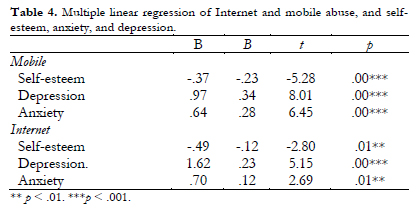
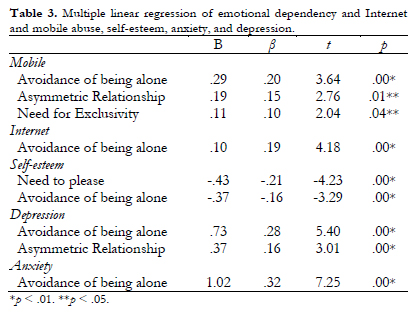
<body><![CDATA[<p><font face="Verdana" size="2">Secondly, the relationship between emotional dependency (Avoidance of being alone, Need for exclusivity, Need to please, and Asymmetric relationship), self-esteem, anxious and depressive symptomatology, and Internet and mobile abuse was measured (<a target="_blank" href="/img/revistas/ap/v33n2/psicologia_clinica5_tabla2.jpg">Table 2</a>). Results showed that emotional dependency, anxious and depressive symptomatology, and Internet and mobile abuse correlated significant and positively. These variables also correlated significant and negatively with self-esteem.</font></p>     <p><font face="Verdana" size="2">Thirdly, the predictive role of emotional dependency on Internet and mobile abuse, self-esteem, and anxious and depressive symptomatology was measured (<a href="#t3">Table 3</a>). Results showed that emotional dependency predicted mobile abuse, explaining 13% of the variance (R = .37, R<sup>2</sup> = .14, adjusted R<sup>2</sup> = .13, <i>p</i> &lt; .01); Internet abuse, explaining 3% of the variance (R = .19, R<sup>2</sup> = .03, adjusted R<sup>2</sup> = .03, <i>p</i> &lt; .01); selfesteem, explaining 10% of the variance (R = .33, R<sup>2</sup> = .11, adjusted R<sup>2</sup> = .10, <i>p</i> &lt; .01); anxious symptomatology, explaining 10% of the variance (R = .32, R<sup>2</sup> = .10, adjusted R<sup>2</sup>= .10, <i>p</i> &lt; .01); and depressive symptomatology, explaining 15% of the variance (R = .40, R<sup>2</sup> = .16, adjusted R<sup>2</sup> = .15, <i>p</i> &lt; .01).</font></p>     <p>&nbsp;</p>     <p align="center"><font face="Verdana" size="2"><a name="t3"></a><img src="/img/revistas/ap/v33n2/psicologia_clinica5_tabla3.jpg"></font></p>     <p>&nbsp;</p>     <p><font face="Verdana" size="2">The predictive role of Internet and mobile abuse in anxious and depressive symptomatology and self-esteem was measured (<a href="#t4">Table 4</a>). Results showed that mobile abuse predicted self-esteem, explaining 5% of the variance (R = .23, R<sup>2</sup> = .05, adjusted R<sup>2</sup> = .05, <i>p</i> &lt; .01); depressive symptomatology, explaining 12% of the variance (R = .34, R<sup>2</sup> = .12, adjusted R<sup>2</sup> = .12, <i>p</i> &lt; .01); and anxious symptomatology, explaining 8% of the variance (R = .28, R<sup>2</sup> = .08, adjusted R<sup>2</sup> = .08, <i>p</i> &lt; .01). Internet abuse was predictive of self-esteem, explaining 1% of the variance (R = .12, R<sup>2</sup> = .02, adjusted R<sup>2</sup> = .01, <i>p</i> = .01); depressive symptomatology, explaining 5% of the variance (R = .23, R<sup>2</sup> = .05, adjusted R<sup>2</sup> = .05, <i>p</i> &lt; .01); and anxious symptomatology, explaining 1% of the variance (R = .12, R<sup>2</sup> = .01, adjusted R<sup>2</sup> = .01, <i>p</i> = .01).</font></p>     <p>&nbsp;</p>     <p align="center"><font face="Verdana" size="2"><a name="t4"></a><img src="/img/revistas/ap/v33n2/psicologia_clinica5_tabla4.jpg"></font></p>     <p>&nbsp;</p>     <p><font face="Verdana" size="2"><b>Discussion</b></font></p>     ]]></body>
<body><![CDATA[<p><font face="Verdana" size="2">Firstly, positive and significant correlations were found between the study variables (emotional dependency, Internet and mobile abuse, anxiety, and depression) except for selfesteem, where the correlation was negative. These data would confirm the same profile as found in adolescents with substance abuse (Diaz &amp; Amaya, 2012), who are characterized by their need to please, low self-esteem, and anxious-depressive symptomatology. This also confirms the psychological consequences found by specific studies about Internet abuse (Bahrainian &amp; Khazaee, 2014; Oliva et al., 2012). Additionally, other authors found a negative relationship between self-esteem and time spent on Facebook (Mehdizadeh, 2010). Although Facebook is only a very small part of the Internet, this social network is present both on Internet and mobile-phones, and it is important to consider it, taking into account the lack of studies. Although most of the studies refer to Internet abuse, as 77.1% of Internet users access the Internet via their mobile-phones (INE, 2014), these studies will be cited due to the connection between the two technologies (connection that has been proven in this study too).</font></p>     <p><font face="Verdana" size="2">Thus, Mehdizadeh (2010) considered that people with problems in face-to-face social relationships use the Internet to achieve affective bonds online, as a way of creating their ideal virtual world. This occurs because the Internet allows one to control one's social representation, so people with lower self-esteem spend more time online to compensate their real life difficulties. As a result, these people dedicate more time to creating and managing their self-representation to others (Gonzales &amp; Hancock, 2011). A negative selfesteem is crucial, as it is an essential pillar in the construction of personality and one of the most powerful predictors of psychological adjustment (DuBois, Bull, Sherman, &amp; Roberts, 1998). In relation to the anxious/depressive consequences, it seems that new technologies can act as a shelter for people with low self-esteem. Thus, a person who suffers from depression, for instance, can take refuge in a screen to escape from reality and even enter a semi-dissociative state (Becoña &amp; Cortés, 2010). Hence, Internet or mobile-phones could be seen as a means that allows these people to satisfy some of their needs, which causes them to increase their use (Bahrainian &amp; Khazaee, 2014). However, it is difficult to establish whether these problems are the cause or the effect of an Internet or mobile abuse.</font></p>     <p><font face="Verdana" size="2">On another hand, regarding the gender differences found in the study, females were found to present higher depressive symptomatology and mobile abuse, while males stood out for their need to please and higher self-esteem. In the case of females, the results confirm the literature about depression, as shown in a recent review of the issue (Vazquez, 2013). This review reported a higher prevalence of depressive symptomatology in females, attributable both to biological and social factors. Regarding gender differences in mobile abuse, they could be due to gender socialization, according to which females are expected to have mainly social needs and therefore, they achieve greater intimacy in their relationships compared to men (Fuertes, Martínez, &amp; Hernández, 2001). This fact could lead to increased use of the mobile to keep in touch when the partner is absent, which, together with emotional dependency, can increment the risk of abuse.</font></p>     <p><font face="Verdana" size="2">The same issue leads to the differences found in males, whose higher scores on the need to please could also be understood from gender socialization. In this case, instead of the social needs that are expected of females, men are expected to have representation needs, which include the need for approval or to please others (Lundy, Field, McBride, Field, &amp; Largie, 1998). Thus, men usually have a larger but less intimate social network than women. This could be related to their developmental delay in the acquisition of competencies to reinforce bonds with peers, as described by Delgado, Oliva, and Sánchez-Queija (2011). These authors found a significant increase in attachment to peers, which was more exacerbated in males. So, if females achieve these relational competencies sooner than males, it is not surprising that males show greater dependence.</font></p>     <p><font face="Verdana" size="2">Moreover, in relation to higher self-esteem, these results confirm previous research on adolescents. Regardless of the similarities in childhood, gender differences arise during adolescence, and males tend to show higher self-esteem (Robins et al., 2002). While it may appear to be a contradiction for males to have higher self-esteem and, at the same time, a higher need to please, the two variables may be related. This is, both measures are self-reported, and it is possible that greater levels of self-esteem simply reflect the need to please, that is, to answer according to what is expected from them as males, or social desirability.</font></p>     <p><font face="Verdana" size="2">Regarding the predictive role of emotional dependency, despite the fact that several subscales of dependence have been found to be significant predictors of Internet and mobile abuse and their psychological consequences, the presence of one subscale stands out, as it appears in every single case: Avoidance of being alone. As mentioned, addictive behaviors in adolescence should not be interpreted decontextualized, but bearing in mind their meaning in the developmental process and especially, the importance of the peer group (Herrero, 2003). In addition, as noted by Herrero (2003) in relation to drug addiction, this kind of abuse acts is way to achieve group cohesion and identity. In this case, this could also apply to the use of Internet and mobile (e.g., using social networks such as Facebook). Furthermore, different authors indicate that social isolation or loneliness is characteristic of people who are addicted to new technologies, as well as certain social skills deficits (Becoña &amp; Cortés, 2010; Oliva et al., 2012). Again, this could be related to a possible need to belong to the group.</font></p>     <p><font face="Verdana" size="2">Finally, the predictive role of Internet and mobile abuse in relation to the psychological consequences was also analyzed. This analysis showed that both types of abuse are predictors of anxiety, depression, and self-esteem. These results are in line with previous research indicating the relation between this type of abuse and the measured psychological variables (Armstrong, Phillips, &amp; Saling, 2000; Ceyhan &amp; Ceyhan, 2008; Demirci, Akg&#246;n&#252;l, &amp; Akpinar, 2015; Ehrenberg, Juckes, White, &amp; Walsh, 2008). It may seem that Internet abuse explains a smaller percentage of the variance than mobile abuse, but we emphasize the significant correlation found between Internet and mobile abuse, in addition to the fact that 77.1% of Internet users access it through their mobile phones (INE, 2014). Hence, as the instrument to measure mobile abuse collects data about its general use (without excluding access to the Internet), it could be considered that mobile abuse may somehow be covering Internet abuse. This way, it would be reasonable to find stronger relationships for mobile phones and not for Internet alone (which would cover just a part of online connections). On another hand, the Cronbach alpha for Internet abuse measured by MULTICAGE CAD-4 was moderate (.67), so further studies in this area are necessary to corroborate these results.</font></p>     <p><font face="Verdana" size="2">This study has some limitations that should be commented on. On the one hand, sample size, together with the fact that it is a convenience sample with an irregular composition (with 83.36% females), limits the generalization of results, as the sample is not representative of the population. Moreover, all the participants were university students (which entails use of the Internet), from the same university, and from the Autonomous Community of Madrid, where, according to INE (2014), the use of Internet and mobile-phone is above the Spanish mean. All these aspects limit sample diversity. Furthermore, this is a cross-sectional study conducted through self-reports (which, in some cases, have obtained poor reliability indexes). It is therefore possible that social desirability may have influenced participants' responses. Lastly, confirmation bias should not be forgotten, that is, the study only shows what it we decided to analyze, and there may be other consequences or associated factors that were not considered.</font></p>     <p><font face="Verdana" size="2">Due to the above limitations, the results of this study are not conclusive. However, they provide a new viewpoint for future investigations, which should try to resolve the limitations (especially the aspects that affect sample representativeness). Regarding the method, a battery of screening questionnaires should be used in order to avoid the confirmation bias as well as to guide future research and interventions. It would also be interesting to include not only measures of the consequences of Internet and mobile-phone abuse, but also to examine in greater depth what that use means for the participants, how they spend that time or what is their motivation. This could be done through self-report questions or interviews/discussion groups. The importance of gender roles and gender socialization should also be studied in depth, in case they are possible factors in which to intervene. Ultimately, all this work could help to develop an intervention and/or prevention program for Internet and mobile abuse, considering its relation with emotional dependency. Future investigations should put into practice and evaluate the efficacy of such programs.</font></p>     <p><font face="Verdana" size="2">Considering all these conclusions, it can be said that, despite the limitations of the study, it provides new data about aspects that are to date barely studied. This study confirms the existence of a positive relation between Internet and mobile abuse and emotional dependency, but it is important to note that abuse was not classified. Furthermore, it also proves the relationship with anxiety, depression, and selfesteem. In short, the study aimed to deepen an area of increasing interest for the adequate attention to and care of youth, due to impact of and the unavoidable coexistence with new technologies.</font></p>     ]]></body>
<body><![CDATA[<p>&nbsp;</p>     <p><font face="Verdana" size="2"><b>Conflicts of interest</b></font></p>     <p><font face="Verdana" size="2">The authors declare that there is no conflict of interest regarding this paper.</font></p>     <p>&nbsp;</p>     <p><font face="Verdana" size="2"><b>References</b></font></p>     <!-- ref --><p><font face="Verdana" size="2">1. Armstrong, L., Phillips, J. G., &amp; Saling, L. L. (2000). Potential determinants of heavier internet usage. International Journal of Human-Computer Studies, 53, 537-550.    &nbsp;&nbsp;&nbsp;&nbsp;&nbsp;&nbsp;&nbsp;&nbsp;[&#160;<a href="javascript:void(0);" onclick="javascript: window.open('/scielo.php?script=sci_nlinks&ref=778247&pid=S0212-9728201700020000700001&lng=','','width=640,height=500,resizable=yes,scrollbars=1,menubar=yes,');">Links</a>&#160;]<!-- end-ref --></font></p>    <!-- ref --><p><font face="Verdana" size="2">2. Arnett, J. J. (2000). Emerging adulthood: A theory of development from the late teens through the twenties. American Psychologist, 55(5), 469-480.    &nbsp;&nbsp;&nbsp;&nbsp;&nbsp;&nbsp;&nbsp;&nbsp;[&#160;<a href="javascript:void(0);" onclick="javascript: window.open('/scielo.php?script=sci_nlinks&ref=778249&pid=S0212-9728201700020000700002&lng=','','width=640,height=500,resizable=yes,scrollbars=1,menubar=yes,');">Links</a>&#160;]<!-- end-ref --></font></p>    <!-- ref --><p><font face="Verdana" size="2">3. Arnett, J. J. (2005). The developmental context of substance use in emerging adulthood. Journal of Drug Issues, 35(2), 235-254. doi: 10.1177/002204260503500202.    &nbsp;&nbsp;&nbsp;&nbsp;&nbsp;&nbsp;&nbsp;&nbsp;[&#160;<a href="javascript:void(0);" onclick="javascript: window.open('/scielo.php?script=sci_nlinks&ref=778251&pid=S0212-9728201700020000700003&lng=','','width=640,height=500,resizable=yes,scrollbars=1,menubar=yes,');">Links</a>&#160;]<!-- end-ref --></font></p>    <!-- ref --><p><font face="Verdana" size="2">4. Bahrainian, A., &amp; Khazaee, A. (2014). Internet addiction among students: The relation of self-esteem and depression. Bulletin of Environment, Pharmacology and Life Sciences, 3(3), 1-6.    &nbsp;&nbsp;&nbsp;&nbsp;&nbsp;&nbsp;&nbsp;&nbsp;[&#160;<a href="javascript:void(0);" onclick="javascript: window.open('/scielo.php?script=sci_nlinks&ref=778253&pid=S0212-9728201700020000700004&lng=','','width=640,height=500,resizable=yes,scrollbars=1,menubar=yes,');">Links</a>&#160;]<!-- end-ref --></font></p>    <!-- ref --><p><font face="Verdana" size="2">5. Becoña, E., &amp; Cortés, M (2010). Manual de adicciones para psicólogos especialistas en psicología clínica en formación (Manual of addictions for specialist clinical psychologists in training). Valencia: Socidrogalcohol.    &nbsp;&nbsp;&nbsp;&nbsp;&nbsp;&nbsp;&nbsp;&nbsp;[&#160;<a href="javascript:void(0);" onclick="javascript: window.open('/scielo.php?script=sci_nlinks&ref=778255&pid=S0212-9728201700020000700005&lng=','','width=640,height=500,resizable=yes,scrollbars=1,menubar=yes,');">Links</a>&#160;]<!-- end-ref --></font></p>    <!-- ref --><p><font face="Verdana" size="2">6. Beranuy, M., Chamarro, A., Graner, C., &amp; Carbonell, X. (2009). Validación de dos escalas breves para evaluar la adicción a Internet y el abuso de móvil (Validation of two short measures for evaluating Internet and mobile abuse). Psicothema, 21(3), 480-485.    &nbsp;&nbsp;&nbsp;&nbsp;&nbsp;&nbsp;&nbsp;&nbsp;[&#160;<a href="javascript:void(0);" onclick="javascript: window.open('/scielo.php?script=sci_nlinks&ref=778257&pid=S0212-9728201700020000700006&lng=','','width=640,height=500,resizable=yes,scrollbars=1,menubar=yes,');">Links</a>&#160;]<!-- end-ref --></font></p>    <!-- ref --><p><font face="Verdana" size="2">7. Bornstein, R. F. (1992). The dependent personality: Developmental, social, and clinical perspectives. Psychological Bulletin, 112(1), 3-23. doi: 10.1037/0033-2909.112.1.3.    &nbsp;&nbsp;&nbsp;&nbsp;&nbsp;&nbsp;&nbsp;&nbsp;[&#160;<a href="javascript:void(0);" onclick="javascript: window.open('/scielo.php?script=sci_nlinks&ref=778259&pid=S0212-9728201700020000700007&lng=','','width=640,height=500,resizable=yes,scrollbars=1,menubar=yes,');">Links</a>&#160;]<!-- end-ref --></font></p>    <!-- ref --><p><font face="Verdana" size="2">8. Bornstein, R. F. (1994). Construct validity of the Interpersonal Dependency Inventory: 1977-1992. Journal of Personality Disorders, 8, 64-76. doi: 10.1521/pedi.1994.8.1.64.    &nbsp;&nbsp;&nbsp;&nbsp;&nbsp;&nbsp;&nbsp;&nbsp;[&#160;<a href="javascript:void(0);" onclick="javascript: window.open('/scielo.php?script=sci_nlinks&ref=778261&pid=S0212-9728201700020000700008&lng=','','width=640,height=500,resizable=yes,scrollbars=1,menubar=yes,');">Links</a>&#160;]<!-- end-ref --></font></p>    <!-- ref --><p><font face="Verdana" size="2">9. Bornstein, R. F., Geiselman, K. J., Eisenhart, E. A., &amp; Languirand, M. A. (2002). Construct validity of the Relationship Profile Test: Links with attachment, identity, relatedness, and affect. Assessment, 9(4), 373-381. doi: 10.1177/1073191102238195.    &nbsp;&nbsp;&nbsp;&nbsp;&nbsp;&nbsp;&nbsp;&nbsp;[&#160;<a href="javascript:void(0);" onclick="javascript: window.open('/scielo.php?script=sci_nlinks&ref=778263&pid=S0212-9728201700020000700009&lng=','','width=640,height=500,resizable=yes,scrollbars=1,menubar=yes,');">Links</a>&#160;]<!-- end-ref --></font></p>    <!-- ref --><p><font face="Verdana" size="2">10. Bowlby, J. (1951). Maternal care and mental health. Geneva, World Health Organization.    &nbsp;&nbsp;&nbsp;&nbsp;&nbsp;&nbsp;&nbsp;&nbsp;[&#160;<a href="javascript:void(0);" onclick="javascript: window.open('/scielo.php?script=sci_nlinks&ref=778265&pid=S0212-9728201700020000700010&lng=','','width=640,height=500,resizable=yes,scrollbars=1,menubar=yes,');">Links</a>&#160;]<!-- end-ref --></font></p>    <!-- ref --><p><font face="Verdana" size="2">11. Calvete, E., &amp; Cardeñoso, O. (1999). Creencias y síntomas depresivos: Resultados preliminares en el desarrollo de una Escala de Creencias Irracionales abreviada (Depressive beliefs and symptoms: Preliminary results in the development of a short Irrational Beliefs Scale). Anales de Psicología, 15(2), 179-190.    &nbsp;&nbsp;&nbsp;&nbsp;&nbsp;&nbsp;&nbsp;&nbsp;[&#160;<a href="javascript:void(0);" onclick="javascript: window.open('/scielo.php?script=sci_nlinks&ref=778267&pid=S0212-9728201700020000700011&lng=','','width=640,height=500,resizable=yes,scrollbars=1,menubar=yes,');">Links</a>&#160;]<!-- end-ref --></font></p>    <!-- ref --><p><font face="Verdana" size="2">12. Calvete, E., &amp; Estévez, A. (2009). Consumo de drogas en adolescentes: El papel del estrés, la impulsividad y los esquemas relacionados con la falta de límites (Drug consumption in adolescents: The role of stress, impulsitivy and lack of limits-related schematas). Adicciones, 21(1), 49-56.    &nbsp;&nbsp;&nbsp;&nbsp;&nbsp;&nbsp;&nbsp;&nbsp;[&#160;<a href="javascript:void(0);" onclick="javascript: window.open('/scielo.php?script=sci_nlinks&ref=778269&pid=S0212-9728201700020000700012&lng=','','width=640,height=500,resizable=yes,scrollbars=1,menubar=yes,');">Links</a>&#160;]<!-- end-ref --></font></p>    <!-- ref --><p><font face="Verdana" size="2">13. Carbonell, X., Chamarro, A., Griffiths, M., Oberst, U., Cladellas, R., &amp; Talarn, A. (2012). Problematic Internet and cell phone use in Spanish teenagers and young students. Anales de Psicología, 28(3), 789-796.    &nbsp;&nbsp;&nbsp;&nbsp;&nbsp;&nbsp;&nbsp;&nbsp;[&#160;<a href="javascript:void(0);" onclick="javascript: window.open('/scielo.php?script=sci_nlinks&ref=778271&pid=S0212-9728201700020000700013&lng=','','width=640,height=500,resizable=yes,scrollbars=1,menubar=yes,');">Links</a>&#160;]<!-- end-ref --></font></p>    <!-- ref --><p><font face="Verdana" size="2">14. Carbonell, X., Fúster, H., Chamarro, A., &amp; Oberst, U. (2012). Adicción a Internet y móvil: una revisión de estudios empíricos españoles (Internet and mobile addiction: A review of empirical Spanish studies). Papeles del Psicólogo, 33(2), 82-89.    &nbsp;&nbsp;&nbsp;&nbsp;&nbsp;&nbsp;&nbsp;&nbsp;[&#160;<a href="javascript:void(0);" onclick="javascript: window.open('/scielo.php?script=sci_nlinks&ref=778273&pid=S0212-9728201700020000700014&lng=','','width=640,height=500,resizable=yes,scrollbars=1,menubar=yes,');">Links</a>&#160;]<!-- end-ref --></font></p>    <!-- ref --><p><font face="Verdana" size="2">15. Castelló, J. (Marzo, 2000). Análisis del concepto "Dependencia Emocional&quot;. (Analysis of the concept "Emotional dependency"). Work presented in the I Virtual Congress of Psychiatry. 6-CI-A Conference. Retrieved from <a target="_blank" href="http://www.psiquiatria.com/congreso/mesas/mesa6/conferencias/6_ci_a.htm">www.psiquiatria.com/congreso/mesas/mesa6/conferencias/6_ci_a.htm</a>.    &nbsp;&nbsp;&nbsp;&nbsp;&nbsp;&nbsp;&nbsp;&nbsp;[&#160;<a href="javascript:void(0);" onclick="javascript: window.open('/scielo.php?script=sci_nlinks&ref=778275&pid=S0212-9728201700020000700015&lng=','','width=640,height=500,resizable=yes,scrollbars=1,menubar=yes,');">Links</a>&#160;]<!-- end-ref --></font></p>    <!-- ref --><p><font face="Verdana" size="2">16. Castelló, J. (2005). Dependencia emocional. Características y tratamiento (Emotional dependency. Characteristics and treatment). Madrid: Alianza Editorial.    &nbsp;&nbsp;&nbsp;&nbsp;&nbsp;&nbsp;&nbsp;&nbsp;[&#160;<a href="javascript:void(0);" onclick="javascript: window.open('/scielo.php?script=sci_nlinks&ref=778277&pid=S0212-9728201700020000700016&lng=','','width=640,height=500,resizable=yes,scrollbars=1,menubar=yes,');">Links</a>&#160;]<!-- end-ref --></font></p>    <!-- ref --><p><font face="Verdana" size="2">17. Ceyhan, A. A., &amp; Ceyhan, E. (2008). Loneliness, depression, and computer self-efficacy as predictors of problematic internet use. Cyberpsychology and Behavior, 11(6), 699-701.    &nbsp;&nbsp;&nbsp;&nbsp;&nbsp;&nbsp;&nbsp;&nbsp;[&#160;<a href="javascript:void(0);" onclick="javascript: window.open('/scielo.php?script=sci_nlinks&ref=778279&pid=S0212-9728201700020000700017&lng=','','width=640,height=500,resizable=yes,scrollbars=1,menubar=yes,');">Links</a>&#160;]<!-- end-ref --></font></p>    <!-- ref --><p><font face="Verdana" size="2">18. Chak, K., &amp; Leing, L. (2004). Shyness and locus of control as predictors of Internet addiction and Internet use. Cyberpsychology and Behavior, 7(5), 559-570. doi: 10.1089/1094931042403073.    &nbsp;&nbsp;&nbsp;&nbsp;&nbsp;&nbsp;&nbsp;&nbsp;[&#160;<a href="javascript:void(0);" onclick="javascript: window.open('/scielo.php?script=sci_nlinks&ref=778281&pid=S0212-9728201700020000700018&lng=','','width=640,height=500,resizable=yes,scrollbars=1,menubar=yes,');">Links</a>&#160;]<!-- end-ref --></font></p>    <!-- ref --><p><font face="Verdana" size="2">19. Chóliz, M., Villanueva, V., &amp; Chóliz, M. C. (2009). Ellas, ellos y su móvil: uso, abuso (¿y dependencia?) del teléfono móvil en la adolescencia (Them and their mobile: use, abuse (and dependency?) of mobile in adolescence). Revista española de drgodependencias, 34(1), 74-88.    &nbsp;&nbsp;&nbsp;&nbsp;&nbsp;&nbsp;&nbsp;&nbsp;[&#160;<a href="javascript:void(0);" onclick="javascript: window.open('/scielo.php?script=sci_nlinks&ref=778283&pid=S0212-9728201700020000700019&lng=','','width=640,height=500,resizable=yes,scrollbars=1,menubar=yes,');">Links</a>&#160;]<!-- end-ref --></font></p>    <!-- ref --><p><font face="Verdana" size="2">20. Clark, D. J., Frith, K., &amp; Demi, A. S. (2004). The physical, behavioral, and psychosocial consequences of internet use in college students. Computers, Informatics, Nursing, 22(3), 153-161. doi: 10.1097/00024665-200405000-00010.    &nbsp;&nbsp;&nbsp;&nbsp;&nbsp;&nbsp;&nbsp;&nbsp;[&#160;<a href="javascript:void(0);" onclick="javascript: window.open('/scielo.php?script=sci_nlinks&ref=778285&pid=S0212-9728201700020000700020&lng=','','width=640,height=500,resizable=yes,scrollbars=1,menubar=yes,');">Links</a>&#160;]<!-- end-ref --></font></p>    <!-- ref --><p><font face="Verdana" size="2">21. Cohen, J. (1992). A power primer. Psychological Bulletin, 112(1), 155-159. doi: 10.1037/0033-2909.112.1.155.    &nbsp;&nbsp;&nbsp;&nbsp;&nbsp;&nbsp;&nbsp;&nbsp;[&#160;<a href="javascript:void(0);" onclick="javascript: window.open('/scielo.php?script=sci_nlinks&ref=778287&pid=S0212-9728201700020000700021&lng=','','width=640,height=500,resizable=yes,scrollbars=1,menubar=yes,');">Links</a>&#160;]<!-- end-ref --></font></p>    <!-- ref --><p><font face="Verdana" size="2">22. Davis, F. S., Smith B. G., Rodrigue, K., &amp; Pulvers, K. (1999). An examination of Internet usage on two college campuses. College Student Journal, 33, 257-260.    &nbsp;&nbsp;&nbsp;&nbsp;&nbsp;&nbsp;&nbsp;&nbsp;[&#160;<a href="javascript:void(0);" onclick="javascript: window.open('/scielo.php?script=sci_nlinks&ref=778289&pid=S0212-9728201700020000700022&lng=','','width=640,height=500,resizable=yes,scrollbars=1,menubar=yes,');">Links</a>&#160;]<!-- end-ref --></font></p>    <!-- ref --><p><font face="Verdana" size="2">23. Delgado, I., Oliva, A., &amp; Sánchez-Queija, I. (2011). Apego a los iguales durante la adolescencia y la adultez emergente (Peer attachment during adolescence and emerging adulthood). Anales de Psicología, 27(1), 155-163.    &nbsp;&nbsp;&nbsp;&nbsp;&nbsp;&nbsp;&nbsp;&nbsp;[&#160;<a href="javascript:void(0);" onclick="javascript: window.open('/scielo.php?script=sci_nlinks&ref=778291&pid=S0212-9728201700020000700023&lng=','','width=640,height=500,resizable=yes,scrollbars=1,menubar=yes,');">Links</a>&#160;]<!-- end-ref --></font></p>    <!-- ref --><p><font face="Verdana" size="2">24. Demirci, K., Akg&#246;n&#252;l, M., &amp; Akpinar, A. (2015). Relationship of smartphone use severity with sleep quality, depression, and anxiety in university students. Journal of Behavioral Addictions, 4(2), 85-92.    &nbsp;&nbsp;&nbsp;&nbsp;&nbsp;&nbsp;&nbsp;&nbsp;[&#160;<a href="javascript:void(0);" onclick="javascript: window.open('/scielo.php?script=sci_nlinks&ref=778293&pid=S0212-9728201700020000700024&lng=','','width=640,height=500,resizable=yes,scrollbars=1,menubar=yes,');">Links</a>&#160;]<!-- end-ref --></font></p>    <!-- ref --><p><font face="Verdana" size="2">25. Derogatis, L. R. (1977). SCL-90-R. Administration, scoring and procedures manual for the Revised Version of the SCL-90. Baltimore, MD: John Hopkins University Press.    &nbsp;&nbsp;&nbsp;&nbsp;&nbsp;&nbsp;&nbsp;&nbsp;[&#160;<a href="javascript:void(0);" onclick="javascript: window.open('/scielo.php?script=sci_nlinks&ref=778295&pid=S0212-9728201700020000700025&lng=','','width=640,height=500,resizable=yes,scrollbars=1,menubar=yes,');">Links</a>&#160;]<!-- end-ref --></font></p>    <!-- ref --><p><font face="Verdana" size="2">26. Derogatis, L. R. (1983). The SCL-90 administration, scoring and procedures manual. Towson, ídem: Clinical Psychometric Research.    &nbsp;&nbsp;&nbsp;&nbsp;&nbsp;&nbsp;&nbsp;&nbsp;[&#160;<a href="javascript:void(0);" onclick="javascript: window.open('/scielo.php?script=sci_nlinks&ref=778297&pid=S0212-9728201700020000700026&lng=','','width=640,height=500,resizable=yes,scrollbars=1,menubar=yes,');">Links</a>&#160;]<!-- end-ref --></font></p>    <!-- ref --><p><font face="Verdana" size="2">27. Derogatis, L. R. (2002). SCL-90-R. Cuestionario de 90 items (SCL-90-R. 90-item questionnaire). Adaptación española de J. L. González de Rivera, et al. Madrid: TEA Ediciones.    &nbsp;&nbsp;&nbsp;&nbsp;&nbsp;&nbsp;&nbsp;&nbsp;[&#160;<a href="javascript:void(0);" onclick="javascript: window.open('/scielo.php?script=sci_nlinks&ref=778299&pid=S0212-9728201700020000700027&lng=','','width=640,height=500,resizable=yes,scrollbars=1,menubar=yes,');">Links</a>&#160;]<!-- end-ref --></font></p>    <!-- ref --><p><font face="Verdana" size="2">28. Díaz, K., &amp; Amaya, M. C. (2012). Factores familiares, individuales y ambientales en el consumo y no consumo de drogas en adolescentes (Family, individual and environment factors in consumption and nonconsumption of drugs in adolescents). Avances en Enfermería, 30(3), 37-59.    &nbsp;&nbsp;&nbsp;&nbsp;&nbsp;&nbsp;&nbsp;&nbsp;[&#160;<a href="javascript:void(0);" onclick="javascript: window.open('/scielo.php?script=sci_nlinks&ref=778301&pid=S0212-9728201700020000700028&lng=','','width=640,height=500,resizable=yes,scrollbars=1,menubar=yes,');">Links</a>&#160;]<!-- end-ref --></font></p>    <!-- ref --><p><font face="Verdana" size="2">29. Donati, M. A., Chiesi, F., &amp; Primi, C. (2013). A model to explain at-risk/problem gambling among male and female adolescents: Gender similarities and differences. Journal of Adolescence, 36(1), 129-137. doi: 10.1016/j.adolescence.2012.10.001.    &nbsp;&nbsp;&nbsp;&nbsp;&nbsp;&nbsp;&nbsp;&nbsp;[&#160;<a href="javascript:void(0);" onclick="javascript: window.open('/scielo.php?script=sci_nlinks&ref=778303&pid=S0212-9728201700020000700029&lng=','','width=640,height=500,resizable=yes,scrollbars=1,menubar=yes,');">Links</a>&#160;]<!-- end-ref --></font></p>    <!-- ref --><p><font face="Verdana" size="2">30. DuBois, D. L. Bull, C. A., Sherman, M. D., &amp; Roberts, M. (1998). Self-esteem and adjustment in early adolescence: A social-contextual perspective. Journal of Youth and Adolescence, 27, 557-584.    &nbsp;&nbsp;&nbsp;&nbsp;&nbsp;&nbsp;&nbsp;&nbsp;[&#160;<a href="javascript:void(0);" onclick="javascript: window.open('/scielo.php?script=sci_nlinks&ref=778305&pid=S0212-9728201700020000700030&lng=','','width=640,height=500,resizable=yes,scrollbars=1,menubar=yes,');">Links</a>&#160;]<!-- end-ref --></font></p>    <!-- ref --><p><font face="Verdana" size="2">31. Echeburúa, E. (1999). ¿Adicciones sin drogas? Las nuevas adicciones (juego, sexo, comida, compras, trabajo, Internet) (Addictions without drugs? The new addictions (gambling, sex, food, shopping, work, Internet). Bilbao, Spain: Desclée de Brouwer.    &nbsp;&nbsp;&nbsp;&nbsp;&nbsp;&nbsp;&nbsp;&nbsp;[&#160;<a href="javascript:void(0);" onclick="javascript: window.open('/scielo.php?script=sci_nlinks&ref=778307&pid=S0212-9728201700020000700031&lng=','','width=640,height=500,resizable=yes,scrollbars=1,menubar=yes,');">Links</a>&#160;]<!-- end-ref --></font></p>    <!-- ref --><p><font face="Verdana" size="2">32. Echeburúa, E. (2012). Factores de riesgo y factores de protección en la adicción a las nuevas tecnologías y redes sociales en jóvenes y adolescentes (Risk and protective factors in addiction to new technologies and social networks in adolescents and young people). Revista Española de Drogodependencias, 37(4), 435-447.    &nbsp;&nbsp;&nbsp;&nbsp;&nbsp;&nbsp;&nbsp;&nbsp;[&#160;<a href="javascript:void(0);" onclick="javascript: window.open('/scielo.php?script=sci_nlinks&ref=778309&pid=S0212-9728201700020000700032&lng=','','width=640,height=500,resizable=yes,scrollbars=1,menubar=yes,');">Links</a>&#160;]<!-- end-ref --></font></p>    <!-- ref --><p><font face="Verdana" size="2">33. Ehrenberg, A., Juckes, S., White, K. M., &amp; Walsh, S. P. (2008). Personality and self-esteem as predictors of young people's technology use. Cyber Psychology and Behavior, 11(6), 739-741.    &nbsp;&nbsp;&nbsp;&nbsp;&nbsp;&nbsp;&nbsp;&nbsp;[&#160;<a href="javascript:void(0);" onclick="javascript: window.open('/scielo.php?script=sci_nlinks&ref=778311&pid=S0212-9728201700020000700033&lng=','','width=640,height=500,resizable=yes,scrollbars=1,menubar=yes,');">Links</a>&#160;]<!-- end-ref --></font></p>    <!-- ref --><p><font face="Verdana" size="2">34. EU Kids Online (2011). Riesgos y seguridad en internet: los menores españoles en el contexto europeo (Risks and safety in Internet: Spanish minors in the European context). Bilbao, Spain: Euskal Herriko Unibertsitatea.    &nbsp;&nbsp;&nbsp;&nbsp;&nbsp;&nbsp;&nbsp;&nbsp;[&#160;<a href="javascript:void(0);" onclick="javascript: window.open('/scielo.php?script=sci_nlinks&ref=778313&pid=S0212-9728201700020000700034&lng=','','width=640,height=500,resizable=yes,scrollbars=1,menubar=yes,');">Links</a>&#160;]<!-- end-ref --></font></p>    <!-- ref --><p><font face="Verdana" size="2">35. Fernández-Villa, T., Alguacil, J., Almaraz, A., Cancela, J. M., Delgado-Rodríguez, M., García-Martín, M.,... Martín, V. (2015). Uso problemático de internet en estudiantes universitarios: factores asociados y diferencias de género (Problematic use of Internet in university students: Associated factors and gender differences). Adicciones, 27(4), 265-275.    &nbsp;&nbsp;&nbsp;&nbsp;&nbsp;&nbsp;&nbsp;&nbsp;[&#160;<a href="javascript:void(0);" onclick="javascript: window.open('/scielo.php?script=sci_nlinks&ref=778315&pid=S0212-9728201700020000700035&lng=','','width=640,height=500,resizable=yes,scrollbars=1,menubar=yes,');">Links</a>&#160;]<!-- end-ref --></font></p>    <!-- ref --><p><font face="Verdana" size="2">36. Fuertes, A., Martínez, J. L., &amp; Hernández, A. (2001). Relaciones de amistad y competencia en las relaciones con los iguales en la adolescencia (Friendship and competence in peer relationships in adolescence). Revista de Psicología General y Aplicada, 54, 531-546.    &nbsp;&nbsp;&nbsp;&nbsp;&nbsp;&nbsp;&nbsp;&nbsp;[&#160;<a href="javascript:void(0);" onclick="javascript: window.open('/scielo.php?script=sci_nlinks&ref=778317&pid=S0212-9728201700020000700036&lng=','','width=640,height=500,resizable=yes,scrollbars=1,menubar=yes,');">Links</a>&#160;]<!-- end-ref --></font></p>    <!-- ref --><p><font face="Verdana" size="2">37. Gonzales, A. L., &amp; Hancock, J. T. (2011). Mirror, mirror on my Facebook wall: Effects of exposure to Facebook on self-esteem. CyberPsychology, Behavior and Social Networking, 14(1/2), 79-83. doi: 10.1089/cyber.2009.0411.    &nbsp;&nbsp;&nbsp;&nbsp;&nbsp;&nbsp;&nbsp;&nbsp;[&#160;<a href="javascript:void(0);" onclick="javascript: window.open('/scielo.php?script=sci_nlinks&ref=778319&pid=S0212-9728201700020000700037&lng=','','width=640,height=500,resizable=yes,scrollbars=1,menubar=yes,');">Links</a>&#160;]<!-- end-ref --></font></p>    <!-- ref --><p><font face="Verdana" size="2">38. Grant, J. E., Brewer, J. A., &amp; Potenza, M. N. (2006). The neurobiology of substance and behavioral addictions. CNS spectrums, 11 (12), 924-930.    &nbsp;&nbsp;&nbsp;&nbsp;&nbsp;&nbsp;&nbsp;&nbsp;[&#160;<a href="javascript:void(0);" onclick="javascript: window.open('/scielo.php?script=sci_nlinks&ref=778321&pid=S0212-9728201700020000700038&lng=','','width=640,height=500,resizable=yes,scrollbars=1,menubar=yes,');">Links</a>&#160;]<!-- end-ref --></font></p>    <!-- ref --><p><font face="Verdana" size="2">39. Hartup, W. W. (1993). Adolescents and their friends. In B. Laursen (Ed.), New directions for child development: Close friendships in adolescence (pp. 3-22). San Francisco: Jossey-Bass.    &nbsp;&nbsp;&nbsp;&nbsp;&nbsp;&nbsp;&nbsp;&nbsp;[&#160;<a href="javascript:void(0);" onclick="javascript: window.open('/scielo.php?script=sci_nlinks&ref=778323&pid=S0212-9728201700020000700039&lng=','','width=640,height=500,resizable=yes,scrollbars=1,menubar=yes,');">Links</a>&#160;]<!-- end-ref --></font></p>    <!-- ref --><p><font face="Verdana" size="2">40. Herrero, D. (2013). Adaptación española de la dimensión conductual del "Displaced Aggression Questionnaire&quot;. Análisis de validez con medidas de ira y agresión genéricas y en la conducción (Spanish adaptation of behavioral dimension of the "Displaced Aggression Questionnaire". Validity analyses with general and driving-related anger and aggression measures). Revista de Psicología Social, 28(3), 273-284.    &nbsp;&nbsp;&nbsp;&nbsp;&nbsp;&nbsp;&nbsp;&nbsp;[&#160;<a href="javascript:void(0);" onclick="javascript: window.open('/scielo.php?script=sci_nlinks&ref=778325&pid=S0212-9728201700020000700040&lng=','','width=640,height=500,resizable=yes,scrollbars=1,menubar=yes,');">Links</a>&#160;]<!-- end-ref --></font></p>    <!-- ref --><p><font face="Verdana" size="2">41. Herrero, M. N. (2003). Adolescencia, grupo de iguales, consumo de drogas, y otras conductas problemáticas (Adolescence, peer group, drug consumption, and other problematic behaviors). Estudios de Juventud, 62, 81-91.    &nbsp;&nbsp;&nbsp;&nbsp;&nbsp;&nbsp;&nbsp;&nbsp;[&#160;<a href="javascript:void(0);" onclick="javascript: window.open('/scielo.php?script=sci_nlinks&ref=778327&pid=S0212-9728201700020000700041&lng=','','width=640,height=500,resizable=yes,scrollbars=1,menubar=yes,');">Links</a>&#160;]<!-- end-ref --></font></p>    <!-- ref --><p><font face="Verdana" size="2">42. Injuve (2012). Informe. Juventud en España (Report. Youth in Spain). Madrid: Instituto de la Juventud.    &nbsp;&nbsp;&nbsp;&nbsp;&nbsp;&nbsp;&nbsp;&nbsp;[&#160;<a href="javascript:void(0);" onclick="javascript: window.open('/scielo.php?script=sci_nlinks&ref=778329&pid=S0212-9728201700020000700042&lng=','','width=640,height=500,resizable=yes,scrollbars=1,menubar=yes,');">Links</a>&#160;]<!-- end-ref --></font></p>    <!-- ref --><p><font face="Verdana" size="2">43. Instituto Nacional de Estadística (2014). Encuesta sobre equipamiento y uso de tecnología de información y comunicación en los hogares (Questionnaire on equipment and information and communication technology use at homes). Retrieved from http://www.ine.es/dynt3/inebase/index.htm?type=pcaxis&amp;path=/125/p450/base2011/a2014/&file=pcaxis).    &nbsp;&nbsp;&nbsp;&nbsp;&nbsp;&nbsp;&nbsp;&nbsp;[&#160;<a href="javascript:void(0);" onclick="javascript: window.open('/scielo.php?script=sci_nlinks&ref=778331&pid=S0212-9728201700020000700043&lng=','','width=640,height=500,resizable=yes,scrollbars=1,menubar=yes,');">Links</a>&#160;]<!-- end-ref --></font></p>    <!-- ref --><p><font face="Verdana" size="2">44. Jiménez, M., de la Villa, M., &amp; Sirvent, C. (2009). Dependencia interpersonal como adicción social: Perfiles clínicos diferenciales (Interpersonal dependency as a social addiction: Differential clinic profiles). Work presented in the X Virtual Congress of Psychiatry. Retrieved from <a target="_blank" href="http://www.psiquiatria.com/bibliopsiquis/handle/10401/5094">http://www.psiquiatria.com/bibliopsiquis/handle/10401/5094</a>.    &nbsp;&nbsp;&nbsp;&nbsp;&nbsp;&nbsp;&nbsp;&nbsp;[&#160;<a href="javascript:void(0);" onclick="javascript: window.open('/scielo.php?script=sci_nlinks&ref=778333&pid=S0212-9728201700020000700044&lng=','','width=640,height=500,resizable=yes,scrollbars=1,menubar=yes,');">Links</a>&#160;]<!-- end-ref --></font></p>    <!-- ref --><p><font face="Verdana" size="2">45. Jiménez, M., &amp; Sirvent. C. (2008). Dependencias sentimentales o afectivas: etiología, clasificación y evaluación (Emotional or affective dependencies: Etiology, classification and assessment). Revista Española de Drogodependencias, 33(2), 150-167.    &nbsp;&nbsp;&nbsp;&nbsp;&nbsp;&nbsp;&nbsp;&nbsp;[&#160;<a href="javascript:void(0);" onclick="javascript: window.open('/scielo.php?script=sci_nlinks&ref=778335&pid=S0212-9728201700020000700045&lng=','','width=640,height=500,resizable=yes,scrollbars=1,menubar=yes,');">Links</a>&#160;]<!-- end-ref --></font></p>    <!-- ref --><p><font face="Verdana" size="2">46. Karim, R., &amp; Chaudhri, P. (2012). Behavioral addictions: An overview. Journal of Psychoactive Drugs, 44(1), 5-17. doi: 10.1080/02791072.2012.662859.    &nbsp;&nbsp;&nbsp;&nbsp;&nbsp;&nbsp;&nbsp;&nbsp;[&#160;<a href="javascript:void(0);" onclick="javascript: window.open('/scielo.php?script=sci_nlinks&ref=778337&pid=S0212-9728201700020000700046&lng=','','width=640,height=500,resizable=yes,scrollbars=1,menubar=yes,');">Links</a>&#160;]<!-- end-ref --></font></p>    <!-- ref --><p><font face="Verdana" size="2">47. Luengo, A. (2004). Adicción a Internet: Conceptualización y propuesta de intervención (Internet addiction: Conceptualization and intervention proposal). Revista Profesional Española de Terapia Cognitivo Conductual, 2, 22-52.    &nbsp;&nbsp;&nbsp;&nbsp;&nbsp;&nbsp;&nbsp;&nbsp;[&#160;<a href="javascript:void(0);" onclick="javascript: window.open('/scielo.php?script=sci_nlinks&ref=778339&pid=S0212-9728201700020000700047&lng=','','width=640,height=500,resizable=yes,scrollbars=1,menubar=yes,');">Links</a>&#160;]<!-- end-ref --></font></p>    <!-- ref --><p><font face="Verdana" size="2">48. Lundy, B., Field, T., McBride, C., Field, T., &amp; Largie, S. (1998). Same-sex and opposite-sex best friend interactions among high school juniors and seniors. Adolescence, 33, 279-289.    &nbsp;&nbsp;&nbsp;&nbsp;&nbsp;&nbsp;&nbsp;&nbsp;[&#160;<a href="javascript:void(0);" onclick="javascript: window.open('/scielo.php?script=sci_nlinks&ref=778341&pid=S0212-9728201700020000700048&lng=','','width=640,height=500,resizable=yes,scrollbars=1,menubar=yes,');">Links</a>&#160;]<!-- end-ref --></font></p>    <!-- ref --><p><font face="Verdana" size="2">49. Martín-Albo, J., Núñez, J. L., Navarro, J. G., &amp; Grijalvo, F. (2007). The Rosenberg Self-Esteem Scale: Translation and validation in university students. The Spanish Journal of Psychology, 10(2), 458-467.    &nbsp;&nbsp;&nbsp;&nbsp;&nbsp;&nbsp;&nbsp;&nbsp;[&#160;<a href="javascript:void(0);" onclick="javascript: window.open('/scielo.php?script=sci_nlinks&ref=778343&pid=S0212-9728201700020000700049&lng=','','width=640,height=500,resizable=yes,scrollbars=1,menubar=yes,');">Links</a>&#160;]<!-- end-ref --></font></p>    <!-- ref --><p><font face="Verdana" size="2">50. McLean, C. P., &amp; Anderson, E. R. (2009). Brave men and timid women? A review of the gender differences in fear and anxiety. Clinical Psychology Review, 29(6), 496-505. doi: 10.1016/j.cpr.2009.05.003.    &nbsp;&nbsp;&nbsp;&nbsp;&nbsp;&nbsp;&nbsp;&nbsp;[&#160;<a href="javascript:void(0);" onclick="javascript: window.open('/scielo.php?script=sci_nlinks&ref=778345&pid=S0212-9728201700020000700050&lng=','','width=640,height=500,resizable=yes,scrollbars=1,menubar=yes,');">Links</a>&#160;]<!-- end-ref --></font></p>    <!-- ref --><p><font face="Verdana" size="2">51. Mehdizadeh, S. (2010). Self-presentation 2.0: Narcissism and self-esteem on Facebook. CyberPsychology, Behavior and Social Networking, 13(4), 357-364. doi: 10.1089/cyber.2009.0257.    &nbsp;&nbsp;&nbsp;&nbsp;&nbsp;&nbsp;&nbsp;&nbsp;[&#160;<a href="javascript:void(0);" onclick="javascript: window.open('/scielo.php?script=sci_nlinks&ref=778347&pid=S0212-9728201700020000700051&lng=','','width=640,height=500,resizable=yes,scrollbars=1,menubar=yes,');">Links</a>&#160;]<!-- end-ref --></font></p>    <!-- ref --><p><font face="Verdana" size="2">52. Morahan-Martin, J., &amp; Schumaker, P. (2000). Incidence and correlates of pathological Internet use among college students. Computers in Human Behavior, 16(1), 13-29. doi: 10.1016/S0747-5632(99)00049-7.    &nbsp;&nbsp;&nbsp;&nbsp;&nbsp;&nbsp;&nbsp;&nbsp;[&#160;<a href="javascript:void(0);" onclick="javascript: window.open('/scielo.php?script=sci_nlinks&ref=778349&pid=S0212-9728201700020000700052&lng=','','width=640,height=500,resizable=yes,scrollbars=1,menubar=yes,');">Links</a>&#160;]<!-- end-ref --></font></p>    <!-- ref --><p><font face="Verdana" size="2">53. Muñoz-Rivas, M., Navarro, M. E., &amp; Ortega, N. (2003). Patrones de uso de Internet en población universitaria (Patterns of Internet use in university populations). Adicciones, 15, 137-144.    &nbsp;&nbsp;&nbsp;&nbsp;&nbsp;&nbsp;&nbsp;&nbsp;[&#160;<a href="javascript:void(0);" onclick="javascript: window.open('/scielo.php?script=sci_nlinks&ref=778351&pid=S0212-9728201700020000700053&lng=','','width=640,height=500,resizable=yes,scrollbars=1,menubar=yes,');">Links</a>&#160;]<!-- end-ref --></font></p>    <!-- ref --><p><font face="Verdana" size="2">54. Myers, D. G. (2005). Psicología (Psychology). Madrid: Editorial médica Panamericana.    &nbsp;&nbsp;&nbsp;&nbsp;&nbsp;&nbsp;&nbsp;&nbsp;[&#160;<a href="javascript:void(0);" onclick="javascript: window.open('/scielo.php?script=sci_nlinks&ref=778353&pid=S0212-9728201700020000700054&lng=','','width=640,height=500,resizable=yes,scrollbars=1,menubar=yes,');">Links</a>&#160;]<!-- end-ref --></font></p>    <!-- ref --><p><font face="Verdana" size="2">55. Oliva, A., Hidalgo, M. V., Moreno, C., Jiménez, L., Jiménez, A., Antolín, L., &amp; Ramos, P. (2012). Uso y riesgo de adicciones a las nuevas tecnologías entre adolescentes y jóvenes andaluces (Use and risk of addiction to new technologies among adolescents and young people from Andalucía). Sevilla, Spain: Agua Clara Editorial.    &nbsp;&nbsp;&nbsp;&nbsp;&nbsp;&nbsp;&nbsp;&nbsp;[&#160;<a href="javascript:void(0);" onclick="javascript: window.open('/scielo.php?script=sci_nlinks&ref=778355&pid=S0212-9728201700020000700055&lng=','','width=640,height=500,resizable=yes,scrollbars=1,menubar=yes,');">Links</a>&#160;]<!-- end-ref --></font></p>    <!-- ref --><p><font face="Verdana" size="2">56. Pedrero-Pérez, E. J., Rodríguez-Monje, M. T., Gallardo-Alonso, F., Fernández-Girón, M., Pérez-López, M., &amp; Chicharro-Romero, J. (2007). Validación de un instrumento para la detección de trastornos del control de impulsos y adicciones: el MULTICAGE CAD-4 (Validation of a measure for detecting addictions and impulse-control disorders: MULTICAGE CAD-4). Trastornos Adictivos, 9(4), 269-278.    &nbsp;&nbsp;&nbsp;&nbsp;&nbsp;&nbsp;&nbsp;&nbsp;[&#160;<a href="javascript:void(0);" onclick="javascript: window.open('/scielo.php?script=sci_nlinks&ref=778357&pid=S0212-9728201700020000700056&lng=','','width=640,height=500,resizable=yes,scrollbars=1,menubar=yes,');">Links</a>&#160;]<!-- end-ref --></font></p>    <!-- ref --><p><font face="Verdana" size="2">57. Petry, N. M. (2006). Should the scope of addictive behaviors be broadened to include pathological gambling? Addiction, 101, 152-160. doi: 10.1111/j.1360-0443.2006.01593.x.    &nbsp;&nbsp;&nbsp;&nbsp;&nbsp;&nbsp;&nbsp;&nbsp;[&#160;<a href="javascript:void(0);" onclick="javascript: window.open('/scielo.php?script=sci_nlinks&ref=778359&pid=S0212-9728201700020000700057&lng=','','width=640,height=500,resizable=yes,scrollbars=1,menubar=yes,');">Links</a>&#160;]<!-- end-ref --></font></p>    <!-- ref --><p><font face="Verdana" size="2">58. Radloff, L. S. (1977). The CES-D Scale: A self-report depression scale for research in the general population. Applied Psychological Measurement, 1(3), 385-401. doi: 10.1177/014662167700100306.    &nbsp;&nbsp;&nbsp;&nbsp;&nbsp;&nbsp;&nbsp;&nbsp;[&#160;<a href="javascript:void(0);" onclick="javascript: window.open('/scielo.php?script=sci_nlinks&ref=778361&pid=S0212-9728201700020000700058&lng=','','width=640,height=500,resizable=yes,scrollbars=1,menubar=yes,');">Links</a>&#160;]<!-- end-ref --></font></p>    <!-- ref --><p><font face="Verdana" size="2">59. Raisamo, S., Halme, J., Murto, A., &amp; Lintonen, T. (2013). Gambling-related harms among adolescents: A population-based study. Journal of Gambling Studies, 29, 151-159. doi: 10.1007/s10899-012-9298-9.    &nbsp;&nbsp;&nbsp;&nbsp;&nbsp;&nbsp;&nbsp;&nbsp;[&#160;<a href="javascript:void(0);" onclick="javascript: window.open('/scielo.php?script=sci_nlinks&ref=778363&pid=S0212-9728201700020000700059&lng=','','width=640,height=500,resizable=yes,scrollbars=1,menubar=yes,');">Links</a>&#160;]<!-- end-ref --></font></p>    <!-- ref --><p><font face="Verdana" size="2">60. Riso, W. (2004). ¿Amar o depender? (To love or to depend?). Barcelona: Granica.    &nbsp;&nbsp;&nbsp;&nbsp;&nbsp;&nbsp;&nbsp;&nbsp;[&#160;<a href="javascript:void(0);" onclick="javascript: window.open('/scielo.php?script=sci_nlinks&ref=778365&pid=S0212-9728201700020000700060&lng=','','width=640,height=500,resizable=yes,scrollbars=1,menubar=yes,');">Links</a>&#160;]<!-- end-ref --></font></p>    <!-- ref --><p><font face="Verdana" size="2">61. Robins, R. W., Trzesniewski, K. H., Tracy, J. L., Gosling, S. D., &amp; Potter, J. (2002). Global self-esteem across the lifespan. Psychology and Aging, 17, 423-434.    &nbsp;&nbsp;&nbsp;&nbsp;&nbsp;&nbsp;&nbsp;&nbsp;[&#160;<a href="javascript:void(0);" onclick="javascript: window.open('/scielo.php?script=sci_nlinks&ref=778367&pid=S0212-9728201700020000700061&lng=','','width=640,height=500,resizable=yes,scrollbars=1,menubar=yes,');">Links</a>&#160;]<!-- end-ref --></font></p>    <!-- ref --><p><font face="Verdana" size="2">62. Rodríguez, L., López-Cepero, J., Rodríguez, F. J., Bringas, C., Antuña, M. A., &amp; Estrada, C. (2010). Validación del Cuestionario de Violencia entre Novios (CUVINO) en jóvenes hispanohablantes: Análisis de resultados en España, México y Argentina (Validation of the Questionnaire of Violence among Dating Relationships (CUVINO) in Spanish-speaking young people: Analysis of results in Spain, Mexico, and Argentina). Anuario de Psicología Clínica y de la Salud, 6, 45-52.    &nbsp;&nbsp;&nbsp;&nbsp;&nbsp;&nbsp;&nbsp;&nbsp;[&#160;<a href="javascript:void(0);" onclick="javascript: window.open('/scielo.php?script=sci_nlinks&ref=778369&pid=S0212-9728201700020000700062&lng=','','width=640,height=500,resizable=yes,scrollbars=1,menubar=yes,');">Links</a>&#160;]<!-- end-ref --></font></p>    <!-- ref --><p><font face="Verdana" size="2">63. Rosenberg, M. (1965). Society and the adolescent self-image. Princeton, NJ: Princeton University Press.    &nbsp;&nbsp;&nbsp;&nbsp;&nbsp;&nbsp;&nbsp;&nbsp;[&#160;<a href="javascript:void(0);" onclick="javascript: window.open('/scielo.php?script=sci_nlinks&ref=778371&pid=S0212-9728201700020000700063&lng=','','width=640,height=500,resizable=yes,scrollbars=1,menubar=yes,');">Links</a>&#160;]<!-- end-ref --></font></p>    <!-- ref --><p><font face="Verdana" size="2">64. Ruiz-Olivares, M. R., Lucena, V., Pino, M. J., &amp; Herruzo, J. (2010). Análisis de comportamientos relacionados con el uso/abuso de internet, teléfono móvil, compras y juego en estudiantes universitarios (Analysis of behaviors related with the use/abuse of Internet, mobile, shopping and gambling in university students). Adicciones, 22(4), 301-310.    &nbsp;&nbsp;&nbsp;&nbsp;&nbsp;&nbsp;&nbsp;&nbsp;[&#160;<a href="javascript:void(0);" onclick="javascript: window.open('/scielo.php?script=sci_nlinks&ref=778373&pid=S0212-9728201700020000700064&lng=','','width=640,height=500,resizable=yes,scrollbars=1,menubar=yes,');">Links</a>&#160;]<!-- end-ref --></font></p>    <!-- ref --><p><font face="Verdana" size="2">65. Shucksmith, J., &amp; Hendry, L. B. (1998). Health issues and adolescents: Growing up and, speaking out. London: Routledge.    &nbsp;&nbsp;&nbsp;&nbsp;&nbsp;&nbsp;&nbsp;&nbsp;[&#160;<a href="javascript:void(0);" onclick="javascript: window.open('/scielo.php?script=sci_nlinks&ref=778375&pid=S0212-9728201700020000700065&lng=','','width=640,height=500,resizable=yes,scrollbars=1,menubar=yes,');">Links</a>&#160;]<!-- end-ref --></font></p>    <!-- ref --><p><font face="Verdana" size="2">66. Tsitsika, A., Critselis, E., Janikian, M., Kormas, G., &amp; Kafetzis, D. A. (2011). Association between internet gambling and problematic internet use among adolescents. Journal of Gambling Studies, 27(3), 389-400. doi: 10.1007/s10899-010-9223-z.    &nbsp;&nbsp;&nbsp;&nbsp;&nbsp;&nbsp;&nbsp;&nbsp;[&#160;<a href="javascript:void(0);" onclick="javascript: window.open('/scielo.php?script=sci_nlinks&ref=778377&pid=S0212-9728201700020000700066&lng=','','width=640,height=500,resizable=yes,scrollbars=1,menubar=yes,');">Links</a>&#160;]<!-- end-ref --></font></p>    <!-- ref --><p><font face="Verdana" size="2">67. Urbiola, I. &amp; Estévez, A. (2015). Dependencia emocional y su relación con estructuras inadaptadas tempranas en las relaciones de noviazgo en jóvenes y adolescentes (Emotional dependency and its relationship with early maladaptive schemas in dating relationships in adolescents and young adults). Psicología Conductual, 23(3), 571-587.    &nbsp;&nbsp;&nbsp;&nbsp;&nbsp;&nbsp;&nbsp;&nbsp;[&#160;<a href="javascript:void(0);" onclick="javascript: window.open('/scielo.php?script=sci_nlinks&ref=778379&pid=S0212-9728201700020000700067&lng=','','width=640,height=500,resizable=yes,scrollbars=1,menubar=yes,');">Links</a>&#160;]<!-- end-ref --></font></p>    <!-- ref --><p> <font face="Verdana" size="2">68. Urbiola, I., Estévez, A., &amp; Iraurgi, I. (2014). Dependencia emocional en el noviazgo de jóvenes y adolescentes (DEN): Desarrollo y validación de un instrumento (Emotional dependency in dating relationships in adolescents and young people (DEN): Development and validation of an instrument). Ansiedad y Estrés, 20(2-3), 101-114.    &nbsp;&nbsp;&nbsp;&nbsp;&nbsp;&nbsp;&nbsp;&nbsp;[&#160;<a href="javascript:void(0);" onclick="javascript: window.open('/scielo.php?script=sci_nlinks&ref=778381&pid=S0212-9728201700020000700068&lng=','','width=640,height=500,resizable=yes,scrollbars=1,menubar=yes,');">Links</a>&#160;]<!-- end-ref --></font></p>    <!-- ref --><p><font face="Verdana" size="2">69. Van Rooij, A. J., Schoenmakers, T. M., Vermulst, A. A., Van Den Eijnden, R. J., &amp; Van De Mheen, D. (2011). Online video game addiction: Identification of addicted adolescent gamers. Addiction, 106(1), 205-212. doi: 10.1111/j.1360-0443.2010.03104.x.    &nbsp;&nbsp;&nbsp;&nbsp;&nbsp;&nbsp;&nbsp;&nbsp;[&#160;<a href="javascript:void(0);" onclick="javascript: window.open('/scielo.php?script=sci_nlinks&ref=778383&pid=S0212-9728201700020000700069&lng=','','width=640,height=500,resizable=yes,scrollbars=1,menubar=yes,');">Links</a>&#160;]<!-- end-ref --></font></p>    <!-- ref --><p><font face="Verdana" size="2">70. Vázquez, A. (2013). Depresión. Diferencias de género (Depression. Gender differences). Multimed, 17(3), 1-21.    &nbsp;&nbsp;&nbsp;&nbsp;&nbsp;&nbsp;&nbsp;&nbsp;[&#160;<a href="javascript:void(0);" onclick="javascript: window.open('/scielo.php?script=sci_nlinks&ref=778385&pid=S0212-9728201700020000700070&lng=','','width=640,height=500,resizable=yes,scrollbars=1,menubar=yes,');">Links</a>&#160;]<!-- end-ref --></font></p>    <!-- ref --><p><font face="Verdana" size="2">71. Walther, B., Morgenstern, M., &amp; Hanewinkel, R. (2012). Co-occurrence of addictive behaviors: Personality factors related to substance use, gambling and computer gaming. European Addiction Research, 18(4), 167-174. doi: 10.1159/000335662.    &nbsp;&nbsp;&nbsp;&nbsp;&nbsp;&nbsp;&nbsp;&nbsp;[&#160;<a href="javascript:void(0);" onclick="javascript: window.open('/scielo.php?script=sci_nlinks&ref=778387&pid=S0212-9728201700020000700071&lng=','','width=640,height=500,resizable=yes,scrollbars=1,menubar=yes,');">Links</a>&#160;]<!-- end-ref --></font></p>    <!-- ref --><p><font face="Verdana" size="2">72. Wang, W. (2001). Internet dependency and psychosocial maturity among college students. International Journal of Human-Computer Studies, 55, 919-938. doi: 10.1006/ijhc.2001.0510.    &nbsp;&nbsp;&nbsp;&nbsp;&nbsp;&nbsp;&nbsp;&nbsp;[&#160;<a href="javascript:void(0);" onclick="javascript: window.open('/scielo.php?script=sci_nlinks&ref=778389&pid=S0212-9728201700020000700072&lng=','','width=640,height=500,resizable=yes,scrollbars=1,menubar=yes,');">Links</a>&#160;]<!-- end-ref --></font></p>    <!-- ref --><p><font face="Verdana" size="2">73. Wills, T. A. (1986). Stress and coping in early adolescence: Relationships to substance use in urban school samples. Health Psychology, 5, 503-529.    &nbsp;&nbsp;&nbsp;&nbsp;&nbsp;&nbsp;&nbsp;&nbsp;[&#160;<a href="javascript:void(0);" onclick="javascript: window.open('/scielo.php?script=sci_nlinks&ref=778391&pid=S0212-9728201700020000700073&lng=','','width=640,height=500,resizable=yes,scrollbars=1,menubar=yes,');">Links</a>&#160;]<!-- end-ref --></font></p>    <!-- ref --><p><font face="Verdana" size="2">74. Wolfe, D. A., Scott, K., Reitzel-Jaffe, D., Wekerle, C., Grasley, C., &amp; Straatman, A. L. (2001). Development and validation of the Conflict in Adolescent Dating Relationships Inventory. Psychological Assessment, 13(2), 277-293.    &nbsp;&nbsp;&nbsp;&nbsp;&nbsp;&nbsp;&nbsp;&nbsp;[&#160;<a href="javascript:void(0);" onclick="javascript: window.open('/scielo.php?script=sci_nlinks&ref=778393&pid=S0212-9728201700020000700074&lng=','','width=640,height=500,resizable=yes,scrollbars=1,menubar=yes,');">Links</a>&#160;]<!-- end-ref --></font></p>    <!-- ref --><p><font face="Verdana" size="2">75. Yang, C. K. (2001). Sociopsychiatric characteristics of adolescents who use computers to excess. Acta Psychiatrica Scandinavica, 104, 217-222.    &nbsp;&nbsp;&nbsp;&nbsp;&nbsp;&nbsp;&nbsp;&nbsp;[&#160;<a href="javascript:void(0);" onclick="javascript: window.open('/scielo.php?script=sci_nlinks&ref=778395&pid=S0212-9728201700020000700075&lng=','','width=640,height=500,resizable=yes,scrollbars=1,menubar=yes,');">Links</a>&#160;]<!-- end-ref --></font></p>    <!-- ref --><p><font face="Verdana" size="2">76. Young, K. S., &amp; Rodgers, R. C. (1998). The relationships between depression and Internet addiction. CyberPsychology and Behavior, 1, 25-28. doi: 10.1089/cpb.1998.1.25.    &nbsp;&nbsp;&nbsp;&nbsp;&nbsp;&nbsp;&nbsp;&nbsp;[&#160;<a href="javascript:void(0);" onclick="javascript: window.open('/scielo.php?script=sci_nlinks&ref=778397&pid=S0212-9728201700020000700076&lng=','','width=640,height=500,resizable=yes,scrollbars=1,menubar=yes,');">Links</a>&#160;]<!-- end-ref --></font></p>    <!-- ref --><p><font face="Verdana" size="2">77. Zeifman, D., &amp; Hazan, C. (2008). Pair bonds as attachments. Reevaluating the evidence. In J. Cassidy &amp; P. R. Shaver (Eds.), Handbook of attachment. Theory, research and clinical applications (pp. 436-455). New York: The Guildford Press.    &nbsp;&nbsp;&nbsp;&nbsp;&nbsp;&nbsp;&nbsp;&nbsp;[&#160;<a href="javascript:void(0);" onclick="javascript: window.open('/scielo.php?script=sci_nlinks&ref=778399&pid=S0212-9728201700020000700077&lng=','','width=640,height=500,resizable=yes,scrollbars=1,menubar=yes,');">Links</a>&#160;]<!-- end-ref --></font></p>    <!-- ref --><p><font face="Verdana" size="2">78. Zimmerman, M. A., Copeland, L. A., Shope, J. T., &amp; Dielman, T. E. (1997). A longitudinal study of self-esteem: Implications for adolescent development. Journal of Youth and Adolescence, 26, 117-141.    &nbsp;&nbsp;&nbsp;&nbsp;&nbsp;&nbsp;&nbsp;&nbsp;[&#160;<a href="javascript:void(0);" onclick="javascript: window.open('/scielo.php?script=sci_nlinks&ref=778401&pid=S0212-9728201700020000700078&lng=','','width=640,height=500,resizable=yes,scrollbars=1,menubar=yes,');">Links</a>&#160;]<!-- end-ref --></font></p>     <p>&nbsp;</p>     <p>&nbsp;</p>     <p><font face="Verdana" size="2"><a href="#top"><img border="0" src="/img/revistas/ap/v33n2/seta.gif" width="15" height="17"></a><a name="bajo"></a><b>Correspondence:</b>    <br>Ana Estévez.    <br>Departamento de Psicología.    <br>Universidad de Deusto.    <br>Apartado 1, 48080,    <br>Bilbao (Spain).    <br>E-mail: <a href="mailto:aestevez@deusto.es">aestevez@deusto.es</a></font></p>     ]]></body>
<body><![CDATA[<p><font face="Verdana" size="2">Article received: 29-03-2016;    <br>Revised: 11-05-2016;    <br>Accepted: 26-05-2016</font></p>      ]]></body><back>
<ref-list>
<ref id="B1">
<label>1</label><nlm-citation citation-type="journal">
<person-group person-group-type="author">
<name>
<surname><![CDATA[Armstrong]]></surname>
<given-names><![CDATA[L.]]></given-names>
</name>
<name>
<surname><![CDATA[Phillips]]></surname>
<given-names><![CDATA[J. G.]]></given-names>
</name>
<name>
<surname><![CDATA[Saling]]></surname>
<given-names><![CDATA[L. L.]]></given-names>
</name>
</person-group>
<article-title xml:lang="en"><![CDATA[Potential determinants of heavier internet usage]]></article-title>
<source><![CDATA[International Journal of Human-Computer Studies]]></source>
<year>2000</year>
<volume>53</volume>
<page-range>537-550</page-range></nlm-citation>
</ref>
<ref id="B2">
<label>2</label><nlm-citation citation-type="journal">
<person-group person-group-type="author">
<name>
<surname><![CDATA[Arnett]]></surname>
<given-names><![CDATA[J. J.]]></given-names>
</name>
</person-group>
<article-title xml:lang="en"><![CDATA[Emerging adulthood: A theory of development from the late teens through the twenties]]></article-title>
<source><![CDATA[American Psychologist]]></source>
<year>2000</year>
<volume>55</volume>
<numero>5</numero>
<issue>5</issue>
<page-range>469-480</page-range></nlm-citation>
</ref>
<ref id="B3">
<label>3</label><nlm-citation citation-type="journal">
<person-group person-group-type="author">
<name>
<surname><![CDATA[Arnett]]></surname>
<given-names><![CDATA[J. J.]]></given-names>
</name>
</person-group>
<article-title xml:lang="en"><![CDATA[The developmental context of substance use in emerging adulthood]]></article-title>
<source><![CDATA[Journal of Drug Issues]]></source>
<year>2005</year>
<volume>35</volume>
<numero>2</numero>
<issue>2</issue>
<page-range>235-254</page-range></nlm-citation>
</ref>
<ref id="B4">
<label>4</label><nlm-citation citation-type="journal">
<person-group person-group-type="author">
<name>
<surname><![CDATA[Bahrainian]]></surname>
<given-names><![CDATA[A.]]></given-names>
</name>
<name>
<surname><![CDATA[Khazaee]]></surname>
<given-names><![CDATA[A.]]></given-names>
</name>
</person-group>
<article-title xml:lang="en"><![CDATA[Internet addiction among students: The relation of self-esteem and depression]]></article-title>
<source><![CDATA[Bulletin of Environment, Pharmacology and Life Sciences]]></source>
<year>2014</year>
<volume>3</volume>
<numero>3</numero>
<issue>3</issue>
<page-range>1-6</page-range></nlm-citation>
</ref>
<ref id="B5">
<label>5</label><nlm-citation citation-type="book">
<person-group person-group-type="author">
<name>
<surname><![CDATA[Becoña]]></surname>
<given-names><![CDATA[E.]]></given-names>
</name>
<name>
<surname><![CDATA[Cortés]]></surname>
<given-names><![CDATA[M]]></given-names>
</name>
</person-group>
<source><![CDATA[Manual de adicciones para psicólogos especialistas en psicología clínica en formación]]></source>
<year>2010</year>
<publisher-loc><![CDATA[Valencia ]]></publisher-loc>
<publisher-name><![CDATA[Socidrogalcohol]]></publisher-name>
</nlm-citation>
</ref>
<ref id="B6">
<label>6</label><nlm-citation citation-type="journal">
<person-group person-group-type="author">
<name>
<surname><![CDATA[Beranuy]]></surname>
<given-names><![CDATA[M.]]></given-names>
</name>
<name>
<surname><![CDATA[Chamarro]]></surname>
<given-names><![CDATA[A.]]></given-names>
</name>
<name>
<surname><![CDATA[Graner]]></surname>
<given-names><![CDATA[C.]]></given-names>
</name>
<name>
<surname><![CDATA[Carbonell]]></surname>
<given-names><![CDATA[X.]]></given-names>
</name>
</person-group>
<article-title xml:lang="es"><![CDATA[Validación de dos escalas breves para evaluar la adicción a Internet y el abuso de móvil]]></article-title>
<source><![CDATA[Psicothema]]></source>
<year>2009</year>
<volume>21</volume>
<numero>3</numero>
<issue>3</issue>
<page-range>480-485</page-range></nlm-citation>
</ref>
<ref id="B7">
<label>7</label><nlm-citation citation-type="journal">
<person-group person-group-type="author">
<name>
<surname><![CDATA[Bornstein]]></surname>
<given-names><![CDATA[R. F.]]></given-names>
</name>
</person-group>
<article-title xml:lang="en"><![CDATA[The dependent personality: Developmental, social, and clinical perspectives]]></article-title>
<source><![CDATA[Psychological Bulletin]]></source>
<year>1992</year>
<volume>112</volume>
<numero>1</numero>
<issue>1</issue>
<page-range>3-23</page-range></nlm-citation>
</ref>
<ref id="B8">
<label>8</label><nlm-citation citation-type="journal">
<person-group person-group-type="author">
<name>
<surname><![CDATA[Bornstein]]></surname>
<given-names><![CDATA[R. F.]]></given-names>
</name>
</person-group>
<article-title xml:lang="en"><![CDATA[Construct validity of the Interpersonal Dependency Inventory: 1977-1992]]></article-title>
<source><![CDATA[Journal of Personality Disorders]]></source>
<year>1994</year>
<volume>8</volume>
<page-range>64-76</page-range></nlm-citation>
</ref>
<ref id="B9">
<label>9</label><nlm-citation citation-type="journal">
<person-group person-group-type="author">
<name>
<surname><![CDATA[Bornstein]]></surname>
<given-names><![CDATA[R. F.]]></given-names>
</name>
<name>
<surname><![CDATA[Geiselman]]></surname>
<given-names><![CDATA[K. J.]]></given-names>
</name>
<name>
<surname><![CDATA[Eisenhart]]></surname>
<given-names><![CDATA[E. A.]]></given-names>
</name>
<name>
<surname><![CDATA[Languirand]]></surname>
<given-names><![CDATA[M. A.]]></given-names>
</name>
</person-group>
<article-title xml:lang="en"><![CDATA[Construct validity of the Relationship Profile Test: Links with attachment, identity, relatedness, and affect]]></article-title>
<source><![CDATA[Assessment]]></source>
<year>2002</year>
<volume>9</volume>
<numero>4</numero>
<issue>4</issue>
<page-range>373-381</page-range></nlm-citation>
</ref>
<ref id="B10">
<label>10</label><nlm-citation citation-type="book">
<person-group person-group-type="author">
<name>
<surname><![CDATA[Bowlby]]></surname>
<given-names><![CDATA[J.]]></given-names>
</name>
</person-group>
<source><![CDATA[Maternal care and mental health]]></source>
<year>1951</year>
<publisher-loc><![CDATA[Geneva ]]></publisher-loc>
<publisher-name><![CDATA[World Health Organization]]></publisher-name>
</nlm-citation>
</ref>
<ref id="B11">
<label>11</label><nlm-citation citation-type="journal">
<person-group person-group-type="author">
<name>
<surname><![CDATA[Calvete]]></surname>
<given-names><![CDATA[E.]]></given-names>
</name>
<name>
<surname><![CDATA[Cardeñoso]]></surname>
<given-names><![CDATA[O.]]></given-names>
</name>
</person-group>
<article-title xml:lang="es"><![CDATA[Creencias y síntomas depresivos: Resultados preliminares en el desarrollo de una Escala de Creencias Irracionales abreviada]]></article-title>
<source><![CDATA[Anales de Psicología]]></source>
<year>1999</year>
<volume>15</volume>
<numero>2</numero>
<issue>2</issue>
<page-range>179-190</page-range></nlm-citation>
</ref>
<ref id="B12">
<label>12</label><nlm-citation citation-type="journal">
<person-group person-group-type="author">
<name>
<surname><![CDATA[Calvete]]></surname>
<given-names><![CDATA[E.]]></given-names>
</name>
<name>
<surname><![CDATA[Estévez]]></surname>
<given-names><![CDATA[A.]]></given-names>
</name>
</person-group>
<article-title xml:lang="es"><![CDATA[Consumo de drogas en adolescentes: El papel del estrés, la impulsividad y los esquemas relacionados con la falta de límites]]></article-title>
<source><![CDATA[Adicciones]]></source>
<year>2009</year>
<volume>21</volume>
<numero>1</numero>
<issue>1</issue>
<page-range>49-56</page-range></nlm-citation>
</ref>
<ref id="B13">
<label>13</label><nlm-citation citation-type="journal">
<person-group person-group-type="author">
<name>
<surname><![CDATA[Carbonell]]></surname>
<given-names><![CDATA[X.]]></given-names>
</name>
<name>
<surname><![CDATA[Chamarro]]></surname>
<given-names><![CDATA[A.]]></given-names>
</name>
<name>
<surname><![CDATA[Griffiths]]></surname>
<given-names><![CDATA[M.]]></given-names>
</name>
<name>
<surname><![CDATA[Oberst]]></surname>
<given-names><![CDATA[U.]]></given-names>
</name>
<name>
<surname><![CDATA[Cladellas]]></surname>
<given-names><![CDATA[R.]]></given-names>
</name>
<name>
<surname><![CDATA[Talarn]]></surname>
<given-names><![CDATA[A.]]></given-names>
</name>
</person-group>
<article-title xml:lang="en"><![CDATA[Problematic Internet and cell phone use in Spanish teenagers and young students]]></article-title>
<source><![CDATA[Anales de Psicología]]></source>
<year>2012</year>
<volume>28</volume>
<numero>3</numero>
<issue>3</issue>
<page-range>789-796</page-range></nlm-citation>
</ref>
<ref id="B14">
<label>14</label><nlm-citation citation-type="journal">
<person-group person-group-type="author">
<name>
<surname><![CDATA[Carbonell]]></surname>
<given-names><![CDATA[X.]]></given-names>
</name>
<name>
<surname><![CDATA[Fúster]]></surname>
<given-names><![CDATA[H.]]></given-names>
</name>
<name>
<surname><![CDATA[Chamarro]]></surname>
<given-names><![CDATA[A.]]></given-names>
</name>
<name>
<surname><![CDATA[Oberst]]></surname>
<given-names><![CDATA[U.]]></given-names>
</name>
</person-group>
<article-title xml:lang="es"><![CDATA[Adicción a Internet y móvil: una revisión de estudios empíricos españoles]]></article-title>
<source><![CDATA[Papeles del Psicólogo]]></source>
<year>2012</year>
<volume>33</volume>
<numero>2</numero>
<issue>2</issue>
<page-range>82-89</page-range></nlm-citation>
</ref>
<ref id="B15">
<label>15</label><nlm-citation citation-type="confpro">
<person-group person-group-type="author">
<name>
<surname><![CDATA[Castelló]]></surname>
<given-names><![CDATA[J.]]></given-names>
</name>
</person-group>
<source><![CDATA[Análisis del concepto "Dependencia Emocional"]]></source>
<year>Marz</year>
<month>o,</month>
<day> 2</day>
<conf-name><![CDATA[I Virtual Congress of Psychiatry. 6-CI-A Conference]]></conf-name>
<conf-loc> </conf-loc>
</nlm-citation>
</ref>
<ref id="B16">
<label>16</label><nlm-citation citation-type="book">
<person-group person-group-type="author">
<name>
<surname><![CDATA[Castelló]]></surname>
<given-names><![CDATA[J.]]></given-names>
</name>
</person-group>
<source><![CDATA[Dependencia emocional: Características y tratamiento]]></source>
<year>2005</year>
<publisher-loc><![CDATA[Madrid ]]></publisher-loc>
<publisher-name><![CDATA[Alianza Editorial]]></publisher-name>
</nlm-citation>
</ref>
<ref id="B17">
<label>17</label><nlm-citation citation-type="journal">
<person-group person-group-type="author">
<name>
<surname><![CDATA[Ceyhan]]></surname>
<given-names><![CDATA[A. A.]]></given-names>
</name>
<name>
<surname><![CDATA[Ceyhan]]></surname>
<given-names><![CDATA[E.]]></given-names>
</name>
</person-group>
<article-title xml:lang="en"><![CDATA[Loneliness, depression, and computer self-efficacy as predictors of problematic internet use]]></article-title>
<source><![CDATA[Cyberpsychology and Behavior]]></source>
<year>2008</year>
<volume>11</volume>
<numero>6</numero>
<issue>6</issue>
<page-range>699-701</page-range></nlm-citation>
</ref>
<ref id="B18">
<label>18</label><nlm-citation citation-type="journal">
<person-group person-group-type="author">
<name>
<surname><![CDATA[Chak]]></surname>
<given-names><![CDATA[K.]]></given-names>
</name>
<name>
<surname><![CDATA[Leing]]></surname>
<given-names><![CDATA[L.]]></given-names>
</name>
</person-group>
<article-title xml:lang="en"><![CDATA[Shyness and locus of control as predictors of Internet addiction and Internet use]]></article-title>
<source><![CDATA[Cyberpsychology and Behavior]]></source>
<year>2004</year>
<volume>7</volume>
<numero>5</numero>
<issue>5</issue>
<page-range>559-570</page-range></nlm-citation>
</ref>
<ref id="B19">
<label>19</label><nlm-citation citation-type="journal">
<person-group person-group-type="author">
<name>
<surname><![CDATA[Chóliz]]></surname>
<given-names><![CDATA[M.]]></given-names>
</name>
<name>
<surname><![CDATA[Villanueva]]></surname>
<given-names><![CDATA[V.]]></given-names>
</name>
<name>
<surname><![CDATA[Chóliz]]></surname>
<given-names><![CDATA[M. C.]]></given-names>
</name>
</person-group>
<article-title xml:lang="es"><![CDATA[Ellas, ellos y su móvil: uso, abuso (¿y dependencia?) del teléfono móvil en la adolescencia]]></article-title>
<source><![CDATA[Revista española de drgodependencias]]></source>
<year>2009</year>
<volume>34</volume>
<numero>1</numero>
<issue>1</issue>
<page-range>74-88</page-range></nlm-citation>
</ref>
<ref id="B20">
<label>20</label><nlm-citation citation-type="journal">
<person-group person-group-type="author">
<name>
<surname><![CDATA[Clark]]></surname>
<given-names><![CDATA[D. J.]]></given-names>
</name>
<name>
<surname><![CDATA[Frith]]></surname>
<given-names><![CDATA[K.]]></given-names>
</name>
<name>
<surname><![CDATA[Demi]]></surname>
<given-names><![CDATA[A. S.]]></given-names>
</name>
</person-group>
<article-title xml:lang="en"><![CDATA[The physical, behavioral, and psychosocial consequences of internet use in college students]]></article-title>
<source><![CDATA[Computers, Informatics, Nursing]]></source>
<year>2004</year>
<volume>22</volume>
<numero>3</numero>
<issue>3</issue>
<page-range>153-161</page-range></nlm-citation>
</ref>
<ref id="B21">
<label>21</label><nlm-citation citation-type="journal">
<person-group person-group-type="author">
<name>
<surname><![CDATA[Cohen]]></surname>
<given-names><![CDATA[J.]]></given-names>
</name>
</person-group>
<article-title xml:lang="en"><![CDATA[A power primer]]></article-title>
<source><![CDATA[Psychological Bulletin]]></source>
<year>1992</year>
<volume>112</volume>
<numero>1</numero>
<issue>1</issue>
<page-range>155-159</page-range></nlm-citation>
</ref>
<ref id="B22">
<label>22</label><nlm-citation citation-type="journal">
<person-group person-group-type="author">
<name>
<surname><![CDATA[Davis]]></surname>
<given-names><![CDATA[F. S.]]></given-names>
</name>
<name>
<surname><![CDATA[Smith]]></surname>
<given-names><![CDATA[B. G.]]></given-names>
</name>
<name>
<surname><![CDATA[Rodrigue]]></surname>
<given-names><![CDATA[K.]]></given-names>
</name>
<name>
<surname><![CDATA[Pulvers]]></surname>
<given-names><![CDATA[K.]]></given-names>
</name>
</person-group>
<article-title xml:lang="en"><![CDATA[An examination of Internet usage on two college campuses]]></article-title>
<source><![CDATA[College Student Journal]]></source>
<year>1999</year>
<volume>33</volume>
<page-range>257-260</page-range></nlm-citation>
</ref>
<ref id="B23">
<label>23</label><nlm-citation citation-type="journal">
<person-group person-group-type="author">
<name>
<surname><![CDATA[Delgado]]></surname>
<given-names><![CDATA[I.]]></given-names>
</name>
<name>
<surname><![CDATA[Oliva]]></surname>
<given-names><![CDATA[A.]]></given-names>
</name>
<name>
<surname><![CDATA[Sánchez-Queija]]></surname>
<given-names><![CDATA[I.]]></given-names>
</name>
</person-group>
<article-title xml:lang="es"><![CDATA[Apego a los iguales durante la adolescencia y la adultez emergente]]></article-title>
<source><![CDATA[Anales de Psicología]]></source>
<year>2011</year>
<volume>27</volume>
<numero>1</numero>
<issue>1</issue>
<page-range>155-163</page-range></nlm-citation>
</ref>
<ref id="B24">
<label>24</label><nlm-citation citation-type="journal">
<person-group person-group-type="author">
<name>
<surname><![CDATA[Demirci]]></surname>
<given-names><![CDATA[K.]]></given-names>
</name>
<name>
<surname><![CDATA[Akgönül]]></surname>
<given-names><![CDATA[M.]]></given-names>
</name>
<name>
<surname><![CDATA[Akpinar]]></surname>
<given-names><![CDATA[A.]]></given-names>
</name>
</person-group>
<article-title xml:lang="en"><![CDATA[Relationship of smartphone use severity with sleep quality, depression, and anxiety in university students]]></article-title>
<source><![CDATA[Journal of Behavioral Addictions]]></source>
<year>2015</year>
<volume>4</volume>
<numero>2</numero>
<issue>2</issue>
<page-range>85-92</page-range></nlm-citation>
</ref>
<ref id="B25">
<label>25</label><nlm-citation citation-type="book">
<person-group person-group-type="author">
<name>
<surname><![CDATA[Derogatis]]></surname>
<given-names><![CDATA[L. R.]]></given-names>
</name>
</person-group>
<source><![CDATA[SCL-90-R. Administration, scoring and procedures manual for the Revised Version of the SCL-90]]></source>
<year>1977</year>
<publisher-loc><![CDATA[Baltimore^eMD MD]]></publisher-loc>
<publisher-name><![CDATA[John Hopkins University Press]]></publisher-name>
</nlm-citation>
</ref>
<ref id="B26">
<label>26</label><nlm-citation citation-type="book">
<person-group person-group-type="author">
<name>
<surname><![CDATA[Derogatis]]></surname>
<given-names><![CDATA[L. R.]]></given-names>
</name>
</person-group>
<source><![CDATA[The SCL-90 administration, scoring and procedures manual]]></source>
<year>1983</year>
<publisher-loc><![CDATA[Towson ]]></publisher-loc>
<publisher-name><![CDATA[Clinical Psychometric Research]]></publisher-name>
</nlm-citation>
</ref>
<ref id="B27">
<label>27</label><nlm-citation citation-type="book">
<person-group person-group-type="author">
<name>
<surname><![CDATA[Derogatis]]></surname>
<given-names><![CDATA[L. R.]]></given-names>
</name>
</person-group>
<source><![CDATA[SCL-90-R. Cuestionario de 90 items]]></source>
<year>2002</year>
<publisher-loc><![CDATA[Madrid ]]></publisher-loc>
<publisher-name><![CDATA[TEA Ediciones]]></publisher-name>
</nlm-citation>
</ref>
<ref id="B28">
<label>28</label><nlm-citation citation-type="journal">
<person-group person-group-type="author">
<name>
<surname><![CDATA[Díaz]]></surname>
<given-names><![CDATA[K.]]></given-names>
</name>
<name>
<surname><![CDATA[Amaya]]></surname>
<given-names><![CDATA[M. C.]]></given-names>
</name>
</person-group>
<article-title xml:lang="es"><![CDATA[Factores familiares, individuales y ambientales en el consumo y no consumo de drogas en adolescentes]]></article-title>
<source><![CDATA[Avances en Enfermería]]></source>
<year>2012</year>
<volume>30</volume>
<numero>3</numero>
<issue>3</issue>
<page-range>37-59</page-range></nlm-citation>
</ref>
<ref id="B29">
<label>29</label><nlm-citation citation-type="journal">
<person-group person-group-type="author">
<name>
<surname><![CDATA[Donati]]></surname>
<given-names><![CDATA[M. A.]]></given-names>
</name>
<name>
<surname><![CDATA[Chiesi]]></surname>
<given-names><![CDATA[F.]]></given-names>
</name>
<name>
<surname><![CDATA[Primi]]></surname>
<given-names><![CDATA[C.]]></given-names>
</name>
</person-group>
<article-title xml:lang="en"><![CDATA[A model to explain at-risk/problem gambling among male and female adolescents: Gender similarities and differences]]></article-title>
<source><![CDATA[Journal of Adolescence]]></source>
<year>2013</year>
<volume>36</volume>
<numero>1</numero>
<issue>1</issue>
<page-range>129-137</page-range></nlm-citation>
</ref>
<ref id="B30">
<label>30</label><nlm-citation citation-type="journal">
<person-group person-group-type="author">
<name>
<surname><![CDATA[DuBois]]></surname>
<given-names><![CDATA[D. L.]]></given-names>
</name>
<name>
<surname><![CDATA[Bull]]></surname>
<given-names><![CDATA[C. A.]]></given-names>
</name>
<name>
<surname><![CDATA[Sherman]]></surname>
<given-names><![CDATA[M. D.]]></given-names>
</name>
<name>
<surname><![CDATA[Roberts]]></surname>
<given-names><![CDATA[M.]]></given-names>
</name>
</person-group>
<article-title xml:lang="en"><![CDATA[Self-esteem and adjustment in early adolescence: A social-contextual perspective]]></article-title>
<source><![CDATA[Journal of Youth and Adolescence]]></source>
<year>1998</year>
<volume>27</volume>
<page-range>557-584</page-range></nlm-citation>
</ref>
<ref id="B31">
<label>31</label><nlm-citation citation-type="book">
<person-group person-group-type="author">
<name>
<surname><![CDATA[Echeburúa]]></surname>
<given-names><![CDATA[E.]]></given-names>
</name>
</person-group>
<source><![CDATA[¿Adicciones sin drogas?: Las nuevas adicciones (juego, sexo, comida, compras, trabajo, Internet)]]></source>
<year>1999</year>
<publisher-loc><![CDATA[Bilbao ]]></publisher-loc>
<publisher-name><![CDATA[Desclée de Brouwer]]></publisher-name>
</nlm-citation>
</ref>
<ref id="B32">
<label>32</label><nlm-citation citation-type="journal">
<person-group person-group-type="author">
<name>
<surname><![CDATA[Echeburúa]]></surname>
<given-names><![CDATA[E.]]></given-names>
</name>
</person-group>
<article-title xml:lang="es"><![CDATA[Factores de riesgo y factores de protección en la adicción a las nuevas tecnologías y redes sociales en jóvenes y adolescentes]]></article-title>
<source><![CDATA[Revista Española de Drogodependencias]]></source>
<year>2012</year>
<volume>37</volume>
<numero>4</numero>
<issue>4</issue>
<page-range>435-447</page-range></nlm-citation>
</ref>
<ref id="B33">
<label>33</label><nlm-citation citation-type="journal">
<person-group person-group-type="author">
<name>
<surname><![CDATA[Ehrenberg]]></surname>
<given-names><![CDATA[A.]]></given-names>
</name>
<name>
<surname><![CDATA[Juckes]]></surname>
<given-names><![CDATA[S.]]></given-names>
</name>
<name>
<surname><![CDATA[White]]></surname>
<given-names><![CDATA[K. M.]]></given-names>
</name>
<name>
<surname><![CDATA[Walsh]]></surname>
<given-names><![CDATA[S. P.]]></given-names>
</name>
</person-group>
<article-title xml:lang="en"><![CDATA[Personality and self-esteem as predictors of young people's technology use]]></article-title>
<source><![CDATA[Cyber Psychology and Behavior]]></source>
<year>2008</year>
<volume>11</volume>
<numero>6</numero>
<issue>6</issue>
<page-range>739-741</page-range></nlm-citation>
</ref>
<ref id="B34">
<label>34</label><nlm-citation citation-type="book">
<collab>EU Kids Online</collab>
<source><![CDATA[Riesgos y seguridad en internet: los menores españoles en el contexto europeo]]></source>
<year>2011</year>
<publisher-loc><![CDATA[Bilbao ]]></publisher-loc>
<publisher-name><![CDATA[Euskal Herriko Unibertsitatea]]></publisher-name>
</nlm-citation>
</ref>
<ref id="B35">
<label>35</label><nlm-citation citation-type="journal">
<person-group person-group-type="author">
<name>
<surname><![CDATA[Fernández-Villa]]></surname>
<given-names><![CDATA[T.]]></given-names>
</name>
<name>
<surname><![CDATA[Alguacil]]></surname>
<given-names><![CDATA[J.]]></given-names>
</name>
<name>
<surname><![CDATA[Almaraz]]></surname>
<given-names><![CDATA[A.]]></given-names>
</name>
<name>
<surname><![CDATA[Cancela]]></surname>
<given-names><![CDATA[J. M.]]></given-names>
</name>
<name>
<surname><![CDATA[Delgado-Rodríguez]]></surname>
<given-names><![CDATA[M.]]></given-names>
</name>
<name>
<surname><![CDATA[García-Martín]]></surname>
<given-names><![CDATA[M.]]></given-names>
</name>
<name>
<surname><![CDATA[Martín]]></surname>
<given-names><![CDATA[V.]]></given-names>
</name>
</person-group>
<article-title xml:lang="es"><![CDATA[Uso problemático de internet en estudiantes universitarios: factores asociados y diferencias de género]]></article-title>
<source><![CDATA[Adicciones]]></source>
<year>2015</year>
<volume>27</volume>
<numero>4</numero>
<issue>4</issue>
<page-range>265-275</page-range></nlm-citation>
</ref>
<ref id="B36">
<label>36</label><nlm-citation citation-type="journal">
<person-group person-group-type="author">
<name>
<surname><![CDATA[Fuertes]]></surname>
<given-names><![CDATA[A.]]></given-names>
</name>
<name>
<surname><![CDATA[Martínez]]></surname>
<given-names><![CDATA[J. L.]]></given-names>
</name>
<name>
<surname><![CDATA[Hernández]]></surname>
<given-names><![CDATA[A.]]></given-names>
</name>
</person-group>
<article-title xml:lang="es"><![CDATA[Relaciones de amistad y competencia en las relaciones con los iguales en la adolescencia]]></article-title>
<source><![CDATA[Revista de Psicología General y Aplicada]]></source>
<year>2001</year>
<volume>54</volume>
<page-range>531-546</page-range></nlm-citation>
</ref>
<ref id="B37">
<label>37</label><nlm-citation citation-type="journal">
<person-group person-group-type="author">
<name>
<surname><![CDATA[Gonzales]]></surname>
<given-names><![CDATA[A. L.]]></given-names>
</name>
<name>
<surname><![CDATA[Hancock]]></surname>
<given-names><![CDATA[J. T.]]></given-names>
</name>
</person-group>
<article-title xml:lang="en"><![CDATA[Mirror, mirror on my Facebook wall: Effects of exposure to Facebook on self-esteem]]></article-title>
<source><![CDATA[CyberPsychology, Behavior and Social Networking]]></source>
<year>2011</year>
<volume>14</volume>
<numero>1/2</numero>
<issue>1/2</issue>
<page-range>79-83</page-range></nlm-citation>
</ref>
<ref id="B38">
<label>38</label><nlm-citation citation-type="journal">
<person-group person-group-type="author">
<name>
<surname><![CDATA[Grant]]></surname>
<given-names><![CDATA[J. E.]]></given-names>
</name>
<name>
<surname><![CDATA[Brewer]]></surname>
<given-names><![CDATA[J. A.]]></given-names>
</name>
<name>
<surname><![CDATA[Potenza]]></surname>
<given-names><![CDATA[M. N.]]></given-names>
</name>
</person-group>
<article-title xml:lang="en"><![CDATA[The neurobiology of substance and behavioral addictions]]></article-title>
<source><![CDATA[CNS spectrums]]></source>
<year>2006</year>
<volume>11</volume>
<numero>12</numero>
<issue>12</issue>
<page-range>924-930</page-range></nlm-citation>
</ref>
<ref id="B39">
<label>39</label><nlm-citation citation-type="book">
<person-group person-group-type="author">
<name>
<surname><![CDATA[Hartup]]></surname>
<given-names><![CDATA[W. W.]]></given-names>
</name>
</person-group>
<article-title xml:lang="en"><![CDATA[Adolescents and their friends]]></article-title>
<person-group person-group-type="editor">
<name>
<surname><![CDATA[Laursen]]></surname>
<given-names><![CDATA[B.]]></given-names>
</name>
</person-group>
<source><![CDATA[New directions for child development: Close friendships in adolescence]]></source>
<year>1993</year>
<page-range>3-22</page-range><publisher-loc><![CDATA[San Francisco ]]></publisher-loc>
<publisher-name><![CDATA[Jossey-Bass]]></publisher-name>
</nlm-citation>
</ref>
<ref id="B40">
<label>40</label><nlm-citation citation-type="journal">
<person-group person-group-type="author">
<name>
<surname><![CDATA[Herrero]]></surname>
<given-names><![CDATA[D.]]></given-names>
</name>
</person-group>
<article-title xml:lang="es"><![CDATA[Adaptación española de la dimensión conductual del "Displaced Aggression Questionnaire": Análisis de validez con medidas de ira y agresión genéricas y en la conducción]]></article-title>
<source><![CDATA[Revista de Psicología Social]]></source>
<year>2013</year>
<volume>28</volume>
<numero>3</numero>
<issue>3</issue>
<page-range>273-284</page-range></nlm-citation>
</ref>
<ref id="B41">
<label>41</label><nlm-citation citation-type="journal">
<person-group person-group-type="author">
<name>
<surname><![CDATA[Herrero]]></surname>
<given-names><![CDATA[M. N.]]></given-names>
</name>
</person-group>
<article-title xml:lang="es"><![CDATA[Adolescencia, grupo de iguales, consumo de drogas, y otras conductas problemáticas]]></article-title>
<source><![CDATA[Estudios de Juventud]]></source>
<year>2003</year>
<numero>62</numero>
<issue>62</issue>
<page-range>81-91</page-range></nlm-citation>
</ref>
<ref id="B42">
<label>42</label><nlm-citation citation-type="book">
<collab>Injuve</collab>
<source><![CDATA[Informe. Juventud en España]]></source>
<year>2012</year>
<publisher-loc><![CDATA[Madrid ]]></publisher-loc>
<publisher-name><![CDATA[Instituto de la Juventud]]></publisher-name>
</nlm-citation>
</ref>
<ref id="B43">
<label>43</label><nlm-citation citation-type="">
<collab>Instituto Nacional de Estadística</collab>
<source><![CDATA[Encuesta sobre equipamiento y uso de tecnología de información y comunicación en los hogares]]></source>
<year>2014</year>
</nlm-citation>
</ref>
<ref id="B44">
<label>44</label><nlm-citation citation-type="confpro">
<person-group person-group-type="author">
<name>
<surname><![CDATA[Jiménez]]></surname>
<given-names><![CDATA[M.]]></given-names>
</name>
<name>
<surname><![CDATA[de la Villa]]></surname>
<given-names><![CDATA[M.]]></given-names>
</name>
<name>
<surname><![CDATA[Sirvent]]></surname>
<given-names><![CDATA[C.]]></given-names>
</name>
</person-group>
<source><![CDATA[Dependencia interpersonal como adicción social: Perfiles clínicos diferenciales]]></source>
<year>2009</year>
<conf-name><![CDATA[X Virtual Congress of Psychiatry]]></conf-name>
<conf-loc> </conf-loc>
</nlm-citation>
</ref>
<ref id="B45">
<label>45</label><nlm-citation citation-type="journal">
<person-group person-group-type="author">
<name>
<surname><![CDATA[Jiménez]]></surname>
<given-names><![CDATA[M.]]></given-names>
</name>
<name>
<surname><![CDATA[Sirvent]]></surname>
<given-names><![CDATA[C.]]></given-names>
</name>
</person-group>
<article-title xml:lang="es"><![CDATA[Dependencias sentimentales o afectivas: etiología, clasificación y evaluación]]></article-title>
<source><![CDATA[Revista Española de Drogodependencias]]></source>
<year>2008</year>
<volume>33</volume>
<numero>2</numero>
<issue>2</issue>
<page-range>150-167</page-range></nlm-citation>
</ref>
<ref id="B46">
<label>46</label><nlm-citation citation-type="journal">
<person-group person-group-type="author">
<name>
<surname><![CDATA[Karim]]></surname>
<given-names><![CDATA[R.]]></given-names>
</name>
<name>
<surname><![CDATA[Chaudhri]]></surname>
<given-names><![CDATA[P.]]></given-names>
</name>
</person-group>
<article-title xml:lang="en"><![CDATA[Behavioral addictions: An overview]]></article-title>
<source><![CDATA[Journal of Psychoactive Drugs]]></source>
<year>2012</year>
<volume>44</volume>
<numero>1</numero>
<issue>1</issue>
<page-range>5-17</page-range></nlm-citation>
</ref>
<ref id="B47">
<label>47</label><nlm-citation citation-type="journal">
<person-group person-group-type="author">
<name>
<surname><![CDATA[Luengo]]></surname>
<given-names><![CDATA[A.]]></given-names>
</name>
</person-group>
<article-title xml:lang="es"><![CDATA[Adicción a Internet: Conceptualización y propuesta de intervención]]></article-title>
<source><![CDATA[Revista Profesional Española de Terapia Cognitivo Conductual]]></source>
<year>2004</year>
<volume>2</volume>
<page-range>22-52</page-range></nlm-citation>
</ref>
<ref id="B48">
<label>48</label><nlm-citation citation-type="journal">
<person-group person-group-type="author">
<name>
<surname><![CDATA[Lundy]]></surname>
<given-names><![CDATA[B.]]></given-names>
</name>
<name>
<surname><![CDATA[Field]]></surname>
<given-names><![CDATA[T.]]></given-names>
</name>
<name>
<surname><![CDATA[McBride]]></surname>
<given-names><![CDATA[C.]]></given-names>
</name>
<name>
<surname><![CDATA[Field]]></surname>
<given-names><![CDATA[T.]]></given-names>
</name>
<name>
<surname><![CDATA[Largie]]></surname>
<given-names><![CDATA[S.]]></given-names>
</name>
</person-group>
<article-title xml:lang="en"><![CDATA[Same-sex and opposite-sex best friend interactions among high school juniors and seniors]]></article-title>
<source><![CDATA[Adolescence]]></source>
<year>1998</year>
<volume>33</volume>
<page-range>279-289</page-range></nlm-citation>
</ref>
<ref id="B49">
<label>49</label><nlm-citation citation-type="journal">
<person-group person-group-type="author">
<name>
<surname><![CDATA[Martín-Albo]]></surname>
<given-names><![CDATA[J.]]></given-names>
</name>
<name>
<surname><![CDATA[Núñez]]></surname>
<given-names><![CDATA[J. L.]]></given-names>
</name>
<name>
<surname><![CDATA[Navarro]]></surname>
<given-names><![CDATA[J. G.]]></given-names>
</name>
<name>
<surname><![CDATA[Grijalvo]]></surname>
<given-names><![CDATA[F.]]></given-names>
</name>
</person-group>
<article-title xml:lang="en"><![CDATA[The Rosenberg Self-Esteem Scale: Translation and validation in university students]]></article-title>
<source><![CDATA[The Spanish Journal of Psychology]]></source>
<year>2007</year>
<volume>10</volume>
<numero>2</numero>
<issue>2</issue>
<page-range>458-467</page-range></nlm-citation>
</ref>
<ref id="B50">
<label>50</label><nlm-citation citation-type="journal">
<person-group person-group-type="author">
<name>
<surname><![CDATA[McLean]]></surname>
<given-names><![CDATA[C. P.]]></given-names>
</name>
<name>
<surname><![CDATA[Anderson]]></surname>
<given-names><![CDATA[E. R.]]></given-names>
</name>
</person-group>
<article-title xml:lang="en"><![CDATA[Brave men and timid women?: A review of the gender differences in fear and anxiety]]></article-title>
<source><![CDATA[Clinical Psychology Review]]></source>
<year>2009</year>
<volume>29</volume>
<numero>6</numero>
<issue>6</issue>
<page-range>496-505</page-range></nlm-citation>
</ref>
<ref id="B51">
<label>51</label><nlm-citation citation-type="journal">
<person-group person-group-type="author">
<name>
<surname><![CDATA[Mehdizadeh]]></surname>
<given-names><![CDATA[S.]]></given-names>
</name>
</person-group>
<article-title xml:lang="en"><![CDATA[Self-presentation 2.0: Narcissism and self-esteem on Facebook]]></article-title>
<source><![CDATA[CyberPsychology, Behavior and Social Networking]]></source>
<year>2010</year>
<volume>13</volume>
<numero>4</numero>
<issue>4</issue>
<page-range>357-364</page-range></nlm-citation>
</ref>
<ref id="B52">
<label>52</label><nlm-citation citation-type="journal">
<person-group person-group-type="author">
<name>
<surname><![CDATA[Morahan-Martin]]></surname>
<given-names><![CDATA[J.]]></given-names>
</name>
<name>
<surname><![CDATA[Schumaker]]></surname>
<given-names><![CDATA[P.]]></given-names>
</name>
</person-group>
<article-title xml:lang="en"><![CDATA[Incidence and correlates of pathological Internet use among college students]]></article-title>
<source><![CDATA[Computers in Human Behavior]]></source>
<year>2000</year>
<volume>16</volume>
<numero>1</numero>
<issue>1</issue>
<page-range>13-29</page-range></nlm-citation>
</ref>
<ref id="B53">
<label>53</label><nlm-citation citation-type="journal">
<person-group person-group-type="author">
<name>
<surname><![CDATA[Muñoz-Rivas]]></surname>
<given-names><![CDATA[M.]]></given-names>
</name>
<name>
<surname><![CDATA[Navarro]]></surname>
<given-names><![CDATA[M. E.]]></given-names>
</name>
<name>
<surname><![CDATA[Ortega]]></surname>
<given-names><![CDATA[N.]]></given-names>
</name>
</person-group>
<article-title xml:lang="es"><![CDATA[Patrones de uso de Internet en población universitaria]]></article-title>
<source><![CDATA[Adicciones]]></source>
<year>2003</year>
<volume>15</volume>
<page-range>137-144</page-range></nlm-citation>
</ref>
<ref id="B54">
<label>54</label><nlm-citation citation-type="book">
<person-group person-group-type="author">
<name>
<surname><![CDATA[Myers]]></surname>
<given-names><![CDATA[D. G.]]></given-names>
</name>
</person-group>
<source><![CDATA[Psicología]]></source>
<year>2005</year>
<publisher-loc><![CDATA[Madrid ]]></publisher-loc>
<publisher-name><![CDATA[Editorial médica Panamericana]]></publisher-name>
</nlm-citation>
</ref>
<ref id="B55">
<label>55</label><nlm-citation citation-type="book">
<person-group person-group-type="author">
<name>
<surname><![CDATA[Oliva]]></surname>
<given-names><![CDATA[A.]]></given-names>
</name>
<name>
<surname><![CDATA[Hidalgo]]></surname>
<given-names><![CDATA[M. V.]]></given-names>
</name>
<name>
<surname><![CDATA[Moreno]]></surname>
<given-names><![CDATA[C.]]></given-names>
</name>
<name>
<surname><![CDATA[Jiménez]]></surname>
<given-names><![CDATA[L.]]></given-names>
</name>
<name>
<surname><![CDATA[Jiménez]]></surname>
<given-names><![CDATA[A.]]></given-names>
</name>
<name>
<surname><![CDATA[Antolín]]></surname>
<given-names><![CDATA[L.]]></given-names>
</name>
<name>
<surname><![CDATA[Ramos]]></surname>
<given-names><![CDATA[P.]]></given-names>
</name>
</person-group>
<source><![CDATA[Uso y riesgo de adicciones a las nuevas tecnologías entre adolescentes y jóvenes andaluces]]></source>
<year>2012</year>
<publisher-loc><![CDATA[Sevilla ]]></publisher-loc>
<publisher-name><![CDATA[Agua Clara Editorial]]></publisher-name>
</nlm-citation>
</ref>
<ref id="B56">
<label>56</label><nlm-citation citation-type="journal">
<person-group person-group-type="author">
<name>
<surname><![CDATA[Pedrero-Pérez]]></surname>
<given-names><![CDATA[E. J.]]></given-names>
</name>
<name>
<surname><![CDATA[Rodríguez-Monje]]></surname>
<given-names><![CDATA[M. T.]]></given-names>
</name>
<name>
<surname><![CDATA[Gallardo-Alonso]]></surname>
<given-names><![CDATA[F.]]></given-names>
</name>
<name>
<surname><![CDATA[Fernández-Girón]]></surname>
<given-names><![CDATA[M.]]></given-names>
</name>
<name>
<surname><![CDATA[Pérez-López]]></surname>
<given-names><![CDATA[M.]]></given-names>
</name>
<name>
<surname><![CDATA[Chicharro-Romero]]></surname>
<given-names><![CDATA[J.]]></given-names>
</name>
</person-group>
<article-title xml:lang="es"><![CDATA[Validación de un instrumento para la detección de trastornos del control de impulsos y adicciones: el MULTICAGE CAD-4]]></article-title>
<source><![CDATA[Trastornos Adictivos]]></source>
<year>2007</year>
<volume>9</volume>
<numero>4</numero>
<issue>4</issue>
<page-range>269-278</page-range></nlm-citation>
</ref>
<ref id="B57">
<label>57</label><nlm-citation citation-type="journal">
<person-group person-group-type="author">
<name>
<surname><![CDATA[Petry]]></surname>
<given-names><![CDATA[N. M.]]></given-names>
</name>
</person-group>
<article-title xml:lang="en"><![CDATA[Should the scope of addictive behaviors be broadened to include pathological gambling?]]></article-title>
<source><![CDATA[Addiction]]></source>
<year>2006</year>
<volume>101</volume>
<page-range>152-160</page-range></nlm-citation>
</ref>
<ref id="B58">
<label>58</label><nlm-citation citation-type="journal">
<person-group person-group-type="author">
<name>
<surname><![CDATA[Radloff]]></surname>
<given-names><![CDATA[L. S.]]></given-names>
</name>
</person-group>
<article-title xml:lang="en"><![CDATA[The CES-D Scale: A self-report depression scale for research in the general population]]></article-title>
<source><![CDATA[Applied Psychological Measurement]]></source>
<year>1977</year>
<volume>1</volume>
<numero>3</numero>
<issue>3</issue>
<page-range>385-401</page-range></nlm-citation>
</ref>
<ref id="B59">
<label>59</label><nlm-citation citation-type="journal">
<person-group person-group-type="author">
<name>
<surname><![CDATA[Raisamo]]></surname>
<given-names><![CDATA[S.]]></given-names>
</name>
<name>
<surname><![CDATA[Halme]]></surname>
<given-names><![CDATA[J.]]></given-names>
</name>
<name>
<surname><![CDATA[Murto]]></surname>
<given-names><![CDATA[A.]]></given-names>
</name>
<name>
<surname><![CDATA[Lintonen]]></surname>
<given-names><![CDATA[T.]]></given-names>
</name>
</person-group>
<article-title xml:lang="en"><![CDATA[Gambling-related harms among adolescents: A population-based study]]></article-title>
<source><![CDATA[Journal of Gambling Studies]]></source>
<year>2013</year>
<volume>29</volume>
<page-range>151-159</page-range></nlm-citation>
</ref>
<ref id="B60">
<label>60</label><nlm-citation citation-type="book">
<person-group person-group-type="author">
<name>
<surname><![CDATA[Riso]]></surname>
<given-names><![CDATA[W.]]></given-names>
</name>
</person-group>
<source><![CDATA[¿Amar o depender?]]></source>
<year>2004</year>
<publisher-loc><![CDATA[Barcelona ]]></publisher-loc>
<publisher-name><![CDATA[Granica]]></publisher-name>
</nlm-citation>
</ref>
<ref id="B61">
<label>61</label><nlm-citation citation-type="journal">
<person-group person-group-type="author">
<name>
<surname><![CDATA[Robins]]></surname>
<given-names><![CDATA[R. W.]]></given-names>
</name>
<name>
<surname><![CDATA[Trzesniewski]]></surname>
<given-names><![CDATA[K. H.]]></given-names>
</name>
<name>
<surname><![CDATA[Tracy]]></surname>
<given-names><![CDATA[J. L.]]></given-names>
</name>
<name>
<surname><![CDATA[Gosling]]></surname>
<given-names><![CDATA[S. D.]]></given-names>
</name>
<name>
<surname><![CDATA[Potter]]></surname>
<given-names><![CDATA[J.]]></given-names>
</name>
</person-group>
<article-title xml:lang="en"><![CDATA[Global self-esteem across the lifespan]]></article-title>
<source><![CDATA[Psychology and Aging]]></source>
<year>2002</year>
<volume>17</volume>
<page-range>423-434</page-range></nlm-citation>
</ref>
<ref id="B62">
<label>62</label><nlm-citation citation-type="journal">
<person-group person-group-type="author">
<name>
<surname><![CDATA[Rodríguez]]></surname>
<given-names><![CDATA[L.]]></given-names>
</name>
<name>
<surname><![CDATA[López-Cepero]]></surname>
<given-names><![CDATA[J.]]></given-names>
</name>
<name>
<surname><![CDATA[Rodríguez]]></surname>
<given-names><![CDATA[F. J.]]></given-names>
</name>
<name>
<surname><![CDATA[Bringas]]></surname>
<given-names><![CDATA[C.]]></given-names>
</name>
<name>
<surname><![CDATA[Antuña]]></surname>
<given-names><![CDATA[M. A.]]></given-names>
</name>
<name>
<surname><![CDATA[Estrada]]></surname>
<given-names><![CDATA[C.]]></given-names>
</name>
</person-group>
<article-title xml:lang="es"><![CDATA[Validación del Cuestionario de Violencia entre Novios (CUVINO) en jóvenes hispanohablantes: Análisis de resultados en España, México y Argentina]]></article-title>
<source><![CDATA[Anuario de Psicología Clínica y de la Salud]]></source>
<year>2010</year>
<numero>6</numero>
<issue>6</issue>
<page-range>45-52</page-range></nlm-citation>
</ref>
<ref id="B63">
<label>63</label><nlm-citation citation-type="book">
<person-group person-group-type="author">
<name>
<surname><![CDATA[Rosenberg]]></surname>
<given-names><![CDATA[M.]]></given-names>
</name>
</person-group>
<source><![CDATA[Society and the adolescent self-image]]></source>
<year>1965</year>
<publisher-loc><![CDATA[Princeton^eNJ NJ]]></publisher-loc>
<publisher-name><![CDATA[Princeton University Press]]></publisher-name>
</nlm-citation>
</ref>
<ref id="B64">
<label>64</label><nlm-citation citation-type="journal">
<person-group person-group-type="author">
<name>
<surname><![CDATA[Ruiz-Olivares]]></surname>
<given-names><![CDATA[M. R.]]></given-names>
</name>
<name>
<surname><![CDATA[Lucena]]></surname>
<given-names><![CDATA[V.]]></given-names>
</name>
<name>
<surname><![CDATA[Pino]]></surname>
<given-names><![CDATA[M. J.]]></given-names>
</name>
<name>
<surname><![CDATA[Herruzo]]></surname>
<given-names><![CDATA[J.]]></given-names>
</name>
</person-group>
<article-title xml:lang="es"><![CDATA[Análisis de comportamientos relacionados con el uso/abuso de internet, teléfono móvil, compras y juego en estudiantes universitarios]]></article-title>
<source><![CDATA[Adicciones]]></source>
<year>2010</year>
<volume>22</volume>
<numero>4</numero>
<issue>4</issue>
<page-range>301-310</page-range></nlm-citation>
</ref>
<ref id="B65">
<label>65</label><nlm-citation citation-type="book">
<person-group person-group-type="author">
<name>
<surname><![CDATA[Shucksmith]]></surname>
<given-names><![CDATA[J.]]></given-names>
</name>
<name>
<surname><![CDATA[Hendry]]></surname>
<given-names><![CDATA[L. B.]]></given-names>
</name>
</person-group>
<source><![CDATA[Health issues and adolescents: Growing up and, speaking out]]></source>
<year>1998</year>
<publisher-loc><![CDATA[London ]]></publisher-loc>
<publisher-name><![CDATA[Routledge]]></publisher-name>
</nlm-citation>
</ref>
<ref id="B66">
<label>66</label><nlm-citation citation-type="journal">
<person-group person-group-type="author">
<name>
<surname><![CDATA[Tsitsika]]></surname>
<given-names><![CDATA[A.]]></given-names>
</name>
<name>
<surname><![CDATA[Critselis]]></surname>
<given-names><![CDATA[E.]]></given-names>
</name>
<name>
<surname><![CDATA[Janikian]]></surname>
<given-names><![CDATA[M.]]></given-names>
</name>
<name>
<surname><![CDATA[Kormas]]></surname>
<given-names><![CDATA[G.]]></given-names>
</name>
<name>
<surname><![CDATA[Kafetzis]]></surname>
<given-names><![CDATA[D. A.]]></given-names>
</name>
</person-group>
<article-title xml:lang="en"><![CDATA[Association between internet gambling and problematic internet use among adolescents]]></article-title>
<source><![CDATA[Journal of Gambling Studies]]></source>
<year>2011</year>
<volume>27</volume>
<numero>3</numero>
<issue>3</issue>
<page-range>389-400</page-range></nlm-citation>
</ref>
<ref id="B67">
<label>67</label><nlm-citation citation-type="journal">
<person-group person-group-type="author">
<name>
<surname><![CDATA[Urbiola]]></surname>
<given-names><![CDATA[I.]]></given-names>
</name>
<name>
<surname><![CDATA[Estévez]]></surname>
<given-names><![CDATA[A.]]></given-names>
</name>
</person-group>
<article-title xml:lang="es"><![CDATA[Dependencia emocional y su relación con estructuras inadaptadas tempranas en las relaciones de noviazgo en jóvenes y adolescentes]]></article-title>
<source><![CDATA[Psicología Conductual]]></source>
<year>2015</year>
<volume>23</volume>
<numero>3</numero>
<issue>3</issue>
<page-range>571-587</page-range></nlm-citation>
</ref>
<ref id="B68">
<label>68</label><nlm-citation citation-type="journal">
<person-group person-group-type="author">
<name>
<surname><![CDATA[Urbiola]]></surname>
<given-names><![CDATA[I.]]></given-names>
</name>
<name>
<surname><![CDATA[Estévez]]></surname>
<given-names><![CDATA[A.]]></given-names>
</name>
<name>
<surname><![CDATA[Iraurgi]]></surname>
<given-names><![CDATA[I.]]></given-names>
</name>
</person-group>
<article-title xml:lang="es"><![CDATA[Dependencia emocional en el noviazgo de jóvenes y adolescentes (DEN): Desarrollo y validación de un instrumento]]></article-title>
<source><![CDATA[Ansiedad y Estrés]]></source>
<year>2014</year>
<volume>20</volume>
<numero>2-3</numero>
<issue>2-3</issue>
<page-range>101-114</page-range></nlm-citation>
</ref>
<ref id="B69">
<label>69</label><nlm-citation citation-type="journal">
<person-group person-group-type="author">
<name>
<surname><![CDATA[Van Rooij]]></surname>
<given-names><![CDATA[A. J.]]></given-names>
</name>
<name>
<surname><![CDATA[Schoenmakers]]></surname>
<given-names><![CDATA[T. M.]]></given-names>
</name>
<name>
<surname><![CDATA[Vermulst]]></surname>
<given-names><![CDATA[A. A.]]></given-names>
</name>
<name>
<surname><![CDATA[Van Den Eijnden]]></surname>
<given-names><![CDATA[R. J.]]></given-names>
</name>
<name>
<surname><![CDATA[Van De Mheen]]></surname>
<given-names><![CDATA[D.]]></given-names>
</name>
</person-group>
<article-title xml:lang="en"><![CDATA[Online video game addiction: Identification of addicted adolescent gamers]]></article-title>
<source><![CDATA[Addiction]]></source>
<year>2011</year>
<volume>106</volume>
<numero>1</numero>
<issue>1</issue>
<page-range>205-212</page-range></nlm-citation>
</ref>
<ref id="B70">
<label>70</label><nlm-citation citation-type="journal">
<person-group person-group-type="author">
<name>
<surname><![CDATA[Vázquez]]></surname>
<given-names><![CDATA[A.]]></given-names>
</name>
</person-group>
<article-title xml:lang="es"><![CDATA[Depresión: Diferencias de género]]></article-title>
<source><![CDATA[Multimed]]></source>
<year>2013</year>
<volume>17</volume>
<numero>3</numero>
<issue>3</issue>
<page-range>1-21</page-range></nlm-citation>
</ref>
<ref id="B71">
<label>71</label><nlm-citation citation-type="journal">
<person-group person-group-type="author">
<name>
<surname><![CDATA[Walther]]></surname>
<given-names><![CDATA[B.]]></given-names>
</name>
<name>
<surname><![CDATA[Morgenstern]]></surname>
<given-names><![CDATA[M.]]></given-names>
</name>
<name>
<surname><![CDATA[Hanewinkel]]></surname>
<given-names><![CDATA[R.]]></given-names>
</name>
</person-group>
<article-title xml:lang="en"><![CDATA[Co-occurrence of addictive behaviors: Personality factors related to substance use, gambling and computer gaming]]></article-title>
<source><![CDATA[European Addiction Research]]></source>
<year>2012</year>
<volume>18</volume>
<numero>4</numero>
<issue>4</issue>
<page-range>167-174</page-range></nlm-citation>
</ref>
<ref id="B72">
<label>72</label><nlm-citation citation-type="journal">
<person-group person-group-type="author">
<name>
<surname><![CDATA[Wang]]></surname>
<given-names><![CDATA[W.]]></given-names>
</name>
</person-group>
<article-title xml:lang="en"><![CDATA[Internet dependency and psychosocial maturity among college students]]></article-title>
<source><![CDATA[International Journal of Human-Computer Studies]]></source>
<year>2001</year>
<volume>55</volume>
<page-range>919-938</page-range></nlm-citation>
</ref>
<ref id="B73">
<label>73</label><nlm-citation citation-type="journal">
<person-group person-group-type="author">
<name>
<surname><![CDATA[Wills]]></surname>
<given-names><![CDATA[T. A.]]></given-names>
</name>
</person-group>
<article-title xml:lang="en"><![CDATA[Stress and coping in early adolescence: Relationships to substance use in urban school samples]]></article-title>
<source><![CDATA[Health Psychology]]></source>
<year>1986</year>
<volume>5</volume>
<page-range>503-529</page-range></nlm-citation>
</ref>
<ref id="B74">
<label>74</label><nlm-citation citation-type="journal">
<person-group person-group-type="author">
<name>
<surname><![CDATA[Wolfe]]></surname>
<given-names><![CDATA[D. A.]]></given-names>
</name>
<name>
<surname><![CDATA[Scott]]></surname>
<given-names><![CDATA[K.]]></given-names>
</name>
<name>
<surname><![CDATA[Reitzel-Jaffe]]></surname>
<given-names><![CDATA[D.]]></given-names>
</name>
<name>
<surname><![CDATA[Wekerle]]></surname>
<given-names><![CDATA[C.]]></given-names>
</name>
<name>
<surname><![CDATA[Grasley]]></surname>
<given-names><![CDATA[C.]]></given-names>
</name>
<name>
<surname><![CDATA[Straatman]]></surname>
<given-names><![CDATA[A. L.]]></given-names>
</name>
</person-group>
<article-title xml:lang="en"><![CDATA[Development and validation of the Conflict in Adolescent Dating Relationships Inventory]]></article-title>
<source><![CDATA[Psychological Assessment]]></source>
<year>2001</year>
<volume>13</volume>
<numero>2</numero>
<issue>2</issue>
<page-range>277-293</page-range></nlm-citation>
</ref>
<ref id="B75">
<label>75</label><nlm-citation citation-type="journal">
<person-group person-group-type="author">
<name>
<surname><![CDATA[Yang]]></surname>
<given-names><![CDATA[C. K.]]></given-names>
</name>
</person-group>
<article-title xml:lang="en"><![CDATA[Sociopsychiatric characteristics of adolescents who use computers to excess]]></article-title>
<source><![CDATA[Acta Psychiatrica Scandinavica]]></source>
<year>2001</year>
<volume>104</volume>
<page-range>217-222</page-range></nlm-citation>
</ref>
<ref id="B76">
<label>76</label><nlm-citation citation-type="journal">
<person-group person-group-type="author">
<name>
<surname><![CDATA[Young]]></surname>
<given-names><![CDATA[K. S.]]></given-names>
</name>
<name>
<surname><![CDATA[Rodgers]]></surname>
<given-names><![CDATA[R. C.]]></given-names>
</name>
</person-group>
<article-title xml:lang="en"><![CDATA[The relationships between depression and Internet addiction]]></article-title>
<source><![CDATA[CyberPsychology and Behavior]]></source>
<year>1998</year>
<volume>1</volume>
<page-range>25-28</page-range></nlm-citation>
</ref>
<ref id="B77">
<label>77</label><nlm-citation citation-type="book">
<person-group person-group-type="author">
<name>
<surname><![CDATA[Zeifman]]></surname>
<given-names><![CDATA[D.]]></given-names>
</name>
<name>
<surname><![CDATA[Hazan]]></surname>
<given-names><![CDATA[C.]]></given-names>
</name>
</person-group>
<article-title xml:lang="en"><![CDATA[Pair bonds as attachments: Reevaluating the evidence]]></article-title>
<person-group person-group-type="editor">
<name>
<surname><![CDATA[Cassidy]]></surname>
<given-names><![CDATA[J.]]></given-names>
</name>
<name>
<surname><![CDATA[Shaver]]></surname>
<given-names><![CDATA[P. R.]]></given-names>
</name>
</person-group>
<source><![CDATA[Handbook of attachment: Theory, research and clinical applications]]></source>
<year>2008</year>
<page-range>436-455</page-range><publisher-loc><![CDATA[New York ]]></publisher-loc>
<publisher-name><![CDATA[The Guildford Press]]></publisher-name>
</nlm-citation>
</ref>
<ref id="B78">
<label>78</label><nlm-citation citation-type="journal">
<person-group person-group-type="author">
<name>
<surname><![CDATA[Zimmerman]]></surname>
<given-names><![CDATA[M. A.]]></given-names>
</name>
<name>
<surname><![CDATA[Copeland]]></surname>
<given-names><![CDATA[L. A.]]></given-names>
</name>
<name>
<surname><![CDATA[Shope]]></surname>
<given-names><![CDATA[J. T.]]></given-names>
</name>
<name>
<surname><![CDATA[Dielman]]></surname>
<given-names><![CDATA[T. E.]]></given-names>
</name>
</person-group>
<article-title xml:lang="en"><![CDATA[A longitudinal study of self-esteem: Implications for adolescent development]]></article-title>
<source><![CDATA[Journal of Youth and Adolescence]]></source>
<year>1997</year>
<volume>26</volume>
<page-range>117-141</page-range></nlm-citation>
</ref>
</ref-list>
</back>
</article>