<?xml version="1.0" encoding="ISO-8859-1"?><article xmlns:mml="http://www.w3.org/1998/Math/MathML" xmlns:xlink="http://www.w3.org/1999/xlink" xmlns:xsi="http://www.w3.org/2001/XMLSchema-instance">
<front>
<journal-meta>
<journal-id>0212-9728</journal-id>
<journal-title><![CDATA[Anales de Psicología]]></journal-title>
<abbrev-journal-title><![CDATA[Anal. Psicol.]]></abbrev-journal-title>
<issn>0212-9728</issn>
<publisher>
<publisher-name><![CDATA[Universidad de Murcia]]></publisher-name>
</publisher>
</journal-meta>
<article-meta>
<article-id>S0212-97282017000200011</article-id>
<article-id pub-id-type="doi">10.6018/analesps.33.2.229771</article-id>
<title-group>
<article-title xml:lang="en"><![CDATA[Training strategies for self-regulating motivation and volition: effect on Learning]]></article-title>
<article-title xml:lang="es"><![CDATA[Entrenamiento en estrategias de autorregulación de la motivación y la volición: efecto en el aprendizaje]]></article-title>
</title-group>
<contrib-group>
<contrib contrib-type="author">
<name>
<surname><![CDATA[Baez-Estradas]]></surname>
<given-names><![CDATA[Mario]]></given-names>
</name>
<xref ref-type="aff" rid="A01"/>
</contrib>
<contrib contrib-type="author">
<name>
<surname><![CDATA[Alonso-Tapia]]></surname>
<given-names><![CDATA[Jesús]]></given-names>
</name>
<xref ref-type="aff" rid="A02"/>
</contrib>
</contrib-group>
<aff id="A01">
<institution><![CDATA[,Universidad de Tarapacá  ]]></institution>
<addr-line><![CDATA[ ]]></addr-line>
<country>Chile</country>
</aff>
<aff id="A02">
<institution><![CDATA[,Universidad Autónoma de Madrid  ]]></institution>
<addr-line><![CDATA[Madrid ]]></addr-line>
<country>Spain</country>
</aff>
<pub-date pub-type="pub">
<day>00</day>
<month>05</month>
<year>2017</year>
</pub-date>
<pub-date pub-type="epub">
<day>00</day>
<month>05</month>
<year>2017</year>
</pub-date>
<volume>33</volume>
<numero>2</numero>
<fpage>292</fpage>
<lpage>300</lpage>
<copyright-statement/>
<copyright-year/>
<self-uri xlink:href="http://scielo.isciii.es/scielo.php?script=sci_arttext&amp;pid=S0212-97282017000200011&amp;lng=en&amp;nrm=iso"></self-uri><self-uri xlink:href="http://scielo.isciii.es/scielo.php?script=sci_abstract&amp;pid=S0212-97282017000200011&amp;lng=en&amp;nrm=iso"></self-uri><self-uri xlink:href="http://scielo.isciii.es/scielo.php?script=sci_pdf&amp;pid=S0212-97282017000200011&amp;lng=en&amp;nrm=iso"></self-uri><abstract abstract-type="short" xml:lang="en"><p><![CDATA[The objective of this work is to determine the relative and combined effect on self-regulation and learning of teaching students two kinds of self-regulation strategies, the first centered on motivation, and the second on negative emotions that obstruct volitional processes. Two guides with instructions and commentaries that the teacher should give to students before, during and after learning tasks were developed. The learning tasks were also of two kinds, academic -writing composition- and non- academic -learning to solve problems of the Tangram, a Chinese puzzle-. A total of 178 High School students, 16 to 19 years old (Mean: 16.7) participated in the study. Results of ANOVAs showed that the efficacy of each kind of training varies depending on the dependent variable, though -in general- emotional self-regulation training was superior. Theoretical and practical implications of these results are commented.]]></p></abstract>
<abstract abstract-type="short" xml:lang="es"><p><![CDATA[El objetivo del presente trabajo es comparar el efecto relativo y combinado en la autorregulación y en el aprendizaje que puede tener enseñar a los alumnos dos tipos de estrategias de autorregulación, unas centradas en la regulación de la motivación y otras centradas en el control de las emociones que afectan a la volición. Con este fin se desarrollaron dos tipos de guiones con instrucciones y comentarios que el profesor debía dar a los alumnos antes, durante y después de las tareas de aprendizaje. Las tareas utilizadas fueron de tipo académico -redacción- y no académico -solución de problemas de un rompecabezas chino, el Tangram. Un total de 178 estudiantes de Secundaria, con edades comprendidas entre los 16 y 19 años (M: 16,7) participaron en el estudio. Los resultados de los ANOVAS pusieron de manifiesto que la eficacia de cada tipo de entrenamiento varía dependiendo del tipo de variable dependiente utilizada, si bien -en general- fue mayor en el caso entrenamiento centrado en la autorregulación emocional. Se comentan las implicaciones teóricas y prácticas de los resultados.]]></p></abstract>
<kwd-group>
<kwd lng="en"><![CDATA[Learning motivation]]></kwd>
<kwd lng="en"><![CDATA[volition]]></kwd>
<kwd lng="en"><![CDATA[self-regulation]]></kwd>
<kwd lng="en"><![CDATA[self-regulation training]]></kwd>
<kwd lng="es"><![CDATA[Motivación para aprender]]></kwd>
<kwd lng="es"><![CDATA[volición]]></kwd>
<kwd lng="es"><![CDATA[autorregulación]]></kwd>
<kwd lng="es"><![CDATA[entrenamiento en autorregulación]]></kwd>
</kwd-group>
</article-meta>
</front><body><![CDATA[ <p>&nbsp;</p>     <p>&nbsp;</p> <a name="top"></a>    <p><font face="Verdana" size="4"><b>Training strategies for self-regulating motivation and volition: effect on Learning</b></font></p>     <p><font face="Verdana" size="4"><b>Entrenamiento en estrategias de autorregulación de la motivación y la volición: efecto en el aprendizaje</b></font></p>     <p>&nbsp;</p>     <p>&nbsp;</p>     <p><font face="Verdana" size="2"><b>Mario Baez-Estradas<sup>1</sup> and Jesús Alonso-Tapia<sup>2</sup></b></font></p>     <p><font face="Verdana" size="2"><sup>1</sup> Universidad de Tarapacá (Chile)    <br><sup>2</sup> Universidad Autónoma de Madrid (Spain)</font></p>     <p><font face="Verdana" size="2"><a href="#bajo">Correspondence</a></font></p>     ]]></body>
<body><![CDATA[<p>&nbsp;</p>     <p>&nbsp;</p> <hr size="1">     <p><font face="Verdana" size="2"><b>ABSTRACT</b></font></p>     <p><font face="Verdana" size="2">The objective of this work is to determine the relative and combined effect on self-regulation and learning of teaching students two kinds of self-regulation strategies, the first centered on motivation, and the second on negative emotions that obstruct volitional processes. Two guides with instructions and commentaries that the teacher should give to students before, during and after learning tasks were developed. The learning tasks were also of two kinds, academic -writing composition- and non- academic -learning to solve problems of the Tangram, a Chinese puzzle-. A total of 178 High School students, 16 to 19 years old (Mean: 16.7) participated in the study. Results of ANOVAs showed that the efficacy of each kind of training varies depending on the dependent variable, though -in general- emotional self-regulation training was superior. Theoretical and practical implications of these results are commented.</font></p>     <p><font face="Verdana" size="2"><b>Key words:</b> Learning motivation; volition; self-regulation; self-regulation training.</font></p> <hr size="1">     <p><font face="Verdana" size="2"><b>RESUMEN</b></font></p>     <p><font face="Verdana" size="2">El objetivo del presente trabajo es comparar el efecto relativo y combinado en la autorregulación y en el aprendizaje que puede tener enseñar a los alumnos dos tipos de estrategias de autorregulación, unas centradas en la regulación de la motivación y otras centradas en el control de las emociones que afectan a la volición. Con este fin se desarrollaron dos tipos de guiones con instrucciones y comentarios que el profesor debía dar a los alumnos antes, durante y después de las tareas de aprendizaje. Las tareas utilizadas fueron de tipo académico -redacción- y no académico -solución de problemas de un rompecabezas chino, el Tangram. Un total de 178 estudiantes de Secundaria, con edades comprendidas entre los 16 y 19 años (<i>M</i>: 16,7) participaron en el estudio. Los resultados de los <i>ANOVAS</i> pusieron de manifiesto que la eficacia de cada tipo de entrenamiento varía dependiendo del tipo de variable dependiente utilizada, si bien -en general- fue mayor en el caso entrenamiento centrado en la autorregulación emocional. Se comentan las implicaciones teóricas y prácticas de los resultados.</font></p>     <p><font face="Verdana" size="2"><b>Palabras clave:</b> Motivación para aprender; volición; autorregulación; entrenamiento en autorregulación.</font></p> <hr size="1">     <p>&nbsp;</p>     <p><font face="Verdana" size="2"><b>Introduction</b></font></p>     ]]></body>
<body><![CDATA[<p><font face="Verdana" size="2">Teachers say often that students do not learn because they lack enough motivation, that is, because they consider that the goals to achieve are not worth to devote time and effort. Though this assertion is true according to expectancy-value theory (Eccles &amp; Wigfield, 2002), according to this same theory what sometimes happens is that they do not have the necessary motivation because do not experience progress when trying to learn, as they do not know how to manage their learning process. This fact implies that the lack of adequate self-regulation influences negatively their self-efficacy expectancies -the belief that they are able to cope with the task in an efficient and successful way-, and through these expectancies, their learning effort that does not depend only on motivation. The learning effort depends on the way students self-regulate their learning process when confronting the task, and not only on motivational factors. Therefore, it is important to study the factors on which self-regulation depends, as the many studies on this topic show (Bjork, Dunlosky &amp; Kornell, 2013; Dweck % Master, 2008; Ef-klides, 2011; Fryer % Elliot, 2008; Usher &amp; Pajares, 2008; Shunk, 2008; Wigfield, Hoa, &amp; Kaluda, 2008; Zimmerman, 2008, 2013; Zimmerman &amp; Shunk, 2008), and how it can be improved.</font></p>     <p><font face="Verdana" size="2">To answer the above problem it is necessary first to clarify what does self-regulation mean. Self-regulation (SR) is a self-initiated cyclic process through which students: 1) selfrepresent the task, 2) decide to carry it out or not depending on their interests, on whether they perceive they have enough knowledge and capacity for doing it, and on their success expectancies, 3) plan the way to realize it, 4) selfmonitor and self-assess whether they are doing it well or not, 5) cope with difficulties and emotions arising during its realization, 6) decide to modify their strategies to solve the task if necessary, or to give it up, 7) assess their performance and attribute their outcomes to different causes (Efklides, 2011; Winne, 2011; Zimmerman, 2008).</font></p>     <p><font face="Verdana" size="2">Self-regulation is, then, an essential competence to achieve deep learning and success. However, there are important differences in the way in which the cognitive, emotional, motivational and behavioral activities that configure the self-regulation process are managed (Boekaerts, 2011; Efklides, 2011; Zimmerman &amp; Shunk, 2011a).</font></p>     <p><font face="Verdana" size="2">In the first place, students differ in the speed with which they decide to begin doing a task or not, and how to carry it out, depending on the interaction of different variables in which they differ: interests, previous knowledge, perceived self-efficacy for doing the specific task, goals used for self-representing and valuing it, competence, control and success expectancies (Efklides, 2011), and volitional orientation, the "action" or "state" orientations that translate the way they react when confronting preoccupation, negative emotions and distractions experienced when doing the task (Kuhl, 2000).</font></p>     <p><font face="Verdana" size="2">Once the students have decided to begin doing a task, they go on without interruption unless the process is interrupted by difficulties: lack of time, of previous knowledge, of cognitive strategies, etc. Becoming aware of such difficulties depends, in some way, on self-monitoring and selfassessment, processes in which students differ depending on their interest, on their motivation, and on the criteria they are using for assessing the procedure they are carrying out (Alonso-Tapia &amp; Panadero, 2010). Besides, students differ in the way of coping with difficulties depending on their motivation (intrinsic or extrinsic), on their motivational orientation (Linnenbrink-Garcia et al, 2012; Senko, Hulleman y Harackiewicz, 2011), on their self-efficacy expectancies (Bandura, 1997), on the strategies available and, mainly, on their volitional orientation (Kuhl, 2000). These differences influence the way of reconsidering their decision of going on with the task or of giving it up.</font></p>     <p><font face="Verdana" size="2">Finally, if students go on with the task and finish it, they differ in how they evaluate their performance as a function of the available standards, of the attributional processes, of the reassessment of their competence and self-efficacy, of self-reinforcement, (Weiner, 1986), and in the speed with which they disconnect from the task and change to a new one or, by the contrary, they remain ruminating on their failures. These processes characterized also the mentioned volitional orientations (Kuhl, 2000).</font></p>     <p><font face="Verdana" size="2">The facts just described have provided a base on which to act in order to help students to acquire self-regulation patterns that improve their motivation and learning. In fact, many researchers have tried to do it on the base of a wide body of knowledge on self-regulation functioning and on the procedures available for improving it (Dignath &amp; B&#252;ttner, 2008; Dignath, B&#252;ttner &amp; Langfeldt, 2008; Perry &amp; Rahim, 2011; Stoegler &amp; Ziegler, 2011; Zimmerman &amp; Schunk, 2011b).</font></p>     <p><font face="Verdana" size="2">An important review of such works is the meta-analysis realized by Dignath, B&#252;ttner and Langfeldt, (2008). In this work, the results of 48 intervention studies carried out between 1991 and 2006 for promoting self-regulated learning in students 5 to 12 years old were analyzed. A total of 263 measures were used for estimating the mean size effect of interventions as a function of different variables, being the most important: a) type of subject -reading, writing, mathematics and others (natural and social sciences); b) moderating variables (type of strategy trained: metacognitive, cognitive or motivational; c) duration of training; and d) students' age, among others. Results showed that an intervention can facilitate the development and use of self-regulation if it combines the training of metacognitive strategies -if students have taught to decide when and why to act in a particular way-, of cognitive strategies -if students are taught the specific process to use adequate for each subject-, and of motivational strategies -the strategies that are adequate for improving interest and motivation-.</font></p>     <p><font face="Verdana" size="2">In the case of Secondary students, similar reviews have not been found, though there are some studies. For example, Pardo and Alonso-Tapia (1990) trained cognitive and motivational strategies with similar results, though the training was carried out in an experimental setting, not in the classroom context. Besides, they did not teach to self-regulate ways of coping with emotions arising from difficulties. In fact, it seems from the revised research that there are no studies realized with Secondary students focused on improving the processes implied in emotion self-regulation and, through it, on improving volition and learning self-regula-tion, and that compare the efficacy of training these processes with the efficacy of training the metacognitive and cognitive processes that were the focus in the studies revised by Dignath and B&#252;ttner, (2008). Teaching to self-regulate emotional and volitional processes is important because when students confront their school tasks they do not only tray to learn, but also to feel good, as pointed by Boekaerts and Corno (2005).</font></p>     <p><font face="Verdana" size="2">The objective of this work is, then, to analyze the relative efficacy of training self-regulation: 1) by teaching cognitive strategies focused on improving motivation, or 2) by teaching strategies focused on emotion control. Taking into account the results of the studies reviewed by Dignath and B&#252;ttner (2008) as well as the ideas of Boekaerts and Corno (2005), it can be stated as <i>starting hypothesis</i> that probably both types of training will have positive effects. However, the question of which type of training will be more effective remains open. Effectiveness may depend on interaction between task conditions and students' characteristics. Nevertheless, it may be that the combination of both types of training is more effective than the separate used of each one of them, or than the lack of training.</font></p>     ]]></body>
<body><![CDATA[<p>&nbsp;</p>     <p><font face="Verdana" size="2"><b>Method</b></font></p>     <p><font face="Verdana" size="2">To test the hypotheses, two similar studies were carried out. The only difference between them was the type of task. In one study, students had to realize an academic task -writing, whereas in the other study they had to realize a nonacademic one: they have to solve a Chinese puzzle, the Tangram, described later.</font></p>     <p><font face="Verdana" size="2"><b>Participants</b></font></p>     <p><font face="Verdana" size="2">A total of 178 Secondary students, 16 to 19 years old (Mean = 16.7; <i>SD</i> = .66), 52% females and 47% males, participated in the study. They were chosen by convenience reasons form an urban center of Arica (Chile). They belonged to lower-middle social class, with a high index of socioeconomic and social vulnerability. The school authorities and the students' parents gave their consent for the study. Students were not randomly assigned to each study condition. So, it was tested before whether there were differences between groups in some moderating variables that will be described later.</font></p>     <p><font face="Verdana" size="2"><b>Design</b></font></p>     <p><font face="Verdana" size="2">To test the hypotheses, it was used in both studies a 4 x 2 randomized block design with repeated measures (four kinds of treatment by two measurement occasion -beforeafter-) (Ato, López &amp; Benavente, 2013). Intact classroom groups were used, but each group was randomly assigned to one of four training conditions: no training (control group), motivational training, volitional training and mixed training. In the first study, training effects were assessed on three dependent variables related to the academic task (quality, number and variety of arguments), whereas in the second study, the dependent variable for assessing training effects was performance in Tangram. In order to control the effects of potential outcome moderator variables that were not the object of intervention, the following variables were measured: age, sex, IQ, motivational orientation and volitional orientation.</font></p>     <p><font face="Verdana" size="2"><b>Materials</b></font></p>     <p><font face="Verdana" size="2"><i>A) Materials for intervention.</i></font></p>     <p><font face="Verdana" size="2"><i>1) Instructions.</i> Two types of instructions were used for intervention. First, <i>classroom instructions</i> for each of the studies. In the first study these instructions defined the argumentation tasks that the students had to realize, whereas in the second, they described the nature of the puzzle to be solved. Second, the specific instructions defining the experimental conditions. As these instructions were quite long and were inserted in the classroom script, a complete transcription is impossible. So, only some examples will be presented (The whole set of instructions can be seen in: <a target="_blank" href="http://sohs.pbs.uam.es/documentos/entrenamiento_en_autorregulacion.pdf">http://sohs.pbs.uam.es/documentos/entrenamiento_en_autorregulacion.pdf</a>).</font></p>     ]]></body>
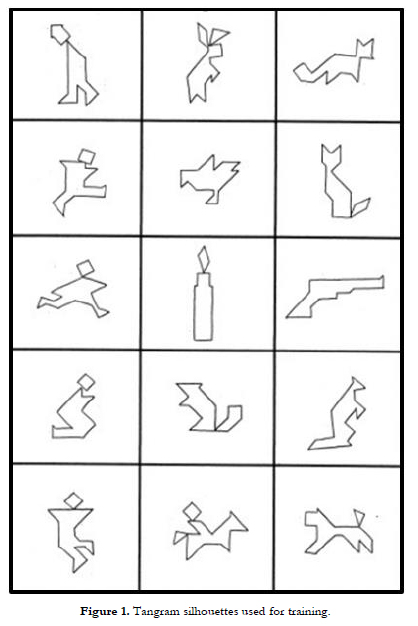
<body><![CDATA[<blockquote>     <p><font face="Verdana" size="2"><i>a) Control group.</i> There were no specific instructions, only the classroom instructions used for motivating all the students and explaining the task.</font></p>     <p><font face="Verdana" size="2"><i>b) Motivational training group.</i> The instructions for this group were aimed at activating the learning motivational orientation and to facilitate the self-regulatory processes supporting this motivation on the base of the type of training developed by Pardo &amp; Alonso-Tapia, (1990). The following messages are examples of these instructions: <i>Before the task:</i> "Who would not like to be able to convince other people? We are going to learn how to convince, as this consist of a technique that can be learned". <i>During the task,:</i> "You will be able to do it better if you plan your way in advance and try to it dividing the problem in parts". Or, in case that the student found a difficulty: "Try to look for an alternative procedure: there are always different possibilities. Remember, if you progress in solving the exercises, you are going to feel proud, as it is the reward for learning from errors". <i>After the task:</i> "What have you been thinking about as you were trying to realize the exercises on argumentation? What type of ideas have been useful? Why do you think so? What ones have not been useful? Why do you think so? What are the differences between the two types of ideas".</font></p>     <p><font face="Verdana" size="2"><i>c) Volitional training group.</i> The instructions for this group were aimed at activating the <i>action orientation</i> and through it, the <i>positive emotion self-regulation.</i> With this purpose, <i>before</i> the task, students received instructions such as: "Do not detain too much considering what exercise to do: you will learn the same no matter the one you chose. Star going the exercise without hesitation". <i>During the task.</i> "If you feel discouraged because the task is difficult, try to thing on the things that you are doing well: you will be able to bounce back", "If you feel tense, take a deep breath. you will feel relaxed". <i>After the task:</i> There were no specific messages aimed at controlling emotions.</font></p>     <p><font face="Verdana" size="2"><i>d) Mixed training group.</i> Students in this group received, combined, the two types of instructions given to the students in the two previous conditions.</font></p> </blockquote>     <p><font face="Verdana" size="2">2) <i>Task materials.</i> In the first study, focused on learning how to write argumentative texts, students had available the support materials usually employed for this task, mainly texts. In the second study, it was used the Tangram, a Chinese puzzle. The objective of this task is to reproduce the figure shown in a silhouette using the seven pieces of the puzzle living no one. <a href="#f1">Figure 1</a> shows the silhouettes used for training. Performance in this task was scored from 0 to 5, depending on the number of pieces correctly placed.</font></p>     <p>&nbsp;</p>     <p align="center"><font face="Verdana" size="2"><a name="f1"></a><img src="/img/revistas/ap/v33n2/psicologia_desarrollo1_figura1.jpg"></font></p>     <p>&nbsp;</p>     <p><font face="Verdana" size="2"><i>B) Materials for assessing the moderating variables.</i></font></p>     ]]></body>
<body><![CDATA[<p><font face="Verdana" size="2">As there are differences in self-regulation that depend on motivation (Alonso-Tapia, Huertas y Ruiz, 2010) and volition (Kuhl, 2000), and as both types of variables manifest in the self-messages that students give themselves when confronting a task, in order to control for the potential moderating effect of these types of messages on learning, the following questionnaires were used:</font></p>     <blockquote>     <p><font face="Verdana" size="2">&bull; <i>MEVA questionnaire, abbreviated form (Alonso-Tapia, 2005).</i> This questionnaire includes three scales that allow assessing the three goal orientations more accepted, according to motivational literature (Elliot, 2005): Learning goal orientation (&#945; = .84), Performance goal orientation (&#945; = .71) and Avoidance goal orientation (&#945; = .72).</font></p>     <p><font face="Verdana" size="2">&bull; <i>HAKEMP-90 (Kuhl, 1994), Spanish version.</i> This questionnaire includes also three scales that allow assessing the volitional orientations to state or to action through three bipolar scales related the degree of attention focused on emotional states at the beginning of activities (initiative vs vacillation, &#945; = .77), during activities (persistency vs volatility, &#945; = .77), or once the activities are finished (resolution versus preoccupation, &#945; = <i>.67)</i>.</font></p>     <p><font face="Verdana" size="2"><i>&bull; Motivation self-messages questionnaire (MSQ)</i> (Alonso-Tapia, 1995). It consists of two scales of self-messages of different motivational content: a) Positives self-messages oriented to learning (&#945; = .77) and Negative self-messages oriented to performance or avoidance (&#945; = .90).</font></p>     <p><font face="Verdana" size="2">&bull; Two scales developed for these studies, <i>Success expectancies for the specific task,</i> with ten items (&#945; = .76), and <i>Interest in the task,</i> with four items (&#945; = .74). These scales were used because of the potential moderator value of the two variables.</font></p>     <p><font face="Verdana" size="2">&bull; <i>Progressive matrices IQ test</i> (Raven, 1995). This well-known IQ test was used for controlling the potential moderator effect of this variable.</font></p> </blockquote>     <p><font face="Verdana" size="2"><i>C) Materials for assessing the dependent variables.</i> The following materials were used, one for each study:</font></p>     <blockquote>     <p><font face="Verdana" size="2">&bull; <i>Rubric for assessing the writing of argumentative texts.</i> This rubric consist of nine categories that allow assessing the quantity, variety and quality of arguments given for persuading in relation to the proposed topic. The categories were: a) number of arguments, b) variety of arguments, c) clarity of arguments, d) statements given in support of arguments, e) illustration of arguments with facts or examples, f) accuracy of statements, g) logic of sequence, h) conclusions and, i) adequate use of documental sources. Three scores were derived from this instrument: Number of arguments, variety of arguments and quality of arguments. The "Number" measure was obtained adding the number of reasons given by the students. The "Variety" measure took into account only the reasons that were really different and not those reasons that were a repetition or a paraphrase of a reason already given. As for the "quality "measure", it was derived using the following five criteria: 1) The answer reflects a clear and well supported expression of the author's opinion (4 points); 2) it includes specific and relevant pieces of evidence (4 points); 3) it includes contra-arguments (3 points); 4) it present secondary ideas and data with accuracy (2 points); 5) the conclusion does not allow any doubt about the author's position (3 points). The scores obtained with this code were the measure of the dependent variables.</font></p>     ]]></body>
<body><![CDATA[<p><font face="Verdana" size="2">&bull; <i>Tangram score.</i> Performance in this task was scored from 0 to 5 depending on the number of pieces of the puzzle correctly placed.</font></p> </blockquote>     <p><font face="Verdana" size="2"><b>Procedure</b></font></p>     <p><font face="Verdana" size="2">The first study, realized in the context learning to write argumentative texts, was developed along three classes. Students worked in their ordinary classrooms, during school time, and individual tables. For the initial assessment, all participants realized the same tasks and received the same instructions, no matter the experimental condition to which they had been assigned. Later, during training, they received different information, depending on the experimental condition they belonged to.</font></p>     <p><font face="Verdana" size="2">The second study was developed along two classes. In the first class, devoted to the initial assessment, all the students received the same instructions, whereas in the second, each group received the instructions corresponding to the experimental condition assigned.</font></p>     <p><font face="Verdana" size="2"><b>Data analyses</b></font></p>     <p><font face="Verdana" size="2">First, one-factor ANOVAS to test for differences between groups in each moderating variable were carried out. Second, repeated measures ANOVAS of dependent variables in academic and non-academic tasks were also carried out.</font></p>     <p>&nbsp;</p>     <p><font face="Verdana" size="2"><b>Results</b></font></p>     <p><font face="Verdana" size="2"><b>Analyses of differences between covariables.</b></font></p>     <p><font face="Verdana" size="2"><a target="_blank" href="/img/revistas/ap/v33n2/psicologia_desarrollo1_tabla1.jpg">Table 1</a> shows the means and standard deviations of the four groups in all moderating variables. Only in one case - Avoidance orientation- the differences between groups were significant. Analyses of covariance realized after this result (not included) showed the moderating effect of this variable on results was non-significant. So, all data were reanalyzed with ANOVA.</font></p>     ]]></body>
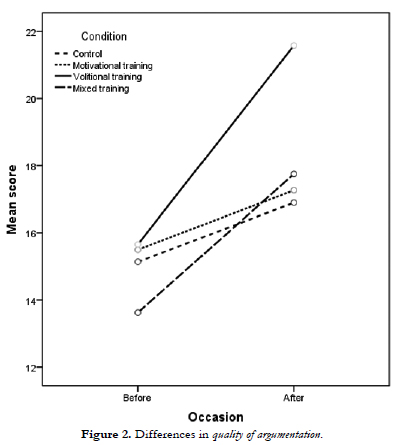
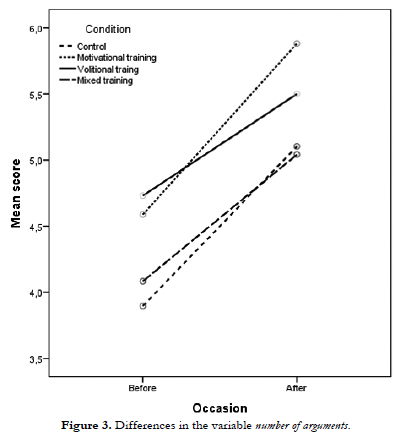
<body><![CDATA[<p><font face="Verdana" size="2"><b>Study 1. Analyses of intervention effects.</b></font></p>     <p><font face="Verdana" size="2"><a target="_blank" href="/img/revistas/ap/v33n2/psicologia_desarrollo1_tabla2.jpg">Table 2</a> shows the means and standard deviations in the three dependent variables before and after training, and Figures <a href="#f2">2</a>, <a href="#f3">3</a> and <a href="#f4">4</a>, the ANOVA results.</font></p>     <p><font face="Verdana" size="2"><a href="#f2">Figure 2</a> shows the results corresponding to the variable <i>quality of arguments</i>. In this case, the effects of <i>occasion</i> (<i>F</i><sub>1, 109</sub> = 121.85; <i>p</i> &lt; .001; &#951;<sup>2</sup> = .528), <i>condition</i> (<i>F</i><sub>3, 109</sub> = 7.48; <i>p</i> &lt; .001; &#951;<sup>2</sup> = .171) and <i>interaction</i> between both variables (<i>F</i><sub>3, 102</sub> = 10.91; <i>p</i> &lt; .001; &#951;<sup>2</sup> = .231) were significant. All groups increased the quality of the argumentative text, but the <i>volitional training group</i> (group 3) had the highest improvement followed by the <i>mixed training group</i> (group 4)</font></p>     <p>&nbsp;</p>     <p align="center"><font face="Verdana" size="2"><a name="f2"></a><img src="/img/revistas/ap/v33n2/psicologia_desarrollo1_figura2.jpg"></font></p>     <p>&nbsp;</p>     <p><font face="Verdana" size="2"><a href="#f3">Figure 3</a> shows the results corresponding to the variable <i>number of arguments.</i> In this case, the effects of both, <i>occasion</i> (<i>F</i><sub>1, 109</sub> = 78.04; <i>p &lt;</i> .001; &#951;<sup>2</sup> = .417) and <i>condition</i> (<i>F</i><sub>3, 109</sub> = 5.07; <i>p</i> &lt; .003; &#951;<sup>2</sup> = .122) were significant, but not the effect of the <i>interaction</i> between both variables (<i>F</i><sub>3, 102</sub> = 1.02; <i>p</i> &lt; .385; &#951;<sup>2</sup> = .027). This fact implies that, though there are differences between subjects in the different conditions, these differences do not imply a change of the initial differences between groups: all types of training have had a positive effect in the number of arguments generated by the students, but no one of them had a differential effect on this variable.</font></p>     <p>&nbsp;</p>     <p align="center"><font face="Verdana" size="2"><a name="f3"></a><img src="/img/revistas/ap/v33n2/psicologia_desarrollo1_figura3.jpg"></font></p>     <p>&nbsp;</p>     ]]></body>
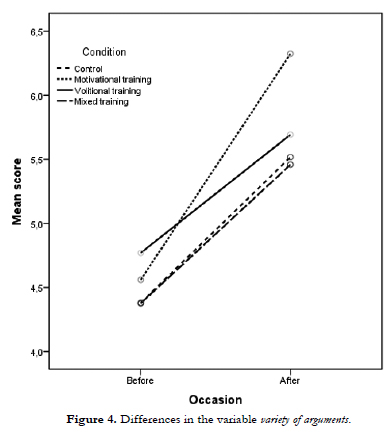
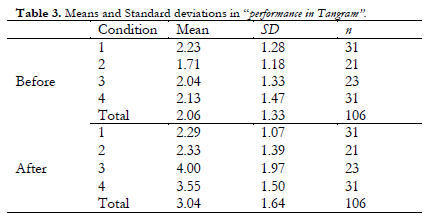
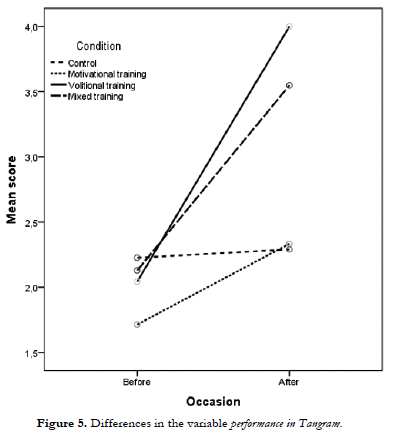
<body><![CDATA[<p><font face="Verdana" size="2">Finally, <a href="#f4">Figure 4</a> shows the results corresponding to the variable <i>number of arguments.</i> In this case, the effect of <i>occasion</i> was significant (<i>F</i><sub>1, 109</sub> = 96.37; <i>p</i> &lt; .001; &#951;<sup>2</sup> = .469), but neither the effect of the variable <i>condition</i> <i>F</i><sub>3, 109</sub> = 1.75; <i>p</i> &lt; .116; &#951;<sup>2</sup> = .160) nor the effect of the variable <i>interaction</i> (<i>F</i><sub>3, 109</sub> = 2.45; <i>p</i> = .06; &#951;<sup>2</sup> = .063) reached the standard level of significance.</font></p>     <p>&nbsp;</p>     <p align="center"><font face="Verdana" size="2"><a name="f4"></a><img src="/img/revistas/ap/v33n2/psicologia_desarrollo1_figura4.jpg"></font></p>     <p>&nbsp;</p>     <p><font face="Verdana" size="2"><b>Study 2. Analyses of intervention effects</b></font></p>     <p><font face="Verdana" size="2"><a href="#t3">Table 3</a> shows the means and standard deviations in the dependent variable <i>Tangram performance</i> before and after training, and <a href="#f5">Figure 5</a>, the ANOVA results. In this case, the effects of <i>occasion</i> (<i>F</i><sub><i>gl</i> = 1, 102</sub> = 37.33; <i>p</i> &lt; .001; &#951;<sup>2</sup> = .268), <i>condition</i> (<i>F</i><sub><i>gl</i>= 3, 102</sub> = 4.15; <i>p</i> &lt; .008; &#951;<sup>2</sup> = .109) and <i>interaction</i> between both variables (<i>F</i><sub><i>gl</i>= 3, 102</sub> = 6.65; <i>p</i> &lt; .001; &#951;<sup>2</sup> = .164) were significant. All groups increased the quality of the argumentative text, but the <i>volitional training group</i> (group 3) had the highest improvement followed by the <i>mixed training group</i> (group 4). As it can be seen in <a href="#f4">Figure 4</a>, all groups except the control one improved their performance after training, but the groups with volitional training increased their performance in a degree significantly greater than the other two groups (Mixed training group: Difference = -1.42; <i>t</i><sub><i>gl</i> = 30</sub> = -5.69, <i>p</i> &lt;.0001; Volitional training group: Difference : -1.95; <i>t</i><sub><i>gl</i> = 22</sub> = 4.42, p&lt;.000).</font></p>     <p>&nbsp;</p>     <p align="center"><font face="Verdana" size="2"><a name="t3"></a><img src="/img/revistas/ap/v33n2/psicologia_desarrollo1_tabla3.jpg"></font></p>     <p>&nbsp;</p>     <p align="center"><font face="Verdana" size="2"><a name="f5"></a><img src="/img/revistas/ap/v33n2/psicologia_desarrollo1_figura5.jpg"></font></p>     ]]></body>
<body><![CDATA[<p>&nbsp;</p>     <p><font face="Verdana" size="2"><b>Discussion and conclusions</b></font></p>     <p><font face="Verdana" size="2">At the beginning of this paper it was said that students' effort to learn does not depend only on their motivation, but also on the way of self-regulating their own activity when confronting the learning tasks. This fact underlies the importance of facilitating self-regulation. This process implies knowing specific strategies related to the task in hand, the capacity of regulating the own motivation by focusing on the value of learning what one is trying to learn, and the capacity of coping with the negative emotions that arise when finding difficulties, as such emotions can force the students to give up the task. However, the review of self-regulation literature showed that there were no studies displaying the relative and combined effect that teaching to self-regulate not only motivation, but also the emotions affecting volition, can have on learning. The need of an answer to this problem motivated the present study. Thus, what kind of contributions has our study made for answering this question?.</font></p>     <p><font face="Verdana" size="2">Before evaluating the results, we have to pay attention to the brevity of intervention, as this fact can explain why the results were not more pronounced. Having this fact in mind, the result most clear is that, contrary to initial expectations, the effect of both types of training has not been similar in both studies. The only relevant effect in both cases that was significant was the effect of volitional training, focused on teaching how to self-regulate emotions. However, in Study 1 this effect has not been found when the dependent variables were those that implied a lower mental effort -to give more and more varied arguments-, though it has been found in the case of the dependent variable <i>quality of arguments,</i> a variable that imply giving arguments more relevant and organizing better the argumentation. In the same way, in Study 2, the only dependent variable <i>-performance in Tangram-</i> implied complex reasoning processes.</font></p>     <p><font face="Verdana" size="2">These results raise some questions. Why volitional training effects, focused on self-regulating the negative emotions that influence volitional processes, do not generalize from one task to another? Why <i>motivational training</i> effects have not been significantly higher than those found in the control group, as it have been found in other studies? (Pardo &amp; Alonso Tapia, 1990).</font></p>     <p><font face="Verdana" size="2">Concerning the first question, it may have been that, as the processes affecting the different dependent variables differ in difficulty, the experience of difficulty and the negative emotions aroused by it may have been also different: it is easier to give reasons -in great quantity and more varied-that to select them on the base of its relevance and, mainly, to organize them when building an argumentation. The greater the difficulty, the greater the likelihood of experiencing negative emotions that can manifest in thoughts such as: "What a difficult task!", "I don't know how to do it", "I'm going to be wrong", etc. In consequence, it is in these occasions when teaching strategies allowing the self-regulation of emotions can be more useful: that is what the results seem to imply. The teaching of such strategies would had allowed the students to cope adequately with the fear of making mistakes or doing wrong, to control their emotional states, anxiety and annoyance, and to generate positive thoughts. That is, it seems that a greater control of emotional states allow students to achieve greater concentration, attention, interest, effort and persistence in the task, so that their performance improves. On the contrary, it seems logical that if the task is not difficult and does not arouse negative emotions, to teach the students to self-regulate their emotions has few effectiveness.</font></p>     <p><font face="Verdana" size="2">The likelihood that the greater experience of difficulty have made it possible the greater effectiveness of emotion self-regulation training, increases if we consider that the time the students had available for realizing the tasks was quite limited -it was a very short intervention-. This fact could have aroused anxiety, and so the volitional training, directly aimed at teaching how to control emotions, would had been more effective.</font></p>     <p><font face="Verdana" size="2">As for the effect of <i>motivational training,</i> it was nonsignificant -the students in this condition improved, but their improvement was similar to that of the control group-. However, the effect was almost significant in the case of the dependent variable "variety of arguments" In both cases, the results differ from the ones found in other studies (Dignath &amp; B&#252;ttner, 2008; Pardo &amp; Alonso-Tapia, 1990). It is therefore appropriate to ask why the motivational training group was not superior to the control group. There may be several reasons. In study 1, the previous experience of students with the task of writing argumentative texts, a task already dealt with in previous years, may have influenced the value assigned to the task by the students so that intervention -given its brevity- would have been insufficient for improving their motivation. In the case of Study 2, the lack of previous experience should have been caused the improvement of motivation, as previous experience would not have interfered. However, the fact that the work took place in a school context, in which performance in a puzzle is not relevant, may have produced the results obtained. Finally, the fact that the effect of <i>motivational training</i> fell short of the standard levels of significance in the case of the variable "variety of arguments" could be explained if we consider the possibility that to look for different arguments may not generate too much anxiety. In this case, volitional training would not be neither specially relevant nor effective, whereas motivational training, focused on strategies directly oriented to the realization of the task, would certainly be relevant and so, probably effective.</font></p>     <p><font face="Verdana" size="2">Another question aroused by our data is why, in the nonacademic task, the volitional training was effective whereas the motivational was not, neither alone nor in combination, as there nor additional effect to that of volitional training. This fact could be explained on the base of some observations realized during training, when it could be appreciated that the students' motivation was mainly to win in competition. The situation aroused a motivation extrinsic to the task -to show their abilities to solve the Tangram (a circumstantial interest)-, and probably, greater anxiety -fear of failure-. In this case, the volitional training was relevant, whereas the fact that the task was not a curricular one did not activated the motivation to learn, that was what the motivational training tried to do.</font></p>     <p><font face="Verdana" size="2">Taken together, the results found make an important contribution. According to Boekaerts (2011; Boekaerts &amp; Corno, 2005), students not only strive for learning, but also for wellbeing. So, if the learning environment is stressful by any reason -the type of task, the difficulty experienced, etc.-, their performance is negatively affected. For this reason, not only it is important to self-regulate learning and motivation, but also the emotions that affect volition and the whole selfregulation process. Our results support the idea that it is possible to teach how to self-regulate emotions in an effective way. Moreover, they also suggest, according to the selfregulation model proposed by Efklides (2011), that the type of task plays an important moderating role. It is not the same a difficult task that can generate anxiety, than an easy one; and it is not the same a task relevant for the objectives at stake -the performance in a task is important for achieving good grades-, that a task not relevant for such objectives. Therefore, if we what to progress in our understanding of how to help students to develop their self-regulation capacity, it is necessary to pay attention to the task and to the degree of experience of students in it.</font></p>     ]]></body>
<body><![CDATA[<p><font face="Verdana" size="2">The present work, however, has an important limitation. The intervention was short and so, the value of our conclusions is limited. So it is necessary to get additional evidence that give additional support to them.</font></p>     <p>&nbsp;</p>     <p><font face="Verdana" size="2"><b>References</b></font></p>     <!-- ref --><p><font face="Verdana" size="2">1. Alonso Tapia, J. (1995). Orientación Educativa: Teoría, evaluación e intervención. (Educational orientation: Theory, Assessment and intervention). Madrid: Síntesis.    &nbsp;&nbsp;&nbsp;&nbsp;&nbsp;&nbsp;&nbsp;&nbsp;[&#160;<a href="javascript:void(0);" onclick="javascript: window.open('/scielo.php?script=sci_nlinks&ref=779197&pid=S0212-9728201700020001100001&lng=','','width=640,height=500,resizable=yes,scrollbars=1,menubar=yes,');">Links</a>&#160;]<!-- end-ref --></font></p>    <!-- ref --><p><font face="Verdana" size="2">2. Alonso Tapia, J. (2005). Motivaciones, expectativas y valores-intereses relacionados con el aprendizaje: el cuestionario MEVA. (Motivations, expectancies and value-interests related to Learning: the MEVA questionnaire). Psicothema, 17 (3), 404-411.    &nbsp;&nbsp;&nbsp;&nbsp;&nbsp;&nbsp;&nbsp;&nbsp;[&#160;<a href="javascript:void(0);" onclick="javascript: window.open('/scielo.php?script=sci_nlinks&ref=779199&pid=S0212-9728201700020001100002&lng=','','width=640,height=500,resizable=yes,scrollbars=1,menubar=yes,');">Links</a>&#160;]<!-- end-ref --></font></p>    <!-- ref --><p><font face="Verdana" size="2">3. Alonso Tapia, J., Huertas, J.A. &amp; Ruiz, M (2010).On the nature of motivational orientations: Implications of assessed goals and gender differences for motivational goal theory. Spanish Journal of Psychology, 13(1), 231-242. http://dx.doi.org/10.1017/S1138741600003814.    &nbsp;&nbsp;&nbsp;&nbsp;&nbsp;&nbsp;&nbsp;&nbsp;[&#160;<a href="javascript:void(0);" onclick="javascript: window.open('/scielo.php?script=sci_nlinks&ref=779201&pid=S0212-9728201700020001100003&lng=','','width=640,height=500,resizable=yes,scrollbars=1,menubar=yes,');">Links</a>&#160;]<!-- end-ref --></font></p>    <!-- ref --><p><font face="Verdana" size="2">4. Alonso-Tapia, J., &amp; Panadero, E. (2010). Effect of self-assessment scripts on self-regulation and learning. Infancia y Aprendizaje, 33(3), 385-397. http://dx.doi.org/10.1174/021037010792215145.    &nbsp;&nbsp;&nbsp;&nbsp;&nbsp;&nbsp;&nbsp;&nbsp;[&#160;<a href="javascript:void(0);" onclick="javascript: window.open('/scielo.php?script=sci_nlinks&ref=779203&pid=S0212-9728201700020001100004&lng=','','width=640,height=500,resizable=yes,scrollbars=1,menubar=yes,');">Links</a>&#160;]<!-- end-ref --></font></p>    <!-- ref --><p><font face="Verdana" size="2">5. Ato, M., López, J.J. &amp; Benavente, A. (2013). Un sistema de clasificación de los diseños de investigación en psicología. Anales de Psicología, 29(3), 1038-1059. http://dx.doi.org/10.6018/analesps.29.3.178511.    &nbsp;&nbsp;&nbsp;&nbsp;&nbsp;&nbsp;&nbsp;&nbsp;[&#160;<a href="javascript:void(0);" onclick="javascript: window.open('/scielo.php?script=sci_nlinks&ref=779205&pid=S0212-9728201700020001100005&lng=','','width=640,height=500,resizable=yes,scrollbars=1,menubar=yes,');">Links</a>&#160;]<!-- end-ref --></font></p>    <!-- ref --><p><font face="Verdana" size="2">6. Bandura, A. (1997). Self-efficacy: the exercise of control. New York: Freeman.    &nbsp;&nbsp;&nbsp;&nbsp;&nbsp;&nbsp;&nbsp;&nbsp;[&#160;<a href="javascript:void(0);" onclick="javascript: window.open('/scielo.php?script=sci_nlinks&ref=779207&pid=S0212-9728201700020001100006&lng=','','width=640,height=500,resizable=yes,scrollbars=1,menubar=yes,');">Links</a>&#160;]<!-- end-ref --></font></p>    <!-- ref --><p><font face="Verdana" size="2">7. Boekaerts, M. (1995). Self-regulated learning Bridging the gap between metacognitive and meta-motivation theories, Educational Psychologist, 30(4), 195-200.    &nbsp;&nbsp;&nbsp;&nbsp;&nbsp;&nbsp;&nbsp;&nbsp;[&#160;<a href="javascript:void(0);" onclick="javascript: window.open('/scielo.php?script=sci_nlinks&ref=779209&pid=S0212-9728201700020001100007&lng=','','width=640,height=500,resizable=yes,scrollbars=1,menubar=yes,');">Links</a>&#160;]<!-- end-ref --></font></p>    <!-- ref --><p><font face="Verdana" size="2">8. Boekaerts, M. (2011). Emotions, emotion regulation and self-regulation of learning. In B.J. Zimmerman, &amp; D.H. Schunk (Eds.), Handbook of selfregulation of learning and performance (pp. 408-425). New York: Routledge.    &nbsp;&nbsp;&nbsp;&nbsp;&nbsp;&nbsp;&nbsp;&nbsp;[&#160;<a href="javascript:void(0);" onclick="javascript: window.open('/scielo.php?script=sci_nlinks&ref=779211&pid=S0212-9728201700020001100008&lng=','','width=640,height=500,resizable=yes,scrollbars=1,menubar=yes,');">Links</a>&#160;]<!-- end-ref --></font></p>    <!-- ref --><p><font face="Verdana" size="2">9. Boekaerts, M. &amp; Corno, L, (2005). Self-Regulation in the Classroom: A perspective on assessment and intervention. Applied Psychology: An International 918 Review, 54(2), 199-231. http://dx.doi.org/10.1111/j.1464-0597.2005.00205.x.    &nbsp;&nbsp;&nbsp;&nbsp;&nbsp;&nbsp;&nbsp;&nbsp;[&#160;<a href="javascript:void(0);" onclick="javascript: window.open('/scielo.php?script=sci_nlinks&ref=779213&pid=S0212-9728201700020001100009&lng=','','width=640,height=500,resizable=yes,scrollbars=1,menubar=yes,');">Links</a>&#160;]<!-- end-ref --></font></p>    <!-- ref --><p><font face="Verdana" size="2">10. Bjork, R. A., Dunlosky, J. &amp; Kornell, N. (2013). Self-Regulated learning: Beliefs, techniques, and illusions. Annual Review of Psychology, 64, 417-444. http://dx.doi.org/ 10.1146/annurev-psych-113011-143823.    &nbsp;&nbsp;&nbsp;&nbsp;&nbsp;&nbsp;&nbsp;&nbsp;[&#160;<a href="javascript:void(0);" onclick="javascript: window.open('/scielo.php?script=sci_nlinks&ref=779215&pid=S0212-9728201700020001100010&lng=','','width=640,height=500,resizable=yes,scrollbars=1,menubar=yes,');">Links</a>&#160;]<!-- end-ref --></font></p>    <!-- ref --><p><font face="Verdana" size="2">11. Dignath, C., &amp; B&#252;ttner, G. (2008). Components of fostering self-regulated learning among students. A meta-analysis on intervention studies at primary and secondary school level. Metacognition and Learning, 3, 231-264. http://dx.doi.org/10.1007/s11409-008-9029-x.    &nbsp;&nbsp;&nbsp;&nbsp;&nbsp;&nbsp;&nbsp;&nbsp;[&#160;<a href="javascript:void(0);" onclick="javascript: window.open('/scielo.php?script=sci_nlinks&ref=779217&pid=S0212-9728201700020001100011&lng=','','width=640,height=500,resizable=yes,scrollbars=1,menubar=yes,');">Links</a>&#160;]<!-- end-ref --></font></p>    <!-- ref --><p><font face="Verdana" size="2">12. Dignath, C., B&#252;ttner, G., &amp; Langfeldt, H. (2008). How can primary school students learn self-regulated learning strategies most effectively? A meta-analysis on self-regulation training programmes. Educational Research Review, 3(2), 101-129. http://dx.doi.org/10.1016/j.edurev.2008.02.003.    &nbsp;&nbsp;&nbsp;&nbsp;&nbsp;&nbsp;&nbsp;&nbsp;[&#160;<a href="javascript:void(0);" onclick="javascript: window.open('/scielo.php?script=sci_nlinks&ref=779219&pid=S0212-9728201700020001100012&lng=','','width=640,height=500,resizable=yes,scrollbars=1,menubar=yes,');">Links</a>&#160;]<!-- end-ref --></font></p>    <!-- ref --><p><font face="Verdana" size="2">13. Dweck, C.S., &amp; Master, A. (2008). Self-theories motivate self-regulated learning. In D. Schunk &amp; B. Zimmerman (Eds.). Motivation and selfregulated learning: Theory, Research, and Applications. Mahwah, NJ: Erlbaum.    &nbsp;&nbsp;&nbsp;&nbsp;&nbsp;&nbsp;&nbsp;&nbsp;[&#160;<a href="javascript:void(0);" onclick="javascript: window.open('/scielo.php?script=sci_nlinks&ref=779221&pid=S0212-9728201700020001100013&lng=','','width=640,height=500,resizable=yes,scrollbars=1,menubar=yes,');">Links</a>&#160;]<!-- end-ref --></font></p>    <!-- ref --><p><font face="Verdana" size="2">14. Eccles, J.S. &amp; Wigfield, A. (2002). Motivational beliefs, values and goals. Annual Review of Psychology, 53, 109-132. http://dx.doi.org/10.1146/annurev.psych.53.100901.135153.    &nbsp;&nbsp;&nbsp;&nbsp;&nbsp;&nbsp;&nbsp;&nbsp;[&#160;<a href="javascript:void(0);" onclick="javascript: window.open('/scielo.php?script=sci_nlinks&ref=779223&pid=S0212-9728201700020001100014&lng=','','width=640,height=500,resizable=yes,scrollbars=1,menubar=yes,');">Links</a>&#160;]<!-- end-ref --></font></p>    <!-- ref --><p><font face="Verdana" size="2">15. Efklides, A. (2011). Interactions of metacognition with motivation and affect in self-regulated learning: The MASRL Model. Educational Psychologist, 46(1), 6-25. http://dx.doi.org/10.1080/00461520.2011.538645.    &nbsp;&nbsp;&nbsp;&nbsp;&nbsp;&nbsp;&nbsp;&nbsp;[&#160;<a href="javascript:void(0);" onclick="javascript: window.open('/scielo.php?script=sci_nlinks&ref=779225&pid=S0212-9728201700020001100015&lng=','','width=640,height=500,resizable=yes,scrollbars=1,menubar=yes,');">Links</a>&#160;]<!-- end-ref --></font></p>    <!-- ref --><p><font face="Verdana" size="2">16. Elliot, A. (2005). A conceptual history of the achievement goal construct. In A. Elliot &amp; C. Dweck (Eds.), Handbook of competence and motivation (pp. 52-72). New York: Guilford.    &nbsp;&nbsp;&nbsp;&nbsp;&nbsp;&nbsp;&nbsp;&nbsp;[&#160;<a href="javascript:void(0);" onclick="javascript: window.open('/scielo.php?script=sci_nlinks&ref=779227&pid=S0212-9728201700020001100016&lng=','','width=640,height=500,resizable=yes,scrollbars=1,menubar=yes,');">Links</a>&#160;]<!-- end-ref --></font></p>    <!-- ref --><p><font face="Verdana" size="2">17. Fryer, J. &amp; Elliot, A. (2008). Self-regulation of achievement goal pursuit. In D. Schunk &amp; B. Zimmerman (Eds.), Motivation and self-regulated learning: Theory, research, and applications (pp. 53-75). New York: Erlbaum.    &nbsp;&nbsp;&nbsp;&nbsp;&nbsp;&nbsp;&nbsp;&nbsp;[&#160;<a href="javascript:void(0);" onclick="javascript: window.open('/scielo.php?script=sci_nlinks&ref=779229&pid=S0212-9728201700020001100017&lng=','','width=640,height=500,resizable=yes,scrollbars=1,menubar=yes,');">Links</a>&#160;]<!-- end-ref --></font></p>    <!-- ref --><p><font face="Verdana" size="2">18. Kuhl, J. (1994). Action versus state orientation: psychometric properties of the action control scale. In J. Kuhl &amp; J. Beckmann (Eds.), Volition and personality: action versus state orientation (pp. 47-59). Seattle: Hogrefe &amp; Huber.    &nbsp;&nbsp;&nbsp;&nbsp;&nbsp;&nbsp;&nbsp;&nbsp;[&#160;<a href="javascript:void(0);" onclick="javascript: window.open('/scielo.php?script=sci_nlinks&ref=779231&pid=S0212-9728201700020001100018&lng=','','width=640,height=500,resizable=yes,scrollbars=1,menubar=yes,');">Links</a>&#160;]<!-- end-ref --></font></p>    <!-- ref --><p><font face="Verdana" size="2">19. Kuhl, J. (2000). A functional-design approach to motivation and self-regulation. In M. Boekaerts, P. Pintrich &amp; M. Zaidner (Eds.) Handbook of self-regulation (pp. 111-169). San Diego, CA: Academic Press.    &nbsp;&nbsp;&nbsp;&nbsp;&nbsp;&nbsp;&nbsp;&nbsp;[&#160;<a href="javascript:void(0);" onclick="javascript: window.open('/scielo.php?script=sci_nlinks&ref=779233&pid=S0212-9728201700020001100019&lng=','','width=640,height=500,resizable=yes,scrollbars=1,menubar=yes,');">Links</a>&#160;]<!-- end-ref --></font></p>    <!-- ref --><p><font face="Verdana" size="2">20. Linnenbrink-Garcia, L., Middleton, M. J., Ciani, K. D., Easter, M. A., O'Keefe, P.A. &amp; Zusho, A. (2012). The strength of the relation between performance-approach and performance-avoidance goal orientations: Theoretical, methodological, and instructional implications, Educational Psychologist, 47(4), 281-301. http://dx.doi.org/10.1080/00461520.2012.722515.    &nbsp;&nbsp;&nbsp;&nbsp;&nbsp;&nbsp;&nbsp;&nbsp;[&#160;<a href="javascript:void(0);" onclick="javascript: window.open('/scielo.php?script=sci_nlinks&ref=779235&pid=S0212-9728201700020001100020&lng=','','width=640,height=500,resizable=yes,scrollbars=1,menubar=yes,');">Links</a>&#160;]<!-- end-ref --></font></p>    <!-- ref --><p><font face="Verdana" size="2">21. Pardo, A. &amp; Alonso-Tapia, J. (1990). Motivación en el aula. (Motivation in the school) Madrid: Universidad Autónoma.    &nbsp;&nbsp;&nbsp;&nbsp;&nbsp;&nbsp;&nbsp;&nbsp;[&#160;<a href="javascript:void(0);" onclick="javascript: window.open('/scielo.php?script=sci_nlinks&ref=779237&pid=S0212-9728201700020001100021&lng=','','width=640,height=500,resizable=yes,scrollbars=1,menubar=yes,');">Links</a>&#160;]<!-- end-ref --></font></p>    <!-- ref --><p><font face="Verdana" size="2">22. Perry, N.E. &amp; Rahim, A. (2011). Studying self-regulation in classroom. In B. J. Zimmerman, &amp; D. H. Schunk (Eds.), Handbook of self-regulation of learning and performance (pp. 122-136). New York: Routledge.    &nbsp;&nbsp;&nbsp;&nbsp;&nbsp;&nbsp;&nbsp;&nbsp;[&#160;<a href="javascript:void(0);" onclick="javascript: window.open('/scielo.php?script=sci_nlinks&ref=779239&pid=S0212-9728201700020001100022&lng=','','width=640,height=500,resizable=yes,scrollbars=1,menubar=yes,');">Links</a>&#160;]<!-- end-ref --></font></p>    <!-- ref --><p><font face="Verdana" size="2">23. Raven, J.C. (1995). Test de matrices progresivas. (Progressive matrices IQ test). Buenos Aires: Paidós.    &nbsp;&nbsp;&nbsp;&nbsp;&nbsp;&nbsp;&nbsp;&nbsp;[&#160;<a href="javascript:void(0);" onclick="javascript: window.open('/scielo.php?script=sci_nlinks&ref=779241&pid=S0212-9728201700020001100023&lng=','','width=640,height=500,resizable=yes,scrollbars=1,menubar=yes,');">Links</a>&#160;]<!-- end-ref --></font></p>    <!-- ref --><p><font face="Verdana" size="2">24. Schunk, D.H. (1995). Self-efficacy in education and instruction. In J. E. Maddux, (Ed.), Self-efficacy, adaptation, and adjustment: Theory, research, and application (pp. 281-303). New York: Plenum.    &nbsp;&nbsp;&nbsp;&nbsp;&nbsp;&nbsp;&nbsp;&nbsp;[&#160;<a href="javascript:void(0);" onclick="javascript: window.open('/scielo.php?script=sci_nlinks&ref=779243&pid=S0212-9728201700020001100024&lng=','','width=640,height=500,resizable=yes,scrollbars=1,menubar=yes,');">Links</a>&#160;]<!-- end-ref --></font></p>    <!-- ref --><p><font face="Verdana" size="2">25. Schunk, D.H. (1999). Social-self interaction and achievement behavior. Educational Psychologist 34 (4), 219-227. http://dx.doi.org/10.1207/s15326985ep34043.    &nbsp;&nbsp;&nbsp;&nbsp;&nbsp;&nbsp;&nbsp;&nbsp;[&#160;<a href="javascript:void(0);" onclick="javascript: window.open('/scielo.php?script=sci_nlinks&ref=779245&pid=S0212-9728201700020001100025&lng=','','width=640,height=500,resizable=yes,scrollbars=1,menubar=yes,');">Links</a>&#160;]<!-- end-ref --></font></p>    <!-- ref --><p><font face="Verdana" size="2">26. Schunk, D.H. (2008). Attributions as motivators of self-regulated learning. In D.H. Shunk y B.J. Zimmerman (Eds.), Motivation and self-regulated learning. Theory, research and applications. (p. 245-266). New York: Lawrence Erlbaum.    &nbsp;&nbsp;&nbsp;&nbsp;&nbsp;&nbsp;&nbsp;&nbsp;[&#160;<a href="javascript:void(0);" onclick="javascript: window.open('/scielo.php?script=sci_nlinks&ref=779247&pid=S0212-9728201700020001100026&lng=','','width=640,height=500,resizable=yes,scrollbars=1,menubar=yes,');">Links</a>&#160;]<!-- end-ref --></font></p>    <!-- ref --><p><font face="Verdana" size="2">27. Senko, C., Hulleman, C. S. &amp; Harackiewicz, J.M. (2011). Achievement goal theory at the crossroads: Old controversies, current challenges and new directions. Educational Psychologist, 46(1), 26-47. http://dx.doi.org/10.1080/00461520.2011.538646.    &nbsp;&nbsp;&nbsp;&nbsp;&nbsp;&nbsp;&nbsp;&nbsp;[&#160;<a href="javascript:void(0);" onclick="javascript: window.open('/scielo.php?script=sci_nlinks&ref=779249&pid=S0212-9728201700020001100027&lng=','','width=640,height=500,resizable=yes,scrollbars=1,menubar=yes,');">Links</a>&#160;]<!-- end-ref --></font></p>    <!-- ref --><p><font face="Verdana" size="2">28. Stoegler, H &amp; Ziegler, A. (2011). Self-regulatory training through elementary school students' homework completion. In B. J. Zimmerman, &amp; D. H. Schunk (Eds.), Handbook of self-regulation of learning and performance (pp. 87-101). New York: Routledge.    &nbsp;&nbsp;&nbsp;&nbsp;&nbsp;&nbsp;&nbsp;&nbsp;[&#160;<a href="javascript:void(0);" onclick="javascript: window.open('/scielo.php?script=sci_nlinks&ref=779251&pid=S0212-9728201700020001100028&lng=','','width=640,height=500,resizable=yes,scrollbars=1,menubar=yes,');">Links</a>&#160;]<!-- end-ref --></font></p>    <!-- ref --><p><font face="Verdana" size="2">29. Urdan, T. &amp; Midgley, C. (2001). Academic self-handicapping: What we know, what more there is to learn? Educational Psychology Review, 13(2), 115-138. http://dx.doi.org/10.1023/AT009061303214.    &nbsp;&nbsp;&nbsp;&nbsp;&nbsp;&nbsp;&nbsp;&nbsp;[&#160;<a href="javascript:void(0);" onclick="javascript: window.open('/scielo.php?script=sci_nlinks&ref=779253&pid=S0212-9728201700020001100029&lng=','','width=640,height=500,resizable=yes,scrollbars=1,menubar=yes,');">Links</a>&#160;]<!-- end-ref --></font></p>    <!-- ref --><p><font face="Verdana" size="2">30. Usher, E.L. &amp; Pajares, F. (2008). Self-Efficacy for Self-Regulated Learning. Educational and Psychological Measurement, 68(3), 443-463 http://dx.doi.org/10.1177/0013164407308475.    &nbsp;&nbsp;&nbsp;&nbsp;&nbsp;&nbsp;&nbsp;&nbsp;[&#160;<a href="javascript:void(0);" onclick="javascript: window.open('/scielo.php?script=sci_nlinks&ref=779255&pid=S0212-9728201700020001100030&lng=','','width=640,height=500,resizable=yes,scrollbars=1,menubar=yes,');">Links</a>&#160;]<!-- end-ref --></font></p>    <!-- ref --><p><font face="Verdana" size="2">31. Weiner, B. (1986). An attributional theory of motivation and emotion. New York: Springer.    &nbsp;&nbsp;&nbsp;&nbsp;&nbsp;&nbsp;&nbsp;&nbsp;[&#160;<a href="javascript:void(0);" onclick="javascript: window.open('/scielo.php?script=sci_nlinks&ref=779257&pid=S0212-9728201700020001100031&lng=','','width=640,height=500,resizable=yes,scrollbars=1,menubar=yes,');">Links</a>&#160;]<!-- end-ref --></font></p>    <!-- ref --><p><font face="Verdana" size="2">32. Wigfield, A., Hoa, L.W. &amp; Kaluda, S.L. (2008). The role of achievement values in the self-regulation of achievement behaviors. In D.H. Shunk &amp; B.J. Zimmerman (Eds.), Motivation and self-regulated learning. Theory, research and applications. (p. 169-196). New York: Lawrence Erlbaum.    &nbsp;&nbsp;&nbsp;&nbsp;&nbsp;&nbsp;&nbsp;&nbsp;[&#160;<a href="javascript:void(0);" onclick="javascript: window.open('/scielo.php?script=sci_nlinks&ref=779259&pid=S0212-9728201700020001100032&lng=','','width=640,height=500,resizable=yes,scrollbars=1,menubar=yes,');">Links</a>&#160;]<!-- end-ref --></font></p>    <!-- ref --><p><font face="Verdana" size="2">33. Wigfield, A. &amp; Eccles, J. (1992).The development of achievement task values: A theoretical analysis. Developmental Review, 12, 265-310.    &nbsp;&nbsp;&nbsp;&nbsp;&nbsp;&nbsp;&nbsp;&nbsp;[&#160;<a href="javascript:void(0);" onclick="javascript: window.open('/scielo.php?script=sci_nlinks&ref=779261&pid=S0212-9728201700020001100033&lng=','','width=640,height=500,resizable=yes,scrollbars=1,menubar=yes,');">Links</a>&#160;]<!-- end-ref --></font></p>    <!-- ref --><p><font face="Verdana" size="2">34. Winne, P.H. (2011). A cognitive and metacognitive analysis of selfregulation learning. In B. J. Zimmerman, &amp; D. H. Schunk (Eds.), Handbook of self-regulation of learning and performance (pp. 15-32). New York: Routledge.    &nbsp;&nbsp;&nbsp;&nbsp;&nbsp;&nbsp;&nbsp;&nbsp;[&#160;<a href="javascript:void(0);" onclick="javascript: window.open('/scielo.php?script=sci_nlinks&ref=779263&pid=S0212-9728201700020001100034&lng=','','width=640,height=500,resizable=yes,scrollbars=1,menubar=yes,');">Links</a>&#160;]<!-- end-ref --></font></p>    <!-- ref --><p><font face="Verdana" size="2">35. Zimmerman, B. J. (1995b). Self-regulation involves more than metacognition: A social cognitive perspective. Educational Psychologist, 30(4) 217-221.    &nbsp;&nbsp;&nbsp;&nbsp;&nbsp;&nbsp;&nbsp;&nbsp;[&#160;<a href="javascript:void(0);" onclick="javascript: window.open('/scielo.php?script=sci_nlinks&ref=779265&pid=S0212-9728201700020001100035&lng=','','width=640,height=500,resizable=yes,scrollbars=1,menubar=yes,');">Links</a>&#160;]<!-- end-ref --></font></p>    <!-- ref --><p><font face="Verdana" size="2">36. Zimmerman, B. J. (2008). Investigating self-regulation and motivation: Historical background, methodological developments, and future prospects. American Educational Research Journal, 45, 166-183. http://dx.doi.org/10.3102/0002831207312909.    &nbsp;&nbsp;&nbsp;&nbsp;&nbsp;&nbsp;&nbsp;&nbsp;[&#160;<a href="javascript:void(0);" onclick="javascript: window.open('/scielo.php?script=sci_nlinks&ref=779267&pid=S0212-9728201700020001100036&lng=','','width=640,height=500,resizable=yes,scrollbars=1,menubar=yes,');">Links</a>&#160;]<!-- end-ref --></font></p>    <!-- ref --><p><font face="Verdana" size="2">37. Zimmerman, B.J. &amp; Shunk, D.H. (2008). Motivation: An Essentials dimension of self-regulated learning. En D.H. Shunk &amp; B.J. Zimmerman (Eds.), Motivation and self-regulated learning. Theory, research and applications. (p. 1-30). New York: Lawrence Erlbaum.    &nbsp;&nbsp;&nbsp;&nbsp;&nbsp;&nbsp;&nbsp;&nbsp;[&#160;<a href="javascript:void(0);" onclick="javascript: window.open('/scielo.php?script=sci_nlinks&ref=779269&pid=S0212-9728201700020001100037&lng=','','width=640,height=500,resizable=yes,scrollbars=1,menubar=yes,');">Links</a>&#160;]<!-- end-ref --></font></p>    <!-- ref --><p><font face="Verdana" size="2">38. Zimmerman, B. J. (2013). From Cognitive Modeling to Self-Regulation: A Social Cognitive Career Path. Educational Psychologist, 48(3), 135-147, http://dx.doi.org/10.1080/00461520.2013.794676.    &nbsp;&nbsp;&nbsp;&nbsp;&nbsp;&nbsp;&nbsp;&nbsp;[&#160;<a href="javascript:void(0);" onclick="javascript: window.open('/scielo.php?script=sci_nlinks&ref=779271&pid=S0212-9728201700020001100038&lng=','','width=640,height=500,resizable=yes,scrollbars=1,menubar=yes,');">Links</a>&#160;]<!-- end-ref --></font></p>    <!-- ref --><p><font face="Verdana" size="2">39. Zimmerman, B. J., &amp; Schunk, D. H. (2011a). Self-regulating learning and performance: An introduction and and overview. In B. J. Zimmerman, &amp; D. H. Schunk (Eds.), Handbook of self-regulation of learning and performance (pp. 1-12). New York: Routledge.    &nbsp;&nbsp;&nbsp;&nbsp;&nbsp;&nbsp;&nbsp;&nbsp;[&#160;<a href="javascript:void(0);" onclick="javascript: window.open('/scielo.php?script=sci_nlinks&ref=779273&pid=S0212-9728201700020001100039&lng=','','width=640,height=500,resizable=yes,scrollbars=1,menubar=yes,');">Links</a>&#160;]<!-- end-ref --></font></p>    <!-- ref --><p><font face="Verdana" size="2">40. Zimmerman, B. J., &amp; Schunk, D. H. (2011b). Handbook of self-regulation of learning and performance. New York: Routledge.    &nbsp;&nbsp;&nbsp;&nbsp;&nbsp;&nbsp;&nbsp;&nbsp;[&#160;<a href="javascript:void(0);" onclick="javascript: window.open('/scielo.php?script=sci_nlinks&ref=779275&pid=S0212-9728201700020001100040&lng=','','width=640,height=500,resizable=yes,scrollbars=1,menubar=yes,');">Links</a>&#160;]<!-- end-ref --></font></p>     <p>&nbsp;</p>     <p>&nbsp;</p>     <p><font face="Verdana" size="2"><a href="#top"><img border="0" src="/img/revistas/ap/v33n2/seta.gif" width="15" height="17"></a><a name="bajo"></a><b>Correspondence:</b>    <br>Mario Báez-Estradas: <a href="mailto:mbaez@uta.cl">mbaez@uta.cl</a>:    <br>Jesús Alonso-Tapia: <a href="mailto:jesus.alonso@uam.es">jesus.alonso@uam.es</a></font></p>     <p><font face="Verdana" size="2">Article received: 17-06-2015;    <br>Revised: 02-01-2016;    ]]></body>
<body><![CDATA[<br>Accepted: 02-05-2016</font></p>      ]]></body><back>
<ref-list>
<ref id="B1">
<label>1</label><nlm-citation citation-type="book">
<person-group person-group-type="author">
<name>
<surname><![CDATA[Alonso Tapia]]></surname>
<given-names><![CDATA[J.]]></given-names>
</name>
</person-group>
<source><![CDATA[Orientación Educativa: Teoría, evaluación e intervención]]></source>
<year>1995</year>
<publisher-loc><![CDATA[Madrid ]]></publisher-loc>
<publisher-name><![CDATA[Síntesis]]></publisher-name>
</nlm-citation>
</ref>
<ref id="B2">
<label>2</label><nlm-citation citation-type="journal">
<person-group person-group-type="author">
<name>
<surname><![CDATA[Alonso Tapia]]></surname>
<given-names><![CDATA[J.]]></given-names>
</name>
</person-group>
<article-title xml:lang="es"><![CDATA[Motivaciones, expectativas y valores-intereses relacionados con el aprendizaje: el cuestionario MEVA]]></article-title>
<source><![CDATA[Psicothema]]></source>
<year>2005</year>
<volume>17</volume>
<numero>3</numero>
<issue>3</issue>
<page-range>404-411</page-range></nlm-citation>
</ref>
<ref id="B3">
<label>3</label><nlm-citation citation-type="journal">
<person-group person-group-type="author">
<name>
<surname><![CDATA[Alonso Tapia]]></surname>
<given-names><![CDATA[J.]]></given-names>
</name>
<name>
<surname><![CDATA[Huertas]]></surname>
<given-names><![CDATA[J.A.]]></given-names>
</name>
<name>
<surname><![CDATA[Ruiz]]></surname>
<given-names><![CDATA[M]]></given-names>
</name>
</person-group>
<article-title xml:lang="en"><![CDATA[On the nature of motivational orientations: Implications of assessed goals and gender differences for motivational goal theory]]></article-title>
<source><![CDATA[Spanish Journal of Psychology]]></source>
<year>2010</year>
<volume>13</volume>
<numero>1</numero>
<issue>1</issue>
<page-range>231-242</page-range></nlm-citation>
</ref>
<ref id="B4">
<label>4</label><nlm-citation citation-type="journal">
<person-group person-group-type="author">
<name>
<surname><![CDATA[Alonso-Tapia]]></surname>
<given-names><![CDATA[J.]]></given-names>
</name>
<name>
<surname><![CDATA[Panadero]]></surname>
<given-names><![CDATA[E.]]></given-names>
</name>
</person-group>
<article-title xml:lang="en"><![CDATA[Effect of self-assessment scripts on self-regulation and learning]]></article-title>
<source><![CDATA[Infancia y Aprendizaje]]></source>
<year>2010</year>
<volume>33</volume>
<numero>3</numero>
<issue>3</issue>
<page-range>385-397</page-range></nlm-citation>
</ref>
<ref id="B5">
<label>5</label><nlm-citation citation-type="journal">
<person-group person-group-type="author">
<name>
<surname><![CDATA[Ato]]></surname>
<given-names><![CDATA[M.]]></given-names>
</name>
<name>
<surname><![CDATA[López]]></surname>
<given-names><![CDATA[J.J.]]></given-names>
</name>
<name>
<surname><![CDATA[Benavente]]></surname>
<given-names><![CDATA[A.]]></given-names>
</name>
</person-group>
<article-title xml:lang="es"><![CDATA[Un sistema de clasificación de los diseños de investigación en psicología]]></article-title>
<source><![CDATA[Anales de Psicología]]></source>
<year>2013</year>
<volume>29</volume>
<numero>3</numero>
<issue>3</issue>
<page-range>1038-1059</page-range></nlm-citation>
</ref>
<ref id="B6">
<label>6</label><nlm-citation citation-type="book">
<person-group person-group-type="author">
<name>
<surname><![CDATA[Bandura]]></surname>
<given-names><![CDATA[A.]]></given-names>
</name>
</person-group>
<source><![CDATA[Self-efficacy: the exercise of control]]></source>
<year>1997</year>
<publisher-loc><![CDATA[New York ]]></publisher-loc>
<publisher-name><![CDATA[Freeman]]></publisher-name>
</nlm-citation>
</ref>
<ref id="B7">
<label>7</label><nlm-citation citation-type="journal">
<person-group person-group-type="author">
<name>
<surname><![CDATA[Boekaerts]]></surname>
<given-names><![CDATA[M.]]></given-names>
</name>
</person-group>
<article-title xml:lang="en"><![CDATA[Self-regulated learning Bridging the gap between metacognitive and meta-motivation theories]]></article-title>
<source><![CDATA[Educational Psychologist]]></source>
<year>1995</year>
<volume>30</volume>
<numero>4</numero>
<issue>4</issue>
<page-range>195-200</page-range></nlm-citation>
</ref>
<ref id="B8">
<label>8</label><nlm-citation citation-type="book">
<person-group person-group-type="author">
<name>
<surname><![CDATA[Boekaerts]]></surname>
<given-names><![CDATA[M.]]></given-names>
</name>
</person-group>
<article-title xml:lang="en"><![CDATA[Emotions, emotion regulation and self-regulation of learning]]></article-title>
<person-group person-group-type="editor">
<name>
<surname><![CDATA[Zimmerman]]></surname>
<given-names><![CDATA[B.J.]]></given-names>
</name>
<name>
<surname><![CDATA[Schunk]]></surname>
<given-names><![CDATA[D.H.]]></given-names>
</name>
</person-group>
<source><![CDATA[Handbook of selfregulation of learning and performance]]></source>
<year>2011</year>
<page-range>408-425</page-range><publisher-loc><![CDATA[New York ]]></publisher-loc>
<publisher-name><![CDATA[Routledge]]></publisher-name>
</nlm-citation>
</ref>
<ref id="B9">
<label>9</label><nlm-citation citation-type="journal">
<person-group person-group-type="author">
<name>
<surname><![CDATA[Boekaerts]]></surname>
<given-names><![CDATA[M.]]></given-names>
</name>
<name>
<surname><![CDATA[Corno]]></surname>
<given-names><![CDATA[L]]></given-names>
</name>
</person-group>
<article-title xml:lang="en"><![CDATA[Self-Regulation in the Classroom: A perspective on assessment and intervention]]></article-title>
<source><![CDATA[Applied Psychology: An International 918 Review]]></source>
<year>2005</year>
<volume>54</volume>
<numero>2</numero>
<issue>2</issue>
<page-range>199-231</page-range></nlm-citation>
</ref>
<ref id="B10">
<label>10</label><nlm-citation citation-type="journal">
<person-group person-group-type="author">
<name>
<surname><![CDATA[Bjork]]></surname>
<given-names><![CDATA[R. A.]]></given-names>
</name>
<name>
<surname><![CDATA[Dunlosky]]></surname>
<given-names><![CDATA[J.]]></given-names>
</name>
<name>
<surname><![CDATA[Kornell]]></surname>
<given-names><![CDATA[N.]]></given-names>
</name>
</person-group>
<article-title xml:lang="en"><![CDATA[Self-Regulated learning: Beliefs, techniques, and illusions]]></article-title>
<source><![CDATA[Annual Review of Psychology]]></source>
<year>2013</year>
<volume>64</volume>
<page-range>417-444</page-range></nlm-citation>
</ref>
<ref id="B11">
<label>11</label><nlm-citation citation-type="journal">
<person-group person-group-type="author">
<name>
<surname><![CDATA[Dignath]]></surname>
<given-names><![CDATA[C.]]></given-names>
</name>
<name>
<surname><![CDATA[Büttner]]></surname>
<given-names><![CDATA[G.]]></given-names>
</name>
</person-group>
<article-title xml:lang="en"><![CDATA[Components of fostering self-regulated learning among students: A meta-analysis on intervention studies at primary and secondary school level]]></article-title>
<source><![CDATA[Metacognition and Learning]]></source>
<year>2008</year>
<volume>3</volume>
<page-range>231-264</page-range></nlm-citation>
</ref>
<ref id="B12">
<label>12</label><nlm-citation citation-type="journal">
<person-group person-group-type="author">
<name>
<surname><![CDATA[Dignath]]></surname>
<given-names><![CDATA[C.]]></given-names>
</name>
<name>
<surname><![CDATA[Büttner]]></surname>
<given-names><![CDATA[G.]]></given-names>
</name>
<name>
<surname><![CDATA[Langfeldt]]></surname>
<given-names><![CDATA[H.]]></given-names>
</name>
</person-group>
<article-title xml:lang="en"><![CDATA[How can primary school students learn self-regulated learning strategies most effectively?: A meta-analysis on self-regulation training programmes]]></article-title>
<source><![CDATA[Educational Research Review]]></source>
<year>2008</year>
<volume>3</volume>
<numero>2</numero>
<issue>2</issue>
<page-range>101-129</page-range></nlm-citation>
</ref>
<ref id="B13">
<label>13</label><nlm-citation citation-type="book">
<person-group person-group-type="author">
<name>
<surname><![CDATA[Dweck]]></surname>
<given-names><![CDATA[C.S.]]></given-names>
</name>
<name>
<surname><![CDATA[Master]]></surname>
<given-names><![CDATA[A.]]></given-names>
</name>
</person-group>
<article-title xml:lang="en"><![CDATA[Self-theories motivate self-regulated learning]]></article-title>
<person-group person-group-type="editor">
<name>
<surname><![CDATA[Schunk]]></surname>
<given-names><![CDATA[D.]]></given-names>
</name>
<name>
<surname><![CDATA[Zimmerman]]></surname>
<given-names><![CDATA[B.]]></given-names>
</name>
</person-group>
<source><![CDATA[Motivation and selfregulated learning: Theory, Research, and Applications]]></source>
<year>2008</year>
<publisher-loc><![CDATA[Mahwah^eNJ NJ]]></publisher-loc>
<publisher-name><![CDATA[Erlbaum]]></publisher-name>
</nlm-citation>
</ref>
<ref id="B14">
<label>14</label><nlm-citation citation-type="journal">
<person-group person-group-type="author">
<name>
<surname><![CDATA[Eccles]]></surname>
<given-names><![CDATA[J.S.]]></given-names>
</name>
<name>
<surname><![CDATA[Wigfield]]></surname>
<given-names><![CDATA[A.]]></given-names>
</name>
</person-group>
<article-title xml:lang="en"><![CDATA[Motivational beliefs, values and goals]]></article-title>
<source><![CDATA[Annual Review of Psychology]]></source>
<year>2002</year>
<volume>53</volume>
<page-range>109-132</page-range></nlm-citation>
</ref>
<ref id="B15">
<label>15</label><nlm-citation citation-type="journal">
<person-group person-group-type="author">
<name>
<surname><![CDATA[Efklides]]></surname>
<given-names><![CDATA[A.]]></given-names>
</name>
</person-group>
<article-title xml:lang="en"><![CDATA[Interactions of metacognition with motivation and affect in self-regulated learning: The MASRL Model]]></article-title>
<source><![CDATA[Educational Psychologist]]></source>
<year>2011</year>
<volume>46</volume>
<numero>1</numero>
<issue>1</issue>
<page-range>6-25</page-range></nlm-citation>
</ref>
<ref id="B16">
<label>16</label><nlm-citation citation-type="book">
<person-group person-group-type="author">
<name>
<surname><![CDATA[Elliot]]></surname>
<given-names><![CDATA[A.]]></given-names>
</name>
</person-group>
<article-title xml:lang="en"><![CDATA[A conceptual history of the achievement goal construct]]></article-title>
<person-group person-group-type="editor">
<name>
<surname><![CDATA[Elliot]]></surname>
<given-names><![CDATA[A.]]></given-names>
</name>
<name>
<surname><![CDATA[Dweck]]></surname>
<given-names><![CDATA[C.]]></given-names>
</name>
</person-group>
<source><![CDATA[Handbook of competence and motivation]]></source>
<year>2005</year>
<page-range>52-72</page-range><publisher-loc><![CDATA[New York ]]></publisher-loc>
<publisher-name><![CDATA[Guilford]]></publisher-name>
</nlm-citation>
</ref>
<ref id="B17">
<label>17</label><nlm-citation citation-type="book">
<person-group person-group-type="author">
<name>
<surname><![CDATA[Fryer]]></surname>
<given-names><![CDATA[J.]]></given-names>
</name>
<name>
<surname><![CDATA[Elliot]]></surname>
<given-names><![CDATA[A.]]></given-names>
</name>
</person-group>
<article-title xml:lang="en"><![CDATA[Self-regulation of achievement goal pursuit]]></article-title>
<person-group person-group-type="editor">
<name>
<surname><![CDATA[Schunk]]></surname>
<given-names><![CDATA[D.]]></given-names>
</name>
<name>
<surname><![CDATA[Zimmerman]]></surname>
<given-names><![CDATA[B.]]></given-names>
</name>
</person-group>
<source><![CDATA[Motivation and self-regulated learning: Theory, research, and applications]]></source>
<year>2008</year>
<page-range>53-75</page-range><publisher-loc><![CDATA[New York ]]></publisher-loc>
<publisher-name><![CDATA[Erlbaum]]></publisher-name>
</nlm-citation>
</ref>
<ref id="B18">
<label>18</label><nlm-citation citation-type="book">
<person-group person-group-type="author">
<name>
<surname><![CDATA[Kuhl]]></surname>
<given-names><![CDATA[J.]]></given-names>
</name>
</person-group>
<article-title xml:lang="en"><![CDATA[Action versus state orientation: psychometric properties of the action control scale]]></article-title>
<person-group person-group-type="editor">
<name>
<surname><![CDATA[Kuhl]]></surname>
<given-names><![CDATA[J.]]></given-names>
</name>
<name>
<surname><![CDATA[Beckmann]]></surname>
<given-names><![CDATA[J.]]></given-names>
</name>
</person-group>
<source><![CDATA[Volition and personality: action versus state orientation]]></source>
<year>1994</year>
<page-range>47-59</page-range><publisher-loc><![CDATA[Seattle ]]></publisher-loc>
<publisher-name><![CDATA[Hogrefe & Huber]]></publisher-name>
</nlm-citation>
</ref>
<ref id="B19">
<label>19</label><nlm-citation citation-type="book">
<person-group person-group-type="author">
<name>
<surname><![CDATA[Kuhl]]></surname>
<given-names><![CDATA[J.]]></given-names>
</name>
</person-group>
<article-title xml:lang="en"><![CDATA[A functional-design approach to motivation and self-regulation]]></article-title>
<person-group person-group-type="editor">
<name>
<surname><![CDATA[Boekaerts]]></surname>
<given-names><![CDATA[M.]]></given-names>
</name>
<name>
<surname><![CDATA[Pintrich]]></surname>
<given-names><![CDATA[P.]]></given-names>
</name>
<name>
<surname><![CDATA[Zaidner]]></surname>
<given-names><![CDATA[M.]]></given-names>
</name>
</person-group>
<source><![CDATA[Handbook of self-regulation]]></source>
<year>2000</year>
<page-range>111-169</page-range><publisher-loc><![CDATA[San Diego^eCA CA]]></publisher-loc>
<publisher-name><![CDATA[Academic Press]]></publisher-name>
</nlm-citation>
</ref>
<ref id="B20">
<label>20</label><nlm-citation citation-type="journal">
<person-group person-group-type="author">
<name>
<surname><![CDATA[Linnenbrink-Garcia]]></surname>
<given-names><![CDATA[L.]]></given-names>
</name>
<name>
<surname><![CDATA[Middleton]]></surname>
<given-names><![CDATA[M. J.]]></given-names>
</name>
<name>
<surname><![CDATA[Ciani]]></surname>
<given-names><![CDATA[K. D.]]></given-names>
</name>
<name>
<surname><![CDATA[Easter]]></surname>
<given-names><![CDATA[M. A.]]></given-names>
</name>
<name>
<surname><![CDATA[O'Keefe]]></surname>
<given-names><![CDATA[P.A.]]></given-names>
</name>
<name>
<surname><![CDATA[Zusho]]></surname>
<given-names><![CDATA[A.]]></given-names>
</name>
</person-group>
<article-title xml:lang="en"><![CDATA[The strength of the relation between performance-approach and performance-avoidance goal orientations: Theoretical, methodological, and instructional implications]]></article-title>
<source><![CDATA[Educational Psychologist]]></source>
<year>2012</year>
<volume>47</volume>
<numero>4</numero>
<issue>4</issue>
<page-range>281-301</page-range></nlm-citation>
</ref>
<ref id="B21">
<label>21</label><nlm-citation citation-type="book">
<person-group person-group-type="author">
<name>
<surname><![CDATA[Pardo]]></surname>
<given-names><![CDATA[A.]]></given-names>
</name>
<name>
<surname><![CDATA[Alonso-Tapia]]></surname>
<given-names><![CDATA[J.]]></given-names>
</name>
</person-group>
<source><![CDATA[Motivación en el aula]]></source>
<year>1990</year>
<publisher-loc><![CDATA[Madrid ]]></publisher-loc>
<publisher-name><![CDATA[Universidad Autónoma]]></publisher-name>
</nlm-citation>
</ref>
<ref id="B22">
<label>22</label><nlm-citation citation-type="book">
<person-group person-group-type="author">
<name>
<surname><![CDATA[Perry]]></surname>
<given-names><![CDATA[N.E.]]></given-names>
</name>
<name>
<surname><![CDATA[Rahim]]></surname>
<given-names><![CDATA[A.]]></given-names>
</name>
</person-group>
<article-title xml:lang="en"><![CDATA[Studying self-regulation in classroom]]></article-title>
<person-group person-group-type="editor">
<name>
<surname><![CDATA[Zimmerman]]></surname>
<given-names><![CDATA[B. J.]]></given-names>
</name>
<name>
<surname><![CDATA[Schunk]]></surname>
<given-names><![CDATA[D. H.]]></given-names>
</name>
</person-group>
<source><![CDATA[Handbook of self-regulation of learning and performance]]></source>
<year>2011</year>
<page-range>122-136</page-range><publisher-loc><![CDATA[New York ]]></publisher-loc>
<publisher-name><![CDATA[Routledge]]></publisher-name>
</nlm-citation>
</ref>
<ref id="B23">
<label>23</label><nlm-citation citation-type="book">
<person-group person-group-type="author">
<name>
<surname><![CDATA[Raven]]></surname>
<given-names><![CDATA[J.C.]]></given-names>
</name>
</person-group>
<source><![CDATA[Test de matrices progresivas]]></source>
<year>1995</year>
<publisher-loc><![CDATA[Buenos Aires ]]></publisher-loc>
<publisher-name><![CDATA[Paidós]]></publisher-name>
</nlm-citation>
</ref>
<ref id="B24">
<label>24</label><nlm-citation citation-type="book">
<person-group person-group-type="author">
<name>
<surname><![CDATA[Schunk]]></surname>
<given-names><![CDATA[D.H.]]></given-names>
</name>
</person-group>
<article-title xml:lang="en"><![CDATA[Self-efficacy in education and instruction]]></article-title>
<person-group person-group-type="editor">
<name>
<surname><![CDATA[Maddux]]></surname>
<given-names><![CDATA[J. E.]]></given-names>
</name>
</person-group>
<source><![CDATA[Self-efficacy, adaptation, and adjustment: Theory, research, and application]]></source>
<year>1995</year>
<page-range>281-303</page-range><publisher-loc><![CDATA[New York ]]></publisher-loc>
<publisher-name><![CDATA[Plenum]]></publisher-name>
</nlm-citation>
</ref>
<ref id="B25">
<label>25</label><nlm-citation citation-type="journal">
<person-group person-group-type="author">
<name>
<surname><![CDATA[Schunk]]></surname>
<given-names><![CDATA[D.H.]]></given-names>
</name>
</person-group>
<article-title xml:lang="en"><![CDATA[Social-self interaction and achievement behavior]]></article-title>
<source><![CDATA[Educational Psychologist]]></source>
<year>1999</year>
<volume>34</volume>
<numero>4</numero>
<issue>4</issue>
<page-range>219-227</page-range></nlm-citation>
</ref>
<ref id="B26">
<label>26</label><nlm-citation citation-type="book">
<person-group person-group-type="author">
<name>
<surname><![CDATA[Schunk]]></surname>
<given-names><![CDATA[D.H.]]></given-names>
</name>
</person-group>
<article-title xml:lang="en"><![CDATA[Attributions as motivators of self-regulated learning]]></article-title>
<person-group person-group-type="editor">
<name>
<surname><![CDATA[Shunk]]></surname>
<given-names><![CDATA[D.H.]]></given-names>
</name>
<name>
<surname><![CDATA[Zimmerman]]></surname>
<given-names><![CDATA[B.J.]]></given-names>
</name>
</person-group>
<source><![CDATA[Motivation and self-regulated learning: Theory, research and applications]]></source>
<year>2008</year>
<page-range>245-266</page-range><publisher-loc><![CDATA[New York ]]></publisher-loc>
<publisher-name><![CDATA[Lawrence Erlbaum]]></publisher-name>
</nlm-citation>
</ref>
<ref id="B27">
<label>27</label><nlm-citation citation-type="journal">
<person-group person-group-type="author">
<name>
<surname><![CDATA[Senko]]></surname>
<given-names><![CDATA[C.]]></given-names>
</name>
<name>
<surname><![CDATA[Hulleman]]></surname>
<given-names><![CDATA[C. S.]]></given-names>
</name>
<name>
<surname><![CDATA[Harackiewicz]]></surname>
<given-names><![CDATA[J.M.]]></given-names>
</name>
</person-group>
<article-title xml:lang="en"><![CDATA[Achievement goal theory at the crossroads: Old controversies, current challenges and new directions]]></article-title>
<source><![CDATA[Educational Psychologist]]></source>
<year>2011</year>
<volume>46</volume>
<numero>1</numero>
<issue>1</issue>
<page-range>26-47</page-range></nlm-citation>
</ref>
<ref id="B28">
<label>28</label><nlm-citation citation-type="book">
<person-group person-group-type="author">
<name>
<surname><![CDATA[Stoegler]]></surname>
<given-names><![CDATA[H]]></given-names>
</name>
<name>
<surname><![CDATA[Ziegler]]></surname>
<given-names><![CDATA[A.]]></given-names>
</name>
</person-group>
<article-title xml:lang="en"><![CDATA[Self-regulatory training through elementary school students' homework completion]]></article-title>
<person-group person-group-type="editor">
<name>
<surname><![CDATA[Zimmerman]]></surname>
<given-names><![CDATA[B. J.]]></given-names>
</name>
<name>
<surname><![CDATA[Schunk]]></surname>
<given-names><![CDATA[D. H.]]></given-names>
</name>
</person-group>
<source><![CDATA[Handbook of self-regulation of learning and performance]]></source>
<year>2011</year>
<page-range>87-101</page-range><publisher-loc><![CDATA[New York ]]></publisher-loc>
<publisher-name><![CDATA[Routledge]]></publisher-name>
</nlm-citation>
</ref>
<ref id="B29">
<label>29</label><nlm-citation citation-type="journal">
<person-group person-group-type="author">
<name>
<surname><![CDATA[Urdan]]></surname>
<given-names><![CDATA[T.]]></given-names>
</name>
<name>
<surname><![CDATA[Midgley]]></surname>
<given-names><![CDATA[C.]]></given-names>
</name>
</person-group>
<article-title xml:lang="en"><![CDATA[Academic self-handicapping: What we know, what more there is to learn?]]></article-title>
<source><![CDATA[Educational Psychology Review]]></source>
<year>2001</year>
<volume>13</volume>
<numero>2</numero>
<issue>2</issue>
<page-range>115-138</page-range></nlm-citation>
</ref>
<ref id="B30">
<label>30</label><nlm-citation citation-type="journal">
<person-group person-group-type="author">
<name>
<surname><![CDATA[Usher]]></surname>
<given-names><![CDATA[E.L.]]></given-names>
</name>
<name>
<surname><![CDATA[Pajares]]></surname>
<given-names><![CDATA[F.]]></given-names>
</name>
</person-group>
<article-title xml:lang="en"><![CDATA[Self-Efficacy for Self-Regulated Learning]]></article-title>
<source><![CDATA[Educational and Psychological Measurement]]></source>
<year>2008</year>
<volume>68</volume>
<numero>3</numero>
<issue>3</issue>
<page-range>443-463</page-range></nlm-citation>
</ref>
<ref id="B31">
<label>31</label><nlm-citation citation-type="book">
<person-group person-group-type="author">
<name>
<surname><![CDATA[Weiner]]></surname>
<given-names><![CDATA[B.]]></given-names>
</name>
</person-group>
<source><![CDATA[An attributional theory of motivation and emotion]]></source>
<year>1986</year>
<publisher-loc><![CDATA[New York ]]></publisher-loc>
<publisher-name><![CDATA[Springer]]></publisher-name>
</nlm-citation>
</ref>
<ref id="B32">
<label>32</label><nlm-citation citation-type="book">
<person-group person-group-type="author">
<name>
<surname><![CDATA[Wigfield]]></surname>
<given-names><![CDATA[A.]]></given-names>
</name>
<name>
<surname><![CDATA[Hoa]]></surname>
<given-names><![CDATA[L.W.]]></given-names>
</name>
<name>
<surname><![CDATA[Kaluda]]></surname>
<given-names><![CDATA[S.L.]]></given-names>
</name>
</person-group>
<article-title xml:lang="en"><![CDATA[The role of achievement values in the self-regulation of achievement behaviors]]></article-title>
<person-group person-group-type="editor">
<name>
<surname><![CDATA[Shunk]]></surname>
<given-names><![CDATA[D.H.]]></given-names>
</name>
<name>
<surname><![CDATA[Zimmerman]]></surname>
<given-names><![CDATA[B.J.]]></given-names>
</name>
</person-group>
<source><![CDATA[Motivation and self-regulated learning: Theory, research and applications]]></source>
<year>2008</year>
<page-range>169-196</page-range><publisher-loc><![CDATA[New York ]]></publisher-loc>
<publisher-name><![CDATA[Lawrence Erlbaum]]></publisher-name>
</nlm-citation>
</ref>
<ref id="B33">
<label>33</label><nlm-citation citation-type="journal">
<person-group person-group-type="author">
<name>
<surname><![CDATA[Wigfield]]></surname>
<given-names><![CDATA[A.]]></given-names>
</name>
<name>
<surname><![CDATA[Eccles]]></surname>
<given-names><![CDATA[J.]]></given-names>
</name>
</person-group>
<article-title xml:lang="en"><![CDATA[The development of achievement task values: A theoretical analysis]]></article-title>
<source><![CDATA[Developmental Review]]></source>
<year>1992</year>
<volume>12</volume>
<page-range>265-310</page-range></nlm-citation>
</ref>
<ref id="B34">
<label>34</label><nlm-citation citation-type="book">
<person-group person-group-type="author">
<name>
<surname><![CDATA[Winne]]></surname>
<given-names><![CDATA[P.H.]]></given-names>
</name>
</person-group>
<article-title xml:lang="en"><![CDATA[A cognitive and metacognitive analysis of selfregulation learning]]></article-title>
<person-group person-group-type="editor">
<name>
<surname><![CDATA[Zimmerman]]></surname>
<given-names><![CDATA[B. J.]]></given-names>
</name>
<name>
<surname><![CDATA[Schunk]]></surname>
<given-names><![CDATA[D. H.]]></given-names>
</name>
</person-group>
<source><![CDATA[Handbook of self-regulation of learning and performance]]></source>
<year>2011</year>
<page-range>15-32</page-range><publisher-loc><![CDATA[New York ]]></publisher-loc>
<publisher-name><![CDATA[Routledge]]></publisher-name>
</nlm-citation>
</ref>
<ref id="B35">
<label>35</label><nlm-citation citation-type="journal">
<person-group person-group-type="author">
<name>
<surname><![CDATA[Zimmerman]]></surname>
<given-names><![CDATA[B. J.]]></given-names>
</name>
</person-group>
<article-title xml:lang="en"><![CDATA[Self-regulation involves more than metacognition: A social cognitive perspective]]></article-title>
<source><![CDATA[Educational Psychologist]]></source>
<year>1995</year>
<volume>30</volume>
<numero>4</numero>
<issue>4</issue>
<page-range>217-221</page-range></nlm-citation>
</ref>
<ref id="B36">
<label>36</label><nlm-citation citation-type="journal">
<person-group person-group-type="author">
<name>
<surname><![CDATA[Zimmerman]]></surname>
<given-names><![CDATA[B. J.]]></given-names>
</name>
</person-group>
<article-title xml:lang="en"><![CDATA[Investigating self-regulation and motivation: Historical background, methodological developments, and future prospects]]></article-title>
<source><![CDATA[American Educational Research Journal]]></source>
<year>2008</year>
<volume>45</volume>
<page-range>166-183</page-range></nlm-citation>
</ref>
<ref id="B37">
<label>37</label><nlm-citation citation-type="book">
<person-group person-group-type="author">
<name>
<surname><![CDATA[Zimmerman]]></surname>
<given-names><![CDATA[B.J.]]></given-names>
</name>
<name>
<surname><![CDATA[Shunk]]></surname>
<given-names><![CDATA[D.H.]]></given-names>
</name>
</person-group>
<article-title xml:lang="en"><![CDATA[Motivation: An Essentials dimension of self-regulated learning]]></article-title>
<person-group person-group-type="editor">
<name>
<surname><![CDATA[Shunk]]></surname>
<given-names><![CDATA[D.H.]]></given-names>
</name>
<name>
<surname><![CDATA[Zimmerman]]></surname>
<given-names><![CDATA[B.J.]]></given-names>
</name>
</person-group>
<source><![CDATA[Motivation and self-regulated learning: Theory, research and applications]]></source>
<year>2008</year>
<page-range>1-30</page-range><publisher-loc><![CDATA[New York ]]></publisher-loc>
<publisher-name><![CDATA[Lawrence Erlbaum]]></publisher-name>
</nlm-citation>
</ref>
<ref id="B38">
<label>38</label><nlm-citation citation-type="journal">
<person-group person-group-type="author">
<name>
<surname><![CDATA[Zimmerman]]></surname>
<given-names><![CDATA[B. J.]]></given-names>
</name>
</person-group>
<article-title xml:lang="en"><![CDATA[From Cognitive Modeling to Self-Regulation: A Social Cognitive Career Path]]></article-title>
<source><![CDATA[Educational Psychologist]]></source>
<year>2013</year>
<volume>48</volume>
<numero>3</numero>
<issue>3</issue>
<page-range>135-147</page-range></nlm-citation>
</ref>
<ref id="B39">
<label>39</label><nlm-citation citation-type="book">
<person-group person-group-type="author">
<name>
<surname><![CDATA[Zimmerman]]></surname>
<given-names><![CDATA[B. J.]]></given-names>
</name>
<name>
<surname><![CDATA[Schunk]]></surname>
<given-names><![CDATA[D. H.]]></given-names>
</name>
</person-group>
<article-title xml:lang="en"><![CDATA[Self-regulating learning and performance: An introduction and and overview]]></article-title>
<person-group person-group-type="editor">
<name>
<surname><![CDATA[Zimmerman]]></surname>
<given-names><![CDATA[B. J.]]></given-names>
</name>
<name>
<surname><![CDATA[Schunk]]></surname>
<given-names><![CDATA[D. H.]]></given-names>
</name>
</person-group>
<source><![CDATA[Handbook of self-regulation of learning and performance]]></source>
<year>2011</year>
<page-range>1-12</page-range><publisher-loc><![CDATA[New York ]]></publisher-loc>
<publisher-name><![CDATA[Routledge]]></publisher-name>
</nlm-citation>
</ref>
<ref id="B40">
<label>40</label><nlm-citation citation-type="book">
<person-group person-group-type="author">
<name>
<surname><![CDATA[Zimmerman]]></surname>
<given-names><![CDATA[B. J.]]></given-names>
</name>
<name>
<surname><![CDATA[Schunk]]></surname>
<given-names><![CDATA[D. H.]]></given-names>
</name>
</person-group>
<source><![CDATA[Handbook of self-regulation of learning and performance]]></source>
<year>2011</year>
<publisher-loc><![CDATA[New York ]]></publisher-loc>
<publisher-name><![CDATA[Routledge]]></publisher-name>
</nlm-citation>
</ref>
</ref-list>
</back>
</article>