<?xml version="1.0" encoding="ISO-8859-1"?><article xmlns:mml="http://www.w3.org/1998/Math/MathML" xmlns:xlink="http://www.w3.org/1999/xlink" xmlns:xsi="http://www.w3.org/2001/XMLSchema-instance">
<front>
<journal-meta>
<journal-id>0212-9728</journal-id>
<journal-title><![CDATA[Anales de Psicología]]></journal-title>
<abbrev-journal-title><![CDATA[Anal. Psicol.]]></abbrev-journal-title>
<issn>0212-9728</issn>
<publisher>
<publisher-name><![CDATA[Universidad de Murcia]]></publisher-name>
</publisher>
</journal-meta>
<article-meta>
<article-id>S0212-97282017000200017</article-id>
<article-id pub-id-type="doi">10.6018/analesps.33.2.249811</article-id>
<title-group>
<article-title xml:lang="en"><![CDATA[The assessment of detachment among university students: Validation of the Recovery Experience Questionnaire in educational contexts]]></article-title>
<article-title xml:lang="es"><![CDATA[La evaluación del distanciamiento psicológico (detachment) en estudiantes universitarios: Validación del Cuestionario de Experiencia de Recuperación en contextos educativos]]></article-title>
</title-group>
<contrib-group>
<contrib contrib-type="author">
<name>
<surname><![CDATA[Merino-Tejedor]]></surname>
<given-names><![CDATA[Enrique]]></given-names>
</name>
<xref ref-type="aff" rid="A01"/>
</contrib>
<contrib contrib-type="author">
<name>
<surname><![CDATA[Hontangas]]></surname>
<given-names><![CDATA[Pedro M.]]></given-names>
</name>
<xref ref-type="aff" rid="A02"/>
</contrib>
<contrib contrib-type="author">
<name>
<surname><![CDATA[Boada-Grau]]></surname>
<given-names><![CDATA[Joan]]></given-names>
</name>
<xref ref-type="aff" rid="A03"/>
</contrib>
</contrib-group>
<aff id="A01">
<institution><![CDATA[,University of Valladolid Faculty of Education at Segovia Department of Psychology]]></institution>
<addr-line><![CDATA[Segovia ]]></addr-line>
<country>Spain</country>
</aff>
<aff id="A02">
<institution><![CDATA[,University of Valencia Department of Methodology of Behavioral Sdences ]]></institution>
<addr-line><![CDATA[Valencia ]]></addr-line>
<country>Spain</country>
</aff>
<aff id="A03">
<institution><![CDATA[,Rovira i Virgili University Department of Psychology ]]></institution>
<addr-line><![CDATA[ ]]></addr-line>
<country>Spain</country>
</aff>
<pub-date pub-type="pub">
<day>00</day>
<month>05</month>
<year>2017</year>
</pub-date>
<pub-date pub-type="epub">
<day>00</day>
<month>05</month>
<year>2017</year>
</pub-date>
<volume>33</volume>
<numero>2</numero>
<fpage>342</fpage>
<lpage>350</lpage>
<copyright-statement/>
<copyright-year/>
<self-uri xlink:href="http://scielo.isciii.es/scielo.php?script=sci_arttext&amp;pid=S0212-97282017000200017&amp;lng=en&amp;nrm=iso"></self-uri><self-uri xlink:href="http://scielo.isciii.es/scielo.php?script=sci_abstract&amp;pid=S0212-97282017000200017&amp;lng=en&amp;nrm=iso"></self-uri><self-uri xlink:href="http://scielo.isciii.es/scielo.php?script=sci_pdf&amp;pid=S0212-97282017000200017&amp;lng=en&amp;nrm=iso"></self-uri><abstract abstract-type="short" xml:lang="en"><p><![CDATA[The objective of this study was to adapt and validate the Recovery Experience Questionnaire for use in an educational context. So far, this measure of detachment has mainly been used with workers. The study aimed to verify the factor validity and the criterion-related validity through correlation with self-regulation, engagement, coping strategies, and big-five personality dimensions in a sample of 468 Spanish university students. Several models proposed in the literature have been tested through confirmatory factor analysis. The results obtained confirmed the presence of four factors: psychological detachment, relaxation, mastery and control, as observed in previous studies within a workplace setting. Correlations obtained between these factors and the variables considered verified that detachment is significantly and positively associated with self-regulation, engagement, coping strategies, and certain types of personality; on the other side, detachment is significantly and negatively associated with irritation.]]></p></abstract>
<abstract abstract-type="short" xml:lang="es"><p><![CDATA[El objetivo de este estudio fue adaptar y validar el Cuestionario de Experiencias de Recuperación (Recovery Experience Questionnaire) para su uso en un contexto educativo. Hasta el momento, la evaluación del detachment o distanciamiento psicológico ha sido utilizada fundamentalmente en contextos laborales. El estudio tuvo como objetivo verificar la validez factorial y la validez de criterio, a través de la correlación con variables como la autorregulación, el compromiso (engagement), las estrategias de afrontamiento, y las dimensiones de la personalidad contempladas en el modelo de los cinco grandes factores (Big Five Model) en una muestra de 468 estudiantes universitarios españoles. Varios modelos propuestos en la literatura han sido probados a través del análisis factorial confirmatorio. Los resultados obtenidos confirmaron la presencia de los cuatro factores siguientes: el distanciamiento psicológico, la relajación, el dominio, y el control. Estos son los mismos factores que se han observado en estudios previos dentro de los entornos laborales. Las correlaciones obtenidas entre estos cuatro factores y las variables consideradas verifican que el detachment está asociado de forma positiva y significativa con la autorregulación, el compromiso, las estrategias de afrontamiento, y ciertas dimensiones de personalidad. Por otro lado, el detachment mostró una relación significativa y negativa con variables de tipo negativo como la irritación.]]></p></abstract>
<kwd-group>
<kwd lng="en"><![CDATA[Detachment]]></kwd>
<kwd lng="en"><![CDATA[Engagement]]></kwd>
<kwd lng="en"><![CDATA[Irritation]]></kwd>
<kwd lng="en"><![CDATA[Self-regulation]]></kwd>
<kwd lng="es"><![CDATA[Distanciamiento psicológico]]></kwd>
<kwd lng="es"><![CDATA[compromiso]]></kwd>
<kwd lng="es"><![CDATA[irritación]]></kwd>
<kwd lng="es"><![CDATA[autorregulación]]></kwd>
</kwd-group>
</article-meta>
</front><body><![CDATA[ <p><a name="top"></a>&nbsp;</p>     <p>&nbsp;</p>     <p><font face="Verdana" size="4"><b>The assessment of detachment among university students: Validation of the Recovery Experience Questionnaire in educational contexts</b></font></p>     <p><font face="Verdana" size="4"><b>La evaluación del distanciamiento psicológico <i>(detachment)</i> en estudiantes universitarios: Validación del Cuestionario de Experiencia de Recuperación en contextos educativos</b></font></p>     <p>&nbsp;</p>     <p>&nbsp;</p>     <p><font face="Verdana" size="2"><b>Enrique Merino-Tejedor<sup>1</sup>, Pedro M. Hontangas<sup>2</sup> and Joan Boada-Grau<sup>3</sup></b></font></p>     <p><font face="Verdana" size="2"><sup>1</sup> University of Valladolid, Department of Psychology, Faculty of Education at Segovia (Spain)    <br><sup>2</sup> University of Valencia, Department of Methodology of Behavioral Sdences (Spain)    <br><sup>3</sup> Rovira i Virgili University, Department of Psychology (Spain)</font></p>     ]]></body>
<body><![CDATA[<p><font face="Verdana" size="2"><a href="#bajo">Correspondence</a></font></p>     <p>&nbsp;</p>     <p>&nbsp;</p> <hr size="1">     <p><font face="Verdana" size="2"><b>ABSTRACT</b></font></p>     <p><font face="Verdana" size="2">The objective of this study was to adapt and validate the <i>Recovery Experience Questionnaire</i> for use in an educational context. So far, this measure of detachment has mainly been used with workers. The study aimed to verify the factor validity and the criterion-related validity through correlation with self-regulation, engagement, coping strategies, and big-five personality dimensions in a sample of 468 Spanish university students. Several models proposed in the literature have been tested through confirmatory factor analysis. The results obtained confirmed the presence of four factors: psychological detachment, relaxation, mastery and control, as observed in previous studies within a workplace setting. Correlations obtained between these factors and the variables considered verified that detachment is significantly and positively associated with self-regulation, engagement, coping strategies, and certain types of personality; on the other side, detachment is significantly and negatively associated with irritation.</font></p>     <p><font face="Verdana" size="2"><b>Key words:</b> Detachment; Engagement; Irritation; Self-regulation.</font></p> <hr size="1">     <p><font face="Verdana" size="2"><b>RESUMEN</b></font></p>     <p><font face="Verdana" size="2">El objetivo de este estudio fue adaptar y validar el Cuestionario de Experiencias de Recuperación (<i>Recovery Experience Questionnaire</i>) para su uso en un contexto educativo. Hasta el momento, la evaluación del <i>detachment</i> o distanciamiento psicológico ha sido utilizada fundamentalmente en contextos laborales. El estudio tuvo como objetivo verificar la validez factorial y la validez de criterio, a través de la correlación con variables como la autorregulación, el compromiso (<i>engagement</i>), las estrategias de afrontamiento, y las dimensiones de la personalidad contempladas en el modelo de los cinco grandes factores (<i>Big Five Model</i>) en una muestra de 468 estudiantes universitarios españoles. Varios modelos propuestos en la literatura han sido probados a través del análisis factorial confirmatorio. Los resultados obtenidos confirmaron la presencia de los cuatro factores siguientes: el distanciamiento psicológico, la relajación, el dominio, y el control. Estos son los mismos factores que se han observado en estudios previos dentro de los entornos laborales. Las correlaciones obtenidas entre estos cuatro factores y las variables consideradas verifican que el <i>detachment</i> está asociado de forma positiva y significativa con la autorregulación, el compromiso, las estrategias de afrontamiento, y ciertas dimensiones de personalidad. Por otro lado, el <i>detachment</i> mostró una relación significativa y negativa con variables de tipo negativo como la irritación.</font></p>     <p><font face="Verdana" size="2"><b>Palabras clave:</b> Distanciamiento psicológico; compromiso; irritación; autorregulación.</font></p> <hr size="1">     <p>&nbsp;</p>     ]]></body>
<body><![CDATA[<p><font face="Verdana" size="2"><b>Introduction</b></font></p>     <p><font face="Verdana" size="2">Detachment is a construct which has largely been studied in the context of the workplace in which it is associated with experiences of recovery at the end of the working day. In recent years, the number of studies on recovery experience has increased (Bakker, Demerouti, Oerlemans, &amp; Sonnentag, 2013; Fritz, Yankelevich, Zarubin, &amp; Barger, 2010), manifesting the importance of this construct in the field of psychological assessment and research.</font></p>     <p><font face="Verdana" size="2">Sonnentag and Bayer (2005) introduced the term <i>psychological detachment</i> in their research into stress and stress recovery. It is related to the personal capacity to disconnect psychologically when away from the workplace. This capacity has two important features: not to carry out work-related tasks, and not to dwell on work-related matters (Sonnentag &amp; Fritz, 2014). Important in this line of research are the contributions of Sonnentag on the role of detachment in wellbeing in the workplace, mainly with the development of the theoretical model known as the <i>"stressor-detachment model"</i> (Sonnentag, 2010).</font></p>     <p><font face="Verdana" size="2">A lack of detachment is directly linked to having recurring thoughts such as rumination, a concept related to the tendency to recurrently dwell upon the same thoughts away from the environment in which they are appropriate (Martin &amp; Tesser, 1996). Although the concepts of lack of detachment and rumination share elements in common, they are not strictly the same (Sonnetag &amp; Fritz, 2014).</font></p>     <p><font face="Verdana" size="2">Sonnentag and Fritz (2007) designed the <i>Recovery Experience Questionnaire</i> to evaluate this construct; the final version is composed of 16 items and 4 dimensions: Psychological detachment, relaxation, mastery, and control. The theoretical model of detachment assumes that coping styles are related to recovery experiences; however, although some correlations were found for social support or active coping, empirical research found low and mostly non-significant correlations between most coping measures and recovery experiences. Low and non-significant correlations have also been found for personality traits, indicating that personality is not a good predictor of recovery experiences, with the exception of openness to experience and extraversion which are related to mastery, and emotional stability which is related to psychological detachment, mastery, and control (Sonnentag &amp; Fritz, 2007). Of the results found to be significant, it is worth noting the relationship between openness to experience and extraversión with mastery and, on the other hand, emotional stability which has shown positive correlations with psychological detachment, mastery, and control.</font></p>     <p><font face="Verdana" size="2">Current research has shown the convenience of the validation of recovery experiences scores among students. For example, Ragsdale et al., (2011) have already developed an integrative model of recovery among undergraduate students. They include in their model not only recovery experiences, but also recovery quality, need for recovery, and recovery activities (resource-providing and resourceconsuming activities). They affirm that "students need to take action and participate in resource-providing recovery activities during leisure time to bring about the recovery experiences and subsequent reduced need for recovery and reduced strains" (Ragsdale et al., 2011, p. 171). On the other hand, Schraub, Turgut, Clavairoly, and Sonntag (2013) have also explored recovery experiences and well-being among students.</font></p>     <p><font face="Verdana" size="2">In relation to the additional variables selected for this study, we present the following reasons that justify their presence in a research on detachment among college students.</font></p>     <p><font face="Verdana" size="2">Self-regulation is an ability whose adaptive value has been shown in different contexts, such as well-being (Baumann, Kaschel, &amp; Kuhl, 2005), or health promotion (Fuhrman &amp; Kuhl, 1998), so it seems important to test its relation to detachment. Another variable included is irritation, which has been considered a kind of academic stress related to health dimensions among university students (Merino-Tejedor, Boada-Grau, Sánchez-García, &amp; Hontangas-Beltrán, 2013), so it seems also relevant to investigate its relation to detachment.</font></p>     <p><font face="Verdana" size="2">On the other hand, personality and coping have been considered as potential predictors of recovery experiences from a theoretical point of view (Sonnentag &amp; Fritz, 2007). In the case of correlations between personality and measures of recovery experiences, although according to authors results were low, it seems appropriate to test whether the same findings can be found in the case of college students. The same reasoning can be applied in the case of coping measures, which previous research has found low correlations, but for example in the case of "problem-focused coping was related to the recovery experience control which might reflect a person's overall tendency to actively approach everyday situations and problems" (Sonnentag &amp; Fritz, 2007, p. 216). These findings encourage the possibility to go on with further research on coping strategies and detachment. In addition, a study found evidence of a relationship between detachment and coping in undergraduate students (Lawrence, Ashford, &amp; Den, 2006; Roger, Jarvis, &amp; Najarían, 1993). Another study on the validation of a scale of coping included a scale called detachment (Roger, Jarvis, &amp; Najarian, 1993).</font></p>     <p><font face="Verdana" size="2">Finally, regarding the incorporation of the variable engagement, a current investigation carried out by Shimazu, Matsudaira, De Jonge, Tosaka, Watanabe, and Takahashi (2016) indicates that detachment has a curvilinear relationship with the engagement in a sample of Japanese workers. Although the detachment can improve mental health of employees, moderate levels of detachment are most beneficial for appropriate engagement. Another study shows that not only the detachment during leisure time, but also the detachment when returning to work turns out to be crucial for engagement in a sample of employees (Sonnentag &amp; Kühnel, 2016). Therefore, it seems appropriate to test in which degree a higher level of academic engagement affects recovery experiences among college students.</font></p>     ]]></body>
<body><![CDATA[<p><font face="Verdana" size="2">The <i>Recovery Experience Questionnaire</i> was adapted into Spanish by Sanz-Vergel et al. (2010) with a sample of workers in the security sector. They favoured a reduced version containing 12 items with the same four-dimensional factorial structure and satisfactory reliability coefficients, as will be outlined in the description of research instruments. Despite the importance that detachment is gaining in the workplace, currently, some authors have addressed the study of detachment among university students (Larson, 2006; Misra &amp; Castillo, 2004; Ragsdale, Beehr, Grebner, &amp; Han, 2011). It is important to highlight that students have greater difficulty in disconnecting from their work, due to the time they must dedicate to study outside the classroom.</font></p>     <p><font face="Verdana" size="2">The main purpose of this research is to assess whether detachment, assessed through the <i>Recovery Experience Questionnaire</i>, may be applied in other contexts, such as with university students, testing for generalizability with Messick's (1995) model.</font></p>     <p><font face="Verdana" size="2">Some scales have also been adapted to different environments. For example, this is the case of the MBI- General Survey (Salanova, Grau, Llorens, &amp; Schaufeli, 2001) that led to the MBI-Student Survey (Schaufeli, Martínez, Marqués-Pinto, Salanova, &amp; Bakker, 2002). Also, the School-Burnout Inventory (SBI, Salmela-Aro, Kiuru, Leskinen, &amp; Nurmi, 2009) has been adapted to different student populations.</font></p>     <p><font face="Verdana" size="2">The initial hypothesis, following on from previous research, is that the Confirmatory Factor Analysis (CFA) will verify the existence four independent factors: Psychological detachment, relaxation, mastery, and control. The second aim is to determine the external validity of the questionnaire, comparing the results with those obtained with other variables such as self-regulation, engagement, coping strategies, personality traits, and irritation.</font></p>     <p><font face="Verdana" size="2">To sum up, the objective of this study was to adapt the <i>Recovery Experience Questionnaire</i> for use in an educational context, addressing three of the six aspects of Messick's framework (1995) on construct validity: structural (factorial structure analyzed via CFA), external (relationships with other psychological constructs), and generalizability (conducting the questionnaire on a university sample, which is a novel and different application).</font></p>     <p>&nbsp;</p>     <p><font face="Verdana" size="2"><b>Method</b></font></p>     <p><font face="Verdana" size="2"><b>Procedure and Participants</b></font></p>     <p><font face="Verdana" size="2">Data collection was undertaken during the 2013-2014 academic year. The study was conducted via online survey. The sample used in the study consisted of 468 Spanish university students. Subjects were not randomly chosen, and they participated in the process of data collection on a strictly voluntary basis and were informed of the aims of the study. In terms of gender distribution, there were 182 males (38.9%), and 286 females (61.1%), reflecting the current gender ratio in Spanish universities. The average age of participants was 20.9 <i>(SD</i> = 6.00). In terms of the level of study, 430 participants (91.9%) were degree students, 4 (0.9%), were studying for a diploma, 22 (4.7%), were studying towards a licentiate, and 12 (2.6%), other types of study, such as a Master's degree. In terms of the year of study, 288 of the subjects (61.5%) were in their first year, 95 (20.3%) in their second year, 34 (7.3%) in their third year, 34 (7.3%) in their fourth year, 15 (3.2%) in their fifth year and, finally, 2 students (0.4%) were in their sixth year.</font></p>     <p><font face="Verdana" size="2"><b>Research instruments</b></font></p>     ]]></body>
<body><![CDATA[<p><font face="Verdana" size="2">Before responding to the research instruments, subjects were required to answer a number of questions regarding important data from their academic and personal life, such as their marks in the previous academic year, their perception of their teachers' and peers' support, and their level of satisfaction with their studies. Specifically, participants were asked to respond to the following questions in a Likert type scale ranging from 1 (minimum) to 10 (maximum): "What was your average mark during the last academic year?", "How do you value your teachers' support?", "How do you value your peers' support"? "How satisfied are you with your current studies?"</font></p>     <p><font face="Verdana" size="2">The following research instruments were used:</font></p>     <p><font face="Verdana" size="2"><i>The Recovery Experience Questionnaire.-</i> This instrument was originally designed by Sonnentag &amp; Fritz (2007). The Spanish version was adapted for the context of the workplace by Sanz-Vergel et al., (2010). The content of the items has been modified for university students. This adaptation consists of 16 items gathered in four factors: Psychological detachment ("I am able to disconnect after class"), relaxation, ("I engage in activities which help me to feel relaxed"), mastery, ("I look for new intellectual challenges outside university) and control, ("Outside class, I can manage my own timetable"). These factors are defined by different items in both studies (see Methods section). Internal consistency values show adequate reliability ratings in the four factors: Cronbach's alpha's of .87 in the case of psychological detachment; .75 for relaxation; .85 for mastery; and .88 for control. Items are answered through a Likert-type scale ranging from 1 <i>(completely disagree)</i> to 5 <i>(completely agree)</i>.</font></p>     <p><font face="Verdana" size="2"><i>The Irritation Scale.-</i> The Irritation Scale is currently published and commercialized by the German group <i>Hogrefe Publishing Company.</i> This 8-item scale was initially created by Mohr (1986), and it has been developed through international research (Mohr, Müller, Rigotti, Aycan, &amp; Tschan, 2006). Results would seem to confirm a two-dimensional structure, with one component known as cognitive irritation, and another known as emotional irritation. Although the scale was initially created for the assessment of work strain, it has already been used in Spanish with university students (Merino-Tejedor et al., 2013) adapting the items to the academic context, both for cognitive irritation ("I have difficulty relaxing after attending class"), and for emotional irritation ("I get angry quickly"). Consistent results have been obtained in reliability (Cronbach's alpha .79 for emotional irritation, and .83 for cognitive irritation). The 8 items of the scale are answered through a Likert-type scale ranging from 1 <i>(completely disagree)</i> to 7 <i>(completely agree)</i>.</font></p>     <p><font face="Verdana" size="2"><i>The Self-Regulation Scale.-</i> The third instrument used in this study is the <i>Self-Regulation Scale</i> (Luszczynska, Diehl, Gutiérrez-Doña, Kuusinen, &amp; Schwarzer, 2004), specifically the most recent version reduced to 7 items (e.g., "I stay focused on my goal and don't allow anything to distract me from my plan of action"). The internal consistency values of the scale vary between Cronbach's alpha values of .63 and .87. In terms of validity, significant values have been found with perceived general self-efficacy (<i>r</i> = .75, <i>p</i> &lt; .001) or depression (<i>r</i> = -.25, <i>p</i> &lt; .001) (Luszczynska et al., 2004). The scale is answered through a Likert-type scale ranging from 1 (<i>not al all</i>) to 4 (<i>a lot</i>).</font></p>     <p><font face="Verdana" size="2"><i>Engagement.-</i> In order to evaluate engagement, derivation of the Utrecht Work Engagement Scale (UWES) was used, an instrument which has undergone several adaptations into Spanish by the Salanova team. In the present study the 24-item version was used (Schaufeli, Salanova, González-Romá, &amp; Bakker, 2002) with the following dimensions: Dedication (8 items, e.g. "I feel fulfilled by my studies"); absorption (7 items, e.g. "I am happy when doing work related to my studies"); vigour (9 items, e.g. "When I get up in the morning I am in the mood for going to class or studying"). In student samples data with acceptable levels of reliability have been obtained (Cronbach's alpha of .78 for vigour, .84 for dedication, and .73 for absorption). Items are answered through a Likert-type scale ranging from 1 <i>(never)</i> to 5 <i>(always)</i>.</font></p>     <p><font face="Verdana" size="2"><i>Brief COPE.-</i> The COPE is an instrument used in a number of studies to evaluate coping strategies, including research with a Spanish version (Perczek, Carver, &amp; Price, 2000). In the present study the Brief COPE version was used (Carver, 1997) which evaluates 12 coping strategies: self-distraction; active coping; denial; substance use; use of emotional support; behavioural disengagement; venting; positive reframing; planning; humour; acceptance; and religion. The internal consistency values of the scale vary between Cronbach's alpha's values of .50 for venting, and .90 for substance use.</font></p>     <p><font face="Verdana" size="2">Sonnentag and Fritz (2007) used a version of the instrument designed by Carver, Scheier, &amp; Weintraub (1989) with the following dimensions: problem-focused coping (active coping, planning, restraint coping, use of instrumental social support); emotion-focused coping (denial, use of emotional social support); and other (focus on emotions, behavioural disengagement, and mental disengagement). The present research employed dimensions coinciding with those of Sonnentag and Fritz (2007): Active coping, planning, emotional support, denial, behavioural disengagement; and others which did not coincide: Self-distraction, venting, positive reframing, and acceptance.</font></p>     <p><font face="Verdana" size="2"><i>Overall Personality Assessment Scale.-</i> This questionnaire developed by Vigil-Colet, Morales-Vives, Camps, Tous, &amp; Lorenzo-Seva (2011) is based on the model considering the <i>big five</i> factors of personality: extraversion, emotional stability, agreeableness, conscientiousness and openness to experience (Costa &amp; McCrae, 1992). It must be taken into account that, in this case, emotional stability was assessed instead of neuroticism. The questionnaire consists of a total of 40 items (e.g., "I feel comfortable with myself'). In relation to the psychometric factors, the results found show an adequate goodness-of-fit to the Five Factor Model. The reliability values of the factors obtained in previous studies through Cronbach's alpha coefficient (Vigil-Colet al., 2011) are as follows: .86 for extraversion and emotional stability, .77 for conscientiousness, .71 for agreeableness and .81 for openness to experience. Items are assessed on a Likert-type scale with options ranging from 1 (<i>completely disagree)</i> to 5 <i>(completely agree</i>).</font></p>     <p><font face="Verdana" size="2"><b>Statistical Analyses</b></font></p>     ]]></body>
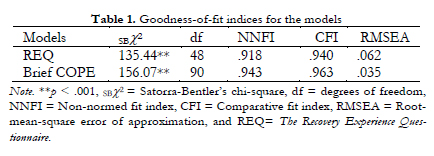
<body><![CDATA[<p><font face="Verdana" size="2">Tested model. From the work of Sonnentag &amp; Fritz (2007) and Sanz et al. (2010), the model with the better fit was selected. This model was the reduced version of <i>The Recovery Experience Questionnaire</i> composed by 12 items and 4 dimensions (psychological detachment, relaxation, mastery, and control). On the other hand, the dimensional structure of the <i>Brief COPE Questionnaire</i> was also tested, using nine coping strategies composed by two item each one (selfdistraction, active coping, denial, emotional support, behavioural disengagement, venting, positive reframing, planning, and acceptance).</font></p>     <p><font face="Verdana" size="2">Confirmatory factor analysis (CFA). The analyses are carried out using the EQS 6.1 software package, using the method of maximum likelihood with robust estimation by Satorra-Bentler (Bentler, 1995, 2005), following the recommendations of Finney and DiStefano (2006) and Byrne (2006), given that the multivariate normal distribution is not sufficient (Mardia's multivariate coefficient for <i>The Recovery Experience Questionnaire</i> and <i>Brief COPE Questionnaire</i> are 34.23 and 21.07). The adjustment is evaluated using indices based on different estimations (Hu &amp; Bentler, 1999; Marsh, Balla, &amp; Hau, 1996): <i>&chi;</i><sup>2</sup> (statistical chi-squared), NNFI (Non-normed fit index, or TLI, Tuker-Lewis index), CFI (Comparative fit index), and RMSEA (Root mean square error of approximation). A <i>&chi;</i><sup>2</sup> value with a probability greater than .05 indicates good fit; however, this statistic is affected by several limitations and, therefore, other indices are used (NNFI, CFI and RMSEA) which are less influenced by the sample size and the complexity of the model (Bollen &amp; Long, 1993). On the NNFI and CFI indices, values above .90 indicate a reasonable fit, although values greater than .95 are desirable. Although a RMSEA value lower than .07 can be considered a reasonable fit (Steiger, 2007), values lower than .05 are preferable (Hu &amp; Bentler, 1999). It has also been suggested that the combination of a CFI greater than .90 and a RMSEA lower than .06 can indicate a good fit (Hu &amp; Bentler, 1999).</font></p>     <p><font face="Verdana" size="2">Reliability was obtained through Cronbach's alpha value, while Pearson's correlation coefficient was used for the analysis of external validity. Stepwise multiple regression analyses were also performed. These analyses were carried out using the statistical package SPSS 19.0.</font></p>     <p>&nbsp;</p>     <p><font face="Verdana" size="2"><b>Results</b></font></p>     <p><font face="Verdana" size="2"><b>Factorial validity</b></font></p>     <p><font face="Verdana" size="2">The results corresponding to the goodness-of-fit indices are shown in <a href="#t1">Table 1</a>. The four factors model of <i>The Recovery Experience Questionnaire</i> presents a good fit (NNFI = .918, CFI = .940, RMSEA = .062). The factorial saturations and the correlations between the factors are shown in <a href="#f1">Figure 1</a>. The saturations of the items in their respective factors are high, between .66 and .88, and the correlations between the factors are positive and statistically significant, except in the cases of psychological detachment and mastery, which are independent. Therefore, the results support the structure of four factors obtained by Sonnentag &amp; Fritz (2007) and Sanz et al. (2010) in a work context, and indicate that the reduced 12-item version has the same dimensions in an academic context.</font></p>     <p>&nbsp;</p>     <p align="center"><a name="t1"><img src="/img/revistas/ap/v33n2/psicologia_desarrollo7_tabla1.jpg"></a></font></p>     <p>&nbsp;</p>     ]]></body>
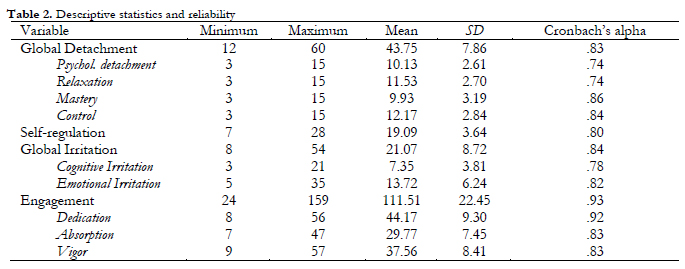
<body><![CDATA[<p align="center"><a name="f1"><img src="/img/revistas/ap/v33n2/psicologia_desarrollo7_figura1.jpg"></a></font></p>     <p>&nbsp;</p>     <p><font face="Verdana" size="2">On the other hand, the results of confirmatory factor analysis by the nine coping strategies of <i>Brief COPE Questionnaire</i> have also shown a very good fit (NNFI = .943, CFI = .963, RMSEA = .035). The range of factorial saturations is from .44 to .85 and all correlations between the factors are positive and statistically significant, except three cases are independent (denial and active coping, denial and positive reframing, behavioral disengagement), and three correlations are negatives (behavioral disengagement with active coping, planning and acceptance).</font></p>     <p><font face="Verdana" size="2"><b>Reliability Analysis</b></font></p>     <p><font face="Verdana" size="2">Internal consistency coefficients (Cronbach's alpha) of the <i>Recovery Experience Questionnaire</i> and other variables, as well as measures of central tendency and dispersion, are shown in <a href="#t2">Table 2</a>. The mean obtained from global detachment reached a value of 43.75 (<i>SD</i> = 7.86), and the averages for the four dimensions were: psychological detachment 10.13 (<i>SD</i> = 2.61); relaxation 11.53 (<i>SD</i> = 2.70); mastery 9.93 (<i>SD</i> = 3.19); and control 12.17 (<i>SD</i> = 2.84). Reliability analysis yielded an internal consistency coefficient of .83 for the global questionnaire. In terms of the four factors of the detachment questionnaire, both psychological detachment and relaxation scored a Cronbach's alpha of .74, while the result for the factor corresponding to mastery was .86, with a similar figure (.84) for the factor of control. The reliability of the other variables is satisfactory with values between .80 and .93 (see <a href="#t2">Table 2</a>).</font></p>     <p>&nbsp;</p>     <p align="center"><a name="t2"><img src="/img/revistas/ap/v33n2/psicologia_desarrollo7_tabla2.jpg"></a></font></p>     <p>&nbsp;</p>     <p><font face="Verdana" size="2"><b>Bivariate correlation analysis</b></font></p>     <p><font face="Verdana" size="2">In order to analyse these results, the correlations obtained between the Recovery Experience Questionnaire and the other variables considered in this study will be analysed below. The results obtained from this analysis are displayed in <a target="_blank" href="/img/revistas/ap/v33n2/psicologia_desarrollo7_tabla3.jpg">Table 3</a>. As shown in this table, the Pearson correlation coefficients indicate that all variables displayed significant correlations in the manner expected, lending support to the external aspect of construct validity (Messick, 1995).</font></p>     ]]></body>
<body><![CDATA[<p><font face="Verdana" size="2">First of all, negative and significant correlations were found between global detachment and irritation. Global irritation showed a negative correlation with overall detachment (<i>r</i> = -.15, <i>p</i> &lt; .01), as well as its two components, cognitive irritation (<i>r</i> = -.20, <i>p</i> &lt; .01) and emotional irritation (<i>r</i> = -.09, <i>p</i> &lt; .05). The strongest correlations among the dimensions of detachment were found in psychological detachment and relaxation. Thus, these data confirm the theoretical model which predicts a negative relationship between detachment and negative constructs such as academic irritation, particularly cognitive irritation.</font></p>     <p><font face="Verdana" size="2">On the other hand, detachment showed significant, positive correlations with self-regulation (<i>r</i> = .37, <i>p</i> &lt; .01), and the state of engagement. The results obtained showed significant, positive correlations between the state of detachment and global engagement (<i>r</i> = .34, <i>p</i> &lt; .01). In addition, all the dimensions presented positive correlations between themselves, except in the case of psychological detachment, where no significant correlations were found.</font></p>     <p><font face="Verdana" size="2">Detachment also showed significant and positive correlations with extraversion (<i>r</i> = .14, <i>p</i> &lt; .01), emotional stability (<i>r</i> = .20, <i>p</i> &lt; .01), agreeableness (<i>r</i> = .14, <i>p</i> &lt; .01), and openness to experience (<i>r</i> = .18, <i>p</i> &lt; .01).</font></p>     <p><font face="Verdana" size="2">Regarding coping strategies, global detachment displayed positive and significant correlations with self-distraction (<i>r</i> = .24, <i>p</i> &lt; .01), active coping (<i>r</i> = .36, <i>p</i> &lt; .01), emotional support <i>(r</i> = .23, <i>p</i> &lt; .01), venting (<i>r</i> = .24, <i>p</i> &lt; .01), positive reframing (<i>r</i> = .30, <i>p</i> &lt; .01), planning (<i>r</i> = .34, <i>p</i> &lt; .01), and acceptance (<i>r</i> = .33, <i>p</i> &lt; .01). On the other hand, no correlations were found in the cases of denial or behavioural disengagement.</font></p>     <p><font face="Verdana" size="2">Finally, the relationship between detachment and four correlates was tested; the relationship was significant in the case of marks in the previous academic year (<i>r</i> = .24, <i>p</i> &lt; .01), teachers' support (<i>r</i> = .14, <i>p</i> &lt; .01), peers' support (<i>r</i> = .20, <i>p</i> &lt; .01), and satisfaction with studies (<i>r</i> = .26, <i>p</i> &lt; .01).</font></p>     <p><font face="Verdana" size="2"><b>Multiple regression analysis</b></font></p>     <p><font face="Verdana" size="2">Several stepwise multiple regression analyses were performed to obtain the best combination of variables to predict the dimensions of detachment, and to establish their relative importance. The entry criterion was <i>p</i> = .05, and the removal criterion was <i>p</i> = .10. No problems of multicollinearity were founded (tolerance values were always higher than .7), but five influential cases were eliminated (1.1% of sample).</font></p>     <p><font face="Verdana" size="2">It is remarkable the result found for cognitive irritation, with a negative and significant value of -.52, which explains the strong and negative influence of cognitive irritation on psychological detachment. The rest of the results are shown in <a target="_blank" href="/img/revistas/ap/v33n2/psicologia_desarrollo7_tabla4.jpg">Table 4</a>.</font></p>     <p>&nbsp;</p>     <p><font face="Verdana" size="2"><b>Discussion</b></font></p>     ]]></body>
<body><![CDATA[<p><font face="Verdana" size="2">In light of the results obtained in this study, the <i>Recovery Experience Questionnaire</i> offers good psychometric properties for use in the assessment of detachment among university students, a different setting to that in which it has been used until now.</font></p>     <p><font face="Verdana" size="2">All the objectives proposed in this study were confirmed. Firstly, the validation of the four aforementioned factors on the instrument, through CFA, backs up the same structure offered by the instrument when used in workplace contexts with different samples of workers (Sanz-Vergel et al., 2010; Sonnentag &amp; Fritz, 2007).</font></p>     <p><font face="Verdana" size="2">The internal consistency data, measured using Cronbach's alpha coefficient, are favourable, as much for the questionnaire for overall detachment as for each of its four components: Psychological detachment, relaxation, mastery, and control.</font></p>     <p><font face="Verdana" size="2">Finally, in terms of the external validity, all of the objectives have been confirmed. Thus, significant and positive correlations were obtained between the factors on the <i>Recovery Experience Questionnaire</i> and positive constructs such as self-regulation, engagement, and coping strategies, as predicted by the theoretical model. On the other hand, significant and negative correlations were obtained between detachment and negative variables, such as academic irritation. These results were found in the four factors of detachment.</font></p>     <p><font face="Verdana" size="2">The questionnaire also shows significant, positive links with certain personality dimensions such as extraversion, emotional stability, agreeableness, and openness, lending support to and strengthening previous open-ended results (Sonnentag &amp; Fritz, 2007), and paving the way for future studies to investigate further the relationship between states of detachment and variables of personality.</font></p>     <p><font face="Verdana" size="2">In terms of the relationship with academic performance, the results were as sound as those predicted by the theoretical model, as positive correlations have been found between marks in the previous academic year and three components of detachment: relaxation, mastery, and control.</font></p>     <p><font face="Verdana" size="2">Finally, regarding the multiple regression analysis, it is worth mentioning the strong and negative influence of cognitive irritation both on psychological detachment and on relaxation. The results found in this study convey important applications for college students in order to improve their efficient response to stressful situations, such as venting, acceptance, and emotional support seeking.</font></p>     <p><font face="Verdana" size="2">Therefore, in conclusion, it can be stated that the questionnaire, which has been proven useful in workplace environments, is also an appropriate tool for measuring levels of detachment among university students, as much for its psychometric properties of internal consistency, as for its factor and construct validity. The transcendence of this study stems from the fact that if aiding university students to achieve their goals is desirable, it may be beneficial to know beforehand their state and level of detachment, in order to tackle the demands of university tasks in an appropriate manner, and to use corresponding strategies to improve their personal well-being, for example, by practicing unwinding activities such as mindfulness.</font></p>     <p><font face="Verdana" size="2">In terms of the limitations of this study, it must be noted that, although the sample was considerably large (<i>N</i> = 468), the subjects were all from the same country. Therefore, future research could study whether the scale shows the same results with a sample of international university students.</font></p>     <p><font face="Verdana" size="2">Among future lines of research there is the possibility to carry out a comparative study with students from different universities or plans of study to identify any significant differences between them. Other lines of study may consider the relationship between detachment and the degree of commitment, or the dropout rate.</font></p>     ]]></body>
<body><![CDATA[<p>&nbsp;</p>     <p><font face="Verdana" size="2"><b>References</b></font></p>     <!-- ref --><p><font face="Verdana" size="2">1. Bakker, A. B., Demerouti, E., Oerlemans, W., &amp; Sonnentag, S. (2013). Workaholism and daily recovery: A day reconstruction study of leisure activities. Journal of Organizational Behavior, 34, 87-107. doi: 10.1002/iob.1796.    &nbsp;&nbsp;&nbsp;&nbsp;&nbsp;&nbsp;&nbsp;&nbsp;[&#160;<a href="javascript:void(0);" onclick="javascript: window.open('/scielo.php?script=sci_nlinks&ref=782042&pid=S0212-9728201700020001700001&lng=','','width=640,height=500,resizable=yes,scrollbars=1,menubar=yes,');">Links</a>&#160;]<!-- end-ref --></font></p>    <!-- ref --><p><font face="Verdana" size="2">2. Baumann, N., Kaschel, R., &amp; Kuhl, J. (2005). Striving for unwanted goals: Stress-dependent discrepancies between explicit and implicit achievement motives reduce subjective well-being and increase psychosomatic symptoms. Journal of Personality and Social Psychology, 89, 781-799. doi: 10.1037/0022-3514.89.5.781.    &nbsp;&nbsp;&nbsp;&nbsp;&nbsp;&nbsp;&nbsp;&nbsp;[&#160;<a href="javascript:void(0);" onclick="javascript: window.open('/scielo.php?script=sci_nlinks&ref=782044&pid=S0212-9728201700020001700002&lng=','','width=640,height=500,resizable=yes,scrollbars=1,menubar=yes,');">Links</a>&#160;]<!-- end-ref --></font></p>    <!-- ref --><p><font face="Verdana" size="2">3. Bentler, P.M. (1995). EQS program manual. Encino, CA: Multivariate Software.    &nbsp;&nbsp;&nbsp;&nbsp;&nbsp;&nbsp;&nbsp;&nbsp;[&#160;<a href="javascript:void(0);" onclick="javascript: window.open('/scielo.php?script=sci_nlinks&ref=782046&pid=S0212-9728201700020001700003&lng=','','width=640,height=500,resizable=yes,scrollbars=1,menubar=yes,');">Links</a>&#160;]<!-- end-ref --></font></p>    <!-- ref --><p><font face="Verdana" size="2">4. Bentler, P. M. (2005). EQS 6.1. for Windows. Structural equations program manual. Encino, CA: Multivariate Software, Inc.    &nbsp;&nbsp;&nbsp;&nbsp;&nbsp;&nbsp;&nbsp;&nbsp;[&#160;<a href="javascript:void(0);" onclick="javascript: window.open('/scielo.php?script=sci_nlinks&ref=782048&pid=S0212-9728201700020001700004&lng=','','width=640,height=500,resizable=yes,scrollbars=1,menubar=yes,');">Links</a>&#160;]<!-- end-ref --></font></p>    ]]></body>
<body><![CDATA[<!-- ref --><p><font face="Verdana" size="2">5. Bollen, K. A., &amp; Long, J. S. (1993). Testing structural equation models. Newbury Park, CA: Sage.    &nbsp;&nbsp;&nbsp;&nbsp;&nbsp;&nbsp;&nbsp;&nbsp;[&#160;<a href="javascript:void(0);" onclick="javascript: window.open('/scielo.php?script=sci_nlinks&ref=782050&pid=S0212-9728201700020001700005&lng=','','width=640,height=500,resizable=yes,scrollbars=1,menubar=yes,');">Links</a>&#160;]<!-- end-ref --></font></p>    <!-- ref --><p><font face="Verdana" size="2">6. Byrne, B. M. (2006). Structural equation modeling with EQS: Basic concepts, applications, and programming (2<sup>nd</sup> ed.). Mahwah, NJ: Erlbaum.    &nbsp;&nbsp;&nbsp;&nbsp;&nbsp;&nbsp;&nbsp;&nbsp;[&#160;<a href="javascript:void(0);" onclick="javascript: window.open('/scielo.php?script=sci_nlinks&ref=782052&pid=S0212-9728201700020001700006&lng=','','width=640,height=500,resizable=yes,scrollbars=1,menubar=yes,');">Links</a>&#160;]<!-- end-ref --></font></p>    <!-- ref --><p><font face="Verdana" size="2">7. Byrne, B. M. (2008). Testing for multigroup equivalence of a measuring instrument: A walk through the process. Psicothema, 20, 872-882.    &nbsp;&nbsp;&nbsp;&nbsp;&nbsp;&nbsp;&nbsp;&nbsp;[&#160;<a href="javascript:void(0);" onclick="javascript: window.open('/scielo.php?script=sci_nlinks&ref=782054&pid=S0212-9728201700020001700007&lng=','','width=640,height=500,resizable=yes,scrollbars=1,menubar=yes,');">Links</a>&#160;]<!-- end-ref --></font></p>    <!-- ref --><p><font face="Verdana" size="2">8. Carver, S. S. (1997). You want to measure coping but your protocol's too long: Consider the Brief COPE. International Journal of Behavioral Medicine, 4(1), 92-100.    &nbsp;&nbsp;&nbsp;&nbsp;&nbsp;&nbsp;&nbsp;&nbsp;[&#160;<a href="javascript:void(0);" onclick="javascript: window.open('/scielo.php?script=sci_nlinks&ref=782056&pid=S0212-9728201700020001700008&lng=','','width=640,height=500,resizable=yes,scrollbars=1,menubar=yes,');">Links</a>&#160;]<!-- end-ref --></font></p>    <!-- ref --><p><font face="Verdana" size="2">9. Carver, C. S., Scheier, M. F., &amp; Weintraub, J. K. (1989). Assessing coping strategies: A theoretical based approach. Journal of Personality and Social Psychology, 56, 267-283.    &nbsp;&nbsp;&nbsp;&nbsp;&nbsp;&nbsp;&nbsp;&nbsp;[&#160;<a href="javascript:void(0);" onclick="javascript: window.open('/scielo.php?script=sci_nlinks&ref=782058&pid=S0212-9728201700020001700009&lng=','','width=640,height=500,resizable=yes,scrollbars=1,menubar=yes,');">Links</a>&#160;]<!-- end-ref --></font></p>    ]]></body>
<body><![CDATA[<!-- ref --><p><font face="Verdana" size="2">10. Costa, P. T., Jr., &amp; McCrae, R. R. (1992). Revised NEO Personality Inventory and NEO Five-Factor Inventory professional manual. Odessa, FL: Psychological Assessment Resources.    &nbsp;&nbsp;&nbsp;&nbsp;&nbsp;&nbsp;&nbsp;&nbsp;[&#160;<a href="javascript:void(0);" onclick="javascript: window.open('/scielo.php?script=sci_nlinks&ref=782060&pid=S0212-9728201700020001700010&lng=','','width=640,height=500,resizable=yes,scrollbars=1,menubar=yes,');">Links</a>&#160;]<!-- end-ref --></font></p>    <!-- ref --><p><font face="Verdana" size="2">11. Finney, S. J., &amp; DiStefano, C. (2006). Non-normal and categorical data in structural equation modeling SEM. In G. R. Hancock, &amp; R. O. Mueller (Eds.), Structural Equation Modeling: A second course (pp. 269-314). Greenwich, CT: Information Age Publishing.    &nbsp;&nbsp;&nbsp;&nbsp;&nbsp;&nbsp;&nbsp;&nbsp;[&#160;<a href="javascript:void(0);" onclick="javascript: window.open('/scielo.php?script=sci_nlinks&ref=782062&pid=S0212-9728201700020001700011&lng=','','width=640,height=500,resizable=yes,scrollbars=1,menubar=yes,');">Links</a>&#160;]<!-- end-ref --></font></p>    <!-- ref --><p><font face="Verdana" size="2">12. Fritz, C., Yankelevich, M., Zarubin, A., &amp; Barger, P. (2010). Happy, healthy and productive: The role of detachment from work during nonwork time. Journal of Applied Psychology, 95, 977-983. doi: 10.1037/a0019462.    &nbsp;&nbsp;&nbsp;&nbsp;&nbsp;&nbsp;&nbsp;&nbsp;[&#160;<a href="javascript:void(0);" onclick="javascript: window.open('/scielo.php?script=sci_nlinks&ref=782064&pid=S0212-9728201700020001700012&lng=','','width=640,height=500,resizable=yes,scrollbars=1,menubar=yes,');">Links</a>&#160;]<!-- end-ref --></font></p>    <!-- ref --><p><font face="Verdana" size="2">13. Fuhrman, A., &amp; Kuhl, J. (1998). Maintaining a healthy diet: Effects of personality and self-reward versus self-punishment on commitment to and enactment of self-chosen and assigned goals. Psychology and Health, 13, 651-686. doi: 10.1080/08870449808407423.    &nbsp;&nbsp;&nbsp;&nbsp;&nbsp;&nbsp;&nbsp;&nbsp;[&#160;<a href="javascript:void(0);" onclick="javascript: window.open('/scielo.php?script=sci_nlinks&ref=782066&pid=S0212-9728201700020001700013&lng=','','width=640,height=500,resizable=yes,scrollbars=1,menubar=yes,');">Links</a>&#160;]<!-- end-ref --></font></p>    <!-- ref --><p><font face="Verdana" size="2">14. Hu, L., &amp; Bentler, P. M. (1995). Evaluating model fit. In R. H. Hoyle (Ed.), Structural equation modeling: Concepts, issues and applications (pp. 76-99). Thousand Oaks, CA: Sage.    &nbsp;&nbsp;&nbsp;&nbsp;&nbsp;&nbsp;&nbsp;&nbsp;[&#160;<a href="javascript:void(0);" onclick="javascript: window.open('/scielo.php?script=sci_nlinks&ref=782068&pid=S0212-9728201700020001700014&lng=','','width=640,height=500,resizable=yes,scrollbars=1,menubar=yes,');">Links</a>&#160;]<!-- end-ref --></font></p>    ]]></body>
<body><![CDATA[<!-- ref --><p><font face="Verdana" size="2">15. Hu, L., &amp; Bentler, P. M. (1999). Cut-off criteria for fit indices in covariance structure analysis: Conventional criteria versus new alternatives. Structural Equation Modeling 6, 1-55. doi: 10.1080/10705519909540118.    &nbsp;&nbsp;&nbsp;&nbsp;&nbsp;&nbsp;&nbsp;&nbsp;[&#160;<a href="javascript:void(0);" onclick="javascript: window.open('/scielo.php?script=sci_nlinks&ref=782070&pid=S0212-9728201700020001700015&lng=','','width=640,height=500,resizable=yes,scrollbars=1,menubar=yes,');">Links</a>&#160;]<!-- end-ref --></font></p>    <!-- ref --><p><font face="Verdana" size="2">16. Larson, E. A. (2006). Stress in the live of college women: Lots to do and not much time. Journal of Adolescent Research, 21, 579-606. doi: 10.1177/0743558406293965.    &nbsp;&nbsp;&nbsp;&nbsp;&nbsp;&nbsp;&nbsp;&nbsp;[&#160;<a href="javascript:void(0);" onclick="javascript: window.open('/scielo.php?script=sci_nlinks&ref=782072&pid=S0212-9728201700020001700016&lng=','','width=640,height=500,resizable=yes,scrollbars=1,menubar=yes,');">Links</a>&#160;]<!-- end-ref --></font></p>    <!-- ref --><p><font face="Verdana" size="2">17. Lawrence, J., Ashford, K., &amp; Den, P. (2006). Gender differences in coping strategies of undergraduate students and their impact on self-esteem and attainment. Active Learning in Higher Education, 7, 273-281. doi: 10.1177/1469787406069058.    &nbsp;&nbsp;&nbsp;&nbsp;&nbsp;&nbsp;&nbsp;&nbsp;[&#160;<a href="javascript:void(0);" onclick="javascript: window.open('/scielo.php?script=sci_nlinks&ref=782074&pid=S0212-9728201700020001700017&lng=','','width=640,height=500,resizable=yes,scrollbars=1,menubar=yes,');">Links</a>&#160;]<!-- end-ref --></font></p>    <!-- ref --><p><font face="Verdana" size="2">18. Luszczynska, A., Diehl, M., Gutiérrez-Doña, B., Kuusinen, P., &amp; Schwarzer, R. (2004). Measuring one component of dispositional self-regulation: Attention control in goal pursuit. Personality and Individual Differences, 37(3), 555-566. doi: 10.1016/j.paid.2003.09.026.    &nbsp;&nbsp;&nbsp;&nbsp;&nbsp;&nbsp;&nbsp;&nbsp;[&#160;<a href="javascript:void(0);" onclick="javascript: window.open('/scielo.php?script=sci_nlinks&ref=782076&pid=S0212-9728201700020001700018&lng=','','width=640,height=500,resizable=yes,scrollbars=1,menubar=yes,');">Links</a>&#160;]<!-- end-ref --></font></p>    <!-- ref --><p><font face="Verdana" size="2">19. Marsh, H. W., Balla, J. R., &amp; Hau, K. T. (1996). An evaluation of incremental fit indices: A clarification of mathematical and empirical properties. In G. A. Marcoulides &amp; R. E. Schumacker (Eds.), Advanced structural equation modeling: Issues and techniques (pp. 315-353). Mahwah, NJ: Erlbaum.    &nbsp;&nbsp;&nbsp;&nbsp;&nbsp;&nbsp;&nbsp;&nbsp;[&#160;<a href="javascript:void(0);" onclick="javascript: window.open('/scielo.php?script=sci_nlinks&ref=782078&pid=S0212-9728201700020001700019&lng=','','width=640,height=500,resizable=yes,scrollbars=1,menubar=yes,');">Links</a>&#160;]<!-- end-ref --></font></p>    ]]></body>
<body><![CDATA[<!-- ref --><p><font face="Verdana" size="2">20. Martin, L. L., &amp; Tesser, A. (1996). Some ruminative thoughts. In R. S. Wyer (Ed.), Ruminative thoughts (pp. 1-47). Hillsdale, NJ: Lawrence Erlbaum.    &nbsp;&nbsp;&nbsp;&nbsp;&nbsp;&nbsp;&nbsp;&nbsp;[&#160;<a href="javascript:void(0);" onclick="javascript: window.open('/scielo.php?script=sci_nlinks&ref=782080&pid=S0212-9728201700020001700020&lng=','','width=640,height=500,resizable=yes,scrollbars=1,menubar=yes,');">Links</a>&#160;]<!-- end-ref --></font></p>    <!-- ref --><p><font face="Verdana" size="2">21. Merino-Tejedor, E., Boada-Grau, J., Sánchez-García, J. C., &amp; Hontangas-Beltrán, P. M. (2013). The Irritation Scale as an instrument to measure stress among university students. The Spanish Journal of Psychology, 16, 1-10. doi: 10.1017/sjp.2013.106.    &nbsp;&nbsp;&nbsp;&nbsp;&nbsp;&nbsp;&nbsp;&nbsp;[&#160;<a href="javascript:void(0);" onclick="javascript: window.open('/scielo.php?script=sci_nlinks&ref=782082&pid=S0212-9728201700020001700021&lng=','','width=640,height=500,resizable=yes,scrollbars=1,menubar=yes,');">Links</a>&#160;]<!-- end-ref --></font></p>    <!-- ref --><p><font face="Verdana" size="2">22. Messick, S. (1995). Validity of psychological assessment: Validation of inferences from persons' responses and performances as scientific inquiry into score meaning. American Psychologist, 50, 741-749. doi: 10.1037/0003-066X.50.9.741.    &nbsp;&nbsp;&nbsp;&nbsp;&nbsp;&nbsp;&nbsp;&nbsp;[&#160;<a href="javascript:void(0);" onclick="javascript: window.open('/scielo.php?script=sci_nlinks&ref=782084&pid=S0212-9728201700020001700022&lng=','','width=640,height=500,resizable=yes,scrollbars=1,menubar=yes,');">Links</a>&#160;]<!-- end-ref --></font></p>    <!-- ref --><p><font face="Verdana" size="2">23. Misra, R., &amp; Castillo, L. G. (2004). Academic stress among collage students: comparison of American International Students. International Journal of Stress Management, 11, 132-148. doi: 10.1037/1072-5245.11.2.132.    &nbsp;&nbsp;&nbsp;&nbsp;&nbsp;&nbsp;&nbsp;&nbsp;[&#160;<a href="javascript:void(0);" onclick="javascript: window.open('/scielo.php?script=sci_nlinks&ref=782086&pid=S0212-9728201700020001700023&lng=','','width=640,height=500,resizable=yes,scrollbars=1,menubar=yes,');">Links</a>&#160;]<!-- end-ref --></font></p>    <!-- ref --><p><font face="Verdana" size="2">24. Mohr, G. (1986). Die Erfassung psychischer Befindensbeeintrachtigungen bei Industriearbeitern. Europaische hochschulschriften (The assessment of mental strain of industrial workers). Frankfurt: Lang.    &nbsp;&nbsp;&nbsp;&nbsp;&nbsp;&nbsp;&nbsp;&nbsp;[&#160;<a href="javascript:void(0);" onclick="javascript: window.open('/scielo.php?script=sci_nlinks&ref=782088&pid=S0212-9728201700020001700024&lng=','','width=640,height=500,resizable=yes,scrollbars=1,menubar=yes,');">Links</a>&#160;]<!-- end-ref --></font></p>    ]]></body>
<body><![CDATA[<!-- ref --><p><font face="Verdana" size="2">25. Mohr, G., Müller, A., Rigotti, T., Aycan, Z., &amp; Tschan, F. (2006). The assessment of psychological strain in work contexts: Concerning the structural equivalency of nine language adaptations of the irritation scale. European Journal of Psychological Assessment, 22(3), 198-206. doi: 10.1027/1015-5759.22.3.198.    &nbsp;&nbsp;&nbsp;&nbsp;&nbsp;&nbsp;&nbsp;&nbsp;[&#160;<a href="javascript:void(0);" onclick="javascript: window.open('/scielo.php?script=sci_nlinks&ref=782090&pid=S0212-9728201700020001700025&lng=','','width=640,height=500,resizable=yes,scrollbars=1,menubar=yes,');">Links</a>&#160;]<!-- end-ref --></font></p>    <!-- ref --><p><font face="Verdana" size="2">26. Perczek, R., Carver, C. S., &amp; Price, A. A. (2000). Coping, mood, and aspects of personality in Spanish translation and evidence of convergence with English versions. Journal of Personality Assessment, 74(1), 63-87. doi: 10.1207/S15327752JPA740105.    &nbsp;&nbsp;&nbsp;&nbsp;&nbsp;&nbsp;&nbsp;&nbsp;[&#160;<a href="javascript:void(0);" onclick="javascript: window.open('/scielo.php?script=sci_nlinks&ref=782092&pid=S0212-9728201700020001700026&lng=','','width=640,height=500,resizable=yes,scrollbars=1,menubar=yes,');">Links</a>&#160;]<!-- end-ref --></font></p>    <!-- ref --><p><font face="Verdana" size="2">27. Ragsdale, J. M., Beehr, T. A., Grebner, S., &amp; Han, K. (2011). An integrated model of weekday stress and weekend recovery of students. International Journal of Stress Management, 18(2), 153-180. doi: 10.1037/a0023190.    &nbsp;&nbsp;&nbsp;&nbsp;&nbsp;&nbsp;&nbsp;&nbsp;[&#160;<a href="javascript:void(0);" onclick="javascript: window.open('/scielo.php?script=sci_nlinks&ref=782094&pid=S0212-9728201700020001700027&lng=','','width=640,height=500,resizable=yes,scrollbars=1,menubar=yes,');">Links</a>&#160;]<!-- end-ref --></font></p>    <!-- ref --><p><font face="Verdana" size="2">28. Roger, D., Jarvis, G., &amp; Najarian, B. (1993). Detachment and coping: The construction and validation of a new scale for measuring coping strategies. Personality and Individual Differences, 15, 619-626. doi: 10.1016/0191-8869(93)90003-L.    &nbsp;&nbsp;&nbsp;&nbsp;&nbsp;&nbsp;&nbsp;&nbsp;[&#160;<a href="javascript:void(0);" onclick="javascript: window.open('/scielo.php?script=sci_nlinks&ref=782096&pid=S0212-9728201700020001700028&lng=','','width=640,height=500,resizable=yes,scrollbars=1,menubar=yes,');">Links</a>&#160;]<!-- end-ref --></font></p>    <!-- ref --><p><font face="Verdana" size="2">29. Salanova, M., Grau, R., Llorens, S., &amp; Schaufeli, W. B. (2001). Exposición a las tecnologías de la información, burnout y engagement: el rol modulador de la autoeficacia profesional (Exposure to information technology, burnout and engagement: the role of self-efficacy training). Revista de Psicología Social Aplicada, 11, 69-90.    &nbsp;&nbsp;&nbsp;&nbsp;&nbsp;&nbsp;&nbsp;&nbsp;[&#160;<a href="javascript:void(0);" onclick="javascript: window.open('/scielo.php?script=sci_nlinks&ref=782098&pid=S0212-9728201700020001700029&lng=','','width=640,height=500,resizable=yes,scrollbars=1,menubar=yes,');">Links</a>&#160;]<!-- end-ref --></font></p>    ]]></body>
<body><![CDATA[<!-- ref --><p><font face="Verdana" size="2">30. Salmela-Aro, K., Kiuru, N., Leskinen, E., &amp; Nurmi, J. E. (2009). School-Burnout Inventory (SBI) - Reliability and validity. European Journal of Psychological Assessment, 25, 48-57. doi: 10.1027/1015-5759.25.1.48.    &nbsp;&nbsp;&nbsp;&nbsp;&nbsp;&nbsp;&nbsp;&nbsp;[&#160;<a href="javascript:void(0);" onclick="javascript: window.open('/scielo.php?script=sci_nlinks&ref=782100&pid=S0212-9728201700020001700030&lng=','','width=640,height=500,resizable=yes,scrollbars=1,menubar=yes,');">Links</a>&#160;]<!-- end-ref --></font></p>    <!-- ref --><p><font face="Verdana" size="2">31. Sanz-Vergel, A. I., Sebastián, J., Rodríguez-Muñoz, A., Garrosa, E., Moreno-Jiménez, B., &amp; Sonnentag, S. (2010). Adaptación del "Cuestionario de Experiencias de Recuperación" a una muestra española (Adaptation of the "Recovery Experience Questionnaire" in a Spanish sample). Psicothema, 22(4), 990-996.    &nbsp;&nbsp;&nbsp;&nbsp;&nbsp;&nbsp;&nbsp;&nbsp;[&#160;<a href="javascript:void(0);" onclick="javascript: window.open('/scielo.php?script=sci_nlinks&ref=782102&pid=S0212-9728201700020001700031&lng=','','width=640,height=500,resizable=yes,scrollbars=1,menubar=yes,');">Links</a>&#160;]<!-- end-ref --></font></p>    <!-- ref --><p><font face="Verdana" size="2">32. Schaufeli, W. B., Martínez, I., Marqués-Pinto, A., Salanova, M., &amp; Bakker, A. (2002). Burnout and engagement in university students: A crossnational study. Journal of Cross-Cultural Studies, 33, 464-481. doi: 10.1177/0022022102033005003.    &nbsp;&nbsp;&nbsp;&nbsp;&nbsp;&nbsp;&nbsp;&nbsp;[&#160;<a href="javascript:void(0);" onclick="javascript: window.open('/scielo.php?script=sci_nlinks&ref=782104&pid=S0212-9728201700020001700032&lng=','','width=640,height=500,resizable=yes,scrollbars=1,menubar=yes,');">Links</a>&#160;]<!-- end-ref --></font></p>    <!-- ref --><p><font face="Verdana" size="2">33. Schaufeli, W. B., Salanova, M., González-Romá, V., &amp; Bakker, A. B. (2002). The measurment of engagement and burnout: A two sample confirmatory factor analytic approach. Journal of Happiness Studies, 3, 71-92. doi: 10.1023/A:1015630930326.    &nbsp;&nbsp;&nbsp;&nbsp;&nbsp;&nbsp;&nbsp;&nbsp;[&#160;<a href="javascript:void(0);" onclick="javascript: window.open('/scielo.php?script=sci_nlinks&ref=782106&pid=S0212-9728201700020001700033&lng=','','width=640,height=500,resizable=yes,scrollbars=1,menubar=yes,');">Links</a>&#160;]<!-- end-ref --></font></p>    <!-- ref --><p><font face="Verdana" size="2">34. Schraub, E. M., Turgut, S., Clavairoly, V., &amp; Sonntag, K. (2013). Emotion regulation as a determinant of recovery experiences and well-being: A day-level study. International Journal of Stress Management, 20(4), 309-335. doi: 10.1037/a0034483.    &nbsp;&nbsp;&nbsp;&nbsp;&nbsp;&nbsp;&nbsp;&nbsp;[&#160;<a href="javascript:void(0);" onclick="javascript: window.open('/scielo.php?script=sci_nlinks&ref=782108&pid=S0212-9728201700020001700034&lng=','','width=640,height=500,resizable=yes,scrollbars=1,menubar=yes,');">Links</a>&#160;]<!-- end-ref --></font></p>    ]]></body>
<body><![CDATA[<!-- ref --><p><font face="Verdana" size="2">35. Shimazu, A., Matsudaira, K., De Jonge, J., Tosaka, N., Watanabe, K., &amp; Takahashi, M. (2016, in press). Psychological detachment from work during nonwork time: linear or curvilinear relations with mental health and work engagement? Industrial Health. doi: 10.2486/indhealth.2015-0097.    &nbsp;&nbsp;&nbsp;&nbsp;&nbsp;&nbsp;&nbsp;&nbsp;[&#160;<a href="javascript:void(0);" onclick="javascript: window.open('/scielo.php?script=sci_nlinks&ref=782110&pid=S0212-9728201700020001700035&lng=','','width=640,height=500,resizable=yes,scrollbars=1,menubar=yes,');">Links</a>&#160;]<!-- end-ref --></font></p>    <!-- ref --><p><font face="Verdana" size="2">36. Sonnentag, S. (2010). Recovery from fatigue: The role of psychological detachment. In P. L. Ackerman (Ed.), Cognitive fatigue: The current status and future for research and application (pp. 253-272). Washington, CD: American Psychological Association. doi: 10.1037/12343-012.    &nbsp;&nbsp;&nbsp;&nbsp;&nbsp;&nbsp;&nbsp;&nbsp;[&#160;<a href="javascript:void(0);" onclick="javascript: window.open('/scielo.php?script=sci_nlinks&ref=782112&pid=S0212-9728201700020001700036&lng=','','width=640,height=500,resizable=yes,scrollbars=1,menubar=yes,');">Links</a>&#160;]<!-- end-ref --></font></p>    <!-- ref --><p><font face="Verdana" size="2">37. Sonnentag, S., &amp; Bayer, U. V. (2005). Switching off mentally: Predictors and consequences of psychological detachment from work during off-job time. Journal of Occupational Health Psychology, 10(4), 393-414. doi: 10.1037/1076-8998.10.4.393.    &nbsp;&nbsp;&nbsp;&nbsp;&nbsp;&nbsp;&nbsp;&nbsp;[&#160;<a href="javascript:void(0);" onclick="javascript: window.open('/scielo.php?script=sci_nlinks&ref=782114&pid=S0212-9728201700020001700037&lng=','','width=640,height=500,resizable=yes,scrollbars=1,menubar=yes,');">Links</a>&#160;]<!-- end-ref --></font></p>    <!-- ref --><p><font face="Verdana" size="2">38. Sonnentag, S., &amp; Fritz, C. (2007). The Recovery Experience Questionnaire: Development and validation of a measure for assessing recuperation and unwinding from work. Journal of Occupational Health Psychology, 12, 204-221. doi: 10.1037/1076-8998.12.3.204.    &nbsp;&nbsp;&nbsp;&nbsp;&nbsp;&nbsp;&nbsp;&nbsp;[&#160;<a href="javascript:void(0);" onclick="javascript: window.open('/scielo.php?script=sci_nlinks&ref=782116&pid=S0212-9728201700020001700038&lng=','','width=640,height=500,resizable=yes,scrollbars=1,menubar=yes,');">Links</a>&#160;]<!-- end-ref --></font></p>    <!-- ref --><p><font face="Verdana" size="2">39. Sonnentag, S., &amp; Fritz, C. (2014). Recovery form job stress: The stressor-detachment model as an integrative framework. Journal of Organizational Behavior, 36, 72-103. doi: 10.1002/job.1924.    &nbsp;&nbsp;&nbsp;&nbsp;&nbsp;&nbsp;&nbsp;&nbsp;[&#160;<a href="javascript:void(0);" onclick="javascript: window.open('/scielo.php?script=sci_nlinks&ref=782118&pid=S0212-9728201700020001700039&lng=','','width=640,height=500,resizable=yes,scrollbars=1,menubar=yes,');">Links</a>&#160;]<!-- end-ref --></font></p>    ]]></body>
<body><![CDATA[<!-- ref --><p><font face="Verdana" size="2">40. Sonnentag, S., &amp; Kühnel, J. (2016, in press). Coming back to work in the morning: Psychological detachment and reattachment as predictors of work engagement. Journal of Occupational Health Psychology. doi: 10.1037/ocp0000020.    &nbsp;&nbsp;&nbsp;&nbsp;&nbsp;&nbsp;&nbsp;&nbsp;[&#160;<a href="javascript:void(0);" onclick="javascript: window.open('/scielo.php?script=sci_nlinks&ref=782120&pid=S0212-9728201700020001700040&lng=','','width=640,height=500,resizable=yes,scrollbars=1,menubar=yes,');">Links</a>&#160;]<!-- end-ref --></font></p>    <!-- ref --><p><font face="Verdana" size="2">41. Steiger, J. H. (2007). Understanding the limitations of global fit assessment in structural equation modelling. Personality and Individual Differences, 42, 893-898. doi: 10.1016/j.paid.2006.09.017.    &nbsp;&nbsp;&nbsp;&nbsp;&nbsp;&nbsp;&nbsp;&nbsp;[&#160;<a href="javascript:void(0);" onclick="javascript: window.open('/scielo.php?script=sci_nlinks&ref=782122&pid=S0212-9728201700020001700041&lng=','','width=640,height=500,resizable=yes,scrollbars=1,menubar=yes,');">Links</a>&#160;]<!-- end-ref --></font></p>    <!-- ref --><p><font face="Verdana" size="2">42. Vigil-Colet, A., Morales-Vives, F., Camps, E., Tous, J., y Lorenzo-Seva, U. (2013). Development and validation of the Overall Personality Assessment Scale (OPERAS). Psicothema, 25(1), 100-106. doi: 10.7334/psicothema2011.411.    &nbsp;&nbsp;&nbsp;&nbsp;&nbsp;&nbsp;&nbsp;&nbsp;[&#160;<a href="javascript:void(0);" onclick="javascript: window.open('/scielo.php?script=sci_nlinks&ref=782124&pid=S0212-9728201700020001700042&lng=','','width=640,height=500,resizable=yes,scrollbars=1,menubar=yes,');">Links</a>&#160;]<!-- end-ref --></font></p>     <p>&nbsp;</p>     <p>&nbsp;</p>     <p><font face="Verdana" size="2"><a href="#top"><img border="0" src="/img/revistas/ap/v33n2/seta.gif" width="15" height="17"></a><a name="bajo"></a><b>Correspondence:</b>    <br>Enrique Merino-Tejedor.    ]]></body>
<body><![CDATA[<br>University of Valladolid,    <br>Department of Psychology,    <br>Faculty of Education at Segovia,    <br>Campus María Zambrano,    <br>Plaza de la Universidad, 1,    <br>40.005 Segovia (Spain).    <br>E-mail: <a href="mailto:enrique.merino@uva.es">enrique.merino@uva.es</a></font></p>     <p><font face="Verdana" size="2">Article received: 07-02-2016;    <br>revised: 02-06-2016;    <br>accepted: 02-06-2016</font></p>     ]]></body>
<body><![CDATA[ ]]></body><back>
<ref-list>
<ref id="B1">
<label>1</label><nlm-citation citation-type="journal">
<person-group person-group-type="author">
<name>
<surname><![CDATA[Bakker]]></surname>
<given-names><![CDATA[A. B.]]></given-names>
</name>
<name>
<surname><![CDATA[Demerouti]]></surname>
<given-names><![CDATA[E.]]></given-names>
</name>
<name>
<surname><![CDATA[Oerlemans]]></surname>
<given-names><![CDATA[W.]]></given-names>
</name>
<name>
<surname><![CDATA[Sonnentag]]></surname>
<given-names><![CDATA[S.]]></given-names>
</name>
</person-group>
<article-title xml:lang="en"><![CDATA[Workaholism and daily recovery: A day reconstruction study of leisure activities]]></article-title>
<source><![CDATA[Journal of Organizational Behavior]]></source>
<year>2013</year>
<volume>34</volume>
<page-range>87-107</page-range></nlm-citation>
</ref>
<ref id="B2">
<label>2</label><nlm-citation citation-type="journal">
<person-group person-group-type="author">
<name>
<surname><![CDATA[Baumann]]></surname>
<given-names><![CDATA[N.]]></given-names>
</name>
<name>
<surname><![CDATA[Kaschel]]></surname>
<given-names><![CDATA[R.]]></given-names>
</name>
<name>
<surname><![CDATA[Kuhl]]></surname>
<given-names><![CDATA[J.]]></given-names>
</name>
</person-group>
<article-title xml:lang="en"><![CDATA[Striving for unwanted goals: Stress-dependent discrepancies between explicit and implicit achievement motives reduce subjective well-being and increase psychosomatic symptoms]]></article-title>
<source><![CDATA[Journal of Personality and Social Psychology]]></source>
<year>2005</year>
<volume>89</volume>
<page-range>781-799</page-range></nlm-citation>
</ref>
<ref id="B3">
<label>3</label><nlm-citation citation-type="book">
<person-group person-group-type="author">
<name>
<surname><![CDATA[Bentler]]></surname>
<given-names><![CDATA[P.M.]]></given-names>
</name>
</person-group>
<source><![CDATA[EQS program manual]]></source>
<year>1995</year>
<publisher-loc><![CDATA[Encino^eCA CA]]></publisher-loc>
<publisher-name><![CDATA[Multivariate Software]]></publisher-name>
</nlm-citation>
</ref>
<ref id="B4">
<label>4</label><nlm-citation citation-type="book">
<person-group person-group-type="author">
<name>
<surname><![CDATA[Bentler]]></surname>
<given-names><![CDATA[P. M.]]></given-names>
</name>
</person-group>
<source><![CDATA[EQS 6.1. for Windows: Structural equations program manual]]></source>
<year>2005</year>
<publisher-loc><![CDATA[Encino^eCA CA]]></publisher-loc>
<publisher-name><![CDATA[Multivariate Software]]></publisher-name>
</nlm-citation>
</ref>
<ref id="B5">
<label>5</label><nlm-citation citation-type="book">
<person-group person-group-type="author">
<name>
<surname><![CDATA[Bollen]]></surname>
<given-names><![CDATA[K. A.]]></given-names>
</name>
<name>
<surname><![CDATA[Long]]></surname>
<given-names><![CDATA[J. S.]]></given-names>
</name>
</person-group>
<source><![CDATA[Testing structural equation models]]></source>
<year>1993</year>
<publisher-loc><![CDATA[Newbury Park^eCA CA]]></publisher-loc>
<publisher-name><![CDATA[Sage]]></publisher-name>
</nlm-citation>
</ref>
<ref id="B6">
<label>6</label><nlm-citation citation-type="book">
<person-group person-group-type="author">
<name>
<surname><![CDATA[Byrne]]></surname>
<given-names><![CDATA[B. M.]]></given-names>
</name>
</person-group>
<source><![CDATA[Structural equation modeling with EQS: Basic concepts, applications, and programming]]></source>
<year>2006</year>
<edition>2</edition>
<publisher-loc><![CDATA[Mahwah^eNJ NJ]]></publisher-loc>
<publisher-name><![CDATA[Erlbaum]]></publisher-name>
</nlm-citation>
</ref>
<ref id="B7">
<label>7</label><nlm-citation citation-type="journal">
<person-group person-group-type="author">
<name>
<surname><![CDATA[Byrne]]></surname>
<given-names><![CDATA[B. M.]]></given-names>
</name>
</person-group>
<article-title xml:lang="en"><![CDATA[Testing for multigroup equivalence of a measuring instrument: A walk through the process]]></article-title>
<source><![CDATA[Psicothema]]></source>
<year>2008</year>
<volume>20</volume>
<page-range>872-882</page-range></nlm-citation>
</ref>
<ref id="B8">
<label>8</label><nlm-citation citation-type="journal">
<person-group person-group-type="author">
<name>
<surname><![CDATA[Carver]]></surname>
<given-names><![CDATA[S. S.]]></given-names>
</name>
</person-group>
<article-title xml:lang="en"><![CDATA[You want to measure coping but your protocol's too long: Consider the Brief COPE]]></article-title>
<source><![CDATA[International Journal of Behavioral Medicine]]></source>
<year>1997</year>
<volume>4</volume>
<numero>1</numero>
<issue>1</issue>
<page-range>92-100</page-range></nlm-citation>
</ref>
<ref id="B9">
<label>9</label><nlm-citation citation-type="journal">
<person-group person-group-type="author">
<name>
<surname><![CDATA[Carver]]></surname>
<given-names><![CDATA[C. S.]]></given-names>
</name>
<name>
<surname><![CDATA[Scheier]]></surname>
<given-names><![CDATA[M. F.]]></given-names>
</name>
<name>
<surname><![CDATA[& Weintraub]]></surname>
<given-names><![CDATA[J. K.]]></given-names>
</name>
</person-group>
<article-title xml:lang="en"><![CDATA[Assessing coping strategies: A theoretical based approach]]></article-title>
<source><![CDATA[Journal of Personality and Social Psychology]]></source>
<year>1989</year>
<volume>56</volume>
<page-range>267-283</page-range></nlm-citation>
</ref>
<ref id="B10">
<label>10</label><nlm-citation citation-type="book">
<person-group person-group-type="author">
<name>
<surname><![CDATA[Costa]]></surname>
<given-names><![CDATA[P. T., Jr.]]></given-names>
</name>
<name>
<surname><![CDATA[McCrae]]></surname>
<given-names><![CDATA[R. R.]]></given-names>
</name>
</person-group>
<source><![CDATA[Revised NEO Personality Inventory and NEO Five-Factor Inventory professional manual]]></source>
<year>1992</year>
<publisher-loc><![CDATA[Odessa^eFL FL]]></publisher-loc>
<publisher-name><![CDATA[Psychological Assessment Resources]]></publisher-name>
</nlm-citation>
</ref>
<ref id="B11">
<label>11</label><nlm-citation citation-type="book">
<person-group person-group-type="author">
<name>
<surname><![CDATA[Finney]]></surname>
<given-names><![CDATA[S. J.]]></given-names>
</name>
<name>
<surname><![CDATA[DiStefano]]></surname>
<given-names><![CDATA[C.]]></given-names>
</name>
</person-group>
<article-title xml:lang="en"><![CDATA[Non-normal and categorical data in structural equation modeling SEM]]></article-title>
<person-group person-group-type="editor">
<name>
<surname><![CDATA[Hancock]]></surname>
<given-names><![CDATA[G. R.]]></given-names>
</name>
<name>
<surname><![CDATA[Mueller]]></surname>
<given-names><![CDATA[R. O.]]></given-names>
</name>
</person-group>
<source><![CDATA[Structural Equation Modeling: A second course]]></source>
<year>2006</year>
<page-range>269-314</page-range><publisher-loc><![CDATA[Greenwich^eCT CT]]></publisher-loc>
<publisher-name><![CDATA[Information Age Publishing]]></publisher-name>
</nlm-citation>
</ref>
<ref id="B12">
<label>12</label><nlm-citation citation-type="journal">
<person-group person-group-type="author">
<name>
<surname><![CDATA[Fritz]]></surname>
<given-names><![CDATA[C.]]></given-names>
</name>
<name>
<surname><![CDATA[Yankelevich]]></surname>
<given-names><![CDATA[M.]]></given-names>
</name>
<name>
<surname><![CDATA[Zarubin]]></surname>
<given-names><![CDATA[A.]]></given-names>
</name>
<name>
<surname><![CDATA[Barger]]></surname>
<given-names><![CDATA[P.]]></given-names>
</name>
</person-group>
<article-title xml:lang="en"><![CDATA[Happy, healthy and productive: The role of detachment from work during nonwork time]]></article-title>
<source><![CDATA[Journal of Applied Psychology]]></source>
<year>2010</year>
<volume>95</volume>
<page-range>977-983</page-range></nlm-citation>
</ref>
<ref id="B13">
<label>13</label><nlm-citation citation-type="journal">
<person-group person-group-type="author">
<name>
<surname><![CDATA[Fuhrman]]></surname>
<given-names><![CDATA[A.]]></given-names>
</name>
<name>
<surname><![CDATA[Kuhl]]></surname>
<given-names><![CDATA[J.]]></given-names>
</name>
</person-group>
<article-title xml:lang="en"><![CDATA[Maintaining a healthy diet: Effects of personality and self-reward versus self-punishment on commitment to and enactment of self-chosen and assigned goals]]></article-title>
<source><![CDATA[Psychology and Health]]></source>
<year>1998</year>
<volume>13</volume>
<page-range>651-686</page-range></nlm-citation>
</ref>
<ref id="B14">
<label>14</label><nlm-citation citation-type="book">
<person-group person-group-type="author">
<name>
<surname><![CDATA[Hu]]></surname>
<given-names><![CDATA[L.]]></given-names>
</name>
<name>
<surname><![CDATA[Bentler]]></surname>
<given-names><![CDATA[P. M.]]></given-names>
</name>
</person-group>
<article-title xml:lang="en"><![CDATA[Evaluating model fit]]></article-title>
<person-group person-group-type="editor">
<name>
<surname><![CDATA[Hoyle]]></surname>
<given-names><![CDATA[R. H.]]></given-names>
</name>
</person-group>
<source><![CDATA[Structural equation modeling: Concepts, issues and applications]]></source>
<year>1995</year>
<page-range>76-99</page-range><publisher-loc><![CDATA[Thousand Oaks^eCA CA]]></publisher-loc>
<publisher-name><![CDATA[Sage]]></publisher-name>
</nlm-citation>
</ref>
<ref id="B15">
<label>15</label><nlm-citation citation-type="journal">
<person-group person-group-type="author">
<name>
<surname><![CDATA[Hu]]></surname>
<given-names><![CDATA[L.]]></given-names>
</name>
<name>
<surname><![CDATA[Bentler]]></surname>
<given-names><![CDATA[P. M.]]></given-names>
</name>
</person-group>
<article-title xml:lang="en"><![CDATA[Cut-off criteria for fit indices in covariance structure analysis: Conventional criteria versus new alternatives]]></article-title>
<source><![CDATA[Structural Equation Modeling]]></source>
<year>1999</year>
<volume>6</volume>
<page-range>1-55</page-range></nlm-citation>
</ref>
<ref id="B16">
<label>16</label><nlm-citation citation-type="journal">
<person-group person-group-type="author">
<name>
<surname><![CDATA[Larson]]></surname>
<given-names><![CDATA[E. A.]]></given-names>
</name>
</person-group>
<article-title xml:lang="en"><![CDATA[Stress in the live of college women: Lots to do and not much time]]></article-title>
<source><![CDATA[Journal of Adolescent Research]]></source>
<year>2006</year>
<volume>21</volume>
<page-range>579-606</page-range></nlm-citation>
</ref>
<ref id="B17">
<label>17</label><nlm-citation citation-type="journal">
<person-group person-group-type="author">
<name>
<surname><![CDATA[Lawrence]]></surname>
<given-names><![CDATA[J.]]></given-names>
</name>
<name>
<surname><![CDATA[Ashford]]></surname>
<given-names><![CDATA[K.]]></given-names>
</name>
<name>
<surname><![CDATA[Den]]></surname>
<given-names><![CDATA[P.]]></given-names>
</name>
</person-group>
<article-title xml:lang="en"><![CDATA[Gender differences in coping strategies of undergraduate students and their impact on self-esteem and attainment]]></article-title>
<source><![CDATA[Active Learning in Higher Education]]></source>
<year>2006</year>
<volume>7</volume>
<page-range>273-281</page-range></nlm-citation>
</ref>
<ref id="B18">
<label>18</label><nlm-citation citation-type="journal">
<person-group person-group-type="author">
<name>
<surname><![CDATA[Luszczynska]]></surname>
<given-names><![CDATA[A.]]></given-names>
</name>
<name>
<surname><![CDATA[Diehl]]></surname>
<given-names><![CDATA[M.]]></given-names>
</name>
<name>
<surname><![CDATA[Gutiérrez-Doña]]></surname>
<given-names><![CDATA[B.]]></given-names>
</name>
<name>
<surname><![CDATA[Kuusinen]]></surname>
<given-names><![CDATA[P.]]></given-names>
</name>
<name>
<surname><![CDATA[Schwarzer]]></surname>
<given-names><![CDATA[R.]]></given-names>
</name>
</person-group>
<article-title xml:lang="en"><![CDATA[Measuring one component of dispositional self-regulation: Attention control in goal pursuit]]></article-title>
<source><![CDATA[Personality and Individual Differences]]></source>
<year>2004</year>
<volume>37</volume>
<numero>3</numero>
<issue>3</issue>
<page-range>555-566</page-range></nlm-citation>
</ref>
<ref id="B19">
<label>19</label><nlm-citation citation-type="book">
<person-group person-group-type="author">
<name>
<surname><![CDATA[Marsh]]></surname>
<given-names><![CDATA[H. W.]]></given-names>
</name>
<name>
<surname><![CDATA[Balla]]></surname>
<given-names><![CDATA[J. R.]]></given-names>
</name>
<name>
<surname><![CDATA[Hau]]></surname>
<given-names><![CDATA[K. T.]]></given-names>
</name>
</person-group>
<article-title xml:lang="en"><![CDATA[An evaluation of incremental fit indices: A clarification of mathematical and empirical properties]]></article-title>
<person-group person-group-type="editor">
<name>
<surname><![CDATA[Marcoulides]]></surname>
<given-names><![CDATA[G. A.]]></given-names>
</name>
<name>
<surname><![CDATA[Schumacker]]></surname>
<given-names><![CDATA[R. E.]]></given-names>
</name>
</person-group>
<source><![CDATA[Advanced structural equation modeling: Issues and techniques]]></source>
<year>1996</year>
<page-range>315-353</page-range><publisher-loc><![CDATA[Mahwah^eNJ NJ]]></publisher-loc>
<publisher-name><![CDATA[Erlbaum]]></publisher-name>
</nlm-citation>
</ref>
<ref id="B20">
<label>20</label><nlm-citation citation-type="book">
<person-group person-group-type="author">
<name>
<surname><![CDATA[Martin]]></surname>
<given-names><![CDATA[L. L.]]></given-names>
</name>
<name>
<surname><![CDATA[Tesser]]></surname>
<given-names><![CDATA[A.]]></given-names>
</name>
</person-group>
<article-title xml:lang="en"><![CDATA[Some ruminative thoughts]]></article-title>
<person-group person-group-type="editor">
<name>
<surname><![CDATA[Wyer]]></surname>
<given-names><![CDATA[R. S.]]></given-names>
</name>
</person-group>
<source><![CDATA[Ruminative thoughts]]></source>
<year>1996</year>
<page-range>1-47</page-range><publisher-loc><![CDATA[Hillsdale^eNJ NJ]]></publisher-loc>
<publisher-name><![CDATA[Lawrence Erlbaum]]></publisher-name>
</nlm-citation>
</ref>
<ref id="B21">
<label>21</label><nlm-citation citation-type="journal">
<person-group person-group-type="author">
<name>
<surname><![CDATA[Merino-Tejedor]]></surname>
<given-names><![CDATA[E.]]></given-names>
</name>
<name>
<surname><![CDATA[Boada-Grau]]></surname>
<given-names><![CDATA[J.]]></given-names>
</name>
<name>
<surname><![CDATA[Sánchez-García]]></surname>
<given-names><![CDATA[J. C.]]></given-names>
</name>
<name>
<surname><![CDATA[Hontangas-Beltrán]]></surname>
<given-names><![CDATA[P. M.]]></given-names>
</name>
</person-group>
<article-title xml:lang="en"><![CDATA[The Irritation Scale as an instrument to measure stress among university students]]></article-title>
<source><![CDATA[The Spanish Journal of Psychology]]></source>
<year>2013</year>
<volume>16</volume>
<page-range>1-10</page-range></nlm-citation>
</ref>
<ref id="B22">
<label>22</label><nlm-citation citation-type="journal">
<person-group person-group-type="author">
<name>
<surname><![CDATA[Messick]]></surname>
<given-names><![CDATA[S.]]></given-names>
</name>
</person-group>
<article-title xml:lang="en"><![CDATA[Validity of psychological assessment: Validation of inferences from persons' responses and performances as scientific inquiry into score meaning]]></article-title>
<source><![CDATA[American Psychologist]]></source>
<year>1995</year>
<volume>50</volume>
<page-range>741-749</page-range></nlm-citation>
</ref>
<ref id="B23">
<label>23</label><nlm-citation citation-type="journal">
<person-group person-group-type="author">
<name>
<surname><![CDATA[Misra]]></surname>
<given-names><![CDATA[R.]]></given-names>
</name>
<name>
<surname><![CDATA[Castillo]]></surname>
<given-names><![CDATA[L. G.]]></given-names>
</name>
</person-group>
<article-title xml:lang="en"><![CDATA[Academic stress among collage students: comparison of American International Students]]></article-title>
<source><![CDATA[International Journal of Stress Management]]></source>
<year>2004</year>
<volume>11</volume>
<page-range>132-148</page-range></nlm-citation>
</ref>
<ref id="B24">
<label>24</label><nlm-citation citation-type="book">
<person-group person-group-type="author">
<name>
<surname><![CDATA[Mohr]]></surname>
<given-names><![CDATA[G.]]></given-names>
</name>
</person-group>
<source><![CDATA[Die Erfassung psychischer Befindensbeeintrachtigungen bei Industriearbeitern]]></source>
<year>1986</year>
<publisher-loc><![CDATA[Frankfurt ]]></publisher-loc>
<publisher-name><![CDATA[Lang]]></publisher-name>
</nlm-citation>
</ref>
<ref id="B25">
<label>25</label><nlm-citation citation-type="journal">
<person-group person-group-type="author">
<name>
<surname><![CDATA[Mohr]]></surname>
<given-names><![CDATA[G.]]></given-names>
</name>
<name>
<surname><![CDATA[Müller]]></surname>
<given-names><![CDATA[A.]]></given-names>
</name>
<name>
<surname><![CDATA[Rigotti]]></surname>
<given-names><![CDATA[T.]]></given-names>
</name>
<name>
<surname><![CDATA[Aycan]]></surname>
<given-names><![CDATA[Z.]]></given-names>
</name>
<name>
<surname><![CDATA[Tschan]]></surname>
<given-names><![CDATA[F.]]></given-names>
</name>
</person-group>
<article-title xml:lang="en"><![CDATA[The assessment of psychological strain in work contexts: Concerning the structural equivalency of nine language adaptations of the irritation scale]]></article-title>
<source><![CDATA[European Journal of Psychological Assessment]]></source>
<year>2006</year>
<volume>22</volume>
<numero>3</numero>
<issue>3</issue>
<page-range>198-206</page-range></nlm-citation>
</ref>
<ref id="B26">
<label>26</label><nlm-citation citation-type="journal">
<person-group person-group-type="author">
<name>
<surname><![CDATA[Perczek]]></surname>
<given-names><![CDATA[R.]]></given-names>
</name>
<name>
<surname><![CDATA[Carver]]></surname>
<given-names><![CDATA[C. S.]]></given-names>
</name>
<name>
<surname><![CDATA[Price]]></surname>
<given-names><![CDATA[A. A.]]></given-names>
</name>
</person-group>
<article-title xml:lang="en"><![CDATA[Coping, mood, and aspects of personality in Spanish translation and evidence of convergence with English versions]]></article-title>
<source><![CDATA[Journal of Personality Assessment]]></source>
<year>2000</year>
<volume>74</volume>
<numero>1</numero>
<issue>1</issue>
<page-range>63-87</page-range></nlm-citation>
</ref>
<ref id="B27">
<label>27</label><nlm-citation citation-type="journal">
<person-group person-group-type="author">
<name>
<surname><![CDATA[Ragsdale]]></surname>
<given-names><![CDATA[J. M.]]></given-names>
</name>
<name>
<surname><![CDATA[Beehr]]></surname>
<given-names><![CDATA[T. A.]]></given-names>
</name>
<name>
<surname><![CDATA[Grebner]]></surname>
<given-names><![CDATA[S.]]></given-names>
</name>
<name>
<surname><![CDATA[Han]]></surname>
<given-names><![CDATA[K.]]></given-names>
</name>
</person-group>
<article-title xml:lang="en"><![CDATA[An integrated model of weekday stress and weekend recovery of students]]></article-title>
<source><![CDATA[International Journal of Stress Management]]></source>
<year>2011</year>
<volume>18</volume>
<numero>2</numero>
<issue>2</issue>
<page-range>153-180</page-range></nlm-citation>
</ref>
<ref id="B28">
<label>28</label><nlm-citation citation-type="journal">
<person-group person-group-type="author">
<name>
<surname><![CDATA[Roger]]></surname>
<given-names><![CDATA[D.]]></given-names>
</name>
<name>
<surname><![CDATA[Jarvis]]></surname>
<given-names><![CDATA[G.]]></given-names>
</name>
<name>
<surname><![CDATA[Najarian]]></surname>
<given-names><![CDATA[B.]]></given-names>
</name>
</person-group>
<article-title xml:lang="en"><![CDATA[Detachment and coping: The construction and validation of a new scale for measuring coping strategies]]></article-title>
<source><![CDATA[Personality and Individual Differences]]></source>
<year>1993</year>
<volume>15</volume>
<page-range>619-626</page-range></nlm-citation>
</ref>
<ref id="B29">
<label>29</label><nlm-citation citation-type="journal">
<person-group person-group-type="author">
<name>
<surname><![CDATA[Salanova]]></surname>
<given-names><![CDATA[M.]]></given-names>
</name>
<name>
<surname><![CDATA[Grau]]></surname>
<given-names><![CDATA[R.]]></given-names>
</name>
<name>
<surname><![CDATA[Llorens]]></surname>
<given-names><![CDATA[S.]]></given-names>
</name>
<name>
<surname><![CDATA[Schaufeli]]></surname>
<given-names><![CDATA[W. B.]]></given-names>
</name>
</person-group>
<article-title xml:lang="es"><![CDATA[Exposición a las tecnologías de la información, burnout y engagement: el rol modulador de la autoeficacia profesional]]></article-title>
<source><![CDATA[Revista de Psicología Social Aplicada]]></source>
<year>2001</year>
<volume>11</volume>
<page-range>69-90</page-range></nlm-citation>
</ref>
<ref id="B30">
<label>30</label><nlm-citation citation-type="journal">
<person-group person-group-type="author">
<name>
<surname><![CDATA[Salmela-Aro]]></surname>
<given-names><![CDATA[K.]]></given-names>
</name>
<name>
<surname><![CDATA[Kiuru]]></surname>
<given-names><![CDATA[N.]]></given-names>
</name>
<name>
<surname><![CDATA[Leskinen]]></surname>
<given-names><![CDATA[E.]]></given-names>
</name>
<name>
<surname><![CDATA[Nurmi]]></surname>
<given-names><![CDATA[J. E.]]></given-names>
</name>
</person-group>
<article-title xml:lang="en"><![CDATA[School-Burnout Inventory (SBI): Reliability and validity]]></article-title>
<source><![CDATA[European Journal of Psychological Assessment]]></source>
<year>2009</year>
<volume>25</volume>
<page-range>48-57</page-range></nlm-citation>
</ref>
<ref id="B31">
<label>31</label><nlm-citation citation-type="journal">
<person-group person-group-type="author">
<name>
<surname><![CDATA[Sanz-Vergel]]></surname>
<given-names><![CDATA[A. I.]]></given-names>
</name>
<name>
<surname><![CDATA[Sebastián]]></surname>
<given-names><![CDATA[J.]]></given-names>
</name>
<name>
<surname><![CDATA[Rodríguez-Muñoz]]></surname>
<given-names><![CDATA[A.]]></given-names>
</name>
<name>
<surname><![CDATA[Garrosa]]></surname>
<given-names><![CDATA[E.]]></given-names>
</name>
<name>
<surname><![CDATA[Moreno-Jiménez]]></surname>
<given-names><![CDATA[B.]]></given-names>
</name>
<name>
<surname><![CDATA[Sonnentag]]></surname>
<given-names><![CDATA[S.]]></given-names>
</name>
</person-group>
<article-title xml:lang="es"><![CDATA[Adaptación del "Cuestionario de Experiencias de Recuperación" a una muestra española]]></article-title>
<source><![CDATA[Psicothema]]></source>
<year>2010</year>
<volume>22</volume>
<numero>4</numero>
<issue>4</issue>
<page-range>990-996</page-range></nlm-citation>
</ref>
<ref id="B32">
<label>32</label><nlm-citation citation-type="journal">
<person-group person-group-type="author">
<name>
<surname><![CDATA[Schaufeli]]></surname>
<given-names><![CDATA[W. B.]]></given-names>
</name>
<name>
<surname><![CDATA[Martínez]]></surname>
<given-names><![CDATA[I.]]></given-names>
</name>
<name>
<surname><![CDATA[Marqués-Pinto]]></surname>
<given-names><![CDATA[A.]]></given-names>
</name>
<name>
<surname><![CDATA[Salanova]]></surname>
<given-names><![CDATA[M.]]></given-names>
</name>
<name>
<surname><![CDATA[Bakker]]></surname>
<given-names><![CDATA[A.]]></given-names>
</name>
</person-group>
<article-title xml:lang="en"><![CDATA[Burnout and engagement in university students: A crossnational study]]></article-title>
<source><![CDATA[Journal of Cross-Cultural Studies]]></source>
<year>2002</year>
<volume>33</volume>
<numero>464-481</numero>
<issue>464-481</issue>
</nlm-citation>
</ref>
<ref id="B33">
<label>33</label><nlm-citation citation-type="journal">
<person-group person-group-type="author">
<name>
<surname><![CDATA[Schaufeli]]></surname>
<given-names><![CDATA[W. B.]]></given-names>
</name>
<name>
<surname><![CDATA[Salanova]]></surname>
<given-names><![CDATA[M.]]></given-names>
</name>
<name>
<surname><![CDATA[González-Romá]]></surname>
<given-names><![CDATA[V.]]></given-names>
</name>
<name>
<surname><![CDATA[Bakker]]></surname>
<given-names><![CDATA[A. B.]]></given-names>
</name>
</person-group>
<article-title xml:lang="en"><![CDATA[The measurment of engagement and burnout: A two sample confirmatory factor analytic approach]]></article-title>
<source><![CDATA[Journal of Happiness Studies]]></source>
<year>2002</year>
<volume>3</volume>
<page-range>71-92</page-range></nlm-citation>
</ref>
<ref id="B34">
<label>34</label><nlm-citation citation-type="journal">
<person-group person-group-type="author">
<name>
<surname><![CDATA[Schraub]]></surname>
<given-names><![CDATA[E. M.]]></given-names>
</name>
<name>
<surname><![CDATA[Turgut]]></surname>
<given-names><![CDATA[S.]]></given-names>
</name>
<name>
<surname><![CDATA[Clavairoly]]></surname>
<given-names><![CDATA[V.]]></given-names>
</name>
<name>
<surname><![CDATA[Sonntag]]></surname>
<given-names><![CDATA[K.]]></given-names>
</name>
</person-group>
<article-title xml:lang="en"><![CDATA[Emotion regulation as a determinant of recovery experiences and well-being: A day-level study]]></article-title>
<source><![CDATA[International Journal of Stress Management]]></source>
<year>2013</year>
<volume>20</volume>
<numero>4</numero>
<issue>4</issue>
<page-range>309-335</page-range></nlm-citation>
</ref>
<ref id="B35">
<label>35</label><nlm-citation citation-type="journal">
<person-group person-group-type="author">
<name>
<surname><![CDATA[Shimazu]]></surname>
<given-names><![CDATA[A.]]></given-names>
</name>
<name>
<surname><![CDATA[Matsudaira]]></surname>
<given-names><![CDATA[K.]]></given-names>
</name>
<name>
<surname><![CDATA[De Jonge]]></surname>
<given-names><![CDATA[J.]]></given-names>
</name>
<name>
<surname><![CDATA[Tosaka]]></surname>
<given-names><![CDATA[N.]]></given-names>
</name>
<name>
<surname><![CDATA[Watanabe]]></surname>
<given-names><![CDATA[K.]]></given-names>
</name>
<name>
<surname><![CDATA[Takahashi]]></surname>
<given-names><![CDATA[M.]]></given-names>
</name>
</person-group>
<article-title xml:lang="en"><![CDATA[Psychological detachment from work during nonwork time: linear or curvilinear relations with mental health and work engagement?]]></article-title>
<source><![CDATA[Industrial Health]]></source>
<year>2016</year>
</nlm-citation>
</ref>
<ref id="B36">
<label>36</label><nlm-citation citation-type="book">
<person-group person-group-type="author">
<name>
<surname><![CDATA[Sonnentag]]></surname>
<given-names><![CDATA[S.]]></given-names>
</name>
</person-group>
<article-title xml:lang="en"><![CDATA[Recovery from fatigue: The role of psychological detachment]]></article-title>
<person-group person-group-type="editor">
<name>
<surname><![CDATA[Ackerman]]></surname>
<given-names><![CDATA[P. L.]]></given-names>
</name>
</person-group>
<source><![CDATA[Cognitive fatigue: The current status and future for research and application]]></source>
<year>2010</year>
<page-range>253-272</page-range><publisher-loc><![CDATA[Washington^eCD CD]]></publisher-loc>
<publisher-name><![CDATA[American Psychological Association]]></publisher-name>
</nlm-citation>
</ref>
<ref id="B37">
<label>37</label><nlm-citation citation-type="journal">
<person-group person-group-type="author">
<name>
<surname><![CDATA[Sonnentag]]></surname>
<given-names><![CDATA[S.]]></given-names>
</name>
<name>
<surname><![CDATA[Bayer]]></surname>
<given-names><![CDATA[U. V.]]></given-names>
</name>
</person-group>
<article-title xml:lang="en"><![CDATA[Switching off mentally: Predictors and consequences of psychological detachment from work during off-job time]]></article-title>
<source><![CDATA[Journal of Occupational Health Psychology]]></source>
<year>2005</year>
<volume>10</volume>
<numero>4</numero>
<issue>4</issue>
<page-range>393-414</page-range></nlm-citation>
</ref>
<ref id="B38">
<label>38</label><nlm-citation citation-type="journal">
<person-group person-group-type="author">
<name>
<surname><![CDATA[Sonnentag]]></surname>
<given-names><![CDATA[S.]]></given-names>
</name>
<name>
<surname><![CDATA[Fritz]]></surname>
<given-names><![CDATA[C.]]></given-names>
</name>
</person-group>
<article-title xml:lang="en"><![CDATA[The Recovery Experience Questionnaire: Development and validation of a measure for assessing recuperation and unwinding from work]]></article-title>
<source><![CDATA[Journal of Occupational Health Psychology]]></source>
<year>2007</year>
<volume>12</volume>
<page-range>204-221</page-range></nlm-citation>
</ref>
<ref id="B39">
<label>39</label><nlm-citation citation-type="journal">
<person-group person-group-type="author">
<name>
<surname><![CDATA[Sonnentag]]></surname>
<given-names><![CDATA[S.]]></given-names>
</name>
<name>
<surname><![CDATA[Fritz]]></surname>
<given-names><![CDATA[C.]]></given-names>
</name>
</person-group>
<article-title xml:lang="en"><![CDATA[Recovery form job stress: The stressor-detachment model as an integrative framework]]></article-title>
<source><![CDATA[Journal of Organizational Behavior]]></source>
<year>2014</year>
<volume>36</volume>
<page-range>72-103</page-range></nlm-citation>
</ref>
<ref id="B40">
<label>40</label><nlm-citation citation-type="journal">
<person-group person-group-type="author">
<name>
<surname><![CDATA[Sonnentag]]></surname>
<given-names><![CDATA[S.]]></given-names>
</name>
<name>
<surname><![CDATA[Kühnel]]></surname>
<given-names><![CDATA[J.]]></given-names>
</name>
</person-group>
<article-title xml:lang="en"><![CDATA[Coming back to work in the morning: Psychological detachment and reattachment as predictors of work engagement]]></article-title>
<source><![CDATA[Journal of Occupational Health Psychology]]></source>
<year>2016</year>
</nlm-citation>
</ref>
<ref id="B41">
<label>41</label><nlm-citation citation-type="journal">
<person-group person-group-type="author">
<name>
<surname><![CDATA[Steiger]]></surname>
<given-names><![CDATA[J. H.]]></given-names>
</name>
</person-group>
<article-title xml:lang="en"><![CDATA[Understanding the limitations of global fit assessment in structural equation modelling]]></article-title>
<source><![CDATA[Personality and Individual Differences]]></source>
<year>2007</year>
<volume>42</volume>
<page-range>893-898</page-range></nlm-citation>
</ref>
<ref id="B42">
<label>42</label><nlm-citation citation-type="journal">
<person-group person-group-type="author">
<name>
<surname><![CDATA[Vigil-Colet]]></surname>
<given-names><![CDATA[A.]]></given-names>
</name>
<name>
<surname><![CDATA[Morales-Vives]]></surname>
<given-names><![CDATA[F.]]></given-names>
</name>
<name>
<surname><![CDATA[Camps]]></surname>
<given-names><![CDATA[E.]]></given-names>
</name>
<name>
<surname><![CDATA[Tous]]></surname>
<given-names><![CDATA[J.]]></given-names>
</name>
<name>
<surname><![CDATA[Lorenzo-Seva]]></surname>
<given-names><![CDATA[U.]]></given-names>
</name>
</person-group>
<article-title xml:lang="en"><![CDATA[Development and validation of the Overall Personality Assessment Scale (OPERAS)]]></article-title>
<source><![CDATA[Psicothema]]></source>
<year>2013</year>
<volume>25</volume>
<numero>1</numero>
<issue>1</issue>
<page-range>100-106</page-range></nlm-citation>
</ref>
</ref-list>
</back>
</article>