<?xml version="1.0" encoding="ISO-8859-1"?><article xmlns:mml="http://www.w3.org/1998/Math/MathML" xmlns:xlink="http://www.w3.org/1999/xlink" xmlns:xsi="http://www.w3.org/2001/XMLSchema-instance">
<front>
<journal-meta>
<journal-id>0212-9728</journal-id>
<journal-title><![CDATA[Anales de Psicología]]></journal-title>
<abbrev-journal-title><![CDATA[Anal. Psicol.]]></abbrev-journal-title>
<issn>0212-9728</issn>
<publisher>
<publisher-name><![CDATA[Universidad de Murcia]]></publisher-name>
</publisher>
</journal-meta>
<article-meta>
<article-id>S0212-97282017000300008</article-id>
<article-id pub-id-type="doi">10.6018/analesps.33.3.271061</article-id>
<title-group>
<article-title xml:lang="en"><![CDATA[Observational Analysis of the Organization of On-Task Behavior in the Classroom Using Complementary Data Analysis]]></article-title>
<article-title xml:lang="es"><![CDATA[Análisis observacional de la organización del comportamiento en la tarea en el aula utilizando complementariedad de análisis de datos]]></article-title>
</title-group>
<contrib-group>
<contrib contrib-type="author">
<name>
<surname><![CDATA[Santoyo]]></surname>
<given-names><![CDATA[Carlos]]></given-names>
</name>
<xref ref-type="aff" rid="A01"/>
</contrib>
<contrib contrib-type="author">
<name>
<surname><![CDATA[Jonsson]]></surname>
<given-names><![CDATA[Gudberg K.]]></given-names>
</name>
<xref ref-type="aff" rid="A02"/>
</contrib>
<contrib contrib-type="author">
<name>
<surname><![CDATA[Anguera]]></surname>
<given-names><![CDATA[M. Teresa]]></given-names>
</name>
<xref ref-type="aff" rid="A03"/>
</contrib>
<contrib contrib-type="author">
<name>
<surname><![CDATA[López-López]]></surname>
<given-names><![CDATA[José Antonio]]></given-names>
</name>
<xref ref-type="aff" rid="A04"/>
</contrib>
</contrib-group>
<aff id="A01">
<institution><![CDATA[,Universidad Nacional Autónoma de México  ]]></institution>
<addr-line><![CDATA[Ciudad de México ]]></addr-line>
<country>México</country>
</aff>
<aff id="A02">
<institution><![CDATA[,Iceland University  ]]></institution>
<addr-line><![CDATA[Rejkyavík ]]></addr-line>
<country>Iceland</country>
</aff>
<aff id="A03">
<institution><![CDATA[,Universidad de Barcelona  ]]></institution>
<addr-line><![CDATA[Barcelona ]]></addr-line>
<country>Spain</country>
</aff>
<aff id="A04">
<institution><![CDATA[,Universidad de Málaga  ]]></institution>
<addr-line><![CDATA[Málaga ]]></addr-line>
<country>Spain</country>
</aff>
<pub-date pub-type="pub">
<day>00</day>
<month>10</month>
<year>2017</year>
</pub-date>
<pub-date pub-type="epub">
<day>00</day>
<month>10</month>
<year>2017</year>
</pub-date>
<volume>33</volume>
<numero>3</numero>
<fpage>497</fpage>
<lpage>514</lpage>
<copyright-statement/>
<copyright-year/>
<self-uri xlink:href="http://scielo.isciii.es/scielo.php?script=sci_arttext&amp;pid=S0212-97282017000300008&amp;lng=en&amp;nrm=iso"></self-uri><self-uri xlink:href="http://scielo.isciii.es/scielo.php?script=sci_abstract&amp;pid=S0212-97282017000300008&amp;lng=en&amp;nrm=iso"></self-uri><self-uri xlink:href="http://scielo.isciii.es/scielo.php?script=sci_pdf&amp;pid=S0212-97282017000300008&amp;lng=en&amp;nrm=iso"></self-uri><abstract abstract-type="short" xml:lang="en"><p><![CDATA[The aim of this study was to analyze the organization of on-task behavior in the classroom. Four observational methodology techniques- T-pattern detection, lag sequential analysis, trend analysis, and polar coordinate analysis-were used to study the organization of on-task and offtask behavioral patterns during class time in a primary school setting. The specific objective was to detect and explore relationships between on-task behavior and different social interaction categories in relation to the actual distribution of activities in a real-life classroom setting. The study was conducted using the behavioral observation system for social interaction SOC-IS and the software programs Theme (version 6, Edu), SDIS-GSEQ (version 4.1.2), HOISAN (version 1.6), and STATGRAPHICS (version 6). We describe the results obtained for the four techniques and discuss the methodological implications of combining complementary techniques in a single study.]]></p></abstract>
<abstract abstract-type="short" xml:lang="es"><p><![CDATA[El objetivo de este estudio es analizar la organización de la actividad académica en el aula de clase. Cuatro técnicas de análisis de datos utilizadas en metodología observacional -detección de T-Patterns, análisis secuencial de retardos, análisis de tendencias, y análisis de coordenadas polares- han permitido estudiar como los escolares de Primaria distribuyen sus actividades en el aula. De forma específica, se pretendía detectar y explorar las relaciones entre las conductas relativas al trabajo académico y diferentes categorías de interacción social respecto al uso del tiempo en el contexto de la vida cotidiana en el aula. El estudio se llevó a cabo mediante el instrumento de observación SOC-IS, focalizado en la interacción social, y se utilizaron los programas informáticos THEME (versión 6, Edu), SDIS-GSEQ (versión 4.1.2), HOISAN (versión 1.6), y STATGRAPHICS (versión 16). Se describen los T-Patterns, patrones de conducta, tendencias y vectores obtenidos, sí como las implicaciones metodológicas de la estrategia propuesta.]]></p></abstract>
<kwd-group>
<kwd lng="en"><![CDATA[Observational methodology]]></kwd>
<kwd lng="en"><![CDATA[social interaction]]></kwd>
<kwd lng="en"><![CDATA[academic engagement]]></kwd>
<kwd lng="en"><![CDATA[T-pattern]]></kwd>
<kwd lng="en"><![CDATA[lag sequential analysis]]></kwd>
<kwd lng="en"><![CDATA[trend analysis]]></kwd>
<kwd lng="en"><![CDATA[polar coordinates]]></kwd>
<kwd lng="es"><![CDATA[Metodología observacional]]></kwd>
<kwd lng="es"><![CDATA[interacción social]]></kwd>
<kwd lng="es"><![CDATA[persistencia académica]]></kwd>
<kwd lng="es"><![CDATA[detección de T-Patterns]]></kwd>
<kwd lng="es"><![CDATA[análisis secuencial de retardos]]></kwd>
<kwd lng="es"><![CDATA[análisis de tendencias]]></kwd>
<kwd lng="es"><![CDATA[análisis de coordenadas polares]]></kwd>
</kwd-group>
</article-meta>
</front><body><![CDATA[ <p>&nbsp;</p>     <p>&nbsp;</p> <a name="top"></a><font face="Verdana" size="4"><b>Observational Analysis of the Organization of On-Task Behavior in the Classroom Using Complementary Data Analysis</b></font></p>     <p><font face="Verdana" size="4"><b>Análisis observacional de la organización del comportamiento en la tarea en el aula utilizando complementariedad de análisis de datos</b></font></p>     <p>&nbsp;</p>     <p>&nbsp;</p>     <p><font face="Verdana" size="2"><b>Carlos Santoyo<sup>1</sup>, Gudberg K. Jonsson<sup>2</sup>, M. Teresa Anguera<sup>3</sup> and José Antonio López-López<sup>4</sup></b></font></p>     <p><font face="Verdana" size="2"><sup>1</sup> Universidad Nacional Autónoma de México. Ciudad de México (México).    <br><sup>2</sup> Iceland University. Rejkyavík (Iceland).    <br><sup>3</sup> Universidad de Barcelona. Barcelona (Spain).    <br><sup>4</sup> Universidad de Málaga. Málaga (Spain).</font></p>     ]]></body>
<body><![CDATA[<p><font face="Verdana" size="2">We acknowledge the support of the Mexican Science and Technology Board CONACYT (project 178383), PAPIIT/UNAM (project IN306715) and thank L. Colmenares, Y. Torres, and N. Xicotencatl for their help.</font></p>     <p><font face="Verdana" size="2">We gratefully acknowledge the support of the Spanish government (Ministerio de Economía y Competitvidad) within the Projects Avances metodológicos y tecnológicos en el estudio observacional del comportamiento deportivo &#091;Grant PSI2015-71947-REDT; MINECO/FEDER, UE&#093; (2015-2017), and La actividad física y el deporte como potenciadores del estilo de vida saludable: evaluación del comportamiento deportivo desde metodologías no intrusivas &#091;Grant DEP2015-66069-P; MINECO/FEDER, UE&#093; (2016-2018).</font></p>     <p><font face="Verdana" size="2">We gratefully acknowledge the support of the Generalitat de Catalunya Research Group (GRUP DE RECERCA E INNOVACIÓ EN DISSENYS &#091;GRID&#093;). Tecnología i aplicació multimedia i digital als dissenys observacionals&#093;, &#091;Grant 2014 SGR 971&#093;.</font></p>     <p><font face="Verdana" size="2"><a href="#bajo">Correspondence</a></font></p>     <p>&nbsp;</p>     <p>&nbsp;</p> <hr size="1">     <p><font face="Verdana" size="2"><b>ABSTRACT</b></font></p>     <p><font face="Verdana" size="2">The aim of this study was to analyze the organization of on-task behavior in the classroom. Four observational methodology techniques- T-pattern detection, lag sequential analysis, trend analysis, and polar coordinate analysis-were used to study the organization of on-task and offtask behavioral patterns during class time in a primary school setting. The specific objective was to detect and explore relationships between on-task behavior and different social interaction categories in relation to the actual distribution of activities in a real-life classroom setting. The study was conducted using the behavioral observation system for social interaction SOC-IS and the software programs Theme (version 6, Edu), SDIS-GSEQ (version 4.1.2), HOISAN (version 1.6), and STATGRAPHICS (version 6). We describe the results obtained for the four techniques and discuss the methodological implications of combining complementary techniques in a single study.</font></p>     <p><font face="Verdana" size="2"><b>Key words:</b> Observational methodology; social interaction; academic engagement; T-pattern; lag sequential analysis; trend analysis; polar coordinates.</font></p> <hr size="1">     <p><font face="Verdana" size="2"><b>RESUMEN</b></font></p>     ]]></body>
<body><![CDATA[<p><font face="Verdana" size="2">El objetivo de este estudio es analizar la organización de la actividad académica en el aula de clase. Cuatro técnicas de análisis de datos utilizadas en metodología observacional -detección de <i>T-Patterns</i>, análisis secuencial de retardos, análisis de tendencias, y análisis de coordenadas polares- han permitido estudiar como los escolares de Primaria distribuyen sus actividades en el aula. De forma específica, se pretendía detectar y explorar las relaciones entre las conductas relativas al trabajo académico y diferentes categorías de interacción social respecto al uso del tiempo en el contexto de la vida cotidiana en el aula. El estudio se llevó a cabo mediante el instrumento de observación SOC-IS, focalizado en la interacción social, y se utilizaron los programas informáticos THEME (versión 6, Edu), SDIS-GSEQ (versión 4.1.2), HOISAN (versión 1.6), y STATGRAPHICS (versión 16). Se describen los T-Patterns, patrones de conducta, tendencias y vectores obtenidos, sí como las implicaciones metodológicas de la estrategia propuesta.</font></p>     <p><font face="Verdana" size="2"><b>Palabras clave:</b> Metodología observacional; interacción social; persistencia académica; detección de T-Patterns; análisis secuencial de retardos; análisis de tendencias; análisis de coordenadas polares.</font></p> <hr size="1">     <p>&nbsp;</p>     <p><font face="Verdana" size="2"><b>Introduction</b></font></p>     <p><font face="Verdana" size="2">In this paper, we analyze the organization of behavioral patterns of children in a primary school classroom by identifying behaviors that favor or interfere with on-task activity during academic instruction.</font></p>     <p><font face="Verdana" size="2">The Teaching and Learning International Survey (TALIS) is a cross-country survey conducted by the Organization for Economic Co-operation and Development (OECD) to investigate how, among other things, teachers distribute their time in the classroom, which is, logically, related to time spent by children on academic activities (TALIS, 2013). The survey showed that one of four teachers spend at least 30% of their time dealing with disruptive behavior, interruptions, and administrative tasks. In Mexico, teachers reported that they spent just 69% of their classroom time on learning activities (vs 80% in other OECD countries). Secondary school teachers, in turn, reported spending 345 hours a year resolving student conflicts, imposing order, and doing paperwork, which is a considerable amount of time that could be spent on instruction. Findings such as these are cause for concern and of particular relevance in several OECD countries, especially in terms of the implications for public policies in Latin America (Martinic, 2015). While information of this type seems crucial for education planning and evaluation purposes, research in this area to date has focused mainly on sources of indirect data rather than on the use of direct observation to investigate realtime activity patterns of teachers, and equally importantly, children in the classroom.</font></p>     <p><font face="Verdana" size="2">The present study analyzes streams of behavior exhibited by children performing academic tasks in the classroom. We employed an observational methodology design to gather information on the organization of behavioral patterns in a primary school classroom. Observational methodology has emerged in recent years as a highly effective and useful technique for analyzing behaviors and events in a wide range of fields. Adequate use of this scientific method provides a rigorous analytical framework for addressing specific research questions using one or more research designs inherent to observational methodology.</font></p>     <p><font face="Verdana" size="2">Most observational methodology studies to date have analyzed data from a single perspective, i.e., using a single method, although there is growing interest in the combined use of complementary methods to unlock the informative and predictive power hidden within large volumes of data collected using direct observation methods (Tarragó, Iglesias, Lapresa, &amp; Anguera, 2016; Tarragó, Iglesias, Lapresa, Anguera, Ruiz-Sanchis, &amp; Arana, in press). Such approaches can only contribute to enhancing substantive and methodological richness, and consequently improving our understanding and interpretation of empirical evidence (data). Although each method has its own characteristics and purpose, the "cross-fertilization" of methods is likely to provide additional and complementary insights into given research questions. Furthermore, the combination of distinct technical and methodological approaches provides a broad perspective from which to contemplate different angles and aspects of the same question.</font></p>     <p><font face="Verdana" size="2">For the purpose of the present study, it was necessary to identify and analyze the dynamics of behaviors and behavioral patterns within and related to on-task academic activities. In situ observation of on-task behavior as an indicator of classroom motivation and social ecology (Heward, 1994) or of frequency of activity interruption (Santoyo, 2010) is an adequate strategy for this purpose. Previous studies using a similar approach have shown the high level of flexibility offered by observational methodology in the classroom (Santoyo &amp; Anguera, 1992; Otero &amp; Haut, 2016; Razo, 2015; Santoyo, Fabián, &amp; Espinosa, 2000).</font></p>     <p><font face="Verdana" size="2">Earlier studies have analyzed control exerted by teachers over time spent on academic tasks by students and the effects of on-task behavior and contingent teacher attention on academic engagement (Abramowitz, O'Leary &amp; Futter-sak, 1988; Berk &amp; Landau, 1993; Heller &amp; White, 1975). The effects of reinforcement strategies on academic activity have also been analyzed (Martens, 1990; Martens, Halperin, Rummel, &amp; Kilpatrick, 1990; Santoyo et al, 2000). Forms and means of teacher-student interactions can be described by the matching law (Torres, 2012; Delgado, 2013), and two very recent studies have shown that reinforcement interventions focused on self-regulation can improve on-task behavior (Norris, 2016; Slattery, Crosland, &amp; Iovannone, 2016). However, it is also necessary to collect information on classroom events that occur that influence the development of diverse behavioral patterns, and in particular the behavior stream of individual students and their social interaction with peers.</font></p>     ]]></body>
<body><![CDATA[<p><font face="Verdana" size="2">One way of studying behavioral patterns in the classroom is to analyze the frequency of transition from one behavior to the next. While many children typically "jump" from one activity to another, others are relatively persistent when it comes to task completion. Previous studies of children at primary schools, for example, have shown that most children change activities about three or four times every minute, and that on average they dedicate just 25% to 30% of available class time to academic activities. In other words, around three-quarters of instruction time is spent on nonacademic and social activities (Santoyo et al., 2000; Santoyo, Morales, Colmenares, &amp; Figueroa, 2007). Similar results have been reported for other classroom settings (Razo, 2015). It is therefore important not only to determine what favors on-task behavior and how long children spend on task, but also to assess behavioral patterns over a period of time.</font></p>     <p><font face="Verdana" size="2">To address these questions, we built on former research involving archival data (Elder, Pavalko, &amp; Clipp, 1993) and defined new research questions based on information compiled from the databases of the Longitudinal Coyoacán Study (Santoyo, 2007; Santoyo, Espinosa, &amp; Bachá, 1994, 1996; Santoyo &amp; Colmenares, 2012). The availability of consistent, robust, and reliable information permits the formulation of new questions that can be answered with adequately collected data.</font></p>     <p><font face="Verdana" size="2">The aim of this study was to use four complementary observational methodology techniques to analyze relationships between episodes of on-task behavior and different social interaction categories and to transfer our results to the classroom in order to better understand the development of student behavioral patterns.</font></p>     <p>&nbsp;</p>     <p><font face="Verdana" size="2"><b>Method</b></font></p>     <p><font face="Verdana" size="2"><b>Design</b></font></p>     <p><font face="Verdana" size="2">We undertook an observational methodology study, which is appropriate for analyzing spontaneous behavior in a natural setting. The specific design used was an I/F/M design (Anguera, Blanco-Villaseñor, &amp; Losada, 2001), where I refers to idiographic (analysis of data for 28 students although in this study we focus on just one student), F refers to follow-up (data collected over eight sessions), and M refers to multidimensional (assessment of multiple levels of response). The multidimensional nature of the study influenced subsequent decisions regarding the content of the observation instrument (Anguera, Magnusson, &amp; Jonsson, 2007) and the nature of the data (Bakeman, 1978).</font></p>     <p><font face="Verdana" size="2"><b>Participants</b></font></p>     <p><font face="Verdana" size="2">We contemplated both molar and molecular views of the behaviors analyzed. From the molar perspective, we briefly described the overall use of classroom time by 28 first-year primary school students (18 boys and 10 girls) in a public school in Mexico City, Mexico. From the molecular perspective we focused on the individual behaviors of one student in particular (the target student, coded as <i>fdo1f)</i> as a case study. Details of the sampling method and other aspects of the Longitudinal Coyoacan Study are described elsewhere (Santoyo &amp; Espinosa, 2006; Santoyo, 2007). The research project was approved by an ethics committee at the university of the first author and the study was approved by the school authorities. Informed consent was obtained from all the children's parents.</font></p>     <p><font face="Verdana" size="2"><b>Instruments</b></font></p>     ]]></body>
<body><![CDATA[<p><font face="Verdana" size="2"><i>1. Observation instrument.</i> The observation instrument used to analyze and code the behaviors of the children was the behavioral observation system for social interaction, known as SOC-IS, according to its acronym in Spanish (Santoyo et al, 1994). The instrument is formed by five dimensions or criteria (Classmate, Initiation, Episode, Task, Area), each of which is broken down into a system of exhaustive, mutually exclusive categories (<a target="_blank" href="/img/revistas/ap/v33n3/monografico8_tabla1.jpg">Table 1</a>). SOC-IS is a valid, reliable, flexible, and viable instrument with a long track record and guarantees of quality, including between-observer agreement rates of over 0.8 (Bakeman & Gottman, 1986) and generalizability rates of over 0.9 for trained observers, individuals (sample representativeness), and number of sessions (Espinosa, Blanco-Villaseñor, & Santoyo, 2006).</font></p>     <p><font face="Verdana" size="2">Characteristics of SOC-IS:</font></p>     <blockquote>     <p><font face="Verdana" size="2">a) Numerous exhaustive and mutually exclusive behavioral categories, with the following response criteria: Episode, Initiation, and Area</font></p>     <p><font face="Verdana" size="2">b) Representative category system based on actions performed by children in the classroom (academic tasks, social interaction, group play, individual play, nonacademic behavior)</font></p>     <p><font face="Verdana" size="2">c) Recording of event-based data based on events that occur within predefined intervals</font></p>     <p><font face="Verdana" size="2">d) Detection of direction of social interaction to identify initiator of action</font></p> </blockquote>     <p><font face="Verdana" size="2">2. <i>Recording instrument:</i></font></p>     <p><font face="Verdana" size="2">The freely available software program SDIS-GSEQ version 4.1.2. (Bakeman &amp; Quera, 1996, 2011) <i>&#091;<a target="_blank" href="http://www.ub.es/comporta/sg/sg_s_download.htm">http://www.ub.es/comporta/sg/sg_s_download.htm</a>&#093;</i>, loaded with SOC-IS, was used to analyze and code the video footage of the sessions via time-based data.</font></p>     <p><font face="Verdana" size="2"><i>3. Data analysis instruments.</i> To meet the study objective, which required the use of four analytical techniques, we used the following four software programs:</font></p>     ]]></body>
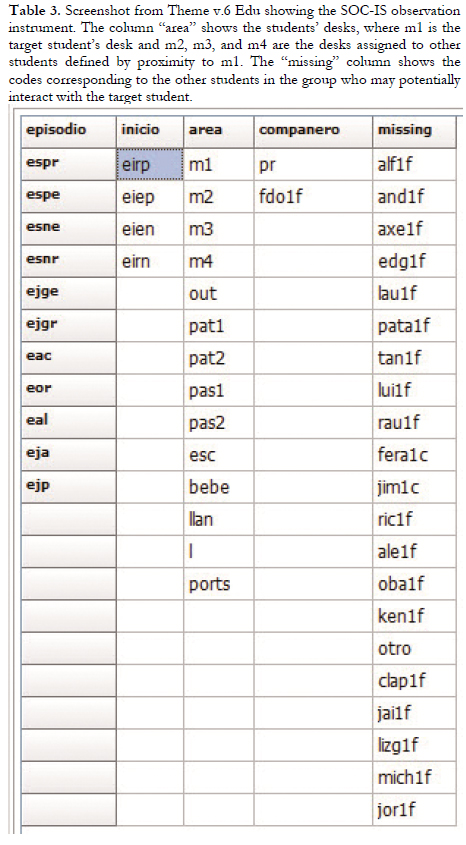
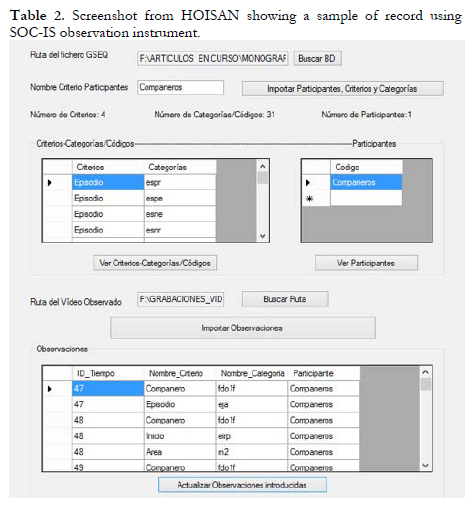
<body><![CDATA[<blockquote>     <p><font face="Verdana" size="2">a. THEME 6 Edu (Magnuson, 1996, 2000, 2005) for the T-Pattern analysis (free software program). This software is free. <a href="#t2">Table 2</a> shows a screenshot of the data loaded into THEME.</font></p>     <p><font face="Verdana" size="2">b. SDIS-GSEQ version 4.1.2. (Bakeman &amp; Quera, 1996, 2011) <i>&#091;<a target="_blank" href="http://www.ub.es/comporta/sg/sg_s_download.htm">http://www.ub.es/comporta/sg/sg_s_download.htm</a></i>&#093; to calculate the adjusted residuals needed to analyze sequential behaviors by lag sequential analysis (free software program)</font></p>     <p><font face="Verdana" size="2">c. HOISAN version 1.6 (Hernández-Mendo, López-López, Castellano, Morales-Sánchez, &amp; Pastrana, 2012; Hernández-Mendo et al., 2014) to calculate polar coordinates according to the original proposal of Sackett (1980) and the concept of genuine retrospectivity proposed by Anguera (1997). This software program is also free and displays results in the form of polar coordinate maps. <a href="#t3">Table 3</a> shows a screenshot of the observation instrument SOC-IS loaded into HOISAN.</font></p>     <p><font face="Verdana" size="2">d. STATGRAPHICS version 16 to generate linear regression equations and display the corresponding trends in graph format.</font></p> </blockquote>     <p>&nbsp;</p>     <p align="center"><a name="t2"></a><img src="/img/revistas/ap/v33n3/monografico8_tabla2.jpg"></p>     <p>&nbsp;</p>     <p align="center"><a name="t3"></a><img src="/img/revistas/ap/v33n3/monografico8_tabla3.jpg"></p>     <p>&nbsp;</p>     ]]></body>
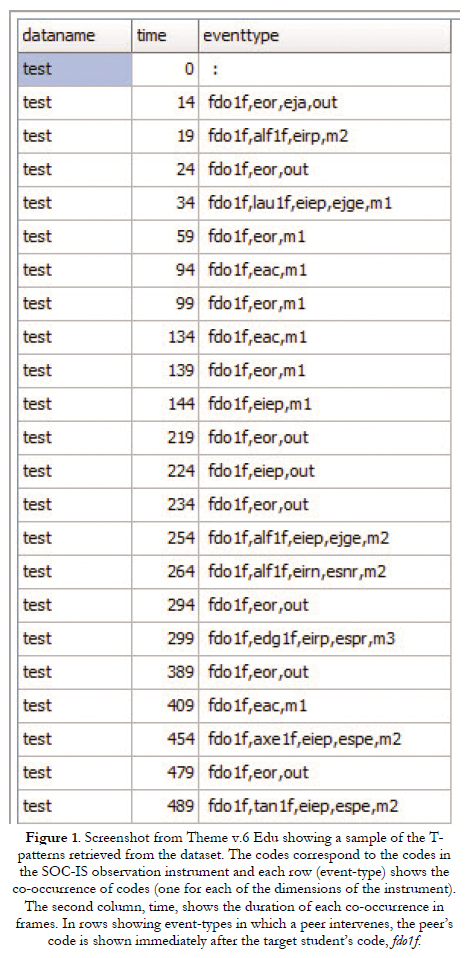
<body><![CDATA[<p><font face="Verdana" size="2"><b>Procedure</b></font></p>     <p><font face="Verdana" size="2">Eight 15-minute classroom sessions were analyzed and coded in situ by trained observers in SDIS-GSEQ using timed data (type IV data according to the data types described by Bakeman &#091;1978&#093;) derived from within-session observational sampling using 5-second intervals.</font></p>     <p><font face="Verdana" size="2">Datasets with interobserver agreement levels of less than 80% were eliminated and a new dataset was generated. Interobserver agreement (kappa statistic) for the behaviors of the target child was 0.94 (Cohen, 1960, 1968). This analysis was performed on the same day as the field session, following coding of the data.</font></p>     <p>&nbsp;</p>     <p><font face="Verdana" size="2"><b>Results</b></font></p>     <p><font face="Verdana" size="2">In this section we investigate the convergence between the four data analysis techniques used to investigate the relationships between on-task behavior (<i>eac</i> category in SOC-IS) and the other social interaction categories in the instrument. We chose the <i>eac</i> category to represent on-task behavior as a key indicator of academic motivation and the impact of teacher-led activities. In studies of the use of class time, it is obviously important to analyze how much time children spend on instructional practices. Our study differs from previously cited studies in that it provides information on specific interactions that are generally broadly classified as off-task activities, thereby providing insights into how a specific child and his peers contribute to the persistence of academic engagement in the classroom.</font></p>     <p><font face="Verdana" size="2">At the molar level, the 28 children switched behaviors on average three or four times a minute and 25% of the transitions were in response to an interaction initiated by another child. The children generally spent less than 30 seconds on task at a time, and the likelihood of switching from an on-task to an off-task activity was linearly dependent on the time spent on the first task. In other words, the longer the time spent on <i>eac</i>, the less likely the child was to abandon the task and vice versa. For more information on the molar distribution of behavioral transitions we recommend consulting Santoyo (2006).</font></p>     <p><font face="Verdana" size="2">Although we analyzed diachronic relationships between <i>eac</i> and the other categories for the 28 children over eight sessions, in this next section, we focus on the results obtained for the target student<i> fdo1f</i>. The boy spent just 19% of the total class time recorded on <i>eac</i>, the rest of his time was divided between social interaction (43%) and other activities (38%). The specific behavioral patterns detected using each of the four techniques are described below.</font></p>     <p><font face="Verdana" size="2"><b>T-Pattern detection</b></font></p>     <p><font face="Verdana" size="2">The first analysis was T-pattern detection, which is used to identify hidden patterns within sequential datasets (Magnusson, 1996, 2000, 2005). To meet the requirements of the technique and the software program (Theme v. 6 Edu), we prepared the vvt.vvt file corresponding to the observation instrument and the respective .txt data files, arranged in a single block. A screenshot from the program is shown in <a href="#f1">Figure 1</a>.</font></p>     ]]></body>
<body><![CDATA[<p>&nbsp;</p>     <p align="center"><a name="f1"></a><img src="/img/revistas/ap/v33n3/monografico8_figura1.jpg"></p>     <p>&nbsp;</p>     <p><font face="Verdana" size="2">For the first analysis we search for patterns occurring in at least 50 % of the observational files, using a significance level of p &lt; .05. The pattern detection resulted in 133 different T-patterns. To narrow down the selection using all the calculations for the target student, we prioritized T-patterns first according to their level of statistical significance and second according to their relationship with the aims of the study (i.e. T-patterns related to the performance of academic tasks in the classroom, i.e., the connection between <i>eac</i> and <i>ml</i>). The category <i>m1</i> refers to the place assigned to the student in the classroom, i.e., his desk. <a href="#t3">Table 3</a> shows all the areas considered for the general study, but for the purpose of this analysis, we used <i>m1</i> to investigate whether the target student interacted with his peers or displayed <i>eor</i> behavior away from his desk.</font></p>     <p><font face="Verdana" size="2">We focused our analysis on T-pattern #1, the most complex pattern found to occur in half of the observation files, and T-pattern #129, which was the last of the 133 T-patterns containing <i>eac</i> and occurring in over half of the observation files (Figures <a target="_blank" href="/img/revistas/ap/v33n3/monografico8_figura2.jpg">2</a> and <a target="_blank" href="/img/revistas/ap/v33n3/monografico8_figura3.jpg">3</a>). <i>m1</i> appeared in all the branches of the tree diagrams featuring <i>eac</i>, showing the strong association between the two categories.</font></p>     <p><font face="Verdana" size="2">When we increased the statistical significance requirements (to a level of p &lt; .005 and a minimum occurrence setting of 50% of the observational records), we found 15 T-patterns, but the connection between <i>eac</i> and <i>m1 </i>was retained (see T-pattern 1 with the strictest parameter requirements in <a target="_blank" href="/img/revistas/ap/v33n3/monografico8_figura4.jpg">Figure 4</a>).</font></p>     <p><font face="Verdana" size="2">However, in order to explore synergies between the four methods, we were interested not only in determining the extent to which <i>eac</i> was statistically associated with certain categories but also in identifying the categories with which it was not associated. On observing the frequencies of the different event-types for the target student <i>fdo1f</i> (see <a target="_blank" href="/img/revistas/ap/v33n3/monografico8_figura5.jpg">Figure 5</a>), we found that <i>eac</i> was only connected to <i>ml</i>. In other words, while performing the classroom task (eac), the student exhibited no connections with Initiation, Area (except for <i>m1</i>), or missing categories. Another interesting observation is the high distribution of <i>eor</i> (off-task behavior), as this reflects the motivational competition that exists between on-task and off-task behavior.</font></p>     <p><font face="Verdana" size="2">In this analysis the category <i>eor</i> was also closely associated with <i>m1</i>, indicating that the student did not move from his desk while alternating between on-task and off-task activities.</font></p>     <p><font face="Verdana" size="2">In the next section, we investigate events that triggered <i>eor</i> (e.g., <i>eiep</i>) using the other techniques with the ultimate aim of achieving valuable, complementary insights.</font></p>     <p><font face="Verdana" size="2"><b>Lag sequential analysis</b></font></p>     ]]></body>
<body><![CDATA[<p><font face="Verdana" size="2">The first technique analyzed in this section is lag sequential analysis (Bakeman, 1978; Bakeman &amp; Quera, 1996, 2011; Sackett, 1978, 1979; Bakeman &amp; Gottman, 1986), which was performed using SDIS-GSEQ, GSEQ5, and HOISAN.</font></p>     <p><font face="Verdana" size="2">The SDIS-GSEQ algorithm compares conditional and unconditional probabilities related to behaviors that occur in the form of transition frequencies after the criterion behavior (or given behavior as it is known in SDIS-GSEQ). The given behavior is established according to the needs of each study. Considering its relevance in our study, the <i>eac</i> category was established as both the criterion and the conditional behavior. Adjusted residuals for the positive lags R1 to R5 were calculated using the binomial test and the correction proposed by Allison and Liker (1982).</font></p>     <p><font face="Verdana" size="2">Separate datasets were generated for each of the eight sessions. Data were entered using the timed-event data option (type IV data). The resulting SDS files were then converted to MDS files using the GSEQ compiler. Lag sequential analysis was performed using the GSQ file (<a target="_blank" href="/img/revistas/ap/v33n3/monografico8_tabla4.jpg">Table 4</a>).</font></p>     <p><font face="Verdana" size="2">Using the results of this analysis (OUT file), we identified the occurrence of both excitatory or activating behavioral patterns (Res<sub>adjust</sub> &gt; 1.96, for <i>p</i> &lt; .05) and inhibitory behavioral patterns (Res<sub>adjust</sub> &lt; -1.96, for<i>p</i> &lt; .05) (<a target="_blank" href="/img/revistas/ap/v33n3/monografico8_tabla1.jpg">Table 1</a>).</font></p>     <p><font face="Verdana" size="2">The high values obtained for <i>eac</i> as both the criterion and conditional behavior indicates that the task is self-sustained, which is further supported by the fact that it has a statistically significant inhibitory relationship with <i>espr, espe, ejge, ejgr, eor, eirp</i>, and <i>eiep</i>. As shown by <a href="#t2">Table 2</a> <i>eiep, eirp, espr, espe, ejge, ejgr</i>, and <i>eor</i> also had a significant inhibitory relationship with <i>eac</i>.</font></p>     <p><font face="Verdana" size="2">To explore the connection between <i>eac</i> and <i>m1</i> using lag sequential analysis, we analyzed lag 0, which corresponds to concurrent events (<a target="_blank" href="/img/revistas/ap/v33n3/monografico8_tabla5.jpg">Table 5</a>).</font></p>     <p><font face="Verdana" size="2">As seen, the adjusted residual was 4.61, indicating a strongly significant association between the two categories. The negative connection between <i>eor</i> and <i>m1</i> is also noteworthy, as it shows that off-task behavior also occurs away from the student's desk, complementing findings from the first analysis.</font></p>     <p><font face="Verdana" size="2"><b>Trend analysis</b></font></p>     <p><font face="Verdana" size="2">Using the adjusted residuals obtained in the lag sequential analysis, we applied trend analysis to assess the extent to which the relationships connecting <i>eac</i> with the other categories varied across the different lags analyzed.</font></p>     <p><font face="Verdana" size="2">Using the adjusted residuals available for each of the positive lags, R1 to R5 (<a href="#t3">Table 3</a>), linear regression equations were generated in STATGRAPHICS and the resulting trends were displayed as graphs. As mentioned above, the <i>eac</i> category was established as both the criterion (<a target="_blank" href="/img/revistas/ap/v33n3/monografico8_tabla6.html">Table 6</a>) and the conditional behavior (<a target="_blank" href="/img/revistas/ap/v33n3/monografico8_tabla7.html">Table 7</a>).</font></p>     ]]></body>
<body><![CDATA[<p><font face="Verdana" size="2">The regression equation linking eac (criterion behavior) to eor (conditional behavior) in <a target="_blank" href="/img/revistas/ap/v33n3/monografico8_tabla5.jpg">Table 5</a> -<i>eac</i> / <i>eor</i> = -45.38 + 2.792*Lags-provides information on the association between the behaviors that complements the results of the Tpattern and lag sequential analyses. The existence of a negative value at lag 0 (concurrence) again shows that these behaviors do not occur simultaneously, but rather in alternation, as seen previously in the T-pattern analysis.</font></p>     <p><font face="Verdana" size="2">The regression equation linking <i>eor</i> (criterion behavior) and <i>eac</i> (conditional behavior) was <i>eor</i> / <i>eac</i> = -45.98 + 3.37*Lags. Again, the existence of a negative value at lag 0 shows that these two events cannot occur simultaneously, regardless of whether or not they occur in the same setting (<i>m1</i>).</font></p>     <p><font face="Verdana" size="2">The final analysis of the organization of class time, particularly with respect to the relationship between <i>eac</i> and the other categories, was performed using polar coordinate analysis.</font></p>     <p><font face="Verdana" size="2"><b>Polar coordinate analysis</b></font></p>     <p><font face="Verdana" size="2">Polar coordinate analysis is a powerful data reduction technique that depicts complex relationships between a given category, known as a focal category, and other categories in the form of vectors. We applied the technique to show the network of relationships between <i>eac</i> (the focal behavior, which corresponds to the given behavior in lag sequential analysis) and the other categories in SOC-IS (conditional behaviors) to generate a map showing the various interactions between categories. The technique was proposed by Sackett (1980) based on previous work by Bakeman (1978) and was subsequently enriched by the incorporation of the concept of genuine retrospectivity (Anguera, 1997). Used in combination with SOC-IS, it has proven very useful in studies analyzing children's behavior in the classroom (Anguera, Espinosa, &amp; Santoyo, 2002; Anguera, Santoyo, &amp; Espinosa, 2003; Espinosa, Anguera, &amp; Santoyo, 2004) and in other observational studies (Hernández-Mendo &amp; Anguera, 1998; Anguera &amp; Losada, 1999; Aragón, Lapresa, Arana, Anguera &amp; Garzón, 2017; Castañer et al., 2016; Gorospe &amp; Anguera, 2000; Herrero, 2000; López, Valero, Anguera &amp; Díaz, 2016; Morillo, Reigal &amp; Hernández-Mendo, 2015; Perea, Castellano, Alday &amp; Hernández-Mendo, 2012). We believe that polar coordinate analysis would also be a valuable tool for analyzing the impact of self-regulation interventions in children with high rates of behavior transitions (Norris, 2016; Slattery, et al., 2016).</font></p>     <p><font face="Verdana" size="2">Following Cochran's proposal (1954), the prospective adjusted residuals (positive lags) and retrospective adjusted residuals (negative lags) generated in the lag sequential analysis were used, respectively, to compute prospective and retrospective Z<sub>sum</sub> values, which in turn were used to calculate vector length and angle.</font></p>     <p><font face="Verdana" size="2">The resulting vectors are located in different quadrants, depending on their angle: 0-90<sup>o</sup> corresponds to quadrant I, 91-180<sup>o</sup> to quadrant II, 181-270<sup>o</sup> to quadrant III, and 271-360<sup>o</sup> to quadrant IV. Quadrants I and III are symmetric, while quadrants II and IV are asymmetric. Quadrants I and III correspond, respectively, to mutual activating and inhibitory interactions. Quadrant II corresponds to an inhibitory relationship between the criterion and the conditional behavior (or an activating relationship when the opposite direction is detected), while quadrant IV corresponds to an activating relationship between the criterion and the conditional behavior (or an inhibitory relationship for the opposite direction).</font></p>     <p><font face="Verdana" size="2">The use of polar coordinate analysis has been greatly facilitated by the inclusion of a dedicated feature in the software program, HOISAN. All the vector parameters were calculated and displayed as graphs using this program (version 1.6.3.2) (Hernández-Mendo, López-López, Castellano, Morales-Sánchez, &amp; Pastrana, 2012).</font></p>     <p><font face="Verdana" size="2">The results of the polar coordinate analysis are shown in <a target="_blank" href="/img/revistas/ap/v33n3/monografico8_tabla8.jpg">Table 8</a> and Figures <a target="_blank" href="/img/revistas/ap/v33n3/monografico8_figura6.jpg">6</a> and <a target="_blank" href="/img/revistas/ap/v33n3/monografico8_figura7.jpg">7</a>.</font></p>     <p><font face="Verdana" size="2">In quadrant I, the only category that had a mutual activating relationship with <i>eac</i> was <i>m1</i> (the corresponding vector had a length of 11.57 and an angle of 45.07<sup>o</sup>). Given the asymmetric relationship that characterizes quadrant IV, in which the focal behavior has an activating effect on all other categories in the quadrant, the only categories it could affect were <i>eal</i> and <i>ejp</i>, for which the corresponding vectors had null values.</font></p>     ]]></body>
<body><![CDATA[<p><font face="Verdana" size="2">While the results of quadrants II (inhibitory focal behavior) and III (mutually inhibitory focal and conditional behavior) are not directly pertinent to our analysis, they are consistent with the results of the other techniques. The fact that <i>eac</i> had a significant inhibitory effect on the social categories in quadrants II <i>(espr, eirp)</i> and III <i>(espe, esne, esnr, ejge, ejgr, eiep, eien</i>, and <i>eirn</i>) shows an "incompatibility" that permits a greater understanding of how time is organized in the classroom.</font></p>     <p>&nbsp;</p>     <p><font face="Verdana" size="2"><b>Discussion</b></font></p>     <p><font face="Verdana" size="2">The aim of this study was to show how complementary observational methodology techniques can be used to analyze the distribution of classroom behavior from the perspective of a single child. Our results therefore should be contemplated within the context of a case study, i.e., they are not intended to be generalized to the broader population of students. The majority of studies in this area have based their findings on information collected through questionnaires and other sources of indirect data. Studies of the distribution of time in classroom settings can offer highly relevant insights into what actually occurs in the classroom and how this impacts student motivation, academic activities, and other relevant experiences. The main strength of the current study is that we analyzed behavioral patterns related to academic tasks performed by primary school children from an individual and group perspective.</font></p>     <p><font face="Verdana" size="2">Our specific aim was to use four complementary techniques to study relationships between on-task behavior and other interaction categories to analyze how students spend their time in the classroom. We focused on on-task behavior (the <i>eac</i> category) to address some of the gaps in knowledge on how classroom time is organized.</font></p>     <p><font face="Verdana" size="2">Considering, a priori, that it is difficult to interpret relationships between the <i>eac</i> category and other interaction categories using any of the four techniques-T-pattern detection, lag sequential analysis, trend analysis, and polar coordinate analysis-in isolation, we decided to use a combination of the techniques and assess the convergence between results.</font></p>     <p><font face="Verdana" size="2"><a target="_blank" href="/img/revistas/ap/v33n3/monografico8_tabla9.jpg">Table 9</a> shows a side-by-side comparison of the results and helps to detect interpretative synergies.</font></p>     <p><font face="Verdana" size="2">The first finding of note is that according to the results of the T-pattern, lag sequential, and polar coordinate analyses, on-task behavior (<i>eac</i>) was not significantly associated with any other episodes and the only consistent connection observed was with <i>m1</i>.</font></p>     <p><font face="Verdana" size="2">Of particular note also is the statistically significant mutually inhibitory relationship between <i>eac</i> and both <i>ejge</i> (episode of group play in target child,) and <i>ejgr</i> (episode of group play in target peers). When the <i>eac</i> category was analyzed as the criterion behavior, both <i>ejge</i> and <i>ejgr</i> generated vectors located in quadrant III, indicating that play has a disruptive effect on on-task behavior. The adjusted residuals for lags R1 to R5 also exhibited an upward, albeit insignificant trend, indicating that the longer the play episode, the less likely the student is to start an academic task.</font></p>     <p><font face="Verdana" size="2">The <i>espr</i> (positive social interaction &#091;prosocial behavior) by target child) and <i>espe</i> (positive social interaction in target peers) categories are also particularly relevant. Both exhibited a significant inhibitory relationship with <i>eac</i>, indicating that social interaction interferes with academic activity. In the case of <i>espe</i>, the relationship was also reciprocal, as the corresponding vector was located in quadrant III, unlike that of <i>espr</i>, which was located in quadrant II. The adjusted residuals for the positive lags R1 to R5 exhibited an upward trend, reflecting, in a statistically significant manner, the consolidation of this inhibitory relationship. The relationships between on-task behavior and social interaction <i>(espr</i> and <i>espe</i>) have important implications for education and the organization of classroom activities. The inclusion of categories that permit the identification of the person who initiates a social episode allowed us to confirm the motivational importance of actions initiated by the target child or his peers favoring off-task behavior. These aspects are evident in both the polar coordinate and T-pattern analyses.</font></p>     ]]></body>
<body><![CDATA[<p><font face="Verdana" size="2">Finally, the relationship between the <i>eac</i> category and both the <i>eirp</i> (positive social interaction initiated by peer) and the <i>eiep</i> category (positive social interaction initiated by target child) is also interesting. We observed a statistically significant inhibitory relationship between the two categories and <i>eac</i> as both the criterion and conditional behavior, highlighting the fact that initiation of social interaction distracts children from academic tasks. The <i>eiep</i> vector was located in quadrant III, while the <i>eirp</i> vector was located in quadrant II. The inhibitory nature of these categories was further supported in the trend analysis, as they exhibited an upward trend, regardless of whether <i>eac</i> was analyzed as the criterion or conditional behavior. Furthermore, in the case of <i>eiep</i>, the upward trend was statistically significant when <i>eac</i> was defined as the conditional behavior.</font></p>     <p><font face="Verdana" size="2">We have presented an extension of previous work by our group in the field of academic behavior (Santoyo &amp; Anguera, 1992) that supports previous findings from observational methodology studies conducted in similar school settings (Santoyo et al., 2000, 2006). In particular, our study adds to the body of scientific literature on the distribution of classroom behavior that has focused on the time spent by teachers in getting their students started on a task. Time lost in achieving this logically has an effect on the time spent by students on academic tasks. One general limitation of studies in this area to date is that they have based their analyses on indirect data rather than on actual time spent on class-work or factors that influence on-task behavior. Future studies should address motivational factors in situ to shed light not only on the allocation of time by teachers in the classroom (Martinic, 2015) but also on the distribution of activities that form part of on- and off-task behavior during teacher-student and student-student interactions in the classroom (Santoyo, in press).</font></p>     <p><font face="Verdana" size="2">To conclude, the combined use of four complementary observational methodology techniques to explore in greater depth the distribution of classroom activities in a primary school setting shows that the methods converged in terms of essential information but also provided differential insights that, considered as a whole, add an interesting depth to the analysis. We believe that more studies should aim to enrich their analyses and interpretation of data by using complementary techniques.</font></p>     <p>&nbsp;</p>     <p><font face="Verdana" size="2"><b>References</b></font></p>     <!-- ref --><p><font face="Verdana" size="2">1. Abramowitz, A.J., O'Leary, S.G., &amp; Futtersak, M.W. (1988). The relative impact of longand short reprimands on children's off-task behavior in the classroom. Behavior Therapy, 19, 243-247.    &nbsp;&nbsp;&nbsp;&nbsp;&nbsp;&nbsp;&nbsp;&nbsp;[&#160;<a href="javascript:void(0);" onclick="javascript: window.open('/scielo.php?script=sci_nlinks&ref=787033&pid=S0212-9728201700030000800001&lng=','','width=640,height=500,resizable=yes,scrollbars=1,menubar=yes,');">Links</a>&#160;]<!-- end-ref --></font></p>    <!-- ref --><p><font face="Verdana" size="2">2. Allison, P.D. &amp; Liker, J.K. (1982). Analyzing sequential categorical data on dyadic interaction: A comment on Gottman. Psychological Bulletin, 91(2), 393-403.    &nbsp;&nbsp;&nbsp;&nbsp;&nbsp;&nbsp;&nbsp;&nbsp;[&#160;<a href="javascript:void(0);" onclick="javascript: window.open('/scielo.php?script=sci_nlinks&ref=787035&pid=S0212-9728201700030000800002&lng=','','width=640,height=500,resizable=yes,scrollbars=1,menubar=yes,');">Links</a>&#160;]<!-- end-ref --></font></p>    <!-- ref --><p><font face="Verdana" size="2">3. Anguera, M.T. (1997). From prospective patterns in behavior to joint analysis with a retrospective perspective. En Colloque sur invitation &#171;Méthodologie d'analyse des interactions sociales&#187;. París: Université de la Sorbonne.    &nbsp;&nbsp;&nbsp;&nbsp;&nbsp;&nbsp;&nbsp;&nbsp;[&#160;<a href="javascript:void(0);" onclick="javascript: window.open('/scielo.php?script=sci_nlinks&ref=787037&pid=S0212-9728201700030000800003&lng=','','width=640,height=500,resizable=yes,scrollbars=1,menubar=yes,');">Links</a>&#160;]<!-- end-ref --></font></p>    <!-- ref --><p><font face="Verdana" size="2">4. Anguera, M. T., Blanco, A. y Losada, J. L. (2001). Diseños observacionales, cuestión clave en el proceso de la metodología observacional (Observational designs, key issues in the observational methodology process). Metodología de las Ciencias del Comportamiento, 3(2), 135-160.    &nbsp;&nbsp;&nbsp;&nbsp;&nbsp;&nbsp;&nbsp;&nbsp;[&#160;<a href="javascript:void(0);" onclick="javascript: window.open('/scielo.php?script=sci_nlinks&ref=787039&pid=S0212-9728201700030000800004&lng=','','width=640,height=500,resizable=yes,scrollbars=1,menubar=yes,');">Links</a>&#160;]<!-- end-ref --></font></p>    <!-- ref --><p><font face="Verdana" size="2">5. Anguera, M.T., Espinosa, M.C. y Santoyo, C. (2002). Observación de la conducta interactiva en niños: Análisis de la intensidad interactiva diádica (Observation of interactive behavior in children). Metodología de las Ciencias del Comportamiento, vol. especial, 34-36.    &nbsp;&nbsp;&nbsp;&nbsp;&nbsp;&nbsp;&nbsp;&nbsp;[&#160;<a href="javascript:void(0);" onclick="javascript: window.open('/scielo.php?script=sci_nlinks&ref=787041&pid=S0212-9728201700030000800005&lng=','','width=640,height=500,resizable=yes,scrollbars=1,menubar=yes,');">Links</a>&#160;]<!-- end-ref --></font></p>    <!-- ref --><p><font face="Verdana" size="2">6. Anguera, M.T. y Losada, J.L. (1999) Reducción de datos en marcos de conducta mediante la técnica de coordenadas polares (Reduction of data in behavioral frameworks using the polar coordinate technique). En M.T. Anguera (Ed.), Observación de la conducta interactiva en situaciones naturales: Aplicaciones. Barcelona: E.U.B.    &nbsp;&nbsp;&nbsp;&nbsp;&nbsp;&nbsp;&nbsp;&nbsp;[&#160;<a href="javascript:void(0);" onclick="javascript: window.open('/scielo.php?script=sci_nlinks&ref=787043&pid=S0212-9728201700030000800006&lng=','','width=640,height=500,resizable=yes,scrollbars=1,menubar=yes,');">Links</a>&#160;]<!-- end-ref --></font></p>    <!-- ref --><p><font face="Verdana" size="2">7. Anguera, M.T., Santoyo, C. &amp; Espinosa, M.C. (2003). Evaluating links intensity in social networks in a school context through observational designs. In R. García Mira, J.M. Sabucedo Cameselle &amp; J. Romay Martínez (Eds.), Culture, Environmental Action and Sustainability (pp. 286-298). G&#246;ttingen: Hogrefe &amp; Huber.    &nbsp;&nbsp;&nbsp;&nbsp;&nbsp;&nbsp;&nbsp;&nbsp;[&#160;<a href="javascript:void(0);" onclick="javascript: window.open('/scielo.php?script=sci_nlinks&ref=787045&pid=S0212-9728201700030000800007&lng=','','width=640,height=500,resizable=yes,scrollbars=1,menubar=yes,');">Links</a>&#160;]<!-- end-ref --></font></p>    <!-- ref --><p><font face="Verdana" size="2">8. Aragón, S., Lapresa, D., Arana, J., Anguera, M.T., &amp; Garzón, B. (2017). An example of the informative potential of polar coordinate analysis: sprint tactics in elite 1500 m track events. Measurement in Physical Education and Exercise Science, 21(1), 26-33, DOI: 10.1080/1091367X.2016.1245192.    &nbsp;&nbsp;&nbsp;&nbsp;&nbsp;&nbsp;&nbsp;&nbsp;[&#160;<a href="javascript:void(0);" onclick="javascript: window.open('/scielo.php?script=sci_nlinks&ref=787047&pid=S0212-9728201700030000800008&lng=','','width=640,height=500,resizable=yes,scrollbars=1,menubar=yes,');">Links</a>&#160;]<!-- end-ref --></font></p>    <!-- ref --><p><font face="Verdana" size="2">9. Bakeman, R. (1978). Untangling streams of behavior: Sequential analysis of observation data. In G.P. Sackett (Ed.), ObservingBehavior, Vol. 2: Data collection and analysis methods. Baltimore, University of Park Press, pp. 63-78.    &nbsp;&nbsp;&nbsp;&nbsp;&nbsp;&nbsp;&nbsp;&nbsp;[&#160;<a href="javascript:void(0);" onclick="javascript: window.open('/scielo.php?script=sci_nlinks&ref=787049&pid=S0212-9728201700030000800009&lng=','','width=640,height=500,resizable=yes,scrollbars=1,menubar=yes,');">Links</a>&#160;]<!-- end-ref --></font></p>    <!-- ref --><p><font face="Verdana" size="2">10. Bakeman, R., &amp; Gottman, J.M. (1986). Observing Interaction: An introduction to sequential analysis. New York: Cambridge University Press.    &nbsp;&nbsp;&nbsp;&nbsp;&nbsp;&nbsp;&nbsp;&nbsp;[&#160;<a href="javascript:void(0);" onclick="javascript: window.open('/scielo.php?script=sci_nlinks&ref=787051&pid=S0212-9728201700030000800010&lng=','','width=640,height=500,resizable=yes,scrollbars=1,menubar=yes,');">Links</a>&#160;]<!-- end-ref --></font></p>    <!-- ref --><p><font face="Verdana" size="2">11. Bakeman, R. y Quera, V. (1996). Análisis de la interacción. Análisis secuencialcon SDIS y GSEQ (Interaction analysis. Sequential analysis with SDIS and GSEQ). Madrid, Ra-Ma.    &nbsp;&nbsp;&nbsp;&nbsp;&nbsp;&nbsp;&nbsp;&nbsp;[&#160;<a href="javascript:void(0);" onclick="javascript: window.open('/scielo.php?script=sci_nlinks&ref=787053&pid=S0212-9728201700030000800011&lng=','','width=640,height=500,resizable=yes,scrollbars=1,menubar=yes,');">Links</a>&#160;]<!-- end-ref --></font></p>    <!-- ref --><p><font face="Verdana" size="2">12. Berk, L.E., &amp; Landau, S. (1993). Private speech of learning disabled and normally achieving children in classroom academic and laboratory contexts. Child Development, 64, 556-571.    &nbsp;&nbsp;&nbsp;&nbsp;&nbsp;&nbsp;&nbsp;&nbsp;[&#160;<a href="javascript:void(0);" onclick="javascript: window.open('/scielo.php?script=sci_nlinks&ref=787055&pid=S0212-9728201700030000800012&lng=','','width=640,height=500,resizable=yes,scrollbars=1,menubar=yes,');">Links</a>&#160;]<!-- end-ref --></font></p>    <!-- ref --><p><font face="Verdana" size="2">13. Castañer, M., Barreira, D., Camerino, O., Anguera, M. T., Canton, A., and Hileno, R. (2016). Goal scoring in soccer: A polar coordinate analysis of motor skills used by Lionel Messi. Frontiersin Psychology, 7, 806. doi: 10.3389/fpsyg.2016.00806.    &nbsp;&nbsp;&nbsp;&nbsp;&nbsp;&nbsp;&nbsp;&nbsp;[&#160;<a href="javascript:void(0);" onclick="javascript: window.open('/scielo.php?script=sci_nlinks&ref=787057&pid=S0212-9728201700030000800013&lng=','','width=640,height=500,resizable=yes,scrollbars=1,menubar=yes,');">Links</a>&#160;]<!-- end-ref --></font></p>    <!-- ref --><p><font face="Verdana" size="2">14. Cochran, W.G. (1954). Some methods for strengthening the common &#967;<sup>2</sup> test. Biometrics, 10, 417-451.    &nbsp;&nbsp;&nbsp;&nbsp;&nbsp;&nbsp;&nbsp;&nbsp;[&#160;<a href="javascript:void(0);" onclick="javascript: window.open('/scielo.php?script=sci_nlinks&ref=787059&pid=S0212-9728201700030000800014&lng=','','width=640,height=500,resizable=yes,scrollbars=1,menubar=yes,');">Links</a>&#160;]<!-- end-ref --></font></p>    <!-- ref --><p><font face="Verdana" size="2">15. Cohen, J. (1960). A coefficient of agreement for nominal scales. Educational and Psychological Measurement, 20, 37-46.    &nbsp;&nbsp;&nbsp;&nbsp;&nbsp;&nbsp;&nbsp;&nbsp;[&#160;<a href="javascript:void(0);" onclick="javascript: window.open('/scielo.php?script=sci_nlinks&ref=787061&pid=S0212-9728201700030000800015&lng=','','width=640,height=500,resizable=yes,scrollbars=1,menubar=yes,');">Links</a>&#160;]<!-- end-ref --></font></p>    <!-- ref --><p><font face="Verdana" size="2">16. Cohen, J. (1968). Weighted kappa: Nominal scale agreement with provision for scaled disagreement of partial credit. Psychological Bulletin, 70, 213-220.    &nbsp;&nbsp;&nbsp;&nbsp;&nbsp;&nbsp;&nbsp;&nbsp;[&#160;<a href="javascript:void(0);" onclick="javascript: window.open('/scielo.php?script=sci_nlinks&ref=787063&pid=S0212-9728201700030000800016&lng=','','width=640,height=500,resizable=yes,scrollbars=1,menubar=yes,');">Links</a>&#160;]<!-- end-ref --></font></p>    <!-- ref --><p><font face="Verdana" size="2">17. Delgado, E.L.G. (2013). La ley de igualación, de la teoría al aula escolar: La relación entre la atención diferencial y la conducta dentro del aula (The matching law, from theory to the classroom: The relationship between differential attention and behavior in the classroom). Tesis de Licenciatura en Psicología. Universidad Nacional Autónoma de México.    &nbsp;&nbsp;&nbsp;&nbsp;&nbsp;&nbsp;&nbsp;&nbsp;[&#160;<a href="javascript:void(0);" onclick="javascript: window.open('/scielo.php?script=sci_nlinks&ref=787065&pid=S0212-9728201700030000800017&lng=','','width=640,height=500,resizable=yes,scrollbars=1,menubar=yes,');">Links</a>&#160;]<!-- end-ref --></font></p>    <!-- ref --><p><font face="Verdana" size="2">18. Elder, G.H., Pavalko, E.K., &amp; Clipp, E.C. (1993). Working with archival data: Studying lives. Newbury Park: Sage Publications.    &nbsp;&nbsp;&nbsp;&nbsp;&nbsp;&nbsp;&nbsp;&nbsp;[&#160;<a href="javascript:void(0);" onclick="javascript: window.open('/scielo.php?script=sci_nlinks&ref=787067&pid=S0212-9728201700030000800018&lng=','','width=640,height=500,resizable=yes,scrollbars=1,menubar=yes,');">Links</a>&#160;]<!-- end-ref --></font></p>    <!-- ref --><p><font face="Verdana" size="2">19. Espinosa, M.C., Anguera, M.T. y Santoyo, C. (2004). Análisis jerárquico y secuencial de patrones sociales "rudimentarios" establecidos por niños pequeños (Hierarchical and sequential analysis of "rudimentary" social patterns established by young children). Metodología de las Ciencias del Comportamiento, Suplemento, 193-200.    &nbsp;&nbsp;&nbsp;&nbsp;&nbsp;&nbsp;&nbsp;&nbsp;[&#160;<a href="javascript:void(0);" onclick="javascript: window.open('/scielo.php?script=sci_nlinks&ref=787069&pid=S0212-9728201700030000800019&lng=','','width=640,height=500,resizable=yes,scrollbars=1,menubar=yes,');">Links</a>&#160;]<!-- end-ref --></font></p>    <!-- ref --><p><font face="Verdana" size="2">20. Espinosa, A.M.C., Blanco-Villaseñor, A., &amp; Santoyo, V.C. (2006). El estudio del comportamiento en escenarios naturales: Observación de las interacciones sociales (Studying behavior in natural settings: Observation of social interactions). En C. Santoyo y M.C. Espinosa (Eds.). Desarrollo e interacción social: Teoríay métodos de investigación en contexto (pp. 45-78). México: UNAM/CONACYT.    &nbsp;&nbsp;&nbsp;&nbsp;&nbsp;&nbsp;&nbsp;&nbsp;[&#160;<a href="javascript:void(0);" onclick="javascript: window.open('/scielo.php?script=sci_nlinks&ref=787071&pid=S0212-9728201700030000800020&lng=','','width=640,height=500,resizable=yes,scrollbars=1,menubar=yes,');">Links</a>&#160;]<!-- end-ref --></font></p>    <!-- ref --><p><font face="Verdana" size="2">21. Gorospe, G. y Anguera, M.T. (2000). Modificación de la técnica clásica de coordenadas polares mediante un desarrollo distinto de la retrospectividad: Aplicación al tenis (Modification to the classic polar coordinate technique using a distinct concept of retrospectivity: An application to tennis). Psicothema, 12 (Supl. N<sup>o</sup> 2), 279-282.    &nbsp;&nbsp;&nbsp;&nbsp;&nbsp;&nbsp;&nbsp;&nbsp;[&#160;<a href="javascript:void(0);" onclick="javascript: window.open('/scielo.php?script=sci_nlinks&ref=787073&pid=S0212-9728201700030000800021&lng=','','width=640,height=500,resizable=yes,scrollbars=1,menubar=yes,');">Links</a>&#160;]<!-- end-ref --></font></p>    <!-- ref --><p><font face="Verdana" size="2">22. Hernández Mendo, A. y Anguera, M.T. (1998). Análisis de coordenadas polares en el estudio de las diferencias individuales de la acción de juego (Polar coordinate analysis in the study of individual differences of the game action). En M.P. Sánchez y M.A. Quiroga (Coords.), Perspectivas actuales en la investigación psicológica de las diferencias individuales (pp. 84-88). Madrid: Centro de Estudios Ramón Areces.    &nbsp;&nbsp;&nbsp;&nbsp;&nbsp;&nbsp;&nbsp;&nbsp;[&#160;<a href="javascript:void(0);" onclick="javascript: window.open('/scielo.php?script=sci_nlinks&ref=787075&pid=S0212-9728201700030000800022&lng=','','width=640,height=500,resizable=yes,scrollbars=1,menubar=yes,');">Links</a>&#160;]<!-- end-ref --></font></p>    <!-- ref --><p><font face="Verdana" size="2">23. Hernández-Mendo, A., Castellano, J., Camerino, O., Jonsson, G., Blanco-Villaseñor, A., Lopes, A. y Anguera, M.T. (2014). Programas informáticos de registro, control de calidad del dato, y análisis de datos (Observational software, data quality control and data analysis). Revista de Psicología del Deporte, 23(1), 111-121.    &nbsp;&nbsp;&nbsp;&nbsp;&nbsp;&nbsp;&nbsp;&nbsp;[&#160;<a href="javascript:void(0);" onclick="javascript: window.open('/scielo.php?script=sci_nlinks&ref=787077&pid=S0212-9728201700030000800023&lng=','','width=640,height=500,resizable=yes,scrollbars=1,menubar=yes,');">Links</a>&#160;]<!-- end-ref --></font></p>    <!-- ref --><p><font face="Verdana" size="2">24. Hernández-Mendo, A., López-López, J. A., Castellano, J., Morales-Sánchez, V. y Pastrana, J. L. (2012). Hoisan 1.2: Programa informático para uso en metodología observacional (Hoisan 1.2: Software for observational methodology). Cuadernos de Psicología del Deporte, 12(1), 55-78.    &nbsp;&nbsp;&nbsp;&nbsp;&nbsp;&nbsp;&nbsp;&nbsp;[&#160;<a href="javascript:void(0);" onclick="javascript: window.open('/scielo.php?script=sci_nlinks&ref=787079&pid=S0212-9728201700030000800024&lng=','','width=640,height=500,resizable=yes,scrollbars=1,menubar=yes,');">Links</a>&#160;]<!-- end-ref --></font></p>    <!-- ref --><p><font face="Verdana" size="2">25. Herrero, M. L. (2000). Utilización de la técnica de coordenadas polares en el estudio de la interacción infantil en el marco escolar (Use of the technic of polar coordinates in the study of the children interaction in the school room). Psicothema, 12(2), 292-297.    &nbsp;&nbsp;&nbsp;&nbsp;&nbsp;&nbsp;&nbsp;&nbsp;[&#160;<a href="javascript:void(0);" onclick="javascript: window.open('/scielo.php?script=sci_nlinks&ref=787081&pid=S0212-9728201700030000800025&lng=','','width=640,height=500,resizable=yes,scrollbars=1,menubar=yes,');">Links</a>&#160;]<!-- end-ref --></font></p>    <!-- ref --><p><font face="Verdana" size="2">26. Herrero, M.L. y Pleguezuelos, C.S. (2008). Patrones de conducta interactiva en contexto escolar multicultural (Patterns of interactive behavior in a multicultural school setting). Psicothema, 20(4), 945-950.    &nbsp;&nbsp;&nbsp;&nbsp;&nbsp;&nbsp;&nbsp;&nbsp;[&#160;<a href="javascript:void(0);" onclick="javascript: window.open('/scielo.php?script=sci_nlinks&ref=787083&pid=S0212-9728201700030000800026&lng=','','width=640,height=500,resizable=yes,scrollbars=1,menubar=yes,');">Links</a>&#160;]<!-- end-ref --></font></p>    <!-- ref --><p><font face="Verdana" size="2">27. Heward, W.L. (1994). Three "low-tech" strategies for increasing the frequency of active student response during group instruction. En R. Gardner, D. Sainato, J. Cooper, T. Heron, W. Heward, W. Eshleman, &amp; T. Grossi (Eds.), Behavior analysis in education: Focus on measurably superior instruction (pp. 161-172). Pacific Grove, Cal.: Brooks /Cole Publishing Co.    &nbsp;&nbsp;&nbsp;&nbsp;&nbsp;&nbsp;&nbsp;&nbsp;[&#160;<a href="javascript:void(0);" onclick="javascript: window.open('/scielo.php?script=sci_nlinks&ref=787085&pid=S0212-9728201700030000800027&lng=','','width=640,height=500,resizable=yes,scrollbars=1,menubar=yes,');">Links</a>&#160;]<!-- end-ref --></font></p>    <!-- ref --><p><font face="Verdana" size="2">28. Heller, M.S., &amp; White, M.A. (1975). Rates of teacher verbal approval and disapproval to higher and lower ability classes. Journal of educational psychology, 67, 796-800.    &nbsp;&nbsp;&nbsp;&nbsp;&nbsp;&nbsp;&nbsp;&nbsp;[&#160;<a href="javascript:void(0);" onclick="javascript: window.open('/scielo.php?script=sci_nlinks&ref=787087&pid=S0212-9728201700030000800028&lng=','','width=640,height=500,resizable=yes,scrollbars=1,menubar=yes,');">Links</a>&#160;]<!-- end-ref --></font></p>    <!-- ref --><p><font face="Verdana" size="2">29. López, J., Valero, A., Anguera, M. T., &amp; Díaz, A. (2016). Disruptive behavior among elementary students in physical education. Springer Plus, 5, 1154. doi: 10.1186/s40064-016-2764-6.    &nbsp;&nbsp;&nbsp;&nbsp;&nbsp;&nbsp;&nbsp;&nbsp;[&#160;<a href="javascript:void(0);" onclick="javascript: window.open('/scielo.php?script=sci_nlinks&ref=787089&pid=S0212-9728201700030000800029&lng=','','width=640,height=500,resizable=yes,scrollbars=1,menubar=yes,');">Links</a>&#160;]<!-- end-ref --></font></p>    <!-- ref --><p><font face="Verdana" size="2">30. Magnusson, M.S. (1996). Hidden real-time patterns in intra-and interindividual behavior: Description and detection. European Journal of Psychological Assessment, 12(2), 112-123.    &nbsp;&nbsp;&nbsp;&nbsp;&nbsp;&nbsp;&nbsp;&nbsp;[&#160;<a href="javascript:void(0);" onclick="javascript: window.open('/scielo.php?script=sci_nlinks&ref=787091&pid=S0212-9728201700030000800030&lng=','','width=640,height=500,resizable=yes,scrollbars=1,menubar=yes,');">Links</a>&#160;]<!-- end-ref --></font></p>    <!-- ref --><p><font face="Verdana" size="2">31. Magnusson, M.S. (2000). Discovering hidden time patterns in behavior: T-patterns and their detection. Behavior Research Methods, Instruments, &amp; Computers, 32(1), 93-110.    &nbsp;&nbsp;&nbsp;&nbsp;&nbsp;&nbsp;&nbsp;&nbsp;[&#160;<a href="javascript:void(0);" onclick="javascript: window.open('/scielo.php?script=sci_nlinks&ref=787093&pid=S0212-9728201700030000800031&lng=','','width=640,height=500,resizable=yes,scrollbars=1,menubar=yes,');">Links</a>&#160;]<!-- end-ref --></font></p>    <!-- ref --><p><font face="Verdana" size="2">32. Magnusson, M.S. (2005). Understanding social interaction: Discovering hidden structure with model and algorithms. In L. Anolli, S. Duncan, M.S. Magnusson, &amp; G. Riva (Eds.), The hidden structure of interactions: From neurons to culture patterns (pp. 4-20). Amsterdam: IOS Press.    &nbsp;&nbsp;&nbsp;&nbsp;&nbsp;&nbsp;&nbsp;&nbsp;[&#160;<a href="javascript:void(0);" onclick="javascript: window.open('/scielo.php?script=sci_nlinks&ref=787095&pid=S0212-9728201700030000800032&lng=','','width=640,height=500,resizable=yes,scrollbars=1,menubar=yes,');">Links</a>&#160;]<!-- end-ref --></font></p>    <!-- ref --><p><font face="Verdana" size="2">33. Martens, B. K. (1990). A context analysis of contingent teacher attention. Behavior Modification, 14, 138-156.    &nbsp;&nbsp;&nbsp;&nbsp;&nbsp;&nbsp;&nbsp;&nbsp;[&#160;<a href="javascript:void(0);" onclick="javascript: window.open('/scielo.php?script=sci_nlinks&ref=787097&pid=S0212-9728201700030000800033&lng=','','width=640,height=500,resizable=yes,scrollbars=1,menubar=yes,');">Links</a>&#160;]<!-- end-ref --></font></p>    <!-- ref --><p><font face="Verdana" size="2">34. Martens, B.K., Halperin, S., Rummel, J.R., &amp; Kilpatrick, D. (1990). Matching theory applied to contingent teacher attention. Behavior Assessment, 12, 139-155.    &nbsp;&nbsp;&nbsp;&nbsp;&nbsp;&nbsp;&nbsp;&nbsp;[&#160;<a href="javascript:void(0);" onclick="javascript: window.open('/scielo.php?script=sci_nlinks&ref=787099&pid=S0212-9728201700030000800034&lng=','','width=640,height=500,resizable=yes,scrollbars=1,menubar=yes,');">Links</a>&#160;]<!-- end-ref --></font></p>    <!-- ref --><p><font face="Verdana" size="2">35. Martinic, S. (2015). El tiempo y el aprendizaje escolar: la experiencia de la extensión de la jornada escolar en Chile (Time and learning at school: the experience of lengthening the school day in Chile). Revista Brasileira de Educaç&#227;o, 20, 61, 479-499. http://dx.doi.org/10.1590/S1413-24782015206110.    &nbsp;&nbsp;&nbsp;&nbsp;&nbsp;&nbsp;&nbsp;&nbsp;[&#160;<a href="javascript:void(0);" onclick="javascript: window.open('/scielo.php?script=sci_nlinks&ref=787101&pid=S0212-9728201700030000800035&lng=','','width=640,height=500,resizable=yes,scrollbars=1,menubar=yes,');">Links</a>&#160;]<!-- end-ref --></font></p>    <!-- ref --><p><font face="Verdana" size="2">36. Morillo, J. P., Reigal, R. E., and Hernández-Mendo, A. (2015). Análisis del ataque posicional de balonmano playa masculino y femenino mediante coordenadas polares (Analysis of positional attack in beach handball male and female with polar coordinates). Revista Internacional de Ciencias del Deporte, 11, 226-244.    &nbsp;&nbsp;&nbsp;&nbsp;&nbsp;&nbsp;&nbsp;&nbsp;[&#160;<a href="javascript:void(0);" onclick="javascript: window.open('/scielo.php?script=sci_nlinks&ref=787103&pid=S0212-9728201700030000800036&lng=','','width=640,height=500,resizable=yes,scrollbars=1,menubar=yes,');">Links</a>&#160;]<!-- end-ref --></font></p>    <!-- ref --><p><font face="Verdana" size="2">37. Norris, L.A. (2016). Self-Regulation Strategies for Students with Disruptive Behavior Disorders. Culminating Projects in Special Education. Paper 7. <a target="_blank" href="http://repository.stcloudstate.edu/sped_etds">http://repository.stcloudstate.edu/sped_etds</a>.    &nbsp;&nbsp;&nbsp;&nbsp;&nbsp;&nbsp;&nbsp;&nbsp;[&#160;<a href="javascript:void(0);" onclick="javascript: window.open('/scielo.php?script=sci_nlinks&ref=787105&pid=S0212-9728201700030000800037&lng=','','width=640,height=500,resizable=yes,scrollbars=1,menubar=yes,');">Links</a>&#160;]<!-- end-ref --></font></p>    <!-- ref --><p><font face="Verdana" size="2">38. Organization for Economic Cooperation and Development (OECD) Teaching and Learning International Survey (TALIS) 2013 <a target="_blank" href="http://www.oecd.org/edu/school/Questionnaires%20TALIS%202013.pdf">http://www.oecd.org/edu/school/Questionnaires%20TALIS%202013.pdf</a>.    &nbsp;&nbsp;&nbsp;&nbsp;&nbsp;&nbsp;&nbsp;&nbsp;[&#160;<a href="javascript:void(0);" onclick="javascript: window.open('/scielo.php?script=sci_nlinks&ref=787107&pid=S0212-9728201700030000800038&lng=','','width=640,height=500,resizable=yes,scrollbars=1,menubar=yes,');">Links</a>&#160;]<!-- end-ref --></font></p>    <!-- ref --><p><font face="Verdana" size="2">39. Otero, T.L., and Haut, J.M. (2016). Differential effects of reinforcement on the selfmonitoring of on-task behavior. School Psychology Quarterly, 31(1), 91-103. doi: 10.1037/spq0000113.    &nbsp;&nbsp;&nbsp;&nbsp;&nbsp;&nbsp;&nbsp;&nbsp;[&#160;<a href="javascript:void(0);" onclick="javascript: window.open('/scielo.php?script=sci_nlinks&ref=787109&pid=S0212-9728201700030000800039&lng=','','width=640,height=500,resizable=yes,scrollbars=1,menubar=yes,');">Links</a>&#160;]<!-- end-ref --></font></p>    <!-- ref --><p><font face="Verdana" size="2">40. Perea, A., Castellano, J., Alday, S., and Hernández-Mendo, A. (2012). Analysis of behaviour in sports through Polar Coordinate Analysis with MATLAB. Quality &amp; Quantity, 46, 1249-1260. doi: 10.1007/s11135-011-9435-z.    &nbsp;&nbsp;&nbsp;&nbsp;&nbsp;&nbsp;&nbsp;&nbsp;[&#160;<a href="javascript:void(0);" onclick="javascript: window.open('/scielo.php?script=sci_nlinks&ref=787111&pid=S0212-9728201700030000800040&lng=','','width=640,height=500,resizable=yes,scrollbars=1,menubar=yes,');">Links</a>&#160;]<!-- end-ref --></font></p>    <!-- ref --><p><font face="Verdana" size="2">41. Razo, P.A.E. (2015). Tiempo de aprender. El uso y organización del tiempo en las escuelas primarias en México (Time to learn. Use and organization of time in primary schools in Mexico). Memorias del Segundo Congreso latinoamericano de medición y evaluación educacional. Instituto nacional para la evaluación de la educación. 12-14 de marzo. Ciudad de México.    &nbsp;&nbsp;&nbsp;&nbsp;&nbsp;&nbsp;&nbsp;&nbsp;[&#160;<a href="javascript:void(0);" onclick="javascript: window.open('/scielo.php?script=sci_nlinks&ref=787113&pid=S0212-9728201700030000800041&lng=','','width=640,height=500,resizable=yes,scrollbars=1,menubar=yes,');">Links</a>&#160;]<!-- end-ref --></font></p>    <!-- ref --><p><font face="Verdana" size="2">42. Sackett, G.P. (Ed.) (1978). Observing Behavior, Vol. 2: Data collection and analysis methods, Baltimore: University of Park Press.    &nbsp;&nbsp;&nbsp;&nbsp;&nbsp;&nbsp;&nbsp;&nbsp;[&#160;<a href="javascript:void(0);" onclick="javascript: window.open('/scielo.php?script=sci_nlinks&ref=787115&pid=S0212-9728201700030000800042&lng=','','width=640,height=500,resizable=yes,scrollbars=1,menubar=yes,');">Links</a>&#160;]<!-- end-ref --></font></p>    <!-- ref --><p><font face="Verdana" size="2">43. Sackett, G.P. (1979). The lag sequential analysis of contingency and cyclicity on behavioral interaction research. In J.D. Osofsky (Ed.) Handbook of infant development, New York: Wiley, pp. 623-649.    &nbsp;&nbsp;&nbsp;&nbsp;&nbsp;&nbsp;&nbsp;&nbsp;[&#160;<a href="javascript:void(0);" onclick="javascript: window.open('/scielo.php?script=sci_nlinks&ref=787117&pid=S0212-9728201700030000800043&lng=','','width=640,height=500,resizable=yes,scrollbars=1,menubar=yes,');">Links</a>&#160;]<!-- end-ref --></font></p>    <!-- ref --><p><font face="Verdana" size="2">44. Sackett, G.P. (1980) Lag sequential analysis as a data reduction technique in social interaction research. In D.B. Sawin, R.C. Hawkins, L.O. Walker &amp; J.H. Penticuff (Eds.). Exceptional infant. Psychosocial risks in infant-environment transactions (pp. 300-340). New York: Brunner/Mazel.    &nbsp;&nbsp;&nbsp;&nbsp;&nbsp;&nbsp;&nbsp;&nbsp;[&#160;<a href="javascript:void(0);" onclick="javascript: window.open('/scielo.php?script=sci_nlinks&ref=787119&pid=S0212-9728201700030000800044&lng=','','width=640,height=500,resizable=yes,scrollbars=1,menubar=yes,');">Links</a>&#160;]<!-- end-ref --></font></p>    <!-- ref --><p><font face="Verdana" size="2">45. Santoyo, C. (in press). Uso del tiempo en el aula: Una perspectiva observacional de la "organización" de patrones de comportamiento (Use of time in the classroom: An observational perspective of the &quot;organization&quot; of behavioral patterns). In C. Santoyo (Comp.) Investigación puente de Mecanismos Básicos de Toma de Decisiones Intrapersonales, Diádicas y Grupales. México: CONACYT/UNAM.    &nbsp;&nbsp;&nbsp;&nbsp;&nbsp;&nbsp;&nbsp;&nbsp;[&#160;<a href="javascript:void(0);" onclick="javascript: window.open('/scielo.php?script=sci_nlinks&ref=787121&pid=S0212-9728201700030000800045&lng=','','width=640,height=500,resizable=yes,scrollbars=1,menubar=yes,');">Links</a>&#160;]<!-- end-ref --></font></p>    <!-- ref --><p><font face="Verdana" size="2">46. Santoyo, C. (2010). Reflexiones conceptuales sobre la Persistencia académica: Aportaciones de un Enfoque de Síntesis (Conceptual reflections on academic persistence: Contributions from a synthesis-based approach). Revista Mexicana de Psicología Educativa, 1(1), 5-11.    &nbsp;&nbsp;&nbsp;&nbsp;&nbsp;&nbsp;&nbsp;&nbsp;[&#160;<a href="javascript:void(0);" onclick="javascript: window.open('/scielo.php?script=sci_nlinks&ref=787123&pid=S0212-9728201700030000800046&lng=','','width=640,height=500,resizable=yes,scrollbars=1,menubar=yes,');">Links</a>&#160;]<!-- end-ref --></font></p>    <!-- ref --><p><font face="Verdana" size="2">47. Santoyo, C. (2006). Persistencia y transiciones en escenarios naturales: Desarrollo, interferencia social e interrupción de patrones de comportamiento (Persistence and transitions in natural settings: Development, social interference and interruption of behavioral patterns). En C. Santoyo y C. Espinosa (Eds.), Desarrollo e Interacción Social: Teoría y métodos de investigación en contexto. (Pp. 181-212). México: UNAM/CONACYT.ISBN:970-32-2658-2.    &nbsp;&nbsp;&nbsp;&nbsp;&nbsp;&nbsp;&nbsp;&nbsp;[&#160;<a href="javascript:void(0);" onclick="javascript: window.open('/scielo.php?script=sci_nlinks&ref=787125&pid=S0212-9728201700030000800047&lng=','','width=640,height=500,resizable=yes,scrollbars=1,menubar=yes,');">Links</a>&#160;]<!-- end-ref --></font></p>    <!-- ref --><p><font face="Verdana" size="2">48. Santoyo, C. (2007). Estabilidad y cambio de patrones de comportamiento en escenarios naturales: Un estudio longitudinal en Coyoacán (Stability and change in behavioral patterns in natural settings: A longitudinal study in Coyoacán). México: UNAM/CONACYT.    &nbsp;&nbsp;&nbsp;&nbsp;&nbsp;&nbsp;&nbsp;&nbsp;[&#160;<a href="javascript:void(0);" onclick="javascript: window.open('/scielo.php?script=sci_nlinks&ref=787127&pid=S0212-9728201700030000800048&lng=','','width=640,height=500,resizable=yes,scrollbars=1,menubar=yes,');">Links</a>&#160;]<!-- end-ref --></font></p>    <!-- ref --><p><font face="Verdana" size="2">49. Santoyo, C., &amp; Anguera, M.T. (1992). El hacinamiento como contexto: Estrategias metodológicas para su análisis (Crowding as context: methodological strategies for its analysis). Psicothema, 4, 551-569.    &nbsp;&nbsp;&nbsp;&nbsp;&nbsp;&nbsp;&nbsp;&nbsp;[&#160;<a href="javascript:void(0);" onclick="javascript: window.open('/scielo.php?script=sci_nlinks&ref=787129&pid=S0212-9728201700030000800049&lng=','','width=640,height=500,resizable=yes,scrollbars=1,menubar=yes,');">Links</a>&#160;]<!-- end-ref --></font></p>    <!-- ref --><p><font face="Verdana" size="2">50. Santoyo, C., &amp; Colmenares, L. (2012). Investigación puente y de archivo: Implicaciones para el Estudio Longitudinal de Coyoacán (Bridge and archive studies: implications for the Longitudinal Coyoacán Study). En C. Santoyo (Coord.), Aristas y perspectivas múltiples de la investigación sobre desarrollo e interacción social. (Pp. 43-74). México: UNAM/CONACYT 57327.    &nbsp;&nbsp;&nbsp;&nbsp;&nbsp;&nbsp;&nbsp;&nbsp;[&#160;<a href="javascript:void(0);" onclick="javascript: window.open('/scielo.php?script=sci_nlinks&ref=787131&pid=S0212-9728201700030000800050&lng=','','width=640,height=500,resizable=yes,scrollbars=1,menubar=yes,');">Links</a>&#160;]<!-- end-ref --></font></p>    <!-- ref --><p><font face="Verdana" size="2">51. Santoyo, C., &amp; Espinosa, M.C. (2006). Desarrollo e interacción social: Teoría y métodos de investigación en contexto (Development and social interaction: Theory and research methods in context). México: UNAM/CONACYT.    &nbsp;&nbsp;&nbsp;&nbsp;&nbsp;&nbsp;&nbsp;&nbsp;[&#160;<a href="javascript:void(0);" onclick="javascript: window.open('/scielo.php?script=sci_nlinks&ref=787133&pid=S0212-9728201700030000800051&lng=','','width=640,height=500,resizable=yes,scrollbars=1,menubar=yes,');">Links</a>&#160;]<!-- end-ref --></font></p>    <!-- ref --><p><font face="Verdana" size="2">52. Santoyo, C. Espinosa, M.C. &amp; Bachá, M.G. (1994). Extensión del sistema de observación conductual de las interacciones sociales: calidad, dirección, contenido contexto y resolución (Extending the behavior observation system in social interaction contexts: quality, direction, content, context and resolution). Revista Mexicana de Psicología, 11, 55-68.    &nbsp;&nbsp;&nbsp;&nbsp;&nbsp;&nbsp;&nbsp;&nbsp;[&#160;<a href="javascript:void(0);" onclick="javascript: window.open('/scielo.php?script=sci_nlinks&ref=787135&pid=S0212-9728201700030000800052&lng=','','width=640,height=500,resizable=yes,scrollbars=1,menubar=yes,');">Links</a>&#160;]<!-- end-ref --></font></p>    <!-- ref --><p><font face="Verdana" size="2">53. Santoyo, C., Espinosa, M. C., &amp; Bachá, G. (1996). Una estrategia para el análisis de la organización del comportamiento social (A strategy for analyzing the organization of social behavior). Revista Mexicana de Análisis de la Conducta, 22, 1, 79-93.    &nbsp;&nbsp;&nbsp;&nbsp;&nbsp;&nbsp;&nbsp;&nbsp;[&#160;<a href="javascript:void(0);" onclick="javascript: window.open('/scielo.php?script=sci_nlinks&ref=787137&pid=S0212-9728201700030000800053&lng=','','width=640,height=500,resizable=yes,scrollbars=1,menubar=yes,');">Links</a>&#160;]<!-- end-ref --></font></p>    <!-- ref --><p><font face="Verdana" size="2">54. Santoyo, C., Fabián, T.A., &amp; Espinosa, M.C. (2000). Estabilidad y cambio de procesos de interferencia social: Un estudio longitudinal con niños de primaria (Stability and change in social interference processes: A longitudinal study with primary school children). Revista Mexicana de Análisis de la Conducta, 26, 299-317.    &nbsp;&nbsp;&nbsp;&nbsp;&nbsp;&nbsp;&nbsp;&nbsp;[&#160;<a href="javascript:void(0);" onclick="javascript: window.open('/scielo.php?script=sci_nlinks&ref=787139&pid=S0212-9728201700030000800054&lng=','','width=640,height=500,resizable=yes,scrollbars=1,menubar=yes,');">Links</a>&#160;]<!-- end-ref --></font></p>    <!-- ref --><p><font face="Verdana" size="2">55. Santoyo, V.C., Morales, Ch. S., Colmenares, V.L., &amp; Figueroa, B.N. (2007). Organización del comportamiento en el aula: Transiciones, persistencia, interrupciones e interferencia social (The organization of classroom behavior: Transitions, persistence, interruptions, and social interference). En C. Santoyo (Editor). Estabilidad y cambio de patrones de comportamiento en escenarios naturales: Un estudio longitudinal en Coyoacán. (pp. 149-180). México: CONACYT 40242H/UNAM.    &nbsp;&nbsp;&nbsp;&nbsp;&nbsp;&nbsp;&nbsp;&nbsp;[&#160;<a href="javascript:void(0);" onclick="javascript: window.open('/scielo.php?script=sci_nlinks&ref=787141&pid=S0212-9728201700030000800055&lng=','','width=640,height=500,resizable=yes,scrollbars=1,menubar=yes,');">Links</a>&#160;]<!-- end-ref --></font></p>    <!-- ref --><p><font face="Verdana" size="2">56. Slattery, L., Crosland, K., &amp; Iovannone, R. (2016). An Evaluation of a Self-Management: Intervention to Increase On-Task Behavior With Individuals Diagnosed With Attention-Deficit/Hyperactivity Disorder. Journal of Positive Behavior Interventions, 18, 3, 168-179. DOI: 10.1177/1098300715588282.    &nbsp;&nbsp;&nbsp;&nbsp;&nbsp;&nbsp;&nbsp;&nbsp;[&#160;<a href="javascript:void(0);" onclick="javascript: window.open('/scielo.php?script=sci_nlinks&ref=787143&pid=S0212-9728201700030000800056&lng=','','width=640,height=500,resizable=yes,scrollbars=1,menubar=yes,');">Links</a>&#160;]<!-- end-ref --></font></p>    <!-- ref --><p><font face="Verdana" size="2">57. Tarragó, R., Iglesias, X., Lapresa, D., &amp; Anguera, M.T. (2016). Complementariedad entre las relaciones diacrónicas de los T-patterns y los patrones de conducta en acciones de esgrima de espada masculina de élite (Complementarity between diachronic T-pattern relationships and behavioral patterns in elite male fencing). Cuadernos de Psicología de Deporte, 16(1), 113-128.    &nbsp;&nbsp;&nbsp;&nbsp;&nbsp;&nbsp;&nbsp;&nbsp;[&#160;<a href="javascript:void(0);" onclick="javascript: window.open('/scielo.php?script=sci_nlinks&ref=787145&pid=S0212-9728201700030000800057&lng=','','width=640,height=500,resizable=yes,scrollbars=1,menubar=yes,');">Links</a>&#160;]<!-- end-ref --></font></p>    <!-- ref --><p><font face="Verdana" size="2">58. Tarragó, R., Iglesias, X., Lapresa, D., Anguera, M.T., Ruiz-Sanchis, L., &amp; Arana, X. (in press). Analysis of diachronic relationships in successful and unsuccessful behaviors by world fencing champions using three complementary techniques. Anales de Psicología (in this monographic number).    &nbsp;&nbsp;&nbsp;&nbsp;&nbsp;&nbsp;&nbsp;&nbsp;[&#160;<a href="javascript:void(0);" onclick="javascript: window.open('/scielo.php?script=sci_nlinks&ref=787147&pid=S0212-9728201700030000800058&lng=','','width=640,height=500,resizable=yes,scrollbars=1,menubar=yes,');">Links</a>&#160;]<!-- end-ref --></font></p>    <!-- ref --><p><font face="Verdana" size="2">59. Torres, L.G.Y. (2012). Análisis de la interacción con el profesor y las actividades escolares en niños de primaria (Analysis of interactions with the teacher and school activities in primary school children). Tesis de Licenciatura en Psicología. Universidad Nacional Autónoma de México.    &nbsp;&nbsp;&nbsp;&nbsp;&nbsp;&nbsp;&nbsp;&nbsp;[&#160;<a href="javascript:void(0);" onclick="javascript: window.open('/scielo.php?script=sci_nlinks&ref=787149&pid=S0212-9728201700030000800059&lng=','','width=640,height=500,resizable=yes,scrollbars=1,menubar=yes,');">Links</a>&#160;]<!-- end-ref --></font></p>     <p>&nbsp;</p>     <p>&nbsp;</p>     <p><font face="Verdana" size="2"><a href="#top"><img border="0" src="/img/revistas/ap/v33n3/seta.gif" width="15" height="17"></a><a name="bajo"></a><b>Correspondence:</b>    <br>Carlos Santoyo V.,    <br>Facultad de Psicología,    <br>División de Investigación y Posgrado,    <br>Edif. D, cub.120,    ]]></body>
<body><![CDATA[<br>Av. Universidad 3304, Col.    <br>Universidad Nacional Autónoma de México,    <br>Deleg. Coyoacán, CP 04510,    <br>Ciudad de México (México).    <br>E-mail: <a href="mailto:carsan@unam.mx">carsan@unam.mx</a></font></p>     <p><font face="Verdana" size="2">Article received: 12-10-2016    <br>revised: 29-11-2016    <br>accepted: 28-02-2017</font></p>      ]]></body><back>
<ref-list>
<ref id="B1">
<label>1</label><nlm-citation citation-type="journal">
<person-group person-group-type="author">
<name>
<surname><![CDATA[Abramowitz]]></surname>
<given-names><![CDATA[A.J.]]></given-names>
</name>
<name>
<surname><![CDATA[O'Leary]]></surname>
<given-names><![CDATA[S.G.]]></given-names>
</name>
<name>
<surname><![CDATA[Futtersak]]></surname>
<given-names><![CDATA[M.W.]]></given-names>
</name>
</person-group>
<article-title xml:lang="en"><![CDATA[The relative impact of longand short reprimands on children's off-task behavior in the classroom]]></article-title>
<source><![CDATA[Behavior Therapy]]></source>
<year>1988</year>
<volume>19</volume>
<page-range>243-247</page-range></nlm-citation>
</ref>
<ref id="B2">
<label>2</label><nlm-citation citation-type="journal">
<person-group person-group-type="author">
<name>
<surname><![CDATA[Allison]]></surname>
<given-names><![CDATA[P.D.]]></given-names>
</name>
<name>
<surname><![CDATA[Liker]]></surname>
<given-names><![CDATA[J.K.]]></given-names>
</name>
</person-group>
<article-title xml:lang="en"><![CDATA[Analyzing sequential categorical data on dyadic interaction: A comment on Gottman]]></article-title>
<source><![CDATA[Psychological Bulletin]]></source>
<year>1982</year>
<volume>91</volume>
<numero>2</numero>
<issue>2</issue>
<page-range>393-403</page-range></nlm-citation>
</ref>
<ref id="B3">
<label>3</label><nlm-citation citation-type="book">
<person-group person-group-type="author">
<name>
<surname><![CDATA[Anguera]]></surname>
<given-names><![CDATA[M.T.]]></given-names>
</name>
</person-group>
<article-title xml:lang="en"><![CDATA[From prospective patterns in behavior to joint analysis with a retrospective perspective]]></article-title>
<source><![CDATA[Colloque sur invitation «Méthodologie d'analyse des interactions sociales»]]></source>
<year>1997</year>
<publisher-loc><![CDATA[París ]]></publisher-loc>
<publisher-name><![CDATA[Université de la Sorbonne]]></publisher-name>
</nlm-citation>
</ref>
<ref id="B4">
<label>4</label><nlm-citation citation-type="journal">
<person-group person-group-type="author">
<name>
<surname><![CDATA[Anguera]]></surname>
<given-names><![CDATA[M. T.]]></given-names>
</name>
<name>
<surname><![CDATA[Blanco]]></surname>
<given-names><![CDATA[A.]]></given-names>
</name>
<name>
<surname><![CDATA[Losada]]></surname>
<given-names><![CDATA[J. L.]]></given-names>
</name>
</person-group>
<article-title xml:lang="es"><![CDATA[Diseños observacionales, cuestión clave en el proceso de la metodología observacional]]></article-title>
<source><![CDATA[Metodología de las Ciencias del Comportamiento]]></source>
<year>2001</year>
<volume>3</volume>
<numero>2</numero>
<issue>2</issue>
<page-range>135-160</page-range></nlm-citation>
</ref>
<ref id="B5">
<label>5</label><nlm-citation citation-type="journal">
<person-group person-group-type="author">
<name>
<surname><![CDATA[Anguera]]></surname>
<given-names><![CDATA[M.T.]]></given-names>
</name>
<name>
<surname><![CDATA[Espinosa]]></surname>
<given-names><![CDATA[M.C.]]></given-names>
</name>
<name>
<surname><![CDATA[Santoyo]]></surname>
<given-names><![CDATA[C.]]></given-names>
</name>
</person-group>
<article-title xml:lang="es"><![CDATA[Observación de la conducta interactiva en niños: Análisis de la intensidad interactiva diádica]]></article-title>
<source><![CDATA[Metodología de las Ciencias del Comportamiento]]></source>
<year>2002</year>
<page-range>34-36</page-range></nlm-citation>
</ref>
<ref id="B6">
<label>6</label><nlm-citation citation-type="book">
<person-group person-group-type="author">
<name>
<surname><![CDATA[Anguera]]></surname>
<given-names><![CDATA[M.T.]]></given-names>
</name>
<name>
<surname><![CDATA[Losada]]></surname>
<given-names><![CDATA[J.L.]]></given-names>
</name>
</person-group>
<article-title xml:lang="es"><![CDATA[Reducción de datos en marcos de conducta mediante la técnica de coordenadas polares]]></article-title>
<person-group person-group-type="editor">
<name>
<surname><![CDATA[Anguera]]></surname>
<given-names><![CDATA[M.T.]]></given-names>
</name>
</person-group>
<source><![CDATA[Observación de la conducta interactiva en situaciones naturales: Aplicaciones]]></source>
<year>(199</year>
<month>9</month>
<publisher-loc><![CDATA[Barcelona ]]></publisher-loc>
<publisher-name><![CDATA[E.U.B.]]></publisher-name>
</nlm-citation>
</ref>
<ref id="B7">
<label>7</label><nlm-citation citation-type="book">
<person-group person-group-type="author">
<name>
<surname><![CDATA[Anguera]]></surname>
<given-names><![CDATA[M.T.]]></given-names>
</name>
<name>
<surname><![CDATA[Santoyo]]></surname>
<given-names><![CDATA[C.]]></given-names>
</name>
<name>
<surname><![CDATA[Espinosa]]></surname>
<given-names><![CDATA[M.C.]]></given-names>
</name>
</person-group>
<article-title xml:lang="en"><![CDATA[Evaluating links intensity in social networks in a school context through observational designs]]></article-title>
<person-group person-group-type="editor">
<name>
<surname><![CDATA[García Mira]]></surname>
<given-names><![CDATA[R.]]></given-names>
</name>
<name>
<surname><![CDATA[Sabucedo Cameselle]]></surname>
<given-names><![CDATA[J.M.]]></given-names>
</name>
<name>
<surname><![CDATA[Romay Martínez]]></surname>
<given-names><![CDATA[J.]]></given-names>
</name>
</person-group>
<source><![CDATA[Culture, Environmental Action and Sustainability]]></source>
<year>2003</year>
<page-range>286-298</page-range><publisher-loc><![CDATA[Göttingen ]]></publisher-loc>
<publisher-name><![CDATA[Hogrefe & Huber]]></publisher-name>
</nlm-citation>
</ref>
<ref id="B8">
<label>8</label><nlm-citation citation-type="journal">
<person-group person-group-type="author">
<name>
<surname><![CDATA[Aragón]]></surname>
<given-names><![CDATA[S.]]></given-names>
</name>
<name>
<surname><![CDATA[Lapresa]]></surname>
<given-names><![CDATA[D.]]></given-names>
</name>
<name>
<surname><![CDATA[Arana]]></surname>
<given-names><![CDATA[J.]]></given-names>
</name>
<name>
<surname><![CDATA[Anguera]]></surname>
<given-names><![CDATA[M.T.]]></given-names>
</name>
<name>
<surname><![CDATA[Garzón]]></surname>
<given-names><![CDATA[B.]]></given-names>
</name>
</person-group>
<article-title xml:lang="en"><![CDATA[An example of the informative potential of polar coordinate analysis: sprint tactics in elite 1500 m track events]]></article-title>
<source><![CDATA[Measurement in Physical Education and Exercise Science]]></source>
<year>2017</year>
<volume>21</volume>
<numero>1</numero>
<issue>1</issue>
<page-range>26-33</page-range></nlm-citation>
</ref>
<ref id="B9">
<label>9</label><nlm-citation citation-type="book">
<person-group person-group-type="author">
<name>
<surname><![CDATA[Bakeman]]></surname>
<given-names><![CDATA[R.]]></given-names>
</name>
</person-group>
<article-title xml:lang="en"><![CDATA[Untangling streams of behavior: Sequential analysis of observation data.]]></article-title>
<person-group person-group-type="editor">
<name>
<surname><![CDATA[Sackett]]></surname>
<given-names><![CDATA[G.P.]]></given-names>
</name>
</person-group>
<source><![CDATA[ObservingBehavior]]></source>
<year>1978</year>
<volume>2</volume>
<page-range>63-78</page-range><publisher-loc><![CDATA[Baltimore ]]></publisher-loc>
<publisher-name><![CDATA[University of Park Press]]></publisher-name>
</nlm-citation>
</ref>
<ref id="B10">
<label>10</label><nlm-citation citation-type="book">
<person-group person-group-type="author">
<name>
<surname><![CDATA[Bakeman]]></surname>
<given-names><![CDATA[R.]]></given-names>
</name>
<name>
<surname><![CDATA[Gottman]]></surname>
<given-names><![CDATA[J.M.]]></given-names>
</name>
</person-group>
<source><![CDATA[Observing Interaction: An introduction to sequential analysis]]></source>
<year>1986</year>
<publisher-loc><![CDATA[New York ]]></publisher-loc>
<publisher-name><![CDATA[Cambridge University Press]]></publisher-name>
</nlm-citation>
</ref>
<ref id="B11">
<label>11</label><nlm-citation citation-type="book">
<person-group person-group-type="author">
<name>
<surname><![CDATA[Bakeman]]></surname>
<given-names><![CDATA[R.]]></given-names>
</name>
<name>
<surname><![CDATA[Quera]]></surname>
<given-names><![CDATA[V.]]></given-names>
</name>
</person-group>
<source><![CDATA[Análisis de la interacción: Análisis secuencialcon SDIS y GSEQ]]></source>
<year>1996</year>
<publisher-loc><![CDATA[Madrid ]]></publisher-loc>
<publisher-name><![CDATA[Ra-Ma]]></publisher-name>
</nlm-citation>
</ref>
<ref id="B12">
<label>12</label><nlm-citation citation-type="journal">
<person-group person-group-type="author">
<name>
<surname><![CDATA[Berk]]></surname>
<given-names><![CDATA[L.E.]]></given-names>
</name>
<name>
<surname><![CDATA[Landau]]></surname>
<given-names><![CDATA[S.]]></given-names>
</name>
</person-group>
<article-title xml:lang="en"><![CDATA[Private speech of learning disabled and normally achieving children in classroom academic and laboratory contexts]]></article-title>
<source><![CDATA[Child Development]]></source>
<year>1993</year>
<volume>64</volume>
<page-range>556-571</page-range></nlm-citation>
</ref>
<ref id="B13">
<label>13</label><nlm-citation citation-type="journal">
<person-group person-group-type="author">
<name>
<surname><![CDATA[Castañer]]></surname>
<given-names><![CDATA[M.]]></given-names>
</name>
<name>
<surname><![CDATA[Barreira]]></surname>
<given-names><![CDATA[D.]]></given-names>
</name>
<name>
<surname><![CDATA[Camerino]]></surname>
<given-names><![CDATA[O.]]></given-names>
</name>
<name>
<surname><![CDATA[Anguera]]></surname>
<given-names><![CDATA[M. T.]]></given-names>
</name>
<name>
<surname><![CDATA[Canton]]></surname>
<given-names><![CDATA[A.]]></given-names>
</name>
<name>
<surname><![CDATA[Hileno]]></surname>
<given-names><![CDATA[R.]]></given-names>
</name>
</person-group>
<article-title xml:lang="en"><![CDATA[Goal scoring in soccer: A polar coordinate analysis of motor skills used by Lionel Messi]]></article-title>
<source><![CDATA[Frontiersin Psychology]]></source>
<year>2016</year>
<volume>7</volume>
</nlm-citation>
</ref>
<ref id="B14">
<label>14</label><nlm-citation citation-type="journal">
<person-group person-group-type="author">
<name>
<surname><![CDATA[Cochran]]></surname>
<given-names><![CDATA[W.G.]]></given-names>
</name>
</person-group>
<article-title xml:lang="en"><![CDATA[Some methods for strengthening the common &#967;² test]]></article-title>
<source><![CDATA[Biometrics]]></source>
<year>1954</year>
<volume>10</volume>
<page-range>417-451</page-range></nlm-citation>
</ref>
<ref id="B15">
<label>15</label><nlm-citation citation-type="journal">
<person-group person-group-type="author">
<name>
<surname><![CDATA[Cohen]]></surname>
<given-names><![CDATA[J.]]></given-names>
</name>
</person-group>
<article-title xml:lang="en"><![CDATA[A coefficient of agreement for nominal scales]]></article-title>
<source><![CDATA[Educational and Psychological Measurement]]></source>
<year>1960</year>
<volume>20</volume>
<page-range>37-46</page-range></nlm-citation>
</ref>
<ref id="B16">
<label>16</label><nlm-citation citation-type="journal">
<person-group person-group-type="author">
<name>
<surname><![CDATA[Cohen]]></surname>
<given-names><![CDATA[J.]]></given-names>
</name>
</person-group>
<article-title xml:lang="en"><![CDATA[Weighted kappa: Nominal scale agreement with provision for scaled disagreement of partial credit]]></article-title>
<source><![CDATA[Psychological Bulletin]]></source>
<year>1968</year>
<volume>70</volume>
<page-range>213-220</page-range></nlm-citation>
</ref>
<ref id="B17">
<label>17</label><nlm-citation citation-type="">
<person-group person-group-type="author">
<name>
<surname><![CDATA[Delgado]]></surname>
<given-names><![CDATA[E.L.G.]]></given-names>
</name>
</person-group>
<source><![CDATA[La ley de igualación, de la teoría al aula escolar: La relación entre la atención diferencial y la conducta dentro del aula]]></source>
<year>2013</year>
</nlm-citation>
</ref>
<ref id="B18">
<label>18</label><nlm-citation citation-type="book">
<person-group person-group-type="author">
<name>
<surname><![CDATA[Elder]]></surname>
<given-names><![CDATA[G.H.]]></given-names>
</name>
<name>
<surname><![CDATA[Pavalko]]></surname>
<given-names><![CDATA[E.K.]]></given-names>
</name>
<name>
<surname><![CDATA[Clipp]]></surname>
<given-names><![CDATA[E.C.]]></given-names>
</name>
</person-group>
<source><![CDATA[Working with archival data: Studying lives]]></source>
<year>1993</year>
<publisher-loc><![CDATA[Newbury Park ]]></publisher-loc>
<publisher-name><![CDATA[Sage Publications]]></publisher-name>
</nlm-citation>
</ref>
<ref id="B19">
<label>19</label><nlm-citation citation-type="journal">
<person-group person-group-type="author">
<name>
<surname><![CDATA[Espinosa]]></surname>
<given-names><![CDATA[M.C.]]></given-names>
</name>
<name>
<surname><![CDATA[Anguera]]></surname>
<given-names><![CDATA[M.T.]]></given-names>
</name>
<name>
<surname><![CDATA[Santoyo]]></surname>
<given-names><![CDATA[C.]]></given-names>
</name>
</person-group>
<article-title xml:lang="es"><![CDATA[Análisis jerárquico y secuencial de patrones sociales "rudimentarios" establecidos por niños pequeños]]></article-title>
<source><![CDATA[Metodología de las Ciencias del Comportamiento]]></source>
<year>2004</year>
<page-range>193-200</page-range></nlm-citation>
</ref>
<ref id="B20">
<label>20</label><nlm-citation citation-type="book">
<person-group person-group-type="author">
<name>
<surname><![CDATA[Espinosa]]></surname>
<given-names><![CDATA[A.M.C.]]></given-names>
</name>
<name>
<surname><![CDATA[Blanco-Villaseñor]]></surname>
<given-names><![CDATA[A.]]></given-names>
</name>
<name>
<surname><![CDATA[Santoyo]]></surname>
<given-names><![CDATA[V.C.]]></given-names>
</name>
</person-group>
<article-title xml:lang="es"><![CDATA[El estudio del comportamiento en escenarios naturales: Observación de las interacciones sociales]]></article-title>
<person-group person-group-type="editor">
<name>
<surname><![CDATA[Santoyo]]></surname>
<given-names><![CDATA[C.]]></given-names>
</name>
<name>
<surname><![CDATA[Espinosa]]></surname>
<given-names><![CDATA[M.C.]]></given-names>
</name>
</person-group>
<source><![CDATA[Desarrollo e interacción social: Teoríay métodos de investigación en contexto]]></source>
<year>2006</year>
<page-range>45-78</page-range><publisher-name><![CDATA[UNAM/CONACYT]]></publisher-name>
</nlm-citation>
</ref>
<ref id="B21">
<label>21</label><nlm-citation citation-type="journal">
<person-group person-group-type="author">
<name>
<surname><![CDATA[Gorospe]]></surname>
<given-names><![CDATA[G.]]></given-names>
</name>
<name>
<surname><![CDATA[Anguera]]></surname>
<given-names><![CDATA[M.T.]]></given-names>
</name>
</person-group>
<article-title xml:lang="es"><![CDATA[Modificación de la técnica clásica de coordenadas polares mediante un desarrollo distinto de la retrospectividad: Aplicación al tenis]]></article-title>
<source><![CDATA[Psicothema]]></source>
<year>2000</year>
<volume>12</volume>
<numero>^s2</numero>
<issue>^s2</issue>
<supplement>2</supplement>
<page-range>279-282</page-range></nlm-citation>
</ref>
<ref id="B22">
<label>22</label><nlm-citation citation-type="book">
<person-group person-group-type="author">
<name>
<surname><![CDATA[Hernández Mendo]]></surname>
<given-names><![CDATA[A.]]></given-names>
</name>
<name>
<surname><![CDATA[Anguera]]></surname>
<given-names><![CDATA[M.T.]]></given-names>
</name>
</person-group>
<article-title xml:lang="es"><![CDATA[Análisis de coordenadas polares en el estudio de las diferencias individuales de la acción de juego]]></article-title>
<person-group person-group-type="editor">
<name>
<surname><![CDATA[Sánchez]]></surname>
<given-names><![CDATA[M.P.]]></given-names>
</name>
<name>
<surname><![CDATA[Quiroga]]></surname>
<given-names><![CDATA[M.A.]]></given-names>
</name>
</person-group>
<source><![CDATA[Perspectivas actuales en la investigación psicológica de las diferencias individuales]]></source>
<year>1998</year>
<page-range>84-88</page-range><publisher-loc><![CDATA[Madrid ]]></publisher-loc>
<publisher-name><![CDATA[Centro de Estudios Ramón Areces]]></publisher-name>
</nlm-citation>
</ref>
<ref id="B23">
<label>23</label><nlm-citation citation-type="journal">
<person-group person-group-type="author">
<name>
<surname><![CDATA[Hernández-Mendo]]></surname>
<given-names><![CDATA[A.]]></given-names>
</name>
<name>
<surname><![CDATA[Castellano]]></surname>
<given-names><![CDATA[J.]]></given-names>
</name>
<name>
<surname><![CDATA[Camerino]]></surname>
<given-names><![CDATA[O.]]></given-names>
</name>
<name>
<surname><![CDATA[Jonsson]]></surname>
<given-names><![CDATA[G.]]></given-names>
</name>
<name>
<surname><![CDATA[Blanco-Villaseñor]]></surname>
<given-names><![CDATA[A.]]></given-names>
</name>
<name>
<surname><![CDATA[Lopes]]></surname>
<given-names><![CDATA[A.]]></given-names>
</name>
<name>
<surname><![CDATA[Anguera]]></surname>
<given-names><![CDATA[M.T.]]></given-names>
</name>
</person-group>
<article-title xml:lang="es"><![CDATA[Programas informáticos de registro, control de calidad del dato, y análisis de datos]]></article-title>
<source><![CDATA[Revista de Psicología del Deporte]]></source>
<year>2014</year>
<volume>23</volume>
<numero>1</numero>
<issue>1</issue>
<page-range>111-121</page-range></nlm-citation>
</ref>
<ref id="B24">
<label>24</label><nlm-citation citation-type="journal">
<person-group person-group-type="author">
<name>
<surname><![CDATA[Hernández-Mendo]]></surname>
<given-names><![CDATA[A.]]></given-names>
</name>
<name>
<surname><![CDATA[López-López]]></surname>
<given-names><![CDATA[J. A.]]></given-names>
</name>
<name>
<surname><![CDATA[Castellano]]></surname>
<given-names><![CDATA[J.]]></given-names>
</name>
<name>
<surname><![CDATA[Morales-Sánchez]]></surname>
<given-names><![CDATA[V.]]></given-names>
</name>
<name>
<surname><![CDATA[Pastrana]]></surname>
<given-names><![CDATA[J. L.]]></given-names>
</name>
</person-group>
<article-title xml:lang="es"><![CDATA[Hoisan 1.2: Programa informático para uso en metodología observacional]]></article-title>
<source><![CDATA[Cuadernos de Psicología del Deporte]]></source>
<year>2012</year>
<volume>12</volume>
<numero>1</numero>
<issue>1</issue>
<page-range>55-78</page-range></nlm-citation>
</ref>
<ref id="B25">
<label>25</label><nlm-citation citation-type="journal">
<person-group person-group-type="author">
<name>
<surname><![CDATA[Herrero]]></surname>
<given-names><![CDATA[M. L.]]></given-names>
</name>
</person-group>
<article-title xml:lang="es"><![CDATA[Utilización de la técnica de coordenadas polares en el estudio de la interacción infantil en el marco escolar]]></article-title>
<source><![CDATA[Psicothema]]></source>
<year>2000</year>
<volume>12</volume>
<numero>2</numero>
<issue>2</issue>
<page-range>292-297</page-range></nlm-citation>
</ref>
<ref id="B26">
<label>26</label><nlm-citation citation-type="journal">
<person-group person-group-type="author">
<name>
<surname><![CDATA[Herrero]]></surname>
<given-names><![CDATA[M.L.]]></given-names>
</name>
<name>
<surname><![CDATA[Pleguezuelos]]></surname>
<given-names><![CDATA[C.S.]]></given-names>
</name>
</person-group>
<article-title xml:lang="es"><![CDATA[Patrones de conducta interactiva en contexto escolar multicultural]]></article-title>
<source><![CDATA[Psicothema]]></source>
<year>2008</year>
<volume>20</volume>
<numero>4</numero>
<issue>4</issue>
<page-range>945-950</page-range></nlm-citation>
</ref>
<ref id="B27">
<label>27</label><nlm-citation citation-type="book">
<person-group person-group-type="author">
<name>
<surname><![CDATA[Heward]]></surname>
<given-names><![CDATA[W.L.]]></given-names>
</name>
</person-group>
<article-title xml:lang="en"><![CDATA[Three "low-tech" strategies for increasing the frequency of active student response during group instruction]]></article-title>
<person-group person-group-type="editor">
<name>
<surname><![CDATA[Gardner]]></surname>
<given-names><![CDATA[R.]]></given-names>
</name>
<name>
<surname><![CDATA[Sainato]]></surname>
<given-names><![CDATA[D.]]></given-names>
</name>
<name>
<surname><![CDATA[Cooper]]></surname>
<given-names><![CDATA[J.]]></given-names>
</name>
<name>
<surname><![CDATA[Heron]]></surname>
<given-names><![CDATA[T.]]></given-names>
</name>
<name>
<surname><![CDATA[Heward]]></surname>
<given-names><![CDATA[W.]]></given-names>
</name>
<name>
<surname><![CDATA[Eshleman]]></surname>
<given-names><![CDATA[W]]></given-names>
</name>
<name>
<surname><![CDATA[Grossi]]></surname>
<given-names><![CDATA[T.]]></given-names>
</name>
</person-group>
<source><![CDATA[Behavior analysis in education: Focus on measurably superior instruction]]></source>
<year>1994</year>
<page-range>161-172</page-range><publisher-loc><![CDATA[Pacific Grove^eCal Cal]]></publisher-loc>
<publisher-name><![CDATA[Brooks /Cole Publishing Co]]></publisher-name>
</nlm-citation>
</ref>
<ref id="B28">
<label>28</label><nlm-citation citation-type="journal">
<person-group person-group-type="author">
<name>
<surname><![CDATA[Heller]]></surname>
<given-names><![CDATA[M.S.]]></given-names>
</name>
<name>
<surname><![CDATA[White]]></surname>
<given-names><![CDATA[M.A.]]></given-names>
</name>
</person-group>
<article-title xml:lang="en"><![CDATA[Rates of teacher verbal approval and disapproval to higher and lower ability classes]]></article-title>
<source><![CDATA[Journal of educational psychology]]></source>
<year>1975</year>
<volume>67</volume>
<page-range>796-800</page-range></nlm-citation>
</ref>
<ref id="B29">
<label>29</label><nlm-citation citation-type="journal">
<person-group person-group-type="author">
<name>
<surname><![CDATA[López]]></surname>
<given-names><![CDATA[J.]]></given-names>
</name>
<name>
<surname><![CDATA[Valero]]></surname>
<given-names><![CDATA[A.]]></given-names>
</name>
<name>
<surname><![CDATA[Anguera]]></surname>
<given-names><![CDATA[M. T.]]></given-names>
</name>
<name>
<surname><![CDATA[Díaz]]></surname>
<given-names><![CDATA[A.]]></given-names>
</name>
</person-group>
<article-title xml:lang="en"><![CDATA[Disruptive behavior among elementary students in physical education]]></article-title>
<source><![CDATA[Springer Plus]]></source>
<year>2016</year>
<volume>5</volume>
</nlm-citation>
</ref>
<ref id="B30">
<label>30</label><nlm-citation citation-type="journal">
<person-group person-group-type="author">
<name>
<surname><![CDATA[Magnusson]]></surname>
<given-names><![CDATA[M.S.]]></given-names>
</name>
</person-group>
<article-title xml:lang="en"><![CDATA[Hidden real-time patterns in intra-and interindividual behavior: Description and detection]]></article-title>
<source><![CDATA[European Journal of Psychological Assessment]]></source>
<year>1996</year>
<volume>12</volume>
<numero>2</numero>
<issue>2</issue>
<page-range>112-123</page-range></nlm-citation>
</ref>
<ref id="B31">
<label>31</label><nlm-citation citation-type="journal">
<person-group person-group-type="author">
<name>
<surname><![CDATA[Magnusson]]></surname>
<given-names><![CDATA[M.S.]]></given-names>
</name>
</person-group>
<article-title xml:lang="en"><![CDATA[Discovering hidden time patterns in behavior: T-patterns and their detection]]></article-title>
<source><![CDATA[Behavior Research Methods, Instruments, & Computers]]></source>
<year>2000</year>
<volume>32</volume>
<numero>1</numero>
<issue>1</issue>
<page-range>93-110</page-range></nlm-citation>
</ref>
<ref id="B32">
<label>32</label><nlm-citation citation-type="book">
<person-group person-group-type="author">
<name>
<surname><![CDATA[Magnusson]]></surname>
<given-names><![CDATA[M.S.]]></given-names>
</name>
</person-group>
<article-title xml:lang="en"><![CDATA[Understanding social interaction: Discovering hidden structure with model and algorithms]]></article-title>
<person-group person-group-type="editor">
<name>
<surname><![CDATA[Anolli]]></surname>
<given-names><![CDATA[L.]]></given-names>
</name>
<name>
<surname><![CDATA[Duncan]]></surname>
<given-names><![CDATA[S.]]></given-names>
</name>
<name>
<surname><![CDATA[Magnusson]]></surname>
<given-names><![CDATA[M.S.]]></given-names>
</name>
<name>
<surname><![CDATA[Riva]]></surname>
<given-names><![CDATA[G.]]></given-names>
</name>
</person-group>
<source><![CDATA[The hidden structure of interactions: From neurons to culture patterns]]></source>
<year>2005</year>
<page-range>4-20</page-range><publisher-loc><![CDATA[Amsterdam ]]></publisher-loc>
<publisher-name><![CDATA[IOS Press]]></publisher-name>
</nlm-citation>
</ref>
<ref id="B33">
<label>33</label><nlm-citation citation-type="journal">
<person-group person-group-type="author">
<name>
<surname><![CDATA[Martens]]></surname>
<given-names><![CDATA[B. K.]]></given-names>
</name>
</person-group>
<article-title xml:lang="en"><![CDATA[A context analysis of contingent teacher attention]]></article-title>
<source><![CDATA[Behavior Modification]]></source>
<year>1990</year>
<volume>14</volume>
<page-range>138-156</page-range></nlm-citation>
</ref>
<ref id="B34">
<label>34</label><nlm-citation citation-type="journal">
<person-group person-group-type="author">
<name>
<surname><![CDATA[Martens]]></surname>
<given-names><![CDATA[B.K.]]></given-names>
</name>
<name>
<surname><![CDATA[Halperin]]></surname>
<given-names><![CDATA[S.]]></given-names>
</name>
<name>
<surname><![CDATA[Rummel]]></surname>
<given-names><![CDATA[J.R.]]></given-names>
</name>
<name>
<surname><![CDATA[Kilpatrick]]></surname>
<given-names><![CDATA[D.]]></given-names>
</name>
</person-group>
<article-title xml:lang="en"><![CDATA[Matching theory applied to contingent teacher attention]]></article-title>
<source><![CDATA[Behavior Assessment]]></source>
<year>1990</year>
<volume>12</volume>
<page-range>139-155</page-range></nlm-citation>
</ref>
<ref id="B35">
<label>35</label><nlm-citation citation-type="journal">
<person-group person-group-type="author">
<name>
<surname><![CDATA[Martinic]]></surname>
<given-names><![CDATA[S.]]></given-names>
</name>
</person-group>
<article-title xml:lang="es"><![CDATA[El tiempo y el aprendizaje escolar: la experiencia de la extensión de la jornada escolar en Chile]]></article-title>
<source><![CDATA[Revista Brasileira de Educação]]></source>
<year>2015</year>
<volume>20</volume>
<numero>61</numero>
<issue>61</issue>
<page-range>479-499</page-range></nlm-citation>
</ref>
<ref id="B36">
<label>36</label><nlm-citation citation-type="journal">
<person-group person-group-type="author">
<name>
<surname><![CDATA[Morillo]]></surname>
<given-names><![CDATA[J. P.]]></given-names>
</name>
<name>
<surname><![CDATA[Reigal]]></surname>
<given-names><![CDATA[R. E.]]></given-names>
</name>
<name>
<surname><![CDATA[Hernández-Mendo]]></surname>
<given-names><![CDATA[A.]]></given-names>
</name>
</person-group>
<article-title xml:lang="es"><![CDATA[Análisis del ataque posicional de balonmano playa masculino y femenino mediante coordenadas polares]]></article-title>
<source><![CDATA[Revista Internacional de Ciencias del Deporte]]></source>
<year>2015</year>
<volume>11</volume>
<page-range>226-244</page-range></nlm-citation>
</ref>
<ref id="B37">
<label>37</label><nlm-citation citation-type="">
<person-group person-group-type="author">
<name>
<surname><![CDATA[Norris]]></surname>
<given-names><![CDATA[L.A.]]></given-names>
</name>
</person-group>
<source><![CDATA[Self-Regulation Strategies for Students with Disruptive Behavior Disorders: Culminating Projects in Special Education]]></source>
<year>2016</year>
</nlm-citation>
</ref>
<ref id="B38">
<label>38</label><nlm-citation citation-type="">
<collab>Organization for Economic Cooperation and Development (OECD)</collab>
<source><![CDATA[Teaching and Learning International Survey (TALIS)]]></source>
<year>2013</year>
</nlm-citation>
</ref>
<ref id="B39">
<label>39</label><nlm-citation citation-type="journal">
<person-group person-group-type="author">
<name>
<surname><![CDATA[Otero]]></surname>
<given-names><![CDATA[T.L.]]></given-names>
</name>
<name>
<surname><![CDATA[Haut]]></surname>
<given-names><![CDATA[J.M.]]></given-names>
</name>
</person-group>
<article-title xml:lang="en"><![CDATA[Differential effects of reinforcement on the selfmonitoring of on-task behavior]]></article-title>
<source><![CDATA[School Psychology Quarterly]]></source>
<year>2016</year>
<volume>31</volume>
<numero>1</numero>
<issue>1</issue>
<page-range>91-103</page-range></nlm-citation>
</ref>
<ref id="B40">
<label>40</label><nlm-citation citation-type="journal">
<person-group person-group-type="author">
<name>
<surname><![CDATA[Perea]]></surname>
<given-names><![CDATA[A.]]></given-names>
</name>
<name>
<surname><![CDATA[Castellano]]></surname>
<given-names><![CDATA[J.]]></given-names>
</name>
<name>
<surname><![CDATA[Alday]]></surname>
<given-names><![CDATA[S.]]></given-names>
</name>
<name>
<surname><![CDATA[Hernández-Mendo]]></surname>
<given-names><![CDATA[A.]]></given-names>
</name>
</person-group>
<article-title xml:lang="en"><![CDATA[Analysis of behaviour in sports through Polar Coordinate Analysis with MATLAB]]></article-title>
<source><![CDATA[Quality & Quantity]]></source>
<year>2012</year>
<volume>46</volume>
<page-range>1249-1260</page-range></nlm-citation>
</ref>
<ref id="B41">
<label>41</label><nlm-citation citation-type="confpro">
<person-group person-group-type="author">
<name>
<surname><![CDATA[Razo]]></surname>
<given-names><![CDATA[P.A.E.]]></given-names>
</name>
</person-group>
<source><![CDATA[Tiempo de aprender: El uso y organización del tiempo en las escuelas primarias en México]]></source>
<year>2015</year>
<conf-name><![CDATA[ Segundo Congreso latinoamericano de medición y evaluación educacional]]></conf-name>
<conf-loc>Ciudad de México </conf-loc>
</nlm-citation>
</ref>
<ref id="B42">
<label>42</label><nlm-citation citation-type="book">
<person-group person-group-type="author">
<name>
<surname><![CDATA[Sackett]]></surname>
<given-names><![CDATA[G.P.]]></given-names>
</name>
</person-group>
<source><![CDATA[Observing Behavior]]></source>
<year>1978</year>
<volume>2</volume>
<publisher-loc><![CDATA[Baltimore ]]></publisher-loc>
<publisher-name><![CDATA[University of Park Press]]></publisher-name>
</nlm-citation>
</ref>
<ref id="B43">
<label>43</label><nlm-citation citation-type="book">
<person-group person-group-type="author">
<name>
<surname><![CDATA[Sackett]]></surname>
<given-names><![CDATA[G.P.]]></given-names>
</name>
</person-group>
<article-title xml:lang="en"><![CDATA[The lag sequential analysis of contingency and cyclicity on behavioral interaction research]]></article-title>
<person-group person-group-type="editor">
<name>
<surname><![CDATA[Osofsky]]></surname>
<given-names><![CDATA[J.D.]]></given-names>
</name>
</person-group>
<source><![CDATA[Handbook of infant development]]></source>
<year>1979</year>
<page-range>623-649</page-range><publisher-loc><![CDATA[New York ]]></publisher-loc>
<publisher-name><![CDATA[Wiley]]></publisher-name>
</nlm-citation>
</ref>
<ref id="B44">
<label>44</label><nlm-citation citation-type="book">
<person-group person-group-type="author">
<name>
<surname><![CDATA[Sackett]]></surname>
<given-names><![CDATA[G.P.]]></given-names>
</name>
</person-group>
<article-title xml:lang="en"><![CDATA[Lag sequential analysis as a data reduction technique in social interaction research]]></article-title>
<person-group person-group-type="editor">
<name>
<surname><![CDATA[Sawin]]></surname>
<given-names><![CDATA[D.B.]]></given-names>
</name>
<name>
<surname><![CDATA[Hawkins]]></surname>
<given-names><![CDATA[R.C.]]></given-names>
</name>
<name>
<surname><![CDATA[Walker]]></surname>
<given-names><![CDATA[L.O.]]></given-names>
</name>
<name>
<surname><![CDATA[Penticuff]]></surname>
<given-names><![CDATA[J.H.]]></given-names>
</name>
</person-group>
<source><![CDATA[Exceptional infant: Psychosocial risks in infant-environment transactions]]></source>
<year>1980</year>
<page-range>300-340</page-range><publisher-loc><![CDATA[New York ]]></publisher-loc>
<publisher-name><![CDATA[Brunner/Mazel]]></publisher-name>
</nlm-citation>
</ref>
<ref id="B45">
<label>45</label><nlm-citation citation-type="book">
<person-group person-group-type="author">
<name>
<surname><![CDATA[Santoyo]]></surname>
<given-names><![CDATA[C.]]></given-names>
</name>
</person-group>
<article-title xml:lang="es"><![CDATA[Uso del tiempo en el aula: Una perspectiva observacional de la "organización" de patrones de comportamiento]]></article-title>
<person-group person-group-type="editor">
<name>
<surname><![CDATA[Santoyo]]></surname>
<given-names><![CDATA[C.]]></given-names>
</name>
</person-group>
<source><![CDATA[Investigación puente de Mecanismos Básicos de Toma de Decisiones Intrapersonales, Diádicas y Grupales]]></source>
<year></year>
<publisher-loc><![CDATA[México ]]></publisher-loc>
<publisher-name><![CDATA[CONACYT/UNAM]]></publisher-name>
</nlm-citation>
</ref>
<ref id="B46">
<label>46</label><nlm-citation citation-type="journal">
<person-group person-group-type="author">
<name>
<surname><![CDATA[Santoyo]]></surname>
<given-names><![CDATA[C.]]></given-names>
</name>
</person-group>
<article-title xml:lang="es"><![CDATA[Reflexiones conceptuales sobre la Persistencia académica: Aportaciones de un Enfoque de Síntesis]]></article-title>
<source><![CDATA[Revista Mexicana de Psicología Educativa]]></source>
<year>2010</year>
<volume>1</volume>
<numero>1</numero>
<issue>1</issue>
<page-range>5-11</page-range></nlm-citation>
</ref>
<ref id="B47">
<label>47</label><nlm-citation citation-type="book">
<person-group person-group-type="author">
<name>
<surname><![CDATA[Santoyo]]></surname>
<given-names><![CDATA[C.]]></given-names>
</name>
</person-group>
<article-title xml:lang="es"><![CDATA[Persistencia y transiciones en escenarios naturales: Desarrollo, interferencia social e interrupción de patrones de comportamiento]]></article-title>
<person-group person-group-type="editor">
<name>
<surname><![CDATA[Santoyo]]></surname>
<given-names><![CDATA[C.]]></given-names>
</name>
<name>
<surname><![CDATA[Espinosa]]></surname>
<given-names><![CDATA[C.]]></given-names>
</name>
</person-group>
<source><![CDATA[Desarrollo e Interacción Social: Teoría y métodos de investigación en contexto]]></source>
<year>2006</year>
<page-range>181-212</page-range><publisher-loc><![CDATA[México ]]></publisher-loc>
<publisher-name><![CDATA[UNAM/CONACYT]]></publisher-name>
</nlm-citation>
</ref>
<ref id="B48">
<label>48</label><nlm-citation citation-type="book">
<person-group person-group-type="author">
<name>
<surname><![CDATA[Santoyo]]></surname>
<given-names><![CDATA[C.]]></given-names>
</name>
</person-group>
<source><![CDATA[Estabilidad y cambio de patrones de comportamiento en escenarios naturales: Un estudio longitudinal en Coyoacán]]></source>
<year>2007</year>
<publisher-loc><![CDATA[México ]]></publisher-loc>
<publisher-name><![CDATA[UNAM/CONACYT]]></publisher-name>
</nlm-citation>
</ref>
<ref id="B49">
<label>49</label><nlm-citation citation-type="journal">
<person-group person-group-type="author">
<name>
<surname><![CDATA[Santoyo]]></surname>
<given-names><![CDATA[C.]]></given-names>
</name>
<name>
<surname><![CDATA[Anguera]]></surname>
<given-names><![CDATA[M.T.]]></given-names>
</name>
</person-group>
<article-title xml:lang="es"><![CDATA[El hacinamiento como contexto: Estrategias metodológicas para su análisis]]></article-title>
<source><![CDATA[Psicothema]]></source>
<year>1992</year>
<volume>4</volume>
<page-range>551-569</page-range></nlm-citation>
</ref>
<ref id="B50">
<label>50</label><nlm-citation citation-type="book">
<person-group person-group-type="author">
<name>
<surname><![CDATA[Santoyo]]></surname>
<given-names><![CDATA[C.]]></given-names>
</name>
<name>
<surname><![CDATA[Colmenares]]></surname>
<given-names><![CDATA[L.]]></given-names>
</name>
</person-group>
<article-title xml:lang="es"><![CDATA[Investigación puente y de archivo: Implicaciones para el Estudio Longitudinal de Coyoacán]]></article-title>
<person-group person-group-type="editor">
<name>
<surname><![CDATA[Santoyo]]></surname>
<given-names><![CDATA[C.]]></given-names>
</name>
</person-group>
<source><![CDATA[Aristas y perspectivas múltiples de la investigación sobre desarrollo e interacción social]]></source>
<year>2012</year>
<volume>57327</volume>
<page-range>43-74</page-range><publisher-loc><![CDATA[México ]]></publisher-loc>
<publisher-name><![CDATA[UNAM]]></publisher-name>
</nlm-citation>
</ref>
<ref id="B51">
<label>51</label><nlm-citation citation-type="book">
<person-group person-group-type="author">
<name>
<surname><![CDATA[Santoyo]]></surname>
<given-names><![CDATA[C.]]></given-names>
</name>
<name>
<surname><![CDATA[Espinosa]]></surname>
<given-names><![CDATA[M.C.]]></given-names>
</name>
</person-group>
<source><![CDATA[Desarrollo e interacción social: Teoría y métodos de investigación en contexto]]></source>
<year>2006</year>
<publisher-loc><![CDATA[México ]]></publisher-loc>
<publisher-name><![CDATA[UNAM/CONACYT]]></publisher-name>
</nlm-citation>
</ref>
<ref id="B52">
<label>52</label><nlm-citation citation-type="journal">
<person-group person-group-type="author">
<name>
<surname><![CDATA[Santoyo]]></surname>
<given-names><![CDATA[C.]]></given-names>
</name>
<name>
<surname><![CDATA[Espinosa]]></surname>
<given-names><![CDATA[M.C.]]></given-names>
</name>
<name>
<surname><![CDATA[Bachá]]></surname>
<given-names><![CDATA[M.G.]]></given-names>
</name>
</person-group>
<article-title xml:lang="es"><![CDATA[Extensión del sistema de observación conductual de las interacciones sociales: calidad, dirección, contenido contexto y resolución]]></article-title>
<source><![CDATA[Revista Mexicana de Psicología]]></source>
<year>1994</year>
<volume>11</volume>
<page-range>55-68</page-range></nlm-citation>
</ref>
<ref id="B53">
<label>53</label><nlm-citation citation-type="journal">
<person-group person-group-type="author">
<name>
<surname><![CDATA[Santoyo]]></surname>
<given-names><![CDATA[C.]]></given-names>
</name>
<name>
<surname><![CDATA[Espinosa]]></surname>
<given-names><![CDATA[M. C.]]></given-names>
</name>
<name>
<surname><![CDATA[Bachá]]></surname>
<given-names><![CDATA[G.]]></given-names>
</name>
</person-group>
<article-title xml:lang="es"><![CDATA[Una estrategia para el análisis de la organización del comportamiento social]]></article-title>
<source><![CDATA[Revista Mexicana de Análisis de la Conducta]]></source>
<year>1996</year>
<volume>22</volume>
<numero>1</numero>
<issue>1</issue>
<page-range>79-93</page-range></nlm-citation>
</ref>
<ref id="B54">
<label>54</label><nlm-citation citation-type="journal">
<person-group person-group-type="author">
<name>
<surname><![CDATA[Santoyo]]></surname>
<given-names><![CDATA[C.]]></given-names>
</name>
<name>
<surname><![CDATA[Fabián]]></surname>
<given-names><![CDATA[T.A.]]></given-names>
</name>
<name>
<surname><![CDATA[Espinosa]]></surname>
<given-names><![CDATA[M.C.]]></given-names>
</name>
</person-group>
<article-title xml:lang="es"><![CDATA[Estabilidad y cambio de procesos de interferencia social: Un estudio longitudinal con niños de primaria]]></article-title>
<source><![CDATA[Revista Mexicana de Análisis de la Conducta]]></source>
<year>2000</year>
<volume>26</volume>
<page-range>299-317</page-range></nlm-citation>
</ref>
<ref id="B55">
<label>55</label><nlm-citation citation-type="book">
<person-group person-group-type="author">
<name>
<surname><![CDATA[Santoyo]]></surname>
<given-names><![CDATA[V.C.]]></given-names>
</name>
<name>
<surname><![CDATA[Morales]]></surname>
<given-names><![CDATA[Ch. S.]]></given-names>
</name>
<name>
<surname><![CDATA[Colmenares]]></surname>
<given-names><![CDATA[V.L.]]></given-names>
</name>
<name>
<surname><![CDATA[Figueroa]]></surname>
<given-names><![CDATA[B.N.]]></given-names>
</name>
</person-group>
<article-title xml:lang="es"><![CDATA[Organización del comportamiento en el aula: Transiciones, persistencia, interrupciones e interferencia social]]></article-title>
<person-group person-group-type="editor">
<name>
<surname><![CDATA[Santoyo]]></surname>
<given-names><![CDATA[C.]]></given-names>
</name>
</person-group>
<source><![CDATA[Estabilidad y cambio de patrones de comportamiento en escenarios naturales: Un estudio longitudinal en Coyoacán]]></source>
<year>2007</year>
<volume>40242H</volume>
<page-range>149-180</page-range><publisher-loc><![CDATA[México ]]></publisher-loc>
<publisher-name><![CDATA[UNAM]]></publisher-name>
</nlm-citation>
</ref>
<ref id="B56">
<label>56</label><nlm-citation citation-type="journal">
<person-group person-group-type="author">
<name>
<surname><![CDATA[Slattery]]></surname>
<given-names><![CDATA[L.]]></given-names>
</name>
<name>
<surname><![CDATA[Crosland]]></surname>
<given-names><![CDATA[K.]]></given-names>
</name>
<name>
<surname><![CDATA[Iovannone]]></surname>
<given-names><![CDATA[R.]]></given-names>
</name>
</person-group>
<article-title xml:lang="en"><![CDATA[An Evaluation of a Self-Management: Intervention to Increase On-Task Behavior With Individuals Diagnosed With Attention-Deficit/Hyperactivity Disorder]]></article-title>
<source><![CDATA[Journal of Positive Behavior Interventions, 18]]></source>
<year>2016</year>
<volume>3</volume>
<page-range>168-179</page-range></nlm-citation>
</ref>
<ref id="B57">
<label>57</label><nlm-citation citation-type="journal">
<person-group person-group-type="author">
<name>
<surname><![CDATA[Tarragó]]></surname>
<given-names><![CDATA[R.]]></given-names>
</name>
<name>
<surname><![CDATA[Iglesias]]></surname>
<given-names><![CDATA[X.]]></given-names>
</name>
<name>
<surname><![CDATA[Lapresa]]></surname>
<given-names><![CDATA[D.]]></given-names>
</name>
<name>
<surname><![CDATA[Anguera]]></surname>
<given-names><![CDATA[M.T.]]></given-names>
</name>
</person-group>
<article-title xml:lang="es"><![CDATA[Complementariedad entre las relaciones diacrónicas de los T-patterns y los patrones de conducta en acciones de esgrima de espada masculina de élite]]></article-title>
<source><![CDATA[Cuadernos de Psicología de Deporte]]></source>
<year>2016</year>
<volume>16</volume>
<numero>1</numero>
<issue>1</issue>
<page-range>113-128</page-range></nlm-citation>
</ref>
<ref id="B58">
<label>58</label><nlm-citation citation-type="journal">
<person-group person-group-type="author">
<name>
<surname><![CDATA[Tarragó]]></surname>
<given-names><![CDATA[R.]]></given-names>
</name>
<name>
<surname><![CDATA[Iglesias]]></surname>
<given-names><![CDATA[X.]]></given-names>
</name>
<name>
<surname><![CDATA[Lapresa]]></surname>
<given-names><![CDATA[D.]]></given-names>
</name>
<name>
<surname><![CDATA[Anguera]]></surname>
<given-names><![CDATA[M.T.]]></given-names>
</name>
<name>
<surname><![CDATA[Ruiz-Sanchis]]></surname>
<given-names><![CDATA[L.]]></given-names>
</name>
<name>
<surname><![CDATA[Arana]]></surname>
<given-names><![CDATA[X.]]></given-names>
</name>
</person-group>
<article-title xml:lang="en"><![CDATA[Analysis of diachronic relationships in successful and unsuccessful behaviors by world fencing champions using three complementary techniques]]></article-title>
<source><![CDATA[Anales de Psicología]]></source>
<year></year>
</nlm-citation>
</ref>
<ref id="B59">
<label>59</label><nlm-citation citation-type="">
<person-group person-group-type="author">
<name>
<surname><![CDATA[Torres]]></surname>
<given-names><![CDATA[L.G.Y.]]></given-names>
</name>
</person-group>
<source><![CDATA[Análisis de la interacción con el profesor y las actividades escolares en niños de primaria]]></source>
<year>2012</year>
</nlm-citation>
</ref>
</ref-list>
</back>
</article>