<?xml version="1.0" encoding="ISO-8859-1"?><article xmlns:mml="http://www.w3.org/1998/Math/MathML" xmlns:xlink="http://www.w3.org/1999/xlink" xmlns:xsi="http://www.w3.org/2001/XMLSchema-instance">
<front>
<journal-meta>
<journal-id>0212-9728</journal-id>
<journal-title><![CDATA[Anales de Psicología]]></journal-title>
<abbrev-journal-title><![CDATA[Anal. Psicol.]]></abbrev-journal-title>
<issn>0212-9728</issn>
<publisher>
<publisher-name><![CDATA[Universidad de Murcia]]></publisher-name>
</publisher>
</journal-meta>
<article-meta>
<article-id>S0212-97282017000300017</article-id>
<article-id pub-id-type="doi">10.6018/analesps.33.3.256871</article-id>
<title-group>
<article-title xml:lang="en"><![CDATA[Analysis of the familiar psychopathology as a therapeutic tool]]></article-title>
<article-title xml:lang="es"><![CDATA[Análisis de la psicopatología familiar como herramienta terapéutica]]></article-title>
</title-group>
<contrib-group>
<contrib contrib-type="author">
<name>
<surname><![CDATA[Gómez-Castillo]]></surname>
<given-names><![CDATA[Maria-Dolores]]></given-names>
</name>
<xref ref-type="aff" rid="A01"/>
<xref ref-type="aff" rid="A02"/>
</contrib>
<contrib contrib-type="author">
<name>
<surname><![CDATA[Torres-Ortuño]]></surname>
<given-names><![CDATA[Ana]]></given-names>
</name>
<xref ref-type="aff" rid="A03"/>
</contrib>
<contrib contrib-type="author">
<name>
<surname><![CDATA[Galindo-Piñana]]></surname>
<given-names><![CDATA[Pilar]]></given-names>
</name>
<xref ref-type="aff" rid="A03"/>
</contrib>
<contrib contrib-type="author">
<name>
<surname><![CDATA[López-Durán]]></surname>
<given-names><![CDATA[Alicia]]></given-names>
</name>
<xref ref-type="aff" rid="A03"/>
</contrib>
</contrib-group>
<aff id="A01">
<institution><![CDATA[,Perpetuo Socorro University  ]]></institution>
<addr-line><![CDATA[ ]]></addr-line>
</aff>
<aff id="A02">
<institution><![CDATA[,Hospital of Albacete  ]]></institution>
<addr-line><![CDATA[Albacete ]]></addr-line>
<country>Spain</country>
</aff>
<aff id="A03">
<institution><![CDATA[,University of Murcia  ]]></institution>
<addr-line><![CDATA[Murcia ]]></addr-line>
<country>Spain</country>
</aff>
<pub-date pub-type="pub">
<day>00</day>
<month>10</month>
<year>2017</year>
</pub-date>
<pub-date pub-type="epub">
<day>00</day>
<month>10</month>
<year>2017</year>
</pub-date>
<volume>33</volume>
<numero>3</numero>
<fpage>597</fpage>
<lpage>604</lpage>
<copyright-statement/>
<copyright-year/>
<self-uri xlink:href="http://scielo.isciii.es/scielo.php?script=sci_arttext&amp;pid=S0212-97282017000300017&amp;lng=en&amp;nrm=iso"></self-uri><self-uri xlink:href="http://scielo.isciii.es/scielo.php?script=sci_abstract&amp;pid=S0212-97282017000300017&amp;lng=en&amp;nrm=iso"></self-uri><self-uri xlink:href="http://scielo.isciii.es/scielo.php?script=sci_pdf&amp;pid=S0212-97282017000300017&amp;lng=en&amp;nrm=iso"></self-uri><abstract abstract-type="short" xml:lang="en"><p><![CDATA[The objective of this study is to find out the degree of psychopathology which patients with an eating disorder present (ED) and to which degree this is accompanied by the presence of psychopathology in mothers and fathers of patients. Three groups of patients with Anorexia Nervosa (AN), Bulimia Nervosa (BN), and eating disorders not otherwise specified (EDNOS) and a control group were selected. Each group had 30 participants (and mothers and fathers). A socio-demographic questionnaire and the SCL-90-R were applied. This scale measured nine dimensions of psychopathology in patients, mothers and fathers. An ANOVA of partially repeated measures with two factors was applied to each dimension of SCL-90-R. Multiple comparisons between groups within each of the repeated measures were carried out with Sidak test. Patients in three clinical groups obtained significant differences in all psychopathological variables compared with the control group, except in phobic anxiety. These clinical results were accompanied by some degree of psychopathology in mothers but not fathers. The presence of high levels of psychopathology in the three groups of patients and mothers has therapeutic implications that indicate the need for psychological intervention in patients and their mothers.]]></p></abstract>
<abstract abstract-type="short" xml:lang="es"><p><![CDATA[El objetivo de este estudio es averiguar el grado de psicopatología que presentan los pacientes con un Trastorno de la Conducta Alimentaria (TCA) y en qué grado está acompañado por la presencia de psicopatología en madres y padres de los pacientes. Se seleccionaron tres grupos de 30 pacientes cada uno con Anorexia Nerviosa, Bulimia Nerviosa y TCA No especificado y un grupo control (y sus madres y padres). Se aplicó un cuestionario socio-demográfico y la escala SCL-90-R que mide nueve dimensiones de psicopatología de pacientes, madres y padres, en los cuatro grupos. El análisis de datos se realizó con una ANOVA de dos factores con medidas parcialmente repetidas en cada subescala de la SCL-90-R. Las comparaciones múltiples entre los grupos dentro de cada medida repetida se realizaron con la prueba de Sidak. Los pacientes de los tres grupos clínicos obtuvieron diferencias significativas en todas las variables psicopatológicas frente al grupo control, menos en ansiedad fóbica. Este cuadro clínico fue acompañado por cierto grado de psicopatología de las madres pero no de los padres. La presencia de altos niveles de psicopatología en los tres grupos de pacientes y en las madres tiene implicaciones terapéuticas que marcan la necesidad de la intervención psicológica en las pacientes y en sus madres.]]></p></abstract>
<kwd-group>
<kwd lng="en"><![CDATA[Psychopathology]]></kwd>
<kwd lng="en"><![CDATA[eating disorders]]></kwd>
<kwd lng="en"><![CDATA[family]]></kwd>
<kwd lng="en"><![CDATA[SCL-90-R]]></kwd>
<kwd lng="es"><![CDATA[Psicopatología]]></kwd>
<kwd lng="es"><![CDATA[trastornos conducta alimentaria]]></kwd>
<kwd lng="es"><![CDATA[familia]]></kwd>
<kwd lng="es"><![CDATA[SCL-90-R]]></kwd>
</kwd-group>
</article-meta>
</front><body><![CDATA[ <p>&nbsp;</p>     <p>&nbsp;</p> <a name="top"></a>    <p><font face="Verdana" size="4"><b>Analysis of the familiar psychopathology as a therapeutic tool</b></font></p>     <p><font face="Verdana" size="4"><b>Análisis de la psicopatología familiar como herramienta terapéutica</b></font></p>     <p>&nbsp;</p>     <p>&nbsp;</p>     <p><font face="Verdana" size="2"><b>Maria-Dolores Gómez-Castillo<sup>1</sup>, Ana Torres-Ortuño<sup>2</sup>, Pilar Galindo-Piñana<sup>2</sup> and Alicia López-Durán<sup>2</sup></b></font></p>     <p><font face="Verdana" size="2"><sup>1</sup> Perpetuo Socorro University Hospital of Albacete (Spain).    <br><sup>2</sup> University of Murcia (Spain).</font></p>     <p><font face="Verdana" size="2"><a href="#bajo">Correspondence</a></font></p>     ]]></body>
<body><![CDATA[<p>&nbsp;</p>     <p>&nbsp;</p> <hr size="1">     <p><font face="Verdana" size="2"><b>ABSTRACT</b></font></p>     <p><font face="Verdana" size="2">The objective of this study is to find out the degree of psychopathology which patients with an eating disorder present (ED) and to which degree this is accompanied by the presence of psychopathology in mothers and fathers of patients. Three groups of patients with Anorexia Nervosa (AN), Bulimia Nervosa (BN), and eating disorders not otherwise specified (EDNOS) and a control group were selected. Each group had 30 participants (and mothers and fathers). A socio-demographic questionnaire and the SCL-90-R were applied. This scale measured nine dimensions of psychopathology in patients, mothers and fathers. An ANOVA of partially repeated measures with two factors was applied to each dimension of SCL-90-R. Multiple comparisons between groups within each of the repeated measures were carried out with Sidak test. Patients in three clinical groups obtained significant differences in all psychopathological variables compared with the control group, except in phobic anxiety. These clinical results were accompanied by some degree of psychopathology in mothers but not fathers. The presence of high levels of psychopathology in the three groups of patients and mothers has therapeutic implications that indicate the need for psychological intervention in patients and their mothers.</font></p>     <p><font face="Verdana" size="2"><b>Key words:</b> Psychopathology, eating disorders, family, SCL-90-R.</font></p> <hr size="1">     <p><font face="Verdana" size="2"><b>RESUMEN</b></font></p>     <p><font face="Verdana" size="2">El objetivo de este estudio es averiguar el grado de psicopatología que presentan los pacientes con un Trastorno de la Conducta Alimentaria (TCA) y en qué grado está acompañado por la presencia de psicopatología en madres y padres de los pacientes. Se seleccionaron tres grupos de 30 pacientes cada uno con Anorexia Nerviosa, Bulimia Nerviosa y TCA No especificado y un grupo control (y sus madres y padres). Se aplicó un cuestionario socio-demográfico y la escala SCL-90-R que mide nueve dimensiones de psicopatología de pacientes, madres y padres, en los cuatro grupos. El análisis de datos se realizó con una ANOVA de dos factores con medidas parcialmente repetidas en cada subescala de la SCL-90-R. Las comparaciones múltiples entre los grupos dentro de cada medida repetida se realizaron con la prueba de Sidak. Los pacientes de los tres grupos clínicos obtuvieron diferencias significativas en todas las variables psicopatológicas frente al grupo control, menos en ansiedad fóbica. Este cuadro clínico fue acompañado por cierto grado de psicopatología de las madres pero no de los padres. La presencia de altos niveles de psicopatología en los tres grupos de pacientes y en las madres tiene implicaciones terapéuticas que marcan la necesidad de la intervención psicológica en las pacientes y en sus madres.</font></p>     <p><font face="Verdana" size="2"><b>Palabras clave:</b> Psicopatología; trastornos conducta alimentaria; familia; SCL-90-R.</font></p> <hr size="1">     <p>&nbsp;</p>     <p><font face="Verdana" size="2"><b>Introduction</b></font></p>     ]]></body>
<body><![CDATA[<p><font face="Verdana" size="2">Eating disorders (EDs) comprise a group of mental disorders characterized by pathological behaviour in food intake, weight concerns, and altered body image. They are also associated with severe physical, psychological and social complications (Santiago, Bolanos, &amp; Jauregui, 2010). These disorders are regularly classified as Anorexia Nervosa (AN), Bulimia Nervosa (BN) and other unspecified disorders (EDNOS) (APA, 2000). Epidemiological studies consider EDs a public health problem due to the severity of their evolution and the need for specialized and multidisciplinary treatment. These are often complex and lengthy with a risk of chronification, relapse and high comorbidity (Stice, Becker, &amp; Yokum, 2013).</font></p>     <p><font face="Verdana" size="2">The etiology of EDs is the result of a complex interaction of biological processes, psychological, sociocultural and family factors that pose difficulties for treatment despite progress in diagnostic criteria. Among them we can identify emotional disorders, conflicts in the family environment and a high risk sociocultural environment, where social pressure to look thin is seen as synonymous with health, elegance, prestige and success which is difficult to say no to. Some research (Binford et al., 2007; Cockell, Zaitsoff, &amp; Geller, 2007; Dalle-Grave, 2011; Duvvuri, Bailer, &amp; Kaye, 2010; Mazzeo &amp; Bulik, 2009; Zandian, Ioakimidis, Bergh, &amp; S&#246;dersten, 2007) has enabled advances in treatment, although discrepancies and some confusion persist. In addition, some patients tend to hide and pretend, resisting help, especially at the beginning, (Lenoir &amp; Silber, 2006).</font></p>     <p><font face="Verdana" size="2">EDs often manifest in childhood and remain until later ages (Downs &amp; Blow, 2013). Some studies have shown a rising increase in their incidence in industrialized societies over recent decades (Favaro, Caregaro, Tenconi, Bosello, &amp; Santonastaso, 2009; Hoek &amp; van Hoeken, 2003; van Son, van Hoeken, Bartelds, van Furth, &amp; Hoek, 2006), being more prevalent in women than in men, at a ratio of 10: 1 (Hoek, 2006; Striegel-Moore &amp; Bulik, 2007).</font></p>     <p><font face="Verdana" size="2">The most currently accepted therapeutic and preventive approach is bio-psychosocial which allows identifying not only factors that influence the genesis and perpetuation of EDs, but also the joint action of various factors such as predisposition, triggers and maintenance of disorders.</font></p>     <p><font face="Verdana" size="2">An important aspect in the management of these disorders is the varied psychopathology that accompanies them. Grilo, Levy, Becker, Edell and McGlashan (1996) noted that 95% of patients with an ED met criteria for at least one additional diagnosis on Axis I DSM-IV disorders such as mood-swings, consumption of addictive substances, anxiety disorders, social phobia and sexual disorders (Blinder, Cumella, &amp; Sanathara, 2006). Halmi et al. (2005; Humphreys, Clopton, &amp; Reich, 2007) found rates of comorbidity between 11% and 37% with obsessive-compulsive disorder (OCD), comorbidity being higher in AN than in BN. In addition a prevalence of 29.5% of comorbidity between OCD and duration of ED with no differences between AN and BN was found, which implies that the presence of OCD plays an important role in the development of EDs (Milos, Spindler, Ruggiero, Klaghofer, &amp; Schnyner, 2002).</font></p>     <p><font face="Verdana" size="2">In this regard, significant features are noted in these patients such as perfectionism, impulsivity or negative affectivity. Longitudinal studies have indicated that perfectionism (Goodwin, Haycraft, Willis, &amp; Meyer, 2011; Tyrka, Waldron, Graber, &amp; Ybrooks-Gunn, 2002), inefficiency (Casper, 1990), poor interoceptive awareness (Lilenfeld et al., 2000), negative emotionality / neuroticism (Casper, 1990; Stein et al., 2002), self-control (Casper, 1990) and obsessions (Kaye et al., 2000) may show some predisposition in the later development of EDs. Some clinical studies (e.g., Lee &amp; Lin, 2010; Lilenfeld, Wonderlich, Riso, Crosby, &amp; Mitchell, 2006; Mond &amp; Calogero, 2009) have found high scores of negative affectivity in individuals with AN as well as those with BN. Women with eating disorders have reduced levels of positive affectivity and optimism (Petrie, Greenleaf, Reel, &amp; Carter, 2009), and women who have binges and purges tend to score higher on measures of impulsivity, sensation seeking and disinhibited behaviour (Lilenfeld et al., 2000; Robinson, Pearce, Engel, &amp; Wonderlich, 2009). This pattern suggests that women with BN tend to have anxiety and impulsivity, a profile that can contribute to the often seen cycles of binging and purging.</font></p>     <p><font face="Verdana" size="2">Another factor of interest is the role of family in the development and maintenance of EDs. Some studies have reported that a history of illness or personality disorders in parents carries a poor prognosis for the risk of EDs and plays an etiological role in these disorders (Fitzsimmons &amp; Bardone, 2011; Beato-Fernández &amp; Rodríguez-Cano, 2005; Lara &amp; Akiskal, 2006; Ochoa, Espina, &amp; Ortego, 2006). The findings of Palmer (2008; Kluck, 2010; Reba-Harrelson et al., 2010) reported that diagnoses of eating disorders are more common in young people whose mothers have suffered an ED.</font></p>     <p><font face="Verdana" size="2">Family dynamics are also involved not only in the perpetuation of EDs but in their development (Mills &amp; Miller, 2007; Neziroglu, Khemlani-Patel, &amp; Veale, 2008). Some studies (Herzog, Kronm&#252;eller, Hartmann, Bergmann, &amp; Kroeper, 2000; Lilenfeld et al., 2000; Rodríguez-Lazo, Hernández-Camacho, Bolanos-Ríos, Ruíz-Prieto, &amp; Jáuregui-Lobera, 2015) showed the marked influence of the family environment on the development of EDs. Issues related to food, figure and weight are passed on from parents to children, especially from mothers to daughters, risk factors in developing eating disorders being: obesity in mothers, restrictive diets, insistence that daughters lose or control weight, the importance attached to appearance and society' ideal figure, compulsive eating behaviours and dietary restrictions; and in the case of parents to children, body dissatisfaction is considered the main risk factor. However, the study's correlational nature makes it difficult to determine whether family dysfunction contributes to EDs or if EDs contribute to family dysfunction, or if some common factors contribute to both.</font></p>     <p><font face="Verdana" size="2">In short, previous studies have shown that patients with EDs presented higher scores in general psychopathology. 97% of patients met criteria for at least one additional disorder in Axis I DSM-IV (Grilo et al., 1996). The most common diagnostic categories are: mood- swings, substance abuse, anxiety disorders, social phobia and somatization (Garfinkel et al., 1995; Piran, Kennedy, Garfinkel, &amp; Owens, 1995). OCD also achieves higher scores in AN than in BN. In turn, patients with BN presented comorbidity with other medical conditions and psychopathological family history such as depression, alcohol abuse and emotional disturbances (Garfinkel et al., 1995). Thus, patients with AN and BN will reach high scores on general psychopathology variables such as Anxiety, Hostility, Paranoid Ideation, Phobic Anxiety, Psychoticism and Somatization.</font></p>     <p><font face="Verdana" size="2">However, the family psychopathology of EDs means it is difficult to discern if it is determined biologically or socially, or either explains the biopsychosocial interaction mechanisms involved. Genetic research works hard to try to identify the genes involved in the transmission of food psychopathology in families with EDs (Cavallini, Bertelli, Chiapparino, Riboldi, &amp; Bellodi, 2000; Gorwood, Kipman, &amp; Foulon, 2003).</font></p>     ]]></body>
<body><![CDATA[<p><font face="Verdana" size="2">The purpose of this study is to find out the degree of psychopathology of patients with EDs and that of their parents, to find if there is some correlation between the two, allowing us a more effective therapeutic approach.</font></p>     <p>&nbsp;</p>     <p><font face="Verdana" size="2"><b>Methods</b></font></p>     <p><font face="Verdana" size="2"><b>Participants</b></font></p>     <p><font face="Verdana" size="2">The sample comprises 90 patients from the Eating Disorders Unit at the University Hospital of Albacete (Spain), plus 89 mothers and 82 fathers. It was divided into three groups of 30 patients each diagnosed respectively, in accordance with a Structured Clinical Interview for DSM-IV Axis I, of AN, BN and EDNOS. Three groups of mothers and fathers also took part. Excluded were cases presenting addictions, mental disability or psychotic disorders. Also discounted were 32 cases with parents due to lack of information or errors in questionnaires that could not be solved.</font></p>     <p><font face="Verdana" size="2">The control group (CG) consisted of 30 people and their respective parents, and cases were matched by age, sex, education level, habitat and social class. These volunteers were chosen from students of Secondary Education Institute Diego de Siloe of Albacete as well as students from the School of Nursing and Teaching of the University of Castilla-La Mancha. Excluded from the CG were those reporting a diagnosis or risk of EDNOS according to a structured clinical interview for DSM-IV Axis I as well as those with addictions, mental disability or psychotic disorders</font></p>     <p><font face="Verdana" size="2">However, some parents were unable to take part in the study: two mothers and two fathers had died and eight fathers were absent during the time of the study for several reasons: mental illness (one case), estrangement (six cases) and imprisonment (one case).</font></p>     <p><font face="Verdana" size="2">The age range of participants was between 11 and 33 years (<i>M</i> = 17.54, <i>SD</i> = 4.50). The average age for the AN group was 17.4 (<i>SD</i> = 5.27) for the BN group (<i>M</i> = 19.5, <i>SD</i> = 5.12), for the EDNOS group (<i>M</i> = 15.9, <i>SD</i> = 2.23), and for the CG (<i>M</i> = 17.3, <i>SD</i> = 4.21).</font></p>     <p><font face="Verdana" size="2">Significant differences were found between the mean age, <i>F</i>(3, 120) = 3.312, <i>p</i> = .023. The Bonferroni post-hoc test (<i>B</i> = 3.53, <i>p</i> = .013) found significant differences between the BN group and EDNOS group.</font></p>     <p><font face="Verdana" size="2">The mothers were aged between 34 and 71 years. In the AN group, the average was 48.4 (<i>SD</i> = 5.8), in the BN group (<i>M</i> = 47.4, <i>SD</i> = 7.5), EDNOS (<i>M</i> = 43.6, <i>SD</i> = 5.9), and GC (<i>M</i> = 46.7, <i>SD</i> = 4.7). The fathers' age ranged between 36 and 75 years. In the AN group, the average was 49.1 (<i>SD</i> = 7.6), in the BN group (<i>M</i> = 49.4, <i>SD</i> = 6.6) the EDNOS group (<i>M</i> = 46.9, <i>SD</i> = 6.6) and the CG was (<i>M</i> = 50, <i>SD</i> = 7.3). No significant differences were found in mothers, <i>F</i> (3, 118) = 2.109, <i>p</i> = .103, or in fathers, <i>F</i> (3, 110) = 1.128, <i>p</i> = .341.</font></p>     ]]></body>
<body><![CDATA[<p><font face="Verdana" size="2">Moreover, 36% of patients had a family history of mental illness. However, no participants from the CG had a history of psychiatric illness in the family. In addition, 22% of patients had some type of illness different to EDs. On the contrary, no participant from the CG presented any illness. Among patients, the BN group stands out where 30% of patients had some type of comorbidity.</font></p>     <p><font face="Verdana" size="2"><b>Instruments</b></font></p>     <p><font face="Verdana" size="2">A socio-demographic questionnaire was administered gathering information on age, marital status, studies completed, academic results, profession of father and mother, onset of illness of patients, number of siblings, physical and mental illness suffered and family history of mental illness, in addition to the SCL-90-R questionnaire.</font></p>     <p><font face="Verdana" size="2">The SCL-90-R (Symptom Checklist-90-Revised; Derogatis, 2002) questionnaire is a self-administered instrument of 90 symptoms that can be applied individually and/or collectively, and be completed in approximately 12 or 15 minutes. It can be used from thirteen years of age.</font></p>     <p><font face="Verdana" size="2">Each item of the SCL-90-R describes a specific psychopathological or psychosomatic disorder. The intensity of the suffering caused by each symptom is graded on a Likert scale from 0 (<i>total absence of discomfort related to symptom</i>) to 4 (<i>maximum discomfort)</i>. The scale allows for three global indices: A General Somatic Index (GSI), a Positive Symptom Total (PST), and an index of Positive Symptom Distress (PSDT).</font></p>     <p><font face="Verdana" size="2">The 90 symptoms are distributed over 9 symptomatic dimensions: Somatization (&#945; = .87, test-retest = .81), Obsession/ Compulsion (&#945; = .88, test-retest = .87), Interpersonal Sensitivity (&#945; = .86, test-retest = .81), Depression (&#945; = .89, test-retest = .87), Anxiety (&#945; = .90, test-retest = .88), Hostility (&#945; = .86, test-retest =. 85), Phobic Anxiety (&#945; = .86, test-retest = .83), Paranoid Ideation (&#945; = .81, test-retest = .81), and Psychoticism (&#945; = .87, test-retest = .86).</font></p>     <p><font face="Verdana" size="2">The SCL-90-R showed good convergent validity with the symptomatic dimensions of Minnesota Multiphasic Personality Inventory (MMPI) in ambulatory psychiatric patients (Derogatis, Rickels, &amp; Rock, 1976). However, its discriminant validity is questionable, given its positive and significant correlation with the Beck Depression Inventory and the Spielberger State-Trait Anxiety Inventory (Dinning &amp; Evans, 1977).</font></p>     <p><font face="Verdana" size="2"><b>Procedure</b></font></p>     <p><font face="Verdana" size="2"><i>Selection of patients and their mothers and fathers</i></font></p>     <p><font face="Verdana" size="2">An interview for the diagnosis of EDs was carried out according to the DSM-IV. It also requested patients' informed consent to participate in the study, and consent from parents in the case of minors. Research was conducted in the Eating Disorders Unit at the Mental Health Service, University Hospital of Albacete (Spain).</font></p>     ]]></body>
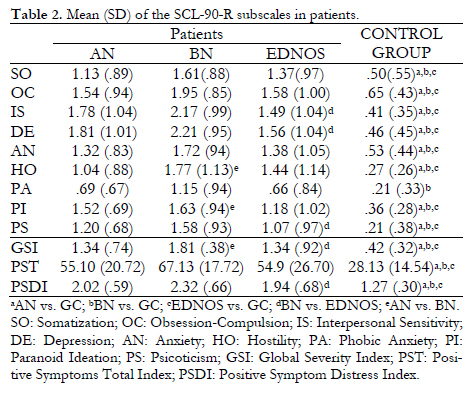
<body><![CDATA[<p><font face="Verdana" size="2"><i>Selection of control group and their mothers and fathers</i></font></p>     <p><font face="Verdana" size="2">To select the CG we contacted the Guidance Department of the Public Secondary School Diego de Siloe, Albacete. Participation was voluntary. Parental consent was requested for children in the study. All fathers / mothers authorized the participation of their children in this research. CG participants over 18 years of age were chosen among trainees in practice at the hospital from the School of Nursing and Teaching.</font></p>     <p><font face="Verdana" size="2"><i>Statistical analysis</i></font></p>     <p><font face="Verdana" size="2">Data analysis was performed through a two-way ANOVA with partially repeated measures in each SCL-90-R subscale. The main factor was group inclusion (AN, BN, EDNOS, CG) and the repeated measures factor was formed by the group (patient /control, mothers and fathers). In this analysis the significance of the effects was tested through Pillai' trace.</font></p>     <p><font face="Verdana" size="2">A Mauchly sphericity test was also performed, which according to its significance interpreted the meanings of the main effect and group interaction and the repeated measures factor. If the Mauchly test was not significant, statistical significance was obtained through the <i>'assumed sphericity'</i> option. If this test was significant, then the statistical significance was obtained through the ' <i>Greenhouse-Geisser'</i> option.</font></p>     <p><font face="Verdana" size="2">Finally, in each analysis where the main effect and /or interaction were significant, multiple comparisons were carried out with Sidak test among groups within each repeated measure (patients / controls, mothers and fathers). The significance level chosen for these analyses was <i>p</i> &lt; .05, and the effect size (ES) was also obtained through statistical &#969;<sup>2</sup> (ES Low: .01; ES Medium: .06; ES Height: .14). Statistical analysis was performed with SPSS v. 19.0</font></p>     <p>&nbsp;</p>     <p><font face="Verdana" size="2"><b>Results</b></font></p>     <p><font face="Verdana" size="2">The analysis of the multivariate contrasts of the SCL-90-R subscales showed that all were highly significant; so significant differences were found between the group averages and the repeated measures factor. However, the Mauchly sphericity test was significant in Somatization, x<sup>2</sup>(2) = 11.64, <i>p</i> = .003, Obsession-Compulsion, &#967;<sup>2</sup>(2) = 7.10, <i>p</i> = .019, Phobic Anxiety, &#967;<sup>2</sup>(2) = 14.21, <i>p</i> = .001, GSI, &#967;<sup>2</sup>(2) = 6.49, <i>p</i> = .039, and PSDI, &#967;<sup>2</sup>(2) = 6.28, <i>p</i> = .043, which led to the interpretation of the significance of the main effect and its interaction with the repeated measures factor varied depending on that significance.</font></p>     <p><font face="Verdana" size="2"><a href="#t1">Table 1</a> shows the statistical significance and effect size of each effect in the different SCL-90-R subscales. The main effects and interactions turned out to be significant in all subscales, although the size of the highest effect was obtained in Interpersonal Sensitivity and Depression, and the lowest in Somatization. The remaining subscales obtained mean effect sizes.</font></p>     ]]></body>
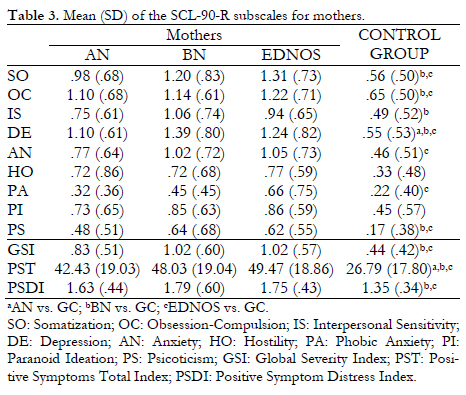
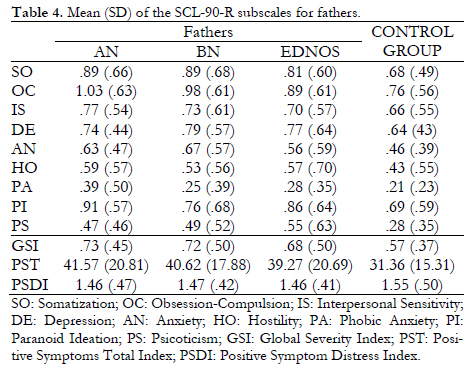
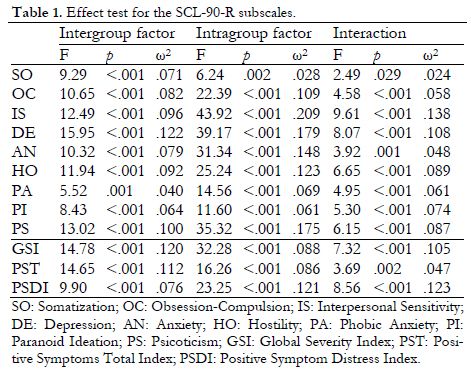
<body><![CDATA[<p>&nbsp;</p>     <p align="center"><a name="t1"></a><img src="/img/revistas/ap/v33n3/psicologia_clinica5_tabla1.jpg"></p>     <p>&nbsp;</p>     <p><font face="Verdana" size="2">Given that the main effect (group inclusion) and its interaction with the repeated measures factor were significant, multiple comparisons were performed with Sidak test within each of the repeated measures. Tables <a href="#t2">2</a>, <a href="#t3">3</a> and <a href="#t4">4</a> show the mean and standard deviations for each SCL-90-R subscale as a function of group inclusion in each factor of repeated measures.</font></p>     <p>&nbsp;</p>     <p align="center"><a name="t2"></a><img src="/img/revistas/ap/v33n3/psicologia_clinica5_tabla2.jpg"></p>     <p>&nbsp;</p>     <p align="center"><a name="t3"></a><img src="/img/revistas/ap/v33n3/psicologia_clinica5_tabla3.jpg"></p>     <p>&nbsp;</p>     <p align="center"><a name="t4"></a><img src="/img/revistas/ap/v33n3/psicologia_clinica5_tabla4.jpg"></p>     ]]></body>
<body><![CDATA[<p>&nbsp;</p>     <p><font face="Verdana" size="2">The three groups of patients (<a href="#t2">Table 2</a>) obtained significant differences in all SCL-90-R subscales when compared to the GC, except in the Phobic Anxiety subscale where only patients with BN obtained significant differences vs. the CG (<i>p</i> &lt;.001). In addition, significant differences were found between BN and EDNOS in Interpersonal Sensitivity (<i>p</i> = .014), Depression (<i>p</i> = .028) and Psychoticism (<i>p</i> = .028), and AN vs. BN in Hostility (<i>p</i> = .002) and Paranoid Ideation (<i>p</i> = .020). Results in <a href="#t2">table 2</a> suggest two different patterns:</font></p>     <blockquote>     <p><font face="Verdana" size="2">1. A first pattern is given by the existence of significant differences from the clinical / non-clinical condition of the participants; that is, among each of the clinical groups (AN, BN and EDNOS) vs. the CG, there not being significant differences among the clinical groups. This pattern occurs in Somatization, Obsession-Compulsion, Anxiety, Phobic Anxiety and PST. In each of these variables, patients in the clinical groups scored significantly higher than the CG.</font></p>     <p><font face="Verdana" size="2">2. The second pattern is observed with other variables (Interpersonal Sensitivity, Depression, Hostility, Paranoid Ideation, Psychoticism, GSI and PSDI), which in addition to finding significant differences between clinical groups and the CG, scores were seen to be significantly higher in BN patients when compared with the AN group (Hostility, Paranoid Ideation and GSI) and BN (Interpersonal sensitivity, Depression, Psychoticism, GSI and PSDI).</font></p> </blockquote>     <p><font face="Verdana" size="2">Taken together, these results suggest that patients diagnosed with BN tend to achieve higher scores in all psychopathological variables. Regarding global indices, the BN group obtained the highest scores, although the PST was similar in the three groups, the BN group scored higher than the EDNOS group in GSI and PSDI.</font></p>     <p><font face="Verdana" size="2">The situation is different however in the case of mothers (<a href="#t3">Table 3</a>), although there was also a certain degree of psychopathology in some SCL-90-R subscales. Thus, the differences between the three groups of patients and the CG were significant in Depression (AN vs. CG, <i>p</i> = .031; BN vs CG, <i>p</i> = .003; EDNOS vs. CG, <i>p</i> = .003), but significant differences were only obtained between groups BN and EDNOS vs. CG in Somatization (BN vs. CG, <i>p</i> = .044; EDNOS vs. GC, <i>p</i> = .001), Obsession-Compulsion (BN vs. CG, <i>p</i> = .024; EDNOS vs. GC, <i>p</i> = .007) and Psychoticism (BN vs. CG, <i>p</i> = .023; EDNOS vs. CG, <i>p</i> = .021), and only between BN vs. CG in Interpersonal Sensitivity (BN vs. GC, <i>p</i> = .043), and EDNOS vs. CG in Anxiety (GC vs. TANE, <i>p</i> = .011), and Phobic Anxiety (EDNOS vs. CG, <i>p</i> = .015). However, no significant differences were found in Hostility and Paranoid Ideation.</font></p>     <p><font face="Verdana" size="2">Taken together, the three global indices obtained significant differences between the mothers of patients and the CG, except mothers in the AN group in which no significant differences were found with the CG in GSI and PSDI indexes. Thus, groups of mothers of young people with EDs of whatever type, had a higher number of symptoms present and greater general psychological and psychosomatic suffering, except for mothers in the AN group.</font></p>     <p><font face="Verdana" size="2">As regards the specific symptomatic dimensions, the mothers in the BN group obtained statistically significant differences to the CG in all dimensions except in Hostility, Anxiety, Phobic Anxiety and Paranoid Ideation.</font></p>     <p><font face="Verdana" size="2">The mothers from the EDNOS group obtained significant differences to the CG in Somatization, Obsession-Compulsion, Depression, Anxiety, Phobic Anxiety, Psychoticism and GSI, PST, and PSDI. Finally, no significant differences were found in any dimension among the mothers in the clinical groups.</font></p>     ]]></body>
<body><![CDATA[<p><font face="Verdana" size="2">In the case of parents (<a href="#t4">Table 4</a>), no multiple comparisons were significant between the groups of patients versus the CG.</font></p>     <p>&nbsp;</p>     <p><font face="Verdana" size="2"><b>Discussion</b></font></p>     <p><font face="Verdana" size="2">Comorbidity between EDs and psychopathological disorders, both Axis I and Axis II following the DSM-IV nomenclature, is the subject of continuing controversy (Braun, Sunday, &amp; Halmi, 1994). The importance of their approach is because it can affect the severity, chronicity and resistance to treatment of EDs, worsening prognosis, accelerating social decay, and impeding recovery (Blinder et al., 2006). It also appears that when there is comorbidity, the ED is more severe and vice versa, and that the most serious EDs are associated with multiple comorbidities (Spindler &amp; Milos, 2007).</font></p>     <p><font face="Verdana" size="2">In our study, we firstly found that the three groups of patients (AN, BN and EDNOS) scored significantly higher than CG. Significant differences were maintained in all subscales of the SCL-90-R questionnaire, suggesting the existence of a high level of general psychopathology in all patients diagnosed with ED, regardless of the type of disorder. These results are consistent with our hypothesis where we expected to find higher levels of psychopathology in patient groups. It also corroborates other results in the literature regarding the close association between EDs and symptomology and psychopathological comorbidity (Garfinkel et al., 1995; Kessler, Schwarze, Filipic, &amp; von Wietersheim, 2006, Piran et al., 1985).</font></p>     <p><font face="Verdana" size="2">These results are consistent with the work of Rojo-Moreno et al. (2015), which found that 62.9% of ED patients showed comorbidity. Swanson, Crow, Le Grange, Swendsen and Merihanga (2006) also found that 55.2% of patients with AN, 88% of patients with BN and 83.5% with EDNOS had at least one psychiatric comorbidity. This conclusion is also confirmed by the outstanding differences between patients (regardless of the group in question) and non- patients in the scores received on the GSI variable. This is the main variable of the general psychopathological symptomatology of the SCL-90-R (as it reflects both the frequency and intensity with which patients experience the total symptoms in the questionnaire).</font></p>     <p><font face="Verdana" size="2">If we look at the EDs individually (AN-BN), the differences are very limited as we only found significant differences between the groups in Hostility and Paranoid Ideation. Given the few studies that have researched differences in psychopathological symptoms among patients with AN and BN, and also due to the limited evidence from the literature on this issue, we can only conclude that people diagnosed with AN, although being more hostile than nonclinical participants, tend to have a lesser degree of hostility than BN patients. This result, albeit indirectly, supports the idea that BN patients are usually more impulsive than AN patients.</font></p>     <p><font face="Verdana" size="2">Although some authors have reported a greater specificity of symptoms and/or obsessive-compulsive disorder with AN than BN (Godart, Flament, Perdereau, &amp; Jeammet, 2002; Pallister &amp; Waller, 2008), our results do not corroborate that there are relevant differences in this regard, at least relating to OCD symptoms.</font></p>     <p><font face="Verdana" size="2">Moreover, on analyzing the differences between the groups regarding the general symptomology variables of SCL-90-R, we observed that, in addition to all clinical groups being different to the CG, participants with BN show significantly higher levels of global suffering (GSI) than the other patient groups (AN and EDNOS). This result is important as it indicates a higher level of overall psychopathological disturbance in the group of patients diagnosed with BN, thereby providing evidence and new data to the already suggested hypothesis that BN appears to show a general level of psychopathological disturbance greater than AN (Manara, Manara, &amp; Todisco, 2005). Apart from this psychopathological implication, it could also have important therapeutic implications; for example, relating to the management of BN patients , as well as regarding a possible worse prognosis and a greater number of relapses in these patients. These issues are of large relevance in treatment programs of any mental disorder.</font></p>     <p><font face="Verdana" size="2">Regarding the mothers of patients with BN and ED-NOS, they had higher levels of psychopathology (symptoms from the SCL-90-R) than mothers of participants in the CG, in all subscales except Hostility and Paranoid Ideation. However, mothers of patients with AN, although scoring a higher average than CG mothers in all subscales, only differed significantly from CG in Depression. This contrasts with a recent study (Berbelet al., 2010) that found that primary caregivers of patients with EDs had higher values in all subscales of the SCL-90-R and statistically significant difference in the dimensions of Somatization, Obsession -Compulsion, Depression, Anxiety, Phobic Anxiety and GSI.</font></p>     ]]></body>
<body><![CDATA[<p><font face="Verdana" size="2">Moreover, the GSI present similar differences, since mothers of BN and EDNOS patients reported a significantly higher psychopathology level than mothers in the CG. This conclusion is consistent with that of Santonastaso, Zambenedetti, Favaro, Favaron and Pavan (1997), who found a higher incidence of psychiatric disorders among parents of patients with greater clinical severity.</font></p>     <p><font face="Verdana" size="2">At the same time, our sample shows 36% of patients with a family history of mental disorder compared to the CG. Our results support the evidence of possible psychopathological family history in the genesis of EDs (Garfinkel et al., 1995), and provide weight to the recently mentioned hypothesis in the literature on the generality of the parental psychopathology effects on Child/ Adolescent Psychopathology.</font></p>     <p><font face="Verdana" size="2">Even assuming the concept of generalization highlighted in our previous hypothesis, we found some differences in the psychopathology of mothers depending on the type of disorder affecting their daughters. In this regard, the mothers of patients diagnosed with AN compared to the other clinical groups, exhibited a lesser degree of disturbance in several dimensions of psychopathology, specifically in Somatization, Obsession-Compulsion, Interpersonal Sensitivity, Anxiety, Hostility, Phobic Anxiety, Paranoid Ideation and Psychoticism.</font></p>     <p><font face="Verdana" size="2">It is relevant that, for these variables, there are no differences between the CG mothers and mothers of patients diagnosed with AN. Such evidence suggests that the psychopathology of mothers, although possibly predisposed in general to their daughters' EDs, is more associated with bulimic disorder, which is also consistent with our conclusion mentioned above on the seemingly superior level of psychopathology exhibited by patients diagnosed with BN. This also coincides with the conclusion relative to personality characteristics.</font></p>     <p><font face="Verdana" size="2">Finally, we point out that parents of ED patients show no significant data regarding psychopathology. Gonzalez-de-Rivera (2002) found that women exceed the mean scores of the general female population, exceeding the cutoff 80th percentile in two dimensions: Depression and Psychoticism. While men exceed the mean scores of the male population except in Hostility and Paranoid Ideation. However, Ortíz, Sánchez-Moral, Ciccotelli and Del Barrio (2003) obtained similar results in which gender showed differences in favour of women in all global indices, except in Hostility, Phobic Anxiety and Psychoticism. Therefore, as there is little research on the subject, more studies are recommended to verify if differences are due to gender or other aspects.</font></p>     <p><font face="Verdana" size="2">In conclusion, this study shows the presence of family psychopathology, especially in mothers, as a factor to consider in the risk or predisposition of suffering an ED. A limitation of the study is that the sample size is not large enough to establish a generalization of the results. In addition, the sample is mainly composed of adolescents, finding some significant differences that should be homogenized. Even so, the results obtained encourage us to continue assessing family psychopathology, since this may have implications for the treatment of patients with eating disorders.</font></p>     <p>&nbsp;</p>     <p><font face="Verdana" size="2"><b>References</b></font></p>     <!-- ref --><p><font face="Verdana" size="2">1. American Psychiatric Association (2000). Diagnostic and Statistical Manual of Mental Disorders, 4<sup>th</sup> ed. Washington, DC: American Psychiatric Association.    &nbsp;&nbsp;&nbsp;&nbsp;&nbsp;&nbsp;&nbsp;&nbsp;[&#160;<a href="javascript:void(0);" onclick="javascript: window.open('/scielo.php?script=sci_nlinks&ref=789248&pid=S0212-9728201700030001700001&lng=','','width=640,height=500,resizable=yes,scrollbars=1,menubar=yes,');">Links</a>&#160;]<!-- end-ref --></font></p>    ]]></body>
<body><![CDATA[<!-- ref --><p><font face="Verdana" size="2">2. Beato-Fernández, L., &amp; Rodríguez-Cano, T. (2005). Gender differences regarding psychopathological, family and social characteristics in adolescents with abnormal eating behavior. Eating Behaviors, 6(4), 337-344. doi: 10.1016/j.eatheh.2005.02.002.    &nbsp;&nbsp;&nbsp;&nbsp;&nbsp;&nbsp;&nbsp;&nbsp;[&#160;<a href="javascript:void(0);" onclick="javascript: window.open('/scielo.php?script=sci_nlinks&ref=789250&pid=S0212-9728201700030001700002&lng=','','width=640,height=500,resizable=yes,scrollbars=1,menubar=yes,');">Links</a>&#160;]<!-- end-ref --></font></p>    <!-- ref --><p><font face="Verdana" size="2">3. Berbel, E., Sepúlveda, A. R., Graell, M., Andrés, P., Carrobles, J. A., &amp; Morandé, G. (2010). Valoración del estado de salud y psicopatología de los familiares en el trastorno del comportamiento alimentario: diferencias entre cuidadores principales y secundarios (Assessment of general health and psychopathology among family members in eating disorder settings: Differences between primary and secondary caregivers). Revista de Psicopatología y Psicología Clínica, 15(3), 179-192.    &nbsp;&nbsp;&nbsp;&nbsp;&nbsp;&nbsp;&nbsp;&nbsp;[&#160;<a href="javascript:void(0);" onclick="javascript: window.open('/scielo.php?script=sci_nlinks&ref=789252&pid=S0212-9728201700030001700003&lng=','','width=640,height=500,resizable=yes,scrollbars=1,menubar=yes,');">Links</a>&#160;]<!-- end-ref --></font></p>    <!-- ref --><p><font face="Verdana" size="2">4. Binford, R. B., Mussell, M. P., Crosby, R. D., Peterson, C. B., Crow, S. J., &amp; Mitchell, J. E. (2007). Coping strategies in bulimia nervosa treatment: Impact on outcome in group cognitive-behavioral therapy. Journal of Consulting and Clinical Psychology, 73, 1089-1096. doi: 10.1037/0022-006X.73.6.1089.    &nbsp;&nbsp;&nbsp;&nbsp;&nbsp;&nbsp;&nbsp;&nbsp;[&#160;<a href="javascript:void(0);" onclick="javascript: window.open('/scielo.php?script=sci_nlinks&ref=789254&pid=S0212-9728201700030001700004&lng=','','width=640,height=500,resizable=yes,scrollbars=1,menubar=yes,');">Links</a>&#160;]<!-- end-ref --></font></p>    <!-- ref --><p><font face="Verdana" size="2">5. Blinder, B. J., Cumella, E. J., &amp; Sanathara, V. A. (2006). Psychiatric comorbidities of female inpatients with eating disorder. Psychosomatic Medicine, 68(3), 454-462. doi: 10.1097/01.psy.0000221254.77675.f5.    &nbsp;&nbsp;&nbsp;&nbsp;&nbsp;&nbsp;&nbsp;&nbsp;[&#160;<a href="javascript:void(0);" onclick="javascript: window.open('/scielo.php?script=sci_nlinks&ref=789256&pid=S0212-9728201700030001700005&lng=','','width=640,height=500,resizable=yes,scrollbars=1,menubar=yes,');">Links</a>&#160;]<!-- end-ref --></font></p>    <!-- ref --><p><font face="Verdana" size="2">6. Braun, D. L., Sunday, S. R., &amp; Halmi, K. A. (1994). Psychiatric comorbidity in patients with eating disorders. Psychological Medicine, 24, 859-867. doi: 10.1017/S0033291700028956.    &nbsp;&nbsp;&nbsp;&nbsp;&nbsp;&nbsp;&nbsp;&nbsp;[&#160;<a href="javascript:void(0);" onclick="javascript: window.open('/scielo.php?script=sci_nlinks&ref=789258&pid=S0212-9728201700030001700006&lng=','','width=640,height=500,resizable=yes,scrollbars=1,menubar=yes,');">Links</a>&#160;]<!-- end-ref --></font></p>    ]]></body>
<body><![CDATA[<!-- ref --><p><font face="Verdana" size="2">7. Casper, R. C. (1990). Personality features of women with good outcome from restricting anorexia nervosa. Psychosomatic Medicine, 52, 156-170. doi: 10.1097/00006842-199003000-00004.    &nbsp;&nbsp;&nbsp;&nbsp;&nbsp;&nbsp;&nbsp;&nbsp;[&#160;<a href="javascript:void(0);" onclick="javascript: window.open('/scielo.php?script=sci_nlinks&ref=789260&pid=S0212-9728201700030001700007&lng=','','width=640,height=500,resizable=yes,scrollbars=1,menubar=yes,');">Links</a>&#160;]<!-- end-ref --></font></p>    <!-- ref --><p><font face="Verdana" size="2">8. Cavallini, M. C., Bertelli, S., Chiapparino, D., Riboldi, S., &amp; Bellodi, L. (2000). Complex segregation analysis of obsessive-compulsive disorder in 141 families of eating disorder probands, with and without obsessive-compulsive disorder. American Journal of Medical Genetics, 96(3), 384-391. doi: 10.1002/1096-8628(20000612)96:3&lt;384::AID-AJMG28&gt;3.0.C0;2-P.    &nbsp;&nbsp;&nbsp;&nbsp;&nbsp;&nbsp;&nbsp;&nbsp;[&#160;<a href="javascript:void(0);" onclick="javascript: window.open('/scielo.php?script=sci_nlinks&ref=789262&pid=S0212-9728201700030001700008&lng=','','width=640,height=500,resizable=yes,scrollbars=1,menubar=yes,');">Links</a>&#160;]<!-- end-ref --></font></p>    <!-- ref --><p><font face="Verdana" size="2">9. Cockell, S. J., Zaitsoff, S. L., &amp; Geller, J. (2007). Maintaining change following eating disorder treatment. Professional Psychology: Research and Practice, 35, 527-534. doi: dx.doi.org/10.1037/0735-7028.35.5.527.    &nbsp;&nbsp;&nbsp;&nbsp;&nbsp;&nbsp;&nbsp;&nbsp;[&#160;<a href="javascript:void(0);" onclick="javascript: window.open('/scielo.php?script=sci_nlinks&ref=789264&pid=S0212-9728201700030001700009&lng=','','width=640,height=500,resizable=yes,scrollbars=1,menubar=yes,');">Links</a>&#160;]<!-- end-ref --></font></p>    <!-- ref --><p><font face="Verdana" size="2">10. Dalle-Grave, R. (2011). Eating disorders: Progress and challenges. European Journal of Internal Medicine, 15(5), 405-425. doi: 10.1016/j.ejim.2010.12.010.    &nbsp;&nbsp;&nbsp;&nbsp;&nbsp;&nbsp;&nbsp;&nbsp;[&#160;<a href="javascript:void(0);" onclick="javascript: window.open('/scielo.php?script=sci_nlinks&ref=789266&pid=S0212-9728201700030001700010&lng=','','width=640,height=500,resizable=yes,scrollbars=1,menubar=yes,');">Links</a>&#160;]<!-- end-ref --></font></p>    <!-- ref --><p><font face="Verdana" size="2">11. Derogatis, L. R. (2002). Manual del SCL-90-R (SCL-90-R Manual). Madrid: TEA.    &nbsp;&nbsp;&nbsp;&nbsp;&nbsp;&nbsp;&nbsp;&nbsp;[&#160;<a href="javascript:void(0);" onclick="javascript: window.open('/scielo.php?script=sci_nlinks&ref=789268&pid=S0212-9728201700030001700011&lng=','','width=640,height=500,resizable=yes,scrollbars=1,menubar=yes,');">Links</a>&#160;]<!-- end-ref --></font></p>    ]]></body>
<body><![CDATA[<!-- ref --><p><font face="Verdana" size="2">12. Derogatis, L. R., Rickels, K., &amp; Rock, A. F. (1976). The SCL-90 and MMPI: A step in the validation of a new self-report scale. British Journal of Psychiatry, 128(3), 280-289. doi: 10.1192/bjp.128.3.280.    &nbsp;&nbsp;&nbsp;&nbsp;&nbsp;&nbsp;&nbsp;&nbsp;[&#160;<a href="javascript:void(0);" onclick="javascript: window.open('/scielo.php?script=sci_nlinks&ref=789270&pid=S0212-9728201700030001700012&lng=','','width=640,height=500,resizable=yes,scrollbars=1,menubar=yes,');">Links</a>&#160;]<!-- end-ref --></font></p>    <!-- ref --><p><font face="Verdana" size="2">13. Dinning, W. E., &amp; Evans, R. G. (1977). Discriminant and convergent validity of the SCL-90 in psychiatric inpatients. Journal of Personality Assessment, 41, 304-310. doi: 10.1207/s15327752jps4013_13.    &nbsp;&nbsp;&nbsp;&nbsp;&nbsp;&nbsp;&nbsp;&nbsp;[&#160;<a href="javascript:void(0);" onclick="javascript: window.open('/scielo.php?script=sci_nlinks&ref=789272&pid=S0212-9728201700030001700013&lng=','','width=640,height=500,resizable=yes,scrollbars=1,menubar=yes,');">Links</a>&#160;]<!-- end-ref --></font></p>    <!-- ref --><p><font face="Verdana" size="2">14. Downs, K. J., &amp; Blow, A. J. (2013). A substantive and methodological review of family-based treatment for eating disorder: the last 25 years of research. Journal of Family Therapy, 35 (Suppl. 1), 3-28. doi: 10.111/j.1467-6427.2011.00566.x.    &nbsp;&nbsp;&nbsp;&nbsp;&nbsp;&nbsp;&nbsp;&nbsp;[&#160;<a href="javascript:void(0);" onclick="javascript: window.open('/scielo.php?script=sci_nlinks&ref=789274&pid=S0212-9728201700030001700014&lng=','','width=640,height=500,resizable=yes,scrollbars=1,menubar=yes,');">Links</a>&#160;]<!-- end-ref --></font></p>    <!-- ref --><p><font face="Verdana" size="2">15. Duvvuri, V., Bailer, U. F., &amp; Kaye, W. H. (2010). Altered serotonin function in anorexia and bulimia nervosa. In C. P. M&#252;ller &amp; B. L. Jacobs (Eds.), Handbook of Behavioral Neurobiology of Serotonin (pp. 715-729). New York: Academic Press.    &nbsp;&nbsp;&nbsp;&nbsp;&nbsp;&nbsp;&nbsp;&nbsp;[&#160;<a href="javascript:void(0);" onclick="javascript: window.open('/scielo.php?script=sci_nlinks&ref=789276&pid=S0212-9728201700030001700015&lng=','','width=640,height=500,resizable=yes,scrollbars=1,menubar=yes,');">Links</a>&#160;]<!-- end-ref --></font></p>    <!-- ref --><p><font face="Verdana" size="2">16. Favaro, A., Caregaro, L., Tenconi, E., Bosello, R., &amp; Santonastaso, P. (2009).Time trends in age at onset of anorexia nervosa and bulimia nervosa. Journal of Clinical Psychiatry, 70, 1715-1721. doi: 10.4088/JCP.09m05176blu.    &nbsp;&nbsp;&nbsp;&nbsp;&nbsp;&nbsp;&nbsp;&nbsp;[&#160;<a href="javascript:void(0);" onclick="javascript: window.open('/scielo.php?script=sci_nlinks&ref=789278&pid=S0212-9728201700030001700016&lng=','','width=640,height=500,resizable=yes,scrollbars=1,menubar=yes,');">Links</a>&#160;]<!-- end-ref --></font></p>    ]]></body>
<body><![CDATA[<!-- ref --><p><font face="Verdana" size="2">17. Fitzsimmons, E. E., &amp; Bardone, A. M. (2011). Coping and social support as potential moderators of the relation between anxiety and eating disorder symptomatology. Eating Behaviors, 12(1), 21-28. doi: 10.1016/j.eatbeth.2010.09.002.    &nbsp;&nbsp;&nbsp;&nbsp;&nbsp;&nbsp;&nbsp;&nbsp;[&#160;<a href="javascript:void(0);" onclick="javascript: window.open('/scielo.php?script=sci_nlinks&ref=789280&pid=S0212-9728201700030001700017&lng=','','width=640,height=500,resizable=yes,scrollbars=1,menubar=yes,');">Links</a>&#160;]<!-- end-ref --></font></p>    <!-- ref --><p><font face="Verdana" size="2">18. Garfinkel, P. E., Lin, E., Goering, C., Spegg, C., Goldbloom, D., Kennedy, S., ... Woodside, D. B. (1995). Bulimia nervosa in a Canadian community sample: prevalence and comparison of subgroups. American Journal of Psychiatry, 152, 1052-1058. doi: 10.1176/ajp.152.7.1052.    &nbsp;&nbsp;&nbsp;&nbsp;&nbsp;&nbsp;&nbsp;&nbsp;[&#160;<a href="javascript:void(0);" onclick="javascript: window.open('/scielo.php?script=sci_nlinks&ref=789282&pid=S0212-9728201700030001700018&lng=','','width=640,height=500,resizable=yes,scrollbars=1,menubar=yes,');">Links</a>&#160;]<!-- end-ref --></font></p>    <!-- ref --><p><font face="Verdana" size="2">19. Godart, N. T., Flament, M. F., Perdereau, F., &amp; Jeammet, P. (2002). Comorbidity between eating disorders and anxiety disorders: A review. The International Journal of Eating Disorders, 32(3), 253-270. doi: 10.1002/eat.10096.    &nbsp;&nbsp;&nbsp;&nbsp;&nbsp;&nbsp;&nbsp;&nbsp;[&#160;<a href="javascript:void(0);" onclick="javascript: window.open('/scielo.php?script=sci_nlinks&ref=789284&pid=S0212-9728201700030001700019&lng=','','width=640,height=500,resizable=yes,scrollbars=1,menubar=yes,');">Links</a>&#160;]<!-- end-ref --></font></p>    <!-- ref --><p><font face="Verdana" size="2">20. González-de-Rivera, J. (2002). Manual del cuestionario de 90 síntomas (SCL-90-R (Manual of the questionnaire of 90 symptoms (SCL-90-R)). Madrid: TEA.    &nbsp;&nbsp;&nbsp;&nbsp;&nbsp;&nbsp;&nbsp;&nbsp;[&#160;<a href="javascript:void(0);" onclick="javascript: window.open('/scielo.php?script=sci_nlinks&ref=789286&pid=S0212-9728201700030001700020&lng=','','width=640,height=500,resizable=yes,scrollbars=1,menubar=yes,');">Links</a>&#160;]<!-- end-ref --></font></p>    <!-- ref --><p><font face="Verdana" size="2">21. Goodwin, H., Haycraft, E., Willis, A. M., &amp; Meyer, C. (2011). Compulsive exercise: The role of personality, psychological morbidity, and disordered eating. International Journal of Eating Disorders, 44, 655-660. doi: 10.1002/eat.20902.    &nbsp;&nbsp;&nbsp;&nbsp;&nbsp;&nbsp;&nbsp;&nbsp;[&#160;<a href="javascript:void(0);" onclick="javascript: window.open('/scielo.php?script=sci_nlinks&ref=789288&pid=S0212-9728201700030001700021&lng=','','width=640,height=500,resizable=yes,scrollbars=1,menubar=yes,');">Links</a>&#160;]<!-- end-ref --></font></p>    ]]></body>
<body><![CDATA[<!-- ref --><p><font face="Verdana" size="2">22. Gorwood, P., Kipman, A., &amp; Foulong, C. (2003). The human genetics of anorexia nervosa. European Journal of Pharmacology, 480(1-3), 163-170. doi:10.1016/j.ejphar.2003.08.103.    &nbsp;&nbsp;&nbsp;&nbsp;&nbsp;&nbsp;&nbsp;&nbsp;[&#160;<a href="javascript:void(0);" onclick="javascript: window.open('/scielo.php?script=sci_nlinks&ref=789290&pid=S0212-9728201700030001700022&lng=','','width=640,height=500,resizable=yes,scrollbars=1,menubar=yes,');">Links</a>&#160;]<!-- end-ref --></font></p>    <!-- ref --><p><font face="Verdana" size="2">23. Grilo, C. M., Levy, K. N., Becker, D. F., Edell, W. S., &amp; McGlashan, T. H. (1996). Comorbidity of DSM-III-R axis I and II disorders among female inpatients with eating disorders. Psychiatric Services, 47, 426-429. doi: 10.1176/ps.47.4.426.    &nbsp;&nbsp;&nbsp;&nbsp;&nbsp;&nbsp;&nbsp;&nbsp;[&#160;<a href="javascript:void(0);" onclick="javascript: window.open('/scielo.php?script=sci_nlinks&ref=789292&pid=S0212-9728201700030001700023&lng=','','width=640,height=500,resizable=yes,scrollbars=1,menubar=yes,');">Links</a>&#160;]<!-- end-ref --></font></p>    <!-- ref --><p><font face="Verdana" size="2">24. Herzog, W., Kronm&#252;eller, K. T., Hartmann, M., Bergmann, G., &amp; Kroeger, F. (2000). Family perception of interpersonal behavior as a predictor in eating disorders: A prospective six-year follow-up study. Family Process, 39(3), 359-374. doi: 10.1111/j.1545-5300.2000.39307.x.    &nbsp;&nbsp;&nbsp;&nbsp;&nbsp;&nbsp;&nbsp;&nbsp;[&#160;<a href="javascript:void(0);" onclick="javascript: window.open('/scielo.php?script=sci_nlinks&ref=789294&pid=S0212-9728201700030001700024&lng=','','width=640,height=500,resizable=yes,scrollbars=1,menubar=yes,');">Links</a>&#160;]<!-- end-ref --></font></p>    <!-- ref --><p><font face="Verdana" size="2">25. Halmi, K. A., Tozzi, F., Thomton, L. M., Crow, S., Fichter, M. M., Kaplan, A. S., ... Bulik, C. M. (2005). The relation among perfectionism, obsessive-compulsive personality disorder in individuals with eating disorders. International Journal of Eating Disorders, 38(4), 371-374. doi: 10.1002/eat.20190.    &nbsp;&nbsp;&nbsp;&nbsp;&nbsp;&nbsp;&nbsp;&nbsp;[&#160;<a href="javascript:void(0);" onclick="javascript: window.open('/scielo.php?script=sci_nlinks&ref=789296&pid=S0212-9728201700030001700025&lng=','','width=640,height=500,resizable=yes,scrollbars=1,menubar=yes,');">Links</a>&#160;]<!-- end-ref --></font></p>    <!-- ref --><p><font face="Verdana" size="2">26. Hoek, H. W. (2006). Incidence, prevalence and mortality of anorexia nervosa and other eating disorders. Current Opinion in Psychiatry, 19, 389-394. doi: 10.1097/01.yco.0000228759.95237.78.    &nbsp;&nbsp;&nbsp;&nbsp;&nbsp;&nbsp;&nbsp;&nbsp;[&#160;<a href="javascript:void(0);" onclick="javascript: window.open('/scielo.php?script=sci_nlinks&ref=789298&pid=S0212-9728201700030001700026&lng=','','width=640,height=500,resizable=yes,scrollbars=1,menubar=yes,');">Links</a>&#160;]<!-- end-ref --></font></p>    ]]></body>
<body><![CDATA[<!-- ref --><p><font face="Verdana" size="2">27. Hoek, H. W., &amp; Van Hoeken, D. (2003). Review of the prevalence and incidence of eating disorders. International Journal of Eating Disorders, 34, 383-396. doi: 10.1002/eat.10222.    &nbsp;&nbsp;&nbsp;&nbsp;&nbsp;&nbsp;&nbsp;&nbsp;[&#160;<a href="javascript:void(0);" onclick="javascript: window.open('/scielo.php?script=sci_nlinks&ref=789300&pid=S0212-9728201700030001700027&lng=','','width=640,height=500,resizable=yes,scrollbars=1,menubar=yes,');">Links</a>&#160;]<!-- end-ref --></font></p>    <!-- ref --><p><font face="Verdana" size="2">28. Humphreys, J. D., Clopton, J. R., &amp; Reich, D. A. (2007). Disordered eating behavior and obsessive compulsive symptoms in college students: Cognitive and affective similarities. Eating Disorders: The Journal of Treatment and Prevention, 15, 247-259. doi: 10.1080/10640260701323508.    &nbsp;&nbsp;&nbsp;&nbsp;&nbsp;&nbsp;&nbsp;&nbsp;[&#160;<a href="javascript:void(0);" onclick="javascript: window.open('/scielo.php?script=sci_nlinks&ref=789302&pid=S0212-9728201700030001700028&lng=','','width=640,height=500,resizable=yes,scrollbars=1,menubar=yes,');">Links</a>&#160;]<!-- end-ref --></font></p>    <!-- ref --><p><font face="Verdana" size="2">29. Kaye, W., Lilenfeld, L., Berrettini, W., Stroberr, M., Devlin, B., Klumo, K., ... McConaha, C. (2000). A search for susceptibility loci for anorexia nervosa: Methods and sample descriptions. Biological Psychiatry, 47, 794-803. doi: 10.1016/S0006-3223(99)00240-1.    &nbsp;&nbsp;&nbsp;&nbsp;&nbsp;&nbsp;&nbsp;&nbsp;[&#160;<a href="javascript:void(0);" onclick="javascript: window.open('/scielo.php?script=sci_nlinks&ref=789304&pid=S0212-9728201700030001700029&lng=','','width=640,height=500,resizable=yes,scrollbars=1,menubar=yes,');">Links</a>&#160;]<!-- end-ref --></font></p>    <!-- ref --><p><font face="Verdana" size="2">30. Kessler, H., Schwarze, M., Filipic, S., Traue, H. C., &amp; von Wietersheim, J. (2006). Alexithymia and facial emotion recognition in patients with eating disorders. International Journal of Eating Disorders, 39(3), 245-251. doi: 10.1002/eat.20228.    &nbsp;&nbsp;&nbsp;&nbsp;&nbsp;&nbsp;&nbsp;&nbsp;[&#160;<a href="javascript:void(0);" onclick="javascript: window.open('/scielo.php?script=sci_nlinks&ref=789306&pid=S0212-9728201700030001700030&lng=','','width=640,height=500,resizable=yes,scrollbars=1,menubar=yes,');">Links</a>&#160;]<!-- end-ref --></font></p>    <!-- ref --><p><font face="Verdana" size="2">31. Kluck, A. (2010). Family influence on disordered eating: The role of body image dissatisfaction. Body Image, 7(1), 8-14. doi: 10.1016/j.bodyim.2009.09.009.    &nbsp;&nbsp;&nbsp;&nbsp;&nbsp;&nbsp;&nbsp;&nbsp;[&#160;<a href="javascript:void(0);" onclick="javascript: window.open('/scielo.php?script=sci_nlinks&ref=789308&pid=S0212-9728201700030001700031&lng=','','width=640,height=500,resizable=yes,scrollbars=1,menubar=yes,');">Links</a>&#160;]<!-- end-ref --></font></p>    ]]></body>
<body><![CDATA[<!-- ref --><p><font face="Verdana" size="2">32. Lara, D., &amp; Akiskal, H. (2006). Toward an integrative model of the spectrum of mood, behavioral and personality disorders based on fear and anger traits: II. Implications for neurobiology, genetics and psychopharmacological treatment. Journal of Affective Disorder, 94(13), 89-103. doi: 10.1016/j.jad2006.02.025.    &nbsp;&nbsp;&nbsp;&nbsp;&nbsp;&nbsp;&nbsp;&nbsp;[&#160;<a href="javascript:void(0);" onclick="javascript: window.open('/scielo.php?script=sci_nlinks&ref=789310&pid=S0212-9728201700030001700032&lng=','','width=640,height=500,resizable=yes,scrollbars=1,menubar=yes,');">Links</a>&#160;]<!-- end-ref --></font></p>    <!-- ref --><p><font face="Verdana" size="2">33. Lee, Y., &amp; Lin, P. Y. (2010). Association between serotonin transporter gene polymorphism and eating disorders: A meta-analytic study. International Journal of Eating Disorders, 43(6), 498-504. doi: 10.1002/eat.20732.    &nbsp;&nbsp;&nbsp;&nbsp;&nbsp;&nbsp;&nbsp;&nbsp;[&#160;<a href="javascript:void(0);" onclick="javascript: window.open('/scielo.php?script=sci_nlinks&ref=789312&pid=S0212-9728201700030001700033&lng=','','width=640,height=500,resizable=yes,scrollbars=1,menubar=yes,');">Links</a>&#160;]<!-- end-ref --></font></p>    <!-- ref --><p><font face="Verdana" size="2">34. Lenoir, M., &amp; Silber, T. (2006). Anorexia nerviosa en niños y adolescentes. Criterios diagnósticos, historia, epidemiología, etiología, fisiopatología, morbilidad y mortalidad (Anorexia Nervosa in children and adolescents. Diagnostic criteria, history, epidemiology, etiology, physiopathology, morbidity and mortality). Archivos Argentinos de Pedriatría, 104(3), 253-260.    &nbsp;&nbsp;&nbsp;&nbsp;&nbsp;&nbsp;&nbsp;&nbsp;[&#160;<a href="javascript:void(0);" onclick="javascript: window.open('/scielo.php?script=sci_nlinks&ref=789314&pid=S0212-9728201700030001700034&lng=','','width=640,height=500,resizable=yes,scrollbars=1,menubar=yes,');">Links</a>&#160;]<!-- end-ref --></font></p>    <!-- ref --><p><font face="Verdana" size="2">35. Lilenfeld, L. R. R., Stein, D., Bulik, C. M., Strober, M., Plotnicov, K., Pollice, C., ... Kaye, W. H. (2000). Personality traits among currently eating disordered, recovered and never ill first-degree female relatives of bulimic and control women. Psychological Medicine, 30, 1399-1410. doi: 10.1017/s0033291799002792.    &nbsp;&nbsp;&nbsp;&nbsp;&nbsp;&nbsp;&nbsp;&nbsp;[&#160;<a href="javascript:void(0);" onclick="javascript: window.open('/scielo.php?script=sci_nlinks&ref=789316&pid=S0212-9728201700030001700035&lng=','','width=640,height=500,resizable=yes,scrollbars=1,menubar=yes,');">Links</a>&#160;]<!-- end-ref --></font></p>    <!-- ref --><p><font face="Verdana" size="2">36. Lilenfeld, L. R. R., Wonderlich, S., Riso, L. P., Crosby, R., &amp; Mitchell, J. (2006). Eating disorders and personality: A methodological and empirical review. Clinical Psychology Review, 26, 299-320. doi: 10.1016/j.cpr.2005.10.003.    &nbsp;&nbsp;&nbsp;&nbsp;&nbsp;&nbsp;&nbsp;&nbsp;[&#160;<a href="javascript:void(0);" onclick="javascript: window.open('/scielo.php?script=sci_nlinks&ref=789318&pid=S0212-9728201700030001700036&lng=','','width=640,height=500,resizable=yes,scrollbars=1,menubar=yes,');">Links</a>&#160;]<!-- end-ref --></font></p>    ]]></body>
<body><![CDATA[<!-- ref --><p><font face="Verdana" size="2">37. Manara, F., Manara, A., &amp; Todisco, P. (2005). Correlation between psychometric and biological parameters in anorexic and bulimic patients during and after an intensive day hospital treatment. Eating and Weight Disorders, 10, 236-244. doi:10.1007/BF03327490.    &nbsp;&nbsp;&nbsp;&nbsp;&nbsp;&nbsp;&nbsp;&nbsp;[&#160;<a href="javascript:void(0);" onclick="javascript: window.open('/scielo.php?script=sci_nlinks&ref=789320&pid=S0212-9728201700030001700037&lng=','','width=640,height=500,resizable=yes,scrollbars=1,menubar=yes,');">Links</a>&#160;]<!-- end-ref --></font></p>    <!-- ref --><p><font face="Verdana" size="2">38. Mazzeo, S. E., &amp; Bulik, C. M. (2009). Environmental and genetic risk factors for eating disorders: What the clinician needs to know. Child and Adolescent Psychiatric Clinics of North America, 18, 67-82. doi: 10.1016/j.chc.2008.07.003.    &nbsp;&nbsp;&nbsp;&nbsp;&nbsp;&nbsp;&nbsp;&nbsp;[&#160;<a href="javascript:void(0);" onclick="javascript: window.open('/scielo.php?script=sci_nlinks&ref=789322&pid=S0212-9728201700030001700038&lng=','','width=640,height=500,resizable=yes,scrollbars=1,menubar=yes,');">Links</a>&#160;]<!-- end-ref --></font></p>    <!-- ref --><p><font face="Verdana" size="2">39. Mills, J. S., &amp; Miller, J. (2007). Experimental effects of negative weight-related feedback and the importance of peers' perceptions of weight. Body Image, 4, 309-316. doi: 10.1016/j.bodyim.2007.04.004.    &nbsp;&nbsp;&nbsp;&nbsp;&nbsp;&nbsp;&nbsp;&nbsp;[&#160;<a href="javascript:void(0);" onclick="javascript: window.open('/scielo.php?script=sci_nlinks&ref=789324&pid=S0212-9728201700030001700039&lng=','','width=640,height=500,resizable=yes,scrollbars=1,menubar=yes,');">Links</a>&#160;]<!-- end-ref --></font></p>    <!-- ref --><p><font face="Verdana" size="2">40. Milos, G., Spindler, A., Ruggiero, G., Klaghofer, R., &amp; Schnyner, U. (2002). Comorbidity of obsessive-compulsive disorders and duration of eating disorders. International Journal of Eating Disorders, 31, 284-289. doi: 10.1002/eat.10013.    &nbsp;&nbsp;&nbsp;&nbsp;&nbsp;&nbsp;&nbsp;&nbsp;[&#160;<a href="javascript:void(0);" onclick="javascript: window.open('/scielo.php?script=sci_nlinks&ref=789326&pid=S0212-9728201700030001700040&lng=','','width=640,height=500,resizable=yes,scrollbars=1,menubar=yes,');">Links</a>&#160;]<!-- end-ref --></font></p>    <!-- ref --><p><font face="Verdana" size="2">41. Mond, J. M., &amp; Calogero, R. M. (2009). Excessive exercise in eating disorder patients and in healthy women. Australian and New Zealand Journal of Psychiatry, 43, 227-234. doi: 10.1080/00048670802653323.    &nbsp;&nbsp;&nbsp;&nbsp;&nbsp;&nbsp;&nbsp;&nbsp;[&#160;<a href="javascript:void(0);" onclick="javascript: window.open('/scielo.php?script=sci_nlinks&ref=789328&pid=S0212-9728201700030001700041&lng=','','width=640,height=500,resizable=yes,scrollbars=1,menubar=yes,');">Links</a>&#160;]<!-- end-ref --></font></p>    ]]></body>
<body><![CDATA[<!-- ref --><p><font face="Verdana" size="2">42. Neziroglu, F., Khemlani-Patel, S., &amp; Veale, D. (2008). Social learning theory and cognitive behavioral models of body dysmorphic disorders. Body Image, 5, 28-38. doi: 10.1016/j.bodyim.2008.01.002.    &nbsp;&nbsp;&nbsp;&nbsp;&nbsp;&nbsp;&nbsp;&nbsp;[&#160;<a href="javascript:void(0);" onclick="javascript: window.open('/scielo.php?script=sci_nlinks&ref=789330&pid=S0212-9728201700030001700042&lng=','','width=640,height=500,resizable=yes,scrollbars=1,menubar=yes,');">Links</a>&#160;]<!-- end-ref --></font></p>    <!-- ref --><p><font face="Verdana" size="2">43. Ochoa, I., Espina, A., &amp; Ortego, M. (2006). Un estudio sobre personalidad, ansiedad y depresión en padres de pacientes con un trastorno alimentario (A study on personality, anxiety, and depression in parents of patients with an eating disorder). Clínica y Salud, 17, 151-170.    &nbsp;&nbsp;&nbsp;&nbsp;&nbsp;&nbsp;&nbsp;&nbsp;[&#160;<a href="javascript:void(0);" onclick="javascript: window.open('/scielo.php?script=sci_nlinks&ref=789332&pid=S0212-9728201700030001700043&lng=','','width=640,height=500,resizable=yes,scrollbars=1,menubar=yes,');">Links</a>&#160;]<!-- end-ref --></font></p>    <!-- ref --><p><font face="Verdana" size="2">44. Ortíz, M. A., Sánchez-Moral, V., Ciccotelli, H., &amp; Del Barrio, V. (2003). Listado de síntomas SCL-90-R: Análisis de su comportamiento en una muestra clínica (Symptom check list SCL-90-Revised: Analysis in psychiatric patients). Acción Psicológica, 2(2), 149-161. doi: 20.5944/ap.2.2.528.    &nbsp;&nbsp;&nbsp;&nbsp;&nbsp;&nbsp;&nbsp;&nbsp;[&#160;<a href="javascript:void(0);" onclick="javascript: window.open('/scielo.php?script=sci_nlinks&ref=789334&pid=S0212-9728201700030001700044&lng=','','width=640,height=500,resizable=yes,scrollbars=1,menubar=yes,');">Links</a>&#160;]<!-- end-ref --></font></p>    <!-- ref --><p><font face="Verdana" size="2">45. Pallister, E., &amp; Waller, G. (2008). Anxiety in the eating disorders: understanding the overlap. Clinical Psychology Review, 28(3), 366-386. doi: 10.1016/j.cpr.2007.07.001.    &nbsp;&nbsp;&nbsp;&nbsp;&nbsp;&nbsp;&nbsp;&nbsp;[&#160;<a href="javascript:void(0);" onclick="javascript: window.open('/scielo.php?script=sci_nlinks&ref=789336&pid=S0212-9728201700030001700045&lng=','','width=640,height=500,resizable=yes,scrollbars=1,menubar=yes,');">Links</a>&#160;]<!-- end-ref --></font></p>    <!-- ref --><p><font face="Verdana" size="2">46. Palmer, B. (2008). Epidemiology, diagnosing, and assessing eating disorder. Psychiatric, 7(4), 143-146. doi: 10.1016/j.mppsy.2008.02.005.    &nbsp;&nbsp;&nbsp;&nbsp;&nbsp;&nbsp;&nbsp;&nbsp;[&#160;<a href="javascript:void(0);" onclick="javascript: window.open('/scielo.php?script=sci_nlinks&ref=789338&pid=S0212-9728201700030001700046&lng=','','width=640,height=500,resizable=yes,scrollbars=1,menubar=yes,');">Links</a>&#160;]<!-- end-ref --></font></p>    ]]></body>
<body><![CDATA[<!-- ref --><p><font face="Verdana" size="2">47. Petrie, T. A., Greenleaf, C., Reel, J., &amp; Carter, J. (2009). Personality and psychological factors as predictors of disordered eating among female collegiate athletes. Eating Disorders: Journal of Treatment and Prevention, 17, 302-321. doi: 10.1080/10640260902991160.    &nbsp;&nbsp;&nbsp;&nbsp;&nbsp;&nbsp;&nbsp;&nbsp;[&#160;<a href="javascript:void(0);" onclick="javascript: window.open('/scielo.php?script=sci_nlinks&ref=789340&pid=S0212-9728201700030001700047&lng=','','width=640,height=500,resizable=yes,scrollbars=1,menubar=yes,');">Links</a>&#160;]<!-- end-ref --></font></p>    <!-- ref --><p><font face="Verdana" size="2">48. Piran, N., Kennedy, S., Garfinkel, P. E., &amp; Owens, M. (1985). Affective disturbance in eating disorders. The Journal of Nervous and Mental Disease, 173(7), 395-400. doi: 10.1097/00005053-198507000-00002.    &nbsp;&nbsp;&nbsp;&nbsp;&nbsp;&nbsp;&nbsp;&nbsp;[&#160;<a href="javascript:void(0);" onclick="javascript: window.open('/scielo.php?script=sci_nlinks&ref=789342&pid=S0212-9728201700030001700048&lng=','','width=640,height=500,resizable=yes,scrollbars=1,menubar=yes,');">Links</a>&#160;]<!-- end-ref --></font></p>    <!-- ref --><p><font face="Verdana" size="2">49. Reba-Harrelson, L., Von Holle, A., Hamer, R., Torgersen, L., Reichborn-Kjennerud, T., &amp; Bulik, C. (2010). Patterns of maternal feeding and child eating associated with eating disorders in the norwegian mother and child cohort study (MoBa). Eating Behaviors, 11, 54-61. doi: 10.1016/j.eatbeh.2009.09.004.    &nbsp;&nbsp;&nbsp;&nbsp;&nbsp;&nbsp;&nbsp;&nbsp;[&#160;<a href="javascript:void(0);" onclick="javascript: window.open('/scielo.php?script=sci_nlinks&ref=789344&pid=S0212-9728201700030001700049&lng=','','width=640,height=500,resizable=yes,scrollbars=1,menubar=yes,');">Links</a>&#160;]<!-- end-ref --></font></p>    <!-- ref --><p><font face="Verdana" size="2">50. Robinson, M. D., Pearce, E. A., Engel, S. G., &amp; Wonderlich, S. A. (2009). Cognitive control moderates relation between impulsivity and bulimic symptoms. Cognitive Therapy and Research, 33(4), 356-367. doi: 10.1007/s10608-008-9192-z.    &nbsp;&nbsp;&nbsp;&nbsp;&nbsp;&nbsp;&nbsp;&nbsp;[&#160;<a href="javascript:void(0);" onclick="javascript: window.open('/scielo.php?script=sci_nlinks&ref=789346&pid=S0212-9728201700030001700050&lng=','','width=640,height=500,resizable=yes,scrollbars=1,menubar=yes,');">Links</a>&#160;]<!-- end-ref --></font></p>    <!-- ref --><p><font face="Verdana" size="2">51. Rodríguez-Lazo, M., Hernández-Camacho, J. D., Bolaños-Ríos, P., Ruíz-Prieto, I., &amp; Jáuregui-Lobera, I. (2015). Alimentación familiar y percepción de riesgo en trastornos de la conducta alimentaria (Family eating habits and perception of risk in eating disorders). Nutrición Hospitalaria, 32(4), 1786-1795. doi: 10.3305%2Fnh.2015.32.4.9635.    &nbsp;&nbsp;&nbsp;&nbsp;&nbsp;&nbsp;&nbsp;&nbsp;[&#160;<a href="javascript:void(0);" onclick="javascript: window.open('/scielo.php?script=sci_nlinks&ref=789348&pid=S0212-9728201700030001700051&lng=','','width=640,height=500,resizable=yes,scrollbars=1,menubar=yes,');">Links</a>&#160;]<!-- end-ref --></font></p>    ]]></body>
<body><![CDATA[<!-- ref --><p><font face="Verdana" size="2">52. Rojo-Moreno, L., Arribas, P., Plumed, J., Gimeno, N., García-Blanco, A., &amp; Vaz-Leal, F. (2015). Prevalence and comorbidity of eating disorders among a community simple of adolescents: 2-year follow-up. Psychiatry Research, 227(1), 52-57. doi: 10.1016/j.psychres.2015.02.015.    &nbsp;&nbsp;&nbsp;&nbsp;&nbsp;&nbsp;&nbsp;&nbsp;[&#160;<a href="javascript:void(0);" onclick="javascript: window.open('/scielo.php?script=sci_nlinks&ref=789350&pid=S0212-9728201700030001700052&lng=','','width=640,height=500,resizable=yes,scrollbars=1,menubar=yes,');">Links</a>&#160;]<!-- end-ref --></font></p>    <!-- ref --><p><font face="Verdana" size="2">53. Santiago, M. J., Bolaños, P., &amp; Jáuregui I. (2010). Anemias nutricionales en los trastornos de la conducta alimentaria (Nutritional anemias in eating disorders). Revista Española de Nutrición Comunitaria, 16(4), 187-193.    &nbsp;&nbsp;&nbsp;&nbsp;&nbsp;&nbsp;&nbsp;&nbsp;[&#160;<a href="javascript:void(0);" onclick="javascript: window.open('/scielo.php?script=sci_nlinks&ref=789352&pid=S0212-9728201700030001700053&lng=','','width=640,height=500,resizable=yes,scrollbars=1,menubar=yes,');">Links</a>&#160;]<!-- end-ref --></font></p>    <!-- ref --><p><font face="Verdana" size="2">54. Santonastaso, P., Zambenedetti, M., Favaro, A., Favaron, C., &amp; Pavan, T. (1997). Family psychiatric morbidity in eating disorders. European Eating Disorders Review, 5(1), 3-10. doi: 10.1002/(SICI)1099-0968(199703)5:1&lt;3::AID-ERV170&gt;3.0.C0;2-.    &nbsp;&nbsp;&nbsp;&nbsp;&nbsp;&nbsp;&nbsp;&nbsp;[&#160;<a href="javascript:void(0);" onclick="javascript: window.open('/scielo.php?script=sci_nlinks&ref=789354&pid=S0212-9728201700030001700054&lng=','','width=640,height=500,resizable=yes,scrollbars=1,menubar=yes,');">Links</a>&#160;]<!-- end-ref --></font></p>    <!-- ref --><p><font face="Verdana" size="2">55. Spindler A., &amp; Milos G. (2007). Links between eating disorder symptom severity and psychiatric comorbidity. Eating Behaviors, 8(3), 364-373. doi: 10.1016/j.earbeh.2006.11.012.    &nbsp;&nbsp;&nbsp;&nbsp;&nbsp;&nbsp;&nbsp;&nbsp;[&#160;<a href="javascript:void(0);" onclick="javascript: window.open('/scielo.php?script=sci_nlinks&ref=789356&pid=S0212-9728201700030001700055&lng=','','width=640,height=500,resizable=yes,scrollbars=1,menubar=yes,');">Links</a>&#160;]<!-- end-ref --></font></p>    <!-- ref --><p><font face="Verdana" size="2">56. Stein, O., Kaye, W. H., Matsunaga, H., Orbach, I., Har-Even, D., Frank, G.,... Rao, R. (2002). Eating-related concerns, mood, and personality traits in recovered bulimia nervosa subjects: A replication study. International Journal of Eating Disorders, 32(2), 225-229. doi: 10.1002/eat.10025.    &nbsp;&nbsp;&nbsp;&nbsp;&nbsp;&nbsp;&nbsp;&nbsp;[&#160;<a href="javascript:void(0);" onclick="javascript: window.open('/scielo.php?script=sci_nlinks&ref=789358&pid=S0212-9728201700030001700056&lng=','','width=640,height=500,resizable=yes,scrollbars=1,menubar=yes,');">Links</a>&#160;]<!-- end-ref --></font></p>    ]]></body>
<body><![CDATA[<!-- ref --><p><font face="Verdana" size="2">57. Stice, E., Becker, C.B., &amp; Yokum, S. (2013). Eating disorder prevention: Current evidence-based and future directions. International Journal Eating Disorders, 46, 478-485. doi: 10.1002/eat22105.    &nbsp;&nbsp;&nbsp;&nbsp;&nbsp;&nbsp;&nbsp;&nbsp;[&#160;<a href="javascript:void(0);" onclick="javascript: window.open('/scielo.php?script=sci_nlinks&ref=789360&pid=S0212-9728201700030001700057&lng=','','width=640,height=500,resizable=yes,scrollbars=1,menubar=yes,');">Links</a>&#160;]<!-- end-ref --></font></p>    <!-- ref --><p><font face="Verdana" size="2">58. Striegle-Moore, R. H., &amp; Bulik, C. M. (2007). Risk factors for eating disorders. American Psychologist, 62(3), 181-198. doi: 10.1037/0003-066X.62.3.181.    &nbsp;&nbsp;&nbsp;&nbsp;&nbsp;&nbsp;&nbsp;&nbsp;[&#160;<a href="javascript:void(0);" onclick="javascript: window.open('/scielo.php?script=sci_nlinks&ref=789362&pid=S0212-9728201700030001700058&lng=','','width=640,height=500,resizable=yes,scrollbars=1,menubar=yes,');">Links</a>&#160;]<!-- end-ref --></font></p>    <!-- ref --><p><font face="Verdana" size="2">59. Swanson, S. A., Crow, S. J., Le Grange, D., Swendsen, J., &amp; Merihanga, K. R. (2006). Prevalence and correlates of eating disorders in adolescents: Results from the national comorbidity survey replication adolescents supplement. Archives of General Psychiatry, 68(7), 714-723. doi: 10.1001/archgenpsychiatry.2011.22.    &nbsp;&nbsp;&nbsp;&nbsp;&nbsp;&nbsp;&nbsp;&nbsp;[&#160;<a href="javascript:void(0);" onclick="javascript: window.open('/scielo.php?script=sci_nlinks&ref=789364&pid=S0212-9728201700030001700059&lng=','','width=640,height=500,resizable=yes,scrollbars=1,menubar=yes,');">Links</a>&#160;]<!-- end-ref --></font></p>    <!-- ref --><p><font face="Verdana" size="2">60. Tyrka, A. R., Waldron, I., Graber, J. A., &amp; Brooks-Gunn, J. (2002). Prospective predictors of the onset of anorexic and bulimic syndromes. International Journal of Eating Disorders, 32, 282-290. doi: 10.1002/eat.10094.    &nbsp;&nbsp;&nbsp;&nbsp;&nbsp;&nbsp;&nbsp;&nbsp;[&#160;<a href="javascript:void(0);" onclick="javascript: window.open('/scielo.php?script=sci_nlinks&ref=789366&pid=S0212-9728201700030001700060&lng=','','width=640,height=500,resizable=yes,scrollbars=1,menubar=yes,');">Links</a>&#160;]<!-- end-ref --></font></p>    <!-- ref --><p><font face="Verdana" size="2">61. van Son, G. E., van Hoeken, D., Bartelds, A. I., van Furth, E. F., &amp; Hoek, H. W. (2006). Time trends in the incidence of eating disorders a primary care study in the Netherlands. International Journal of Eating Disorders, 39(7), 565-569. doi: 10.1002/eat.20316.    &nbsp;&nbsp;&nbsp;&nbsp;&nbsp;&nbsp;&nbsp;&nbsp;[&#160;<a href="javascript:void(0);" onclick="javascript: window.open('/scielo.php?script=sci_nlinks&ref=789368&pid=S0212-9728201700030001700061&lng=','','width=640,height=500,resizable=yes,scrollbars=1,menubar=yes,');">Links</a>&#160;]<!-- end-ref --></font></p>    ]]></body>
<body><![CDATA[<!-- ref --><p><font face="Verdana" size="2">62. Zandian, M., Ioakimidis, I., Bergh, C., &amp; Sodersten, P. (2007). Cause and treatment of anorexia nervosa. Physiology and Behavior, 92, 283-290. doi: 10.1016/j.physbeh.2007.05.052.    &nbsp;&nbsp;&nbsp;&nbsp;&nbsp;&nbsp;&nbsp;&nbsp;[&#160;<a href="javascript:void(0);" onclick="javascript: window.open('/scielo.php?script=sci_nlinks&ref=789370&pid=S0212-9728201700030001700062&lng=','','width=640,height=500,resizable=yes,scrollbars=1,menubar=yes,');">Links</a>&#160;]<!-- end-ref --></font></p>     <p>&nbsp;</p>     <p>&nbsp;</p>     <p><font face="Verdana" size="2"><a href="#top"><img border="0" src="/img/revistas/ap/v33n3/seta.gif" width="15" height="17"></a><a name="bajo"></a><b>Correspondence:</b>    <br>Ana-I. Torres-Ortuño.    <br>Department of Psychiatry and Social Psychology.    <br>Faculty of Medicine.    <br>University of Murcia.    <br>30100, Murcia (Spain).    ]]></body>
<body><![CDATA[<br>E-mail: <a href="mailto:atorresortuno@gmail.com">atorresortuno@gmail.com</a></font></p>     <p><font face="Verdana" size="2">Article received: 19-04-2016    <br>revised: 11-05-2016    <br>accepted: 01-06-2016</font></p>      ]]></body><back>
<ref-list>
<ref id="B1">
<label>1</label><nlm-citation citation-type="book">
<collab>American Psychiatric Association</collab>
<source><![CDATA[Diagnostic and Statistical Manual of Mental Disorders]]></source>
<year>2000</year>
<edition>4</edition>
<publisher-loc><![CDATA[Washington^eDC DC]]></publisher-loc>
<publisher-name><![CDATA[American Psychiatric Association]]></publisher-name>
</nlm-citation>
</ref>
<ref id="B2">
<label>2</label><nlm-citation citation-type="journal">
<person-group person-group-type="author">
<name>
<surname><![CDATA[Beato-Fernández]]></surname>
<given-names><![CDATA[L.]]></given-names>
</name>
<name>
<surname><![CDATA[Rodríguez-Cano]]></surname>
<given-names><![CDATA[T.]]></given-names>
</name>
</person-group>
<article-title xml:lang="en"><![CDATA[Gender differences regarding psychopathological, family and social characteristics in adolescents with abnormal eating behavior]]></article-title>
<source><![CDATA[Eating Behaviors]]></source>
<year>2005</year>
<volume>6</volume>
<numero>4</numero>
<issue>4</issue>
<page-range>337-344</page-range></nlm-citation>
</ref>
<ref id="B3">
<label>3</label><nlm-citation citation-type="journal">
<person-group person-group-type="author">
<name>
<surname><![CDATA[Berbel]]></surname>
<given-names><![CDATA[E.]]></given-names>
</name>
<name>
<surname><![CDATA[Sepúlveda]]></surname>
<given-names><![CDATA[A. R.]]></given-names>
</name>
<name>
<surname><![CDATA[Graell]]></surname>
<given-names><![CDATA[M.]]></given-names>
</name>
<name>
<surname><![CDATA[Andrés]]></surname>
<given-names><![CDATA[P.]]></given-names>
</name>
<name>
<surname><![CDATA[Carrobles]]></surname>
<given-names><![CDATA[J. A.]]></given-names>
</name>
<name>
<surname><![CDATA[Morandé]]></surname>
<given-names><![CDATA[G.]]></given-names>
</name>
</person-group>
<article-title xml:lang="es"><![CDATA[Valoración del estado de salud y psicopatología de los familiares en el trastorno del comportamiento alimentario: diferencias entre cuidadores principales y secundarios]]></article-title>
<source><![CDATA[Revista de Psicopatología y Psicología Clínica]]></source>
<year>2010</year>
<volume>15</volume>
<numero>3</numero>
<issue>3</issue>
<page-range>179-192</page-range></nlm-citation>
</ref>
<ref id="B4">
<label>4</label><nlm-citation citation-type="journal">
<person-group person-group-type="author">
<name>
<surname><![CDATA[Binford]]></surname>
<given-names><![CDATA[R. B.]]></given-names>
</name>
<name>
<surname><![CDATA[Mussell]]></surname>
<given-names><![CDATA[M. P.]]></given-names>
</name>
<name>
<surname><![CDATA[Crosby]]></surname>
<given-names><![CDATA[R. D.]]></given-names>
</name>
<name>
<surname><![CDATA[Peterson]]></surname>
<given-names><![CDATA[C. B.]]></given-names>
</name>
<name>
<surname><![CDATA[Crow]]></surname>
<given-names><![CDATA[S. J.]]></given-names>
</name>
<name>
<surname><![CDATA[Mitchell]]></surname>
<given-names><![CDATA[J. E.]]></given-names>
</name>
</person-group>
<article-title xml:lang="en"><![CDATA[Coping strategies in bulimia nervosa treatment: Impact on outcome in group cognitive-behavioral therapy]]></article-title>
<source><![CDATA[Journal of Consulting and Clinical Psychology]]></source>
<year>2007</year>
<volume>73</volume>
<page-range>1089-1096</page-range></nlm-citation>
</ref>
<ref id="B5">
<label>5</label><nlm-citation citation-type="journal">
<person-group person-group-type="author">
<name>
<surname><![CDATA[Blinder]]></surname>
<given-names><![CDATA[B. J.]]></given-names>
</name>
<name>
<surname><![CDATA[Cumella]]></surname>
<given-names><![CDATA[E. J.]]></given-names>
</name>
<name>
<surname><![CDATA[Sanathara]]></surname>
<given-names><![CDATA[V. A.]]></given-names>
</name>
</person-group>
<article-title xml:lang="en"><![CDATA[Psychiatric comorbidities of female inpatients with eating disorder]]></article-title>
<source><![CDATA[Psychosomatic Medicine]]></source>
<year>2006</year>
<volume>68</volume>
<numero>3</numero>
<issue>3</issue>
<page-range>454-462</page-range></nlm-citation>
</ref>
<ref id="B6">
<label>6</label><nlm-citation citation-type="journal">
<person-group person-group-type="author">
<name>
<surname><![CDATA[Braun]]></surname>
<given-names><![CDATA[D. L.]]></given-names>
</name>
<name>
<surname><![CDATA[Sunday]]></surname>
<given-names><![CDATA[S. R.]]></given-names>
</name>
<name>
<surname><![CDATA[Halmi]]></surname>
<given-names><![CDATA[K. A.]]></given-names>
</name>
</person-group>
<article-title xml:lang="en"><![CDATA[Psychiatric comorbidity in patients with eating disorders]]></article-title>
<source><![CDATA[Psychological Medicine]]></source>
<year>1994</year>
<volume>24</volume>
<page-range>859-867</page-range></nlm-citation>
</ref>
<ref id="B7">
<label>7</label><nlm-citation citation-type="journal">
<person-group person-group-type="author">
<name>
<surname><![CDATA[Casper]]></surname>
<given-names><![CDATA[R. C.]]></given-names>
</name>
</person-group>
<article-title xml:lang="en"><![CDATA[Personality features of women with good outcome from restricting anorexia nervosa]]></article-title>
<source><![CDATA[Psychosomatic Medicine]]></source>
<year>1990</year>
<volume>52</volume>
<page-range>156-170</page-range></nlm-citation>
</ref>
<ref id="B8">
<label>8</label><nlm-citation citation-type="journal">
<person-group person-group-type="author">
<name>
<surname><![CDATA[Cavallini]]></surname>
<given-names><![CDATA[M. C.]]></given-names>
</name>
<name>
<surname><![CDATA[Bertelli]]></surname>
<given-names><![CDATA[S.]]></given-names>
</name>
<name>
<surname><![CDATA[Chiapparino]]></surname>
<given-names><![CDATA[D.]]></given-names>
</name>
<name>
<surname><![CDATA[Riboldi]]></surname>
<given-names><![CDATA[S.]]></given-names>
</name>
<name>
<surname><![CDATA[Bellodi]]></surname>
<given-names><![CDATA[L.]]></given-names>
</name>
</person-group>
<article-title xml:lang="en"><![CDATA[Complex segregation analysis of obsessive-compulsive disorder in 141 families of eating disorder probands, with and without obsessive-compulsive disorder]]></article-title>
<source><![CDATA[American Journal of Medical Genetics]]></source>
<year>2000</year>
<volume>96</volume>
<numero>3</numero>
<issue>3</issue>
<page-range>384-391</page-range></nlm-citation>
</ref>
<ref id="B9">
<label>9</label><nlm-citation citation-type="journal">
<person-group person-group-type="author">
<name>
<surname><![CDATA[Cockell]]></surname>
<given-names><![CDATA[S. J.]]></given-names>
</name>
<name>
<surname><![CDATA[Zaitsoff]]></surname>
<given-names><![CDATA[S. L.]]></given-names>
</name>
<name>
<surname><![CDATA[Geller]]></surname>
<given-names><![CDATA[J.]]></given-names>
</name>
</person-group>
<article-title xml:lang="en"><![CDATA[Maintaining change following eating disorder treatment]]></article-title>
<source><![CDATA[Professional Psychology: Research and Practice]]></source>
<year>2007</year>
<volume>35</volume>
<page-range>527-534</page-range></nlm-citation>
</ref>
<ref id="B10">
<label>10</label><nlm-citation citation-type="journal">
<person-group person-group-type="author">
<name>
<surname><![CDATA[Dalle-Grave]]></surname>
<given-names><![CDATA[R.]]></given-names>
</name>
</person-group>
<article-title xml:lang="en"><![CDATA[Eating disorders: Progress and challenges]]></article-title>
<source><![CDATA[European Journal of Internal Medicine]]></source>
<year>2011</year>
<volume>15</volume>
<numero>5</numero>
<issue>5</issue>
<page-range>405-425</page-range></nlm-citation>
</ref>
<ref id="B11">
<label>11</label><nlm-citation citation-type="book">
<person-group person-group-type="author">
<name>
<surname><![CDATA[Derogatis]]></surname>
<given-names><![CDATA[L. R.]]></given-names>
</name>
</person-group>
<source><![CDATA[Manual del SCL-90-R (SCL-90-R Manual)]]></source>
<year>2002</year>
<publisher-loc><![CDATA[Madrid ]]></publisher-loc>
<publisher-name><![CDATA[TEA]]></publisher-name>
</nlm-citation>
</ref>
<ref id="B12">
<label>12</label><nlm-citation citation-type="journal">
<person-group person-group-type="author">
<name>
<surname><![CDATA[Derogatis]]></surname>
<given-names><![CDATA[L. R.]]></given-names>
</name>
<name>
<surname><![CDATA[Rickels]]></surname>
<given-names><![CDATA[K.]]></given-names>
</name>
<name>
<surname><![CDATA[Rock]]></surname>
<given-names><![CDATA[A. F.]]></given-names>
</name>
</person-group>
<article-title xml:lang="en"><![CDATA[The SCL-90 and MMPI: A step in the validation of a new self-report scale]]></article-title>
<source><![CDATA[British Journal of Psychiatry]]></source>
<year>1976</year>
<volume>128</volume>
<numero>3</numero>
<issue>3</issue>
<page-range>280-289</page-range></nlm-citation>
</ref>
<ref id="B13">
<label>13</label><nlm-citation citation-type="journal">
<person-group person-group-type="author">
<name>
<surname><![CDATA[Dinning]]></surname>
<given-names><![CDATA[W. E.]]></given-names>
</name>
<name>
<surname><![CDATA[Evans]]></surname>
<given-names><![CDATA[R. G.]]></given-names>
</name>
</person-group>
<article-title xml:lang="en"><![CDATA[Discriminant and convergent validity of the SCL-90 in psychiatric inpatients]]></article-title>
<source><![CDATA[Journal of Personality Assessment]]></source>
<year>1977</year>
<volume>41</volume>
<page-range>304-310</page-range></nlm-citation>
</ref>
<ref id="B14">
<label>14</label><nlm-citation citation-type="journal">
<person-group person-group-type="author">
<name>
<surname><![CDATA[Downs]]></surname>
<given-names><![CDATA[K. J.]]></given-names>
</name>
<name>
<surname><![CDATA[Blow]]></surname>
<given-names><![CDATA[A. J.]]></given-names>
</name>
</person-group>
<article-title xml:lang="en"><![CDATA[A substantive and methodological review of family-based treatment for eating disorder: the last 25 years of research]]></article-title>
<source><![CDATA[Journal of Family Therapy]]></source>
<year>2013</year>
<volume>35</volume>
<numero>^s1</numero>
<issue>^s1</issue>
<supplement>1</supplement>
<page-range>3-28</page-range></nlm-citation>
</ref>
<ref id="B15">
<label>15</label><nlm-citation citation-type="book">
<person-group person-group-type="author">
<name>
<surname><![CDATA[Duvvuri]]></surname>
<given-names><![CDATA[V.]]></given-names>
</name>
<name>
<surname><![CDATA[Bailer]]></surname>
<given-names><![CDATA[U. F.]]></given-names>
</name>
<name>
<surname><![CDATA[Kaye]]></surname>
<given-names><![CDATA[W. H.]]></given-names>
</name>
</person-group>
<article-title xml:lang="en"><![CDATA[Altered serotonin function in anorexia and bulimia nervosa]]></article-title>
<person-group person-group-type="editor">
<name>
<surname><![CDATA[Müller]]></surname>
<given-names><![CDATA[C. P.]]></given-names>
</name>
<name>
<surname><![CDATA[Jacobs]]></surname>
<given-names><![CDATA[B. L.]]></given-names>
</name>
</person-group>
<source><![CDATA[Handbook of Behavioral Neurobiology of Serotonin]]></source>
<year>2010</year>
<page-range>715-729</page-range><publisher-loc><![CDATA[New York ]]></publisher-loc>
<publisher-name><![CDATA[Academic Press]]></publisher-name>
</nlm-citation>
</ref>
<ref id="B16">
<label>16</label><nlm-citation citation-type="journal">
<person-group person-group-type="author">
<name>
<surname><![CDATA[Favaro]]></surname>
<given-names><![CDATA[A.]]></given-names>
</name>
<name>
<surname><![CDATA[Caregaro]]></surname>
<given-names><![CDATA[L.]]></given-names>
</name>
<name>
<surname><![CDATA[Tenconi]]></surname>
<given-names><![CDATA[E.]]></given-names>
</name>
<name>
<surname><![CDATA[Bosello]]></surname>
<given-names><![CDATA[R.]]></given-names>
</name>
<name>
<surname><![CDATA[Santonastaso]]></surname>
<given-names><![CDATA[P.]]></given-names>
</name>
</person-group>
<article-title xml:lang="en"><![CDATA[Time trends in age at onset of anorexia nervosa and bulimia nervosa]]></article-title>
<source><![CDATA[Journal of Clinical Psychiatry]]></source>
<year>2009</year>
<volume>70</volume>
<page-range>1715-1721</page-range></nlm-citation>
</ref>
<ref id="B17">
<label>17</label><nlm-citation citation-type="journal">
<person-group person-group-type="author">
<name>
<surname><![CDATA[Fitzsimmons]]></surname>
<given-names><![CDATA[E. E.]]></given-names>
</name>
<name>
<surname><![CDATA[Bardone]]></surname>
<given-names><![CDATA[A. M.]]></given-names>
</name>
</person-group>
<article-title xml:lang="en"><![CDATA[Coping and social support as potential moderators of the relation between anxiety and eating disorder symptomatology]]></article-title>
<source><![CDATA[Eating Behaviors]]></source>
<year>2011</year>
<volume>12</volume>
<numero>1</numero>
<issue>1</issue>
<page-range>21-28</page-range></nlm-citation>
</ref>
<ref id="B18">
<label>18</label><nlm-citation citation-type="journal">
<person-group person-group-type="author">
<name>
<surname><![CDATA[Garfinkel]]></surname>
<given-names><![CDATA[P. E.]]></given-names>
</name>
<name>
<surname><![CDATA[Lin]]></surname>
<given-names><![CDATA[E.]]></given-names>
</name>
<name>
<surname><![CDATA[Goering]]></surname>
<given-names><![CDATA[C.]]></given-names>
</name>
<name>
<surname><![CDATA[Spegg]]></surname>
<given-names><![CDATA[C.]]></given-names>
</name>
<name>
<surname><![CDATA[Goldbloom]]></surname>
<given-names><![CDATA[D.]]></given-names>
</name>
<name>
<surname><![CDATA[Kennedy]]></surname>
<given-names><![CDATA[S.]]></given-names>
</name>
<name>
<surname><![CDATA[Woodside]]></surname>
<given-names><![CDATA[D. B.]]></given-names>
</name>
</person-group>
<article-title xml:lang="en"><![CDATA[Bulimia nervosa in a Canadian community sample: prevalence and comparison of subgroups]]></article-title>
<source><![CDATA[American Journal of Psychiatry]]></source>
<year>1995</year>
<volume>152</volume>
<page-range>1052-1058</page-range></nlm-citation>
</ref>
<ref id="B19">
<label>19</label><nlm-citation citation-type="journal">
<person-group person-group-type="author">
<name>
<surname><![CDATA[Godart]]></surname>
<given-names><![CDATA[N. T.]]></given-names>
</name>
<name>
<surname><![CDATA[Flament]]></surname>
<given-names><![CDATA[M. F.]]></given-names>
</name>
<name>
<surname><![CDATA[Perdereau]]></surname>
<given-names><![CDATA[F.]]></given-names>
</name>
<name>
<surname><![CDATA[Jeammet]]></surname>
<given-names><![CDATA[P.]]></given-names>
</name>
</person-group>
<article-title xml:lang="en"><![CDATA[Comorbidity between eating disorders and anxiety disorders: A review]]></article-title>
<source><![CDATA[The International Journal of Eating Disorders]]></source>
<year>2002</year>
<volume>32</volume>
<numero>3</numero>
<issue>3</issue>
<page-range>253-270</page-range></nlm-citation>
</ref>
<ref id="B20">
<label>20</label><nlm-citation citation-type="book">
<person-group person-group-type="author">
<name>
<surname><![CDATA[González-de-Rivera]]></surname>
<given-names><![CDATA[J.]]></given-names>
</name>
</person-group>
<source><![CDATA[Manual del cuestionario de 90 síntomas (SCL-90-R]]></source>
<year>2002</year>
<publisher-loc><![CDATA[Madrid ]]></publisher-loc>
<publisher-name><![CDATA[TEA]]></publisher-name>
</nlm-citation>
</ref>
<ref id="B21">
<label>21</label><nlm-citation citation-type="journal">
<person-group person-group-type="author">
<name>
<surname><![CDATA[Goodwin]]></surname>
<given-names><![CDATA[H.]]></given-names>
</name>
<name>
<surname><![CDATA[Haycraft]]></surname>
<given-names><![CDATA[E.]]></given-names>
</name>
<name>
<surname><![CDATA[Willis]]></surname>
<given-names><![CDATA[A. M.]]></given-names>
</name>
<name>
<surname><![CDATA[Meyer]]></surname>
<given-names><![CDATA[C.]]></given-names>
</name>
</person-group>
<article-title xml:lang="en"><![CDATA[Compulsive exercise: The role of personality, psychological morbidity, and disordered eating]]></article-title>
<source><![CDATA[International Journal of Eating Disorders]]></source>
<year>2011</year>
<volume>44</volume>
<page-range>655-660</page-range></nlm-citation>
</ref>
<ref id="B22">
<label>22</label><nlm-citation citation-type="journal">
<person-group person-group-type="author">
<name>
<surname><![CDATA[Gorwood]]></surname>
<given-names><![CDATA[P.]]></given-names>
</name>
<name>
<surname><![CDATA[Kipman]]></surname>
<given-names><![CDATA[A.]]></given-names>
</name>
<name>
<surname><![CDATA[Foulong]]></surname>
<given-names><![CDATA[C.]]></given-names>
</name>
</person-group>
<article-title xml:lang="en"><![CDATA[The human genetics of anorexia nervosa]]></article-title>
<source><![CDATA[European Journal of Pharmacology]]></source>
<year>2003</year>
<volume>480</volume>
<numero>1-3</numero>
<issue>1-3</issue>
<page-range>163-170</page-range></nlm-citation>
</ref>
<ref id="B23">
<label>23</label><nlm-citation citation-type="journal">
<person-group person-group-type="author">
<name>
<surname><![CDATA[Grilo]]></surname>
<given-names><![CDATA[C. M.]]></given-names>
</name>
<name>
<surname><![CDATA[Levy]]></surname>
<given-names><![CDATA[K. N.]]></given-names>
</name>
<name>
<surname><![CDATA[Becker]]></surname>
<given-names><![CDATA[D. F.]]></given-names>
</name>
<name>
<surname><![CDATA[Edell]]></surname>
<given-names><![CDATA[W. S.]]></given-names>
</name>
<name>
<surname><![CDATA[McGlashan]]></surname>
<given-names><![CDATA[T. H.]]></given-names>
</name>
</person-group>
<article-title xml:lang="en"><![CDATA[Comorbidity of DSM-III-R axis I and II disorders among female inpatients with eating disorders]]></article-title>
<source><![CDATA[Psychiatric Services]]></source>
<year>1996</year>
<volume>47</volume>
<page-range>426-429</page-range></nlm-citation>
</ref>
<ref id="B24">
<label>24</label><nlm-citation citation-type="journal">
<person-group person-group-type="author">
<name>
<surname><![CDATA[Herzog]]></surname>
<given-names><![CDATA[W.]]></given-names>
</name>
<name>
<surname><![CDATA[Kronmüeller]]></surname>
<given-names><![CDATA[K. T.]]></given-names>
</name>
<name>
<surname><![CDATA[Hartmann]]></surname>
<given-names><![CDATA[M.]]></given-names>
</name>
<name>
<surname><![CDATA[Bergmann]]></surname>
<given-names><![CDATA[G.]]></given-names>
</name>
<name>
<surname><![CDATA[Kroeger]]></surname>
<given-names><![CDATA[F.]]></given-names>
</name>
</person-group>
<article-title xml:lang="en"><![CDATA[Family perception of interpersonal behavior as a predictor in eating disorders: A prospective six-year follow-up study]]></article-title>
<source><![CDATA[Family Process]]></source>
<year>2000</year>
<volume>39</volume>
<numero>3</numero>
<issue>3</issue>
<page-range>359-374</page-range></nlm-citation>
</ref>
<ref id="B25">
<label>25</label><nlm-citation citation-type="journal">
<person-group person-group-type="author">
<name>
<surname><![CDATA[Halmi]]></surname>
<given-names><![CDATA[K. A.]]></given-names>
</name>
<name>
<surname><![CDATA[Tozzi]]></surname>
<given-names><![CDATA[F.]]></given-names>
</name>
<name>
<surname><![CDATA[Thomton]]></surname>
<given-names><![CDATA[L. M.]]></given-names>
</name>
<name>
<surname><![CDATA[Crow]]></surname>
<given-names><![CDATA[S.]]></given-names>
</name>
<name>
<surname><![CDATA[Fichter]]></surname>
<given-names><![CDATA[M. M.]]></given-names>
</name>
<name>
<surname><![CDATA[Kaplan]]></surname>
<given-names><![CDATA[A. S.]]></given-names>
</name>
<name>
<surname><![CDATA[Bulik]]></surname>
<given-names><![CDATA[C. M.]]></given-names>
</name>
</person-group>
<article-title xml:lang="en"><![CDATA[The relation among perfectionism, obsessive-compulsive personality disorder in individuals with eating disorders]]></article-title>
<source><![CDATA[International Journal of Eating Disorders]]></source>
<year>2005</year>
<volume>38</volume>
<numero>4</numero>
<issue>4</issue>
<page-range>371-374</page-range></nlm-citation>
</ref>
<ref id="B26">
<label>26</label><nlm-citation citation-type="journal">
<person-group person-group-type="author">
<name>
<surname><![CDATA[Hoek]]></surname>
<given-names><![CDATA[H. W.]]></given-names>
</name>
</person-group>
<article-title xml:lang="en"><![CDATA[Incidence, prevalence and mortality of anorexia nervosa and other eating disorders]]></article-title>
<source><![CDATA[Current Opinion in Psychiatry]]></source>
<year>2006</year>
<volume>19</volume>
<page-range>389-394</page-range></nlm-citation>
</ref>
<ref id="B27">
<label>27</label><nlm-citation citation-type="journal">
<person-group person-group-type="author">
<name>
<surname><![CDATA[Hoek]]></surname>
<given-names><![CDATA[H. W.]]></given-names>
</name>
<name>
<surname><![CDATA[Van Hoeken]]></surname>
<given-names><![CDATA[D.]]></given-names>
</name>
</person-group>
<article-title xml:lang="en"><![CDATA[Review of the prevalence and incidence of eating disorders]]></article-title>
<source><![CDATA[International Journal of Eating Disorders]]></source>
<year>2003</year>
<volume>34</volume>
<page-range>383-396</page-range></nlm-citation>
</ref>
<ref id="B28">
<label>28</label><nlm-citation citation-type="journal">
<person-group person-group-type="author">
<name>
<surname><![CDATA[Humphreys]]></surname>
<given-names><![CDATA[J. D.]]></given-names>
</name>
<name>
<surname><![CDATA[Clopton]]></surname>
<given-names><![CDATA[J. R.]]></given-names>
</name>
<name>
<surname><![CDATA[Reich]]></surname>
<given-names><![CDATA[D. A.]]></given-names>
</name>
</person-group>
<article-title xml:lang="en"><![CDATA[Disordered eating behavior and obsessive compulsive symptoms in college students: Cognitive and affective similarities]]></article-title>
<source><![CDATA[Eating Disorders: The Journal of Treatment and Prevention]]></source>
<year>2007</year>
<volume>15</volume>
<page-range>247-259</page-range></nlm-citation>
</ref>
<ref id="B29">
<label>29</label><nlm-citation citation-type="journal">
<person-group person-group-type="author">
<name>
<surname><![CDATA[Kaye]]></surname>
<given-names><![CDATA[W.]]></given-names>
</name>
<name>
<surname><![CDATA[Lilenfeld]]></surname>
<given-names><![CDATA[L.]]></given-names>
</name>
<name>
<surname><![CDATA[Berrettini]]></surname>
<given-names><![CDATA[W.]]></given-names>
</name>
<name>
<surname><![CDATA[Stroberr]]></surname>
<given-names><![CDATA[M.]]></given-names>
</name>
<name>
<surname><![CDATA[Devlin]]></surname>
<given-names><![CDATA[B.]]></given-names>
</name>
<name>
<surname><![CDATA[Klumo]]></surname>
<given-names><![CDATA[K.]]></given-names>
</name>
<name>
<surname><![CDATA[McConaha]]></surname>
<given-names><![CDATA[C.]]></given-names>
</name>
</person-group>
<article-title xml:lang="en"><![CDATA[A search for susceptibility loci for anorexia nervosa: Methods and sample descriptions]]></article-title>
<source><![CDATA[Biological Psychiatry]]></source>
<year>2000</year>
<volume>47</volume>
<page-range>794-803</page-range></nlm-citation>
</ref>
<ref id="B30">
<label>30</label><nlm-citation citation-type="journal">
<person-group person-group-type="author">
<name>
<surname><![CDATA[Kessler]]></surname>
<given-names><![CDATA[H.]]></given-names>
</name>
<name>
<surname><![CDATA[Schwarze]]></surname>
<given-names><![CDATA[M.]]></given-names>
</name>
<name>
<surname><![CDATA[Filipic]]></surname>
<given-names><![CDATA[S.]]></given-names>
</name>
<name>
<surname><![CDATA[Traue]]></surname>
<given-names><![CDATA[H. C.]]></given-names>
</name>
<name>
<surname><![CDATA[von Wietersheim]]></surname>
<given-names><![CDATA[J.]]></given-names>
</name>
</person-group>
<article-title xml:lang="en"><![CDATA[Alexithymia and facial emotion recognition in patients with eating disorders]]></article-title>
<source><![CDATA[International Journal of Eating Disorders]]></source>
<year>2006</year>
<volume>39</volume>
<numero>3</numero>
<issue>3</issue>
<page-range>245-251</page-range></nlm-citation>
</ref>
<ref id="B31">
<label>31</label><nlm-citation citation-type="journal">
<person-group person-group-type="author">
<name>
<surname><![CDATA[Kluck]]></surname>
<given-names><![CDATA[A.]]></given-names>
</name>
</person-group>
<article-title xml:lang="en"><![CDATA[Family influence on disordered eating: The role of body image dissatisfaction]]></article-title>
<source><![CDATA[Body Image]]></source>
<year>2010</year>
<volume>7</volume>
<numero>1</numero>
<issue>1</issue>
<page-range>8-14</page-range></nlm-citation>
</ref>
<ref id="B32">
<label>32</label><nlm-citation citation-type="journal">
<person-group person-group-type="author">
<name>
<surname><![CDATA[Lara]]></surname>
<given-names><![CDATA[D.]]></given-names>
</name>
<name>
<surname><![CDATA[Akiskal]]></surname>
<given-names><![CDATA[H.]]></given-names>
</name>
</person-group>
<article-title xml:lang="en"><![CDATA[Toward an integrative model of the spectrum of mood, behavioral and personality disorders based on fear and anger traits: II: Implications for neurobiology, genetics and psychopharmacological treatment]]></article-title>
<source><![CDATA[Journal of Affective Disorder]]></source>
<year>2006</year>
<volume>94</volume>
<numero>13</numero>
<issue>13</issue>
<page-range>89-103</page-range></nlm-citation>
</ref>
<ref id="B33">
<label>33</label><nlm-citation citation-type="journal">
<person-group person-group-type="author">
<name>
<surname><![CDATA[Lee]]></surname>
<given-names><![CDATA[Y.]]></given-names>
</name>
<name>
<surname><![CDATA[Lin]]></surname>
<given-names><![CDATA[P. Y.]]></given-names>
</name>
</person-group>
<article-title xml:lang="en"><![CDATA[Association between serotonin transporter gene polymorphism and eating disorders: A meta-analytic study]]></article-title>
<source><![CDATA[International Journal of Eating Disorders]]></source>
<year>2010</year>
<volume>43</volume>
<numero>6</numero>
<issue>6</issue>
<page-range>498-504</page-range></nlm-citation>
</ref>
<ref id="B34">
<label>34</label><nlm-citation citation-type="journal">
<person-group person-group-type="author">
<name>
<surname><![CDATA[Lenoir]]></surname>
<given-names><![CDATA[M.]]></given-names>
</name>
<name>
<surname><![CDATA[Silber]]></surname>
<given-names><![CDATA[T.]]></given-names>
</name>
</person-group>
<article-title xml:lang="es"><![CDATA[Anorexia nerviosa en niños y adolescentes: Criterios diagnósticos, historia, epidemiología, etiología, fisiopatología, morbilidad y mortalidad]]></article-title>
<source><![CDATA[Archivos Argentinos de Pedriatría]]></source>
<year>2006</year>
<volume>104</volume>
<numero>3</numero>
<issue>3</issue>
<page-range>253-260</page-range></nlm-citation>
</ref>
<ref id="B35">
<label>35</label><nlm-citation citation-type="journal">
<person-group person-group-type="author">
<name>
<surname><![CDATA[Lilenfeld]]></surname>
<given-names><![CDATA[L. R. R.]]></given-names>
</name>
<name>
<surname><![CDATA[Stein]]></surname>
<given-names><![CDATA[D.]]></given-names>
</name>
<name>
<surname><![CDATA[Bulik]]></surname>
<given-names><![CDATA[C. M.]]></given-names>
</name>
<name>
<surname><![CDATA[Strober]]></surname>
<given-names><![CDATA[M.]]></given-names>
</name>
<name>
<surname><![CDATA[Plotnicov]]></surname>
<given-names><![CDATA[K.]]></given-names>
</name>
<name>
<surname><![CDATA[Pollice]]></surname>
<given-names><![CDATA[C.]]></given-names>
</name>
<name>
<surname><![CDATA[Kaye]]></surname>
<given-names><![CDATA[W. H.]]></given-names>
</name>
</person-group>
<article-title xml:lang="en"><![CDATA[Personality traits among currently eating disordered, recovered and never ill first-degree female relatives of bulimic and control women]]></article-title>
<source><![CDATA[Psychological Medicine]]></source>
<year>2000</year>
<volume>30</volume>
<page-range>1399-1410</page-range></nlm-citation>
</ref>
<ref id="B36">
<label>36</label><nlm-citation citation-type="journal">
<person-group person-group-type="author">
<name>
<surname><![CDATA[Lilenfeld]]></surname>
<given-names><![CDATA[L. R. R.]]></given-names>
</name>
<name>
<surname><![CDATA[Wonderlich]]></surname>
<given-names><![CDATA[S.]]></given-names>
</name>
<name>
<surname><![CDATA[Riso]]></surname>
<given-names><![CDATA[L. P.]]></given-names>
</name>
<name>
<surname><![CDATA[Crosby]]></surname>
<given-names><![CDATA[R.]]></given-names>
</name>
<name>
<surname><![CDATA[Mitchell]]></surname>
<given-names><![CDATA[J.]]></given-names>
</name>
</person-group>
<article-title xml:lang="en"><![CDATA[Eating disorders and personality: A methodological and empirical review]]></article-title>
<source><![CDATA[Clinical Psychology Review]]></source>
<year>2006</year>
<volume>26</volume>
<page-range>299-320</page-range></nlm-citation>
</ref>
<ref id="B37">
<label>37</label><nlm-citation citation-type="journal">
<person-group person-group-type="author">
<name>
<surname><![CDATA[Manara]]></surname>
<given-names><![CDATA[F.]]></given-names>
</name>
<name>
<surname><![CDATA[Manara]]></surname>
<given-names><![CDATA[A.]]></given-names>
</name>
<name>
<surname><![CDATA[Todisco]]></surname>
<given-names><![CDATA[P.]]></given-names>
</name>
</person-group>
<article-title xml:lang="en"><![CDATA[Correlation between psychometric and biological parameters in anorexic and bulimic patients during and after an intensive day hospital treatment]]></article-title>
<source><![CDATA[Eating and Weight Disorders]]></source>
<year>2005</year>
<volume>10</volume>
<page-range>236-244</page-range></nlm-citation>
</ref>
<ref id="B38">
<label>38</label><nlm-citation citation-type="journal">
<person-group person-group-type="author">
<name>
<surname><![CDATA[Mazzeo]]></surname>
<given-names><![CDATA[S. E.]]></given-names>
</name>
<name>
<surname><![CDATA[Bulik]]></surname>
<given-names><![CDATA[C. M.]]></given-names>
</name>
</person-group>
<article-title xml:lang="en"><![CDATA[Environmental and genetic risk factors for eating disorders: What the clinician needs to know]]></article-title>
<source><![CDATA[Child and Adolescent Psychiatric Clinics of North America]]></source>
<year>2009</year>
<volume>18</volume>
<page-range>67-82</page-range></nlm-citation>
</ref>
<ref id="B39">
<label>39</label><nlm-citation citation-type="journal">
<person-group person-group-type="author">
<name>
<surname><![CDATA[Mills]]></surname>
<given-names><![CDATA[J. S.]]></given-names>
</name>
<name>
<surname><![CDATA[Miller]]></surname>
<given-names><![CDATA[J.]]></given-names>
</name>
</person-group>
<article-title xml:lang="en"><![CDATA[Experimental effects of negative weight-related feedback and the importance of peers' perceptions of weight]]></article-title>
<source><![CDATA[Body Image]]></source>
<year>2007</year>
<volume>4</volume>
<page-range>309-316</page-range></nlm-citation>
</ref>
<ref id="B40">
<label>40</label><nlm-citation citation-type="journal">
<person-group person-group-type="author">
<name>
<surname><![CDATA[Milos]]></surname>
<given-names><![CDATA[G.]]></given-names>
</name>
<name>
<surname><![CDATA[Spindler]]></surname>
<given-names><![CDATA[A.]]></given-names>
</name>
<name>
<surname><![CDATA[Ruggiero]]></surname>
<given-names><![CDATA[G.]]></given-names>
</name>
<name>
<surname><![CDATA[Klaghofer]]></surname>
<given-names><![CDATA[R.]]></given-names>
</name>
<name>
<surname><![CDATA[Schnyner]]></surname>
<given-names><![CDATA[U.]]></given-names>
</name>
</person-group>
<article-title xml:lang="en"><![CDATA[Comorbidity of obsessive-compulsive disorders and duration of eating disorders]]></article-title>
<source><![CDATA[International Journal of Eating Disorders]]></source>
<year>2002</year>
<volume>31</volume>
<page-range>284-289</page-range></nlm-citation>
</ref>
<ref id="B41">
<label>41</label><nlm-citation citation-type="journal">
<person-group person-group-type="author">
<name>
<surname><![CDATA[Mond]]></surname>
<given-names><![CDATA[J. M.]]></given-names>
</name>
<name>
<surname><![CDATA[Calogero]]></surname>
<given-names><![CDATA[R. M.]]></given-names>
</name>
</person-group>
<article-title xml:lang="en"><![CDATA[Excessive exercise in eating disorder patients and in healthy women]]></article-title>
<source><![CDATA[Australian and New Zealand Journal of Psychiatry]]></source>
<year>2009</year>
<volume>43</volume>
<page-range>227-234</page-range></nlm-citation>
</ref>
<ref id="B42">
<label>42</label><nlm-citation citation-type="journal">
<person-group person-group-type="author">
<name>
<surname><![CDATA[Neziroglu]]></surname>
<given-names><![CDATA[F.]]></given-names>
</name>
<name>
<surname><![CDATA[Khemlani-Patel]]></surname>
<given-names><![CDATA[S.]]></given-names>
</name>
<name>
<surname><![CDATA[Veale]]></surname>
<given-names><![CDATA[D.]]></given-names>
</name>
</person-group>
<article-title xml:lang="en"><![CDATA[Social learning theory and cognitive behavioral models of body dysmorphic disorders]]></article-title>
<source><![CDATA[Body Image]]></source>
<year>2008</year>
<volume>5</volume>
<page-range>28-38</page-range></nlm-citation>
</ref>
<ref id="B43">
<label>43</label><nlm-citation citation-type="journal">
<person-group person-group-type="author">
<name>
<surname><![CDATA[Ochoa]]></surname>
<given-names><![CDATA[I.]]></given-names>
</name>
<name>
<surname><![CDATA[Espina]]></surname>
<given-names><![CDATA[A.]]></given-names>
</name>
<name>
<surname><![CDATA[Ortego]]></surname>
<given-names><![CDATA[M.]]></given-names>
</name>
</person-group>
<article-title xml:lang="es"><![CDATA[Un estudio sobre personalidad, ansiedad y depresión en padres de pacientes con un trastorno alimentario]]></article-title>
<source><![CDATA[Clínica y Salud]]></source>
<year>2006</year>
<volume>17</volume>
<page-range>151-170</page-range></nlm-citation>
</ref>
<ref id="B44">
<label>44</label><nlm-citation citation-type="journal">
<person-group person-group-type="author">
<name>
<surname><![CDATA[Ortíz]]></surname>
<given-names><![CDATA[M. A.]]></given-names>
</name>
<name>
<surname><![CDATA[Sánchez-Moral]]></surname>
<given-names><![CDATA[V.]]></given-names>
</name>
<name>
<surname><![CDATA[Ciccotelli]]></surname>
<given-names><![CDATA[H.]]></given-names>
</name>
<name>
<surname><![CDATA[Del Barrio]]></surname>
<given-names><![CDATA[V.]]></given-names>
</name>
</person-group>
<article-title xml:lang="es"><![CDATA[Listado de síntomas SCL-90-R: Análisis de su comportamiento en una muestra clínica]]></article-title>
<source><![CDATA[Acción Psicológica]]></source>
<year>2003</year>
<volume>2</volume>
<numero>2</numero>
<issue>2</issue>
<page-range>149-161</page-range></nlm-citation>
</ref>
<ref id="B45">
<label>45</label><nlm-citation citation-type="journal">
<person-group person-group-type="author">
<name>
<surname><![CDATA[Pallister]]></surname>
<given-names><![CDATA[E.]]></given-names>
</name>
<name>
<surname><![CDATA[Waller]]></surname>
<given-names><![CDATA[G.]]></given-names>
</name>
</person-group>
<article-title xml:lang="en"><![CDATA[Anxiety in the eating disorders: understanding the overlap]]></article-title>
<source><![CDATA[Clinical Psychology Review]]></source>
<year>2008</year>
<volume>28</volume>
<numero>3</numero>
<issue>3</issue>
<page-range>366-386</page-range></nlm-citation>
</ref>
<ref id="B46">
<label>46</label><nlm-citation citation-type="journal">
<person-group person-group-type="author">
<name>
<surname><![CDATA[Palmer]]></surname>
<given-names><![CDATA[B.]]></given-names>
</name>
</person-group>
<article-title xml:lang="en"><![CDATA[Epidemiology, diagnosing, and assessing eating disorder]]></article-title>
<source><![CDATA[Psychiatric]]></source>
<year>2008</year>
<volume>7</volume>
<numero>4</numero>
<issue>4</issue>
<page-range>143-146</page-range></nlm-citation>
</ref>
<ref id="B47">
<label>47</label><nlm-citation citation-type="journal">
<person-group person-group-type="author">
<name>
<surname><![CDATA[Petrie]]></surname>
<given-names><![CDATA[T. A.]]></given-names>
</name>
<name>
<surname><![CDATA[Greenleaf]]></surname>
<given-names><![CDATA[C.]]></given-names>
</name>
<name>
<surname><![CDATA[Reel]]></surname>
<given-names><![CDATA[J.]]></given-names>
</name>
<name>
<surname><![CDATA[Carter]]></surname>
<given-names><![CDATA[J.]]></given-names>
</name>
</person-group>
<article-title xml:lang="en"><![CDATA[Personality and psychological factors as predictors of disordered eating among female collegiate athletes]]></article-title>
<source><![CDATA[Eating Disorders: Journal of Treatment and Prevention]]></source>
<year>2009</year>
<volume>17</volume>
<page-range>302-321</page-range></nlm-citation>
</ref>
<ref id="B48">
<label>48</label><nlm-citation citation-type="journal">
<person-group person-group-type="author">
<name>
<surname><![CDATA[Piran]]></surname>
<given-names><![CDATA[N.]]></given-names>
</name>
<name>
<surname><![CDATA[Kennedy]]></surname>
<given-names><![CDATA[S.]]></given-names>
</name>
<name>
<surname><![CDATA[Garfinkel]]></surname>
<given-names><![CDATA[P. E.]]></given-names>
</name>
<name>
<surname><![CDATA[Owens]]></surname>
<given-names><![CDATA[M.]]></given-names>
</name>
</person-group>
<article-title xml:lang="en"><![CDATA[Affective disturbance in eating disorders]]></article-title>
<source><![CDATA[The Journal of Nervous and Mental Disease]]></source>
<year>1985</year>
<volume>173</volume>
<numero>7</numero>
<issue>7</issue>
<page-range>395-400</page-range></nlm-citation>
</ref>
<ref id="B49">
<label>49</label><nlm-citation citation-type="journal">
<person-group person-group-type="author">
<name>
<surname><![CDATA[Reba-Harrelson]]></surname>
<given-names><![CDATA[L.]]></given-names>
</name>
<name>
<surname><![CDATA[Von Holle]]></surname>
<given-names><![CDATA[A.]]></given-names>
</name>
<name>
<surname><![CDATA[Hamer]]></surname>
<given-names><![CDATA[R.]]></given-names>
</name>
<name>
<surname><![CDATA[Torgersen]]></surname>
<given-names><![CDATA[L.]]></given-names>
</name>
<name>
<surname><![CDATA[Reichborn-Kjennerud]]></surname>
<given-names><![CDATA[T.]]></given-names>
</name>
<name>
<surname><![CDATA[Bulik]]></surname>
<given-names><![CDATA[C.]]></given-names>
</name>
</person-group>
<article-title xml:lang="en"><![CDATA[Patterns of maternal feeding and child eating associated with eating disorders in the norwegian mother and child cohort study (MoBa)]]></article-title>
<source><![CDATA[Eating Behaviors]]></source>
<year>2010</year>
<volume>11</volume>
<page-range>54-61</page-range></nlm-citation>
</ref>
<ref id="B50">
<label>50</label><nlm-citation citation-type="journal">
<person-group person-group-type="author">
<name>
<surname><![CDATA[Robinson]]></surname>
<given-names><![CDATA[M. D.]]></given-names>
</name>
<name>
<surname><![CDATA[Pearce]]></surname>
<given-names><![CDATA[E. A.]]></given-names>
</name>
<name>
<surname><![CDATA[Engel]]></surname>
<given-names><![CDATA[S. G.]]></given-names>
</name>
<name>
<surname><![CDATA[Wonderlich]]></surname>
<given-names><![CDATA[S. A.]]></given-names>
</name>
</person-group>
<article-title xml:lang="en"><![CDATA[Cognitive control moderates relation between impulsivity and bulimic symptoms]]></article-title>
<source><![CDATA[Cognitive Therapy and Research]]></source>
<year>2009</year>
<volume>33</volume>
<numero>4</numero>
<issue>4</issue>
<page-range>356-367</page-range></nlm-citation>
</ref>
<ref id="B51">
<label>51</label><nlm-citation citation-type="journal">
<person-group person-group-type="author">
<name>
<surname><![CDATA[Rodríguez-Lazo]]></surname>
<given-names><![CDATA[M.]]></given-names>
</name>
<name>
<surname><![CDATA[Hernández-Camacho]]></surname>
<given-names><![CDATA[J. D.]]></given-names>
</name>
<name>
<surname><![CDATA[Bolaños-Ríos]]></surname>
<given-names><![CDATA[P.]]></given-names>
</name>
<name>
<surname><![CDATA[Ruíz-Prieto]]></surname>
<given-names><![CDATA[I.]]></given-names>
</name>
<name>
<surname><![CDATA[Jáuregui-Lobera]]></surname>
<given-names><![CDATA[I.]]></given-names>
</name>
</person-group>
<article-title xml:lang="es"><![CDATA[Alimentación familiar y percepción de riesgo en trastornos de la conducta alimentaria]]></article-title>
<source><![CDATA[Nutrición Hospitalaria]]></source>
<year>2015</year>
<volume>32</volume>
<numero>4</numero>
<issue>4</issue>
<page-range>1786-1795</page-range></nlm-citation>
</ref>
<ref id="B52">
<label>52</label><nlm-citation citation-type="journal">
<person-group person-group-type="author">
<name>
<surname><![CDATA[Rojo-Moreno]]></surname>
<given-names><![CDATA[L.]]></given-names>
</name>
<name>
<surname><![CDATA[Arribas]]></surname>
<given-names><![CDATA[P.]]></given-names>
</name>
<name>
<surname><![CDATA[Plumed]]></surname>
<given-names><![CDATA[J.]]></given-names>
</name>
<name>
<surname><![CDATA[Gimeno]]></surname>
<given-names><![CDATA[N.]]></given-names>
</name>
<name>
<surname><![CDATA[García-Blanco]]></surname>
<given-names><![CDATA[A.]]></given-names>
</name>
<name>
<surname><![CDATA[Vaz-Leal]]></surname>
<given-names><![CDATA[F.]]></given-names>
</name>
</person-group>
<article-title xml:lang="en"><![CDATA[Prevalence and comorbidity of eating disorders among a community simple of adolescents: 2-year follow-up]]></article-title>
<source><![CDATA[Psychiatry Research]]></source>
<year>2015</year>
<volume>227</volume>
<numero>1</numero>
<issue>1</issue>
<page-range>52-57</page-range></nlm-citation>
</ref>
<ref id="B53">
<label>53</label><nlm-citation citation-type="journal">
<person-group person-group-type="author">
<name>
<surname><![CDATA[Santiago]]></surname>
<given-names><![CDATA[M. J.]]></given-names>
</name>
<name>
<surname><![CDATA[Bolaños]]></surname>
<given-names><![CDATA[P.]]></given-names>
</name>
<name>
<surname><![CDATA[Jáuregui]]></surname>
<given-names><![CDATA[I.]]></given-names>
</name>
</person-group>
<article-title xml:lang="es"><![CDATA[Anemias nutricionales en los trastornos de la conducta alimentaria]]></article-title>
<source><![CDATA[Revista Española de Nutrición Comunitaria]]></source>
<year>2010</year>
<volume>16</volume>
<numero>4</numero>
<issue>4</issue>
<page-range>187-193</page-range></nlm-citation>
</ref>
<ref id="B54">
<label>54</label><nlm-citation citation-type="journal">
<person-group person-group-type="author">
<name>
<surname><![CDATA[Santonastaso]]></surname>
<given-names><![CDATA[P.]]></given-names>
</name>
<name>
<surname><![CDATA[Zambenedetti]]></surname>
<given-names><![CDATA[M.]]></given-names>
</name>
<name>
<surname><![CDATA[Favaro]]></surname>
<given-names><![CDATA[A.]]></given-names>
</name>
<name>
<surname><![CDATA[Favaron]]></surname>
<given-names><![CDATA[C.]]></given-names>
</name>
<name>
<surname><![CDATA[Pavan]]></surname>
<given-names><![CDATA[T.]]></given-names>
</name>
</person-group>
<article-title xml:lang="en"><![CDATA[Family psychiatric morbidity in eating disorders]]></article-title>
<source><![CDATA[European Eating Disorders Review]]></source>
<year>1997</year>
<volume>5</volume>
<numero>1</numero>
<issue>1</issue>
<page-range>3-10</page-range></nlm-citation>
</ref>
<ref id="B55">
<label>55</label><nlm-citation citation-type="journal">
<person-group person-group-type="author">
<name>
<surname><![CDATA[Spindler]]></surname>
<given-names><![CDATA[A.]]></given-names>
</name>
<name>
<surname><![CDATA[Milos]]></surname>
<given-names><![CDATA[G.]]></given-names>
</name>
</person-group>
<article-title xml:lang="en"><![CDATA[Links between eating disorder symptom severity and psychiatric comorbidity]]></article-title>
<source><![CDATA[Eating Behaviors]]></source>
<year>2007</year>
<volume>8</volume>
<numero>3</numero>
<issue>3</issue>
<page-range>364-373</page-range></nlm-citation>
</ref>
<ref id="B56">
<label>56</label><nlm-citation citation-type="journal">
<person-group person-group-type="author">
<name>
<surname><![CDATA[Stein]]></surname>
<given-names><![CDATA[O.]]></given-names>
</name>
<name>
<surname><![CDATA[Kaye]]></surname>
<given-names><![CDATA[W. H.]]></given-names>
</name>
<name>
<surname><![CDATA[Matsunaga]]></surname>
<given-names><![CDATA[H.]]></given-names>
</name>
<name>
<surname><![CDATA[Orbach]]></surname>
<given-names><![CDATA[I.]]></given-names>
</name>
<name>
<surname><![CDATA[Har-Even]]></surname>
<given-names><![CDATA[D.]]></given-names>
</name>
<name>
<surname><![CDATA[Frank]]></surname>
<given-names><![CDATA[G.]]></given-names>
</name>
<name>
<surname><![CDATA[Rao]]></surname>
<given-names><![CDATA[R.]]></given-names>
</name>
</person-group>
<article-title xml:lang="en"><![CDATA[Eating-related concerns, mood, and personality traits in recovered bulimia nervosa subjects: A replication study]]></article-title>
<source><![CDATA[International Journal of Eating Disorders]]></source>
<year>2002</year>
<volume>32</volume>
<numero>2</numero>
<issue>2</issue>
<page-range>225-229</page-range></nlm-citation>
</ref>
<ref id="B57">
<label>57</label><nlm-citation citation-type="journal">
<person-group person-group-type="author">
<name>
<surname><![CDATA[Stice]]></surname>
<given-names><![CDATA[E.]]></given-names>
</name>
<name>
<surname><![CDATA[Becker]]></surname>
<given-names><![CDATA[C.B.]]></given-names>
</name>
<name>
<surname><![CDATA[Yokum]]></surname>
<given-names><![CDATA[S.]]></given-names>
</name>
</person-group>
<article-title xml:lang="en"><![CDATA[Eating disorder prevention: Current evidence-based and future directions]]></article-title>
<source><![CDATA[International Journal Eating Disorders]]></source>
<year>2013</year>
<volume>46</volume>
<page-range>478-485</page-range></nlm-citation>
</ref>
<ref id="B58">
<label>58</label><nlm-citation citation-type="journal">
<person-group person-group-type="author">
<name>
<surname><![CDATA[Striegle-Moore]]></surname>
<given-names><![CDATA[R. H.]]></given-names>
</name>
<name>
<surname><![CDATA[Bulik]]></surname>
<given-names><![CDATA[C. M.]]></given-names>
</name>
</person-group>
<article-title xml:lang="en"><![CDATA[Risk factors for eating disorders]]></article-title>
<source><![CDATA[American Psychologist]]></source>
<year>2007</year>
<volume>62</volume>
<numero>3</numero>
<issue>3</issue>
<page-range>181-198</page-range></nlm-citation>
</ref>
<ref id="B59">
<label>59</label><nlm-citation citation-type="journal">
<person-group person-group-type="author">
<name>
<surname><![CDATA[Swanson]]></surname>
<given-names><![CDATA[S. A.]]></given-names>
</name>
<name>
<surname><![CDATA[Crow]]></surname>
<given-names><![CDATA[S. J.]]></given-names>
</name>
<name>
<surname><![CDATA[Le Grange]]></surname>
<given-names><![CDATA[D.]]></given-names>
</name>
<name>
<surname><![CDATA[Swendsen]]></surname>
<given-names><![CDATA[J.]]></given-names>
</name>
<name>
<surname><![CDATA[Merihanga]]></surname>
<given-names><![CDATA[K. R.]]></given-names>
</name>
</person-group>
<article-title xml:lang="en"><![CDATA[Prevalence and correlates of eating disorders in adolescents: Results from the national comorbidity survey replication adolescents supplement]]></article-title>
<source><![CDATA[Archives of General Psychiatry]]></source>
<year>2006</year>
<volume>68</volume>
<numero>7</numero>
<issue>7</issue>
<page-range>714-723</page-range></nlm-citation>
</ref>
<ref id="B60">
<label>60</label><nlm-citation citation-type="journal">
<person-group person-group-type="author">
<name>
<surname><![CDATA[Tyrka]]></surname>
<given-names><![CDATA[A. R.]]></given-names>
</name>
<name>
<surname><![CDATA[Waldron]]></surname>
<given-names><![CDATA[I.]]></given-names>
</name>
<name>
<surname><![CDATA[Graber]]></surname>
<given-names><![CDATA[J. A.]]></given-names>
</name>
<name>
<surname><![CDATA[Brooks-Gunn]]></surname>
<given-names><![CDATA[J.]]></given-names>
</name>
</person-group>
<article-title xml:lang="en"><![CDATA[Prospective predictors of the onset of anorexic and bulimic syndromes]]></article-title>
<source><![CDATA[International Journal of Eating Disorders]]></source>
<year>2002</year>
<volume>32</volume>
<page-range>282-290</page-range></nlm-citation>
</ref>
<ref id="B61">
<label>61</label><nlm-citation citation-type="journal">
<person-group person-group-type="author">
<name>
<surname><![CDATA[van Son]]></surname>
<given-names><![CDATA[G. E.]]></given-names>
</name>
<name>
<surname><![CDATA[van Hoeken]]></surname>
<given-names><![CDATA[D.]]></given-names>
</name>
<name>
<surname><![CDATA[Bartelds]]></surname>
<given-names><![CDATA[A. I.]]></given-names>
</name>
<name>
<surname><![CDATA[van Furth]]></surname>
<given-names><![CDATA[E. F.]]></given-names>
</name>
<name>
<surname><![CDATA[Hoek]]></surname>
<given-names><![CDATA[H. W.]]></given-names>
</name>
</person-group>
<article-title xml:lang="en"><![CDATA[Time trends in the incidence of eating disorders a primary care study in the Netherlands]]></article-title>
<source><![CDATA[International Journal of Eating Disorders]]></source>
<year>2006</year>
<volume>39</volume>
<numero>7</numero>
<issue>7</issue>
<page-range>565-569</page-range></nlm-citation>
</ref>
<ref id="B62">
<label>62</label><nlm-citation citation-type="journal">
<person-group person-group-type="author">
<name>
<surname><![CDATA[Zandian]]></surname>
<given-names><![CDATA[M.]]></given-names>
</name>
<name>
<surname><![CDATA[Ioakimidis]]></surname>
<given-names><![CDATA[I.]]></given-names>
</name>
<name>
<surname><![CDATA[Bergh]]></surname>
<given-names><![CDATA[C.]]></given-names>
</name>
<name>
<surname><![CDATA[Sodersten]]></surname>
<given-names><![CDATA[P.]]></given-names>
</name>
</person-group>
<article-title xml:lang="en"><![CDATA[Cause and treatment of anorexia nervosa]]></article-title>
<source><![CDATA[Physiology and Behavior]]></source>
<year>2007</year>
<volume>92</volume>
<page-range>283-290</page-range></nlm-citation>
</ref>
</ref-list>
</back>
</article>