<?xml version="1.0" encoding="ISO-8859-1"?><article xmlns:mml="http://www.w3.org/1998/Math/MathML" xmlns:xlink="http://www.w3.org/1999/xlink" xmlns:xsi="http://www.w3.org/2001/XMLSchema-instance">
<front>
<journal-meta>
<journal-id>0212-9728</journal-id>
<journal-title><![CDATA[Anales de Psicología]]></journal-title>
<abbrev-journal-title><![CDATA[Anal. Psicol.]]></abbrev-journal-title>
<issn>0212-9728</issn>
<publisher>
<publisher-name><![CDATA[Universidad de Murcia]]></publisher-name>
</publisher>
</journal-meta>
<article-meta>
<article-id>S0212-97282017000300021</article-id>
<article-id pub-id-type="doi">10.6018/analesps.33.3.248351</article-id>
<title-group>
<article-title xml:lang="en"><![CDATA[Facing death: student's thoughts towards the feeling of their own death]]></article-title>
<article-title xml:lang="es"><![CDATA[La muerte ante uno mismo: respuestas de jóvenes estudiantes ante el pensamiento de la propia muerte]]></article-title>
</title-group>
<contrib-group>
<contrib contrib-type="author">
<name>
<surname><![CDATA[Martí-García]]></surname>
<given-names><![CDATA[Celia]]></given-names>
</name>
<xref ref-type="aff" rid="A01"/>
<xref ref-type="aff" rid="A02"/>
</contrib>
<contrib contrib-type="author">
<name>
<surname><![CDATA[Fernández-Alcántara]]></surname>
<given-names><![CDATA[Manuel]]></given-names>
</name>
<xref ref-type="aff" rid="A01"/>
<xref ref-type="aff" rid="A03"/>
</contrib>
<contrib contrib-type="author">
<name>
<surname><![CDATA[Ruiz-Martín]]></surname>
<given-names><![CDATA[Laura]]></given-names>
</name>
<xref ref-type="aff" rid="A04"/>
</contrib>
<contrib contrib-type="author">
<name>
<surname><![CDATA[Montoya-Juárez]]></surname>
<given-names><![CDATA[Rafael]]></given-names>
</name>
<xref ref-type="aff" rid="A01"/>
<xref ref-type="aff" rid="A05"/>
</contrib>
<contrib contrib-type="author">
<name>
<surname><![CDATA[Hueso-Montoro]]></surname>
<given-names><![CDATA[Cesar]]></given-names>
</name>
<xref ref-type="aff" rid="A01"/>
<xref ref-type="aff" rid="A05"/>
</contrib>
<contrib contrib-type="author">
<name>
<surname><![CDATA[García-Caro]]></surname>
<given-names><![CDATA[M. Paz]]></given-names>
</name>
<xref ref-type="aff" rid="A01"/>
<xref ref-type="aff" rid="A05"/>
</contrib>
</contrib-group>
<aff id="A01">
<institution><![CDATA[,Centro de Investigación Mente, Cerebro y Comportamiento (CIMCyC)  ]]></institution>
<addr-line><![CDATA[ ]]></addr-line>
<country>Spain</country>
</aff>
<aff id="A02">
<institution><![CDATA[,Universidad de Málaga Facultad de Ciencias de la Salud ]]></institution>
<addr-line><![CDATA[Málaga ]]></addr-line>
<country>Spain</country>
</aff>
<aff id="A03">
<institution><![CDATA[,Universidad de Granada Facultad de Psicología ]]></institution>
<addr-line><![CDATA[Granada ]]></addr-line>
<country>Spain</country>
</aff>
<aff id="A04">
<institution><![CDATA[,Hospital Son Llàtzer  ]]></institution>
<addr-line><![CDATA[Palma de Mallorca ]]></addr-line>
<country>Spain</country>
</aff>
<aff id="A05">
<institution><![CDATA[,Universidad de Granada Facultad de Ciencias de la Salud ]]></institution>
<addr-line><![CDATA[Granada ]]></addr-line>
<country>Spain</country>
</aff>
<pub-date pub-type="pub">
<day>00</day>
<month>10</month>
<year>2017</year>
</pub-date>
<pub-date pub-type="epub">
<day>00</day>
<month>10</month>
<year>2017</year>
</pub-date>
<volume>33</volume>
<numero>3</numero>
<fpage>630</fpage>
<lpage>640</lpage>
<copyright-statement/>
<copyright-year/>
<self-uri xlink:href="http://scielo.isciii.es/scielo.php?script=sci_arttext&amp;pid=S0212-97282017000300021&amp;lng=en&amp;nrm=iso"></self-uri><self-uri xlink:href="http://scielo.isciii.es/scielo.php?script=sci_abstract&amp;pid=S0212-97282017000300021&amp;lng=en&amp;nrm=iso"></self-uri><self-uri xlink:href="http://scielo.isciii.es/scielo.php?script=sci_pdf&amp;pid=S0212-97282017000300021&amp;lng=en&amp;nrm=iso"></self-uri><abstract abstract-type="short" xml:lang="en"><p><![CDATA[Narratives produced by thinking and reflecting about death and dying may be themselves a source of new knowledge in the study of anxiety and attitudes toward death. A qualitative descriptive study aimed to explore the features of thoughts, emotions and feelings about young people's own death, (nursing students) was conducted. 85 students voluntarily answered a self-administered questionnaire with open questions based on Mortality Salience, used in the Terror Management Theory. Content analysis using Atlas.ti software was performed. When reflecting upon their own death, participants reported substantive emotions such as fear, pain, distress, sadness or loneliness. The fear of their own death was specified as the inability to achieve goals in life, to leave the family and the dying process itself. When reflecting upon been physically dead, attributes of the decomposition of the body, spiritual attributes, beliefs, denial and preferences were identified. Cultural worldview, values and beliefs of each person were remarkably present when thinking about their own death.]]></p></abstract>
<abstract abstract-type="short" xml:lang="es"><p><![CDATA[Las narraciones sobre lo que evoca pensar en la propia muerte y describir los pensamientos y sentimientos sobre el morir, pueden ser por sí mismas una fuente de conocimiento nuevo en el estudio de la ansiedad y las actitudes ante la muerte. Se llevó a cabo un estudio cualitativo descriptivo con el objetivo de explorar las características de los pensamientos, las emociones y sentimientos sobre la propia muerte de jóvenes, estudiantes de enfermería. 85 estudiantes respondieron voluntariamente un cuestionario autoadministrado de preguntas abiertas basadas en la Mortality Salience empleada en la Teoría de la Gestión del Terror. El análisis se realizó mediante la estrategia de análisis de contenido con el programa Atlas ti. Ante el pensamiento sobre la propia muerte respondieron con los sustantivos miedo, dolor, angustia, tristeza o soledad. El miedo a la propia muerte se concretó como la imposibilidad de lograr las metas en la vida, dejar a la familia y el proceso de muerte en sí mismo. Ante las creencias sobre estar físicamente muerto señalaron atributos de la descomposición del cuerpo, atributos espirituales, creencias, negación y preferencias. La visión cultural, los valores y creencias de cada persona, se encuentran muy presentes cuando piensan en su propia muerte.]]></p></abstract>
<kwd-group>
<kwd lng="en"><![CDATA[Death Attitudes]]></kwd>
<kwd lng="en"><![CDATA[Terror Management Theory]]></kwd>
<kwd lng="en"><![CDATA[Mortality Salience]]></kwd>
<kwd lng="en"><![CDATA[Emotion]]></kwd>
<kwd lng="en"><![CDATA[Nursing]]></kwd>
<kwd lng="en"><![CDATA[Qualitative Study]]></kwd>
<kwd lng="es"><![CDATA[Actitud ante la muerte]]></kwd>
<kwd lng="es"><![CDATA[Teoría de la Gestión del Terror]]></kwd>
<kwd lng="es"><![CDATA[Emoción]]></kwd>
<kwd lng="es"><![CDATA[Enfermería]]></kwd>
<kwd lng="es"><![CDATA[Estudio cualitativo]]></kwd>
</kwd-group>
</article-meta>
</front><body><![CDATA[ <p><font face="Verdana" size="2"><a name="top"></a>&nbsp;</font></p>     <p>&nbsp;</p>     <p><font face="Verdana" size="4"><b>Facing death. Student's thoughts towards the feeling of their own death</b></font></p>     <p><font face="Verdana" size="4"><b>La muerte ante uno mismo. Respuestas de jóvenes estudiantes ante el pensamiento de la propia muerte</b></font></p>     <p>&nbsp;</p>     <p>&nbsp;</p>     <p><font face="Verdana" size="2"><b>Celia Martí-García<sup>1,2</sup>, Manuel Fernández-Alcántara<sup>1,3</sup>, Laura Ruiz-Martín<sup>4</sup>, Rafael Montoya-Juárez<sup>1,5</sup>, Cesar Hueso-Montoro<sup>1,5</sup> and M. Paz García-Caro<sup>1,5</sup></b></font></p>     <p><font face="Verdana" size="2"><sup>1</sup> Centro de Investigación Mente, Cerebro y Comportamiento (CIMCyC). (Spain).    <br><sup>2</sup> Universidad de Málaga, Facultad de Ciencias de la Salud. (Spain).    <br><sup>3</sup> Universidad de Granada, Facultad de Psicología. (Spain).    ]]></body>
<body><![CDATA[<br><sup>4</sup> Hospital Son Llàtzer. Palma de Mallorca. (Spain).    <br><sup>5</sup> Universidad de Granada, Facultad de Ciencias de la Salud. (Spain).</font></p>     <p><font face="Verdana" size="2"><a href="#bajo">Correspondence</a></font></p>     <p>&nbsp;</p>     <p>&nbsp;</p> <hr size="1">     <p><font face="Verdana" size="2"><b>ABSTRACT</b></font></p>     <p><font face="Verdana" size="2">Narratives produced by thinking and reflecting about death and dying may be themselves a source of new knowledge in the study of anxiety and attitudes toward death. A qualitative descriptive study aimed to explore the features of thoughts, emotions and feelings about young people's own death, (nursing students) was conducted. 85 students voluntarily answered a self-administered questionnaire with open questions based on Mortality Salience, used in the Terror Management Theory. Content analysis using Atlas.ti software was performed. When reflecting upon their own death, participants reported substantive emotions such as fear, pain, distress, sadness or loneliness. The fear of their own death was specified as the inability to achieve goals in life, to leave the family and the dying process itself. When reflecting upon been physically dead, attributes of the decomposition of the body, spiritual attributes, beliefs, denial and preferences were identified. Cultural worldview, values and beliefs of each person were remarkably present when thinking about their own death.</font></p>     <p><font face="Verdana" size="2"><b>Key words:</b> Death Attitudes; Terror Management Theory; Mortality Salience; Emotion; Nursing; Qualitative Study.</font></p> <hr size="1">     <p><font face="Verdana" size="2"><b>RESUMEN</b></font></p>     <p><font face="Verdana" size="2">Las narraciones sobre lo que evoca pensar en la propia muerte y describir los pensamientos y sentimientos sobre el morir, pueden ser por sí mismas una fuente de conocimiento nuevo en el estudio de la ansiedad y las actitudes ante la muerte. Se llevó a cabo un estudio cualitativo descriptivo con el objetivo de explorar las características de los pensamientos, las emociones y sentimientos sobre la propia muerte de jóvenes, estudiantes de enfermería. 85 estudiantes respondieron voluntariamente un cuestionario autoadministrado de preguntas abiertas basadas en la <i>Mortality Salience</i>  empleada en la Teoría de la Gestión del Terror. El análisis se realizó mediante  la estrategia de análisis de contenido con el programa Atlas ti. Ante el  pensamiento sobre la propia muerte respondieron con los sustantivos miedo,  dolor, angustia, tristeza o soledad. El miedo a la propia muerte se concretó  como la imposibilidad de lograr las metas en la vida, dejar a la familia y el  proceso de muerte en sí mismo. Ante las creencias sobre estar físicamente muerto  señalaron atributos de la descomposición del cuerpo, atributos espirituales, creencias, negación y preferencias. La visión cultural, los valores y creencias de cada persona, se encuentran muy presentes cuando piensan en su propia muerte.</font></p>     ]]></body>
<body><![CDATA[<p><font face="Verdana" size="2"><b>Palabras clave:</b> Actitud ante la muerte; Teoría de la Gestión del Terror; Emoción; Enfermería; Estudio cualitativo.</font></p> <hr size="1">     <p>&nbsp;</p>     <p><font face="Verdana" size="2"><b>Introduction</b></font></p>     <p><font face="Verdana" size="2">Death is a natural phenomenon, inherent to the human condition, and the inevitable consequence of life. Nevertheless, death or its proximity generates a series of emotional responses, including frustration, fear, anxiety and depression (Cruz-Quintana, 2007).</font></p>     <p><font face="Verdana" size="2">Society has adapted poorly to death, evolving from attitudes of acceptance and coping towards an aura of taboo regarding the subject (Edo-Gual, Tomás-Sábado &amp; Aradilla-Herrero, 2011). In the framework of the Western model of medical attention, death is considered a failure and so there is a social tendency to hide and medicalise it (Colell, Limonero &amp; Otero, 2003; Chocarro-González, Gónzalez-Fernández, Salvadores-Fuentes &amp; Venturi-Medina, 2012). This hinders the integration of death as a natural process and distances the individual from awareness and reflection on his/her own mortality and that of others.</font></p>     <p><font face="Verdana" size="2">A major area of research interest is that of emotions and attitudes towards death. In general, this event generates a wide range of attitudes and emotions, chief among which are fear and/or anxiety (Fortner &amp; Neimeyer, 1999; Neimeyer, 1994, 2005; Templer et al., 2006). To date, most studies in this area have focused on measuring anxiety and its relation to other factors, such as age or religion (Lester, Templer &amp; Abdel-Khalek, 2007; Neimeyer, Currier, Coleman, Tomer &amp; Samuel, 2011), applying methods focused mainly on quantitative analysis of the data. However, this focus shifted with the development of terror management theory (TMT), which emphasises the effects on daily life of attitudes towards death.</font></p>     <p><font face="Verdana" size="2">According to Ernest Becker (2003), humans, like other living beings, have a strong instinct to survive and prolong life. However, unlike other organisms, humans are aware of the inevitability of death. TMT experiments by Pyszczynski, Greenberg, Solomon &amp; Maxfield (2006) showed that consciousness of the finitude of life evokes anxiety and terror and, under certain circumstances, triggers a series of avoidance mechanisms. On the one hand, <i>proximal defences</i> are activated when thoughts of death come to the forefront of consciousness; such defences are based on distraction or trivialisation, aimed at driving away such thoughts from the mind. <i>Distal defences</i>, on the other hand, prevent the thoughts of death that are still accessible from remaining in the subconscious (Pyszczynski, Solomon &amp; Greenberg, 2015). Two main distal defences have been described: self-esteem and belief in the validity of one's own cultural outlook on the world and its associated values (Burgin, Sanders, Vandellen &amp; Martin, 2012; Burke, Martens &amp; Faucher, 2010; Routledge, Juhl &amp; Vess, 2013). Unconsciously, both of these mechanisms help people overcome the terror associated with their own death, by providing a sense of order and replacing the reality of existential death with a possible later life, whether literal or symbolic (Hohman &amp; Hogg, 2011).</font></p>     <p><font face="Verdana" size="2">In exploring this question, most studies of TMT have adopted the hypothesis of <i>mortality salience</i> (MS) (Burke et al., 2010), by which thoughts are spurred about one's own mortality. This hypothesis holds that if distal defences are erected to barricade the entrance to consciousness against thoughts concerning death, then increasing accessibility to such thoughts would strengthen the compulsion to maintain the psychological structures underpinning these defences, thus making them more necessary. In many studies of MS, members of the experimental group are asked to write about their own death, while those in the control group are instructed to write about an event unrelated to death (although, in many cases, one with negative connotations). The results obtained from such studies show that much of the behaviour we present and experience on a daily basis is influenced by unconscious thoughts about our own death (Burke et al., 2010; Burgin et al., 2012), reinforcing the defence of ideals or values related to distal defences.</font></p>     <p><font face="Verdana" size="2">The most common way in which MS is addressed and analysed (and which has been used in 79.8% of such studies) (Burgin et al., 2012) is by means of the <i>Mortality Attitudes Personality Survey</i> (Rosenblatt, Greenberg, Solomon, Pyszczynski &amp; Lyon, 1989), which contains two direct questions on the thoughts aroused by death and about what the respondents believe will happen when they die and when they are dead.</font></p>     <p><font face="Verdana" size="2">The first of these, the <i>Emotion Question</i> ("Briefly describe the emotions that the thought of your own death arouses in you"), requires participants to express their thoughts, feelings and experiences. The second, the <i>After-life Question</i> ("Jot down as specifically as you can what you think will happen to you as you physically die, and once you are physically dead"), reports on participants' cultural values and beliefs (Burgin et al., 2012). In most studies, these questions are not analysed in depth and no conclusions are drawn from the participants' narratives (Kastenbaum &amp; Heflick, 2011), since what is sought is to determine the effect produced, in making these responses, on another activity that is not directly related to the question of mortality.</font></p>     ]]></body>
<body><![CDATA[<p><font face="Verdana" size="2">An exception to this pattern was the study by Kastenbaum and Heflick (2011), in which the narratives offered by university students who took part in TMT-associated experiments were used to identify various outcomes, which included feelings of anxiety and sadness. These first-person narratives on the feelings evoked in thinking about one's own death and in describing the thoughts and feelings about its consequences, i.e., death itself and its product (the corpse), may constitute a source of new knowledge regarding anxiety and attitudes towards death. However, as the authors acknowledge, their study is subject to certain major limitations. First, the questions were asked as part of a larger study that was not intended to explore the answers to MS questions but to activate accessibility to thoughts about death, in order to evaluate their influence on other types of behaviour. Accordingly, other variables may have influenced the responses made. Second, the method of analysis employed, grouping into clusters the different adjectives used by the participants, impedes an in-depth exploration of subjective outlooks on death. For example, one such cluster contained 27 different adjectives, including <i>calm, curious, excited</i> and <i>happy</i>, which is indicative of the great heterogeneity in this area (Kastenbaum and Heflick, 2011).</font></p>     <p><font face="Verdana" size="2">In health sciences, diverse studies have referred to the need for medical personnel to analyse and be aware of their own ideas about death and dying, as part of the preparation needed in order to address the process of mortality in their relations with patients and their families, to reduce anxiety and to enhance people's ability to cope with the situation (Chow, 2013; Mason &amp; Ellershaw, 2010; Schillerstrom, Sánchez-Reilly &amp; O'Donnell, 2012; Schmidt-RioValle et al., 2012). Studies of emotional intelligence have emphasised how important it is for nurses to know how to effectively manage the emotions aroused by continued contact with illness and death, and the need for specific emotional preparation to neutralise avoidance conduct and to minimise inadequate responses that might impede professional development and provoke emotional conflicts (Pineda-Galán, 2012; Sánchez-Rueda, 2014).</font></p>     <p><font face="Verdana" size="2">The question arises, then, of whether the MS survey (aimed at a specific population sample) might provide a means of identifying responses to overriding thoughts about one's own death, and whether possession of this knowledge would improve attitudes and responses to death and dying.</font></p>     <p><font face="Verdana" size="2">To evaluate the potential and applicability of the MS questionnaire, this study takes into account two fundamental requirements: 1) the study environment must be relevant and appropriate to the area of research; 2) the results obtained must enable specific improvements to be applied. The field of education was considered the most appropriate and feasible for these two conditions to be met. In this respect, moreover, healthcare staff constitute an especially vulnerable population group because of their direct involvement in end-of-life processes. After considering various options, it was concluded that the nursing degree course offered at the University of Granada provided the necessary applicability, as it incorporated a specific course subject in this area, namely palliative care, in the second year. Therefore, it would be possible to measure the effect of specific occupational training on students' thoughts regarding these questions.</font></p>     <p><font face="Verdana" size="2">The study presented in this paper explores the characteristics of thoughts, emotions and feelings about death, experienced after specific training in this field, expressed by nursing students in response to an open-ended questionnaire focused on mortality salience (MS). This questionnaire seeks to provide detailed information about the baseline state of mind among young people about their own death. We also consider the influence of personal characteristics such as age and sex, and of any personal and/or professional experience of mortality, such as having lived with relatives or cared for patients faced with serious illness and/or death.</font></p>     <p><font face="Verdana" size="2">The main aim of this study, therefore, is to describe the characteristics of the responses evoked by thinking about one's own death and the situations of dying and of physical death, according to the opinions expressed by a group of nursing students. A secondary objective was to determine the effect of certain factors, such as age, sex, and personal and/or professional experience, on the responses made.</font></p>     <p>&nbsp;</p>     <p><font face="Verdana" size="2"><b>Method</b></font></p>     <p><font face="Verdana" size="2"><b>Design</b></font></p>     <p><font face="Verdana" size="2">This qualitative observational descriptive study was carried out using an open-ended questionnaire, and syntactic and semantic content analysis (Ato, López &amp; Benavente, 2013).</font></p>     ]]></body>
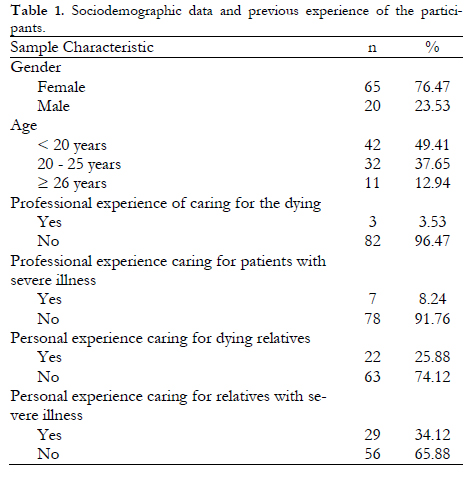
<body><![CDATA[<p><font face="Verdana" size="2"><b>Participants</b></font></p>     <p><font face="Verdana" size="2">The study participants were selected by intentional sampling. Among the 130 students enrolled in each course year, 88 who had completed the first year of the degree course in nursing studies at the Health Sciences Faculty of the University of Granada during the academic years 2011-2012 and 2012-2013 volunteered to take part. Three responses were excluded because the students' questionnaire data were incomplete, and so the final sample was composed of 85 students (<a href="#t1">Table 1</a>).</font></p>     <p>&nbsp;</p>     <p align="center"><font face="Verdana" size="2"><a name="t1"></a><img src="/img/revistas/ap/v33n3/psicologia_desarrollo1_tabla1.jpg"></font></p>     <p>&nbsp;</p>     <p><font face="Verdana" size="2"><b>Instruments</b></font></p>     <p><font face="Verdana" size="2">The survey was self-administered and contained the following items:</font></p>     <blockquote>     <p><font face="Verdana" size="2">- Sociodemographic data: age, sex.</font></p>     <p><font face="Verdana" size="2">- Previous personal experience in caring for relatives with serious or terminal illness (YES/NO).</font></p>     ]]></body>
<body><![CDATA[<p><font face="Verdana" size="2">- Previous professional experience in caring for patients with serious or terminal illness (YES/NO).</font></p>     <p><font face="Verdana" size="2">- Open questions: 1) Briefly describe the emotions aroused by the thought of your own death; 2) Write down as specifically as you can what you think will happen to you physically when you are dying and once you are physically dead.</font></p> </blockquote>     <p><font face="Verdana" size="2">The open questions were derived from the Mortality Attitudes Personality Survey (Rosenblatt et al., 1989), used in MS studies in Terror Management Theory.</font></p>     <p><font face="Verdana" size="2"><b>Procedure</b></font></p>     <p><font face="Verdana" size="2">To evaluate the potential and applicability of the MS questionnaire, this study takes into account two fundamental requirements: 1) the study environment must be relevant and appropriate to the area of research; 2) the results obtained must enable specific improvements to be applied. The field of education was considered the most appropriate and feasible for these two conditions to be met. In this respect, moreover, healthcare staff constitute an especially vulnerable population group because of their direct involvement in end-of-life processes. After considering various options, it was concluded that the nursing degree course offered at the University of Granada provided the necessary applicability, as it incorporated a specific course subject in this area, namely palliative care, in the second year. Therefore, it would be possible to measure the effect of specific occupational training on students' thoughts regarding these questions.</font></p>     <p><font face="Verdana" size="2">Therefore, on the first day of the second-year degree course, simultaneously in each of the classrooms in use by these students, the research project was explained to those present and verbal consent to voluntary participation was requested. A psychologist was present during the data compilation process to offer advice and support if any questions caused discomfort. Thus, doubts were resolved and clarifications provided. The students filled in the questionnaire immediately, in the classroom, anonymously and voluntarily, and were advised that if they did not wish to participate or if they did not feel able to continue, they could hand in the questionnaire, leave the classroom and request the intervention of the psychologist if this was felt necessary. No participant requested this type of assistance. The time taken to complete the questionnaire ranged from nine to twelve minutes. The confidentiality of the data was ensured by coding the identification of the questionnaires. At no time were the students asked for their name or place of origin.</font></p>     <p><font face="Verdana" size="2"><b>Data analysis</b></font></p>     <p><font face="Verdana" size="2">The data obtained were analysed using ATLAS.ti 6.2 software. To do so, the first steps were to create the Hermeneutic Unit and to generate the primary documents containing the literal answers given to each questionnaire.</font></p>     <p><font face="Verdana" size="2">For the content analysis, we followed the Mayring (2000) model, based first on an inductive and then on a deductive sequence. In this process, the meaning of each sentence was considered, in search of units of meaning, themes and subthemes.</font></p>     <p><font face="Verdana" size="2">After an initial reading of the texts, a series of main categories and sub-categories related to the questionnaire topics were extracted. These were then contrasted and reformulated during the analysis of the information (<a href="#t2">Table 2</a>). Subsequently, the textual expressions in the primary documents were classified and coded. A syntactic analysis of the data was then performed, by word count, which supplied the frequency of appearance of each code. In addition, a semantic analysis was conducted to determine the meaning of the words employed and to analyse the themes and categories proposed (Amezcua &amp; Galvez-Toro, 2002). Finally, the relations between the different codes were identified, and networks and tables created for the preparation of the final report and the extraction of results.</font></p>     ]]></body>
<body><![CDATA[<p>&nbsp;</p>     <p align="center"><font face="Verdana" size="2"><a name="t2"></a><img src="/img/revistas/ap/v33n3/psicologia_desarrollo1_tabla2.jpg"></font></p>     <p>&nbsp;</p>     <p><font face="Verdana" size="2">Strategies were included to improve the reliability of the data, regarding both the process and the results obtained, in accordance with the criteria established by Lincoln and Guba (1985) regarding reliability, credibility and auditability. Two external experts in qualitative analysis, acting as triangulation researchers, then reviewed the code generation, the results obtained and the data analysis performed (Denzin, 1989; Flick, 1992).</font></p>     <p>&nbsp;</p>     <p><font face="Verdana" size="2"><b>Results</b></font></p>     <p><font face="Verdana" size="2"><b>Emotions aroused by thoughts about one's own death</b></font></p>     <p><font face="Verdana" size="2">In response to the survey item, <i>"Briefly describe the emotions aroused by the thought of your own death"</i>, two main categories were identified: i) emotions aroused by the thought of one's own death; ii) specific thoughts aroused on contemplating one's own death.</font></p>     <p><font face="Verdana" size="2"><i>Emotions</i></font></p>     <p><font face="Verdana" size="2">Among the most frequently described emotions were fear (20.2%), pain (15.6%), anguish (13.2%), sadness (10.7%), anxiety (10.1%), loneliness (6.8%) and uncertainty (6.5%). Fear was the emotion most often mentioned in all the conditions analysed except when the participant had previous professional experience in the care of dying patients and among those over 26 years of age (<a target="_blank" href="/img/revistas/ap/v33n3/psicologia_desarrollo1_tabla3.jpg">Table 3</a>).</font></p>     ]]></body>
<body><![CDATA[<p><font face="Verdana" size="2">There were no significant differences between the percentages of men and women who cited fear and pain as the emotions most frequently aroused. However, women referred frequently to sadness and anguish, while men placed greater emphasis on anxiety and loneliness. By age groups, the students aged under 20 years most often cited anxiety and sadness, while those aged 20 to 25 years did so regarding pain and sadness, and in those aged 26 years or older, the main emotion reflected was loneliness.</font></p>     <p><font face="Verdana" size="2">When personal experience in caring for a dying relative was taken into consideration, the participants cited the emotions of pain and fear in the same proportions as above, but made less reference to sadness. However, if the experience in question involved a family member with a severe illness, the percentage of students mentioning fear and anguish increased. Among those with previous professional experience of caring for a dying patient, fear was not mentioned at all, but when the experience concerned caring for a patient with a severe illness, the emotions of fear, pain and anguish were cited in the same percentages as before.</font></p>     <p><font face="Verdana" size="2"><i>Thoughts</i></font></p>     <p><font face="Verdana" size="2">When the students were asked about the emotions aroused by the thought of their own death, many also referred to their thoughts or feelings in this respect. Five main areas (codes) were identified: i) family; ii) uncertainty about death; iii) achieving one's goals; iv) finitude; v) acceptance of death.</font></p>     <p><font face="Verdana" size="2">-<u>The family</u></font></p>     <p><font face="Verdana" size="2">Most of the students' observations concerned feelings of sadness at leaving their family or at not being able to see them anymore:</font></p>     <p><font face="Verdana" size="2"><i>"The idea of no longer being with my loved ones makes me unhappy".</i></font></p>     <p><font face="Verdana" size="2">They also expressed concern about how they would cope with death or about the suffering of their loved ones during this time:</font></p>     <p><font face="Verdana" size="2"><i>"I fear the suffering of my family and close friends. If I knew they wouldn't suffer, the thought of dying wouldn't be so bad"</i>.</font></p>     <p><font face="Verdana" size="2"><u>-Uncertainty about death</u></font></p>     ]]></body>
<body><![CDATA[<p><font face="Verdana" size="2">One topic that frequently arose was the fear caused by uncertainty about what would come after death, related to the doubts present in one's beliefs:</font></p>     <p><font face="Verdana" size="2"><i>"Fear of not knowing what there is after death".</i></font></p>     <p><font face="Verdana" size="2"><i>"Thinking about my own death distresses me because doubts keep going round and round my head: what will it be like, what will be there ... Or is there anything at all after death?".</i></font></p>     <p><font face="Verdana" size="2">Moreover, in many cases there is a sense of anguish provoked by ignorance of the experience of death, by not knowing what will happen, or when and how we will die. It was at this point that many of the respondents recognised they were afraid of the process of death, not only regarding physical or emotional suffering, but also regarding the conditions in which death would take place:</font></p>     <p><font face="Verdana" size="2"><i>"The only thing that worries me is the pain that I may suffer, or immobility, or being in a coma, before my death".</i></font></p>     <p><font face="Verdana" size="2"><i>"I'm not afraid of death, but of dying; I don't want to suffer or die alone. I don't mind dying, if my loved ones are with me at the time".</i></font></p>     <p><font face="Verdana" size="2"><i>"Not knowing when I'm going to die is disquieting".</i></font></p>     <p><font face="Verdana" size="2">-<u>Leaving everything done, achieving life's ambitions</u></font></p>     <p><font face="Verdana" size="2">Some of the respondents' views referred to the importance of achieving lifetime goals and of living all the experiences they wished to enjoy before death. In other words, these respondents hoped for a death that left no loose ends:</font></p>     <p><font face="Verdana" size="2"><i>"My death worries me when I think about everything I'd like to do before I die".</i></font></p>     ]]></body>
<body><![CDATA[<p><font face="Verdana" size="2"><i>"My death, or thinking about it, makes me wonder: when it happens, will I have achieved all my goals?".</i></font></p>     <p><font face="Verdana" size="2">However, among a small group of participants, thoughts about their own death led them to reflect on the importance of making the most of life and of enjoying the time available.</font></p>     <p><font face="Verdana" size="2"><i>"The thought of my death makes me happy for the time I've had to live".</i></font></p>     <p><font face="Verdana" size="2"><i>"I enjoy life and I'm not obsessed about death. You have to take advantage of what life has to offer".</i></font></p>     <p><font face="Verdana" size="2">-<u>Finitude</u></font></p>     <p><font face="Verdana" size="2">The sense of finitude was also present in the students' words; the idea of ceasing to think, of no longer existing, terrified them:</font></p>     <p><font face="Verdana" size="2"><i>"It frightens me, especially the fact of ceasing to exist and no longer thinking"</i>.</font></p>     <p><font face="Verdana" size="2"><i>"It frightens me, the idea of not feeling, not seeing, not hearing, not being able to share and interact with my friends and family, I'm afraid of not being".</i></font></p>     <p><font face="Verdana" size="2">-<u>Acceptance of death</u></font></p>     <p><font face="Verdana" size="2">Despite all the fears aroused by thinking about death, many students referred to the acceptance of one's own death as a natural act, although many linked this acceptance to the passage of time, since they assumed death would take place in the distant future:</font></p>     ]]></body>
<body><![CDATA[<p><font face="Verdana" size="2"><i>"In the long term, I accept it perfectly well, it's only natural".</i></font></p>     <p><font face="Verdana" size="2"><i>"My own death doesn't worry me, it's something I've always assumed will happen"</i>.</font></p>     <p><font face="Verdana" size="2"><b>Beliefs about what will happen physically when dying and once dead</b></font></p>     <p><font face="Verdana" size="2">In reference to the question, "Write down as specifically as you can what you believe will happen to you physically when you are dying and once you are physically dead", a distinction should be made between the two situations posed (dying and being dead) in our analysis of the information provided.</font></p>     <p><font face="Verdana" size="2"><i>Beliefs about physically dying</i></font></p>     <p><font face="Verdana" size="2">- <u>Description of the physical process of dying</u></font></p>     <p><font face="Verdana" size="2">The students' descriptions of what may be experienced in physically dying revealed a wide variety of perceptions regarding the physical signs and symptoms that may occur. The physical states most commonly referred to were the failure of vital organs (14.17%), followed closely by weakness (12.9%), pain (11.81%), cardiorespiratory arrest (8.66%) and loss of consciousness (6.69%). Some students described the process using the metaphor of "switching off'.</font></p>     <p><font face="Verdana" size="2"><i>"Little by little, I willprogressively be switched off."</i></font></p>     <p><font face="Verdana" size="2"><i>"I won't need to breathe, or think; little by little, like a machine that's running out of battery power, I'll run down and switch off, when everything goes dark".</i></font></p>     <p><font face="Verdana" size="2">- <u>Feelings about the moment of death</u></font></p>     ]]></body>
<body><![CDATA[<p><font face="Verdana" size="2">In stating what they believed would physically happen to them when they were dying, some participants also referred to the feelings or emotions they would experience during their death. Terms used for this included distress (18.75%), anxiety (12.5%), sadness (10.42%) and awareness of death itself (10.42%), expressed in forms such as the following:</font></p>     <p><font face="Verdana" size="2"><i>"When you are dying, I think that little by little you come to accept the idea that you are going to die"</i>.</font></p>     <p><font face="Verdana" size="2">Analysis of these results, according to the sociodemographic data compiled, showed the differences in the percentages to be minimal and non-significant.</font></p>     <p><font face="Verdana" size="2"><i>Beliefs about beingphysically dead</i></font></p>     <p><font face="Verdana" size="2">Two types of classification code were obtained: (i) corpse-related qualities: body decomposition and physical and spiritual attributes (see <a target="_blank" href="/img/revistas/ap/v33n3/psicologia_desarrollo1_figura1.jpg">Figure 1</a>); (ii) personal qualities and attitudes: beliefs, denial and preferences (see <a target="_blank" href="/img/revistas/ap/v33n3/psicologia_desarrollo1_tabla4.jpg">Table 4</a>).</font></p>     <p><font face="Verdana" size="2">- <u>Attributes of body decomposition, and physical and spiritual attributes.</u></font></p>     <p><font face="Verdana" size="2">Many references were made to spiritual attributes, especially by the male students. By age groups, more references to spiritual attributes were made by those aged less than 26 years.</font></p>     <p><font face="Verdana" size="2">Previous personal experience was associated with the number of references made to spiritual attributes, regarding dying and severely ill relatives. Nearly all of the students with previous professional experience referred to the attributes of body decomposition, in descriptions of caring for dying patients, and also referred to spiritual attributes in the case of severely ill persons (<a target="_blank" href="/img/revistas/ap/v33n3/psicologia_desarrollo1_tabla4.jpg">Table 4</a>).</font></p>     <p><font face="Verdana" size="2">Regarding physical change, the students mentioned the decomposition, putrefaction and disintegration of the corpse after death, the physical attributes of a corpse, such as coldness, pallor, rigidity (or rigor mortis) and immobility. With respect to spiritual attributes, they used existential expressions such as feeling nothing, darkness or simply "nothing" (<a target="_blank" href="/img/revistas/ap/v33n3/psicologia_desarrollo1_figura1.jpg">Figure 1</a>).</font></p>     <p><font face="Verdana" size="2"><u>- Personal qualities and attitudes: beliefs, denial and preferences</u></font></p>     ]]></body>
<body><![CDATA[<p><font face="Verdana" size="2">Half of the students referred to doubts regarding life after death:</font></p>     <p><font face="Verdana" size="2"><i>"l don't know, either, if there is anything after death, but I hope so".</i></font></p>     <p><font face="Verdana" size="2">On the other hand, 22.2% claimed to have no belief in an afterlife:</font></p>     <p><font face="Verdana" size="2"><i>"l view it simply as an end; l don't believe in a life after death"</i>.</font></p>     <p><font face="Verdana" size="2">The other remarks made were manifestations of personal beliefs, unrelated to religion:</font></p>     <p><font face="Verdana" size="2"><i>"Dust to dust, ashes to ashes; that's it"</i>.</font></p>     <p><font face="Verdana" size="2"><i>"All emotions, thoughts and feelings will disappear, it's farewell to the soul".</i></font></p>     <p><font face="Verdana" size="2">71.43% of the comments made (n = 35) regarding the denial of death referred to avoiding thinking about it:</font></p>     <p><font face="Verdana" size="2"><i>"I get really anxious and avoid thinking about it, because when I do I have problems in sleeping and can't concentrate".</i></font></p>     <p><font face="Verdana" size="2">However, there were also expressions of indifference or doubt:</font></p>     ]]></body>
<body><![CDATA[<p><font face="Verdana" size="2"><i>"I don't worry too much about how I will die".</i></font></p>     <p><font face="Verdana" size="2"><i>"I honestly can't imagine the moment when I'll be dying or when I'll be dead".</i></font></p>     <p><font face="Verdana" size="2">Another significant aspect of the comments made concerned the students' preferences (n = 70). Thus, 35.7% would prefer to be cremated, versus 7.14% who wished to be buried. 8.57% would donate their organs, while 7.14% hoped to die in the company of their loved ones.</font></p>     <p><font face="Verdana" size="2">The treatment granted the body once dead (i.e. cremation or burial) was more often referred to by the male students, while the women more frequently commented on desirable conditions during the process of dying, such as the absence of pain and suffering, and that the process should be rapid and/or in the company of one's family.</font></p>     <p><font face="Verdana" size="2">In this area, the wish that was most commonly expressed was to be cremated after death. This was especially so among those with experience in caring for the dying, together with the wish to die accompanied by loved ones and to be able to say goodbye to them before dying.</font></p>     <p>&nbsp;</p>     <p><font face="Verdana" size="2"><b>Discussion</b></font></p>     <p><font face="Verdana" size="2">The aim of this study is to obtain a detailed description of the main considerations associated with the thought of one's own death and of situations of dying, among a student population. This experiment, in which intrusive thinking about one's own death was provoked among a group of young people, has enhanced our understanding of the mental representation of death and dying, expressed in the first person. The views given can be considered representative of the baseline state in this respect, at the experiential level. Our analysis of the narratives evoked by thoughts about one's own death shows that the fear of dying, the pain of thinking about one's own death, the anguish and sadness aroused and the suffering related to what is lost or left behind are the main features of the emotions associated with one's own death. The beliefs associated with the two states into which we inquired, namely physically dying and being physically dead, are intermixed, including both purely physical conditions and emotions and feelings. In their descriptions of what they believe will happen to them physically, our respondents cannot ignore what they feel or believe they will feel.</font></p>     <p><font face="Verdana" size="2">The results obtained concerning the emotions evoked in thinking about one's own death coincide with the findings of Kastenbaum and Heflick (2011), who reported that anxiety and sadness were the principal emotions aroused. In the present study, together with these two emotions, other, related feelings were observed; thus, in the respondents' discourse, terms such as anguish, fear, pain and uncertainty were commonly employed to describe the emotional state evoked.</font></p>     <p><font face="Verdana" size="2">In both cases, the female respondents in our study more frequently used terms related to distress, sadness and uncertainty (for example, anxiety, preoccupation and a sense of perplexity). Among the men, on the other hand, the responses made were more often expressed in terms of anxiety and loneliness. In the main, they did not employ terms disassociating themselves from death. In this respect, Kastenbaum and Heflick (2011) observed respondents' use of terms that detached them from the idea, in apathetic responses such as <i>"I don't cart"</i>.</font></p>     ]]></body>
<body><![CDATA[<p><font face="Verdana" size="2">The differences in the expressions used by our male and female respondents might be interpreted as gender-based nuances. However, in our study, the terms that were most frequently used by both men and women were, first, fear and second, pain. For Kastenbaum and Heflick (2011), the main emotions described by women were first anxiety and then sadness; for men, this order was reversed. Other studies, using quantitative measures, have also found that women feel greater anxiety about death than men (Tomas-Sabado &amp; Gomez-Benito, 2003). These differences are probably related to a methodological diversity among the studies. In consequence, the results obtained concerning the open expression of emotions are not comparable with those reported by studies in which specific questionnaires are used (Tomas-Sabado &amp; Gomez-Benito, 2003). In this respect, when they are expressed in terms of personal experience and emotions, the answers given may depend more on the respondents' own outlook on the world and on their personal values (Chocarro-Gonzalez, 2010) than on their gender.</font></p>     <p><font face="Verdana" size="2">In order to interpret the influence of the respondents' age on the responses made, it should be taken into account that 87% of the respondents were under 26 years of age. The answers given may be considered logical, in that younger persons tend to be more concerned with insecurity regarding death, given its lack of proximity. This is in accordance with the cultural values of our society, where death is considered a natural outcome or process, something that affects the elderly (Chocarro-Gonzalez et al., 2012). Our analysis revealed, moreover, that the younger students made a greater number of references to fear and anxiety, thus confirming previous findings (Edo-Gual et al., 2011; Limonero, Tomas-Sabado, Fernandez-Castro, Cladellas &amp; Gomez -Benito, 2010; Lyke, 2013). Thus, with age there is a greater experience of loss and unpleasant circumstances, which spurs the development of more effective coping strategies to reduce feelings of anxiety and fear.</font></p>     <p><font face="Verdana" size="2">Many of the students also expressed concerns regarding the moment of their own death. In this respect, the ideas most commonly cited included the fear of not being able to achieve one's goals (Kastenbaum &amp; Heflick, 2011; Liu et al., 2011) and the importance of the family. This latter concern was to the forefront of many of the narratives offered, both because of the sadness at ceasing to be with their family members (Liu et al., 2011; Shih, Gau, Lin, Pong &amp; Lin et al., 2006) and from concern as to how the family would cope with their death (Kastenbaum &amp; Heflick, 2011). In other words, the respondents were preoccupied by the grief that their own death would cause to others. Interestingly, these concerns bear a great similarity to those expressed by patients in an advanced stage of terminal illness. Montoya-Juarez et al. (2013) highlighted various emotional responses by such patients, in a study population derived from the same cultural environment as that of the participants in the present study. These patients expressed concern about the "loose ends" they would leave behind, mainly related to the future of their families. Similar concerns have been observed in other studies (Baile, Palmer, Bruera &amp; Parker, 2010; Ryan, 2005) and in the handbook <i>Nearing the End of Life</i> published by the American Cancer Society (2014). The similarity of some of these thoughts regarding one's own death, in different cultural contexts, may be indicative of a conception of death and dying that is shared and generalised within developed societies, as has been noted by authors such as Louis-Vicent Thomas (1983) and Philippe Ariès (2005).</font></p>     <p><font face="Verdana" size="2">Another viewpoint is that what is generalised may be the emotional origin. This was the outlook expressed by Izard (2009), who developed the concept of "emotion schemas". This term refers to emotion in dynamic interaction with perceptual and cognitive processes that influence the mind and behaviour. These processes would be elicited by activation but also by images, memories and thoughts, and would be influenced by individual differences, learning and the cultural and social context (Zerpa, 2009). Such schemas could explain how a specific emotional state comes to be inscribed in the brain, from the relation between a basic emotion and self-awareness (Damasio, 2005), which is expressed in accordance with the sociocultural context. Previous studies have reported the existence of a specific emotional schema for images of death (Martí-García et al., 2014). In the present case, the eliciting power of MS questions is apparent, in a particular context in which the education received would modulate perceptions. Our study adopts a new approach and employs a novel method by which such differences might be controlled in future research.</font></p>     <p><font face="Verdana" size="2">Another recurrent theme in the narratives was the generalised uncertainty about what will happen after death. This is one of the main effects highlighted in MS studies, since reminders of mortality, as well as evoking our fear of death, aggravate existential uncertainty about what might come next (Van des Bos, 2009).</font></p>     <p><font face="Verdana" size="2">Corroborating previous studies (Chocarro-Gonzalez et al., 2012), our findings revealed indications of the denial of death, in the sense of avoiding thinking about it or being unable to imagine any aspect related to it. In the narratives of those participants capable of describing their death, a frequent occurrence is the expression of their desires at the moment of death and once they are dead, taking advantage of the opportunity offered by this study to state their preferences. These included the desire to die at home, to donate their organs, not to extend their life by unnecessary procedures and to be cremated after death. Many such preferences have been recorded in previous studies on end-of-life decisions among the Spanish population (Wanden-Berghe, Guardiola- Wanden-Berghe &amp; Sanz-Valero, 2009).</font></p>     <p><font face="Verdana" size="2">Finally, although prior experience in coping with end-of-life processes was only evaluated on the basis of the respondents' experiences in caring for patients or relatives with severe and/or terminal illnesses, there was a notable increase in references to the most prevalent emotions, such as anxiety or pain, among those who had cared for family members. However, this was not the case with respect to fear, which was absent from the narratives of respondents with professional experience in caring for a dying patient, or sadness, which in general had no significantly increased presence in the narratives.</font></p>     <p><font face="Verdana" size="2">The results obtained suggest that emotions, thoughts and beliefs are appropriate areas on which to focus educational programmes in the health sciences regarding personal views on mortality, both one's own death and that of others, thus enhancing understanding in this regard. Studies have shown that training in communication skills and palliative care can significantly reduce levels of anxiety about death (Schmidt-Rio Valle et al., 2012) or modify reactions to emotional stimuli directly related to death (Martí-García et al., 2014).</font></p>     <p><font face="Verdana" size="2">The results obtained suggest that the management of emotions, by means of strategies related to emotional intelligence, should be incorporated into training programmes for students and healthcare professionals, as a means of recognising one's own feelings and those of others, in order to be motivated and to properly manage relationships with others and with oneself. In the field of health care, the management of empathy, i.e., the ability to recognise the emotional states of others and on that basis react in a socially appropriate way, is of fundamental importance (Sánchez Rueda, 2014; Pineda Galán, 2012).</font></p>     <p><font face="Verdana" size="2">This study presents the following strengths and limitations. On the positive side, it is one of the few studies conducted in this area in which an in-depth qualitative analysis is made of health sciences students' emotions regarding the subject of death, using a research method based on the MS paradigm. Moreover, this analysis highlights a wealth of expressions and emotions that were not revealed in previous studies. On the other hand, our data analysis suffers an important limitation in that we are unaware whether the respondents, in their narratives, are saying what they believe they will feel when the situation of mortality arises or, on the contrary, whether this is what they are feeling at the present moment, on considering the prospect. This ambiguity must be taken into account in any generalisation of the results obtained. Furthermore, this study does not obtain detailed characteristics of the personal and/or professional experience of the respondents except that it refers to the death or serious illness of family members or patients. No other information was requested, to avoid recalling unwelcome memories and to maintain the necessary conditions of neutrality. However, it was important to determine the respondents' previous experience in this respect, as the sampling procedure was intentional, based on voluntary participation. Nevertheless, this fact may have introduced bias into the results obtained.</font></p>     ]]></body>
<body><![CDATA[<p><font face="Verdana" size="2">In conclusion, the MS questionnaire examined in this study was found to be a useful means of investigating responses to intrusive thinking about one's own death, among a student population. Among the main emotions aroused in this respect are fear of dying, pain in thinking about one's own death, anguish, sadness and suffering related to what is lost or left behind. The variables of sex, age, and prior experience partly determined the variability in the responses evoked. However, the more profound responses, such as beliefs, seem to depend more on each individual's worldview and personal values.</font></p>     <p>&nbsp;</p>     <p><font face="Verdana" size="2"><b>References</b></font></p>     <!-- ref --><p><font face="Verdana" size="2">1. American Cáncer Society. Cuando el final de la vida se acerca (en línea) Copyright American Cancer Society, 2014. (Fecha de consulta: 21 Diciembre 2015) Disponible en: <a target="_blank" href="http://www.cancer.org/acs/groups/cid/documents/webcontent/002900-pdf.pdf">http://www.cancer.org/acs/groups/cid /documents/webcontent/002900-pdf.pdf</a>.    &nbsp;&nbsp;&nbsp;&nbsp;&nbsp;&nbsp;&nbsp;&nbsp;[&#160;<a href="javascript:void(0);" onclick="javascript: window.open('/scielo.php?script=sci_nlinks&ref=790568&pid=S0212-9728201700030002100001&lng=','','width=640,height=500,resizable=yes,scrollbars=1,menubar=yes,');">Links</a>&#160;]<!-- end-ref --></font></p>    <!-- ref --><p><font face="Verdana" size="2">2. Amezcua, M., y Gálvez Toro, A. (2002). Los modos de análisis en investigación cualitativa en salud: perspectiva crítica y reflexiones en voz alta. Revista Española de Salud Pública, 76(5), 423-36.    &nbsp;&nbsp;&nbsp;&nbsp;&nbsp;&nbsp;&nbsp;&nbsp;[&#160;<a href="javascript:void(0);" onclick="javascript: window.open('/scielo.php?script=sci_nlinks&ref=790570&pid=S0212-9728201700030002100002&lng=','','width=640,height=500,resizable=yes,scrollbars=1,menubar=yes,');">Links</a>&#160;]<!-- end-ref --></font></p>    <!-- ref --><p><font face="Verdana" size="2">3. Ariès, P (2005) Historia de la muerte en occidente: desde la edad media hasta nuestros dias. 3<sup>a</sup> ed. Barcelona: El acantilado.    &nbsp;&nbsp;&nbsp;&nbsp;&nbsp;&nbsp;&nbsp;&nbsp;[&#160;<a href="javascript:void(0);" onclick="javascript: window.open('/scielo.php?script=sci_nlinks&ref=790572&pid=S0212-9728201700030002100003&lng=','','width=640,height=500,resizable=yes,scrollbars=1,menubar=yes,');">Links</a>&#160;]<!-- end-ref --></font></p>    <!-- ref --><p><font face="Verdana" size="2">4. Ato, M., López, J. J., y Benavente, A. (2013). Un sistema de clasificación de los diseños de investigación en psicología. Anales de psicología, 29(3), 1038-1059. http://dx.doi.org/10.6018/analesps.29.3T78511.    &nbsp;&nbsp;&nbsp;&nbsp;&nbsp;&nbsp;&nbsp;&nbsp;[&#160;<a href="javascript:void(0);" onclick="javascript: window.open('/scielo.php?script=sci_nlinks&ref=790574&pid=S0212-9728201700030002100004&lng=','','width=640,height=500,resizable=yes,scrollbars=1,menubar=yes,');">Links</a>&#160;]<!-- end-ref --></font></p>    <!-- ref --><p><font face="Verdana" size="2">5. Baile, W. F., Palmer, J. L., Bruera, E., and Parker, P. A. (2011). Assessment of palliative care cancer patients' most important concerns. Supportive Care in Cancer, 19(4), 475-481. doi: 10.1007/s00520-010-0839-4.    &nbsp;&nbsp;&nbsp;&nbsp;&nbsp;&nbsp;&nbsp;&nbsp;[&#160;<a href="javascript:void(0);" onclick="javascript: window.open('/scielo.php?script=sci_nlinks&ref=790576&pid=S0212-9728201700030002100005&lng=','','width=640,height=500,resizable=yes,scrollbars=1,menubar=yes,');">Links</a>&#160;]<!-- end-ref --></font></p>    <!-- ref --><p><font face="Verdana" size="2">6. Becker, E. (2003). La negación de la muerte. Barcelona: Kairós.    &nbsp;&nbsp;&nbsp;&nbsp;&nbsp;&nbsp;&nbsp;&nbsp;[&#160;<a href="javascript:void(0);" onclick="javascript: window.open('/scielo.php?script=sci_nlinks&ref=790578&pid=S0212-9728201700030002100006&lng=','','width=640,height=500,resizable=yes,scrollbars=1,menubar=yes,');">Links</a>&#160;]<!-- end-ref --></font></p>    <!-- ref --><p><font face="Verdana" size="2">7. Burgin, C. J., Sanders, M. A., Vandellen, M. R., and Martin, L. L. (2012). Breaking apart the typical mortality salience manipulation: Two questions, two outcomes. European Journal of Social Psychology, 42(4), 521-532. doi: 10.1002/ejsp.1845.    &nbsp;&nbsp;&nbsp;&nbsp;&nbsp;&nbsp;&nbsp;&nbsp;[&#160;<a href="javascript:void(0);" onclick="javascript: window.open('/scielo.php?script=sci_nlinks&ref=790580&pid=S0212-9728201700030002100007&lng=','','width=640,height=500,resizable=yes,scrollbars=1,menubar=yes,');">Links</a>&#160;]<!-- end-ref --></font></p>    <!-- ref --><p><font face="Verdana" size="2">8. Burke, B. L., Martens, A., and Faucher, E. H. (2010). Two decades of terror management theory: A meta-analysis of mortality salience research. Personality and Social Psychology Review, 14(2), 155-195. doi: 10.1177/1088868309352321.    &nbsp;&nbsp;&nbsp;&nbsp;&nbsp;&nbsp;&nbsp;&nbsp;[&#160;<a href="javascript:void(0);" onclick="javascript: window.open('/scielo.php?script=sci_nlinks&ref=790582&pid=S0212-9728201700030002100008&lng=','','width=640,height=500,resizable=yes,scrollbars=1,menubar=yes,');">Links</a>&#160;]<!-- end-ref --></font></p>    <!-- ref --><p><font face="Verdana" size="2">9. Chocarro-González, L. (2010). Representación social de la muerte entre los profesionales sanitarios: una aproximación psicosociológica desde el análisis del discurso. (Tesis Doctoral). Facultad de Ciencias Políticas y Sociología Departamento de Psicología Social. Universidad Complutense de Madrid. Madrid. Disponible en: <a target="_blank" href="http://eprints.ucm.es/11998/1/T32597.pdf">http://eprints.ucm.es/11998/1/T32597.pdf</a>.    &nbsp;&nbsp;&nbsp;&nbsp;&nbsp;&nbsp;&nbsp;&nbsp;[&#160;<a href="javascript:void(0);" onclick="javascript: window.open('/scielo.php?script=sci_nlinks&ref=790584&pid=S0212-9728201700030002100009&lng=','','width=640,height=500,resizable=yes,scrollbars=1,menubar=yes,');">Links</a>&#160;]<!-- end-ref --></font></p>    <!-- ref --><p><font face="Verdana" size="2">10. Chocarro-González, L., Gónzalez-Fernández, R., Salvadores-Fuentes, P., y Venturi-Medina, C. (2012). Negación de la muerte y su repercusión en los cuidados. Medicina paliativa, 19(7), 148-54.    &nbsp;&nbsp;&nbsp;&nbsp;&nbsp;&nbsp;&nbsp;&nbsp;[&#160;<a href="javascript:void(0);" onclick="javascript: window.open('/scielo.php?script=sci_nlinks&ref=790586&pid=S0212-9728201700030002100010&lng=','','width=640,height=500,resizable=yes,scrollbars=1,menubar=yes,');">Links</a>&#160;]<!-- end-ref --></font></p>    <!-- ref --><p><font face="Verdana" size="2">11. Chow, A. Y. M. (2013). Developing emotional competence of social workers of end-of-life and bereavement care. British Journal of Social Work, 43(2), 373-393. doi: 10.1093/bjsw/bct030.    &nbsp;&nbsp;&nbsp;&nbsp;&nbsp;&nbsp;&nbsp;&nbsp;[&#160;<a href="javascript:void(0);" onclick="javascript: window.open('/scielo.php?script=sci_nlinks&ref=790588&pid=S0212-9728201700030002100011&lng=','','width=640,height=500,resizable=yes,scrollbars=1,menubar=yes,');">Links</a>&#160;]<!-- end-ref --></font></p>    <!-- ref --><p><font face="Verdana" size="2">12. Cruz-Quintana F. (2007). Miedo a la muerte. En Álava MJ. (Coord) Enciclopedia de la Psicología. La Psicología que nos Ayuda a Vivir (913-938). Madrid: La Esfera de los Libros.    &nbsp;&nbsp;&nbsp;&nbsp;&nbsp;&nbsp;&nbsp;&nbsp;[&#160;<a href="javascript:void(0);" onclick="javascript: window.open('/scielo.php?script=sci_nlinks&ref=790590&pid=S0212-9728201700030002100012&lng=','','width=640,height=500,resizable=yes,scrollbars=1,menubar=yes,');">Links</a>&#160;]<!-- end-ref --></font></p>    <!-- ref --><p><font face="Verdana" size="2">13. Damasio, A. (2005). En busca de Spinoga. Neurobiología de la emoción y los sentimientos. Barcelona: Crítica.    &nbsp;&nbsp;&nbsp;&nbsp;&nbsp;&nbsp;&nbsp;&nbsp;[&#160;<a href="javascript:void(0);" onclick="javascript: window.open('/scielo.php?script=sci_nlinks&ref=790592&pid=S0212-9728201700030002100013&lng=','','width=640,height=500,resizable=yes,scrollbars=1,menubar=yes,');">Links</a>&#160;]<!-- end-ref --></font></p>    <!-- ref --><p><font face="Verdana" size="2">14. Denzin, N. K. (1989). The Research Act. Englewood Cliffs, NJ: Prentice Hall</font>&nbsp;&nbsp;&nbsp;&nbsp;&nbsp;&nbsp;&nbsp;&nbsp;[&#160;<a href="javascript:void(0);" onclick="javascript: window.open('/scielo.php?script=sci_nlinks&ref=790594&pid=S0212-9728201700030002100014&lng=','','width=640,height=500,resizable=yes,scrollbars=1,menubar=yes,');">Links</a>&#160;]<!-- end-ref --><!-- ref --><p><font face="Verdana" size="2">15. Dunne, S., Gallagher, P., and Matthews, A. (2015). Existential threat or dissociative response? Examining defensive avoidance of point-of-care testing devices through a terror management theory framework. Death studies, 39(1), 30-38. DOI:10.1080/07481187.2014.885469.    &nbsp;&nbsp;&nbsp;&nbsp;&nbsp;&nbsp;&nbsp;&nbsp;[&#160;<a href="javascript:void(0);" onclick="javascript: window.open('/scielo.php?script=sci_nlinks&ref=790595&pid=S0212-9728201700030002100015&lng=','','width=640,height=500,resizable=yes,scrollbars=1,menubar=yes,');">Links</a>&#160;]<!-- end-ref --></font></p>    <!-- ref --><p><font face="Verdana" size="2">16. Flick, U. (1992). Triangulation Revisited: Strategy of or alternative to validation of qualitative data. Journal for the Theory of Social Behavior, 22, 175-197. doi: 10.1111/j.1468-5914.1992.tb00215.x.    &nbsp;&nbsp;&nbsp;&nbsp;&nbsp;&nbsp;&nbsp;&nbsp;[&#160;<a href="javascript:void(0);" onclick="javascript: window.open('/scielo.php?script=sci_nlinks&ref=790597&pid=S0212-9728201700030002100016&lng=','','width=640,height=500,resizable=yes,scrollbars=1,menubar=yes,');">Links</a>&#160;]<!-- end-ref --></font></p>    <!-- ref --><p><font face="Verdana" size="2">17. Fortner, B. V., and Neimeyer, R. A. (1999). Death anxiety in older adults: A quantitative review. Death Studies, 23(5), 387-411. doi:10.1080/074811899200920.    &nbsp;&nbsp;&nbsp;&nbsp;&nbsp;&nbsp;&nbsp;&nbsp;[&#160;<a href="javascript:void(0);" onclick="javascript: window.open('/scielo.php?script=sci_nlinks&ref=790599&pid=S0212-9728201700030002100017&lng=','','width=640,height=500,resizable=yes,scrollbars=1,menubar=yes,');">Links</a>&#160;]<!-- end-ref --></font></p>    <!-- ref --><p><font face="Verdana" size="2">18. Gual, M., Sábado, J., y Aradilla, A. (2011). Miedo a la muerte en estudiantes de enfermería. Enfermería Clínica, 16, 177-88.    &nbsp;&nbsp;&nbsp;&nbsp;&nbsp;&nbsp;&nbsp;&nbsp;[&#160;<a href="javascript:void(0);" onclick="javascript: window.open('/scielo.php?script=sci_nlinks&ref=790601&pid=S0212-9728201700030002100018&lng=','','width=640,height=500,resizable=yes,scrollbars=1,menubar=yes,');">Links</a>&#160;]<!-- end-ref --></font></p>    <!-- ref --><p><font face="Verdana" size="2">19. Hohman, Z. P., and Hogg, M. A. (2011). Fear and uncertainty in the face of death: The role of life after death in group identification. European Journal of Social Psychology, 41(6), 751-760. doi: 10.1002/ejsp.818.    &nbsp;&nbsp;&nbsp;&nbsp;&nbsp;&nbsp;&nbsp;&nbsp;[&#160;<a href="javascript:void(0);" onclick="javascript: window.open('/scielo.php?script=sci_nlinks&ref=790603&pid=S0212-9728201700030002100019&lng=','','width=640,height=500,resizable=yes,scrollbars=1,menubar=yes,');">Links</a>&#160;]<!-- end-ref --></font></p>    ]]></body>
<body><![CDATA[<!-- ref --><p><font face="Verdana" size="2">20. Izard, C. E. (2009). Emotion theory and research: Highlights, unanswered questions, and emerging issues. Annual review of psychology, 60, 1-25. doi: 10.1146/annurev.psych.60.110707.163539.    &nbsp;&nbsp;&nbsp;&nbsp;&nbsp;&nbsp;&nbsp;&nbsp;[&#160;<a href="javascript:void(0);" onclick="javascript: window.open('/scielo.php?script=sci_nlinks&ref=790605&pid=S0212-9728201700030002100020&lng=','','width=640,height=500,resizable=yes,scrollbars=1,menubar=yes,');">Links</a>&#160;]<!-- end-ref --></font></p>    <!-- ref --><p><font face="Verdana" size="2">21. Kastenbaum, R., and Heflick, N. A. (2011). Sad to say: is it time for Sorrow Management Theory?. OMEGA-Journal of Death and Dying, 62(4), 305-327. doi: 10.2190/OM.62.4.a.    &nbsp;&nbsp;&nbsp;&nbsp;&nbsp;&nbsp;&nbsp;&nbsp;[&#160;<a href="javascript:void(0);" onclick="javascript: window.open('/scielo.php?script=sci_nlinks&ref=790607&pid=S0212-9728201700030002100021&lng=','','width=640,height=500,resizable=yes,scrollbars=1,menubar=yes,');">Links</a>&#160;]<!-- end-ref --></font></p>    <!-- ref --><p><font face="Verdana" size="2">22. Lester, D., Templer, D.I., and Abdel-Khalek, A. (2007). A cross-cultural comparison of death anxiety: A brief note. Omega: Journal of Death and Dying, 54(3), 255-260. DOI:10.1080/07481187.2011.583200.    &nbsp;&nbsp;&nbsp;&nbsp;&nbsp;&nbsp;&nbsp;&nbsp;[&#160;<a href="javascript:void(0);" onclick="javascript: window.open('/scielo.php?script=sci_nlinks&ref=790609&pid=S0212-9728201700030002100022&lng=','','width=640,height=500,resizable=yes,scrollbars=1,menubar=yes,');">Links</a>&#160;]<!-- end-ref --></font></p>    <!-- ref --><p><font face="Verdana" size="2">23. Limonero, J.T., Tomás-Sábado, J., Fernández-Castro, J, Cladellas, R., and Gómez-Benito, J. (2010). Competencia personal percibida y ansiedad ante la muerte en estudiantes de enfermería. Ansiedad y estrés, 16(2-3), 177-88.    &nbsp;&nbsp;&nbsp;&nbsp;&nbsp;&nbsp;&nbsp;&nbsp;[&#160;<a href="javascript:void(0);" onclick="javascript: window.open('/scielo.php?script=sci_nlinks&ref=790611&pid=S0212-9728201700030002100023&lng=','','width=640,height=500,resizable=yes,scrollbars=1,menubar=yes,');">Links</a>&#160;]<!-- end-ref --></font></p>    <!-- ref --><p><font face="Verdana" size="2">24. Lincoln, Y. S., and Guba, E. G. (1985). Naturalistic inquiry. Londres: Sage</font>&nbsp;&nbsp;&nbsp;&nbsp;&nbsp;&nbsp;&nbsp;&nbsp;[&#160;<a href="javascript:void(0);" onclick="javascript: window.open('/scielo.php?script=sci_nlinks&ref=790613&pid=S0212-9728201700030002100024&lng=','','width=640,height=500,resizable=yes,scrollbars=1,menubar=yes,');">Links</a>&#160;]<!-- end-ref --><!-- ref --><p><font face="Verdana" size="2">25. Liu, Y. C., Su, P. Y., Chen, C. H., Chiang, H. H., Wang, K. Y., &amp; Tzeng, W. C. (2011). Facing death, facing self: nursing students' emotional reactions during an experiential workshop on life-and-death issues. Journal of clinical nursing, 20(5-6), 856-863. doi: 10.1111/j.1365-2702.2010.03545.x.    &nbsp;&nbsp;&nbsp;&nbsp;&nbsp;&nbsp;&nbsp;&nbsp;[&#160;<a href="javascript:void(0);" onclick="javascript: window.open('/scielo.php?script=sci_nlinks&ref=790614&pid=S0212-9728201700030002100025&lng=','','width=640,height=500,resizable=yes,scrollbars=1,menubar=yes,');">Links</a>&#160;]<!-- end-ref --></font></p>    <!-- ref --><p><font face="Verdana" size="2">26. Lyke, J. (2013). Associations among aspects of meaning in life and death anxiety in young adults. Death studies, 37(5), 471-482. doi:10.1080/07481187.2011.649939.    &nbsp;&nbsp;&nbsp;&nbsp;&nbsp;&nbsp;&nbsp;&nbsp;[&#160;<a href="javascript:void(0);" onclick="javascript: window.open('/scielo.php?script=sci_nlinks&ref=790616&pid=S0212-9728201700030002100026&lng=','','width=640,height=500,resizable=yes,scrollbars=1,menubar=yes,');">Links</a>&#160;]<!-- end-ref --></font></p>    <!-- ref --><p><font face="Verdana" size="2">27. Martí-García, C., García-Caro, M. P., Schmidt-Riovalle, J., Fernández-Alcántara, M., Montoya-Juárez, R., y Cruz-Quintana, F. (2014). Formación en cuidados paliativos y efecto en la evaluación emocional de imágenes de muerte. Medicina Paliativa, doi:10.1016/j.medipa.2013.12.007.    &nbsp;&nbsp;&nbsp;&nbsp;&nbsp;&nbsp;&nbsp;&nbsp;[&#160;<a href="javascript:void(0);" onclick="javascript: window.open('/scielo.php?script=sci_nlinks&ref=790618&pid=S0212-9728201700030002100027&lng=','','width=640,height=500,resizable=yes,scrollbars=1,menubar=yes,');">Links</a>&#160;]<!-- end-ref --></font></p>    <!-- ref --><p><font face="Verdana" size="2">28. Mayring, P. (2000). Qualitative Content Analysis. Forum Qualitative Sozialforschung/Forum: Qualitative Social Research, 1(2). Retrieved from <a target="_blank" href="http://www.qualitative-research.net/index.php/fqs/article/view/1089/2385">http://www.qualitative-research.net/ index.php/fqs/article/view/1089/2385</a>.    &nbsp;&nbsp;&nbsp;&nbsp;&nbsp;&nbsp;&nbsp;&nbsp;[&#160;<a href="javascript:void(0);" onclick="javascript: window.open('/scielo.php?script=sci_nlinks&ref=790620&pid=S0212-9728201700030002100028&lng=','','width=640,height=500,resizable=yes,scrollbars=1,menubar=yes,');">Links</a>&#160;]<!-- end-ref --></font></p>    <!-- ref --><p><font face="Verdana" size="2">29. Mason, S. R., and Ellershaw, J. E. (2010). Undergraduate training in palliative medicine: Is more necessarily better? Palliative Medicine, 24(3), 306-309. doi: 10.1177/0269216309351867.    &nbsp;&nbsp;&nbsp;&nbsp;&nbsp;&nbsp;&nbsp;&nbsp;[&#160;<a href="javascript:void(0);" onclick="javascript: window.open('/scielo.php?script=sci_nlinks&ref=790622&pid=S0212-9728201700030002100029&lng=','','width=640,height=500,resizable=yes,scrollbars=1,menubar=yes,');">Links</a>&#160;]<!-- end-ref --></font></p>    <!-- ref --><p> <font face="Verdana" size="2">30. Montoya-Juarez, R., García-Caro, M. P., Campos-Calderón, C., Schmidt-Rio Valle, J., Gomez-Chica, A., Marti-García, C., and Cruz-Quintana, F. (2013). Psychological responses of terminally ill patients who are experiencing suffering: A qualitative study. International Journal of Nursing Studies, 50(1), 53-62. doi:10.1016/j.ijnurstu.2012.08.016.    &nbsp;&nbsp;&nbsp;&nbsp;&nbsp;&nbsp;&nbsp;&nbsp;[&#160;<a href="javascript:void(0);" onclick="javascript: window.open('/scielo.php?script=sci_nlinks&ref=790624&pid=S0212-9728201700030002100030&lng=','','width=640,height=500,resizable=yes,scrollbars=1,menubar=yes,');">Links</a>&#160;]<!-- end-ref --></font></p>    <!-- ref --><p><font face="Verdana" size="2">31. Neimeyer, R A. (1994). Death anxiety handbook: Research, instrumentation, and application. Washington, D.C.: Taylor &amp; Francis.    &nbsp;&nbsp;&nbsp;&nbsp;&nbsp;&nbsp;&nbsp;&nbsp;[&#160;<a href="javascript:void(0);" onclick="javascript: window.open('/scielo.php?script=sci_nlinks&ref=790626&pid=S0212-9728201700030002100031&lng=','','width=640,height=500,resizable=yes,scrollbars=1,menubar=yes,');">Links</a>&#160;]<!-- end-ref --></font></p>    <!-- ref --><p><font face="Verdana" size="2">32. Neimeyer, R. A. (2005). From death anxiety to meaning making at the end of life: Recommendations for psychological assessment. Clinical Psychology: Science and Practice, 12(3), 354-357. doi: 10.1093/clipsy.bpi036.    &nbsp;&nbsp;&nbsp;&nbsp;&nbsp;&nbsp;&nbsp;&nbsp;[&#160;<a href="javascript:void(0);" onclick="javascript: window.open('/scielo.php?script=sci_nlinks&ref=790628&pid=S0212-9728201700030002100032&lng=','','width=640,height=500,resizable=yes,scrollbars=1,menubar=yes,');">Links</a>&#160;]<!-- end-ref --></font></p>    <!-- ref --><p><font face="Verdana" size="2">33. Neimeyer, R. A., Currier, J. M., Coleman, R., Tomer, A., and Samuel, E. (2011). Confronting suffering and death at the end of life: The impact of religiosity, psychosocial factors, and life regret among hospice patients. Death Studies, 35(9), 777-800. doi:10.1080/07481187.2011.583200.    &nbsp;&nbsp;&nbsp;&nbsp;&nbsp;&nbsp;&nbsp;&nbsp;[&#160;<a href="javascript:void(0);" onclick="javascript: window.open('/scielo.php?script=sci_nlinks&ref=790630&pid=S0212-9728201700030002100033&lng=','','width=640,height=500,resizable=yes,scrollbars=1,menubar=yes,');">Links</a>&#160;]<!-- end-ref --></font></p>    <!-- ref --><p><font face="Verdana" size="2">34. Pineda Galán, C. (2012). Inteligencia Emocional y Bienestar Personal en estudiantes universitarios en ciencias de la salud. Tesis Doctoral. Universidad de Málaga. Disponible en http://riuma.uma.es/xmlui/browse?value=Pineda%20Gal%C3%A1n,%20Consolaci%C3%B3n&amp;type=author#sthash.7l0B3ffc.dpuf.    &nbsp;&nbsp;&nbsp;&nbsp;&nbsp;&nbsp;&nbsp;&nbsp;[&#160;<a href="javascript:void(0);" onclick="javascript: window.open('/scielo.php?script=sci_nlinks&ref=790632&pid=S0212-9728201700030002100034&lng=','','width=640,height=500,resizable=yes,scrollbars=1,menubar=yes,');">Links</a>&#160;]<!-- end-ref --> </font></p>    <!-- ref --><p><font face="Verdana" size="2">35. Pyszczynski, T., Greenberg, J., Solomon, S., and Maxfield, M. (2006). On the unique psychological import of the human awareness of mortality: Theme and variations. Psychological Inquiry, 17(4), 328-356. doi:10.1080/10478400701369542.    &nbsp;&nbsp;&nbsp;&nbsp;&nbsp;&nbsp;&nbsp;&nbsp;[&#160;<a href="javascript:void(0);" onclick="javascript: window.open('/scielo.php?script=sci_nlinks&ref=790634&pid=S0212-9728201700030002100035&lng=','','width=640,height=500,resizable=yes,scrollbars=1,menubar=yes,');">Links</a>&#160;]<!-- end-ref --></font></p>    <!-- ref --><p><font face="Verdana" size="2">36. Pyszczynski, T., Solomon, S., and Greenberg, J. (2015). Thirty Years of Terror Management Theory: From Genesis to Revelation. Advances in Experimental Social Psychology. doi: 10.1016/bs.aesp.2015.03.001.    &nbsp;&nbsp;&nbsp;&nbsp;&nbsp;&nbsp;&nbsp;&nbsp;[&#160;<a href="javascript:void(0);" onclick="javascript: window.open('/scielo.php?script=sci_nlinks&ref=790636&pid=S0212-9728201700030002100036&lng=','','width=640,height=500,resizable=yes,scrollbars=1,menubar=yes,');">Links</a>&#160;]<!-- end-ref --></font></p>    <!-- ref --><p><font face="Verdana" size="2">37. Rosenblatt, A., Greenberg, J., Solomon, S., Pyszczynski, T., and Lyon, D. (1989). Evidence for terror management theory: I. The effects of mortality salience on reactions to those who violate or uphold cultural values. Journal of personality and social psychology, 57(4), 681. http://dx.doi.org/10.1037/0022-3514.57.4.681.    &nbsp;&nbsp;&nbsp;&nbsp;&nbsp;&nbsp;&nbsp;&nbsp;[&#160;<a href="javascript:void(0);" onclick="javascript: window.open('/scielo.php?script=sci_nlinks&ref=790638&pid=S0212-9728201700030002100037&lng=','','width=640,height=500,resizable=yes,scrollbars=1,menubar=yes,');">Links</a>&#160;]<!-- end-ref --></font></p>    <!-- ref --><p><font face="Verdana" size="2">38. Routledge, C., Juhl, J., and Vess, M. (2013). Mortality salience increases death-anxiety for individuals low in personal need for structure. Motivation and Emotion, 37(2), 303-307. doi: 10.1007/s11031-012-9313-6.    &nbsp;&nbsp;&nbsp;&nbsp;&nbsp;&nbsp;&nbsp;&nbsp;[&#160;<a href="javascript:void(0);" onclick="javascript: window.open('/scielo.php?script=sci_nlinks&ref=790640&pid=S0212-9728201700030002100038&lng=','','width=640,height=500,resizable=yes,scrollbars=1,menubar=yes,');">Links</a>&#160;]<!-- end-ref --></font></p>    <!-- ref --><p><font face="Verdana" size="2">39. Ryan, P.Y. (2005). Approaching death: a phenomenological study of five older adults with advanced cancer. Oncology Nursing Forum, 32, 1101-1108 doi: 10.1188/05.ONF.1101-1108.    &nbsp;&nbsp;&nbsp;&nbsp;&nbsp;&nbsp;&nbsp;&nbsp;[&#160;<a href="javascript:void(0);" onclick="javascript: window.open('/scielo.php?script=sci_nlinks&ref=790642&pid=S0212-9728201700030002100039&lng=','','width=640,height=500,resizable=yes,scrollbars=1,menubar=yes,');">Links</a>&#160;]<!-- end-ref --></font></p>    <!-- ref --><p> <font face="Verdana" size="2">40. Sánchez Rueda, G. (2014) Las emociones en la práctica enfermera. Tesis doctoral. Universidad Autónoma de Barcelona. Disponible en <a target="_blank" href="http://hdl.handle.net/10803/284050">http://hdl.handle.net/10803/284050</a>.    &nbsp;&nbsp;&nbsp;&nbsp;&nbsp;&nbsp;&nbsp;&nbsp;[&#160;<a href="javascript:void(0);" onclick="javascript: window.open('/scielo.php?script=sci_nlinks&ref=790644&pid=S0212-9728201700030002100040&lng=','','width=640,height=500,resizable=yes,scrollbars=1,menubar=yes,');">Links</a>&#160;]<!-- end-ref --></font></p>    <!-- ref --><p><font face="Verdana" size="2">41. Schillerstrom, J. E., Sánchez-Reilly, S., and O'Donnell, L. (2012). Improving student comfort with death and dying discussions through facilitated family encounters. Academic Psychiatry, 36(3), 188-190. doi: 10.1176/appi.ap.10020032.    &nbsp;&nbsp;&nbsp;&nbsp;&nbsp;&nbsp;&nbsp;&nbsp;[&#160;<a href="javascript:void(0);" onclick="javascript: window.open('/scielo.php?script=sci_nlinks&ref=790646&pid=S0212-9728201700030002100041&lng=','','width=640,height=500,resizable=yes,scrollbars=1,menubar=yes,');">Links</a>&#160;]<!-- end-ref --></font></p>    <!-- ref --><p><font face="Verdana" size="2">42. Shih, F. J., Gau, M. L., Lin, Y. S., Pong, S. J., and Lin, H. R. (2006). Death and help expected from nurses when dying. Nursing Ethics, 13(4), 360-375. doi: 10.1191/0969733006ne881oa.    &nbsp;&nbsp;&nbsp;&nbsp;&nbsp;&nbsp;&nbsp;&nbsp;[&#160;<a href="javascript:void(0);" onclick="javascript: window.open('/scielo.php?script=sci_nlinks&ref=790648&pid=S0212-9728201700030002100042&lng=','','width=640,height=500,resizable=yes,scrollbars=1,menubar=yes,');">Links</a>&#160;]<!-- end-ref --></font></p>    <!-- ref --><p><font face="Verdana" size="2">43. Schmidt-RioValle, J., Montoya-Juárez, R., Campos-Calderon, C. P., García-Caro, M. P., Prados-Peña, D., y Cruz-Quintana, F. (2012). Efectos de un programa de formacion en cuidados paliativos sobre el afrontamiento de la muerte. Medicina Paliativa, 19(3), 113-120.    &nbsp;&nbsp;&nbsp;&nbsp;&nbsp;&nbsp;&nbsp;&nbsp;[&#160;<a href="javascript:void(0);" onclick="javascript: window.open('/scielo.php?script=sci_nlinks&ref=790650&pid=S0212-9728201700030002100043&lng=','','width=640,height=500,resizable=yes,scrollbars=1,menubar=yes,');">Links</a>&#160;]<!-- end-ref --></font></p>    <!-- ref --><p><font face="Verdana" size="2">44. Templer, D.I., Awadalla, A., Al-Fayez, G., Frazee, J., Bassman, L., Connelly, H. J., ... Abdel-Khalek, A. M. (2006). Construction of a death anxiety scale-extended. Omega: Journal of Death and Dying, 53(3), 209-226. doi: 10.2190/BQFP-9ULN-NULY-4JDR.    &nbsp;&nbsp;&nbsp;&nbsp;&nbsp;&nbsp;&nbsp;&nbsp;[&#160;<a href="javascript:void(0);" onclick="javascript: window.open('/scielo.php?script=sci_nlinks&ref=790652&pid=S0212-9728201700030002100044&lng=','','width=640,height=500,resizable=yes,scrollbars=1,menubar=yes,');">Links</a>&#160;]<!-- end-ref --></font></p>    <!-- ref --><p><font face="Verdana" size="2">45. Thomas, L.V. (1983). Antropología de la muerte. México D.F.: Fondo de Cultura Económica.    &nbsp;&nbsp;&nbsp;&nbsp;&nbsp;&nbsp;&nbsp;&nbsp;[&#160;<a href="javascript:void(0);" onclick="javascript: window.open('/scielo.php?script=sci_nlinks&ref=790654&pid=S0212-9728201700030002100045&lng=','','width=640,height=500,resizable=yes,scrollbars=1,menubar=yes,');">Links</a>&#160;]<!-- end-ref --></font></p>    <!-- ref --><p><font face="Verdana" size="2">46. Tomás-Sábado, J., y Benito, J. G. (2003). Variables relacionadas con la ansiedad ante la muerte. Revista de psicología general y aplicada: Revista de la Federación Española de Asociaciones de Psicología, 56(3), 257-279.    &nbsp;&nbsp;&nbsp;&nbsp;&nbsp;&nbsp;&nbsp;&nbsp;[&#160;<a href="javascript:void(0);" onclick="javascript: window.open('/scielo.php?script=sci_nlinks&ref=790656&pid=S0212-9728201700030002100046&lng=','','width=640,height=500,resizable=yes,scrollbars=1,menubar=yes,');">Links</a>&#160;]<!-- end-ref --></font></p>    <!-- ref --><p><font face="Verdana" size="2">47. van den Bos, K. (2009). Making sense of life: The existential self trying to deal with personal uncertainty. Psychological Inquiry, 20(4), 197-217. doi:10.1080/10478400903333411.    &nbsp;&nbsp;&nbsp;&nbsp;&nbsp;&nbsp;&nbsp;&nbsp;[&#160;<a href="javascript:void(0);" onclick="javascript: window.open('/scielo.php?script=sci_nlinks&ref=790658&pid=S0212-9728201700030002100047&lng=','','width=640,height=500,resizable=yes,scrollbars=1,menubar=yes,');">Links</a>&#160;]<!-- end-ref --></font></p>    <!-- ref --><p><font face="Verdana" size="2">48. Wanden-Berghe, C., Guardiola-Wanden-Berghe, R., y Sanz-Valero, J. (2009). Voluntades de la población sobre los cuidados y decisiones al final de la vida. Nutrición Hospitalaria, 24(6), 732-737.    &nbsp;&nbsp;&nbsp;&nbsp;&nbsp;&nbsp;&nbsp;&nbsp;[&#160;<a href="javascript:void(0);" onclick="javascript: window.open('/scielo.php?script=sci_nlinks&ref=790660&pid=S0212-9728201700030002100048&lng=','','width=640,height=500,resizable=yes,scrollbars=1,menubar=yes,');">Links</a>&#160;]<!-- end-ref --></font></p>    <!-- ref --><p><font face="Verdana" size="2">49. Zerpa, C. E. (2009). Sistemas emocionales y la tradición evolucionada en psicología. Summa Psicológica UST, 6(1), 113-123.    &nbsp;&nbsp;&nbsp;&nbsp;&nbsp;&nbsp;&nbsp;&nbsp;[&#160;<a href="javascript:void(0);" onclick="javascript: window.open('/scielo.php?script=sci_nlinks&ref=790662&pid=S0212-9728201700030002100049&lng=','','width=640,height=500,resizable=yes,scrollbars=1,menubar=yes,');">Links</a>&#160;]<!-- end-ref --></font></p>     <p>&nbsp;</p>     ]]></body>
<body><![CDATA[<p>&nbsp;</p>     <p><font face="Verdana" size="2"><a href="#top"><img border="0" src="/img/revistas/ap/v33n3/seta.gif" width="15" height="17"></a><a name="bajo"></a><b>Correspondence:</b>    <br>Celia Martí-García.    <br>Universidad de Málaga.    <br>Facultad de Ciencias de la Salud.    <br>Departamento de Enfermería.    <br>Arquitecto Francisco Peñalosa, 3,    <br>29071 Málaga (Spain).    <br>E-mail: <a href="mailto:celiamarti@uma.es">celiamarti@uma.es</a></font></p>     <p><font face="Verdana" size="2">Article received: 18-01-2016    ]]></body>
<body><![CDATA[<br>revised: 08-04-2016    <br>accepted: 26-04-2016</font></p> </i>      ]]></body><back>
<ref-list>
<ref id="B1">
<label>1</label><nlm-citation citation-type="book">
<collab>American Cáncer Society</collab>
<source><![CDATA[Cuando el final de la vida se acerca]]></source>
<year>2014</year>
<publisher-name><![CDATA[American Cancer Society]]></publisher-name>
</nlm-citation>
</ref>
<ref id="B2">
<label>2</label><nlm-citation citation-type="journal">
<person-group person-group-type="author">
<name>
<surname><![CDATA[Amezcua]]></surname>
<given-names><![CDATA[M.]]></given-names>
</name>
<name>
<surname><![CDATA[Gálvez Toro]]></surname>
<given-names><![CDATA[A.]]></given-names>
</name>
</person-group>
<article-title xml:lang="es"><![CDATA[Los modos de análisis en investigación cualitativa en salud: perspectiva crítica y reflexiones en voz alta]]></article-title>
<source><![CDATA[Revista Española de Salud Pública]]></source>
<year>2002</year>
<volume>76</volume>
<numero>5</numero>
<issue>5</issue>
<page-range>423-36</page-range></nlm-citation>
</ref>
<ref id="B3">
<label>3</label><nlm-citation citation-type="book">
<person-group person-group-type="author">
<name>
<surname><![CDATA[Ariès]]></surname>
<given-names><![CDATA[P]]></given-names>
</name>
</person-group>
<source><![CDATA[Historia de la muerte en occidente: desde la edad media hasta nuestros dias]]></source>
<year>2005</year>
<edition>3</edition>
<publisher-loc><![CDATA[Barcelona ]]></publisher-loc>
<publisher-name><![CDATA[El acantilado]]></publisher-name>
</nlm-citation>
</ref>
<ref id="B4">
<label>4</label><nlm-citation citation-type="journal">
<person-group person-group-type="author">
<name>
<surname><![CDATA[Ato]]></surname>
<given-names><![CDATA[M.]]></given-names>
</name>
<name>
<surname><![CDATA[López]]></surname>
<given-names><![CDATA[J. J.]]></given-names>
</name>
<name>
<surname><![CDATA[Benavente]]></surname>
<given-names><![CDATA[A.]]></given-names>
</name>
</person-group>
<article-title xml:lang="es"><![CDATA[Un sistema de clasificación de los diseños de investigación en psicología]]></article-title>
<source><![CDATA[Anales de psicología]]></source>
<year>2013</year>
<volume>29</volume>
<numero>3</numero>
<issue>3</issue>
<page-range>1038-1059</page-range></nlm-citation>
</ref>
<ref id="B5">
<label>5</label><nlm-citation citation-type="journal">
<person-group person-group-type="author">
<name>
<surname><![CDATA[Baile]]></surname>
<given-names><![CDATA[W. F.]]></given-names>
</name>
<name>
<surname><![CDATA[Palmer]]></surname>
<given-names><![CDATA[J. L.]]></given-names>
</name>
<name>
<surname><![CDATA[Bruera]]></surname>
<given-names><![CDATA[E.]]></given-names>
</name>
<name>
<surname><![CDATA[Parker]]></surname>
<given-names><![CDATA[P. A.]]></given-names>
</name>
</person-group>
<article-title xml:lang="en"><![CDATA[Assessment of palliative care cancer patients' most important concerns]]></article-title>
<source><![CDATA[Supportive Care in Cancer]]></source>
<year>2011</year>
<volume>19</volume>
<numero>4</numero>
<issue>4</issue>
<page-range>475-481</page-range></nlm-citation>
</ref>
<ref id="B6">
<label>6</label><nlm-citation citation-type="book">
<person-group person-group-type="author">
<name>
<surname><![CDATA[Becker]]></surname>
<given-names><![CDATA[E.]]></given-names>
</name>
</person-group>
<source><![CDATA[La negación de la muerte]]></source>
<year>2003</year>
<publisher-loc><![CDATA[Barcelona ]]></publisher-loc>
<publisher-name><![CDATA[Kairós]]></publisher-name>
</nlm-citation>
</ref>
<ref id="B7">
<label>7</label><nlm-citation citation-type="journal">
<person-group person-group-type="author">
<name>
<surname><![CDATA[Burgin]]></surname>
<given-names><![CDATA[C. J.]]></given-names>
</name>
<name>
<surname><![CDATA[Sanders]]></surname>
<given-names><![CDATA[M. A.]]></given-names>
</name>
<name>
<surname><![CDATA[Vandellen]]></surname>
<given-names><![CDATA[M. R.]]></given-names>
</name>
<name>
<surname><![CDATA[Martin]]></surname>
<given-names><![CDATA[L. L.]]></given-names>
</name>
</person-group>
<article-title xml:lang="en"><![CDATA[Breaking apart the typical mortality salience manipulation: Two questions, two outcomes]]></article-title>
<source><![CDATA[European Journal of Social Psychology]]></source>
<year>2012</year>
<volume>42</volume>
<numero>4</numero>
<issue>4</issue>
<page-range>521-532</page-range></nlm-citation>
</ref>
<ref id="B8">
<label>8</label><nlm-citation citation-type="journal">
<person-group person-group-type="author">
<name>
<surname><![CDATA[Burke]]></surname>
<given-names><![CDATA[B. L.]]></given-names>
</name>
<name>
<surname><![CDATA[Martens]]></surname>
<given-names><![CDATA[A.]]></given-names>
</name>
<name>
<surname><![CDATA[Faucher]]></surname>
<given-names><![CDATA[E. H.]]></given-names>
</name>
</person-group>
<article-title xml:lang="en"><![CDATA[Two decades of terror management theory: A meta-analysis of mortality salience research]]></article-title>
<source><![CDATA[Personality and Social Psychology Review]]></source>
<year>2010</year>
<volume>14</volume>
<numero>2</numero>
<issue>2</issue>
<page-range>155-195</page-range></nlm-citation>
</ref>
<ref id="B9">
<label>9</label><nlm-citation citation-type="">
<person-group person-group-type="author">
<name>
<surname><![CDATA[Chocarro-González]]></surname>
<given-names><![CDATA[L.]]></given-names>
</name>
</person-group>
<source><![CDATA[Representación social de la muerte entre los profesionales sanitarios: una aproximación psicosociológica desde el análisis del discurso]]></source>
<year>2010</year>
</nlm-citation>
</ref>
<ref id="B10">
<label>10</label><nlm-citation citation-type="journal">
<person-group person-group-type="author">
<name>
<surname><![CDATA[Chocarro-González]]></surname>
<given-names><![CDATA[L.]]></given-names>
</name>
<name>
<surname><![CDATA[Gónzalez-Fernández]]></surname>
<given-names><![CDATA[R.]]></given-names>
</name>
<name>
<surname><![CDATA[Salvadores-Fuentes]]></surname>
<given-names><![CDATA[P.]]></given-names>
</name>
<name>
<surname><![CDATA[Venturi-Medina]]></surname>
<given-names><![CDATA[C.]]></given-names>
</name>
</person-group>
<article-title xml:lang="es"><![CDATA[Negación de la muerte y su repercusión en los cuidados]]></article-title>
<source><![CDATA[Medicina paliativa]]></source>
<year>2012</year>
<volume>19</volume>
<numero>7</numero>
<issue>7</issue>
<page-range>148-54</page-range></nlm-citation>
</ref>
<ref id="B11">
<label>11</label><nlm-citation citation-type="journal">
<person-group person-group-type="author">
<name>
<surname><![CDATA[Chow]]></surname>
<given-names><![CDATA[A. Y. M.]]></given-names>
</name>
</person-group>
<article-title xml:lang="en"><![CDATA[Developing emotional competence of social workers of end-of-life and bereavement care]]></article-title>
<source><![CDATA[British Journal of Social Work]]></source>
<year>2013</year>
<volume>43</volume>
<numero>2</numero>
<issue>2</issue>
<page-range>373-393</page-range></nlm-citation>
</ref>
<ref id="B12">
<label>12</label><nlm-citation citation-type="book">
<person-group person-group-type="author">
<name>
<surname><![CDATA[Cruz-Quintana]]></surname>
<given-names><![CDATA[F.]]></given-names>
</name>
</person-group>
<article-title xml:lang="es"><![CDATA[Miedo a la muerte]]></article-title>
<person-group person-group-type="editor">
<name>
<surname><![CDATA[Álava]]></surname>
<given-names><![CDATA[MJ.]]></given-names>
</name>
</person-group>
<source><![CDATA[Enciclopedia de la Psicología: La Psicología que nos Ayuda a Vivir]]></source>
<year>2007</year>
<page-range>913-938</page-range><publisher-loc><![CDATA[Madrid ]]></publisher-loc>
<publisher-name><![CDATA[La Esfera de los Libros]]></publisher-name>
</nlm-citation>
</ref>
<ref id="B13">
<label>13</label><nlm-citation citation-type="book">
<person-group person-group-type="author">
<name>
<surname><![CDATA[Damasio]]></surname>
<given-names><![CDATA[A.]]></given-names>
</name>
</person-group>
<source><![CDATA[En busca de Spinoga: Neurobiología de la emoción y los sentimientos]]></source>
<year>2005</year>
<publisher-loc><![CDATA[Barcelona ]]></publisher-loc>
<publisher-name><![CDATA[Crítica]]></publisher-name>
</nlm-citation>
</ref>
<ref id="B14">
<label>14</label><nlm-citation citation-type="book">
<person-group person-group-type="author">
<name>
<surname><![CDATA[Denzin]]></surname>
<given-names><![CDATA[N. K.]]></given-names>
</name>
</person-group>
<source><![CDATA[The Research Act]]></source>
<year>1989</year>
<publisher-loc><![CDATA[Englewood Cliffs^eNJ NJ]]></publisher-loc>
<publisher-name><![CDATA[Prentice Hall]]></publisher-name>
</nlm-citation>
</ref>
<ref id="B15">
<label>15</label><nlm-citation citation-type="journal">
<person-group person-group-type="author">
<name>
<surname><![CDATA[Dunne]]></surname>
<given-names><![CDATA[S.]]></given-names>
</name>
<name>
<surname><![CDATA[Gallagher]]></surname>
<given-names><![CDATA[P.]]></given-names>
</name>
<name>
<surname><![CDATA[Matthews]]></surname>
<given-names><![CDATA[A.]]></given-names>
</name>
</person-group>
<article-title xml:lang="en"><![CDATA[Existential threat or dissociative response?: Examining defensive avoidance of point-of-care testing devices through a terror management theory framework]]></article-title>
<source><![CDATA[Death studies]]></source>
<year>2015</year>
<volume>39</volume>
<numero>1</numero>
<issue>1</issue>
<page-range>30-38</page-range></nlm-citation>
</ref>
<ref id="B16">
<label>16</label><nlm-citation citation-type="journal">
<person-group person-group-type="author">
<name>
<surname><![CDATA[Flick]]></surname>
<given-names><![CDATA[U.]]></given-names>
</name>
</person-group>
<article-title xml:lang="en"><![CDATA[Triangulation Revisited: Strategy of or alternative to validation of qualitative data]]></article-title>
<source><![CDATA[Journal for the Theory of Social Behavior]]></source>
<year>1992</year>
<volume>22</volume>
<page-range>175-197</page-range></nlm-citation>
</ref>
<ref id="B17">
<label>17</label><nlm-citation citation-type="journal">
<person-group person-group-type="author">
<name>
<surname><![CDATA[Fortner]]></surname>
<given-names><![CDATA[B. V.]]></given-names>
</name>
<name>
<surname><![CDATA[Neimeyer]]></surname>
<given-names><![CDATA[R. A.]]></given-names>
</name>
</person-group>
<article-title xml:lang="en"><![CDATA[Death anxiety in older adults: A quantitative review]]></article-title>
<source><![CDATA[Death Studies]]></source>
<year>1999</year>
<volume>23</volume>
<numero>5</numero>
<issue>5</issue>
<page-range>387-411</page-range></nlm-citation>
</ref>
<ref id="B18">
<label>18</label><nlm-citation citation-type="journal">
<person-group person-group-type="author">
<name>
<surname><![CDATA[Gual]]></surname>
<given-names><![CDATA[M.]]></given-names>
</name>
<name>
<surname><![CDATA[Sábado]]></surname>
<given-names><![CDATA[J.]]></given-names>
</name>
<name>
<surname><![CDATA[Aradilla]]></surname>
<given-names><![CDATA[A.]]></given-names>
</name>
</person-group>
<article-title xml:lang="es"><![CDATA[Miedo a la muerte en estudiantes de enfermería]]></article-title>
<source><![CDATA[Enfermería Clínica]]></source>
<year>2011</year>
<volume>16</volume>
<page-range>177-88</page-range></nlm-citation>
</ref>
<ref id="B19">
<label>19</label><nlm-citation citation-type="journal">
<person-group person-group-type="author">
<name>
<surname><![CDATA[Hohman]]></surname>
<given-names><![CDATA[Z. P.]]></given-names>
</name>
<name>
<surname><![CDATA[Hogg]]></surname>
<given-names><![CDATA[M. A.]]></given-names>
</name>
</person-group>
<article-title xml:lang="en"><![CDATA[Fear and uncertainty in the face of death: The role of life after death in group identification]]></article-title>
<source><![CDATA[European Journal of Social Psychology]]></source>
<year>2011</year>
<volume>41</volume>
<numero>6</numero>
<issue>6</issue>
<page-range>751-760</page-range></nlm-citation>
</ref>
<ref id="B20">
<label>20</label><nlm-citation citation-type="journal">
<person-group person-group-type="author">
<name>
<surname><![CDATA[Izard]]></surname>
<given-names><![CDATA[C. E.]]></given-names>
</name>
</person-group>
<article-title xml:lang="en"><![CDATA[Emotion theory and research: Highlights, unanswered questions, and emerging issues]]></article-title>
<source><![CDATA[Annual review of psychology]]></source>
<year>2009</year>
<volume>60</volume>
<page-range>1-25</page-range></nlm-citation>
</ref>
<ref id="B21">
<label>21</label><nlm-citation citation-type="journal">
<person-group person-group-type="author">
<name>
<surname><![CDATA[Kastenbaum]]></surname>
<given-names><![CDATA[R.]]></given-names>
</name>
<name>
<surname><![CDATA[Heflick]]></surname>
<given-names><![CDATA[N. A.]]></given-names>
</name>
</person-group>
<article-title xml:lang="en"><![CDATA[Sad to say: is it time for Sorrow Management Theory?]]></article-title>
<source><![CDATA[OMEGA-Journal of Death and Dying]]></source>
<year>2011</year>
<volume>62</volume>
<numero>4</numero>
<issue>4</issue>
<page-range>305-327</page-range></nlm-citation>
</ref>
<ref id="B22">
<label>22</label><nlm-citation citation-type="journal">
<person-group person-group-type="author">
<name>
<surname><![CDATA[Lester]]></surname>
<given-names><![CDATA[D.]]></given-names>
</name>
<name>
<surname><![CDATA[Templer]]></surname>
<given-names><![CDATA[D.I.]]></given-names>
</name>
<name>
<surname><![CDATA[Abdel-Khalek]]></surname>
<given-names><![CDATA[A.]]></given-names>
</name>
</person-group>
<article-title xml:lang="en"><![CDATA[A cross-cultural comparison of death anxiety: A brief note]]></article-title>
<source><![CDATA[Omega: Journal of Death and Dying]]></source>
<year>2007</year>
<volume>54</volume>
<numero>3</numero>
<issue>3</issue>
<page-range>255-260</page-range></nlm-citation>
</ref>
<ref id="B23">
<label>23</label><nlm-citation citation-type="journal">
<person-group person-group-type="author">
<name>
<surname><![CDATA[Limonero]]></surname>
<given-names><![CDATA[J.T.]]></given-names>
</name>
<name>
<surname><![CDATA[Tomás-Sábado]]></surname>
<given-names><![CDATA[J.]]></given-names>
</name>
<name>
<surname><![CDATA[Fernández-Castro]]></surname>
<given-names><![CDATA[J]]></given-names>
</name>
<name>
<surname><![CDATA[Cladellas]]></surname>
<given-names><![CDATA[R.]]></given-names>
</name>
<name>
<surname><![CDATA[Gómez-Benito]]></surname>
<given-names><![CDATA[J.]]></given-names>
</name>
</person-group>
<article-title xml:lang="es"><![CDATA[Competencia personal percibida y ansiedad ante la muerte en estudiantes de enfermería]]></article-title>
<source><![CDATA[Ansiedad y estrés]]></source>
<year>2010</year>
<volume>16</volume>
<numero>2-3</numero>
<issue>2-3</issue>
<page-range>177-88</page-range></nlm-citation>
</ref>
<ref id="B24">
<label>24</label><nlm-citation citation-type="book">
<person-group person-group-type="author">
<name>
<surname><![CDATA[Lincoln]]></surname>
<given-names><![CDATA[Y. S.]]></given-names>
</name>
<name>
<surname><![CDATA[Guba]]></surname>
<given-names><![CDATA[E. G.]]></given-names>
</name>
</person-group>
<source><![CDATA[Naturalistic inquiry]]></source>
<year>1985</year>
<publisher-loc><![CDATA[Londres ]]></publisher-loc>
<publisher-name><![CDATA[Sage]]></publisher-name>
</nlm-citation>
</ref>
<ref id="B25">
<label>25</label><nlm-citation citation-type="journal">
<person-group person-group-type="author">
<name>
<surname><![CDATA[Liu]]></surname>
<given-names><![CDATA[Y. C.]]></given-names>
</name>
<name>
<surname><![CDATA[Su]]></surname>
<given-names><![CDATA[P. Y.]]></given-names>
</name>
<name>
<surname><![CDATA[Chen]]></surname>
<given-names><![CDATA[C. H.]]></given-names>
</name>
<name>
<surname><![CDATA[Chiang]]></surname>
<given-names><![CDATA[H. H.]]></given-names>
</name>
<name>
<surname><![CDATA[Wang]]></surname>
<given-names><![CDATA[K. Y.]]></given-names>
</name>
<name>
<surname><![CDATA[Tzeng]]></surname>
<given-names><![CDATA[W. C.]]></given-names>
</name>
</person-group>
<article-title xml:lang="en"><![CDATA[Facing death, facing self: nursing students' emotional reactions during an experiential workshop on life-and-death issues]]></article-title>
<source><![CDATA[Journal of clinical nursing]]></source>
<year>2011</year>
<volume>20</volume>
<numero>5-6</numero>
<issue>5-6</issue>
<page-range>856-863</page-range></nlm-citation>
</ref>
<ref id="B26">
<label>26</label><nlm-citation citation-type="journal">
<person-group person-group-type="author">
<name>
<surname><![CDATA[Lyke]]></surname>
<given-names><![CDATA[J.]]></given-names>
</name>
</person-group>
<article-title xml:lang="en"><![CDATA[Associations among aspects of meaning in life and death anxiety in young adults]]></article-title>
<source><![CDATA[Death studies]]></source>
<year>2013</year>
<volume>37</volume>
<numero>5</numero>
<issue>5</issue>
<page-range>471-482</page-range></nlm-citation>
</ref>
<ref id="B27">
<label>27</label><nlm-citation citation-type="journal">
<person-group person-group-type="author">
<name>
<surname><![CDATA[Martí-García]]></surname>
<given-names><![CDATA[C.]]></given-names>
</name>
<name>
<surname><![CDATA[García-Caro]]></surname>
<given-names><![CDATA[M. P.]]></given-names>
</name>
<name>
<surname><![CDATA[Schmidt-Riovalle]]></surname>
<given-names><![CDATA[J.]]></given-names>
</name>
<name>
<surname><![CDATA[Fernández-Alcántara]]></surname>
<given-names><![CDATA[M.]]></given-names>
</name>
<name>
<surname><![CDATA[Montoya-Juárez]]></surname>
<given-names><![CDATA[R.]]></given-names>
</name>
<name>
<surname><![CDATA[Cruz-Quintana]]></surname>
<given-names><![CDATA[F.]]></given-names>
</name>
</person-group>
<article-title xml:lang="es"><![CDATA[Formación en cuidados paliativos y efecto en la evaluación emocional de imágenes de muerte]]></article-title>
<source><![CDATA[Medicina Paliativa]]></source>
<year>2014</year>
</nlm-citation>
</ref>
<ref id="B28">
<label>28</label><nlm-citation citation-type="journal">
<person-group person-group-type="author">
<name>
<surname><![CDATA[Mayring]]></surname>
<given-names><![CDATA[P.]]></given-names>
</name>
</person-group>
<article-title xml:lang="en"><![CDATA[Qualitative Content Analysis]]></article-title>
<source><![CDATA[Forum Qualitative Sozialforschung/Forum: Qualitative Social Research]]></source>
<year>2000</year>
<volume>1</volume>
<numero>2</numero>
<issue>2</issue>
</nlm-citation>
</ref>
<ref id="B29">
<label>29</label><nlm-citation citation-type="journal">
<person-group person-group-type="author">
<name>
<surname><![CDATA[Mason]]></surname>
<given-names><![CDATA[S. R.]]></given-names>
</name>
<name>
<surname><![CDATA[Ellershaw]]></surname>
<given-names><![CDATA[J. E.]]></given-names>
</name>
</person-group>
<article-title xml:lang="en"><![CDATA[Undergraduate training in palliative medicine: Is more necessarily better?]]></article-title>
<source><![CDATA[Palliative Medicine]]></source>
<year>2010</year>
<volume>24</volume>
<numero>3</numero>
<issue>3</issue>
<page-range>306-309</page-range></nlm-citation>
</ref>
<ref id="B30">
<label>30</label><nlm-citation citation-type="journal">
<person-group person-group-type="author">
<name>
<surname><![CDATA[Montoya-Juarez]]></surname>
<given-names><![CDATA[R.]]></given-names>
</name>
<name>
<surname><![CDATA[García-Caro]]></surname>
<given-names><![CDATA[M. P.]]></given-names>
</name>
<name>
<surname><![CDATA[Campos-Calderón]]></surname>
<given-names><![CDATA[C.]]></given-names>
</name>
<name>
<surname><![CDATA[Schmidt-Rio Valle]]></surname>
<given-names><![CDATA[J.]]></given-names>
</name>
<name>
<surname><![CDATA[Gomez-Chica]]></surname>
<given-names><![CDATA[A.]]></given-names>
</name>
<name>
<surname><![CDATA[Marti-García]]></surname>
<given-names><![CDATA[C.]]></given-names>
</name>
<name>
<surname><![CDATA[Cruz-Quintana]]></surname>
<given-names><![CDATA[F.]]></given-names>
</name>
</person-group>
<article-title xml:lang="en"><![CDATA[Psychological responses of terminally ill patients who are experiencing suffering: A qualitative study]]></article-title>
<source><![CDATA[International Journal of Nursing Studies]]></source>
<year>2013</year>
<volume>50</volume>
<numero>1</numero>
<issue>1</issue>
<page-range>53-62</page-range></nlm-citation>
</ref>
<ref id="B31">
<label>31</label><nlm-citation citation-type="book">
<person-group person-group-type="author">
<name>
<surname><![CDATA[Neimeyer]]></surname>
<given-names><![CDATA[R A.]]></given-names>
</name>
</person-group>
<source><![CDATA[Death anxiety handbook: Research, instrumentation, and application]]></source>
<year>1994</year>
<publisher-loc><![CDATA[Washington^eD.C. D.C.]]></publisher-loc>
<publisher-name><![CDATA[Taylor & Francis]]></publisher-name>
</nlm-citation>
</ref>
<ref id="B32">
<label>32</label><nlm-citation citation-type="journal">
<person-group person-group-type="author">
<name>
<surname><![CDATA[Neimeyer]]></surname>
<given-names><![CDATA[R. A.]]></given-names>
</name>
</person-group>
<article-title xml:lang="en"><![CDATA[From death anxiety to meaning making at the end of life: Recommendations for psychological assessment]]></article-title>
<source><![CDATA[Clinical Psychology: Science and Practice]]></source>
<year>2005</year>
<volume>12</volume>
<numero>3</numero>
<issue>3</issue>
<page-range>354-357</page-range></nlm-citation>
</ref>
<ref id="B33">
<label>33</label><nlm-citation citation-type="journal">
<person-group person-group-type="author">
<name>
<surname><![CDATA[Neimeyer]]></surname>
<given-names><![CDATA[R. A.]]></given-names>
</name>
<name>
<surname><![CDATA[Currier]]></surname>
<given-names><![CDATA[J. M.]]></given-names>
</name>
<name>
<surname><![CDATA[Coleman]]></surname>
<given-names><![CDATA[R.]]></given-names>
</name>
<name>
<surname><![CDATA[Tomer]]></surname>
<given-names><![CDATA[A.]]></given-names>
</name>
<name>
<surname><![CDATA[Samuel]]></surname>
<given-names><![CDATA[E.]]></given-names>
</name>
</person-group>
<article-title xml:lang="en"><![CDATA[Confronting suffering and death at the end of life: The impact of religiosity, psychosocial factors, and life regret among hospice patients]]></article-title>
<source><![CDATA[Death Studies]]></source>
<year>2011</year>
<volume>35</volume>
<numero>9</numero>
<issue>9</issue>
<page-range>777-800</page-range></nlm-citation>
</ref>
<ref id="B34">
<label>34</label><nlm-citation citation-type="">
<person-group person-group-type="author">
<name>
<surname><![CDATA[Pineda Galán]]></surname>
<given-names><![CDATA[C.]]></given-names>
</name>
</person-group>
<source><![CDATA[Inteligencia Emocional y Bienestar Personal en estudiantes universitarios en ciencias de la salud]]></source>
<year>2012</year>
</nlm-citation>
</ref>
<ref id="B35">
<label>35</label><nlm-citation citation-type="journal">
<person-group person-group-type="author">
<name>
<surname><![CDATA[Pyszczynski]]></surname>
<given-names><![CDATA[T.]]></given-names>
</name>
<name>
<surname><![CDATA[Greenberg]]></surname>
<given-names><![CDATA[J.]]></given-names>
</name>
<name>
<surname><![CDATA[Solomon]]></surname>
<given-names><![CDATA[S.]]></given-names>
</name>
<name>
<surname><![CDATA[Maxfield]]></surname>
<given-names><![CDATA[M.]]></given-names>
</name>
</person-group>
<article-title xml:lang="en"><![CDATA[On the unique psychological import of the human awareness of mortality: Theme and variations]]></article-title>
<source><![CDATA[Psychological Inquiry]]></source>
<year>2006</year>
<volume>17</volume>
<numero>4</numero>
<issue>4</issue>
<page-range>328-356</page-range></nlm-citation>
</ref>
<ref id="B36">
<label>36</label><nlm-citation citation-type="journal">
<person-group person-group-type="author">
<name>
<surname><![CDATA[Pyszczynski]]></surname>
<given-names><![CDATA[T.]]></given-names>
</name>
<name>
<surname><![CDATA[Solomon]]></surname>
<given-names><![CDATA[S.]]></given-names>
</name>
<name>
<surname><![CDATA[Greenberg]]></surname>
<given-names><![CDATA[J.]]></given-names>
</name>
</person-group>
<article-title xml:lang="en"><![CDATA[Thirty Years of Terror Management Theory: From Genesis to Revelation]]></article-title>
<source><![CDATA[Advances in Experimental Social Psychology]]></source>
<year>2015</year>
</nlm-citation>
</ref>
<ref id="B37">
<label>37</label><nlm-citation citation-type="journal">
<person-group person-group-type="author">
<name>
<surname><![CDATA[Rosenblatt]]></surname>
<given-names><![CDATA[A.]]></given-names>
</name>
<name>
<surname><![CDATA[Greenberg]]></surname>
<given-names><![CDATA[J.]]></given-names>
</name>
<name>
<surname><![CDATA[Solomon]]></surname>
<given-names><![CDATA[S.]]></given-names>
</name>
<name>
<surname><![CDATA[Pyszczynski]]></surname>
<given-names><![CDATA[T.]]></given-names>
</name>
<name>
<surname><![CDATA[Lyon]]></surname>
<given-names><![CDATA[D.]]></given-names>
</name>
</person-group>
<article-title xml:lang="en"><![CDATA[Evidence for terror management theory: I. The effects of mortality salience on reactions to those who violate or uphold cultural values]]></article-title>
<source><![CDATA[Journal of personality and social psychology]]></source>
<year>1989</year>
<volume>57</volume>
<numero>4</numero>
<issue>4</issue>
<page-range>681</page-range></nlm-citation>
</ref>
<ref id="B38">
<label>38</label><nlm-citation citation-type="journal">
<person-group person-group-type="author">
<name>
<surname><![CDATA[Routledge]]></surname>
<given-names><![CDATA[C.]]></given-names>
</name>
<name>
<surname><![CDATA[Juhl]]></surname>
<given-names><![CDATA[J.]]></given-names>
</name>
<name>
<surname><![CDATA[Vess]]></surname>
<given-names><![CDATA[M.]]></given-names>
</name>
</person-group>
<article-title xml:lang="en"><![CDATA[Mortality salience increases death-anxiety for individuals low in personal need for structure]]></article-title>
<source><![CDATA[Motivation and Emotion]]></source>
<year>2013</year>
<volume>37</volume>
<numero>2</numero>
<issue>2</issue>
<page-range>303-307</page-range></nlm-citation>
</ref>
<ref id="B39">
<label>39</label><nlm-citation citation-type="journal">
<person-group person-group-type="author">
<name>
<surname><![CDATA[Ryan]]></surname>
<given-names><![CDATA[P.Y.]]></given-names>
</name>
</person-group>
<article-title xml:lang="en"><![CDATA[Approaching death: a phenomenological study of five older adults with advanced cancer]]></article-title>
<source><![CDATA[Oncology Nursing Forum]]></source>
<year>2005</year>
<volume>32</volume>
<page-range>1101-1108</page-range></nlm-citation>
</ref>
<ref id="B40">
<label>40</label><nlm-citation citation-type="">
<person-group person-group-type="author">
<name>
<surname><![CDATA[Sánchez Rueda]]></surname>
<given-names><![CDATA[G.]]></given-names>
</name>
</person-group>
<source><![CDATA[Las emociones en la práctica enfermera]]></source>
<year>2014</year>
</nlm-citation>
</ref>
<ref id="B41">
<label>41</label><nlm-citation citation-type="journal">
<person-group person-group-type="author">
<name>
<surname><![CDATA[Schillerstrom]]></surname>
<given-names><![CDATA[J. E.]]></given-names>
</name>
<name>
<surname><![CDATA[Sánchez-Reilly]]></surname>
<given-names><![CDATA[S.]]></given-names>
</name>
<name>
<surname><![CDATA[O'Donnell]]></surname>
<given-names><![CDATA[L.]]></given-names>
</name>
</person-group>
<article-title xml:lang="en"><![CDATA[Improving student comfort with death and dying discussions through facilitated family encounters]]></article-title>
<source><![CDATA[Academic Psychiatry]]></source>
<year>2012</year>
<volume>36</volume>
<numero>3</numero>
<issue>3</issue>
<page-range>188-190</page-range></nlm-citation>
</ref>
<ref id="B42">
<label>42</label><nlm-citation citation-type="journal">
<person-group person-group-type="author">
<name>
<surname><![CDATA[Shih]]></surname>
<given-names><![CDATA[F. J.]]></given-names>
</name>
<name>
<surname><![CDATA[Gau]]></surname>
<given-names><![CDATA[M. L.]]></given-names>
</name>
<name>
<surname><![CDATA[Lin]]></surname>
<given-names><![CDATA[Y. S.]]></given-names>
</name>
<name>
<surname><![CDATA[Pong]]></surname>
<given-names><![CDATA[S. J.]]></given-names>
</name>
<name>
<surname><![CDATA[Lin]]></surname>
<given-names><![CDATA[H. R.]]></given-names>
</name>
</person-group>
<article-title xml:lang="en"><![CDATA[Death and help expected from nurses when dying]]></article-title>
<source><![CDATA[Nursing Ethics]]></source>
<year>2006</year>
<volume>13</volume>
<numero>4</numero>
<issue>4</issue>
<page-range>360-375</page-range></nlm-citation>
</ref>
<ref id="B43">
<label>43</label><nlm-citation citation-type="journal">
<person-group person-group-type="author">
<name>
<surname><![CDATA[Schmidt-RioValle]]></surname>
<given-names><![CDATA[J.]]></given-names>
</name>
<name>
<surname><![CDATA[Montoya-Juárez]]></surname>
<given-names><![CDATA[R.]]></given-names>
</name>
<name>
<surname><![CDATA[Campos-Calderon]]></surname>
<given-names><![CDATA[C. P.]]></given-names>
</name>
<name>
<surname><![CDATA[García-Caro]]></surname>
<given-names><![CDATA[M. P.]]></given-names>
</name>
<name>
<surname><![CDATA[Prados-Peña]]></surname>
<given-names><![CDATA[D.]]></given-names>
</name>
<name>
<surname><![CDATA[Cruz-Quintana]]></surname>
<given-names><![CDATA[F.]]></given-names>
</name>
</person-group>
<article-title xml:lang="es"><![CDATA[Efectos de un programa de formacion en cuidados paliativos sobre el afrontamiento de la muerte]]></article-title>
<source><![CDATA[Medicina Paliativa]]></source>
<year>2012</year>
<volume>19</volume>
<numero>3</numero>
<issue>3</issue>
<page-range>113-120</page-range></nlm-citation>
</ref>
<ref id="B44">
<label>44</label><nlm-citation citation-type="journal">
<person-group person-group-type="author">
<name>
<surname><![CDATA[Templer]]></surname>
<given-names><![CDATA[D.I.]]></given-names>
</name>
<name>
<surname><![CDATA[Awadalla]]></surname>
<given-names><![CDATA[A.]]></given-names>
</name>
<name>
<surname><![CDATA[Al-Fayez]]></surname>
<given-names><![CDATA[G.]]></given-names>
</name>
<name>
<surname><![CDATA[Frazee]]></surname>
<given-names><![CDATA[J.]]></given-names>
</name>
<name>
<surname><![CDATA[Bassman]]></surname>
<given-names><![CDATA[L.]]></given-names>
</name>
<name>
<surname><![CDATA[Connelly]]></surname>
<given-names><![CDATA[H. J.]]></given-names>
</name>
<name>
<surname><![CDATA[Abdel-Khalek]]></surname>
<given-names><![CDATA[A. M.]]></given-names>
</name>
</person-group>
<article-title xml:lang="en"><![CDATA[Construction of a death anxiety scale-extended]]></article-title>
<source><![CDATA[Omega: Journal of Death and Dying]]></source>
<year>2006</year>
<volume>53</volume>
<numero>3</numero>
<issue>3</issue>
<page-range>209-226</page-range></nlm-citation>
</ref>
<ref id="B45">
<label>45</label><nlm-citation citation-type="book">
<person-group person-group-type="author">
<name>
<surname><![CDATA[Thomas]]></surname>
<given-names><![CDATA[L.V.]]></given-names>
</name>
</person-group>
<source><![CDATA[Antropología de la muerte]]></source>
<year>1983</year>
<publisher-loc><![CDATA[México^eD.F D.F]]></publisher-loc>
<publisher-name><![CDATA[Fondo de Cultura Económica]]></publisher-name>
</nlm-citation>
</ref>
<ref id="B46">
<label>46</label><nlm-citation citation-type="journal">
<person-group person-group-type="author">
<name>
<surname><![CDATA[Tomás-Sábado]]></surname>
<given-names><![CDATA[J.]]></given-names>
</name>
<name>
<surname><![CDATA[Benito]]></surname>
<given-names><![CDATA[J. G.]]></given-names>
</name>
</person-group>
<article-title xml:lang="es"><![CDATA[Variables relacionadas con la ansiedad ante la muerte]]></article-title>
<source><![CDATA[Revista de psicología general y aplicada: Revista de la Federación Española de Asociaciones de Psicología]]></source>
<year>2003</year>
<volume>56</volume>
<numero>3</numero>
<issue>3</issue>
<page-range>257-279</page-range></nlm-citation>
</ref>
<ref id="B47">
<label>47</label><nlm-citation citation-type="journal">
<person-group person-group-type="author">
<name>
<surname><![CDATA[van den Bos]]></surname>
<given-names><![CDATA[K.]]></given-names>
</name>
</person-group>
<article-title xml:lang="en"><![CDATA[Making sense of life: The existential self trying to deal with personal uncertainty]]></article-title>
<source><![CDATA[Psychological Inquiry]]></source>
<year>2009</year>
<volume>20</volume>
<numero>4</numero>
<issue>4</issue>
<page-range>197-217</page-range></nlm-citation>
</ref>
<ref id="B48">
<label>48</label><nlm-citation citation-type="journal">
<person-group person-group-type="author">
<name>
<surname><![CDATA[Wanden-Berghe]]></surname>
<given-names><![CDATA[C.]]></given-names>
</name>
<name>
<surname><![CDATA[Guardiola-Wanden-Berghe]]></surname>
<given-names><![CDATA[R.]]></given-names>
</name>
<name>
<surname><![CDATA[Sanz-Valero]]></surname>
<given-names><![CDATA[J.]]></given-names>
</name>
</person-group>
<article-title xml:lang="es"><![CDATA[Voluntades de la población sobre los cuidados y decisiones al final de la vida]]></article-title>
<source><![CDATA[Nutrición Hospitalaria]]></source>
<year>2009</year>
<volume>24</volume>
<numero>6</numero>
<issue>6</issue>
<page-range>732-737</page-range></nlm-citation>
</ref>
<ref id="B49">
<label>49</label><nlm-citation citation-type="journal">
<person-group person-group-type="author">
<name>
<surname><![CDATA[Zerpa]]></surname>
<given-names><![CDATA[C. E.]]></given-names>
</name>
</person-group>
<article-title xml:lang="es"><![CDATA[Sistemas emocionales y la tradición evolucionada en psicología]]></article-title>
<source><![CDATA[Summa Psicológica UST]]></source>
<year>2009</year>
<volume>6</volume>
<numero>1</numero>
<issue>1</issue>
<page-range>113-123</page-range></nlm-citation>
</ref>
</ref-list>
</back>
</article>
