<?xml version="1.0" encoding="ISO-8859-1"?><article xmlns:mml="http://www.w3.org/1998/Math/MathML" xmlns:xlink="http://www.w3.org/1999/xlink" xmlns:xsi="http://www.w3.org/2001/XMLSchema-instance">
<front>
<journal-meta>
<journal-id>0213-6163</journal-id>
<journal-title><![CDATA[The European Journal of Psychiatry]]></journal-title>
<abbrev-journal-title><![CDATA[Eur. J. Psychiat.]]></abbrev-journal-title>
<issn>0213-6163</issn>
<publisher>
<publisher-name><![CDATA[Universidad de Zaragoza]]></publisher-name>
</publisher>
</journal-meta>
<article-meta>
<article-id>S0213-61632005000300005</article-id>
<title-group>
<article-title xml:lang="en"><![CDATA[Delirium: A predictor of mortality in the elderly]]></article-title>
</title-group>
<contrib-group>
<contrib contrib-type="author">
<name>
<surname><![CDATA[González]]></surname>
<given-names><![CDATA[Matías]]></given-names>
</name>
<xref ref-type="aff" rid="A01"/>
</contrib>
<contrib contrib-type="author">
<name>
<surname><![CDATA[Pablo]]></surname>
<given-names><![CDATA[Joan de]]></given-names>
</name>
<xref ref-type="aff" rid="A02"/>
<xref ref-type="aff" rid="A03"/>
</contrib>
<contrib contrib-type="author">
<name>
<surname><![CDATA[Valdés]]></surname>
<given-names><![CDATA[Manuel]]></given-names>
</name>
<xref ref-type="aff" rid="A02"/>
<xref ref-type="aff" rid="A03"/>
</contrib>
<contrib contrib-type="author">
<name>
<surname><![CDATA[Matrai]]></surname>
<given-names><![CDATA[Silvia]]></given-names>
</name>
<xref ref-type="aff" rid="A02"/>
<xref ref-type="aff" rid="A03"/>
</contrib>
<contrib contrib-type="author">
<name>
<surname><![CDATA[Peri]]></surname>
<given-names><![CDATA[Josep Maria]]></given-names>
</name>
<xref ref-type="aff" rid="A02"/>
<xref ref-type="aff" rid="A03"/>
</contrib>
<contrib contrib-type="author">
<name>
<surname><![CDATA[Fuente]]></surname>
<given-names><![CDATA[Eduardo]]></given-names>
</name>
<xref ref-type="aff" rid="A02"/>
<xref ref-type="aff" rid="A03"/>
</contrib>
</contrib-group>
<aff id="A01">
<institution><![CDATA[,Universidad Católica de Chile Departamento de Psiquiatría ]]></institution>
<addr-line><![CDATA[ ]]></addr-line>
</aff>
<aff id="A03">
<institution><![CDATA[,Institut d'Investigacions Biomediques Agusto Pi I Sunyer (IDIBAPS)  ]]></institution>
<addr-line><![CDATA[ ]]></addr-line>
</aff>
<aff id="A02">
<institution><![CDATA[,Hospital Clínico de Barcelona  Instituto Clínico de Psiquiatría y Psicología]]></institution>
<addr-line><![CDATA[Barcelona ]]></addr-line>
<country>Spain</country>
</aff>
<pub-date pub-type="pub">
<day>00</day>
<month>09</month>
<year>2005</year>
</pub-date>
<pub-date pub-type="epub">
<day>00</day>
<month>09</month>
<year>2005</year>
</pub-date>
<volume>19</volume>
<numero>3</numero>
<fpage>165</fpage>
<lpage>171</lpage>
<copyright-statement/>
<copyright-year/>
<self-uri xlink:href="http://scielo.isciii.es/scielo.php?script=sci_arttext&amp;pid=S0213-61632005000300005&amp;lng=en&amp;nrm=iso"></self-uri><self-uri xlink:href="http://scielo.isciii.es/scielo.php?script=sci_abstract&amp;pid=S0213-61632005000300005&amp;lng=en&amp;nrm=iso"></self-uri><self-uri xlink:href="http://scielo.isciii.es/scielo.php?script=sci_pdf&amp;pid=S0213-61632005000300005&amp;lng=en&amp;nrm=iso"></self-uri><abstract abstract-type="short" xml:lang="en"><p><![CDATA[The frequency of delirium in elderly inpatients is high, resulting in poor hospital outcomes. The objective of this study is to assess whether delirium is an independent predictor for mortality over a three-month period. Methods: Prospective, observational study in a cohort of 171 inpatients aged over 65 years. Presence of delirium and/or dementia, severity of delirium and incapacity due to illness were assessed at baseline using DSM-IV diagnostic criteria, the Confusion Assessment Method (CAM), the MMSE, the Delirium Rating Scale (DRS) and the Karnofsky Performance Status (KPS). Mortality rates were evaluated over a three-month follow-up period after enrollment. Kaplan-Meier survival curves were constructed and the adjusted effect of a set of covariates was evaluated with the Cox multiple regression analysis. Results: By 3 months after enrollment, 34.4% of the patients with delirium died, compared with 16.5% of those without delirium. The survival analysis shows a statistically significant difference between the two groups (log-rank=11.92; d.f.=1; P=0.0006). After adjustment for covariates, delirium was found to be independently associated with higher mortality. Conclusions: Delirium was found to be an independent marker for mortality in older medical patients over a three-month follow-up.]]></p></abstract>
<kwd-group>
<kwd lng="en"><![CDATA[Delirium]]></kwd>
<kwd lng="en"><![CDATA[Mortality]]></kwd>
</kwd-group>
</article-meta>
</front><body><![CDATA[ <p>&nbsp;</p>     <p><b> <FONT SIZE=5>Delirium: A predictor of mortality in the elderly </FONT></b></p> <table border="0" width="100%">   <tr>     <td width="48%" valign="top">&nbsp;</td>     <td width="4%" valign="top">&nbsp;</td>     <td width="48%" valign="top"> <B>Mat&iacute;as Gonz&aacute;lez </B>MD, PhD*    <BR> <B>Joan de Pablo </B>MD, PhD**    <BR> <B>Manuel Vald&eacute;s </B>MD, PhD**    <BR> <B>Silvia Matrai </B>Psychologist**    <BR> <B>Josep Maria Peri </B>Psychologist, PhD**    <BR> <B>Eduardo Fuente </B>MD**     <P> * Departamento de Psiquiatr&iacute;a de la P. Universidad Cat&oacute;lica de Chile.    <br> ** IDIBAPS, Clinical Institute of Psychiatry and Psychology,&nbsp;    <br>  Hospital Cl&iacute;nic, University of Barcelona, Spain.     ]]></body>
<body><![CDATA[<br> CHILE, SPAIN     </td>     </tr>   </table>     <P> Key words: Delirium, Mortality. <HR NOSHADE SIZE=1>     <P> ABSTRACT - The frequency of delirium in elderly inpatients is high, resulting in poor hospital outcomes. The objective of this study is to assess whether delirium is an independent predictor for mortality over a three-month period. <I>     <br> Methods</I>: Prospective, observational study in a cohort of 171 inpatients aged over 65 years. Presence of delirium and/or dementia, severity of delirium and incapacity due to illness were assessed at baseline using DSM-IV diagnostic criteria, the Confusion Assessment Method (CAM), the MMSE, the Delirium Rating Scale (DRS) and the Karnofsky Performance Status (KPS). Mortality rates were evaluated over a three-month follow-up period after enrollment. Kaplan-Meier survival curves were constructed and the adjusted effect of a set of covariates was evaluated with the Cox multiple regression analysis. <I>     <br> Results</I>: By 3 months after enrollment, 34.4% of the patients with delirium died, compared with 16.5% of those without delirium. The survival analysis shows a statistically significant difference between the two groups (log-rank=11.92; d.f.=1; P=0.0006). After adjustment for covariates, delirium was found to be independently associated with higher mortality. <I>     <br> Conclusions</I>: Delirium was found to be an independent marker for mortality in older medical patients over a three-month follow-up. <HR NOSHADE SIZE=1>     <P> <B> <FONT size="4">Introduction</FONT>  </B>     <P> Delirium is an acute confusional state with global cognitive disfunctioning. The frequency of delirium in the elderly inpatient population ranges from 14 to 56% (Inouye 1994). The impact of delirium has been studied with relation to its individual and social consequences. The cognitive and functional status after discharge was found to be altered in older inpatients diagnosed with delirium (McCusker <I>et al</I>. 2001), and this condition seems to be an important marker of risk for dementia (Rockwood <I>et al.</I> 1999). The length of stay for different patient groups with delirium was found to be significantly longer than for non-delirious patients (Ljubisavljevic &amp; Kelly 2003, Pompei <I>et al</I>. 1994). Poor hospital outcomes such as new nursing home placement and functional decline were also associated with delirium as a prognostic determinant (Inouye <I>et al</I>. 1998). All these facts underline not only the clinical importance of delirium but also its hospital and nursing home costs, which could reach 17.5 million USD per day in the USA (Rizzo <I>et al.</I> 2001).     <P> With respect to mortality for inpatients with delirium, index admission mortality rates were between 9 and 23.9% (Inouye <I>et al</I>. 1998, Navin&eacute;s <I>et al</I>. 2001). Even the prevalent subsyndromal delirium led to a longer hospital stay and increased post discharge mortality in elderly medical inpatients (Cole <I>et al</I>. 2003). Non-detection of delirium in older patients seen in emergency departments may be related to increased mortality after discharge (Kakuma <I>et al</I>. 2003)     <P> Studies assessing the association between delirium and subsequent adverse outcomes including death, reached diverse conclusions. Inouye <I>et al.</I> (1998) reported no significant association between in hospital or three-month mortality and delirium, while other follow-up studies on post discharge mortality (Rockwood <I>et al.</I> 1999, Francis &amp; Kapoor 1992) found that delirium could be a marker of risk for death at long term. However, these two studies have limitations such as small sample sizes, limited follow-up and inadequate control of confounding factors. In their 12-month follow-up study, McCusker <I>et al.</I> (2002) introduced a more exhaustive control of these factors and found that delirium was an independent marker for mortality.     ]]></body>
<body><![CDATA[<P> Continuing this line of research will contribute to clarify the association between delirium and mortality and increase awareness in clinical practice. In this sense, the objective of this study is to report more evidence on the association between mortality and an episode of delirium in the older population over a three-month follow-up. The duration of the follow-up period was established on the basis of previous studies finding that the survival curve for delirious patients decreased rapidly during the first month after enrollment (McCusker <I>et al.</I> 2002).     <P> <B> <FONT size="4">Methods</FONT>  </B>     <P> <font size="4">Sample</font>     <P> The sample was recruited among patients aged over 65 years, admitted over a six-month period at the medical and traumatology wards in a 700-bed university-affiliated hospital in Barcelona, Spain, with length of stay longer than 72 hours. Reasons for exclusion were severe aphasia and language barriers. The final sample included 171 inpatients, 65 of whom presented delirium (38.0%).     <P> <font size="4">Instruments</font>     <P> A protocol designed for gathering information on clinical features of delirium and dementia was used in the clinical interview. Psychiatric diagnosis for delirium and dementia was determined with the DSM-IV criteria (American Psychiatric Association 1994). The existence of current or previous psychiatric morbidity was established according to data gathered from interviews with the patient, treating physician and relatives, and psychiatric files.     <P> The Confusion Assessment Method (CAM) (Inouye <I>et al.</I> 1990) is a specific index for identifying delirium, based on the operational application of the DSM-III-R diagnostic criteria and intended to obtain clinically relevant information from the caregiver (nurse or relative) and the patient. It provides a diagnostic algorithm for delirium based on the presence of the two cardinal features (acute onset and fluctuating course, and inattention) and at least of one of the two secondary features (disorganized thinking and altered level of consciousness). In our study, the Spanish version of the CAM was used (Gonz&aacute;lez <I>et al</I>. 2004).     <P> The Delirium Rating Scale (DRS) (Trzepacz <I>et al.</I> 1988) was specifically designed to assess delirium symptoms. It has 10 items and is able to differentiate delirium from other psychiatric conditions. The scores reflect the severity of the symptoms. Both the original and the Spanish versions (Bulbena <I>et al.</I> 1996) used in our study were found to have adequate psychometric properties.     <P> The widely validated Spanish version of the MMSE (Folstein <I>et al.</I> 1975, Lobo <I>et al.</I> 1999) is intended for use by clinicians for the evaluation of cognitive functions such as orientation to time and space, memory, attention and calculation, language and constructional abilities.     <P> The Karnofsky Performance Status (KPS) includes ratings by the clinician of the patient's overall functioning level. Scores of 0 represent minimal functioning while scores of 100 represent unimpaired functioning. It was shown to have good reliability and validity and standardized guidelines for use are also available (Schag <I>et al.</I> 1984). The KPS proved to be highly predictive of outcomes in geriatric patients and to have good ability to discriminate between high- and low-risk groups (Crooks <I>et al.</I> 1991). It also proved to be useful as a predictor of decline in basic daily life activities and quality of life in older patients (Sitjas <I>et al</I>. 2003).     ]]></body>
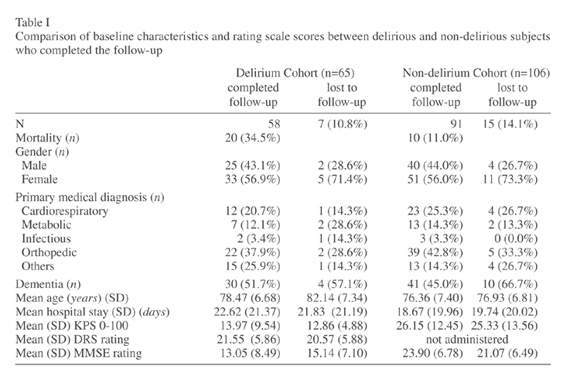
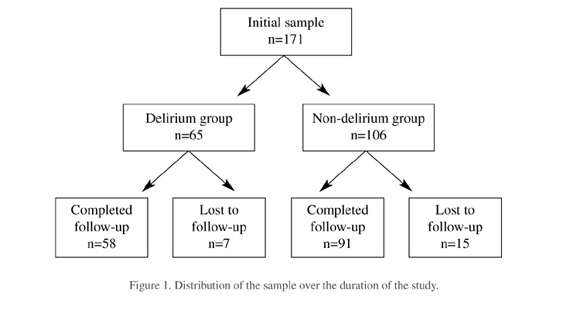
<body><![CDATA[<P> <font size="4">Procedure</font>     <P> The study was undertaken with the consent of the participants or their legal representative. The patients and their relatives were informed that they would be contacted by telephone in order to evaluate their medical status. A psychiatrist expert in detection of delirium of the Consultation-Liaison (C-L) Psychiatry Ward at the Hospital Cl&iacute;nic of Barcelona, selected inpatients with a hospital stay over 72 hours from the medical and orthopedic wards, according to the inclusion criteria. The psychiatrist reviewed the medical record of the patient and interviewed the relatives or the nurses on acute onset and fluctuation of the patient's symptoms of delirium. Then he administered a clinical interview according to DSM-IV criteria and conducted a single cross-sectional evaluation for ratings at the CAM, the MMSE and the KPS. Diagnoses of delirium and dementia were made using all data. If the patient was diagnosed with delirium, the DRS was administered to evaluate the severity of delirium. At three months after enrollment, the C-L psychiatrist contacted each patient or his/her relative(s) in order to obtain information on vital status. All data were entered twice in a database designed for this purpose.     <P> <font size="4">Statistical Analysis</font>     <P> Survival curves for patients with and without delirium were constructed with the Kaplan-Meier product limit estimate (Kaplan &amp; Meier 1958). The significance of differences in survival was tested using the log-rank test.     <P> To evaluate the effect of possible prognostic factors in the survival time the Cox multiple regression model was used (Cox &amp; Oakes 1984). This model identifies and evaluates the relation between a possible set of prognostic variables and the rate of incidence of the event in question (in our study, death).     <P> <I>T</I> test for independent samples or chi-square statistics were used to compare the group of patients who completed the follow-up and those lost to follow-up, in order to ensure that there were no significant differences with respect to the main prognostic risk factors.     <P> <B> <FONT size="4">Results</FONT>  </B>     <P> Of the 171 patients included in the study, 7 patients were lost to follow-up in the delirium group vs. 15 patients in the non-delirium group, representing 12.9% of the initial sample (<a href="#f1">Figure 1</a>). No statistically significant differences were found between these patients and those who completed the study with respect to baseline variables. The rate of delirium in the 149 patients who completed the follow-up was 38.9% (58 patients). Their characteristics are shown in  <a href="#t1">Table I</a>. The mortality rate at three-month follow-up in the patients with delirium was 34.5% versus 11% in those without delirium. When comparing the mean survival times for patients who died in the delirium group (31.05 days, S.D. 23.16) and for those who died in the non-delirium group (21.8 days, S.D. 11) with the <I>t</I> test for independent samples (t=1.18, p=0.24) no statistically significant differences were found.     <P align="center"> <a name="f1"><img src="/img/revistas/ejpen/v19n3/456Fig1.jpg" width="580" height="312"></a>    <P align="center"> &nbsp;    ]]></body>
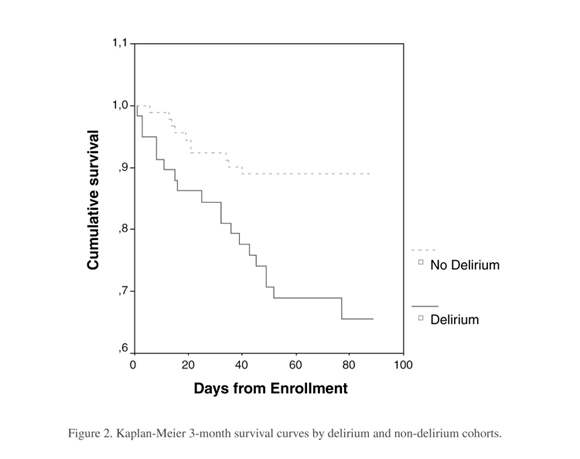
<body><![CDATA[<P align="center"> <a name="t1"> <img src="/img/revistas/ejpen/v19n3/456table1.jpg" width="580" height="390"></a>    <P> The Kaplan-Meier survival curve for the delirium cohort declined rapidly over the 50 days after discharge (<a href="#f2">Figure 2</a>). When comparing the survival curves with the log-rank test, there is a significant difference between survival times in the two cohorts (log-rank=11.92; d.f.=1; P=0.0006).     <P align="center"> <a name="f2"><img src="/img/revistas/ejpen/v19n3/456fig2.jpg" width="580" height="459"></a>    <P> We included the following predictive variables in the univariate Cox regression model in order to assess their prognostic effect on mortality: delirium, age, dementia and overall functioning level (KPS). We found that the diagnosis of delirium (&#967;<SUP>2</SUP>=11.87; p=0.001) and the KPS rates (&#967;<SUP>2</SUP>=4.89; p=0.027) had a significant association with higher mortality. However, in the multivariate model the only remaining explanatory variable was delirium (&#967;<SUP>2</SUP>=11.29; p=0.001).     <P> Differences in mean hospital stay were not statistically significant between the two groups: 22.62 days (SD=21.37) in the delirium vs. 18.67 days (SD=19.96) in the non-delirium group (t=1,129; p=0.261).     <P> <B> <FONT size="4">Discussion</FONT>  </B>     <P> The results of this study confirm the association of delirium with a higher risk for mortality and are in accordance with the findings of previous studies (Rockwood <I>et al.</I> 1999, Francis &amp; Kapoor 1992). Moreover, delirium was showed to be an independent marker for increased mortality, in line with the conclusion of McCusker <I>et al</I>. (2002). However, this result has not been confirmed in all studies (Inouye <I>et al.</I> 1998) This could be due to the fact that the objective of the cited study was to assess hospital outcomes in patients with delirium, and therefore a large number of variables were assessed which can be confounding in the evaluation of mortality as an independent factor.     <P> The selection of the prognostic factors included in our model was based on the results of previous studies showing their impact on the mortality rates. The functional state (KPS) and delirium were associated with the risk of death in the univariate regression model. However, after adjusting for all the assessed factors including dementia and age, we found that only delirium remained independently associated with mortality over the follow-up period.     <P> There are no statistically significant differences in mean survival time between the two groups (delirium and no delirium), and the functional state (KPS) has no independent association with mortality in the final model. Both of these findings could be explained by the severe decline in the functioning level (mean KPS=21.41, S.D.=12.84) at baseline in the study population, which contributes to shorten the survival time in both groups and makes more difficult the comparison between them with respect to global functioning level.     <P> In contrast to the study of McCusker <I>et al.</I> (2002), the variable 'age' was not found to be independently associated with higher mortality in our study. We consider that the reduced follow-up period in our sample could prevent a significant impact of the factor 'age'.     ]]></body>
<body><![CDATA[<P> It is important to highlight that our follow-up period (3 months) is much shorter than in the cited studies (3 years and 12 months, respectively) (Rockwood <I>et al.</I> 1999, McCusker <I>et al.</I> 2002). The survival curves of previous studies show an important decline during the first month followed by a deceleration. Therefore, we assessed a shorter follow-up period, as the effect of delirium on mortality may decrease while the effect of confounding factors may increase with time, which could bias the results over the long run even after statistical adjustment.     <P> The fact that differences in mean hospital stay did not reach statistical differences between the delirium and non-delirium groups in our study, in contrast to other studies, could be explained by the similar grade of impairment of the functional level associated with physical illness in both groups.     <P> Our study has some limitations. The study sample was selected from hospital wards with a high percentage of elderly patients at admission and therefore more severe morbidity due to age. Another limitation might be due to the relatively small sample size and the limited follow-up period. Further studies in different hospital settings should confirm our results in larger samples with longer follow-up periods. Moreover, the presence of delirium was assessed at 72 hours of hospitalization with no information on the existence of previous or subsequent delirious episodes, which could contribute false negative cases to appear in the delirium group. Finally, the functional state assessed with the KPS was used as an indirect measure of severity, while higher accuracy could have been reached by using more specific indicators of the severity of physical illness.     <P> In sum, the results of this study are in line with previous studies confirming the association between delirium and mortality, and point out the effect of delirium on the prognosis over a short period after the acute episode.     <P> &nbsp;     <P> <B><FONT size="4">References</FONT>  </B>     <!-- ref --><P> American Psychiatric Association. <I>Diagnostic and statistical manual of mental disorders (DSM-IV), 4th ed</I>. Washington D.C.: APA; 1994.     &nbsp;&nbsp;&nbsp;&nbsp;&nbsp;&nbsp;&nbsp;&nbsp;[&#160;<a href="javascript:void(0);" onclick="javascript: window.open('/scielo.php?script=sci_nlinks&ref=5920614&pid=S0213-6163200500030000500001&lng=','','width=640,height=500,resizable=yes,scrollbars=1,menubar=yes,');">Links</a>&#160;]<!-- end-ref --><!-- ref --><P> Bulbena A, Corrons C, Amor&oacute;s G et al. Escalas de delirium y orientaci&oacute;n. Adaptaci&oacute;n castellana del <I>Delirium Rating Scale</I> y de la <I>Orientation Scale</I>. <I>Rev Gerontol </I>1996; 6: 245-254.     &nbsp;&nbsp;&nbsp;&nbsp;&nbsp;&nbsp;&nbsp;&nbsp;[&#160;<a href="javascript:void(0);" onclick="javascript: window.open('/scielo.php?script=sci_nlinks&ref=5920615&pid=S0213-6163200500030000500002&lng=','','width=640,height=500,resizable=yes,scrollbars=1,menubar=yes,');">Links</a>&#160;]<!-- end-ref --><!-- ref --><P> Cole M, Mccusker J, Dendukuri N et al. The prognostic significance of subsyndromal delirium in elderly medical inpatients. <I>J Am Geriatr Soc</I> 2003; 51(6): 754-60.     &nbsp;&nbsp;&nbsp;&nbsp;&nbsp;&nbsp;&nbsp;&nbsp;[&#160;<a href="javascript:void(0);" onclick="javascript: window.open('/scielo.php?script=sci_nlinks&ref=5920616&pid=S0213-6163200500030000500003&lng=','','width=640,height=500,resizable=yes,scrollbars=1,menubar=yes,');">Links</a>&#160;]<!-- end-ref --><!-- ref --><P> Cox Dr, Oakes D. <I>Analysis of survival data</I>. London: Chapman &amp; Hall; 1984.     &nbsp;&nbsp;&nbsp;&nbsp;&nbsp;&nbsp;&nbsp;&nbsp;[&#160;<a href="javascript:void(0);" onclick="javascript: window.open('/scielo.php?script=sci_nlinks&ref=5920617&pid=S0213-6163200500030000500004&lng=','','width=640,height=500,resizable=yes,scrollbars=1,menubar=yes,');">Links</a>&#160;]<!-- end-ref --><!-- ref --><P> Crooks V, Waller S, Smith T et al. The use of the <I>Karnofsky Performance Scale </I>in determining outcomes and risk in geriatric outpatients. <I>J Gerontol</I> 1991; 46: M139-M144.     &nbsp;&nbsp;&nbsp;&nbsp;&nbsp;&nbsp;&nbsp;&nbsp;[&#160;<a href="javascript:void(0);" onclick="javascript: window.open('/scielo.php?script=sci_nlinks&ref=5920618&pid=S0213-6163200500030000500005&lng=','','width=640,height=500,resizable=yes,scrollbars=1,menubar=yes,');">Links</a>&#160;]<!-- end-ref --><!-- ref --><P> Folstein MF, Folstein SE, Mchugh PR. "Mini-Mental State": A practical method for grading the cognitive state of patients for the clinician. <I>J Psychiatr Res </I>1975; 12: 189-198.     &nbsp;&nbsp;&nbsp;&nbsp;&nbsp;&nbsp;&nbsp;&nbsp;[&#160;<a href="javascript:void(0);" onclick="javascript: window.open('/scielo.php?script=sci_nlinks&ref=5920619&pid=S0213-6163200500030000500006&lng=','','width=640,height=500,resizable=yes,scrollbars=1,menubar=yes,');">Links</a>&#160;]<!-- end-ref --><!-- ref --><P> Francis J, Kapoor WN. Prognosis after hospital discharge of older medical patients with delirium. <I>Jags</I> 1992; 40: 601-606.     &nbsp;&nbsp;&nbsp;&nbsp;&nbsp;&nbsp;&nbsp;&nbsp;[&#160;<a href="javascript:void(0);" onclick="javascript: window.open('/scielo.php?script=sci_nlinks&ref=5920620&pid=S0213-6163200500030000500007&lng=','','width=640,height=500,resizable=yes,scrollbars=1,menubar=yes,');">Links</a>&#160;]<!-- end-ref --><!-- ref --><P> Inouye SK, Rushing JT, Foreman MD et al. Does delirium contribute to poor hospital outcomes?. A three-site epidemiologic study. <I>J Gen Intern Med</I> 1998; 13: 234-242.     &nbsp;&nbsp;&nbsp;&nbsp;&nbsp;&nbsp;&nbsp;&nbsp;[&#160;<a href="javascript:void(0);" onclick="javascript: window.open('/scielo.php?script=sci_nlinks&ref=5920621&pid=S0213-6163200500030000500008&lng=','','width=640,height=500,resizable=yes,scrollbars=1,menubar=yes,');">Links</a>&#160;]<!-- end-ref --><!-- ref --><P> Inouye SK, Van Dyck CH, Alessi CA et al. Clarifying confusion: the confusion assessment method. A new method for detection of delirium. <I>Ann Inter Med</I> 1990; 113: 941-948.     &nbsp;&nbsp;&nbsp;&nbsp;&nbsp;&nbsp;&nbsp;&nbsp;[&#160;<a href="javascript:void(0);" onclick="javascript: window.open('/scielo.php?script=sci_nlinks&ref=5920622&pid=S0213-6163200500030000500009&lng=','','width=640,height=500,resizable=yes,scrollbars=1,menubar=yes,');">Links</a>&#160;]<!-- end-ref --><!-- ref --><P> Inouye SK. The dilemma of delirium: Clinical and research controversies regarding diagnosis and evaluation of delirium in hospitalized elderly medical patients. <I>Am J Medicine</I> 1994 ; 97: 278-288.     &nbsp;&nbsp;&nbsp;&nbsp;&nbsp;&nbsp;&nbsp;&nbsp;[&#160;<a href="javascript:void(0);" onclick="javascript: window.open('/scielo.php?script=sci_nlinks&ref=5920623&pid=S0213-6163200500030000500010&lng=','','width=640,height=500,resizable=yes,scrollbars=1,menubar=yes,');">Links</a>&#160;]<!-- end-ref --><!-- ref --><P> Kakuma R, Du Fort Gg, Arsenault L et al. Delirium in older emergency department patients discharged home: Effect on survival. <I>J Am Geriatr Soc </I>2003; 51(4): 443-50.     &nbsp;&nbsp;&nbsp;&nbsp;&nbsp;&nbsp;&nbsp;&nbsp;[&#160;<a href="javascript:void(0);" onclick="javascript: window.open('/scielo.php?script=sci_nlinks&ref=5920624&pid=S0213-6163200500030000500011&lng=','','width=640,height=500,resizable=yes,scrollbars=1,menubar=yes,');">Links</a>&#160;]<!-- end-ref --><!-- ref --><P> Kaplan EL, Meier P. Non-parametric estimations from incomplete observations. <I>J Am Statistical Assoc</I> 1958; 53: 457-481.     &nbsp;&nbsp;&nbsp;&nbsp;&nbsp;&nbsp;&nbsp;&nbsp;[&#160;<a href="javascript:void(0);" onclick="javascript: window.open('/scielo.php?script=sci_nlinks&ref=5920625&pid=S0213-6163200500030000500012&lng=','','width=640,height=500,resizable=yes,scrollbars=1,menubar=yes,');">Links</a>&#160;]<!-- end-ref --><!-- ref --><P> Ljubisavljevic V, Kelly B. Risk factors for development of delirium among oncology patients. <I>Gen Hosp Psychiatry</I> 2003; 25(5): 345-52.     &nbsp;&nbsp;&nbsp;&nbsp;&nbsp;&nbsp;&nbsp;&nbsp;[&#160;<a href="javascript:void(0);" onclick="javascript: window.open('/scielo.php?script=sci_nlinks&ref=5920626&pid=S0213-6163200500030000500013&lng=','','width=640,height=500,resizable=yes,scrollbars=1,menubar=yes,');">Links</a>&#160;]<!-- end-ref --><!-- ref --><P> Lobo A, Saz P, Marcos G et al. Revalidation and standardization of the <I>Mini-Exam</I> (First spanish version of the <I>Mini-Mental Status Examination</I>) in the general geriatric population. <I>Med Clin (Barc) </I>1999; 112(20): 767-774.     &nbsp;&nbsp;&nbsp;&nbsp;&nbsp;&nbsp;&nbsp;&nbsp;[&#160;<a href="javascript:void(0);" onclick="javascript: window.open('/scielo.php?script=sci_nlinks&ref=5920627&pid=S0213-6163200500030000500014&lng=','','width=640,height=500,resizable=yes,scrollbars=1,menubar=yes,');">Links</a>&#160;]<!-- end-ref --><!-- ref --><P> Mccusker J, Cole M, Abrahamowicz M et al. Delirium predicts 12-month mortality. <I>Arch Intern Med</I> 2002; 162: 457-463.     &nbsp;&nbsp;&nbsp;&nbsp;&nbsp;&nbsp;&nbsp;&nbsp;[&#160;<a href="javascript:void(0);" onclick="javascript: window.open('/scielo.php?script=sci_nlinks&ref=5920628&pid=S0213-6163200500030000500015&lng=','','width=640,height=500,resizable=yes,scrollbars=1,menubar=yes,');">Links</a>&#160;]<!-- end-ref --><!-- ref --><P> Mccusker J, Cole M, Dendukuri N et al. Delirium in older medical inpatients and subsequent cognitive and functional status: A prospective study. <I>Cmaj</I> 2001; 165(5): 575-83.     &nbsp;&nbsp;&nbsp;&nbsp;&nbsp;&nbsp;&nbsp;&nbsp;[&#160;<a href="javascript:void(0);" onclick="javascript: window.open('/scielo.php?script=sci_nlinks&ref=5920629&pid=S0213-6163200500030000500016&lng=','','width=640,height=500,resizable=yes,scrollbars=1,menubar=yes,');">Links</a>&#160;]<!-- end-ref --><!-- ref --><P> Navin&eacute;s R, G&oacute;mez E, Franco JG et al. Delirium in a consultation-liaison psychiatry unit of a general hospital. <I>Actas Esp Psiquiatr</I> 2001; 29(3): 159-164.     &nbsp;&nbsp;&nbsp;&nbsp;&nbsp;&nbsp;&nbsp;&nbsp;[&#160;<a href="javascript:void(0);" onclick="javascript: window.open('/scielo.php?script=sci_nlinks&ref=5920630&pid=S0213-6163200500030000500017&lng=','','width=640,height=500,resizable=yes,scrollbars=1,menubar=yes,');">Links</a>&#160;]<!-- end-ref --><!-- ref --><P> Pompei P, Foreman M, Rudberg MA et al. Delirium in hospitalized older persons: Outcomes and predictors. <I>J Am Geriatr Soc</I> 1994; 42(8): 809-15.     &nbsp;&nbsp;&nbsp;&nbsp;&nbsp;&nbsp;&nbsp;&nbsp;[&#160;<a href="javascript:void(0);" onclick="javascript: window.open('/scielo.php?script=sci_nlinks&ref=5920631&pid=S0213-6163200500030000500018&lng=','','width=640,height=500,resizable=yes,scrollbars=1,menubar=yes,');">Links</a>&#160;]<!-- end-ref --><!-- ref --><P> Rizzo Ja, Bogardous St Jr, Leo-Summers Let al. Multicomponent targeted intervention to prevent delirium in hospitalized older patients: What is the economic value?. <I>Med Care </I>2001; 39(7): 740-752.     &nbsp;&nbsp;&nbsp;&nbsp;&nbsp;&nbsp;&nbsp;&nbsp;[&#160;<a href="javascript:void(0);" onclick="javascript: window.open('/scielo.php?script=sci_nlinks&ref=5920632&pid=S0213-6163200500030000500019&lng=','','width=640,height=500,resizable=yes,scrollbars=1,menubar=yes,');">Links</a>&#160;]<!-- end-ref --><!-- ref --><P> Rockwood K, Cosway S, Carver D et al. The risk of dementia and death after delirium. <I>Age Ageing</I> 1999; 28: 551-556.     &nbsp;&nbsp;&nbsp;&nbsp;&nbsp;&nbsp;&nbsp;&nbsp;[&#160;<a href="javascript:void(0);" onclick="javascript: window.open('/scielo.php?script=sci_nlinks&ref=5920633&pid=S0213-6163200500030000500020&lng=','','width=640,height=500,resizable=yes,scrollbars=1,menubar=yes,');">Links</a>&#160;]<!-- end-ref --><!-- ref --><P> Schag CC, Heinrich RL, Ganz PA. Karnofsky Performance Status Revisited: Reliability validity and guidelines. <I>J Clin Oncology</I> 1984; 2: 187-193.     &nbsp;&nbsp;&nbsp;&nbsp;&nbsp;&nbsp;&nbsp;&nbsp;[&#160;<a href="javascript:void(0);" onclick="javascript: window.open('/scielo.php?script=sci_nlinks&ref=5920634&pid=S0213-6163200500030000500021&lng=','','width=640,height=500,resizable=yes,scrollbars=1,menubar=yes,');">Links</a>&#160;]<!-- end-ref --><!-- ref --><P> Sitjas E, San Jose A, Armadans L et al. Predictor factors about functional decline in community-dwelling older persons. <I>Aten Primaria</I> 2003; 32(5): 282-287.     &nbsp;&nbsp;&nbsp;&nbsp;&nbsp;&nbsp;&nbsp;&nbsp;[&#160;<a href="javascript:void(0);" onclick="javascript: window.open('/scielo.php?script=sci_nlinks&ref=5920635&pid=S0213-6163200500030000500022&lng=','','width=640,height=500,resizable=yes,scrollbars=1,menubar=yes,');">Links</a>&#160;]<!-- end-ref --><!-- ref --><P> Trzepacz PT, Baker RW, Greenhouse J. A Symptom Rating Scale for delirium. <I>Psychiatry Res </I>1988; 23: 89-97.     &nbsp;&nbsp;&nbsp;&nbsp;&nbsp;&nbsp;&nbsp;&nbsp;[&#160;<a href="javascript:void(0);" onclick="javascript: window.open('/scielo.php?script=sci_nlinks&ref=5920636&pid=S0213-6163200500030000500023&lng=','','width=640,height=500,resizable=yes,scrollbars=1,menubar=yes,');">Links</a>&#160;]<!-- end-ref --><P> &nbsp;     ]]></body>
<body><![CDATA[<P> <FONT SIZE=2>Address for correspondence:    <BR> Joan de Pablo    <BR> Secci&oacute;n de Psiquiatr&iacute;a de Enlace del Instituto Cl&iacute;nico de Psiquiatr&iacute;a y Psicolog&iacute;a    <BR> Hospital Cl&iacute;nico de Barcelona    <BR> Villaroel, 170    <BR> 08036 Barcelona    <BR> <a href="mailto:jdepablo@clinic.ub.es">jdepablo@clinic.ub.es</a>    <BR> SPAIN</FONT>      ]]></body><back>
<ref-list>
<ref id="B1">
<nlm-citation citation-type="book">
<collab>American Psychiatric Association</collab>
<source><![CDATA[Diagnostic and statistical manual of mental disorders (DSM-IV)]]></source>
<year>1994</year>
<edition>4</edition>
<publisher-loc><![CDATA[Washington ]]></publisher-loc>
<publisher-name><![CDATA[APA]]></publisher-name>
</nlm-citation>
</ref>
<ref id="B2">
<nlm-citation citation-type="journal">
<person-group person-group-type="author">
<name>
<surname><![CDATA[Bulbena]]></surname>
<given-names><![CDATA[A]]></given-names>
</name>
<name>
<surname><![CDATA[Corrons]]></surname>
<given-names><![CDATA[C]]></given-names>
</name>
<name>
<surname><![CDATA[Amorós]]></surname>
<given-names><![CDATA[G]]></given-names>
</name>
</person-group>
<article-title xml:lang="es"><![CDATA[Escalas de delirium y orientación: Adaptación castellana del Delirium Rating Scale y de la Orientation Scale]]></article-title>
<source><![CDATA[Rev Gerontol]]></source>
<year>1996</year>
<volume>6</volume>
<page-range>245-254</page-range></nlm-citation>
</ref>
<ref id="B3">
<nlm-citation citation-type="journal">
<person-group person-group-type="author">
<name>
<surname><![CDATA[Cole]]></surname>
<given-names><![CDATA[M]]></given-names>
</name>
<name>
<surname><![CDATA[Mccusker]]></surname>
<given-names><![CDATA[J]]></given-names>
</name>
<name>
<surname><![CDATA[Dendukuri]]></surname>
<given-names><![CDATA[N]]></given-names>
</name>
</person-group>
<article-title xml:lang="en"><![CDATA[The prognostic significance of subsyndromal delirium in elderly medical inpatients]]></article-title>
<source><![CDATA[J Am Geriatr Soc]]></source>
<year>2003</year>
<volume>51</volume>
<numero>6</numero>
<issue>6</issue>
<page-range>754-60</page-range></nlm-citation>
</ref>
<ref id="B4">
<nlm-citation citation-type="book">
<person-group person-group-type="author">
<name>
<surname><![CDATA[Cox]]></surname>
<given-names><![CDATA[Dr]]></given-names>
</name>
<name>
<surname><![CDATA[Oakes]]></surname>
<given-names><![CDATA[D]]></given-names>
</name>
</person-group>
<source><![CDATA[Analysis of survival data]]></source>
<year>1984</year>
<publisher-loc><![CDATA[London ]]></publisher-loc>
<publisher-name><![CDATA[Chapman & Hall]]></publisher-name>
</nlm-citation>
</ref>
<ref id="B5">
<nlm-citation citation-type="journal">
<person-group person-group-type="author">
<name>
<surname><![CDATA[Crooks]]></surname>
<given-names><![CDATA[V]]></given-names>
</name>
<name>
<surname><![CDATA[Waller]]></surname>
<given-names><![CDATA[S]]></given-names>
</name>
<name>
<surname><![CDATA[Smith]]></surname>
<given-names><![CDATA[T]]></given-names>
</name>
</person-group>
<article-title xml:lang="en"><![CDATA[The use of the Karnofsky Performance Scale in determining outcomes and risk in geriatric outpatients]]></article-title>
<source><![CDATA[J Gerontol]]></source>
<year>1991</year>
<volume>46</volume>
<page-range>M139-M144</page-range></nlm-citation>
</ref>
<ref id="B6">
<nlm-citation citation-type="journal">
<person-group person-group-type="author">
<name>
<surname><![CDATA[Folstein]]></surname>
<given-names><![CDATA[MF]]></given-names>
</name>
<name>
<surname><![CDATA[Folstein]]></surname>
<given-names><![CDATA[SE]]></given-names>
</name>
<name>
<surname><![CDATA[Mchugh]]></surname>
<given-names><![CDATA[PR]]></given-names>
</name>
</person-group>
<article-title xml:lang="en"><![CDATA["Mini-Mental State": A practical method for grading the cognitive state of patients for the clinician]]></article-title>
<source><![CDATA[J Psychiatr Res]]></source>
<year>1975</year>
<volume>12</volume>
<page-range>189-198</page-range></nlm-citation>
</ref>
<ref id="B7">
<nlm-citation citation-type="journal">
<person-group person-group-type="author">
<name>
<surname><![CDATA[Francis]]></surname>
<given-names><![CDATA[J]]></given-names>
</name>
<name>
<surname><![CDATA[Kapoor]]></surname>
<given-names><![CDATA[WN]]></given-names>
</name>
</person-group>
<article-title xml:lang="en"><![CDATA[Prognosis after hospital discharge of older medical patients with delirium]]></article-title>
<source><![CDATA[Jags]]></source>
<year>1992</year>
<volume>40</volume>
<page-range>601-606</page-range></nlm-citation>
</ref>
<ref id="B8">
<nlm-citation citation-type="journal">
<person-group person-group-type="author">
<name>
<surname><![CDATA[Inouye]]></surname>
<given-names><![CDATA[SK]]></given-names>
</name>
<name>
<surname><![CDATA[Rushing]]></surname>
<given-names><![CDATA[JT]]></given-names>
</name>
<name>
<surname><![CDATA[Foreman]]></surname>
<given-names><![CDATA[MD]]></given-names>
</name>
</person-group>
<article-title xml:lang="en"><![CDATA[Does delirium contribute to poor hospital outcomes?: A three-site epidemiologic study]]></article-title>
<source><![CDATA[J Gen Intern Med]]></source>
<year>1998</year>
<volume>13</volume>
<page-range>234-242</page-range></nlm-citation>
</ref>
<ref id="B9">
<nlm-citation citation-type="journal">
<person-group person-group-type="author">
<name>
<surname><![CDATA[Inouye]]></surname>
<given-names><![CDATA[SK]]></given-names>
</name>
<name>
<surname><![CDATA[Van Dyck]]></surname>
<given-names><![CDATA[CH]]></given-names>
</name>
<name>
<surname><![CDATA[Alessi]]></surname>
<given-names><![CDATA[CA]]></given-names>
</name>
</person-group>
<article-title xml:lang="en"><![CDATA[Clarifying confusion: the confusion assessment method. A new method for detection of delirium]]></article-title>
<source><![CDATA[Ann Inter Med]]></source>
<year>1990</year>
<volume>113</volume>
<page-range>941-948</page-range></nlm-citation>
</ref>
<ref id="B10">
<nlm-citation citation-type="journal">
<person-group person-group-type="author">
<name>
<surname><![CDATA[Inouye]]></surname>
<given-names><![CDATA[SK]]></given-names>
</name>
</person-group>
<article-title xml:lang="en"><![CDATA[The dilemma of delirium: Clinical and research controversies regarding diagnosis and evaluation of delirium in hospitalized elderly medical patients]]></article-title>
<source><![CDATA[Am J Medicine]]></source>
<year>1994</year>
<volume>97</volume>
<page-range>278-288</page-range></nlm-citation>
</ref>
<ref id="B11">
<nlm-citation citation-type="journal">
<person-group person-group-type="author">
<name>
<surname><![CDATA[Kakuma]]></surname>
<given-names><![CDATA[R]]></given-names>
</name>
<name>
<surname><![CDATA[Du Fort]]></surname>
<given-names><![CDATA[Gg]]></given-names>
</name>
<name>
<surname><![CDATA[Arsenault]]></surname>
<given-names><![CDATA[L]]></given-names>
</name>
</person-group>
<article-title xml:lang="en"><![CDATA[Delirium in older emergency department patients discharged home: Effect on survival]]></article-title>
<source><![CDATA[J Am Geriatr Soc]]></source>
<year>2003</year>
<volume>51</volume>
<numero>4</numero>
<issue>4</issue>
<page-range>443-50</page-range></nlm-citation>
</ref>
<ref id="B12">
<nlm-citation citation-type="journal">
<person-group person-group-type="author">
<name>
<surname><![CDATA[Kaplan]]></surname>
<given-names><![CDATA[EL]]></given-names>
</name>
<name>
<surname><![CDATA[Meier]]></surname>
<given-names><![CDATA[P]]></given-names>
</name>
</person-group>
<article-title xml:lang="en"><![CDATA[Non-parametric estimations from incomplete observations]]></article-title>
<source><![CDATA[J Am Statistical Assoc]]></source>
<year>1958</year>
<volume>53</volume>
<page-range>457-481</page-range></nlm-citation>
</ref>
<ref id="B13">
<nlm-citation citation-type="journal">
<person-group person-group-type="author">
<name>
<surname><![CDATA[Ljubisavljevic]]></surname>
<given-names><![CDATA[V]]></given-names>
</name>
<name>
<surname><![CDATA[Kelly]]></surname>
<given-names><![CDATA[B]]></given-names>
</name>
</person-group>
<article-title xml:lang="en"><![CDATA[Risk factors for development of delirium among oncology patients]]></article-title>
<source><![CDATA[Gen Hosp Psychiatry]]></source>
<year>2003</year>
<volume>25</volume>
<numero>5</numero>
<issue>5</issue>
<page-range>345-52</page-range></nlm-citation>
</ref>
<ref id="B14">
<nlm-citation citation-type="journal">
<person-group person-group-type="author">
<name>
<surname><![CDATA[Lobo]]></surname>
<given-names><![CDATA[A]]></given-names>
</name>
<name>
<surname><![CDATA[Saz]]></surname>
<given-names><![CDATA[P]]></given-names>
</name>
<name>
<surname><![CDATA[Marcos]]></surname>
<given-names><![CDATA[G]]></given-names>
</name>
</person-group>
<article-title xml:lang="en"><![CDATA[Revalidation and standardization of the Mini-Exam (First spanish version of the Mini-Mental Status Examination) in the general geriatric population]]></article-title>
<source><![CDATA[Med Clin (Barc)]]></source>
<year>1999</year>
<volume>112</volume>
<numero>20</numero>
<issue>20</issue>
<page-range>767-774</page-range></nlm-citation>
</ref>
<ref id="B15">
<nlm-citation citation-type="journal">
<person-group person-group-type="author">
<name>
<surname><![CDATA[Mccusker]]></surname>
<given-names><![CDATA[J]]></given-names>
</name>
<name>
<surname><![CDATA[Cole]]></surname>
<given-names><![CDATA[M]]></given-names>
</name>
<name>
<surname><![CDATA[Abrahamowicz]]></surname>
<given-names><![CDATA[M]]></given-names>
</name>
</person-group>
<article-title xml:lang="en"><![CDATA[Delirium predicts 12-month mortality]]></article-title>
<source><![CDATA[Arch Intern Med]]></source>
<year>2002</year>
<volume>162</volume>
<page-range>457-463</page-range></nlm-citation>
</ref>
<ref id="B16">
<nlm-citation citation-type="journal">
<person-group person-group-type="author">
<name>
<surname><![CDATA[Mccusker]]></surname>
<given-names><![CDATA[J]]></given-names>
</name>
<name>
<surname><![CDATA[Cole]]></surname>
<given-names><![CDATA[M]]></given-names>
</name>
<name>
<surname><![CDATA[Dendukuri]]></surname>
<given-names><![CDATA[N]]></given-names>
</name>
</person-group>
<article-title xml:lang="en"><![CDATA[Delirium in older medical inpatients and subsequent cognitive and functional status: A prospective study]]></article-title>
<source><![CDATA[Cmaj]]></source>
<year>2001</year>
<volume>165</volume>
<numero>5</numero>
<issue>5</issue>
<page-range>575-83</page-range></nlm-citation>
</ref>
<ref id="B17">
<nlm-citation citation-type="journal">
<person-group person-group-type="author">
<name>
<surname><![CDATA[Navinés]]></surname>
<given-names><![CDATA[R]]></given-names>
</name>
<name>
<surname><![CDATA[Gómez]]></surname>
<given-names><![CDATA[E]]></given-names>
</name>
<name>
<surname><![CDATA[Franco]]></surname>
<given-names><![CDATA[JG]]></given-names>
</name>
</person-group>
<article-title xml:lang="en"><![CDATA[Delirium in a consultation-liaison psychiatry unit of a general hospital]]></article-title>
<source><![CDATA[Actas Esp Psiquiatr]]></source>
<year>2001</year>
<volume>29</volume>
<numero>3</numero>
<issue>3</issue>
<page-range>159-164</page-range></nlm-citation>
</ref>
<ref id="B18">
<nlm-citation citation-type="journal">
<person-group person-group-type="author">
<name>
<surname><![CDATA[Pompei]]></surname>
<given-names><![CDATA[P]]></given-names>
</name>
<name>
<surname><![CDATA[Foreman]]></surname>
<given-names><![CDATA[M]]></given-names>
</name>
<name>
<surname><![CDATA[Rudberg]]></surname>
<given-names><![CDATA[MA]]></given-names>
</name>
</person-group>
<article-title xml:lang="en"><![CDATA[Delirium in hospitalized older persons: Outcomes and predictors]]></article-title>
<source><![CDATA[J Am Geriatr Soc]]></source>
<year>1994</year>
<volume>42</volume>
<numero>8</numero>
<issue>8</issue>
<page-range>809-15</page-range></nlm-citation>
</ref>
<ref id="B19">
<nlm-citation citation-type="journal">
<person-group person-group-type="author">
<name>
<surname><![CDATA[Rizzo]]></surname>
<given-names><![CDATA[Ja]]></given-names>
</name>
<name>
<surname><![CDATA[Bogardous]]></surname>
<given-names><![CDATA[St Jr]]></given-names>
</name>
<name>
<surname><![CDATA[Leo-Summers]]></surname>
<given-names><![CDATA[L]]></given-names>
</name>
</person-group>
<article-title xml:lang="en"><![CDATA[Multicomponent targeted intervention to prevent delirium in hospitalized older patients: What is the economic value?]]></article-title>
<source><![CDATA[Med Care]]></source>
<year>2001</year>
<volume>39</volume>
<numero>7</numero>
<issue>7</issue>
<page-range>740-752</page-range></nlm-citation>
</ref>
<ref id="B20">
<nlm-citation citation-type="journal">
<person-group person-group-type="author">
<name>
<surname><![CDATA[Rockwood]]></surname>
<given-names><![CDATA[K]]></given-names>
</name>
<name>
<surname><![CDATA[Cosway]]></surname>
<given-names><![CDATA[S]]></given-names>
</name>
<name>
<surname><![CDATA[Carver]]></surname>
<given-names><![CDATA[D]]></given-names>
</name>
</person-group>
<article-title xml:lang="en"><![CDATA[The risk of dementia and death after delirium]]></article-title>
<source><![CDATA[Age Ageing]]></source>
<year>1999</year>
<volume>28</volume>
<page-range>551-556</page-range></nlm-citation>
</ref>
<ref id="B21">
<nlm-citation citation-type="journal">
<person-group person-group-type="author">
<name>
<surname><![CDATA[Schag]]></surname>
<given-names><![CDATA[CC]]></given-names>
</name>
<name>
<surname><![CDATA[Heinrich]]></surname>
<given-names><![CDATA[RL]]></given-names>
</name>
<name>
<surname><![CDATA[Ganz]]></surname>
<given-names><![CDATA[PA]]></given-names>
</name>
</person-group>
<article-title xml:lang="en"><![CDATA[Karnofsky Performance Status Revisited: Reliability validity and guidelines]]></article-title>
<source><![CDATA[J Clin Oncology]]></source>
<year>1984</year>
<volume>2</volume>
<page-range>187-193</page-range></nlm-citation>
</ref>
<ref id="B22">
<nlm-citation citation-type="journal">
<person-group person-group-type="author">
<name>
<surname><![CDATA[Sitjas]]></surname>
<given-names><![CDATA[E]]></given-names>
</name>
<name>
<surname><![CDATA[San Jose]]></surname>
<given-names><![CDATA[A]]></given-names>
</name>
<name>
<surname><![CDATA[Armadans]]></surname>
<given-names><![CDATA[L]]></given-names>
</name>
</person-group>
<article-title xml:lang="en"><![CDATA[Predictor factors about functional decline in community-dwelling older persons]]></article-title>
<source><![CDATA[Aten Primaria]]></source>
<year>2003</year>
<volume>32</volume>
<numero>5</numero>
<issue>5</issue>
<page-range>282-287</page-range></nlm-citation>
</ref>
<ref id="B23">
<nlm-citation citation-type="journal">
<person-group person-group-type="author">
<name>
<surname><![CDATA[Trzepacz]]></surname>
<given-names><![CDATA[PT]]></given-names>
</name>
<name>
<surname><![CDATA[Baker]]></surname>
<given-names><![CDATA[RW]]></given-names>
</name>
<name>
<surname><![CDATA[Greenhouse]]></surname>
<given-names><![CDATA[J]]></given-names>
</name>
</person-group>
<article-title xml:lang="en"><![CDATA[A Symptom Rating Scale for delirium]]></article-title>
<source><![CDATA[Psychiatry Res]]></source>
<year>1988</year>
<volume>23</volume>
<page-range>89-97</page-range></nlm-citation>
</ref>
</ref-list>
</back>
</article>