<?xml version="1.0" encoding="ISO-8859-1"?><article xmlns:mml="http://www.w3.org/1998/Math/MathML" xmlns:xlink="http://www.w3.org/1999/xlink" xmlns:xsi="http://www.w3.org/2001/XMLSchema-instance">
<front>
<journal-meta>
<journal-id>0213-6163</journal-id>
<journal-title><![CDATA[The European Journal of Psychiatry]]></journal-title>
<abbrev-journal-title><![CDATA[Eur. J. Psychiat.]]></abbrev-journal-title>
<issn>0213-6163</issn>
<publisher>
<publisher-name><![CDATA[Universidad de Zaragoza]]></publisher-name>
</publisher>
</journal-meta>
<article-meta>
<article-id>S0213-61632010000300001</article-id>
<title-group>
<article-title xml:lang="en"><![CDATA[Cognitive deficits in hospitalized and never hospitalized remitted unipolar depressive patients]]></article-title>
</title-group>
<contrib-group>
<contrib contrib-type="author">
<name>
<surname><![CDATA[Preiss]]></surname>
<given-names><![CDATA[Marek]]></given-names>
</name>
<xref ref-type="aff" rid="A01"/>
</contrib>
<contrib contrib-type="author">
<name>
<surname><![CDATA[Kucerova]]></surname>
<given-names><![CDATA[Hana]]></given-names>
</name>
<xref ref-type="aff" rid="A02"/>
</contrib>
<contrib contrib-type="author">
<name>
<surname><![CDATA[Lukavsky]]></surname>
<given-names><![CDATA[Jiri]]></given-names>
</name>
<xref ref-type="aff" rid="A03"/>
</contrib>
<contrib contrib-type="author">
<name>
<surname><![CDATA[Sos]]></surname>
<given-names><![CDATA[Petr]]></given-names>
</name>
<xref ref-type="aff" rid="A01"/>
</contrib>
<contrib contrib-type="author">
<name>
<surname><![CDATA[Stepankova]]></surname>
<given-names><![CDATA[Hana]]></given-names>
</name>
<xref ref-type="aff" rid="A01"/>
</contrib>
<contrib contrib-type="author">
<name>
<surname><![CDATA[Cermakova]]></surname>
<given-names><![CDATA[Radka]]></given-names>
</name>
<xref ref-type="aff" rid="A01"/>
</contrib>
</contrib-group>
<aff id="A01">
<institution><![CDATA[,Prague Psychiatric Center  ]]></institution>
<addr-line><![CDATA[ ]]></addr-line>
</aff>
<aff id="A02">
<institution><![CDATA[,Faculty Hospital Brno  ]]></institution>
<addr-line><![CDATA[Brno ]]></addr-line>
</aff>
<aff id="A03">
<institution><![CDATA[,Academy of Sciences  ]]></institution>
<addr-line><![CDATA[Prague ]]></addr-line>
<country>CZECH REPUBLIC</country>
</aff>
<pub-date pub-type="pub">
<day>00</day>
<month>09</month>
<year>2010</year>
</pub-date>
<pub-date pub-type="epub">
<day>00</day>
<month>09</month>
<year>2010</year>
</pub-date>
<volume>24</volume>
<numero>3</numero>
<fpage>129</fpage>
<lpage>135</lpage>
<copyright-statement/>
<copyright-year/>
<self-uri xlink:href="http://scielo.isciii.es/scielo.php?script=sci_arttext&amp;pid=S0213-61632010000300001&amp;lng=en&amp;nrm=iso"></self-uri><self-uri xlink:href="http://scielo.isciii.es/scielo.php?script=sci_abstract&amp;pid=S0213-61632010000300001&amp;lng=en&amp;nrm=iso"></self-uri><self-uri xlink:href="http://scielo.isciii.es/scielo.php?script=sci_pdf&amp;pid=S0213-61632010000300001&amp;lng=en&amp;nrm=iso"></self-uri><abstract abstract-type="short" xml:lang="en"><p><![CDATA[Background and Objectives: Little is known about the differences between patients managing depression on an outpatient basis as compared with hospitalized ones. This study investigated the performance of attention, executive function and verbal memory during remission from unipolar depressive episodes and compare patients with and without history of hospitalization. Methods: The sample of participants who had undergone one or more hospitalizations (hospitalized, N = 46) as well as in a sample without hospitalization (never hospitalized, N = 46) and controls (N = 92) were used. The Auditory Verbal Learning Test (AVLT) and the Trail Making Test (TMT) were administrated to test this hypothesis. Results and conclusion: The hospitalized sample had similar results in all four neuropsychological variables in comparison with the never hospitalized group, and both groups had some lower results in comparison with controls. In comparison with the controls, hospitalized sample had mean cognitive deficits of 34% (28-41%), the never hospitalized group had a mean of 20% (21-35%). Contrary to previous reports we have found no meaningful differences between the two patient groups.]]></p></abstract>
<kwd-group>
<kwd lng="en"><![CDATA[Hospitalization]]></kwd>
<kwd lng="en"><![CDATA[Major depressive episode]]></kwd>
<kwd lng="en"><![CDATA[Remission]]></kwd>
<kwd lng="en"><![CDATA[Cognitive function]]></kwd>
<kwd lng="en"><![CDATA[Course of illness]]></kwd>
<kwd lng="en"><![CDATA[Outcome]]></kwd>
</kwd-group>
</article-meta>
</front><body><![CDATA[ <p><a name="top"></a><font face="Verdana" size="2"><b>SHORT REPORT</b></font></p>     <p>&nbsp;</p>     <p><font face="Verdana" size="4"><b>Cognitive deficits in hospitalized and never hospitalized remitted unipolar depressive patients</b></font></p>     <p>&nbsp;</p>     <p>&nbsp;</p>     <p><font face="Verdana" size="2"><b>Marek Preiss*; Hana Kucerova**; Jiri Lukavsky***; Petr Sos*; Hana Stepankova*; Radka Cermakova*</b></font></p>     <p><font face="Verdana" size="2">* Prague Psychiatric Center    <br>** The Faculty Hospital Brno, Brno    <br>*** Academy of Sciences, Prague. CZECH REPUBLIC</font></p>     <p><font face="Verdana" size="2">Funding for this study was provided by MSMT 1M0517.</font></p>     ]]></body>
<body><![CDATA[<p><font face="Verdana" size="2"><a href="#back">Correspondence</a></font></p>     <p>&nbsp;</p>     <p>&nbsp;</p> <hr size="1">    <p><font face="Verdana" size="2"><b>ABSTRACT</b></font></p>     <p><font face="Verdana" size="2"><b>Background and Objectives:</b> Little is known about the differences between patients managing depression on an outpatient basis as compared with hospitalized ones. This study investigated the performance of attention, executive function and verbal memory during remission from unipolar depressive episodes and compare patients with and without history of hospitalization.    <br><b>Methods:</b> The sample of participants who had undergone one or more hospitalizations (hospitalized, N = 46) as well as in a sample without hospitalization (never hospitalized, N = 46) and controls (N = 92) were used. The Auditory Verbal Learning Test (AVLT) and the Trail Making Test (TMT) were administrated to test this hypothesis.    <br><b>Results and conclusion:</b> The hospitalized sample had similar results in all four neuropsychological variables in comparison with the never hospitalized group, and both groups had some lower results in comparison with controls. In comparison with the controls, hospitalized sample had mean cognitive deficits of 34% (28-41%), the never hospitalized group had a mean of 20% (21-35%). Contrary to previous reports we have found no meaningful differences between the two patient groups.</font></p>     <p><font face="Verdana" size="2"><b>Key words:</b> Hospitalization; Major depressive episode; Remission; Cognitive function; Course of illness; Outcome.</font></p> <hr size="1">     <p>&nbsp;</p>     <p><font face="Verdana" size="2"><b>Introduction</b></font></p>     ]]></body>
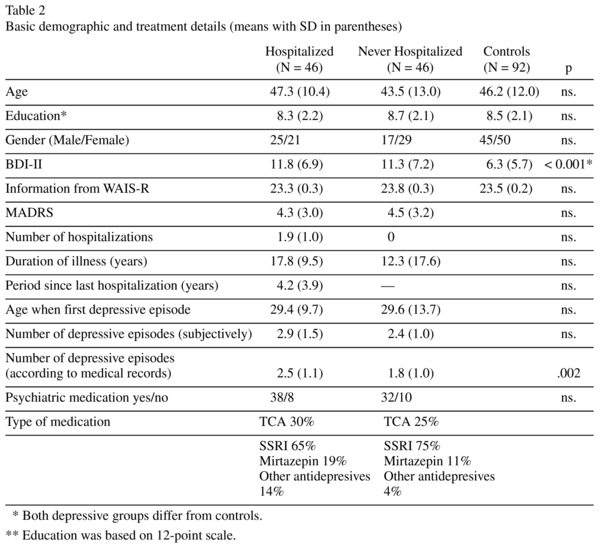
<body><![CDATA[<p><font face="Verdana" size="2">Major depression is a prevalent and disabling disorder with high rates of recurrence and chronicity<sup>1-2</sup>. Cognitive impairment is likely to be a key factor affecting the subject&acute;s ability to function occupationally<sup>3-6</sup>. The "therapeutic" aspects of mental hospitalization are generally taken for granted, and are usually considered to comprise protection, separation from a potentially pathogenic environment, and positive contact between patients and staff<sup>7</sup>.</font></p>     <p><font face="Verdana" size="2">Kessing<sup>8</sup>, who studied patients with primary affective disorders who had undergone hospitalization for depression, mania or a recurrent episode, and with no further admissions or with 2 more additional admissions, found that cognitive impairment appears to increase with the increasing number of episodes a patient has experienced. On the other hand, patients with a history of more than one hospitalization did not show any differences compared to patients experiencing their first hospitalization on most of the neuropsychological tests and clinical variables<sup>9</sup>. We might think that impaired cognitive performance in hospitalized patients relates to the fact that people with more severe symptomathology are hospitalized. The patients with a history of hospitalization had worse results than those without such a history<sup>10-11</sup>. Neuropsychological assessment is an ideal strategy for obtaining collaborative data in a psychiatric population due to the presumed absence of self-report bias<sup>12</sup>. We assumed that remitted patients who were previously hospitalized would demonstrate worse impairment of attention, memory and executive function in comparison to those remitted patients who had never been hospitalized.</font></p>     <p>&nbsp;</p>     <p><font face="Verdana" size="2"><b>Material and Methods</b></font></p>     <p><font face="Verdana">Sample</font></p>     <p><font face="Verdana" size="2">The study was conducted with 92 unipolar depressive outpatients (42 men and 50 women; Table <a href="#t1">1</a> and <a href="#t2">2</a>). All the patients met the criteria for formerly having major depressive disorder according to ICD-10. All patients were in a remitted state at the time of testing. Remission was defined as a period of at least 2 months during which the subject functioned well (subjectively according to the patient and objectively according to their psychiatrist) and the MADRS on the day of study &lt; 12. Patients were divided into two groups: never hospitalized (N = 46) or hospitalized (N = 46). Controls were recruited from the general population and they were matched for age, gender and education with the test groups (<a href="#t1">Table 1</a>).</font></p>     <p align="center"><a name="t1"><img src="/img/revistas/ejpen/v24n3/original1_table1.jpg" width="600" height="494"></a></font></p>     <p align="center"><a name="t2"><img src="/img/revistas/ejpen/v24n3/original1_table2.jpg" width="600" height="547"></a></font></p>     <p>&nbsp;</p>     <p><font face="Verdana" size="2">Individuals with mental retardation (IQ &lt; 70 according to subtest Information from WAIS-R, scale score 6 and lower), dementia, substance abuse/dependence, neurological disorders or clinical/laboratory indications of a severe organic disease, actual or prior bipolar I or II were not counted. Written consent was obtained and the study was approved by the Ethical Regional Committee for Medicine of Prague Psychiatric Center.</font></p>     ]]></body>
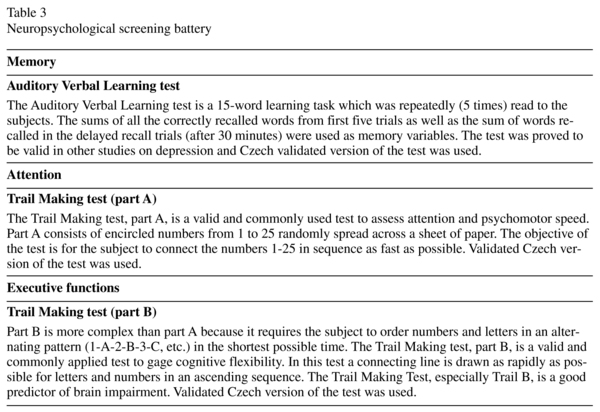
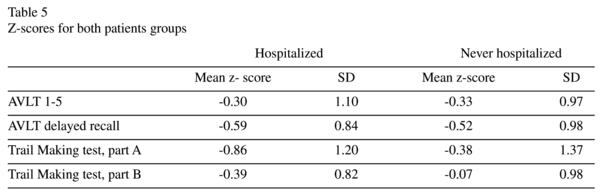
<body><![CDATA[<p>&nbsp;</p>     <p><font face="Verdana" size="2"><b>Methods</b></font></p>     <p><font face="Verdana" size="2">All subjects were given a battery of short neuropsychological tests (<a href="#t3">Table 3</a>). Traditional neuropsychological criteria for cognitive impairment would identify those individuals who performed better than 1 SD below the healthy control mean as "unimpaired"<sup>13-14</sup>.</font></p>     <p align="center"><a name="t3"><img src="/img/revistas/ejpen/v24n3/original1_table3.jpg" width="600" height="412"></a></font></p>     <p>&nbsp;</p>     <p><font face="Verdana" size="2"><b>Results</b></font></p>     <p><font face="Verdana" size="2">As can be seen in <a href="#t2">Table 2</a>, groups were well matched. The number of hospitalizations was rather small in the hospitalized group (M = 1.9, SD = 1.0; maximum 5 hospitalizations). On average, hospitalized patients had been hospitalized 4 years prior (M = 4.2, SD = 3.9). The mean duration of illness was 17.8 years in the hospitalized group and 12.3 in never hospitalized group. The average age of the first depressive episode was 29.4 resp. 29.6 years. The mean number of depressive episodes was subjectively 2.9 vs. 2.4 and according to medical records 2.5 vs. 1.8.</font></p>     <p><font face="Verdana" size="2">Performance of both groups is presented in <a href="#t4">Table 4</a>. Mean z-scores of patients and controls are seen in <a href="#t5">Table 5</a>. In comparison with the controls, all mean z-scores for the depressive groups are lower. The hospitalized sample had cognitive deficits in the AVLT Trial (28%), in AVLT delayed recall (35%), in the Trail Making Test, part A (41%), and in Trail Making test, part B (30%). The never hospitalized sample demonstrated signs of cognitive deficit in the AVLT Trial (33%), in the AVLT delayed recall (35%), in the Trail Making Test, part A (22%), and in the Trail Making test, part B (21%). In total, 34% of the hospitalized sample had cognitive deficits, and 20% of the never hospitalized sample presented the same deficiencies (p = 0.134).</font></p>     <p align="center"><a name="t4"><img src="/img/revistas/ejpen/v24n3/original1_table4.jpg" width="600" height="213"></a></font></p>     <p align="center"><a name="t5"><img src="/img/revistas/ejpen/v24n3/original1_table5.jpg" width="600" height="195"></a></font></p>     ]]></body>
<body><![CDATA[<p>&nbsp;</p>     <p><font face="Verdana" size="2"><b>Discussion</b></font></p>     <p><font face="Verdana" size="2">The hospitalized sample did not have worse results in any from 4 neuropsychological tests compared to the never hospitalized sample. The only statistically significant difference in comparison with controls was in the Trail Making test, part A, with worse performance found in the hospitalized sample and in AVLT delayed recall for both depressive samples.</font></p>     <p><font face="Verdana" size="2">Both depressive samples had significantly higher levels of subjective depressiveness according to the BDI-II in comparison with controls. These results may suggest that certain residual depressive symptomatology may affect performance in neuropsychological tests. This may be true despite the fact that no relationship between neuropsychological tests and BDI-II/MADRS was proven, besides the correlation between the MADRS and TMT-B scores (r = -0.33, p = 0.001).</font></p>     <p><font face="Verdana" size="2">In our data, we did not find a relationship between the number of hospitalizations and the subjectively reported depressive episo-des as well as cognitive performance for separate groups, but for the whole sample of depressive patients this link was found (r = -0.27, p = 0.008 and -0.33, p = 0.003). Some negative effects of repeated depressive episodes were found in one of the four neuropsychological measures. These findings are and have been considered controversial in older studies<sup>15</sup>. Other studies and papers have also failed to find differences between first and recurrent episodes<sup>16</sup>.</font></p>     <p><font face="Verdana" size="2">The performance of both depressive groups is below the mean scores of the controls, but does not exceed 66% in the hospitalized sample and 80% in the never hospitalized sample, -1 SD below the mean of controls. Level of cognitive deficits varied in hospitalized sample from 28-41% and in never hospitalized from 21-35%. According to Gauss curve, in this range should be about 15.86% patients.</font></p>     <p>&nbsp;</p>     <p><font face="Verdana" size="2"><b>References</b></font></p>     <!-- ref --><p><font face="Verdana" size="2">1. Ayuso-Mateos JL, V&aacute;zquez-Barquero JL, Dowrick C, Lehtinen V, Dalgard OS, Casey P, et al. Depressive disorders in Europe: Prevalence figures from the ODIN group. Brit J Psychiat 2001; 179: 308-316.</font>&nbsp;&nbsp;&nbsp;&nbsp;&nbsp;&nbsp;&nbsp;&nbsp;[&#160;<a href="javascript:void(0);" onclick="javascript: window.open('/scielo.php?script=sci_nlinks&ref=5980953&pid=S0213-6163201000030000100001&lng=','','width=640,height=500,resizable=yes,scrollbars=1,menubar=yes,');">Links</a>&#160;]<!-- end-ref --><!-- ref --><p><font face="Verdana" size="2">2. Marvel CHL, Paradiso S. Cognitive and neurological impairment in mood disorders. Psychiatric Clinics of North America 2004; 27: 19-36.</font>&nbsp;&nbsp;&nbsp;&nbsp;&nbsp;&nbsp;&nbsp;&nbsp;[&#160;<a href="javascript:void(0);" onclick="javascript: window.open('/scielo.php?script=sci_nlinks&ref=5980954&pid=S0213-6163201000030000100002&lng=','','width=640,height=500,resizable=yes,scrollbars=1,menubar=yes,');">Links</a>&#160;]<!-- end-ref --><!-- ref --><p><font face="Verdana" size="2">3. Hirchsfeld RMA. Long-term nature of depression. Depress Anxiety 1998; 7: 1-4.</font>&nbsp;&nbsp;&nbsp;&nbsp;&nbsp;&nbsp;&nbsp;&nbsp;[&#160;<a href="javascript:void(0);" onclick="javascript: window.open('/scielo.php?script=sci_nlinks&ref=5980955&pid=S0213-6163201000030000100003&lng=','','width=640,height=500,resizable=yes,scrollbars=1,menubar=yes,');">Links</a>&#160;]<!-- end-ref --><!-- ref --><p><font face="Verdana" size="2">4. Ormel J, Oldehinkel AJ, Nolen WA, Volleberg W. Psychosocial disability before, during, and after a major depressive episode. Arch Gen Psychiat 2004; 61: 387-392.</font>&nbsp;&nbsp;&nbsp;&nbsp;&nbsp;&nbsp;&nbsp;&nbsp;[&#160;<a href="javascript:void(0);" onclick="javascript: window.open('/scielo.php?script=sci_nlinks&ref=5980956&pid=S0213-6163201000030000100004&lng=','','width=640,height=500,resizable=yes,scrollbars=1,menubar=yes,');">Links</a>&#160;]<!-- end-ref --><!-- ref --><p><font face="Verdana" size="2">5. Basso MR, Bornstein RA. Neuropsychological deficits in psychotic versus nonpsychotic unipolar depression. Neuropsychology 1999;13:69-75.</font>&nbsp;&nbsp;&nbsp;&nbsp;&nbsp;&nbsp;&nbsp;&nbsp;[&#160;<a href="javascript:void(0);" onclick="javascript: window.open('/scielo.php?script=sci_nlinks&ref=5980957&pid=S0213-6163201000030000100005&lng=','','width=640,height=500,resizable=yes,scrollbars=1,menubar=yes,');">Links</a>&#160;]<!-- end-ref --><!-- ref --><p><font face="Verdana" size="2">6. Thase ME. Defining remission in patients treated with antidepressants. J Clin Psychiat 1999; 60: 3-6.</font>&nbsp;&nbsp;&nbsp;&nbsp;&nbsp;&nbsp;&nbsp;&nbsp;[&#160;<a href="javascript:void(0);" onclick="javascript: window.open('/scielo.php?script=sci_nlinks&ref=5980958&pid=S0213-6163201000030000100006&lng=','','width=640,height=500,resizable=yes,scrollbars=1,menubar=yes,');">Links</a>&#160;]<!-- end-ref --><!-- ref --><p><font face="Verdana" size="2">7. Zaslove MO, Ungerleider T, Fuller M. How psychiatric hospitalization helps: Patient views v.s. staff views. J Nerv Ment Dis 1966; 142: 568-576.</font>&nbsp;&nbsp;&nbsp;&nbsp;&nbsp;&nbsp;&nbsp;&nbsp;[&#160;<a href="javascript:void(0);" onclick="javascript: window.open('/scielo.php?script=sci_nlinks&ref=5980959&pid=S0213-6163201000030000100007&lng=','','width=640,height=500,resizable=yes,scrollbars=1,menubar=yes,');">Links</a>&#160;]<!-- end-ref --><!-- ref --><p><font face="Verdana" size="2">8. Kessing LV. Cognitive impairment in the euthymic phase of affective disorder. Psychol Med 1998; 28: 1027-1038.</font>&nbsp;&nbsp;&nbsp;&nbsp;&nbsp;&nbsp;&nbsp;&nbsp;[&#160;<a href="javascript:void(0);" onclick="javascript: window.open('/scielo.php?script=sci_nlinks&ref=5980960&pid=S0213-6163201000030000100008&lng=','','width=640,height=500,resizable=yes,scrollbars=1,menubar=yes,');">Links</a>&#160;]<!-- end-ref --><!-- ref --><p><font face="Verdana" size="2">9. Harvey PO, Bastard G, Pochon JB, Levy R, Allinaire JF, Dubois B, et al. Executive functions and updating of the contents of working memory in unipolar depression. J Psychiat Res 2004; 38: 567-576.</font>&nbsp;&nbsp;&nbsp;&nbsp;&nbsp;&nbsp;&nbsp;&nbsp;[&#160;<a href="javascript:void(0);" onclick="javascript: window.open('/scielo.php?script=sci_nlinks&ref=5980961&pid=S0213-6163201000030000100009&lng=','','width=640,height=500,resizable=yes,scrollbars=1,menubar=yes,');">Links</a>&#160;]<!-- end-ref --><!-- ref --><p><font face="Verdana" size="2">10. Elliott R, Sahakian BJ, McKay AP, Herrod JJ, Robbins TW, Paykel ES. Neuropsychological Impairments in Unipolar Depression: The Influence of Perceived Failure on Subsequent Performance. Psychol Med 1996; 26: 975-989.</font>&nbsp;&nbsp;&nbsp;&nbsp;&nbsp;&nbsp;&nbsp;&nbsp;[&#160;<a href="javascript:void(0);" onclick="javascript: window.open('/scielo.php?script=sci_nlinks&ref=5980962&pid=S0213-6163201000030000100010&lng=','','width=640,height=500,resizable=yes,scrollbars=1,menubar=yes,');">Links</a>&#160;]<!-- end-ref --><!-- ref --><p><font face="Verdana" size="2">11. Purcell R, Maruff P, Kurios M, Pantelis C. Neuropsychological function in young patients with unipolar major depression. Psychol Med 1997; 27: 1277-1285.</font>&nbsp;&nbsp;&nbsp;&nbsp;&nbsp;&nbsp;&nbsp;&nbsp;[&#160;<a href="javascript:void(0);" onclick="javascript: window.open('/scielo.php?script=sci_nlinks&ref=5980963&pid=S0213-6163201000030000100011&lng=','','width=640,height=500,resizable=yes,scrollbars=1,menubar=yes,');">Links</a>&#160;]<!-- end-ref --><!-- ref --><p><font face="Verdana" size="2">12. Fleming SF, Blasey Ch, Schatzberg AF. Neuropsychological correlates of psychotic features in major depressive disorders: A review and meta-analysis. Psychiat Res 2004; 38: 27-35.</font>&nbsp;&nbsp;&nbsp;&nbsp;&nbsp;&nbsp;&nbsp;&nbsp;[&#160;<a href="javascript:void(0);" onclick="javascript: window.open('/scielo.php?script=sci_nlinks&ref=5980964&pid=S0213-6163201000030000100012&lng=','','width=640,height=500,resizable=yes,scrollbars=1,menubar=yes,');">Links</a>&#160;]<!-- end-ref --><!-- ref --><p><font face="Verdana" size="2">13. Bryson GJ. Differential rate of neuropsychological dysfunction in psychiatric disorders: Comparison between the Halstead-Reitan and Luria-Nebraska batteries. Percept Mot Skills 1993; 76: 305-306.</font>&nbsp;&nbsp;&nbsp;&nbsp;&nbsp;&nbsp;&nbsp;&nbsp;[&#160;<a href="javascript:void(0);" onclick="javascript: window.open('/scielo.php?script=sci_nlinks&ref=5980965&pid=S0213-6163201000030000100013&lng=','','width=640,height=500,resizable=yes,scrollbars=1,menubar=yes,');">Links</a>&#160;]<!-- end-ref --><!-- ref --><p><font face="Verdana" size="2">14. Ballard C, Stephens S, Kenny RA, Tovee KM, O&acute;Brien J. Profile of Neuropsychological Deficits in Older Stroke Survivors without Dementia. Dement Geriatr Cogn Disord 2003; 16: 52-56.</font>&nbsp;&nbsp;&nbsp;&nbsp;&nbsp;&nbsp;&nbsp;&nbsp;[&#160;<a href="javascript:void(0);" onclick="javascript: window.open('/scielo.php?script=sci_nlinks&ref=5980966&pid=S0213-6163201000030000100014&lng=','','width=640,height=500,resizable=yes,scrollbars=1,menubar=yes,');">Links</a>&#160;]<!-- end-ref --><!-- ref --><p><font face="Verdana" size="2">15. Austin MP, Mitchell P, Goodwin GM. Cognitive deficits in depression. Possible implications for functional neuropathology. Brit J Psychiat 2001; 178: 200-206.</font>&nbsp;&nbsp;&nbsp;&nbsp;&nbsp;&nbsp;&nbsp;&nbsp;[&#160;<a href="javascript:void(0);" onclick="javascript: window.open('/scielo.php?script=sci_nlinks&ref=5980967&pid=S0213-6163201000030000100015&lng=','','width=640,height=500,resizable=yes,scrollbars=1,menubar=yes,');">Links</a>&#160;]<!-- end-ref --><!-- ref --><p><font face="Verdana" size="2">16. Oldenhinkel AJ, Berg MD, Bouhuys AL, Ormel J. Do depressive episodes leads to accumulation of vulnerability in the elderly? Depress Anxiety 2003;18: 67-75.</font>&nbsp;&nbsp;&nbsp;&nbsp;&nbsp;&nbsp;&nbsp;&nbsp;[&#160;<a href="javascript:void(0);" onclick="javascript: window.open('/scielo.php?script=sci_nlinks&ref=5980968&pid=S0213-6163201000030000100016&lng=','','width=640,height=500,resizable=yes,scrollbars=1,menubar=yes,');">Links</a>&#160;]<!-- end-ref --><p>&nbsp;</p>     <p>&nbsp;</p>     <p><font face="Verdana" size="2"><b><a name="back"></a><a href="#top"><img src="/img/revistas/ejpen/v24n3/seta.gif" border="0"></a>Correspondence:</b>    <br>Marek Preiss    <br>Prague Psychiatric Center    <br>Ustavni 91, Praha 8-Bohnice, 181 03, Czech Republic    ]]></body>
<body><![CDATA[<br>Tel.: 420 266 003 338    <br>Fax: 420 266 003 366    <br>E-mail: <a href="mailto:preiss@pcp.lf3.cuni.cz">preiss@pcp.lf3.cuni.cz</a></font></p>     <p><font face="Verdana" size="2">Received: 20 April 2009    <br>Revised: 4 January 2010    <br>Accepted: 9 February 2010</font></p>      ]]></body><back>
<ref-list>
<ref id="B1">
<label>1</label><nlm-citation citation-type="journal">
<person-group person-group-type="author">
<name>
<surname><![CDATA[Ayuso-Mateos]]></surname>
<given-names><![CDATA[JL]]></given-names>
</name>
<name>
<surname><![CDATA[Vázquez-Barquero]]></surname>
<given-names><![CDATA[JL]]></given-names>
</name>
<name>
<surname><![CDATA[Dowrick]]></surname>
<given-names><![CDATA[C]]></given-names>
</name>
<name>
<surname><![CDATA[Lehtinen]]></surname>
<given-names><![CDATA[V]]></given-names>
</name>
<name>
<surname><![CDATA[Dalgard]]></surname>
<given-names><![CDATA[OS]]></given-names>
</name>
<name>
<surname><![CDATA[Casey]]></surname>
<given-names><![CDATA[P]]></given-names>
</name>
</person-group>
<article-title xml:lang="en"><![CDATA[Depressive disorders in Europe: Prevalence figures from the ODIN group]]></article-title>
<source><![CDATA[Brit J Psychiat]]></source>
<year>2001</year>
<volume>179</volume>
<page-range>308-316</page-range></nlm-citation>
</ref>
<ref id="B2">
<label>2</label><nlm-citation citation-type="journal">
<person-group person-group-type="author">
<name>
<surname><![CDATA[Marvel]]></surname>
<given-names><![CDATA[CHL]]></given-names>
</name>
<name>
<surname><![CDATA[Paradiso]]></surname>
<given-names><![CDATA[S]]></given-names>
</name>
</person-group>
<article-title xml:lang="en"><![CDATA[Cognitive and neurological impairment in mood disorders]]></article-title>
<source><![CDATA[Psychiatric Clinics of North America]]></source>
<year>2004</year>
<volume>27</volume>
<page-range>19-36</page-range></nlm-citation>
</ref>
<ref id="B3">
<label>3</label><nlm-citation citation-type="journal">
<person-group person-group-type="author">
<name>
<surname><![CDATA[Hirchsfeld]]></surname>
<given-names><![CDATA[RMA]]></given-names>
</name>
</person-group>
<article-title xml:lang="en"><![CDATA[Long-term nature of depression]]></article-title>
<source><![CDATA[Depress Anxiety]]></source>
<year>1998</year>
<volume>7</volume>
<page-range>1-4</page-range></nlm-citation>
</ref>
<ref id="B4">
<label>4</label><nlm-citation citation-type="journal">
<person-group person-group-type="author">
<name>
<surname><![CDATA[Ormel]]></surname>
<given-names><![CDATA[J]]></given-names>
</name>
<name>
<surname><![CDATA[Oldehinkel]]></surname>
<given-names><![CDATA[AJ]]></given-names>
</name>
<name>
<surname><![CDATA[Nolen]]></surname>
<given-names><![CDATA[WA]]></given-names>
</name>
<name>
<surname><![CDATA[Volleberg]]></surname>
<given-names><![CDATA[W]]></given-names>
</name>
</person-group>
<article-title xml:lang="en"><![CDATA[Psychosocial disability before, during, and after a major depressive episode]]></article-title>
<source><![CDATA[Arch Gen Psychiat]]></source>
<year>2004</year>
<volume>61</volume>
<page-range>387-392</page-range></nlm-citation>
</ref>
<ref id="B5">
<label>5</label><nlm-citation citation-type="journal">
<person-group person-group-type="author">
<name>
<surname><![CDATA[Basso]]></surname>
<given-names><![CDATA[MR]]></given-names>
</name>
<name>
<surname><![CDATA[Bornstein]]></surname>
<given-names><![CDATA[RA]]></given-names>
</name>
</person-group>
<article-title xml:lang="en"><![CDATA[Neuropsychological deficits in psychotic versus nonpsychotic unipolar depression]]></article-title>
<source><![CDATA[Neuropsychology]]></source>
<year>1999</year>
<volume>13</volume>
<page-range>69-75</page-range></nlm-citation>
</ref>
<ref id="B6">
<label>6</label><nlm-citation citation-type="journal">
<person-group person-group-type="author">
<name>
<surname><![CDATA[Thase]]></surname>
<given-names><![CDATA[ME]]></given-names>
</name>
</person-group>
<article-title xml:lang="en"><![CDATA[Defining remission in patients treated with antidepressants]]></article-title>
<source><![CDATA[J Clin Psychiat]]></source>
<year>1999</year>
<volume>60</volume>
<page-range>3-6</page-range></nlm-citation>
</ref>
<ref id="B7">
<label>7</label><nlm-citation citation-type="journal">
<person-group person-group-type="author">
<name>
<surname><![CDATA[Zaslove]]></surname>
<given-names><![CDATA[MO]]></given-names>
</name>
<name>
<surname><![CDATA[Ungerleider]]></surname>
<given-names><![CDATA[T]]></given-names>
</name>
<name>
<surname><![CDATA[Fuller]]></surname>
<given-names><![CDATA[M]]></given-names>
</name>
</person-group>
<article-title xml:lang="en"><![CDATA[How psychiatric hospitalization helps: Patient views v. s. staff views]]></article-title>
<source><![CDATA[J Nerv Ment Dis]]></source>
<year>1966</year>
<volume>142</volume>
<page-range>568-576</page-range></nlm-citation>
</ref>
<ref id="B8">
<label>8</label><nlm-citation citation-type="journal">
<person-group person-group-type="author">
<name>
<surname><![CDATA[Kessing]]></surname>
<given-names><![CDATA[LV]]></given-names>
</name>
</person-group>
<article-title xml:lang="en"><![CDATA[Cognitive impairment in the euthymic phase of affective disorder]]></article-title>
<source><![CDATA[Psychol Med]]></source>
<year>1998</year>
<volume>28</volume>
<page-range>1027-1038</page-range></nlm-citation>
</ref>
<ref id="B9">
<label>9</label><nlm-citation citation-type="journal">
<person-group person-group-type="author">
<name>
<surname><![CDATA[Harvey]]></surname>
<given-names><![CDATA[PO]]></given-names>
</name>
<name>
<surname><![CDATA[Bastard]]></surname>
<given-names><![CDATA[G]]></given-names>
</name>
<name>
<surname><![CDATA[Pochon]]></surname>
<given-names><![CDATA[JB]]></given-names>
</name>
<name>
<surname><![CDATA[Levy]]></surname>
<given-names><![CDATA[R]]></given-names>
</name>
<name>
<surname><![CDATA[Allinaire]]></surname>
<given-names><![CDATA[JF]]></given-names>
</name>
<name>
<surname><![CDATA[Dubois]]></surname>
<given-names><![CDATA[B]]></given-names>
</name>
</person-group>
<article-title xml:lang="en"><![CDATA[Executive functions and updating of the contents of working memory in unipolar depression]]></article-title>
<source><![CDATA[J Psychiat Res]]></source>
<year>2004</year>
<volume>38</volume>
<page-range>567-576</page-range></nlm-citation>
</ref>
<ref id="B10">
<label>10</label><nlm-citation citation-type="journal">
<person-group person-group-type="author">
<name>
<surname><![CDATA[Elliott]]></surname>
<given-names><![CDATA[R]]></given-names>
</name>
<name>
<surname><![CDATA[Sahakian]]></surname>
<given-names><![CDATA[BJ]]></given-names>
</name>
<name>
<surname><![CDATA[McKay]]></surname>
<given-names><![CDATA[AP]]></given-names>
</name>
<name>
<surname><![CDATA[Herrod]]></surname>
<given-names><![CDATA[JJ]]></given-names>
</name>
<name>
<surname><![CDATA[Robbins]]></surname>
<given-names><![CDATA[TW]]></given-names>
</name>
<name>
<surname><![CDATA[Paykel]]></surname>
<given-names><![CDATA[ES]]></given-names>
</name>
</person-group>
<article-title xml:lang="en"><![CDATA[Neuropsychological Impairments in Unipolar Depression: The Influence of Perceived Failure on Subsequent Performance]]></article-title>
<source><![CDATA[Psychol Med]]></source>
<year>1996</year>
<volume>26</volume>
<page-range>975-989</page-range></nlm-citation>
</ref>
<ref id="B11">
<label>11</label><nlm-citation citation-type="journal">
<person-group person-group-type="author">
<name>
<surname><![CDATA[Purcell]]></surname>
<given-names><![CDATA[R]]></given-names>
</name>
<name>
<surname><![CDATA[Maruff]]></surname>
<given-names><![CDATA[P]]></given-names>
</name>
<name>
<surname><![CDATA[Kurios]]></surname>
<given-names><![CDATA[M]]></given-names>
</name>
<name>
<surname><![CDATA[Pantelis]]></surname>
<given-names><![CDATA[C]]></given-names>
</name>
</person-group>
<article-title xml:lang="en"><![CDATA[Neuropsychological function in young patients with unipolar major depression]]></article-title>
<source><![CDATA[Psychol Med]]></source>
<year>1997</year>
<volume>27</volume>
<page-range>1277-1285</page-range></nlm-citation>
</ref>
<ref id="B12">
<label>12</label><nlm-citation citation-type="journal">
<person-group person-group-type="author">
<name>
<surname><![CDATA[Fleming]]></surname>
<given-names><![CDATA[SF]]></given-names>
</name>
<name>
<surname><![CDATA[Blasey]]></surname>
<given-names><![CDATA[Ch]]></given-names>
</name>
<name>
<surname><![CDATA[Schatzberg]]></surname>
<given-names><![CDATA[AF]]></given-names>
</name>
</person-group>
<article-title xml:lang="en"><![CDATA[Neuropsychological correlates of psychotic features in major depressive disorders: A review and meta-analysis]]></article-title>
<source><![CDATA[Psychiat Res]]></source>
<year>2004</year>
<volume>38</volume>
<page-range>27-35</page-range></nlm-citation>
</ref>
<ref id="B13">
<label>13</label><nlm-citation citation-type="journal">
<person-group person-group-type="author">
<name>
<surname><![CDATA[Bryson]]></surname>
<given-names><![CDATA[GJ]]></given-names>
</name>
</person-group>
<article-title xml:lang="en"><![CDATA[Differential rate of neuropsychological dysfunction in psychiatric disorders: Comparison between the Halstead-Reitan and Luria-Nebraska batteries]]></article-title>
<source><![CDATA[Percept Mot Skills]]></source>
<year>1993</year>
<volume>76</volume>
<page-range>305-306</page-range></nlm-citation>
</ref>
<ref id="B14">
<label>14</label><nlm-citation citation-type="journal">
<person-group person-group-type="author">
<name>
<surname><![CDATA[Ballard]]></surname>
<given-names><![CDATA[C]]></given-names>
</name>
<name>
<surname><![CDATA[Stephens]]></surname>
<given-names><![CDATA[S]]></given-names>
</name>
<name>
<surname><![CDATA[Kenny]]></surname>
<given-names><![CDATA[RA]]></given-names>
</name>
<name>
<surname><![CDATA[Tovee]]></surname>
<given-names><![CDATA[KM]]></given-names>
</name>
<name>
<surname><![CDATA[Brien]]></surname>
<given-names><![CDATA[J]]></given-names>
</name>
</person-group>
<article-title xml:lang="en"><![CDATA[Profile of Neuropsychological Deficits in Older Stroke Survivors without Dementia]]></article-title>
<source><![CDATA[Dement Geriatr Cogn Disord]]></source>
<year>2003</year>
<volume>16</volume>
<page-range>52-56</page-range></nlm-citation>
</ref>
<ref id="B15">
<label>15</label><nlm-citation citation-type="journal">
<person-group person-group-type="author">
<name>
<surname><![CDATA[Austin]]></surname>
<given-names><![CDATA[MP]]></given-names>
</name>
<name>
<surname><![CDATA[Mitchell]]></surname>
<given-names><![CDATA[P]]></given-names>
</name>
<name>
<surname><![CDATA[Goodwin]]></surname>
<given-names><![CDATA[GM]]></given-names>
</name>
</person-group>
<article-title xml:lang="en"><![CDATA[Cognitive deficits in depression: Possible implications for functional neuropathology]]></article-title>
<source><![CDATA[Brit J Psychiat]]></source>
<year>2001</year>
<volume>178</volume>
<page-range>200-206</page-range></nlm-citation>
</ref>
<ref id="B16">
<label>16</label><nlm-citation citation-type="journal">
<person-group person-group-type="author">
<name>
<surname><![CDATA[Oldenhinkel]]></surname>
<given-names><![CDATA[AJ]]></given-names>
</name>
<name>
<surname><![CDATA[Berg]]></surname>
<given-names><![CDATA[MD]]></given-names>
</name>
<name>
<surname><![CDATA[Bouhuys]]></surname>
<given-names><![CDATA[AL]]></given-names>
</name>
<name>
<surname><![CDATA[Ormel]]></surname>
<given-names><![CDATA[J]]></given-names>
</name>
</person-group>
<article-title xml:lang="en"><![CDATA[Do depressive episodes leads to accumulation of vulnerability in the elderly?]]></article-title>
<source><![CDATA[Depress Anxiety]]></source>
<year>2003</year>
<volume>18</volume>
<page-range>67-75</page-range></nlm-citation>
</ref>
</ref-list>
</back>
</article>