<?xml version="1.0" encoding="ISO-8859-1"?><article xmlns:mml="http://www.w3.org/1998/Math/MathML" xmlns:xlink="http://www.w3.org/1999/xlink" xmlns:xsi="http://www.w3.org/2001/XMLSchema-instance">
<front>
<journal-meta>
<journal-id>0213-6163</journal-id>
<journal-title><![CDATA[The European Journal of Psychiatry]]></journal-title>
<abbrev-journal-title><![CDATA[Eur. J. Psychiat.]]></abbrev-journal-title>
<issn>0213-6163</issn>
<publisher>
<publisher-name><![CDATA[Universidad de Zaragoza]]></publisher-name>
</publisher>
</journal-meta>
<article-meta>
<article-id>S0213-61632010000400002</article-id>
<title-group>
<article-title xml:lang="en"><![CDATA[The anxiety between individuals with and without joint hypermobility]]></article-title>
</title-group>
<contrib-group>
<contrib contrib-type="author">
<name>
<surname><![CDATA[Gurer]]></surname>
<given-names><![CDATA[Gulcan]]></given-names>
</name>
<xref ref-type="aff" rid="A01"/>
</contrib>
<contrib contrib-type="author">
<name>
<surname><![CDATA[Sendur]]></surname>
<given-names><![CDATA[Faruk]]></given-names>
</name>
<xref ref-type="aff" rid="A02"/>
</contrib>
<contrib contrib-type="author">
<name>
<surname><![CDATA[Gultekin]]></surname>
<given-names><![CDATA[Bulent Kadri]]></given-names>
</name>
<xref ref-type="aff" rid="A03"/>
</contrib>
<contrib contrib-type="author">
<name>
<surname><![CDATA[Ozcan]]></surname>
<given-names><![CDATA[Mehmet Erkan]]></given-names>
</name>
<xref ref-type="aff" rid="A04"/>
</contrib>
</contrib-group>
<aff id="A01">
<institution><![CDATA[,Van Research and Training Hospital Department of Rheumatology ]]></institution>
<addr-line><![CDATA[Van ]]></addr-line>
</aff>
<aff id="A02">
<institution><![CDATA[,Adnan Menderes University Medical School Hospital Department of Physical Medicine and Rehabilitation ]]></institution>
<addr-line><![CDATA[ ]]></addr-line>
</aff>
<aff id="A03">
<institution><![CDATA[,Adnan Menderes University Medical School Hospital Department of Psychiatry ]]></institution>
<addr-line><![CDATA[ ]]></addr-line>
</aff>
<aff id="A04">
<institution><![CDATA[,Fatih University Medical School Hospital Department of Psychiatry ]]></institution>
<addr-line><![CDATA[ ]]></addr-line>
<country>Turkey</country>
</aff>
<pub-date pub-type="pub">
<day>00</day>
<month>12</month>
<year>2010</year>
</pub-date>
<pub-date pub-type="epub">
<day>00</day>
<month>12</month>
<year>2010</year>
</pub-date>
<volume>24</volume>
<numero>4</numero>
<fpage>205</fpage>
<lpage>209</lpage>
<copyright-statement/>
<copyright-year/>
<self-uri xlink:href="http://scielo.isciii.es/scielo.php?script=sci_arttext&amp;pid=S0213-61632010000400002&amp;lng=en&amp;nrm=iso"></self-uri><self-uri xlink:href="http://scielo.isciii.es/scielo.php?script=sci_abstract&amp;pid=S0213-61632010000400002&amp;lng=en&amp;nrm=iso"></self-uri><self-uri xlink:href="http://scielo.isciii.es/scielo.php?script=sci_pdf&amp;pid=S0213-61632010000400002&amp;lng=en&amp;nrm=iso"></self-uri><abstract abstract-type="short" xml:lang="en"><p><![CDATA[Background and Objectives: This study was performed to compare the anxiety disorders between individuals with and without joint hypermobility. Methods: A total of 94 Turkish volunteers, 40 subjects (38 females, 2 males) with joint hypermobility and 54 controls (47 females, 7 males) without joint hypermobility, were included in this study. We evaluated the joint hypermobility by using the Beighton scoring system in the participants and a Beighton score of at least 4 was considered as joint hypermobility. In addition, all cases were evaluated with Structured Clinical Interview for DSM-IV Axis I Disorders (SCID-I) and Hamilton Anxiety Rating Scale by a psychiatrist in order to define their psychyatric disorders and anxiety levels, respectively. Results: Age, gender and educational levels of the participants were similar between these two groups. Mean of anxiety score was higher statistically in the study group (13.5 &plusmn; 5.3) than that of the control group (11.1 &plusmn; 4.9) (p < 0.05). No statistically a significant difference in the ratio of psychyatric disorders according to SCID-I were observed between cases with and without hypermobility. Conclusions: Anxiety scores have been found significantly higher in the group with hypermobility than that of the group without hypermobility. We strongly recommend the assessment of medical conditions, including joint hypermobility syndrome, in anxiety patients.]]></p></abstract>
<kwd-group>
<kwd lng="en"><![CDATA[Hypermobility]]></kwd>
<kwd lng="en"><![CDATA[Anxiety]]></kwd>
<kwd lng="en"><![CDATA[Depression]]></kwd>
<kwd lng="en"><![CDATA[Panic disorder]]></kwd>
<kwd lng="en"><![CDATA[Obsessive-compulsive disorder]]></kwd>
</kwd-group>
</article-meta>
</front><body><![CDATA[ <p><a name="top"></a><font face="Verdana" size="2"><b>SHORT REPORT</b></font></p>     <p>&nbsp;</p>     <p><font face="Verdana" size="4"><b>The anxiety between individuals with and without joint hypermobility</b></font></p>     <p>&nbsp;</p>     <p>&nbsp;</p>     <p><font face="Verdana" size="2"><b>Gulcan Gurer<sup>*</sup>; Faruk Sendur<sup>**</sup>; Bulent Kadri Gultekin<sup>***</sup>; Mehmet Erkan Ozcan<sup>****</sup></b></font></p>     <p><font face="Verdana" size="2">* Department of Rheumatology, Van Research and Training Hospital, Van    <br>** Department of Physical Medicine and Rehabilitation, Adnan Menderes University Medical School Hospital    <br>*** Department of Psychiatry, Adnan Menderes University Medical School Hospital    <br>**** Department of Psychiatry, Fatih University Medical School Hospital. Turkey</font></p>     ]]></body>
<body><![CDATA[<p><font face="Verdana" size="2"><a href="#back">Correspondence</a></font></p>     <p>&nbsp;</p>     <p>&nbsp;</p> <hr size="1">     <p><b><font face="Verdana" size="2">ABSTRACT</font></b></p>     <p><font face="Verdana" size="2"><b>Background and Objectives:</b> This study was performed to compare the anxiety disorders between individuals with and without joint hypermobility.    <br><b>Methods:</b> A total of 94 Turkish volunteers, 40 subjects (38 females, 2 males) with joint hypermobility and 54 controls (47 females, 7 males) without joint hypermobility, were included in this study. We evaluated the joint hypermobility by using the Beighton scoring system in the participants and a Beighton score of at least 4 was considered as joint hypermobility. In addition, all cases were evaluated with Structured Clinical Interview for DSM-IV Axis I Disorders (SCID-I) and Hamilton Anxiety Rating Scale by a psychiatrist in order to define their psychyatric disorders and anxiety levels, respectively.    <br><b>Results:</b> Age, gender and educational levels of the participants were similar between these two groups. Mean of anxiety score was higher statistically in the study group (13.5 &plusmn; 5.3) than that of the control group (11.1 &plusmn; 4.9) (p &lt; 0.05). No statistically a significant difference in the ratio of psychyatric disorders according to SCID-I were observed between cases with and without hypermobility.    <br><b>Conclusions:</b> Anxiety scores have been found significantly higher in the group with hypermobility than that of the group without hypermobility. We strongly recommend the assessment of medical conditions, including joint hypermobility syndrome, in anxiety patients.</font></p>     <p><font face="Verdana" size="2"><b>Key words:</b> Hypermobility; Anxiety; Depression; Panic disorder; Obsessive-compulsive disorder.</font></p> <hr size="1">     <p>&nbsp;</p>     ]]></body>
<body><![CDATA[<p><font face="Verdana" size="2"><b>Introduction</b></font></p>     <p><font face="Verdana" size="2">Joint hypermobility is a highly heritable clinical condition characterized by an increased distensibility of joints in passive movements and hypermobility in active movements<sup>1</sup>. Its prevalence in the general population appears to range between 10% and 15%, and it is more common in women than in men. A strong association between joint hypermobility and anxiety disorders, which has been found both in clinical<sup>2</sup> and also in nonclinical populations<sup>3</sup>, must be considered. Interestingly, joint hypermobility and anxiety disorders have similar prevalence in the general population, between 10% and 15%, and have similar female predominance (3:1). Although joint hypermobility syndrome often goes unnoticed, affected individuals may suffer from repeated injuries of the musculoskeletal system<sup>3</sup>.</font></p>     <p><font face="Verdana" size="2">Aim of this study was to compare the anxiety and other psychyatric disorders (major depression, panic, dysthymic, generalized anxiety, and obsessive-compulsive disorders) between individuals with and without hypermobility.</font></p>     <p>&nbsp;</p>     <p><font face="Verdana" size="2"><b>Participants and Methods</b></font></p>     <p><font face="Verdana" size="2">A total of 94 Turkish volunteers who we-re admitted to the Rheumatology Outpatient Clinic of Adnan Menderes University, 40 subjects (38 females, 2 males) with joint hypermobility and 54 controls (47 females, 7 males) without hypermobility, were enrolled in this study. Participants had no psychiatric disease that was diagnosed in their medical story.</font></p>     <p><font face="Verdana" size="2">A physical examination, including the measurement of height and body weight was performed. The educational levels were interrogated and recorded.</font></p>     <p><font face="Verdana" size="2">In this study, joint hypermobility was evaluated in the participants by using the Beighton scoring system<sup>4</sup>, and a Beighton score of at least 4 was considered as joint hypermobility. Generally, a Beighton score of at least 4 is defined as hypermobility<sup>5-9</sup>.</font></p>     <p><font face="Verdana" size="2">Forty hypermobil subjects were defined as a study group and 54 age and sex-matched participants that had Beighton score 0 were constituted as a control group.</font></p>     <p><font face="Verdana" size="2">The psychiatrist who performed the psychiatric evaluation did not know to which group each individual belonged. All cases were subjected to Structured Clinical Interview for DSM-IV Axis I Disorders (SCID-I)<sup>10</sup> and Hamilton Anxiety Rating Scale by a psychiatrist in order to determine their psychyatric disorders and anxiety levels, respectively. Because of all participants were Turkish, the Turkish version of the SCID-I<sup>11</sup> and Hamilton Anxiety Rating Scale were used<sup>12</sup>.</font></p>     ]]></body>
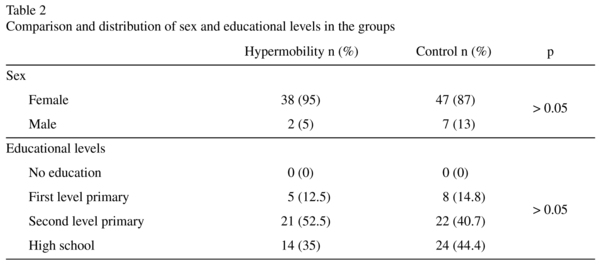
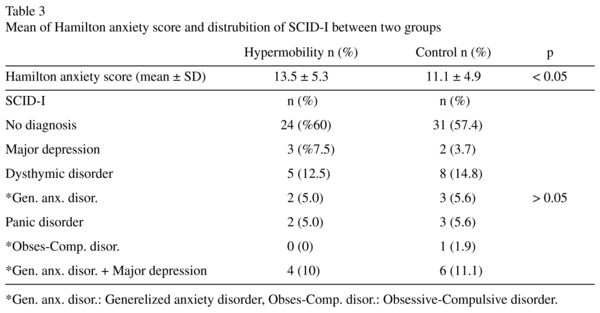
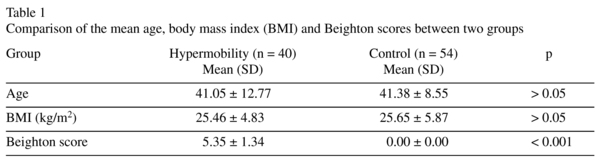
<body><![CDATA[<p><font face="Verdana" size="2">Mean difference of age and BMI values among two groups were assessed by using independent-samples t test. The Mann-Whitney U test was used to compare the sex, educational levels and anxiety disorders of subjects with and without hypermobility.</font></p>     <p>&nbsp;</p>     <p><font face="Verdana" size="2"><b>Results</b></font></p>     <p><font face="Verdana" size="2">There was no significant difference between these two groups by means of age and BMI (p &gt; 0.05). Mean of beighton score was determined to be statistically higher in study group than that of the control group (p &lt; 0.001) (<a href="#t1">Table 1</a>).</font></p>     <p align="center"><font face="Verdana" size="2"><a name="t1"><img src="/img/revistas/ejpen/v24n4/original2_table1.jpg" alt="207table1" width="600" height="162"></a></font></p>     <p>&nbsp;</p>     <p><font face="Verdana" size="2">No statistically a significant difference was found by educational levels and sex between these groups (p &gt; 0.05) (<a href="#t2">Table 2</a>).</font></p>     <p align="center"><font face="Verdana" size="2"><a name="t2"><img src="/img/revistas/ejpen/v24n4/original2_table2.jpg" alt="207table2" width="600" height="266"></a></font></p>     <p>&nbsp;</p>     <p><font face="Verdana" size="2">The mean of anxiety score in the hypermobility group were found to be significantly higher than that of the control group (p &lt; 0.05). No statistically a significant difference in the ratio and frequency of psychyatric disorders according to SCID-I were observed between cases with and without hypermobility (p &gt; 0.05) (<a href="#t3">Table 3</a>).</font></p>     ]]></body>
<body><![CDATA[<p align="center"><font face="Verdana" size="2"><a name="t3"><img src="/img/revistas/ejpen/v24n4/original2_table3.jpg" alt="208table3" width="600" height="313"></a></font></p>     <p>&nbsp;</p>     <p><font face="Verdana" size="2"><b>Discussion</b></font></p>     <p><font face="Verdana" size="2">In this study, we aimed to investigate the anxiety levels and frequency of other psychological disorders (major depression, panic, dysthymic, generalized anxiety, and obsessive-compulsive disorders) between individuals with and without joint hypermobility. Consequently, mean anxiety score was found significantly higher in the study group than that in the control group.</font></p>     <p><font face="Verdana" size="2">Bulbena <i>et al.</i><sup>3</sup> reported that the correlations of joint laxity with trait anxiety were significant. Subjects (N = 526) were assessed with the Hospital del Mar hypermobility criteria and the State-Trait Anxiety Inventory. Scores for trait anxiety, and to a lesser extent state anxiety, were significantly higher among subjects with joint hypermobility syndrome than among subjects without this syndrome.</font></p>     <p><font face="Verdana" size="2">Some studies have shown a strong association between panic disorder/agoraphobia and joint laxity or joint hypermobility syndrome<sup>3,13-14</sup>. We also evaluated panic disorder in participants of this study. Consequently, no a significant difference was found regarding to panic disorder between these two groups in this study.</font></p>     <p><font face="Verdana" size="2">In addition, we investigated the presence of major depression, dysthymic, generalized anxiety, and obsessive-compulsive disorders in all of participants and we compared the ratio and rate of these disorders among these subjects with and without joint hypermobility. But, we could not determined a significant difference in these disorders among these two groups.</font></p>     <p><font face="Verdana" size="2">In the study published in 1998 by the Martin-Santos and <i>et al</i>.<sup>2</sup>, in a psychiatric population, was compared the ratio of hypermobility between patients with panic disorder and/or agoraphobia with age- and sex-matched psychiatric and medical comparison subjects, and found joint hypermobility to be 67.7% of the patients with anxiety disorder but in only 10.1% of the psychiatric and 12.5% of the medical comparison subjects. Nevertheless, no significant differences were found in the prevalence of mitral valve prolapse between the patients with anxiety disorder and the comparison subjects.</font></p>     <p><font face="Verdana" size="2">In this study, we researched the rate of obsessive-compulsive disorder in subjects with and without joint hypermobility. While obsessive-compulsive disorder was not found in hypermobility group, this disorder determined in a case of other goup. Thus, there was no a significant difference in statistical analyse. A review of the literature did not reveal any study that the frequency of obsessive-compulsive disorder was investigated in subjects with hypermobility.</font></p>     <p><font face="Verdana" size="2">In conclusion, we found that hypermobile subjects had more anxious than that of the control cases. Our study and other reports concerning this situation demonstrated that a association had between anxiety disorder and hypermobility. Anxiety may also be due to the perception of joint instability and frequent pain and injury without understandable antecedent.</font></p>     ]]></body>
<body><![CDATA[<p><font face="Verdana" size="2">We think that researchers and clinicians should be aware of the fact that anxiety patients suffer from a variety of medical conditions, one of which is joint hypermobility, a disorder that despite the evidence seems to be underrecognized and underdiagnosed. We strongly recommend the assessment of medical conditions, including joint hypermobility, in anxiety patients.</font></p>     <p>&nbsp;</p>     <p><font face="Verdana" size="2"><b>References</b></font></p>     <!-- ref --><p><font face="Verdana" size="2">1. Beighton PH, Grahame R, Bird H. Hypermobility of Joints. 2nd ed. London: Springer-Verlag; 1989.</font>&nbsp;&nbsp;&nbsp;&nbsp;&nbsp;&nbsp;&nbsp;&nbsp;[&#160;<a href="javascript:void(0);" onclick="javascript: window.open('/scielo.php?script=sci_nlinks&ref=5940733&pid=S0213-6163201000040000200001&lng=','','width=640,height=500,resizable=yes,scrollbars=1,menubar=yes,');">Links</a>&#160;]<!-- end-ref --><!-- ref --><p><font face="Verdana" size="2">2. Mart&iacute;n-Santos R, Bulbena A, Porta M, Gago J, Molina L, Dur&oacute; JC. Association between joint hypermobility syndrome and panic disorder. Am J Psychiatry 1998; 155: 1578-1583.</font>&nbsp;&nbsp;&nbsp;&nbsp;&nbsp;&nbsp;&nbsp;&nbsp;[&#160;<a href="javascript:void(0);" onclick="javascript: window.open('/scielo.php?script=sci_nlinks&ref=5940734&pid=S0213-6163201000040000200002&lng=','','width=640,height=500,resizable=yes,scrollbars=1,menubar=yes,');">Links</a>&#160;]<!-- end-ref --><!-- ref --><p><font face="Verdana" size="2">3. Bulbena A, Agull&oacute; A, Pailhez G, Mart&iacute;n-Santos R, Porta M, Guitart J, <i>et al</i>. Is joint hypermobility related to anxiety in a nonclinical population also? Psychosomatics 2004; 45: 432-437.</font>&nbsp;&nbsp;&nbsp;&nbsp;&nbsp;&nbsp;&nbsp;&nbsp;[&#160;<a href="javascript:void(0);" onclick="javascript: window.open('/scielo.php?script=sci_nlinks&ref=5940735&pid=S0213-6163201000040000200003&lng=','','width=640,height=500,resizable=yes,scrollbars=1,menubar=yes,');">Links</a>&#160;]<!-- end-ref --><!-- ref --><p><font face="Verdana" size="2">4. Beighton P. The Ehlers Danlos syndromes. In: Beighton P, ed. McKusick's heritable disorders of connective tissue. 5th ed. St. Louis: Mosby; 1993. p. 206.</font>&nbsp;&nbsp;&nbsp;&nbsp;&nbsp;&nbsp;&nbsp;&nbsp;[&#160;<a href="javascript:void(0);" onclick="javascript: window.open('/scielo.php?script=sci_nlinks&ref=5940736&pid=S0213-6163201000040000200004&lng=','','width=640,height=500,resizable=yes,scrollbars=1,menubar=yes,');">Links</a>&#160;]<!-- end-ref --><!-- ref --><p><font face="Verdana" size="2">5. Kraus VB, Li YJ, Martin ER, Jordan JM, Renner JB, Doherty M, <i>et al</i>. Articular hypermobility is a protective factor for hand osteoarthritis. Arthritis Rheum 2004; 50: 2178-2183.</font>&nbsp;&nbsp;&nbsp;&nbsp;&nbsp;&nbsp;&nbsp;&nbsp;[&#160;<a href="javascript:void(0);" onclick="javascript: window.open('/scielo.php?script=sci_nlinks&ref=5940737&pid=S0213-6163201000040000200005&lng=','','width=640,height=500,resizable=yes,scrollbars=1,menubar=yes,');">Links</a>&#160;]<!-- end-ref --><!-- ref --><p><font face="Verdana" size="2">6. Beighton P, Grahame R, Bird H. Assessment of hypermobility. In: Beighton P, ed. Hypermobility of joints, 3rd ed. New York: Springer; 1999. p. 9-22.</font>&nbsp;&nbsp;&nbsp;&nbsp;&nbsp;&nbsp;&nbsp;&nbsp;[&#160;<a href="javascript:void(0);" onclick="javascript: window.open('/scielo.php?script=sci_nlinks&ref=5940738&pid=S0213-6163201000040000200006&lng=','','width=640,height=500,resizable=yes,scrollbars=1,menubar=yes,');">Links</a>&#160;]<!-- end-ref --><!-- ref --><p><font face="Verdana" size="2">7. Hudson N, Fitzcharles MA, Cohen M, Starr MR, Esdaile JM. The association of soft-tissue rheumatism and hypermobility. Br J Rheumatol 1998; 37: 382-386.</font>&nbsp;&nbsp;&nbsp;&nbsp;&nbsp;&nbsp;&nbsp;&nbsp;[&#160;<a href="javascript:void(0);" onclick="javascript: window.open('/scielo.php?script=sci_nlinks&ref=5940739&pid=S0213-6163201000040000200007&lng=','','width=640,height=500,resizable=yes,scrollbars=1,menubar=yes,');">Links</a>&#160;]<!-- end-ref --><!-- ref --><p><font face="Verdana" size="2">8. Bulbena A, Dur&oacute; JC, Porta M, Faus S, Vallescar R, Mart&iacute;n-Santos R. Clinical assessment of hypermobility of joints: Assembling criteria. J Rheumatol 1992; 19: 115-122.</font>&nbsp;&nbsp;&nbsp;&nbsp;&nbsp;&nbsp;&nbsp;&nbsp;[&#160;<a href="javascript:void(0);" onclick="javascript: window.open('/scielo.php?script=sci_nlinks&ref=5940740&pid=S0213-6163201000040000200008&lng=','','width=640,height=500,resizable=yes,scrollbars=1,menubar=yes,');">Links</a>&#160;]<!-- end-ref --><!-- ref --><p><font face="Verdana" size="2">9. Barron DF, Cohen BA, Geraghty MT, Violand R, Rowe PC. Joint hypermobility is more common in children with chronic fatigue syndrome than in healthy controls. J Pediatr 2002; 141: 421-425.</font>&nbsp;&nbsp;&nbsp;&nbsp;&nbsp;&nbsp;&nbsp;&nbsp;[&#160;<a href="javascript:void(0);" onclick="javascript: window.open('/scielo.php?script=sci_nlinks&ref=5940741&pid=S0213-6163201000040000200009&lng=','','width=640,height=500,resizable=yes,scrollbars=1,menubar=yes,');">Links</a>&#160;]<!-- end-ref --><!-- ref --><p><font face="Verdana" size="2">10. First MB, Spitzer RL, Gibbon M, Williams JBW. Structured clinical interview for DSM-IV Axis I Disorders (SCID-I), Clinical Version. Washington, D.C.: American Psychiatric Press; 1997.</font>&nbsp;&nbsp;&nbsp;&nbsp;&nbsp;&nbsp;&nbsp;&nbsp;[&#160;<a href="javascript:void(0);" onclick="javascript: window.open('/scielo.php?script=sci_nlinks&ref=5940742&pid=S0213-6163201000040000200010&lng=','','width=640,height=500,resizable=yes,scrollbars=1,menubar=yes,');">Links</a>&#160;]<!-- end-ref --><!-- ref --><p><font face="Verdana" size="2">11. Corapcioglu A, Aydemir O, Yildiz M, Esen A. Structured Clinical Interview for DSM-IV (SCID-IV), Turkish Version. Ankara: Hekimler Yayin Birligi; 1999.</font>&nbsp;&nbsp;&nbsp;&nbsp;&nbsp;&nbsp;&nbsp;&nbsp;[&#160;<a href="javascript:void(0);" onclick="javascript: window.open('/scielo.php?script=sci_nlinks&ref=5940743&pid=S0213-6163201000040000200011&lng=','','width=640,height=500,resizable=yes,scrollbars=1,menubar=yes,');">Links</a>&#160;]<!-- end-ref --><!-- ref --><p><font face="Verdana" size="2">12. Yazici MK, Demir B, Tanriverdi N, Karaag aog lu E, Yola&ccedil; P. Hamilton Anxiety Rating Scale, study of reability and validity among raters. Turkish J Psychiatry 1998; 9: 114-117.</font>&nbsp;&nbsp;&nbsp;&nbsp;&nbsp;&nbsp;&nbsp;&nbsp;[&#160;<a href="javascript:void(0);" onclick="javascript: window.open('/scielo.php?script=sci_nlinks&ref=5940744&pid=S0213-6163201000040000200012&lng=','','width=640,height=500,resizable=yes,scrollbars=1,menubar=yes,');">Links</a>&#160;]<!-- end-ref --><!-- ref --><p><font face="Verdana" size="2">13. Bulbena A, Duro JC, Mateo A, Porta M, Vallejo J. Anxiety disorders in the joint hypermobility syndrome. Lancet 1988; 2: 694.</font>&nbsp;&nbsp;&nbsp;&nbsp;&nbsp;&nbsp;&nbsp;&nbsp;[&#160;<a href="javascript:void(0);" onclick="javascript: window.open('/scielo.php?script=sci_nlinks&ref=5940745&pid=S0213-6163201000040000200013&lng=','','width=640,height=500,resizable=yes,scrollbars=1,menubar=yes,');">Links</a>&#160;]<!-- end-ref --><!-- ref --><p><font face="Verdana" size="2">14. Bulbena A, Dur&oacute; JC, Porta M, Mart&iacute;n-Santos R, Mateo A, Molina L, <i>et al</i>. Anxiety disorder in the joint hypermobility syndrome. Psychiatry Res 1993; 43: 59-68.</font>&nbsp;&nbsp;&nbsp;&nbsp;&nbsp;&nbsp;&nbsp;&nbsp;[&#160;<a href="javascript:void(0);" onclick="javascript: window.open('/scielo.php?script=sci_nlinks&ref=5940746&pid=S0213-6163201000040000200014&lng=','','width=640,height=500,resizable=yes,scrollbars=1,menubar=yes,');">Links</a>&#160;]<!-- end-ref --><p>&nbsp;</p>     <p>&nbsp;</p>     <p><font face="Verdana" size="2"><b><a name="back"></a><a href="#top"><img src="/img/revistas/ejpen/v24n4/seta.gif" border="0"></a>Correspondence:</b>    ]]></body>
<body><![CDATA[<br>Gulcan Gurer    <br>Department of Rheumatology,    <br>Van Research and Training Hospital, Van, Turkey    <br>Tel: +90 432 2140609    <br>E-mail: <a href="mailto:gurergulcan@yahoo.com.tr">gurergulcan@yahoo.com.tr</a>    <br><a href="mailto:gurergulcan@gmail.com">gurergulcan@gmail.com</a></font></p>     <p><font face="Verdana" size="2">Received: 2 November 2009    <br>Revised: 2 May 2010    <br>Accepted: 21 July 2010</font></p>      ]]></body><back>
<ref-list>
<ref id="B1">
<label>1</label><nlm-citation citation-type="book">
<person-group person-group-type="author">
<name>
<surname><![CDATA[Beighton]]></surname>
<given-names><![CDATA[PH]]></given-names>
</name>
<name>
<surname><![CDATA[Grahame]]></surname>
<given-names><![CDATA[R]]></given-names>
</name>
<name>
<surname><![CDATA[Bird]]></surname>
<given-names><![CDATA[H]]></given-names>
</name>
</person-group>
<source><![CDATA[Hypermobility of Joints]]></source>
<year>1989</year>
<edition>2</edition>
<publisher-loc><![CDATA[London ]]></publisher-loc>
<publisher-name><![CDATA[Springer-Verlag]]></publisher-name>
</nlm-citation>
</ref>
<ref id="B2">
<label>2</label><nlm-citation citation-type="journal">
<person-group person-group-type="author">
<name>
<surname><![CDATA[Martín-Santos]]></surname>
<given-names><![CDATA[R]]></given-names>
</name>
<name>
<surname><![CDATA[Bulbena]]></surname>
<given-names><![CDATA[A]]></given-names>
</name>
<name>
<surname><![CDATA[Porta]]></surname>
<given-names><![CDATA[M]]></given-names>
</name>
<name>
<surname><![CDATA[Gago]]></surname>
<given-names><![CDATA[J]]></given-names>
</name>
<name>
<surname><![CDATA[Molina]]></surname>
<given-names><![CDATA[L]]></given-names>
</name>
<name>
<surname><![CDATA[Duró]]></surname>
<given-names><![CDATA[JC]]></given-names>
</name>
</person-group>
<article-title xml:lang="en"><![CDATA[Association between joint hypermobility syndrome and panic disorder]]></article-title>
<source><![CDATA[Am J Psychiatry]]></source>
<year>1998</year>
<volume>155</volume>
<page-range>1578-1583</page-range></nlm-citation>
</ref>
<ref id="B3">
<label>3</label><nlm-citation citation-type="journal">
<person-group person-group-type="author">
<name>
<surname><![CDATA[Bulbena]]></surname>
<given-names><![CDATA[A]]></given-names>
</name>
<name>
<surname><![CDATA[Agulló]]></surname>
<given-names><![CDATA[A]]></given-names>
</name>
<name>
<surname><![CDATA[Pailhez]]></surname>
<given-names><![CDATA[G]]></given-names>
</name>
<name>
<surname><![CDATA[Martín-Santos]]></surname>
<given-names><![CDATA[R]]></given-names>
</name>
<name>
<surname><![CDATA[Porta]]></surname>
<given-names><![CDATA[M]]></given-names>
</name>
<name>
<surname><![CDATA[Guitart]]></surname>
<given-names><![CDATA[J]]></given-names>
</name>
</person-group>
<article-title xml:lang="en"><![CDATA[Is joint hypermobility related to anxiety in a nonclinical population also?]]></article-title>
<source><![CDATA[Psychosomatics]]></source>
<year>2004</year>
<volume>45</volume>
<page-range>432-437</page-range></nlm-citation>
</ref>
<ref id="B4">
<label>4</label><nlm-citation citation-type="book">
<person-group person-group-type="author">
<name>
<surname><![CDATA[Beighton]]></surname>
<given-names><![CDATA[P]]></given-names>
</name>
</person-group>
<article-title xml:lang="en"><![CDATA[The Ehlers Danlos syndromes]]></article-title>
<person-group person-group-type="editor">
<name>
<surname><![CDATA[Beighton]]></surname>
<given-names><![CDATA[P]]></given-names>
</name>
</person-group>
<source><![CDATA[McKusick's heritable disorders of connective tissue]]></source>
<year>1993</year>
<edition>5</edition>
<page-range>206</page-range><publisher-loc><![CDATA[St. Louis ]]></publisher-loc>
<publisher-name><![CDATA[Mosby]]></publisher-name>
</nlm-citation>
</ref>
<ref id="B5">
<label>5</label><nlm-citation citation-type="journal">
<person-group person-group-type="author">
<name>
<surname><![CDATA[Kraus]]></surname>
<given-names><![CDATA[VB]]></given-names>
</name>
<name>
<surname><![CDATA[Li]]></surname>
<given-names><![CDATA[YJ]]></given-names>
</name>
<name>
<surname><![CDATA[Martin]]></surname>
<given-names><![CDATA[ER]]></given-names>
</name>
<name>
<surname><![CDATA[Jordan]]></surname>
<given-names><![CDATA[JM]]></given-names>
</name>
<name>
<surname><![CDATA[Renner]]></surname>
<given-names><![CDATA[JB]]></given-names>
</name>
<name>
<surname><![CDATA[Doherty]]></surname>
<given-names><![CDATA[M]]></given-names>
</name>
</person-group>
<article-title xml:lang="en"><![CDATA[Articular hypermobility is a protective factor for hand osteoarthritis]]></article-title>
<source><![CDATA[Arthritis Rheum]]></source>
<year>2004</year>
<volume>50</volume>
<page-range>2178-2183</page-range></nlm-citation>
</ref>
<ref id="B6">
<label>6</label><nlm-citation citation-type="book">
<person-group person-group-type="author">
<name>
<surname><![CDATA[Beighton]]></surname>
<given-names><![CDATA[P]]></given-names>
</name>
<name>
<surname><![CDATA[Grahame]]></surname>
<given-names><![CDATA[R]]></given-names>
</name>
<name>
<surname><![CDATA[Bird]]></surname>
<given-names><![CDATA[H]]></given-names>
</name>
</person-group>
<article-title xml:lang="en"><![CDATA[Assessment of hypermobility]]></article-title>
<person-group person-group-type="editor">
<name>
<surname><![CDATA[Beighton]]></surname>
<given-names><![CDATA[P]]></given-names>
</name>
</person-group>
<source><![CDATA[Hypermobility of joints]]></source>
<year>1999</year>
<edition>3</edition>
<page-range>9-22</page-range><publisher-loc><![CDATA[New York ]]></publisher-loc>
<publisher-name><![CDATA[Springer]]></publisher-name>
</nlm-citation>
</ref>
<ref id="B7">
<label>7</label><nlm-citation citation-type="journal">
<person-group person-group-type="author">
<name>
<surname><![CDATA[Hudson]]></surname>
<given-names><![CDATA[N]]></given-names>
</name>
<name>
<surname><![CDATA[Fitzcharles]]></surname>
<given-names><![CDATA[MA]]></given-names>
</name>
<name>
<surname><![CDATA[Cohen]]></surname>
<given-names><![CDATA[M]]></given-names>
</name>
<name>
<surname><![CDATA[Starr]]></surname>
<given-names><![CDATA[MR]]></given-names>
</name>
<name>
<surname><![CDATA[Esdaile]]></surname>
<given-names><![CDATA[JM]]></given-names>
</name>
</person-group>
<article-title xml:lang="en"><![CDATA[The association of soft-tissue rheumatism and hypermobility]]></article-title>
<source><![CDATA[Br J Rheumatol]]></source>
<year>1998</year>
<volume>37</volume>
<page-range>382-386</page-range></nlm-citation>
</ref>
<ref id="B8">
<label>8</label><nlm-citation citation-type="journal">
<person-group person-group-type="author">
<name>
<surname><![CDATA[Bulbena]]></surname>
<given-names><![CDATA[A]]></given-names>
</name>
<name>
<surname><![CDATA[Duró]]></surname>
<given-names><![CDATA[JC]]></given-names>
</name>
<name>
<surname><![CDATA[Porta]]></surname>
<given-names><![CDATA[M]]></given-names>
</name>
<name>
<surname><![CDATA[Faus]]></surname>
<given-names><![CDATA[S]]></given-names>
</name>
<name>
<surname><![CDATA[Vallescar]]></surname>
<given-names><![CDATA[R]]></given-names>
</name>
<name>
<surname><![CDATA[Martín-Santos]]></surname>
<given-names><![CDATA[R]]></given-names>
</name>
</person-group>
<article-title xml:lang="en"><![CDATA[Clinical assessment of hypermobility of joints: Assembling criteria]]></article-title>
<source><![CDATA[J Rheumatol]]></source>
<year>1992</year>
<volume>19</volume>
<page-range>115-122</page-range></nlm-citation>
</ref>
<ref id="B9">
<label>9</label><nlm-citation citation-type="journal">
<person-group person-group-type="author">
<name>
<surname><![CDATA[Barron]]></surname>
<given-names><![CDATA[DF]]></given-names>
</name>
<name>
<surname><![CDATA[Cohen]]></surname>
<given-names><![CDATA[BA]]></given-names>
</name>
<name>
<surname><![CDATA[Geraghty]]></surname>
<given-names><![CDATA[MT]]></given-names>
</name>
<name>
<surname><![CDATA[Violand]]></surname>
<given-names><![CDATA[R]]></given-names>
</name>
<name>
<surname><![CDATA[Rowe]]></surname>
<given-names><![CDATA[PC]]></given-names>
</name>
</person-group>
<article-title xml:lang="en"><![CDATA[Joint hypermobility is more common in children with chronic fatigue syndrome than in healthy controls]]></article-title>
<source><![CDATA[J Pediatr]]></source>
<year>2002</year>
<volume>141</volume>
<page-range>421-425</page-range></nlm-citation>
</ref>
<ref id="B10">
<label>10</label><nlm-citation citation-type="book">
<person-group person-group-type="author">
<name>
<surname><![CDATA[First]]></surname>
<given-names><![CDATA[MB]]></given-names>
</name>
<name>
<surname><![CDATA[Spitzer]]></surname>
<given-names><![CDATA[RL]]></given-names>
</name>
<name>
<surname><![CDATA[Gibbon]]></surname>
<given-names><![CDATA[M]]></given-names>
</name>
<name>
<surname><![CDATA[Williams]]></surname>
<given-names><![CDATA[JBW]]></given-names>
</name>
</person-group>
<source><![CDATA[Structured clinical interview for DSM-IV Axis I Disorders (SCID-I), Clinical Version]]></source>
<year>1997</year>
<publisher-loc><![CDATA[Washington^eD.C. D.C.]]></publisher-loc>
<publisher-name><![CDATA[American Psychiatric Press]]></publisher-name>
</nlm-citation>
</ref>
<ref id="B11">
<label>11</label><nlm-citation citation-type="book">
<person-group person-group-type="author">
<name>
<surname><![CDATA[Corapcioglu]]></surname>
<given-names><![CDATA[A]]></given-names>
</name>
<name>
<surname><![CDATA[Aydemir]]></surname>
<given-names><![CDATA[O]]></given-names>
</name>
<name>
<surname><![CDATA[Yildiz]]></surname>
<given-names><![CDATA[M]]></given-names>
</name>
<name>
<surname><![CDATA[Esen]]></surname>
<given-names><![CDATA[A]]></given-names>
</name>
</person-group>
<source><![CDATA[Structured Clinical Interview for DSM-IV (SCID-IV), Turkish Version]]></source>
<year>1999</year>
<publisher-loc><![CDATA[Ankara ]]></publisher-loc>
<publisher-name><![CDATA[Hekimler Yayin Birligi]]></publisher-name>
</nlm-citation>
</ref>
<ref id="B12">
<label>12</label><nlm-citation citation-type="journal">
<person-group person-group-type="author">
<name>
<surname><![CDATA[Yazici]]></surname>
<given-names><![CDATA[MK]]></given-names>
</name>
<name>
<surname><![CDATA[Demir]]></surname>
<given-names><![CDATA[B]]></given-names>
</name>
<name>
<surname><![CDATA[Tanriverdi]]></surname>
<given-names><![CDATA[N]]></given-names>
</name>
<name>
<surname><![CDATA[Karaag aog lu]]></surname>
<given-names><![CDATA[E]]></given-names>
</name>
<name>
<surname><![CDATA[Yolaç]]></surname>
<given-names><![CDATA[P]]></given-names>
</name>
</person-group>
<article-title xml:lang="en"><![CDATA[Hamilton Anxiety Rating Scale, study of reability and validity among raters]]></article-title>
<source><![CDATA[Turkish J Psychiatry]]></source>
<year>1998</year>
<volume>9</volume>
<page-range>114-117</page-range></nlm-citation>
</ref>
<ref id="B13">
<label>13</label><nlm-citation citation-type="journal">
<person-group person-group-type="author">
<name>
<surname><![CDATA[Bulbena]]></surname>
<given-names><![CDATA[A]]></given-names>
</name>
<name>
<surname><![CDATA[Duro]]></surname>
<given-names><![CDATA[JC]]></given-names>
</name>
<name>
<surname><![CDATA[Mateo]]></surname>
<given-names><![CDATA[A]]></given-names>
</name>
<name>
<surname><![CDATA[Porta]]></surname>
<given-names><![CDATA[M]]></given-names>
</name>
<name>
<surname><![CDATA[Vallejo]]></surname>
<given-names><![CDATA[J]]></given-names>
</name>
</person-group>
<article-title xml:lang="en"><![CDATA[Anxiety disorders in the joint hypermobility syndrome]]></article-title>
<source><![CDATA[Lancet]]></source>
<year>1988</year>
<volume>2</volume>
<page-range>694</page-range></nlm-citation>
</ref>
<ref id="B14">
<label>14</label><nlm-citation citation-type="journal">
<person-group person-group-type="author">
<name>
<surname><![CDATA[Bulbena]]></surname>
<given-names><![CDATA[A]]></given-names>
</name>
<name>
<surname><![CDATA[Duró]]></surname>
<given-names><![CDATA[JC]]></given-names>
</name>
<name>
<surname><![CDATA[Porta]]></surname>
<given-names><![CDATA[M]]></given-names>
</name>
<name>
<surname><![CDATA[Martín-Santos]]></surname>
<given-names><![CDATA[R]]></given-names>
</name>
<name>
<surname><![CDATA[Mateo]]></surname>
<given-names><![CDATA[A]]></given-names>
</name>
<name>
<surname><![CDATA[Molina]]></surname>
<given-names><![CDATA[L]]></given-names>
</name>
</person-group>
<article-title xml:lang="en"><![CDATA[Anxiety disorder in the joint hypermobility syndrome]]></article-title>
<source><![CDATA[Psychiatry Res]]></source>
<year>1993</year>
<volume>43</volume>
<page-range>59-68</page-range></nlm-citation>
</ref>
</ref-list>
</back>
</article>