<?xml version="1.0" encoding="ISO-8859-1"?><article xmlns:mml="http://www.w3.org/1998/Math/MathML" xmlns:xlink="http://www.w3.org/1999/xlink" xmlns:xsi="http://www.w3.org/2001/XMLSchema-instance">
<front>
<journal-meta>
<journal-id>0213-6163</journal-id>
<journal-title><![CDATA[The European Journal of Psychiatry]]></journal-title>
<abbrev-journal-title><![CDATA[Eur. J. Psychiat.]]></abbrev-journal-title>
<issn>0213-6163</issn>
<publisher>
<publisher-name><![CDATA[Universidad de Zaragoza]]></publisher-name>
</publisher>
</journal-meta>
<article-meta>
<article-id>S0213-61632011000300005</article-id>
<article-id pub-id-type="doi">10.4321/S0213-61632011000300005</article-id>
<title-group>
<article-title xml:lang="en"><![CDATA[Alcohol and drug dependence in adults with attention-deficit/hyperactivity disorder: Data from Germany]]></article-title>
</title-group>
<contrib-group>
<contrib contrib-type="author">
<name>
<surname><![CDATA[Ohlmeier]]></surname>
<given-names><![CDATA[Martin D.]]></given-names>
</name>
<xref ref-type="aff" rid="A01"/>
<xref ref-type="aff" rid="A02"/>
</contrib>
<contrib contrib-type="author">
<name>
<surname><![CDATA[Goseberg]]></surname>
<given-names><![CDATA[Eva]]></given-names>
</name>
<xref ref-type="aff" rid="A01"/>
</contrib>
<contrib contrib-type="author">
<name>
<surname><![CDATA[Roy]]></surname>
<given-names><![CDATA[Mandy]]></given-names>
</name>
<xref ref-type="aff" rid="A01"/>
</contrib>
<contrib contrib-type="author">
<name>
<surname><![CDATA[Dillo]]></surname>
<given-names><![CDATA[Wolfgang]]></given-names>
</name>
<xref ref-type="aff" rid="A01"/>
</contrib>
<contrib contrib-type="author">
<name>
<surname><![CDATA[Kordon]]></surname>
<given-names><![CDATA[Andreas]]></given-names>
</name>
<xref ref-type="aff" rid="A03"/>
</contrib>
<contrib contrib-type="author">
<name>
<surname><![CDATA[Prox-Vagedes]]></surname>
<given-names><![CDATA[Vanessa]]></given-names>
</name>
<xref ref-type="aff" rid="A01"/>
</contrib>
</contrib-group>
<aff id="A01">
<institution><![CDATA[,Hannover Medical School (MHH) Department of Psychiatry, Social Psychiatry and Psychotherapy ]]></institution>
<addr-line><![CDATA[Hanover ]]></addr-line>
<country>Germany</country>
</aff>
<aff id="A02">
<institution><![CDATA[,Klinikum Kassel Ludwig-Noll-Hospital Department of Psychiatry and Psychotherapy]]></institution>
<addr-line><![CDATA[Kassel ]]></addr-line>
<country>Germany</country>
</aff>
<aff id="A03">
<institution><![CDATA[,Medical University of Luebeck Department of Psychiatry and Psychotherapy ]]></institution>
<addr-line><![CDATA[Luebeck ]]></addr-line>
<country>Germany</country>
</aff>
<pub-date pub-type="pub">
<day>00</day>
<month>09</month>
<year>2011</year>
</pub-date>
<pub-date pub-type="epub">
<day>00</day>
<month>09</month>
<year>2011</year>
</pub-date>
<volume>25</volume>
<numero>3</numero>
<fpage>150</fpage>
<lpage>163</lpage>
<copyright-statement/>
<copyright-year/>
<self-uri xlink:href="http://scielo.isciii.es/scielo.php?script=sci_arttext&amp;pid=S0213-61632011000300005&amp;lng=en&amp;nrm=iso"></self-uri><self-uri xlink:href="http://scielo.isciii.es/scielo.php?script=sci_abstract&amp;pid=S0213-61632011000300005&amp;lng=en&amp;nrm=iso"></self-uri><self-uri xlink:href="http://scielo.isciii.es/scielo.php?script=sci_pdf&amp;pid=S0213-61632011000300005&amp;lng=en&amp;nrm=iso"></self-uri><abstract abstract-type="short" xml:lang="en"><p><![CDATA[Background and Objectives: The objective of the present study was to obtain information about the prevalence of addiction disorders in ADHD patients in a German study population, to compare the prevalence of addiction disorders in ADHD patients to that in the normal population according to the German Epidemiological Addiction Survey, and to determine which drugs are consumed most by ADHD patients. Participants: The sample consisted of 61 patients (average age 35.11 &plusmn; 9.33 years) from our ADHD consultation who were consecutively included in our study over a period of 12 months. Measurements: We diagnosed ADHD according to DSM-IV-R and by assessing the WURS-k, CAARS and BROWN ADD scales. For diagnosing addiction we conducted the EuropASI, the IDCL, the QOD and the FTNA. For differential diagnosis we assessed the SCL-K. Results: About half of our study population of ADHD patients were diagnosed with a dependence disorder (50.8%, n = 31). Twenty one dot three percent (n = 13) were suffering from an alcohol dependence, 13.1% (n = 8) from a substance use disorder (SUD) and 18% (n = 11) from a combination of both addictions. The drug consumed most commonly by ADHD patients was cannabis. Alcohol and substance abuse commenced significantly earlier in patients with ADHD than in patients with addiction disorders without comorbid ADHD. Conclusions: Our data show that the risk of developing a dependence disorder is elevated in ADHD patients. Clinicians should bear in mind that the characteristics of a dependence in ADHD patients are clinically more pronounced and that an addiction in ADHD patients starts earlier than usually expected.]]></p></abstract>
<kwd-group>
<kwd lng="en"><![CDATA[ADHD]]></kwd>
<kwd lng="en"><![CDATA[Adults]]></kwd>
<kwd lng="en"><![CDATA[Addiction]]></kwd>
<kwd lng="en"><![CDATA[Epidemiology]]></kwd>
<kwd lng="en"><![CDATA[Comorbidity]]></kwd>
</kwd-group>
</article-meta>
</front><body><![CDATA[ <p>&nbsp;</p>     <p>&nbsp;</p>     <p><font face="Verdana" size="4"><a name="top"></a><b>Alcohol and drug dependence in adults with attention-deficit/hyperactivity disorder: Data from Germany</b></font></p>     <p>&nbsp;</p>     <p>&nbsp;</p>     <p><font face="Verdana" size="2"><b>Martin D. Ohlmeier* **; Eva Goseberg*; Mandy Roy*; Wolfgang Dillo*; Andreas Kordon***; Vanessa Prox-Vagedes*</b></font></p>     <p><font face="Verdana" size="2">* Department of Psychiatry, Social Psychiatry and Psychotherapy, Hannover Medical School (MHH), Hanover, Germany    <br>** Department of Psychiatry and Psychotherapy, Ludwig-Noll-Hospital, Klinikum Kassel Kassel, Germany    <br>*** Department of Psychiatry and Psychotherapy, Medical University of Luebeck Luebeck, Germany</font></p>     <p><font face="Verdana" size="2"><a href="#bajo">Correspondence</a></font></p>     ]]></body>
<body><![CDATA[<p>&nbsp;</p>     <p>&nbsp;</p> <hr size="1">     <p><font face="Verdana" size="2"><b>ABSTRACT</b></font></p>     <p><font face="Verdana" size="2"><b>Background and Objectives:</b> The objective of the present study was to obtain information about the prevalence of addiction disorders in ADHD patients in a German study population, to compare the prevalence of addiction disorders in ADHD patients to that in the normal population according to the German Epidemiological Addiction Survey, and to determine which drugs are consumed most by ADHD patients.    <br><b>Participants:</b> The sample consisted of 61 patients (average age 35.11 &plusmn; 9.33 years) from our ADHD consultation who were consecutively included in our study over a period of 12 months.    <br><b>Measurements:</b> We diagnosed ADHD according to DSM-IV-R and by assessing the WURS-k, CAARS and BROWN ADD scales. For diagnosing addiction we conducted the EuropASI, the IDCL, the QOD and the FTNA. For differential diagnosis we assessed the SCL-K.    <br><b>Results:</b> About half of our study population of ADHD patients were diagnosed with a dependence disorder (50.8%, n = 31). Twenty one dot three percent (n = 13) were suffering from an alcohol dependence, 13.1% (n = 8) from a substance use disorder (SUD) and 18% (n = 11) from a combination of both addictions. The drug consumed most commonly by ADHD patients was cannabis. Alcohol and substance abuse commenced significantly earlier in patients with ADHD than in patients with addiction disorders without comorbid ADHD.    <br><b>Conclusions:</b> Our data show that the risk of developing a dependence disorder is elevated in ADHD patients. Clinicians should bear in mind that the characteristics of a dependence in ADHD patients are clinically more pronounced and that an addiction in ADHD patients starts earlier than usually expected.</p>     <p><font face="Verdana" size="2"><b>Key words:</b> ADHD; Adults; Addiction; Epidemiology; Comorbidity.</font></p> <hr size="1">     <p>&nbsp;</p>     ]]></body>
<body><![CDATA[<p><font face="Verdana" size="2"><b>Introduction</b></font></p>     <p><font face="Verdana" size="3">ADHD in adulthood</font></p>     <p><font face="Verdana" size="2">Attention-Deficit/Hyperactivity Disorder (ADHD) is the most frequent psychiatric disorder in childhood and adolescence<sup>1</sup>. According to a survey of the Robert Koch Institute (Berlin, Germany), the prevalence rate of ADHD in children and adolescents in Germany is 3.9%<sup>1</sup>. Epidemiological studies have shown that symptoms of childhood ADHD persist into adulthood in 30 to 80 percent of cases<sup>2</sup>. In a survey of the American population in 2006, a prevalence of 4.4% was ascertained for ADHD in adulthood<sup>3</sup>.</font></p>     <p><font face="Verdana" size="2">The disorder is over-represented in male subjects (3:1 to 4:1)<sup>4</sup>. This may be due to the fact that boys suffer more often from the hyperactive, impulsive subtype, which prompts parents to consult a physician<sup>5</sup>, whereas girls suffer more often from the inattentive subtype and are diagnosed more randomly or simply later in life<sup>1</sup>. These facts relativise the gender ratio in favour of the inattentive subtype with respect to DSM-IV<sup>6</sup>. According to the "German guidelines for ADHD in adulthood"<sup>7</sup>, there is no need to treat an adult with ADHD with medication right away. A treatment is indicated if the patients are suffering from ADHD symptoms strongly in one part of their lives or problems occur in different parts of their lives. There are manifold treatment options, e.g. pharmacological treatment or psychotherapy. In principle the therapy of an ADHD adult should be multimodal to comprise the comorbidities as well<sup>8</sup>. An early treatment of ADHD seems to be a protective factor against developing an SUD in later life<sup>9</sup>.</font></p>     <p><font face="Verdana" size="3">Substance use disorders</font></p>     <p><font face="Verdana" size="2">Substance use disorders (SUDs) are a heterogeneous disease pattern. The current theory about the pathogenesis of SUDs comprises a multimodal concept including physical, mental and social factors. SUD is diagnosed according to ICD-10<sup>4</sup> or DSM-IV-R<sup>10</sup>. The criteria for the diagnosis are similar to each other but differ in the point that DSM-IV also includes social and interpersonal factors<sup>11</sup>.</font></p>     <p><font face="Verdana" size="2">SUDs are a major social problem. In Germany, the most often diagnosed SUD is nicotine dependence, at 27% of the German population, divided into 85% regular users and 15% infrequent users<sup>12</sup>. The second most common SUD in Germany -especially in men- is alcohol consumption. According to DSM-IV, 2.4% of the population between the age of 18 and 65 years are diagnosed with alcohol dependence (3.4% men; 1.4% women). In absolute numbers, this means 1.3 million of the entire German population<sup>13</sup>. The data concerning substance abuse/SUD is harder to interpret, because the existing data do not differentiate between abuse and dependence. In the year 2000, 0.9% of the German population between the age of 18 and 59 were diagnosed with an abuse/dependence (1-year prevalence). This means in absolute numbers that there are 290,000 addicted people in the entire German population with at least one diagnosis of addiction according to DSM-IV<sup>14</sup>. Data from the year 2007 for the prevalence of the different substances used throughout life (according to the "epidemiological addiction survey") show that cannabis is the most commonly consumed illegal substance, at 24.7% of drug consumers in the year 2006. It is followed by amphetamines (2.7%) and cocaine (2.7%)<sup>15,16</sup>.</font></p>     <p><font face="Verdana" size="3">Comorbidity of ADHD and alcohol and substance use disorders</font></p>     <p><font face="Verdana" size="2">The relationship between ADHD and SUD has become increasingly important<sup>17-21</sup>. In general, ADHD patients are said to have twice as high a lifetime risk of developing an SUD<sup>17</sup>. Various studies have reported an elevated comorbidity of ADHD and SUD in 45% to 70 %<sup>22-24</sup>. Biederman and colleagues found a higher rate (44%) of comorbid alcohol abuse/addiction in 239 adult ADHD patients, in contrast to 268 non-ADHD adults with a comorbid alcohol abuse/addiction of 24%<sup>18</sup>. Similar comorbidity rates were found by Shekim and colleagues (34%)<sup>25</sup> and Downey et al. (33.3%)<sup>26</sup>. In one of our previous study populations, we diagnosed ADHD in 20.9% to 33.3% of alcohol addicted patients, which is consistent with the figures found in US-American studies<sup>27,28</sup>. In a review article, Wilens and others showed that the coherence between SUD and ADHD is strong, too<sup>29</sup>. Various studies about alcohol and substance abuse have shown that 15-25% of adults with a dependence disorder fulfil the diagnostic criteria of ADHD<sup>29-32</sup>. The most popular drug in ADHD patients seems to be cannabis, with a comorbidity rate of 21%<sup>17,28,33</sup>. A comorbidity rate of cocaine addiction and ADHD was found in 11% to 35% of the patients<sup>30,33,34</sup>. Also the symptoms of addiction start earlier in these patients and the course of the disease is worse than in cocaine addicted patients without ADHD<sup>30</sup>.</font></p>     <p><font face="Verdana" size="2">Early pharmacotherapy in children with ADHD seems to be a factor protecting against the development of an SUD in later life<sup>35,36</sup>. Metaanalysis<sup>37</sup> as well as animal models<sup>38-40</sup> indicate that early treatment may be effective in avoiding substance abuse. 20-day-old rats -similar to childhood in mankind- with symptoms of hyperactivity showed a diminished interest in cocaine after being treated with stimulants<sup>38,39</sup>.</font></p>     ]]></body>
<body><![CDATA[<p><font face="Verdana" size="2">The risk of developing nicotine dependence seems also to be elevated in ADHD patients in a US-study, with a prevalence rate of about 40%<sup>41</sup>. These figures are significantly higher than that of the general US-population, at 27%. Adolescent ADHD patients have twice as high a risk of developing a nicotine dependence as adolescents without ADHD, in whom cigarette smoking is a further risk factor for developing a subsequent substance dependence<sup>42</sup>. The coincidence of an addiction to nicotine in adults with ADHD was 40-75% in a US-American study (vs 19-26% in the normal population)<sup>41</sup>.</font></p>     <p><font face="Verdana" size="2">Biederman and colleagues demonstrated that untreated ADHD is a risk factor for the development of an SUD<sup>35</sup>. The groups of Faraone<sup>43</sup> and Wilens<sup>37</sup> drew the conclusion that a pharmacological treatment had no negative influence on SUDs in ADHD patients. In contrast, various studies have shown that a treatment of addicted ADHD patients with stimulants reduces drug consumption and "craving"<sup>31,37,44,45</sup>. Adolescents medicated with stimulants showed a lower risk of developing an addiction (cocaine, alcohol and other drugs)<sup>35</sup>.</font></p>     <p><font face="Verdana" size="2">In our own studies<sup>27,28</sup>, we demonstrated that many substance-dependent patients suffer from an -often not diagnosed- ADHD. Within the scope of these studies, 91 patients with alcohol dependence and 61 patients with multiple substance dependence were examined for the presentation of ADHD. 23.1% of the alcohol-dependent patients showed evidence of retrospective ADHD affliction in childhood. In the group of substance-addicted patients, 54.1% presented with diagnostic criteria for ADHD in childhood. In addition, in both groups examined, it was shown that a comorbid ADHD supported earlier first consumption of alcohol or substances<sup>28</sup>. Studies of other groups focused on coherences between different subtypes of adult ADHD patients with regard to psychosocial adjustments, personality traits and other psychiatric comorbidities<sup>46,47</sup>.</font></p>     <p><font face="Verdana" size="3">Aims of the study</font></p>     <p><font face="Verdana" size="2">The aim of this study was to identify the prevalence of SUD in ADHD adults of our specialised ADHD consultation in the German population. Several studies have been conducted in the USA, but data from Germany are lacking. We wanted to compare the prevalence of the comorbidity of ADHD and SUD with the data of the German population. Another aim was to determine which substances are most commonly consumed and to establish the characteristics of substance dependence in ADHD adults, e.g. whether ADHD adults start consuming drugs earlier in life or whether the course of addiction in ADHD patients is more aggressive.</font></p>     <p>&nbsp;</p>     <p><font face="Verdana" size="2"><b>Subjects and Methods</b></font></p>     <p><font face="Verdana" size="2">61 adult patients (28 males, 33 females - average age 35.11 &plusmn; 9.33 years) were enrolled in this study. In aiming to find out about the prevalence of ADHD patients who are suffering from a comorbid dependence disorder, we recruited all patients consecutively who presented at our ADHD consultation and were diagnosed with ADHD (diagnostic criteria of DSM-IV-R) over a period of 12 months. Only two patients refused to take part in our study. Every participating patient gave written consent to participate in our study. The minimum age had to be 18 years.</font></p>     <p><font face="Verdana" size="2">Excluded from the study were patients with acute psychoses and people who were impaired by their illness to such an extent that they were not able to take care of their personal needs. Other comorbid illnesses such as major depression were acknowledged but did not lead to exclusion from the study. To screen for relevant comorbid diagnoses the IDCL and the SCL-90-R were conducted<sup>48,49</sup>.</font></p>     <p><font face="Verdana" size="2">For retrospective assessment of childhood ADHD, the DSM-IV-R symptom checklist for ADHD<sup>50</sup> was used, as well as the authorised German translation of the Wender Utah Rating Scale (WURS-k)<sup>51</sup>.</font></p>     ]]></body>
<body><![CDATA[<p><font face="Verdana" size="2">Moreover, the individuals were divided into diagnostic subgroups of ADHD as the inattentive type (DSM-IV-R: 314.00, according to ICD-10: F98.8), hyperactive-impulsive type (DSM-IV-R: 314.01, according to ICD-10: F90.1) and combined type (DSM-IV-R: 314.01, according to ICD-10: F90.0). The Conners Adult ADHD Rating Scales (CAARS, long version)<sup>52</sup> were used to assess the persisting symptoms of ADHD in adults. Also the Brown Attention Deficit Scales<sup>53</sup> were applied. Every patient was finally diagnosed by a specially trained psychiatrist who conducted a semi-structured clinical interview with each patient according to criteria of DSM-IV-R.</font></p>     <p><font face="Verdana" size="2">The patients who had been diagnosed with ADHD were then screened for a possible diagnosis of a substance dependence or an alcohol dependence according to diagnostic criteria of DSM-IV-R and ICD-10. The "Internationale Diagnosen Checkliste f&uuml;r ICD-10" (IDCL) was conducted to validate the clinical diagnosis<sup>49,54</sup>. The European Addiction Severity Index (Europ-ASI)<sup>55</sup> was used for evaluation of the addiction case history. To evaluate the characteristics of a given dependence in more detail, a questionnaire concerning alcohol and drug addiction (QOD) was also conducted<sup>56</sup>. Nicotine consumption was tested using the Fagerstr&ouml;m Test of Nicotine Dependence<sup>57</sup> and then graded into 'minimal', 'average' or 'high' nicotine dependence.</font></p>     <p><font face="Verdana" size="2">Approval for this study was given by the Ethics Committee of Hannover Medical School.</font></p>     <p>&nbsp;</p>     <p><font face="Verdana" size="2"><b>Statistical Analysis</b></font></p>     <p><font face="Verdana" size="2">Statistical analysis was conducted with the SPSS program (version 15.0, SPSS Inc., Chicago, IL). The <i>chi-square</i> test was performed for comparison of proportions. The level of significance was p &lt; 0.05. Comparison of means were conducted using single factor analysis of variance (ANOVA). Post-hoc analyses were calculated using the <i>Scheff&eacute; test.</i>The assessment of homogeneity of variances was guaranteed using the <i>Levene test.</i></font></p>     <p>&nbsp;</p>     <p><font face="Verdana" size="2"><b>Results</b></font></p>     <p><font face="Verdana" size="2">According to DSM-IV-R and ICD-10, 61 patients fulfilled the required diagnostic criteria of ADHD and were definitely suffering from ADHD. The group was composed of 28 male (45.9%) and 33 female (54.1%) patients with an average age of 35.11 &plusmn; 9.33 years. The sociodemographic data are presented in <a href="#t1">Table 1</a>.</font></p>     <p align="center"><a name="t1"><img src="/img/revistas/ejpen/v25n3/original5_tabla1.jpg" width="600" height="434"></a></p>     ]]></body>
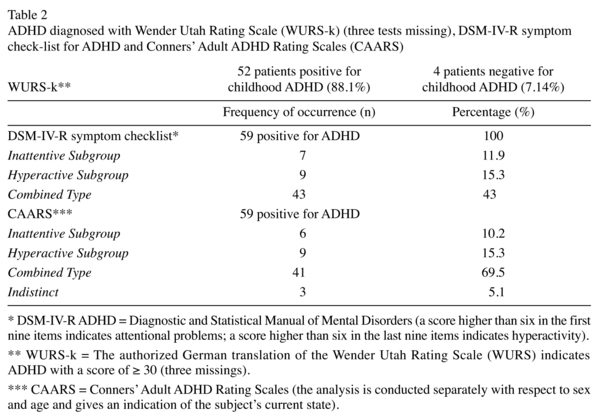
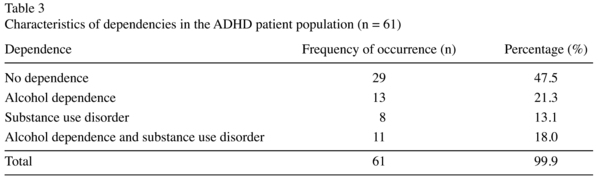
<body><![CDATA[<p>&nbsp;</p>     <p>52 (88.1 %) of the 61 patients achieved the cut-off of 30 or more points in the WURS-k and therefore fulfilled the criteria for ADHD symptoms in childhood. The DSM-IV-R symptom checklist retrospectively confirmed the ADHD diagnosis in childhood in 59 patients (96.2 %). The CAARS gave evidence of persisting ADHD in adulthood in all 59 patients, too. Two of the 61 patients could only be diagnosed with ADHD according to the interview of an experienced and specially trained physician, so that they were excluded from the diagnostic differentiation of the ADHD subtypes. According to DSM-IV-R, 9 patients (15.3%) were categorized as 'hyperactive type', 7 (11.9%) as 'inattentive type' and 43 (72.9%) as 'combined type' of ADHD. The same differentiation was conducted using the CAARS. The categorization showed similar results. The data concerning the diagnosis of ADHD and the subtypes are presented in <a href="#t2">Table 2</a>.</p>     <p align="center"><a name="t2"><img src="/img/revistas/ejpen/v25n3/original5_tabla2.jpg" width="600" height="418"></a></p>     <p>&nbsp;</p>     <p>Approximately half of the patients (50.8%) diagnosed with ADHD were suffering from a comorbid active or remitted dependency according to the IDCL. 21.3% of the patients (n = 13) were diagnosed with an alcohol dependency, 13.1% with an SUD (n = 8) and 18% with a comorbid alcohol and SUD (n = 11). The data are presented in <a href="#t3">Table 3</a>.</p>     <p align="center"><a name="t3"><img src="/img/revistas/ejpen/v25n3/original5_tabla3.jpg" width="600" height="185"></a></p>     <p>&nbsp;</p>     <p><font face="Verdana" size="3">Alcohol</font></p>     <p><font face="Verdana" size="2">29.5% (n = 18) of our ADHD patients could be diagnosed with an alcohol dependency according to IDCL. The average age of first alcohol consumption was 13.97 years (&plusmn; 3.27). The first alcohol excess was 15.09 (&plusmn; 2.94) years according to the QOD. A frequent consumption of three times a week was started at the age of 19 (&plusmn; 4.94) years.</font></p>     <p><font face="Verdana" size="3">Substances</font></p>     ]]></body>
<body><![CDATA[<p><font face="Verdana" size="2">With the aid of the IDCL, 31.1% (n = 19) of the patients could be diagnosed as suffering from a substance dependence, including three cases with a reasonable suspicion. In 68.4% of the cases (n = 13) the symptoms were remitted.</font></p>     <p><font face="Verdana" size="2">Cannabis was the substance most commonly consumed, at 29.5% of the whole population according to EuropASI and QOD. This means that 94.7% of the substance dependent ADHD patients in our study consumed cannabis over a period of 8 &plusmn; 7.58 years. The start of the frequent consumption of cannabis was 17.68 years &plusmn; 4.22. Hence, cannabis was the first illegal drug to be consumed regularly.</font></p>     <p><font face="Verdana" size="2">For a detailed description of the substances consumed see <a href="#t4">Table 4</a>.</font></p>     <p align="center"><a name="t4"><img src="/img/revistas/ejpen/v25n3/original5_tabla4.jpg" width="600" height="279"></a></p>     <p>&nbsp;</p>     <p>The majority of the substance dependent ADHD patients abused multiple drugs (73.7%, n = 14), starting at an age of 17.88 (&plusmn; 7.78) years. This multiple substance dependence was due to the use of cannabis (94.73%, n = 18), amphetamines (47.36%, n = 9), cocaine (36.84%, n = 7) and hallucinogens (36.84%, n = 7).</font></p>     <p><font face="Verdana" size="3">Nicotine</font></p>     <p><font face="Verdana" size="2">According to the Fagerstr&ouml;m test (FTNA), there was no nicotine dependence in 53.3% of the patients at the time of the interview. In 11.6% (n = 7) the dependence was classified as "very low", 10% (n = 6) as "low", 5% as "middle" and 20% as "extreme".</font></p>     <p>&nbsp;</p>     <p><font face="Verdana" size="2"><b>Discussion</b></font></p>     ]]></body>
<body><![CDATA[<p><font face="Verdana" size="2">The prevalence of an addictive disorder seems to be elevated in ADHD adults, as approximately every second ADHD patient (50.8%) in our study was suffering from an addictive disorder.</font></p>     <p><font face="Verdana" size="2">These results are similar to those of Jacob et al.<sup>22</sup>, who found a lifetime prevalence of a comorbid SUD in 45% in a large German cohort study. Similarly, Wilens and colleagues<sup>24</sup> found a comorbidity of ADHD and alcohol or substance use dependency in 71%. These results support the theory that ADHD patients are at high risk of developing addictive disorders.</font></p>     <p><font face="Verdana" size="2">Our study population revealed an addiction to alcohol in 39.3%. This prevalence rate includes both current and remitted cases of alcohol addiction, which complicates a direct comparison with the prevalence rate of alcohol dependence in the normal population. Nevertheless, the number of alcohol dependent patients with ADHD seems to be elevated in comparison to the normal German population. According to evaluations of German society for addiction ("Deutsche Hauptstelle f&uuml;r Suchtfragen e.V. (DHS)"), 2.4% of the German population between the age of 18 and 64 years are addicted to alcohol according to DSM-IV criteria<sup>13</sup>.</font></p>     <p><font face="Verdana" size="2">Studies by Biederman and colleagues<sup>18</sup> and Wilens<sup>29</sup> found similar rates for this comorbidity, with 44% alcohol addicted ADHD patients. Also Downey et al.<sup>26</sup> and Shekim et al.<sup>25</sup> describe a comorbidity of alcohol dependency and ADHD in 34% of the patients. Regarding these results, our data seem to be realistic and support the theory that the prevalence of alcohol dependence is elevated in ADHD patients.</font></p>     <p><font face="Verdana" size="2">The numbers of ADHD patients with a multiple SUD show that ADHD patients also have a higher risk of becoming addicted to illegal drugs. 14.2% of the German population try an illegal drug at least once in their lives<sup>60</sup>. Compared with our prevalence rate of 31.1% substance abusing ADHD patients, the lifetime risk of consuming drugs is twice as high. In contrast to the alcohol addiction data, these figures can be compared because the statistics of the normal population include both current drug consumption and consumption during the past, and also considers cannabis as an illegal drug. Wilens<sup>29</sup> found a similarly elevated rate for psychoactive SUD in ADHD patients, at 9% to 30%. The research groups of Mannuzza<sup>23</sup> and Biederman<sup>61</sup> even found a percentage rate of about 50%. Our results are therefore in line with the hypothesis that ADHD is a risk factor for addiction to illegal drugs<sup>17</sup> which means that ADHD patients have also a higher risk of getting in conflict with the law.</font></p>     <p><font face="Verdana" size="2">Taking a closer look at the alcohol consumption habits of the adult ADHD patients in comparison to the normal population, we were unable to find any differences concerning first alcohol consumption or first intoxication with alcohol. The mean age of first alcohol consumption of our ADHD patient group was 13.97 (&plusmn; 3.27) years. The mean age of first intoxication was 15.09 (&plusmn; 2.94) years. In the normal population, alcohol is first consumed at 12.8 years and the critical level of alcohol first exceeded at 13.8 years<sup>62</sup>. It is certainly difficult to compare our study group with the youth of today, because the trend is for alcohol to be started earlier than when our patients were teenagers. Comparison of an older normal population might have shown a difference in first alcohol consumption. This result was nonetheless unexpected, because various authors have described an earlier start and a more aggressive form of SUD in patients with ADHD<sup>24,32</sup>.</font></p>     <p><font face="Verdana" size="2">Whereas the first symptoms of alcohol dependence can be recognized earlier in ADHD patients than in the normal population, our patients reported the first symptoms of alcohol dependence at the age of 22.43 (&plusmn; 5.47) years. This finding is consistent with the work of Wilens and colleagues<sup>24</sup>, who found that the career of dependence starts approximately three years earlier in ADHD patients in comparison to the normal population. Similar results were reported by Johann and colleagues<sup>63</sup>. Within their study including 314 patients with and without ADHD, they arrived at the conclusion that ADHD patients become addicted to alcohol significantly earlier (24 instead of 30 years).</font></p>     <p><font face="Verdana" size="2">The group of Wilens<sup>24</sup> found that patients with ADHD also develop a dependence to psychoactive substances around three years earlier in contrast to people without ADHD. In general ADHD patients seem to change earlier and faster from a substance abuse into an addictive disorder than patients without ADHD<sup>64</sup>. Even if there is no difference between ADHD patients and the normal population with respect to first alcohol consumption, the clinician should bear in mind that the risk of ADHD patients developing an addiction is higher if they are already abusing substances.</font></p>     <p><font face="Verdana" size="2">The illegal substance most frequently consumed was clearly cannabis. Regular consumption was started at 17.68 (&plusmn; 4.22) years. These results are congruent with the study of Wilens<sup>29</sup>, who described the first consumption of cannabis typically at an age between 17 and 19. 29.5% of our study population consumed cannabis regularly. This is in line with the findings of Tzelepis and colleagues<sup>33</sup>, who found a prevalence of regular cannabis consumption in their study population of 21%. In a multi-centre study, Tims and colleagues<sup>65</sup> found that ADHD is the second most common comorbidity in adolescents who abuse cannabis, at 38%. Cannabis consumption may be a kind of "self-medication" for ADHD patients. The "self-medication hypothesis" of the dependence disorders was postulated in 1985 by Khantzian<sup>66</sup>. The core statement of the hypothesis is that people who develop a substance dependence are already suffering from other psychiatric symptoms, such as anxiety disorders or depression, but also hyperactivity. Khantzian developed the hypothesis that each drug consumer unconsciously selects the drug that reduces the symptoms from which he is suffering most. The preferred substances to be consumed by ADHD patients are according to Khantzian the group of the amphetamines as well as cocaine, because ADHD patients describe commonly reassuring effects after consumption of the above mentioned substances - at first sight, apparently a "paradoxical" reaction<sup>66,67</sup>. In a study published recently, Pandolfo and colleagues<sup>68</sup> reported that hyperactive adult rats show a significant influence in their behaviour after consumption of can-nabinoid substances in contrast to healthy rats, which supports the theory of self-medication of ADHD patients with cannabis.</font></p>     <p><font face="Verdana" size="2">Also the risk of developing a cocaine dependence seems to be higher in ADHD patients. We found a cocaine dependency in 14.8% of our patients. These figures are definitely higher than the prevalence in the normal population, which is 2.7% in Germany. Comparable percentages (11%) of the prevalence of cannabis dependence were described by Tzelepis et al.<sup>33</sup>. Conversely, Rounsaville and colleagues<sup>69</sup> found positive criteria for childhood ADHD in 35% of cocaine abusing patients.</font></p>     ]]></body>
<body><![CDATA[<p><font face="Verdana" size="2">Concerning nicotine dependence, we observed another highly prevalent comorbidity in ADHD patients (45.9%), which is almost twice as high as the nicotine dependence in the normal population, at 27%. Similarly, Pomerleau and colleagues<sup>41</sup> found a prevalence rate of nicotine dependence of 40-75% in ADHD patients. Nicotine consumption may also be a kind of "self-medication", as Lambert and Hartsough<sup>70</sup> found tobacco consumption to be twice as high in ADHD adults. This hypothesis is underlined by Wilens et al.<sup>71</sup>, who described that more than one third of ADHD adolescents and adults use nicotine for "self-medication" which is according to the theory of Khantzian<sup>72,73</sup>. The high prevalence of nicotine dependence in ADHD patients can be explained pathophysiologically by the fact that nicotine stimulates the release of neurotransmitters (e.g. acetylcholine, dopamine and serotonin) and, accordingly, the attention span is increased. Nicotine appears to have an effect on the nucleus accumbens similar to that of the amphetamine derivatives<sup>74</sup>. Some studies support the hypothesis that nicotine can be used therapeutically in ADHD patients<sup>75,76</sup>.</font></p>     <p><font face="Verdana" size="2">Several SPECT studies have shown evidence of a comparable effect of nicotine on the dopamine transporter (DAT), known also with methylphenidate<sup>77</sup>. A marked decrease of striatal DAT has been observed in nicotine-dependent ADHD patients<sup>78</sup>. It is of particular interest to note that various dopaminergically and noradrenergically effective drugs, such as bupropione, nortriptylene and moclobemide, are effective and beneficial in both the treatment of nicotine dependence and in ADHD<sup>45</sup>.</font></p>     <p><font face="Verdana" size="2">Other reasons for the high vulnerability of SUD in ADHD patients might also be the typical impulsivity, such as the readiness to take risks and a form of "sensation seeking" behaviour. The concept of "sensation seeking" appeared for the first time at the end of the 1970s<sup>79,80</sup>. The basis for this new concept was the observation that some people show a stronger desire for new attractions and are ready to take higher risks to achieve a stimulation by new attractions. There also appeared to be a positive correlation between impulsiveness and "sensation-seeking behaviour", which was discussed for the purposes of a biological mechanism<sup>81</sup>. Cloninger interprets "curiosity behaviour" as an expression of a low basal dopaminergic activity. With the help of positron emission tomography (PET) and single photon emission computed tomography (SPECT), controlled proof of a raised dopamine-transporter density in the striatum -a disturbance of dopaminergic function- leads to the assumption that ADHD patients have a strong "curiosity behaviour" in the narrower sense<sup>77,82,83</sup>. The reduced dopamine level in ADHD patients may therefore explain the strong "novelty seeking", which would explain the raised impulsiveness and risk seeking behaviour, on the one hand, and the higher risk concerning substance dependence, on the other. Verheul and others (2001)<sup>58</sup> come to similar results in their study. They describe that some personality traits seem to be associated with the development of an SUD, such as impulsivity, hyperactivity and "sensation seeking". Also from the point of view of genetics there seems to be evidence that there is coherence between ADHD and SUD. Comorbidity of alcoholism and ADHD forms a distinct phenotype that contributes substantially to the so-called type 2 alcoholics according Cloninger. A genome-wide association (GWA) study with pooled DNA in adult ADHD employing approximately 500K SNP markers identifies novel risk genes and reveals remarkable overlap with findings from recent GWA scans in SUDs<sup>59.</sup></font></p>     <p><font face="Verdana" size="3">Limitations</font></p>     <p><font face="Verdana" size="2">One general problem in prevalence studies is that not every patient wants to take part in a study. As mentioned above two patients refused to take part in the study. This can falsify the results. Enough patients participated in our study for conclusions to be drawn, but the patients who did not agree to take part might have led to slightly different figures. Overall we must admit that 61 patients are not a very high number of patients.</font></p>     <p><font face="Verdana" size="2">Another problem is the work with self-assessment scales, which includes the risk that patients do not remember events in their past accurately and tend to affirm questions. We tried to reduce these risks by conducting a semi-standardized interview by an experienced clinician.</font></p>     <p>&nbsp;</p>     <p><font face="Verdana" size="2"><b>Conclusions</b></font></p>     <p><font face="Verdana" size="2">Our data show that the risk of developing a dependence disorder is elevated in ADHD patients. Clinicians should bear in mind that the characteristic of a dependence in ADHD patients is clinically more pronounced and that an addiction in ADHD patients starts earlier than one might possibly expect. The results of our study and clinical experience also indicate the importance of an early diagnosis and treatment of ADHD, i.e. a 'multimodal therapy' using pharmacological and psychotherapeutic concepts, which may help in reducing the onset and exacerbation of addictive illnesses.</font></p>     <p>&nbsp;</p>     ]]></body>
<body><![CDATA[<p><font face="Verdana" size="2"><b>Acknowledgments</b></font></p>     <p><font face="Verdana" size="2">The authors of this paper do not have any commercial associations that might pose a conflict of interest in connection with this manuscript. The authors thank all co-workers for their assistance in this study, particularly since no financial support was available.</font></p>     <p>&nbsp;</p>     <p><font face="Verdana" size="2"><b>Reference List</b></font></p>     <!-- ref --><p><font face="Verdana" size="2">1. Huss M. Vorbereitung der Erhebung und Auswertung zur Pr&auml;valenz des Aufmerksamkeit-Defizit-Hyperaktivit&auml;ts-Syndroms (ADHS) in Deutschland im Rahmen des Kinder- und Jungend-Surveys des Robert-Koch-Instituts. Abschlussbericht an das Bundesministerium f&uuml;r Gesundheit und soziale Sicherung (BMGS). Bonn: 2004.    &nbsp;&nbsp;&nbsp;&nbsp;&nbsp;&nbsp;&nbsp;&nbsp;[&#160;<a href="javascript:void(0);" onclick="javascript: window.open('/scielo.php?script=sci_nlinks&ref=5944752&pid=S0213-6163201100030000500001&lng=','','width=640,height=500,resizable=yes,scrollbars=1,menubar=yes,');">Links</a>&#160;]<!-- end-ref --></font></p>    <!-- ref --><p><font face="Verdana" size="2">2. Barkley RA. Advancing age, declining ADHD. Am J Psychiatry 1997; 154: 1323-1325.    &nbsp;&nbsp;&nbsp;&nbsp;&nbsp;&nbsp;&nbsp;&nbsp;[&#160;<a href="javascript:void(0);" onclick="javascript: window.open('/scielo.php?script=sci_nlinks&ref=5944754&pid=S0213-6163201100030000500002&lng=','','width=640,height=500,resizable=yes,scrollbars=1,menubar=yes,');">Links</a>&#160;]<!-- end-ref --></font></p>    <!-- ref --><p><font face="Verdana" size="2">3. Kessler RC, Adler L, Barkley R, Biederman J, Conners CK, Demler O, <i>et al</i>. The prevalence and correlates of adult ADHD in the United States: results from the National Comorbidity Survey Replication. Am J Psychiatry 2006; 163: 716-723.    &nbsp;&nbsp;&nbsp;&nbsp;&nbsp;&nbsp;&nbsp;&nbsp;[&#160;<a href="javascript:void(0);" onclick="javascript: window.open('/scielo.php?script=sci_nlinks&ref=5944756&pid=S0213-6163201100030000500003&lng=','','width=640,height=500,resizable=yes,scrollbars=1,menubar=yes,');">Links</a>&#160;]<!-- end-ref --></font></p>    ]]></body>
<body><![CDATA[<!-- ref --><p><font face="Verdana" size="2">4. World Health Organization. Division of Mental Health, ICD-10. Geneva; 1990.    &nbsp;&nbsp;&nbsp;&nbsp;&nbsp;&nbsp;&nbsp;&nbsp;[&#160;<a href="javascript:void(0);" onclick="javascript: window.open('/scielo.php?script=sci_nlinks&ref=5944758&pid=S0213-6163201100030000500004&lng=','','width=640,height=500,resizable=yes,scrollbars=1,menubar=yes,');">Links</a>&#160;]<!-- end-ref --></font></p>    <!-- ref --><p><font face="Verdana" size="2">5. Weiss M, Hechtmann L, Weiss G. ADHD in adulthood. A guide to current theory, diagnosis and treatment. Baltimore: The Johns Hopkins University Press; 1999.    &nbsp;&nbsp;&nbsp;&nbsp;&nbsp;&nbsp;&nbsp;&nbsp;[&#160;<a href="javascript:void(0);" onclick="javascript: window.open('/scielo.php?script=sci_nlinks&ref=5944760&pid=S0213-6163201100030000500005&lng=','','width=640,height=500,resizable=yes,scrollbars=1,menubar=yes,');">Links</a>&#160;]<!-- end-ref --></font></p>    <!-- ref --><p><font face="Verdana" size="2">6. Wender PH, Wolf LE, Wasserstein J. Adults with ADHD. An overview. Ann N Y Acad Sci 2001; 931: 1-16.    &nbsp;&nbsp;&nbsp;&nbsp;&nbsp;&nbsp;&nbsp;&nbsp;[&#160;<a href="javascript:void(0);" onclick="javascript: window.open('/scielo.php?script=sci_nlinks&ref=5944762&pid=S0213-6163201100030000500006&lng=','','width=640,height=500,resizable=yes,scrollbars=1,menubar=yes,');">Links</a>&#160;]<!-- end-ref --></font></p>    <!-- ref --><p><font face="Verdana" size="2">7. Ebert D, Krause J, Roth-Sackenheim C. ADHD in adulthood-guidelines based on expert consensus with DGPPN support. Nervenarzt 2003; 74: 939-946.    &nbsp;&nbsp;&nbsp;&nbsp;&nbsp;&nbsp;&nbsp;&nbsp;[&#160;<a href="javascript:void(0);" onclick="javascript: window.open('/scielo.php?script=sci_nlinks&ref=5944764&pid=S0213-6163201100030000500007&lng=','','width=640,height=500,resizable=yes,scrollbars=1,menubar=yes,');">Links</a>&#160;]<!-- end-ref --></font></p>    <!-- ref --><p><font face="Verdana" size="2">8. Krause KH, Krause J, Trott GE. Hyperkinetic syndrome (attention deficit-/hyperactivity disorder) in adulthood. Nervenarzt 1998; 69: 543-556.    &nbsp;&nbsp;&nbsp;&nbsp;&nbsp;&nbsp;&nbsp;&nbsp;[&#160;<a href="javascript:void(0);" onclick="javascript: window.open('/scielo.php?script=sci_nlinks&ref=5944766&pid=S0213-6163201100030000500008&lng=','','width=640,height=500,resizable=yes,scrollbars=1,menubar=yes,');">Links</a>&#160;]<!-- end-ref --></font></p>    ]]></body>
<body><![CDATA[<!-- ref --><p><font face="Verdana" size="2">9. Wilens TE, Faraone SV, Biederman J, Gunawardene S. Does stimulant therapy of attention-deficit/hyperactivity disorder beget later substance abuse? A meta-analytic review of the literature. Pediatrics 2003; 111: 179-185.    &nbsp;&nbsp;&nbsp;&nbsp;&nbsp;&nbsp;&nbsp;&nbsp;[&#160;<a href="javascript:void(0);" onclick="javascript: window.open('/scielo.php?script=sci_nlinks&ref=5944768&pid=S0213-6163201100030000500009&lng=','','width=640,height=500,resizable=yes,scrollbars=1,menubar=yes,');">Links</a>&#160;]<!-- end-ref --></font></p>    <!-- ref --><p><font face="Verdana" size="2">10. American Psychiatric Association. DSM-IV-R Diagnostic criteria of the attention deficit-/hyperactivity disorder. Washington, DC; 2000.    &nbsp;&nbsp;&nbsp;&nbsp;&nbsp;&nbsp;&nbsp;&nbsp;[&#160;<a href="javascript:void(0);" onclick="javascript: window.open('/scielo.php?script=sci_nlinks&ref=5944770&pid=S0213-6163201100030000500010&lng=','','width=640,height=500,resizable=yes,scrollbars=1,menubar=yes,');">Links</a>&#160;]<!-- end-ref --></font></p>    <!-- ref --><p><font face="Verdana" size="2">11. Schuckit MA, Hesselbrock V, Tipp J, Anthenelli R, Bucholz K, Radziminski S. A comparison of DSM-III-R, DSM-IV and ICD-10 substance use disorders diagnoses in 1922 men and women subjects in the COGA study. Collaborative Study on the Genetics of Alcoholism. Addiction 1994; 89: 1629-1638.    &nbsp;&nbsp;&nbsp;&nbsp;&nbsp;&nbsp;&nbsp;&nbsp;[&#160;<a href="javascript:void(0);" onclick="javascript: window.open('/scielo.php?script=sci_nlinks&ref=5944772&pid=S0213-6163201100030000500011&lng=','','width=640,height=500,resizable=yes,scrollbars=1,menubar=yes,');">Links</a>&#160;]<!-- end-ref --></font></p>    <!-- ref --><p><font face="Verdana" size="2">12. Statistisches Bundesamt. Leben in Deutschland - Haushalte, Familien und Gesundheit. Ergebnisse des Mikrozensus 2005. Wiesbaden: Statistisches Bundesamt; 2006.    &nbsp;&nbsp;&nbsp;&nbsp;&nbsp;&nbsp;&nbsp;&nbsp;[&#160;<a href="javascript:void(0);" onclick="javascript: window.open('/scielo.php?script=sci_nlinks&ref=5944774&pid=S0213-6163201100030000500012&lng=','','width=640,height=500,resizable=yes,scrollbars=1,menubar=yes,');">Links</a>&#160;]<!-- end-ref --></font></p>    <!-- ref --><p><font face="Verdana" size="2">13. H&uuml;llinghorst R., Kaldewei D., Lindemann F. Jahrbuch Sucht 2007, Epidemiologischer Suchtsurvey 2006. In: Sucht - Zeitschrift f&uuml;r Wissenschaft und Praxis, ed. Deutsche Haupstelle f&uuml;r Suchtfragen e.V. (DHS). 2006.    &nbsp;&nbsp;&nbsp;&nbsp;&nbsp;&nbsp;&nbsp;&nbsp;[&#160;<a href="javascript:void(0);" onclick="javascript: window.open('/scielo.php?script=sci_nlinks&ref=5944776&pid=S0213-6163201100030000500013&lng=','','width=640,height=500,resizable=yes,scrollbars=1,menubar=yes,');">Links</a>&#160;]<!-- end-ref --></font></p>    ]]></body>
<body><![CDATA[<!-- ref --><p><font face="Verdana" size="2">14. H&uuml;llinghorst R., Kaldewei D., Lindemann F. Repr&auml;sentativerhebung zum Gebrauch psychoaktiver Substanzen bei Erwachsenen in Deutschland. 2000.    &nbsp;&nbsp;&nbsp;&nbsp;&nbsp;&nbsp;&nbsp;&nbsp;[&#160;<a href="javascript:void(0);" onclick="javascript: window.open('/scielo.php?script=sci_nlinks&ref=5944778&pid=S0213-6163201100030000500014&lng=','','width=640,height=500,resizable=yes,scrollbars=1,menubar=yes,');">Links</a>&#160;]<!-- end-ref --></font></p>    <!-- ref --><p><font face="Verdana" size="2">15. Kraus L, Pfeiffer-Gerschel T, Stonner T. Epidemiologischer Suchtsurvey 2006. Repr&auml;sentativerhebung zum Gebrauch und Missbrauch psychoaktiver Substanzen bei Erwachsenen in Deutschland. Sucht 2008; 54: 1-63.    &nbsp;&nbsp;&nbsp;&nbsp;&nbsp;&nbsp;&nbsp;&nbsp;[&#160;<a href="javascript:void(0);" onclick="javascript: window.open('/scielo.php?script=sci_nlinks&ref=5944780&pid=S0213-6163201100030000500015&lng=','','width=640,height=500,resizable=yes,scrollbars=1,menubar=yes,');">Links</a>&#160;]<!-- end-ref --></font></p>    <!-- ref --><p><font face="Verdana" size="2">16. BZgA 2007. Die Drogenaffinit&auml;t Jugendlicher in der Bundesrepublik Deutschland 2004 (DAS). Version: Illegale Drogen, <a target="_blank" href="http://www.bzga.de/bot">http://www.bzga.de/bot</a> 2007; Seite 1417-html, Abruf: 15.08.2007.    &nbsp;&nbsp;&nbsp;&nbsp;&nbsp;&nbsp;&nbsp;&nbsp;[&#160;<a href="javascript:void(0);" onclick="javascript: window.open('/scielo.php?script=sci_nlinks&ref=5944782&pid=S0213-6163201100030000500016&lng=','','width=640,height=500,resizable=yes,scrollbars=1,menubar=yes,');">Links</a>&#160;]<!-- end-ref --></font></p>    <!-- ref --><p><font face="Verdana" size="2">17. Biederman J, Wilens T, Mick E, Milberger S, Spencer TJ, Faraone SV. Psychoactive substance use disorders in adults with attention deficit hyperactivity disorder (ADHD): effects of ADHD and psychiatric comorbidity. Am J Psychiatry 1995; 152: 1652-1658.    &nbsp;&nbsp;&nbsp;&nbsp;&nbsp;&nbsp;&nbsp;&nbsp;[&#160;<a href="javascript:void(0);" onclick="javascript: window.open('/scielo.php?script=sci_nlinks&ref=5944784&pid=S0213-6163201100030000500017&lng=','','width=640,height=500,resizable=yes,scrollbars=1,menubar=yes,');">Links</a>&#160;]<!-- end-ref --></font></p>    <!-- ref --><p><font face="Verdana" size="2">18. Biederman J, Wilens TE, Mick E, Faraone SV, Spencer T. Does attention-deficit hyperactivity disorder impact the developmental course of drug and alcohol abuse and dependence? Biol Psychiatry 1998; 44: 269-273.    &nbsp;&nbsp;&nbsp;&nbsp;&nbsp;&nbsp;&nbsp;&nbsp;[&#160;<a href="javascript:void(0);" onclick="javascript: window.open('/scielo.php?script=sci_nlinks&ref=5944786&pid=S0213-6163201100030000500018&lng=','','width=640,height=500,resizable=yes,scrollbars=1,menubar=yes,');">Links</a>&#160;]<!-- end-ref --></font></p>    ]]></body>
<body><![CDATA[<!-- ref --><p><font face="Verdana" size="2">19. Clure C, Brady KT, Saladin ME, Johnson D, Waid R, Rittenbury M. Attention-deficit/hyperactivity disorder and substance use: Symptom pattern and drug choice. Am J Drug Alcohol Abuse 1999; 25: 441-448.    &nbsp;&nbsp;&nbsp;&nbsp;&nbsp;&nbsp;&nbsp;&nbsp;[&#160;<a href="javascript:void(0);" onclick="javascript: window.open('/scielo.php?script=sci_nlinks&ref=5944788&pid=S0213-6163201100030000500019&lng=','','width=640,height=500,resizable=yes,scrollbars=1,menubar=yes,');">Links</a>&#160;]<!-- end-ref --></font></p>    <!-- ref --><p><font face="Verdana" size="2">20. Robbins TW. ADHD and addiction. Nat Med 2002; 8: 24-25.    &nbsp;&nbsp;&nbsp;&nbsp;&nbsp;&nbsp;&nbsp;&nbsp;[&#160;<a href="javascript:void(0);" onclick="javascript: window.open('/scielo.php?script=sci_nlinks&ref=5944790&pid=S0213-6163201100030000500020&lng=','','width=640,height=500,resizable=yes,scrollbars=1,menubar=yes,');">Links</a>&#160;]<!-- end-ref --></font></p>    <!-- ref --><p><font face="Verdana" size="2">21. Wilson JJ, Levin FR. Attention deficit hyperactivity disorder (ADHD) and substance use disorders. Curr Psychiatry Rep 2001; 3: 497-506.    &nbsp;&nbsp;&nbsp;&nbsp;&nbsp;&nbsp;&nbsp;&nbsp;[&#160;<a href="javascript:void(0);" onclick="javascript: window.open('/scielo.php?script=sci_nlinks&ref=5944792&pid=S0213-6163201100030000500021&lng=','','width=640,height=500,resizable=yes,scrollbars=1,menubar=yes,');">Links</a>&#160;]<!-- end-ref --></font></p>    <!-- ref --><p><font face="Verdana" size="2">22. Jacob CP, Romanos J, Dempfle A, Heine M, Windemuth-Kieselbach C, Kruse A, <i>et al</i>. Co-morbidity of adult attention-deficit/hyperactivity disorder with focus on personality traits and related disorders in a tertiary referral center. Eur Arch Psychiatry Clin Neurosci 2007; 257: 309-317.    &nbsp;&nbsp;&nbsp;&nbsp;&nbsp;&nbsp;&nbsp;&nbsp;[&#160;<a href="javascript:void(0);" onclick="javascript: window.open('/scielo.php?script=sci_nlinks&ref=5944794&pid=S0213-6163201100030000500022&lng=','','width=640,height=500,resizable=yes,scrollbars=1,menubar=yes,');">Links</a>&#160;]<!-- end-ref --></font></p>    <!-- ref --><p><font face="Verdana" size="2">23. Mannuzza S, Klein RG, Bessler A, Malloy P, LaPadula M. Adult outcome of hyperactive boys. Educational achievement, occupational rank, and psychiatric status. Arch Gen Psychiatry 1993; 50: 565-576.    &nbsp;&nbsp;&nbsp;&nbsp;&nbsp;&nbsp;&nbsp;&nbsp;[&#160;<a href="javascript:void(0);" onclick="javascript: window.open('/scielo.php?script=sci_nlinks&ref=5944796&pid=S0213-6163201100030000500023&lng=','','width=640,height=500,resizable=yes,scrollbars=1,menubar=yes,');">Links</a>&#160;]<!-- end-ref --></font></p>    ]]></body>
<body><![CDATA[<!-- ref --><p><font face="Verdana" size="2">24. Wilens TE, Biederman J, Mick E, Faraone SV, Spencer T. Attention deficit hyperactivity disorder (ADHD) is associated with early onset substance use disorders. J Nerv Ment Dis 1997; 185: 475-482.    &nbsp;&nbsp;&nbsp;&nbsp;&nbsp;&nbsp;&nbsp;&nbsp;[&#160;<a href="javascript:void(0);" onclick="javascript: window.open('/scielo.php?script=sci_nlinks&ref=5944798&pid=S0213-6163201100030000500024&lng=','','width=640,height=500,resizable=yes,scrollbars=1,menubar=yes,');">Links</a>&#160;]<!-- end-ref --></font></p>    <!-- ref --><p><font face="Verdana" size="2">25. Shekim WO, Asarnow RF, Hess E, Zaucha K, Wheeler N. A clinical and demographic profile of a sample of adults with attention deficit hyperactivity disorder, residual state. Compr Psychiatry 1990; 31: 416-425.    &nbsp;&nbsp;&nbsp;&nbsp;&nbsp;&nbsp;&nbsp;&nbsp;[&#160;<a href="javascript:void(0);" onclick="javascript: window.open('/scielo.php?script=sci_nlinks&ref=5944800&pid=S0213-6163201100030000500025&lng=','','width=640,height=500,resizable=yes,scrollbars=1,menubar=yes,');">Links</a>&#160;]<!-- end-ref --></font></p>    <!-- ref --><p><font face="Verdana" size="2">26. Downey KK, Stelson FW, Pomerleau OF, Giordani B. Adult attention deficit hyperactivity disorder: Psychological test profiles in a clinical population. J Nerv Ment Dis 1997; 185: 32-38.    &nbsp;&nbsp;&nbsp;&nbsp;&nbsp;&nbsp;&nbsp;&nbsp;[&#160;<a href="javascript:void(0);" onclick="javascript: window.open('/scielo.php?script=sci_nlinks&ref=5944802&pid=S0213-6163201100030000500026&lng=','','width=640,height=500,resizable=yes,scrollbars=1,menubar=yes,');">Links</a>&#160;]<!-- end-ref --></font></p>    <!-- ref --><p><font face="Verdana" size="2">27. Ohlmeier MD, Peters K, Kordon A, Seifert J, Wildt BT, Wiese B, <i>et al</i>. Nicotine and alcohol dependence in patients with comorbid attention-deficit/hyperactivity disorder (ADHD). Alcohol Alcohol 2007; 42: 539-543.    &nbsp;&nbsp;&nbsp;&nbsp;&nbsp;&nbsp;&nbsp;&nbsp;[&#160;<a href="javascript:void(0);" onclick="javascript: window.open('/scielo.php?script=sci_nlinks&ref=5944804&pid=S0213-6163201100030000500027&lng=','','width=640,height=500,resizable=yes,scrollbars=1,menubar=yes,');">Links</a>&#160;]<!-- end-ref --></font></p>    <!-- ref --><p><font face="Verdana" size="2">28. Ohlmeier MD, Peters K, Te Wildt BT, Zedler M, Ziegenbein M, Wiese B, <i>et al</i>. Comorbidity of alcohol and substance dependence with attention-deficit/hyperactivity disorder (ADHD). Alcohol Alcohol 2008; 43: 300-304.    &nbsp;&nbsp;&nbsp;&nbsp;&nbsp;&nbsp;&nbsp;&nbsp;[&#160;<a href="javascript:void(0);" onclick="javascript: window.open('/scielo.php?script=sci_nlinks&ref=5944806&pid=S0213-6163201100030000500028&lng=','','width=640,height=500,resizable=yes,scrollbars=1,menubar=yes,');">Links</a>&#160;]<!-- end-ref --></font></p>    ]]></body>
<body><![CDATA[<!-- ref --><p><font face="Verdana" size="2">29. Wilens TE. Attention-deficit/hyperactivity disorder and the substance use disorders: The nature of the relationship, subtypes at risk, and treatment issues. Psychiatr Clin North Am 2004; 27: 283-301.    &nbsp;&nbsp;&nbsp;&nbsp;&nbsp;&nbsp;&nbsp;&nbsp;[&#160;<a href="javascript:void(0);" onclick="javascript: window.open('/scielo.php?script=sci_nlinks&ref=5944808&pid=S0213-6163201100030000500029&lng=','','width=640,height=500,resizable=yes,scrollbars=1,menubar=yes,');">Links</a>&#160;]<!-- end-ref --></font></p>    <!-- ref --><p><font face="Verdana" size="2">30. Carroll KM, Rounsaville BJ. History and significance of childhood attention deficit disorder in treatment-seeking cocaine abusers. Compr Psychiatry 1993; 34: 75-82.    &nbsp;&nbsp;&nbsp;&nbsp;&nbsp;&nbsp;&nbsp;&nbsp;[&#160;<a href="javascript:void(0);" onclick="javascript: window.open('/scielo.php?script=sci_nlinks&ref=5944810&pid=S0213-6163201100030000500030&lng=','','width=640,height=500,resizable=yes,scrollbars=1,menubar=yes,');">Links</a>&#160;]<!-- end-ref --></font></p>    <!-- ref --><p><font face="Verdana" size="2">31. Levin FR, Evans SM, Kleber HD. Prevalence of adult attention-deficit hyperactivity disorder among cocaine abusers seeking treatment. Drug Alcohol Depend 1998; 52: 15-25.    &nbsp;&nbsp;&nbsp;&nbsp;&nbsp;&nbsp;&nbsp;&nbsp;[&#160;<a href="javascript:void(0);" onclick="javascript: window.open('/scielo.php?script=sci_nlinks&ref=5944812&pid=S0213-6163201100030000500031&lng=','','width=640,height=500,resizable=yes,scrollbars=1,menubar=yes,');">Links</a>&#160;]<!-- end-ref --></font></p>    <!-- ref --><p><font face="Verdana" size="2">32. Schubiner H, Tzelepis A, Milberger S, Lockhart N, Kruger M, Kelley BJ, <i>et al</i>. Prevalence of attention-deficit/hyperactivity disorder and conduct disorder among substance abusers. J Clin Psychiatry 2000; 61: 244-251.    &nbsp;&nbsp;&nbsp;&nbsp;&nbsp;&nbsp;&nbsp;&nbsp;[&#160;<a href="javascript:void(0);" onclick="javascript: window.open('/scielo.php?script=sci_nlinks&ref=5944814&pid=S0213-6163201100030000500032&lng=','','width=640,height=500,resizable=yes,scrollbars=1,menubar=yes,');">Links</a>&#160;]<!-- end-ref --></font></p>    <!-- ref --><p><font face="Verdana" size="2">33. Tzelepis A, Schubiner H, Warbusse LH, Nadeau K. Differential diagnosis and psychiatric comorbidity patterns in adult attention deficit disorder. New York: Brunner/ Mazel; 1995.    &nbsp;&nbsp;&nbsp;&nbsp;&nbsp;&nbsp;&nbsp;&nbsp;[&#160;<a href="javascript:void(0);" onclick="javascript: window.open('/scielo.php?script=sci_nlinks&ref=5944816&pid=S0213-6163201100030000500033&lng=','','width=640,height=500,resizable=yes,scrollbars=1,menubar=yes,');">Links</a>&#160;]<!-- end-ref --></font></p>    ]]></body>
<body><![CDATA[<!-- ref --><p><font face="Verdana" size="2">34. Volkow ND, Wang GJ, Ma Y, Fowler JS, Zhu W, Maynard L, <i>et al</i>. Expectation enhances the regional brain metabolic and the reinforcing effects of stimulants in cocaine abusers. J Neurosci 2003; 23: 11461-11468.    &nbsp;&nbsp;&nbsp;&nbsp;&nbsp;&nbsp;&nbsp;&nbsp;[&#160;<a href="javascript:void(0);" onclick="javascript: window.open('/scielo.php?script=sci_nlinks&ref=5944818&pid=S0213-6163201100030000500034&lng=','','width=640,height=500,resizable=yes,scrollbars=1,menubar=yes,');">Links</a>&#160;]<!-- end-ref --></font></p>    <!-- ref --><p><font face="Verdana" size="2">35. Biederman J, Wilens T, Mick E, Spencer T, Faraone SV. Pharmacotherapy of attention-deficit/hyperactivity disorder reduces risk for substance use disorder. Pediatrics 1999; 104: e20.    &nbsp;&nbsp;&nbsp;&nbsp;&nbsp;&nbsp;&nbsp;&nbsp;[&#160;<a href="javascript:void(0);" onclick="javascript: window.open('/scielo.php?script=sci_nlinks&ref=5944820&pid=S0213-6163201100030000500035&lng=','','width=640,height=500,resizable=yes,scrollbars=1,menubar=yes,');">Links</a>&#160;]<!-- end-ref --></font></p>    <!-- ref --><p><font face="Verdana" size="2">36. Huss M, Lehmkuhl U. Methylphenidate and substance abuse: A review of pharmacology, animal, and clinical studies. J Atten Disord 2002; 6 (Suppl 1): S65-S71.    &nbsp;&nbsp;&nbsp;&nbsp;&nbsp;&nbsp;&nbsp;&nbsp;[&#160;<a href="javascript:void(0);" onclick="javascript: window.open('/scielo.php?script=sci_nlinks&ref=5944822&pid=S0213-6163201100030000500036&lng=','','width=640,height=500,resizable=yes,scrollbars=1,menubar=yes,');">Links</a>&#160;]<!-- end-ref --></font></p>    <!-- ref --><p><font face="Verdana" size="2">37. Wilens TE, Faraone SV, Biederman J, Gunawardene S. Does stimulant therapy of attention-deficit/hyperactivity disorder beget later substance abuse? A meta-analytic review of the literature. Pediatrics 2003; 111: 179-185.    &nbsp;&nbsp;&nbsp;&nbsp;&nbsp;&nbsp;&nbsp;&nbsp;[&#160;<a href="javascript:void(0);" onclick="javascript: window.open('/scielo.php?script=sci_nlinks&ref=5944824&pid=S0213-6163201100030000500037&lng=','','width=640,height=500,resizable=yes,scrollbars=1,menubar=yes,');">Links</a>&#160;]<!-- end-ref --></font></p>    <!-- ref --><p><font face="Verdana" size="2">38. Andersen SL, Arvanitogiannis A, Pliakas AM, LeBlanc C, Carlezon WA, Jr. Altered responsiveness to cocaine in rats exposed to methylphenidate during development. Nat Neurosci 2002; 5: 13-14.    &nbsp;&nbsp;&nbsp;&nbsp;&nbsp;&nbsp;&nbsp;&nbsp;[&#160;<a href="javascript:void(0);" onclick="javascript: window.open('/scielo.php?script=sci_nlinks&ref=5944826&pid=S0213-6163201100030000500038&lng=','','width=640,height=500,resizable=yes,scrollbars=1,menubar=yes,');">Links</a>&#160;]<!-- end-ref --></font></p>    ]]></body>
<body><![CDATA[<!-- ref --><p><font face="Verdana" size="2">39. Brandon CL, Marinelli M, Baker LK, White FJ. Enhanced reactivity and vulnerability to cocaine following methylphenidate treatment in adolescent rats. Neuropsychopharmacology 2001; 25: 651-661.    &nbsp;&nbsp;&nbsp;&nbsp;&nbsp;&nbsp;&nbsp;&nbsp;[&#160;<a href="javascript:void(0);" onclick="javascript: window.open('/scielo.php?script=sci_nlinks&ref=5944828&pid=S0213-6163201100030000500039&lng=','','width=640,height=500,resizable=yes,scrollbars=1,menubar=yes,');">Links</a>&#160;]<!-- end-ref --></font></p>    <!-- ref --><p><font face="Verdana" size="2">40. Augustyniak PN, Kourrich S, Rezazadeh SM, Stewart J, Arvanitogiannis A. Differential behavioral and neurochemical effects of cocaine after early exposure to methylphenidate in an animal model of attention deficit hyperactivity disorder. Behav Brain Res 2006; 167: 379-382.    &nbsp;&nbsp;&nbsp;&nbsp;&nbsp;&nbsp;&nbsp;&nbsp;[&#160;<a href="javascript:void(0);" onclick="javascript: window.open('/scielo.php?script=sci_nlinks&ref=5944830&pid=S0213-6163201100030000500040&lng=','','width=640,height=500,resizable=yes,scrollbars=1,menubar=yes,');">Links</a>&#160;]<!-- end-ref --></font></p>    <!-- ref --><p><font face="Verdana" size="2">41. Pomerleau OF, Downey KK, Stelson FW, Pomerleau CS. Cigarette smoking in adult patients diagnosed with attention deficit hyperactivity disorder. J Subst Abuse 1995; 7: 373-378.    &nbsp;&nbsp;&nbsp;&nbsp;&nbsp;&nbsp;&nbsp;&nbsp;[&#160;<a href="javascript:void(0);" onclick="javascript: window.open('/scielo.php?script=sci_nlinks&ref=5944832&pid=S0213-6163201100030000500041&lng=','','width=640,height=500,resizable=yes,scrollbars=1,menubar=yes,');">Links</a>&#160;]<!-- end-ref --></font></p>    <!-- ref --><p><font face="Verdana" size="2">42. Wilens TE, Upadhyaya HP. Impact of substance use disorder on ADHD and its treatment. J Clin Psychiatry 2007; 68: e20.    &nbsp;&nbsp;&nbsp;&nbsp;&nbsp;&nbsp;&nbsp;&nbsp;[&#160;<a href="javascript:void(0);" onclick="javascript: window.open('/scielo.php?script=sci_nlinks&ref=5944834&pid=S0213-6163201100030000500042&lng=','','width=640,height=500,resizable=yes,scrollbars=1,menubar=yes,');">Links</a>&#160;]<!-- end-ref --></font></p>    <!-- ref --><p><font face="Verdana" size="2">43. Faraone SV, Biederman J, Wilens TE, Adamson J. A naturalistic study of the effects of pharmacotherapy on substance use disorders among ADHD adults. Psychol Med 2007; 37: 1743-1752.    &nbsp;&nbsp;&nbsp;&nbsp;&nbsp;&nbsp;&nbsp;&nbsp;[&#160;<a href="javascript:void(0);" onclick="javascript: window.open('/scielo.php?script=sci_nlinks&ref=5944836&pid=S0213-6163201100030000500043&lng=','','width=640,height=500,resizable=yes,scrollbars=1,menubar=yes,');">Links</a>&#160;]<!-- end-ref --></font></p>    ]]></body>
<body><![CDATA[<!-- ref --><p><font face="Verdana" size="2">44. Levin FR, Evans SM, McDowell DM, Kleber HD. Methylphenidate treatment for cocaine abusers with adult attention-deficit/hyperactivity disorder: A pilot study. J Clin Psychiatry 1998; 59: 300-305.    &nbsp;&nbsp;&nbsp;&nbsp;&nbsp;&nbsp;&nbsp;&nbsp;[&#160;<a href="javascript:void(0);" onclick="javascript: window.open('/scielo.php?script=sci_nlinks&ref=5944838&pid=S0213-6163201100030000500044&lng=','','width=640,height=500,resizable=yes,scrollbars=1,menubar=yes,');">Links</a>&#160;]<!-- end-ref --></font></p>    <!-- ref --><p><font face="Verdana" size="2">45. Riggs PD, Leon SL, Mikulich SK, Pottle LC. An open trial of bupropion for ADHD in adolescents with substance use disorders and conduct disorder. J Am Acad Child Adolesc Psychiatry 1998; 37: 1271-1278.    &nbsp;&nbsp;&nbsp;&nbsp;&nbsp;&nbsp;&nbsp;&nbsp;[&#160;<a href="javascript:void(0);" onclick="javascript: window.open('/scielo.php?script=sci_nlinks&ref=5944840&pid=S0213-6163201100030000500045&lng=','','width=640,height=500,resizable=yes,scrollbars=1,menubar=yes,');">Links</a>&#160;]<!-- end-ref --></font></p>    <!-- ref --><p><font face="Verdana" size="2">46. Sobanski E, Bruggemann D, Alm B, Kern S, Philipsen A, Schmalzried H, <i>et al</i>. Subtype differences in adults with attention-deficit/hyperactivity disorder (ADHD) with regard to ADHD-symptoms, psychiatric comorbidity and psychosocial adjustment. Eur Psychiatry 2008; 23: 142-149.    &nbsp;&nbsp;&nbsp;&nbsp;&nbsp;&nbsp;&nbsp;&nbsp;[&#160;<a href="javascript:void(0);" onclick="javascript: window.open('/scielo.php?script=sci_nlinks&ref=5944842&pid=S0213-6163201100030000500046&lng=','','width=640,height=500,resizable=yes,scrollbars=1,menubar=yes,');">Links</a>&#160;]<!-- end-ref --></font></p>    <!-- ref --><p><font face="Verdana" size="2">47. Jacob CP, Romanos J, Dempfle A, Heine M, Windemuth-Kieselbach C, Kruse A, <i>et al</i>. Co-morbidity of adult attention-deficit/hyperactivity disorder with focus on personality traits and related disorders in a tertiary referral center. Eur Arch Psychiatry Clin Neurosci 2007; 257: 309-317.    &nbsp;&nbsp;&nbsp;&nbsp;&nbsp;&nbsp;&nbsp;&nbsp;[&#160;<a href="javascript:void(0);" onclick="javascript: window.open('/scielo.php?script=sci_nlinks&ref=5944844&pid=S0213-6163201100030000500047&lng=','','width=640,height=500,resizable=yes,scrollbars=1,menubar=yes,');">Links</a>&#160;]<!-- end-ref --></font></p>    <!-- ref --><p><font face="Verdana" size="2">48. Franke G. SCL-90-R-Symptom-Checkliste. G&ouml;ttingen: Beltz Test GmbH; 2002.    &nbsp;&nbsp;&nbsp;&nbsp;&nbsp;&nbsp;&nbsp;&nbsp;[&#160;<a href="javascript:void(0);" onclick="javascript: window.open('/scielo.php?script=sci_nlinks&ref=5944846&pid=S0213-6163201100030000500048&lng=','','width=640,height=500,resizable=yes,scrollbars=1,menubar=yes,');">Links</a>&#160;]<!-- end-ref --></font></p>    ]]></body>
<body><![CDATA[<!-- ref --><p><font face="Verdana" size="2">49. Hiller W, Zaudig M, Mombour W. IDCL Internationale Diagnosen Checkliste f&uuml;r ICD-10. Bern: Huber; 1995.    &nbsp;&nbsp;&nbsp;&nbsp;&nbsp;&nbsp;&nbsp;&nbsp;[&#160;<a href="javascript:void(0);" onclick="javascript: window.open('/scielo.php?script=sci_nlinks&ref=5944848&pid=S0213-6163201100030000500049&lng=','','width=640,height=500,resizable=yes,scrollbars=1,menubar=yes,');">Links</a>&#160;]<!-- end-ref --></font></p>    <!-- ref --><p><font face="Verdana" size="2">50. American Psychiatric Association. DSM-IV Diagnostic criteria of the attention deficit-/hyperactivity disorder. Washington, DC; 1994.    &nbsp;&nbsp;&nbsp;&nbsp;&nbsp;&nbsp;&nbsp;&nbsp;[&#160;<a href="javascript:void(0);" onclick="javascript: window.open('/scielo.php?script=sci_nlinks&ref=5944850&pid=S0213-6163201100030000500050&lng=','','width=640,height=500,resizable=yes,scrollbars=1,menubar=yes,');">Links</a>&#160;]<!-- end-ref --></font></p>    <!-- ref --><p><font face="Verdana" size="2">51. Retz-Junginger P, Retz W, Blocher D, Weijers HG, Trott GE, Wender PH, <i>et al</i>. Wender Utah rating scale. The short-version for the assessment of the attention-deficit hyperactivity disorder in adults. Nervenarzt 2002; 73: 830-838.    &nbsp;&nbsp;&nbsp;&nbsp;&nbsp;&nbsp;&nbsp;&nbsp;[&#160;<a href="javascript:void(0);" onclick="javascript: window.open('/scielo.php?script=sci_nlinks&ref=5944852&pid=S0213-6163201100030000500051&lng=','','width=640,height=500,resizable=yes,scrollbars=1,menubar=yes,');">Links</a>&#160;]<!-- end-ref --></font></p>    <!-- ref --><p><font face="Verdana" size="2">52. Conners CK, Erhardt D, Sparrow E. Conners' Adult ADHD Rating Scales (CAARS); 1999.    &nbsp;&nbsp;&nbsp;&nbsp;&nbsp;&nbsp;&nbsp;&nbsp;[&#160;<a href="javascript:void(0);" onclick="javascript: window.open('/scielo.php?script=sci_nlinks&ref=5944854&pid=S0213-6163201100030000500052&lng=','','width=640,height=500,resizable=yes,scrollbars=1,menubar=yes,');">Links</a>&#160;]<!-- end-ref --></font></p>    <!-- ref --><p><font face="Verdana" size="2">53. Brown TE. Brown Attention Deficit Disorder Scales. San Antonio: The Psychological Association. TX; 1996.    &nbsp;&nbsp;&nbsp;&nbsp;&nbsp;&nbsp;&nbsp;&nbsp;[&#160;<a href="javascript:void(0);" onclick="javascript: window.open('/scielo.php?script=sci_nlinks&ref=5944856&pid=S0213-6163201100030000500053&lng=','','width=640,height=500,resizable=yes,scrollbars=1,menubar=yes,');">Links</a>&#160;]<!-- end-ref --></font></p>    ]]></body>
<body><![CDATA[<!-- ref --><p><font face="Verdana" size="2">54. Hiller W, Zaudig M, Mombour W. Development of diagnostic checklists for use in routine clinical care. A guideline designed to assess DSM-III-R diagnoses. Arch Gen Psychiatry 1990; 47: 782-784.    &nbsp;&nbsp;&nbsp;&nbsp;&nbsp;&nbsp;&nbsp;&nbsp;[&#160;<a href="javascript:void(0);" onclick="javascript: window.open('/scielo.php?script=sci_nlinks&ref=5944858&pid=S0213-6163201100030000500054&lng=','','width=640,height=500,resizable=yes,scrollbars=1,menubar=yes,');">Links</a>&#160;]<!-- end-ref --></font></p>    <!-- ref --><p><font face="Verdana" size="2">55. Gsellhofer B, K&uuml;fner H, Vogt M. European Addiction Severity Index- Euro, nach der 5. Aufl. der amerika-nischen Version von McLellan und der europ&auml;ischen Version des ASI; Manual f&uuml;r Training und Durchf&uuml;hrung. Hohengehren: Schneider; 1999.    &nbsp;&nbsp;&nbsp;&nbsp;&nbsp;&nbsp;&nbsp;&nbsp;[&#160;<a href="javascript:void(0);" onclick="javascript: window.open('/scielo.php?script=sci_nlinks&ref=5944860&pid=S0213-6163201100030000500055&lng=','','width=640,height=500,resizable=yes,scrollbars=1,menubar=yes,');">Links</a>&#160;]<!-- end-ref --></font></p>    <!-- ref --><p><font face="Verdana" size="2">56. Driessen M, Schulte S, Wulff H, Sutmann F, Schaefer I. Diagnostische Aspekte bei Trauma und Substanzabh&auml;ngigkeit. Stuttgart: Klett-Cotta; 2006.    &nbsp;&nbsp;&nbsp;&nbsp;&nbsp;&nbsp;&nbsp;&nbsp;[&#160;<a href="javascript:void(0);" onclick="javascript: window.open('/scielo.php?script=sci_nlinks&ref=5944862&pid=S0213-6163201100030000500056&lng=','','width=640,height=500,resizable=yes,scrollbars=1,menubar=yes,');">Links</a>&#160;]<!-- end-ref --></font></p>    <!-- ref --><p><font face="Verdana" size="2">57. Fagerstrom KO, Schneider NG. Measuring nicotine dependence: A review of the Fagerstrom Tolerance Questionnaire. J Behav Med 1989; 12: 159-182.    &nbsp;&nbsp;&nbsp;&nbsp;&nbsp;&nbsp;&nbsp;&nbsp;[&#160;<a href="javascript:void(0);" onclick="javascript: window.open('/scielo.php?script=sci_nlinks&ref=5944864&pid=S0213-6163201100030000500057&lng=','','width=640,height=500,resizable=yes,scrollbars=1,menubar=yes,');">Links</a>&#160;]<!-- end-ref --></font></p>    <!-- ref --><p><font face="Verdana" size="2">58. Verheul R. Co-morbidity of personality disorders in individuals with substance use disorders. Eur Psychiatry 2001; 16: 274-282.    &nbsp;&nbsp;&nbsp;&nbsp;&nbsp;&nbsp;&nbsp;&nbsp;[&#160;<a href="javascript:void(0);" onclick="javascript: window.open('/scielo.php?script=sci_nlinks&ref=5944866&pid=S0213-6163201100030000500058&lng=','','width=640,height=500,resizable=yes,scrollbars=1,menubar=yes,');">Links</a>&#160;]<!-- end-ref --></font></p>    ]]></body>
<body><![CDATA[<!-- ref --><p><font face="Verdana" size="2">59. Lesch KP, Timmesfeld N, Renner TJ, Halperin R, Roser C, Nguyen TT, <i>et al</i>. Molecular genetics of adult ADHD: converging evidence from genome-wide association and extended pedigree linkage studies. J Neural Transm 2008; 115: 1573-1585.    &nbsp;&nbsp;&nbsp;&nbsp;&nbsp;&nbsp;&nbsp;&nbsp;[&#160;<a href="javascript:void(0);" onclick="javascript: window.open('/scielo.php?script=sci_nlinks&ref=5944868&pid=S0213-6163201100030000500059&lng=','','width=640,height=500,resizable=yes,scrollbars=1,menubar=yes,');">Links</a>&#160;]<!-- end-ref --></font></p>    <!-- ref --><p><font face="Verdana" size="2">60. Kraus L, Bauernfein R. Repr&auml;sentativerhebung zum Gebrauch psychoaktiver Substanzen bei Erwachsenen in Deutschland 1997. Sucht 1998; 44 (Sonderheft 1): 3-82.    &nbsp;&nbsp;&nbsp;&nbsp;&nbsp;&nbsp;&nbsp;&nbsp;[&#160;<a href="javascript:void(0);" onclick="javascript: window.open('/scielo.php?script=sci_nlinks&ref=5944870&pid=S0213-6163201100030000500060&lng=','','width=640,height=500,resizable=yes,scrollbars=1,menubar=yes,');">Links</a>&#160;]<!-- end-ref --></font></p>    <!-- ref --><p><font face="Verdana" size="2">61. Biederman J, Faraone SV, Spencer T, Wilens T, Norman D, Lapey KA, <i>et al</i>. Patterns of psychiatric comorbidity, cognition, and psychosocial functioning in adults with attention deficit hyperactivity disorder. Am J Psychiatry 1993; 150: 1792-1798.    &nbsp;&nbsp;&nbsp;&nbsp;&nbsp;&nbsp;&nbsp;&nbsp;[&#160;<a href="javascript:void(0);" onclick="javascript: window.open('/scielo.php?script=sci_nlinks&ref=5944872&pid=S0213-6163201100030000500061&lng=','','width=640,height=500,resizable=yes,scrollbars=1,menubar=yes,');">Links</a>&#160;]<!-- end-ref --></font></p>    <!-- ref --><p><font face="Verdana" size="2">62. Richter M, Hurrelmann K. Jugend und Drogen Eine Studie zum wachsenden Bedarf an jungenspezischer Suchtpr&auml;vention. Blickpunkt DER MANN 2004; 2: 6-10.    &nbsp;&nbsp;&nbsp;&nbsp;&nbsp;&nbsp;&nbsp;&nbsp;[&#160;<a href="javascript:void(0);" onclick="javascript: window.open('/scielo.php?script=sci_nlinks&ref=5944874&pid=S0213-6163201100030000500062&lng=','','width=640,height=500,resizable=yes,scrollbars=1,menubar=yes,');">Links</a>&#160;]<!-- end-ref --></font></p>    <!-- ref --><p><font face="Verdana" size="2">63. Johann M, Bobbe G, Laufkotter R, Lange K, Wodarz  N. Attention-deficit hyperactivity disorder and alcohol dependence: a risk constellation. Psychiatr Prax 2004; 31 (Suppl 1): S102-S104.    &nbsp;&nbsp;&nbsp;&nbsp;&nbsp;&nbsp;&nbsp;&nbsp;[&#160;<a href="javascript:void(0);" onclick="javascript: window.open('/scielo.php?script=sci_nlinks&ref=5944876&pid=S0213-6163201100030000500063&lng=','','width=640,height=500,resizable=yes,scrollbars=1,menubar=yes,');">Links</a>&#160;]<!-- end-ref --></font></p>    ]]></body>
<body><![CDATA[<!-- ref --><p><font face="Verdana" size="2">64. Wilens TE, Biederman J, Mick E. Does ADHD affect the course of substance abuse? Findings from a sample of adults with and without ADHD. Am J Addict 1998; 7: 156-163.    &nbsp;&nbsp;&nbsp;&nbsp;&nbsp;&nbsp;&nbsp;&nbsp;[&#160;<a href="javascript:void(0);" onclick="javascript: window.open('/scielo.php?script=sci_nlinks&ref=5944878&pid=S0213-6163201100030000500064&lng=','','width=640,height=500,resizable=yes,scrollbars=1,menubar=yes,');">Links</a>&#160;]<!-- end-ref --></font></p>    <!-- ref --><p><font face="Verdana" size="2">65. Tims FM, Dennis ML, Hamilton N, Buchan J, Diamond G, Funk R, <i>et al</i>. Characteristics and problems of 600 adolescent cannabis abusers in outpatient treatment. Addiction 2002; 97 Suppl 1: 46-57.    &nbsp;&nbsp;&nbsp;&nbsp;&nbsp;&nbsp;&nbsp;&nbsp;[&#160;<a href="javascript:void(0);" onclick="javascript: window.open('/scielo.php?script=sci_nlinks&ref=5944880&pid=S0213-6163201100030000500065&lng=','','width=640,height=500,resizable=yes,scrollbars=1,menubar=yes,');">Links</a>&#160;]<!-- end-ref --></font></p>    <!-- ref --><p><font face="Verdana" size="2">66. Khantzian EJ. The self-medication hypothesis of addictive disorders: Focus on heroin and cocaine dependence. Am J Psychiatry 1985; 142: 1259-1264.    &nbsp;&nbsp;&nbsp;&nbsp;&nbsp;&nbsp;&nbsp;&nbsp;[&#160;<a href="javascript:void(0);" onclick="javascript: window.open('/scielo.php?script=sci_nlinks&ref=5944882&pid=S0213-6163201100030000500066&lng=','','width=640,height=500,resizable=yes,scrollbars=1,menubar=yes,');">Links</a>&#160;]<!-- end-ref --></font></p>    <!-- ref --><p><font face="Verdana" size="2">67. Khantzian EJ. An extreme case of cocaine dependence and marked improvement with methylphenidate treatment. Am J Psychiatry 1983; 140: 784-785.    &nbsp;&nbsp;&nbsp;&nbsp;&nbsp;&nbsp;&nbsp;&nbsp;[&#160;<a href="javascript:void(0);" onclick="javascript: window.open('/scielo.php?script=sci_nlinks&ref=5944884&pid=S0213-6163201100030000500067&lng=','','width=640,height=500,resizable=yes,scrollbars=1,menubar=yes,');">Links</a>&#160;]<!-- end-ref --></font></p>    <!-- ref --><p><font face="Verdana" size="2">68. Pandolfo P, Vendruscolo LF, Sordi R, Takahashi RN. Cannabinoid-induced conditioned place preference in the spontaneously hypertensive ratan animal model of attention deficit hyperactivity disorder. Psychopharmacology (Berl) 2009; 205: 319-326.    &nbsp;&nbsp;&nbsp;&nbsp;&nbsp;&nbsp;&nbsp;&nbsp;[&#160;<a href="javascript:void(0);" onclick="javascript: window.open('/scielo.php?script=sci_nlinks&ref=5944886&pid=S0213-6163201100030000500068&lng=','','width=640,height=500,resizable=yes,scrollbars=1,menubar=yes,');">Links</a>&#160;]<!-- end-ref --></font></p>    ]]></body>
<body><![CDATA[<!-- ref --><p><font face="Verdana" size="2">69. Rounsaville BJ, Anton SF, Carroll K, Budde D, Prusoff BA, Gawin F. Psychiatric diagnoses of treatment-seeking cocaine abusers. Arch Gen Psychiatry 1991; 48: 43-51.    &nbsp;&nbsp;&nbsp;&nbsp;&nbsp;&nbsp;&nbsp;&nbsp;[&#160;<a href="javascript:void(0);" onclick="javascript: window.open('/scielo.php?script=sci_nlinks&ref=5944888&pid=S0213-6163201100030000500069&lng=','','width=640,height=500,resizable=yes,scrollbars=1,menubar=yes,');">Links</a>&#160;]<!-- end-ref --></font></p>    <!-- ref --><p><font face="Verdana" size="2">70. Lambert NM, Hartsough CS. Prospective study of tobacco smoking and substance dependencies among samples of ADHD and non-ADHD participants. J Learn Disabil 1998; 31: 533-544.    &nbsp;&nbsp;&nbsp;&nbsp;&nbsp;&nbsp;&nbsp;&nbsp;[&#160;<a href="javascript:void(0);" onclick="javascript: window.open('/scielo.php?script=sci_nlinks&ref=5944890&pid=S0213-6163201100030000500070&lng=','','width=640,height=500,resizable=yes,scrollbars=1,menubar=yes,');">Links</a>&#160;]<!-- end-ref --></font></p>    <!-- ref --><p><font face="Verdana" size="2">71. Wilens TE, Adamson J, Sgambati S, Whitley J, Santry A, Monuteaux MC, <i>et al</i>. Do individuals with ADHD self-medicate with cigarettes and substances of abuse? Results from a controlled family study of ADHD. Am J Addict 2007; 16 (Suppl 1): 14-21.    &nbsp;&nbsp;&nbsp;&nbsp;&nbsp;&nbsp;&nbsp;&nbsp;[&#160;<a href="javascript:void(0);" onclick="javascript: window.open('/scielo.php?script=sci_nlinks&ref=5944892&pid=S0213-6163201100030000500071&lng=','','width=640,height=500,resizable=yes,scrollbars=1,menubar=yes,');">Links</a>&#160;]<!-- end-ref --></font></p>    <!-- ref --><p><font face="Verdana" size="2">72. Khantzian EJ. Self-regulation and self-medication factors in alcoholism and the addictions. Similarities and differences. Recent Dev Alcohol 1990; 8: 255-271.    &nbsp;&nbsp;&nbsp;&nbsp;&nbsp;&nbsp;&nbsp;&nbsp;[&#160;<a href="javascript:void(0);" onclick="javascript: window.open('/scielo.php?script=sci_nlinks&ref=5944894&pid=S0213-6163201100030000500072&lng=','','width=640,height=500,resizable=yes,scrollbars=1,menubar=yes,');">Links</a>&#160;]<!-- end-ref --></font></p>    <!-- ref --><p><font face="Verdana" size="2">73. Khantzian EJ. The self-medication hypothesis of substance use disorders: A reconsideration and recent applications. Harv Rev Psychiatry 1997; 4: 231-244.    &nbsp;&nbsp;&nbsp;&nbsp;&nbsp;&nbsp;&nbsp;&nbsp;[&#160;<a href="javascript:void(0);" onclick="javascript: window.open('/scielo.php?script=sci_nlinks&ref=5944896&pid=S0213-6163201100030000500073&lng=','','width=640,height=500,resizable=yes,scrollbars=1,menubar=yes,');">Links</a>&#160;]<!-- end-ref --></font></p>    ]]></body>
<body><![CDATA[<!-- ref --><p><font face="Verdana" size="2">74. Pontieri FE, Tanda G, Orzi F, Di Chiara G. Effects of nicotine on the nucleus accumbens and similarity to those of addictive drugs. Nature 1996; 382: 255-257.    &nbsp;&nbsp;&nbsp;&nbsp;&nbsp;&nbsp;&nbsp;&nbsp;[&#160;<a href="javascript:void(0);" onclick="javascript: window.open('/scielo.php?script=sci_nlinks&ref=5944898&pid=S0213-6163201100030000500074&lng=','','width=640,height=500,resizable=yes,scrollbars=1,menubar=yes,');">Links</a>&#160;]<!-- end-ref --></font></p>    <!-- ref --><p><font face="Verdana" size="2">75. Conners CK, Levin ED, Sparrow E, Hinton SC, Erhardt D, Meck WH <i>et al</i>. Nicotine and attention in adult attention deficit hyperactivity disorder (ADHD). Psychopharmacol Bull 1996; 32: 67-73.    &nbsp;&nbsp;&nbsp;&nbsp;&nbsp;&nbsp;&nbsp;&nbsp;[&#160;<a href="javascript:void(0);" onclick="javascript: window.open('/scielo.php?script=sci_nlinks&ref=5944900&pid=S0213-6163201100030000500075&lng=','','width=640,height=500,resizable=yes,scrollbars=1,menubar=yes,');">Links</a>&#160;]<!-- end-ref --></font></p>    <!-- ref --><p><font face="Verdana" size="2">76. Levin ED, Conners CK, Sparrow E, Hinton SC, Erhardt D, Meck WH, <i>et al</i>. Nicotine effects on adults with attention-deficit/hyperactivity disorder. Psychopharmacology (Berl) 1996; 123: 55-63.    &nbsp;&nbsp;&nbsp;&nbsp;&nbsp;&nbsp;&nbsp;&nbsp;[&#160;<a href="javascript:void(0);" onclick="javascript: window.open('/scielo.php?script=sci_nlinks&ref=5944902&pid=S0213-6163201100030000500076&lng=','','width=640,height=500,resizable=yes,scrollbars=1,menubar=yes,');">Links</a>&#160;]<!-- end-ref --></font></p>    <!-- ref --><p><font face="Verdana" size="2">77. Dougherty DD, Bonab AA, Spencer TJ, Rauch SL, Madras BK, Fischman AJ. Dopamine transporter density in patients with attention deficit hyperactivity disorder. Lancet 1999; 354: 2132-2133.    &nbsp;&nbsp;&nbsp;&nbsp;&nbsp;&nbsp;&nbsp;&nbsp;[&#160;<a href="javascript:void(0);" onclick="javascript: window.open('/scielo.php?script=sci_nlinks&ref=5944904&pid=S0213-6163201100030000500077&lng=','','width=640,height=500,resizable=yes,scrollbars=1,menubar=yes,');">Links</a>&#160;]<!-- end-ref --></font></p>    <!-- ref --><p><font face="Verdana" size="2">78. Krause KH, Dresel SH, Krause J, Kung HF, Tatsch K, Ackenheil M. Stimulant-like action of nicotine on striatal dopamine transporter in the brain of adults with attention deficit hyperactivity disorder. Int J Neuropsychopharmacol 2002; 5: 111-113.    &nbsp;&nbsp;&nbsp;&nbsp;&nbsp;&nbsp;&nbsp;&nbsp;[&#160;<a href="javascript:void(0);" onclick="javascript: window.open('/scielo.php?script=sci_nlinks&ref=5944906&pid=S0213-6163201100030000500078&lng=','','width=640,height=500,resizable=yes,scrollbars=1,menubar=yes,');">Links</a>&#160;]<!-- end-ref --></font></p>    ]]></body>
<body><![CDATA[<!-- ref --><p><font face="Verdana" size="2">79. Zuckerman M, Neeb M. Sensation seeking and psychopathology. Psychiatry Res 1979; 1: 255-264.    &nbsp;&nbsp;&nbsp;&nbsp;&nbsp;&nbsp;&nbsp;&nbsp;[&#160;<a href="javascript:void(0);" onclick="javascript: window.open('/scielo.php?script=sci_nlinks&ref=5944908&pid=S0213-6163201100030000500079&lng=','','width=640,height=500,resizable=yes,scrollbars=1,menubar=yes,');">Links</a>&#160;]<!-- end-ref --></font></p>    <!-- ref --><p><font face="Verdana" size="2">80. Zuckerman M. Sensation Seeking: beyond the optimal level of arousal. Hillsdale/NJ: Lawrence Erlbaum; 1979.    &nbsp;&nbsp;&nbsp;&nbsp;&nbsp;&nbsp;&nbsp;&nbsp;[&#160;<a href="javascript:void(0);" onclick="javascript: window.open('/scielo.php?script=sci_nlinks&ref=5944910&pid=S0213-6163201100030000500080&lng=','','width=640,height=500,resizable=yes,scrollbars=1,menubar=yes,');">Links</a>&#160;]<!-- end-ref --></font></p>    <!-- ref --><p><font face="Verdana" size="2">81. Hur YM, Bouchard TJ, Jr. The genetic correlation between impulsivity and sensation seeking traits. Behav Genet 1997; 27: 455-463.    &nbsp;&nbsp;&nbsp;&nbsp;&nbsp;&nbsp;&nbsp;&nbsp;[&#160;<a href="javascript:void(0);" onclick="javascript: window.open('/scielo.php?script=sci_nlinks&ref=5944912&pid=S0213-6163201100030000500081&lng=','','width=640,height=500,resizable=yes,scrollbars=1,menubar=yes,');">Links</a>&#160;]<!-- end-ref --></font></p>    <!-- ref --><p><font face="Verdana" size="2">82. Dresel S, Krause J, Krause KH, LaFougere C, Brinkbaumer K, Kung HF, <i>et al</i>. Attention deficit hyperactivity disorder: Binding of &#091;99mTc&#093;TRODAT-1 to the dopamine transporter before and after methylphenidate treatment. Eur J Nucl Med 2000; 27: 1518-1524.    &nbsp;&nbsp;&nbsp;&nbsp;&nbsp;&nbsp;&nbsp;&nbsp;[&#160;<a href="javascript:void(0);" onclick="javascript: window.open('/scielo.php?script=sci_nlinks&ref=5944914&pid=S0213-6163201100030000500082&lng=','','width=640,height=500,resizable=yes,scrollbars=1,menubar=yes,');">Links</a>&#160;]<!-- end-ref --></font></p>    <!-- ref --><p><font face="Verdana" size="2">83. Ernst M, Zametkin AJ, Matochik JA, Jons PH, Cohen RM. DOPA decarboxylase activity in attention deficit hyperactivity disorder adults. A &#091;fluorine-18&#093;fluorodopa positron emission tomographic study. J Neurosci 1998; 18: 5901-5907.    &nbsp;&nbsp;&nbsp;&nbsp;&nbsp;&nbsp;&nbsp;&nbsp;[&#160;<a href="javascript:void(0);" onclick="javascript: window.open('/scielo.php?script=sci_nlinks&ref=5944916&pid=S0213-6163201100030000500083&lng=','','width=640,height=500,resizable=yes,scrollbars=1,menubar=yes,');">Links</a>&#160;]<!-- end-ref --></font></p>     ]]></body>
<body><![CDATA[<p>&nbsp;</p>     <p>&nbsp;</p>     <p><font face="Verdana" size="2"><a href="#top"><img border="0" src="/img/revistas/ejpen/v25n3/seta.gif" width="15" height="17"></a><a name="bajo"></a><b>Correspondence:</b>    <br>Dr. Vanessa Prox-Vagedes, MD    <br>Department of Psychiatry, Social Psychiatry and Psychotherapy    <br>Hannover Medical School (MHH)    <br>Carl-Neuberg-Stra&szlig;e 1    <br>D-30625 Hannover, Germany    <br>Tel.: 0049 / 511 532 3167    <br>Fax: 0049 / 511 532 2415    ]]></body>
<body><![CDATA[<br>Email: <a href="mailto:Prox-Vagedes.Vanessa@mh-hannover.de">Prox-Vagedes.Vanessa@mh-hannover.de</a></font></p>     <p><font face="Verdana" size="2">Received: 30 May 2010    <br>Revised: 14 February 2011    <br>Accepted: 1 April 2011</font></p>      ]]></body><back>
<ref-list>
<ref id="B1">
<label>1</label><nlm-citation citation-type="book">
<person-group person-group-type="author">
<name>
<surname><![CDATA[Huss]]></surname>
<given-names><![CDATA[M]]></given-names>
</name>
</person-group>
<source><![CDATA[Vorbereitung der Erhebung und Auswertung zur Prävalenz des Aufmerksamkeit-Defizit-Hyperaktivitäts-Syndroms (ADHS) in Deutschland im Rahmen des Kinder- und Jungend-Surveys des Robert-Koch-Instituts]]></source>
<year>2004</year>
<publisher-loc><![CDATA[Bonn ]]></publisher-loc>
<publisher-name><![CDATA[Bundesministerium für Gesundheit und soziale Sicherung (BMGS)]]></publisher-name>
</nlm-citation>
</ref>
<ref id="B2">
<label>2</label><nlm-citation citation-type="journal">
<person-group person-group-type="author">
<name>
<surname><![CDATA[Barkley]]></surname>
<given-names><![CDATA[RA]]></given-names>
</name>
</person-group>
<article-title xml:lang="en"><![CDATA[Advancing age, declining ADHD]]></article-title>
<source><![CDATA[Am J Psychiatry]]></source>
<year>1997</year>
<volume>154</volume>
<page-range>1323-1325</page-range></nlm-citation>
</ref>
<ref id="B3">
<label>3</label><nlm-citation citation-type="journal">
<person-group person-group-type="author">
<name>
<surname><![CDATA[Kessler]]></surname>
<given-names><![CDATA[RC]]></given-names>
</name>
<name>
<surname><![CDATA[Adler]]></surname>
<given-names><![CDATA[L]]></given-names>
</name>
<name>
<surname><![CDATA[Barkley]]></surname>
<given-names><![CDATA[R]]></given-names>
</name>
<name>
<surname><![CDATA[Biederman]]></surname>
<given-names><![CDATA[J]]></given-names>
</name>
<name>
<surname><![CDATA[Conners]]></surname>
<given-names><![CDATA[CK]]></given-names>
</name>
<name>
<surname><![CDATA[Demler]]></surname>
<given-names><![CDATA[O]]></given-names>
</name>
</person-group>
<article-title xml:lang="en"><![CDATA[The prevalence and correlates of adult ADHD in the United States: results from the National Comorbidity Survey Replication]]></article-title>
<source><![CDATA[Am J Psychiatry]]></source>
<year>2006</year>
<volume>163</volume>
<page-range>716-723</page-range></nlm-citation>
</ref>
<ref id="B4">
<label>4</label><nlm-citation citation-type="">
<collab>World Health Organization^dDivision of Mental Health</collab>
<source><![CDATA[ICD-10]]></source>
<year>1990</year>
<publisher-loc><![CDATA[Geneva ]]></publisher-loc>
</nlm-citation>
</ref>
<ref id="B5">
<label>5</label><nlm-citation citation-type="book">
<person-group person-group-type="author">
<name>
<surname><![CDATA[Weiss]]></surname>
<given-names><![CDATA[M]]></given-names>
</name>
<name>
<surname><![CDATA[Hechtmann]]></surname>
<given-names><![CDATA[L]]></given-names>
</name>
<name>
<surname><![CDATA[Weiss]]></surname>
<given-names><![CDATA[G]]></given-names>
</name>
</person-group>
<source><![CDATA[ADHD in adulthood: A guide to current theory, diagnosis and treatment]]></source>
<year>1999</year>
<publisher-loc><![CDATA[Baltimore ]]></publisher-loc>
<publisher-name><![CDATA[The Johns Hopkins University Press]]></publisher-name>
</nlm-citation>
</ref>
<ref id="B6">
<label>6</label><nlm-citation citation-type="journal">
<person-group person-group-type="author">
<name>
<surname><![CDATA[Wender]]></surname>
<given-names><![CDATA[PH]]></given-names>
</name>
<name>
<surname><![CDATA[Wolf]]></surname>
<given-names><![CDATA[LE]]></given-names>
</name>
<name>
<surname><![CDATA[Wasserstein]]></surname>
<given-names><![CDATA[J]]></given-names>
</name>
</person-group>
<article-title xml:lang="en"><![CDATA[Adults with ADHD: An overview]]></article-title>
<source><![CDATA[Ann N Y Acad Sci]]></source>
<year>2001</year>
<volume>931</volume>
<page-range>1-16</page-range></nlm-citation>
</ref>
<ref id="B7">
<label>7</label><nlm-citation citation-type="journal">
<person-group person-group-type="author">
<name>
<surname><![CDATA[Ebert]]></surname>
<given-names><![CDATA[D]]></given-names>
</name>
<name>
<surname><![CDATA[Krause]]></surname>
<given-names><![CDATA[J]]></given-names>
</name>
<name>
<surname><![CDATA[Roth-Sackenheim]]></surname>
<given-names><![CDATA[C]]></given-names>
</name>
</person-group>
<article-title xml:lang="en"><![CDATA[ADHD in adulthood-guidelines based on expert consensus with DGPPN support]]></article-title>
<source><![CDATA[Nervenarzt]]></source>
<year>2003</year>
<volume>74</volume>
<page-range>939-946</page-range></nlm-citation>
</ref>
<ref id="B8">
<label>8</label><nlm-citation citation-type="journal">
<person-group person-group-type="author">
<name>
<surname><![CDATA[Krause]]></surname>
<given-names><![CDATA[KH]]></given-names>
</name>
<name>
<surname><![CDATA[Krause]]></surname>
<given-names><![CDATA[J]]></given-names>
</name>
<name>
<surname><![CDATA[Trott]]></surname>
<given-names><![CDATA[GE]]></given-names>
</name>
</person-group>
<article-title xml:lang="en"><![CDATA[Hyperkinetic syndrome (attention deficit-/hyperactivity disorder) in adulthood]]></article-title>
<source><![CDATA[Nervenarzt]]></source>
<year>1998</year>
<volume>69</volume>
<page-range>543-556</page-range></nlm-citation>
</ref>
<ref id="B9">
<label>9</label><nlm-citation citation-type="journal">
<person-group person-group-type="author">
<name>
<surname><![CDATA[Wilens]]></surname>
<given-names><![CDATA[TE]]></given-names>
</name>
<name>
<surname><![CDATA[Faraone]]></surname>
<given-names><![CDATA[SV]]></given-names>
</name>
<name>
<surname><![CDATA[Biederman]]></surname>
<given-names><![CDATA[J]]></given-names>
</name>
<name>
<surname><![CDATA[Gunawardene]]></surname>
<given-names><![CDATA[S]]></given-names>
</name>
</person-group>
<article-title xml:lang="en"><![CDATA[Does stimulant therapy of attention-deficit/hyperactivity disorder beget later substance abuse?: A meta-analytic review of the literature]]></article-title>
<source><![CDATA[Pediatrics]]></source>
<year>2003</year>
<volume>111</volume>
<page-range>179-185</page-range></nlm-citation>
</ref>
<ref id="B10">
<label>10</label><nlm-citation citation-type="">
<collab>American Psychiatric Association</collab>
<source><![CDATA[DSM-IV-R Diagnostic criteria of the attention deficit-/hyperactivity disorder]]></source>
<year>2000</year>
<publisher-loc><![CDATA[Washington^eDC DC]]></publisher-loc>
</nlm-citation>
</ref>
<ref id="B11">
<label>11</label><nlm-citation citation-type="journal">
<person-group person-group-type="author">
<name>
<surname><![CDATA[Schuckit]]></surname>
<given-names><![CDATA[MA]]></given-names>
</name>
<name>
<surname><![CDATA[Hesselbrock]]></surname>
<given-names><![CDATA[V]]></given-names>
</name>
<name>
<surname><![CDATA[Tipp]]></surname>
<given-names><![CDATA[J]]></given-names>
</name>
<name>
<surname><![CDATA[Anthenelli]]></surname>
<given-names><![CDATA[R]]></given-names>
</name>
<name>
<surname><![CDATA[Bucholz]]></surname>
<given-names><![CDATA[K]]></given-names>
</name>
<name>
<surname><![CDATA[Radziminski]]></surname>
<given-names><![CDATA[S]]></given-names>
</name>
</person-group>
<article-title xml:lang="en"><![CDATA[A comparison of DSM-III-R, DSM-IV and ICD-10 substance use disorders diagnoses in 1922 men and women subjects in the COGA study: Collaborative Study on the Genetics of Alcoholism]]></article-title>
<source><![CDATA[Addiction]]></source>
<year>1994</year>
<volume>89</volume>
<page-range>1629-1638</page-range></nlm-citation>
</ref>
<ref id="B12">
<label>12</label><nlm-citation citation-type="book">
<collab>Statistisches Bundesamt</collab>
<source><![CDATA[Leben in Deutschland: Haushalte, Familien und Gesundheit. Ergebnisse des Mikrozensus 2005]]></source>
<year>2006</year>
<publisher-loc><![CDATA[Wiesbaden ]]></publisher-loc>
<publisher-name><![CDATA[Statistisches Bundesamt]]></publisher-name>
</nlm-citation>
</ref>
<ref id="B13">
<label>13</label><nlm-citation citation-type="journal">
<person-group person-group-type="author">
<name>
<surname><![CDATA[Hüllinghorst]]></surname>
<given-names><![CDATA[R.]]></given-names>
</name>
<name>
<surname><![CDATA[Kaldewei]]></surname>
<given-names><![CDATA[D.]]></given-names>
</name>
<name>
<surname><![CDATA[Lindemann]]></surname>
<given-names><![CDATA[F.]]></given-names>
</name>
</person-group>
<article-title xml:lang="de"><![CDATA[Jahrbuch Sucht 2007, Epidemiologischer Suchtsurvey 2006]]></article-title>
<source><![CDATA[Sucht - Zeitschrift für Wissenschaft und Praxis]]></source>
<year>2006</year>
<publisher-name><![CDATA[Deutsche Haupstelle für Suchtfragen e.V. (DHS)]]></publisher-name>
</nlm-citation>
</ref>
<ref id="B14">
<label>14</label><nlm-citation citation-type="">
<person-group person-group-type="author">
<name>
<surname><![CDATA[Hüllinghorst]]></surname>
<given-names><![CDATA[R.]]></given-names>
</name>
<name>
<surname><![CDATA[Kaldewei]]></surname>
<given-names><![CDATA[D.]]></given-names>
</name>
<name>
<surname><![CDATA[Lindemann]]></surname>
<given-names><![CDATA[F.]]></given-names>
</name>
</person-group>
<source><![CDATA[Repräsentativerhebung zum Gebrauch psychoaktiver Substanzen bei Erwachsenen in Deutschland]]></source>
<year>2000</year>
</nlm-citation>
</ref>
<ref id="B15">
<label>15</label><nlm-citation citation-type="journal">
<person-group person-group-type="author">
<name>
<surname><![CDATA[Kraus]]></surname>
<given-names><![CDATA[L]]></given-names>
</name>
<name>
<surname><![CDATA[Pfeiffer-Gerschel]]></surname>
<given-names><![CDATA[T]]></given-names>
</name>
<name>
<surname><![CDATA[Stonner]]></surname>
<given-names><![CDATA[T]]></given-names>
</name>
</person-group>
<article-title xml:lang="de"><![CDATA[Epidemiologischer Suchtsurvey 2006: Repräsentativerhebung zum Gebrauch und Missbrauch psychoaktiver Substanzen bei Erwachsenen in Deutschland]]></article-title>
<source><![CDATA[Sucht]]></source>
<year>2008</year>
<volume>54</volume>
<page-range>1-63</page-range></nlm-citation>
</ref>
<ref id="B16">
<label>16</label><nlm-citation citation-type="">
<collab>BZgA</collab>
<source><![CDATA[Die Drogenaffinität Jugendlicher in der Bundesrepublik Deutschland 2004 (DAS)]]></source>
<year>2007</year>
<page-range>1417</page-range></nlm-citation>
</ref>
<ref id="B17">
<label>17</label><nlm-citation citation-type="journal">
<person-group person-group-type="author">
<name>
<surname><![CDATA[Biederman]]></surname>
<given-names><![CDATA[J]]></given-names>
</name>
<name>
<surname><![CDATA[Wilens]]></surname>
<given-names><![CDATA[T]]></given-names>
</name>
<name>
<surname><![CDATA[Mick]]></surname>
<given-names><![CDATA[E]]></given-names>
</name>
<name>
<surname><![CDATA[Milberger]]></surname>
<given-names><![CDATA[S]]></given-names>
</name>
<name>
<surname><![CDATA[Spencer]]></surname>
<given-names><![CDATA[TJ]]></given-names>
</name>
<name>
<surname><![CDATA[Faraone]]></surname>
<given-names><![CDATA[SV]]></given-names>
</name>
</person-group>
<article-title xml:lang="en"><![CDATA[Psychoactive substance use disorders in adults with attention deficit hyperactivity disorder (ADHD): effects of ADHD and psychiatric comorbidity]]></article-title>
<source><![CDATA[Am J Psychiatry]]></source>
<year>1995</year>
<volume>152</volume>
<page-range>1652-1658</page-range></nlm-citation>
</ref>
<ref id="B18">
<label>18</label><nlm-citation citation-type="journal">
<person-group person-group-type="author">
<name>
<surname><![CDATA[Biederman]]></surname>
<given-names><![CDATA[J]]></given-names>
</name>
<name>
<surname><![CDATA[Wilens]]></surname>
<given-names><![CDATA[TE]]></given-names>
</name>
<name>
<surname><![CDATA[Mick]]></surname>
<given-names><![CDATA[E]]></given-names>
</name>
<name>
<surname><![CDATA[Faraone]]></surname>
<given-names><![CDATA[SV]]></given-names>
</name>
<name>
<surname><![CDATA[Spencer]]></surname>
<given-names><![CDATA[T]]></given-names>
</name>
</person-group>
<article-title xml:lang="en"><![CDATA[Does attention-deficit hyperactivity disorder impact the developmental course of drug and alcohol abuse and dependence?]]></article-title>
<source><![CDATA[Biol Psychiatry]]></source>
<year>1998</year>
<volume>44</volume>
<page-range>269-273</page-range></nlm-citation>
</ref>
<ref id="B19">
<label>19</label><nlm-citation citation-type="journal">
<person-group person-group-type="author">
<name>
<surname><![CDATA[Clure]]></surname>
<given-names><![CDATA[C]]></given-names>
</name>
<name>
<surname><![CDATA[Brady]]></surname>
<given-names><![CDATA[KT]]></given-names>
</name>
<name>
<surname><![CDATA[Saladin]]></surname>
<given-names><![CDATA[ME]]></given-names>
</name>
<name>
<surname><![CDATA[Johnson]]></surname>
<given-names><![CDATA[D]]></given-names>
</name>
<name>
<surname><![CDATA[Waid]]></surname>
<given-names><![CDATA[R]]></given-names>
</name>
<name>
<surname><![CDATA[Rittenbury]]></surname>
<given-names><![CDATA[M]]></given-names>
</name>
</person-group>
<article-title xml:lang="en"><![CDATA[Attention-deficit/hyperactivity disorder and substance use: Symptom pattern and drug choice]]></article-title>
<source><![CDATA[Am J Drug Alcohol Abuse]]></source>
<year>1999</year>
<volume>25</volume>
<page-range>441-448</page-range></nlm-citation>
</ref>
<ref id="B20">
<label>20</label><nlm-citation citation-type="journal">
<person-group person-group-type="author">
<name>
<surname><![CDATA[Robbins]]></surname>
<given-names><![CDATA[TW]]></given-names>
</name>
</person-group>
<article-title xml:lang="en"><![CDATA[ADHD and addiction]]></article-title>
<source><![CDATA[Nat Med]]></source>
<year>2002</year>
<volume>8</volume>
<page-range>24-25</page-range></nlm-citation>
</ref>
<ref id="B21">
<label>21</label><nlm-citation citation-type="journal">
<person-group person-group-type="author">
<name>
<surname><![CDATA[Wilson]]></surname>
<given-names><![CDATA[JJ]]></given-names>
</name>
<name>
<surname><![CDATA[Levin]]></surname>
<given-names><![CDATA[FR]]></given-names>
</name>
</person-group>
<article-title xml:lang="en"><![CDATA[Attention deficit hyperactivity disorder (ADHD) and substance use disorders]]></article-title>
<source><![CDATA[Curr Psychiatry Rep]]></source>
<year>2001</year>
<volume>3</volume>
<page-range>497-506</page-range></nlm-citation>
</ref>
<ref id="B22">
<label>22</label><nlm-citation citation-type="journal">
<person-group person-group-type="author">
<name>
<surname><![CDATA[Jacob]]></surname>
<given-names><![CDATA[CP]]></given-names>
</name>
<name>
<surname><![CDATA[Romanos]]></surname>
<given-names><![CDATA[J]]></given-names>
</name>
<name>
<surname><![CDATA[Dempfle]]></surname>
<given-names><![CDATA[A]]></given-names>
</name>
<name>
<surname><![CDATA[Heine]]></surname>
<given-names><![CDATA[M]]></given-names>
</name>
<name>
<surname><![CDATA[Windemuth-Kieselbach]]></surname>
<given-names><![CDATA[C]]></given-names>
</name>
<name>
<surname><![CDATA[Kruse]]></surname>
<given-names><![CDATA[A]]></given-names>
</name>
</person-group>
<article-title xml:lang="en"><![CDATA[Co-morbidity of adult attention-deficit/hyperactivity disorder with focus on personality traits and related disorders in a tertiary referral center]]></article-title>
<source><![CDATA[Eur Arch Psychiatry Clin Neurosci]]></source>
<year>2007</year>
<volume>257</volume>
<page-range>309-317</page-range></nlm-citation>
</ref>
<ref id="B23">
<label>23</label><nlm-citation citation-type="journal">
<person-group person-group-type="author">
<name>
<surname><![CDATA[Mannuzza]]></surname>
<given-names><![CDATA[S]]></given-names>
</name>
<name>
<surname><![CDATA[Klein]]></surname>
<given-names><![CDATA[RG]]></given-names>
</name>
<name>
<surname><![CDATA[Bessler]]></surname>
<given-names><![CDATA[A]]></given-names>
</name>
<name>
<surname><![CDATA[Malloy]]></surname>
<given-names><![CDATA[P]]></given-names>
</name>
<name>
<surname><![CDATA[LaPadula]]></surname>
<given-names><![CDATA[M]]></given-names>
</name>
</person-group>
<article-title xml:lang="en"><![CDATA[Adult outcome of hyperactive boys: Educational achievement, occupational rank, and psychiatric status]]></article-title>
<source><![CDATA[Arch Gen Psychiatry]]></source>
<year>1993</year>
<volume>50</volume>
<page-range>565-576</page-range></nlm-citation>
</ref>
<ref id="B24">
<label>24</label><nlm-citation citation-type="journal">
<person-group person-group-type="author">
<name>
<surname><![CDATA[Wilens]]></surname>
<given-names><![CDATA[TE]]></given-names>
</name>
<name>
<surname><![CDATA[Biederman]]></surname>
<given-names><![CDATA[J]]></given-names>
</name>
<name>
<surname><![CDATA[Mick]]></surname>
<given-names><![CDATA[E]]></given-names>
</name>
<name>
<surname><![CDATA[Faraone]]></surname>
<given-names><![CDATA[SV]]></given-names>
</name>
<name>
<surname><![CDATA[Spencer]]></surname>
<given-names><![CDATA[T]]></given-names>
</name>
</person-group>
<article-title xml:lang="en"><![CDATA[Attention deficit hyperactivity disorder (ADHD) is associated with early onset substance use disorders]]></article-title>
<source><![CDATA[J Nerv Ment Dis]]></source>
<year>1997</year>
<volume>185</volume>
<page-range>475-482</page-range></nlm-citation>
</ref>
<ref id="B25">
<label>25</label><nlm-citation citation-type="journal">
<person-group person-group-type="author">
<name>
<surname><![CDATA[Shekim]]></surname>
<given-names><![CDATA[WO]]></given-names>
</name>
<name>
<surname><![CDATA[Asarnow]]></surname>
<given-names><![CDATA[RF]]></given-names>
</name>
<name>
<surname><![CDATA[Hess]]></surname>
<given-names><![CDATA[E]]></given-names>
</name>
<name>
<surname><![CDATA[Zaucha]]></surname>
<given-names><![CDATA[K]]></given-names>
</name>
<name>
<surname><![CDATA[Wheeler]]></surname>
<given-names><![CDATA[N]]></given-names>
</name>
</person-group>
<article-title xml:lang="en"><![CDATA[A clinical and demographic profile of a sample of adults with attention deficit hyperactivity disorder, residual state]]></article-title>
<source><![CDATA[Compr Psychiatry]]></source>
<year>1990</year>
<volume>31</volume>
<page-range>416-425</page-range></nlm-citation>
</ref>
<ref id="B26">
<label>26</label><nlm-citation citation-type="journal">
<person-group person-group-type="author">
<name>
<surname><![CDATA[Downey]]></surname>
<given-names><![CDATA[KK]]></given-names>
</name>
<name>
<surname><![CDATA[Stelson]]></surname>
<given-names><![CDATA[FW]]></given-names>
</name>
<name>
<surname><![CDATA[Pomerleau]]></surname>
<given-names><![CDATA[OF]]></given-names>
</name>
<name>
<surname><![CDATA[Giordani]]></surname>
<given-names><![CDATA[B]]></given-names>
</name>
</person-group>
<article-title xml:lang="en"><![CDATA[Adult attention deficit hyperactivity disorder: Psychological test profiles in a clinical population]]></article-title>
<source><![CDATA[J Nerv Ment Dis]]></source>
<year>1997</year>
<volume>185</volume>
<page-range>32-38</page-range></nlm-citation>
</ref>
<ref id="B27">
<label>27</label><nlm-citation citation-type="journal">
<person-group person-group-type="author">
<name>
<surname><![CDATA[Ohlmeier]]></surname>
<given-names><![CDATA[MD]]></given-names>
</name>
<name>
<surname><![CDATA[Peters]]></surname>
<given-names><![CDATA[K]]></given-names>
</name>
<name>
<surname><![CDATA[Kordon]]></surname>
<given-names><![CDATA[A]]></given-names>
</name>
<name>
<surname><![CDATA[Seifert]]></surname>
<given-names><![CDATA[J]]></given-names>
</name>
<name>
<surname><![CDATA[Wildt]]></surname>
<given-names><![CDATA[BT]]></given-names>
</name>
<name>
<surname><![CDATA[Wiese]]></surname>
<given-names><![CDATA[B]]></given-names>
</name>
</person-group>
<article-title xml:lang="en"><![CDATA[Nicotine and alcohol dependence in patients with comorbid attention-deficit/hyperactivity disorder (ADHD)]]></article-title>
<source><![CDATA[Alcohol Alcohol]]></source>
<year>2007</year>
<volume>42</volume>
<page-range>539-543</page-range></nlm-citation>
</ref>
<ref id="B28">
<label>28</label><nlm-citation citation-type="journal">
<person-group person-group-type="author">
<name>
<surname><![CDATA[Ohlmeier]]></surname>
<given-names><![CDATA[MD]]></given-names>
</name>
<name>
<surname><![CDATA[Peters]]></surname>
<given-names><![CDATA[K]]></given-names>
</name>
<name>
<surname><![CDATA[Te Wildt]]></surname>
<given-names><![CDATA[BT]]></given-names>
</name>
<name>
<surname><![CDATA[Zedler]]></surname>
<given-names><![CDATA[M]]></given-names>
</name>
<name>
<surname><![CDATA[Ziegenbein]]></surname>
<given-names><![CDATA[M]]></given-names>
</name>
<name>
<surname><![CDATA[Wiese]]></surname>
<given-names><![CDATA[B]]></given-names>
</name>
</person-group>
<article-title xml:lang="en"><![CDATA[Comorbidity of alcohol and substance dependence with attention-deficit/hyperactivity disorder (ADHD)]]></article-title>
<source><![CDATA[Alcohol Alcohol]]></source>
<year>2008</year>
<volume>43</volume>
<page-range>300-304</page-range></nlm-citation>
</ref>
<ref id="B29">
<label>29</label><nlm-citation citation-type="journal">
<person-group person-group-type="author">
<name>
<surname><![CDATA[Wilens]]></surname>
<given-names><![CDATA[TE]]></given-names>
</name>
</person-group>
<article-title xml:lang="en"><![CDATA[Attention-deficit/hyperactivity disorder and the substance use disorders: The nature of the relationship, subtypes at risk, and treatment issues]]></article-title>
<source><![CDATA[Psychiatr Clin North Am]]></source>
<year>2004</year>
<volume>27</volume>
<page-range>283-301</page-range></nlm-citation>
</ref>
<ref id="B30">
<label>30</label><nlm-citation citation-type="journal">
<person-group person-group-type="author">
<name>
<surname><![CDATA[Carroll]]></surname>
<given-names><![CDATA[KM]]></given-names>
</name>
<name>
<surname><![CDATA[Rounsaville]]></surname>
<given-names><![CDATA[BJ]]></given-names>
</name>
</person-group>
<article-title xml:lang="en"><![CDATA[History and significance of childhood attention deficit disorder in treatment-seeking cocaine abusers]]></article-title>
<source><![CDATA[Compr Psychiatry]]></source>
<year>1993</year>
<volume>34</volume>
<page-range>75-82</page-range></nlm-citation>
</ref>
<ref id="B31">
<label>31</label><nlm-citation citation-type="journal">
<person-group person-group-type="author">
<name>
<surname><![CDATA[Levin]]></surname>
<given-names><![CDATA[FR]]></given-names>
</name>
<name>
<surname><![CDATA[Evans]]></surname>
<given-names><![CDATA[SM]]></given-names>
</name>
<name>
<surname><![CDATA[Kleber]]></surname>
<given-names><![CDATA[HD]]></given-names>
</name>
</person-group>
<article-title xml:lang="en"><![CDATA[Prevalence of adult attention-deficit hyperactivity disorder among cocaine abusers seeking treatment]]></article-title>
<source><![CDATA[Drug Alcohol Depend]]></source>
<year>1998</year>
<volume>52</volume>
<page-range>15-25</page-range></nlm-citation>
</ref>
<ref id="B32">
<label>32</label><nlm-citation citation-type="journal">
<person-group person-group-type="author">
<name>
<surname><![CDATA[Schubiner]]></surname>
<given-names><![CDATA[H]]></given-names>
</name>
<name>
<surname><![CDATA[Tzelepis]]></surname>
<given-names><![CDATA[A]]></given-names>
</name>
<name>
<surname><![CDATA[Milberger]]></surname>
<given-names><![CDATA[S]]></given-names>
</name>
<name>
<surname><![CDATA[Lockhart]]></surname>
<given-names><![CDATA[N]]></given-names>
</name>
<name>
<surname><![CDATA[Kruger]]></surname>
<given-names><![CDATA[M]]></given-names>
</name>
<name>
<surname><![CDATA[Kelley]]></surname>
<given-names><![CDATA[BJ]]></given-names>
</name>
</person-group>
<article-title xml:lang="en"><![CDATA[Prevalence of attention-deficit/hyperactivity disorder and conduct disorder among substance abusers]]></article-title>
<source><![CDATA[J Clin Psychiatry]]></source>
<year>2000</year>
<volume>61</volume>
<page-range>244-251</page-range></nlm-citation>
</ref>
<ref id="B33">
<label>33</label><nlm-citation citation-type="book">
<person-group person-group-type="author">
<name>
<surname><![CDATA[Tzelepis]]></surname>
<given-names><![CDATA[A]]></given-names>
</name>
<name>
<surname><![CDATA[Schubiner]]></surname>
<given-names><![CDATA[H]]></given-names>
</name>
<name>
<surname><![CDATA[Warbusse]]></surname>
<given-names><![CDATA[LH]]></given-names>
</name>
<name>
<surname><![CDATA[Nadeau]]></surname>
<given-names><![CDATA[K]]></given-names>
</name>
</person-group>
<source><![CDATA[Differential diagnosis and psychiatric comorbidity patterns in adult attention deficit disorder]]></source>
<year>1995</year>
<publisher-loc><![CDATA[New York ]]></publisher-loc>
<publisher-name><![CDATA[Brunner/ Mazel]]></publisher-name>
</nlm-citation>
</ref>
<ref id="B34">
<label>34</label><nlm-citation citation-type="journal">
<person-group person-group-type="author">
<name>
<surname><![CDATA[Volkow]]></surname>
<given-names><![CDATA[ND]]></given-names>
</name>
<name>
<surname><![CDATA[Wang]]></surname>
<given-names><![CDATA[GJ]]></given-names>
</name>
<name>
<surname><![CDATA[Ma]]></surname>
<given-names><![CDATA[Y]]></given-names>
</name>
<name>
<surname><![CDATA[Fowler]]></surname>
<given-names><![CDATA[JS]]></given-names>
</name>
<name>
<surname><![CDATA[Zhu]]></surname>
<given-names><![CDATA[W]]></given-names>
</name>
<name>
<surname><![CDATA[Maynard]]></surname>
<given-names><![CDATA[L]]></given-names>
</name>
</person-group>
<article-title xml:lang="en"><![CDATA[Expectation enhances the regional brain metabolic and the reinforcing effects of stimulants in cocaine abusers]]></article-title>
<source><![CDATA[J Neurosci]]></source>
<year>2003</year>
<volume>23</volume>
<page-range>11461-11468</page-range></nlm-citation>
</ref>
<ref id="B35">
<label>35</label><nlm-citation citation-type="journal">
<person-group person-group-type="author">
<name>
<surname><![CDATA[Biederman]]></surname>
<given-names><![CDATA[J]]></given-names>
</name>
<name>
<surname><![CDATA[Wilens]]></surname>
<given-names><![CDATA[T]]></given-names>
</name>
<name>
<surname><![CDATA[Mick]]></surname>
<given-names><![CDATA[E]]></given-names>
</name>
<name>
<surname><![CDATA[Spencer]]></surname>
<given-names><![CDATA[T]]></given-names>
</name>
<name>
<surname><![CDATA[Faraone]]></surname>
<given-names><![CDATA[SV]]></given-names>
</name>
</person-group>
<article-title xml:lang="en"><![CDATA[Pharmacotherapy of attention-deficit/hyperactivity disorder reduces risk for substance use disorder]]></article-title>
<source><![CDATA[Pediatrics]]></source>
<year>1999</year>
<volume>104</volume>
<page-range>e20</page-range></nlm-citation>
</ref>
<ref id="B36">
<label>36</label><nlm-citation citation-type="journal">
<person-group person-group-type="author">
<name>
<surname><![CDATA[Huss]]></surname>
<given-names><![CDATA[M]]></given-names>
</name>
<name>
<surname><![CDATA[Lehmkuhl]]></surname>
<given-names><![CDATA[U]]></given-names>
</name>
</person-group>
<article-title xml:lang="en"><![CDATA[Methylphenidate and substance abuse: A review of pharmacology, animal, and clinical studies]]></article-title>
<source><![CDATA[J Atten Disord]]></source>
<year>2002</year>
<volume>6</volume>
<numero>^s1</numero>
<issue>^s1</issue>
<supplement>1</supplement>
<page-range>S65-S71</page-range></nlm-citation>
</ref>
<ref id="B37">
<label>37</label><nlm-citation citation-type="journal">
<person-group person-group-type="author">
<name>
<surname><![CDATA[Wilens]]></surname>
<given-names><![CDATA[TE]]></given-names>
</name>
<name>
<surname><![CDATA[Faraone]]></surname>
<given-names><![CDATA[SV]]></given-names>
</name>
<name>
<surname><![CDATA[Biederman]]></surname>
<given-names><![CDATA[J]]></given-names>
</name>
<name>
<surname><![CDATA[Gunawardene]]></surname>
<given-names><![CDATA[S]]></given-names>
</name>
</person-group>
<article-title xml:lang="en"><![CDATA[Does stimulant therapy of attention-deficit/hyperactivity disorder beget later substance abuse?: A meta-analytic review of the literature]]></article-title>
<source><![CDATA[Pediatrics]]></source>
<year>2003</year>
<volume>111</volume>
<page-range>179-185</page-range></nlm-citation>
</ref>
<ref id="B38">
<label>38</label><nlm-citation citation-type="journal">
<person-group person-group-type="author">
<name>
<surname><![CDATA[Andersen]]></surname>
<given-names><![CDATA[SL]]></given-names>
</name>
<name>
<surname><![CDATA[Arvanitogiannis]]></surname>
<given-names><![CDATA[A]]></given-names>
</name>
<name>
<surname><![CDATA[Pliakas]]></surname>
<given-names><![CDATA[AM]]></given-names>
</name>
<name>
<surname><![CDATA[LeBlanc]]></surname>
<given-names><![CDATA[C]]></given-names>
</name>
<name>
<surname><![CDATA[Carlezon]]></surname>
<given-names><![CDATA[WA, Jr]]></given-names>
</name>
</person-group>
<article-title xml:lang="en"><![CDATA[Altered responsiveness to cocaine in rats exposed to methylphenidate during development]]></article-title>
<source><![CDATA[Nat Neurosci]]></source>
<year>2002</year>
<volume>5</volume>
<page-range>13-14</page-range></nlm-citation>
</ref>
<ref id="B39">
<label>39</label><nlm-citation citation-type="journal">
<person-group person-group-type="author">
<name>
<surname><![CDATA[Brandon]]></surname>
<given-names><![CDATA[CL]]></given-names>
</name>
<name>
<surname><![CDATA[Marinelli]]></surname>
<given-names><![CDATA[M]]></given-names>
</name>
<name>
<surname><![CDATA[Baker]]></surname>
<given-names><![CDATA[LK]]></given-names>
</name>
<name>
<surname><![CDATA[White]]></surname>
<given-names><![CDATA[FJ]]></given-names>
</name>
</person-group>
<article-title xml:lang="en"><![CDATA[Enhanced reactivity and vulnerability to cocaine following methylphenidate treatment in adolescent rats]]></article-title>
<source><![CDATA[Neuropsychopharmacology]]></source>
<year>2001</year>
<volume>25</volume>
<page-range>651-661</page-range></nlm-citation>
</ref>
<ref id="B40">
<label>40</label><nlm-citation citation-type="journal">
<person-group person-group-type="author">
<name>
<surname><![CDATA[Augustyniak]]></surname>
<given-names><![CDATA[PN]]></given-names>
</name>
<name>
<surname><![CDATA[Kourrich]]></surname>
<given-names><![CDATA[S]]></given-names>
</name>
<name>
<surname><![CDATA[Rezazadeh]]></surname>
<given-names><![CDATA[SM]]></given-names>
</name>
<name>
<surname><![CDATA[Stewart]]></surname>
<given-names><![CDATA[J]]></given-names>
</name>
<name>
<surname><![CDATA[Arvanitogiannis]]></surname>
<given-names><![CDATA[A]]></given-names>
</name>
</person-group>
<article-title xml:lang="en"><![CDATA[Differential behavioral and neurochemical effects of cocaine after early exposure to methylphenidate in an animal model of attention deficit hyperactivity disorder]]></article-title>
<source><![CDATA[Behav Brain Res]]></source>
<year>2006</year>
<volume>167</volume>
<page-range>379-382</page-range></nlm-citation>
</ref>
<ref id="B41">
<label>41</label><nlm-citation citation-type="journal">
<person-group person-group-type="author">
<name>
<surname><![CDATA[Pomerleau]]></surname>
<given-names><![CDATA[OF]]></given-names>
</name>
<name>
<surname><![CDATA[Downey]]></surname>
<given-names><![CDATA[KK]]></given-names>
</name>
<name>
<surname><![CDATA[Stelson]]></surname>
<given-names><![CDATA[FW]]></given-names>
</name>
<name>
<surname><![CDATA[Pomerleau]]></surname>
<given-names><![CDATA[CS]]></given-names>
</name>
</person-group>
<article-title xml:lang="en"><![CDATA[Cigarette smoking in adult patients diagnosed with attention deficit hyperactivity disorder]]></article-title>
<source><![CDATA[J Subst Abuse]]></source>
<year>1995</year>
<volume>7</volume>
<page-range>373-378</page-range></nlm-citation>
</ref>
<ref id="B42">
<label>42</label><nlm-citation citation-type="journal">
<person-group person-group-type="author">
<name>
<surname><![CDATA[Wilens]]></surname>
<given-names><![CDATA[TE]]></given-names>
</name>
<name>
<surname><![CDATA[Upadhyaya]]></surname>
<given-names><![CDATA[HP]]></given-names>
</name>
</person-group>
<article-title xml:lang="en"><![CDATA[Impact of substance use disorder on ADHD and its treatment]]></article-title>
<source><![CDATA[J Clin Psychiatry]]></source>
<year>2007</year>
<volume>68</volume>
<page-range>e20</page-range></nlm-citation>
</ref>
<ref id="B43">
<label>43</label><nlm-citation citation-type="journal">
<person-group person-group-type="author">
<name>
<surname><![CDATA[Faraone]]></surname>
<given-names><![CDATA[SV]]></given-names>
</name>
<name>
<surname><![CDATA[Biederman]]></surname>
<given-names><![CDATA[J]]></given-names>
</name>
<name>
<surname><![CDATA[Wilens]]></surname>
<given-names><![CDATA[TE]]></given-names>
</name>
<name>
<surname><![CDATA[Adamson]]></surname>
<given-names><![CDATA[J]]></given-names>
</name>
</person-group>
<article-title xml:lang="en"><![CDATA[A naturalistic study of the effects of pharmacotherapy on substance use disorders among ADHD adults]]></article-title>
<source><![CDATA[Psychol Med]]></source>
<year>2007</year>
<volume>37</volume>
<page-range>1743-1752</page-range></nlm-citation>
</ref>
<ref id="B44">
<label>44</label><nlm-citation citation-type="journal">
<person-group person-group-type="author">
<name>
<surname><![CDATA[Levin]]></surname>
<given-names><![CDATA[FR]]></given-names>
</name>
<name>
<surname><![CDATA[Evans]]></surname>
<given-names><![CDATA[SM]]></given-names>
</name>
<name>
<surname><![CDATA[McDowell]]></surname>
<given-names><![CDATA[DM]]></given-names>
</name>
<name>
<surname><![CDATA[Kleber]]></surname>
<given-names><![CDATA[HD]]></given-names>
</name>
</person-group>
<article-title xml:lang="en"><![CDATA[Methylphenidate treatment for cocaine abusers with adult attention-deficit/hyperactivity disorder: A pilot study]]></article-title>
<source><![CDATA[J Clin Psychiatry]]></source>
<year>1998</year>
<volume>59</volume>
<page-range>300-305</page-range></nlm-citation>
</ref>
<ref id="B45">
<label>45</label><nlm-citation citation-type="journal">
<person-group person-group-type="author">
<name>
<surname><![CDATA[Riggs]]></surname>
<given-names><![CDATA[PD]]></given-names>
</name>
<name>
<surname><![CDATA[Leon]]></surname>
<given-names><![CDATA[SL]]></given-names>
</name>
<name>
<surname><![CDATA[Mikulich]]></surname>
<given-names><![CDATA[SK]]></given-names>
</name>
<name>
<surname><![CDATA[Pottle]]></surname>
<given-names><![CDATA[LC]]></given-names>
</name>
</person-group>
<article-title xml:lang="en"><![CDATA[An open trial of bupropion for ADHD in adolescents with substance use disorders and conduct disorder]]></article-title>
<source><![CDATA[J Am Acad Child Adolesc Psychiatry]]></source>
<year>1998</year>
<volume>37</volume>
<page-range>1271-1278</page-range></nlm-citation>
</ref>
<ref id="B46">
<label>46</label><nlm-citation citation-type="journal">
<person-group person-group-type="author">
<name>
<surname><![CDATA[Sobanski]]></surname>
<given-names><![CDATA[E]]></given-names>
</name>
<name>
<surname><![CDATA[Bruggemann]]></surname>
<given-names><![CDATA[D]]></given-names>
</name>
<name>
<surname><![CDATA[Alm]]></surname>
<given-names><![CDATA[B]]></given-names>
</name>
<name>
<surname><![CDATA[Kern]]></surname>
<given-names><![CDATA[S]]></given-names>
</name>
<name>
<surname><![CDATA[Philipsen]]></surname>
<given-names><![CDATA[A]]></given-names>
</name>
<name>
<surname><![CDATA[Schmalzried]]></surname>
<given-names><![CDATA[H]]></given-names>
</name>
</person-group>
<article-title xml:lang="en"><![CDATA[Subtype differences in adults with attention-deficit/hyperactivity disorder (ADHD) with regard to ADHD-symptoms, psychiatric comorbidity and psychosocial adjustment]]></article-title>
<source><![CDATA[Eur Psychiatry]]></source>
<year>2008</year>
<volume>23</volume>
<page-range>142-149</page-range></nlm-citation>
</ref>
<ref id="B47">
<label>47</label><nlm-citation citation-type="journal">
<person-group person-group-type="author">
<name>
<surname><![CDATA[Jacob]]></surname>
<given-names><![CDATA[CP]]></given-names>
</name>
<name>
<surname><![CDATA[Romanos]]></surname>
<given-names><![CDATA[J]]></given-names>
</name>
<name>
<surname><![CDATA[Dempfle]]></surname>
<given-names><![CDATA[A]]></given-names>
</name>
<name>
<surname><![CDATA[Heine]]></surname>
<given-names><![CDATA[M]]></given-names>
</name>
<name>
<surname><![CDATA[Windemuth-Kieselbach]]></surname>
<given-names><![CDATA[C]]></given-names>
</name>
<name>
<surname><![CDATA[Kruse]]></surname>
<given-names><![CDATA[A]]></given-names>
</name>
</person-group>
<article-title xml:lang="en"><![CDATA[Co-morbidity of adult attention-deficit/hyperactivity disorder with focus on personality traits and related disorders in a tertiary referral center]]></article-title>
<source><![CDATA[Eur Arch Psychiatry Clin Neurosci]]></source>
<year>2007</year>
<volume>257</volume>
<page-range>309-317</page-range></nlm-citation>
</ref>
<ref id="B48">
<label>48</label><nlm-citation citation-type="book">
<person-group person-group-type="author">
<name>
<surname><![CDATA[Franke]]></surname>
<given-names><![CDATA[G]]></given-names>
</name>
</person-group>
<source><![CDATA[SCL-90-R-Symptom-Checkliste]]></source>
<year>2002</year>
<publisher-loc><![CDATA[Göttingen ]]></publisher-loc>
<publisher-name><![CDATA[Beltz Test GmbH]]></publisher-name>
</nlm-citation>
</ref>
<ref id="B49">
<label>49</label><nlm-citation citation-type="book">
<person-group person-group-type="author">
<name>
<surname><![CDATA[Hiller]]></surname>
<given-names><![CDATA[W]]></given-names>
</name>
<name>
<surname><![CDATA[Zaudig]]></surname>
<given-names><![CDATA[M]]></given-names>
</name>
<name>
<surname><![CDATA[Mombour]]></surname>
<given-names><![CDATA[W]]></given-names>
</name>
</person-group>
<source><![CDATA[IDCL Internationale Diagnosen Checkliste für ICD-10]]></source>
<year>1995</year>
<publisher-loc><![CDATA[Bern ]]></publisher-loc>
<publisher-name><![CDATA[Huber]]></publisher-name>
</nlm-citation>
</ref>
<ref id="B50">
<label>50</label><nlm-citation citation-type="">
<collab>American Psychiatric Association</collab>
<source><![CDATA[DSM-IV Diagnostic criteria of the attention deficit-/hyperactivity disorder]]></source>
<year>1994</year>
<publisher-loc><![CDATA[Washington^eDC DC]]></publisher-loc>
</nlm-citation>
</ref>
<ref id="B51">
<label>51</label><nlm-citation citation-type="journal">
<person-group person-group-type="author">
<name>
<surname><![CDATA[Retz-Junginger]]></surname>
<given-names><![CDATA[P]]></given-names>
</name>
<name>
<surname><![CDATA[Retz]]></surname>
<given-names><![CDATA[W]]></given-names>
</name>
<name>
<surname><![CDATA[Blocher]]></surname>
<given-names><![CDATA[D]]></given-names>
</name>
<name>
<surname><![CDATA[Weijers]]></surname>
<given-names><![CDATA[HG]]></given-names>
</name>
<name>
<surname><![CDATA[Trott]]></surname>
<given-names><![CDATA[GE]]></given-names>
</name>
<name>
<surname><![CDATA[Wender]]></surname>
<given-names><![CDATA[PH]]></given-names>
</name>
</person-group>
<article-title xml:lang="en"><![CDATA[Wender Utah rating scale: The short-version for the assessment of the attention-deficit hyperactivity disorder in adults]]></article-title>
<source><![CDATA[Nervenarzt]]></source>
<year>2002</year>
<volume>73</volume>
<page-range>830-838</page-range></nlm-citation>
</ref>
<ref id="B52">
<label>52</label><nlm-citation citation-type="">
<person-group person-group-type="author">
<name>
<surname><![CDATA[Conners]]></surname>
<given-names><![CDATA[CK]]></given-names>
</name>
<name>
<surname><![CDATA[Erhardt]]></surname>
<given-names><![CDATA[D]]></given-names>
</name>
<name>
<surname><![CDATA[Sparrow]]></surname>
<given-names><![CDATA[E]]></given-names>
</name>
</person-group>
<source><![CDATA[Conners' Adult ADHD Rating Scales (CAARS)]]></source>
<year>1999</year>
</nlm-citation>
</ref>
<ref id="B53">
<label>53</label><nlm-citation citation-type="book">
<person-group person-group-type="author">
<name>
<surname><![CDATA[Brown]]></surname>
<given-names><![CDATA[TE]]></given-names>
</name>
</person-group>
<source><![CDATA[Brown Attention Deficit Disorder Scales]]></source>
<year>1996</year>
<publisher-loc><![CDATA[San Antonio^eTX TX]]></publisher-loc>
<publisher-name><![CDATA[The Psychological Association]]></publisher-name>
</nlm-citation>
</ref>
<ref id="B54">
<label>54</label><nlm-citation citation-type="journal">
<person-group person-group-type="author">
<name>
<surname><![CDATA[Hiller]]></surname>
<given-names><![CDATA[W]]></given-names>
</name>
<name>
<surname><![CDATA[Zaudig]]></surname>
<given-names><![CDATA[M]]></given-names>
</name>
<name>
<surname><![CDATA[Mombour]]></surname>
<given-names><![CDATA[W]]></given-names>
</name>
</person-group>
<article-title xml:lang="en"><![CDATA[Development of diagnostic checklists for use in routine clinical care: A guideline designed to assess DSM-III-R diagnoses]]></article-title>
<source><![CDATA[Arch Gen Psychiatry]]></source>
<year>1990</year>
<volume>47</volume>
<page-range>782-784</page-range></nlm-citation>
</ref>
<ref id="B55">
<label>55</label><nlm-citation citation-type="book">
<person-group person-group-type="author">
<name>
<surname><![CDATA[Gsellhofer]]></surname>
<given-names><![CDATA[B]]></given-names>
</name>
<name>
<surname><![CDATA[Küfner]]></surname>
<given-names><![CDATA[H]]></given-names>
</name>
<name>
<surname><![CDATA[Vogt]]></surname>
<given-names><![CDATA[M]]></given-names>
</name>
</person-group>
<source><![CDATA[European Addiction Severity Index- Euro, nach der 5. Aufl. der amerika-nischen Version von McLellan und der europäischen Version des ASI: Manual für Training und Durchführung]]></source>
<year>1999</year>
<publisher-loc><![CDATA[Hohengehren ]]></publisher-loc>
<publisher-name><![CDATA[Schneider]]></publisher-name>
</nlm-citation>
</ref>
<ref id="B56">
<label>56</label><nlm-citation citation-type="book">
<person-group person-group-type="author">
<name>
<surname><![CDATA[Driessen]]></surname>
<given-names><![CDATA[M]]></given-names>
</name>
<name>
<surname><![CDATA[Schulte]]></surname>
<given-names><![CDATA[S]]></given-names>
</name>
<name>
<surname><![CDATA[Wulff]]></surname>
<given-names><![CDATA[H]]></given-names>
</name>
<name>
<surname><![CDATA[Sutmann]]></surname>
<given-names><![CDATA[F]]></given-names>
</name>
<name>
<surname><![CDATA[Schaefer]]></surname>
<given-names><![CDATA[I]]></given-names>
</name>
</person-group>
<source><![CDATA[Diagnostische Aspekte bei Trauma und Substanzabhängigkeit]]></source>
<year>2006</year>
<publisher-loc><![CDATA[Stuttgart ]]></publisher-loc>
<publisher-name><![CDATA[Klett-Cotta]]></publisher-name>
</nlm-citation>
</ref>
<ref id="B57">
<label>57</label><nlm-citation citation-type="journal">
<person-group person-group-type="author">
<name>
<surname><![CDATA[Fagerstrom]]></surname>
<given-names><![CDATA[KO]]></given-names>
</name>
<name>
<surname><![CDATA[Schneider]]></surname>
<given-names><![CDATA[NG]]></given-names>
</name>
</person-group>
<article-title xml:lang="en"><![CDATA[Measuring nicotine dependence: A review of the Fagerstrom Tolerance Questionnaire]]></article-title>
<source><![CDATA[J Behav Med]]></source>
<year>1989</year>
<volume>12</volume>
<page-range>159-182</page-range></nlm-citation>
</ref>
<ref id="B58">
<label>58</label><nlm-citation citation-type="journal">
<person-group person-group-type="author">
<name>
<surname><![CDATA[Verheul]]></surname>
<given-names><![CDATA[R]]></given-names>
</name>
</person-group>
<article-title xml:lang="en"><![CDATA[Co-morbidity of personality disorders in individuals with substance use disorders]]></article-title>
<source><![CDATA[Eur Psychiatry]]></source>
<year>2001</year>
<volume>16</volume>
<page-range>274-282</page-range></nlm-citation>
</ref>
<ref id="B59">
<label>59</label><nlm-citation citation-type="journal">
<person-group person-group-type="author">
<name>
<surname><![CDATA[Lesch]]></surname>
<given-names><![CDATA[KP]]></given-names>
</name>
<name>
<surname><![CDATA[Timmesfeld]]></surname>
<given-names><![CDATA[N]]></given-names>
</name>
<name>
<surname><![CDATA[Renner]]></surname>
<given-names><![CDATA[TJ]]></given-names>
</name>
<name>
<surname><![CDATA[Halperin]]></surname>
<given-names><![CDATA[R]]></given-names>
</name>
<name>
<surname><![CDATA[Roser]]></surname>
<given-names><![CDATA[C]]></given-names>
</name>
<name>
<surname><![CDATA[Nguyen]]></surname>
<given-names><![CDATA[TT]]></given-names>
</name>
</person-group>
<article-title xml:lang="en"><![CDATA[Molecular genetics of adult ADHD: converging evidence from genome-wide association and extended pedigree linkage studies]]></article-title>
<source><![CDATA[J Neural Transm]]></source>
<year>2008</year>
<volume>115</volume>
<page-range>1573-1585</page-range></nlm-citation>
</ref>
<ref id="B60">
<label>60</label><nlm-citation citation-type="journal">
<person-group person-group-type="author">
<name>
<surname><![CDATA[Kraus]]></surname>
<given-names><![CDATA[L]]></given-names>
</name>
<name>
<surname><![CDATA[Bauernfein]]></surname>
<given-names><![CDATA[R]]></given-names>
</name>
</person-group>
<article-title xml:lang="de"><![CDATA[Repräsentativerhebung zum Gebrauch psychoaktiver Substanzen bei Erwachsenen in Deutschland 1997]]></article-title>
<source><![CDATA[Sucht]]></source>
<year>1998</year>
<volume>44</volume>
<numero>^s1</numero>
<issue>^s1</issue>
<supplement>1</supplement>
<page-range>3-82</page-range></nlm-citation>
</ref>
<ref id="B61">
<label>61</label><nlm-citation citation-type="journal">
<person-group person-group-type="author">
<name>
<surname><![CDATA[Biederman]]></surname>
<given-names><![CDATA[J]]></given-names>
</name>
<name>
<surname><![CDATA[Faraone]]></surname>
<given-names><![CDATA[SV]]></given-names>
</name>
<name>
<surname><![CDATA[Spencer]]></surname>
<given-names><![CDATA[T]]></given-names>
</name>
<name>
<surname><![CDATA[Wilens]]></surname>
<given-names><![CDATA[T]]></given-names>
</name>
<name>
<surname><![CDATA[Norman]]></surname>
<given-names><![CDATA[D]]></given-names>
</name>
<name>
<surname><![CDATA[Lapey]]></surname>
<given-names><![CDATA[KA]]></given-names>
</name>
</person-group>
<article-title xml:lang="en"><![CDATA[Patterns of psychiatric comorbidity, cognition, and psychosocial functioning in adults with attention deficit hyperactivity disorder]]></article-title>
<source><![CDATA[Am J Psychiatry]]></source>
<year>1993</year>
<volume>150</volume>
<page-range>1792-1798</page-range></nlm-citation>
</ref>
<ref id="B62">
<label>62</label><nlm-citation citation-type="journal">
<person-group person-group-type="author">
<name>
<surname><![CDATA[Richter]]></surname>
<given-names><![CDATA[M]]></given-names>
</name>
<name>
<surname><![CDATA[Hurrelmann]]></surname>
<given-names><![CDATA[K]]></given-names>
</name>
</person-group>
<article-title xml:lang="de"><![CDATA[Jugend und Drogen Eine Studie zum wachsenden Bedarf an jungenspezischer Suchtprävention]]></article-title>
<source><![CDATA[Blickpunkt DER MANN]]></source>
<year>2004</year>
<volume>2</volume>
<page-range>6-10</page-range></nlm-citation>
</ref>
<ref id="B63">
<label>63</label><nlm-citation citation-type="journal">
<person-group person-group-type="author">
<name>
<surname><![CDATA[Johann]]></surname>
<given-names><![CDATA[M]]></given-names>
</name>
<name>
<surname><![CDATA[Bobbe]]></surname>
<given-names><![CDATA[G]]></given-names>
</name>
<name>
<surname><![CDATA[Laufkotter]]></surname>
<given-names><![CDATA[R]]></given-names>
</name>
<name>
<surname><![CDATA[Lange]]></surname>
<given-names><![CDATA[K]]></given-names>
</name>
<name>
<surname><![CDATA[Wodarz]]></surname>
<given-names><![CDATA[N]]></given-names>
</name>
</person-group>
<article-title xml:lang="en"><![CDATA[Attention-deficit hyperactivity disorder and alcohol dependence: a risk constellation]]></article-title>
<source><![CDATA[Psychiatr Prax]]></source>
<year>2004</year>
<volume>31</volume>
<numero>^s1</numero>
<issue>^s1</issue>
<supplement>1</supplement>
<page-range>S102-S104</page-range></nlm-citation>
</ref>
<ref id="B64">
<label>64</label><nlm-citation citation-type="journal">
<person-group person-group-type="author">
<name>
<surname><![CDATA[Wilens]]></surname>
<given-names><![CDATA[TE]]></given-names>
</name>
<name>
<surname><![CDATA[Biederman]]></surname>
<given-names><![CDATA[J]]></given-names>
</name>
<name>
<surname><![CDATA[Mick]]></surname>
<given-names><![CDATA[E]]></given-names>
</name>
</person-group>
<article-title xml:lang="en"><![CDATA[Does ADHD affect the course of substance abuse?: Findings from a sample of adults with and without ADHD]]></article-title>
<source><![CDATA[Am J Addict]]></source>
<year>1998</year>
<volume>7</volume>
<page-range>156-163</page-range></nlm-citation>
</ref>
<ref id="B65">
<label>65</label><nlm-citation citation-type="journal">
<person-group person-group-type="author">
<name>
<surname><![CDATA[Tims]]></surname>
<given-names><![CDATA[FM]]></given-names>
</name>
<name>
<surname><![CDATA[Dennis]]></surname>
<given-names><![CDATA[ML]]></given-names>
</name>
<name>
<surname><![CDATA[Hamilton]]></surname>
<given-names><![CDATA[N]]></given-names>
</name>
<name>
<surname><![CDATA[Buchan]]></surname>
<given-names><![CDATA[J]]></given-names>
</name>
<name>
<surname><![CDATA[Diamond]]></surname>
<given-names><![CDATA[G]]></given-names>
</name>
<name>
<surname><![CDATA[Funk]]></surname>
<given-names><![CDATA[R]]></given-names>
</name>
</person-group>
<article-title xml:lang="en"><![CDATA[Characteristics and problems of 600 adolescent cannabis abusers in outpatient treatment]]></article-title>
<source><![CDATA[Addiction]]></source>
<year>2002</year>
<volume>97</volume>
<numero>^s1</numero>
<issue>^s1</issue>
<supplement>1</supplement>
<page-range>46-57</page-range></nlm-citation>
</ref>
<ref id="B66">
<label>66</label><nlm-citation citation-type="journal">
<person-group person-group-type="author">
<name>
<surname><![CDATA[Khantzian]]></surname>
<given-names><![CDATA[EJ]]></given-names>
</name>
</person-group>
<article-title xml:lang="en"><![CDATA[The self-medication hypothesis of addictive disorders: Focus on heroin and cocaine dependence]]></article-title>
<source><![CDATA[Am J Psychiatry]]></source>
<year>1985</year>
<volume>142</volume>
<page-range>1259-1264</page-range></nlm-citation>
</ref>
<ref id="B67">
<label>67</label><nlm-citation citation-type="journal">
<person-group person-group-type="author">
<name>
<surname><![CDATA[Khantzian]]></surname>
<given-names><![CDATA[EJ]]></given-names>
</name>
</person-group>
<article-title xml:lang="en"><![CDATA[An extreme case of cocaine dependence and marked improvement with methylphenidate treatment]]></article-title>
<source><![CDATA[Am J Psychiatry]]></source>
<year>1983</year>
<volume>140</volume>
<page-range>784-785</page-range></nlm-citation>
</ref>
<ref id="B68">
<label>68</label><nlm-citation citation-type="journal">
<person-group person-group-type="author">
<name>
<surname><![CDATA[Pandolfo]]></surname>
<given-names><![CDATA[P]]></given-names>
</name>
<name>
<surname><![CDATA[Vendruscolo]]></surname>
<given-names><![CDATA[LF]]></given-names>
</name>
<name>
<surname><![CDATA[Sordi]]></surname>
<given-names><![CDATA[R]]></given-names>
</name>
<name>
<surname><![CDATA[Takahashi]]></surname>
<given-names><![CDATA[RN]]></given-names>
</name>
</person-group>
<article-title xml:lang="en"><![CDATA[Cannabinoid-induced conditioned place preference in the spontaneously hypertensive ratan animal model of attention deficit hyperactivity disorder]]></article-title>
<source><![CDATA[Psychopharmacology (Berl)]]></source>
<year>2009</year>
<volume>205</volume>
<page-range>319-326</page-range></nlm-citation>
</ref>
<ref id="B69">
<label>69</label><nlm-citation citation-type="journal">
<person-group person-group-type="author">
<name>
<surname><![CDATA[Rounsaville]]></surname>
<given-names><![CDATA[BJ]]></given-names>
</name>
<name>
<surname><![CDATA[Anton]]></surname>
<given-names><![CDATA[SF]]></given-names>
</name>
<name>
<surname><![CDATA[Carroll]]></surname>
<given-names><![CDATA[K]]></given-names>
</name>
<name>
<surname><![CDATA[Budde]]></surname>
<given-names><![CDATA[D]]></given-names>
</name>
<name>
<surname><![CDATA[Prusoff]]></surname>
<given-names><![CDATA[BA]]></given-names>
</name>
<name>
<surname><![CDATA[Gawin]]></surname>
<given-names><![CDATA[F]]></given-names>
</name>
</person-group>
<article-title xml:lang="en"><![CDATA[Psychiatric diagnoses of treatment-seeking cocaine abusers]]></article-title>
<source><![CDATA[Arch Gen Psychiatry]]></source>
<year>1991</year>
<volume>48</volume>
<page-range>43-51</page-range></nlm-citation>
</ref>
<ref id="B70">
<label>70</label><nlm-citation citation-type="journal">
<person-group person-group-type="author">
<name>
<surname><![CDATA[Lambert]]></surname>
<given-names><![CDATA[NM]]></given-names>
</name>
<name>
<surname><![CDATA[Hartsough]]></surname>
<given-names><![CDATA[CS]]></given-names>
</name>
</person-group>
<article-title xml:lang="en"><![CDATA[Prospective study of tobacco smoking and substance dependencies among samples of ADHD and non-ADHD participants]]></article-title>
<source><![CDATA[J Learn Disabil]]></source>
<year>1998</year>
<volume>31</volume>
<page-range>533-544</page-range></nlm-citation>
</ref>
<ref id="B71">
<label>71</label><nlm-citation citation-type="journal">
<person-group person-group-type="author">
<name>
<surname><![CDATA[Wilens]]></surname>
<given-names><![CDATA[TE]]></given-names>
</name>
<name>
<surname><![CDATA[Adamson]]></surname>
<given-names><![CDATA[J]]></given-names>
</name>
<name>
<surname><![CDATA[Sgambati]]></surname>
<given-names><![CDATA[S]]></given-names>
</name>
<name>
<surname><![CDATA[Whitley]]></surname>
<given-names><![CDATA[J]]></given-names>
</name>
<name>
<surname><![CDATA[Santry]]></surname>
<given-names><![CDATA[A]]></given-names>
</name>
<name>
<surname><![CDATA[Monuteaux]]></surname>
<given-names><![CDATA[MC]]></given-names>
</name>
</person-group>
<article-title xml:lang="en"><![CDATA[Do individuals with ADHD self-medicate with cigarettes and substances of abuse?: Results from a controlled family study of ADHD]]></article-title>
<source><![CDATA[Am J Addict]]></source>
<year>2007</year>
<volume>16</volume>
<numero>^s1</numero>
<issue>^s1</issue>
<supplement>1</supplement>
<page-range>14-21</page-range></nlm-citation>
</ref>
<ref id="B72">
<label>72</label><nlm-citation citation-type="journal">
<person-group person-group-type="author">
<name>
<surname><![CDATA[Khantzian]]></surname>
<given-names><![CDATA[EJ]]></given-names>
</name>
</person-group>
<article-title xml:lang="en"><![CDATA[Self-regulation and self-medication factors in alcoholism and the addictions: Similarities and differences]]></article-title>
<source><![CDATA[Recent Dev Alcohol]]></source>
<year>1990</year>
<volume>8</volume>
<page-range>255-271</page-range></nlm-citation>
</ref>
<ref id="B73">
<label>73</label><nlm-citation citation-type="journal">
<person-group person-group-type="author">
<name>
<surname><![CDATA[Khantzian]]></surname>
<given-names><![CDATA[EJ]]></given-names>
</name>
</person-group>
<article-title xml:lang="en"><![CDATA[The self-medication hypothesis of substance use disorders: A reconsideration and recent applications]]></article-title>
<source><![CDATA[Harv Rev Psychiatry]]></source>
<year>1997</year>
<volume>4</volume>
<page-range>231-244</page-range></nlm-citation>
</ref>
<ref id="B74">
<label>74</label><nlm-citation citation-type="journal">
<person-group person-group-type="author">
<name>
<surname><![CDATA[Pontieri]]></surname>
<given-names><![CDATA[FE]]></given-names>
</name>
<name>
<surname><![CDATA[Tanda]]></surname>
<given-names><![CDATA[G]]></given-names>
</name>
<name>
<surname><![CDATA[Orzi]]></surname>
<given-names><![CDATA[F]]></given-names>
</name>
<name>
<surname><![CDATA[Di Chiara]]></surname>
<given-names><![CDATA[G]]></given-names>
</name>
</person-group>
<article-title xml:lang="en"><![CDATA[Effects of nicotine on the nucleus accumbens and similarity to those of addictive drugs]]></article-title>
<source><![CDATA[Nature]]></source>
<year>1996</year>
<volume>382</volume>
<page-range>255-257</page-range></nlm-citation>
</ref>
<ref id="B75">
<label>75</label><nlm-citation citation-type="journal">
<person-group person-group-type="author">
<name>
<surname><![CDATA[Conners]]></surname>
<given-names><![CDATA[CK]]></given-names>
</name>
<name>
<surname><![CDATA[Levin]]></surname>
<given-names><![CDATA[ED]]></given-names>
</name>
<name>
<surname><![CDATA[Sparrow]]></surname>
<given-names><![CDATA[E]]></given-names>
</name>
<name>
<surname><![CDATA[Hinton]]></surname>
<given-names><![CDATA[SC]]></given-names>
</name>
<name>
<surname><![CDATA[Erhardt]]></surname>
<given-names><![CDATA[D]]></given-names>
</name>
<name>
<surname><![CDATA[Meck]]></surname>
<given-names><![CDATA[WH]]></given-names>
</name>
</person-group>
<article-title xml:lang="en"><![CDATA[Nicotine and attention in adult attention deficit hyperactivity disorder (ADHD)]]></article-title>
<source><![CDATA[Psychopharmacol Bull]]></source>
<year>1996</year>
<volume>32</volume>
<page-range>67-73</page-range></nlm-citation>
</ref>
<ref id="B76">
<label>76</label><nlm-citation citation-type="journal">
<person-group person-group-type="author">
<name>
<surname><![CDATA[Levin]]></surname>
<given-names><![CDATA[ED]]></given-names>
</name>
<name>
<surname><![CDATA[Conners]]></surname>
<given-names><![CDATA[CK]]></given-names>
</name>
<name>
<surname><![CDATA[Sparrow]]></surname>
<given-names><![CDATA[E]]></given-names>
</name>
<name>
<surname><![CDATA[Hinton]]></surname>
<given-names><![CDATA[SC]]></given-names>
</name>
<name>
<surname><![CDATA[Erhardt]]></surname>
<given-names><![CDATA[D]]></given-names>
</name>
<name>
<surname><![CDATA[Meck]]></surname>
<given-names><![CDATA[WH]]></given-names>
</name>
</person-group>
<article-title xml:lang="en"><![CDATA[Nicotine effects on adults with attention-deficit/hyperactivity disorder]]></article-title>
<source><![CDATA[Psychopharmacology (Berl)]]></source>
<year>1996</year>
<volume>123</volume>
<page-range>55-63</page-range></nlm-citation>
</ref>
<ref id="B77">
<label>77</label><nlm-citation citation-type="journal">
<person-group person-group-type="author">
<name>
<surname><![CDATA[Dougherty]]></surname>
<given-names><![CDATA[DD]]></given-names>
</name>
<name>
<surname><![CDATA[Bonab]]></surname>
<given-names><![CDATA[AA]]></given-names>
</name>
<name>
<surname><![CDATA[Spencer]]></surname>
<given-names><![CDATA[TJ]]></given-names>
</name>
<name>
<surname><![CDATA[Rauch]]></surname>
<given-names><![CDATA[SL]]></given-names>
</name>
<name>
<surname><![CDATA[Madras]]></surname>
<given-names><![CDATA[BK]]></given-names>
</name>
<name>
<surname><![CDATA[Fischman]]></surname>
<given-names><![CDATA[AJ]]></given-names>
</name>
</person-group>
<article-title xml:lang="en"><![CDATA[Dopamine transporter density in patients with attention deficit hyperactivity disorder]]></article-title>
<source><![CDATA[Lancet]]></source>
<year>1999</year>
<volume>354</volume>
<page-range>2132-2133</page-range></nlm-citation>
</ref>
<ref id="B78">
<label>78</label><nlm-citation citation-type="journal">
<person-group person-group-type="author">
<name>
<surname><![CDATA[Krause]]></surname>
<given-names><![CDATA[KH]]></given-names>
</name>
<name>
<surname><![CDATA[Dresel]]></surname>
<given-names><![CDATA[SH]]></given-names>
</name>
<name>
<surname><![CDATA[Krause]]></surname>
<given-names><![CDATA[J]]></given-names>
</name>
<name>
<surname><![CDATA[Kung]]></surname>
<given-names><![CDATA[HF]]></given-names>
</name>
<name>
<surname><![CDATA[Tatsch]]></surname>
<given-names><![CDATA[K]]></given-names>
</name>
<name>
<surname><![CDATA[Ackenheil]]></surname>
<given-names><![CDATA[M]]></given-names>
</name>
</person-group>
<article-title xml:lang="en"><![CDATA[Stimulant-like action of nicotine on striatal dopamine transporter in the brain of adults with attention deficit hyperactivity disorder]]></article-title>
<source><![CDATA[Int J Neuropsychopharmacol]]></source>
<year>2002</year>
<volume>5</volume>
<page-range>111-113</page-range></nlm-citation>
</ref>
<ref id="B79">
<label>79</label><nlm-citation citation-type="journal">
<person-group person-group-type="author">
<name>
<surname><![CDATA[Zuckerman]]></surname>
<given-names><![CDATA[M]]></given-names>
</name>
<name>
<surname><![CDATA[Neeb]]></surname>
<given-names><![CDATA[M]]></given-names>
</name>
</person-group>
<article-title xml:lang="en"><![CDATA[Sensation seeking and psychopathology]]></article-title>
<source><![CDATA[Psychiatry Res]]></source>
<year>1979</year>
<volume>1</volume>
<page-range>255-264</page-range></nlm-citation>
</ref>
<ref id="B80">
<label>80</label><nlm-citation citation-type="book">
<person-group person-group-type="author">
<name>
<surname><![CDATA[Zuckerman]]></surname>
<given-names><![CDATA[M]]></given-names>
</name>
</person-group>
<source><![CDATA[Sensation Seeking: beyond the optimal level of arousal]]></source>
<year>1979</year>
<publisher-loc><![CDATA[Hillsdale^eNJ NJ]]></publisher-loc>
<publisher-name><![CDATA[Lawrence Erlbaum]]></publisher-name>
</nlm-citation>
</ref>
<ref id="B81">
<label>81</label><nlm-citation citation-type="journal">
<person-group person-group-type="author">
<name>
<surname><![CDATA[Hur]]></surname>
<given-names><![CDATA[YM]]></given-names>
</name>
<name>
<surname><![CDATA[Bouchard]]></surname>
<given-names><![CDATA[TJ, Jr]]></given-names>
</name>
</person-group>
<article-title xml:lang="en"><![CDATA[The genetic correlation between impulsivity and sensation seeking traits]]></article-title>
<source><![CDATA[Behav Genet]]></source>
<year>1997</year>
<volume>27</volume>
<page-range>455-463</page-range></nlm-citation>
</ref>
<ref id="B82">
<label>82</label><nlm-citation citation-type="journal">
<person-group person-group-type="author">
<name>
<surname><![CDATA[Dresel]]></surname>
<given-names><![CDATA[S]]></given-names>
</name>
<name>
<surname><![CDATA[Krause]]></surname>
<given-names><![CDATA[J]]></given-names>
</name>
<name>
<surname><![CDATA[Krause]]></surname>
<given-names><![CDATA[KH]]></given-names>
</name>
<name>
<surname><![CDATA[LaFougere]]></surname>
<given-names><![CDATA[C]]></given-names>
</name>
<name>
<surname><![CDATA[Brinkbaumer]]></surname>
<given-names><![CDATA[K]]></given-names>
</name>
<name>
<surname><![CDATA[Kung]]></surname>
<given-names><![CDATA[HF]]></given-names>
</name>
</person-group>
<article-title xml:lang="en"><![CDATA[Attention deficit hyperactivity disorder: Binding of [99mTc]TRODAT-1 to the dopamine transporter before and after methylphenidate treatment]]></article-title>
<source><![CDATA[Eur J Nucl Med]]></source>
<year>2000</year>
<volume>27</volume>
<page-range>1518-1524</page-range></nlm-citation>
</ref>
<ref id="B83">
<label>83</label><nlm-citation citation-type="journal">
<person-group person-group-type="author">
<name>
<surname><![CDATA[Ernst]]></surname>
<given-names><![CDATA[M]]></given-names>
</name>
<name>
<surname><![CDATA[Zametkin]]></surname>
<given-names><![CDATA[AJ]]></given-names>
</name>
<name>
<surname><![CDATA[Matochik]]></surname>
<given-names><![CDATA[JA]]></given-names>
</name>
<name>
<surname><![CDATA[Jons]]></surname>
<given-names><![CDATA[PH]]></given-names>
</name>
<name>
<surname><![CDATA[Cohen]]></surname>
<given-names><![CDATA[RM]]></given-names>
</name>
</person-group>
<article-title xml:lang="en"><![CDATA[DOPA decarboxylase activity in attention deficit hyperactivity disorder adults: A [fluorine-18]fluorodopa positron emission tomographic study]]></article-title>
<source><![CDATA[J Neurosci]]></source>
<year>1998</year>
<volume>18</volume>
<page-range>5901-5907</page-range></nlm-citation>
</ref>
</ref-list>
</back>
</article>