<?xml version="1.0" encoding="ISO-8859-1"?><article xmlns:mml="http://www.w3.org/1998/Math/MathML" xmlns:xlink="http://www.w3.org/1999/xlink" xmlns:xsi="http://www.w3.org/2001/XMLSchema-instance">
<front>
<journal-meta>
<journal-id>0213-6163</journal-id>
<journal-title><![CDATA[The European Journal of Psychiatry]]></journal-title>
<abbrev-journal-title><![CDATA[Eur. J. Psychiat.]]></abbrev-journal-title>
<issn>0213-6163</issn>
<publisher>
<publisher-name><![CDATA[Universidad de Zaragoza]]></publisher-name>
</publisher>
</journal-meta>
<article-meta>
<article-id>S0213-61632012000300003</article-id>
<article-id pub-id-type="doi">10.4321/S0213-61632012000300003</article-id>
<title-group>
<article-title xml:lang="en"><![CDATA[Successful treatment of catatonic syndrome in bipolar I disorder adding aripiprazole to ECT: A case report]]></article-title>
</title-group>
<contrib-group>
<contrib contrib-type="author">
<name>
<surname><![CDATA[Hidalgo, MD]]></surname>
<given-names><![CDATA[Diego]]></given-names>
</name>
<xref ref-type="aff" rid="A01"/>
<xref ref-type="aff" rid="A02"/>
<xref ref-type="aff" rid="A03"/>
<xref ref-type="aff" rid="A04"/>
</contrib>
<contrib contrib-type="author">
<name>
<surname><![CDATA[Parellada, MD, PhD]]></surname>
<given-names><![CDATA[Eduard]]></given-names>
</name>
<xref ref-type="aff" rid="A01"/>
<xref ref-type="aff" rid="A02"/>
<xref ref-type="aff" rid="A03"/>
<xref ref-type="aff" rid="A04"/>
</contrib>
<contrib contrib-type="author">
<name>
<surname><![CDATA[Martín-Santos, MD, PhD]]></surname>
<given-names><![CDATA[Rocío]]></given-names>
</name>
<xref ref-type="aff" rid="A01"/>
<xref ref-type="aff" rid="A02"/>
<xref ref-type="aff" rid="A03"/>
<xref ref-type="aff" rid="A04"/>
</contrib>
<contrib contrib-type="author">
<name>
<surname><![CDATA[Benabarre, MD, PhD]]></surname>
<given-names><![CDATA[Antonio]]></given-names>
</name>
<xref ref-type="aff" rid="A01"/>
<xref ref-type="aff" rid="A02"/>
<xref ref-type="aff" rid="A03"/>
<xref ref-type="aff" rid="A04"/>
</contrib>
</contrib-group>
<aff id="A01">
<institution><![CDATA[,Hospital Clinic de Barcelona Instituto Clinico de Neurociencias Servicio de Psiquiatria Adultos]]></institution>
<addr-line><![CDATA[ ]]></addr-line>
</aff>
<aff id="A02">
<institution><![CDATA[,Institut d'investigacions Biomèdiques August Pi i Sunyer (IDIBAPS)  ]]></institution>
<addr-line><![CDATA[ ]]></addr-line>
</aff>
<aff id="A03">
<institution><![CDATA[,Centro de Investigación Biomédica en Red de Salud Mental (CIBERSAM)  ]]></institution>
<addr-line><![CDATA[ ]]></addr-line>
</aff>
<aff id="A04">
<institution><![CDATA[,Universidad de Barcelona  ]]></institution>
<addr-line><![CDATA[Barcelona ]]></addr-line>
<country>Spain</country>
</aff>
<pub-date pub-type="pub">
<day>00</day>
<month>09</month>
<year>2012</year>
</pub-date>
<pub-date pub-type="epub">
<day>00</day>
<month>09</month>
<year>2012</year>
</pub-date>
<volume>26</volume>
<numero>3</numero>
<fpage>169</fpage>
<lpage>173</lpage>
<copyright-statement/>
<copyright-year/>
<self-uri xlink:href="http://scielo.isciii.es/scielo.php?script=sci_arttext&amp;pid=S0213-61632012000300003&amp;lng=en&amp;nrm=iso"></self-uri><self-uri xlink:href="http://scielo.isciii.es/scielo.php?script=sci_abstract&amp;pid=S0213-61632012000300003&amp;lng=en&amp;nrm=iso"></self-uri><self-uri xlink:href="http://scielo.isciii.es/scielo.php?script=sci_pdf&amp;pid=S0213-61632012000300003&amp;lng=en&amp;nrm=iso"></self-uri><abstract abstract-type="short" xml:lang="en"><p><![CDATA[Background and Objectives: Catatonic syndrome is a condition presenting in multiple ways, sharing many of them with the neuroleptic malignant syndrome and other diseases. This diagnostic challenge is the main cause of keep treating catatonic syndromes without neuroleptics. Methods: Review of the literature and a case report. Results: We present the case of a 19 years old bipolar I patient with a severe catatonic syndrome, with a torpid clinical evolution, partial response to benzodiazepines and ECT, which successfully resolved with intramuscular aripiprazole. We found through a systematic review (PubMed 2005-2010) that there are few but significant case reports of catatonic syndromes treated with new second generation antipsychotics for different reasons with good outcomes as ours. The pharmacological profile of aripiprazole and the low incidence of NMS reported make it a suitable option in treating this syndrome. Conclusions: We think that this case report could contribute to add more evidence for aripiprazole to be considered a good third-line option in the treatment of catatonic syndrome. However, this would require randomized controlled trials to confirm its effectiveness and safety.]]></p></abstract>
<kwd-group>
<kwd lng="en"><![CDATA[Catatonia]]></kwd>
<kwd lng="en"><![CDATA[Aripiprazole]]></kwd>
<kwd lng="en"><![CDATA[Second generation antipsychotics]]></kwd>
<kwd lng="en"><![CDATA[ECT]]></kwd>
<kwd lng="en"><![CDATA[Bipolar disorder]]></kwd>
</kwd-group>
</article-meta>
</front><body><![CDATA[ <p><a name="top"></a><font face="Verdana" size="2"><b>SHORT REPORT</b></font></p>     <p>&nbsp;</p>     <p><font face="Verdana" size="4"><b>Successful treatment of catatonic syndrome in bipolar I disorder adding aripiprazole to ECT: A case report</b></font></p>     <p>&nbsp;</p>     <p>&nbsp;</p>     <p><font face="Verdana" size="2"><b>Diego Hidalgo, MD; Eduard Parellada, MD, PhD; Rocío Martín-Santos, MD, PhD; Antonio Benabarre, MD, PhD</b></font></p>     <p><font face="Verdana" size="2">Servicio de Psiquiatría Adultos, Instituto Clínico de Neurociencias, Hospital Clínic, IDIBAPS, CIBERSAM, Universidad de Barcelona, Barcelona. Spain</font></p>     <p><font face="Verdana" size="2"><a href="#bajo">Dirección para correspondencia</a></font></p>     <p>&nbsp;</p>     <p>&nbsp;</p> <hr size="1">     ]]></body>
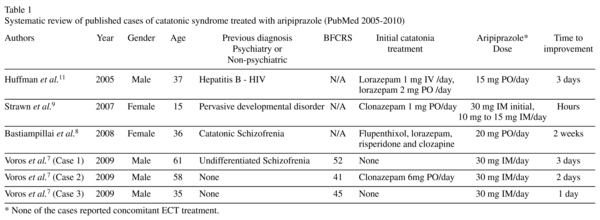
<body><![CDATA[<p><font face="Verdana" size="2"><b>ABSTRACT</b></font></p>     <p><font face="Verdana" size="2"><b>Background and Objectives:</b> Catatonic syndrome is a condition presenting in multiple ways, sharing many of them with the neuroleptic malignant syndrome and other diseases. This diagnostic challenge is the main cause of keep treating catatonic syndromes without neuroleptics.    <br><b>Methods:</b> Review of the literature and a case report.    <br><b>Results:</b> We present the case of a 19 years old bipolar I patient with a severe catatonic syndrome, with a torpid clinical evolution, partial response to benzodiazepines and ECT, which successfully resolved with intramuscular aripiprazole. We found through a systematic review (PubMed 2005-2010) that there are few but significant case reports of catatonic syndromes treated with new second generation antipsychotics for different reasons with good outcomes as ours. The pharmacological profile of aripiprazole and the low incidence of NMS reported make it a suitable option in treating this syndrome.    <br><b>Conclusions:</b> We think that this case report could contribute to add more evidence for aripiprazole to be considered a good third-line option in the treatment of catatonic syndrome. However, this would require randomized controlled trials to confirm its effectiveness and safety.</font></p>     <p><font face="Verdana" size="2"><b>Key words:</b> Catatonia; Aripiprazole; Second generation antipsychotics; ECT; Bipolar disorder.</font></p> <hr size="1">     <p>&nbsp;</p>     <p><font face="Verdana" size="2"><b>Introduction</b></font></p>     <p><font face="Verdana" size="2">Catatonic syndrome is a life threatening condition, classically described in schizophrenia but could be the expression of many psychiatric and non-psychiatric (infectious, metabolic, neurological, and toxic) diseases. Its presentation is always polymorph with a wide range of signs and symptoms, which make it sometimes difficult to differentiate from other diseases<sup>1,2</sup>. It is probably produced by a complex imbalance of dopamine, serotoninergic, noradrenergic and cholinergic systems at basal ganglia and prefrontal cortex, although the exact mechanism remains unknown<sup>1,3,4</sup>. Catatonic syndrome treatment should be fast, safe and effective. Even though benzodiazepines resolve most of the cases, there are still some of them that are even resistant to electroconvulsive therapy (ECT)<sup>5,6</sup>. The use of first generation antipsychotics showed an important incidence of catatonia worsening and inducing of neurological malignant syndrome (NMS)<sup>1,7</sup>. Nevertheless, the experience with some second generation antipsychotics showed a lower number of cases and even possible beneficial effects in brain function and on the catatonic symptoms<sup>8</sup>. In the last years we found few reported cases which responded to the treatment with aripiprazole when benzodiazepines and ECT failed or when the last was not available<sup>9-13</sup> (<a href="#t1">Table 1</a>). Aripiprazole is a second generation antipsychotic with a mechanism of action (D<sub>2</sub>/5-HT1<sub>A</sub> partial agonist and 5-HT1<sub>2A </sub>antagonist) that seems suitable for the treatment misbalance neurochemistry that probably produces the catatonic syndrome. Since some theories points that the catatonic syndromes could be explained by a prefrontal hypodopaminergic state, the partial agonism of aripiprazole and rise in dopamine levels in these regions could explain its therapeutic benefits. However, there is not enough evidence that demonstrates its clinical effectiveness (9). We present in this report the case of a bipolar I patient with a severe catatonic syndrome, with a torpid clinical evolution, partial response to benzodiazepines and ECT, which successfully resolved with intramuscular aripiprazole.</font></p>     <p>&nbsp;</p>     ]]></body>
<body><![CDATA[<p align="center"><font face="Verdana" size="2"><a name="t1"><img src="/img/revistas/ejpen/v26n3/original3_tabla1.jpg" width="600" height="220"></a></font></p>     <p>&nbsp;</p>     <p><font face="Verdana" size="2"><b>Methods:</b> Review of the literature and a case report.</font></p>     <p>&nbsp;</p>     <p><font face="Verdana" size="2"><b>Case presentation</b></font></p>     <p><font face="Verdana" size="2">The case is about a 19 years old Caucasian man, with a well-documented history of type I bipolar disorder by the DSM-IV criteria treated with lithium carbonate and risperidone presenting to the emergency room with grossly disorganized behaviour, disinhibition, agitation and stereotyped movements which required physical restraint and haloperidol 5 mg IM. The family reported a week of expansivity; altered sleep pattern and probable medication drop out, scoring at admission a Young Mania Rating Scale (YMRS) of 56. A couple of hours after admission the patient progressed to mutism, motor rigidity, stupor and fever of 38.9<sup>o</sup>C, together with a leukocitosis(14300/mm<sup>3</sup>) and elevated CPK (2121 U/L) totalizing a Bush-Francis Catatonia Rating Scale (BFCRS) of 36. The urine and the rest of blood tests did not show any other abnormal values. He was started on increasing doses of flunitrazepam IM up to 3 mg/day (since parenteral lorazepam is not available in our market and the patient was unable to tolerate oral administration), acetaminophen 1g qid, IV fluid therapy and re-started lithium carbonate PO 1200 mg/day. A chest x-ray did not demonstrate any considerable abnormalities and a brain magnetic resonance exploration showed no brain lesions. The clinical picture of the patient became an interesting diagnostic challenge between catatonia, neuroleptic malignant syndrome (NMS), antipsychotic-induced rhabdomyolysis (RML) or an acute infectious disease. After stopping neuroleptics and adding empiric antibiotic coverage, the fever persisted, CPK increased (7408 U/L), and also the rigidity. In front of the clinical situation ECT every other day was indicated, with poor results after the first 4 sessions. The adverse clinical course obligated us to consider other options; we decided to add aripiprazole 15 mg IM/day to the treatment along with ECT at the same parameters and benzodiazepines also at same doses. In the following days the patient showed a continuum clinical progress without fever peaks, being able of doing autonomous basic tasks in 4 days (BFCRS: 16; 44.4% improvement) and progressive normalization of laboratory values (Leukocytes and CPK). The patient was discharged from our hospital almost 1 month after the admission with IM aripiprazol for two weeks rotated after to PO aripiprazol 30 mg/day for other two weeks along with decreasing doses of flunitrazepam and totalizing 16 ECT sessions showing a full clinical recovery.</font></p>     <p>&nbsp;</p>     <p><font face="Verdana" size="2"><b>Discussion</b></font></p>     <p><font face="Verdana" size="2">Catatonic syndrome could be a challenging diagnosis when it present with severe signs and symptoms as our case<sup>1</sup>. This and the fact that the patient had a history of using antipsychotic medication at home and also the one administered in the emergency room, made things even more difficult to differentiate from an incipient NMS, iatrogenic catatonia, RML or catatonia due to mania. Even though antipsychotics are frequently associated with rhabdomyolisis, we discard the diagnosis because there were no muscular signs nor myoglobinuria in urine test and normal creatinine-BUN levels in blood tests<sup>14</sup>. At the same time, there was a history of progressive symptoms the previous days that made us think of a catatonia due to mania or induced by the risperidone. Although the acute exacerbation of symptoms and signs along with the elevation of CPK after the administration of IM Halo-peridol inclined us to suspect an incipient NMS or an iatrogenic catatonia. There is still an on-going debate if NMS is a subtype of catatonia or not, what we know for sure is that catatonia is a risk factor for NMS. It is also obvious that both share symptomatology and probably neurochemical mechanisms<sup>4</sup>. We consider here the condition as a syndrome as it was impossible to differentiate a specific type or cause. There is a good rate of effectiveness in catatonic patients with benzodiazepines (aprox.70%), most of them improve in the first four days<sup>6</sup>. ECT usually resolves catatonic syndromes in approximately 90% of cases, most of them with a substantial improvement within the first two to five sessions<sup>15</sup>. After 6 days of treatment with benzodiazepines and 4 ECT sessions, the patient condition did not seem to improve. The use of second generation antipsychotics in this setting seemed an option, considering the low incidence of adverse effects and the good response in some reported cases<sup>9-13</sup>. Among them, we decided to introduce aripiprazole because it's pharmacological profile and also the low incidence of NMS reported with its use in mania<sup>16,17</sup> along with the suitable mechanism of action mentioned. Even though we think that benzodiazepines and ECT contributed to the improvement, there was a favourable inflection point in the clinical course with the introduction of aripiprazole.</font></p>     <p>&nbsp;</p>     ]]></body>
<body><![CDATA[<p><font face="Verdana" size="2"><b>Conclusion</b></font></p>     <p><font face="Verdana" size="2">Catatonic syndrome is a condition presenting in multiple ways, sharing many of them with the neuroleptic malignant syndrome and other diseases. This diagnostic challenge is the main cause of keep treating catatonic syndromes without neuroleptics. There are few but significant case reports of catatonic syndromes treated with new second generation antipsychotics for different reasons with good outcomes as ours. This fact and taking into account the low risk of NMS reported of these new antipsychotics, may make aripiprazole a good third-line option to be considered in the treatment of catatonic syndrome. However, this would require randomized controlled trials to confirm its effectiveness and safety.</font></p>     <p>&nbsp;</p>     <p><font face="Verdana" size="2"><b>Financial disclosure</b></font></p>     <p><font face="Verdana" size="2">This research received no specific grant from any funding agency in the public, commercial, or not-for-profit sectors.</font></p>     <p>&nbsp;</p>     <p><font face="Verdana" size="2"><b>References</b></font></p>     <!-- ref --><p><font face="Verdana" size="2">1. Fink M, Taylor MA. Catatonia: A Clinician's Guide to Diagnosis and Treatment. Cambridge: Cambridge University Press; 2003.    &nbsp;&nbsp;&nbsp;&nbsp;&nbsp;&nbsp;&nbsp;&nbsp;[&#160;<a href="javascript:void(0);" onclick="javascript: window.open('/scielo.php?script=sci_nlinks&ref=5998320&pid=S0213-6163201200030000300001&lng=','','width=640,height=500,resizable=yes,scrollbars=1,menubar=yes,');">Links</a>&#160;]<!-- end-ref --></font></p>    <!-- ref --><p><font face="Verdana" size="2">2. Bernardo M, Parellada E, Palao D. Un paciente catat&oacute;nico. Medicina Integral 1991; 18: 239-244.    &nbsp;&nbsp;&nbsp;&nbsp;&nbsp;&nbsp;&nbsp;&nbsp;[&#160;<a href="javascript:void(0);" onclick="javascript: window.open('/scielo.php?script=sci_nlinks&ref=5998322&pid=S0213-6163201200030000300002&lng=','','width=640,height=500,resizable=yes,scrollbars=1,menubar=yes,');">Links</a>&#160;]<!-- end-ref --></font></p>    <!-- ref --><p><font face="Verdana" size="2">3. Lee JWY. Laboratory findings in Catatonia. In: Caroff SN, Mann SC, Francis A, Fricchione GL, editors. Catatonia: from psychopathology to neurobiology. Washington DC: American Psychiatric Publishing; 2004. p. 65-75.    &nbsp;&nbsp;&nbsp;&nbsp;&nbsp;&nbsp;&nbsp;&nbsp;[&#160;<a href="javascript:void(0);" onclick="javascript: window.open('/scielo.php?script=sci_nlinks&ref=5998324&pid=S0213-6163201200030000300003&lng=','','width=640,height=500,resizable=yes,scrollbars=1,menubar=yes,');">Links</a>&#160;]<!-- end-ref --></font></p>    <!-- ref --><p><font face="Verdana" size="2">4. Northof G. Catatonia and neuroleptic malignant syndrome: psychopathology and pathophysiology. J Neural Transm 2002; 109: 1453-1467.    &nbsp;&nbsp;&nbsp;&nbsp;&nbsp;&nbsp;&nbsp;&nbsp;[&#160;<a href="javascript:void(0);" onclick="javascript: window.open('/scielo.php?script=sci_nlinks&ref=5998326&pid=S0213-6163201200030000300004&lng=','','width=640,height=500,resizable=yes,scrollbars=1,menubar=yes,');">Links</a>&#160;]<!-- end-ref --></font></p>    <!-- ref --><p><font face="Verdana" size="2">5. Bush G, Fink M, Petrides G, Dowling F, Francis A. Catatonia. II. Treatment with lorazepam and electroconvulsive therapy. Acta Psychiatr Scand 1996; 93: 137-143.    &nbsp;&nbsp;&nbsp;&nbsp;&nbsp;&nbsp;&nbsp;&nbsp;[&#160;<a href="javascript:void(0);" onclick="javascript: window.open('/scielo.php?script=sci_nlinks&ref=5998328&pid=S0213-6163201200030000300005&lng=','','width=640,height=500,resizable=yes,scrollbars=1,menubar=yes,');">Links</a>&#160;]<!-- end-ref --></font></p>    <!-- ref --><p><font face="Verdana" size="2">6. Lee JWY, Schwartz DL, Hallmayer J. Catatonia in a Psychiatric Intensive Care Facility: Incidence and Response to Benzodiazepines. Ann Clin Psychiatry 2000; 6: 89-96.    &nbsp;&nbsp;&nbsp;&nbsp;&nbsp;&nbsp;&nbsp;&nbsp;[&#160;<a href="javascript:void(0);" onclick="javascript: window.open('/scielo.php?script=sci_nlinks&ref=5998330&pid=S0213-6163201200030000300006&lng=','','width=640,height=500,resizable=yes,scrollbars=1,menubar=yes,');">Links</a>&#160;]<!-- end-ref --></font></p>    <!-- ref --><p><font face="Verdana" size="2">7. Blumer D. Catatonia and the neuroleptics: Psychobiologic significance of remote and recent findings. Compr Psychiatry 1997; 38: 193-201.    &nbsp;&nbsp;&nbsp;&nbsp;&nbsp;&nbsp;&nbsp;&nbsp;[&#160;<a href="javascript:void(0);" onclick="javascript: window.open('/scielo.php?script=sci_nlinks&ref=5998332&pid=S0213-6163201200030000300007&lng=','','width=640,height=500,resizable=yes,scrollbars=1,menubar=yes,');">Links</a>&#160;]<!-- end-ref --></font></p>    <!-- ref --><p><font face="Verdana" size="2">8. Van Den Eede F, Van Hecke J, Van Dalfsen A, Van den Bossche B, Cosyns P, Sabbe B. The use of atypical antipsychotics in the treatment of catatonia. Eur Psychiatry 2005; 20: 422-429.    &nbsp;&nbsp;&nbsp;&nbsp;&nbsp;&nbsp;&nbsp;&nbsp;[&#160;<a href="javascript:void(0);" onclick="javascript: window.open('/scielo.php?script=sci_nlinks&ref=5998334&pid=S0213-6163201200030000300008&lng=','','width=640,height=500,resizable=yes,scrollbars=1,menubar=yes,');">Links</a>&#160;]<!-- end-ref --></font></p>    <!-- ref --><p><font face="Verdana" size="2">9. Voros V, Kovacs A, Herold R, Osvath P, Simon M, Fekete S, et al. Effectiveness of intramuscular aripiprazole injection in patients with catatonia: report on three cases. Pharmacopsychiatry 2009; 42: 286-287.    &nbsp;&nbsp;&nbsp;&nbsp;&nbsp;&nbsp;&nbsp;&nbsp;[&#160;<a href="javascript:void(0);" onclick="javascript: window.open('/scielo.php?script=sci_nlinks&ref=5998336&pid=S0213-6163201200030000300009&lng=','','width=640,height=500,resizable=yes,scrollbars=1,menubar=yes,');">Links</a>&#160;]<!-- end-ref --></font></p>    <!-- ref --><p><font face="Verdana" size="2">10. Bastiampillai T, Dhillon R. Catatonia resolution and aripiprazole. Aust N Zealand J Psychiatry 2008; 42(10): 907.    &nbsp;&nbsp;&nbsp;&nbsp;&nbsp;&nbsp;&nbsp;&nbsp;[&#160;<a href="javascript:void(0);" onclick="javascript: window.open('/scielo.php?script=sci_nlinks&ref=5998338&pid=S0213-6163201200030000300010&lng=','','width=640,height=500,resizable=yes,scrollbars=1,menubar=yes,');">Links</a>&#160;]<!-- end-ref --></font></p>    <!-- ref --><p><font face="Verdana" size="2">11. Strawn JR, Delgado SV. Successful treatment of catatonia with aripiprazole in an adolescent with psychosis. J Child Adolesc Psychopharmacol 2007; 17: 733-735.    &nbsp;&nbsp;&nbsp;&nbsp;&nbsp;&nbsp;&nbsp;&nbsp;[&#160;<a href="javascript:void(0);" onclick="javascript: window.open('/scielo.php?script=sci_nlinks&ref=5998340&pid=S0213-6163201200030000300011&lng=','','width=640,height=500,resizable=yes,scrollbars=1,menubar=yes,');">Links</a>&#160;]<!-- end-ref --></font></p>    <!-- ref --><p><font face="Verdana" size="2">12. Kirino E. Prolonged Catatonic Stupor Successfully Treated with Aripiprazole in an Adolescent Male with Schizophrenia: A Case Report. Clin Schizophr Relat Psychoses 2010; 4: 1-4.    &nbsp;&nbsp;&nbsp;&nbsp;&nbsp;&nbsp;&nbsp;&nbsp;[&#160;<a href="javascript:void(0);" onclick="javascript: window.open('/scielo.php?script=sci_nlinks&ref=5998342&pid=S0213-6163201200030000300012&lng=','','width=640,height=500,resizable=yes,scrollbars=1,menubar=yes,');">Links</a>&#160;]<!-- end-ref --></font></p>    <!-- ref --><p><font face="Verdana" size="2">13. Huffman JC, Fricchione GL. Catatonia and psychosis in a patient with AIDS: treatment with lorazepam and aripiprazole. J Clin Psychopharmacol 2005; 25: 508-510.    &nbsp;&nbsp;&nbsp;&nbsp;&nbsp;&nbsp;&nbsp;&nbsp;[&#160;<a href="javascript:void(0);" onclick="javascript: window.open('/scielo.php?script=sci_nlinks&ref=5998344&pid=S0213-6163201200030000300013&lng=','','width=640,height=500,resizable=yes,scrollbars=1,menubar=yes,');">Links</a>&#160;]<!-- end-ref --></font></p>    <!-- ref --><p><font face="Verdana" size="2">14. Melli G, Chaudhry V, Cornblath DR. Rhabdomyolysis: an evaluation of 475 hospitalized patients. Medicine (Baltimore) 2005; 84(6): 377-385.    &nbsp;&nbsp;&nbsp;&nbsp;&nbsp;&nbsp;&nbsp;&nbsp;[&#160;<a href="javascript:void(0);" onclick="javascript: window.open('/scielo.php?script=sci_nlinks&ref=5998346&pid=S0213-6163201200030000300014&lng=','','width=640,height=500,resizable=yes,scrollbars=1,menubar=yes,');">Links</a>&#160;]<!-- end-ref --></font></p>    <!-- ref --><p><font face="Verdana" size="2">15. Fink M. Catatonia: syndrome or schizophrenia subtype? Recognition and treatment. J Neural Transm 2001; 108: 637-644.    &nbsp;&nbsp;&nbsp;&nbsp;&nbsp;&nbsp;&nbsp;&nbsp;[&#160;<a href="javascript:void(0);" onclick="javascript: window.open('/scielo.php?script=sci_nlinks&ref=5998348&pid=S0213-6163201200030000300015&lng=','','width=640,height=500,resizable=yes,scrollbars=1,menubar=yes,');">Links</a>&#160;]<!-- end-ref --></font></p>    <!-- ref --><p><font face="Verdana" size="2">16. Keck PE, Marcus R, Tourkodimitris S, Ali M, Liebeskind A, Saha A, et al. A placebo-controlled, double-blind study of the efficacy and safety of aripiprazole in patients with acute bipolar mania. Am J Psychiatry 2003; 160(9): 1651-1658.    &nbsp;&nbsp;&nbsp;&nbsp;&nbsp;&nbsp;&nbsp;&nbsp;[&#160;<a href="javascript:void(0);" onclick="javascript: window.open('/scielo.php?script=sci_nlinks&ref=5998350&pid=S0213-6163201200030000300016&lng=','','width=640,height=500,resizable=yes,scrollbars=1,menubar=yes,');">Links</a>&#160;]<!-- end-ref --></font></p>    <!-- ref --><p><font face="Verdana" size="2">17. Vieta E, Bourin M, Sanchez R, Marcus R, Stock E, McQuade R, et al. Effectiveness of aripiprazole vs. halo-peridol in acute bipolar mania. Br J Psychiatry 2005; 187: 235-242.    &nbsp;&nbsp;&nbsp;&nbsp;&nbsp;&nbsp;&nbsp;&nbsp;[&#160;<a href="javascript:void(0);" onclick="javascript: window.open('/scielo.php?script=sci_nlinks&ref=5998352&pid=S0213-6163201200030000300017&lng=','','width=640,height=500,resizable=yes,scrollbars=1,menubar=yes,');">Links</a>&#160;]<!-- end-ref --></font></p>     <p>&nbsp;</p>     <p>&nbsp;</p>     <p><font face="Verdana" size="2"><a href="#top"><img border="0" src="/img/revistas/ejpen/v26n3/seta.gif" width="15" height="17"></a><a name="bajo"></a><b>Correspondence:</b>    <br>Diego Hidalgo    <br>Servicio de Psiquiatr&iacute;a Adultos    <br>Instituto Cl&iacute;nico de Neurociencias    <br>Hospital Cl&iacute;nic, Villarroel n<sup>o</sup> 170,    <br>08036, Barcelona, Spain    <br>Phone: +34 932 275 400    ]]></body>
<body><![CDATA[<br>Fax: +34 932 275 548    <br>E-mail: <a href="mailto:dahidalg@clinic.ub.es">dahidalg@clinic.ub.es</a></font></p>     <p><font face="Verdana" size="2">Received: 26 April 2011    <br>Revised: 16 December 2011    <br>Accepted: 21 December 2011</font></p>      ]]></body><back>
<ref-list>
<ref id="B1">
<label>1</label><nlm-citation citation-type="book">
<person-group person-group-type="author">
<name>
<surname><![CDATA[Fink]]></surname>
<given-names><![CDATA[M]]></given-names>
</name>
<name>
<surname><![CDATA[Taylor]]></surname>
<given-names><![CDATA[MA]]></given-names>
</name>
</person-group>
<source><![CDATA[Catatonia: A Clinician's Guide to Diagnosis and Treatment]]></source>
<year>2003</year>
<publisher-loc><![CDATA[Cambridge ]]></publisher-loc>
<publisher-name><![CDATA[Cambridge University Press]]></publisher-name>
</nlm-citation>
</ref>
<ref id="B2">
<label>2</label><nlm-citation citation-type="journal">
<person-group person-group-type="author">
<name>
<surname><![CDATA[Bernardo]]></surname>
<given-names><![CDATA[M]]></given-names>
</name>
<name>
<surname><![CDATA[Parellada]]></surname>
<given-names><![CDATA[E]]></given-names>
</name>
<name>
<surname><![CDATA[Palao]]></surname>
<given-names><![CDATA[D]]></given-names>
</name>
</person-group>
<article-title xml:lang="es"><![CDATA[Un paciente catatónico]]></article-title>
<source><![CDATA[Medicina Integral]]></source>
<year>1991</year>
<volume>18</volume>
<page-range>239-244</page-range></nlm-citation>
</ref>
<ref id="B3">
<label>3</label><nlm-citation citation-type="book">
<person-group person-group-type="author">
<name>
<surname><![CDATA[Lee]]></surname>
<given-names><![CDATA[JWY]]></given-names>
</name>
</person-group>
<article-title xml:lang="en"><![CDATA[Laboratory findings in Catatonia]]></article-title>
<person-group person-group-type="editor">
<name>
<surname><![CDATA[Caroff]]></surname>
<given-names><![CDATA[SN]]></given-names>
</name>
<name>
<surname><![CDATA[Mann]]></surname>
<given-names><![CDATA[SC]]></given-names>
</name>
<name>
<surname><![CDATA[Francis]]></surname>
<given-names><![CDATA[A]]></given-names>
</name>
<name>
<surname><![CDATA[Fricchione]]></surname>
<given-names><![CDATA[GL]]></given-names>
</name>
</person-group>
<source><![CDATA[Catatonia: from psychopathology to neurobiology]]></source>
<year>2004</year>
<page-range>65-75</page-range><publisher-loc><![CDATA[Washington^eDC DC]]></publisher-loc>
<publisher-name><![CDATA[American Psychiatric Publishing]]></publisher-name>
</nlm-citation>
</ref>
<ref id="B4">
<label>4</label><nlm-citation citation-type="journal">
<person-group person-group-type="author">
<name>
<surname><![CDATA[Northof]]></surname>
<given-names><![CDATA[G]]></given-names>
</name>
</person-group>
<article-title xml:lang="en"><![CDATA[Catatonia and neuroleptic malignant syndrome: psychopathology and pathophysiology]]></article-title>
<source><![CDATA[J Neural Transm]]></source>
<year>2002</year>
<volume>109</volume>
<page-range>1453-1467</page-range></nlm-citation>
</ref>
<ref id="B5">
<label>5</label><nlm-citation citation-type="journal">
<person-group person-group-type="author">
<name>
<surname><![CDATA[Bush]]></surname>
<given-names><![CDATA[G]]></given-names>
</name>
<name>
<surname><![CDATA[Fink]]></surname>
<given-names><![CDATA[M]]></given-names>
</name>
<name>
<surname><![CDATA[Petrides]]></surname>
<given-names><![CDATA[G]]></given-names>
</name>
<name>
<surname><![CDATA[Dowling]]></surname>
<given-names><![CDATA[F]]></given-names>
</name>
<name>
<surname><![CDATA[Francis]]></surname>
<given-names><![CDATA[A]]></given-names>
</name>
</person-group>
<article-title xml:lang="en"><![CDATA[Catatonia. II: Treatment with lorazepam and electroconvulsive therapy]]></article-title>
<source><![CDATA[Acta Psychiatr Scand]]></source>
<year>1996</year>
<volume>93</volume>
<page-range>137-143</page-range></nlm-citation>
</ref>
<ref id="B6">
<label>6</label><nlm-citation citation-type="journal">
<person-group person-group-type="author">
<name>
<surname><![CDATA[Lee]]></surname>
<given-names><![CDATA[JWY]]></given-names>
</name>
<name>
<surname><![CDATA[Schwartz]]></surname>
<given-names><![CDATA[DL]]></given-names>
</name>
<name>
<surname><![CDATA[Hallmayer]]></surname>
<given-names><![CDATA[J]]></given-names>
</name>
</person-group>
<article-title xml:lang="en"><![CDATA[Catatonia in a Psychiatric Intensive Care Facility: Incidence and Response to Benzodiazepines]]></article-title>
<source><![CDATA[Ann Clin Psychiatry]]></source>
<year>2000</year>
<volume>6</volume>
<page-range>89-96</page-range></nlm-citation>
</ref>
<ref id="B7">
<label>7</label><nlm-citation citation-type="journal">
<person-group person-group-type="author">
<name>
<surname><![CDATA[Blumer]]></surname>
<given-names><![CDATA[D]]></given-names>
</name>
</person-group>
<article-title xml:lang="en"><![CDATA[Catatonia and the neuroleptics: Psychobiologic significance of remote and recent findings]]></article-title>
<source><![CDATA[Compr Psychiatry]]></source>
<year>1997</year>
<volume>38</volume>
<page-range>193-201</page-range></nlm-citation>
</ref>
<ref id="B8">
<label>8</label><nlm-citation citation-type="journal">
<person-group person-group-type="author">
<name>
<surname><![CDATA[Van Den Eede]]></surname>
<given-names><![CDATA[F]]></given-names>
</name>
<name>
<surname><![CDATA[Van Hecke]]></surname>
<given-names><![CDATA[J]]></given-names>
</name>
<name>
<surname><![CDATA[Van Dalfsen]]></surname>
<given-names><![CDATA[A]]></given-names>
</name>
<name>
<surname><![CDATA[Van den Bossche]]></surname>
<given-names><![CDATA[B]]></given-names>
</name>
<name>
<surname><![CDATA[Cosyns]]></surname>
<given-names><![CDATA[P]]></given-names>
</name>
<name>
<surname><![CDATA[Sabbe]]></surname>
<given-names><![CDATA[B]]></given-names>
</name>
</person-group>
<article-title xml:lang="en"><![CDATA[The use of atypical antipsychotics in the treatment of catatonia]]></article-title>
<source><![CDATA[Eur Psychiatry]]></source>
<year>2005</year>
<volume>20</volume>
<page-range>422-429</page-range></nlm-citation>
</ref>
<ref id="B9">
<label>9</label><nlm-citation citation-type="journal">
<person-group person-group-type="author">
<name>
<surname><![CDATA[Voros]]></surname>
<given-names><![CDATA[V]]></given-names>
</name>
<name>
<surname><![CDATA[Kovacs]]></surname>
<given-names><![CDATA[A]]></given-names>
</name>
<name>
<surname><![CDATA[Herold]]></surname>
<given-names><![CDATA[R]]></given-names>
</name>
<name>
<surname><![CDATA[Osvath]]></surname>
<given-names><![CDATA[P]]></given-names>
</name>
<name>
<surname><![CDATA[Simon]]></surname>
<given-names><![CDATA[M]]></given-names>
</name>
<name>
<surname><![CDATA[Fekete]]></surname>
<given-names><![CDATA[S]]></given-names>
</name>
</person-group>
<article-title xml:lang="en"><![CDATA[Effectiveness of intramuscular aripiprazole injection in patients with catatonia: report on three cases]]></article-title>
<source><![CDATA[Pharmacopsychiatry]]></source>
<year>2009</year>
<volume>42</volume>
<page-range>286-287</page-range></nlm-citation>
</ref>
<ref id="B10">
<label>10</label><nlm-citation citation-type="journal">
<person-group person-group-type="author">
<name>
<surname><![CDATA[Bastiampillai]]></surname>
<given-names><![CDATA[T]]></given-names>
</name>
<name>
<surname><![CDATA[Dhillon]]></surname>
<given-names><![CDATA[R]]></given-names>
</name>
</person-group>
<article-title xml:lang="en"><![CDATA[Catatonia resolution and aripiprazole]]></article-title>
<source><![CDATA[Aust N Zealand J Psychiatry]]></source>
<year>2008</year>
<volume>42</volume>
<numero>10</numero>
<issue>10</issue>
<page-range>907</page-range></nlm-citation>
</ref>
<ref id="B11">
<label>11</label><nlm-citation citation-type="journal">
<person-group person-group-type="author">
<name>
<surname><![CDATA[Strawn]]></surname>
<given-names><![CDATA[JR]]></given-names>
</name>
<name>
<surname><![CDATA[Delgado]]></surname>
<given-names><![CDATA[SV]]></given-names>
</name>
</person-group>
<article-title xml:lang="en"><![CDATA[Successful treatment of catatonia with aripiprazole in an adolescent with psychosis]]></article-title>
<source><![CDATA[J Child Adolesc Psychopharmacol]]></source>
<year>2007</year>
<volume>17</volume>
<page-range>733-735</page-range></nlm-citation>
</ref>
<ref id="B12">
<label>12</label><nlm-citation citation-type="journal">
<person-group person-group-type="author">
<name>
<surname><![CDATA[Kirino]]></surname>
<given-names><![CDATA[E]]></given-names>
</name>
</person-group>
<article-title xml:lang="en"><![CDATA[Prolonged Catatonic Stupor Successfully Treated with Aripiprazole in an Adolescent Male with Schizophrenia: A Case Report]]></article-title>
<source><![CDATA[Clin Schizophr Relat Psychoses]]></source>
<year>2010</year>
<volume>4</volume>
<page-range>1-4</page-range></nlm-citation>
</ref>
<ref id="B13">
<label>13</label><nlm-citation citation-type="journal">
<person-group person-group-type="author">
<name>
<surname><![CDATA[Huffman]]></surname>
<given-names><![CDATA[JC]]></given-names>
</name>
<name>
<surname><![CDATA[Fricchione]]></surname>
<given-names><![CDATA[GL]]></given-names>
</name>
</person-group>
<article-title xml:lang="en"><![CDATA[Catatonia and psychosis in a patient with AIDS: treatment with lorazepam and aripiprazole]]></article-title>
<source><![CDATA[J Clin Psychopharmacol]]></source>
<year>2005</year>
<volume>25</volume>
<page-range>508-510</page-range></nlm-citation>
</ref>
<ref id="B14">
<label>14</label><nlm-citation citation-type="journal">
<person-group person-group-type="author">
<name>
<surname><![CDATA[Melli]]></surname>
<given-names><![CDATA[G]]></given-names>
</name>
<name>
<surname><![CDATA[Chaudhry]]></surname>
<given-names><![CDATA[V]]></given-names>
</name>
<name>
<surname><![CDATA[Cornblath]]></surname>
<given-names><![CDATA[DR]]></given-names>
</name>
</person-group>
<article-title xml:lang="en"><![CDATA[Rhabdomyolysis: an evaluation of 475 hospitalized patients]]></article-title>
<source><![CDATA[Medicine (Baltimore)]]></source>
<year>2005</year>
<volume>84</volume>
<numero>6</numero>
<issue>6</issue>
<page-range>377-385</page-range></nlm-citation>
</ref>
<ref id="B15">
<label>15</label><nlm-citation citation-type="journal">
<person-group person-group-type="author">
<name>
<surname><![CDATA[Fink]]></surname>
<given-names><![CDATA[M]]></given-names>
</name>
</person-group>
<article-title xml:lang="en"><![CDATA[Catatonia: syndrome or schizophrenia subtype? Recognition and treatment]]></article-title>
<source><![CDATA[J Neural Transm]]></source>
<year>2001</year>
<volume>108</volume>
<page-range>637-644</page-range></nlm-citation>
</ref>
<ref id="B16">
<label>16</label><nlm-citation citation-type="journal">
<person-group person-group-type="author">
<name>
<surname><![CDATA[Keck]]></surname>
<given-names><![CDATA[PE]]></given-names>
</name>
<name>
<surname><![CDATA[Marcus]]></surname>
<given-names><![CDATA[R]]></given-names>
</name>
<name>
<surname><![CDATA[Tourkodimitris]]></surname>
<given-names><![CDATA[S]]></given-names>
</name>
<name>
<surname><![CDATA[Ali]]></surname>
<given-names><![CDATA[M]]></given-names>
</name>
<name>
<surname><![CDATA[Liebeskind]]></surname>
<given-names><![CDATA[A]]></given-names>
</name>
<name>
<surname><![CDATA[Saha]]></surname>
<given-names><![CDATA[A]]></given-names>
</name>
</person-group>
<article-title xml:lang="en"><![CDATA[A placebo-controlled, double-blind study of the efficacy and safety of aripiprazole in patients with acute bipolar mania]]></article-title>
<source><![CDATA[Am J Psychiatry]]></source>
<year>2003</year>
<volume>160</volume>
<numero>9</numero>
<issue>9</issue>
<page-range>1651-1658</page-range></nlm-citation>
</ref>
<ref id="B17">
<label>17</label><nlm-citation citation-type="journal">
<person-group person-group-type="author">
<name>
<surname><![CDATA[Vieta]]></surname>
<given-names><![CDATA[E]]></given-names>
</name>
<name>
<surname><![CDATA[Bourin]]></surname>
<given-names><![CDATA[M]]></given-names>
</name>
<name>
<surname><![CDATA[Sanchez]]></surname>
<given-names><![CDATA[R]]></given-names>
</name>
<name>
<surname><![CDATA[Marcus]]></surname>
<given-names><![CDATA[R]]></given-names>
</name>
<name>
<surname><![CDATA[Stock]]></surname>
<given-names><![CDATA[E]]></given-names>
</name>
<name>
<surname><![CDATA[McQuade]]></surname>
<given-names><![CDATA[R]]></given-names>
</name>
</person-group>
<article-title xml:lang="en"><![CDATA[Effectiveness of aripiprazole vs. halo-peridol in acute bipolar mania]]></article-title>
<source><![CDATA[Br J Psychiatry]]></source>
<year>2005</year>
<volume>187</volume>
<page-range>235-242</page-range></nlm-citation>
</ref>
</ref-list>
</back>
</article>
