<?xml version="1.0" encoding="ISO-8859-1"?><article xmlns:mml="http://www.w3.org/1998/Math/MathML" xmlns:xlink="http://www.w3.org/1999/xlink" xmlns:xsi="http://www.w3.org/2001/XMLSchema-instance">
<front>
<journal-meta>
<journal-id>0213-6163</journal-id>
<journal-title><![CDATA[The European Journal of Psychiatry]]></journal-title>
<abbrev-journal-title><![CDATA[Eur. J. Psychiat.]]></abbrev-journal-title>
<issn>0213-6163</issn>
<publisher>
<publisher-name><![CDATA[Universidad de Zaragoza]]></publisher-name>
</publisher>
</journal-meta>
<article-meta>
<article-id>S0213-61632013000100002</article-id>
<article-id pub-id-type="doi">10.4321/S0213-61632013000100002</article-id>
<title-group>
<article-title xml:lang="en"><![CDATA[Subtyping demoralization in the medically ill by cluster analysis]]></article-title>
</title-group>
<contrib-group>
<contrib contrib-type="author">
<name>
<surname><![CDATA[Rafanelli]]></surname>
<given-names><![CDATA[Chiara]]></given-names>
</name>
<xref ref-type="aff" rid="A01"/>
</contrib>
<contrib contrib-type="author">
<name>
<surname><![CDATA[Guidi]]></surname>
<given-names><![CDATA[Jenny]]></given-names>
</name>
<xref ref-type="aff" rid="A01"/>
</contrib>
<contrib contrib-type="author">
<name>
<surname><![CDATA[Gostoli]]></surname>
<given-names><![CDATA[Sara]]></given-names>
</name>
<xref ref-type="aff" rid="A01"/>
</contrib>
<contrib contrib-type="author">
<name>
<surname><![CDATA[Tomba]]></surname>
<given-names><![CDATA[Elena]]></given-names>
</name>
<xref ref-type="aff" rid="A01"/>
</contrib>
<contrib contrib-type="author">
<name>
<surname><![CDATA[Porcelli]]></surname>
<given-names><![CDATA[Piero]]></given-names>
</name>
<xref ref-type="aff" rid="A02"/>
</contrib>
<contrib contrib-type="author">
<name>
<surname><![CDATA[Grandi]]></surname>
<given-names><![CDATA[Silvana]]></given-names>
</name>
<xref ref-type="aff" rid="A01"/>
</contrib>
</contrib-group>
<aff id="A01">
<institution><![CDATA[,University of Bologna Department of Psychology Laboratory of Psychosomatics and Clinimetrics]]></institution>
<addr-line><![CDATA[Bologna ]]></addr-line>
<country>Italy</country>
</aff>
<aff id="A02">
<institution><![CDATA[,IRCCS De Bellis Hospital Department of Gastroenterology Psychosomatic Unit]]></institution>
<addr-line><![CDATA[Castellana Grotte ]]></addr-line>
<country>Italy</country>
</aff>
<pub-date pub-type="pub">
<day>00</day>
<month>03</month>
<year>2013</year>
</pub-date>
<pub-date pub-type="epub">
<day>00</day>
<month>03</month>
<year>2013</year>
</pub-date>
<volume>27</volume>
<numero>1</numero>
<fpage>7</fpage>
<lpage>17</lpage>
<copyright-statement/>
<copyright-year/>
<self-uri xlink:href="http://scielo.isciii.es/scielo.php?script=sci_arttext&amp;pid=S0213-61632013000100002&amp;lng=en&amp;nrm=iso"></self-uri><self-uri xlink:href="http://scielo.isciii.es/scielo.php?script=sci_abstract&amp;pid=S0213-61632013000100002&amp;lng=en&amp;nrm=iso"></self-uri><self-uri xlink:href="http://scielo.isciii.es/scielo.php?script=sci_pdf&amp;pid=S0213-61632013000100002&amp;lng=en&amp;nrm=iso"></self-uri><abstract abstract-type="short" xml:lang="en"><p><![CDATA[Background and Objectives: There is increasing interest in the issue of demoralization, particularly in the setting of medical disease. The aim of this investigation was to use both DSM-IV comorbidity and the Diagnostic Criteria for Psychosomatic Research (DCPR) in order to characterize demoralization in the medically ill. Methods: 1700 patients were recruited from 8 medical centers in the Italian Health System and 1560 agreed to participate. They all underwent a cross-sectional assessment with DSM-IV and DCPR structured interviews. 373 patients (23.9%) received a diagnosis of demoralization. Data were submitted to cluster analysis. Results: Four clusters were identified: demoralization and comorbid depression; demoralization and comorbid somatoform/adjustment disorders; demoralization and comorbid anxiety; demoralization without any comorbid DSM disorder. The first cluster included 27.6% of the total sample and was characterized by the presence of DSM-IV mood disorders (mainly major depressive disorder). The second cluster had 18.2% of the cases and contained both DSM-IV somatoform (particularly, undifferentiated somatoform disorder and hypochondriasis) and adjustment disorders. In the third cluster (24.7%), DSM-IV anxiety disorders in comorbidity with demoralization were predominant (particularly, generalized anxiety disorder, agoraphobia, panic disorder and obsessive-compulsive disorder). The fourth cluster had 29.5% of the patients and was characterized by the absence of any DSM-IV comorbid disorder. Conclusions: The findings indicate the need of expanding clinical assessment in the medically ill to include the various manifestations of demoralization as encompassed by the DCPR. Subtyping demoralization may yield improved targets for psychosomatic research and treatment trials.]]></p></abstract>
<kwd-group>
<kwd lng="en"><![CDATA[Demoralization]]></kwd>
<kwd lng="en"><![CDATA[DCPR]]></kwd>
<kwd lng="en"><![CDATA[DSM-IV]]></kwd>
<kwd lng="en"><![CDATA[Cluster analysis]]></kwd>
</kwd-group>
</article-meta>
</front><body><![CDATA[ <p>&nbsp;</p>     <p>&nbsp;</p>     <p><font size="4" face="Verdana"><b><a name="top"></a>Subtyping demoralization in the medically ill by cluster analysis</b></font></p>     <p>&nbsp;</p>     <p>&nbsp;</p>     <p><font size="2" face="Verdana"><b>Chiara Rafanelli, MD, PhD<sup>*</sup>; Jenny  Guidi, PhD<sup>*</sup>; Sara Gostoli, PhD<sup>*</sup>; Elena Tomba, PhD<sup>*</sup>;  Piero Porcelli, PhD<sup>**</sup> and Silvana Grandi, MD<sup>*</sup></b></font></p>     <p><font size="2" face="Verdana"><sup>*</sup>Laboratory of Psychosomatics and  Clinimetrics, Department of Psychology, University of Bologna, Bologna. Italy    <br> <sup>**</sup>IRCCS De Bellis Hospital, Department of Gastroenterology,  Psychosomatic Unit, Castellana Grotte. Italy</font></p>     <p><font size="2" face="Verdana">This study was supported in part by a grant  from Compagnia di San Paolo, Torino, Italy, to Dr. Chiara Rafanelli.</font></p>     <p><font size="2" face="Verdana"><a href="#bajo">Correspondence</a></font></p>     ]]></body>
<body><![CDATA[<p>&nbsp;</p>     <p>&nbsp;</p> <hr SIZE="1">     <p><font size="2" face="Verdana"><b>ABSTRACT</b></font></p>     <p><font size="2" face="Verdana"><b>Background and Objectives:</b> There is  increasing interest in the issue of demoralization, particularly in the setting  of medical disease. The aim of this investigation was to use both DSM-IV  comorbidity and the Diagnostic Criteria for Psychosomatic Research (DCPR) in  order to characterize demoralization in the medically ill.    <br> <b>Methods:</b> 1700 patients were recruited from 8 medical centers in the  Italian Health System and 1560 agreed to participate. They all underwent a  cross-sectional assessment with DSM-IV and DCPR structured interviews. 373  patients (23.9%) received a diagnosis of demoralization. Data were submitted to  cluster analysis.    <br> <b>Results:</b> Four clusters were identified: demoralization and comorbid  depression; demoralization and comorbid somatoform/adjustment disorders;  demoralization and comorbid anxiety; demoralization without any comorbid DSM  disorder. The first cluster included 27.6% of the total sample and was  characterized by the presence of DSM-IV mood disorders (mainly major depressive  disorder). The second cluster had 18.2% of the cases and contained both DSM-IV  somatoform (particularly, undifferentiated somatoform disorder and  hypochondriasis) and adjustment disorders. In the third cluster (24.7%), DSM-IV  anxiety disorders in comorbidity with demoralization were predominant  (particularly, generalized anxiety disorder, agoraphobia, panic disorder and  obsessive-compulsive disorder). The fourth cluster had 29.5% of the patients and  was characterized by the absence of any DSM-IV comorbid disorder.    <br> <b>Conclusions:</b> The findings indicate the need of expanding clinical  assessment in the medically ill to include the various manifestations of  demoralization as encompassed by the DCPR. Subtyping demoralization may yield  improved targets for psychosomatic research and treatment trials.</font></p>     <p><font size="2" face="Verdana"><b>Key words:</b> Demoralization; DCPR; DSM-IV;  Cluster analysis.</font></p> <hr SIZE="1">     <p>&nbsp;</p>     <p><font size="2" face="Verdana"><b>Introduction</b></font></p>     ]]></body>
<body><![CDATA[<p><font size="2" face="Verdana">Several studies confirmed a high prevalence of  demoralization among patients with medical disorders, especially with  life-threatening or disabling disorders<sup>1-7</sup>. Demoralization was also  found to precede the onset of serious diseases, such as cancer, ischemic heart  disease and stroke<sup>1,6,8</sup>. Despite its clinical and prognostic  relevance, demoralization has not been adequately recognized by traditional  psychiatric classifications and very few dimensional instruments have been  specifically developed for its assessment<sup>9</sup>. A substantial problem of  research in demoralization lies in the various way in which it is defined<sup>10</sup>  ranging from a non-specific psychological distress<sup>11</sup> and a normal  response to adversity<sup>3</sup> to a specific syndrome resulting from the  convergence of distress and subjective incompetence<sup>12</sup> that may  negatively affect the course of both psychiatric and medical disorders<sup>13,14</sup>.</font></p>     <p><font size="2" face="Verdana">Schmale and Engel<sup>15</sup> described the  pattern of psychological features of the &quot;giving up-given up complex&quot;, whose  characteristics may be related to the concept of subjective incompetence:  feelings of helplessness and hopelessness, perception of diminished competence  and loss of mastery and control<sup>15</sup>. The giving up-given up complex was  found to frequently occur in the life setting immediately preceding the onset of  disease and can also be exacerbated by the course of illness<sup>16</sup>. Frank<sup>17</sup>  suggested that demoralization results from the awareness of being unable to cope  with a pressing problem or of having failed to meet one's own or others'  expectations and is the main reason why individuals seek psychotherapeutic  treatment. All these subclinical aspects, which cannot be identified by  psychiatric categories<sup>3</sup>, are included in the concept of  demoralization according to the Diagnostic Criteria for Psychosomatic Research  (DCPR)<sup>18,19</sup> (<a href="#t1">Table 1</a>). DCPR were developed about 15  years ago by an international group of investigators<sup>18</sup> with the aim  to translate psychosocial variables, issued from a wide body of psychosomatic  literature, of prognostic and therapeutic value in the course of physical  conditions, into working categories whereby individual patients could be  identified. The application of the DCPR operational criteria has permitted to  document the occurrence of demoralization across different medical settings,  substantiating previous findings that used dimensional tools<sup>20,21</sup>. In  studies utilizing the DCPR, demoralization was found in 14-44% of patients with  cardiac<sup>22</sup>, oncological<sup>23</sup>, dermatological<sup>24</sup>,  gastrointestinal<sup>25</sup> and endocrine conditions<sup>26-28</sup>, in those  recruited in primary care<sup>29</sup> and in consultation-liaison psychiatry  settings<sup>30,31</sup>. DCPR demoralization appeared to be far less frequent  in the general population<sup>32</sup>.</font></p>     <p align="center"><a name="t1"> <img src="/img/revistas/ejpen/v27n1/original2_tabla1.jpg"></a></p>     <p>&nbsp;</p>     <p><font size="2" face="Verdana">The aim of this investigation was to use both  DSM and DCPR comorbidity in order to examine the feasibility of subtyping in a  highly heterogenous group of medical patients diagnosed as suffering from DCPR  demoralization, by a cluster analysis technique.</font></p>     <p>&nbsp;</p>     <p><font size="2" face="Verdana"><b>Methods</b></font></p>     <p><font face="Verdana">Design, procedures and subjects</font></p>     <p><font size="2" face="Verdana">Patients were recruited from different medical  settings in an ongoing multicenter project concerned with the psychosocial  dimensions of medical patients<sup>33</sup>. Even though studies involved in the  research project had different aims and sample sizes, they shared a common  methodology in the assessment of psychopathology and psychosocial syndromes.  Patients were recruited consecutively, with the intent of being representative  of their respective patient populations:</font></p>     <blockquote> 	    ]]></body>
<body><![CDATA[<p><font size="2" face="Verdana">1. Consecutive outpatients with functional  	gastrointestinal disorders (N = 190, 12.2% of the total sample) from the  	Functional Gastrointestinal Disorders Outpatient Clinic of the Scientific  	Institute of Gastroenterology at Castellana Grotte, Italy.</font></p> 	    <p><font size="2" face="Verdana">2. Consecutive outpatients with heart  	diseases (N = 351, 22.5%) from 3 different sources: 1) 198 patients who  	underwent heart transplantation from the Heart Transplantation Unit of the  	Institute of Cardiology at S. Orsola Hospital of Bologna, Italy; 2) 61  	consecutive patients with a recent (within 1 month) first myocardial  	infarction diagnosis from the Cardiac Rehabilitation Program of the Bellaria  	Hospital in Bologna, Italy; and 3) 92 consecutive patients with a recent  	(within 1 month) first myocardial infarction diagnosis, from the Institute  	of Cardiology of University Hospital in Modena, Italy.</font></p> 	    <p><font size="2" face="Verdana">3. Consecutive outpatients with endocrine  	disorders (N = 162, 10.4%) from the Division of Endocrinology of the  	University of Padova Medical Center, Padova, Italy.</font></p> 	    <p><font size="2" face="Verdana">4. Consecutive outpatients who had received  	a diagnosis of cancer within the past 18 months (N = 104, 6.7%) from the S.  	Anna University Hospital in Ferrara, Italy.</font></p> 	    <p><font size="2" face="Verdana">5. Consecutive outpatients with skin  	disorders (N = 545, 34.9%) from the Dermopathic Institute of the Immaculate  	(IDI-IRCCS), Rome, Italy.</font></p> 	    <p><font size="2" face="Verdana">6. Consecutive inpatients referred for  	psychiatric consultation in 2 large university-based general hospitals (N =  	208, 13.3%) from the University of Perugia and University of Foggia, Italy.</font></p> </blockquote>     <p><font size="2" face="Verdana">The study was approved by institutional review  boards and local ethics committees, and written informed consent was obtained  from all patients. The patients who were approached were 1700; 140 (8.2%)  declined to participate. The most common reason for refusal was lack of time.  The total sample included 1560 patients (712 men, 45.6%, and 848 women, 54.4%),  with a mean age of 45 (SD = 15.02) years, and a mean of 10.6 (SD = 3.85) years  of education. There were no significant differences in terms of sociodemographic  variables between the patients who accepted and those who refused.</font></p>     <p><font face="Verdana">Assessment</font></p>     <p><font size="2" face="Verdana">All patients underwent two detailed  semi-structured interviews by clinical psychologists or psychiatrists with  extensive experience, including psychosomatic research. Psychiatric disorders  were investigated with the Structured Clinical Interview for DSM-IV (SCID)<sup>34</sup>.  Diagnoses were grouped according to diagnostic categories such as mood  disorders, anxiety disorders, somatoform disorders, adjustment disorders, and  other disorders (including psychotic disorders, eating disorders, sexual  dysfunctions and substance use related disorders). Psychosomatic syndromes were  diagnosed with the Structured Interview for DCPR<sup>35</sup>. The DCPR  encompass various diagnostic rubrics: abnormal illness behavior (disease phobia,  thanatophobia, health anxiety, illness denial), somatization syndromes  (persistent somatization, functional somatic symptoms secondary to a psychiatric  disorder, conversion symptoms, anniversary reactions), irritability (irritable  mood, type A behavior), demoralization, and alexithymia. The interview for DCPR  consists of 58 items scored in a yes/no response format evaluating the presence  of 1 or more of 12 psychosomatic syndromes. The interview has shown excellent  inter-rater reliability, construct validity, and predictive validity for  psychosocial functioning and treatment outcome<sup>30</sup>.</font></p>     <p><font face="Verdana">Data analysis</font></p>     ]]></body>
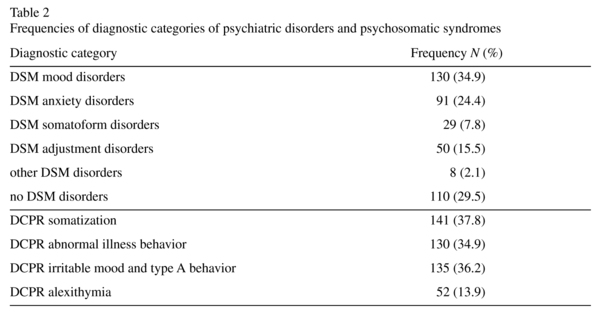
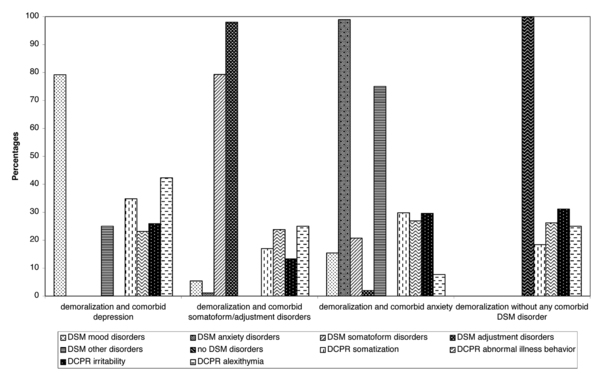
<body><![CDATA[<p><font size="2" face="Verdana">Data were entered in SPSS (SPSS Inc., USA),  after which descriptive statistics were calculated. Two-step cluster analysis  was performed to organize observations into two or more mutually exclusive  groups, where members of the groups shared properties in common<sup>36</sup>.  The following variables were included in the analysis: DSM mood disorders,  anxiety disorders, somatoform disorders, adjustment disorders, other disorders  (psychotic disorders, eating disorders, sexual dysfunctions and substance use  disorders), absence of any DSM disorder absence of any DSM disorder, DCPR  abnormal illness behavior, somatization, irritability and alexithymia.</font></p>     <p><font size="2" face="Verdana">The two-step cluster method is a scalable  cluster analysis algorithm designed to handle large data sets. It can handle  both continuous and categorical variables. The two steps are: 1) pre-cluster the  cases into many small sub-clusters; 2) cluster the sub-clusters resulting from  pre-cluster step into the desired number of clusters. The log-likelihood  distance measure was used, with subjects assigned to the cluster leading to the  largest likelihood. No prescribed number of clusters was suggested. The Bayesian  Information Criterion (BIC) was used to judge the adequacy of the final  solution. Differences in sample characteristics were compared according to  cluster membership using independent sample t-tests and chi squared tests for  continuous and categorical variables, respectively. For all tests performed, the  significance level was set at 0.05, two-tailed.</font></p>     <p>&nbsp;</p>     <p><font size="2" face="Verdana"><b>Results</b></font></p>     <p><font size="2" face="Verdana">A total of 373 patients (23.9%; 60.3% female)  received a diagnosis of demoralization according to DCPR criteria, with a mean  age of 48 (SD = 14.57) years, and a mean of 10 (SD = 3.90) years of education.  Of these, 263 (70.5%) had at least 1 comorbid Axis I disorder (mainly mood and  anxiety disorders), and 308 (82.6%) presented at least 1 comorbid DCPR syndrome.  Frequencies for each of the diagnostic categories of psychiatric disorders and  psychosomatic syndromes are shown in <a href="#t2">Table 2</a>.</font></p>     <p align="center"><a name="t2"> <img src="/img/revistas/ejpen/v27n1/original2_tabla2.jpg"></a></p>     <p>&nbsp;</p>     <p><font size="2" face="Verdana">Two-step cluster analysis yielded 4 clusters,  with no exclusion of cases. The composition of the clusters (<a href="#f1">Figure  1</a>) and the importance of variables within a cluster were then examined.</font></p>     <p align="center"><font size="2" face="Verdana"><a name="f1"> <img src="/img/revistas/ejpen/v27n1/original2_figura1.jpg"></a>    <br> Figure 1. Distribution of diagnostic categories within each cluster.</font></p>     ]]></body>
<body><![CDATA[<p>&nbsp;</p>     <p><font size="2" face="Verdana">The first cluster had 27.6% (N = 103) of the  total sample and was characterized by the presence of DSM-IV mood disorders  (mainly major depressive disorder); this cluster was named <i>demoralization and  comorbid depression</i>.</font></p>     <p><font size="2" face="Verdana">The second cluster had 18.2% of the cases (N =  68) and contained both DSM-IV somatoform (particularly, undifferentiated  somatoform disorder and hypochondriasis) and adjustment disorders; this cluster  was named <i>demoralization and comorbid somatoform/ adjustment disorders</i>.</font></p>     <p><font size="2" face="Verdana">In the third cluster (N = 92; 24.7%), DSM-IV  anxiety disorders were predominant (particularly, generalized anxiety disorder,  agoraphobia, panic disorder and obsessive- compulsive disorder); this cluster  was thus named <i>demoralization and comorbid anxiety</i>.</font></p>     <p><font size="2" face="Verdana">The fourth cluster had 29.5% (N = 110) of the  patients and was characterized by the absence of any DSM-IV comorbid disorder;  this cluster was named <i>demoralization without any comorbid DSM disorder</i>.</font></p>     <p><font size="2" face="Verdana">The frequency and the importance of the  remaining variables (e.g., other disorders listed in DSM, DCPR somatization,  abnormal illness behavior, irritability, alexithymia) were comparable among the  groups, indicating that these diagnostic categories did not make a substantial  contribution to cluster formation.</font></p>     <p><font size="2" face="Verdana">When differences among the cluster groups were  examined, no significant differences were found with regard to both gender and  years of education. Age differed among the clusters (F<sub>3,246</sub> = 4.186;  p &lt; 0.01), with patients in the fourth cluster being the oldest (mean age 52  years; SD = 1.76), and those in the second cluster the youngest (mean 43.2  years; SD = 1.88).</font></p>     <p><font size="2" face="Verdana">With regard to specific medical settings, there  were significant differences among the clusters (&#967;<sup>2</sup><sub>18</sub> =  121.710; p &lt; 0.001): a greater proportion of patients from the Functional  Gastrointestinal Disorders Outpatient Clinic were found in the first two  clusters (N = 14; 32.6% and N = 16; 37.2%, respectively); patients who had  received a diagnosis of cancer within the past 18 months were mainly represented  in the second cluster (N = 19; 55.9%); a number of patients with skin diseases  were contained in both the first and the fourth clusters (N = 22; 29.3% and N =  24; 32%, respectively). The vast majority of inpatients from psychiatric  consultation services were present in the first three clusters (N = 19; 35.2%, N  = 16; 29.6% and N = 16; 29.6%, respectively). Patients with endocrine disorders  were mainly represented in the third cluster (N = 22; 40.7%), as well as those  who underwent heart transplantation (N = 27; 42.9%), even though the latter were  also present in the fourth cluster (N = 25; 39.7%). About half of patients with  a recent first myocardial infarction diagnosis (N = 24; 48%) were found in the  fourth cluster.</font></p>     <p>&nbsp;</p>     <p><font size="2" face="Verdana"><b>Discussion</b></font></p>     ]]></body>
<body><![CDATA[<p><font size="2" face="Verdana">This study has found that almost 24% of  patients with various medical illnesses received a diagnosis of demoralization  according to DCPR criteria. These results confirm that demoralization is  frequent across different medical settings.</font></p>     <p><font size="2" face="Verdana">The first cluster (demoralization and comorbid  depression) encompassed about 30% of cases. This is not a new finding. In fact,  previous studies suggested that demoralization can be found in major depression:  Klein<sup>37</sup> claimed that demoralization may develop in &quot;endogenomorphic  depression&quot;, and Galeazzi <i>et al</i>.<sup>30</sup> and Mangelli <i>et al</i>.<sup>10</sup>  observed demoralization in more than 50% of medically ill patients with major  depression. In a study conducted by Marchesi and Maggini<sup>38</sup>, the  presence of major depression was related to an increase of demoralization  scores. Even though demoralization and depression are distinct clinical  phenomena<sup>10,39-41</sup> in many cases they coexist<sup>42</sup>. A  patient's diminished frustration tolerance and increased mood reactivity while  in the hospital are likely due to a sense of demoralization caused by  circumstances beyond his control in the hospital. However, his or her more  chronic symptoms of anhedonia, social isolation, and poor concentration are  suggestive of a coexisting depressive disorder<sup>7</sup>. There is growing  opinion that, within clinical depression, traditional diagnostic systems do not  allow differentiation between different mood states commonly experienced in  medically ill patients<sup>43,44</sup>. Clarke and collegues<sup>21,45,46</sup>  found evidence for different dimensions or types of depression, primarily  distinguished by levels of demoralization (hopelessness, helplessness) and  anhedonia (diminished interest and ability to experience pleasure). Anhedonia is  evident in a number of clusters but did not correlate strongly with the  demoralization score.</font></p>     <p><font size="2" face="Verdana">If on one hand severe and debilitating medical  illness can frequently lead to demoralization, on the other hand chronic and  disabling mental illness can also be associated with demoralization<sup>7</sup>.  In major depression, demoralization can be viewed as a step in a sequence,  starting with the loss of interest and pleasure, the psychopathological core  alteration of this disorder<sup>37,47</sup>. If the loss of pleasure and  interest becomes very severe and pervasive, demoralization can follow<sup>37</sup>.  Therefore, demoralization in major depressive patients may represent a  psychological response to a prolonged and severe loss of interest and pleasure<sup>48</sup>.  However, in other medically ill patients the relationship between major  depression and demoralization might be characterized by a different sequence. In  fact, a chronic, severe, incapacitating medical illness may induce feelings of  poor self-esteem, helplessness, hopelessness and subjective incompetence<sup>5,21,30,49,50</sup>.  It cannot be excluded that demoralization, once occurred, may predispose  medically ill patients to suffer from major depression, which in turn worsen the  feelings of poor self-esteem, helplessness and hopelessness. Moreover, it could  be that demoralization, when associated with clinical depression, individuates a  subgroup of patients at a greater risk of a worse outcome<sup>8</sup>. This  could happen since the addition of demoralization to major depressive disorder  results in decreased psychological well-being dimensions, such as autonomy,  positive relations and self-acceptance as recently found in a population of  heart transplanted patients<sup>51</sup>.</font></p>     <p><font size="2" face="Verdana">The second cluster encompassed 18.2% of the  cases and was characterized by both DSM-IV somatoform (particularly,  undifferentiated somatoform disorder and hypochondriasis) and adjustment  disorders. Both diagnostic rubrics have recently undergone considerable  criticism as to their clinical usefulness<sup>52,53</sup>. Clarke <i>et al</i>.<sup>21</sup>  found that in 312 patients admitted to hospital with a range of medical  conditions (cardiovascular, gastrointestinal, respiratory, rheumatological and  neurological), clusters of high self-reported distress (demoralization and  demoralized grief) were significantly associated with DSM-IV somatoform  disorders. Patients with somatization syndromes might present a bias to  interpret minor physical changes as a possible sign of a severe illness.  Affective consequences such as demoralization might present a negative feed-back  loop that helps to maintain the problem<sup>54</sup>. On the other hand,  adjustment disorders have been found to be the most frequent psychiatric  diagnosis in the medically ill. Problems have been raised, however, as to their  clinical value. In the study by Grassi <i>et al</i>.<sup>43</sup> one hundred  patients with medical illness and a diagnosis of DSM-IV adjustment disorder were  interviewed according to the DCPR system. A considerable overlap was shown  between adjustment disorders and DCPR clusters related to somatization (37%) and  demoralization (33%), confirming our findings. While researchers have  highlighted the need to include demoralization in the psychiatric nomenclature<sup>55</sup>,  currently it is often referred to as adjustment disorder. However, it has been  argued that adjustment disorder does not place sufficient emphasis on the  personal narrative of incompetence that characterizes the lives of demoralized  individuals<sup>4</sup>.</font></p>     <p><font size="2" face="Verdana">In the third cluster (24.7%), DSM-IV anxiety  disorders (particularly, generalized anxiety disorder, agoraphobia, panic  disorder and obsessive-compulsive disorder) in comorbidity with demoralization  were predominant. Since anxiety disorders can be severely disabling and  impairing<sup>56</sup>, it is not surprising that a number of patients  experience demoralization<sup>57</sup>. The phenomenon of demoralization has  been largely applied to clinical populations to explain a developmental spectrum  of psychopathology. Frank<sup>17</sup> observed both anxiety and depressive  symptomatology as direct expressions of demoralization. Research indicates that  if an individual endures internal or external stressors that are perceived as  severe, then anxiety levels increase<sup>5</sup>. When anxiety levels increase,  an individual may feel the situation is uncontrollable, leading to helplessness.  If the feeling of helplessness is not attended to, then hopelessness and the  inability to cope will develop<sup>5</sup>. Anxiety then might evolve into  subsequent depression by a sort of process of demoralization<sup>58</sup>. The  relation between symptoms of anxiety/depression and demoralization, as suggested  by Grassi <i>et al</i>.<sup>43</sup>, reopens the question whether  demoralization is part of the anxious-depressive spectrum.</font></p>     <p><font size="2" face="Verdana">The fourth cluster had 29.5% of the patients  and was characterized by the absence of any DSM-IV comorbid disorder. This  finding is clinically relevant. Through the use of the DCPR among medically ill  patients, it has been confirmed that demoralization is a construct that is not  necessarily related to psychiatric disorders. In a large study of 809 medical  patients, the frequency of DCPR demoralization was 30%, whereas the frequency of  DSM-IV major depression was only 17%. Of interest, 44% of patients with major  depression did not meet the DCPR criteria for demoralization, whereas up to 69%  of those with demoralization did not meet the criteria for major depression<sup>10</sup>.  Patient's inability to cope with some pressing problems, feelings of  helplessness, or hopelessness, or giving up could represent key factors for the  development of illnesses or contributing factor to the expression of physical or  mental disease activity. Demoralization should thus be examined carefully,  avoiding the common tendency to dismiss it as an understandable (and thus not  requiring attention or treatment) condition in patients with medical illnesses<sup>10</sup>.  Preliminary clinical findings suggest that a careful diagnosis of demoralization  may lead to effective treatment of both psychological and somatic symptoms<sup>5,59</sup>.  There remains the need to further investigate if treating sub-clinical syndromes  can improve quality of life and reduce the risk of morbidity and mortality in  these patients<sup>60</sup>.</font></p>     <p><font size="2" face="Verdana">The study has limitations due to its  cross-sectional nature. We do not know, in fact, the longitudinal course of  these clusters. However, the findings of this study highlight the importance of  detecting demoralization alone or in comorbidity with major depression,  somatization, adjustment and anxiety disorders. Exclusive reliance on  psychiatric diagnostic criteria has impoverished the clinical process and does  not reflect the complex thinking that underlies decisions in psychiatric  practice<sup>61</sup>. Identifying and subtyping demoralization in the setting  of medical disease may yield improved targets for research and treatment trials,  as is currently advocated in major depression<sup>62-64</sup>.</font></p>     <p>&nbsp;</p>     <p><font size="2" face="Verdana"><b>Acknowledgements</b></font></p>     <p><font size="2" face="Verdana">We are indebted to Antonello Bellomo, MD,  Silvia Ferrari, MD, Luigi Grassi, MD, Angelo Picardi, MD, Roberto Quartesan, MD,  Marco Rigatelli, MD, and Nicoletta Sonino, MD, for the use of collaborative  data.</font></p>     ]]></body>
<body><![CDATA[<p>&nbsp;</p>     <p><font size="2" face="Verdana"><b>References</b></font></p>     <!-- ref --><p><font size="2" face="Verdana">1. Grossarth-Maticek R, Bastiaans J, Kanazir  DT. Psychosocial factors as strong predictors of mortality from cancer,  ischaemic heart disease and stroke: the Yugoslav prospective study. J Psychosom  Res 1985; 29(2): 167-176.    &nbsp;&nbsp;&nbsp;&nbsp;&nbsp;&nbsp;&nbsp;&nbsp;[&#160;<a href="javascript:void(0);" onclick="javascript: window.open('/scielo.php?script=sci_nlinks&ref=6001543&pid=S0213-6163201300010000200001&lng=','','width=640,height=500,resizable=yes,scrollbars=1,menubar=yes,');">Links</a>&#160;]<!-- end-ref --></font></p>     <!-- ref --><p><font size="2" face="Verdana">2. Anda R, Williamson D, Jones D, Macera C,  Eaker E, Glassman A, <i>et al</i>. Depressed affect, hopelessness, and the risk  of ischemic heart disease in a cohort of U.S. adults. Epidemiology 1993; 4(4):  285-294.    &nbsp;&nbsp;&nbsp;&nbsp;&nbsp;&nbsp;&nbsp;&nbsp;[&#160;<a href="javascript:void(0);" onclick="javascript: window.open('/scielo.php?script=sci_nlinks&ref=6001545&pid=S0213-6163201300010000200002&lng=','','width=640,height=500,resizable=yes,scrollbars=1,menubar=yes,');">Links</a>&#160;]<!-- end-ref --></font></p>     <!-- ref --><p><font size="2" face="Verdana">3. Slavney PR. Diagnosing demoralization in  consultation psychiatry. Psychosomatics 1999; 40(4): 325-329.    &nbsp;&nbsp;&nbsp;&nbsp;&nbsp;&nbsp;&nbsp;&nbsp;[&#160;<a href="javascript:void(0);" onclick="javascript: window.open('/scielo.php?script=sci_nlinks&ref=6001547&pid=S0213-6163201300010000200003&lng=','','width=640,height=500,resizable=yes,scrollbars=1,menubar=yes,');">Links</a>&#160;]<!-- end-ref --></font></p>     <!-- ref --><p><font size="2" face="Verdana">4. Angelino AF, Treisman GJ. Major depression  and demoralization in cancer patients: diagnostic and treatment considerations.  Support Care Cancer 2001; 9(5): 344-349.    &nbsp;&nbsp;&nbsp;&nbsp;&nbsp;&nbsp;&nbsp;&nbsp;[&#160;<a href="javascript:void(0);" onclick="javascript: window.open('/scielo.php?script=sci_nlinks&ref=6001549&pid=S0213-6163201300010000200004&lng=','','width=640,height=500,resizable=yes,scrollbars=1,menubar=yes,');">Links</a>&#160;]<!-- end-ref --></font></p>     ]]></body>
<body><![CDATA[<!-- ref --><p><font size="2" face="Verdana">5. Clarke DM, Kissane DW. Demoralization: its  phenomenology and importance. Aust N Z J Psychiatry 2002; 36(6): 733-742.    &nbsp;&nbsp;&nbsp;&nbsp;&nbsp;&nbsp;&nbsp;&nbsp;[&#160;<a href="javascript:void(0);" onclick="javascript: window.open('/scielo.php?script=sci_nlinks&ref=6001551&pid=S0213-6163201300010000200005&lng=','','width=640,height=500,resizable=yes,scrollbars=1,menubar=yes,');">Links</a>&#160;]<!-- end-ref --></font></p>     <!-- ref --><p><font size="2" face="Verdana">6. Schuitemaker GE, Dinant GJ, van der Pol GA,  Appels A. Assessment of vital exhaustion and identification of subjects at  increased risk of myocardial infarction in general practice. Psychosomatics  2004; 45(5): 414-418.    &nbsp;&nbsp;&nbsp;&nbsp;&nbsp;&nbsp;&nbsp;&nbsp;[&#160;<a href="javascript:void(0);" onclick="javascript: window.open('/scielo.php?script=sci_nlinks&ref=6001553&pid=S0213-6163201300010000200006&lng=','','width=640,height=500,resizable=yes,scrollbars=1,menubar=yes,');">Links</a>&#160;]<!-- end-ref --></font></p>     <!-- ref --><p><font size="2" face="Verdana">7. Jacobsen JC, Maytal G, Stern TA.  Demoralization in medical practice. Prim Care Companion J Clin Psychiatry. 2007;  9(2): 139-143.    &nbsp;&nbsp;&nbsp;&nbsp;&nbsp;&nbsp;&nbsp;&nbsp;[&#160;<a href="javascript:void(0);" onclick="javascript: window.open('/scielo.php?script=sci_nlinks&ref=6001555&pid=S0213-6163201300010000200007&lng=','','width=640,height=500,resizable=yes,scrollbars=1,menubar=yes,');">Links</a>&#160;]<!-- end-ref --></font></p>     <!-- ref --><p><font size="2" face="Verdana">8. Rafanelli C, Roncuzzi R, Milaneschi Y, Tomba  E, Colistro MC, Pancaldi LG, <i>et al</i>. Stressful life events, depression and  demoralization as risk factors for acute coronary heart disease. Psychother  Psychosom 2005; 74(3): 179-184.    &nbsp;&nbsp;&nbsp;&nbsp;&nbsp;&nbsp;&nbsp;&nbsp;[&#160;<a href="javascript:void(0);" onclick="javascript: window.open('/scielo.php?script=sci_nlinks&ref=6001557&pid=S0213-6163201300010000200008&lng=','','width=640,height=500,resizable=yes,scrollbars=1,menubar=yes,');">Links</a>&#160;]<!-- end-ref --></font></p>     <!-- ref --><p><font size="2" face="Verdana">9. Fabbri S, Fava GA, Sirri L, Wise T.  Development of a new assessment strategy in psychosomatic medicine: The  Diagnostic Criteria for Psychosomatic Research. In: Porcelli P, Sonino N,  editors. Psychological factors affecting medical conditions. A new  classification for DSM-V. Basel, CH: Karger; 2007. p. 1-20.    &nbsp;&nbsp;&nbsp;&nbsp;&nbsp;&nbsp;&nbsp;&nbsp;[&#160;<a href="javascript:void(0);" onclick="javascript: window.open('/scielo.php?script=sci_nlinks&ref=6001559&pid=S0213-6163201300010000200009&lng=','','width=640,height=500,resizable=yes,scrollbars=1,menubar=yes,');">Links</a>&#160;]<!-- end-ref --></font></p>     ]]></body>
<body><![CDATA[<!-- ref --><p><font size="2" face="Verdana">10. Mangelli L, Fava GA, Grandi S, Grassi L,  Ottolini F, Porcelli P, <i>et al</i>. Assessing demoralization and depression in  the setting of medical disease. J Clin Psychiatry 2005; 66(3): 391-394.    &nbsp;&nbsp;&nbsp;&nbsp;&nbsp;&nbsp;&nbsp;&nbsp;[&#160;<a href="javascript:void(0);" onclick="javascript: window.open('/scielo.php?script=sci_nlinks&ref=6001561&pid=S0213-6163201300010000200010&lng=','','width=640,height=500,resizable=yes,scrollbars=1,menubar=yes,');">Links</a>&#160;]<!-- end-ref --></font></p>     <!-- ref --><p><font size="2" face="Verdana">11. Dohrenwend BP, Shrout PE, Egri G,  Mendelsohn FS. Nonspecific psychological distress and other dimensions of  psychopathology. Arch Gen Psychiatry 1980; 37(11): 1229-1236.    &nbsp;&nbsp;&nbsp;&nbsp;&nbsp;&nbsp;&nbsp;&nbsp;[&#160;<a href="javascript:void(0);" onclick="javascript: window.open('/scielo.php?script=sci_nlinks&ref=6001563&pid=S0213-6163201300010000200011&lng=','','width=640,height=500,resizable=yes,scrollbars=1,menubar=yes,');">Links</a>&#160;]<!-- end-ref --></font></p>     <!-- ref --><p><font size="2" face="Verdana">12. de Figueiredo JM. Depression and  demoralization: phenomenologic differences and research perspectives. Compr  Psychiatry 1993; 34(5): 308-311.    &nbsp;&nbsp;&nbsp;&nbsp;&nbsp;&nbsp;&nbsp;&nbsp;[&#160;<a href="javascript:void(0);" onclick="javascript: window.open('/scielo.php?script=sci_nlinks&ref=6001565&pid=S0213-6163201300010000200012&lng=','','width=640,height=500,resizable=yes,scrollbars=1,menubar=yes,');">Links</a>&#160;]<!-- end-ref --></font></p>     <!-- ref --><p><font size="2" face="Verdana">13. Myers JK, Lindenthal JJ, Peper MP. Life  events, social integration and psychiatric symptomatology. J Helth Soc Behav  1975; 16(4): 421-427.    &nbsp;&nbsp;&nbsp;&nbsp;&nbsp;&nbsp;&nbsp;&nbsp;[&#160;<a href="javascript:void(0);" onclick="javascript: window.open('/scielo.php?script=sci_nlinks&ref=6001567&pid=S0213-6163201300010000200013&lng=','','width=640,height=500,resizable=yes,scrollbars=1,menubar=yes,');">Links</a>&#160;]<!-- end-ref --></font></p>     <!-- ref --><p><font size="2" face="Verdana">14. Craig TJ, Brown GW. Goal frustration and  life events in the etiology of painful gastrointestinal disorder. J Psychosom  Res 1984; 28(5): 411-421.    &nbsp;&nbsp;&nbsp;&nbsp;&nbsp;&nbsp;&nbsp;&nbsp;[&#160;<a href="javascript:void(0);" onclick="javascript: window.open('/scielo.php?script=sci_nlinks&ref=6001569&pid=S0213-6163201300010000200014&lng=','','width=640,height=500,resizable=yes,scrollbars=1,menubar=yes,');">Links</a>&#160;]<!-- end-ref --></font></p>     ]]></body>
<body><![CDATA[<!-- ref --><p><font size="2" face="Verdana">15. Schmale AH, Engel GL. The giving up-given  up complex illustrated on film. Arch Gen Psychiatry 1967; 17(2): 133-145.    &nbsp;&nbsp;&nbsp;&nbsp;&nbsp;&nbsp;&nbsp;&nbsp;[&#160;<a href="javascript:void(0);" onclick="javascript: window.open('/scielo.php?script=sci_nlinks&ref=6001571&pid=S0213-6163201300010000200015&lng=','','width=640,height=500,resizable=yes,scrollbars=1,menubar=yes,');">Links</a>&#160;]<!-- end-ref --></font></p>     <!-- ref --><p><font size="2" face="Verdana">16. Schmale AH. Giving up as a final common  pathway to changes in health. Adv Psychosom Med 1972; 8: 20-40.    &nbsp;&nbsp;&nbsp;&nbsp;&nbsp;&nbsp;&nbsp;&nbsp;[&#160;<a href="javascript:void(0);" onclick="javascript: window.open('/scielo.php?script=sci_nlinks&ref=6001573&pid=S0213-6163201300010000200016&lng=','','width=640,height=500,resizable=yes,scrollbars=1,menubar=yes,');">Links</a>&#160;]<!-- end-ref --></font></p>     <!-- ref --><p><font size="2" face="Verdana">17. Frank JD. Psychotherapy: the restoration of  morale. Am J Psychiatry 1974; 131: 271-274.    &nbsp;&nbsp;&nbsp;&nbsp;&nbsp;&nbsp;&nbsp;&nbsp;[&#160;<a href="javascript:void(0);" onclick="javascript: window.open('/scielo.php?script=sci_nlinks&ref=6001575&pid=S0213-6163201300010000200017&lng=','','width=640,height=500,resizable=yes,scrollbars=1,menubar=yes,');">Links</a>&#160;]<!-- end-ref --></font></p>     <!-- ref --><p><font size="2" face="Verdana">18. Fava GA, Freyberger HJ, Bech P,  Christodoulou G, Sensky T, Theorell T, <i>et al</i>. Appendix 1. Diagnostic  criteria for use in psychosomatic research. In: Porcelli P, Sonino N, editors.  Psychological factors affecting medical condition. A new clasiffication for  DSM-V. Basel, CH: Karger; 207. p. 169-173.    &nbsp;&nbsp;&nbsp;&nbsp;&nbsp;&nbsp;&nbsp;&nbsp;[&#160;<a href="javascript:void(0);" onclick="javascript: window.open('/scielo.php?script=sci_nlinks&ref=6001577&pid=S0213-6163201300010000200018&lng=','','width=640,height=500,resizable=yes,scrollbars=1,menubar=yes,');">Links</a>&#160;]<!-- end-ref --></font></p>     <!-- ref --><p><font size="2" face="Verdana">19. Rafanelli C, Roncuzzi R, Finos L, Tossani  E, Tomba E, Mangelli L, <i>et al</i>. Psychosocial assessment in cardiac  rehabilitation. Psychother Psychosom 2003; 72(6): 343-349.    &nbsp;&nbsp;&nbsp;&nbsp;&nbsp;&nbsp;&nbsp;&nbsp;[&#160;<a href="javascript:void(0);" onclick="javascript: window.open('/scielo.php?script=sci_nlinks&ref=6001579&pid=S0213-6163201300010000200019&lng=','','width=640,height=500,resizable=yes,scrollbars=1,menubar=yes,');">Links</a>&#160;]<!-- end-ref --></font></p>     ]]></body>
<body><![CDATA[<!-- ref --><p><font size="2" face="Verdana">20. Feldman D, Rabinowitz J, Yehuda YB.  Detecting psychological distress among patients attending secondary health care  clinics: Self-report and physician rating. Gen Hosp Psychiatry 1995; 17(6):  425-432.    &nbsp;&nbsp;&nbsp;&nbsp;&nbsp;&nbsp;&nbsp;&nbsp;[&#160;<a href="javascript:void(0);" onclick="javascript: window.open('/scielo.php?script=sci_nlinks&ref=6001581&pid=S0213-6163201300010000200020&lng=','','width=640,height=500,resizable=yes,scrollbars=1,menubar=yes,');">Links</a>&#160;]<!-- end-ref --></font></p>     <!-- ref --><p><font size="2" face="Verdana">21. Clarke DM, Smith GC, Doweb DL, McKenzieac  DP. An empirically derived taxonomy of common distress syndromes in the  medically ill. J Psychosom Res 2003; 54(4): 323-330.    &nbsp;&nbsp;&nbsp;&nbsp;&nbsp;&nbsp;&nbsp;&nbsp;[&#160;<a href="javascript:void(0);" onclick="javascript: window.open('/scielo.php?script=sci_nlinks&ref=6001583&pid=S0213-6163201300010000200021&lng=','','width=640,height=500,resizable=yes,scrollbars=1,menubar=yes,');">Links</a>&#160;]<!-- end-ref --></font></p>     <!-- ref --><p><font size="2" face="Verdana">22. Ottolini F, Modena MG, Rigatelli M.  Prodromal symptoms in myocardial infarction. Psychother Psychosom 2005; 74(5):  323-327.    &nbsp;&nbsp;&nbsp;&nbsp;&nbsp;&nbsp;&nbsp;&nbsp;[&#160;<a href="javascript:void(0);" onclick="javascript: window.open('/scielo.php?script=sci_nlinks&ref=6001585&pid=S0213-6163201300010000200022&lng=','','width=640,height=500,resizable=yes,scrollbars=1,menubar=yes,');">Links</a>&#160;]<!-- end-ref --></font></p>     <!-- ref --><p><font size="2" face="Verdana">23. Grassi L, Sabato S, Rossi E, Biancosino B,  Marmai L. Use of the Diagnostic Criteria for Psychosomatic Research in oncology.  Psychother Psychosom 2005; 74(2): 100-107.    &nbsp;&nbsp;&nbsp;&nbsp;&nbsp;&nbsp;&nbsp;&nbsp;[&#160;<a href="javascript:void(0);" onclick="javascript: window.open('/scielo.php?script=sci_nlinks&ref=6001587&pid=S0213-6163201300010000200023&lng=','','width=640,height=500,resizable=yes,scrollbars=1,menubar=yes,');">Links</a>&#160;]<!-- end-ref --></font></p>     <!-- ref --><p><font size="2" face="Verdana">24. Picardi A, Porcelli P, Pasquini P, Fassone  G, Mazzotti E, Lega I, <i>et al</i>. Integration of multiple criteria for  psychosomatic assessment of dermatological patients. Psychosomatics 2006; 47(2):  122-128.    &nbsp;&nbsp;&nbsp;&nbsp;&nbsp;&nbsp;&nbsp;&nbsp;[&#160;<a href="javascript:void(0);" onclick="javascript: window.open('/scielo.php?script=sci_nlinks&ref=6001589&pid=S0213-6163201300010000200024&lng=','','width=640,height=500,resizable=yes,scrollbars=1,menubar=yes,');">Links</a>&#160;]<!-- end-ref --></font></p>     ]]></body>
<body><![CDATA[<!-- ref --><p><font size="2" face="Verdana">25. Porcelli P, de Carne M, Fava GA. Assessing  somatization in functional gastrointestinal disorders. Integration of different  criteria. Psychother Psychosom 2000; 69(4): 198-204.    &nbsp;&nbsp;&nbsp;&nbsp;&nbsp;&nbsp;&nbsp;&nbsp;[&#160;<a href="javascript:void(0);" onclick="javascript: window.open('/scielo.php?script=sci_nlinks&ref=6001591&pid=S0213-6163201300010000200025&lng=','','width=640,height=500,resizable=yes,scrollbars=1,menubar=yes,');">Links</a>&#160;]<!-- end-ref --></font></p>     <!-- ref --><p><font size="2" face="Verdana">26. Sonino N, Navarrini C, Ruini C, Ottolini F,  Paoletta A, Fallo F, <i>et al</i>. Persistent psychological distress in patients  treated for endocrine disease. Psychother Psychosom 2004; 73(2): 78-83.    &nbsp;&nbsp;&nbsp;&nbsp;&nbsp;&nbsp;&nbsp;&nbsp;[&#160;<a href="javascript:void(0);" onclick="javascript: window.open('/scielo.php?script=sci_nlinks&ref=6001593&pid=S0213-6163201300010000200026&lng=','','width=640,height=500,resizable=yes,scrollbars=1,menubar=yes,');">Links</a>&#160;]<!-- end-ref --></font></p>     <!-- ref --><p><font size="2" face="Verdana">27. Sonino N, Ruini C, Navarrini C, Ottolini F,  Sirri L, Paoletta A, <i>et al</i>. Psychosocial impairment in patients treated  for pituitary disease. A controlled study. Clin Endocrinol 2007; 67(5): 719-726.    &nbsp;&nbsp;&nbsp;&nbsp;&nbsp;&nbsp;&nbsp;&nbsp;[&#160;<a href="javascript:void(0);" onclick="javascript: window.open('/scielo.php?script=sci_nlinks&ref=6001595&pid=S0213-6163201300010000200027&lng=','','width=640,height=500,resizable=yes,scrollbars=1,menubar=yes,');">Links</a>&#160;]<!-- end-ref --></font></p>     <!-- ref --><p><font size="2" face="Verdana">28. Sonino N, Peruzzi P. A  psychoneuroendocrinology service. Psychother Psychosom 2009; 78(6): 346-351.    &nbsp;&nbsp;&nbsp;&nbsp;&nbsp;&nbsp;&nbsp;&nbsp;[&#160;<a href="javascript:void(0);" onclick="javascript: window.open('/scielo.php?script=sci_nlinks&ref=6001597&pid=S0213-6163201300010000200028&lng=','','width=640,height=500,resizable=yes,scrollbars=1,menubar=yes,');">Links</a>&#160;]<!-- end-ref --></font></p>     <!-- ref --><p><font size="2" face="Verdana">29. Ferrari S, Galeazzi GM, Mackinnon A,  Rigatelli M. Frequent attenders in primary care: impact of medical, psychiatric  and psychosomatic diagnoses. Psychother Psychosom 2008; 77(5): 306-314.    &nbsp;&nbsp;&nbsp;&nbsp;&nbsp;&nbsp;&nbsp;&nbsp;[&#160;<a href="javascript:void(0);" onclick="javascript: window.open('/scielo.php?script=sci_nlinks&ref=6001599&pid=S0213-6163201300010000200029&lng=','','width=640,height=500,resizable=yes,scrollbars=1,menubar=yes,');">Links</a>&#160;]<!-- end-ref --></font></p>     ]]></body>
<body><![CDATA[<!-- ref --><p><font size="2" face="Verdana">30. Galeazzi GM, Ferrari S, Mackinnon A,  Rigatelli M. Interrater reliability, prevalence and relation to ICD-10 diagnoses  of the Diagnostic Criteria for Psychosomatic Research in consultation-liaison  psychiatry patients. Psychosomatics 2004; 45(5): 386-393.    &nbsp;&nbsp;&nbsp;&nbsp;&nbsp;&nbsp;&nbsp;&nbsp;[&#160;<a href="javascript:void(0);" onclick="javascript: window.open('/scielo.php?script=sci_nlinks&ref=6001601&pid=S0213-6163201300010000200030&lng=','','width=640,height=500,resizable=yes,scrollbars=1,menubar=yes,');">Links</a>&#160;]<!-- end-ref --></font></p>     <!-- ref --><p><font size="2" face="Verdana">31. Porcelli P, Bellomo A, Quartesan R,  Altamura M, Iuso S, Ciannameo I, <i>et al</i>. Psychosocial functioning in  consultation-liaison psychiatry patients: influence of psychosomatic syndromes,  psychopathology and somatization. Psychother Psychosom 2009; 78(6): 352-358.    &nbsp;&nbsp;&nbsp;&nbsp;&nbsp;&nbsp;&nbsp;&nbsp;[&#160;<a href="javascript:void(0);" onclick="javascript: window.open('/scielo.php?script=sci_nlinks&ref=6001603&pid=S0213-6163201300010000200031&lng=','','width=640,height=500,resizable=yes,scrollbars=1,menubar=yes,');">Links</a>&#160;]<!-- end-ref --></font></p>     <!-- ref --><p><font size="2" face="Verdana">32. Mangelli L, Semprini F, Sirri L, Fava GA,  Sonino N. Use of the Diagnostic Criteria for Psychosomatic Research (DCPR) in a  community sample. Psychosomatics 2006; 47(2): 143-146.    &nbsp;&nbsp;&nbsp;&nbsp;&nbsp;&nbsp;&nbsp;&nbsp;[&#160;<a href="javascript:void(0);" onclick="javascript: window.open('/scielo.php?script=sci_nlinks&ref=6001605&pid=S0213-6163201300010000200032&lng=','','width=640,height=500,resizable=yes,scrollbars=1,menubar=yes,');">Links</a>&#160;]<!-- end-ref --></font></p>     <!-- ref --><p><font size="2" face="Verdana">33. Porcelli P, Sonino N. Preface. In: Porcelli  P, Sonino N, editors. Psychological factors affecting medical condition. A new  classification for DSM-V. Basel, CH: Karger; 2007. p. VII-X.    &nbsp;&nbsp;&nbsp;&nbsp;&nbsp;&nbsp;&nbsp;&nbsp;[&#160;<a href="javascript:void(0);" onclick="javascript: window.open('/scielo.php?script=sci_nlinks&ref=6001607&pid=S0213-6163201300010000200033&lng=','','width=640,height=500,resizable=yes,scrollbars=1,menubar=yes,');">Links</a>&#160;]<!-- end-ref --></font></p>     <!-- ref --><p><font size="2" face="Verdana">34. First MB, Spitzer RL, Gibbon M, Williams  JBW. SCID-I - Structured Clinical Interview for DSM-IV Axis I Disorders (Italian  version by Mazzi F, Morosini P, de Girolamo G, Lussetti M, Guaraldi GP).  Firenze, IT: Organizzazioni Speciali; 2000.    &nbsp;&nbsp;&nbsp;&nbsp;&nbsp;&nbsp;&nbsp;&nbsp;[&#160;<a href="javascript:void(0);" onclick="javascript: window.open('/scielo.php?script=sci_nlinks&ref=6001609&pid=S0213-6163201300010000200034&lng=','','width=640,height=500,resizable=yes,scrollbars=1,menubar=yes,');">Links</a>&#160;]<!-- end-ref --></font></p>     ]]></body>
<body><![CDATA[<!-- ref --><p><font size="2" face="Verdana">35. Mangelli L, Rafanelli C, Porcelli P, Fava  GA. Appendix 2. Interview for the Diagnostic Criteria for Psychosomatic  Research. In: Porcelli P, Sonino N, editors. Psychological factors affecting  medical conditions. A new classification for DSM-V. Basel, CH: Karger; 2007. p.  174-181.    &nbsp;&nbsp;&nbsp;&nbsp;&nbsp;&nbsp;&nbsp;&nbsp;[&#160;<a href="javascript:void(0);" onclick="javascript: window.open('/scielo.php?script=sci_nlinks&ref=6001611&pid=S0213-6163201300010000200035&lng=','','width=640,height=500,resizable=yes,scrollbars=1,menubar=yes,');">Links</a>&#160;]<!-- end-ref --></font></p>     <!-- ref --><p><font size="2" face="Verdana">36. Kaufman L, Rousseeuw PJ. Finding groups in  data: an introduction to cluster analysis. New York, NY: Wiley; 1990.    &nbsp;&nbsp;&nbsp;&nbsp;&nbsp;&nbsp;&nbsp;&nbsp;[&#160;<a href="javascript:void(0);" onclick="javascript: window.open('/scielo.php?script=sci_nlinks&ref=6001613&pid=S0213-6163201300010000200036&lng=','','width=640,height=500,resizable=yes,scrollbars=1,menubar=yes,');">Links</a>&#160;]<!-- end-ref --></font></p>     <!-- ref --><p><font size="2" face="Verdana">37. Klein DF. Endogenomorphic depression: A  conceptual and terminological revision. Arch Gen Psychiatry 1974; 31(4):  447-454.    &nbsp;&nbsp;&nbsp;&nbsp;&nbsp;&nbsp;&nbsp;&nbsp;[&#160;<a href="javascript:void(0);" onclick="javascript: window.open('/scielo.php?script=sci_nlinks&ref=6001615&pid=S0213-6163201300010000200037&lng=','','width=640,height=500,resizable=yes,scrollbars=1,menubar=yes,');">Links</a>&#160;]<!-- end-ref --></font></p>     <!-- ref --><p><font size="2" face="Verdana">38. Marchesi C, Maggini C. Socio-demographic  and clinical features associated with demoralization in medically ill  in-patients. Soc Psychiatry Psychiatr Epidemiol 2007; 42(10): 824-829.    &nbsp;&nbsp;&nbsp;&nbsp;&nbsp;&nbsp;&nbsp;&nbsp;[&#160;<a href="javascript:void(0);" onclick="javascript: window.open('/scielo.php?script=sci_nlinks&ref=6001617&pid=S0213-6163201300010000200038&lng=','','width=640,height=500,resizable=yes,scrollbars=1,menubar=yes,');">Links</a>&#160;]<!-- end-ref --></font></p>     <!-- ref --><p><font size="2" face="Verdana">39. Jacobsen JC, Vanderwerker LC, Block SD,  Friedlander RJ, Maciejewski PK, Prigerson HG. Depression and demoralization as  distinct syndromes: Preliminary data from a cohort of advanced cancer patients.  IJPC 2006; 12(1): 8-15.    &nbsp;&nbsp;&nbsp;&nbsp;&nbsp;&nbsp;&nbsp;&nbsp;[&#160;<a href="javascript:void(0);" onclick="javascript: window.open('/scielo.php?script=sci_nlinks&ref=6001619&pid=S0213-6163201300010000200039&lng=','','width=640,height=500,resizable=yes,scrollbars=1,menubar=yes,');">Links</a>&#160;]<!-- end-ref --></font></p>     ]]></body>
<body><![CDATA[<!-- ref --><p><font size="2" face="Verdana">40. Strada EA. Grief, demoralization, and  depression: Diagnostic challenges and treatment modalities. Primary Psychiatry  2009; 16(5): 49-55.    &nbsp;&nbsp;&nbsp;&nbsp;&nbsp;&nbsp;&nbsp;&nbsp;[&#160;<a href="javascript:void(0);" onclick="javascript: window.open('/scielo.php?script=sci_nlinks&ref=6001621&pid=S0213-6163201300010000200040&lng=','','width=640,height=500,resizable=yes,scrollbars=1,menubar=yes,');">Links</a>&#160;]<!-- end-ref --></font></p>     <!-- ref --><p><font size="2" face="Verdana">41. Wellen M. Differentiation between  demoralization, grief, and anhedonic depression. Curr Psychiatry Rep 2010; 12:  229-233.    &nbsp;&nbsp;&nbsp;&nbsp;&nbsp;&nbsp;&nbsp;&nbsp;[&#160;<a href="javascript:void(0);" onclick="javascript: window.open('/scielo.php?script=sci_nlinks&ref=6001623&pid=S0213-6163201300010000200041&lng=','','width=640,height=500,resizable=yes,scrollbars=1,menubar=yes,');">Links</a>&#160;]<!-- end-ref --></font></p>     <!-- ref --><p><font size="2" face="Verdana">42. Sansone RA, Sansone LA. Demoralization in  patients with medical illness. Psychiatry 2010; 7(8): 42-45.    &nbsp;&nbsp;&nbsp;&nbsp;&nbsp;&nbsp;&nbsp;&nbsp;[&#160;<a href="javascript:void(0);" onclick="javascript: window.open('/scielo.php?script=sci_nlinks&ref=6001625&pid=S0213-6163201300010000200042&lng=','','width=640,height=500,resizable=yes,scrollbars=1,menubar=yes,');">Links</a>&#160;]<!-- end-ref --></font></p>     <!-- ref --><p><font size="2" face="Verdana">43. Grassi L, Mangelli L, Fava GA, Grandi S,  Ottolini F, Porcelli P, <i>et al</i>. Psychosomatic characterization of  adjustment disorders in the medical setting: Some suggestions for DSM-V. J  Affect Dis 2007; 101(1): 251-254.    &nbsp;&nbsp;&nbsp;&nbsp;&nbsp;&nbsp;&nbsp;&nbsp;[&#160;<a href="javascript:void(0);" onclick="javascript: window.open('/scielo.php?script=sci_nlinks&ref=6001627&pid=S0213-6163201300010000200043&lng=','','width=640,height=500,resizable=yes,scrollbars=1,menubar=yes,');">Links</a>&#160;]<!-- end-ref --></font></p>     <!-- ref --><p><font size="2" face="Verdana">44. Guidi J, Fava GA, Bech P, Paykel E. The  Clinical Interview for Depression: A comprehensive review of studies and  clinimetric properties. Psychother Psychosom 2011; 80(1): 10-27.    &nbsp;&nbsp;&nbsp;&nbsp;&nbsp;&nbsp;&nbsp;&nbsp;[&#160;<a href="javascript:void(0);" onclick="javascript: window.open('/scielo.php?script=sci_nlinks&ref=6001629&pid=S0213-6163201300010000200044&lng=','','width=640,height=500,resizable=yes,scrollbars=1,menubar=yes,');">Links</a>&#160;]<!-- end-ref --></font></p>     ]]></body>
<body><![CDATA[<!-- ref --><p><font size="2" face="Verdana">45. Clarke DM, Mackinnon AJ, Smith GC, McKenzie  DP, Herrman HE. Dimensions of psychopathology in the medically ill. A latent  trait analysis. Psychosomatics 2000; 41: 418-425.    &nbsp;&nbsp;&nbsp;&nbsp;&nbsp;&nbsp;&nbsp;&nbsp;[&#160;<a href="javascript:void(0);" onclick="javascript: window.open('/scielo.php?script=sci_nlinks&ref=6001631&pid=S0213-6163201300010000200045&lng=','','width=640,height=500,resizable=yes,scrollbars=1,menubar=yes,');">Links</a>&#160;]<!-- end-ref --></font></p>     <!-- ref --><p><font size="2" face="Verdana">46. Clarke DM, Kissane DW, Trauer T, Smith GC.  Demoralization, anhedonia and grief in patients with severe physical illness.  World Psychiatry 2005; 4(2): 96-105.    &nbsp;&nbsp;&nbsp;&nbsp;&nbsp;&nbsp;&nbsp;&nbsp;[&#160;<a href="javascript:void(0);" onclick="javascript: window.open('/scielo.php?script=sci_nlinks&ref=6001633&pid=S0213-6163201300010000200046&lng=','','width=640,height=500,resizable=yes,scrollbars=1,menubar=yes,');">Links</a>&#160;]<!-- end-ref --></font></p>     <!-- ref --><p><font size="2" face="Verdana">47. Pichot P. Classification of depressive  states. Psychopathology 1986; 19(2): 12-16.    &nbsp;&nbsp;&nbsp;&nbsp;&nbsp;&nbsp;&nbsp;&nbsp;[&#160;<a href="javascript:void(0);" onclick="javascript: window.open('/scielo.php?script=sci_nlinks&ref=6001635&pid=S0213-6163201300010000200047&lng=','','width=640,height=500,resizable=yes,scrollbars=1,menubar=yes,');">Links</a>&#160;]<!-- end-ref --></font></p>     <!-- ref --><p><font size="2" face="Verdana">48. Chouinard G, Chouinard VA, Corruble E.  Beyond DSM-IV bereavement exclusion criterion E for major depressive disorder.  Psychother Psychosom 2011; 80(1) :4-9.    &nbsp;&nbsp;&nbsp;&nbsp;&nbsp;&nbsp;&nbsp;&nbsp;[&#160;<a href="javascript:void(0);" onclick="javascript: window.open('/scielo.php?script=sci_nlinks&ref=6001637&pid=S0213-6163201300010000200048&lng=','','width=640,height=500,resizable=yes,scrollbars=1,menubar=yes,');">Links</a>&#160;]<!-- end-ref --></font></p>     <!-- ref --><p><font size="2" face="Verdana">49. Grassi L, Rossi E, Sabato S, Cruciani G,  Zambelli M. Diagnostic criteria for psychosomatic research and psychosocial  variables in breast cancer patients. Psychosomatics 2004; 45(6): 483-491.    &nbsp;&nbsp;&nbsp;&nbsp;&nbsp;&nbsp;&nbsp;&nbsp;[&#160;<a href="javascript:void(0);" onclick="javascript: window.open('/scielo.php?script=sci_nlinks&ref=6001639&pid=S0213-6163201300010000200049&lng=','','width=640,height=500,resizable=yes,scrollbars=1,menubar=yes,');">Links</a>&#160;]<!-- end-ref --></font></p>     ]]></body>
<body><![CDATA[<!-- ref --><p><font size="2" face="Verdana">50. Vehling S, Lehmann C, Oechsle K, Bokemeyer  C, Krüll A, Koch U, <i>et al</i>. Is advanced cancer associated with  demoralization and lower global meaning? The role of tumor stage and physical  problems in explaining existential distress in cancer patients. Psychooncology  2012: 21(1): 54-63.    &nbsp;&nbsp;&nbsp;&nbsp;&nbsp;&nbsp;&nbsp;&nbsp;[&#160;<a href="javascript:void(0);" onclick="javascript: window.open('/scielo.php?script=sci_nlinks&ref=6001641&pid=S0213-6163201300010000200050&lng=','','width=640,height=500,resizable=yes,scrollbars=1,menubar=yes,');">Links</a>&#160;]<!-- end-ref --></font></p>     <!-- ref --><p><font size="2" face="Verdana">51. Grandi S, Sirri L, Tossani E, Fava GA.  Psychological characterization of demoralization in the setting of heart  transplantation. J Clin Psychiatry 2011; 72(5): 648-654.    &nbsp;&nbsp;&nbsp;&nbsp;&nbsp;&nbsp;&nbsp;&nbsp;[&#160;<a href="javascript:void(0);" onclick="javascript: window.open('/scielo.php?script=sci_nlinks&ref=6001643&pid=S0213-6163201300010000200051&lng=','','width=640,height=500,resizable=yes,scrollbars=1,menubar=yes,');">Links</a>&#160;]<!-- end-ref --></font></p>     <!-- ref --><p><font size="2" face="Verdana">52. Wise TN. Diagnostic criteria for  psychosomatic research are necessary for DSM V. Psychother Psychosom 2009;  78(6): 330-332.    &nbsp;&nbsp;&nbsp;&nbsp;&nbsp;&nbsp;&nbsp;&nbsp;[&#160;<a href="javascript:void(0);" onclick="javascript: window.open('/scielo.php?script=sci_nlinks&ref=6001645&pid=S0213-6163201300010000200052&lng=','','width=640,height=500,resizable=yes,scrollbars=1,menubar=yes,');">Links</a>&#160;]<!-- end-ref --></font></p>     <!-- ref --><p><font size="2" face="Verdana">53. Semprini F, Fava GA, Sonino N. The spectrum  of adjustment disorders: too broad to be clinically helpful. CNS Spectr 2010;  15(6): 382-388.    &nbsp;&nbsp;&nbsp;&nbsp;&nbsp;&nbsp;&nbsp;&nbsp;[&#160;<a href="javascript:void(0);" onclick="javascript: window.open('/scielo.php?script=sci_nlinks&ref=6001647&pid=S0213-6163201300010000200053&lng=','','width=640,height=500,resizable=yes,scrollbars=1,menubar=yes,');">Links</a>&#160;]<!-- end-ref --></font></p>     <!-- ref --><p><font size="2" face="Verdana">54. Rief W, Exner C. Psychobiology of  somatoform disorders. In: D'haenen HAH, den Boer JA, Willner P, editors.  Biological psychiatry. Chichester, West Sussex: Wiley; 2002. p. 1063-1077.    &nbsp;&nbsp;&nbsp;&nbsp;&nbsp;&nbsp;&nbsp;&nbsp;[&#160;<a href="javascript:void(0);" onclick="javascript: window.open('/scielo.php?script=sci_nlinks&ref=6001649&pid=S0213-6163201300010000200054&lng=','','width=640,height=500,resizable=yes,scrollbars=1,menubar=yes,');">Links</a>&#160;]<!-- end-ref --></font></p>     ]]></body>
<body><![CDATA[<!-- ref --><p><font size="2" face="Verdana">55. Lloyd-Williams M, Reeve J, Kissane D.  Distress in palliative care patients: developing patient-centred approaches to  clinical management. Eur J Cancer 2008; 44(8): 1133-1138.    &nbsp;&nbsp;&nbsp;&nbsp;&nbsp;&nbsp;&nbsp;&nbsp;[&#160;<a href="javascript:void(0);" onclick="javascript: window.open('/scielo.php?script=sci_nlinks&ref=6001651&pid=S0213-6163201300010000200055&lng=','','width=640,height=500,resizable=yes,scrollbars=1,menubar=yes,');">Links</a>&#160;]<!-- end-ref --></font></p>     <!-- ref --><p><font size="2" face="Verdana">56. Beutel ME, Bleichner F, von Heymann F,  Tritt K, Hardt J. Anxiety disorders and comorbidity in psychosomatic inpatients.  Psychother Psychosom 2010; 79(1): 58.    &nbsp;&nbsp;&nbsp;&nbsp;&nbsp;&nbsp;&nbsp;&nbsp;[&#160;<a href="javascript:void(0);" onclick="javascript: window.open('/scielo.php?script=sci_nlinks&ref=6001653&pid=S0213-6163201300010000200056&lng=','','width=640,height=500,resizable=yes,scrollbars=1,menubar=yes,');">Links</a>&#160;]<!-- end-ref --></font></p>     <!-- ref --><p><font size="2" face="Verdana">57. Goodwin R, Olfson M, Feder A, Fuentes M,  Pilowsky DJ, Weissman MM. Panic and suicidal ideation in primary care. Depress  Anxiety 2001; 14: 244-246.    &nbsp;&nbsp;&nbsp;&nbsp;&nbsp;&nbsp;&nbsp;&nbsp;[&#160;<a href="javascript:void(0);" onclick="javascript: window.open('/scielo.php?script=sci_nlinks&ref=6001655&pid=S0213-6163201300010000200057&lng=','','width=640,height=500,resizable=yes,scrollbars=1,menubar=yes,');">Links</a>&#160;]<!-- end-ref --></font></p>     <!-- ref --><p><font size="2" face="Verdana">58. Schindel-Allon I, Aderka IM, Shahar G,  Stein M, Gilboa-Schechtman E. Longitudinal associations between post-traumatic  distress and depressive symptoms following a traumatic event: a test of three  models. Psychol Med 2010; 40(10): 1669-1978.    &nbsp;&nbsp;&nbsp;&nbsp;&nbsp;&nbsp;&nbsp;&nbsp;[&#160;<a href="javascript:void(0);" onclick="javascript: window.open('/scielo.php?script=sci_nlinks&ref=6001657&pid=S0213-6163201300010000200058&lng=','','width=640,height=500,resizable=yes,scrollbars=1,menubar=yes,');">Links</a>&#160;]<!-- end-ref --></font></p>     <!-- ref --><p><font size="2" face="Verdana">59. Porcelli P, De Carne M. Non-fearful panic  disorder in gastroenterology. Psychosomatics 2008; 49: 543-545.    &nbsp;&nbsp;&nbsp;&nbsp;&nbsp;&nbsp;&nbsp;&nbsp;[&#160;<a href="javascript:void(0);" onclick="javascript: window.open('/scielo.php?script=sci_nlinks&ref=6001659&pid=S0213-6163201300010000200059&lng=','','width=640,height=500,resizable=yes,scrollbars=1,menubar=yes,');">Links</a>&#160;]<!-- end-ref --></font></p>     ]]></body>
<body><![CDATA[<!-- ref --><p><font size="2" face="Verdana">60. Rafanelli C, Roncuzzi R, Ottolini F,  Rigatelli M. Psychological factors affecting cardiologic conditions. In:  Porcelli P, Sonino N, editors. Psychological factors affecting medical condition.  A new classification for DSM-V. Basel, CH: Karger; 2007. p. 72-108.    &nbsp;&nbsp;&nbsp;&nbsp;&nbsp;&nbsp;&nbsp;&nbsp;[&#160;<a href="javascript:void(0);" onclick="javascript: window.open('/scielo.php?script=sci_nlinks&ref=6001661&pid=S0213-6163201300010000200060&lng=','','width=640,height=500,resizable=yes,scrollbars=1,menubar=yes,');">Links</a>&#160;]<!-- end-ref --></font></p>     <!-- ref --><p><font size="2" face="Verdana">61. Fava GA, Rafanelli C, Tomba E. The clinical  process in psychiatry. A clinimetric approach. J Clin Psychiatry 2012; 73(2):  177-184.    &nbsp;&nbsp;&nbsp;&nbsp;&nbsp;&nbsp;&nbsp;&nbsp;[&#160;<a href="javascript:void(0);" onclick="javascript: window.open('/scielo.php?script=sci_nlinks&ref=6001663&pid=S0213-6163201300010000200061&lng=','','width=640,height=500,resizable=yes,scrollbars=1,menubar=yes,');">Links</a>&#160;]<!-- end-ref --></font></p>     <!-- ref --><p><font size="2" face="Verdana">62. Baumeister H, Parker G. A second thought on  subtyping major depression. Psychother Psychosom 2010; 79(6): 388-389.    &nbsp;&nbsp;&nbsp;&nbsp;&nbsp;&nbsp;&nbsp;&nbsp;[&#160;<a href="javascript:void(0);" onclick="javascript: window.open('/scielo.php?script=sci_nlinks&ref=6001665&pid=S0213-6163201300010000200062&lng=','','width=640,height=500,resizable=yes,scrollbars=1,menubar=yes,');">Links</a>&#160;]<!-- end-ref --></font></p>     <!-- ref --><p><font size="2" face="Verdana">63. Bech P. Struggle for subtypes in primary  and secondary depression and their mode-specific treatment or healing.  Psychother Psychosom 2010; 79(6): 331-338.    &nbsp;&nbsp;&nbsp;&nbsp;&nbsp;&nbsp;&nbsp;&nbsp;[&#160;<a href="javascript:void(0);" onclick="javascript: window.open('/scielo.php?script=sci_nlinks&ref=6001667&pid=S0213-6163201300010000200063&lng=','','width=640,height=500,resizable=yes,scrollbars=1,menubar=yes,');">Links</a>&#160;]<!-- end-ref --></font></p>     <!-- ref --><p><font size="2" face="Verdana">64. Lichtenberg P, Belmaker RH. Subtyping major  depressive disorder. Psychother Psychosom 2010; 79(3) :131-135.    &nbsp;&nbsp;&nbsp;&nbsp;&nbsp;&nbsp;&nbsp;&nbsp;[&#160;<a href="javascript:void(0);" onclick="javascript: window.open('/scielo.php?script=sci_nlinks&ref=6001669&pid=S0213-6163201300010000200064&lng=','','width=640,height=500,resizable=yes,scrollbars=1,menubar=yes,');">Links</a>&#160;]<!-- end-ref --></font></p>     ]]></body>
<body><![CDATA[<p>&nbsp;</p>     <p>&nbsp;</p>     <p><font size="2" face="Verdana"><b><a name="bajo"></a><a href="#top"> <img border="0" src="/img/revistas/ejpen/v27n1/seta.gif" width="15" height="17"></a>Correspondence:</b>    <br> Chiara Rafanelli, M.D., Ph.D    <br> Department of Psychology, University of Bologna    <br> Viale Berti Pichat 5    <br> 40127 Bologna, Italy    <br> Phone: +39-051-2091847    <br> E-mail: <a href="mailto:chiara.rafanelli@unibo.it">chiara.rafanelli@unibo.it</a></font></p>     <p><font size="2" face="Verdana">Received: 3 September 2012    ]]></body>
<body><![CDATA[<br> Revised: 1 December 2012    <br> Accepted: 19 December 2012</font></p>       ]]></body><back>
<ref-list>
<ref id="B1">
<label>1</label><nlm-citation citation-type="journal">
<person-group person-group-type="author">
<name>
<surname><![CDATA[Grossarth-Maticek]]></surname>
<given-names><![CDATA[R]]></given-names>
</name>
<name>
<surname><![CDATA[Bastiaans]]></surname>
<given-names><![CDATA[J]]></given-names>
</name>
<name>
<surname><![CDATA[Kanazir]]></surname>
<given-names><![CDATA[DT]]></given-names>
</name>
</person-group>
<article-title xml:lang="en"><![CDATA[Psychosocial factors as strong predictors of mortality from cancer, ischaemic heart disease and stroke: the Yugoslav prospective study]]></article-title>
<source><![CDATA[J Psychosom Res]]></source>
<year>1985</year>
<volume>29</volume>
<numero>2</numero>
<issue>2</issue>
<page-range>167-176</page-range></nlm-citation>
</ref>
<ref id="B2">
<label>2</label><nlm-citation citation-type="journal">
<person-group person-group-type="author">
<name>
<surname><![CDATA[Anda]]></surname>
<given-names><![CDATA[R]]></given-names>
</name>
<name>
<surname><![CDATA[Williamson]]></surname>
<given-names><![CDATA[D]]></given-names>
</name>
<name>
<surname><![CDATA[Jones]]></surname>
<given-names><![CDATA[D]]></given-names>
</name>
<name>
<surname><![CDATA[Macera]]></surname>
<given-names><![CDATA[C]]></given-names>
</name>
<name>
<surname><![CDATA[Eaker]]></surname>
<given-names><![CDATA[E]]></given-names>
</name>
<name>
<surname><![CDATA[Glassman]]></surname>
<given-names><![CDATA[A]]></given-names>
</name>
</person-group>
<source><![CDATA[Epidemiology]]></source>
<year>1993</year>
<volume>4</volume>
<numero>4</numero>
<issue>4</issue>
<page-range>285-294</page-range></nlm-citation>
</ref>
<ref id="B3">
<label>3</label><nlm-citation citation-type="journal">
<person-group person-group-type="author">
<name>
<surname><![CDATA[Slavney]]></surname>
<given-names><![CDATA[PR]]></given-names>
</name>
</person-group>
<article-title xml:lang="en"><![CDATA[Diagnosing demoralization in consultation psychiatry]]></article-title>
<source><![CDATA[Psychosomatics]]></source>
<year>1999</year>
<volume>40</volume>
<numero>4</numero>
<issue>4</issue>
<page-range>325-329</page-range></nlm-citation>
</ref>
<ref id="B4">
<label>4</label><nlm-citation citation-type="journal">
<person-group person-group-type="author">
<name>
<surname><![CDATA[Angelino]]></surname>
<given-names><![CDATA[AF]]></given-names>
</name>
<name>
<surname><![CDATA[Treisman]]></surname>
<given-names><![CDATA[GJ]]></given-names>
</name>
</person-group>
<article-title xml:lang="en"><![CDATA[Major depression and demoralization in cancer patients: diagnostic and treatment considerations]]></article-title>
<source><![CDATA[Support Care Cancer]]></source>
<year>2001</year>
<volume>9</volume>
<numero>5</numero>
<issue>5</issue>
<page-range>344-349</page-range></nlm-citation>
</ref>
<ref id="B5">
<label>5</label><nlm-citation citation-type="journal">
<person-group person-group-type="author">
<name>
<surname><![CDATA[Clarke]]></surname>
<given-names><![CDATA[DM]]></given-names>
</name>
<name>
<surname><![CDATA[Kissane]]></surname>
<given-names><![CDATA[DW]]></given-names>
</name>
</person-group>
<article-title xml:lang="en"><![CDATA[Demoralization: its phenomenology and importance]]></article-title>
<source><![CDATA[Aust N Z J Psychiatry]]></source>
<year>2002</year>
<volume>36</volume>
<numero>6</numero>
<issue>6</issue>
<page-range>733-742</page-range></nlm-citation>
</ref>
<ref id="B6">
<label>6</label><nlm-citation citation-type="journal">
<person-group person-group-type="author">
<name>
<surname><![CDATA[Schuitemaker]]></surname>
<given-names><![CDATA[GE]]></given-names>
</name>
<name>
<surname><![CDATA[Dinant]]></surname>
<given-names><![CDATA[GJ]]></given-names>
</name>
<name>
<surname><![CDATA[van der Pol]]></surname>
<given-names><![CDATA[GA]]></given-names>
</name>
<name>
<surname><![CDATA[Appels]]></surname>
<given-names><![CDATA[A]]></given-names>
</name>
</person-group>
<article-title xml:lang="en"><![CDATA[Assessment of vital exhaustion and identification of subjects at increased risk of myocardial infarction in general practice]]></article-title>
<source><![CDATA[Psychosomatics]]></source>
<year>2004</year>
<volume>45</volume>
<numero>5</numero>
<issue>5</issue>
<page-range>414-418</page-range></nlm-citation>
</ref>
<ref id="B7">
<label>7</label><nlm-citation citation-type="journal">
<person-group person-group-type="author">
<name>
<surname><![CDATA[Jacobsen]]></surname>
<given-names><![CDATA[JC]]></given-names>
</name>
<name>
<surname><![CDATA[Maytal]]></surname>
<given-names><![CDATA[G]]></given-names>
</name>
<name>
<surname><![CDATA[Stern]]></surname>
<given-names><![CDATA[TA]]></given-names>
</name>
</person-group>
<article-title xml:lang="en"><![CDATA[Demoralization in medical practice]]></article-title>
<source><![CDATA[Prim Care Companion J Clin Psychiatry.]]></source>
<year>2007</year>
<volume>9</volume>
<numero>2</numero>
<issue>2</issue>
<page-range>139-143</page-range></nlm-citation>
</ref>
<ref id="B8">
<label>8</label><nlm-citation citation-type="journal">
<person-group person-group-type="author">
<name>
<surname><![CDATA[Rafanelli]]></surname>
<given-names><![CDATA[C]]></given-names>
</name>
<name>
<surname><![CDATA[Roncuzzi]]></surname>
<given-names><![CDATA[R]]></given-names>
</name>
<name>
<surname><![CDATA[Milaneschi]]></surname>
<given-names><![CDATA[Y]]></given-names>
</name>
<name>
<surname><![CDATA[Tomba]]></surname>
<given-names><![CDATA[E]]></given-names>
</name>
<name>
<surname><![CDATA[Colistro]]></surname>
<given-names><![CDATA[MC]]></given-names>
</name>
<name>
<surname><![CDATA[Pancaldi]]></surname>
<given-names><![CDATA[LG]]></given-names>
</name>
</person-group>
<article-title xml:lang="en"><![CDATA[Stressful life events, depression and demoralization as risk factors for acute coronary heart disease]]></article-title>
<source><![CDATA[Psychother Psychosom]]></source>
<year>2005</year>
<volume>74</volume>
<numero>3</numero>
<issue>3</issue>
<page-range>179-184</page-range></nlm-citation>
</ref>
<ref id="B9">
<label>9</label><nlm-citation citation-type="book">
<person-group person-group-type="author">
<name>
<surname><![CDATA[Fabbri]]></surname>
<given-names><![CDATA[S]]></given-names>
</name>
<name>
<surname><![CDATA[Fava]]></surname>
<given-names><![CDATA[GA]]></given-names>
</name>
<name>
<surname><![CDATA[Sirri]]></surname>
<given-names><![CDATA[L]]></given-names>
</name>
<name>
<surname><![CDATA[Wise]]></surname>
<given-names><![CDATA[T]]></given-names>
</name>
</person-group>
<article-title xml:lang="en"><![CDATA[Development of a new assessment strategy in psychosomatic medicine: The Diagnostic Criteria for Psychosomatic Research]]></article-title>
<person-group person-group-type="editor">
<name>
<surname><![CDATA[Porcelli]]></surname>
<given-names><![CDATA[P]]></given-names>
</name>
<name>
<surname><![CDATA[Sonino]]></surname>
<given-names><![CDATA[N]]></given-names>
</name>
</person-group>
<source><![CDATA[Psychological factors affecting medical conditions: A new classification for DSM-V]]></source>
<year>2007</year>
<page-range>1-20</page-range><publisher-loc><![CDATA[Basel ]]></publisher-loc>
<publisher-name><![CDATA[Karger]]></publisher-name>
</nlm-citation>
</ref>
<ref id="B10">
<label>10</label><nlm-citation citation-type="journal">
<person-group person-group-type="author">
<name>
<surname><![CDATA[Mangelli]]></surname>
<given-names><![CDATA[L]]></given-names>
</name>
<name>
<surname><![CDATA[Fava]]></surname>
<given-names><![CDATA[GA]]></given-names>
</name>
<name>
<surname><![CDATA[Grandi]]></surname>
<given-names><![CDATA[S]]></given-names>
</name>
<name>
<surname><![CDATA[Grassi]]></surname>
<given-names><![CDATA[L]]></given-names>
</name>
<name>
<surname><![CDATA[Ottolini]]></surname>
<given-names><![CDATA[F]]></given-names>
</name>
<name>
<surname><![CDATA[Porcelli]]></surname>
<given-names><![CDATA[P]]></given-names>
</name>
</person-group>
<article-title xml:lang="en"><![CDATA[Assessing demoralization and depression in the setting of medical disease]]></article-title>
<source><![CDATA[J Clin Psychiatry]]></source>
<year>2005</year>
<volume>66</volume>
<numero>3</numero>
<issue>3</issue>
<page-range>391-394</page-range></nlm-citation>
</ref>
<ref id="B11">
<label>11</label><nlm-citation citation-type="journal">
<person-group person-group-type="author">
<name>
<surname><![CDATA[Dohrenwend]]></surname>
<given-names><![CDATA[BP]]></given-names>
</name>
<name>
<surname><![CDATA[Shrout]]></surname>
<given-names><![CDATA[PE]]></given-names>
</name>
<name>
<surname><![CDATA[Egri]]></surname>
<given-names><![CDATA[G]]></given-names>
</name>
<name>
<surname><![CDATA[Mendelsohn]]></surname>
<given-names><![CDATA[FS]]></given-names>
</name>
</person-group>
<article-title xml:lang="en"><![CDATA[Nonspecific psychological distress and other dimensions of psychopathology]]></article-title>
<source><![CDATA[Arch Gen Psychiatry]]></source>
<year>1980</year>
<volume>37</volume>
<numero>11</numero>
<issue>11</issue>
<page-range>1229-1236</page-range></nlm-citation>
</ref>
<ref id="B12">
<label>12</label><nlm-citation citation-type="journal">
<person-group person-group-type="author">
<name>
<surname><![CDATA[de Figueiredo]]></surname>
<given-names><![CDATA[JM]]></given-names>
</name>
</person-group>
<article-title xml:lang="en"><![CDATA[Depression and demoralization: phenomenologic differences and research perspectives]]></article-title>
<source><![CDATA[Compr Psychiatry]]></source>
<year>1993</year>
<volume>34</volume>
<numero>5</numero>
<issue>5</issue>
<page-range>308-311</page-range></nlm-citation>
</ref>
<ref id="B13">
<label>13</label><nlm-citation citation-type="journal">
<person-group person-group-type="author">
<name>
<surname><![CDATA[Myers]]></surname>
<given-names><![CDATA[JK]]></given-names>
</name>
<name>
<surname><![CDATA[Lindenthal]]></surname>
<given-names><![CDATA[JJ]]></given-names>
</name>
<name>
<surname><![CDATA[Peper]]></surname>
<given-names><![CDATA[MP]]></given-names>
</name>
</person-group>
<article-title xml:lang="en"><![CDATA[Life events, social integration and psychiatric symptomatology]]></article-title>
<source><![CDATA[J Helth Soc Behav]]></source>
<year>1975</year>
<volume>16</volume>
<numero>4</numero>
<issue>4</issue>
<page-range>421-427</page-range></nlm-citation>
</ref>
<ref id="B14">
<label>14</label><nlm-citation citation-type="journal">
<person-group person-group-type="author">
<name>
<surname><![CDATA[Craig]]></surname>
<given-names><![CDATA[TJ]]></given-names>
</name>
<name>
<surname><![CDATA[Brown]]></surname>
<given-names><![CDATA[GW]]></given-names>
</name>
</person-group>
<article-title xml:lang="en"><![CDATA[Goal frustration and life events in the etiology of painful gastrointestinal disorder]]></article-title>
<source><![CDATA[J Psychosom Res]]></source>
<year>1984</year>
<volume>28</volume>
<numero>5</numero>
<issue>5</issue>
<page-range>411-421</page-range></nlm-citation>
</ref>
<ref id="B15">
<label>15</label><nlm-citation citation-type="journal">
<person-group person-group-type="author">
<name>
<surname><![CDATA[Schmale]]></surname>
<given-names><![CDATA[AH]]></given-names>
</name>
<name>
<surname><![CDATA[Engel]]></surname>
<given-names><![CDATA[GL]]></given-names>
</name>
</person-group>
<article-title xml:lang="en"><![CDATA[The giving up-given up complex illustrated on film]]></article-title>
<source><![CDATA[Arch Gen Psychiatry]]></source>
<year>1967</year>
<volume>17</volume>
<numero>2</numero>
<issue>2</issue>
<page-range>133-145</page-range></nlm-citation>
</ref>
<ref id="B16">
<label>16</label><nlm-citation citation-type="journal">
<person-group person-group-type="author">
<name>
<surname><![CDATA[Schmale]]></surname>
<given-names><![CDATA[AH]]></given-names>
</name>
</person-group>
<article-title xml:lang="en"><![CDATA[Giving up as a final common pathway to changes in health]]></article-title>
<source><![CDATA[Adv Psychosom Med]]></source>
<year>1972</year>
<volume>8</volume>
<page-range>20-40</page-range></nlm-citation>
</ref>
<ref id="B17">
<label>17</label><nlm-citation citation-type="journal">
<person-group person-group-type="author">
<name>
<surname><![CDATA[Frank]]></surname>
<given-names><![CDATA[JD]]></given-names>
</name>
</person-group>
<article-title xml:lang="en"><![CDATA[Psychotherapy: the restoration of morale]]></article-title>
<source><![CDATA[Am J Psychiatry]]></source>
<year>1974</year>
<volume>131</volume>
<page-range>271-274</page-range></nlm-citation>
</ref>
<ref id="B18">
<label>18</label><nlm-citation citation-type="book">
<person-group person-group-type="author">
<name>
<surname><![CDATA[Fava]]></surname>
<given-names><![CDATA[GA]]></given-names>
</name>
<name>
<surname><![CDATA[Freyberger]]></surname>
<given-names><![CDATA[HJ]]></given-names>
</name>
<name>
<surname><![CDATA[Bech]]></surname>
<given-names><![CDATA[P]]></given-names>
</name>
<name>
<surname><![CDATA[Christodoulou]]></surname>
<given-names><![CDATA[G]]></given-names>
</name>
<name>
<surname><![CDATA[Sensky]]></surname>
<given-names><![CDATA[T]]></given-names>
</name>
<name>
<surname><![CDATA[Theorell]]></surname>
<given-names><![CDATA[T]]></given-names>
</name>
</person-group>
<article-title xml:lang="en"><![CDATA[Appendix 1. Diagnostic criteria for use in psychosomatic research]]></article-title>
<person-group person-group-type="editor">
<name>
<surname><![CDATA[Porcelli]]></surname>
<given-names><![CDATA[P]]></given-names>
</name>
<name>
<surname><![CDATA[Sonino]]></surname>
<given-names><![CDATA[N]]></given-names>
</name>
</person-group>
<source><![CDATA[Psychological factors affecting medical condition: A new clasiffication for DSM-V]]></source>
<year></year>
<page-range>169-173</page-range><publisher-loc><![CDATA[Basel ]]></publisher-loc>
<publisher-name><![CDATA[Karger]]></publisher-name>
</nlm-citation>
</ref>
<ref id="B19">
<label>19</label><nlm-citation citation-type="journal">
<person-group person-group-type="author">
<name>
<surname><![CDATA[Rafanelli]]></surname>
<given-names><![CDATA[C]]></given-names>
</name>
<name>
<surname><![CDATA[Roncuzzi]]></surname>
<given-names><![CDATA[R]]></given-names>
</name>
<name>
<surname><![CDATA[Finos]]></surname>
<given-names><![CDATA[L]]></given-names>
</name>
<name>
<surname><![CDATA[Tossani]]></surname>
<given-names><![CDATA[E]]></given-names>
</name>
<name>
<surname><![CDATA[Tomba]]></surname>
<given-names><![CDATA[E]]></given-names>
</name>
<name>
<surname><![CDATA[Mangelli]]></surname>
<given-names><![CDATA[L]]></given-names>
</name>
</person-group>
<article-title xml:lang="en"><![CDATA[Psychosocial assessment in cardiac rehabilitation]]></article-title>
<source><![CDATA[Psychother Psychosom]]></source>
<year>2003</year>
<volume>72</volume>
<numero>6</numero>
<issue>6</issue>
<page-range>343-349</page-range></nlm-citation>
</ref>
<ref id="B20">
<label>20</label><nlm-citation citation-type="journal">
<person-group person-group-type="author">
<name>
<surname><![CDATA[Feldman]]></surname>
<given-names><![CDATA[D]]></given-names>
</name>
<name>
<surname><![CDATA[Rabinowitz]]></surname>
<given-names><![CDATA[J]]></given-names>
</name>
<name>
<surname><![CDATA[Yehuda]]></surname>
<given-names><![CDATA[YB]]></given-names>
</name>
</person-group>
<article-title xml:lang="en"><![CDATA[Detecting psychological distress among patients attending secondary health care clinics: Self-report and physician rating]]></article-title>
<source><![CDATA[Gen Hosp Psychiatry]]></source>
<year>1995</year>
<volume>17</volume>
<numero>6</numero>
<issue>6</issue>
<page-range>425-432</page-range></nlm-citation>
</ref>
<ref id="B21">
<label>21</label><nlm-citation citation-type="journal">
<person-group person-group-type="author">
<name>
<surname><![CDATA[Clarke]]></surname>
<given-names><![CDATA[DM]]></given-names>
</name>
<name>
<surname><![CDATA[Smith]]></surname>
<given-names><![CDATA[GC]]></given-names>
</name>
<name>
<surname><![CDATA[Doweb]]></surname>
<given-names><![CDATA[DL]]></given-names>
</name>
<name>
<surname><![CDATA[McKenzieac]]></surname>
<given-names><![CDATA[DP]]></given-names>
</name>
</person-group>
<article-title xml:lang="en"><![CDATA[An empirically derived taxonomy of common distress syndromes in the medically ill]]></article-title>
<source><![CDATA[J Psychosom Res]]></source>
<year>2003</year>
<volume>54</volume>
<numero>4</numero>
<issue>4</issue>
<page-range>323-330</page-range></nlm-citation>
</ref>
<ref id="B22">
<label>22</label><nlm-citation citation-type="journal">
<person-group person-group-type="author">
<name>
<surname><![CDATA[Ottolini]]></surname>
<given-names><![CDATA[F]]></given-names>
</name>
<name>
<surname><![CDATA[Modena]]></surname>
<given-names><![CDATA[MG]]></given-names>
</name>
<name>
<surname><![CDATA[Rigatelli]]></surname>
<given-names><![CDATA[M]]></given-names>
</name>
</person-group>
<article-title xml:lang="en"><![CDATA[Prodromal symptoms in myocardial infarction]]></article-title>
<source><![CDATA[Psychother Psychosom]]></source>
<year>2005</year>
<volume>74</volume>
<numero>5</numero>
<issue>5</issue>
<page-range>323-327</page-range></nlm-citation>
</ref>
<ref id="B23">
<label>23</label><nlm-citation citation-type="journal">
<person-group person-group-type="author">
<name>
<surname><![CDATA[Grassi]]></surname>
<given-names><![CDATA[L]]></given-names>
</name>
<name>
<surname><![CDATA[Sabato]]></surname>
<given-names><![CDATA[S]]></given-names>
</name>
<name>
<surname><![CDATA[Rossi]]></surname>
<given-names><![CDATA[E]]></given-names>
</name>
<name>
<surname><![CDATA[Biancosino]]></surname>
<given-names><![CDATA[B]]></given-names>
</name>
<name>
<surname><![CDATA[Marmai]]></surname>
<given-names><![CDATA[L]]></given-names>
</name>
</person-group>
<article-title xml:lang="en"><![CDATA[Use of the Diagnostic Criteria for Psychosomatic Research in oncology]]></article-title>
<source><![CDATA[Psychother Psychosom]]></source>
<year>2005</year>
<volume>74</volume>
<numero>2</numero>
<issue>2</issue>
<page-range>100-107</page-range></nlm-citation>
</ref>
<ref id="B24">
<label>24</label><nlm-citation citation-type="journal">
<person-group person-group-type="author">
<name>
<surname><![CDATA[Picardi]]></surname>
<given-names><![CDATA[A]]></given-names>
</name>
<name>
<surname><![CDATA[Porcelli]]></surname>
<given-names><![CDATA[P]]></given-names>
</name>
<name>
<surname><![CDATA[Pasquini]]></surname>
<given-names><![CDATA[P]]></given-names>
</name>
<name>
<surname><![CDATA[Fassone]]></surname>
<given-names><![CDATA[G]]></given-names>
</name>
<name>
<surname><![CDATA[Mazzotti]]></surname>
<given-names><![CDATA[E]]></given-names>
</name>
<name>
<surname><![CDATA[Lega]]></surname>
<given-names><![CDATA[I]]></given-names>
</name>
</person-group>
<article-title xml:lang="en"><![CDATA[Integration of multiple criteria for psychosomatic assessment of dermatological patients]]></article-title>
<source><![CDATA[Psychosomatics]]></source>
<year>2006</year>
<volume>47</volume>
<numero>2</numero>
<issue>2</issue>
<page-range>122-128</page-range></nlm-citation>
</ref>
<ref id="B25">
<label>25</label><nlm-citation citation-type="journal">
<person-group person-group-type="author">
<name>
<surname><![CDATA[Porcelli]]></surname>
<given-names><![CDATA[P]]></given-names>
</name>
<name>
<surname><![CDATA[de Carne]]></surname>
<given-names><![CDATA[M]]></given-names>
</name>
<name>
<surname><![CDATA[Fava]]></surname>
<given-names><![CDATA[GA]]></given-names>
</name>
</person-group>
<article-title xml:lang="en"><![CDATA[Assessing somatization in functional gastrointestinal disorders: Integration of different criteria]]></article-title>
<source><![CDATA[Psychother Psychosom]]></source>
<year>2000</year>
<volume>69</volume>
<numero>4</numero>
<issue>4</issue>
<page-range>198-204</page-range></nlm-citation>
</ref>
<ref id="B26">
<label>26</label><nlm-citation citation-type="journal">
<person-group person-group-type="author">
<name>
<surname><![CDATA[Sonino]]></surname>
<given-names><![CDATA[N]]></given-names>
</name>
<name>
<surname><![CDATA[Navarrini]]></surname>
<given-names><![CDATA[C]]></given-names>
</name>
<name>
<surname><![CDATA[Ruini]]></surname>
<given-names><![CDATA[C]]></given-names>
</name>
<name>
<surname><![CDATA[Ottolini]]></surname>
<given-names><![CDATA[F]]></given-names>
</name>
<name>
<surname><![CDATA[Paoletta]]></surname>
<given-names><![CDATA[A]]></given-names>
</name>
<name>
<surname><![CDATA[Fallo]]></surname>
<given-names><![CDATA[F]]></given-names>
</name>
</person-group>
<article-title xml:lang="en"><![CDATA[Persistent psychological distress in patients treated for endocrine disease]]></article-title>
<source><![CDATA[Psychother Psychosom]]></source>
<year>2004</year>
<volume>73</volume>
<numero>2</numero>
<issue>2</issue>
<page-range>78-83</page-range></nlm-citation>
</ref>
<ref id="B27">
<label>27</label><nlm-citation citation-type="journal">
<person-group person-group-type="author">
<name>
<surname><![CDATA[Sonino]]></surname>
<given-names><![CDATA[N]]></given-names>
</name>
<name>
<surname><![CDATA[Ruini]]></surname>
<given-names><![CDATA[C]]></given-names>
</name>
<name>
<surname><![CDATA[Navarrini]]></surname>
<given-names><![CDATA[C]]></given-names>
</name>
<name>
<surname><![CDATA[Ottolini]]></surname>
<given-names><![CDATA[F]]></given-names>
</name>
<name>
<surname><![CDATA[Sirri]]></surname>
<given-names><![CDATA[L]]></given-names>
</name>
<name>
<surname><![CDATA[Paoletta]]></surname>
<given-names><![CDATA[A]]></given-names>
</name>
</person-group>
<article-title xml:lang="en"><![CDATA[Psychosocial impairment in patients treated for pituitary disease: A controlled study]]></article-title>
<source><![CDATA[Clin Endocrinol]]></source>
<year>2007</year>
<volume>67</volume>
<numero>5</numero>
<issue>5</issue>
<page-range>719-726</page-range></nlm-citation>
</ref>
<ref id="B28">
<label>28</label><nlm-citation citation-type="journal">
<person-group person-group-type="author">
<name>
<surname><![CDATA[Sonino]]></surname>
<given-names><![CDATA[N]]></given-names>
</name>
<name>
<surname><![CDATA[Peruzzi]]></surname>
<given-names><![CDATA[P]]></given-names>
</name>
</person-group>
<article-title xml:lang="en"><![CDATA[A psychoneuroendocrinology service]]></article-title>
<source><![CDATA[Psychother Psychosom]]></source>
<year>2009</year>
<volume>78</volume>
<numero>6</numero>
<issue>6</issue>
<page-range>346-351</page-range></nlm-citation>
</ref>
<ref id="B29">
<label>29</label><nlm-citation citation-type="journal">
<person-group person-group-type="author">
<name>
<surname><![CDATA[Ferrari]]></surname>
<given-names><![CDATA[S]]></given-names>
</name>
<name>
<surname><![CDATA[Galeazzi]]></surname>
<given-names><![CDATA[GM]]></given-names>
</name>
<name>
<surname><![CDATA[Mackinnon]]></surname>
<given-names><![CDATA[A]]></given-names>
</name>
<name>
<surname><![CDATA[Rigatelli]]></surname>
<given-names><![CDATA[M]]></given-names>
</name>
</person-group>
<article-title xml:lang="en"><![CDATA[Frequent attenders in primary care: impact of medical, psychiatric and psychosomatic diagnoses]]></article-title>
<source><![CDATA[Psychother Psychosom]]></source>
<year>2008</year>
<volume>77</volume>
<numero>5</numero>
<issue>5</issue>
<page-range>306-314</page-range></nlm-citation>
</ref>
<ref id="B30">
<label>30</label><nlm-citation citation-type="journal">
<person-group person-group-type="author">
<name>
<surname><![CDATA[Galeazzi]]></surname>
<given-names><![CDATA[GM]]></given-names>
</name>
<name>
<surname><![CDATA[Ferrari]]></surname>
<given-names><![CDATA[S]]></given-names>
</name>
<name>
<surname><![CDATA[Mackinnon]]></surname>
<given-names><![CDATA[A]]></given-names>
</name>
<name>
<surname><![CDATA[Rigatelli]]></surname>
<given-names><![CDATA[M]]></given-names>
</name>
</person-group>
<article-title xml:lang="en"><![CDATA[Interrater reliability, prevalence and relation to ICD-10 diagnoses of the Diagnostic Criteria for Psychosomatic Research in consultation-liaison psychiatry patients]]></article-title>
<source><![CDATA[Psychosomatics]]></source>
<year>2004</year>
<volume>45</volume>
<numero>5</numero>
<issue>5</issue>
<page-range>386-393</page-range></nlm-citation>
</ref>
<ref id="B31">
<label>31</label><nlm-citation citation-type="journal">
<person-group person-group-type="author">
<name>
<surname><![CDATA[Porcelli]]></surname>
<given-names><![CDATA[P]]></given-names>
</name>
<name>
<surname><![CDATA[Bellomo]]></surname>
<given-names><![CDATA[A]]></given-names>
</name>
<name>
<surname><![CDATA[Quartesan]]></surname>
<given-names><![CDATA[R]]></given-names>
</name>
<name>
<surname><![CDATA[Altamura]]></surname>
<given-names><![CDATA[M]]></given-names>
</name>
<name>
<surname><![CDATA[Iuso]]></surname>
<given-names><![CDATA[S]]></given-names>
</name>
<name>
<surname><![CDATA[Ciannameo]]></surname>
<given-names><![CDATA[I]]></given-names>
</name>
</person-group>
<article-title xml:lang="en"><![CDATA[Psychosocial functioning in consultation-liaison psychiatry patients: influence of psychosomatic syndromes, psychopathology and somatization]]></article-title>
<source><![CDATA[Psychother Psychosom]]></source>
<year>2009</year>
<volume>78</volume>
<numero>6</numero>
<issue>6</issue>
<page-range>352-358</page-range></nlm-citation>
</ref>
<ref id="B32">
<label>32</label><nlm-citation citation-type="journal">
<person-group person-group-type="author">
<name>
<surname><![CDATA[Mangelli]]></surname>
<given-names><![CDATA[L]]></given-names>
</name>
<name>
<surname><![CDATA[Semprini]]></surname>
<given-names><![CDATA[F]]></given-names>
</name>
<name>
<surname><![CDATA[Sirri]]></surname>
<given-names><![CDATA[L]]></given-names>
</name>
<name>
<surname><![CDATA[Fava]]></surname>
<given-names><![CDATA[GA]]></given-names>
</name>
<name>
<surname><![CDATA[Sonino]]></surname>
<given-names><![CDATA[N]]></given-names>
</name>
</person-group>
<article-title xml:lang="en"><![CDATA[Use of the Diagnostic Criteria for Psychosomatic Research (DCPR) in a community sample]]></article-title>
<source><![CDATA[Psychosomatics]]></source>
<year>2006</year>
<volume>47</volume>
<numero>2</numero>
<issue>2</issue>
<page-range>143-146</page-range></nlm-citation>
</ref>
<ref id="B33">
<label>33</label><nlm-citation citation-type="book">
<person-group person-group-type="author">
<name>
<surname><![CDATA[Porcelli]]></surname>
<given-names><![CDATA[P]]></given-names>
</name>
<name>
<surname><![CDATA[Sonino]]></surname>
<given-names><![CDATA[N.]]></given-names>
</name>
</person-group>
<person-group person-group-type="editor">
<name>
<surname><![CDATA[Porcelli]]></surname>
<given-names><![CDATA[P]]></given-names>
</name>
<name>
<surname><![CDATA[Sonino]]></surname>
<given-names><![CDATA[N]]></given-names>
</name>
</person-group>
<source><![CDATA[Psychological factors affecting medical condition: A new classification for DSM-V]]></source>
<year>2007</year>
<page-range>VII-X</page-range><publisher-loc><![CDATA[Basel ]]></publisher-loc>
<publisher-name><![CDATA[Karger]]></publisher-name>
</nlm-citation>
</ref>
<ref id="B34">
<label>34</label><nlm-citation citation-type="book">
<person-group person-group-type="author">
<name>
<surname><![CDATA[First]]></surname>
<given-names><![CDATA[MB]]></given-names>
</name>
<name>
<surname><![CDATA[Spitzer]]></surname>
<given-names><![CDATA[RL]]></given-names>
</name>
<name>
<surname><![CDATA[Gibbon]]></surname>
<given-names><![CDATA[M]]></given-names>
</name>
<name>
<surname><![CDATA[Williams]]></surname>
<given-names><![CDATA[JBW]]></given-names>
</name>
</person-group>
<source><![CDATA[SCID-I - Structured Clinical Interview for DSM-IV Axis I Disorders]]></source>
<year>2000</year>
<publisher-loc><![CDATA[Firenze ]]></publisher-loc>
<publisher-name><![CDATA[Organizzazioni Speciali]]></publisher-name>
</nlm-citation>
</ref>
<ref id="B35">
<label>35</label><nlm-citation citation-type="book">
<person-group person-group-type="author">
<name>
<surname><![CDATA[Mangelli]]></surname>
<given-names><![CDATA[L]]></given-names>
</name>
<name>
<surname><![CDATA[Rafanelli]]></surname>
<given-names><![CDATA[C]]></given-names>
</name>
<name>
<surname><![CDATA[Porcelli]]></surname>
<given-names><![CDATA[P]]></given-names>
</name>
<name>
<surname><![CDATA[Fava]]></surname>
<given-names><![CDATA[GA]]></given-names>
</name>
</person-group>
<article-title xml:lang="en"><![CDATA[Appendix 2. Interview for the Diagnostic Criteria for Psychosomatic Research]]></article-title>
<person-group person-group-type="editor">
<name>
<surname><![CDATA[Porcelli]]></surname>
<given-names><![CDATA[P]]></given-names>
</name>
<name>
<surname><![CDATA[Sonino]]></surname>
<given-names><![CDATA[N]]></given-names>
</name>
</person-group>
<source><![CDATA[Psychological factors affecting medical conditions: A new classification for DSM-V]]></source>
<year>2007</year>
<page-range>174-181</page-range><publisher-loc><![CDATA[Basel ]]></publisher-loc>
<publisher-name><![CDATA[Karger]]></publisher-name>
</nlm-citation>
</ref>
<ref id="B36">
<label>36</label><nlm-citation citation-type="book">
<person-group person-group-type="author">
<name>
<surname><![CDATA[Kaufman]]></surname>
<given-names><![CDATA[L]]></given-names>
</name>
<name>
<surname><![CDATA[Rousseeuw]]></surname>
<given-names><![CDATA[PJ]]></given-names>
</name>
</person-group>
<source><![CDATA[Finding groups in data: an introduction to cluster analysis]]></source>
<year>1990</year>
<publisher-loc><![CDATA[New York^eNY NY]]></publisher-loc>
<publisher-name><![CDATA[Wiley]]></publisher-name>
</nlm-citation>
</ref>
<ref id="B37">
<label>37</label><nlm-citation citation-type="journal">
<person-group person-group-type="author">
<name>
<surname><![CDATA[Klein]]></surname>
<given-names><![CDATA[DF]]></given-names>
</name>
</person-group>
<article-title xml:lang="en"><![CDATA[Endogenomorphic depression: A conceptual and terminological revision]]></article-title>
<source><![CDATA[Arch Gen Psychiatry]]></source>
<year>1974</year>
<volume>31</volume>
<numero>4</numero>
<issue>4</issue>
<page-range>447-454</page-range></nlm-citation>
</ref>
<ref id="B38">
<label>38</label><nlm-citation citation-type="journal">
<person-group person-group-type="author">
<name>
<surname><![CDATA[Marchesi]]></surname>
<given-names><![CDATA[C]]></given-names>
</name>
<name>
<surname><![CDATA[Maggini]]></surname>
<given-names><![CDATA[C]]></given-names>
</name>
</person-group>
<article-title xml:lang="en"><![CDATA[Socio-demographic and clinical features associated with demoralization in medically ill in-patients]]></article-title>
<source><![CDATA[Soc Psychiatry Psychiatr Epidemiol]]></source>
<year>2007</year>
<volume>42</volume>
<numero>10</numero>
<issue>10</issue>
<page-range>824-829</page-range></nlm-citation>
</ref>
<ref id="B39">
<label>39</label><nlm-citation citation-type="journal">
<person-group person-group-type="author">
<name>
<surname><![CDATA[Jacobsen]]></surname>
<given-names><![CDATA[JC]]></given-names>
</name>
<name>
<surname><![CDATA[Vanderwerker]]></surname>
<given-names><![CDATA[LC]]></given-names>
</name>
<name>
<surname><![CDATA[Block]]></surname>
<given-names><![CDATA[SD]]></given-names>
</name>
<name>
<surname><![CDATA[Friedlander]]></surname>
<given-names><![CDATA[RJ]]></given-names>
</name>
<name>
<surname><![CDATA[Maciejewski]]></surname>
<given-names><![CDATA[PK]]></given-names>
</name>
<name>
<surname><![CDATA[Prigerson]]></surname>
<given-names><![CDATA[HG]]></given-names>
</name>
</person-group>
<article-title xml:lang="en"><![CDATA[Depression and demoralization as distinct syndromes: Preliminary data from a cohort of advanced cancer patients]]></article-title>
<source><![CDATA[IJPC]]></source>
<year>2006</year>
<volume>12</volume>
<numero>1</numero>
<issue>1</issue>
<page-range>8-15</page-range></nlm-citation>
</ref>
<ref id="B40">
<label>40</label><nlm-citation citation-type="journal">
<person-group person-group-type="author">
<name>
<surname><![CDATA[Strada]]></surname>
<given-names><![CDATA[EA]]></given-names>
</name>
</person-group>
<article-title xml:lang="en"><![CDATA[Grief, demoralization, and depression: Diagnostic challenges and treatment modalities]]></article-title>
<source><![CDATA[Primary Psychiatry]]></source>
<year>2009</year>
<volume>16</volume>
<numero>5</numero>
<issue>5</issue>
<page-range>49-55</page-range></nlm-citation>
</ref>
<ref id="B41">
<label>41</label><nlm-citation citation-type="journal">
<person-group person-group-type="author">
<name>
<surname><![CDATA[Wellen]]></surname>
<given-names><![CDATA[M]]></given-names>
</name>
</person-group>
<article-title xml:lang="en"><![CDATA[Differentiation between demoralization, grief, and anhedonic depression]]></article-title>
<source><![CDATA[Curr Psychiatry Rep]]></source>
<year>2010</year>
<volume>12</volume>
<page-range>229-233</page-range></nlm-citation>
</ref>
<ref id="B42">
<label>42</label><nlm-citation citation-type="journal">
<person-group person-group-type="author">
<name>
<surname><![CDATA[Sansone]]></surname>
<given-names><![CDATA[RA]]></given-names>
</name>
<name>
<surname><![CDATA[Sansone]]></surname>
<given-names><![CDATA[LA]]></given-names>
</name>
</person-group>
<article-title xml:lang="en"><![CDATA[Demoralization in patients with medical illness]]></article-title>
<source><![CDATA[Psychiatry]]></source>
<year>2010</year>
<volume>7</volume>
<numero>8</numero>
<issue>8</issue>
<page-range>42-45</page-range></nlm-citation>
</ref>
<ref id="B43">
<label>43</label><nlm-citation citation-type="journal">
<person-group person-group-type="author">
<name>
<surname><![CDATA[Grassi]]></surname>
<given-names><![CDATA[L]]></given-names>
</name>
<name>
<surname><![CDATA[Mangelli]]></surname>
<given-names><![CDATA[L]]></given-names>
</name>
<name>
<surname><![CDATA[Fava]]></surname>
<given-names><![CDATA[GA]]></given-names>
</name>
<name>
<surname><![CDATA[Grandi]]></surname>
<given-names><![CDATA[S]]></given-names>
</name>
<name>
<surname><![CDATA[Ottolini]]></surname>
<given-names><![CDATA[F]]></given-names>
</name>
<name>
<surname><![CDATA[Porcelli]]></surname>
<given-names><![CDATA[P]]></given-names>
</name>
</person-group>
<article-title xml:lang="en"><![CDATA[Psychosomatic characterization of adjustment disorders in the medical setting: Some suggestions for DSM-V]]></article-title>
<source><![CDATA[J Affect Dis]]></source>
<year>2007</year>
<volume>101</volume>
<numero>1</numero>
<issue>1</issue>
<page-range>251-254</page-range></nlm-citation>
</ref>
<ref id="B44">
<label>44</label><nlm-citation citation-type="journal">
<person-group person-group-type="author">
<name>
<surname><![CDATA[Guidi]]></surname>
<given-names><![CDATA[J]]></given-names>
</name>
<name>
<surname><![CDATA[Fava]]></surname>
<given-names><![CDATA[GA]]></given-names>
</name>
<name>
<surname><![CDATA[Bech]]></surname>
<given-names><![CDATA[P]]></given-names>
</name>
<name>
<surname><![CDATA[Paykel]]></surname>
<given-names><![CDATA[E]]></given-names>
</name>
</person-group>
<article-title xml:lang="en"><![CDATA[The Clinical Interview for Depression: A comprehensive review of studies and clinimetric properties]]></article-title>
<source><![CDATA[Psychother Psychosom]]></source>
<year>2011</year>
<volume>80</volume>
<numero>1</numero>
<issue>1</issue>
<page-range>10-27</page-range></nlm-citation>
</ref>
<ref id="B45">
<label>45</label><nlm-citation citation-type="journal">
<person-group person-group-type="author">
<name>
<surname><![CDATA[Clarke]]></surname>
<given-names><![CDATA[DM]]></given-names>
</name>
<name>
<surname><![CDATA[Mackinnon]]></surname>
<given-names><![CDATA[AJ]]></given-names>
</name>
<name>
<surname><![CDATA[Smith]]></surname>
<given-names><![CDATA[GC]]></given-names>
</name>
<name>
<surname><![CDATA[McKenzie]]></surname>
<given-names><![CDATA[DP]]></given-names>
</name>
<name>
<surname><![CDATA[Herrman]]></surname>
<given-names><![CDATA[HE]]></given-names>
</name>
</person-group>
<article-title xml:lang="en"><![CDATA[Dimensions of psychopathology in the medically ill: A latent trait analysis]]></article-title>
<source><![CDATA[Psychosomatics]]></source>
<year>2000</year>
<volume>41</volume>
<page-range>418-425</page-range></nlm-citation>
</ref>
<ref id="B46">
<label>46</label><nlm-citation citation-type="journal">
<person-group person-group-type="author">
<name>
<surname><![CDATA[Clarke]]></surname>
<given-names><![CDATA[DM]]></given-names>
</name>
<name>
<surname><![CDATA[Kissane]]></surname>
<given-names><![CDATA[DW]]></given-names>
</name>
<name>
<surname><![CDATA[Trauer]]></surname>
<given-names><![CDATA[T]]></given-names>
</name>
<name>
<surname><![CDATA[Smith]]></surname>
<given-names><![CDATA[GC]]></given-names>
</name>
</person-group>
<article-title xml:lang="en"><![CDATA[Demoralization, anhedonia and grief in patients with severe physical illness]]></article-title>
<source><![CDATA[World Psychiatry]]></source>
<year>2005</year>
<volume>4</volume>
<numero>2</numero>
<issue>2</issue>
<page-range>96-105</page-range></nlm-citation>
</ref>
<ref id="B47">
<label>47</label><nlm-citation citation-type="journal">
<person-group person-group-type="author">
<name>
<surname><![CDATA[Pichot]]></surname>
<given-names><![CDATA[P]]></given-names>
</name>
</person-group>
<article-title xml:lang="en"><![CDATA[Classification of depressive states]]></article-title>
<source><![CDATA[Psychopathology]]></source>
<year>1986</year>
<volume>19</volume>
<numero>2</numero>
<issue>2</issue>
<page-range>12-16</page-range></nlm-citation>
</ref>
<ref id="B48">
<label>48</label><nlm-citation citation-type="journal">
<person-group person-group-type="author">
<name>
<surname><![CDATA[Chouinard]]></surname>
<given-names><![CDATA[G]]></given-names>
</name>
<name>
<surname><![CDATA[Chouinard]]></surname>
<given-names><![CDATA[VA]]></given-names>
</name>
<name>
<surname><![CDATA[Corruble]]></surname>
<given-names><![CDATA[E]]></given-names>
</name>
</person-group>
<article-title xml:lang="en"><![CDATA[Beyond DSM-IV bereavement exclusion criterion E for major depressive disorder]]></article-title>
<source><![CDATA[Psychother Psychosom]]></source>
<year>2011</year>
<volume>80</volume>
<numero>1</numero>
<issue>1</issue>
<page-range>4-9</page-range></nlm-citation>
</ref>
<ref id="B49">
<label>49</label><nlm-citation citation-type="journal">
<person-group person-group-type="author">
<name>
<surname><![CDATA[Grassi]]></surname>
<given-names><![CDATA[L]]></given-names>
</name>
<name>
<surname><![CDATA[Rossi]]></surname>
<given-names><![CDATA[E]]></given-names>
</name>
<name>
<surname><![CDATA[Sabato]]></surname>
<given-names><![CDATA[S]]></given-names>
</name>
<name>
<surname><![CDATA[Cruciani]]></surname>
<given-names><![CDATA[G]]></given-names>
</name>
<name>
<surname><![CDATA[Zambelli]]></surname>
<given-names><![CDATA[M]]></given-names>
</name>
</person-group>
<article-title xml:lang="en"><![CDATA[Diagnostic criteria for psychosomatic research and psychosocial variables in breast cancer patients]]></article-title>
<source><![CDATA[Psychosomatics]]></source>
<year>2004</year>
<volume>45</volume>
<numero>6</numero>
<issue>6</issue>
<page-range>483-491</page-range></nlm-citation>
</ref>
<ref id="B50">
<label>50</label><nlm-citation citation-type="journal">
<person-group person-group-type="author">
<name>
<surname><![CDATA[Vehling]]></surname>
<given-names><![CDATA[S]]></given-names>
</name>
<name>
<surname><![CDATA[Lehmann]]></surname>
<given-names><![CDATA[C]]></given-names>
</name>
<name>
<surname><![CDATA[Oechsle]]></surname>
<given-names><![CDATA[K]]></given-names>
</name>
<name>
<surname><![CDATA[Bokemeyer]]></surname>
<given-names><![CDATA[C]]></given-names>
</name>
<name>
<surname><![CDATA[Krüll]]></surname>
<given-names><![CDATA[A]]></given-names>
</name>
<name>
<surname><![CDATA[Koch]]></surname>
<given-names><![CDATA[U]]></given-names>
</name>
</person-group>
<article-title xml:lang="en"><![CDATA[Is advanced cancer associated with demoralization and lower global meaning?: The role of tumor stage and physical problems in explaining existential distress in cancer patients]]></article-title>
<source><![CDATA[Psychooncology]]></source>
<year>2012</year>
<volume>21</volume>
<numero>1</numero>
<issue>1</issue>
<page-range>54-63</page-range></nlm-citation>
</ref>
<ref id="B51">
<label>51</label><nlm-citation citation-type="journal">
<person-group person-group-type="author">
<name>
<surname><![CDATA[Grandi]]></surname>
<given-names><![CDATA[S]]></given-names>
</name>
<name>
<surname><![CDATA[Sirri]]></surname>
<given-names><![CDATA[L]]></given-names>
</name>
<name>
<surname><![CDATA[Tossani]]></surname>
<given-names><![CDATA[E]]></given-names>
</name>
<name>
<surname><![CDATA[Fava]]></surname>
<given-names><![CDATA[GA]]></given-names>
</name>
</person-group>
<article-title xml:lang="en"><![CDATA[Psychological characterization of demoralization in the setting of heart transplantation]]></article-title>
<source><![CDATA[J Clin Psychiatry]]></source>
<year>2011</year>
<volume>72</volume>
<numero>5</numero>
<issue>5</issue>
<page-range>648-654</page-range></nlm-citation>
</ref>
<ref id="B52">
<label>52</label><nlm-citation citation-type="journal">
<person-group person-group-type="author">
<name>
<surname><![CDATA[Wise]]></surname>
<given-names><![CDATA[TN]]></given-names>
</name>
</person-group>
<article-title xml:lang="en"><![CDATA[Diagnostic criteria for psychosomatic research are necessary for DSM V]]></article-title>
<source><![CDATA[Psychother Psychosom]]></source>
<year>2009</year>
<volume>78</volume>
<numero>6</numero>
<issue>6</issue>
<page-range>330-332</page-range></nlm-citation>
</ref>
<ref id="B53">
<label>53</label><nlm-citation citation-type="journal">
<person-group person-group-type="author">
<name>
<surname><![CDATA[Semprini]]></surname>
<given-names><![CDATA[F]]></given-names>
</name>
<name>
<surname><![CDATA[Fava]]></surname>
<given-names><![CDATA[GA]]></given-names>
</name>
<name>
<surname><![CDATA[Sonino]]></surname>
<given-names><![CDATA[N]]></given-names>
</name>
</person-group>
<article-title xml:lang="en"><![CDATA[The spectrum of adjustment disorders: too broad to be clinically helpful]]></article-title>
<source><![CDATA[CNS Spectr]]></source>
<year>2010</year>
<volume>15</volume>
<numero>6</numero>
<issue>6</issue>
<page-range>382-388</page-range></nlm-citation>
</ref>
<ref id="B54">
<label>54</label><nlm-citation citation-type="book">
<person-group person-group-type="author">
<name>
<surname><![CDATA[Rief]]></surname>
<given-names><![CDATA[W]]></given-names>
</name>
<name>
<surname><![CDATA[Exner]]></surname>
<given-names><![CDATA[C]]></given-names>
</name>
</person-group>
<article-title xml:lang="en"><![CDATA[Psychobiology of somatoform disorders]]></article-title>
<person-group person-group-type="editor">
<name>
<surname><![CDATA[D'haenen]]></surname>
<given-names><![CDATA[HAH]]></given-names>
</name>
<name>
<surname><![CDATA[den Boer]]></surname>
<given-names><![CDATA[JA]]></given-names>
</name>
<name>
<surname><![CDATA[Willner]]></surname>
<given-names><![CDATA[P]]></given-names>
</name>
</person-group>
<source><![CDATA[Biological psychiatry]]></source>
<year>2002</year>
<page-range>1063-1077</page-range><publisher-loc><![CDATA[Chichester^eWest Sussex West Sussex]]></publisher-loc>
<publisher-name><![CDATA[Wiley]]></publisher-name>
</nlm-citation>
</ref>
<ref id="B55">
<label>55</label><nlm-citation citation-type="journal">
<person-group person-group-type="author">
<name>
<surname><![CDATA[Lloyd-Williams]]></surname>
<given-names><![CDATA[M]]></given-names>
</name>
<name>
<surname><![CDATA[Reeve]]></surname>
<given-names><![CDATA[J]]></given-names>
</name>
<name>
<surname><![CDATA[Kissane]]></surname>
<given-names><![CDATA[D]]></given-names>
</name>
</person-group>
<article-title xml:lang="en"><![CDATA[Distress in palliative care patients: developing patient-centred approaches to clinical management]]></article-title>
<source><![CDATA[Eur J Cancer]]></source>
<year>2008</year>
<volume>44</volume>
<numero>8</numero>
<issue>8</issue>
<page-range>1133-1138</page-range></nlm-citation>
</ref>
<ref id="B56">
<label>56</label><nlm-citation citation-type="journal">
<person-group person-group-type="author">
<name>
<surname><![CDATA[Beutel]]></surname>
<given-names><![CDATA[ME]]></given-names>
</name>
<name>
<surname><![CDATA[Bleichner]]></surname>
<given-names><![CDATA[F]]></given-names>
</name>
<name>
<surname><![CDATA[von Heymann]]></surname>
<given-names><![CDATA[F]]></given-names>
</name>
<name>
<surname><![CDATA[Tritt]]></surname>
<given-names><![CDATA[K]]></given-names>
</name>
<name>
<surname><![CDATA[Hardt]]></surname>
<given-names><![CDATA[J]]></given-names>
</name>
</person-group>
<article-title xml:lang="en"><![CDATA[Anxiety disorders and comorbidity in psychosomatic inpatients]]></article-title>
<source><![CDATA[Psychother Psychosom]]></source>
<year>2010</year>
<volume>79</volume>
<numero>1</numero>
<issue>1</issue>
<page-range>58</page-range></nlm-citation>
</ref>
<ref id="B57">
<label>57</label><nlm-citation citation-type="journal">
<person-group person-group-type="author">
<name>
<surname><![CDATA[Goodwin]]></surname>
<given-names><![CDATA[R]]></given-names>
</name>
<name>
<surname><![CDATA[Olfson]]></surname>
<given-names><![CDATA[M]]></given-names>
</name>
<name>
<surname><![CDATA[Feder]]></surname>
<given-names><![CDATA[A]]></given-names>
</name>
<name>
<surname><![CDATA[Fuentes]]></surname>
<given-names><![CDATA[M]]></given-names>
</name>
<name>
<surname><![CDATA[Pilowsky]]></surname>
<given-names><![CDATA[DJ]]></given-names>
</name>
<name>
<surname><![CDATA[Weissman]]></surname>
<given-names><![CDATA[MM]]></given-names>
</name>
</person-group>
<article-title xml:lang="en"><![CDATA[Panic and suicidal ideation in primary care]]></article-title>
<source><![CDATA[Depress Anxiety]]></source>
<year>2001</year>
<volume>14</volume>
<page-range>244-246</page-range></nlm-citation>
</ref>
<ref id="B58">
<label>58</label><nlm-citation citation-type="journal">
<person-group person-group-type="author">
<name>
<surname><![CDATA[Schindel-Allon]]></surname>
<given-names><![CDATA[I]]></given-names>
</name>
<name>
<surname><![CDATA[Aderka]]></surname>
<given-names><![CDATA[IM]]></given-names>
</name>
<name>
<surname><![CDATA[Shahar]]></surname>
<given-names><![CDATA[G]]></given-names>
</name>
<name>
<surname><![CDATA[Stein]]></surname>
<given-names><![CDATA[M]]></given-names>
</name>
<name>
<surname><![CDATA[Gilboa-Schechtman]]></surname>
<given-names><![CDATA[E]]></given-names>
</name>
</person-group>
<article-title xml:lang="en"><![CDATA[Longitudinal associations between post-traumatic distress and depressive symptoms following a traumatic event: a test of three models]]></article-title>
<source><![CDATA[Psychol Med]]></source>
<year>2010</year>
<volume>40</volume>
<numero>10</numero>
<issue>10</issue>
<page-range>1669-1978</page-range></nlm-citation>
</ref>
<ref id="B59">
<label>59</label><nlm-citation citation-type="journal">
<person-group person-group-type="author">
<name>
<surname><![CDATA[Porcelli]]></surname>
<given-names><![CDATA[P]]></given-names>
</name>
<name>
<surname><![CDATA[De Carne]]></surname>
<given-names><![CDATA[M]]></given-names>
</name>
</person-group>
<article-title xml:lang="en"><![CDATA[Non-fearful panic disorder in gastroenterology]]></article-title>
<source><![CDATA[Psychosomatics]]></source>
<year>2008</year>
<volume>49</volume>
<page-range>543-545</page-range></nlm-citation>
</ref>
<ref id="B60">
<label>60</label><nlm-citation citation-type="book">
<person-group person-group-type="author">
<name>
<surname><![CDATA[Rafanelli]]></surname>
<given-names><![CDATA[C]]></given-names>
</name>
<name>
<surname><![CDATA[Roncuzzi]]></surname>
<given-names><![CDATA[R]]></given-names>
</name>
<name>
<surname><![CDATA[Ottolini]]></surname>
<given-names><![CDATA[F]]></given-names>
</name>
<name>
<surname><![CDATA[Rigatelli]]></surname>
<given-names><![CDATA[M]]></given-names>
</name>
</person-group>
<article-title xml:lang="en"><![CDATA[Psychological factors affecting cardiologic conditions]]></article-title>
<person-group person-group-type="editor">
<name>
<surname><![CDATA[Porcelli]]></surname>
<given-names><![CDATA[P]]></given-names>
</name>
<name>
<surname><![CDATA[Sonino]]></surname>
<given-names><![CDATA[N]]></given-names>
</name>
</person-group>
<source><![CDATA[Psychological factors affecting medical condition: A new classification for DSM-V]]></source>
<year>2007</year>
<page-range>72-108</page-range><publisher-loc><![CDATA[Basel ]]></publisher-loc>
<publisher-name><![CDATA[Karger]]></publisher-name>
</nlm-citation>
</ref>
<ref id="B61">
<label>61</label><nlm-citation citation-type="journal">
<person-group person-group-type="author">
<name>
<surname><![CDATA[Fava]]></surname>
<given-names><![CDATA[GA]]></given-names>
</name>
<name>
<surname><![CDATA[Rafanelli]]></surname>
<given-names><![CDATA[C]]></given-names>
</name>
<name>
<surname><![CDATA[Tomba]]></surname>
<given-names><![CDATA[E]]></given-names>
</name>
</person-group>
<article-title xml:lang="en"><![CDATA[The clinical process in psychiatry: A clinimetric approach]]></article-title>
<source><![CDATA[J Clin Psychiatry]]></source>
<year>2012</year>
<volume>73</volume>
<numero>2</numero>
<issue>2</issue>
<page-range>177-184</page-range></nlm-citation>
</ref>
<ref id="B62">
<label>62</label><nlm-citation citation-type="journal">
<person-group person-group-type="author">
<name>
<surname><![CDATA[Baumeister]]></surname>
<given-names><![CDATA[H]]></given-names>
</name>
<name>
<surname><![CDATA[Parker]]></surname>
<given-names><![CDATA[G]]></given-names>
</name>
</person-group>
<article-title xml:lang="en"><![CDATA[A second thought on subtyping major depression]]></article-title>
<source><![CDATA[Psychother Psychosom]]></source>
<year>2010</year>
<volume>79</volume>
<numero>6</numero>
<issue>6</issue>
<page-range>388-389</page-range></nlm-citation>
</ref>
<ref id="B63">
<label>63</label><nlm-citation citation-type="journal">
<person-group person-group-type="author">
<name>
<surname><![CDATA[Bech]]></surname>
<given-names><![CDATA[P]]></given-names>
</name>
</person-group>
<article-title xml:lang="en"><![CDATA[Struggle for subtypes in primary and secondary depression and their mode-specific treatment or healing]]></article-title>
<source><![CDATA[Psychother Psychosom]]></source>
<year>2010</year>
<volume>79</volume>
<numero>6</numero>
<issue>6</issue>
<page-range>331-338</page-range></nlm-citation>
</ref>
<ref id="B64">
<label>64</label><nlm-citation citation-type="journal">
<person-group person-group-type="author">
<name>
<surname><![CDATA[Lichtenberg]]></surname>
<given-names><![CDATA[P]]></given-names>
</name>
<name>
<surname><![CDATA[Belmaker]]></surname>
<given-names><![CDATA[RH]]></given-names>
</name>
</person-group>
<article-title xml:lang="en"><![CDATA[Subtyping major depressive disorder]]></article-title>
<source><![CDATA[Psychother Psychosom]]></source>
<year>2010</year>
<volume>79</volume>
<numero>3</numero>
<issue>3</issue>
<page-range>131-135</page-range></nlm-citation>
</ref>
</ref-list>
</back>
</article>