<?xml version="1.0" encoding="ISO-8859-1"?><article xmlns:mml="http://www.w3.org/1998/Math/MathML" xmlns:xlink="http://www.w3.org/1999/xlink" xmlns:xsi="http://www.w3.org/2001/XMLSchema-instance">
<front>
<journal-meta>
<journal-id>0213-6163</journal-id>
<journal-title><![CDATA[The European Journal of Psychiatry]]></journal-title>
<abbrev-journal-title><![CDATA[Eur. J. Psychiat.]]></abbrev-journal-title>
<issn>0213-6163</issn>
<publisher>
<publisher-name><![CDATA[Universidad de Zaragoza]]></publisher-name>
</publisher>
</journal-meta>
<article-meta>
<article-id>S0213-61632013000400003</article-id>
<article-id pub-id-type="doi">10.4321/S0213-61632013000400003</article-id>
<title-group>
<article-title xml:lang="en"><![CDATA[Abnormalities in oligodendrocyte clusters in the inferior parietal cortex in schizophrenia are associated with insight]]></article-title>
</title-group>
<contrib-group>
<contrib contrib-type="author">
<name>
<surname><![CDATA[Kolomeets]]></surname>
<given-names><![CDATA[Natalya S.]]></given-names>
</name>
<xref ref-type="aff" rid="A01"/>
</contrib>
<contrib contrib-type="author">
<name>
<surname><![CDATA[Vostrikov]]></surname>
<given-names><![CDATA[Victor M.]]></given-names>
</name>
<xref ref-type="aff" rid="A01"/>
</contrib>
<contrib contrib-type="author">
<name>
<surname><![CDATA[Uranova]]></surname>
<given-names><![CDATA[Natalya A.]]></given-names>
</name>
<xref ref-type="aff" rid="A01"/>
</contrib>
</contrib-group>
<aff id="A01">
<institution><![CDATA[,Mental Health Research Center Laboratory of Clinical Neuropathology ]]></institution>
<addr-line><![CDATA[Moscow ]]></addr-line>
<country>Russia</country>
</aff>
<pub-date pub-type="pub">
<day>00</day>
<month>12</month>
<year>2013</year>
</pub-date>
<pub-date pub-type="epub">
<day>00</day>
<month>12</month>
<year>2013</year>
</pub-date>
<volume>27</volume>
<numero>4</numero>
<fpage>248</fpage>
<lpage>258</lpage>
<copyright-statement/>
<copyright-year/>
<self-uri xlink:href="http://scielo.isciii.es/scielo.php?script=sci_arttext&amp;pid=S0213-61632013000400003&amp;lng=en&amp;nrm=iso"></self-uri><self-uri xlink:href="http://scielo.isciii.es/scielo.php?script=sci_abstract&amp;pid=S0213-61632013000400003&amp;lng=en&amp;nrm=iso"></self-uri><self-uri xlink:href="http://scielo.isciii.es/scielo.php?script=sci_pdf&amp;pid=S0213-61632013000400003&amp;lng=en&amp;nrm=iso"></self-uri><abstract abstract-type="short" xml:lang="en"><p><![CDATA[Background and Objectives: Deficits in oligodendrocytes have been consistently reported in the brains of patients with schizophrenia and include alterations in the clustering pattern of oligodendrocytes. Recently it has been shown that oligodendrocyte progenitors proliferate in the adult mammalian brain to form oligodendrocyte clusters (OlC). We previously found a deficit of oligodendrocytes in layer 3 of the inferior parietal lobule (IPL) in subjects with schizophrenia with poor insight into disorder. We hypothesized that the number of OlC might be reduced in schizophrenia subjects with poor insight. Methods: Nissl-stained sections from the Stanley "Parietal Collection" from male schizophrenia subjects (n = 24) that have poor, fair, or good insight into their disorder and normal matched controls (n = 24) were studied. The numerical density (Nv) of OlC was estimated in layer 3 of BA 39 and BA 40 by optical disector method. Results: The Nv of OlC was 23% lower in BA 39 and 30% lower in BA40 in the schizophrenia group compared to the control group (p Conclusions: The deficit of OlC may be associated with altered proliferation and/or maturation of oligodendrocyte progenitors in schizophrenia.]]></p></abstract>
<kwd-group>
<kwd lng="en"><![CDATA[Schizophrenia]]></kwd>
<kwd lng="en"><![CDATA[Oligodendrocyte clusters]]></kwd>
<kwd lng="en"><![CDATA[Inferior parietal lobule]]></kwd>
<kwd lng="en"><![CDATA[Insight]]></kwd>
<kwd lng="en"><![CDATA[Morphometry]]></kwd>
</kwd-group>
</article-meta>
</front><body><![CDATA[ <p>&nbsp;</p>     <p>&nbsp;</p>     <p><font face="Verdana" size="4"><a name="top"></a><b>Abnormalities in oligodendrocyte clusters in the inferior parietal cortex in schizophrenia are associated with insight</b></font></p>     <p>&nbsp;</p>     <p>&nbsp;</p>     <p><font face="Verdana" size="2"><b>Natalya S. Kolomeets; Victor M. Vostrikov and Natalya A. Uranova</b></font></p>     <p><font face="Verdana" size="2">Laboratory of Clinical Neuropathology, Mental Health Research Center, Moscow. Russia</font></p>     <p><font face="Verdana" size="2">This study was supported by the Stanley Medical Research Institute. Grant number: 07R-1787.</font></p>     <p><font face="Verdana" size="2"><a href="#bajo">Correspondence</a></font></p>     <p>&nbsp;</p>     ]]></body>
<body><![CDATA[<p>&nbsp;</p> <hr size="1">     <p><b><font face="Verdana" size="2">ABSTRACT</font></b></p>     <p><font face="Verdana" size="2"><b>Background and Objectives:</b> Deficits in oligodendrocytes have been consistently reported in the brains of patients with schizophrenia and include alterations in the clustering pattern of oligodendrocytes. Recently it has been shown that oligodendrocyte progenitors proliferate in the adult mammalian brain to form oligodendrocyte clusters (OlC). We previously found a deficit of oligodendrocytes in layer 3 of the inferior parietal lobule (IPL) in subjects with schizophrenia with poor insight into disorder. We hypothesized that the number of OlC might be reduced in schizophrenia subjects with poor insight.    <br><b>Methods:</b> Nissl-stained sections from the Stanley "Parietal Collection" from male schizophrenia subjects (n = 24) that have poor, fair, or good insight into their disorder and normal matched controls (n = 24) were studied. The numerical density (Nv) of OlC was estimated in layer 3 of BA 39 and BA 40 by optical disector method.    <br><b>Results:</b> The Nv of OlC was 23% lower in BA 39 and 30% lower in BA40 in the schizophrenia group compared to the control group (p<0.01). Normal hemispheric differences in the Nv of OlC in BA 39 were absent in the schizophrenia group. The Nv of OlC was significantly decreased in BA39 in the subgroup with poor insight and in BA40 in the subgroups with fair and good insight as compared to controls. In BA40 lower Nv of OlC (-40%, p<0.01) was found in the subgroup with adolescent onset of disease as compared to controls.    <br><b>Conclusions:</b> The deficit of OlC may be associated with altered proliferation and/or maturation of oligodendrocyte progenitors in schizophrenia.</font></p>     <p><font face="Verdana" size="2"><b>Key words:</b> Schizophrenia; Oligodendrocyte clusters; Inferior parietal lobule; Insight; Morphometry.</font></p> <hr size="1">     <p>&nbsp;</p>     <p><font face="Verdana" size="2"><b>Introduction</b></font></p>     <p><font face="Verdana" size="2">There is increasing evidence from imaging, genetic and postmortem studies for the involvement of oligodendrocytes in the pathogenesis of schizophrenia<sup>1,2</sup>. Morphometric studies of postmortem brains of schizophrenia subjects have consistently found a reduction in oligodendrocyte density in the grey and white matter of the prefrontal and parietal cortex<sup>3-7</sup> that includes both perineuronal<sup>8</sup> and pericapillary<sup>9</sup> oligodendrocytes. We have also reported ultrastructural signs of degeneration of oligodendrocytes in the schizophrenia brain<sup>10</sup>. Moreover, cell cycle abnormalities and incomplete differentiation of oligodendrocytes have also been reported in schizophrenia<sup>11-13</sup>.</font></p>     ]]></body>
<body><![CDATA[<p><font face="Verdana" size="2">The adult mammalian brain contains a ubiquitous population of glial progenitors that can develop into mature oligodendrocytes<sup>14</sup>. Oligodendrocytes are readily identified in Nissl stained sections<sup>15</sup>, and they are situated as individual cells or grouped in small clusters (2-9 cells) in both the grey and white matter. Recent experimental data demonstrated that cell clusters in adult rodent and primate brain contain oligodendrocyte progenitors at different stages of maturation<sup>14,16,17</sup>. Peters and Sethares<sup>16</sup> also reported groups or rows (clusters) of oligodendrocytes in the frontal and visual cortices of old-aged monkeys and found a strong positive correlation between the number of oligodendrocytes per mm<sup>2</sup> and the percentage of them that were in clusters. The spatial distribution of oligodendrocytes in the white matter of prefrontal, Brodmann area 9, exhibited a less clustered arrangement in Nissl stained sections in schizophrenia<sup>4</sup>. We hypothesized that the deficits of oligodendrocytes that have been reported in schizophrenia may be associated with the reduced number of OlC. We recently reported that the Nv of oligodendrocytes is reduced in the grey matter of the IPL (layer 3, BA39) in schizophrenia subjects with poor insight as compared to controls<sup>7</sup>. In the present study we used the same collection of sections to determine: 1) whether there is a deficit of OlC in layer 3 of BA39 and BA40 in schizophrenia; 2) whether the Nv of OlC is associated with the Nv of oligodendrocytes in the IPL in the control and schizophrenia brains and 3) whether insight impacts the Nv of OlC.</font></p>     <p>&nbsp;</p>     <p><font face="Verdana" size="2"><b>Material and methods</b></font></p>     <p><font face="Verdana">Samples</font></p>     <p><font face="Verdana" size="2">Human brain specimens were donated by the Stanley Medical Research Institute's "Parietal Collection". The samples consisted of 48 subjects (24 controls and 24 with schizophrenia). Diagnosis was made according to DSM-IV criteria. A postmortem assessment of each person's awareness of illness (insight) has been previously described<sup>7</sup>. The mean age at the time of death was 44.3 &plusmn; 9.3 years for the control group and 39.8 &plusmn; 10.7 years for the schizophrenia group. The average postmortem interval (PMI) was 24.4 &plusmn; 10.8 hours for the control group and 29.1 &plusmn; 11.6 hours for the schizophrenia group. Fourteen cases were from the left hemisphere and 10 cases were from the right hemisphere. Complete demographic and clinical data were reported in the previous paper<sup>7</sup>.</font></p>     <p><font face="Verdana" size="2">The brain specimens were coded, and all cytoarchitectural assessments were done blind to diagnosis. Tissue was available from one hemisphere of each brain. The angular gyrus (BA 39) and the supramarginal gyrus (BA 40) were identified according to macroscopic landmarks<sup>18</sup>. Ten serial sections throughthe IPL (one section every 17th) were mounted on slides and Nissl-stained.</font></p>     <p><font face="Verdana">Stereological analysis</font></p>     <p><font face="Verdana" size="2">The sublayers of layer 3 (a, b and c) in BA 39 and BA 40 were readily identified. The Nv of OlC was estimated in BA 39 and BA 40 in each sublayer of layer 3 using an optical disector method<sup>19</sup>. The sections were viewed on a Carl Zeiss Axio Imager M1 microscope with AxioVision microscope software. Section thickness was measured on slides and ranged from 14-16 &mu;m. For each brain, the mean oligodendrocyte cluster density was corrected by a z-axis shrinkage factor. Original section thickness (60 &mu;m) was divided by the average final thickness of the sections in each brain (mean &plusmn; S.D :15.0 &plusmn; 1.2 &mu;m for the control group and 14.9 &plusmn; 2.3 &mu;m for the schizophrenia group).</font></p>     <p><font face="Verdana" size="2">Prior to the actual analysis, the optimal parameters for counting box size were determined. Disector dimensions were x = 55 &mu;m, y = 55 &mu;m, and z = 10 &mu;m, with an upper and lower guard zones = 4 &mu;m. Sections were examined using a 100 &times; 1.4 oil immersion objective. Oligodendrocytes were identified by the presence of a small round or oval nucleus, with relatively dense nuclear staining (more chromophilic than astroglial nuclei) and a narrow unstained rim of cytoplasm. The OlC was identified as pairs and groups of 3-9 oligodendrocytes closely apposed to each other and seen in 3D space (<a href="#f1">Fig. 1</a>). 100 fields were counted per each sublayer of layer 3 per case.</font></p>     <p>&nbsp;</p>     ]]></body>
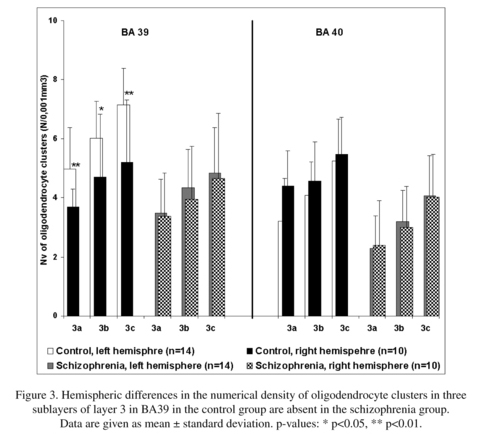
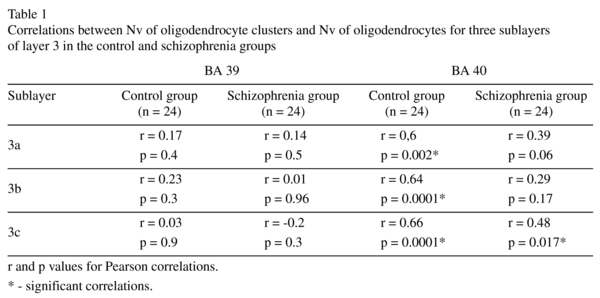
<body><![CDATA[<p align=center><a name="f1"><img src="/img/revistas/ejpen/v27n4/original3_figura1.jpg"></a></p>     <p>&nbsp;</p>     <p><font face="Verdana">Statistical analyses</font></p>     <p><font face="Verdana" size="2">Statistical analysis was performed using Statistica (Version 7). The data were examined using the Kolmogorov-Smirnov test for normality. Correlation analysis was performed to assess correlations between the parameter measured and age, PMI, pH, refrigerator interval, brain weight, lifetime antipsychotics, age at onset and duration of disease. Comparisons between diagnostic groups were made using a two-way MANOVA with the Nv of OlC in three sublayers of layer 3 as the dependent variables, and diagnosis and hemispheres as the independent variables. A one-way MANOVA was used to compare the control group and three schizophrenia insight subgroups (poor, fair and good insight). MANOVA was followed by post hoc Duncan's test.</font></p>     <p>&nbsp;</p>     <p><font face="Verdana" size="2"><b>Results</b></font></p>     <p><font face="Verdana">Numerical density of OlC</font></p>     <p><font face="Verdana" size="2">We found a decrease in the Nv of OlC in all sublayers of layer 3 in both BA 39 &#091;22-25%, F(1,46) &ge; 7,5; p &le; 0.01&#093; and BA 40 &#091;25-38%, F(1,46) &ge; 10.9; p&lt;0.01&#093; in the schizophrenia group as compared to the control group (<a href="#f2">Fig. 2</a>). In BA 39, but not in BA 40, the Nv of OlC in the left hemisphere was greater than in the right hemisphere in all three sublayers in the control group (22-27%, p&lt;0.05). The interhemispheric asymmetry was not apparent in the schizophrenia group in either BA 39 or BA 40 (<a href="#f3">Fig. 3</a>). Previously, we estimated the Nv of oligodendrocytes using the same IPL sections<sup>7</sup>. A pearson's correlation analysis demonstrated a significant positive correlation (r &ge; 0.6, p &le; 0.002) between the Nv of OlC and the Nv of oligodendrocytes in all sublayers of BA40 in the control group but not in the schizophrenia group (<a href="#t1">Table 1</a>).</font></p>     <p>&nbsp;</p>     <p align=center><a name="f2"><img src="/img/revistas/ejpen/v27n4/original3_figuras2.jpg"></a></p>     ]]></body>
<body><![CDATA[<p>&nbsp;</p>     <p align=center><a name="f3"><img src="/img/revistas/ejpen/v27n4/original3_figuras3.jpg"></a></p>     <p>&nbsp;</p>     <p align=center><a name="t1"><img src="/img/revistas/ejpen/v27n4/original3_tabla1.jpg"></a></p>     <p>&nbsp;</p>     <p><font face="Verdana">Potential confounding factors</font></p>     <p><font face="Verdana" size="2">We found no effects ofthe confounding factors (age, PMI, refrigerator interval, brain weight, brain pH, lifetime antipsychotics) on the parameter measured in both areas studied.</font></p>     <p><font face="Verdana">Effects of insight</font></p>     <p><font face="Verdana" size="2">There was a significant effect of insight on the Nv of OlC in both BA39 and BA 40. In BA 39 the subgroup of subjects having poor insight had a significantly lower Nv of OlC in all three sublayers of layer 3 &#091;23-33%, F(3,44) &ge; 3.0, p&lt;0.05&#093; compared to the control group (<a href="#f4">Fig. 4</a>). There were no significant differences between the three insight subgroups. In BA40 a decrease in the Nv of OlC was found in all sublayers of layer 3 in the subgroups with fair insight (p&lt;0.001) and good insight (p&lt;0.05) compared to the control group &#091;F (3,44) &ge; 5.8, 46-65%, 30-47% respectively&#093;. The subgroup with fair insight differed significantly from the subgroup with poor insight (p&lt;0.05 for all sublayers).</font></p>     <p>&nbsp;</p>     ]]></body>
<body><![CDATA[<p align=center><a name="f4"><img src="/img/revistas/ejpen/v27n4/original3_figura4.jpg"></a></p>     <p>&nbsp;</p>     <p><font face="Verdana">Effects of age at onset of disease</font></p>     <p><font face="Verdana" size="2">The duration of disease was not correlated with the Nv of OlC in BA 39 and BA 40 (for all p &ge; 0.2; r &le; 0.27, Spearman correlation). However, there was a significant positive correlation between the Nv of OlC and age at onset of disease (r &ge; 0.4, p &le; 0.05, Spearman correlation) in BA 40. Therefore we compared the subgroup of schizophrenia cases with adolescent onset of disease (9-18 y.o., n = 13) to the subgroup with adult onset of disease (19-34 y.o., n = 11) and to the control group. MANOVA showed a significant effect of age at onset of disease only in BA 40. The parameter was decreased significantly only in the subgroup with adolescent onset of disease &#091;31-46% for all sublayers of layer 3, F (2,45) &ge; 6.4, p&lt; 0.01&#093; compared to the control group (<a href="#f5">Fig. 5</a>). The subgroup with adult onset of disease did not differ significantly from the control group or from the subgroup with adolescent onset of disease. In BA 39 the Nv of OlC was reduced significantly in both subgroups as compared to the control group &#091;22-27% for all sublayers, F (2,45) &ge; 3.7, p&lt;0.05&#093; (<a href="#f5">Fig. 5</a>).</font></p>     <p>&nbsp;</p>     <p align=center><a name="f5"><img src="/img/revistas/ejpen/v27n4/original3_figura5.jpg"></a></p>     <p>&nbsp;</p>     <p><font face="Verdana" size="2"><b>Discussion</b></font></p>     <p><font face="Verdana" size="2">The present study is a continuation of our previous study using the same collection of IPL sections. We reported a reduced Nv of oligodendrocytes in layer 3 of BA39 but not of BA40 in schizophrenia<sup>7</sup>. Here we demonstrate for the first time a deficit in the clustering of oligodendrocytes in layer 3 in BA39/40 of the IPL in the schizophrenia group compared to the control group. A reduction in the number of OlC in the grey matter of the IPL in schizophrenia corroborates the data of Hof <i>et al</i>.<sup>4</sup> who showed that the spatial distribution of oligodendrocytes in the white matter of prefrontal cortex exhibited a less clustered arrangement in schizophrenia compared to healthy controls.</font></p>     <p><font face="Verdana" size="2">We also demonstrated that left&gt;right hemispheric asymmetry of the Nv of OlC in BA39 in the control group was absent in the schizophrenia group. This result is in accordance with the altered asymmetry of oligodendrocyte density that we previously reported in BA39 in schizophrenia<sup>7</sup>. This data also supports the MRI reports that show a reversal of the left&gt;right IPL asymmetry in first episode<sup>20</sup> and chronic schizophrenia<sup>21,22</sup> that appears to be localized to the angular gyrus<sup>23</sup> (see<sup>24</sup> for review). Thus, our results support the hypothesis that schizophrenia is characterized by abnormal hemispheric asymmetry. Finally, we show that there is a strong positive correlation between the Nv oligodendrocytes<sup>7</sup> and the Nv of OlC in all sublayers of layer 3 in BA40 in the control group but not in the schizophrenia group. These data indicate that the Nv of OlC is associated with the Nv of oligodendrocytes in BA40 in the control but not in schizophrenia brains.</font></p>     ]]></body>
<body><![CDATA[<p><font face="Verdana" size="2">Pairs and groups of oligodendrocytes have been described in the primate cortex previously, and strong positive correlations have been shown between number of oligodendrocytes and the percent of them that are in pairs and groups<sup>16</sup>. It is believed that these groups are derived from the division of oligodendrocytes progenitors which replenish the oligodendrocyte population. Recently a population of residual, mitotically competent oligodendrocyte progenitor cells that express NG2-antigen have been found in the adult brain of rodent<sup>14,17,25,26</sup>, primate<sup>16</sup> and human<sup>27,28</sup>. These cells are able to renew the population of mature myelinating oligodendrocytes<sup>14</sup>. Clonal analysis combined with BdU injection revealed that mitotic division of the NG2 cells resulted in the formation of cell groups (~4 cells) that contained oligodendrocyte precursors<sup>14,17</sup>. These cells shared a common lineage with oligodendrocytes and resemble oligodendrocytes morphologically making it difficult to distinguish them from oligodendrocytes<sup>29,30</sup>. Taken together, this accumulated experimental data suggests that OlC in the human IPL may represent sites of oligodendrocyte precursor proliferation and differentiation.</font></p>     <p><font face="Verdana" size="2">The deficit of OlC that we find in the present study may be important for the etiology of schizophrenia because: 1) a correlation analysis did not reveal any effects of potential confounding factors (age, PMI, refrigerator interval, brain weight, brain pH, life time antipsychotic) on the Nv of OlC; 2) a decrea-se in the Nv of OlC was not due to the changes in laminar thickness, because Smiley <i>et al</i>.<sup>31</sup> using the same IPL collection as used here did not detect any significant changes in laminar thickness or volume, or in neuronal size and density in BA39/40 in schizophrenia; 3) we found an effect of insight and of age at onset of disease on the Nv of OlC. Consistent with our previous data<sup>7</sup> we find here that only the subgroup with poor insight showed a significant decrease ~25% in the Nv of OlC in BA39 compared to the control group. In contrast, in BA40 the Nv of OlC was decreased non-significantly in the subgroup with poor insight but was significantly lower in the subgroups with fair and good insight compared to the control group. A strong effect of the age at onset on the Nv of OlC may be a possible reason for this region discrepancy. In BA40 a highly significant decrease in the Nv of OlC was revealed only in the subgroup with early onset of disease (age 9-18 years). This effect can mask the effect of insight in BA40: the subgroup with good insight (9 cases) contained 4 subjects with the earliest onset of disease (9-14 years) and 2 subjects with onset of disease at 16 and 17 years. The subgroup with poor insight (10 cases) contained 6 subjects with age at onset of disease &gt;18 years.</font></p>     <p><font face="Verdana" size="2">A prominent deficit of OlC in the subgroup with the early onset of disease may be a very important finding because early onset schizophrenia is a particularly severe form of schizophrenia and adolescence coincides with a key time point in myelination. The result is consistent with data from imaging studies in childhood onset schizophrenia that have reported a decrease in the volume and fractional anisotropy of white matter in the parietal regions<sup>32</sup>. Imaging studies have also linked insight in schizophrenia with impaired functioning<sup>33</sup> and reduced grey matter volume of the IPL in the schizophrenia patients<sup>24</sup>. Since IPL abnormalities have been implicated in both insight and onset of schizophrenia, it is likely that the reduced number of OlC detected in the present study may be directly associated with the disease. Moreover, our analysis did not reveal any effects of neuroleptic medication on the Nv of OlC. In fact neuroleptics have been shown to stimulate proliferation and development of oligodendrocyte progenitors<sup>34-36</sup> rather than decrease them. However, oligodendrocyte precursors are sensitive to environmental stress signals such as oxidative stress, glutamate-relative excitotoxicity<sup>37</sup> and persistent viral infection<sup>38</sup>. all of which have been implicated in the eitiology of schizophrenia. Mature oligodendrocytes are much less sensitive to these stress signals.</font></p>     <p><font face="Verdana" size="2">As with most postmortem studies the present study has some limitations. First, Nissl staining is not appropriate method to count oligodendroglial progenitor cells. Immunohistochemical identification should be used to analyze abnormalities in oligodendroglial progenitors. Second, the sample sizes for the insight and onset subgroups are quite small. And so to more fully define the effects of insight and onset the results will have to be confirmed in a larger sample.</font></p>     <p><font face="Verdana" size="2">We hypothesize that the replenishing of the oligodendrocyte population that is necessary throughout life for normal neural function may be altered in schizophrenia. This suggestion supports our previous data showing that the normal age-related increase in the number of oligodendrocytes in the prefrontal cortex was absent in schizophrenia<sup>39</sup>. These abnormalities may contribute to more profound abnormalities in the brain of patients with schizophrenia including abnormal expression of oligodendrocyte- and myelin-related genes, of genes that govern oligodendrocyte development and function, and of genes involved in the cell cycles.</font></p>     <p>&nbsp;</p>     <p><font face="Verdana" size="2"><b>Authors' contributions</b></font></p>     <p><font face="Verdana" size="2">Dr. Kolomeets designed the study, carried out data collection and interpretation and wrote the the manuscript. Dr. Vostrikov contributed to the study design, data collection and interpretation, preparation of the manuscript. Dr. Uranova designed the study, performed statistical analysis, wrote and revised the manuscript.</font></p>     <p>&nbsp;</p>     <p><font face="Verdana" size="2"><b>Acknowledgments</b></font></p>     ]]></body>
<body><![CDATA[<p><font face="Verdana" size="2">The authors would like to thank the Stanley Medical Research Institute for support this work. Postmortem brain sections were donated by Dr. M.J Webster from the Stanley "Parietal Collection". We express our gratitude to Dr. E. Fuller Torrey for examination of clinical records and editing the manuscript and Dr. M.J. Webster for editing the manuscript.</font></p>     <p>&nbsp;</p>     <p><font face="Verdana" size="2"><b>References</b></font></p>     <!-- ref --><p><font face="Verdana" size="2">1. Konrad A, Winterer G. Disturbed structural connectivity in schizophrenia primary factor in pathology or epiphenomenon? Schizophr Bull 2008; 34(1): 72-92.    &nbsp;&nbsp;&nbsp;&nbsp;&nbsp;&nbsp;&nbsp;&nbsp;[&#160;<a href="javascript:void(0);" onclick="javascript: window.open('/scielo.php?script=sci_nlinks&ref=5955344&pid=S0213-6163201300040000300001&lng=','','width=640,height=500,resizable=yes,scrollbars=1,menubar=yes,');">Links</a>&#160;]<!-- end-ref --></font></p>    <!-- ref --><p><font face="Verdana" size="2">2. Takahashi N, Sakurai T, Davis KL, Buxbaum JD. Linking oligodendrocyte and myelin dysfunction to neurocircuitry abnormalities in schizophrenia. Prog Neurobiol 2011; 93(1): 13-24.    &nbsp;&nbsp;&nbsp;&nbsp;&nbsp;&nbsp;&nbsp;&nbsp;[&#160;<a href="javascript:void(0);" onclick="javascript: window.open('/scielo.php?script=sci_nlinks&ref=5955346&pid=S0213-6163201300040000300002&lng=','','width=640,height=500,resizable=yes,scrollbars=1,menubar=yes,');">Links</a>&#160;]<!-- end-ref --></font></p>    <!-- ref --><p><font face="Verdana" size="2">3. Uranova NA, Vostrikov VM, Orlovskaya DD, Rachmanova VI. Oligodendroglial density in the prefrontal cortex in schizophrenia and mood disorders: a study from the Stanley Neuropathology Consortium. Schizophr Res 2004; 67 (2-3): 269-275.    &nbsp;&nbsp;&nbsp;&nbsp;&nbsp;&nbsp;&nbsp;&nbsp;[&#160;<a href="javascript:void(0);" onclick="javascript: window.open('/scielo.php?script=sci_nlinks&ref=5955348&pid=S0213-6163201300040000300003&lng=','','width=640,height=500,resizable=yes,scrollbars=1,menubar=yes,');">Links</a>&#160;]<!-- end-ref --></font></p>    <!-- ref --><p><font face="Verdana" size="2">4. Hof PR, Haroutunian V, Copland C, Davis KL, Buxbaum JD. Molecular and cellular evidence for an oligodendrocyte abnormality in schizophrenia. Neurochem Res 2002; 27(10): 1193-1200.    &nbsp;&nbsp;&nbsp;&nbsp;&nbsp;&nbsp;&nbsp;&nbsp;[&#160;<a href="javascript:void(0);" onclick="javascript: window.open('/scielo.php?script=sci_nlinks&ref=5955350&pid=S0213-6163201300040000300004&lng=','','width=640,height=500,resizable=yes,scrollbars=1,menubar=yes,');">Links</a>&#160;]<!-- end-ref --></font></p>    <!-- ref --><p><font face="Verdana" size="2">5. Hof PR, Haroutunian V, Friedrich VL, Byne W, Buitron C, Perl DP, <i>et al</i>. Loss and altered spatial distribution of oligodendrocytes in the superior frontal gyrus in schizophrenia. Biol Psychiatry 2003; 53: 1075-1085.    &nbsp;&nbsp;&nbsp;&nbsp;&nbsp;&nbsp;&nbsp;&nbsp;[&#160;<a href="javascript:void(0);" onclick="javascript: window.open('/scielo.php?script=sci_nlinks&ref=5955352&pid=S0213-6163201300040000300005&lng=','','width=640,height=500,resizable=yes,scrollbars=1,menubar=yes,');">Links</a>&#160;]<!-- end-ref --></font></p>    <!-- ref --><p><font face="Verdana" size="2">6. Vostrikov VM, Uranova NA, Rakhmanova VI, Orlovskaia DD. Lowered oligodendroglial cell density in the prefrontal cortex in schizophrenia. Zh Nevrol Psikhiatr Im S S Korsakova 2004; 104(1): 47-51 (in Russian).    &nbsp;&nbsp;&nbsp;&nbsp;&nbsp;&nbsp;&nbsp;&nbsp;[&#160;<a href="javascript:void(0);" onclick="javascript: window.open('/scielo.php?script=sci_nlinks&ref=5955354&pid=S0213-6163201300040000300006&lng=','','width=640,height=500,resizable=yes,scrollbars=1,menubar=yes,');">Links</a>&#160;]<!-- end-ref --></font></p>    <!-- ref --><p><font face="Verdana" size="2">7. Vostrikov VM, Kolomeets NS, Uranova NA. Reduced oligodendroglial density in neocortex and lack of insight in schizophrenia. Eur J Psychiat 2013; 27(2): 111-121.    &nbsp;&nbsp;&nbsp;&nbsp;&nbsp;&nbsp;&nbsp;&nbsp;[&#160;<a href="javascript:void(0);" onclick="javascript: window.open('/scielo.php?script=sci_nlinks&ref=5955356&pid=S0213-6163201300040000300007&lng=','','width=640,height=500,resizable=yes,scrollbars=1,menubar=yes,');">Links</a>&#160;]<!-- end-ref --></font></p>    <!-- ref --><p><font face="Verdana" size="2">8. Vostrikov VM, Uranova NA, Orlovskaya DD. Deficit of perineuronal oligodendrocytes in the prefrontal cortex in schizophrenia and mood disorders. Schizophr Res 2007; 94: 273-280.    &nbsp;&nbsp;&nbsp;&nbsp;&nbsp;&nbsp;&nbsp;&nbsp;[&#160;<a href="javascript:void(0);" onclick="javascript: window.open('/scielo.php?script=sci_nlinks&ref=5955358&pid=S0213-6163201300040000300008&lng=','','width=640,height=500,resizable=yes,scrollbars=1,menubar=yes,');">Links</a>&#160;]<!-- end-ref --></font></p>    <!-- ref --><p><font face="Verdana" size="2">9. Vostrikov V, Orlovskaya D, Uranova N. Deficit of pericapillary oligodendrocytes in the prefrontal cortex in schizophrenia. World J Biol Psychiatry 2008; 9: 34-42.    &nbsp;&nbsp;&nbsp;&nbsp;&nbsp;&nbsp;&nbsp;&nbsp;[&#160;<a href="javascript:void(0);" onclick="javascript: window.open('/scielo.php?script=sci_nlinks&ref=5955360&pid=S0213-6163201300040000300009&lng=','','width=640,height=500,resizable=yes,scrollbars=1,menubar=yes,');">Links</a>&#160;]<!-- end-ref --></font></p>    <!-- ref --><p><font face="Verdana" size="2">10. Uranova N, Orlovskaya D, Vikhreva O, Zimina I, Kolomeets N, Vostrikov V, Rachmanova V. Electron microscopy of oligodendroglia in severe mental illness. Brain Res Bull 2001; 55 (5): 597-610.    &nbsp;&nbsp;&nbsp;&nbsp;&nbsp;&nbsp;&nbsp;&nbsp;[&#160;<a href="javascript:void(0);" onclick="javascript: window.open('/scielo.php?script=sci_nlinks&ref=5955362&pid=S0213-6163201300040000300010&lng=','','width=640,height=500,resizable=yes,scrollbars=1,menubar=yes,');">Links</a>&#160;]<!-- end-ref --></font></p>    <!-- ref --><p><font face="Verdana" size="2">11. Radu A, Hristescu G, Katsel P, Haroutunian V, Davis KL. Microarray database mining and cell differentiation defects in schizophrenia. Adv Exp Med Biol 2011; 696: 67-74.    &nbsp;&nbsp;&nbsp;&nbsp;&nbsp;&nbsp;&nbsp;&nbsp;[&#160;<a href="javascript:void(0);" onclick="javascript: window.open('/scielo.php?script=sci_nlinks&ref=5955364&pid=S0213-6163201300040000300011&lng=','','width=640,height=500,resizable=yes,scrollbars=1,menubar=yes,');">Links</a>&#160;]<!-- end-ref --></font></p>    <!-- ref --><p><font face="Verdana" size="2">12. Katsel P, Davis KL, Li C, Tan W, Greenstein E, Kleiner Hoffman LB, <i>et al</i>. Abnormal indices of cell cycle activity in schizophrenia and their potential association with oligodendrocytes. Neuropsychopharmacology 2008; 33: 2993-3009.    &nbsp;&nbsp;&nbsp;&nbsp;&nbsp;&nbsp;&nbsp;&nbsp;[&#160;<a href="javascript:void(0);" onclick="javascript: window.open('/scielo.php?script=sci_nlinks&ref=5955366&pid=S0213-6163201300040000300012&lng=','','width=640,height=500,resizable=yes,scrollbars=1,menubar=yes,');">Links</a>&#160;]<!-- end-ref --></font></p>    <!-- ref --><p><font face="Verdana" size="2">13. Kerns DC, Vong GS, Barley K, Dracheva S, Katsel P, Casaccia P, <i>et al</i>. Gene expression abnormalities and oligodendrocyte de&#64257;cits in the internal capsule in schizophrenia. Schizophr Res 2010; 120: 150-158.    &nbsp;&nbsp;&nbsp;&nbsp;&nbsp;&nbsp;&nbsp;&nbsp;[&#160;<a href="javascript:void(0);" onclick="javascript: window.open('/scielo.php?script=sci_nlinks&ref=5955368&pid=S0213-6163201300040000300013&lng=','','width=640,height=500,resizable=yes,scrollbars=1,menubar=yes,');">Links</a>&#160;]<!-- end-ref --></font></p>    <!-- ref --><p><font face="Verdana" size="2">14. Kang SH, Fukaya M, Yang JK, Rothstein JD, Bergles DE. NG2+ CNS glial progenitors remain committed to the oligodendrocyte lineage in postnatal life and following neurodegeneration. Neuron 2010; 68(4): 668-681.    &nbsp;&nbsp;&nbsp;&nbsp;&nbsp;&nbsp;&nbsp;&nbsp;[&#160;<a href="javascript:void(0);" onclick="javascript: window.open('/scielo.php?script=sci_nlinks&ref=5955370&pid=S0213-6163201300040000300014&lng=','','width=640,height=500,resizable=yes,scrollbars=1,menubar=yes,');">Links</a>&#160;]<!-- end-ref --></font></p>    <!-- ref --><p><font face="Verdana" size="2">15. Polak M, Haymaker W, Johnson Jr, D'Amelio F, Hager H. Neuroglia and their reactions. In: Haymaker W and Adams R.D., eds. Histology and histopathology of the Nervous system. New Springfield: Charles C Thomas Publisher; 1982. p. 431-440.    &nbsp;&nbsp;&nbsp;&nbsp;&nbsp;&nbsp;&nbsp;&nbsp;[&#160;<a href="javascript:void(0);" onclick="javascript: window.open('/scielo.php?script=sci_nlinks&ref=5955372&pid=S0213-6163201300040000300015&lng=','','width=640,height=500,resizable=yes,scrollbars=1,menubar=yes,');">Links</a>&#160;]<!-- end-ref --></font></p>    <!-- ref --><p><font face="Verdana" size="2">16. Peters A, Sethares C. Oligodendrocytes, their progenitors and other neuroglial cells in the aging primate cerebral cortex. Cerebral Cortex 2004; 14: 995-1007.    &nbsp;&nbsp;&nbsp;&nbsp;&nbsp;&nbsp;&nbsp;&nbsp;[&#160;<a href="javascript:void(0);" onclick="javascript: window.open('/scielo.php?script=sci_nlinks&ref=5955374&pid=S0213-6163201300040000300016&lng=','','width=640,height=500,resizable=yes,scrollbars=1,menubar=yes,');">Links</a>&#160;]<!-- end-ref --></font></p>    <!-- ref --><p><font face="Verdana" size="2">17. Zhu X, Hill RA, Dietrich D, Komitova M, Suzuki R, Nishiyama A. Age-dependent fate and lineage restriction of single NG2 cells. Development 2011; 138(4): 745-753.    &nbsp;&nbsp;&nbsp;&nbsp;&nbsp;&nbsp;&nbsp;&nbsp;[&#160;<a href="javascript:void(0);" onclick="javascript: window.open('/scielo.php?script=sci_nlinks&ref=5955376&pid=S0213-6163201300040000300017&lng=','','width=640,height=500,resizable=yes,scrollbars=1,menubar=yes,');">Links</a>&#160;]<!-- end-ref --></font></p>    <!-- ref --><p><font face="Verdana" size="2">18. Zilles K. Architecture of the human cerebral cortex. In: Paxinos G, Mai JK, eds. The human nervous system, 2nd edition. San Diego: Elsevier Academic Press; 2004. p. 997-1055.    &nbsp;&nbsp;&nbsp;&nbsp;&nbsp;&nbsp;&nbsp;&nbsp;[&#160;<a href="javascript:void(0);" onclick="javascript: window.open('/scielo.php?script=sci_nlinks&ref=5955378&pid=S0213-6163201300040000300018&lng=','','width=640,height=500,resizable=yes,scrollbars=1,menubar=yes,');">Links</a>&#160;]<!-- end-ref --></font></p>    <!-- ref --><p><font face="Verdana" size="2">19. Gundersen HJ, Bendtsen TF, Korbo L, Marcussen N, M&oslash;ller A, Nielsen K, <i>et al</i>. Some new, simple and efficient stereological methods and their use in pathological research and diagnosis. APMIS 1988; 96 (5): 379-394.    &nbsp;&nbsp;&nbsp;&nbsp;&nbsp;&nbsp;&nbsp;&nbsp;[&#160;<a href="javascript:void(0);" onclick="javascript: window.open('/scielo.php?script=sci_nlinks&ref=5955380&pid=S0213-6163201300040000300019&lng=','','width=640,height=500,resizable=yes,scrollbars=1,menubar=yes,');">Links</a>&#160;]<!-- end-ref --></font></p>    <!-- ref --><p><font face="Verdana" size="2">20. Nierenberg J, Salisbury DF, Levitt JJ, David EA, McCarley RW, Shenton ME. Reduced Left Angular Gyrus Volume in First-Episode Schizophrenia Am J Psychiatry 2005; 162(8): 1539-1541.    &nbsp;&nbsp;&nbsp;&nbsp;&nbsp;&nbsp;&nbsp;&nbsp;[&#160;<a href="javascript:void(0);" onclick="javascript: window.open('/scielo.php?script=sci_nlinks&ref=5955382&pid=S0213-6163201300040000300020&lng=','','width=640,height=500,resizable=yes,scrollbars=1,menubar=yes,');">Links</a>&#160;]<!-- end-ref --></font></p>    <!-- ref --><p><font face="Verdana" size="2">21. Buchanan RW, Francis A, Arango C, Miller K, Lefkowitz DM, Mc-Mahon RP, <i>et al</i>. Morphometric assessment of the heteromodal association cortex in schizophrenia. Am J Psychiatry 2004; 161: 322-331.    &nbsp;&nbsp;&nbsp;&nbsp;&nbsp;&nbsp;&nbsp;&nbsp;[&#160;<a href="javascript:void(0);" onclick="javascript: window.open('/scielo.php?script=sci_nlinks&ref=5955384&pid=S0213-6163201300040000300021&lng=','','width=640,height=500,resizable=yes,scrollbars=1,menubar=yes,');">Links</a>&#160;]<!-- end-ref --></font></p>    <!-- ref --><p><font face="Verdana" size="2">22. Frederikse M, Lu A, Aylward E, Barta P, Sharma T, Pearlson G. Sex differences in inferior parietal lobule volume in schizophrenia. Am J Psychiatry 2000; 157 (3): 422-427.    &nbsp;&nbsp;&nbsp;&nbsp;&nbsp;&nbsp;&nbsp;&nbsp;[&#160;<a href="javascript:void(0);" onclick="javascript: window.open('/scielo.php?script=sci_nlinks&ref=5955386&pid=S0213-6163201300040000300022&lng=','','width=640,height=500,resizable=yes,scrollbars=1,menubar=yes,');">Links</a>&#160;]<!-- end-ref --></font></p>    <!-- ref --><p><font face="Verdana" size="2">23. Niznikiewicz M, Donnino R, McCarley RW, Nestor PG, Iosifescu DV, O'Donnell B, <i>et al</i>. Abnormal angular gyrus asymmetry in schizophrenia. Am J Psychiatry 2000; 157: 428-437.    &nbsp;&nbsp;&nbsp;&nbsp;&nbsp;&nbsp;&nbsp;&nbsp;[&#160;<a href="javascript:void(0);" onclick="javascript: window.open('/scielo.php?script=sci_nlinks&ref=5955388&pid=S0213-6163201300040000300023&lng=','','width=640,height=500,resizable=yes,scrollbars=1,menubar=yes,');">Links</a>&#160;]<!-- end-ref --></font></p>    <!-- ref --><p><font face="Verdana" size="2">24. Torrey EF. Schizophrenia and the inferior parietal lobule. Schizophr Res 2007; 97 (1-3): 215-225.    &nbsp;&nbsp;&nbsp;&nbsp;&nbsp;&nbsp;&nbsp;&nbsp;[&#160;<a href="javascript:void(0);" onclick="javascript: window.open('/scielo.php?script=sci_nlinks&ref=5955390&pid=S0213-6163201300040000300024&lng=','','width=640,height=500,resizable=yes,scrollbars=1,menubar=yes,');">Links</a>&#160;]<!-- end-ref --></font></p>    <!-- ref --><p><font face="Verdana" size="2">25. Polito A, Reynolds R. NG2-expressing cells as oligodendrocyte progenitors in the normal and demyelinated adult central nervous system. J Anat 2005; 207(6): 707-716.    &nbsp;&nbsp;&nbsp;&nbsp;&nbsp;&nbsp;&nbsp;&nbsp;[&#160;<a href="javascript:void(0);" onclick="javascript: window.open('/scielo.php?script=sci_nlinks&ref=5955392&pid=S0213-6163201300040000300025&lng=','','width=640,height=500,resizable=yes,scrollbars=1,menubar=yes,');">Links</a>&#160;]<!-- end-ref --></font></p>    <!-- ref --><p><font face="Verdana" size="2">26. Nishiyama A, Komitova M, Suzuki R, Zhu X. Polydendrocytes (NG2 cells): multifunctional cells with lineage plasticity. Nat Rev Neurosci 2009; 10: 9-22.    &nbsp;&nbsp;&nbsp;&nbsp;&nbsp;&nbsp;&nbsp;&nbsp;[&#160;<a href="javascript:void(0);" onclick="javascript: window.open('/scielo.php?script=sci_nlinks&ref=5955394&pid=S0213-6163201300040000300026&lng=','','width=640,height=500,resizable=yes,scrollbars=1,menubar=yes,');">Links</a>&#160;]<!-- end-ref --></font></p>    <!-- ref --><p><font face="Verdana" size="2">27. Chang A, Nishiyama A, Peterson J, Prineas J, Trapp BD. NG2-positive oligodendrocyte progenitor cells in adult human brain and multiple sclerosis lesions. J Neurosci 2000; 20(17): 6404-6412.    &nbsp;&nbsp;&nbsp;&nbsp;&nbsp;&nbsp;&nbsp;&nbsp;[&#160;<a href="javascript:void(0);" onclick="javascript: window.open('/scielo.php?script=sci_nlinks&ref=5955396&pid=S0213-6163201300040000300027&lng=','','width=640,height=500,resizable=yes,scrollbars=1,menubar=yes,');">Links</a>&#160;]<!-- end-ref --></font></p>    <!-- ref --><p><font face="Verdana" size="2">28. Geha S, Pallud J, Junier MP, Devaux B, Leonard N, Chassoux F, <i>et al</i>. NG2+/Olig2+ cells are the major cycle-related cell population of the adult human normal brain. Brain Pathol 2010; 20(2): 399-411.    &nbsp;&nbsp;&nbsp;&nbsp;&nbsp;&nbsp;&nbsp;&nbsp;[&#160;<a href="javascript:void(0);" onclick="javascript: window.open('/scielo.php?script=sci_nlinks&ref=5955398&pid=S0213-6163201300040000300028&lng=','','width=640,height=500,resizable=yes,scrollbars=1,menubar=yes,');">Links</a>&#160;]<!-- end-ref --></font></p>    <!-- ref --><p><font face="Verdana" size="2">29. Wilson HC, Scolding NJ, Raine CS. Co-expression of PDGF alpha receptor and NG2 by oligodendrocyte precursors in human CNS and multiple sclerosis lesions. J Neuroimmunol 2006; 176(1-2): 162-173.    &nbsp;&nbsp;&nbsp;&nbsp;&nbsp;&nbsp;&nbsp;&nbsp;[&#160;<a href="javascript:void(0);" onclick="javascript: window.open('/scielo.php?script=sci_nlinks&ref=5955400&pid=S0213-6163201300040000300029&lng=','','width=640,height=500,resizable=yes,scrollbars=1,menubar=yes,');">Links</a>&#160;]<!-- end-ref --></font></p>    <!-- ref --><p><font face="Verdana" size="2">30. Edgar N, Sibille E. A putative functional role for oligo-dendrocytes in mood regulation. Transl Psychiatry 2012; 2: e109. doi: 10.1038/tp.2012.34.    &nbsp;&nbsp;&nbsp;&nbsp;&nbsp;&nbsp;&nbsp;&nbsp;[&#160;<a href="javascript:void(0);" onclick="javascript: window.open('/scielo.php?script=sci_nlinks&ref=5955402&pid=S0213-6163201300040000300030&lng=','','width=640,height=500,resizable=yes,scrollbars=1,menubar=yes,');">Links</a>&#160;]<!-- end-ref --></font></p>    <!-- ref --><p><font face="Verdana" size="2">31. Smiley JF, Konnova K, Bleiwas C. Cortical thickness, neuron density and size in the inferior parietal lobe in schizophrenia. Schizophr Res 2012; 136(1-3): 43-50.    &nbsp;&nbsp;&nbsp;&nbsp;&nbsp;&nbsp;&nbsp;&nbsp;[&#160;<a href="javascript:void(0);" onclick="javascript: window.open('/scielo.php?script=sci_nlinks&ref=5955404&pid=S0213-6163201300040000300031&lng=','','width=640,height=500,resizable=yes,scrollbars=1,menubar=yes,');">Links</a>&#160;]<!-- end-ref --></font></p>    <!-- ref --><p><font face="Verdana" size="2">32. Yildiz MS, Borgwardt SJ, Berger GF. Parietal Lobes in Schizophrenia: Do They Matter? Schizophr Res Treatment 2011; 2011: 581686.    &nbsp;&nbsp;&nbsp;&nbsp;&nbsp;&nbsp;&nbsp;&nbsp;[&#160;<a href="javascript:void(0);" onclick="javascript: window.open('/scielo.php?script=sci_nlinks&ref=5955406&pid=S0213-6163201300040000300032&lng=','','width=640,height=500,resizable=yes,scrollbars=1,menubar=yes,');">Links</a>&#160;]<!-- end-ref --></font></p>    <!-- ref --><p><font face="Verdana" size="2">33. van der Meer L, de Vos AE, Stiekema AP, Pijnenborg GH, van Tol MJ, Nolen WA, <i>et al</i>. Insight in Schizophrenia: Involvement of Self-Reflection Networks? Schizophr Bull 2012 (in press).    &nbsp;&nbsp;&nbsp;&nbsp;&nbsp;&nbsp;&nbsp;&nbsp;[&#160;<a href="javascript:void(0);" onclick="javascript: window.open('/scielo.php?script=sci_nlinks&ref=5955408&pid=S0213-6163201300040000300033&lng=','','width=640,height=500,resizable=yes,scrollbars=1,menubar=yes,');">Links</a>&#160;]<!-- end-ref --></font></p>    <!-- ref --><p><font face="Verdana" size="2">34. Niu J, Mei F, Li N, Wang H, Li X, Kong J, <i>et al</i>. Haloperidol promotes proliferation but inhibits differentiation in rat oligodendrocyte progenitor cell cultures. Biochem Cell Biol 2010; 88(4): 611-620.    &nbsp;&nbsp;&nbsp;&nbsp;&nbsp;&nbsp;&nbsp;&nbsp;[&#160;<a href="javascript:void(0);" onclick="javascript: window.open('/scielo.php?script=sci_nlinks&ref=5955410&pid=S0213-6163201300040000300034&lng=','','width=640,height=500,resizable=yes,scrollbars=1,menubar=yes,');">Links</a>&#160;]<!-- end-ref --></font></p>    <!-- ref --><p><font face="Verdana" size="2">35. Wang H, Xu H, Niu J, Mei F, Li X, Kong J, <i>et al</i>. Haloperidol activates quiescent oligodendroglia precursor cells in the adult mouse brain. Schizophr Res 2010; 119(1-3): 164-174.    &nbsp;&nbsp;&nbsp;&nbsp;&nbsp;&nbsp;&nbsp;&nbsp;[&#160;<a href="javascript:void(0);" onclick="javascript: window.open('/scielo.php?script=sci_nlinks&ref=5955412&pid=S0213-6163201300040000300035&lng=','','width=640,height=500,resizable=yes,scrollbars=1,menubar=yes,');">Links</a>&#160;]<!-- end-ref --></font></p>    <!-- ref --><p><font face="Verdana" size="2">36. Kimoto S, Okuda A, Toritsuka M, Yamauchi T, Makinodan M, Okuda H, <i>et al</i>. Olanzapine stimulates proliferation but inhibits differentiation in rat oligodendrocyte precursor cell cultures. Prog Neuropsychopharmacol Biol Psychiatry 2011; 35(8): 1950-1956.    &nbsp;&nbsp;&nbsp;&nbsp;&nbsp;&nbsp;&nbsp;&nbsp;[&#160;<a href="javascript:void(0);" onclick="javascript: window.open('/scielo.php?script=sci_nlinks&ref=5955414&pid=S0213-6163201300040000300036&lng=','','width=640,height=500,resizable=yes,scrollbars=1,menubar=yes,');">Links</a>&#160;]<!-- end-ref --></font></p>    <!-- ref --><p><font face="Verdana" size="2">37. Butts BD, Houde C, Mehmet H. Maturation-dependent sensitivity of oligodendrocyte lineage cells to apoptosis: implications for normal development and disease. Cell Death Differ 2008; 15: 1178-1186.    &nbsp;&nbsp;&nbsp;&nbsp;&nbsp;&nbsp;&nbsp;&nbsp;[&#160;<a href="javascript:void(0);" onclick="javascript: window.open('/scielo.php?script=sci_nlinks&ref=5955416&pid=S0213-6163201300040000300037&lng=','','width=640,height=500,resizable=yes,scrollbars=1,menubar=yes,');">Links</a>&#160;]<!-- end-ref --></font></p>    <!-- ref --><p><font face="Verdana" size="2">38. Dietrich J, Blumberg BM, Roshal M, Baker JV, Hurley SD, Mayer-Pr&ouml;schel M, <i>et al</i>. Infection with an endemic human herpesvirus disrupts critical glial precursor cell properties. J Neurosci 2004; 24(20): 4875-4883.    &nbsp;&nbsp;&nbsp;&nbsp;&nbsp;&nbsp;&nbsp;&nbsp;[&#160;<a href="javascript:void(0);" onclick="javascript: window.open('/scielo.php?script=sci_nlinks&ref=5955418&pid=S0213-6163201300040000300038&lng=','','width=640,height=500,resizable=yes,scrollbars=1,menubar=yes,');">Links</a>&#160;]<!-- end-ref --></font></p>    <!-- ref --><p><font face="Verdana" size="2">39. Vostrikov VM, Uranova NA. Age-related increase in the number of oligodendrocytes is dysregulated in schizophrenia and mood disorders. Schizophr Res Treatment 2011; 2011: 174689.    &nbsp;&nbsp;&nbsp;&nbsp;&nbsp;&nbsp;&nbsp;&nbsp;[&#160;<a href="javascript:void(0);" onclick="javascript: window.open('/scielo.php?script=sci_nlinks&ref=5955420&pid=S0213-6163201300040000300039&lng=','','width=640,height=500,resizable=yes,scrollbars=1,menubar=yes,');">Links</a>&#160;]<!-- end-ref --></font></p>     <p>&nbsp;</p>     <p>&nbsp;</p>     <p><font face="Verdana" size="2"><a href="#top"><img border="0" src="/img/revistas/ejpen/v27n4/seta.gif" width="15" height="17"></a><a name="bajo"></a><b>Correspondence:</b>    <br>Natalya S. Kolomeets    <br>Laboratory of Clinical Neuropathology    <br>Mental Health Research Center    <br>Zagorodnoe shosse 2, 117152    <br>Moscow. Russia    <br>Tel: +7-495-952-87-30    ]]></body>
<body><![CDATA[<br>Fax: +7-495-952-89-40    <br>E-mail: <a href="mailto:nkolomee@mail.ru">nkolomee@mail.ru</a></font></p>     <p><font face="Verdana" size="2">Received: 5 December 2012    <br>Revised: 10 June 2013    <br>Accepted: 25 June 2013</font></p>      ]]></body><back>
<ref-list>
<ref id="B1">
<label>1</label><nlm-citation citation-type="journal">
<person-group person-group-type="author">
<name>
<surname><![CDATA[Konrad]]></surname>
<given-names><![CDATA[A]]></given-names>
</name>
<name>
<surname><![CDATA[Winterer]]></surname>
<given-names><![CDATA[G]]></given-names>
</name>
</person-group>
<article-title xml:lang="en"><![CDATA[Disturbed structural connectivity in schizophrenia primary factor in pathology or epiphenomenon?]]></article-title>
<source><![CDATA[Schizophr Bull]]></source>
<year>2008</year>
<volume>34</volume>
<numero>1</numero>
<issue>1</issue>
<page-range>72-92</page-range></nlm-citation>
</ref>
<ref id="B2">
<label>2</label><nlm-citation citation-type="journal">
<person-group person-group-type="author">
<name>
<surname><![CDATA[Takahashi]]></surname>
<given-names><![CDATA[N]]></given-names>
</name>
<name>
<surname><![CDATA[Sakurai]]></surname>
<given-names><![CDATA[T]]></given-names>
</name>
<name>
<surname><![CDATA[Davis]]></surname>
<given-names><![CDATA[KL]]></given-names>
</name>
<name>
<surname><![CDATA[Buxbaum]]></surname>
<given-names><![CDATA[JD]]></given-names>
</name>
</person-group>
<article-title xml:lang="en"><![CDATA[Linking oligodendrocyte and myelin dysfunction to neurocircuitry abnormalities in schizophrenia]]></article-title>
<source><![CDATA[Prog Neurobiol]]></source>
<year>2011</year>
<volume>93</volume>
<numero>1</numero>
<issue>1</issue>
<page-range>13-24</page-range></nlm-citation>
</ref>
<ref id="B3">
<label>3</label><nlm-citation citation-type="journal">
<person-group person-group-type="author">
<name>
<surname><![CDATA[Uranova]]></surname>
<given-names><![CDATA[NA]]></given-names>
</name>
<name>
<surname><![CDATA[Vostrikov]]></surname>
<given-names><![CDATA[VM]]></given-names>
</name>
<name>
<surname><![CDATA[Orlovskaya]]></surname>
<given-names><![CDATA[DD]]></given-names>
</name>
<name>
<surname><![CDATA[Rachmanova]]></surname>
<given-names><![CDATA[VI]]></given-names>
</name>
</person-group>
<article-title xml:lang="en"><![CDATA[Oligodendroglial density in the prefrontal cortex in schizophrenia and mood disorders: a study from the Stanley Neuropathology Consortium]]></article-title>
<source><![CDATA[Schizophr Res]]></source>
<year>2004</year>
<volume>67</volume>
<numero>2-3</numero>
<issue>2-3</issue>
<page-range>269-275</page-range></nlm-citation>
</ref>
<ref id="B4">
<label>4</label><nlm-citation citation-type="journal">
<person-group person-group-type="author">
<name>
<surname><![CDATA[Hof]]></surname>
<given-names><![CDATA[PR]]></given-names>
</name>
<name>
<surname><![CDATA[Haroutunian]]></surname>
<given-names><![CDATA[V]]></given-names>
</name>
<name>
<surname><![CDATA[Copland]]></surname>
<given-names><![CDATA[C]]></given-names>
</name>
<name>
<surname><![CDATA[Davis]]></surname>
<given-names><![CDATA[KL]]></given-names>
</name>
<name>
<surname><![CDATA[Buxbaum]]></surname>
<given-names><![CDATA[JD]]></given-names>
</name>
</person-group>
<article-title xml:lang="en"><![CDATA[Molecular and cellular evidence for an oligodendrocyte abnormality in schizophrenia]]></article-title>
<source><![CDATA[Neurochem Res]]></source>
<year>2002</year>
<volume>27</volume>
<numero>10</numero>
<issue>10</issue>
<page-range>1193-1200</page-range></nlm-citation>
</ref>
<ref id="B5">
<label>5</label><nlm-citation citation-type="journal">
<person-group person-group-type="author">
<name>
<surname><![CDATA[Hof]]></surname>
<given-names><![CDATA[PR]]></given-names>
</name>
<name>
<surname><![CDATA[Haroutunian]]></surname>
<given-names><![CDATA[V]]></given-names>
</name>
<name>
<surname><![CDATA[Friedrich]]></surname>
<given-names><![CDATA[VL]]></given-names>
</name>
<name>
<surname><![CDATA[Byne]]></surname>
<given-names><![CDATA[W]]></given-names>
</name>
<name>
<surname><![CDATA[Buitron]]></surname>
<given-names><![CDATA[C]]></given-names>
</name>
<name>
<surname><![CDATA[Perl]]></surname>
<given-names><![CDATA[DP]]></given-names>
</name>
</person-group>
<article-title xml:lang="en"><![CDATA[Loss and altered spatial distribution of oligodendrocytes in the superior frontal gyrus in schizophrenia]]></article-title>
<source><![CDATA[Biol Psychiatry]]></source>
<year>2003</year>
<volume>53</volume>
<page-range>1075-1085</page-range></nlm-citation>
</ref>
<ref id="B6">
<label>6</label><nlm-citation citation-type="journal">
<person-group person-group-type="author">
<name>
<surname><![CDATA[Vostrikov]]></surname>
<given-names><![CDATA[VM]]></given-names>
</name>
<name>
<surname><![CDATA[Uranova]]></surname>
<given-names><![CDATA[NA]]></given-names>
</name>
<name>
<surname><![CDATA[Rakhmanova]]></surname>
<given-names><![CDATA[VI]]></given-names>
</name>
<name>
<surname><![CDATA[Orlovskaia]]></surname>
<given-names><![CDATA[DD]]></given-names>
</name>
</person-group>
<article-title xml:lang="en"><![CDATA[Lowered oligodendroglial cell density in the prefrontal cortex in schizophrenia]]></article-title>
<source><![CDATA[Zh Nevrol Psikhiatr Im S S Korsakova]]></source>
<year>2004</year>
<volume>104</volume>
<numero>1</numero>
<issue>1</issue>
<page-range>47-51</page-range></nlm-citation>
</ref>
<ref id="B7">
<label>7</label><nlm-citation citation-type="journal">
<person-group person-group-type="author">
<name>
<surname><![CDATA[Vostrikov]]></surname>
<given-names><![CDATA[VM]]></given-names>
</name>
<name>
<surname><![CDATA[Kolomeets]]></surname>
<given-names><![CDATA[NS]]></given-names>
</name>
<name>
<surname><![CDATA[Uranova]]></surname>
<given-names><![CDATA[NA]]></given-names>
</name>
</person-group>
<article-title xml:lang="en"><![CDATA[Reduced oligodendroglial density in neocortex and lack of insight in schizophrenia]]></article-title>
<source><![CDATA[Eur J Psychiat]]></source>
<year>2013</year>
<volume>27</volume>
<numero>2</numero>
<issue>2</issue>
<page-range>111-121</page-range></nlm-citation>
</ref>
<ref id="B8">
<label>8</label><nlm-citation citation-type="journal">
<person-group person-group-type="author">
<name>
<surname><![CDATA[Vostrikov]]></surname>
<given-names><![CDATA[VM]]></given-names>
</name>
<name>
<surname><![CDATA[Uranova]]></surname>
<given-names><![CDATA[NA]]></given-names>
</name>
<name>
<surname><![CDATA[Orlovskaya]]></surname>
<given-names><![CDATA[DD]]></given-names>
</name>
</person-group>
<article-title xml:lang="en"><![CDATA[Deficit of perineuronal oligodendrocytes in the prefrontal cortex in schizophrenia and mood disorders]]></article-title>
<source><![CDATA[Schizophr Res]]></source>
<year>2007</year>
<volume>94</volume>
<page-range>273-280</page-range></nlm-citation>
</ref>
<ref id="B9">
<label>9</label><nlm-citation citation-type="journal">
<person-group person-group-type="author">
<name>
<surname><![CDATA[Vostrikov]]></surname>
<given-names><![CDATA[V]]></given-names>
</name>
<name>
<surname><![CDATA[Orlovskaya]]></surname>
<given-names><![CDATA[D]]></given-names>
</name>
<name>
<surname><![CDATA[Uranova]]></surname>
<given-names><![CDATA[N]]></given-names>
</name>
</person-group>
<article-title xml:lang="en"><![CDATA[Deficit of pericapillary oligodendrocytes in the prefrontal cortex in schizophrenia]]></article-title>
<source><![CDATA[World J Biol Psychiatry]]></source>
<year>2008</year>
<volume>9</volume>
<page-range>34-42</page-range></nlm-citation>
</ref>
<ref id="B10">
<label>10</label><nlm-citation citation-type="journal">
<person-group person-group-type="author">
<name>
<surname><![CDATA[Uranova]]></surname>
<given-names><![CDATA[N]]></given-names>
</name>
<name>
<surname><![CDATA[Orlovskaya]]></surname>
<given-names><![CDATA[D]]></given-names>
</name>
<name>
<surname><![CDATA[Vikhreva]]></surname>
<given-names><![CDATA[O]]></given-names>
</name>
<name>
<surname><![CDATA[Zimina]]></surname>
<given-names><![CDATA[I]]></given-names>
</name>
<name>
<surname><![CDATA[Kolomeets]]></surname>
<given-names><![CDATA[N]]></given-names>
</name>
<name>
<surname><![CDATA[Vostrikov]]></surname>
<given-names><![CDATA[V]]></given-names>
</name>
<name>
<surname><![CDATA[Rachmanova]]></surname>
<given-names><![CDATA[V]]></given-names>
</name>
</person-group>
<article-title xml:lang="en"><![CDATA[Electron microscopy of oligodendroglia in severe mental illness]]></article-title>
<source><![CDATA[Brain Res Bull]]></source>
<year>2001</year>
<volume>55</volume>
<numero>5</numero>
<issue>5</issue>
<page-range>597-610</page-range></nlm-citation>
</ref>
<ref id="B11">
<label>11</label><nlm-citation citation-type="journal">
<person-group person-group-type="author">
<name>
<surname><![CDATA[Radu]]></surname>
<given-names><![CDATA[A]]></given-names>
</name>
<name>
<surname><![CDATA[Hristescu]]></surname>
<given-names><![CDATA[G]]></given-names>
</name>
<name>
<surname><![CDATA[Katsel]]></surname>
<given-names><![CDATA[P]]></given-names>
</name>
<name>
<surname><![CDATA[Haroutunian]]></surname>
<given-names><![CDATA[V]]></given-names>
</name>
<name>
<surname><![CDATA[Davis]]></surname>
<given-names><![CDATA[KL]]></given-names>
</name>
</person-group>
<article-title xml:lang="en"><![CDATA[Microarray database mining and cell differentiation defects in schizophrenia]]></article-title>
<source><![CDATA[Adv Exp Med Biol]]></source>
<year>2011</year>
<volume>696</volume>
<page-range>67-74</page-range></nlm-citation>
</ref>
<ref id="B12">
<label>12</label><nlm-citation citation-type="journal">
<person-group person-group-type="author">
<name>
<surname><![CDATA[Katsel]]></surname>
<given-names><![CDATA[P]]></given-names>
</name>
<name>
<surname><![CDATA[Davis]]></surname>
<given-names><![CDATA[KL]]></given-names>
</name>
<name>
<surname><![CDATA[Li]]></surname>
<given-names><![CDATA[C]]></given-names>
</name>
<name>
<surname><![CDATA[Tan]]></surname>
<given-names><![CDATA[W]]></given-names>
</name>
<name>
<surname><![CDATA[Greenstein]]></surname>
<given-names><![CDATA[E]]></given-names>
</name>
<name>
<surname><![CDATA[Kleiner Hoffman]]></surname>
<given-names><![CDATA[LB]]></given-names>
</name>
</person-group>
<article-title xml:lang="en"><![CDATA[Abnormal indices of cell cycle activity in schizophrenia and their potential association with oligodendrocytes]]></article-title>
<source><![CDATA[Neuropsychopharmacology]]></source>
<year>2008</year>
<volume>33</volume>
<page-range>2993-3009</page-range></nlm-citation>
</ref>
<ref id="B13">
<label>13</label><nlm-citation citation-type="journal">
<person-group person-group-type="author">
<name>
<surname><![CDATA[Kerns]]></surname>
<given-names><![CDATA[DC]]></given-names>
</name>
<name>
<surname><![CDATA[Vong]]></surname>
<given-names><![CDATA[GS]]></given-names>
</name>
<name>
<surname><![CDATA[Barley]]></surname>
<given-names><![CDATA[K]]></given-names>
</name>
<name>
<surname><![CDATA[Dracheva]]></surname>
<given-names><![CDATA[S]]></given-names>
</name>
<name>
<surname><![CDATA[Katsel]]></surname>
<given-names><![CDATA[P]]></given-names>
</name>
<name>
<surname><![CDATA[Casaccia]]></surname>
<given-names><![CDATA[P]]></given-names>
</name>
</person-group>
<article-title xml:lang="en"><![CDATA[Gene expression abnormalities and oligodendrocyte de&#64257;cits in the internal capsule in schizophrenia]]></article-title>
<source><![CDATA[Schizophr Res]]></source>
<year>2010</year>
<volume>120</volume>
<page-range>150-158</page-range></nlm-citation>
</ref>
<ref id="B14">
<label>14</label><nlm-citation citation-type="journal">
<person-group person-group-type="author">
<name>
<surname><![CDATA[Kang]]></surname>
<given-names><![CDATA[SH]]></given-names>
</name>
<name>
<surname><![CDATA[Fukaya]]></surname>
<given-names><![CDATA[M]]></given-names>
</name>
<name>
<surname><![CDATA[Yang]]></surname>
<given-names><![CDATA[JK]]></given-names>
</name>
<name>
<surname><![CDATA[Rothstein]]></surname>
<given-names><![CDATA[JD]]></given-names>
</name>
<name>
<surname><![CDATA[Bergles]]></surname>
<given-names><![CDATA[DE]]></given-names>
</name>
</person-group>
<article-title xml:lang="en"><![CDATA[NG2+ CNS glial progenitors remain committed to the oligodendrocyte lineage in postnatal life and following neurodegeneration]]></article-title>
<source><![CDATA[Neuron]]></source>
<year>2010</year>
<volume>68</volume>
<numero>4</numero>
<issue>4</issue>
<page-range>668-681</page-range></nlm-citation>
</ref>
<ref id="B15">
<label>15</label><nlm-citation citation-type="book">
<person-group person-group-type="author">
<name>
<surname><![CDATA[Polak]]></surname>
<given-names><![CDATA[M]]></given-names>
</name>
<name>
<surname><![CDATA[Haymaker]]></surname>
<given-names><![CDATA[W]]></given-names>
</name>
<name>
<surname><![CDATA[Johnson]]></surname>
<given-names><![CDATA[Jr]]></given-names>
</name>
<name>
<surname><![CDATA[D'Amelio]]></surname>
<given-names><![CDATA[F]]></given-names>
</name>
<name>
<surname><![CDATA[Hager]]></surname>
<given-names><![CDATA[H]]></given-names>
</name>
</person-group>
<article-title xml:lang="en"><![CDATA[Neuroglia and their reactions]]></article-title>
<person-group person-group-type="editor">
<name>
<surname><![CDATA[Haymaker]]></surname>
<given-names><![CDATA[W]]></given-names>
</name>
<name>
<surname><![CDATA[Adams]]></surname>
<given-names><![CDATA[R.D.]]></given-names>
</name>
</person-group>
<source><![CDATA[Histology and histopathology of the Nervous system]]></source>
<year>1982</year>
<page-range>431-440</page-range><publisher-loc><![CDATA[New Springfield ]]></publisher-loc>
<publisher-name><![CDATA[Charles C Thomas Publisher]]></publisher-name>
</nlm-citation>
</ref>
<ref id="B16">
<label>16</label><nlm-citation citation-type="journal">
<person-group person-group-type="author">
<name>
<surname><![CDATA[Peters]]></surname>
<given-names><![CDATA[A]]></given-names>
</name>
<name>
<surname><![CDATA[Sethares]]></surname>
<given-names><![CDATA[C]]></given-names>
</name>
</person-group>
<article-title xml:lang="en"><![CDATA[Oligodendrocytes, their progenitors and other neuroglial cells in the aging primate cerebral cortex]]></article-title>
<source><![CDATA[Cerebral Cortex]]></source>
<year>2004</year>
<volume>14</volume>
<page-range>995-1007</page-range></nlm-citation>
</ref>
<ref id="B17">
<label>17</label><nlm-citation citation-type="journal">
<person-group person-group-type="author">
<name>
<surname><![CDATA[Zhu]]></surname>
<given-names><![CDATA[X]]></given-names>
</name>
<name>
<surname><![CDATA[Hill]]></surname>
<given-names><![CDATA[RA]]></given-names>
</name>
<name>
<surname><![CDATA[Dietrich]]></surname>
<given-names><![CDATA[D]]></given-names>
</name>
<name>
<surname><![CDATA[Komitova]]></surname>
<given-names><![CDATA[M]]></given-names>
</name>
<name>
<surname><![CDATA[Suzuki]]></surname>
<given-names><![CDATA[R]]></given-names>
</name>
<name>
<surname><![CDATA[Nishiyama]]></surname>
<given-names><![CDATA[A]]></given-names>
</name>
</person-group>
<article-title xml:lang="en"><![CDATA[Age-dependent fate and lineage restriction of single NG2 cells]]></article-title>
<source><![CDATA[Development]]></source>
<year>2011</year>
<volume>138</volume>
<numero>4</numero>
<issue>4</issue>
<page-range>745-753</page-range></nlm-citation>
</ref>
<ref id="B18">
<label>18</label><nlm-citation citation-type="book">
<person-group person-group-type="author">
<name>
<surname><![CDATA[Zilles]]></surname>
<given-names><![CDATA[K]]></given-names>
</name>
</person-group>
<article-title xml:lang="en"><![CDATA[Architecture of the human cerebral cortex]]></article-title>
<person-group person-group-type="editor">
<name>
<surname><![CDATA[Paxinos]]></surname>
<given-names><![CDATA[G]]></given-names>
</name>
<name>
<surname><![CDATA[Mai]]></surname>
<given-names><![CDATA[JK]]></given-names>
</name>
</person-group>
<source><![CDATA[The human nervous system]]></source>
<year>2004</year>
<edition>2</edition>
<page-range>997-1055</page-range><publisher-loc><![CDATA[San Diego ]]></publisher-loc>
<publisher-name><![CDATA[Elsevier Academic Press]]></publisher-name>
</nlm-citation>
</ref>
<ref id="B19">
<label>19</label><nlm-citation citation-type="journal">
<person-group person-group-type="author">
<name>
<surname><![CDATA[Gundersen]]></surname>
<given-names><![CDATA[HJ]]></given-names>
</name>
<name>
<surname><![CDATA[Bendtsen]]></surname>
<given-names><![CDATA[TF]]></given-names>
</name>
<name>
<surname><![CDATA[Korbo]]></surname>
<given-names><![CDATA[L]]></given-names>
</name>
<name>
<surname><![CDATA[Marcussen]]></surname>
<given-names><![CDATA[N]]></given-names>
</name>
<name>
<surname><![CDATA[Møller]]></surname>
<given-names><![CDATA[A]]></given-names>
</name>
<name>
<surname><![CDATA[Nielsen]]></surname>
<given-names><![CDATA[K]]></given-names>
</name>
</person-group>
<article-title xml:lang="en"><![CDATA[Some new, simple and efficient stereological methods and their use in pathological research and diagnosis]]></article-title>
<source><![CDATA[APMIS]]></source>
<year>1988</year>
<volume>96</volume>
<numero>5</numero>
<issue>5</issue>
<page-range>379-394</page-range></nlm-citation>
</ref>
<ref id="B20">
<label>20</label><nlm-citation citation-type="journal">
<person-group person-group-type="author">
<name>
<surname><![CDATA[Nierenberg]]></surname>
<given-names><![CDATA[J]]></given-names>
</name>
<name>
<surname><![CDATA[Salisbury]]></surname>
<given-names><![CDATA[DF]]></given-names>
</name>
<name>
<surname><![CDATA[Levitt]]></surname>
<given-names><![CDATA[JJ]]></given-names>
</name>
<name>
<surname><![CDATA[David]]></surname>
<given-names><![CDATA[EA]]></given-names>
</name>
<name>
<surname><![CDATA[McCarley]]></surname>
<given-names><![CDATA[RW]]></given-names>
</name>
<name>
<surname><![CDATA[Shenton]]></surname>
<given-names><![CDATA[ME]]></given-names>
</name>
</person-group>
<article-title xml:lang="en"><![CDATA[Reduced Left Angular Gyrus Volume in First-Episode Schizophrenia]]></article-title>
<source><![CDATA[Am J Psychiatry]]></source>
<year>2005</year>
<volume>162</volume>
<numero>8</numero>
<issue>8</issue>
<page-range>1539-1541</page-range></nlm-citation>
</ref>
<ref id="B21">
<label>21</label><nlm-citation citation-type="journal">
<person-group person-group-type="author">
<name>
<surname><![CDATA[Buchanan]]></surname>
<given-names><![CDATA[RW]]></given-names>
</name>
<name>
<surname><![CDATA[Francis]]></surname>
<given-names><![CDATA[A]]></given-names>
</name>
<name>
<surname><![CDATA[Arango]]></surname>
<given-names><![CDATA[C]]></given-names>
</name>
<name>
<surname><![CDATA[Miller]]></surname>
<given-names><![CDATA[K]]></given-names>
</name>
<name>
<surname><![CDATA[Lefkowitz]]></surname>
<given-names><![CDATA[DM]]></given-names>
</name>
<name>
<surname><![CDATA[Mc-Mahon]]></surname>
<given-names><![CDATA[RP]]></given-names>
</name>
</person-group>
<article-title xml:lang="en"><![CDATA[Morphometric assessment of the heteromodal association cortex in schizophrenia]]></article-title>
<source><![CDATA[Am J Psychiatry]]></source>
<year>2004</year>
<volume>161</volume>
<page-range>322-331</page-range></nlm-citation>
</ref>
<ref id="B22">
<label>22</label><nlm-citation citation-type="journal">
<person-group person-group-type="author">
<name>
<surname><![CDATA[Frederikse]]></surname>
<given-names><![CDATA[M]]></given-names>
</name>
<name>
<surname><![CDATA[Lu]]></surname>
<given-names><![CDATA[A]]></given-names>
</name>
<name>
<surname><![CDATA[Aylward]]></surname>
<given-names><![CDATA[E]]></given-names>
</name>
<name>
<surname><![CDATA[Barta]]></surname>
<given-names><![CDATA[P]]></given-names>
</name>
<name>
<surname><![CDATA[Sharma]]></surname>
<given-names><![CDATA[T]]></given-names>
</name>
<name>
<surname><![CDATA[Pearlson]]></surname>
<given-names><![CDATA[G]]></given-names>
</name>
</person-group>
<article-title xml:lang="en"><![CDATA[Sex differences in inferior parietal lobule volume in schizophrenia]]></article-title>
<source><![CDATA[Am J Psychiatry]]></source>
<year>2000</year>
<volume>157</volume>
<numero>3</numero>
<issue>3</issue>
<page-range>422-427</page-range></nlm-citation>
</ref>
<ref id="B23">
<label>23</label><nlm-citation citation-type="journal">
<person-group person-group-type="author">
<name>
<surname><![CDATA[Niznikiewicz]]></surname>
<given-names><![CDATA[M]]></given-names>
</name>
<name>
<surname><![CDATA[Donnino]]></surname>
<given-names><![CDATA[R]]></given-names>
</name>
<name>
<surname><![CDATA[McCarley]]></surname>
<given-names><![CDATA[RW]]></given-names>
</name>
<name>
<surname><![CDATA[Nestor]]></surname>
<given-names><![CDATA[PG]]></given-names>
</name>
<name>
<surname><![CDATA[Iosifescu]]></surname>
<given-names><![CDATA[DV]]></given-names>
</name>
<name>
<surname><![CDATA[O'Donnell]]></surname>
<given-names><![CDATA[B]]></given-names>
</name>
</person-group>
<article-title xml:lang="en"><![CDATA[Abnormal angular gyrus asymmetry in schizophrenia]]></article-title>
<source><![CDATA[Am J Psychiatry]]></source>
<year>2000</year>
<volume>157</volume>
<page-range>428-437</page-range></nlm-citation>
</ref>
<ref id="B24">
<label>24</label><nlm-citation citation-type="journal">
<person-group person-group-type="author">
<name>
<surname><![CDATA[Torrey]]></surname>
<given-names><![CDATA[EF]]></given-names>
</name>
</person-group>
<article-title xml:lang="en"><![CDATA[Schizophrenia and the inferior parietal lobule]]></article-title>
<source><![CDATA[Schizophr Res]]></source>
<year>2007</year>
<volume>97</volume>
<numero>1-3</numero>
<issue>1-3</issue>
<page-range>215-225</page-range></nlm-citation>
</ref>
<ref id="B25">
<label>25</label><nlm-citation citation-type="journal">
<person-group person-group-type="author">
<name>
<surname><![CDATA[Polito]]></surname>
<given-names><![CDATA[A]]></given-names>
</name>
<name>
<surname><![CDATA[Reynolds]]></surname>
<given-names><![CDATA[R]]></given-names>
</name>
</person-group>
<article-title xml:lang="en"><![CDATA[NG2-expressing cells as oligodendrocyte progenitors in the normal and demyelinated adult central nervous system]]></article-title>
<source><![CDATA[J Anat]]></source>
<year>2005</year>
<volume>207</volume>
<numero>6</numero>
<issue>6</issue>
<page-range>707-716</page-range></nlm-citation>
</ref>
<ref id="B26">
<label>26</label><nlm-citation citation-type="journal">
<person-group person-group-type="author">
<name>
<surname><![CDATA[Nishiyama]]></surname>
<given-names><![CDATA[A]]></given-names>
</name>
<name>
<surname><![CDATA[Komitova]]></surname>
<given-names><![CDATA[M]]></given-names>
</name>
<name>
<surname><![CDATA[Suzuki]]></surname>
<given-names><![CDATA[R]]></given-names>
</name>
<name>
<surname><![CDATA[Zhu]]></surname>
<given-names><![CDATA[X]]></given-names>
</name>
</person-group>
<article-title xml:lang="en"><![CDATA[Polydendrocytes (NG2 cells): multifunctional cells with lineage plasticity]]></article-title>
<source><![CDATA[Nat Rev Neurosci]]></source>
<year>2009</year>
<volume>10</volume>
<page-range>9-22</page-range></nlm-citation>
</ref>
<ref id="B27">
<label>27</label><nlm-citation citation-type="journal">
<person-group person-group-type="author">
<name>
<surname><![CDATA[Chang]]></surname>
<given-names><![CDATA[A]]></given-names>
</name>
<name>
<surname><![CDATA[Nishiyama]]></surname>
<given-names><![CDATA[A]]></given-names>
</name>
<name>
<surname><![CDATA[Peterson]]></surname>
<given-names><![CDATA[J]]></given-names>
</name>
<name>
<surname><![CDATA[Prineas]]></surname>
<given-names><![CDATA[J]]></given-names>
</name>
<name>
<surname><![CDATA[Trapp]]></surname>
<given-names><![CDATA[BD]]></given-names>
</name>
</person-group>
<article-title xml:lang="en"><![CDATA[NG2-positive oligodendrocyte progenitor cells in adult human brain and multiple sclerosis lesions]]></article-title>
<source><![CDATA[J Neurosci]]></source>
<year>2000</year>
<volume>20</volume>
<numero>17</numero>
<issue>17</issue>
<page-range>6404-6412</page-range></nlm-citation>
</ref>
<ref id="B28">
<label>28</label><nlm-citation citation-type="journal">
<person-group person-group-type="author">
<name>
<surname><![CDATA[Geha]]></surname>
<given-names><![CDATA[S]]></given-names>
</name>
<name>
<surname><![CDATA[Pallud]]></surname>
<given-names><![CDATA[J]]></given-names>
</name>
<name>
<surname><![CDATA[Junier]]></surname>
<given-names><![CDATA[MP]]></given-names>
</name>
<name>
<surname><![CDATA[Devaux]]></surname>
<given-names><![CDATA[B]]></given-names>
</name>
<name>
<surname><![CDATA[Leonard]]></surname>
<given-names><![CDATA[N]]></given-names>
</name>
<name>
<surname><![CDATA[Chassoux]]></surname>
<given-names><![CDATA[F]]></given-names>
</name>
</person-group>
<article-title xml:lang="en"><![CDATA[NG2+/Olig2+ cells are the major cycle-related cell population of the adult human normal brain]]></article-title>
<source><![CDATA[Brain Pathol]]></source>
<year>2010</year>
<volume>20</volume>
<numero>2</numero>
<issue>2</issue>
<page-range>399-411</page-range></nlm-citation>
</ref>
<ref id="B29">
<label>29</label><nlm-citation citation-type="journal">
<person-group person-group-type="author">
<name>
<surname><![CDATA[Wilson]]></surname>
<given-names><![CDATA[HC]]></given-names>
</name>
<name>
<surname><![CDATA[Scolding]]></surname>
<given-names><![CDATA[NJ]]></given-names>
</name>
<name>
<surname><![CDATA[Raine]]></surname>
<given-names><![CDATA[CS]]></given-names>
</name>
</person-group>
<article-title xml:lang="en"><![CDATA[Co-expression of PDGF alpha receptor and NG2 by oligodendrocyte precursors in human CNS and multiple sclerosis lesions]]></article-title>
<source><![CDATA[J Neuroimmunol]]></source>
<year>2006</year>
<volume>176</volume>
<numero>1-2</numero>
<issue>1-2</issue>
<page-range>162-173</page-range></nlm-citation>
</ref>
<ref id="B30">
<label>30</label><nlm-citation citation-type="journal">
<person-group person-group-type="author">
<name>
<surname><![CDATA[Edgar]]></surname>
<given-names><![CDATA[N]]></given-names>
</name>
<name>
<surname><![CDATA[Sibille]]></surname>
<given-names><![CDATA[E]]></given-names>
</name>
</person-group>
<article-title xml:lang="en"><![CDATA[A putative functional role for oligo-dendrocytes in mood regulation]]></article-title>
<source><![CDATA[Transl Psychiatry]]></source>
<year>2012</year>
<volume>2</volume>
<page-range>e109</page-range></nlm-citation>
</ref>
<ref id="B31">
<label>31</label><nlm-citation citation-type="journal">
<person-group person-group-type="author">
<name>
<surname><![CDATA[Smiley]]></surname>
<given-names><![CDATA[JF]]></given-names>
</name>
<name>
<surname><![CDATA[Konnova]]></surname>
<given-names><![CDATA[K]]></given-names>
</name>
<name>
<surname><![CDATA[Bleiwas]]></surname>
<given-names><![CDATA[C]]></given-names>
</name>
</person-group>
<article-title xml:lang="en"><![CDATA[Cortical thickness, neuron density and size in the inferior parietal lobe in schizophrenia]]></article-title>
<source><![CDATA[Schizophr Res]]></source>
<year>2012</year>
<volume>136</volume>
<numero>1-3</numero>
<issue>1-3</issue>
<page-range>43-50</page-range></nlm-citation>
</ref>
<ref id="B32">
<label>32</label><nlm-citation citation-type="journal">
<person-group person-group-type="author">
<name>
<surname><![CDATA[Yildiz]]></surname>
<given-names><![CDATA[MS]]></given-names>
</name>
<name>
<surname><![CDATA[Borgwardt]]></surname>
<given-names><![CDATA[SJ]]></given-names>
</name>
<name>
<surname><![CDATA[Berger]]></surname>
<given-names><![CDATA[GF]]></given-names>
</name>
</person-group>
<article-title xml:lang="en"><![CDATA[Parietal Lobes in Schizophrenia: Do They Matter?]]></article-title>
<source><![CDATA[Schizophr Res Treatment]]></source>
<year>2011</year>
<volume>2011</volume>
</nlm-citation>
</ref>
<ref id="B33">
<label>33</label><nlm-citation citation-type="journal">
<person-group person-group-type="author">
<name>
<surname><![CDATA[van der Meer]]></surname>
<given-names><![CDATA[L]]></given-names>
</name>
<name>
<surname><![CDATA[de Vos]]></surname>
<given-names><![CDATA[AE]]></given-names>
</name>
<name>
<surname><![CDATA[Stiekema]]></surname>
<given-names><![CDATA[AP]]></given-names>
</name>
<name>
<surname><![CDATA[Pijnenborg]]></surname>
<given-names><![CDATA[GH]]></given-names>
</name>
<name>
<surname><![CDATA[van Tol]]></surname>
</name>
<name>
<surname><![CDATA[Nolen]]></surname>
<given-names><![CDATA[WA]]></given-names>
</name>
</person-group>
<article-title xml:lang="en"><![CDATA[Insight in Schizophrenia: Involvement of Self-Reflection Networks?]]></article-title>
<source><![CDATA[Schizophr Bull]]></source>
<year>2012</year>
</nlm-citation>
</ref>
<ref id="B34">
<label>34</label><nlm-citation citation-type="journal">
<person-group person-group-type="author">
<name>
<surname><![CDATA[Niu]]></surname>
<given-names><![CDATA[J]]></given-names>
</name>
<name>
<surname><![CDATA[Mei]]></surname>
<given-names><![CDATA[F]]></given-names>
</name>
<name>
<surname><![CDATA[Li]]></surname>
<given-names><![CDATA[N]]></given-names>
</name>
<name>
<surname><![CDATA[Wang]]></surname>
<given-names><![CDATA[H]]></given-names>
</name>
<name>
<surname><![CDATA[Li]]></surname>
<given-names><![CDATA[X]]></given-names>
</name>
<name>
<surname><![CDATA[Kong]]></surname>
<given-names><![CDATA[J]]></given-names>
</name>
</person-group>
<article-title xml:lang="en"><![CDATA[Haloperidol promotes proliferation but inhibits differentiation in rat oligodendrocyte progenitor cell cultures]]></article-title>
<source><![CDATA[Biochem Cell Biol]]></source>
<year>2010</year>
<volume>88</volume>
<numero>4</numero>
<issue>4</issue>
<page-range>611-620</page-range></nlm-citation>
</ref>
<ref id="B35">
<label>35</label><nlm-citation citation-type="journal">
<person-group person-group-type="author">
<name>
<surname><![CDATA[Wang]]></surname>
<given-names><![CDATA[H]]></given-names>
</name>
<name>
<surname><![CDATA[Xu]]></surname>
<given-names><![CDATA[H]]></given-names>
</name>
<name>
<surname><![CDATA[Niu]]></surname>
<given-names><![CDATA[J]]></given-names>
</name>
<name>
<surname><![CDATA[Mei]]></surname>
<given-names><![CDATA[F]]></given-names>
</name>
<name>
<surname><![CDATA[Li]]></surname>
<given-names><![CDATA[X]]></given-names>
</name>
<name>
<surname><![CDATA[Kong]]></surname>
<given-names><![CDATA[J]]></given-names>
</name>
</person-group>
<article-title xml:lang="en"><![CDATA[Haloperidol activates quiescent oligodendroglia precursor cells in the adult mouse brain]]></article-title>
<source><![CDATA[Schizophr Res]]></source>
<year>2010</year>
<volume>119</volume>
<numero>1-3</numero>
<issue>1-3</issue>
<page-range>164-174</page-range></nlm-citation>
</ref>
<ref id="B36">
<label>36</label><nlm-citation citation-type="journal">
<person-group person-group-type="author">
<name>
<surname><![CDATA[Kimoto]]></surname>
<given-names><![CDATA[S]]></given-names>
</name>
<name>
<surname><![CDATA[Okuda]]></surname>
<given-names><![CDATA[A]]></given-names>
</name>
<name>
<surname><![CDATA[Toritsuka]]></surname>
<given-names><![CDATA[M]]></given-names>
</name>
<name>
<surname><![CDATA[Yamauchi]]></surname>
<given-names><![CDATA[T]]></given-names>
</name>
<name>
<surname><![CDATA[Makinodan]]></surname>
<given-names><![CDATA[M]]></given-names>
</name>
<name>
<surname><![CDATA[Okuda]]></surname>
<given-names><![CDATA[H]]></given-names>
</name>
</person-group>
<article-title xml:lang="en"><![CDATA[Olanzapine stimulates proliferation but inhibits differentiation in rat oligodendrocyte precursor cell cultures]]></article-title>
<source><![CDATA[Prog Neuropsychopharmacol Biol Psychiatry]]></source>
<year>2011</year>
<volume>35</volume>
<numero>8</numero>
<issue>8</issue>
<page-range>1950-1956</page-range></nlm-citation>
</ref>
<ref id="B37">
<label>37</label><nlm-citation citation-type="journal">
<person-group person-group-type="author">
<name>
<surname><![CDATA[Butts]]></surname>
<given-names><![CDATA[BD]]></given-names>
</name>
<name>
<surname><![CDATA[Houde]]></surname>
<given-names><![CDATA[C]]></given-names>
</name>
<name>
<surname><![CDATA[Mehmet]]></surname>
<given-names><![CDATA[H]]></given-names>
</name>
</person-group>
<article-title xml:lang="en"><![CDATA[Maturation-dependent sensitivity of oligodendrocyte lineage cells to apoptosis: implications for normal development and disease]]></article-title>
<source><![CDATA[Cell Death Differ]]></source>
<year>2008</year>
<volume>15</volume>
<page-range>1178-1186</page-range></nlm-citation>
</ref>
<ref id="B38">
<label>38</label><nlm-citation citation-type="journal">
<person-group person-group-type="author">
<name>
<surname><![CDATA[Dietrich]]></surname>
<given-names><![CDATA[J]]></given-names>
</name>
<name>
<surname><![CDATA[Blumberg]]></surname>
<given-names><![CDATA[BM]]></given-names>
</name>
<name>
<surname><![CDATA[Roshal]]></surname>
<given-names><![CDATA[M]]></given-names>
</name>
<name>
<surname><![CDATA[Baker]]></surname>
<given-names><![CDATA[JV]]></given-names>
</name>
<name>
<surname><![CDATA[Hurley]]></surname>
<given-names><![CDATA[SD]]></given-names>
</name>
<name>
<surname><![CDATA[Mayer-Pröschel]]></surname>
<given-names><![CDATA[M]]></given-names>
</name>
</person-group>
<article-title xml:lang="en"><![CDATA[Infection with an endemic human herpesvirus disrupts critical glial precursor cell properties]]></article-title>
<source><![CDATA[J Neurosci]]></source>
<year>2004</year>
<volume>24</volume>
<numero>20</numero>
<issue>20</issue>
<page-range>4875-4883</page-range></nlm-citation>
</ref>
<ref id="B39">
<label>39</label><nlm-citation citation-type="journal">
<person-group person-group-type="author">
<name>
<surname><![CDATA[Vostrikov]]></surname>
<given-names><![CDATA[VM]]></given-names>
</name>
<name>
<surname><![CDATA[Uranova]]></surname>
<given-names><![CDATA[NA]]></given-names>
</name>
</person-group>
<article-title xml:lang="en"><![CDATA[Age-related increase in the number of oligodendrocytes is dysregulated in schizophrenia and mood disorders]]></article-title>
<source><![CDATA[Schizophr Res Treatment]]></source>
<year>2011</year>
<volume>2011</volume>
</nlm-citation>
</ref>
</ref-list>
</back>
</article>