<?xml version="1.0" encoding="ISO-8859-1"?><article xmlns:mml="http://www.w3.org/1998/Math/MathML" xmlns:xlink="http://www.w3.org/1999/xlink" xmlns:xsi="http://www.w3.org/2001/XMLSchema-instance">
<front>
<journal-meta>
<journal-id>0213-6163</journal-id>
<journal-title><![CDATA[The European Journal of Psychiatry]]></journal-title>
<abbrev-journal-title><![CDATA[Eur. J. Psychiat.]]></abbrev-journal-title>
<issn>0213-6163</issn>
<publisher>
<publisher-name><![CDATA[Universidad de Zaragoza]]></publisher-name>
</publisher>
</journal-meta>
<article-meta>
<article-id>S0213-61632015000100005</article-id>
<article-id pub-id-type="doi">10.4321/S0213-61632015000100005</article-id>
<title-group>
<article-title xml:lang="en"><![CDATA[New perspectives in the search for reliable biomarkers in Alzheimer disease]]></article-title>
</title-group>
<contrib-group>
<contrib contrib-type="author">
<name>
<surname><![CDATA[Moreno]]></surname>
<given-names><![CDATA[Laura]]></given-names>
</name>
<xref ref-type="aff" rid="A01"/>
<xref ref-type="aff" rid="A02"/>
</contrib>
<contrib contrib-type="author">
<name>
<surname><![CDATA[Osta]]></surname>
<given-names><![CDATA[Rosario]]></given-names>
</name>
<xref ref-type="aff" rid="A01"/>
<xref ref-type="aff" rid="A02"/>
</contrib>
<contrib contrib-type="author">
<name>
<surname><![CDATA[Calvo]]></surname>
<given-names><![CDATA[Ana Cristina]]></given-names>
</name>
<xref ref-type="aff" rid="A01"/>
<xref ref-type="aff" rid="A02"/>
</contrib>
</contrib-group>
<aff id="A01">
<institution><![CDATA[,University of Zaragoza Veterinary Faculty Laboratorio de Genética Bioquímica (LAGENBIO)-I3A]]></institution>
<addr-line><![CDATA[Zaragoza ]]></addr-line>
</aff>
<aff id="A02">
<institution><![CDATA[,Instituto de Investigación Sanitaria de Aragón (IIS Aragón)  ]]></institution>
<addr-line><![CDATA[Zaragoza ]]></addr-line>
<country>Spain</country>
</aff>
<pub-date pub-type="pub">
<day>00</day>
<month>03</month>
<year>2015</year>
</pub-date>
<pub-date pub-type="epub">
<day>00</day>
<month>03</month>
<year>2015</year>
</pub-date>
<volume>29</volume>
<numero>1</numero>
<fpage>51</fpage>
<lpage>65</lpage>
<copyright-statement/>
<copyright-year/>
<self-uri xlink:href="http://scielo.isciii.es/scielo.php?script=sci_arttext&amp;pid=S0213-61632015000100005&amp;lng=en&amp;nrm=iso"></self-uri><self-uri xlink:href="http://scielo.isciii.es/scielo.php?script=sci_abstract&amp;pid=S0213-61632015000100005&amp;lng=en&amp;nrm=iso"></self-uri><self-uri xlink:href="http://scielo.isciii.es/scielo.php?script=sci_pdf&amp;pid=S0213-61632015000100005&amp;lng=en&amp;nrm=iso"></self-uri><abstract abstract-type="short" xml:lang="en"><p><![CDATA[Background and Objectives: The search for accurate biomarkers in Alzheimer Disease (AD), on of the most devastating neurodegenerative diseases, remains essential to enable an early prognosis and diagnosis of the disease and to provide more efficient therapeutic strategies. A wide variety of potential biomarkers are has been identified by neuroimaging techniques and by the analysis of fluid samples, such as cerebrospinal fluid (CSF) or blood. Recently, a growing number of studies are focused on the discovery of reliable blood-based biomarkers in blood, especially in the prodromal stage of AD, which can predict the conversion of asymptomatic cases to AD demented cases. In this review, the latest challenges in the search for accurate biomarkers of AD is revised, in particular, an update in blood-based biomarkers is described in depth. Conclusions: Finally, the close link among AD and other neurodegenerative diseases is discussed, mainly based on the last discovered mutation, the chromosome 9 open reading frame 72, C9ORF72.]]></p></abstract>
<kwd-group>
<kwd lng="en"><![CDATA[Alzheimer Disease]]></kwd>
<kwd lng="en"><![CDATA[Blood-based biomarkers]]></kwd>
<kwd lng="en"><![CDATA[Cerebrospinal fluid]]></kwd>
<kwd lng="en"><![CDATA[Conversion to Alzheimer Disease]]></kwd>
<kwd lng="en"><![CDATA[Mild Cognitive Impairment]]></kwd>
<kwd lng="en"><![CDATA[Neuroimaging techniques]]></kwd>
</kwd-group>
</article-meta>
</front><body><![CDATA[ <p>&nbsp;</p>     <p>&nbsp;</p> <a name="top"></a>    <p><font face="Verdana" size="4"><b>New perspectives in the search for reliable biomarkers in Alzheimer disease</b></font></p>     <p>&nbsp;</p>     <p>&nbsp;</p>     <p><font face="Verdana" size="2"><b>Laura Moreno; Rosario Osta and Ana Cristina Calvo</b></font></p>     <p><font face="Verdana" size="2">LAGENBIO-I3A, Veterinary Faculty, University of Zaragoza, Instituto de Investigaci&#243;n Sanitaria de Arag&#243;n (IIS Arag&#243;n), Zaragoza. Spain</font></p>     <p><font face="Verdana" size="2">This work was supported by grant PI10/0178 from the Fondo de Investigaci&oacute;n Sanitaria of Spain.</font></p>     <p><font face="Verdana" size="2"><a href="#bajo">Correspondence</a></font></p>     <p>&nbsp;</p>     ]]></body>
<body><![CDATA[<p>&nbsp;</p> <hr size="1">    <p><font face="Verdana" size="2"><b>ABSTRACT</b></font></p>     <p><font face="Verdana" size="2"><b>Background and Objectives:</b> The search for accurate biomarkers in Alzheimer Disease (AD), on of the most devastating neurodegenerative diseases, remains essential to enable an early prognosis and diagnosis of the disease and to provide more efficient therapeutic strategies.    <br>A wide variety of potential biomarkers are has been identified by neuroimaging techniques and by the analysis of fluid samples, such as cerebrospinal fluid (CSF) or blood. Recently, a growing number of studies are focused on the discovery of reliable blood-based biomarkers in blood, especially in the prodromal stage of AD, which can predict the conversion of asymptomatic cases to AD demented cases.    <br>In this review, the latest challenges in the search for accurate biomarkers of AD is revised, in particular, an update in blood-based biomarkers is described in depth.    <br><b>Conclusions:</b> Finally, the close link among AD and other neurodegenerative diseases is discussed, mainly based on the last discovered mutation, the chromosome 9 open reading frame 72, C9ORF72.</font></p>     <p><font face="Verdana" size="2"><b>Key words:</b> Alzheimer Disease; Blood-based biomarkers; Cerebrospinal fluid; Conversion to Alzheimer Disease; Mild Cognitive Impairment; Neuroimaging techniques.</font></p> <hr size="1">     <p>&nbsp;</p>     <p><font face="Verdana" size="2"><b>Challenges in the discovery of potential biomarkers in Alzheimer Disease</b></font></p>     <p><font face="Verdana" size="2">To date there are no effective therapies to preserve normal brain function in potential future Alzheimer's disease (AD) patients. The absence of reliable biomarkers to identify cognitive normal individuals that will become early-stage AD patients support this fact. Therefore, this overlap between demented and non-demented population has limited the diagnostic accuracy of the current known biomarkers for AD. Due to the fact that neurological processes that finally result in dementia are assumed to be actively long before the first symptoms appear, the availability of diagnostic biomarkers could make a preclinical diagnostic testing and an early treatment of AD possible.</font></p>     ]]></body>
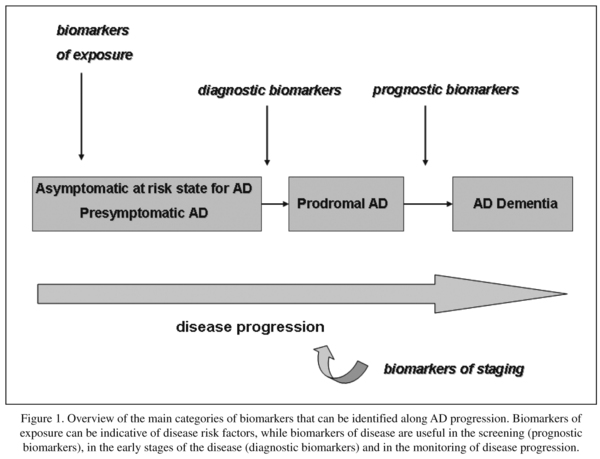
<body><![CDATA[<p><font face="Verdana" size="2">A great variety of biomarkers of AD has been described using different approaches (<a target="_blank" href="/img/revistas/ejpen/v29n1/original5_t1.htm">Table 1</a>). As <a href="#f1">Figure 1</a> shows, different strategies can be studied along AD progression for a better understanding of the disease and to enable an accurate identification of potential AD biomarkers. Currently, the most studied methods to identify markers of mild cognitive impairment (MCI) and AD are neuroimaging and molecular techniques based on cerebrospinal fluid (CSF). A systematic search on PubMed and Scopus databases was performed to find the most relevant studies and review papers. The key words used for this purpose were: "Alzheimer's disease", "Mild Cognitive Impairment", "biomarkers", "blood", "neuroimaging" and "neurodegenerative diseases" in various combinations. The articles selected were published in English from 2004 to 2015.</font></p>     <p>&nbsp;</p>     <p align="center"><font face="Verdana" size="2"><a name="f1"><img src="/img/revistas/ejpen/v29n1/original5_f1.jpg"></a></font></p>     <p>&nbsp;</p>     <p><font face="Verdana" size="2">Neuroimaging is a non-invasive technique which monitors brain regions and allows the subsequent identification and quantification of diagnostic and candidate biomarkers of dementia progression<sup>1</sup>. Magnetic resonance imaging (MRI) is the most widely used neuroimaging technique to investigate brain changes and neurodegeneration. Several longitudinal studies using MRI have been conducted with positive results<sup>2,3</sup>. After follow-up assessments, these studies supported that MRI is a valuable biomarker to predict early conversion to dementia in patients with MCI. In particular, a maximum value of 1.61 for the occipital cortex N-acetylaspartate / creatine ratio was useful to predict dementia at 100% sensitivity and 75% specificity, yielding a positive predictive value of 83% and a negative predictive value of 100%<sup>2</sup>. The same ratio in the posteromedial bilateral parietal cortex could enable a predicted conversion rate to probable AD with a sensitivity of 74.1% and a specificity of 83.7%<sup>3</sup>. Furthermore, MRI is capable of measuring both regional and global brain atrophy, determining the extent of the brain degeneration in patients with dementia<sup>4,5</sup>. Based on this, several groups have proposed the rate of hippocampal atrophy in MCI patients as a predictor for the conversion to AD<sup>6,7</sup>. Other measurements by MRI, like cortical thickness, have been performed in amnestic MCI (aMCI) patients, which have the highest conversion rate to AD<sup>8</sup>. However, these measurements alone could not distinguish among aMCI subtypes and controls. White matter (WM) and grey matter (GM) have also been studied using MRI, which showed lower volumes of WM and GM in different brain regions in MCI patients who converted to AD<sup>9</sup>. A more sensitive to microscope WM changes technique is diffusion tension imaging (DTI). Nir <i>et al</i>. (2013) showed widespread diffusivity disruptions associated with neuropsychological and cognitive deficits in specific tracts that passed through the temporal lobe and posterior brain regions in AD and MCI patients<sup>10</sup>. Despite MRI is widely used for AD, the accuracy of MRI as biomarker of early AD generally reaches an accuracy of 80%<sup>11</sup>, what encourages the search of better biomarkers and more accurate diagnostic tools. Several studies demonstrated that the accuracy to predict conversion from MCI to AD in MRI was enhanced when combined with positron emission tomography (PET)<sup>12,13</sup>, where the best brain region for MRI and PET was the temporal cortex<sup>13</sup>.</font></p>     <p><font face="Verdana" size="2">Currently, PET is one of the most sensitive tests for and early AD detection comparing to other biomarkers, such as CSF measures of A&beta;-42 or A&beta;-42/tau<sup>14,15</sup>. However, its high cost hampers its regular clinical use. PET can determine the presence or activity of proteins, enzymes and metabolic pathways involved in dementia<sup>16</sup>, and it has been used for prediction of progression from MCI to AD showing promising results. Particularly, <sup>11</sup>C-Pittsburgh compound B positron emission tomography (<sup>11</sup>C-PIB-PET) may play a role in stratifying patients with MCI into risk levels for developing AD, yielding a 83.3% to 100% sensitivity and a 41.1% to 100% specificity for predicting conversion to AD<sup>17</sup>. In addition, in a recent study, fluorodeoxyglucose PET (FDG-PET) images were used to investigate MCI to AD conversion at different prodromal stages<sup>18</sup>. The results showed that MCI to AD conversion can be predicted as early as 24 months prior to conversion. Another molecular imaging technique suggested as a predictor of conversion to dementia is proton magnetic resonance spectroscopy (<sup>1</sup>H-MRS)<sup>19</sup>. In particular, five metabolite ratios were calculated in four different brain regions in MCI patients, but only mI/CR ratio (myo-inositol/creatine ratio) in the cortical area of right parietal lobe in MCI subjects predicted the conversion to AD with sensitivity 70% and specificity 85%.</font></p>     <p><font face="Verdana" size="2">Recent studies suggest the combination of data for an accurate diagnose and prediction of dementia progression. A longitudinal study evaluated a multivariate method combining morphometric variables in patients with MCI, AD and controls<sup>20</sup>. This study suggested an index based on temporal evolution of brain degeneration using MRI, combined with other longitudinal information could be a reliable method to identify preclinical AD patients, as well as to predict conversion from MCI to AD. Other studies have supported the combination of data from neuroimaging to obtain more accurate diagnostic and predictive tools<sup>21,22</sup>. Particularly, a study combined data from neuroimaging for tracking dementia progression by proposing a method based on support vector machines. The results obtained showed a higher prediction for progression from MCI to AD, and a better differentiation between AD and healthy patients when considering the brain as a whole, rather than separate brain regions<sup>22</sup>.</font></p>     <p><font face="Verdana" size="2">During the last decade, neuroimaging has been shown as a potential tool for diagnosis and prediction of AD; however most of the AD biomarkers described are measured in CSF. Although CSF biomarkers combined can optimally discriminate AD patients from controls, as well as prognosticate conversion from MCI to AD, they are not suitable for distinguishing AD from other dementias<sup>23</sup>. Over the past two decades, three CSF biomarkers have been widely studied: amyloid &beta; peptide 42 (A&beta;-42), total tau protein (T-tau) and hyperphosphorilated tau protein (P-tau), which have been shown to be reliable markers for early diagnosis of AD and prediction of disease progression<sup>24,25</sup>.</font></p>     <p><font face="Verdana" size="2">Many studies have shown that AD pathophysiological processes are characterized by decreased amyloid concentrations, increased tau concentrations or increased tau/amyloid concentrations<sup>16,26-28</sup>. As an example, a 4-year follow-up study showed that all MCI patients with levels of the three CSF markers abnormally altered at baseline developed AD dementia within one year<sup>26</sup>. Interestingly, Buchhave <i>et al</i>. (2012) found decreased A&beta;-42 levels in MCI patients at an early stage, before conversion to AD dementia. In contrast, levels of T-tau and P-tau were found increased at a later stage<sup>27,29</sup>. Moreover, A&beta;-42/P-tau ratio predicted the conversion to AD dementia within 9.2 years with a sensitivity and specificity of 0.88 and 0.90, respectively<sup>27</sup>. Other studies have also determined A&beta;-42 as an early marker, followed by tau proteins<sup>28,30</sup>. A&beta;-42 has also been suggested as a trustworthy marker for distinguishing among MCI, AD and other dementias<sup>31,32</sup>. In this sense, lower CSF A&beta;-42 levels were found in AD patients compared to those measured in MCI subjects and with other dementias. Regarding P-tau separately, a meta-analysis of 51 studies based on MCI and AD patients concluded that CSF P-tau levels were a precise diagnostic biomarker for MCI and AD, as well as for progression of MCI. Conversely, CSF P-tau levels were less adequate in distinguishing AD from other dementias<sup>33</sup>.</font></p>     <p><font face="Verdana" size="2">In addition, accuracy of these CSF biomarkers can be improved when combining with other CSF proteins, as Perrin <i>et al.</i> (2011) demonstrated. After a CSF proteomic study, they suggested four novel CSF markers for MCI and AD (NrCAM, YKL-40, chromogranin A, carnosinase I) that enhanced diagnostic accuracy of A&beta;-42 and P-tau for distinguishing groups with mild, very mild cognitive impairment or no dementia<sup>34</sup>. A recent study also identified changes in several CSF proteins between controls and AD subjects, and suggested four proteins as potential progression biomarkers (amyloid precursor protein, neuronal pentraxin receptor, NrCAM and chromogranin A)<sup>35</sup>.</font></p>     ]]></body>
<body><![CDATA[<p><font face="Verdana" size="2">Although the current CSF biomarkers can be considered accurate markers for diagnosis and prediction of AD (<a target="_blank" href="/img/revistas/ejpen/v29n1/original5_t1.htm">Table 1</a>), there are still large variations in biomarker measurements between studies, and between and within laboratories<sup>36</sup>. Both CSF and neuroimaging biomarkers have been proved to have valuable diagnostic and prognostic capacity in AD. Nevertheless, the combination of them, together with cumulative information from clinical examination, could enhance their accuracy in detecting MCI and AD patients in early stages as well as the conversion to AD that will allow an effective therapy before the latest stage<sup>37</sup>. Hu <i>et al.</i> (2010) proposed the use of a multi-analyze profiling to identify novel candidate biomarkers, included in the RBM Human DiscoveryMAP&trade; panel, which could help to improve the accuracy of the established CSF markers<sup>38</sup>. The combination of CSF markers and cognitive tests, such as Mini-Mental State Examination (MMSE) and the clock drawing, has been also suggested, as it showed to be significantly better than these methods alone for prediction of conversion from MCI to AD<sup>39</sup>. Several studies assessed the predictive accuracy for the diagnosis and conversion to AD when analyzing CSF markers together with MRI and/or neuropsychological and functional measures (NMs)<sup>40-43</sup>. The results determined that combination of selected MRI, CSF and/or NM features outperformed a single modality of these features. Moreover, combination of CSF, imaging, genetic and cognitive markers and other methods has been performed to measure both the temporal evolution of AD<sup>29</sup> and predict more accurately the conversion from MCI to AD<sup>44</sup> (<a target="_blank" href="/img/revistas/ejpen/v29n1/original5_t1.htm">Table 1</a>).</font></p>     <p><font face="Verdana" size="2">Although the established biomarkers of AD from CSF and neuroimaging are precise, their clinical application has limitations due to their invasiveness or high cost. This supports the need to find other easily available and accessible biomarkers that make a diagnostic of early AD possible, and therefore, the possibility to identify those susceptible individuals in order to apply an effective therapy before the onset of the disease.</font></p>     <p>&nbsp;</p>     <p><font face="Verdana" size="2"><b>The search for reliable blood-based biomarkers</b></font></p>     <p><font face="Verdana" size="2">The neurodegeneration presented in AD is mainly characterized by the deposition of senile plaques, composed of amyloid beta peptide and neurofibrillary tangles of hyperphosphorylated tau protein, especially in the hypocampus, amygdala and frontal cortex. Dealing with the search of putative biomarkers of AD, an AD prodromal phase, identified as MCI can be precisely the useful time-point to test reliable biomarkers that can enable an early and accurate prognosis and diagnosis of the disease. The complexity of the pathogenesis of AD, which is not fully understood to date, is caused by a synergy of risk factors and the combination of current well-characterized biomarkers, from neuroimaging, genetic to fluid biomarkers (<a target="_blank" href="/img/revistas/ejpen/v29n1/original5_t1.htm">Table 1</a>), can improve prognostic and diagnostic accuracy<sup>45</sup>.</font></p>     <p><font face="Verdana" size="2">Albeit neuroimaging tools have provided a reliable early detection and differentiation of AD, they still remain as a quite expensive diagnostic tool in many hospitals and clinical centers. Conversely, the detection of CSF, blood (plasma or serum) and urine biomarkers could be also useful for the disease characterization, even at preclinical stage. Regarding urine biomarkers, several biochemical markers have been described as potential biomarkers for dementia, such as the level of urinary 3-hydroxypropyl mercapturic acid (3-HPMA)/creatinine (Cre)<sup>46</sup> and the level of urinary Alzheimer-associated neuronal thread protein (AD7c-NTP), which may be an important biomarker for an early diagnosis of MCI<sup>47</sup>. Particularly, decreased levels in 3-HPMA/Cre in urine correlated with increase in A&beta;40/42 in plasma in demented subjects<sup>46</sup>, while increased levels of AD7c-NTP were found in AD and MCI patients<sup>47</sup>. Nevertheless, the minimally invasive nature, possible follow-up of patients, low risk and cost and the possibility of screening healthy population make the blood the first choice to analyze putative biomarkers. In spite of the low sensitivity and specificity of blood biomarkers, the invasive sample collection by lumbar puncture, which is needed in the analysis of CSF samples, is less preferred than a wider range of blood-based biomarkers study to identify reliable biomarkers of prodromal AD and AD dementia<sup>45,48</sup>. Interestingly, blood-based proteomic search of biomarkers in heterogeneous populations of individuals supports an alteration of the blood proteome in AD patients<sup>49</sup>.</font></p>     <p><font face="Verdana" size="2">Reliable biomarkers of prodromal AD and AD dementia are essential for early AD detection at preclinical stages. Since it is expected that the number of demented people will exponentially increased in the next years and taking into consideration the lack of an effective therapeutic approach for AD, the detection of these reliable biomarkers could enable the treatment of asymptomatic patients before the degeneration progresses severely. At this step, the standardization of blood-based biomarker studies for the improvement of diagnosis, treatment and care of AD patients has become the ultimate goal of the Standards for Alzheimer's Research in Blood biomarkers (STAR-B) working group<sup>48</sup>.</font></p>     <p><font face="Verdana" size="2">The advantages of blood tissue in the search of reliable AD biomarkers compensate for the limited detection of potential biomarkers closely related to brain pathogenesis through the blood brain barrier and the inevitably dilution of brain derived proteins and metabolites in this tissue<sup>50</sup>. Among the biomarkers studied in blood (plasma or serum), A&beta; is the most studied one, especially in plasma samples (<a target="_blank" href="/img/revistas/ejpen/v29n1/original5_t1.htm">Table 1</a>). Abnormal production and aggregation of A&beta; isoforms is one of the earliest pathophysiological hallmarks that take place in the brain, and they begin several decades before the onset of clinical symptoms, triggering synaptic loss, neuronal death and clinical dementia. As a consequence, the monitoring of the amyloid processes in asymptomatic subjects could be useful to select those at the prodromal stage that will progress to AD<sup>51</sup>.</font></p>     <p><font face="Verdana" size="2">Although it remains under debate whether plasma A&beta; levels could be considered a reliable biomarker because of the controversial published results, recent studies point out to a decreased A&beta;-42 / A&beta;-40 ratio as a risk factor to MCI conversion to AD, while other studies have suggested that increased A&beta;-40 and A&beta;-42 plasma levels, simultaneously or separately, could play a role as putative biomarkers of AD<sup>45,50,52,53</sup>. In particular, decreased levels of A&beta;-42 or decreased A&beta;-42 / A&beta;-40 ratio in aging could indicate a conversion from a normal cognitive status to MCI or AD<sup>54,55</sup>. Similarly, unaltered A&beta; plasma levels have also been found when comparing AD patients and control cases<sup>50,56</sup>. In addition, plasma A&beta; levels have been tested in different studies of correlation. As an example, plasma A&beta; levels did not correlate with CSF A&beta; levels. A multiplex immunoassay analysis in two independent cohorts of patients showed unaltered levels of plasma A&beta; in incipient AD and a lack of  correlation of A&beta;-42 levels in CSF and plasma<sup>57,58</sup>. However, positive although no significant correlations were found between plasma A&beta; levels and plasma homocysteine<sup>50. </sup>More recently, the sensitivity and specificity of plasma A&beta;-42 levels were significantly improved to 0.8 and 0.82 respectively, when combined plasma A&beta;-42 and tau protein levels and monitored them with the use of immunomagnetic reduction assays (IMR). This ultrahigh sensitivity technology could make possible the low detection limits for amyloids and tau protein (1-10 pg/ml). This improvement in the detection of very low protein levels could enable not only the differentiation of healthy cases and AD patients, in both prodromal and dementia phases, but it also allowed the identification of the group of MCI cases due to AD<sup>59</sup>.</font></p>     <p><font face="Verdana" size="2">One of the largest prospective studies of plasma A&beta; levels and the risk of incident of AD disease and dementia is the Framingham Heart Study, which included more than two thousand participants with a long period of follow-up. The main results obtained in this study suggested that lower plasma A&beta;-42 and A&beta;-40 levels preceded and were associated with the risk of incident AD and dementia. In particular, low plasma A&beta;-42 levels were associated with higher risk of incident AD and dementia, and significant associations between low plasma A&beta;-42 levels and A&beta;-42 / A&beta;-40 ratio were also found associated with higher risk of incident AD and dementia<sup>51</sup>. In spite of the limitations of the study, this work reinforced the potential role of plasma A&beta; levels as a useful biomarker for preclinical AD and dementia. In accordance with Framingham Heart Study, a previous longitudinal study based on 2,454 patient plasma samples from the Alzheimer's Disease Neuroimaging Initiative study found relatively strongest correlations between plasma A&beta;-42 levels and CSF p-tau<sub>181</sub> / A&beta;-42 ratio in MCI patients, pointing out to the use of plasma A&beta; as a potential biomarker<sup>60</sup>. In relation to plasma A&beta; levels, it has been also shown that an increase in oxidized lipoprotein receptor-related protein-1 (sLRP) could lead to elevated levels of A&beta;-40 and A&beta;-42, which re-entered the brain favoring the risk of MCI and AD. In fact, high levels of oxidize sLRP and free plasma A&beta;-40 and A&beta;-42 correlated significantly with CSF tau / A&beta;-42 ratios and reductions in MMSE scores<sup>61</sup>.</font></p>     ]]></body>
<body><![CDATA[<p><font face="Verdana" size="2">As above mentioned, other relevant biomarkers in blood samples are serum or plasma tau levels (<a target="_blank" href="/img/revistas/ejpen/v29n1/original5_t1.htm">Table 1</a>). The main handicap in this case remains in the increased levels of tau in other pathologies, such as ischemic stroke or traumatic brain injury, while in AD or MCI, tau levels are difficult to detect. However, a recent and more sensitive immunoassay methodology can detect both normal and phosphorylated tau, suggesting that serum tau levels could be useful in the identification of AD<sup>62</sup>. Furthermore, recent studies support the potential nature of AD biomarker of tau since a fragment of tau in serum correlated with cognitive function in a small clinical study. In connection with this result, the existence of plasma post-translational modifications (PTMs), called neo-epitopes, are considered chemical modifications that can prompt proteomic diversity. Albeit protein PTMs can be reversible depending on the nature of modification, the identification and better understanding of PTMs are essential to study the cellular and molecular mechanisms involved under physiological or pathological conditions. Therefore, in relation to AD disease, PTM-based biomarker could provide useful information about the disease progression. The induction of neuronal death in AD, in which tau is truncated in a caspase dependent mechanism, can generate pathological truncated protein species, which could become staging biomarkers that could enable the monitoring of disease progression<sup>62</sup>.</font></p>     <p><font face="Verdana" size="2">Novel blood-based biomarkers for AD (<a target="_blank" href="/img/revistas/ejpen/v29n1/original5_t1.htm">Table 1</a>), such as circulating microRNA and a wide variety of plasma proteins and lipids suggested by transcriptomic and lipidomic sequencing, support the use of peripheral blood for unbiased screening to detect significant preclinical alterations in AD patients, which are reflected in the periphery that can be easily and minimally invasive analyzed<sup>49</sup>. In this sense, the combination of several markers can significantly improve the diagnostic accuracy. Panels of serum biomarkers for inflammation, homocysteine and cholesterol metabolism and brain specific proteins have been evaluated, yielding high accuracy, close to 90%, to differentiate AD patients from control cases and they also provided a useful tool to predict MCI patients that later converted to AD patients<sup>50</sup>. As an example, some identified plas-ma biomarkers are &alpha;2-macroglobulin, complement factor H, homocysteine, cholesterol, E4 isoform of apolipoprotein E, F2-isoprostanes, A&beta; autoantibodies, apolipoprotein A1, clusterin/apolipoprotein-J, isoprostane or glycogen synthase kinase (GSK-3&beta;)<sup>45,63-65</sup>. Regarding calmodulin, this potential plasma biomarker was found significantly upregulated in MCI and AD patients with a sensitivity of 0.87 and a specificity of 0.82, suggesting its possible role in the identification of early stages in AD and in the discrimination from other types of dementia<sup>66</sup>. Reduced phospholipase A<sub>2</sub> activity has also been suggested as a risk marker for AD in subjects with MCI<sup>67</sup>. Similarly, sphingomyelins and ceramides could be predictive of memory impairment and they could be useful for the ongoing AD pathology and progression in asymptomatic cases<sup>68</sup>. Interestingly, very long plasma ceramides were found altered in MCI, and it has been suggested that they could predict memory and right hippocampal volume loss among subjects with MCI<sup>69</sup>.</font></p>     <p><font face="Verdana" size="2">Moreover, 18 signaling proteins were identified in plasma with a 90% accuracy to distinguish patients who had MCI and progressed to AD 2-6 years later. These signaling proteins were related to changes in the periphery, the central nervous system or both that were relatively specific to AD and took place in the first stages of disease process<sup>70</sup>. Similar studies dealing with protein-based multiplex biomarker data from control and AD patients showed that serum protein-based biomarkers improved their diagnostic accuracy when they were combined with clinical information, such as age, sex, education and <i>APOE</i> status<sup>71</sup>. A more recent study have identified a panel of 10 plasma proteins associated with neuroimaging measures of the disease that can predict disease conversion from MCI to AD within a year of blood sampling<sup>72</sup>. Another recent study based on isobaric tag (iTRAQ) and proteomic methods, identified 30 plasma proteins, such as afamin and immunoglobulin heavy constant mu (IGHM), that could be potential biomarkers for MCI and AD<sup>73</sup>.</font></p>     <p><font face="Verdana" size="2">The possibility to identify in blood an Alzheimer's biomarker phenotype could favor the diagnosis of early AD. The study not only of the serum or plasma proteome but also of the relationships among different signaling proteins and intercellular communication factors could pave the way to new approaches for the search of AD biomarkers suitable for an early prognosis and diagnosis of the disease, and therefore for novel therapeutic strategies.</font></p>     <p><font face="Verdana">Common insights in AD and other neurodegenerative diseases</font></p>     <p><font face="Verdana" size="2">Regarding other neurodegenerative disorders, there is an important clinical need to identify and establish accurate biomarkers for the classification of neurodegenerative dementias, including AD, Parkinson disease (PD), frontotemporal dementia (FTD) and Amyotrophic Lateral Sclerosis (ALS), in which several pathological pathways leading to neurodegeneration are overlapped. A frequent pathological characteristic implicated in these disorders is the accumulation and aggregation of abnormal or misfolded proteins (amyloid-&beta; in AD, &alpha;-synuclein in PD, and TDP-43 in FTD and ALS)<sup>74</sup>. Moreover, common processes that modulate neurodegeneration also include aberrant regulation of apoptosis, uncontrolled activation of autophagy, mytochondria dysfunction and oxidative DNA damage<sup>74</sup>.</font></p>     <p><font face="Verdana" size="2">Concerning genetics, the GGGGCC hexanucleotide repeat expansion intronic to chromosome 9 open reading frame 72 (<i>C9ORF72</i>) was first identified as a common genetic cause of ALS and FTD<sup>75,76</sup>. Nevertheless, recent studies about <i>C9ORF72</i> have shown this expansion involved in diverse molecular mechanisms in other dementias, especially in AD and PD, confirming the pathological interrelationship between these diseases<sup>77-79</sup>. In particular, two early-onset AD patients were found to harbour <i>C9ORF72</i> expansions in a study regarding FTD genes<sup>80</sup>. Another study concerning Caucasian families showed <i>C9ORF72</i> expansions (&gt; 30 repeats) at a rate of 0,76% in AD cases versus zero in controls, supporting the notion that large <i>C9ORF72</i> expansions have a considerable role in neurodegenerative diseases including AD<sup>81</sup>. In contrast, the allele frequency of<i> C9ORF72</i> repeats was estimated in ALS, frontotemporal lobar degeneration (FTLD), AD and PD; however, this expansion was only commonly found in ALS and FTLD, but not in AD or PD<sup>82</sup>. In accordance to these results, no pathogenic expansions (&lt; 30 repeats) of <i>C9ORF72</i> were found in either AD patients or controls<sup>83</sup>. In the same study, as regards PD, it was suggested the intermediate (&ge; 7 repeats) repeat allele in <i>C9ORF72</i> as a risk factor for PD.</font></p>     <p><font face="Verdana" size="2">Despite the fact that <i>C9ORF72</i> pathological repeats are not frequently found in AD or PD, their presence in some cases supports the simultaneity of diverse clinical and pathological features between several neurodegenerative diseases. On the other hand, their low frequency in AD and PD, compared to it in ALS and FTD, could be a useful tool for making a more precise diagnosis between these dementias.</font></p>     <p><font face="Verdana" size="2">Given the pathological and clinical overlapping in diverse neurodegenerative disorders, it is crucial to find potential and trustworthy biomarkers that allow developing an accurate classifying method for an early diagnosis of neurodegenerative diseases, which could make an early treatment for patients possible. Regarding AD, the identified biomarkers obtained from CSF and neuroimaging have reached clinical applications and their significant limitations in the disease stage and dementia identification can be accurately improved when they are combined in tandem with blood-based biomarkers. Future studies based on improved methodological approaches will provide a better understanding of the neurodegenerative progression of the disease and they could undoubtedly promote more promising and effective therapeutic strategies for AD.</font></p>     <p>&nbsp;</p>     ]]></body>
<body><![CDATA[<p><font face="Verdana" size="2"><b>Potential conflict of interests</b></font></p>     <p><font face="Verdana" size="2">The authors declare that they have no competing interests.</font></p>     <p>&nbsp;</p>     <p><font face="Verdana" size="2"><b>Abbreviations</b></font></p>     <p><font face="Verdana" size="2">Alzheimer-associated neuronal thread protein (AD7c-NTP); Alzheimer Disease (AD); amnestic MCI (aMCI); amyloid &beta; peptide (A &beta;); Amyotrophic Lateral Sclerosis (ALS);<sup>11</sup>C-Pittsburgh compound B positron emission tomography (<sup>11</sup>C-PIB-PET); cerebrospinal fluid (CSF); diffusion tension imaging (DTI); fluorodeoxyglucose PET (FDG-PET); frontotemporal dementia (FTD); frontotemporal lobar degeneration (FTLD); glycogen synthase kinase (GSK-3&beta;); grey matter (GM); hexanucleotide repeat expansion intronic to chromosome 9 open reading frame 72 (<i>C9ORF72</i>); 3-hydroxypropyl mercapturic acid (3-HPMA)/ creatinine (Cre); immunomagnetic reduction assays (IMR); isobaric tag (iTRAQ); magnetic resonance imaging (MRI); Mild Cognitive Impairment (MCI); Mini-Mental State Examination (MMSE); neuropsychological and functional measures (NMs); oxidized lipoprotein receptor-related protein-1 (sLRP); Parkinson Disease (PD); positron emission tomography (PET); post-translational modifications (PTMs); proton magnetic resonance spectroscopy (<sup>1</sup>H-MRS); white matter (WM).</font></p>     <p>&nbsp;</p>     <p><font face="Verdana" size="2"><b>References</b></font></p>     <!-- ref --><p><font face="Verdana" size="2">1. Risacher SL, Saykin AJ. Neuroimaging biomarkers of neurodegenerative diseases and dementia. Semin. Neurol. 2013; 33(4): 386-416.    &nbsp;&nbsp;&nbsp;&nbsp;&nbsp;&nbsp;&nbsp;&nbsp;[&#160;<a href="javascript:void(0);" onclick="javascript: window.open('/scielo.php?script=sci_nlinks&ref=5962847&pid=S0213-6163201500010000500001&lng=','','width=640,height=500,resizable=yes,scrollbars=1,menubar=yes,');">Links</a>&#160;]<!-- end-ref --></font></p>    <!-- ref --><p><font face="Verdana" size="2">2. Modrego PJ, Fayed N, Pina MA. Conversion from mild cognitive impairment to probable Alzheimer's disease predicted by brain magnetic resonance spectroscopy. Am J Psychiatry. 2005; 162(4): 667-675.    &nbsp;&nbsp;&nbsp;&nbsp;&nbsp;&nbsp;&nbsp;&nbsp;[&#160;<a href="javascript:void(0);" onclick="javascript: window.open('/scielo.php?script=sci_nlinks&ref=5962849&pid=S0213-6163201500010000500002&lng=','','width=640,height=500,resizable=yes,scrollbars=1,menubar=yes,');">Links</a>&#160;]<!-- end-ref --></font></p>    <!-- ref --><p><font face="Verdana" size="2">3. Modrego PJ, Fayed N, Sarasa M. Magnetic resonance spectroscopy in the prediction of early conversion from amnestic mild cognitive impairment to dementia: A prospective cohort study. BMJ Open. 2011; 1(1): e000007.    &nbsp;&nbsp;&nbsp;&nbsp;&nbsp;&nbsp;&nbsp;&nbsp;[&#160;<a href="javascript:void(0);" onclick="javascript: window.open('/scielo.php?script=sci_nlinks&ref=5962851&pid=S0213-6163201500010000500003&lng=','','width=640,height=500,resizable=yes,scrollbars=1,menubar=yes,');">Links</a>&#160;]<!-- end-ref --></font></p>    <!-- ref --><p><font face="Verdana" size="2">4. McEvoy L, Fennema-Notestine C, Roddey JC, Hagler DJ, Holland D, Karow DS <i>et al</i>. Alzheimer Disease: Quantitative structural seuroimaging for detection and prediction of clinical and structural changes in mild cognitive impairment. radiology. 2009; 251(1): 195-205.    &nbsp;&nbsp;&nbsp;&nbsp;&nbsp;&nbsp;&nbsp;&nbsp;[&#160;<a href="javascript:void(0);" onclick="javascript: window.open('/scielo.php?script=sci_nlinks&ref=5962853&pid=S0213-6163201500010000500004&lng=','','width=640,height=500,resizable=yes,scrollbars=1,menubar=yes,');">Links</a>&#160;]<!-- end-ref --></font></p>    <!-- ref --><p><font face="Verdana" size="2">5. Aguilar C, Muehlboeck JS, Mecocci P, Vellas B, Tsolaki M, Kloszewska I, <i>et al</i>. Application of a MRI based index to longitudinal atrophy change in Alzheimer disease, mild cognitive impairment and healthy older individuals in the Add Neuro Med cohort. Frontiers in Aging Neuroscience. 2014; 6(145): 1-12.    &nbsp;&nbsp;&nbsp;&nbsp;&nbsp;&nbsp;&nbsp;&nbsp;[&#160;<a href="javascript:void(0);" onclick="javascript: window.open('/scielo.php?script=sci_nlinks&ref=5962855&pid=S0213-6163201500010000500005&lng=','','width=640,height=500,resizable=yes,scrollbars=1,menubar=yes,');">Links</a>&#160;]<!-- end-ref --></font></p>    <!-- ref --><p><font face="Verdana" size="2">6. Leung KK, Bartlett JW, Barnes J, Manning EN, Ourselin S, Fox NC. Cerebral atrophy in mild cognitive impairment and Alzheimer disease: Rates and acceleration. Neurology. 2013; 12; 80(7): 648-654.    &nbsp;&nbsp;&nbsp;&nbsp;&nbsp;&nbsp;&nbsp;&nbsp;[&#160;<a href="javascript:void(0);" onclick="javascript: window.open('/scielo.php?script=sci_nlinks&ref=5962857&pid=S0213-6163201500010000500006&lng=','','width=640,height=500,resizable=yes,scrollbars=1,menubar=yes,');">Links</a>&#160;]<!-- end-ref --></font></p>    <!-- ref --><p><font face="Verdana" size="2">7. Macdonald KE, Bartlett JW, Leung KK, Ourselin S, Barnes J. The value of hippocampal and temporal horn volumes and rates of change in predicting future conversion to AD. Alzheimer Dis Assoc Disord. 2013; 27(2): 168-173.    &nbsp;&nbsp;&nbsp;&nbsp;&nbsp;&nbsp;&nbsp;&nbsp;[&#160;<a href="javascript:void(0);" onclick="javascript: window.open('/scielo.php?script=sci_nlinks&ref=5962859&pid=S0213-6163201500010000500007&lng=','','width=640,height=500,resizable=yes,scrollbars=1,menubar=yes,');">Links</a>&#160;]<!-- end-ref --></font></p>    <!-- ref --><p><font face="Verdana" size="2">8. Raamana PR, Wen W, Kochan NA, Brodaty H, Sachdev PS Wang L <i>et al</i>. The sub-classification of amnestic mild cognitive impairment using MRI-based cortical thickness measures. Frontiers in Neurology. 2014; 5(76): 1-10.    &nbsp;&nbsp;&nbsp;&nbsp;&nbsp;&nbsp;&nbsp;&nbsp;[&#160;<a href="javascript:void(0);" onclick="javascript: window.open('/scielo.php?script=sci_nlinks&ref=5962861&pid=S0213-6163201500010000500008&lng=','','width=640,height=500,resizable=yes,scrollbars=1,menubar=yes,');">Links</a>&#160;]<!-- end-ref --></font></p>    <!-- ref --><p><font face="Verdana" size="2">9. Misra C, Fan Y, Davatzikos C. Baseline and longitudinal patterns of brain atrophy in MCI patients, and their use in prediction of short-term conversion to AD: Results from ADNI. Neuroimage. 2009; 44(4): 1415-1422.    &nbsp;&nbsp;&nbsp;&nbsp;&nbsp;&nbsp;&nbsp;&nbsp;[&#160;<a href="javascript:void(0);" onclick="javascript: window.open('/scielo.php?script=sci_nlinks&ref=5962863&pid=S0213-6163201500010000500009&lng=','','width=640,height=500,resizable=yes,scrollbars=1,menubar=yes,');">Links</a>&#160;]<!-- end-ref --></font></p>    <!-- ref --><p><font face="Verdana" size="2">10. Nir TM, Jahanshada N, Villalon-Reina JE, Toga AW, Jack CR, Weiner MW <i>et al</i>. Effectiveness of regional DTI measures in distinguishing Alzheimer's disease, MCI, and normal aging. NeuroImage: Clinical. 2013; 3: 180-195.    &nbsp;&nbsp;&nbsp;&nbsp;&nbsp;&nbsp;&nbsp;&nbsp;[&#160;<a href="javascript:void(0);" onclick="javascript: window.open('/scielo.php?script=sci_nlinks&ref=5962865&pid=S0213-6163201500010000500010&lng=','','width=640,height=500,resizable=yes,scrollbars=1,menubar=yes,');">Links</a>&#160;]<!-- end-ref --></font></p>    <!-- ref --><p><font face="Verdana" size="2">11. Fayed N, Modrego PJ, Salinas GR, Gazulla J. Magnetic resonance imaging based clinical research in Alzheimer's disease. J Alzheimers Dis. 2012; 31 Suppl 3: S5-18.    &nbsp;&nbsp;&nbsp;&nbsp;&nbsp;&nbsp;&nbsp;&nbsp;[&#160;<a href="javascript:void(0);" onclick="javascript: window.open('/scielo.php?script=sci_nlinks&ref=5962867&pid=S0213-6163201500010000500011&lng=','','width=640,height=500,resizable=yes,scrollbars=1,menubar=yes,');">Links</a>&#160;]<!-- end-ref --></font></p>    <!-- ref --><p><font face="Verdana" size="2">12. Suk HI, Lee SW, Shena D. Hierarchical feature representation and multimodal fusion with deep learning for AD/MCI diagnosis. NeuroImage. 2014; 101: 569-582.    &nbsp;&nbsp;&nbsp;&nbsp;&nbsp;&nbsp;&nbsp;&nbsp;[&#160;<a href="javascript:void(0);" onclick="javascript: window.open('/scielo.php?script=sci_nlinks&ref=5962869&pid=S0213-6163201500010000500012&lng=','','width=640,height=500,resizable=yes,scrollbars=1,menubar=yes,');">Links</a>&#160;]<!-- end-ref --></font></p>    <!-- ref --><p><font face="Verdana" size="2">13. Trzepacz PT, Yu P, Sun J, Schuh K, Case M, Witte MM <i>et al</i>. Comparison of neuroimaging modalities for the prediction of conversion from mild cognitive impairment to Alzheimer's dementia. Neurobiology of Aging. 2014; 35(1): 143-151.    &nbsp;&nbsp;&nbsp;&nbsp;&nbsp;&nbsp;&nbsp;&nbsp;[&#160;<a href="javascript:void(0);" onclick="javascript: window.open('/scielo.php?script=sci_nlinks&ref=5962871&pid=S0213-6163201500010000500013&lng=','','width=640,height=500,resizable=yes,scrollbars=1,menubar=yes,');">Links</a>&#160;]<!-- end-ref --></font></p>    <!-- ref --><p><font face="Verdana" size="2">14. Leuzy A, Carter SF, Chiotis K, Almkvist O, Wall A, Nordberg A. Concordance and Diagnostic Accuracy of (11C)PIB PET and Cerebrospinal Fluid Biomarkers in a Sample of Patients with Mild Cognitive Impairment and Alzheimer's Disease. J Alzheimers Dis. 2015.    &nbsp;&nbsp;&nbsp;&nbsp;&nbsp;&nbsp;&nbsp;&nbsp;[&#160;<a href="javascript:void(0);" onclick="javascript: window.open('/scielo.php?script=sci_nlinks&ref=5962873&pid=S0213-6163201500010000500014&lng=','','width=640,height=500,resizable=yes,scrollbars=1,menubar=yes,');">Links</a>&#160;]<!-- end-ref --></font></p>    <!-- ref --><p><font face="Verdana" size="2">15. Prestia A, Caroli A, Wade SK, van der Flier WM, Ossenkoppele R, Van Berckel B <i>et al</i>. Prediction of AD dementia by biomarkers following the NIA-AA and <i>IWG</i> diagnostic criteria in MCI patients from three European memory clinics. Alzheimers Dement. 2015.    &nbsp;&nbsp;&nbsp;&nbsp;&nbsp;&nbsp;&nbsp;&nbsp;[&#160;<a href="javascript:void(0);" onclick="javascript: window.open('/scielo.php?script=sci_nlinks&ref=5962875&pid=S0213-6163201500010000500015&lng=','','width=640,height=500,resizable=yes,scrollbars=1,menubar=yes,');">Links</a>&#160;]<!-- end-ref --></font></p>    <!-- ref --><p><font face="Verdana" size="2">16. McConathy J, Sheline YI. Imaging biomarkers associated with cognitive decline: A review. Biological Psychiatry. 2014.    &nbsp;&nbsp;&nbsp;&nbsp;&nbsp;&nbsp;&nbsp;&nbsp;[&#160;<a href="javascript:void(0);" onclick="javascript: window.open('/scielo.php?script=sci_nlinks&ref=5962877&pid=S0213-6163201500010000500016&lng=','','width=640,height=500,resizable=yes,scrollbars=1,menubar=yes,');">Links</a>&#160;]<!-- end-ref --></font></p>    <!-- ref --><p><font face="Verdana" size="2">17. Ma Y, Zhang S, Li J, Zheng DM, Guo Y, Feng J <i>et al</i>. Predictive accuracy of amyloid imaging for progression from mild cognitive impairment to Alzheimer disease with different lengths of follow-up: A systematic review. Medicine. 2014; 93(27): e150.    &nbsp;&nbsp;&nbsp;&nbsp;&nbsp;&nbsp;&nbsp;&nbsp;[&#160;<a href="javascript:void(0);" onclick="javascript: window.open('/scielo.php?script=sci_nlinks&ref=5962879&pid=S0213-6163201500010000500017&lng=','','width=640,height=500,resizable=yes,scrollbars=1,menubar=yes,');">Links</a>&#160;]<!-- end-ref --></font></p>    <!-- ref --><p><font face="Verdana" size="2">18. Cabral C, Morgado PM, Campos-Costa D, Silveira M. Alzheimer&#1523;s Disease Neuroimaging Initiative Predicting conversion from MCI to AD with FDG-PET brain images at different prodromal stages. Computers in Biology and Medicine. 2015; 58: 101-109.    &nbsp;&nbsp;&nbsp;&nbsp;&nbsp;&nbsp;&nbsp;&nbsp;[&#160;<a href="javascript:void(0);" onclick="javascript: window.open('/scielo.php?script=sci_nlinks&ref=5962881&pid=S0213-6163201500010000500018&lng=','','width=640,height=500,resizable=yes,scrollbars=1,menubar=yes,');">Links</a>&#160;]<!-- end-ref --></font></p>    <!-- ref --><p><font face="Verdana" size="2">19. Targosz-Gajniak M, Siuda JS, Wicher MM, Banasikc TJ, Bujak MA, Augusciak-Duma AM <i>et al</i>. Magnetic resonance spectroscopy as a predictor of conversion of mild cognitive impairment to dementia. Journal of the Neurological Sciences. 2013; 335(1-2): 58-63.    &nbsp;&nbsp;&nbsp;&nbsp;&nbsp;&nbsp;&nbsp;&nbsp;[&#160;<a href="javascript:void(0);" onclick="javascript: window.open('/scielo.php?script=sci_nlinks&ref=5962883&pid=S0213-6163201500010000500019&lng=','','width=640,height=500,resizable=yes,scrollbars=1,menubar=yes,');">Links</a>&#160;]<!-- end-ref --></font></p>    <!-- ref --><p><font face="Verdana" size="2">20. Aguilar C, Muehlboeck JS, Mecocci P, Vellas B, Tsolaki M, Kloszewska I, <i>et al</i>. Application of a MRI based index to longitudinal atrophy change in Alzheimer disease, mild cognitive impairment and healthy older individuals in the Add Neuro Med cohort. Frontiers in Aging Neuroscience. 2014; 6 (145): 1-12.    &nbsp;&nbsp;&nbsp;&nbsp;&nbsp;&nbsp;&nbsp;&nbsp;[&#160;<a href="javascript:void(0);" onclick="javascript: window.open('/scielo.php?script=sci_nlinks&ref=5962885&pid=S0213-6163201500010000500020&lng=','','width=640,height=500,resizable=yes,scrollbars=1,menubar=yes,');">Links</a>&#160;]<!-- end-ref --></font></p>    <!-- ref --><p><font face="Verdana" size="2">21. Liu F, Wee CY, Chen H, Shen D. Inter-modality relationship constrained multi-modality multi-task feature selection for Alzheimer's Disease and mild cognitive impairment identification. NeuroImage. 2014; 84: 466-475.    &nbsp;&nbsp;&nbsp;&nbsp;&nbsp;&nbsp;&nbsp;&nbsp;[&#160;<a href="javascript:void(0);" onclick="javascript: window.open('/scielo.php?script=sci_nlinks&ref=5962887&pid=S0213-6163201500010000500021&lng=','','width=640,height=500,resizable=yes,scrollbars=1,menubar=yes,');">Links</a>&#160;]<!-- end-ref --></font></p>    <!-- ref --><p><font face="Verdana" size="2">22. Retico A, Bosco P, Cerello P, Fiorina E, Chincarini A, Fantacci ME. Predictive Models Based on Support Vector Machines: Whole-Brain versus Regional Analysis of Structural MRI in the Alzheimer's Disease. J Neuroimaging. 2014.    &nbsp;&nbsp;&nbsp;&nbsp;&nbsp;&nbsp;&nbsp;&nbsp;[&#160;<a href="javascript:void(0);" onclick="javascript: window.open('/scielo.php?script=sci_nlinks&ref=5962889&pid=S0213-6163201500010000500022&lng=','','width=640,height=500,resizable=yes,scrollbars=1,menubar=yes,');">Links</a>&#160;]<!-- end-ref --></font></p>    <!-- ref --><p><font face="Verdana" size="2">23. Ferreira D, Perestelo-P&eacute;rez L, Westman E, Wahlund LO, Sarr&iacute;a A, Serrano-Aguilar P. Meta-review of CSF core biomarkers in Alzheimer's disease: The state-of-the-art after the new revised diagnostic criteria. Frontiers in Aging Neuroscience. 2014; 6(47): 1-24.    &nbsp;&nbsp;&nbsp;&nbsp;&nbsp;&nbsp;&nbsp;&nbsp;[&#160;<a href="javascript:void(0);" onclick="javascript: window.open('/scielo.php?script=sci_nlinks&ref=5962891&pid=S0213-6163201500010000500023&lng=','','width=640,height=500,resizable=yes,scrollbars=1,menubar=yes,');">Links</a>&#160;]<!-- end-ref --></font></p>    <!-- ref --><p><font face="Verdana" size="2">24. Holtzman DM. CSF biomarkers for Alzheimer's disease: Current utility and potential future use. Neurobiol Aging. 2011; 32(Suppl 1): S4-S9.    &nbsp;&nbsp;&nbsp;&nbsp;&nbsp;&nbsp;&nbsp;&nbsp;[&#160;<a href="javascript:void(0);" onclick="javascript: window.open('/scielo.php?script=sci_nlinks&ref=5962893&pid=S0213-6163201500010000500024&lng=','','width=640,height=500,resizable=yes,scrollbars=1,menubar=yes,');">Links</a>&#160;]<!-- end-ref --></font></p>    <!-- ref --><p><font face="Verdana" size="2">25. Kang JH, Korecka M, Toledo JB, Trojanowski JQ, Shaw LM. Clinical Utility and Analytical Challenges in Measurement of Cerebrospinal Fluid Amyloid-&#946;1-42 and &#964; Proteins as Alzheimer Disease Biomarkers. Clin Chem. 2013; 59(6): 903-916.    &nbsp;&nbsp;&nbsp;&nbsp;&nbsp;&nbsp;&nbsp;&nbsp;[&#160;<a href="javascript:void(0);" onclick="javascript: window.open('/scielo.php?script=sci_nlinks&ref=5962895&pid=S0213-6163201500010000500025&lng=','','width=640,height=500,resizable=yes,scrollbars=1,menubar=yes,');">Links</a>&#160;]<!-- end-ref --></font></p>    <!-- ref --><p><font face="Verdana" size="2">26. Lanari A, Parnetti L. CSF Biomarkers in Clinical Practice. The Scientific World Journal. 2009; 9: 961-966.    &nbsp;&nbsp;&nbsp;&nbsp;&nbsp;&nbsp;&nbsp;&nbsp;[&#160;<a href="javascript:void(0);" onclick="javascript: window.open('/scielo.php?script=sci_nlinks&ref=5962897&pid=S0213-6163201500010000500026&lng=','','width=640,height=500,resizable=yes,scrollbars=1,menubar=yes,');">Links</a>&#160;]<!-- end-ref --></font></p>    <!-- ref --><p><font face="Verdana" size="2">27. Buchhave P, Minthon L, Zetterberg H, Wallin AK, Blennow K, Hansson O. Cerebrospinal Fluid Levels of -Amyloid 1-42, but Not of Tau, Are Fully Changed Already 5 to 10 Years Before the Onset of Alzheimer Dementia. Arch Gen Psychiatry. 2012; 69(1): 98-106.    &nbsp;&nbsp;&nbsp;&nbsp;&nbsp;&nbsp;&nbsp;&nbsp;[&#160;<a href="javascript:void(0);" onclick="javascript: window.open('/scielo.php?script=sci_nlinks&ref=5962899&pid=S0213-6163201500010000500027&lng=','','width=640,height=500,resizable=yes,scrollbars=1,menubar=yes,');">Links</a>&#160;]<!-- end-ref --></font></p>    <!-- ref --><p><font face="Verdana" size="2">28. Monge-Argil&eacute;s JA, S&aacute;nchez-Pay&aacute; J, Mu&ntilde;oz-Ruiz C, Pampliega-P&eacute;rez A, G&oacute;mez-L&oacute;pez MJ, Rodr&iacute;guez Borja E <i>et al</i>. Patients with mild cognitive impairment and a reduced CSF A&#946;1-42 protein progress rapidly to Alzheimer's disease. Neurolog&iacute;a. 2012; 27(1): 28-33.    &nbsp;&nbsp;&nbsp;&nbsp;&nbsp;&nbsp;&nbsp;&nbsp;[&#160;<a href="javascript:void(0);" onclick="javascript: window.open('/scielo.php?script=sci_nlinks&ref=5962901&pid=S0213-6163201500010000500028&lng=','','width=640,height=500,resizable=yes,scrollbars=1,menubar=yes,');">Links</a>&#160;]<!-- end-ref --></font></p>    <!-- ref --><p><font face="Verdana" size="2">29. Bertens D, Knol DL, Scheltens P, Visser PJ. Temporal evolution of biomarkers and cognitive markers in the asymptomatic, MCI, and dementia stage of Alzheimer's disease. Alzheimer's &amp; Dementia. 2014; 20: 1-12.    &nbsp;&nbsp;&nbsp;&nbsp;&nbsp;&nbsp;&nbsp;&nbsp;[&#160;<a href="javascript:void(0);" onclick="javascript: window.open('/scielo.php?script=sci_nlinks&ref=5962903&pid=S0213-6163201500010000500029&lng=','','width=640,height=500,resizable=yes,scrollbars=1,menubar=yes,');">Links</a>&#160;]<!-- end-ref --></font></p>    <!-- ref --><p><font face="Verdana" size="2">30. Jack CR, Knopman DS, Jagust WJ, Shaw LM, Aisen PS, Weiner MW <i>et al</i>. Hypothetical model of dynamic biomarkers of the Alzheimer's pathological cascade. Lancet Neurol. 2010; 9(1): 119-28.    &nbsp;&nbsp;&nbsp;&nbsp;&nbsp;&nbsp;&nbsp;&nbsp;[&#160;<a href="javascript:void(0);" onclick="javascript: window.open('/scielo.php?script=sci_nlinks&ref=5962905&pid=S0213-6163201500010000500030&lng=','','width=640,height=500,resizable=yes,scrollbars=1,menubar=yes,');">Links</a>&#160;]<!-- end-ref --></font></p>    <!-- ref --><p><font face="Verdana" size="2">31. Toledo JB, Brettschneider J, Grossman M, Arnold SE, Hu WT, XIe SX <i>et al</i>. CSF biomarkers cutoffs: The importance of coincident neuropathological diseases. Acta Neuropathol. 2012; 124(1): 23-35.    &nbsp;&nbsp;&nbsp;&nbsp;&nbsp;&nbsp;&nbsp;&nbsp;[&#160;<a href="javascript:void(0);" onclick="javascript: window.open('/scielo.php?script=sci_nlinks&ref=5962907&pid=S0213-6163201500010000500031&lng=','','width=640,height=500,resizable=yes,scrollbars=1,menubar=yes,');">Links</a>&#160;]<!-- end-ref --></font></p>    <!-- ref --><p><font face="Verdana" size="2">32. Tang W, Huang Q, Wang Y, Wang ZY, Yao YY. Assessment of CSF A&#946;42 as an aid to discriminating Alzheimer's disease from other dementias and mild cognitive impairment: A meta-analysis of 50 studies. Journal of the Neurological Sciences. 2014; 345(1-2): 26-36.    &nbsp;&nbsp;&nbsp;&nbsp;&nbsp;&nbsp;&nbsp;&nbsp;[&#160;<a href="javascript:void(0);" onclick="javascript: window.open('/scielo.php?script=sci_nlinks&ref=5962909&pid=S0213-6163201500010000500032&lng=','','width=640,height=500,resizable=yes,scrollbars=1,menubar=yes,');">Links</a>&#160;]<!-- end-ref --></font></p>    <!-- ref --><p><font face="Verdana" size="2">33. Mitchell AJ. CSF phosphorylated tau in the diagnosis and prognosis of mild cognitive impairment and Alzheimer's disease: A meta-analysis of 51 studies. J Neurol Neurosurg Psychiatry. 2009; 80(9): 966-975.    &nbsp;&nbsp;&nbsp;&nbsp;&nbsp;&nbsp;&nbsp;&nbsp;[&#160;<a href="javascript:void(0);" onclick="javascript: window.open('/scielo.php?script=sci_nlinks&ref=5962911&pid=S0213-6163201500010000500033&lng=','','width=640,height=500,resizable=yes,scrollbars=1,menubar=yes,');">Links</a>&#160;]<!-- end-ref --></font></p>    <!-- ref --><p><font face="Verdana" size="2">34. Perrin RJ, Craig-Schapiro R, Malone JP, Shah AR, Gilmore P, Davis AE <i>et al</i>. Identification and Validation of Novel Cerebrospinal Fluid Biomarkers for Staging Early Alzheimer's Disease. PLoS ONE. 2011; 6(1): e16032.    &nbsp;&nbsp;&nbsp;&nbsp;&nbsp;&nbsp;&nbsp;&nbsp;[&#160;<a href="javascript:void(0);" onclick="javascript: window.open('/scielo.php?script=sci_nlinks&ref=5962913&pid=S0213-6163201500010000500034&lng=','','width=640,height=500,resizable=yes,scrollbars=1,menubar=yes,');">Links</a>&#160;]<!-- end-ref --></font></p>    <!-- ref --><p><font face="Verdana" size="2">35. Wildsmith KR, Schauer SP, Smith AM, Arnott D, Zhu Y, Haznedar J <i>et al</i>. Identification of longitudinally dynamic biomarkers in Alzheimer's disease cerebrospinal fluid by targeted proteomics. Molecular Neurodegeneration. 2014; 9: 22, doi: 10.1186/1750-1326-9-22.    &nbsp;&nbsp;&nbsp;&nbsp;&nbsp;&nbsp;&nbsp;&nbsp;[&#160;<a href="javascript:void(0);" onclick="javascript: window.open('/scielo.php?script=sci_nlinks&ref=5962915&pid=S0213-6163201500010000500035&lng=','','width=640,height=500,resizable=yes,scrollbars=1,menubar=yes,');">Links</a>&#160;]<!-- end-ref --></font></p>    <!-- ref --><p><font face="Verdana" size="2">36. Mattsson N, Andreasson U, Persson S, Arai H, Batish SD, Bernardini S <i>et al</i>. The Alzheimer's Association external quality control program for cerebrospinal fluid biomarkers. Alzheimer's &amp; Dementia. 2011; 7(4): 386-395.    &nbsp;&nbsp;&nbsp;&nbsp;&nbsp;&nbsp;&nbsp;&nbsp;[&#160;<a href="javascript:void(0);" onclick="javascript: window.open('/scielo.php?script=sci_nlinks&ref=5962917&pid=S0213-6163201500010000500036&lng=','','width=640,height=500,resizable=yes,scrollbars=1,menubar=yes,');">Links</a>&#160;]<!-- end-ref --></font></p>    <!-- ref --><p><font face="Verdana" size="2">37. Blennow K. CSF biomarkers for mild cognitive impairment. Journal of Internal Medicine. 2004; 256(3): 224-234.    &nbsp;&nbsp;&nbsp;&nbsp;&nbsp;&nbsp;&nbsp;&nbsp;[&#160;<a href="javascript:void(0);" onclick="javascript: window.open('/scielo.php?script=sci_nlinks&ref=5962919&pid=S0213-6163201500010000500037&lng=','','width=640,height=500,resizable=yes,scrollbars=1,menubar=yes,');">Links</a>&#160;]<!-- end-ref --></font></p>    <!-- ref --><p><font face="Verdana" size="2">38. Hu WT, Chen-Plotkin A, Arnold SE, Grossman M, Clark CM, Shaw LM <i>et al</i>. Biomarker Discovery for Alzheimer's Disease, Frontotemporal Lobar Degeneration, and Parkinson's Disease. Acta Neuropathol. 2010; 120(3): 385-399.    &nbsp;&nbsp;&nbsp;&nbsp;&nbsp;&nbsp;&nbsp;&nbsp;[&#160;<a href="javascript:void(0);" onclick="javascript: window.open('/scielo.php?script=sci_nlinks&ref=5962921&pid=S0213-6163201500010000500038&lng=','','width=640,height=500,resizable=yes,scrollbars=1,menubar=yes,');">Links</a>&#160;]<!-- end-ref --></font></p>    <!-- ref --><p><font face="Verdana" size="2">39. Palmqvist S, Hertze J, Minthon L, Wattmo C, Zetterberg H, Blennow K <i>et al</i>. Comparison of Brief Cognitive Tests and CSF Biomarkers in Predicting Alzheimer's Disease in Mild Cognitive Impairment: Six-Year Follow-Up Study. PLoS ONE. 2012; 7(6): e38639.    &nbsp;&nbsp;&nbsp;&nbsp;&nbsp;&nbsp;&nbsp;&nbsp;[&#160;<a href="javascript:void(0);" onclick="javascript: window.open('/scielo.php?script=sci_nlinks&ref=5962923&pid=S0213-6163201500010000500039&lng=','','width=640,height=500,resizable=yes,scrollbars=1,menubar=yes,');">Links</a>&#160;]<!-- end-ref --></font></p>    <!-- ref --><p><font face="Verdana" size="2">40. Vemuri P, Wiste HJ, Weigand MS, Shaw LM, Trojanowski JQ, Weiner MW <i>et al</i>. MRI and CSF biomarkers in normal, MCI, and AD subjects. Diagnostic discrimination and cognitive correlations. Neurology. 2009; 73(4): 287-293.    &nbsp;&nbsp;&nbsp;&nbsp;&nbsp;&nbsp;&nbsp;&nbsp;[&#160;<a href="javascript:void(0);" onclick="javascript: window.open('/scielo.php?script=sci_nlinks&ref=5962925&pid=S0213-6163201500010000500040&lng=','','width=640,height=500,resizable=yes,scrollbars=1,menubar=yes,');">Links</a>&#160;]<!-- end-ref --></font></p>    <!-- ref --><p><font face="Verdana" size="2">41. Cui Y, Liu B, Luo S, Zhen X, Fan M, Liu T <i>et al</i>. Identification of Conversion from Mild Cognitive Impairment to Alzheimer's Disease Using Multivariate Predictors. PLoS ONE. 2011; 6(7): e21896.    &nbsp;&nbsp;&nbsp;&nbsp;&nbsp;&nbsp;&nbsp;&nbsp;[&#160;<a href="javascript:void(0);" onclick="javascript: window.open('/scielo.php?script=sci_nlinks&ref=5962927&pid=S0213-6163201500010000500041&lng=','','width=640,height=500,resizable=yes,scrollbars=1,menubar=yes,');">Links</a>&#160;]<!-- end-ref --></font></p>    <!-- ref --><p><font face="Verdana" size="2">42. Davatzikos C, Bhatt P, Shaw LM, Batmanghelich KN, Trojanowski JQ. Prediction of MCI to AD conversion, via MRI, CSF biomarkers, and pattern classification. Neurobiology of Aging 32. 2011; 2322: e19-2322.e27.    &nbsp;&nbsp;&nbsp;&nbsp;&nbsp;&nbsp;&nbsp;&nbsp;[&#160;<a href="javascript:void(0);" onclick="javascript: window.open('/scielo.php?script=sci_nlinks&ref=5962929&pid=S0213-6163201500010000500042&lng=','','width=640,height=500,resizable=yes,scrollbars=1,menubar=yes,');">Links</a>&#160;]<!-- end-ref --></font></p>    <!-- ref --><p><font face="Verdana" size="2">43. Yang X, Tan MZ, Qiu A. CSF and Brain Structural Imaging Markers of the Alzheimer's Pathological Cascade. PLoS ONE. 2012; 7(12): e47406.    &nbsp;&nbsp;&nbsp;&nbsp;&nbsp;&nbsp;&nbsp;&nbsp;[&#160;<a href="javascript:void(0);" onclick="javascript: window.open('/scielo.php?script=sci_nlinks&ref=5962931&pid=S0213-6163201500010000500043&lng=','','width=640,height=500,resizable=yes,scrollbars=1,menubar=yes,');">Links</a>&#160;]<!-- end-ref --></font></p>    <!-- ref --><p><font face="Verdana" size="2">44. Da X, Toledo JB, Zee J, Wolk DA, Xie SX, Oua Y <i>et al</i>. Integration and relative value of biomarkers for prediction of MCI to AD progression: Spatial patterns of brain atrophy, cognitive scores, APOE genotype and CSF biomarkers. NeuroImage: Clinical. 2014; 4, 164-173.    &nbsp;&nbsp;&nbsp;&nbsp;&nbsp;&nbsp;&nbsp;&nbsp;[&#160;<a href="javascript:void(0);" onclick="javascript: window.open('/scielo.php?script=sci_nlinks&ref=5962933&pid=S0213-6163201500010000500044&lng=','','width=640,height=500,resizable=yes,scrollbars=1,menubar=yes,');">Links</a>&#160;]<!-- end-ref --></font></p>    <!-- ref --><p><font face="Verdana" size="2">45. Babic M, Svob Strac D, M&uuml;ck-Seler D, Pivac N, Stanic G, Hof PR <i>et al</i>. Update on the core and developing cerebrospinal fluid biomarkers for Alzheimer disease. Croat. Med. J 2014; 55: 347-365.    &nbsp;&nbsp;&nbsp;&nbsp;&nbsp;&nbsp;&nbsp;&nbsp;[&#160;<a href="javascript:void(0);" onclick="javascript: window.open('/scielo.php?script=sci_nlinks&ref=5962935&pid=S0213-6163201500010000500045&lng=','','width=640,height=500,resizable=yes,scrollbars=1,menubar=yes,');">Links</a>&#160;]<!-- end-ref --></font></p>    <!-- ref --><p><font face="Verdana" size="2">46. Yoshida M, Higashi K, Kuni K, Mizoi M, Saiki R, Nakamura M <i>et al</i>. Distinguishing mild cognitive impairment from Alzheimer's disease with acrolein metabolites and creatinine in urine. Clinica Chimica Acta. 2015; 441: 115-121.    &nbsp;&nbsp;&nbsp;&nbsp;&nbsp;&nbsp;&nbsp;&nbsp;[&#160;<a href="javascript:void(0);" onclick="javascript: window.open('/scielo.php?script=sci_nlinks&ref=5962937&pid=S0213-6163201500010000500046&lng=','','width=640,height=500,resizable=yes,scrollbars=1,menubar=yes,');">Links</a>&#160;]<!-- end-ref --></font></p>    <!-- ref --><p><font face="Verdana" size="2">47. Ma L, Chen J, Wang R, Han Y, Zhang J, Dong W <i>et al</i>. The level of Alzheimer-associated neuronal thread protein in urine may be an important biomarker of mild cognitive impairment. Journal of Clinical Neuroscience. 2015.    &nbsp;&nbsp;&nbsp;&nbsp;&nbsp;&nbsp;&nbsp;&nbsp;[&#160;<a href="javascript:void(0);" onclick="javascript: window.open('/scielo.php?script=sci_nlinks&ref=5962939&pid=S0213-6163201500010000500047&lng=','','width=640,height=500,resizable=yes,scrollbars=1,menubar=yes,');">Links</a>&#160;]<!-- end-ref --></font></p>    <!-- ref --><p><font face="Verdana" size="2">48. O'Bryant SE, Gupta V, Henriksen K, Edwards M, Jeromin A, Lista S <i>et al</i>. Guidelines for the standardization of preanalytic variables for blood-based biomarker studies in Alzheimer's disease research. Alzheimer's Dement. 2014.    &nbsp;&nbsp;&nbsp;&nbsp;&nbsp;&nbsp;&nbsp;&nbsp;[&#160;<a href="javascript:void(0);" onclick="javascript: window.open('/scielo.php?script=sci_nlinks&ref=5962941&pid=S0213-6163201500010000500048&lng=','','width=640,height=500,resizable=yes,scrollbars=1,menubar=yes,');">Links</a>&#160;]<!-- end-ref --></font></p>    <!-- ref --><p><font face="Verdana" size="2">49. Fiandaca MS, Mapstone ME, Cheema AK, Federoff HJ. The critical need for defining preclinical biomarkers in Alzheimer's disease. Alzheimer's Dement. 2014; 10: S196-S212.    &nbsp;&nbsp;&nbsp;&nbsp;&nbsp;&nbsp;&nbsp;&nbsp;[&#160;<a href="javascript:void(0);" onclick="javascript: window.open('/scielo.php?script=sci_nlinks&ref=5962943&pid=S0213-6163201500010000500049&lng=','','width=640,height=500,resizable=yes,scrollbars=1,menubar=yes,');">Links</a>&#160;]<!-- end-ref --></font></p>    <!-- ref --><p><font face="Verdana" size="2">50. Cedazo-Minguez A, Winblad B. Biomarkers for Alzheimer's disease and other forms of dementia: Clinical needs, limitations and future aspects. Exp. Gerontol. 2010; 45: 5-14.    &nbsp;&nbsp;&nbsp;&nbsp;&nbsp;&nbsp;&nbsp;&nbsp;[&#160;<a href="javascript:void(0);" onclick="javascript: window.open('/scielo.php?script=sci_nlinks&ref=5962945&pid=S0213-6163201500010000500050&lng=','','width=640,height=500,resizable=yes,scrollbars=1,menubar=yes,');">Links</a>&#160;]<!-- end-ref --></font></p>    <!-- ref --><p><font face="Verdana" size="2">51. Chouraki V, Beiser A, Younkin L, Preis SR, Weinstein G, Hansson O, <i>et al</i>. Plasma amyloid-b and risk of Alzheimer's disease in the Framingham Heart Study. Alzheimer's Dement. 2014.    &nbsp;&nbsp;&nbsp;&nbsp;&nbsp;&nbsp;&nbsp;&nbsp;[&#160;<a href="javascript:void(0);" onclick="javascript: window.open('/scielo.php?script=sci_nlinks&ref=5962947&pid=S0213-6163201500010000500051&lng=','','width=640,height=500,resizable=yes,scrollbars=1,menubar=yes,');">Links</a>&#160;]<!-- end-ref --></font></p>    <!-- ref --><p><font face="Verdana" size="2">52. Lopez OL, Kuller LH, Mehta PD, Becker JT, Gach HM, Sweet RA, <i>et al</i>. Plasma amyloid levels and the risk of AD in normal subjects in the Cardiovascular Health Study. Neurology. 2008; 70(19): 1664-1671.    &nbsp;&nbsp;&nbsp;&nbsp;&nbsp;&nbsp;&nbsp;&nbsp;[&#160;<a href="javascript:void(0);" onclick="javascript: window.open('/scielo.php?script=sci_nlinks&ref=5962949&pid=S0213-6163201500010000500052&lng=','','width=640,height=500,resizable=yes,scrollbars=1,menubar=yes,');">Links</a>&#160;]<!-- end-ref --></font></p>    <!-- ref --><p><font face="Verdana" size="2">53. Allan CL, Sexton CE, Welchew D, Ebmeier KP. Imaging and biomarkers for Alzheimer's disease. Maturitas 2010; 65: 138-142.    &nbsp;&nbsp;&nbsp;&nbsp;&nbsp;&nbsp;&nbsp;&nbsp;[&#160;<a href="javascript:void(0);" onclick="javascript: window.open('/scielo.php?script=sci_nlinks&ref=5962951&pid=S0213-6163201500010000500053&lng=','','width=640,height=500,resizable=yes,scrollbars=1,menubar=yes,');">Links</a>&#160;]<!-- end-ref --></font></p>    <!-- ref --><p><font face="Verdana" size="2">54. Fei M, Jianghua W, Rujuan M, Wei Z, Qian W. The relationship of plasma A&#946; levels to dementia in aging individuals with mild cognitive impairment. J. Neurol. Sci. 2011; 305: 92-96.    &nbsp;&nbsp;&nbsp;&nbsp;&nbsp;&nbsp;&nbsp;&nbsp;[&#160;<a href="javascript:void(0);" onclick="javascript: window.open('/scielo.php?script=sci_nlinks&ref=5962953&pid=S0213-6163201500010000500054&lng=','','width=640,height=500,resizable=yes,scrollbars=1,menubar=yes,');">Links</a>&#160;]<!-- end-ref --></font></p>    <!-- ref --><p><font face="Verdana" size="2">55. Rembach A, Faux NG, Watt AD, Pertile KK, Rumble RL, Trounson BO, <i>et al</i>. Changes in plasma amyloid beta in a longitudinal study of aging and Alzheimer's disease. Alzheimer's Dement. 2014; 10: 53-61.    &nbsp;&nbsp;&nbsp;&nbsp;&nbsp;&nbsp;&nbsp;&nbsp;[&#160;<a href="javascript:void(0);" onclick="javascript: window.open('/scielo.php?script=sci_nlinks&ref=5962955&pid=S0213-6163201500010000500055&lng=','','width=640,height=500,resizable=yes,scrollbars=1,menubar=yes,');">Links</a>&#160;]<!-- end-ref --></font></p>    <!-- ref --><p><font face="Verdana" size="2">56. H&ouml;glund K, Bogstedt A, Fabre S, Aziz A, Annas P, Basun H, <i>et al</i>. Longitudinal stability evaluation of biomarkers and their correlation in cerebrospinal fluid and plasma from patients with Alzheimer's Disease. J. Alzheimer's Dis. 2012; 32: 939-947.    &nbsp;&nbsp;&nbsp;&nbsp;&nbsp;&nbsp;&nbsp;&nbsp;[&#160;<a href="javascript:void(0);" onclick="javascript: window.open('/scielo.php?script=sci_nlinks&ref=5962957&pid=S0213-6163201500010000500056&lng=','','width=640,height=500,resizable=yes,scrollbars=1,menubar=yes,');">Links</a>&#160;]<!-- end-ref --></font></p>    <!-- ref --><p><font face="Verdana" size="2">57. Hansson O, Zetterberg H, Vanmechelen E, Vanderstichele J, Andreasson U, Londos E, <i>et al</i>. Evaluation of plasma A&#946;40 and A&#946;42 as predictors of conversion to Alzheimer's disease in patients with mild cognitive impairment. Neurobiol. Aging 2010; 31: 357-367.    &nbsp;&nbsp;&nbsp;&nbsp;&nbsp;&nbsp;&nbsp;&nbsp;[&#160;<a href="javascript:void(0);" onclick="javascript: window.open('/scielo.php?script=sci_nlinks&ref=5962959&pid=S0213-6163201500010000500057&lng=','','width=640,height=500,resizable=yes,scrollbars=1,menubar=yes,');">Links</a>&#160;]<!-- end-ref --></font></p>    <!-- ref --><p><font face="Verdana" size="2">58. Kester MI, Verwey NA, van Elk EJ, Scheltens P, Blankenstein MA. Evaluation of plasma A&#946;40 and A&#946;42 as predictors of conversion to Alzheimer's disease in patients with mild cognitive impairment (Comentary). Neurobiol. Aging 2010; 31: 539-540.    &nbsp;&nbsp;&nbsp;&nbsp;&nbsp;&nbsp;&nbsp;&nbsp;[&#160;<a href="javascript:void(0);" onclick="javascript: window.open('/scielo.php?script=sci_nlinks&ref=5962961&pid=S0213-6163201500010000500058&lng=','','width=640,height=500,resizable=yes,scrollbars=1,menubar=yes,');">Links</a>&#160;]<!-- end-ref --></font></p>    <!-- ref --><p><font face="Verdana" size="2">59. Chiu MJ, Yang SY, Horng HE, Yang CC, Chen TF, Chieh JJ, <i>et al</i>. Combined Plasma Biomarkers for Diagnosing Mild Cognition Impairment and Alzheimer's Disease. ACS Chem. Neurosci. 2013; 4: 1530-1536.    &nbsp;&nbsp;&nbsp;&nbsp;&nbsp;&nbsp;&nbsp;&nbsp;[&#160;<a href="javascript:void(0);" onclick="javascript: window.open('/scielo.php?script=sci_nlinks&ref=5962963&pid=S0213-6163201500010000500059&lng=','','width=640,height=500,resizable=yes,scrollbars=1,menubar=yes,');">Links</a>&#160;]<!-- end-ref --></font></p>    <!-- ref --><p><font face="Verdana" size="2">60. Figurski MJ, Walig&oacute;rska T, Toledo J, Vanderstichele H, Korecka M, Lee VMY, <i>et al</i>. Improved protocol for measurement of plasma b-amyloid in longitudinal evaluation of Alzheimer's Disease Neuroimaging Initiative study patients. Alzheimer's Dement. 2012; 8: 250-260.    &nbsp;&nbsp;&nbsp;&nbsp;&nbsp;&nbsp;&nbsp;&nbsp;[&#160;<a href="javascript:void(0);" onclick="javascript: window.open('/scielo.php?script=sci_nlinks&ref=5962965&pid=S0213-6163201500010000500060&lng=','','width=640,height=500,resizable=yes,scrollbars=1,menubar=yes,');">Links</a>&#160;]<!-- end-ref --></font></p>    <!-- ref --><p><font face="Verdana" size="2">61. Sagare AB, Deane R, Zetterberg H, Wallin A, Blennow K, Zlokovic BV. Impaired lipoprotein receptor-mediated peripheral binding of plasma A&#946; is an early biomarker for mild cognitive impairment preceding Alzheimer's disease. J. Alzheimers Dis. 2011; 24(1): 25-34.    &nbsp;&nbsp;&nbsp;&nbsp;&nbsp;&nbsp;&nbsp;&nbsp;[&#160;<a href="javascript:void(0);" onclick="javascript: window.open('/scielo.php?script=sci_nlinks&ref=5962967&pid=S0213-6163201500010000500061&lng=','','width=640,height=500,resizable=yes,scrollbars=1,menubar=yes,');">Links</a>&#160;]<!-- end-ref --></font></p>    <!-- ref --><p><font face="Verdana" size="2">62. Henriksen K, O'Bryant SE, Hampel H, Trojanowski JQ, Montine TJ, Jeromin A, <i>et al</i>. The future of blood-based biomarkers for Alzheimer's disease. Alzheimer's Dement. 2014; 10: 115-131.    &nbsp;&nbsp;&nbsp;&nbsp;&nbsp;&nbsp;&nbsp;&nbsp;[&#160;<a href="javascript:void(0);" onclick="javascript: window.open('/scielo.php?script=sci_nlinks&ref=5962969&pid=S0213-6163201500010000500062&lng=','','width=640,height=500,resizable=yes,scrollbars=1,menubar=yes,');">Links</a>&#160;]<!-- end-ref --></font></p>    <!-- ref --><p><font face="Verdana" size="2">63. Forlenza OV, Diniz BS, Teixeira AL, Stella F, Gattaz W. Mild cognitive impairment (part 2): biological markers for diagnosis and prediction of dementia in Alzheimer's disease. Rev. Brasil. Psiquiat. 2013; 35: 284-294.    &nbsp;&nbsp;&nbsp;&nbsp;&nbsp;&nbsp;&nbsp;&nbsp;[&#160;<a href="javascript:void(0);" onclick="javascript: window.open('/scielo.php?script=sci_nlinks&ref=5962971&pid=S0213-6163201500010000500063&lng=','','width=640,height=500,resizable=yes,scrollbars=1,menubar=yes,');">Links</a>&#160;]<!-- end-ref --></font></p>    <!-- ref --><p><font face="Verdana" size="2">64. Song F, Poljak A, Smythe GA, Sachdev P. Plasma biomarkers for mild cognitive impairment and Alzheimer's disease. Brain Res. Rev. 2009; 61: 69-80.    &nbsp;&nbsp;&nbsp;&nbsp;&nbsp;&nbsp;&nbsp;&nbsp;[&#160;<a href="javascript:void(0);" onclick="javascript: window.open('/scielo.php?script=sci_nlinks&ref=5962973&pid=S0213-6163201500010000500064&lng=','','width=640,height=500,resizable=yes,scrollbars=1,menubar=yes,');">Links</a>&#160;]<!-- end-ref --></font></p>    <!-- ref --><p><font face="Verdana" size="2">65. Thambisetty M, An Y, Kinsey A, Koka D, Saleem M, G&uuml;ntert A, <i>et al</i>. Plasma clusterin concentration is associated with longitudinal brain atrophy in mild cognitive impairment. Neuroimage 2012; 59: 212-217.    &nbsp;&nbsp;&nbsp;&nbsp;&nbsp;&nbsp;&nbsp;&nbsp;[&#160;<a href="javascript:void(0);" onclick="javascript: window.open('/scielo.php?script=sci_nlinks&ref=5962975&pid=S0213-6163201500010000500065&lng=','','width=640,height=500,resizable=yes,scrollbars=1,menubar=yes,');">Links</a>&#160;]<!-- end-ref --></font></p>    <!-- ref --><p><font face="Verdana" size="2">66. Esteras N, Alqu&eacute;zar C, de la Encarnaci&oacute;n A, Villarejo A, Bermejo-Pareja F, Mart&iacute;n-Requero A. Calmodulin levels in blood cells as a potential biomarker of Alzheimer's disease. Alzheimers Res. Ther. 2013; 5(6): 55.    &nbsp;&nbsp;&nbsp;&nbsp;&nbsp;&nbsp;&nbsp;&nbsp;[&#160;<a href="javascript:void(0);" onclick="javascript: window.open('/scielo.php?script=sci_nlinks&ref=5962977&pid=S0213-6163201500010000500066&lng=','','width=640,height=500,resizable=yes,scrollbars=1,menubar=yes,');">Links</a>&#160;]<!-- end-ref --></font></p>    <!-- ref --><p><font face="Verdana" size="2">67. Gattaz WF, Talib LL, Schaeffer EL, Diniz BS, Forlenza OV. Low platelet iPLA2 activity predicts conversion from mild cognitive impairment to Alzheimer's disease: A 4-year follow-up study. J. Neural. Transm. 2014; 121: 193-200.    &nbsp;&nbsp;&nbsp;&nbsp;&nbsp;&nbsp;&nbsp;&nbsp;[&#160;<a href="javascript:void(0);" onclick="javascript: window.open('/scielo.php?script=sci_nlinks&ref=5962979&pid=S0213-6163201500010000500067&lng=','','width=640,height=500,resizable=yes,scrollbars=1,menubar=yes,');">Links</a>&#160;]<!-- end-ref --></font></p>    <!-- ref --><p><font face="Verdana" size="2">68. Mielke MM, Venkata Ratnam Bandaru V, Haughey NJ, Rabins PV, Lyketsos CG, Carlson MC. Serum sphingomyelins and ceramides are early predictors of memory impairment. Neurobiol. Aging. 2010; 31(1): 17-24.    &nbsp;&nbsp;&nbsp;&nbsp;&nbsp;&nbsp;&nbsp;&nbsp;[&#160;<a href="javascript:void(0);" onclick="javascript: window.open('/scielo.php?script=sci_nlinks&ref=5962981&pid=S0213-6163201500010000500068&lng=','','width=640,height=500,resizable=yes,scrollbars=1,menubar=yes,');">Links</a>&#160;]<!-- end-ref --></font></p>    <!-- ref --><p><font face="Verdana" size="2">69. Mielke MM, Haughey NJ, Venkata Ratnam Bandaru V, Schech S, Carrick R, Carlson MC, <i>et al</i>. Plasma ceramides are altered in mild cognitive impairment and predict cognitive decline and hippocampal volume loss. Alzheimer's Dement. 2010; 6: 378-385.    &nbsp;&nbsp;&nbsp;&nbsp;&nbsp;&nbsp;&nbsp;&nbsp;[&#160;<a href="javascript:void(0);" onclick="javascript: window.open('/scielo.php?script=sci_nlinks&ref=5962983&pid=S0213-6163201500010000500069&lng=','','width=640,height=500,resizable=yes,scrollbars=1,menubar=yes,');">Links</a>&#160;]<!-- end-ref --></font></p>    <!-- ref --><p><font face="Verdana" size="2">70. Ray S, Britschgi M, Herbert C, Takeda-Uchimura Y, Boxer A, Blennow K, <i>et al</i>. Classification and prediction of clinical Alzheimer's diagnosis based on plasma signaling proteins. Nat. Med 2007; 13(11): 1359-1362.    &nbsp;&nbsp;&nbsp;&nbsp;&nbsp;&nbsp;&nbsp;&nbsp;[&#160;<a href="javascript:void(0);" onclick="javascript: window.open('/scielo.php?script=sci_nlinks&ref=5962985&pid=S0213-6163201500010000500070&lng=','','width=640,height=500,resizable=yes,scrollbars=1,menubar=yes,');">Links</a>&#160;]<!-- end-ref --></font></p>    <!-- ref --><p><font face="Verdana" size="2">71. O'Bryant SE, Xiao G, Barber R, Reisch J, Doody R, Fairchild T, <i>et al</i>. A Serum Protein-Based Algorithm for the Detection of Alzheimer Disease. Arch. Neurol. 2010; 67(9): 1077-1081.    &nbsp;&nbsp;&nbsp;&nbsp;&nbsp;&nbsp;&nbsp;&nbsp;[&#160;<a href="javascript:void(0);" onclick="javascript: window.open('/scielo.php?script=sci_nlinks&ref=5962987&pid=S0213-6163201500010000500071&lng=','','width=640,height=500,resizable=yes,scrollbars=1,menubar=yes,');">Links</a>&#160;]<!-- end-ref --></font></p>    <!-- ref --><p><font face="Verdana" size="2">72. Hye A, Riddoch-Contreras J, Baird AL, Ashton NJ, Bazanet C, Leung R, <i>et al</i>. Plasma proteins predict conversion to dementia from prodromal disease. Alzheimer's Dement. 2014; 10(6): 799-807.e2.    &nbsp;&nbsp;&nbsp;&nbsp;&nbsp;&nbsp;&nbsp;&nbsp;[&#160;<a href="javascript:void(0);" onclick="javascript: window.open('/scielo.php?script=sci_nlinks&ref=5962989&pid=S0213-6163201500010000500072&lng=','','width=640,height=500,resizable=yes,scrollbars=1,menubar=yes,');">Links</a>&#160;]<!-- end-ref --></font></p>    <!-- ref --><p><font face="Verdana" size="2">73. Song F, Poljak A, Kochan NA, Raftery M, Brodaty H, Smythe GA, <i>et al</i>. Plasma protein profiling of Mild Cognitive Impairment and Alzheimer's disease using iTRAQ quantitative proteomics. Proteome Sci. 2014; 12(1): 5.    &nbsp;&nbsp;&nbsp;&nbsp;&nbsp;&nbsp;&nbsp;&nbsp;[&#160;<a href="javascript:void(0);" onclick="javascript: window.open('/scielo.php?script=sci_nlinks&ref=5962991&pid=S0213-6163201500010000500073&lng=','','width=640,height=500,resizable=yes,scrollbars=1,menubar=yes,');">Links</a>&#160;]<!-- end-ref --></font></p>    <!-- ref --><p><font face="Verdana" size="2">74. Ramanan VK, Saykin AJ. Pathways to neurodegeneration: Mechanistic insights from GWAS in Alzheimer's disease, Parkinson's disease, and related disorders. Am J Neurodegener Dis. 2013; 2(3): 145-175.    &nbsp;&nbsp;&nbsp;&nbsp;&nbsp;&nbsp;&nbsp;&nbsp;[&#160;<a href="javascript:void(0);" onclick="javascript: window.open('/scielo.php?script=sci_nlinks&ref=5962993&pid=S0213-6163201500010000500074&lng=','','width=640,height=500,resizable=yes,scrollbars=1,menubar=yes,');">Links</a>&#160;]<!-- end-ref --></font></p>    <!-- ref --><p><font face="Verdana" size="2">75. De Jesus-Hernandez M, Mackenzie IR, Boeve BF, Boxer AL, Baker M, Rutherford NJ <i>et al</i>. Expanded GGGGCC hexanucleotide repeat in noncoding region of C9ORF72 causes chromosome 9p-linked FTD and ALS. Neuron. 2011; 72: 245-256.    &nbsp;&nbsp;&nbsp;&nbsp;&nbsp;&nbsp;&nbsp;&nbsp;[&#160;<a href="javascript:void(0);" onclick="javascript: window.open('/scielo.php?script=sci_nlinks&ref=5962995&pid=S0213-6163201500010000500075&lng=','','width=640,height=500,resizable=yes,scrollbars=1,menubar=yes,');">Links</a>&#160;]<!-- end-ref --></font></p>    <!-- ref --><p><font face="Verdana" size="2">76. Renton AE, Majounie E, Waite A, Sim&oacute;n-S&aacute;nchez J, Rollinson S, Gibbs JR <i>et al</i>. A hexanucleotide repeat expansion in C9ORF72 is the cause of chromosome 9p21-linked ALS-FTD. Neuron. 2011; 72, 257-268.    &nbsp;&nbsp;&nbsp;&nbsp;&nbsp;&nbsp;&nbsp;&nbsp;[&#160;<a href="javascript:void(0);" onclick="javascript: window.open('/scielo.php?script=sci_nlinks&ref=5962997&pid=S0213-6163201500010000500076&lng=','','width=640,height=500,resizable=yes,scrollbars=1,menubar=yes,');">Links</a>&#160;]<!-- end-ref --></font></p>    <!-- ref --><p><font face="Verdana" size="2">77. Majounie E, Abramzon Y, Renton AE, Perry R, Bassett SS, Pletnikova O <i>et al</i>. Repeat expansion in C9ORF72 in Alzheimer's disease. The New England Journal of Medicine. 2012; 366(3): 283-284.    &nbsp;&nbsp;&nbsp;&nbsp;&nbsp;&nbsp;&nbsp;&nbsp;[&#160;<a href="javascript:void(0);" onclick="javascript: window.open('/scielo.php?script=sci_nlinks&ref=5962999&pid=S0213-6163201500010000500077&lng=','','width=640,height=500,resizable=yes,scrollbars=1,menubar=yes,');">Links</a>&#160;]<!-- end-ref --></font></p>    <!-- ref --><p><font face="Verdana" size="2">78. Beck J, Poulter M, Hensman D, Rohrer JD, Mahoney CJ, Adamson G <i>et al</i>. Large C9orf72 hexanucleotide repeat expansions are seen in multiple neurodegenerative syndromes and are more frequent than expected in the UK population. The American Journal of Human Genetics. 2013; 92: 345-353.    &nbsp;&nbsp;&nbsp;&nbsp;&nbsp;&nbsp;&nbsp;&nbsp;[&#160;<a href="javascript:void(0);" onclick="javascript: window.open('/scielo.php?script=sci_nlinks&ref=5963001&pid=S0213-6163201500010000500078&lng=','','width=640,height=500,resizable=yes,scrollbars=1,menubar=yes,');">Links</a>&#160;]<!-- end-ref --></font></p>    <!-- ref --><p><font face="Verdana" size="2">79. Yokoyama JS, Sirkis DW, Miller BL. C9ORF72 hexanucleotide repeats in behavioral and motor neuron disease: Clinical heterogeneity and pathological diversity. Am J Neurodegener Dis. 2014; 3(1): 1-18.    &nbsp;&nbsp;&nbsp;&nbsp;&nbsp;&nbsp;&nbsp;&nbsp;[&#160;<a href="javascript:void(0);" onclick="javascript: window.open('/scielo.php?script=sci_nlinks&ref=5963003&pid=S0213-6163201500010000500079&lng=','','width=640,height=500,resizable=yes,scrollbars=1,menubar=yes,');">Links</a>&#160;]<!-- end-ref --></font></p>    <!-- ref --><p><font face="Verdana" size="2">80. Wojtas A, Heggeli KA, Finch N, Baker M, De Jesus-Hernandez M, Younkin SG, <i>et al</i>. C9ORF72 repeat expansions and other FTD gene mutations in a clinical AD patient series from Mayo Clinic. Am J Neurodegener Dis. 2012; 1: 107-118.    &nbsp;&nbsp;&nbsp;&nbsp;&nbsp;&nbsp;&nbsp;&nbsp;[&#160;<a href="javascript:void(0);" onclick="javascript: window.open('/scielo.php?script=sci_nlinks&ref=5963005&pid=S0213-6163201500010000500080&lng=','','width=640,height=500,resizable=yes,scrollbars=1,menubar=yes,');">Links</a>&#160;]<!-- end-ref --></font></p>    <!-- ref --><p><font face="Verdana" size="2">81. Kohli MA, John-Williams K, Rajbhanday R, Naj A, Whitehead P, Hamilton K <i>et al</i>. Repeat expansions in the C9ORF72 gene contribute to Alzheimer disease in Caucasians. Neurobiol Aging. 2013; 34(5), 1519.e5-1519.    &nbsp;&nbsp;&nbsp;&nbsp;&nbsp;&nbsp;&nbsp;&nbsp;[&#160;<a href="javascript:void(0);" onclick="javascript: window.open('/scielo.php?script=sci_nlinks&ref=5963007&pid=S0213-6163201500010000500081&lng=','','width=640,height=500,resizable=yes,scrollbars=1,menubar=yes,');">Links</a>&#160;]<!-- end-ref --></font></p>    <!-- ref --><p><font face="Verdana" size="2">82. Xi Z, Zinman L, Grinberg Y, Moreno D, Sato C, Bilbao JM <i>et al</i>. Investigation of C9orf72 in 4 neurodegenerative disorders. Arch Neurol. 2012; 69(12): 1583-1590.    &nbsp;&nbsp;&nbsp;&nbsp;&nbsp;&nbsp;&nbsp;&nbsp;[&#160;<a href="javascript:void(0);" onclick="javascript: window.open('/scielo.php?script=sci_nlinks&ref=5963009&pid=S0213-6163201500010000500082&lng=','','width=640,height=500,resizable=yes,scrollbars=1,menubar=yes,');">Links</a>&#160;]<!-- end-ref --></font></p>    <!-- ref --><p><font face="Verdana" size="2">83. Jiao B, Guo J, Wang Y, Yan X, Zhou L, Liu X <i>et al</i>. C9orf72 mutation is rare in Alzheimer's disease, Parkinson's disease, and essential tremor in China. Frontiers in Cellular Neuroscience. 2013; 7 (164): 1-6.    &nbsp;&nbsp;&nbsp;&nbsp;&nbsp;&nbsp;&nbsp;&nbsp;[&#160;<a href="javascript:void(0);" onclick="javascript: window.open('/scielo.php?script=sci_nlinks&ref=5963011&pid=S0213-6163201500010000500083&lng=','','width=640,height=500,resizable=yes,scrollbars=1,menubar=yes,');">Links</a>&#160;]<!-- end-ref --></font></p>     <p>&nbsp;</p>     <p>&nbsp;</p>     <p><font face="Verdana" size="2"><a href="#top"><img border="0" src="/img/revistas/ejpen/v29n1/seta.gif" width="15" height="17"></a><a name="bajo"></a><b>Correspondence:</b>    <br>Ana Cristina Calvo    <br>LAGENBIO-I3A, Veterinary Faculty of Zaragoza    <br>Instituto de Investigaci&oacute;n Sanitaria de Arag&oacute;n (IIS Arag&oacute;n)    <br>University of Zaragoza    ]]></body>
<body><![CDATA[<br>Miguel Servet, 177    <br>50013 Zaragoza. Spain    <br>Phone: 34 976761622    <br>Fax: 34 976761612    <br>E-mail: <a href="mailto:accalvo@unizar.es">accalvo@unizar.es</a></font></p>     <p><font face="Verdana" size="2">Received: 16 January 2015    <br>Revised: 18 February 2015    <br>Accepted: 19 February 2015</font></p>      ]]></body><back>
<ref-list>
<ref id="B1">
<label>1</label><nlm-citation citation-type="journal">
<person-group person-group-type="author">
<name>
<surname><![CDATA[Risacher]]></surname>
<given-names><![CDATA[SL]]></given-names>
</name>
<name>
<surname><![CDATA[Saykin]]></surname>
<given-names><![CDATA[AJ]]></given-names>
</name>
</person-group>
<article-title xml:lang="en"><![CDATA[Neuroimaging biomarkers of neurodegenerative diseases and dementia]]></article-title>
<source><![CDATA[Semin. Neurol.]]></source>
<year>2013</year>
<volume>33</volume>
<numero>4</numero>
<issue>4</issue>
<page-range>386-416</page-range></nlm-citation>
</ref>
<ref id="B2">
<label>2</label><nlm-citation citation-type="journal">
<person-group person-group-type="author">
<name>
<surname><![CDATA[Modrego]]></surname>
<given-names><![CDATA[PJ]]></given-names>
</name>
<name>
<surname><![CDATA[Fayed]]></surname>
<given-names><![CDATA[N]]></given-names>
</name>
<name>
<surname><![CDATA[Pina]]></surname>
<given-names><![CDATA[MA]]></given-names>
</name>
</person-group>
<article-title xml:lang="en"><![CDATA[Conversion from mild cognitive impairment to probable Alzheimer's disease predicted by brain magnetic resonance spectroscopy]]></article-title>
<source><![CDATA[Am J Psychiatry]]></source>
<year>2005</year>
<volume>162</volume>
<numero>4</numero>
<issue>4</issue>
<page-range>667-675</page-range></nlm-citation>
</ref>
<ref id="B3">
<label>3</label><nlm-citation citation-type="journal">
<person-group person-group-type="author">
<name>
<surname><![CDATA[Modrego]]></surname>
<given-names><![CDATA[PJ]]></given-names>
</name>
<name>
<surname><![CDATA[Fayed]]></surname>
<given-names><![CDATA[N]]></given-names>
</name>
<name>
<surname><![CDATA[Sarasa]]></surname>
<given-names><![CDATA[M]]></given-names>
</name>
</person-group>
<article-title xml:lang="en"><![CDATA[Magnetic resonance spectroscopy in the prediction of early conversion from amnestic mild cognitive impairment to dementia: A prospective cohort study]]></article-title>
<source><![CDATA[BMJ Open]]></source>
<year>2011</year>
<volume>1</volume>
<numero>1</numero>
<issue>1</issue>
</nlm-citation>
</ref>
<ref id="B4">
<label>4</label><nlm-citation citation-type="journal">
<person-group person-group-type="author">
<name>
<surname><![CDATA[McEvoy]]></surname>
<given-names><![CDATA[L]]></given-names>
</name>
<name>
<surname><![CDATA[Fennema-Notestine]]></surname>
<given-names><![CDATA[C]]></given-names>
</name>
<name>
<surname><![CDATA[Roddey]]></surname>
<given-names><![CDATA[JC]]></given-names>
</name>
<name>
<surname><![CDATA[Hagler]]></surname>
<given-names><![CDATA[DJ]]></given-names>
</name>
<name>
<surname><![CDATA[Holland]]></surname>
<given-names><![CDATA[D]]></given-names>
</name>
<name>
<surname><![CDATA[Karow]]></surname>
<given-names><![CDATA[DS]]></given-names>
</name>
</person-group>
<article-title xml:lang="en"><![CDATA[Alzheimer Disease: Quantitative structural seuroimaging for detection and prediction of clinical and structural changes in mild cognitive impairment]]></article-title>
<source><![CDATA[radiology.]]></source>
<year>2009</year>
<volume>251</volume>
<numero>1</numero>
<issue>1</issue>
<page-range>195-205</page-range></nlm-citation>
</ref>
<ref id="B5">
<label>5</label><nlm-citation citation-type="journal">
<person-group person-group-type="author">
<name>
<surname><![CDATA[Aguilar]]></surname>
<given-names><![CDATA[C]]></given-names>
</name>
<name>
<surname><![CDATA[Muehlboeck]]></surname>
<given-names><![CDATA[JS]]></given-names>
</name>
<name>
<surname><![CDATA[Mecocci]]></surname>
<given-names><![CDATA[P]]></given-names>
</name>
<name>
<surname><![CDATA[Vellas]]></surname>
<given-names><![CDATA[B]]></given-names>
</name>
<name>
<surname><![CDATA[Tsolaki]]></surname>
<given-names><![CDATA[M]]></given-names>
</name>
<name>
<surname><![CDATA[Kloszewska]]></surname>
<given-names><![CDATA[I]]></given-names>
</name>
</person-group>
<article-title xml:lang="en"><![CDATA[Application of a MRI based index to longitudinal atrophy change in Alzheimer disease, mild cognitive impairment and healthy older individuals in the Add Neuro Med cohort]]></article-title>
<source><![CDATA[Frontiers in Aging Neuroscience]]></source>
<year>2014</year>
<volume>6</volume>
<numero>145</numero>
<issue>145</issue>
<page-range>1-12</page-range></nlm-citation>
</ref>
<ref id="B6">
<label>6</label><nlm-citation citation-type="journal">
<person-group person-group-type="author">
<name>
<surname><![CDATA[Leung]]></surname>
<given-names><![CDATA[KK]]></given-names>
</name>
<name>
<surname><![CDATA[Bartlett]]></surname>
<given-names><![CDATA[JW]]></given-names>
</name>
<name>
<surname><![CDATA[Barnes]]></surname>
<given-names><![CDATA[J]]></given-names>
</name>
<name>
<surname><![CDATA[Manning]]></surname>
<given-names><![CDATA[EN]]></given-names>
</name>
<name>
<surname><![CDATA[Ourselin]]></surname>
<given-names><![CDATA[S]]></given-names>
</name>
<name>
<surname><![CDATA[Fox]]></surname>
<given-names><![CDATA[NC]]></given-names>
</name>
</person-group>
<article-title xml:lang="en"><![CDATA[Cerebral atrophy in mild cognitive impairment and Alzheimer disease: Rates and acceleration]]></article-title>
<source><![CDATA[Neurology]]></source>
<year>2013</year>
<month>; </month>
<day>12</day>
<volume>80</volume>
<numero>7</numero>
<issue>7</issue>
<page-range>648-654</page-range></nlm-citation>
</ref>
<ref id="B7">
<label>7</label><nlm-citation citation-type="journal">
<person-group person-group-type="author">
<name>
<surname><![CDATA[Macdonald]]></surname>
<given-names><![CDATA[KE]]></given-names>
</name>
<name>
<surname><![CDATA[Bartlett]]></surname>
<given-names><![CDATA[JW]]></given-names>
</name>
<name>
<surname><![CDATA[Leung]]></surname>
<given-names><![CDATA[KK]]></given-names>
</name>
<name>
<surname><![CDATA[Ourselin]]></surname>
<given-names><![CDATA[S]]></given-names>
</name>
<name>
<surname><![CDATA[Barnes]]></surname>
<given-names><![CDATA[J]]></given-names>
</name>
</person-group>
<article-title xml:lang="en"><![CDATA[The value of hippocampal and temporal horn volumes and rates of change in predicting future conversion to AD]]></article-title>
<source><![CDATA[Alzheimer Dis Assoc Disord.]]></source>
<year>2013</year>
<volume>27</volume>
<numero>2</numero>
<issue>2</issue>
<page-range>168-173</page-range></nlm-citation>
</ref>
<ref id="B8">
<label>8</label><nlm-citation citation-type="journal">
<person-group person-group-type="author">
<name>
<surname><![CDATA[Raamana]]></surname>
<given-names><![CDATA[PR]]></given-names>
</name>
<name>
<surname><![CDATA[Wen]]></surname>
<given-names><![CDATA[W]]></given-names>
</name>
<name>
<surname><![CDATA[Kochan]]></surname>
<given-names><![CDATA[NA]]></given-names>
</name>
<name>
<surname><![CDATA[Brodaty]]></surname>
<given-names><![CDATA[H]]></given-names>
</name>
<name>
<surname><![CDATA[Sachdev]]></surname>
<given-names><![CDATA[PS]]></given-names>
</name>
<name>
<surname><![CDATA[Wang]]></surname>
<given-names><![CDATA[L]]></given-names>
</name>
</person-group>
<article-title xml:lang="en"><![CDATA[The sub-classification of amnestic mild cognitive impairment using MRI-based cortical thickness measures]]></article-title>
<source><![CDATA[Frontiers in Neurology]]></source>
<year>2014</year>
<volume>5</volume>
<numero>76</numero>
<issue>76</issue>
<page-range>1-10</page-range></nlm-citation>
</ref>
<ref id="B9">
<label>9</label><nlm-citation citation-type="journal">
<person-group person-group-type="author">
<name>
<surname><![CDATA[Misra]]></surname>
<given-names><![CDATA[C]]></given-names>
</name>
<name>
<surname><![CDATA[Fan]]></surname>
<given-names><![CDATA[Y]]></given-names>
</name>
<name>
<surname><![CDATA[Davatzikos]]></surname>
<given-names><![CDATA[C]]></given-names>
</name>
</person-group>
<article-title xml:lang="en"><![CDATA[Baseline and longitudinal patterns of brain atrophy in MCI patients, and their use in prediction of short-term conversion to AD: Results from ADNI]]></article-title>
<source><![CDATA[Neuroimage]]></source>
<year>2009</year>
<volume>44</volume>
<numero>4</numero>
<issue>4</issue>
<page-range>1415-1422</page-range></nlm-citation>
</ref>
<ref id="B10">
<label>10</label><nlm-citation citation-type="journal">
<person-group person-group-type="author">
<name>
<surname><![CDATA[Nir]]></surname>
<given-names><![CDATA[TM]]></given-names>
</name>
<name>
<surname><![CDATA[Jahanshada]]></surname>
<given-names><![CDATA[N]]></given-names>
</name>
<name>
<surname><![CDATA[Villalon-Reina]]></surname>
<given-names><![CDATA[JE]]></given-names>
</name>
<name>
<surname><![CDATA[Toga]]></surname>
<given-names><![CDATA[AW]]></given-names>
</name>
<name>
<surname><![CDATA[Jack]]></surname>
<given-names><![CDATA[CR]]></given-names>
</name>
<name>
<surname><![CDATA[Weiner]]></surname>
<given-names><![CDATA[MW]]></given-names>
</name>
</person-group>
<article-title xml:lang="en"><![CDATA[Effectiveness of regional DTI measures in distinguishing Alzheimer's disease, MCI, and normal aging]]></article-title>
<source><![CDATA[NeuroImage: Clinical]]></source>
<year>2013</year>
<volume>3</volume>
<page-range>180-195</page-range></nlm-citation>
</ref>
<ref id="B11">
<label>11</label><nlm-citation citation-type="journal">
<person-group person-group-type="author">
<name>
<surname><![CDATA[Fayed]]></surname>
<given-names><![CDATA[N]]></given-names>
</name>
<name>
<surname><![CDATA[Modrego]]></surname>
<given-names><![CDATA[PJ]]></given-names>
</name>
<name>
<surname><![CDATA[Salinas]]></surname>
<given-names><![CDATA[GR]]></given-names>
</name>
<name>
<surname><![CDATA[Gazulla]]></surname>
<given-names><![CDATA[J]]></given-names>
</name>
</person-group>
<article-title xml:lang="en"><![CDATA[Magnetic resonance imaging based clinical research in Alzheimer's disease]]></article-title>
<source><![CDATA[J Alzheimers Dis.]]></source>
<year>2012</year>
<volume>31</volume>
<numero>^s3</numero>
<issue>^s3</issue>
<supplement>3</supplement>
<page-range>S5-18</page-range></nlm-citation>
</ref>
<ref id="B12">
<label>12</label><nlm-citation citation-type="journal">
<person-group person-group-type="author">
<name>
<surname><![CDATA[Suk]]></surname>
<given-names><![CDATA[HI]]></given-names>
</name>
<name>
<surname><![CDATA[Lee]]></surname>
<given-names><![CDATA[SW]]></given-names>
</name>
<name>
<surname><![CDATA[Shena]]></surname>
<given-names><![CDATA[D]]></given-names>
</name>
</person-group>
<article-title xml:lang="en"><![CDATA[Hierarchical feature representation and multimodal fusion with deep learning for AD/MCI diagnosis]]></article-title>
<source><![CDATA[NeuroImage]]></source>
<year>2014</year>
<volume>101</volume>
<page-range>569-582</page-range></nlm-citation>
</ref>
<ref id="B13">
<label>13</label><nlm-citation citation-type="journal">
<person-group person-group-type="author">
<name>
<surname><![CDATA[Trzepacz]]></surname>
<given-names><![CDATA[PT]]></given-names>
</name>
<name>
<surname><![CDATA[Yu]]></surname>
<given-names><![CDATA[P]]></given-names>
</name>
<name>
<surname><![CDATA[Sun]]></surname>
<given-names><![CDATA[J]]></given-names>
</name>
<name>
<surname><![CDATA[Schuh]]></surname>
<given-names><![CDATA[K]]></given-names>
</name>
<name>
<surname><![CDATA[Case]]></surname>
<given-names><![CDATA[M]]></given-names>
</name>
<name>
<surname><![CDATA[Witte]]></surname>
<given-names><![CDATA[MM]]></given-names>
</name>
</person-group>
<article-title xml:lang="en"><![CDATA[Comparison of neuroimaging modalities for the prediction of conversion from mild cognitive impairment to Alzheimer's dementia]]></article-title>
<source><![CDATA[Neurobiology of Aging]]></source>
<year>2014</year>
<volume>35</volume>
<numero>1</numero>
<issue>1</issue>
<page-range>143-151</page-range></nlm-citation>
</ref>
<ref id="B14">
<label>14</label><nlm-citation citation-type="journal">
<person-group person-group-type="author">
<name>
<surname><![CDATA[Leuzy]]></surname>
<given-names><![CDATA[A]]></given-names>
</name>
<name>
<surname><![CDATA[Carter]]></surname>
<given-names><![CDATA[SF]]></given-names>
</name>
<name>
<surname><![CDATA[Chiotis]]></surname>
<given-names><![CDATA[K]]></given-names>
</name>
<name>
<surname><![CDATA[Almkvist]]></surname>
<given-names><![CDATA[O]]></given-names>
</name>
<name>
<surname><![CDATA[Wall]]></surname>
<given-names><![CDATA[A]]></given-names>
</name>
<name>
<surname><![CDATA[Nordberg]]></surname>
<given-names><![CDATA[A]]></given-names>
</name>
</person-group>
<article-title xml:lang="en"><![CDATA[Concordance and Diagnostic Accuracy of (11C)PIB PET and Cerebrospinal Fluid Biomarkers in a Sample of Patients with Mild Cognitive Impairment and Alzheimer's Disease]]></article-title>
<source><![CDATA[J Alzheimers Dis.]]></source>
<year>2015</year>
</nlm-citation>
</ref>
<ref id="B15">
<label>15</label><nlm-citation citation-type="journal">
<person-group person-group-type="author">
<name>
<surname><![CDATA[Prestia]]></surname>
<given-names><![CDATA[A]]></given-names>
</name>
<name>
<surname><![CDATA[Caroli]]></surname>
<given-names><![CDATA[A]]></given-names>
</name>
<name>
<surname><![CDATA[Wade]]></surname>
<given-names><![CDATA[SK]]></given-names>
</name>
<name>
<surname><![CDATA[van der Flier]]></surname>
<given-names><![CDATA[WM]]></given-names>
</name>
<name>
<surname><![CDATA[Ossenkoppele]]></surname>
<given-names><![CDATA[R]]></given-names>
</name>
<name>
<surname><![CDATA[Van Berckel]]></surname>
<given-names><![CDATA[B]]></given-names>
</name>
</person-group>
<article-title xml:lang="en"><![CDATA[Prediction of AD dementia by biomarkers following the NIA-AA and IWG diagnostic criteria in MCI patients from three European memory clinics]]></article-title>
<source><![CDATA[Alzheimers Dement.]]></source>
<year>2015</year>
</nlm-citation>
</ref>
<ref id="B16">
<label>16</label><nlm-citation citation-type="journal">
<person-group person-group-type="author">
<name>
<surname><![CDATA[McConathy]]></surname>
<given-names><![CDATA[J]]></given-names>
</name>
<name>
<surname><![CDATA[Sheline]]></surname>
<given-names><![CDATA[YI]]></given-names>
</name>
</person-group>
<article-title xml:lang="en"><![CDATA[Imaging biomarkers associated with cognitive decline: A review]]></article-title>
<source><![CDATA[Biological Psychiatry]]></source>
<year>2014</year>
</nlm-citation>
</ref>
<ref id="B17">
<label>17</label><nlm-citation citation-type="journal">
<person-group person-group-type="author">
<name>
<surname><![CDATA[Ma]]></surname>
<given-names><![CDATA[Y]]></given-names>
</name>
<name>
<surname><![CDATA[Zhang]]></surname>
<given-names><![CDATA[S]]></given-names>
</name>
<name>
<surname><![CDATA[Li]]></surname>
<given-names><![CDATA[J]]></given-names>
</name>
<name>
<surname><![CDATA[Zheng]]></surname>
<given-names><![CDATA[DM]]></given-names>
</name>
<name>
<surname><![CDATA[Guo]]></surname>
<given-names><![CDATA[Y]]></given-names>
</name>
<name>
<surname><![CDATA[Feng]]></surname>
<given-names><![CDATA[J]]></given-names>
</name>
</person-group>
<article-title xml:lang="en"><![CDATA[Predictive accuracy of amyloid imaging for progression from mild cognitive impairment to Alzheimer disease with different lengths of follow-up: A systematic review]]></article-title>
<source><![CDATA[Medicine]]></source>
<year>2014</year>
<volume>93</volume>
<numero>27</numero>
<issue>27</issue>
</nlm-citation>
</ref>
<ref id="B18">
<label>18</label><nlm-citation citation-type="journal">
<person-group person-group-type="author">
<name>
<surname><![CDATA[Cabral]]></surname>
<given-names><![CDATA[C]]></given-names>
</name>
<name>
<surname><![CDATA[Morgado]]></surname>
<given-names><![CDATA[PM]]></given-names>
</name>
<name>
<surname><![CDATA[Campos-Costa]]></surname>
<given-names><![CDATA[D]]></given-names>
</name>
<name>
<surname><![CDATA[Silveira]]></surname>
<given-names><![CDATA[M]]></given-names>
</name>
</person-group>
<article-title xml:lang="en"><![CDATA[Alzheimer&#1523;s Disease Neuroimaging Initiative Predicting conversion from MCI to AD with FDG-PET brain images at different prodromal stages]]></article-title>
<source><![CDATA[Computers in Biology and Medicine]]></source>
<year>2015</year>
<volume>58</volume>
<page-range>101-109</page-range></nlm-citation>
</ref>
<ref id="B19">
<label>19</label><nlm-citation citation-type="journal">
<person-group person-group-type="author">
<name>
<surname><![CDATA[Targosz-Gajniak]]></surname>
<given-names><![CDATA[M]]></given-names>
</name>
<name>
<surname><![CDATA[Siuda]]></surname>
<given-names><![CDATA[JS]]></given-names>
</name>
<name>
<surname><![CDATA[Wicher]]></surname>
<given-names><![CDATA[MM]]></given-names>
</name>
<name>
<surname><![CDATA[Banasikc]]></surname>
<given-names><![CDATA[TJ]]></given-names>
</name>
<name>
<surname><![CDATA[Bujak]]></surname>
<given-names><![CDATA[MA]]></given-names>
</name>
<name>
<surname><![CDATA[Augusciak-Duma]]></surname>
<given-names><![CDATA[AM]]></given-names>
</name>
</person-group>
<article-title xml:lang="en"><![CDATA[Magnetic resonance spectroscopy as a predictor of conversion of mild cognitive impairment to dementia]]></article-title>
<source><![CDATA[Journal of the Neurological Sciences]]></source>
<year>2013</year>
<volume>335</volume>
<numero>1-2</numero>
<issue>1-2</issue>
<page-range>58-63</page-range></nlm-citation>
</ref>
<ref id="B20">
<label>20</label><nlm-citation citation-type="journal">
<person-group person-group-type="author">
<name>
<surname><![CDATA[Aguilar]]></surname>
<given-names><![CDATA[C]]></given-names>
</name>
<name>
<surname><![CDATA[Muehlboeck]]></surname>
<given-names><![CDATA[JS]]></given-names>
</name>
<name>
<surname><![CDATA[Mecocci]]></surname>
<given-names><![CDATA[P]]></given-names>
</name>
<name>
<surname><![CDATA[Vellas]]></surname>
<given-names><![CDATA[B]]></given-names>
</name>
<name>
<surname><![CDATA[Tsolaki]]></surname>
<given-names><![CDATA[M]]></given-names>
</name>
<name>
<surname><![CDATA[Kloszewska]]></surname>
<given-names><![CDATA[I]]></given-names>
</name>
</person-group>
<article-title xml:lang="en"><![CDATA[Application of a MRI based index to longitudinal atrophy change in Alzheimer disease, mild cognitive impairment and healthy older individuals in the Add Neuro Med cohort]]></article-title>
<source><![CDATA[Frontiers in Aging Neuroscience]]></source>
<year>2014</year>
<volume>6</volume>
<numero>145</numero>
<issue>145</issue>
<page-range>1-12</page-range></nlm-citation>
</ref>
<ref id="B21">
<label>21</label><nlm-citation citation-type="journal">
<person-group person-group-type="author">
<name>
<surname><![CDATA[Liu]]></surname>
<given-names><![CDATA[F]]></given-names>
</name>
<name>
<surname><![CDATA[Wee]]></surname>
<given-names><![CDATA[CY]]></given-names>
</name>
<name>
<surname><![CDATA[Chen]]></surname>
<given-names><![CDATA[H]]></given-names>
</name>
<name>
<surname><![CDATA[Shen]]></surname>
<given-names><![CDATA[D]]></given-names>
</name>
</person-group>
<article-title xml:lang="en"><![CDATA[Inter-modality relationship constrained multi-modality multi-task feature selection for Alzheimer's Disease and mild cognitive impairment identification]]></article-title>
<source><![CDATA[NeuroImage]]></source>
<year>2014</year>
<volume>84</volume>
<page-range>466-475</page-range></nlm-citation>
</ref>
<ref id="B22">
<label>22</label><nlm-citation citation-type="journal">
<person-group person-group-type="author">
<name>
<surname><![CDATA[Retico]]></surname>
<given-names><![CDATA[A]]></given-names>
</name>
<name>
<surname><![CDATA[Bosco]]></surname>
<given-names><![CDATA[P]]></given-names>
</name>
<name>
<surname><![CDATA[Cerello]]></surname>
<given-names><![CDATA[P]]></given-names>
</name>
<name>
<surname><![CDATA[Fiorina]]></surname>
<given-names><![CDATA[E]]></given-names>
</name>
<name>
<surname><![CDATA[Chincarini]]></surname>
<given-names><![CDATA[A]]></given-names>
</name>
<name>
<surname><![CDATA[Fantacci]]></surname>
<given-names><![CDATA[ME]]></given-names>
</name>
</person-group>
<article-title xml:lang="en"><![CDATA[Predictive Models Based on Support Vector Machines: Whole-Brain versus Regional Analysis of Structural MRI in the Alzheimer's Disease]]></article-title>
<source><![CDATA[J Neuroimaging]]></source>
<year>2014</year>
</nlm-citation>
</ref>
<ref id="B23">
<label>23</label><nlm-citation citation-type="journal">
<person-group person-group-type="author">
<name>
<surname><![CDATA[Ferreira]]></surname>
<given-names><![CDATA[D]]></given-names>
</name>
<name>
<surname><![CDATA[Perestelo-Pérez]]></surname>
<given-names><![CDATA[L]]></given-names>
</name>
<name>
<surname><![CDATA[Westman]]></surname>
<given-names><![CDATA[E]]></given-names>
</name>
<name>
<surname><![CDATA[Wahlund]]></surname>
<given-names><![CDATA[LO]]></given-names>
</name>
<name>
<surname><![CDATA[Sarría]]></surname>
<given-names><![CDATA[A]]></given-names>
</name>
<name>
<surname><![CDATA[Serrano-Aguilar]]></surname>
<given-names><![CDATA[P]]></given-names>
</name>
</person-group>
<article-title xml:lang="en"><![CDATA[Meta-review of CSF core biomarkers in Alzheimer's disease: The state-of-the-art after the new revised diagnostic criteria]]></article-title>
<source><![CDATA[Frontiers in Aging Neuroscience]]></source>
<year>2014</year>
<volume>6</volume>
<numero>47</numero>
<issue>47</issue>
<page-range>1-24</page-range></nlm-citation>
</ref>
<ref id="B24">
<label>24</label><nlm-citation citation-type="journal">
<person-group person-group-type="author">
<name>
<surname><![CDATA[Holtzman]]></surname>
<given-names><![CDATA[DM]]></given-names>
</name>
</person-group>
<article-title xml:lang="en"><![CDATA[CSF biomarkers for Alzheimer's disease: Current utility and potential future use]]></article-title>
<source><![CDATA[Neurobiol Aging]]></source>
<year>2011</year>
<volume>32</volume>
<numero>^s1</numero>
<issue>^s1</issue>
<supplement>1</supplement>
<page-range>S4-S9</page-range></nlm-citation>
</ref>
<ref id="B25">
<label>25</label><nlm-citation citation-type="journal">
<person-group person-group-type="author">
<name>
<surname><![CDATA[Kang]]></surname>
<given-names><![CDATA[JH]]></given-names>
</name>
<name>
<surname><![CDATA[Korecka]]></surname>
<given-names><![CDATA[M]]></given-names>
</name>
<name>
<surname><![CDATA[Toledo]]></surname>
<given-names><![CDATA[JB]]></given-names>
</name>
<name>
<surname><![CDATA[Trojanowski]]></surname>
<given-names><![CDATA[JQ]]></given-names>
</name>
<name>
<surname><![CDATA[Shaw]]></surname>
<given-names><![CDATA[LM]]></given-names>
</name>
</person-group>
<article-title xml:lang="en"><![CDATA[Clinical Utility and Analytical Challenges in Measurement of Cerebrospinal Fluid Amyloid-&#946;1-42 and &#964; Proteins as Alzheimer Disease Biomarkers]]></article-title>
<source><![CDATA[Clin Chem.]]></source>
<year>2013</year>
<volume>59</volume>
<numero>6</numero>
<issue>6</issue>
<page-range>903-916</page-range></nlm-citation>
</ref>
<ref id="B26">
<label>26</label><nlm-citation citation-type="journal">
<person-group person-group-type="author">
<name>
<surname><![CDATA[Lanari]]></surname>
<given-names><![CDATA[A]]></given-names>
</name>
<name>
<surname><![CDATA[Parnetti]]></surname>
<given-names><![CDATA[L]]></given-names>
</name>
</person-group>
<article-title xml:lang="en"><![CDATA[CSF Biomarkers in Clinical Practice]]></article-title>
<source><![CDATA[The Scientific World Journal]]></source>
<year>2009</year>
<volume>9</volume>
<page-range>961-966</page-range></nlm-citation>
</ref>
<ref id="B27">
<label>27</label><nlm-citation citation-type="journal">
<person-group person-group-type="author">
<name>
<surname><![CDATA[Buchhave]]></surname>
<given-names><![CDATA[P]]></given-names>
</name>
<name>
<surname><![CDATA[Minthon]]></surname>
<given-names><![CDATA[L]]></given-names>
</name>
<name>
<surname><![CDATA[Zetterberg]]></surname>
<given-names><![CDATA[H]]></given-names>
</name>
<name>
<surname><![CDATA[Wallin]]></surname>
<given-names><![CDATA[AK]]></given-names>
</name>
<name>
<surname><![CDATA[Blennow]]></surname>
<given-names><![CDATA[K]]></given-names>
</name>
<name>
<surname><![CDATA[Hansson]]></surname>
<given-names><![CDATA[O]]></given-names>
</name>
</person-group>
<article-title xml:lang="en"><![CDATA[Cerebrospinal Fluid Levels of -Amyloid 1-42, but Not of Tau, Are Fully Changed Already 5 to 10 Years Before the Onset of Alzheimer Dementia]]></article-title>
<source><![CDATA[Arch Gen Psychiatry]]></source>
<year>2012</year>
<volume>69</volume>
<numero>1</numero>
<issue>1</issue>
<page-range>98-106</page-range></nlm-citation>
</ref>
<ref id="B28">
<label>28</label><nlm-citation citation-type="journal">
<person-group person-group-type="author">
<name>
<surname><![CDATA[Monge-Argilés]]></surname>
<given-names><![CDATA[JA]]></given-names>
</name>
<name>
<surname><![CDATA[Sánchez-Payá]]></surname>
<given-names><![CDATA[J]]></given-names>
</name>
<name>
<surname><![CDATA[Muñoz-Ruiz]]></surname>
<given-names><![CDATA[C]]></given-names>
</name>
<name>
<surname><![CDATA[Pampliega-Pérez]]></surname>
<given-names><![CDATA[A]]></given-names>
</name>
<name>
<surname><![CDATA[Gómez-López]]></surname>
<given-names><![CDATA[MJ]]></given-names>
</name>
<name>
<surname><![CDATA[Rodríguez Borja]]></surname>
<given-names><![CDATA[E]]></given-names>
</name>
</person-group>
<article-title xml:lang="en"><![CDATA[Patients with mild cognitive impairment and a reduced CSF A&#946;1-42 protein progress rapidly to Alzheimer's disease]]></article-title>
<source><![CDATA[Neurología]]></source>
<year>2012</year>
<volume>27</volume>
<numero>1</numero>
<issue>1</issue>
<page-range>28-33</page-range></nlm-citation>
</ref>
<ref id="B29">
<label>29</label><nlm-citation citation-type="journal">
<person-group person-group-type="author">
<name>
<surname><![CDATA[Bertens]]></surname>
<given-names><![CDATA[D]]></given-names>
</name>
<name>
<surname><![CDATA[Knol]]></surname>
<given-names><![CDATA[DL]]></given-names>
</name>
<name>
<surname><![CDATA[Scheltens]]></surname>
<given-names><![CDATA[P]]></given-names>
</name>
<name>
<surname><![CDATA[Visser]]></surname>
<given-names><![CDATA[PJ]]></given-names>
</name>
</person-group>
<article-title xml:lang="en"><![CDATA[Temporal evolution of biomarkers and cognitive markers in the asymptomatic, MCI, and dementia stage of Alzheimer's disease]]></article-title>
<source><![CDATA[Alzheimer's & Dementia]]></source>
<year>2014</year>
<volume>20</volume>
<page-range>1-12</page-range></nlm-citation>
</ref>
<ref id="B30">
<label>30</label><nlm-citation citation-type="journal">
<person-group person-group-type="author">
<name>
<surname><![CDATA[Jack]]></surname>
<given-names><![CDATA[CR]]></given-names>
</name>
<name>
<surname><![CDATA[Knopman]]></surname>
<given-names><![CDATA[DS]]></given-names>
</name>
<name>
<surname><![CDATA[Jagust]]></surname>
<given-names><![CDATA[WJ]]></given-names>
</name>
<name>
<surname><![CDATA[Shaw]]></surname>
<given-names><![CDATA[LM]]></given-names>
</name>
<name>
<surname><![CDATA[Aisen]]></surname>
<given-names><![CDATA[PS]]></given-names>
</name>
<name>
<surname><![CDATA[Weiner]]></surname>
<given-names><![CDATA[MW]]></given-names>
</name>
</person-group>
<article-title xml:lang="en"><![CDATA[Hypothetical model of dynamic biomarkers of the Alzheimer's pathological cascade]]></article-title>
<source><![CDATA[Lancet Neurol.]]></source>
<year>2010</year>
<volume>9</volume>
<numero>1</numero>
<issue>1</issue>
<page-range>119-28</page-range></nlm-citation>
</ref>
<ref id="B31">
<label>31</label><nlm-citation citation-type="journal">
<person-group person-group-type="author">
<name>
<surname><![CDATA[Toledo]]></surname>
<given-names><![CDATA[JB]]></given-names>
</name>
<name>
<surname><![CDATA[Brettschneider]]></surname>
<given-names><![CDATA[J]]></given-names>
</name>
<name>
<surname><![CDATA[Grossman]]></surname>
<given-names><![CDATA[M]]></given-names>
</name>
<name>
<surname><![CDATA[Arnold]]></surname>
<given-names><![CDATA[SE]]></given-names>
</name>
<name>
<surname><![CDATA[Hu]]></surname>
<given-names><![CDATA[WT]]></given-names>
</name>
<name>
<surname><![CDATA[XIe]]></surname>
<given-names><![CDATA[SX]]></given-names>
</name>
</person-group>
<article-title xml:lang="en"><![CDATA[CSF biomarkers cutoffs: The importance of coincident neuropathological diseases]]></article-title>
<source><![CDATA[Acta Neuropathol.]]></source>
<year>2012</year>
<volume>124</volume>
<numero>1</numero>
<issue>1</issue>
<page-range>23-35</page-range></nlm-citation>
</ref>
<ref id="B32">
<label>32</label><nlm-citation citation-type="journal">
<person-group person-group-type="author">
<name>
<surname><![CDATA[Tang]]></surname>
<given-names><![CDATA[W]]></given-names>
</name>
<name>
<surname><![CDATA[Huang]]></surname>
<given-names><![CDATA[Q]]></given-names>
</name>
<name>
<surname><![CDATA[Wang]]></surname>
<given-names><![CDATA[Y]]></given-names>
</name>
<name>
<surname><![CDATA[Wang]]></surname>
<given-names><![CDATA[ZY]]></given-names>
</name>
<name>
<surname><![CDATA[Yao]]></surname>
<given-names><![CDATA[YY]]></given-names>
</name>
</person-group>
<article-title xml:lang="en"><![CDATA[Assessment of CSF A&#946;42 as an aid to discriminating Alzheimer's disease from other dementias and mild cognitive impairment: A meta-analysis of 50 studies]]></article-title>
<source><![CDATA[Journal of the Neurological Sciences]]></source>
<year>2014</year>
<volume>345</volume>
<numero>1-2</numero>
<issue>1-2</issue>
<page-range>26-36</page-range></nlm-citation>
</ref>
<ref id="B33">
<label>33</label><nlm-citation citation-type="journal">
<person-group person-group-type="author">
<name>
<surname><![CDATA[Mitchell]]></surname>
<given-names><![CDATA[AJ]]></given-names>
</name>
</person-group>
<article-title xml:lang="en"><![CDATA[CSF phosphorylated tau in the diagnosis and prognosis of mild cognitive impairment and Alzheimer's disease: A meta-analysis of 51 studies]]></article-title>
<source><![CDATA[J Neurol Neurosurg Psychiatry]]></source>
<year>2009</year>
<volume>80</volume>
<numero>9</numero>
<issue>9</issue>
<page-range>966-975</page-range></nlm-citation>
</ref>
<ref id="B34">
<label>34</label><nlm-citation citation-type="journal">
<person-group person-group-type="author">
<name>
<surname><![CDATA[Perrin]]></surname>
<given-names><![CDATA[RJ]]></given-names>
</name>
<name>
<surname><![CDATA[Craig-Schapiro]]></surname>
<given-names><![CDATA[R]]></given-names>
</name>
<name>
<surname><![CDATA[Malone]]></surname>
<given-names><![CDATA[JP]]></given-names>
</name>
<name>
<surname><![CDATA[Shah]]></surname>
<given-names><![CDATA[AR]]></given-names>
</name>
<name>
<surname><![CDATA[Gilmore]]></surname>
<given-names><![CDATA[P]]></given-names>
</name>
<name>
<surname><![CDATA[Davis]]></surname>
<given-names><![CDATA[AE]]></given-names>
</name>
</person-group>
<article-title xml:lang="en"><![CDATA[Identification and Validation of Novel Cerebrospinal Fluid Biomarkers for Staging Early Alzheimer's Disease]]></article-title>
<source><![CDATA[PLoS ONE]]></source>
<year>2011</year>
<volume>6</volume>
<numero>1</numero>
<issue>1</issue>
</nlm-citation>
</ref>
<ref id="B35">
<label>35</label><nlm-citation citation-type="journal">
<person-group person-group-type="author">
<name>
<surname><![CDATA[Wildsmith]]></surname>
<given-names><![CDATA[KR]]></given-names>
</name>
<name>
<surname><![CDATA[Schauer]]></surname>
<given-names><![CDATA[SP]]></given-names>
</name>
<name>
<surname><![CDATA[Smith]]></surname>
<given-names><![CDATA[AM]]></given-names>
</name>
<name>
<surname><![CDATA[Arnott]]></surname>
<given-names><![CDATA[D]]></given-names>
</name>
<name>
<surname><![CDATA[Zhu]]></surname>
<given-names><![CDATA[Y]]></given-names>
</name>
<name>
<surname><![CDATA[Haznedar]]></surname>
<given-names><![CDATA[J]]></given-names>
</name>
</person-group>
<article-title xml:lang="en"><![CDATA[Identification of longitudinally dynamic biomarkers in Alzheimer's disease cerebrospinal fluid by targeted proteomics]]></article-title>
<source><![CDATA[Molecular Neurodegeneration]]></source>
<year>2014</year>
<volume>9</volume>
</nlm-citation>
</ref>
<ref id="B36">
<label>36</label><nlm-citation citation-type="journal">
<person-group person-group-type="author">
<name>
<surname><![CDATA[Mattsson]]></surname>
<given-names><![CDATA[N]]></given-names>
</name>
<name>
<surname><![CDATA[Andreasson]]></surname>
<given-names><![CDATA[U]]></given-names>
</name>
<name>
<surname><![CDATA[Persson]]></surname>
<given-names><![CDATA[S]]></given-names>
</name>
<name>
<surname><![CDATA[Arai]]></surname>
<given-names><![CDATA[H]]></given-names>
</name>
<name>
<surname><![CDATA[Batish]]></surname>
<given-names><![CDATA[SD]]></given-names>
</name>
<name>
<surname><![CDATA[Bernardini]]></surname>
<given-names><![CDATA[S]]></given-names>
</name>
</person-group>
<article-title xml:lang="en"><![CDATA[The Alzheimer's Association external quality control program for cerebrospinal fluid biomarkers]]></article-title>
<source><![CDATA[Alzheimer's & Dementia]]></source>
<year>2011</year>
<volume>7</volume>
<numero>4</numero>
<issue>4</issue>
<page-range>386-395</page-range></nlm-citation>
</ref>
<ref id="B37">
<label>37</label><nlm-citation citation-type="journal">
<person-group person-group-type="author">
<name>
<surname><![CDATA[Blennow]]></surname>
<given-names><![CDATA[K]]></given-names>
</name>
</person-group>
<article-title xml:lang="en"><![CDATA[CSF biomarkers for mild cognitive impairment]]></article-title>
<source><![CDATA[Journal of Internal Medicine]]></source>
<year>2004</year>
<volume>256</volume>
<numero>3</numero>
<issue>3</issue>
<page-range>224-234</page-range></nlm-citation>
</ref>
<ref id="B38">
<label>38</label><nlm-citation citation-type="journal">
<person-group person-group-type="author">
<name>
<surname><![CDATA[Hu]]></surname>
<given-names><![CDATA[WT]]></given-names>
</name>
<name>
<surname><![CDATA[Chen-Plotkin]]></surname>
<given-names><![CDATA[A]]></given-names>
</name>
<name>
<surname><![CDATA[Arnold]]></surname>
<given-names><![CDATA[SE]]></given-names>
</name>
<name>
<surname><![CDATA[Grossman]]></surname>
<given-names><![CDATA[M]]></given-names>
</name>
<name>
<surname><![CDATA[Clark]]></surname>
<given-names><![CDATA[CM]]></given-names>
</name>
<name>
<surname><![CDATA[Shaw]]></surname>
<given-names><![CDATA[LM]]></given-names>
</name>
</person-group>
<article-title xml:lang="en"><![CDATA[Biomarker Discovery for Alzheimer's Disease, Frontotemporal Lobar Degeneration, and Parkinson's Disease]]></article-title>
<source><![CDATA[Acta Neuropathol.]]></source>
<year>2010</year>
<volume>120</volume>
<numero>3</numero>
<issue>3</issue>
<page-range>385-399</page-range></nlm-citation>
</ref>
<ref id="B39">
<label>39</label><nlm-citation citation-type="journal">
<person-group person-group-type="author">
<name>
<surname><![CDATA[Palmqvist]]></surname>
<given-names><![CDATA[S]]></given-names>
</name>
<name>
<surname><![CDATA[Hertze]]></surname>
<given-names><![CDATA[J]]></given-names>
</name>
<name>
<surname><![CDATA[Minthon]]></surname>
<given-names><![CDATA[L]]></given-names>
</name>
<name>
<surname><![CDATA[Wattmo]]></surname>
<given-names><![CDATA[C]]></given-names>
</name>
<name>
<surname><![CDATA[Zetterberg]]></surname>
<given-names><![CDATA[H]]></given-names>
</name>
<name>
<surname><![CDATA[Blennow]]></surname>
<given-names><![CDATA[K]]></given-names>
</name>
</person-group>
<article-title xml:lang="en"><![CDATA[Comparison of Brief Cognitive Tests and CSF Biomarkers in Predicting Alzheimer's Disease in Mild Cognitive Impairment: Six-Year Follow-Up Study]]></article-title>
<source><![CDATA[PLoS ONE]]></source>
<year>2012</year>
<volume>7</volume>
<numero>6</numero>
<issue>6</issue>
</nlm-citation>
</ref>
<ref id="B40">
<label>40</label><nlm-citation citation-type="journal">
<person-group person-group-type="author">
<name>
<surname><![CDATA[Vemuri]]></surname>
<given-names><![CDATA[P]]></given-names>
</name>
<name>
<surname><![CDATA[Wiste]]></surname>
<given-names><![CDATA[HJ]]></given-names>
</name>
<name>
<surname><![CDATA[Weigand]]></surname>
<given-names><![CDATA[MS]]></given-names>
</name>
<name>
<surname><![CDATA[Shaw]]></surname>
<given-names><![CDATA[LM]]></given-names>
</name>
<name>
<surname><![CDATA[Trojanowski]]></surname>
<given-names><![CDATA[JQ]]></given-names>
</name>
<name>
<surname><![CDATA[Weiner]]></surname>
<given-names><![CDATA[MW]]></given-names>
</name>
</person-group>
<article-title xml:lang="en"><![CDATA[MRI and CSF biomarkers in normal, MCI, and AD subjects: Diagnostic discrimination and cognitive correlations]]></article-title>
<source><![CDATA[Neurology]]></source>
<year>2009</year>
<volume>73</volume>
<numero>4</numero>
<issue>4</issue>
<page-range>287-293</page-range></nlm-citation>
</ref>
<ref id="B41">
<label>41</label><nlm-citation citation-type="journal">
<person-group person-group-type="author">
<name>
<surname><![CDATA[Cui]]></surname>
<given-names><![CDATA[Y]]></given-names>
</name>
<name>
<surname><![CDATA[Liu]]></surname>
<given-names><![CDATA[B]]></given-names>
</name>
<name>
<surname><![CDATA[Luo]]></surname>
<given-names><![CDATA[S]]></given-names>
</name>
<name>
<surname><![CDATA[Zhen]]></surname>
<given-names><![CDATA[X]]></given-names>
</name>
<name>
<surname><![CDATA[Fan]]></surname>
<given-names><![CDATA[M]]></given-names>
</name>
<name>
<surname><![CDATA[Liu]]></surname>
<given-names><![CDATA[T]]></given-names>
</name>
</person-group>
<article-title xml:lang="en"><![CDATA[Identification of Conversion from Mild Cognitive Impairment to Alzheimer's Disease Using Multivariate Predictors]]></article-title>
<source><![CDATA[PLoS ONE]]></source>
<year>2011</year>
<volume>6</volume>
<numero>7</numero>
<issue>7</issue>
</nlm-citation>
</ref>
<ref id="B42">
<label>42</label><nlm-citation citation-type="journal">
<person-group person-group-type="author">
<name>
<surname><![CDATA[Davatzikos]]></surname>
<given-names><![CDATA[C]]></given-names>
</name>
<name>
<surname><![CDATA[Bhatt]]></surname>
<given-names><![CDATA[P]]></given-names>
</name>
<name>
<surname><![CDATA[Shaw]]></surname>
<given-names><![CDATA[LM]]></given-names>
</name>
<name>
<surname><![CDATA[Batmanghelich]]></surname>
<given-names><![CDATA[KN]]></given-names>
</name>
<name>
<surname><![CDATA[Trojanowski]]></surname>
<given-names><![CDATA[JQ]]></given-names>
</name>
</person-group>
<article-title xml:lang="en"><![CDATA[Prediction of MCI to AD conversion, via MRI, CSF biomarkers, and pattern classification]]></article-title>
<source><![CDATA[Neurobiology of Aging]]></source>
<year>2011</year>
<volume>32</volume>
<page-range>2322: e19-2322.e27</page-range></nlm-citation>
</ref>
<ref id="B43">
<label>43</label><nlm-citation citation-type="journal">
<person-group person-group-type="author">
<name>
<surname><![CDATA[Yang]]></surname>
<given-names><![CDATA[X]]></given-names>
</name>
<name>
<surname><![CDATA[Tan]]></surname>
<given-names><![CDATA[MZ]]></given-names>
</name>
<name>
<surname><![CDATA[Qiu]]></surname>
<given-names><![CDATA[A]]></given-names>
</name>
</person-group>
<article-title xml:lang="en"><![CDATA[CSF and Brain Structural Imaging Markers of the Alzheimer's Pathological Cascade]]></article-title>
<source><![CDATA[PLoS ONE]]></source>
<year>2012</year>
<volume>7</volume>
<numero>12</numero>
<issue>12</issue>
</nlm-citation>
</ref>
<ref id="B44">
<label>44</label><nlm-citation citation-type="journal">
<person-group person-group-type="author">
<name>
<surname><![CDATA[Da]]></surname>
<given-names><![CDATA[X]]></given-names>
</name>
<name>
<surname><![CDATA[Toledo]]></surname>
<given-names><![CDATA[JB]]></given-names>
</name>
<name>
<surname><![CDATA[Zee]]></surname>
<given-names><![CDATA[J]]></given-names>
</name>
<name>
<surname><![CDATA[Wolk]]></surname>
<given-names><![CDATA[DA]]></given-names>
</name>
<name>
<surname><![CDATA[Xie]]></surname>
<given-names><![CDATA[SX]]></given-names>
</name>
<name>
<surname><![CDATA[Oua]]></surname>
<given-names><![CDATA[Y]]></given-names>
</name>
</person-group>
<article-title xml:lang="en"><![CDATA[Integration and relative value of biomarkers for prediction of MCI to AD progression: Spatial patterns of brain atrophy, cognitive scores, APOE genotype and CSF biomarkers]]></article-title>
<source><![CDATA[NeuroImage: Clinical]]></source>
<year>2014</year>
<volume>4</volume>
<page-range>164-173</page-range></nlm-citation>
</ref>
<ref id="B45">
<label>45</label><nlm-citation citation-type="journal">
<person-group person-group-type="author">
<name>
<surname><![CDATA[Babic]]></surname>
<given-names><![CDATA[M]]></given-names>
</name>
<name>
<surname><![CDATA[Svob]]></surname>
<given-names><![CDATA[Strac D]]></given-names>
</name>
<name>
<surname><![CDATA[Mück-Seler]]></surname>
<given-names><![CDATA[D]]></given-names>
</name>
<name>
<surname><![CDATA[Pivac]]></surname>
<given-names><![CDATA[N]]></given-names>
</name>
<name>
<surname><![CDATA[Stanic]]></surname>
<given-names><![CDATA[G]]></given-names>
</name>
<name>
<surname><![CDATA[Hof]]></surname>
<given-names><![CDATA[PR]]></given-names>
</name>
</person-group>
<article-title xml:lang="en"><![CDATA[Update on the core and developing cerebrospinal fluid biomarkers for Alzheimer disease]]></article-title>
<source><![CDATA[Croat. Med. J]]></source>
<year>2014</year>
<volume>55</volume>
<page-range>347-365</page-range></nlm-citation>
</ref>
<ref id="B46">
<label>46</label><nlm-citation citation-type="journal">
<person-group person-group-type="author">
<name>
<surname><![CDATA[Yoshida]]></surname>
<given-names><![CDATA[M]]></given-names>
</name>
<name>
<surname><![CDATA[Higashi]]></surname>
<given-names><![CDATA[K]]></given-names>
</name>
<name>
<surname><![CDATA[Kuni]]></surname>
<given-names><![CDATA[K]]></given-names>
</name>
<name>
<surname><![CDATA[Mizoi]]></surname>
<given-names><![CDATA[M]]></given-names>
</name>
<name>
<surname><![CDATA[Saiki]]></surname>
<given-names><![CDATA[R]]></given-names>
</name>
<name>
<surname><![CDATA[Nakamura]]></surname>
<given-names><![CDATA[M]]></given-names>
</name>
</person-group>
<article-title xml:lang="en"><![CDATA[Distinguishing mild cognitive impairment from Alzheimer's disease with acrolein metabolites and creatinine in urine]]></article-title>
<source><![CDATA[Clinica Chimica Acta]]></source>
<year>2015</year>
<volume>441</volume>
<page-range>115-121</page-range></nlm-citation>
</ref>
<ref id="B47">
<label>47</label><nlm-citation citation-type="journal">
<person-group person-group-type="author">
<name>
<surname><![CDATA[Ma]]></surname>
<given-names><![CDATA[L]]></given-names>
</name>
<name>
<surname><![CDATA[Chen]]></surname>
<given-names><![CDATA[J]]></given-names>
</name>
<name>
<surname><![CDATA[Wang]]></surname>
<given-names><![CDATA[R]]></given-names>
</name>
<name>
<surname><![CDATA[Han]]></surname>
<given-names><![CDATA[Y]]></given-names>
</name>
<name>
<surname><![CDATA[Zhang]]></surname>
<given-names><![CDATA[J]]></given-names>
</name>
<name>
<surname><![CDATA[Dong]]></surname>
<given-names><![CDATA[W]]></given-names>
</name>
</person-group>
<article-title xml:lang="en"><![CDATA[The level of Alzheimer-associated neuronal thread protein in urine may be an important biomarker of mild cognitive impairment]]></article-title>
<source><![CDATA[Journal of Clinical Neuroscience]]></source>
<year>2015</year>
</nlm-citation>
</ref>
<ref id="B48">
<label>48</label><nlm-citation citation-type="journal">
<person-group person-group-type="author">
<name>
<surname><![CDATA[O'Bryant]]></surname>
<given-names><![CDATA[SE]]></given-names>
</name>
<name>
<surname><![CDATA[Gupta]]></surname>
<given-names><![CDATA[V]]></given-names>
</name>
<name>
<surname><![CDATA[Henriksen]]></surname>
<given-names><![CDATA[K]]></given-names>
</name>
<name>
<surname><![CDATA[Edwards]]></surname>
<given-names><![CDATA[M]]></given-names>
</name>
<name>
<surname><![CDATA[Jeromin]]></surname>
<given-names><![CDATA[A]]></given-names>
</name>
<name>
<surname><![CDATA[Lista]]></surname>
<given-names><![CDATA[S]]></given-names>
</name>
</person-group>
<article-title xml:lang="en"><![CDATA[Guidelines for the standardization of preanalytic variables for blood-based biomarker studies in Alzheimer's disease research]]></article-title>
<source><![CDATA[Alzheimer's Dement.]]></source>
<year>2014</year>
</nlm-citation>
</ref>
<ref id="B49">
<label>49</label><nlm-citation citation-type="journal">
<person-group person-group-type="author">
<name>
<surname><![CDATA[Fiandaca]]></surname>
<given-names><![CDATA[MS]]></given-names>
</name>
<name>
<surname><![CDATA[Mapstone]]></surname>
<given-names><![CDATA[ME]]></given-names>
</name>
<name>
<surname><![CDATA[Cheema]]></surname>
<given-names><![CDATA[AK]]></given-names>
</name>
<name>
<surname><![CDATA[Federoff]]></surname>
<given-names><![CDATA[HJ]]></given-names>
</name>
</person-group>
<article-title xml:lang="en"><![CDATA[The critical need for defining preclinical biomarkers in Alzheimer's disease]]></article-title>
<source><![CDATA[Alzheimer's Dement.]]></source>
<year>2014</year>
<volume>10</volume>
<page-range>S196-S212</page-range></nlm-citation>
</ref>
<ref id="B50">
<label>50</label><nlm-citation citation-type="journal">
<person-group person-group-type="author">
<name>
<surname><![CDATA[Cedazo-Minguez]]></surname>
<given-names><![CDATA[A]]></given-names>
</name>
<name>
<surname><![CDATA[Winblad]]></surname>
<given-names><![CDATA[B]]></given-names>
</name>
</person-group>
<article-title xml:lang="en"><![CDATA[Biomarkers for Alzheimer's disease and other forms of dementia: Clinical needs, limitations and future aspects]]></article-title>
<source><![CDATA[Exp. Gerontol.]]></source>
<year>2010</year>
<volume>45</volume>
<page-range>5-14</page-range></nlm-citation>
</ref>
<ref id="B51">
<label>51</label><nlm-citation citation-type="journal">
<person-group person-group-type="author">
<name>
<surname><![CDATA[Chouraki]]></surname>
<given-names><![CDATA[V]]></given-names>
</name>
<name>
<surname><![CDATA[Beiser]]></surname>
<given-names><![CDATA[A]]></given-names>
</name>
<name>
<surname><![CDATA[Younkin]]></surname>
<given-names><![CDATA[L]]></given-names>
</name>
<name>
<surname><![CDATA[Preis]]></surname>
<given-names><![CDATA[SR]]></given-names>
</name>
<name>
<surname><![CDATA[Weinstein]]></surname>
<given-names><![CDATA[G]]></given-names>
</name>
<name>
<surname><![CDATA[Hansson]]></surname>
<given-names><![CDATA[O]]></given-names>
</name>
</person-group>
<article-title xml:lang="en"><![CDATA[Plasma amyloid-b and risk of Alzheimer's disease in the Framingham Heart Study]]></article-title>
<source><![CDATA[Alzheimer's Dement.]]></source>
<year>2014</year>
</nlm-citation>
</ref>
<ref id="B52">
<label>52</label><nlm-citation citation-type="journal">
<person-group person-group-type="author">
<name>
<surname><![CDATA[Lopez]]></surname>
<given-names><![CDATA[OL]]></given-names>
</name>
<name>
<surname><![CDATA[Kuller]]></surname>
<given-names><![CDATA[LH]]></given-names>
</name>
<name>
<surname><![CDATA[Mehta]]></surname>
<given-names><![CDATA[PD]]></given-names>
</name>
<name>
<surname><![CDATA[Becker]]></surname>
<given-names><![CDATA[JT]]></given-names>
</name>
<name>
<surname><![CDATA[Gach]]></surname>
<given-names><![CDATA[HM]]></given-names>
</name>
<name>
<surname><![CDATA[Sweet]]></surname>
<given-names><![CDATA[RA]]></given-names>
</name>
</person-group>
<article-title xml:lang="en"><![CDATA[Plasma amyloid levels and the risk of AD in normal subjects in the Cardiovascular Health Study]]></article-title>
<source><![CDATA[Neurology]]></source>
<year>2008</year>
<volume>70</volume>
<numero>19</numero>
<issue>19</issue>
<page-range>1664-1671</page-range></nlm-citation>
</ref>
<ref id="B53">
<label>53</label><nlm-citation citation-type="journal">
<person-group person-group-type="author">
<name>
<surname><![CDATA[Allan]]></surname>
<given-names><![CDATA[CL]]></given-names>
</name>
<name>
<surname><![CDATA[Sexton]]></surname>
<given-names><![CDATA[CE]]></given-names>
</name>
<name>
<surname><![CDATA[Welchew]]></surname>
<given-names><![CDATA[D]]></given-names>
</name>
<name>
<surname><![CDATA[Ebmeier]]></surname>
<given-names><![CDATA[KP]]></given-names>
</name>
</person-group>
<article-title xml:lang="en"><![CDATA[Imaging and biomarkers for Alzheimer's disease]]></article-title>
<source><![CDATA[Maturitas]]></source>
<year>2010</year>
<volume>65</volume>
<page-range>138-142</page-range></nlm-citation>
</ref>
<ref id="B54">
<label>54</label><nlm-citation citation-type="journal">
<person-group person-group-type="author">
<name>
<surname><![CDATA[Fei]]></surname>
<given-names><![CDATA[M]]></given-names>
</name>
<name>
<surname><![CDATA[Jianghua]]></surname>
<given-names><![CDATA[W]]></given-names>
</name>
<name>
<surname><![CDATA[Rujuan]]></surname>
<given-names><![CDATA[M]]></given-names>
</name>
<name>
<surname><![CDATA[Wei]]></surname>
<given-names><![CDATA[Z]]></given-names>
</name>
<name>
<surname><![CDATA[Qian]]></surname>
<given-names><![CDATA[W]]></given-names>
</name>
</person-group>
<article-title xml:lang="en"><![CDATA[The relationship of plasma A&#946; levels to dementia in aging individuals with mild cognitive impairment]]></article-title>
<source><![CDATA[J. Neurol. Sci.]]></source>
<year>2011</year>
<volume>305</volume>
<page-range>92-96</page-range></nlm-citation>
</ref>
<ref id="B55">
<label>55</label><nlm-citation citation-type="journal">
<person-group person-group-type="author">
<name>
<surname><![CDATA[Rembach]]></surname>
<given-names><![CDATA[A]]></given-names>
</name>
<name>
<surname><![CDATA[Faux]]></surname>
<given-names><![CDATA[NG]]></given-names>
</name>
<name>
<surname><![CDATA[Watt]]></surname>
<given-names><![CDATA[AD]]></given-names>
</name>
<name>
<surname><![CDATA[Pertile]]></surname>
<given-names><![CDATA[KK]]></given-names>
</name>
<name>
<surname><![CDATA[Rumble]]></surname>
<given-names><![CDATA[RL]]></given-names>
</name>
<name>
<surname><![CDATA[Trounson]]></surname>
<given-names><![CDATA[BO]]></given-names>
</name>
</person-group>
<article-title xml:lang="en"><![CDATA[Changes in plasma amyloid beta in a longitudinal study of aging and Alzheimer's disease]]></article-title>
<source><![CDATA[Alzheimer's Dement.]]></source>
<year>2014</year>
<volume>10</volume>
<page-range>53-61</page-range></nlm-citation>
</ref>
<ref id="B56">
<label>56</label><nlm-citation citation-type="journal">
<person-group person-group-type="author">
<name>
<surname><![CDATA[Höglund]]></surname>
<given-names><![CDATA[K]]></given-names>
</name>
<name>
<surname><![CDATA[Bogstedt]]></surname>
<given-names><![CDATA[A]]></given-names>
</name>
<name>
<surname><![CDATA[Fabre]]></surname>
<given-names><![CDATA[S]]></given-names>
</name>
<name>
<surname><![CDATA[Aziz]]></surname>
<given-names><![CDATA[A]]></given-names>
</name>
<name>
<surname><![CDATA[Annas]]></surname>
<given-names><![CDATA[P]]></given-names>
</name>
<name>
<surname><![CDATA[Basun]]></surname>
<given-names><![CDATA[H]]></given-names>
</name>
</person-group>
<article-title xml:lang="en"><![CDATA[Longitudinal stability evaluation of biomarkers and their correlation in cerebrospinal fluid and plasma from patients with Alzheimer's Disease]]></article-title>
<source><![CDATA[J. Alzheimer's Dis.]]></source>
<year>2012</year>
<volume>32</volume>
<page-range>939-947</page-range></nlm-citation>
</ref>
<ref id="B57">
<label>57</label><nlm-citation citation-type="journal">
<person-group person-group-type="author">
<name>
<surname><![CDATA[Hansson]]></surname>
<given-names><![CDATA[O]]></given-names>
</name>
<name>
<surname><![CDATA[Zetterberg]]></surname>
<given-names><![CDATA[H]]></given-names>
</name>
<name>
<surname><![CDATA[Vanmechelen]]></surname>
<given-names><![CDATA[E]]></given-names>
</name>
<name>
<surname><![CDATA[Vanderstichele]]></surname>
<given-names><![CDATA[J]]></given-names>
</name>
<name>
<surname><![CDATA[Andreasson]]></surname>
<given-names><![CDATA[U]]></given-names>
</name>
<name>
<surname><![CDATA[Londos]]></surname>
<given-names><![CDATA[E]]></given-names>
</name>
</person-group>
<article-title xml:lang="en"><![CDATA[Evaluation of plasma A&#946;40 and A&#946;42 as predictors of conversion to Alzheimer's disease in patients with mild cognitive impairment]]></article-title>
<source><![CDATA[Neurobiol. Aging]]></source>
<year>2010</year>
<volume>31</volume>
<page-range>357-367</page-range></nlm-citation>
</ref>
<ref id="B58">
<label>58</label><nlm-citation citation-type="journal">
<person-group person-group-type="author">
<name>
<surname><![CDATA[Kester]]></surname>
<given-names><![CDATA[MI]]></given-names>
</name>
<name>
<surname><![CDATA[Verwey]]></surname>
<given-names><![CDATA[NA]]></given-names>
</name>
<name>
<surname><![CDATA[van Elk]]></surname>
<given-names><![CDATA[EJ]]></given-names>
</name>
<name>
<surname><![CDATA[Scheltens]]></surname>
<given-names><![CDATA[P]]></given-names>
</name>
<name>
<surname><![CDATA[Blankenstein]]></surname>
<given-names><![CDATA[MA]]></given-names>
</name>
</person-group>
<article-title xml:lang="en"><![CDATA[Evaluation of plasma A&#946;40 and A&#946;42 as predictors of conversion to Alzheimer's disease in patients with mild cognitive impairment (Comentary)]]></article-title>
<source><![CDATA[Neurobiol. Aging]]></source>
<year>2010</year>
<volume>31</volume>
<page-range>539-540</page-range></nlm-citation>
</ref>
<ref id="B59">
<label>59</label><nlm-citation citation-type="journal">
<person-group person-group-type="author">
<name>
<surname><![CDATA[Chiu]]></surname>
<given-names><![CDATA[MJ]]></given-names>
</name>
<name>
<surname><![CDATA[Yang]]></surname>
<given-names><![CDATA[SY]]></given-names>
</name>
<name>
<surname><![CDATA[Horng]]></surname>
<given-names><![CDATA[HE]]></given-names>
</name>
<name>
<surname><![CDATA[Yang]]></surname>
<given-names><![CDATA[CC]]></given-names>
</name>
<name>
<surname><![CDATA[Chen]]></surname>
<given-names><![CDATA[TF]]></given-names>
</name>
<name>
<surname><![CDATA[Chieh]]></surname>
<given-names><![CDATA[JJ]]></given-names>
</name>
</person-group>
<article-title xml:lang="en"><![CDATA[Combined Plasma Biomarkers for Diagnosing Mild Cognition Impairment and Alzheimer's Disease]]></article-title>
<source><![CDATA[ACS Chem. Neurosci.]]></source>
<year>2013</year>
<volume>4</volume>
<page-range>1530-1536</page-range></nlm-citation>
</ref>
<ref id="B60">
<label>60</label><nlm-citation citation-type="journal">
<person-group person-group-type="author">
<name>
<surname><![CDATA[Figurski]]></surname>
<given-names><![CDATA[MJ]]></given-names>
</name>
<name>
<surname><![CDATA[Waligórska]]></surname>
<given-names><![CDATA[T]]></given-names>
</name>
<name>
<surname><![CDATA[Toledo]]></surname>
<given-names><![CDATA[J]]></given-names>
</name>
<name>
<surname><![CDATA[Vanderstichele]]></surname>
<given-names><![CDATA[H]]></given-names>
</name>
<name>
<surname><![CDATA[Korecka]]></surname>
<given-names><![CDATA[M]]></given-names>
</name>
<name>
<surname><![CDATA[Lee]]></surname>
<given-names><![CDATA[VMY]]></given-names>
</name>
</person-group>
<article-title xml:lang="en"><![CDATA[Improved protocol for measurement of plasma b-amyloid in longitudinal evaluation of Alzheimer's Disease Neuroimaging Initiative study patients]]></article-title>
<source><![CDATA[Alzheimer's Dement.]]></source>
<year>2012</year>
<volume>8</volume>
<page-range>250-260</page-range></nlm-citation>
</ref>
<ref id="B61">
<label>61</label><nlm-citation citation-type="journal">
<person-group person-group-type="author">
<name>
<surname><![CDATA[Sagare]]></surname>
<given-names><![CDATA[AB]]></given-names>
</name>
<name>
<surname><![CDATA[Deane]]></surname>
<given-names><![CDATA[R]]></given-names>
</name>
<name>
<surname><![CDATA[Zetterberg]]></surname>
<given-names><![CDATA[H]]></given-names>
</name>
<name>
<surname><![CDATA[Wallin]]></surname>
<given-names><![CDATA[A]]></given-names>
</name>
<name>
<surname><![CDATA[Blennow]]></surname>
<given-names><![CDATA[K]]></given-names>
</name>
<name>
<surname><![CDATA[Zlokovic]]></surname>
<given-names><![CDATA[BV]]></given-names>
</name>
</person-group>
<article-title xml:lang="en"><![CDATA[Impaired lipoprotein receptor-mediated peripheral binding of plasma A&#946; is an early biomarker for mild cognitive impairment preceding Alzheimer's disease]]></article-title>
<source><![CDATA[J. Alzheimers Dis.]]></source>
<year>2011</year>
<volume>24</volume>
<numero>1</numero>
<issue>1</issue>
<page-range>25-34</page-range></nlm-citation>
</ref>
<ref id="B62">
<label>62</label><nlm-citation citation-type="journal">
<person-group person-group-type="author">
<name>
<surname><![CDATA[Henriksen]]></surname>
<given-names><![CDATA[K]]></given-names>
</name>
<name>
<surname><![CDATA[O'Bryant]]></surname>
<given-names><![CDATA[SE]]></given-names>
</name>
<name>
<surname><![CDATA[Hampel]]></surname>
<given-names><![CDATA[H]]></given-names>
</name>
<name>
<surname><![CDATA[Trojanowski]]></surname>
<given-names><![CDATA[JQ]]></given-names>
</name>
<name>
<surname><![CDATA[Montine]]></surname>
<given-names><![CDATA[TJ]]></given-names>
</name>
<name>
<surname><![CDATA[Jeromin]]></surname>
<given-names><![CDATA[A]]></given-names>
</name>
</person-group>
<article-title xml:lang="en"><![CDATA[The future of blood-based biomarkers for Alzheimer's disease]]></article-title>
<source><![CDATA[Alzheimer's Dement.]]></source>
<year>2014</year>
<volume>10</volume>
<page-range>115-131</page-range></nlm-citation>
</ref>
<ref id="B63">
<label>63</label><nlm-citation citation-type="journal">
<person-group person-group-type="author">
<name>
<surname><![CDATA[Forlenza]]></surname>
<given-names><![CDATA[OV]]></given-names>
</name>
<name>
<surname><![CDATA[Diniz]]></surname>
<given-names><![CDATA[BS]]></given-names>
</name>
<name>
<surname><![CDATA[Teixeira]]></surname>
<given-names><![CDATA[AL]]></given-names>
</name>
<name>
<surname><![CDATA[Stella]]></surname>
<given-names><![CDATA[F]]></given-names>
</name>
<name>
<surname><![CDATA[Gattaz]]></surname>
<given-names><![CDATA[W]]></given-names>
</name>
</person-group>
<article-title xml:lang="en"><![CDATA[Mild cognitive impairment (part 2): biological markers for diagnosis and prediction of dementia in Alzheimer's disease]]></article-title>
<source><![CDATA[Rev. Brasil. Psiquiat.]]></source>
<year>2013</year>
<volume>35</volume>
<page-range>284-294</page-range></nlm-citation>
</ref>
<ref id="B64">
<label>64</label><nlm-citation citation-type="journal">
<person-group person-group-type="author">
<name>
<surname><![CDATA[Song]]></surname>
<given-names><![CDATA[F]]></given-names>
</name>
<name>
<surname><![CDATA[Poljak]]></surname>
<given-names><![CDATA[A]]></given-names>
</name>
<name>
<surname><![CDATA[Smythe]]></surname>
<given-names><![CDATA[GA]]></given-names>
</name>
<name>
<surname><![CDATA[Sachdev]]></surname>
<given-names><![CDATA[P]]></given-names>
</name>
</person-group>
<article-title xml:lang="en"><![CDATA[Plasma biomarkers for mild cognitive impairment and Alzheimer's disease]]></article-title>
<source><![CDATA[Brain Res. Rev.]]></source>
<year>2009</year>
<volume>61</volume>
<page-range>69-80</page-range></nlm-citation>
</ref>
<ref id="B65">
<label>65</label><nlm-citation citation-type="journal">
<person-group person-group-type="author">
<name>
<surname><![CDATA[Thambisetty]]></surname>
<given-names><![CDATA[M]]></given-names>
</name>
<name>
<surname><![CDATA[An]]></surname>
<given-names><![CDATA[Y]]></given-names>
</name>
<name>
<surname><![CDATA[Kinsey]]></surname>
<given-names><![CDATA[A]]></given-names>
</name>
<name>
<surname><![CDATA[Koka]]></surname>
<given-names><![CDATA[D]]></given-names>
</name>
<name>
<surname><![CDATA[Saleem]]></surname>
<given-names><![CDATA[M]]></given-names>
</name>
<name>
<surname><![CDATA[Güntert]]></surname>
<given-names><![CDATA[A]]></given-names>
</name>
</person-group>
<article-title xml:lang="en"><![CDATA[Plasma clusterin concentration is associated with longitudinal brain atrophy in mild cognitive impairment]]></article-title>
<source><![CDATA[Neuroimage]]></source>
<year>2012</year>
<volume>59</volume>
<page-range>212-217</page-range></nlm-citation>
</ref>
<ref id="B66">
<label>66</label><nlm-citation citation-type="journal">
<person-group person-group-type="author">
<name>
<surname><![CDATA[Esteras]]></surname>
<given-names><![CDATA[N]]></given-names>
</name>
<name>
<surname><![CDATA[Alquézar]]></surname>
<given-names><![CDATA[C]]></given-names>
</name>
<name>
<surname><![CDATA[de la Encarnación]]></surname>
<given-names><![CDATA[A]]></given-names>
</name>
<name>
<surname><![CDATA[Villarejo]]></surname>
<given-names><![CDATA[A]]></given-names>
</name>
<name>
<surname><![CDATA[Bermejo-Pareja]]></surname>
<given-names><![CDATA[F]]></given-names>
</name>
<name>
<surname><![CDATA[Martín-Requero]]></surname>
<given-names><![CDATA[A]]></given-names>
</name>
</person-group>
<article-title xml:lang="en"><![CDATA[Calmodulin levels in blood cells as a potential biomarker of Alzheimer's disease]]></article-title>
<source><![CDATA[Alzheimers Res. Ther.]]></source>
<year>2013</year>
<volume>5</volume>
<numero>6</numero>
<issue>6</issue>
</nlm-citation>
</ref>
<ref id="B67">
<label>67</label><nlm-citation citation-type="journal">
<person-group person-group-type="author">
<name>
<surname><![CDATA[Gattaz]]></surname>
<given-names><![CDATA[WF]]></given-names>
</name>
<name>
<surname><![CDATA[Talib]]></surname>
<given-names><![CDATA[LL]]></given-names>
</name>
<name>
<surname><![CDATA[Schaeffer]]></surname>
<given-names><![CDATA[EL]]></given-names>
</name>
<name>
<surname><![CDATA[Diniz]]></surname>
<given-names><![CDATA[BS]]></given-names>
</name>
<name>
<surname><![CDATA[Forlenza]]></surname>
<given-names><![CDATA[OV]]></given-names>
</name>
</person-group>
<article-title xml:lang="en"><![CDATA[Low platelet iPLA2 activity predicts conversion from mild cognitive impairment to Alzheimer's disease: A 4-year follow-up study]]></article-title>
<source><![CDATA[J. Neural. Transm.]]></source>
<year>2014</year>
<volume>121</volume>
<page-range>193-200</page-range></nlm-citation>
</ref>
<ref id="B68">
<label>68</label><nlm-citation citation-type="journal">
<person-group person-group-type="author">
<name>
<surname><![CDATA[Mielke]]></surname>
<given-names><![CDATA[MM]]></given-names>
</name>
<name>
<surname><![CDATA[Venkata Ratnam Bandaru]]></surname>
<given-names><![CDATA[V]]></given-names>
</name>
<name>
<surname><![CDATA[Haughey]]></surname>
<given-names><![CDATA[NJ]]></given-names>
</name>
<name>
<surname><![CDATA[Rabins]]></surname>
<given-names><![CDATA[PV]]></given-names>
</name>
<name>
<surname><![CDATA[Lyketsos]]></surname>
<given-names><![CDATA[CG]]></given-names>
</name>
<name>
<surname><![CDATA[Carlson]]></surname>
<given-names><![CDATA[MC]]></given-names>
</name>
</person-group>
<article-title xml:lang="en"><![CDATA[Serum sphingomyelins and ceramides are early predictors of memory impairment]]></article-title>
<source><![CDATA[Neurobiol. Aging.]]></source>
<year>2010</year>
<volume>31</volume>
<numero>1</numero>
<issue>1</issue>
<page-range>17-24</page-range></nlm-citation>
</ref>
<ref id="B69">
<label>69</label><nlm-citation citation-type="journal">
<person-group person-group-type="author">
<name>
<surname><![CDATA[Mielke]]></surname>
<given-names><![CDATA[MM]]></given-names>
</name>
<name>
<surname><![CDATA[Haughey]]></surname>
<given-names><![CDATA[NJ]]></given-names>
</name>
<name>
<surname><![CDATA[Venkata Ratnam Bandaru]]></surname>
<given-names><![CDATA[V]]></given-names>
</name>
<name>
<surname><![CDATA[Schech]]></surname>
<given-names><![CDATA[S]]></given-names>
</name>
<name>
<surname><![CDATA[Carrick]]></surname>
<given-names><![CDATA[R]]></given-names>
</name>
<name>
<surname><![CDATA[Carlson]]></surname>
<given-names><![CDATA[MC]]></given-names>
</name>
</person-group>
<article-title xml:lang="en"><![CDATA[Plasma ceramides are altered in mild cognitive impairment and predict cognitive decline and hippocampal volume loss]]></article-title>
<source><![CDATA[Alzheimer's Dement.]]></source>
<year>2010</year>
<volume>6</volume>
<page-range>378-385</page-range></nlm-citation>
</ref>
<ref id="B70">
<label>70</label><nlm-citation citation-type="journal">
<person-group person-group-type="author">
<name>
<surname><![CDATA[Ray]]></surname>
<given-names><![CDATA[S]]></given-names>
</name>
<name>
<surname><![CDATA[Britschgi]]></surname>
<given-names><![CDATA[M]]></given-names>
</name>
<name>
<surname><![CDATA[Herbert]]></surname>
<given-names><![CDATA[C]]></given-names>
</name>
<name>
<surname><![CDATA[Takeda-Uchimura]]></surname>
<given-names><![CDATA[Y]]></given-names>
</name>
<name>
<surname><![CDATA[Boxer]]></surname>
<given-names><![CDATA[A]]></given-names>
</name>
<name>
<surname><![CDATA[Blennow]]></surname>
<given-names><![CDATA[K]]></given-names>
</name>
</person-group>
<article-title xml:lang="en"><![CDATA[Classification and prediction of clinical Alzheimer's diagnosis based on plasma signaling proteins]]></article-title>
<source><![CDATA[Nat. Med]]></source>
<year>2007</year>
<volume>13</volume>
<numero>11</numero>
<issue>11</issue>
<page-range>1359-1362</page-range></nlm-citation>
</ref>
<ref id="B71">
<label>71</label><nlm-citation citation-type="journal">
<person-group person-group-type="author">
<name>
<surname><![CDATA[O'Bryant]]></surname>
<given-names><![CDATA[SE]]></given-names>
</name>
<name>
<surname><![CDATA[Xiao]]></surname>
<given-names><![CDATA[G]]></given-names>
</name>
<name>
<surname><![CDATA[Barber]]></surname>
<given-names><![CDATA[R]]></given-names>
</name>
<name>
<surname><![CDATA[Reisch]]></surname>
<given-names><![CDATA[J]]></given-names>
</name>
<name>
<surname><![CDATA[Doody]]></surname>
<given-names><![CDATA[R]]></given-names>
</name>
<name>
<surname><![CDATA[Fairchild]]></surname>
<given-names><![CDATA[T]]></given-names>
</name>
</person-group>
<article-title xml:lang="en"><![CDATA[A Serum Protein-Based Algorithm for the Detection of Alzheimer Disease]]></article-title>
<source><![CDATA[Arch. Neurol.]]></source>
<year>2010</year>
<volume>67</volume>
<numero>9</numero>
<issue>9</issue>
<page-range>1077-1081</page-range></nlm-citation>
</ref>
<ref id="B72">
<label>72</label><nlm-citation citation-type="journal">
<person-group person-group-type="author">
<name>
<surname><![CDATA[Hye]]></surname>
<given-names><![CDATA[A]]></given-names>
</name>
<name>
<surname><![CDATA[Riddoch-Contreras]]></surname>
<given-names><![CDATA[J]]></given-names>
</name>
<name>
<surname><![CDATA[Baird]]></surname>
<given-names><![CDATA[AL]]></given-names>
</name>
<name>
<surname><![CDATA[Ashton]]></surname>
<given-names><![CDATA[NJ]]></given-names>
</name>
<name>
<surname><![CDATA[Bazanet]]></surname>
<given-names><![CDATA[C]]></given-names>
</name>
<name>
<surname><![CDATA[Leung]]></surname>
<given-names><![CDATA[R]]></given-names>
</name>
</person-group>
<article-title xml:lang="en"><![CDATA[Plasma proteins predict conversion to dementia from prodromal disease]]></article-title>
<source><![CDATA[Alzheimer's Dement.]]></source>
<year>2014</year>
<volume>10</volume>
<numero>6</numero>
<issue>6</issue>
<page-range>799-807.e2</page-range></nlm-citation>
</ref>
<ref id="B73">
<label>73</label><nlm-citation citation-type="journal">
<person-group person-group-type="author">
<name>
<surname><![CDATA[Song]]></surname>
<given-names><![CDATA[F]]></given-names>
</name>
<name>
<surname><![CDATA[Poljak]]></surname>
<given-names><![CDATA[A]]></given-names>
</name>
<name>
<surname><![CDATA[Kochan]]></surname>
<given-names><![CDATA[NA]]></given-names>
</name>
<name>
<surname><![CDATA[Raftery]]></surname>
<given-names><![CDATA[M]]></given-names>
</name>
<name>
<surname><![CDATA[Brodaty]]></surname>
<given-names><![CDATA[H]]></given-names>
</name>
<name>
<surname><![CDATA[Smythe]]></surname>
<given-names><![CDATA[GA]]></given-names>
</name>
</person-group>
<article-title xml:lang="en"><![CDATA[Plasma protein profiling of Mild Cognitive Impairment and Alzheimer's disease using iTRAQ quantitative proteomics]]></article-title>
<source><![CDATA[Proteome Sci.]]></source>
<year>2014</year>
<volume>12</volume>
<numero>1</numero>
<issue>1</issue>
</nlm-citation>
</ref>
<ref id="B74">
<label>74</label><nlm-citation citation-type="journal">
<person-group person-group-type="author">
<name>
<surname><![CDATA[Ramanan]]></surname>
<given-names><![CDATA[VK]]></given-names>
</name>
<name>
<surname><![CDATA[Saykin]]></surname>
<given-names><![CDATA[AJ]]></given-names>
</name>
</person-group>
<article-title xml:lang="en"><![CDATA[Pathways to neurodegeneration: Mechanistic insights from GWAS in Alzheimer's disease, Parkinson's disease, and related disorders]]></article-title>
<source><![CDATA[Am J Neurodegener Dis.]]></source>
<year>2013</year>
<volume>2</volume>
<numero>3</numero>
<issue>3</issue>
<page-range>145-175</page-range></nlm-citation>
</ref>
<ref id="B75">
<label>75</label><nlm-citation citation-type="journal">
<person-group person-group-type="author">
<name>
<surname><![CDATA[De Jesus-Hernandez]]></surname>
<given-names><![CDATA[M]]></given-names>
</name>
<name>
<surname><![CDATA[Mackenzie]]></surname>
<given-names><![CDATA[IR]]></given-names>
</name>
<name>
<surname><![CDATA[Boeve]]></surname>
<given-names><![CDATA[BF]]></given-names>
</name>
<name>
<surname><![CDATA[Boxer]]></surname>
<given-names><![CDATA[AL]]></given-names>
</name>
<name>
<surname><![CDATA[Baker]]></surname>
<given-names><![CDATA[M]]></given-names>
</name>
<name>
<surname><![CDATA[Rutherford]]></surname>
<given-names><![CDATA[NJ]]></given-names>
</name>
</person-group>
<article-title xml:lang="en"><![CDATA[Expanded GGGGCC hexanucleotide repeat in noncoding region of C9ORF72 causes chromosome 9p-linked FTD and ALS]]></article-title>
<source><![CDATA[Neuron]]></source>
<year>2011</year>
<volume>72</volume>
<page-range>245-256</page-range></nlm-citation>
</ref>
<ref id="B76">
<label>76</label><nlm-citation citation-type="journal">
<person-group person-group-type="author">
<name>
<surname><![CDATA[Renton]]></surname>
<given-names><![CDATA[AE]]></given-names>
</name>
<name>
<surname><![CDATA[Majounie]]></surname>
<given-names><![CDATA[E]]></given-names>
</name>
<name>
<surname><![CDATA[Waite]]></surname>
<given-names><![CDATA[A]]></given-names>
</name>
<name>
<surname><![CDATA[Simón-Sánchez]]></surname>
<given-names><![CDATA[J]]></given-names>
</name>
<name>
<surname><![CDATA[Rollinson]]></surname>
<given-names><![CDATA[S]]></given-names>
</name>
<name>
<surname><![CDATA[Gibbs]]></surname>
<given-names><![CDATA[JR]]></given-names>
</name>
</person-group>
<article-title xml:lang="en"><![CDATA[A hexanucleotide repeat expansion in C9ORF72 is the cause of chromosome 9p21-linked ALS-FTD]]></article-title>
<source><![CDATA[Neuron]]></source>
<year>2011</year>
<volume>72</volume>
<page-range>257-268</page-range></nlm-citation>
</ref>
<ref id="B77">
<label>77</label><nlm-citation citation-type="journal">
<person-group person-group-type="author">
<name>
<surname><![CDATA[Majounie]]></surname>
<given-names><![CDATA[E]]></given-names>
</name>
<name>
<surname><![CDATA[Abramzon]]></surname>
<given-names><![CDATA[Y]]></given-names>
</name>
<name>
<surname><![CDATA[Renton]]></surname>
<given-names><![CDATA[AE]]></given-names>
</name>
<name>
<surname><![CDATA[Perry]]></surname>
<given-names><![CDATA[R]]></given-names>
</name>
<name>
<surname><![CDATA[Bassett]]></surname>
<given-names><![CDATA[SS]]></given-names>
</name>
<name>
<surname><![CDATA[Pletnikova]]></surname>
<given-names><![CDATA[O]]></given-names>
</name>
</person-group>
<article-title xml:lang="en"><![CDATA[Repeat expansion in C9ORF72 in Alzheimer's disease]]></article-title>
<source><![CDATA[The New England Journal of Medicine]]></source>
<year>2012</year>
<volume>366</volume>
<numero>3</numero>
<issue>3</issue>
<page-range>283-284</page-range></nlm-citation>
</ref>
<ref id="B78">
<label>78</label><nlm-citation citation-type="journal">
<person-group person-group-type="author">
<name>
<surname><![CDATA[Beck]]></surname>
<given-names><![CDATA[J]]></given-names>
</name>
<name>
<surname><![CDATA[Poulter]]></surname>
<given-names><![CDATA[M]]></given-names>
</name>
<name>
<surname><![CDATA[Hensman]]></surname>
<given-names><![CDATA[D]]></given-names>
</name>
<name>
<surname><![CDATA[Rohrer]]></surname>
<given-names><![CDATA[JD]]></given-names>
</name>
<name>
<surname><![CDATA[Mahoney]]></surname>
<given-names><![CDATA[CJ]]></given-names>
</name>
<name>
<surname><![CDATA[Adamson]]></surname>
<given-names><![CDATA[G]]></given-names>
</name>
</person-group>
<article-title xml:lang="en"><![CDATA[Large C9orf72 hexanucleotide repeat expansions are seen in multiple neurodegenerative syndromes and are more frequent than expected in the UK population]]></article-title>
<source><![CDATA[The American Journal of Human Genetics]]></source>
<year>2013</year>
<volume>92</volume>
<page-range>345-353</page-range></nlm-citation>
</ref>
<ref id="B79">
<label>79</label><nlm-citation citation-type="journal">
<person-group person-group-type="author">
<name>
<surname><![CDATA[Yokoyama]]></surname>
<given-names><![CDATA[JS]]></given-names>
</name>
<name>
<surname><![CDATA[Sirkis]]></surname>
<given-names><![CDATA[DW]]></given-names>
</name>
<name>
<surname><![CDATA[Miller]]></surname>
<given-names><![CDATA[BL]]></given-names>
</name>
</person-group>
<article-title xml:lang="en"><![CDATA[C9ORF72 hexanucleotide repeats in behavioral and motor neuron disease: Clinical heterogeneity and pathological diversity]]></article-title>
<source><![CDATA[Am J Neurodegener Dis.]]></source>
<year>2014</year>
<volume>3</volume>
<numero>1</numero>
<issue>1</issue>
<page-range>1-18</page-range></nlm-citation>
</ref>
<ref id="B80">
<label>80</label><nlm-citation citation-type="journal">
<person-group person-group-type="author">
<name>
<surname><![CDATA[Wojtas]]></surname>
<given-names><![CDATA[A]]></given-names>
</name>
<name>
<surname><![CDATA[Heggeli]]></surname>
<given-names><![CDATA[KA]]></given-names>
</name>
<name>
<surname><![CDATA[Finch]]></surname>
<given-names><![CDATA[N]]></given-names>
</name>
<name>
<surname><![CDATA[Baker]]></surname>
<given-names><![CDATA[M]]></given-names>
</name>
<name>
<surname><![CDATA[De Jesus-Hernandez]]></surname>
<given-names><![CDATA[M]]></given-names>
</name>
<name>
<surname><![CDATA[Younkin]]></surname>
<given-names><![CDATA[SG]]></given-names>
</name>
</person-group>
<article-title xml:lang="en"><![CDATA[C9ORF72 repeat expansions and other FTD gene mutations in a clinical AD patient series from Mayo Clinic]]></article-title>
<source><![CDATA[Am J Neurodegener Dis.]]></source>
<year>2012</year>
<volume>1</volume>
<page-range>107-118</page-range></nlm-citation>
</ref>
<ref id="B81">
<label>81</label><nlm-citation citation-type="journal">
<person-group person-group-type="author">
<name>
<surname><![CDATA[Kohli]]></surname>
<given-names><![CDATA[MA]]></given-names>
</name>
<name>
<surname><![CDATA[John-Williams]]></surname>
<given-names><![CDATA[K]]></given-names>
</name>
<name>
<surname><![CDATA[Rajbhanday]]></surname>
<given-names><![CDATA[R]]></given-names>
</name>
<name>
<surname><![CDATA[Naj]]></surname>
<given-names><![CDATA[A]]></given-names>
</name>
<name>
<surname><![CDATA[Whitehead]]></surname>
<given-names><![CDATA[P]]></given-names>
</name>
<name>
<surname><![CDATA[Hamilton]]></surname>
<given-names><![CDATA[K]]></given-names>
</name>
</person-group>
<article-title xml:lang="en"><![CDATA[Repeat expansions in the C9ORF72 gene contribute to Alzheimer disease in Caucasians]]></article-title>
<source><![CDATA[Neurobiol Aging]]></source>
<year>2013</year>
<volume>34</volume>
<numero>5</numero>
<issue>5</issue>
<page-range>1519.e5-1519</page-range></nlm-citation>
</ref>
<ref id="B82">
<label>82</label><nlm-citation citation-type="journal">
<person-group person-group-type="author">
<name>
<surname><![CDATA[Xi]]></surname>
<given-names><![CDATA[Z]]></given-names>
</name>
<name>
<surname><![CDATA[Zinman]]></surname>
<given-names><![CDATA[L]]></given-names>
</name>
<name>
<surname><![CDATA[Grinberg]]></surname>
<given-names><![CDATA[Y]]></given-names>
</name>
<name>
<surname><![CDATA[Moreno]]></surname>
<given-names><![CDATA[D]]></given-names>
</name>
<name>
<surname><![CDATA[Sato]]></surname>
<given-names><![CDATA[C]]></given-names>
</name>
<name>
<surname><![CDATA[Bilbao]]></surname>
<given-names><![CDATA[JM]]></given-names>
</name>
</person-group>
<article-title xml:lang="en"><![CDATA[Investigation of C9orf72 in 4 neurodegenerative disorders]]></article-title>
<source><![CDATA[Arch Neurol.]]></source>
<year>2012</year>
<volume>69</volume>
<numero>12</numero>
<issue>12</issue>
<page-range>1583-1590</page-range></nlm-citation>
</ref>
<ref id="B83">
<label>83</label><nlm-citation citation-type="journal">
<person-group person-group-type="author">
<name>
<surname><![CDATA[Jiao]]></surname>
<given-names><![CDATA[B]]></given-names>
</name>
<name>
<surname><![CDATA[Guo]]></surname>
<given-names><![CDATA[J]]></given-names>
</name>
<name>
<surname><![CDATA[Wang]]></surname>
<given-names><![CDATA[Y]]></given-names>
</name>
<name>
<surname><![CDATA[Yan]]></surname>
<given-names><![CDATA[X]]></given-names>
</name>
<name>
<surname><![CDATA[Zhou]]></surname>
<given-names><![CDATA[L]]></given-names>
</name>
<name>
<surname><![CDATA[Liu]]></surname>
<given-names><![CDATA[X]]></given-names>
</name>
</person-group>
<article-title xml:lang="en"><![CDATA[C9orf72 mutation is rare in Alzheimer's disease, Parkinson's disease, and essential tremor in China]]></article-title>
<source><![CDATA[Frontiers in Cellular Neuroscience]]></source>
<year>2013</year>
<volume>7</volume>
<numero>164</numero>
<issue>164</issue>
<page-range>1-6</page-range></nlm-citation>
</ref>
</ref-list>
</back>
</article>
