<?xml version="1.0" encoding="ISO-8859-1"?><article xmlns:mml="http://www.w3.org/1998/Math/MathML" xmlns:xlink="http://www.w3.org/1999/xlink" xmlns:xsi="http://www.w3.org/2001/XMLSchema-instance">
<front>
<journal-meta>
<journal-id>0213-6163</journal-id>
<journal-title><![CDATA[The European Journal of Psychiatry]]></journal-title>
<abbrev-journal-title><![CDATA[Eur. J. Psychiat.]]></abbrev-journal-title>
<issn>0213-6163</issn>
<publisher>
<publisher-name><![CDATA[Universidad de Zaragoza]]></publisher-name>
</publisher>
</journal-meta>
<article-meta>
<article-id>S0213-61632015000200004</article-id>
<article-id pub-id-type="doi">10.4321/S0213-61632015000200004</article-id>
<title-group>
<article-title xml:lang="en"><![CDATA[An abbreviated version of the brief assessment of cognition in schizophrenia (BACS)]]></article-title>
</title-group>
<contrib-group>
<contrib contrib-type="author">
<name>
<surname><![CDATA[Yasuhiro Kaneda]]></surname>
<given-names><![CDATA[MD]]></given-names>
</name>
<xref ref-type="aff" rid="A01"/>
</contrib>
<contrib contrib-type="author">
<name>
<surname><![CDATA[Keefe]]></surname>
<given-names><![CDATA[Richard S.E.]]></given-names>
</name>
<xref ref-type="aff" rid="A02"/>
</contrib>
</contrib-group>
<aff id="A01">
<institution><![CDATA[,Iwaki Clinic Department of Psychiatry ]]></institution>
<addr-line><![CDATA[Anan Tokushima]]></addr-line>
<country>Japan</country>
</aff>
<aff id="A02">
<institution><![CDATA[,Duke University Medical Center Department of Psychiatry and Behavioral Sciences ]]></institution>
<addr-line><![CDATA[Durham NC]]></addr-line>
<country>USA</country>
</aff>
<pub-date pub-type="pub">
<day>00</day>
<month>06</month>
<year>2015</year>
</pub-date>
<pub-date pub-type="epub">
<day>00</day>
<month>06</month>
<year>2015</year>
</pub-date>
<volume>29</volume>
<numero>2</numero>
<fpage>131</fpage>
<lpage>134</lpage>
<copyright-statement/>
<copyright-year/>
<self-uri xlink:href="http://scielo.isciii.es/scielo.php?script=sci_arttext&amp;pid=S0213-61632015000200004&amp;lng=en&amp;nrm=iso"></self-uri><self-uri xlink:href="http://scielo.isciii.es/scielo.php?script=sci_abstract&amp;pid=S0213-61632015000200004&amp;lng=en&amp;nrm=iso"></self-uri><self-uri xlink:href="http://scielo.isciii.es/scielo.php?script=sci_pdf&amp;pid=S0213-61632015000200004&amp;lng=en&amp;nrm=iso"></self-uri><abstract abstract-type="short" xml:lang="en"><p><![CDATA[Background and Objectives: A short version of the Brief Assessment of Cognition in Schizophrenia (BACS) was derived. Methods: We calculated the corrected item-total correlation (CITC) for each test score relative to the composite score, and then computed the proportion of variance that each test shares with the global score excluding that test (Rt² = CITCt²) and the variance explained per minute of administration time for each test (Rt²/mint). Results and Conclusions: The 3 tests with the highest Rt²/mint, Symbol Coding, Digit Sequencing, and Token Motor, were selected for the Abbreviated BACS.]]></p></abstract>
<kwd-group>
<kwd lng="en"><![CDATA[Schizophrenia]]></kwd>
<kwd lng="en"><![CDATA[Cognition]]></kwd>
<kwd lng="en"><![CDATA[Clinical assessment]]></kwd>
</kwd-group>
</article-meta>
</front><body><![CDATA[ <p>&nbsp;</p>     <p>&nbsp;</p>     <p><a name="top"></a><font face="Verdana" size="4"><b>An abbreviated version of the brief assessment of cognition in schizophrenia (BACS)</b></font></p>     <p>&nbsp;</p>     <p>&nbsp;</p>     <p><font face="Verdana" size="2"><b>Yasuhiro Kaneda, MD, PhD<sup>a</sup> and Richard S.E. Keefe, PhD<sup>b</sup></b></font></p>     <p><font face="Verdana" size="2"><sup>a</sup> Department of Psychiatry, Iwaki Clinic, Anan, Tokushima 774-0014, Japan    <br><sup>b</sup> Department of Psychiatry and Behavioral Sciences, Duke University Medical Center, Durham, NC 27710, USA</font></p>     <p><font face="Verdana" size="2"><a href="#bajo">Correspondence</a></font></p>     <p>&nbsp;</p>     ]]></body>
<body><![CDATA[<p>&nbsp;</p> <hr size="1">     <p><font face="Verdana" size="2"><b>ABSTRACT</b></font></p>     <p><font face="Verdana" size="2"><b>Background and Objectives:</b> A short version of the Brief Assessment of Cognition in Schizophrenia (BACS) was derived.    <br><b>Methods:</b> We calculated the corrected item-total correlation (CITC) for each test score relative to the composite score, and then computed the proportion of variance that each test shares with the global score excluding that test (R<sub>t</sub><sup>2</sup> = CITC<sub>t</sub><sup>2</sup>) and the variance explained per minute of administration time for each test (R<sub>t</sub><sup>2</sup>/mint).    <br><b>Results and Conclusions:</b> The 3 tests with the highest R<sub>t</sub><sup>2</sup>/mint, Symbol Coding, Digit Sequencing, and Token Motor, were selected for the Abbreviated BACS.</font></p>     <p><font face="Verdana" size="2"><b>Key words:</b> Schizophrenia; Cognition; Clinical assessment.</font></p> <hr size="1">     <p>&nbsp;</p>     <p><font face="Verdana" size="2"><b>Introduction</b></font></p>     <p><font face="Verdana" size="2">The assessment of cognitive function is an important step in evaluating patients with schizophrenia because of the extensive evidence that cognitive impairment is a core feature of schizophrenia<sup>1</sup>, as well as a key determinant of functional outcome<sup>2</sup>. The Brief Assessment of Cognition in Schizophrenia (BACS) has been developed as a quick and efficient tool for measuring cognition in patients with schizophrenia<sup>3</sup>. The time required for the testing with the BACS is approximately 30 min with minimal extra time for scoring and training demands. The author tried to derive an abbreviated version of the BACS (Abbreviated BACS, A-BACS) to make it more useful for clinical work, using the Japanese BACS recently developed by the authors upon permission<sup>4</sup>.</font></p>     <p>&nbsp;</p>     ]]></body>
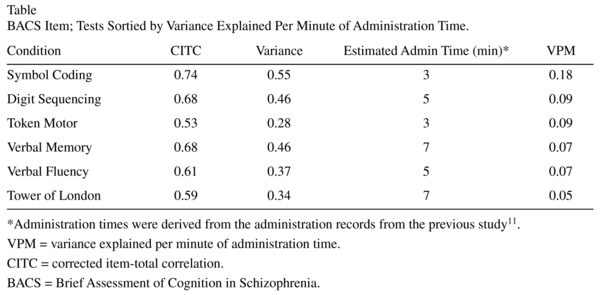
<body><![CDATA[<p><font face="Verdana" size="2"><b>Methods</b></font></p>     <p><font face="Verdana" size="2">Data from a previous study were utilized, and the subjects consisted of 472 stable patients with a DSM-IV<sup>5</sup> diagnosis of chronic schizophrenia or schizoaffective disorder. Among the patients, 213 (45%) were women; the patients had a mean age of 38.8 (SD = 13.3), and a mean age at onset of 24.7 years (SD = 7.9).</font></p>     <p><font face="Verdana" size="2">The BACS takes approximately 30 min, and is devised for easy administration and scoring by non-psychologists. It is specifically designed to measure treatment-related improvements. The BACS has high test-retest reliability<sup>3</sup>, and is as sensitive to cognitive dysfunction in schizophrenia as standard 2.5-h batteries<sup>6</sup>. The BACS includes brief assessments of verbal memory (Verbal Memory), working memory (Digit Sequencing), motor speed (Token Motor), verbal fluency (Verbal Fluency), attention and processing speed (Symbol Coding), and executive function (Tower of London). The 18-item Brief Psychiatric Rating Scale (BPRS<sup>7</sup>, 1-7 score) was completed by a trained psychiatrist along with the BACS, and the patients had a mean total BPRS score of 42.0 (SD = 13.6).</font></p>     <p><font face="Verdana" size="2">The data analyses were conducted using JMP-8.0.2.J for Mac software (SAS Institute Inc., Cary, NC, US). Descriptive statistics were used to report the patients in terms of socio-demographic and clinical data. The relationships among measures were determined by calculating Pearson correlations (r) among the scores. The level of significance was set at <i>P</i> &lt; 0.05 (two-tailed).</font></p>     <p>&nbsp;</p>     <p><font face="Verdana" size="2"><b>Results</b></font></p>     <p><font face="Verdana" size="2">Based on the previous study<sup>8</sup>, we calculated the corrected item-total correlation (CITC) for each test score relative to the composite score (<a href="#t1">Table</a>). The CITC is the correlation between each standardized test score in the BACS with the standardized BACS total score excluding the test score itself, thereby controlling for part-whole correlation. We computed the proportion of variance that each test shares with the global score excluding that test (R<sub>t</sub><sup>2</sup> = CITC<sub>t</sub><sup>2</sup>) and the variance explained per minute of administration time for each test (R<sub>t</sub><sup>2</sup>/min<sub>t</sub>). The 3 tests with the highest R<sub>t</sub><sup>2</sup>/min<sub>t</sub> were selected for the A-BACS. The composite score from the Symbol Coding, Digit Sequencing, and Token Motor tasks correlated 0.93 with the composite score of the whole BACS (R<sup>2</sup> = 0.86, <i>P</i> &lt; 0.0001) and correlated 0.74 with the total battery score excluding these 3 tests (R<sup>2</sup> = 0.55, <i>P</i> &lt; 0.0001).</font></p>     <p>&nbsp;</p>     <p align="center"><font face="Verdana" size="2"><a name="t1"><img src="/img/revistas/ejpen/v29n2/original4_tab1.jpg"></a></font></p>     <p>&nbsp;</p>     ]]></body>
<body><![CDATA[<p><font face="Verdana" size="2"><b>Discussion</b></font></p>     <p><font face="Verdana" size="2">The A-BACS is also composed of two speed of processing measures and one working memory measure. The finding is consistent with the results in the previous reports: in their report, Hurford <i>et al</i>.<sup>8</sup> proposed a group of tests composed of trail making B, category fluency, and digit symbol. Verbal fluency was not chosen for this A-BACS, mainly because verbal fluency in the BACS is composed of Semantic Fluency and two trials of Letter Fluency, and thus it takes three times as long as Semantic Fluency alone takes. The findings in this study therefore suggested that the A-BACS could provide a valid estimate of general cognitive ability.</font></p>     <p><font face="Verdana" size="2">For assessing cognitive function in schizophrenia, a neuropsychological test battery (NTB), usually consisting of 8-12 tests tapping each of several for the putative neurocognitive domains, is employed. These NTBs are, however, time consuming, technically difficult, and costly. The availability of a quick and efficient tool for measuring cognition in patients with schizophrenia could be an extremely useful guide for clinicians making decisions about potential rehabilitation, and thus BACS has been developed. Still, a typical outpatient psychiatric practice allots about 15min for medication management appointments<sup>8</sup>. The 3 tests with the highest R<sub>t</sub><sup>2</sup>/min<sub>t</sub> were selected for the A-BACS, because, as Hurford <i>et al</i>.<sup>8</sup> described, a brief battery should be very brief and account for a large proportion of the variance of the global cognitive score of the battery.</font></p>     <p><font face="Verdana" size="2">Since a single generalized cognitive deficit has been suggested to best characterizes schizophrenia<sup>9</sup> and A-BACS could be administered approximately in 11 min, it may be a good choice to use an A-BACS to assess cognitive function in patients with schizophrenia in clinical settings. For broader dissemination of brief neuropsychological assessments such as A-BACS, further studies should be necessary to test their sensitivity to treatments. In addition, we should be aware that, for prediction of different aspects of outcome, another A-BACS composed of a different subset may be necessary<sup>10</sup>.</font></p>     <p>&nbsp;</p>     <p><font face="Verdana" size="2"><b>Conflict of interest</b></font></p>     <p><font face="Verdana" size="2">Dr. Kaneda is responsible for developing the Japanese version of the BACS. Dr. Keefe receives royalties from the BACS testing battery and the MATRICS Battery (BACS Symbol Coding). He is also a shareholder in NeuroCog Trials, Durham, NC, USA.</font></p>     <p>&nbsp;</p>     <p><font face="Verdana" size="2"><b>References</b></font></p>     <!-- ref --><p><font face="Verdana" size="2">1. Mohamed S, Paulsen JS, O'Leary D, Arndt S, Andreasen N. Generalized cognitive deficits in schizophrenia: A study of first-episode patients. Arch Gen Psychiatry. 1999; 56(8): 749-54.    &nbsp;&nbsp;&nbsp;&nbsp;&nbsp;&nbsp;&nbsp;&nbsp;[&#160;<a href="javascript:void(0);" onclick="javascript: window.open('/scielo.php?script=sci_nlinks&ref=5965298&pid=S0213-6163201500020000400001&lng=','','width=640,height=500,resizable=yes,scrollbars=1,menubar=yes,');">Links</a>&#160;]<!-- end-ref --></font></p>    <!-- ref --><p><font face="Verdana" size="2">2. Green MF, Kern RS, Braff DL, Mintz J. Neurocognitive deficits and functional outcome in schizophrenia: Are we measuring the "right stuff"? Schizophr Bull. 2000; 26(1): 119-36.    &nbsp;&nbsp;&nbsp;&nbsp;&nbsp;&nbsp;&nbsp;&nbsp;[&#160;<a href="javascript:void(0);" onclick="javascript: window.open('/scielo.php?script=sci_nlinks&ref=5965300&pid=S0213-6163201500020000400002&lng=','','width=640,height=500,resizable=yes,scrollbars=1,menubar=yes,');">Links</a>&#160;]<!-- end-ref --></font></p>    <!-- ref --><p><font face="Verdana" size="2">3. Keefe RS, Goldberg TE, Harvey PD, Gold JM, Poe MP, Coughenour L. The Brief Assessment of Cognition in Schizophrenia: Reliability, sensitivity, and comparison with a standard neurocognitive battery. Schizophr Res. 2004; 68(2-3): 283-97.    &nbsp;&nbsp;&nbsp;&nbsp;&nbsp;&nbsp;&nbsp;&nbsp;[&#160;<a href="javascript:void(0);" onclick="javascript: window.open('/scielo.php?script=sci_nlinks&ref=5965302&pid=S0213-6163201500020000400003&lng=','','width=640,height=500,resizable=yes,scrollbars=1,menubar=yes,');">Links</a>&#160;]<!-- end-ref --></font></p>    <!-- ref --><p><font face="Verdana" size="2">4. Kaneda Y, Sumiyoshi T, Keefe R, Ishimoto Y, Numata S, Ohmori T. Brief assessment of cognition in schizophrenia: Validation of the Japanese version. Psychiatry Clin Neurosci. 2007; 61(6): 602-9.    &nbsp;&nbsp;&nbsp;&nbsp;&nbsp;&nbsp;&nbsp;&nbsp;[&#160;<a href="javascript:void(0);" onclick="javascript: window.open('/scielo.php?script=sci_nlinks&ref=5965304&pid=S0213-6163201500020000400004&lng=','','width=640,height=500,resizable=yes,scrollbars=1,menubar=yes,');">Links</a>&#160;]<!-- end-ref --></font></p>    <!-- ref --><p><font face="Verdana" size="2">5. American Psychiatric Association. Diagnostic and Statistical Manual of Mental Disorders, Fourth Edition (DSM-IV). Washington, D.C.: American Psychiatric Association. 1994.    &nbsp;&nbsp;&nbsp;&nbsp;&nbsp;&nbsp;&nbsp;&nbsp;[&#160;<a href="javascript:void(0);" onclick="javascript: window.open('/scielo.php?script=sci_nlinks&ref=5965306&pid=S0213-6163201500020000400005&lng=','','width=640,height=500,resizable=yes,scrollbars=1,menubar=yes,');">Links</a>&#160;]<!-- end-ref --></font></p>    <!-- ref --><p><font face="Verdana" size="2">6. Hill SK, Sweeney JA, Hamer RM, Keefe RS, Perkins DO, Gu H, <i>et al</i>. Efficiency of the CATIE and BACS neuropsychological batteries in assessing cognitive effects of antipsychotic treatments in schizophrenia. J Int Neuropsychol Soc. 2008; 14(2): 209-21.    &nbsp;&nbsp;&nbsp;&nbsp;&nbsp;&nbsp;&nbsp;&nbsp;[&#160;<a href="javascript:void(0);" onclick="javascript: window.open('/scielo.php?script=sci_nlinks&ref=5965308&pid=S0213-6163201500020000400006&lng=','','width=640,height=500,resizable=yes,scrollbars=1,menubar=yes,');">Links</a>&#160;]<!-- end-ref --></font></p>    <!-- ref --><p><font face="Verdana" size="2">7. Overall JE, Gorham DR. The brief psychiatric rating scale. Psychol Rep. 1962; 10: 799-812.    &nbsp;&nbsp;&nbsp;&nbsp;&nbsp;&nbsp;&nbsp;&nbsp;[&#160;<a href="javascript:void(0);" onclick="javascript: window.open('/scielo.php?script=sci_nlinks&ref=5965310&pid=S0213-6163201500020000400007&lng=','','width=640,height=500,resizable=yes,scrollbars=1,menubar=yes,');">Links</a>&#160;]<!-- end-ref --></font></p>    <!-- ref --><p><font face="Verdana" size="2">8. Hurford IM, Marder SR, Keefe RS, Reise SP, Bilder RM. A brief cognitive assessment tool for schizophrenia: Construction of a tool for clinicians. Schizophr Bull. 2011; 37(3): 538-45.    &nbsp;&nbsp;&nbsp;&nbsp;&nbsp;&nbsp;&nbsp;&nbsp;[&#160;<a href="javascript:void(0);" onclick="javascript: window.open('/scielo.php?script=sci_nlinks&ref=5965312&pid=S0213-6163201500020000400008&lng=','','width=640,height=500,resizable=yes,scrollbars=1,menubar=yes,');">Links</a>&#160;]<!-- end-ref --></font></p>    <!-- ref --><p><font face="Verdana" size="2">9. Bilder RM, Goldman RS, Robinson D, Reiter G, Bell L, Bates JA, <i>et al</i>. Neuropsychology of first-episode schizophrenia: Initial characterization and clinical correlates. Am J Psychiatry. 2000; 157(4): 549-59.    &nbsp;&nbsp;&nbsp;&nbsp;&nbsp;&nbsp;&nbsp;&nbsp;[&#160;<a href="javascript:void(0);" onclick="javascript: window.open('/scielo.php?script=sci_nlinks&ref=5965314&pid=S0213-6163201500020000400009&lng=','','width=640,height=500,resizable=yes,scrollbars=1,menubar=yes,');">Links</a>&#160;]<!-- end-ref --></font></p>    <!-- ref --><p><font face="Verdana" size="2">10. Harvey PD, Keefe RS, Patterson TL, Heaton RK, Bowie CR. Abbreviated neuropsychological assessment in schizophrenia: Prediction of different aspects of outcome. J Clin Exp Neuropsychol. 2009; 31(4): 462-71.    &nbsp;&nbsp;&nbsp;&nbsp;&nbsp;&nbsp;&nbsp;&nbsp;[&#160;<a href="javascript:void(0);" onclick="javascript: window.open('/scielo.php?script=sci_nlinks&ref=5965316&pid=S0213-6163201500020000400010&lng=','','width=640,height=500,resizable=yes,scrollbars=1,menubar=yes,');">Links</a>&#160;]<!-- end-ref --></font></p>    <!-- ref --><p><font face="Verdana" size="2">11. Keefe RS, Harvey PD, Goldberg TE, Gold JM, Walker TM, Kennel C, <i>et al</i>. Norms and standardization of the Brief Assessment of Cognition in Schizophrenia (BACS). Schizophr Res. 2008; 102(1-3): 108-15.    &nbsp;&nbsp;&nbsp;&nbsp;&nbsp;&nbsp;&nbsp;&nbsp;[&#160;<a href="javascript:void(0);" onclick="javascript: window.open('/scielo.php?script=sci_nlinks&ref=5965318&pid=S0213-6163201500020000400011&lng=','','width=640,height=500,resizable=yes,scrollbars=1,menubar=yes,');">Links</a>&#160;]<!-- end-ref --></font></p>     <p>&nbsp;</p>     <p>&nbsp;</p>     <p><font face="Verdana" size="2"><a href="#top"><img border="0" src="/img/revistas/ejpen/v29n2/seta.gif" width="15" height="17"></a><a name="bajo"></a><b>Correspondence:</b>    <br>Yasuhiro Kaneda, MD, PhD    <br>Department of Psychiatry    <br>Iwaki Clinic, 11-1 Kamimizuta    <br>Gakubara, Anan    <br>Tokushima 774-0014    <br>Japan    ]]></body>
<body><![CDATA[<br>Tel. +81-884-23-5600    <br>Facsimile number: +81-884-22-1780    <br>E-mail: <a href="mailto:kaneday-tsh@umin.ac.jp">kaneday-tsh@umin.ac.jp</a></font></p>     <p><font face="Verdana" size="2">Received: 24 December 2014    <br>Revised: 31 March 2015    <br>Accepted: 31 March 2015</font></p>      ]]></body><back>
<ref-list>
<ref id="B1">
<label>1</label><nlm-citation citation-type="journal">
<person-group person-group-type="author">
<name>
<surname><![CDATA[Mohamed]]></surname>
<given-names><![CDATA[S]]></given-names>
</name>
<name>
<surname><![CDATA[Paulsen]]></surname>
<given-names><![CDATA[JS]]></given-names>
</name>
<name>
<surname><![CDATA[O'Leary]]></surname>
<given-names><![CDATA[D]]></given-names>
</name>
<name>
<surname><![CDATA[Arndt]]></surname>
<given-names><![CDATA[S]]></given-names>
</name>
<name>
<surname><![CDATA[Andreasen]]></surname>
<given-names><![CDATA[N]]></given-names>
</name>
</person-group>
<article-title xml:lang="en"><![CDATA[Generalized cognitive deficits in schizophrenia: A study of first-episode patients]]></article-title>
<source><![CDATA[Arch Gen Psychiatry]]></source>
<year>1999</year>
<volume>56</volume>
<numero>8</numero>
<issue>8</issue>
<page-range>749-54</page-range></nlm-citation>
</ref>
<ref id="B2">
<label>2</label><nlm-citation citation-type="journal">
<person-group person-group-type="author">
<name>
<surname><![CDATA[Green]]></surname>
<given-names><![CDATA[MF]]></given-names>
</name>
<name>
<surname><![CDATA[Kern]]></surname>
<given-names><![CDATA[RS]]></given-names>
</name>
<name>
<surname><![CDATA[Braff]]></surname>
<given-names><![CDATA[DL]]></given-names>
</name>
<name>
<surname><![CDATA[Mintz]]></surname>
<given-names><![CDATA[J]]></given-names>
</name>
</person-group>
<article-title xml:lang="en"><![CDATA[Neurocognitive deficits and functional outcome in schizophrenia: Are we measuring the "right stuff"?]]></article-title>
<source><![CDATA[Schizophr Bull.]]></source>
<year>2000</year>
<volume>26</volume>
<numero>1</numero>
<issue>1</issue>
<page-range>119-36</page-range></nlm-citation>
</ref>
<ref id="B3">
<label>3</label><nlm-citation citation-type="journal">
<person-group person-group-type="author">
<name>
<surname><![CDATA[Keefe]]></surname>
<given-names><![CDATA[RS]]></given-names>
</name>
<name>
<surname><![CDATA[Goldberg]]></surname>
<given-names><![CDATA[TE]]></given-names>
</name>
<name>
<surname><![CDATA[Harvey]]></surname>
<given-names><![CDATA[PD]]></given-names>
</name>
<name>
<surname><![CDATA[Gold]]></surname>
<given-names><![CDATA[JM]]></given-names>
</name>
<name>
<surname><![CDATA[Poe]]></surname>
<given-names><![CDATA[MP]]></given-names>
</name>
<name>
<surname><![CDATA[Coughenour]]></surname>
<given-names><![CDATA[L]]></given-names>
</name>
</person-group>
<article-title xml:lang="en"><![CDATA[The Brief Assessment of Cognition in Schizophrenia: Reliability, sensitivity, and comparison with a standard neurocognitive battery]]></article-title>
<source><![CDATA[Schizophr Res.]]></source>
<year>2004</year>
<volume>68</volume>
<numero>2-3</numero>
<issue>2-3</issue>
<page-range>283-97</page-range></nlm-citation>
</ref>
<ref id="B4">
<label>4</label><nlm-citation citation-type="journal">
<person-group person-group-type="author">
<name>
<surname><![CDATA[Kaneda]]></surname>
<given-names><![CDATA[Y]]></given-names>
</name>
<name>
<surname><![CDATA[Sumiyoshi]]></surname>
<given-names><![CDATA[T]]></given-names>
</name>
<name>
<surname><![CDATA[Keefe]]></surname>
<given-names><![CDATA[R]]></given-names>
</name>
<name>
<surname><![CDATA[Ishimoto]]></surname>
<given-names><![CDATA[Y]]></given-names>
</name>
<name>
<surname><![CDATA[Numata]]></surname>
<given-names><![CDATA[S]]></given-names>
</name>
<name>
<surname><![CDATA[Ohmori]]></surname>
<given-names><![CDATA[T]]></given-names>
</name>
</person-group>
<article-title xml:lang="en"><![CDATA[Brief assessment of cognition in schizophrenia: Validation of the Japanese version]]></article-title>
<source><![CDATA[Psychiatry Clin Neurosci.]]></source>
<year>2007</year>
<volume>61</volume>
<numero>6</numero>
<issue>6</issue>
<page-range>602-9</page-range></nlm-citation>
</ref>
<ref id="B5">
<label>5</label><nlm-citation citation-type="book">
<collab>American Psychiatric Association</collab>
<source><![CDATA[Diagnostic and Statistical Manual of Mental Disorders]]></source>
<year>1994</year>
<publisher-loc><![CDATA[Washington^eD.C. D.C.]]></publisher-loc>
<publisher-name><![CDATA[American Psychiatric Association]]></publisher-name>
</nlm-citation>
</ref>
<ref id="B6">
<label>6</label><nlm-citation citation-type="journal">
<person-group person-group-type="author">
<name>
<surname><![CDATA[Hill]]></surname>
<given-names><![CDATA[SK]]></given-names>
</name>
<name>
<surname><![CDATA[Sweeney]]></surname>
<given-names><![CDATA[JA]]></given-names>
</name>
<name>
<surname><![CDATA[Hamer]]></surname>
<given-names><![CDATA[RM]]></given-names>
</name>
<name>
<surname><![CDATA[Keefe]]></surname>
<given-names><![CDATA[RS]]></given-names>
</name>
<name>
<surname><![CDATA[Perkins]]></surname>
<given-names><![CDATA[DO]]></given-names>
</name>
<name>
<surname><![CDATA[Gu]]></surname>
<given-names><![CDATA[H]]></given-names>
</name>
</person-group>
<article-title xml:lang="en"><![CDATA[Efficiency of the CATIE and BACS neuropsychological batteries in assessing cognitive effects of antipsychotic treatments in schizophrenia]]></article-title>
<source><![CDATA[J Int Neuropsychol Soc.]]></source>
<year>2008</year>
<volume>14</volume>
<numero>2</numero>
<issue>2</issue>
<page-range>209-21</page-range></nlm-citation>
</ref>
<ref id="B7">
<label>7</label><nlm-citation citation-type="journal">
<person-group person-group-type="author">
<name>
<surname><![CDATA[Overall]]></surname>
<given-names><![CDATA[JE]]></given-names>
</name>
<name>
<surname><![CDATA[Gorham]]></surname>
<given-names><![CDATA[DR]]></given-names>
</name>
</person-group>
<article-title xml:lang="en"><![CDATA[The brief psychiatric rating scale]]></article-title>
<source><![CDATA[Psychol Rep.]]></source>
<year>1962</year>
<volume>10</volume>
<page-range>799-812</page-range></nlm-citation>
</ref>
<ref id="B8">
<label>8</label><nlm-citation citation-type="journal">
<person-group person-group-type="author">
<name>
<surname><![CDATA[Hurford]]></surname>
<given-names><![CDATA[IM]]></given-names>
</name>
<name>
<surname><![CDATA[Marder]]></surname>
<given-names><![CDATA[SR]]></given-names>
</name>
<name>
<surname><![CDATA[Keefe]]></surname>
<given-names><![CDATA[RS]]></given-names>
</name>
<name>
<surname><![CDATA[Reise]]></surname>
<given-names><![CDATA[SP]]></given-names>
</name>
<name>
<surname><![CDATA[Bilder]]></surname>
<given-names><![CDATA[RM]]></given-names>
</name>
</person-group>
<article-title xml:lang="en"><![CDATA[A brief cognitive assessment tool for schizophrenia: Construction of a tool for clinicians]]></article-title>
<source><![CDATA[Schizophr Bull.]]></source>
<year>2011</year>
<volume>37</volume>
<numero>3</numero>
<issue>3</issue>
<page-range>538-45</page-range></nlm-citation>
</ref>
<ref id="B9">
<label>9</label><nlm-citation citation-type="journal">
<person-group person-group-type="author">
<name>
<surname><![CDATA[Bilder]]></surname>
<given-names><![CDATA[RM]]></given-names>
</name>
<name>
<surname><![CDATA[Goldman]]></surname>
<given-names><![CDATA[RS]]></given-names>
</name>
<name>
<surname><![CDATA[Robinson]]></surname>
<given-names><![CDATA[D]]></given-names>
</name>
<name>
<surname><![CDATA[Reiter]]></surname>
<given-names><![CDATA[G]]></given-names>
</name>
<name>
<surname><![CDATA[Bell]]></surname>
<given-names><![CDATA[L]]></given-names>
</name>
<name>
<surname><![CDATA[Bates]]></surname>
<given-names><![CDATA[JA]]></given-names>
</name>
</person-group>
<article-title xml:lang="en"><![CDATA[Neuropsychology of first-episode schizophrenia: Initial characterization and clinical correlates]]></article-title>
<source><![CDATA[Am J Psychiatry]]></source>
<year>2000</year>
<volume>157</volume>
<numero>4</numero>
<issue>4</issue>
<page-range>549-59</page-range></nlm-citation>
</ref>
<ref id="B10">
<label>10</label><nlm-citation citation-type="journal">
<person-group person-group-type="author">
<name>
<surname><![CDATA[Harvey]]></surname>
<given-names><![CDATA[PD]]></given-names>
</name>
<name>
<surname><![CDATA[Keefe]]></surname>
<given-names><![CDATA[RS]]></given-names>
</name>
<name>
<surname><![CDATA[Patterson]]></surname>
<given-names><![CDATA[TL]]></given-names>
</name>
<name>
<surname><![CDATA[Heaton]]></surname>
<given-names><![CDATA[RK]]></given-names>
</name>
<name>
<surname><![CDATA[Bowie]]></surname>
<given-names><![CDATA[CR]]></given-names>
</name>
</person-group>
<article-title xml:lang="en"><![CDATA[Abbreviated neuropsychological assessment in schizophrenia: Prediction of different aspects of outcome]]></article-title>
<source><![CDATA[J Clin Exp Neuropsychol.]]></source>
<year>2009</year>
<volume>31</volume>
<numero>4</numero>
<issue>4</issue>
<page-range>462-71</page-range></nlm-citation>
</ref>
<ref id="B11">
<label>11</label><nlm-citation citation-type="journal">
<person-group person-group-type="author">
<name>
<surname><![CDATA[Keefe]]></surname>
<given-names><![CDATA[RS]]></given-names>
</name>
<name>
<surname><![CDATA[Harvey]]></surname>
<given-names><![CDATA[PD]]></given-names>
</name>
<name>
<surname><![CDATA[Goldberg]]></surname>
<given-names><![CDATA[TE]]></given-names>
</name>
<name>
<surname><![CDATA[Gold]]></surname>
<given-names><![CDATA[JM]]></given-names>
</name>
<name>
<surname><![CDATA[Walker]]></surname>
<given-names><![CDATA[TM]]></given-names>
</name>
<name>
<surname><![CDATA[Kennel]]></surname>
<given-names><![CDATA[C]]></given-names>
</name>
</person-group>
<article-title xml:lang="en"><![CDATA[Norms and standardization of the Brief Assessment of Cognition in Schizophrenia (BACS)]]></article-title>
<source><![CDATA[Schizophr Res.]]></source>
<year>2008</year>
<volume>102</volume>
<numero>1-3</numero>
<issue>1-3</issue>
<page-range>108-15</page-range></nlm-citation>
</ref>
</ref-list>
</back>
</article>
