<?xml version="1.0" encoding="ISO-8859-1"?><article xmlns:mml="http://www.w3.org/1998/Math/MathML" xmlns:xlink="http://www.w3.org/1999/xlink" xmlns:xsi="http://www.w3.org/2001/XMLSchema-instance">
<front>
<journal-meta>
<journal-id>0213-6163</journal-id>
<journal-title><![CDATA[The European Journal of Psychiatry]]></journal-title>
<abbrev-journal-title><![CDATA[Eur. J. Psychiat.]]></abbrev-journal-title>
<issn>0213-6163</issn>
<publisher>
<publisher-name><![CDATA[Universidad de Zaragoza]]></publisher-name>
</publisher>
</journal-meta>
<article-meta>
<article-id>S0213-61632016000100003</article-id>
<title-group>
<article-title xml:lang="en"><![CDATA[Levels of salivary immunoglobulin A under psychological stress and its relationship with rumination and five personality traits in medical students]]></article-title>
</title-group>
<contrib-group>
<contrib contrib-type="author">
<name>
<surname><![CDATA[Afrisham]]></surname>
<given-names><![CDATA[Reza]]></given-names>
</name>
<xref ref-type="aff" rid="A01"/>
<xref ref-type="aff" rid="A02"/>
</contrib>
<contrib contrib-type="author">
<name>
<surname><![CDATA[Aberomand]]></surname>
<given-names><![CDATA[Mohammad]]></given-names>
</name>
<xref ref-type="aff" rid="A02"/>
</contrib>
<contrib contrib-type="author">
<name>
<surname><![CDATA[SoliemaniFar]]></surname>
<given-names><![CDATA[Omid]]></given-names>
</name>
<xref ref-type="aff" rid="A03"/>
</contrib>
<contrib contrib-type="author">
<name>
<surname><![CDATA[Kooti]]></surname>
<given-names><![CDATA[Wesam]]></given-names>
</name>
<xref ref-type="aff" rid="A04"/>
</contrib>
<contrib contrib-type="author">
<name>
<surname><![CDATA[Ashtary-Larky]]></surname>
<given-names><![CDATA[Damoon]]></given-names>
</name>
<xref ref-type="aff" rid="A01"/>
<xref ref-type="aff" rid="A02"/>
</contrib>
<contrib contrib-type="author">
<name>
<surname><![CDATA[Alamiri]]></surname>
<given-names><![CDATA[Fatima]]></given-names>
</name>
<xref ref-type="aff" rid="A05"/>
</contrib>
<contrib contrib-type="author">
<name>
<surname><![CDATA[Najjar-Asl]]></surname>
<given-names><![CDATA[Sedigheh]]></given-names>
</name>
<xref ref-type="aff" rid="A06"/>
</contrib>
<contrib contrib-type="author">
<name>
<surname><![CDATA[Khaneh-Keshi]]></surname>
<given-names><![CDATA[Ali]]></given-names>
</name>
<xref ref-type="aff" rid="A06"/>
</contrib>
<contrib contrib-type="author">
<name>
<surname><![CDATA[Sadegh-Nejadi]]></surname>
<given-names><![CDATA[Sahar]]></given-names>
</name>
<xref ref-type="aff" rid="A01"/>
<xref ref-type="aff" rid="A02"/>
</contrib>
</contrib-group>
<aff id="A01">
<institution><![CDATA[,Jundishapour University of Medical Sciences Student Research Committee ]]></institution>
<addr-line><![CDATA[Ahvaz ]]></addr-line>
<country>Iran</country>
</aff>
<aff id="A02">
<institution><![CDATA[,Jundishapour University of Medical Sciences Faculty of Medicine Department of Clinical Biochemistry]]></institution>
<addr-line><![CDATA[Ahvaz ]]></addr-line>
<country>Iran</country>
</aff>
<aff id="A03">
<institution><![CDATA[,Payame Noor University Department of Psychology ]]></institution>
<addr-line><![CDATA[Abdanan ]]></addr-line>
<country>Iran</country>
</aff>
<aff id="A04">
<institution><![CDATA[,Kurdistan University of Medical Sciences Student Research Committee ]]></institution>
<addr-line><![CDATA[Sanandaj ]]></addr-line>
<country>Iran</country>
</aff>
<aff id="A05">
<institution><![CDATA[,Henry Ford College Henry Ford Early College ]]></institution>
<addr-line><![CDATA[Dearborn Michigan]]></addr-line>
<country>USA</country>
</aff>
<aff id="A06">
<institution><![CDATA[,Islamic Azad University Psychology Faculty Department of Psychology]]></institution>
<addr-line><![CDATA[Behbahan ]]></addr-line>
<country>Iran</country>
</aff>
<pub-date pub-type="pub">
<day>00</day>
<month>03</month>
<year>2016</year>
</pub-date>
<pub-date pub-type="epub">
<day>00</day>
<month>03</month>
<year>2016</year>
</pub-date>
<volume>30</volume>
<numero>1</numero>
<fpage>41</fpage>
<lpage>53</lpage>
<copyright-statement/>
<copyright-year/>
<self-uri xlink:href="http://scielo.isciii.es/scielo.php?script=sci_arttext&amp;pid=S0213-61632016000100003&amp;lng=en&amp;nrm=iso"></self-uri><self-uri xlink:href="http://scielo.isciii.es/scielo.php?script=sci_abstract&amp;pid=S0213-61632016000100003&amp;lng=en&amp;nrm=iso"></self-uri><self-uri xlink:href="http://scielo.isciii.es/scielo.php?script=sci_pdf&amp;pid=S0213-61632016000100003&amp;lng=en&amp;nrm=iso"></self-uri><abstract abstract-type="short" xml:lang="en"><p><![CDATA[Background and Objectives: The measurement of salivary immunoglobulin A is a useful and non-invasive method for measuring stress. Personality traits and rumination act as possible mediators in the relationship between psychological stressors and the immune system. This study was aimed to evaluate the levels of salivary IgA under psychological stress and its relationship with rumination and five personality traits in medical students. Methods: In this cross- sectional study, 45 medical students who intended to participate in the final exam were selected by simple random sampling. Two months before the exam, in the basal conditions, the NEO Personality Inventory-Short Form and Emotional Control Questionnaire (ECQ) were completed. Saliva samples were taken from students in both the basal conditions and exam stress conditions. Salivary IgA was measured by an ELISA test. Data was analyzed using paired samples T-test, Pearson correlation analysis, and stepwise regression. Results: A significant reduction of salivary IgA levels was found in exam stress conditions. Also, a significant negative correlation was found between traits of neuroticism and rumination with salivary IgA, as well as a significant positive correlation between of openness to experience and emotional inhibition with salivary IgA. Openness to experience and emotional inhibition may predict a substantial variance (34%) of salivary IgA under exam stress. Conclusions: Salivary IgA is reduced in response to exam stress. In addition, the rumination and personality traits may reduce or increase stress effects on the immune system, particularly the salivary IgA.]]></p></abstract>
<kwd-group>
<kwd lng="en"><![CDATA[Salivary IgA]]></kwd>
<kwd lng="en"><![CDATA[Personality traits]]></kwd>
<kwd lng="en"><![CDATA[Rumination]]></kwd>
<kwd lng="en"><![CDATA[Stress]]></kwd>
</kwd-group>
</article-meta>
</front><body><![CDATA[ <p>&nbsp;</p>     <p>&nbsp;</p> <a name="top"></a>    <p><font face="Verdana" size="4"><b>Levels of salivary immunoglobulin A under psychological stress and its relationship with rumination and five personality traits in medical students</b></font></p>     <p>&nbsp;</p>     <p>&nbsp;</p>     <p><font face="Verdana" size="2"><b>Reza Afrisham<sup>a,b</sup>; Mohammad Aberomand<sup>b</sup>; Omid SoliemaniFar<sup>c</sup>; Wesam Kooti<sup>d</sup>; Damoon Ashtary-Larky<sup>a,b</sup>; Fatima Alamiri <sup>e</sup>; Sedigheh Najjar-Asl<sup>f</sup>; Ali Khaneh-Keshi<sup>f</sup> and Sahar Sadegh-Nejadi<sup>a,b</sup></b></font></p>     <p><font face="Verdana" size="2"><sup>a</sup> Student Research Committee, Ahvaz Jundishapour University of Medical Sciences, Ahvaz. Iran    <br><sup>b</sup> Department of Clinical Biochemistry, Faculty of Medicine, Ahvaz Jundishapur University of Medical Sciences, Ahvaz. Iran    <br><sup>c</sup> Department of Psychology, Abdanan Payame Noor University, Abdanan. Iran    <br><sup>d</sup> Student Research Committee, Kurdistan University of Medical Sciences, Sanandaj. Iran    ]]></body>
<body><![CDATA[<br><sup>e</sup> Sophmore/Health and Medical Studies, Henry Ford Early College at Henry Ford College, Dearborn, Michigan. USA    <br><sup>f</sup> Department of Psychology, Psychology Faculty, Behbahan Branch, Islamic Azad University, Behbahan. Iran</font></p>     <p><font face="Verdana" size="2">Financial support was provided by Student Research Committee of Ahvaz Jundishapur University of Medical Sciences.</font></p>     <p><font face="Verdana" size="2">Financial Disclosure: This study was supported by Ahvaz Jundishapur University of Medical Sciences.</font></p>     <p><font face="Verdana" size="2"><a href="#bajo">Correspondence</a></font></p>     <p>&nbsp;</p>     <p>&nbsp;</p> <hr size="1">     <p><font face="Verdana" size="2"><b>ABSTRACT</b></font></p>     <p><font face="Verdana" size="2"><b>Background and Objectives:</b> The measurement of salivary immunoglobulin A is a useful and non-invasive method for measuring stress. Personality traits and rumination act as possible mediators in the relationship between psychological stressors and the immune system. This study was aimed to evaluate the levels of salivary IgA under psychological stress and its relationship with rumination and five personality traits in medical students.    <br><b>Methods:</b> In this cross- sectional study, 45 medical students who intended to participate in the final exam were selected by simple random sampling. Two months before the exam, in the basal conditions, the NEO Personality Inventory-Short Form and Emotional Control Questionnaire (ECQ) were completed. Saliva samples were taken from students in both the basal conditions and exam stress conditions. Salivary IgA was measured by an ELISA test. Data was analyzed using paired samples T-test, Pearson correlation analysis, and stepwise regression.    ]]></body>
<body><![CDATA[<br><b>Results:</b> A significant reduction of salivary IgA levels was found in exam stress conditions. Also, a significant negative correlation was found between traits of neuroticism and rumination with salivary IgA, as well as a significant positive correlation between of openness to experience and emotional inhibition with salivary IgA. Openness to experience and emotional inhibition may predict a substantial variance (34%) of salivary IgA under exam stress.    <br><b>Conclusions:</b> Salivary IgA is reduced in response to exam stress. In addition, the rumination and personality traits may reduce or increase stress effects on the immune system, particularly the salivary IgA.</font></p>     <p><font face="Verdana" size="2"><b>Key words:</b> Salivary IgA; Personality traits; Rumination; Stress.</font></p> <hr size="1">     <p>&nbsp;</p>     <p><font face="Verdana" size="2"><b>Introduction</b></font></p>     <p><font face="Verdana" size="2">Stress is an environmental and psychological stimulus that creates mental or physiological responses and this may lead to disease in individuals. Mild stress can be useful for tasks and cognitive performance, while constant and high stress leads to anxiety and depression<sup>1</sup>. Studies show that acute stress can reduce the performance of the immune system and suppress the production of immunoglobulin<sup>2</sup>. The effects of stress and negative emotions on the levels of IgA are one of the major issues in the field of psychoneuroimmunology studies<sup>3</sup>. Recently, the measurement of salivary immunoglobulin A (sIgA) is another potential non-invasive method for the measurement of stress. The IgA is the most frequent class of antibodies in mucous membrane, which is a very important factor in the protection against infectious agents, allergy, and external proteins and has a concentration that can be affected by stress<sup>4</sup>. It is reported that salivary IgA level changes in response to psychological factors, such as desirable or undesirable daily events, daily hassles, positive and negative mood, short-term stressful cognitive tasks and presentation<sup>5</sup>. Even studies conducted on animals (such as mature dogs) showed that IgA levels following prolonged stress and acute stress is reduced<sup>4</sup>. In the present study, we focused on stressful situations by experienced medical students. Exams are one of the important academic stressful situations.</font></p>     <p><font face="Verdana" size="2">Academic exams are considered as one of psychological stressors, because success in exams is related to future professional life of students<sup>6</sup>. Exams (a psychological stress factor) play an important role in the assessment of learning outcomes and competence of students. In particular, medical students experience a high level of anxiety during exams. Previous studies showed that exam stress can increase anxiety, salivary cortisol levels and blood pressure<sup>7</sup>. It is known that stress from academic exams has a significant impact on the well-being of individuals and it is associated with mental and physical health changes such as increased anxiety, negative mental state, and changes in immune function<sup>8</sup>. Various studies have examined the effects of educational and exam stress as psychological stressors on the immune system, particularly IgA levels<sup>9</sup>. However, there are conflicting findings. For example, the long-term periods of exam stress<sup>10,11</sup>, as well as an oral examination<sup>12</sup> are associated with a significant reduction in salivary IgA levels. On the other hand, increased levels of salivary IgA in the days before and during their academic exams<sup>13,14</sup> and lower levels during the days between exams<sup>13</sup> and after the announcement of the scores (Associated with academic success) have been observed<sup>14</sup>. In addition, the daily changes in salivary IgA concentration sometimes seem to be disturbed due to the academic stress<sup>13</sup>. Given the above background, it seems the association between examination stresses with IgA levels is not known reliably, yet. Thus, in the present study, we examined the effect of exam stress on salivary IgA levels in medical students. Additionally, the student reaction to exam stress may be influenced by psychological factors and personality traits. Accordingly, the relationship between rumination and personality traits with salivary IgA under exam stress has been studied.</font></p>     <p><font face="Verdana" size="2">Rumination, as a psychological construct associated with stress, can cause and maintain physiological activities associated with stress factors<sup>15</sup>. Rumination is important to maintain and increases the severity of depression and stress, and its increase is associated with rise stress levels<sup>16</sup>. Research findings show the association between rumination with cortisol responses<sup>15</sup> and salivary alpha amylase<sup>17</sup> to psychological stress. The question arises as to whether changes in salivary IgA levels can be influenced by traits of persons rumination. We have tried to study the relationship between the rumination and salivary IgA under psychological stress.</font></p>     <p><font face="Verdana" size="2">In the initial reports about the relationship between stress and disease, there was an assumption that the stress factors similarly affect everyone. However, since the relationship between stress and disease in general was low, the researchers were more interested in adjusted variables or psychological characteristics of individuals that may increase or reduce the effects of stress variables<sup>3</sup>. The hypothesized relationship between the personality and the immune system has been prevalent for a minimum of 25 years and therefore recognizing the relationship can help us to understand the effects of personality on the extent and period of chronic diseases, including cancer and heart disease. A number of aspects of personality, such as suppression, hostility, attribution style, and extraversion-introversion have been associated with parameters of the immune system<sup>18</sup>. But in particular, psychological characteristics associated with personality, such as a sense of humor, internal locus of control, hardiness and inhibited and stressed power motivation have been reported in association with the concentration and level of salivary IgA secretion. However, there are other studies that show conflicting findings on the relationship between the personality traits and salivary IgA levels<sup>3</sup>. Using the Five Factor model, previous studies have reported the relationship between neuroticism trait with cortisol<sup>19</sup> and salivary alpha-amylase<sup>17,20</sup>, as well as a negative<sup>20</sup> and positive<sup>17</sup> correlation between agreeableness and salivary alpha-amylase. Nevertheless, some findings showed that the conscientiousness affects parameters of the immune system such as delayed type hypersensitivity (DTH)<sup>21</sup>. In one study, individuals with low levels of extraversion characteristics had higher basic natural killer cell activity, but the number of their natural killer cells was stable<sup>22</sup>. Based on the information stated in the background, we assume that the five major personality traits could be predictive key factors in relation to the parameters of the immune system, particularly the salivary IgA.</font></p>     <p><font face="Verdana" size="2">The main objective of the present study was to investigate the salivary IgA levels under psychological stress and its relationship with five personality traits and rumination.</font></p>     ]]></body>
<body><![CDATA[<p>&nbsp;</p>     <p><font face="Verdana" size="2"><b>Methods</b></font></p>     <p><font face="Verdana" size="3">Participants</font></p>     <p><font face="Verdana" size="2">This was a cross-sectional study. The study population consisted of medical students in Ahvaz Jundishapur University of Medical Sciences (AJUMS), entered on October 2014, who had to attend a final exam. A sample size of 45 participant (22 females, 23 males) was selected using Cochran formula and simple random sampling method from the prepared list (the statistical population = 73 people) from Medical School. Written consent was obtained from all the students and the purpose and method was explained to them. Because academic examinations stress were reported to have a significant impact on the student's well-being, and are associated with changes in the mental and physical health such as increasing anxiety, increasing negative mood and changes in the immune functioning<sup>23</sup>. Furthermore, due to the students being freshmen, the first exam was considered as a stressful situation. The natural conditions did not change the normal level of biochemical factors significantly, however in exam stress conditions or mental pressure, changes are obvious<sup>17,24</sup>. Thus, the exam was considered as psychological stressful situation.</font></p>     <p><font face="Verdana" size="3">Measures</font></p>     <p><font face="Verdana" size="2">In this study, data collection tools included a shortened version of the NEO Five-Factor Inventory (NEO-FFI), and Emotional Control Questionnaire (ECQ). Two months before the exam (basal conditions) all participants filled the NEO- Short Form and the ECQ.</font></p>     <p><font face="Verdana" size="2">1. A shortened version of the NEO-FFI: In this study, McCrae and Costa's 60-statement questionnaire (1992) was used. This scale measures the five major personality traits, which include: Neuroticism (N), Extraversion (E), Agreeableness (A), Openness to Experience (O), and conscientiousness (C). Each of these traits can be measured with 12 questions. The answer to the questionnaire is set based on the Likert scale, completely disagree (0); disagree (1); indifferent (2); agree (3); and completely agree (4). Based on Cronbach's alpha coefficients by Costa and McCrae the internal consistency of this scale for the traits of the N, E, O, A, and C was 0.66, 0.77, 0.73, 0.68 and 0.81, respectively<sup>25</sup>. In this study, using Cronbach's alpha the coefficient of reliability of the questionnaire calculated for the traits of the N, E, O, A, and C was 0.76, 0.68, 0.77, 0.72, and 0.81, respectively.</font></p>     <p><font face="Verdana" size="2">2. Emotional Control Questionnaire (ECQ): The questionnaire has been developed by Roger and Nesshoever (1987) and has been renewed by Roger and Najarian (1989). The ECQ measures four scales of emotional inhibition, aggression control, rumination, or rehearsing and benign control measures and has 56 items. Each sub-scale has 14 questions. The score of a person in each sub-scale is ranging from 0 to 14 and in the total scale is ranging from 0 to 56. High scores indicate greater emotional control<sup>26</sup>. The validity of the questionnaire using internal consistency, and Cronbach's alpha coefficient calculated by Rafineya <i>et al</i>. (2006) for each sub-scale of emotional inhibition, aggression control, rumination, and benign control were 0.70, 0.76, 0.77, and 0.58, respectively and its total validity was 0.68<sup>27</sup>. In the present study, the reliability coefficient obtained using Cronbach's alpha coefficient for the total scale was 0.78 and for each of the sub-scales of emotional inhibition, aggression control, rumination, and benign control was 0.59, 0.63, 0.68 and 0.73, respectively.</font></p>     <p><font face="Verdana" size="3">Sampling and analices of saliva</font></p>     <p><font face="Verdana" size="2">To conduct this research in the first phase, two months before the exam (basal conditions) and two days after the filling out of the questionnaires by the participants, saliva samples were taken to measure salivary IgA in the basal conditions. Then, in the second phase, to measure salivary IgA during the exam stress condition, the subjects' saliva samples were taken at the start of the exam. In both phases of sampling, the subjects were told not to have caffeine from the night before taking the saliva samples until the taking of the samples, and they were not permitted the intake of any food one hour prior to exam to prevent any interference in the process of sample collection and measurement of salivary IgA<sup>26</sup>. To take salivary samples, the subjects were asked to collect their secreted saliva for five minutes in the tubes determined by passive methods<sup>28</sup>. Both times, sampling from saliva was performed in identical circumstances at one particular time (10 am). Saliva samples taken in two steps immediately were sent to the laboratory of Biochemistry Department of AJUMS for analysis. First, the samples were centrifuged with a round of 3000g for 15 minutes and for the evaluation of IgA the supernatant was frozen at -70 <sup>o</sup>C. When measuring salivary IgA, at first the saliva samples were melted and then centrifuged again with the previous conditions, and measured by a Kit (Diametra, Italy) by ELISA method using an ELISA reader (BIOTEK, model ELX800, USA).</font></p>     ]]></body>
<body><![CDATA[<p><font face="Verdana" size="3">Statistical analyses</font></p>     <p><font face="Verdana" size="2">To analyze the data, descriptive statistical methods, including mean, standard deviation, minimum and maximum scores were used, and Pearson correlation coefficient was used for measuring the strength of the association between the two variables. In addition, to determine the best predictor of IgA under psychological stress the stepwise regression analysis was used and paired sample t-test was utilized to compare differences in levels of IgA under the exam stress with the basal conditions of the participants; SPSS version 15 was used for this purpose.</font></p>     <p>&nbsp;</p>     <p><font face="Verdana" size="2"><b>Results</b></font></p>     <p><font face="Verdana" size="2"><a href="#t1">Table 1</a> shows descriptive statistics (mean, standard deviation, minimum and maximum scores) of the variables of the study in the medical students.</font></p>     <p>&nbsp;</p>     <p align="center"><font face="Verdana" size="2"><a name="t1"><img src="/img/revistas/ejpen/v30n1/original03_tabla1.jpg"></a></font></p>     <p>&nbsp;</p>     <p><font face="Verdana" size="2">Then, to compare the level of salivary IgA under basal condition and in the exam condition the paired samples t-test was used. <a href="#t2">Table 2</a> shows a comparison of means of salivary IgA levels (&mu;g/ml) in the conditions of before the exam and under the exam.</font></p>     <p>&nbsp;</p>     ]]></body>
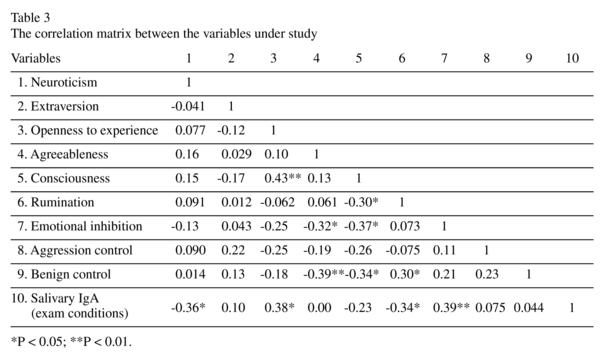
<body><![CDATA[<p align="center"><font face="Verdana" size="2"><a name="t2"><img src="/img/revistas/ejpen/v30n1/original03_tabla2.jpg"></a></font></p>     <p>&nbsp;</p>     <p><font face="Verdana" size="2">As reflected by <a href="#t2">Table 2</a>, there are significant differences in the means of salivary IgA levels (&mu;g/ml) of students in the basal conditions and exam conditions (P = 0.004, T = 3.054). In other words, the levels of salivary IgA of students under exam stress are significantly less than the basal conditions. Then, to investigate the association between rumination and personality traits with salivary IgA levels in the exam conditions, the stepwise regression analysis was used. <a href="#t3">Table 3</a> shows the correlation matrix between the studied variables.</font></p>     <p>&nbsp;</p>     <p align="center"><font face="Verdana" size="2"><a name="t3"><img src="/img/revistas/ejpen/v30n1/original03_tabla3.jpg"></a></font></p>     <p>&nbsp;</p>     <p><font face="Verdana" size="2">According to the results of <a href="#t3">Table 3</a>, there was a significant correlation between the traits of neuroticism (r = - 0.36) and openness to experience (r = 0.38) with salivary IgA at the level of 0.05, as well as a significant correlation between the rumination (r = -0.34) and emotional inhibition (r = 0.39) with salivary IgA at the levels of 0.05 and 0.01, respectively.</font></p>     <p><font face="Verdana" size="2"><a href="#t4">Table 4</a> shows the results of stepwise regression analysis to predict salivary IgA (&mu;g / ml) under exam stress. According to the results of <a href="#t4">Table 4</a>, the regression analysis suggests that emotional inhibition and openness respectively, with the beta coefficients of 0.39 and 0.31, may predict salivary IgA levels in the stressful exam conditions, and predicted 34% of its variance.</font></p>     <p>&nbsp;</p>     <p align="center"><font face="Verdana" size="2"><a name="t4"><img src="/img/revistas/ejpen/v30n1/original03_tabla4.jpg"></a></font></p>     ]]></body>
<body><![CDATA[<p>&nbsp;</p>     <p><font face="Verdana" size="2"><b>Discussion</b></font></p>     <p><font face="Verdana" size="2">The purpose of this study was to evaluate levels of salivary IgA under psychological stress and its relationship with rumination and personality traits in the medical students. As the results displayed, there was a significant difference between salivary IgA of students in the basal condition (two months ago) and under exam stress conditions (<a href="#t2">Table 2</a>). This means that the exam circumstances are stressful conditions that cause changes in functions of the immune system, particularly in the salivary IgA. In addition, &nbsp;the correlation results indicated that among the five personality traits, only neuroticism and openness to experience had significant negative and positive correlations with salivary IgA, respectively. Additionally, a significant positive and negative correlation between the rumination and emotional inhibition traits with salivary IgA was found (<a href="#t3">Table 3</a>), respectively. The regression analysis suggested that emotional inhibition and openness may predict salivary IgA in the stressful exam condition (<a href="#t4">Table 4</a>).</font></p>     <p><font face="Verdana" size="2">Limitations of the present includes the nation the subjects represented by this study were only medical students in Ahvaz, thus, the results cannot be generalized to other levels of education, cities, cultures and other universities. Also, studies on the relationship between the five personality traits, particularly rumination with IgA at the country and abroad, were minimal. In this context, there is little research to compare the results. Furthermore, the effect of possible external factors (such as academic stress or prolonged academic pressures associated with exam periods, stressful life events, etc.) has not been evaluated that simultaneously may have an impact on students' exam stress. Other limitations of this study that may have influenced the results include the sample size of the research. Because, using a larger sample might reveal more meaningfulness in of relationships between the variables. For example, the considerable results of the present study found a negative correlation between conscientiousness trait and salivary IgA (r = -0.23), but it was not statistically significant.</font></p>     <p><font face="Verdana" size="2">In terms of methodology, we took samples of the salivary IgA two months after assessment of the personality of the subjects. the big five personality traits may predict the levels of salivary IgA in the future stressful conditions and previous pathological studies have evaluated the use of the Big Five Factor Model of personality in the diagnosis and prognosis of psychiatric diseases such as mood, depressive and anxiety disorders<sup>29,30</sup> and multiple sclerosis<sup>31</sup>. A strength of this study was the use of saliva samples. Salivary IgA has a important role in mucosal immunity and is proved as a sensitive and objective indicator of stress in humans. Saliva samples are easily collected and without inconvenience to individuals, with only a small sample volume being required. Even in animals<sup>32</sup> salivary IgA is a useful marker of stress. Use of the Medical students that are frequently exposed to heavy examination stress and academic rumination was also a strength of the research sample.</font></p>     <p><font face="Verdana" size="3">Salivary IgA levels Ander exam stress</font></p>     <p><font face="Verdana" size="2">This result is specifically consistent with previous studies of the effects of exam stress on reduction in salivary IgA levels<sup>10-12</sup>. Similarly, the laboratory studies have shown that examination stress in healthy medical students could lead to decrease parameters of immune system such as a decrease in NK cell activity, a decrease in the response of peripheral blood lymphocytes (PBLs) to mitogens, a decrease in production of IFN- &gamma; by PBLs in response to stimulation by Con A, a decrease in the antibody and virus-specific T-cell response to a hepatitis B vaccination, and changes in the ability of the immune system to control the expression of latent herpesviruses such as Epstein-Barr virus (EBV) and herpes simplex virus type 1 (HSV-1)<sup>33</sup>. A study on medical students showed that stress causes a decrease in IgE levels (parameter of immune system) and an increase in cortisol levels at the same time<sup>23</sup>. In another study, the levels of salivary cortisol and sIgA both significantly increased after the acute examination stress (mental arithmetic challenge). However, the increase of sIgA was transient; the sIgA fall was significantly correlated with the cortisol rise during the 20 minutes after stress<sup>34</sup>. Previous studies have shown the relationship between cortisol and levels of sIgA after the stressful situation in animals<sup>4</sup>. It is reported that basal sIgA (an index of mucosal immunity) and cortisol levels could predict stress-related health outcomes. Participants with low basal sIgA levels and high basal cortisol levels had poorer health outcomes during the examination session than did participants with high basal sIgA levels and low basal cortisol levels<sup>35</sup>. In a study on first-year medical students, in order to assess the stress-reducing effects of MBMS (Mind Body Medicine Skills Program), changes in levels of cortisol, DHEA-S, testosterone, and IgA were measured in both groups &#091;(T2p)-post-intervention and (T2c)-control&#093; during the period of final examinations. The results, after implementation of the intervention program (MBMS) showed that cortisol, DHEA-S, testosterone levels at T2p were significantly lower than T2c, whereas sIgA levels were not statistically different<sup>36</sup>. Releasing too much cortisol can suppress aspects of immune function and negative effects on health<sup>37</sup>. Overall, the results show that it is possible that there is a correlation between the increase of cortisol activity and mucosal immune function.</font></p>     <p><font face="Verdana" size="2">In contrast, some studies have reported an increase in the concentration or an increase in the secretion of salivary IgA in response to the exam stress<sup>13,14,38</sup>. While present results showed lower levels of salivary IgA in exam conditions. some studies observed higher cortisol levels before than after the exam, whereas no significant differences were noted between the pre- and post-test saliva samples for salivary IgA and chromogranin A (CgA) levels. Also, students' perceived stress scores before the exam were associated with raised salivary cortisol, but not IgA or CgA<sup>39</sup>. In contrast to these findings, another research found that both IgA and CgA concentrations statistically increased immediately after the examination and decreased two hours after the examination. No significant differences were observed between, before, and after the examination in the salivary cortisol concentration<sup>40</sup>. Results of a meta-analytical study also showed that brief naturalistic stressors (such as exams) tended to suppress cellular immunity while preserving humoral immunity<sup>37</sup>. In general, studies are classified<sup>9</sup> on a basis of whether samples were taken close to (i.e., during, or minutes before or after) a single exam, or were taken sometime during the extended exam period. Studies<sup>38,41-46</sup> whose samples were collected close to an examination were found increased in salivary IgA levels, whereas lower levels of S-IgA have been reported in Studies<sup>10,11,47-50</sup> in which samples were taken during the extended exam period, and one study<sup>51</sup> showed no change. Thus, according to this classification, saliva samples taken during, minutes before or after the exam or during an extended examination may see different effects of examination stress on levels of IgA.</font></p>     <p><font face="Verdana" size="3">Relationship personality traits and psychological variables with IgA</font></p>     <p><font face="Verdana" size="2">In addition to psychological stressors, psychological characteristics and personality of individuals could also play a mediating role in the intensity of the impact of stress on biological responses, in particular the immune system. Specifically, it has been found that subjects with higher scores in neuroticism and anxiety are defined by lower levels of the basal salivary IgA and more significant reduction IgA in certain stress conditions<sup>52</sup>. Previous studies have identified the relationship between personality traits with cortisol and alpha amylase activity. For example, cortisol secretions positively increase with neuroticism traits<sup>19,26</sup>. Also, a negative correlation between openness to experience and salivary cortisol has been observed<sup>53</sup>. Similarly, some studies have reported a negative correlation<sup>17,20</sup> between neuroticism with salivary alpha amylase, and also a negative<sup>20</sup> and positive<sup>17</sup> correlation between agreeableness and salivary alpha-amylase under psychological stress.</font></p>     ]]></body>
<body><![CDATA[<p><font face="Verdana" size="2">In the present study, rumination and emotional inhibition were statistically correlated with salivary IgA under psychological stress. A few studies in this field were found. However, evidence suggests that rumination affects the physiological system and makes longer stress-related stimulation of the hypothalamic-pituitary-adrenal (HPA) axis; the effect was also observed by cortisol reaction to the stressor<sup>54</sup>. Studies indicated that rumination is related to other salivary biomarkers such as cortisol<sup>15</sup> and alpha amylase<sup>17</sup>. Furthermore, emotional inhibition is defined as a desire to inhibition and suppression of the experienced emotions<sup>26</sup>. Its role is delaying the physiological activation and improving the delayed muscle tension following stress<sup>55</sup>. Researches that show salivary IgA levels under examinations stress influenced by the emotional inhibition were not found. However, previous studies about effects of the expression of negative emotions on the immune system showed that subjects who are clearly crying during a tragic movie, compared with those who inhibit the expression of weeping openly, had salivary IgA concentration levels lowered significantly after watching the movie<sup>56</sup>; an increase in salivary IgA levels in individuals who do not cry clearly during the movie has been reported<sup>57</sup>. Nevertheless, positive or negative effects of emotional inhibition on the immune system, specifically the salivary IgA are unknown, because of conflicting findings. For example, increased salivary IgA levels with an increase in negative emotions, have been observed<sup>58</sup>.</font></p>     <p><font face="Verdana" size="2">The present study showed that salivary IgA can be used both as a marker of the immune system and may a marker of the autonomic nervous system, whereas other biomarkers such as alpha amylase and cortisol are only markers of the autonomic nervous system. As the results indicated, the mean salivary IgA in the exam stress was less than the basal conditions. So, measurement of salivary IgA could be a useful and non-invasive method to measure the effects of stress on the immune system. It seems that personality traits determine not only a specific form of emotional and behavioral responsiveness, but possibly a certain form of physiological responsiveness to specific stressful situations. Traditionally the Five-Factor Model is applied in the diagnosis and pathology of mental disorders. Nevertheless, more psycho- neuro-immunological research using the Five Factor Model is required to determine psychological and physiological effects associated with the personality traits on the immune system. Furthermore, psychological variables such as rumination and emotional inhibition may be considered to identify vulnerability of individuals to stressful situations. We suggest that in future studies appropriate experimental designs be used to control some of the factors that influence the results, such as time patterns of salivary sampling and the type of stress (short or long, psychological or actual) in order to clarify the real impact of psychological factors (rumination and emotional inhibition) and personality traits on the immune system under stress.</font></p>     <p>&nbsp;</p>     <p><font face="Verdana" size="2"><b>Acknowledgments</b></font></p>     <p><font face="Verdana" size="2">This article is derived from the research project with 92.S85 code and ajums. REC. 1393.443 ethical code approved by the Student Research Committee of Ahvaz Jundishapur University of Medical Sciences; thus, the authors express thanks the Committee for financial support. In addition, we thank and appreciate all students participating in data collection of this research.</font></p>     <p>&nbsp;</p>     <p><font face="Verdana" size="2"><b>Author's contribution</b></font></p>     <p><font face="Verdana" size="2">All authors contributed to the study design. RA and SS were Leader of the research. WK and D AL conducting the statistical analysis and MA, EE and S NA prepared the Manuscript. A KK and OS read and editing the manuscript. All authors read and approved the final version of the manuscript.</font></p>     <p>&nbsp;</p>     <p><font face="Verdana" size="2"><b>Conflict of interest</b></font></p>     ]]></body>
<body><![CDATA[<p><font face="Verdana" size="2">The authors declare that they have no conflict of interest.</font></p>     <p>&nbsp;</p>     <p><font face="Verdana" size="2"><b>References</b></font></p>     <!-- ref --><p><font face="Verdana" size="2">1. Joshi RM, Sanghavi SJ, Upadhyaya DP, Chauhan A, Halvadia S. Effect of examination stress on the plasma cortisol level. National Journal of Medical Research. 2012; 2(4): 435-8.    &nbsp;&nbsp;&nbsp;&nbsp;&nbsp;&nbsp;&nbsp;&nbsp;[&#160;<a href="javascript:void(0);" onclick="javascript: window.open('/scielo.php?script=sci_nlinks&ref=5967880&pid=S0213-6163201600010000300001&lng=','','width=640,height=500,resizable=yes,scrollbars=1,menubar=yes,');">Links</a>&#160;]<!-- end-ref --></font></p>    <!-- ref --><p><font face="Verdana" size="2">2. Cohen S, Miller GE, Rabin BS. Psychological stress and antibody response to immunization: a critical review of the human literature. Psychosom Med. 2001; 63(1): 7-18.    &nbsp;&nbsp;&nbsp;&nbsp;&nbsp;&nbsp;&nbsp;&nbsp;[&#160;<a href="javascript:void(0);" onclick="javascript: window.open('/scielo.php?script=sci_nlinks&ref=5967882&pid=S0213-6163201600010000300002&lng=','','width=640,height=500,resizable=yes,scrollbars=1,menubar=yes,');">Links</a>&#160;]<!-- end-ref --></font></p>    <!-- ref --><p><font face="Verdana" size="2">3. Valdimarsdottir HB, Stone AA. Psychosocial factors and secretory immunoglobulin A. Crit Rev Oral Biol Med. 1997; 8(4): 461-74.    &nbsp;&nbsp;&nbsp;&nbsp;&nbsp;&nbsp;&nbsp;&nbsp;[&#160;<a href="javascript:void(0);" onclick="javascript: window.open('/scielo.php?script=sci_nlinks&ref=5967884&pid=S0213-6163201600010000300003&lng=','','width=640,height=500,resizable=yes,scrollbars=1,menubar=yes,');">Links</a>&#160;]<!-- end-ref --></font></p>    <!-- ref --><p><font face="Verdana" size="2">4. Svobodov&aacute; I, Chaloupkov&aacute; H, Koncel R, Bartos L, Hradeck&aacute; L, Jebav&yacute; L. Cortisol and Secretory Immunoglobulin A Response to Stress in German Shepherd Dogs. PLoS One. 2014; 9(3): e90820.    &nbsp;&nbsp;&nbsp;&nbsp;&nbsp;&nbsp;&nbsp;&nbsp;[&#160;<a href="javascript:void(0);" onclick="javascript: window.open('/scielo.php?script=sci_nlinks&ref=5967886&pid=S0213-6163201600010000300004&lng=','','width=640,height=500,resizable=yes,scrollbars=1,menubar=yes,');">Links</a>&#160;]<!-- end-ref --></font></p>    <!-- ref --><p><font face="Verdana" size="2">5. Nomura S, Handri S, Honda H. Development of a bionanodevice for detecting stress levels. IOP Conference Series: Materials Science and Engineering. 2011; 21(1): 012029.    &nbsp;&nbsp;&nbsp;&nbsp;&nbsp;&nbsp;&nbsp;&nbsp;[&#160;<a href="javascript:void(0);" onclick="javascript: window.open('/scielo.php?script=sci_nlinks&ref=5967888&pid=S0213-6163201600010000300005&lng=','','width=640,height=500,resizable=yes,scrollbars=1,menubar=yes,');">Links</a>&#160;]<!-- end-ref --></font></p>    <!-- ref --><p><font face="Verdana" size="2">6. Singh R, Goyal M, Tiwari S, Ghildiyal A, Nattu SM, Das S. Effect of examination stress on mood, performance and cortisol levels in medical students. Indian J Physiol Pharmacol. 2012; 56(1): 48-55.    &nbsp;&nbsp;&nbsp;&nbsp;&nbsp;&nbsp;&nbsp;&nbsp;[&#160;<a href="javascript:void(0);" onclick="javascript: window.open('/scielo.php?script=sci_nlinks&ref=5967890&pid=S0213-6163201600010000300006&lng=','','width=640,height=500,resizable=yes,scrollbars=1,menubar=yes,');">Links</a>&#160;]<!-- end-ref --></font></p>    <!-- ref --><p><font face="Verdana" size="2">7. Choi J, Chung M, Lee Y. Modulation of pain sensation by stress-related testosterone and cortisol. Anaesthesia. 2012; 67(10): 1146-51.    &nbsp;&nbsp;&nbsp;&nbsp;&nbsp;&nbsp;&nbsp;&nbsp;[&#160;<a href="javascript:void(0);" onclick="javascript: window.open('/scielo.php?script=sci_nlinks&ref=5967892&pid=S0213-6163201600010000300007&lng=','','width=640,height=500,resizable=yes,scrollbars=1,menubar=yes,');">Links</a>&#160;]<!-- end-ref --></font></p>    <!-- ref --><p><font face="Verdana" size="2">8. Shamsdin SA, Anvar M, Mehrabani D. The Effect of Exam Stress on Serum IL-6, Cortisol, CRP and IgE Levels. Iranian Red Crescent Medical Journal. 2010; 2010(4): 484-8.    &nbsp;&nbsp;&nbsp;&nbsp;&nbsp;&nbsp;&nbsp;&nbsp;[&#160;<a href="javascript:void(0);" onclick="javascript: window.open('/scielo.php?script=sci_nlinks&ref=5967894&pid=S0213-6163201600010000300008&lng=','','width=640,height=500,resizable=yes,scrollbars=1,menubar=yes,');">Links</a>&#160;]<!-- end-ref --></font></p>    <!-- ref --><p><font face="Verdana" size="2">9. Bosch JA, Ring C, Amerongen AVN. Academic examinations and immunity: academic stress or examination stress? Psychosom Med. 2004; 66(4): 625-6.    &nbsp;&nbsp;&nbsp;&nbsp;&nbsp;&nbsp;&nbsp;&nbsp;[&#160;<a href="javascript:void(0);" onclick="javascript: window.open('/scielo.php?script=sci_nlinks&ref=5967896&pid=S0213-6163201600010000300009&lng=','','width=640,height=500,resizable=yes,scrollbars=1,menubar=yes,');">Links</a>&#160;]<!-- end-ref --></font></p>    <!-- ref --><p><font face="Verdana" size="2">10. Deinzer R, Kleineidam C, Stiller-Winkler R, Idel H, Bachg D. Prolonged reduction of salivary immunoglobulin A (sIgA) after a major academic exam. Int J Psychophysiol. 2000; 37(3): 219-32.    &nbsp;&nbsp;&nbsp;&nbsp;&nbsp;&nbsp;&nbsp;&nbsp;[&#160;<a href="javascript:void(0);" onclick="javascript: window.open('/scielo.php?script=sci_nlinks&ref=5967898&pid=S0213-6163201600010000300010&lng=','','width=640,height=500,resizable=yes,scrollbars=1,menubar=yes,');">Links</a>&#160;]<!-- end-ref --></font></p>    <!-- ref --><p><font face="Verdana" size="2">11. Jemmott JB, Magloire K. Academic stress, social support, and secretory immunoglobulin A. J Pers Soc Psychol. 1988; 55(5): 803.    &nbsp;&nbsp;&nbsp;&nbsp;&nbsp;&nbsp;&nbsp;&nbsp;[&#160;<a href="javascript:void(0);" onclick="javascript: window.open('/scielo.php?script=sci_nlinks&ref=5967900&pid=S0213-6163201600010000300011&lng=','','width=640,height=500,resizable=yes,scrollbars=1,menubar=yes,');">Links</a>&#160;]<!-- end-ref --></font></p>    <!-- ref --><p><font face="Verdana" size="2">12. Lowe G, Urquhart J, Greenman J, Lowe G. Academic stress and secretory immunoglobulin A. Psychol Rep. 2000; 87(3): 721-2.    &nbsp;&nbsp;&nbsp;&nbsp;&nbsp;&nbsp;&nbsp;&nbsp;[&#160;<a href="javascript:void(0);" onclick="javascript: window.open('/scielo.php?script=sci_nlinks&ref=5967902&pid=S0213-6163201600010000300012&lng=','','width=640,height=500,resizable=yes,scrollbars=1,menubar=yes,');">Links</a>&#160;]<!-- end-ref --></font></p>    <!-- ref --><p><font face="Verdana" size="2">13. Otsuki T, Sakaguchi H, Hatayama T, Takata A, Hyodoh F, Tsujita S, <i>et al</i>. Secretory Ig A in saliva and academic stress. International journal of immunopathology and pharmacology. 2004; 17(2 suppl): 45-8.    &nbsp;&nbsp;&nbsp;&nbsp;&nbsp;&nbsp;&nbsp;&nbsp;[&#160;<a href="javascript:void(0);" onclick="javascript: window.open('/scielo.php?script=sci_nlinks&ref=5967904&pid=S0213-6163201600010000300013&lng=','','width=640,height=500,resizable=yes,scrollbars=1,menubar=yes,');">Links</a>&#160;]<!-- end-ref --></font></p>    <!-- ref --><p><font face="Verdana" size="2">14. Sarid O, Anson O, Yaari A, Margalith M. Academic stress, immunological reaction, and academic performance among students of nursing and physiotherapy. Res Nurs Health. 2004; 27(5): 370-7.    &nbsp;&nbsp;&nbsp;&nbsp;&nbsp;&nbsp;&nbsp;&nbsp;[&#160;<a href="javascript:void(0);" onclick="javascript: window.open('/scielo.php?script=sci_nlinks&ref=5967906&pid=S0213-6163201600010000300014&lng=','','width=640,height=500,resizable=yes,scrollbars=1,menubar=yes,');">Links</a>&#160;]<!-- end-ref --></font></p>    <!-- ref --><p><font face="Verdana" size="2">15. Zoccola PM, Dickerson SS. Assessing the relationship between rumination and cortisol: A review. J Psychosom Res. 2012; 73(1): 1-9.    &nbsp;&nbsp;&nbsp;&nbsp;&nbsp;&nbsp;&nbsp;&nbsp;[&#160;<a href="javascript:void(0);" onclick="javascript: window.open('/scielo.php?script=sci_nlinks&ref=5967908&pid=S0213-6163201600010000300015&lng=','','width=640,height=500,resizable=yes,scrollbars=1,menubar=yes,');">Links</a>&#160;]<!-- end-ref --></font></p>    <!-- ref --><p><font face="Verdana" size="2">16. Hu E, Koucky EM, Brown WJ, Bruce SE, Sheline YI. The role of rumination in elevating perceived stress in posttraumatic stress disorder. Journal of interpersonal violence. 2013: 0886260513511697.    &nbsp;&nbsp;&nbsp;&nbsp;&nbsp;&nbsp;&nbsp;&nbsp;[&#160;<a href="javascript:void(0);" onclick="javascript: window.open('/scielo.php?script=sci_nlinks&ref=5967910&pid=S0213-6163201600010000300016&lng=','','width=640,height=500,resizable=yes,scrollbars=1,menubar=yes,');">Links</a>&#160;]<!-- end-ref --></font></p>    <!-- ref --><p><font face="Verdana" size="2">17. Afrisham R, Sadegh-Nejadi S, SoliemaniFar O, Abromand M, Kooti W, Najjar Asl S, <i>et al</i>. Evaluating the Salivary Alpha-amylase Level under Psychological Stress and its Relationship with Rumination and the Five Personality Traits. Journal of Mazandaran University of Medical Sciences. 2015; 25(126): 22-33.    &nbsp;&nbsp;&nbsp;&nbsp;&nbsp;&nbsp;&nbsp;&nbsp;[&#160;<a href="javascript:void(0);" onclick="javascript: window.open('/scielo.php?script=sci_nlinks&ref=5967912&pid=S0213-6163201600010000300017&lng=','','width=640,height=500,resizable=yes,scrollbars=1,menubar=yes,');">Links</a>&#160;]<!-- end-ref --></font></p>    <!-- ref --><p><font face="Verdana" size="2">18. Segerstrom SC. Personality and the immune system: Models, methods, and mechanisms. Ann Behav Med. 2000; 22(3): 180-90.    &nbsp;&nbsp;&nbsp;&nbsp;&nbsp;&nbsp;&nbsp;&nbsp;[&#160;<a href="javascript:void(0);" onclick="javascript: window.open('/scielo.php?script=sci_nlinks&ref=5967914&pid=S0213-6163201600010000300018&lng=','','width=640,height=500,resizable=yes,scrollbars=1,menubar=yes,');">Links</a>&#160;]<!-- end-ref --></font></p>    <!-- ref --><p><font face="Verdana" size="2">19. Nater UM, Hoppmann C, Klumb PL. Neuroticism and conscientiousness are associated with cortisol diurnal profiles in adults-role of positive and negative affect. Psychoneuroendocrinology. 2010; 35(10): 1573-7.    &nbsp;&nbsp;&nbsp;&nbsp;&nbsp;&nbsp;&nbsp;&nbsp;[&#160;<a href="javascript:void(0);" onclick="javascript: window.open('/scielo.php?script=sci_nlinks&ref=5967916&pid=S0213-6163201600010000300019&lng=','','width=640,height=500,resizable=yes,scrollbars=1,menubar=yes,');">Links</a>&#160;]<!-- end-ref --></font></p>    <!-- ref --><p><font face="Verdana" size="2">20. Inukai K, Shinada M, Tanida S, Takahashi C, Mifune N, Takagishi H, <i>et al</i>. Salivary alpha-amylase levels and big five personality factors in adults. Neuro Endocrinol Lett. 2009; 31(6): 771-4.    &nbsp;&nbsp;&nbsp;&nbsp;&nbsp;&nbsp;&nbsp;&nbsp;[&#160;<a href="javascript:void(0);" onclick="javascript: window.open('/scielo.php?script=sci_nlinks&ref=5967918&pid=S0213-6163201600010000300020&lng=','','width=640,height=500,resizable=yes,scrollbars=1,menubar=yes,');">Links</a>&#160;]<!-- end-ref --></font></p>    <!-- ref --><p><font face="Verdana" size="2">21. Segerstrom SC, Casta&ntilde;eda JO, Spencer TE. Optimism effects on cellular immunity: testing the affective and persistence models. Pers Individ Dif. 2003; 35(7): 1615-24.    &nbsp;&nbsp;&nbsp;&nbsp;&nbsp;&nbsp;&nbsp;&nbsp;[&#160;<a href="javascript:void(0);" onclick="javascript: window.open('/scielo.php?script=sci_nlinks&ref=5967920&pid=S0213-6163201600010000300021&lng=','','width=640,height=500,resizable=yes,scrollbars=1,menubar=yes,');">Links</a>&#160;]<!-- end-ref --></font></p>    <!-- ref --><p><font face="Verdana" size="2">22. Miller GE, Cohen S, Rabin BS, Skoner DP, Doyle WJ. Personality and tonic cardiovascular, neuroendocrine, and immune parameters. Brain Behav Immun. 1999; 13(2): 109-23.    &nbsp;&nbsp;&nbsp;&nbsp;&nbsp;&nbsp;&nbsp;&nbsp;[&#160;<a href="javascript:void(0);" onclick="javascript: window.open('/scielo.php?script=sci_nlinks&ref=5967922&pid=S0213-6163201600010000300022&lng=','','width=640,height=500,resizable=yes,scrollbars=1,menubar=yes,');">Links</a>&#160;]<!-- end-ref --></font></p>    <!-- ref --><p><font face="Verdana" size="2">23. Shamsdin S, Anvar M, Mehrabani D. The Effect of Exam Stress on Serum IL-6, Cortisol, CRP and IgE Levels. Iranian Red Crescent Medical Journal. 2010; 12(4): 484-8.    &nbsp;&nbsp;&nbsp;&nbsp;&nbsp;&nbsp;&nbsp;&nbsp;[&#160;<a href="javascript:void(0);" onclick="javascript: window.open('/scielo.php?script=sci_nlinks&ref=5967924&pid=S0213-6163201600010000300023&lng=','','width=640,height=500,resizable=yes,scrollbars=1,menubar=yes,');">Links</a>&#160;]<!-- end-ref --></font></p>    <!-- ref --><p><font face="Verdana" size="2">24. Ghafourian-Boroujerdnia M SZ HN, Hemmati AA, Kooti W. The Relationship of Hardiness and Immune System Cells. J Isfahan Med Sch. 2014; 31(260): 1812-20.    &nbsp;&nbsp;&nbsp;&nbsp;&nbsp;&nbsp;&nbsp;&nbsp;[&#160;<a href="javascript:void(0);" onclick="javascript: window.open('/scielo.php?script=sci_nlinks&ref=5967926&pid=S0213-6163201600010000300024&lng=','','width=640,height=500,resizable=yes,scrollbars=1,menubar=yes,');">Links</a>&#160;]<!-- end-ref --></font></p>    <!-- ref --><p><font face="Verdana" size="2">25. Costa PT, McCrae RR. Reply to Eysenck. Pers Individ Dif. 1992; 13(8): 861-5.    &nbsp;&nbsp;&nbsp;&nbsp;&nbsp;&nbsp;&nbsp;&nbsp;[&#160;<a href="javascript:void(0);" onclick="javascript: window.open('/scielo.php?script=sci_nlinks&ref=5967928&pid=S0213-6163201600010000300025&lng=','','width=640,height=500,resizable=yes,scrollbars=1,menubar=yes,');">Links</a>&#160;]<!-- end-ref --></font></p>    <!-- ref --><p><font face="Verdana" size="2">26. Roger D, Najarian B. The relationship between emotional rumination and cortisol secretion under stress. Personality and Individual Differences. 1998; 24(4): 531-8.    &nbsp;&nbsp;&nbsp;&nbsp;&nbsp;&nbsp;&nbsp;&nbsp;[&#160;<a href="javascript:void(0);" onclick="javascript: window.open('/scielo.php?script=sci_nlinks&ref=5967930&pid=S0213-6163201600010000300026&lng=','','width=640,height=500,resizable=yes,scrollbars=1,menubar=yes,');">Links</a>&#160;]<!-- end-ref --></font></p>    <!-- ref --><p><font face="Verdana" size="2">27. Rafineya P RTSK AFP. The relation between emotional expression and mental health in students. J Psychol. 2006; 10(1): 85-104 (persian).    &nbsp;&nbsp;&nbsp;&nbsp;&nbsp;&nbsp;&nbsp;&nbsp;[&#160;<a href="javascript:void(0);" onclick="javascript: window.open('/scielo.php?script=sci_nlinks&ref=5967932&pid=S0213-6163201600010000300027&lng=','','width=640,height=500,resizable=yes,scrollbars=1,menubar=yes,');">Links</a>&#160;]<!-- end-ref --></font></p>    <!-- ref --><p><font face="Verdana" size="2">28. Susman EJ, Dockray S, Granger DA, Blades KT, Randazzo W, Heaton JA, <i>et al</i>. Cortisol and alpha amylase reactivity and timing of puberty: Vulnerabilities for antisocial behaviour in young adolescents. Psychoneuroendocrinology. 2010; 35(4): 557-69.    &nbsp;&nbsp;&nbsp;&nbsp;&nbsp;&nbsp;&nbsp;&nbsp;[&#160;<a href="javascript:void(0);" onclick="javascript: window.open('/scielo.php?script=sci_nlinks&ref=5967934&pid=S0213-6163201600010000300028&lng=','','width=640,height=500,resizable=yes,scrollbars=1,menubar=yes,');">Links</a>&#160;]<!-- end-ref --></font></p>    <!-- ref --><p><font face="Verdana" size="2">29. Bienvenu OJ, Nestadt G, Samuels JF, Costa PT, Howard WT, Eaton WW. Phobic, panic, and major depressive disorders and the five-factor model of personality. The Journal of nervous and mental disease. 2001; 189(3): 154-61.    &nbsp;&nbsp;&nbsp;&nbsp;&nbsp;&nbsp;&nbsp;&nbsp;[&#160;<a href="javascript:void(0);" onclick="javascript: window.open('/scielo.php?script=sci_nlinks&ref=5967936&pid=S0213-6163201600010000300029&lng=','','width=640,height=500,resizable=yes,scrollbars=1,menubar=yes,');">Links</a>&#160;]<!-- end-ref --></font></p>    <!-- ref --><p><font face="Verdana" size="2">30. Kotov R, Gamez W, Schmidt F, Watson D. Linking "big" personality traits to anxiety, depressive, and substance use disorders: a meta-analysis. Psychol Bull. 2010; 136(5): 768.    &nbsp;&nbsp;&nbsp;&nbsp;&nbsp;&nbsp;&nbsp;&nbsp;[&#160;<a href="javascript:void(0);" onclick="javascript: window.open('/scielo.php?script=sci_nlinks&ref=5967938&pid=S0213-6163201600010000300030&lng=','','width=640,height=500,resizable=yes,scrollbars=1,menubar=yes,');">Links</a>&#160;]<!-- end-ref --></font></p>    <!-- ref --><p><font face="Verdana" size="2">31. Khodarahimi S, Rasti A. The roles of fatigue, depression, and Big Five Personality traits in males with and without multiple sclerosis disease. Cl&iacute;nica y Salud. 2015; 26(2): 91-6.    &nbsp;&nbsp;&nbsp;&nbsp;&nbsp;&nbsp;&nbsp;&nbsp;[&#160;<a href="javascript:void(0);" onclick="javascript: window.open('/scielo.php?script=sci_nlinks&ref=5967940&pid=S0213-6163201600010000300031&lng=','','width=640,height=500,resizable=yes,scrollbars=1,menubar=yes,');">Links</a>&#160;]<!-- end-ref --></font></p>    <!-- ref --><p><font face="Verdana" size="2">32. Takahashi A, Uchiyama S, Kato Y, Yuhi T, Ushijima H, Takezaki M, <i>et al</i>. Immunochromatographic assay using gold nanoparticles for measuring salivary secretory IgA in dogs as a stress marker. Science and Technology of Advanced Materials. 2009; 10(3): 034604.    &nbsp;&nbsp;&nbsp;&nbsp;&nbsp;&nbsp;&nbsp;&nbsp;[&#160;<a href="javascript:void(0);" onclick="javascript: window.open('/scielo.php?script=sci_nlinks&ref=5967942&pid=S0213-6163201600010000300032&lng=','','width=640,height=500,resizable=yes,scrollbars=1,menubar=yes,');">Links</a>&#160;]<!-- end-ref --></font></p>    <!-- ref --><p><font face="Verdana" size="2">33. Yang E, Glaser R. Stress-induced immunomodulation: impact on immune defenses against infectious disease. Biomed Pharmacother. 2000; 54(5): 245-50.    &nbsp;&nbsp;&nbsp;&nbsp;&nbsp;&nbsp;&nbsp;&nbsp;[&#160;<a href="javascript:void(0);" onclick="javascript: window.open('/scielo.php?script=sci_nlinks&ref=5967944&pid=S0213-6163201600010000300033&lng=','','width=640,height=500,resizable=yes,scrollbars=1,menubar=yes,');">Links</a>&#160;]<!-- end-ref --></font></p>    <!-- ref --><p><font face="Verdana" size="2">34. Fan Y, Tang Y, Lu Q, Feng S, Yu Q, Sui D, <i>et al</i>. Dynamic changes in salivary cortisol and secretory immunoglobulin A response to acute stress. Stress and Health. 2009; 25(2): 189-94.    &nbsp;&nbsp;&nbsp;&nbsp;&nbsp;&nbsp;&nbsp;&nbsp;[&#160;<a href="javascript:void(0);" onclick="javascript: window.open('/scielo.php?script=sci_nlinks&ref=5967946&pid=S0213-6163201600010000300034&lng=','','width=640,height=500,resizable=yes,scrollbars=1,menubar=yes,');">Links</a>&#160;]<!-- end-ref --></font></p>    <!-- ref --><p><font face="Verdana" size="2">35. Volkmann ER, Weekes NY. Basal SIgA and cortisol levels predict stress-related health outcomes. Stress and Health. 2006; 22(1): 11-23.    &nbsp;&nbsp;&nbsp;&nbsp;&nbsp;&nbsp;&nbsp;&nbsp;[&#160;<a href="javascript:void(0);" onclick="javascript: window.open('/scielo.php?script=sci_nlinks&ref=5967948&pid=S0213-6163201600010000300035&lng=','','width=640,height=500,resizable=yes,scrollbars=1,menubar=yes,');">Links</a>&#160;]<!-- end-ref --></font></p>    <!-- ref --><p><font face="Verdana" size="2">36. MacLaughlin BW, Wang D, Noone A-M, Liu N, Harazduk N, Lumpkin M, <i>et al</i>. Stress biomarkers in medical students participating in a mind body medicine skills program. Evid Based Complement Alternat Med. 2011; 2011.    &nbsp;&nbsp;&nbsp;&nbsp;&nbsp;&nbsp;&nbsp;&nbsp;[&#160;<a href="javascript:void(0);" onclick="javascript: window.open('/scielo.php?script=sci_nlinks&ref=5967950&pid=S0213-6163201600010000300036&lng=','','width=640,height=500,resizable=yes,scrollbars=1,menubar=yes,');">Links</a>&#160;]<!-- end-ref --></font></p>    <!-- ref --><p><font face="Verdana" size="2">37. Segerstrom SC, Miller GE. Psychological stress and the human immune system: a meta-analytic study of 30 years of inquiry. Psychol Bull. 2004; 130(4): 601.    &nbsp;&nbsp;&nbsp;&nbsp;&nbsp;&nbsp;&nbsp;&nbsp;[&#160;<a href="javascript:void(0);" onclick="javascript: window.open('/scielo.php?script=sci_nlinks&ref=5967952&pid=S0213-6163201600010000300037&lng=','','width=640,height=500,resizable=yes,scrollbars=1,menubar=yes,');">Links</a>&#160;]<!-- end-ref --></font></p>    <!-- ref --><p><font face="Verdana" size="2">38. Evans P, Bristow M, Hucklebridge F, Clow A, Pang FY. Stress, arousal, cortisol and secretory immunoglobulin A in students undergoing assessment. Br J Clin Psychol. 1994; 33(4): 575-6.    &nbsp;&nbsp;&nbsp;&nbsp;&nbsp;&nbsp;&nbsp;&nbsp;[&#160;<a href="javascript:void(0);" onclick="javascript: window.open('/scielo.php?script=sci_nlinks&ref=5967954&pid=S0213-6163201600010000300038&lng=','','width=640,height=500,resizable=yes,scrollbars=1,menubar=yes,');">Links</a>&#160;]<!-- end-ref --></font></p>    <!-- ref --><p><font face="Verdana" size="2">39. Ng V, Koh D, Mok B, Chia S-E, Lim L-P. Salivary biomarkers associated with academic assessment stress among dental undergraduates. J Dent Educ. 2003; 67(10): 1091-4.    &nbsp;&nbsp;&nbsp;&nbsp;&nbsp;&nbsp;&nbsp;&nbsp;[&#160;<a href="javascript:void(0);" onclick="javascript: window.open('/scielo.php?script=sci_nlinks&ref=5967956&pid=S0213-6163201600010000300039&lng=','','width=640,height=500,resizable=yes,scrollbars=1,menubar=yes,');">Links</a>&#160;]<!-- end-ref --></font></p>    <!-- ref --><p><font face="Verdana" size="2">40. Takatsuji K, Sugimoto Y, Ishizaki S, Ozaki Y, Matsuyama E, Yamaguchi Y. The effects of examination stress on salivary cortisol, immunoglobulin A, and chromogranin A in nursing students. Biomed Res. 2008; 29(4): 221-4.    &nbsp;&nbsp;&nbsp;&nbsp;&nbsp;&nbsp;&nbsp;&nbsp;[&#160;<a href="javascript:void(0);" onclick="javascript: window.open('/scielo.php?script=sci_nlinks&ref=5967958&pid=S0213-6163201600010000300040&lng=','','width=640,height=500,resizable=yes,scrollbars=1,menubar=yes,');">Links</a>&#160;]<!-- end-ref --></font></p>    <!-- ref --><p><font face="Verdana" size="2">41. McClelland DC, Ross G, Patel V. The effect of an academic examination on salivary norepinephrine and immunoglobulin levels. J Human Stress. 1985; 11(2): 52-9.    &nbsp;&nbsp;&nbsp;&nbsp;&nbsp;&nbsp;&nbsp;&nbsp;[&#160;<a href="javascript:void(0);" onclick="javascript: window.open('/scielo.php?script=sci_nlinks&ref=5967960&pid=S0213-6163201600010000300041&lng=','','width=640,height=500,resizable=yes,scrollbars=1,menubar=yes,');">Links</a>&#160;]<!-- end-ref --></font></p>    <!-- ref --><p><font face="Verdana" size="2">42. Bosch J, Brand H, Ligtenberg A, Bermond B, Hoogstraten J, Nieuw-Amgerongen A. The response of salivary protein levels and S-IgA to an academic examination are associated with daily stress. Journal of Psychophysiology. 1998; 12(4): 384-91.    &nbsp;&nbsp;&nbsp;&nbsp;&nbsp;&nbsp;&nbsp;&nbsp;[&#160;<a href="javascript:void(0);" onclick="javascript: window.open('/scielo.php?script=sci_nlinks&ref=5967962&pid=S0213-6163201600010000300042&lng=','','width=640,height=500,resizable=yes,scrollbars=1,menubar=yes,');">Links</a>&#160;]<!-- end-ref --></font></p>    <!-- ref --><p><font face="Verdana" size="2">43. Bosch JA, Brand HS, Ligtenberg TJ, Bermond B, Hoogstraten J, Amerongen AVN. Psychological stress as a determinant of protein levels and salivary-induced aggregation of Streptococcus gordonii in human whole saliva. Psychosom Med. 1996; 58(4): 374-82.    &nbsp;&nbsp;&nbsp;&nbsp;&nbsp;&nbsp;&nbsp;&nbsp;[&#160;<a href="javascript:void(0);" onclick="javascript: window.open('/scielo.php?script=sci_nlinks&ref=5967964&pid=S0213-6163201600010000300043&lng=','','width=640,height=500,resizable=yes,scrollbars=1,menubar=yes,');">Links</a>&#160;]<!-- end-ref --></font></p>    <!-- ref --><p><font face="Verdana" size="2">44. Bristow M, Hucklebridge F, Clow A, Evans PD. Modulation of secretory immunoglobulin A in saliva in relation to an acute episode of stress and arousal. Journal of Psychophysiology. 1997; 11(3): 248-55.    &nbsp;&nbsp;&nbsp;&nbsp;&nbsp;&nbsp;&nbsp;&nbsp;[&#160;<a href="javascript:void(0);" onclick="javascript: window.open('/scielo.php?script=sci_nlinks&ref=5967966&pid=S0213-6163201600010000300044&lng=','','width=640,height=500,resizable=yes,scrollbars=1,menubar=yes,');">Links</a>&#160;]<!-- end-ref --></font></p>    <!-- ref --><p><font face="Verdana" size="2">45. Spangler G. Psychological and physiological responses during an exam and their relation to personality characteristics. Psychoneuroendocrinology. 1997; 22(6): 423-41.    &nbsp;&nbsp;&nbsp;&nbsp;&nbsp;&nbsp;&nbsp;&nbsp;[&#160;<a href="javascript:void(0);" onclick="javascript: window.open('/scielo.php?script=sci_nlinks&ref=5967968&pid=S0213-6163201600010000300045&lng=','','width=640,height=500,resizable=yes,scrollbars=1,menubar=yes,');">Links</a>&#160;]<!-- end-ref --></font></p>    <!-- ref --><p><font face="Verdana" size="2">46. Huwe S, Hennig J, Netter P. Biological, emotional, behavioral, and coping reactions to examination stress in high and low state anxious subjects. Anxiety, stress, and coping. 1998; 11(1): 47-65.    &nbsp;&nbsp;&nbsp;&nbsp;&nbsp;&nbsp;&nbsp;&nbsp;[&#160;<a href="javascript:void(0);" onclick="javascript: window.open('/scielo.php?script=sci_nlinks&ref=5967970&pid=S0213-6163201600010000300046&lng=','','width=640,height=500,resizable=yes,scrollbars=1,menubar=yes,');">Links</a>&#160;]<!-- end-ref --></font></p>    <!-- ref --><p><font face="Verdana" size="2">47. Jemmott J, Borysenko M, Chapman R, Borysenko J, Mcclelland D, Meyer D, <i>et al</i>. Academic stress, power motivation, and decrease in secretion rate of salivary secretory immunoglobulin A. The Lancet. 1983; 321(8339): 1400-2.    &nbsp;&nbsp;&nbsp;&nbsp;&nbsp;&nbsp;&nbsp;&nbsp;[&#160;<a href="javascript:void(0);" onclick="javascript: window.open('/scielo.php?script=sci_nlinks&ref=5967972&pid=S0213-6163201600010000300047&lng=','','width=640,height=500,resizable=yes,scrollbars=1,menubar=yes,');">Links</a>&#160;]<!-- end-ref --></font></p>    <!-- ref --><p><font face="Verdana" size="2">48. Mouton C, Fillion L, Tawadros &Eacute;, Tessier R. Salivary IgA is a weak stress marker. Behav Med. 1989; 15(4): 179-85.    &nbsp;&nbsp;&nbsp;&nbsp;&nbsp;&nbsp;&nbsp;&nbsp;[&#160;<a href="javascript:void(0);" onclick="javascript: window.open('/scielo.php?script=sci_nlinks&ref=5967974&pid=S0213-6163201600010000300048&lng=','','width=640,height=500,resizable=yes,scrollbars=1,menubar=yes,');">Links</a>&#160;]<!-- end-ref --></font></p>    <!-- ref --><p><font face="Verdana" size="2">49. Li S, Xiu B, Qian Z, Tang P. Changes in salivary cortisol and S-IgA in response to test stress. Chinese Mental Health J. 1997; 11: 336-8.    &nbsp;&nbsp;&nbsp;&nbsp;&nbsp;&nbsp;&nbsp;&nbsp;[&#160;<a href="javascript:void(0);" onclick="javascript: window.open('/scielo.php?script=sci_nlinks&ref=5967976&pid=S0213-6163201600010000300049&lng=','','width=640,height=500,resizable=yes,scrollbars=1,menubar=yes,');">Links</a>&#160;]<!-- end-ref --></font></p>    <!-- ref --><p><font face="Verdana" size="2">50. Deinzer R, Sch&uuml;ller N. Dynamics of stress-related decrease of salivary immunoglobulin A (sIgA): relationship to symptoms of the common cold and studying behavior. Behav Med. 1998; 23(4): 161-9.    &nbsp;&nbsp;&nbsp;&nbsp;&nbsp;&nbsp;&nbsp;&nbsp;[&#160;<a href="javascript:void(0);" onclick="javascript: window.open('/scielo.php?script=sci_nlinks&ref=5967978&pid=S0213-6163201600010000300050&lng=','','width=640,height=500,resizable=yes,scrollbars=1,menubar=yes,');">Links</a>&#160;]<!-- end-ref --></font></p>    <!-- ref --><p><font face="Verdana" size="2">51. Kiecolt-Glaser JK, Garner W, Speicher C, Penn GM, Holliday J, Glaser R. Psychosocial modifiers of immunocompetence in medical students. Psychosom Med. 1984; 46(1): 7-14.    &nbsp;&nbsp;&nbsp;&nbsp;&nbsp;&nbsp;&nbsp;&nbsp;[&#160;<a href="javascript:void(0);" onclick="javascript: window.open('/scielo.php?script=sci_nlinks&ref=5967980&pid=S0213-6163201600010000300051&lng=','','width=640,height=500,resizable=yes,scrollbars=1,menubar=yes,');">Links</a>&#160;]<!-- end-ref --></font></p>    <!-- ref --><p><font face="Verdana" size="2">52. Rohrmann S, Hennig J, Netter P. Trait anxiety-possible consequences for health. German Journal of Psychiatry. 2000; 3(3): 19-25.    &nbsp;&nbsp;&nbsp;&nbsp;&nbsp;&nbsp;&nbsp;&nbsp;[&#160;<a href="javascript:void(0);" onclick="javascript: window.open('/scielo.php?script=sci_nlinks&ref=5967982&pid=S0213-6163201600010000300052&lng=','','width=640,height=500,resizable=yes,scrollbars=1,menubar=yes,');">Links</a>&#160;]<!-- end-ref --></font></p>    <!-- ref --><p><font face="Verdana" size="2">53. Wirtz PH, Elsenbruch S, Emini L, R&uuml;dis&uuml;li K, Groessbauer S, Ehlert U. Perfectionism and the cortisol response to psychosocial stress in men. Psychosom Med. 2007; 69(3): 249-55.    &nbsp;&nbsp;&nbsp;&nbsp;&nbsp;&nbsp;&nbsp;&nbsp;[&#160;<a href="javascript:void(0);" onclick="javascript: window.open('/scielo.php?script=sci_nlinks&ref=5967984&pid=S0213-6163201600010000300053&lng=','','width=640,height=500,resizable=yes,scrollbars=1,menubar=yes,');">Links</a>&#160;]<!-- end-ref --></font></p>    <!-- ref --><p><font face="Verdana" size="2">54. Zoccola PM, Dickerson SS, Zaldivar FP. Rumination and cortisol responses to laboratory stressors. Psychosom Med. 2008; 70(6): 661-7.    &nbsp;&nbsp;&nbsp;&nbsp;&nbsp;&nbsp;&nbsp;&nbsp;[&#160;<a href="javascript:void(0);" onclick="javascript: window.open('/scielo.php?script=sci_nlinks&ref=5967986&pid=S0213-6163201600010000300054&lng=','','width=640,height=500,resizable=yes,scrollbars=1,menubar=yes,');">Links</a>&#160;]<!-- end-ref --></font></p>    <!-- ref --><p><font face="Verdana" size="2">55. Kaiser J, Hinton JW, Krohne HW, Stewart R, Burton R. Coping dispositions and physiological recovery from a speech preparation stressor. Pers Individ Dif. 1995; 19(1): 1-11.    &nbsp;&nbsp;&nbsp;&nbsp;&nbsp;&nbsp;&nbsp;&nbsp;[&#160;<a href="javascript:void(0);" onclick="javascript: window.open('/scielo.php?script=sci_nlinks&ref=5967988&pid=S0213-6163201600010000300055&lng=','','width=640,height=500,resizable=yes,scrollbars=1,menubar=yes,');">Links</a>&#160;]<!-- end-ref --></font></p>    <!-- ref --><p><font face="Verdana" size="2">56. Labott SM, Ahleman S, Wolever ME, Martin RB. The physiological and psychological effects of the expression and inhibition of emotion. Behav Med. 1990; 16(4): 182-9.    &nbsp;&nbsp;&nbsp;&nbsp;&nbsp;&nbsp;&nbsp;&nbsp;[&#160;<a href="javascript:void(0);" onclick="javascript: window.open('/scielo.php?script=sci_nlinks&ref=5967990&pid=S0213-6163201600010000300056&lng=','','width=640,height=500,resizable=yes,scrollbars=1,menubar=yes,');">Links</a>&#160;]<!-- end-ref --></font></p>    <!-- ref --><p><font face="Verdana" size="2">57. Martin RB, Guthrie CA, Pitts CG. Emotional crying, depressed mood, and secretory immunoglobulin A. Behav Med. 1993; 19(3): 111-4.    &nbsp;&nbsp;&nbsp;&nbsp;&nbsp;&nbsp;&nbsp;&nbsp;[&#160;<a href="javascript:void(0);" onclick="javascript: window.open('/scielo.php?script=sci_nlinks&ref=5967992&pid=S0213-6163201600010000300057&lng=','','width=640,height=500,resizable=yes,scrollbars=1,menubar=yes,');">Links</a>&#160;]<!-- end-ref --></font></p>    <!-- ref --><p><font face="Verdana" size="2">58. Evans P, Bristow M, Hucklebridge F, Clow A, Walters N. The relationship between secretory immunity, mood and life-events. Br J Clin Psychol. 1993; 32(2): 227-36.    &nbsp;&nbsp;&nbsp;&nbsp;&nbsp;&nbsp;&nbsp;&nbsp;[&#160;<a href="javascript:void(0);" onclick="javascript: window.open('/scielo.php?script=sci_nlinks&ref=5967994&pid=S0213-6163201600010000300058&lng=','','width=640,height=500,resizable=yes,scrollbars=1,menubar=yes,');">Links</a>&#160;]<!-- end-ref --></font></p>     <p>&nbsp;</p>     ]]></body>
<body><![CDATA[<p>&nbsp;</p>     <p><font face="Verdana" size="2"><a href="#top"><img border="0" src="/img/revistas/ejpen/v30n1/seta.gif" width="15" height="17"></a><a name="bajo"></a><b>Correspondence:</b>    <br>Sahar Sadegh-Nejadi    <br>Department of Clinical Biochemistry,    <br>Faculty of Medicine, Ahvaz Jundishapur    <br>University of Medical Sciences, Ahvaz. Iran    <br>Tel. 00989339772675    <br>Fax 00986134457684    <br>E-mail: <a href="mailto:s_laboratory87@yahoo.com">s_laboratory87@yahoo.com</a></font></p>     <p><font face="Verdana" size="2">Received: 5 September 2015    ]]></body>
<body><![CDATA[<br>Revised: 1 December 2015    <br>Accepted: 15 January 2016</font></p>      ]]></body><back>
<ref-list>
<ref id="B1">
<label>1</label><nlm-citation citation-type="journal">
<person-group person-group-type="author">
<name>
<surname><![CDATA[Joshi]]></surname>
<given-names><![CDATA[RM]]></given-names>
</name>
<name>
<surname><![CDATA[Sanghavi]]></surname>
<given-names><![CDATA[SJ]]></given-names>
</name>
<name>
<surname><![CDATA[Upadhyaya]]></surname>
<given-names><![CDATA[DP]]></given-names>
</name>
<name>
<surname><![CDATA[Chauhan]]></surname>
<given-names><![CDATA[A]]></given-names>
</name>
<name>
<surname><![CDATA[Halvadia]]></surname>
<given-names><![CDATA[S]]></given-names>
</name>
</person-group>
<article-title xml:lang="en"><![CDATA[Effect of examination stress on the plasma cortisol level]]></article-title>
<source><![CDATA[National Journal of Medical Research]]></source>
<year>2012</year>
<volume>2</volume>
<numero>4</numero>
<issue>4</issue>
<page-range>435-8</page-range></nlm-citation>
</ref>
<ref id="B2">
<label>2</label><nlm-citation citation-type="journal">
<person-group person-group-type="author">
<name>
<surname><![CDATA[Cohen]]></surname>
<given-names><![CDATA[S]]></given-names>
</name>
<name>
<surname><![CDATA[Miller]]></surname>
<given-names><![CDATA[GE]]></given-names>
</name>
<name>
<surname><![CDATA[Rabin]]></surname>
<given-names><![CDATA[BS]]></given-names>
</name>
</person-group>
<article-title xml:lang="en"><![CDATA[Psychological stress and antibody response to immunization: a critical review of the human literature]]></article-title>
<source><![CDATA[Psychosom Med.]]></source>
<year>2001</year>
<volume>63</volume>
<numero>1</numero>
<issue>1</issue>
<page-range>7-18</page-range></nlm-citation>
</ref>
<ref id="B3">
<label>3</label><nlm-citation citation-type="journal">
<person-group person-group-type="author">
<name>
<surname><![CDATA[Valdimarsdottir]]></surname>
<given-names><![CDATA[HB]]></given-names>
</name>
<name>
<surname><![CDATA[Stone]]></surname>
<given-names><![CDATA[AA]]></given-names>
</name>
</person-group>
<article-title xml:lang="en"><![CDATA[Psychosocial factors and secretory immunoglobulin A]]></article-title>
<source><![CDATA[Crit Rev Oral Biol Med.]]></source>
<year>1997</year>
<volume>8</volume>
<numero>4</numero>
<issue>4</issue>
<page-range>461-74</page-range></nlm-citation>
</ref>
<ref id="B4">
<label>4</label><nlm-citation citation-type="journal">
<person-group person-group-type="author">
<name>
<surname><![CDATA[Svobodová]]></surname>
<given-names><![CDATA[I]]></given-names>
</name>
<name>
<surname><![CDATA[Chaloupková]]></surname>
<given-names><![CDATA[H]]></given-names>
</name>
<name>
<surname><![CDATA[Koncel]]></surname>
<given-names><![CDATA[R]]></given-names>
</name>
<name>
<surname><![CDATA[Bartos]]></surname>
<given-names><![CDATA[L]]></given-names>
</name>
<name>
<surname><![CDATA[Hradecká]]></surname>
<given-names><![CDATA[L]]></given-names>
</name>
<name>
<surname><![CDATA[Jebavý]]></surname>
<given-names><![CDATA[L]]></given-names>
</name>
</person-group>
<article-title xml:lang="en"><![CDATA[Cortisol and Secretory Immunoglobulin A Response to Stress in German Shepherd Dogs]]></article-title>
<source><![CDATA[PLoS One]]></source>
<year>2014</year>
<volume>9</volume>
<numero>3</numero>
<issue>3</issue>
</nlm-citation>
</ref>
<ref id="B5">
<label>5</label><nlm-citation citation-type="journal">
<person-group person-group-type="author">
<name>
<surname><![CDATA[Nomura]]></surname>
<given-names><![CDATA[S]]></given-names>
</name>
<name>
<surname><![CDATA[Handri]]></surname>
<given-names><![CDATA[S]]></given-names>
</name>
<name>
<surname><![CDATA[Honda]]></surname>
<given-names><![CDATA[H]]></given-names>
</name>
</person-group>
<article-title xml:lang="en"><![CDATA[Development of a bionanodevice for detecting stress levels]]></article-title>
<source><![CDATA[IOP Conference Series: Materials Science and Engineering]]></source>
<year>2011</year>
<volume>21</volume>
<numero>1</numero>
<issue>1</issue>
</nlm-citation>
</ref>
<ref id="B6">
<label>6</label><nlm-citation citation-type="journal">
<person-group person-group-type="author">
<name>
<surname><![CDATA[Singh]]></surname>
<given-names><![CDATA[R]]></given-names>
</name>
<name>
<surname><![CDATA[Goyal]]></surname>
<given-names><![CDATA[M]]></given-names>
</name>
<name>
<surname><![CDATA[Tiwari]]></surname>
<given-names><![CDATA[S]]></given-names>
</name>
<name>
<surname><![CDATA[Ghildiyal]]></surname>
<given-names><![CDATA[A]]></given-names>
</name>
<name>
<surname><![CDATA[Nattu]]></surname>
<given-names><![CDATA[SM]]></given-names>
</name>
<name>
<surname><![CDATA[Das]]></surname>
<given-names><![CDATA[S]]></given-names>
</name>
</person-group>
<article-title xml:lang="en"><![CDATA[Effect of examination stress on mood, performance and cortisol levels in medical students]]></article-title>
<source><![CDATA[Indian J Physiol Pharmacol.]]></source>
<year>2012</year>
<volume>56</volume>
<numero>1</numero>
<issue>1</issue>
<page-range>48-55</page-range></nlm-citation>
</ref>
<ref id="B7">
<label>7</label><nlm-citation citation-type="journal">
<person-group person-group-type="author">
<name>
<surname><![CDATA[Choi]]></surname>
<given-names><![CDATA[J]]></given-names>
</name>
<name>
<surname><![CDATA[Chung]]></surname>
<given-names><![CDATA[M]]></given-names>
</name>
<name>
<surname><![CDATA[Lee]]></surname>
<given-names><![CDATA[Y]]></given-names>
</name>
</person-group>
<article-title xml:lang="en"><![CDATA[Modulation of pain sensation by stress-related testosterone and cortisol]]></article-title>
<source><![CDATA[Anaesthesia]]></source>
<year>2012</year>
<volume>67</volume>
<numero>10</numero>
<issue>10</issue>
<page-range>1146-51</page-range></nlm-citation>
</ref>
<ref id="B8">
<label>8</label><nlm-citation citation-type="journal">
<person-group person-group-type="author">
<name>
<surname><![CDATA[Shamsdin]]></surname>
<given-names><![CDATA[SA]]></given-names>
</name>
<name>
<surname><![CDATA[Anvar]]></surname>
<given-names><![CDATA[M]]></given-names>
</name>
<name>
<surname><![CDATA[Mehrabani]]></surname>
<given-names><![CDATA[D]]></given-names>
</name>
</person-group>
<article-title xml:lang="en"><![CDATA[The Effect of Exam Stress on Serum IL-6, Cortisol, CRP and IgE Levels]]></article-title>
<source><![CDATA[Iranian Red Crescent Medical Journal]]></source>
<year>2010</year>
<volume>2010</volume>
<numero>4</numero>
<issue>4</issue>
<page-range>484-8</page-range></nlm-citation>
</ref>
<ref id="B9">
<label>9</label><nlm-citation citation-type="journal">
<person-group person-group-type="author">
<name>
<surname><![CDATA[Bosch]]></surname>
<given-names><![CDATA[JA]]></given-names>
</name>
<name>
<surname><![CDATA[Ring]]></surname>
<given-names><![CDATA[C]]></given-names>
</name>
<name>
<surname><![CDATA[Amerongen]]></surname>
<given-names><![CDATA[AVN]]></given-names>
</name>
</person-group>
<article-title xml:lang="en"><![CDATA[Academic examinations and immunity: academic stress or examination stress?]]></article-title>
<source><![CDATA[Psychosom Med.]]></source>
<year>2004</year>
<volume>66</volume>
<numero>4</numero>
<issue>4</issue>
<page-range>625-6</page-range></nlm-citation>
</ref>
<ref id="B10">
<label>10</label><nlm-citation citation-type="journal">
<person-group person-group-type="author">
<name>
<surname><![CDATA[Deinzer]]></surname>
<given-names><![CDATA[R]]></given-names>
</name>
<name>
<surname><![CDATA[Kleineidam]]></surname>
<given-names><![CDATA[C]]></given-names>
</name>
<name>
<surname><![CDATA[Stiller-Winkler]]></surname>
<given-names><![CDATA[R]]></given-names>
</name>
<name>
<surname><![CDATA[Idel]]></surname>
<given-names><![CDATA[H]]></given-names>
</name>
<name>
<surname><![CDATA[Bachg]]></surname>
<given-names><![CDATA[D]]></given-names>
</name>
</person-group>
<article-title xml:lang="en"><![CDATA[Prolonged reduction of salivary immunoglobulin A (sIgA) after a major academic exam]]></article-title>
<source><![CDATA[Int J Psychophysiol.]]></source>
<year>2000</year>
<volume>37</volume>
<numero>3</numero>
<issue>3</issue>
<page-range>219-32</page-range></nlm-citation>
</ref>
<ref id="B11">
<label>11</label><nlm-citation citation-type="journal">
<person-group person-group-type="author">
<name>
<surname><![CDATA[Jemmott]]></surname>
<given-names><![CDATA[JB]]></given-names>
</name>
<name>
<surname><![CDATA[Magloire]]></surname>
<given-names><![CDATA[K]]></given-names>
</name>
</person-group>
<article-title xml:lang="en"><![CDATA[Academic stress, social support, and secretory immunoglobulin A]]></article-title>
<source><![CDATA[J Pers Soc Psychol.]]></source>
<year>1988</year>
<volume>55</volume>
<numero>5</numero>
<issue>5</issue>
<page-range>803</page-range></nlm-citation>
</ref>
<ref id="B12">
<label>12</label><nlm-citation citation-type="journal">
<person-group person-group-type="author">
<name>
<surname><![CDATA[Lowe]]></surname>
<given-names><![CDATA[G]]></given-names>
</name>
<name>
<surname><![CDATA[Urquhart]]></surname>
<given-names><![CDATA[J]]></given-names>
</name>
<name>
<surname><![CDATA[Greenman]]></surname>
<given-names><![CDATA[J]]></given-names>
</name>
<name>
<surname><![CDATA[Lowe]]></surname>
<given-names><![CDATA[G]]></given-names>
</name>
</person-group>
<article-title xml:lang="en"><![CDATA[Academic stress and secretory immunoglobulin A]]></article-title>
<source><![CDATA[Psychol Rep.]]></source>
<year>2000</year>
<volume>87</volume>
<numero>3</numero>
<issue>3</issue>
<page-range>721-2</page-range></nlm-citation>
</ref>
<ref id="B13">
<label>13</label><nlm-citation citation-type="journal">
<person-group person-group-type="author">
<name>
<surname><![CDATA[Otsuki]]></surname>
<given-names><![CDATA[T]]></given-names>
</name>
<name>
<surname><![CDATA[Sakaguchi]]></surname>
<given-names><![CDATA[H]]></given-names>
</name>
<name>
<surname><![CDATA[Hatayama]]></surname>
<given-names><![CDATA[T]]></given-names>
</name>
<name>
<surname><![CDATA[Takata]]></surname>
<given-names><![CDATA[A]]></given-names>
</name>
<name>
<surname><![CDATA[Hyodoh]]></surname>
<given-names><![CDATA[F]]></given-names>
</name>
<name>
<surname><![CDATA[Tsujita]]></surname>
<given-names><![CDATA[S]]></given-names>
</name>
</person-group>
<article-title xml:lang="en"><![CDATA[Secretory Ig A in saliva and academic stress]]></article-title>
<source><![CDATA[International journal of immunopathology and pharmacology]]></source>
<year>2004</year>
<volume>17</volume>
<numero>^s2</numero>
<issue>^s2</issue>
<supplement>2</supplement>
<page-range>45-8</page-range></nlm-citation>
</ref>
<ref id="B14">
<label>14</label><nlm-citation citation-type="journal">
<person-group person-group-type="author">
<name>
<surname><![CDATA[Sarid]]></surname>
<given-names><![CDATA[O]]></given-names>
</name>
<name>
<surname><![CDATA[Anson]]></surname>
<given-names><![CDATA[O]]></given-names>
</name>
<name>
<surname><![CDATA[Yaari]]></surname>
<given-names><![CDATA[A]]></given-names>
</name>
<name>
<surname><![CDATA[Margalith]]></surname>
<given-names><![CDATA[M]]></given-names>
</name>
</person-group>
<article-title xml:lang="en"><![CDATA[Academic stress, immunological reaction, and academic performance among students of nursing and physiotherapy]]></article-title>
<source><![CDATA[Res Nurs Health]]></source>
<year>2004</year>
<volume>27</volume>
<numero>5</numero>
<issue>5</issue>
<page-range>370-7</page-range></nlm-citation>
</ref>
<ref id="B15">
<label>15</label><nlm-citation citation-type="journal">
<person-group person-group-type="author">
<name>
<surname><![CDATA[Zoccola]]></surname>
<given-names><![CDATA[PM]]></given-names>
</name>
<name>
<surname><![CDATA[Dickerson]]></surname>
<given-names><![CDATA[SS]]></given-names>
</name>
</person-group>
<article-title xml:lang="en"><![CDATA[Assessing the relationship between rumination and cortisol: A review]]></article-title>
<source><![CDATA[J Psychosom Res.]]></source>
<year>2012</year>
<volume>73</volume>
<numero>1</numero>
<issue>1</issue>
<page-range>1-9</page-range></nlm-citation>
</ref>
<ref id="B16">
<label>16</label><nlm-citation citation-type="journal">
<person-group person-group-type="author">
<name>
<surname><![CDATA[Hu]]></surname>
<given-names><![CDATA[E]]></given-names>
</name>
<name>
<surname><![CDATA[Koucky]]></surname>
<given-names><![CDATA[EM]]></given-names>
</name>
<name>
<surname><![CDATA[Brown]]></surname>
<given-names><![CDATA[WJ]]></given-names>
</name>
<name>
<surname><![CDATA[Bruce]]></surname>
<given-names><![CDATA[SE]]></given-names>
</name>
<name>
<surname><![CDATA[Sheline]]></surname>
<given-names><![CDATA[YI]]></given-names>
</name>
</person-group>
<article-title xml:lang="en"><![CDATA[The role of rumination in elevating perceived stress in posttraumatic stress disorder]]></article-title>
<source><![CDATA[Journal of interpersonal violence]]></source>
<year>2013</year>
</nlm-citation>
</ref>
<ref id="B17">
<label>17</label><nlm-citation citation-type="journal">
<person-group person-group-type="author">
<name>
<surname><![CDATA[Afrisham]]></surname>
<given-names><![CDATA[R]]></given-names>
</name>
<name>
<surname><![CDATA[Sadegh-Nejadi]]></surname>
<given-names><![CDATA[S]]></given-names>
</name>
<name>
<surname><![CDATA[SoliemaniFar]]></surname>
<given-names><![CDATA[O]]></given-names>
</name>
<name>
<surname><![CDATA[Abromand]]></surname>
<given-names><![CDATA[M]]></given-names>
</name>
<name>
<surname><![CDATA[Kooti]]></surname>
<given-names><![CDATA[W]]></given-names>
</name>
<name>
<surname><![CDATA[Najjar Asl]]></surname>
<given-names><![CDATA[S]]></given-names>
</name>
</person-group>
<article-title xml:lang="en"><![CDATA[Evaluating the Salivary Alpha-amylase Level under Psychological Stress and its Relationship with Rumination and the Five Personality Traits]]></article-title>
<source><![CDATA[Journal of Mazandaran University of Medical Sciences]]></source>
<year>2015</year>
<volume>25</volume>
<numero>126</numero>
<issue>126</issue>
<page-range>22-33</page-range></nlm-citation>
</ref>
<ref id="B18">
<label>18</label><nlm-citation citation-type="journal">
<person-group person-group-type="author">
<name>
<surname><![CDATA[Segerstrom]]></surname>
<given-names><![CDATA[SC]]></given-names>
</name>
</person-group>
<article-title xml:lang="en"><![CDATA[Personality and the immune system: Models, methods, and mechanisms]]></article-title>
<source><![CDATA[Ann Behav Med.]]></source>
<year>2000</year>
<volume>22</volume>
<numero>3</numero>
<issue>3</issue>
<page-range>180-90</page-range></nlm-citation>
</ref>
<ref id="B19">
<label>19</label><nlm-citation citation-type="journal">
<person-group person-group-type="author">
<name>
<surname><![CDATA[Nater]]></surname>
<given-names><![CDATA[UM]]></given-names>
</name>
<name>
<surname><![CDATA[Hoppmann]]></surname>
<given-names><![CDATA[C]]></given-names>
</name>
<name>
<surname><![CDATA[Klumb]]></surname>
<given-names><![CDATA[PL]]></given-names>
</name>
</person-group>
<article-title xml:lang="en"><![CDATA[Neuroticism and conscientiousness are associated with cortisol diurnal profiles in adults-role of positive and negative affect]]></article-title>
<source><![CDATA[Psychoneuroendocrinology]]></source>
<year>2010</year>
<volume>35</volume>
<numero>10</numero>
<issue>10</issue>
<page-range>1573-7</page-range></nlm-citation>
</ref>
<ref id="B20">
<label>20</label><nlm-citation citation-type="journal">
<person-group person-group-type="author">
<name>
<surname><![CDATA[Inukai]]></surname>
<given-names><![CDATA[K]]></given-names>
</name>
<name>
<surname><![CDATA[Shinada]]></surname>
<given-names><![CDATA[M]]></given-names>
</name>
<name>
<surname><![CDATA[Tanida]]></surname>
<given-names><![CDATA[S]]></given-names>
</name>
<name>
<surname><![CDATA[Takahashi]]></surname>
<given-names><![CDATA[C]]></given-names>
</name>
<name>
<surname><![CDATA[Mifune]]></surname>
<given-names><![CDATA[N]]></given-names>
</name>
<name>
<surname><![CDATA[Takagishi]]></surname>
<given-names><![CDATA[H]]></given-names>
</name>
</person-group>
<article-title xml:lang="en"><![CDATA[Salivary alpha-amylase levels and big five personality factors in adults]]></article-title>
<source><![CDATA[Neuro Endocrinol Lett.]]></source>
<year>2009</year>
<volume>31</volume>
<numero>6</numero>
<issue>6</issue>
<page-range>771-4</page-range></nlm-citation>
</ref>
<ref id="B21">
<label>21</label><nlm-citation citation-type="journal">
<person-group person-group-type="author">
<name>
<surname><![CDATA[Segerstrom]]></surname>
<given-names><![CDATA[SC]]></given-names>
</name>
<name>
<surname><![CDATA[Castańeda]]></surname>
<given-names><![CDATA[JO]]></given-names>
</name>
<name>
<surname><![CDATA[Spencer]]></surname>
<given-names><![CDATA[TE]]></given-names>
</name>
</person-group>
<article-title xml:lang="en"><![CDATA[Optimism effects on cellular immunity: testing the affective and persistence models]]></article-title>
<source><![CDATA[Pers Individ Dif.]]></source>
<year>2003</year>
<volume>35</volume>
<numero>7</numero>
<issue>7</issue>
<page-range>1615-24</page-range></nlm-citation>
</ref>
<ref id="B22">
<label>22</label><nlm-citation citation-type="journal">
<person-group person-group-type="author">
<name>
<surname><![CDATA[Miller]]></surname>
<given-names><![CDATA[GE]]></given-names>
</name>
<name>
<surname><![CDATA[Cohen]]></surname>
<given-names><![CDATA[S]]></given-names>
</name>
<name>
<surname><![CDATA[Rabin]]></surname>
<given-names><![CDATA[BS]]></given-names>
</name>
<name>
<surname><![CDATA[Skoner]]></surname>
<given-names><![CDATA[DP]]></given-names>
</name>
<name>
<surname><![CDATA[Doyle]]></surname>
<given-names><![CDATA[WJ]]></given-names>
</name>
</person-group>
<article-title xml:lang="en"><![CDATA[Personality and tonic cardiovascular, neuroendocrine, and immune parameters]]></article-title>
<source><![CDATA[Brain Behav Immun.]]></source>
<year>1999</year>
<volume>13</volume>
<numero>2</numero>
<issue>2</issue>
<page-range>109-23</page-range></nlm-citation>
</ref>
<ref id="B23">
<label>23</label><nlm-citation citation-type="journal">
<person-group person-group-type="author">
<name>
<surname><![CDATA[Shamsdin]]></surname>
<given-names><![CDATA[S]]></given-names>
</name>
<name>
<surname><![CDATA[Anvar]]></surname>
<given-names><![CDATA[M]]></given-names>
</name>
<name>
<surname><![CDATA[Mehrabani]]></surname>
<given-names><![CDATA[D]]></given-names>
</name>
</person-group>
<article-title xml:lang="en"><![CDATA[The Effect of Exam Stress on Serum IL-6, Cortisol, CRP and IgE Levels]]></article-title>
<source><![CDATA[Iranian Red Crescent Medical Journal]]></source>
<year>2010</year>
<volume>12</volume>
<numero>4</numero>
<issue>4</issue>
<page-range>484-8</page-range></nlm-citation>
</ref>
<ref id="B24">
<label>24</label><nlm-citation citation-type="journal">
<person-group person-group-type="author">
<name>
<surname><![CDATA[Ghafourian-Boroujerdnia]]></surname>
<given-names><![CDATA[M]]></given-names>
</name>
<name>
<surname><![CDATA[S]]></surname>
<given-names><![CDATA[Z]]></given-names>
</name>
<name>
<surname><![CDATA[H]]></surname>
<given-names><![CDATA[N]]></given-names>
</name>
<name>
<surname><![CDATA[Hemmati]]></surname>
<given-names><![CDATA[AA]]></given-names>
</name>
<name>
<surname><![CDATA[Kooti]]></surname>
<given-names><![CDATA[W]]></given-names>
</name>
</person-group>
<article-title xml:lang="en"><![CDATA[The Relationship of Hardiness and Immune System Cells]]></article-title>
<source><![CDATA[J Isfahan Med Sch.]]></source>
<year>2014</year>
<volume>31</volume>
<numero>260</numero>
<issue>260</issue>
<page-range>1812-20</page-range></nlm-citation>
</ref>
<ref id="B25">
<label>25</label><nlm-citation citation-type="journal">
<person-group person-group-type="author">
<name>
<surname><![CDATA[Costa]]></surname>
<given-names><![CDATA[PT]]></given-names>
</name>
<name>
<surname><![CDATA[McCrae]]></surname>
<given-names><![CDATA[RR]]></given-names>
</name>
</person-group>
<article-title xml:lang="en"><![CDATA[Reply to Eysenck]]></article-title>
<source><![CDATA[Pers Individ Dif.]]></source>
<year>1992</year>
<volume>13</volume>
<numero>8</numero>
<issue>8</issue>
<page-range>861-5</page-range></nlm-citation>
</ref>
<ref id="B26">
<label>26</label><nlm-citation citation-type="journal">
<person-group person-group-type="author">
<name>
<surname><![CDATA[Roger]]></surname>
<given-names><![CDATA[D]]></given-names>
</name>
<name>
<surname><![CDATA[Najarian]]></surname>
<given-names><![CDATA[B]]></given-names>
</name>
</person-group>
<article-title xml:lang="en"><![CDATA[The relationship between emotional rumination and cortisol secretion under stress]]></article-title>
<source><![CDATA[Personality and Individual Differences]]></source>
<year>1998</year>
<volume>24</volume>
<numero>4</numero>
<issue>4</issue>
<page-range>531-8</page-range></nlm-citation>
</ref>
<ref id="B27">
<label>27</label><nlm-citation citation-type="journal">
<person-group person-group-type="author">
<name>
<surname><![CDATA[Rafineya]]></surname>
<given-names><![CDATA[P]]></given-names>
</name>
<name>
<surname><![CDATA[RTSK]]></surname>
<given-names><![CDATA[AFP]]></given-names>
</name>
</person-group>
<article-title xml:lang="en"><![CDATA[The relation between emotional expression and mental health in students]]></article-title>
<source><![CDATA[J Psychol.]]></source>
<year>2006</year>
<volume>10</volume>
<numero>1</numero>
<issue>1</issue>
<page-range>85-104</page-range></nlm-citation>
</ref>
<ref id="B28">
<label>28</label><nlm-citation citation-type="journal">
<person-group person-group-type="author">
<name>
<surname><![CDATA[Susman]]></surname>
<given-names><![CDATA[EJ]]></given-names>
</name>
<name>
<surname><![CDATA[Dockray]]></surname>
<given-names><![CDATA[S]]></given-names>
</name>
<name>
<surname><![CDATA[Granger]]></surname>
<given-names><![CDATA[DA]]></given-names>
</name>
<name>
<surname><![CDATA[Blades]]></surname>
<given-names><![CDATA[KT]]></given-names>
</name>
<name>
<surname><![CDATA[Randazzo]]></surname>
<given-names><![CDATA[W]]></given-names>
</name>
<name>
<surname><![CDATA[Heaton]]></surname>
<given-names><![CDATA[JA]]></given-names>
</name>
</person-group>
<article-title xml:lang="en"><![CDATA[Cortisol and alpha amylase reactivity and timing of puberty: Vulnerabilities for antisocial behaviour in young adolescents]]></article-title>
<source><![CDATA[Psychoneuroendocrinology]]></source>
<year>2010</year>
<volume>35</volume>
<numero>4</numero>
<issue>4</issue>
<page-range>557-69</page-range></nlm-citation>
</ref>
<ref id="B29">
<label>29</label><nlm-citation citation-type="journal">
<person-group person-group-type="author">
<name>
<surname><![CDATA[Bienvenu]]></surname>
<given-names><![CDATA[OJ]]></given-names>
</name>
<name>
<surname><![CDATA[Nestadt]]></surname>
<given-names><![CDATA[G]]></given-names>
</name>
<name>
<surname><![CDATA[Samuels]]></surname>
<given-names><![CDATA[JF]]></given-names>
</name>
<name>
<surname><![CDATA[Costa]]></surname>
<given-names><![CDATA[PT]]></given-names>
</name>
<name>
<surname><![CDATA[Howard]]></surname>
<given-names><![CDATA[WT]]></given-names>
</name>
<name>
<surname><![CDATA[Eaton]]></surname>
<given-names><![CDATA[WW]]></given-names>
</name>
</person-group>
<article-title xml:lang="en"><![CDATA[Phobic, panic, and major depressive disorders and the five-factor model of personality]]></article-title>
<source><![CDATA[The Journal of nervous and mental disease]]></source>
<year>2001</year>
<volume>189</volume>
<numero>3</numero>
<issue>3</issue>
<page-range>154-61</page-range></nlm-citation>
</ref>
<ref id="B30">
<label>30</label><nlm-citation citation-type="journal">
<person-group person-group-type="author">
<name>
<surname><![CDATA[Kotov]]></surname>
<given-names><![CDATA[R]]></given-names>
</name>
<name>
<surname><![CDATA[Gamez]]></surname>
<given-names><![CDATA[W]]></given-names>
</name>
<name>
<surname><![CDATA[Schmidt]]></surname>
<given-names><![CDATA[F]]></given-names>
</name>
<name>
<surname><![CDATA[Watson]]></surname>
<given-names><![CDATA[D]]></given-names>
</name>
</person-group>
<article-title xml:lang="en"><![CDATA[Linking "big" personality traits to anxiety, depressive, and substance use disorders: a meta-analysis]]></article-title>
<source><![CDATA[Psychol Bull.]]></source>
<year>2010</year>
<volume>136</volume>
<numero>5</numero>
<issue>5</issue>
<page-range>768</page-range></nlm-citation>
</ref>
<ref id="B31">
<label>31</label><nlm-citation citation-type="journal">
<person-group person-group-type="author">
<name>
<surname><![CDATA[Khodarahimi]]></surname>
<given-names><![CDATA[S]]></given-names>
</name>
<name>
<surname><![CDATA[Rasti]]></surname>
<given-names><![CDATA[A]]></given-names>
</name>
</person-group>
<article-title xml:lang="en"><![CDATA[The roles of fatigue, depression, and Big Five Personality traits in males with and without multiple sclerosis disease]]></article-title>
<source><![CDATA[Clínica y Salud]]></source>
<year>2015</year>
<volume>26</volume>
<numero>2</numero>
<issue>2</issue>
<page-range>91-6</page-range></nlm-citation>
</ref>
<ref id="B32">
<label>32</label><nlm-citation citation-type="journal">
<person-group person-group-type="author">
<name>
<surname><![CDATA[Takahashi]]></surname>
<given-names><![CDATA[A]]></given-names>
</name>
<name>
<surname><![CDATA[Uchiyama]]></surname>
<given-names><![CDATA[S]]></given-names>
</name>
<name>
<surname><![CDATA[Kato]]></surname>
<given-names><![CDATA[Y]]></given-names>
</name>
<name>
<surname><![CDATA[Yuhi]]></surname>
<given-names><![CDATA[T]]></given-names>
</name>
<name>
<surname><![CDATA[Ushijima]]></surname>
<given-names><![CDATA[H]]></given-names>
</name>
<name>
<surname><![CDATA[Takezaki]]></surname>
<given-names><![CDATA[M]]></given-names>
</name>
</person-group>
<article-title xml:lang="en"><![CDATA[Immunochromatographic assay using gold nanoparticles for measuring salivary secretory IgA in dogs as a stress marker]]></article-title>
<source><![CDATA[Science and Technology of Advanced Materials]]></source>
<year>2009</year>
<volume>10</volume>
<numero>3</numero>
<issue>3</issue>
</nlm-citation>
</ref>
<ref id="B33">
<label>33</label><nlm-citation citation-type="journal">
<person-group person-group-type="author">
<name>
<surname><![CDATA[Yang]]></surname>
<given-names><![CDATA[E]]></given-names>
</name>
<name>
<surname><![CDATA[Glaser]]></surname>
<given-names><![CDATA[R]]></given-names>
</name>
</person-group>
<article-title xml:lang="en"><![CDATA[Stress-induced immunomodulation: impact on immune defenses against infectious disease]]></article-title>
<source><![CDATA[Biomed Pharmacother.]]></source>
<year>2000</year>
<volume>54</volume>
<numero>5</numero>
<issue>5</issue>
<page-range>245-50</page-range></nlm-citation>
</ref>
<ref id="B34">
<label>34</label><nlm-citation citation-type="journal">
<person-group person-group-type="author">
<name>
<surname><![CDATA[Fan]]></surname>
<given-names><![CDATA[Y]]></given-names>
</name>
<name>
<surname><![CDATA[Tang]]></surname>
<given-names><![CDATA[Y]]></given-names>
</name>
<name>
<surname><![CDATA[Lu]]></surname>
<given-names><![CDATA[Q]]></given-names>
</name>
<name>
<surname><![CDATA[Feng]]></surname>
<given-names><![CDATA[S]]></given-names>
</name>
<name>
<surname><![CDATA[Yu]]></surname>
<given-names><![CDATA[Q]]></given-names>
</name>
<name>
<surname><![CDATA[Sui]]></surname>
<given-names><![CDATA[D]]></given-names>
</name>
</person-group>
<article-title xml:lang="en"><![CDATA[Dynamic changes in salivary cortisol and secretory immunoglobulin A response to acute stress]]></article-title>
<source><![CDATA[Stress and Health]]></source>
<year>2009</year>
<volume>25</volume>
<numero>2</numero>
<issue>2</issue>
<page-range>189-94</page-range></nlm-citation>
</ref>
<ref id="B35">
<label>35</label><nlm-citation citation-type="journal">
<person-group person-group-type="author">
<name>
<surname><![CDATA[Volkmann]]></surname>
<given-names><![CDATA[ER]]></given-names>
</name>
<name>
<surname><![CDATA[Weekes]]></surname>
<given-names><![CDATA[NY]]></given-names>
</name>
</person-group>
<article-title xml:lang="en"><![CDATA[Basal SIgA and cortisol levels predict stress-related health outcomes]]></article-title>
<source><![CDATA[Stress and Health]]></source>
<year>2006</year>
<volume>22</volume>
<numero>1</numero>
<issue>1</issue>
<page-range>11-23</page-range></nlm-citation>
</ref>
<ref id="B36">
<label>36</label><nlm-citation citation-type="journal">
<person-group person-group-type="author">
<name>
<surname><![CDATA[MacLaughlin]]></surname>
<given-names><![CDATA[BW]]></given-names>
</name>
<name>
<surname><![CDATA[Wang]]></surname>
<given-names><![CDATA[D]]></given-names>
</name>
<name>
<surname><![CDATA[Noone]]></surname>
<given-names><![CDATA[A-M]]></given-names>
</name>
<name>
<surname><![CDATA[Liu]]></surname>
<given-names><![CDATA[N]]></given-names>
</name>
<name>
<surname><![CDATA[Harazduk]]></surname>
<given-names><![CDATA[N]]></given-names>
</name>
<name>
<surname><![CDATA[Lumpkin]]></surname>
<given-names><![CDATA[M]]></given-names>
</name>
</person-group>
<article-title xml:lang="en"><![CDATA[Stress biomarkers in medical students participating in a mind body medicine skills program]]></article-title>
<source><![CDATA[Evid Based Complement Alternat Med.]]></source>
<year>2011</year>
<volume>2011</volume>
</nlm-citation>
</ref>
<ref id="B37">
<label>37</label><nlm-citation citation-type="journal">
<person-group person-group-type="author">
<name>
<surname><![CDATA[Segerstrom]]></surname>
<given-names><![CDATA[SC]]></given-names>
</name>
<name>
<surname><![CDATA[Miller]]></surname>
<given-names><![CDATA[GE]]></given-names>
</name>
</person-group>
<article-title xml:lang="en"><![CDATA[Psychological stress and the human immune system: a meta-analytic study of 30 years of inquiry]]></article-title>
<source><![CDATA[Psychol Bull.]]></source>
<year>2004</year>
<volume>130</volume>
<numero>4</numero>
<issue>4</issue>
<page-range>601</page-range></nlm-citation>
</ref>
<ref id="B38">
<label>38</label><nlm-citation citation-type="journal">
<person-group person-group-type="author">
<name>
<surname><![CDATA[Evans]]></surname>
<given-names><![CDATA[P]]></given-names>
</name>
<name>
<surname><![CDATA[Bristow]]></surname>
<given-names><![CDATA[M]]></given-names>
</name>
<name>
<surname><![CDATA[Hucklebridge]]></surname>
<given-names><![CDATA[F]]></given-names>
</name>
<name>
<surname><![CDATA[Clow]]></surname>
<given-names><![CDATA[A]]></given-names>
</name>
<name>
<surname><![CDATA[Pang]]></surname>
<given-names><![CDATA[FY]]></given-names>
</name>
</person-group>
<article-title xml:lang="en"><![CDATA[Stress, arousal, cortisol and secretory immunoglobulin A in students undergoing assessment]]></article-title>
<source><![CDATA[Br J Clin Psychol.]]></source>
<year>1994</year>
<volume>33</volume>
<numero>4</numero>
<issue>4</issue>
<page-range>575-6</page-range></nlm-citation>
</ref>
<ref id="B39">
<label>39</label><nlm-citation citation-type="journal">
<person-group person-group-type="author">
<name>
<surname><![CDATA[Ng]]></surname>
<given-names><![CDATA[V]]></given-names>
</name>
<name>
<surname><![CDATA[Koh]]></surname>
<given-names><![CDATA[D]]></given-names>
</name>
<name>
<surname><![CDATA[Mok]]></surname>
<given-names><![CDATA[B]]></given-names>
</name>
<name>
<surname><![CDATA[Chia]]></surname>
<given-names><![CDATA[S-E]]></given-names>
</name>
<name>
<surname><![CDATA[Lim]]></surname>
<given-names><![CDATA[L-P]]></given-names>
</name>
</person-group>
<article-title xml:lang="en"><![CDATA[Salivary biomarkers associated with academic assessment stress among dental undergraduates]]></article-title>
<source><![CDATA[J Dent Educ.]]></source>
<year>2003</year>
<volume>67</volume>
<numero>10</numero>
<issue>10</issue>
<page-range>1091-4</page-range></nlm-citation>
</ref>
<ref id="B40">
<label>40</label><nlm-citation citation-type="journal">
<person-group person-group-type="author">
<name>
<surname><![CDATA[Takatsuji]]></surname>
<given-names><![CDATA[K]]></given-names>
</name>
<name>
<surname><![CDATA[Sugimoto]]></surname>
<given-names><![CDATA[Y]]></given-names>
</name>
<name>
<surname><![CDATA[Ishizaki]]></surname>
<given-names><![CDATA[S]]></given-names>
</name>
<name>
<surname><![CDATA[Ozaki]]></surname>
<given-names><![CDATA[Y]]></given-names>
</name>
<name>
<surname><![CDATA[Matsuyama]]></surname>
<given-names><![CDATA[E]]></given-names>
</name>
<name>
<surname><![CDATA[Yamaguchi]]></surname>
<given-names><![CDATA[Y]]></given-names>
</name>
</person-group>
<article-title xml:lang="en"><![CDATA[The effects of examination stress on salivary cortisol, immunoglobulin A, and chromogranin A in nursing students]]></article-title>
<source><![CDATA[Biomed Res.]]></source>
<year>2008</year>
<volume>29</volume>
<numero>4</numero>
<issue>4</issue>
<page-range>221-4</page-range></nlm-citation>
</ref>
<ref id="B41">
<label>41</label><nlm-citation citation-type="journal">
<person-group person-group-type="author">
<name>
<surname><![CDATA[McClelland]]></surname>
<given-names><![CDATA[DC]]></given-names>
</name>
<name>
<surname><![CDATA[Ross]]></surname>
<given-names><![CDATA[G]]></given-names>
</name>
<name>
<surname><![CDATA[Patel]]></surname>
<given-names><![CDATA[V]]></given-names>
</name>
</person-group>
<article-title xml:lang="en"><![CDATA[The effect of an academic examination on salivary norepinephrine and immunoglobulin levels]]></article-title>
<source><![CDATA[J Human Stress]]></source>
<year>1985</year>
<volume>11</volume>
<numero>2</numero>
<issue>2</issue>
<page-range>52-9</page-range></nlm-citation>
</ref>
<ref id="B42">
<label>42</label><nlm-citation citation-type="journal">
<person-group person-group-type="author">
<name>
<surname><![CDATA[Bosch]]></surname>
<given-names><![CDATA[J]]></given-names>
</name>
<name>
<surname><![CDATA[Brand]]></surname>
<given-names><![CDATA[H]]></given-names>
</name>
<name>
<surname><![CDATA[Ligtenberg]]></surname>
<given-names><![CDATA[A]]></given-names>
</name>
<name>
<surname><![CDATA[Bermond]]></surname>
<given-names><![CDATA[B]]></given-names>
</name>
<name>
<surname><![CDATA[Hoogstraten]]></surname>
<given-names><![CDATA[J]]></given-names>
</name>
<name>
<surname><![CDATA[Nieuw-Amgerongen]]></surname>
<given-names><![CDATA[A]]></given-names>
</name>
</person-group>
<article-title xml:lang="en"><![CDATA[The response of salivary protein levels and S-IgA to an academic examination are associated with daily stress]]></article-title>
<source><![CDATA[Journal of Psychophysiology]]></source>
<year>1998</year>
<volume>12</volume>
<numero>4</numero>
<issue>4</issue>
<page-range>384-91</page-range></nlm-citation>
</ref>
<ref id="B43">
<label>43</label><nlm-citation citation-type="journal">
<person-group person-group-type="author">
<name>
<surname><![CDATA[Bosch]]></surname>
<given-names><![CDATA[JA]]></given-names>
</name>
<name>
<surname><![CDATA[Brand]]></surname>
<given-names><![CDATA[HS]]></given-names>
</name>
<name>
<surname><![CDATA[Ligtenberg]]></surname>
<given-names><![CDATA[TJ]]></given-names>
</name>
<name>
<surname><![CDATA[Bermond]]></surname>
<given-names><![CDATA[B]]></given-names>
</name>
<name>
<surname><![CDATA[Hoogstraten]]></surname>
<given-names><![CDATA[J]]></given-names>
</name>
<name>
<surname><![CDATA[Amerongen]]></surname>
<given-names><![CDATA[AVN]]></given-names>
</name>
</person-group>
<article-title xml:lang="en"><![CDATA[Psychological stress as a determinant of protein levels and salivary-induced aggregation of Streptococcus gordonii in human whole saliva]]></article-title>
<source><![CDATA[Psychosom Med.]]></source>
<year>1996</year>
<volume>58</volume>
<numero>4</numero>
<issue>4</issue>
<page-range>374-82</page-range></nlm-citation>
</ref>
<ref id="B44">
<label>44</label><nlm-citation citation-type="journal">
<person-group person-group-type="author">
<name>
<surname><![CDATA[Bristow]]></surname>
<given-names><![CDATA[M]]></given-names>
</name>
<name>
<surname><![CDATA[Hucklebridge]]></surname>
<given-names><![CDATA[F]]></given-names>
</name>
<name>
<surname><![CDATA[Clow]]></surname>
<given-names><![CDATA[A]]></given-names>
</name>
<name>
<surname><![CDATA[Evans]]></surname>
<given-names><![CDATA[PD]]></given-names>
</name>
</person-group>
<article-title xml:lang="en"><![CDATA[Modulation of secretory immunoglobulin A in saliva in relation to an acute episode of stress and arousal]]></article-title>
<source><![CDATA[Journal of Psychophysiology]]></source>
<year>1997</year>
<volume>11</volume>
<numero>3</numero>
<issue>3</issue>
<page-range>248-55</page-range></nlm-citation>
</ref>
<ref id="B45">
<label>45</label><nlm-citation citation-type="journal">
<person-group person-group-type="author">
<name>
<surname><![CDATA[Spangler]]></surname>
<given-names><![CDATA[G]]></given-names>
</name>
</person-group>
<article-title xml:lang="en"><![CDATA[Psychological and physiological responses during an exam and their relation to personality characteristics]]></article-title>
<source><![CDATA[Psychoneuroendocrinology]]></source>
<year>1997</year>
<volume>22</volume>
<numero>6</numero>
<issue>6</issue>
<page-range>423-41</page-range></nlm-citation>
</ref>
<ref id="B46">
<label>46</label><nlm-citation citation-type="journal">
<person-group person-group-type="author">
<name>
<surname><![CDATA[Huwe]]></surname>
<given-names><![CDATA[S]]></given-names>
</name>
<name>
<surname><![CDATA[Hennig]]></surname>
<given-names><![CDATA[J]]></given-names>
</name>
<name>
<surname><![CDATA[Netter]]></surname>
<given-names><![CDATA[P]]></given-names>
</name>
</person-group>
<article-title xml:lang="en"><![CDATA[Biological, emotional, behavioral, and coping reactions to examination stress in high and low state anxious subjects]]></article-title>
<source><![CDATA[Anxiety, stress, and coping]]></source>
<year>1998</year>
<volume>11</volume>
<numero>1</numero>
<issue>1</issue>
<page-range>47-65</page-range></nlm-citation>
</ref>
<ref id="B47">
<label>47</label><nlm-citation citation-type="journal">
<person-group person-group-type="author">
<name>
<surname><![CDATA[Jemmott]]></surname>
<given-names><![CDATA[J]]></given-names>
</name>
<name>
<surname><![CDATA[Borysenko]]></surname>
<given-names><![CDATA[M]]></given-names>
</name>
<name>
<surname><![CDATA[Chapman]]></surname>
<given-names><![CDATA[R]]></given-names>
</name>
<name>
<surname><![CDATA[Borysenko]]></surname>
<given-names><![CDATA[J]]></given-names>
</name>
<name>
<surname><![CDATA[Mcclelland]]></surname>
<given-names><![CDATA[D]]></given-names>
</name>
<name>
<surname><![CDATA[Meyer]]></surname>
<given-names><![CDATA[D]]></given-names>
</name>
</person-group>
<article-title xml:lang="en"><![CDATA[Academic stress, power motivation, and decrease in secretion rate of salivary secretory immunoglobulin A]]></article-title>
<source><![CDATA[The Lancet]]></source>
<year>1983</year>
<volume>321</volume>
<numero>8339</numero>
<issue>8339</issue>
<page-range>1400-2</page-range></nlm-citation>
</ref>
<ref id="B48">
<label>48</label><nlm-citation citation-type="journal">
<person-group person-group-type="author">
<name>
<surname><![CDATA[Mouton]]></surname>
<given-names><![CDATA[C]]></given-names>
</name>
<name>
<surname><![CDATA[Fillion]]></surname>
<given-names><![CDATA[L]]></given-names>
</name>
<name>
<surname><![CDATA[Tawadros]]></surname>
<given-names><![CDATA[É]]></given-names>
</name>
<name>
<surname><![CDATA[Tessier]]></surname>
<given-names><![CDATA[R]]></given-names>
</name>
</person-group>
<article-title xml:lang="en"><![CDATA[Salivary IgA is a weak stress marker]]></article-title>
<source><![CDATA[Behav Med.]]></source>
<year>1989</year>
<volume>15</volume>
<numero>4</numero>
<issue>4</issue>
<page-range>179-85</page-range></nlm-citation>
</ref>
<ref id="B49">
<label>49</label><nlm-citation citation-type="journal">
<person-group person-group-type="author">
<name>
<surname><![CDATA[Li]]></surname>
<given-names><![CDATA[S]]></given-names>
</name>
<name>
<surname><![CDATA[Xiu]]></surname>
<given-names><![CDATA[B]]></given-names>
</name>
<name>
<surname><![CDATA[Qian]]></surname>
<given-names><![CDATA[Z]]></given-names>
</name>
<name>
<surname><![CDATA[Tang]]></surname>
<given-names><![CDATA[P]]></given-names>
</name>
</person-group>
<article-title xml:lang="en"><![CDATA[Changes in salivary cortisol and S-IgA in response to test stress]]></article-title>
<source><![CDATA[Chinese Mental Health J.]]></source>
<year>1997</year>
<volume>11</volume>
<page-range>336-8</page-range></nlm-citation>
</ref>
<ref id="B50">
<label>50</label><nlm-citation citation-type="journal">
<person-group person-group-type="author">
<name>
<surname><![CDATA[Deinzer]]></surname>
<given-names><![CDATA[R]]></given-names>
</name>
<name>
<surname><![CDATA[Schüller]]></surname>
<given-names><![CDATA[N]]></given-names>
</name>
</person-group>
<article-title xml:lang="en"><![CDATA[Dynamics of stress-related decrease of salivary immunoglobulin A (sIgA): relationship to symptoms of the common cold and studying behavior]]></article-title>
<source><![CDATA[Behav Med.]]></source>
<year>1998</year>
<volume>23</volume>
<numero>4</numero>
<issue>4</issue>
<page-range>161-9</page-range></nlm-citation>
</ref>
<ref id="B51">
<label>51</label><nlm-citation citation-type="journal">
<person-group person-group-type="author">
<name>
<surname><![CDATA[Kiecolt-Glaser]]></surname>
<given-names><![CDATA[JK]]></given-names>
</name>
<name>
<surname><![CDATA[Garner]]></surname>
<given-names><![CDATA[W]]></given-names>
</name>
<name>
<surname><![CDATA[Speicher]]></surname>
<given-names><![CDATA[C]]></given-names>
</name>
<name>
<surname><![CDATA[Penn]]></surname>
<given-names><![CDATA[GM]]></given-names>
</name>
<name>
<surname><![CDATA[Holliday]]></surname>
<given-names><![CDATA[J]]></given-names>
</name>
<name>
<surname><![CDATA[Glaser]]></surname>
<given-names><![CDATA[R]]></given-names>
</name>
</person-group>
<article-title xml:lang="en"><![CDATA[Psychosocial modifiers of immunocompetence in medical students]]></article-title>
<source><![CDATA[Psychosom Med.]]></source>
<year>1984</year>
<volume>46</volume>
<numero>1</numero>
<issue>1</issue>
<page-range>7-14</page-range></nlm-citation>
</ref>
<ref id="B52">
<label>52</label><nlm-citation citation-type="journal">
<person-group person-group-type="author">
<name>
<surname><![CDATA[Rohrmann]]></surname>
<given-names><![CDATA[S]]></given-names>
</name>
<name>
<surname><![CDATA[Hennig]]></surname>
<given-names><![CDATA[J]]></given-names>
</name>
<name>
<surname><![CDATA[Netter]]></surname>
<given-names><![CDATA[P]]></given-names>
</name>
</person-group>
<article-title xml:lang="en"><![CDATA[Trait anxiety-possible consequences for health]]></article-title>
<source><![CDATA[German Journal of Psychiatry]]></source>
<year>2000</year>
<volume>3</volume>
<numero>3</numero>
<issue>3</issue>
<page-range>19-25</page-range></nlm-citation>
</ref>
<ref id="B53">
<label>53</label><nlm-citation citation-type="journal">
<person-group person-group-type="author">
<name>
<surname><![CDATA[Wirtz]]></surname>
<given-names><![CDATA[PH]]></given-names>
</name>
<name>
<surname><![CDATA[Elsenbruch]]></surname>
<given-names><![CDATA[S]]></given-names>
</name>
<name>
<surname><![CDATA[Emini]]></surname>
<given-names><![CDATA[L]]></given-names>
</name>
<name>
<surname><![CDATA[Rüdisüli]]></surname>
<given-names><![CDATA[K]]></given-names>
</name>
<name>
<surname><![CDATA[Groessbauer]]></surname>
<given-names><![CDATA[S]]></given-names>
</name>
<name>
<surname><![CDATA[Ehlert]]></surname>
<given-names><![CDATA[U]]></given-names>
</name>
</person-group>
<article-title xml:lang="en"><![CDATA[Perfectionism and the cortisol response to psychosocial stress in men]]></article-title>
<source><![CDATA[Psychosom Med.]]></source>
<year>2007</year>
<volume>69</volume>
<numero>3</numero>
<issue>3</issue>
<page-range>249-55</page-range></nlm-citation>
</ref>
<ref id="B54">
<label>54</label><nlm-citation citation-type="journal">
<person-group person-group-type="author">
<name>
<surname><![CDATA[Zoccola]]></surname>
<given-names><![CDATA[PM]]></given-names>
</name>
<name>
<surname><![CDATA[Dickerson]]></surname>
<given-names><![CDATA[SS]]></given-names>
</name>
<name>
<surname><![CDATA[Zaldivar]]></surname>
<given-names><![CDATA[FP]]></given-names>
</name>
</person-group>
<article-title xml:lang="en"><![CDATA[Rumination and cortisol responses to laboratory stressors]]></article-title>
<source><![CDATA[Psychosom Med.]]></source>
<year>2008</year>
<volume>70</volume>
<numero>6</numero>
<issue>6</issue>
<page-range>661-7</page-range></nlm-citation>
</ref>
<ref id="B55">
<label>55</label><nlm-citation citation-type="journal">
<person-group person-group-type="author">
<name>
<surname><![CDATA[Kaiser]]></surname>
<given-names><![CDATA[J]]></given-names>
</name>
<name>
<surname><![CDATA[Hinton]]></surname>
<given-names><![CDATA[JW]]></given-names>
</name>
<name>
<surname><![CDATA[Krohne]]></surname>
<given-names><![CDATA[HW]]></given-names>
</name>
<name>
<surname><![CDATA[Stewart]]></surname>
<given-names><![CDATA[R]]></given-names>
</name>
<name>
<surname><![CDATA[Burton]]></surname>
<given-names><![CDATA[R]]></given-names>
</name>
</person-group>
<article-title xml:lang="en"><![CDATA[Coping dispositions and physiological recovery from a speech preparation stressor]]></article-title>
<source><![CDATA[Pers Individ Dif.]]></source>
<year>1995</year>
<volume>19</volume>
<numero>1</numero>
<issue>1</issue>
<page-range>1-11</page-range></nlm-citation>
</ref>
<ref id="B56">
<label>56</label><nlm-citation citation-type="journal">
<person-group person-group-type="author">
<name>
<surname><![CDATA[Labott]]></surname>
<given-names><![CDATA[SM]]></given-names>
</name>
<name>
<surname><![CDATA[Ahleman]]></surname>
<given-names><![CDATA[S]]></given-names>
</name>
<name>
<surname><![CDATA[Wolever]]></surname>
<given-names><![CDATA[ME]]></given-names>
</name>
<name>
<surname><![CDATA[Martin]]></surname>
<given-names><![CDATA[RB]]></given-names>
</name>
</person-group>
<article-title xml:lang="en"><![CDATA[The physiological and psychological effects of the expression and inhibition of emotion]]></article-title>
<source><![CDATA[Behav Med.]]></source>
<year>1990</year>
<volume>16</volume>
<numero>4</numero>
<issue>4</issue>
<page-range>182-9</page-range></nlm-citation>
</ref>
<ref id="B57">
<label>57</label><nlm-citation citation-type="journal">
<person-group person-group-type="author">
<name>
<surname><![CDATA[Martin]]></surname>
<given-names><![CDATA[RB]]></given-names>
</name>
<name>
<surname><![CDATA[Guthrie]]></surname>
<given-names><![CDATA[CA]]></given-names>
</name>
<name>
<surname><![CDATA[Pitts]]></surname>
<given-names><![CDATA[CG]]></given-names>
</name>
</person-group>
<article-title xml:lang="en"><![CDATA[Emotional crying, depressed mood, and secretory immunoglobulin A]]></article-title>
<source><![CDATA[Behav Med.]]></source>
<year>1993</year>
<volume>19</volume>
<numero>3</numero>
<issue>3</issue>
<page-range>111-4</page-range></nlm-citation>
</ref>
<ref id="B58">
<label>58</label><nlm-citation citation-type="journal">
<person-group person-group-type="author">
<name>
<surname><![CDATA[Evans]]></surname>
<given-names><![CDATA[P]]></given-names>
</name>
<name>
<surname><![CDATA[Bristow]]></surname>
<given-names><![CDATA[M]]></given-names>
</name>
<name>
<surname><![CDATA[Hucklebridge]]></surname>
<given-names><![CDATA[F]]></given-names>
</name>
<name>
<surname><![CDATA[Clow]]></surname>
<given-names><![CDATA[A]]></given-names>
</name>
<name>
<surname><![CDATA[Walters]]></surname>
<given-names><![CDATA[N]]></given-names>
</name>
</person-group>
<article-title xml:lang="en"><![CDATA[The relationship between secretory immunity, mood and life-events]]></article-title>
<source><![CDATA[Br J Clin Psychol.]]></source>
<year>1993</year>
<volume>32</volume>
<numero>2</numero>
<issue>2</issue>
<page-range>227-36</page-range></nlm-citation>
</ref>
</ref-list>
</back>
</article>