<?xml version="1.0" encoding="ISO-8859-1"?><article xmlns:mml="http://www.w3.org/1998/Math/MathML" xmlns:xlink="http://www.w3.org/1999/xlink" xmlns:xsi="http://www.w3.org/2001/XMLSchema-instance">
<front>
<journal-meta>
<journal-id>0213-9111</journal-id>
<journal-title><![CDATA[Gaceta Sanitaria]]></journal-title>
<abbrev-journal-title><![CDATA[Gac Sanit]]></abbrev-journal-title>
<issn>0213-9111</issn>
<publisher>
<publisher-name><![CDATA[Sociedad Española de Salud Pública y Administración Sanitaria (SESPAS)]]></publisher-name>
</publisher>
</journal-meta>
<article-meta>
<article-id>S0213-91112003000900008</article-id>
<title-group>
<article-title xml:lang="en"><![CDATA[Qualitative research and the epidemiological imagination: a vital relationship]]></article-title>
<article-title xml:lang="es"><![CDATA[Investigación cualitativa e imaginación epidemiológica, una relación vital]]></article-title>
</title-group>
<contrib-group>
<contrib contrib-type="author">
<name>
<surname><![CDATA[Popay]]></surname>
<given-names><![CDATA[J.]]></given-names>
</name>
<xref ref-type="aff" rid="A01"/>
</contrib>
</contrib-group>
<aff id="A01">
<institution><![CDATA[,Lancaster University Institute for Health Research ]]></institution>
<addr-line><![CDATA[ ]]></addr-line>
<country>Reino Unido</country>
</aff>
<pub-date pub-type="pub">
<day>00</day>
<month>12</month>
<year>2003</year>
</pub-date>
<pub-date pub-type="epub">
<day>00</day>
<month>12</month>
<year>2003</year>
</pub-date>
<volume>17</volume>
<fpage>58</fpage>
<lpage>63</lpage>
<copyright-statement/>
<copyright-year/>
<self-uri xlink:href="http://scielo.isciii.es/scielo.php?script=sci_arttext&amp;pid=S0213-91112003000900008&amp;lng=en&amp;nrm=iso"></self-uri><self-uri xlink:href="http://scielo.isciii.es/scielo.php?script=sci_abstract&amp;pid=S0213-91112003000900008&amp;lng=en&amp;nrm=iso"></self-uri><self-uri xlink:href="http://scielo.isciii.es/scielo.php?script=sci_pdf&amp;pid=S0213-91112003000900008&amp;lng=en&amp;nrm=iso"></self-uri><abstract abstract-type="short" xml:lang="en"><p><![CDATA[This paper takes as its starting point the assumption that the «Epidemiological Imagination» has a central role to play in the future development of policies and practice to improve population health and reduce health inequalities within and between states but suggests that by neglecting the contribution that qualitative research can make epidemiology is failing to deliver this potential. The paper briefly considers what qualitative research is, touching on epistemological questions -what type of «knowledge» is generated- and questions of methods -what approaches to data collection, analysis and interpretation are involved. Following this the paper presents two different models of the relationship between qualitative and quantitative research. The enhancement model -which assumes that qualitative research findings add something extra to the findings of quantitative research- suggests three related «roles» for qualitative research: generating hypothesis to be tested by quantitative research, helping to construct more sophisticated measures of social phenomena and explaining unexpected research from quantitative research. In contrast, the Epistemological Model suggests that qualitative research is equal but different from quantitative research making a unique contribution through: researching parts other research approaches can't reach, increasing understanding by adding conceptual and theoretical depth to knowledge, shifting the balance of power between researchers and researched and challenging traditional epidemiological ways of «knowing» the social world. The paper illustrates these different types of contributions with examples of qualitative research and finally discusses ways in which the «trustworthiness» of qualitative research can be assessed.]]></p></abstract>
<abstract abstract-type="short" xml:lang="es"><p><![CDATA[Este artículo presume que la «imaginación epidemiológica» tiene un papel relevante en el futuro desarrollo e implementación de políticas cuya finalidad sea mejorar la salud de la población y reducir las desigualdades de salud entre países y dentro de ellos. Sin embargo, si obviamos la contribución de la investigación cualitativa a la epidemiología fracasaremos en el desarrollo de ese potencial. Este artículo brevemente describe qué es la investigación cualitativa desde un punto de vista epidemiológico -qué tipo de «conocimiento» genera- y aborda cuestiones metodológicas (aproximaciones sobre recogida de datos, análisis e interpretación de resultados). Se presentan dos modelos diferentes sobre la relación entre la investigación cualitativa y cuantitativa. El primer modelo, denominado de intensificación, asume que los resultados de la investigación cualitativa enriquecen los resultados obtenidos mediante investigación cuantitativa y sugiere 3 roles para la investigación cualitativa: generar hipótesis que se podrán probar en la investigación cuantitativa, ayudar a construir medidas más sofisticadas de fenómenos sociales y explicar resultados sorprendentes obtenidos mediante una aproximación cuantitativa. Por el contrario, el modelo epistemológico sugiere que la investigación cualitativa es diferente de la cuantitativa en el sentido de que realiza una contribución única: estudia aspectos que otras aproximaciones no pueden analizar; mejora y amplía el conocimiento al profundizar en aspectos conceptuales y teóricos; cambia el equilibrio de poder entre los investigadores y el objeto de investigación, y por último desafía los métodos que utiliza la epidemiología tradicional para conocer el mundo social. Este artículo ilustra los diferentes tipos de contribuciones con ejemplos de la investigación cualitativa y finalmente discute cómo la investigación cualitativa "digna de confianza" puede evaluarse.]]></p></abstract>
<kwd-group>
<kwd lng="en"><![CDATA[Qualitative]]></kwd>
<kwd lng="en"><![CDATA[Quantitative]]></kwd>
<kwd lng="en"><![CDATA[Enhancement model]]></kwd>
<kwd lng="en"><![CDATA[Epistemology]]></kwd>
<kwd lng="en"><![CDATA[Social epidemiology]]></kwd>
<kwd lng="es"><![CDATA[Cualitativo]]></kwd>
<kwd lng="es"><![CDATA[Cuantitativo]]></kwd>
<kwd lng="es"><![CDATA[Modelo de intensificación]]></kwd>
<kwd lng="es"><![CDATA[Epistemología]]></kwd>
<kwd lng="es"><![CDATA[Epidemiología social]]></kwd>
</kwd-group>
</article-meta>
</front><body><![CDATA[ <p align="center"><b><FONT face=Arial size=2>DEBATE</FONT> </b> <hr color="#000000">     <p align="center"><font face="Arial" size="4"><B>Qualitative research and the epidemiological&nbsp;</B></font></p>     <p align="center"><font face="Arial" size="4"><B>imagination: a vital relationship</B>    <BR></font><font size="2" face="Arial">    <BR><b>J. Popay&nbsp;     <BR></b>Institute  for Health Research. Lancaster University. Reino Unido.</font></p>     <p align="left"><font face="Arial" size="3"><sup><i>Correspondencia</i>: J. Popay. Institute for Health Research. Lancaster Universrity.    <br> Alexander Square. Lancaster LA1 4YT. Reino Unido.&nbsp;    <br> Correo electrónico: <a href="mailto:j.popay@lancaster.ac.uk">j.popay@lancaster.ac.uk</a></sup></font></p>     <p align="right"><font size="2" face="Arial"><i>Recibido</i>: 21 de noviembre de 2002.    ]]></body>
<body><![CDATA[<br> <i>Aceptado</i>: 2 de mayo de 2003.</font></p>     <p align="left"><font size="2" face="Arial"><B>(Investigación  cualitativa e imaginación epidemiológica, una relación vital)</B></font></p> <hr color="#000000"> <table border="0" width="100%">   <tr>     <td width="48%" valign="top"><font face="Arial" size="2"><b>Abstract</b></font><font size="2" face="Arial">    <br>       This  paper takes as its starting point the assumption that the «Epidemiological       Imagination» has a central role to play in the future development of policies  and practice to improve population health and reduce health inequalities within  and between states but suggests that by neglecting the contribution that  qualitative research can make epidemiology is failing to deliver this potential.  The paper briefly considers what qualitative research is, touching on  epistemological questions -what type of «knowledge» is generated- and  questions of methods -what approaches to data collection, analysis and  interpretation are involved. Following this the paper presents two different  models of the relationship between qualitative and quantitative research. The  enhancement model -which assumes that qualitative research findings add  something extra to the findings of quantitative research- suggests three  related «roles» for qualitative research: generating hypothesis to be tested by  quantitative research, helping to construct more sophisticated measures of  social phenomena and explaining unexpected research from quantitative research.  In contrast, the Epistemological Model suggests that qualitative research is  equal but different from quantitative research making a unique contribution       through: researching parts other research approaches can't reach, increasing  understanding by adding conceptual and theoretical depth to knowledge, shifting  the balance of power between researchers and researched and challenging  traditional epidemiological ways of «knowing» the social world. The paper  illustrates these different types of contributions with examples of qualitative  research and finally discusses ways in which the «trustworthiness» of  qualitative research can be assessed.&nbsp;<b>    <br>       Key words:</b> Qualitative. Quantitative.  Enhancement model. Epistemology. Social epidemiology.    <BR></font></td>     <td width="4%" valign="top"></td>     <td width="48%" valign="top"><font face="Arial" size="2"><b>Resumen</b></font><font size="2" face="Arial">    <br>       Este  artículo presume que la «imaginación epidemiológica» tiene un papel relevante en  el futuro desarrollo e implementación de políticas cuya finalidad sea mejorar la  salud de la población y reducir las desigualdades de salud entre países y dentro  de ellos. Sin embargo, si obviamos la contribución de la investigación  cualitativa a la epidemiología fracasaremos en el desarrollo de ese potencial.  Este artículo brevemente describe qué es la investigación cualitativa desde un  punto de vista epidemiológico -qué tipo de «conocimiento» genera- y  aborda cuestiones metodológicas (aproximaciones sobre recogida de datos,  análisis e interpretación de resultados). Se presentan dos modelos diferentes  sobre la relación entre la investigación cualitativa y cuantitativa. El primer  modelo, denominado de intensificación, asume que los resultados de la  investigación cualitativa enriquecen los resultados obtenidos mediante  investigación cuantitativa y sugiere 3 roles para la investigación cualitativa:  generar hipótesis que se podrán probar en la investigación cuantitativa, ayudar  a construir medidas más sofisticadas de fenómenos sociales y explicar resultados  sorprendentes obtenidos mediante una aproximación cuantitativa. Por el  contrario, el modelo epistemológico sugiere que la investigación cualitativa es  diferente de la cuantitativa en el sentido de que realiza una contribución  única: estudia aspectos que otras aproximaciones no pueden analizar; mejora y  amplía el conocimiento al profundizar en aspectos conceptuales y teóricos;  cambia el equilibrio de poder entre los investigadores y el objeto de  investigación, y por último desafía los métodos que utiliza la epidemiología  tradicional para conocer el mundo social. Este artículo ilustra los diferentes  tipos de contribuciones con ejemplos de la investigación cualitativa y       finalmente discute cómo la investigación cualitativa &quot;digna de       confianza&quot; puede evaluarse.<b>    <br>       Palabras clave:</b> Cualitativo. Cuantitativo. Modelo de  intensificación. Epistemología. Epidemiología social.</font></td>   </tr> </table> <hr color="#000000">     <P><B><FONT face=Arial size=2>Introduction</FONT></B></P>     <P><font face="Arial" size="2">In a book entitled «The Epidemiological Imagination»<SUP>1</SUP> the editor  -John Ashton- acknowledges that the title is borrowed from the classic  text «The Sociological Imagination» published by the American academic Charles  Wright Mills<SUP>2</SUP>. For this author, the «sociological imagination» is the  creative force that transforms social enquiry from the mundane application of  particular techniques into a process that has the potential to generate new ways  of thinking about the social world -new knowledge of theoretical and  practical use<SUP>2</SUP>. I believe 'The Epidemiological Imagination'  illustrates a paradox at the heart of epidemiology<SUP>1</SUP> (albeit one which  is evident in many other textbooks and papers) and one that has informed the  development of this paper. On the one hand I believe that epidemiologists share  a commitment to the production of new knowledge that will contribute to  population health improvement and the reduction of health inequalities. I also  believe that many epidemiologists would agree that social epidemiology is best  conceived of as an approach to enquiry, rather than as a particular method, and  should be «intellectually eclectic» drawing on a range of «traditions»  including, for example, the natural and social sciences, the humanities, policy  analysis and, political science. On the other hand, however, I would argue that  the practice of epidemiology is a long way from this rhetoric. Rather, it is  dominated by a particular understanding of what knowledge is and therefore  pre-occupied with the (rigorous) application of a limited range of largely  quantitative techniques. As a consequence epidemiology is failing to apply the  full imaginative force available to it through the use of other ways of  «knowing» about the world it seeks to understand.</font></P>     <P><FONT face=Arial size=2>Let me briefly illustrate this introductory  point by looking in a little more detail at the content of «The Epidemiological  Imagination». According to the editor, the book is intended to introduce people  to «epidemiological thinking», to some of the masters [sic] and some of the  classics'<SUP>1</SUP>. But what picture of «epidemiological thinking» emerges  from these pages? Certainly, as Ashton, notes in his introductory remarks, the  papers selected reflect some of the wide landscape over which epidemiologists  wander (in terms of both the substantive focus and the methods involved). This  includes the health implications of famines and major social changes,  occupational exposure to toxic materials, the complex role of nutrition over the  life-course, the outcomes of health service interventions and area variations in  health experiences.</FONT></P>     ]]></body>
<body><![CDATA[<P><FONT face=Arial size=2>The excitement and stimulation of the  research process is also captured in this book, as is the importance of  methodological innovations and the potential for epidemiology to contribute  significantly to health improvement (and to enhanced social justice). But, for  me, there are at least two important limits to the epidemiological imagination  portrayed in these pages and in the wider body of published epidemiological  research. First, and at the risk of appearing petty, whilst not a subject  directly considered in this paper I would argue that current epidemiological  thinking reflected here is strongly gendered. The implications of this are  worthy of study in their own right -if all, or most of the classics and  «masters» of epidemiology, to which students are exposed, are men what are the  implications for what gets studied and how? My second point is more directly  relevant to this discussion- that is the profoundly limited ways in which  knowledge about the social world is defined and, as a consequence, aspects of  the social world are conceptualised and operationalised in much epidemiology.</FONT></P>     <P><FONT face=Arial size=2>In this paper I argue that qualitative  research has a contribution to make to enhancing the imaginative potential of  epidemiology. But bringing quantitative and qualitative research together is no  easy task. As Ann Oakley argues in her recent book «Experiments in Knowing:  Gender and Methods in the Social Sciences'»<SUP>3</SUP>:</FONT></P>     <P><FONT face=Arial size=2>«Whilst researchers in one camp think they  are studying the real world, which consists of things it is feasible to try to  find out about, those in the other dispute the idea that there is a single  reality to be 'known' and regard the pursuit of 'hard data' as impractical and  unachievable. What for one side is a set of 'facts' is for the other a complex  and impenetrable kaleidoscope of heavily constructed social meanings.»</FONT></P>     <P><FONT face=Arial size=2>Too often the preoccupation of both sides  in what has been termed «the paradigm wars» with the «righteousness» of their  cause -of their way of «knowing» the world- deflects them from  appreciating the value and power of research from the other tradition If  epidemiology is to fully develop it imaginative potential then the intellectual  frame that guides it and the methods it deploys must encompass both empirical  observation and interpretation -measurement, meanings and context- and  together these will provide both explanation and understanding<SUP>4</SUP>. In  research on the relationship between health and place, for example, multi-level  modelling approaches have shown that place has an impact on health over and  above that resulting from the characteristics of people living in particular  places -albeit that these contextual effects appear to be relatively small  compared to compositional effects. This body of research is also beginning to  «explain» the ways in which place impacts on health by unravelling the complex  chains of causation at the material, social and psychological level.  Importantly, however, qualitative research on, for example, the meanings people  attach to places and how these «meanings» shape the way people respond to the  health hazards of particular places, adds understanding to these  explanations<SUP>5</SUP>.</FONT></P>     <P><FONT face=Arial size=2>There is then much in the argument  increasingly voiced within the research community that for adequate answers to  the important questions facing epidemiology in particular and health research in  general we have to move beyond the qualitative/quantitative divide. This would  allow us to develop research questions and study designs that generate  «trustworthy» knowledge that is as comprehensive, relevant and accessible as it  can be. In the remainder of this paper I wish to illustrate the contribution  that I believe qualitative research can made to this endeavour by addressing  three questions: what is qualitative research, how can it contribute to  epidemiological enquiry and what about the trustworthiness of this type of research.</FONT></P>     <P><B><FONT face=Arial size=2>What is qualitative research?</FONT></B></P>     <P><FONT face=Arial size=2>Asked to talk about the role of qualitative  research in epidemiology there is an immediate dilemma - where should one  begin? Let me begin by briefly commenting on what qualitative research isn't and  then on what it is! First, it is not, as some people appear to assume, just a  set of specific methods such as in-depth interviews and focus groups. These are  two of the methods that are commonly used but as with any research approach  particular methods reflect particular research questions and in qualitative  research it is the type of question addressed that is the defining  characteristic. Second, and again challenging a common misconception,  qualitative research isn't always small scale. To be sure it often is,  reflecting resource constraints as much as the demands of the research, but just  as there are classic qualitative studies that involve only a single case, for  example, Goffman's classic study of total institutions in the mental health  field<SUP>6</SUP> so there are those that involve observation of hundreds if not  thousands of cases<SUP>7,8</SUP>. Third, qualitative research is not only  concerned with subjective personal experience. The subjective world is at the  heart of qualitative enquiry but always within a wider context. Fourth,  qualitative research is not the simple opposite of quantitative research.  Qualitative researchers often quantify the phenomena they seek to describe  -using terms such as a little or a lot, for example- and, as Silverman  has argued, «cautious positivism» in terms of simple counts of phenomena may be  an important addition to qualitative analysis<SUP>9</SUP>. Finally, addressing  perhaps one of the most prevalent misconceptions, qualitative research isn't an  easy option. It is not just the choice of aspiring researchers who do not like  or cannot «do» statistics!</FONT></P>     <P><FONT face=Arial size=2>So what is qualitative research? First, it  is a science -in the sense of being an approach to the pursuit and  formulation of a systematic body of knowledge with its own principles by which  trustworthiness can be assess- a point returned to below. Second, this  approach is dependent upon conceptual rather than numerical analysis. Third, it  is concerned with the way in which people negotiate and construct the meanings  they give to their experiences within diverse social and material contexts.  Fourth, the concern with social meanings is not an end in itself but rather is  conceptualised as a vital part of the central puzzle for qualitative research  -understanding the basis of social action.</FONT></P>     <P><B><FONT face=Arial size=2>How can qualitative research broaden the  epidemiological imagination?</FONT></B></P>     <P><FONT face=Arial size=2>The contribution of qualitative research to  epidemiology and health research more generally can be conceptualised in two  ways. Most commonly, the contribution, if it is recognised at all, is conceived  of as adding a little extra to the understanding provided by traditional  epidemiological research -this I refer to as the enhancement model and it  implies an unequal handmaiden role for qualitative research. Alternatively, the  contribution can be seen in terms of the type of knowledge and understanding  that qualitative research can generate. Whilst this may complement the  understanding provided by traditional epidemiology this approach -which I  refer to as the epistemological model- assumes a more equal relationship  between qualitative and quantitative approaches allowing for the possibility of  challenge and tension between the two. Below I briefly elaborate on these  different contributions using examples from qualitative studies.</FONT></P>     ]]></body>
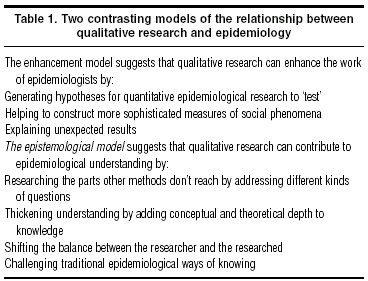
<body><![CDATA[<P><FONT face=Arial size=2><i>The enhancement model</i></FONT></P>     <P><font size="2"><a href="#tab1"><FONT face=Arial>Table 1</FONT></a> <FONT face=Arial> highlights the main characteristics  of the relationship between qualitative research and traditional epidemiology  suggested by what I refer to as the 'Enhancement Model' and the 'Epistemological  Model'. In the enhancement model the most readily recognised role for  qualitative research within the epidemiological endeavour is to generate  hypotheses for quantitative research to «test». An example of this type of  contribution is provided by qualitative research on pain. According to this body  of work, men and women both experience and react to pain differently. A  prominent belief amongst both women and men is that because of childbirth women  are more stoical than men about pain and discomfort and observational research  supports these findings<SUP>10,11</SUP>. A number of potential hypotheses can be  constructed on the basis of this work focusing, for example, on the way in which  gendered patterning in responses to pain impacts upon the take-up of services  and clinical practice. In terms of the second potential contribution suggested  by this model there are many examples of the ways in which qualitative research  has informed the development of more sophisticated measures of social phenomena.  In research on social support, for example, qualitative research has contributed  to a widening of the conceptual lens beyond the number of relationships to  include the quality of such relationships<SUP>12</SUP>. Similarly, recent  research on gendered patterns of health and illness is pointing to the need for  research exploring the relationship between health status and social/sex roles  to development measurements of 'role orientation' alongside traditional measures  of the psycho-social and physical demands of different social  roles<SUP>13</SUP>.</FONT></font></P>     <P align=center><a name="tab1"><font face="Arial" size="2"><IMG src="/img/revistas/gs/v17s3/138v17nSupl.3-13057793tab01.gif"  border=0></font></a></P>     <P><FONT face=Arial size=2>The measurement of «area effects» within  the health research on the spatial patterning of health and illness referred to  earlier has also been informed by qualitative research. In the work of Macintyre  and colleagues<SUP>14</SUP> for instance, qualitative research has pointed to  the fine detail of inequalities in opportunity structures highlighting the  timing of buses rather than only the number for example, the quality of play  space rather than only availability and the nature and quality of the goods  provided in shops rather than only the number of shops and their opening hours.  Finally, within the Enhancement Model of the relationship between qualitative  and quantitative health research the former is seen to have a role in helping to  explain unexpected results from the latter. No doubt the epidemiological  landscape is littered with results that came as a surprise to the researchers  -examples where qualitative research has been consciously used to illuminate  these findings are far fewer.</FONT></P>     <P><FONT face=Arial size=2><i>The epistemological model</i></FONT></P>     <P><FONT face=Arial size=2>In contrast to the Enhancement model, the  Epistemological model envisages a different and more equal relationship between  qualitative research and traditional epidemiology highlighting the unique nature  of the knowledge and understanding this research generates. There are four  elements to this noted in <a href="#tab1"> Table 1</a>. First, there are the types of research  questions addressed. For example, whilst traditional epidemiology is concerned  with the (social patterning of the) incidence and prevalence of life threatening  illness and associated risk factors qualitative research focuses on how people  make sense of the experience of such illness exploring the way these meanings  shape individuals responses in their social and material context <SUP>15</SUP>.  Second, this model points to the way in which qualitative research can «thicken»  understanding of important health related behaviour -pointing to  explanations as well as providing descriptive data. A key message from this  large body of work, which focuses on many different types of individual  behaviour, is that the endurance of health damaging behaviours in certain social  groups is profoundly linked to the material and cultural context of people lives  rather than being the result of a lack of information or education. A good  example of this type of research is Hilary Graham's study of smoking amongst  poor white women in the UK, which demonstrated that these women do not lack  understanding about the health damaging consequences of smoking for their health  and that of their children. However, these risks do not outweigh the  considerable benefits of smoking, which operates as a vital coping mechanism in  their lives and continue to smoke<SUP>16</SUP>. The third theme identified in <a href="#tab1">  Table 1</a> refers to a key difference between qualitative research and traditional  epidemiology. In the former, the researcher is the instrument of the research  process rather than the vehicle for applying the research instrument, as is the  case in the latter. Whilst this is the case with all qualitative research there  are also particular approaches within this paradigm, notably various approaches  to action research, which place the participation and empowerment of research  subjects at the centre of the research endeavour. Finally, the Epistemological  Model of the relationship between qualitative and quantitative research points  to the way in which qualitative research can challenge how 'problems' are  conceptualised within traditional epidemiology. Pope's work on waiting lists  within the UK National Health Services is a good example of this  contribution<SUP>17.</SUP> This study re-conceptualised the notion of waiting  lists traditionally understood as more or less orderly queues of people waiting  for hospital care. Pope's research suggests that a more appropriate image is  that of still stretches of water in oxbow lakes located alongside fast flowing  currents all of which are manipulated by consultants, clerical staff and, in  some instances, patients themselves.</FONT></P>     <P><B><FONT face=Arial size=2>Appraising the trustworthiness of  qualitative research</FONT></B></P>     <P><FONT face=Arial size=2>There will be some who will never be  convinced that qualitative research has a legitimate and valuable contribution  to make to the epidemiological imagination. But for the hopefully larger number  of people who are open to the possibilities, a critical issue is how the  trustworthiness of qualitative research is to be ensured. In this context it is  important to stress that this field of social science -like other branches  of science- has well-established internally recognised conventions within  the research process for ensuring rigour. It is also recognised by practitioners  that an important marker of good quality qualitative research is that the  findings are transferable to other setting. Obviously generalisability within  the qualitative tradition is of a different kind to that which is possible from  an experiment or a survey. The aim is to identify findings which are logically  generalisable rather than probabilistically so. A notable example of this  approach is the work of Goffman already mentioned on the impact on patients and  staff of 'total institutions' such as mental hospitals<SUP>6</SUP>. This work  was based on detailed observation of one ward and subsequently made a major  contribution to a paradigm shift in mental health policy.</FONT></P>     <P><FONT face=Arial size=2>There is also a widespread recognition that  people unfamiliar with the practice of qualitative research need a framework for  making judgements about the quality of particular studies. Arguably, such a  framework should consist of two related but separate elements. On the one hand  there is a set of prima facie criteria for assessing quality, which are common  to all research. These would include the issues listed in <a href="#tab2"> Table 2</a> and include,  for example, the common sense suggestion that all research-based publications  should provide sufficient details of the research question, design and methods  to allow assessment. These details are frequently n ot available -a  situation facing the earlier pioneers in the Cochrane Collaboration when they  tried to assess the quality of randomised controlled trials and which resulted  in the CONSORT statement on how Randomised Control Trails should be reported  issued by major health publications including the British Medical Journal.</FONT></P>     <P align=center><a name="tab2"><font face="Arial" size="2"><IMG src="/img/revistas/gs/v17s3/138v17nSupl.3-13057793tab02.gif"  border=0></font></a></P>     ]]></body>
<body><![CDATA[<P><FONT face=Arial size=2>However, prior to the application of such  minimalist «technical» criteria a judgement about trustworthiness of research  should involve the application of a primary «epistemological» marker tailored to  different research paradigms need to be used. Elsewhere with colleagues I have  argued that this marker for qualitative research would be that it adopted a  «verstehen» approach to the collection, analysis and interpretation of data-  that is good quality qualitative research would seek to see the world as the  «subjects» of the research see it<SUP>18</SUP>. The key question to ask here is  whether the research, as reported, illuminates the subjective meaning, action  and contexts of those being researcher?</FONT></P>     <P><B><FONT face=Arial size=2>Concluding comments</FONT></B></P>     <P><FONT face=Arial size=2>If epidemiology is to fulfil its full  potential to contribute to improved population health and the reduction of  health inequalities then it must extend its methodological gaze to include  qualitative research approaches. In doing this, however, it will be important to  recognise that different relationships between traditional epidemiological  approaches and qualitative research are possible and legitimate. There will be  many examples where these different research traditions are complementary  -when, taken together the findings will provide both explanation and  understanding. There will, however, also be examples when the results of  qualitative research represent a fundamental challenge to the methods and/or  findings of traditional epidemiology. Those who wish to develop the  epidemiological imagination by pursuing collaborative research need to be  prepared to work with conflict at the level of concepts and findings as well as  complementarity. <I>¡Nuestras respuestas a los conflictos nos permiten  crecer!</I></FONT></P> <hr color="#000000"> <font face="Arial" size="2"><b>Bibliografía</b></font>     <!-- ref --><p><font face="Arial" size="2">1. Ashton J, editor. The  epidemiological imagination. Buckingham: Open University Press; 1994.    &nbsp;&nbsp;&nbsp;&nbsp;&nbsp;&nbsp;&nbsp;&nbsp;[&#160;<a href="javascript:void(0);" onclick="javascript: window.open('/scielo.php?script=sci_nlinks&ref=2539829&pid=S0213-9111200300090000800001&lng=','','width=640,height=500,resizable=yes,scrollbars=1,menubar=yes,');">Links</a>&#160;]<!-- end-ref --></font></p>     <!-- ref --><p><font face="Arial" size="2">2.  Wright C. The Sociological imagination. New York: Oxford University Press; 1959 [reprinted 1976].    &nbsp;&nbsp;&nbsp;&nbsp;&nbsp;&nbsp;&nbsp;&nbsp;[&#160;<a href="javascript:void(0);" onclick="javascript: window.open('/scielo.php?script=sci_nlinks&ref=2539831&pid=S0213-9111200300090000800002&lng=','','width=640,height=500,resizable=yes,scrollbars=1,menubar=yes,');">Links</a>&#160;]<!-- end-ref --></font></p>     <!-- ref --><p><font face="Arial" size="2">3. Oakley A. Experiments in knowing: gender and method in  the social sciences. Cambridge: Polity Press; 2000.    &nbsp;&nbsp;&nbsp;&nbsp;&nbsp;&nbsp;&nbsp;&nbsp;[&#160;<a href="javascript:void(0);" onclick="javascript: window.open('/scielo.php?script=sci_nlinks&ref=2539833&pid=S0213-9111200300090000800003&lng=','','width=640,height=500,resizable=yes,scrollbars=1,menubar=yes,');">Links</a>&#160;]<!-- end-ref --></font></p>     <!-- ref --><p><font face="Arial" size="2">4. Dilthey W. Selected  Works, Volume I: Introduction to the human sciences. Makkreel RA, Rodi F,  editors. Princeton: Princeton University Press; 1989.    &nbsp;&nbsp;&nbsp;&nbsp;&nbsp;&nbsp;&nbsp;&nbsp;[&#160;<a href="javascript:void(0);" onclick="javascript: window.open('/scielo.php?script=sci_nlinks&ref=2539835&pid=S0213-9111200300090000800004&lng=','','width=640,height=500,resizable=yes,scrollbars=1,menubar=yes,');">Links</a>&#160;]<!-- end-ref --></font></p>     <!-- ref --><p><font face="Arial" size="2">5. Popay J, Thomas C,  Williams G, Bennett S, Gatrell A, Bostock L. A proper place to live: health  inequalities, agency and the normative dimensions of space. Soc Sci Med  2003;57:55-69.    &nbsp;&nbsp;&nbsp;&nbsp;&nbsp;&nbsp;&nbsp;&nbsp;[&#160;<a href="javascript:void(0);" onclick="javascript: window.open('/scielo.php?script=sci_nlinks&ref=2539837&pid=S0213-9111200300090000800005&lng=','','width=640,height=500,resizable=yes,scrollbars=1,menubar=yes,');">Links</a>&#160;]<!-- end-ref --></font></p>     <!-- ref --><p><font face="Arial" size="2">6. Goffman E. Asylums: essays on the social situation of  mental patients and other inmates. New York: Anchor; 1961.    &nbsp;&nbsp;&nbsp;&nbsp;&nbsp;&nbsp;&nbsp;&nbsp;[&#160;<a href="javascript:void(0);" onclick="javascript: window.open('/scielo.php?script=sci_nlinks&ref=2539839&pid=S0213-9111200300090000800006&lng=','','width=640,height=500,resizable=yes,scrollbars=1,menubar=yes,');">Links</a>&#160;]<!-- end-ref --></font></p>     <!-- ref --><p><font face="Arial" size="2">7. Silverman D.  Communication and medical practice. London: Sage; 1987.    &nbsp;&nbsp;&nbsp;&nbsp;&nbsp;&nbsp;&nbsp;&nbsp;[&#160;<a href="javascript:void(0);" onclick="javascript: window.open('/scielo.php?script=sci_nlinks&ref=2539841&pid=S0213-9111200300090000800007&lng=','','width=640,height=500,resizable=yes,scrollbars=1,menubar=yes,');">Links</a>&#160;]<!-- end-ref --></font></p>     <!-- ref --><p><font face="Arial" size="2">8. Strong P. The  ceremonial order of the clinic. London: Routledge; 1979.    &nbsp;&nbsp;&nbsp;&nbsp;&nbsp;&nbsp;&nbsp;&nbsp;[&#160;<a href="javascript:void(0);" onclick="javascript: window.open('/scielo.php?script=sci_nlinks&ref=2539843&pid=S0213-9111200300090000800008&lng=','','width=640,height=500,resizable=yes,scrollbars=1,menubar=yes,');">Links</a>&#160;]<!-- end-ref --></font></p>     <!-- ref --><p><font face="Arial" size="2">9. Silverman D.  Interpreting qualitative data: methods for analysing talk, text and interaction. London: Sage; 1993.    &nbsp;&nbsp;&nbsp;&nbsp;&nbsp;&nbsp;&nbsp;&nbsp;[&#160;<a href="javascript:void(0);" onclick="javascript: window.open('/scielo.php?script=sci_nlinks&ref=2539845&pid=S0213-9111200300090000800009&lng=','','width=640,height=500,resizable=yes,scrollbars=1,menubar=yes,');">Links</a>&#160;]<!-- end-ref --></font></p>     <!-- ref --><p><font face="Arial" size="2">10. Bendelow G. Pain perceptions, emotions and gender.  Sociol Health Illn 1993;15:273-94.    &nbsp;&nbsp;&nbsp;&nbsp;&nbsp;&nbsp;&nbsp;&nbsp;[&#160;<a href="javascript:void(0);" onclick="javascript: window.open('/scielo.php?script=sci_nlinks&ref=2539847&pid=S0213-9111200300090000800010&lng=','','width=640,height=500,resizable=yes,scrollbars=1,menubar=yes,');">Links</a>&#160;]<!-- end-ref --></font></p>     <!-- ref --><p><font face="Arial" size="2">11. Macintyre S, Ford G, Hunt K. Do women  'over report' morbidity? Men's and women's responses to structured prompting on  a standard question on long standing illness. Soc Sci Med 1999;48:89-98.    &nbsp;&nbsp;&nbsp;&nbsp;&nbsp;&nbsp;&nbsp;&nbsp;[&#160;<a href="javascript:void(0);" onclick="javascript: window.open('/scielo.php?script=sci_nlinks&ref=2539849&pid=S0213-9111200300090000800011&lng=','','width=640,height=500,resizable=yes,scrollbars=1,menubar=yes,');">Links</a>&#160;]<!-- end-ref --></font></p>     <!-- ref --><p><font face="Arial" size="2">12.  Oakley A. Social support and motherhood: the natural history of a research  project. Oxford: Blackwell; 1992.    &nbsp;&nbsp;&nbsp;&nbsp;&nbsp;&nbsp;&nbsp;&nbsp;[&#160;<a href="javascript:void(0);" onclick="javascript: window.open('/scielo.php?script=sci_nlinks&ref=2539851&pid=S0213-9111200300090000800012&lng=','','width=640,height=500,resizable=yes,scrollbars=1,menubar=yes,');">Links</a>&#160;]<!-- end-ref --></font></p>     <!-- ref --><p><font face="Arial" size="2">13. Annandale E, Hunt K, editors. Gender  inequalities in health. Buckingham: Open University Press; 2000.    &nbsp;&nbsp;&nbsp;&nbsp;&nbsp;&nbsp;&nbsp;&nbsp;[&#160;<a href="javascript:void(0);" onclick="javascript: window.open('/scielo.php?script=sci_nlinks&ref=2539853&pid=S0213-9111200300090000800013&lng=','','width=640,height=500,resizable=yes,scrollbars=1,menubar=yes,');">Links</a>&#160;]<!-- end-ref --></font></p>     <!-- ref --><p><font face="Arial" size="2">14.  Macintyre S, Maciver S, Sooman A. Area, class and health: should we be focusing  on places or people? J Soc Policy 1993;22:213-34.    &nbsp;&nbsp;&nbsp;&nbsp;&nbsp;&nbsp;&nbsp;&nbsp;[&#160;<a href="javascript:void(0);" onclick="javascript: window.open('/scielo.php?script=sci_nlinks&ref=2539855&pid=S0213-9111200300090000800014&lng=','','width=640,height=500,resizable=yes,scrollbars=1,menubar=yes,');">Links</a>&#160;]<!-- end-ref --></font></p>     <!-- ref --><p><font face="Arial" size="2">15. Popay J, Groves K.  Narratives in research on gender inequalities in health. In: Annandale E, Hunt  K, editors. Gender inequalities in health. Buckingham: Open University Press;  2000.    &nbsp;&nbsp;&nbsp;&nbsp;&nbsp;&nbsp;&nbsp;&nbsp;[&#160;<a href="javascript:void(0);" onclick="javascript: window.open('/scielo.php?script=sci_nlinks&ref=2539857&pid=S0213-9111200300090000800015&lng=','','width=640,height=500,resizable=yes,scrollbars=1,menubar=yes,');">Links</a>&#160;]<!-- end-ref --></font></p>     <!-- ref --><p><font face="Arial" size="2">16. Graham H. Women's smoking and family health. Soc Sci Med  1987;25:47-56.    &nbsp;&nbsp;&nbsp;&nbsp;&nbsp;&nbsp;&nbsp;&nbsp;[&#160;<a href="javascript:void(0);" onclick="javascript: window.open('/scielo.php?script=sci_nlinks&ref=2539859&pid=S0213-9111200300090000800016&lng=','','width=640,height=500,resizable=yes,scrollbars=1,menubar=yes,');">Links</a>&#160;]<!-- end-ref --></font></p>     <!-- ref --><p><font face="Arial" size="2">17. Pope C. Trouble in store: some thoughts on the management  of waiting lists. Sociol Health Illn 1991;13:193-212.    &nbsp;&nbsp;&nbsp;&nbsp;&nbsp;&nbsp;&nbsp;&nbsp;[&#160;<a href="javascript:void(0);" onclick="javascript: window.open('/scielo.php?script=sci_nlinks&ref=2539861&pid=S0213-9111200300090000800017&lng=','','width=640,height=500,resizable=yes,scrollbars=1,menubar=yes,');">Links</a>&#160;]<!-- end-ref --></font></p>     <!-- ref --><p><font face="Arial" size="2">18. Popay J, Rogers A,  Williams G. Rationale and standards for the systematic review of qualitative  literature in health services research. Qual Health Res  1998;8:341-51.    &nbsp;&nbsp;&nbsp;&nbsp;&nbsp;&nbsp;&nbsp;&nbsp;[&#160;<a href="javascript:void(0);" onclick="javascript: window.open('/scielo.php?script=sci_nlinks&ref=2539863&pid=S0213-9111200300090000800018&lng=','','width=640,height=500,resizable=yes,scrollbars=1,menubar=yes,');">Links</a>&#160;]<!-- end-ref --></font></p>      ]]></body><back>
<ref-list>
<ref id="B1">
<label>1</label><nlm-citation citation-type="book">
<person-group person-group-type="author">
<name>
<surname><![CDATA[Ashton]]></surname>
<given-names><![CDATA[J]]></given-names>
</name>
</person-group>
<source><![CDATA[The epidemiological imagination]]></source>
<year>1994</year>
<publisher-loc><![CDATA[Buckingham ]]></publisher-loc>
<publisher-name><![CDATA[Open University Press]]></publisher-name>
</nlm-citation>
</ref>
<ref id="B2">
<label>2</label><nlm-citation citation-type="book">
<person-group person-group-type="author">
<name>
<surname><![CDATA[Wright]]></surname>
<given-names><![CDATA[C]]></given-names>
</name>
</person-group>
<source><![CDATA[The Sociological imagination]]></source>
<year>1959</year>
<publisher-loc><![CDATA[New York ]]></publisher-loc>
<publisher-name><![CDATA[Oxford University Press]]></publisher-name>
</nlm-citation>
</ref>
<ref id="B3">
<label>3</label><nlm-citation citation-type="book">
<person-group person-group-type="author">
<name>
<surname><![CDATA[Oakley]]></surname>
<given-names><![CDATA[A]]></given-names>
</name>
</person-group>
<source><![CDATA[Experiments in knowing: gender and method in the social sciences]]></source>
<year>2000</year>
<publisher-loc><![CDATA[Cambridge ]]></publisher-loc>
<publisher-name><![CDATA[Polity Press]]></publisher-name>
</nlm-citation>
</ref>
<ref id="B4">
<label>4</label><nlm-citation citation-type="book">
<person-group person-group-type="author">
<name>
<surname><![CDATA[Dilthey]]></surname>
<given-names><![CDATA[W]]></given-names>
</name>
<name>
<surname><![CDATA[Makkreel]]></surname>
<given-names><![CDATA[RA]]></given-names>
</name>
<name>
<surname><![CDATA[Rodi]]></surname>
<given-names><![CDATA[F]]></given-names>
</name>
</person-group>
<source><![CDATA[Selected Works: Introduction to the human sciences]]></source>
<year>1989</year>
<publisher-loc><![CDATA[Princeton ]]></publisher-loc>
<publisher-name><![CDATA[Princeton University Press]]></publisher-name>
</nlm-citation>
</ref>
<ref id="B5">
<label>5</label><nlm-citation citation-type="journal">
<person-group person-group-type="author">
<name>
<surname><![CDATA[Popay]]></surname>
<given-names><![CDATA[J]]></given-names>
</name>
<name>
<surname><![CDATA[Thomas]]></surname>
<given-names><![CDATA[C]]></given-names>
</name>
<name>
<surname><![CDATA[Williams]]></surname>
<given-names><![CDATA[G]]></given-names>
</name>
<name>
<surname><![CDATA[Bennett]]></surname>
<given-names><![CDATA[S]]></given-names>
</name>
<name>
<surname><![CDATA[Gatrell]]></surname>
<given-names><![CDATA[A]]></given-names>
</name>
<name>
<surname><![CDATA[Bostock]]></surname>
<given-names><![CDATA[L]]></given-names>
</name>
</person-group>
<article-title xml:lang="en"><![CDATA[A proper place to live: health inequalities, agency and the normative dimensions of space]]></article-title>
<source><![CDATA[Soc Sci Med]]></source>
<year>2003</year>
<volume>57</volume>
<page-range>55-69</page-range></nlm-citation>
</ref>
<ref id="B6">
<label>6</label><nlm-citation citation-type="book">
<person-group person-group-type="author">
<name>
<surname><![CDATA[Goffman]]></surname>
<given-names><![CDATA[E]]></given-names>
</name>
</person-group>
<source><![CDATA[Asylums: essays on the social situation of mental patients and other inmates]]></source>
<year>1961</year>
<publisher-loc><![CDATA[New York ]]></publisher-loc>
<publisher-name><![CDATA[Anchor]]></publisher-name>
</nlm-citation>
</ref>
<ref id="B7">
<label>7</label><nlm-citation citation-type="book">
<person-group person-group-type="author">
<name>
<surname><![CDATA[Silverman]]></surname>
<given-names><![CDATA[D]]></given-names>
</name>
</person-group>
<source><![CDATA[Communication and medical practice]]></source>
<year>1987</year>
<publisher-loc><![CDATA[London ]]></publisher-loc>
<publisher-name><![CDATA[Sage]]></publisher-name>
</nlm-citation>
</ref>
<ref id="B8">
<label>8</label><nlm-citation citation-type="book">
<person-group person-group-type="author">
<name>
<surname><![CDATA[Strong]]></surname>
<given-names><![CDATA[P]]></given-names>
</name>
</person-group>
<source><![CDATA[The ceremonial order of the clinic]]></source>
<year>1979</year>
<publisher-loc><![CDATA[London ]]></publisher-loc>
<publisher-name><![CDATA[Routledge]]></publisher-name>
</nlm-citation>
</ref>
<ref id="B9">
<label>9</label><nlm-citation citation-type="book">
<person-group person-group-type="author">
<name>
<surname><![CDATA[Silverman]]></surname>
<given-names><![CDATA[D]]></given-names>
</name>
</person-group>
<source><![CDATA[Interpreting qualitative data: methods for analysing talk, text and interaction]]></source>
<year>1993</year>
<publisher-loc><![CDATA[London ]]></publisher-loc>
<publisher-name><![CDATA[Sage]]></publisher-name>
</nlm-citation>
</ref>
<ref id="B10">
<label>10</label><nlm-citation citation-type="journal">
<person-group person-group-type="author">
<name>
<surname><![CDATA[Bendelow]]></surname>
<given-names><![CDATA[G]]></given-names>
</name>
</person-group>
<article-title xml:lang="en"><![CDATA[Pain perceptions, emotions and gender]]></article-title>
<source><![CDATA[Sociol Health Illn]]></source>
<year>1993</year>
<volume>15</volume>
<page-range>273-94</page-range></nlm-citation>
</ref>
<ref id="B11">
<label>11</label><nlm-citation citation-type="journal">
<person-group person-group-type="author">
<name>
<surname><![CDATA[Macintyre]]></surname>
<given-names><![CDATA[S]]></given-names>
</name>
<name>
<surname><![CDATA[Ford]]></surname>
<given-names><![CDATA[G]]></given-names>
</name>
<name>
<surname><![CDATA[Hunt]]></surname>
<given-names><![CDATA[K]]></given-names>
</name>
</person-group>
<article-title xml:lang="en"><![CDATA[Do women 'over report' morbidity?: Men's and women's responses to structured prompting on a standard question on long standing illness]]></article-title>
<source><![CDATA[Soc Sci Med]]></source>
<year>1999</year>
<volume>48</volume>
<page-range>89-98</page-range></nlm-citation>
</ref>
<ref id="B12">
<label>12</label><nlm-citation citation-type="book">
<person-group person-group-type="author">
<name>
<surname><![CDATA[Oakley]]></surname>
<given-names><![CDATA[A]]></given-names>
</name>
</person-group>
<source><![CDATA[Social support and motherhood: the natural history of a research project]]></source>
<year>1992</year>
<publisher-loc><![CDATA[Oxford ]]></publisher-loc>
<publisher-name><![CDATA[Blackwell]]></publisher-name>
</nlm-citation>
</ref>
<ref id="B13">
<label>13</label><nlm-citation citation-type="book">
<person-group person-group-type="author">
<name>
<surname><![CDATA[Annandale]]></surname>
<given-names><![CDATA[E]]></given-names>
</name>
<name>
<surname><![CDATA[Hunt]]></surname>
<given-names><![CDATA[K]]></given-names>
</name>
</person-group>
<source><![CDATA[Gender inequalities in health]]></source>
<year>2000</year>
<publisher-loc><![CDATA[Buckingham ]]></publisher-loc>
<publisher-name><![CDATA[Open University Press]]></publisher-name>
</nlm-citation>
</ref>
<ref id="B14">
<label>14</label><nlm-citation citation-type="journal">
<person-group person-group-type="author">
<name>
<surname><![CDATA[Macintyre]]></surname>
<given-names><![CDATA[S]]></given-names>
</name>
<name>
<surname><![CDATA[Maciver]]></surname>
<given-names><![CDATA[S]]></given-names>
</name>
<name>
<surname><![CDATA[Sooman]]></surname>
<given-names><![CDATA[A]]></given-names>
</name>
</person-group>
<article-title xml:lang="en"><![CDATA[Area, class and health: should we be focusing on places or people?]]></article-title>
<source><![CDATA[J Soc Policy]]></source>
<year>1993</year>
<volume>22</volume>
<page-range>213-34</page-range></nlm-citation>
</ref>
<ref id="B15">
<label>15</label><nlm-citation citation-type="book">
<person-group person-group-type="author">
<name>
<surname><![CDATA[Popay]]></surname>
<given-names><![CDATA[J]]></given-names>
</name>
<name>
<surname><![CDATA[Groves]]></surname>
<given-names><![CDATA[K]]></given-names>
</name>
</person-group>
<article-title xml:lang="en"><![CDATA[Narratives in research on gender inequalities in health]]></article-title>
<person-group person-group-type="editor">
<name>
<surname><![CDATA[Annandale]]></surname>
<given-names><![CDATA[E]]></given-names>
</name>
<name>
<surname><![CDATA[Hunt]]></surname>
<given-names><![CDATA[K]]></given-names>
</name>
</person-group>
<source><![CDATA[Gender inequalities in health]]></source>
<year>2000</year>
<publisher-loc><![CDATA[Buckingham ]]></publisher-loc>
<publisher-name><![CDATA[Open University Press]]></publisher-name>
</nlm-citation>
</ref>
<ref id="B16">
<label>16</label><nlm-citation citation-type="journal">
<person-group person-group-type="author">
<name>
<surname><![CDATA[Graham]]></surname>
<given-names><![CDATA[H]]></given-names>
</name>
</person-group>
<article-title xml:lang="en"><![CDATA[Women's smoking and family health]]></article-title>
<source><![CDATA[Soc Sci Med]]></source>
<year>1987</year>
<volume>25</volume>
<page-range>47-56</page-range></nlm-citation>
</ref>
<ref id="B17">
<label>17</label><nlm-citation citation-type="journal">
<person-group person-group-type="author">
<name>
<surname><![CDATA[Pope]]></surname>
<given-names><![CDATA[C]]></given-names>
</name>
</person-group>
<article-title xml:lang="en"><![CDATA[Trouble in store: some thoughts on the management of waiting lists]]></article-title>
<source><![CDATA[Sociol Health Illn]]></source>
<year>1991</year>
<volume>13</volume>
<page-range>193-212</page-range></nlm-citation>
</ref>
<ref id="B18">
<label>18</label><nlm-citation citation-type="journal">
<person-group person-group-type="author">
<name>
<surname><![CDATA[Popay]]></surname>
<given-names><![CDATA[J]]></given-names>
</name>
<name>
<surname><![CDATA[Rogers]]></surname>
<given-names><![CDATA[A]]></given-names>
</name>
<name>
<surname><![CDATA[Williams]]></surname>
<given-names><![CDATA[G]]></given-names>
</name>
</person-group>
<article-title xml:lang="en"><![CDATA[Rationale and standards for the systematic review of qualitative literature in health services research]]></article-title>
<source><![CDATA[Qual Health Res]]></source>
<year>1998</year>
<volume>8</volume>
<page-range>341-51</page-range></nlm-citation>
</ref>
</ref-list>
</back>
</article>
