<?xml version="1.0" encoding="ISO-8859-1"?><article xmlns:mml="http://www.w3.org/1998/Math/MathML" xmlns:xlink="http://www.w3.org/1999/xlink" xmlns:xsi="http://www.w3.org/2001/XMLSchema-instance">
<front>
<journal-meta>
<journal-id>0213-9111</journal-id>
<journal-title><![CDATA[Gaceta Sanitaria]]></journal-title>
<abbrev-journal-title><![CDATA[Gac Sanit]]></abbrev-journal-title>
<issn>0213-9111</issn>
<publisher>
<publisher-name><![CDATA[Sociedad Española de Salud Pública y Administración Sanitaria (SESPAS)]]></publisher-name>
</publisher>
</journal-meta>
<article-meta>
<article-id>S0213-91112005000100004</article-id>
<title-group>
<article-title xml:lang="en"><![CDATA[Influence of pharmacists' opinions on their dispensing medicines without requirement of a doctor's prescription]]></article-title>
</title-group>
<contrib-group>
<contrib contrib-type="author">
<name>
<surname><![CDATA[Caamaño]]></surname>
<given-names><![CDATA[Francisco]]></given-names>
</name>
<xref ref-type="aff" rid="A01"/>
</contrib>
<contrib contrib-type="author">
<name>
<surname><![CDATA[Tomé-Otero]]></surname>
<given-names><![CDATA[Manuel]]></given-names>
</name>
<xref ref-type="aff" rid="A01"/>
</contrib>
<contrib contrib-type="author">
<name>
<surname><![CDATA[Takkouche]]></surname>
<given-names><![CDATA[Bahi]]></given-names>
</name>
<xref ref-type="aff" rid="A01"/>
</contrib>
<contrib contrib-type="author">
<name>
<surname><![CDATA[Gestal-Otero]]></surname>
<given-names><![CDATA[Juan Jesús]]></given-names>
</name>
<xref ref-type="aff" rid="A01"/>
</contrib>
</contrib-group>
<aff id="A01">
<institution><![CDATA[,University of Santiago de Compostela Department of Preventive Medicine and Public Health ]]></institution>
<addr-line><![CDATA[Santiago de Compostela A Coruña]]></addr-line>
<country>Spain</country>
</aff>
<pub-date pub-type="pub">
<day>00</day>
<month>02</month>
<year>2005</year>
</pub-date>
<pub-date pub-type="epub">
<day>00</day>
<month>02</month>
<year>2005</year>
</pub-date>
<volume>19</volume>
<numero>1</numero>
<fpage>9</fpage>
<lpage>14</lpage>
<copyright-statement/>
<copyright-year/>
<self-uri xlink:href="http://scielo.isciii.es/scielo.php?script=sci_arttext&amp;pid=S0213-91112005000100004&amp;lng=en&amp;nrm=iso"></self-uri><self-uri xlink:href="http://scielo.isciii.es/scielo.php?script=sci_abstract&amp;pid=S0213-91112005000100004&amp;lng=en&amp;nrm=iso"></self-uri><self-uri xlink:href="http://scielo.isciii.es/scielo.php?script=sci_pdf&amp;pid=S0213-91112005000100004&amp;lng=en&amp;nrm=iso"></self-uri><abstract abstract-type="short" xml:lang="en"><p><![CDATA[Objective: To assess the influence of pharmacists' opinions on their dispensing medicines with a «medical prescription only» label without requiring a doctor's prescription. Methods: We performed a cross-sectional study of 166 community pharmacies in northwest Spain. The opinions of pharmacists on the following were collected as independent variables through personal interview: a) physicians' prescribing practices; b) the pharmacist's qualifications to prescribe; c) the responsibility of the pharmacist regarding the dispensed drugs; d) the customer' qualifications for self-medication; and e) the pharmacist's perception of his or her own work. The dependent variable was the pharmacist's demand for a medical prescription for 5 drugs, which in Spain require a prescription. Multiple linear regression models were constructed. Results: The response rate was 98.8%. A total of 65.9% of pharmacists reported dispensing antibiotics without a prescription. This percentage was 83.5% for nonsteroidal anti-inflammatory drugs, 46.3% for angiotensin-converting enzyme inhibitors, 13.4% for benzodiazepines, and 84.8% for oral contraceptives. Further results showed that pharmacists with a heavier workload and those who underestimated the physicians' qualifications to prescribe but overestimated their own qualifications to prescribe less frequently demanded medical prescriptions. In contrast, pharmacists who stressed the importance of their duty in rationalizing the consumption of drugs more frequently demanded medical prescriptions. Conclusion: Our results suggest that to increase the quality of dispensing: a) the importance of the pharmacist's duty in controlling drug consumption should be stressed; b) pharmacies' workload should be optimized; and c) perceptions of physicians' prescribing practices among pharmacists should be improved.]]></p></abstract>
<abstract abstract-type="short" xml:lang="es"><p><![CDATA[Objetivo: Evaluar la influencia de las opiniones de los farmacéuticos que no solicitan receta médica para dispensar fármacos que la requieren para su venta. Métodos: Se ha llevado a cabo un estudio transversal sobre una muestra de 166 farmacéuticos de oficina de farmacia en la provincia de A Coruña. Las opiniones de los farmacéuticos, variables e independientes, fueron medidas mediante entrevista personal. Se valoraron las opiniones siguientes: a) prácticas prescriptoras de los médicos; b) cualificación de los farmacéuticos para prescribir; c) la responsabilidad de los farmacéuticos sobre los medicamentos dispensados; d) la cualificación de los clientes para automedicarse, y e) la percepción de los farmacéuticos sobre su trabajo. La exigencia de receta por parte del farmacéutico para 5 fármacos, que en España deben dispensarse con receta, fue la variable dependiente que se tuvo en cuenta. Se construyeron modelos de regresión múltiple. Resultados: La participación fue del 98,8%. Un total del 65,9% de los farmacéuticos afirmaron dispensar antibióticos sin receta. Este porcentaje fue del 83,5% para los antiinflamatorios no esteroideos, 46,3% para los inhibidores de la enzima de conversión de la angiotensina, 13,4% para las benzodiazepinas y 84,8% para los anticonceptivos orales. Además, los resultados muestran que los farmacéuticos con mayor carga de trabajo y los que califican peor la prescripción de los médicos, y que en mayor medida consideran que ellos mismos están capacitados para prescribir, exigen menos recetas médicas. Por el contrario, los farmacéuticos que otorgan mayor importancia a la racionalización en el consumo de fármacos exigen receta más frecuentemente. Conclusión: Nuestros resultados indican que para el incremento en la calidad de la dispensación el sistema debería lograr: a) incrementar la importancia que los farmacéuticos otorguen al control y la racionalización del consumo de fármacos; b) adecuar la carga de trabajo de las farmacias, y c) mejorar la percepción que los farmacéuticos tienen de las pautas prescriptoras de los médicos.]]></p></abstract>
<kwd-group>
<kwd lng="en"><![CDATA[Prescription requirement]]></kwd>
<kwd lng="en"><![CDATA[Cross-sectional study]]></kwd>
<kwd lng="en"><![CDATA[Community pharmacist]]></kwd>
<kwd lng="es"><![CDATA[Exigencia de receta]]></kwd>
<kwd lng="es"><![CDATA[Estudio transversal]]></kwd>
<kwd lng="es"><![CDATA[Farmacéutico]]></kwd>
</kwd-group>
</article-meta>
</front><body><![CDATA[ <p align="center"><b><font face="Arial" size="2">ORIGINALES</font></b></p> <hr color="#000000">     <p align="center"><B><font face="Arial" size="4">Influence of  pharmacists' opinions on their dispensing</font></B></p>     <p align="center"><B><font face="Arial" size="4">medicines without requirement of a  doctor's prescription</font></B></p>     <p align="center"><font face="Arial" size="2"><b>Francisco Caamaño / Manuel  Tomé-Otero / Bahi Takkouche / Juan Jesús Gestal-Otero</b>    <br> Department of Preventive Medicine and Public Health. University  of Santiago de Compostela.    <br> Santiago de Compostela. A Coruña. Spain.</font></p> <hr color="#000000"> <table border="0" width="100%">   <tr>     <td width="48%" valign="top"><font face="Arial" size="2"><b>Abstract</b></font>           <p><font face="Arial" size="2"><i>Objective</i>: To assess the influence of       pharmacists'  opinions on their dispensing medicines with a «medical prescription only» label  without requiring a doctor's prescription.    <br>       <i>Methods</i>: We performed a cross-sectional study of 166 community pharmacies in  northwest Spain. The opinions of pharmacists on the following were collected as  independent variables through personal interview: a) physicians' prescribing       practices; b) the pharmacist's qualifications to prescribe; c) the  responsibility of the pharmacist regarding the dispensed drugs; d) the customer'  qualifications for self-medication; and e) the pharmacist's perception of his or  her own work. The dependent variable was the pharmacist's demand for a medical  prescription for 5 drugs, which in Spain require a prescription. Multiple linear  regression models were constructed.<i>    <br>       Results</i>: The response rate was 98.8%. A total of 65.9% of pharmacists  reported dispensing antibiotics without a prescription. This percentage was  83.5% for nonsteroidal anti-inflammatory drugs, 46.3% for angiotensin-converting  enzyme inhibitors, 13.4% for benzodiazepines, and 84.8% for oral contraceptives.  Further results showed that pharmacists with a heavier workload and those who  underestimated the physicians' qualifications to prescribe but overestimated  their own qualifications to prescribe less frequently demanded medical       prescriptions. In contrast, pharmacists who stressed the importance of their  duty in rationalizing the consumption of drugs more frequently demanded medical       prescriptions.    <br>       <i>Conclusion</i>: Our results suggest that to increase the quality of       dispensing:  a) the importance of the pharmacist's duty in controlling drug consumption  should be stressed; b) pharmacies' workload should be optimized; and c)  perceptions of physicians' prescribing practices among pharmacists should be       improved.</font><font face="Arial" size="2"><b>    ]]></body>
<body><![CDATA[<br>       Key words:</b> Prescription requirement. Cross-sectional study.  Community pharmacist.</font></p>           <p>&nbsp;</td>     <td width="4%" valign="top"></td>     <td width="48%" valign="top"><b><font face="Arial" size="2">Resumen</font></b>           <p><font face="Arial" size="2"><i>Objetivo</i>: Evaluar la influencia de las opiniones de los  farmacéuticos que no solicitan receta médica para dispensar fármacos que la  requieren para su venta.<i>    <br>       Métodos</i>: Se ha llevado a cabo un estudio transversal sobre una muestra de 166  farmacéuticos de oficina de farmacia en la provincia de A Coruña. Las opiniones  de los farmacéuticos, variables e independientes, fueron medidas mediante  entrevista personal. Se valoraron las opiniones siguientes: a) prácticas  prescriptoras de los médicos; b) cualificación de los farmacéuticos para  prescribir; c) la responsabilidad de los farmacéuticos sobre los medicamentos  dispensados; d) la cualificación de los clientes para automedicarse, y e) la  percepción de los farmacéuticos sobre su trabajo. La exigencia de receta por  parte del farmacéutico para 5 fármacos, que en España deben dispensarse con  receta, fue la variable dependiente que se tuvo en cuenta. Se construyeron  modelos de regresión múltiple.<i>    <br>       Resultados</i>: La participación fue del 98,8%. Un total del 65,9% de los  farmacéuticos afirmaron dispensar antibióticos sin receta. Este porcentaje fue  del 83,5% para los antiinflamatorios no esteroideos, 46,3% para los inhibidores  de la enzima de conversión de la angiotensina, 13,4% para las benzodiazepinas y  84,8% para los anticonceptivos orales.    <br>       Además, los resultados muestran que los farmacéuticos con mayor carga de  trabajo y los que califican peor la prescripción de los médicos, y que en mayor  medida consideran que ellos mismos están capacitados para prescribir, exigen  menos recetas médicas. Por el contrario, los farmacéuticos que otorgan mayor  importancia a la racionalización en el consumo de fármacos exigen receta más  frecuentemente.<i>    <br>       Conclusión</i>: Nuestros resultados indican que para el incremento en la calidad  de la dispensación el sistema debería lograr: <i> a)</i> incrementar la importancia       que los farmacéuticos otorguen al control y la racionalización del       consumo de fármacos; <i>b)</i> adecuar la carga de trabajo de las       farmacias, y <i>c)</i> mejorar la percepción que los farmacéuticos       tienen de las pautas prescriptoras de los médicos.<b>    <br>       Palabras clave:</b> Exigencia de receta. Estudio transversal. Farmacéutico.</font></td>   </tr> </table> <hr color="#000000">     <p align="left"><font face="Arial" size="2"><i>Correspondencia:</i> Francisco Caamaño Isorna. Departamento de Medicina Preventiva y Salud Pública. Facultad de Medicina.    <br> San Francisco. s/n. 15705 Santiago de Compostela. A Coruña. Spain.    ]]></body>
<body><![CDATA[<br> Correo electrónico: <a href="mailto:mrpaco@usc.es">mrpaco@usc.es</a></font></p>     <p align="left"><font face="Arial" size="2"><i>Recibido</i>: 11 de mayo de 2004. <i>Aceptado</i>: 19 de octubre de 2004.</font></p>     <p> &nbsp;</p>     <p> <B><font face="Arial" size="2">Introduction</font></B></p>     <p> <font face="Arial" size="2">The professional activity of the community pharmacist has changed dramatically in  the last decades. With the increase of ready-to-use drugs, the activity in a  pharmacist's laboratory experienced a sharp decrease<SUP>1</SUP>. Today, the  main health-related activity of a pharmacist is to assure quality of  dispensing<SUP>2,3</SUP>.</font></p>     <p> <font face="Arial" size="2">Several studies associated quality of  dispensing with factors such as pharmacist's age, educational background and  social and demographic factors of the practice<SUP>4-6</SUP>. The pharmacists'  opinions about their activity have been proposed as potential determinants of  the quality of dispensing<SUP>7,8</SUP>. However, these factors have been  analyzed individually and so far, no comprehensive theoretical model has been  proposed to explain their effect.</font></p>     <p> <font face="Arial" size="2">According to previous  studies<SUP>2,7-12</SUP>, we propose a model to investigate the opinions of the  pharmacist that are associated with dispensing. Following this model, dispensing  by the pharmacists is determined by their opinions about the prescription  practice of the physicians, about their own competence to prescribe and about  the pharmacists' responsibility in the control of consumption of medicines. The  model also considers that the dispensing practice is subject to changes that are  due to the workload of the pharmacist and to the socio-economic and  socio-cultural characteristics of the customers.</font></p>     <p> <font face="Arial" size="2">The aim of this study is to assess the  validity of the model proposed and to measure the effect on the quality of  dispensing (measured as the requirement of a medical prescription to dispense)  exerted by each opinion.</font></p>     <p> <font face="Arial" size="2"><B>Methods</B></font></p>     <p> <font face="Arial" size="2"><i>Design, population, sample</i></font></p>     ]]></body>
<body><![CDATA[<p> <font face="Arial" size="2">We carried out a cross-sectional study of  the population of community pharmacists in Northwest Spain (n = 875, who work in  490 pharmacies). We used multistage cluster sampling (pharmacies are clusters  and pharmacist are the population). Pharmacies were used as sampling units in  the first stage (n = 150), and pharmacists were sampled at random within  pharmacies. All pharmacists present during the interviewer's visit were selected  (n = 166). The schedule of the visit to the pharmacy was selected at random  during the opening hours.</font></p>     <p> <font face="Arial" size="2"><i>Data collection</i></font></p>     <p> <font face="Arial" size="2">We collected data collection by means of a  personal interview (February and March, 2002) with a closed questionnaire, a  method that can maximize participation<SUP>13</SUP>.</font></p>     <p> <font face="Arial" size="2">The interviews were carried out by a  trained qualified interviewer (pharmacist). The questionnaire included four  blocks of questions: <I>a)</I> socio-demographic variables and variables of the  formation of the pharmacist; <I>b)</I> practice in relation to requirement of  prescription to dispense different drugs; <I>c)</I> level of agreement with 24  items about prescription practice of the doctors, pharmacist's qualification to  prescribe, responsibility of the pharmacist about dispensed drugs, clients'  qualification for self-medication, and pharmacists' perception of their work,  and <I>d)</I> services offered in the pharmacy and characteristics of its  socio-cultural and socio-economic surroundings.</font></p>     <p> <font face="Arial" size="2"><i>Independent variables</i></font></p>     <p> <font face="Arial" size="2">Pharmacists were asked about whether they  had specialty training. In Spain, pharmacists may work either with or without  specialty degrees. The three-year special training is officially regulated and  takes place in pharmacies of the National Health Service. During the three year  special training, the pharmacists work in a hospital pharmacy and they study  clinical pharmacology, pharmacoepidemiology and clinical epidemiology. So,  specialty is a dichotomous variable: yes or no.</font></p>     <p> <font face="Arial" size="2">Pharmacists were asked about their work  status. Two situations were considered: a pharmacist who is the owner or  responsible for the pharmacy and a pharmacist who is under contract. So, work  status is a dichotomous variable: owner or responsible (yes or no).</font></p>     <p> <font face="Arial" size="2">The models also included two variables that  measure the work environment of the pharmacist: number of pharmacists in the  pharmacy: number of pharmacist who work in the pharmacy (this variable is used  as a proxy of the customers per day of the pharmacy) and the socio-economic  level of the population attended. The socio-economic level of the population was  valued through the perceptions of the pharmacists in charge, by means of a  5-point Likert-like response scale ranging from «very low» to «very high».</font></p>     <p> <font face="Arial" size="2">The opinions were measured by asking the  pharmacists about their level of agreement with 16 items (from 0 = completely in  disagreement, to 10 = completely in agreement). The items were grouped in 5  topics: prescription practice of the doctors (3 items); pharmacist's  qualification to prescribe (3 items); responsibility of the pharmacist about  dispensed drugs (5 items); clients' qualification for self-medication (2 items),  and pharmacists' perception of their work (3 items).</font></p>     <p> <font face="Arial" size="2"><i>Dependent variable</i></font></p>     ]]></body>
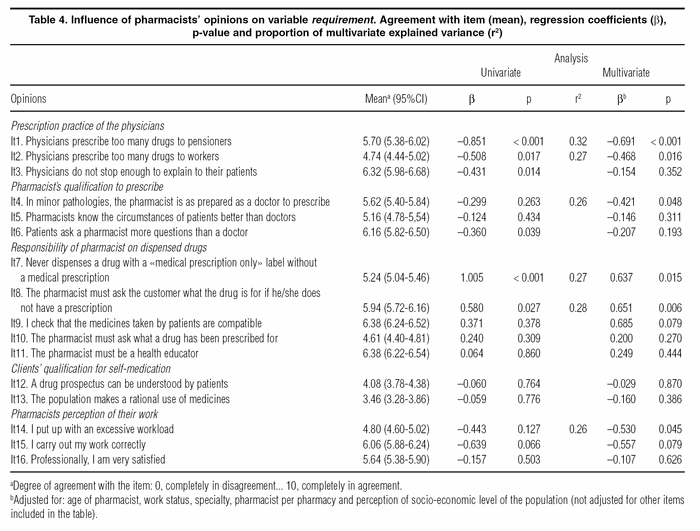
<body><![CDATA[<p> <font face="Arial" size="2"><I>Requirement</I>. We gathered information  on the requirement of a prescription to dispense 5 drugs (no requirement = 0;  requirement = 1), which in Spain have to be dispensed with a prescription (drugs  with «medical prescription only» label). These drugs included an oral  contraceptive (Diane 35<SUP>®</SUP>), an angiotensin-converting enzyme (ACE)  inhibitor (Capoten<SUP>®</SUP>), an antibiotic (Clamoxyl<SUP>®</SUP>), a  benzodiazepine (Lexatin<SUP>®</SUP>), and a nonsteroidal anti-inflammatory drug  (Voltaren<SUP>®</SUP>). Prescription requirement was considered for 5 drugs and  two types of client: well-known customers (habitual customers) and unknown  customers. So, the variable ranges from 0 (the pharmacist does not demand any  prescription for any of the 5 drugs, either for well-known or unknown customers)  to 10 (the pharmacist demands a prescription for the 5 drugs for all customers).</font></p>     <p> <font face="Arial" size="2"><i>Statistical analysis</i></font></p>     <p> <font face="Arial" size="2">We measured the effect that each of the  opinions exerts on the variable <I>requirement</I> through linear regression. We  adjusted the multiple linear regression models for the variables: age of the  pharmacist, work status, specialty, number of pharmacists in the pharmacy and  perception of socio-economic level of the population. There variable were  associated with the quality of dispensing in previous  studies<SUP>6</SUP>.</font></p>     <p> <font face="Arial" size="2">Other candidates for potential confounders  included sex, number of years of work, former work experience, additional degree  of studies, and urban/rural environment. These covariates were introduced in the  final model if their inclusion changed the coefficient of the main independent  variable by more than 10%. SPSS package was used to analyze the data.</font></p>     <p> <font face="Arial" size="2"><B>Results</B></font></p>     <p> <font face="Arial" size="2">Of the 150 pharmacies sampled, 4 were  excluded (due to vacation closing). Out of the 146 remaining pharmacies, 123  participated (84.2%). Of the 166 pharmacists, 164 participated in the study  (98.8%). <a href="/img/gs/v19n1/original1_archivos/138v19n01-13071811tab01.gif" target="_blank"> Table 1</a> shows the characteristics of the participants. The mean age of  the pharmacists was 40.2 years and their average work experience was 12.3 years.  Our sample showed a proportion of 72% of women and a proportion of pharmacists  with a specialist degree obtained though the National Health Service of  3.1%.</font></p>     <p> <font face="Arial" size="2"><a href="/img/gs/v19n1/original1_archivos/138v19n01-13071811tab02.gif" target="_blank">Table 2</a> shows the proportion of pharmacists  that demanded a prescription for dispensing the five drugs considered, according  to the type of client. <a href="/img/gs/v19n1/original1_archivos/138v19n01-13071811tab03.gif" target="_blank"> Table 3</a> shows the variables in the multivariate model for  the dependent variable <I>requirement</I>. Age of the pharmacist, work status,  specialty, number of pharmacists in the pharmacy, and perception of  socio-economic level of the population, were associated to the quality of dispensing.</font></p>     <p> <font face="Arial" size="2"><a href="#t4">Table 4</a> presents the influence of the  pharmacist's opinions on the variable <I>requirement</I>, the agreement with  item (mean), the regression coefficients (&#946;), the p-value and the proportion of multivariate explained variance  (r<SUP>2</SUP>). Pharmacists who have a heavier workload and who underestimate  the physicians' qualification to prescribe but overestimate their own  qualification to prescribe required medical prescriptions less often. Those  pharmacists who stress the importance of their duty in rationalizing the  consumption of drugs demanded medical prescriptions more often.</font></p>     <P align=center><font face="Arial" size="2"><a name="t4"><IMG src="/img/gs/v19n1/original1_archivos/138v19n01-13071811tab04.gif"> </a> </font> </p> <font face="Arial" size="2"> <B>    <br> Discussion</B></font>     ]]></body>
<body><![CDATA[<p> <font face="Arial" size="2"> According to our model, the dispensing  practice of the pharmacists is associated with their opinions on the  prescription practice of the physicians, on the qualification of the pharmacist  to prescribe, and on the perception of the pharmacist's responsibility toward  the rational use of drugs.</font> </p>     <p> <font face="Arial" size="2"> <I>Prescription practice of the  doctors.</I> The association between pharmacists' perception of the quality of  the medical prescription and prescription requirement (table 4, items 1 and 2)  reflects the doubts that pharmacists raise on the adequacy of the diagnosis and  prescription by the physician. The pharmacist who is not convinced by the  adequacy of the physician's diagnosis will be more flexible towards the  mandatory character of the prescription demand. These results are consistent  with those found in Nepal in a study of excessive prescription and quality of  dispensing<SUP>9</SUP>. The similarity of the results of these studies that were  carried out in very different cultural environment and with different  methodologies suggests that the relation between those variables is  causal<SUP>14</SUP>.</font> </p>     <p> <font face="Arial" size="2"> Furthermore, the high degree of agreement  of the pharmacists with the third affirmation «doctors do not stop enough to  give explanations to their patients», (mean, 6.32; 95%CI, 5.98-6.68) and the  negative correlation with the variable <I>requirement</I> show that the lower  confidence in the clinical practice is associated with a higher independence in  the behavior of the pharmacist.</font> </p>     <p> <font face="Arial" size="2"> <I>Pharmacists' qualification to  prescribe.</I> We analyzed this determinant of the quality of dispensing by  means of 3 items. The first and very explicit affirmation, «in minor  pathologies, the pharmacist is as prepared as a doctor to prescribe» is  negatively correlated with a lower demand of a medical prescription (p = 0.048).  The items 5 and 6, in which the level of knowledge of the patient is assessed,  are also negatively associated with the variable <I>requirement</I>, although  this association is not statistically significant.</font> </p>     <p> <font face="Arial" size="2"> These results show that the opinions of the  pharmacists about their qualification to prescribe translate into dispensing  practice<SUP>6</SUP>. This practice is facilitated by their large autonomy and  the scarce control that exists over dispensing in Spain<SUP>15</SUP>. To improve  the quality of dispensing, it is necessary to implement a stricter  administrative control over dispensing. Pharmacist's prescription could be  accepted only for over-the-counter drugs and continuation of treatments  initially prescribed by a physician<SUP>16</SUP>.</font> </p>     <p> <font face="Arial" size="2"> <I>Responsibility on dispensed drugs.</I>  The higher degree of agreement with affirmation 7 and 8 «never dispense a drug  with a «medical prescription only» label without a medical prescription» and  «the pharmacist must ask the client what the drug is for if he/she does not have  a prescription» is significantly related to a higher demand of the medical  prescription (p = 0.015 and p = 0.006, respectively). Those pharmacists who  perceive as important their role in the rationalization of the consumption of  drugs dispense in a stricter manner and demand every legal  contro<SUP>15,17</SUP>. The higher degree of agreement with the remaining items  (9, 10 and 11) is correlated positively but not statistically significantly with  the variable <I>requirement</I>.</font> </p>     <p> <font face="Arial" size="2"> According to the proposed model, the  interaction of the pharmacists with their environment will modify their  dispensing practice. Our study measured two aspects: pharmacists' perception of  their work and opinion on the qualification of the customer for  self-medication.</font> </p>     <p> <font face="Arial" size="2"> The pharmacist's perception of the  customers' qualification for self-medication is not significantly associated  with prescription requirement. However, both items 1 and 2 show a negative  correlation with the prescription requirement: those pharmacists who consider  that «a drug prospectus can be understood by patients» and that «the population  makes a rational use of medicines» tend to require the medical prescription less  often. In addition, if we take into account that the model is adjusted for the  pharmacists' perception of the socio-economical level of the population (p =  0.016), and that this level and the qualification for self-medication are highly  correlated<SUP>17</SUP>, we cannot rule out the possibility that the lack of  statistical significance is due to over-adjustment.</font> </p>     <p> <font face="Arial" size="2"> In relation to pharmacists' perception of  their work, previous studies associated a large number of customers with less  pharmaceutical advice<SUP>10,11</SUP>. Other studies demonstrated the existence  of a relation between large dispensing loads and the number of dispensing  mistakes<SUP>12</SUP>. Our results confirm those results, as item 14 «the  pharmacist puts up with an excessive work-load» shows a negative correlation  with the variable <I>requirement,</I> which is statistically significant (p =  0.045). This could be explained by the fact that those pharmacies with excessive  workload function in a more commercial way, reducing the time a pharmacist  spends with each customer and exerting less control over  prescriptions<SUP>6</SUP>.</font> </p>     <p> <font face="Arial" size="2"> Previous studies found that a low degree of  pharmaceutical advice is related to a high cultural degree of the population  attended<SUP>11,18</SUP>; a similar relation exists between medical  prescriptions and the level of autonomy of the  patient<SUP>19-21</SUP>.</font> </p>     ]]></body>
<body><![CDATA[<p> <font face="Arial" size="2"> Four possible limitations to this study  have to be considered. First, since the current analysis is based on  cross-sectional data, the validity of the conclusions could be limited by the  difficulty in differentiating between cause and effect. However, in our study,  those factors that are associated with quality dispensing are variables that are  unlikely to change during the period of time in which the dependent variable is  measured. A cross-sectional analysis provides then results that are close to  those of a longitudinal one<SUP>14</SUP>. Second, the questionnaire has not been  validated. Third, the measure of the prescription requirement of the pharmacist  could be biased by the pharmacist's tendency to provide answers that are legally  acceptable. The indicators are then probably too optimistic as far as it  concerns the evaluation of the quality of dispensing. Finally, the quality of  dispensing is assessed only by the prescription requirement. There are probably  other indicators the measure of which was not feasible in our  study<SUP>22</SUP>. In conclusion, our results suggest that, in order to  increase the quality of dispensing, it is necessary: <I>a)</I> to stress the  importance of the duty of the pharmacists in controlling the consumption of  medicines; <I>b)</I> to optimize the pharmacies workload, and <I>c)</I> to  improve the perception of the prescription practice of the physicians among  pharmacists. It is also necessary to restrict drug prescription by the  pharmacist to over-the-counter drugs and to continuation of treatments initially  prescribed by a physician.</font> </p> <hr color="#000000">     <p><B> <font face="Arial" size="2"> Acknowledgements</font></B> <font face="Arial" size="2"> This work was funded by the Spanish  Ministry of Health (Grant FIS 01/1688). We thank María Xesús Cebro for her  comments during the drafting of this report.</font></p>     <p>    <br> <font face="Arial" size="2"> <b>Bibliografía</b></font></p>     <!-- ref --><p> <font face="Arial" size="2"> 1. Rawlin MD. Extending  the role of the community pharmacist. BMJ. 1991;302:427-8.</font>&nbsp;&nbsp;&nbsp;&nbsp;&nbsp;&nbsp;&nbsp;&nbsp;[&#160;<a href="javascript:void(0);" onclick="javascript: window.open('/scielo.php?script=sci_nlinks&ref=2364442&pid=S0213-9111200500010000400001&lng=','','width=640,height=500,resizable=yes,scrollbars=1,menubar=yes,');">Links</a>&#160;]<!-- end-ref --><!-- ref --><p><font face="Arial" size="2">2. Rupp MT. Value  of community pharmacists' interventions to correct prescribing errors. Ann Pharmacother. 1992;26:1580-4.</font>&nbsp;&nbsp;&nbsp;&nbsp;&nbsp;&nbsp;&nbsp;&nbsp;[&#160;<a href="javascript:void(0);" onclick="javascript: window.open('/scielo.php?script=sci_nlinks&ref=2364443&pid=S0213-9111200500010000400002&lng=','','width=640,height=500,resizable=yes,scrollbars=1,menubar=yes,');">Links</a>&#160;]<!-- end-ref --><!-- ref --><p><font face="Arial" size="2">3. Beney J, Bero LA, Bond C. Expanding the  roles of outpatient pharmacists: effects on health services utilisation, costs,  and patient outcomes. Cochrane Database Syst Rev. 2000; 3:CD000336.</font>&nbsp;&nbsp;&nbsp;&nbsp;&nbsp;&nbsp;&nbsp;&nbsp;[&#160;<a href="javascript:void(0);" onclick="javascript: window.open('/scielo.php?script=sci_nlinks&ref=2364444&pid=S0213-9111200500010000400003&lng=','','width=640,height=500,resizable=yes,scrollbars=1,menubar=yes,');">Links</a>&#160;]<!-- end-ref --><!-- ref --><p><font face="Arial" size="2">4.  Odedina FT, Hepler CD, Segal R, Miller D. The pharmacists' implementation of pharmaceutical care (PIPC) model. Pharm Res. 1997;14:135-44.</font>&nbsp;&nbsp;&nbsp;&nbsp;&nbsp;&nbsp;&nbsp;&nbsp;[&#160;<a href="javascript:void(0);" onclick="javascript: window.open('/scielo.php?script=sci_nlinks&ref=2364445&pid=S0213-9111200500010000400004&lng=','','width=640,height=500,resizable=yes,scrollbars=1,menubar=yes,');">Links</a>&#160;]<!-- end-ref --><!-- ref --><p><font face="Arial" size="2">5. Yesalis CE  3rd, Norwood GJ, Lipson DP, Helling DK, Fisher WP, Burmeister LF. Capitation  payment for pharmacy services: impact on generic substitution. Med Care.  1980;18:816-28.</font>&nbsp;&nbsp;&nbsp;&nbsp;&nbsp;&nbsp;&nbsp;&nbsp;[&#160;<a href="javascript:void(0);" onclick="javascript: window.open('/scielo.php?script=sci_nlinks&ref=2364446&pid=S0213-9111200500010000400005&lng=','','width=640,height=500,resizable=yes,scrollbars=1,menubar=yes,');">Links</a>&#160;]<!-- end-ref --><!-- ref --><p><font face="Arial" size="2">6. Caamaño F, Tomé-Otero M, Figueiras A, Takkouche B. Factors  related with prescription requirement to dispensing in Spain. Pharmacoepidemiol  Drug Saf. 2004;13:405-9.</font>&nbsp;&nbsp;&nbsp;&nbsp;&nbsp;&nbsp;&nbsp;&nbsp;[&#160;<a href="javascript:void(0);" onclick="javascript: window.open('/scielo.php?script=sci_nlinks&ref=2364447&pid=S0213-9111200500010000400006&lng=','','width=640,height=500,resizable=yes,scrollbars=1,menubar=yes,');">Links</a>&#160;]<!-- end-ref --><!-- ref --><p><font face="Arial" size="2">7. Pendergast JF, Kimberlin CL, Berrardo DH,  McKenzie LC. Role orientation and community pharmacists' participation in a  project to improve patient care. Soc Sci Med. 1995;40:557-65.</font>&nbsp;&nbsp;&nbsp;&nbsp;&nbsp;&nbsp;&nbsp;&nbsp;[&#160;<a href="javascript:void(0);" onclick="javascript: window.open('/scielo.php?script=sci_nlinks&ref=2364448&pid=S0213-9111200500010000400007&lng=','','width=640,height=500,resizable=yes,scrollbars=1,menubar=yes,');">Links</a>&#160;]<!-- end-ref --><!-- ref --><p><font face="Arial" size="2">8.  Cancrinus-Matthijsse AM, Lindenberg SM, Bakker A, Groenewegen G. The quality of  the professional paractice of community pharmacists: what can still be improved  in Europe? Pharm World Sci. 1996;18:217-28.</font>&nbsp;&nbsp;&nbsp;&nbsp;&nbsp;&nbsp;&nbsp;&nbsp;[&#160;<a href="javascript:void(0);" onclick="javascript: window.open('/scielo.php?script=sci_nlinks&ref=2364449&pid=S0213-9111200500010000400008&lng=','','width=640,height=500,resizable=yes,scrollbars=1,menubar=yes,');">Links</a>&#160;]<!-- end-ref --><!-- ref --><p><font face="Arial" size="2">9. Holloway KA, Gautam BR.  Consequences of over-prescribing on the dispensing process in rural Nepal. Trop  Med Int Health. 2001;6:151-4.</font>&nbsp;&nbsp;&nbsp;&nbsp;&nbsp;&nbsp;&nbsp;&nbsp;[&#160;<a href="javascript:void(0);" onclick="javascript: window.open('/scielo.php?script=sci_nlinks&ref=2364450&pid=S0213-9111200500010000400009&lng=','','width=640,height=500,resizable=yes,scrollbars=1,menubar=yes,');">Links</a>&#160;]<!-- end-ref --><!-- ref --><p><font face="Arial" size="2">10. Rupp MT, DeYoung M, Schondelmeyer SW.  Prescribing problems and the pharmacist interventions in community practice. Med  Care. 1992;30:926-40.</font>&nbsp;&nbsp;&nbsp;&nbsp;&nbsp;&nbsp;&nbsp;&nbsp;[&#160;<a href="javascript:void(0);" onclick="javascript: window.open('/scielo.php?script=sci_nlinks&ref=2364451&pid=S0213-9111200500010000400010&lng=','','width=640,height=500,resizable=yes,scrollbars=1,menubar=yes,');">Links</a>&#160;]<!-- end-ref --><!-- ref --><p><font face="Arial" size="2">11. Raisch DW. Patient counseling in community pharmacy  and its relationship with prescription payment methods and practice settings.  Ann Pharmacother. 1993;27:1173-9.</font>&nbsp;&nbsp;&nbsp;&nbsp;&nbsp;&nbsp;&nbsp;&nbsp;[&#160;<a href="javascript:void(0);" onclick="javascript: window.open('/scielo.php?script=sci_nlinks&ref=2364452&pid=S0213-9111200500010000400011&lng=','','width=640,height=500,resizable=yes,scrollbars=1,menubar=yes,');">Links</a>&#160;]<!-- end-ref --><!-- ref --><p><font face="Arial" size="2">12. Guernsey BG, Ingrim NB, Hokanson JA,  Doutre WH, Bryant SG, Blair CW, et al. Pharmacists' dispensing accuracy in a  high-volume outpatient pharmacy service: focus on risk management. Drug Intell  Clin Pharm. 1983;17:742-6.</font>&nbsp;&nbsp;&nbsp;&nbsp;&nbsp;&nbsp;&nbsp;&nbsp;[&#160;<a href="javascript:void(0);" onclick="javascript: window.open('/scielo.php?script=sci_nlinks&ref=2364453&pid=S0213-9111200500010000400012&lng=','','width=640,height=500,resizable=yes,scrollbars=1,menubar=yes,');">Links</a>&#160;]<!-- end-ref --><!-- ref --><p><font face="Arial" size="2">13. Caamaño F, Ruano A, Figueiras A, Gestal-Otero  JJ. Data collection methods for analyzing the quality of the dispensing in  pharmacies. Pharm World Sci. 2002;24:217-23.</font>&nbsp;&nbsp;&nbsp;&nbsp;&nbsp;&nbsp;&nbsp;&nbsp;[&#160;<a href="javascript:void(0);" onclick="javascript: window.open('/scielo.php?script=sci_nlinks&ref=2364454&pid=S0213-9111200500010000400013&lng=','','width=640,height=500,resizable=yes,scrollbars=1,menubar=yes,');">Links</a>&#160;]<!-- end-ref --><!-- ref --><p><font face="Arial" size="2">14. Rothman KJ, Greenland S.  Types of epidemiology study. En: Rothman KJ, Greenland S, editors. Modern  epidemiology. Philadelphia: Lippincott and Raven; 1998. p. 75-6.</font>&nbsp;&nbsp;&nbsp;&nbsp;&nbsp;&nbsp;&nbsp;&nbsp;[&#160;<a href="javascript:void(0);" onclick="javascript: window.open('/scielo.php?script=sci_nlinks&ref=2364455&pid=S0213-9111200500010000400014&lng=','','width=640,height=500,resizable=yes,scrollbars=1,menubar=yes,');">Links</a>&#160;]<!-- end-ref --><!-- ref --><p><font face="Arial" size="2">15. Guerra  L. Informe sobre resistencia microbiana: ¿qué hacer? Med Clin (Barc).  1995;106:267-79.</font>&nbsp;&nbsp;&nbsp;&nbsp;&nbsp;&nbsp;&nbsp;&nbsp;[&#160;<a href="javascript:void(0);" onclick="javascript: window.open('/scielo.php?script=sci_nlinks&ref=2364456&pid=S0213-9111200500010000400015&lng=','','width=640,height=500,resizable=yes,scrollbars=1,menubar=yes,');">Links</a>&#160;]<!-- end-ref --><!-- ref --><p><font face="Arial" size="2">16. Dowell J, Cruikshank J, Bain J, Staines. Repeat  dispensing by community pharmacists: advantages for patients and practitioners.  B J Gen Pract. 1998;48:1858-60.</font>&nbsp;&nbsp;&nbsp;&nbsp;&nbsp;&nbsp;&nbsp;&nbsp;[&#160;<a href="javascript:void(0);" onclick="javascript: window.open('/scielo.php?script=sci_nlinks&ref=2364457&pid=S0213-9111200500010000400016&lng=','','width=640,height=500,resizable=yes,scrollbars=1,menubar=yes,');">Links</a>&#160;]<!-- end-ref --><!-- ref --><p><font face="Arial" size="2">17. Figueiras A, Caamaño F, Gestal-Otero JJ.  Sociodemographic factors related to self-medication in Spain. Eur J Epidemiol.  2000;16:19-26.</font>&nbsp;&nbsp;&nbsp;&nbsp;&nbsp;&nbsp;&nbsp;&nbsp;[&#160;<a href="javascript:void(0);" onclick="javascript: window.open('/scielo.php?script=sci_nlinks&ref=2364458&pid=S0213-9111200500010000400017&lng=','','width=640,height=500,resizable=yes,scrollbars=1,menubar=yes,');">Links</a>&#160;]<!-- end-ref --><!-- ref --><p><font face="Arial" size="2">18. Ruegg A. Contribution of the pharmacist to safety in self  medication. Soz Praventivmed. 1986;31:160-4.</font>&nbsp;&nbsp;&nbsp;&nbsp;&nbsp;&nbsp;&nbsp;&nbsp;[&#160;<a href="javascript:void(0);" onclick="javascript: window.open('/scielo.php?script=sci_nlinks&ref=2364459&pid=S0213-9111200500010000400018&lng=','','width=640,height=500,resizable=yes,scrollbars=1,menubar=yes,');">Links</a>&#160;]<!-- end-ref --><!-- ref --><p><font face="Arial" size="2">19. Chewning B, Sleath B.  Medication decision-making and management: a client-centered model. Soc Sci Med.  1996;42:389-98.</font>&nbsp;&nbsp;&nbsp;&nbsp;&nbsp;&nbsp;&nbsp;&nbsp;[&#160;<a href="javascript:void(0);" onclick="javascript: window.open('/scielo.php?script=sci_nlinks&ref=2364460&pid=S0213-9111200500010000400019&lng=','','width=640,height=500,resizable=yes,scrollbars=1,menubar=yes,');">Links</a>&#160;]<!-- end-ref --><!-- ref --><p><font face="Arial" size="2">20. Soctt A, Shiell A, King M. Is general practitioner  decision making associated with patient socio-economic status? Soc Sci Med.  1996;42:35-46.</font>&nbsp;&nbsp;&nbsp;&nbsp;&nbsp;&nbsp;&nbsp;&nbsp;[&#160;<a href="javascript:void(0);" onclick="javascript: window.open('/scielo.php?script=sci_nlinks&ref=2364461&pid=S0213-9111200500010000400020&lng=','','width=640,height=500,resizable=yes,scrollbars=1,menubar=yes,');">Links</a>&#160;]<!-- end-ref --><!-- ref --><p><font face="Arial" size="2">21. Virji A, Britten N. A study of the relationship between  patients' attitudes and doctors' prescribing. Fam Pract. 1991;8:314-9.</font>&nbsp;&nbsp;&nbsp;&nbsp;&nbsp;&nbsp;&nbsp;&nbsp;[&#160;<a href="javascript:void(0);" onclick="javascript: window.open('/scielo.php?script=sci_nlinks&ref=2364462&pid=S0213-9111200500010000400021&lng=','','width=640,height=500,resizable=yes,scrollbars=1,menubar=yes,');">Links</a>&#160;]<!-- end-ref --><!-- ref --><p><font face="Arial" size="2">22.  Mullins CD, Baldwin R, Perfetto EM. What are outcomes? J Am Pharm Assoc (Wash).  1996;36:39-49.</font>&nbsp;&nbsp;&nbsp;&nbsp;&nbsp;&nbsp;&nbsp;&nbsp;[&#160;<a href="javascript:void(0);" onclick="javascript: window.open('/scielo.php?script=sci_nlinks&ref=2364463&pid=S0213-9111200500010000400022&lng=','','width=640,height=500,resizable=yes,scrollbars=1,menubar=yes,');">Links</a>&#160;]<!-- end-ref --> ]]></body><back>
<ref-list>
<ref id="B1">
<label>1</label><nlm-citation citation-type="journal">
<person-group person-group-type="author">
<name>
<surname><![CDATA[Rawlin]]></surname>
<given-names><![CDATA[MD]]></given-names>
</name>
</person-group>
<article-title xml:lang="en"><![CDATA[Extending the role of the community pharmacist]]></article-title>
<source><![CDATA[BMJ]]></source>
<year>1991</year>
<volume>302</volume>
<page-range>427-8</page-range></nlm-citation>
</ref>
<ref id="B2">
<label>2</label><nlm-citation citation-type="journal">
<person-group person-group-type="author">
<name>
<surname><![CDATA[Rupp]]></surname>
<given-names><![CDATA[MT]]></given-names>
</name>
</person-group>
<article-title xml:lang="en"><![CDATA[Value of community pharmacists' interventions to correct prescribing errors]]></article-title>
<source><![CDATA[Ann Pharmacother]]></source>
<year>1992</year>
<volume>26</volume>
<page-range>1580-4</page-range></nlm-citation>
</ref>
<ref id="B3">
<label>3</label><nlm-citation citation-type="journal">
<person-group person-group-type="author">
<name>
<surname><![CDATA[Beney]]></surname>
<given-names><![CDATA[J]]></given-names>
</name>
<name>
<surname><![CDATA[Bero]]></surname>
<given-names><![CDATA[LA]]></given-names>
</name>
<name>
<surname><![CDATA[Bond]]></surname>
<given-names><![CDATA[C]]></given-names>
</name>
</person-group>
<article-title xml:lang="en"><![CDATA[Expanding the roles of outpatient pharmacists: effects on health services utilisation, costs, and patient outcomes]]></article-title>
<source><![CDATA[Cochrane Database Syst Rev]]></source>
<year>2000</year>
<numero>3</numero>
<issue>3</issue>
</nlm-citation>
</ref>
<ref id="B4">
<label>4</label><nlm-citation citation-type="journal">
<person-group person-group-type="author">
<name>
<surname><![CDATA[Odedina]]></surname>
<given-names><![CDATA[FT]]></given-names>
</name>
<name>
<surname><![CDATA[Hepler]]></surname>
<given-names><![CDATA[CD]]></given-names>
</name>
<name>
<surname><![CDATA[Segal]]></surname>
<given-names><![CDATA[R]]></given-names>
</name>
<name>
<surname><![CDATA[Miller]]></surname>
<given-names><![CDATA[D]]></given-names>
</name>
</person-group>
<article-title xml:lang="en"><![CDATA[The pharmacists' implementation of pharmaceutical care (PIPC) model]]></article-title>
<source><![CDATA[Pharm Res]]></source>
<year>1997</year>
<volume>14</volume>
<page-range>135-44</page-range></nlm-citation>
</ref>
<ref id="B5">
<label>5</label><nlm-citation citation-type="journal">
<person-group person-group-type="author">
<name>
<surname><![CDATA[Yesalis]]></surname>
<given-names><![CDATA[CE 3rd]]></given-names>
</name>
<name>
<surname><![CDATA[Norwood]]></surname>
<given-names><![CDATA[GJ]]></given-names>
</name>
<name>
<surname><![CDATA[Lipson]]></surname>
<given-names><![CDATA[DP]]></given-names>
</name>
<name>
<surname><![CDATA[Helling]]></surname>
<given-names><![CDATA[DK]]></given-names>
</name>
<name>
<surname><![CDATA[Fisher]]></surname>
<given-names><![CDATA[WP]]></given-names>
</name>
<name>
<surname><![CDATA[Burmeister]]></surname>
<given-names><![CDATA[LF]]></given-names>
</name>
</person-group>
<article-title xml:lang="en"><![CDATA[Capitation payment for pharmacy services: impact on generic substitution]]></article-title>
<source><![CDATA[Med Care]]></source>
<year>1980</year>
<volume>18</volume>
<page-range>816-28</page-range></nlm-citation>
</ref>
<ref id="B6">
<label>6</label><nlm-citation citation-type="journal">
<person-group person-group-type="author">
<name>
<surname><![CDATA[Caamaño]]></surname>
<given-names><![CDATA[F]]></given-names>
</name>
<name>
<surname><![CDATA[Tomé-Otero]]></surname>
<given-names><![CDATA[M]]></given-names>
</name>
<name>
<surname><![CDATA[Figueiras]]></surname>
<given-names><![CDATA[A]]></given-names>
</name>
<name>
<surname><![CDATA[Takkouche]]></surname>
<given-names><![CDATA[B]]></given-names>
</name>
</person-group>
<article-title xml:lang="en"><![CDATA[Factors related with prescription requirement to dispensing in Spain]]></article-title>
<source><![CDATA[Pharmacoepidemiol Drug Saf]]></source>
<year>2004</year>
<volume>13</volume>
<page-range>405-9</page-range></nlm-citation>
</ref>
<ref id="B7">
<label>7</label><nlm-citation citation-type="journal">
<person-group person-group-type="author">
<name>
<surname><![CDATA[Pendergast]]></surname>
<given-names><![CDATA[JF]]></given-names>
</name>
<name>
<surname><![CDATA[Kimberlin]]></surname>
<given-names><![CDATA[CL]]></given-names>
</name>
<name>
<surname><![CDATA[Berrardo]]></surname>
<given-names><![CDATA[DH]]></given-names>
</name>
<name>
<surname><![CDATA[McKenzie]]></surname>
<given-names><![CDATA[LC]]></given-names>
</name>
</person-group>
<article-title xml:lang="en"><![CDATA[Role orientation and community pharmacists' participation in a project to improve patient care]]></article-title>
<source><![CDATA[Soc Sci Med]]></source>
<year>1995</year>
<volume>40</volume>
<page-range>557-65</page-range></nlm-citation>
</ref>
<ref id="B8">
<label>8</label><nlm-citation citation-type="journal">
<person-group person-group-type="author">
<name>
<surname><![CDATA[Cancrinus-Matthijsse]]></surname>
<given-names><![CDATA[AM]]></given-names>
</name>
<name>
<surname><![CDATA[Lindenberg]]></surname>
<given-names><![CDATA[SM]]></given-names>
</name>
<name>
<surname><![CDATA[Bakker]]></surname>
<given-names><![CDATA[A]]></given-names>
</name>
<name>
<surname><![CDATA[Groenewegen]]></surname>
<given-names><![CDATA[G]]></given-names>
</name>
</person-group>
<article-title xml:lang="en"><![CDATA[The quality of the professional paractice of community pharmacists: what can still be improved in Europe?]]></article-title>
<source><![CDATA[Pharm World Sci]]></source>
<year>1996</year>
<volume>18</volume>
<page-range>217-28</page-range></nlm-citation>
</ref>
<ref id="B9">
<label>9</label><nlm-citation citation-type="journal">
<person-group person-group-type="author">
<name>
<surname><![CDATA[Holloway]]></surname>
<given-names><![CDATA[KA]]></given-names>
</name>
<name>
<surname><![CDATA[Gautam]]></surname>
<given-names><![CDATA[BR]]></given-names>
</name>
</person-group>
<article-title xml:lang="en"><![CDATA[Consequences of over-prescribing on the dispensing process in rural Nepal]]></article-title>
<source><![CDATA[Trop Med Int Health]]></source>
<year>2001</year>
<volume>6</volume>
<page-range>151-4</page-range></nlm-citation>
</ref>
<ref id="B10">
<label>10</label><nlm-citation citation-type="journal">
<person-group person-group-type="author">
<name>
<surname><![CDATA[Rupp]]></surname>
<given-names><![CDATA[MT]]></given-names>
</name>
<name>
<surname><![CDATA[DeYoung]]></surname>
<given-names><![CDATA[M]]></given-names>
</name>
<name>
<surname><![CDATA[Schondelmeyer]]></surname>
<given-names><![CDATA[SW]]></given-names>
</name>
</person-group>
<article-title xml:lang="en"><![CDATA[Prescribing problems and the pharmacist interventions in community practice]]></article-title>
<source><![CDATA[Med Care]]></source>
<year>1992</year>
<volume>30</volume>
<page-range>926-40</page-range></nlm-citation>
</ref>
<ref id="B11">
<label>11</label><nlm-citation citation-type="journal">
<person-group person-group-type="author">
<name>
<surname><![CDATA[Raisch]]></surname>
<given-names><![CDATA[DW]]></given-names>
</name>
</person-group>
<article-title xml:lang="en"><![CDATA[Patient counseling in community pharmacy and its relationship with prescription payment methods and practice settings]]></article-title>
<source><![CDATA[Ann Pharmacother]]></source>
<year>1993</year>
<volume>27</volume>
<page-range>1173-9</page-range></nlm-citation>
</ref>
<ref id="B12">
<label>12</label><nlm-citation citation-type="journal">
<person-group person-group-type="author">
<name>
<surname><![CDATA[Guernsey]]></surname>
<given-names><![CDATA[BG]]></given-names>
</name>
<name>
<surname><![CDATA[Ingrim]]></surname>
<given-names><![CDATA[NB]]></given-names>
</name>
<name>
<surname><![CDATA[Hokanson]]></surname>
<given-names><![CDATA[JA]]></given-names>
</name>
<name>
<surname><![CDATA[Doutre]]></surname>
<given-names><![CDATA[WH]]></given-names>
</name>
<name>
<surname><![CDATA[Bryant]]></surname>
<given-names><![CDATA[SG]]></given-names>
</name>
<name>
<surname><![CDATA[Blair]]></surname>
<given-names><![CDATA[CW]]></given-names>
</name>
</person-group>
<article-title xml:lang="en"><![CDATA[Pharmacists' dispensing accuracy in a high-volume outpatient pharmacy service: focus on risk management]]></article-title>
<source><![CDATA[Drug Intell Clin Pharm]]></source>
<year>1983</year>
<volume>17</volume>
<page-range>742-6</page-range></nlm-citation>
</ref>
<ref id="B13">
<label>13</label><nlm-citation citation-type="journal">
<person-group person-group-type="author">
<name>
<surname><![CDATA[Caamaño]]></surname>
<given-names><![CDATA[F]]></given-names>
</name>
<name>
<surname><![CDATA[Ruano]]></surname>
<given-names><![CDATA[A]]></given-names>
</name>
<name>
<surname><![CDATA[Figueiras]]></surname>
<given-names><![CDATA[A]]></given-names>
</name>
<name>
<surname><![CDATA[Gestal-Otero]]></surname>
<given-names><![CDATA[JJ]]></given-names>
</name>
</person-group>
<article-title xml:lang="en"><![CDATA[Data collection methods for analyzing the quality of the dispensing in pharmacies]]></article-title>
<source><![CDATA[Pharm World Sci]]></source>
<year>2002</year>
<volume>24</volume>
<page-range>217-23</page-range></nlm-citation>
</ref>
<ref id="B14">
<label>14</label><nlm-citation citation-type="book">
<person-group person-group-type="author">
<name>
<surname><![CDATA[Rothman]]></surname>
<given-names><![CDATA[KJ]]></given-names>
</name>
<name>
<surname><![CDATA[Greenland]]></surname>
<given-names><![CDATA[S]]></given-names>
</name>
</person-group>
<article-title xml:lang="en"><![CDATA[Types of epidemiology study]]></article-title>
<person-group person-group-type="editor">
<name>
<surname><![CDATA[Rothman]]></surname>
<given-names><![CDATA[KJ]]></given-names>
</name>
<name>
<surname><![CDATA[Greenland]]></surname>
<given-names><![CDATA[S]]></given-names>
</name>
</person-group>
<source><![CDATA[Modern epidemiology]]></source>
<year>1998</year>
<page-range>75-6</page-range><publisher-loc><![CDATA[Philadelphia ]]></publisher-loc>
<publisher-name><![CDATA[Lippincott and Raven]]></publisher-name>
</nlm-citation>
</ref>
<ref id="B15">
<label>15</label><nlm-citation citation-type="journal">
<person-group person-group-type="author">
<name>
<surname><![CDATA[Guerra]]></surname>
<given-names><![CDATA[L]]></given-names>
</name>
</person-group>
<article-title xml:lang="es"><![CDATA[Informe sobre resistencia microbiana: ¿qué hacer?]]></article-title>
<source><![CDATA[Med Clin (Barc)]]></source>
<year>1995</year>
<volume>106</volume>
<page-range>267-79</page-range></nlm-citation>
</ref>
<ref id="B16">
<label>16</label><nlm-citation citation-type="journal">
<person-group person-group-type="author">
<name>
<surname><![CDATA[Dowell]]></surname>
<given-names><![CDATA[J]]></given-names>
</name>
<name>
<surname><![CDATA[Cruikshank]]></surname>
<given-names><![CDATA[J]]></given-names>
</name>
<name>
<surname><![CDATA[Bain]]></surname>
<given-names><![CDATA[J]]></given-names>
</name>
<name>
<surname><![CDATA[Staines]]></surname>
</name>
</person-group>
<article-title xml:lang="en"><![CDATA[Repeat dispensing by community pharmacists: advantages for patients and practitioners]]></article-title>
<source><![CDATA[B J Gen Pract]]></source>
<year>1998</year>
<volume>48</volume>
<page-range>1858-60</page-range></nlm-citation>
</ref>
<ref id="B17">
<label>17</label><nlm-citation citation-type="journal">
<person-group person-group-type="author">
<name>
<surname><![CDATA[Figueiras]]></surname>
<given-names><![CDATA[A]]></given-names>
</name>
<name>
<surname><![CDATA[Caamaño]]></surname>
<given-names><![CDATA[F]]></given-names>
</name>
<name>
<surname><![CDATA[Gestal-Otero]]></surname>
<given-names><![CDATA[JJ]]></given-names>
</name>
</person-group>
<article-title xml:lang="en"><![CDATA[Sociodemographic factors related to self-medication in Spain]]></article-title>
<source><![CDATA[Eur J Epidemiol]]></source>
<year>2000</year>
<volume>16</volume>
<page-range>19-26</page-range></nlm-citation>
</ref>
<ref id="B18">
<label>18</label><nlm-citation citation-type="journal">
<person-group person-group-type="author">
<name>
<surname><![CDATA[Ruegg]]></surname>
<given-names><![CDATA[A]]></given-names>
</name>
</person-group>
<article-title xml:lang="en"><![CDATA[Contribution of the pharmacist to safety in self medication]]></article-title>
<source><![CDATA[Soz Praventivmed]]></source>
<year>1986</year>
<volume>31</volume>
<page-range>160-4</page-range></nlm-citation>
</ref>
<ref id="B19">
<label>19</label><nlm-citation citation-type="journal">
<person-group person-group-type="author">
<name>
<surname><![CDATA[Chewning]]></surname>
<given-names><![CDATA[B]]></given-names>
</name>
<name>
<surname><![CDATA[Sleath]]></surname>
<given-names><![CDATA[B]]></given-names>
</name>
</person-group>
<article-title xml:lang="en"><![CDATA[Medication decision-making and management: a client-centered model]]></article-title>
<source><![CDATA[Soc Sci Med]]></source>
<year>1996</year>
<volume>42</volume>
<page-range>389-98</page-range></nlm-citation>
</ref>
<ref id="B20">
<label>20</label><nlm-citation citation-type="journal">
<person-group person-group-type="author">
<name>
<surname><![CDATA[Soctt]]></surname>
<given-names><![CDATA[A]]></given-names>
</name>
<name>
<surname><![CDATA[Shiell]]></surname>
<given-names><![CDATA[A]]></given-names>
</name>
<name>
<surname><![CDATA[King]]></surname>
<given-names><![CDATA[M]]></given-names>
</name>
</person-group>
<article-title xml:lang="en"><![CDATA[Is general practitioner decision making associated with patient socio-economic status?]]></article-title>
<source><![CDATA[Soc Sci Med]]></source>
<year>1996</year>
<volume>42</volume>
<page-range>35-46</page-range></nlm-citation>
</ref>
<ref id="B21">
<label>21</label><nlm-citation citation-type="journal">
<person-group person-group-type="author">
<name>
<surname><![CDATA[Virji]]></surname>
<given-names><![CDATA[A]]></given-names>
</name>
<name>
<surname><![CDATA[Britten]]></surname>
<given-names><![CDATA[N]]></given-names>
</name>
</person-group>
<article-title xml:lang="en"><![CDATA[A study of the relationship between patients' attitudes and doctors' prescribing]]></article-title>
<source><![CDATA[Fam Pract]]></source>
<year>1991</year>
<volume>8</volume>
<page-range>314-9</page-range></nlm-citation>
</ref>
<ref id="B22">
<label>22</label><nlm-citation citation-type="journal">
<person-group person-group-type="author">
<name>
<surname><![CDATA[Mullins]]></surname>
<given-names><![CDATA[CD]]></given-names>
</name>
<name>
<surname><![CDATA[Baldwin]]></surname>
<given-names><![CDATA[R]]></given-names>
</name>
<name>
<surname><![CDATA[Perfetto]]></surname>
<given-names><![CDATA[EM]]></given-names>
</name>
</person-group>
<article-title xml:lang="en"><![CDATA[What are outcomes?]]></article-title>
<source><![CDATA[J Am Pharm Assoc (Wash)]]></source>
<year>1996</year>
<volume>36</volume>
<page-range>39-49</page-range></nlm-citation>
</ref>
</ref-list>
</back>
</article>
