<?xml version="1.0" encoding="ISO-8859-1"?><article xmlns:mml="http://www.w3.org/1998/Math/MathML" xmlns:xlink="http://www.w3.org/1999/xlink" xmlns:xsi="http://www.w3.org/2001/XMLSchema-instance">
<front>
<journal-meta>
<journal-id>0213-9111</journal-id>
<journal-title><![CDATA[Gaceta Sanitaria]]></journal-title>
<abbrev-journal-title><![CDATA[Gac Sanit]]></abbrev-journal-title>
<issn>0213-9111</issn>
<publisher>
<publisher-name><![CDATA[Sociedad Española de Salud Pública y Administración Sanitaria (SESPAS)]]></publisher-name>
</publisher>
</journal-meta>
<article-meta>
<article-id>S0213-91112005000200004</article-id>
<title-group>
<article-title xml:lang="en"><![CDATA[Factors related to dental health in 12-year-old children: a cross-sectional study in pupils]]></article-title>
<article-title xml:lang="es"><![CDATA[Factors related to dental health in 12-year-old children: a cross-sectional study in pupils]]></article-title>
</title-group>
<contrib-group>
<contrib contrib-type="author">
<name>
<surname><![CDATA[Smyth]]></surname>
<given-names><![CDATA[Ernesto]]></given-names>
</name>
<xref ref-type="aff" rid="A01"/>
</contrib>
<contrib contrib-type="author">
<name>
<surname><![CDATA[Caamaño]]></surname>
<given-names><![CDATA[Francisco]]></given-names>
</name>
<xref ref-type="aff" rid="A01"/>
</contrib>
</contrib-group>
<aff id="A01">
<institution><![CDATA[,University of Santiago de Compostela Department of Preventive Medicine and Public Health ]]></institution>
<addr-line><![CDATA[Santiago de Compostela A Coruña]]></addr-line>
<country>Spain</country>
</aff>
<pub-date pub-type="pub">
<day>00</day>
<month>04</month>
<year>2005</year>
</pub-date>
<pub-date pub-type="epub">
<day>00</day>
<month>04</month>
<year>2005</year>
</pub-date>
<volume>19</volume>
<numero>2</numero>
<fpage>113</fpage>
<lpage>119</lpage>
<copyright-statement/>
<copyright-year/>
<self-uri xlink:href="http://scielo.isciii.es/scielo.php?script=sci_arttext&amp;pid=S0213-91112005000200004&amp;lng=en&amp;nrm=iso"></self-uri><self-uri xlink:href="http://scielo.isciii.es/scielo.php?script=sci_abstract&amp;pid=S0213-91112005000200004&amp;lng=en&amp;nrm=iso"></self-uri><self-uri xlink:href="http://scielo.isciii.es/scielo.php?script=sci_pdf&amp;pid=S0213-91112005000200004&amp;lng=en&amp;nrm=iso"></self-uri><abstract abstract-type="short" xml:lang="en"><p><![CDATA[Objective: The aim of this study was to identify factors related to the prevalence of caries in 12-year-old schoolchildren. Methods: A cross-sectional study was carried out using a representative sample (n = 1217) of the population of 12-year-old schoolchildren in Galiza (northwest Spain). Independent variables were measured through a questionnaire, and dependent variables were determined through oral examination. Multiple and logistic regression were applied. Results: The decayed, missing and filled permanent teeth/decayed, filled primary teeth (DMFT-dft) value in the sample was 1.83 (95% confidence interval [CI], 1.67-1.98), the DMFT value was 1.53 (95% CI, 1.37-1.67), and the prevalence of caries was 61% (95% CI, 57.7-64.5). The prevalence of caries was directly related to a low frequency of brushing, greater use of toothpaste, and a higher consumption of sweets. The prevalence of caries was higher in rural than in urban areas. In contrast, the higher the mother's level of education and the greater the subject's knowledge of dental health, the lower the prevalence of caries. Conclusions: The main goals of dental health programmes should be to achieve quality brushing every day in children, to reduce the consumption of sweets, and to increase knowledge of dental health.]]></p></abstract>
<abstract abstract-type="short" xml:lang="es"><p><![CDATA[Objetivo: Identificar los factores asociados a la prevalencia de caries en escolares de 12 años. Métodos: Estudio transversal sobre una muestra (n = 1.217) de escolares de 12 años de Galicia. Las variables independientes se midieron mediante un cuestionario y las dependientes, a través de exploración bucal. En el análisis estadístico se aplicaron regresión logística y regresión lineal múltiple. Resultados: El índice CAO-co en la muestra fue 1,83 (intervalo de confianza [IC] del 95%, 1,67-1,98), el índice CAO 1,53 (IC del 95%, 1,37-1,67), mientras que la prevalencia de caries se situó en el 61% (IC del 95%, 57,7-64,5). La prevalencia de caries estuvo directamente asociada a la baja frecuencia del cepillado, al mayor uso de pasta y al elevado consumo de golosinas. La prevalencia de caries determinada en el medio rural fue más alta que en el medio urbano. Por último, el mayor nivel de estudios de la madre y los mayores conocimientos sobre salud oral de los individuos se asocian a una menor prevalencia de caries. Conclusiones: A pesar de la moderada afectación por caries, los principales objetivos de los programas de salud oral para este grupo de edad deben ser: lograr el cepillado dental diario, reducir el consumo de golosinas e incrementar los conocimientos sobre salud oral. Por último, los programas de salud oral deben estar dirigidos principalmente a la población del medio rural y de menor nivel sociocultural.]]></p></abstract>
<kwd-group>
<kwd lng="en"><![CDATA[Children]]></kwd>
<kwd lng="en"><![CDATA[Dental knowledge]]></kwd>
<kwd lng="en"><![CDATA[Health practice]]></kwd>
<kwd lng="en"><![CDATA[Oral health surwey]]></kwd>
<kwd lng="en"><![CDATA[Spain]]></kwd>
<kwd lng="es"><![CDATA[Niños]]></kwd>
<kwd lng="es"><![CDATA[Conocimientos dentales]]></kwd>
<kwd lng="es"><![CDATA[Práctica odontológica]]></kwd>
<kwd lng="es"><![CDATA[Encuesta sobre salud bucal]]></kwd>
<kwd lng="es"><![CDATA[España]]></kwd>
</kwd-group>
</article-meta>
</front><body><![CDATA[ <FONT face=Arial size=2>    <p align="center"><B>ORIGINALES</B></p> <hr color="#000000" align="left"> </FONT>     <p align="center"><B><font face="Arial" size="4">Factors related  to dental health in 12-year-old children:</font></B></p>    <p align="center"><B><font face="Arial" size="4">a cross-sectional study in  pupils</font></B></p>    <p align="center"><FONT face=Arial size=2><b>Ernesto Smyth /<sup> </sup>Francisco Caamaño</b>    <br> Department of Preventive Medicine and Public Health. University of Santiago  de Compostela.    <br> Santiago de Compostela. A Coruña. Spain.    <br>     <br>     <br> </FONT> </p> <table border="0" width="100%">   <tr>     <td width="48%" valign="top"></td>     <td width="4%" valign="top"></td>     <td width="48%"><b>(<FONT face=Arial size=2>Factors related  to dental health in 12-year-old children:    ]]></body>
<body><![CDATA[<br>       a cross-sectional study in  pupils</FONT>)</b></td>   </tr> </table> <FONT face=Arial size=2> <hr color="#000000" align="left"> </FONT> <table border="0" width="100%">   <tr>     <td width="48%" valign="top"><FONT face=Arial size=2><b>Abstract</b>    <br>       <FONT face=Arial size=2><i>Objective</i>: The aim of this study was to identify  factors related to the prevalence of caries in 12-year-old schoolchildren.    <br>       <i>Methods</i>: A cross-sectional study was carried out using a representative  sample (n = 1217) of the population of 12-year-old schoolchildren in Galiza (northwest       Spain). Independent variables were measured through a questionnaire,  and dependent variables were determined through oral examination. Multiple and  logistic regression were applied.    <br>       <i>Results</i>: The decayed, missing and filled permanent teeth/decayed, filled  primary teeth (DMFT-dft) value in the sample was 1.83 (95% confidence interval  [CI], 1.67-1.98), the DMFT value was 1.53 (95% CI, 1.37-1.67), and the  prevalence of caries was 61% (95% CI, 57.7-64.5). The prevalence of caries was  directly related to a low frequency of brushing, greater use of toothpaste, and  a higher consumption of sweets. The prevalence of caries was higher in rural  than in urban areas. In contrast, the higher the mother's level of education and  the greater the subject's knowledge of dental health, the lower the prevalence  of caries.    <br>       <i>Conclusions</i>: The main goals of dental health programmes should be to achieve  quality brushing every day in children, to reduce the consumption of sweets, and  to increase knowledge of dental health.    <br>       <b>Keywords:</b> Children. Dental knowledge. Health practice. Oral health       surwey. Spain.</FONT>       </td>       <td width="4%" valign="top"></td>       <td width="48%" valign="top"><FONT face=Arial size=2><b>Resumen</b>    <br>         <i>Objetivo</i>: Identificar los factores asociados a la prevalencia  de caries en escolares de 12 años.    <br>         <i>Métodos</i>: Estudio transversal sobre una muestra (n = 1.217) de escolares de 12  años de Galicia. Las variables independientes se midieron mediante un  cuestionario y las dependientes, a través de exploración bucal. En el análisis  estadístico se aplicaron regresión logística y regresión lineal múltiple.    <br>         <i>Resultados</i>: El índice CAO-co en la muestra fue 1,83 (intervalo de confianza         [IC] del 95%, 1,67-1,98), el índice CAO 1,53 (IC del 95%, 1,37-1,67), mientras  que la prevalencia de caries se situó en el 61% (IC del 95%, 57,7-64,5). La  prevalencia de caries estuvo directamente asociada a la baja frecuencia del  cepillado, al mayor uso de pasta y al elevado consumo de golosinas. La  prevalencia de caries determinada en el medio rural fue más alta que en el medio  urbano. Por último, el mayor nivel de estudios de la madre y los mayores  conocimientos sobre salud oral de los individuos se asocian a una menor  prevalencia de caries.    <br>         <i>Conclusiones</i>: A pesar de la moderada afectación por caries, los principales  objetivos de los programas de salud oral para este grupo de edad deben ser:  lograr el cepillado dental diario, reducir el consumo de golosinas e incrementar  los conocimientos sobre salud oral. Por último, los programas de salud oral         deben estar dirigidos principalmente a la población del medio rural y         de menor nivel sociocultural.    ]]></body>
<body><![CDATA[<br>         <b>Palabras clave: </b>N<b></b>iños. Conocimientos dentales.  Práctica odontológica. Encuesta sobre salud bucal. España.</FONT></td>     </tr>   </table>   <hr color="#000000" align="left">     <p><font face="Arial" size="2"><i>Correspondencia</i>: Ernesto Smyth.    <br> Departamento de Medicina Preventiva y Salud Pública.    <br> Facultad de Medicina.    <br> San Francisco, s/n. 15782 Santiago de Compostela.    <br> A Coruña. España.    <br> Correo electrónico: <a href="mailto:mrsmyth@usc.es">mrsmyth@usc.es</a></font>    <p><font face="Arial" size="2"><i>Recibido</i>: 11 de mayo de 2004. <i>Aceptado</i>: 28 de octubre de 2004.</font><FONT face=Arial size=2>    <p>&nbsp;</FONT>    <p><FONT face=arial,helvetica size=2><B>Introduction</B></FONT>     ]]></body>
<body><![CDATA[<P><FONT face=arial,helvetica size=2>Epidemiological studies about dental caries in schoolchildren are  numerous<SUP>1-3</SUP>. However, many of these studies only analyse caries  prevalence, as the prevalence rate of caries, or through the different caries  ratios defined in the bibliography (DMFT, decayed, missing, filling in  definitive tooth; dmft, decayed, missing, filling in temporary tooth; dft,  decayed, filling in temporary tooth)<SUP>1,2</SUP>. Dental caries is a disease  in which cultural and hygienic habits are decisive, so prevalence found in  different habitats and different moments could be strong related with these  factors.</FONT></P>     <P><FONT face=arial,helvetica size=2>On the other hand, determining the factors  associated with the appearance of caries is of greater interest, given that  these factors present high geographical and temporal stability<SUP>4</SUP>.  However, the number of articles that analyse these factors is lower, and despite  there being studies on the factors associated with caries in 12 year  olds<SUP>5-7</SUP>, studies that use multivariate methodology including cultural  variables are scarce<SUP>8</SUP>, a method that allows us to isolate the  contribution of each of the risk factors.</FONT></P>     <P><FONT face=arial,helvetica size=2>The objectives of this study were: to  determine caries prevalence in 12-year-old pupils and to identify the factors  related to caries prevalence.</FONT></P>     <P><FONT face=arial,helvetica size=2><B>Methods</B></FONT></P>     <P><FONT face=arial,helvetica size=2><i>Design and sample</i></FONT></P>     <P><FONT face=arial,helvetica size=2>This study has a cross-sectional design,  and the study participants were 28 297 children aged 12 years old. The pool of  schools was stratified by province (A Coruña, Lugo, Ourense, Pontevedra) and  habitat (urban; and rural). Eight clusters were generated. A total of 95 schools  were selected proportional to cluster size. Finally, each school had a number of  sampled pupils proportional to its size. This sample is comprised of 1217  subjects.</FONT></P>     <P><FONT face=arial,helvetica size=2><i>Data collection</i></FONT></P>     <P><FONT face=arial,helvetica size=2>For data collection, six teams were created  and each one of them were made up of two persons: 1 dentist and 1 assistant who  administered out the questionnaire. Diagnosis criteria between the six teams  were calibrated by a training of two weeks. The training was made in 4 schools.</FONT></P>     <P><FONT face=arial,helvetica size=2>The teams visited the schools during the  second term of the year 2000. Before the team visited the schools, they were  contacted to set dates and determine requirements to carry out the questionnaire  and the exploration. Authorisation from the pupils' parents was  requested.</FONT></P>     <P><FONT face=arial,helvetica size=2>Taking previous studies as a starting  point, we collected socio-demographic and medical variables, which could be  associated with dental caries, through the questionnaire. The questionnaire was  designed to be short and easy to fill. Pupils were asked whether they considered  they had a healthy mouth, and what pathology they had. Pupils were also queried  about their beliefs on health: whether they believed it was important to look  after their teeth, if they thought that with age their teeth would be less  healthy, and if they believed that sugar produces caries. Pupils were also  queried about sweets' consumption.</FONT></P>     ]]></body>
<body><![CDATA[<P><FONT face=arial,helvetica size=2>In as far as their hygienic habits were  concerned, the pupils were asked whether they cleaned their teeth habitually, if  they used dental floss and if they used an electric toothbrush. Pupils were also  asked at what age they had started cleaning their teeth, when was the last time  they had cleaned their teeth, how many times they clean their teeth a day, when  was the last time they changed their toothbrush, how much toothpaste they put on  the toothbrush, and who showed them how to clean their teeth.</FONT></P>     <P><FONT face=arial,helvetica size=2>The pupils were also asked about their use  of fluorinated toothpaste, fluorine tablets, fluorine drops, and fluorinated  mouthwashes. Pupils were also queried about whether they had been to the  dentist, and if the dentist had advised them to wash their teeth. The  schoolchildren's knowledge was also measured on the usefulness of fluorine and  on prevention of caries and gingivitis.</FONT></P>     <P><FONT face=arial,helvetica size=2>Dependent variables were obtained through  mouth exploration of the schoolchildren carried out by the dentist. This  information was registered using a modified exploration  form<SUP>9</SUP>.</FONT></P>     <P><FONT face=arial,helvetica size=2><i>Independent variables</i></FONT></P>     <P><FONT face=arial,helvetica size=2>Pupils were also queried about their  knowledge on dental health through 6 questions, giving 0 (incorrect) or 1  (correct) point to each answer. A variable with values between 0 and 10 was  generated, given that some questions had a multiple answer. The questions  considered were: <I>a)</I> sugar provokes caries, 0 = none, 0 = little, 1 =  quite a lot or a lot; <I>b)</I> fluorine is good so that, 1 = teeth are more  resistant, 0 = teeth are whiter, 0 = teeth are sparkler; <I>c)</I> caries is a  disease, 1 = that destroys teeth, 0 = that makes your gums bleed, 0 = that gives  a bad smell, 0 = in which your teeth get whiter; <I>d)</I> gingivitis is a  disease, 0 = that destroys your teeth, 1 = that makes your gums bleed, 0 = that  gives a bad smell, 0 = in which your teeth get whiter; <I>e)</I> I can avoid  having caries, 1 = with hygiene, 1 = eating few sweets, 1 = using fluorine, 1 =  going for check ups, and <I>f)</I> I can avoid gingivitis, 1 = with hygiene, 0 =  eating few sweets, 0 = using fluorine, 1 = going for check ups.</FONT></P>     <P><FONT face=arial,helvetica size=2>In as far as their hygienic habits, the  pupils were asked when they had cleaned their teeth last (today, yesterday, day  before yesterday, or more than two days ago); and how much toothpaste they had  put on the toothbrush (a third, two thirds, or complete).</FONT></P>     <P><FONT face=arial,helvetica size=2>Pupils were queried about their consumption  of sweets and where they eat them habitually (doesn't eat them, at school, at  home, with friends, in other situations). This variable is part of the models as  the number of situations in which they eat sweets (doesn't eat them, in 1  situation, in 2, in 3, or in 4). Pupils were also queried about visiting a  dentist: when was the last time they had visited the dentist (never visited,  more than 1 year ago, between 3 months and one year, less than 3 months ago).  Finally, pupils were also queried about orthodontic treatment  (yes/no).</FONT></P>     <P><FONT face=arial,helvetica size=2>One socio-economic variable was considered:  mother's education (no education, primary, secondary, university). In addition,  an ecological variable which measures the socio-economic habitat was considered:  municipality (rural, urban).</FONT></P>     <P><FONT face=arial,helvetica size=2><i>Dependent variables</i></FONT></P>     <P><FONT face=arial,helvetica size=2>We defined 3 variables to measure caries  affectation: <I>1.</I> Presence of decayed tooth, missing pieces or with  fillings due to caries, dichotomous variable (0 = no; 1 = yes); <I>2.</I>  DMFT-value; <I>3.</I> DMFT-dft-value, average decayed teeth surface in temporary  and definite pieces.</FONT></P>     ]]></body>
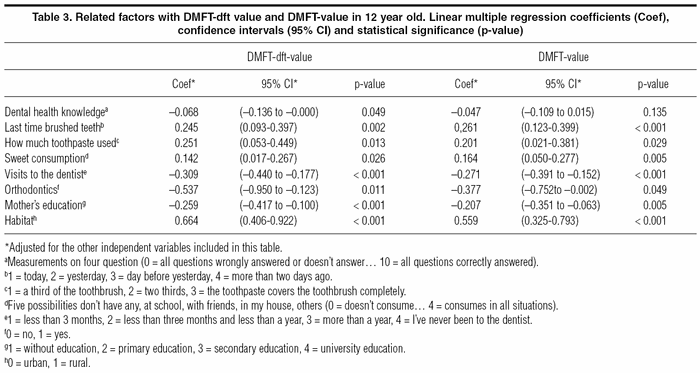
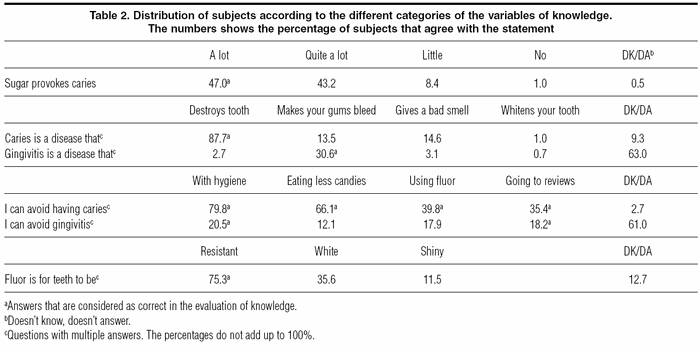
<body><![CDATA[<P><FONT face=arial,helvetica size=2><i>Data analysis</i></FONT></P>     <P><FONT face=arial,helvetica size=2>The weighted Cohen's Kappa was used to  evaluate the concordance between gold standard (evaluation of  specialist-professor) and the teams in four schools. A univariate (prevalence)  analysis was performed. To analyse the factors related to DMFT-value and  DMFT-dft-value (continuum variable) linear multiple regression was used. To  study the factors related to caries presence we carried out a logistic  regression analyses. Taking into account that our study is a cross-sectional  study, odds ratios calculated are really prevalence odds ratio (POR).</FONT></P>     <P><FONT face=arial,helvetica size=2>According to the hypothesis, maximum models  were generated. We excluded from the logistic models variables that had no  effect and were not cofounders of the other independent variables (change in  coefficients &gt; 10%). We used the Hosmer-Lemeshow test to determine the  goodness of fit of the models to the data<SUP>10</SUP>.</FONT></P>     <P><FONT face=arial,helvetica size=2><B>Results</B></FONT></P>     <P><FONT face=arial,helvetica size=2>Of the 1217 pupils in our sample, 1105  pupils participated in the study (90.8%). The caries prevalence in the studied  population was 61.1% (95% confidence interval [CI], 57.7-64.5). The DMFT-dft  value in the sample was 1.82 (95% CI, 1.67-1.98), and the DMFT value 1.52 (95%  CI, 1.37-1.67). The kappa statistics for concordance ranged from 0.75 to  0.95.</FONT></P>     <P><FONT face=arial,helvetica size=2><a href="/img/gs/v19n2/original3_archivos/138v19n02-13074367tab01.gif" target="_blank">Table 1</a> shows the characteristics of the  participants; in as far as the main dependent variables are concerned. <a href="#t2"> Table 2</a>  shows the distribution of subjects according to the different categories of the  variables of knowledge.</FONT></P>     <P align=center><a name="t2"><IMG src="/img/gs/v19n2/original3_archivos/138v19n02-13074367tab02.gif"> </a> </P>     <P><FONT face=arial,helvetica size=2><a href="#t3">Table 3</a> shows multiple regression models  including the variables chosen for DMFT value and DMFT-dft value as outcomes.  The DMFT-dft value and the DMFT value reduce with knowledge on dental health,  and with educational level. On the other hand, low frequency in brushing teeth,  the use of a lot of toothpaste, and the consumption of sweets are related to  higher ratios. The ecological habitat variable (rural/urban) is significant,  given that a rural habitat is associated with higher ratios.</FONT></P>     <P align=center><a name="t3"><IMG src="/img/gs/v19n2/original3_archivos/138v19n02-13074367tab03.gif"> </a> </P>     <P><FONT face=arial,helvetica size=2>Logistic regression model is shown in <a href="/img/gs/v19n2/original3_archivos/138v19n02-13074367tab04.gif" target="_blank"> table 4</a>. The model includes all the variables comprised in the table. This table also  includes the description of the sample through independent variables and caries  prevalence in different groups.</FONT></P>     ]]></body>
<body><![CDATA[<P><FONT face=arial,helvetica size=2><B>Discussion</B></FONT></P>     <P><FONT face=arial,helvetica size=2>The results of this study show that caries  is directly related to a low frequency in brushing, the use of more toothpaste,  and a higher consumption of sweets. The study has also shown that there is  higher caries prevalence in rural habitats compared to urban habitats. On the  other hand, the higher the mother's level of education is and the more knowledge  on dental health the subjects have, the lower the caries prevalence.</FONT></P>     <P><FONT face=arial,helvetica size=2>According to the results of the study,  subjects with low knowledge of dental health show more caries (POR = 1.32; 95%  CI, 1.20-1.61) than those subjects with higher knowledge. Different studies have  found that health education could reduce caries affectation, concluding that  higher knowledge generates more positive attitudes that in turn generate  healthier habits. On the other hand, the results of our study show that  knowledge has an effect on its own, independently of being able to modify  attitudes and habits.</FONT></P>     <P><FONT face=arial,helvetica size=2>The fact that the models have been adjusted  for follow brushing guidelines, visits to the dentist and consumption of sweets  indicates that with the same habits, the subjects with more knowledge on oral  health show less caries. There are 2 possible explanations for this result:  first, better knowledge is related to better brushing techniques, although when  adjusting by the quantity of toothpaste used, part of this effect should be  controlled, and second, a certain amount of residual confounding cannot be  ignored due to the misclassification introduced in the variables that measure  the habits<SUP>11</SUP>.</FONT></P>     <P><FONT face=arial,helvetica size=2>In as far as the effect of brushing on  caries is concerned, the results of our study are consistent with those found by  different authors<SUP>7</SUP>. Therefore, considering the subjects who cleaned  their teeth today as a reference category, among those who cleaned their teeth  yesterday, we found more caries (POR = 1.48; 95% CI, 1.22-1.78), (POR = 1.57;  95% CI, 0.91-2.33) among those who brushed their teeth before yesterday and  among those who brushed their teeth more than two days ago (POR = 1.60; 95% CI,  1.20-2.28). These results are of statistical significance.</FONT></P>     <P><FONT face=arial,helvetica size=2>The final models also considered the  variable of quantity of toothpaste on the toothbrush. Taking as a reference  category those who use a third of the toothbrush with toothpaste, the subjects  who use two thirds show more caries (POR = 1.32; 95% CI, 1.10-2.16), and also  those who use the whole brush (POR = 1.52; 95% CI, 1.20-1.61). These results  show a clear significant tendency. This association between quantity of  toothpaste and caries could be due to 3 reasons: <I>a)</I> the variable quantity  of toothpaste could be a proxy of the quality of brushing. Therefore, the  subjects who use less toothpaste are probably those who have more knowledge on  the more adequate way to brush their teeth; <I>b)</I> the quantity of toothpaste  used is related to the frequency of brushing (p = 0.02). Therefore, it is  reasonable to think that the subjects who brush their teeth more frequently use  less toothpaste, and <I>c)</I> the use of great quantities of toothpaste could  generate a false sensation of cleanliness (production of great amounts of foam  and a pleasant sensation), which reduces brushing time.</FONT></P>     <P><FONT face=arial,helvetica size=2>Consistently with previous studies, a high  consumption of sweets is related to higher caries prevalence, these results are  consistent with the bibliography<SUP>12-15</SUP>, even though the consumption  between meals could be a more suitable measure. Therefore, taking the subjects  who never consume as a reference category, we found increasing values of caries  prevalence as the situations in which they are consumed increase: in one  situation (POR = 1.39); in two situations (POR = 1.44); in three situations (POR  = 1.46), and in four situations (POR = 1.68). The fact that the models have been  adjusted according to brushing, quantity of toothpaste, or visits to the  dentist, allows us to confirm the negative effect that the number of times we  eat sweets has on caries, independently of the subject maintaining adequate  hygienic habits.</FONT></P>     <P><FONT face=arial,helvetica size=2>In as far as the variable of education of  the mother is concerned, a univariate analysis shows how caries prevalence  increases as the level of education decreases, we go from a prevalence of 49.7%  in children with mothers with higher education, to a prevalence of 78.8% in  children with mothers who have no education. These results are consistent with  those in the bibliography<SUP>6,16</SUP>, which generally show worse dental  health in the lower economic strata<SUP>17-19</SUP>.</FONT></P>     <P><FONT face=arial,helvetica size=2>However, when analysing prevalence odds  ratio we observe different data: taking higher education as a reference  category, caries prevalence odds ratio in secondary education is POR = 1.62,  while in the categories of primary and no education this increase is lower POR =  1.40. These results show an important confusing effect of the remaining  variables, an effect that has not been described in the bibliography.</FONT></P>     <P><FONT face=arial,helvetica size=2>The lower caries prevalence in subjects  belonging to the lower cultural strata compared with the middle cultural strata  is not easy to explain. Perhaps the subjects belonging to a lower socio-economic  strata consume less refined sugar products<SUP>20</SUP>, although we cannot  ignore that this difference in prevalence may be a sample effect, in fact, the  confidence intervals are not significant.</FONT></P>     ]]></body>
<body><![CDATA[<P><FONT face=arial,helvetica size=2>We also considered one aggregate variable  of the municipality where the pupils live, rural municipalities and urban  municipalities, finding that there is a lower level of dental health in rural  habitats. Traditionally, there has always been a lower economical and cultural  level in rural habitats, and less possibility of access to a dentist. And  despite including the parents' level of education and check ups in the models,  we cannot ignore a certain degree of residual confounding. Moreover, the level  of studies is a proxy of socio-cultural level, but both are not equal. In any  case, these interpretations must be made with caution, due to the possibility of  «ecological fallacy» in the measurement of these  variables<SUP>11</SUP>.</FONT></P>     <P><FONT face=arial,helvetica size=2>Moreover, the models include variables of  orthodontics and visits to the dentist. These variables have been included  solely to adjust the models, and their coefficients have no direct  interpretation on the models.</FONT></P>     <P><FONT face=arial,helvetica size=2>Since the current analysis is based on  cross-sectional data, the validity of the conclusions could be limited by the  difficulty in differentiating between cause and effect. In this case however,  the factors associated with caries (i.e. habitat, socio-economical level, oral  hygiene, sweet consumption) are variables that are unlikely to change during the  period of time in which the dependent variable is  measured<SUP>11</SUP>.</FONT></P>     <P><FONT face=arial,helvetica size=2>This study may give health educators,  planners and other health professionals' information that will help to reduce  dental caries. The main goals of dental health programmes should be to achieve  quality brushing every day in children, to reduce the consumption of sweets, and  to increase knowledge on dental health.</FONT></P> <hr color="#000000" align="left" size="1">     <P><FONT face=arial,helvetica size=2><B>Acknowledgements</B></FONT></P>     <P><FONT face=arial,helvetica size=2>Our thanks to Dirección Xeral de Saúde  Pública da Xunta de Galicia.</FONT></P>     <P>    <br> <font face="Arial" size="2"><b>References</b></font></P>     <!-- ref --><P><FONT face=Arial size=2>1.  Álvarez-Arenal A, Álvarez-Riesgo JA, Pena-López JM, Fernández-Vázquez JP. DMFT,  dmft and treatment requirements of schollchildren in Asturias, Spain. Community  Dent Oral Epidemiol. 1998;26:166-9.&nbsp;&nbsp;&nbsp;&nbsp;&nbsp;&nbsp;&nbsp;&nbsp;[&#160;<a href="javascript:void(0);" onclick="javascript: window.open('/scielo.php?script=sci_nlinks&ref=2368066&pid=S0213-9111200500020000400001&lng=','','width=640,height=500,resizable=yes,scrollbars=1,menubar=yes,');">Links</a>&#160;]<!-- end-ref --><!-- ref --><p>2. Llodra JC, Bravo M, Cortés J. Encuesta  de salud oral en España (2000). Rev Col Odont Esp. 2002;7:19-63.&nbsp;&nbsp;&nbsp;&nbsp;&nbsp;&nbsp;&nbsp;&nbsp;[&#160;<a href="javascript:void(0);" onclick="javascript: window.open('/scielo.php?script=sci_nlinks&ref=2368067&pid=S0213-9111200500020000400002&lng=','','width=640,height=500,resizable=yes,scrollbars=1,menubar=yes,');">Links</a>&#160;]<!-- end-ref --><!-- ref --><p>3. Noguerol  B, Llodra JC, Sicilia A, Follana M. La salud bucodental en España 1994:  antedecentes y prespectiva de futuro. Av Odontoestomatol. 1990;6:323-30.&nbsp;&nbsp;&nbsp;&nbsp;&nbsp;&nbsp;&nbsp;&nbsp;[&#160;<a href="javascript:void(0);" onclick="javascript: window.open('/scielo.php?script=sci_nlinks&ref=2368068&pid=S0213-9111200500020000400003&lng=','','width=640,height=500,resizable=yes,scrollbars=1,menubar=yes,');">Links</a>&#160;]<!-- end-ref --><!-- ref --><p>4.  Diehnelt DE, Kiyak HA. Socioeconomic factors that affect international caries  levels. Community Dent Oral Epidemiol. 2001;29:226-33.&nbsp;&nbsp;&nbsp;&nbsp;&nbsp;&nbsp;&nbsp;&nbsp;[&#160;<a href="javascript:void(0);" onclick="javascript: window.open('/scielo.php?script=sci_nlinks&ref=2368069&pid=S0213-9111200500020000400004&lng=','','width=640,height=500,resizable=yes,scrollbars=1,menubar=yes,');">Links</a>&#160;]<!-- end-ref --><!-- ref --><p>5. Mascarenhas AK.  Determinants of caries prevalence and severity in higher SES Indian children.  Community Dent Health. 1999;16:107-13.&nbsp;&nbsp;&nbsp;&nbsp;&nbsp;&nbsp;&nbsp;&nbsp;[&#160;<a href="javascript:void(0);" onclick="javascript: window.open('/scielo.php?script=sci_nlinks&ref=2368070&pid=S0213-9111200500020000400005&lng=','','width=640,height=500,resizable=yes,scrollbars=1,menubar=yes,');">Links</a>&#160;]<!-- end-ref --><!-- ref --><p>6. Irigoyen ME, Sánchez-Hinojosa G.  Changes in dental caries prevalence in 12-year-old students in the State of  Mexico after 9 years of salt fluoridation. Caries Res. 2000; 34:303-7.&nbsp;&nbsp;&nbsp;&nbsp;&nbsp;&nbsp;&nbsp;&nbsp;[&#160;<a href="javascript:void(0);" onclick="javascript: window.open('/scielo.php?script=sci_nlinks&ref=2368071&pid=S0213-9111200500020000400006&lng=','','width=640,height=500,resizable=yes,scrollbars=1,menubar=yes,');">Links</a>&#160;]<!-- end-ref --><!-- ref --><p>7.  Harris R, Nicoll AD, Adair Pm, Pine CM. Risk factors for dental caries in young  children: a systematic review of the literature. Community Dent Health.  2004;21:71-85.&nbsp;&nbsp;&nbsp;&nbsp;&nbsp;&nbsp;&nbsp;&nbsp;[&#160;<a href="javascript:void(0);" onclick="javascript: window.open('/scielo.php?script=sci_nlinks&ref=2368072&pid=S0213-9111200500020000400007&lng=','','width=640,height=500,resizable=yes,scrollbars=1,menubar=yes,');">Links</a>&#160;]<!-- end-ref --><!-- ref --><p>8. Impact of caries and dental fluorosis on 12-year-old  schoolchildren's self-perception of appareance and chewing. Cadernos Saúde  Pública. 2003;19:323-30.&nbsp;&nbsp;&nbsp;&nbsp;&nbsp;&nbsp;&nbsp;&nbsp;[&#160;<a href="javascript:void(0);" onclick="javascript: window.open('/scielo.php?script=sci_nlinks&ref=2368073&pid=S0213-9111200500020000400008&lng=','','width=640,height=500,resizable=yes,scrollbars=1,menubar=yes,');">Links</a>&#160;]<!-- end-ref --><!-- ref --><p>9. WHO. Oral health surveys. Basic methods. 3rd ed.  Geneva: WHO; 1987.&nbsp;&nbsp;&nbsp;&nbsp;&nbsp;&nbsp;&nbsp;&nbsp;[&#160;<a href="javascript:void(0);" onclick="javascript: window.open('/scielo.php?script=sci_nlinks&ref=2368074&pid=S0213-9111200500020000400009&lng=','','width=640,height=500,resizable=yes,scrollbars=1,menubar=yes,');">Links</a>&#160;]<!-- end-ref --><!-- ref --><p>10. Hosmer DW, Taber S, Lemeshow S. The importance of  assessing the fit of logistic regression models: a case study. Am J Public  Health. 1991;81:1630-5.&nbsp;&nbsp;&nbsp;&nbsp;&nbsp;&nbsp;&nbsp;&nbsp;[&#160;<a href="javascript:void(0);" onclick="javascript: window.open('/scielo.php?script=sci_nlinks&ref=2368075&pid=S0213-9111200500020000400010&lng=','','width=640,height=500,resizable=yes,scrollbars=1,menubar=yes,');">Links</a>&#160;]<!-- end-ref --><!-- ref --><p>11. Rothman KJ, Greenland S. Types of epidemiology  study. In: Rothman KJ, Greenland S, editors. Modern epidemiology. Philadelphia:  Lippincott and Raven; 1998. p. 75-6.&nbsp;&nbsp;&nbsp;&nbsp;&nbsp;&nbsp;&nbsp;&nbsp;[&#160;<a href="javascript:void(0);" onclick="javascript: window.open('/scielo.php?script=sci_nlinks&ref=2368076&pid=S0213-9111200500020000400011&lng=','','width=640,height=500,resizable=yes,scrollbars=1,menubar=yes,');">Links</a>&#160;]<!-- end-ref --><!-- ref --><p>12. Moore WJ. The role of sugar in the  aetiology of dental caries (I). Sugar and the antiquity of dental caries. J  Dent. 1983;11:189-90.&nbsp;&nbsp;&nbsp;&nbsp;&nbsp;&nbsp;&nbsp;&nbsp;[&#160;<a href="javascript:void(0);" onclick="javascript: window.open('/scielo.php?script=sci_nlinks&ref=2368077&pid=S0213-9111200500020000400012&lng=','','width=640,height=500,resizable=yes,scrollbars=1,menubar=yes,');">Links</a>&#160;]<!-- end-ref --><!-- ref --><p>13. Rugg-Gunn AJ, Murray JJ. The role of sugar in the  aetiology of dental caries (II). The epidemiologi-cal evidence. J Dent.  1983;11:190-9.&nbsp;&nbsp;&nbsp;&nbsp;&nbsp;&nbsp;&nbsp;&nbsp;[&#160;<a href="javascript:void(0);" onclick="javascript: window.open('/scielo.php?script=sci_nlinks&ref=2368078&pid=S0213-9111200500020000400013&lng=','','width=640,height=500,resizable=yes,scrollbars=1,menubar=yes,');">Links</a>&#160;]<!-- end-ref --><!-- ref --><p>14. Woodward M, Walker ARP. Sugar consumption and dental  caries: evidence from 90 countries. Br Dent J. 1994;176:297-302.&nbsp;&nbsp;&nbsp;&nbsp;&nbsp;&nbsp;&nbsp;&nbsp;[&#160;<a href="javascript:void(0);" onclick="javascript: window.open('/scielo.php?script=sci_nlinks&ref=2368079&pid=S0213-9111200500020000400014&lng=','','width=640,height=500,resizable=yes,scrollbars=1,menubar=yes,');">Links</a>&#160;]<!-- end-ref --><!-- ref --><p>15. Bedos C,  Brodeur JM. Determinants of dental caries in Haitian schoolchildren and  implications for public health. Sante. 2000;10:161-8.&nbsp;&nbsp;&nbsp;&nbsp;&nbsp;&nbsp;&nbsp;&nbsp;[&#160;<a href="javascript:void(0);" onclick="javascript: window.open('/scielo.php?script=sci_nlinks&ref=2368080&pid=S0213-9111200500020000400015&lng=','','width=640,height=500,resizable=yes,scrollbars=1,menubar=yes,');">Links</a>&#160;]<!-- end-ref --><!-- ref --><p>16. Flinck A, Kallestal  C, Holm AK, Allebeck P, Wall S. Distribution of caries in 12-year-old children  in Sweden. Social and oral health-related behavioural patterns. Community Dent  Health. 1999;16:160-5.&nbsp;&nbsp;&nbsp;&nbsp;&nbsp;&nbsp;&nbsp;&nbsp;[&#160;<a href="javascript:void(0);" onclick="javascript: window.open('/scielo.php?script=sci_nlinks&ref=2368081&pid=S0213-9111200500020000400016&lng=','','width=640,height=500,resizable=yes,scrollbars=1,menubar=yes,');">Links</a>&#160;]<!-- end-ref --><!-- ref --><p>17. Dummer PM, Addy M, Hicks R, Kingdon A, Shaw WC.  The effect of social class on the prevalence of caries, plaque, gingivitis and  pocketing in 11-12-year-old children in South Wales. J Dent.  1987;15:185-90.&nbsp;&nbsp;&nbsp;&nbsp;&nbsp;&nbsp;&nbsp;&nbsp;[&#160;<a href="javascript:void(0);" onclick="javascript: window.open('/scielo.php?script=sci_nlinks&ref=2368082&pid=S0213-9111200500020000400017&lng=','','width=640,height=500,resizable=yes,scrollbars=1,menubar=yes,');">Links</a>&#160;]<!-- end-ref --><!-- ref --><p>18. Hjern A, Grindefjord M, Sundberg H, Rosen M. Social  inequality in oral health and use of dental care in Sweden. Community Dent Oral  Epidemiol. 2001;29:167-74.&nbsp;&nbsp;&nbsp;&nbsp;&nbsp;&nbsp;&nbsp;&nbsp;[&#160;<a href="javascript:void(0);" onclick="javascript: window.open('/scielo.php?script=sci_nlinks&ref=2368083&pid=S0213-9111200500020000400018&lng=','','width=640,height=500,resizable=yes,scrollbars=1,menubar=yes,');">Links</a>&#160;]<!-- end-ref --><!-- ref --><p>19. Pitts NB. Inequalities in children's caries  experience: the nature and size of the UK problem. Community Dent Health.  1998;15:296-300.&nbsp;&nbsp;&nbsp;&nbsp;&nbsp;&nbsp;&nbsp;&nbsp;[&#160;<a href="javascript:void(0);" onclick="javascript: window.open('/scielo.php?script=sci_nlinks&ref=2368084&pid=S0213-9111200500020000400019&lng=','','width=640,height=500,resizable=yes,scrollbars=1,menubar=yes,');">Links</a>&#160;]<!-- end-ref --><!-- ref --><p>20. Burt BA, Pai S. Sugar consumption and caries risk: a  systematic review. J Dent Educ. 2001;65:1017-23.&nbsp;&nbsp;&nbsp;&nbsp;&nbsp;&nbsp;&nbsp;&nbsp;[&#160;<a href="javascript:void(0);" onclick="javascript: window.open('/scielo.php?script=sci_nlinks&ref=2368085&pid=S0213-9111200500020000400020&lng=','','width=640,height=500,resizable=yes,scrollbars=1,menubar=yes,');">Links</a>&#160;]<!-- end-ref --> ]]></body><back>
<ref-list>
<ref id="B1">
<label>1</label><nlm-citation citation-type="journal">
<person-group person-group-type="author">
<name>
<surname><![CDATA[Álvarez-Arenal]]></surname>
<given-names><![CDATA[A]]></given-names>
</name>
<name>
<surname><![CDATA[Álvarez-Riesgo]]></surname>
<given-names><![CDATA[JA]]></given-names>
</name>
<name>
<surname><![CDATA[Pena-López]]></surname>
<given-names><![CDATA[JM]]></given-names>
</name>
<name>
<surname><![CDATA[Fernández-Vázquez]]></surname>
<given-names><![CDATA[JP]]></given-names>
</name>
</person-group>
<article-title xml:lang="en"><![CDATA[DMFT, dmft and treatment requirements of schollchildren in Asturias, Spain]]></article-title>
<source><![CDATA[Community Dent Oral Epidemiol]]></source>
<year>1998</year>
<volume>26</volume>
<page-range>166-9</page-range></nlm-citation>
</ref>
<ref id="B2">
<label>2</label><nlm-citation citation-type="journal">
<person-group person-group-type="author">
<name>
<surname><![CDATA[Llodra]]></surname>
<given-names><![CDATA[JC]]></given-names>
</name>
<name>
<surname><![CDATA[Bravo]]></surname>
<given-names><![CDATA[M]]></given-names>
</name>
<name>
<surname><![CDATA[Cortés]]></surname>
<given-names><![CDATA[J]]></given-names>
</name>
</person-group>
<article-title xml:lang="es"><![CDATA[Encuesta de salud oral en España (2000)]]></article-title>
<source><![CDATA[Rev Col Odont Esp]]></source>
<year>2002</year>
<volume>7</volume>
<page-range>19-63</page-range></nlm-citation>
</ref>
<ref id="B3">
<label>3</label><nlm-citation citation-type="journal">
<person-group person-group-type="author">
<name>
<surname><![CDATA[Noguerol]]></surname>
<given-names><![CDATA[B]]></given-names>
</name>
<name>
<surname><![CDATA[Llodra]]></surname>
<given-names><![CDATA[JC]]></given-names>
</name>
<name>
<surname><![CDATA[Sicilia]]></surname>
<given-names><![CDATA[A]]></given-names>
</name>
<name>
<surname><![CDATA[Follana]]></surname>
<given-names><![CDATA[M]]></given-names>
</name>
</person-group>
<article-title xml:lang="es"><![CDATA[La salud bucodental en España 1994: antedecentes y prespectiva de futuro]]></article-title>
<source><![CDATA[Av Odontoestomatol]]></source>
<year>1990</year>
<volume>6</volume>
<page-range>323-30</page-range></nlm-citation>
</ref>
<ref id="B4">
<label>4</label><nlm-citation citation-type="journal">
<person-group person-group-type="author">
<name>
<surname><![CDATA[Diehnelt]]></surname>
<given-names><![CDATA[DE]]></given-names>
</name>
<name>
<surname><![CDATA[Kiyak]]></surname>
<given-names><![CDATA[HA]]></given-names>
</name>
</person-group>
<article-title xml:lang="en"><![CDATA[Socioeconomic factors that affect international caries levels]]></article-title>
<source><![CDATA[Community Dent Oral Epidemiol]]></source>
<year>2001</year>
<volume>29</volume>
<page-range>226-33</page-range></nlm-citation>
</ref>
<ref id="B5">
<label>5</label><nlm-citation citation-type="journal">
<person-group person-group-type="author">
<name>
<surname><![CDATA[Mascarenhas]]></surname>
<given-names><![CDATA[AK]]></given-names>
</name>
</person-group>
<article-title xml:lang="en"><![CDATA[Determinants of caries prevalence and severity in higher SES Indian children]]></article-title>
<source><![CDATA[Community Dent Health]]></source>
<year>1999</year>
<volume>16</volume>
<page-range>107-13</page-range></nlm-citation>
</ref>
<ref id="B6">
<label>6</label><nlm-citation citation-type="journal">
<person-group person-group-type="author">
<name>
<surname><![CDATA[Irigoyen]]></surname>
<given-names><![CDATA[ME]]></given-names>
</name>
<name>
<surname><![CDATA[Sánchez-Hinojosa]]></surname>
<given-names><![CDATA[G]]></given-names>
</name>
</person-group>
<article-title xml:lang="en"><![CDATA[Changes in dental caries prevalence in 12-year-old students in the State of Mexico after 9 years of salt fluoridation]]></article-title>
<source><![CDATA[Caries Res]]></source>
<year>2000</year>
<volume>34</volume>
<page-range>303-7</page-range></nlm-citation>
</ref>
<ref id="B7">
<label>7</label><nlm-citation citation-type="journal">
<person-group person-group-type="author">
<name>
<surname><![CDATA[Harris]]></surname>
<given-names><![CDATA[R]]></given-names>
</name>
<name>
<surname><![CDATA[Nicoll]]></surname>
<given-names><![CDATA[AD]]></given-names>
</name>
<name>
<surname><![CDATA[Adair]]></surname>
<given-names><![CDATA[Pm]]></given-names>
</name>
<name>
<surname><![CDATA[Pine]]></surname>
<given-names><![CDATA[CM]]></given-names>
</name>
</person-group>
<article-title xml:lang="en"><![CDATA[Risk factors for dental caries in young children: a systematic review of the literature]]></article-title>
<source><![CDATA[Community Dent Health]]></source>
<year>2004</year>
<volume>21</volume>
<page-range>71-85</page-range></nlm-citation>
</ref>
<ref id="B8">
<label>8</label><nlm-citation citation-type="journal">
<article-title xml:lang="en"><![CDATA[Impact of caries and dental fluorosis on 12-year-old schoolchildren's self-perception of appareance and chewing]]></article-title>
<source><![CDATA[Cadernos Saúde Pública]]></source>
<year>2003</year>
<volume>19</volume>
<page-range>323-30</page-range></nlm-citation>
</ref>
<ref id="B9">
<label>9</label><nlm-citation citation-type="book">
<collab>WHO</collab>
<source><![CDATA[Oral health surveys: Basic methods]]></source>
<year>1987</year>
<edition>3</edition>
<publisher-loc><![CDATA[Geneva ]]></publisher-loc>
<publisher-name><![CDATA[WHO]]></publisher-name>
</nlm-citation>
</ref>
<ref id="B10">
<label>10</label><nlm-citation citation-type="journal">
<person-group person-group-type="author">
<name>
<surname><![CDATA[Hosmer]]></surname>
<given-names><![CDATA[DW]]></given-names>
</name>
<name>
<surname><![CDATA[Taber]]></surname>
<given-names><![CDATA[S]]></given-names>
</name>
<name>
<surname><![CDATA[Lemeshow]]></surname>
<given-names><![CDATA[S]]></given-names>
</name>
</person-group>
<article-title xml:lang="en"><![CDATA[The importance of assessing the fit of logistic regression models: a case study]]></article-title>
<source><![CDATA[Am J Public Health]]></source>
<year>1991</year>
<volume>81</volume>
<page-range>1630-5</page-range></nlm-citation>
</ref>
<ref id="B11">
<label>11</label><nlm-citation citation-type="book">
<person-group person-group-type="author">
<name>
<surname><![CDATA[Rothman]]></surname>
<given-names><![CDATA[KJ]]></given-names>
</name>
<name>
<surname><![CDATA[Greenland]]></surname>
<given-names><![CDATA[S]]></given-names>
</name>
</person-group>
<article-title xml:lang="en"><![CDATA[Types of epidemiology study]]></article-title>
<person-group person-group-type="editor">
<name>
<surname><![CDATA[Rothman]]></surname>
<given-names><![CDATA[KJ]]></given-names>
</name>
<name>
<surname><![CDATA[Greenland]]></surname>
<given-names><![CDATA[S]]></given-names>
</name>
</person-group>
<source><![CDATA[Modern epidemiology]]></source>
<year>1998</year>
<page-range>75-6</page-range><publisher-loc><![CDATA[Philadelphia ]]></publisher-loc>
<publisher-name><![CDATA[Lippincott and Raven]]></publisher-name>
</nlm-citation>
</ref>
<ref id="B12">
<label>12</label><nlm-citation citation-type="journal">
<person-group person-group-type="author">
<name>
<surname><![CDATA[Moore]]></surname>
<given-names><![CDATA[WJ]]></given-names>
</name>
</person-group>
<article-title xml:lang="en"><![CDATA[The role of sugar in the aetiology of dental caries (I): Sugar and the antiquity of dental caries]]></article-title>
<source><![CDATA[J Dent]]></source>
<year>1983</year>
<volume>11</volume>
<page-range>189-90</page-range></nlm-citation>
</ref>
<ref id="B13">
<label>13</label><nlm-citation citation-type="journal">
<person-group person-group-type="author">
<name>
<surname><![CDATA[Rugg-Gunn]]></surname>
<given-names><![CDATA[AJ]]></given-names>
</name>
<name>
<surname><![CDATA[Murray]]></surname>
<given-names><![CDATA[JJ]]></given-names>
</name>
</person-group>
<article-title xml:lang="en"><![CDATA[The role of sugar in the aetiology of dental caries (II): The epidemiologi-cal evidence]]></article-title>
<source><![CDATA[J Dent]]></source>
<year>1983</year>
<volume>11</volume>
<page-range>190-9</page-range></nlm-citation>
</ref>
<ref id="B14">
<label>14</label><nlm-citation citation-type="journal">
<person-group person-group-type="author">
<name>
<surname><![CDATA[Woodward]]></surname>
<given-names><![CDATA[M]]></given-names>
</name>
<name>
<surname><![CDATA[Walker]]></surname>
<given-names><![CDATA[ARP]]></given-names>
</name>
</person-group>
<article-title xml:lang="en"><![CDATA[Sugar consumption and dental caries: evidence from 90 countries]]></article-title>
<source><![CDATA[Br Dent J]]></source>
<year>1994</year>
<volume>176</volume>
<page-range>297-302</page-range></nlm-citation>
</ref>
<ref id="B15">
<label>15</label><nlm-citation citation-type="journal">
<person-group person-group-type="author">
<name>
<surname><![CDATA[Bedos]]></surname>
<given-names><![CDATA[C]]></given-names>
</name>
<name>
<surname><![CDATA[Brodeur]]></surname>
<given-names><![CDATA[JM]]></given-names>
</name>
</person-group>
<article-title xml:lang="en"><![CDATA[Determinants of dental caries in Haitian schoolchildren and implications for public health]]></article-title>
<source><![CDATA[Sante]]></source>
<year>2000</year>
<volume>10</volume>
<page-range>161-8</page-range></nlm-citation>
</ref>
<ref id="B16">
<label>16</label><nlm-citation citation-type="journal">
<person-group person-group-type="author">
<name>
<surname><![CDATA[Flinck]]></surname>
<given-names><![CDATA[A]]></given-names>
</name>
<name>
<surname><![CDATA[Kallestal]]></surname>
<given-names><![CDATA[C]]></given-names>
</name>
<name>
<surname><![CDATA[Holm]]></surname>
<given-names><![CDATA[AK]]></given-names>
</name>
<name>
<surname><![CDATA[Allebeck]]></surname>
<given-names><![CDATA[P]]></given-names>
</name>
<name>
<surname><![CDATA[Wall]]></surname>
<given-names><![CDATA[S]]></given-names>
</name>
</person-group>
<article-title xml:lang="en"><![CDATA[Distribution of caries in 12-year-old children in Sweden: Social and oral health-related behavioural patterns]]></article-title>
<source><![CDATA[Community Dent Health]]></source>
<year>1999</year>
<volume>16</volume>
<page-range>160-5</page-range></nlm-citation>
</ref>
<ref id="B17">
<label>17</label><nlm-citation citation-type="journal">
<person-group person-group-type="author">
<name>
<surname><![CDATA[Dummer]]></surname>
<given-names><![CDATA[PM]]></given-names>
</name>
<name>
<surname><![CDATA[Addy]]></surname>
<given-names><![CDATA[M]]></given-names>
</name>
<name>
<surname><![CDATA[Hicks]]></surname>
<given-names><![CDATA[R]]></given-names>
</name>
<name>
<surname><![CDATA[Kingdon]]></surname>
<given-names><![CDATA[A]]></given-names>
</name>
<name>
<surname><![CDATA[Shaw]]></surname>
<given-names><![CDATA[WC]]></given-names>
</name>
</person-group>
<article-title xml:lang="en"><![CDATA[The effect of social class on the prevalence of caries, plaque, gingivitis and pocketing in 11-12-year-old children in South Wales]]></article-title>
<source><![CDATA[J Dent]]></source>
<year>1987</year>
<volume>15</volume>
<page-range>185-90</page-range></nlm-citation>
</ref>
<ref id="B18">
<label>18</label><nlm-citation citation-type="journal">
<person-group person-group-type="author">
<name>
<surname><![CDATA[Hjern]]></surname>
<given-names><![CDATA[A]]></given-names>
</name>
<name>
<surname><![CDATA[Grindefjord]]></surname>
<given-names><![CDATA[M]]></given-names>
</name>
<name>
<surname><![CDATA[Sundberg]]></surname>
<given-names><![CDATA[H]]></given-names>
</name>
<name>
<surname><![CDATA[Rosen]]></surname>
<given-names><![CDATA[M]]></given-names>
</name>
</person-group>
<article-title xml:lang="en"><![CDATA[Social inequality in oral health and use of dental care in Sweden]]></article-title>
<source><![CDATA[Community Dent Oral Epidemiol]]></source>
<year>2001</year>
<volume>29</volume>
<page-range>167-74</page-range></nlm-citation>
</ref>
<ref id="B19">
<label>19</label><nlm-citation citation-type="journal">
<person-group person-group-type="author">
<name>
<surname><![CDATA[Pitts]]></surname>
<given-names><![CDATA[NB]]></given-names>
</name>
</person-group>
<article-title xml:lang="en"><![CDATA[Inequalities in children's caries experience: the nature and size of the UK problem]]></article-title>
<source><![CDATA[Community Dent Health]]></source>
<year>1998</year>
<volume>15</volume>
<page-range>296-300</page-range></nlm-citation>
</ref>
<ref id="B20">
<label>20</label><nlm-citation citation-type="journal">
<person-group person-group-type="author">
<name>
<surname><![CDATA[Burt]]></surname>
<given-names><![CDATA[BA]]></given-names>
</name>
<name>
<surname><![CDATA[Pai]]></surname>
<given-names><![CDATA[S]]></given-names>
</name>
</person-group>
<article-title xml:lang="en"><![CDATA[Sugar consumption and caries risk: a systematic review]]></article-title>
<source><![CDATA[J Dent Educ]]></source>
<year>2001</year>
<volume>65</volume>
<page-range>1017-23</page-range></nlm-citation>
</ref>
</ref-list>
</back>
</article>