<?xml version="1.0" encoding="ISO-8859-1"?><article xmlns:mml="http://www.w3.org/1998/Math/MathML" xmlns:xlink="http://www.w3.org/1999/xlink" xmlns:xsi="http://www.w3.org/2001/XMLSchema-instance">
<front>
<journal-meta>
<journal-id>0213-9111</journal-id>
<journal-title><![CDATA[Gaceta Sanitaria]]></journal-title>
<abbrev-journal-title><![CDATA[Gac Sanit]]></abbrev-journal-title>
<issn>0213-9111</issn>
<publisher>
<publisher-name><![CDATA[Sociedad Española de Salud Pública y Administración Sanitaria (SESPAS)]]></publisher-name>
</publisher>
</journal-meta>
<article-meta>
<article-id>S0213-91112005000400004</article-id>
<title-group>
<article-title xml:lang="en"><![CDATA[Variability in the clinical practice of maintaining the patency of peripheral intravenous catheters]]></article-title>
<article-title xml:lang="es"><![CDATA[Variabilidad en la práctica clínica del mantenimiento de la permeabilidad de catéteres venosos periféricos]]></article-title>
</title-group>
<contrib-group>
<contrib contrib-type="author">
<name>
<surname><![CDATA[Cabrero]]></surname>
<given-names><![CDATA[Julio]]></given-names>
</name>
<xref ref-type="aff" rid="A01"/>
</contrib>
<contrib contrib-type="author">
<name>
<surname><![CDATA[Orts]]></surname>
<given-names><![CDATA[M. Isabel]]></given-names>
</name>
<xref ref-type="aff" rid="A01"/>
</contrib>
<contrib contrib-type="author">
<name>
<surname><![CDATA[López-Coig]]></surname>
<given-names><![CDATA[M. Luisa]]></given-names>
</name>
<xref ref-type="aff" rid="A01"/>
</contrib>
<contrib contrib-type="author">
<name>
<surname><![CDATA[Velasco]]></surname>
<given-names><![CDATA[M. Luisa]]></given-names>
</name>
<xref ref-type="aff" rid="A01"/>
</contrib>
<contrib contrib-type="author">
<name>
<surname><![CDATA[Richart]]></surname>
<given-names><![CDATA[Miguel]]></given-names>
</name>
<xref ref-type="aff" rid="A01"/>
</contrib>
</contrib-group>
<aff id="A01">
<institution><![CDATA[,Universidad de Alicante Department of Nursing ]]></institution>
<addr-line><![CDATA[ Alicante]]></addr-line>
<country>Spain</country>
</aff>
<pub-date pub-type="pub">
<day>00</day>
<month>08</month>
<year>2005</year>
</pub-date>
<pub-date pub-type="epub">
<day>00</day>
<month>08</month>
<year>2005</year>
</pub-date>
<volume>19</volume>
<numero>4</numero>
<fpage>287</fpage>
<lpage>293</lpage>
<copyright-statement/>
<copyright-year/>
<self-uri xlink:href="http://scielo.isciii.es/scielo.php?script=sci_arttext&amp;pid=S0213-91112005000400004&amp;lng=en&amp;nrm=iso"></self-uri><self-uri xlink:href="http://scielo.isciii.es/scielo.php?script=sci_abstract&amp;pid=S0213-91112005000400004&amp;lng=en&amp;nrm=iso"></self-uri><self-uri xlink:href="http://scielo.isciii.es/scielo.php?script=sci_pdf&amp;pid=S0213-91112005000400004&amp;lng=en&amp;nrm=iso"></self-uri><abstract abstract-type="short" xml:lang="en"><p><![CDATA[Objective: To establish variations in clinical practice associated with maintaining the patency of peripheral intravenous catheters (PIC) and to determine to what extent such clinical practice falls within the limits of the available scientific evidence, based on a random sample of Spanish public hospitals. Methods: A cross-sectional, descriptive study was carried out in non-psychiatric public hospitals and their associated medical and surgical units. Cluster (hospitals), stratified (hospital size), and single-stage (all units) sampling was applied. A questionnaire was mailed to all of the units involved. Results: A sample of 341 valid questionnaires was analysed (response rate 54.5%). Only one praxis-modality was carried out in the majority of units. Intermittent flushing and heparin saline versus normal saline was the most frequent modality employed, over those of continuous flushing and non-heparinised saline. There was a high degree of variation in the quantity of heparin administered: 81.7% when flushing was carried out with heparinised saline and 48.2% when it was conducted with concentrated heparin. About 40% of this variation was associated with the hospital in question, rather than with the unit. The clinical practice fell within the limits of available scientific evidence in fewer than half of the units studied. Conclusions: There was a high degree of variability in the practice of maintaining PIC patency. A significant part of this variation was attributable to the hospital in which the practice was carried out. Moreover, most of this practice was carried out beyond the limits of available scientific evidence.]]></p></abstract>
<abstract abstract-type="short" xml:lang="es"><p><![CDATA[Objetivo: Determinar la variabilidad de la práctica clínica en el mantenimiento de la permeabilidad de los catéteres venosos periféricos en una muestra aleatoria de hospitales españoles y determinar en qué medida esta práctica se realiza dentro del rango de la evidencia disponible. Métodos: Estudio descriptivo y transversal. Ámbito y población: Hospitales públicos no psiquiátricos del Sistema Nacional de Salud y sus unidades médicas o quirúrgicas. Se realizó un muestreo por conglomerados (hospitales) estratificado (tamaño de los hospitales) y monoetápico (todas las unidades). Las variables se recogieron mediante un cuestionario administrado por correo postal. Resultados: Se recibieron 341 cuestionarios válidos (tasa de participación del 54,5%). En la mayoría de las unidades sólo se realiza una modalidad de la práctica. El lavado intermitente frente al lavado continuo y el suero salino con heparina frente al no heparinizado son las modalidades más frecuentes. Hay una elevada variabilidad en la cantidad de heparina administrada: el coeficiente de variación intercuartílico es del 81,7% si el suero es heparinizado y del 48,2% si es con una dilución de heparina dada. Alrededor del 40% de esta variabilidad es atribuible al hospital y no a la unidad. En menos de la mitad de las unidades la práctica se realiza de acuerdo con la evidencia actual. Conclusiones: Hay una gran variabilidad en la práctica del mantenimiento de la permeabilidad de los catéteres venosos periféricos. Una parte sustancial de esa variabilidad es incompatible con la evidencia actual, y una parte significativa de la variabilidad reside en el hospital donde se realiza la práctica.]]></p></abstract>
<kwd-group>
<kwd lng="en"><![CDATA[Variation in clinical practice]]></kwd>
<kwd lng="en"><![CDATA[Evidence-based nursing practice]]></kwd>
<kwd lng="en"><![CDATA[Peripheral intravenous catheters]]></kwd>
<kwd lng="en"><![CDATA[Heparin]]></kwd>
<kwd lng="en"><![CDATA[Nursing practice]]></kwd>
<kwd lng="es"><![CDATA[Variabilidad de la práctica clínica]]></kwd>
<kwd lng="es"><![CDATA[Práctica de enfermería basada en la evidencia]]></kwd>
<kwd lng="es"><![CDATA[Catéteres venosos periféricos]]></kwd>
<kwd lng="es"><![CDATA[Heparina]]></kwd>
<kwd lng="es"><![CDATA[Práctica de enfermería]]></kwd>
</kwd-group>
</article-meta>
</front><body><![CDATA[ <FONT face=Arial size=2>    <P align="center"><B>ORIGINALES</B></P> <hr color="#000000"> </FONT>     <P align="center"><B><font face="Arial" size="4">Variability in  the clinical practice of maintaining the patency</font></B></P>    <P align="center"><B><font face="Arial" size="4">of peripheral intravenous  catheters</font></B></P>    <P align="center"><FONT face=Arial size=2><b>Julio Cabrero / M. Isabel Orts / M.  Luisa López-Coig / M. Luisa Velasco / Miguel Richart</b>    <br> Department of Nursing, Universidad de Alicante, Alicante, Spain.    <br> </FONT></P> <table border="0" width="100%">   <tr>     <td width="48%" valign="top"></td>     <td width="4%" valign="top"></td>     <td width="48%" valign="top"><b>(</b><B><FONT face=Arial size=2>Variabilidad       en la práctica clínica del mantenimiento de la permeabilidad de los       catéteres venosos periféricos</FONT></B><b>)</b></td>   </tr> </table> <FONT face=Arial size=2></FONT> <hr color="#000000"> <table border="0" width="100%">   <tr>     <td width="48%" valign="top"><font size="2" face="Arial"><b>Abstract</b></font><I><FONT size=2 face="Arial">    <br>       Objective: </FONT>   </I><FONT size=2 face="Arial">To establish variations in clinical practice  associated with maintaining the patency of peripheral intravenous catheters  (PIC) and to determine to what extent such clinical practice falls within the  limits of the available scientific evidence, based on a random sample of Spanish  public hospitals.</FONT><I><FONT size=2 face="Arial">    <br>       Methods:</FONT>        </I> <FONT size=2 face="Arial"> A cross-sectional, descriptive study was carried  out in non-psychiatric public hospitals and their associated medical and  surgical units. Cluster (hospitals), stratified (hospital size), and       single-stage (all units) sampling was applied. A questionnaire was mailed to all  of the units involved.</FONT><I><FONT size=2 face="Arial">    <br>       Results:</FONT>        </I> <FONT size=2 face="Arial"> A sample of 341 valid questionnaires was  analysed (response rate 54.5%). Only one praxis-modality was carried out in the  majority of units. Intermittent flushing and heparin saline <I>versus</I> normal  saline was the most frequent modality employed, over those of continuous  flushing and non-heparinised saline. There was a high degree of variation in the  quantity of heparin administered: 81.7% when flushing was carried out with  heparinised saline and 48.2% when it was conducted with concentrated heparin.  About 40% of this variation was associated with the hospital in question, rather  than with the unit. The clinical practice fell within the limits of available  scientific evidence in fewer than half of the units studied.</FONT><I><FONT size=2 face="Arial">    ]]></body>
<body><![CDATA[<br>       Conclusions: </FONT></I> <FONT face=Arial size=2><FONT size=2> There was a high degree of variability in  the practice of maintaining PIC patency. A significant part of this variation  was attributable to the hospital in which the practice was carried out.       Moreover, most of this practice was carried out beyond the limits of available  scientific evidence.    <br>       </FONT><b>Keywords: </b> Variation in clinical practice. Evidence-based nursing       practice. Peripheral intravenous catheters. Heparin.  Nursing practice.</FONT>     </td>     <td width="4%" valign="top"></td>     <td width="48%" valign="top"><b><font face="Arial" size="2">Resumen</font></b><I><FONT size=2 face="Arial">    <br>       Objetivo:</FONT>        </I> <FONT size=2 face="Arial"> Determinar la variabilidad de la práctica  clínica en el mantenimiento de la permeabilidad de los catéteres venosos  periféricos en una muestra aleatoria de hospitales españoles y determinar en qué  medida esta práctica se realiza dentro del rango de la evidencia  disponible.</FONT><I><FONT size=2 face="Arial">    <br>       Métodos: </FONT>       </I> <FONT size=2 face="Arial"> Estudio descriptivo y transversal.</FONT><I><FONT size=2 face="Arial">    <br>       Ámbito y población: </FONT>       </I> <FONT size=2 face="Arial"> Hospitales públicos no psiquiátricos  del Sistema Nacional de Salud y sus unidades médicas o quirúrgicas. Se realizó  un muestreo por conglomerados (hospitales) estratificado (tamaño de los  hospitales) y monoetápico (todas las unidades). Las variables se recogieron  mediante un cuestionario administrado por correo postal.</FONT><I><FONT size=2 face="Arial">    <br>       Resultados:</FONT>        </I> <FONT size=2 face="Arial"> Se recibieron 341 cuestionarios válidos (tasa  de participación del 54,5%). En la mayoría de las unidades sólo se realiza una  modalidad de la práctica. El lavado intermitente frente al lavado continuo y el  suero salino con heparina frente al no heparinizado son las modalidades más  frecuentes. Hay una elevada variabilidad en la cantidad de heparina  administrada: el coeficiente de variación intercuartílico es del 81,7% si el  suero es heparinizado y del 48,2% si es con una dilución de heparina dada.  Alrededor del 40% de esta variabilidad es atribuible al hospital y no a la  unidad. En menos de la mitad de las unidades la práctica se realiza de acuerdo  con la evidencia actual.</FONT><I><FONT size=2 face="Arial">    <br>       Conclusiones: </FONT></I> <FONT face=Arial size=2><FONT size=2> Hay una gran variabilidad en la práctica  del mantenimiento de la permeabilidad de los catéteres venosos periféricos. Una  parte sustancial de esa variabilidad es incompatible con la evidencia actual, y  una parte significativa de la variabilidad reside en el hospital donde se  realiza la práctica.    <br>       </FONT><b>Palabras clave:</b> Variabilidad de la práctica clínica.  Práctica de enfermería basada en la evidencia. Catéteres venosos periféricos.  Heparina. Práctica de enfermería.</FONT></td>   </tr> </table> <FONT face=Arial size=2> <hr color="#000000"> </FONT>     <P><FONT face=Arial size=2>The Spanish version of this paper can be down loaded from the web of GACETA SANITARIA (<a href="http://www.doyma.es/gs" target="_blank">www.doyma.es/gs</a>) in PDF format.    <br> <i>La versión en castellano de este trabajo se puede descargar en la página web de GACETA SANITARIA</i> (<a href="http://www.doyma.es/gs" target="_blank">www.doyma.es/gs</a>).</FONT></P>    ]]></body>
<body><![CDATA[<P><font size="2" face="Arial"><i>Correspondence</i>: Dr. Julio Cabrero García.    <br> Deparment of Nursing. Universidad de Alicante.    <br> Campus de San Vicente del Raspeig. Ap. 99 E-03080. Alicante. Spain.    <br> E-mail: <a href="mailto:julio.cabrero@ua.es" target="_blank">julio.cabrero@ua.es</a></font></P>    <P><font size="2" face="Arial"><i>Received:</i> October 6, 2004. <i>Accepted for publication</i>: February, 2005.</font></P>    <P>&nbsp;</P>    <P><B><FONT face=Arial size=2>Introduction</FONT></B></P>     <P><font face="Arial"><FONT size=2>Maintaining the patency of peripheral intravenous catheters (PIC) is a common  clinical practice in patients requiring medication and the administration of  fluids and/or blood derivatives. Nevertheless, there are no universal directives  governing the most appropriate form in which to implement it<SUP>1</SUP>. Two  important considerations when looking at ways of regulating such practice are,  on the one hand, to ensure that the catheter is continuously or intermittently  flushed, and on the other, to make sure that the solution used is saline or  heparin saline. The latter aspect is perhaps the most controversial, and is the  one that has given rise to most research. Three meta-analyses have been carried  out in this area; two in 1991<SUP>2,3</SUP> and a systematic review in  1998<SUP>4</SUP>. The first two meta-analyses concluded that intermittent  flushing with the heparinised solution and with the saline solution were  comparable in terms of permeability, catheter duration and the incidence of  phlebitis. Moreover, on the basis of cost and in order to avoid the risks  associated with the use of heparin (thrombocyto- penia, haemorrhage, etc.),  saline solution was regarded as the most recommendable option. Randolph et  al.<SUP>4</SUP> confirmed these results when applying heparin in quantities of  10 International Units (IU), but also observed an increased incidence of  phlebitis with this solution; on the other hand, when the dose of heparin  applied was 100 IU, its application still proved advantageous, but the results  obtained were less conclusive than in the previous case. Finally, in the case of  continuous flushing, continuous perfusion of 1 IU/ml produced better  results<SUP>4</SUP> than continuous perfusion of saline solution  alone.</FONT></font></P>     <P><FONT face=Arial size=2>Moving from the field of efficacy to the  field of effectiveness, one might ask how the patency of PIC is maintained in  common practice and how congruent this common practice is with currently  available evidence. With the exception of a small quantity of aggregate data  spread over time and place<SUP>5-7</SUP>, no studies have yet been carried out  to examine the variability of this practice or to determine how it conforms to  the available evidence. The main objective of this study was to describe  variability in clinical practice related with maintaining PIC, in a random  sample of Spanish hospitals. Their medical and surgical units were the data  collection and analysis units. The conceptual framework of this investigation  was quite broadly situated within the field of studying variations in medical  practice. These studies have showed that an important part of the observed  variability could be attributed to a certain degree of uncertainty with respect  to what might constitute the most suitable procedure<SUP>8-12</SUP>. Along these  lines, a second objective was to determine to what extent the practice of  maintaining PIC was carried out within the limits of currently available  scientific evidence.</FONT></P>     <P><B><FONT face=Arial size=2>Methods</FONT></B></P>     ]]></body>
<body><![CDATA[<P><FONT face=Arial size=2><i>Study design and area</i></FONT></P>     <P><FONT face=Arial size=2>A descriptive and cross-sectional study was  carried out. The study setting consisted of non-psychiatric public hospitals  belonging to Spain's National Health System<SUP>13</SUP>. The population  comprised medical and/or surgical units (services) for adults, and other units  which attend to patients with PIC, such as obstetric-gynaecological units,  though it excluded those in which the frequency and length of use of peripheral  channels was extremely limited or null, such as in psychiatric units, intensive care, etc.</FONT></P>     <P><FONT face=Arial size=2>The calculation of the sample size was  based on a population of 205 non-psychiatric public hospitals<SUP>13</SUP> (with  the 6 from the pilot study being subsequently excluded), with an estimation of  10 eligible units per hospital, based on the results of the pilot study. The  total estimated population therefore consisted of 2,050 units. For a sampling  error of 0.05, a confidence level of 95% and an assumed maximum variance (p = q)  the necessary sample size was 353 units. Allowing for a non-response of 40%, the  definitive sampling size rose to 600 units.</FONT></P>     <P><font face="Arial"><FONT size=2>Cluster, stratified and single-stage random  sampling was carried out. Although the data collection unit was the service or  unit, the sampling unit chosen was the hospital. This was because a sampling  framework was available at the hospital level, but not at the level of the units  housed within it. Two strata were distinguished according to the number of beds: «big hospitals» ( &gt;=</FONT> <FONT  face=arial,helvetica size=2>882 beds) and «small hospitals» (&lt; 882 beds). The  cutt off mark was determined statistically (there is no common classifier for  the whole of Spain) by means of an exploratory data analysis<SUP>14</SUP> which  identified two homogeneous subpopulations at this point: 175 «small» hospitals  and 24 «big» ones. 63 small hospitals and 8 big ones, making a total of 71  hospitals, were selected at random within each of the two strata by means of a  table of randomly generated numbers. The resulting total number of eligible  units housed in these hospitals was 626; 26 units more than the estimated sample  (note that the hospitals were selected first and the number of units and their  eligibility was determined afterwards).</FONT></font></P>     <P><FONT face=Arial size=2><i>Variables and instrumentation</i></FONT></P>     <P><FONT face=Arial size=2>The variables were gathered using a  questionnaire that was specifically elaborated for this investigation. This  questionnaire was completed by the matrons of the medical-surgical units in  question. The questionnaire was pilot-tested on two occasions. The first test  was presented to 10 matrons in order to evaluate its interpretability. The  second test was used to evaluate all aspects, including the data gathering  process, and was sent to a sample of 119 matrons in the Community of Valencia.  The questionnaire consisted of 33 questions, 26 of which had a closed format and  7 of which were open, and was divided into three sections: continuous flushing,  intermittent flushing and characteristics of the units and hospitals. To  determine which study units fell within the bounds of the existing evidence,  three researchers independently drew conclusions that were relevant to the  practice investigated by the three meta-analyses<SUP>2-4</SUP>. There was  agreement on considering intermittent flushing with saline solution and  continuous perfusion of saline heparinised with a concentration of 1 IU/ml of  heparin as modalities that fell within the limits of the evidence. A third  conclusion, relating to intermittent flushing with 100 IU of heparin, was  considered too provisional by one of the three researchers. It was therefore  decided to create two variables: «type I evidence» and «type II evidence». The  first combined the two most solid implications, while the second incorporated  the third, more provisional, implication<SUP>4</SUP>.</FONT></P>     <P><FONT face=Arial size=2><i>Procedure</i></FONT></P>     <P><FONT face=Arial size=2>The questionnaire was delivered by post  between May and June 2002. A pilot study had been previously carried out  involving a sample of 119 medical-surgical units in six hospitals in the  Community of Valencia. The procedure followed was based on the findings of the  pilot study and on recommendations contained in the literature<SUP>15'16</SUP>.  In order to ensure a good response rate, the questionnaire was sent three times  in the space of three weeks.</FONT></P>     <P><FONT face=Arial size=2><i>Data analysis</i></FONT></P>     <P><FONT face=Arial size=2>A descriptive analysis of the categorical  and continuous variables of this study was carried out. This focused on:  frequency distribution, proportions and 95% confidence intervals (95% CI) for  the categorical variables, and the mean, median, maximum and minimum and 95% CI  for the continuous variables. The coefficient of variation (CV) and the  coefficient of quartile variation (CQV) were used to measure variability, with  the latter being considered the more robust measurement<SUP>17</SUP>. The ANOVA  of random effects was used to separate the variance in the amount of heparin  administered (expressed in IU) attributable to the variation among hospitals  from the variation between units. Eta<SUP>2</SUP> was chosen as a measure of  effect size and in our study it is the amount of variance attributable to the  variability between hospitals. This analytical strategy is recommended as a  screening technique to discover whether the data have a multilevel structure: if  the value of Eta<SUP>2</SUP> is greater than 20 then there the data have a  multilevel structure. The reply variables were transformed to homogenise the  variances following the sequence of steps proposed by Hoaglin et  al<SUP>18</SUP>.</FONT></P>     ]]></body>
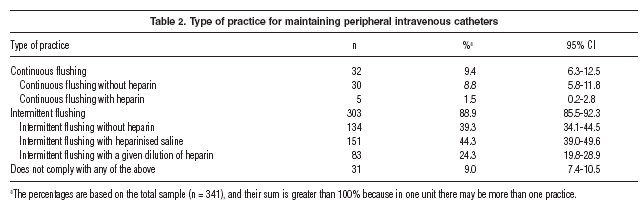
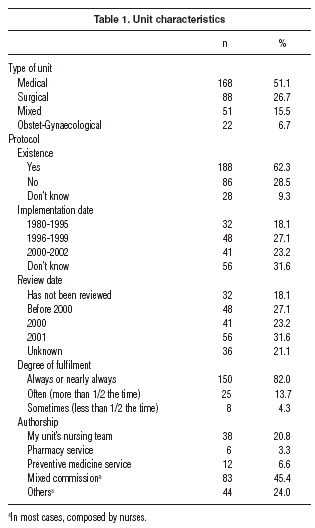
<body><![CDATA[<P><B><FONT face=Arial size=2>Results</FONT></B></P>     <P><FONT face=Arial size=2>341 valid questionnaires were received out  of the 626 sent, making the global response rate 54.5%. The sample was  comparable to the population in the two variables examined: administrative  dependence (Insalud <I>versus</I> non-Insalud, and for the small hospital  stratum, again on the basis of Autonomous Community) and the number of beds,  both globally and within the two strata. The average number of patients per unit  was 32 ± 12.2, and the average number of patients with PIC was 20 ± 10.7. In 94%  of the units the practice(s) was/were carried out by the majority of the  professionals employed by the unit(s) in question. The description of the  participating units is summarised in <a href="#t1"> table 1</a>.</FONT></P>     <P align=center><font face="Arial"><a name="t1"><IMG src="/img/gs/v19n4/original3_archivos/138v19n04-13078026tab01.gif"  border=0></a></font></P>     <P><FONT face=Arial size=2>    <br> <i>Variability in the practice of maintaining  PIC amongst the units surveyed</i></FONT></P>     <P><FONT face=Arial size=2>Intermittent flushing as opposed to  continuous flushing, and saline with heparin as opposed to nonheparinised saline  were the main ways of implementing the practice of maintaining PIC (<a href="#t2">table 2</a>). In  most of the units only one modality was applied, although in about 25% of units  more than one was carried out.</FONT></P>     <P align=center><font face="Arial"><a name="t2"><IMG src="/img/gs/v19n4/original3_archivos/138v19n04-13078026tab02.gif"  border=0></a></font></P>     <P><FONT face=Arial size=2>    <br> Continuous flushing was carried out in 32  units (9.4%), application without heparin in 30, and application with heparin in  only 5 (note that there were more practices than units), the average IU/ml of  heparin administered was 9.40 ± 4.67. The most commonly applied serum was  saline, normally with a steady volume of 500 ml/day.</FONT></P>     <P><FONT face=Arial size=2>Intermittent flushing was carried out in  303 units (88.9%). In 134 (39.3%) only saline solution was used, while in 234  (68.6%) flushing was performed with saline solution and heparin. The former  (flushing with saline solution alone) was often implemented after applying  medication, after performing an extraction, or in both cases. On each occasion  the average saline solution administered was 5.02 ± 3.13 ml, 95% CI (4.47 -  5.56). In the latter case (saline solution with heparin), flushing was carried  out with heparinised saline (IFHS) in 151 units (44.3%) and with a specific  dilution of heparin (IFdH) in 83 (24.3%) units.</FONT></P>     ]]></body>
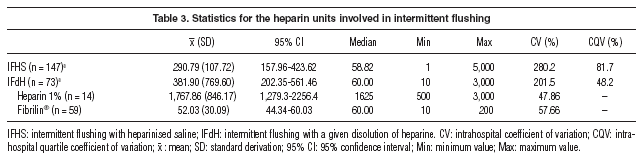
<body><![CDATA[<P><FONT face=Arial size=2>In the case of IFHS, the main serum used  was saline solution with 1% heparin, and the diluted solution had an average  concentration of 78.54 ± 107.72 IU/ml of heparin (Mdn = 47.62). This kind of  flushing was normally carried out after applying medication or performing an  extraction. On each occasion the average IU of the heparin administered was  290.79 (Mdn = 58.82), and the CQV was 81.7% (<a href="#t3">table 3</a>).</FONT></P>     <P align=center><font face="Arial"><a name="t3"><IMG src="/img/gs/v19n4/original3_archivos/138v19n04-13078026tab03.gif"  border=0></a></font></P>     <P><FONT face=Arial size=2>    <br> IFdH was carried out in 83 units (24.3%),  in three-quarters of which a commercial preparation, Fibrilín<SUP>®</SUP>, was  used, while in the rest a 1% dilution of heparin was employed. The average IU of  heparin administered was 381.9 (Mdn = 60) and the CQV was 48.2. There were  considerable differences with respect to the amount of heparin administered in  these two submodalities. The minimum value of units administered involving the  1% heparin solution (500 IU) were much greater than the maximum value of units  administered associated with the other modality (200 IU) (table 3). More than  half of the nursing units that performed these two submodalities did so after  applying medication or carrying out an extraction.</FONT></P>     <P><FONT face=Arial size=2><i>Variability in practice among  hospitals</i></FONT></P>     <P><FONT face=Arial size=2>The practice of maintaining PIC was carried  out in 4 or 5 different ways in 11.8% of the hospitals, while in 35.3%, 19.6%  and 33.3% of hospitals, it was carried out in three, two and one way(s),  respectively. The variability in the average IU of heparin administered per  hospital (in hospitals with four or more medical and surgical units) is shown in  tables 4 and 5. In IFHS (<a href="#t4">table 4</a>), the CQV was 71.1, ranging from 0 to 94.19. In  IFdH (<a href="#t5">table 5</a>), the CQV between hospitals was 84.7, ranging from 0 to 97.4; in  this case two hospital subgroups were observed, one with high variability, and  the other with low variability.</FONT></P>     <P align=center><font face="Arial"><a name="t4"><IMG src="/img/gs/v19n4/original3_archivos/138v19n04-13078026tab04.gif"  border=0>    <br> </a></font></P>     <P align=center><font face="Arial"><a name="t5"><IMG src="/img/gs/v19n4/original3_archivos/138v19n04-13078026tab05.gif"  border=0></a></font></P>     <P><FONT face=Arial size=2>    ]]></body>
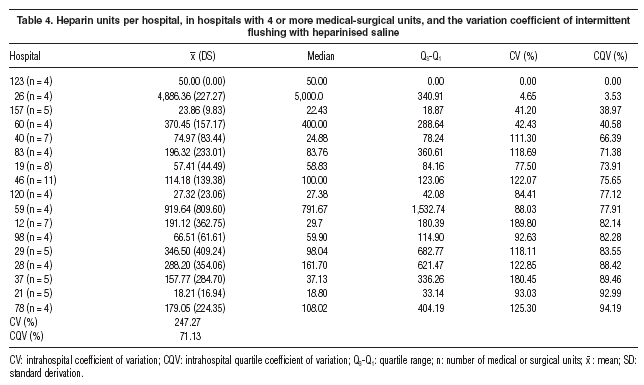
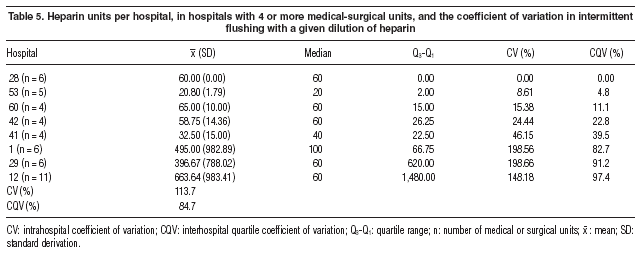
<body><![CDATA[<br> ANOVA data for random effects show that a  significant part of the variability relating to the units of heparin  administered, in the two modalities, was attributable to variability among  hospitals, 43% and 37% respectively; in other words, it did not depend on the  medical-surgical units themselves but rather on the hospital under which these  units were grouped. These eta<SUP>2</SUP> coefficient values also indicated the  existence of a hierarchical structure in the data, which made it impossible to  estimate an unbiased predictive model, unless it was a multilevel  model<SUP>19</SUP>.</FONT></P>     <P><FONT face=Arial size=2><i>The practice of maintaining PIC and how  this conforms to the evidence</i></FONT></P>     <P><FONT face=Arial size=2>According to the first definition of  evidence (type I), the practice was followed within the range of evidence in  only 3 out of every 10 units (31.9%). According to the second, and  wider-ranging, definition (type II), the practice was followed within the range  of evidence in 4 out of every 10 units (41.9%).</FONT></P>     <P><B><FONT face=Arial size=2>Discussion</FONT></B></P>     <P><FONT face=Arial size=2>Intermittent flushing, as opposed to  continuous flushing, is the prevalent method for maintaining PIC in the case of  the medical and surgical units of public hospitals in Spain. Within intermittent  flushing, the use of heparinised saline is the most common practice though  flushing with saline solution is also frequent. If flushing is continuous it is  unusual for it to be carried out with heparinised saline.</FONT></P>     <P><FONT face=Arial size=2>The variability in the quantity of  international units of heparin administered on each occasion is high: it is  greatest when the heparin is diluted in a saline solution and least when a  dilution of heparin is directly administered. In this latter case two  submodalities can be distinguished: the use of a commercial preparation  (Fibrilin<SUP>®</SUP>) or of a 1% dilution of heparin (less common). In both  cases the variation coefficients were high, but the most notable aspect was that  there were considerable differences in the quantity of IUs of heparin  administered. There was a clearly observable floor effect, as no less than 500  IU were administered in the case of the 1% dilution. It could therefore be seen  that the amount of heparin administered depended on the method of administration.</FONT></P>     <P><FONT face=Arial size=2>The data clustered at the hospital level  showed great variability among hospitals; accounting for almost half of all the  variability observed. In statistical terms, this signified the presence of a  hierarchical structure in the data. This has two implications: <I>a)</I> the  performance of the practice of maintaining PIC depends -to a substantial  degree- on the hospital in which it is carried out, and partly on the unit  involved (the part directly attributable to professional staff is probably very  small according to the intraunit homogeneity indicators), and <I>b)</I> in  accordance with this, any unbiased examination of the causes of this variability  calls for the application of a multilevel design. In Spanish hospitals  intermittent flushing with heparinised saline is almost twice as common as it is  with saline solution. This stands in contrast to the situation in Australian  hospitals (the only current comparison available in the literature), where  flushing with saline solution is the norm<SUP>7</SUP>.</FONT></P>     <P><FONT face=Arial size=2>With regard to the most basic  -intraunit- level of analysis, which was not a direct object of this  study, a certain amount of somewhat contradictory data was obtained. On the one  hand, our findings suggest a high degree of uniformity in the practices  implemented by professionals within the units, but on the other, there are  indications to the contrary: in almost half of the units surveyed there were no  established protocols, and in approximately a quarter of them several modalities  were applied within the same practice.</FONT></P>     <P><FONT face=Arial size=2>Two definitions were established for  evidence relating to this practice. One definition, type I evidence,  incorporated two firm implications, whereas the other, type II evidence,  included a third, and more provisional, implication. Only 31.9% of the units,  according to the first of the definitions, and only 41.9%, according to the  second, carried out practices that conformed to the evidence. Furthermore, it  should be stressed that the fact that the findings coincide with the evidence,  does not necessarily mean that they are based on the evidence. Literature  relating to the diffusion and use of research, in general, and more specifically  to its application in the area of nursing, shows the cultural and temporal  distance between the production of findings (research context) and their  implementation (practice context)<SUP>20</SUP>. It also shows that research  literature does not feature among the main sources of information used by  nursing professionals when making clinical decisions: their main sources for  such guidance tend to be: doctors, colleagues, reference manuals, experience,  etc.<SUP>21,22</SUP>. As far as nursing manuals published in Spanish during the  last 10 years are concerned, no common guidelines have been set with respect to  these practices, nor have references been made to suitably high level evidences  or been kept up-to-date, for example<SUP>23,24</SUP>.</FONT></P>     <P><FONT face=Arial size=2>With respect to the limitations of this  study, we have used a mailed questionnaire to examine the variability of this  practice among medical and surgical units with the collaboration of a key  informant by unit; almost always the matron. The pilot study compared the  convergence between mailed surveys and telephoned reports involving 20  informants and this was found to be maximal. Even so, the criterion validity of  the informant's report was not established. Another potentially debatable aspect  related to the delimitation of practices deemed to conform to the evidence: the  question of the validity of these implications still remains to be resolved. In  other words, it has yet to be firmly established whether the investigation  provides sufficient evidence to enable the unequivocal establishment of relevant  conclusions relating to this practice.</FONT></P>     ]]></body>
<body><![CDATA[<P><FONT face=Arial size=2>Two clear suggestions can be made for  further studies. On the one hand, it seems necessary to establish -perhaps  with the help of a panel of experts- a series of directives relating to the  practice of maintaining PIC and to disseminate them appropriately within the  conceptual and empirical framework of the diffusion of innovations and the use  of research<SUP>25,26</SUP>. On the other hand, it seems necessary to analyse,  by means of a multilevel design, the factors that explain the variability  observed amongst different medical and surgical units.</FONT></P>     <P><FONT face=Arial size=2>In conclusion, this study shows: <I>a)</I>  that there is great variability in the application of the practices aimed at  maintaining the patency of peripheral intravenous catheters; <I>b)</I> that a  substantial portion of this variability is not compatible with the current  evidence, and <I>c)</I> that a significant part of the variability resides in  the hospital where the practice is carried out. These findings are compatible  with the most solid hypotheses relating to variability in  practice<SUP>27,9</SUP> and the use of research<SUP>28,29</SUP>. It is apparent  that a lack of clear evidence and a lack of existing knowledge on the part of  professionals cause variability, and that the use of research findings and  different types of practice are largely determined by supraindividual variables;  in this particular case by the unit and the hospital.</FONT></P> <hr color="#000000" width="30%" align="left">     <P><B><FONT face=Arial size=2>Acknowledgements</FONT></B></P>     <P><FONT face=Arial size=2>This research was financed by <I>the  Agencia Nacional de Evaluación de Tecnologías Sanitarias,</I> ref.  n.<SUP>o</SUP> 01/10100.</FONT></P>     <P><font size="2" face="Arial"><b>    <br> </b><b>References</b></font></P>     <!-- ref --><P><FONT face=Arial size=2>1. Guideline  for Prevention of Intravascular Device-Related Infections. Am J Infect Control.  1996;24:262-93.</FONT>&nbsp;&nbsp;&nbsp;&nbsp;&nbsp;&nbsp;&nbsp;&nbsp;[&#160;<a href="javascript:void(0);" onclick="javascript: window.open('/scielo.php?script=sci_nlinks&ref=2358392&pid=S0213-9111200500040000400001&lng=','','width=640,height=500,resizable=yes,scrollbars=1,menubar=yes,');">Links</a>&#160;]<!-- end-ref --><!-- ref --><P><FONT face=Arial size=2>2. Peterson FY, Kirchoff KT. Analysis of the research about  heparinized versus nonhepariniced intravascular lines. Heart Lung.  1991;20:631-40.</FONT>&nbsp;&nbsp;&nbsp;&nbsp;&nbsp;&nbsp;&nbsp;&nbsp;[&#160;<a href="javascript:void(0);" onclick="javascript: window.open('/scielo.php?script=sci_nlinks&ref=2358393&pid=S0213-9111200500040000400002&lng=','','width=640,height=500,resizable=yes,scrollbars=1,menubar=yes,');">Links</a>&#160;]<!-- end-ref --><!-- ref --><P><FONT face=Arial size=2>3. Goode CJ, Titler M, Rakel B, Kleiber C. A meta-analysis of  effects of heparin flush and saline flush: quality and cost implications. Nurs  Res. 1991;40:324-30.</FONT>&nbsp;&nbsp;&nbsp;&nbsp;&nbsp;&nbsp;&nbsp;&nbsp;[&#160;<a href="javascript:void(0);" onclick="javascript: window.open('/scielo.php?script=sci_nlinks&ref=2358394&pid=S0213-9111200500040000400003&lng=','','width=640,height=500,resizable=yes,scrollbars=1,menubar=yes,');">Links</a>&#160;]<!-- end-ref --><!-- ref --><P><FONT face=Arial size=2>4. Randolph A, Cook D, Gonzales CA, Andrew M. Benefit of  heparin in peripheral venous and arterial catheters: systematic review and  meta-analysis of randomised controlled trials. BMJ. 1998;316:969-75.</FONT>&nbsp;&nbsp;&nbsp;&nbsp;&nbsp;&nbsp;&nbsp;&nbsp;[&#160;<a href="javascript:void(0);" onclick="javascript: window.open('/scielo.php?script=sci_nlinks&ref=2358395&pid=S0213-9111200500040000400004&lng=','','width=640,height=500,resizable=yes,scrollbars=1,menubar=yes,');">Links</a>&#160;]<!-- end-ref --><!-- ref --><P><FONT face=Arial size=2>5. Deeb  E, Di Mattia P. How much heparin in the lock. Am J Intravenous Ther.  1976;3:22-6.</FONT>&nbsp;&nbsp;&nbsp;&nbsp;&nbsp;&nbsp;&nbsp;&nbsp;[&#160;<a href="javascript:void(0);" onclick="javascript: window.open('/scielo.php?script=sci_nlinks&ref=2358396&pid=S0213-9111200500040000400005&lng=','','width=640,height=500,resizable=yes,scrollbars=1,menubar=yes,');">Links</a>&#160;]<!-- end-ref --><!-- ref --><P><FONT face=Arial size=2>6. American Association of Critical Care Nurses. Nationwide  practice survey results announced. AACN News; 1990. p. 3.</FONT>&nbsp;&nbsp;&nbsp;&nbsp;&nbsp;&nbsp;&nbsp;&nbsp;[&#160;<a href="javascript:void(0);" onclick="javascript: window.open('/scielo.php?script=sci_nlinks&ref=2358397&pid=S0213-9111200500040000400006&lng=','','width=640,height=500,resizable=yes,scrollbars=1,menubar=yes,');">Links</a>&#160;]<!-- end-ref --><!-- ref --><P><FONT face=Arial size=2>7. Fernández RS,  Griffiths RD, Murie P. Peripheral venous catheters: a review of current  practices. J Infus Nurs. 2003;26: 388-92.</FONT>&nbsp;&nbsp;&nbsp;&nbsp;&nbsp;&nbsp;&nbsp;&nbsp;[&#160;<a href="javascript:void(0);" onclick="javascript: window.open('/scielo.php?script=sci_nlinks&ref=2358398&pid=S0213-9111200500040000400007&lng=','','width=640,height=500,resizable=yes,scrollbars=1,menubar=yes,');">Links</a>&#160;]<!-- end-ref --><!-- ref --><P><FONT face=Arial size=2>8. Cabrero J, Richart M, Orts MI.  La promesa, la realidad y el desafío de la práctica basada en la evidencia.  Hypatia. 2003; 10:25-36.</FONT>&nbsp;&nbsp;&nbsp;&nbsp;&nbsp;&nbsp;&nbsp;&nbsp;[&#160;<a href="javascript:void(0);" onclick="javascript: window.open('/scielo.php?script=sci_nlinks&ref=2358399&pid=S0213-9111200500040000400008&lng=','','width=640,height=500,resizable=yes,scrollbars=1,menubar=yes,');">Links</a>&#160;]<!-- end-ref --><!-- ref --><P><FONT face=Arial size=2>9. Marión J, Peiró S, Márquez S, Meneu R.  Variaciones en la práctica médica: importancia, causas e implicaciones. Med Clin  (Barc). 1998;110:382-9.</FONT>&nbsp;&nbsp;&nbsp;&nbsp;&nbsp;&nbsp;&nbsp;&nbsp;[&#160;<a href="javascript:void(0);" onclick="javascript: window.open('/scielo.php?script=sci_nlinks&ref=2358400&pid=S0213-9111200500040000400009&lng=','','width=640,height=500,resizable=yes,scrollbars=1,menubar=yes,');">Links</a>&#160;]<!-- end-ref --><!-- ref --><P><FONT face=Arial size=2>10. Sobreques J, Bolibar B, Unzueta L, Prados JD,  Leiva F, Boerma W. Variaciones en la aplicación de técnicas médicas en atención  primaria. Gac Sanit. 2002;16:497-504.</FONT>&nbsp;&nbsp;&nbsp;&nbsp;&nbsp;&nbsp;&nbsp;&nbsp;[&#160;<a href="javascript:void(0);" onclick="javascript: window.open('/scielo.php?script=sci_nlinks&ref=2358401&pid=S0213-9111200500040000400010&lng=','','width=640,height=500,resizable=yes,scrollbars=1,menubar=yes,');">Links</a>&#160;]<!-- end-ref --><!-- ref --><P><FONT face=Arial size=2>11. Ruiz I, Ramos JM, Hernández-Aguado  I. Variaciones en la prevención del riesgo cardiovascular: estudio poblacional.  Gac Sanit. 2003;17:20-6.</FONT>&nbsp;&nbsp;&nbsp;&nbsp;&nbsp;&nbsp;&nbsp;&nbsp;[&#160;<a href="javascript:void(0);" onclick="javascript: window.open('/scielo.php?script=sci_nlinks&ref=2358402&pid=S0213-9111200500040000400011&lng=','','width=640,height=500,resizable=yes,scrollbars=1,menubar=yes,');">Links</a>&#160;]<!-- end-ref --><!-- ref --><P><FONT face=Arial size=2>12. Aróstegui I, Quintana JM, Arcelay A. Uso del PMC  en el estudio de la variabilidad de la estancia media hospitalaria en tres  procesos quirúrgicos. Gac Sanit. 1998;12:169-75.</FONT>&nbsp;&nbsp;&nbsp;&nbsp;&nbsp;&nbsp;&nbsp;&nbsp;[&#160;<a href="javascript:void(0);" onclick="javascript: window.open('/scielo.php?script=sci_nlinks&ref=2358403&pid=S0213-9111200500040000400012&lng=','','width=640,height=500,resizable=yes,scrollbars=1,menubar=yes,');">Links</a>&#160;]<!-- end-ref --><!-- ref --><P><FONT face=Arial size=2>13. Ministerio de Sanidad y  Consumo. Catálogo de hospitales públicos españoles 1999. (accessed 15 Feb 2000).  Available in: http://www.msc.es/centros/catálogo/home.htm</FONT>&nbsp;&nbsp;&nbsp;&nbsp;&nbsp;&nbsp;&nbsp;&nbsp;[&#160;<a href="javascript:void(0);" onclick="javascript: window.open('/scielo.php?script=sci_nlinks&ref=2358404&pid=S0213-9111200500040000400013&lng=','','width=640,height=500,resizable=yes,scrollbars=1,menubar=yes,');">Links</a>&#160;]<!-- end-ref --><!-- ref --><P><FONT face=Arial size=2>14. Palmer AL.  Análisis de datos. Etapa exploratoria. Madrid: Pirámide; 1999.</FONT>&nbsp;&nbsp;&nbsp;&nbsp;&nbsp;&nbsp;&nbsp;&nbsp;[&#160;<a href="javascript:void(0);" onclick="javascript: window.open('/scielo.php?script=sci_nlinks&ref=2358405&pid=S0213-9111200500040000400014&lng=','','width=640,height=500,resizable=yes,scrollbars=1,menubar=yes,');">Links</a>&#160;]<!-- end-ref --><!-- ref --><P><FONT face=Arial size=2>15. Dillman  DA. Mail and telephone surveys. The total design method. New York: John Wiley  and Sons; 1978.</FONT>&nbsp;&nbsp;&nbsp;&nbsp;&nbsp;&nbsp;&nbsp;&nbsp;[&#160;<a href="javascript:void(0);" onclick="javascript: window.open('/scielo.php?script=sci_nlinks&ref=2358406&pid=S0213-9111200500040000400015&lng=','','width=640,height=500,resizable=yes,scrollbars=1,menubar=yes,');">Links</a>&#160;]<!-- end-ref --><!-- ref --><P><FONT face=Arial size=2>16. Bosch JL, Torrente D. Encuestas telefónicas y por correo.  Madrid: Centro de Investigaciones Sociológicas; 1983.</FONT>&nbsp;&nbsp;&nbsp;&nbsp;&nbsp;&nbsp;&nbsp;&nbsp;[&#160;<a href="javascript:void(0);" onclick="javascript: window.open('/scielo.php?script=sci_nlinks&ref=2358407&pid=S0213-9111200500040000400016&lng=','','width=640,height=500,resizable=yes,scrollbars=1,menubar=yes,');">Links</a>&#160;]<!-- end-ref --><!-- ref --><P><FONT face=Arial size=2>17. Escobar M. Análisis  gráfico/exploratorio. Madrid: La Muralla; 1999.</FONT>&nbsp;&nbsp;&nbsp;&nbsp;&nbsp;&nbsp;&nbsp;&nbsp;[&#160;<a href="javascript:void(0);" onclick="javascript: window.open('/scielo.php?script=sci_nlinks&ref=2358408&pid=S0213-9111200500040000400017&lng=','','width=640,height=500,resizable=yes,scrollbars=1,menubar=yes,');">Links</a>&#160;]<!-- end-ref --><!-- ref --><P><FONT face=Arial size=2>18. Hoaglin DC, Mosteller F,  Tukey JW. Understanding robust and exploratory data analysis. New York: John  Wiley and Sons; 1983.</FONT>&nbsp;&nbsp;&nbsp;&nbsp;&nbsp;&nbsp;&nbsp;&nbsp;[&#160;<a href="javascript:void(0);" onclick="javascript: window.open('/scielo.php?script=sci_nlinks&ref=2358409&pid=S0213-9111200500040000400018&lng=','','width=640,height=500,resizable=yes,scrollbars=1,menubar=yes,');">Links</a>&#160;]<!-- end-ref --><!-- ref --><P><FONT face=Arial size=2>19. Rice N, Leyland A. Multilevel models: applications  to health data. J Health Serv Res Policy. 1996;1:154-64.</FONT>&nbsp;&nbsp;&nbsp;&nbsp;&nbsp;&nbsp;&nbsp;&nbsp;[&#160;<a href="javascript:void(0);" onclick="javascript: window.open('/scielo.php?script=sci_nlinks&ref=2358410&pid=S0213-9111200500040000400019&lng=','','width=640,height=500,resizable=yes,scrollbars=1,menubar=yes,');">Links</a>&#160;]<!-- end-ref --><!-- ref --><P><FONT face=Arial size=2>20. Cabrero J,  Richart M. Investigar en enfermería. Concepto y estado actual de la  investigación en enfermería. Alicante: Publicaciones de la Universidad de  Alicante; 2000.</FONT>&nbsp;&nbsp;&nbsp;&nbsp;&nbsp;&nbsp;&nbsp;&nbsp;[&#160;<a href="javascript:void(0);" onclick="javascript: window.open('/scielo.php?script=sci_nlinks&ref=2358411&pid=S0213-9111200500040000400020&lng=','','width=640,height=500,resizable=yes,scrollbars=1,menubar=yes,');">Links</a>&#160;]<!-- end-ref --><!-- ref --><P><FONT face=Arial size=2>21. Luker K, Hogg C, Austin L, Ferguson B, Smith K. Decision  making: the context of nursing prescribing. J Adv Nurs. 1998; 27:657-65.</FONT>&nbsp;&nbsp;&nbsp;&nbsp;&nbsp;&nbsp;&nbsp;&nbsp;[&#160;<a href="javascript:void(0);" onclick="javascript: window.open('/scielo.php?script=sci_nlinks&ref=2358412&pid=S0213-9111200500040000400021&lng=','','width=640,height=500,resizable=yes,scrollbars=1,menubar=yes,');">Links</a>&#160;]<!-- end-ref --><!-- ref --><P><FONT face=Arial size=2>22.  Thompson C, McCaughan D, Cullum N, Sheldon TA, Mulhall A, Thompson DR. Research  information in nurses clinical decision-making: what is useful? J Adv Nurs.  2001;36:376-88.</FONT>&nbsp;&nbsp;&nbsp;&nbsp;&nbsp;&nbsp;&nbsp;&nbsp;[&#160;<a href="javascript:void(0);" onclick="javascript: window.open('/scielo.php?script=sci_nlinks&ref=2358413&pid=S0213-9111200500040000400022&lng=','','width=640,height=500,resizable=yes,scrollbars=1,menubar=yes,');">Links</a>&#160;]<!-- end-ref --><!-- ref --><P><FONT face=Arial size=2>23. Carrero MC. Accesos vasculares. Implantación y cuidados  enfermeros. Madrid: Difusión Avances de Enfermería (DAE); 2002.</FONT>&nbsp;&nbsp;&nbsp;&nbsp;&nbsp;&nbsp;&nbsp;&nbsp;[&#160;<a href="javascript:void(0);" onclick="javascript: window.open('/scielo.php?script=sci_nlinks&ref=2358414&pid=S0213-9111200500040000400023&lng=','','width=640,height=500,resizable=yes,scrollbars=1,menubar=yes,');">Links</a>&#160;]<!-- end-ref --><!-- ref --><P><FONT face=Arial size=2>24. Larocca  J, Otto SG. Guía clínica de enfermería. Terapia Intravenosa. Barcelona:  Mosby/Doyma Libros; 1994.</FONT>&nbsp;&nbsp;&nbsp;&nbsp;&nbsp;&nbsp;&nbsp;&nbsp;[&#160;<a href="javascript:void(0);" onclick="javascript: window.open('/scielo.php?script=sci_nlinks&ref=2358415&pid=S0213-9111200500040000400024&lng=','','width=640,height=500,resizable=yes,scrollbars=1,menubar=yes,');">Links</a>&#160;]<!-- end-ref --><!-- ref --><P><FONT face=Arial size=2>25. Rogers EM. Diffusion of Innovations. New York:  Free Press; 1995.</FONT>&nbsp;&nbsp;&nbsp;&nbsp;&nbsp;&nbsp;&nbsp;&nbsp;[&#160;<a href="javascript:void(0);" onclick="javascript: window.open('/scielo.php?script=sci_nlinks&ref=2358416&pid=S0213-9111200500040000400025&lng=','','width=640,height=500,resizable=yes,scrollbars=1,menubar=yes,');">Links</a>&#160;]<!-- end-ref --><!-- ref --><P><FONT face=Arial size=2>26. Bero LA, Grilli R, Grimshaw JM, Harvey E, Oxman H,  Thomson MA. Getting research findings into practice: closing the gap between  research and practice: an overview of systematic reviews of interventions to  promote the implementation of research findings. BMJ. 1998;317:465-8.</FONT>&nbsp;&nbsp;&nbsp;&nbsp;&nbsp;&nbsp;&nbsp;&nbsp;[&#160;<a href="javascript:void(0);" onclick="javascript: window.open('/scielo.php?script=sci_nlinks&ref=2358417&pid=S0213-9111200500040000400026&lng=','','width=640,height=500,resizable=yes,scrollbars=1,menubar=yes,');">Links</a>&#160;]<!-- end-ref --><!-- ref --><P><FONT face=Arial size=2>27.  Meneu R. Variabilidad de las decisiones médicas y su repercusión sobre las  poblaciones. Barcelona: Masson SA; 2002.</FONT>&nbsp;&nbsp;&nbsp;&nbsp;&nbsp;&nbsp;&nbsp;&nbsp;[&#160;<a href="javascript:void(0);" onclick="javascript: window.open('/scielo.php?script=sci_nlinks&ref=2358418&pid=S0213-9111200500040000400027&lng=','','width=640,height=500,resizable=yes,scrollbars=1,menubar=yes,');">Links</a>&#160;]<!-- end-ref --><!-- ref --><P><FONT face=Arial size=2>28. Royle L, Blythe J. Promoting  research utilization in nursing: the role of the individual, organization, and  environment. Evid Based Nurs. 1998;1:71-2.</FONT>&nbsp;&nbsp;&nbsp;&nbsp;&nbsp;&nbsp;&nbsp;&nbsp;[&#160;<a href="javascript:void(0);" onclick="javascript: window.open('/scielo.php?script=sci_nlinks&ref=2358419&pid=S0213-9111200500040000400028&lng=','','width=640,height=500,resizable=yes,scrollbars=1,menubar=yes,');">Links</a>&#160;]<!-- end-ref --><!-- ref --><P><FONT face=Arial size=2>29. Dobbins M, Ciliska D, Mitchell  A. Dissemination and use of research evidence for policy and practice by nurses:  a model of development and implementation strategies; 1998. (accessed 15 Nov 2003). Available in:  http://www.cna-nurses.ca/_dissem/3x/wp/dissem.doc</FONT>&nbsp;&nbsp;&nbsp;&nbsp;&nbsp;&nbsp;&nbsp;&nbsp;[&#160;<a href="javascript:void(0);" onclick="javascript: window.open('/scielo.php?script=sci_nlinks&ref=2358420&pid=S0213-9111200500040000400029&lng=','','width=640,height=500,resizable=yes,scrollbars=1,menubar=yes,');">Links</a>&#160;]<!-- end-ref --> ]]></body><back>
<ref-list>
<ref id="B1">
<label>1</label><nlm-citation citation-type="journal">
<article-title xml:lang="en"><![CDATA[Guideline for Prevention of Intravascular Device-Related Infections]]></article-title>
<source><![CDATA[Am J Infect Control]]></source>
<year>1996</year>
<volume>24</volume>
<page-range>262-93</page-range></nlm-citation>
</ref>
<ref id="B2">
<label>2</label><nlm-citation citation-type="journal">
<person-group person-group-type="author">
<name>
<surname><![CDATA[Peterson]]></surname>
<given-names><![CDATA[FY]]></given-names>
</name>
<name>
<surname><![CDATA[Kirchoff]]></surname>
<given-names><![CDATA[KT]]></given-names>
</name>
</person-group>
<article-title xml:lang="en"><![CDATA[Analysis of the research about heparinized versus nonhepariniced intravascular lines]]></article-title>
<source><![CDATA[Heart Lung]]></source>
<year>1991</year>
<volume>20</volume>
<page-range>631-40</page-range></nlm-citation>
</ref>
<ref id="B3">
<label>3</label><nlm-citation citation-type="journal">
<person-group person-group-type="author">
<name>
<surname><![CDATA[Goode]]></surname>
<given-names><![CDATA[CJ]]></given-names>
</name>
<name>
<surname><![CDATA[Titler]]></surname>
<given-names><![CDATA[M]]></given-names>
</name>
<name>
<surname><![CDATA[Rakel]]></surname>
<given-names><![CDATA[B]]></given-names>
</name>
<name>
<surname><![CDATA[Kleiber]]></surname>
<given-names><![CDATA[C]]></given-names>
</name>
</person-group>
<article-title xml:lang="en"><![CDATA[A meta-analysis of effects of heparin flush and saline flush: quality and cost implications]]></article-title>
<source><![CDATA[Nurs Res]]></source>
<year>1991</year>
<volume>40</volume>
<page-range>324-30</page-range></nlm-citation>
</ref>
<ref id="B4">
<label>4</label><nlm-citation citation-type="journal">
<person-group person-group-type="author">
<name>
<surname><![CDATA[Randolph]]></surname>
<given-names><![CDATA[A]]></given-names>
</name>
<name>
<surname><![CDATA[Cook]]></surname>
<given-names><![CDATA[D]]></given-names>
</name>
<name>
<surname><![CDATA[Gonzales]]></surname>
<given-names><![CDATA[CA]]></given-names>
</name>
<name>
<surname><![CDATA[Andrew]]></surname>
<given-names><![CDATA[M]]></given-names>
</name>
</person-group>
<article-title xml:lang="en"><![CDATA[Benefit of heparin in peripheral venous and arterial catheters: systematic review and meta-analysis of randomised controlled trials]]></article-title>
<source><![CDATA[BMJ]]></source>
<year>1998</year>
<volume>316</volume>
<page-range>969-75</page-range></nlm-citation>
</ref>
<ref id="B5">
<label>5</label><nlm-citation citation-type="journal">
<person-group person-group-type="author">
<name>
<surname><![CDATA[Deeb]]></surname>
<given-names><![CDATA[E]]></given-names>
</name>
<name>
<surname><![CDATA[Di Mattia]]></surname>
<given-names><![CDATA[P]]></given-names>
</name>
</person-group>
<article-title xml:lang="en"><![CDATA[How much heparin in the lock]]></article-title>
<source><![CDATA[Am J Intravenous Ther]]></source>
<year>1976</year>
<volume>3</volume>
<page-range>22-6</page-range></nlm-citation>
</ref>
<ref id="B6">
<label>6</label><nlm-citation citation-type="journal">
<collab>American Association of Critical Care Nurses</collab>
<article-title xml:lang="en"><![CDATA[Nationwide practice survey results announced]]></article-title>
<source><![CDATA[AACN News]]></source>
<year>1990</year>
<page-range>3</page-range></nlm-citation>
</ref>
<ref id="B7">
<label>7</label><nlm-citation citation-type="journal">
<person-group person-group-type="author">
<name>
<surname><![CDATA[Fernández]]></surname>
<given-names><![CDATA[RS]]></given-names>
</name>
<name>
<surname><![CDATA[Griffiths]]></surname>
<given-names><![CDATA[RD]]></given-names>
</name>
<name>
<surname><![CDATA[Murie]]></surname>
<given-names><![CDATA[P]]></given-names>
</name>
</person-group>
<article-title xml:lang="en"><![CDATA[Peripheral venous catheters: a review of current practices]]></article-title>
<source><![CDATA[J Infus Nurs]]></source>
<year>2003</year>
<volume>26</volume>
<page-range>388-92</page-range></nlm-citation>
</ref>
<ref id="B8">
<label>8</label><nlm-citation citation-type="journal">
<person-group person-group-type="author">
<name>
<surname><![CDATA[Cabrero]]></surname>
<given-names><![CDATA[J]]></given-names>
</name>
<name>
<surname><![CDATA[Richart]]></surname>
<given-names><![CDATA[M]]></given-names>
</name>
<name>
<surname><![CDATA[Orts]]></surname>
<given-names><![CDATA[MI]]></given-names>
</name>
</person-group>
<article-title xml:lang="es"><![CDATA[La promesa, la realidad y el desafío de la práctica basada en la evidencia]]></article-title>
<source><![CDATA[Hypatia]]></source>
<year>2003</year>
<volume>10</volume>
<page-range>25-36</page-range></nlm-citation>
</ref>
<ref id="B9">
<label>9</label><nlm-citation citation-type="journal">
<person-group person-group-type="author">
<name>
<surname><![CDATA[Marión]]></surname>
<given-names><![CDATA[J]]></given-names>
</name>
<name>
<surname><![CDATA[Peiró]]></surname>
<given-names><![CDATA[S]]></given-names>
</name>
<name>
<surname><![CDATA[Márquez]]></surname>
<given-names><![CDATA[S]]></given-names>
</name>
<name>
<surname><![CDATA[Meneu]]></surname>
<given-names><![CDATA[R]]></given-names>
</name>
</person-group>
<article-title xml:lang="es"><![CDATA[Variaciones en la práctica médica: importancia, causas e implicaciones]]></article-title>
<source><![CDATA[Med Clin (Barc)]]></source>
<year>1998</year>
<volume>110</volume>
<page-range>382-9</page-range></nlm-citation>
</ref>
<ref id="B10">
<label>10</label><nlm-citation citation-type="journal">
<person-group person-group-type="author">
<name>
<surname><![CDATA[Sobreques]]></surname>
<given-names><![CDATA[J]]></given-names>
</name>
<name>
<surname><![CDATA[Bolibar]]></surname>
<given-names><![CDATA[B]]></given-names>
</name>
<name>
<surname><![CDATA[Unzueta]]></surname>
<given-names><![CDATA[L]]></given-names>
</name>
<name>
<surname><![CDATA[Prados]]></surname>
<given-names><![CDATA[JD]]></given-names>
</name>
<name>
<surname><![CDATA[Leiva]]></surname>
<given-names><![CDATA[F]]></given-names>
</name>
<name>
<surname><![CDATA[Boerma]]></surname>
<given-names><![CDATA[W]]></given-names>
</name>
</person-group>
<article-title xml:lang="es"><![CDATA[Variaciones en la aplicación de técnicas médicas en atención primaria]]></article-title>
<source><![CDATA[Gac Sanit]]></source>
<year>2002</year>
<volume>16</volume>
<page-range>497-504</page-range></nlm-citation>
</ref>
<ref id="B11">
<label>11</label><nlm-citation citation-type="journal">
<person-group person-group-type="author">
<name>
<surname><![CDATA[Ruiz]]></surname>
<given-names><![CDATA[I]]></given-names>
</name>
<name>
<surname><![CDATA[Ramos]]></surname>
<given-names><![CDATA[JM]]></given-names>
</name>
<name>
<surname><![CDATA[Hernández-Aguado]]></surname>
<given-names><![CDATA[I]]></given-names>
</name>
</person-group>
<article-title xml:lang="es"><![CDATA[Variaciones en la prevención del riesgo cardiovascular: estudio poblacional]]></article-title>
<source><![CDATA[Gac Sanit]]></source>
<year>2003</year>
<volume>17</volume>
<page-range>20-6</page-range></nlm-citation>
</ref>
<ref id="B12">
<label>12</label><nlm-citation citation-type="journal">
<person-group person-group-type="author">
<name>
<surname><![CDATA[Aróstegui]]></surname>
<given-names><![CDATA[I]]></given-names>
</name>
<name>
<surname><![CDATA[Quintana]]></surname>
<given-names><![CDATA[JM]]></given-names>
</name>
<name>
<surname><![CDATA[Arcelay]]></surname>
<given-names><![CDATA[A]]></given-names>
</name>
</person-group>
<article-title xml:lang="es"><![CDATA[Uso del PMC en el estudio de la variabilidad de la estancia media hospitalaria en tres procesos quirúrgicos]]></article-title>
<source><![CDATA[Gac Sanit]]></source>
<year>1998</year>
<volume>12</volume>
<page-range>169-75</page-range></nlm-citation>
</ref>
<ref id="B13">
<label>13</label><nlm-citation citation-type="">
<collab>Ministerio de Sanidad y Consumo</collab>
<source><![CDATA[Catálogo de hospitales públicos españoles 1999]]></source>
<year></year>
</nlm-citation>
</ref>
<ref id="B14">
<label>14</label><nlm-citation citation-type="book">
<person-group person-group-type="author">
<name>
<surname><![CDATA[Palmer]]></surname>
<given-names><![CDATA[AL]]></given-names>
</name>
</person-group>
<source><![CDATA[Análisis de datos: Etapa exploratoria]]></source>
<year>1999</year>
<publisher-loc><![CDATA[Madrid ]]></publisher-loc>
<publisher-name><![CDATA[Pirámide]]></publisher-name>
</nlm-citation>
</ref>
<ref id="B15">
<label>15</label><nlm-citation citation-type="book">
<person-group person-group-type="author">
<name>
<surname><![CDATA[Dillman]]></surname>
<given-names><![CDATA[DA]]></given-names>
</name>
</person-group>
<source><![CDATA[Mail and telephone surveys: The total design method]]></source>
<year>1978</year>
<publisher-loc><![CDATA[New York ]]></publisher-loc>
<publisher-name><![CDATA[John Wiley and Sons]]></publisher-name>
</nlm-citation>
</ref>
<ref id="B16">
<label>16</label><nlm-citation citation-type="book">
<person-group person-group-type="author">
<name>
<surname><![CDATA[Bosch]]></surname>
<given-names><![CDATA[JL]]></given-names>
</name>
<name>
<surname><![CDATA[Torrente]]></surname>
<given-names><![CDATA[D]]></given-names>
</name>
</person-group>
<source><![CDATA[Encuestas telefónicas y por correo]]></source>
<year>1983</year>
<publisher-loc><![CDATA[Madrid ]]></publisher-loc>
<publisher-name><![CDATA[Centro de Investigaciones Sociológicas]]></publisher-name>
</nlm-citation>
</ref>
<ref id="B17">
<label>17</label><nlm-citation citation-type="book">
<person-group person-group-type="author">
<name>
<surname><![CDATA[Escobar]]></surname>
<given-names><![CDATA[M]]></given-names>
</name>
</person-group>
<source><![CDATA[Análisis gráfico/exploratorio]]></source>
<year>1999</year>
<publisher-loc><![CDATA[Madrid ]]></publisher-loc>
<publisher-name><![CDATA[La Muralla]]></publisher-name>
</nlm-citation>
</ref>
<ref id="B18">
<label>18</label><nlm-citation citation-type="book">
<person-group person-group-type="author">
<name>
<surname><![CDATA[Hoaglin]]></surname>
<given-names><![CDATA[DC]]></given-names>
</name>
<name>
<surname><![CDATA[Mosteller]]></surname>
<given-names><![CDATA[F]]></given-names>
</name>
<name>
<surname><![CDATA[Tukey]]></surname>
<given-names><![CDATA[JW]]></given-names>
</name>
</person-group>
<source><![CDATA[Understanding robust and exploratory data analysis]]></source>
<year>1983</year>
<publisher-loc><![CDATA[New York ]]></publisher-loc>
<publisher-name><![CDATA[John Wiley and Sons]]></publisher-name>
</nlm-citation>
</ref>
<ref id="B19">
<label>19</label><nlm-citation citation-type="journal">
<person-group person-group-type="author">
<name>
<surname><![CDATA[Rice]]></surname>
<given-names><![CDATA[N]]></given-names>
</name>
<name>
<surname><![CDATA[Leyland]]></surname>
<given-names><![CDATA[A]]></given-names>
</name>
</person-group>
<article-title xml:lang="en"><![CDATA[Multilevel models: applications to health data]]></article-title>
<source><![CDATA[J Health Serv Res Policy]]></source>
<year>1996</year>
<volume>1</volume>
<page-range>154-64</page-range></nlm-citation>
</ref>
<ref id="B20">
<label>20</label><nlm-citation citation-type="book">
<person-group person-group-type="author">
<name>
<surname><![CDATA[Cabrero]]></surname>
<given-names><![CDATA[J]]></given-names>
</name>
<name>
<surname><![CDATA[Richart]]></surname>
<given-names><![CDATA[M]]></given-names>
</name>
</person-group>
<source><![CDATA[Investigar en enfermería: Concepto y estado actual de la investigación en enfermería]]></source>
<year>2000</year>
<publisher-loc><![CDATA[Alicante ]]></publisher-loc>
<publisher-name><![CDATA[Publicaciones de la Universidad de Alicante]]></publisher-name>
</nlm-citation>
</ref>
<ref id="B21">
<label>21</label><nlm-citation citation-type="journal">
<person-group person-group-type="author">
<name>
<surname><![CDATA[Luker]]></surname>
<given-names><![CDATA[K]]></given-names>
</name>
<name>
<surname><![CDATA[Hogg]]></surname>
<given-names><![CDATA[C]]></given-names>
</name>
<name>
<surname><![CDATA[Austin]]></surname>
<given-names><![CDATA[L]]></given-names>
</name>
<name>
<surname><![CDATA[Ferguson]]></surname>
<given-names><![CDATA[B]]></given-names>
</name>
<name>
<surname><![CDATA[Smith]]></surname>
<given-names><![CDATA[K]]></given-names>
</name>
</person-group>
<article-title xml:lang="en"><![CDATA[Decision making: the context of nursing prescribing]]></article-title>
<source><![CDATA[J Adv Nurs]]></source>
<year>1998</year>
<volume>27</volume>
<page-range>657-65</page-range></nlm-citation>
</ref>
<ref id="B22">
<label>22</label><nlm-citation citation-type="journal">
<person-group person-group-type="author">
<name>
<surname><![CDATA[Thompson]]></surname>
<given-names><![CDATA[C]]></given-names>
</name>
<name>
<surname><![CDATA[McCaughan]]></surname>
<given-names><![CDATA[D]]></given-names>
</name>
<name>
<surname><![CDATA[Cullum]]></surname>
<given-names><![CDATA[N]]></given-names>
</name>
<name>
<surname><![CDATA[Sheldon]]></surname>
<given-names><![CDATA[TA]]></given-names>
</name>
<name>
<surname><![CDATA[Mulhall]]></surname>
<given-names><![CDATA[A]]></given-names>
</name>
<name>
<surname><![CDATA[Thompson]]></surname>
<given-names><![CDATA[DR]]></given-names>
</name>
</person-group>
<article-title xml:lang="en"><![CDATA[Research information in nurses clinical decision-making: what is useful?]]></article-title>
<source><![CDATA[J Adv Nurs]]></source>
<year>2001</year>
<volume>36</volume>
<page-range>376-88</page-range></nlm-citation>
</ref>
<ref id="B23">
<label>23</label><nlm-citation citation-type="book">
<person-group person-group-type="author">
<name>
<surname><![CDATA[Carrero]]></surname>
<given-names><![CDATA[MC]]></given-names>
</name>
</person-group>
<source><![CDATA[Accesos vasculares: Implantación y cuidados enfermeros]]></source>
<year>2002</year>
<publisher-loc><![CDATA[Madrid ]]></publisher-loc>
<publisher-name><![CDATA[Difusión Avances de Enfermería (DAE)]]></publisher-name>
</nlm-citation>
</ref>
<ref id="B24">
<label>24</label><nlm-citation citation-type="book">
<person-group person-group-type="author">
<name>
<surname><![CDATA[Larocca]]></surname>
<given-names><![CDATA[J]]></given-names>
</name>
<name>
<surname><![CDATA[Otto]]></surname>
<given-names><![CDATA[SG]]></given-names>
</name>
</person-group>
<source><![CDATA[Guía clínica de enfermería: Terapia Intravenosa]]></source>
<year>1994</year>
<publisher-loc><![CDATA[Barcelona ]]></publisher-loc>
<publisher-name><![CDATA[Mosby/Doyma Libros]]></publisher-name>
</nlm-citation>
</ref>
<ref id="B25">
<label>25</label><nlm-citation citation-type="book">
<person-group person-group-type="author">
<name>
<surname><![CDATA[Rogers]]></surname>
<given-names><![CDATA[EM]]></given-names>
</name>
</person-group>
<source><![CDATA[Diffusion of Innovations]]></source>
<year>1995</year>
<publisher-loc><![CDATA[New York ]]></publisher-loc>
<publisher-name><![CDATA[Free Press]]></publisher-name>
</nlm-citation>
</ref>
<ref id="B26">
<label>26</label><nlm-citation citation-type="journal">
<person-group person-group-type="author">
<name>
<surname><![CDATA[Bero]]></surname>
<given-names><![CDATA[LA]]></given-names>
</name>
<name>
<surname><![CDATA[Grilli]]></surname>
<given-names><![CDATA[R]]></given-names>
</name>
<name>
<surname><![CDATA[Grimshaw]]></surname>
<given-names><![CDATA[JM]]></given-names>
</name>
<name>
<surname><![CDATA[Harvey]]></surname>
<given-names><![CDATA[E]]></given-names>
</name>
<name>
<surname><![CDATA[Oxman]]></surname>
<given-names><![CDATA[H]]></given-names>
</name>
<name>
<surname><![CDATA[Thomson]]></surname>
<given-names><![CDATA[MA]]></given-names>
</name>
</person-group>
<article-title xml:lang="en"><![CDATA[Getting research findings into practice: closing the gap between research and practice: an overview of systematic reviews of interventions to promote the implementation of research findings]]></article-title>
<source><![CDATA[BMJ]]></source>
<year>1998</year>
<volume>317</volume>
<page-range>465-8</page-range></nlm-citation>
</ref>
<ref id="B27">
<label>27</label><nlm-citation citation-type="book">
<person-group person-group-type="author">
<name>
<surname><![CDATA[Meneu]]></surname>
<given-names><![CDATA[R]]></given-names>
</name>
</person-group>
<source><![CDATA[Variabilidad de las decisiones médicas y su repercusión sobre las poblaciones]]></source>
<year>2002</year>
<publisher-loc><![CDATA[Barcelona ]]></publisher-loc>
<publisher-name><![CDATA[Masson]]></publisher-name>
</nlm-citation>
</ref>
<ref id="B28">
<label>28</label><nlm-citation citation-type="journal">
<person-group person-group-type="author">
<name>
<surname><![CDATA[Royle]]></surname>
<given-names><![CDATA[L]]></given-names>
</name>
<name>
<surname><![CDATA[Blythe]]></surname>
<given-names><![CDATA[J]]></given-names>
</name>
</person-group>
<article-title xml:lang="en"><![CDATA[Promoting research utilization in nursing: the role of the individual, organization, and environment]]></article-title>
<source><![CDATA[Evid Based Nurs]]></source>
<year>1998</year>
<volume>1</volume>
<page-range>71-2</page-range></nlm-citation>
</ref>
<ref id="B29">
<label>29</label><nlm-citation citation-type="">
<person-group person-group-type="author">
<name>
<surname><![CDATA[Dobbins]]></surname>
<given-names><![CDATA[M]]></given-names>
</name>
<name>
<surname><![CDATA[Ciliska]]></surname>
<given-names><![CDATA[D]]></given-names>
</name>
<name>
<surname><![CDATA[Mitchell]]></surname>
<given-names><![CDATA[A]]></given-names>
</name>
</person-group>
<source><![CDATA[Dissemination and use of research evidence for policy and practice by nurses: a model of development and implementation strategies]]></source>
<year>1998</year>
</nlm-citation>
</ref>
</ref-list>
</back>
</article>