<?xml version="1.0" encoding="ISO-8859-1"?><article xmlns:mml="http://www.w3.org/1998/Math/MathML" xmlns:xlink="http://www.w3.org/1999/xlink" xmlns:xsi="http://www.w3.org/2001/XMLSchema-instance">
<front>
<journal-meta>
<journal-id>0213-9111</journal-id>
<journal-title><![CDATA[Gaceta Sanitaria]]></journal-title>
<abbrev-journal-title><![CDATA[Gac Sanit]]></abbrev-journal-title>
<issn>0213-9111</issn>
<publisher>
<publisher-name><![CDATA[Sociedad Española de Salud Pública y Administración Sanitaria (SESPAS)]]></publisher-name>
</publisher>
</journal-meta>
<article-meta>
<article-id>S0213-91112005000500005</article-id>
<title-group>
<article-title xml:lang="en"><![CDATA[Clustering of behavioural risk factors and their association with subjective health]]></article-title>
<article-title xml:lang="es"><![CDATA[Agregación de factores de riesgo ligados al comportamiento y su relación con la salud subjetiva]]></article-title>
</title-group>
<contrib-group>
<contrib contrib-type="author">
<name>
<surname><![CDATA[Galán]]></surname>
<given-names><![CDATA[Iñaki]]></given-names>
</name>
<xref ref-type="aff" rid="A01"/>
</contrib>
<contrib contrib-type="author">
<name>
<surname><![CDATA[Rodríguez-Artalejo]]></surname>
<given-names><![CDATA[Fernando]]></given-names>
</name>
<xref ref-type="aff" rid="A02"/>
</contrib>
<contrib contrib-type="author">
<name>
<surname><![CDATA[Tobías]]></surname>
<given-names><![CDATA[Aurelio]]></given-names>
</name>
<xref ref-type="aff" rid="A01"/>
</contrib>
<contrib contrib-type="author">
<name>
<surname><![CDATA[Díez-Gañán]]></surname>
<given-names><![CDATA[Lucía]]></given-names>
</name>
<xref ref-type="aff" rid="A01"/>
<xref ref-type="aff" rid="A02"/>
</contrib>
<contrib contrib-type="author">
<name>
<surname><![CDATA[Gandarillas]]></surname>
<given-names><![CDATA[Ana]]></given-names>
</name>
<xref ref-type="aff" rid="A01"/>
</contrib>
<contrib contrib-type="author">
<name>
<surname><![CDATA[Zorrilla]]></surname>
<given-names><![CDATA[Belén]]></given-names>
</name>
<xref ref-type="aff" rid="A01"/>
</contrib>
</contrib-group>
<aff id="A01">
<institution><![CDATA[,Comunidad de Madrid Consejería de Sanidad y Consumo Instituto de Salud Pública]]></institution>
<addr-line><![CDATA[Madrid ]]></addr-line>
<country>España</country>
</aff>
<aff id="A02">
<institution><![CDATA[,Universidad Autónoma de Madrid Facultad de Medicina Departamento de Medicina Preventiva y Salud Pública]]></institution>
<addr-line><![CDATA[Madrid ]]></addr-line>
<country>España</country>
</aff>
<pub-date pub-type="pub">
<day>00</day>
<month>10</month>
<year>2005</year>
</pub-date>
<pub-date pub-type="epub">
<day>00</day>
<month>10</month>
<year>2005</year>
</pub-date>
<volume>19</volume>
<numero>5</numero>
<fpage>370</fpage>
<lpage>378</lpage>
<copyright-statement/>
<copyright-year/>
<self-uri xlink:href="http://scielo.isciii.es/scielo.php?script=sci_arttext&amp;pid=S0213-91112005000500005&amp;lng=en&amp;nrm=iso"></self-uri><self-uri xlink:href="http://scielo.isciii.es/scielo.php?script=sci_abstract&amp;pid=S0213-91112005000500005&amp;lng=en&amp;nrm=iso"></self-uri><self-uri xlink:href="http://scielo.isciii.es/scielo.php?script=sci_pdf&amp;pid=S0213-91112005000500005&amp;lng=en&amp;nrm=iso"></self-uri><abstract abstract-type="short" xml:lang="en"><p><![CDATA[Objectives: To describe the clustering of behavioural risk factors in the adult population of the Autonomous Community of Madrid (Spain), and to evaluate the association between the level of aggregation of such factors and suboptimal subjective health. Methods: Data were drawn from the Non-communicable Disease Risk-Factor Surveillance System (Sistema de Vigilancia de Factores de Riesgo asociados a Enfermedades No Transmisibles - SIVFRENT). We studied the relationships between tobacco use, high-risk alcohol consumption, leisure-time inactivity and unbalanced diet in 16,043 people aged 18-64, comparing observed against expected proportions. Logistic regression was used to estimate the association between aggregation of risk factors and suboptimal health (fair, poor and very poor health). Results: Almost 20% of subjects had 3 or 4 risk factors. Most combinations of three risk factors exceeded expectations and, in particular, 4-factor clustering yielded observed/expected quotients of 2.15 (95% confidence interval [CI], 1.93-2.38) in men and 2.96 (95% CI, 2.46-3.46) in women. In both sexes, smoking was the individual factor most frequently associated with the remaining risk factors. Aggregation of risk factors was more frequent among men, in younger age groups and among subjects with low educational level. Compared to people with none of the 4 risk factors, those with 3 or four reported suboptimal subjective health more frequently (OR = 2.49; 95% CI, 1.59-3.90 for men and OR = 1.96; 95% CI, 1.29-2.97 for women). Conclusions: Behavioural risk factors tend to aggregate, and this clustering is higher among men, in younger age groups and among subjects with a low educational level. A greater level of clustering is associated with a higher frequency of suboptimal self-rated health.]]></p></abstract>
<abstract abstract-type="short" xml:lang="es"><p><![CDATA[Objetivos: Describir la agregación de factores de riesgo relacionados con el comportamiento en la población adulta de la Comunidad de Madrid y evaluar la asociación del grado de agregación de dichos factores con la salud subjetiva subóptima. Métodos: Los datos proceden del Sistema de Vigilancia de Factores de Riesgo asociados a Enfermedades No Transmisibles (SIVFRENT). Las relaciones entre el consumo de tabaco, el consumo de alcohol de riesgo, el sedentarismo en tiempo libre y la dieta desequilibrada fueron estudiadas en 16.043 personas de 18 a 64 años, y se compararon las proporciones observadas respecto a las esperadas. Mediante un análisis de regresión logística se estimó la asociación entre la agregación de factores de riesgo y la salud percibida subóptima (regular, mala y muy mala). Resultados: Cerca del 20% de los sujetos presentan 3 o 4 factores de riesgo simultáneamente. La mayoría de combinaciones de 3 factores de riesgo son superiores a las esperadas, destacando la agregación de los 4 factores con un cociente observado/esperado de 2,15 (IC del 95%, 1,93-2,38) en varones y de 2,96 (IC del 95%, 2,46-3,46) en mujeres. En ambos sexos, el factor individual que más se asocia al resto de factores de riesgo es el tabaco. La agregación de factores de riesgo es más frecuente en varones, en edades jóvenes y en el nivel educativo bajo. En comparación con los que carecen de los 4 factores de riesgo, los que presentan simultáneamente 3 o 4 de ellos tienen con mayor frecuencia una salud percibida subóptima (OR = 2,49; IC del 95%, 1,59-3,90 en varones y OR = 1,96; IC del 95%, 1,29-2,97 en mujeres). Conclusiones: Los factores de riesgo ligados al comportamiento se agregan, y esta acumulación es superior en varones, en personas jóvenes y con bajo nivel de estudios. Un mayor grado de agregación se asocia a mayor frecuencia de salud percibida subóptima.]]></p></abstract>
<kwd-group>
<kwd lng="en"><![CDATA[Behavioural risk factors]]></kwd>
<kwd lng="en"><![CDATA[Clustering]]></kwd>
<kwd lng="en"><![CDATA[Subjective health]]></kwd>
<kwd lng="es"><![CDATA[Factores de riesgo asociados al comportamiento]]></kwd>
<kwd lng="es"><![CDATA[Agregaciones]]></kwd>
<kwd lng="es"><![CDATA[Salud percibida]]></kwd>
</kwd-group>
</article-meta>
</front><body><![CDATA[ <FONT face=Arial size=2>    <P align="center"><B>ORIGINALES</B></P> <hr color="#000000"> </FONT>     <P align="center"><font face="Arial" size="4"><b>Clustering of behavioural risk factors  and their association</b></font></P>    <P align="center"><font face="Arial" size="4"><b>with subjective health</b></font></P><FONT face=Arial size=2>    <P align="center"><b>Iñaki Galán<SUP>a</SUP>   / Fernando Rodríguez-Artalejo<SUP>b</SUP>  / Aurelio Tobías<SUP>a</SUP> / Lucía  Díez-Gañán<SUP>a,b</SUP> /    <br> Ana Gandarillas<SUP>a</SUP> / Belén Zorrilla<SUP>a</SUP></b>    <br> <SUP>a</SUP>Servicio de Epidemiología. Instituto de Salud Pública. Consejería de Sanidad  y Consumo de la Comunidad    <br> de Madrid. Madrid. España. <SUP>b</SUP>Departamento  de Medicina Preventiva y Salud Pública.    <br> Facultad de Medicina. Universidad  Autónoma de Madrid. Madrid. España.  </P> <table border="0" width="100%">   <tr>     <td width="48%" valign="top"></td>     <td width="4%" valign="top"></td>   </FONT>   <td width="48%" valign="top"><FONT face=Arial size=2><b>(Agregación de factores de  riesgo ligados al comportamiento y su relación con la salud  subjetiva)</b></FONT>   </td> </tr> </table> <FONT face=Arial size=2> <hr color="#000000"> <table border="0" width="100%">   <tr>     <td width="48%" valign="top"><FONT face=Arial size=2>    <P><b>Abstract</b><i>    ]]></body>
<body><![CDATA[<br>       Objectives</i>: To describe the clustering of behavioural  risk factors in the adult population of the Autonomous Community of Madrid (Spain), and to evaluate the association between the level of aggregation of  such factors and suboptimal subjective health.    <br>       <i>Methods</i>: Data were drawn from the Non-communicable Disease Risk-Factor  Surveillance System (Sistema de Vigilancia de Factores de Riesgo asociados a  Enfermedades No Transmisibles - SIVFRENT). We studied the relationships between  tobacco use, high-risk alcohol consumption, leisure-time inactivity and  unbalanced diet in 16,043 people aged 18-64, comparing observed against expected       proportions. Logistic regression was used to estimate the association between  aggregation of risk factors and suboptimal health (fair, poor and very poor       health).    <br>       <i>Results</i>: Almost 20% of subjects had 3 or 4 risk factors. Most combinations of  three risk factors exceeded expectations and, in particular, 4-factor clustering  yielded observed/expected quotients of 2.15 (95% confidence interval [CI],  1.93-2.38) in men and 2.96 (95% CI, 2.46-3.46) in women. In both sexes, smoking  was the individual factor most frequently associated with the remaining risk       factors. Aggregation of risk factors was more frequent among men, in younger age  groups and among subjects with low educational level. Compared to people with  none of the 4 risk factors, those with 3 or four reported suboptimal subjective  health more frequently (OR = 2.49; 95% CI, 1.59-3.90 for men and OR = 1.96; 95%  CI, 1.29-2.97 for women).    <br>       <i>Conclusions</i>: Behavioural risk factors tend to aggregate, and this clustering  is higher among men, in younger age groups and among subjects with a low  educational level. A greater level of clustering is associated with a higher  frequency of suboptimal self-rated health.    <br>       <b>Palabras clave:</b> Behavioural risk factors. Clustering. Subjective       health.</FONT>     </td>     <td width="4%" valign="top"></td>     <td width="48%" valign="top"><FONT face=Arial size=2>    <P><b>Resumen</b>    <br>       <i>Objetivos</i>: Describir la agregación de factores de riesgo  relacionados con el comportamiento en la población adulta de la Comunidad de  Madrid y evaluar la asociación del grado de agregación de dichos factores con la  salud subjetiva subóptima.    <br>       <i>Métodos</i>: Los datos proceden del Sistema de Vigilancia de Factores de Riesgo  asociados a Enfermedades No Transmisibles (SIVFRENT). Las relaciones entre el  consumo de tabaco, el consumo de alcohol de riesgo, el sedentarismo en tiempo  libre y la dieta desequilibrada fueron estudiadas en 16.043 personas de 18 a 64  años, y se compararon las proporciones observadas respecto a las esperadas.  Mediante un análisis de regresión logística se estimó la asociación entre la  agregación de factores de riesgo y la salud percibida subóptima (regular, mala y  muy mala).    <br>       <i>Resultados</i>: Cerca del 20% de los sujetos presentan 3 o 4 factores de riesgo  simultáneamente. La mayoría de combinaciones de 3 factores de riesgo son  superiores a las esperadas, destacando la agregación de los 4 factores con un  cociente observado/esperado de 2,15 (IC del 95%, 1,93-2,38) en varones y de 2,96       (IC del 95%, 2,46-3,46) en mujeres. En ambos sexos, el factor individual que más  se asocia al resto de factores de riesgo es el tabaco. La agregación de factores  de riesgo es más frecuente en varones, en edades jóvenes y en el nivel educativo  bajo. En comparación con los que carecen de los 4 factores de riesgo, los que  presentan simultáneamente 3 o 4 de ellos tienen con mayor frecuencia una salud  percibida subóptima (OR = 2,49; IC del 95%, 1,59-3,90 en varones y OR = 1,96; IC  del 95%, 1,29-2,97 en mujeres).<i>    <br>       Conclusiones</i>: Los factores de riesgo ligados al comportamiento se agregan, y  esta acumulación es superior en varones, en personas jóvenes y con bajo nivel de  estudios. Un mayor grado de agregación se asocia a mayor frecuencia de salud       percibida subóptima.    ]]></body>
<body><![CDATA[<br>       <b>Keywords:</b> Factores de riesgo asociados al  comportamiento. Agregaciones. Salud percibida.</FONT>     </td>   </tr> </table> <hr color="#000000"> </FONT>     <P><font size="2" face="Arial">The Spanish version of this manuscript can be downloaded (PDF format) from the web (<a href="http://www.doyma.es/gs" target="_blank">www.doyma.es/gs</a>).</font></P>     <P><font size="2" face="Arial"><i>Correspondence</i>: Iñaki Galán.    <br> Servicio de Epidemiología. Instituto de Salud Pública.    <br> Consejería de Sanidad y Consumo de la Comunidad de Madrid.    <br> Julián Camarillo, 4 B. 28037 Madrid. España.    <br> E-mail: <a href="mailto:iñaki.galan@salud.madrid.org">iñaki.galan@saludmadrid.org</a></font></P>     <P><font size="2" face="Arial"><i>Received</i>: 14 de septiembre de 2004.    <br> <i>Acepted</i>: 10 de enero de 2005.</font></P>     <P>&nbsp;</P>     ]]></body>
<body><![CDATA[<P><FONT face=arial,helvetica size=2><B>Introduction</B></FONT></P>     <P><FONT face=arial,helvetica size=2>Several behavioural risk factors such as smoking, excessive alcohol consumption,  inactivity and an unbalanced diet are responsible for most of the burden of  disease in developed societies, expressed in terms of general  mortality<SUP>1</SUP>, or premature mortality and  disability<SUP>2</SUP>.</FONT></P>     <P><FONT face=arial,helvetica size=2>The simultaneous occurrence of several  factors in the same individual has been associated with a greater risk of  general mortality, and more specifically with mortality from cancer, heart  disease and stroke<SUP>3-6</SUP>. Furthermore, the accumulation of several  factors increases the risk of suboptimal perceived health<SUP>7</SUP>, although  most of this effect might be due to the health disorders they  induce<SUP>8</SUP>. It has also been shown that the clustering of classic risk  factors (low physical activity, unbalanced diet, smoking, and excessive alcohol  consumption) is associated with an atherogenesis lipid high and blood pressure  profile<SUP>9</SUP>.</FONT></P>     <P><FONT face=arial,helvetica size=2>Although lifestyle is treated as a  one-dimensional structure, an approach employing diverse methodological options  has demonstrated their multidimensionality<SUP>10-14</SUP>. This means that  completely healthy or unhealthy patterns of behaviour are infrequent: most  people show various combinations of healthy and unhealthy habits. For example,  the relationships between smoking and alcohol consumption<SUP>15</SUP>, between  smoking and diet<SUP>16</SUP>, and between physical activity and other factors  are well known<SUP>17</SUP>. A wider-range of combinations in which a higher  than expected frequency of 3- and 4-factor clustering has been observed has also  been evaluated<SUP>18-20</SUP>.</FONT></P>     <P><FONT face=arial,helvetica size=2>Risk-factor clustering analysis can  contribute towards designing improved public health interventions<SUP>21</SUP>.  In particular, it can be used to identify lifestyle-related risk factors which  lead to other unhealthy habits. Furthermore, it can improve the efficiency of  interventions by directing them at the sectors of the population who exhibit the  highest aggregation of risk factors. This approach may also be used to stimulate  research into the underlying influences responsible for the observed risk-factor  clusters. Nevertheless, earlier studies have shown that the prevalence of  multiple behavioural patterns differs between socio-demographic groups and  regions<SUP>22,23</SUP>. This study therefore focuses its attention on  describing the composition and aggregation pattern of the main behaviour-related  risk factors for the adult population of the Community of Madrid. In addition,  it evaluates the degree of clustering of these factors with respect to  suboptimal subjective health.</FONT></P>     <P><FONT face=arial,helvetica size=2><B>Methods</B></FONT></P>     <P><FONT face=arial,helvetica size=2><i>Data source and study population</i></FONT></P>     <P><FONT face=arial,helvetica size=2>The information source used was the  Non-communicable Disease Risk Factor Surveillance System (SIVFRENT), which was  based on continuous telephone surveys on health behaviour and preventive  practices among the non-institutionalised population aged 18-64 years, living in  the Community of Madrid. The study sample was selected from a telephone  directory listing homes with landline telephone: in Madrid, this currently  covers 94.8% of homes<SUP>24</SUP>. The interview was carried out using a CATI  (Computer Assisted Telephone Interviewing) system<SUP>25</SUP>. The  questionnaire consisted of a central core of questions which have remained  unchanged since 1995, the year in which the survey was first conducted. The  methods of this system have been described in detail elsewhere<SUP>26</SUP>. For  this study, data analysis focussed on 16,043 interviews carried out from 1996  through 2003.</FONT></P>     <P><FONT face=arial,helvetica size=2><i>Study variables</i></FONT></P>     <P><font face="Arial"><FONT size=2>The behavioural factors analysed were:  smoking, alcohol consumption, physical activity at leisure time and food habits.  State of health was assessed as self-rated health during the previous t</FONT></font><FONT face=Arial size=2>welve  months. The following socio-demographic variables were also considered: age,  educational level and social class.</FONT></P>     ]]></body>
<body><![CDATA[<P><font face="Arial" size="2">Smokers were defined as people who had  smoked more than 100 cigarettes in their lives and who still smoked at the time  of completing the questionnaire. Risk-drinkers were defined as men who consumed  a daily average of &#8805; 50 ml of pure  alcohol and women who consumed &#8805; 30 ml  per day, or men who consumed &#8805; 80 ml  and women who consumed &#8805; 60 ml over a  short period of time, such as during an afternoon or a night («binge drinking»).  Estimation of average daily consumption was based on recall of the type,  frequency and quantity of consumption of different alcoholic drinks during the  previous week. Allocation of «binge drinking» pattern was based on recalled  consumption of 8 units of pure alcohol («drinks») in men and 6 in women over a  short period of time in the course of the previous 30 days. Leisure time  inactivity was defined as not undertaking activities involving at least  moderate-intensity activity for 30 minutes at a time at least 3 times a week. To  estimate free-time physical activity, metabolic equivalents (METs)<SUP>27</SUP>  were calculated from the frequency and duration of sporting activities during  the previous 2 weeks. The CDC (Centers for Disease Control and Prevention)  recommendation of carrying out at least moderate-intensity activities was used:  these were defined as activities whose assigned METs<SUP>27</SUP> were at least  three times greater than those associated with resting<SUP>28</SUP>. Finally, an  unbalanced diet was considered as consumption of less than 2 servings of fruit,  juice or vegetables in the previous 24 hours.</font></P>     <P><FONT face=Arial size=2>State of health was assessed as perceived  health over the previous twelve months: the categories were very good, good,  fair, bad and very bad, with the categories fair, bad and very bad being  considered as indicators of suboptimal health. Finally, the following  socio-demographic variables were considered: age in 9 groups (18-24 years old  and subsequent 5-year groupings up to the age of 64); education: higher  (university studies), medium-high (second degree secondary studies), medium-low  (first degree secondary studies), and low (primary studies or lower); social  class<SUP>29</SUP>: class I (professionals and management positions in companies  with 10 or more employees), class II (management positions in companies with  fewer than 10 employees and intermediate professions), class III (qualified  non-manual workers), class IVa (skilled manual workers), class IVb (semi-skilled  manual workers), class V (unskilled manual workers).</FONT></P>     <P><FONT face=arial,helvetica size=2><I>Analysis</I></FONT></P>     <P><FONT face=arial,helvetica size=2>All the possible risk factor combinations  were studied, estimating each factor's prevalence and comparing observed and  expected proportions. The expected probability was calculated assuming the  independence of the different factors and multiplying the individual prevalence  of each factor. The observed/expected ratios measured the direction and degree  of behavioural clustering, and their 95% confidence interval was calculated  assuming a Poisson distribution, as described by Breslow and  Day<SUP>30</SUP>.</FONT></P>     <P><FONT face=arial,helvetica size=2>To identify population subgroups with the  greatest probability of factor clustering, a logistic regression model was built  adjusting for age, educational level, social class, and the year of the  interview. Similarly, a logistic regression model was used to summarize the  relationship between the number of risk factors present and the frequency of  suboptimal subjective health, adjusting for age, educational level, social  class, body mass index (weight in kg/square of the height in m<SUP>2</SUP>), and  year of interview. The study years included in this analysis were 2000-2003, as  subjective health was recorded from 2000 on. Analyses were done for each sex  separately.</FONT></P>     <P><FONT face=arial,helvetica size=2>Statistical analysis was performed with the  Stata v.7.0 (StataCorp, College Station, 2001).</FONT></P>     <P><FONT face=arial,helvetica size=2><B>Results</B></FONT></P>     <P><FONT face=arial,helvetica size=2>The average response rate for the period  1996-2003, measured as the number of completed interviews, divided by the number  of complete and incomplete interviews plus the number of interviews not  performed (including negative responses and non-contacts)<SUP>31</SUP>, was  66.1%. Response rates ranged from 61.7% in 1999 to 69.5% in 1996.</FONT></P>     <P><FONT face=arial,helvetica size=2><a href="#t1">Table 1</a> shows the socio-demographic  characteristics of the study sample and the frequency of each factor presented  both individually and by cluster. In total, 9.5% of men and 8.3% of women showed  no risk factors, while 69.0% of men and 77.8% of women had only one or two  factors. High levels of aggregation, with the accumulation of 3 and 4 factors,  were respectively present in 17.2% and 4.4% of men, and 12.2% and 1.6% of  women.</FONT></P>     <P align=center><a name="t1"><IMG src="/img/gs/v19n5/original3/original3_tabla1.gif" width="450" height="715"> </a> </P>     ]]></body>
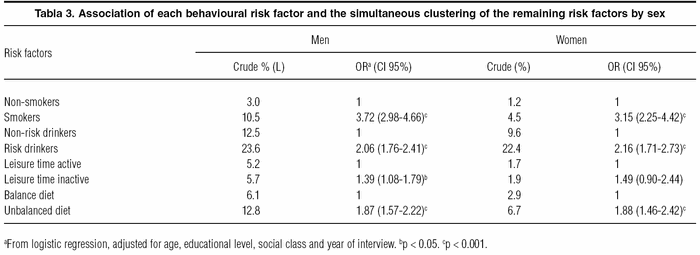
<body><![CDATA[<P><FONT face=arial,helvetica size=2>    <br> The different combinations of risk factors  are shown in <a href="#t2"> table 2</a>. The greatest difference between observed and expected  frequencies was evidenced for the simultaneous combination of 4 risk factors,  with an observed/expected ratio of 2.15 for men and 2.96 for women. This  indicates that the frequency with which these 4 factors simultaneously occur was  115% greater in men and 196% greater in women than the frequency that would be  predicted if these factors were independent. The second combination worthy of  comment was the clustering of current tobacco smoking, risk-drinking and people  with unbalanced diets, with an observed/expected ratio of 1.97 in men and 2.66  in women. All 3-factor combinations showed higher values than expected (except  risk-drinking, inactivity and an unbalanced diet in men). The same is true for  the relationship between simultaneous smoking and drinking, particularly in  women, who showed a frequency almost twice as that expected. There was also a  group of people who have a relatively healthy profile, in which all of the  factors are negative: this combination appears to be 30% more prevalent than  expected in men and 18% more in women.</FONT></P>     <P align=center><a name="t2"><IMG src="/img/gs/v19n5/original3/138v19n05-13080135tab02.gif" width="700" height="387"> </a> </P>     <P><FONT face=arial,helvetica size=2>    <br> <a href="#t3">Table 3</a> shows the relationship between the  presence of a specific risk factor and the aggregation of the remaining  behaviours. The individual factor most associated with this clustering was  tobacco smoking; in fact, as compared to non-smokers, men and women who smoke  had, respectively, odds ratios (OR) = 3.72 (IC 95%, 2.98-4.66) and 3.15 (IC 95%,  2.25-4.42) for having the other 3 risk factors. In second place comes high-risk  alcohol consumption, followed by an unbalanced diet. The factor with the lowest  tendency for clustering was leisure time inactivity. Except for tobacco smoking,  where the association was greatest in men, the relationship was very similar for  both sexes.</FONT></P>     <P align=center><a name="t3"><IMG src="/img/gs/v19n5/original3/138v19n05-13080135tab03.gif" width="700" height="255"> </a> </P>     <P><FONT face=arial,helvetica size=2>    <br> The presence of 3 or 4 risk factors  occurred almost as twice as often in men as in women (<a href="#t4">table 4</a>). The aggregation  of 3 or 4 factors was also more frequent in the younger age groups (18 and 34  year olds in men and 18-24 year olds in women). In men, the frequency of  clustering decreased with age after the age of 34. A similar pattern was shown  for women, with the frequency of clustering decreasing from the 25-29 year old  age group, with subsequent reductions being more pronounced than in men. The  frequency of factor clustering in men also increased with a decreasing  educational level. This gradient was not observed in women, although in  comparison with women with university studies the probability of aggregation was  always greater in groups with lower educational level. With regard to social  class based on occupation, men exhibited greater accumulation of factors in the  manual classes (IVa, IVb and V) in comparison with men in class I, although this  was only statistically significant in category IVa. For women, there was no  clearly observable pattern, although those of class IVb showed an OR of 1.39 (IC  95%, 1.04-1.82) with respect to members of the highest social class (<a href="#t4">table 4</a>).</FONT></P>     <P align=center><a name="t4"><IMG src="/img/gs/v19n5/original3/138v19n05-13080135tab04.gif" width="700" height="496"> </a> </P>     <P><FONT face=arial,helvetica size=2>    ]]></body>
<body><![CDATA[<br> Finally, the frequency of suboptimal health  increased with the accumulation of behavioural factors (<a href="#t5">table 5</a>). As compared to  people with none of the risk factors studied, those with only one risk factor  showed an OR for suboptimal subjective health of 1.90 (IC 95%, 1.24-2.93) in  men, and 1.44 (IC 95%, 1.00-2.08) in women. In people with 3 or 4 factors these  OR increased to 2.49 (IC 95%, 1.59-3.90) and 1.96 (IC 95%, 1.29-2.97) for men  and women, respectively.</FONT></P>     <P align=center><a name="t5"><IMG src="/img/gs/v19n5/original3/138v19n05-13080135tab05.gif" width="700" height="188"> </a> </P>     <P><FONT face=arial,helvetica size=2><B>    <br> Discussion</B></FONT></P>     <P><FONT face=arial,helvetica size=2>The results of this study suggest that an  important percentage of the population, about 20%, shows 3 or 4 important risk  factors simultaneously: smoking, high-risk drinking, leisure time inactivity and  having an unbalanced diet. These factors cluster on a multidimensional  structural base, with tobacco smoking being the factor most closely related with  the accumulation of other factors. The existence of high levels of aggregation  was more common in men, in younger age groups and in the case of lower  educational level, and was associated with a suboptimal subjective health. These  results are consistent with those observed in previous  studies<SUP>19,20,23,32</SUP>.</FONT></P>     <P><FONT face=arial,helvetica size=2>The frequency and distribution of the  indicators studied, both individually and as a cluster, depends on the  definition employed. In this work, the definition of tobacco smoking was the  same as that regularly used in other health surveys<SUP>33</SUP>. The definition  for risk-drinking was partly established in relation to average daily intakes in  line with criteria proposed by the Programme for Preventive Activities and  Health Promotion (PAPPS) of the <I>Sociedad Española de Medicina de Familia y  Comunitaria</I> (Spanish Society for Family and Community  Medicine)<SUP>34</SUP>, and also took into consideration «binge drinking», whose  relationship with an increase in mortality is now well-known and  documented<SUP>35</SUP>. The definition of leisure time inactivity was also  elaborated according to the recommendations of the PAPPS<SUP>34</SUP>. Finally,  insufficient consumption of fruit and vegetables, as an indicator of an  unbalanced diet, was limited to the consumption of less than 2 rations per day.  This frequency is situated in the lower quartile of quintile, and is a reference  category used to calculate the risk of cardiovascular diseases and  cancer<SUP>36,37</SUP>.</FONT></P>     <P><FONT face=arial,helvetica size=2>A limited number of people (about 9%) have  a very healthy profile, having none of the indicated risk habits, and another  minority (3%) has a very unhealthy profile, with all of the positive risk  factors being present. These data are coherent with the absence of a  one-dimensional structure<SUP>10,13</SUP>, according to which there should be 2  majority groups within the population; one with completely healthy habits and  the other with unhealthy habits. In our case most people exhibit 1 or 2 risk  factors, although the proportion of people with three or four factors is also  high (close to 20%), but it is distributed with different frequencies for  different combinations of aggregation, according to the multidimensional concept  of these behavioural habits<SUP>11,14</SUP>. Our results are very similar to  those reported in the studies of Schuit et al.<SUP>19</SUP> for Germany and  Laaksonen et al<SUP>20</SUP> for Finland, in which the same risk factors were  investigated. Of the 4 indicators studied, tobacco smoking is the one that  presents the greatest probability of clustering with other risk factors. This is  followed by excessive alcohol consumption and an unbalanced diet, while  inactivity exhibits a much weaker relationship. This important role for tobacco  in clustering has been described by Prättälä et al<SUP>32</SUP> as the «gateway»  to other risk factors, and Burke et al<SUP>18</SUP> and Laaksonen et  al<SUP>23</SUP> have reached similar conclusions. Moreover, the weakest  association -that of inactivity with the other risk factors- is also in  line with observations based on other studies<SUP>17,38</SUP>.</FONT></P>     <P><FONT face=arial,helvetica size=2>The simultaneous existence of several  unhealthy habits is more common in men than in women, and in younger people as  opposed to older people. This age-related distribution probably reflects the  higher survival rate of subjects who have maintained healthier habits and  lifestyles, since -as many studies have shown- the presence of these  risk factors is responsible for a significant incidence of premature  mortality<SUP>1-6</SUP>. This situation could also be due to improvements in  diet and the abandoning of addictive habits such as smoking or excessive alcohol  consumption<SUP>39</SUP> by older subjects. As well as being associated with  abandoning unhealthy habits and/or differential survival, the more pronounced  age-related differences associated with women could express a certain cohort  effect in the adoption of risk factors<SUP>23</SUP>. This has, for example,  occurred in our geographical area in the case of tobacco  smoking<SUP>40</SUP>.</FONT></P>     <P><FONT face=arial,helvetica size=2>People with lower socio-economic status  generally exhibit less healthy behaviour<SUP>41</SUP>. From comparisons among  different indicators, it seems that education rather than income or occupation  is the factor most consistently associated with different behavioural  habits<SUP>42</SUP>. In our study, a greater aggregation of unhealthy behaviour  was observed in people with low educational levels, while the relationship with  occupation appeared less pronounced when the 2 variables were modelled  simultaneously. This relationship with educational level has also been described  by other authors considering similar risk factors.<SUP>9,19,23,33</SUP>. Our  data showed this association as being greater for men than for women, with the  difference being greater than that ob served by Laaksonen et al<SUP>23</SUP>.  These results can be explained by a differential degree of incorporation of  women into unhealthy and particularly addictive habits. For example, it is well  documented that in the early stages of the development of epidemic tobacco  addiction, the people who start smoking first belong to higher socio-economic  levels, while in later stages, the greatest frequency of consumption occurs in  the lower social class categories<SUP>43</SUP>. This effect can be clearly seen  in our region, where - until recently - tobacco smoking was most  prevalent in women from the highest socio-economic groups and the same was true  of alcohol consumption. However, in recent years a change in this pattern has  been observed, with a tendency towards similar frequency in all strata. In men,  however, all of the risk indicators are most frequent in the lowest  socio-economic categories<SUP>44</SUP>.</FONT></P>     <P><FONT face=arial,helvetica size=2>Subjective health is considered a valid  indicator of the state of health and is an important independent predictor of  morbidity and mortality<SUP>45,46</SUP>. Many investigations have detected an  association between various individually assessed risk factors and a worse state  of health<SUP>8,46-50</SUP>. This situation is also repeated with factor  clustering<SUP>9,19</SUP>; as in our study, previous works show that as  simultaneous risk factors accumulate, state of health worsens. This relationship  could reflect the effects of both physical health problems and the functional  limitations arising from these risk factors, because the physical symptom  component tends to be related to perceived health<SUP>51</SUP>. When the model  considers chronic diseases related to these factors, such as diabetes or known  obstructive respiratory diseases (data not shown), this relationship is less  marked. Indeed, it would be expected to diminish even further if other health  problems were taken into account. This could be interpreted as the potential  effect on perceived health being measured by the existence of chronic health  problems, which would act as an intermediate step between the risk factors and  the subjective state of health<SUP>8</SUP>. Even so, it is also likely that  there is another direct relationship with these unhealthy habits that is  independent of the existence of other health problems<SUP>49</SUP>.</FONT></P>     ]]></body>
<body><![CDATA[<P><FONT face=arial,helvetica size=2>The 4 indicators have been aggregated with  each receiving a similar weighting. Several authors have criticised the  construction of these additive indices in which each factor is given equal  treatment<SUP>52,53</SUP>, despite the fact that their contribution to the  development of chronic health problems is different. Nevertheless, such indices  have been successfully employed to explain the risk of morbidity and  mortality<SUP>3,4,54</SUP>. Furthermore, as this is a cross-sectional study, it  is not possible to make causal inferences on the relationships detected. For  example, a person with health problems is likely to modify his/her behaviour by  giving up smoking or excessive alcohol consumption, or by making  health-favouring changes in diet or physical activity. This change in lifestyle  would subsequently lead to this person being placed in a different category in  the current classification, with little or no consequent factor clustering.  Because recent ex-smokers<SUP>49</SUP> and ex-drinkers<SUP>50</SUP> have a worse  state of health, the magnitude of the observed relationship would tend to  decrease.</FONT></P>     <P><FONT face=arial,helvetica size=2>In conclusion, a high percentage of the  population, almost one in five people, simultaneously exhibits 3 or 4 of the  following risk factors: smoking, high-risk drinking, leisure time inactivity and  an unbalanced diet. These factors cluster in a multidimensional fashion, with  smoking being the risk factor with the highest frequency of clustering.  Clustering varies among socio-demographic strata, being most common in men, in  younger age groups and in people with low educational level. The accumulation of  factors is associated with suboptimal perceived health.</FONT></P>     <P><FONT face=arial,helvetica size=2>The tendency for these risk factors to  cluster, the description of the pattern of combinations, and the identification  of population groups with high clustering frequencies may have important  implications for the design of population health promotion strategies, and also  for the elaboration of preventive strategies for primary health care, largely  based on the detection of individual risk factors.</FONT></P> <hr width="30%" color="#000000" align="left">     <P><FONT face=arial,helvetica size=2><B>Acknowledgwent</B></FONT></P>     <P><FONT face=arial,helvetica size=2>The translation of the manuscript was done  by Malcom Hayes.</FONT></P>     <P>    <br> <FONT face=arial,helvetica size=2><b>References</b></FONT></P>     <!-- ref --><P><FONT  face=Arial size=2>1. Mokdad AH, Marks JS, Stroup DF, Gerberding JL. Actual  causes of death in the United States, 2000. JAMA. 2004;10:1238-45.&nbsp;&nbsp;&nbsp;&nbsp;&nbsp;&nbsp;&nbsp;&nbsp;[&#160;<a href="javascript:void(0);" onclick="javascript: window.open('/scielo.php?script=sci_nlinks&ref=2359627&pid=S0213-9111200500050000500001&lng=','','width=640,height=500,resizable=yes,scrollbars=1,menubar=yes,');">Links</a>&#160;]<!-- end-ref --><!-- ref --><P>2. Murray  CJL, López AD. Global mortality, disability, and the contribution of risk  factors: global burden of disease study. Lancet. 1997;349:1436-42.&nbsp;&nbsp;&nbsp;&nbsp;&nbsp;&nbsp;&nbsp;&nbsp;[&#160;<a href="javascript:void(0);" onclick="javascript: window.open('/scielo.php?script=sci_nlinks&ref=2359628&pid=S0213-9111200500050000500002&lng=','','width=640,height=500,resizable=yes,scrollbars=1,menubar=yes,');">Links</a>&#160;]<!-- end-ref --><!-- ref --><P>3. Meng L,  Maskarinec G, Lee J, Kolonel LN. Lifestyle factors and chronic diseases:  application of a composite risk index. Prev Med. 1999;29:296-304.&nbsp;&nbsp;&nbsp;&nbsp;&nbsp;&nbsp;&nbsp;&nbsp;[&#160;<a href="javascript:void(0);" onclick="javascript: window.open('/scielo.php?script=sci_nlinks&ref=2359629&pid=S0213-9111200500050000500003&lng=','','width=640,height=500,resizable=yes,scrollbars=1,menubar=yes,');">Links</a>&#160;]<!-- end-ref --><!-- ref --><P>4. Yusuf  HR, Giles WH, Croft JB, Anda RF, Casper ML. Impact of multiple risk factor  profiles on determining cardiovascular disease risk. Prev Med.  1998;27:1-9.&nbsp;&nbsp;&nbsp;&nbsp;&nbsp;&nbsp;&nbsp;&nbsp;[&#160;<a href="javascript:void(0);" onclick="javascript: window.open('/scielo.php?script=sci_nlinks&ref=2359630&pid=S0213-9111200500050000500004&lng=','','width=640,height=500,resizable=yes,scrollbars=1,menubar=yes,');">Links</a>&#160;]<!-- end-ref --><!-- ref --><P>5. Luoto R, Prättälä, Uutela A, Puska P. Impact of unhealthy  behaviors on cardiovascular mortality in Finland, 1978-1993. Prev Med.  1998;27:93-100.&nbsp;&nbsp;&nbsp;&nbsp;&nbsp;&nbsp;&nbsp;&nbsp;[&#160;<a href="javascript:void(0);" onclick="javascript: window.open('/scielo.php?script=sci_nlinks&ref=2359631&pid=S0213-9111200500050000500005&lng=','','width=640,height=500,resizable=yes,scrollbars=1,menubar=yes,');">Links</a>&#160;]<!-- end-ref --><!-- ref --><P>6. Chyou PH, Burchfiel CM, Yano K, Sharps DS, Rodríguez BL,  Curb JD, et al. Obesity, alcohol consumption, smoking, and mortality. Ann  Epidemiol. 1997;7:311-7.&nbsp;&nbsp;&nbsp;&nbsp;&nbsp;&nbsp;&nbsp;&nbsp;[&#160;<a href="javascript:void(0);" onclick="javascript: window.open('/scielo.php?script=sci_nlinks&ref=2359632&pid=S0213-9111200500050000500006&lng=','','width=640,height=500,resizable=yes,scrollbars=1,menubar=yes,');">Links</a>&#160;]<!-- end-ref --><!-- ref --><P>7. Johansson S, Sundquist J. Change in lifestyle  factors and their influence on health status and all-cause mortality. Int J  Epidemiol. 1999;28:1073-80.&nbsp;&nbsp;&nbsp;&nbsp;&nbsp;&nbsp;&nbsp;&nbsp;[&#160;<a href="javascript:void(0);" onclick="javascript: window.open('/scielo.php?script=sci_nlinks&ref=2359633&pid=S0213-9111200500050000500007&lng=','','width=640,height=500,resizable=yes,scrollbars=1,menubar=yes,');">Links</a>&#160;]<!-- end-ref --><!-- ref --><P>8. Manderbacka K, Lundberg O, Martikainnen P. Do  risk factors behaviours contribute to self-ratings of health? Soc Sci Med.  1999;48:1713-20.&nbsp;&nbsp;&nbsp;&nbsp;&nbsp;&nbsp;&nbsp;&nbsp;[&#160;<a href="javascript:void(0);" onclick="javascript: window.open('/scielo.php?script=sci_nlinks&ref=2359634&pid=S0213-9111200500050000500008&lng=','','width=640,height=500,resizable=yes,scrollbars=1,menubar=yes,');">Links</a>&#160;]<!-- end-ref --><!-- ref --><P>9. Raitakari OT, Leino M, Räikkönen K, Kimmo VK, Taimela S,  Räsänen L, et al. Clustering of risk habits in young adults. The cardiovascular  risk in young Finnish Study. Am J Epidemiol. 1995;142:36-44.&nbsp;&nbsp;&nbsp;&nbsp;&nbsp;&nbsp;&nbsp;&nbsp;[&#160;<a href="javascript:void(0);" onclick="javascript: window.open('/scielo.php?script=sci_nlinks&ref=2359635&pid=S0213-9111200500050000500009&lng=','','width=640,height=500,resizable=yes,scrollbars=1,menubar=yes,');">Links</a>&#160;]<!-- end-ref --><!-- ref --><P>10. Kronenfeld  JJ, Goodyear N, Pate R, Blair A, Howe H, Parker G, et al. The interrelationships  among preventive health habits. Health Educ Res. 1988;3:317-23.&nbsp;&nbsp;&nbsp;&nbsp;&nbsp;&nbsp;&nbsp;&nbsp;[&#160;<a href="javascript:void(0);" onclick="javascript: window.open('/scielo.php?script=sci_nlinks&ref=2359636&pid=S0213-9111200500050000500010&lng=','','width=640,height=500,resizable=yes,scrollbars=1,menubar=yes,');">Links</a>&#160;]<!-- end-ref --><!-- ref --><P>11. Krick JP,  Sobal J. Relationships between health protective behaviors. J Community Health.  1990;15:19-34.&nbsp;&nbsp;&nbsp;&nbsp;&nbsp;&nbsp;&nbsp;&nbsp;[&#160;<a href="javascript:void(0);" onclick="javascript: window.open('/scielo.php?script=sci_nlinks&ref=2359637&pid=S0213-9111200500050000500011&lng=','','width=640,height=500,resizable=yes,scrollbars=1,menubar=yes,');">Links</a>&#160;]<!-- end-ref --><!-- ref --><P>12. Hulshof KFA, Wedel M, Löwik MRH, Kok FJ, Kistemaker C,  Hermus RJJ, et al. Clustering of dietary variables and other lifestyle factors  (Dutch Nutritional Surveillance System). J Epidemiol Community Health.  1992;46:417-24.&nbsp;&nbsp;&nbsp;&nbsp;&nbsp;&nbsp;&nbsp;&nbsp;[&#160;<a href="javascript:void(0);" onclick="javascript: window.open('/scielo.php?script=sci_nlinks&ref=2359638&pid=S0213-9111200500050000500012&lng=','','width=640,height=500,resizable=yes,scrollbars=1,menubar=yes,');">Links</a>&#160;]<!-- end-ref --><!-- ref --><P>13. Mulder M, Ranchor AV, Sanderman R, Bouma J, Van den  Heuvel WJA. The stability of lifestyle behaviour. Int J Epidemiol.  1998;27:199-207.&nbsp;&nbsp;&nbsp;&nbsp;&nbsp;&nbsp;&nbsp;&nbsp;[&#160;<a href="javascript:void(0);" onclick="javascript: window.open('/scielo.php?script=sci_nlinks&ref=2359639&pid=S0213-9111200500050000500013&lng=','','width=640,height=500,resizable=yes,scrollbars=1,menubar=yes,');">Links</a>&#160;]<!-- end-ref --><!-- ref --><P>14. Berrigan D, Dodd K, Troiano RP, Krebs-Smith SM, Ballard  R. Patterns of health behavior in US adults. Prev Med. 2003;36: 615-23.&nbsp;&nbsp;&nbsp;&nbsp;&nbsp;&nbsp;&nbsp;&nbsp;[&#160;<a href="javascript:void(0);" onclick="javascript: window.open('/scielo.php?script=sci_nlinks&ref=2359640&pid=S0213-9111200500050000500014&lng=','','width=640,height=500,resizable=yes,scrollbars=1,menubar=yes,');">Links</a>&#160;]<!-- end-ref --><!-- ref --><P>15.  Sobell LC, Sobell MB, Kozlowski LT, Toneatto T. Alcohol or tobacco research  versus alcohol and tobacco research. Br J Addict. 1990;85:263-9.&nbsp;&nbsp;&nbsp;&nbsp;&nbsp;&nbsp;&nbsp;&nbsp;[&#160;<a href="javascript:void(0);" onclick="javascript: window.open('/scielo.php?script=sci_nlinks&ref=2359641&pid=S0213-9111200500050000500015&lng=','','width=640,height=500,resizable=yes,scrollbars=1,menubar=yes,');">Links</a>&#160;]<!-- end-ref --><!-- ref --><P>16.  Dallongeville J, Marécaux N, Fruchart JC, Amouyel P. Cigarette smoking is  associated with unhealthy patterns of nutrient intake: a meta-analysis. J Nutr.  1998;128:1450-7.&nbsp;&nbsp;&nbsp;&nbsp;&nbsp;&nbsp;&nbsp;&nbsp;[&#160;<a href="javascript:void(0);" onclick="javascript: window.open('/scielo.php?script=sci_nlinks&ref=2359642&pid=S0213-9111200500050000500016&lng=','','width=640,height=500,resizable=yes,scrollbars=1,menubar=yes,');">Links</a>&#160;]<!-- end-ref --><!-- ref --><P>17. Johnson NA, Boyle CA, Heller RF. Leisure-time physical  activity and other health behaviours: are they related? Aust J Public Health.  1995;19:69-75.&nbsp;&nbsp;&nbsp;&nbsp;&nbsp;&nbsp;&nbsp;&nbsp;[&#160;<a href="javascript:void(0);" onclick="javascript: window.open('/scielo.php?script=sci_nlinks&ref=2359643&pid=S0213-9111200500050000500017&lng=','','width=640,height=500,resizable=yes,scrollbars=1,menubar=yes,');">Links</a>&#160;]<!-- end-ref --><!-- ref --><P>18. Burke V, Milligan RAK, Beilin LJ, Dunbar D, Spencer M,  Balde E, et al. Clustering of health-related behaviors among 18-year-old  Australians. Prev Med. 1997;26:724-33.&nbsp;&nbsp;&nbsp;&nbsp;&nbsp;&nbsp;&nbsp;&nbsp;[&#160;<a href="javascript:void(0);" onclick="javascript: window.open('/scielo.php?script=sci_nlinks&ref=2359644&pid=S0213-9111200500050000500018&lng=','','width=640,height=500,resizable=yes,scrollbars=1,menubar=yes,');">Links</a>&#160;]<!-- end-ref --><!-- ref --><P>19. Schuit AJ, Van Loon AJM, Tijhuis  M, Ocké MC. Clustering of lifestyle risk factors in a general adult population.  Prev Med. 2002;35:219-24.&nbsp;&nbsp;&nbsp;&nbsp;&nbsp;&nbsp;&nbsp;&nbsp;[&#160;<a href="javascript:void(0);" onclick="javascript: window.open('/scielo.php?script=sci_nlinks&ref=2359645&pid=S0213-9111200500050000500019&lng=','','width=640,height=500,resizable=yes,scrollbars=1,menubar=yes,');">Links</a>&#160;]<!-- end-ref --><!-- ref --><P>20. Laaksonen M, Prättälä R, Karisto A. Patterns of  unhealthy behaviour in Finland. Eur J Public Health. 2001;11:294-300.&nbsp;&nbsp;&nbsp;&nbsp;&nbsp;&nbsp;&nbsp;&nbsp;[&#160;<a href="javascript:void(0);" onclick="javascript: window.open('/scielo.php?script=sci_nlinks&ref=2359646&pid=S0213-9111200500050000500020&lng=','','width=640,height=500,resizable=yes,scrollbars=1,menubar=yes,');">Links</a>&#160;]<!-- end-ref --><!-- ref --><P>21.  Sobal J, Revicki D, DeForge BR. Patterns of interrelationships among  health-promotion behaviors. Prev Med. 1992;8: 351-9.&nbsp;&nbsp;&nbsp;&nbsp;&nbsp;&nbsp;&nbsp;&nbsp;[&#160;<a href="javascript:void(0);" onclick="javascript: window.open('/scielo.php?script=sci_nlinks&ref=2359647&pid=S0213-9111200500050000500021&lng=','','width=640,height=500,resizable=yes,scrollbars=1,menubar=yes,');">Links</a>&#160;]<!-- end-ref --><!-- ref --><P>22. Liang W,  Shediac-Rizkallah C, Celentano DD, Rohde C. A population-based study of age and  gender differences in patterns of health-related behaviors. Am J Prev Med.  1999;17:8-17.&nbsp;&nbsp;&nbsp;&nbsp;&nbsp;&nbsp;&nbsp;&nbsp;[&#160;<a href="javascript:void(0);" onclick="javascript: window.open('/scielo.php?script=sci_nlinks&ref=2359648&pid=S0213-9111200500050000500022&lng=','','width=640,height=500,resizable=yes,scrollbars=1,menubar=yes,');">Links</a>&#160;]<!-- end-ref --><!-- ref --><P>23. Laaksonen M, Prättälä R, Lahelma E. Sociodemographic  determinants of multiple unhealthy behaviours. Scand J Public Health.  2003;31:37-43.&nbsp;&nbsp;&nbsp;&nbsp;&nbsp;&nbsp;&nbsp;&nbsp;[&#160;<a href="javascript:void(0);" onclick="javascript: window.open('/scielo.php?script=sci_nlinks&ref=2359649&pid=S0213-9111200500050000500023&lng=','','width=640,height=500,resizable=yes,scrollbars=1,menubar=yes,');">Links</a>&#160;]<!-- end-ref --><!-- ref --><P>24. Encuesta a hogares españoles sobre equipamiento, uso y  valoración de servicios de telecomunicaciones, audiovisual e Internet. Informe  preliminar (diciembre de 2002). Comisión del mercado de las telecomunicaciones e  Instituto Nacional de Estadística (accessed 11 Aug 2004). Available in: <a href="http://www.aece.org/docs/EstudioINE+CMT.2002.pdf" target="_blank">http://www.aece.org/docs/EstudioINE+CMT.2002.pdf</a>.&nbsp;&nbsp;&nbsp;&nbsp;&nbsp;&nbsp;&nbsp;&nbsp;[&#160;<a href="javascript:void(0);" onclick="javascript: window.open('/scielo.php?script=sci_nlinks&ref=2359650&pid=S0213-9111200500050000500024&lng=','','width=640,height=500,resizable=yes,scrollbars=1,menubar=yes,');">Links</a>&#160;]<!-- end-ref --><!-- ref --><P>25. Nicholls II WL.  Computer-assisted telephone interviewing: a general introduction. In: Groves RM,  Biemer PP, Lyberg LE, Massey JT, Nicholls II WL, Waksberg J editors. Telephone  survey methodology. New York: John Wiley &amp; Sons Inc.; 1988. p.  377-85.&nbsp;&nbsp;&nbsp;&nbsp;&nbsp;&nbsp;&nbsp;&nbsp;[&#160;<a href="javascript:void(0);" onclick="javascript: window.open('/scielo.php?script=sci_nlinks&ref=2359651&pid=S0213-9111200500050000500025&lng=','','width=640,height=500,resizable=yes,scrollbars=1,menubar=yes,');">Links</a>&#160;]<!-- end-ref --><!-- ref --><P>26. Galán I, Rodríguez-Artalejo F, Zorrilla B. Reproducibilidad de un  cuestionario telefónico sobre factores de riesgo asociados al comportamiento y  prácticas preventivas. Gac Sanit. 2004;18:118-24.&nbsp;&nbsp;&nbsp;&nbsp;&nbsp;&nbsp;&nbsp;&nbsp;[&#160;<a href="javascript:void(0);" onclick="javascript: window.open('/scielo.php?script=sci_nlinks&ref=2359652&pid=S0213-9111200500050000500026&lng=','','width=640,height=500,resizable=yes,scrollbars=1,menubar=yes,');">Links</a>&#160;]<!-- end-ref --><!-- ref --><P>27. Ainsworth BE, Haskell  WL, Whitt MC, Irwin ML, Swartz AM, Strath SJ, et al. Compendium of physical  activities: an update of activity codes and MET intensities. Med Sci Sports  Exerc. 2000;32 Suppl 9:498-504.&nbsp;&nbsp;&nbsp;&nbsp;&nbsp;&nbsp;&nbsp;&nbsp;[&#160;<a href="javascript:void(0);" onclick="javascript: window.open('/scielo.php?script=sci_nlinks&ref=2359653&pid=S0213-9111200500050000500027&lng=','','width=640,height=500,resizable=yes,scrollbars=1,menubar=yes,');">Links</a>&#160;]<!-- end-ref --><!-- ref --><P>28. Pate R, Pratt M, Blair SN, Haskell WL,  Macera CA, Bouchard C, et al. Physical activity and public health: a  recommendation from the Centers for Disease Control and Prevention and the  American College of Sports Medicine. JAMA. 1995;273: 402-7.&nbsp;&nbsp;&nbsp;&nbsp;&nbsp;&nbsp;&nbsp;&nbsp;[&#160;<a href="javascript:void(0);" onclick="javascript: window.open('/scielo.php?script=sci_nlinks&ref=2359654&pid=S0213-9111200500050000500028&lng=','','width=640,height=500,resizable=yes,scrollbars=1,menubar=yes,');">Links</a>&#160;]<!-- end-ref --><!-- ref --><P>29. Álvarez C,  Alonso J, Domingo A, Regidor E. La medición de la clase social en ciencias de la  salud. Informe de un grupo de trabajo de la Sociedad Española de Epidemología.  Sociedad Española de Epidemiología. Barcelona: SG editores; 1995.&nbsp;&nbsp;&nbsp;&nbsp;&nbsp;&nbsp;&nbsp;&nbsp;[&#160;<a href="javascript:void(0);" onclick="javascript: window.open('/scielo.php?script=sci_nlinks&ref=2359655&pid=S0213-9111200500050000500029&lng=','','width=640,height=500,resizable=yes,scrollbars=1,menubar=yes,');">Links</a>&#160;]<!-- end-ref --><!-- ref --><P>30. Breslow  NE, Day NE. Statistical methods in cancer research. The design and analysis of  cohort studies. Lyon: IARC Scientific Publications n.o 82; 1987.&nbsp;&nbsp;&nbsp;&nbsp;&nbsp;&nbsp;&nbsp;&nbsp;[&#160;<a href="javascript:void(0);" onclick="javascript: window.open('/scielo.php?script=sci_nlinks&ref=2359656&pid=S0213-9111200500050000500030&lng=','','width=640,height=500,resizable=yes,scrollbars=1,menubar=yes,');">Links</a>&#160;]<!-- end-ref --><!-- ref --><P>31. The  American Association for Public Opinion Research. 2004. Standard definitions:  Final dispositions of case codes and outcome rates for surveys. 3rd ed. Lenexa,  Kansas: AAPOR (accessed 11 Aug 2004). Avaliable in: <a href="http://www.aapor.org/pdfs/standarddefs_3.1.pdf" target="_blank">http://www.aapor. org/pdfs/standarddefs2004.pdf</a>&nbsp;&nbsp;&nbsp;&nbsp;&nbsp;&nbsp;&nbsp;&nbsp;[&#160;<a href="javascript:void(0);" onclick="javascript: window.open('/scielo.php?script=sci_nlinks&ref=2359657&pid=S0213-9111200500050000500031&lng=','','width=640,height=500,resizable=yes,scrollbars=1,menubar=yes,');">Links</a>&#160;]<!-- end-ref --><!-- ref --><P>32. Prättälä R, Karisto A, Berg M-A.  Consistency and variation in unhealthy behaviour among Finnish men, 1982-1990.  Soc Sci Med. 1994;39:115-22.&nbsp;&nbsp;&nbsp;&nbsp;&nbsp;&nbsp;&nbsp;&nbsp;[&#160;<a href="javascript:void(0);" onclick="javascript: window.open('/scielo.php?script=sci_nlinks&ref=2359658&pid=S0213-9111200500050000500032&lng=','','width=640,height=500,resizable=yes,scrollbars=1,menubar=yes,');">Links</a>&#160;]<!-- end-ref --><!-- ref --><P>33. Husten C, Jackson K, Lee C. Cigarette  smoking among adults: United States, 2002. Morb Mortal Wkly Rep.  2004;53:427-31.&nbsp;&nbsp;&nbsp;&nbsp;&nbsp;&nbsp;&nbsp;&nbsp;[&#160;<a href="javascript:void(0);" onclick="javascript: window.open('/scielo.php?script=sci_nlinks&ref=2359659&pid=S0213-9111200500050000500033&lng=','','width=640,height=500,resizable=yes,scrollbars=1,menubar=yes,');">Links</a>&#160;]<!-- end-ref --><!-- ref --><P>34. Brotons C, Ciurana R, Iglesias M, editores. Manual de  prevención en Atención Primaria. Programa de Actividades Preventivas y de  Promoción de la Salud (PAPPS). Barcelona: Sociedad Española de Medicina de  Familia y Comunitaria; 2003.&nbsp;&nbsp;&nbsp;&nbsp;&nbsp;&nbsp;&nbsp;&nbsp;[&#160;<a href="javascript:void(0);" onclick="javascript: window.open('/scielo.php?script=sci_nlinks&ref=2359660&pid=S0213-9111200500050000500034&lng=','','width=640,height=500,resizable=yes,scrollbars=1,menubar=yes,');">Links</a>&#160;]<!-- end-ref --><!-- ref --><P>35. Murray RP, Connett JE, Tyas SL, Bond R,  Ekuma O, Silversides CK, et al. Alcohol volume, drinking pattern, and  cardiovascular disease morbidity and mortality: is there a U-shaped function? Am  J Epidemiol. 2002;155:242-8.&nbsp;&nbsp;&nbsp;&nbsp;&nbsp;&nbsp;&nbsp;&nbsp;[&#160;<a href="javascript:void(0);" onclick="javascript: window.open('/scielo.php?script=sci_nlinks&ref=2359661&pid=S0213-9111200500050000500035&lng=','','width=640,height=500,resizable=yes,scrollbars=1,menubar=yes,');">Links</a>&#160;]<!-- end-ref --><!-- ref --><P>36. Bazzano LA, He J, Ogden LG, Loria CM,  Vupputuri S, Myers L, et al. Fruit and vegetable intake and risk of  cardiovascular disease in US adults: the first National Health and Nutrition  Examination Survey Epidemiologic Follow-up Study. Am J Clin Nutr.  2002;76:93-9.&nbsp;&nbsp;&nbsp;&nbsp;&nbsp;&nbsp;&nbsp;&nbsp;[&#160;<a href="javascript:void(0);" onclick="javascript: window.open('/scielo.php?script=sci_nlinks&ref=2359662&pid=S0213-9111200500050000500036&lng=','','width=640,height=500,resizable=yes,scrollbars=1,menubar=yes,');">Links</a>&#160;]<!-- end-ref --><!-- ref --><P>37. Van't Veer P, Jansen MC, Klerk M, Kok FJ. Fruits and  vegetables in the prevention of cancer and cardiovascular disease. Public Health  Nutr. 2000;3:103-7.&nbsp;&nbsp;&nbsp;&nbsp;&nbsp;&nbsp;&nbsp;&nbsp;[&#160;<a href="javascript:void(0);" onclick="javascript: window.open('/scielo.php?script=sci_nlinks&ref=2359663&pid=S0213-9111200500050000500037&lng=','','width=640,height=500,resizable=yes,scrollbars=1,menubar=yes,');">Links</a>&#160;]<!-- end-ref --><!-- ref --><P>38. Johnson MF, Nichols JF, Sallis JF, Calfas KJ, Hovell  MF. Interrelationships between physical activity and other health behaviors  among university women and men. Prev Med. 1998; 27:536-44.&nbsp;&nbsp;&nbsp;&nbsp;&nbsp;&nbsp;&nbsp;&nbsp;[&#160;<a href="javascript:void(0);" onclick="javascript: window.open('/scielo.php?script=sci_nlinks&ref=2359664&pid=S0213-9111200500050000500038&lng=','','width=640,height=500,resizable=yes,scrollbars=1,menubar=yes,');">Links</a>&#160;]<!-- end-ref --><!-- ref --><P>39. Cockerham WC.  Lifestyles, social class, demographic characteristics, and health behavior. In:  Gochman D, editors. Handbook of health behavior research. I Personal and social  determinants. New York: Plenum Press, 1997. p. 253-65.&nbsp;&nbsp;&nbsp;&nbsp;&nbsp;&nbsp;&nbsp;&nbsp;[&#160;<a href="javascript:void(0);" onclick="javascript: window.open('/scielo.php?script=sci_nlinks&ref=2359665&pid=S0213-9111200500050000500039&lng=','','width=640,height=500,resizable=yes,scrollbars=1,menubar=yes,');">Links</a>&#160;]<!-- end-ref --><!-- ref --><P>40. Fernández E,  Schiaffino A, García M, Saltó E, Villalbí JR, Borrás JM. Prevalencia del consumo  de tabaco en España entre 1945 y 1995. Reconstrucción a partir de las Encuestas  Nacionales de Salud. Med Clin (Barc). 2003;120:14-6.&nbsp;&nbsp;&nbsp;&nbsp;&nbsp;&nbsp;&nbsp;&nbsp;[&#160;<a href="javascript:void(0);" onclick="javascript: window.open('/scielo.php?script=sci_nlinks&ref=2359666&pid=S0213-9111200500050000500040&lng=','','width=640,height=500,resizable=yes,scrollbars=1,menubar=yes,');">Links</a>&#160;]<!-- end-ref --><!-- ref --><P>41. Pomerlau J, Pederson  LL, Ostbye T, Speechley M, Speechley KN. Health behaviours and socio-economic  status in Ontario, Canada. Eur J Epidemiol. 1997;13:613-22.&nbsp;&nbsp;&nbsp;&nbsp;&nbsp;&nbsp;&nbsp;&nbsp;[&#160;<a href="javascript:void(0);" onclick="javascript: window.open('/scielo.php?script=sci_nlinks&ref=2359667&pid=S0213-9111200500050000500041&lng=','','width=640,height=500,resizable=yes,scrollbars=1,menubar=yes,');">Links</a>&#160;]<!-- end-ref --><!-- ref --><P>42. Winkleby MA,  Jatulis DE, Franck E, Frank E, Fortmann SP. Socioeconomic status and health: how  education, income, and occupation contribute to risk factors for cardiovascular  disease. Am J Public Health. 1992;82:816-20.&nbsp;&nbsp;&nbsp;&nbsp;&nbsp;&nbsp;&nbsp;&nbsp;[&#160;<a href="javascript:void(0);" onclick="javascript: window.open('/scielo.php?script=sci_nlinks&ref=2359668&pid=S0213-9111200500050000500042&lng=','','width=640,height=500,resizable=yes,scrollbars=1,menubar=yes,');">Links</a>&#160;]<!-- end-ref --><!-- ref --><P>43. López A, Collishaw NE, Piha  T. A descriptive model of the cigarette epidemic in developed countries. Tobacco  Control. 1994;3:242-7.&nbsp;&nbsp;&nbsp;&nbsp;&nbsp;&nbsp;&nbsp;&nbsp;[&#160;<a href="javascript:void(0);" onclick="javascript: window.open('/scielo.php?script=sci_nlinks&ref=2359669&pid=S0213-9111200500050000500043&lng=','','width=640,height=500,resizable=yes,scrollbars=1,menubar=yes,');">Links</a>&#160;]<!-- end-ref --><!-- ref --><P>44. Galán I. Desigualdades sociales en hábitos de  salud en la Comunidad de Madrid. En: Desigualdades sociales en salud: situación  en España en los últimos años del siglo xx. Murcia: Universidad de Alicante,  2002. p. 91-116.&nbsp;&nbsp;&nbsp;&nbsp;&nbsp;&nbsp;&nbsp;&nbsp;[&#160;<a href="javascript:void(0);" onclick="javascript: window.open('/scielo.php?script=sci_nlinks&ref=2359670&pid=S0213-9111200500050000500044&lng=','','width=640,height=500,resizable=yes,scrollbars=1,menubar=yes,');">Links</a>&#160;]<!-- end-ref --><!-- ref --><P>45. Idler EL, Benyamini Y. Self-rated health and mortality:  a review of twenty-seven community studies. J Health Soc Behav.  1997;38:21-37.&nbsp;&nbsp;&nbsp;&nbsp;&nbsp;&nbsp;&nbsp;&nbsp;[&#160;<a href="javascript:void(0);" onclick="javascript: window.open('/scielo.php?script=sci_nlinks&ref=2359671&pid=S0213-9111200500050000500045&lng=','','width=640,height=500,resizable=yes,scrollbars=1,menubar=yes,');">Links</a>&#160;]<!-- end-ref --><!-- ref --><P>46. Manor O, Matthews S, Power C. Self-rated health and  limiting longstanding illness: inter-relationships with morbidity in early  adulthood. Int J Epidemiol. 2001;30:600-7.&nbsp;&nbsp;&nbsp;&nbsp;&nbsp;&nbsp;&nbsp;&nbsp;[&#160;<a href="javascript:void(0);" onclick="javascript: window.open('/scielo.php?script=sci_nlinks&ref=2359672&pid=S0213-9111200500050000500046&lng=','','width=640,height=500,resizable=yes,scrollbars=1,menubar=yes,');">Links</a>&#160;]<!-- end-ref --><!-- ref --><P>47. Ross CE, Bird CE. Sex  stratification and health lifestyle: consequences for men's and women's  perceived health. J Health Soc Behav. 1994;35:161-78.&nbsp;&nbsp;&nbsp;&nbsp;&nbsp;&nbsp;&nbsp;&nbsp;[&#160;<a href="javascript:void(0);" onclick="javascript: window.open('/scielo.php?script=sci_nlinks&ref=2359673&pid=S0213-9111200500050000500047&lng=','','width=640,height=500,resizable=yes,scrollbars=1,menubar=yes,');">Links</a>&#160;]<!-- end-ref --><!-- ref --><P>48. Parkatti T, Deeg  DJ, Bosscher RJ, Launer LL. Physical activity and self-rated health among 55- to  89-year-old Dutch people. J Aging Health. 1998;10:311-26.&nbsp;&nbsp;&nbsp;&nbsp;&nbsp;&nbsp;&nbsp;&nbsp;[&#160;<a href="javascript:void(0);" onclick="javascript: window.open('/scielo.php?script=sci_nlinks&ref=2359674&pid=S0213-9111200500050000500048&lng=','','width=640,height=500,resizable=yes,scrollbars=1,menubar=yes,');">Links</a>&#160;]<!-- end-ref --><!-- ref --><P>49.  Guallar-Castillón P, Rodríguez Artalejo F, Díez Gañán L, Banegas Banegas JR,  Lafuente Urdinguio P, Del Rey Calero J. Consumo de tabaco y salud subjetiva en  España. Med Clin (Barc). 2001;116:451-3.&nbsp;&nbsp;&nbsp;&nbsp;&nbsp;&nbsp;&nbsp;&nbsp;[&#160;<a href="javascript:void(0);" onclick="javascript: window.open('/scielo.php?script=sci_nlinks&ref=2359675&pid=S0213-9111200500050000500049&lng=','','width=640,height=500,resizable=yes,scrollbars=1,menubar=yes,');">Links</a>&#160;]<!-- end-ref --><!-- ref --><P>50. Poikolainen K, Vartiainen E,  Korhonen HJ. Alcohol intake and subjective health. Am J Epidemiol.  1996;144:346-50.&nbsp;&nbsp;&nbsp;&nbsp;&nbsp;&nbsp;&nbsp;&nbsp;[&#160;<a href="javascript:void(0);" onclick="javascript: window.open('/scielo.php?script=sci_nlinks&ref=2359676&pid=S0213-9111200500050000500050&lng=','','width=640,height=500,resizable=yes,scrollbars=1,menubar=yes,');">Links</a>&#160;]<!-- end-ref --><!-- ref --><P>51. Bailis DS, Segall A, Chipperfield JG. Two views of  self-rated general health status. Soc Sci Med. 2003;56:203-17.&nbsp;&nbsp;&nbsp;&nbsp;&nbsp;&nbsp;&nbsp;&nbsp;[&#160;<a href="javascript:void(0);" onclick="javascript: window.open('/scielo.php?script=sci_nlinks&ref=2359677&pid=S0213-9111200500050000500051&lng=','','width=640,height=500,resizable=yes,scrollbars=1,menubar=yes,');">Links</a>&#160;]<!-- end-ref --><!-- ref --><P>52. Dean K,  Salem N. Detecting measurement confounding in epidemiological research:  construct validity in scaling risk behaviours: based on a population sample in  Minnesota, USA. J Epidemiol Community Health. 1998;52:195-9.&nbsp;&nbsp;&nbsp;&nbsp;&nbsp;&nbsp;&nbsp;&nbsp;[&#160;<a href="javascript:void(0);" onclick="javascript: window.open('/scielo.php?script=sci_nlinks&ref=2359678&pid=S0213-9111200500050000500052&lng=','','width=640,height=500,resizable=yes,scrollbars=1,menubar=yes,');">Links</a>&#160;]<!-- end-ref --><!-- ref --><P>53. Slater CH,  Linder SH. A reassessment of the additive scoring of health practices. Med Care.  1988;26:1216-27.&nbsp;&nbsp;&nbsp;&nbsp;&nbsp;&nbsp;&nbsp;&nbsp;[&#160;<a href="javascript:void(0);" onclick="javascript: window.open('/scielo.php?script=sci_nlinks&ref=2359679&pid=S0213-9111200500050000500053&lng=','','width=640,height=500,resizable=yes,scrollbars=1,menubar=yes,');">Links</a>&#160;]<!-- end-ref --><!-- ref --><P>54. Segovia J, Bartlett RF, Edwards AC. Health status and  health practices -Alameda and Beyond. Int J Epidemiol. 1991;  20:259-63.&nbsp;&nbsp;&nbsp;&nbsp;&nbsp;&nbsp;&nbsp;&nbsp;[&#160;<a href="javascript:void(0);" onclick="javascript: window.open('/scielo.php?script=sci_nlinks&ref=2359680&pid=S0213-9111200500050000500054&lng=','','width=640,height=500,resizable=yes,scrollbars=1,menubar=yes,');">Links</a>&#160;]<!-- end-ref --> ]]></body><back>
<ref-list>
<ref id="B1">
<label>1</label><nlm-citation citation-type="journal">
<person-group person-group-type="author">
<name>
<surname><![CDATA[Mokdad]]></surname>
<given-names><![CDATA[AH]]></given-names>
</name>
<name>
<surname><![CDATA[Marks]]></surname>
<given-names><![CDATA[JS]]></given-names>
</name>
<name>
<surname><![CDATA[Stroup]]></surname>
<given-names><![CDATA[DF]]></given-names>
</name>
<name>
<surname><![CDATA[Gerberding]]></surname>
<given-names><![CDATA[JL]]></given-names>
</name>
</person-group>
<article-title xml:lang="en"><![CDATA[Actual causes of death in the United States, 2000]]></article-title>
<source><![CDATA[JAMA]]></source>
<year>2004</year>
<volume>10</volume>
<page-range>1238-45</page-range></nlm-citation>
</ref>
<ref id="B2">
<label>2</label><nlm-citation citation-type="journal">
<person-group person-group-type="author">
<name>
<surname><![CDATA[Murray]]></surname>
<given-names><![CDATA[CJ]]></given-names>
</name>
<name>
<surname><![CDATA[López]]></surname>
<given-names><![CDATA[AD]]></given-names>
</name>
</person-group>
<article-title xml:lang="en"><![CDATA[Global mortality, disability, and the contribution of risk factors: global burden of disease study]]></article-title>
<source><![CDATA[Lancet]]></source>
<year>1997</year>
<volume>349</volume>
<page-range>1436-42</page-range></nlm-citation>
</ref>
<ref id="B3">
<label>3</label><nlm-citation citation-type="journal">
<person-group person-group-type="author">
<name>
<surname><![CDATA[Meng]]></surname>
<given-names><![CDATA[L]]></given-names>
</name>
<name>
<surname><![CDATA[Maskarinec]]></surname>
<given-names><![CDATA[G]]></given-names>
</name>
<name>
<surname><![CDATA[Lee]]></surname>
<given-names><![CDATA[J]]></given-names>
</name>
<name>
<surname><![CDATA[Kolonel]]></surname>
<given-names><![CDATA[LN]]></given-names>
</name>
</person-group>
<article-title xml:lang="en"><![CDATA[Lifestyle factors and chronic diseases: application of a composite risk index]]></article-title>
<source><![CDATA[Prev Med]]></source>
<year>1999</year>
<volume>29</volume>
<page-range>296-304</page-range></nlm-citation>
</ref>
<ref id="B4">
<label>4</label><nlm-citation citation-type="journal">
<person-group person-group-type="author">
<name>
<surname><![CDATA[Yusuf]]></surname>
<given-names><![CDATA[HR]]></given-names>
</name>
<name>
<surname><![CDATA[Giles]]></surname>
<given-names><![CDATA[WH]]></given-names>
</name>
<name>
<surname><![CDATA[Croft]]></surname>
<given-names><![CDATA[JB]]></given-names>
</name>
<name>
<surname><![CDATA[Anda]]></surname>
<given-names><![CDATA[RF]]></given-names>
</name>
<name>
<surname><![CDATA[Casper]]></surname>
<given-names><![CDATA[ML]]></given-names>
</name>
</person-group>
<article-title xml:lang="en"><![CDATA[Impact of multiple risk factor profiles on determining cardiovascular disease risk]]></article-title>
<source><![CDATA[Prev Med]]></source>
<year>1998</year>
<volume>27</volume>
<page-range>1-9</page-range></nlm-citation>
</ref>
<ref id="B5">
<label>5</label><nlm-citation citation-type="journal">
<person-group person-group-type="author">
<name>
<surname><![CDATA[Luoto]]></surname>
<given-names><![CDATA[R]]></given-names>
</name>
<name>
<surname><![CDATA[Prättälä]]></surname>
</name>
<name>
<surname><![CDATA[Uutela]]></surname>
<given-names><![CDATA[A]]></given-names>
</name>
<name>
<surname><![CDATA[Puska]]></surname>
<given-names><![CDATA[P]]></given-names>
</name>
</person-group>
<article-title xml:lang="en"><![CDATA[Impact of unhealthy behaviors on cardiovascular mortality in Finland, 1978-1993]]></article-title>
<source><![CDATA[Prev Med]]></source>
<year>1998</year>
<volume>27</volume>
<page-range>93-100</page-range></nlm-citation>
</ref>
<ref id="B6">
<label>6</label><nlm-citation citation-type="journal">
<person-group person-group-type="author">
<name>
<surname><![CDATA[Chyou]]></surname>
<given-names><![CDATA[PH]]></given-names>
</name>
<name>
<surname><![CDATA[Burchfiel]]></surname>
<given-names><![CDATA[CM]]></given-names>
</name>
<name>
<surname><![CDATA[Yano]]></surname>
<given-names><![CDATA[K]]></given-names>
</name>
<name>
<surname><![CDATA[Sharps]]></surname>
<given-names><![CDATA[DS]]></given-names>
</name>
<name>
<surname><![CDATA[Rodríguez]]></surname>
<given-names><![CDATA[BL]]></given-names>
</name>
<name>
<surname><![CDATA[Curb]]></surname>
<given-names><![CDATA[JD]]></given-names>
</name>
</person-group>
<article-title xml:lang="en"><![CDATA[Obesity, alcohol consumption, smoking, and mortality]]></article-title>
<source><![CDATA[Ann Epidemiol]]></source>
<year>1997</year>
<volume>7</volume>
<page-range>311-7</page-range></nlm-citation>
</ref>
<ref id="B7">
<label>7</label><nlm-citation citation-type="journal">
<person-group person-group-type="author">
<name>
<surname><![CDATA[Johansson]]></surname>
<given-names><![CDATA[S]]></given-names>
</name>
<name>
<surname><![CDATA[Sundquist]]></surname>
<given-names><![CDATA[J]]></given-names>
</name>
</person-group>
<article-title xml:lang="en"><![CDATA[Change in lifestyle factors and their influence on health status and all-cause mortality]]></article-title>
<source><![CDATA[Int J Epidemiol]]></source>
<year>1999</year>
<volume>28</volume>
<page-range>1073-80</page-range></nlm-citation>
</ref>
<ref id="B8">
<label>8</label><nlm-citation citation-type="journal">
<person-group person-group-type="author">
<name>
<surname><![CDATA[Manderbacka]]></surname>
<given-names><![CDATA[K]]></given-names>
</name>
<name>
<surname><![CDATA[Lundberg]]></surname>
<given-names><![CDATA[O]]></given-names>
</name>
<name>
<surname><![CDATA[Martikainnen]]></surname>
<given-names><![CDATA[P]]></given-names>
</name>
</person-group>
<article-title xml:lang="en"><![CDATA[Do risk factors behaviours contribute to self-ratings of health?]]></article-title>
<source><![CDATA[Soc Sci Med]]></source>
<year>1999</year>
<volume>48</volume>
<page-range>1713-20</page-range></nlm-citation>
</ref>
<ref id="B9">
<label>9</label><nlm-citation citation-type="journal">
<person-group person-group-type="author">
<name>
<surname><![CDATA[Raitakari]]></surname>
<given-names><![CDATA[OT]]></given-names>
</name>
<name>
<surname><![CDATA[Leino]]></surname>
<given-names><![CDATA[M]]></given-names>
</name>
<name>
<surname><![CDATA[Räikkönen]]></surname>
<given-names><![CDATA[K]]></given-names>
</name>
<name>
<surname><![CDATA[Kimmo]]></surname>
<given-names><![CDATA[VK]]></given-names>
</name>
<name>
<surname><![CDATA[Taimela]]></surname>
<given-names><![CDATA[S]]></given-names>
</name>
<name>
<surname><![CDATA[Räsänen]]></surname>
<given-names><![CDATA[L]]></given-names>
</name>
</person-group>
<article-title xml:lang="en"><![CDATA[Clustering of risk habits in young adults: The cardiovascular risk in young Finnish Study]]></article-title>
<source><![CDATA[Am J Epidemiol]]></source>
<year>1995</year>
<volume>142</volume>
<page-range>36-44</page-range></nlm-citation>
</ref>
<ref id="B10">
<label>10</label><nlm-citation citation-type="journal">
<person-group person-group-type="author">
<name>
<surname><![CDATA[Kronenfeld]]></surname>
<given-names><![CDATA[JJ]]></given-names>
</name>
<name>
<surname><![CDATA[Goodyear]]></surname>
<given-names><![CDATA[N]]></given-names>
</name>
<name>
<surname><![CDATA[Pate]]></surname>
<given-names><![CDATA[R]]></given-names>
</name>
<name>
<surname><![CDATA[Blair]]></surname>
<given-names><![CDATA[A]]></given-names>
</name>
<name>
<surname><![CDATA[Howe]]></surname>
<given-names><![CDATA[H]]></given-names>
</name>
<name>
<surname><![CDATA[Parker]]></surname>
<given-names><![CDATA[G]]></given-names>
</name>
</person-group>
<article-title xml:lang="en"><![CDATA[The interrelationships among preventive health habits]]></article-title>
<source><![CDATA[Health Educ Res]]></source>
<year>1988</year>
<volume>3</volume>
<page-range>317-23</page-range></nlm-citation>
</ref>
<ref id="B11">
<label>11</label><nlm-citation citation-type="journal">
<person-group person-group-type="author">
<name>
<surname><![CDATA[Krick]]></surname>
<given-names><![CDATA[JP]]></given-names>
</name>
<name>
<surname><![CDATA[Sobal]]></surname>
<given-names><![CDATA[J]]></given-names>
</name>
</person-group>
<article-title xml:lang="en"><![CDATA[Relationships between health protective behaviors]]></article-title>
<source><![CDATA[J Community Health]]></source>
<year>1990</year>
<volume>15</volume>
<page-range>19-34</page-range></nlm-citation>
</ref>
<ref id="B12">
<label>12</label><nlm-citation citation-type="journal">
<person-group person-group-type="author">
<name>
<surname><![CDATA[Hulshof]]></surname>
<given-names><![CDATA[KF]]></given-names>
</name>
<name>
<surname><![CDATA[Wedel]]></surname>
<given-names><![CDATA[M]]></given-names>
</name>
<name>
<surname><![CDATA[Löwik]]></surname>
<given-names><![CDATA[MR]]></given-names>
</name>
<name>
<surname><![CDATA[Kok]]></surname>
<given-names><![CDATA[FJ]]></given-names>
</name>
<name>
<surname><![CDATA[Kistemaker]]></surname>
<given-names><![CDATA[C]]></given-names>
</name>
<name>
<surname><![CDATA[Hermus]]></surname>
<given-names><![CDATA[RJ]]></given-names>
</name>
</person-group>
<article-title xml:lang="en"><![CDATA[Clustering of dietary variables and other lifestyle factors (Dutch Nutritional Surveillance System)]]></article-title>
<source><![CDATA[J Epidemiol Community Health]]></source>
<year>1992</year>
<volume>46</volume>
<page-range>417-24</page-range></nlm-citation>
</ref>
<ref id="B13">
<label>13</label><nlm-citation citation-type="journal">
<person-group person-group-type="author">
<name>
<surname><![CDATA[Mulder]]></surname>
<given-names><![CDATA[M]]></given-names>
</name>
<name>
<surname><![CDATA[Ranchor]]></surname>
<given-names><![CDATA[AV]]></given-names>
</name>
<name>
<surname><![CDATA[Sanderman]]></surname>
<given-names><![CDATA[R]]></given-names>
</name>
<name>
<surname><![CDATA[Bouma]]></surname>
<given-names><![CDATA[J]]></given-names>
</name>
<name>
<surname><![CDATA[Van den Heuvel]]></surname>
<given-names><![CDATA[WJ]]></given-names>
</name>
</person-group>
<article-title xml:lang="en"><![CDATA[The stability of lifestyle behaviour]]></article-title>
<source><![CDATA[Int J Epidemiol]]></source>
<year>1998</year>
<volume>27</volume>
<page-range>199-207</page-range></nlm-citation>
</ref>
<ref id="B14">
<label>14</label><nlm-citation citation-type="journal">
<person-group person-group-type="author">
<name>
<surname><![CDATA[Berrigan]]></surname>
<given-names><![CDATA[D]]></given-names>
</name>
<name>
<surname><![CDATA[Dodd]]></surname>
<given-names><![CDATA[K]]></given-names>
</name>
<name>
<surname><![CDATA[Troiano]]></surname>
<given-names><![CDATA[RP]]></given-names>
</name>
<name>
<surname><![CDATA[Krebs-Smith]]></surname>
<given-names><![CDATA[SM]]></given-names>
</name>
<name>
<surname><![CDATA[Ballard]]></surname>
<given-names><![CDATA[R]]></given-names>
</name>
</person-group>
<article-title xml:lang="en"><![CDATA[Patterns of health behavior in US adults]]></article-title>
<source><![CDATA[Prev Med]]></source>
<year>2003</year>
<volume>36</volume>
<page-range>615-23</page-range></nlm-citation>
</ref>
<ref id="B15">
<label>15</label><nlm-citation citation-type="journal">
<person-group person-group-type="author">
<name>
<surname><![CDATA[Sobell]]></surname>
<given-names><![CDATA[LC]]></given-names>
</name>
<name>
<surname><![CDATA[Sobell]]></surname>
<given-names><![CDATA[MB]]></given-names>
</name>
<name>
<surname><![CDATA[Kozlowski]]></surname>
<given-names><![CDATA[LT]]></given-names>
</name>
<name>
<surname><![CDATA[Toneatto]]></surname>
<given-names><![CDATA[T]]></given-names>
</name>
</person-group>
<article-title xml:lang="en"><![CDATA[Alcohol or tobacco research versus alcohol and tobacco research]]></article-title>
<source><![CDATA[Br J Addict]]></source>
<year>1990</year>
<volume>85</volume>
<page-range>263-9</page-range></nlm-citation>
</ref>
<ref id="B16">
<label>16</label><nlm-citation citation-type="">
<person-group person-group-type="author">
<name>
<surname><![CDATA[Dallongeville]]></surname>
<given-names><![CDATA[J]]></given-names>
</name>
<name>
<surname><![CDATA[Marécaux]]></surname>
<given-names><![CDATA[N]]></given-names>
</name>
<name>
<surname><![CDATA[Fruchart]]></surname>
<given-names><![CDATA[JC]]></given-names>
</name>
<name>
<surname><![CDATA[Amouyel]]></surname>
<given-names><![CDATA[P]]></given-names>
</name>
</person-group>
<article-title xml:lang="en"><![CDATA[Cigarette smoking is associated with unhealthy patterns of nutrient intake: a meta-analysis]]></article-title>
<source><![CDATA[]]></source>
<year></year>
</nlm-citation>
</ref>
<ref id="B17">
<label>17</label><nlm-citation citation-type="journal">
<person-group person-group-type="author">
<name>
<surname><![CDATA[Johnson]]></surname>
<given-names><![CDATA[NA]]></given-names>
</name>
<name>
<surname><![CDATA[Boyle]]></surname>
<given-names><![CDATA[CA]]></given-names>
</name>
<name>
<surname><![CDATA[Heller]]></surname>
<given-names><![CDATA[RF]]></given-names>
</name>
</person-group>
<article-title xml:lang="en"><![CDATA[Leisure-time physical activity and other health behaviours: are they related?]]></article-title>
<source><![CDATA[Aust J Public Health]]></source>
<year>1995</year>
<volume>19</volume>
<page-range>69-75</page-range></nlm-citation>
</ref>
<ref id="B18">
<label>18</label><nlm-citation citation-type="journal">
<person-group person-group-type="author">
<name>
<surname><![CDATA[Burke]]></surname>
<given-names><![CDATA[V]]></given-names>
</name>
<name>
<surname><![CDATA[Milligan]]></surname>
<given-names><![CDATA[RA]]></given-names>
</name>
<name>
<surname><![CDATA[Beilin]]></surname>
<given-names><![CDATA[LJ]]></given-names>
</name>
<name>
<surname><![CDATA[Dunbar]]></surname>
<given-names><![CDATA[D]]></given-names>
</name>
<name>
<surname><![CDATA[Spencer]]></surname>
<given-names><![CDATA[M]]></given-names>
</name>
<name>
<surname><![CDATA[Balde]]></surname>
<given-names><![CDATA[E]]></given-names>
</name>
</person-group>
<article-title xml:lang="en"><![CDATA[Clustering of health-related behaviors among 18-year-old Australians]]></article-title>
<source><![CDATA[Prev Med]]></source>
<year>1997</year>
<volume>26</volume>
<page-range>724-33</page-range></nlm-citation>
</ref>
<ref id="B19">
<label>19</label><nlm-citation citation-type="journal">
<person-group person-group-type="author">
<name>
<surname><![CDATA[Schuit]]></surname>
<given-names><![CDATA[AJ]]></given-names>
</name>
<name>
<surname><![CDATA[Van Loon]]></surname>
<given-names><![CDATA[AJ]]></given-names>
</name>
<name>
<surname><![CDATA[Tijhuis]]></surname>
<given-names><![CDATA[M]]></given-names>
</name>
<name>
<surname><![CDATA[Ocké]]></surname>
<given-names><![CDATA[MC]]></given-names>
</name>
</person-group>
<article-title xml:lang="en"><![CDATA[Clustering of lifestyle risk factors in a general adult population]]></article-title>
<source><![CDATA[Prev Med]]></source>
<year>2002</year>
<volume>35</volume>
<page-range>219-24</page-range></nlm-citation>
</ref>
<ref id="B20">
<label>20</label><nlm-citation citation-type="journal">
<person-group person-group-type="author">
<name>
<surname><![CDATA[Laaksonen]]></surname>
<given-names><![CDATA[M]]></given-names>
</name>
<name>
<surname><![CDATA[Prättälä]]></surname>
<given-names><![CDATA[R]]></given-names>
</name>
<name>
<surname><![CDATA[Karisto]]></surname>
<given-names><![CDATA[A]]></given-names>
</name>
</person-group>
<article-title xml:lang="en"><![CDATA[Patterns of unhealthy behaviour in Finland]]></article-title>
<source><![CDATA[Eur J Public Health]]></source>
<year>2001</year>
<volume>11</volume>
<page-range>294-300</page-range></nlm-citation>
</ref>
<ref id="B21">
<label>21</label><nlm-citation citation-type="journal">
<person-group person-group-type="author">
<name>
<surname><![CDATA[Sobal]]></surname>
<given-names><![CDATA[J]]></given-names>
</name>
<name>
<surname><![CDATA[Revicki]]></surname>
<given-names><![CDATA[D]]></given-names>
</name>
<name>
<surname><![CDATA[DeForge]]></surname>
<given-names><![CDATA[BR]]></given-names>
</name>
</person-group>
<article-title xml:lang="en"><![CDATA[Patterns of interrelationships among health-promotion behaviors]]></article-title>
<source><![CDATA[Prev Med]]></source>
<year>1992</year>
<volume>8</volume>
<page-range>351-9</page-range></nlm-citation>
</ref>
<ref id="B22">
<label>22</label><nlm-citation citation-type="journal">
<person-group person-group-type="author">
<name>
<surname><![CDATA[Liang]]></surname>
<given-names><![CDATA[W]]></given-names>
</name>
<name>
<surname><![CDATA[Shediac-Rizkallah]]></surname>
<given-names><![CDATA[C]]></given-names>
</name>
<name>
<surname><![CDATA[Celentano]]></surname>
<given-names><![CDATA[DD]]></given-names>
</name>
<name>
<surname><![CDATA[Rohde]]></surname>
<given-names><![CDATA[C]]></given-names>
</name>
</person-group>
<article-title xml:lang="en"><![CDATA[A population-based study of age and gender differences in patterns of health-related behaviors]]></article-title>
<source><![CDATA[Am J Prev Med]]></source>
<year>1999</year>
<volume>17</volume>
<page-range>8-17</page-range></nlm-citation>
</ref>
<ref id="B23">
<label>23</label><nlm-citation citation-type="journal">
<person-group person-group-type="author">
<name>
<surname><![CDATA[Laaksonen]]></surname>
<given-names><![CDATA[M]]></given-names>
</name>
<name>
<surname><![CDATA[Prättälä]]></surname>
<given-names><![CDATA[R]]></given-names>
</name>
<name>
<surname><![CDATA[Lahelma]]></surname>
<given-names><![CDATA[E]]></given-names>
</name>
</person-group>
<article-title xml:lang="en"><![CDATA[Sociodemographic determinants of multiple unhealthy behaviours]]></article-title>
<source><![CDATA[Scand J Public Health]]></source>
<year>2003</year>
<volume>31</volume>
<page-range>37-43</page-range></nlm-citation>
</ref>
<ref id="B24">
<label>24</label><nlm-citation citation-type="book">
<source><![CDATA[Encuesta a hogares españoles sobre equipamiento, uso y valoración de servicios de telecomunicaciones, audiovisual e Internet: Informe preliminar (diciembre de 2002)]]></source>
<year></year>
<publisher-name><![CDATA[Comisión del mercado de las telecomunicaciones e Instituto Nacional de Estadística]]></publisher-name>
</nlm-citation>
</ref>
<ref id="B25">
<label>25</label><nlm-citation citation-type="book">
<person-group person-group-type="author">
<name>
<surname><![CDATA[Nicholls II]]></surname>
<given-names><![CDATA[WL]]></given-names>
</name>
</person-group>
<article-title xml:lang="en"><![CDATA[Computer-assisted telephone interviewing: a general introduction]]></article-title>
<person-group person-group-type="editor">
<name>
<surname><![CDATA[Groves]]></surname>
<given-names><![CDATA[RM]]></given-names>
</name>
<name>
<surname><![CDATA[Biemer]]></surname>
<given-names><![CDATA[PP]]></given-names>
</name>
<name>
<surname><![CDATA[Lyberg]]></surname>
<given-names><![CDATA[LE]]></given-names>
</name>
<name>
<surname><![CDATA[Massey]]></surname>
<given-names><![CDATA[JT]]></given-names>
</name>
<name>
<surname><![CDATA[Nicholls II]]></surname>
<given-names><![CDATA[WL]]></given-names>
</name>
<name>
<surname><![CDATA[Waksberg]]></surname>
<given-names><![CDATA[J]]></given-names>
</name>
</person-group>
<source><![CDATA[Telephone survey methodology]]></source>
<year>1988</year>
<page-range>377-85</page-range><publisher-loc><![CDATA[New York ]]></publisher-loc>
<publisher-name><![CDATA[John Wiley & Sons]]></publisher-name>
</nlm-citation>
</ref>
<ref id="B26">
<label>26</label><nlm-citation citation-type="journal">
<person-group person-group-type="author">
<name>
<surname><![CDATA[Galán]]></surname>
<given-names><![CDATA[I]]></given-names>
</name>
<name>
<surname><![CDATA[Rodríguez-Artalejo]]></surname>
<given-names><![CDATA[F]]></given-names>
</name>
<name>
<surname><![CDATA[Zorrilla]]></surname>
<given-names><![CDATA[B]]></given-names>
</name>
</person-group>
<article-title xml:lang="es"><![CDATA[Reproducibilidad de un cuestionario telefónico sobre factores de riesgo asociados al comportamiento y prácticas preventivas]]></article-title>
<source><![CDATA[Gac Sanit]]></source>
<year>2004</year>
<volume>18</volume>
<page-range>118-24</page-range></nlm-citation>
</ref>
<ref id="B27">
<label>27</label><nlm-citation citation-type="journal">
<person-group person-group-type="author">
<name>
<surname><![CDATA[Ainsworth]]></surname>
<given-names><![CDATA[BE]]></given-names>
</name>
<name>
<surname><![CDATA[Haskell]]></surname>
<given-names><![CDATA[WL]]></given-names>
</name>
<name>
<surname><![CDATA[Whitt]]></surname>
<given-names><![CDATA[MC]]></given-names>
</name>
<name>
<surname><![CDATA[Irwin]]></surname>
<given-names><![CDATA[ML]]></given-names>
</name>
<name>
<surname><![CDATA[Swartz]]></surname>
<given-names><![CDATA[AM]]></given-names>
</name>
<name>
<surname><![CDATA[Strath]]></surname>
<given-names><![CDATA[SJ]]></given-names>
</name>
</person-group>
<article-title xml:lang="en"><![CDATA[Compendium of physical activities: an update of activity codes and MET intensities]]></article-title>
<source><![CDATA[Med Sci Sports Exerc]]></source>
<year>2000</year>
<volume>32</volume>
<numero>^s9</numero>
<issue>^s9</issue>
<supplement>9</supplement>
<page-range>498-504</page-range></nlm-citation>
</ref>
<ref id="B28">
<label>28</label><nlm-citation citation-type="journal">
<person-group person-group-type="author">
<name>
<surname><![CDATA[Pate]]></surname>
<given-names><![CDATA[R]]></given-names>
</name>
<name>
<surname><![CDATA[Pratt]]></surname>
<given-names><![CDATA[M]]></given-names>
</name>
<name>
<surname><![CDATA[Blair]]></surname>
<given-names><![CDATA[SN]]></given-names>
</name>
<name>
<surname><![CDATA[Haskell]]></surname>
<given-names><![CDATA[WL]]></given-names>
</name>
<name>
<surname><![CDATA[Macera]]></surname>
<given-names><![CDATA[CA]]></given-names>
</name>
<name>
<surname><![CDATA[Bouchard]]></surname>
<given-names><![CDATA[C]]></given-names>
</name>
</person-group>
<article-title xml:lang="en"><![CDATA[Physical activity and public health: a recommendation from the Centers for Disease Control and Prevention and the American College of Sports Medicine]]></article-title>
<source><![CDATA[JAMA]]></source>
<year>1995</year>
<volume>273</volume>
<page-range>402-7</page-range></nlm-citation>
</ref>
<ref id="B29">
<label>29</label><nlm-citation citation-type="book">
<person-group person-group-type="author">
<name>
<surname><![CDATA[Álvarez]]></surname>
<given-names><![CDATA[C]]></given-names>
</name>
<name>
<surname><![CDATA[Alonso]]></surname>
<given-names><![CDATA[J]]></given-names>
</name>
<name>
<surname><![CDATA[Domingo]]></surname>
<given-names><![CDATA[A]]></given-names>
</name>
<name>
<surname><![CDATA[Regidor]]></surname>
<given-names><![CDATA[E]]></given-names>
</name>
</person-group>
<source><![CDATA[La medición de la clase social en ciencias de la salud: Informe de un grupo de trabajo de la Sociedad Española de Epidemología]]></source>
<year>1995</year>
<publisher-loc><![CDATA[Barcelona ]]></publisher-loc>
<publisher-name><![CDATA[SG editores]]></publisher-name>
</nlm-citation>
</ref>
<ref id="B30">
<label>30</label><nlm-citation citation-type="book">
<person-group person-group-type="author">
<name>
<surname><![CDATA[Breslow]]></surname>
<given-names><![CDATA[NE]]></given-names>
</name>
<name>
<surname><![CDATA[Day]]></surname>
<given-names><![CDATA[NE]]></given-names>
</name>
</person-group>
<source><![CDATA[Statistical methods in cancer research: The design and analysis of cohort studies]]></source>
<year>1987</year>
<volume>82</volume>
<publisher-loc><![CDATA[Lyon ]]></publisher-loc>
<publisher-name><![CDATA[IARC]]></publisher-name>
</nlm-citation>
</ref>
<ref id="B31">
<label>31</label><nlm-citation citation-type="book">
<collab>The American Association for Public Opinion Research</collab>
<source><![CDATA[Standard definitions: Final dispositions of case codes and outcome rates for surveys]]></source>
<year>2004</year>
<edition>3</edition>
<publisher-loc><![CDATA[Lenexa^eKansas Kansas]]></publisher-loc>
<publisher-name><![CDATA[AAPOR]]></publisher-name>
</nlm-citation>
</ref>
<ref id="B32">
<label>32</label><nlm-citation citation-type="journal">
<person-group person-group-type="author">
<name>
<surname><![CDATA[Prättälä]]></surname>
<given-names><![CDATA[R]]></given-names>
</name>
<name>
<surname><![CDATA[Karisto]]></surname>
<given-names><![CDATA[A]]></given-names>
</name>
<name>
<surname><![CDATA[Berg]]></surname>
<given-names><![CDATA[M-A]]></given-names>
</name>
</person-group>
<article-title xml:lang="en"><![CDATA[Consistency and variation in unhealthy behaviour among Finnish men, 1982-1990]]></article-title>
<source><![CDATA[Soc Sci Med]]></source>
<year>1994</year>
<volume>39</volume>
<page-range>115-22</page-range></nlm-citation>
</ref>
<ref id="B33">
<label>33</label><nlm-citation citation-type="journal">
<person-group person-group-type="author">
<name>
<surname><![CDATA[Husten]]></surname>
<given-names><![CDATA[C]]></given-names>
</name>
<name>
<surname><![CDATA[Jackson]]></surname>
<given-names><![CDATA[K]]></given-names>
</name>
<name>
<surname><![CDATA[Lee]]></surname>
<given-names><![CDATA[C]]></given-names>
</name>
</person-group>
<article-title xml:lang="en"><![CDATA[Cigarette smoking among adults: United States, 2002]]></article-title>
<source><![CDATA[Morb Mortal Wkly Rep]]></source>
<year>2004</year>
<volume>53</volume>
<page-range>427-31</page-range></nlm-citation>
</ref>
<ref id="B34">
<label>34</label><nlm-citation citation-type="book">
<person-group person-group-type="author">
<name>
<surname><![CDATA[Brotons]]></surname>
<given-names><![CDATA[C]]></given-names>
</name>
<name>
<surname><![CDATA[Ciurana]]></surname>
<given-names><![CDATA[R]]></given-names>
</name>
<name>
<surname><![CDATA[Iglesias]]></surname>
<given-names><![CDATA[M]]></given-names>
</name>
</person-group>
<source><![CDATA[Manual de prevención en Atención Primaria: Programa de Actividades Preventivas y de Promoción de la Salud (PAPPS)]]></source>
<year>2003</year>
<publisher-loc><![CDATA[Barcelona ]]></publisher-loc>
<publisher-name><![CDATA[Sociedad Española de Medicina de Familia y Comunitaria]]></publisher-name>
</nlm-citation>
</ref>
<ref id="B35">
<label>35</label><nlm-citation citation-type="journal">
<person-group person-group-type="author">
<name>
<surname><![CDATA[Murray]]></surname>
<given-names><![CDATA[RP]]></given-names>
</name>
<name>
<surname><![CDATA[Connett]]></surname>
<given-names><![CDATA[JE]]></given-names>
</name>
<name>
<surname><![CDATA[Tyas]]></surname>
<given-names><![CDATA[SL]]></given-names>
</name>
<name>
<surname><![CDATA[Bond]]></surname>
<given-names><![CDATA[R]]></given-names>
</name>
<name>
<surname><![CDATA[Ekuma]]></surname>
<given-names><![CDATA[O]]></given-names>
</name>
<name>
<surname><![CDATA[Silversides]]></surname>
<given-names><![CDATA[CK]]></given-names>
</name>
</person-group>
<article-title xml:lang="en"><![CDATA[Alcohol volume, drinking pattern, and cardiovascular disease morbidity and mortality: is there a U-shaped function?]]></article-title>
<source><![CDATA[Am J Epidemiol]]></source>
<year>2002</year>
<volume>155</volume>
<page-range>242-8</page-range></nlm-citation>
</ref>
<ref id="B36">
<label>36</label><nlm-citation citation-type="journal">
<person-group person-group-type="author">
<name>
<surname><![CDATA[Bazzano]]></surname>
<given-names><![CDATA[LA]]></given-names>
</name>
<name>
<surname><![CDATA[He]]></surname>
<given-names><![CDATA[J]]></given-names>
</name>
<name>
<surname><![CDATA[Ogden]]></surname>
<given-names><![CDATA[LG]]></given-names>
</name>
<name>
<surname><![CDATA[Loria]]></surname>
<given-names><![CDATA[CM]]></given-names>
</name>
<name>
<surname><![CDATA[Vupputuri]]></surname>
<given-names><![CDATA[S]]></given-names>
</name>
<name>
<surname><![CDATA[Myers]]></surname>
<given-names><![CDATA[L]]></given-names>
</name>
</person-group>
<article-title xml:lang="en"><![CDATA[Fruit and vegetable intake and risk of cardiovascular disease in US adults: the first National Health and Nutrition Examination Survey Epidemiologic Follow-up Study]]></article-title>
<source><![CDATA[Am J Clin Nutr]]></source>
<year>2002</year>
<volume>76</volume>
<page-range>93-9</page-range></nlm-citation>
</ref>
<ref id="B37">
<label>37</label><nlm-citation citation-type="journal">
<person-group person-group-type="author">
<name>
<surname><![CDATA[Van't Veer]]></surname>
<given-names><![CDATA[P]]></given-names>
</name>
<name>
<surname><![CDATA[Jansen]]></surname>
<given-names><![CDATA[MC]]></given-names>
</name>
<name>
<surname><![CDATA[Klerk]]></surname>
<given-names><![CDATA[M]]></given-names>
</name>
<name>
<surname><![CDATA[Kok]]></surname>
<given-names><![CDATA[FJ]]></given-names>
</name>
</person-group>
<article-title xml:lang="en"><![CDATA[Fruits and vegetables in the prevention of cancer and cardiovascular disease]]></article-title>
<source><![CDATA[Public Health Nutr]]></source>
<year>2000</year>
<volume>3</volume>
<page-range>103-7</page-range></nlm-citation>
</ref>
<ref id="B38">
<label>38</label><nlm-citation citation-type="journal">
<person-group person-group-type="author">
<name>
<surname><![CDATA[Johnson]]></surname>
<given-names><![CDATA[MF]]></given-names>
</name>
<name>
<surname><![CDATA[Nichols]]></surname>
<given-names><![CDATA[JF]]></given-names>
</name>
<name>
<surname><![CDATA[Sallis]]></surname>
<given-names><![CDATA[JF]]></given-names>
</name>
<name>
<surname><![CDATA[Calfas]]></surname>
<given-names><![CDATA[KJ]]></given-names>
</name>
<name>
<surname><![CDATA[Hovell]]></surname>
<given-names><![CDATA[MF]]></given-names>
</name>
</person-group>
<article-title xml:lang="en"><![CDATA[Interrelationships between physical activity and other health behaviors among university women and men]]></article-title>
<source><![CDATA[Prev Med]]></source>
<year>1998</year>
<volume>27</volume>
<page-range>536-44</page-range></nlm-citation>
</ref>
<ref id="B39">
<label>39</label><nlm-citation citation-type="book">
<person-group person-group-type="author">
<name>
<surname><![CDATA[Cockerham]]></surname>
<given-names><![CDATA[WC]]></given-names>
</name>
</person-group>
<article-title xml:lang="en"><![CDATA[Lifestyles, social class, demographic characteristics, and health behavior]]></article-title>
<person-group person-group-type="editor">
<name>
<surname><![CDATA[Gochman]]></surname>
<given-names><![CDATA[D]]></given-names>
</name>
</person-group>
<source><![CDATA[Handbook of health behavior research: I Personal and social determinants]]></source>
<year>1997</year>
<page-range>253-65</page-range><publisher-loc><![CDATA[New York ]]></publisher-loc>
<publisher-name><![CDATA[Plenum Press]]></publisher-name>
</nlm-citation>
</ref>
<ref id="B40">
<label>40</label><nlm-citation citation-type="journal">
<person-group person-group-type="author">
<name>
<surname><![CDATA[Fernández]]></surname>
<given-names><![CDATA[E]]></given-names>
</name>
<name>
<surname><![CDATA[Schiaffino]]></surname>
<given-names><![CDATA[A]]></given-names>
</name>
<name>
<surname><![CDATA[García]]></surname>
<given-names><![CDATA[M]]></given-names>
</name>
<name>
<surname><![CDATA[Saltó]]></surname>
<given-names><![CDATA[E]]></given-names>
</name>
<name>
<surname><![CDATA[Villalbí]]></surname>
<given-names><![CDATA[JR]]></given-names>
</name>
<name>
<surname><![CDATA[Borrás]]></surname>
<given-names><![CDATA[JM]]></given-names>
</name>
</person-group>
<article-title xml:lang="es"><![CDATA[Prevalencia del consumo de tabaco en España entre 1945 y 1995: Reconstrucción a partir de las Encuestas Nacionales de Salud]]></article-title>
<source><![CDATA[Med Clin (Barc)]]></source>
<year>2003</year>
<volume>120</volume>
<page-range>14-6</page-range></nlm-citation>
</ref>
<ref id="B41">
<label>41</label><nlm-citation citation-type="journal">
<person-group person-group-type="author">
<name>
<surname><![CDATA[Pomerlau]]></surname>
<given-names><![CDATA[J]]></given-names>
</name>
<name>
<surname><![CDATA[Pederson]]></surname>
<given-names><![CDATA[LL]]></given-names>
</name>
<name>
<surname><![CDATA[Ostbye]]></surname>
<given-names><![CDATA[T]]></given-names>
</name>
<name>
<surname><![CDATA[Speechley]]></surname>
<given-names><![CDATA[M]]></given-names>
</name>
<name>
<surname><![CDATA[Speechley]]></surname>
<given-names><![CDATA[KN]]></given-names>
</name>
</person-group>
<article-title xml:lang="en"><![CDATA[Health behaviours and socio-economic status in Ontario, Canada]]></article-title>
<source><![CDATA[Eur J Epidemiol]]></source>
<year>1997</year>
<volume>13</volume>
<page-range>613-22</page-range></nlm-citation>
</ref>
<ref id="B42">
<label>42</label><nlm-citation citation-type="journal">
<person-group person-group-type="author">
<name>
<surname><![CDATA[Winkleby]]></surname>
<given-names><![CDATA[MA]]></given-names>
</name>
<name>
<surname><![CDATA[Jatulis]]></surname>
<given-names><![CDATA[DE]]></given-names>
</name>
<name>
<surname><![CDATA[Franck]]></surname>
<given-names><![CDATA[E]]></given-names>
</name>
<name>
<surname><![CDATA[Frank]]></surname>
<given-names><![CDATA[E]]></given-names>
</name>
<name>
<surname><![CDATA[Fortmann]]></surname>
<given-names><![CDATA[SP]]></given-names>
</name>
</person-group>
<article-title xml:lang="en"><![CDATA[Socioeconomic status and health: how education, income, and occupation contribute to risk factors for cardiovascular disease]]></article-title>
<source><![CDATA[Am J Public Health]]></source>
<year>1992</year>
<volume>82</volume>
<page-range>816-20</page-range></nlm-citation>
</ref>
<ref id="B43">
<label>43</label><nlm-citation citation-type="journal">
<person-group person-group-type="author">
<name>
<surname><![CDATA[López]]></surname>
<given-names><![CDATA[A]]></given-names>
</name>
<name>
<surname><![CDATA[Collishaw]]></surname>
<given-names><![CDATA[NE]]></given-names>
</name>
<name>
<surname><![CDATA[Piha]]></surname>
<given-names><![CDATA[T]]></given-names>
</name>
</person-group>
<article-title xml:lang="en"><![CDATA[A descriptive model of the cigarette epidemic in developed countries]]></article-title>
<source><![CDATA[Tobacco Control]]></source>
<year>1994</year>
<volume>3</volume>
<page-range>242-7</page-range></nlm-citation>
</ref>
<ref id="B44">
<label>44</label><nlm-citation citation-type="book">
<person-group person-group-type="author">
<name>
<surname><![CDATA[Galán]]></surname>
<given-names><![CDATA[I]]></given-names>
</name>
</person-group>
<article-title xml:lang="es"><![CDATA[Desigualdades sociales en hábitos de salud en la Comunidad de Madrid]]></article-title>
<source><![CDATA[Desigualdades sociales en salud: situación en España en los últimos años del siglo xx]]></source>
<year>2002</year>
<page-range>91-116</page-range><publisher-loc><![CDATA[Murcia ]]></publisher-loc>
<publisher-name><![CDATA[Universidad de Alicante]]></publisher-name>
</nlm-citation>
</ref>
<ref id="B45">
<label>45</label><nlm-citation citation-type="journal">
<person-group person-group-type="author">
<name>
<surname><![CDATA[Idler]]></surname>
<given-names><![CDATA[EL]]></given-names>
</name>
<name>
<surname><![CDATA[Benyamini]]></surname>
<given-names><![CDATA[Y]]></given-names>
</name>
</person-group>
<article-title xml:lang="en"><![CDATA[Self-rated health and mortality: a review of twenty-seven community studies]]></article-title>
<source><![CDATA[J Health Soc Behav]]></source>
<year>1997</year>
<volume>38</volume>
<page-range>21-37</page-range></nlm-citation>
</ref>
<ref id="B46">
<label>46</label><nlm-citation citation-type="journal">
<person-group person-group-type="author">
<name>
<surname><![CDATA[Manor]]></surname>
<given-names><![CDATA[O]]></given-names>
</name>
<name>
<surname><![CDATA[Matthews]]></surname>
<given-names><![CDATA[S]]></given-names>
</name>
<name>
<surname><![CDATA[Power]]></surname>
<given-names><![CDATA[C]]></given-names>
</name>
</person-group>
<article-title xml:lang="en"><![CDATA[Self-rated health and limiting longstanding illness: inter-relationships with morbidity in early adulthood]]></article-title>
<source><![CDATA[Int J Epidemiol]]></source>
<year>2001</year>
<volume>30</volume>
<page-range>600-7</page-range></nlm-citation>
</ref>
<ref id="B47">
<label>47</label><nlm-citation citation-type="journal">
<person-group person-group-type="author">
<name>
<surname><![CDATA[Ross]]></surname>
<given-names><![CDATA[CE]]></given-names>
</name>
<name>
<surname><![CDATA[Bird]]></surname>
<given-names><![CDATA[CE]]></given-names>
</name>
</person-group>
<article-title xml:lang="en"><![CDATA[Sex stratification and health lifestyle: consequences for men's and women's perceived health]]></article-title>
<source><![CDATA[J Health Soc Behav]]></source>
<year>1994</year>
<volume>35</volume>
<page-range>161-78</page-range></nlm-citation>
</ref>
<ref id="B48">
<label>48</label><nlm-citation citation-type="journal">
<person-group person-group-type="author">
<name>
<surname><![CDATA[Parkatti]]></surname>
<given-names><![CDATA[T]]></given-names>
</name>
<name>
<surname><![CDATA[Deeg]]></surname>
<given-names><![CDATA[DJ]]></given-names>
</name>
<name>
<surname><![CDATA[Bosscher]]></surname>
<given-names><![CDATA[RJ]]></given-names>
</name>
<name>
<surname><![CDATA[Launer]]></surname>
<given-names><![CDATA[LL]]></given-names>
</name>
</person-group>
<article-title xml:lang="en"><![CDATA[Physical activity and self-rated health among 55- to 89-year-old Dutch people]]></article-title>
<source><![CDATA[J Aging Health]]></source>
<year>1998</year>
<volume>10</volume>
<page-range>311-26</page-range></nlm-citation>
</ref>
<ref id="B49">
<label>49</label><nlm-citation citation-type="journal">
<person-group person-group-type="author">
<name>
<surname><![CDATA[Guallar-Castillón]]></surname>
<given-names><![CDATA[P]]></given-names>
</name>
<name>
<surname><![CDATA[Rodríguez Artalejo]]></surname>
<given-names><![CDATA[F]]></given-names>
</name>
<name>
<surname><![CDATA[Díez Gañán]]></surname>
<given-names><![CDATA[L]]></given-names>
</name>
<name>
<surname><![CDATA[Banegas Banegas]]></surname>
<given-names><![CDATA[JR]]></given-names>
</name>
<name>
<surname><![CDATA[Lafuente Urdinguio]]></surname>
<given-names><![CDATA[P]]></given-names>
</name>
<name>
<surname><![CDATA[Del Rey Calero]]></surname>
<given-names><![CDATA[J]]></given-names>
</name>
</person-group>
<article-title xml:lang="es"><![CDATA[Consumo de tabaco y salud subjetiva en España]]></article-title>
<source><![CDATA[Med Clin (Barc)]]></source>
<year>2001</year>
<volume>116</volume>
<page-range>451-3</page-range></nlm-citation>
</ref>
<ref id="B50">
<label>50</label><nlm-citation citation-type="journal">
<person-group person-group-type="author">
<name>
<surname><![CDATA[Poikolainen]]></surname>
<given-names><![CDATA[K]]></given-names>
</name>
<name>
<surname><![CDATA[Vartiainen]]></surname>
<given-names><![CDATA[E]]></given-names>
</name>
<name>
<surname><![CDATA[Korhonen]]></surname>
<given-names><![CDATA[HJ]]></given-names>
</name>
</person-group>
<article-title xml:lang="en"><![CDATA[Alcohol intake and subjective health]]></article-title>
<source><![CDATA[Am J Epidemiol]]></source>
<year>1996</year>
<volume>144</volume>
<page-range>346-50</page-range></nlm-citation>
</ref>
<ref id="B51">
<label>51</label><nlm-citation citation-type="journal">
<person-group person-group-type="author">
<name>
<surname><![CDATA[Bailis]]></surname>
<given-names><![CDATA[DS]]></given-names>
</name>
<name>
<surname><![CDATA[Segall]]></surname>
<given-names><![CDATA[A]]></given-names>
</name>
<name>
<surname><![CDATA[Chipperfield]]></surname>
<given-names><![CDATA[JG]]></given-names>
</name>
</person-group>
<article-title xml:lang="en"><![CDATA[Two views of self-rated general health status]]></article-title>
<source><![CDATA[Soc Sci Med]]></source>
<year>2003</year>
<volume>56</volume>
<page-range>203-17</page-range></nlm-citation>
</ref>
<ref id="B52">
<label>52</label><nlm-citation citation-type="journal">
<person-group person-group-type="author">
<name>
<surname><![CDATA[Dean]]></surname>
<given-names><![CDATA[K]]></given-names>
</name>
<name>
<surname><![CDATA[Salem]]></surname>
<given-names><![CDATA[N]]></given-names>
</name>
</person-group>
<article-title xml:lang="en"><![CDATA[Detecting measurement confounding in epidemiological research: construct validity in scaling risk behaviours: based on a population sample in Minnesota, USA]]></article-title>
<source><![CDATA[J Epidemiol Community Health]]></source>
<year>1998</year>
<volume>52</volume>
<page-range>195-9</page-range></nlm-citation>
</ref>
<ref id="B53">
<label>53</label><nlm-citation citation-type="journal">
<person-group person-group-type="author">
<name>
<surname><![CDATA[Slater]]></surname>
<given-names><![CDATA[CH]]></given-names>
</name>
<name>
<surname><![CDATA[Linder]]></surname>
<given-names><![CDATA[SH]]></given-names>
</name>
</person-group>
<article-title xml:lang="en"><![CDATA[A reassessment of the additive scoring of health practices]]></article-title>
<source><![CDATA[Med Care]]></source>
<year>1988</year>
<volume>26</volume>
<page-range>1216-27</page-range></nlm-citation>
</ref>
<ref id="B54">
<label>54</label><nlm-citation citation-type="journal">
<person-group person-group-type="author">
<name>
<surname><![CDATA[Segovia]]></surname>
<given-names><![CDATA[J]]></given-names>
</name>
<name>
<surname><![CDATA[Bartlett]]></surname>
<given-names><![CDATA[RF]]></given-names>
</name>
<name>
<surname><![CDATA[Edwards]]></surname>
<given-names><![CDATA[AC]]></given-names>
</name>
</person-group>
<article-title xml:lang="en"><![CDATA[Health status and health practices: Alameda and Beyond]]></article-title>
<source><![CDATA[Int J Epidemiol]]></source>
<year>1991</year>
<volume>20</volume>
<page-range>259-63</page-range></nlm-citation>
</ref>
</ref-list>
</back>
</article>