<?xml version="1.0" encoding="ISO-8859-1"?><article xmlns:mml="http://www.w3.org/1998/Math/MathML" xmlns:xlink="http://www.w3.org/1999/xlink" xmlns:xsi="http://www.w3.org/2001/XMLSchema-instance">
<front>
<journal-meta>
<journal-id>0213-9111</journal-id>
<journal-title><![CDATA[Gaceta Sanitaria]]></journal-title>
<abbrev-journal-title><![CDATA[Gac Sanit]]></abbrev-journal-title>
<issn>0213-9111</issn>
<publisher>
<publisher-name><![CDATA[Sociedad Española de Salud Pública y Administración Sanitaria (SESPAS)]]></publisher-name>
</publisher>
</journal-meta>
<article-meta>
<article-id>S0213-91112006000100012</article-id>
<title-group>
<article-title xml:lang="en"><![CDATA[Infant mortality in Central Europe: effects of transition]]></article-title>
<article-title xml:lang="es"><![CDATA[Mortalidad infantil en Europa central: efectos de la transición]]></article-title>
</title-group>
<contrib-group>
<contrib contrib-type="author">
<name>
<surname><![CDATA[Zatoñski]]></surname>
<given-names><![CDATA[Witold]]></given-names>
</name>
<xref ref-type="aff" rid="A01"/>
</contrib>
<contrib contrib-type="author">
<name>
<surname><![CDATA[Mikucka]]></surname>
<given-names><![CDATA[Malgorzata]]></given-names>
</name>
<xref ref-type="aff" rid="A01"/>
</contrib>
<contrib contrib-type="author">
<name>
<surname><![CDATA[La Vecchia]]></surname>
<given-names><![CDATA[Carlo]]></given-names>
</name>
<xref ref-type="aff" rid="A02"/>
<xref ref-type="aff" rid="A03"/>
</contrib>
<contrib contrib-type="author">
<name>
<surname><![CDATA[Boyle]]></surname>
<given-names><![CDATA[Peter]]></given-names>
</name>
<xref ref-type="aff" rid="A04"/>
</contrib>
</contrib-group>
<aff id="A01">
<institution><![CDATA[,The Maria Sklodowska-Curie Memorial Cancer Center & Institute of Oncology  ]]></institution>
<addr-line><![CDATA[Warsaw ]]></addr-line>
<country>Poland</country>
</aff>
<aff id="A02">
<institution><![CDATA[,Istituto di Ricerche Farmacologiche Mario Negri  ]]></institution>
<addr-line><![CDATA[Milano ]]></addr-line>
<country>Italy</country>
</aff>
<aff id="A03">
<institution><![CDATA[,Università di Milano Istituto di Statistica Medica e Biometria ]]></institution>
<addr-line><![CDATA[Milano ]]></addr-line>
<country>Italy</country>
</aff>
<aff id="A04">
<institution><![CDATA[,International Agency for Research on Cancer (IARC)  ]]></institution>
<addr-line><![CDATA[Lyon ]]></addr-line>
<country>France</country>
</aff>
<pub-date pub-type="pub">
<day>00</day>
<month>02</month>
<year>2006</year>
</pub-date>
<pub-date pub-type="epub">
<day>00</day>
<month>02</month>
<year>2006</year>
</pub-date>
<volume>20</volume>
<numero>1</numero>
<fpage>63</fpage>
<lpage>66</lpage>
<copyright-statement/>
<copyright-year/>
<self-uri xlink:href="http://scielo.isciii.es/scielo.php?script=sci_arttext&amp;pid=S0213-91112006000100012&amp;lng=en&amp;nrm=iso"></self-uri><self-uri xlink:href="http://scielo.isciii.es/scielo.php?script=sci_abstract&amp;pid=S0213-91112006000100012&amp;lng=en&amp;nrm=iso"></self-uri><self-uri xlink:href="http://scielo.isciii.es/scielo.php?script=sci_pdf&amp;pid=S0213-91112006000100012&amp;lng=en&amp;nrm=iso"></self-uri><abstract abstract-type="short" xml:lang="en"><p><![CDATA[Objective: To address the issue of infant mortality as an important health indicator, we systematically analyzed trends in infant mortality in five central and eastern European (CEE) countries (the Czech Republic, Hungary, Poland, Slovakia and Slovenia). Methods: Infant mortality rates (per 1,000 live births) and trends were computed using the World Health Organization database, as well as selected European databases. Results: In 1990, mortality rates in most CEE countries were appreciably higher than the mean European Union value of 9.2/1,000 (up to 14.8/1,000 in Hungary and 19.4/1,000 in Poland). However, between 1990 and 2001, infant mortality decreased substantially in all CEE countries, and in 2001 the rates in the Czech Republic (4.0/1,000) and Slovenia (4.3/1,000) were lower than the EU average of 4.6/1,000. Discussion: Infant mortality is an important indicator of the improvements in health observed in CEE countries over the last decade.]]></p></abstract>
<abstract abstract-type="short" xml:lang="es"><p><![CDATA[Objetivo: Para estudiar la aplicación específica de la mortalidad infantil como indicador relevante de la salud, hemos considerado sistemáticamente las tendencias en la mortalidad infantil en 5 países de Europa central y del este (República Checa, Hungría, Polonia, Eslovaquia y Eslovenia). Métodos: Hemos calculado las tasas de mortalidad infantil (por 1.000 nacidos vivos) y las tendencias a partir de la base de datos de mortalidad de la Organización Mundial de la Salud, así como otras bases de datos europeas y nacionales seleccionadas. Resultados: En 1990, la mayoría de los países de Europa central y del este tenían tasas apreciablemente mayores que el valor medio de la Unión Europea de 9,2/1.000, hasta 14,8/1.000 en Hungría y 19,4/1.000 en Polonia. Sin embargo, entre 1990 y 2001, la mortalidad infantil disminuyó sustancialmente en todos los países de Europa central y del este, y en 2001 las tasas en la República Checa (4,0/1.000) y Eslovenia (4,3/1.000) fueron menores que la media de la Unión Europea (4,6/1.000). Discusión: La mortalidad infantil es un indicador relevante de los cambios favorables de la salud observados en países de Europa central y del este durante la década pasada.]]></p></abstract>
<kwd-group>
<kwd lng="en"><![CDATA[Infant mortality]]></kwd>
<kwd lng="en"><![CDATA[Democracy]]></kwd>
<kwd lng="en"><![CDATA[Trends]]></kwd>
<kwd lng="es"><![CDATA[Mortalidad infantil]]></kwd>
<kwd lng="es"><![CDATA[Democracia]]></kwd>
<kwd lng="es"><![CDATA[Tendencias]]></kwd>
</kwd-group>
</article-meta>
</front><body><![CDATA[ <FONT face=Verdana size=2>    <p align="right"><B>ORIGINALES BREVES</B></p>     <p align="right">&nbsp;</p></font><FONT face=Verdana size=4>    <p><B><a name="top"> </a>Infant  mortality in Central Europe: effects of transition</B></p><FONT face="Verdana">    <p>Mortalidad  infantil en Europa central: efectos de la transición</p></FONT> </font><FONT face="Verdana"><FONT face=Verdana size=2>    <p><a href="#back"> Dirección para correspondencia</a></p> </font></FONT><FONT face=Verdana size=4>    <p>&nbsp;</p>     <p>&nbsp;</p> </font><FONT face=Verdana size=2>    <p><b>Witold Zatoñski<SUP>a</SUP>&nbsp; Malgorzata Mikucka<SUP>a</SUP>&nbsp; Carlo La Vecchia<SUP>b,c</SUP>&nbsp; Peter  Boyle<sup>d</sup> </b> </p>    <p><SUP>a</SUP>The Maria Sklodowska-Curie Memorial Cancer Center &amp;  Institute of Oncology, Warsaw, Poland<SUP>    ]]></body>
<body><![CDATA[<br> </SUP><sup>b</sup>Istituto di Ricerche  Farmacologiche Mario Negri, Milano, Italy     <br> <SUP>c</SUP>Istituto di Statistica Medica e  Biometria, Università di Milano, Milano, Italy<SUP>    <br> </SUP><sup>d</sup>International  Agency for Research on Cancer (IARC), Lyon, France</p>    <p>&nbsp;</p>    <p>&nbsp;</p></font><FONT face=Arial size=2> <hr size="1"></font>    <p> <b><font face="Verdana" size="2">ABSTRACT</font></b>    <P align=left> <font face="Verdana" size="2"><I>Objective:</I>  To address the issue of infant mortality as an important health indicator, we  systematically analyzed trends in infant mortality in five central and eastern  European (CEE) countries (the Czech Republic, Hungary, Poland, Slovakia and Slovenia).<I>    <br> Methods:</I>  Infant mortality rates (per 1,000 live births) and trends were computed using  the World Health Organization database, as well as selected European  databases. <I>    <br> Results:  </I>In 1990, mortality rates in most CEE countries were appreciably higher than  the mean European Union value of 9.2/1,000 (up to 14.8/1,000 in Hungary and  19.4/1,000 in Poland). However, between 1990 and 2001, infant mortality  decreased substantially in all CEE countries, and in 2001 the rates in the Czech  Republic (4.0/1,000) and Slovenia (4.3/1,000) were lower than the EU average of  4.6/1,000. <I>    <br> Discussion:</I> Infant mortality is an important indicator of the  improvements in health observed in CEE countries over the last decade.</font>    ]]></body>
<body><![CDATA[<P align=left> <font face="Verdana" size="2"><b>Keywords:</b> Infant mortality. Democracy. Trends.</font></p> <FONT face=Arial size=2> <hr size="1"></font>    <p> <b><FONT face=Verdana size=2>RESUMEN</font></b>    <P align=left> <font face="Verdana" size="2"><I>Objetivo:  </I>Para estudiar la aplicación específica de la mortalidad infantil como  indicador relevante de la salud, hemos considerado sistemáticamente las  tendencias en la mortalidad infantil en 5 países de Europa central y del este  (República Checa, Hungría, Polonia, Eslovaquia y Eslovenia). <I>    <br> Métodos:  </I>Hemos calculado las tasas de mortalidad infantil (por 1.000 nacidos vivos) y  las tendencias a partir de la base de datos de mortalidad de la Organización  Mundial de la Salud, así como otras bases de datos europeas y nacionales  seleccionadas.<I>    <br> Resultados:</I> En 1990, la mayoría de los países de Europa central y  del este tenían tasas apreciablemente mayores que el valor medio de la Unión  Europea de 9,2/1.000, hasta 14,8/1.000 en Hungría y 19,4/1.000 en Polonia. Sin  embargo, entre 1990 y 2001, la mortalidad infantil disminuyó sustancialmente en  todos los países de Europa central y del este, y en 2001 las tasas en la  República Checa (4,0/1.000) y Eslovenia (4,3/1.000) fueron menores que la media  de la Unión Europea (4,6/1.000).    <br> <i>Discusión: </i>La mortalidad infantil es un indicador relevante de los  cambios favorables de la salud observados en países de Europa central y del este  durante la década pasada.</font>    <P align=left> <font face="Verdana" size="2"><b>Palabras clave:</b> Mortalidad infantil. Democracia. Tendencias.&nbsp;<FONT face=Verdana size=2></p> <hr size="1"> </font></font><FONT face=Arial>    <p>&nbsp;</p>     <p><FONT face=Verdana><B>Introduction</B></FONT></font></p>     <p><FONT face=Arial size=2><FONT face=Verdana size=2>Infant mortality is an important indicator of health-related socioeconomic and  cultural conditions, as well as of organizative and technical advancements in  medical care. It is known, in fact, that infant mortality tends to be higher in  countries with greater social and health-related inequalities, and to rise in  countries which have suffered substantial socioeconomic, cultural and political  disruption<SUP>1</SUP>.</FONT></p>     ]]></body>
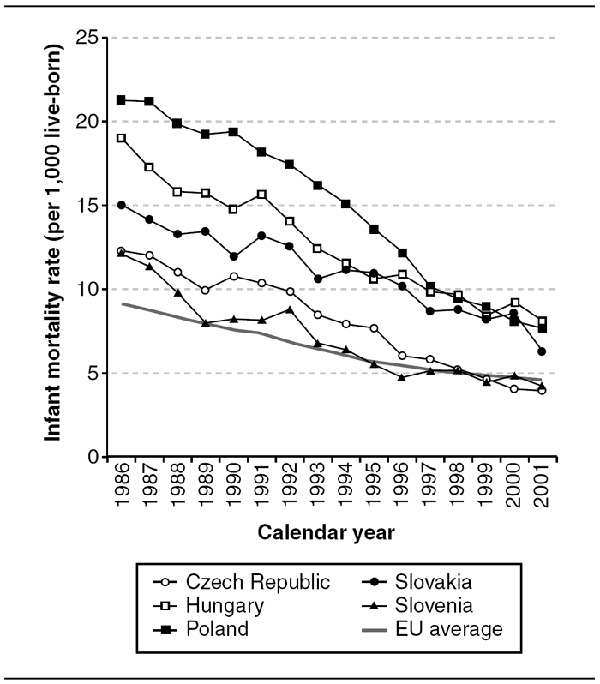
<body><![CDATA[<p><FONT face=Verdana size=2>Former non-market economy Central and  Eastern European (CEE) countries underwent major political and social changes  over the last two decades, and the collapse of socialized health systems led to  the question of possible worsening of relevant health indicators<SUP>2</SUP>.  Thus, to address the specific issue of infant mortality as a relevant health  indicator, we systematically considered trends in infant mortality in five CEE  countries.</FONT></p> </font><FONT face=Arial>     <p>&nbsp;</p>     <p><FONT face=Verdana><B>Methods</B></FONT></p> </font><FONT face=Arial size=2>     <p><FONT face=Verdana size=2>The countries considered in this  investigation are the Czech Republic, Hungary, Poland, Slovakia and Slovenia,  i.e. the countries that first entered the period of political and economic  transition during the late 1980's (in the rest of accession countries, the  political and economical transition started later, in the mid 1990's). For the  purpose of comparison, European Union (EU) average data were used. The source of  the data was the WHO database (http://www3.who.int/whosis/menu.cfm). For the  years 2000 and 2001, the EU average was derived (for year 2000) and estimated  (for year 2001) from Eurostat data. For Slovakia 1970-85 and Slovenia 1970-83  data from national offices (Institute of Public Health of the Republic of  Slovenia and Institute of Health Information and Statistics of Slovakia) were  used. The infant mortality rate was computed on the basis of the World Health  Organization definition. Numbers of births were used to compute rates per 1,000  live-born. The average infant mortality rate for the whole region analysed  (i.e., the 5 countries of interest) was also computed. The average per cent  change per year (annual percent change) was computed for each country and  region, for each selected period. The computation was based on exponential  function as a model of time trends.</FONT></p> </font><FONT face=Arial>     <p>&nbsp;</p>     <p><FONT face=Verdana><B>Results</B></FONT></p> </font><FONT face=Arial size=2>     <p><FONT face=Verdana size=2>In the year 1990, the lowest infant  mortality rates were observed in Slovenia (8.3/1,000) and the Czech Republic  (10.8/1,000). The highest ones were in Poland (19.4/1,000) and Hungary  (14.8/1,000). The average rate for the EU, with a value of 9.2/1,000, was  appreciably lower than in CEE countries considered (average value: 16.6/1,000)  (<a target="_blank" href="/img/revistas/gs/v20n1/138v20n01-13084131tab01.gif">table 1</a>).</FONT></p>     <p><FONT face=Verdana size=2>In the period 1990-2001 infant mortality  rates decreased in all countries of interest (<a href="#f1">fig. 1</a>). These declines were  substantial and steady, and a few increases of infant mortality rates that  occurred in Slovakia and Hungary in selected years were of minor value, possible  due to vagaries of chance. Only the freezing of infant mortality decrease in  Slovenia between 1989 and 1992 (with values 8.1/1,000 in 1989 and 8.9/1,000 in  1992) appears to be real.</FONT></p> <FONT face=Verdana size=2>     <p align=center><a name="f1"><img src="/img/revistas/gs/v20n1/138v20n01-13084131tab02.gif"></a></p> </font> <FONT face=Verdana size=2><B>&nbsp;&nbsp;&nbsp;&nbsp;&nbsp;&nbsp;&nbsp;&nbsp;&nbsp;&nbsp;&nbsp;&nbsp;&nbsp;&nbsp;&nbsp;&nbsp;&nbsp;&nbsp;&nbsp;&nbsp;&nbsp;&nbsp;&nbsp;&nbsp;&nbsp;&nbsp;&nbsp;&nbsp;&nbsp;&nbsp;&nbsp;&nbsp;&nbsp;&nbsp;&nbsp;&nbsp;&nbsp;&nbsp;&nbsp; Figure 1. Trends in infant  mortality rates (/1,000 live-born) in selected Central    <br> &nbsp;&nbsp;&nbsp;&nbsp;&nbsp;&nbsp;&nbsp;&nbsp;&nbsp;&nbsp;&nbsp;&nbsp;&nbsp;&nbsp;&nbsp;&nbsp;&nbsp;&nbsp;&nbsp;&nbsp;&nbsp;&nbsp;&nbsp;&nbsp;&nbsp;&nbsp;&nbsp;&nbsp;&nbsp;&nbsp;&nbsp;&nbsp;&nbsp;&nbsp;&nbsp;&nbsp;&nbsp;&nbsp;&nbsp; and Eastern European  countries and the European Union (EU) average, period    ]]></body>
<body><![CDATA[<br> &nbsp;&nbsp;&nbsp;&nbsp;&nbsp;&nbsp;&nbsp;&nbsp;&nbsp;&nbsp;&nbsp;&nbsp;&nbsp;&nbsp;&nbsp;&nbsp;&nbsp;&nbsp;&nbsp;&nbsp;&nbsp;&nbsp;&nbsp;&nbsp;&nbsp;&nbsp;&nbsp;&nbsp;&nbsp;&nbsp;&nbsp;&nbsp;&nbsp;&nbsp;&nbsp;&nbsp;&nbsp;&nbsp;&nbsp; 1986-2001.</B></FONT>     <p><FONT face=Verdana size=2>    <br> In 2001, the lowest infant mortality rates  were observed in the Czech Republic (4.0/1,000) and Slovenia (4.3/1,000). These  values were indeed below the EU average (4.6/1,000) (<a target="_blank" href="/img/revistas/gs/v20n1/138v20n01-13084131tab01.gif">table 1</a>). The highest  infant mortality rates in 2001 were observed in Poland (7.7/1,000) and Hungary  (8.1/1,000). The annual percent change between 1990 and 2001 was highest in the  Czech Republic (-9.9%) and Poland (-9.1%).</FONT></p>     <p><FONT face=Verdana size=2>In all CEE countries, the percent decline  was greater in the 1990's, compared to the 1980's. The change in fall was  greatest in Poland (9.1% per year, compared to 3.1%) and in the Czech Republic  (9.9 compared to 4.9%). In Hungary, the change in fall was smaller (5.8 compared  to 3.9%), and in Slovenia and Slovakia changes were minor. Over the last decade,  all CEE countries considered had greater annual percent change than the average  EU one, leading to a levelling of infant mortality rates between accession  countries and EU member states before 2004.</FONT></p>     <p>&nbsp;</p> </font>     <p><B><font face="Verdana">Discussion</font></B></p>     <p><FONT face=Arial size=2><FONT face=Verdana size=2>Contrary to what had been forecasted by  several scientific and political groups, (e.g., Paniccia<SUP>3</SUP>), in the  period of political transformation considered no increase in infant mortality in  CEE countries was observed. On the contrary, the key message from this  systematic analysis of infant mortality over the last two decades is the  substantial decline observed in countries of the area, despite the societal  changes and related social disruptions occurred in several of these countries in  the late 1980's and early 1990's, and despite some freezing of decline of infant  mortality rates in Slovenia during the Balkan conflict, although Slovenia was  only marginally affected by that conflict.</FONT></p>     <p><FONT face=Verdana size=2>Over more recent years, some of the CEE  countries considered reached infant mortality rates lower than the EU as a  whole, reflecting the stronger falls registered throughout the last decade.  Interestingly, the annual percent change in East Germany (former German  Democratic Republic, -7.4% in the 1990s, compared to -5.4% in the 1980s)  during the 1990s was smaller than in the Czech Republic or Poland<SUP>4</SUP>.  There are also differences in the components of infant mortality in various  countries and regions. Thus, although there were declines in infant mortality in  both parts of Germany in the 1990's, these were driven by a fall in neonatal  mortality in the East, but of post-neonatal mortality in the  West<SUP>4</SUP>.</FONT></p>     <p><FONT face=Verdana size=2>In the Check Republic, the decline in  neonatal mortality registered between 1989-91 and 1994-95 was due to an  improvement in the survival of infants of all birth weights, but especially for  these of low birth weight, pointing to a relevant effect of better access to  health case<SUP>5</SUP>.</FONT></p>     <p><FONT face=Verdana size=2>Some changes of pregnant women behaviour  (like decrease in smoking prevalence) and a wider availability of modern medical  technology are also likely to have contributed to the substantial declines in  infant mortality observed across various CEE countries<SUP>7</SUP>. It is also  possible, however, that socioeconomic improvements had a relevant impact,  following the establishment of democracy in these countries<SUP>2,8-11</SUP>. An  ecological exercise including data from 170 countries and using three different  types of information -i.e., life expectancy, maternal mortality and infant  mortality trends- showed, in fact, that after a country's wealth, level of  inequality and size of its public spending were adjusted for, democracy had an  independent favourable effect on health<SUP>10</SUP>.</FONT></p>     ]]></body>
<body><![CDATA[<p><FONT face=Verdana size=2>Infant mortality is therefore a major  indicator of the positive health changes that have been recorded in CEE  countries during the last decade<SUP>6</SUP>.</FONT></p>     <p>&nbsp;</p> </font>     <p><B><font face="Verdana">Contributors</font></B></p> <FONT face=Arial size=2>     <p><FONT face=Verdana size=2>W. Zatoñski participated in preparing  concept of analysis, supervising the data analysis, writing and editing of the  paper; M. Mikucka participated in data analysis, writing and editing of the  report; C. La Vecchia participated in preparing concept, writing and editing of  the paper; P. Boyle participated in preparing concept, and editing of the  paper</FONT></p>     <p>&nbsp;</p> </font>     <p><B><font face="Verdana">Conflict of interest  statement</font></B></p> <FONT face=Arial size=2>     <p><FONT face=Verdana size=2>None declared.</FONT></p>     <p>&nbsp;</p> </font>     <p><B><font face="Verdana">Acknowledgements</font></B></p> <FONT face=Arial size=2>     <p><FONT face=Verdana size=2>Partial funding: EU Council: HEM. Closing  the Gap. Reducing Premature Mortality, Baseline for Health Evaluation Monitoring  Following Enlargement (Grant Agreement N.<SUP>0</SUP> 2003121).</FONT></p>     ]]></body>
<body><![CDATA[<p><FONT face=Verdana size=2>The authors would like to thank Ms Anna  Barkova from Institute of Health Information and Statistics in Slovakia, and Ms  Jozica Selb from Institute of Public Health in Slovenia for supplying data for  the study.</FONT></p>     <p>&nbsp;</p> </font>      <p><b><font face="Verdana">Bibliografía</font></b></p> <FONT face=Arial size=2>     <!-- ref --><p><FONT face=Verdana size=2>1. Bryce J, El Arifeen S, Pariyo G, Lanata CF, Gwatkin D,  Habicht JP, et al. Reducing child mortality: can public health deliver? Lancet.  2003;362:159-64.&nbsp;&nbsp;&nbsp;&nbsp;&nbsp;&nbsp;&nbsp;&nbsp;[&#160;<a href="javascript:void(0);" onclick="javascript: window.open('/scielo.php?script=sci_nlinks&ref=2362898&pid=S0213-9111200600010001200001&lng=','','width=640,height=500,resizable=yes,scrollbars=1,menubar=yes,');">Links</a>&#160;]<!-- end-ref --><!-- ref --><p>2. Zatonski W, Boyle P. Health transformations in Poland  after 1988. J Epidemiol Biostat. 1996;1:183-97.&nbsp;&nbsp;&nbsp;&nbsp;&nbsp;&nbsp;&nbsp;&nbsp;[&#160;<a href="javascript:void(0);" onclick="javascript: window.open('/scielo.php?script=sci_nlinks&ref=2362899&pid=S0213-9111200600010001200002&lng=','','width=640,height=500,resizable=yes,scrollbars=1,menubar=yes,');">Links</a>&#160;]<!-- end-ref --><!-- ref --><p>3. Paniccia R. Economic  shocks, impoverishment and poverty-related mortality during the Eastern European  transition. Research Paper from World Institute for Development Economics  Research; 1997.&nbsp;&nbsp;&nbsp;&nbsp;&nbsp;&nbsp;&nbsp;&nbsp;[&#160;<a href="javascript:void(0);" onclick="javascript: window.open('/scielo.php?script=sci_nlinks&ref=2362900&pid=S0213-9111200600010001200003&lng=','','width=640,height=500,resizable=yes,scrollbars=1,menubar=yes,');">Links</a>&#160;]<!-- end-ref --><!-- ref --><p>4. Nolte E, Brand A, Koupilova I, McKee M. Neonatal and  postneonatal mortality in Germany since unification. J Epidemiol Community  Health. 2000;54:84-90.&nbsp;&nbsp;&nbsp;&nbsp;&nbsp;&nbsp;&nbsp;&nbsp;[&#160;<a href="javascript:void(0);" onclick="javascript: window.open('/scielo.php?script=sci_nlinks&ref=2362901&pid=S0213-9111200600010001200004&lng=','','width=640,height=500,resizable=yes,scrollbars=1,menubar=yes,');">Links</a>&#160;]<!-- end-ref --><!-- ref --><p>5. Koupilova I, McKee M, Holcik J. Neonatal mortality  in the Czech Republic during the transition. Health Policy. 1998;46:43-52.&nbsp;&nbsp;&nbsp;&nbsp;&nbsp;&nbsp;&nbsp;&nbsp;[&#160;<a href="javascript:void(0);" onclick="javascript: window.open('/scielo.php?script=sci_nlinks&ref=2362902&pid=S0213-9111200600010001200005&lng=','','width=640,height=500,resizable=yes,scrollbars=1,menubar=yes,');">Links</a>&#160;]<!-- end-ref --><!-- ref --><p>6.  Zatonski WA, McMichael AJ, Powles JW. Ecological study of reasons for sharp  decline in mortality from ischaemic heart disease in Poland since 1991. BMJ.  1998;316:1047-51.&nbsp;&nbsp;&nbsp;&nbsp;&nbsp;&nbsp;&nbsp;&nbsp;[&#160;<a href="javascript:void(0);" onclick="javascript: window.open('/scielo.php?script=sci_nlinks&ref=2362903&pid=S0213-9111200600010001200006&lng=','','width=640,height=500,resizable=yes,scrollbars=1,menubar=yes,');">Links</a>&#160;]<!-- end-ref --><!-- ref --><p>7. La Vecchia C, Parazzini F, Levi F. Perinatal and infant  mortality: a worldwide issue. Eur J Public Health. 1996;6:157-8.&nbsp;&nbsp;&nbsp;&nbsp;&nbsp;&nbsp;&nbsp;&nbsp;[&#160;<a href="javascript:void(0);" onclick="javascript: window.open('/scielo.php?script=sci_nlinks&ref=2362904&pid=S0213-9111200600010001200007&lng=','','width=640,height=500,resizable=yes,scrollbars=1,menubar=yes,');">Links</a>&#160;]<!-- end-ref --><!-- ref --><p>8. Sen A.  Poverty and famines: An essay on entitlement and deprivation. Oxford: Clarendon  Press; 1982.&nbsp;&nbsp;&nbsp;&nbsp;&nbsp;&nbsp;&nbsp;&nbsp;[&#160;<a href="javascript:void(0);" onclick="javascript: window.open('/scielo.php?script=sci_nlinks&ref=2362905&pid=S0213-9111200600010001200008&lng=','','width=640,height=500,resizable=yes,scrollbars=1,menubar=yes,');">Links</a>&#160;]<!-- end-ref --><!-- ref --><p>9. Sen AK. Development as freedom. Freedom in the World Country  Ratings 1972-73 to 2001-2002. Nueva York: Knopf; 1999 &#091;consultado 15/11/2003&#093;.  Disponible en: <a href="http://www.freedomhouse.org" target="_blank">http://www.freedomhouse.org</a>&nbsp;&nbsp;&nbsp;&nbsp;&nbsp;&nbsp;&nbsp;&nbsp;[&#160;<a href="javascript:void(0);" onclick="javascript: window.open('/scielo.php?script=sci_nlinks&ref=2362906&pid=S0213-9111200600010001200009&lng=','','width=640,height=500,resizable=yes,scrollbars=1,menubar=yes,');">Links</a>&#160;]<!-- end-ref --><!-- ref --><p>10. Franco A, Álvarez-Dardet C,  Ruiz MT. Effect of democracy on health: ecological study. BMJ.  2004;329:1421-3.&nbsp;&nbsp;&nbsp;&nbsp;&nbsp;&nbsp;&nbsp;&nbsp;[&#160;<a href="javascript:void(0);" onclick="javascript: window.open('/scielo.php?script=sci_nlinks&ref=2362907&pid=S0213-9111200600010001200010&lng=','','width=640,height=500,resizable=yes,scrollbars=1,menubar=yes,');">Links</a>&#160;]<!-- end-ref --><!-- ref --><p>11. Ruger JP. Democracy and health. QJM.  2005;98:299-304.&nbsp;&nbsp;&nbsp;&nbsp;&nbsp;&nbsp;&nbsp;&nbsp;[&#160;<a href="javascript:void(0);" onclick="javascript: window.open('/scielo.php?script=sci_nlinks&ref=2362908&pid=S0213-9111200600010001200011&lng=','','width=640,height=500,resizable=yes,scrollbars=1,menubar=yes,');">Links</a>&#160;]<!-- end-ref --><p>&nbsp;</p>    <p>&nbsp;</p>    <p>  <b>  <FONT size=2>  <FONT face=Verdana size=2>  <a href="#top"><img src="/img/revistas/gs/v20n1/seta.gif" border="0"></a><a name="back"></a>C</font></FONT></b></FONT></font></font><font face="Verdana" size="2"><b>orrespondencia:</b>     <br> Prof. Witold Zatoñski.    <br> The Maria Sklodowska-Curie Memorial Cancer Center    <br> &amp; Institute of Oncology, 5 W.K.    ]]></body>
<body><![CDATA[<br> Roentgena Street, 02-781. Warsaw. Poland.    <br> Correo electrónico: <A href="mailto:zatonskiw@coi.waw.pl">zatonskiw@coi.waw.pl</A></font></p>    <p><FONT face=Verdana size=2>Recibido: 2 de  septiembre.    <br> Aceptado: 12 de  octubre de 2005.</FONT></p>      ]]></body><back>
<ref-list>
<ref id="B1">
<label>1</label><nlm-citation citation-type="journal">
<person-group person-group-type="author">
<name>
<surname><![CDATA[Bryce]]></surname>
<given-names><![CDATA[J]]></given-names>
</name>
<name>
<surname><![CDATA[El Arifeen]]></surname>
<given-names><![CDATA[S]]></given-names>
</name>
<name>
<surname><![CDATA[Pariyo]]></surname>
<given-names><![CDATA[G]]></given-names>
</name>
<name>
<surname><![CDATA[Lanata]]></surname>
<given-names><![CDATA[CF]]></given-names>
</name>
<name>
<surname><![CDATA[Gwatkin]]></surname>
<given-names><![CDATA[D]]></given-names>
</name>
<name>
<surname><![CDATA[Habicht]]></surname>
<given-names><![CDATA[JP]]></given-names>
</name>
</person-group>
<article-title xml:lang="en"><![CDATA[Reducing child mortality: can public health deliver?]]></article-title>
<source><![CDATA[Lancet]]></source>
<year>2003</year>
<volume>362</volume>
<page-range>159-64</page-range></nlm-citation>
</ref>
<ref id="B2">
<label>2</label><nlm-citation citation-type="journal">
<person-group person-group-type="author">
<name>
<surname><![CDATA[Zatonski]]></surname>
<given-names><![CDATA[W]]></given-names>
</name>
<name>
<surname><![CDATA[Boyle]]></surname>
<given-names><![CDATA[P]]></given-names>
</name>
</person-group>
<article-title xml:lang="en"><![CDATA[Health transformations in Poland after 1988]]></article-title>
<source><![CDATA[J Epidemiol Biostat]]></source>
<year>1996</year>
<volume>1</volume>
<page-range>183-97</page-range></nlm-citation>
</ref>
<ref id="B3">
<label>3</label><nlm-citation citation-type="journal">
<person-group person-group-type="author">
<name>
<surname><![CDATA[Paniccia]]></surname>
<given-names><![CDATA[R]]></given-names>
</name>
</person-group>
<article-title xml:lang="en"><![CDATA[Economic shocks, impoverishment and poverty-related mortality during the Eastern European transition]]></article-title>
<source><![CDATA[Research Paper from World Institute for Development Economics Research]]></source>
<year>1997</year>
</nlm-citation>
</ref>
<ref id="B4">
<label>4</label><nlm-citation citation-type="journal">
<person-group person-group-type="author">
<name>
<surname><![CDATA[Nolte]]></surname>
<given-names><![CDATA[E]]></given-names>
</name>
<name>
<surname><![CDATA[Brand]]></surname>
<given-names><![CDATA[A]]></given-names>
</name>
<name>
<surname><![CDATA[Koupilova]]></surname>
<given-names><![CDATA[I]]></given-names>
</name>
<name>
<surname><![CDATA[McKee]]></surname>
<given-names><![CDATA[M]]></given-names>
</name>
</person-group>
<article-title xml:lang="en"><![CDATA[Neonatal and postneonatal mortality in Germany since unification]]></article-title>
<source><![CDATA[J Epidemiol Community Health]]></source>
<year>2000</year>
<volume>54</volume>
<page-range>84-90</page-range></nlm-citation>
</ref>
<ref id="B5">
<label>5</label><nlm-citation citation-type="journal">
<person-group person-group-type="author">
<name>
<surname><![CDATA[Koupilova]]></surname>
<given-names><![CDATA[I]]></given-names>
</name>
<name>
<surname><![CDATA[McKee]]></surname>
<given-names><![CDATA[M]]></given-names>
</name>
<name>
<surname><![CDATA[Holcik]]></surname>
<given-names><![CDATA[J]]></given-names>
</name>
</person-group>
<article-title xml:lang="en"><![CDATA[Neonatal mortality in the Czech Republic during the transition]]></article-title>
<source><![CDATA[Health Policy]]></source>
<year>1998</year>
<volume>46</volume>
<page-range>43-52</page-range></nlm-citation>
</ref>
<ref id="B6">
<label>6</label><nlm-citation citation-type="journal">
<person-group person-group-type="author">
<name>
<surname><![CDATA[Zatonski]]></surname>
<given-names><![CDATA[WA]]></given-names>
</name>
<name>
<surname><![CDATA[McMichael]]></surname>
<given-names><![CDATA[AJ]]></given-names>
</name>
<name>
<surname><![CDATA[Powles]]></surname>
<given-names><![CDATA[JW]]></given-names>
</name>
</person-group>
<article-title xml:lang="en"><![CDATA[Ecological study of reasons for sharp decline in mortality from ischaemic heart disease in Poland since 1991]]></article-title>
<source><![CDATA[BMJ]]></source>
<year>1998</year>
<volume>316</volume>
<page-range>1047-51</page-range></nlm-citation>
</ref>
<ref id="B7">
<label>7</label><nlm-citation citation-type="journal">
<person-group person-group-type="author">
<name>
<surname><![CDATA[La Vecchia]]></surname>
<given-names><![CDATA[C]]></given-names>
</name>
<name>
<surname><![CDATA[Parazzini]]></surname>
<given-names><![CDATA[F]]></given-names>
</name>
<name>
<surname><![CDATA[Levi]]></surname>
<given-names><![CDATA[F]]></given-names>
</name>
</person-group>
<article-title xml:lang="en"><![CDATA[Perinatal and infant mortality: a worldwide issue]]></article-title>
<source><![CDATA[Eur J Public Health]]></source>
<year>1996</year>
<volume>6</volume>
<page-range>157-8</page-range></nlm-citation>
</ref>
<ref id="B8">
<label>8</label><nlm-citation citation-type="book">
<person-group person-group-type="author">
<name>
<surname><![CDATA[Sen]]></surname>
<given-names><![CDATA[A]]></given-names>
</name>
</person-group>
<source><![CDATA[Poverty and famines: An essay on entitlement and deprivation]]></source>
<year>1982</year>
<publisher-loc><![CDATA[Oxford ]]></publisher-loc>
<publisher-name><![CDATA[Clarendon Press]]></publisher-name>
</nlm-citation>
</ref>
<ref id="B9">
<label>9</label><nlm-citation citation-type="book">
<person-group person-group-type="author">
<name>
<surname><![CDATA[Sen]]></surname>
<given-names><![CDATA[AK]]></given-names>
</name>
</person-group>
<source><![CDATA[Development as freedom: Freedom in the World Country Ratings 1972-73 to 2001-2002]]></source>
<year>1999</year>
<publisher-loc><![CDATA[Nueva York ]]></publisher-loc>
<publisher-name><![CDATA[Knopf]]></publisher-name>
</nlm-citation>
</ref>
<ref id="B10">
<label>10</label><nlm-citation citation-type="journal">
<person-group person-group-type="author">
<name>
<surname><![CDATA[Franco]]></surname>
<given-names><![CDATA[A]]></given-names>
</name>
<name>
<surname><![CDATA[Álvarez-Dardet]]></surname>
<given-names><![CDATA[C]]></given-names>
</name>
<name>
<surname><![CDATA[Ruiz]]></surname>
<given-names><![CDATA[MT]]></given-names>
</name>
</person-group>
<article-title xml:lang="en"><![CDATA[Effect of democracy on health: ecological study]]></article-title>
<source><![CDATA[BMJ]]></source>
<year>2004</year>
<volume>329</volume>
<page-range>1421-3</page-range></nlm-citation>
</ref>
<ref id="B11">
<label>11</label><nlm-citation citation-type="journal">
<person-group person-group-type="author">
<name>
<surname><![CDATA[Ruger]]></surname>
<given-names><![CDATA[JP]]></given-names>
</name>
</person-group>
<article-title xml:lang="en"><![CDATA[Democracy and health]]></article-title>
<source><![CDATA[QJM]]></source>
<year>2005</year>
<volume>98</volume>
<page-range>299-304</page-range></nlm-citation>
</ref>
</ref-list>
</back>
</article>
