<?xml version="1.0" encoding="ISO-8859-1"?><article xmlns:mml="http://www.w3.org/1998/Math/MathML" xmlns:xlink="http://www.w3.org/1999/xlink" xmlns:xsi="http://www.w3.org/2001/XMLSchema-instance">
<front>
<journal-meta>
<journal-id>0213-9111</journal-id>
<journal-title><![CDATA[Gaceta Sanitaria]]></journal-title>
<abbrev-journal-title><![CDATA[Gac Sanit]]></abbrev-journal-title>
<issn>0213-9111</issn>
<publisher>
<publisher-name><![CDATA[Sociedad Española de Salud Pública y Administración Sanitaria (SESPAS)]]></publisher-name>
</publisher>
</journal-meta>
<article-meta>
<article-id>S0213-91112010000500003</article-id>
<title-group>
<article-title xml:lang="en"><![CDATA[Risky alcohol use and heavy episodic drinking among Spanish University students: a two-year follow-up]]></article-title>
<article-title xml:lang="es"><![CDATA[Consumo de riesgo y consumo intensivo de alcohol entre estudiantes universitarios: dos años de estudio]]></article-title>
</title-group>
<contrib-group>
<contrib contrib-type="author">
<name>
<surname><![CDATA[Mota]]></surname>
<given-names><![CDATA[Nayara]]></given-names>
</name>
<xref ref-type="aff" rid="A01"/>
</contrib>
<contrib contrib-type="author">
<name>
<surname><![CDATA[Álvarez-Gil]]></surname>
<given-names><![CDATA[Rosa]]></given-names>
</name>
<xref ref-type="aff" rid="A02"/>
<xref ref-type="aff" rid="A03"/>
</contrib>
<contrib contrib-type="author">
<name>
<surname><![CDATA[Corral]]></surname>
<given-names><![CDATA[Montserrat]]></given-names>
</name>
<xref ref-type="aff" rid="A01"/>
</contrib>
<contrib contrib-type="author">
<name>
<surname><![CDATA[Rodríguez Holguín]]></surname>
<given-names><![CDATA[Socorro]]></given-names>
</name>
<xref ref-type="aff" rid="A01"/>
</contrib>
<contrib contrib-type="author">
<name>
<surname><![CDATA[Parada]]></surname>
<given-names><![CDATA[María]]></given-names>
</name>
<xref ref-type="aff" rid="A01"/>
</contrib>
<contrib contrib-type="author">
<name>
<surname><![CDATA[Crego]]></surname>
<given-names><![CDATA[Alberto]]></given-names>
</name>
<xref ref-type="aff" rid="A01"/>
</contrib>
<contrib contrib-type="author">
<name>
<surname><![CDATA[Caamaño-Isorna]]></surname>
<given-names><![CDATA[Francisco]]></given-names>
</name>
<xref ref-type="aff" rid="A02"/>
<xref ref-type="aff" rid="A03"/>
</contrib>
<contrib contrib-type="author">
<name>
<surname><![CDATA[Cadaveira]]></surname>
<given-names><![CDATA[Fernando]]></given-names>
</name>
<xref ref-type="aff" rid="A01"/>
</contrib>
</contrib-group>
<aff id="A01">
<institution><![CDATA[,University of Santiago de Compostela Department of Clinical Psychology and Psychobiology ]]></institution>
<addr-line><![CDATA[Santiago de Compostela ]]></addr-line>
<country>Spain</country>
</aff>
<aff id="A02">
<institution><![CDATA[,Centro de investigación biomédica en red de Epidemiología y Salud Pública (CIBERESP)  ]]></institution>
<addr-line><![CDATA[ ]]></addr-line>
</aff>
<aff id="A03">
<institution><![CDATA[,University of Santiago de Compostela Department of Preventive Medicine ]]></institution>
<addr-line><![CDATA[Santiago de Compostela ]]></addr-line>
<country>Spain</country>
</aff>
<pub-date pub-type="pub">
<day>00</day>
<month>10</month>
<year>2010</year>
</pub-date>
<pub-date pub-type="epub">
<day>00</day>
<month>10</month>
<year>2010</year>
</pub-date>
<volume>24</volume>
<numero>5</numero>
<fpage>372</fpage>
<lpage>377</lpage>
<copyright-statement/>
<copyright-year/>
<self-uri xlink:href="http://scielo.isciii.es/scielo.php?script=sci_arttext&amp;pid=S0213-91112010000500003&amp;lng=en&amp;nrm=iso"></self-uri><self-uri xlink:href="http://scielo.isciii.es/scielo.php?script=sci_abstract&amp;pid=S0213-91112010000500003&amp;lng=en&amp;nrm=iso"></self-uri><self-uri xlink:href="http://scielo.isciii.es/scielo.php?script=sci_pdf&amp;pid=S0213-91112010000500003&amp;lng=en&amp;nrm=iso"></self-uri><abstract abstract-type="short" xml:lang="en"><p><![CDATA[Objective: To evaluate the incidence of risky consumption (RC) and heavy episodic drinking (HED) in the Cohort of Spanish university students at two-year follow-up and to identify predictors of these patterns of alcohol consumption and the association between these patterns and academic achievement. Method: We carried out a cohort study. Alcohol consumption was measured with the AUDIT. The following variables were collected by questionnaire: place of residence, parents' education, alcohol consumption in the family, age of onset of use, alcohol expectancies, and the academic achievement. We constructed logistic regression models using three dependent variables: RC, HED, and academic achievement. Results: The response rate at two-year follow-up was 64.1%. The incidence of RC and HED at two-year follow-up were 24.92% and 4.01% respectively. The prevalence of RC rose from 37.1% to 54.6%. On the contrary, HED dropped from 12.2% to 8.7%. In relation to incidence of RC, being male (OR=2.77), medium (OR=1.59) or high expectancies (OR=2.24), and early age of onset of use (OR=2.26) constituted risk factors. In contrast, living with parents constituted a protective factor (OR=0.48). For HED, being male (OR=1.92) and high expectancies (OR=2.96) were risk factors. RC and HED were risk factors for low academic achievement. Conclusions: HED is a pattern of alcohol consumption mainly associated with adolescence, while RC is associated with youth. Both patterns are predictors of academic achievement. Public Health strategies should focus on modifying expectancies and limit access to alcohol at young ages.]]></p></abstract>
<abstract abstract-type="short" xml:lang="es"><p><![CDATA[Objetivo: Determinar la incidencia del consumo de riesgo de alcohol (CR) y del consumo intensivo (CI) en una cohorte de estudiantes universitarios a los 2 años de seguimiento e identificar los factores de estas pautas de consumo de alcohol y su asociación con el redimiento académico. Método: Se ha realizado un estudio de cohortes. El consumo de alcohol se ha medido con el AUDIT. Las siguientes variables se han medido mediante cuestionario: lugar de residencia, educación parental, consumo de alcohol en la familia, edad de inicio de uso, expectativas sobre alcohol y rendimiento académico. Para el análisis de datos se han construido modelos de regresión logística con las tres variables dependientes consideradas: CR, CI y rendimiento académico. Resultados: La tasa de respuesta en el seguimiento se situó en el 64,1%. La incidencia de CR y CI a los 2 años fue del 24,92% y el 4,01%. La prevalencia de CR aumentó del 37,1% al 54,6%. Por el contrario, el CI disminuyó del 12,2% al 8,7%. Con relación a la incidencia de CR, el ser varón (OR=2,77), las medias (OR=1.59) y altas expectativas (OR=2.24), y la edad temprana de inicio de uso (OR=2,26) son factores de riesgo. Por el contrario, el vivir con los padres muestra un factor protector (OR=0,48). Para el CI, ser varón (OR=1,92) y las altas expectativas (OR=2,96) son también factores de riesgo. Ambos patrones de consumo constituyen factores de riesgo del bajo rendimiento académico. Conclusiones: El CI es un patrón de consumo principalmente asociado con la adolescencia, mientras que el CR se asocia con la juventud. Ambos patrones son predictores del rendimiento académico. Las estrategias de salud pública deberían centrarse en la modificación de expectativas y en limitar el acceso al alcohol de los más jóvenes.]]></p></abstract>
<kwd-group>
<kwd lng="en"><![CDATA[Heavy episodic drinking]]></kwd>
<kwd lng="en"><![CDATA[Adolescent]]></kwd>
<kwd lng="en"><![CDATA[Epidemiology]]></kwd>
<kwd lng="en"><![CDATA[Cohort]]></kwd>
<kwd lng="en"><![CDATA[Alcohol]]></kwd>
<kwd lng="en"><![CDATA[Logistic-regression]]></kwd>
<kwd lng="es"><![CDATA[Consumo episódico intensivo de alcohol]]></kwd>
<kwd lng="es"><![CDATA[Adolescentes]]></kwd>
<kwd lng="es"><![CDATA[Epidemiología]]></kwd>
<kwd lng="es"><![CDATA[Cohorte]]></kwd>
<kwd lng="es"><![CDATA[Alcohol]]></kwd>
<kwd lng="es"><![CDATA[Regresión logística]]></kwd>
</kwd-group>
</article-meta>
</front><body><![CDATA[ <p><a name="top"></a><font face="Verdana" size="2"><b>ORIGINAL</b></font></p>     <p>&nbsp;</p>     <p><font face="Verdana" size="4"><b>Risky alcohol use and heavy episodic drinking among Spanish University students: a two-year follow-up</b></font></p>     <p><font face="Verdana" size="4"><b>Consumo de riesgo y consumo intensivo de alcohol entre estudiantes universitarios: dos años de estudio</b></font></p>     <p>&nbsp;</p>     <p>&nbsp;</p>     <p><font face="Verdana" size="2"><b>Nayara Mota<sup>a</sup>, Rosa Álvarez-Gil<sup>b</sup>, Montserrat Corral<sup>a</sup>, Socorro Rodríguez Holguín<sup>a</sup>, María Parada<sup>a</sup>, Alberto Crego<sup>a</sup>, Francisco Caamaño-Isorna<sup>b</sup> and Fernando Cadaveira<sup>a</sup></b></font></p>     <p><font face="Verdana" size="2"><sup>a</sup>Department of Clinical Psychology and Psychobiology, University of Santiago de Compostela, Spain    <br><sup>b</sup>CIBER de Epidemiología y Salud Pública (CIBERESP), Department of Preventive Medicine, University of Santiago de Compostela, Spain</font></p>     <p><font face="Verdana" size="2">This research was supported by Consellería de Innovación e Industria, Xunta de Galicia, grant number PGIDIT05CS021103PR and INCITE08XIB211015PR, by Plan Nacional sobre Drogas, Ministerio de Salud y Consumo, Spain, grant number 2005/PN014, and by Ministerio de Ciencia e Innovación, Spain, grant number EDU2008-03440.</font></p>     ]]></body>
<body><![CDATA[<p><font face="Verdana" size="2">The authors N. Mota and A. Crego hold a predoctoral scholarship from Consellería de Innovación e Industria, Xunta de Galicia, and from Ministerio de Educación, Spain (grant number AP2006-03871), respectively.</font></p>     <p><font face="Verdana" size="2"><a href="#back">Correspondence</a></font></p>     <p>&nbsp;</p>     <p>&nbsp;</p> <hr size="1">     <p><font face="Verdana" size="2"><b>ABSTRACT</b></font></p>     <p><font face="Verdana" size="2"><b>Objective:</b> To evaluate the incidence of risky consumption (RC) and heavy episodic drinking (HED) in the Cohort of Spanish university students at two-year follow-up and to identify predictors of these patterns of alcohol consumption and the association between these patterns and academic achievement.    <br><b>Method:</b> We carried out a cohort study. Alcohol consumption was measured with the AUDIT. The following variables were collected by questionnaire: place of residence, parents' education, alcohol consumption in the family, age of onset of use, alcohol expectancies, and the academic achievement. We constructed logistic regression models using three dependent variables: RC, HED, and academic achievement.    <br><b>Results:</b> The response rate at two-year follow-up was 64.1%. The incidence of RC and HED at two-year follow-up were 24.92% and 4.01% respectively. The prevalence of RC rose from 37.1% to 54.6%. On the contrary, HED dropped from 12.2% to 8.7%. In relation to incidence of RC, being male (OR=2.77), medium (OR=1.59) or high expectancies (OR=2.24), and early age of onset of use (OR=2.26) constituted risk factors. In contrast, living with parents constituted a protective factor (OR=0.48). For HED, being male (OR=1.92) and high expectancies (OR=2.96) were risk factors. RC and HED were risk factors for low academic achievement.    <br><b>Conclusions:</b> HED is a pattern of alcohol consumption mainly associated with adolescence, while RC is associated with youth. Both patterns are predictors of academic achievement. Public Health strategies should focus on modifying expectancies and limit access to alcohol at young ages.</font></p>     <p><font face="Verdana" size="2"><b>Key words:</b> Heavy episodic drinking. Adolescent. Epidemiology. Cohort. Alcohol. Logistic-regression.</font></p> <hr size="1">     ]]></body>
<body><![CDATA[<p><font face="Verdana" size="2"><b>RESUMEN</b></font></p>     <p><font face="Verdana" size="2"><b>Objetivo:</b> Determinar la incidencia del consumo de riesgo de alcohol (CR) y del consumo intensivo (CI) en una cohorte de estudiantes universitarios a los 2 años de seguimiento e identificar los factores de estas pautas de consumo de alcohol y su asociación con el redimiento académico.    <br><b>Método:</b> Se ha realizado un estudio de cohortes. El consumo de alcohol se ha medido con el AUDIT. Las siguientes variables se han medido mediante cuestionario: lugar de residencia, educación parental, consumo de alcohol en la familia, edad de inicio de uso, expectativas sobre alcohol y rendimiento académico. Para el análisis de datos se han construido modelos de regresión logística con las tres variables dependientes consideradas: CR, CI y rendimiento académico.    <br><b>Resultados:</b> La tasa de respuesta en el seguimiento se situó en el 64,1%. La incidencia de CR y CI a los 2 años fue del 24,92% y el 4,01%. La prevalencia de CR aumentó del 37,1% al 54,6%. Por el contrario, el CI disminuyó del 12,2% al 8,7%. Con relación a la incidencia de CR, el ser varón (OR=2,77), las medias (OR=1.59) y altas expectativas (OR=2.24), y la edad temprana de inicio de uso (OR=2,26) son factores de riesgo. Por el contrario, el vivir con los padres muestra un factor protector (OR=0,48). Para el CI, ser varón (OR=1,92) y las altas expectativas (OR=2,96) son también factores de riesgo. Ambos patrones de consumo constituyen factores de riesgo del bajo rendimiento académico.    <br><b>Conclusiones:</b> El CI es un patrón de consumo principalmente asociado con la adolescencia, mientras que el CR se asocia con la juventud. Ambos patrones son predictores del rendimiento académico. Las estrategias de salud pública deberían centrarse en la modificación de expectativas y en limitar el acceso al alcohol de los más jóvenes.</font></p>     <p><font face="Verdana" size="2"><b>Palabras clave:</b> Consumo episódico intensivo de alcohol. Adolescentes. Epidemiología. Cohorte. Alcohol. Regresión logística.</font></p> <hr size="1">     <p>&nbsp;</p>     <p><font face="Verdana" size="2"><b>Introduction</b></font></p>     <p><font face="Verdana" size="2">Psychological, physical and social damage have been associated to patterns of high alcohol consumption among adolescents, like risky consumption (RC), characterized by high consumption of alcohol, or heavy episodic drinking (HED), described as the consumption of high quantities of alcohol in a short period of time.<sup>1-5</sup></font></p>     <p><font face="Verdana" size="2">There have been many alerts about the high prevalence of these drinking habits among adolescents<sup>6-8</sup> and many risk factors have been identified as familiar background,<sup>9,10</sup> age of onset,<sup>11,12</sup> peer influence,<sup>13,14</sup> and expectancies.<sup>11,15</sup></font></p>     ]]></body>
<body><![CDATA[<p><font face="Verdana" size="2">On the other hand, these own patterns of alcohol consumption may consist in risk factors for some aspects, like academic attainment. RC and HED may interfere directly or indirectly on educational achievement by reducing the number of hours dedicated for studying, by affecting the motivation and school attitudes or even limiting neurocognitive abilities.<sup>16,17</sup></font></p>     <p><font face="Verdana" size="2">As the adolescent development is related to multiple dimensions and the alcohol consumption patterns and its associated factors can be modified at different ages,<sup>18</sup> it is desirable to know the trajectory of these drinking habits and their associated risk factors throughout the years.</font></p>     <p><font face="Verdana" size="2">Up to now, there is increasing longitudinal data about prevalence and risk factors of alcohol drinking among subjects that are in process of development and independence.<sup>19-23</sup> Nonetheless, in Spain, such longitudinal studies are still scarce. In one-year follow-up study with high school students (13-20 years old), Fuentes-Almendras et al<sup>24</sup> identified increment of drinking. Higher drinking frequency was related to older ages and to being male. In another two-year follow-up study, 15 years-old male outscored female on week alcohol consumption.<sup>25</sup></font></p>     <p><font face="Verdana" size="2">Therefore, in an attempt to extend the data provided by a previous work of our group,<sup>11</sup> the aim of this study is to evaluate the incidence of RC and HED in the Cohort of Spanish university students at two-year follow-up and to identify predictors of these patterns of alcohol consumption and the association between these patterns and academic achievement.</font></p>     <p>&nbsp;</p>     <p><font face="Verdana" size="2"><b>Methods</b></font></p>     <p><font face="Verdana" size="2"><i>Design, population and sample</i></font></p>     <p><font face="Verdana" size="2">A cohort study was carried out to evaluate the neurocognitive consequences of alcohol use. The study population was first year students (18 to 19 years old) at the University of Santiago de Compostela (Spain) (target <i>n</i>=2700).</font></p>     <p><font face="Verdana" size="2"><i>Data collection procedures</i></font></p>     <p><font face="Verdana" size="2">Initial data collection was carried out by means of a questionnaire filled in by students in the classroom (October to February 2006). The subjects were analyzed two-year follow up again (October to February 2008).</font></p>     ]]></body>
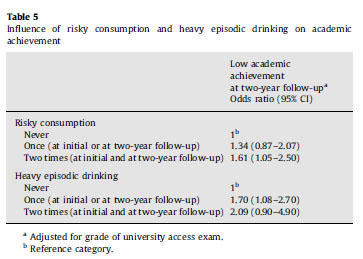
<body><![CDATA[<p><font face="Verdana" size="2">Alcohol use was measured with the Galician validated version of the AUDIT.<sup>26,27</sup> In this version, for a screening of RC, the cut-off value is 5 for men and 4 for women. Along with the AUDIT, we used another questionnaire that asked about the potential factors associated with alcohol use (educational level and alcohol use of parents, presence of alcohol related problems and age of onset of use). One of the items in this second questionnaire referred specifically to alcohol expectancies. In this question the students were required to rank 7 positive and 7 negative expectancies about the effects of alcohol. This question was generated using items from a questionnaire previously used with Spanish youths.<sup>28</sup> This same questionnaire was used to ask about students' grades and several socio-demographic variables.</font></p>     <p><font face="Verdana" size="2"><i>Definition of variables</i></font></p>     <p><font face="Verdana" size="2">(1) <i>Risky consumption (RC)</i>. Dichotomous variable generated from AUDIT score. A different cut-off value was established according to gender: &gt;4 for women; and &gt;5 for men. (2) <i>Heavy episodic drinking (HED)</i>. Dichotomous variable generated from the third AUDIT question "How often do you have 6 or more alcoholic drinks per occasion?" which was coded as follows: never=0, less than once a month=0, once a month=0, once a week=1, daily or almost daily=1. The sensitivity and specificity of this question with this cut-off value are respectively 0.40 and 0.94.<sup>29</sup> (3) <i>Low academic achievement.</i> Dichotomous variable generated from mean grades of students at two-year follow-up. A cut-off value was established at the 20th percentile. So, students included in the 20th percentile of the mean of their grades at two-year follow-up were classified as "low academic achievement".</font></p>     <p><font face="Verdana" size="2">Several socio-demographic variables were considered such as gender, place of residence (at the parents' home/outside of the parents' home), and the maternal educational level (primary school/high school/university). Alcohol use in the subject´s family was included as mother´s alcohol use (doesn´t consume/consumes). Maternal educational level and mother´s alcohol use have been considered because of their greater variability. Four categories were defined for age of onset of use (after 16 years old, at 16, at 15, before the age of 15). Finally, taking the number of positive and negative expectancies into account, a score ranging from 0 to 14 was generated (0 being the maximum of negative expectancies and 14 the maximum of positive expectancies). The scores were divided up into terciles.</font></p>     <p><font face="Verdana" size="2"><i>Statistical analysis</i></font></p>     <p><font face="Verdana" size="2">We constructed logistic regression models to estimate odds ratios (OR) using three dependent variables: RC, HED, and academic achievement. The models for RC and HED include socio-demographic data as independent variables. Finally, two models were constructed for academic achievement, one with RC as independent variable and another with HED.</font></p>     <p><font face="Verdana" size="2">All the subjects, even abstainers, were included in the models. Maximal models were generated including all theoretical independent variables. From these maximal models, final models were generated. Final models included all significant variables and also no significant variables when their exclusion changed the OR of other variables by more than 10%.</font></p>     <p>&nbsp;</p>     <p><font face="Verdana" size="2"><b>Results</b></font></p>     <p><font face="Verdana" size="2">The response rate at two-year follow-up was 64.1%. <a target="_blank" href="/img/revistas/gs/v24n5/original1_t1.jpg">Table 1</a> shows the characteristics of total sample (<i>n</i>=1369) and the characteristics of two-year follow-up sample (<i>n</i>=877). The table does not show significant differences for any variable. The observed reduction in the follow-up sample might be explained by two motives of similar weight: dropping out of college; and absences from school or degree change.</font></p>     ]]></body>
<body><![CDATA[<p><font face="Verdana" size="2">The incidence of RC and of HED at two-year follow-up were 24.92% (95% CI: 21.96-27.86) and 4.01% (95% CI: 2.84-5.41) respectively. The condition of being male, having a non-abstainer mother, besides of the early age of onset of use, and high positive expectancies are associated with the higher incidence rates of RC and HED (<a target="_blank" href="/img/revistas/gs/v24n5/original1_t2.jpg">table 2</a>).</font></p>     <p><font face="Verdana" size="2"><a target="_blank" href="/img/revistas/gs/v24n5/original1_t3.jpg">Table 3</a> shows the prevalences of alcohol consumption. The prevalence of RC shows significant changes, 37.1% vs. 54.6%, prevalence ratio=1.47 (95% CI: 1.34-1.61). On the contrary, the prevalence of HED drops from 12.2% to 8.7%, prevalence ratio=0.70 (95% CI: 0.55-0.92). In relation to abstemious variable, the prevalence at initial study and at two-year follow-up do not show significant differences.</font></p>     <p><font face="Verdana" size="2">The prevalence rates of RC at two-year follow-up are significantly higher than at initial study for all categories of subjects (<a target="_blank" href="/img/revistas/gs/v24n5/original1_t3.jpg">table 3</a>). The prevalence of RC present higher increase among the categories of subjects with lower prevalence at initial study (<a target="_blank" href="/img/revistas/gs/v24n5/original1_t3.jpg">table 3</a>). On the contrary, the prevalence of HED at two-year follow-up is significantly lower than at initial-study (<a target="_blank" href="/img/revistas/gs/v24n5/original1_t3.jpg">table 3</a>).</font></p>     <p><font face="Verdana" size="2">In relation to incidence of RC (<a target="_blank" href="/img/revistas/gs/v24n5/original1_t4.jpg">table 4</a>), the multivariate model shows that being male, high and medium positive expectancies, and age of onset of use at 15 years, all constitute risk factors for incidence of RC. On the contrary, living with parents shows a protective effect on RC. <a target="_blank" href="/img/revistas/gs/v24n5/original1_t4.jpg">Table 4</a> also shows that being male and having high positive expectancies are risk factors for incidence of HED. Finally, <a href="#t5">table 5</a> shows the influence of RC and HED on academic achievement. Both patterns are risk factors of low academic achievement.</font></p>     <p align="center"><font face="Verdana" size="2"><a name="t5"><img src="/img/revistas/gs/v24n5/original1_t5.jpg" width="363" height="259"></a></font></p>     <p>&nbsp;</p>     <p><font face="Verdana" size="2"><b>Discussion</b></font></p>     <p><font face="Verdana" size="2">One out of four subjects that did not present RC at initial study does show it at two-year follow-up. Up to our knowledge, this proportion is among the higher ever cited in literature (Schulenberg et al<sup>18</sup> have reported about 20%). In our study, the condition of being male, having a non-abstainer mother, and the early age of onset of use and high positive expectancies are associated with the higher rates, near 50%. Further study more, the higher incidences of onset of RC occur among categories of subjects that presented higher prevalence at initial study. This contributes for the expansion of prevalence of RC at two-year follow-up.</font></p>     <p><font face="Verdana" size="2">The prevalence of RC at two-year follow-up is also higher than at initial study, while prevalence of HED is lower than at initial study. These results suggest that HED is associated with adolescents and RC with young subjects. According to Jackson et al.<sup>30</sup> and to Windle et al.<sup>31</sup> adolescents' HED reaches its peak around 20 years-old and then tends to stabilize or decrease. Another longitudinal study has reported diminished relative risk for binge drinking over time for 12- to 20-year-old males.<sup>23</sup></font></p>     <p><font face="Verdana" size="2">The prevalence of RC at two-year follow-up shows average increases of 50% on all variables, except for variables "age of onset of use" and "positive expectancies", that show increases of 100% (<a target="_blank" href="/img/revistas/gs/v24n5/original1_t3.jpg">table 3</a>). These results are consistent with different studies.<sup>12,32</sup></font></p>     ]]></body>
<body><![CDATA[<p><font face="Verdana" size="2">The prevalence of HED shows more marked decreases among categories of subjects with higher prevalence at initial study, except for the variable "positive expectancies". Furthermore, among subjects with higher positive expectancies, the HED prevalence diminishes only 20%, opposite to the decrease of 30% showed by all subjects (<a target="_blank" href="/img/revistas/gs/v24n5/original1_t3.jpg">table 3</a>). Once more, the results of this work underline the role of positive expectancies in establishing and maintaining different patterns of alcohol consumption.</font></p>     <p><font face="Verdana" size="2">Both, socio-demographic characteristics and alcohol expectancies are associated with incidence of RC and with incidence of HED.</font></p>     <p><font face="Verdana" size="2">In relation to gender, at two-year follow up, opposite to initial study results, "being male" becomes a risk factor for incidence of RC, despite of the lower cut-off point used for RC in females. In line with these results, a work with Turkish college students has informed that alcohol use was predicted by being male<sup>33</sup> and another Swedish study informed that being male has been related to frequent high alcohol consumption.<sup>34</sup></font></p>     <p><font face="Verdana" size="2">Living with their parents is a protective factor for incidence of RC. However, this protective effect is lower at two-year follow-up (OR=0.48) than at initial study (OR=0.39).<sup>11</sup> In contrast, this variable does not show an effect on incidence of HED.</font></p>     <p><font face="Verdana" size="2">The association found between the maternal educational level and the incidence of RC at two-year follow-up is similar as at initial study.<sup>11</sup> It indicates that higher maternal educational level is still a risk factor for RC at early adulthood.</font></p>     <p><font face="Verdana" size="2">The observed association between early age of onset of alcohol use and incidence of RC or incidence of HED could be explained by tolerance generated by alcohol use. Other possible explanation for this association could be that the parents who "permit" alcohol use at an earlier age are also more likely to be more permissive with excessive consumption.<sup>9,10</sup></font></p>     <p><font face="Verdana" size="2">The relationship between positive expectancies and alcohol consumption is similar to the one found at initial study. These results are consistent with those described in several studies, even though they have used different measurement scales for expectancies.</font></p>     <p><font face="Verdana" size="2">Finally, our results show that RC and HED are associated with low academic achievement. Inconsistent with these results, teacher-rated poor academic ability has been considered a predictor of adolescent HED among both women (OR=1.17, <i>p</i>&lt;0.05) and men (OR=1.22, <i>p</i>&lt;0.001).<sup>17</sup> However, other study observed association between adolescent high HED and usual grades in school among men (OR=0.510, <i>p</i>&lt;0.01) but not among women (OR=0.828, <i>p</i>&gt;0.05).<sup>31</sup></font></p>     <p><font face="Verdana" size="2">This lower achievement could be attributed to the confusion introduced by less academic effort of subjects who present these patterns of consumption. However, the fact that the models have been adjusted for grade of university access exam suggests absence of this confusion. Further, neuropsychological and psychophysiological evaluation of the subjects at two-year follow-up will facilitate the identification of the extension at which this lower academic achievement can be attributed to the neurocognitive consequences of alcohol consumption.</font></p>     <p><font face="Verdana" size="2">There are two possible limitations in our study: (1) Selection bias, because of the loss of subjects in the follow-up. However, the absence of significant differences between the initial sample and the follow-up sample (<a target="_blank" href="/img/revistas/gs/v24n5/original1_t1.jpg">table 1</a>) suggests absence of this bias. (2) Given that the question about expectancies is not specifically validated, expectancies may have not been correctly measured.</font></p>     ]]></body>
<body><![CDATA[<p><font face="Verdana" size="2">Our results show that HED in Spain is a pattern of alcohol consumption mainly associated with adolescence, while RC is associated with youth. Both patterns are predictors of academic achievement. Public Health strategies should focus on modifying expectancies and limit access to alcohol at young ages.</font></p>     <p>&nbsp;</p>     <p><font face="Verdana" size="2"><b>Author contributions</b></font></p>     <p><font face="Verdana" size="2">F. Cadaveira, M. Corral, F. Caamaño-Isorna and S. Rodríguez Holguín have designed the study. A. Crego, M. Parada, N. Mota and R. Álvarez-Gil have collected data. F. Caamaño-Isorna and R. Álvarez-Gil have analysed and interpreted data. R. Álvarez-Gil and N. Mota have written the article. F. Caamaño-Isorna has approved the final version for publication.</font></p>     <p>&nbsp;</p>     <p><font face="Verdana" size="2"><b>Conflict of interest</b></font></p>     <p><font face="Verdana" size="2">No conflicts of interest.</font></p>     <p>&nbsp;</p>     <p><b><font face="Verdana" size="2">References</font></b></p>     <!-- ref --><p><font face="Verdana" size="2">1. Crego A., Rodíguez Holguín S., Parada M., et al. Binge drinking affects attentional and visual working memory processing in young university students. Alcohol Clin Exp Res. 2009; 33:1870-9.</font>&nbsp;&nbsp;&nbsp;&nbsp;&nbsp;&nbsp;&nbsp;&nbsp;[&#160;<a href="javascript:void(0);" onclick="javascript: window.open('/scielo.php?script=sci_nlinks&ref=2430701&pid=S0213-9111201000050000300001&lng=','','width=640,height=500,resizable=yes,scrollbars=1,menubar=yes,');">Links</a>&#160;]<!-- end-ref --><!-- ref --><p><font face="Verdana" size="2">2. Crews F.T., Braun C.J., Hoplight B., et al. Binge ethanol consumption causes differential brain damage in young adolescent rats compared with adult rats. Alcohol Clin Exp Res. 2000; 24:1712-23.</font>&nbsp;&nbsp;&nbsp;&nbsp;&nbsp;&nbsp;&nbsp;&nbsp;[&#160;<a href="javascript:void(0);" onclick="javascript: window.open('/scielo.php?script=sci_nlinks&ref=2430702&pid=S0213-9111201000050000300002&lng=','','width=640,height=500,resizable=yes,scrollbars=1,menubar=yes,');">Links</a>&#160;]<!-- end-ref --><!-- ref --><p><font face="Verdana" size="2">3. Gunzerath L., Faden V., Zakhari S., et al. National Institute on Alcohol Abuse and Alcoholism report on moderate drinking. Alcohol Clin Exp Res. 2004; 28:829-47.</font>&nbsp;&nbsp;&nbsp;&nbsp;&nbsp;&nbsp;&nbsp;&nbsp;[&#160;<a href="javascript:void(0);" onclick="javascript: window.open('/scielo.php?script=sci_nlinks&ref=2430703&pid=S0213-9111201000050000300003&lng=','','width=640,height=500,resizable=yes,scrollbars=1,menubar=yes,');">Links</a>&#160;]<!-- end-ref --><!-- ref --><p><font face="Verdana" size="2">4. Miller J.W., Naimi T.S., Brewer R.D., et al. Binge drinking and associated health risk behaviors among high school students. Pediatrics. 2007; 119:76-85.</font>&nbsp;&nbsp;&nbsp;&nbsp;&nbsp;&nbsp;&nbsp;&nbsp;[&#160;<a href="javascript:void(0);" onclick="javascript: window.open('/scielo.php?script=sci_nlinks&ref=2430704&pid=S0213-9111201000050000300004&lng=','','width=640,height=500,resizable=yes,scrollbars=1,menubar=yes,');">Links</a>&#160;]<!-- end-ref --><!-- ref --><p><font face="Verdana" size="2">5. World Health Organization. Problemas de salud pública causados por el uso nocivo del alcohol, 2005 &#091;retrieved March 27, 2007; cited May 18, 2009&#093;. Available in: <a target="_blank" href="http://www.who.int/substance_abuse/wha_resolution_58_26_public_health_problems_alcohol_spanish.pdf">http://www.who.int/substance_abuse/wha_resolution_58_26_public_health_problems_alcohol_spanish.pdf</a>.</font>&nbsp;&nbsp;&nbsp;&nbsp;&nbsp;&nbsp;&nbsp;&nbsp;[&#160;<a href="javascript:void(0);" onclick="javascript: window.open('/scielo.php?script=sci_nlinks&ref=2430705&pid=S0213-9111201000050000300005&lng=','','width=640,height=500,resizable=yes,scrollbars=1,menubar=yes,');">Links</a>&#160;]<!-- end-ref --><!-- ref --><p><font face="Verdana" size="2">6. Andersson B., Hibell B., Beck C., et al. Alcohol and drug use among European 17-18 year old students. Sweden: The Swedish Council for Information on Alcohol and Other Drugs (CAN); 2007.</font>&nbsp;&nbsp;&nbsp;&nbsp;&nbsp;&nbsp;&nbsp;&nbsp;[&#160;<a href="javascript:void(0);" onclick="javascript: window.open('/scielo.php?script=sci_nlinks&ref=2430706&pid=S0213-9111201000050000300006&lng=','','width=640,height=500,resizable=yes,scrollbars=1,menubar=yes,');">Links</a>&#160;]<!-- end-ref --><!-- ref --><p><font face="Verdana" size="2">7. Karam E., Kypri K., Salamoun M. Alcohol use among college students: an international perspective. Curr Opin Psychiatry. 2007; 20:213-21.</font>&nbsp;&nbsp;&nbsp;&nbsp;&nbsp;&nbsp;&nbsp;&nbsp;[&#160;<a href="javascript:void(0);" onclick="javascript: window.open('/scielo.php?script=sci_nlinks&ref=2430707&pid=S0213-9111201000050000300007&lng=','','width=640,height=500,resizable=yes,scrollbars=1,menubar=yes,');">Links</a>&#160;]<!-- end-ref --><!-- ref --><p><font face="Verdana" size="2">8. Newes-Adeyi G., Chen C.M., Williams G.D., et al. Trends in underage drinking in The United States, 1991-2003. U.S.: National Institute on Alcohol Abuse and Alcoholism; 2005. (Surveillance Report #74).</font>&nbsp;&nbsp;&nbsp;&nbsp;&nbsp;&nbsp;&nbsp;&nbsp;[&#160;<a href="javascript:void(0);" onclick="javascript: window.open('/scielo.php?script=sci_nlinks&ref=2430708&pid=S0213-9111201000050000300008&lng=','','width=640,height=500,resizable=yes,scrollbars=1,menubar=yes,');">Links</a>&#160;]<!-- end-ref --><!-- ref --><p><font face="Verdana" size="2">9. Kramer J.R., Chan G., Dick D.M., et al. Multiple-domain predictors of problematic alcohol use in young adulthood. J Stud Alcohol Drugs. 2008; 69:649-59.</font>&nbsp;&nbsp;&nbsp;&nbsp;&nbsp;&nbsp;&nbsp;&nbsp;[&#160;<a href="javascript:void(0);" onclick="javascript: window.open('/scielo.php?script=sci_nlinks&ref=2430709&pid=S0213-9111201000050000300009&lng=','','width=640,height=500,resizable=yes,scrollbars=1,menubar=yes,');">Links</a>&#160;]<!-- end-ref --><!-- ref --><p><font face="Verdana" size="2">10. Seljamo S., Aromaa M., Koivusilta L., et al. Alcohol use in families: a 15-year prospective follow-up study. Addiction. 2006; 101:984-92.</font>&nbsp;&nbsp;&nbsp;&nbsp;&nbsp;&nbsp;&nbsp;&nbsp;[&#160;<a href="javascript:void(0);" onclick="javascript: window.open('/scielo.php?script=sci_nlinks&ref=2430710&pid=S0213-9111201000050000300010&lng=','','width=640,height=500,resizable=yes,scrollbars=1,menubar=yes,');">Links</a>&#160;]<!-- end-ref --><!-- ref --><p><font face="Verdana" size="2">11. Caamaño-Isorna F., Corral M., Parada M., et al. Factors associated with risky consumption and heavy episodic drinking among spanish university students. J Stud Alcohol Drugs. 2008; 69:308-12.</font>&nbsp;&nbsp;&nbsp;&nbsp;&nbsp;&nbsp;&nbsp;&nbsp;[&#160;<a href="javascript:void(0);" onclick="javascript: window.open('/scielo.php?script=sci_nlinks&ref=2430711&pid=S0213-9111201000050000300011&lng=','','width=640,height=500,resizable=yes,scrollbars=1,menubar=yes,');">Links</a>&#160;]<!-- end-ref --><!-- ref --><p><font face="Verdana" size="2">12. Grant B.F., Stinson F.S., Harford T.C. Age at onset of alcohol use and DSM-IV alcohol abuse and dependen a 12-year follow-up. J Subst Abuse. 2001; 13:493-504.</font>&nbsp;&nbsp;&nbsp;&nbsp;&nbsp;&nbsp;&nbsp;&nbsp;[&#160;<a href="javascript:void(0);" onclick="javascript: window.open('/scielo.php?script=sci_nlinks&ref=2430712&pid=S0213-9111201000050000300012&lng=','','width=640,height=500,resizable=yes,scrollbars=1,menubar=yes,');">Links</a>&#160;]<!-- end-ref --><!-- ref --><p><font face="Verdana" size="2">13. Flory K., Lynam D., Milich R., et al. Early adolescent through young adult alcohol and marijuana use trajectories: early predictors, young adult outcomes, and predictive utility. Dev Psychopathol. 2004; 16:193-213.</font>&nbsp;&nbsp;&nbsp;&nbsp;&nbsp;&nbsp;&nbsp;&nbsp;[&#160;<a href="javascript:void(0);" onclick="javascript: window.open('/scielo.php?script=sci_nlinks&ref=2430713&pid=S0213-9111201000050000300013&lng=','','width=640,height=500,resizable=yes,scrollbars=1,menubar=yes,');">Links</a>&#160;]<!-- end-ref --><!-- ref --><p><font face="Verdana" size="2">14. Tucker J.S., Orlando M., Ellickson P.L. Patterns and correlates of binge drinking trajectories from early adolescence to young adulthood. Health Psychol. 2003; 22:79-87.</font>&nbsp;&nbsp;&nbsp;&nbsp;&nbsp;&nbsp;&nbsp;&nbsp;[&#160;<a href="javascript:void(0);" onclick="javascript: window.open('/scielo.php?script=sci_nlinks&ref=2430714&pid=S0213-9111201000050000300014&lng=','','width=640,height=500,resizable=yes,scrollbars=1,menubar=yes,');">Links</a>&#160;]<!-- end-ref --><!-- ref --><p><font face="Verdana" size="2">15. Zamboanga B.L., Ham L.S. Alcohol expectancies and context-specific drinking behaviors among female college athletes. Behav Ther. 2008; 39:162-70.</font>&nbsp;&nbsp;&nbsp;&nbsp;&nbsp;&nbsp;&nbsp;&nbsp;[&#160;<a href="javascript:void(0);" onclick="javascript: window.open('/scielo.php?script=sci_nlinks&ref=2430715&pid=S0213-9111201000050000300015&lng=','','width=640,height=500,resizable=yes,scrollbars=1,menubar=yes,');">Links</a>&#160;]<!-- end-ref --><!-- ref --><p><font face="Verdana" size="2">16. Bryant A.L., Schulenberg J.E., O´Malley P.M., et al. How academic achievement, attitudes, and behaviors relate to the course substance use during adolescen a 6-year, multiwave national longitudinal study. J Res Adolesc. 2003; 13:361-97.</font>&nbsp;&nbsp;&nbsp;&nbsp;&nbsp;&nbsp;&nbsp;&nbsp;[&#160;<a href="javascript:void(0);" onclick="javascript: window.open('/scielo.php?script=sci_nlinks&ref=2430716&pid=S0213-9111201000050000300016&lng=','','width=640,height=500,resizable=yes,scrollbars=1,menubar=yes,');">Links</a>&#160;]<!-- end-ref --><!-- ref --><p><font face="Verdana" size="2">17. Staff J., Patrick M.E., Loken E., et al. Teenage alcohol use and educational attainment. J Stud Alcohol Drugs. 2008; 69:848-58.</font>&nbsp;&nbsp;&nbsp;&nbsp;&nbsp;&nbsp;&nbsp;&nbsp;[&#160;<a href="javascript:void(0);" onclick="javascript: window.open('/scielo.php?script=sci_nlinks&ref=2430717&pid=S0213-9111201000050000300017&lng=','','width=640,height=500,resizable=yes,scrollbars=1,menubar=yes,');">Links</a>&#160;]<!-- end-ref --><!-- ref --><p><font face="Verdana" size="2">18. Schulenberg J.E., Maggs J.L. A developmental perspective on alcohol use and heavy drinking during adolescence and the transition to young adulthood. J Stud Alcohol. 2002; 14:54-70.</font>&nbsp;&nbsp;&nbsp;&nbsp;&nbsp;&nbsp;&nbsp;&nbsp;[&#160;<a href="javascript:void(0);" onclick="javascript: window.open('/scielo.php?script=sci_nlinks&ref=2430718&pid=S0213-9111201000050000300018&lng=','','width=640,height=500,resizable=yes,scrollbars=1,menubar=yes,');">Links</a>&#160;]<!-- end-ref --><!-- ref --><p><font face="Verdana" size="2">19. Chassin L., Pitts S.C., Prost J. Binge drinking trajectories from adolescence to emerging adulthood in a high-risk sample: predictors and substance abuse outcomes. J Consult Clin Psychol. 2002; 70:67-78.</font>&nbsp;&nbsp;&nbsp;&nbsp;&nbsp;&nbsp;&nbsp;&nbsp;[&#160;<a href="javascript:void(0);" onclick="javascript: window.open('/scielo.php?script=sci_nlinks&ref=2430719&pid=S0213-9111201000050000300019&lng=','','width=640,height=500,resizable=yes,scrollbars=1,menubar=yes,');">Links</a>&#160;]<!-- end-ref --><!-- ref --><p><font face="Verdana" size="2">20. Corliss H.L., Rosario M., Wypij D., et al. Sexual orientation disparities in longitudinal alcohol use patterns among adolescents: findings from the Growing Up Today Study. Arch Pediatr Adolesc Med. 2008; 162:1071-8.</font>&nbsp;&nbsp;&nbsp;&nbsp;&nbsp;&nbsp;&nbsp;&nbsp;[&#160;<a href="javascript:void(0);" onclick="javascript: window.open('/scielo.php?script=sci_nlinks&ref=2430720&pid=S0213-9111201000050000300020&lng=','','width=640,height=500,resizable=yes,scrollbars=1,menubar=yes,');">Links</a>&#160;]<!-- end-ref --><!-- ref --><p><font face="Verdana" size="2">21. Marmorstein N.R. Longitudinal associations between alcohol problems and depressive symptoms: early adolescence through early adulthood. Alcohol Clin Exp Res. 2009; 33:49-59.</font>&nbsp;&nbsp;&nbsp;&nbsp;&nbsp;&nbsp;&nbsp;&nbsp;[&#160;<a href="javascript:void(0);" onclick="javascript: window.open('/scielo.php?script=sci_nlinks&ref=2430721&pid=S0213-9111201000050000300021&lng=','','width=640,height=500,resizable=yes,scrollbars=1,menubar=yes,');">Links</a>&#160;]<!-- end-ref --><!-- ref --><p><font face="Verdana" size="2">22. Pitkänen T., Kokko K., Lyyra A.L., et al. Developmental approach to alcohol drinking behaviour in adulthood: a follow-up study from age 8 to age 42. Addiction. 2008; 103:48-68.</font>&nbsp;&nbsp;&nbsp;&nbsp;&nbsp;&nbsp;&nbsp;&nbsp;[&#160;<a href="javascript:void(0);" onclick="javascript: window.open('/scielo.php?script=sci_nlinks&ref=2430722&pid=S0213-9111201000050000300022&lng=','','width=640,height=500,resizable=yes,scrollbars=1,menubar=yes,');">Links</a>&#160;]<!-- end-ref --><!-- ref --><p><font face="Verdana" size="2">23. Grucza R.A., Norberg K.E., Bierut L.J. Binge drinking among youths and young adults in the United States: 1979-2006. J Am Acad Child Adolesc Psychiatry. 2009; 48:692-702.</font>&nbsp;&nbsp;&nbsp;&nbsp;&nbsp;&nbsp;&nbsp;&nbsp;[&#160;<a href="javascript:void(0);" onclick="javascript: window.open('/scielo.php?script=sci_nlinks&ref=2430723&pid=S0213-9111201000050000300023&lng=','','width=640,height=500,resizable=yes,scrollbars=1,menubar=yes,');">Links</a>&#160;]<!-- end-ref --><!-- ref --><p><font face="Verdana" size="2">24. Fuentes-Almendras M., Mora-Ripoll R., Dijk A., et al. Alcohol consumption among high school students in Barcelona. Spain J Stud Alcohol. 1999; 60:228-33.</font>&nbsp;&nbsp;&nbsp;&nbsp;&nbsp;&nbsp;&nbsp;&nbsp;[&#160;<a href="javascript:void(0);" onclick="javascript: window.open('/scielo.php?script=sci_nlinks&ref=2430724&pid=S0213-9111201000050000300024&lng=','','width=640,height=500,resizable=yes,scrollbars=1,menubar=yes,');">Links</a>&#160;]<!-- end-ref --><!-- ref --><p><font face="Verdana" size="2">25. Beato-Fernández L., Rodríguez-Cano T., Belmonte-Llario A., et al. Risk and protective factors for drug abuse in adolescents. A longitudinal research. Actas Esp Psiquiatr. 2005; 33:352-8.</font>&nbsp;&nbsp;&nbsp;&nbsp;&nbsp;&nbsp;&nbsp;&nbsp;[&#160;<a href="javascript:void(0);" onclick="javascript: window.open('/scielo.php?script=sci_nlinks&ref=2430725&pid=S0213-9111201000050000300025&lng=','','width=640,height=500,resizable=yes,scrollbars=1,menubar=yes,');">Links</a>&#160;]<!-- end-ref --><!-- ref --><p><font face="Verdana" size="2">26. Saunders J.B., Aasland O.G., Babor T.F., et al. Development of the Alcohol Use Disorders Identification Test (AUDIT): WHO collaborative project on early detection of persons with harmful alcohol consumption-II. Addiction. 1993; 88:791-804.</font>&nbsp;&nbsp;&nbsp;&nbsp;&nbsp;&nbsp;&nbsp;&nbsp;[&#160;<a href="javascript:void(0);" onclick="javascript: window.open('/scielo.php?script=sci_nlinks&ref=2430726&pid=S0213-9111201000050000300026&lng=','','width=640,height=500,resizable=yes,scrollbars=1,menubar=yes,');">Links</a>&#160;]<!-- end-ref --><!-- ref --><p><font face="Verdana" size="2">27. Varela J, Braña T, Real E, et al. Validación empírica do AUDIT (Cuestionario de Identificación dos trastornos debidos ó consumo de alcohol) na poboación xeral galega. Santiago de Compostela: Xunta de Galicia, Consellería de Sanidade-Sergas; 2005.</font>&nbsp;&nbsp;&nbsp;&nbsp;&nbsp;&nbsp;&nbsp;&nbsp;[&#160;<a href="javascript:void(0);" onclick="javascript: window.open('/scielo.php?script=sci_nlinks&ref=2430727&pid=S0213-9111201000050000300027&lng=','','width=640,height=500,resizable=yes,scrollbars=1,menubar=yes,');">Links</a>&#160;]<!-- end-ref --><!-- ref --><p><font face="Verdana" size="2">28. Defensor del Menor de la Comunidad de Madrid. Análisis del consumo de alcohol por los jóvenes en la Comunidad de Madrid. In: Estudios e Investigaciones. Madrid: Defensor del Menor en la Comunidad de Madrid; 2002. p. 307-98.</font>&nbsp;&nbsp;&nbsp;&nbsp;&nbsp;&nbsp;&nbsp;&nbsp;[&#160;<a href="javascript:void(0);" onclick="javascript: window.open('/scielo.php?script=sci_nlinks&ref=2430728&pid=S0213-9111201000050000300028&lng=','','width=640,height=500,resizable=yes,scrollbars=1,menubar=yes,');">Links</a>&#160;]<!-- end-ref --><!-- ref --><p><font face="Verdana" size="2">29. Tuunanen M., Aalto M., Seppa K. Heavy drinking and its detection among middle-aged men using AUDIT, AUDIT-C and AUDIT-3. Drug Alcohol Rev. 2007; 26:295-9.</font>&nbsp;&nbsp;&nbsp;&nbsp;&nbsp;&nbsp;&nbsp;&nbsp;[&#160;<a href="javascript:void(0);" onclick="javascript: window.open('/scielo.php?script=sci_nlinks&ref=2430729&pid=S0213-9111201000050000300029&lng=','','width=640,height=500,resizable=yes,scrollbars=1,menubar=yes,');">Links</a>&#160;]<!-- end-ref --><!-- ref --><p><font face="Verdana" size="2">30. Jackson K.M., Sher K.J., Cooper M.L., et al. Adolescent alcohol and tobacco use: onset, persistence and trajectories of use across two samples. Addiction. 2002; 97:517-31.</font>&nbsp;&nbsp;&nbsp;&nbsp;&nbsp;&nbsp;&nbsp;&nbsp;[&#160;<a href="javascript:void(0);" onclick="javascript: window.open('/scielo.php?script=sci_nlinks&ref=2430730&pid=S0213-9111201000050000300030&lng=','','width=640,height=500,resizable=yes,scrollbars=1,menubar=yes,');">Links</a>&#160;]<!-- end-ref --><!-- ref --><p><font face="Verdana" size="2">31. Windle M., Mun E.Y., Windle R.C. Adolescent-to-young adulthood heavy drinking trajectories and their prospective predictors. J Stud Alcohol. 2005; 66:313-22.</font>&nbsp;&nbsp;&nbsp;&nbsp;&nbsp;&nbsp;&nbsp;&nbsp;[&#160;<a href="javascript:void(0);" onclick="javascript: window.open('/scielo.php?script=sci_nlinks&ref=2430731&pid=S0213-9111201000050000300031&lng=','','width=640,height=500,resizable=yes,scrollbars=1,menubar=yes,');">Links</a>&#160;]<!-- end-ref --><!-- ref --><p><font face="Verdana" size="2">32. Cable N., Sacker A. Typologies of alcohol consumption in adolescen predictors and adult outcomes. Alcohol. 2008; 43:81-90.</font>&nbsp;&nbsp;&nbsp;&nbsp;&nbsp;&nbsp;&nbsp;&nbsp;[&#160;<a href="javascript:void(0);" onclick="javascript: window.open('/scielo.php?script=sci_nlinks&ref=2430732&pid=S0213-9111201000050000300032&lng=','','width=640,height=500,resizable=yes,scrollbars=1,menubar=yes,');">Links</a>&#160;]<!-- end-ref --><!-- ref --><p><font face="Verdana" size="2">33. Oksuz E., Malhan S. Socioeconomic factors and health risk behaviors among university students in Turkey: questionnaire study. Croat Med J. 2005; 46:66-73.</font>&nbsp;&nbsp;&nbsp;&nbsp;&nbsp;&nbsp;&nbsp;&nbsp;[&#160;<a href="javascript:void(0);" onclick="javascript: window.open('/scielo.php?script=sci_nlinks&ref=2430733&pid=S0213-9111201000050000300033&lng=','','width=640,height=500,resizable=yes,scrollbars=1,menubar=yes,');">Links</a>&#160;]<!-- end-ref --><!-- ref --><p><font face="Verdana" size="2">34. Stafstrom M., Ostergren P.O., Larsson S. Risk factors for frequent high alcohol consumption among Swedish secondary-school students. J Stud Alcohol. 2005; 66:776-83.</font>&nbsp;&nbsp;&nbsp;&nbsp;&nbsp;&nbsp;&nbsp;&nbsp;[&#160;<a href="javascript:void(0);" onclick="javascript: window.open('/scielo.php?script=sci_nlinks&ref=2430734&pid=S0213-9111201000050000300034&lng=','','width=640,height=500,resizable=yes,scrollbars=1,menubar=yes,');">Links</a>&#160;]<!-- end-ref --><p>&nbsp;</p>     <p>&nbsp;</p>     <p><font face="Verdana" size="2"><b><a name="back"></a><a href="#top"><img src="/img/revistas/gs/v24n5/seta.gif" border="0"></a>Correspondence:</b>    <br><a href="mailto:nayaragraciella.mota@usc.es">nayaragraciella.mota@usc.es</a>    <br>(N. Mota)</font></p>     <p><font face="Verdana" size="2">Received 20 May 2009    <br>Accepted 15 February 2010</font></p>     ]]></body>
<body><![CDATA[ ]]></body><back>
<ref-list>
<ref id="B1">
<label>1</label><nlm-citation citation-type="journal">
<person-group person-group-type="author">
<name>
<surname><![CDATA[Crego]]></surname>
<given-names><![CDATA[A.]]></given-names>
</name>
<name>
<surname><![CDATA[Rodíguez Holguín]]></surname>
<given-names><![CDATA[S.]]></given-names>
</name>
<name>
<surname><![CDATA[Parada]]></surname>
<given-names><![CDATA[M.]]></given-names>
</name>
</person-group>
<article-title xml:lang="en"><![CDATA[Binge drinking affects attentional and visual working memory processing in young university students]]></article-title>
<source><![CDATA[Alcohol Clin Exp Res.]]></source>
<year>2009</year>
<volume>33</volume>
<page-range>1870-9</page-range></nlm-citation>
</ref>
<ref id="B2">
<label>2</label><nlm-citation citation-type="journal">
<person-group person-group-type="author">
<name>
<surname><![CDATA[Crews]]></surname>
<given-names><![CDATA[F.T.]]></given-names>
</name>
<name>
<surname><![CDATA[Braun]]></surname>
<given-names><![CDATA[C.J.]]></given-names>
</name>
<name>
<surname><![CDATA[Hoplight]]></surname>
<given-names><![CDATA[B.]]></given-names>
</name>
</person-group>
<article-title xml:lang="en"><![CDATA[Binge ethanol consumption causes differential brain damage in young adolescent rats compared with adult rats]]></article-title>
<source><![CDATA[Alcohol Clin Exp Res.]]></source>
<year>2000</year>
<volume>24</volume>
<page-range>1712-23</page-range></nlm-citation>
</ref>
<ref id="B3">
<label>3</label><nlm-citation citation-type="journal">
<person-group person-group-type="author">
<name>
<surname><![CDATA[Gunzerath]]></surname>
<given-names><![CDATA[L.]]></given-names>
</name>
<name>
<surname><![CDATA[Faden]]></surname>
<given-names><![CDATA[V.]]></given-names>
</name>
<name>
<surname><![CDATA[Zakhari]]></surname>
<given-names><![CDATA[S.]]></given-names>
</name>
</person-group>
<article-title xml:lang="en"><![CDATA[National Institute on Alcohol Abuse and Alcoholism report on moderate drinking]]></article-title>
<source><![CDATA[Alcohol Clin Exp Res.]]></source>
<year>2004</year>
<volume>28</volume>
<page-range>829-47</page-range></nlm-citation>
</ref>
<ref id="B4">
<label>4</label><nlm-citation citation-type="journal">
<person-group person-group-type="author">
<name>
<surname><![CDATA[Miller]]></surname>
<given-names><![CDATA[J.W.]]></given-names>
</name>
<name>
<surname><![CDATA[Naimi]]></surname>
<given-names><![CDATA[T.S.]]></given-names>
</name>
<name>
<surname><![CDATA[Brewer]]></surname>
<given-names><![CDATA[R.D.]]></given-names>
</name>
</person-group>
<article-title xml:lang="en"><![CDATA[Binge drinking and associated health risk behaviors among high school students]]></article-title>
<source><![CDATA[Pediatrics.]]></source>
<year>2007</year>
<volume>119</volume>
<page-range>76-85</page-range></nlm-citation>
</ref>
<ref id="B5">
<label>5</label><nlm-citation citation-type="">
<collab>World Health Organization</collab>
<source><![CDATA[Problemas de salud pública causados por el uso nocivo del alcohol]]></source>
<year>2005</year>
</nlm-citation>
</ref>
<ref id="B6">
<label>6</label><nlm-citation citation-type="book">
<person-group person-group-type="author">
<name>
<surname><![CDATA[Andersson]]></surname>
<given-names><![CDATA[B.]]></given-names>
</name>
<name>
<surname><![CDATA[Hibell]]></surname>
<given-names><![CDATA[B.]]></given-names>
</name>
<name>
<surname><![CDATA[Beck]]></surname>
<given-names><![CDATA[C.]]></given-names>
</name>
</person-group>
<source><![CDATA[Alcohol and drug use among European 17-18 year old students]]></source>
<year>2007</year>
<publisher-name><![CDATA[The Swedish Council for Information on Alcohol and Other Drugs (CAN)]]></publisher-name>
</nlm-citation>
</ref>
<ref id="B7">
<label>7</label><nlm-citation citation-type="journal">
<person-group person-group-type="author">
<name>
<surname><![CDATA[Karam]]></surname>
<given-names><![CDATA[E.]]></given-names>
</name>
<name>
<surname><![CDATA[Kypri]]></surname>
<given-names><![CDATA[K.]]></given-names>
</name>
<name>
<surname><![CDATA[Salamoun]]></surname>
<given-names><![CDATA[M]]></given-names>
</name>
</person-group>
<article-title xml:lang="en"><![CDATA[Alcohol use among college students: an international perspective]]></article-title>
<source><![CDATA[Curr Opin Psychiatry.]]></source>
<year>2007</year>
<volume>20</volume>
<page-range>213-21</page-range></nlm-citation>
</ref>
<ref id="B8">
<label>8</label><nlm-citation citation-type="book">
<person-group person-group-type="author">
<name>
<surname><![CDATA[Newes-Adeyi]]></surname>
<given-names><![CDATA[G.]]></given-names>
</name>
<name>
<surname><![CDATA[Chen]]></surname>
<given-names><![CDATA[C.M.]]></given-names>
</name>
<name>
<surname><![CDATA[Williams]]></surname>
<given-names><![CDATA[G.D.]]></given-names>
</name>
</person-group>
<source><![CDATA[Trends in underage drinking in The United States, 1991-2003]]></source>
<year>2005</year>
<volume>74</volume>
<publisher-name><![CDATA[National Institute on Alcohol Abuse and Alcoholism]]></publisher-name>
</nlm-citation>
</ref>
<ref id="B9">
<label>9</label><nlm-citation citation-type="journal">
<person-group person-group-type="author">
<name>
<surname><![CDATA[Kramer]]></surname>
<given-names><![CDATA[J.R.]]></given-names>
</name>
<name>
<surname><![CDATA[Chan]]></surname>
<given-names><![CDATA[G.]]></given-names>
</name>
<name>
<surname><![CDATA[Dick]]></surname>
<given-names><![CDATA[D.M.]]></given-names>
</name>
</person-group>
<article-title xml:lang="en"><![CDATA[Multiple-domain predictors of problematic alcohol use in young adulthood]]></article-title>
<source><![CDATA[J Stud Alcohol Drugs.]]></source>
<year>2008</year>
<volume>69</volume>
<page-range>649-59</page-range></nlm-citation>
</ref>
<ref id="B10">
<label>10</label><nlm-citation citation-type="journal">
<person-group person-group-type="author">
<name>
<surname><![CDATA[Seljamo]]></surname>
<given-names><![CDATA[S.]]></given-names>
</name>
<name>
<surname><![CDATA[Aromaa]]></surname>
<given-names><![CDATA[M.]]></given-names>
</name>
<name>
<surname><![CDATA[Koivusilta]]></surname>
<given-names><![CDATA[L.]]></given-names>
</name>
</person-group>
<article-title xml:lang="en"><![CDATA[Alcohol use in families: a 15-year prospective follow-up study]]></article-title>
<source><![CDATA[Addiction.]]></source>
<year>2006</year>
<volume>101</volume>
<page-range>984-92</page-range></nlm-citation>
</ref>
<ref id="B11">
<label>11</label><nlm-citation citation-type="journal">
<person-group person-group-type="author">
<name>
<surname><![CDATA[Caamaño-Isorna]]></surname>
<given-names><![CDATA[F.]]></given-names>
</name>
<name>
<surname><![CDATA[Corral]]></surname>
<given-names><![CDATA[M.]]></given-names>
</name>
<name>
<surname><![CDATA[Parada]]></surname>
<given-names><![CDATA[M.]]></given-names>
</name>
</person-group>
<article-title xml:lang="en"><![CDATA[Factors associated with risky consumption and heavy episodic drinking among spanish university students]]></article-title>
<source><![CDATA[J Stud Alcohol Drugs.]]></source>
<year>2008</year>
<volume>69</volume>
<page-range>308-12</page-range></nlm-citation>
</ref>
<ref id="B12">
<label>12</label><nlm-citation citation-type="journal">
<person-group person-group-type="author">
<name>
<surname><![CDATA[Grant]]></surname>
<given-names><![CDATA[B.F.]]></given-names>
</name>
<name>
<surname><![CDATA[Stinson]]></surname>
<given-names><![CDATA[F.S.]]></given-names>
</name>
<name>
<surname><![CDATA[Harford]]></surname>
<given-names><![CDATA[T.C.]]></given-names>
</name>
</person-group>
<article-title xml:lang="en"><![CDATA[Age at onset of alcohol use and DSM-IV alcohol abuse and dependen a 12-year follow-up]]></article-title>
<source><![CDATA[J Subst Abuse.]]></source>
<year>2001</year>
<volume>13</volume>
<page-range>493-504</page-range></nlm-citation>
</ref>
<ref id="B13">
<label>13</label><nlm-citation citation-type="journal">
<person-group person-group-type="author">
<name>
<surname><![CDATA[Flory]]></surname>
<given-names><![CDATA[K.]]></given-names>
</name>
<name>
<surname><![CDATA[Lynam]]></surname>
<given-names><![CDATA[D.]]></given-names>
</name>
<name>
<surname><![CDATA[Milich]]></surname>
<given-names><![CDATA[R.]]></given-names>
</name>
</person-group>
<article-title xml:lang="en"><![CDATA[Early adolescent through young adult alcohol and marijuana use trajectories: early predictors, young adult outcomes, and predictive utility]]></article-title>
<source><![CDATA[Dev Psychopathol.]]></source>
<year>2004</year>
<volume>16</volume>
<page-range>193-213</page-range></nlm-citation>
</ref>
<ref id="B14">
<label>14</label><nlm-citation citation-type="journal">
<person-group person-group-type="author">
<name>
<surname><![CDATA[Tucker]]></surname>
<given-names><![CDATA[J.S.]]></given-names>
</name>
<name>
<surname><![CDATA[Orlando]]></surname>
<given-names><![CDATA[M.]]></given-names>
</name>
<name>
<surname><![CDATA[Ellickson]]></surname>
<given-names><![CDATA[PL]]></given-names>
</name>
</person-group>
<article-title xml:lang="en"><![CDATA[Patterns and correlates of binge drinking trajectories from early adolescence to young adulthood]]></article-title>
<source><![CDATA[Health Psychol.]]></source>
<year>2003</year>
<volume>22</volume>
<page-range>79-87</page-range></nlm-citation>
</ref>
<ref id="B15">
<label>15</label><nlm-citation citation-type="journal">
<person-group person-group-type="author">
<name>
<surname><![CDATA[Zamboanga]]></surname>
<given-names><![CDATA[B.L.]]></given-names>
</name>
<name>
<surname><![CDATA[Ham]]></surname>
<given-names><![CDATA[L.S.]]></given-names>
</name>
</person-group>
<article-title xml:lang="en"><![CDATA[Alcohol expectancies and context-specific drinking behaviors among female college athletes]]></article-title>
<source><![CDATA[Behav Ther.]]></source>
<year>2008</year>
<volume>39</volume>
<page-range>162-70</page-range></nlm-citation>
</ref>
<ref id="B16">
<label>16</label><nlm-citation citation-type="journal">
<person-group person-group-type="author">
<name>
<surname><![CDATA[Bryant]]></surname>
<given-names><![CDATA[A.L.]]></given-names>
</name>
<name>
<surname><![CDATA[Schulenberg]]></surname>
<given-names><![CDATA[J.E.]]></given-names>
</name>
<name>
<surname><![CDATA[O´Malley]]></surname>
<given-names><![CDATA[P.M.]]></given-names>
</name>
</person-group>
<article-title xml:lang="en"><![CDATA[How academic achievement, attitudes, and behaviors relate to the course substance use during adolescen a 6-year, multiwave national longitudinal study]]></article-title>
<source><![CDATA[J Res Adolesc.]]></source>
<year>2003</year>
<volume>13</volume>
<page-range>361-97</page-range></nlm-citation>
</ref>
<ref id="B17">
<label>17</label><nlm-citation citation-type="journal">
<person-group person-group-type="author">
<name>
<surname><![CDATA[Staff]]></surname>
<given-names><![CDATA[J.]]></given-names>
</name>
<name>
<surname><![CDATA[Patrick]]></surname>
<given-names><![CDATA[M.E.]]></given-names>
</name>
<name>
<surname><![CDATA[Loken]]></surname>
<given-names><![CDATA[E.]]></given-names>
</name>
</person-group>
<article-title xml:lang="en"><![CDATA[Teenage alcohol use and educational attainment]]></article-title>
<source><![CDATA[J Stud Alcohol Drugs.]]></source>
<year>2008</year>
<volume>69</volume>
<page-range>848-58</page-range></nlm-citation>
</ref>
<ref id="B18">
<label>18</label><nlm-citation citation-type="journal">
<person-group person-group-type="author">
<name>
<surname><![CDATA[Schulenberg]]></surname>
<given-names><![CDATA[J.E.]]></given-names>
</name>
<name>
<surname><![CDATA[Maggs]]></surname>
<given-names><![CDATA[J.L.]]></given-names>
</name>
</person-group>
<article-title xml:lang="en"><![CDATA[A developmental perspective on alcohol use and heavy drinking during adolescence and the transition to young adulthood]]></article-title>
<source><![CDATA[J Stud Alcohol.]]></source>
<year>2002</year>
<volume>14</volume>
<page-range>54-70</page-range></nlm-citation>
</ref>
<ref id="B19">
<label>19</label><nlm-citation citation-type="journal">
<person-group person-group-type="author">
<name>
<surname><![CDATA[Chassin]]></surname>
<given-names><![CDATA[L.]]></given-names>
</name>
<name>
<surname><![CDATA[Pitts]]></surname>
<given-names><![CDATA[S.C.]]></given-names>
</name>
<name>
<surname><![CDATA[Prost]]></surname>
<given-names><![CDATA[J]]></given-names>
</name>
</person-group>
<article-title xml:lang="en"><![CDATA[Binge drinking trajectories from adolescence to emerging adulthood in a high-risk sample: predictors and substance abuse outcomes]]></article-title>
<source><![CDATA[J Consult Clin Psychol.]]></source>
<year>2002</year>
<volume>70</volume>
<page-range>67-78</page-range></nlm-citation>
</ref>
<ref id="B20">
<label>20</label><nlm-citation citation-type="journal">
<person-group person-group-type="author">
<name>
<surname><![CDATA[Corliss]]></surname>
<given-names><![CDATA[H.L.]]></given-names>
</name>
<name>
<surname><![CDATA[Rosario]]></surname>
<given-names><![CDATA[M.]]></given-names>
</name>
<name>
<surname><![CDATA[Wypij]]></surname>
<given-names><![CDATA[D.]]></given-names>
</name>
</person-group>
<article-title xml:lang="en"><![CDATA[Sexual orientation disparities in longitudinal alcohol use patterns among adolescents: findings from the Growing Up Today Study]]></article-title>
<source><![CDATA[Arch Pediatr Adolesc Med.]]></source>
<year>2008</year>
<volume>162</volume>
<page-range>1071-8</page-range></nlm-citation>
</ref>
<ref id="B21">
<label>21</label><nlm-citation citation-type="journal">
<person-group person-group-type="author">
<name>
<surname><![CDATA[Marmorstein]]></surname>
<given-names><![CDATA[N.R.]]></given-names>
</name>
</person-group>
<article-title xml:lang="en"><![CDATA[Longitudinal associations between alcohol problems and depressive symptoms: early adolescence through early adulthood]]></article-title>
<source><![CDATA[Alcohol Clin Exp Res.]]></source>
<year>2009</year>
<volume>33</volume>
<page-range>49-59</page-range></nlm-citation>
</ref>
<ref id="B22">
<label>22</label><nlm-citation citation-type="journal">
<person-group person-group-type="author">
<name>
<surname><![CDATA[Pitkänen]]></surname>
<given-names><![CDATA[T.]]></given-names>
</name>
<name>
<surname><![CDATA[Kokko]]></surname>
<given-names><![CDATA[K.]]></given-names>
</name>
<name>
<surname><![CDATA[Lyyra]]></surname>
<given-names><![CDATA[A.L.]]></given-names>
</name>
</person-group>
<article-title xml:lang="en"><![CDATA[Developmental approach to alcohol drinking behaviour in adulthood: a follow-up study from age 8 to age 42]]></article-title>
<source><![CDATA[Addiction.]]></source>
<year>2008</year>
<volume>103</volume>
<page-range>48-68</page-range></nlm-citation>
</ref>
<ref id="B23">
<label>23</label><nlm-citation citation-type="journal">
<person-group person-group-type="author">
<name>
<surname><![CDATA[Grucza]]></surname>
<given-names><![CDATA[R.A.]]></given-names>
</name>
<name>
<surname><![CDATA[Norberg]]></surname>
<given-names><![CDATA[K.E.]]></given-names>
</name>
<name>
<surname><![CDATA[Bierut]]></surname>
<given-names><![CDATA[L.J.]]></given-names>
</name>
</person-group>
<article-title xml:lang="en"><![CDATA[Binge drinking among youths and young adults in the United States: 1979-2006]]></article-title>
<source><![CDATA[J Am Acad Child Adolesc Psychiatry.]]></source>
<year>2009</year>
<volume>48</volume>
<page-range>692-702</page-range></nlm-citation>
</ref>
<ref id="B24">
<label>24</label><nlm-citation citation-type="journal">
<person-group person-group-type="author">
<name>
<surname><![CDATA[Fuentes-Almendras]]></surname>
<given-names><![CDATA[M.]]></given-names>
</name>
<name>
<surname><![CDATA[Mora-Ripoll]]></surname>
<given-names><![CDATA[R.]]></given-names>
</name>
<name>
<surname><![CDATA[Dijk]]></surname>
<given-names><![CDATA[A.]]></given-names>
</name>
</person-group>
<article-title xml:lang="en"><![CDATA[Alcohol consumption among high school students in Barcelona]]></article-title>
<source><![CDATA[Spain J Stud Alcohol.]]></source>
<year>1999</year>
<volume>60</volume>
<page-range>228-33</page-range></nlm-citation>
</ref>
<ref id="B25">
<label>25</label><nlm-citation citation-type="journal">
<person-group person-group-type="author">
<name>
<surname><![CDATA[Beato-Fernández]]></surname>
<given-names><![CDATA[L.]]></given-names>
</name>
<name>
<surname><![CDATA[Rodríguez-Cano]]></surname>
<given-names><![CDATA[T.]]></given-names>
</name>
<name>
<surname><![CDATA[Belmonte-Llario]]></surname>
<given-names><![CDATA[A.]]></given-names>
</name>
</person-group>
<article-title xml:lang="en"><![CDATA[Risk and protective factors for drug abuse in adolescents: A longitudinal research]]></article-title>
<source><![CDATA[Actas Esp Psiquiatr.]]></source>
<year>2005</year>
<volume>33</volume>
<page-range>352-8</page-range></nlm-citation>
</ref>
<ref id="B26">
<label>26</label><nlm-citation citation-type="journal">
<person-group person-group-type="author">
<name>
<surname><![CDATA[Saunders]]></surname>
<given-names><![CDATA[J.B.]]></given-names>
</name>
<name>
<surname><![CDATA[Aasland]]></surname>
<given-names><![CDATA[O.G.]]></given-names>
</name>
<name>
<surname><![CDATA[Babor]]></surname>
<given-names><![CDATA[T.F.]]></given-names>
</name>
</person-group>
<article-title xml:lang="en"><![CDATA[Development of the Alcohol Use Disorders Identification Test (AUDIT): WHO collaborative project on early detection of persons with harmful alcohol consumption-II]]></article-title>
<source><![CDATA[Addiction.]]></source>
<year>1993</year>
<volume>88</volume>
<page-range>791-804</page-range></nlm-citation>
</ref>
<ref id="B27">
<label>27</label><nlm-citation citation-type="book">
<person-group person-group-type="author">
<name>
<surname><![CDATA[Varela]]></surname>
<given-names><![CDATA[J]]></given-names>
</name>
<name>
<surname><![CDATA[Braña]]></surname>
<given-names><![CDATA[T]]></given-names>
</name>
<name>
<surname><![CDATA[Real]]></surname>
<given-names><![CDATA[E]]></given-names>
</name>
</person-group>
<source><![CDATA[Validación empírica do AUDIT (Cuestionario de Identificación dos trastornos debidos ó consumo de alcohol) na poboación xeral galega]]></source>
<year>2005</year>
<publisher-loc><![CDATA[Santiago de Compostela ]]></publisher-loc>
<publisher-name><![CDATA[Xunta de Galicia, Consellería de Sanidade-Sergas]]></publisher-name>
</nlm-citation>
</ref>
<ref id="B28">
<label>28</label><nlm-citation citation-type="book">
<collab>Comunidad de Madrid^dDefensor del Menor</collab>
<article-title xml:lang="es"><![CDATA[Análisis del consumo de alcohol por los jóvenes en la Comunidad de Madrid]]></article-title>
<source><![CDATA[Estudios e Investigaciones]]></source>
<year>2002</year>
<page-range>307-98</page-range><publisher-loc><![CDATA[Madrid ]]></publisher-loc>
<publisher-name><![CDATA[Defensor del Menor en la Comunidad de Madrid]]></publisher-name>
</nlm-citation>
</ref>
<ref id="B29">
<label>29</label><nlm-citation citation-type="journal">
<person-group person-group-type="author">
<name>
<surname><![CDATA[Tuunanen]]></surname>
<given-names><![CDATA[M.]]></given-names>
</name>
<name>
<surname><![CDATA[Aalto]]></surname>
<given-names><![CDATA[M.]]></given-names>
</name>
<name>
<surname><![CDATA[Seppa]]></surname>
<given-names><![CDATA[K]]></given-names>
</name>
</person-group>
<article-title xml:lang="en"><![CDATA[Heavy drinking and its detection among middle-aged men using AUDIT, AUDIT-C and AUDIT-3]]></article-title>
<source><![CDATA[Drug Alcohol Rev.]]></source>
<year>2007</year>
<volume>26</volume>
<page-range>295-9</page-range></nlm-citation>
</ref>
<ref id="B30">
<label>30</label><nlm-citation citation-type="journal">
<person-group person-group-type="author">
<name>
<surname><![CDATA[Jackson]]></surname>
<given-names><![CDATA[K.M.]]></given-names>
</name>
<name>
<surname><![CDATA[Sher]]></surname>
<given-names><![CDATA[K.J.]]></given-names>
</name>
<name>
<surname><![CDATA[Cooper]]></surname>
<given-names><![CDATA[M.L.]]></given-names>
</name>
</person-group>
<article-title xml:lang="en"><![CDATA[Adolescent alcohol and tobacco use: onset, persistence and trajectories of use across two samples]]></article-title>
<source><![CDATA[Addiction.]]></source>
<year>2002</year>
<volume>97</volume>
<page-range>517-31</page-range></nlm-citation>
</ref>
<ref id="B31">
<label>31</label><nlm-citation citation-type="journal">
<person-group person-group-type="author">
<name>
<surname><![CDATA[Windle]]></surname>
<given-names><![CDATA[M.]]></given-names>
</name>
<name>
<surname><![CDATA[Mun]]></surname>
<given-names><![CDATA[E.Y.]]></given-names>
</name>
<name>
<surname><![CDATA[Windle]]></surname>
<given-names><![CDATA[R.C.]]></given-names>
</name>
</person-group>
<article-title xml:lang="en"><![CDATA[Adolescent-to-young adulthood heavy drinking trajectories and their prospective predictors]]></article-title>
<source><![CDATA[J Stud Alcohol.]]></source>
<year>2005</year>
<volume>66</volume>
<page-range>313-22</page-range></nlm-citation>
</ref>
<ref id="B32">
<label>32</label><nlm-citation citation-type="journal">
<person-group person-group-type="author">
<name>
<surname><![CDATA[Cable]]></surname>
<given-names><![CDATA[N.]]></given-names>
</name>
<name>
<surname><![CDATA[Sacker]]></surname>
<given-names><![CDATA[A]]></given-names>
</name>
</person-group>
<article-title xml:lang="en"><![CDATA[Typologies of alcohol consumption in adolescen predictors and adult outcomes]]></article-title>
<source><![CDATA[Alcohol.]]></source>
<year>2008</year>
<volume>43</volume>
<page-range>81-90</page-range></nlm-citation>
</ref>
<ref id="B33">
<label>33</label><nlm-citation citation-type="journal">
<person-group person-group-type="author">
<name>
<surname><![CDATA[Oksuz]]></surname>
<given-names><![CDATA[E.]]></given-names>
</name>
<name>
<surname><![CDATA[Malhan]]></surname>
<given-names><![CDATA[S]]></given-names>
</name>
</person-group>
<article-title xml:lang="en"><![CDATA[Socioeconomic factors and health risk behaviors among university students in Turkey: questionnaire study]]></article-title>
<source><![CDATA[Croat Med J.]]></source>
<year>2005</year>
<volume>46</volume>
<page-range>66-73</page-range></nlm-citation>
</ref>
<ref id="B34">
<label>34</label><nlm-citation citation-type="journal">
<person-group person-group-type="author">
<name>
<surname><![CDATA[Stafstrom]]></surname>
<given-names><![CDATA[M.]]></given-names>
</name>
<name>
<surname><![CDATA[Ostergren]]></surname>
<given-names><![CDATA[P.O.]]></given-names>
</name>
<name>
<surname><![CDATA[Larsson]]></surname>
<given-names><![CDATA[S]]></given-names>
</name>
</person-group>
<article-title xml:lang="en"><![CDATA[Risk factors for frequent high alcohol consumption among Swedish secondary-school students]]></article-title>
<source><![CDATA[J Stud Alcohol.]]></source>
<year>2005</year>
<volume>66</volume>
<page-range>776-83</page-range></nlm-citation>
</ref>
</ref-list>
</back>
</article>
