<?xml version="1.0" encoding="ISO-8859-1"?><article xmlns:mml="http://www.w3.org/1998/Math/MathML" xmlns:xlink="http://www.w3.org/1999/xlink" xmlns:xsi="http://www.w3.org/2001/XMLSchema-instance">
<front>
<journal-meta>
<journal-id>0213-9111</journal-id>
<journal-title><![CDATA[Gaceta Sanitaria]]></journal-title>
<abbrev-journal-title><![CDATA[Gac Sanit]]></abbrev-journal-title>
<issn>0213-9111</issn>
<publisher>
<publisher-name><![CDATA[Sociedad Española de Salud Pública y Administración Sanitaria (SESPAS)]]></publisher-name>
</publisher>
</journal-meta>
<article-meta>
<article-id>S0213-91112011000400008</article-id>
<title-group>
<article-title xml:lang="en"><![CDATA[Nursing workload predictors in Catalonia (Spain): a home care cohort study]]></article-title>
<article-title xml:lang="es"><![CDATA[Variables predictoras de las cargas de trabajo de enfermería en Cataluña: seguimiento de una cohorte de atención domiciliaria]]></article-title>
</title-group>
<contrib-group>
<contrib contrib-type="author">
<name>
<surname><![CDATA[Gené Badia]]></surname>
<given-names><![CDATA[Joan]]></given-names>
</name>
<xref ref-type="aff" rid="A01"/>
<xref ref-type="aff" rid="A02"/>
<xref ref-type="aff" rid="A03"/>
<xref ref-type="aff" rid="A04"/>
</contrib>
<contrib contrib-type="author">
<name>
<surname><![CDATA[Borràs Santos]]></surname>
<given-names><![CDATA[Alícia]]></given-names>
</name>
<xref ref-type="aff" rid="A04"/>
</contrib>
<contrib contrib-type="author">
<name>
<surname><![CDATA[Contel Segura]]></surname>
<given-names><![CDATA[Joan Carles]]></given-names>
</name>
<xref ref-type="aff" rid="A02"/>
</contrib>
<contrib contrib-type="author">
<name>
<surname><![CDATA[Camprubí Casellas]]></surname>
<given-names><![CDATA[Mª Dolors]]></given-names>
</name>
<xref ref-type="aff" rid="A02"/>
</contrib>
<contrib contrib-type="author">
<name>
<surname><![CDATA[Cegri Lombardo]]></surname>
<given-names><![CDATA[Francisco]]></given-names>
</name>
<xref ref-type="aff" rid="A02"/>
</contrib>
<contrib contrib-type="author">
<name>
<surname><![CDATA[Heras Tebar]]></surname>
<given-names><![CDATA[Antonio]]></given-names>
</name>
<xref ref-type="aff" rid="A02"/>
</contrib>
<contrib contrib-type="author">
<name>
<surname><![CDATA[Noguera Rodríguez]]></surname>
<given-names><![CDATA[Ramón]]></given-names>
</name>
<xref ref-type="aff" rid="A05"/>
</contrib>
<contrib contrib-type="author">
<name>
<surname><![CDATA[González Martínez]]></surname>
<given-names><![CDATA[Susana]]></given-names>
</name>
<xref ref-type="aff" rid="A06"/>
</contrib>
<contrib contrib-type="author">
<name>
<surname><![CDATA[Oliver Olius]]></surname>
<given-names><![CDATA[Anna]]></given-names>
</name>
<xref ref-type="aff" rid="A07"/>
</contrib>
<contrib contrib-type="author">
<name>
<surname><![CDATA[Piñeiro González]]></surname>
<given-names><![CDATA[Martiño]]></given-names>
</name>
<xref ref-type="aff" rid="A03"/>
</contrib>
<contrib contrib-type="author">
<name>
<surname><![CDATA[Montanuy Baró]]></surname>
<given-names><![CDATA[Teresa]]></given-names>
</name>
<xref ref-type="aff" rid="A02"/>
</contrib>
<contrib contrib-type="author">
<name>
<surname><![CDATA[Limón Ramírez]]></surname>
<given-names><![CDATA[Esther]]></given-names>
</name>
<xref ref-type="aff" rid="A02"/>
</contrib>
<contrib contrib-type="author">
<name>
<surname><![CDATA[Aranzana Martínez]]></surname>
<given-names><![CDATA[Antonio]]></given-names>
</name>
<xref ref-type="aff" rid="A02"/>
</contrib>
<contrib contrib-type="author">
<name>
<surname><![CDATA[Pedret Llaberia]]></surname>
<given-names><![CDATA[Roser]]></given-names>
</name>
<xref ref-type="aff" rid="A02"/>
</contrib>
<contrib contrib-type="author">
<name>
<surname><![CDATA[Borrell Muñoz]]></surname>
<given-names><![CDATA[Manuel]]></given-names>
</name>
<xref ref-type="aff" rid="A08"/>
</contrib>
<contrib contrib-type="author">
<name>
<surname><![CDATA[Hidalgo García]]></surname>
<given-names><![CDATA[Antonio]]></given-names>
</name>
<xref ref-type="aff" rid="A04"/>
</contrib>
</contrib-group>
<aff id="A01">
<institution><![CDATA[,Consorci d'Atenció Primària de Salut de l'Eixample (CAPSE)  ]]></institution>
<addr-line><![CDATA[Barcelona ]]></addr-line>
<country>España</country>
</aff>
<aff id="A02">
<institution><![CDATA[,Institut Català de la Salut  ]]></institution>
<addr-line><![CDATA[Barcelona ]]></addr-line>
<country>España</country>
</aff>
<aff id="A03">
<institution><![CDATA[,Universitat de Barcelona Departament de Salut Pública ]]></institution>
<addr-line><![CDATA[Barcelona ]]></addr-line>
<country>España</country>
</aff>
<aff id="A04">
<institution><![CDATA[,Institut de Recerca Jordi Gol i Gurina  ]]></institution>
<addr-line><![CDATA[Barcelona ]]></addr-line>
<country>España</country>
</aff>
<aff id="A05">
<institution><![CDATA[,Consorci de Salut Integral (C.S.I.)  ]]></institution>
<addr-line><![CDATA[Barcelona ]]></addr-line>
<country>España</country>
</aff>
<aff id="A06">
<institution><![CDATA[,Centre de Atenció Primària (CAP) Les Corts Gesclinic  ]]></institution>
<addr-line><![CDATA[Barcelona ]]></addr-line>
<country>España</country>
</aff>
<aff id="A07">
<institution><![CDATA[,Centre de Atenció Primària (CAP) Larrard PAM  ]]></institution>
<addr-line><![CDATA[Barcelona ]]></addr-line>
<country>España</country>
</aff>
<aff id="A08">
<institution><![CDATA[,Equipo de Atención Primara (EAP) Sarrià  ]]></institution>
<addr-line><![CDATA[Barcelona ]]></addr-line>
<country>España</country>
</aff>
<pub-date pub-type="pub">
<day>00</day>
<month>08</month>
<year>2011</year>
</pub-date>
<pub-date pub-type="epub">
<day>00</day>
<month>08</month>
<year>2011</year>
</pub-date>
<volume>25</volume>
<numero>4</numero>
<fpage>308</fpage>
<lpage>313</lpage>
<copyright-statement/>
<copyright-year/>
<self-uri xlink:href="http://scielo.isciii.es/scielo.php?script=sci_arttext&amp;pid=S0213-91112011000400008&amp;lng=en&amp;nrm=iso"></self-uri><self-uri xlink:href="http://scielo.isciii.es/scielo.php?script=sci_abstract&amp;pid=S0213-91112011000400008&amp;lng=en&amp;nrm=iso"></self-uri><self-uri xlink:href="http://scielo.isciii.es/scielo.php?script=sci_pdf&amp;pid=S0213-91112011000400008&amp;lng=en&amp;nrm=iso"></self-uri><abstract abstract-type="short" xml:lang="en"><p><![CDATA[Objective: To identify the characteristics of chronic patients and their environment in order to predict the nursing workload required 1 year after their inclusion in a home care program. Methods: A longitudinal study was carried out in 72 primary health care teams in Catalonia (Spain) with a 1-year follow-up of 1,068 home care patients over 64 years old. The variables collected from each patient included data on health and social status (Charlson and Barthel indexes and the Pfeiffer, Braden and Gijon scales), carer overburden (Zarit scale), hospital admissions, use of emergency services, self-perceived health (SF-12) and the number of health worker visits. Results: Patients received 7.2 (SD 10.4) visits per year from their nurse-in-charge, out of a total of 8.7 (SD 13.1) nursing visits per year. Risk factors for receiving more nursing visits at home were male gender (IRR=1.42, 95%CI: 1.20-1.67), dependency for daily activities (IRR=1.65, 95%CI: 1.29-2.13), decubitus ulcers (IRR=4.03, 95%CI: 2.27-7.14) and receiving emergency medical care at home (IRR=1.65, 95%CI: 1.31-2.07). In contrast, patients with major cognitive impairment (IRR=0.78, 95%CI: 0.63-0.98) had a lower probability of receiving nursing visits at home. Conclusions: Workload can be predicted by patients' clinical characteristics. The positive correlation of workload with variables related to disease severity and the negative correlation with variables related to cognitive impairment show that home care nursing in Catalonia is basically demand-oriented.]]></p></abstract>
<abstract abstract-type="short" xml:lang="es"><p><![CDATA[Objetivo: Identificar las características basales de los pacientes crónicos y su entorno que predicen la carga de trabajo de enfermería durante el año siguiente a su inclusión en un programa de atención domiciliaria (ATDOM). Métodos: Estudio longitudinal realizado en 72 equipos de atención primaria de salud en Cataluña. Seguimiento durante un año de 1068 pacientes de ATDOM mayores de 64 años de edad. Variables recogidas: nivel de salud y situación social (test de Charlson, Barthel, Pfeiffer, Braden y Gijón); sobrecarga del cuidador (Test de Zarit); ingresos hospitalarios y visitas a urgencias; estado subjetivo de salud (SF-12); visitas de los profesionales de salud. Resultados: Los pacientes recibieron 7,2 (DE: 10,4) visitas anuales de su enfermera habitual. Observamos que tienen más riesgo de recibir visitas de enfermería los pacientes varones (IRR=1,42, IC95%: 1,20-1,67), con dependencia para las actividades de la vida diaria (IRR=1,65, IC95%: 1,29-2,13), afectados por úlceras por decúbito (IRR=4,03, IC95%: 2,27-7,14) y que precisaron servicios de atención de urgencia a domicilio (IRR=1,65, IC95%: 1,31-2,07). Por otro lado, los pacientes con deterioro cognitivo importante tienen menos probabilidad de recibir visitas de su enfermera (IRR=0,78, IC95%: 0,63-0,98). Conclusiones: Las características clínicas de los pacientes permiten predecir la carga de trabajo de enfermería. Esta relación positiva de la carga de trabajo con las variables relacionadas con la gravedad de la enfermedad y la relación negativa con el deterioro cognitivo muestra que la enfermería domiciliaria en Cataluña está básicamente orientada a la demanda.]]></p></abstract>
<kwd-group>
<kwd lng="en"><![CDATA[Nursing workload]]></kwd>
<kwd lng="en"><![CDATA[Home care]]></kwd>
<kwd lng="en"><![CDATA[Elderly]]></kwd>
<kwd lng="en"><![CDATA[Primary care]]></kwd>
<kwd lng="es"><![CDATA[Carga de trabajo de enfermería]]></kwd>
<kwd lng="es"><![CDATA[Atención domiciliaria]]></kwd>
<kwd lng="es"><![CDATA[Anciano]]></kwd>
<kwd lng="es"><![CDATA[Atención primaria]]></kwd>
</kwd-group>
</article-meta>
</front><body><![CDATA[ <p><font face="Verdana" size="2"><a name="top"></a><b>ORIGINAL ARTICLE</b></font></p>     <p>&nbsp;</p>     <p><font face="Verdana" size="4"><b>Nursing workload predictors in Catalonia (Spain): a home care cohort study</b></font></p>     <p><font face="Verdana" size="4"><b>Variables predictoras de las cargas de trabajo de enfermería en Cataluña: seguimiento de una cohorte de atención domiciliaria</font></p>     <p>&nbsp;</p>     <p>&nbsp;</p>     <p><font face="Verdana" size="2">Joan Gené Badia<sup>a,b,c,d</sup>, Alícia Borràs Santos<sup>d</sup>, Joan Carles Contel Segura<sup>b</sup>, M<sup>a</sup> Dolors Camprubí Casellas<sup>b</sup>, Francisco Cegri Lombardo<sup>b</sup>, Antonio Heras Tebar<sup>b</sup>, Ramón Noguera Rodríguez<sup>e</sup>, Susana González Martínez<sup>f</sup>, Anna Oliver Olius<sup>g</sup>, Martiño Piñeiro González<sup>c</sup>, Teresa Montanuy Baró<sup>b</sup>, Esther Limón Ramírez<sup>b</sup>, Antonio Aranzana Martínez<sup>b</sup>, Roser Pedret Llaberia<sup>b</sup>, Manuel Borrell Muñoz<sup>h</sup> y Antonio Hidalgo García<sup>d</sup></b></font></p>     <p><font face="Verdana" size="2"><sup>a</sup>Consorci d'Atenció Primària de Salut de l'Eixample (CAPSE), Barcelona, España    <br><sup>b</sup>Institut Català de la Salut, Barcelona, España    <br><sup>c</sup>Universitat de Barcelona, Departament de Salut Pública, Barcelona, España    ]]></body>
<body><![CDATA[<br><sup>d</sup>Institut de Recerca Jordi Gol i Gurina, Barcelona, España    <br><sup>e</sup>Consorci de Salut Integral (C.S.I.), Barcelona, España    <br><sup>f</sup>CAP Les Corts Gesclinic, Barcelona, España    <br><sup>g</sup>CAP Larrard PAM, Barcelona, España    <br><sup>h</sup>EAP Sarrià, Barcelona, España</font></p>     <p><font face="Verdana" size="2">This research project was financed by a grant from the Catalan Agency for Health Technology Assessment and Research (CAHTA) in 2004. The project was also partially financed by a research grant from the Fundación MAPFRE.</font></p>     <p><a href="#bajo"><font face="Verdana" size="2">Correspondence</font></a></p>     <p>&nbsp;</p> <hr size="1">     <p><font face="Verdana" size="2"><b>ABSTRACT</b></font></p>     <p><font face="Verdana" size="2"><b>Objective:</b> To identify the characteristics of chronic patients and their environment in order to predict the nursing workload required 1 year after their inclusion in a home care program.    ]]></body>
<body><![CDATA[<br><b>Methods:</b> A longitudinal study was carried out in 72 primary health care teams in Catalonia (Spain) with a 1-year follow-up of 1,068 home care patients over 64 years old. The variables collected from each patient included data on health and social status (Charlson and Barthel indexes and the Pfeiffer, Braden and Gijon scales), carer overburden (Zarit scale), hospital admissions, use of emergency services, self-perceived health (SF-12) and the number of health worker visits.    <br><b>Results:</b> Patients received 7.2 (SD 10.4) visits per year from their nurse-in-charge, out of a total of 8.7 (SD 13.1) nursing visits per year. Risk factors for receiving more nursing visits at home were male gender (IRR=1.42, 95%CI: 1.20-1.67), dependency for daily activities (IRR=1.65, 95%CI: 1.29-2.13), decubitus ulcers (IRR=4.03, 95%CI: 2.27-7.14) and receiving emergency medical care at home (IRR=1.65, 95%CI: 1.31-2.07). In contrast, patients with major cognitive impairment (IRR=0.78, 95%CI: 0.63-0.98) had a lower probability of receiving nursing visits at home.    <br><b>Conclusions:</b> Workload can be predicted by patients' clinical characteristics. The positive correlation of workload with variables related to disease severity and the negative correlation with variables related to cognitive impairment show that home care nursing in Catalonia is basically demand-oriented.</font></p>     <p><font face="Verdana" size="2"><b>Key words:</b> Nursing workload. Home care. Elderly. Primary care.</font></p> <hr size="1">     <p><font face="Verdana" size="2"><b>RESUMEN</b></font></p>     <p><font face="Verdana" size="2"><b>Objetivo:</b> Identificar las características basales de los pacientes crónicos y su entorno que predicen la carga de trabajo de enfermería durante el año siguiente a su inclusión en un programa de atención domiciliaria (ATDOM).    <br><b>Métodos:</b> Estudio longitudinal realizado en 72 equipos de atención primaria de salud en Cataluña. Seguimiento durante un año de 1068 pacientes de ATDOM mayores de 64 años de edad. Variables recogidas: nivel de salud y situación social (test de Charlson, Barthel, Pfeiffer, Braden y Gijón); sobrecarga del cuidador (Test de Zarit); ingresos hospitalarios y visitas a urgencias; estado subjetivo de salud (SF-12); visitas de los profesionales de salud.    <br><b>Resultados:</b> Los pacientes recibieron 7,2 (DE: 10,4) visitas anuales de su enfermera habitual. Observamos que tienen más riesgo de recibir visitas de enfermería los pacientes varones (IRR=1,42, IC95%: 1,20-1,67), con dependencia para las actividades de la vida diaria (IRR=1,65, IC95%: 1,29-2,13), afectados por úlceras por decúbito (IRR=4,03, IC95%: 2,27-7,14) y que precisaron servicios de atención de urgencia a domicilio (IRR=1,65, IC95%: 1,31-2,07). Por otro lado, los pacientes con deterioro cognitivo importante tienen menos probabilidad de recibir visitas de su enfermera (IRR=0,78, IC95%: 0,63-0,98).    <br><b>Conclusiones:</b> Las características clínicas de los pacientes permiten predecir la carga de trabajo de enfermería. Esta relación positiva de la carga de trabajo con las variables relacionadas con la gravedad de la enfermedad y la relación negativa con el deterioro cognitivo muestra que la enfermería domiciliaria en Cataluña está básicamente orientada a la demanda.</font></p>     <p><font face="Verdana" size="2"><b>Palabras clave:</b> Carga de trabajo de enfermería. Atención domiciliaria. Anciano. Atención primaria.</font></p> <hr size="1">     ]]></body>
<body><![CDATA[<p>&nbsp;</p>     <p><font face="Verdana" size="2"><b>Introduction</b></font></p>     <p><font face="Verdana" size="2">The development of home care programs in Catalonia (Spain) has been favored by increased life expectancy, changes in the traditional Mediterranean family structure, reduced length of hospital stay, and the shortage of nursing homes and long term hospital wards, combined with the desire of the elderly to continue living in the community. This region of Spain has a National Health Service that provides healthcare to all citizens free of charge at the moment of delivery. A total of 340 teams, covering a geographically delimited area from 5 to 25 thousand inhabitants each, provide primary care. Each team carries out a home care program intended for patients who cannot visit the health center to receive primary care services. As in other developed countries, nurses lead the home care programs<sup>1</sup>. In Catalonia, primary care nurses devote 5h a week to this activity, twice the time devoted by physicians and social workers<sup>2</sup>. As care providers, nurses play a central role in promoting health, reducing functional status impairment and ensuring the continuity of care by the different health professionals who provide services to these patients<sup>3</sup>.</font></p>     <p><font face="Verdana" size="2">Because of the large volume of resources allocated to this program and the need to rationalize the nursing workforce, current practices and the factors that affect the nursing workload must be evaluated, even though measuring the role of nursing care is extremely difficult, given the complex, multitasking characteristics of this work<sup>4</sup>.</font></p>     <p><font face="Verdana" size="2">Several factors related to disease severity and comorbidity have been identified as being associated with nursing workload, although these results are very much influenced by the nursing organization system used and by the patients' needs assessment carried out by the nurses<sup>5-7</sup>. However, the majority of these studies were carried out in cultures and health services that differ substantially from Catalan services<sup>1,8-10</sup>. To plan future nursing activity and identify opportunities for improvement, the programs currently used in Catalonia must be evaluated. The purpose of our study was to identify the variables that would allow us to predict the nursing workload needed to treat patients 1 year after admission to a home care program. These variables were based on the characteristics of patients over 64 years of age, their families and the health and social services they received. This information may be of great help to primary care teams in predicting nursing requirements after initial patient assessment.</font></p>     <p>&nbsp;</p>     <p><font face="Verdana" size="2"><b>Methods</b></font></p>     <p><font face="Verdana" size="2">The methodology of this longitudinal study can be consulted in Gené et al<sup>11</sup>. The current analysis is based on the data from the initial assessment and the first year of follow-up.</font></p>     <p><font face="Verdana" size="2">The patient inclusion criteria were as follows: non-institutionalized chronic patients over 64 years of age who were unable to travel to the primary healthcare center to seek healthcare and who had been included in a home care program from July 1 to December 31, 2005 or patients who, during this inclusion period, had already been in the program for less than 12 months.</font></p>     <p><font face="Verdana" size="2">The patient exclusion criteria were the following: patients who refused to participate, transitory patients (followed-up by the team for less than 9 months/year), patients with a life expectancy of less than 4 months (according to the healthcare professional's prognosis), patients provided temporary care after surgery and those with dementia whose carers also had dementia (hampering data collection).</font></p>     ]]></body>
<body><![CDATA[<p><font face="Verdana" size="2"><i>Data collection</i></font></p>     <p><font face="Verdana" size="2">For patient recruitment purposes, each of the 378 primary healthcare professionals (general practitioners, nurses and social workers) who agreed to participate in the study randomly selected an average of three patients who fulfilled the inclusion criteria. Each health professional participating in the study acted as a collaborative researcher and was responsible for administering the questionnaires used in the study and for the gathering the necessary patient information from the clinical visit, clinical records and reports from other healthcare providers.</font></p>     <p><font face="Verdana" size="2">The following data were collected from each patient: comorbidity level (Charlson index)<sup>12</sup>, functional status (Barthel index)<sup>13</sup>, cognitive status (Pfeiffer scale)<sup>14</sup>, presence of decubitus ulcers, risk of development of ulcers (Braden scale)<sup>15</sup>, subjective health status (SF-12)<sup>16</sup>, social risk (Gijon social scale)<sup>17</sup>, use of health services (palliative care, home care rehabilitation and others), formal and informal social help (home help, teleassistance, meal on wheels, volunteer care, day center stays and others) and carer burden (Zarit scale)<sup>18</sup>. Data on hospital admissions, emergency room visits and home emergency visits were extracted from the patients' clinical records by the collaborative researchers. During the first year after recruitment, we collected data on visits by primary healthcare personnel (general practitioner, nurses and social workers). All the above-mentioned questionnaires have been validated to enable their use in the Spanish context.</font></p>     <p><font face="Verdana" size="2">Researchers participating in the study received training for data collection standardization. Data were analyzed centrally. A continuous data quality assurance process was carried out to minimize errors and information loss. A research team member validated 10% of the data gathered by collaborative researchers from the patients' original clinical records.</font></p>     <p><font face="Verdana" size="2"><i>Sample size</i></font></p>     <p><font face="Verdana" size="2">We used Granmo software to perform the sample size calculations (cohort studies and relative risk option). Although our objective was not to focus exclusively on the exposure variable "presence of decubitus ulcers", we had to choose a reference exposure variable for the sample size calculation. We agreed to choose this "decubitus ulcer variable" because it was recognized in the literature as the item most closely related to nursing activity<sup>19</sup>. Accepting an alpha risk of 0.05 and a beta risk of 0.20 in a bilateral contrast, 116 patients were needed in the exposed group (with decubitus ulcers) and 707 in the unexposed group to detect a minimum relative risk of 1.3, with a disease ratio of 0.5 in the unexposed group, expecting a proportion of missing values of 10%.</font></p>     <p><font face="Verdana" size="2"><i>Statistical analysis</i></font></p>     <p><font face="Verdana" size="2">Qualitative variables were described by frequency tables and quantitative variables by the mean and the standard deviation. The dependent variable used in our study was nursing visits in the first year of follow-up. We used the variables collected in the initial assessment to predict nursing visits received by patients the following year.</font></p>     <p><font face="Verdana" size="2">Our dependent variable of nursing visits followed a Poisson distribution. A negative binomial model<sup>20</sup> was required because of data overdispersion. In the bivariate analysis we selected the variables with a p&lt;0.10 and added other important variables to these variables in the multivariate model. Because the time between the first and second data collections was not constant, an offset parameter was included in the model.</font></p>     <p><font face="Verdana" size="2">The statistical analysis was carried out using the SPSS 13 program (univariate analysis) and STATA 9.1 (bivariate and multivariate analysis).</font></p>     ]]></body>
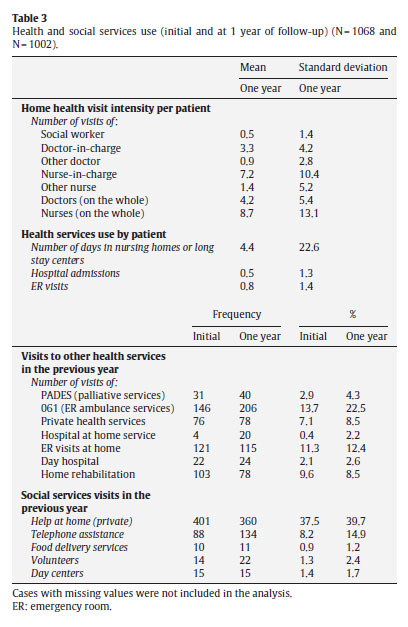
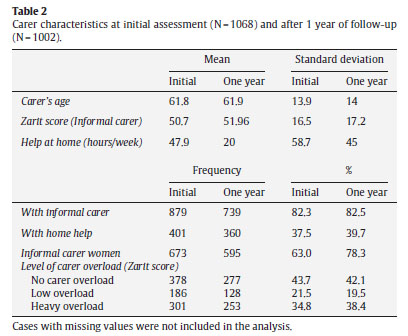
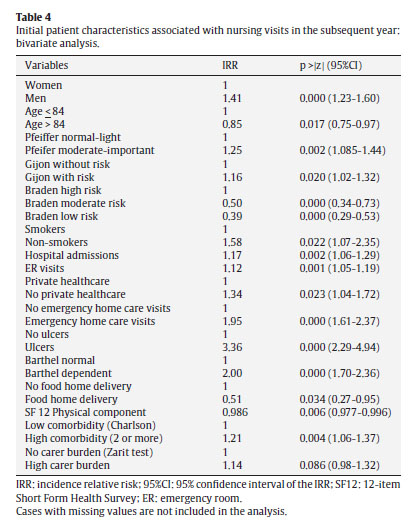
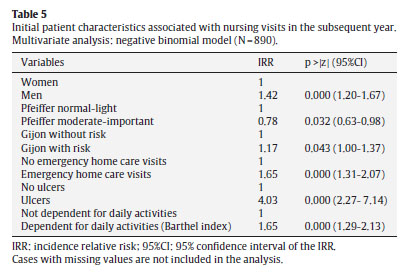
<body><![CDATA[<p>&nbsp;</p>     <p><font face="Verdana" size="2"><b>Results</b></font></p>     <p><font face="Verdana" size="2">Of the 1,068 patients enrolled in the study, 1,002 were followed-up for a year. Patient characteristics are shown in <a target="_blank" href="/img/revistas/gs/v25n4/original7_t1.jpg">Table 1</a>. The characteristics of the 66 patients that did not complete the follow-up were not significantly different from those of the remaining patients. The proportion of patients with severe dependency, cognitive impairment, social problems and risk of decubitus ulcers increased in the follow-up year. However, comorbidity and self-perceived health did not vary significantly during this period. Tobacco and alcohol consumption decreased and almost 20% of the patients died.</font></p>     <p><font face="Verdana" size="2"><a href="#t2">Table 2</a> shows carer characteristics at the initial assessment and 1 year later. <a href="#t3">Table 3</a> shows the use of health and social services by the patients in the study during the 1-year follow-up. The number of women acting as informal carers increased, as did perceived carer burden and formal home care.</font></p>     <p align="center"><a name="t2"><img src="/img/revistas/gs/v25n4/original7_t2.jpg" width="408" height="336"></a></font></p>     <p align="center"><a name="t3"><img src="/img/revistas/gs/v25n4/original7_t3.jpg" width="408" height="627"></a></font></p>     <p>&nbsp;</p>     <p><font face="Verdana" size="2"><a href="#t4">Table 4</a> displays the results of the bivariate analysis, showing the relationship between the patients' characteristics at the initial assessment and the nursing workload in the following year. The results of the multivariate analysis are shown in <a href="#t5">Table 5</a>. Patients with ulcers had a four-fold higher risk of receiving nursing home visits the year after their inclusion in the program. The probability of receiving more nursing visits the following year increased by 40% in men, 65% in patients dependent for daily activities, 20% in those with social problems, and 65% in those who received emergency home visits prior to the initial assessment. In contrast, patients with major cognitive impairment had a lower probability of receiving nursing visits at home.</font></p>     <p align="center"><a name="t4"><img src="/img/revistas/gs/v25n4/original7_t4.jpg" width="417" height="531"></a></font></p>     <p align="center"><a name="t5"><img src="/img/revistas/gs/v25n4/original7_t5.jpg" width="411" height="272"></a></font></p>     ]]></body>
<body><![CDATA[<p>&nbsp;</p>     <p><font face="Verdana" size="2"><b>Discussion</b></font></p>     <p><font face="Verdana" size="2">Home care patients in Catalonia receive an average of nine nurse visits per year with high variability among patients. The cohort assessment showed that the number of visits can be predicted by the patient characteristics identified at the initial assessment. The risk of receiving more nursing visits increased particularly in patients with decubitus ulcers, men, those dependent for daily activities, patients with social problems and those who received emergency visits at home prior to the initial assessment. In contrast, people with major cognitive impairment had a lower probability of receiving home visits from nurses.</font></p>     <p><font face="Verdana" size="2">The absence of standardized procedures for home care nursing in Catalonia favors variability and implies that current practices are more due to patient and environment characteristics than to a standardized intervention program with different healthcare providers. The research methodology does not allow us to see the sample as representative of the home care provided in Catalonia because the researchers joined the study voluntarily and were not randomly selected. However, the large sample size, the diversity of providers, the even geographical distribution of the primary healthcare teams and the quality of the data collected make this study the best available description of the home care provided in Catalonia. Although the number of visits cannot be an accurate measurement of nursing professionals' performance, its universality and simplicity make it a good indicator of nursing workload. This indicator does not accurately reflect variations in consultation length due to the different procedures carried out, but clearly measures the number of patients that a nurse can care for per day. In home care, a high percentage of working time is spent travelling, particularly in rural areas. Our results may not predict the precise workload needed for a single patient but can help us to plan the human resources needed to cover a defined population.</font></p>     <p><font face="Verdana" size="2">The presence of decubitus ulcers is the variable that most strongly predicts the number of home care nursing visits in the subsequent year. Decubitus ulcers are related to deterioration in health and are consequently associated with more clinical care<sup>19,21</sup>. In our study, the risk of receiving nursing visits in the following year was four times greater in patients with decubitus ulcers at the initial assessment than in those without. The incidence of decubitus ulcers in bedridden patients is a clear indicator of the quality of nursing care, although the prevalence of ulcers in home care patients predicts the nursing workload<sup>22</sup>.</font></p>     <p><font face="Verdana" size="2">As other authors have found, male patients receive more home care nursing visits<sup>23</sup>. Although gender inequalities in access to healthcare services have been identified in Catalonia<sup>24</sup>, the additional activity observed in the study might be explained by the higher morbidity of the elderly male population<sup>25,26</sup> and informal carer demand. In our sample, men were less healthy than women, even though on average they were younger. Male patients also benefitted from more informal carers than women, with a higher proportion of the carers feeling overburdened.</font></p>     <p><font face="Verdana" size="2">Dependency for daily living activities is an understandable predictor of home care nursing workload, also identified by other authors<sup>27,28</sup>, while dependency for instrumental living activities also implies more home care nursing<sup>8</sup>. Our dependent patients also had the poorest health.</font></p>     <p><font face="Verdana" size="2">In our study, higher-educated and affluent populations did not receive more home care services, as has been described in other environments<sup>8-10</sup>. On the contrary, in Catalonia social factors do not make access to home care nursing more difficult: populations with higher social risk receive more services.</font></p>     <p><font face="Verdana" size="2">Emergency care visits are an indicator of patient complexity used to identify over-users of hospital services<sup>21</sup>. In our study, patients who used out-of-hours home care services also had an increased risk of more nursing home care visits. This group of patients also benefitted from more informal carers. Despite their higher level of dependency, the elevated use of home services by this group might be explained by the advocacy role of their informal caregivers, as may be the case with male patients. Certain population groups are known to over-use health care services, even though they need them less<sup>29,30</sup>.</font></p>     <p><font face="Verdana" size="2">Multivariate analysis showed that the increased nursing activity in patients with abnormal Pfeiffer scale scores found in the bivariate analysis was not due to cognitive impairment but to other factors, such as the presence of decubitus ulcers. One explanation for this finding may be that patients with cognitive impairment benefit more from social and family support than from nursing care. Other authors also found that cognitive impairment was not related to more nursing visits<sup>31</sup>, except in patients living alone<sup>32</sup>.</font></p>     ]]></body>
<body><![CDATA[<p><font face="Verdana" size="2">The results of this study suggest that nursing care in Catalonia is demand-led<sup>33</sup>. Activity is not only explained by variables related to health needs, such as decubitus ulcers or the degree of dependency, but is also associated with variables linked to demand, such as the availability of an informal caregiver in the case of male patients or in the group using out-of-hours services. In line with this argument, those that seek fewer healthcare services, such as smokers or patients with a high level of cognitive impairment, receive less nursing home care. For the same reason, people living alone do not appear to be high consumers of home care services<sup>10,32</sup>. The same situation is found in countries with preventive home care programs with special follow-up plans for this group of patients.</font></p>     <p><font face="Verdana" size="2">A set of patient characteristics described by other authors did not appear to be significant in our multivariate analysis, such as age<sup>1,9,10</sup>, hospital or nursing home admissions<sup>21</sup>, low levels of self-perceived health<sup>8</sup>, pain<sup>34</sup>, or the number of persons living in the same household<sup>7</sup>. Some of these characteristics, such as low levels of self-perceived health, were identified in the bivariate analysis, but became neutralized in the multivariate analysis because of their close relationship and the higher power of the characteristics finally found to be significant.</font></p>     <p><font face="Verdana" size="2">Our results show that decubitus ulcers were the patient characteristic that best predicted nursing workload in home care. Thus efforts should focus on prevention of these ulcers through interventions that include appropriate support surfaces such as special mattresses, repositioning at least every 4h, nutritional status, moisturizing and surveillance of at-risk skin sites. Most of these interventions can be achieved and improved in a home care environment if health education programs are offered to families. If home care services, which are currently entirely demand-oriented, are redirected to a more preventive approach, many decubitus ulcers might be avoided and consequently nursing workload would be reduced. Because ulcers require many nursing visits, reorientation toward prevention might benefit patients' health and reduce hospital admissions<sup>35</sup>. The inclusion of special mattresses in the list of orthopedic devices covered by the National Health Service and the patient care education provided by nurses to families are measures that could be both cost-effective and beneficial for the health of the patients and their carers.</font></p>     <p>&nbsp;</p>     <p><font face="Verdana" size="2"><b>Author contributions</b></font></p>     <p><font face="Verdana" size="2">J. Gené, A. Hidalgo and J.C. Contel designed the study. All the Research Team HC&gt;65 collected the data, coordinated by A. Borràs. A. Borràs and M. Piñeiro analyzed the data. A. Borràs and J. Gené drafted the manuscript. All the authors contributed ideas, interpreted the findings and checked the first manuscript. All the authors approved the final version of the manuscript.</font></p>     <p>&nbsp;</p>     <p><font face="Verdana" size="2"><b>Conflict of interest</b></font></p>     <p><font face="Verdana" size="2">None.</font></p>     <p>&nbsp;</p>     ]]></body>
<body><![CDATA[<p><font face="Verdana" size="2"><b>Acknowledgement</b></font></p>     <p><font face="Verdana" size="2">Research Team HC&gt;65 (Appendix 1). The full list of participants has been published elsewhere: Gené J, et al. Los problemas de salud también explican la utilización de servicios sociales en atención domiciliaria. Aten Primaria. 2009;41:91-101.</font></p>     <p>&nbsp;</p>     <p><font face="Verdana" size="2"><b>References</b></font></p>     <!-- ref --><p><font face="Verdana" size="2">1. Ting Ting L, Mills ME. Analysis of patient profile in predicting home care resource utilization and outcomes. J Nurs Adm. 2000; 30:67-75.</font>&nbsp;&nbsp;&nbsp;&nbsp;&nbsp;&nbsp;&nbsp;&nbsp;[&#160;<a href="javascript:void(0);" onclick="javascript: window.open('/scielo.php?script=sci_nlinks&ref=2431419&pid=S0213-9111201100040000800001&lng=','','width=640,height=500,resizable=yes,scrollbars=1,menubar=yes,');">Links</a>&#160;]<!-- end-ref --><!-- ref --><p><font face="Verdana" size="2">2. Grupo ATDOM de la CAMFYC. Aproximación a la atención domiciliaria. ¿Cómo trabaja la sanidad pública catalana la atención domiciliaria?. Aten Primaria. 2003; 31:473-9.</font>&nbsp;&nbsp;&nbsp;&nbsp;&nbsp;&nbsp;&nbsp;&nbsp;[&#160;<a href="javascript:void(0);" onclick="javascript: window.open('/scielo.php?script=sci_nlinks&ref=2431420&pid=S0213-9111201100040000800002&lng=','','width=640,height=500,resizable=yes,scrollbars=1,menubar=yes,');">Links</a>&#160;]<!-- end-ref --><!-- ref --><p><font face="Verdana" size="2">3. Stuck A, Egger M, Hammer A, et al. Home visits to prevent nursing home admission and functional decline in elderly people: systematic review and meta-regression analysis. JAMA. 2002; 287:1022-8.</font>&nbsp;&nbsp;&nbsp;&nbsp;&nbsp;&nbsp;&nbsp;&nbsp;[&#160;<a href="javascript:void(0);" onclick="javascript: window.open('/scielo.php?script=sci_nlinks&ref=2431421&pid=S0213-9111201100040000800003&lng=','','width=640,height=500,resizable=yes,scrollbars=1,menubar=yes,');">Links</a>&#160;]<!-- end-ref --><!-- ref --><p><font face="Verdana" size="2">4. Byrne G, Brady AM, Griffith C, et al. The community client need classification system - a dependency system for community nurses. J Nursing Manag. 2006; 14:437-46.</font>&nbsp;&nbsp;&nbsp;&nbsp;&nbsp;&nbsp;&nbsp;&nbsp;[&#160;<a href="javascript:void(0);" onclick="javascript: window.open('/scielo.php?script=sci_nlinks&ref=2431422&pid=S0213-9111201100040000800004&lng=','','width=640,height=500,resizable=yes,scrollbars=1,menubar=yes,');">Links</a>&#160;]<!-- end-ref --><!-- ref --><p><font face="Verdana" size="2">5. Spence K, Tarnow-Mordi W, Duncan G, et al. Measuring nursing workload in neonatal intensive care. J Nursing Manag. 2006; 14:227-34.</font>&nbsp;&nbsp;&nbsp;&nbsp;&nbsp;&nbsp;&nbsp;&nbsp;[&#160;<a href="javascript:void(0);" onclick="javascript: window.open('/scielo.php?script=sci_nlinks&ref=2431423&pid=S0213-9111201100040000800005&lng=','','width=640,height=500,resizable=yes,scrollbars=1,menubar=yes,');">Links</a>&#160;]<!-- end-ref --><!-- ref --><p><font face="Verdana" size="2">6. Marek KD. Nursing diagnoses and home care nursing utilization. Public Health Nurs. 1996; 13:195-200.</font>&nbsp;&nbsp;&nbsp;&nbsp;&nbsp;&nbsp;&nbsp;&nbsp;[&#160;<a href="javascript:void(0);" onclick="javascript: window.open('/scielo.php?script=sci_nlinks&ref=2431424&pid=S0213-9111201100040000800006&lng=','','width=640,height=500,resizable=yes,scrollbars=1,menubar=yes,');">Links</a>&#160;]<!-- end-ref --><!-- ref --><p><font face="Verdana" size="2">7. Helberg JL. Use of home care nursing resources by the elderly. Public Health Nurs. 1994; 11:104-12.</font>&nbsp;&nbsp;&nbsp;&nbsp;&nbsp;&nbsp;&nbsp;&nbsp;[&#160;<a href="javascript:void(0);" onclick="javascript: window.open('/scielo.php?script=sci_nlinks&ref=2431425&pid=S0213-9111201100040000800007&lng=','','width=640,height=500,resizable=yes,scrollbars=1,menubar=yes,');">Links</a>&#160;]<!-- end-ref --><!-- ref --><p><font face="Verdana" size="2">8. Crocker Houde S. Predictors of elder's and family caregivers' use of formal home services. Research in Nursing &amp; Health. 1998; 21:533-43.</font>&nbsp;&nbsp;&nbsp;&nbsp;&nbsp;&nbsp;&nbsp;&nbsp;[&#160;<a href="javascript:void(0);" onclick="javascript: window.open('/scielo.php?script=sci_nlinks&ref=2431426&pid=S0213-9111201100040000800008&lng=','','width=640,height=500,resizable=yes,scrollbars=1,menubar=yes,');">Links</a>&#160;]<!-- end-ref --><!-- ref --><p><font face="Verdana" size="2">9. Sullivan CO, Omar RZ, Forrest CB, et al. Adjusting for case mix and social class in examining variation in home visits between practices. Fam Pract. 2004; 21:355-63.</font>&nbsp;&nbsp;&nbsp;&nbsp;&nbsp;&nbsp;&nbsp;&nbsp;[&#160;<a href="javascript:void(0);" onclick="javascript: window.open('/scielo.php?script=sci_nlinks&ref=2431427&pid=S0213-9111201100040000800009&lng=','','width=640,height=500,resizable=yes,scrollbars=1,menubar=yes,');">Links</a>&#160;]<!-- end-ref --><!-- ref --><p><font face="Verdana" size="2">10. Stoddart H, Whitley E, Harvey I, et al. What determines the use of home care services by elderly people?. Health and Social Care in the Community. 2002; 10:348-60.</font>&nbsp;&nbsp;&nbsp;&nbsp;&nbsp;&nbsp;&nbsp;&nbsp;[&#160;<a href="javascript:void(0);" onclick="javascript: window.open('/scielo.php?script=sci_nlinks&ref=2431428&pid=S0213-9111201100040000800010&lng=','','width=640,height=500,resizable=yes,scrollbars=1,menubar=yes,');">Links</a>&#160;]<!-- end-ref --><!-- ref --><p><font face="Verdana" size="2">11. Gené J, Hidalgo A, Contel JC, et al. Seguimiento de una cohorte de atención domiciliaria. Aten Primaria. 2006; 38:47-50.</font>&nbsp;&nbsp;&nbsp;&nbsp;&nbsp;&nbsp;&nbsp;&nbsp;[&#160;<a href="javascript:void(0);" onclick="javascript: window.open('/scielo.php?script=sci_nlinks&ref=2431429&pid=S0213-9111201100040000800011&lng=','','width=640,height=500,resizable=yes,scrollbars=1,menubar=yes,');">Links</a>&#160;]<!-- end-ref --><!-- ref --><p><font face="Verdana" size="2">12. Librero J, Peiró S, Ordiñana R. Chronic comorbidity and outcomes of hospital care: length of stay, mortality, and readmission at 30 and 365 days. J Clin Epidemiol. 1999; 52:171-9.</font>&nbsp;&nbsp;&nbsp;&nbsp;&nbsp;&nbsp;&nbsp;&nbsp;[&#160;<a href="javascript:void(0);" onclick="javascript: window.open('/scielo.php?script=sci_nlinks&ref=2431430&pid=S0213-9111201100040000800012&lng=','','width=640,height=500,resizable=yes,scrollbars=1,menubar=yes,');">Links</a>&#160;]<!-- end-ref --><!-- ref --><p><font face="Verdana" size="2">13. Buzziin M, Secundini R, Gazzotti A, et al. Validación del Índice de Barthel. Boletín del Departamento de Docencia e Investigación IREP. 2002; 6:9-12.</font>&nbsp;&nbsp;&nbsp;&nbsp;&nbsp;&nbsp;&nbsp;&nbsp;[&#160;<a href="javascript:void(0);" onclick="javascript: window.open('/scielo.php?script=sci_nlinks&ref=2431431&pid=S0213-9111201100040000800013&lng=','','width=640,height=500,resizable=yes,scrollbars=1,menubar=yes,');">Links</a>&#160;]<!-- end-ref --><!-- ref --><p><font face="Verdana" size="2">14. Martínez de la Iglesia J, Dueñas-Herrero R, Onís-Vilches MC, et al. Adaptación y validación al castellano del cuestionario de Pfeiffer (SPMSQ) para detectar la existencia de deterioro cognitivo en personas mayores de 65 años. Med Clin (Barc). 2001; 117:129-34.</font>&nbsp;&nbsp;&nbsp;&nbsp;&nbsp;&nbsp;&nbsp;&nbsp;[&#160;<a href="javascript:void(0);" onclick="javascript: window.open('/scielo.php?script=sci_nlinks&ref=2431432&pid=S0213-9111201100040000800014&lng=','','width=640,height=500,resizable=yes,scrollbars=1,menubar=yes,');">Links</a>&#160;]<!-- end-ref --><!-- ref --><p><font face="Verdana" size="2">15. Braden BJ, Bergstrom N. Clinical utility of the Braden scale for predicting pressure score risk. Decubitus. 1989; 2:44-6. 50-1.</font>&nbsp;&nbsp;&nbsp;&nbsp;&nbsp;&nbsp;&nbsp;&nbsp;[&#160;<a href="javascript:void(0);" onclick="javascript: window.open('/scielo.php?script=sci_nlinks&ref=2431433&pid=S0213-9111201100040000800015&lng=','','width=640,height=500,resizable=yes,scrollbars=1,menubar=yes,');">Links</a>&#160;]<!-- end-ref --><!-- ref --><p><font face="Verdana" size="2">16. Vilagut G, Valderas JM, Ferrer M, et al. Interpretación de los cuestioanrios SF-36 y SF-12 en España: componente físico y mental. Med Clin (Barc). 2008; 130:726-35.</font>&nbsp;&nbsp;&nbsp;&nbsp;&nbsp;&nbsp;&nbsp;&nbsp;[&#160;<a href="javascript:void(0);" onclick="javascript: window.open('/scielo.php?script=sci_nlinks&ref=2431434&pid=S0213-9111201100040000800016&lng=','','width=640,height=500,resizable=yes,scrollbars=1,menubar=yes,');">Links</a>&#160;]<!-- end-ref --><!-- ref --><p><font face="Verdana" size="2">17. Alarcón MT, González-Montalvo JL. La escala sociofamiliar de Gijón, instrumento útil en el hospital general. Rev Esp Geriatr Gerontol. 1998; 33:178-80.</font>&nbsp;&nbsp;&nbsp;&nbsp;&nbsp;&nbsp;&nbsp;&nbsp;[&#160;<a href="javascript:void(0);" onclick="javascript: window.open('/scielo.php?script=sci_nlinks&ref=2431435&pid=S0213-9111201100040000800017&lng=','','width=640,height=500,resizable=yes,scrollbars=1,menubar=yes,');">Links</a>&#160;]<!-- end-ref --><!-- ref --><p><font face="Verdana" size="2">18. Requeiro Martínez A, Pérez-Vázquez A, Gómara Villabona S, et al. Escala Zarit reducida para la sobrecarga del cuidador en atención primaria. Aten Primaria. 2007; 39:185-8.</font>&nbsp;&nbsp;&nbsp;&nbsp;&nbsp;&nbsp;&nbsp;&nbsp;[&#160;<a href="javascript:void(0);" onclick="javascript: window.open('/scielo.php?script=sci_nlinks&ref=2431436&pid=S0213-9111201100040000800018&lng=','','width=640,height=500,resizable=yes,scrollbars=1,menubar=yes,');">Links</a>&#160;]<!-- end-ref --><!-- ref --><p><font face="Verdana" size="2">19. Oien RF, Ragnarson Tennvall G. Accurate diagnosis and effective treatment of leg ulcers reduce prevalence, care time and costs. J Wound Care. 2006; 15:259-62.</font>&nbsp;&nbsp;&nbsp;&nbsp;&nbsp;&nbsp;&nbsp;&nbsp;[&#160;<a href="javascript:void(0);" onclick="javascript: window.open('/scielo.php?script=sci_nlinks&ref=2431437&pid=S0213-9111201100040000800019&lng=','','width=640,height=500,resizable=yes,scrollbars=1,menubar=yes,');">Links</a>&#160;]<!-- end-ref --><!-- ref --><p><font face="Verdana" size="2">20. Navarro A, Utzel F, Puig P, et al. La distribución binomial negativa frente a la de Poisson en el análisis de fenómenos recurrentes. Gac Sanit. 2001; 15:447-52.</font>&nbsp;&nbsp;&nbsp;&nbsp;&nbsp;&nbsp;&nbsp;&nbsp;[&#160;<a href="javascript:void(0);" onclick="javascript: window.open('/scielo.php?script=sci_nlinks&ref=2431438&pid=S0213-9111201100040000800020&lng=','','width=640,height=500,resizable=yes,scrollbars=1,menubar=yes,');">Links</a>&#160;]<!-- end-ref --><!-- ref --><p><font face="Verdana" size="2">21. King's Fund. Combined predictive model: final report. London: King's Fund, 2006.</font>&nbsp;&nbsp;&nbsp;&nbsp;&nbsp;&nbsp;&nbsp;&nbsp;[&#160;<a href="javascript:void(0);" onclick="javascript: window.open('/scielo.php?script=sci_nlinks&ref=2431439&pid=S0213-9111201100040000800021&lng=','','width=640,height=500,resizable=yes,scrollbars=1,menubar=yes,');">Links</a>&#160;]<!-- end-ref --><!-- ref --><p><font face="Verdana" size="2">22. González JM, Blanco JM, Ayuso E, et al. Epidemiología de las úlceras por presión en un hospital de agudos. Rev Calidad Asistencial. 2003; 18:173-7.</font>&nbsp;&nbsp;&nbsp;&nbsp;&nbsp;&nbsp;&nbsp;&nbsp;[&#160;<a href="javascript:void(0);" onclick="javascript: window.open('/scielo.php?script=sci_nlinks&ref=2431440&pid=S0213-9111201100040000800022&lng=','','width=640,height=500,resizable=yes,scrollbars=1,menubar=yes,');">Links</a>&#160;]<!-- end-ref --><!-- ref --><p><font face="Verdana" size="2">23. Jette AM, Tennstedt S, Crawford S. How does formal and informal community care affect nursing home use?. J Gerontol B Psychol Sci Soc Sci. 1995; 50:S4-S12.</font>&nbsp;&nbsp;&nbsp;&nbsp;&nbsp;&nbsp;&nbsp;&nbsp;[&#160;<a href="javascript:void(0);" onclick="javascript: window.open('/scielo.php?script=sci_nlinks&ref=2431441&pid=S0213-9111201100040000800023&lng=','','width=640,height=500,resizable=yes,scrollbars=1,menubar=yes,');">Links</a>&#160;]<!-- end-ref --><!-- ref --><p><font face="Verdana" size="2">24. Borrell C, García-Calvente M, Marti-Bosca JV. Public health from the perspective of gender and social class. Gac Sanit. 2004; 18:2-6.</font>&nbsp;&nbsp;&nbsp;&nbsp;&nbsp;&nbsp;&nbsp;&nbsp;[&#160;<a href="javascript:void(0);" onclick="javascript: window.open('/scielo.php?script=sci_nlinks&ref=2431442&pid=S0213-9111201100040000800024&lng=','','width=640,height=500,resizable=yes,scrollbars=1,menubar=yes,');">Links</a>&#160;]<!-- end-ref --><!-- ref --><p><font face="Verdana" size="2">25. Segura Noguera JM, Bastida Bastús N, Martí Guadaño N, et al. The Raval Nord Study: descriptive analysis of survival rates during 10 years of home care. Home Health Care Management &amp; Practice. 2007; 19:118-25.</font>&nbsp;&nbsp;&nbsp;&nbsp;&nbsp;&nbsp;&nbsp;&nbsp;[&#160;<a href="javascript:void(0);" onclick="javascript: window.open('/scielo.php?script=sci_nlinks&ref=2431443&pid=S0213-9111201100040000800025&lng=','','width=640,height=500,resizable=yes,scrollbars=1,menubar=yes,');">Links</a>&#160;]<!-- end-ref --><!-- ref --><p><font face="Verdana" size="2">26. Kemper P. The use of formal and informal home care by the disabled elderly. Health Serv Res. 1992; 27:421-49.</font>&nbsp;&nbsp;&nbsp;&nbsp;&nbsp;&nbsp;&nbsp;&nbsp;[&#160;<a href="javascript:void(0);" onclick="javascript: window.open('/scielo.php?script=sci_nlinks&ref=2431444&pid=S0213-9111201100040000800026&lng=','','width=640,height=500,resizable=yes,scrollbars=1,menubar=yes,');">Links</a>&#160;]<!-- end-ref --><!-- ref --><p><font face="Verdana" size="2">27. Logan J, Spitze G. Informal support and the use of formal services by older Americans. J Gerontol. 1994; 49:S25-34.</font>&nbsp;&nbsp;&nbsp;&nbsp;&nbsp;&nbsp;&nbsp;&nbsp;[&#160;<a href="javascript:void(0);" onclick="javascript: window.open('/scielo.php?script=sci_nlinks&ref=2431445&pid=S0213-9111201100040000800027&lng=','','width=640,height=500,resizable=yes,scrollbars=1,menubar=yes,');">Links</a>&#160;]<!-- end-ref --><!-- ref --><p><font face="Verdana" size="2">28. Ballard S, McNamara R. Quantifying nursing needs in home health care. Nurs Res. 1983; 32:236-41.</font>&nbsp;&nbsp;&nbsp;&nbsp;&nbsp;&nbsp;&nbsp;&nbsp;[&#160;<a href="javascript:void(0);" onclick="javascript: window.open('/scielo.php?script=sci_nlinks&ref=2431446&pid=S0213-9111201100040000800028&lng=','','width=640,height=500,resizable=yes,scrollbars=1,menubar=yes,');">Links</a>&#160;]<!-- end-ref --><!-- ref --><p><font face="Verdana" size="2">29. Hart JT. The inverse care law. Lancet. 1971; 1:405-12.</font>&nbsp;&nbsp;&nbsp;&nbsp;&nbsp;&nbsp;&nbsp;&nbsp;[&#160;<a href="javascript:void(0);" onclick="javascript: window.open('/scielo.php?script=sci_nlinks&ref=2431447&pid=S0213-9111201100040000800029&lng=','','width=640,height=500,resizable=yes,scrollbars=1,menubar=yes,');">Links</a>&#160;]<!-- end-ref --><!-- ref --><p><font face="Verdana" size="2">30. Hays BJ, Willborn EH. Characteristics of clients who receive home health aide service. Public Health Nurs. 1996; 13:58-64.</font>&nbsp;&nbsp;&nbsp;&nbsp;&nbsp;&nbsp;&nbsp;&nbsp;[&#160;<a href="javascript:void(0);" onclick="javascript: window.open('/scielo.php?script=sci_nlinks&ref=2431448&pid=S0213-9111201100040000800030&lng=','','width=640,height=500,resizable=yes,scrollbars=1,menubar=yes,');">Links</a>&#160;]<!-- end-ref --><!-- ref --><p><font face="Verdana" size="2">31. Roelands M, Van Oyen H, Depoorter A, et al. Are cognitive impairment and depressive mood associated with increased service utilisation in community-dwelling elderly people?. Health Soc Care Community. 2003; 11:1-9.</font>&nbsp;&nbsp;&nbsp;&nbsp;&nbsp;&nbsp;&nbsp;&nbsp;[&#160;<a href="javascript:void(0);" onclick="javascript: window.open('/scielo.php?script=sci_nlinks&ref=2431449&pid=S0213-9111201100040000800031&lng=','','width=640,height=500,resizable=yes,scrollbars=1,menubar=yes,');">Links</a>&#160;]<!-- end-ref --><!-- ref --><p><font face="Verdana" size="2">32. Larsson K, Thorslund M, Forsell Y. Dementia and depressive symptoms as predictors of home help utilization among the oldest old: population-based study in an urban area of Sweden. Journal of Aging and Health. 2004; 16:641-68.</font>&nbsp;&nbsp;&nbsp;&nbsp;&nbsp;&nbsp;&nbsp;&nbsp;[&#160;<a href="javascript:void(0);" onclick="javascript: window.open('/scielo.php?script=sci_nlinks&ref=2431450&pid=S0213-9111201100040000800032&lng=','','width=640,height=500,resizable=yes,scrollbars=1,menubar=yes,');">Links</a>&#160;]<!-- end-ref --><!-- ref --><p><font face="Verdana" size="2">33. Gené J, Hidalgo A, Contel JC, et al. La demanda explica les càrregues d'infermeria a l'atenció domiciliaria catalana. Butlletí CAMFIC. 2007; 25:27-35.</font>&nbsp;&nbsp;&nbsp;&nbsp;&nbsp;&nbsp;&nbsp;&nbsp;[&#160;<a href="javascript:void(0);" onclick="javascript: window.open('/scielo.php?script=sci_nlinks&ref=2431451&pid=S0213-9111201100040000800033&lng=','','width=640,height=500,resizable=yes,scrollbars=1,menubar=yes,');">Links</a>&#160;]<!-- end-ref --><!-- ref --><p><font face="Verdana" size="2">34. Miller SC. Hospice care in nursing homes: is site of care associated with visit volume?. J Am Geriatr Soc. 2004; 52:1331-6.</font>&nbsp;&nbsp;&nbsp;&nbsp;&nbsp;&nbsp;&nbsp;&nbsp;[&#160;<a href="javascript:void(0);" onclick="javascript: window.open('/scielo.php?script=sci_nlinks&ref=2431452&pid=S0213-9111201100040000800034&lng=','','width=640,height=500,resizable=yes,scrollbars=1,menubar=yes,');">Links</a>&#160;]<!-- end-ref --><!-- ref --><p><font face="Verdana" size="2">35. Trisolini MG, Thomas CP, Cashman SB, et al. Resource utilization in home health care: results of a prospective study. Home Health Care Serv Q. 1994; 15:19-41.</font>&nbsp;&nbsp;&nbsp;&nbsp;&nbsp;&nbsp;&nbsp;&nbsp;[&#160;<a href="javascript:void(0);" onclick="javascript: window.open('/scielo.php?script=sci_nlinks&ref=2431453&pid=S0213-9111201100040000800035&lng=','','width=640,height=500,resizable=yes,scrollbars=1,menubar=yes,');">Links</a>&#160;]<!-- end-ref --><p>&nbsp;</p>     ]]></body>
<body><![CDATA[<p>&nbsp;</p>     <p><font face="Verdana" size="2"><a href="#top"><img border="0" src="/img/revistas/gs/v25n4/seta.gif" width="15" height="17"></a><a name="bajo"></a><b>Correspondence:</b>    <br>Correo electrónico: <a href="mailto:jgene@clinic.ub.es">jgene@clinic.ub.es</a>    <br>(J. Gené Badia)</font></p>     <p><font face="Verdana" size="2">Received 12 April 2010    <br>Accepted 7 December 2010</font></p>      ]]></body><back>
<ref-list>
<ref id="B1">
<label>1</label><nlm-citation citation-type="journal">
<person-group person-group-type="author">
<name>
<surname><![CDATA[Ting Ting]]></surname>
<given-names><![CDATA[L]]></given-names>
</name>
<name>
<surname><![CDATA[Mills]]></surname>
<given-names><![CDATA[ME]]></given-names>
</name>
</person-group>
<article-title xml:lang="en"><![CDATA[Analysis of patient profile in predicting home care resource utilization and outcomes]]></article-title>
<source><![CDATA[J Nurs Adm]]></source>
<year>2000</year>
<volume>30</volume>
<page-range>67-75</page-range></nlm-citation>
</ref>
<ref id="B2">
<label>2</label><nlm-citation citation-type="journal">
<collab>CAMFYC^dGrupo ATDOM</collab>
<article-title xml:lang="es"><![CDATA[Aproximación a la atención domiciliaria: ¿Cómo trabaja la sanidad pública catalana la atención domiciliaria?]]></article-title>
<source><![CDATA[Aten Primaria]]></source>
<year>2003</year>
<volume>31</volume>
<page-range>473-9</page-range></nlm-citation>
</ref>
<ref id="B3">
<label>3</label><nlm-citation citation-type="journal">
<person-group person-group-type="author">
<name>
<surname><![CDATA[Stuck]]></surname>
<given-names><![CDATA[A]]></given-names>
</name>
<name>
<surname><![CDATA[Egger]]></surname>
<given-names><![CDATA[M]]></given-names>
</name>
<name>
<surname><![CDATA[Hammer]]></surname>
<given-names><![CDATA[A]]></given-names>
</name>
</person-group>
<article-title xml:lang="en"><![CDATA[Home visits to prevent nursing home admission and functional decline in elderly people: systematic review and meta-regression analysis]]></article-title>
<source><![CDATA[JAMA]]></source>
<year>2002</year>
<volume>287</volume>
<page-range>1022-8</page-range></nlm-citation>
</ref>
<ref id="B4">
<label>4</label><nlm-citation citation-type="journal">
<person-group person-group-type="author">
<name>
<surname><![CDATA[Byrne]]></surname>
<given-names><![CDATA[G]]></given-names>
</name>
<name>
<surname><![CDATA[Brady]]></surname>
<given-names><![CDATA[AM]]></given-names>
</name>
<name>
<surname><![CDATA[Griffith]]></surname>
<given-names><![CDATA[C]]></given-names>
</name>
</person-group>
<article-title xml:lang="en"><![CDATA[The community client need classification system: a dependency system for community nurses]]></article-title>
<source><![CDATA[J Nursing Manag.]]></source>
<year>2006</year>
<volume>14</volume>
<page-range>437-46</page-range></nlm-citation>
</ref>
<ref id="B5">
<label>5</label><nlm-citation citation-type="journal">
<person-group person-group-type="author">
<name>
<surname><![CDATA[Spence]]></surname>
<given-names><![CDATA[K]]></given-names>
</name>
<name>
<surname><![CDATA[Tarnow-Mordi]]></surname>
<given-names><![CDATA[W]]></given-names>
</name>
<name>
<surname><![CDATA[Duncan]]></surname>
<given-names><![CDATA[G]]></given-names>
</name>
</person-group>
<article-title xml:lang="en"><![CDATA[Measuring nursing workload in neonatal intensive care]]></article-title>
<source><![CDATA[J Nursing Manag.]]></source>
<year>2006</year>
<volume>14</volume>
<page-range>227-34</page-range></nlm-citation>
</ref>
<ref id="B6">
<label>6</label><nlm-citation citation-type="journal">
<person-group person-group-type="author">
<name>
<surname><![CDATA[Marek]]></surname>
<given-names><![CDATA[KD]]></given-names>
</name>
</person-group>
<article-title xml:lang="en"><![CDATA[Nursing diagnoses and home care nursing utilization]]></article-title>
<source><![CDATA[Public Health Nurs]]></source>
<year>1996</year>
<volume>13</volume>
<page-range>195-200</page-range></nlm-citation>
</ref>
<ref id="B7">
<label>7</label><nlm-citation citation-type="journal">
<person-group person-group-type="author">
<name>
<surname><![CDATA[Helberg]]></surname>
<given-names><![CDATA[JL]]></given-names>
</name>
</person-group>
<article-title xml:lang="en"><![CDATA[Use of home care nursing resources by the elderly]]></article-title>
<source><![CDATA[Public Health Nurs]]></source>
<year>1994</year>
<volume>11</volume>
<page-range>104-12</page-range></nlm-citation>
</ref>
<ref id="B8">
<label>8</label><nlm-citation citation-type="journal">
<person-group person-group-type="author">
<name>
<surname><![CDATA[Crocker Houde]]></surname>
<given-names><![CDATA[S]]></given-names>
</name>
</person-group>
<article-title xml:lang="en"><![CDATA[Predictors of elder's and family caregivers' use of formal home services]]></article-title>
<source><![CDATA[Research in Nursing & Health]]></source>
<year>1998</year>
<volume>21</volume>
<page-range>533-43</page-range></nlm-citation>
</ref>
<ref id="B9">
<label>9</label><nlm-citation citation-type="journal">
<person-group person-group-type="author">
<name>
<surname><![CDATA[Sullivan]]></surname>
<given-names><![CDATA[CO]]></given-names>
</name>
<name>
<surname><![CDATA[Omar]]></surname>
<given-names><![CDATA[RZ]]></given-names>
</name>
<name>
<surname><![CDATA[Forrest]]></surname>
<given-names><![CDATA[CB]]></given-names>
</name>
</person-group>
<article-title xml:lang="en"><![CDATA[Adjusting for case mix and social class in examining variation in home visits between practices]]></article-title>
<source><![CDATA[Fam Pract]]></source>
<year>2004</year>
<volume>21</volume>
<page-range>355-63</page-range></nlm-citation>
</ref>
<ref id="B10">
<label>10</label><nlm-citation citation-type="journal">
<person-group person-group-type="author">
<name>
<surname><![CDATA[Stoddart]]></surname>
<given-names><![CDATA[H]]></given-names>
</name>
<name>
<surname><![CDATA[Whitley]]></surname>
<given-names><![CDATA[E]]></given-names>
</name>
<name>
<surname><![CDATA[Harvey]]></surname>
<given-names><![CDATA[I]]></given-names>
</name>
</person-group>
<article-title xml:lang="en"><![CDATA[What determines the use of home care services by elderly people?]]></article-title>
<source><![CDATA[Health and Social Care in the Community]]></source>
<year>2002</year>
<volume>10</volume>
<page-range>348-60</page-range></nlm-citation>
</ref>
<ref id="B11">
<label>11</label><nlm-citation citation-type="journal">
<person-group person-group-type="author">
<name>
<surname><![CDATA[Gené]]></surname>
<given-names><![CDATA[J]]></given-names>
</name>
<name>
<surname><![CDATA[Hidalgo]]></surname>
<given-names><![CDATA[A]]></given-names>
</name>
<name>
<surname><![CDATA[Contel]]></surname>
<given-names><![CDATA[JC]]></given-names>
</name>
</person-group>
<article-title xml:lang="es"><![CDATA[Seguimiento de una cohorte de atención domiciliaria]]></article-title>
<source><![CDATA[Aten Primaria]]></source>
<year>2006</year>
<volume>38</volume>
<page-range>47-50</page-range></nlm-citation>
</ref>
<ref id="B12">
<label>12</label><nlm-citation citation-type="journal">
<person-group person-group-type="author">
<name>
<surname><![CDATA[Librero]]></surname>
<given-names><![CDATA[J]]></given-names>
</name>
<name>
<surname><![CDATA[Peiró]]></surname>
<given-names><![CDATA[S]]></given-names>
</name>
<name>
<surname><![CDATA[Ordiñana]]></surname>
<given-names><![CDATA[R]]></given-names>
</name>
</person-group>
<article-title xml:lang="en"><![CDATA[Chronic comorbidity and outcomes of hospital care: length of stay, mortality, and readmission at 30 and 365 days]]></article-title>
<source><![CDATA[J Clin Epidemiol]]></source>
<year>1999</year>
<volume>52</volume>
<page-range>171-9</page-range></nlm-citation>
</ref>
<ref id="B13">
<label>13</label><nlm-citation citation-type="journal">
<person-group person-group-type="author">
<name>
<surname><![CDATA[Buzziin]]></surname>
<given-names><![CDATA[M]]></given-names>
</name>
<name>
<surname><![CDATA[Secundini]]></surname>
<given-names><![CDATA[R]]></given-names>
</name>
<name>
<surname><![CDATA[Gazzotti]]></surname>
<given-names><![CDATA[A]]></given-names>
</name>
</person-group>
<article-title xml:lang="es"><![CDATA[Validación del Índice de Barthel]]></article-title>
<source><![CDATA[Boletín del Departamento de Docencia e Investigación IREP]]></source>
<year>2002</year>
<volume>6</volume>
<page-range>9-12</page-range></nlm-citation>
</ref>
<ref id="B14">
<label>14</label><nlm-citation citation-type="journal">
<person-group person-group-type="author">
<name>
<surname><![CDATA[Martínez de la Iglesia]]></surname>
<given-names><![CDATA[J]]></given-names>
</name>
<name>
<surname><![CDATA[Dueñas-Herrero]]></surname>
<given-names><![CDATA[R]]></given-names>
</name>
<name>
<surname><![CDATA[Onís-Vilches]]></surname>
<given-names><![CDATA[MC]]></given-names>
</name>
</person-group>
<article-title xml:lang="es"><![CDATA[Adaptación y validación al castellano del cuestionario de Pfeiffer (SPMSQ) para detectar la existencia de deterioro cognitivo en personas mayores de 65 años]]></article-title>
<source><![CDATA[Med Clin (Barc)]]></source>
<year>2001</year>
<volume>117</volume>
<page-range>129-34</page-range></nlm-citation>
</ref>
<ref id="B15">
<label>15</label><nlm-citation citation-type="journal">
<person-group person-group-type="author">
<name>
<surname><![CDATA[Braden]]></surname>
<given-names><![CDATA[BJ]]></given-names>
</name>
<name>
<surname><![CDATA[Bergstrom]]></surname>
<given-names><![CDATA[N]]></given-names>
</name>
</person-group>
<article-title xml:lang="en"><![CDATA[Clinical utility of the Braden scale for predicting pressure score risk]]></article-title>
<source><![CDATA[Decubitus]]></source>
<year>1989</year>
<volume>2</volume>
<page-range>44-6</page-range><page-range>50-1</page-range></nlm-citation>
</ref>
<ref id="B16">
<label>16</label><nlm-citation citation-type="journal">
<person-group person-group-type="author">
<name>
<surname><![CDATA[Vilagut]]></surname>
<given-names><![CDATA[G]]></given-names>
</name>
<name>
<surname><![CDATA[Valderas]]></surname>
<given-names><![CDATA[JM]]></given-names>
</name>
<name>
<surname><![CDATA[Ferrer]]></surname>
<given-names><![CDATA[M]]></given-names>
</name>
</person-group>
<article-title xml:lang="es"><![CDATA[Interpretación de los cuestioanrios SF-36 y SF-12 en España: componente físico y mental]]></article-title>
<source><![CDATA[Med Clin (Barc)]]></source>
<year>2008</year>
<volume>130</volume>
<page-range>726-35</page-range></nlm-citation>
</ref>
<ref id="B17">
<label>17</label><nlm-citation citation-type="journal">
<person-group person-group-type="author">
<name>
<surname><![CDATA[Alarcón]]></surname>
<given-names><![CDATA[MT]]></given-names>
</name>
<name>
<surname><![CDATA[González-Montalvo]]></surname>
<given-names><![CDATA[JL]]></given-names>
</name>
</person-group>
<article-title xml:lang="es"><![CDATA[La escala sociofamiliar de Gijón, instrumento útil en el hospital general]]></article-title>
<source><![CDATA[Rev Esp Geriatr Gerontol]]></source>
<year>1998</year>
<volume>33</volume>
<page-range>178-80</page-range></nlm-citation>
</ref>
<ref id="B18">
<label>18</label><nlm-citation citation-type="journal">
<person-group person-group-type="author">
<name>
<surname><![CDATA[Requeiro Martínez]]></surname>
<given-names><![CDATA[A]]></given-names>
</name>
<name>
<surname><![CDATA[Pérez-Vázquez]]></surname>
<given-names><![CDATA[A]]></given-names>
</name>
<name>
<surname><![CDATA[Gómara Villabona]]></surname>
<given-names><![CDATA[S]]></given-names>
</name>
</person-group>
<article-title xml:lang="es"><![CDATA[Escala Zarit reducida para la sobrecarga del cuidador en atención primaria]]></article-title>
<source><![CDATA[Aten Primaria]]></source>
<year>2007</year>
<volume>39</volume>
<page-range>185-8</page-range></nlm-citation>
</ref>
<ref id="B19">
<label>19</label><nlm-citation citation-type="journal">
<person-group person-group-type="author">
<name>
<surname><![CDATA[Oien]]></surname>
<given-names><![CDATA[RF]]></given-names>
</name>
<name>
<surname><![CDATA[Ragnarson Tennvall]]></surname>
<given-names><![CDATA[G]]></given-names>
</name>
</person-group>
<article-title xml:lang="en"><![CDATA[Accurate diagnosis and effective treatment of leg ulcers reduce prevalence, care time and costs]]></article-title>
<source><![CDATA[J Wound Care]]></source>
<year>2006</year>
<volume>15</volume>
<page-range>259-62</page-range></nlm-citation>
</ref>
<ref id="B20">
<label>20</label><nlm-citation citation-type="journal">
<person-group person-group-type="author">
<name>
<surname><![CDATA[Navarro]]></surname>
<given-names><![CDATA[A]]></given-names>
</name>
<name>
<surname><![CDATA[Utzel]]></surname>
<given-names><![CDATA[F]]></given-names>
</name>
<name>
<surname><![CDATA[Puig]]></surname>
<given-names><![CDATA[P]]></given-names>
</name>
</person-group>
<article-title xml:lang="es"><![CDATA[La distribución binomial negativa frente a la de Poisson en el análisis de fenómenos recurrentes]]></article-title>
<source><![CDATA[Gac Sanit]]></source>
<year>2001</year>
<volume>15</volume>
<page-range>447-52</page-range></nlm-citation>
</ref>
<ref id="B21">
<label>21</label><nlm-citation citation-type="book">
<collab>King's Fund</collab>
<source><![CDATA[Combined predictive model: final report]]></source>
<year>2006</year>
<publisher-loc><![CDATA[London ]]></publisher-loc>
<publisher-name><![CDATA[King's Fund]]></publisher-name>
</nlm-citation>
</ref>
<ref id="B22">
<label>22</label><nlm-citation citation-type="journal">
<person-group person-group-type="author">
<name>
<surname><![CDATA[González]]></surname>
<given-names><![CDATA[JM]]></given-names>
</name>
<name>
<surname><![CDATA[Blanco]]></surname>
<given-names><![CDATA[JM]]></given-names>
</name>
<name>
<surname><![CDATA[Ayuso]]></surname>
<given-names><![CDATA[E]]></given-names>
</name>
</person-group>
<article-title xml:lang="es"><![CDATA[Epidemiología de las úlceras por presión en un hospital de agudos]]></article-title>
<source><![CDATA[Rev Calidad Asistencial]]></source>
<year>2003</year>
<volume>18</volume>
<page-range>173-7</page-range></nlm-citation>
</ref>
<ref id="B23">
<label>23</label><nlm-citation citation-type="journal">
<person-group person-group-type="author">
<name>
<surname><![CDATA[Jette]]></surname>
<given-names><![CDATA[AM]]></given-names>
</name>
<name>
<surname><![CDATA[Tennstedt]]></surname>
<given-names><![CDATA[S]]></given-names>
</name>
<name>
<surname><![CDATA[Crawford]]></surname>
<given-names><![CDATA[S]]></given-names>
</name>
</person-group>
<article-title xml:lang="en"><![CDATA[How does formal and informal community care affect nursing home use?]]></article-title>
<source><![CDATA[J Gerontol B Psychol Sci Soc Sci]]></source>
<year>1995</year>
<volume>50</volume>
<page-range>S4-S12</page-range></nlm-citation>
</ref>
<ref id="B24">
<label>24</label><nlm-citation citation-type="journal">
<person-group person-group-type="author">
<name>
<surname><![CDATA[Borrell]]></surname>
<given-names><![CDATA[C]]></given-names>
</name>
<name>
<surname><![CDATA[García-Calvente]]></surname>
<given-names><![CDATA[M]]></given-names>
</name>
<name>
<surname><![CDATA[Marti-Bosca]]></surname>
<given-names><![CDATA[JV]]></given-names>
</name>
</person-group>
<article-title xml:lang="en"><![CDATA[Public health from the perspective of gender and social class]]></article-title>
<source><![CDATA[Gac Sanit]]></source>
<year>2004</year>
<volume>18</volume>
<page-range>2-6</page-range></nlm-citation>
</ref>
<ref id="B25">
<label>25</label><nlm-citation citation-type="journal">
<person-group person-group-type="author">
<name>
<surname><![CDATA[Segura Noguera]]></surname>
<given-names><![CDATA[JM]]></given-names>
</name>
<name>
<surname><![CDATA[Bastida Bastús]]></surname>
<given-names><![CDATA[N]]></given-names>
</name>
<name>
<surname><![CDATA[Martí Guadaño]]></surname>
<given-names><![CDATA[N]]></given-names>
</name>
</person-group>
<article-title xml:lang="en"><![CDATA[The Raval Nord Study: descriptive analysis of survival rates during 10 years of home care]]></article-title>
<source><![CDATA[Home Health Care Management & Practice]]></source>
<year>2007</year>
<volume>19</volume>
<page-range>118-25</page-range></nlm-citation>
</ref>
<ref id="B26">
<label>26</label><nlm-citation citation-type="journal">
<person-group person-group-type="author">
<name>
<surname><![CDATA[Kemper]]></surname>
<given-names><![CDATA[P]]></given-names>
</name>
</person-group>
<article-title xml:lang="en"><![CDATA[The use of formal and informal home care by the disabled elderly]]></article-title>
<source><![CDATA[Health Serv Res]]></source>
<year>1992</year>
<volume>27</volume>
<page-range>421-49</page-range></nlm-citation>
</ref>
<ref id="B27">
<label>27</label><nlm-citation citation-type="journal">
<person-group person-group-type="author">
<name>
<surname><![CDATA[Logan]]></surname>
<given-names><![CDATA[J]]></given-names>
</name>
<name>
<surname><![CDATA[Spitze]]></surname>
<given-names><![CDATA[G]]></given-names>
</name>
</person-group>
<article-title xml:lang="en"><![CDATA[Informal support and the use of formal services by older Americans]]></article-title>
<source><![CDATA[J Gerontol]]></source>
<year>1994</year>
<volume>49</volume>
<page-range>S25-34</page-range></nlm-citation>
</ref>
<ref id="B28">
<label>28</label><nlm-citation citation-type="journal">
<person-group person-group-type="author">
<name>
<surname><![CDATA[Ballard]]></surname>
<given-names><![CDATA[S]]></given-names>
</name>
<name>
<surname><![CDATA[McNamara]]></surname>
<given-names><![CDATA[R]]></given-names>
</name>
</person-group>
<article-title xml:lang="en"><![CDATA[Quantifying nursing needs in home health care]]></article-title>
<source><![CDATA[Nurs Res]]></source>
<year>1983</year>
<volume>32</volume>
<page-range>236-41</page-range></nlm-citation>
</ref>
<ref id="B29">
<label>29</label><nlm-citation citation-type="journal">
<person-group person-group-type="author">
<name>
<surname><![CDATA[Hart]]></surname>
<given-names><![CDATA[JT]]></given-names>
</name>
</person-group>
<article-title xml:lang="en"><![CDATA[The inverse care law]]></article-title>
<source><![CDATA[Lancet]]></source>
<year>1971</year>
<volume>1</volume>
<page-range>405-12</page-range></nlm-citation>
</ref>
<ref id="B30">
<label>30</label><nlm-citation citation-type="journal">
<person-group person-group-type="author">
<name>
<surname><![CDATA[Hays]]></surname>
<given-names><![CDATA[BJ]]></given-names>
</name>
<name>
<surname><![CDATA[Willborn]]></surname>
<given-names><![CDATA[EH]]></given-names>
</name>
</person-group>
<article-title xml:lang="en"><![CDATA[Characteristics of clients who receive home health aide service]]></article-title>
<source><![CDATA[Public Health Nurs]]></source>
<year>1996</year>
<volume>13</volume>
<page-range>58-64</page-range></nlm-citation>
</ref>
<ref id="B31">
<label>31</label><nlm-citation citation-type="journal">
<person-group person-group-type="author">
<name>
<surname><![CDATA[Roelands]]></surname>
<given-names><![CDATA[M]]></given-names>
</name>
<name>
<surname><![CDATA[Van Oyen]]></surname>
<given-names><![CDATA[H]]></given-names>
</name>
<name>
<surname><![CDATA[Depoorter]]></surname>
<given-names><![CDATA[A]]></given-names>
</name>
</person-group>
<article-title xml:lang="en"><![CDATA[Are cognitive impairment and depressive mood associated with increased service utilisation in community-dwelling elderly people?]]></article-title>
<source><![CDATA[Health Soc Care Community]]></source>
<year>2003</year>
<volume>11</volume>
<page-range>1-9</page-range></nlm-citation>
</ref>
<ref id="B32">
<label>32</label><nlm-citation citation-type="journal">
<person-group person-group-type="author">
<name>
<surname><![CDATA[Larsson]]></surname>
<given-names><![CDATA[K]]></given-names>
</name>
<name>
<surname><![CDATA[Thorslund]]></surname>
<given-names><![CDATA[M]]></given-names>
</name>
<name>
<surname><![CDATA[Forsell]]></surname>
<given-names><![CDATA[Y]]></given-names>
</name>
</person-group>
<article-title xml:lang="en"><![CDATA[Dementia and depressive symptoms as predictors of home help utilization among the oldest old: population-based study in an urban area of Sweden]]></article-title>
<source><![CDATA[Journal of Aging and Health]]></source>
<year>2004</year>
<volume>16</volume>
<page-range>641-68</page-range></nlm-citation>
</ref>
<ref id="B33">
<label>33</label><nlm-citation citation-type="journal">
<person-group person-group-type="author">
<name>
<surname><![CDATA[Gené]]></surname>
<given-names><![CDATA[J]]></given-names>
</name>
<name>
<surname><![CDATA[Hidalgo]]></surname>
<given-names><![CDATA[A]]></given-names>
</name>
<name>
<surname><![CDATA[Contel]]></surname>
<given-names><![CDATA[JC]]></given-names>
</name>
</person-group>
<article-title xml:lang="es"><![CDATA[La demanda explica les càrregues d'infermeria a l'atenció domiciliaria catalana]]></article-title>
<source><![CDATA[Butlletí CAMFIC]]></source>
<year>2007</year>
<volume>25</volume>
<page-range>27-35</page-range></nlm-citation>
</ref>
<ref id="B34">
<label>34</label><nlm-citation citation-type="journal">
<person-group person-group-type="author">
<name>
<surname><![CDATA[Miller]]></surname>
<given-names><![CDATA[SC]]></given-names>
</name>
</person-group>
<article-title xml:lang="en"><![CDATA[Hospice care in nursing homes: is site of care associated with visit volume?]]></article-title>
<source><![CDATA[J Am Geriatr Soc]]></source>
<year>2004</year>
<volume>52</volume>
<page-range>1331-6</page-range></nlm-citation>
</ref>
<ref id="B35">
<label>35</label><nlm-citation citation-type="journal">
<person-group person-group-type="author">
<name>
<surname><![CDATA[Trisolini]]></surname>
<given-names><![CDATA[MG]]></given-names>
</name>
<name>
<surname><![CDATA[Thomas]]></surname>
<given-names><![CDATA[CP]]></given-names>
</name>
<name>
<surname><![CDATA[Cashman]]></surname>
<given-names><![CDATA[SB]]></given-names>
</name>
</person-group>
<article-title xml:lang="en"><![CDATA[Resource utilization in home health care: results of a prospective study]]></article-title>
<source><![CDATA[Home Health Care Serv Q]]></source>
<year>1994</year>
<volume>15</volume>
<page-range>19-41</page-range></nlm-citation>
</ref>
</ref-list>
</back>
</article>