<?xml version="1.0" encoding="ISO-8859-1"?><article xmlns:mml="http://www.w3.org/1998/Math/MathML" xmlns:xlink="http://www.w3.org/1999/xlink" xmlns:xsi="http://www.w3.org/2001/XMLSchema-instance">
<front>
<journal-meta>
<journal-id>0213-9111</journal-id>
<journal-title><![CDATA[Gaceta Sanitaria]]></journal-title>
<abbrev-journal-title><![CDATA[Gac Sanit]]></abbrev-journal-title>
<issn>0213-9111</issn>
<publisher>
<publisher-name><![CDATA[Sociedad Española de Salud Pública y Administración Sanitaria (SESPAS)]]></publisher-name>
</publisher>
</journal-meta>
<article-meta>
<article-id>S0213-91112012000100012</article-id>
<title-group>
<article-title xml:lang="en"><![CDATA[Incidence of colorectal cancer and influence of dietary habits in fifteen European countries from 1971 to 2002]]></article-title>
<article-title xml:lang="es"><![CDATA[Incidencia de cáncer colorrectal e influencia de los hábitos alimenticios en 15 países europeos desde 1971 hasta 2002]]></article-title>
</title-group>
<contrib-group>
<contrib contrib-type="author">
<name>
<surname><![CDATA[Béjar]]></surname>
<given-names><![CDATA[Luis M.]]></given-names>
</name>
<xref ref-type="aff" rid="A01"/>
<xref ref-type="aff" rid="A02"/>
</contrib>
<contrib contrib-type="author">
<name>
<surname><![CDATA[Gili]]></surname>
<given-names><![CDATA[Miguel]]></given-names>
</name>
<xref ref-type="aff" rid="A01"/>
<xref ref-type="aff" rid="A02"/>
<xref ref-type="aff" rid="A03"/>
</contrib>
<contrib contrib-type="author">
<name>
<surname><![CDATA[Infantes]]></surname>
<given-names><![CDATA[Beatriz]]></given-names>
</name>
<xref ref-type="aff" rid="A02"/>
</contrib>
<contrib contrib-type="author">
<name>
<surname><![CDATA[Marcott]]></surname>
<given-names><![CDATA[Pamela F.]]></given-names>
</name>
<xref ref-type="aff" rid="A01"/>
</contrib>
</contrib-group>
<aff id="A01">
<institution><![CDATA[,University of Seville Department of Preventive Medicine and Public Health ]]></institution>
<addr-line><![CDATA[Seville ]]></addr-line>
<country>Spain</country>
</aff>
<aff id="A02">
<institution><![CDATA[,University of Seville Clinical Epidemiology Group ]]></institution>
<addr-line><![CDATA[Seville ]]></addr-line>
<country>Spain</country>
</aff>
<aff id="A03">
<institution><![CDATA[,Hospital Virgen Macarena Department of Preventive Medicine and Public Health ]]></institution>
<addr-line><![CDATA[ ]]></addr-line>
<country>Spain</country>
</aff>
<pub-date pub-type="pub">
<day>00</day>
<month>02</month>
<year>2012</year>
</pub-date>
<pub-date pub-type="epub">
<day>00</day>
<month>02</month>
<year>2012</year>
</pub-date>
<volume>26</volume>
<numero>1</numero>
<fpage>69</fpage>
<lpage>73</lpage>
<copyright-statement/>
<copyright-year/>
<self-uri xlink:href="http://scielo.isciii.es/scielo.php?script=sci_arttext&amp;pid=S0213-91112012000100012&amp;lng=en&amp;nrm=iso"></self-uri><self-uri xlink:href="http://scielo.isciii.es/scielo.php?script=sci_abstract&amp;pid=S0213-91112012000100012&amp;lng=en&amp;nrm=iso"></self-uri><self-uri xlink:href="http://scielo.isciii.es/scielo.php?script=sci_pdf&amp;pid=S0213-91112012000100012&amp;lng=en&amp;nrm=iso"></self-uri><abstract abstract-type="short" xml:lang="en"><p><![CDATA[Objective: This study aimed to analyze the incidence of colorectal cancer in 15 European countries in recent decades and the relationship between the incidence found and changes in dietary habits. Methods: Pearson's or Spearman's correlation coefficients were calculated by comparing incidence rates obtained from the International Agency for Research on Cancer for 1971-2002 with data on per capita consumption obtained from the Food and Agriculture Organization of the United Nations using 10-year delay intervals. Results: Incidence rates increased in all countries except France in men and except Austria, Denmark, England and France in women. Of the dietary variables considered, there were marked increasing trends (linear regression coefficient, R >0.5) in red meat consumption in Germany (R = 0.9), Austria (R = 0.7), Finland (R = 0.8), Italy (R = 0.9), Poland (R = 0.5), Spain (R = 2.1), Sweden (R = 0.6), and the Netherlands (R = 0.7). Conclusions: Changes in dietary habits may be consistent with the observed trends in the incidence of colorectal cancer in the distinct European countries.]]></p></abstract>
<abstract abstract-type="short" xml:lang="es"><p><![CDATA[Introducción: Este estudio analiza la incidencia de cáncer colorrectal en 15 países europeos en las últimas décadas y su relación con cambios en los hábitos alimenticios. Métodos: Coeficientes de correlación de Pearson/Spearman calculados comparando las tasas de incidencia obtenidas de International Agency for Research on Cancer durante 1971-2002 con los consumos per cápita obtenidos de Food and Agriculture Organization con intervalos de retardo de 10 años. Resultados: Las tasas de incidencia aumentan en todos los países, excepto en Francia, en los hombres, y en Austria, Dinamarca, Inglaterra y Francia en las mujeres. De las variables de la dieta estudiadas, hay marcadas tendencias crecientes (coeficiente de regresión lineal, R >0,5) para carne roja en Alemania (R = 0,9), Austria (R = 0,7), España (R = 2,1), Finlandia (R = 0,8), Italia (R = 0,9), Países Bajos (R = 0,7), Polonia (R = 0,5) y Suecia (R = 0,6). Conclusiones: Los cambios en los hábitos dietéticos pueden ser concordantes con las tendencias de la incidencia de cáncer colorrectal observadas en diferentes países.]]></p></abstract>
<kwd-group>
<kwd lng="en"><![CDATA[Colorectal neoplasms]]></kwd>
<kwd lng="en"><![CDATA[Incidence]]></kwd>
<kwd lng="en"><![CDATA[Epidemiology]]></kwd>
<kwd lng="en"><![CDATA[Diet]]></kwd>
<kwd lng="en"><![CDATA[Alcohol drinking]]></kwd>
<kwd lng="es"><![CDATA[Neoplasia colorrectal]]></kwd>
<kwd lng="es"><![CDATA[Incidencia]]></kwd>
<kwd lng="es"><![CDATA[Epidemiología]]></kwd>
<kwd lng="es"><![CDATA[Dieta]]></kwd>
<kwd lng="es"><![CDATA[Alcohol]]></kwd>
</kwd-group>
</article-meta>
</front><body><![CDATA[ <p><a name="top"></a><font face="Verdana" size="2"><b>BRIEF ARTICLE</b></font></p>     <p>&nbsp;</p>     <p><font face="Verdana" size="4"><b>Incidence of colorectal cancer and influence of dietary habits in fifteen European countries from 1971 to 2002</b></font></p>     <p><font face="Verdana" size="4"><b>Incidencia de cáncer colorrectal e influencia de los hábitos alimenticios en 15 países europeos desde 1971 hasta 2002</b></font></p>     <p>&nbsp;</p>     <p>&nbsp;</p>     <p><font face="Verdana" size="2"><b>Luis M. Béjar<sup>a,b</sup>, Miguel Gili<sup>a,b,c</sup>, Beatriz Infantes<sup>b</sup> y Pamela F. Marcott<sup>a</sup></b></font></p>     <p><font face="Verdana" size="2"><sup>a</sup>Department of Preventive Medicine and Public Health, University of Seville, Spain    <br><sup>b</sup>Clinical Epidemiology Group, University of Seville, Spain    <br><sup>c</sup>Department of Preventive Medicine and Public Health, Hospital Virgen Macarena, Spain</font></p>     ]]></body>
<body><![CDATA[<p><font face="Verdana" size="2"><a href="#bajo">Correspondence</a></font></p>     <p>&nbsp;</p>     <p>&nbsp;</p> <hr size="1">     <p><font face="Verdana" size="2"><b>ABSTRACT</b></font></p>     <p><font face="Verdana" size="2"><b>Objective:</b> This study aimed to analyze the incidence of colorectal cancer in 15 European countries in recent decades and the relationship between the incidence found and changes in dietary habits.    <br><b>Methods:</b> Pearson's or Spearman's correlation coefficients were calculated by comparing incidence rates obtained from the International Agency for Research on Cancer for 1971-2002 with data on <i>per capita</i> consumption obtained from the Food and Agriculture Organization of the United Nations using 10-year delay intervals.    <br><b>Results:</b> Incidence rates increased in all countries except France in men and except Austria, Denmark, England and France in women. Of the dietary variables considered, there were marked increasing trends (linear regression coefficient, R <u>&gt;</u>0.5) in red meat consumption in Germany (R = 0.9), Austria (R = 0.7), Finland (R = 0.8), Italy (R = 0.9), Poland (R = 0.5), Spain (R = 2.1), Sweden (R = 0.6), and the Netherlands (R = 0.7).    <br><b>Conclusions:</b> Changes in dietary habits may be consistent with the observed trends in the incidence of colorectal cancer in the distinct European countries.</font></p>     <p><font face="Verdana" size="2"><b>Key words:</b> Colorectal neoplasms. Incidence. Epidemiology. Diet. Alcohol drinking.</font></p> <hr size="1">     <p><font face="Verdana" size="2"><b>RESUMEN</b></font></p>     ]]></body>
<body><![CDATA[<p><font face="Verdana" size="2"><b>Introducción:</b> Este estudio analiza la incidencia de cáncer colorrectal en 15 países europeos en las últimas décadas y su relación con cambios en los hábitos alimenticios.    <br><b>Métodos:</b> Coeficientes de correlación de Pearson/Spearman calculados comparando las tasas de incidencia obtenidas de International Agency for Research on Cancer durante 1971-2002 con los consumos per cápita obtenidos de Food and Agriculture Organization con intervalos de retardo de 10 años.    <br><b>Resultados:</b> Las tasas de incidencia aumentan en todos los países, excepto en Francia, en los hombres, y en Austria, Dinamarca, Inglaterra y Francia en las mujeres. De las variables de la dieta estudiadas, hay marcadas tendencias crecientes (coeficiente de regresión lineal, R <u>&gt;</u>0,5) para carne roja en Alemania (R = 0,9), Austria (R = 0,7), España (R = 2,1), Finlandia (R = 0,8), Italia (R = 0,9), Países Bajos (R = 0,7), Polonia (R = 0,5) y Suecia (R = 0,6).    <br><b>Conclusiones:</b> Los cambios en los hábitos dietéticos pueden ser concordantes con las tendencias de la incidencia de cáncer colorrectal observadas en diferentes países.</font></p>     <p><font face="Verdana" size="2"><b>Palabras clave:</b> Neoplasia colorrectal. Incidencia. Epidemiología. Dieta. Alcohol.</font></p> <hr size="1">     <p>&nbsp;</p>     <p><font face="Verdana" size="2"><b>Introduction</b></font></p>     <p><font face="Verdana" size="2">The latest available data from the cancer registries supervised by the International Agency for Research on Cancer (IARC) in Europe show that, globally, colorectal cancer is the second most incident tumor in men in Iceland, Norway and Sweden and the third in Austria, Denmark, England, Finland, France, Germany, Italy, Poland, Scotland, Spain, Switzerland and the Netherlands. In women, this tumor has the second highest incidence in Austria, Finland, France, Germany, Italy, Norway, Poland, Spain, Sweden, Switzerland and the Netherlands and the third in Denmark, England, Iceland and Scotland<sup>1</sup>.</font></p>     <p><font face="Verdana" size="2">There is still considerable variation among the incidences of colorectal cancer in these 15 European countries. In 2002, the absolute difference in colorectal cancer incidence rates in men adjusted to the worldwide population between Finland (lowest incidence) and Germany (highest incidence) was 27.6 cases per 100,000 inhabitants, representing a relative difference of 107.4%. The same comparison in women showed a difference of 13.5 cases per 100,000 inhabitants between Poland and Germany (lowest and highest incidences, respectively), representing a relative difference of 69.6%.</font></p>     <p><font face="Verdana" size="2">This major variation in the incidence of colorectal cancer in distinct geographical regions is probably due to distinct levels of exposure to risk and protective factors<sup>2</sup>.</font></p>     ]]></body>
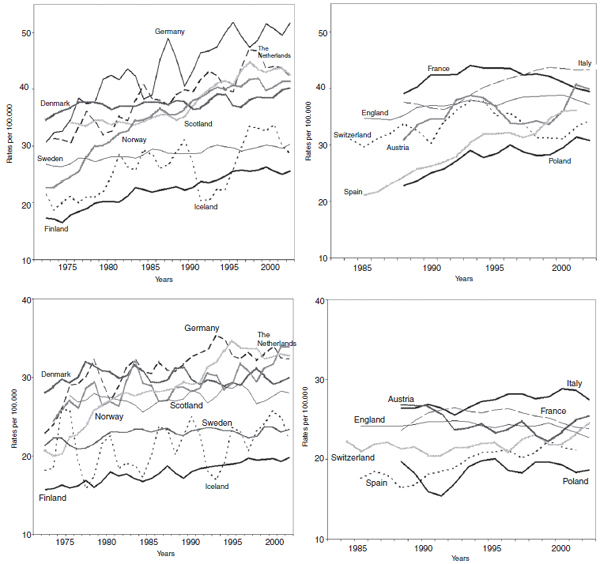
<body><![CDATA[<p><font face="Verdana" size="2">The aim of this study was to analyze the trends in the incidence of colorectal cancer in 15 European countries in the last few decades and to determine how these trends correlate with changes in the dietary habits of these populations during this period.</font></p>     <p>&nbsp;</p>     <p><font face="Verdana" size="2"><b>Methods</b></font></p>     <p><font face="Verdana" size="2">Annual colorectal cancer incidence rates adjusted to the worldwide population per 100,000 inhabitants (codes C18-C21, 10th revision of the International Classification of Diseases) in men and women were obtained from the International Agency for Research on Cancer for 1971-2002. Rates were gathered by beginning with the first year with accessible data in the cancer registries of each country until 2002 (except Spain, until 2000), which was the last year for which data were available at the time of this study. Annual colorectal cancer incidence rates in both genders were plotted on a linear scale.</font></p>     <p><font face="Verdana" size="2">Data from the IARC correspond to distinct types of cancer registries. Local cancer registries cover specific areas in each country: Austria, Germany and the Netherlands. Central cancer registries gather and homogenize the information from several local cancer registries: England, France, Italy, Poland, Spain and Switzerland. Finally, national cancer registries cover the whole population of the country: Denmark, Finland, Iceland, Norway, Scotland and Sweden<sup>1</sup>.</font></p>     <p><font face="Verdana" size="2">Annual <i>per capita</i> data on alcohol consumption (liters), cereals, fruit, vegetables, legumes, poultry, red meat and fish (kilograms) for 1961-1992 were obtained from the Food and Agriculture Organization of the United Nations (FAO)<sup>3</sup>.</font></p>     <p><font face="Verdana" size="2">Pearson's or Spearman's correlation coefficients (depending on the underlying distribution of the variable) were calculated by gender using 10-year delay intervals<sup>4,5</sup>, i.e. annual colorectal cancer incidence rates adjusted to the worldwide population per 100,000 inhabitants in men and women were correlated with annual <i>per capita</i> consumption data in the previous 10 years, according to the available period in each country studied. The statistical analyses were performed using Stata 10.0 StataCorp LP, Texas, USA.</font></p>     <p>&nbsp;</p>     <p><font face="Verdana" size="2"><b>Results</b></font></p>     <p><font face="Verdana" size="2">Annual colorectal cancer incidence rates were plotted for men and women (<a href="#f1">Figure 1</a>), according to the available time period in each country studied. The incidence rates were higher in men than in women throughout the period in all countries except the Netherlands (for 1 year) and Iceland (for 8 years).</font></p>     ]]></body>
<body><![CDATA[<p>&nbsp;</p>     <p align="center"><font face="Verdana" size="2"><a name="f1"><img src="/img/revistas/gs/v26n1/original_breve2_f1.jpg"></a>    <br><b>Figure 1.</b> Annual colorectal cancer incidence rates adjusted to the worldwide population per 100,000 inhabitants,    <br>men (above) and women (below). Austria (1988-2002), Denmark (1971-2002), England (1985-2002), Finland (1971-2002),    <br>France (1988-2002), Germany (1971-2002), Iceland (1971-2002), Italy (1988-2002), Norway (1971-2002),    <br>Poland (1988-2002), Scotland (1975-2002), Spain (1985-2000), Sweden (1971-2002),    <br>Switzerland (1983-2002), and the Netherlands (1973-2002).</font></p>     <p>&nbsp;</p>     <p><font face="Verdana" size="2">Throughout the study, incidence rates followed an increasing linear trend in all countries except France in men and except Austria, Denmark, England and France in women.</font></p>     <p><font face="Verdana" size="2">In Finland, Germany, Iceland, Italy, Norway, Poland, Scotland, Spain, Sweden, Switzerland and the Netherlands, incidence rates in both genders showed an increasing trend with a greater slope in men than in women.</font></p>     ]]></body>
<body><![CDATA[<p><font face="Verdana" size="2">During the study periods for the distinct dietary variables (corresponding to the 10 years prior to the period of the available incidence rates), the prominent dietary trends considered in this study were those that showed a linear regression coefficient (R) <u>&gt;</u>|0.5|.</font></p>     <p><font face="Verdana" size="2">Among food of vegetable origin, fruit consumption increased markedly in all countries except Denmark (R = 0.3). For vegetable consumption, Norway, Switzerland and the Netherlands were the only countries with an R &lt;|0.5|, with R-values of 0.1, 0.4, and -0.2, respectively. Cereal consumption showed considerable variations in Finland (R = -0.8), France (R = 0.7), Italy (R = -1.9), Norway (R = 0.6), Poland (R = -2.2) and the Netherlands (R = -0.5). None of the countries studied showed an R <u>&gt;</u>|0.5| in legume consumption.</font></p>     <p><font face="Verdana" size="2">Among food of animal origin, substantial increasing trends were found in red meat consumption in Austria (R = 0.7), Finland (R = 0.8), Germany (R = 0.9), Italy (R = 0.9), Poland (R = 0.5), Spain (R = 2.1), Sweden (R = 0.6), and the Netherlands (R = 0.7). The countries with the most prominent increases in poultry consumption were England (R = 0.5), France (R = 0.5) and the Netherlands (R = 0.5). There were notable increasing trends in fish consumption in Finland (R = 0.5), France (R = 0.6), Iceland (R = 1.1) and Italy (R = 0.8).</font></p>     <p><font face="Verdana" size="2">Alcohol consumption showed no marked trends in any of the countries studied.</font></p>     <p><font face="Verdana" size="2"><a target="_blank" href="/img/revistas/gs/v26n1/original_breve2_t1.jpg">Table 1</a> shows Pearson's/Spearman's correlation coefficients between trends for the distinct dietary variables and the incidence of colorectal cancer according to gender. In general, the absolute value of the correlation coefficients was greater in men than in women. In men, 34 of the 120 correlations were both strong correlations (correlation coefficient <u>&gt;</u>|0.75|) and statistically significant, representing 28.3% of the correlations calculated in men compared with 14 of 120 correlations (11.7%) in women.</font></p>     <p>&nbsp;</p>     <p><font face="Verdana" size="2"><b>Discussion</b></font></p>     <p><font face="Verdana" size="2">This study has some potential limitations, primarily those due to its ecological design<sup>6</sup>. These limitations include the inability to control for confounding variables, the use of aggregate <i>per capita</i> consumption data and the ecological fallacy, which prevents conclusions on causation. Additionally, potential sources of error are the accuracy of the data on food consumption provided by the FAO database, differences in cancer registration, and the inability to account for other important factors unrelated to diet.</font></p>     <p><font face="Verdana" size="2">In 2003, the European Union extended the recommendation of implanting colorectal cancer screening using the fecal occult blood test in the population aged between 50 and 74 years of age<sup>7,8</sup>. There were few colorectal cancer screening programs in Europe from 1971-2002.</font></p>     <p><font face="Verdana" size="2">In the analysis of the results, only correlation coefficients <u>&gt;</u>|0.75| that were found to be statistically significant and which were calculated with respect to the more prominent food consumption trends (R <u>&gt;</u>|0.5|) were considered in order to determine which dietary elements may have influenced the incidence of colorectal cancer.</font></p>     ]]></body>
<body><![CDATA[<p><font face="Verdana" size="2">Excess consumption of red meat<sup>9-12</sup> and insufficient consumption of food of vegetable origin<sup>13-15</sup> are known to be major risk factors for colorectal cancer. In all of the countries analyzed, positive correlations were established between the incidence of colorectal cancer and red meat consumption, along with negative correlations with cereal consumption. Finland, Germany, Italy, Spain and the Netherlands showed positive correlations between the incidence of colorectal cancer and red meat consumption among men. Among women, positive correlations with red meat were observed in Finland, Germany, Italy, Spain and Sweden. Cereal consumption was negatively correlated with the incidence of colorectal cancer in Finland and Italy in men.</font></p>     <p><font face="Verdana" size="2">Poultry consumption is considered a protective factor for colorectal cancer<sup>11</sup>. Among men in the Netherlands, poultry consumption showed a positive correlation with the incidence of colorectal cancer; however, red meat consumption increased more than that of poultry in the same time period (R = 0.7, red meat; R = 0.5, poultry).</font></p>     <p><font face="Verdana" size="2">Fish consumption is considered a protective factor for colorectal cancer<sup>11,12</sup>. Fish consumption in both Finland (men and women) and Italy (men only) showed positive correlations with the incidence of colorectal cancer. However, as observed with poultry, red meat consumption increased faster than did fish consumption in the same period (Finland: R = 0.8 red meat, R = 0.5 fish; Italy: R = 0.9 red meat, R = 0.8 fish).</font></p>     <p><font face="Verdana" size="2">As discussed previously, inadequate consumption of food of vegetable origin is considered a risk factor for colorectal cancer<sup>13-15</sup>. In all countries with significant correlations, the correlation between the incidence of colorectal cancer and consumption of fruits and vegetables was positive. For fruit consumption, there were positive correlations in England, Finland, Italy, Norway, Scotland and Spain in men and in Norway in women. Vegetable consumption was positively correlated with the incidence of colorectal cancer in Finland, Germany and Sweden in men, and in Finland in women. Only in England, Norway and Scotland was increased consumption of fruits and vegetables not accompanied by a substantial increase in red meat consumption during the same period (red meat: R = 0.8 Finland, R = 0.9 Germany, R = 0.9 Italy, R = 2.1 Spain, R = 0.6 Sweden).</font></p>     <p><font face="Verdana" size="2">In Europe, the primary source of protein has progressively changed from legumes to red meat in the last few decades, which could be a contributing factor in the increase of colorectal cancer in both genders in this region in recent years. In contrast, poultry and fish consumption have slightly increased compared with red meat consumption, most notably fish consumption.</font></p>     <p><font face="Verdana" size="2">Substantial differences in incidence rates according to gender, with higher values normally found in men, may be the result of greater exposure to lifestyle-related risk factors, such as dietary habits, smoking, sedentariness, overweight, obesity and diabetes.</font></p>     <p><font face="Verdana" size="2">In conclusion, the changes in dietary habits may potentially be consistent with the observed trends in the incidence of colorectal cancer in distinct European countries.</font></p>     <p align="center"><img border="0" src="/img/revistas/gs/v26n1/original_breve2_c.jpg" width="433" height="440"></p>     <p>&nbsp;</p>     <p><font face="Verdana" size="2"><b>Authors' contributions</b></font></p>     ]]></body>
<body><![CDATA[<p><font face="Verdana" size="2">L.M. Béjar participated in the literature search, the design and methodology of the study, the statistical analysis of the results, and the final drafting of the manuscript. M. Gili participated in the study design, the analysis of the results, and the final drafting of the manuscript. B. Infantes participated in the literature search, data collection, the analysis and final presentation of the results, including the design of the tables and figures, and in the final drafting of the manuscript. P.F. Marcott participated in data collection, the statistical analysis of the results, and the final drafting of the manuscript.</font></p>     <p>&nbsp;</p>     <p><font face="Verdana" size="2"><b>Funding</b></font></p>     <p><font face="Verdana" size="2">None.</font></p>     <p>&nbsp;</p>     <p><font face="Verdana" size="2"><b>Conflicts of interest</b></font></p>     <p><font face="Verdana" size="2">None.</font></p>     <p>&nbsp;</p>     <p><font face="Verdana" size="2"><b>Bibliografía</b></font></p>     <!-- ref --><p><font face="Verdana" size="2">1. Internacional Agency for Research on Cancer. IARC Databases. &#091;Updated 18/01/11; accesed 18/01/11&#093;. Available at: <a target="_blank" href="http://www-dep.iarc.fr/">http://www-dep.iarc.fr/</a>.    &nbsp;&nbsp;&nbsp;&nbsp;&nbsp;&nbsp;&nbsp;&nbsp;[&#160;<a href="javascript:void(0);" onclick="javascript: window.open('/scielo.php?script=sci_nlinks&ref=2439404&pid=S0213-9111201200010001200001&lng=','','width=640,height=500,resizable=yes,scrollbars=1,menubar=yes,');">Links</a>&#160;]<!-- end-ref --></font></p>    <!-- ref --><p><font face="Verdana" size="2">2. Parkin DM. International variation. Oncogene. 2004; 23:6329-40.    &nbsp;&nbsp;&nbsp;&nbsp;&nbsp;&nbsp;&nbsp;&nbsp;[&#160;<a href="javascript:void(0);" onclick="javascript: window.open('/scielo.php?script=sci_nlinks&ref=2439406&pid=S0213-9111201200010001200002&lng=','','width=640,height=500,resizable=yes,scrollbars=1,menubar=yes,');">Links</a>&#160;]<!-- end-ref --></font></p>    <!-- ref --><p><font face="Verdana" size="2">3. Food and Agriculture Organization of United Nations. FAOSTAT. Crops primary equivalent and livestock and fish primary equivalent consumption statistics, 1961-2007. &#091;Updated 18/01/11; accesed 18/01/11&#093;. Available at: <a target="_blank" href="http://faostat.fao.org/">http://faostat.fao.org/</a>.    &nbsp;&nbsp;&nbsp;&nbsp;&nbsp;&nbsp;&nbsp;&nbsp;[&#160;<a href="javascript:void(0);" onclick="javascript: window.open('/scielo.php?script=sci_nlinks&ref=2439408&pid=S0213-9111201200010001200003&lng=','','width=640,height=500,resizable=yes,scrollbars=1,menubar=yes,');">Links</a>&#160;]<!-- end-ref --></font></p>    <!-- ref --><p><font face="Verdana" size="2">4. Casciato D, Lowitz B. Gastrointestinal tract tumors. In: Casciato D., Lowitz B., editors. Clinical Oncology. 4th ed. Madrid: Marban; 2001. 182-95.    &nbsp;&nbsp;&nbsp;&nbsp;&nbsp;&nbsp;&nbsp;&nbsp;[&#160;<a href="javascript:void(0);" onclick="javascript: window.open('/scielo.php?script=sci_nlinks&ref=2439410&pid=S0213-9111201200010001200004&lng=','','width=640,height=500,resizable=yes,scrollbars=1,menubar=yes,');">Links</a>&#160;]<!-- end-ref --></font></p>    <!-- ref --><p><font face="Verdana" size="2">5. Fauci A, Braunwald E, Kasper D, et al. Cáncer gastrointestinal. In: Fauci A.S., Braunwald E., Kasper D.L., et al, editors. Harrison Principios de Medicina Interna. 17<sup>a</sup> ed. México DF: McGraw-Hill Interamericana; 2009. 385-8.    &nbsp;&nbsp;&nbsp;&nbsp;&nbsp;&nbsp;&nbsp;&nbsp;[&#160;<a href="javascript:void(0);" onclick="javascript: window.open('/scielo.php?script=sci_nlinks&ref=2439412&pid=S0213-9111201200010001200005&lng=','','width=640,height=500,resizable=yes,scrollbars=1,menubar=yes,');">Links</a>&#160;]<!-- end-ref --></font></p>    <!-- ref --><p><font face="Verdana" size="2">6. Dos Santos Silva I. Overview of study designs. In: Cancer epidemiology: principles and methods. Lyon: International Agency for Research on Cancer; 1999. p. 83-101.    &nbsp;&nbsp;&nbsp;&nbsp;&nbsp;&nbsp;&nbsp;&nbsp;[&#160;<a href="javascript:void(0);" onclick="javascript: window.open('/scielo.php?script=sci_nlinks&ref=2439414&pid=S0213-9111201200010001200006&lng=','','width=640,height=500,resizable=yes,scrollbars=1,menubar=yes,');">Links</a>&#160;]<!-- end-ref --></font></p>    <!-- ref --><p><font face="Verdana" size="2">7. Zavoral M, Suchanek S, Zavada F, et al. Colorectal cancer screening in Europe. World J Gastroenterol. 2009; 15:5907-15.    &nbsp;&nbsp;&nbsp;&nbsp;&nbsp;&nbsp;&nbsp;&nbsp;[&#160;<a href="javascript:void(0);" onclick="javascript: window.open('/scielo.php?script=sci_nlinks&ref=2439416&pid=S0213-9111201200010001200007&lng=','','width=640,height=500,resizable=yes,scrollbars=1,menubar=yes,');">Links</a>&#160;]<!-- end-ref --></font></p>    <!-- ref --><p><font face="Verdana" size="2">8. Grau J, Serradesanferm A, Polbach S, et al. Colorectal cancer screening programs in the population at average risk in the European Union and Spain. Gastroenterol Hepatol. 2010; 33:111-8.    &nbsp;&nbsp;&nbsp;&nbsp;&nbsp;&nbsp;&nbsp;&nbsp;[&#160;<a href="javascript:void(0);" onclick="javascript: window.open('/scielo.php?script=sci_nlinks&ref=2439418&pid=S0213-9111201200010001200008&lng=','','width=640,height=500,resizable=yes,scrollbars=1,menubar=yes,');">Links</a>&#160;]<!-- end-ref --></font></p>    <!-- ref --><p><font face="Verdana" size="2">9. Sandhu MS, White IR, McPherson K. Systematic review of the prospective cohort studies on meat consumption and colorectal cancer risk: a meta-analytical approach. Cancer Epidemiol Biomarkers Prev. 2001; 10:439-46.    &nbsp;&nbsp;&nbsp;&nbsp;&nbsp;&nbsp;&nbsp;&nbsp;[&#160;<a href="javascript:void(0);" onclick="javascript: window.open('/scielo.php?script=sci_nlinks&ref=2439420&pid=S0213-9111201200010001200009&lng=','','width=640,height=500,resizable=yes,scrollbars=1,menubar=yes,');">Links</a>&#160;]<!-- end-ref --></font></p>    <!-- ref --><p><font face="Verdana" size="2">10. Norat T, Lukanova A, Ferrari P, et al. Meat consumption and colorectal cancer risk: dose-response meta-analysis of epidemiological studies. Int J Cancer. 2002; 98:241-56.    &nbsp;&nbsp;&nbsp;&nbsp;&nbsp;&nbsp;&nbsp;&nbsp;[&#160;<a href="javascript:void(0);" onclick="javascript: window.open('/scielo.php?script=sci_nlinks&ref=2439422&pid=S0213-9111201200010001200010&lng=','','width=640,height=500,resizable=yes,scrollbars=1,menubar=yes,');">Links</a>&#160;]<!-- end-ref --></font></p>    <!-- ref --><p><font face="Verdana" size="2">11. English DR, MacInnis RJ, Hodge AM, et al. Red meat, chicken, and fish consumption and risk of colorectal cancer. Cancer Epidemiol Biomarkers Prev. 2004; 3:1509-14.    &nbsp;&nbsp;&nbsp;&nbsp;&nbsp;&nbsp;&nbsp;&nbsp;[&#160;<a href="javascript:void(0);" onclick="javascript: window.open('/scielo.php?script=sci_nlinks&ref=2439424&pid=S0213-9111201200010001200011&lng=','','width=640,height=500,resizable=yes,scrollbars=1,menubar=yes,');">Links</a>&#160;]<!-- end-ref --></font></p>    <!-- ref --><p><font face="Verdana" size="2">12. Norat T, Bingham S, Ferrari P, et al. Meat, fish, and colorectal cancer risk: the European Prospective Investigation into Cancer and Nutrition. J Natl Cancer Inst. 2005; 97:906-16.    &nbsp;&nbsp;&nbsp;&nbsp;&nbsp;&nbsp;&nbsp;&nbsp;[&#160;<a href="javascript:void(0);" onclick="javascript: window.open('/scielo.php?script=sci_nlinks&ref=2439426&pid=S0213-9111201200010001200012&lng=','','width=640,height=500,resizable=yes,scrollbars=1,menubar=yes,');">Links</a>&#160;]<!-- end-ref --></font></p>    <!-- ref --><p><font face="Verdana" size="2">13. Michels KB, Giovannucci E, Joshipura KJ, et al. Prospective study on fruit and vegetable consumption and incidence of colon and rectal cancers. J Natl Cancer Inst. 2000; 92:1740-52.    &nbsp;&nbsp;&nbsp;&nbsp;&nbsp;&nbsp;&nbsp;&nbsp;[&#160;<a href="javascript:void(0);" onclick="javascript: window.open('/scielo.php?script=sci_nlinks&ref=2439428&pid=S0213-9111201200010001200013&lng=','','width=640,height=500,resizable=yes,scrollbars=1,menubar=yes,');">Links</a>&#160;]<!-- end-ref --></font></p>    <!-- ref --><p><font face="Verdana" size="2">14. Terry P, Giovannucci E, Michels KB, et al. Fruit, vegetables, dietary fiber, and risk of colorectal cancer. J Natl Cancer Inst. 2001; 93:525-33.    &nbsp;&nbsp;&nbsp;&nbsp;&nbsp;&nbsp;&nbsp;&nbsp;[&#160;<a href="javascript:void(0);" onclick="javascript: window.open('/scielo.php?script=sci_nlinks&ref=2439430&pid=S0213-9111201200010001200014&lng=','','width=640,height=500,resizable=yes,scrollbars=1,menubar=yes,');">Links</a>&#160;]<!-- end-ref --></font></p>    <!-- ref --><p><font face="Verdana" size="2">15. Riboli E, Norat T. Epidemiologic evidence of the protective effect of fruit and vegetables on cancer risk. Am J Clin Nutr. 2003; 78:559-69.    &nbsp;&nbsp;&nbsp;&nbsp;&nbsp;&nbsp;&nbsp;&nbsp;[&#160;<a href="javascript:void(0);" onclick="javascript: window.open('/scielo.php?script=sci_nlinks&ref=2439432&pid=S0213-9111201200010001200015&lng=','','width=640,height=500,resizable=yes,scrollbars=1,menubar=yes,');">Links</a>&#160;]<!-- end-ref --></font></p>     <p>&nbsp;</p>     ]]></body>
<body><![CDATA[<p>&nbsp;</p>     <p><font face="Verdana" size="2"><a href="#top"><img border="0" src="/img/revistas/gs/v26n1/seta.gif" width="15" height="17"></a><a name="bajo"></a><b>Correspondence:</b>    <br><a href="mailto:lmbprado@us.es">lmbprado@us.es</a>    <br>(L.M. Béjar).</font></p>     <p><font face="Verdana" size="2">Received 14 February 2011     <br>Accepted 18 April 2011</font></p>      ]]></body><back>
<ref-list>
<ref id="B1">
<label>1</label><nlm-citation citation-type="">
<collab>Internacional Agency for Research on Cancer</collab>
<source><![CDATA[IARC Databases]]></source>
<year></year>
</nlm-citation>
</ref>
<ref id="B2">
<label>2</label><nlm-citation citation-type="journal">
<person-group person-group-type="author">
<name>
<surname><![CDATA[Parkin]]></surname>
<given-names><![CDATA[DM]]></given-names>
</name>
</person-group>
<article-title xml:lang="en"><![CDATA[International variation]]></article-title>
<source><![CDATA[Oncogene]]></source>
<year>2004</year>
<volume>23</volume>
<page-range>6329-40</page-range></nlm-citation>
</ref>
<ref id="B3">
<label>3</label><nlm-citation citation-type="">
<collab>Food and Agriculture Organization of United Nations. FAOSTAT</collab>
<source><![CDATA[Crops primary equivalent and livestock and fish primary equivalent consumption statistics, 1961-2007]]></source>
<year></year>
</nlm-citation>
</ref>
<ref id="B4">
<label>4</label><nlm-citation citation-type="book">
<person-group person-group-type="author">
<name>
<surname><![CDATA[Casciato]]></surname>
<given-names><![CDATA[D]]></given-names>
</name>
<name>
<surname><![CDATA[Lowitz]]></surname>
<given-names><![CDATA[B]]></given-names>
</name>
</person-group>
<article-title xml:lang="en"><![CDATA[Gastrointestinal tract tumors]]></article-title>
<person-group person-group-type="editor">
<name>
<surname><![CDATA[Casciato]]></surname>
<given-names><![CDATA[D.]]></given-names>
</name>
<name>
<surname><![CDATA[Lowitz]]></surname>
<given-names><![CDATA[B.]]></given-names>
</name>
</person-group>
<source><![CDATA[Clinical Oncology]]></source>
<year>2001</year>
<edition>4</edition>
<page-range>182-95</page-range><publisher-loc><![CDATA[Madrid ]]></publisher-loc>
<publisher-name><![CDATA[Marban]]></publisher-name>
</nlm-citation>
</ref>
<ref id="B5">
<label>5</label><nlm-citation citation-type="book">
<person-group person-group-type="author">
<name>
<surname><![CDATA[Fauci]]></surname>
<given-names><![CDATA[A]]></given-names>
</name>
<name>
<surname><![CDATA[Braunwald]]></surname>
<given-names><![CDATA[E]]></given-names>
</name>
<name>
<surname><![CDATA[Kasper]]></surname>
<given-names><![CDATA[D]]></given-names>
</name>
</person-group>
<article-title xml:lang="es"><![CDATA[Cáncer gastrointestinal]]></article-title>
<person-group person-group-type="editor">
<name>
<surname><![CDATA[Fauci]]></surname>
<given-names><![CDATA[A.S.]]></given-names>
</name>
<name>
<surname><![CDATA[Braunwald]]></surname>
<given-names><![CDATA[E.]]></given-names>
</name>
<name>
<surname><![CDATA[Kasper]]></surname>
<given-names><![CDATA[D.L.]]></given-names>
</name>
</person-group>
<source><![CDATA[Harrison Principios de Medicina Interna]]></source>
<year>2009</year>
<edition>17</edition>
<page-range>385-8</page-range><publisher-loc><![CDATA[México^eDF DF]]></publisher-loc>
<publisher-name><![CDATA[McGraw-Hill Interamericana]]></publisher-name>
</nlm-citation>
</ref>
<ref id="B6">
<label>6</label><nlm-citation citation-type="book">
<person-group person-group-type="author">
<name>
<surname><![CDATA[Dos Santos Silva]]></surname>
<given-names><![CDATA[I]]></given-names>
</name>
</person-group>
<article-title xml:lang="en"><![CDATA[Overview of study designs]]></article-title>
<source><![CDATA[Cancer epidemiology: principles and methods]]></source>
<year>1999</year>
<page-range>83-101</page-range><publisher-loc><![CDATA[Lyon ]]></publisher-loc>
<publisher-name><![CDATA[International Agency for Research on Cancer]]></publisher-name>
</nlm-citation>
</ref>
<ref id="B7">
<label>7</label><nlm-citation citation-type="journal">
<person-group person-group-type="author">
<name>
<surname><![CDATA[Zavoral]]></surname>
<given-names><![CDATA[M]]></given-names>
</name>
<name>
<surname><![CDATA[Suchanek]]></surname>
<given-names><![CDATA[S]]></given-names>
</name>
<name>
<surname><![CDATA[Zavada]]></surname>
<given-names><![CDATA[F]]></given-names>
</name>
</person-group>
<article-title xml:lang="en"><![CDATA[Colorectal cancer screening in Europe]]></article-title>
<source><![CDATA[World J Gastroenterol.]]></source>
<year>2009</year>
<volume>15</volume>
<page-range>5907-15</page-range></nlm-citation>
</ref>
<ref id="B8">
<label>8</label><nlm-citation citation-type="journal">
<person-group person-group-type="author">
<name>
<surname><![CDATA[Grau]]></surname>
<given-names><![CDATA[J]]></given-names>
</name>
<name>
<surname><![CDATA[Serradesanferm]]></surname>
<given-names><![CDATA[A]]></given-names>
</name>
<name>
<surname><![CDATA[Polbach]]></surname>
<given-names><![CDATA[S]]></given-names>
</name>
</person-group>
<article-title xml:lang="en"><![CDATA[Colorectal cancer screening programs in the population at average risk in the European Union and Spain]]></article-title>
<source><![CDATA[Gastroenterol Hepatol.]]></source>
<year>2010</year>
<volume>33</volume>
<page-range>111-8</page-range></nlm-citation>
</ref>
<ref id="B9">
<label>9</label><nlm-citation citation-type="journal">
<person-group person-group-type="author">
<name>
<surname><![CDATA[Sandhu]]></surname>
<given-names><![CDATA[MS]]></given-names>
</name>
<name>
<surname><![CDATA[White]]></surname>
<given-names><![CDATA[IR]]></given-names>
</name>
<name>
<surname><![CDATA[McPherson]]></surname>
<given-names><![CDATA[K]]></given-names>
</name>
</person-group>
<article-title xml:lang="en"><![CDATA[Systematic review of the prospective cohort studies on meat consumption and colorectal cancer risk: a meta-analytical approach]]></article-title>
<source><![CDATA[Cancer Epidemiol Biomarkers Prev.]]></source>
<year>2001</year>
<volume>10</volume>
<page-range>439-46</page-range></nlm-citation>
</ref>
<ref id="B10">
<label>10</label><nlm-citation citation-type="journal">
<person-group person-group-type="author">
<name>
<surname><![CDATA[Norat]]></surname>
<given-names><![CDATA[T]]></given-names>
</name>
<name>
<surname><![CDATA[Lukanova]]></surname>
<given-names><![CDATA[A]]></given-names>
</name>
<name>
<surname><![CDATA[Ferrari]]></surname>
<given-names><![CDATA[P]]></given-names>
</name>
</person-group>
<article-title xml:lang="en"><![CDATA[Meat consumption and colorectal cancer risk: dose-response meta-analysis of epidemiological studies]]></article-title>
<source><![CDATA[Int J Cancer.]]></source>
<year>2002</year>
<volume>98</volume>
<page-range>241-56</page-range></nlm-citation>
</ref>
<ref id="B11">
<label>11</label><nlm-citation citation-type="journal">
<person-group person-group-type="author">
<name>
<surname><![CDATA[English]]></surname>
<given-names><![CDATA[DR]]></given-names>
</name>
<name>
<surname><![CDATA[MacInnis]]></surname>
<given-names><![CDATA[RJ]]></given-names>
</name>
<name>
<surname><![CDATA[Hodge]]></surname>
<given-names><![CDATA[AM]]></given-names>
</name>
</person-group>
<article-title xml:lang="en"><![CDATA[Red meat, chicken, and fish consumption and risk of colorectal cancer]]></article-title>
<source><![CDATA[Cancer Epidemiol Biomarkers Prev.]]></source>
<year>2004</year>
<volume>3</volume>
<page-range>1509-14</page-range></nlm-citation>
</ref>
<ref id="B12">
<label>12</label><nlm-citation citation-type="journal">
<person-group person-group-type="author">
<name>
<surname><![CDATA[Norat]]></surname>
<given-names><![CDATA[T]]></given-names>
</name>
<name>
<surname><![CDATA[Bingham]]></surname>
<given-names><![CDATA[S]]></given-names>
</name>
<name>
<surname><![CDATA[Ferrari]]></surname>
<given-names><![CDATA[P]]></given-names>
</name>
</person-group>
<article-title xml:lang="en"><![CDATA[Meat, fish, and colorectal cancer risk: the European Prospective Investigation into Cancer and Nutrition]]></article-title>
<source><![CDATA[J Natl Cancer Inst.]]></source>
<year>2005</year>
<volume>97</volume>
<page-range>906-16</page-range></nlm-citation>
</ref>
<ref id="B13">
<label>13</label><nlm-citation citation-type="journal">
<person-group person-group-type="author">
<name>
<surname><![CDATA[Michels]]></surname>
<given-names><![CDATA[KB]]></given-names>
</name>
<name>
<surname><![CDATA[Giovannucci]]></surname>
<given-names><![CDATA[E]]></given-names>
</name>
<name>
<surname><![CDATA[Joshipura]]></surname>
<given-names><![CDATA[KJ]]></given-names>
</name>
</person-group>
<article-title xml:lang="en"><![CDATA[Prospective study on fruit and vegetable consumption and incidence of colon and rectal cancers]]></article-title>
<source><![CDATA[J Natl Cancer Inst.]]></source>
<year>2000</year>
<volume>92</volume>
<page-range>1740-52</page-range></nlm-citation>
</ref>
<ref id="B14">
<label>14</label><nlm-citation citation-type="journal">
<person-group person-group-type="author">
<name>
<surname><![CDATA[Terry]]></surname>
<given-names><![CDATA[P]]></given-names>
</name>
<name>
<surname><![CDATA[Giovannucci]]></surname>
<given-names><![CDATA[E]]></given-names>
</name>
<name>
<surname><![CDATA[Michels]]></surname>
<given-names><![CDATA[KB]]></given-names>
</name>
</person-group>
<article-title xml:lang="en"><![CDATA[Fruit, vegetables, dietary fiber, and risk of colorectal cancer]]></article-title>
<source><![CDATA[J Natl Cancer Inst.]]></source>
<year>2001</year>
<volume>93</volume>
<page-range>525-33</page-range></nlm-citation>
</ref>
<ref id="B15">
<label>15</label><nlm-citation citation-type="journal">
<person-group person-group-type="author">
<name>
<surname><![CDATA[Riboli]]></surname>
<given-names><![CDATA[E]]></given-names>
</name>
<name>
<surname><![CDATA[Norat]]></surname>
<given-names><![CDATA[T]]></given-names>
</name>
</person-group>
<article-title xml:lang="en"><![CDATA[Epidemiologic evidence of the protective effect of fruit and vegetables on cancer risk]]></article-title>
<source><![CDATA[Am J Clin Nutr.]]></source>
<year>2003</year>
<volume>78</volume>
<page-range>559-69</page-range></nlm-citation>
</ref>
</ref-list>
</back>
</article>