<?xml version="1.0" encoding="ISO-8859-1"?><article xmlns:mml="http://www.w3.org/1998/Math/MathML" xmlns:xlink="http://www.w3.org/1999/xlink" xmlns:xsi="http://www.w3.org/2001/XMLSchema-instance">
<front>
<journal-meta>
<journal-id>0213-9111</journal-id>
<journal-title><![CDATA[Gaceta Sanitaria]]></journal-title>
<abbrev-journal-title><![CDATA[Gac Sanit]]></abbrev-journal-title>
<issn>0213-9111</issn>
<publisher>
<publisher-name><![CDATA[Sociedad Española de Salud Pública y Administración Sanitaria (SESPAS)]]></publisher-name>
</publisher>
</journal-meta>
<article-meta>
<article-id>S0213-91112013000200010</article-id>
<article-id pub-id-type="doi">10.1016/j.gaceta.2012.02.002</article-id>
<title-group>
<article-title xml:lang="en"><![CDATA[Nitrate and trace elements in municipal and bottled water in Spain]]></article-title>
<article-title xml:lang="es"><![CDATA[Nitrato y elementos traza en agua embotellada y municipal en España]]></article-title>
</title-group>
<contrib-group>
<contrib contrib-type="author">
<name>
<surname><![CDATA[Espejo-Herrera]]></surname>
<given-names><![CDATA[Nadia]]></given-names>
</name>
<xref ref-type="aff" rid="A01"/>
<xref ref-type="aff" rid="A02"/>
</contrib>
<contrib contrib-type="author">
<name>
<surname><![CDATA[Kogevinas]]></surname>
<given-names><![CDATA[Manolis]]></given-names>
</name>
<xref ref-type="aff" rid="A01"/>
<xref ref-type="aff" rid="A02"/>
<xref ref-type="aff" rid="A03"/>
</contrib>
<contrib contrib-type="author">
<name>
<surname><![CDATA[Castaño-Vinyals]]></surname>
<given-names><![CDATA[Gemma]]></given-names>
</name>
<xref ref-type="aff" rid="A01"/>
<xref ref-type="aff" rid="A02"/>
<xref ref-type="aff" rid="A03"/>
</contrib>
<contrib contrib-type="author">
<name>
<surname><![CDATA[Aragonés]]></surname>
<given-names><![CDATA[Nuria]]></given-names>
</name>
<xref ref-type="aff" rid="A03"/>
<xref ref-type="aff" rid="A04"/>
</contrib>
<contrib contrib-type="author">
<name>
<surname><![CDATA[Boldo]]></surname>
<given-names><![CDATA[Elena]]></given-names>
</name>
<xref ref-type="aff" rid="A03"/>
<xref ref-type="aff" rid="A04"/>
</contrib>
<contrib contrib-type="author">
<name>
<surname><![CDATA[Ardanaz]]></surname>
<given-names><![CDATA[Eva]]></given-names>
</name>
<xref ref-type="aff" rid="A03"/>
<xref ref-type="aff" rid="A05"/>
</contrib>
<contrib contrib-type="author">
<name>
<surname><![CDATA[Azpiroz]]></surname>
<given-names><![CDATA[Lourdes]]></given-names>
</name>
<xref ref-type="aff" rid="A06"/>
</contrib>
<contrib contrib-type="author">
<name>
<surname><![CDATA[Ulibarrena]]></surname>
<given-names><![CDATA[Enrique]]></given-names>
</name>
<xref ref-type="aff" rid="A03"/>
<xref ref-type="aff" rid="A07"/>
</contrib>
<contrib contrib-type="author">
<name>
<surname><![CDATA[Tardón]]></surname>
<given-names><![CDATA[Adonina]]></given-names>
</name>
<xref ref-type="aff" rid="A03"/>
<xref ref-type="aff" rid="A08"/>
</contrib>
<contrib contrib-type="author">
<name>
<surname><![CDATA[Molina]]></surname>
<given-names><![CDATA[Antonio J.]]></given-names>
</name>
<xref ref-type="aff" rid="A03"/>
<xref ref-type="aff" rid="A09"/>
</contrib>
<contrib contrib-type="author">
<name>
<surname><![CDATA[López-Rojo]]></surname>
<given-names><![CDATA[Concepción]]></given-names>
</name>
<xref ref-type="aff" rid="A03"/>
<xref ref-type="aff" rid="A10"/>
</contrib>
<contrib contrib-type="author">
<name>
<surname><![CDATA[Jiménez-Moleón]]></surname>
<given-names><![CDATA[José J.]]></given-names>
</name>
<xref ref-type="aff" rid="A03"/>
<xref ref-type="aff" rid="A11"/>
</contrib>
<contrib contrib-type="author">
<name>
<surname><![CDATA[Capelo]]></surname>
<given-names><![CDATA[Rocío]]></given-names>
</name>
<xref ref-type="aff" rid="A01"/>
</contrib>
<contrib contrib-type="author">
<name>
<surname><![CDATA[Gómez-Acebo]]></surname>
<given-names><![CDATA[Inés]]></given-names>
</name>
<xref ref-type="aff" rid="A03"/>
<xref ref-type="aff" rid="A12"/>
</contrib>
<contrib contrib-type="author">
<name>
<surname><![CDATA[Ripoll]]></surname>
<given-names><![CDATA[Mónica]]></given-names>
</name>
<xref ref-type="aff" rid="A13"/>
</contrib>
<contrib contrib-type="author">
<name>
<surname><![CDATA[Villanueva]]></surname>
<given-names><![CDATA[Cristina M.]]></given-names>
</name>
<xref ref-type="aff" rid="A01"/>
<xref ref-type="aff" rid="A02"/>
<xref ref-type="aff" rid="A03"/>
</contrib>
</contrib-group>
<aff id="A01">
<institution><![CDATA[,Center for Research in Environmental Epidemiology (CREAL)  ]]></institution>
<addr-line><![CDATA[Barcelona ]]></addr-line>
<country>Spain</country>
</aff>
<aff id="A02">
<institution><![CDATA[,Hospital del Mar Research Institute (IMIM)  ]]></institution>
<addr-line><![CDATA[Barcelona ]]></addr-line>
<country>Spain</country>
</aff>
<aff id="A03">
<institution><![CDATA[,Centro de Investigación Biomédica En Red de Epidemiología y Salud Pública (CIBERESP)  ]]></institution>
<addr-line><![CDATA[ ]]></addr-line>
<country>Spain</country>
</aff>
<aff id="A04">
<institution><![CDATA[,Carlos III Institute of Health National Center for Epidemiology Cancer and Environmental Epidemiology Unit]]></institution>
<addr-line><![CDATA[Madrid ]]></addr-line>
<country>Spain</country>
</aff>
<aff id="A05">
<institution><![CDATA[,Public Health Institute of Navarre  ]]></institution>
<addr-line><![CDATA[Pamplona ]]></addr-line>
<country>Spain</country>
</aff>
<aff id="A06">
<institution><![CDATA[,Public Health Division of Gipuzkoa  ]]></institution>
<addr-line><![CDATA[Donostia-San Sebastián ]]></addr-line>
<country>Spain</country>
</aff>
<aff id="A07">
<institution><![CDATA[,Public Health Laboratory of Gipuzkoa  ]]></institution>
<addr-line><![CDATA[Donostia-San Sebastián ]]></addr-line>
<country>Spain</country>
</aff>
<aff id="A08">
<institution><![CDATA[,University of Oviedo Faculty of Medicine ]]></institution>
<addr-line><![CDATA[Oviedo ]]></addr-line>
<country>Spain</country>
</aff>
<aff id="A09">
<institution><![CDATA[,University of Leon Institute of Biomedicine (IBIOMED) Department of Preventive Medicine and Public Health]]></institution>
<addr-line><![CDATA[Leon ]]></addr-line>
<country>Spain</country>
</aff>
<aff id="A10">
<institution><![CDATA[,General Subdivision of Healthcare Quality  ]]></institution>
<addr-line><![CDATA[Murcia ]]></addr-line>
<country>Spain</country>
</aff>
<aff id="A11">
<institution><![CDATA[,University of Granada Department of Preventive Medicine and Public Health ]]></institution>
<addr-line><![CDATA[Granada ]]></addr-line>
<country>Spain</country>
</aff>
<aff id="A12">
<institution><![CDATA[,University of Cantabria Faculty of Medicine Division of Epidemiology and Computational Biology]]></institution>
<addr-line><![CDATA[Santander ]]></addr-line>
<country>Spain</country>
</aff>
<aff id="A13">
<institution><![CDATA[,Center for Research in Public Health (CSISP)  ]]></institution>
<addr-line><![CDATA[Valencia ]]></addr-line>
<country>Spain</country>
</aff>
<pub-date pub-type="pub">
<day>00</day>
<month>04</month>
<year>2013</year>
</pub-date>
<pub-date pub-type="epub">
<day>00</day>
<month>04</month>
<year>2013</year>
</pub-date>
<volume>27</volume>
<numero>2</numero>
<fpage>156</fpage>
<lpage>160</lpage>
<copyright-statement/>
<copyright-year/>
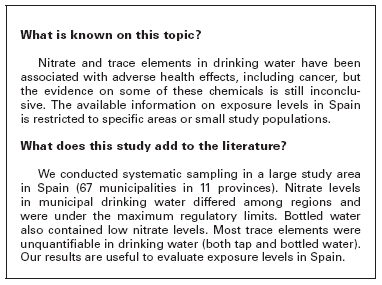
<self-uri xlink:href="http://scielo.isciii.es/scielo.php?script=sci_arttext&amp;pid=S0213-91112013000200010&amp;lng=en&amp;nrm=iso"></self-uri><self-uri xlink:href="http://scielo.isciii.es/scielo.php?script=sci_abstract&amp;pid=S0213-91112013000200010&amp;lng=en&amp;nrm=iso"></self-uri><self-uri xlink:href="http://scielo.isciii.es/scielo.php?script=sci_pdf&amp;pid=S0213-91112013000200010&amp;lng=en&amp;nrm=iso"></self-uri><abstract abstract-type="short" xml:lang="en"><p><![CDATA[Objectives: To describe levels of nitrate and trace elements in drinking water from the study areas of a multicase-control study of cancer in Spain (MCC-Spain). Methods: A total of 227 tap water samples were randomly collected from 67 municipalities in 11 provinces and the nine most frequently consumed bottled water brands were sampled to measure levels of nitrate, arsenic, nickel, chromium, cadmium, lead, selenium and zinc. Results: The median nitrate level was 4.2mg/l (range<1-29.0), with similar levels in rural and urban municipalities (p=0.86). Trace elements were unquantifiable in 94% of tap water samples. Differences between areas were significant for nitrate (p<0.001) and arsenic (p=0.03). Only nitrate was quantifiable in bottled water (range 2.3-15.6mg/l). Conclusions: Nitrate levels in municipal water differed between regions and were below the regulatory limit in all samples, including bottled water. Trace element levels were low and mainly unquantifiable in tap and bottled water.]]></p></abstract>
<abstract abstract-type="short" xml:lang="es"><p><![CDATA[Objetivos: Determinar las concentraciones de nitrato y de elementos traza en el agua de consumo de las áreas del estudio Multicaso-Control de Cáncer en España (MCC-Spain). Métodos: Se tomaron al azar 227 muestras de agua municipal en 67 municipios de 11 provincias, y 9 muestras de las aguas embotelladas más consumidas, para cuantificar la cantidad presente de nitrato, arsénico, níquel, cromo, cadmio, plomo y zinc. Resultados: La mediana de las cifras de nitrato fue 4,2mg/l (rango<1-29,0), con similares resultados en municipios urbanos y rurales (p=0,86). Los elementos traza fueron incuantificables en el 94% de las muestras de agua municipal. Se observaron diferencias entre áreas para nitrato (p<0,001) y arsénico (p=0,03). Solo el nitrato fue cuantificable en el agua embotellada (rango 2,3-15,6mg/l). Conclusiones: La cantidad de nitrato en el agua municipal difiere entre regiones y es menor que el límite regulatorio en todas las muestras. Los elementos traza son mayormente incuantificables tanto en el agua municipal como en la embotellada.]]></p></abstract>
<kwd-group>
<kwd lng="en"><![CDATA[Nitrate]]></kwd>
<kwd lng="en"><![CDATA[Drinking water]]></kwd>
<kwd lng="en"><![CDATA[Tap water]]></kwd>
<kwd lng="en"><![CDATA[Bottled water]]></kwd>
<kwd lng="en"><![CDATA[Water pollutants]]></kwd>
<kwd lng="en"><![CDATA[Trace elements]]></kwd>
<kwd lng="es"><![CDATA[Nitrato]]></kwd>
<kwd lng="es"><![CDATA[Agua de consumo]]></kwd>
<kwd lng="es"><![CDATA[Agua municipal]]></kwd>
<kwd lng="es"><![CDATA[Agua embotellada]]></kwd>
<kwd lng="es"><![CDATA[Contaminantes del agua]]></kwd>
</kwd-group>
</article-meta>
</front><body><![CDATA[ <p><a name="top"></a><font face="Verdana" size="2"><b>BRIEF ORIGINAL ARTICLE</b></font></p>     <p>&nbsp;</p>     <p><font face="Verdana" size="4"><b>Nitrate and trace elements in municipal and bottled water in Spain</b></font></p>     <p><font face="Verdana" size="4"><b>Nitrato y elementos traza en agua embotellada y municipal en España</b></font></p>     <p>&nbsp;</p>     <p>&nbsp;</p>     <p><font face="Verdana" size="2"><b>Nadia Espejo-Herrera<sup>a,b</sup>, Manolis Kogevinas<sup>a,b,c</sup>, Gemma Castaño-Vinyals<sup>a,b,c</sup>, Nuria Aragonés<sup>c,d</sup>, Elena Boldo<sup>c,d</sup>, Eva Ardanaz<sup>c,e</sup>, Lourdes Azpiroz<sup>f</sup>, Enrique Ulibarrena<sup>c,g</sup>, Adonina Tardón<sup>c,h</sup>, Antonio J. Molina<sup>c,i</sup>, Concepción López-Rojo<sup>c,j</sup>, José J. Jiménez-Moleón<sup>c,k</sup>, Rocío Capelo<sup>a</sup>, Inés Gómez-Acebo<sup>c,l</sup>, Mónica Ripoll<sup>m</sup>, Cristina M. Villanueva<sup>a,b,c</sup>, on behalf of the Multicase Control Study of Cancer (MCC)-Spain Water Working Group*</b></font></p>     <p><sup><font face="Verdana" size="2">a</font></sup><font face="Verdana" size="2">Center for Research in Environmental Epidemiology (CREAL), Barcelona, Spain    <br> <sup>b</sup>IMIM (Hospital del Mar Research Institute), Barcelona, Spain    <br><sup>c</sup>CIBER de Epidemiología y Salud Pública (CIBERESP), Spain    ]]></body>
<body><![CDATA[<br><sup>d</sup>Cancer and Environmental Epidemiology Unit, National Center for Epidemiology, Carlos III Institute of Health, Madrid, Spain    <br><sup>e</sup>Public Health Institute of Navarre, Pamplona, Spain    <br><sup>f</sup>Public Health Division of Gipuzkoa, Donostia-San Sebastián, Spain    <br><sup>g</sup>Public Health Laboratory of Gipuzkoa, Donostia-San Sebastián, Spain    <br><sup>h</sup>Faculty of Medicine, University of Oviedo, Oviedo, Spain    <br><sup>i</sup>Department of Preventive Medicine and Public Health, IBIOMED, University of Leon, Leon, Spain    <br><sup>j</sup>General Subdivision of Healthcare Quality, Murcia, Spain    <br><sup>k</sup>Department of Preventive Medicine and Public Health, University of Granada, Granada, Spain    <br><sup>l</sup>Division of Epidemiology and Computational Biology, Faculty of Medicine, University of Cantabria, Santander, Spain    <br><sup>m</sup>Center for Research in Public Health (CSISP), Valencia, Spain</font></p>     ]]></body>
<body><![CDATA[<p><font face="Verdana" size="2">This study was funded by the Instituto de Salud Carlos III FEDER (PI08/0533, PI08/1770, PI08/1359, PI09/1662), FIS PI09/00773, Acción Transversal del Cáncer del Consejo de Ministros del 11/10/2007 and the CIBER de Epidemiología y Salud Pública.</font></p>     <p><font face="Verdana" size="2"><a href="#bajo">Correspondence</a></font></p>     <p>&nbsp;</p>     <p>&nbsp;</p> <hr size="1">     <p><font face="Verdana" size="2"><b>ABSTRACT</b></font></p>     <p><font face="Verdana" size="2"><b>Objectives:</b> To describe levels of nitrate and trace elements in drinking water from the study areas of a multicase-control study of cancer in Spain (MCC-Spain).    <br><b>Methods:</b> A total of 227 tap water samples were randomly collected from 67 municipalities in 11 provinces and the nine most frequently consumed bottled water brands were sampled to measure levels of nitrate, arsenic, nickel, chromium, cadmium, lead, selenium and zinc.    <br><b>Results:</b> The median nitrate level was 4.2mg/l (range&lt;1-29.0), with similar levels in rural and urban municipalities (p=0.86). Trace elements were unquantifiable in 94% of tap water samples. Differences between areas were significant for nitrate (p&lt;0.001) and arsenic (p=0.03). Only nitrate was quantifiable in bottled water (range 2.3-15.6mg/l).    <br><b>Conclusions:</b> Nitrate levels in municipal water differed between regions and were below the regulatory limit in all samples, including bottled water. Trace element levels were low and mainly unquantifiable in tap and bottled water.</font></p>     <p><font face="Verdana" size="2"><b>Key words:</b> Nitrate. Drinking water. Tap water. Bottled water. Water pollutants. Trace elements.</font></p> <hr size="1">     ]]></body>
<body><![CDATA[<p><font face="Verdana" size="2"><b>RESUMEN</b></font></p>     <p><font face="Verdana" size="2"><b>Objetivos:</b> Determinar las concentraciones de nitrato y de elementos traza en el agua de consumo de las áreas del estudio Multicaso-Control de Cáncer en España (MCC-Spain).    <br><b>Métodos:</b> Se tomaron al azar 227 muestras de agua municipal en 67 municipios de 11 provincias, y 9 muestras de las aguas embotelladas más consumidas, para cuantificar la cantidad presente de nitrato, arsénico, níquel, cromo, cadmio, plomo y zinc.    <br><b>Resultados:</b> La mediana de las cifras de nitrato fue 4,2mg/l (rango&lt;1-29,0), con similares resultados en municipios urbanos y rurales (p=0,86). Los elementos traza fueron incuantificables en el 94% de las muestras de agua municipal. Se observaron diferencias entre áreas para nitrato (p&lt;0,001) y arsénico (p=0,03). Solo el nitrato fue cuantificable en el agua embotellada (rango 2,3-15,6mg/l).    <br><b>Conclusiones:</b> La cantidad de nitrato en el agua municipal difiere entre regiones y es menor que el límite regulatorio en todas las muestras. Los elementos traza son mayormente incuantificables tanto en el agua municipal como en la embotellada.</font></p>     <p><font face="Verdana" size="2"><b>Palabras clave:</b> Nitrato. Agua de consumo. Agua municipal. Agua embotellada. Contaminantes del agua.</font></p> <hr size="1">     <p>&nbsp;</p>     <p><font face="Verdana" size="2"><b>Introduction</b></font></p>     <p><font face="Verdana" size="2">Nitrate and trace elements have been associated with diverse health effects. One of the main routes of human exposure is water ingestion.<sup>1</sup> Some of these elements are naturally ubiquitous and mobile in the environment, but can accumulate in soils and water sources due to the use of fertilizers, industrial emissions and other human activities.<sup>2</sup></font></p>     <p><font face="Verdana" size="2">Nitrate is classified as a probable human carcinogen under conditions that result in endogenous formation of N-nitroso compounds.<sup>3</sup> Arsenic, cadmium, chromium (IV) and some nickel compounds are recognized carcinogens and cause other health effects.<sup>4</sup> Lead is neurotoxic and selenium and zinc have a likely inverse relationship with gastric, prostate and breast cancer.<sup>5</sup> Nitrate and many trace elements are regulated in the European Union, Spain, the United States and other countries. Although zinc is not regulated, water containing &gt; 3mg/L of zinc is not acceptable for human intake.<sup>6</sup> Systematic and published information on levels in Spain is limited and the available data are restricted to specific areas or small study populations.</font></p>     ]]></body>
<body><![CDATA[<p><font face="Verdana" size="2">We aimed to describe levels of nitrate and trace elements in tap and bottled water in the study areas of the Spanish Multicase-Control study of Cancer (MCC-Spain). Our ultimate goal was to provide relevant information for expossure assessment to water contaminants in this population.</font></p>     <p>&nbsp;</p>     <p><font face="Verdana" size="2"><b>Methods</b></font></p>     <p><font face="Verdana" size="2"><i>Design and study areas</i></font></p>     <p><font face="Verdana" size="2">A descriptive analysis was conducted within the framework of the MCC-Spain study, carried out in 11 Spanish provinces (<a target="_blank" href="/img/revistas/gs/v27n2/original_breve1_t1.jpg">table 1</a>), with 53 urban and 14 rural municipalities (&lt;5000 inhabitants) according to population records in 2010.</font></p>     <p><font face="Verdana" size="2"><i>Water sampling</i></font></p>     <p><font face="Verdana" size="2">Tap water samples were collected between March and July 2010 in 227 randomly selected locations (households and public buildings). The number of samples per area was defined according to the number of person-years included in the MCC study. Sampling procedures followed a common protocol. In January 2011, we purchased a 500mL bottle of the nine most frequently consumed brands in Spain, according to the National Association of Bottled Water Companies.</font></p>     <p><font face="Verdana" size="2"><i>Laboratory analysis</i></font></p>     <p><font face="Verdana" size="2">Levels of nitrate and seven trace elements (arsenic, nickel, chromium, cadmium, lead, selenium and zinc) were measured at the Public Health Laboratory of Gipuzkoa (Spain), certified by the National Accreditation Institution. Nitrate was quantified by ultraviolet spectrophotometry with 0.5/1.0mg/L detection/quantification (DL/QL) limits. Arsenic, nickel, chromium, cadmium and lead were measured by graphite furnace atomic absorption spectrophotometry (GF-AAS), selenium by hydride generation (HG-AAS), and zinc by flame (F-AAS). DL/QL are detailed in <a target="_blank" href="/img/revistas/gs/v27n2/original_breve1_t2.jpg">table 2</a>.</font></p>     <p><font face="Verdana" size="2"><i>Statistical analysis</i></font></p>     ]]></body>
<body><![CDATA[<p><font face="Verdana" size="2">Differences between study areas were tested with the Kruskall Wallis rank test. Nitrate levels were compared between urban and rural municipalities in provinces where both types of municipality were sampled (Cantabria, Leon and Navarre) by applying the Mann Whitney U test.</font></p>     <p>&nbsp;</p>     <p><font face="Verdana" size="2"><b>Results</b></font></p>     <p><font face="Verdana" size="2">Nitrate was quantified in 222 tap water samples (97.8%). Median levels ranged from 1.4mg/L (Leon) to 10.4mg/L (Barcelona) and differences among study areas were significant (p&lt;0.001). Most determinations in Valencia and Barcelona were in the highest quartile overall (&gt; 7mg/L). Levels in rural and urban municipalities were similar (p=0.86). Nitrate was quantified in eight bottled water samples (88.9%) with a maximum level of 15.6mg/L (<a target="_blank" href="/img/revistas/gs/v27n2/original_breve1_t1.jpg">table 1</a>).</font></p>     <p><font face="Verdana" size="2">On average, trace elements were below the quantification limit in 94% of tap water samples. Zinc was the most frequently quantified element (32.8%) in all areas except Granada. Arsenic was quantified in Barcelona, Leon and Madrid. Cadmium was quantified in Madrid and selenium in Gipuzkoa. Chromium was found in Gipuzkoa, Leon and Madrid. Lead was quantified in Barcelona, Gipuzkoa, Madrid and Navarre and nickel in Barcelona and Navarre. Differences among areas were significant for arsenic (p=0.03). Trace elements were unquantifiable in bottled water samples (<a target="_blank" href="/img/revistas/gs/v27n2/original_breve1_t2.jpg">table 2</a>).</font></p>     <p>&nbsp;</p>     <p><font face="Verdana" size="2"><b>Discussion</b></font></p>     <p><font face="Verdana" size="2">Nitrate and trace elements were below regulatory limits in 227 municipal water samples from 11 Spanish provinces in Spain. Trace elements were under quantification limits in 94% of the samples. Significant differences among areas were observed for nitrate and arsenic. Only nitrate was measurable in bottled water samples, at concentrations below regulatory limits.</font></p>     <p><font face="Verdana" size="2">We found similar levels of nitrate in urban and rural areas. Nitrate levels are usually higher in agricultural (rural) areas. However, in urban regions, nitrate could be produced by industrial sources, wastewater and solid waste disposal.<sup>4</sup> In addition, water supplying urban areas could be collected in rural regions. Our study had limited power to verify urban-rural differences, because most of the study areas included only urban municipalities.</font></p>     <p><font face="Verdana" size="2">We did not find nitrate levels exceeding regulatory limits in tap water, contrary to studies in France<sup>3</sup> and Sicily,<sup>7</sup> where 6% of 2019 samples and 4.7% of 667 samples, respectively, exceeded this limit. Our measurements are consistent with Spanish reports from Galicia<sup>8</sup> (0-55.4mg/L in spring water) and Tenerife (mean&lt;10mg/L in tap water).<sup>9</sup> Our results confirm that nitrate levels differ geographically, which could be explained by several environmental factors such as water source (ground vs. surface), land use and soil characteristics, among others.<sup>1</sup></font></p>     ]]></body>
<body><![CDATA[<p><font face="Verdana" size="2">Arsenic values were below the quantification limit in 96.5% of tap water samples, differing from Spanish reports of levels exceeding the regulatory limits (10&mu;g/L) in Madrid<sup>10</sup>, Leon<sup>11</sup> and Caldes de Malavella.<sup>12</sup> The available literature shows wide variability among regions, due to natural geologic characteristics and anthropogenic sources of contamination.</font></p>     <p><font face="Verdana" size="2">Even the maximum zinc levels measured in Madrid (&#8776;1.7mg/L) did not exceed the recommended limit to avoid toxic effects (3mg/L) and were similar to results from Finland (1.1mg/L).<sup>6</sup> Higher concentrations of zinc, lead, chromium, nickel, cooper and iron could be observed due to release from piping and fittings. According to a study performed in the Basque country,<sup>13</sup> this contaminant pathway is not important in Spain, which could explain the low levels found of nickel and other trace elements. Selenium was mainly unquantifiable, probably because most of the chemical forms remain fixed to soils and do not reach drinking water. Further research is needed to understand the major environmental determinants of trace element levels in drinking water, given their potential effects, possibly protective, on some cancers.<sup>5</sup></font></p>     <p><font face="Verdana" size="2">Nitrate levels in bottled water were similar to those reported in Tenerife (range 0.4-12mg/L)<sup>10</sup> and other European bottled waters (means from &lt;0.04 to 18.1mg/L) analyzed in a Canadian study<sup>14</sup> but were higher than those found in Germany (median 1.08mg/L).<sup>15</sup> Studies from the United States and Germany<sup>15</sup> found arsenic, cadmium, zinc, selenium and nickel exceeding regulatory levels, but our results, mostly below the regulatory limits, were also verified in other countries.</font></p>     <p><font face="Verdana" size="2">We provide broader information than that found in previous Spanish reports on water contaminants. In addition, to our knowledge, this is the first study measuring various trace elements in Spanish bottled water. Since nitrate levels in drinking water were under regulatory limits, specific recommendations about water intake are not warranted. Some implications for exposure assessment are the following: <i>1)</i> geographical variability in nitrate levels should be taken into account; <i>2)</i> drinking water does not appear to be an important source of exposure to trace elements in the study areas; and <i>3)</i> the contribution of bottled water intake to nitrate exposure, so far considered insignificant, needs further analysis.</font></p>     <p><font face="Verdana" size="2">In conclusion, nitrate levels differ significantly among Spanish regions but are always under the regulatory limits. Trace element levels are low and are mainly unquantifiable in tap and bottled water. This information is helpful to evaluate exposure and the association of these contaminants with prevalent tumors in the Spanish population.</font></p>     <p>&nbsp;</p>     <p><font face="Verdana" size="2"><img border="0" src="/img/revistas/gs/v27n2/original_breve1_cuadro.jpg"></font></p>     <p>&nbsp;</p>     <p><font face="Verdana" size="2"><b>Authors´ contributions</b></font></p>     <p><font face="Verdana" size="2">N. Espejo-Herrera performed the statistical analysis and drafted the manuscript under the supervision of C.M. Villanueva. E. Ulibarrena performed the laboratory analysis. All the authors participated in the study design, data collection, review and interpretation of the results. The final manuscript was reviewed and approved by all the authors. All members of the Water Working Group of the MCC-Spain study, listed as co-authors in the Annex, contributed to data collection, water sampling in the study areas and reviewed the results of the study.</font></p>     ]]></body>
<body><![CDATA[<p>&nbsp;</p>     <p><font face="Verdana" size="2"><b>Competing interests</b></font></p>     <p><font face="Verdana" size="2">None.</font></p>     <p>&nbsp;</p>     <p><b><font face="Verdana" size="2">Acknowledgements</font></b></p>     <p><font face="Verdana" size="2">We thank Remedios Pérez and José Luis Rodrigo (Public Health Institute of Navarre) for their contributions.</font></p>     <p>&nbsp;</p>     <p><font face="Verdana" size="2"><b>Annex</b></font></p>     <p><font face="Verdana" size="2"><i>Co-authors:</i> Glòria Carrasco-Turigas, Esther Gràcia-Lavedán, Ana Espinosa (Center for Research in Environmental Epidemiology, CREAL, Barcelona); Victor Moreno (Catalan Institute of Oncology, ICO, Barcelona; Biomedical Research Institute, IDIBELL; University of Barcelona, UB); Laura Costas (Catalan Institute of Oncology, ICO, Barcelona); Marina Pollán, Pablo Fernández Navarro, Javier García, Esther García-Esquinas (Cancer and Environmental Epidemiology Unit, National Center for Epidemiology, Carlos III Institute of Health, Madrid); Margarita Palau (National Information System for Drinking Water, SINAC); Estefanía Toledo (Public Health Institute of Navarra; Department of Preventive Medicine and Public Health, University of Navarre, Pamplona); Jone M. Altzibar, Itziar Zaldua (Public Health Division of Gipuzkoa); Vicente Martín (University of León); Juan Alguacil (Center for Research in Environment and Health, CYSMA, University of Huelva); and Rosana Peiró (Center for Research in Public Health, CSISP, Valencia), as members of the MCC-Spain Water Working Group.</font></p>     <p>&nbsp;</p>     ]]></body>
<body><![CDATA[<p><font face="Verdana" size="2"><b>References</b></font></p>     <!-- ref --><p><font face="Verdana" size="2">1. Ward MH, DeKok TM, Levallois P, et al, International Society for Environmental Epidemiology. Workgroup report: Drinking-water nitrate and health - recent findings and research needs. Environ Health Perspect. 2005; 113:1607-14.    &nbsp;&nbsp;&nbsp;&nbsp;&nbsp;&nbsp;&nbsp;&nbsp;[&#160;<a href="javascript:void(0);" onclick="javascript: window.open('/scielo.php?script=sci_nlinks&ref=2460458&pid=S0213-9111201300020001000001&lng=','','width=640,height=500,resizable=yes,scrollbars=1,menubar=yes,');">Links</a>&#160;]<!-- end-ref --></font></p>    <!-- ref --><p><font face="Verdana" size="2">2. Mandal BK, Suzuki KT. Arsenic round the world: a review. Talanta. 2002; 58:201-35.    &nbsp;&nbsp;&nbsp;&nbsp;&nbsp;&nbsp;&nbsp;&nbsp;[&#160;<a href="javascript:void(0);" onclick="javascript: window.open('/scielo.php?script=sci_nlinks&ref=2460460&pid=S0213-9111201300020001000002&lng=','','width=640,height=500,resizable=yes,scrollbars=1,menubar=yes,');">Links</a>&#160;]<!-- end-ref --></font></p>    <!-- ref --><p><font face="Verdana" size="2">3. IARC Working Group on the Evaluation of Carcinogenic Risks to Humans. International Agency for Research in Cancer monographs on the evaluation of carcinogenic risks to humans. Ingested nitrate and nitrite, and cyanobacterial peptide toxins. IARC Monogr Eval Carcinog Risks Hum. 2010; 94:1-412.    &nbsp;&nbsp;&nbsp;&nbsp;&nbsp;&nbsp;&nbsp;&nbsp;[&#160;<a href="javascript:void(0);" onclick="javascript: window.open('/scielo.php?script=sci_nlinks&ref=2460462&pid=S0213-9111201300020001000003&lng=','','width=640,height=500,resizable=yes,scrollbars=1,menubar=yes,');">Links</a>&#160;]<!-- end-ref --></font></p>    <!-- ref --><p><font face="Verdana" size="2">4. Smith A, Steinmaus C. Health effects of arsenic and chromium in drinking water: recent human findings. Annu Rev Public Health. 2009; 29:107-22.    &nbsp;&nbsp;&nbsp;&nbsp;&nbsp;&nbsp;&nbsp;&nbsp;[&#160;<a href="javascript:void(0);" onclick="javascript: window.open('/scielo.php?script=sci_nlinks&ref=2460464&pid=S0213-9111201300020001000004&lng=','','width=640,height=500,resizable=yes,scrollbars=1,menubar=yes,');">Links</a>&#160;]<!-- end-ref --></font></p>    <!-- ref --><p><font face="Verdana" size="2">5. Navarro Silvera AS, Rohan TE. Trace elements and cancer risk: a review of the epidemiologic evidence. Cancer Causes Control. 2007; 18:7-27.    &nbsp;&nbsp;&nbsp;&nbsp;&nbsp;&nbsp;&nbsp;&nbsp;[&#160;<a href="javascript:void(0);" onclick="javascript: window.open('/scielo.php?script=sci_nlinks&ref=2460466&pid=S0213-9111201300020001000005&lng=','','width=640,height=500,resizable=yes,scrollbars=1,menubar=yes,');">Links</a>&#160;]<!-- end-ref --></font></p>    <!-- ref --><p><font face="Verdana" size="2">6. World Health Organization. Zinc in drinking water. Background document for development of guidelines for drinking-water quality. Health criteria and other supporting information, 1,2nd ed. Geneve: WHO; 2003.    &nbsp;&nbsp;&nbsp;&nbsp;&nbsp;&nbsp;&nbsp;&nbsp;[&#160;<a href="javascript:void(0);" onclick="javascript: window.open('/scielo.php?script=sci_nlinks&ref=2460468&pid=S0213-9111201300020001000006&lng=','','width=640,height=500,resizable=yes,scrollbars=1,menubar=yes,');">Links</a>&#160;]<!-- end-ref --> </font></p>    <!-- ref --><p><font face="Verdana" size="2">7. D´Alessandro W, Bellomo S, Parello F, et al. Nitrate, sulphate and chloride contents in public drinking water supplies in Sicily, Italy. Environ Monit Assess. 2011. DOI: 10.1007/s10661-011-2155-y.    &nbsp;&nbsp;&nbsp;&nbsp;&nbsp;&nbsp;&nbsp;&nbsp;[&#160;<a href="javascript:void(0);" onclick="javascript: window.open('/scielo.php?script=sci_nlinks&ref=2460470&pid=S0213-9111201300020001000007&lng=','','width=640,height=500,resizable=yes,scrollbars=1,menubar=yes,');">Links</a>&#160;]<!-- end-ref --></font></p>    <!-- ref --><p><font face="Verdana" size="2">8. Salgado MJ, Pérez-López M, Alonso J, et al. Assessment of drinking water contamination at springs along the road to Santiago (NW Spain). J Environ Sci Health A Tox Hazard Subst Environ Eng. 2003; 38:609-17.    &nbsp;&nbsp;&nbsp;&nbsp;&nbsp;&nbsp;&nbsp;&nbsp;[&#160;<a href="javascript:void(0);" onclick="javascript: window.open('/scielo.php?script=sci_nlinks&ref=2460472&pid=S0213-9111201300020001000008&lng=','','width=640,height=500,resizable=yes,scrollbars=1,menubar=yes,');">Links</a>&#160;]<!-- end-ref --></font></p>    <!-- ref --><p><font face="Verdana" size="2">9. Caballero-Mesa JM, Rubio AC, Hardisson A. Nitrate intake from drinking water on Tenerife Island (Spain). The Science of the Total Environment. 2003; 302:85-92.    &nbsp;&nbsp;&nbsp;&nbsp;&nbsp;&nbsp;&nbsp;&nbsp;[&#160;<a href="javascript:void(0);" onclick="javascript: window.open('/scielo.php?script=sci_nlinks&ref=2460474&pid=S0213-9111201300020001000009&lng=','','width=640,height=500,resizable=yes,scrollbars=1,menubar=yes,');">Links</a>&#160;]<!-- end-ref --></font></p>    <!-- ref --><p><font face="Verdana" size="2">10. Aragonés N, Palacios M, Avello de Miguel A, et al. Nivel de arsénico en abastecimientos de agua de consumo de origen subterráneo en la Comunidad de Madrid. Rev Esp Salud Pública. 2001; 75:421-32.    &nbsp;&nbsp;&nbsp;&nbsp;&nbsp;&nbsp;&nbsp;&nbsp;[&#160;<a href="javascript:void(0);" onclick="javascript: window.open('/scielo.php?script=sci_nlinks&ref=2460476&pid=S0213-9111201300020001000010&lng=','','width=640,height=500,resizable=yes,scrollbars=1,menubar=yes,');">Links</a>&#160;]<!-- end-ref --></font></p>    <!-- ref --><p><font face="Verdana" size="2">11. García Sánchez A, Moyano A, Mayorga P. High arsenic contents in groundwater of central Spain. Environ Geol. 2005; 47:847-54.    &nbsp;&nbsp;&nbsp;&nbsp;&nbsp;&nbsp;&nbsp;&nbsp;[&#160;<a href="javascript:void(0);" onclick="javascript: window.open('/scielo.php?script=sci_nlinks&ref=2460478&pid=S0213-9111201300020001000011&lng=','','width=640,height=500,resizable=yes,scrollbars=1,menubar=yes,');">Links</a>&#160;]<!-- end-ref --></font></p>    <!-- ref --><p><font face="Verdana" size="2">12. Piquè A, Grandia F, Canals A. Processes releasing arsenic to groundwater in the Caldes de Malavella geothermal area, NE Spain. Water Research. 2010; 44:5618-30.    &nbsp;&nbsp;&nbsp;&nbsp;&nbsp;&nbsp;&nbsp;&nbsp;[&#160;<a href="javascript:void(0);" onclick="javascript: window.open('/scielo.php?script=sci_nlinks&ref=2460480&pid=S0213-9111201300020001000012&lng=','','width=640,height=500,resizable=yes,scrollbars=1,menubar=yes,');">Links</a>&#160;]<!-- end-ref --></font></p>    <!-- ref --><p><font face="Verdana" size="2">13. Zaldua Etxabe I, Cambra K, Onaindia Olalde C, et al. Cesión de plomo y otros metales desde las tuberías al agua de consumo en la Comunidad Autónoma del País Vasco. Gac Sanit. 2010; 24:460-5.    &nbsp;&nbsp;&nbsp;&nbsp;&nbsp;&nbsp;&nbsp;&nbsp;[&#160;<a href="javascript:void(0);" onclick="javascript: window.open('/scielo.php?script=sci_nlinks&ref=2460482&pid=S0213-9111201300020001000013&lng=','','width=640,height=500,resizable=yes,scrollbars=1,menubar=yes,');">Links</a>&#160;]<!-- end-ref --></font></p>    <!-- ref --><p><font face="Verdana" size="2">14. Pip E. Survey of bottled drinking water available in Manitoba, Canada. Environ Health Perspect. 2000; 108:863-6.    &nbsp;&nbsp;&nbsp;&nbsp;&nbsp;&nbsp;&nbsp;&nbsp;[&#160;<a href="javascript:void(0);" onclick="javascript: window.open('/scielo.php?script=sci_nlinks&ref=2460484&pid=S0213-9111201300020001000014&lng=','','width=640,height=500,resizable=yes,scrollbars=1,menubar=yes,');">Links</a>&#160;]<!-- end-ref --></font></p>    <!-- ref --><p><font face="Verdana" size="2">15. Birke M, Rauch U, Harazim B, et al. Major and trace elements in German bottled water, their regional distribution, and accordance with national and international standards. Journal of Geochemical Exploration. 2010; 107:245-71.    &nbsp;&nbsp;&nbsp;&nbsp;&nbsp;&nbsp;&nbsp;&nbsp;[&#160;<a href="javascript:void(0);" onclick="javascript: window.open('/scielo.php?script=sci_nlinks&ref=2460486&pid=S0213-9111201300020001000015&lng=','','width=640,height=500,resizable=yes,scrollbars=1,menubar=yes,');">Links</a>&#160;]<!-- end-ref --></font></p>     <p>&nbsp;</p>     <p>&nbsp;</p>     <p><font face="Verdana" size="2"><a href="#top"><img border="0" src="/img/revistas/gs/v27n2/seta.gif" width="15" height="17"></a><a name="bajo"></a><b>Correspondence:</b>    <br><a href="mailto:cvillanueva@creal.cat">cvillanueva@creal.cat</a>    <br>(C.M. Villanueva)</font></p>     <p><font face="Verdana" size="2">Received 14 October 2011    <br>Accepted 7 February 2012</font></p>      ]]></body><back>
<ref-list>
<ref id="B1">
<label>1</label><nlm-citation citation-type="journal">
<person-group person-group-type="author">
<name>
<surname><![CDATA[Ward]]></surname>
<given-names><![CDATA[MH]]></given-names>
</name>
<name>
<surname><![CDATA[DeKok]]></surname>
<given-names><![CDATA[TM]]></given-names>
</name>
<name>
<surname><![CDATA[Levallois]]></surname>
<given-names><![CDATA[P]]></given-names>
</name>
</person-group>
<article-title xml:lang="en"><![CDATA[Drinking-water nitrate and health: recent findings and research needs]]></article-title>
<source><![CDATA[Environ Health Perspect]]></source>
<year>2005</year>
<volume>113</volume>
<page-range>1607-14</page-range></nlm-citation>
</ref>
<ref id="B2">
<label>2</label><nlm-citation citation-type="journal">
<person-group person-group-type="author">
<name>
<surname><![CDATA[Mandal]]></surname>
<given-names><![CDATA[BK]]></given-names>
</name>
<name>
<surname><![CDATA[Suzuki]]></surname>
<given-names><![CDATA[KT]]></given-names>
</name>
</person-group>
<article-title xml:lang="en"><![CDATA[Arsenic round the world: a review]]></article-title>
<source><![CDATA[Talanta]]></source>
<year>2002</year>
<volume>58</volume>
<page-range>201-35</page-range></nlm-citation>
</ref>
<ref id="B3">
<label>3</label><nlm-citation citation-type="journal">
<collab>IARC^dWorking Group on the Evaluation of Carcinogenic Risks to Humans</collab>
<article-title xml:lang="en"><![CDATA[International Agency for Research in Cancer monographs on the evaluation of carcinogenic risks to humans: Ingested nitrate and nitrite, and cyanobacterial peptide toxins]]></article-title>
<source><![CDATA[IARC Monogr Eval Carcinog Risks Hum]]></source>
<year>2010</year>
<volume>94</volume>
<page-range>1-412</page-range></nlm-citation>
</ref>
<ref id="B4">
<label>4</label><nlm-citation citation-type="journal">
<person-group person-group-type="author">
<name>
<surname><![CDATA[Smith]]></surname>
<given-names><![CDATA[A]]></given-names>
</name>
<name>
<surname><![CDATA[Steinmaus]]></surname>
<given-names><![CDATA[C]]></given-names>
</name>
</person-group>
<article-title xml:lang="en"><![CDATA[Health effects of arsenic and chromium in drinking water: recent human findings]]></article-title>
<source><![CDATA[Annu Rev Public Health]]></source>
<year>2009</year>
<volume>29</volume>
<page-range>107-22</page-range></nlm-citation>
</ref>
<ref id="B5">
<label>5</label><nlm-citation citation-type="journal">
<person-group person-group-type="author">
<name>
<surname><![CDATA[Navarro Silvera]]></surname>
<given-names><![CDATA[AS]]></given-names>
</name>
<name>
<surname><![CDATA[Rohan]]></surname>
<given-names><![CDATA[TE]]></given-names>
</name>
</person-group>
<article-title xml:lang="en"><![CDATA[Trace elements and cancer risk: a review of the epidemiologic evidence]]></article-title>
<source><![CDATA[Cancer Causes Control]]></source>
<year>2007</year>
<volume>18</volume>
<page-range>7-27</page-range></nlm-citation>
</ref>
<ref id="B6">
<label>6</label><nlm-citation citation-type="book">
<collab>World Health Organization</collab>
<source><![CDATA[Zinc in drinking water: Background document for development of guidelines for drinking-water quality. Health criteria and other supporting information, 1]]></source>
<year>2003</year>
<edition>2</edition>
<publisher-loc><![CDATA[Geneve ]]></publisher-loc>
<publisher-name><![CDATA[WHO]]></publisher-name>
</nlm-citation>
</ref>
<ref id="B7">
<label>7</label><nlm-citation citation-type="journal">
<person-group person-group-type="author">
<name>
<surname><![CDATA[D´Alessandro]]></surname>
<given-names><![CDATA[W]]></given-names>
</name>
<name>
<surname><![CDATA[Bellomo]]></surname>
<given-names><![CDATA[S]]></given-names>
</name>
<name>
<surname><![CDATA[Parello]]></surname>
<given-names><![CDATA[F]]></given-names>
</name>
</person-group>
<article-title xml:lang="en"><![CDATA[Nitrate, sulphate and chloride contents in public drinking water supplies in Sicily, Italy]]></article-title>
<source><![CDATA[Environ Monit Assess]]></source>
<year>2011</year>
</nlm-citation>
</ref>
<ref id="B8">
<label>8</label><nlm-citation citation-type="journal">
<person-group person-group-type="author">
<name>
<surname><![CDATA[Salgado]]></surname>
<given-names><![CDATA[MJ]]></given-names>
</name>
<name>
<surname><![CDATA[Pérez-López]]></surname>
<given-names><![CDATA[M]]></given-names>
</name>
<name>
<surname><![CDATA[Alonso]]></surname>
<given-names><![CDATA[J]]></given-names>
</name>
</person-group>
<article-title xml:lang="en"><![CDATA[Assessment of drinking water contamination at springs along the road to Santiago (NW Spain)]]></article-title>
<source><![CDATA[J Environ Sci Health A Tox Hazard Subst Environ Eng]]></source>
<year>2003</year>
<volume>38</volume>
<page-range>609-17</page-range></nlm-citation>
</ref>
<ref id="B9">
<label>9</label><nlm-citation citation-type="journal">
<person-group person-group-type="author">
<name>
<surname><![CDATA[Caballero-Mesa]]></surname>
<given-names><![CDATA[JM]]></given-names>
</name>
<name>
<surname><![CDATA[Rubio]]></surname>
<given-names><![CDATA[AC]]></given-names>
</name>
<name>
<surname><![CDATA[Hardisson]]></surname>
<given-names><![CDATA[A]]></given-names>
</name>
</person-group>
<article-title xml:lang="en"><![CDATA[Nitrate intake from drinking water on Tenerife Island (Spain)]]></article-title>
<source><![CDATA[The Science of the Total Environment]]></source>
<year>2003</year>
<volume>302</volume>
<page-range>85-92</page-range></nlm-citation>
</ref>
<ref id="B10">
<label>10</label><nlm-citation citation-type="journal">
<person-group person-group-type="author">
<name>
<surname><![CDATA[Aragonés]]></surname>
<given-names><![CDATA[N]]></given-names>
</name>
<name>
<surname><![CDATA[Palacios]]></surname>
<given-names><![CDATA[M]]></given-names>
</name>
<name>
<surname><![CDATA[Avello de Miguel]]></surname>
<given-names><![CDATA[A]]></given-names>
</name>
</person-group>
<article-title xml:lang="es"><![CDATA[Nivel de arsénico en abastecimientos de agua de consumo de origen subterráneo en la Comunidad de Madrid]]></article-title>
<source><![CDATA[Rev Esp Salud Pública]]></source>
<year>2001</year>
<volume>75</volume>
<page-range>421-32</page-range></nlm-citation>
</ref>
<ref id="B11">
<label>11</label><nlm-citation citation-type="journal">
<person-group person-group-type="author">
<name>
<surname><![CDATA[García Sánchez]]></surname>
<given-names><![CDATA[A]]></given-names>
</name>
<name>
<surname><![CDATA[Moyano]]></surname>
<given-names><![CDATA[A]]></given-names>
</name>
<name>
<surname><![CDATA[Mayorga]]></surname>
<given-names><![CDATA[P]]></given-names>
</name>
</person-group>
<article-title xml:lang="en"><![CDATA[High arsenic contents in groundwater of central Spain]]></article-title>
<source><![CDATA[Environ Geol]]></source>
<year>2005</year>
<volume>47</volume>
<page-range>847-54</page-range></nlm-citation>
</ref>
<ref id="B12">
<label>12</label><nlm-citation citation-type="journal">
<person-group person-group-type="author">
<name>
<surname><![CDATA[Piquè]]></surname>
<given-names><![CDATA[A]]></given-names>
</name>
<name>
<surname><![CDATA[Grandia]]></surname>
<given-names><![CDATA[F]]></given-names>
</name>
<name>
<surname><![CDATA[Canals]]></surname>
<given-names><![CDATA[A]]></given-names>
</name>
</person-group>
<article-title xml:lang="en"><![CDATA[Processes releasing arsenic to groundwater in the Caldes de Malavella geothermal area, NE Spain]]></article-title>
<source><![CDATA[Water Research]]></source>
<year>2010</year>
<volume>44</volume>
<page-range>5618-30</page-range></nlm-citation>
</ref>
<ref id="B13">
<label>13</label><nlm-citation citation-type="journal">
<person-group person-group-type="author">
<name>
<surname><![CDATA[Zaldua Etxabe]]></surname>
<given-names><![CDATA[I]]></given-names>
</name>
<name>
<surname><![CDATA[Cambra]]></surname>
<given-names><![CDATA[K]]></given-names>
</name>
<name>
<surname><![CDATA[Onaindia Olalde]]></surname>
<given-names><![CDATA[C]]></given-names>
</name>
</person-group>
<article-title xml:lang="es"><![CDATA[Cesión de plomo y otros metales desde las tuberías al agua de consumo en la Comunidad Autónoma del País Vasco]]></article-title>
<source><![CDATA[Gac Sanit]]></source>
<year>2010</year>
<volume>24</volume>
<page-range>460-5</page-range></nlm-citation>
</ref>
<ref id="B14">
<label>14</label><nlm-citation citation-type="journal">
<person-group person-group-type="author">
<name>
<surname><![CDATA[Pip]]></surname>
<given-names><![CDATA[E]]></given-names>
</name>
</person-group>
<article-title xml:lang="en"><![CDATA[Survey of bottled drinking water available in Manitoba, Canada]]></article-title>
<source><![CDATA[Environ Health Perspect]]></source>
<year>2000</year>
<volume>108</volume>
<page-range>863-6</page-range></nlm-citation>
</ref>
<ref id="B15">
<label>15</label><nlm-citation citation-type="journal">
<person-group person-group-type="author">
<name>
<surname><![CDATA[Birke]]></surname>
<given-names><![CDATA[M]]></given-names>
</name>
<name>
<surname><![CDATA[Rauch]]></surname>
<given-names><![CDATA[U]]></given-names>
</name>
<name>
<surname><![CDATA[Harazim]]></surname>
<given-names><![CDATA[B]]></given-names>
</name>
</person-group>
<article-title xml:lang="en"><![CDATA[Major and trace elements in German bottled water, their regional distribution, and accordance with national and international standards]]></article-title>
<source><![CDATA[Journal of Geochemical Exploration]]></source>
<year>2010</year>
<volume>107</volume>
<page-range>245-71</page-range></nlm-citation>
</ref>
</ref-list>
</back>
</article>
